From the FasterSkier archive — posts syndicated from athletes’ and coaches’ own blogs between 2004 and 2012, kept online as published. Current coverage is at fasterskier.com.
JERICHO, Vt. — No matter how you slice it, last weekend’s race efforts at the North American Biathlon Rollerski Championships were hard. For Lowell Bailey, Tim Burke and Susan Dunklee — three U.S. Biathlon national-team members who competed for the first time at the Blink rollerski festival in Norway earlier this month — the Jericho races signaled a sort of wham-bam-you’re-back reentry phase.
Back home on the East Coast, the biathletes and their teammates have embarked on a three-month leadup to the 2014/2015 World Cup season. After training in the snow tunnel in Torsby, Sweden, they flew back to the U.S. a week before the rollerski championships at the Ethan Allen Firing Range in northern Vermont.
Before heading back to Jericho in late October for the second set of World Cup trials, they’ll train at their base in Lake Placid, N.Y., and head west for a training camp in Park City, Utah.
We caught up with the winners of last Saturday’s sprints — Bailey and Dunklee — as well as Burke, who cleaned the sprint (but was disqualified for mistakenly skiing the different-length loops out of order). On Sunday, Bailey won the mass start, Dunklee placed third, and Burke was fourth.
“We just had a really good camp over in Europe — it was really productive, got to work on technique a lot in the tunnel — and then this week was pretty easy off and feeling pretty recovered now,” Dunklee said after the sprint.
She spent the previous week in nearby Craftsbury, Vt., where she trains with the Craftsbury Green Racing Project, flagging out mountain-bike trails.
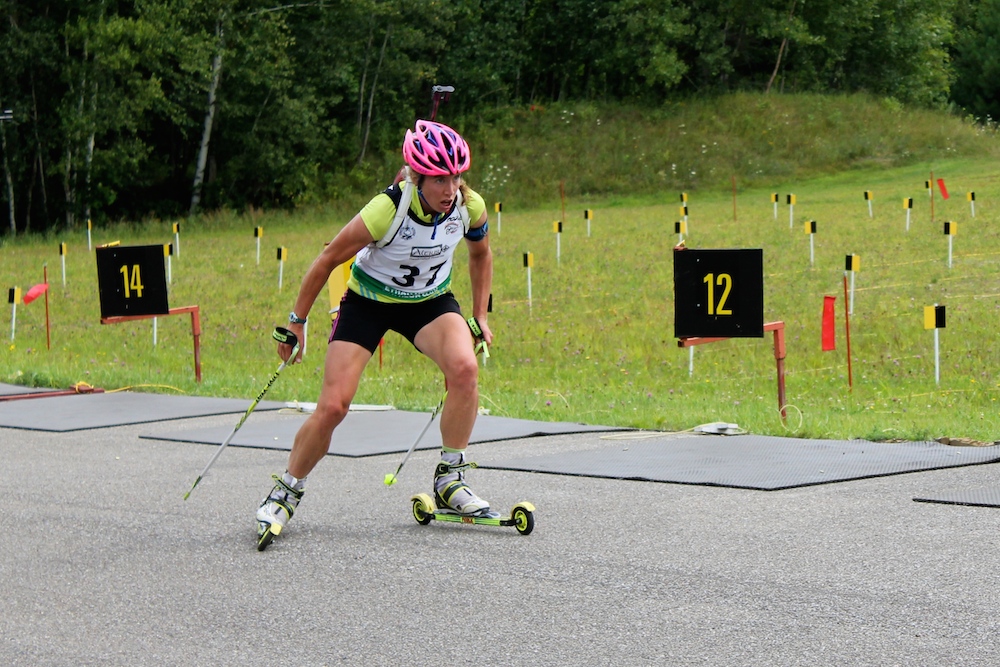
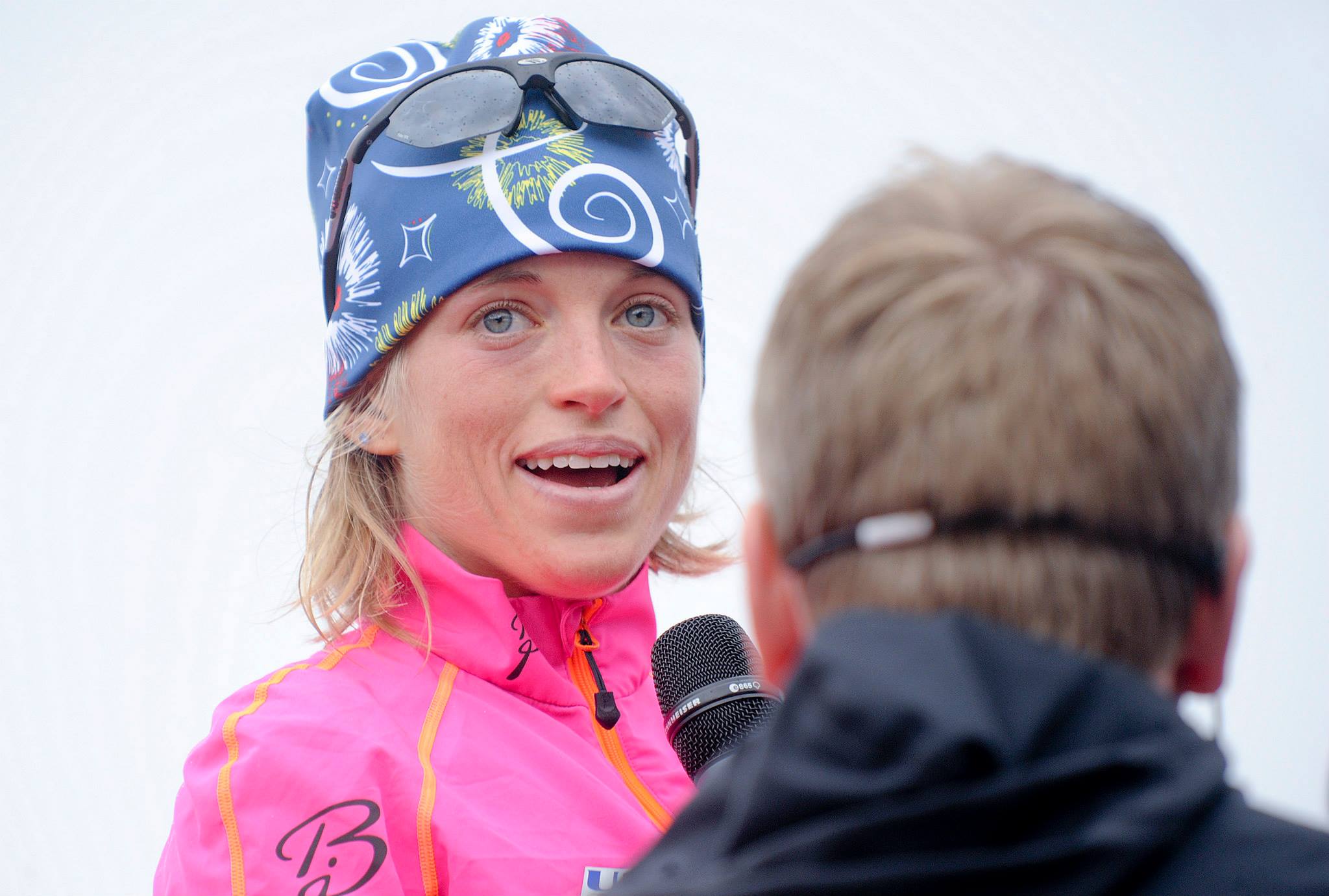
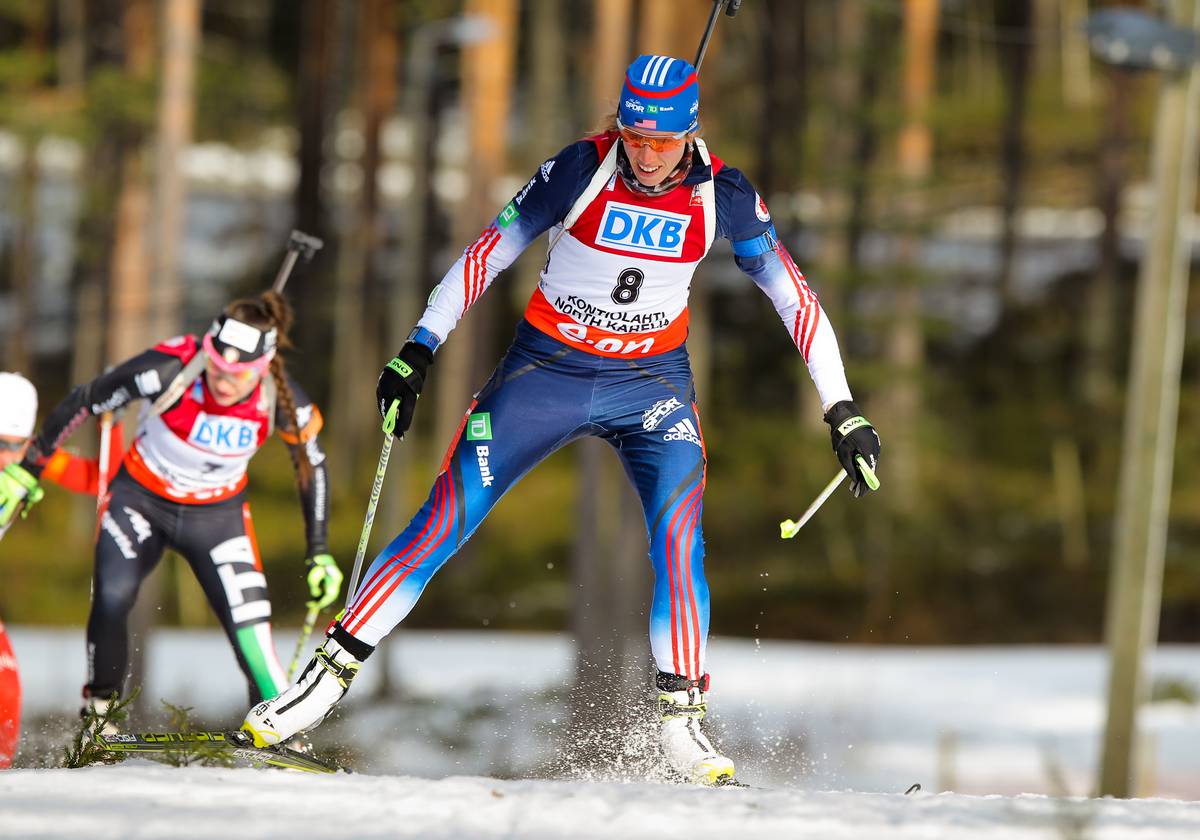
Susan Dunklee leaving the range at the 2014 North American Rollerski Championships 7.5 k sprint at Ethan Allen Firing Range in Jericho, Vt.
“I felt a lot better than I expected to, physically,” she said of her first race back. “Technique felt really strong and good and I was able to implement some of the stuff we’ve been working on in the snow tunnel. … Usually here it’s really hot; normally it’s like 90 degrees and it’s really hard to shoot and ski in those conditions. Usually the whole team struggles, but today was good for us. Better percentages overall on average.”
Dunklee described the Ethan Allen rollerski loop as one of the best that her team goes to.
“It’s got really nice hills and transitions and it skis like a normal skiers’ course does,” she said. “It’s really good practice.”
Two weeks earlier, she was racing in front of some 50,000 spectators at Blink.
“Blink was cool because it’s a very similar field to what we see in the winter in the world cups, a lot of those same big names,” she said. “They have like a two-or-three-million-dollar budget for that event. It was fantastic.”
At the same time, it was more relaxed than the in-season World Cup.
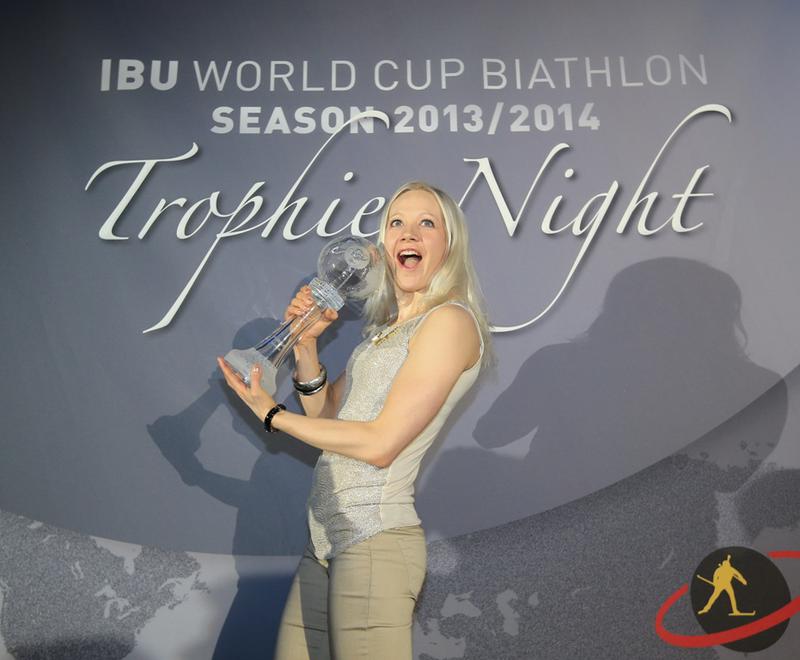
Kaisa Mäkäräinen, Finland’s IBU Overall World Cup champion, with her crystal globe at the IBU’s Trophie Night at the end of last season. (Photo: IBU/Evegeny Tumashov)
For Kaisa Mäkäräinen, everything leading up to last season was build up. In her second Olympics, the 31-year-old Finnish biathlete was aiming for the podium, more precisely — a medal, in Sochi, Russia. She had a World Championships gold and silver from 2011, and won the overall World Cup crown that same season, but the Olympics three years later were different.
In the end, her top finishes of sixth in Sochi’s mass start and ninth in the individual race were somewhat of a letdown.
“Of course winning an Olympic medal is something special, which I couldn’t do, but I had kind of accepted that because I was so sick during Sochi,” Mäkäräinen explained in a recent email to FasterSkier. “I did my best but it was mentally really hard time because I couldn’t make my normal routines before races and I didn’t even know [the] day before if I could make the whole race [the] next day! So it was really stressful time…”
Allergies were to blame, she added, but it wasn’t that simple.
“I always get a really bad cough … (you should hear me when I´m coughing..!!) and it always lasts really long,” she wrote. “I never become ‘just a little sick’ and the cough lasts easily 1-2 weeks and is worst during nights so I cannot sleep so well.”
At the Olympics, she laid awake for two nights between the individual and mass-start races, “just coughing on the sofa,” she recalled.
“I never become ‘just a little sick’ and the cough lasts easily 1-2 weeks…” –– Kaisa Mäkäräinen, 2013/2014 IBU World Cup champion on her returning bouts with illness
And she couldn’t write it off as a single, badly timed illness. Last season, Mäkäräinen was sick before the International Biathlon Union (IBU) World Cup circuit started in late November, as well as during the Antholz-Anterselva World Cup in January and the Olympics in February.
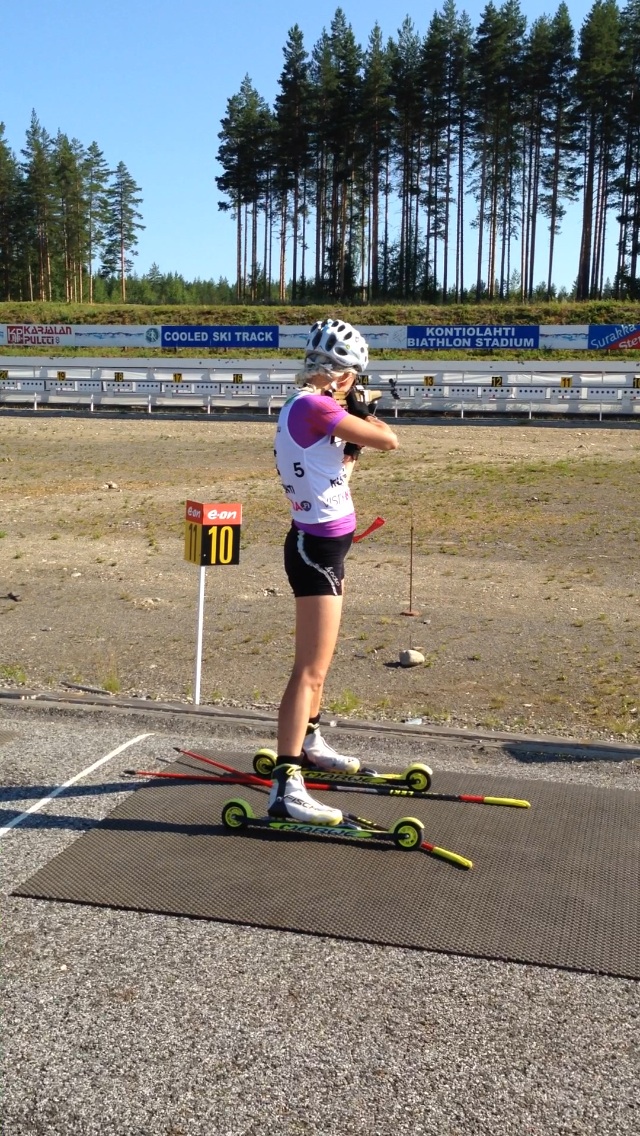
Finnish biathlete Kaisa Mäkäräinen shooting at her home course in Kontiolahti, Finland, where she hosted the U.S. women’s team in late July. (Photo: Jonne Kähkönen)
“The end of the season was super fun, I got in [the] flow and even though it was a big fight with Tora in Holmenkollen, I was finally the one who stayed more calm in last race ;)” Mäkäräinen wrote. “That race was probably the biggest win mentally in my last season.”
By early May, she was coughing again — this time for two weeks straight — sapping some motivation out of the start of her new training season.
“I didn’t get such an advantage from my World Cup victory,” she wrote. “I think I forgot that pretty soon.”
Then she lost her voice for two months.
“I spoke during those months but it was not really allowed, and my voice was really low,” she wrote. “It came back little by little to close to my normal voice in beginning of July but docs say there are still something wrong and we try to figure out what it is… I have had asthma since I was 15 years [old], so it probably just gets worse year by year and makes me more and more easily sick.”
She spent the rest of July getting back to a normal routine, training mostly by herself and her boyfriend at her home course in Kontiolahti, Finland, the site of the 2015 IBU World Championships. Late last month, she got a social-and-training boost when three U.S. women and her former coach Jonne Kähkönen visited, working out with them and showing them around the area.
“It was good training together,” Mäkäräinen wrote. “It’s nice to get some company for trainings, especially for biathlon trainings. And it was nice to show them where I train when I’m at home.”
Shooting with them helped her as well, giving her a group-pressure scenario she doesn’t experience daily. But when she’s not hiking or biking with her boyfriend, she can almost always find other skiers training at Kontiolahti, she added.
Still working with personal coach Jarmo Punkkinen, Mäkäräinen will reconvene with her team (including two other A-team women Mari Laukkanen and Markkanen Sanna) and new head coach Marko Laaksonen on Aug. 17 at a camp in Obertilliach, Austria.
Laaksonen coached the Finnish biathlon team Mäkäräinen’s first year on it in 2004/2005, but now she explained he’s more of a team leader who observes her at training camps and gives her coach feedback. She last saw Laaksonen at the team’s first camp in early June, then missed their July camp in Finland to train on her own elsewhere in Europe.
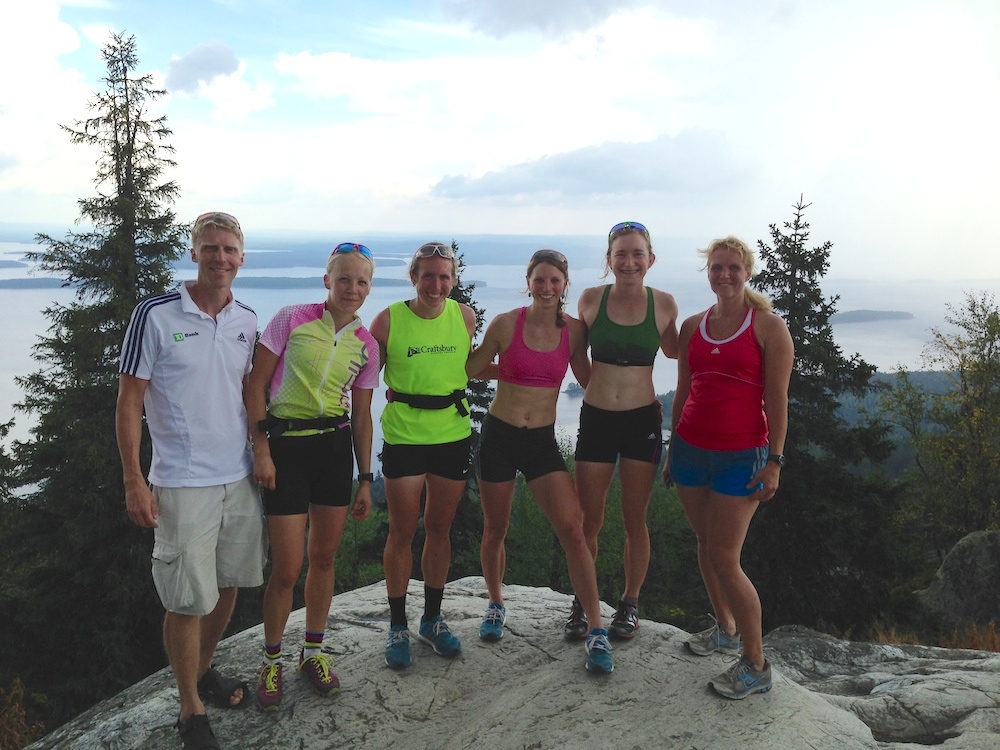
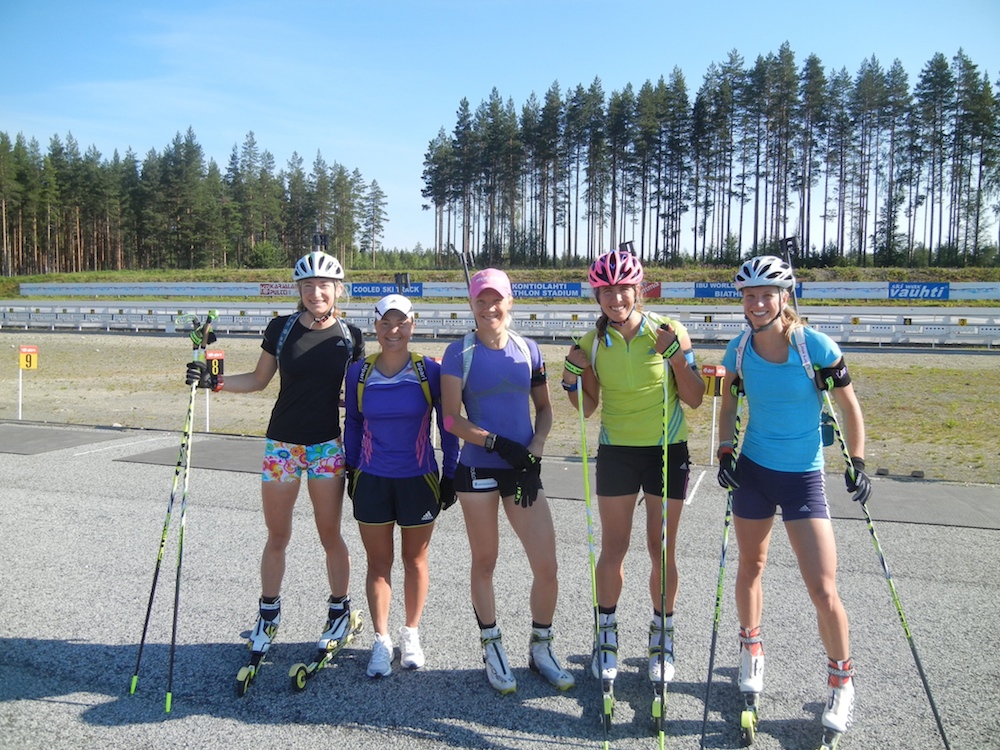
The U.S Biathlon women’s team and Kaisa Makarainen (second from l) at the top of Koli, the highest point in southern Finland, after an uphill, interval rollerski in late July. (Photo: Jonne Kähkönen)
From Aug. 1-3, she competed at the Blink rollerski festival in Norway, placing third on the first day — a 7-kilometer hill climb in Lysebotn — behind American cross-country skier Liz Stephen and Norway’s Kristin Størmer Steira, respectively. She won the race last year, but was pleased she was able to make the podium this time around.
“Blink was great, as always. I have been there five or six times (can’t remember) and go again every year to get some hard but good training in,” she wrote. “Every year after the uphill race I say myself that this was the last time here, it feels so hard to climb it… but then I go next year again. I think that in every athlete there’s little masokist [sic] inside us ;)”
She described her hill-climb result as a “nice surprise. Of course there was a big gap to Liz and Kirstin, but it’s ok … in winter we never do such a climbing races so it’s little special.” In the following 6.3 k biathlon mass start, she placed second, and was fourth on the final day of biathlon sprints.
“I think that in every athlete there’s little masokist [sic] inside us ;)”
Looking ahead to this season, she’s hoping to stay healthy.
“I just want to get a good winter … have fun, enjoy my job, not to stress too much but still have full focus and concentration to get as good result as possible in every single race I start,” she wrote.
With a home World Championships to her advantage — and sprint-and-pursuit podiums in Kontiolahti in 2012 and 2014 (including two sprint victories last season) — she explained she’ll try to enjoy every moment there from March 3-15.
“[It] will be great to live at home and sleep in own bed while others are in hotel,” she added.
While she doesn’t like the beginning of the World Championships course, with about half a kilometer of flat then a “big downhill,” she’s a fan of its uphill sections and the final “wall” back up to the range, which doesn’t allow any rest before shooting.
“That fits for me!” she wrote.
The International Ski Federation (FIS) Cross-Country World Championships will be held beforehand Feb. 8-March 1 in Falun, Sweden, and after competing at the 2013 FIS World Championships in Italy, she’s considering racing the 10 k skate in Falun.
But she’ll have to qualify for the team first and explained she doesn’t want to skip any IBU World Cup races while trying to repeat as overall World Cup champion.
“We’ll see how everything goes,” Mäkäräinen wrote.
At IBU World Championships, she’s focused on the sprint, pursuit, individual, and mass start.
“Sorry to say but relays are not so nice to run,” she wrote.
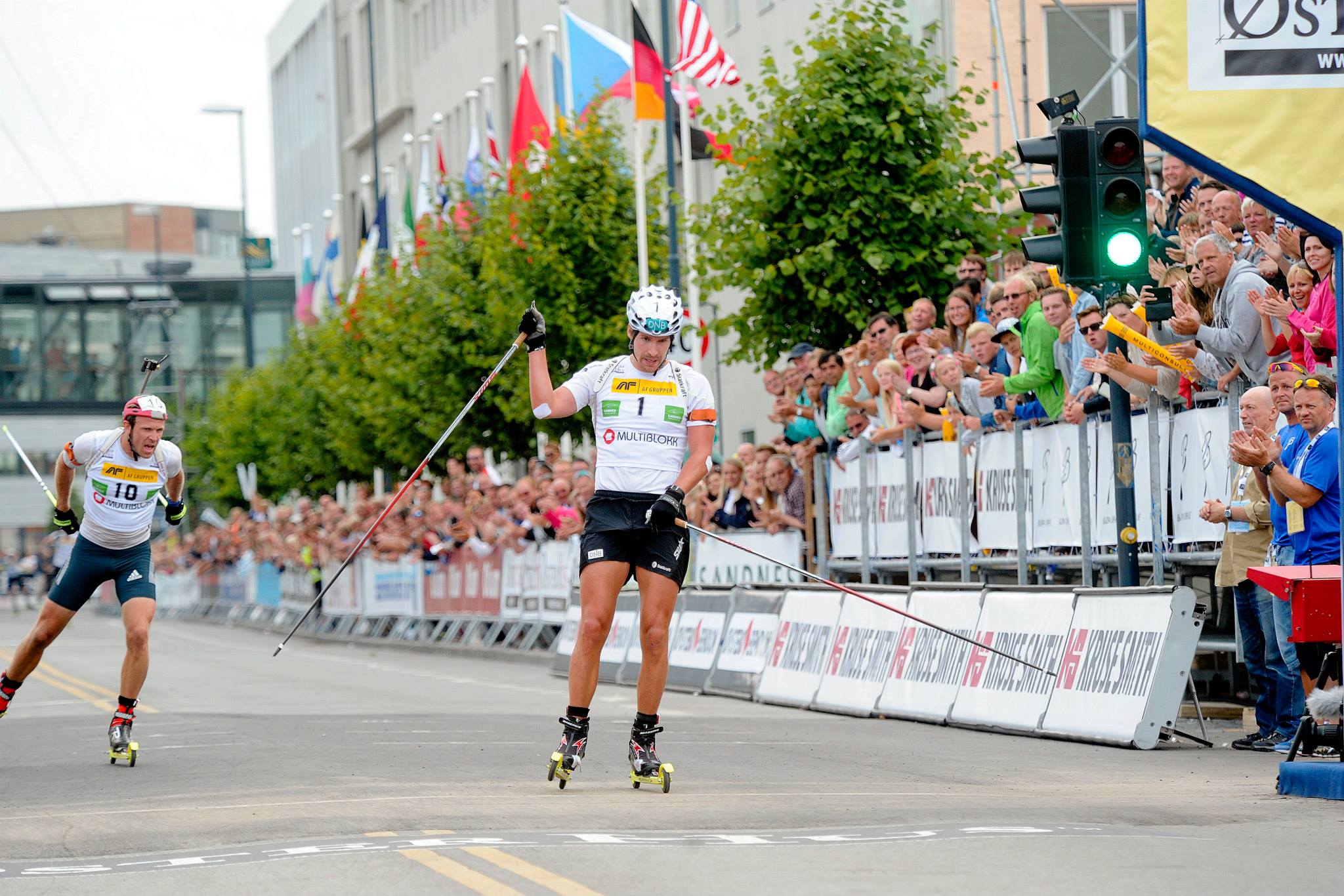
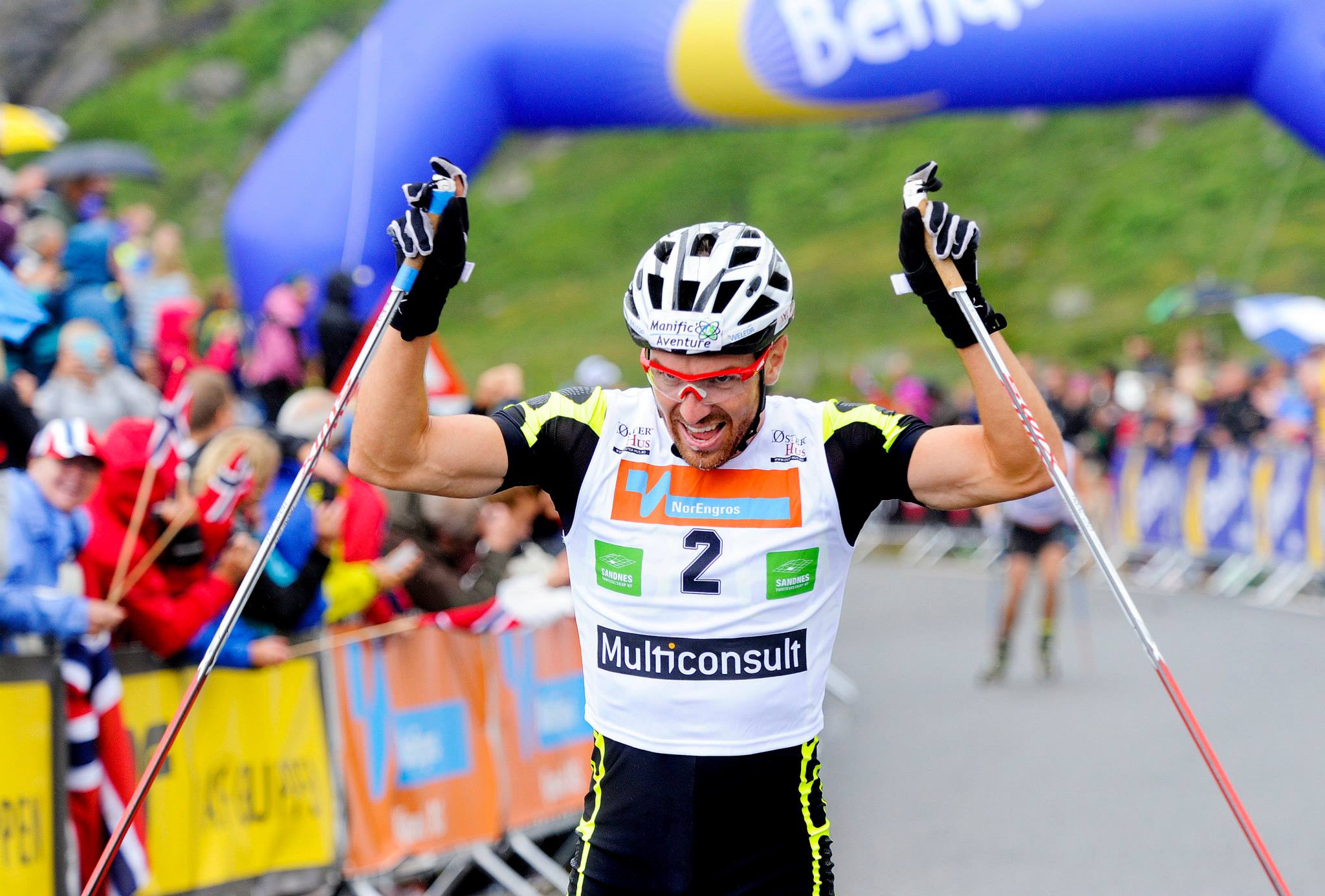
U.S. Biathlon’s Lowell Bailey (l) pushes himself across the finish line in Friday’s biathlon 6.3 k mass start as part of the 2014 Blink Festival. Bailey finished second to Emil Hegle Svedsen (r) of Norway. (Photo: Skifestivalen Blink/Facebook)
When Lowell Bailey raced in the 2014 Blink Festival 7-kilometer hill climb just days after arriving in Norway, he was jolted by a “shock to the system,” he wrote in an email.
Apparently the shock was what he needed to deliver a top-notch performance, as the U.S. biathlete finished second in the biathlon mass start the next day in the city of Sandnes.
The road to the podium wasn’t an easy one. To participate in the mass start, competitors who were not already pre-qualified needed to place in the top six in the qualification round. The round consisted of five laps of 800 meters with prone shooting following the second lap and standing following the fourth.
In a tough field, Bailey and U.S. teammate Tim Burke claimed the last two spots in the mass start by taking fifth and sixth.
Once in the mass start, Bailey knew he had to focus on his shooting if he wanted to have any hopes of placing on the podium.
“I told myself before the race that I was going to race my own race and try not to get caught up in the hurried shooting situations that always happen in this type of race,” Bailey wrote.
Throughout the race, which consisted of nine laps on a 700-meter loop, and two prone and two standing stages, Bailey often took longer to shoot but maintained contact with the lead group.
When he exited the final shooting he was the last of the four competitors he had arrived with to leave the mats.
However, his fellow competitors had rushed through their shots and had penalty loops to compete. Bailey had shot perfectly and left the range with a five-second lead over Norway’s Emil Hegle Svedsen.
Svedsen ultimately caught the American in the final stretches of the race, overcoming him by just 0.7 seconds.
Bailey was followed by Norwegian Tarjei Bø, who finished 12.9 seconds behind Svedsen.
Burke finished eighth in the mass start, 1:09.9 back.
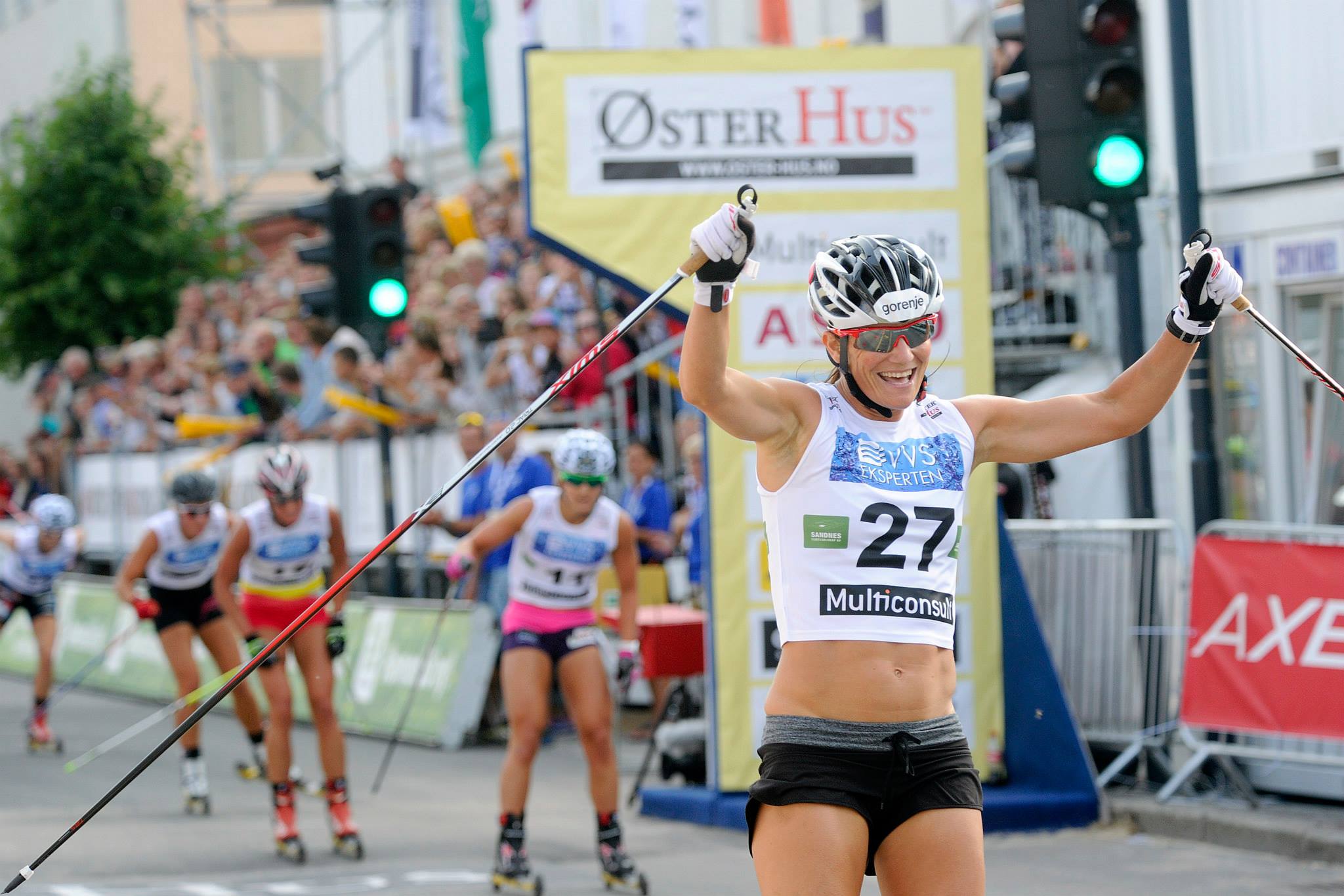
Slovenia’s Katja Visnar celebrates her victory in the women’s 10 k mass start in the 2014 Blink Festival. (Photo: Skifestivalen Blink/Facebook)
In the women’s 6.3 k mass start Fanny Wele-Strand Horn of Norway was victorious with a time of 14:10.8. She was followed by Kaisa Makarainen of Finland and Marine Bolliet of France in second and third.
American Susan Dunklee finished in eighth, 41.8 seconds behind Horn. Dunklee was one of five athletes who had pre-qualified for the mass start, but struggled with her shooting in the final.
“Unfortunately I missed a lot of prone targets early in the final and despite passing a few people on skis, I never regained contact with the main pack,” Dunklee wrote in an email.
The cross-country mass start races that took place later that day consisted of women’s 10 k and a men’s 15 k.
In the men’s race, Teodor Peterson of Sweden claimed victory for the second day in a row on the rollerski course that consisted of 18 laps around an 800-meter loop. The sprint specialist finished with a time of 28:07.3. He was followed by Norwegian Øystein Pettersen in second and Cyril Gaillard in third.
The men’s field was incredibly close with the top-23 finishers crossing the line within ten seconds of Peterson.
Canadian Devon Kershaw was one such finisher. He placed seventh, just 3.7 seconds behind the Swede and 1.4 seconds off the podium.
In an email, Kershaw explained that the curvy course and the 30 aggressive racers that populated it made for conditions he was not used to, but he was happy with how the day ended.
“I was out of position near the end and with all the curves there was nothing I could do,” Kershaw wrote. “It was a fun evening though!”
In the women’s 10 mass start, another sprint-specialist took the win. Slovena’s Katja Visnar finished with a time of 20:36.0. She was followed by German sprinter Denise Herrmann in second and Norway’s Ingvild Flugstad Østberg in third.
American Liz Stephen finished 18th. In an email, she declared the race a success in that there were no major crashes.
“It was good for my head in that I need to be less nervous about skiing in a pack close to other skiers, and after today snow seems like it should be no problem at all,” she wrote.
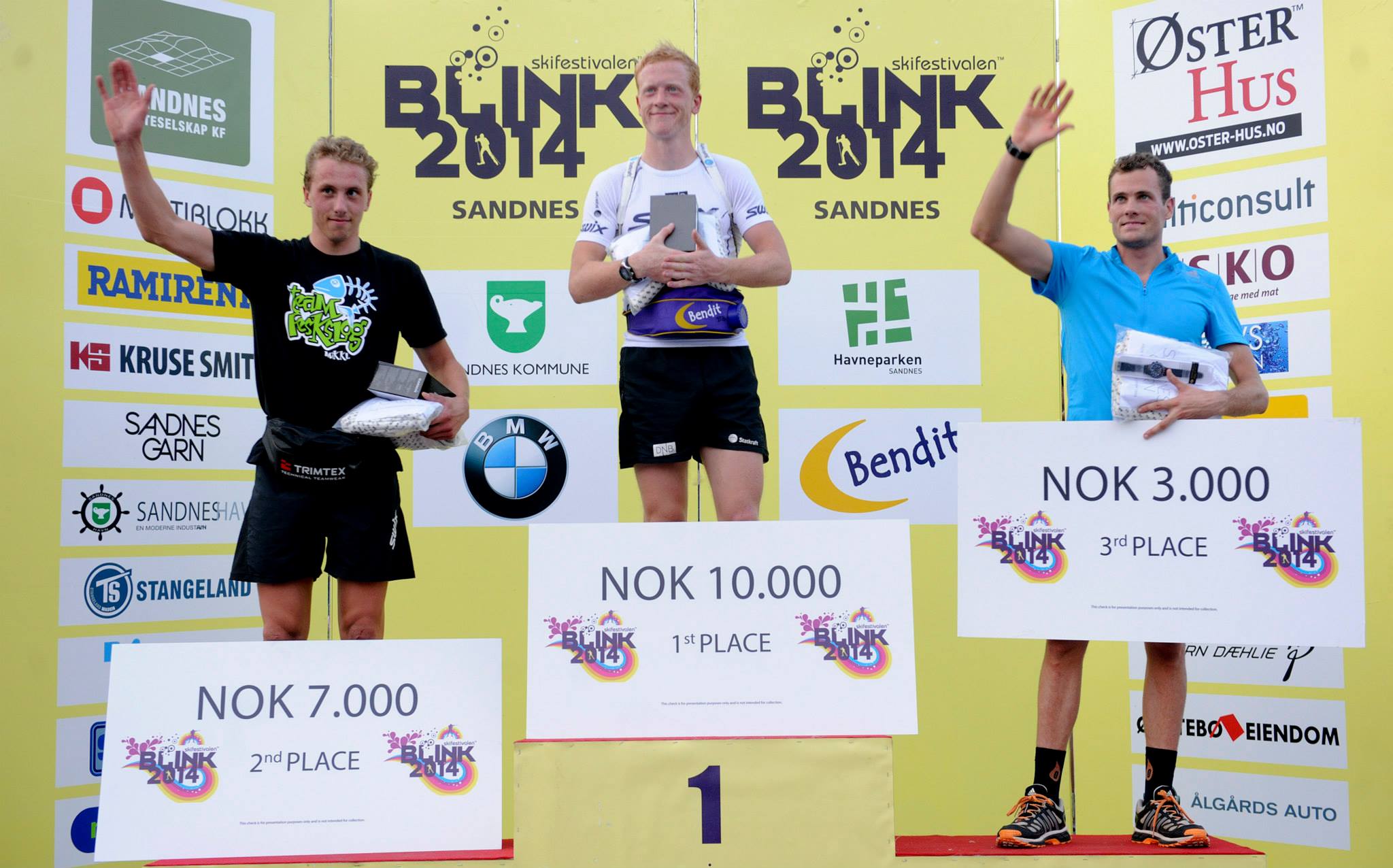
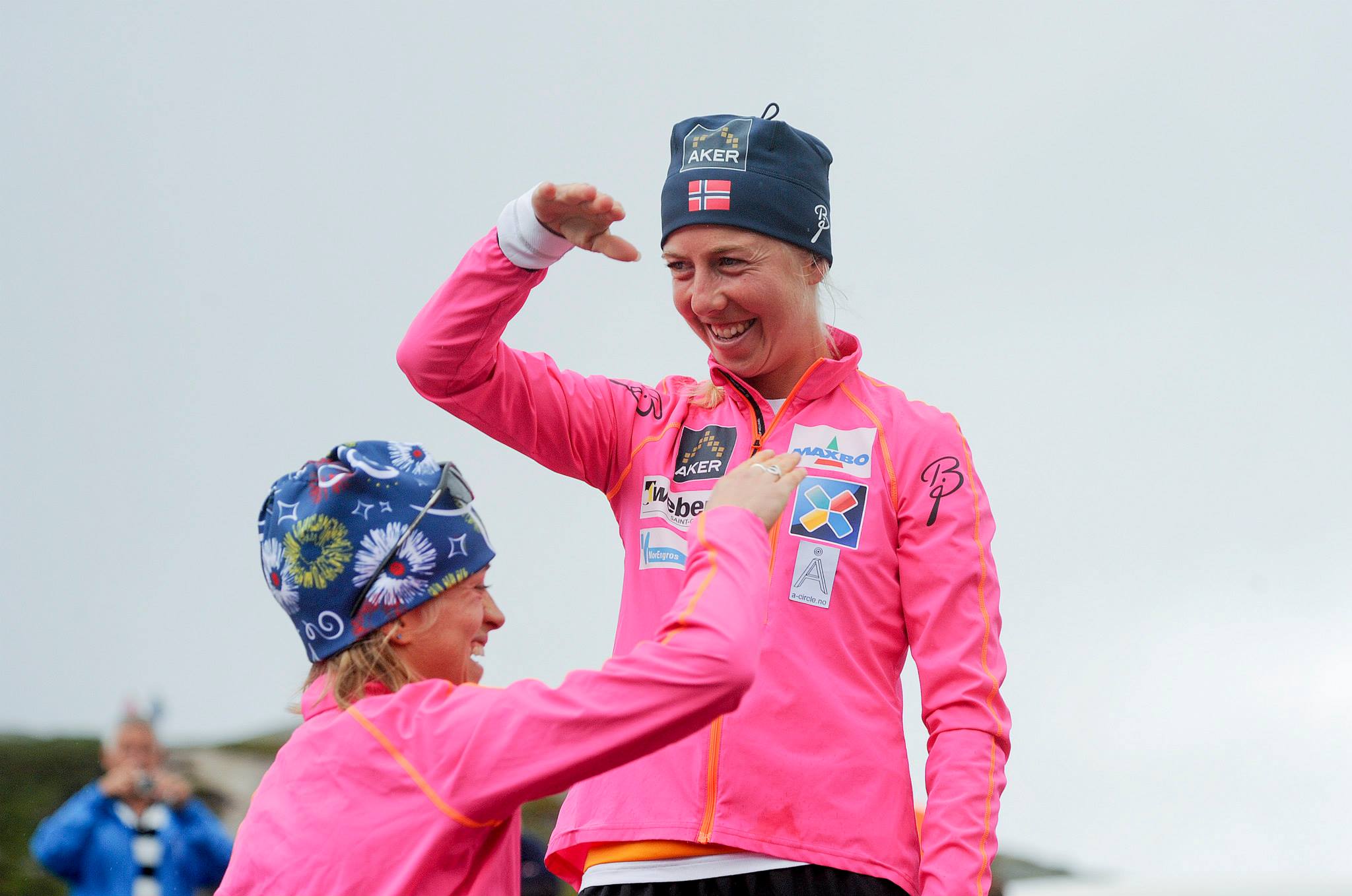
Tim Burke (r) stands on the podium of the men’s biathlon sprint Saturday at the 2014 Blink Festival. Burke finished third, completing a successful weekend for the Americans in attendance at the festival. (Photo: Skifestivalen Blink/Facebook)
Sprint Day
U.S. biathletes also shined in the final day of the Blink Festival with Burke and Bailey claiming third and sixth, respectively, in the biathlon sprint.
Burke finished 8.7 seconds behind race winner Johannes Thingness Bø of Norway, who won the final in 12:25.8. Second place went to fellow Norwegian Marius Hol who crossed the line 7.4 seconds behind Bø.
After struggling with his shooting in the mass start competition, Burke was pleased to have a strong result.
“This was a good confirmation for me that I am headed in the right direction for the winter season,” he wrote.
It was the first time the 32-year-old American had ever competed in heats for a biathlon race, which he found both unique and challenging.
“I would say the shooting in this type of race is actually harder than a normal biathlon race because you are basically sprinting all out for 1 k before each shooting stage,” he wrote.
Bailey finished sixth, 22.7 seconds behind the winner.
In the women’s biathlon sprint, Dunklee placed sixth in her semifinal and did not advance to the final. The women’s biathlon final was won by was won by Bolliet, who was followed by French teammates Enora Latuilliere and Anais Chevalier in second and third, respectively.
In the cross-country sprints, Norway’s Marit Bjørgen topped the women’s final. She edged teammate MaikenCaspersen Fallafor the win by just 0.1 seconds. Visnar placed third, 1.1 seconds behind Bjørgen.
Stephen was unable to advance from the quarterfinals.
Sondre Turvoll Fossli of Norway won the men’s final in 3:08.1. He was followed by another Norwegian Martin Hammer in second and Sweden’s Peterson in third.
Liz Stephen completes an interview after winning the 2014 Blink Festival opener by 27 seconds. (Photo: Skifestivalen Blink)
Liz Stephen already has the reputation as one of the best hill climbers in the world. Whether it’s the Tour de Ski’s final stage or Lake Placid’s Climb to the Castle, it seems like Stephen’s constantly on the up.
The trend continued in Thursday’s Blink Festival opener, a 7 k uphill rollerski race in Lysebotn, Norway. With a time of 32:53.9, Stephen won the hill climb by 27.3 seconds over Norwegian Kristin Størmer Steira who finished with a time of 33:21.2.
In third place was last year’s hill climb winner, biathlete Kaisa Mäkäräinen of Finland, who finished 1:33.7 behind Stephen.
Having finished third in the same event in the 2012 Blink Festival, Stephen had high hopes of winning the esteemed 2014 rollerski race. However, Stephen knew that she needed a concrete plan in order to top the challenging competition. Knowing that she couldn’t rely her finishing sprint, Stephen decided to set a hard place from the beginning and break away with 2 k left in the race.
Liz Stephen and Kristen Størmer Steira congratulate each other after finishing first and second in the 2014 Blink Festival opener. (Photo: Skifestivalen Blink/Facebook)
“I turned up the speed with about 1.5 k to go when the body was still feeling pretty good, though quite tired, and it worked out in my favor today,” Stephen wrote in an email. “It was really fun to ski with Kristin [Størmer Steira] the whole race until then and I am really happy to have been able to come away with a win today.”
The only other American to compete in the women’s race was biathlete Susan Dunklee, who finished in 21st position with a time of 38:43.9.
Dunklee, who just came off a large training block in Finland, said her legs felt heavy in the climb due to the recent volume of training but that she felt her result was solid.
In the men’s race, France’s Maurice Manificat won the 7 k hill climb with a time of 29:57.2.He was followed by Norweigians Martin Sundby and Sjur Røthe in second and third.
The first North American finisher in the men’s race was American biathlete Tim Burke who placed 15th with a time of 32:17.4.
Burke and 35th place finisher and teammate Lowell Bailey arrived in Norway only several days prior to the Blink Festival. Burke called the race both a “shock to the system” and “really tough,” but said he was pleased with his effort.
“I am not in my best shape, but I was really happy with my effort,” Burke wrote in an email. “It was a great experience to race with some of the best biathlon and cross country athletes on such a challenging course.”
Maurice Manificat of France celebrates his win in the 2014 Blink Festival hill climb. (Photo: Skifestivalen Blink/Facebook)
Bailey agreed, stating that “extended uphill races are definitely not my forte” but that he was still happy with the race.
“If nothing less, it’s a good wake up for the body after traveling,” he wrote in an email.
Canadian Devon Kershaw also competed and finished 20th.
The Blink Festival continues Friday with a 10 k criterium race which will take place around a 900 meter loop. Stephen plans to ski aggressive as possible while staying on her feet.
“It can be terrifying to ski in a tight pack on roller skis when there is a lot of opportunity for crashing, but my goal is to relax and try to ski in the pack and work on my cornering and agility tactics in a tight pack,” she wrote.
For all three American biathletes, the plan is to race in the remainder of the Blink Festival biathlon competitions, which include a mass start competition and a sprint race.
“This is a great opportunity for me to test the techniques and shooting skills that I have been working on this year,” Burke wrote about the remainder of the Blink Festival. “I hope to qualify for the mass start competition [Friday]. It will definitely be a challenge, since they will only qualify five guys from around 50 competitors.”
The U.S. Biathlon Women’s A-team, including Hannah Dreissigacker (l), Susan Dunklee (second from r) and Annelies Cook (r), with Russia’s Ekaterina Yurlova (second from l) and Finland’s Kaisa Mäkäräinen (c) at the 2015 World Championships range in Kontiolahti, Finland. (Photo: Jonne Kähkönen/USBA)
When the U.S. Biathlon women step out onto the trails at Kontiolahti, Finland, next March, there should be some muscle memory that comes into play on the 2015 International Biathlon Union (IBU) World Championships course.
They’ve been spending the last two weeks there, rollerskiing and testing their technique and fitness the loops, and learning more about the course and Finnish culture with reigning Overall World Cup champion Kaisa Mäkäräinen.
On July 20, the three 2014 U.S. Olympians and women’s A-team members — Susan Dunklee, Annelies Cook and Hannah Dreissigacker — arrived in Kontiolahti, about 450 kilometers northeast of Helsinki. There, U.S. Women’s Coach Jonne Kähkönen set up several training sessions with Mäkäräinen, his former athlete, who also took the team orienteering, to her favorite local swimming holes, and joined them for a barbecue.
Susan Dunklee racing to seventh in the IBU World Cup pursuit last March in Kontiolahti, Finland. (Photo: USBA/NordicFocus)
“It has been helpful to try to keep up with her on skis and have a few head-to-head shooting duels,” Dunklee wrote in an email. “Ekaterina Yurlova from Russia joined us one morning as well. A few Finnish juniors also joined us for a time trial. It can be difficult in the race season to really get to know athletes from other countries, but it is a lot easier in the summer when everything is more relaxed.”
On Wednesday, Dunklee flew to Norway with Mäkäräinen to compete in the Blink rollerski festival from Thursday to Saturday in Sandnes and Lysebotn. She will be the first U.S. female biathlete to race in the world-famous event, and plans to do the uphill climb and biathlon races at Blink.
“I am most excited about the opportunity to get lots of head-to-head shooting practice against some of the world’s best under the pressure of a race,” she wrote. “That is something that is very difficult to simulate in the training season, so it will be a valuable experience.”
Before her team’s camp in Finland, Dunklee spent her rest week backpacking between huts in Norway. Despite hiking one day for more than nine hours by herself (after bypassing one hut to get to the next), she described it as relaxing.
“The week in Norway was good for the soul,” she wrote. “Sometimes your head needs some recovery too.”
In Kontiolahti, the U.S. women did most of their rollerski-combo workouts at the World Championships range, familiarized themselves with the course’s climbs, and experimented with corners and transitions throughout the loops, Dunklee explained.
“Of course skis move a lot differently than rollerskis, and even in the winter, we have to be prepared to adapt our skiing style day-to-day based on snow conditions,” she added. “This course has one steep wall that I absolutely love (mostly because I know lots of other athletes hate it) and the terrain suits my strengths: V1 and V2 alternate.”
“This course has one steep wall that I absolutely love (mostly because I know lots of other athletes hate it)…” — Susan Dunklee on Kontiolahti’s 2015 IBU World Championships course
Cook explained that her main goal at the Scandinavian camp (with another stop at the Torsby ski tunnel in Sweden next week) was to focus on quality training without distractions.
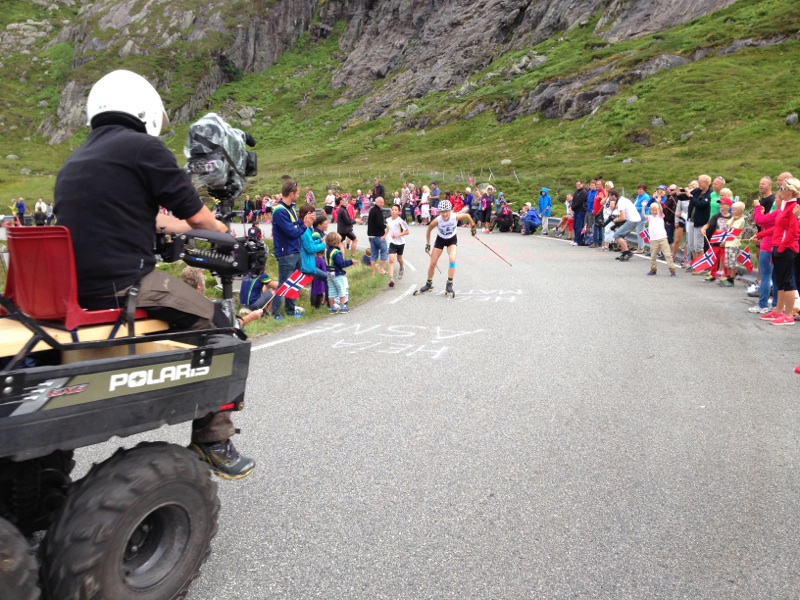
Finland’s Kaisa Mäkäräinen climbing to a victory in the Lysebotn hill climb last season at the Blink Festival in Norway. The 2014 edition of the race took place Thursday, with Makarainen and Americans Susan Dunklee and Lowell Bailey competing. U.S. cross-country skier Liz Stephen won the women’s race. (Photo: blinkfestivalen.no)
“I hate missing out on life and sometimes at home that means I get overwhelmed trying to do everything,” she wrote. “Here in Finland, I can just keep it simple. I also want to do that for training — to keep working on confident shooting and skiing, but keeping it really simple and intuitive.”
While in Kontiolahti, the team stayed at cabins at a campground near town, Cook explained. They commuted on trails with a cruiser bike, visiting lakes and picking blueberries along the way. Outside of training, they didn’t have to worry about too much; Kähkönen’s wife cooked them Finnish meals and treats.
Mäkäräinen also went out of her way to accommodate the Americans.
“It was great for me to get the chance to ski against her in a normal time trial just to see where she is better than me,” Cook wrote. “We also have a small group so it is great to have one extra person around to mix it up!”
Dreissigacker explained that it had been fun getting to know Mäkäräinen better.
“It makes you realize that the World Cup leader is just a normal, hardworking person,” she wrote.
“It makes you realize that the World Cup leader is just a normal, hardworking person.” — Hannah Dreissigacker on training with Finland’s Kaisa Mäkäräinen
Finishing up their second week in Kontiolahti, Dreissigacker described the beautiful weather and valuable training they’d experienced. Even a windy day, like Thursday, made for good practice on the range.
“It’s a unique course with some really steep big hills, but also a lot of flat,” she added. “So it’s good to get more practice skiing here.”
“The world championship course is just hard,” Cook wrote. “There is a massive uphill wall that is going to be a killer no matter what way you slice it. But it is cool to try some things that will make it faster to ski up so the suffering has a bigger payout!”
In Torsby, Cook and Dreissigacker will meet up with other U.S. Biathlon teammates (including Dunklee) and shift to snow for technique work and ski testing.
“It will be fun to have the entire team there — men, women, techs and coaches,” Dreissigacker wrote. “The team atmosphere is always a lot of fun when we’re all together.”