From the FasterSkier archive — posts syndicated from athletes’ and coaches’ own blogs between 2004 and 2012, kept online as published. Current coverage is at fasterskier.com.

Tag: 2014 Canadian Olympic Team

  • Webster 42nd in 10 k Classic as Canadians Struggle Through Slush

    Webster 42nd in 10 k Classic as Canadians Struggle Through Slush

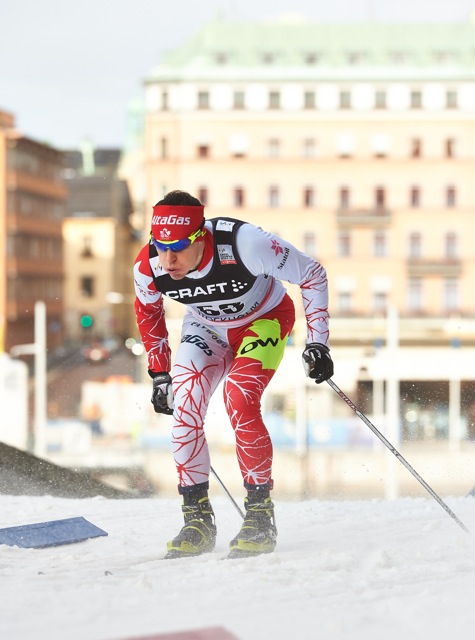
    Dasha Gaiazova (Canadian World Cup Team) racing to 44th in Thursday's 10 k classic individual start at the 2014 Olympics in Sochi, Russia.
    Dasha Gaiazova (Canadian World Cup Team) racing to 44th in Thursday’s 10 k classic individual start at the 2014 Olympics in Sochi, Russia.

    FasterSkier’s coverage is made possible through the generous support of Rudy Project.

    SOCHI, Russia — It’s not every Winter Olympics that athletes have to deal with temperatures soaring above 12 degrees Celsius and racing in slush.

    Three of four of the Americans wore either T-shirts or sleeveless tops in the women’s Olympic 10-kilometer classic individual start, and while the Canadians were in white (as opposed to the black U.S. suits), it was still hot out there.
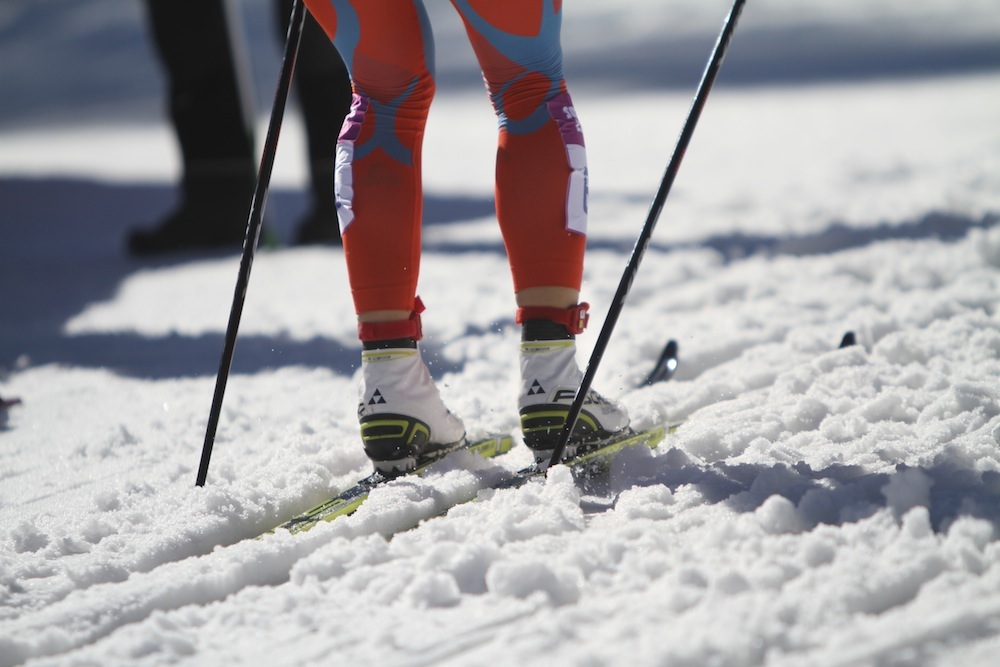
    Slushy snow during the womem's 10 k classic individual start on Thursday at the 2014 Olympics in Sochi, Russia.
    Mashed-potato-like snow during the womem’s 10 k classic individual start on Thursday at the 2014 Olympics in Sochi, Russia.

    Brittany Webster started to cramp a kilometer or so into the two-loop race, with the first half around on the upper part of the trails at the Laura Cross-Country Ski Center and the second lap down a roughly two-minute descent, and then back up again.

    “It was a total battle with my mind,” Webster said after placing 42nd, the best result of four Canadian women.

    “I felt good off of the start and then one minute in you’re like, ‘Oh man,’ and then you see people kind of skiing away and you can’t keep up with them. It’s hard not to think, ‘I wonder what’s gonna happen for the rest of the race. Oh my god, I’ve only done 2 k and I’m already cramping!’ You just have to play a mind game and basically say, ‘Stop! No! Look where you are; concentrate on that climb.’ ”

    Once she got through the first half of the race, the 26-year-old Toronto native started to feel better on the long downhill.

    “I think I was able to breathe it out and not create as much lactate on the shorter [climbs] which made it a lot better,” Webster said. “The conditions, too, it was a little hard to stay on my feet. I crashed twice, one just randomly going up an uphill. Both of them were in the back of the course over there, definitely the safer parts of the course, but it happens in these conditions. It’s thick, it’s soupy, but I really find it fun out there.”

    Webster also wasn’t complaining about the 12 degree Celsius temperatures and accompanying sun. But she said it was difficult to determine whether she drank too much or too little sports drink that led to the cramping.
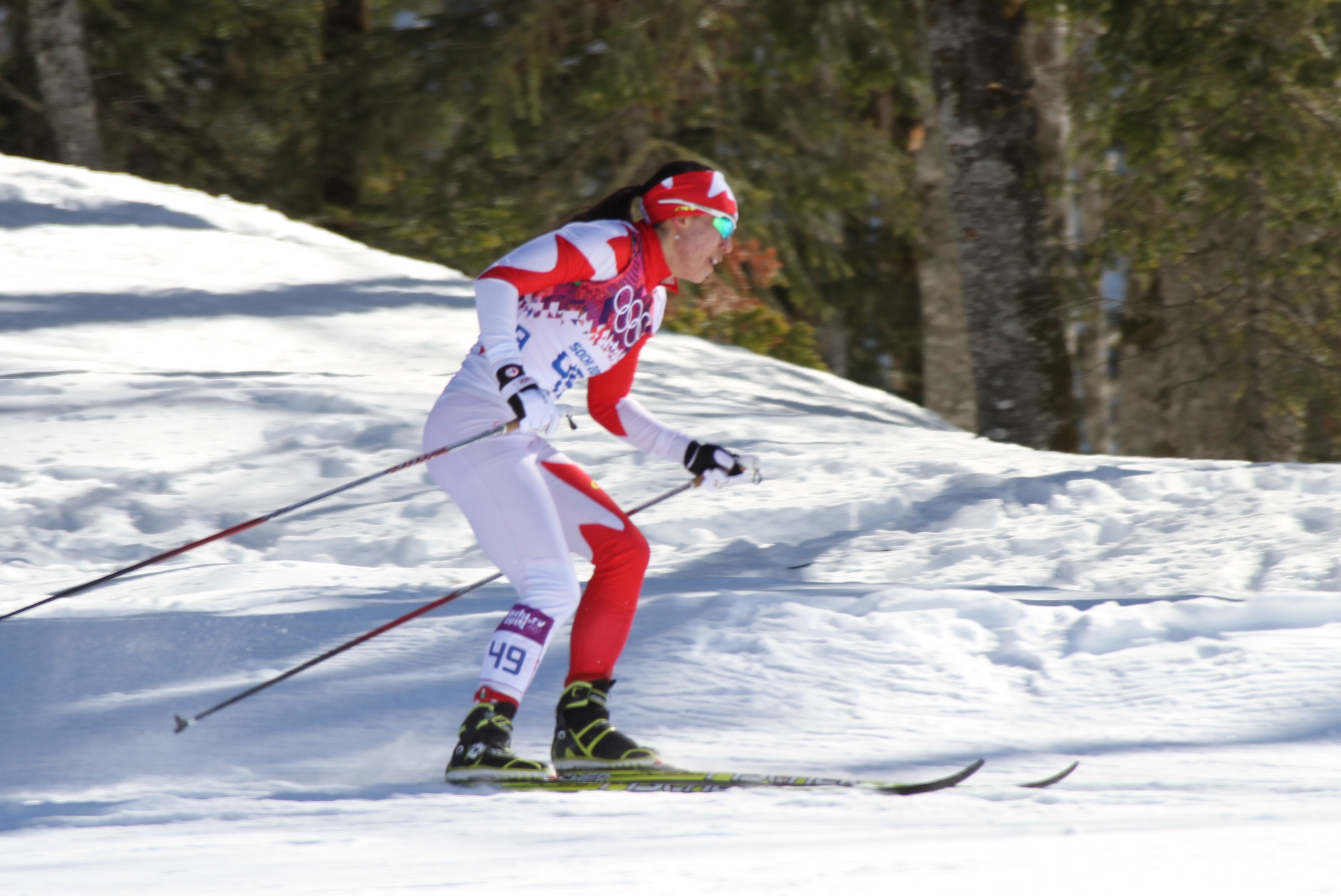
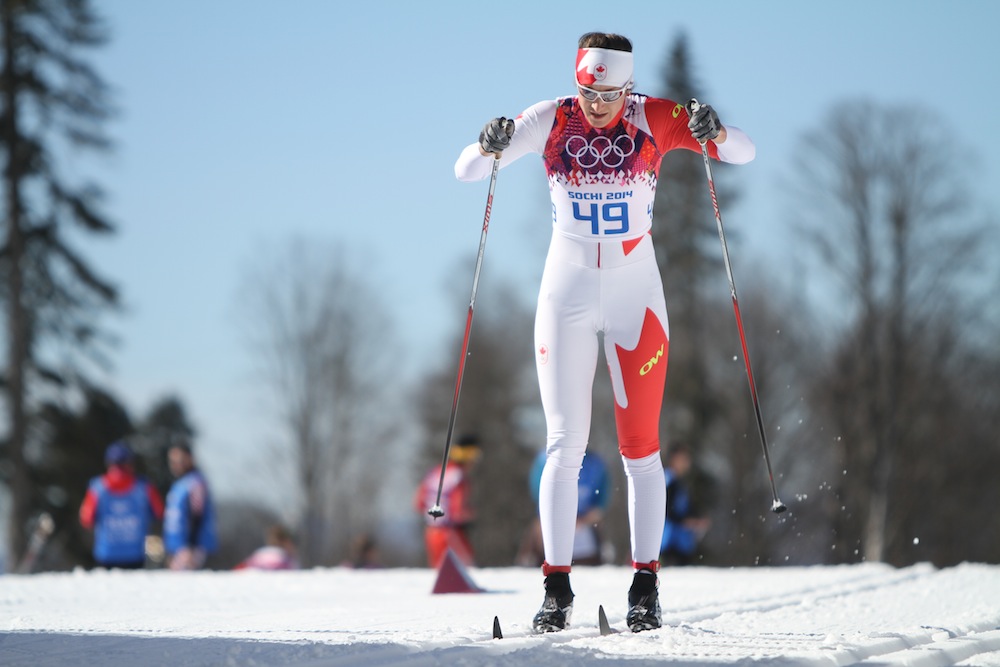
    Canada's Brittany Webster racing in the women's pursuit at the Olympics in Sochi, Russia.
    Canada’s Brittany Webster racing in the women’s pursuit at the Olympics in Sochi, Russia.

    After Webster finished 3:23.2 minutes behind the race winner, Poland’s Justyna Kowalczyk (who won in 28:17.8), Dasha Gaiazova was another 6 seconds back in 44th.

    Gaiazova had started 30 seconds ahead of American Ida Sargent, and Sargent caught her quickly. The two skied together for much of the race, yo-yoing back and forth as Gaiazova carried more speed through the downhills and Sargent took the lead up the final long ascent back toward the stadium. Sargent ended up beating her to the line and ended up 34th, nearly 32 seconds ahead.

    “It was definitely a very difficult one for me, but at the same time I don’t do many 10 k’s,” Gaiazova said in the second race of her second Olympics. “The last one I did was in Lenzerheide at the Tour de Ski and that was awful.”

    There, in Switzerland on New Year’s Day, she placed 59th of 63.

    “I didn’t have many expectations today, just wanted to really push it,” Gaiazova said. “I’m relatively happy. I wish I could’ve been a little faster maybe on the downhills and the flatter sections, I’m not used to pushing so much. I’m used to glide and relax.”

    While Gaiazova said she could’ve used more glide, Canadian head coach Justin Wadsworth suggested that was not the way to go on this course and in these conditions.

    “Everyone’s gonna be on klister and there’s only so much speed you can find with klister, especially in these conditions,” he said. “I think if you make the choice to go light on kick, I don’t know what you’re thinking, but you better be ready to tough it out with your arms because there’s a lot of climbs. In some ways, I think it almost becomes more of a who’s ready to suffer and slog it out.”

    Gaiazova and Heidi Widmer were two of the team’s sprinters in the distance race. The Canadian national team brought three distance skiers to the Olympics — Webster, Amanda Ammar and Emily Nishikawa —  but Nishikawa recently came down with a cold.

    Ammar placed 55th (+4:31) and Widmer was another 13.1 seconds back in 57th in her second race of her Olympic debut.

    “It was hard today; I’m struggling at these Olympics,” Ammar said in her second Olympics since the 2006 Games. “I had a tough lead-in with my skis getting all broken and a lot of stress leading up to the Games so i’m just trying to do the best I can and push the best I can and I did that today, but I think the results will not please me when I see them.”

    Ammar said her skis were damaged in transit while flying into St. Petersburg when the flight company put her ski bag in an elevator and “taco-ed” her bag. Fischer helped her repair four of them, she said.

    “Already it’s a tough course and then you add the hot weather and the slow conditions and it makes for a mentally tough day for sure,” she said.
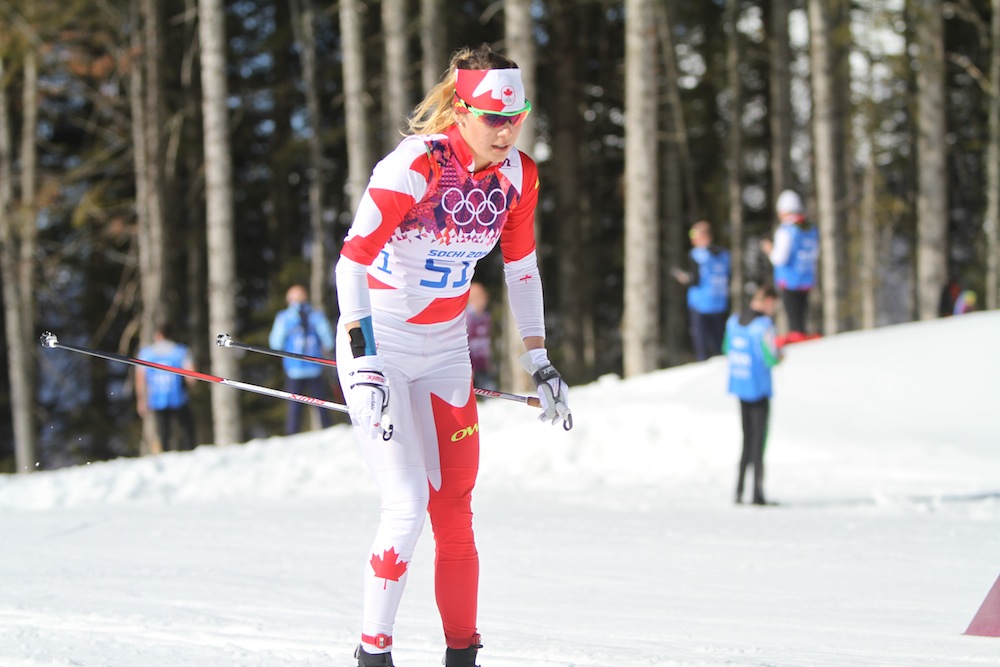
    Heidi Widmer (Canadian Senior Development Team) racing to 57th in Thursday's 10 k classic individual start at the 2014 Olympics in Sochi, Russia.
    Heidi Widmer (Canadian Senior Development Team) racing to 57th in Thursday’s 10 k classic individual start at the 2014 Olympics in Sochi, Russia.

    “It’s a tough race for them and obviously they’re not in the world-leading shape,” Wadsworth said of Webster, Ammar and Widmer. “But I like the effort that Brittany and Amanda and Heidi put out there today. It’s not easy skiing towards back of the pack and having no confidence. I’ve been there and it sucks.

    “I’m concerned for the focus of some of our women’s team,” he added. “We are at the Olympics and there are a lot of people working hard for them, as well as a lot of resources that have gone into them. I hope all our women are giving it their all, and preparing as best they can for each race. That’s all I ask.”

    Widmer, 22, who filled in for Nishikawa, said she’s had some tough moments in her first Olympics, but tried to keep them in perspective throughout Thursday’s race.

    “I feel pretty defeated, but these are the kind of races you think about in the summer and you’re like … ‘When I go back there I’m gonna train that much harder and that much smarter to make improvements,’ ” she said. “Looking up the last hill and being like, ‘Next time I do this it’s gonna seem that much easier. Every little failure you make is an opportunity to improve on it.’ ”

    For Widmer, who specializes in skate sprints, she tried to think about being as smooth as possible and efficient with where she expended her energy.

    “I had a pretty good idea that I would be able to start this race,” she said. “It’s really, really unfortunate that Em Nish came down with a cold. She is the princess, I should stay, queen of classic 10 k’s … but she’s making a smart decision taking care of her body first. I’m just lucky that I had a chance to start the Olympics and just absorbing as much as possible.”

    Two days ago after placing 43rd in the skate-sprint qualifier, Widmer said she tried to FaceTime her parents on her phone during her cool down. Without a wireless connection at the venue, she gave up on it for the time being, and put her phone in her pocket.

    “Running around the athletes village … I heard it in my pocket and then I saw them all in their sleeping gowns up in the middle of the night and I just broke down crying,” Widmer said. “Our sports psych explained it as your pyramid of support, so the stronger and wider that base of support is the stronger your summit of the pyramid is going to be.”

    Thinking back to seeing her parents, two brothers and her sister and their significant others and her dog, she recalled: “They’re the best … Those are the kind of things that really put it in perspective.”

    Results

  • How Webster, Ammar Earned Additional Spots on Canada’s Olympic Team

    How Webster, Ammar Earned Additional Spots on Canada’s Olympic Team

    Amanda Ammar (Team Ninja) leads Brittany Webster (Highland Trailblazers) in the 15 k skiathlon on Jan. 12 at 2014 Canadian Olympic Trials in Canmore, Alberta. (Photo: Angus Cockney)
    Amanda Ammar (Team Ninja) leads Brittany Webster (Mito Canada) in the 15 k skiathlon on Jan. 12 at 2014 Canadian Olympic Trials in Canmore, Alberta. (Photo: Angus Cockney)

    Editor’s Note: With the Olympic Games set to kick off in earnest with the Opening Ceremony on Friday night (Moscow Time Zone, 9 hours ahead of EST), the Canadian National Cross-Country Team is ready to go in the mountain village of Krasnaya Polyana, where it’s been training for the last few days. This article explains how their team grew by two just a few weeks before the Olympics, and shortly after the official nomination.

    ***

    On Jan. 14, Cross Country Canada (CCC) nominated 11 athletes to its 2014 Olympic squad: a roster that included seven prequalified World Cup skiers, plus an additional two men and two women.

    Over the next week, teams like the U.S. also announced their Olympic picks, with the U.S. nordic team opting to use 14 of its 17 allotted quota spots. Nations that chose not to fill their quotas for various reasons, limited support-staff accreditation being one of them, gave countries like Canada the option to bring more athletes.

    By Jan. 23, the CCC appeals process was in its final stages regarding the selection of its own team — a policy designed to ensure member athletes get fair treatment when it comes to decisions that “may include, but are not limited to, carding, contract matters, harassment, selection and discipline,” according to the document.

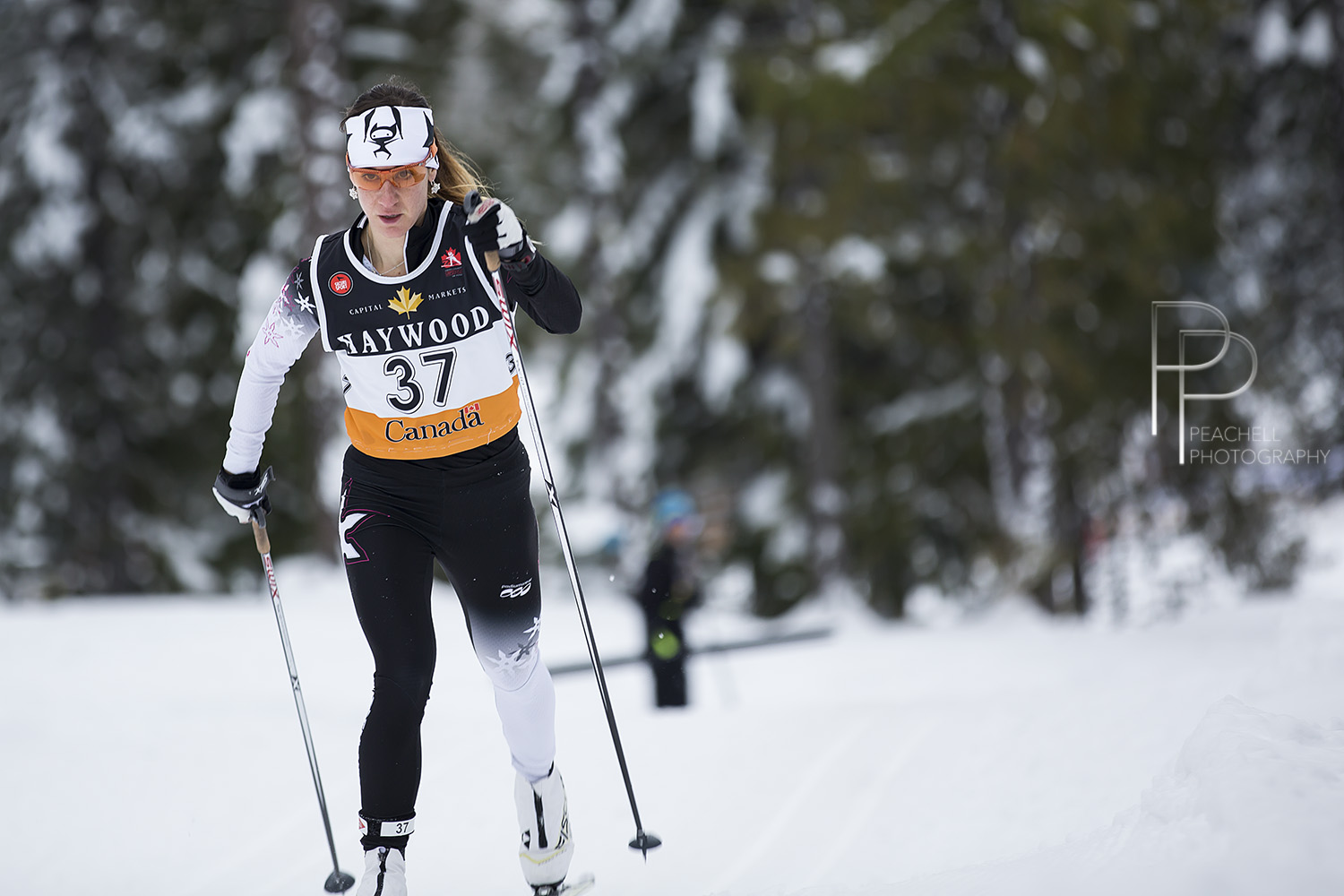
    Amanda Ammar (Team Ninja) racing to third in the Black Jack NorAm 10 k classic individual start on Dec. 15 in Rossland, B.C. (Photo: Shelley Peachell/Peachell Photography, http://peachellphotography.com/)
    Amanda Ammar (Team Ninja) racing to third in the Black Jack NorAm 10 k classic individual start on Dec. 15 in Rossland, B.C. (Photo: Shelley Peachell/Peachell Photography)

    Two former national-team members who narrowly missed the Olympic cut based on their  Canadian Points List (CPL) standings after Olympic Team Trials — Brittany Webster (Mito Canada) and Amanda Ammar (Team Ninja) — stepped forward.

    “If an athlete is not satisfied with the decision of a selection committee in any of our selections, they can appeal internally within Cross Country Canada,” CCC High Performance Director Thomas Holland explained on the phone. “They go to the president, he [sends it to] another panel to hear the appeal.”

    With the Olympics three weeks away and a panel typically having up to 21 days to hold a hearing, CCC rejected one of the appeals because of the short time frame, Holland explained. In that instance, athletes can go to Sport Dispute Resolution Centre of Canada (SDRCC) to have their appeal reconsidered.

    “That’s what Amanda Ammar did,” Holland said. “So then you basically have a hearing for both sides and there’s an arbitrator who decides the case.”

    Based on CCC’s published criteria, which stated it could take up to 12 athletes to the Olympics, Webster was the first one in the door after CCC accepted her appeal.

    “The criteria was a little ambiguous on one point, so she made a case internally to appeal,” Holland explained. “It was all friendly fire anyway. She brought that case forward for the ambiguity in the criteria, which was really looking at the second-place finish [at Olympic Trials].”

    Reviewing Olympic Trials

    The team’s selection process consisted of a prequalification stage at the World Cup level, followed by a series of NorAm races in early January in Canmore, Alberta, which doubled as trials. In addition to the seven World Cup athletes that prequalified, CCC planned to take four more athletes from the results of those trials: a male and female sprinter, and a male and female distance skier.

    For three out of the four disciplines, the decision was clear.

    Heidi Widmer of the Alberta World Cup Academy (AWCA) and National Senior Development Team (NST) won the second freestyle sprint after placing second in the first one to Chandra Crawford, of the World Cup Team and Team Ninja, who had prequalified.

    Jesse Cockney (AWCA/NST) placed second and first, respectively, in the two freestyle sprints, and Graeme Killick (AWCA/NST) finished second in the 10 k classic race by just 1.5 seconds and then dominated the skiathlon a few days later.

    As a result, Widmer, Cockney and Killick were all named to their first Olympic team two days after the trials, along with Emily Nishikawa (AWCA/NST), who won the women’s 10 k classic race by 54 seconds. She went on to place sixth in the 15 k skiathlon, more than 2 minutes behind Ammar as the winner.

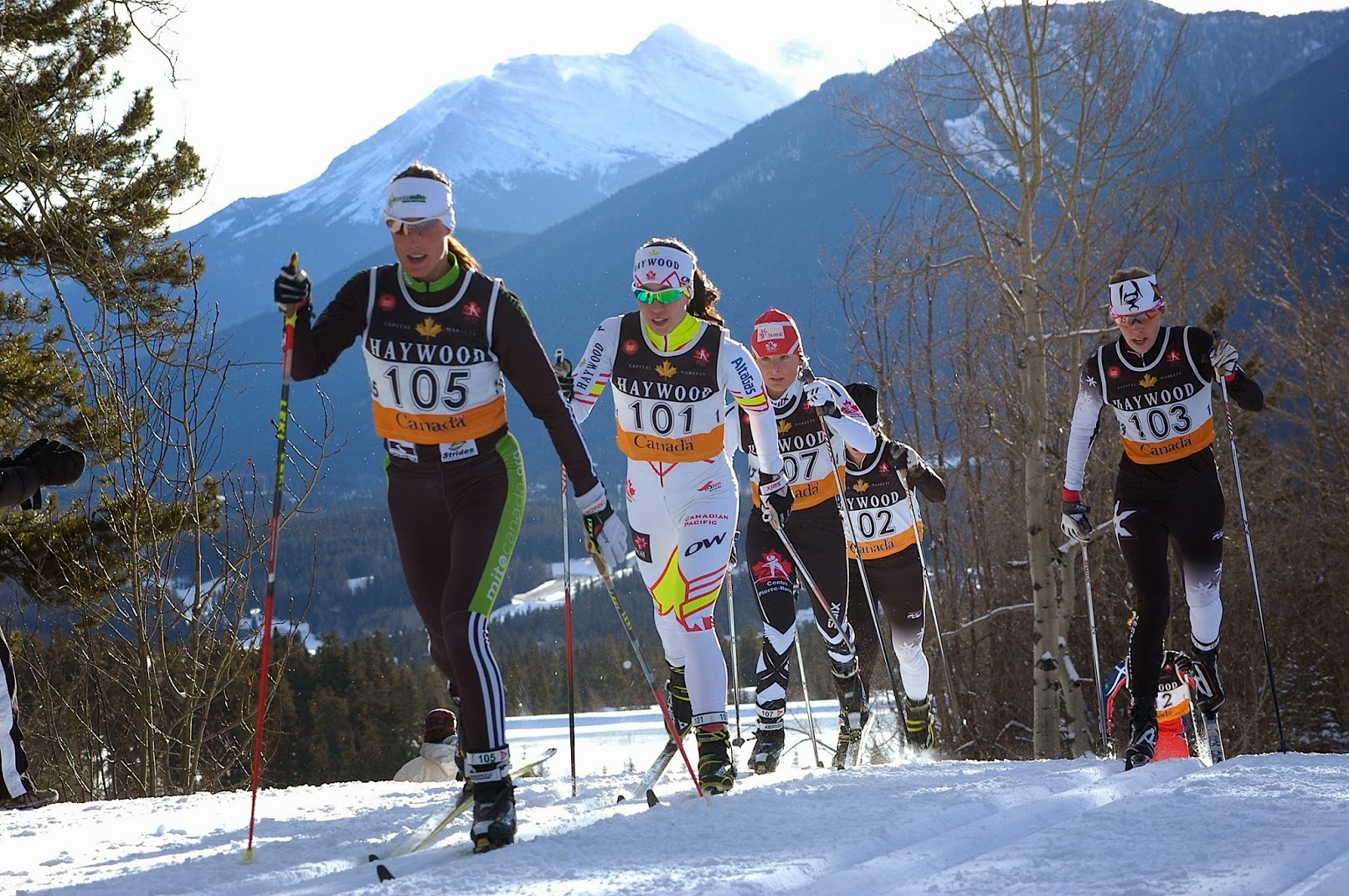
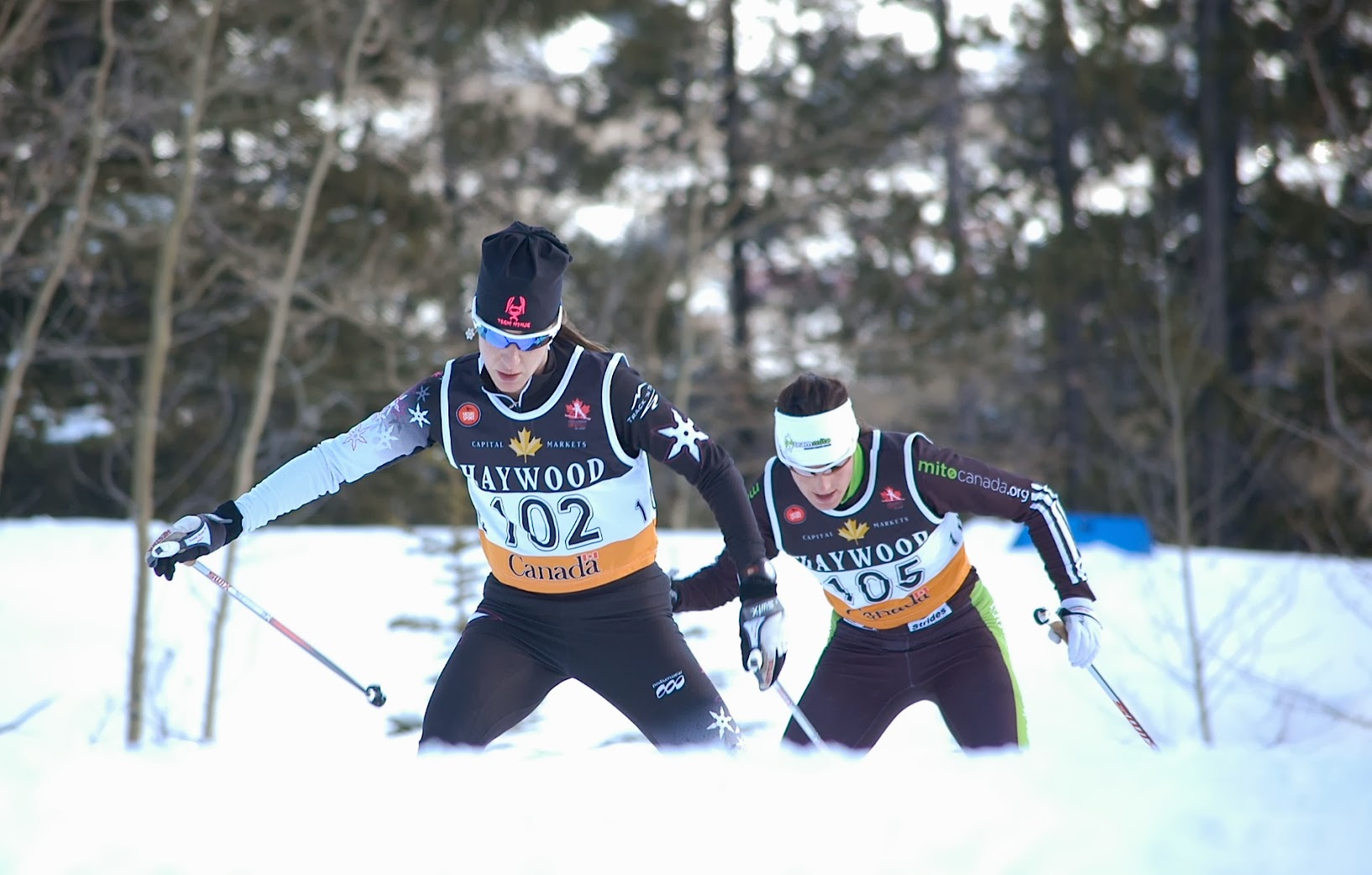
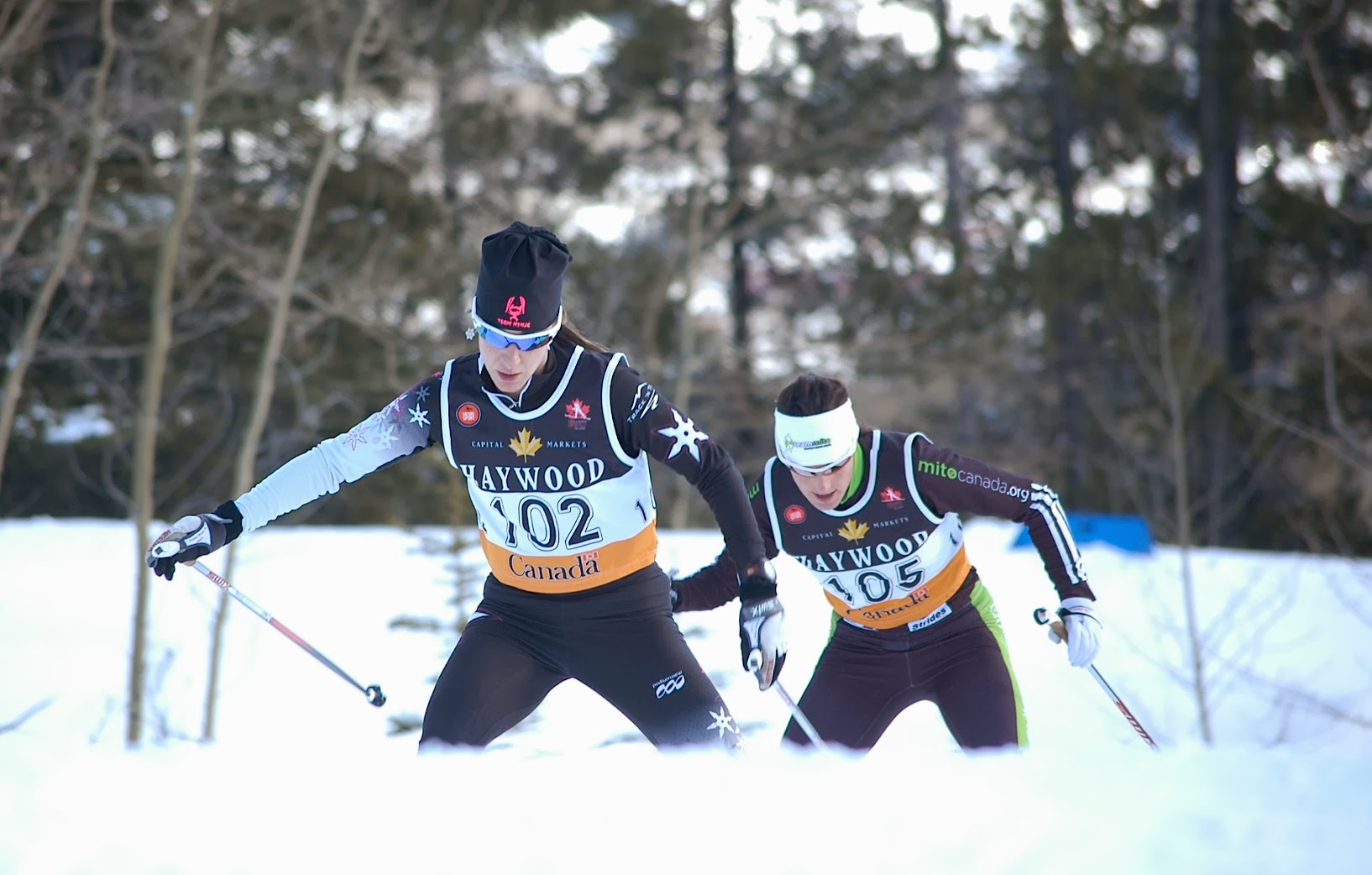
    Emily Nishikawa (101) follows Brittany Webster (105) in the women's 15 k skiathlon at Canadian Olympic Team Trials on Jan. 12 in Canmore, Alberta. Nishikawa placed sixth in the final race of the trials, securing her spot at the 2014 Sochi Olympics from Feb. 7-23. Webster took second after winner Amanda Ammar (102). (Photo: Angus Cockney)
    Brittany Webster (105) leads Emily Nishikawa (101) in the women’s 15 k skiathlon at Canadian Olympic Team Trials on Jan. 12 in Canmore, Alberta. Nishikawa placed sixth in the final race of the trials, securing her spot at the 2014 Olympics. Amanda Ammar (102) won, and Webster placed second. (Photo: Angus Cockney)

    Ammar had placed sixth in the 10 k classic, 1:50 behind Nishikawa. Webster placed second in both of those races.

    Going into the trials, the general consensus among athletes was that winning one of the races was necessary to have a chance at nomination. Nishikawa was named to the team based on her CPL points for the two races better than Ammar’s, topping her by a single point, according to Ammar’s Facebook page. CPL points are the Canadian equivalent of USSA/FIS points.

    After the Olympic team was announced, both Ammar and Webster filed appeals with CCC with separate arguments.

    Ammar stated that the CPL-based selection process was flawed and additionally, that Canada wouldn’t fill its distance starts at the Olympics with the athletes already nominated to the team, with four sprinters among five women. She argued that, had Nishikawa placed fifth in the skiathlon (versus sixth), the points for the skiathlon would have been better because of Nishikawa’s strong point profile, which would’ve boosted Ammar’s points. The CPL scoring system considers only the seed points of the top-five finishers in each race to determine the race points.

    Webster, on the other hand, could have been nominated to the team based on Olympic qualifying standards.  According to CCC’s Nomination Procedures for the 2014 Olympics, an athlete does not explicitly need to win one of the trials races to be selected. In fact, a key component of qualification is having the best points between two trials races.

    “If there are two race winners, the ranking list based on the athlete’s sum total of the designated distance races … will decide the top ranked athlete for the purpose of selection,” the document states.

    Through the end of the trials on Jan. 12, Webster’s points for those races were higher than those of both Nishikawa and Ammar. That, paired with additional Olympic quota spots granted to Canada on Jan. 24, supported Webster’s grounds for nomination.

    Holland said the whole process, including Ammar’s appeal to an outside governing entity, moved quickly — and involved other athletes, such as Para-Nordic Team veteran and 2010 Olympian Brian McKeever, who “started to appeal and for various reasons withdrew that appeal,” Holland explained.

    While McKeever could not be reached for comment, Holland said McKeever, who won the 15 k classic at trials, brought up his case after more athletes were being considered for additional quota spots.

    “He felt that he had a better ranking so why wouldn’t he be considered,” Holland said. “Once an outside appeal committee jumps in, the decision can get very messy because other athletes can come forward and say, ‘What about me?’ We made that case very clear. Anyways, we’re past it, we’ve got our team, and we’re happy to move forward.”

    The entire process started shortly after trials, and with team-naming deadlines looming for both the national and Sochi Olympic committees, Holland said the panel had to move quickly.

    “Sometimes you have to do this within hours,” he said. “That’s why it happened fast and that’s why we have an appeals process that allows for that. It moves pretty quick and these aren’t just hearsay, these are things where we have to put forward a case and put facts on the table.”

    Reacting, Moving Forward

    Once CCC acknowledged it could take up to 13 athletes to the Olympics, both Webster and Ammar received notice on Jan. 24 that they would be named to the team, according to Ammar.

    “I found out on Friday at 6 a.m.,” Ammar said. “So it was a very long, exciting day.”

    When she first discovered she didn’t make it, Ammar said, “Like a normal athlete, I just cried.”

    Frank Ammar cheering for his daughter Amanda Ammar (Team Ninja) on the final day of the Canadian Olympic Team Trials in Canmore, Alberta. A week and a half after the trials, Amanda was named to her second Olympic team. (Photo: Angus Cockney)
    Frank Ammar cheering for his daughter Amanda Ammar (Team Ninja) on the final day of the Canadian Olympic Team Trials in Canmore, Alberta. A week and a half after the trials, Amanda was named to her second Olympic team. (Photo: Angus Cockney)

    The one-point margin was what got her.

    “I mean if it was something huge, then I would have gotten over it, but luckily my dad doesn’t take really no for an answer, and he’s like, ‘Nope, nope, we’re fighting this, nope, we are fighting this,’ and he talked to my old coach, and they’re like, ‘Oh yeah, we more than have a case here, this shouldn’t be an issue.’ So we went forward, and there was a lot of people behind me and supporting me throughout this whole thing.”

    A 2006 Olympian, Ammar, who turned 28 on Thursday, stepped away from skiing for two seasons (from 2009-2011) and came back to it with the help of her boyfriend and coach, Chris Butler. She had been derailed by injuries and dealt with pains in her back and foot as recently as last fall. The NorAm leader at the end of last season, she had the opportunity to start this winter over in Europe. She declined, resolving to rehab her injuries and train more at home to peak for Olympic trials.

    “It feels deserving, it feels amazing, it feels exciting,” Ammar said of being named to her second Olympics. “I have never felt so strong in my whole career. Taking that time away and coming back and training the way I believed to be the best, and staying true to myself and doing my own things as an independent racer has never been more fun and more rewarding. When I hit those start lines at trials this year, I knew there was nothing more I could have done, and there was nothing more in my way.”

    Eight years ago, the Olympics came as a bit of a surprise.

    “I wanted to go to world juniors, and I wanted to be fit, and I ended up making the Olympics — sweet,” she said.

    This time around, she revived and reinvented herself.

    “I came back from so much,” she said. “I came back from an eating disorder, I came back from a back injury, I came back from food allergies, I came back from overtraining, I came back from sleep problems. It was so hard, and I put it out there — I made it real — I said, ‘I want to make Sochi,’ and I just went for it.”

    A member of the 2010 Olympic team, Webster, 26, has also returned to the sport. Four years ago at the Games in Vancouver, B.C., she was initially too sick to race and did not start as a result.

    “[The team] wanted to fly me back to Calgary so I could go back, and in their words, ‘Rest up for a day or two’ and then start training again, but not be around the Olympic environment,” Webster said. “They were going to fly me back for the team relay and the 30 k skate, and for me, it made a little more sense to stay in place and try to recover as best as I could.

    “I had a fever, a sinus infection, a sore throat, and I wasn’t really fit to fly, so I decided instead to stay with my parents at their condo, and that didn’t fly well,” she continued. “So that was basically the end of the story.”

    After taking some time off after the 2010 Olympic season, Webster renewed her zest for racing, making it to World Championships last year in Val di Fiemme, Italy, where sickness knocked her out for all but two of the competitions.

    “I think that if I’m healthy and fit and feeling the way I do now, I can definitely pull out a good race,” Webster said. “What that is on the World Cup or Olympic scene, I have no idea. I would love to think that it’s a top 30, but I really haven’t had a lot of experience stepping on the start line in a good mindset and … healthy in a championship like this, so that would be like the ideal circumstance. In order to get there, I just have to stay happy and healthy and really just enjoy the whole process.”

    Earlier this week, Webster and Ammar flew to Sochi to join their team in the mountain village of Krasnaya Polyana, where all the nordic events will be held. On Saturday, On Saturday, Webster, Ammar and Nishikawa will represent Canada in the women’s 15 k skiathlon, the first race of six women’s events at the 2014 Olympics.

    “I came back from so much … It was so hard, and I put it out there — I made it real — I said, ‘I want to make Sochi,’ and I just went for it.”  — Amanda Ammar

    Accreditation

    In terms of staffing, Canadian Head Coach Justin Wadsworth wrote in an email that they will  have three coaches, seven wax technicians, a team doctor, osteopath, two massage therapists, physiologist, and Holland as the team leader in Russia. Of the 16, all but four (the doctor, osteopath, physiologist, and one masseuse) are accredited, which grants access to the venue and certain restricted areas.

    Canada worked with Australia to bolster its accredited staff. According to Holland, the relationship between the two national teams started before the World Cup races in Sochi a year ago.

    “It is simply an arrangement where we [work] their skis in exchange for accreditation,” he wrote. “Works for both nations. Every Games we are short on accreds for techs.”


  • For Canadian Skiers in Sochi, a Team is a Family

    For Canadian Skiers in Sochi, a Team is a Family

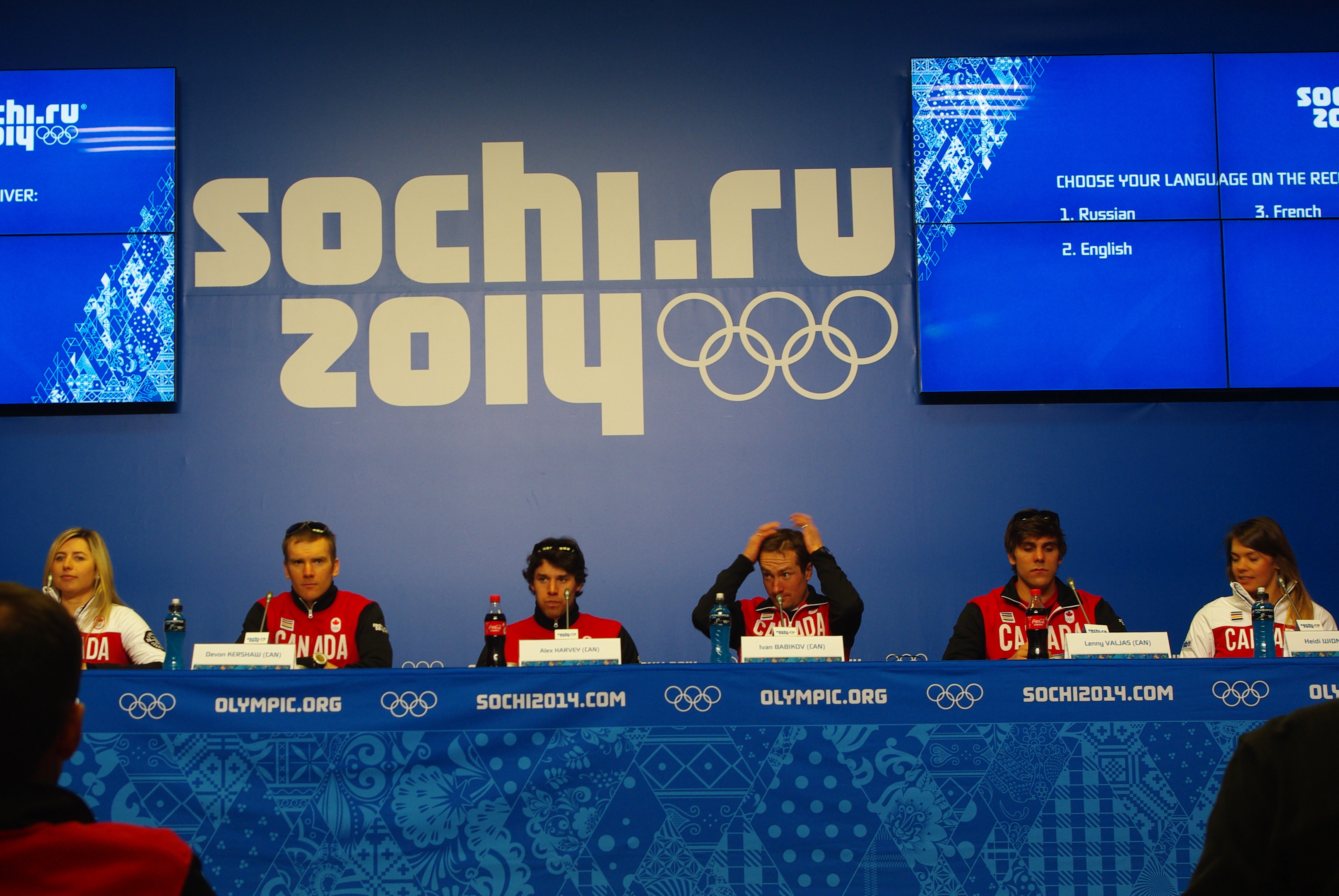
    canada press conference
    The Canadian Olympic Cross-Country Team at a press conference on Thursday in Sochi, Russia.

    SOCHI, Russia — “Without a core group of friends like this, at the ripe old age of 31, I probably wouldn’t be sitting here.”

    Devon Kershaw spoke for himself at the press conference held by the Canadian Ski Team in Sochi today, but you wouldn’t know it. Whether they’re leaning on each other as friends, or grabbing onto the coattails of the older racers and trying to hang on, the Canadians depend on one another.

    “It’s called the World Cup circuit, but really it all happens in Europe and Scandinavia” said Alex Harvey, a 25 year old beginning his second Olympics. “We spend so much time on the road in hotel rooms – Christmas, New Year’s, and most people’s birthdays. Our teammates are more than just teammates, we’re a second family.”

    “What some people don’t understand is that when we pack up in November, we don’t go home until late March or early April,” Kershaw added. “I spend close to 200 days on the road every single year. To share that with good friends, it’s hard to even describe how important that is for longevity and high performance.”

    For the Olympic veterans, drawing on the experience of an Olympics at home – Canada’s best Olympic performance ever – has been invaluable.

    “Canadians know so much more about the winter sports because of 2010,” said three-time Olympic veteran Chandra Crawford, 30. “We had all of these resources […] because of that big push to have the most successful Olympics ever, which was a big boost for our team. I feel really excited to be at my third games, and see the full circle of having been the rookie on the team and now getting to connect it to the next generation.”

    Canada’s veteran skiers have certainly had their work cut out for them. From the late 1980’s until the 2006 Olympics in Torino, Italy, Canada didn’t put a single man on the podium in a major international race.

    “It was quite the drought,” said Kershaw of that time. “People would say, ‘oh, so you’re going to go to the Olympics and that will be fun, and then you’re going to go to school and do something else because no Canadian men can do well in cross country skiing.’ It took a lot of stubbornness to keep going. And self-belief. We’ve always had a really really great core group of men, and I’ve been really fortunate for that.”

    “But it’s been a really inspiring ten years – wow, it’s amazing how fast it’s gone by,” he continued. “It took a lot of hard work and dedication and a group of really like-minded individuals together who just wouldn’t take no for an answer.”

    “Devon has [blazed a trail],” the Harvey said of his older teammate. “I’m really lucky because when I came onboard the team the team was already always in the top 30 – there were guys who got on the podium once or twice a year. So it was just natural. I could have a different approach even for my first World Cup. Rather than fighting for top 50, I was trying to be in the top 10. But mostly I think just mentally for me, the fact that George Grey, who is retired now, and Ivan [Babikov] and Devon have been on the podium a couple times before, I thought it was possible for me, also, to be on the podium, even though I was a first or second-year senior.”

    “This is only my third day of Olympic experience,” said Heidi Widmer, 22, “but […] I have Chandra [Crawford] in the room and also Beckie Scott […] showing me the way, so I just have to do my best to keep up.”

    For Canadians skiers Ivan Babikov and Dasha Gaiazova, these Olympics have extra meaning: both are Russian born, and veterans of the 2010 Olympics in Vancouver. Babikov was born in Kozhva Komi Republic and competed for the Russian National Team in his first Olympics in 2006, gaining full Canadian citizenship in 2007. Gaiazova was born in Moscow, and immigrated to Montreal in 1999 with her family.

    “I feel really special about this,” Babikov said. “Two Olympics in a row and both in my home countries. I don’t know if many athletes have done this before. Of course I’m really excited to be here. I’m enjoying every day of it.“

    “This will be my third Olympic Games,” he continued, “and in terms of comparison, I just don’t think you can compare Olympic Games to each other. Every one is different and they have their own best sides and their down sides. But Vancouver was great, the greatest Olympic Games. Sochi, for now, I think all of us feel really welcome here and everything has been so great so far.”

    “It is obviously really different to compete in Russia than in Canada,” Kershaw said of his own perspective. “But the Olympics in themselves are always a big deal, and when you get off the plane you always know that you’re at a big event. Those big giant rings are just slapping you in the face as you get out of the airport.”

    Yet, even for an experienced international racer like Kershaw, the Canadians don’t miss a chance to learn from each other.

    “I think it has been really really fun for me personally to share the journey to Russia with Ivan and Dasha,” he said. “Kind of getting the straight goods on how it’s going to go and everything. And also just seeing how excited they are. Having shared that home Olympics with them in Vancouver and then seeing them do it again now, it’s making it a really, really cool experience.”

    As the Canadians work together to get the most out of these Sochi Olympics that their bodies can give, they know that they’ll have each other no matter how it comes out.

    “You share in all the victories together, and we help each other through the defeats and the hard times together,” Kershaw said, speaking, it would seem, for the whole team.

  • Canada Adds Two Women, Webster and Ammar, to Olympic Roster

    Canada Adds Two Women, Webster and Ammar, to Olympic Roster

    Amanda Ammar (Team Ninja) leads Brittany Webster (Highland Trailblazers) in the 15 k skiathlon on Jan. 12 at 2014 Canadian Olympic Trials in Canmore, Alberta. (Photo: Angus Cockney)
    Amanda Ammar (Team Ninja) leads Brittany Webster (Highlands Trailblazers) in the 15 k skiathlon on Jan. 12 at 2014 Canadian Olympic Trials in Canmore, Alberta. (Photo: Angus Cockney)

    Cross Country Canada announced late Friday night that it added two women, Brittany Webster and Amanda Ammar, to its 2014 Olympic cross-country team. That brings the team total to 13 athletes, seven women and six men.

    The two former national-team members, who had each been to the Olympics before, filed appeals after 11 athletes were originally named to the team on Jan. 14 “knowing that with the team named … Canada would not have a full representation in the women’s distance races, which were recently granted,” according to a CCC press release.

    “This combined with additional quota spots that became available to Cross Country Canada only [Thursday], confirmed their nomination to the team,” the release explained. “FIS provides quota spots to each country based on international rankings. If other nations do not use their entire quota, those spots are then redistributed in a second round of offers.”

    At Canadian Olympic Team Trials from Jan. 8-12 in Canmore, Alberta, Webster and Ammar finished just outside the quota cutoff — with the one women’s distance spot going to Emily Nishikawa. Webster and Ammar are both distance skiers.

    The founder of the Canmore-based Team Ninja, Ammar, 27, competed at the 2006 Olympics in Turin, Italy. She took two seasons off (from 2009 to 2011) and dealt with injuries in her back and foot this fall, she won the 15-kilometre skiathlon at the Olympic trials.

    Webster (Highlands Trailblazers) went to the 2010 Olympics, took some time away from the sport, and came back to compete at 2013 World Championships. The 26-year-old finished second in both distance races at trials.

    “Adding Brittany and Amanda rounds out the most talented group of cross-country ski athletes to start for Canada at an Olympic Winter Games,” CCC High-Performance Director Tom Holland said in the press release. “This opportunity will allow these two additional athletes to continue their development with this opportunity to race at the Olympics. We welcome them both to the team.”

  • Canada Names 11 Athletes to 2014 Olympic Cross-Country Team

    Canada Names 11 Athletes to 2014 Olympic Cross-Country Team

    Canadian Olympic Logos

    (Press release)

    11 athletes nominated to historic men’s and women’s teams

    CANMORE, Alberta — Cross Country Canada announced today the men and women officially nominated onto the Sochi 2014 Canadian Olympic Cross Country Skiing Team.

    The six men: Alex Harvey (St-Ferréol-les-Neiges, Quebec); Devon Kershaw (Sudbury, Ontario); Ivan Babikov (Canmore, Alberta); Graeme Killick (Fort McMurray, Alberta); Jesse Cockney (Canmore, Alberta); and Lenny Valjas (Toronto, Ontario); and five women: Chandra Crawford (Canmore, Alberta); Daria Gaiazova (Banff, Alberta); Heidi Widmer (Banff, Alberta); Emily Nishikawa (Whitehorse, Yukon); and Perianne Jones (Almonte, Ontario) were nominated during an announcement at Altadore School in Calgary.

    Canada is set to send one of its most talented teams of cross-country skiers of yet to the start line with a focus on contributing to the nation’s medal count at the Sochi 2014 Olympic Winter Games. For the first time ever, Canada qualified a core group of seven veterans – six of them Olympians who have all won medals on the World Cup circuit over the last four years. Each of these athletes qualified based on their World Cup results over the last two years.

    “This is a medal-winning team that has evolved from a group of talented athletes excited to be on the start line into a group of determined high-performers focused on winning, and confident in their ability to achieve podium results,” said Tom Holland, High-Performance Director, Cross Country Canada.

    The final four athletes including Graeme Killick, Jesse Cockney, Heidi Widmer and Emily Nishikawa, earned the last four spots to round out the Canadian Olympic Cross-Country Ski Team following Cross Country Canada’s Olympic Trials held last week in Canmore, Alberta.

    “Depth is critical towards mounting an attack on the podium in any sport, and we have seen through the development of our elite program, that our women are hungry to win another medal at the Games, while us guys are now racing to win the country’s first-ever Olympic medal,” said Devon Kershaw, who was the first Canadian male along with Alex Harvey to win a gold medal at the World Championships.

    “Our cross-country skiers have been training ferociously with unmatched dedication in order to be at the top of their game as we head into Sochi,” said Marcel Aubut, President, Canadian Olympic Committee. “On behalf of the COC, I congratulate all 11 of our phenomenal cross-country skiing athletes – your country will certainly be cheering you on as you take to the snow in Russia.”

    The athletes were officially introduced by seven lucky Calgary kids in front of more than 270 of their fellow students that painted the gym red with clothing at Altadore School. After being introduced, the athletes led by  Cross Country Canada`s official mascot, Klister, took the kids along with the school’s teachers and officials from the COC and Cross Country Canada to the playground where they competed in a fun relay race.

    Ski tracks were set in the Altadore schoolyard for the students who are currently enjoying a week of introductory cross-country ski instruction courtesy of the Foothills Nordic Ski at School program – a local initiative to deliver cross-country skiing opportunities to students in Calgary area schools each winter.

    “What pride we will feel as a country watching our talented athletes representing Canada at the Olympic Winter Games in Sochi,” said  Joan Crockatt, Member of Parliament (Calgary-Centre). “With your talent and determination, you will have us holding our breath as you outdo yourselves facing some of the world’s greatest cross-country skiers. We are very proud of you! Best of luck with final preparations and good luck!”

    Led by Beckie Scott’s first-ever medal for Canada in the sport of cross-country skiing at the 2002 Olympics when she skied to the gold, Canada has three Olympic medals in total. Scott also won a silver in the team sprint with Sara Renner in 2006 – the same year Chandra Crawford won the gold medal in the skate-sprint race.

    The Sochi 2014 Olympic Winter Games will take place from February 7-23, 2014. The Canadian Olympic Team has set a goal to contend for the top spot in overall medals won.

    List of cross-country ski athletes nominated to the Sochi 2014 Canadian Olympic Team:

    Women:
    First Last
    Hometown
    Chandra Crawford Canmore, AB
    Daria Gaiazova Banff, AB
    Emily Nishikawa Whitehorse, YK
    Perianne Jones Almonte, ON
    Heidi Widmer Banff, AB
    Men:
    First Last Hometown
    Alex Harvey St-Ferréol-les-Neiges, QC
    Devon Kershaw Sudbury, O
    Ivan Babikov Canmore, AB
    Lenny Valjas Toronto, ON
    Graeme Killick Fort MacMurray, AB
    Jesse Cockney Canmore, AB

    These 11 cross-country skiers now join 10 speed skaters, 10 Curling athletes, 16 bobsledders, seven lugers, four skeleton athletes, 21 women hockey players, eight biathletes, five snowboarders, 25 men hockey players, three skiers and 17 figure skaters, as the next members on the Canadian Olympic Team. Up to seven more teams will be announced between now and February.

    For more information visit www.olympic.ca.

  • Canadian NorAm Preview: Peaking for Pre-Olympic Trials

    Canadian NorAm Preview: Peaking for Pre-Olympic Trials

    Canadian Jesse Cockney of the Alberta World Cup Academy and Senior Development Team (2) leads Finland's Anssi Pentsinen (12) and the rest of his quarterfinal in Saturday's World Cup 1.3 k skate sprint in Canmore, Alberta. Cockney won the heat and went on to place ninth overall for a personal best in his fifth World Cup start.
    Canadian Jesse Cockney of the Alberta World Cup Academy and Senior Development Team (2) leading his quarterfinal in the Alberta World Cup 1.3 k skate sprint in Canmore on Dec. 15, 2012. Cockney won the heat and went on to place ninth overall for a personal best in his fifth World Cup start. He finished the season as the overall NorAm winner and is starting 2013/2014 on the World Cup in Europe as a result.

    Because the Olympics only come around every four years, domestic races hold even more value in the months leading up to the 2014 Sochi Winter Games. In Canada, they’ll determine who will fill approximately four remaining spots on the Olympic nordic team.

     The NorAm calendar has been reduced this season, with fewer races in the middle of winter when most will be focussed on what’s happening in Russia. This explains why there’s a heavy concentration of events early in the season, starting this weekend.

    Canadian nordic skiers getting some early on-snow time at the Sovereign Lake Nordic Centre on Nov. 7 in Vernon, B.C., the first NorAm stop of the season.
    Canadian nordic skiers getting some early on-snow time at the Sovereign Lake Nordic Centre on Nov. 7 in Vernon, B.C., the first NorAm stop of the season.

    Sovereign and Black Jack

    Following the trend of the last several years, many of North America’s best skiers will meet at Sovereign Lake in Vernon, B.C., for the first NorAm races of the season on Saturday and Sunday, which will be the first “real” races for most Canadians. The next weekend, the circuit heads south to Rossland, B.C., for two more races Dec. 14-15 before the holiday break. Normally, several American skiers make the trip up north to British Columbia for the NorAm openers, deepening the field, and Sovereign Lake’s powder conditions likely enticed many this year.

    These two weekends of races will be an opportunity to catch a glimpse of the shape of the skiers and identify those that might be capable of Olympic selection by mid January.

    For Heidi Widmer, an Alberta World Cup Academy (AWCA) and Canadian Senior Development (NST) skier, it is important to find her marks and have fun during the first part of the season.

    “The NorAms in Silver Star and Rossland before Christmas are a way to get back into the racing scene and build back that routine,” Widmer wrote in an email. “Also, we usually make gingerbread houses or cookies in Rossland and I missed that last year, so definitely looking forward to that.”

    “Having done the work, I am confident there will be some very good moments for me this upcoming winter,” Michael Somppi (AWCA/NST) wrote in an email. “The trick is to make those moments line up with the important races.”

    Olympics Trials in Canmore

    Ivan Babikov (l) leads fellow Canadian Graham Nishikawa (r) of the Alberta World Cup Academy during Wednesday's 15 k freestyle individual start at 2013 World Championships in Val di Fiemme, Italy.
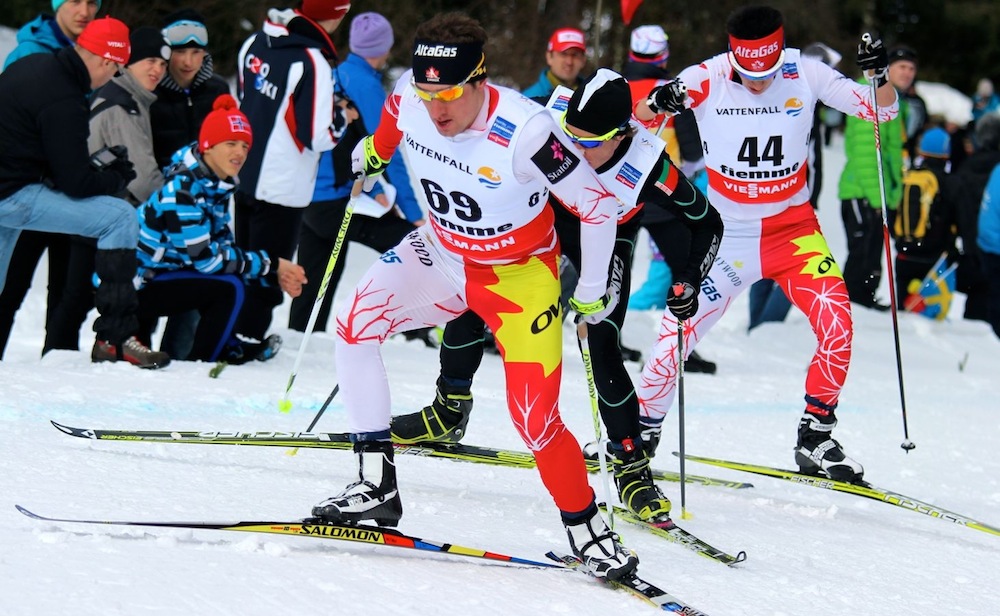
    Graham Nishikawa (44) follows Canadian World Cup vetera Ivan Babikov (69) in the 15 k freestyle individual start at 2013 World Championships in Val di Fiemme, Italy. Babikov went on to place fourth, the best ever by a Canadian man in the event, and Nishikawa finished 39th for his best result at World Championships.

    Anyone with even the slightest chance of qualifying for Sochi has probably circled the Canadian Olympics Trials dates on their calendars: Jan 8-12 in Canmore, Alberta.

    Graham Nishikawa is certainly one of them. Four years after he narrowly missed his nation’s home Olympics in Vancouver, B.C., the 30-year-old Senior National Team member, who’s been working with Canada’s Para Nordic squad throughout the offseason, is ready for redemption.

    “My goal is to qualify for Sochi,” Nishikawa said in a phone interview. “The selection races are very important, whatever I need in those races to be in the best shape is what I’ll focus on. If I need more training and that means that I have to skip some NorAms, I will do that.”

    Veterans will certainly have some pressure on to perform, while many young skiers could catapult themselves into the mix. However, there are only about four Olympic spots available as all six World Cup Team members (Alex Harvey, Devon Kershaw, Ivan Babikov, Len Valjas, Dasha Gaiazova, and Perianne Jones) have already satisfied the Sochi-selection criterias with their results last season.

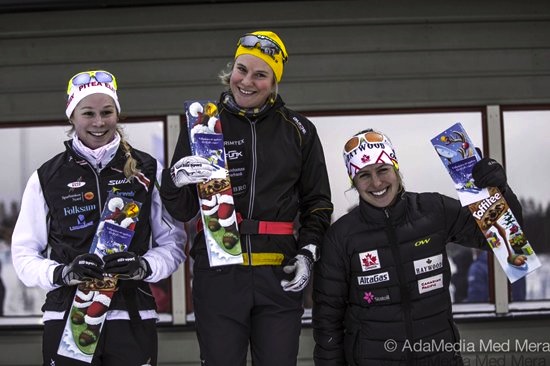
    Third in a FIS skate sprint in Idre, Sweden, on Nov. 30, Chandra Crawford (r) celebrates on the podium with Swedish winner Hanna Falk and runner-up Jennie Öberg (l). (Photo: Cross Country Canada)
    Third in a FIS skate sprint in Idre, Sweden, on Nov. 30, Chandra Crawford (r) celebrates on the podium with Swedish winner Hanna Falk and runner-up Jennie Öberg (l). (Photo: Cross Country Canada)

    Last weekend, Chandra Crawford, who declined her nomination to the team in April, earned her spot back on the World Cup team with third place in a FIS skate sprint in Idre, Sweden (which likely secured her Olympic prequalification as well).

    “We are taking a team size of 11,” Canadian National Team Head Coach Justin Wadsworth said in a phone interview last month. “That can be any combination; it can be six men, five women. It can be seven men, four women. It can be six women, five guys. We’ll just see how everybody’s racing and where our strengths and weakness are.”

    Many skiers will compete for the remaining tickets, which should be a close fight.

    “I expect my performance level to be reasonably consistent throughout the winter, however I will be aiming to peak for the Olympic Trials at the beginning of January,” Somppi explained.

    Note that these races also act as trials for the Junior and U23 World Championships in late January in Val di Fiemme, Italy. Needless to say, any skier who’s shooting for international starts will likely be in the best shape possible.

    “I have a chance to qualify for U23 Championships and the Olympic team based on domestic results so yep, I want to be racing well, especially at Olympic trials in Canmore,” Widmer wrote. “U23 Championships are a skate sprint this year, so that gets me really fired up and I know I have a good chance to perform well provided I do the work to get there.”

    The Rest of the Season

    For the rest of the best Canadian seniors not quite at the Olympic level, there are opportunities to race in Europe, either on the OPA Cup Tour with the national team in February, or by earning World Cup starts late in the season as NorAm leaders. Both options require skiers to excel on the domestic circuit first.

    The traditional mid-season meeting, the Eastern Canadian Championships at Nakkertok Ski Club near Ottawa, falls on the first weekend of February and remains the fourth and final NorAm stop before nationals. Top skiers will need to travel East for those races to contend for some important points.

    “I’m still going to fight for the place of NorAm leader, because my Plan B is to race in Europe,” Somppi explained.

    Nationals in Newfoundland

    Heidi Widmer 2013 Canadian Nationals 30 k freestyle mass start (Photo: Martin Kaiser)
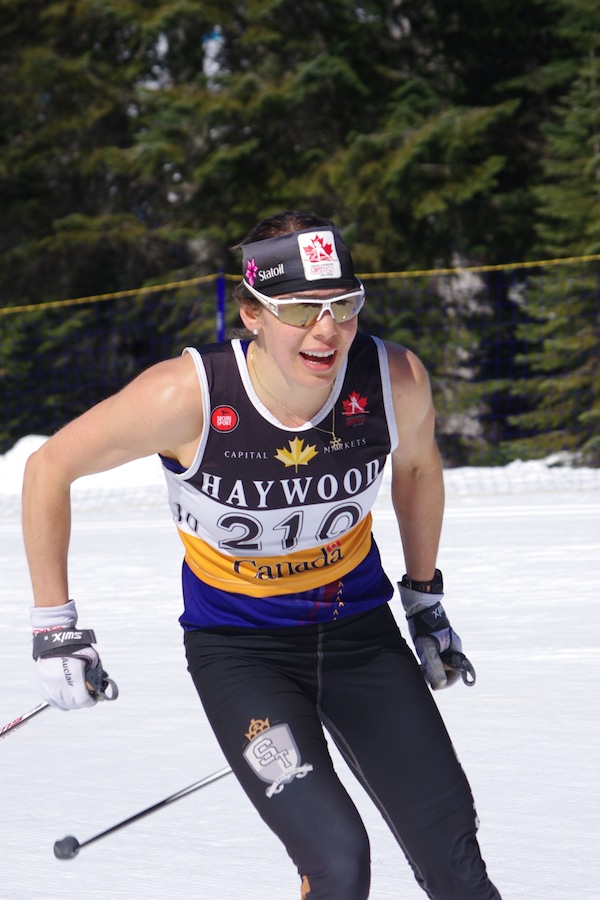
    Heidi Widmer racing to fourth overall (and a Canadian bronze) in the 30 k freestyle mass start at nationals in Whistler, B.C. (Photo: Martin Kaiser)

    For the first time in over 10 years, Canadian Nationals will be held on the Atlantic Coast in mid-March. This will be a new destination for most skiers and certainly a new race site that will bring novelty and freshness to the annual event which concludes the Canadian domestic season.

    The races will be held at the Blow Me Down Trails in Corner Brook, Newfoundland, the site of the 1999 Canada Games.

    “I love the East Coast and am really looking forward to the races at the end of the season,” Kevin Sandau (AWCA/NST) wrote. “I think they will really be a unique experience for National Champs.”

    “I’m excited!” Widmer wrote. “I think it’s important to have the competition in different parts of the country to promote the sport in that area as well as save travel costs for those coming from the far-East for races all the time. I’ve never been to Newfoundland before but with a name like Blow Me Down, it’s gotta be a unique place!”

    It will require some long travel for athletes coming from West, but offers a chance for everyone to discover the skiing community in this part of the country.

    “I actually visited Newfoundland for the first time this past spring,” Somppi wrote. “My girlfriend spent a year at Memorial University in St. John’s, so I went out to visit her. The Newfoundlanders I met along the way were friendly and welcoming, so I’m expecting a warm reception for competitors at this year’s Nationals. I am very much looking forward to my second trip to Newfoundland!”

    Skiers to Watch 

    The reigning NorAm champions, Jesse Cockney (AWCA/NST) and Amanda Ammar (Team Ninja) have chosen to start their season differently from one another, with Cockney taking advantage of the early World Cup starts and Ammar opting to start racing at home in Canada while recovering from injuries in her back and foot.

    Jesse Cockney (Alberta World Cup Academy/Canadian Senior Development Team) after placing second in the Alberta World Cup 1.3 k skate sprint qualifier on Saturday in Canmore.
    Jess Cockney after finishing second in the Alberta World Cup 1.3 k skate sprint qualifier last December in Canmore. He went on to finish ninth for his best World Cup result.

    “My main focus is Olympic trials this year, and I want to do everything I can to be prepared and confident when I hit that start line, which for me, was staying here, doing the Canadian circuit, and getting in some prime training, ” Ammar, a 2006 Olympian, wrote in an email. “I would of missed all the Norams leading into trials, and this was not ideal for me. I want to know where I stand … during trials.”

    Last December, Cockney made a World Cup impression on home soil in Canmore, qualifying second and placing ninth in the freestyle sprint at the Alberta World Cup. With that result, the 24 year old is halfway to making the Olympic team. Starting the season on the World Cup will give him the opportunity secure his spot and gain more international racing experience. 

    Some top skiers will not return to the NorAm circuit after retiring at the end of last season, including Brent McMurtry, David Greer and Kate Brennan.

    The NorAm runner-up last season, Graham Nishikawa is best known as a distance racer, but can notch solid sprint results as well. Married in July, this could be his last push for the Olympics.

    Michael Somppi (AWCA/NST) racing to 48th in the World Cup classic sprint qualifier in Stockholm, Sweden, last season. (Photo: Fischer/Nordic Focus)
    Michael Somppi (AWCA/NST) racing to 48th in the World Cup classic sprint qualifier in Stockholm, Sweden, last season. (Photo: Fischer/Nordic Focus)

    Somppi finished third at the end of last season and is better at skating, but said he worked on his classic to make sure he was in fighting form for the 15 k classic at Olympic Trials.

    A little off his game last year, Sandau, a distance specialist and typical domestic favourite, is back to his old training routine that produced good results for him previously. He’s confident that his training will pay off and is one to keep an eye on in distance races.

    Making the Senior National Team as a first-year senior, Raphaël Couturier of the Pierre-Harvey Training Centre (CNEPH) is an all-round skier that shouldn’t be overlooked.

    Alysson Marshall (AWCA/NST) placed third overall last season despite missing the first part of the NorAm season to participate in the opening World Cups. She is a sprint favourite and could be a podium contender for distances races as well.

    Like her older brother, Emily Nishikawa (AWCA/NST) was a member of the Canada’s World Championships team last winter in Val di Fiemme, Italy, and started several World Cups throughout the 2012/2013 season. She is certainly one of the women in the running for a position the Olympic distance team.

    In her first full season back racing, Brittany Webster (Highland Trailblazers) also made it to 2013 World Championships, but sickness kept her from performing at her best in Italy. She ended the season with a fourth-place finish in the 30 k freestyle at Canadian Nationals and was the third Canadian behind Swiss winner Bettina Gruber, Canadian biathlete Zina Kocher, and Heidi Widmer.

    Considering that result, Widmer, known as a dangerous and talented sprinter, can clearly get top results in distance – even after rebounding from head injuries.

    Alana Thomas (Team Ninja) is an all-around skier who’s had consistently good results in the past couple years. She’s suffered some setbacks with injuries, but with the “Ninja” spirit, anything can happen!

    Keep an eye on Olivia Bouffard-Nesbitt (Rocky Mountain Racers) as well. At 21, she’s arguably one of Canada’s most promising up-and-comers.

    While most of the favourites come from national training centres, there are a few skiers from other clubs that could produce top results in NorAm sprint and distance races this season.

    2013/2014 NorAm Schedule

    1. Sovereign Lake: Vernon, British Columbia: Dec. 7-8

    10/15 k freestyle & classic sprint

    2. Black Jack: Rossland, British Columbia : Dec. 14-15

    10/15 k classic & freestyle sprint

    3. Canmore, Alberta: Jan. 8-12 (Trials for Olympics, Junior and U23 World Championships)

    15/30 k skiathlon, freestyle sprint x 2, 10/15 k classic

    4. Eastern Canadian Championships: hosted by Nakkertok Nordic in Cantley, Québec: Jan-Feb. 31-2

    Freestyle sprint, 10/15 k Freestyle, 15/20 k Classic mass start

    5.Haywood Ski Nationals: at Blow Me Down Trails in Corner Brook, Newfoundland: March 15-22

    Team sprint, 5/10 k Classic, 10/15 k freestyle, freestyle sprint, 30/50 k classic mass start