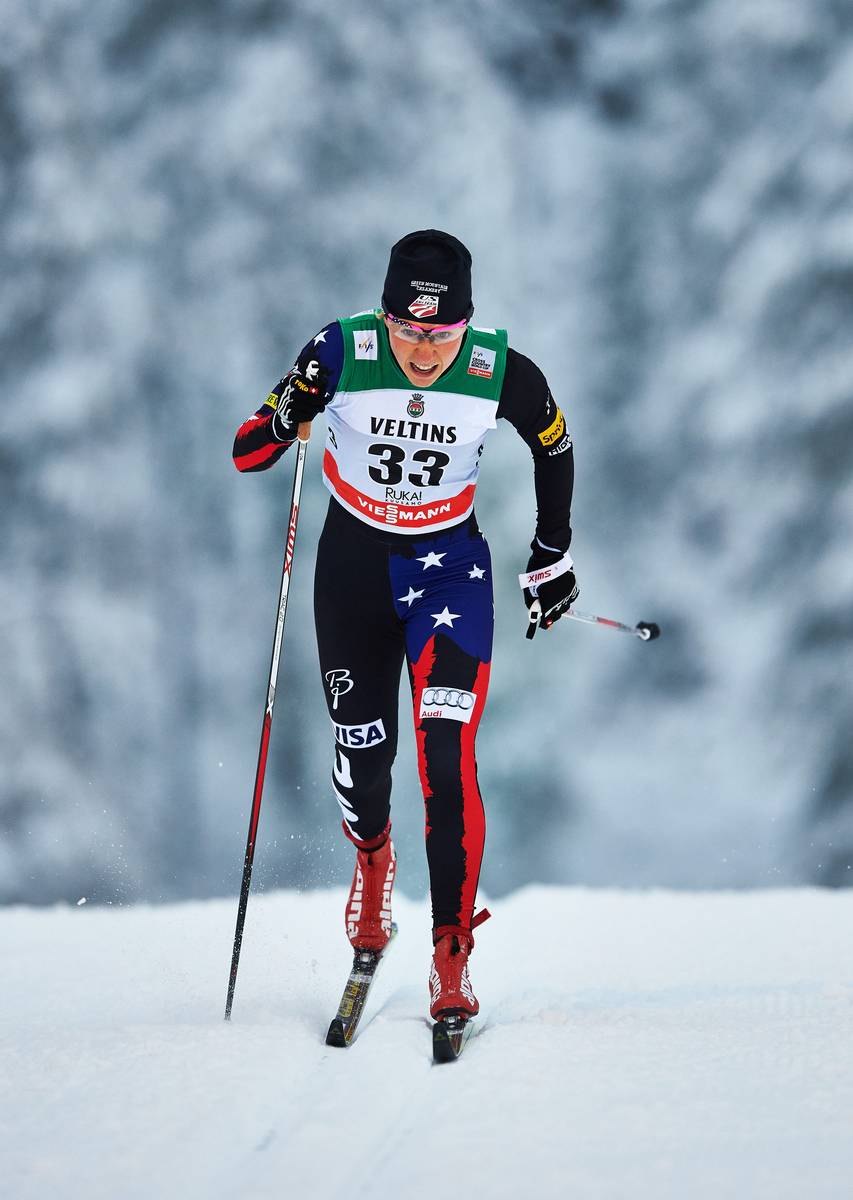
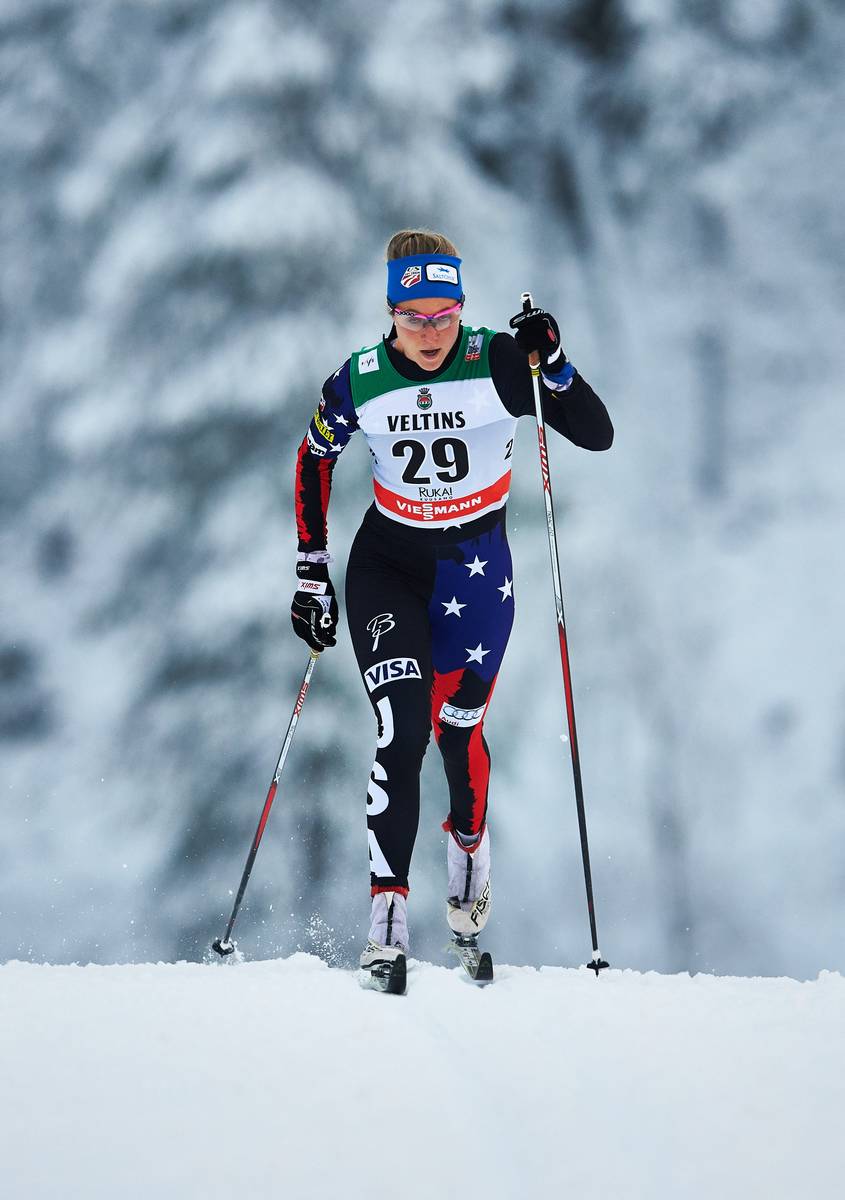
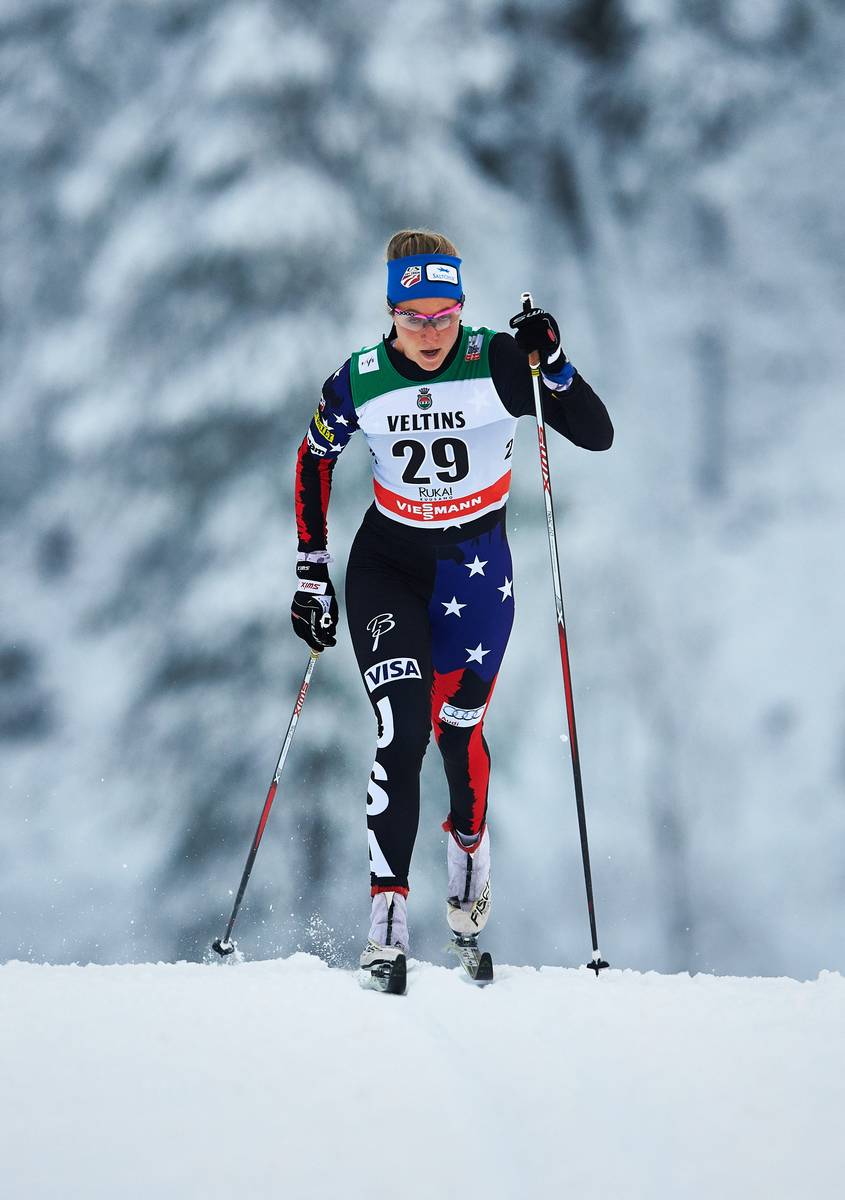
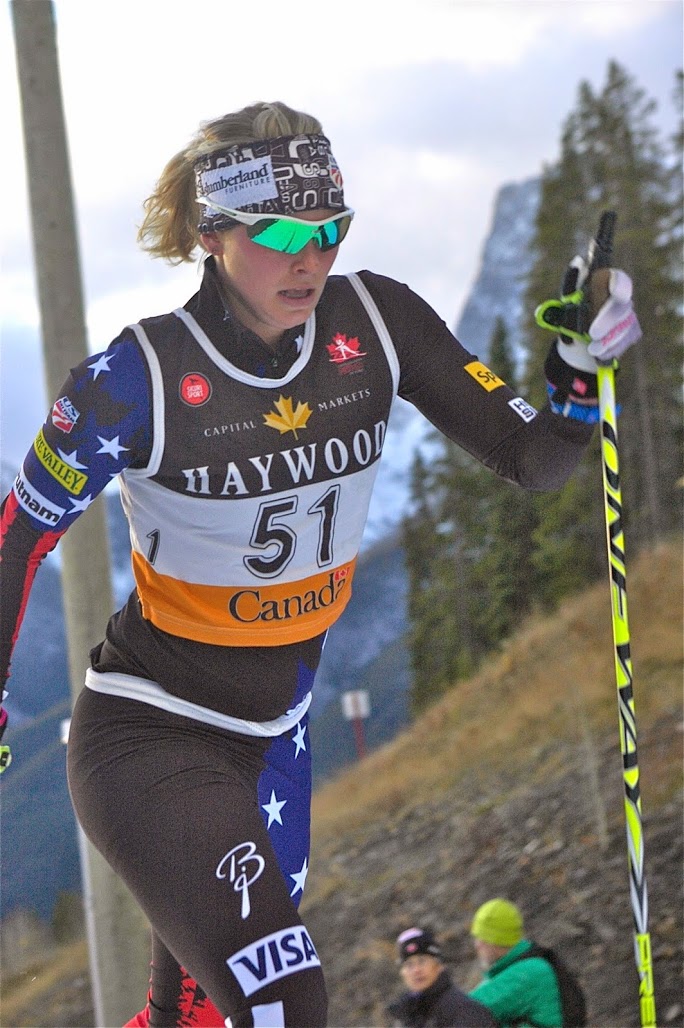
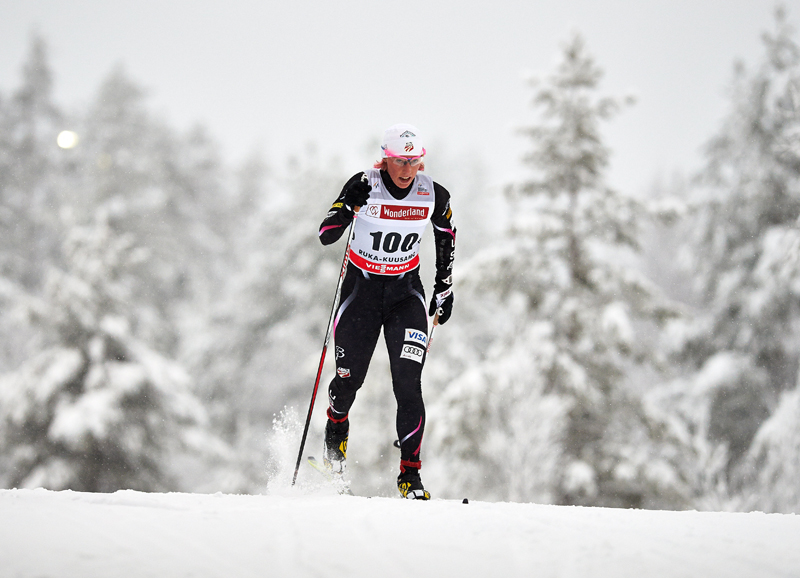
Ida Sargent racing to a career-best fifth in the classic sprint at the World Cup opener last Saturday in Kuusamo, Finland. She placed 51st in the 10 k classic the next day. (Photo: Fischer/Nordic Focus)
Ruka and West came and went like the went, but the biathletes are just getting things going in Östersund, Sweden. The 2014/2015 International Biathlon Union (IBU) World Cup season kicked off Sunday with the mixed relay, where the U.S. pulled out its best performance in the last several years in seventh.
And Susan Dunklee, Annelies Cook, Tim Burke, and Lowell Bailey were just 17 seconds off fourth.
“I don’t remember our exact place here last year, but we definitely weren’t that close to a podium finish,” Burke said. “We were in it all the way until the end. It gives us good confidence going forward.”
The men get after it again in Östersund on Wednesday in the 20-kilometer individual race, starting at 17:15 CET (11:15 a.m. EST). The women’s 15 k individual will be held Thursday at the same time.
But before we launch into more biathlon, then more cross-country World Cup in Lillehammer, Norway (with three days of action Friday through Sunday) and SuperTour stop No. 2 in Bozeman, Mont., here’s what happened in the last week — starting with West Yellowstone on Friday, Nov. 28.
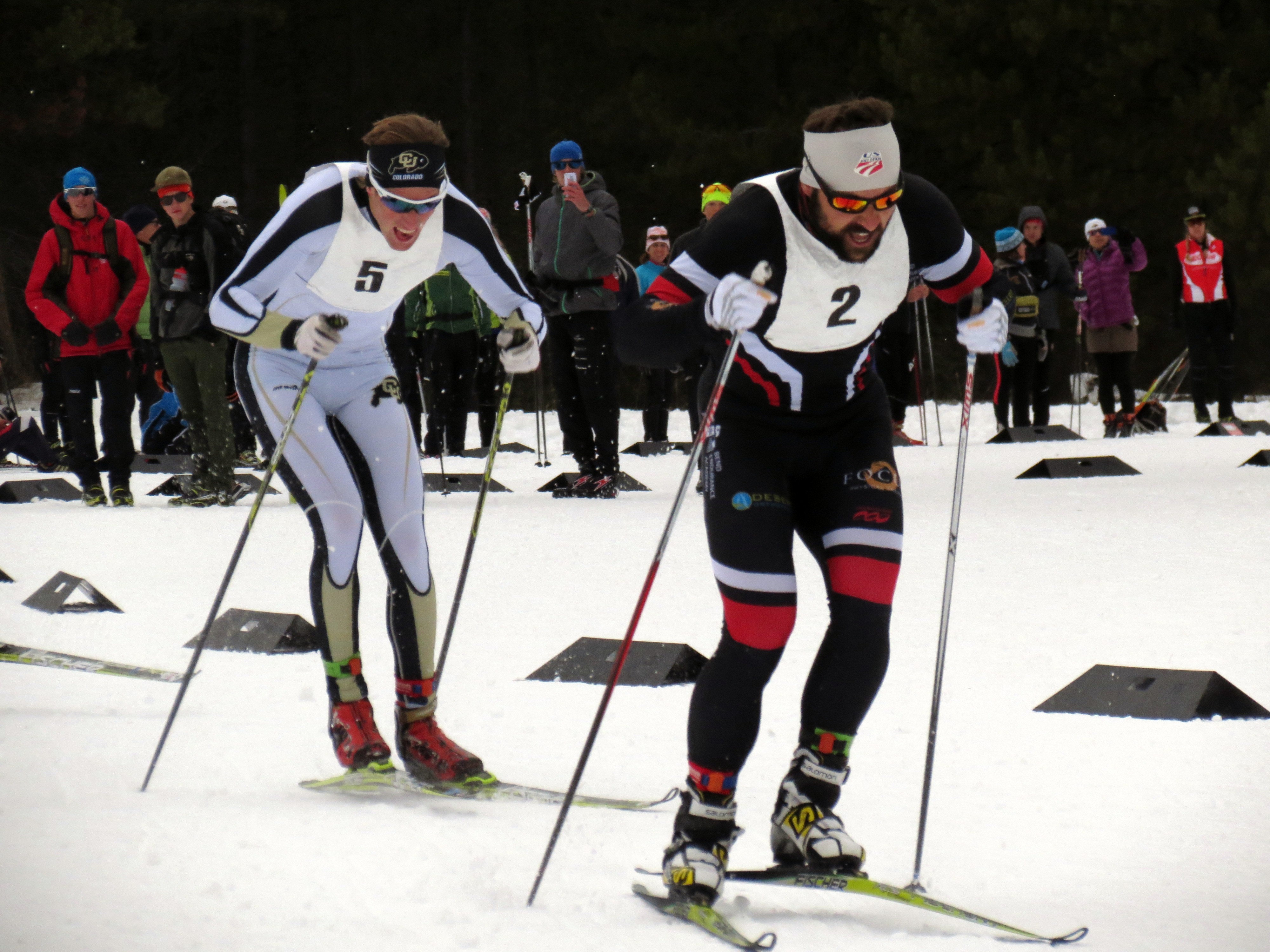
Dakota Blackhorse-von Jess holds off Mads Strøm during the A-final of the SuperTour men’s skate sprint in West Yellowstone, Mont. (Photo: Toko)
Things got a little stalled on Day 1 at the Rendezvous Trails with timing, but at the end of the day, Dakota Blackhorse-von Jess and Alysson Marshall emerged as the definite winners.
“West Yellowstone’s a hard place,” Blackhorse-von Jess said of the early-season race, after edging the University of Colorado’s Mads Strøm by 0.9 seconds in the men’s skate sprint. “I’m tired, everybody’s tired.”
Then there were two Canadian women that dominated the women’s sprint: Marshall in first and Heidi Widmer in second, teammates on the Alberta World Cup Academy and Canadian National Development Team. Marshall won the 1.5 k final by a boot length.
Day 2 saw Rosie Brennan outlast 17-year-old Katharine Ogden in the women’s 10 k individual start, and the win meant everything to her after facing some tough times this summer. In the men’s 15 k, Matt Gelso put himself in contention for domestic World Cup starts in just over a month with a nearly 10-second win over Brian Gregg.
The International Ski Federation (FIS) Cross-Country and Nordic Combined World Cup seasons also got rolling last weekend at the Ruka venue in Kuusamo, Finland. There, Ida Sargent was the biggest thing going for North America after a career-best fifth in the classic sprint — the U.S. Ski Team’s first race of the season. The next day, Sadie Bjornsen skied to 17th to lead the Americans in the opening 10 and 15 k distance races.
“Finland loves Ida Sargent and I know that Ida loves Finland!” former U.S. Ski Team member Holly Brooks wrote on Facebook. “So impressed w/ @sadzarue who skis fast & studies hard! Currently presenting senior thesis while racing WC in NOR!”
Alex Harvey put down two top-15 performances for Canada, including seventh in the 15 k classic, and teammate Devon Kershaw wasn’t far behind him in 14th on Sunday. Canadian development-team member Emily Nishikawa struck a career-best World Cup result in Europe, placing 38th in the 10 k.
Noah Hoffman did not finish a race for the first time in his career after crashing hard off the trail and into a fence with slightly less than 2 k remaining in the 15 k. After seeking immediate medical attention, he learned he broke his fibula, according his blog post, and headed home to the U.S. on Monday for further evaluation.
Also in Ruka, the NoCo guys got after it in the large-hill individual competition and team sprint, where Bryan Fletcher led the U.S. in 17th on Day 1 and was 13th with brother Taylor Fletcher on Sunday.
Sadie Bjornsen (U.S. Ski Team) racing to 29th in the World Cup classic sprint on Saturday in Kuusamo, Finland. On Sunday, she placed 17th in the 10 k classic to lead the U.S. (Photo: Fischer/Nordic Focus)
Sadie Bjornsen very specifically stated that she didn’t wanted to start the season as hot as in year’s past, like last year when she was seventh in the 5-kilometer classic in Kuusamo, Finland.
On Saturday, the 25-year-old U.S. Ski Team member made it into the points and the quarterfinals of Kuusamo’s classic sprint in 29th, which she said at the time was on par with how she hoped to perform in the first race of the season.
Imagine how she felt after placing 17th in Sunday’s 10 k classic.
“Sometimes how you did in the past can dictate how you feel about a result on a specific venue,” Bjornsen said on the phone after Sunday’s race. “So it would be easy to be like, ‘Oh, I got seventh last year. I wish that I did better.’ But I was actually just as satisfied today as I was one year ago. You just have different goals each year.”
Bjornsen finished 1:53.6 minutes behind the winner, Norway’s Therese Johaug, and about 29 seconds out of the top 10. She had the best American result of the day, followed by Jessie Diggins in 39th (+2:50), Ida Sargent in 51st, and her brother Erik Bjornsen in 52nd in the men’s 15 k classic.
Liz Stephen placed 55th in her first race of 2014/2015, Kikkan Randall was 57th, and for the men, Simi Hamilton finished 69th, Reese Hanneman was 82nd and Andy Newell 83rd on his birthday.
And while Bjornsen said she had a good race, in which she started faster than usual and left it all on the line on the women’s two-lap course, she didn’t consider it overly special.
“When you’re having spectacular races, you don’t notice that it’s hurting, but today was one of those days that I really did notice that it was really hurting,” she said with a laugh. “Normally, I have a tendency to have a kick at the end, and today I was just very exhausted and I didn’t have that extra gear. That’s maybe the difference between a good race and a spectacular race, but that’s often the feeling at the beginning of the season anyway.”
“When you’re having spectacular races, you don’t notice that it’s hurting, but today was one of those days that I really did notice that it was really hurting.” — Sadie Bjornsen, top American finisher in 17th on Sunday in the first World Cup distance race of the season
The 35th starter out of 77 women, she didn’t have much to work with in terms of splits, but that ended up helping her.
“When you’re out there not really knowing what’s going on, then you just rely on your own pacing,” she said. “I generally start slow and speed up, and today I was generally just excited because it was the first distance race, so I started I think harder than I normally do.”
She jumped out to the 21st-fastest time by 3.1 k, and by the halfway point, Bjornsen was up into 17th — a position she held until the finish.
“I think more impressive than last year’s race was the fact that she just looked good today and she was able to slip in the top 20,” U.S. Women’s Coach Matt Whitcomb said. “[We’re] entering the season maybe a little bit more softly than we have in the past, and it has played out a little bit that way, but for Sadie to just lay down a solid race and be in the top 20 is incredible. I think it speaks a lot to where she can go this year.”
Bjornsen noted that the race felt much harder than it did in Kuusamo last year, but that was because she had more races behind her at this point last season. This was only her second this year.
“Last year, I came into the beginning of the season with some more time trials under my belt and in a different sort of a fitness place, and this year I tried to not come in quite as hot early on,” she said. “So I was quite happy with today.”
Jessie Diggins in the Frozen Thunder classic sprint on Oct. 24 in Canmore, Alberta. That was her first unofficial race of the season; this weekend, she kicked off the 2014/2015 World Cup season with her team in Kuusamo, Finland. (Photo: Angus Cockney)
Whitcomb pointed out that Diggins also had a “very solid race” for the first classic-distance outing of the year.
“My race was OK, but not great…about how I thought I’d be feeling right about now!” Diggins wrote in an email. “I’m putting in a fairly large training week as a goal of mine is to be skiing faster later in the season and not coming into the races too hot.”
She explained that she didn’t pace her 10 k to perfection after getting too excited and catching her 30-second woman, Slovena’s Nika Razinger, who started just ahead of her, around 2.5 k.
“I paid for it later! Good lesson to learn,” Diggins wrote. “But my skis were good and I didn’t fall on the sketchy corner, so with my track record that’s actually a pretty awesome thing!”
She crashed in Saturday’s sprint qualifier and finished 64th, and fell in last year’s Kuusamo sprint qualifier as well.
“Matt joked, with my rate of falling down during the sprint yesterday I should have fallen 9 times out there today, but I improved a lot with no falls at all!” she added.
Diggins reflected that her technique on the gradual climbs had improved since last season, but she made a few mistakes on the steepest hills.
“Everyone was hopping out of the tracks and herringboning, and I tried to stay in the tracks too long because I have a pretty inefficient herringbone,” she explained. “So I was kind of stalling out and wasting energy out there! But overall, it was a great ‘training race’ and good to get the first distance race out of the way, learn some things about pacing again and get in a really hard effort.”
Sargent, who finished a career-best fifth in Saturday’s sprint, wrote in an email that she was very excited after that race and looked forward to the first distance race.
“I was hoping for a top 30 result but I was pretty far from that but that’s okay,” she wrote. “I was tired from yesterday and felt really flat. … After [Saturday’s] race, I know my fitness is good so I’m not too worried … I haven’t done a 10km since last winter so I wasn’t totally ready for today.”
Ida Sargent racing to a career-best fifth in Saturday’s classic sprint at the World Cup opener in Kuusamo, Finland. She placed 51st in the 10 k classic the next day. (Photo: Fischer/Nordic Focus)
Whitcomb observed that Sargent was simply tired, and Stephen and Randall were “well off their mark” after struggling on the climbs and herringboning to get up them.
“That’s not something that we necessarily worry about,” he said. “The results certainly weren’t where we can be. In Toblach [Italy] last year, I think we had five girls in the top [22], and today we were messing around in the 50s a little bit, and that’s fine. We had some athletes feeling pretty good.”
Like he alluded to, Randall wasn’t one of them.
“Unfortunately I wasn’t quite able to capitalize on the momentum from yesterday’s classic sprint and had a tough day in the 10km classic this morning,” Randall wrote in an email on Sunday. She finished 16th in Saturday’s sprint.
“I attempted to start aggressively but already within the first few kilometers I could feel the fire wasn’t quite there,” she added. “I struggled to kick up the climbs and wasn’t very satisfied with my technical skiing. I like the course here in Ruka but wasn’t able to take full advantage of the terrain like I have in past races here.”
According to Whitcomb, the wax wasn’t necessarily the problem for Randall.
“It was tricky snow and I heard Kikkan say she had good grip on her skis, she was just struggling to make them work,” he said. “It was still slightly unstable snow today. It wasn’t that hero skiing out there, which is what you hope for with Kuusamo because the courses are so hard anyways.”
While Randall summed up her weekend as a “mixed bag to start the season,” she explained she was glad to see Bjornsen, her Alaska Pacific University (APU) teammate, have a solid race.
“I owe my teammates for brightening my spirits after the race,” Randall continued. “I am encouraged by the feelings in yesterday’s sprint, but can tell my distance form still has a ways to go.”
“The results certainly weren’t where we can be. In Toblach last year, I think we had five girls in the top [22], and today we were messing around in the 50s a little bit, and that’s fine.” — U.S. Ski Team Women’s Coach Matt Whitcomb after Sunday’s 10- and 15-kilometer World Cup classic races
Erik Bjornsen Leads U.S. Men
Erik Bjornsen, the top American man in 52nd, started 13th of 96 men and posted one of the slowest times through the 3.1 k checkpoint.
“I guess I was a little gun shy this morning,” he wrote in an email, explaining that he purposely started extra conservatively after blowing up in a U.S. Ski Team time trial last weekend in Muonio, Finland. “It’s all about finding the sweet spot, I thinking I’m narrowing down on it. I haven’t done much racing in the last six months and the body feels a lot different then the last time I raced.”
Regardless, he was able to push hard on Sunday and recover on the downhills.
“Last year I made the easy mistake of training way to hard in November and this year I tried to be a little more conservative,” Bjornsen wrote, adding he felt fortunate to start the season in Europe. “I want to make the most of all the [World Cup] starts I get. Coming into it I knew that these first two World Cup weekends were going to be some of the hardest for me. Not only are they in Scandinavia, which means lots of fast national group skiers, but I also tend to start off the season a little slow.”
Simi Hamilton racing to 16th in the Kuusamo classic sprint, the first race of the 2014/2015 season. The next day, he placed 69th in the 15 k classic. (Photo: Fischer/Nordic Focus)
The conditions in Kuusamo were a bit tough for him, and he found himself running outside the tracks and double poling hard to make up time on Sunday.
“I was surprised with the race feelings the last couple of days,” he added. “The body has felt pretty good even though it has been a little flat the last couple weeks. I can tell that the fitness gains I made this summer are going to pay off.”
Also a rookie at starting the season in Europe, Hanneman, the 2013/2014 SuperTour winner, explained he was mostly excited rather than nervous for Kuusamo.
“Usually, it takes me a couple of races at the start of every season, even last year, to really get going, just because of the way I train,” Hanneman, also an APU skier, wrote in an email. “So I guess there might have been a tiny bit of that, just knowing that the consequences of not being peaked can be huge on the World Cup.”
“I was being caught on the monster climb as we approached this downhill by a couple A seed guys including a Finn,” Hanneman explained. “The crowd was going nuts for him, and then when we started sending it down the downhill, he started yelling at me from behind and I wasn’t sure what side he wanted me to go on. I didn’t make across the trail it to the best line, which is riding the powder berm, so I just washed out on the crazy ice on the inside.
“Ruka is insane; this is my first time here,” he added. “I think people in the US who haven’t seen World Cup courses really misunderstand how hard they are; I know I did before I started racing them. The climbs here are so big, and especially so steep, there’s really nothing like them in the US. And that goes for the downhills too. Any time people say downhills in the US are too fast or too technical, I’m like… “No…” These ones here are so, so fast. TV doesn’t do them justice at all.”
One position and 2.7 seconds back in 83rd, Newell described his race as “pretty awful.”
“I really try not to be negative but there wasn’t a whole lot of positive things for me to take away from this race,” he wrote in an email. “Maybe it’s not the course for me but I always struggle with kick here and was doing a ton of slow [herringbone] out there today.”
His fitness felt good, he added, but he didn’t feel like he’d shown it in his first two World Cup races.
“I think in the future I’ll need to re-think my strategy in preparing for these races or just skip them altogether and focus on starting the season on the 2nd or 3rd weekend,” Newell wrote.
On Sunday night, even without teammate Hoffman, who was on his way to the airport 400 kilometers away to seek treatment in the U.S. for his lower-leg injury, the Americans celebrated Newell’s 31st birthday with reindeer pizza. On Monday afternoon, they planned to fly to Norway to prepare for next weekend’s mini tour in Lillehammer.
***
Notes: Caitlin Gregg was listed as a DNS (did not start) after waking up Sunday morning and deciding to take the day off racing.
“I am racing a little more strategically this year,” she wrote in an email. “I wasn’t feeling like I was going to be fighting for World Cup points this morning when I woke up so I decided to save my energy for next weekend’s skate races! At this level, feeling a little ‘off’ can put you waaay back in the results!
“The only way I will make World Championships is if I score World Cup points in this first period,” she added. “So I am really being careful with my energy and race decisions. I am happy to report that my decision not to race didn’t take a start spot from anyone else, just let me get in another solid day of training before next weekend!”
Alex Harvey (Canadian World Cup Team) racing to 14th in Saturday’s classic sprint at the World Cup opener in Kuusamo, Finland. (Photo: Fischer/Nordic Focus)
Alex Harvey made it clear heading into the World Cup opening weekend in Kuusamo, Finland, that he had one main goal — to ski into the points. That meant the top 30, which he checked off on Saturday after placing 14th in the classic sprint. On Sunday, the 26-year-old Canadian came out with a similar attitude and ended up seventh in the 15-kilometer classic, 27.8 seconds behind the winner, Iivo Niskanen of Finland.
Aim low, finish high? Not exactly. Harvey was simply being realistic.
“Any time I start a race, I want to be on the podium obviously,” Harvey said on the phone after Sunday’s race. “But I know at the same time that I have no podium in my life before Christmas.”
In Kuusamo, he had achieved as high as seventh three years ago in the 15 k classic pursuit, when the race was part of the Ruka Triple mini tour. That same year in 2011, he placed fifth in a 15 k skate in a tuneup FIS race the weekend before in Sjusjøen, and in 2010, he was ninth in Kuusamo’s skate sprint. But other than those results, Harvey said he historically has struggled to find his speed early in the season.
Last year at the Ruka Triple, he was 38th in the classic sprint, 30th in the 10 k classic and 48th in the 15 k freestyle pursuit for 42nd overall. So yeah, seventh and 14th this time around was welcome improvement.
“I was just really trying to be in the points, get things going, like, start the engine, and get some good feelings on skis,” he said. “After the sprint, I knew the speed was there, usually that’s the biggest issue for me, so I knew with the speed being there, my guess would’ve been probably a top 20, top 15, like after [Saturday], so that exceeded a bit my expectations.”
Harvey started toward the back of the pack — 88th of 96 men — and by the 8.1 k checkpoint, he was into the top 10.
“I actually tried to start a bit harder than normal,” he said, after posting the 14th-fastest time though 3.1 k. “I’ve been working on that for four years now. I know I can have one of the best last 5 k compared to anybody else, but it’s always on the first 5 k that I seem to lose a lot of time.”
He said 14th early on was, “pretty much as good as it gets. After that I was able to slowly make my way up the field, and I was able to have a really solid last lap.”
At the finish, Harvey was sixth, only to be bumped one place by eventual-second-place finisher Martin Johnsrud Sundby of Norway. Last season, Sundby topped everyone for the Overall World Cup crown, and Harvey finished 2013/2014 out with a career-best third overall.
Devon Kershaw at the Frozen Thunder classic sprint on Oct. 24 in Canmore, Alberta. After placing 57th in Saturday’s sprint in Kuusamo, Finland, he shaved his beard. (Photo: Angus Cockney)
Kershaw Up to 14th
Another Canadian well up into the points on Sunday was Devon Kershaw, who was 57th in the sprint qualifier the day before after struggling a bit with grippy skis. Kershaw finished 14th, 42.1 seconds back from the winner, in what he called his favorite race: the 15 k classic.
But Kuusamo has never been an easy place to start: last season, he was 77th in the sprint, 64th in the 10 k classic and 65th overall after the 15 k pursuit. In 2012, he finished the mini tour a much-better 22nd, and his best result before that was eighth in the 2011 15 k classic pursuit.
The course itself is widely considered one of the most brutal on the World Cup (although Canadian World Cup coach Tor-Arne Hetland said there are no easy courses on the circuit), and on Sunday, racers had to tackle three massive hills each lap.
On top of that, Kershaw noted that North Americans, which typically have a season-long World Cup team in place at the start of the season, have to compete with Europeans vying for a spot on their respective nations’ World Championships teams every weekend.
“It seems like Period 1 is always very difficult because the big teams are vying for spots … They can’t afford to put the focus on later in the season like I’ve been able to do my whole career as a Canadian,” he said. “So it’s a very difficult course, coupled with guys that are very well prepared. It’s always a hard place to be. If you’re a little bit off in Kuusamo, it looks worse than it is maybe.”
Fortunately, he was firing on “normal” cylinders on Sunday.
“I’ve made some significant changes in my training and been feeling really good about the preparations we’ve been doing and been feeling good in workouts, but you know, it doesn’t mean much if you can’t deliver with a race,” Kershaw said with a laugh. “To ski smooth and have a really solid race, it feels really good, and it’s just confirmation that I made the right changes, at least I believe I did, and we’ll just have to see moving forward. Not feeling amazing, amazing on the steep terrain, but it’s very rare that I ever have. It was very good compared to the last couple years.”
He added that he was most pleased with his first and last laps, and said he “fell asleep a little bit” on some of the steeper climbs in the middle. Starting 50th, he finished sixth and dropped to 14th, but he expected that.
“The splits didn’t really tell me a whole lot today … like, 28 of the best distance skiers in the world were behind me,” Kershaw said. “But I knew of course getting splits like that meant I was starting faster like I wanted and I had good snap.”
His 3.1 k time ranked ninth fastest at the end of the day, and he hovered around 24th at 8.1 k and was back up to 13th with 2 k to go.
“The flatter sections, the double-poling sections and the gradual sections, in my whole career that’s where I’ve been the strongest,” he explained. “I was feeling right back to normal on that terrain and the steeper hills, the first hill, I’ve still got work to do [there]. I felt like my technique was slipping a bit on that terrain, but my skis were very good today and I was super happy with what the boys put together for me. We did a good job testing [skis] after [Saturday] so we adjusted really well.”
Ivan Babikov (Canadian World Cup Team) finished 57th, and Graeme Killick (Canadian Development B-Team) was 71st.
Another national-development-team skier, Emily Nishikawa notched her best World Cup result in Europe, placing 38th in the women’s 10 k classic. Two years ago in Canmore, Alberta, where she lives and trains with the Alberta World Cup Academy, she placed 34th in the World Cup skiathlon.
“I was really happy with my race today!” Nishikawa wrote in an email. “I started out a little slower, that was the plan, to really ramp it up in the 2nd half, and I was able to do that.”
Skiing around 60th for the first half of the race, she jumped to 40th by 8.1 k and closed for 38th, 2:43.9 minutes behind Norwegian winner Therese Johaug.
Emily Nishikawa racing in Stockholm last March. (Photo: Fischer/Nordic Focus)
“I caught some great rides from [Finland’s] Aino Kaisa Saarinen, and [Poland’s] Justyna Kowalczyk [who ended up fourth],” Nishikawa wrote. “I was really happy to hang on to Justyna for the last 4 km. I lost a few seconds to her on the last climb into the stadium, but I was really happy with the way I skied.
“I am really looking to build off this great start to the season,” she added. “I know I can get into the top 30, I was close today, and that really motivates me for the next race.”
After the first World Cup weekend in his first season with the team, Hetland was generally impressed.
“For Emily, a personal best in the World Cup, that’s a good start for her,” he said on the phone Sunday. “That she could ski together with Aino Kaisa Saarinen, with Kowalczyk on the track, that’s a good race for her. For the boys, of course the results from Alex have been very good and also the 15 k from Devon today was also good.”
“Ivan was a little bit under his best level in the race today, but he will be improving to the next weekend,” Hetland added.
Babikov posted the 45th-fastest time at 3.1 k, and by 8.1 k, he was up to 37th.
“In the start he lost a little bit time and then he had a good part in the middle and was climbing on the result list,” Hetland observed. “But on the last hill, he broke a pole and lost a little bit of time. He would have been somewhere between 29 and 45th if that didn’t happen. He will be better when he gets some more races.”
Looking at the rest of the team, Hetland said Valjas, who missed qualifying in the sprint in 39th, was close to the heats, but not quite fast enough. “But it’s easy,” he said. “Also I think [Killick] will need some more races on this level before he’s on his best level, and he will get new chances on the next weekend.”
Canada’s other male development skier in Europe, Jess Cockney raced at the Norwegian Cup this weekend, placing 13th in the classic sprint and 39th in the 10 k classic. Perianne Jones (Development B-team) was 48th in the women’s sprint.
“I think it’s good racing, but there is potential for racing faster so we will keep on working hard,” Hetland added. “Now we have to reset and preparing for Lillehammer and then we will do as good as possible there.”
Kershaw said it’s been helpful to talk with Hetland about realistic expectations and not get too wrapped up in past results — or overall finishes, like when he ended up second in the 2011/2012 World Cup.
“I feel the funniest thing with skiing, or even with anything, is you’re kind of, or I tend to, compare myself to the best I’ve ever been — and the best I’ve ever been was the best in the world,” Kershaw said with a laugh. “It’s so unfair because the last few years, I’ve been off that mark. I’ve been talking a lot with T.A. about that, just to build through the season and not get down on myself and really focus on the process.”
“What the past [was] is not so important,” Hetland said. “We’re racing now and what is the slogan this year? ‘This is our time.’ So we are concentrating on the races this year and we will try to improve for each weekend now. The races have been very good and the team has been performing well. Of course there is somebody that is happy with the results and some that are not so happy.”
Therese Johaug celebrates her dominant performance in Sunday’s 10 k classic in Kuusamo, Finland, which she won by more than 42 seconds over Norwegian teammate Marit Bjørgen.
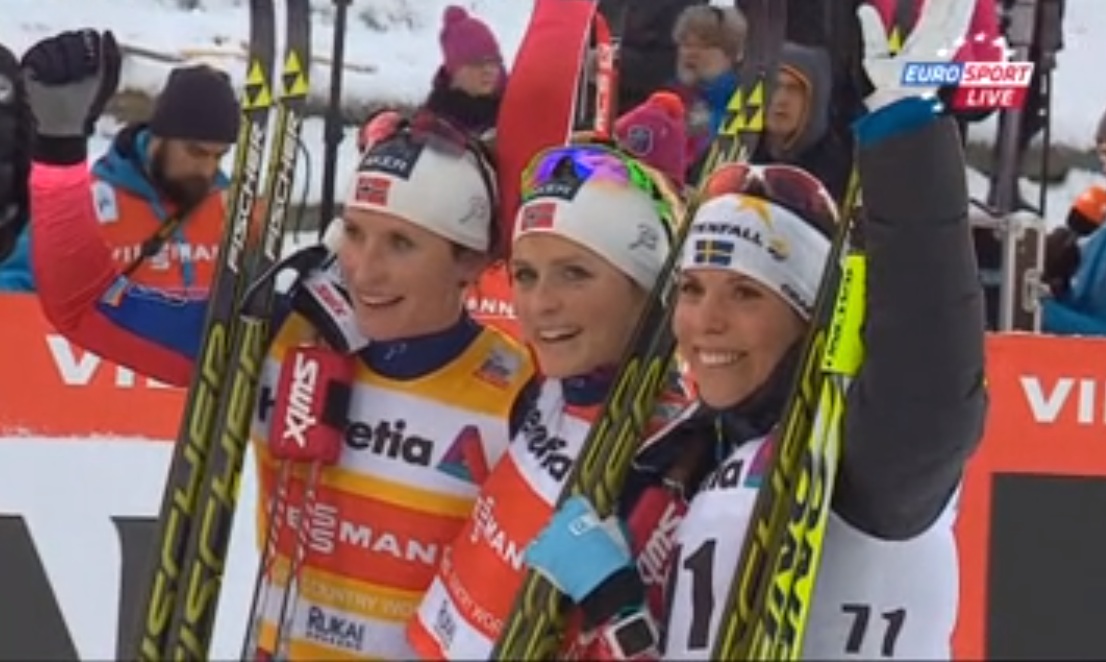
In the opening distance race of the World Cup season, Therese Johaug of Norway dominated from the start and walked away with her first-ever World Cup win in a 10-kilometer classic.
From the moment Johaug, 26, set out on the course during Sunday’s race in Kuusamo, Finland, it was clear that the rest of the women’s field would be racing for second. Even the ever-dominant Marit Bjørgen of Norway, who was coming off a win in the 1.4 k classic sprint the day before, knew that Johaug was going to win.
“I knew after four kilometers that Therese was 25 seconds ahead and I understood I would be fighting for second place,” Bjørgen told FIS after finishing second, 42.2 seconds back from Johaug, who won in 25:47.2. “I was pushing as much as I could to take second place.”
The women’s 10 k classic podium on Sunday in Kuusamo, Finland: with winner Therese Johaug (l), runner-up Marit Bjørgen (c) and Charlotte Kalla in third. (Photo: FIS Cross Country/Twitter)
A two-time winner of the Kuusamo 10 k classic in 2005 and 2007 (the last time it was held was 2008), Bjørgen, who started last of 77 women, appeared to ski a very controlled-and-tactical race. She passed through the 3.1 k checkpoint in fourth behind Johaug in the lead, Poland’s Justyna Kowalczyk in second, and Sweden’s Charlotte Kalla in third.
At each subsequent time check, Bjørgen moved up in the rankings. She was in third at the halfway point and slid into second by 8.1 k, but only by a razor-thin margin of one-tenth of a second over eventual third-place finisher Kalla (+44.1).
Rounding the final bend, Bjørgen put in a hard kick and barely bested Kalla, finishing 1.9 seconds ahead of the her.
Bjørgen was the overall victor in last year’s “Ruka Triple” in Kuusamo. This year, there were just two races — both of which counted for full World Cup points. Bjørgen’s win on Saturday put her in the overall World Cup leader’s bib for 2014/2015, and she remained 70 points ahead of Johaug after Sunday.
Last year, a 5 k classic was held on Day 2, when Kowalczyk took the win, Bjørgen placed second and Johaug finished third.
On Sunday, Kowalczyk was consistently in second for the first half of the race. However, by 8.1 k, she had faded and slipped to fourth where she would ultimately finish.
“I thought that the gap will be more… It hurt, but it’s a good position [for the start of the season],” she wrote in on Facebook, according to a translation.
“I knew after four kilometers that … I would be fighting for second place.” — Marit Bjørgen, 2nd in Sunday’s 10 k classic after Norwegian teammate Therese Johaug
Knowing Johaug and how pumped she was about Sunday’s 10 k, Norwegian Woman’s Head Coach Egil Kristiansen worried she might start too hard.
“I noticed that she was very excited after Saturday’s sprint … I was almost afraid that she would open too hard,” Kristiansen told Langrenn.com, according to a translation. “The skis were good, technique set and everything was correct. I cannot remember the last [time] there was such a victory margin. A fantastic race.”
“I am really happy now because this is my first victory in [a 10 k] classic,” Johaug told FIS afterward. “I’ve never been to the top of the podium in this race [until] today.”
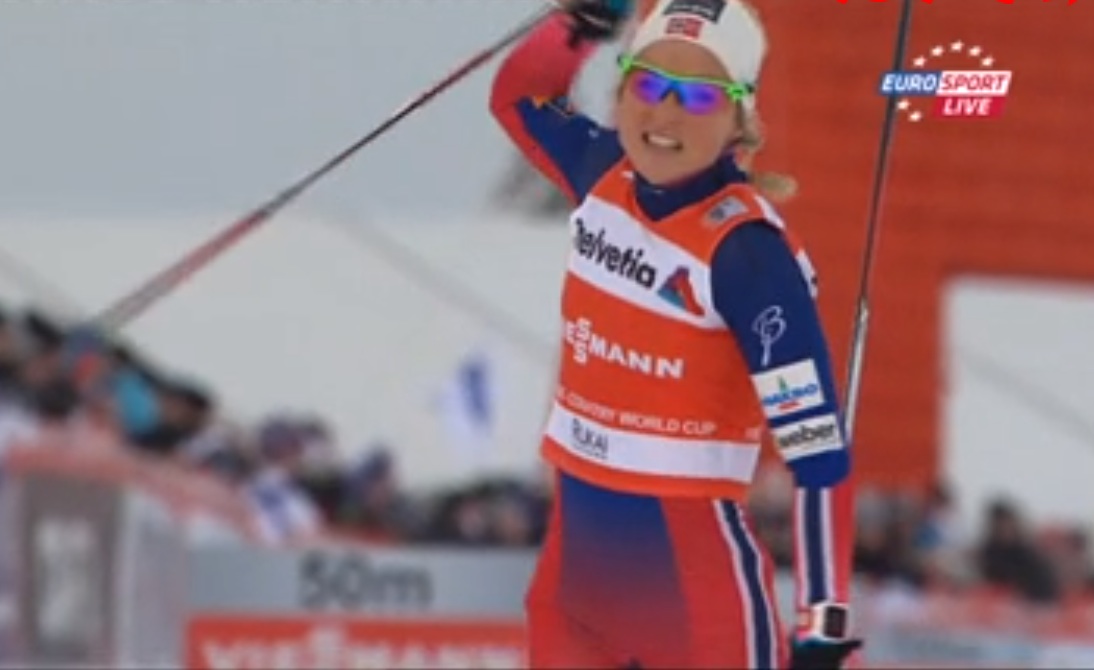
Approaching the finish, Johaug appeared fatigued, but continued to attack until the end. About a meter before the finish, she pumped her right fist into the air and let out a scream before collapsing her hands to her knees after the finish. She had essentially just won it — even with Bjørgen — still on course, she gave herself the liberty of a small celebration as her foot crossed the line.
“I think I’ve never been so good classical ever, especially in kick-double-pole,” Johaug told NRK. “I heard 20 seconds, then 30 and 40 … ‘This is your victory,’ I told myself.”
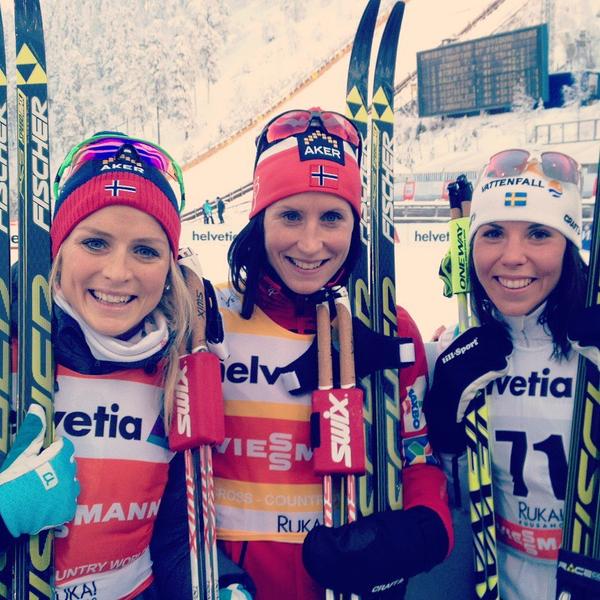
Bjørgen (l), Johaug (c) and Kalla get together after the women’s 10 k classic on Sunday, the first World Cup distance race of the season in Kuusamo, Finland.
Kalla, who did not compete in Saturday’s sprint race but swept three FIS races in Bruksvallarna the weekend before, had a stellar performance, nearly holding off Bjørgen. She told FIS after the race that she spent a lot of time working on her classic technique.
“I am very satisfied with the third place,” Kalla said. “I felt very good last week at the national opening and I’m glad I could keep the good shape to Ruka. I tried to do my very best today.”
Kristiansen had some praise for the 27-year-old Swede: “Charlotte’s strong and we knew in advance,” he told Espressen.se. “It’s good for us that we have two ahead of her.”
Norway took three of the top five, with Ingvild Flugstad Østberg in fifth, putting her third in the overall World Cup standings. Russia’s Yulia Tchekaleva finished sixth, Krista Parmakoski was the top Finnish woman in seventh, Norway’s Heidi Weng was eighth, Austria’s Katerina Smutna ninth, and Finland’s Kerttu Niskanen 10th.
With the opening weekend behind the World Cup athletes, they will move onto Lillehammer, Norway, for a three-day series next weekend, including freestyle sprints on Friday, 5/10 k freestyle races on Saturday, and 10/15 k classic pursuits on Sunday.
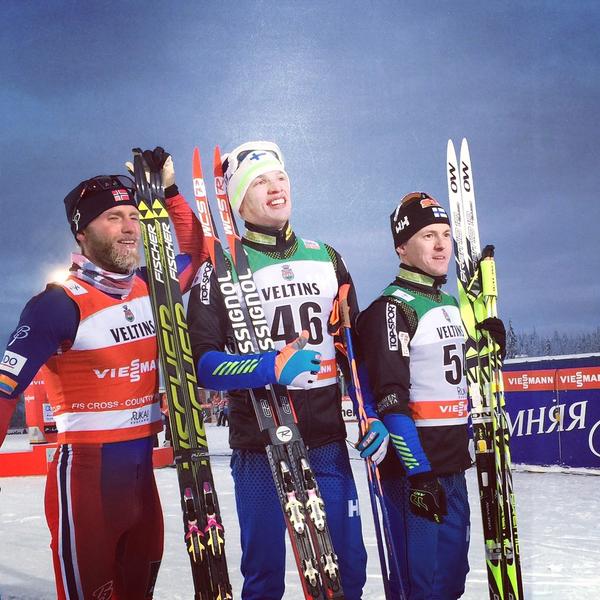
The men’s 15 k classic podium in the first World Cup distance race of the season on Sunday in Kuusamo, Finland: with Finland’s Iivo Niskanen (c) in first and Sami Jauhojärvi (r) in third, and Norway’s Martin Johnsrud Sundby in second. (Photo: FIS Cross Country/Twitter)
Iivo Niskanen appeared itchy in the leader’s chair on Sunday, after finishing with the fastest time of the day through 46 racers in the men’s 15-kilometer classic sprint — the first distance race of the 2014/2015 season.
Itchy, anxious, whatever you want to call it, but happy.
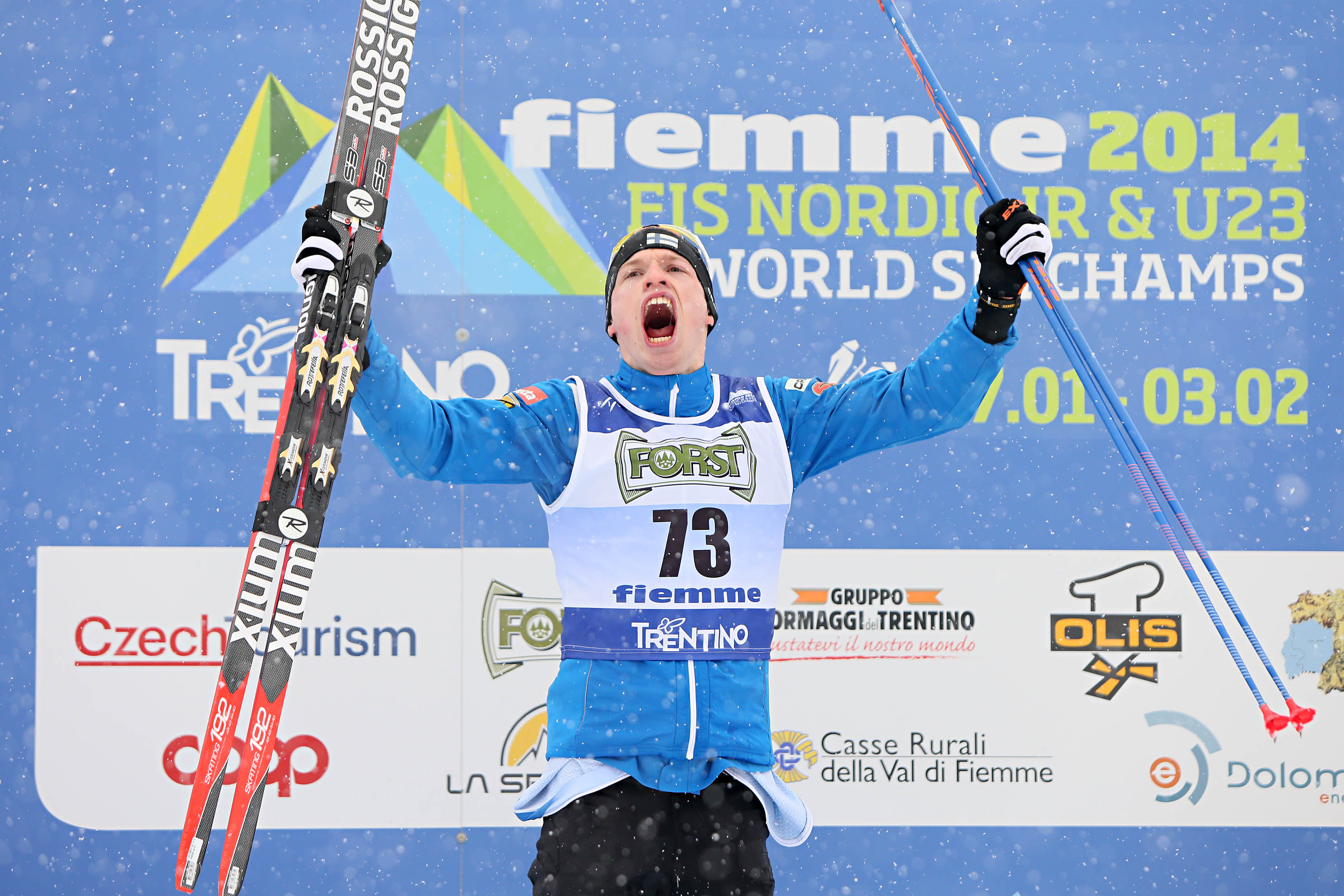
Iivo Niskanen (FIN) celebrating his win in the 15 k classic at the 2014 U23 World Championships in Val di Fiemme, Italy. (Photo: Fiemme 2014)
The 22-year-old Finnish A-team member, defending U23 World Championships 15 k classic champion and younger brother of Kerttu Niskanen, had never been on a World Cup podium before.
He won gold in the 2014 Olympic classic team sprint with teammate Sami Jauhojärvi, but individually, this was a big deal.
Fourteen men raced for Finland on Sunday in front of Ruka’s packed stadium in Kuusamo, Finland, but the man of the hour was Niskanen. The 33-year-old veteran Jauhojärvi wasn’t far behind him — 12.5 seconds at the finish — and ended up on the podium, too, but Niskanen soaked up the most crowd love and blew the most kisses after the race was over.
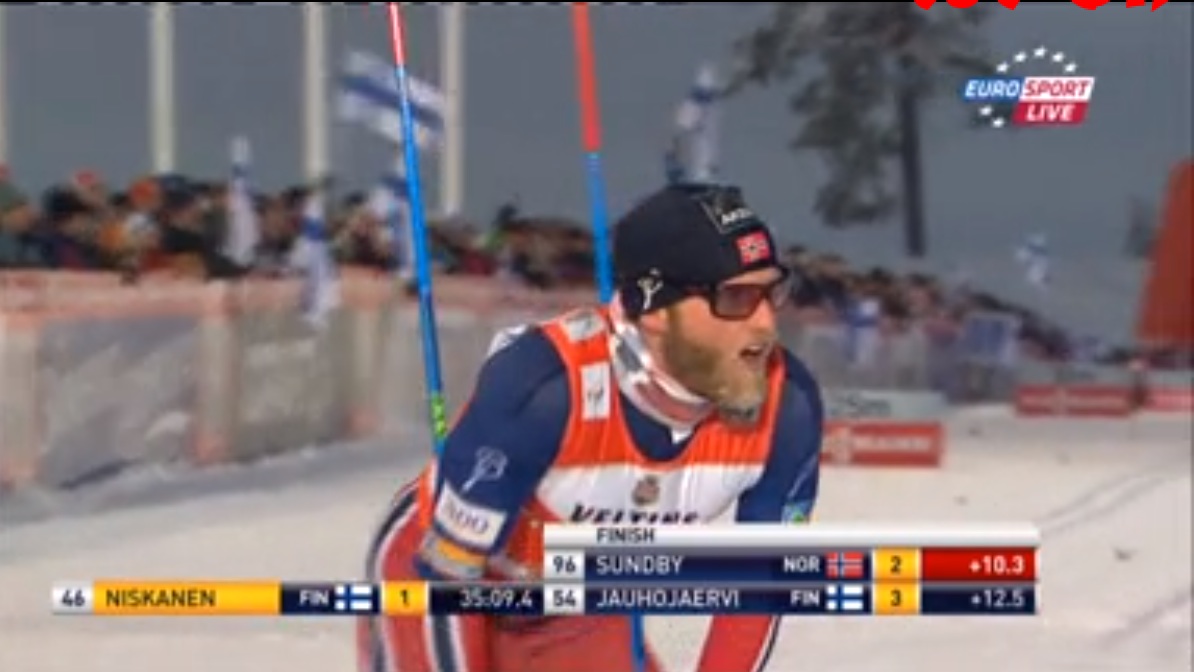
Moments before he officially won it in 35:09.4 — by 10.3 seconds over Norway’s Martin Johnsrud Sundby — Niskanen jumped out of the cushiony chair and got ready to run like crazy down the finishing stretch.
“It’s amazing that this [victory] came in front of a home audience,” Niskanen told the Ilta-Sanomat, according to a translation. “I just realized a little boy’s dream. Thanks to the military forces. We have two men on the podium; it is a fine specimen of a job well done.”
Niskanen started early in the seeded group, 46th of 96 men, and consistently clocked the fastest times through each passing checkpoint about every 1.5 kilometers. That’s impressive enough for a U23 in his first full-time World Cup season, but Niskanen’s times held up as more than 30 other races passed through.
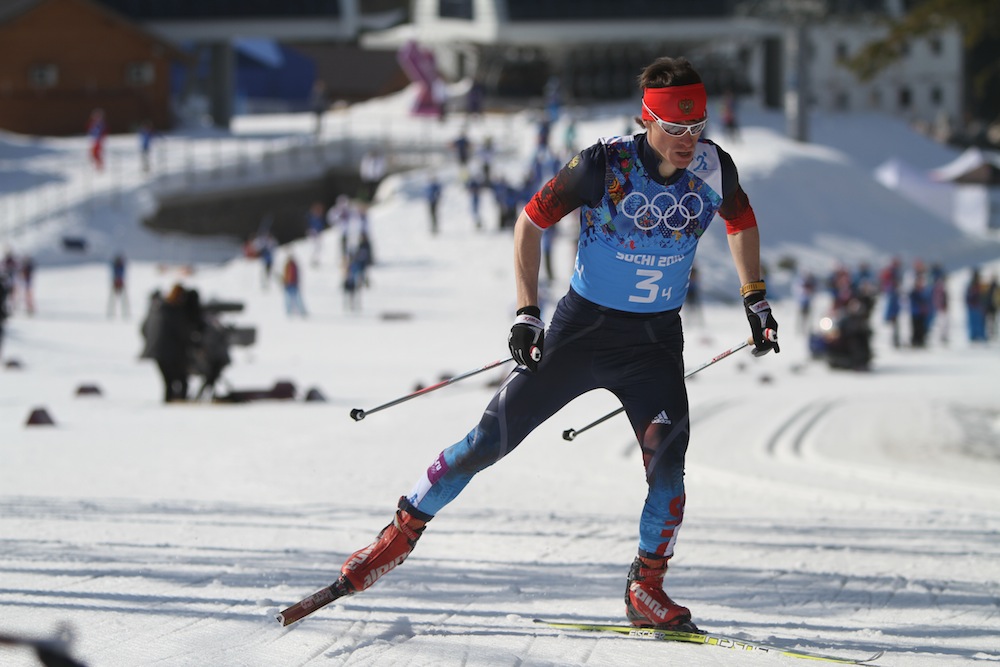
Maxim Vylegzhanin skating the Russian 4 x 10 men’s relay to silver in the 2014 Olympics in Sochi, Russia.
By the time Russia’s Maxim Vylegzhanin in bib 82 hit the 1.4 k marker, Niskanen had his match. The 32-year-old Vylegzhanin came through the checkpoint 2 seconds faster than Niskanen, and by 3.1 k, he remained 1.5 seconds ahead.
A third of the way through at 5 k, Niskanen had the edge over the Russian by 4.3 seconds, followed by Jauhojärvi, Sweden’s Daniel Richardsson, Sundby, Sweden’s Lars Nelson, and Russia’s Sergey Turyshev, respectively.
By 6.4 k, Niskanen and Vylegzhanin were dead even, 8.8 seconds ahead of Jauhojärvi. One-and-a-half kilometers later, Niskanen had a 7.1-second cushion as Vylegzhanin began to fade.
Jauhojärvi was still third fastest through that checkpoint, 9.7 seconds back, and Norway’s Niklas Dyrhaug was up to fourth after a conservative start.
Dyrhaug, who started 30th, took his position in the leader’s chair after finishing in 35:22, 28.5 seconds faster then previous leader Francesco De Fabiani of Italy. The Norwegian would stay there until Niskanen bested his time by 12.6 seconds.
At the 10 k mark, both Niskanen and Jauhojärvi were faster then Vylegzhanin, and it seemed first and second was possible for Finland. But there were still more competitive racers to come, including Sundby, the reigning overall World Cup champion.
Niskanen had nearly 15 seconds on Jauhojärvi at 11.4 k, and Vylegzhanin was 14.8 seconds back in third. The Russian slipped to eighth by 13.1 k, and Sundby slipped momentarily on what looked like slightly slick skis — or maybe he was just getting tired on Kuusamo’s relentless three-lap course.
With less than two kilometers to go, Sundby was up to second regardless, 14 seconds behind Niskanen. Jauhojärvi was another 1.5 seconds back in third.
Niskanen sat grinning from ear to ear under the lights in the Ruka stadium. As Sundby hoofed up the final climb, grimacing through a thick beard and big sunglasses, it was fairly evident he wasn’t going to touch the young Finn. Sundby put on a strong finishing kick around a Russian at the finish, and secured second, 2.2 seconds ahead of Jauhojärvi in third.
Sundby finishing and looking up to confirm he placed second in Sunday’s World Cup 15 k classic in Kuusamo, Finland.
“It is lovely to get on the podium, although I wanted to win,” Sundby said to NRK, according to a translation. “I was basically shot against Iivo.”
While he said he was “not flying on skis yet,” he hoped it would come with time.
“My ultimate goal is to be in my best shape in Falun,” he told FIS.
Sundby bumped fellow Norwegian Dyrhaug to fourth, just one-tenth of a second off the podium. But he wasn’t too upset.
“I am very, very happy to be back in top form,” Dyrhaug told NRK. “I’ve had two tough years, so it’s good to know that the body is working again.”
Standing on the podium with him for the first time in a World Cup since 2010, Jauhojärvi said he felt like he skied smoothly, but he wasn’t completely satisfied.
“I heard from Norwegian split times that Niklas [Dyrhaug] was in the lead,” Jauhojärvi told FIS. “He was skiing behind me so I had to speed up in the last kilometers. I did not feel strong and fast today, but I had extremely good skis.”
Niskanen, who became Finland’s first male to win in Ruka in 19 races there, said both his grip and glide were perfect.
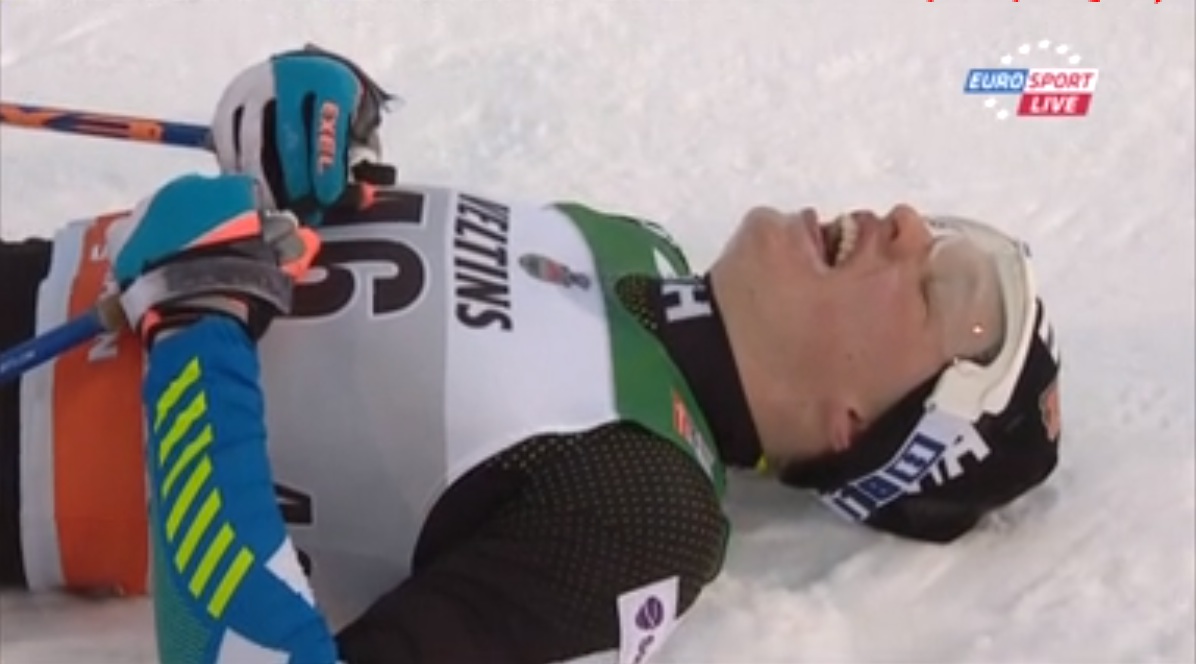
An exhausted Iivo Niskanen at the finish of Sunday’s 15 k classic in Kuusamo, Finland, which he won for his first World Cup podium.
Walking through the mixed zone, Finnish coach Magnar Dalen yelled to journalists, “Watch out for that boy there! He is a cross-country Messi!” referring to the Argentine soccer great.
“I was an amazing day; I had to be smart,” Niskanen told NRK. “I have done many races here and knew I had to turn down the pace two notches on the hills and makes it up [on other parts of the course].
“It was really noisy along the course,” he said to FIS. “Before the race I thought I could be in top six. I tried to improve the summer training and I seem to have done a good job. It was pretty nice that my family could be here today with me.”
“It was impressive,” said Petter Northug, who placed 23rd and 1:02.7 back, to NRK. “Niskanen looks like he has risen.”
Vylegzhanin tied Didrik Tønseth for 11th, 37.5 seconds behind Niskanen. Russia’s top skier, Alexander Bessmertnykh finished fifth, Calle Halfvarsson of Sweden was sixth, Canada’s Alex Harvey seventh, Simen Håkon Østensen eighth, Pål Golberg ninth, and Finland’s Matti Heikkinen 10th.
Turyshev ended up 25th, four seconds behind Switzerland’s Dario Cologna in 24th (+1:05.2).
“Iiiiivoooo!! Unbelievable!!!” Kerttu Niskanen tweeted after Sunday’s race.
Note: Two men did not finish Sunday: American Noah Hoffman and Poland’s Maciej Starega, who stopped somewhere after 3.1 k. Hoffman crashed hard on an icy downhill about 1 k before the finish and was taken off the course in a stretcher.
According to U.S. Ski Team coach Matt Whitcomb, Hoffman “sustained a lower left leg injury today and will be headed home to the US as soon as possible for further evaluation. He will fly home either Monday or Tuesday. The World Cup organizers and medical personnel in Kuusamo / Ruka, as well as our US Ski team medical staff member Peter Dickenson handled the situation very well.”
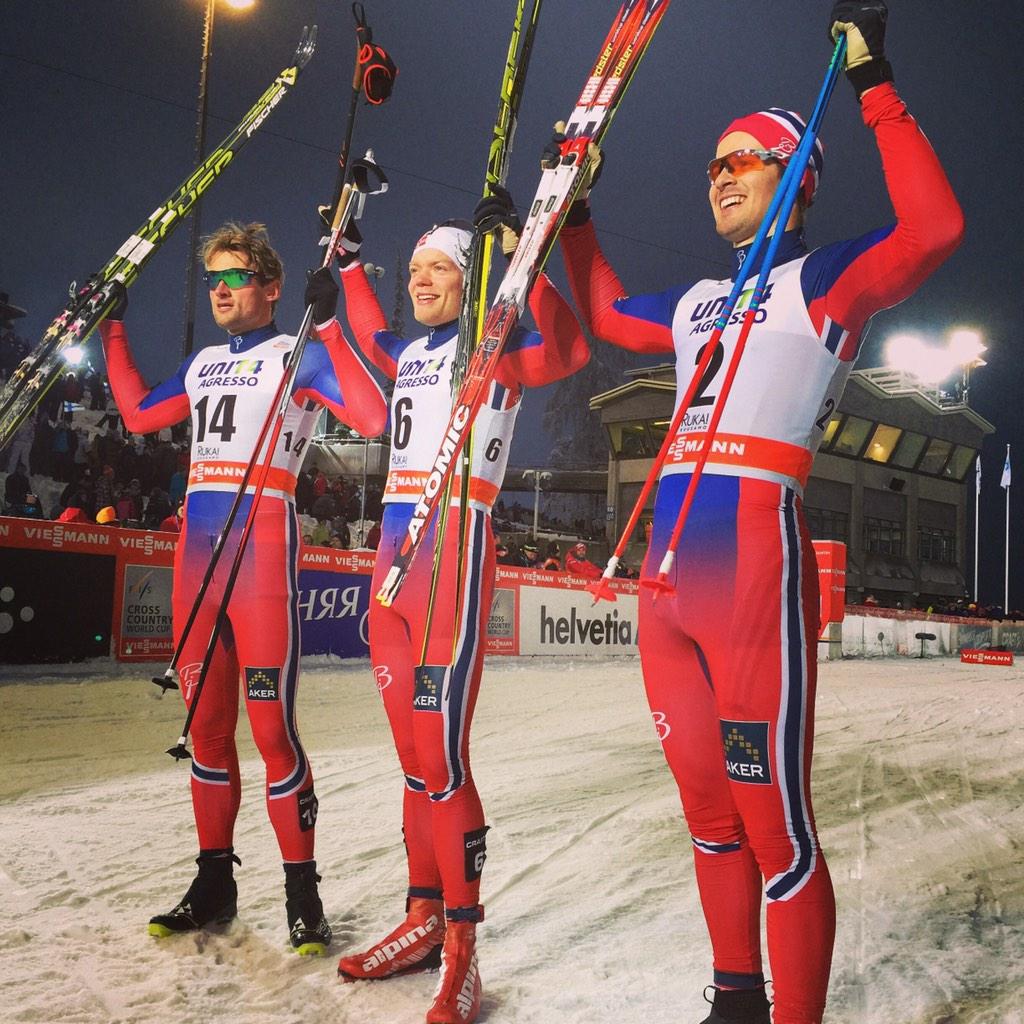
An all-Norwegian men’s podium on Saturday at the 1.4 k classic-sprint World Cup opener in Kuusamo, Finland. Eirik Brandsdal (c) won it, Petter Northug (l) was second and Sondre Turvoll Fossli notched a career-best third in his first World Cup final. (Photo: FIS Cross Country/Twitter)
The World Cup season got off to a blistering start on Saturday in the northern reaches of Finland with a 1.4-kilometer classic sprint. Eighty-seven men toed the line for the prologue on a gray day in Kuusamo, Finland.
Alexander Panzhinskiy of Russia put down the best qualifying time of 2:38.35, two-tenths of a second ahead of Norway’s Sondre Turvoll Fossli in second place and 5 1/2 seconds faster than the last man to make it to the heats, Martin Jaks of the Czech Republic.
Norway managed to put eight men into the heats with host nation, Finland, grabbing seven of the 30 qualifying slots. Three North Americans — Simi Hamilton (USA), Alex Harvey (CAN), and Andy Newell (USA) — qualified in 16th, 17th and 24th, respectively. Harvey went on to place 14th, Hamilton was 26th and Newell 28th after being eliminated in the quarterfinals.
Just-below-freezing variable conditions combined with the hilly course made for difficult waxing conditions, which were evident through the day as the skiers attacked each round.
When asked how the conditions affected wax choice on Saturday, U.S. Ski Team wax technician Gus Kaeding wrote, “Finding kick wasn’t a problem, managing icing with [a] mix of dry powder and ice was. It took a combination of wax, correct application, athletes skiing the conditions, and patience to pull off good skis.
“When everything comes together we see a career best! Congrats Ida!” he added, referring to American Ida Sargent’s career-best fifth-place finish in the women’s sprint.
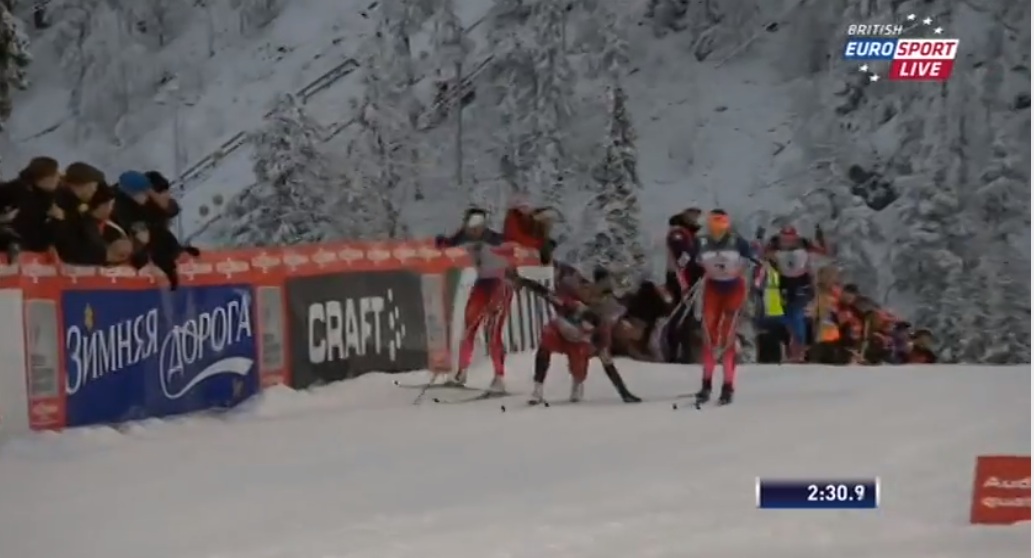
Two memorable moments from the men’s race came from Fossli and Italy’s Federico Pellegrino in the quarterfinals. Fossli was leading the fourth quarterfinal coming into the last turn before the finishing straight, when it appeared that his pole or strap broke leaving him to cover the last few hundred meters with a single pole. Striding hard nonetheless, he watched his teammate Finn Hågen Krogh pass him, and Krogh seemed to consider, if only for a moment, letting Fossli win. Better safe than sorry, and he led Fossli into the finish in first and second, and the two moved on to the semifinals.
The second moment came with Pellegrino as his heat entered the final climb before the stadium. Sitting in sixth at the base of that hill, Pellegrino swung to the outside and put in some extremely fast and hard striding, opening up a sizable gap between himself and the rest of the field by the top. He was unable to repeat his performance in the semifinal and finished third in that heat for seventh overall.
The final turned out to be a battle between Norway and Russia with four Norwegians and two Russians in the mix. The finalists jumped out to a clean start with the Norwegians leading the Russians into the first corner. At the bottom of the first climb, Russia’s Sergey Ustiugov put in a brief kick to attempt to take the lead, but settled into third at the crest.
Norway’s Petter Northug, whose technique and power had been less than stellar in his previous two heats, seemed to put it together on the final climb, looking strong and composed while powering from fourth to the front as the Russians faded.
Northug’s teammate, Eirik Brandsdal led Fossli, Ustiugov and Northug, the last two of which were side by side, in the flat before the climb, followed by Russia’s Alexey Petukhov and Krogh. Northug moved up at the base, passing Ustiugov and Fossli. Brandsdal remained in the lead and the Norwegians kept charging ahead while the Russians appeared to lose steam with a not as much kick.
Rising up and over the top, Northug inched ahead of Brandsdal, who slipped on his kick momentarily. Fossli moved to third ahead of Krogh. Around the last turn, Northug and Brandsdal skied alongside each other, and Brandsdal held stronger to the finish — winning in 2:34.84 by 0.47 seconds.
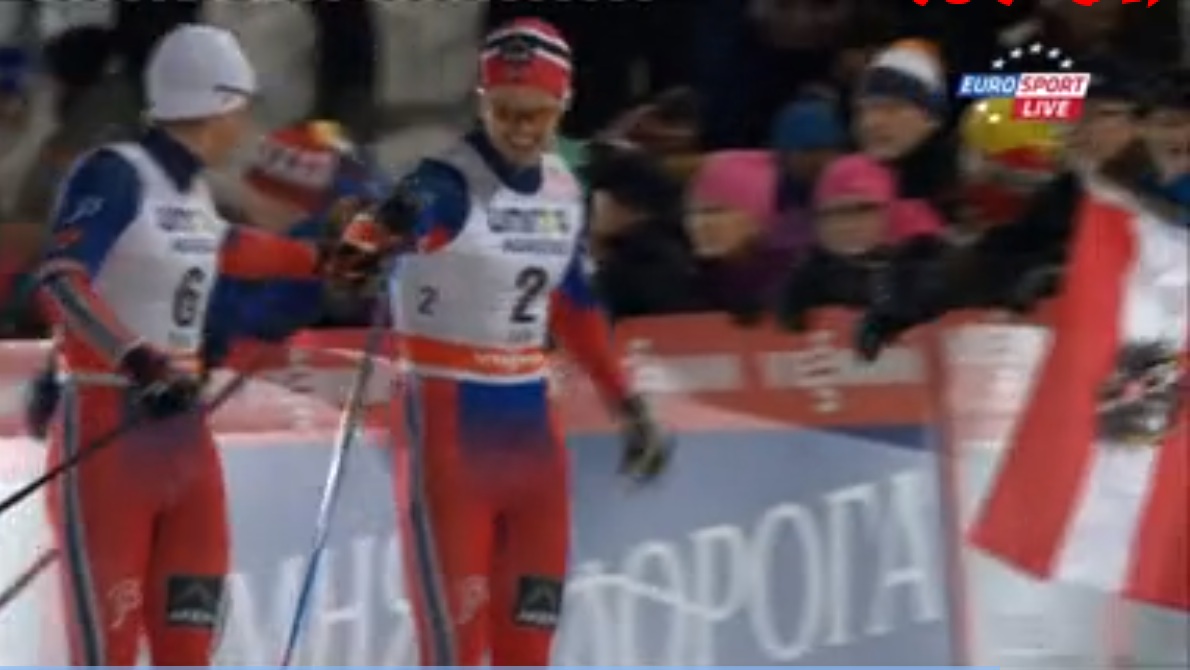
Saturday’s winner, Brandsdal (l) congratulates fellow Norwegian Fossli, who placed third, at the finish of the men’s classic sprint final in Kuusamo, Finland.
Norway swept the podium with Fossli placing third (+1.18), and Krogh took fourth (+1.69) ahead of Petukhov in fifth (+4.54) and Ustiugov in sixth (+14.63).
For the second-straight year, Brandsdal, 28, won the Kuusamo classic-sprint (last year beating Russia’s Anton Gafarov and Sweden’s Teodor Petterson, respectively). It was his sixth World Cup victory.
“I felt from the beginning it was my day,” he told FIS after the race. “I had also perfect skis. I struggled a little bit in the quarterfinal when I did not ski up the hill as I had planned, but the semifinal was much better. In the final I managed to keep calm and go for the victory. Sprint World Cup is one of my goals and it is great to start the season with the victory.”
Brandsdal won both his quarterfinal (by 0.5 seconds over Sweden’s Teodor Peterson) and semifinal (by nearly two seconds over Northug). And for now, he’s in the lead for the overall 2014/2015 World Cup.
“I saw the eyes of Peter. It will be tough next time,” Brandsdal told VG. “He is set on the [overall] yellow jersey.”
Northug was probably the most talked about athlete competing today. After a summer of legal battles and a 50-day jail sentence stemming from a drunk-driving incident in May, he stepped onto the course with intensity.
“It’s good to get a good start. I was only double poling in Beitostølen,” he said of his FIS classic-sprint win in Norway last week. “Today I was on grip wax and it is a tough course, and I am happy to be on the podium. On the last climb I did not have any power left. When Eirik attacked I could not react, but I am happy for the second place.”
Fossli, 21, was excited about a podium in his first World Cup final, and told FIS he felt strong all day.
“I was lucky in the quarterfinal to make it to the semifinal with one pole,” he said. “It feels great to be on the podium. I was second in Beitostølen and it is great to start the World Cup season with a podium.”
The World Cup continues Sunday in Ruka with a 10/15 k classic and then moves to Lillehammer, Norway, for a series of three races next weekend.
About the author: Tommy is a former Stratton Mountain School and Middlebury College skier. After college, he took a different route from skiing and spent nine years flying attack helicopters for the Marine Corps. After too many winters spent in hot dusty climates, he left the Marines and is back in Vermont where he couldn’t be happier.
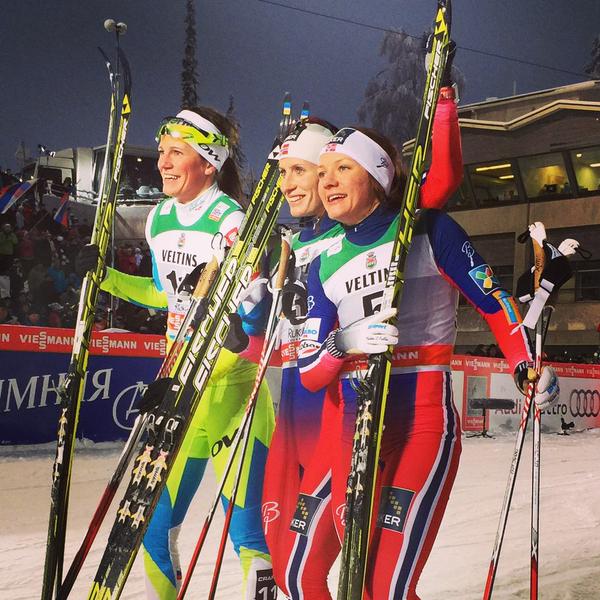
The women’s classic sprint podium on Saturday in Kuusamo, Finland: with winner Marit Bjørgen (c), runner-up Katja Visnar (l) and Maiken Caspersen Falla in third. (Photo: FIS Cross Country/Twitter)
Marit Bjørgen appeared a little surprised with herself at the finish of Saturday’s World Cup opener. A classic-sprint win in the first race of the season? Sure, she was the 2010 Olympic champ in that event, but the 34-year-old Norwegian had barely warmed up into racing, and last year, she placed 13th in the Kuusamo classic sprint after qualifying first. Either way, she’d take it.
“I am grateful to win today,” she told FIS after the race. “It’s still a sprint and to take the victory, I’m really happy for that. We had very good skis today, the Norwegian girls.”
That was a bit of an understatement. The Norwegians across the board had rocket skis on a just-below-freezing morning and afternoon: “Norway hit the wax out of the park,” U.S. Ski Team Women’s Coach Matt Whitcomb said. “But we saw every team have everything from great kick to really slippery to icing a ton to just damage control in all three of those categories.”
Case in point: the 1.4-kilometer women’s final, in which three Norwegians — Bjørgen, Ingvild Flugstad Østberg, and Maiken Caspersen Falla — led the charge early on.
Slovenia’s Katja Visnar kept herself in the mix up front, but she was the exception.
Østberg, the fastest qualifier by 2.9 seconds over teammate Celine Brun-Lie and four more Norwegians (Bjørgen, Kari Vikhagen Gjeitnes, Falla, and Heidi Weng) in third through sixth, led both her quarterfinal and semifinal aggressively out of the start and held her own in first through the finish.
The 24-year-old Østberg tried it once more for the final, with Visnar sticking close and Bjørgen just a couple meters back in third, ahead of Falla. Meanwhile, American Ida Sargent in her first classic-sprint final kept in contact at the back with Russia’s Natalia Matveeva.
Bjørgen squeezed in front of Visnar on the lefthand turn at the top of the first major hill (one of two), and Sargent moved to fifth.
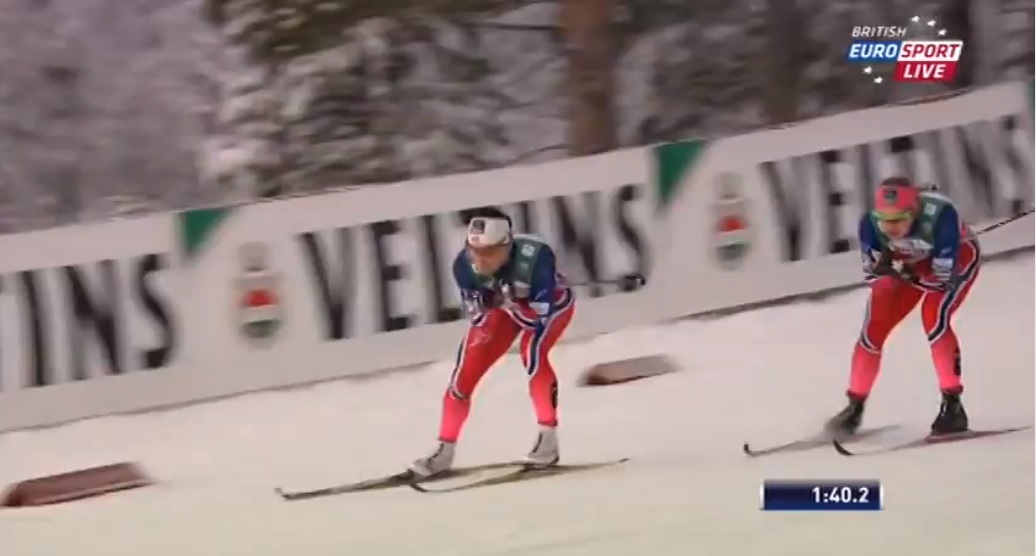
Norway’s Bjørgen (l) and Østberg (r) flying down the long descent of Kuusamo’s 1.4 k classic-sprint course while leading the final before the last, grinding climb to the finish.
By the end of the 25-second downhill on the other side, Bjørgen was up to first several meters ahead of Østberg. Visnar began to close on the second Norwegian, challenging both Østberg and Bjørgen into the long, final climb — one of the steepest on the circuit — back up to the stadium.
Østberg found the grip she needed and came back even with Bjørgen over the top, but got hung up on her iced-over skis shortly after, allowing Bjørgen, Visnar and Falla to overtake her.
It looked like Bjørgen never glanced back. She continued to keep a ski length between her and Visnar and double poled powerfully around the final turn toward the finish. With Visnar inching closer with each push, Bjørgen held her off until the finish, throwing up her arms immediately upon crossing the red line.
“I am really happy that I kept the young girls behind me,” she told FIS. “I am in good shape at the beginning of the season after the hard training I have done. I was training a lot in November.”
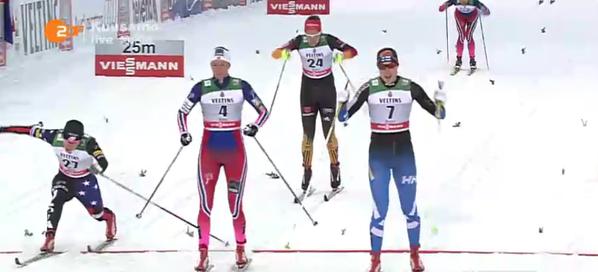
Marit Bjørgen (r) celebrates her win in Saturday’s sprint final in Kuusamo, ahead of Katja Visnar (Slovenia) in second, Falla (Norway) in third, Østberg (Norway) in fourth, and American Sargent (l) in fifth, ahead of Russia’s Matveeva (not shown).
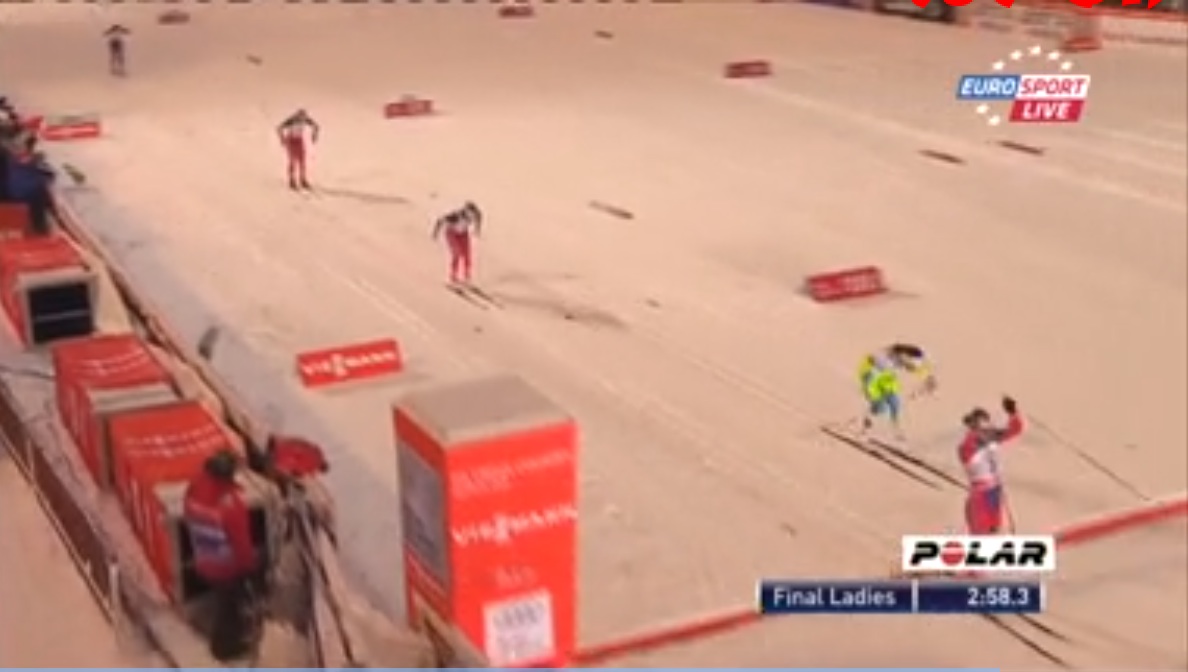
Bjørgen edged Visnar by 0.46 seconds in 2:58.33. Falla took third, 1.7 seconds after Bjørgen, and Østberg settled for fourth, another 1.3 seconds back. Sargent finished fifth (+5.95) for a World Cup career best, and Matveeva was sixth (+12.37).
It was Bjørgen’s fifth podium in the Ruka classic sprint, putting her on par with Slovenian legend Petra Majdič.
Interestingly, Visnar has placed second in four World Cup races — all of which took place in either Finland or Russia, according to FIS.
Eurosport announcers observed that Bjørgen was gasping for air on the final climb — two meters longer than last year because of the way it was tracked.
“It was a difficult race, but we had very good skiing,” Bjørgen said after her 67th World Cup win (83 if you include stages).
This year, the Kuusamo classic sprint was not a stage because the venue is hosting two races Saturday and Sunday as opposed to three (known as the Ruka Triple). Therefore, the race counted toward full World Cup points.
That was good news for Bjørgen, who’s won the overall World Cup three times (in 2012, 2006, and 2005).
In addition to ideal skis, Bjørgen paced her quarterfinal and semi to near-perfection on Kuusamo’s notoriously challenging course. She won her quarterfinal by 0.23 seconds over Matveeva and 0.45 seconds ahead of another Russian, Anastasia Dotsenko. In her semifinal, she topped Matveeva once again (this time by 1.14 seconds) and bumped Polish rival Justyna Kowalczyk to third, 1.51 seconds behind.
Their semifinal was three seconds slower than the first (in which Østberg beat Visnar by one-tenth of a second and Falla by 1 second), which kept Kowalczyk from advancing to the final as a lucky loser.
Sargent, who was fourth in Østberg’s semi (3.23 seconds back), moved on instead along with Falla, the 2014 skate-sprint Olympic gold medalist.
“I was pretty excited because I have only been in one final before and haven’t ever been in a classic final,” Sargent said. “I was just psyched to have one opportunity and see what I could do.”
Østberg was slightly disappointed with her result after never having lost the lead all day until the final.
“It was really a very good day, but what happened at the end was dull,” she told NRK, according to a translation. “I got a little icing under the skis and it’s a shame when you feel so good.”
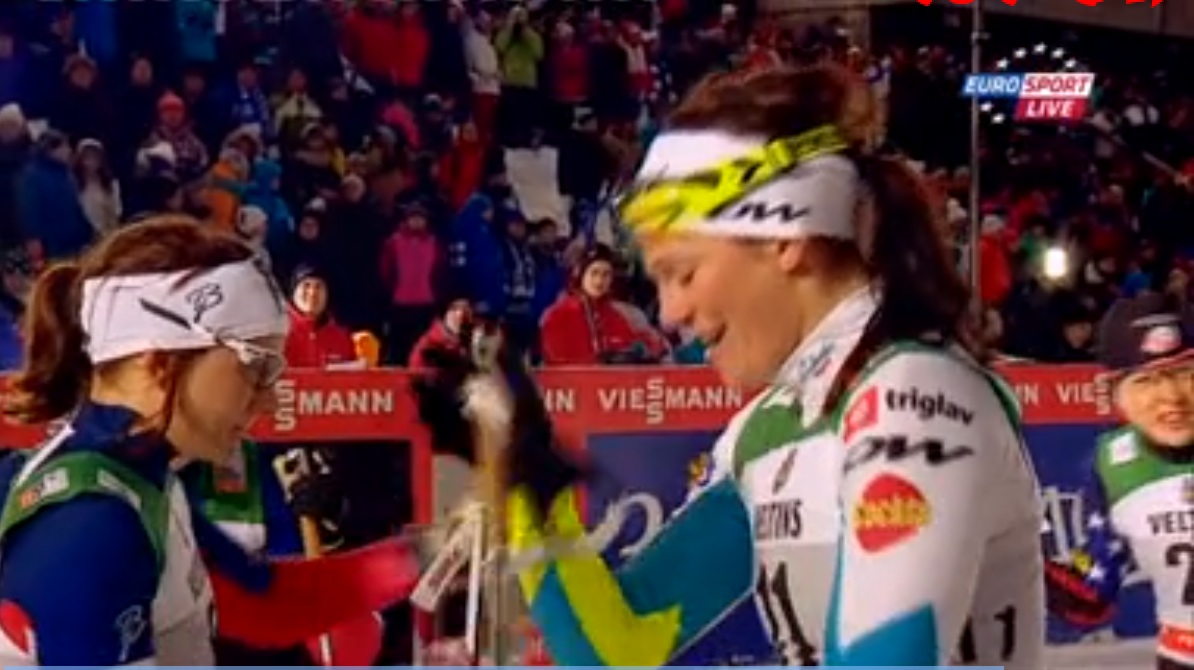
Slovenia’s Katja Visnar, who finished second in Saturday’s classic sprint, after getting hugs from the three Norwegians, including Maiken Caspersen Falla (l), in the final in Kuusamo, Finland.
Visnar, who advanced in second in both her quarterfinal and semi, was just as excited at Bjørgen at the finish — also pumping her arms and joining her on the victory lap in front of Kuusamo’s filled stadium.
“My training works, and it has brought me to where I am,” Visnar told FIS. “I have been training distance more and I am not so tired in the heats as I was before. Now when I have a good day I believe I can make it to the final. The final was fast. I had great skis and grip in the uphill. I felt strong in double poling to the finish line.”
The three Norwegian women all congratulated her afterward.
Falla won her quarterfinal with the fastest quarterfinal time of the day in 2:58.48.
“I am happy about third place today,” she told FIS after achieving her 16th World Cup podium. “It is a good start to the season.”
Justyna Kowalczyk (c) stumbles over her snow-jammed skis just after topping the final climb in her semifinal, while Norway’s Marit Bjørgen (l) and Celine Brun-Lie (r) go around either side of her.
The biggest shakeup was the absence of Kowalczyk in the final. She was second in her quarterfinal behind Falla, and third in her semifinal. Opting for more kick than most, Kowalczyk had no problem running up the last hill and holding off Bjørgen and Brun-Lie initially for first in their semi — until she tripped over the top.
Brun-Lie lost second around the final corner and Kowalczyk made up as much as she could, double poling to third behind Bjørgen and Matveeva.
According to Infostrada Sports, 15 of the last 17 classic sprints in the World Cup or World Championships belong to either Bjørgen or Kowalczyk.
Kowalczyk ended up seventh on the day after winning the Kuusamo classic sprint last year (when Kikkan Randall was second and Bjørgen was 13th). On Saturday, Randall missed out on the semifinals and settled for 16th overall.
Already in the first race of the season, reporters asked Bjørgen about her prospects for 2015 World Championships in February.
“As long as the trails are like here it’ll go well,” Bjørgen told Aftenposten. “I like trails of length, and I think that there may be opportunities in the sprint course in Falun.”
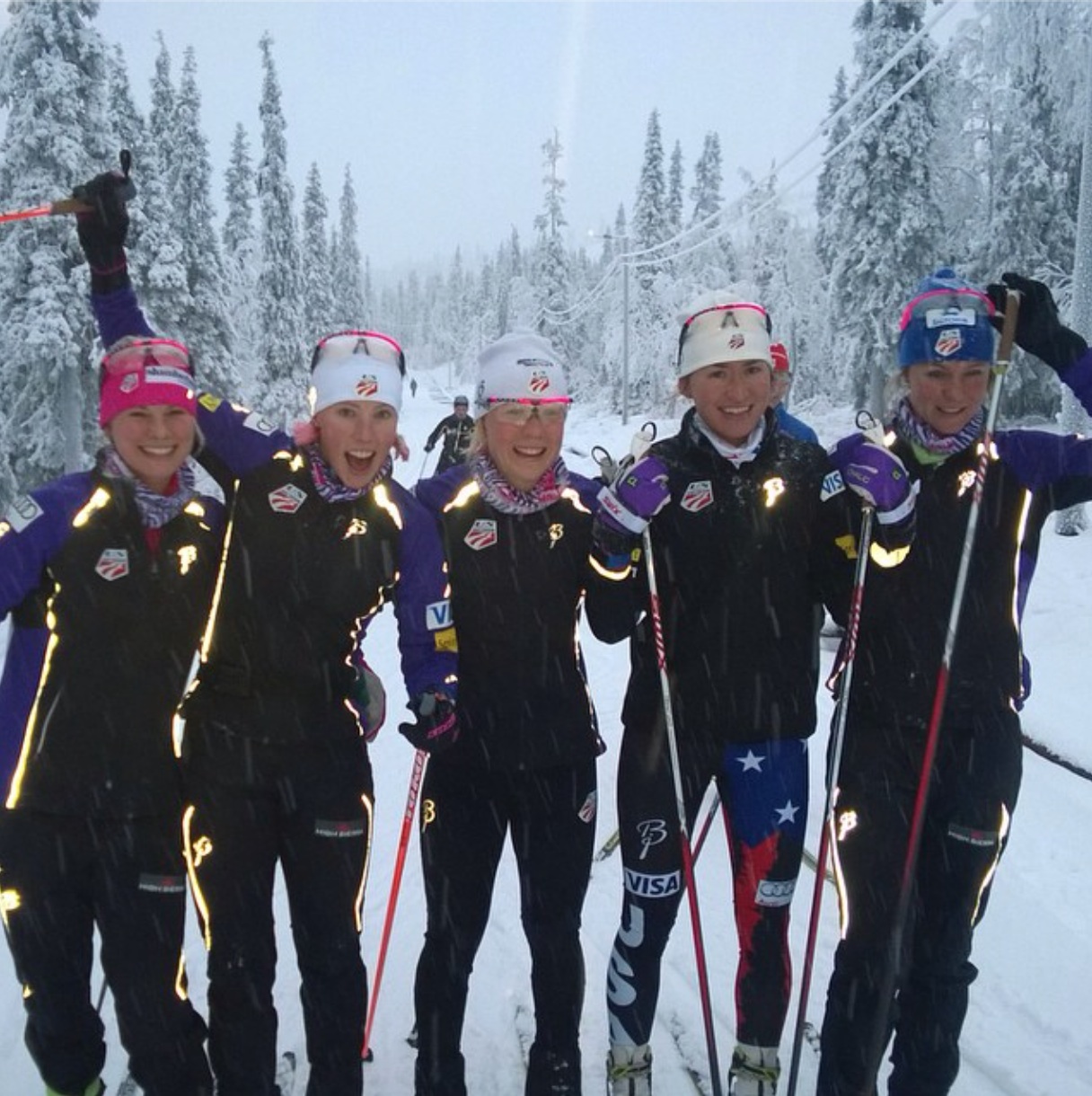
The U.S. Ski Team women earlier this week while training in Muonio, Finland. From left to right: Jessie Diggins, Kikkan Randall, Ida Sargent, Sophie Caldwell, and Sadie Bjornsen. (Photo: Ida Sargent/Instagram)
There was plenty to think about and perhaps more to stress over on Saturday at the first World Cup of the 2014/2015 season in Kuusamo, Finland.
Ida Sargent of the U.S. Ski Team tried to keep in mind everyone else was essentially going through the same thing at the 1.4-kilometer classic sprint on a day with temperatures hovering right around zero degrees Celsius. But there was so much to remember: how to warmup, when to get to the start line, what to do between heats, and when and what she should eat to keep her energy up.
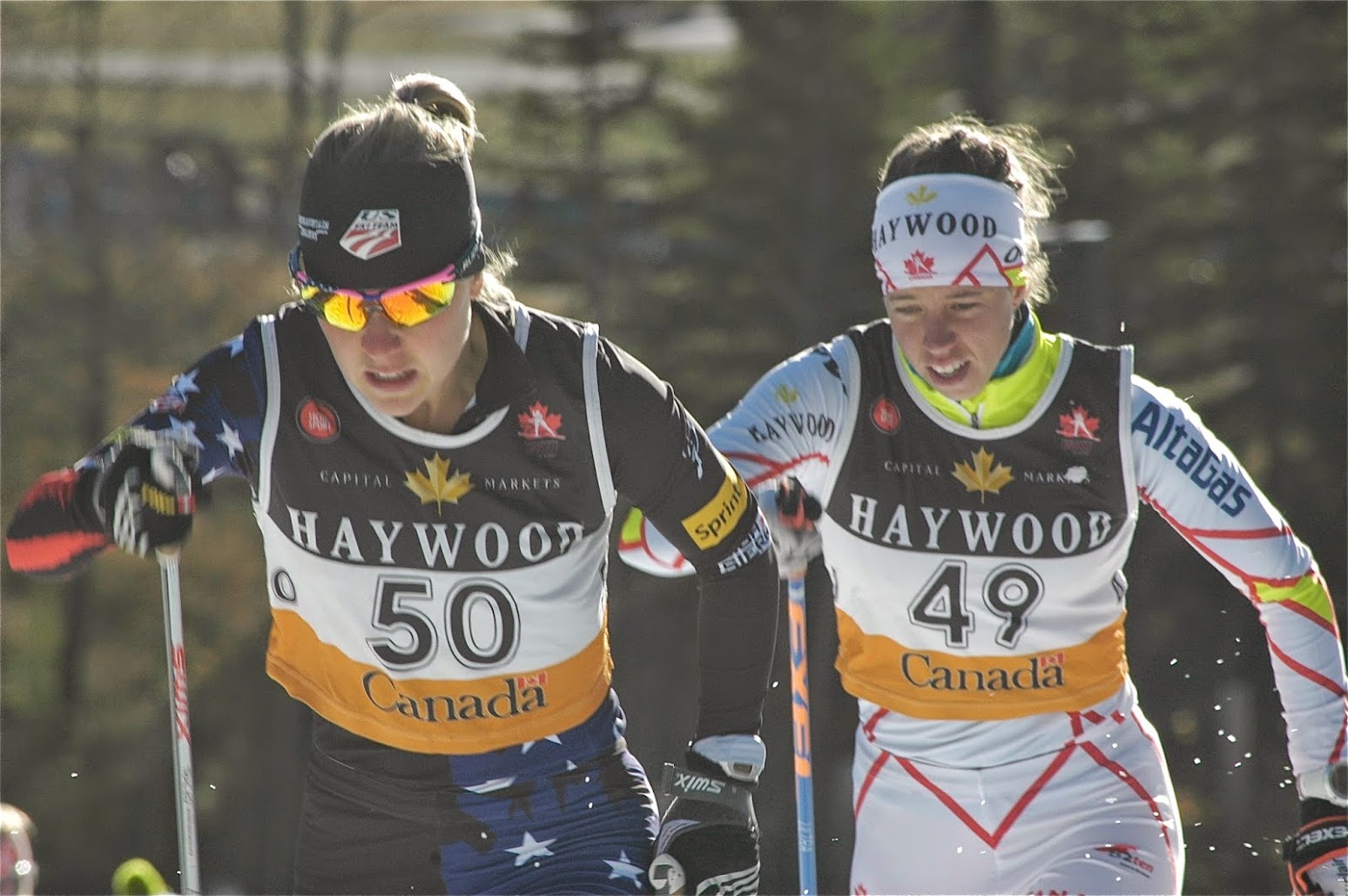
Ida Sargent (U.S. Ski Team/CGRP) leads Perianne Jones (Canadian NST)during the heats of the Frozen Thunder classic sprint on Oct. 24 in Canmore, Alberta. Sargent went on to beat out Jones for first overall. (Photo: Angus Cockney)
It was a routine she and many others on the circuit would refine over the course of the four-month season, but for now, she had to do her best.
In a phone interview after the race, Sargent, 26, recalled being a little tight in the qualifier.
“We were kind of struggling with skis and got them dialed in a little bit more for the race, but I didn’t feel like I had a good warmup so I was kind of stressed and trying to get it together,” she said.
Like others, she found that the tracks were pretty washed out and glazed over from the get-go.
“I think I was kind of fighting it too much in the qualifier rather than just relaxing and skiing smoothly,” she said. “It was really unstable conditions, which is not my favorite.”
Sargent made the top-30 qualifying cut in 27th, finishing 13.86 seconds behind qualifier winner Ingvild Flugstad Østberg, who rounded the challenging course in 2:59.79.
After that, Sargent continued testing her skis, put faith in her wax technicians and took a deep breath, “Like phew, made it through that one,” she said. Next, she thought about a fresh start for the heats.
From then on, every time Sargent advanced, it was a bonus — although she would’ve liked to have done so with a little more wiggle room.
For the first time in her life in a classic sprint, the Vermont native and Craftsbury Green Racing Project skier made it all the way to the final (she had placed sixth in a 2013 World Cup skate-sprint final in Sochi, Russia, so anything better than that on Saturday was gravy, she figured).
And while she mostly honed in on what she needed to do at a given time — like racing up the last, brutal climb as fast as possible — she also had her older sister to ski for.
About three months ago, Sargent’s sister Elsa was diagnosed with breast cancer shortly after getting married in July in Vermont. Two years older than Sargent, she received her last chemotherapy treatment on Wednesday, the day before Thanksgiving.
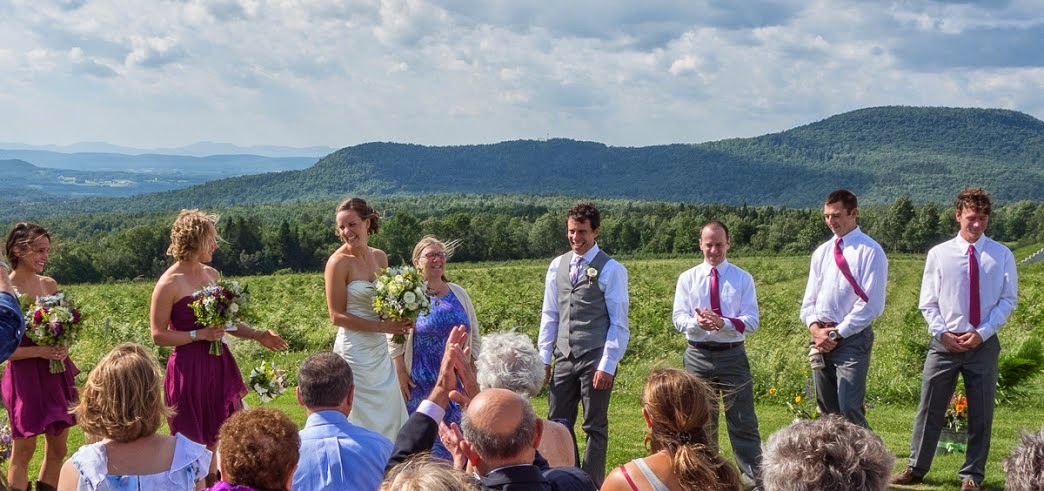
Ida Sargent (second from l) stands by the bride, her sister Elsa, during her Vermont wedding in July. (Photo: IdaSargent.blogspot.com)
“I [last] saw her at the wedding when it just was pure happiness,” Sargent said of Elsa, her best friend, who lives in Seattle. “I’ve just been really impressed with the strength that she’s had through this whole fall so I just wanted to channel that today and do my best to keep fighting. I think it’s pretty incredible to just be healthy and fit and just wanted to do my best to be strong like she has been.
“I feel really lucky that she’s on the mend and on the recovery and can move on with her normal life hopefully,” she added. “She’s always been really supportive of my skiing. We used to train together when she was still racing. She was a fierce competitor then, we had our battles and I was just impressed she had that same strength for this battle.”
Sargent was pleased with her own ability to overcome some elements that usually don’t play to her strengths: variable conditions — with icy tracks and powder over the tops of the hills — and a long, double-pole finish.
Based on her qualifier, she started in an unfavorable outside lane in each heat, then worked to come back from behind, making up the most ground on the wall before the stadium. In last at the base of the hill, she jumped up to third by the top in her quarterfinal, hung on with a strong double pole around the curving finishing flat, and lunged for third, 0.45 seconds behind Finnish winner Mona-Lisa Malvalehto.
Sargent (l) lunging for third in her quarterfinal at Saturday’s World Cup classic sprint in Kuusamo, Finland. Finland’s Mona-Lisa Malvalehto (7) won and Norway’s Kari Vikhagen Gjeitnes was second.
Her quarterfinal time turned out to be the second fastest among third-place finishers, and she advanced to the semifinal with Russia’s Anastasia Dotsenko, the other lucky loser.
“I was kind of frustrated in the quarterfinal; I had felt really strong in the uphill, but I hadn’t had a lane to find space to go, so I kind of felt like I needed a few more meters and I would’ve been top two in the quarterfinal if I had a little more time,” Sargent said. “I was just kind of hoping that I would get another chance for the semifinal and then I was pretty happy it worked out that way.”
While waiting for the final word that she was in the semis, she continued to warm up. Then during her semifinal, Sargent starting in the far lane again focused on staying patient and moving up steadily from behind. On the big climb, she moved from sixth to fourth.
“I just tried to stay in contact and be patient and find openings when I could, but I think I was always last or pretty close to last going into the uphill, but I knew I had enough kick to go up,” she said. “So I could just go hard then and not stress about the early part of the course.”
Pushing up and over the top, she double poled to maintain her position in fourth, finishing 3.23 seconds behind Østberg as the winner. Slovenia’s Katja Visnar was second in that semifinal, and another Norwegian, Maiken Caspersen Falla, took third, while Sargent outlasted Norway’s Kari Vikhagen Gjeitnes in fifth (+4.29) and Malvalehto in sixth (+14.47).
Once she found out she was a lucky loser once again and into the final — for her first time ever in a classic sprint — Sargent said she was “psyched.” She hadn’t been in a final since two seasons ago in Sochi.
According to U.S. women’s coach Matt Whitcomb, the atmosphere in Sochi for those races didn’t come anywhere close to Kuusamo.
“This is one of the classic venues, so it’s no joke,” he said. “She was able to capture a couple of lucky loser positions, which by no means were giveaways, she had to ski very fast to get those spots. It wasn’t like people were falling down in front of her and she snuck through and actually was the lucky loser — she was very fast today.”
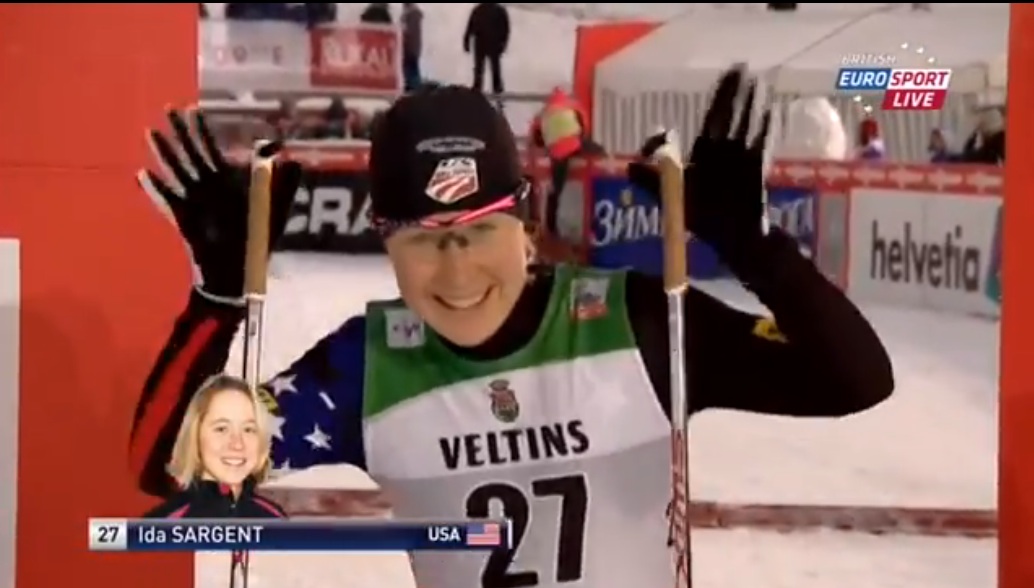
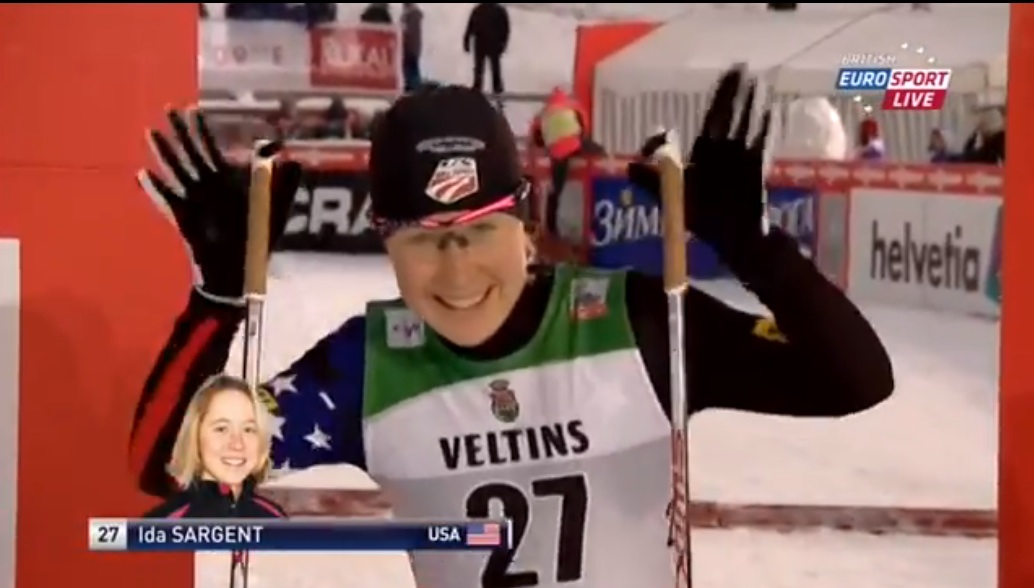
Ida Sargent smiles at the camera before the start of the women’s classic sprint final on Saturday in Kuusamo, Finland.
Lined up with five other women in the final, Sargent gave the camera a big smile when it panned to her.
“I was just psyched to have one opportunity and see what I could do,” she said. “The techs were all just taking care of the skis and really dialing things in between the heats so it was really easy for me to just focus.”
Squaring off against Norway’s Marit Bjørgen, Visnar, Falla, Østberg, and Russia’s Natalia Matveeva, Sargent resolved to go as hard as she could. Still, she remained patient up the first climb and carefully picked an open lane for the steep uphill.
“I was right there and still battling with those girls until going over the top of the hill, I missed a few strides and a little gap opened up,” she said.
Norway’s Marit Bjørgen (r) celebrates her win in Saturday’s women’s sprint final in Kuusamo, ahead of Slovenia’s Katja Visnar in second, Norway’s Falla and Østberg in third and fourth, and American Sargent (l) in fifth, ahead of Russia’s Matveeva (not shown).
Bjørgen charged to the front over the top of the big climb and never looked back for a 0.46-second victory over Visnar, who closed hard to pass Østberg, who had lost momentum after icing up a bit over the top. Falla placed third, 1.7 behind Bjørgen, Østberg was fourth (+3.02) and Sargent finished fifth (+5.95) ahead of Matveeva (+12.37).
“I kept fighting and I was really happy with that,” Sargent said. “The best part was, I got to the finish line and before I could even get my clothes on, all the rest of the girls on the team were there waiting for me. They had all been out cheering even though we have another race tomorrow, they all cheered and greeted me with tons of hugs in the finish area. It was just really special and definitely the best part of the day.”
They also reminded her of the support they’d given her after hearing about Elsa.
“Just having the support of the family and the support of all my teammates throughout this whole fall has been really wonderful,” she said.
“I am ecstatic with her top five. That is such an incredible result for the U.S.A.,” Whitcomb said on the phone after the race. “Not to mention for it just being a personal best for Ida. … When she first got on skis, she was struggling to find kick; she was very patient with the waxing process and went through four or five editions. The way Ida skis, it’s important not to start too thick with wax. It’s important to start with a thin layer, and today her pairs that we were testing out there were all a little bit too thin.”
While her skis weren’t perfect for the qualifier (no team’s were, Whitcomb said, except for maybe Norway), she was able to “sneak through” in qualification, which he said is often her biggest challenge.
“Once she’s in the heats, she tends to excel better than she does in qualification,” he said. “So I was not surprised when she was able to move through a few rounds today. The name of the game today was patience and Ida did a nice job with that. To be fifth, you have to be fast, and she was skiing with fantastic energy up these climbs, fighting eyes wide open, moving through windows, and dealing with the challenges. It’s a big success for Ida, to say nothing of the result. But the result, for our team – just makes us all just so proud.”
Randall, Bjornsen in the Rounds
Teammate Kikkan Randall, who placed 16th, after qualifying in 12th and finishing fourth in her quarterfinal, said the kind of pressure Sargent maintained until the finish of each heat was what kept her in it and would make her successful this season.
Randall striding it out last year in Kuusamo, where placed second in the classic sprint to Poland’s Justyna Kowalczyk. This year, she placed 16th in the World Cup opener, worth full World Cup points and no longer part of a mini tour. (Photo: Fischer/Nordic Focus)
“I think overall it was a really good day for our team,” Randall said, after five U.S. Ski Team (USST) members qualified for the heats, including Simi Hamilton in 16th, Sadie Bjornsen in 19th and Andy Newell in 24th.
“Those that raced today are feeling at least good about where they know their body is,” Whitcomb observed. “In general I think it was a confidence booster for the team, in spite of some areas where we could have done better.”
Randall lost ground on the big climb into the stadium when she was boxed out in her lane, directly behind Sweden’s Hanna Falk in second and beside Norway’s Barbro Kvåle.
“I almost felt like I went backwards,” Randall recalled after standing up to avoid riding up on Falk’s skis. The slowdown allowed snow to clump on the bottom of her skis, which she had asked for more grip on to get up the monster hill.
“When my skis iced [Kvåle] got even with me and she had the inside lane, came out of the turn a little bit ahead of me,” she explained.
Randall finished about a second behind Kvåle in fourth. Norway’s Celine Brun-Lie won the quarterfinal, and Falk was second (+2.84).
“I felt like I skied strong in the quarterfinals but made some wrong tactical choices,” she added in an email. “My energy was good in the rounds and I was disappointed to have my day end early after the quarterfinal.
“Now looking forward to testing out the distance shape in tomorrow’s 10km,” she of Sunday’s classic race. “I can’t believe I’m saying this but actually hoping for slightly colder weather tomorrow for better tracks!”
Sadie Bjornsen ended up 29th after placing sixth in the same quarterfinal, 4.35 seconds behind Randall.
After switching to a stickier pair of skis “which ended up being a wrong pick,” she said, Bjornsen almost went down at the back of the pack on a 180-degree turn before heading back toward the stadium. Gliding, she felt fine, but the tracks on the hills were variable, and that’s where she stumbled.
By the time she got to the final climb, Bjornsen wasn’t too far behind Randall. Norway’s Therese Johaug ended up holding her off for fifth, 6 seconds behind Brun-Lie, and Bjornsen was another 3 seconds back in sixth.
“I felt good in my qualifier; it’s the first time I’ve gone fast like that this year,” Bjornsen said. “I felt like I was not really on top of my game yet, but that’s sort of the goal this year. … This year I chose to not do any racing and try to be at my fittest in February. I felt good, but it wasn’t my most spectacular, which is what I wanted.”
Last year, she qualified in third in the Kuusamo classic sprint and went on to place 26th. And while she doesn’t need a podium at this point in the season, she’s excited about more classic skiing on Sunday.
“It’s supposed to get cooler so maybe some more Kuusamo-like conditions,” she said.
As for Sargent, Bjornsen said her teammate has always been strong on this course.
“She’s really fit this year and she’s also really good in the finishing stretch, which is what you need on a course like this,” she explained. “It’s fun to see it come together for her.”
Jessie Diggins did not qualify in 64th after crashing while descending down out of the first climb, right before the flat section.
“In the flat light and icy corner, I somehow must have caught an edge and down I went,” she explained in a Skype interview. “I actually came sliding to a stop at Simi’s feet as he was warming up, and he was cheering for me saying ‘get up! get up! You can still do this!’ so I charged as hard as I could and Johaug actually didn’t pass me, but I knew she was close so it was extra motivation to get back up to speed!
“I am really happy with how today went for a lot of reasons…my body felt great,” Diggins added. “I felt like my classic technique was a ton better and I am really happy with how my skis were from the techs, my only slip-up was falling down in some tough conditions. It was a bad place to fall because I lost all the glide and then had to use extra energy getting back up to speed, so I have a lot of confidence coming out of today because I think that if I hadn’t fallen it might have been a really good qualifier!”
Diggins explained she’s fine — not as banged up as she was after falling in last year’s Kuusamo sprint qualifier— and “nothing a little foam rolling and icing my shin won’t fix!”
She added that she was proud of Sargent. “It’s always so cool to see someone get a career best,” she said, adding, “I’m so proud of the team for getting 5 into the heats: Sadie, Kikkan, Ida, Andy, Simi…it’s really cool that on a day when it’s tricky waxing and weird conditions we can still have a strong team showing!”
Hamilton, Newell Sixth in Quarterfinals
Hamilton ended up 26th after placing sixth in his quarterfinal, and Newell was 28th with a similar result in his quarterfinal. Both had trouble on the final climb, with Hamilton struggling to find his rhythm on the way up, and Newell icing up over the top and dropping from third to sixth in the last few hundred meters.
“I think it took extra-good balance today and kind of feathery feel, which I’m not always the best at, but I think today was a step in the right direction,” Hamilton said.
He had been skiing smoothly for the first half of the race, before Finland’s Matias Strandvall jumped in front of him near the base of the big hill, he said. Rather than switch to one of the blown-out left lanes (which were used in the qualifier as well), Hamilton stuck to the right side.
“That climb is always a chaos-fest,” he said. “You get people that ski it very differently. What works best for me is skiing the bottom really relaxed and upping the tempo near the top.”
Following Strandvall, a strong classic skier who went on to place third in the heat, he said the pack all ran up it in a similar rhythm — one which wasn’t ideal for Hamilton. He tensed up early and by the time he got to the top, said he felt really tight.
“I’m never the greatest double poler, and it was a long double pole to the finish,” he said. “It’s a super-hard finish, it’s one of those courses where if you don’t have anything left in the tank for the last 30 or 40 seconds, it really shows. I think that’s been one of my weaknesses, where you have a really hard effort before a really long straight finish — that’s been something I’ll be working on and just getting better at going really hard and staying strong for the last 30 seconds, and especially in classic skiing, working on double pole.”
Between the qualifier and heats, Newell said they had plenty of time to test skis, and that’s what most of the top 30 men and top 30 women did on the last climb. Randall estimated she went up it 15 to 20 times in that period.
“I made sure after qualification I had enough kick, for sure,” Newell said, noting his skis felt slick up that hill in the qualifier. He chose a different pair of skis and different wax for the heats. “We knew it would be sticky, but we thought it would free up and kick off easily.”
For him, it didn’t.
“The snow, for some reason, was icy over the top,” he recalled of his quarterfinal. “I was charging up over the top in a decent position and over the top I couldn’t shake that and get the skis rolling so that was a little bit of a bummer. I didn’t feel super quick in the finish, either.”
Canada’s Alex Harvey was skiing alongside him up the hill at the time, and Harvey said both he and Newell slipped simultaneously. Unfortunately for Newell, he couldn’t get the skis gliding well again, lost his momentum and went from third to sixth.
“I ended up dropping quite a few places right there and the skis were dragging going around the last corner,” Newell said. “My fitness is good and I’m feeling fine, so the placings of the day don’t really indicate where we’re at as a team. It was really cool to see Ida in the final. That was huge.
“This is a hard World Cup to start in,” he added. “A lot of these Europeans have been on snow a lot longer than we have. I know it’s always a bit of a shock for me to come here and run that hill; you just don’t see terrain like that on rollerskis. … It’s just the first race so we’re not too worried about it.”
Whitcomb said the team looked good and wasn’t concerned about arriving to Scandinavia a little later than other teams.
“We had a great camp in Canmore with the Canadian National Team and the Alaskans have had 10 days on snow up around Anchorage, so we’ve had decent exposure to snow,” he said. “But adjusting to jetlag and getting over here and putting your bib on for the first time – that’s always a bit of a wildcard. … I was expecting that we’d be able to put together a great day and I think we’ll walk home from the venue satisfied this evening.
“We’ve got a good team vibe going right now,” he added. “It’s always interesting in the first week; everyone has been doing quite a bit of skiing on their own because everyone is feeling different. People have horrible nights of sleep, people have great energy, horrible energy, and so we do a lot of skiing on our own, and it’s been great to see people starting to come back together as bodies have normalized.”
On Friday, the day before the race, the USST held its traditional race prep, where every athlete — male and female — met with their personal wax techs to figure out which skis they’d use on race day then all did an agreed-upon workout.
“The sort of rule of thumb is that you don’t have to do the exact-same race preparation as everybody, but for these sprint days, we like everyone to start together,” Whitcomb said. “It helps us build that team presence, and it seems to generate a good amount of energy. … It was really fun to watch us, for the first time, putting the stars and the stripes on and hammering some race preparation together. And so you have people left wanting more after today … and they can, and so that hunger will help us as we move forward.”
Also for the U.S., Erik Bjornsen placed 56th and 2013/2014 overall SuperTour winner Reese Hanneman raced to 67th in the qualifier out of 87 men.