Tag: 2014 Lillehammer mini tour

  • Same Norwegian Men’s Podium, Same Order as Sundby Tops Krogh in Lillehammer Pursuit

    Same Norwegian Men’s Podium, Same Order as Sundby Tops Krogh in Lillehammer Pursuit

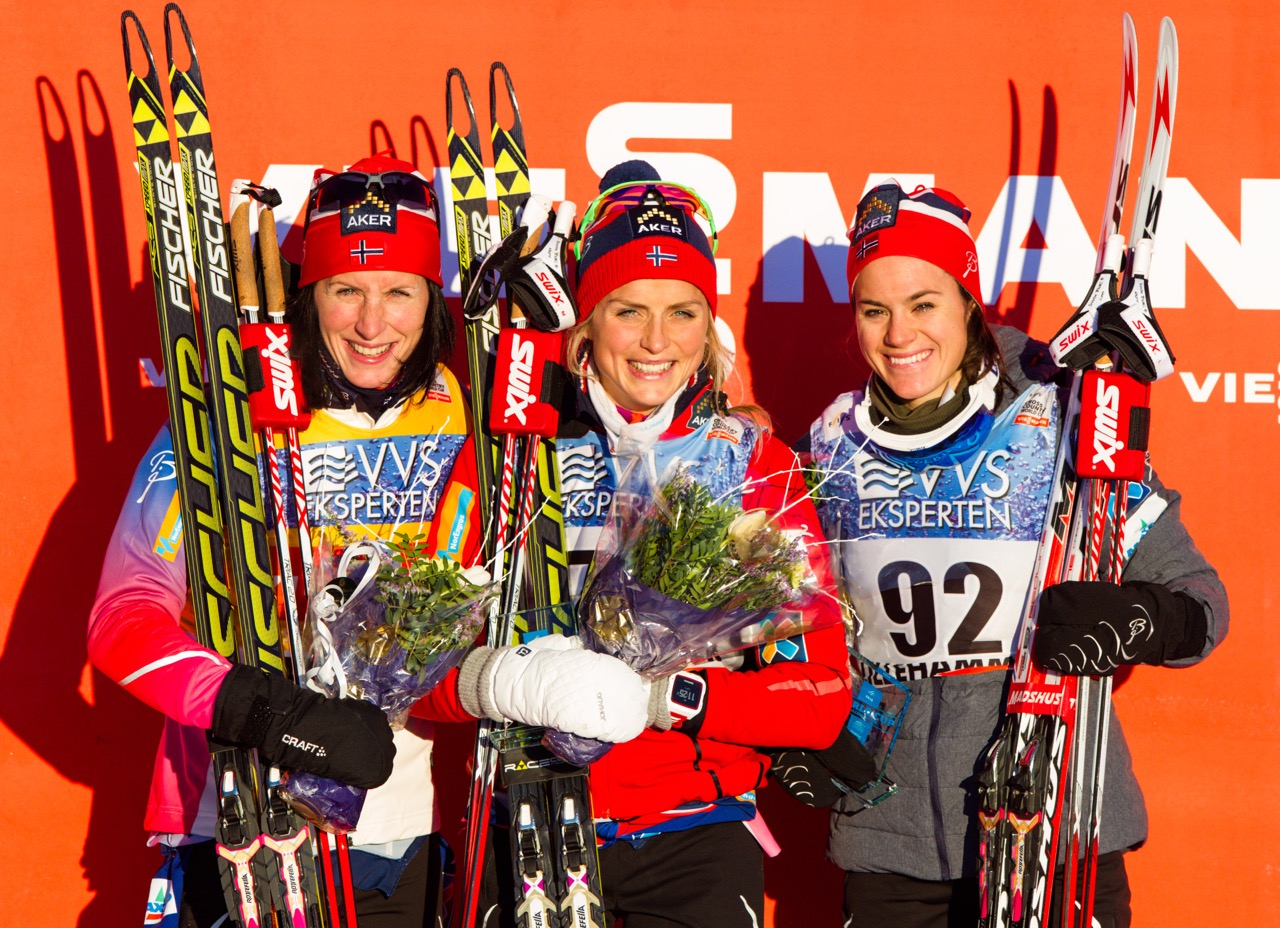
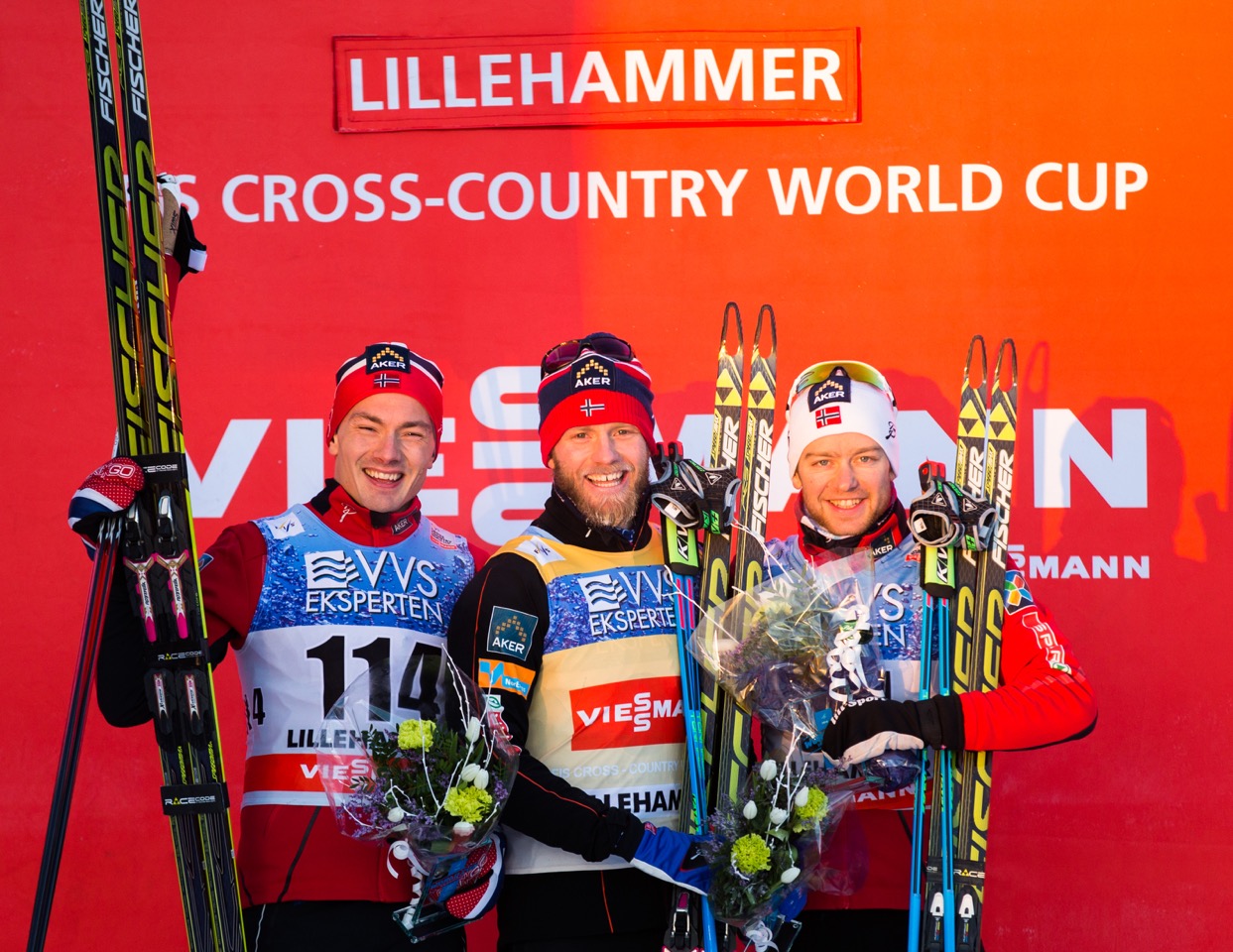
    The men's podiums on Day 2 and 3 of the Lillehammer World Cup were exactly the same, with three Norwegians (as pictured after Saturday's 10 k freestyle). On Sunday, Martin Johnsrud Sundby (c) repeated in first for his fourth-consecutive mini-tour win, Finn Hågen Krogh was second (l), and Sjur Røthe third. (Photo: Fischer/NordicFocus)
    The men’s podiums on Day 2 and 3 of the Lillehammer World Cup were exactly the same, with three Norwegians (as pictured after Saturday’s 10 k freestyle). On Sunday, Martin Johnsrud Sundby (c) repeated in first for his fourth-consecutive mini-tour win, Finn Hågen Krogh was second (l), and Sjur Røthe third. (Photo: Fischer/NordicFocus)

    Coming into the final stage of the Lillehammer triple, Norway’s Martin Johnsrud Sundby the clear favorite despite starting 20 seconds back in second. Sundby won all the World Cup stage-tours last season — the opening Ruka Triple, Tour de Ski and World Cup Finals — and his sweep marked the first time a male managed to win all three of the tours in single season.

    Maybe somebody forgot to tell his teammate Finn Hågen Krogh that before Sunday’s 15-kilometer classic pursuit. After the first two races of this weekend’s mini tour, in which Krogh notched back-to-back podiums (third in Friday’s sprint and second on Saturday), the 24-year-old Norwegian found himself with a 20-second head start on Sundby.
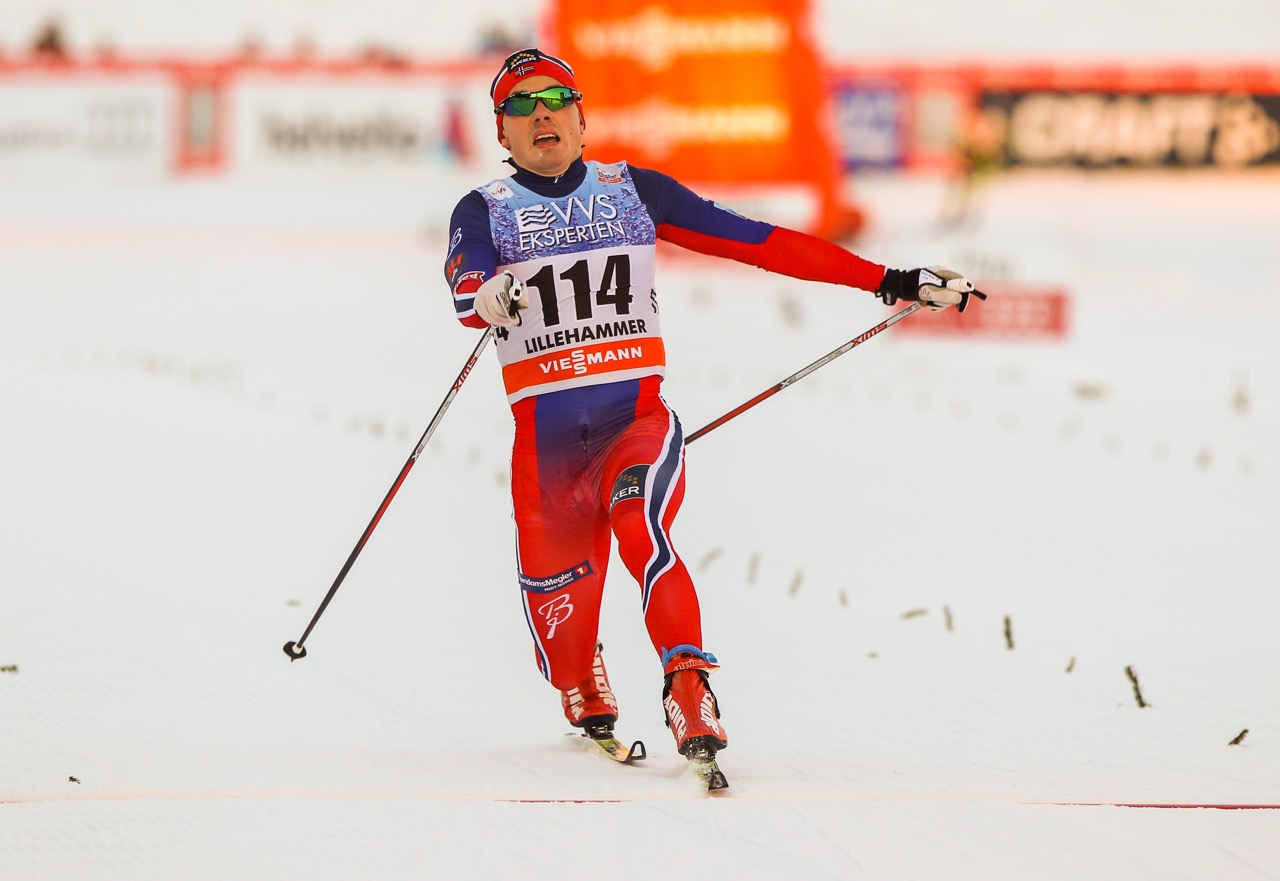
    Finn Hågen Krogh lunging in Saturday's 10 k freestyle individual start. He ended up second, just 2.2 seconds behind Norwegian teammate Martin Johnsrud Sundby. (Photo: Fischer/NordicFocus)
    Finn Hågen Krogh lunging in Saturday’s 10 k freestyle individual start. He ended up second, just 2.2 seconds behind Norwegian teammate Martin Johnsrud Sundby, but continued to lead the Lillehammer mini tour heading into Sunday’s 15 k classic pursuit.(Photo: Fischer/NordicFocus)

    But Sundby, in the yellow overall World Cup leader’s bib, was already on a roll after winning Saturday’s 10 k freestyle by 2.2 seconds over Krogh.

    So was Krogh — after finding himself as the World Cup mini-tour leader for the first time in his career heading into the final pursuit.

    At the start of his race, Krogh showed every indication that he could hold off the charging Sundby. At 2.2 kilometers, he led by 18.3 seconds, but by 5 k, he down to 12.8 seconds ahead.

    “I started out hard, like a regular 15 km, and tried to go my own race,” he told NRK after the race.

    Also in pursuit of Krogh, his Norwegian teammates Pål Golberg and Sjur Røthe started 26 and 27 seconds behind him, respectively. Sweden’s Calle Halfvarsson went out fifth, another second later, and the sixth-man, Norway’s Niklas Dyrhaug, didn’t start until 15 seconds after Halfvarsson.

    At the 3.3 k mark, the chase group of Golberg, Røthe and Halfvarsson was only able to chip away four-tenths of a second off Krogh’s lead. But as soon as all three left the start, they were first hunting Sundby. They caught their first glimpse of him at 0.9 k.

    After the first lap at 5 k, the three men caught Sundby, but it wasn’t long until Sundby launched his own attack to reel in Krogh. The chase group tried to respond but they couldn’t match his acceleration around 5.8 k.

    “I had a plan, and it was running into Finn quickly as possible, and keep the rest of the people behind us,” Sundby told NRK, according to a translation. “We spent longer to catch Finn, than I had envisioned.”

    To Sundby’s surprise, Krogh remained ahead through the 8.3 k checkpoint, where he was 1 second ahead of Sundby.

    “He went on an insanely good run ahead and I would hold second so long — I thought that he wanted to go alone into the finish,” Sundby added.

    When Sundby closed the gap and caught Krogh, the pair worked together for a while to increase their lead over the chase group. The pace increased, assuring Krogh of a podium spot, and it became a matter of which order he and Sundby would end up.
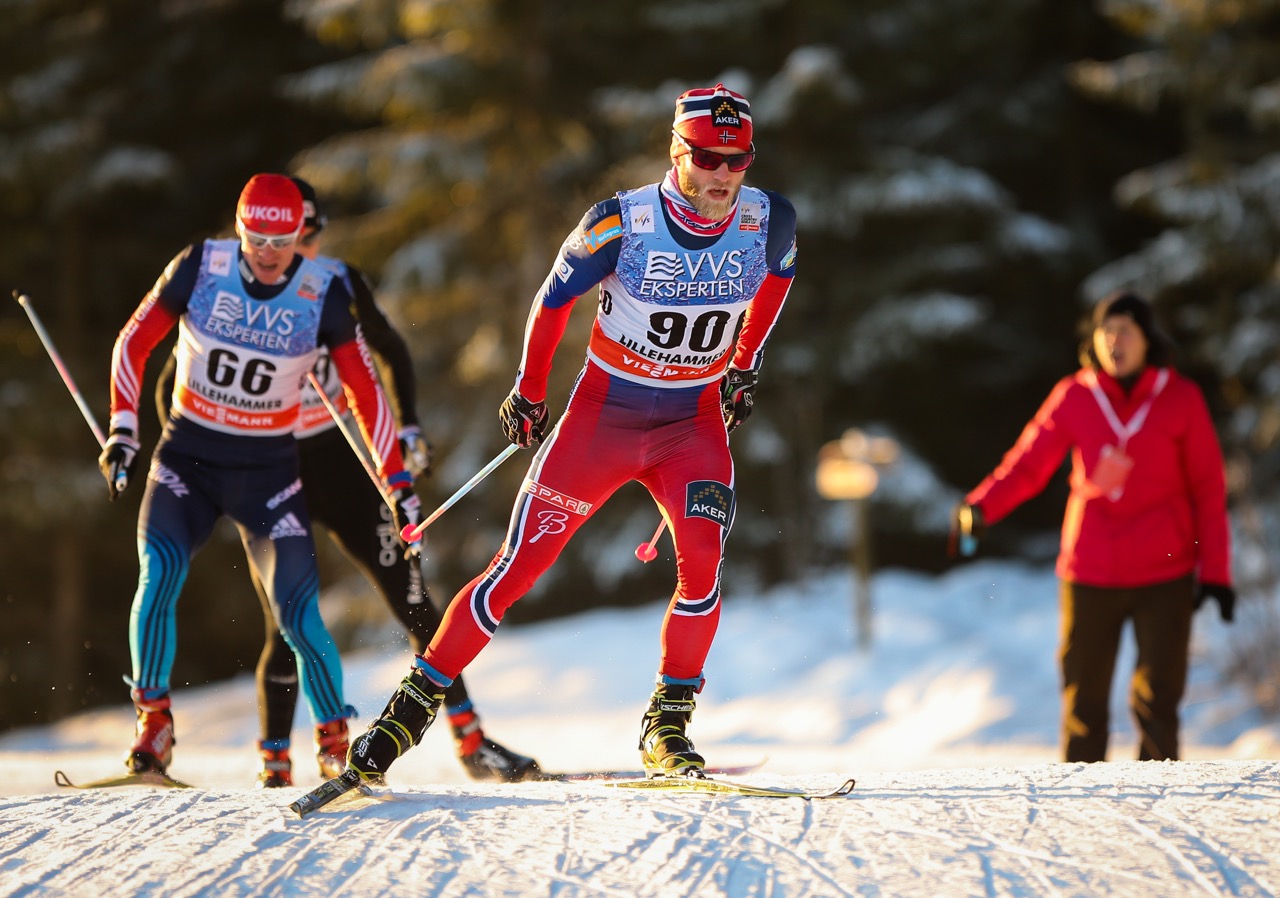
    Martin Johnsrud Sundby racing to a 2.2-second victory in Saturday's 10 k freestyle, the second stage of the Lillehammer mini tour. Sundby went on to win Sunday's 15 k classic pursuit as well, this time by 16.6 seconds over teammate Finn Hågen Krogh. (Photo: Fischer/NordicFocus)
    Martin Johnsrud Sundby (90) racing to a 2.2-second victory in Saturday’s 10 k freestyle, the second stage of the Lillehammer mini tour. Sundby went on to win Sunday’s 15 k classic pursuit as well, this time by 16.6 seconds over teammate Finn Hågen Krogh. (Photo: Fischer/NordicFocus)

    Sundby tried to answer the question before the finish, attacking several times but Krogh matched the pace each time.

    Then, at the 13.3 k mark, Sundby launched what would be his final attack heading into the final climb up to the stadium.

    “I went all-out on the last hill” Sundby told NRK. “My plan was to give everything on the last climb and not look back until I was on the top.”

    His plan worked perfectly. Krogh quickly fell behind, and Sundby opened a sizable lead, which he held across the line for the 16.6-second victory in 39:48.2.

    “It was a heavy finish,” Krogh recalled. “I was struggling with grip and I had no chance to keep Martin’s tempo. I had hoped Martin would attack later. I was just too tired to follow him. Second place in the mini tour is a big achievement. I am really happy about the whole weekend.”

    It was an exciting finish for third place, after Røthe, Golberg and Halfvarsson skied together for most of the race, trying to close the gap to Sundby and Krogh.

    Røthe looked to be in the best form compared to the other members of the chase group heading into the last climb. The 26-year-old Norwegian launched an attack similar to Sundby’s on the climb, aiming to separate himself from Golberg and Halfvarsson before the downhill curve and straightaway into the finish.

    Golberg recognized the attack and countered, dropping Halfvarsson to rejoin the charging Røthe. At the finish, Røthe had a little more left, out-double poling Golberg by 1 second for third (+36.5).

    “My plan was to stay behind Martin and Finn,” Røthe said. “It was a hard fight on the last uphill. I thought I had a little gap on Pål, but he managed to catch me on the top. We were not far away from each other before the home stretch. I believed that if I gained a few meters before the finishing straight, I can beat Pål.”

    The all-Norwegian podium was a repeat from Saturday’s 10 k, which featured Sundby in first, Krogh in second and Røthe in third. Norway swept the top five with Didrik Tønseth, who started 21st and raced himself to fifth place after passing Halfvarsson less than a kilometer before the finish.

    Tønseth posted the fastest time of the day in 39:20.9. Kazakhstan’s Alexey Poltoranin ranked second (+1.4) after racing from 30th to 11th at the finish, and Sundby’s time was 7 seconds slower than Tønseth’s to rank third.

    Finland’s Matti Heikkinen improved one position to seventh (+50.9), and Switzerland’s Dario Cologna skied up from 12th to eighth, 0.3 seconds behind him. Dyrhaug was another 0.7 seconds back in ninth, and Canada’s Alex Harvey made the top 10 in 10th, 0.6 seconds after Dyrhaug, after starting 11th.

    The win gave Sundby his fourth-consecutive mini-tour victory and extended his Overall World Cup lead to 82 seconds over Krogh. Golberg is currently 79 seconds back from Krogh in third.

    Results

  • Bjørgen Outsprints Johaug in Lillehammer Thriller Pursuit

    Bjørgen Outsprints Johaug in Lillehammer Thriller Pursuit

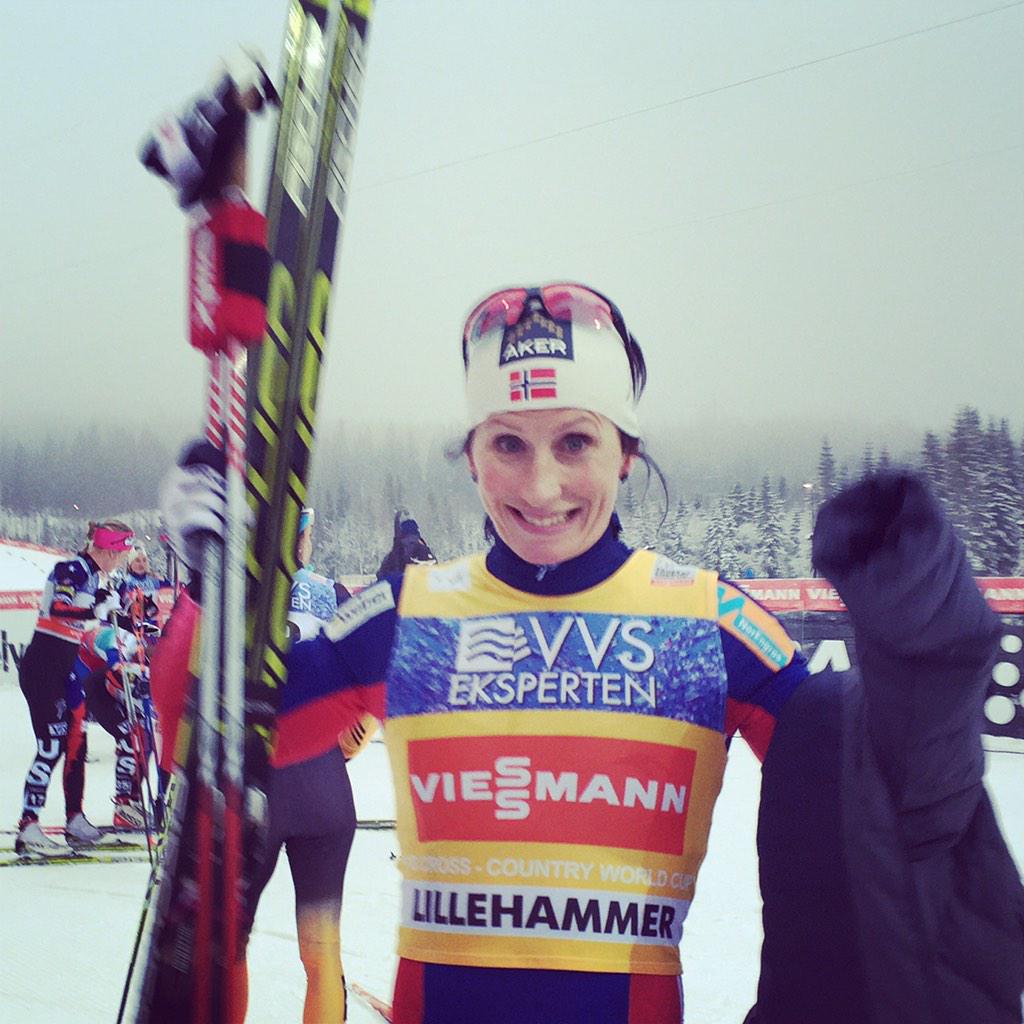
    Marit Bjørgen (Norway) won her fifth-consecutive World Cup mini tour on Sunday after outsprinting teammate Therese Johaug in the women's 10 k classic pursuit. (Photo: FIS Cross Country/Twitter)
    Marit Bjørgen (Norway) won her fifth-consecutive World Cup mini tour on Sunday after outsprinting teammate Therese Johaug in the women’s 10 k classic pursuit. (Photo: FIS Cross Country/Twitter)

    As so often on the World Cup lately, it’s not a question of who will fight for the victory, but how the competition between Marit Bjørgen and Therese Johaug will unfold.

    After that, it’s usually interesting to see who will take third behind the two Norwegian powerhouses. In the last two races of the Lillehammer World Cup mini tour in Norway, it’s been their teammate: Heidi Weng.

    Roles reversed: the all-Norwegian women's 5 k freestyle podium on Saturday, with winner Therese Johaug (c), Marit Bjørgen in second (l) and Heidi Weng in third. While the top two swapped places in Sunday's final pursuit, Weng held steady for the third-straight race in third. (Photo: Fischer/NordicFocus)
    Roles reversed: the all-Norwegian women’s 5 k freestyle podium at the Lillehammer World Cup on Saturday, with winner Therese Johaug (c), Marit Bjørgen in second (l) and Heidi Weng in third. While the top two swapped places in Sunday’s final pursuit, Weng held steady for the third-straight race in third. (Photo: Fischer/NordicFocus)

    The women’s 10-kilometer classic pursuit on Sunday was no different. Bjørgen as the mini-tour leader through two races, started 20 seconds ahead of Weng in second and 32 seconds ahead of Johaug in third. For Bjørgen, the classic pursuit — with implications for the Lillehammer triple victory — was all about keeping Johaug behind her.

    Not only is the 10 k classic a Johaug speciality so far this season (after she beat Bjørgen handily by 42 seconds in the event last weekend in Kuusamo, Finland), and on a comparably hilly course in Lillehammer, but Johaug also had the advantage of chasing.

    The women skied two laps on the same 5-k course they grew familiar with in Saturday’s 5 k freestyle (which Johaug won by 0.3 seconds over Bjørgen). On the first lap of Sunday’s pursuit, Bjørgen lost only about 10 seconds to Johaug. But on the second lap, Bjørgen hit the wall, and she hit it hard.

    “I was given splits along the way. It was 29 seconds ahead, 25 seconds, then 13 seconds,” Bjørgen said to reporters after the race. “When I heard 13 seconds, I was thinking, ‘Crap.’ ”

    With 1.8 k remaining, she was 12.1 seconds ahead of Johaug, who rocketed to second, half a second ahead of Weng by the 2.2 k mark. At the halfway point, Johaug was 19 seconds behind Bjørgen with Weng still hanging on 0.3 seconds behind her. Weng would stick with the eventual-runner up through the 7.2 k checkpoint and up until the final climb.

    With about 1 k to go, Johaug passed Bjørgen before the final climb back to the stadium. Bjørgen appeared to struggle to stay with her, but knew that if she did, she’d have an advantage on the downhill into the stadium.

    Coming into the stadium, Johaug remained in the lead until the final turn, where Bjørgen took the inside track to ride up alongside her about 100 meters from the finish.

    “When we were even, I was thinking, ‘No way I’m going to let her beat me. I should beat her in a sprint,’ ” Bjørgen said.

    But considering the way she looking less than a kilometer earlier when Johaug caught her, it was anyone’s guess how much Bjørgen had left for the finish. She wasn’t sure, either.

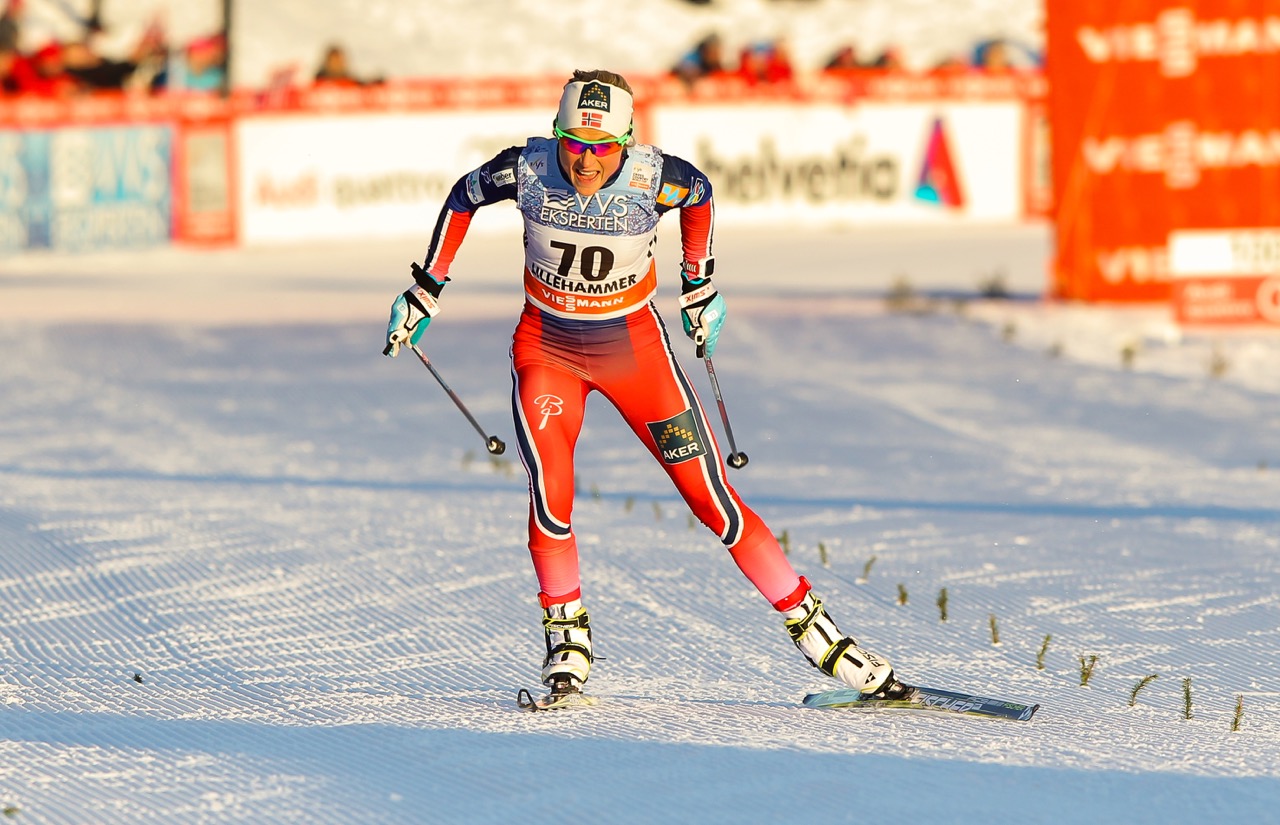
    Johaug on her way to the 5 k freestyle win in Saturday's individual stage, the second stage of the Lillehammer World Cup mini tour. (Photo: Fischer/NordicFocus)
    Therese Johaug on her way to the 5 k freestyle win in Saturday’s individual stage, the second stage of the Lillehammer World Cup mini tour, by 0.3 seconds over Marit Bjørgen. (Photo: Fischer/NordicFocus)

    “My body was not on my side today. I felt heavy and syrupy, and when you feel like that, the seconds are running away from you really fast,” Bjørgen explained.

    She conserved while tucking behind Johaug on the last descent into the stadium, then prepared for her final attack — which left Johaug 0.6 seconds behind at the finish line.

    “And with the effort Therese pulled off today, I felt bad beating her in the sprint,” Bjørgen said after winning the pursuit in 28:19.7, just ahead of Johaug and 12.3 seconds ahead of Weng in third. “But a race is a race.”

    Despite losing, Johaug was impressed with Bjørgen and pleased with her effort.

    “I lost the sprint finish, but I made up 30 seconds on Marit and I had the fastest time for the stage, so that’s my takeaway from the day,” Johaug said. “I did a solid classic race.”

    Johaug completed the course in 27:48.2, nearly 24 seconds faster than Weng as the second-fastest woman of the day. Bjørgen’s time ranked third.

    “My sprint finish was a lot better than it used to be, and [Marit] definitely didn’t park me today,” Johaug said.

    While she didn’t expect to beat Bjørgen in a sprint anytime soon, she explained that Bjørgen’s not unbeatable at that distance, either.

    “She’s a tough cookie and almost nobody in the whole world can beat her in a sprint. But I’m not giving up,” Johaug said.

    Weng secured third after skiing alone in no-man’s-land for the last kilometer or so.

    “Therese came very fast and caught me on the first hill,” she told FIS. “I tried to ski as fast as I could but I could not follow her on the last climb. I am happy about the third podium this season.”

    The fourth-place finisher, another Norwegian — Ingvild Flugstad Østberg — crossed the line 1 minute, 26 seconds after Weng. Østberg improved from fifth to fourth by overtaking teammate Ragnhild Haga early on (after starting with her, 14 seconds behind Johaug and 26 seconds behind Weng).

    Sweden’s Charlotte Kalla started 1 second behind them in sixth, and by the 2.2 k mark, was up to fifth 0.4 seconds behind Østberg. Haga trailed by another 1.3 seconds in sixth.

    At the halfway point, Kalla was up to fourth by 0.4 seconds over Østberg. She continued to lead the Norwegian by the same margin up until the last few hundred meters of the race. In the final stretch toward the finish, Østberg surged hard to drop Kalla, immediately putting at least 10 seconds between them. Østberg secured fourth, 12.6 seconds ahead of Kalla in fifth, and Haga was another 4.4 seconds back in sixth (+1:55.3).

    Norway not only swept the top four, but put six in the top seven in the women’s pursuit. Maiken Caspersen Falla, who started eighth, improved to seventh (+2:00.8). About 12 seconds behind her, Finland’s Krista Parmakoski placed eighth (up from 12th). Also for Finland, Kerttu Niskanen followed just 0.2 seconds back in ninth (up from 16th), and Poland’s Justyna Kowalczyk made it into the top 10 in 10th (up from 30th). Kowalczyk started 1:32 behind Bjørgen and finished 2:15.6 after her.

    Bjørgen’s second win out of three races in Lillehammer lifted her to her fifth-consecutive mini-tour win and gave her a hefty load of World Cup points with it. She is currently 131 points ahead of Johaug in the overall World Cup standings, and Weng overtook Østberg to put herself third, 84 points behind Johaug.

    Results

  • Top Canadian, Harvey 33rd in 10 k Skate, Slips to 11th in Lillehammer Mini Tour

    Top Canadian, Harvey 33rd in 10 k Skate, Slips to 11th in Lillehammer Mini Tour

    Ivan Babikov pushed through a tough race despite cramping legs.
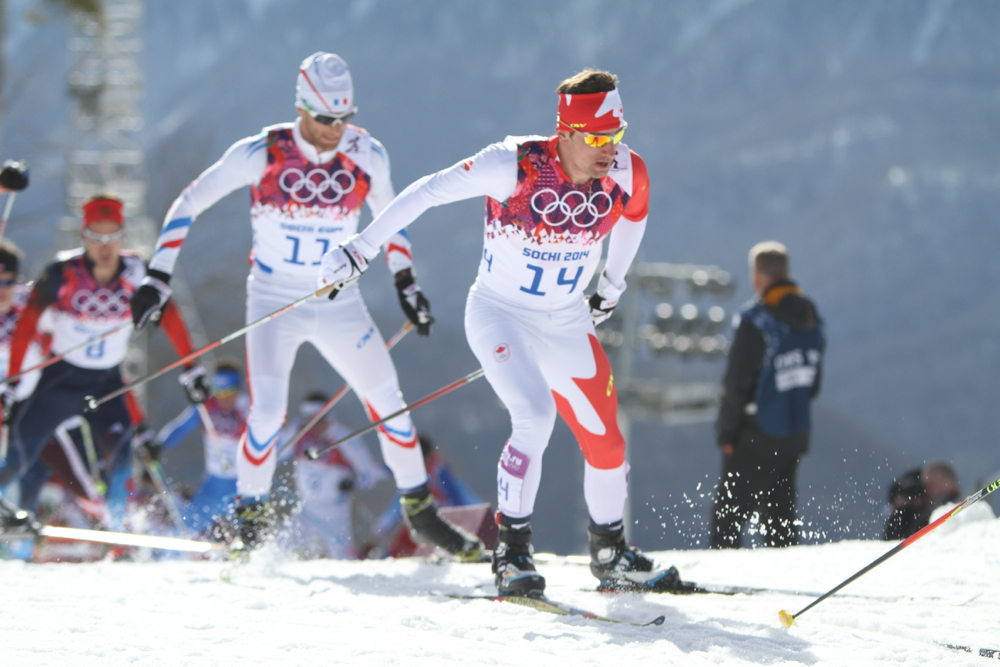
    Canada’s Ivan Babikov (14) pushing in the 50 k freestyle mass start at the 2014 Olympics despite cramping legs to end up 20th for his best individual result at the Winter Games in Sochi, Russia.

    Ivan Babikov heard a lot of chatter at the finish of Saturday’s 10-kilometer freestyle in Lillehammer, Norway, about how tired his competitors were, how much their legs hurt from the relentless hills on the 5 k loop, yadda yadda yadda.

    His fellow Canadian World Cup teammate, Alex Harvey said his leg cramped up, too, but not for the same reason. Harvey had a reoccurring issue that cropped up in V1-heavy skate races. Babikov had a problem not feeling any of these things.

    “I went as hard as I could, but was still not tired at the finish line,” Babikov said on the phone after placing 43rd, 1 minute, 5 seconds back from Norwegian winner Martin Johnsrud Sundby. “Legs were fine, guys were saying because of the big steep uphill [they were tired] … and I just felt nothing. I couldn’t go any harder than I went.”

    That’s a strange feeling for Babikov, who’s gotten used to decent early season results in the last couple years. At the 2012 World Cup opening mini tour in Kuusamo, Finland, he placed 25th overall. That same December at home in Canmore, Alberta, he was 12th in the World Cup skiathlon and 20th in the 15 k classic mass start.

    But before that, he was typically a slow starter, he said.

    “Usually I need, like, one mass-start race to kind of feel the pace again and get the speed back,” he said. “I don’t know why I’m missing that top speed; it’s hard to tell right now. The season is long, it’s just the first two weekends, and my main goal is Tour de Ski and World Champs in Falun [Sweden]. There’s lots of time to work on it and get the speed back.”

    Babikov noted that the speediness of Saturday’s skate course didn’t help him.

    “That’s why you can see lots of sprinters and quick guys up there in the top 10 and top 20,” he said. “Still, it’s a really, really hard course. Any other day with fresh snow or just a bit softer [conditions], it would’ve been totally different. It would’ve been so much slower and harder.

    “But it was interesting. Really fast. Too fast for my legs,” he added with a laugh.

    After finishing 110th in Friday’s skate sprint — a result he said he tried not to dwell on — Babikov went from 110th and 51 seconds behind Lillehammer’s mini-tour leader, to 56th and 1:49 minutes back before Sunday’s 15 k classic pursuit.

    “It’s gonna pretty much be a mass start, but with a fast couple kilometers because every single person will try to catch the person ahead of him,” he predicted. “But it’s 15 k and a pretty hard course, [and] there’s some big uphills.

    “Hopefully by the third lap, it’s gonna calm down and people are gonna start dying,” Babikov added. “I’ll try to ski my way back into the top 30, but it will be hard.”

    “Hopefully by the third lap, it’s gonna calm down and people are gonna start dying.” — Ivan Babikov, Canadian World Cup Team member after placing 43rd in Saturday’s 10 k skate

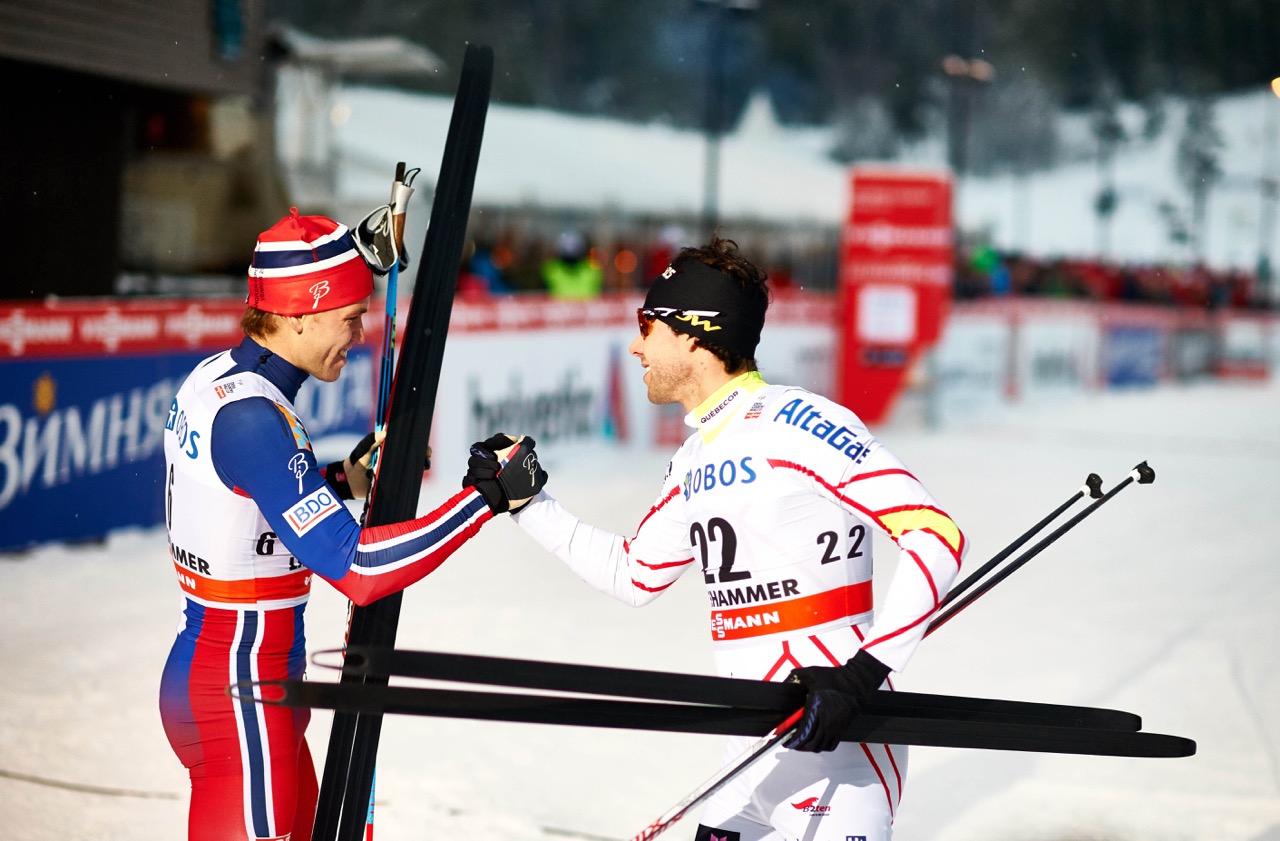
    Canada's Alex Harvey (r) congratulates Norwegian winner Pål Golberg at the finish of Friday's 1.5 k freestyle sprint final. Harvey placed fifth for a season best. (Photo: Fischer/NordicFocus)
    Canada’s Alex Harvey (r) congratulating Friday’s skate-sprint winner, Norway’s Pål Golberg after the sprint final, in which Harvey placed fifth for a season best. (Photo: Fischer/NordicFocus)

    Harvey expected to feel a little tired after Friday’s sprint, in which he made the finals and placed fifth. But he felt good waking up, during his morning jog and also while warming up for the 10 k.

    Sixth in the mini tour to start the day, 11.8 seconds off the lead, Harvey planned to start hard and see what happened on the fast course. Upon hearing his first split around 1.5 k, he knew it wasn’t going so well.

    “I was already quite far off, like in 40th or something, so then I didn’t really know what to think so I kept pushing,” Harvey said on the phone.

    Heading to the high point of the course, climbing from around 3 to 3.5 k, Harvey started feel a familiar pang in his left leg, caused by a blood-flow issue with his iliac artery that affects him primarily in skate races. All the steep climbing was making his leg tense up.

    “I was just fighting against it already and I couldn’t push after that,” Harvey said. “I couldn’t use my leg much, and the downhills were so icy that it was kind of hard to relax and recover so I was always contracting the legs. It was just a really bad day for my leg, I guess.”

    Thirty-sixth at 2.2 k, he improved to 25th at the halfway point, but in the middle of his final lap, Harvey was back down to 32nd. He ultimately finished 33rd, 54.6 seconds behind Sundby and 11th in the mini tour after the second day of racing.

    Harvey wasn’t surprised his leg plagued him in his first skate race of the season, but said in the past he’s sometimes worked through it.

    Harvey on his way to winning the skiathlon last March at 2014 World Cup Finals in Falun, Sweden. (Photo: Fischer/NordicFocus)
    Harvey on his way to winning the skiathlon last March at 2014 World Cup Finals in Falun, Sweden. (Photo: Fischer/NordicFocus)

    “That’s happened to me in races where I’ve had good races,” he said. “Even in Falun, there’s a big hill so by the last third of the hill, I feel it in skating but usually it recovers in the downhill. But here today, the downhills were just so icy and so fast … it was just so unstable that you couldn’t really relax the muscles.  I was like, ‘OK, it’s happening a bit early, but it’s gonna go away,’ but it just didn’t today.”

    Harvey will start the pursuit 59 seconds behind mini-tour leader Finn Hågen Krogh, and 39 seconds behind Sundby in second. Great Britain’s Andrew Musgrave, who placed 13th on Saturday to improve to 10th in the standings, will start at the same time as Harvey, along with Switzerland’s Dario Cologna, who placed ninth in the 10 k for 12th overall.

    “I’m looking forward to tomorrow … I’m surrounded by really fast skiers,” Harvey said. “Dario seems to have finally found his way into decent speed at least. Today he was back in the top 10 and there’s gonna be other guys just ahead of me that are good classic skiers, and I think it’s gonna be a good group and I’m expecting a hard battle.”

    After Saturday’s race, Canada’s massage therapist worked on his left side — mostly his hip and glutes — to loosen it up. Harvey said he went for a run afterward and felt normal that night.

    “Right now it feels a bit tired from a race, but the energy’s good,” he said.

    Last year in Lillehammer, he placed 16th in the 15 k classic for his best result of the season at the time.

    “The hills are the exact same as we skied today, but it’s always much easier in classic than in skating,” he said. “It’s less muscular and you can use your upper body and you can kind of feather it up the hill.”

    Come Sunday morning, during ski testing, Harvey planned to make sure he had plenty of kick.

    “You have to make sure you relax anywhere you can on that course because the hills are really long and you gotta hit your stride well,” he said. “The downhills are a bit icy, like today, so speed in the downhill is not gonna be an issue for anybody and there’s no flats.”

    He aims to work his way up to Norway’s Niklas Dyrhaug, starting 16 seconds ahead of him in sixth.

    “I’ll try to get into a good rhythm the first couple k’s and see who’s pushing hard from the beginning, who wants to try to make seconds to the group ahead of us,” Harvey said. “I’m not planning to lead on the first couple k’s, but if I feel good I’m just gonna try to go up to Dyrhaug and then maybe we’ll see the other guys ahead.

    “It’s hard to plan much when it’s a pursuit start like that,” he added. “The real race will start the last five kilometers, that’s where people are really gonna come undone. We see it every year in Kuusamo: the last two laps are where the gaps are made so you just gotta be ready to push hard and suffer.”

    Teammate Lenny Valjas, who was 45th in Friday’s sprint, finished 57th on Saturday for 62nd overall.

    Devon Kershaw placed 58th, 0.3 seconds behind Valjas and 1:24.6 behind the winner. He’ll start Sunday 66th, 1:58 seconds out of first with Cologna’s younger brother Gianluca Cologna, and 3 seconds behind Valjas.

    “Simply put, technically speaking — I skied like total sh*t,” Kershaw wrote in an email. “That was frustrating. I was just not stable at all and my offset [V1] was atrocious — not good when you are racing an offset heavy course.”

    Expecting a difficult course, Kershaw said he felt like a character from the “Mortal Combat” Super Nintendo game at the top of the three-minute climb. And he didn’t feel like he was on the winning end of the battle, either.

    “I felt like a dude … when he’s about to get destroyed by his opponent (standing there helpless and wavering from side to side about to meet his fate). If I wasn’t so messed up, I bet I could have heard that voice say ‘finish him,’ ” he wrote. “I felt horrible today. Technically skiing very poorly. Bad body, bad legs. It was horrendous.”

     “I felt like a dude in the Super Nintendo classic ‘Mortal Combat’ when he’s about to get destroyed by his opponent. … If I wasn’t so messed up, I bet I could have heard that voice say ‘finish him.’ “  — Canadian World Cup Team member Devon Kershaw, after placing 58th in Saturday’s 10 k skate in Lillehammer, Norway

    On Sunday, he’ll be looking for redemption.

    “Of course, redemption won’t be on the results page since I am in the 60s starting tomorrow. More looking for personal redemption,” Kershaw wrote. “I’m pretty disappointed but actually a bit pissed off to be honest. … I am thankful it’s a classic race tomorrow, and even though I’m back in the field a fair ways, I want to ski aggressive and try and move up as best I can. … Unlike today, I want to hit the technique well, pace it well and have a great last 5km to finish off this Lillehammer mini-tour.”

    Canadian development B-team skiers Jesse Cockney and Graeme Killick placed 77th and 94th, respectively, for 76th and 94th overall. Notably, Cockney’s 2.2 k time held up as the fifth-fastest out of 110 finishers.

    By 5 k, however, he ranked 46th and was down to 59th at 7.2 k.

    In the women’s 5 k earlier in the day, Emily Nishikawa (Development Team) placed 67th for 68th overall, while Perianne Jones (Development B-team) finished 71st for 67th in the standings. Both women were listed to start Sunday’s 10 k classic pursuit, as were Cockney and Killick. Jones will start 1.5 seconds ahead of Nishikawa and 2:11.5 after Norwegian leader Marit Bjørgen.

    Results: Men | Women

    Sunday’s pursuit start lists: Men | Women