Tag: 2014 Sochi Games

  • CAS Ruling Removes Lifetime Ban for Three Russian Biathletes

    CAS Ruling Removes Lifetime Ban for Three Russian Biathletes


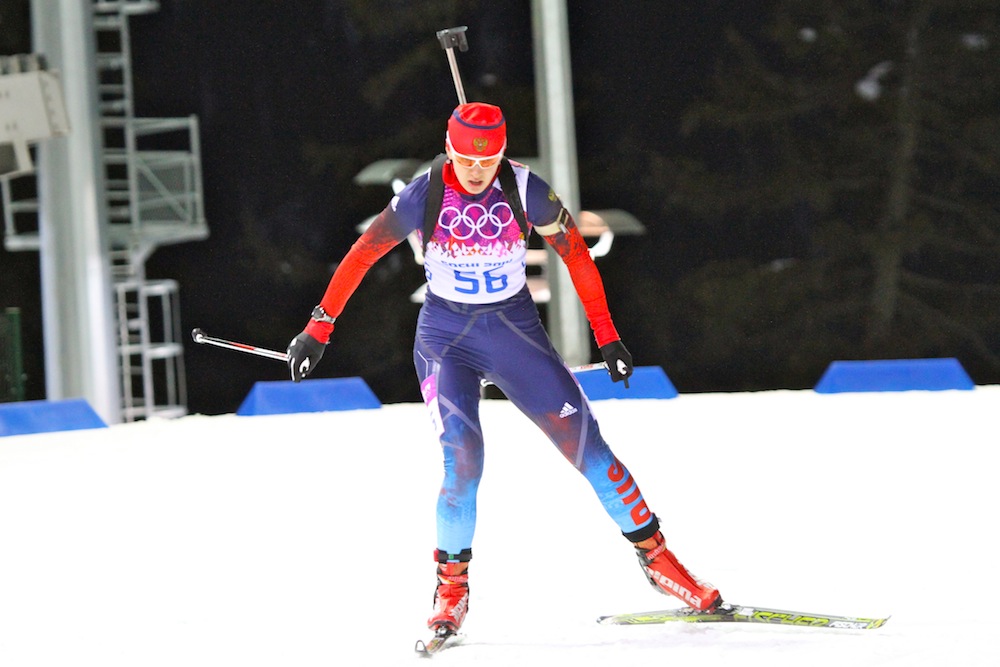
    Olga Vilukhina won a silver medal in the sprint at the 2014 Olympics.


    The Court for Arbitration in Sport (CAS) announced Thursday that three Russian biathletes implicated for doping at the 2014 Sochi Olympics had their lifetime bans overturned. The biathletes in question, Olga Vilukhina, Yana Romanova, and Olga Zaitseva were first handed lifetime bans in 2017 by the International Olympic Committee (IOC). 

    The McLaren Report included information tying the three athletes to doping. The IOC subsequently ruled the three Russians had committed an ADRV, or anti-doping rules violation. Their individual and team results were nullified and they were banned from all future Olympic Games. All three skiers have retired. 

    In the case of Romanova and Vilukhina, CAS stated: “that none of the acts alleged to have committed by these two athletes had been established to its comfortable satisfaction and beyond the mere suspicion of a potential ADRV.”

    Prior to the 2017 IOC penalty, Vilukhin won the 2014 Olympic silver medal in the 7.5-kilometer sprint. That medal was subsequently stripped. Thursday’s CAS ruling reinstated individual results from the Sochi Games for both Romanova and Vilukhina. As a result, the silver medal will be returned to Vilukhina.

    Zaytseva’s penalty was handled differently. CAS ruled Zaytseva had committed an ADRV for both swapping her urine for clean urine and using a prohibited substance. CAS clarified that Zaytseva would not have a lifetime ban, but would be “ineligible” for the 2018 Games after Sochi. 

    Beyond having her individual results not reinstated on Thursday, CAS maintained the IOC’s 2017 decision to nullify results from any team including Zaytseva at the 2014 Games. Zaytseva had teamed up with Romanova, Vilukhina, and Ekaterina Shumilova to win silver in the women’s 4 x 6 k relay in Sochi. That medal was stripped in 2017 – CAS upheld that penalty. Zaytseva was also on Russia’s fourth-place mixed relay team.

    Zaytseva won gold medals in the 2006 and 2010 Olympic relays and a silver in the 2010 Olympic mass start. Those results are not impacted by the recent CAS decision. 


  • Canada’s Jones and Gaiazova Atkins on Russian Doping’s Ripple Effects

    Canada’s Jones and Gaiazova Atkins on Russian Doping’s Ripple Effects

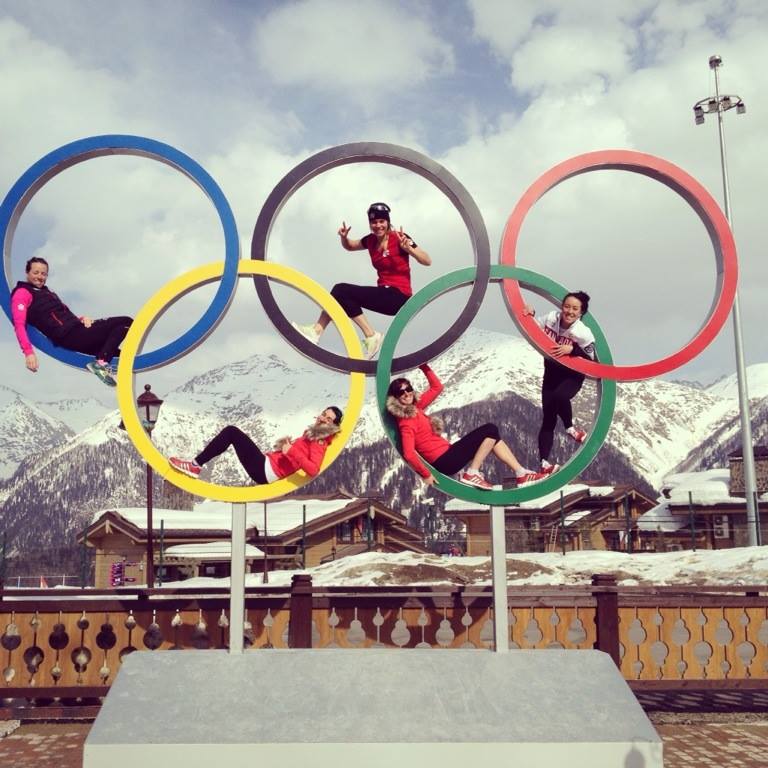
    Five members of Cross Country Canada’s 2014 Olympic team get the perfect photo opp at the Olympic rings in Krasnaya Polyana, Russia. (From left to right) Perianne Jones, Amanda Ammar, Heidi Widmer, Brittany Webster, and Emily Nishikawa. (Photo: Emily Nishikawa)

    On Nov. 9, news broke that four more Russian cross-country skiers had been sanctioned for cheating during the 2014 Sochi Olympics. So far, six Russian nordic athletes in total have had their 2014 Olympic results erased by the International Olympic Committee (IOC). These athletes are also prohibited from participating in all future Olympics due to their affiliation with Russia’s elaborate-state sanctioned doping enterprise.

    Julia Ivanova, half of Russia’s 2014 Olympic team-sprint duo, is one of the six penalized Russians. In Sochi, Ivanova and her teammate Anastasia Dotsenko skied to 10th place in the classic team sprint. (Thus far, Dotsenko has not been implicated in the doping scheme.)

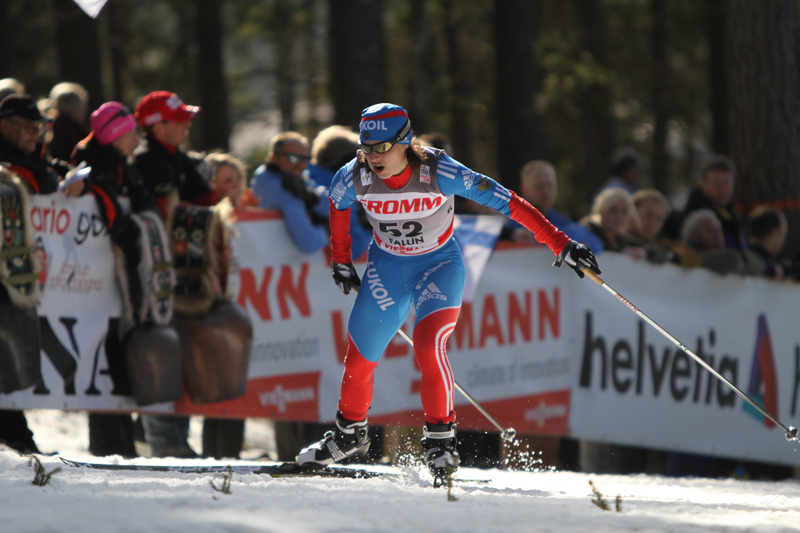
    Russia’s Julia Ivanova racing at 2012 World Cup Finals in Falun, Sweden.

    It’d be easy to say the Russian pair was way out of the medals — theirs was simply another tainted performance already removed from the official results.

    Yet among those clean athletes caught up in the win-at-all-costs mantra of the Sochi doping regime are Canada’s team-sprint pair Perianne Jones, now 32, and Dasha Gaiazova Atkins, 33. Looking back, “What might of been?” is a legitimate question the two retired skiers have asked.

    Ivanova and Dotsenko made the Sochi team-sprint final as what’s referred to as lucky losers — 10th place in their semifinal wasn’t enough for them to automatically advance but their time was fast enough relative to the rest of the field to put them through to the final. Jones and Gaiazova Atkins were right behind them in 11th, which was the end of their day.

    “I texted Peri that morning when the article came out in Fasterskier and said, ‘Should we start training for a redo?’ ” Gaiazova Atkins, who was born in Russia but spent more than half of her life in Canada, said on the phone from her home in Calgary. “Because we could have been in the finals and then you never know how that goes. It could have had a much, much better result and we could have had a chance for a medal.”

    One year before the 2014 Olympics, at the pre-Olympic World Cup in Sochi, Jones and Gaiazova (the latter of which has been married since, hence the new last name) placed third in the classic team sprint. Notably, they were third in a photo finish with the second-place Russians — Ivanova teamed up with Natalia Matveeva in that race.

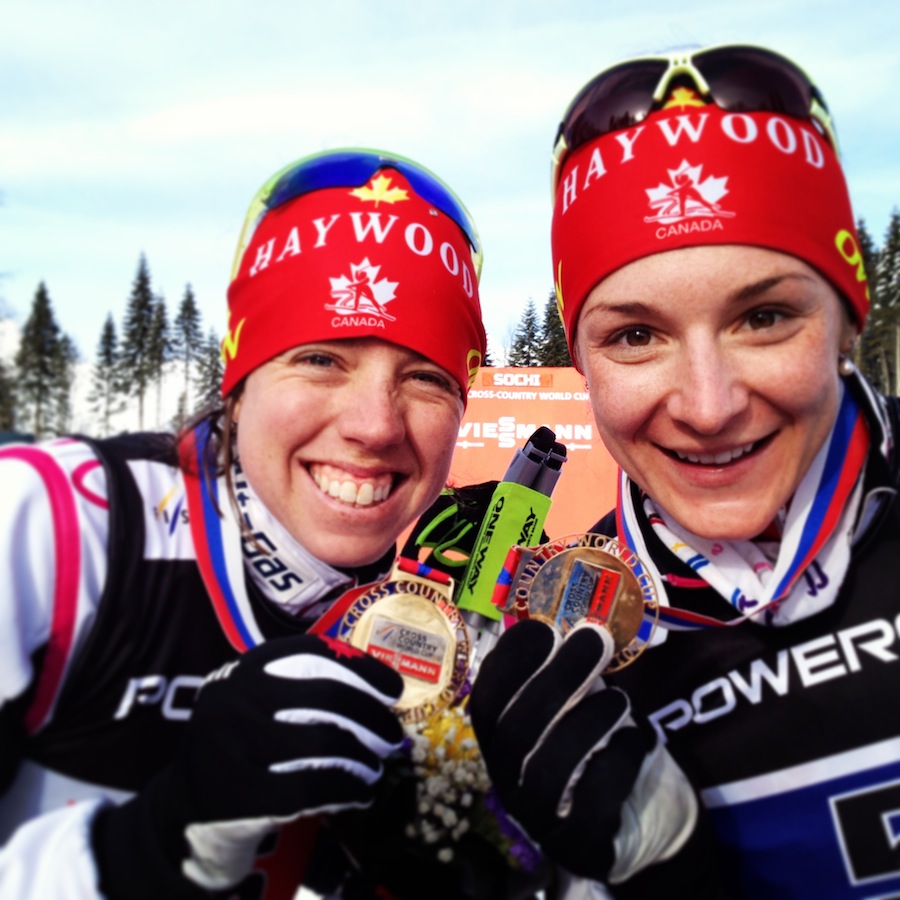
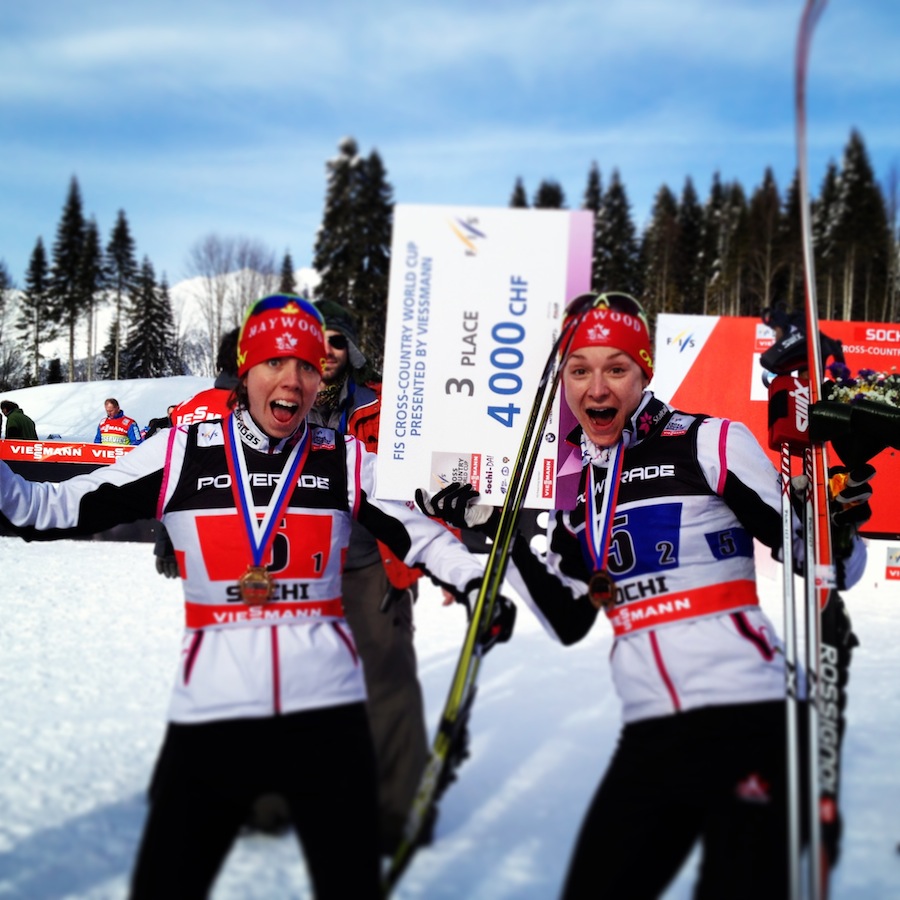
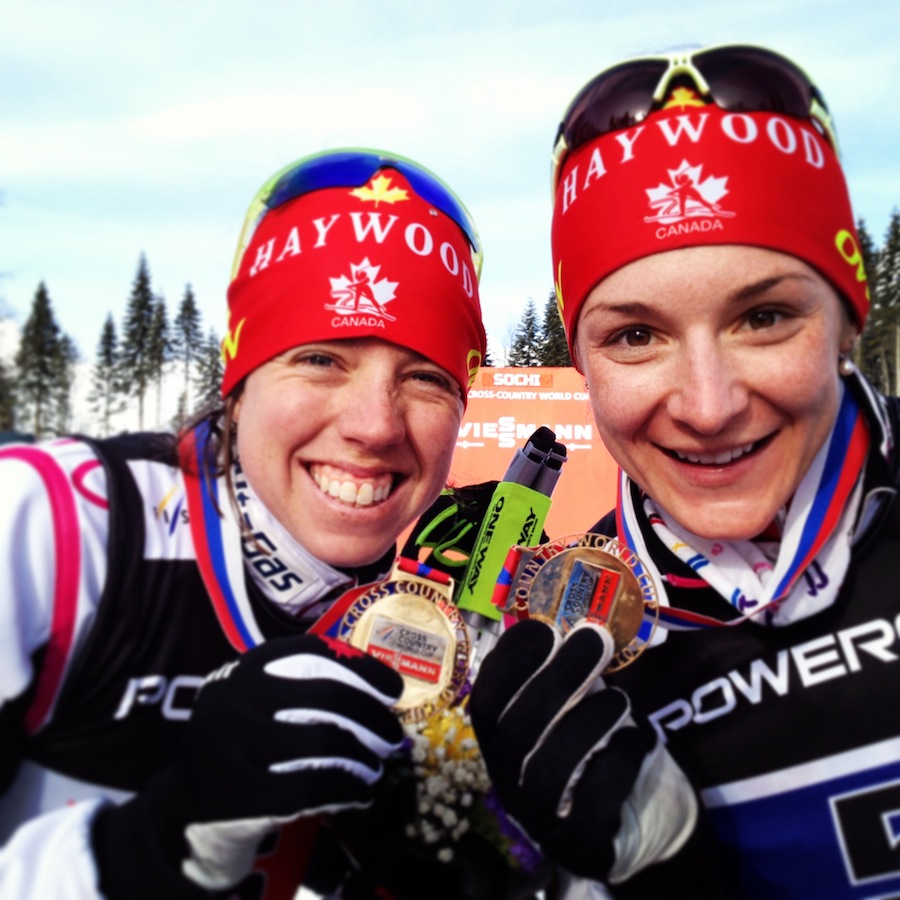
    Canada’s Perianne Jones (l) and Dasha Gaiazova having some fun after notching their first podium together with bronze in the classic team sprint at the Sochi pre-Olympic World Cup in February 2013. (Photo: Chandra Crawford)

    Jones first heard about the Ivanova news through Gaiazova Atkins’s text message.

    When it goes back and you realize that something could have gone a little bit differently or wonder what could’ve been, then you think about it a lot more and it definitely hits you a little personally,” Jones said on the phone from Canmore, Alberta. “For sure, it makes me feel sick and I cannot go back. No one can. That’s the unfair part. … It’s an interesting conundrum: people have put their lives into something and then are not given a fair chance.”

    The “what if” part of this story is multi-layered. Ivanova raced twice in the 2014 Olympics before the team sprint; first in the 10-kilometer classic on Feb. 13 and again in the 4 x 5 k relay on Feb. 15. What if Ivanova had been tested after those races and a legit lab had found her to be doped? What if Ivanova and Dotsenko never raced the team sprint on Feb. 19? Or a different iteration of Russians were slower in the semis? On paper at least, in this post-Sochi thought experiment, the Canadians advance to the final as lucky losers. 

    The perspective of time buffered by athletic retirement seemed to have taken the edge off the tone of both Jones and Gaiazova Atkins, based on their voices over the phone. They both sounded calm and measured, without a sense of bitterness. But they raised several important points as the fallout from the Russia’s doping program continues.

    Canada’s Perianne Jones racing to fifth in the 1.4 k classic sprint at 2015 World Championships in Falun, Sweden. She placed 24th overall and retired after that 2014/2015 season.(Photo: Flyingpointroad.com)

    On Jones’s mind were those athletes still competing, and those wondering if they, too, are racing in an unlevel playing field.

    “I am retired now,” Jones said. “So it would have been tough had all this stuff been coming out as I was still ski racing. I think it is tough for the athletes who are still competing now. Not that it is easy to hear about it after the fact, but you definitely have to believe you can do it while you are ski racing. I imagine that at least most of the playing field is clean and that would be hard given everything that has transpired over the last little while.”

    Gaiazova Atkins’s story resonates due to her literal mid-teen continental shift. At the age of 15, she moved with her family from Russia to Quebec. Although she started skiing in Russia, her swift trajectory up into the international ranks began as a Canadian. She did, however, recall a Russian ski culture where more than a healthy lifestyle choice was on the line.

    “I would say there is more pressure in Russia,” Gaiazova Atkins said. “And maybe because in Russia, in so many ways the country is so far behind in development … they have very few resources. So there is a lot of pressure to become a big skier because if you can race fast, you can do quite well for yourself in the country. … In America, it is not the same. And here in Canada, Chandra [Crawford] got a gold medal, shake her hand and off she goes to get an education.”

    Gaiazova Atkins’s perspective was one of trying to humanizing cheaters and would-be cheats, people with families and their own demons straddling their shoulders.

    “The incentive to perform is so much higher in Russia,” Gaiazova Atkins said.  “And the alternative? You can live in poverty and then, OK, I am going to take a chance. So for a lot of athletes, it may not be perceived as high risk because it’s the only chance to do well in life.”

    While she expressed that blame should be placed on those involved, Gaiazova Atkins emphasized truly understanding an athlete’s complicity.

    “I know these girls and I know the guys who are now being stripped of their results,” she said. “I follow them on Instagram and I see what they are saying in Russian, and it’s crazy they are still denying they did this. But then, you think about a big country like Russia and the whole thing, you almost ask yourself, ‘Did the athletes even know this was happening? Did they have any say?’ It is just like, you have no choice as an athlete.”

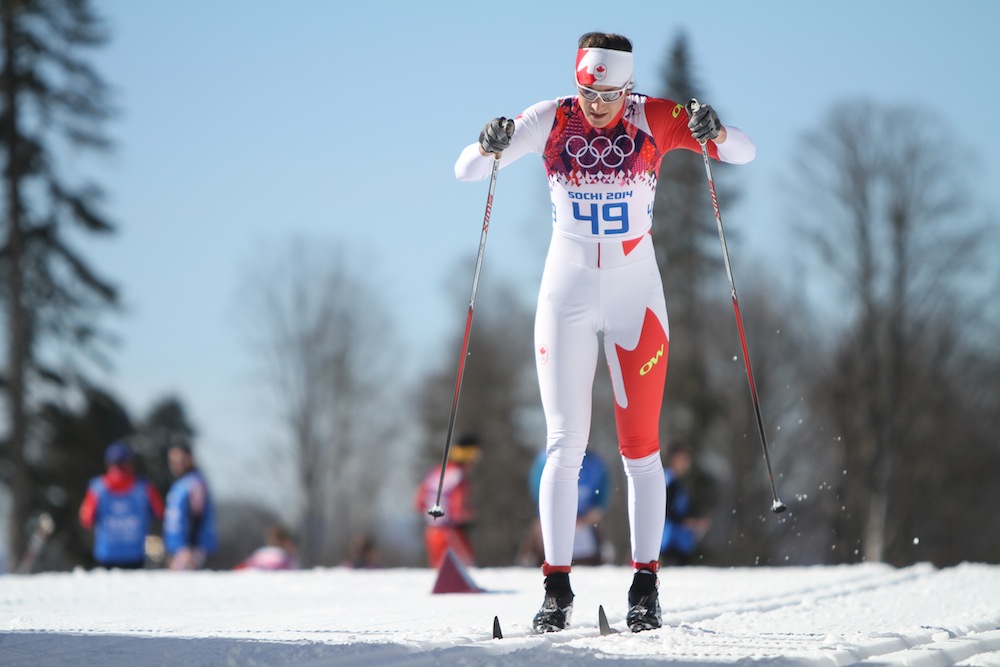
    Dasha Gaiazova racing to 44th in the women’s 10 k classic individual start at the 2014 Olympics in Sochi, Russia. She retired at the end of that 2013/2014 season and is currently coaching the Space Dogs Ski Club (where she’s also the president) in Calgary.

    Several times, Gaiazova Atkins stated her belief that the doping was a top-down mandate, a state-sanctioned endeavor with upper-government power plays manifesting with Sochi podiums. But she’s also no apologist. 

    “I follow on Instagram and their posts from all those guys, like Legkov and people that support him,” she said. “They say, we are with [Legkov] because we know how hard he works and how much work ethic he has. And I am thinking to myself, every single person racing is working just as hard and harder.

    “I feel sorry for those athletes, especially those who aren’t as systematic like the state-supervised program,” she added. “The ones who choose themselves and go to doctors, no pity for you.”

    As far as moving forward, Gaiazova Atkins said she was in favor of nothing less than a wholesale Russian ban from the upcoming PyeongChang Games.

    “You cannot slap them on the hand and say, ‘OK, don’t do this next time, please’,” she said. “It has to be with consequences for the state, for the country.”

    Gaiazova Atkins also believes that Ivanova’s doping has had lasting impact on potential funding for the current crop of Canadian cross-country skiers. “Eleventh place is not a top 10,” she said.  

    “Cross Country Canada funding is based on our results, and there is a big difference between a top 10 and 11th place sometimes,” she added. “To take us out of the equation, this had a trickle effect on the whole system, like our whole nation may have been affected by the funding because we did not get a top-10 result.”

    As the concentric ripples from Russian doping in Sochi move outward, they’ve arrived in North America, nearly four years late, with the 2018 Winter Olympics in PyeongChang, South Korea, on the horizon.

    Canadians Perianne Jones and Dasha Gaiazova celebrate their first bronze together in the 2013 Sochi World Cup classic team sprint. (Photo: Chandra Crawford)
  • McLaren Report II: Systematic Doping Continued After Sochi Games

    McLaren Report II: Systematic Doping Continued After Sochi Games

    (Note: This article has been updated to include a statement from the International Ski Federation regarding the most recent McLaren report, as well as comments from IBU President Anders Besseberg.)

    On Friday morning in London, Professor Richard McLaren held a press conference to discuss the release and findings in what is being called the ‘Independent Person 2nd Report by Professor Richard H. McLaren, O.C.  December 2016‘.

    The initial McLaren bombshell came in July when the World Anti-Doping Agency (WADA) disclosed its findings about alleged systematic state-sponsored doping in Russia.

    McLaren’s investigative mandate was to further disclose the extent to which Russia’s anti-doping authorities manipulated doping-control samples and how they beat international testing protocols.

    Friday’s report disclosed more evidence of systematic Russian doping that McLaren concludes dates back to at least 2011 and continued after the Sochi Olympic Games.

    The major findings released today include this: more than 1,000 Russian athletes in more than 30 different sports were involved in the doping coverup. McLaren called it “a coverup that operated on an unprecedented scale” in his opening remarks.

    Of those 1,000 athletes, 600 (84 percent) are summer athletes whereas 95 (16 percent) are winter athletes. Those 695 names were reported to 32 international sports federations. The remaining 305 were more or less special cases that could not be disclosed for confidentiality reasons, McLaren explained.

    The report states that the “coverup” and “manipulation” of the doping-control process was fine-tuned during the 2012 London Summer Olympics, 2013 Universiade Games, 2013 Moscow IAAF World Championships, and the 2014 Sochi Winter Olympics.

    On page 27, the report’s authors did not mince words when it came to describing the freedom to which some Russian athletes could affect a race’s outcome during the 2014 Winter Games:

    “The Winter Olympics in Sochi debuted the ultimate fail-safe mechanism in the Russian’s sample swapping progression. A protected winter Olympics competitor likely to medal did not have to worry about his or her doping activities. They could dope up to, and possibly throughout, the Games as they could count on their dirty sample being swapped at the Sochi Laboratory.”

    Specific violations that occurred during the Sochi Games were sample swapping and tampering.

    “Two female hockey players’ samples contained male DNA … and eight Sochi samples revealed salt content not physically possible in a healthy human,” McLaren stated, explaining that Russian specialized agents, dubbed “magicians”, used salt and “Nescafé coffee granules” to manipulate the samples.

    More specifically, McLaren’s team found “physiological impossible” salt readings in two Russian athletes that were “winners of 4 Sochi Olympic gold medals” and a female silver-medal winner.

    “Twelve medal winning athletes (including the above 3) from 44 examined samples had scratches and marks on the inside of the caps of their B sample bottles, indicating tampering,” the report stated. “Six winners of 21 Paralympic medals are found to have had their urine samples tampered with at Sochi.”

    For Russian doping authorities, the process of preventing samples from testing positive became a nimble and evolving cat-and-mouse game. Russia’s infrastructure put in place to beat the testing protocol was able to evolve, “in response to WADA regulatory changes and surprise interventions,” the report stated. 

    “For every action by WADA, there was a Russian reaction,” McLaren said.

    The first McLaren report detailed the intricate swapping of positive tests for clean tests during the Sochi Games. The second McLaren report alleges that the same protocol continued after the Sochi Games concluded and became a routine “monthly practice” at the Moscow Laboratory at the center of the doping coverup.

    “After Sochi, the sample swapping happened approximately every month,” McLaren said. “The ‘magicians’ would be called to the Moscow laboratory to swap … about five to 20 samples … per month.”

    How did they get away with tampering with supposedly tamper-proof bottles? According to McLaren, forensics experts determined that “thin strips of the metal were most likely used. They have to be flexible enough to bend and fit between the lid and the bottle, but also strong enough to pull up the metal ratchet ring.”

    And who is responsible at the very top? While McLaren’s report does not name Vladimir Putin, it does include former Russian Ministry of Sport Vitaly Mutko (who has since been promoted to deputy prime minister). Mutko appointed Dr. Grigory Rodchenkov, the former director of the Russian anti-doping laboratory, for the job back in 2011 — when doping efforts were found to have begun ramping up for the 2012 London Olympics.

    McLaren later explained that there was no evidence that Russian Olympic Committee members were directly involved. He also stressed that this “institutional conspiracy” dates back to at least 2011.

    “It is impossible to know how far back the conspiracy goes,” he said. “… Sports fans and spectators have been deceived. It’s time that stops.”

    Athletes affected by the post-Sochi sample swapping technique include elite summer and winter athletes. McLaren wrote that the report’s conclusions were established not by verbal testimony, but by testing physical evidence.

    “The key findings of the first report remain unchanged,” he said. “Evidence does not depend on verbal testimony from anyone to draw a conclusion, but rather tests the physical evidence and draws a conclusion from the results.”

    As of press time, neither McLaren, his report, nor WADA mentioned any athletes by name. McLaren said the evidence has been passed on to WADA, which is asking specific sport federations to handle specific athlete cases. 

    “It has not been put in the public domain. That will be up to sports federations who have received the information,” he said.

    In a press release on Friday, WADA noted that the evidence, described by McLaren’s “Investigation Team as being ‘based on immutable facts’ will be of immediate value to the IFs [International Federations], the International Olympic Committee (IOC), the International Paralympic Committee (IPC) and other organizations — those that are responsible for the Results Management and Adjudication process related to potential anti-doping rule violations (ADRVs) under the World Anti-Doping Code (Code).

    “In terms of next steps, the Investigation Team is providing WADA with an Evidentiary Summary for each athlete referred to in the Report by alpha-numeric code,” the press release continued. “Starting today, WADA will provide these Summaries to all IFs whose athletes are mentioned within the Report; as well as, to the IOC, the IPC and other relevant organizations. Once in possession of these Summaries, these organizations will be responsible for reviewing the evidence available for each case; and, for determining whether or not there are sufficient elements to pursue ADRVs or, whether further investigations are required.  As is a requirement of the Code, WADA will monitor the Results Management that will be carried out by the relevant authorities.”

    As McLaren explained: “It’s up to different parties, like the IOC and the federations [32 of which have reports] for them to make their decisions. They can rely on what’s in the reports and what’s on the website.”

    While the IOC did not have an official statement on its website a few hours after the report was published on Friday, the International Paralympic Committee immediately responded with a press release, stating, “The full findings of the report are unprecedented and astonishing. They strike right at the heart of the integrity and ethics of sport. … We wholeheartedly agree with Professor McLaren that the best course of action is to work together to fix the broken and compromised anti-doping system in Russia.”

    The IPC explained that it recently appointed a taskforce to work “closely” with the Russian Paralympic Committee (RPC) “to do just that.”

    The IPC suspended the RPC in early August “due to its inability to fulfil its IPC membership obligations, in particular its obligation to comply with the World Anti-Doping Code (to which it is a signatory) and the IPC Anti-Doping Code.”

    The International Ski Federation (FIS) relayed its official statement in an email to FasterSkier:

    “FIS will study the details in the WADA McLaren Report in the coming days and thereafter act decisively, in accordance with the FIS policy of zero tolerance to punish anti-doping violations and the protection of clean athletes. Additionally FIS will coordinate with the IOC, as the responsible body for anti-doping at the Olympic Winter Games, and WADA, in order to address each organisation’s next steps.”

    Also in the email, FIS Communications Manager Jenny Wiedeke noted, “Unfortunately, we cannot answer specific questions until we have had a chance to completely review all of the details of the report.”

    The International Biathlon Union (IBU) president Anders Besseberg went on the record saying, “First of all you need proof that the Russian Biathlon Union was involved in this thing,” he told Sportschau.de. “Or was it something that went over the head of our federation member — at a state level so to speak, then it is a difficult question.

    “But in my opinion that is the key question: if the Russian Biathlon Union was involved,” he continued.