From the FasterSkier archive — posts syndicated from athletes’ and coaches’ own blogs between 2004 and 2012, kept online as published. Current coverage is at fasterskier.com.
American Bryan Fletcher after jumping to 18th on the 109-meter normal hill at the 2018 Olympics in PyeongChang, South Korea. He went on to finish 17th in the 10 k later in the day. (Photo: FlyingPointRoad)
At age 31, Bryan Fletcher estimates he’s dedicated 25 years to the sport of nordic combined. He has been a U.S. national team member for the past 11 years and maintains that first time he flew off a jump on skis occurred at the ripe age of 4. Before that, and before his first steps, Fletcher’s exposure to skiing came from the viewpoint of a child carrier on his father’s back.
For the first time since his initial national-team naming in 2006, Fletcher’s full-time work will no longer revolve around nordic combined. As of this spring, the U.S. Nordic Combined veteran has retired from World Cup competition, as have a few other internationally notable nordic-combined skiers.
For any athlete who has devoted as much time as Fletcher, retirement rarely means complete severance from the sport. From the onset of his career, nordic combined (NoCo) served as more than just an athletic pursuit for Fletcher. It was also in a way, a lifeline.
***
Bryan Fletcher (U.S. Nordic Combined) at the 2016 U.S. Ski Jumping and Nordic Combined Large Hill Championships in Park City, Utah. (Photo: USSA/Tyler Tate/T Squared Action Sports)
When he was 6 years old, Fletcher made a special request to his parents. At the time, he was a self-proscribed “adrenaline-junkie kid” living in Steamboat Springs, Colorado — a well-known ski town that is also home to the country’s historical ski jumping venue, Howelsen Hill. Fletcher had heard that his hometown was hosting a “learn-to-ski-jump day” for kids his age.
Naturally, he wanted to attend.
But even if Fletcher’s 6-year-old self self showed a fearless gall and a desire to jump, his parents had other reasons to feel nervous about signing him up. His health. Three years earlier, he had been diagnosed with acute lymphoblastic leukemia (ALL)-
A type of cancer in which the body’s bone marrow overproduces lymphocytes (a type of white blood cell), ALL’s symptoms can range from pain in the bones and joints to fatigue and fever. To treat his condition, Fletcher completed regular chemotherapy sessions three hours away in Denver, Colorado. Some sessions left him without hair.
“I think it’s very easy for young kids, especially going through cancer, to be pretty down in the dumps and not really get to feel like they’re a normal kid,” Fletcher told FasterSkier on the phone earlier this month. “I don’t know how or why, but I guess I begged my parents enough to sign me up for that learn-to-ski-jump day.”
With some persuasion, he convinced his parents to let him partake in the event. Instantly, Fletcher was hooked, prompting him to join Steamboat’s youth ski-jumping program. Eventually, he found his way to the cross-country trails and began participating in the youth NoCo program at the Steamboat Springs Winter Sports Club.
“I think they saw the smile on my face and were like, ‘Holy cow, how are we going to tell him that he can’t do this?’ ” Fletcher recalled of the first time he tried ski jumping.
NoCo became what Fletcher referred to as the “perfect distraction” from his chemotherapy sessions and childhood cancer. In Denver, he adhered to everything his doctors recommended, especially if it meant getting back to Steamboat, skiing and jumping sooner.
“I think it was, in hindsight, a great motivator for me,” Fletcher said of his early days in the sport.
***
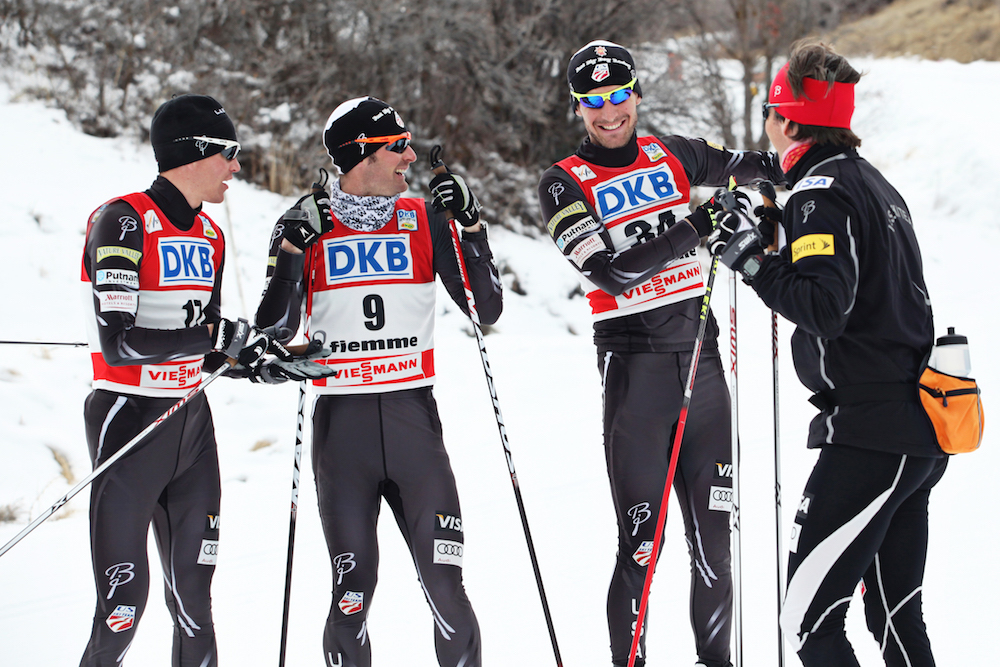
U.S. Nordic Combined’s 2011/2012 team members (from left to right) Bill Demong, Bryan Fletcher and Taylor Fletcher with head coach Dave Jarrett at Soldier Hollow in Midway, Utah. (Photo: USSA)
From then on, Nordic Combined became inextricably intertwined with his life, both on the hill and at home. His younger brother, Taylor Fletcher, who was four years younger, also picked up NoCo, and the two shared practices and passion for the sport.
“Both he and I are fighters, but … he’s always had to work for it a little bit harder than I did,” Taylor said on the phone this month. “That’s what drove him to become as good as he was.”
When Bryan was a freshman at the Winter Sports School in Park City, Utah, he was selected to be a forejumper for the 2002 Winter Olympics.
“This honor further solidified my goals and ambitions to become a world-class athlete,” Bryan wrote on his website.
Just two years after his high-school graduation, Bryan earned a spot on the U.S. Ski Team. He was 20 years old. One year later, he qualified for his first World Championships in Sapporo, Japan, racing to 40th in the sprint.
Six months after his 22nd birthday, Bryan claimed his first Continental Cup podium: third place in an individual large hill/10-kilometer Gundersen at Soldier Hollow near Park City. He competed at his second World Championships in 2009, walking away with two individual top-30 performances (30th in the large hill/10 k and 22nd in the normal hill/10 k).
By the third competition weekend of the 2010/2011 World Cup season, Bryan had achieved his first individual top 10, placing eighth in the normal hill/10 k in Ramsau, Austria.
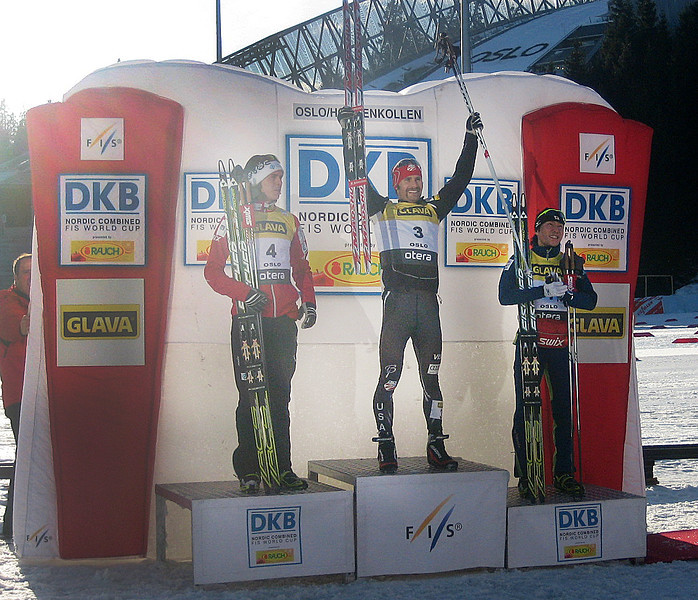
Bryan Fletcher on the top of the podium in at the 2012 Nordic Combined World Cup in Oslo, Norway. (Photo: Margo Christiansen/USSA)
But it was the following season, in 2011/2012, that Fletcher really found his form. At the 2012 Holmenkollen World Cup in Oslo, Norway, he became the fifth American to win a Nordic Combined World Cup with a victory in the large hill/10 k. In that season alone, he also finished in the top 10 seven other times.
“That was kind of a pivotal point,” Fletcher said of his Holmenkollen win. “It was a reinforcing result. … I was like, ‘OK, I do belong here at the top of a World Cup and I have a future in the sport … all the sacrifices and work you’ve put into it are worth it.”
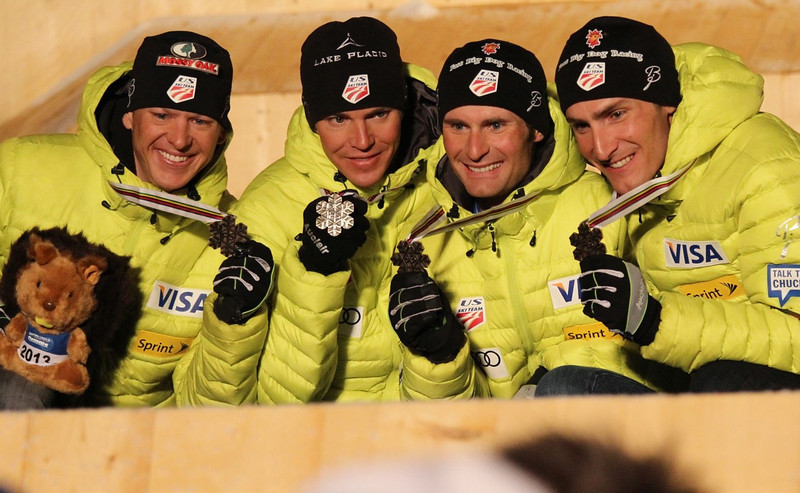
Bryan once again made the team for 2013 World Championships in Val di Fiemme, Italy, where he and his teammates Billy Demong, Todd Lodwick and his brother Taylor raced to bronze in the 4 x 5 k team event.
“That was just solid teamwork and great performances by all,” Bryan said. “A happy moment in the career.”
From left to right: Todd Lodwick, Billy Demong, Bryan Fletcher, and Taylor Fletcher with their bronze medals from the team event at the 2013 Nordic Combined World Championships in Val di Fiemme, Italy. (Photo: Fiemme2013)
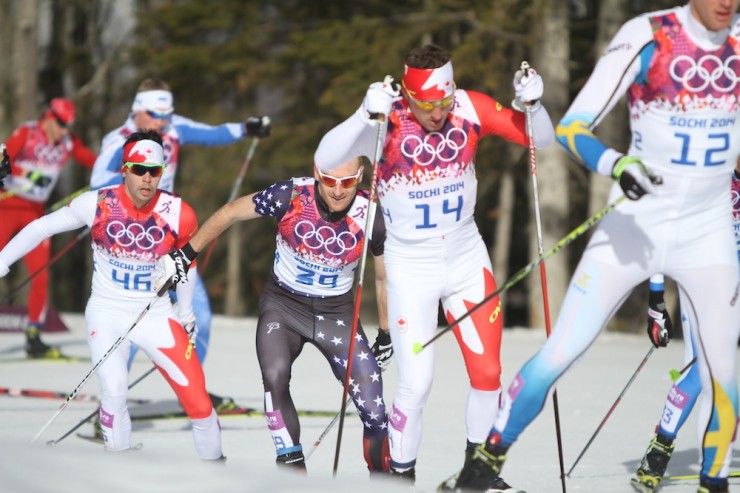
Twelve years after his cameo forerunning appearance at the 2002 Salt Lake Olympics, Bryan found himself at the top of another Olympic jumping hill — this time wearing the Team USA race suit. He had qualified for the 2014 Olympics in Sochi, Russia, where he went on to finish 22nd in the large hill/10 k and 26th in the normal hill/10 k.
Over the next four years, he would qualify for two more World Championship teams as well as the 2018 Olympics in PyeongChang, South Korea. On top of those achievements, he’d accumulate 10 more individual top-10 World Cup finishes, including two seventh-place results this past winter.
In PyeongChang, Bryan placed 17th in both individual races: the large hill and normal hill/10 k Gundersen starts.
“I went into PyeongChang wanting to have a lot of fun, obviously wanting to fight for a medal, and to put my best foot forward,” Bryan explained. “I put together probably some of my best performances on the jump hill I’ve had in several years. Unfortunately my cross-country wasn’t quite as strong as I’d hoped for, but I still felt like I put everything I had in the training going into it.”
***
When it comes to his work, Bryan is all about giving his all, which is one reason he chose to retire from World Cup competitions. It is also one of the reasons why he is not immediately transitioning into coaching, despite his close connection to the sport for so many years.
“I am the type of guy who likes to do things 100 percent,” Bryan explained. “The sport is always growing and the level is always rising, and I just felt like I wasn’t going to be able to give the sport all the effort that I needed to give it to be successful [as an athlete]. So I decided that 2018 was the year that I would retire and I would move into finishing my academic career and start a new journey.”
Bryan Fletcher holding his newborn, Ellery Ardene Fletcher. Fletcher and his wife Nikki welcomed their baby girl on Aug. 29, 2016. (Photo: USSA Nordic)
His new journey will involve finishing school and spending more time with his wife and 20-month-old daughter, Ellery. Through online courses, he has been working toward a degree in health education and promotion (with an emphasis on health science), which he aims to complete by next year. Graduate school has popped into his mind, as well as the idea of becoming a physician assistant.
Though coaching may have seemed like the ideal professional avenue for an athlete like Fletcher, the U.S. team veteran sees value in spacing himself from the team before getting too deeply involved.
“I think that going into coaching is really easy, especially to go straight from your athletic career, but you don’t have that time to expand your knowledge,” he said. “For a number of years, coaching was how I wanted to stay involved in the sport. I’ve since changed that idea.”
Instead, he hopes to enhance his knowledge of athletics and health science before working with athletes. The idea is to not only allow himself to develop more, but give the current U.S. NoCo team time to develop as well.
“When you come back to a sport so fresh out of retirement, it’s easy to focus on the same problems that you had as an athlete,” Fletcher explained. “But those issues may not be necessarily what the other athletes are struggling with or what they need to work on.
“On our team, we have some athletes that are great jumpers and we also have some athletes that are great cross-country skiers, but we don’t have particularly many of both right now,” he continued. “I think we just need to take some time to let those athletes develop in a new environment. That way you’re not just coaching the strong skiers to be strong skiers and the best jumpers to be the best jumpers, but instead allowing them to find strength in the opposite areas.”
Though he himself was 20 years old when he joined the team, by the end of his career, most of Fletcher’s teammates were almost a decade younger than him. While the team energy in recent years was one that left him admittedly needing “more naps”, he also sees the younger pool of athletes as an opportunity to foster a new team dynamic for American nordic combined.
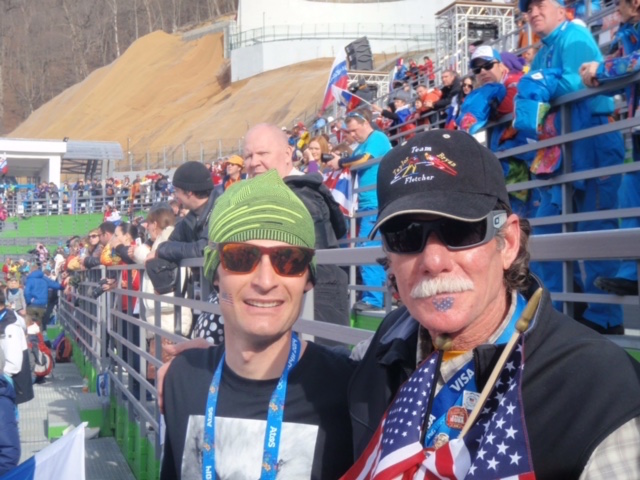
Bryan Fletcher with his father at the 2014 Winter Olympics in Sochi, Russia: “The biggest lesson I ever learned from my dad was not only how to ski but how to enjoy every single day on skis.”
“As the younger athletes come up, we have to let them create their own culture and be accommodating of it,” Fletcher said. “I think the way I can have the biggest impact on the team is not by jumping immediately into coaching, but instead taking some time away from the team to broaden my knowledge base and skill sets in different areas. Then several years from now, I can return to the team with a new attitude and new approach and add something different.”
For the time being, his involvement with NoCo will remain at the administrative level. He was recently elected to Team USA’s Athletes’ Advisory Council and will serve a four-year term on the board of directors.
Even so, his presence at practice sessions will be missed.
“It’s going to be weird,” Taylor said of his brother’s departure from the team. “He was always the very level-headed leader.”
As Taylor, a three-time Olympian, steps into the primary NoCo team-veteran role, Bryan was sage in his advice to those who will continue to hit the trails and the hill.
“Just have a plan in place, especially when you start to think that you’re heading down that road of retirement,” Bryan said. “I think it’s really easy to kind of get stuck and not know what you want to do, so just make sure that you kind of have some sort of idea, some kind of stepping stone to go forward.”
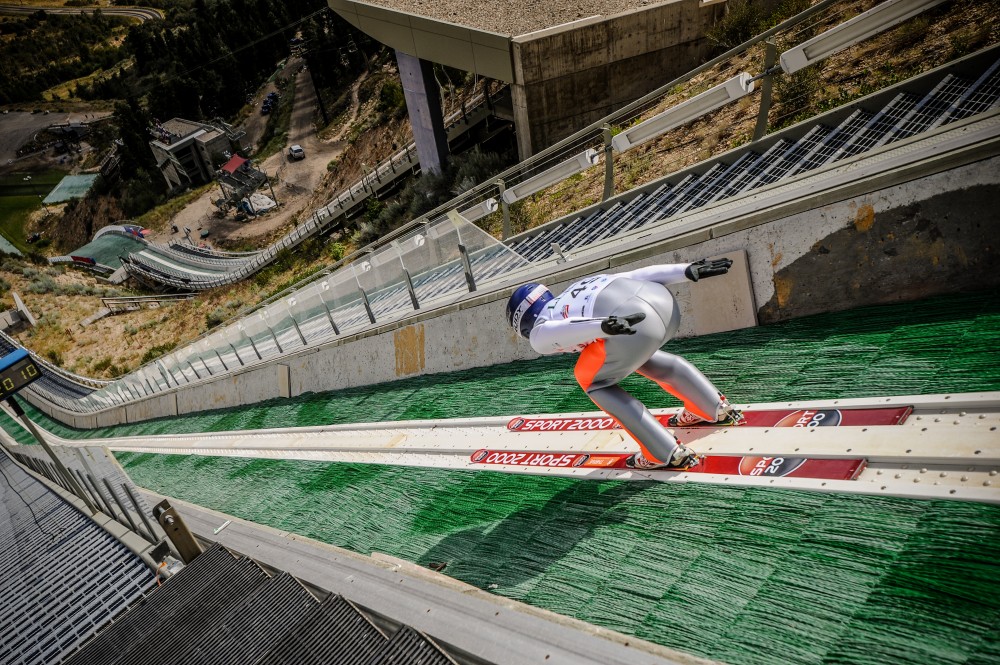
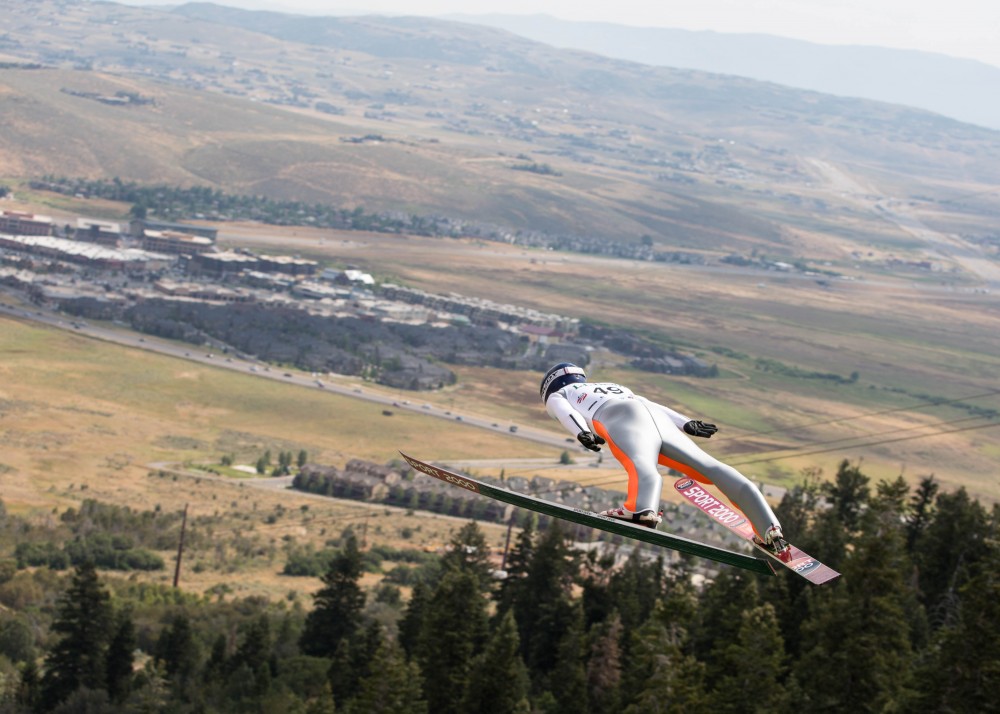
Bryan Fletcher flying at the 2016 U.S. Ski Jumping Championships at Utah Olympic Park in Park City, Utah. (Photo: USSA/Tyler Tate/T Squared Action Sports)
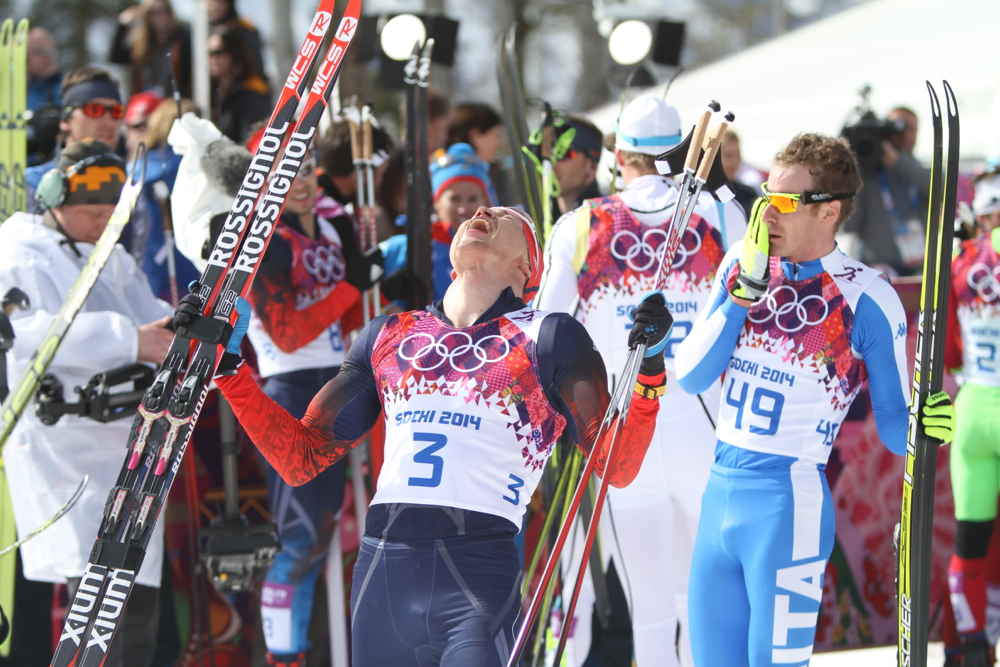
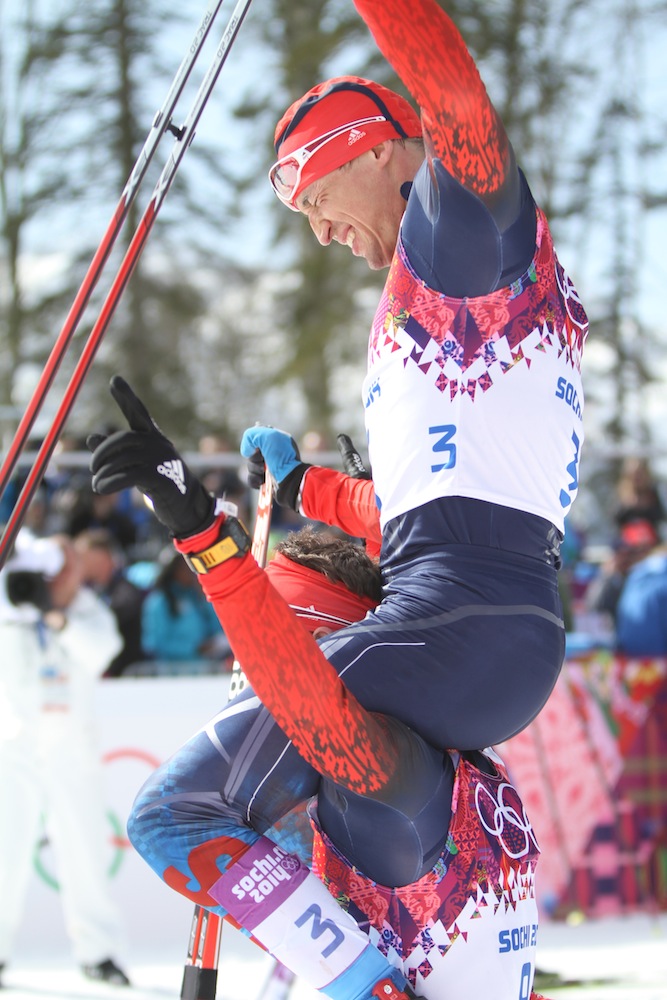
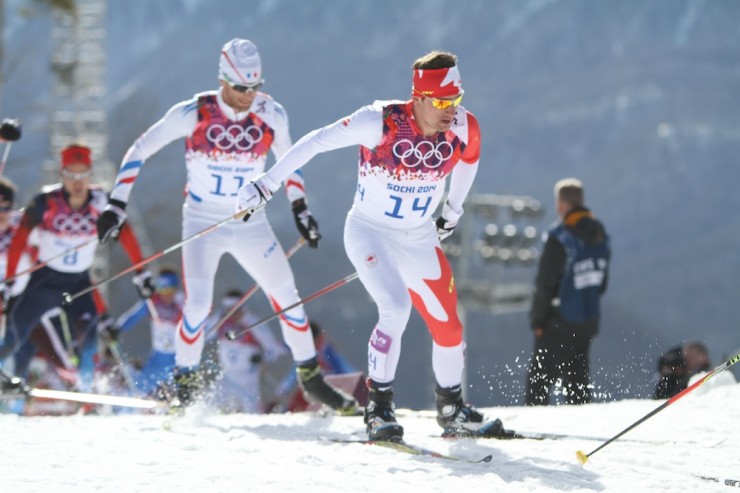
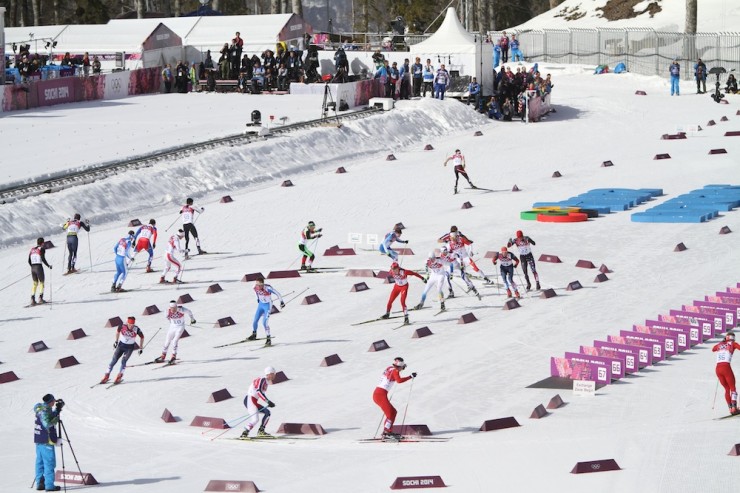
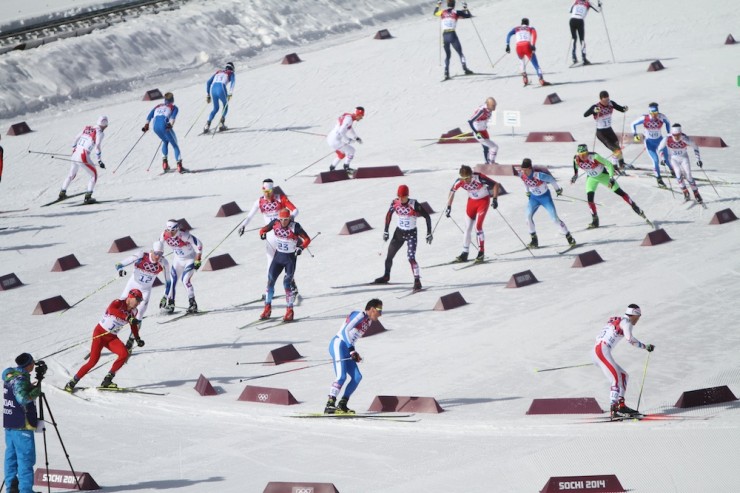
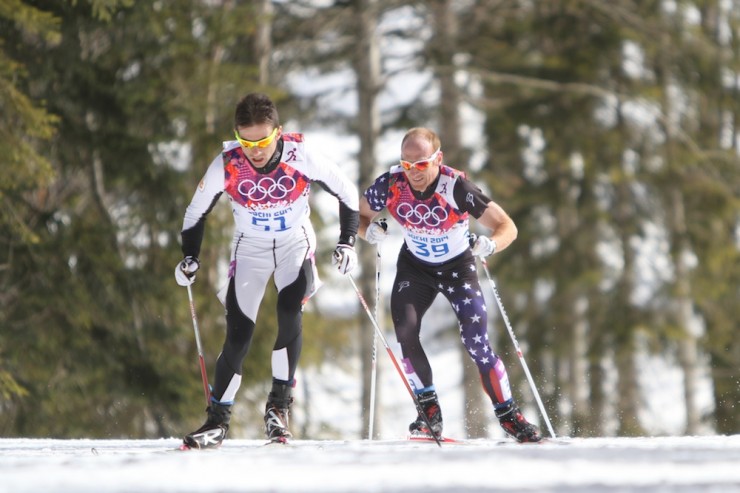
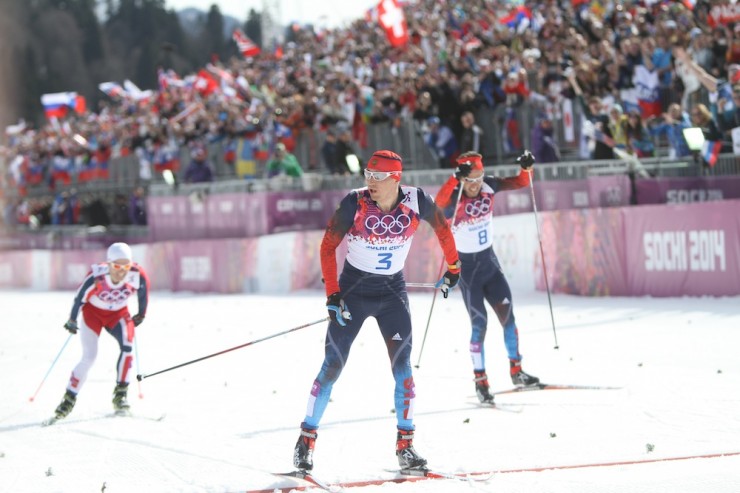
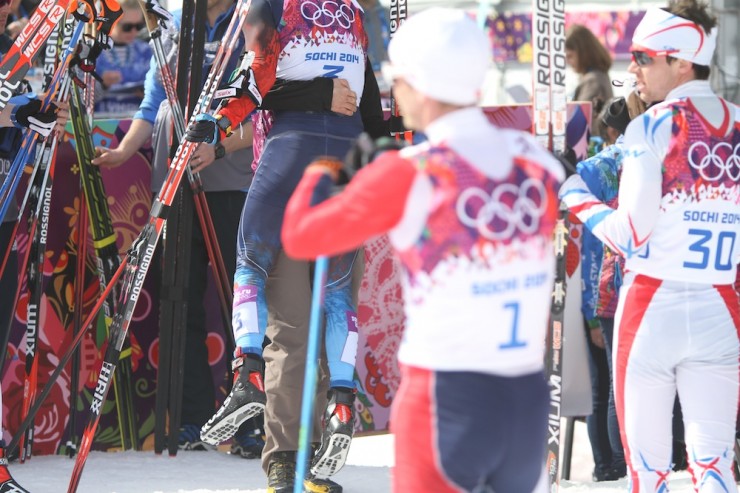
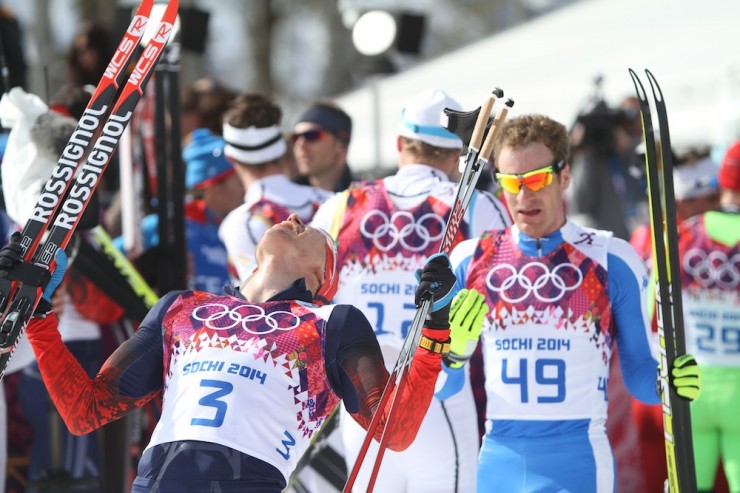
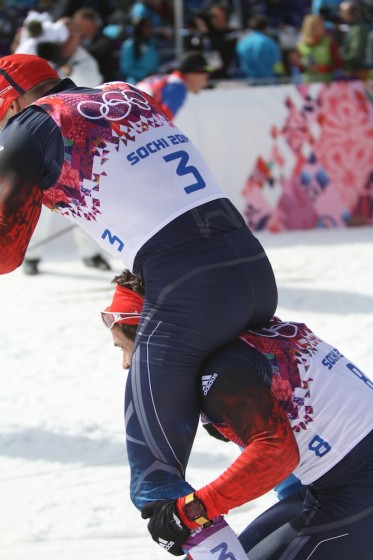
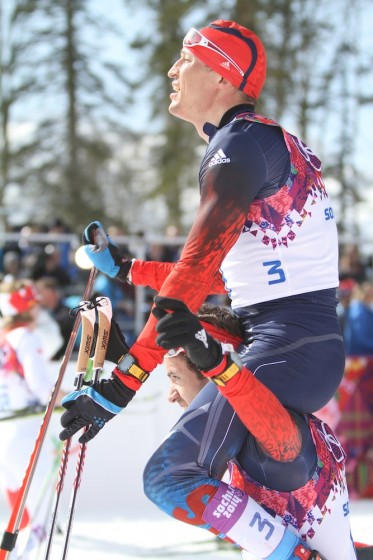
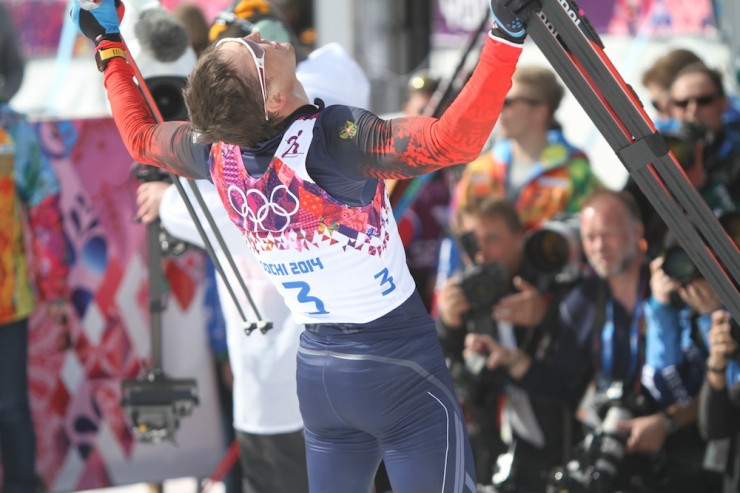
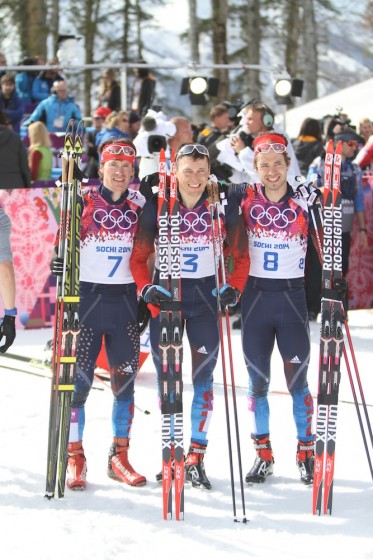
Russia’s Alexander Legkov (3) after winning Olympic gold in the men’s 50 k freestyle mass start at the 2014 Winter Olympics in Sochi, Russia. Russia’s anti-doping director at the time, Grigory Rodchenkov stated that he switched out Legkov’s anti-doping sample for a vial of clean urine collected previously. The International Olympic Committee stripped Legkov of his gold medal and banned him from future Olympics, but the Court of Arbitration for Sport overturned those sanctions in February 2018.
Editor’s Note: The following thoroughly cited opinion piece, prompted by the 2017 ‘Icarus’ documentary, was written by Maks Zechel, a 20-year-old Canadian cross-country skier who spent the 2017/2018 race season training abroad with Team Asker in Norway. Zechel is a regular contributor at FasterSkier, with his ongoing series: “Closing the Gap”.
***
February 23, 2014
Sochi: a home Olympics and the opportunity of a lifetime. Russia, despite being one of the strongest skiing nations in the world, has no individual medals in cross-country skiing leading into the final race of the championships. As the athletes shuffle nervously in the tracks before the 50 k mass start, the pressure on the Russian men can be felt even by me, watching on TV from home.
Putin is in the stands. It’s just a ski race, but how much more than that is at stake?
“The Moscow Laboratory operated, for the protection of doped Russian athletes, within a State-dictated failsafe system” (McLaren 1)
A sunny day, a roaring home crowd. Alexander Legkov is in a world of his own as he absolutely destroys himself over the final climb, skiing with the passion that it takes in all sports to win an Olympic medal. Russian flags waving everywhere, the crowd is absolutely deafening as Legkov adds his first Olympic gold to his already legendary career. Maxim Vylegzhanin and Ilia Chernousov lunge across the line behind him, with Chernousov having given every last bit of himself to outsprint Norway’s Martin Johnsrud Sundby to complete the Russian podium sweep on home soil. A dream come true.
“The Sochi Laboratory operated a unique sample swapping methodology to enable doped Russian athletes to compete at the Games” (McLaren 1)
When you ski with your teammates in front of your friends and family at home, you ski with a fire that is otherwise difficult to find. The presence of those who know you makes you feel guilty if you do not perform to your very best, you are pushed to keep up to those that your mind refuses to admit defeat against, and your own potential reaches new heights when your teammates accomplish something great. There is no cover of anonymity with which to hide the secrets behind your performance, because these people know what it took, and did not take, to get you to where you are.
“A pre-selected group of Russian athletes competing at Sochi were protected by the Sochi sample swapping methodology” (McLaren 67)
Despite the whispers of corruption surrounding Russia’s Olympic team, I cheered for those three skiers, who did the nigh-impossible and pushed their bodies as hard as anyone else to make their country proud. I do not know what exactly went into achieving that medal, but I do know that the incredible display of effort and the tears of happiness falling from Legkov’s face as he was raised onto his teammate’s shoulders, were very real.
“After he became laboratory director, and in furtherance of his responsibility to improve Russian sport performance by covering up doping, Dr. Rodchenkov developed a steroid cocktail optimized to avoid detection” (McLaren 49)
I first dreamt of going to the Olympics when I was 11 years old. This dream sparked an inner drive of mine that has lasted almost a decade, and I like to think that it will never extinguish. Sometimes, I wonder what lights that same flame in children around the world. In most countries, I like to think that many experience moments like mine: a motivation flourished from watching the passion of the Olympics, being inspired by older siblings, or being born with the need to be the first kid through the school doors when the bell rings for recess.
“The steroids were dissolved in alcohol … The solution was then swished in the mouth in order to be absorbed by the bucal membrane and then spit out … the detection window for the steroids in the cocktail would not exceed 3-5 days” (McLaren 49-50)
In parts of the world where fewer children are fortunate enough to make the decision to pursue a sport just because they are inspired, I wonder what brings them to those future championships. Is their talent used out of joy or out of the need to provide for those without the same athletic abilities? Was their talent exploited at a young age as a way for a country to show its dominance? Were they given a choice: to follow their dreams and do what they love by the prescribed method, or to not follow their heart at all?
I think about the lengths that I would go to support my family if they depended on me, and suddenly the way that I pursue sport seems insignificant, a trivial lifestyle “earned” through right of birth. Being born to these opportunities makes it all the more important to not waste them. My great-grandfather used to say, “if you’re going to do something, then you may as well do it right”, and those are words that I attempt to live by. To me, that means clean sport.
But clean sport is now more at risk than it has been in decades. Once an already colossal task of catching individual dirty athletes, we are now facing an extensive doping regime, backed by an entire government.
“[B]y the time of the Olympic Games in London, many of Russia’s top athletes were using the cocktail” (McLaren 51)
When faced with the enormity of the Russian state-sponsored doping system, it is no longer adequate to simply prosecute individual athletes. A large part of the problem when it comes to justly dealing with the system that made it possible for Russian athletes to cheat, is that WADA and the IOC are pitted against the entirety of the Russian government. It is not the USA and Canada versus Russia, or any other country versus Russia; it is two sporting entities, independent of any particular country, against the full power of the Russian government.
“The Ministry of Sport directed, controlled and oversaw the manipulation of athlete’s analytical results or sample swapping, with the active participation and assistance of the FSB [Russian Federal Security Service], CSP [Center of Sports Preparation of National Teams of Russia], and both Moscow and Sochi Laboratories” (McLaren 1)
“… Deputy Minister of Sport, Yuri Nagornykh, was appointed in 2010 by Executive Order of then Prime Minister, Vladimir Putin” (McLaren 10)
The state-run doping program organized for the Sochi Olympics was not just about sport, it was politically motivated, overseen by President Putin himself. This sets Russia apart from previous doping scandals, such as that of the Finnish cross-country ski team in 2001, where doping operations were concentrated to a select number of skiers and their coaches. When the truth was uncovered about their national heroes, Finland, in complete shock, took steps to recover from the international disgrace that its ski team had brought upon them (Andrews). Iivo Niskanen and Krista Pärmäkoski have proven that it is possible for a great skiing nation to recover from such a disaster and win clean, paving the way for the next generation of Finnish skiers.
“ … this Article would prohibit altering identification numbers on a Doping Control form during Testing, breaking the B bottle at the time of B Sample analysis, or altering a Sample by the addition of a foreign substance” (“World Anti-Doping Code” 21)
The situation we see today is different. After the exposure of irrefutable evidence confirming state-sponsored doping and the covering up of doping evidence in Russia, it came as a disappointment to many when the Court of Arbitration for Sport (CAS) annulled the sanctions imposed by the IOC on 28 Russian athletes.
The evidence of coverups and doping are clear, but the CAS ruling was that “the evidence collected was found to be insufficient to establish that an anti-doping rule violation (ADRV) was committed by the athletes concerned” (“Media Release”). The evidence may be adequate to find Russia guilty of state-sponsored doping, but it is not enough to build a case against each individual athlete. This is likely because of the destruction and tampering of drug tests and results by Russian “anti”-doping personnel and Article 10.5.1.2 of the World Anti-Doping Code, which states that, if the “detected Prohibited Substance came from a Contaminated Product, then the period of Ineligibility shall be, at a minimum, a reprimand and no period of Ineligibility, and at a maximum, two years Ineligibility” (“World Anti-Doping Code” 64).
But if the evidence is inadequate, then why are some Russian athletes still facing penalties? Alexander Legkov and Sergey Ustiugov were both unable to compete at the PyeongChang Olympics, but Ustiugov can still race on the World Cup, while Legkov cannot. Evidence against athletes like Legkov proves that they were in some way a part of the state-sponsored doping program, but it is difficult to legitimately sentence them when evidence proving exactly what they have done has been tampered with or destroyed. Athletes like Ustiugov have not been proven to be a part of Russian doping operations, but have violated Article 2.1 of the World Anti-Doping Code through their association with people who are a part of it. This article states that “Athletes and other Persons must not work with coaches, trainers, physicians or other Athlete Support Personnel who are Ineligible on account of an antidoping rule violation … Prohibited association need not involve any form of compensation. (“World Anti-Doping Code” 24).
Sport in Russia will never be fair until Russia takes responsibility for their crimes against clean sport. Whereas Finland bore the weight of what their athletes had done in 2001, and ensured that it would never happen again, the Russian government has more at stake than a few drugged athletes. When doping is politically motivated and backed by the state, I do not think it is possible to solve the issue through sanctions by sporting bodies such as WADA and the IOC alone. Until the Russian government is pushed by other nations to take an interest in ensuring that sports in Russia are clean, the problem can never be completely resolved.
Until substantial action is taken, we will continue to be caught up in a stalemate of “partial blanket bans” and other half-measures. When imposed on a level of command that is too low in the Russian doping system, these actions cannot bring about the outright eradication of doping that we seek. Are sports a high enough priority for entire countries to impose sanctions on the Russian government until they answer for their crimes against clean sport? Or will doping be protected by other political motivations that keep Russia inseparable from the rest of the world? The scope of the Russian government’s involvement in doping is far beyond the reach of traditional sporting sanctions.
“Clean sport is dead” — Jim Walden, lawyer of Dr. Grigory Rodchenkov (Panja and Pérez-Peña).
The sporting world no longer holds its breath in anticipation of change. An uncertain future exists for clean sport, but even more disconcerting is the stagnation in which we now settle. With the anti-doping world left spinning its tires in frustration, where does that leave athletes for whom a future of fair play is too late?
Icarus, 2017 documentary film, debuted Aug. 4, 2017 on Netflix (Photo: Wikipedia)
In his dramatic documentary, Icarus, director Bryan Fogel convinced many sports fans that clean athletics, despite the improvement of anti-doping efforts over the years, is a hopeless pursuit. Fogel’s documentary was key to bringing the extent of systematic doping in Russia into the public eye.
In Icarus, Fogel takes anti-doping research to a personal level: after years of training as a high-level (amateur) cyclist, he spends a full year preparing for the “Haute Route” amateur cycling event, while following a doping program. This was prescribed to him by Dr. Grigory Rodchenkov (the former director of Russia’s Anti-Doping Center, turned whistleblower, who is now under the witness protection program in the U.S.).
Fogel routinely took a cocktail of PEDs (Performance Enhancing Drugs), under the careful guidance of Dr. Rodchenkov, and saw massive improvements in his power output ratings on the bike in less than a year. Having placed 14th in the seven-day Haute Route event the previous year, while racing clean, it seemed clear that Fogel would be a strong contender for the win.
He ended up finishing the unbelievably hard event in a far worse position than when he raced clean. From an athlete’s perspective, this does not surprise me. I understand that there are countless elements involved in producing an incredible athletic performance at a set time and place. Fogel’s reaction was different; visibly depressed, he talked of how sobering it was to realize that, no matter what he did, he could never be as great as his cycling heroes. This is a delusional conclusion, one that is biased by his dreams (influenced by growing up with Lance Armstrong as a hero) of becoming a better cyclist.
In these turbulent times for clean sport, it is important for athletes to remember that there are many aspects to training and competing, aside from other athletes cheating, that they can control. Living in Norway has taught me that there is a lot more to skiing fast than just being fit, and that applies to all sports.
Drugs don’t magically make you a fast skier, just like a high VO2 max score doesn’t make you a competitive World Cup skier. There are many elements to cross-country skiing that have a far bigger effect on a skier’s ability to ski fast than drugs do. If skiing were purely about fitness, aerobic machines like Hans Christer Holund would beat skiers with a lower VO2 max, like Petter Northug and Finn Hågen Krogh, without contest. Divergent technique revolutions, like those brought to us by pioneering skiers such as Petter Northug and Johannes Høsflot Klæbo, show us just how many ways there are to win a ski race.
In his reaction to not becoming a better cyclist even while doping, Bryan Fogel shows what he is: a film director with a remarkable story to tell. As most people would, he takes his failures in sport and attributes them to his personal characteristics; he feels he is simply not good enough at a genetic level. While not everyone will reach their athletic dreams, true failure occurs only when you stop trying after the first attempt. When athletes make changes to their training, it is rare to see dramatic results in the following competition season. Some things will never yield improvements, while other things take a few years of consistent work before they take effect. In the highly competitive world of cross-country skiing in Norway, many skiers go unnoticed down the results list for years, they are seen as average, before suddenly rocketing to incredible new heights seemingly out of nowhere. That is the nature of how training, competition, and life stress the body and mind over a prolonged period of time. To take a one-year snippet of an athlete’s life and make broad conclusions about sport is naive.
An otherwise brave and instructive self-experiment that helped uncover the scope of how doping continues to mar the sporting world uncontestedly, Fogel’s conclusion of his doping experiment sends the wrong message to the audience viewing Icarus. The message he sends is that only extremely gifted humans can become great athletes. This personal look into how his experiences have affected him make his documentary engaging and dramatic, something that the genre normally lacks for your average movie audience. The devastation that Fogel portrays in this realization hits viewers hard and the movie adopts an “apocalyptic” tone from that point on. The worldwide end of clean sport is confirmed with Rodchenkov’s exposé of Russian state-sponsored doping and the footage of him escaping Russia with his life in danger. Icarus uncovers frightening realities that affect the sports we love, but the film also incites new dangers to the culture surrounding sport.
Although accurate in their severity, the events at the end of Icarus doom its audience to pessimism against the current world of sports. This acts as fuel for ungrounded accusations against successful athletes by uninformed viewers. When a complicated issue arises, people quickly try to make sense of it by looking for a distinction between good and evil. By making an issue seem black and white, anyone can have a strong opinion about it, because the choosing of sides is based on your morals. You are either against doping, or you support it. Unfortunately, the issue is not so simple, but this type of inflamed, unschooled “debate” is perfect advertising for a film such as Icarus.
When making conclusions about an issue, it is our duty to question how someone else’s portrayal of events is affecting our opinion and to keep ourselves informed. FasterSkier Editor-at-Large Chelsea Little is an example of the brave reporting and investigating that it takes to keep organizations such as WADA and the IOC held accountable. We owe it to journalists like Chelsea, who sacrifice countless hours of their personal lives to enlighten us about the issues that affect us the most, to simply read their vital research. We must take the facts from the sources available to us, and add our own informed debate to the world of sport, because angry, baseless commentary are what keep humanity from moving forward.
Most Olympic athletes…would favour lifetime bans for doped athletes. IOC President, Thomas Bach, himself an Olympic champion, has publicly indicated a personal preference for life bans, but has correctly noted that the legal order, particularly in relation to human rights issues, will not permit such automatic sanctions, for first offences. Nor does the Code. The IOC itself has lost an appeal before CAS in respect of an IOC rule providing for the automatic exclusion of any doped athletes from Olympic competition in the Olympic Games next following the imposition of even a first doping sanction. (Pound, et al. 63)
It is our responsibility as athletes to represent all of those that have helped us and to lead by example. We can start with the atmosphere that we create amongst our fellow athletes. The culture of discrimination and groundless accusations against clean, Eastern-European athletes, or any successful athlete in endurance sports, has to stop. The “blame game” has some of the same ill-effects on our sport that we are trying to prevent by fighting against doping. Remember how ashamed Canadians felt when Ben Johnson, our “Olympic champion hero”, was caught for doping? Now imagine the irreversible damage that would have been done if he had been falsely accused. By telling young athletes that anyone doing something impressive — something that we could not imagine ourselves doing — is doping, teaches young athletes that no matter how hard they work, they will never become greater than their biggest dreams.
“The problems of the world cannot possibly be solved by skeptics or cynics, whose horizons are limited by the obvious realities. We need men [people] who can dream of things that never were, and ask why not.” — John F. Kennedy (“J.F.K. in Ireland”)
Teach young people to dream outside the realms of what they see as possible, and they will get there via the path you set them.
Athletes have the power to make more of a difference than just complaining about the flaws of their sport. Sports are visually flashy and exciting to an audience, and athletes are celebrated around the world for their raw fight against the limits of the human body. The hero-status of athletes gives them a sphere of influence greater than that of other members of society who work equally hard, or harder, in the goal of helping people.
The playing field of sport will never be equal for every child born on earth, when some athletes fight past obstacles far greater than the trials of sport, just to get to the start line. If we are lucky enough to be living the life of an athlete, it is not enough just to win medals.
Endurance sports may not get the same extent of attention as soccer, football, or basketball, but the popularity of these sports has elevated some athletes to leadership roles from which athletes from smaller sports can learn. Take LeBron James, one of the greatest basketball players of all time, who has recently come under fire for his comments regarding President Trump. Some feel that his place in society is to play basketball and entertain, not to comment on political events, but he has decided that his popularity gives him a greater responsibility than just playing sports:
“I mean too much to society [to ‘shut up and dribble’] … I mean too much to the youth, I mean too much to so many kids that feel like they don’t have a way out and they need someone to help lead them out of the situation they’re in.” — LeBron James (Conway)
As a Canadian, the opportunity that I have to pursue cross country skiing is a selfish privilege. I have the chance to use sport to meet new people, to inspire, and to use my experiences and influences to create a better world around me. Otherwise, I am just a lucky individual, riding on the support of those that I do little to help, enjoying what I have been given and doing little to share my wealth. I work hard at what I do, but to think that I am an inspiration to others simply through my existence would be incredibly pretentious. Athletes can gloat in their athletic prowess, or they can use their abilities to promote the joy of sport, health of body and mind, and the hard work involved in reaching a goal.
Good leadership is to rise and accept challenges even with the possibility of failure. Leaders show their true qualities, and that shows others that they can only achieve success by being their honest selves. Leaders show that there are no shortcuts.
My heart breaks every time that one of my idols is suspected of cheating. It doesn’t hurt because it’s unfair; it hurts because I saw myself in their footsteps, and every time they succeeded, I saw that I could, too. Our dreams scare us because they seem impossible from where we currently stand. When I look at my heroes, I see my future; they are living my dreams, proving them possible. My dreams are crushed when one of my favourite athletes is caught for doping, because that tells me that I am not good enough to be great. Some say that we watch the Olympics to witness the impossible happen, but I watch the Olympics to see the people who started off where I am accomplish the things that seem impossible to me now.
Despite the damning evidence against Russian sport as a whole, I refuse to believe that every Russian athlete is doping for the same reasons that I refuse to believe that the majority of top cross-country skiers are doping. It must be remembered that skiers are people, and the vast majority of people who have grown up surrounded by the positive and welcoming culture that exists in cross-country skiing around the world, do not become cheaters. Even in Norway, where skiing culture is on a much bigger scale than that of North America, it remains a community of people who love being outside year-round, exploring the world around them and the limits of their bodies.
We must keep sport a positive and safe space for people to grow into compassionate citizens of the world. Clean sport isn’t important just so that medals are handed out to the rightful winners; sport must remain possible for real people everywhere, because when doping is left unchecked, sport loses all significance as a tool to inspire, bring people together, and make the world a better place.
March 2, 2011
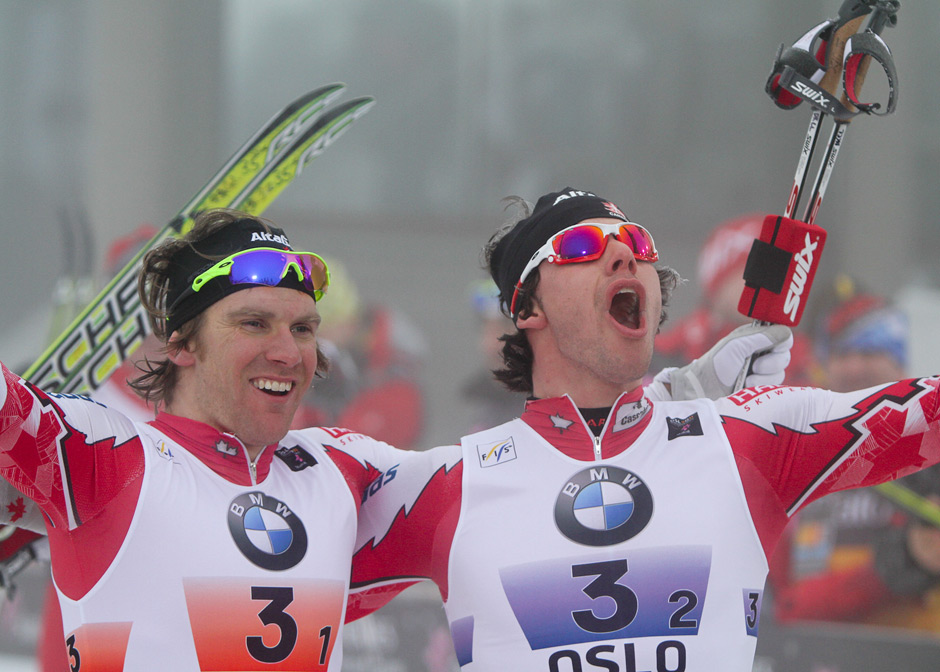
Alex Harvey (r) and Devon Kershaw (l) celebrating their World Championships gold in 2011 in Oslo.
My heart pounds in my chest. Adrenaline courses through my body as my ungainly 13-year old legs run chaotically down the front steps. The slam of the door behind me pierces the stillness of the heavy evening air, but to my ears the whole world is alive in celebration. The rush of blood in my ears is deafening as I relive the race in my head. Alex passing Hattestad — shushing the crowd across the line –raising his arms in disbelief — Devon and Alex playing air guitar on their skis — walking before the massive crowd to the top step of the podium — WORLD CHAMPIONS! … The excitement settles into a glow that becomes an immovable rock of confidence in my chest. I start to notice where I am, running aimlessly to the top of a grassy hill above the trees. I smile as I look down to where I came from: “Yes”, I think, “I can do it, too.”
***
Works Cited
Andrews, Edmund L. “Olympics; Finland Reels Over Skiers’ Drug Scandal.” New York Times, 13
“John F. Kennedy in Ireland.”, John F. Kennedy: Presidential Library and Museum, www.Jfklibrary.org/Exhibits/Past-Exhibits/JFK-in-Ireland.aspx. Accessed 1 Mar. 2018.
Johannes Høsflot Klæbo of Norway moments before crossing the line for Norway’s first Olympic men’s 4 x 10 k relay victory since 2002 in Salt Lake City, Utah. (Photo: FlyingPointRoad)
PYEONGCHANG, South Korea — Conversing in the native tongue of the men’s 4 x 10-kilometer relay winner of Olympics past and present requires a world map and an aptitude for language acquisition. 1952 Oslo Games: Finland wins. 1956 in Cortina: the Soviets win. 1968 in Grenoble: France wins. 1984 in Sarajevo: Sweden prevails. 1992 in Albertville: Norway wins.
The previous two Olympics in Vancouver, British Columbia, and Sochi, Russia, — Norway took a hit. The nation’s simultaneously self-righteous and justifiable claims of cross-country-ski-racing dominance fell hollow on the men’s Olympic relay stage. In a country where it’s win and nothing else, the years between the last two Olympic cycles, 2010-2018, have been fraught with relay angst and foreboding.
Sweden won the men’s 4 x 10 k relay in Vancouver and Sochi. Norway placed second in Vancouver. Within the Norwegian singularity of win or lose, that’s a Norway loss. In 2014, Norway placed fourth. Fourth place. Can you imagine the Norwegian disgust?
Start of the scramble leg during the men’s 4 x 10 k Olympic relay on Sunday in PyeongChang, South Korea. (Photo: FlyingPointRoad)
“I knew some of those teams, like Russia, was going to try to spread it out,” Andy Newell, the Americans’ scramble-leg skier told FasterSkier after his first leg in Sunday’s Olympic 4 x 10 k relay. “I knew Poltarainen was going to try to spread it out because he’s such an amazing classic skier.”
For the full 10 k on the scramble leg, Kazakhstan’s Alexey Poltoranin monopolized camera time. His killing form dragged Andrey Larkov, of the Olympic Athletes of Russia, close behind as he stuck to Poltoranin’s tails. Unable to keep pace, and bleeding time already were Italy (+10.0) and France (+10.8) in third and fourth. Norway tagged off in fifth (+18.2), Sweden sixth (+36.9), and Finland seventh (+1:02).
Surely Norwegian social media was rife with eyeroll and poop emojis. And for Norway’s waxing boss, Knut Nystad, most recently featured in a New York Times piece, another debacle like Sochi would cost him.
With Kazakhstan’s team expected to drop off during the next three legs, Alexander Bolshunov of Russia used Larkov’s Poltoranin-pull as a springboard.
Norway has a reliable steady — and over the last three years that has been Martin Johnsrud Sundby. Like Poltoranin, Sundby is a kick-and-glide master. On paper at least Sundby would cut Norway’s losses to the steal-the-show Russians.
Norway’s Martin Johnsrud Sundby (1), Italy’s Francesco de Fabiani (8) and Kazakstan’s Yevgeniy Velichko (9) during Leg 2 of the men’s 4 x 10 k Olympic relay on Sunday in PyeongChang, South Korea. (Photo:FlyingPointRoad)
Since the 2014 Norwegian relay breakdown in Sochi, there have been six 4 x 10 k relays on the World Cup and World Championships combined — Norway won them all. Sundby was in five of those six Norwegian relay lineups. Through thick and thin, Sundby appeared to be the winning missing link.
Yet, a little more than halfway through his leg, Sundby’s and all of Norway’s fate resembled the second leg of the women’s Olympic 4 x 5 k relay on Saturday when Norwegian Astrid Uhrenholdt Jacobsen fell adrift of the front skiers. Both were haunting Sochi déjà-vu moments.
Passing his 6.6 k checkpoint Sundby looked spent. He uncharacteristically let France and Italy take over the pacing. By then, Bolshunov had gapped the chasing trio by a full 41 seconds.
In the post-race press conference, Bolshunov explained he had been hospitalized in the weeks before the Olympics.
“I have fever over 40 degrees [104 Fahrenheit] and I spent like a week in a hospital,” Bolshunov said of his illness. “But like two weeks ago I began my preparation for the Olympic games. It was not very easy but I am very glad I got myself in a good shape and that I could compete on the same level as my contenders.”
Chervotkin took over for Russia on the third leg. Skating away up the first climb alone was Russia, followed by Italy (+24.5), France (+28) and Norway (+32.1) as they tagged off for the first of two skate legs.
The moment Norway’s Simen Hegstad Krüger, already a two-time medalist here, gold in the 30 k skiathlon and silver in the 15 k skate, glided away on his leg, the Norwegian fans in attendance vigorously waved their once-limp flags.
Krüger took control by reeling in France, Italy, and eventually Chervotkin of Russia. By the 10 k mark, when Krüger tagged Norway’s now-and-future relay anchor, Johannes Høsflot Klæbo, France hung tight with Norway, while Russia tagged off in third (+16.2).
Klæbo and France’s anchor, Adrien Backscheider, backed off the pace intermittently as Klæbo appeared reluctant to make a too-early move. Russia’s Denis Spitsov caught Norway and France from behind with less than half the leg remaining.
Denis Spitsov of the Olympic Athletes from Russia leading Norway’s Johannes Høsflot Klæbo (1) and France’s Adrien Backscheider (7) during the fourth leg of the men’s Olympic 4 x 10 k relay in PyeongChang, South Korea. (Photo: FlyingPointRoad)
Backscheider faded as Klæbo and Spitsov danced. Klæbo went where he was expected to go: in a flurry of red-white-and-blue lycra up and over the final headwall. With enough time to grab a Norwegian flag and undo eight years of wait, Norway won the day, crossing the line in 1:33.04.9. Of the eight gold medals awarded so far in these Games, Norway has won five. Sunday also marked Sundby’s first Olympic gold in his third Olympics.
“Today Didrik and I are very happy that we’re on the same team as Simen and Johannes,” Sundby told Eurosport after, according to a translation. “We have a fantastic team and I would at the same time like to send a greeting to all of the other guys on the team. There are a lot of guys who could have skied here today.”
“I think for all of us it’s an unbelievable feeling to be able to take part of this great team,” Klæbo said at the press conference. “I think that we have people back at the hotel we also could have this relay with us. I think that we have done something right the last couple of years and to be part of this team is quite cool. I think we are all grateful for that.”
Russia secured silver as Spitsov came through 9.4 seconds after Klæbo, and France’s Backscheider was next across the line for bronze (+36.9).
Norway’s 2018 Olympic 4 x 10 k relay winners: the country’s first Olympic gold in the event since 2002. From left to right, Didrik Tønseth, Martin Johnsrud Sundby, Simen Hegstad Krüger, and Johannes Høsflot Klæbo. (Photo: FlyingPointRoad)
“This is a great achievement also for my country,” Spitsov said of his team’s silver at the press conference, through a translator. “We are a young team represented here while a majority of athletes were not able to attend and participate in the Olympic Games. We are very young, but still we proved that we are able to achieve great result and we are happy about that.
France’s Manificat made it clear the bronze medal was no disappointment. “For sure its a bronze medal, but for us it’s like gold,” Manificat explained. This is France’s second consecutive 4 x 10 k relay bronze after finishing ahead of fourth place Norway in Sochi.
“To do it again it’s really important,” Manificat reflected. “We are a lot of generation in this relay — old guys in term of dates and young’ ones. But they are really strong. In all the legs we were really strong and we knew that we could play the game and it was perfect.”
Finland placed fourth (+1:40.5), Sweden fifth (+2:05.6), Germany sixth (+2:08.2), Italy seventh (+2:35.2), and Kazakhstan eighth (+3:31.4). Canada was ninth (+3:41.0) to tie its second-best Olympic relay result (with Len Valjas, Graeme Killick, Russell Kennedy, and Knute Johnsgaard), and the U.S. finished 14th (+9:24.2), out of 14 teams, with Andy Newell, Reese Hanneman, Scott Patterson, and Noah Hoffman.
Racing continues Wednesday with the men’s and women’s team sprint.
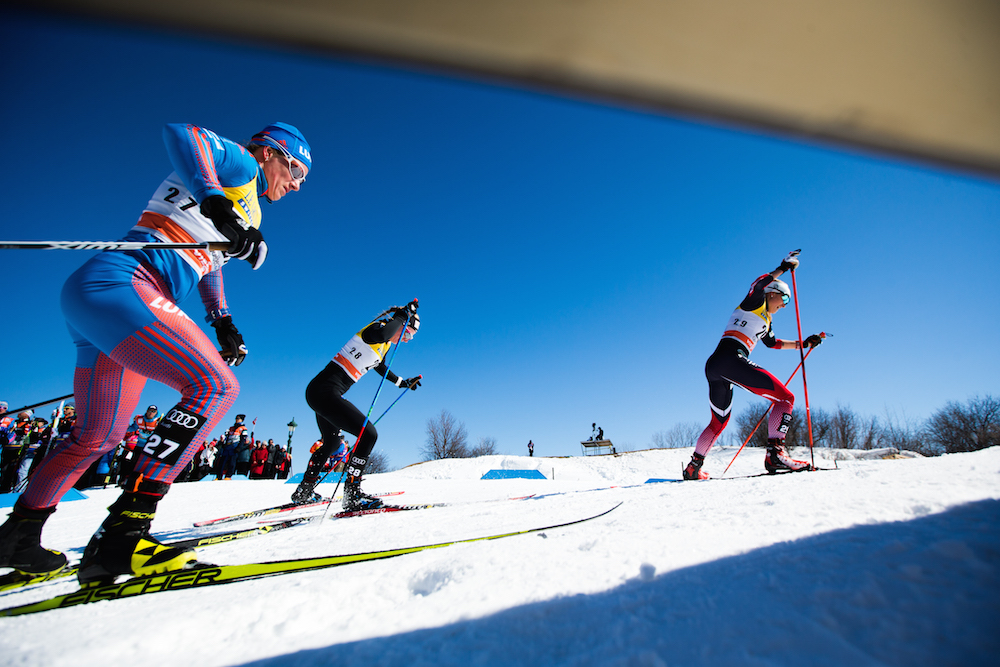
Russia’s Yulia Tchekaleva (27) chasing during the women’s 10 k freestyle pursuit last March at 2017 World Cup Finals in Quebec City. She finished 23rd and ended last season ranked 10th in the Distance World Cup and 11th in the Overall World Cup. On Friday, the International Olympic Committee decided on a lifetime ban for Tchekaleva and another Russian cross-country skier, Anastasia Dotsenko, as well as Russian biathlete Olga Zaytseva. (Photo: Dustin Satloff/dustinsatloff.com)
The International Olympic Committee (IOC) has handed down three more lifetime Olympic bans to two Russian cross-country skiers and a biathlete, all of which are women, based on the Oswald Commission hearings concerning Russia’s systematic doping at the 2014 Sochi Olympics.
Russia’s Olga Zaitseva leads Canada’s Megan Imre in a 2014 IBU World Cup pursuit.
Cross-country skiers Yulia Tchekaleva and Anastasia Dotsenko and biathlete Olga Zaitseva have been sanctioned, according to an IOC press release on Friday.
“More hearings concerning other athletes will be held over the next few weeks,” the release stated. “As of now, the number of cases opened by the Disciplinary Commission has reached 36 after additional findings from the re-analyses.”
So far, 25 Russian Winter Olympians have been sanctioned for violating anti-doping rules in Sochi.
“As some investigations are still ongoing (notably the forensic analysis of the bottles), it cannot be excluded that there might be new elements that would justify opening further new cases. Today 26 athletes have been heard and one case has been filled,” the release stated.
While neither Tchekaleva nor Dotsenko medaled at the 2014 Games*, Zaitseva did — taking silver in the women’s relay. That medal was stripped earlier this week when her teammate Olga Vilukhina was sanctioned on Wednesday. Zaitseva, who retired in 2015, is a two-time relay gold medalist from 2006 and 2010; those results are unaffected.
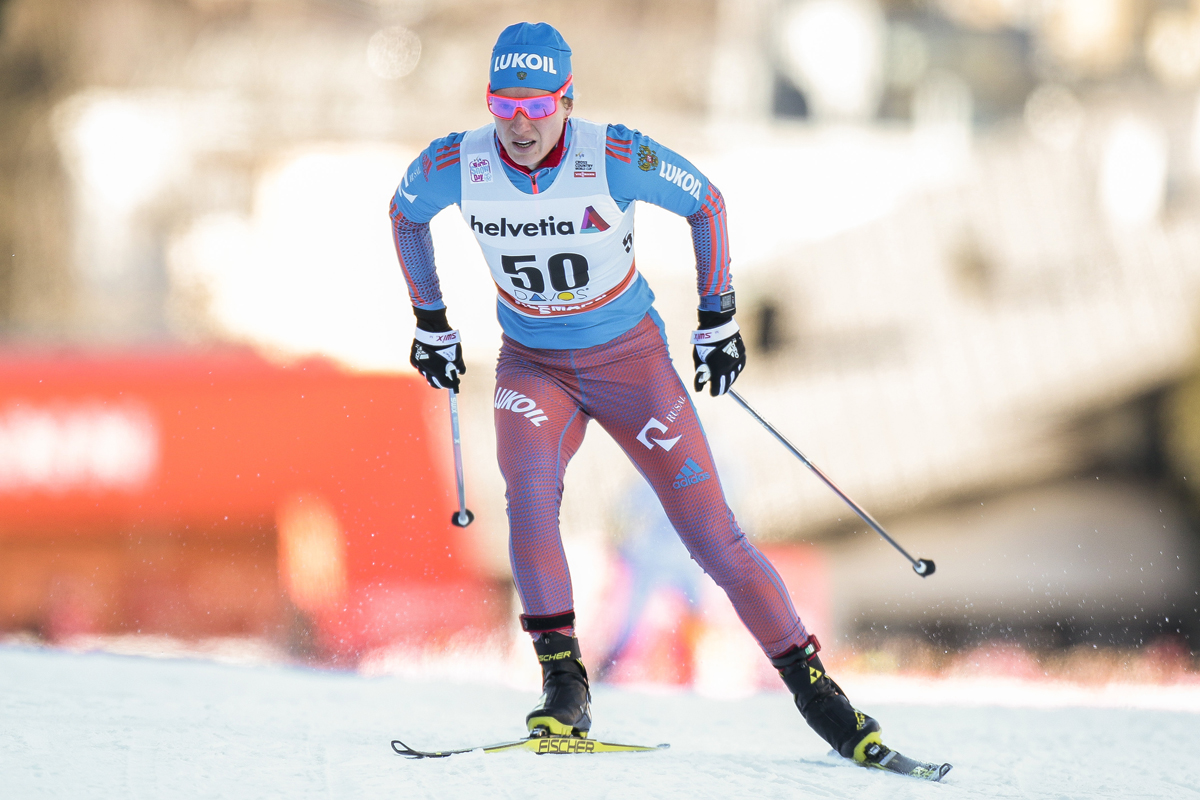
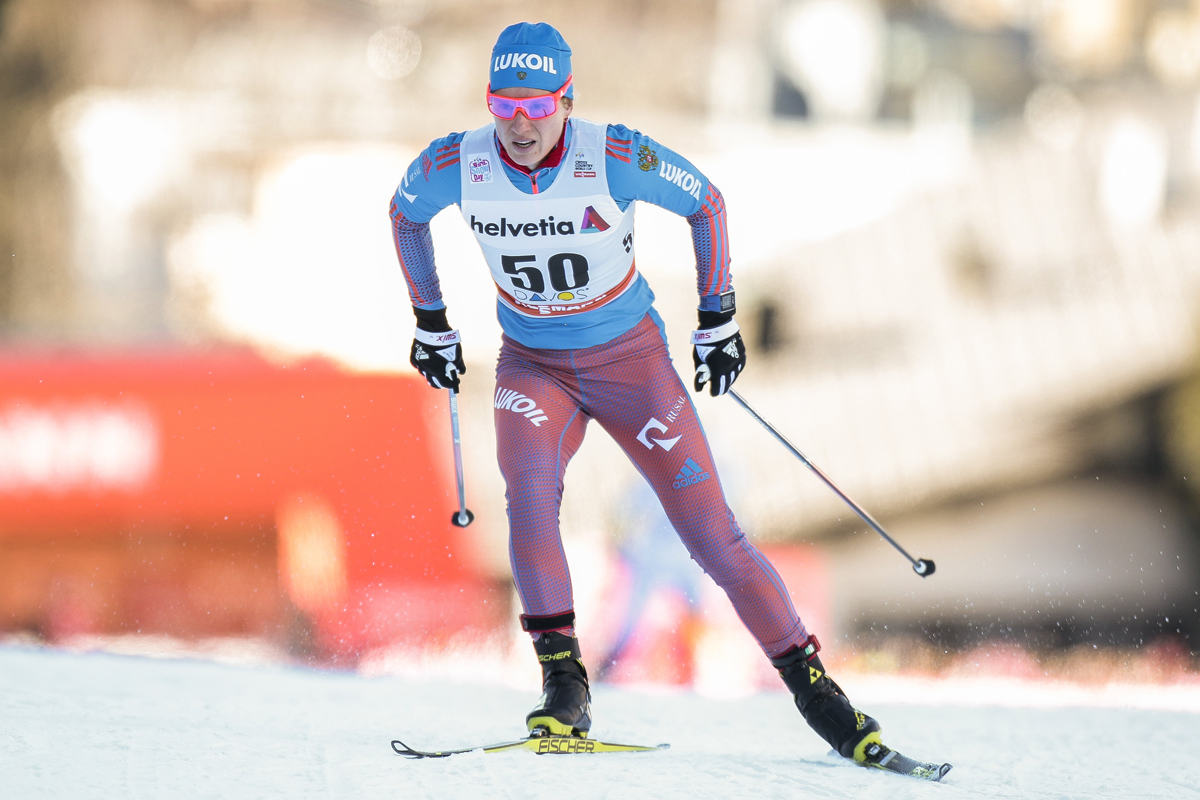
Russia’s Yulia Tchekaleva racing at last year’s Davos World Cup in Switzerland. (Photo: Fischer/NordicFocus)
Tchekaleva finished last season ranked 11th overall on the World Cup and 10th in the Distance World Cup. Now 33, she started this season a couple weekends ago at Sweden’s International Ski Federation (FIS) races in Gallivare, where she placed second in the 10 k classic and sixth in the 5 k freestyle. She hasn’t raced since.
Dotsenko, 31, hasn’t raced a World Cup since February 2016, but she also started this season in Gallivare (where her best result was 18th in the classic sprint), then raced another set of FIS races in Kontiolahti, Finland, last weekend, where she placed fourth and fifth place.
*At the 2014 Olympics, Tchekaleva and Dotsenko originally raced to sixth with two teammates in the 4 x 5 k relay, and the four team members received diplomas for that result, according to the IOC. Tchekaleva also placed 11th in the 10 k classic, 15th in the skiathlon, and 32nd in the 30 k freestyle mass start. Dotsenko finished 22nd in the classic sprint. All of those results have been erased.
Zaitseva notably competed in six Olympic events in Sochi: placing second in the women’s 4 x 6 k relay to take silver, and fourth in the mixed relay “for which she was awarded a diploma“. Individually, she finished 11th in the 10 k pursuit, 15th in the 15 k individual, 23rd in the 12.5 k mass start, 28th in the 7.5 k sprint. Those results are also voided.
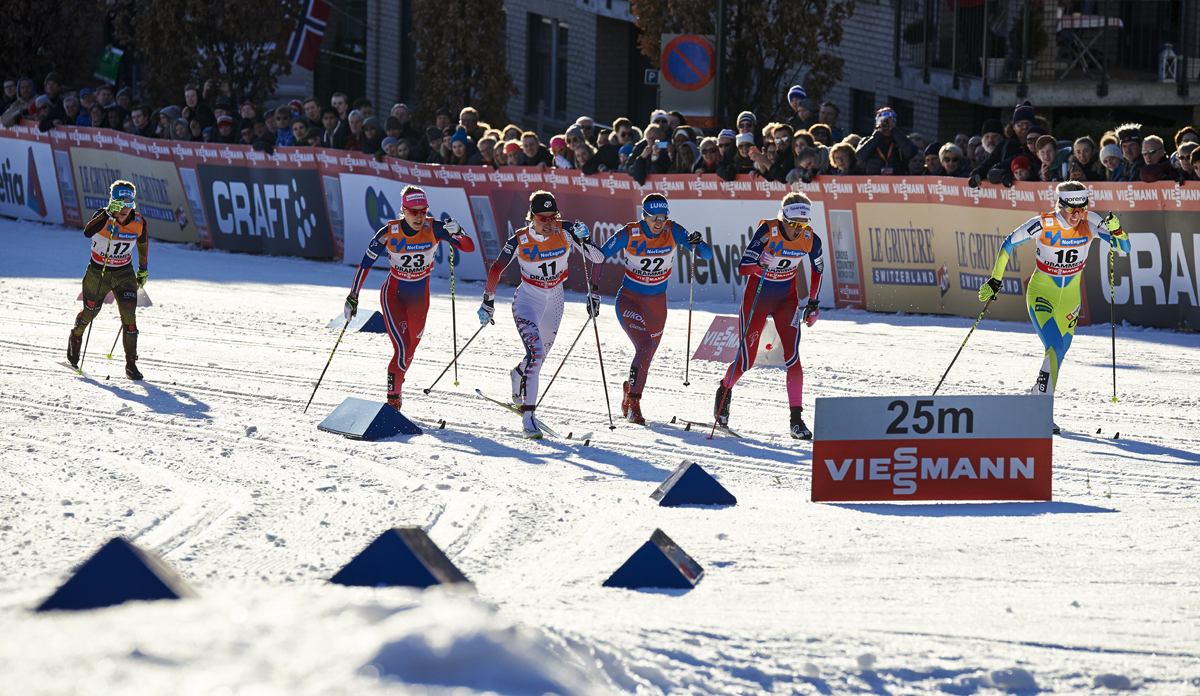
Russia’s Anastasia Dotsenko (22) racing with (from left to right) Germany’s Sandra Ringwald, Norway’s Ragnhild Haga, American Sophie Caldwell, Norway’s Kathrine Rolsted Harsem, and Slovenia’s Anamarija Lampic during a World Cup classic sprint in February 2016 in Drammen, Norway. (Photo: Fischer/NordicFocus)
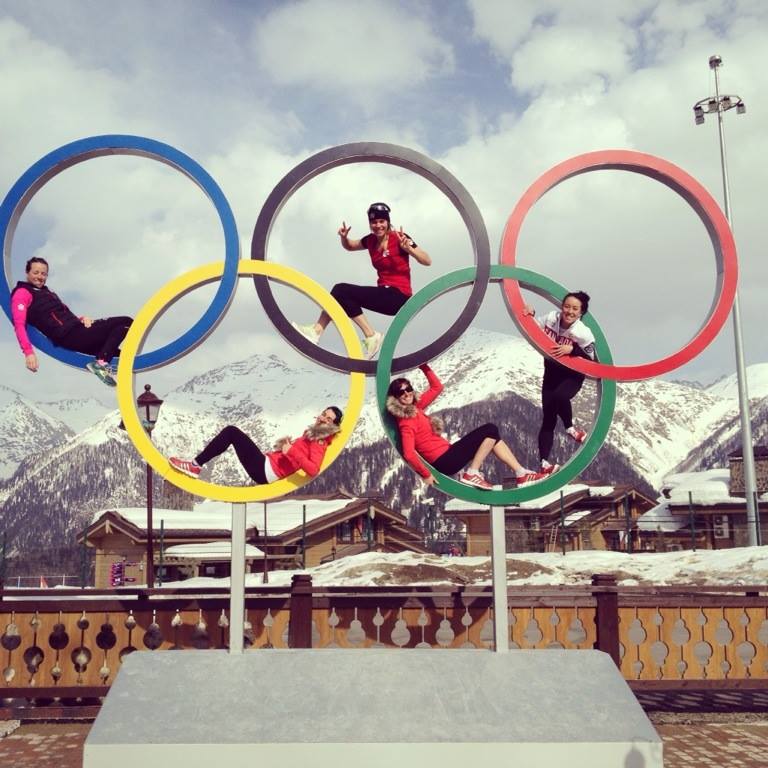
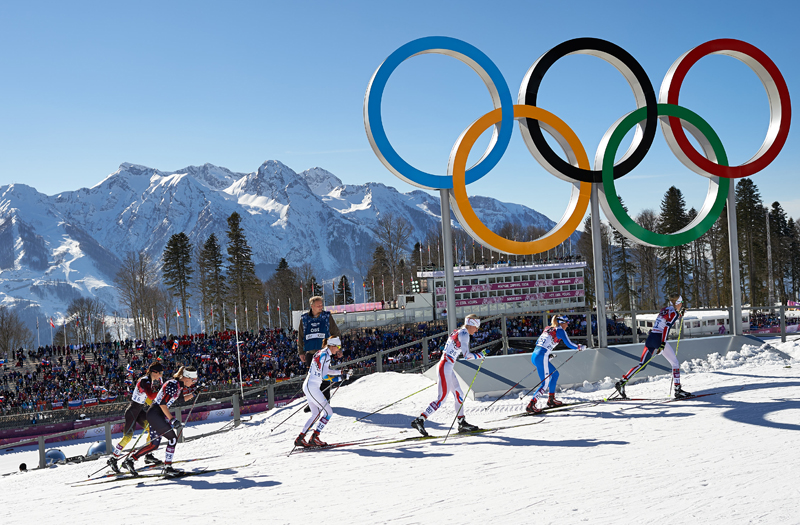
Five members of Cross Country Canada’s 2014 Olympic team get the perfect photo opp at the Olympic rings in Krasnaya Polyana, Russia. (From left to right) Perianne Jones, Amanda Ammar, Heidi Widmer, Brittany Webster, and Emily Nishikawa. (Photo: Emily Nishikawa)
On Nov. 9, news broke that four more Russian cross-country skiers had been sanctioned for cheating during the 2014 Sochi Olympics. So far, six Russian nordic athletes in total have had their 2014 Olympic results erased by the International Olympic Committee (IOC). These athletes are also prohibited from participating in all future Olympics due to their affiliation with Russia’s elaborate-state sanctioned doping enterprise.
Julia Ivanova, half of Russia’s 2014 Olympic team-sprint duo, is one of the six penalized Russians. In Sochi, Ivanova and her teammate Anastasia Dotsenko skied to 10th place in the classic team sprint. (Thus far, Dotsenko has not been implicated in the doping scheme.)
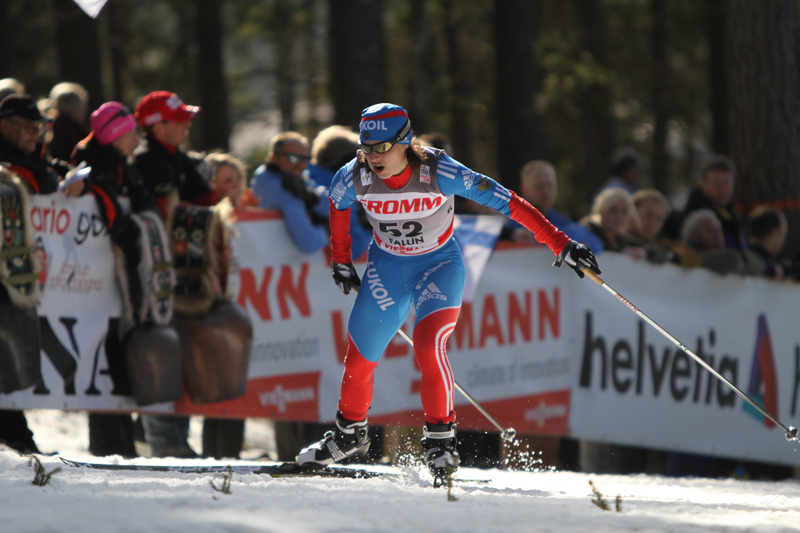
Russia’s Julia Ivanova racing at 2012 World Cup Finals in Falun, Sweden.
It’d be easy to say the Russian pair was way out of the medals — theirs was simply another tainted performance already removed from the official results.
Yet among those clean athletes caught up in the win-at-all-costs mantra of the Sochi doping regime are Canada’s team-sprint pair Perianne Jones, now 32, and Dasha Gaiazova Atkins, 33. Looking back, “What might of been?” is a legitimate question the two retired skiers have asked.
Ivanova and Dotsenko made the Sochi team-sprint final as what’s referred to as lucky losers — 10th place in their semifinal wasn’t enough for them to automatically advance but their time was fast enough relative to the rest of the field to put them through to the final. Jones and Gaiazova Atkins were right behind them in 11th, which was the end of their day.
“I texted Peri that morning when the article came out in Fasterskier and said, ‘Should we start training for a redo?’ ” Gaiazova Atkins, who was born in Russia but spent more than half of her life in Canada, said on the phone from her home in Calgary. “Because we could have been in the finals and then you never know how that goes. It could have had a much, much better result and we could have had a chance for a medal.”
One year before the 2014 Olympics, at the pre-Olympic World Cup in Sochi, Jones and Gaiazova (the latter of which has been married since, hence the new last name) placed third in the classic team sprint. Notably, they were third in a photo finish with the second-place Russians — Ivanova teamed up with Natalia Matveeva in that race.
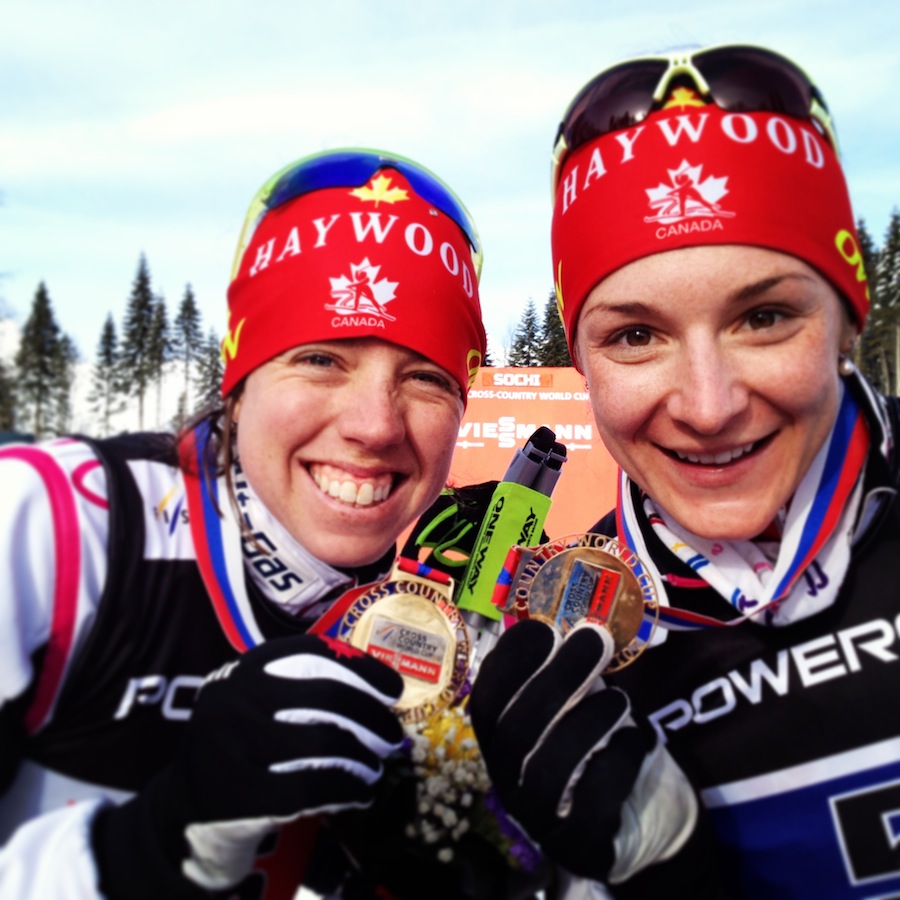
Canada’s Perianne Jones (l) and Dasha Gaiazova having some fun after notching their first podium together with bronze in the classic team sprint at the Sochi pre-Olympic World Cup in February 2013. (Photo: Chandra Crawford)
Jones first heard about the Ivanova news through Gaiazova Atkins’s text message.
“When it goes back and you realize that something could have gone a little bit differently or wonder what could’ve been, then you think about it a lot more and it definitely hits you a little personally,” Jones said on the phone from Canmore, Alberta. “For sure, it makes me feel sick and I cannot go back. No one can. That’s the unfair part. … It’s an interesting conundrum: people have put their lives into something and then are not given a fair chance.”
The “what if” part of this story is multi-layered. Ivanova raced twice in the 2014 Olympics before the team sprint; first in the 10-kilometer classic on Feb. 13 and again in the 4 x 5 k relay on Feb. 15. What if Ivanova had been tested after those races and a legit lab had found her to be doped? What if Ivanova and Dotsenko never raced the team sprint on Feb. 19? Or a different iteration of Russians were slower in the semis? On paper at least, in this post-Sochi thought experiment, the Canadians advance to the final as lucky losers.
The perspective of time buffered by athletic retirement seemed to have taken the edge off the tone of both Jones and Gaiazova Atkins, based on their voices over the phone. They both sounded calm and measured, without a sense of bitterness. But they raised several important points as the fallout from the Russia’s doping program continues.
Canada’s Perianne Jones racing to fifth in the 1.4 k classic sprint at 2015 World Championships in Falun, Sweden. She placed 24th overall and retired after that 2014/2015 season.(Photo: Flyingpointroad.com)
On Jones’s mind were those athletes still competing, and those wondering if they, too, are racing in an unlevel playing field.
“I am retired now,” Jones said. “So it would have been tough had all this stuff been coming out as I was still ski racing. I think it is tough for the athletes who are still competing now. Not that it is easy to hear about it after the fact, but you definitely have to believe you can do it while you are ski racing. I imagine that at least most of the playing field is clean and that would be hard given everything that has transpired over the last little while.”
Gaiazova Atkins’s story resonates due to her literal mid-teen continental shift. At the age of 15, she moved with her family from Russia to Quebec. Although she started skiing in Russia, her swift trajectory up into the international ranks began as a Canadian. She did, however, recall a Russian ski culture where more than a healthy lifestyle choice was on the line.
“I would say there is more pressure in Russia,” Gaiazova Atkins said. “And maybe because in Russia, in so many ways the country is so far behind in development … they have very few resources. So there is a lot of pressure to become a big skier because if you can race fast, you can do quite well for yourself in the country. … In America, it is not the same. And here in Canada, Chandra [Crawford] got a gold medal, shake her hand and off she goes to get an education.”
Gaiazova Atkins’s perspective was one of trying to humanizing cheaters and would-be cheats, people with families and their own demons straddling their shoulders.
“The incentive to perform is so much higher in Russia,” Gaiazova Atkins said. “And the alternative? You can live in poverty and then, OK, I am going to take a chance. So for a lot of athletes, it may not be perceived as high risk because it’s the only chance to do well in life.”
While she expressed that blame should be placed on those involved, Gaiazova Atkins emphasized truly understanding an athlete’s complicity.
“I know these girls and I know the guys who are now being stripped of their results,” she said. “I follow them on Instagram and I see what they are saying in Russian, and it’s crazy they are still denying they did this. But then, you think about a big country like Russia and the whole thing, you almost ask yourself, ‘Did the athletes even know this was happening? Did they have any say?’ It is just like, you have no choice as an athlete.”
Dasha Gaiazova racing to 44th in the women’s 10 k classic individual start at the 2014 Olympics in Sochi, Russia. She retired at the end of that 2013/2014 season and is currently coaching the Space Dogs Ski Club (where she’s also the president) in Calgary.
Several times, Gaiazova Atkins stated her belief that the doping was a top-down mandate, a state-sanctioned endeavor with upper-government power plays manifesting with Sochi podiums. But she’s also no apologist.
“I follow on Instagram and their posts from all those guys, like Legkov and people that support him,” she said. “They say, we are with [Legkov] because we know how hard he works and how much work ethic he has. And I am thinking to myself, every single person racing is working just as hard and harder.
“I feel sorry for those athletes, especially those who aren’t as systematic like the state-supervised program,” she added. “The ones who choose themselves and go to doctors, no pity for you.”
As far as moving forward, Gaiazova Atkins said she was in favor of nothing less than a wholesale Russian ban from the upcoming PyeongChang Games.
“You cannot slap them on the hand and say, ‘OK, don’t do this next time, please’,” she said. “It has to be with consequences for the state, for the country.”
Gaiazova Atkins also believes that Ivanova’s doping has had lasting impact on potential funding for the current crop of Canadian cross-country skiers. “Eleventh place is not a top 10,” she said.
“Cross Country Canada funding is based on our results, and there is a big difference between a top 10 and 11th place sometimes,” she added. “To take us out of the equation, this had a trickle effect on the whole system, like our whole nation may have been affected by the funding because we did not get a top-10 result.”
As the concentric ripples from Russian doping in Sochi move outward, they’ve arrived in North America, nearly four years late, with the 2018 Winter Olympics in PyeongChang, South Korea, on the horizon.
Canadians Perianne Jones and Dasha Gaiazova celebrate their first bronze together in the 2013 Sochi World Cup classic team sprint. (Photo: Chandra Crawford)
Former Biathlon Canada High Performance Director Eric de Nys making the team announcements in Valcartier, Quebec. (Photo: Dan Guay)
For the past 13 years, Eric de Nys has been ingrained in the sport of cross-country skiing and its offshoots, including biathlon. He spent 10 years as a coach on Cross Country Canada’s national team, leading the women’s World Cup team in his final two years there.
Based in the same town and out of the same training facilities in Canmore, Alberta, de Nys parted ways with the national team after the 2014 Olympics and founded a bridge development program, the WinSport Junior Cross-Country Ski Team, to prepare junior skiers for senior-level racing.
A year and a half later, in October 2015, de Nys accepted a new job as high-performance director for Biathlon Canada, replacing Chris Lindsay (who currently works as a high-performance advisor for Own the Podium).
De Nys spent two winters with Biathlon Canada, but less than week after the conclusion of the 2016/2017 competition season, that tenure ended. The move from Biathlon Canada to discharge de Nys came less than a year before the 2018 Olympics, but after a season in which the Canadian biathlon team fell short of reaching the podium in a World Cup or World Championships race.
While several younger biathletes had major breakthroughs, including Megan Bankes and Leo Grandbois at Youth/Junior World Championships, and national-team members like Scott Gow, Christian Gow, Emma Lunder, and Julia Ransom recorded career-bests on the IBU World Cup circuit, several veteran members appeared to take a step back. Nathan Smith was out most of the season with a virus, and Rosanna Crawford and Brendan Green struggled to return to their competitive form.
Biathlon Canada General Manager Andy Holmwood told the Rocky Mountain Outlook that the decision was not performance related. He explained that Biathlon Canada expected to have the position filled by May 1. A job posting on its website indicated that applications would be accepted through May 7.
In an email to FasterSkier, Holmwood wrote that the new high-performance director will take over a program with plans leading up to and through the PyeongChang Winter Games. He explained that he hoped to fill the position as soon as is “feasible.”
Other than to “confirm we’ve recently parted ways with Eric de Nys and wish him the best of success in future endeavours, Biathlon Canada has no comment on the situation,” Holmwood wrote.
De Nys declined to comment specifically on the matter as well, telling FasterSkier on the phone that, as far as he knew, the decision was not performance related. He added that he had enjoyed working with both CCC and Biathlon Canada and was remaining positive as he looked ahead.
“One door closes and multiple open,” de Nys said of his plans moving forward. “I just hope the best for the athletes.”
After spending more than a decade of his career in skiing, he suspected he will remain involved in the sport in the future — even as a volunteer — although this year may signal a break.
“I’m not sure at what level yet, but I will be helping out at the club level or something like that,” de Nys said. “Maybe volunteering, but I do think I will step away from sport for at least year, maybe forever. I don’t know.”
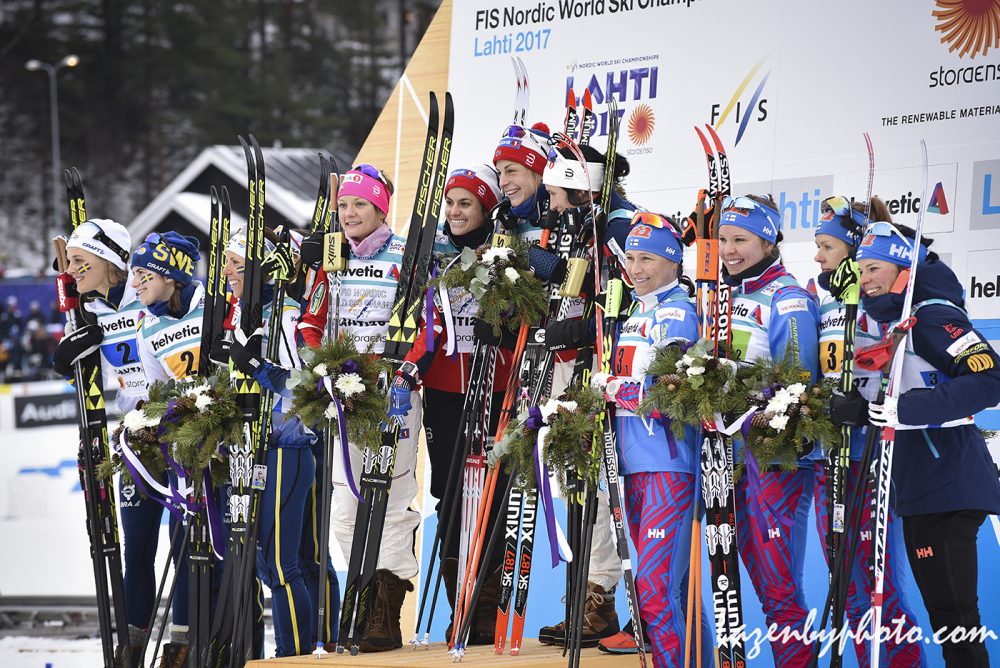
The women’s 4 x 5 k relay podium at 2017 Nordic World Ski Championships in Lahti, Finland, with Norway (c) in first, Sweden (l) in second and Finland (r) third. (Photo: John Lazenby/Lazenbyphoto.com)
LAHTI, Finland—The Norwegian lineup for the women’s 4 x 5-kilometer team at the 2017 Nordic World Championships on Thursday was daunting: Maiken Caspersen Falla, Heidi Weng, Astrid Uhrenholdt Jacobsen, Marit Bjørgen. On paper and on snow, a rundown of names and accomplishments.
On Thursday the Norwegian women made the country’s historic championship gold medal count a tidy 100 by winning the 4 x 5 k relay in 52:21.5 minutes. In a sprint for the remaining two podium spots, Sweden’s anchor skier Stina Nilsson outsprinted Finland’s Krista Pärmäkoski for second.
The Swedish team of Anna Haag, Charlotte Kalla, Ebba Andersson, and Nilsson scored silver (+1:01.6) while Finland’s home team of Aino-Kaisa Saarinen, Kerttu Niskanen, Laura Mononen, and Pärmäkoski was third (+1:02.1).
The U.S., represented by Kikkan Randall, Sadie Bjornsen, Liz Stephen, and Jessie Diggins, placed fourth (+1:33.8).
Two Legs of Parity, Then Norwegian Dominance
Rabid fans of the sport know Norway is winner of the last three consecutive championship relays. And lovers of tactics also know the Norwegians like to push the pace from the gun and break the pack early.
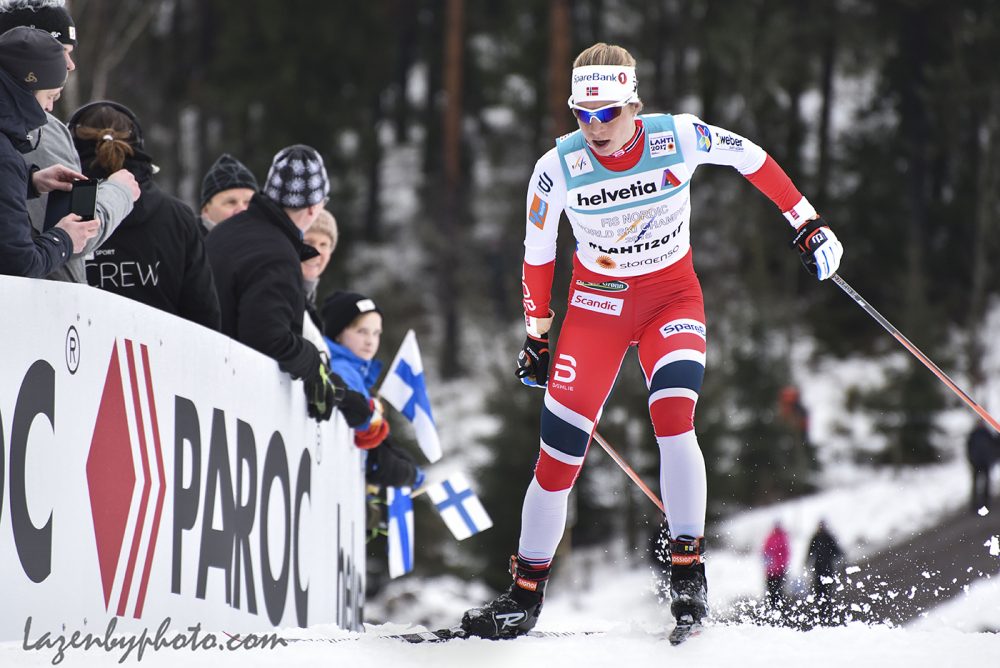
Halfway through the first leg, Poland’s Justyna Kowalczyk, a classic specialist, led Finland, Norway, Sweden, and the U.S. through the 2.5 k mark.
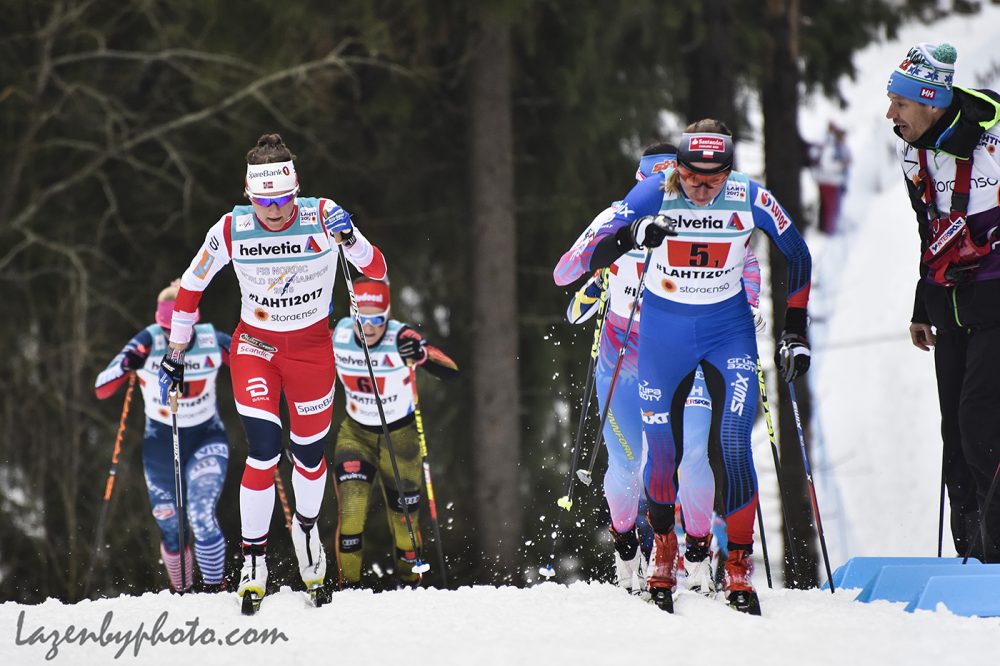
Norway’s Maiken Caspersen Falla (l) leads one row of skiers, Poland’s Justyna Kowalczyk lead’s another, during the scramble leg of the 2017 Nordic World Championships 4 x 5 k relay in Lahti, Finland. (Photo: John Lazenby/lazenbyphoto.com)
For Falla, Norway’s scramble leg, it was her debut in a championship 4 x 5 k relay. Despite her prior medals, her pre-relay nerves were unsettled.
“I was really excited today and I was just hoping that the time could pass fast so I can race,” Falla said after the race. “It was a lot of waiting time, but I get good advice … and that helped me today. So I get my nerves under control.”
According to Falla, here’s the advice: “That I should stay behind the first lap and be strong in the climbs in the last lap,” she explained. “I did that, just as they said.”
In the last kilometer, Falla made a small break, tagging off to Weng with a near eight-second advantage on the chasers.
Weng leads the World Cup overall standings, but racing in the Finnish ski-den, she was unable to fend off the surging Finns. Five kilometers later, Niskanen had absorbed Norway’s punch. Finland and Norway tagged off to their respective third-leg skiers simultaneously. Sweden trailed twelve seconds back.
Up the first hill, the mother of all climbs on the skating course, Jacobsen and Mononen pulsed. Carrying Sweden’s hopes was Andersson — a 19-year-old junior fresh off a win in the 5 k skate at last month’s Junior World Championships at Soldier Hollow in Utah.
The Finn-Norwegian duo pulled away, leaving Andersson with a 22.6-second deficit 1.3 k into the third leg.
Astrid Uhrenholdt Jacobsen, Norway’s third-leg skier, made a decisive move to put major time into second-place Sweden and third-place Finland during the 2017 Nordic World Championships 4 x 5 k relay in Lahti, Finland. (Photo: John Lazenby/Lazenbyphoto.com)
A resurgent Jacobsen kept pushing; her moves to drop Andersson early on weren’t only a tactic to make it a two-team race, but a sustained display of overdrive that ultimately broke the Finns, too.
The third leg was the tipping point for Finland and Sweden. They were on the side of bleeding time to Norway; Norway on the side of looming victory. By 13.8 k, Norway was up 30.4 seconds on Finland and 45.8 seconds on Sweden.
Andersson managed the damage. She and Mononen skied into the stadium amidst a raucous Finnish crowd. By then, Jacobsen handed Bjørgen nearly a minute cushion.
That kind of margin and Bjørgen hustling from the line: Boom!
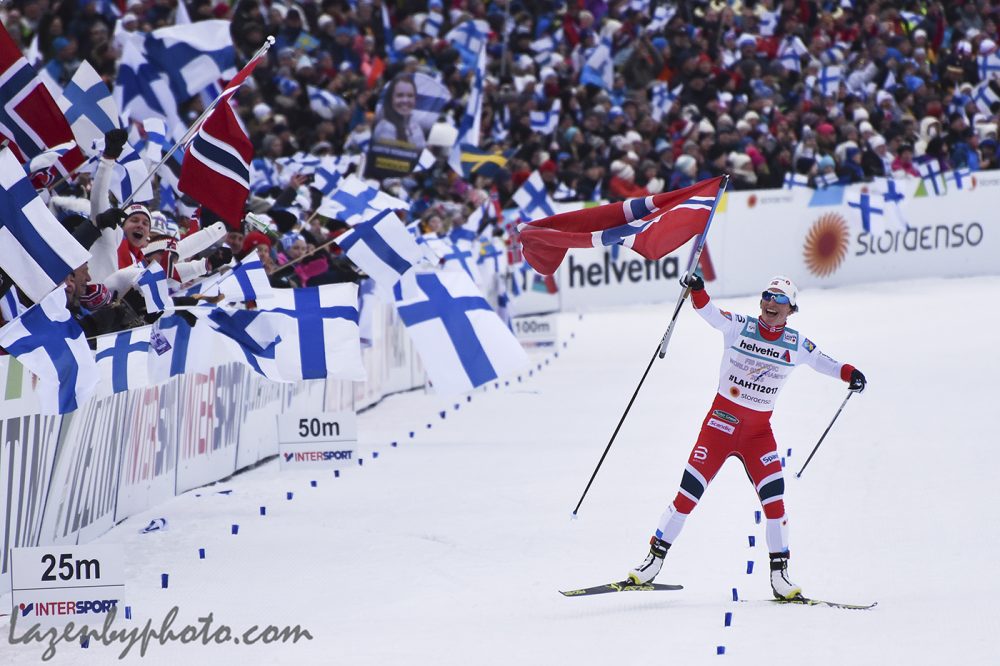
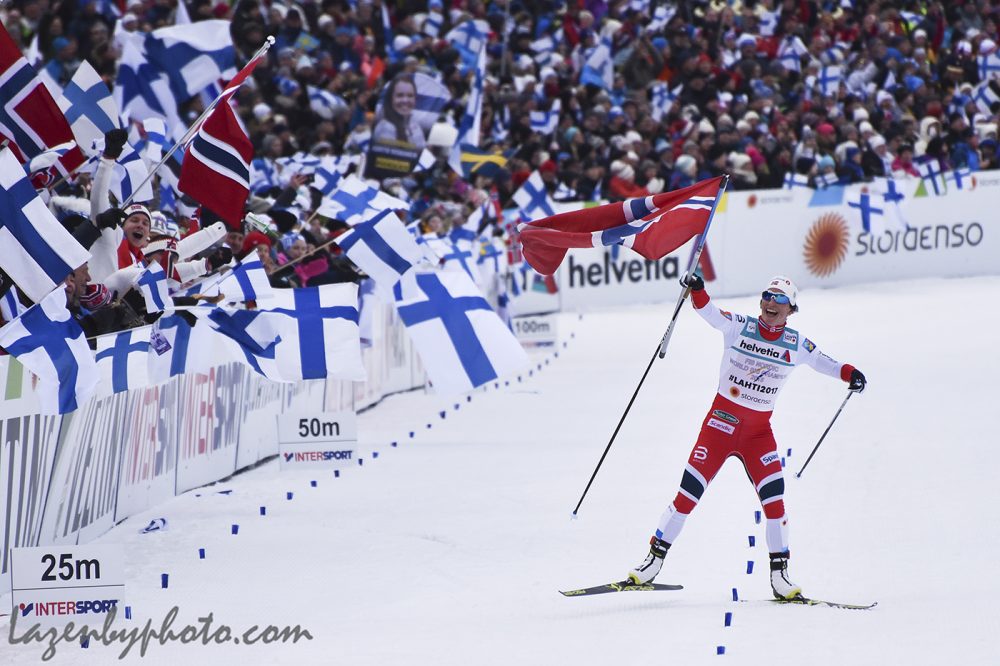
You know how this ends, with the queen waving an oversized Norwegian flag.
After the race, Jacobsen spoke of the pressure of skiing on Norway’s storied relay teams.
Marit Bjørgen carrying the Norwegian flag as she crosses the line first for Norway’s 100th World Championship win during the women’s 4 x 5 k relay at the 2017 Nordic World Championships in Lahti, Finland. (Photo: John Lazenby/Lazenbyphoto.com)
“I think actually the biggest pressure is the one we put on ourselves and probably because it’s so hard for us to qualify for the team,” Jacobsen said. “We are skiing for the girls who didn’t make it this year but will probably make it next year. So we ski of course for our people and our nation. But I think the biggest nerves come from the desire to perform well and do strong legs.”
One hundred championship gold medals later, Jacobsen acknowledged it’s a full treasure chest.
“The Norwegian people are getting spoiled in gold medals, but it not so easy like it looks,” Jacobsen said.
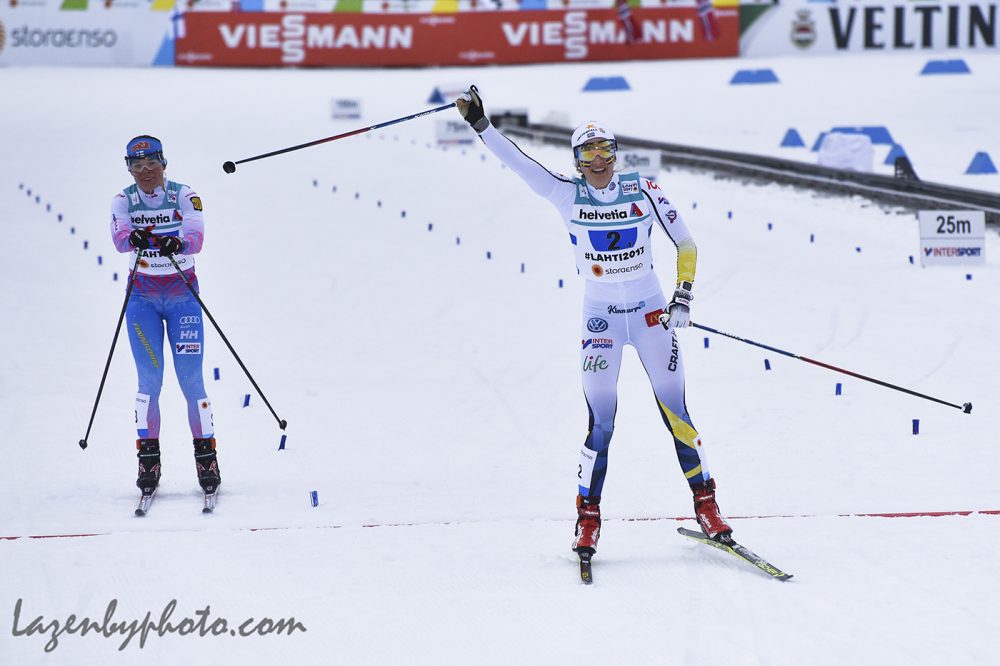
Glide for glide, pole for pole, Sweden and Finland were mirror images the last leg. Known as a closer, Nilsson strategized that coming into the final corner she wanted to follow Parmakoski.
Sweden’s second-leg skier Kalla explained that Nilsson’s tactic was one of waiting until the end.
“If Stina should go with some team in the end, she should wait to the stadium and just focus on her strength and she made it just like the plan,” Kalla said.
Days earlier in the team sprint, Nilsson lost out on bronze to Diggins in a sprint to the line.
“In the team sprint I was first in the final curve,” Nilsson reflected. “And I felt that Diggins had an advantage of it, so I didn’t want to be first today.”
The press conference’s moderator interjected and tried to correct Nilsson, saying she was first again in the closing moments, not shadowing the Finn.
“No, not in the curve, but after the curve,” Nilsson said with a laugh.
The silver and bronze fight came down to Nilsson’s final kick and this time she made it stick for silver.
(Story continues below)
Sweden’s Stina Nilsson celebrates silver after outsprinting Finland’s Krista Parmakoski (l) in the final meters of the women’s 4 x 5 k relay at the 2017 Nordic World Championships in Lahti, Finland. (Photo: John Lazenby/Lazenbyphoto.com)
Same Place, But Progress: U.S. Places Fourth, Canada 10th
With three world champs medals already in the hands of American skiers prior to Thursday’s team relay, the public hope for a podium was high. Perhaps too high.
As U.S. Ski Team (USST) Head Coach Chris Grover explained, medaling in the team relay was certainly on the radar coming into the world champs week, but not where the team’s greatest expectations were held.
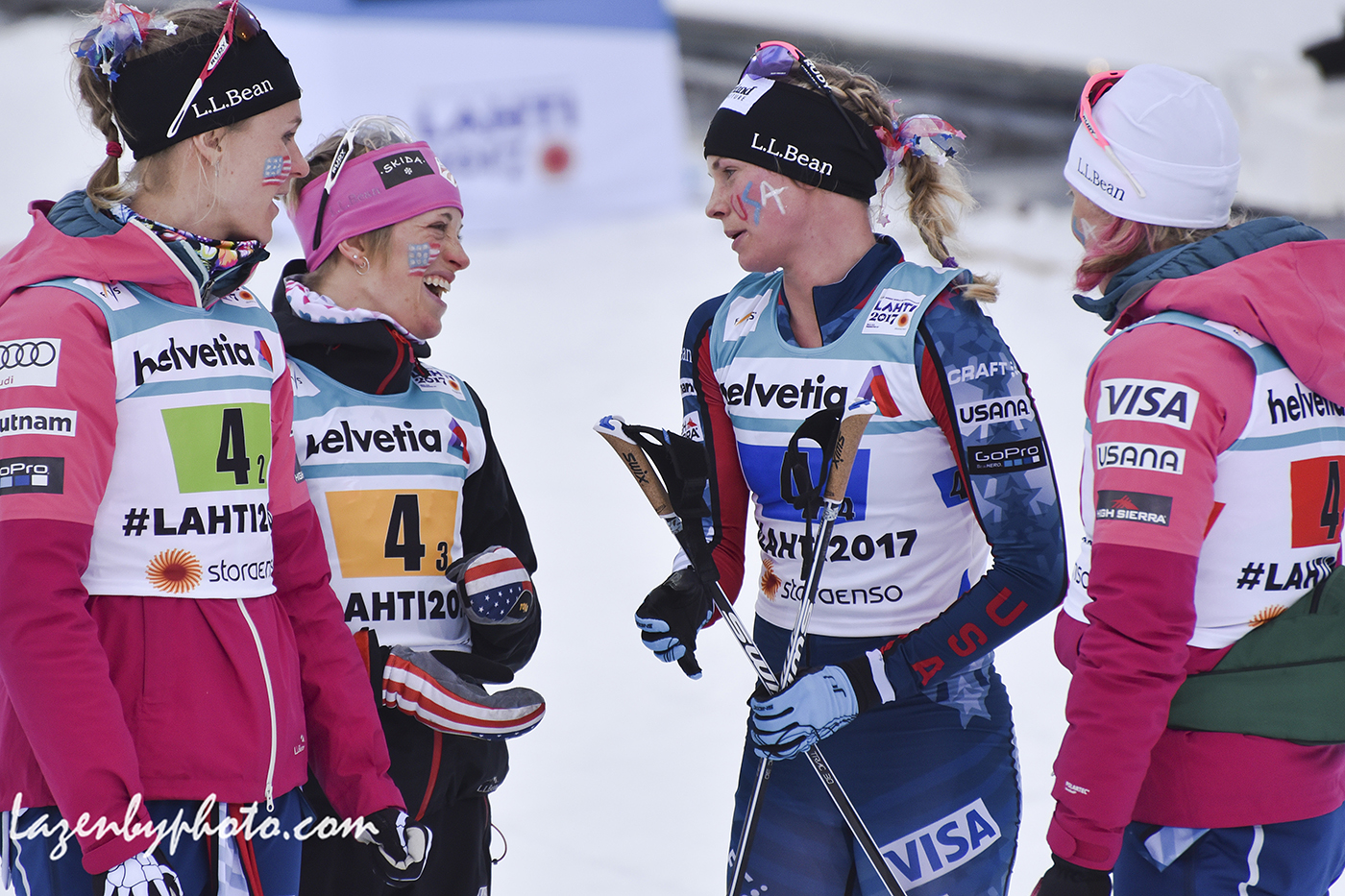
The U.S. women’s relay team, (from left to right) Sadie Bjornsen, Liz Stephen, Jessie Diggins, and Kikkan Randall, after placing fourth on Thursday at 2017 World Championships in Lahti, Finland. (Photo: John Lazenby/Lazenbyphoto.com)
“The relay we knew was a shot, the team sprint we knew was an outside shot,” Grover said after Thursday’s race. “Probably our greatest medal opportunity was the individual sprint.”
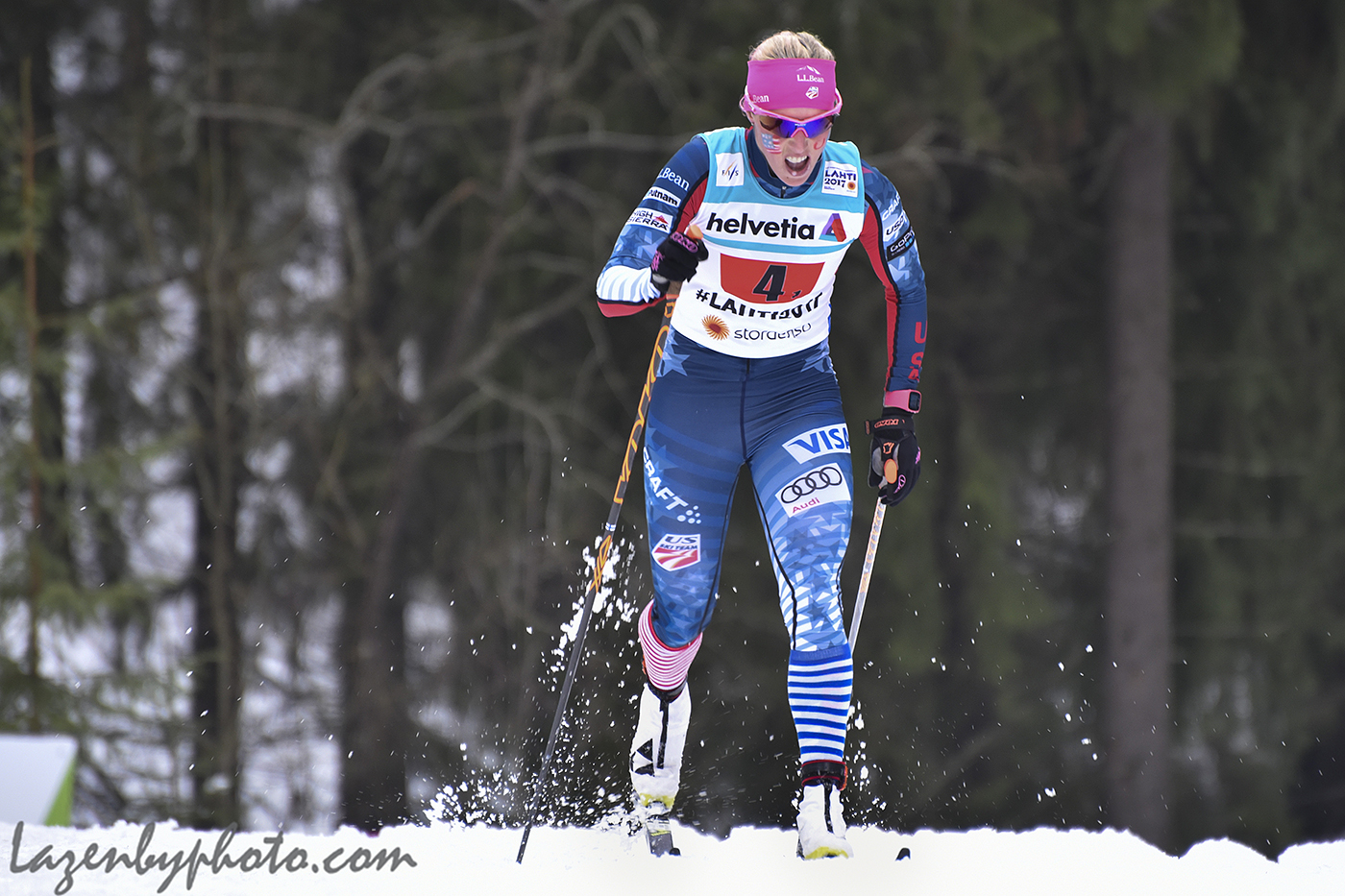
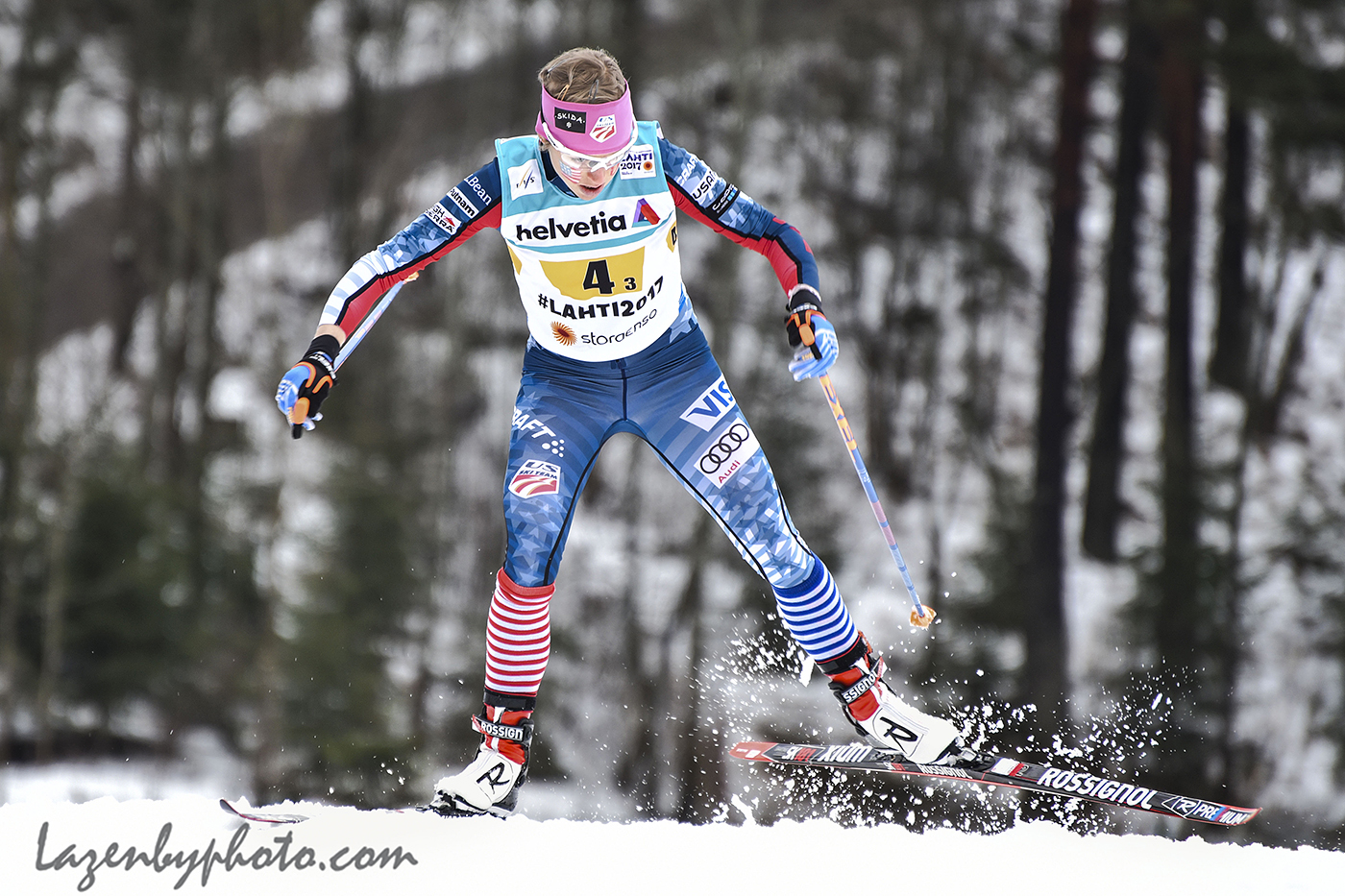
As a gritty group of women, the Americans exude the attitude of a top team. Adorned in red, white and blue socks and face paint sporting the U.S.A.’s emblematic stars and stripes, it’s easy to see the enthusiasm the U.S. women show for team events.
But where does the blur between team-relay hype end and the reality of results begin?
Disappointment in anything less than a podium only comes when the expectation of one exists. Taken over the past few world champs years, the relay event might be one where the U.S. women can, and have, improved the most.
Eight years ago, at the 2009 world champs in Liberec, Czech Republic, the U.S. finished 13th, a little over three minutesout of third place. The following World Championships year, 2011 in Oslo, Norway, they were almost two minutes off the podium, crossing in ninth overall.
This year? The U.S. once again finished fourth — the third time in a row that the team has finished one place outside the podium at a World Championships event.
Yet, Thursday’s performance was the second closest the team has come to bronze, with the Americans crossing 31.7 seconds after third (their 2013 result in Val di Fiemme, Italy, was closer: 26.6 seconds behind third). Given room for systematic error, the statistical trend for the U.S. women in the team relay over the past five world champs: positive.
American Kikkan Randall during the first leg of the women’s 4 x 5 k relay at the 2017 Nordic World Championships in Lahti, Finland. (Photo: John Lazenby/Lazenbyphoto.com)
“Even though this is the third time in a row that we’ve been fourth place at a world championships, there’s progress, there’s real progress,” Grover said. “The athletes could see the competition ahead of them the whole time. … To be getting closer and closer to that top standard, that’s very gratifying.”
When looking at the longer-distance performances from the week in tandem with Thursday’s start list, Grover further explained that the U.S. team’s incoming rank was similar to their outcoming result.
“I guess I’d say that when you look at the start list and you look at the results from the 10 k and the skiathlon, on paper we’re fourth,” Grover said. “Sweden, Finland, Norway they’re definitely ahead of us in terms of the distance results that we’ve seen here all week. So we knew we were sort of an outside chance to be fighting for the bronze and we knew that when we’re successful on the World Cup, it’s because one of those teams has a weak leg.”
A weak leg from Finland, Norway or Sweden — the three teams that finished ahead of the Americans — at least in Thursday’s race, was nowhere to be found for the U.S.
From the start, Kowalczyk, pushed the pace with Falla, Haag and Saarinen in close quarters, while the USST’s Randall worked hard to hold on.
“Unfortunately, we lost some important time there in the beginning,” Randall said. “I know that’s something I’ve got to work on for next year, but it was exciting to know that we were still in the race the whole time and made Sweden and Finland really fight for those medals.”
Randall handed off to Bjornsen in fifth, approximately 16 seconds back from the second, third, and fourth spots. From there, the Americans raced alone, working hard to reel in the racers ahead.
“It’s always hard to have a carrot right in front of you and not go too hard at the beginning,” Bjornsen said. “I think all of us had a hard time with that today, not going too hard to try to catch them right away.”
By the end of her leg, Bjornsen needed another eight seconds from Randall’s time back to catch the third place position. She handed off to Stephen, who would have to make up 23.5 seconds on Sweden’s third leg, Andersson, to contend for the podium.
The young Andersson, however, was putting on a show. And Stephen wasn’t surprised. During the early stages of her ski career, Stephen attended a weeklong camp in Sweden. While there, she’d learn invaluable lessons from countless coaches, one just happening to be Andersson’s father.
Liz Stephen racing the third leg for the U.S. women’s team in the 4 x 5 k relay at the 2017 Nordic World Championships in Lahti, Finland. (Photo: John Lazenby/ Lazenbyphoto.com)
“As I was lining up with her today I was just like ‘this is just full circle,’ “Stephen said after. “She’s a damn-good skier.”
That of course didn’t stop Stephen from putting her best foot forward. The American emphasised the areas she knew were her strength, working the hills.
“Part of me wanted to go out and blow [it] out of the water off the bat, but I also knew that these conditions are also a little bit more energy-expending than normal, hard-packed conditions,” Stephen explained.
Halfway through the first lap, Stephen had gained close to seven seconds on Andersson. By the end of the second lap, however, Andersson had regained the ground that she had lost.
“Unfortunately I couldn’t get her,” Stephen said. “But I did what I could out there … and I am very inspired to be on this team again. To watch my teammates give it all out there, it just makes you want to do the same.”
When Stephen handed off to Diggins, the anchor legs for Sweden and Finland were skiing together. Diggins explained that she had hoped Nilsson and Pärmäkoski’s race tactics would provide an opportunity for her to gain on them.
“I saw where we were coming in and I said, my only strategy is to go out as hard as I can and hope that they are playing cat and mouse in the front,” Diggins said. “[I thought] if they’re trying to be all strategic for the final sprint-out, then maybe I can catch them.”
Ultimately the gap proved too large, with Diggins crossing in fourth.
“I wasn’t able to close the gap but I never stopped fighting and neither did my teammates, and I’m really proud of that,” Diggins said.
Canada’s team of Katherine Stewart-Jones, Emily Nishikawa, Cendrine Browne, and Dahria Beatty finished 10th (+4:16.2) for the fourth-best world champs result of a Canadian women’s relay team. According to a Cross Country Canada press release, this was just the fourth time in the last decade that Canada has fielded a World Championships women’s relay (excluding the Olympics).
At the 2001 World Championships, Beckie Scott, Milane Thériault, Jaime Fortier, and Sara Renner raced to sixth for Canada. Before that, the program’s previous best was eighth at 1989 world champs, also in Lahti.
(Left to right) Canada’s Emily Nishikawa, Cendrine Browne, Dahria Beatty, and Katherine Stewart-Jones after placing 10th in the women’s 4 x 5 k relay at the 2017 Nordic World Championships in Lahti, Finland. (Photo: John Lazenby/Lazenbyphoto.com)
“I think today we surprised ourselves,” Canadian World Cup coach Ivan Babikov said on Thursday.
“[Katherine Stewart-Jones] skied incredibly that first leg, with everything she could,” he added. “She was ahead of Germany, ahead of Russia, so many really good countries, and after that it was a matter of holding on and it was great.”
Stewart-Jones finished her leg in eighth, just seven-tenths of second behind Germany’s Katharina Hennig in seventh. Though Switzerland and Italy eventually caught the Canadians, the women expressed excitement about the finish and results yet to come.
“This is the first time we’ve fielded a world champs relay in a long time so that’s a huge accomplishment [in itself],” Nishikawa said during an in-person interview. “And then to come 10th … it’s really the beginning of something that’s pretty special.”
“I’m really proud of us,” Browne added. “I think we all skied really strongly today, and very positive for the future.”
— Harald Zimmer, Gerry Furseth, and Alex Kochon contributed
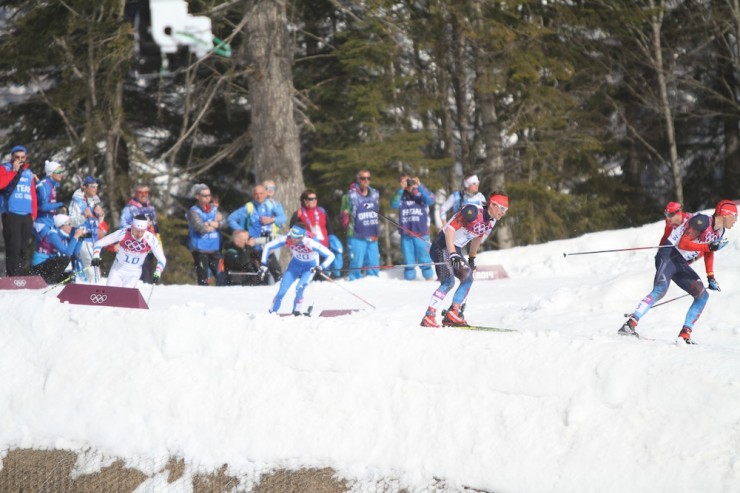
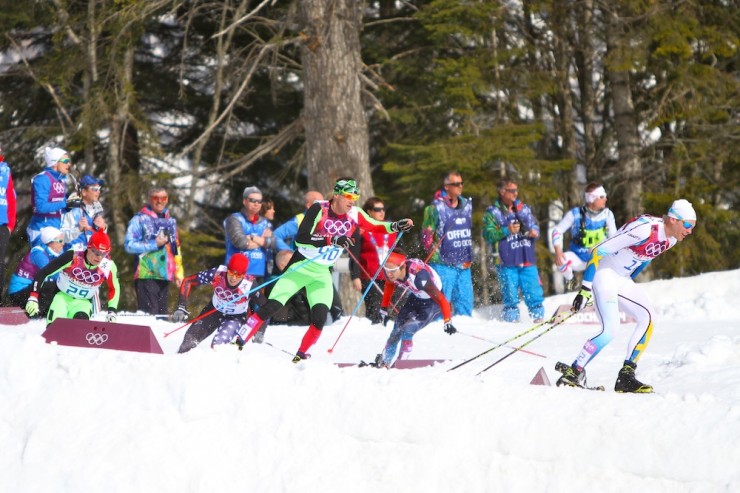
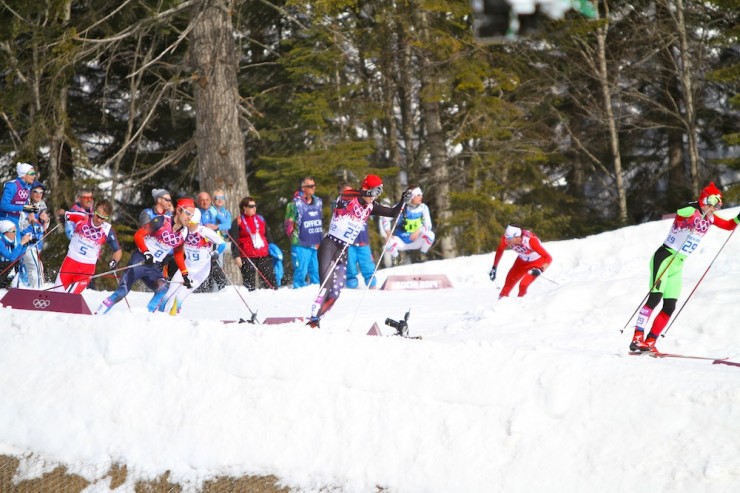
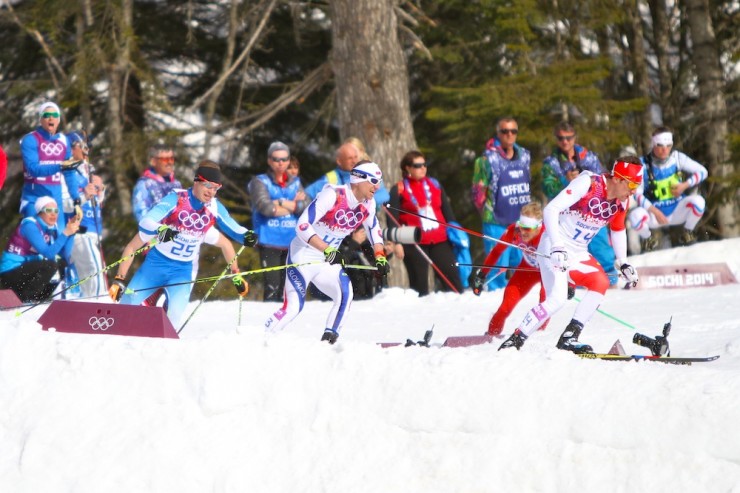
Competitors in the women’s 15 k skiathlon crest a hill at the 2014 Winter Olympics in Sochi, Russia. (Photo: Fischer/NordicFocus)
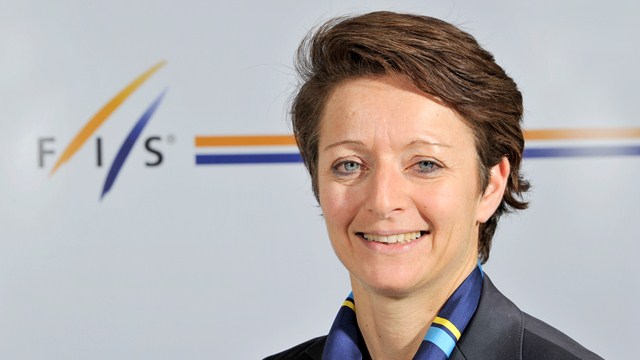
“There needs to be an investigation by WADA,” International Ski Federation (FIS) Secretary General Sarah Lewis told FasterSkier in a phone interview on Monday. “FIS totally supports it and we have already expressed that anything we can provide, we will do. And it needs to be done [quickly], but carefully.”
With allegations published last week in The New York Times of state-sponsored doping at the 2014 Olympics in Sochi, Russia, attention turned immediately to the World Anti-Doping Agency (WADA) and the International Olympic Committee (IOC).
FIS runs its own anti-doping program, as does each country which sends skiers to the World Cup. Those programs add up to thousands of urine tests done on skiers each year. When it comes to the Olympics, however, the IOC takes over all in-competition testing and WADA provides Independent Observers to watch the process.
There had been allegations as early as November of last year, in the WADA Independent Commission report, that Russian state security personnel had infiltrated the Sochi anti-doping laboratory; WADA did not follow up on the finding.
Thus when Grigoriy Rodchenko, the former head of Russia’s anti-doping laboratory, said that 66 Russian athletes had been protected from testing positive by laboratory and security staff who swapped out their dirty urine samples, there was outrage from many sides.
Outrage – and bewilderment. Lewis was the head of the WADA Independent Observers at the 2008 Summer Olympics in Beijing, China. She is intimately acquainted with the anti-doping process and the tamper-proof bottles which were allegedly opened in a secret lab and filled with replacement urine.
Sarah Lewis, secretary general of the International Ski Federation. (FIS file photo)
“Frankly, these bottles, having seen the whole thing in action, to imagine that they can be reopened– wow,” Lewis said. “The fact that they could even be taken out of the lab is really quite shocking.”
WADA has pledged, finally, to investigate winter sports and the Sochi Olympics. But should the investigations confirm the allegations, all the IOC can do is ban an athlete from the Olympics, including retroactively. With 14 Russian cross-country skiers implicated in The New York Times report, including superstar Alexander Legkov, many are wondering whether World Cup results will also be shaken up.
For instance Legkov – who won the 50 k skate in Sochi as well as helping the Russians take home silver in the men’s relay – was on the podium three more times later that season, including at World Cup finals; he then earned a number of top-ten World Cup results in the next two seasons. Are those results in jeopardy?
In the 2014/2015 season, Russian Olympians Evgeniy Belov and Maxim Vylegzhanin – who have not been implicated by name but were members of the 20-athlete team of which 14 were supposedly on the doping list – both finished in the top 10 of the overall World Cup standings. Are the many individual race results that went into those standings also in jeopardy?
Whether to negate results going forward from the date of a positive test – if such a test exists – would be a decision left to FIS, which is also shaking its head about how doping could have happened in its sport, on the world’s biggest athletic stage.
“The story has to be verified – that’s a basic principle,” Lewis said of the allegations. “If any elements of it are true, then it’s a huge throwback, a huge step back for all anti-doping efforts. Especially that this could happen at the Olympic Games where there are so many resources in terms of money, personnel, global expertise – it’s such a major blow.”
Why Weren’t Cheaters Caught?
Russia led the world in anti-doping rule violations in 2014: 148 athletes faced sanctions, 14 of which were in Winter Olympic sports and more specifically four in biathlon and seven in skiing. Despite those numbers, no star cross-country skiers were caught in the leadup to the Olympics.
Irina Starykh (far right) celebrates with her Russian teammates after they won an IBU World Cup biathlon relay in Ruhpolding, Germany, in January 2014. The result was voided as a result of Starykh’s doping ban, from a sample collected in December 2013. (Photo: Fischer / Nordic Focus.)
So could FIS have done more, and tested harder, in order to prevent the cheats from reaching the Games in the first place?
“To be honest, with what they are talking about, namely a steroid program during the Games, it’s likely that the program was very specifically targeted around the Games,” Lewis argued. “Of course you’re always looking at your processes, but with the out-of-competition program we have in place it’s very comprehensive … Nevertheless in hindsight, of course you ask those questions. Until we know what the time scale was, it’s hard to know.”
A total of 6,439 anti-doping samples were collected by various testing agencies from athletes across the skiing disciplines in 2013, a number that shrank to 5,764 in 2014, the Olympic year.
But here, too, numbers don’t tell the full story, FIS argues.
“Let us respectfully point out that this question is rather outdated,” FIS Anti-Doping Coordinator Sarah Fussek wrote in an email on Tuesday. “The WADA policy and guidance to [anti-doping agencies] many years ago was to move away from large testing numbers and move to more quality testing. For example to organise a doping control at a remote location takes much more planning efforts, logistics, transport costs as 10 tests collected at a training camp at an easy to reach place. So comparing numbers only says nothing about the quality of a testing programme.”
In fact, Lewis said that the Russian skiers had been targeted with plenty of tests. That fact was underscored in an interview over the weekend where Legkov claimed to have been tested 33 times in the season leading up to the Games.
“Our specialists are monitoring the results of the testing from a clinical perspective, but also performances, participation, history of that nation, it’s all connected together,” Lewis said. “There’s no question that there’s been extensive targeting of the Russian team for more than ten years.”
That testing did lead to a rash of positive tests and disqualifications before the 2010 Olympic Games in Vancouver, Canada. But despite the bans, some athletes and coaches who were picked up in the sweep stayed in the sport. In one case, Russian athletes who had previously served doping bans decided not to train with the national team, and instead took up with a coach who had been barred from working with the national team because of his involvement in doping.
Rodchenkov – the head of Russian anti-doping who admitted massive fraud to the New York Times – also remained on the FIS Medical Committee until November, when he was suspended after the initial WADA Independent Commission report.
The history of Russian doping in skiing is not lost on anyone. But the biggest personality on the current scandal, Legkov, is a different case from the doping Russian skiers of six or seven years ago, at least in terms of lifestyle. He trained not only away from the standard national team coaching staff, but also primarily outside of Russia, basing himself instead in Davos, Switzerland, with non-Russian coaches in the seasons leading up to Sochi.
Additionally, Lewis had confidence in FIS’s out-of-competition testing.
“During the winter season, you have the athletes more or less with you the entire time,” she said. “It’s possible to carry out very extensive testing.”
Chain of Custody
Vitaly Stepanov, a former RUSADA employee, during an interview with 60 Minutes’ Armen Keteyian, which aired Sunday, May 8. (Photo: CBS News)
With the accounts of malpractice in Russian anti-doping laboratories in not only The New York Times piece but also by another whistleblower to CBS News’ 60 Minutes, there’s also a question as to whether previous anti-doping samples belonging to Russian skiers were manipulated.
Rodchenkov, for instance, said that he had destroyed over a thousand samples to prevent them from being re-tested by a different testing authority.
According to Lewis, samples collected by FIS were rarely stored in Russia.
“There was quite a lot of testing missions which were coordinated with [the Russian Anti-Doping Agency, RUSADA], but most were carried out by the FIS-appointed doping control agency with their own personnel and equipment,” she explained. “Most samples were transported to a different laboratory, in Lausanne or Cologne or somewhere else. We weren’t in the position that they could be manipulated in the Moscow laboratory.”
In addition, after RUSADA was suspended and the Moscow laboratory lost its accreditation from WADA, FIS took any samples that had been stored there immediately out of the country.
“In fact, all the samples were delivered to Cologne,” Lewis said. “They were evaluated again, all of the profiles, the blood profiles but also the steroid profile. That information was analyzed again as to whether there was the need to re-tests … They all returned negative.”
FIS anti-doping samples are handled primarily by a company called PWC, which is based in Germany and also offers services to other international and national federations.
“PWC is currently the main sample collection provider for FIS on the basis of an annual contract, but FIS uses regularly also the services from various national anti-doping agencies, and does not have an exclusive contract with PWC,” Fussek explained in her email.
The company then delivers samples to WADA-accredited laboratories around the world.
“The samples are not left overnight somewhere in a vault,” Lewis said. “Doping control officers carry out the tests and then ship or take them to the lab. That period for tampering doesn’t exist.”
Moving Forward
News broke on Tuesday that the U.S. Department of Justice would investigate the Russian doping claims. Earlier that day, the IOC announced that it directed the Lausanne laboratory where Sochi samples are stored to cooperate with WADA on potential re-testing, a move that many have urged for months.
“The statement by WADA and the IOC in terms of re-testing samples stored in Lausanne, we fully support that and have championed that cause for a long time,” Lewis said. “But that is an issue for the IOC, they are responsible for doping controls at the Olympics.
“In terms of what could be found through the re-testing, we would also support DNA testing of the urine samples in case there has been switching of urine and some errors,” she continued. “How it reads in the [Times] article is that they have used those athletes’ own urine, but nevertheless the experts are able to assess if there has been a change in terms of the composition of the samples. Plasticides were mentioned and that sort of thing.”
FIS already worked with the Russians to ensure that testing was carried out in the 2015/2016 season, even after RUSADA and the Moscow laboratory lost a say in the process.
“On the request of the Russian ski association, they asked FIS to step in and arrange in-competition testing,” Lewis said. “They didn’t have RUSADA to do it. We did that through the group appointed to help them, which was UK Antidoping. There was some additional blood testing carried out by the FIS agency during competitions during the season.”
That said, the testing arranged by UK Antidoping over the last six months was not exactly a roaring success.
Forty percent of the tests the agency was prescribed to carry out were unsuccessful, with one test being flat-out refused by an athlete. Of the tests which were collected, 49 were positive. UK Antidoping is reportedly considering ending its role in Russia altogether.
Nevertheless, Lewis asserted that athletes who competed in 2015/2016 should not worry that they were facing an unfair playing field.
“Anti-Doping holds a very high priority in our organization,” she said. “We have a strong commitment to clean sport. There’s no question that we’re horrified by these stories and absolutely support this investigation to clarify that situation. But when it comes to the statements of how the manipulation was done, in terms of exchanging samples and tampering with the bottles, those things can’t happen with the testing which is carried out by the FIS-appointed agency.”
For FIS, internal discussions are ongoing and the organization’s top brass has already set aside time at their biennial Congress in the second week of June.
“To be perfectly honest, the situation was and is on the agenda based on the WADA report on November,” Lewis said. “The situation with the Russians is on the agenda of the FIS Council already, and then obviously there is more information to be able to discuss and address.”
Correction: The author previously quoted Lewis as saying that she had “dropped a note through to Alex.” She was referring to Fasterskier’s Alex Kochon, not Alexander Legkov. We apologize to Lewis and to readers for this misunderstanding.
The day of the men’s 4 x 10 k relay at the Laura Cross-Country Ski Center at the 2014 Winter Olympics in Sochi, Russia. Sweden went on to take gold, Russia silver and France bronze in the event.
Max Cobb’s motivation to voice his disdain for doping dates back to the 1992 Albertville Olympics. Justin Wadsworth’s stems from being an athlete who had suspicions, but moreover, from watching his wife Beckie Scott miss out on her chance atop the Olympic podium after having been beat out by two Russians who were eventually disqualified for using performance-enhancing drugs.
For both, when it comes to Russia, they’re direct.
“The level of fraud and deceit that was allegedly put in place for the Sochi Games around the anti-doping effort is just a complete assault on everything that sport and the Olympic movement stand for,” Cobb, president and CEO of US Biathlon, told FasterSkier this past weekend.
He was reacting to The New York Times report, published Thursday, May 12, that suggested dozens of Russians, including 14 cross-country skiers, participated in a state-run doping program at the 2014 Winter Olympics in Sochi, Russia.
“There’s enough evidence in the past, with how many positive doping cases the Russians have had,” said Wadsworth, who recently left his post as head coach of the Canadian cross-country ski team after five seasons with the team. “I think that alone is enough to have reason to try to put some sanctions on them.”
Russia’s Natalia Matveeva (r), who tested positive for recombinant EPO in 2009 and was suspended until March 2011, joins Norway’s Ingvild Flugstad Østberg (l) and Maiken Caspersen Falla (c) on the podium this past February at the 2016 classic sprint in Drammen, Norway. (Photo: Fischer/NordicFocus)
Wadsworth was referring to a trend leading up to the 2010 Olympics, in which about a dozen Russian cross-country skiers were suspended for failing drug tests between 2001 and 2009.
“When I first came onto the international scene in the late ’80s, I went to ’89 World Championships in Lahti, and during that whole time I was naive…,” Wadsworth, a former U.S. Ski Team member, recalled. “You learn over the years, you see enough stuff that you just know what’s most likely an athlete that’s doping. You can’t come out and say, ‘Yeah, for sure,’ unless you see the needle going in the arm.”
That’s what makes the current case so complex, with the head of the Sochi anti-doping lab, Grigory Rodchenkov, releasing a list of Russian Olympians handpicked to receive illegal drugs at the 2014 Games.
It’s his word — a man whom the World Anti-Doping Agency (WADA) accused of taking bribes and destroying more than 1,400 samples, who was forced to resign and now lives in Los Angeles — against the Russian government’s. The tests were allegedly tampered with, so investigators will have to find evidence elsewhere to convict athletes like Alexander Legkov, who won gold in the final race of the Sochi Olympics, the 50-kilometer freestyle mass start.
The Russian Sports Ministry might even sue The New York Times, according to RT, a Russian government-funded media outlet.
“We are considering a lawsuit,” Russia’s Deputy Minister of Sports Yury Nagornykh told the Russian News Agency TASS. “They asked us to give comments on 66 athletes who are a part of Russia’s ‘doping program’. We said that we don’t have such a program.”
Rodchenkov claimed he concocted a “three-drug cocktail of banned substances” mixed with liquor, with “one milligram of the steroid mixture for every milliliter of alcohol.”
Apparently, he dissolved the drugs in alcohol to speed up the absorption, making Chivas whiskey for men and Martini vermouth for women.
“All athletes are like small children,” Rodchenkov told The New York Times (NYT). “They’ll put anything you give them into their mouths.”
“Athletes drink Chivas before competing? I can’t take it seriously,” Russian cross-country skier Sergey Ustiugov, who was not named in the NYT report but competed at the 2014 Olympics, told RT.
Alexander Legkov (standing) celebrates Russia’s silver in the men’s 4 x 10 k relay, their nation’s first medal in cross-country at the Sochi Olympics. He went on to win gold in the final race of the Sochi Games, the 50 k freestyle mass start, and Russia swept the podium.
“What happened yesterday [the release of NYT article] is totally absurd,” Legkov said at a press conference. “Alcohol with steroids is ridiculous. I didn’t take a sip of alcohol when I was meeting with friends because I was preparing for the Olympic Games. I know nothing about steroids, I don’t know how they look like. I took the article as an April [Fools’] joke.”
Legkov also called Rodchenkov’s comments groundless.
“It is a political game. Everybody is set against our country because it is one of the strongest in the world,” he said.
The NYT pointed out that, according to WADA statistics, Russia had the highest number of athletes caught doping in 2014.
While Russia fights to defend its winter athletes, its sport officials are simultaneously trying to ensure their track-and-field athletes can compete at the 2016 Summer Olympics in August in Rio de Janeiro, Brazil.
“Serious mistakes have been made by the federation management, along with athletes and coaches who have broken anti-doping rules and neglected the principle of fair play,” Russia’s Minister of Sport Vitaly Mutko wrote in a statement to the British newspaper, The Sunday Times, this weekend. “Let us be clear. We are ashamed of them.”
Track and fields’ international governing body, the International Association of Athletics Federations (IAAF), suspended Russia’s athletics team in November following a WADA investigation that found it guilty of state-sponsored cheating.
“We do not deny having a problem in Russia, and we are doing everything possible at state level to eradicate doping, including punishing athletes and coaches,” Mutko wrote.
Russia will find out June 17 whether its track and field team will be allow to compete in Rio.
“We are very sorry that athletes who tried to deceive us, and the world, were not caught sooner,” Mutko added. “We are very sorry because Russia is committed to upholding the highest standards in sport and is opposed to anything that threatens the Olympic values.”
‘The Needle Going in the Arm’
Cobb didn’t witness doping firsthand, but his opinion on the matter goes back to one of his first Olympic experiences, a night or two before the first race in Albertville, France.
“We were up in Les Saisies and one of our coaches who I was in the sauna with was dragged out to go help translate between a Russian coach and the village medical doctor,” Cobb recalled of the 1992 Games. “Because our coach’s English wasn’t that good, I went along to help translate as well. The situation was, the Russian coach said, ‘One of our athletes is very sick and will die if he doesn’t get a cortisone injection.’ So I was helping to translate that to the French doctor, who spoke English pretty well.”
While emphasizing that point over the next few minutes, the Russian coach explained that the athlete was having an allergic reaction to a protein injection he received.
“The French doctor said, ‘Yes, I know. I can see that he’s having an allergic reaction, but cortisone is a controlled and banned substance, and unless I can examine the athlete I can’t give it to him,’ ” Cobb recalled. “ ‘And yes, I know he will die if I don’t give it to him.’
“That was really how my experience at the Olympic Games began,” Cobb continued. “That was the case of [Russian biathlete] Sergei Tarasov, who was given an injection of blood that was either not his own or had been spoiled by not being refrigerated in an effort to blood dope him before the first race in Albertville.”
That story surfaced last year when Tarasov, who went on to win an individual gold at the 1994 Olympics, turned 50 and gave an interview to a Russian magazine.
Cobb recalled that story and compared it to the current accusations against Russian athletes across multiple Olympic sports.
“This is an issue that has been a violation of the basic principles of sport, that has been — because it was, in many cases forced on athletes with the threat of losing their support if they didn’t comply — an issue that needs to change,” he said. “I believe that with whistleblowers, athlete insiders and RUSADA [Russian Anti-Doping Agency] insiders coming forward at this time, taking the immense risk to come forward and tell what’s going on in an effort to change the system, that incredible sacrifice on their part needs to be met with support from sports leaders. If we don’t support that now, I’m sure it will be decades before it would ever happen again.”
Cobb didn’t see the needle going in Tarasov’s arm back then, and he, like everyone but Rodchenkov who has so far come forward about the 2014 Olympics, didn’t witness the Russians cheating in Sochi.
The all-Russian podium in the Sochi Olympics 50 k freestyle mass start, with Alexander Legkov (3) placing first, Maxim Vylegzhanin (7) in second for his third silver medal of the Games, and Ilya Chernousov (8) in third.
But Wadsworth claimed that’s what the Russians were up to immediately after they swept the podium in the 50 k, with Legkov leading fellow countrymen Maxim Vylegzhanin and Ilya Chernousov across the finish, respectively.
“If Rodchenkov knew my story, he would not even mention my name,” Legkov told MatchTV, according to a translation. “Since 2010, I have been working with foreign experts, I am absolutely not with Russian coaches, live all the time in Switzerland in an apartment in Davos. Before the Olympics, I have taken 33 doping tests.”
Meanwhile, Chernousov was another athlete who trained independently of the national team. After the Sochi Olympics in the spring of 2014, Chernousov began working with Vegard Bitnes, a Norwegian coach.
“We were one of the groups from [Russian] Federation, (Reto Burgermeister/Isabelle Knaute was an other),” Bitnes explained in an email to FasterSkier. “I planned all training, and had all control of training … we had our own camps and training.”
In the last two years, Bitnes explained that he and Chernousov only joined the Russian national team for two or three training camps, holding more camps with other national teams, like Sweden.
“We had some camps with Team Northug [Norwegian Petter Northug’s personal team], also with the Canadian team,” Bitnes wrote. “We was in some sport events in Norway, where we had trainings with French team, also US ski team athlete… So, we was almost never with the RUS team.”
Technically, Bitnes was a Russian national-team coach. He recently parted ways with Chernousov to become the head women’s coach of the Austrian biathlon team, effective May 1.
“The end of my work has nothing to do with the latest from RUS team,” he wrote. “I wanted to turn back to the IBU and Biathlon again. I hope for the best for Ilya and his training in the future.”
As for the allegations that 14 of 20 Russian cross-country skiers in Sochi — which may or may not include Chernousov — were doping, Bitnes wrote, “I can not comment so much, because it is from a time before I had anything to do with the RUS team. I can only say that it’s frightening to see/hear about this. Based on a general base. I hope WADA and IOC [the International Olympic Committee] will get to the bottom of those obligations, so we can clean up this mess. If this is true, its a very very sad thing.”
The Russians celebrate their silver medal in the men’s 4 x 10 k relay at the 2014 Sochi Olympics, with (from left to right) Dmitriy Japarov, Maxim Vylegzhanin, Alexander Bessmertnykh, and Alexander Legkov.
Wadsworth is confident it’s true. The former Canadian coach recalled suspecting something fishy was going on with the Russians during the men’s 4 x 10 k relay in Sochi as he watched Legkov put down the fastest time on the third leg.
“What I saw with the rest of his form that year and on that course, when I saw him hop-skating pretty much the whole course, especially the last hill coming into the stadium, the way he was looking on his face after pushing so hard — because the Russians were quite far behind and he really pulled them into medal contention in that race — and I just didn’t believe what I saw,” Wadsworth said. “And then in the 50 k, it was, at the end, the pace and the pushing. In the early part of the race, there were so many guys up toward the front, but in the last few kilometers, again, it just didn’t look right to me. And I always carefully think that through in my head as far as, is this a great performance we’re seeing or is this something else? And what I saw, I just thought it was something else.”
“I always carefully think that through in my head as far as, is this a great performance we’re seeing or is this something else? … I just thought it was something else.” — Justin Wadsworth
So he spoke out about the Russians after the 50 k and accused them of doping in a post-race interview with FasterSkier. FS then asked Legkov what he thought of Wadsworth’s accusation in the post-race press conference. Legkov laughed off the comment.
“I have to always be clear with this, I wasn’t making any excuses for our team, I was simply commenting on something I saw from the athletes on the field of play,” Wadsworth recalled this past Saturday.
“I fully accept our team’s preparation for the Games and our waxing issues … we had our own issues and we debriefed those and learned from those,” he continued. “But I think if I was potentially another coach who had athletes, like [Norway’s Martin Johnsrud] Sundby, who was fourth in that race and missed out on a chance at a medal … I guess I’m always surprised the Norwegians don’t speak out. They have so much power in our sport and they chose to do nothing with it except make things better for themselves on the World Cup.”
An email to Vidar Løfshus, director of the Norwegian Ski Federation, seeking comment on the recent allegations against Russia was not returned by press time.
“It’s just really surprising to me that nobody wants to speak out more. I can understand we all want to focus on our teams and on our own business, but that’s not to the point when there’s something going on like systematic doping,” Wadsworth said.
As for the athletes, “I expect them to focus on their training and themselves, but when it comes down to it, if there’s enough evidence and they’re tired of it, then they should probably speak up,” he added. “The athletes do have a powerful voice and they should use their athlete representatives to push FIS to do a better job and to push the IOC.”
Shocked But Not Surprised
One athlete who carefully crafted his responses in an email to FasterSkier was France’s Robin Duvillard, who placed sixth in the 50 k. Should the Russian cross-country team be disqualified and its results voided in Sochi, Duvillard would move up to third place and technically a bronze medal in that race.
France’s bronze-medal men’s 4 x 10 k relay team at the Sochi Olympics: (from left to right) Ivan Perrillat Boiteux, Jean-Marc Gaillard, Maurice Manificat, and Robin Duvillard.
“I would like to be clear about the fact that what I read in the newspaper yesterday are only suspicions,” Duvillard wrote on Friday. “I don’t want to blame them if some of the information is not true.”
If everything in the reports is true, “I am shocked, sure. But not really surprised,” the 32-year-old continued. “I am shocked about the fact that it was organized by the authorities. Not because some athletes are doped. In the past, we already discovered that athletes were doped, and I know that it can happen again.”
In Sochi, Duvillard stood on the podium with three teammates, earning bronze in the men’s relay behind Sweden in first place and Russia in second.
“The only thing we can do is to trust [WADA] AMA to achieve anti-doping tests,” he wrote. “And what I have read yesterday is that they failed in Sochi, because Russian authorities were more powerful than them. But now I need to keep my faith in AMA’s work if I want to live my sport serenely and not getting paranoiac.”
Considering the news that immediately followed the 2014 Olympics, in which Russian skiers stated they had used xenon gas in training — a controversial but not-yet-banned substance (before WADA banned it in May 2014) — along with the Russian-athletics scandal unveiled last year, Duvillard had his suspicions.
“I suspected that a doping scandal could break out in Sochi, considering the bunch of money they put into it, and because Putin wanted to show the world that Russia is still shining,” he wrote. “But I can’t say I really suspected the cross country athletes being doped in the 50k. Sure, they were way faster than me in the last hill, but they were faster many many times in the past, so why not once again?”
Since the NYT report hit the world wide web last Thursday, Duvillard has received numerous messages congratulating him on the potential bronze medal.
“In a way, I would be glad to get this medal, because that would award all the work I have done to get in shape on that race,” he wrote. “But in another way, the party would be spoiled forever! Because any time I would watch again that 50k, I would find myself crossing the line in 6th place, and any time I would watch the closing ceremony with that amazing podium into the stadium, I wouldn’t see me on it.”
“Sure, they were way faster than me in the last hill, but they were faster many many times in the past, so why not once again?” — Robin Duvillard, sixth in the men’s 50 k at the 2014 Sochi Olympics
The redistribution of medals is a drawn-out process that involves legal battles handled by the Court of Arbitration for Sport, but if you ask Wadsworth, whose wife fought for her medal two years after the fact, it needs to happen.
“If nobody does anything, nothing’s going to change,” Wadsworth said. “… It’s great for [Beckie] to have the gold medal in the house and get recognized for that, but on the day, that’s what you as an athlete, that’s what you dream about, that’s what you work hard towards and when you get that robbed from you, it doesn’t matter what happens in the future.
Alexander Legkov (3) beat out fellow Russians Maxim Vylegzhanin (not shown) and Ilya Chernousov (r) for gold in the Sochi Olympics 50 k freestyle mass start. Vylegzhanin took silver by 0.7 seconds, just a tenth of a second ahead of Chernousov in third, and Norway’s Martin Johnsrud Sundby (1) missed a medal by 0.2 seconds in fourth. Not shown: Sergei Dolidovich of Belarus placed fifth, 14.3 seconds after Legkov, and France’s Robin Duvillard was another 0.6 seconds back in sixth.
“I think what really needs to come out from all this is not the results getting stripped — you know, Robin Duvillard, he might get the medal, but he’s not going to get to feel what it felt like to stand on the podium in the closing ceremonies down in Sochi, to get a medal around his neck, so that whole thing is lost,” Wadsworth continued. “What really needs to happen is things change for the future so that clean athletes have an opportunity.”
Should the entire Russian cross-country team be suspended, some clean Russian athletes will get caught in the aftermath, he noted.
“But those athletes should speak out and say what they know as well because it’s the Russian athletes that’s getting cheated the worst in the very end,” Wadsworth said. “They’re the ones that are going to have the health issues in the future and they’re also the ones that are going to miss out on future opportunities if their team does get allowed to race. And they’re the ones at the end of the day that have to look at themselves in the mirror and know they cheated.”
FIS and the IOC
As for how the International Ski Federation (FIS), the sport governing body for cross-country (as well as several other winter sports), FasterSkier first obtained a statement on the matter via email.
“FIS is deeply disturbed by these allegations and will provide all possible cooperation to WADA and the IOC with the investigation,” the statement noted.
In a follow-up phone interview on Monday, FIS Secretary General Sarah Lewis said, “We also will make sure that we are looking into our processes which we can control, as opposed to the Olympics where we are playing a facilitating role but not directly controlling the testing.
“Certainly for everybody it’s a wake-up call to what may have happened and what therefore has the potential to happen,” she continued. “I’m very sure that there will be a very careful analysis of the situation to make sure that this cannot happen going forward.”
Kikkan Randall (U.S. Ski Team) at the 2014 Olympics in Sochi, Russia. (Photo: Fischer/NordicFocus)
Kikkan Randall, chair of the FIS Athletes’ Commission who competed for the U.S. in Sochi, wrote in an email that the latest news was “definitely disturbing and if it turns out to be true, it is really unfortunate and unfair for those athletes that competed clean in Sochi and missed out on medals.
“The FIS Athlete Commission had previously written a letter to WADA after the news came out about Russian Athletics calling for further investigations into other sports, especially cross country skiing,” Randall added. “We hope WADA can get to the bottom of this and I know FIS will be in full cooperation to help out however they can.”
As for the U.S. cross-country team, head coach Chris Grover said they’ve been following the news closely.
“I guess our initial reaction is that we are disheartened and disappointed, and really disappointed that there might be a tie to cross-country here,” he said on the phone this weekend before convening with the team for its first training camp of the 2016/2017 season.
“It’s something we’ll talk about as a group but we haven’t,” Grover said. “Every time any sort of doping scandal comes up, we definitely talk about it as a group. It reinforces our resolve by lead by competing clean. And the exciting thing that we have talked about before, is that we know that we can win when we are doing it clean, because we’ve done it so many times before. That’s the silver lining for us … We can’t get hung up in what other people may or may not be doing.”
“The exciting thing that we have talked about before, is that we know that we can win when we are doing it clean, because we’ve done it so many times before.” — Chris Grover
Asked if he had suspicions about doping in cross-country skiing, he said, “I’ve never felt 100-percent confident that the sport is 100-percent clean. I’ve felt that it’s clean enough that we can win. I think that all of us feel that it’s a lot cleaner than it was when we first got involved in the sport.
“We’re really interested in how this story unfolds,” he continued. “We are grateful to the media sources that are following this closely and are doing investigations. We will always, from the USSA [U.S. Ski & Snowboard Association] side, take an active role in working with the USOC [US Olympic Committee] and FIS to ensure that proper steps are taken, that we are getting a clean sport and a level playing field.”
Grover is also chairman of the FIS Cross Country World Cup and Continental Cup sub-committees. FIS plans to meet in Cancun, Mexico, for its 50th International Ski Congress from June 5-11.
“To be perfectly honest, the situation was and is on the agenda based on the WADA report on November,” Lewis said of the planned discussion of Russia at those meetings. “It’s on the agenda of the Council. The Congress is not dealing with daily business … The whole WADA report and the situation with the Russians is on the agenda of the Council already, and now obviously there is more information to be able to discuss and address.”
Update: The IOC Executive Board held a special meeting on Tuesday with IOC President Thomas Bach calling for additional anti-doping measures. The IOC retested 454 selected doping samples from the 2008 Summer Games in Beijing, China, and as a result, up to 31 athletes from six sports could be banned from the upcoming Olympics in Rio. The IOC is also planning on retesting 250 samples from the 2012 London Games.
“The aim is to stop any drugs cheats coming to the Olympic Games in Rio de Janeiro,” an IOC press release stated.
“Swift and decisive action will also follow the controversy surrounding the anti-doping laboratory in Sochi,” it continued. “Meeting Tuesday, the EB of the IOC has requested WADA to initiate a fully fledged investigation into allegations that testing at the Sochi Laboratory was subverted. The IOC for its part will instruct the Lausanne Anti-Doping Laboratory, where the Sochi samples are stored for ten years, to proceed in cooperation with WADA with their analysis in the most sophisticated and efficient way possible.”
The IOC has asked the Russian Olympic Committee to ensure the full cooperation of the Russian side in the WADA investigation.
“Based on the result of this investigation the IOC will take swift action,” the release said.
Perianne Jones (Canadian National Development B-Team) races to 32nd for her best World Championships distance result at 2015 World Championships in Falun, Sweden. (Photo: Fischer/NordicFocus)
For the last 12 years, Perianne Jones was more or less on autopilot, leading the life of a professional nordic racer in Canmore, Alberta, and giving little thought to what would come after skiing.
The 30-year-old Canadian national-team member and Nakkertok Nordic prodigy had moved west from her hometown of Almonte, Ontario, immediately after high school. She immersed herself in full-time training and racing, and by 2009, made the Canadian World Cup Team.
Two Olympics and five seasons later, Jones was inching toward retirement. Health issues stunted the start of her 2013/2014 season; she discovered in the fall of 2013 that she had hemochromatosis, a genetic condition that causes too much iron in the body. She spent the next few months working to manage her iron levels and returned to the World Cup circuit in late December 2013.
Canadian biathletes and fellow cross-country skiers cheer on their own Perianne Jones on the first leg of the 4 x 5 k relay at the Sochi Olympics. the team finished 14th, one place better than their finish at the 2010 Vancouver Games.
Two months later, she competed at her second Olympics in Sochi, Russia, placing 23rd in the freestyle sprint for her personal Olympic best. In the classic team sprint, she and teammate Dasha Gaiazova placed 11th after notching third in the same event at the 2013 Sochi World Cup a year earlier.
Jones ended her season with a second-place finish in the freestyle sprint at 2014 Canadian Nationals in Corner Brook, Newfoundland, and was subsequently named to the national development B-team last May.
Also last spring, her coach, Eric de Nys, left the national team to head up a new training program in Canmore: the WinSport Junior Cross Country Ski Team. Jones lost the bulk of the funding she had received as a World Cup Team member, yet decided to continue on for another season.
“I, for sure, wanted to do another year after Sochi, and do things right,” she said on the phone from Canmore in early April. “… [Not making the World Cup Team] was a bummer, but at the same time, I know I didn’t make the criteria. I had one top-ten two seasons ago and you needed two top-twelves. I was put on the development team, so it meant that this past season cost me way more than it ever has…”
“I, for sure, wanted to do another year after Sochi, and do things right.” — Perianne Jones
As a development athlete, she said the costs amounted to $40,000 to $50,000, and that included government assistance as a carded athlete.
“Even if you’re carded, you still have to pay for a place to live,” Jones said. “And living in Canmore is not cheap.”
Carded athletes essentially receive an allowance each month, she explained. The government cuts qualifying individuals checks that could be used for anything — even a flat-screen TV — but the amount is generally considered a living allowance.
“As a development skier, you have to cover housing and your team fee, which is around $10,000 and your winter expenses on the road, and then your flights to and from and around Canada,” Jones said. “It adds up.”
Without stressing too much over finances, she focused on the 2014/2015 season and logged some of her career-best distance results, placing 32nd in the 10 k freestyle and 37th in the skiathlon at 2015 World Championships in Falun, Sweden.
Canada’s Perianne Jones racing to fifth in the 1.4 k classic sprint at 2015 World Championships in Falun, Sweden. She placed 24th overall. (Photo: flyingpointroad.com)
Also in Falun, she finished 24th in the classic sprint and was 21st for a season best in the preceding World Cup classic sprint in Östersund, Sweden.
“This past year I was healthy the whole season, which was quite an accomplishment for me,” she said. “It wasn’t my best season in terms of results, but health-wise it was really good. … I was pleased with both my sprints in Östersund and at world champs. It always can be better for sure, but I don’t have any regrets.”
In Falun, she announced she would leave the international-racing scene at the end of the season. She capped off her career at 2015 Canadian Nationals in Thunder Bay, Ontario, winning the classic sprint, placing second in both the 5 k freestyle and 10 k classic individual races, and fifth in the 30 k freestyle mass start.
In Thunder Bay, Nakkertok hosted a retirement dinner in her honor, complete with a video and several athletes and her brother Kieran Jones — Nakkertok’s head coach — speaking about the impact she had on their ski careers.
“That was the only time I cried all week,” Jones said. “The ski club has been a huge part of my life and maybe I didn’t realize how I had been a part of them so much in the last ten years because I haven’t been around that much. I would totally love to go back to Ottawa and be a part of that some more.”
She clarified that her involvement with Nakkertok would most likely be as a volunteer.
“I have an interest in being involved, not necessarily in coaching at a high level, but when I was growing up with Nakkertok the ski club was entirely volunteer run,” she said. “I will be involved with a ski club wherever I end up. I will miss certain parts of skiing, but to have Joel still a part of the team will be an easier way to make that transition.”
On Friday, Jones and her husband, Joel Jaques, a national-team wax technician, hopped aboard their 32-year-old Dodge getaway van and began a road trip to Ottawa. She guessed they might be gone for at least a month, with Jaques heading back to Canmore for a week in the middle of their trip for a training camp. How far they’d go depended on how the van ran. They bought it in February, about the time Jones knew her career was winding down.
“We were just kind of joking about vans; there was one in Canmore and we offered the guy quite a bit less than he was asking and he said sure, and we’re like, OK, I guess we’re doing this,” she said.
If they have time and the van makes it to Newfoundland, a friend offered to keep the van and buy their plane tickets back to Canmore. There, Jaques will go back to work with the national team and Jones will decide on her next move: she’s considering studying healthcare in Calgary or Ottawa.
Meanwhile, she also planned to start working in Canmore to cover the cost of last season. While she essentially made up her mind to race one last season a year ago, the bill she received at the end of it ultimately solidified her retirement.
“At the beginning of [last] season, I thought if I work and keep skiing, I would need to make the World Cup Team and need other women on the World Cup Team around me to keep going,” she reflected. “As the season kept going, I was realizing that even if all those things came into place, I wasn’t motivated to keep training for another year.”
Perianne Jones racing to 29th in the Canmore World Cup in February 2010. (Photo: Win Goodbody)
After graduating high school, Jones started a fall term the University of Calgary, but found the commute back and forth from Canmore difficult. She took an online course at Athabasca University, but realized that didn’t work for her, either. Instead, she spent the next 12 years focusing on skiing.
“I’m happy with the decisions I made and I’m sure my ski career was the best quality,” she said. “Hindsight’s twenty-twenty; there’s always things that could’ve gone better, but at the same time I was able to commit 100 percent to skiing. Although I’m not educated right now, I’m really looking forward to going to school and I can put 100 percent of my energy into school.”
Jones and Jaques were also looking forward to having the freedom to visit friends this spring.
“I’m looking forward to waking up and being able to what I want to do for exercise,” Jones said.
“I will not be out on my rollerskis,” she added with a laugh. “So far it doesn’t feel a whole lot different. I feel pretty good about my decision, and I’m confident it was the right one. So many people say that it’s really hard [to retire] and some people say it’s awesome, but I think it depends on the person. I have enough plans to keep me busy; I don’t think I’ll be bored.”
Looking back, she credited her two national-team coaches, de Nys and Justin Wadsworth, for the longevity of her career. She worked with de Nys, a development coach before he became the women’s national-team coach, for most of her senior years.
“Eric really got to know me as an athlete and I got to know him as a coach, and I really trusted him and we were able to work well together,” Jones said. “And Justin, he’s been with the team since [2010] and he wasn’t my personal coach until this past year, but the transition was pretty seamless … I don’t feel like I lost Eric as a coach this year, but I feel like I gained Justin. Whenever we had a question about something, either of us could easily call Eric or visit him in his office.”
In her career, Jones notched three top-15’s at both Junior World Championships and U23 World Championships, finishing eighth at 2008 U23’s in Malles Venosta, Italy.
Canadians Perianne Jones (l) and Dasha Gaiazova celebrate their first bronze together in the Sochi World Cup classic team sprint. (Photo: Chandra Crawford)
“I had some really good World Junior experiences, some good results and some really fun times with the team,” she explained. “For sure, the two medals that I won with Chandra and Dasha respectively in Milano and Sochi were highlights.”
In 2012, Jones and Chandra Crawford teamed up for third in the World Cup freestyle team sprint in Milano, Italy.
Jones also recalled making the 2010 Olympics in Vancouver, British Columbia, as a major high point. She qualified in 2009 when she and Sara Renner placed sixth in the World Championships classic team sprint in Liberec, Czech Republic.
“That was the first time we got to go to the medal ceremony … and it was with Sara, who was a pretty big mentor,” she said. “I was actually never really on the team with Beckie [Scott] or Milaine [Thériault], but I traveled quite a bit with Sara. … Having them come before me and have the results that they did and just being the people that they are, they made it pretty appealing to chase after ski-related goals … Everything was so positive that I never I had any doubt that A.) I would enjoy it and B.) it would be possible.”
The last of Canada’s three veteran females to retire — following the departures of Crawford and Gaiazova from the national team last year — Jones was excited to see what the next generation of women could accomplish.
“I spent the majority of the season on the road with Emily [Nishikawa] and that was just awesome,” she said. “I’m glad I was there for that and able to witness her best season ever, and I think it’s a sign for really great things to come. There are younger women coming up, too, and they have Emily to look up to so there’s no doubt in my mind that they will do great things.”
Regardless of where she attends school, Jones envisioned that she and Jaques would end up living somewhere in western Canada.
“We don’t really want to leave Canmore,” she said.
Several members of the 2014 Canadian Olympic cross-country ski team get the perfect photo opp at the Olympic rings in Krasnaya Polyana, Russia. (From left to right): Perianne Jones, Amanda Ammar, Heidi Widmer, Brittany Webster, and Emily Nishikawa. (Photo: Emily Nishikawa)
Ole Einar Bjørndalen, 40, receiving his award for Best Male Athlete of the 2014 Winter Olympics on Friday in Bangkok, Thailand. (Photo: Norwegian Athletic Association)
At the inaugural Association of National Olympic Committees (ANOC) awards ceremony on Friday, Norwegian biathlete Ole Einar Bjørndalen received the Best Male Athlete award for the 2014 Olympics in Sochi, Russia. More than 1,000 delegates from 204 national Olympic committees attended the gala ceremony in Bangkok, Thailand.
Norwegian biathlete Ole Einar Bjoerndalen skiing to the win in the 10 k sprint at the 2014 Sochi Olympics. His seventh career gold and 12th Olympic medal (at the time) tied the record for the most career medals in the Winter Olympics, a mark that had been held by the Norwegian cross-country skier Bjoern Daehlie.
After winning two gold medals at the 2014 Olympics in Sochi, in the the 10-kilometer sprint and mixed relay, Bjørndalen became the most decorated Winter Olympian of all time, with a total of 13 medals: eight gold, four silver and one bronze.
His achievements and performances in Sochi were honored during the ANOC’s General Assembly in Bangkok. The first-ever ANOC awards ceremony honored Olympians and the national Olympic committees that delivered outstanding performances at a given Olympics.
“I want to take this opportunity to thank everyone who has helped me throughout my career,” he said. “There are too many to mention all the names, but I want to extend a very special thank you to all my coaches, service staff, the Norwegian National Biathlon Association, Olympiatoppen [Norwegian Olympic Development Center] and all my good partners. Everyone who has supported me has contributed to my development and performances, and deserves a part of the honor for this award. I am proud that biathlon is the sport that goes all the way to the top –the jury was considering athletes from much bigger international sports.”
Twenty-five broadcasters reported live from the ceremony, reaching as many as more than 300 million people. There were more than 1,200 accredited journalists Friday as well, and as always, the seasoned Bjørndalen was prepared.
“I have known for a while that I was a candidate for this award,” he said.” I have been at a training camp for almost four weeks and trained well in order to take two days off for this ceremony in Bangkok. I have been looking forward to this little mini break in my training schedule. I planned the journey very carefully, and with a direct flight from Oslo, it is quite convenient. In my carry-on, I brought 20 slices of my favorite whole-grain bread baked by our excellent chef Eva. Tomorrow, Saturday, I am flying straight back, leaving tropical Bangkok for perfect skiing at Beitostølen [Norway].”
“In my carry-on, I brought 20 slices of my favorite whole-grain bread.” — Ole Einar Bjørndalen, Norwegian biathlete, the most decorated Winter Olympian of all time, and Best Male Athlete of the 2014 Sochi Olympics
Inge Andersen, secretary general in the Norwegian Athletic Association (Norges Idrettsforbund), was also present for the awards. In his opinion, there was was no one more deserving of the award than Bjørndalen.
“Ole Einar impressed everyone during the Sochi Olympics,” Andersen said. “Two Olympic gold medals were more than anyone could expect, but still I’m not really surprised. This is the most winning Winter Olympian, from the small town of Simostranda. We are very proud of Ole Einar. He represents the best of Norwegian athletes.”
According to Reuters, Olympic officials held the awards as part of an initiative to modernize the Games, and hope the ceremony will become the “Oscars of Olympics sport.”
Ole Einar Bjørndalen with his two gold medals from Sochi and the gear that helped him get them. (Photo: Madshus/NordicFocus)
Other award-winners include:
– Best Female Athlete of the 2014 Sochi Olympics: Irene Wust (Dutch speed skater; won five medals, the most of any competitor at the 2014 Olympics, with two gold and three silver)
– Best Men’s Team in Sochi: Canada/men’s ice hockey (won gold)
– Best Women’s Team in Sochi: Canada/women’s ice hockey (won gold)
– Most Successful Country in Sochi: Russia (topped the medals table with 33 medals, 13 of which were gold)
– Best Male Athlete of the 2012 London Olympics: David Rudisha (Kenyan middle distance runner; broke 800-meter world record)
– Best Female Athlete of the 2012 London Olympics: Li Xiaoxia (Chinese table tennis player; won two gold medals in London, in singles and team events)
– Best Men’s Team in London: France/handball (first team to win back-to-back gold medals in the event)
– Best Women’s Team in London: Brazil/volleyball (second-straight gold)
– Most Successful Country in London: United States (topped medals table with 104 medals, 46 of which were gold)
– Outstanding Achievement Award: Larisa Latynina (former Soviet gymnast; earned 18 Olympic medals between 1956 and 1964; her record stood until Michael Phelps topped it in London. According to Reuters, Phelps congratulated her personally with a note that was read out loud during the ceremony.)
– Outstanding Lifetime Achievement Award: Jacques Rogge (former International Olympic Committee president)
***
About the author:
A longtime contributor, Inge Scheve was born and bred in Norway, and learned to ski about the time she learned to walk. She always loved skiing, but didn’t really get into racing until she came to the University of Alaska Fairbanks, where she was introduced to collegiate ski racing American style. After UAF, she moved to Bend, Ore., in 2001 to ski with XC Oregon. She has competed for the U.S. in four World Masters, earning three gold medals, as well as a couple of silver and bronze medals.
When she’s not skiing, Inge loves caribou hunting on the tundra in her native Rendalen valley in Norway, dabbles in adventure racing, mountain biking, road cycling, hiking, trail running and kayaking. Inge really wants to become a wine snob, but realizes that probably involves learning to like red wine.
The mascots of the 2014 Sochi Olympics: Bunny, Leopard and White Polar Bear, leading up to Russia’s Winter Games in February. (Photo: Wikimedia Commons)
The Russian hosts of the 2014 Sochi Winter Olympics had their doubters; $51 billion U.S. dollars was simply too much to spend on two-week sporting event, they said. Even though it did come only once every four years, Beijing blew the cost of holding an Olympics out of the water when its organizing committee (OC) spent $40 billion on the 2008 Summer Games.
For China, it wasn’t a total loss — its OC claimed a profit of over $146 million, according to The Associated Press. Four years later, London spent nearly $15 billion and profited $8 million.
Sochi’s got y’all beat. Russian organizers announced Thursday that they posted a provisional surplus of $261 million — $119 million higher than the projected figure its organizers announced in April, the AP reported. The Sochi OC said that was a record for any games, higher than the 1984 Los Angeles Olympics, which had a $232 million surplus.
But what’s the truth behind the numbers? When it comes to Russian bucks, it’s almost like we’re talking about play money. (Can fathom what you’d do with $51 billion?)
The surplus regards Sochi OC’s operations budget, which was about $2 billion, and not its construction or infrastructure costs, the AP explains. And while making $261 million on a $2-billion investment isn’t too shabby, it isn’t anywhere close to how much the Russian government doled out to the OC, estimated at $420 million in December. Aside from government subsidies, the OC also made money off merchandise and ticket sales, and sponsorships, including those from Russian state-owned companies.
The reality is, Russia, like many other Olympic hosts, lost money on the deal. But that was to be expected. Regardless, they aren’t quite $51 billion in the hole.
In a statement, Sochi organizing committee chief Dmitry Chernyshenko said that all the profit, which will be final by the end of the year, would be “oriented towards the development of sport in Russia,” along with providing “a significant sum” to Paralympic sports, plus a lump sum of $17.5 million.
Team Dominica nordic skiers, the oldest Olympians at the 2014 Winter Games, Gary di Silvestri (with flag) and his wife Angelica Morrone (l), and coach J.D. Downing (r) at the Opening Ceremony in Sochi, Russia.
After the Olympics in late February, FasterSkier published a news blog about an American couple, Gary di Silvestri and Angelica Morrone, that represented the island nation of Dominca as cross-country skiers at the Sochi Winter Games. The post was based on allegations and reports that the couple pulled a fast one in order to get to the Games, and once there, did not compete.
We then reached out to their coach, J.D. Downing, who founded the XC Oregon nordic team in Bend, Ore., and is a well-known figure in the US master’s circuit, for his take. Downing’s frustration with the negative coverage his athletes received was apparent. What follows is an article based mainly on excerpts from his thorough response.
(Note: In the interest of writing the most-straightforward article, only Downing’s statements that pertained to the FasterSkier’s news blog were included in this article. In his original email, Downing addressed the issue of taking advantage of a loophole in the rules. A few more excerpts from Downing’s email that are relevant to the first comment on this article have been added under the heading ‘What Exactly is the Problem Here?’)
***
“You have two people that have fallen madly in love with cross-country skiing and the combination of their unbridled enthusiasm and personal resources has spread proven positive benefits far and wide in the worldwide XC ski community.” — J.D. Downing, XC Oregon head coach and Dominca Olympic coach
“I first had the pleasure to work with Gary and Angelica at the 2005 Oregon Spring Camp,” J.D. Downing wrote in an email. “Shortly after that camp they became supporters of the XC Oregon non-profit under our Friends of XC Oregon program. Gary and Angelica have been two of our many generous donors over the past eight fiscal years.
“Within the Friends of XC Oregon program, all donors to XC Oregon receive as benefits access to our XC Oregon workouts, camps, and training programs,” he continued. “So in that way I have coached Gary and Angelica for the past eight years. Beginning spring 2013 we mutually increased my time demands beyond the Friends of XC Oregon program to match the pressing requirements for Olympic qualification and the Games itself.”
What distinguishes di Silvestri and Morrone from the other wealthy donors Downing coaches was that they were attempting to qualify for the Sochi Olympics under the flag of the tiny Caribbean nation of Dominica. Forty-eight and 47 years old, respectively, at the time of the Olympics, Morrone and di Silvestri weren’t quite at the level for qualifying for the U.S. Olympic team, or, for that matter, the Italian Olympic team, as Morrone is Italian-born. (Di Silvestri is from Staten Island and the couple lives in Montana.)
The Rules
There are two separate issues on the table — what anyone chooses to think of Morrone and di Silvestri, and what anyone chooses to think of the rules they followed. Downing wrote that criticism of the rules was being improperly directed at his athletes:
“If it’s a matter of short versus long-term citizenship that bugs people, then feel free to take appropriate steps with your IOC representatives to suggest an international rule change that requires a certain period of time of holding citizenship before you can represent a country at the Olympics.
“If you have a problem with how specific nations legally grant citizenship, take it up with national leaders worldwide for the next Olympics. You know, the people that actually write and enforce laws in various countries.
“If you have a problem with how specific nations set their national Olympic participation criteria, again, please speak with the specific national leaders in question.”
Morrone and di Silvestri qualified according to the “B Standard” — nations that do not have any “A-Standard” athletes can still send one male and one female representative of each sport. However, the B-Standard qualification must still be met, which is a maximum of 300 International Ski Federation (FIS) points in order to enter the mid-distance classical races. Dominica had never previously fielded a team at the Winter Olympics, and their B-Standard cross-country ski spots were open.
“Now there’s been plenty of commentary and opinion about the level of skiing required to meet the Olympic B standard,” Downing continued. “I am perfectly OK with that conversation and if anyone is really bent out of shape about that standard then I’d encourage writing to your FIS and IOC representatives to voice your views. For example, you can argue for lowering the Olympic B standard to an average of 250 or even 200 FIS points. If a tougher ‘standard’ of the Games is your mission, those official entities are the right parties to lobby.
“But please understand just who you impact versus how little you accomplish by lowering the 300 FIS point average. The list of nationalities eliminated largely would be smaller, poorer, and/or snow-challenged. [The resulting pool of athletes will closely resemble] a typical World Cup race. So you’ll successfully make the Winter Olympics far less inclusive while changing nothing in terms of the overall pros and cons of the Olympic movement.”
How It Really Went in Sochi
The Deadspin article quoted in the article by FasterSkier had a great deal of personal criticism for the couple. Downing’s irritation with the negative coverage was apparent, beginning with the coverage of their Olympic experience:
“[That their Olympic experience was an] un-mitigated disaster is completely true. I take issue with how this Olympic experience was presented. Deadspin clearly painted the health of the athletes with a wide brush of suspicion, derision, mocking, and doubt. FasterSkier itself doesn’t exactly leave readers with an accurate portrayal by claiming Angelica just had a ‘broken nose’ and the sarcasm of Gary ‘didn’t get the memo’ on potentially tainted water.”
Downing described their untimely predicaments:
“On Saturday, February 8 Gary woke up with severe abdominal cramps so severe he could not walk nor even stand for more than a few seconds. […] Ultimately he was diagnosed […] as having a serious bacterial gastroenteritis infection. Our best guess was the water in our lodging as the culprit. The symptoms came and went for over a week. In the best of times he could ski, but felt very weak. At the worst, he was back to the day one misery and barely able to walk or stand.
“That very same morning of Saturday, February 8, Angelica and I were skiing on the race courses before the women’s skiathlon and she had a high speed crash into the fence on the exact same downhill corner of the ‘Red’ course that caused so many problems for many athletes in the early portion of the Games. In fact, the exact location of her crash was precisely where Anders Gloeersen hit the bottom of the same fence in the men’s sprint final and where Marcus Hellner and Sergey Ustiugov collided in the same race.
“Although the fence you could see on TV footage was padded, the padding ended just shy of the top metal cross bar (it’s a permanent fence). In her crash, Angelica hit her face right on that exposed cross bar which resulted in a heavy craniofacial injury with multiple fragmental open fractures. Most serious initially was the penetrated open crania-cerebral injury where surgeons were worried that bone fragments might enter her brain. She was transported by ambulance [and] quickly admitted to the Intensive Care Unit, and subsequently underwent four surgeries between the evening of February 8 and lasting until February 24.”
“The medical record regarding this crash provided by the hospital is comprehensive and without dispute. Yet the Deadspin writer actually goes out out of his way to characterize Angelica’s injuries as trivial and Gary’s infection as imagined — and in a bizarre twist insinuates they made it all up for some unspecified reason. Thus he was such a great ‘reporter’ that he supposedly uncovers pointless dirt dating back 30 years ago [including tax-evasion accusations in the Deadspin article], but he couldn’t be bothered to actually get an accurate account of one of the worst injuries to take place at the 2014 Winter Olympics? Even the accounts of Angelica having a ‘broken nose’ are horrifically incomplete in painting the true picture here. […] If you have just a broken nose, it’s painful, but rarely a serious medical emergency. Angelica’s injuries were Intensive Care Unit for the better part of a week serious. Four surgeries serious. In the hospital almost the entire Winter Olympics serious. But apparently not serious enough for accurate reporting. As I’ve already pointed out, the writer never bothered fact checking the medical realities drawing his credibility in all regards into total question.”
And as for di Silvestre’s illness?
“For Gary, his Olympic routine consisted of daily trips to the hospital to be with Angelica and dealing with the ups/downs of his bacterial infection. The morning of the men’s 15k (Friday, February 14) the abdominal cramps brought on by his infection returned with a vengeance. Even after the Endurance Village clinic treated him with every cramp-relieving medicine at their disposal, he was barely able to walk from the village shuttle to our wax cabin. […] it was literally everything Gary could do to make it around the stadium in a vain hope that Angelica could at least see him start (from her hospital bed). [The assertion that he made it] 300 meters is about right and yes, he collapsed off the track (so as not to impede other skiers in any way) before I could run around the stadium to assist him off the field of play.”
“To top off Gary’s erstwhile Olympic start, his race skis were stolen that afternoon from a credential-only ‘secure area,’ ” Downing added.
“Accountability in any writing matters. The original Deadspin account openly challenges Angelica was ever severely hurt or that Gary was ever seriously ill. Right there I don’t need any more proof that the writer in question wasn’t interested in honest and factual reporting. I know what happened to these people because I was there every second. The writer didn’t ask me. He didn’t ask the Dominica National Olympic Committee. He didn’t ask the IOC. The medical issues that confronted both Angelica and Gary were not insignificant sidebars. Any writer and any resource that doesn’t can’t get very basic medical facts straight simply cannot be trusted with anything that was alleged.”
‘What Exactly is the Problem Here?’
“It is a fact that Gary and Angelica were hardly the only athletes in Sochi with multiple past or present passports in their name. Multiple examples exist in both XC and biathlon. In several cases the athletes very openly switched national affiliation purely for athletic reasons. In many cases the athletic reasons involved a measure of direct financial gain to the athlete which is most certainly NOT the case for Gary or Angelica.
“I’m fascinated the vitriol leveled at Gary and Angelica that conveniently ignores the situations where many other athletes (including multiple medalists) gained citizenship for various nations with the clear and often admitted motive of, ‘I’ll get better support or simply have access to the Olympics if I switch to such-and-such country’. I know of no example where any athlete in these many other situations was then subject to the character assassination that Gary and Angelica have been through.
“Try as anyone might, no valid argument can be made that Gary or Angelica bumped someone else out of the Olympics. There was never going to be a Dominica Winter Olympic Team at all if they didn’t make it. They didn’t take a dime from the Dominica NOC. They covered every Olympic and National Ski Federation expense and would have happily covered more if ever required by FIS, the IOC, or Sochi organizers. The IOC and the Sochi O.C. were openly delighted they were there representing Dominica. So please tell me — what exactly is the problem here?
“Finally, I can guarantee the world that if there was any other Dominican citizen that really had a serious plan for making the 2018 Winter Olympics — Gary and Angelica would be the first in line to offer support. How many ‘legitimate’ athletes from other nations can say the same?”
Good People
Throughout Downing’s email he paints di Silvestre and Morrone as kind, generous, and hard-working.
“Both Gary and Angelica would have to be among the most impressive examples I’ve ever come across of near-total devotion to a sport. Any age. Any ability. Their work ethic is literally off the charts. More often than not I needed to warn them about working too hard or too much, which is often the case with the most motivated skiers of any age.
“Over eight years I honestly cannot think of anyone that got to know Gary and Angelica that has not expressed enjoying the positive energy that comes with being around them. But I can document a very long list of clubs, athletes, events, associations, fundraising campaigns, ski retailers, ski industry companies, websites (yes, including FasterSkier) that have all benefited from contributions, expenditures, participation, etc. by Gary and Angelica’s love of cross-country skiing.
“XC Oregon can document an extensive list of athletes, ski programs, and other worthwhile causes that our program has impacted and supported over the past eight years around the XC world. These positive efforts would not have been possible without the support of donors such as Gary and Angelica.
“In sum you have two people that have fallen madly in love with cross-country skiing and the combination of their unbridled enthusiasm and personal resources has spread proven positive benefits far and wide in the worldwide XC ski community.”
FasterSkier’s coverage is made possible through the generous support of Swix.
KRASNAYA POLYANA, Russia — Want to see how long Noah Hoffman was leading the Olympic men’s 50-kilometer freestyle mass start on Sunday, the final day of the Olympics, and how Russia pulled off the medal sweep? Check out this (mostly in order) play-by-play in photos. Read the story here.
Germany’s Evi Sachenbacher-Stehle leaves the range during Monday’s Olympic mass start race.
FasterSkier’s coverage is made possible through the generous support of Swix.
KRASNAYA POLYANA, Russia – A veteran German athlete tested positive for a banned stimulant after Monday’s biathlon mass start race, according to the German Olympic Committee.
Evi Sachenbacher-Stehle, an Olympic champion in cross-country skiing who took up biathlon last winter, had both her A- and B-samples test positive for the stimulant methylhexanamine.
The German Olympic Committee is sending her home immediately, it said Friday evening.
Methylhexanamine can be found in several supplements, including geranium oil, and the U.S. Anti-Doping Agency has cautioned athletes against accidental ingestion. Multiple athletes in sports like basketball, soccer, and track and field have been slapped with suspensions after accidentally taking the substance, among them Jamaican sprint World Champion Sheri-Ann Brooks.
In a prepared statement provided by the German Ski Association, Sachenbacher-Stehle maintained that she had always confirmed the legality of her nutritional supplements with a laboratory.
“I am experiencing the worst nightmare that one could possibly imagine, because I cannot explain how I have received a positive test,” she said. “All I can do at this moment is assure everyone that I have at no time deliberately taken banned substances, and I will do everything possible to clear up this matter completely.”
Sachenbacher-Stehle is the fourth biathlete to have failed a doping test recently, after the International Biathlon Union in January announced positive tests from a Lithuanian and two Russians.
The German Olympic Committee said that it had been notified of Sachenbacher-Stehle’s positive A-sample on Thursday evening.
Sachenbacher-Stehle was informed around midnight, said Stefan Schwarzbach, a spokesman for the German Ski Association.
German Ski Association spokesman Stefan Schwarzbach takes questions after Friday’s women’s relay race.
Schwarzbach said that the association provides its athletes with a list of approved supplements, and said it was possible that Sachenbacher-Stehle had ingested a contaminated product.
“It really seems that it is a mistake,” he said. “And she has to handle the consequences.”
Under the principle of strict liability, athletes are responsible for banned substances found in their samples regardless of whether they were ingested intentionally or not.
The news of the positive test—bits and pieces of which trickled out throughout the day—cast a pall over athletes, coaches, and officials involved in biathlon and cross-country skiing at the Sochi games.
Many said they were shocked to learn that the athlete involved was Sachenbacher-Stehle. Both biathletes and cross-country skiers described her as a cheerful, positive presence on their circuits—American cross-country skier Kikkan Randall called her “the last person, really, that you would suspect.”
Some said they found Sachenbacher-Stehle’s claims plausible, while others dismissed her denials as typical for an athlete who has been caught red-handed.
“The first line of defense that you always hear, in virtually every possible doping case, is that: ‘It was in my supplement. It was inadvertent,’” said Canadian Beckie Scott, a retired Olympic champion cross-country skier who’s a member of both the International Olympic Committee, and the executive committee of the World Anti-Doping Agency. “I’m a really hardened cynic when it comes to those kinds of defenses.”
But American biathlete Tim Burke, whose girlfriend is Andrea Henkel, another member of the German team, said he was “really shocked” to learn of the positive test.
“I’m sure she’s taking some sort of supplement that had something in it that wasn’t listed on it,” Burke said. “I feel awful for her—she’s a multiple-time Olympic champion, and I’m sure she did that clean. And now, she’s always going to have this stain on her name.”
Sachenbacher-Stehle trains in Rupholding, in southwest Germany, with the country’s national biathlon team.
Her coach is Ricco Gross, a German who won eight Olympic medals in biathlon in the 1990s and 2000s as an athlete.
Gross has ties to the American biathlon team, as Bernd Eisenbichler, the team’s high-performance director, was Gross’s personal ski technician for five years.
Eisenbichler said he found it hard to believe that Gross would have any role in a doping program.
“I cannot see any evidence that he would be involved with that at all. I got to know him as a very hard-working sportsman and athlete,” he said. “But for sure, I don’t know. That’s just my feeling.”
In 2006, Sachenbacher-Stehle was given a five-day suspension for elevated levels of hemoglobin just before the start of the Turin Olympic Games. Hemoglobin is the protein in blood that carries oxygen, and high levels have been associated with doping—though they can also occur naturally.
On Friday, news reports were quick to cite the incident from 2006, but Burke, the American biathlete, noted that Americans, including Randall and another cross-country skier, Leif Zimmerman, were both handed the same five-day ban as Sachenbacher-Stehle.
“And I can guarantee you they weren’t doping,” Burke said. “Everyone reads that and just sees that as a doping violation. But it’s not.”
Burke and Max Cobb, the president of the U.S. Biathlon Association, said they were worried about how the report of Sachenbacher-Stehle’s test would reflect on their sport—which both asserted is predominantly clean.
Cobb said he saw the preliminary details of Sachenbacher’s case as distinct from one in which an athlete had been caught using blood-boosting drugs.
“There’s a big difference between having someone stick a needle in your arm, and eating the wrong sports bar,” he said. “On the other hand, you have millions of people around the world watching the Olympics right now. For many of them, they won’t bother to differentiate between a real case of blood doping, and a case of accidental doping.”
Burke said that the news about Sachenbacher-Stehle had been a challenge for the German women’s team, which includes Henkel, his girlfriend.
“She was just shocked, and she was really confident that it was just a mistake. But that doesn’t stop people from pointing fingers and saying bad things about the entire German team that aren’t true,” he said. “And it just puts biathlon in a negative light—especially for what I think this is, which is just all a big mistake.”
From left to right: Todd Lodwick, Billy Demong, Bryan Fletcher and Taylor Fletcher with their bronze medals from the team event at the 2013 Nordic Combined World Championships in Val di Fiemme, Italy. (Photo: Fiemme2013)
FasterSkier’s coverage is made possible through the generous support of Swix.
KRASNAYA POLYANA, Russia — Today is the day for U.S. Nordic Combined. Its four Olympians pinned the 4 x 5-kilometer team event as their best shot at a Sochi Winter Games medal as far back as a year ago when they won their country’s first-ever World Championships medal in the event in Val di Fiemme, Italy.
Not everything had panned out exactly as planned in the season that followed; in early January, Todd Lodwick crashed on a jump in France a day before the World Cup there. He immediately flew to the team’s primary base in Park City, Utah, for further evaluation, and spent the next few weeks rehabbing his shoulder there.
His first time back jumping wouldn’t come until Sochi about two weeks ago.
Meanwhile, the team narrowly missed out on getting a fifth member to score World Cup points, which could have granted them a fifth quota spot at the Sochi Olympics. That would’ve taken the pressure off Lodwick, a six-time Olympian in his final Winter Games, to compete in the team event.
Regardless, Lodwick has been one of the top Americans on the normal- and large-hill competitions at the RusSki Gorki Ski Jumping Center, jumping to 34th on Day 1 and 30th on Day 2. He opted not to race the 10 k Gundersen starts in both competitions, allowing his shoulder to continue to heal as much as possible before the relay.
Thursday marks Day 3, the final day of nordic-combined competition at the 2014 Olympics, and Lodwick hasn’t raced internationally in nearly two months.
“We came into these Olympics knowing that getting back on my skis and getting back in shape and knowing that I can jump … and having the confidence to do that,” Lodwick told the U.S. Ski and Snowboard Association (USSA) after Tuesday’s large-hill jump. “We are continuing to gain every single day — just builds more confidence through the team event, which is the reason why we came here in the first place. … I’m in a really good place, and taking in the Olympic spirit is something that is really rare for a lot of people, especially as an athlete, and I’m just trying to live every moment of it.”
Taylor Fletcher, Billy Demong, and Bryan Fletcher racing together in the individual 10 k at World Championships in Val di Fiemme, Italy.
So far, the top U.S. result in nordic combined at these Olympics has been Taylor Fletcher’s 20th two days ago. Bryan Fletcher placed 22nd in the same individual event, and Billy Demong — the defending large-hill/10 k champion — finished 38th. Almost a week earlier Demong led the team in 24th on the normal hill.
On Tuesday, the Fletcher brothers and Demong each knocked off at least five places to finish with a better result than where their jumps put them, with Taylor skiing up 15 spots with the sixth-fastest time. Bryan improved from 27th on the large hill, and Demong moved up from 38th.
“Obviously things haven’t been going too great, I’ve had a super up-and-down year,” Taylor said.
With pouring rain complicating the jump, causing at least two men to crash in front of him, Taylor had to wait more than 10 minutes at the top of the hill. The rain didn’t stop all afternoon, lasting through the 10 k as well.
“It was just like wait, wait, wait and then I ended up having a strong jump – a jump I was happy with,” he said. “I had the worst wind on the hill so to have that jump in those conditions – I can’t be disappointed. I came out and had a good race, I was happy with the race. I skied away and picked up the tempo on each lap and I felt really, really good. So it’s a step forward for the team event.”
Demong left Tuesday’s competition disappointed and at a loss for words: “I swore I woke up feeling like today was the day, and right up until I landed that first comp jump, I didn’t see anything coming,” he said. “I mean, I feel great, body-wise and everything. It’s kinda devastating, really.”
Unsure why his competition jump was the shortest in the last few days by 10 meters, Demong explained not knowing what to correct was the problem.
“I think I’m old enough and wise enough to have expectations and be able to follow through on them and then a day like today happens and it throws you for a loop,” he said. “I swear I felt the same tingle today that I felt in Vancouver. … Everything feels like it’s in the right place. I did a really good job tapering. I’ve been sick a lot, but that’s always the case. I won World Championships in 2009 with a cold, so I don’t want to make any excuses, but I’m certainly going to look for a more concrete reason why things didn’t go any better.”
The youngest member of the team, Taylor, 23, said Demong had a “fantastic” trial jump. “He’s just gotta figure out what he’s doing – if he’s putting a little bit too much pressure on himself or what.”
Talking about the rest of his teammates, Taylor said, “Todd showed today that he can still jump … and he hasn’t taken many jumps, so each jump he takes is gonna get better and better. And Bryan showed that he’s consistent. He didn’t have a great jump [Tuesday] and he was still right in there, and he’s skiing fast. So I’m looking forward to the team event; I think we have a strong team. We may not be showing it on the results in the individual comps, but a little spirit comes into these team comps and everyone pulls out a little bit of extra … I think it’s gonna be special when we come to this, and we’re gonna let it happen.”
Thursday’s 4 x 5 k team event starts at 3 p.m. Moscow time. Click here for live results.
***
Update: Out of the nine teams that started on Thursday, the U.S. unofficially ranked eighth after the jump and will start the relay 1:52 behind Germany.
At World Championships last year, the Americans started fifth, 1:02 behind the race leader, to finish third 4.2 seconds behind the French winners.
Marit Bjørgen (l) skis toward her Norwegian teammate in Wednesday’s Olympic 6 x 1.3 k classic team sprint, Ingvild Flugstad Østberg after anchoring the team to its first-ever team sprint victory at the Olympics.
KRASNAYA POLYANA, Russia — The Norwegian women’s team of Ingvild Flugstad Østberg and Marit Bjørgen made Wednesday’s Olympic classic team sprint look like a walk in the park.
At least this time, they weren’t walking.
Following a series of bad races — badly timed smøreboms at the biggest races in four years — the Norwegian wax staff finally appeared to get things right on Wednesday as their women cruised to a semifinal victory in the 6 x 1.3-kilometer team sprint.
A decade apart in age, the duo of Østberg, 23, and Bjørgen, 33, found both kick and glide on the taxing course, winning the semifinal in 16:43.45 minutes, 5.31 seconds ahead of Sweden’s Ida Ingemarsdotter and Stina Nilsson in second. The U.S. women placed third in the same semifinal, 7.91 seconds out of first after letting up in the final stretch, confident that their time was fast enough to advance to the final.
A little over an hour later, the top 10 teams from the semifinals went head to head in the final — same scramble-leg, anchor-leg order, same course, and slightly different conditions after temperatures dropped a few degrees to just above freezing later that afternoon.
The colder, the better for Norway, which struggled to finding the right wax for the fast-melting, heavily salted snow since the Olympics began a week and a half earlier. Since then, Bjørgen had been the highlight — winning the 15 k skiathlon on the opening day on Feb. 8.
After that, she face-planted in the semifinals of the skate sprint, placed fifth in the 10 k classic (after teammate Therese Johaug in third), then anchored Norway to fifth in the relay. Not bad, but not exactly up to par by Norwegian standards.
Marit Bjørgen anchors the Norwegian women’s 6 x 1.3 k classic team sprint victory at the 2014 Sochi Olympics. She teamed up with Ingvild Flugstad Østberg to do so, and it was Østberg’s first Olympic gold.
Something had to change, and by Wednesday, the Norwegians got back to their winning ways — grabbing gold in the team sprint for the first time in the event’s history at the last three Olympics. In doing so, Norway became the first nation to win a medal in all 12 Olympic cross-country events.
“The waxing team has done a very good job,” Bjørgen said in a press conference after the race. “They have been working very hard the last days and today we had the perfect skis. It was a hard time in the cabin and it’s good to see that we have good skis.”
Led by a strong opening leg in the final, in which Østberg tagged Bjørgen in second, 0.11 seconds after Finland’s Aino-Kaisa Saarinen, the duo gradually blew apart the field. A 1.63-second lead over Finland by the third exchange grew to nearly 5 seconds by the fourth when Østberg started pushing the pace.
At the end of the second-to-last lap, Saarinen had reined in Østberg slightly, tagging her Finnish teammate Kerttu Niskanen just 4.21 seconds back in second. With one leg remaining, Germany’s Stefanie Böhler and Denise Herrmann were another 7.86 seconds back in third, and Sweden an additional 3.71 seconds behind in fourth.
Bjørgen proceeded to post the fastest time of the last lap, nearly four seconds faster than anyone else, and anchor the win in 16:04.05.
“I was so excited Bjørgen would be able to stand on their feet in the last turn,” Østberg told NRK, according to a translation. “I thought it would be fine, but you never know.”
Finland finished 9.09 seconds back in second, and Sweden’s Nilsson out-double-poled Herrmann for bronze about 10 seconds later.
Bjørgen had nothing but praise for her young teammate, who helped her win her second race of the Sochi Olympics and fifth total gold medal.
“She is totally raw,” Bjørgen told NRK. “She goes wonderfully well at distance races this year … so she is insanely strong.”
Østberg has looked up to Bjørgen since her early days of skiing, writing an essay about her in high school in 2007.
“The task was to write an essay about your role model,” Østberg told NRK. “I wrote that she was extremely good at skiing, strong and everything.”
Seven years later, Østberg won her first Olympic gold with that very woman.
“It’s crazy, really. I had never in my wildest imagination could have dreamed of this,” she said. “I’ve been training a lot with her and learned lots from Marit … She is a wonderful person both when things are going well and when it does not go well.”
If we’re comparing apples, it’s interesting to consider that Bjørgen was 22 when she won the sprint at 2003 World Championships. Just a year older into her athletic career, Østberg is a gold and silver medalist in Sochi, after placing second to teammate Maiken Caspersen Falla in the skate sprint.
“She is very strong, stronger than me,” Bjørgen said.
The two got a visit from Norway’s King Harald V as well, who hugged and congratulated them after the finish.
“I wonder if luck turned when the King came to Sochi yesterday,” Bjørgen told NRK. Harald reportedly came to Russia to follow Norwegian Olympians in contention for medals.
He found it in Norway’s women, who salvaged the reputation of their team on a day when the Norwegian men (with Ola Vigen Hattestad and Petter Northug) failed to make the podium (finishing more than three seconds off in fourth).
“It has been painful to see all the criticism [our wax technicians] have received recently,” Bjørgen said, according to a translation. “They work round the clock. Now it is incredibly amusing that this was the way. This is good for the wax technicians and all the support.”
For Finland, silver was good omen for more to come — as its men’s team of Iivo Niskanen and Sami Jauhojärvi won the following 1.8 k classic team sprint for their nation’s first men’s Olympic gold since 1998.
“We are so happy both of us for the men. They did really excellent work,” Saarinen said. “It was such an amazing race, so interesting to watch. We were screaming and laughing and crying, all the emotions going through.”
Skiing in fourth behind Herrmann into the stadium, Nilsson knew there was a chance for a medal if she did something spectacular. She beat Herrmann in a sprint finish, although Herrmann told reporters slow skis made her feel like “a lame duck” coming down off the last hill into the final stretch.
“When I came into the last 100 meters, I felt that I had a lot of power left, and I also saw that Denise was looking tired,” Nilsson said. “When I was right behind her I knew that I had a chance.”
She beat Herrmann for third by 1.15 seconds. Poland finished fifth, nearly 11 seconds later and 32 seconds behind Norway with Sylwia Jaskowiec and Justyna Kowalczyk. Russia was sixth (Anastasia Dotsenko/Julia Ivanova), and Switzerland seventh (Bettina Gruber/Seraina Boner). The U.S. placed eighth (Sophie Caldwell/Kikkan Randall), Austria was ninth (Katerina Smutna/Teresa Stadlober), and Slovenia 10th (Alenka Cebasek/Kajta Visnar).
Kikkan Randall (U.S. Ski Team) skiing the anchor leg in the semifinals of Wednesday’s Olympic 6 x 1.3 k classic team sprint with teammate Sophie Caldwell. The two advanced to the finals, where they placed eighth.
FasterSkier’s coverage is made possible through the generous support of Swix.
KRASNAYA POLYANA, Russia — For the first time in Kikkan Randall’s storied legacy with the U.S. Ski Team — at least since before the 2006 Olympics — the 31-year-old Alaskan wasn’t a shoo-in for the Olympic 6 x 1.3-kilometer team sprint on Wednesday.
She had been officially named the night before, selected by U.S. Ski Team (USST) coaches out of at least four athletes whom head coach Chris Grover described as almost “identically matched in their abilities.”
But the fact was, Randall had the most experience, and her coaches said she looked good in training. If you were going to take a gamble in a classic team sprint, which generally isn’t the U.S. team’s forte, it wasn’t crazy to go with her.
U.S. scramble skier Sophie Caldwell (r) chases Sweden’s Ida Ingemarsdotter in the semifinals of Wednesday’s Olympic 6 x 1.3 k classic team sprint in Krasnaya Polyana, Russia. Caldwell and teammate Kikkan Randall made the final and placed eighth overall, while Sweden won bronze.
Sophie Caldwell was the other pick — justified after Caldwell, 23, became the first American woman to place as high as sixth in an Olympic cross-country race. She had finished sixth in the freestyle sprint last week, surpassing Randall’s previous individual best of eighth in the 2010 Olympic classic sprint.
You also had the revenge, or avenge, factor coming into play. Randall had her run for an Olympic medal cut short when she was eliminated in the quarterfinals of the skate sprint; four days later, she scrambled for the U.S. women’s relay, which placed ninth.
“I was really excited coming into today,” Randall said of the team sprint. “I was looking at every race here at the Olympics as a new opportunity for me. We know Sophie has been skiing so well so I was really excited about her possibilities.”
Third in the second semifinal behind Norway and Sweden, respectively, Randall had essentially eased up after the last downhill when she heard her coaches tell her she was in “pretty solid qualifying position,” she recalled.
Fighting for second with Sweden’s Stina Nilsson, Randall listened to their advice and decided not to go for the automatic qualifying spot in the top two.
“I knew that I didn’t need to totally dig deep in that final stretch there, knowing that the pace would most likely be faster in the final,” she said.
With Randall anchoring, the Americans finished 7.91 seconds behind Norway’s Ingvild Flugstad Østberg and Marit Bjørgen in first, and 2.6 behind Sweden’s Ida Ingemarsdotter and Nilsson in second. They were the first lucky losers in their semifinal, nearly 11 seconds ahead of Switzerland’s Bettina Gruber and Seraina Boner, who made it in fourth.
In the next hour or so before the final, Caldwell said she and Randall mostly put their feet up and rested as much as possible before racing three more times apiece around the 1.3 k course.
Strategy was tough to preplan, Caldwell said, especially given the challenging terrain and Olympic field. Before the final, the snow initially softened under sunny skies and T-shirt-like temperatures. And hour later, it was considerably colder than the semifinals, with temperatures dropping to a couple degrees above freezing.
Sophie Caldwell (U.S. Ski Team) sticks with the leaders in the semifinals of Wednesday’s Olympic 6 x 1.3 k classic team sprint in Krasnaya Polyana, Russia. Caldwell and teammate Kikkan Randall made the final and placed eighth overall.
Ready for anything, Caldwell said she did her best to stay in contact for the first leg of the final. She had her work cut out for her — the other semifinal winner, Finland’s Aino-Kaisa Saarinen (scrambling for teammate Kerttu Niskanen) had pushed the pace out of the start with Østberg and Ingemarsdotter. Caldwell said the pace was noticeably faster than her semifinal and turned out to be “a fight the whole time.”
She held her own, despite some contact with Ingemarsdotter on the last downhill before the exchange, tagging Randall in fourth, 1 1/2 seconds behind Saarinen up front.
“When you make the finals like this, you kind of just want to hang on for as long as possible until you blow up,” Caldwell said. “Maybe if you’re one of those top teams there’s pacing involved, but for someone like me, it’s basically hang on for dear life for as long as possible.”
From there, Bjørgen broke away for Norway and Randall moved to fifth behind Germany’s Denise Herrmann. By the end of the lap, Randall was in sixth, 4.7 seconds behind Poland’s Justyna Kowalczyk in fifth and 2.6 seconds back from Herrmann.
By the second exchange, Bjørgen had opened up a 2.84-second gap on Niskanen in second, who was just half a second ahead of Nilsson in third.
The next time around, Caldwell held their position in sixth, but came through 15 seconds out of the lead and 10.6 seconds out of medal contention. Randall completed the next lap in seventh place, 25 seconds behind Norway in the lead and 15 seconds back from third.
The Americans’ chances of finishing on the podium weren’t impossible, but the task became increasingly harder as Norway extended the gap and Finland consistently skied in second behind them. Sweden and Germany ultimately sprinted for third, with Nilsson getting the one-second edge for bronze.
Caldwell and Randall placed eighth, 44.03 seconds behind the Norwegian gold medalists and about 25 seconds off the podium. They finished 23 seconds behind Germany in fourth, 12.5 seconds back from Poland in fifth, three seconds behind Russia in sixth, and 2.6 seconds behind Switzerland in seventh. Before the second-to-last exchange, the two Americans slipped to eighth, nearly 35 seconds behind the leaders.
“I think one of my strengths is being able to follow people, and try to go a little easier than they are.” Caldwell said. “Because it went out so quickly, I went really hard that first leg and then the rest of the time, it’s a lot harder for me to be able to catch people than if they take it out at an easier pace — then that helps me, but they didn’t.”
Caldwell said she has a “little ways” to go until she can dictate the pace in races like these, which require both fast-twitch and endurance abilities.
“Distance skiing is something I’ve been working on a lot, and I think I need some big jumps,” she said. “The three-minute break in between [legs] definitely helps me, but it’s still kind of a distance effort.”
“It’s certainly not the Olympics I was hoping for. … It’s two weeks out of four years. You hope to find the best shape you have ever had, and unfortunately for me, I missed the mark somehow. I am not sure quite why.” — Kikkan Randall
Four years ago, the U.S. women placed sixth in the freestyle team sprint with Randall and Caitlin (formerly Compton) Gregg. Last year, Randall and Jessie Diggins teamed up for a first-ever U.S. gold at World Championships, also in a skate team sprint.
American Kikkan Randall (2) chases Norway’s Marit Bjørgen in the semifinals of Wednesday’s classic team sprint at the Sochi Olympics. Both advanced to the final, where Norway won and the U.S. women placed eighth.
But classic sprinting is different, especially for the U.S. women’s team.
“They left everything out there on the course; they went as hard as they could,” Grover said. “We weren’t ready as a nation. We weren’t ready to ski the pace of the final, that those three teams were racing in. … The Norwegians, the Swedes and the Finns were ready to go out and lay down six really fast legs right from the get-go.
“Last year at the World Championships, we have the women to do that, especially in the skate sprint,” he added. “We’re just not quite there yet in classic.”
Randall said she felt good warming up and anticipated that the final was going to be equally hard for everyone in it.
“Team sprints are challenging in that you never really feel good, you have to convince yourself that you do,” she said. “The teams that have shown that they are in great shape here really showed their strength today, and it was cool to see them really push it from the gun, not be too strategic, just put it out there. You could see by the bodies at the finish that everybody went pretty hard.”
As for her race, Randall said she came in ready to go and prepared for a faster race. But, similar to the relay a few days ago, her legs felt “flooded” on the first hill.
“I just didn’t have the same pop that I had this morning, kind of a similar theme that I’ve had all through the last couple of weeks,” she said.
Regardless, she continued to fight for a top place — even if it wasn’t on the podium.
“Even though we weren’t up there fighting for the medals where we wanted to be, I knew Sophie was skiing well and she could go for any position,” Randall said.
Caldwell said it was simply a dream to be named to a two-person Olympic team with Randall.
“It’s been a lot more than I could have imagined,” she said of after the last race of her first Olympics. “I had a really strong skate sprint, probably the best race of my life, and after that I was just kind of happy to get any start that I was offered. I’ve dreamed of being on a sprint relay with Kikkan for as long as I can remember, so I was pretty excited.”
Randall said her fourth Olympics left something to be desired, but also recognized that her struggles with timing peak performances boiled down to the nature of the sport.
“If it was an exact formula, everybody would be peaking,” Randall said. “And that’s probably what the intrigue is at the Olympics: who is going to get it right and who is not. We tried the best we could. I’ve had a long career; we had lots of good examples. We put together a plan that we really felt confident in.”
“I’ve dreamed of being on a sprint relay with Kikkan for as long as I can remember, so I was pretty excited.” — Sophie Caldwell
Randall said there were some “funny things with the venue and snow” that contributed to some of her team’s lackluster results, in certain races on both the women’s and men’s side.
“When you give it everything you had and you try hard, you have to be satisfied with that,” she said. “The medals are nice and the results are great, but yeah, we gave it the best we had. I’m still going to walk away from this Olympics satisfied that we did that.”
That said, her accumulation of results in three Olympic races, with the team-sprint eighth being her best, wasn’t what she envisioned coming in.
“It’s certainly not the Olympics I was hoping for,” Randall said. “It’s a funny thing; it’s two weeks out of four years. You hope to find the best shape you have ever had, and unfortunately for me, I missed the mark somehow. I am not sure quite why.
“Every race I come into, I’m hoping to turn it around. I just haven’t had the feelings that I’ve had in my races coming in,” she added. “It’s not the way I wanted it to go, but I promised myself coming in that I wanted to give it everything I had, and I know I’ve done that. We’ll have another chance in four years and I know these girls can do it.”
Randall hasn’t ruled out competing at the next Winter Games in PyeongChang, South Korea.
— Nat Herz and Chelsea Little contributed reporting
Norway’s Emil Hegle Svendsen (l) celebrates a photo-finish victory over France’s Martin Fourcade (r) in the men’s 15 k mass start on Tuesday at the 2014 Sochi Olympics in Krasnaya Polyana, Russia.
FasterSkier’s coverage is made possible through the generous support of Swix.
KRASNAYA POLYANA, Russia — Emil Hegle Svendsen, the Norwegian biathlete who took two golds home from Vancouver, British Columbia, four years ago, knew exactly how Tuesday’s 15-kilometer mass start was going to play out — or so he said.
Once the men got a start off without fog, rain or snow further delaying their already pushed-back race (it was delayed five times from its original start on Sunday night), Svendsen executed as he’d envisioned, conserving in the thickly falling, wet, boggy snow, then attacking when it counted.
After making his move up the last steep climb before the stadium, Svendsen, 28, hadn’t quite shaken Martin Fourcade. In fact, he was still behind the Frenchman who had already won two gold medals at these Olympics.
Svendsen had overtaken Ondrej Moravec of the Czech Republic, but he had his work cut out for him trailing Fourcade down the finishing straight, with a 180-degree turn that doubles back on itself before the finish.
France’s Martin Fourcade leads Norway’s Emil Hegle Svendsen (r) toward the finish in the men’s biathlon 15 k mass start on Tuesday at the 2014 Sochi Olympics in Krasnaya Polyana, Russia.
Yet the man known as “Super” Svendsen saved himself for that excruciatingly long stretch. He had stayed consistently at the front of the pack, yet conserved throughout the five-lap race.
Following Fourcade into the stadium for the last time, he eyed the final corner. The inside lane was what he wanted, and conveniently, Fourcade chose the outside.
“I noticed that the left track was better than the right and Martin chose the right, luckily for me,” Svendsen said in a post-race press conference.
Turning tightly around the corner, the Norwegian emerged from it with the lead. Fourcade followed and the two “sprinted” toward the finish — looking as if they were moving in slow motion in the consuming snow. Behind them, Moravec skied alone for bronze, finishing 13.8 seconds later.
While Svendsen led the drag race, he also let up before the finish, pumping his arms into the air a few meters before the line. Fourcade took advantage of the premature celebration and lunged from behind — leaving the gold to be determined by a photo finish.
Svendsen was sure he had it and continued celebrating in the finishing pen.
“Even though it looked like I might lose the gold, I actually had quite good control on him,” Svendsen said. “I knew on the last few hundred meters that I would get the gold. It looked closer than it was.”
Fourcade, who won his third medal in four individual races at the Sochi Games, had a slightly different take on it.
“We did exchange glances throughout the race,” he said. “It was a suspense; we didn’t know ’til the end who would finish first.”
To Fourcade’s credit, he gave credit where credit was due.
“I think he has as better engine than I do, figuratively speaking,” Fourcade said. “He was a fraction ahead of me on the ski, but I did everything that I could. Anyway, he won, but I’m pretty happy with myself. … I was always very close.”
“Martin is first of all, a good guy, very honest, and when he loses he’s a much better guy than I am when I lose,” Svendsen said. “I can be a big a**hole when I lose.”
Norway’s Emil Hegle Svendsen (l) wins gold in a photo finish with France’s Martin Fourcade (r) in the men’s 15 k mass start on Tuesday at the 2014 Sochi Olympics in Krasnaya Polyana, Russia.
Personalities aside, Svendsen had cleaned on a day where only two men out of 30 starters managed to do so. Three didn’t finish (Italy’s Lukas Hofer, Canada’s Nathan Smith, and Fourcade’s older brother Simon), after each missed two on the opening prone (Smith made it to the second stage, where he missed three, and Hofer completed three stages with four penalties).
Approaching the range for the first time, three Norwegians — Svendsen, Johannes Thingnes Bø and Ole Einar Bjørndalen — made a point to box Fourcade out.
Fourcade missed one on the first prone, leaving the stadium in 23rd, 36.5 seconds behind Russia’s Anton Shipulin up front. Svendsen cleaned and followed Shipulin in second, 2.9 seconds back. Bø had one penalty and left the range in 16th, and Bjørndalen missed two and fell back to 24th.
One lap later, Fourcade was up to 16th after posting the sixth-fastest course time the second time around. Svendsen was the lone Norwegian within 40 seconds of the lead.
Svendsen cleaned again to leave the range first, 0.4 seconds ahead of Canada’s Jean-Philippe Le Guellec in second. Le Guellec cleaned all but the final stage to finish 10th, falling off the pace in the third lap and ultimately finishing 1:12.5 behind Svendsen. Shipulin missed one on each of the last three stages to place 11th.
Meanwhile, the race heated up on the third lap between Svendsen, Moravec and Fourcade, respectively. Moravec was on his way to cleaning a four-stage race for the second time in his life (after winning silver in the preceding Olympic pursuit), and skied in second until the late in the final loop, when Svendsen attacked.
Fourcade cleaned to jump to third after the first standing, then first after the second. Over the five laps, his course time was the fastest; Svendsen’s ranked fourth. But the Norwegian turned it up when it counted.
“My tactic was, on the first loops, to just stay behind and catch an easy travel, and if I had any power I would start to push harder on the last loops,” Svendsen said.
Ondrej Moravec of the Czech Republic leading Emil Hegle Svendsen in the 15 k mass start at the 2014 Sochi Olympics. Svendsen won, and Moravec took bronze behind France’s Martin Fourcade.
“After the last shooting, I saw those two guys go away,” Moravec said. “After Emil on that uphill go so hard and my reaction was nothing, after that I said, good, it’s bronze medal. For me it’s something like gold because today again I shoot clear.”
After Svendsen, the 20-year-old Bø placed eighth with one penalty for Norway — his first top 10 at his debut Olympics.
“[Svendsen] was not happy about not getting medals; he had his last chance,” Bø said. “Now he’s in the top again and will be laughing and smiling the rest of the day.”
Bjørndalen, 40, ended up 22nd after missing four on the last stage for six total penalties. The gold medalist in the first race of the Sochi Games (the 10 k sprint), Bjørndalen told FasterSkier the snow didn’t mess up his shooting or get in his sights, “It was only me.”
Unsure of how many penalty laps he was supposed to do, he waved at the counters. “I was not sure if I go three or four penalties,” he said.
Fortunately for the Norwegians, the wax wasn’t a factor, and Svendsen said he owed a huge thanks to their service team.
“They have been struggling a lot on the last week, as you see with both biathlon and cross-country,” he said. “Today was perfect and we’re back where we’re supposed to be.”
Sweden’s Björn Ferry, who finished 12th with three penalties, was surprised Svendsen didn’t ski all the way through the finish — a move that nearly cost him.
“I always go like this,” Ferry said, acting out a lunge. “I use my 46 size [feet].”
After the race, a multiple World Cup winner, Austria’s 38-year-old Christoph Sumann pushed his way through the finish and skipped out on interviews, telling race officials: “I’m wet, and I’m cold, and I want to go inside.”
“[It was] one of the hardest races I ever did, and believe me, I did a lot,” he said. “I couldn’t open my eyes any more on the downhill.”
Canada’s Megan Imrie racing to 28th in the first mass start of her career — the women’s biathlon 12.5 k mass start at the Sochi Olympics.
SOCHI, Russia — Megan Imrie was painting dolls when she got the call.
To be fair, the photo her Biathlon Canada teammate Rosanna Crawford tweeted at 5:37 p.m. made it look like she just started. Either way, she wasn’t going to finish.
Her coach, Matthias Ahrens had called Imrie 10 minutes earlier to let her know she could relax. The fourth woman out of the top 30 allowed to start in Monday night’s 12.5-kilometer mass start, Imrie initially heard that two people pulled out. Close, but no cigar.
Canadian biathletes Megan Imrie (l) and Megan Heinicke show off the Russian dolls they were painting when Imrie received a call from her coach, informing her that she could race the Olympic 12.5 k mass start in just over an hour. (Photo: Rosanna Crawford/Twitter)
“I waited here until 5:15 and looked at the start list, and she wasn’t on it,” Ahrens said. “The assumption was that she would not race, so I called her to tell her … and then I started to walk down to the village, and then I got a phone call that she actually could start. So I called back, and from there we went.”
Meanwhile, Imrie and her teammates started to paint Russian “Matryoshka” dolls, those little wooden dolls that contain smaller wooden dolls. The arts-and-crafts session in the Olympic Endurance Village ended with the second call from Ahrens, informing her that two others were out and she was in.
“He called again and said, ‘Actually you’re in! Do you want to start?’ ” Imrie recalled. “I said, ‘Of course I want to start!’ so I jumped up and got in my race clothes as fast as I could.”
Her teammates followed soon after to watch the 7 p.m. race, which went off according to plan despite impenetrable fog throughout the day — a visibility issue that derailed the already postponed men’s mass start from the night before. Originally scheduled to race Sunday night, the men wouldn’t get to start until at least 2:30 p.m. Tuesday, Moscow time.
Either way, Imrie had to get to the venue, calibrate her rifle, and warm up, all in an hour’s time.
The 28-year-old, who celebrated her birthday last week, pulled it off and pumped herself up for the first mass start of her career — and Canada’s first for a female biathlete at the Olympics.
“Because it’s so soft and slushy out there … it’s the kind of day you don’t want to overdo a warmup,” she said.
Starting in bib 30, Imrie was a little intimidated at first.
“But then looking around, these girls are my buddies and I have to keep reminding myself that I earned this spot as much as any of them,” she said. “I just kind of chilled out in the back of the pack for a while and did my thing on the range.”
Her first time in the range, Imrie recorded the eighth-fastest shooting time, missed one and had to ski a penalty lap. She left the range in 27th, and after cleaning the second prone, moved up to 20th.
Focused on her two key words, just like always (“center and squeeze” for prone; “relax and react” for standing), Imrie tried to relax each time she entered the range. She skied the 16th-fastest time on the third 2.5 k loop, then missed one in the first standing. Leaving the range in 22nd, she skied the 18th fastest on the fourth of five loops.
Her last time shooting, she missed three standing. The penalties put her back toward the end of the pack, and Imrie had to fight for 28th. The result tied her Olympic best from the preceding pursuit and bested her results in two other races in Sochi: 30th in the 15 k individual and 31st in the 7.5 k sprint.
“I didn’t want to come across the line last, and I didn’t so that was OK,” she said. “I actually got better and better on my skis. In the individual [race] I just died, absolutely died, so today I felt quite good, but I just didn’t get those last three targets. My sights were just sitting a little bit on the right and I couldn’t get them.”
All things considered, Imrie was glad to check off another Olympic race — after a season in which she hardly competed — and even waved to stadium spectators just before the finish.
“Given that it was a last-minute thing for her to jump into it, I’m really happy for her that it worked out,” Ahrens said. “Unfortunately, the last shooting cost her a few places, but up to that point it was really nice, a really excellent race.”
Imrie finished 3:33.4 behind Belarusian Darya Domracheva, who won in 35:25.6. The lone Canadian in the mass start, she finished 8.7 seconds behind Slovakia’s Anastasiya Kuzmina in 27th and 10.5 seconds ahead of Franziska Hildebrand in 29th.
“I was representing our whole team,” Imrie told CBC. “I’m happy to put our stamp on this race and show Canada belongs in this elite group.”
With soft conditions resulting from moist, tropical-like weather, Imrie said it hasn’t been easy to log the most efficient workouts, but she did some race prep on Sunday in the event that she’d race Monday.
“It’s usually very unlikely, especially in Olympic Games that it would go as deep as 34 [in a mass start] so I had my fingers crossed,” she said. “I did my training and leadup yesterday as if I would be racing. I wasn’t going out and partying like crazy, but I was definitely surprised.
“It’s been difficult conditions for the organizers to deal with,” she added. “They’re really doing their best to manage the snow, which has been fantastic, but it doesn’t leave much quality ski training for us. So it’s nice when you can go out there and have some prime conditions for intensity work.”
On Monday night, she was going to meet with her teammates and boyfriend, who came to the biathlon stadium to cheer her on. Then maybe she’ll finish those dolls.
“It’ll probably be a gift,” said she with a laugh.