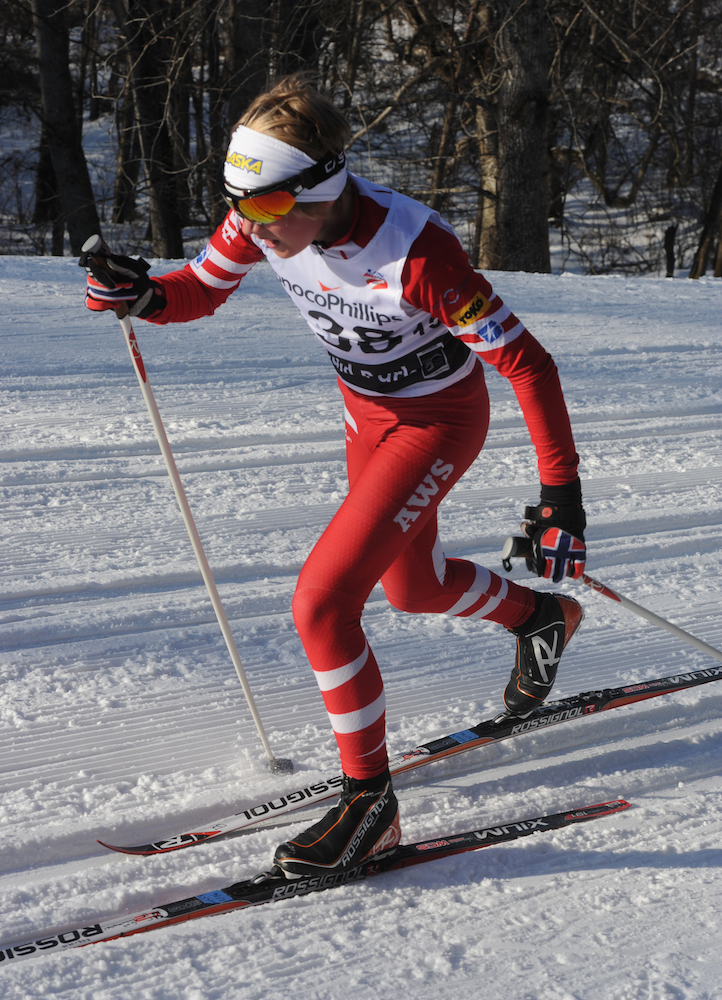
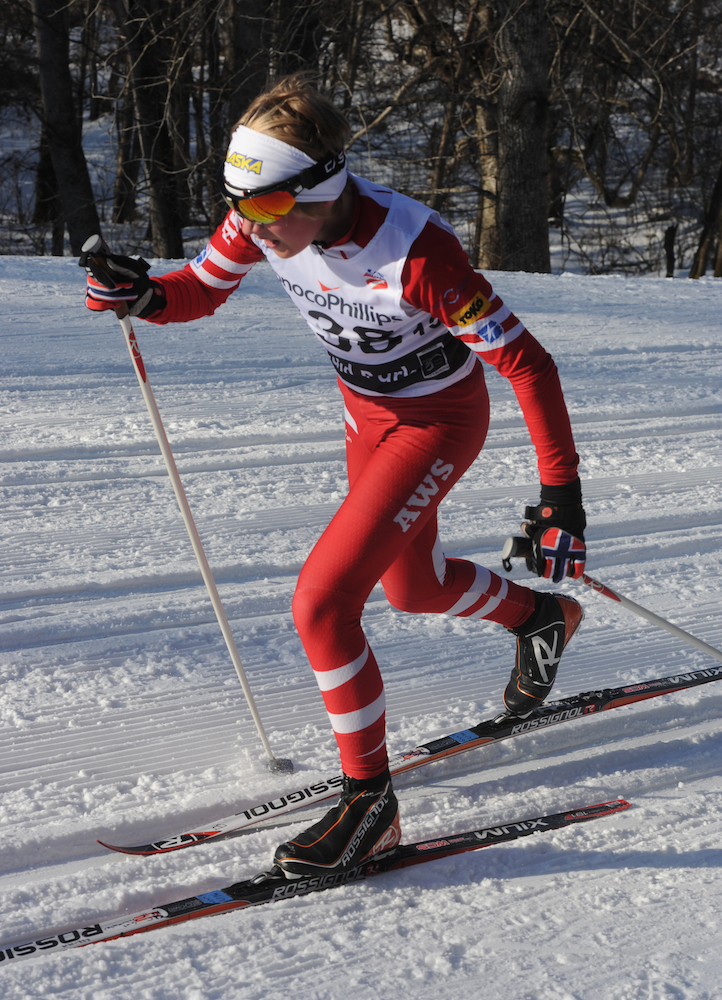
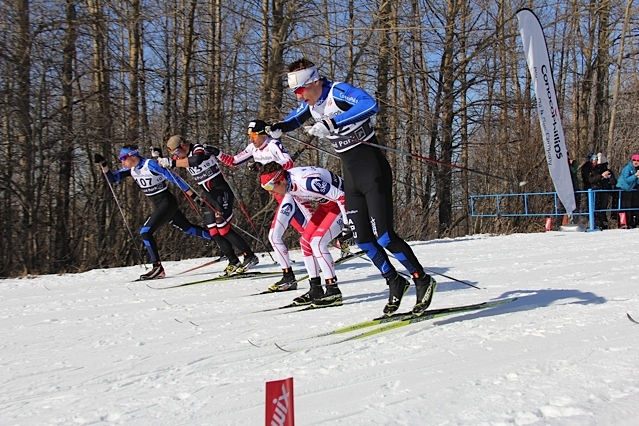
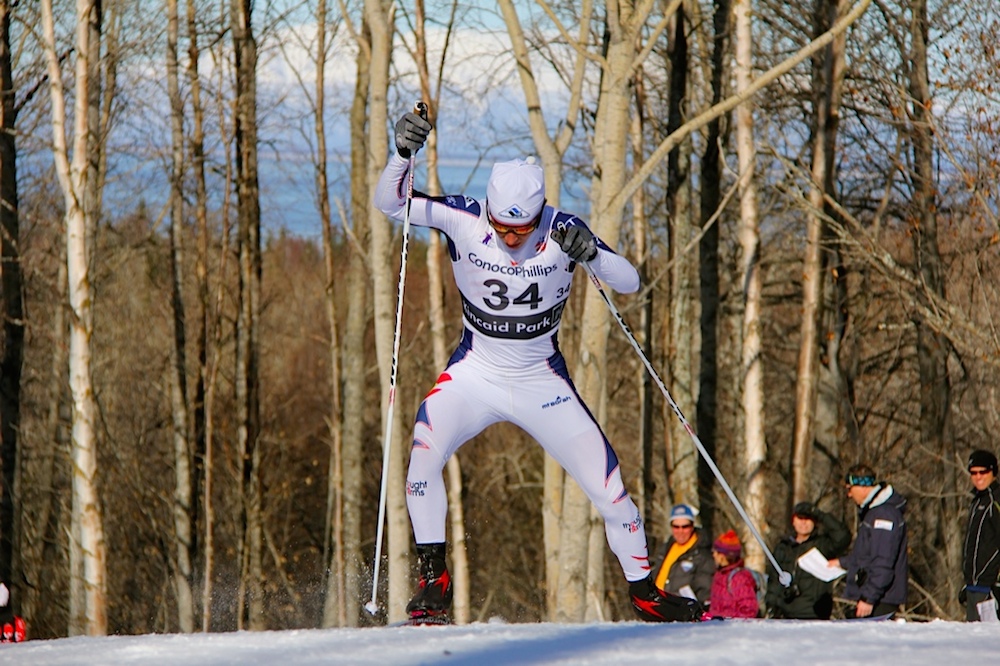
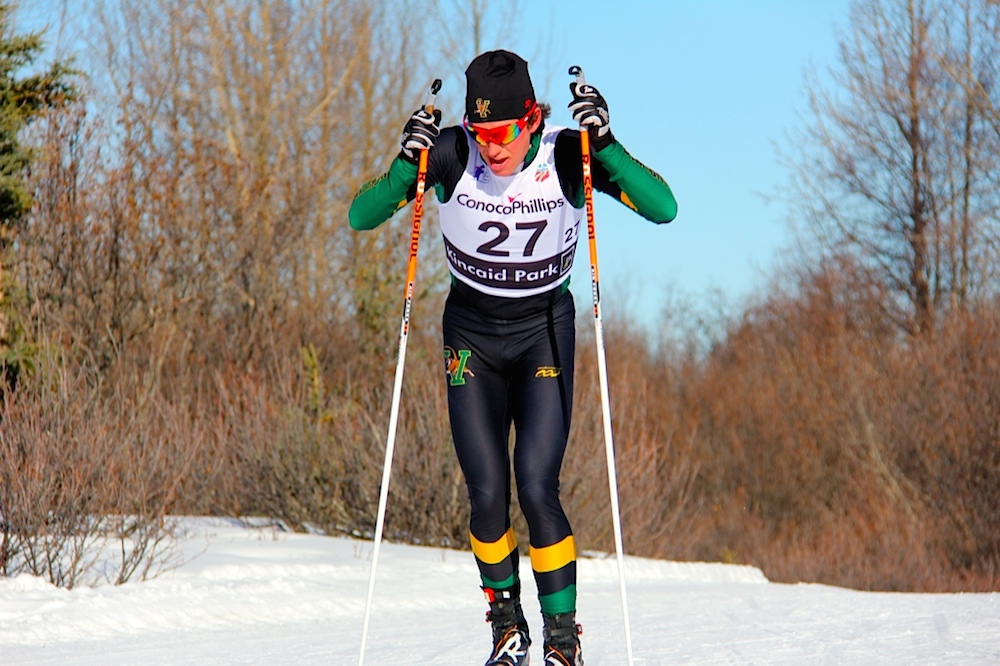
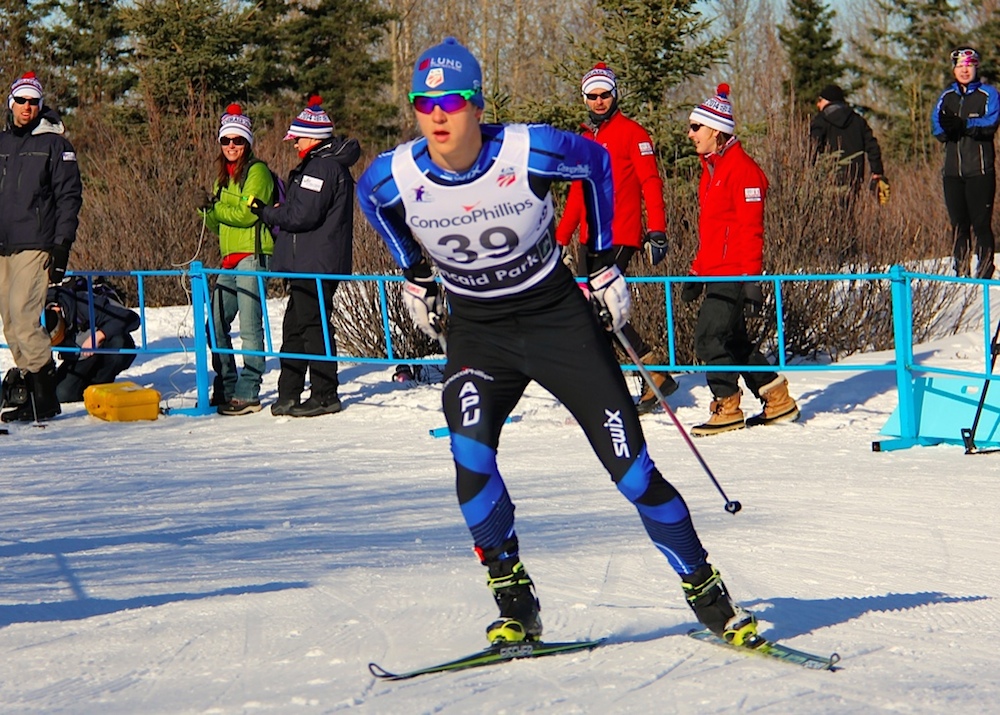
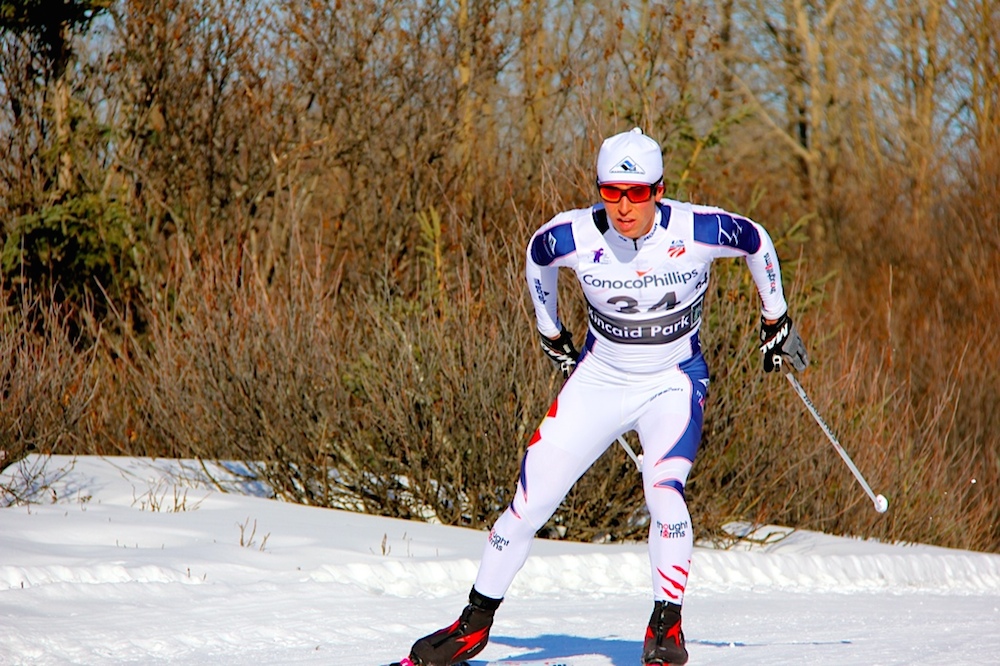
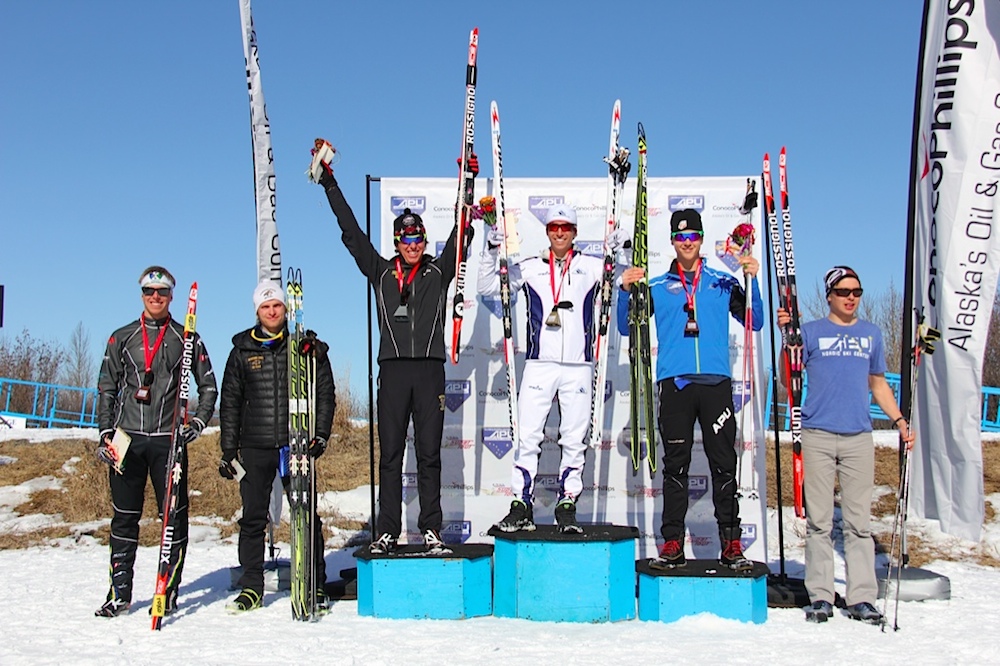
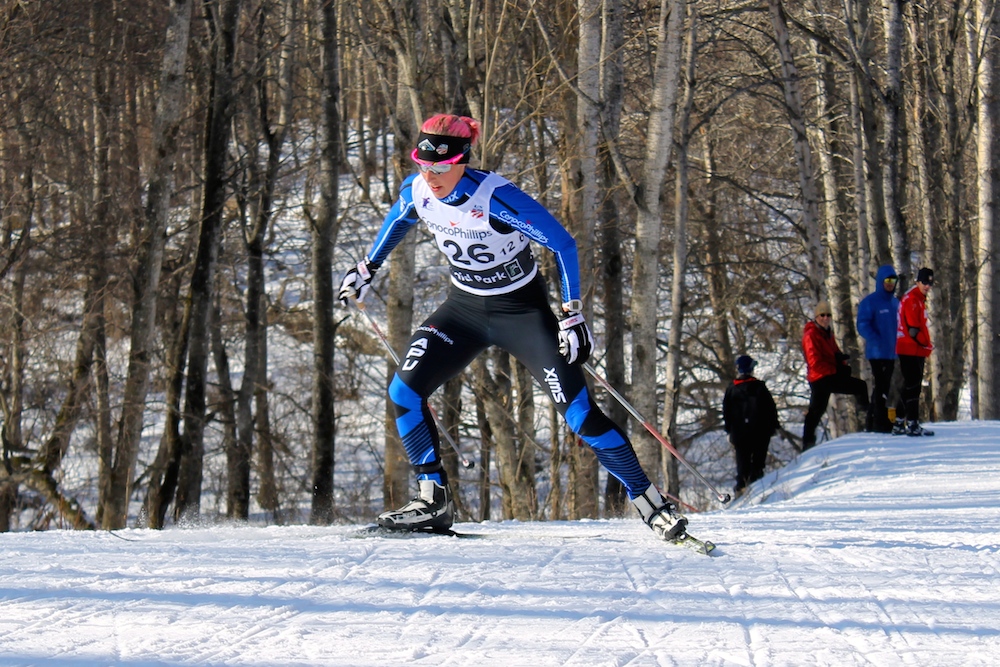
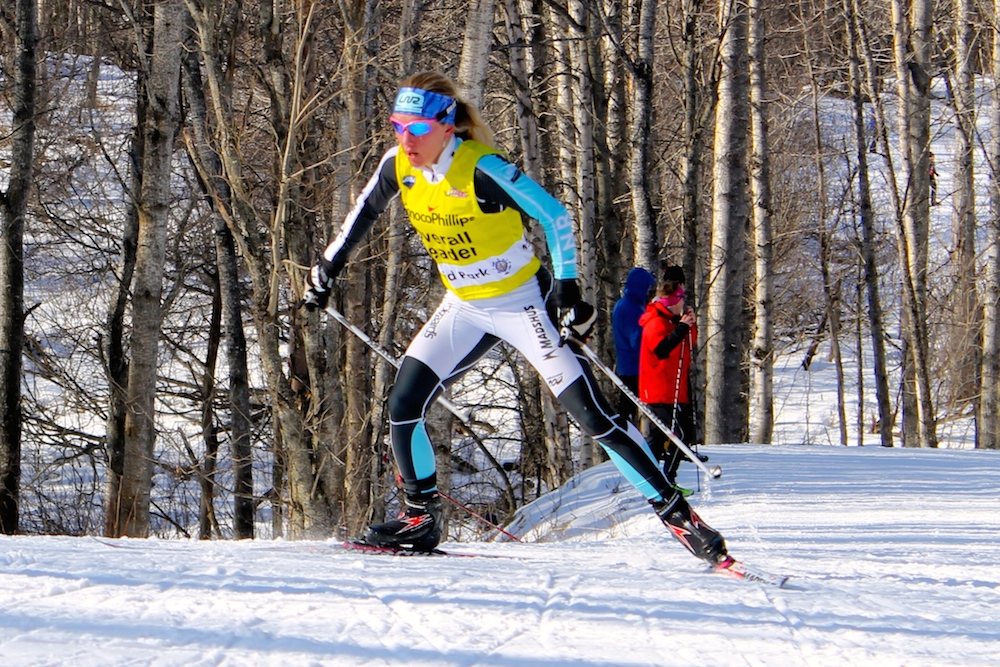
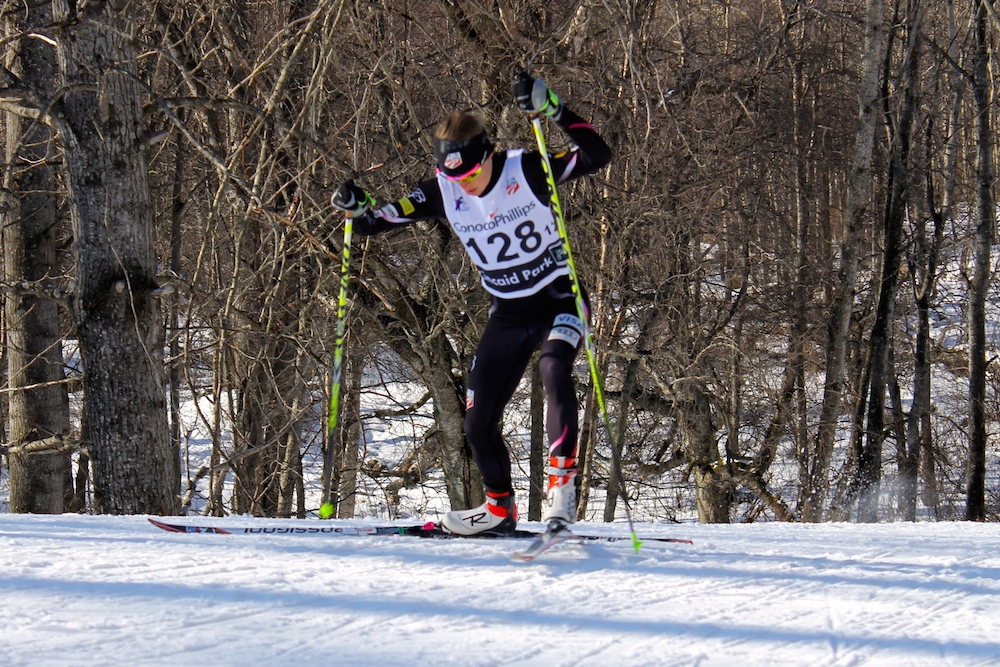
Gus Schumacher, 13, of Alaska Winter Stars, climbs the final hill in the SuperTour Finals classic-sprint qualifier at Kincaid Park on Sunday. The youngest in the field, he placed 65th. (Photo: Bill Roth/Anchorage Daily News)
ANCHORAGE, Alaska — Gus Schumacher is used to the little-guy jokes, like when his Alaska Winter Stars (AWS) coach Jan Buronsays he weighs less than his dog — or when his Junior Nationals team makes him carry the Alaska Cup all the way to Stowe, Vt., because he’s the youngest one on the team.
But the 13-year-old from Anchorage doesn’t seem to mind because really, the joke’s on them. He can say, ‘What’s up?’ to Andy Newell and Newell will greet him back.
The son of U.S. Ski Team doctor Greg Schumacher, an orthopedic practitioner in Anchorage, Gus even raced in the same event as Newell in Sunday’s 1.4-kilometer classic sprint at SuperTour Finals. He raced the day before, too, aging up into the U16 category for AWS, but Newell didn’t do the distance event. Other Olympians, like Noah Hoffman, Erik Bjornsen and Simi Hamilton did though. And then there were several U.S. Ski Team women from Anchorage, like Kikkan Randall, Holly Brooks and Sadie Bjornsen.
“It was really fun to race SuperTours, to be racing with these guys that I totally look up to,” Schumacher said after Sunday’s race, in which he placed 65th in the sprint (he said he’s more of a distance skier). “I watch them on the World Cup and I’m just amazed at their abilities.”
And Schumacher’s actually seen them in person — he went with his family to Switzerland while his dad worked with the team.
“The fact that I’m racing them right now is incredible,” he said. “They’re people too … so It’s really cool to know who they are.”
Before SuperTour Finals, Schumacher was one of about 26 males to make Alaska’s Junior National team after qualifying in an older age group at the trials.
“I really just tried hard in the races, I knew I could somewhat match [the older racers], but I didn’t know how well I could do it,” he said. “So I did the races and I did well, well enough to make it and it was just a great experience.”
The youngest guy on the team by almost two years, he had to take the Alaska Cup as a carry-on for the duration of their flights to Junior Nationals earlier this month in Stowe. He placed 30th in the U16 men’s 5 k classic race, 38th in the classic sprint, and fifth with Alaska’s second team in the 3 x 3 k skate relay.
When he’s training (which is year-round), Schumacher tries to stick with teammates like 15-year-old Matthew Hoefler.
“He’s a pretty good match for me especially in distance kind of stuff,” he said. “And then some of the older guys … they’re just too hard to stay with sometimes. It’s not good for training if you’re with them.”
But Schumacher’s been on skis longer than most.
“I’ve been skiing since I was really young, since I could walk,” he said. “I’m one of those kids.”
His mom, Amy, is a volunteer at the Anchorage SuperTour Finals and said the family loves skiing and being outdoors. She said Gus got his racing starts with a junior nordic program in Anchorage.
“[That’s] what got him to really love it,” she said. “When you add friends and coaches, it makes skiing much more fun than being with parents.”
She said he works hard “by his own drive,” and will be making the step up from middle school next year in his first year at Service High School.
Buron said he shows a lot of promise and joked that he weighs 85 pounds — more than his dog. Schumacher said he’s 110 pounds. “I think he’s exaggerating,” Schumacher said of his coach, whom Amy described as “extremely encouraging and positive [and] … sincere.”
On July 25, Schumacher will turn 14, and next year, he’ll be racing up in high school as well. But not many high-school skiers can claim to have skied with Olympians.
“It’s a big deal,” Kikkan Randall said of up-and-comers like Schumacher. “We spent all winter on the World Cup and you almost forget what it was like when you were first getting going in skiing and how these local races were so big. We could have some future Olympians out here — kids that you want, people that you want to get fired up about cross-country skiing.”
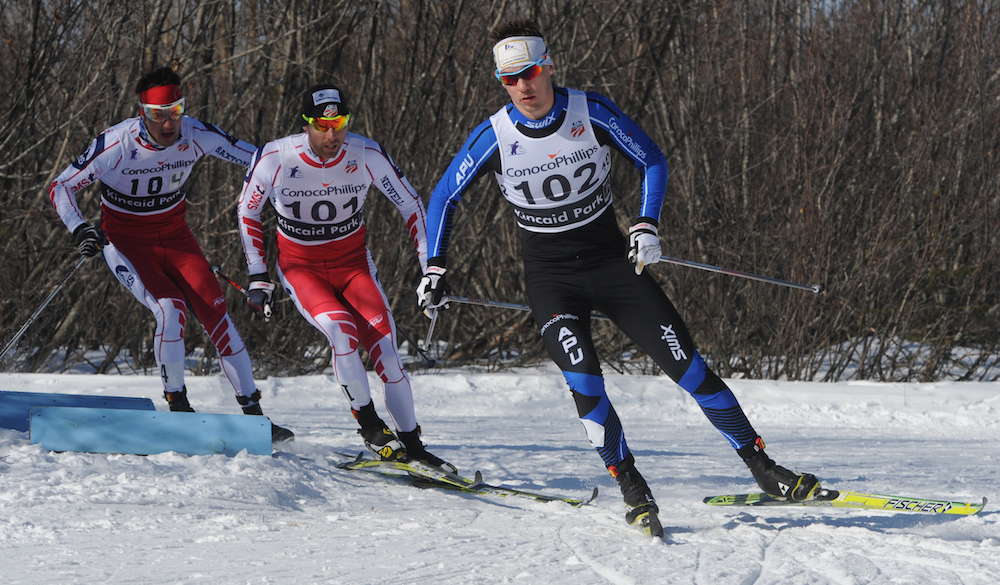
Alaska Pacific University’s Reese Hanneman (r) leads Andrew Newell (c), of the Stratton Mountain School (SMS) T2 and U.S. Ski teams, and Benjamin Saxton (SMS), in the men’s classic-sprint final at the Super Tour Finals at Kincaid Park on Sunday in Anchorage, Alaska. The three went on to finish in the top 3, with Newell first, Hanneman second and Saxton third, but Newell was relegated for obstructing Hanneman and listed as sixth. (Photo: Bill Roth/Anchorage Daily News)
ANCHORAGE, Alaska — Andy Newell’s victory was over almost as soon as he’d finished. The U.S. Ski Team member’s lane switch in the last 80 or so meters before the finish of the men’s 1.4-kilometer classic sprint final at SuperTour Finals on Sunday prompted several jury members to convene once he finished first.
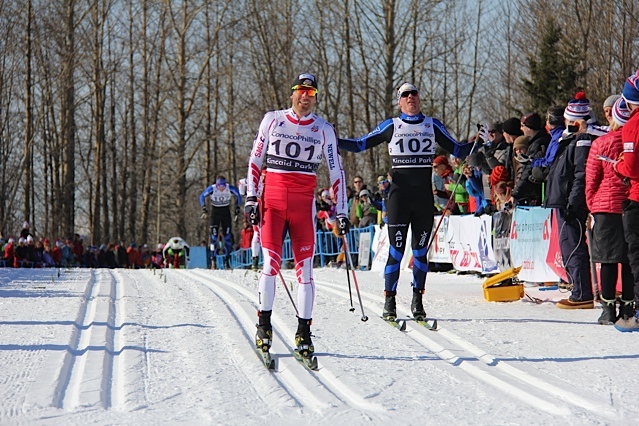
In the second lane from the right out of four lanes to the finish, Reese Hanneman of Alaska Pacific University (APU) had been trailing Newell slightly, who was farthest right, before Newell decided to shift left to the inside of a slight lefthand curve before the final straightway.
He had to accelerate to do so and needed to leave enough room between him and Hanneman before jumping across his lane, two tracks to the left. Hanneman, who’s lived and trained in Anchorage for the last five seasons and is originally from Fairbanks, later said he had to stand up for a second and the move cost him a chance at winning. Newell claimed he had the space and went for the opening.
Andy Newell (SMST2/USST) changing lanes 80 meters before the finish of Sunday’s classic sprint final at SuperTour Finals in Anchorage, Alaska. (Photo: Peter Morris)
Andy Newell (SMST2/USST) changing lanes 80 meters before the finish of Sunday’s classic sprint final at SuperTour Finals in Anchorage, Alaska. (Photo: Peter Morris)
Andy Newell (SMST2/USST) changing lanes 80 meters before the finish of Sunday’s classic sprint final at SuperTour Finals in Anchorage, Alaska. (Photo: Peter Morris)
The two double poled to the line, where Newell stayed ahead of Hanneman by several meters through the finish. Hanneman tossed his head back in disappointment — it was the one low point of an otherwise picture-perfect day. Warm sun, consistent conditions, and for Hanneman, a win in each of the preceding heats with the exception of the qualifier, in which he placed second to Newell by 2.6 seconds.
Andy Newell (101) beat Reese Hanneman (102) to the finish of Sunday’s 1.4 k classic sprint final, but was later relegated to sixth in the heat for obstructing Hanneman about 80 meters before the finish. (Photo: Rob Whitney)
In the final, Hanneman had to come to grips with losing to Newell in the end-all race of the day. In first for much of the 1.4 k loop, which included a gradual downhill into a tight right corner and long descent before the big climb back up, Hanneman initially attacked at the bottom of the final hill known as Elliott’s Climb and led halfway up.
Newell followed him closely and pulled up alongside Hanneman some 200 meters before the finish, then the two raced side by side over the top. Skiing in the same suit for the same team as Newell, Ben Saxton of the Stratton Mountain School (SMS) was the next closest competitor a few seconds back.
Just after the crest before the flat to the finish, that’s where the moment in question went down. That’s what sent APU head coach Erik Flora running to the finish to meet with jury members after the two finished. According to Hanneman, the jury was already aware of the incident and in the process of discussing whether to deny Newell of the victory because of obstruction.
About an hour and 45 minutes later, the announcement was made: unofficially, Hanneman had won, and everyone else in the final had moved up one place — Saxton to second, Tyler Kornfield (APU) in third, Pat O’Brien (Craftsbury Green Racing Project) in fourth, and Dakota Blackhorse-von Jess (Bend Endurance Academy) in fifth. Newell was relegated to sixth with a competition suspension.
A 15-minute protest period allowed Stratton coaches to file the first official protest of the day, in which they opposed the decision to penalize Newell. Twenty-five minutes later, the jury arrived at their decision: Hanneman would remain the classic-sprint champion and Newell was sixth.
Start of the men’s final at the SuperTour Finals classic sprint on Sunday at Kincaid Park in Anchorage, Alaska. (Photo: Rob Whitney)
It wasn’t the way anyone wanted it to happen.
“I would rather win without all that shenanigans, but that was one of the few times I’ve actually felt like a move really kind of did affect the race,” the 24-year-old Hanneman said. “So that’s why I wanted to stand behind that.”
As the jury informed both men of their decision inside the timing trailer the finish, Hanneman sat on a table looking down and Newell stood up, smiling. He wasn’t happy. If anything, he was in awe.
“I don’t see how that’s possible. … I don’t really now what they’re thinking,” Newell said. “I think they’re kind of beginners in there.”
For someone who laughed as he said he’s “been to a lot of TD meetings in my life,” Newell’s frustrations were easily understood. Hanneman got it and initially didn’t want to rock the boat. Second was a great result, but he stood behind his coaches’ decision to follow up with the jury. Hanneman is known as one of the most social guys on the circuit, amiable and friends with a lot of people. Newell’s also highly respected at the domestic and international levels.
“That’s what I want it to be. I have nothing against anybody, I don’t want anyone having anything against me,” Hanneman said. “But I don’t want people to abuse that and ski all over me because I’m a nice guy.”
As for the official decision, technical delegate Bill Rogers said Newell was issued a competition suspension for obstruction, something that wouldn’t affect other races this week.
“Basically we had the jury made a decision based on evidence, Andy Newell protested that and so we did have a closed jury meeting, which involves interviewing both the athletes and then separately meeting to go over the evidence,” Rogers said.
The process itself involved calling the athletes and their coaches to the table, which convened outside then moved into a private meeting inside the timing trailer, to review video and photos. Hanneman argued that Newell skied over his skis: “They have pictures of video of him just mobbing all over my gear,” he said.
Newell couldn’t say whether there was contact or not, but said he made a point to get far enough ahead of Hanneman to make his lane change.
“I also changed two tracks over instead of one so I wouldn’t block him,” Newell said. “I guess according to the video he stands up a little bit, but I am barely even going near the tips of his skis, if they did at all.”
The process itself, according to Newell, involves the jury asking each skier involved “was is it intentional or not, is the first question … and it was obviously not intentional,” he said. “And then, was there an advantage or not? And that’s kind of the shady area. It’s not like Reese lost much time, he did maybe stand up for a second and so if you call that an advantage or not, I don’t know because it didn’t really affect the outcome of the race.”
Hanneman said the jury asked about contact first, to which he said, “Absolutely. Was it intentional? That’s more up to [Newell], I have no clue. But to say you accidentally switched tracks? That doesn’t happen. … I felt like once he made that move that kind of decided the race. It seems like they made the right decision even though I wish they didn’t have to make that decision at all.”
Newell knew that because his previous infraction at World Cup Finals last weekend was a technical warning, equivalent to a yellow card on the World Cup (for skating while changing lanes in a classic sprint), it wouldn’t affect anything at SuperTour Finals. Plus, the season was over after these races in Anchorage.
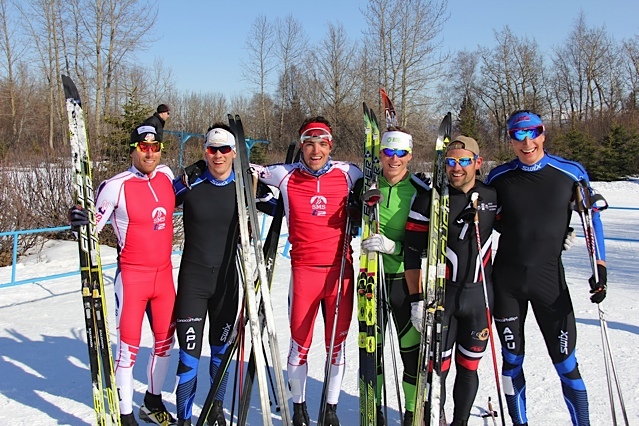
Friends ’til the end: the men’s final, all of which placed in the top sixth (from left to right) Andy Newell, Reese Hanneman, Ben Saxton, Pat O’Brien, Dakota Blackhorse-von Jess, and Tyler Kornfield. (Photo: Rob Whitney)
The penalty cost Newell $650 dollars in prize money, plus the $100 he and his coaches had to put forward to protest. At the end of the day, he made $100 for sixth place, which the protest fee negated.
On the flip side, Hanneman took home an extra $250 dollars for the win ($750 for first as opposed to $500 for second). It was the SuperTour leader’s second victory in national-caliber classic sprints this season after he won his first national title at U.S. Cross Country Championships in the classic sprint in January.
But he also knew what the other side of a jury decision felt like. In December, Hanneman was disqualified for skating in a Besh Cup classic sprint — which he initially won.
“I know that it’s not fun but when you do something that’s questionable, like when I skated in Besh Cup, I was like, well, I shouldn’t have done that and know I know,” he said. “You need that to reinforce … Andy needs to know that he can’t make a move like that because it’s not fair racing. You have to some checks like that to keep people in line.”
According to Rogers, “Unfortunately, obstruction in sprints is common. I think it’s very normal.” He declined to explain how the jury made their final decision and the evidence they considered in the process.
At the end of the day, Hanneman was a champion and the 20-year-old Saxton had one of the best races of his career in second — up there with his runner-up finish in the skate sprint at 2014 nationals. He finished 4.74 seconds behind Hanneman (who ultimately won in 3:25.56) and held off Kornfield by 1.49 seconds.
For Kornfield, the 2012 national classic-sprint champion, third stood as his best race of the season. He finished 4 seconds ahead of O’Brien, who ended up fourth, and 13 seconds ahead of Blackhorse-von Jess in fifth.
Saxton said Hanneman and Newell took off toward the bottom of the hill, over the first roller on the way up to the finish. He was caught in the far left lane in fourth and unable to go with them. Despite the fact that he thought he could’ve stuck with them to the finish, Saxton said he was happy with his result — even if it was third at first.
“I haven’t felt this good all year. This was an incredible feeling,” Saxton said.
“Andy and Reese threw down World Cup qualifiers today so that’s pretty awesome,” he added, referring to Newell’s top time of 3:19.52. Hanneman was 2.6 seconds back in second and Blackhorse-von Jess advanced to the heats 4.09 seconds behind Newell in third. Saxton qualified fourth (+7.4).
Saxton went on to win his quarterfinal (as did Newell), as well as the first semifinal by 0.24 seconds over Newell.
“It’s pretty cool for me to get to race against Andy [and] experience that for the first time,” Saxton said. “[Watching him in the quarterfinals] it was incredible dichotomy between him and the other skiers. He’s so relaxed. It’s not that there technique is bad, but it’s just this innate tightness. There’s a laboredness in their movements.”
So to beat him in the semifinal was fun.
“In my semi, we went side by side up the hill, so it was cool to feel that pace and feel the turn of pace,” Saxton said. “It was exciting.”
Hanneman bested O’Brien in the second semifinal by 0.83 seconds. O’Brien and Simi Hamilton (SMST2/USST) also won their quarterfinals, but Hamilton placed fourth in the second semifinal, 2.6 seconds behind Blackhorse-von Jess in third, and did not make the final.
“Reese is skiing incredible,” said Saxton, Hanneman’s roommate in Europe last year, shortly after the finish. “I could not be happier for that guy.”
Noah Hoffman (SSCV/Team HomeGrown/USST) racing to a 10.9-second win in Saturday’s 15 k freestyle at SuperTour Finals at Kincaid Park in Anchorage, Alaska. (Photo: Rob Whitney)
ANCHORAGE, Alaska — Separated by 30 seconds at the start, nearly 70 men in Saturday’s 15.9-kilometer freestyle raced around Kincaid Park individually on Saturday in the SuperTour Finals opener.
One by one, they ascended massive hills, like Elliott’s Climb at the end of each 5.3 k lap, and descended a winding section of the course known as S Turns. They made their way back to the stadium World Cup start area via trails named Burky’s Climb and Roller Coaster.
Some made up ground on their competitors; others lost it.
With one lap to go, it was pretty obvious which side of that Noah Hoffman of the U.S. Ski Team (USST), Ski & Snowboard Club Vail and Team HomeGrown was on.
University of Vermont senior Scott Patterson racing to second in Saturday’s 15 k freestyle at SuperTour Finals in Anchorage, Alaska. (Photo: Rob Whitney)
Watching him climb Elliott’s the second time around 10 k was unlike anyone else. Scott Patterson of the University of Vermont (UVM) led Hoffman by half a second after the first 5 k loop, then fell behind by 4.6 seconds by the end of the second.
“There’s no recovery out there,” Hoffman said after the race. “You’ve got to work the whole thing. The downhills are turny, really require you to work, but for the most part it’s just rolling terrain and no big uphills, no big downhills, quite different than anything I’ve raced [overseas] all year. It was fun.”
With about 5 k to go, Hoffman, 25, put the hammer down on the hills he knew were his strength. The lone skier at Spring Series from his Colorado club, Hoffman stood out in white — and in his ability to attack when most were visibly slowing.
“My strategy was try just to ski really high energy but keep it relaxed, knowing that I couldn’t really go over the line because there was no place to recover,” Hoffman said. “There were limited opportunities out there to attack on the uphills so I had to really focus when I did have that opportunity.”
Hoffman continued to gap Patterson, a UVM senior from Anchorage, on the final lap and ultimately beat him by 10.9 seconds for a victory in his first SuperTour Finals since 2012.
“I knew I was close to Scott,” Hoffman said. “I was getting word out there, ‘Tied! Up by two, down by two,’ so I knew it was a close race and you’ve just got to work for every second out there and see what happens.”
While Patterson gave Hoffman a run, nobody else came too close. Erik Bjornsen of Alaska Pacific University (APU) and the USST was in a three-way fight for third with Patrick Johnson (Far West Elite Team) and David Norris (Montana State University) with one lap to go.
Erik Bjornsen (APU/USST) racing out of the World Cup start area to third place in Saturday’s 15 k freestyle at SuperTour Finals in Anchorage, Alaska. (Photo: Rob Whitney)
Bjornsen ended up third, 59.3 seconds behind Hoffman and 3.1 second ahead of Norris in fourth, and said he lost time on the second loop and didn’t have the finishing punch he’s used to.
“I really didn’t find that top gear in the last lap that I was looking for, so that was a little disappointing,” Bjornsen said.
But a podium is a podium at a race series that ranks right up there with U.S. nationals prestige (on March 28, the 30 and 50 k classic mass starts will serve as U.S. Distance Nationals).
“It’s been cool this year going to the Olympics,” Bjornsen said. “I think Anchorage has started to notice my name. Just a ton of fans out there. It was so fun.
“I thought I was fourth,” he continued. “I’m happy with [third]. … It’s a tough race. You’ve just got to keep working the whole time and keep moving. As soon as you kind of rest or chill for a little bit I think you lose a lot of time.”
“I think Anchorage has started to notice my name. Just a ton of fans out there. It was so fun.” — Erik Bjornsen (APU/USST), third in SuperTour Finals 15 k freestyle
Patterson didn’t let off the brakes, especially with Anchorage spectators lining the course, but thought he came undone a little bit on the final climb. At the halfway point, he recalled being two seconds ahead of Hoffman in the lead — an accomplishment for any non-USST member, let alone a college racer.
Noah Hoffman on his way to winning his first SuperTour Finals race in two years. He did not compete in Truckee, Calif., last season. (Photo: Rob Whitney)
“It seemed like every person was giving me splits, every volunteer was cheering for me so it was pretty cool. Definitely had a good crowd out there that knew me well,” he said.
“Scott’s a great skier, I’ve known that for a long time,” Hoffman said. “It was never a guarantee I’m going to win this race. I’m just glad to edge it out. I hope to ski Scott at the World Cup level sometime soon.”
If Patterson, the younger of the two siblings at the Finals (Caitlin of the Craftsbury Green Racing Project is the other), has his way, that’s exactly how his career will go down. The first step is not being intimidated by a USST athlete. The second: learn how to deal with limited splits on when you start ahead of the person you’re trying to chase down.
“It was hard to kind of know — up, down, going back and forth — so I tried to push it in, but I was a little slow on the last hill,” Patterson said. “He definitely picked it up towards the end.”
For Hoffman, the attack made all the difference. Besides Patterson and Bjornsen on the podium, Hoffman beat everyone else by more than a minute. Norris was fourth (+1:02.4), Lex Treinen (APU) fifth (+1:06.2). Johnson placed sixth, Matt Gelso (Sun Valley Ski Education Foundation) took seventh, Reese Hanneman (APU) was eighth, Brian Gregg (Team Gregg/Madshus) ninth, and the former APU skier Mark Iverson (Rossignol) 10th.
Hoffman and Bjornsen were among four in the top eight getting wax help from APU this week, including Norris and Hanneman.
“I don’t really know how my fitness is at the moment; it was a lot of travel,” Hoffman said after flying from Sweden to Anchorage earlier this week. “I’ve been sleeping pretty well for the most part this week, but it’s a hard transition, it’s also just been a long season.”
The men’s 15 k freestyle individual start podium at SuperTour Finals in Anchorage, with winner Noah Hoffman (c), runner-up Scott Patterson (third from l) and Erik Bjornsen (second from r) in third.(Photo: Rob Whitney)
Kikkan Randall (APU/USST) heads up Elliott’s Climb in Kincaid Park at the end of the first of two laps on Saturday. She went on to win the 10 k freestyle individual start by 2.2 seconds on the first day of SuperTour Finals in Anchorage, Alaska.
ANCHORAGE, Alaska — Liz Stephen had quite the task ahead of her on Saturday in the first race of 2014 SuperTour Finals. Kikkan Randall’s house guest for the week and her longtime buddy on the U.S. Ski Team, the 27-year-old from East Montpelier, Vt., started a minute behind Randall in the women’s 10-kilometer freestyle individual start at Kincaid Park.
Usually, that would be fine, but when you hear cheers through the woods ahead of you and get splits that you’re right behind Kikkan, that you’re seven seconds down, one second down, it’s hard to know how to beat her.
Stephen tried anyway, but at the end of the 27-minute race — which was actually 10.6 k on the two-lap course — Randall was the one who finished fastest in 27:27.1, by 2.2 seconds over Stephen in second.
Alaska Pacific University’s leading veteran, Randall, 31, repeated her win in the 10 k distance from last year’s SuperTour Finals in Truckee, Calif. There, she won the 10 k classic by 36.6 seconds over her APU and USST teammate Sadie Bjornsen and finished 47 seconds ahead of Stephen.
On Saturday, the 10 k skate was a favorite event for several on the U.S. Ski Team (with the exception of Sophie Caldwell, who finished eighth and smiling in one of her least-favorite races on her 24th birthday. She was greeted at the finish by nearly a dozen costumed competitors, including Randall in a tinsel wig and Stephen in an afro, somewhat contained by a ski headband).
Almost a dozen women quickly switched gears after finishing Saturday’s 10 k skate to wearing costumes and greeting Sophie Caldwell, of the U.S. Ski Team and Stratton Mountain School T2 Team, at the finish at SuperTour Finals in Anchorage, Alaska, on Caldwell’s birthday.
Almost a dozen women quickly switched gears after finishing Saturday’s 10 k skate to wearing costumes and greeting Sophie Caldwell, of the U.S. Ski Team and Stratton Mountain School T2 Team, at the finish at SuperTour Finals in Anchorage, Alaska, on Caldwell’s birthday.
Sophie Caldwell cruises into the finish while being surprised by nearly a dozen competitors in costume to celebrate her birthday on March 22 at SuperTour Finals in Anchorage, Alaska.
A smiling-and-suprised Sophie Caldwell at the finish of the 10 k freestyle at SuperTour Finals on March 22 after several teammates and competitors dressed up to celebrate her birthday in Anchorage, Alaska.
A smiling-and-suprised Sophie Caldwell at the finish of the 10 k freestyle at SuperTour Finals on March 22 after several teammates and competitors dressed up to celebrate her birthday in Anchorage, Alaska.
A smiling-and-suprised Sophie Caldwell at the finish of the 10 k freestyle at SuperTour Finals on March 22 after several teammates and competitors dressed up to celebrate her birthday in Anchorage, Alaska.
A smiling-and-suprised Sophie Caldwell at the finish of the 10 k freestyle at SuperTour Finals on March 22 after several teammates and competitors dressed up to celebrate her birthday in Anchorage, Alaska.
A few minutes earlier, Randall and Stephen had been just as gassed as most in the field at the finish, which ended on the winding uphill called Elliott’s Climb before an 80-meter straightaway into the World Cup stadium (a modified start and finish because of low snow).
“I knew it was close,” Stephen recalled. She was down by 7.3 seconds to Randall after the first lap then two seconds a couple kilometers later.
With 3 k to go, Stephen knew she had some climbing ahead — which was good for her. Randall’s strength was gliding, she reasoned, so Stephen went for it on the rolling (and sometimes-screaming) downhills and tried to ski relaxed, until the last time up Elliott’s.
“On this final climb it was just head down and going,” Stephen said. “[Kikkan] got it and it’s great to see her win in her home state.”
SuperTour leader Caitlin Gregg (Team Gregg/Madshus) clocks the fastest time through 5 k in Saturday’s 10 k freestyle at SuperTour Finals in Anchorage, Alaska. She went on to place third.
While Randall had an edge on Stephen from start to finish, she was actually trailing Caitlin Gregg (Team Gregg/Madshus) by 3.6 seconds at the end of the first lap. However, Randall had little way of knowing; she started 5 1/2 minutes ahead of Gregg. (Stephen started ahead of her as well.)
The 2014 American Birkebeiner freestyle champion, Gregg was also fresh off a flight from World Cup Finals in Europe. She arrived in Anchorage on Tuesday — one day before Randall and Stephen.
While Gregg said her energy was good and wasn’t sure where she lost time on the second lap on Saturday, she credited Randall and Stephen as “great World Cup skiers” and was satisfied with third place, 20.9 seconds behind Randall and 4.1 seconds ahead of Bjornsen in fourth.
“I always have really good skate races here in Anchorage,” Gregg said. “Whether it was at JO’s [Junior Nationals], NCAA’s, nationals twice, I qualified for the Olympics here in 2010 — for whatever reason, Alaska and I, Anchorage and I do great. I love the trails, I love the conditions, the crowds, it’s a good vibe.”
When she and her husband, Brian, who placed ninth in the men’s 15 k, found out that Spring Series was going to be there, they couldn’t pass it up. Even after they raced more than ever this season — both domestically and internationally; Caitlin said she’s only had two weekends off since early October and has been back and fourth to Europe twice.
“Even after our crazy long season, we were like, ‘Oh man, that is gonna be awesome,’ ” she said. “We went for an afternoon jog at nine o’clock last night. We watched the sunset over the ocean.”
“For whatever reason, Alaska and I, Anchorage and I do great. I love the trails, I love the conditions, the crowds, it’s a good vibe.” — Caitlin Gregg (Team Gregg/Madshus), third in 2014 SuperTour Finals 10 k freestyle
The ultimate hometown hero, Randall relied on the crowd to boost her the last time around Kincaid — the same trails she grew up on. Born in Salt Lake City, Utah, Randall moved to Anchorage with her family when she was just a few years old, and went on to rack up 10 state titles at East Anchorage High School, all of which were in running.
As a junior skier, Randall won seven Junior National titles and set Alaska’s record for fastest woman on skis at 74.14 miles per hour in a 1994 speed-skiing event, according to her blog.
But on Saturday, what mattered was that the four-time Olympian had another great day in her storied career, which she most recently added her third Sprint World Cup title to.
“You spend the whole winter on the World Cup and then you come back here and it just feels so familiar,” Randall said. “Just seeing everybody and the snow is familiar. It was really funny packing my race bag this morning, I was so in the routine all winter, but then to do it in your own house is kind of funny.”
Liz Stephen (Burke/USST) heads up Elliott’s Climb the first of two times in Saturday’s 10 k freestyle at SuperTour Finals at Kincaid Park in Anchorage, Alaska. She went on to place second to teammate Kikkan Randall by 2.2 seconds.
She had her husband, Jeff Ellis, and Stephen at home with her, too. Randall said it was that familiarity paired with the ability to make an impact on the community that made her want to have the post-Sochi Olympics, season-ending races there. These Finals are Randall’s first races in Anchorage since 2010 nationals.
“It’s really nice for us racers to come back and race at home, but it’s so good for the community and the next generation of Olympians,” Randall said. “They’re seeing a high-level race for the first time and they’re like, ‘Oh man, I want to be there someday.’ I remember being a kid and feeling that way.”
Randall went on to become the most successful female cross-country skier in U.S. history.
“When I was standing in the start gate [today] I thought, I do this because I love it,” Randall said. “When you’re on the World Cup, it’s such a big scene there, but to do it here in front of all your friends and family, it’s like, Oh yeah, this is the true spirit of cross-country.”
Stephen, who’s also under APU’s wing this week with wax help, said the kind of recognition Randall gets from her home state and supporters stands out.
“Everybody knows her and it’s a really cool atmosphere here in Alaska,” Stephen said. “We were watching TV last night from some shows that had been recorded in December. Usually you fast-forward through the ads, and we were doing that, but on a number of different occasions I would be like, ‘There you are!’ And we’d have to go back and watch it.
“It’s just really cool to see a community and a whole state really embrace cross country skiing and embrace their athletes,” Stephen added. “It’s fun to be here and it’s fun to be home with Kikkan because she is a star. In our minds, all the time and in her state too and it’s just fun to be a part of it.”
Also in the top 10, Jessie Diggins, of the Stratton Mountain School T2 Team (SMST2) and USST, placed fifth (+29.8). Girdwood native Chelsea Holmes (Sun Valley Ski Education Foundation) was sixth (+55.0), Holly Brooks (APU/USST) seventh (+56.2), Caldwell (SMST2) eighth, Erika Flowers (SMST2) ninth, and Anchorage’s own Caitlin Patterson (Craftsbury Green Racing Project) 10th.
ANCHORAGE, Alaska — On a sunny afternoon in Kincaid Park, a 1,500-acre public-recreation venue that borders the Anchorage International Airport and Turnagain Arm coast, several World Cup skiers, including three Olympians and three Alaska Pacific University members, took the time to chat on camera on Friday.
Out on the trails before and during training/testing, Kikkan Randall, Liz Stephen, Erik Bjornsen, and Reese Hanneman talk about returning to the U.S., their homecomings and what they’re most excited for at SuperTour Finals and U.S. Distance Nationals — a.k.a. Spring Series.
Races start Saturday with the 10- and 15-kilometer freestyle individual starts. Start list
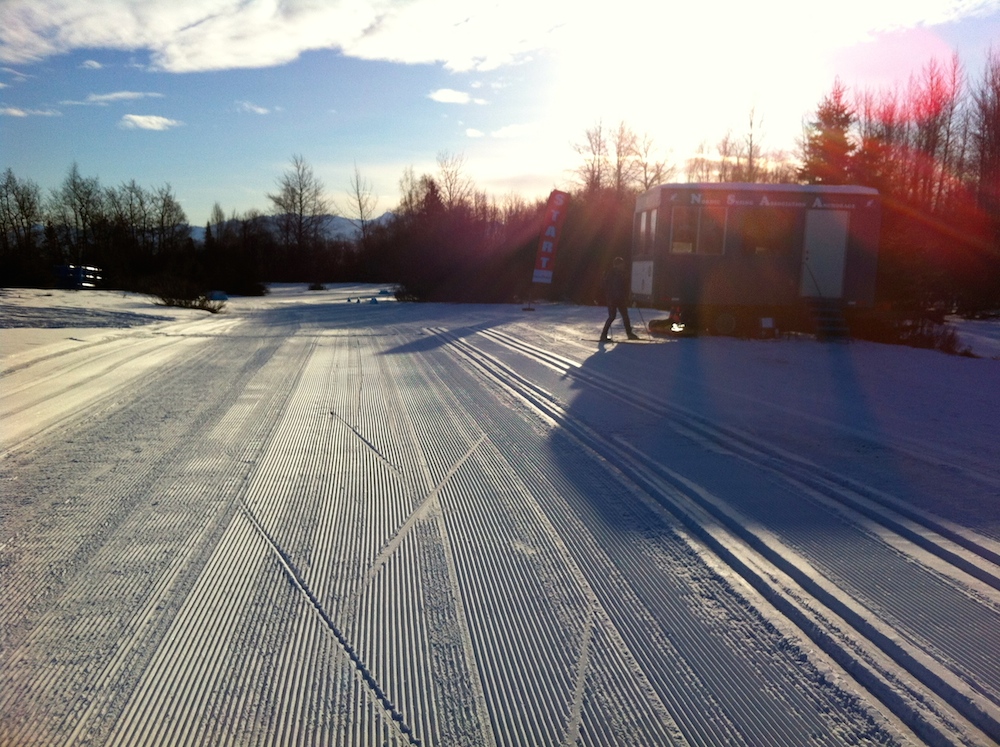
The secondary stadium at World Cup start, 0.8 miles from the Kincaid Chalet and main open-aired stadium at Kincaid Park in Anchorage, Alaska, on Friday morning. While the primary stadium has a thin base of snow cover, it’s exposed.
Editor’s Note: Normally, FasterSkier will be doing the reporting and the Anchorage Daily News (ADN) will help with photos from this year’s SuperTour Finals and U.S. Distance Nationals, but on the eve of the first of four races, we’ll let the ADN do the talking in the form of this preview, which ran both in print and online.
Like her U.S. Ski Team teammates, Anchorage’s Holly Brooks spent this winter living out of duffel bags, grinding out World Cup nordic races all over Europe and Olympic races in Sochi, rarely staying in one location for long.
That schedule proved exhausting, and Brooks is finally back home in Airport Heights after four months away.
But she can’t hit full relax-mode yet, not with the season’s final four races, replete with the strongest fields in North America this season, scheduled here beginning Saturday, when the 2014 U.S. National Championships and the SuperTour Finals open at Kincaid Park.
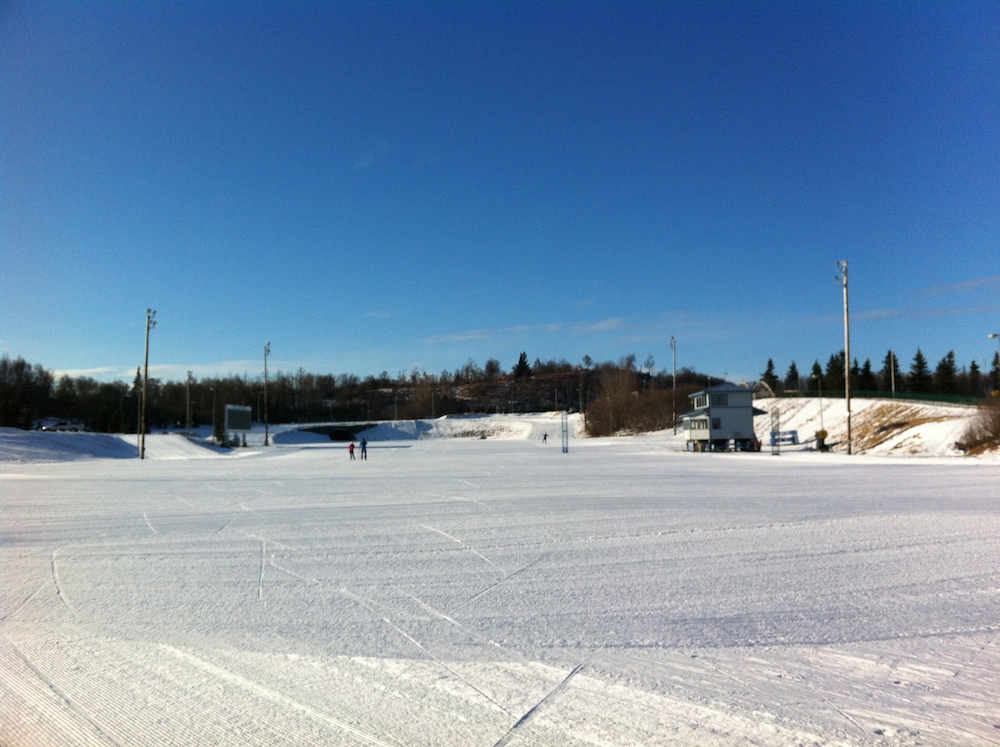
The main stadium at Kincaid Park, which will not be used this week for SuperTour Finals and U.S. Distance Nationals because of Anchorage’s low-snow situation. The trails are covered, and race organizers have yet to determine whether all the races will be held at Kincaid — including the 30 and 50 k next Friday. Races are planned for Kincaid unless otherwise noted.
Anchorage Olympians Brooks, Kikkan Randall, Sophie Bjornsen and Erik Bjornsen, who all compete for the APU Nordic Center, are part of the stacked fields registered. By Brooks’ count, 12 of the 14 U.S. Olympians from Sochi will be skiing. And SuperTour points leaders Reese Hanneman of APU and Caitlin Gregg of Minneapolis are also registered.
“It’s the highest level that’s taking place in North America this year,” said two-time Olympian James Southam, the race director. “It’s the only time all season the best athletes in the country are in one place, and in the U.S.
“For Anchorage to be holding these races, I think, is a super-cool opportunity for people to get out and see what the best in the world look like.”
Brooks said she plans to ski all four races — two SuperTour events and two national championship events.
“This is our only chance to ski domestically all season,” she said. “It’s also kind of a reunion of sorts, to catch up with old friends, teammates, old coaches. Most people will plan to ski all the races. It’s the end of the season — there’s nothing to save for, nothing to hold back.”
Randall, the four-time Olympian who recently wrapped up her third consecutive World Cup sprint title, said she also intends to race every event. She appreciates that the country’s top skiers, almost to a person, have traveled here to end the season with loaded fields.
“Everybody’s doing a good job the last few years of respecting the final races, to race domestically and to compete for your club,” Randall said.
Randall said she’s excited for the upcoming races, in part because they will mark the first time she has competed in her hometown since the 2010 U.S. Olympic Trials.
Southam said he was psyched nearly all the top racers have come here at season’s end.
“At this time of year, you don’t always see the best ones because they’re super-tired,” Southam said. “But for the best to come here is great. The last few years, Anchorage has put itself on the map, especially with the APU program. People are like, ‘What’s going on there?’ What’s in the water?’ ”
The races are all scheduled to take place on the world-class trails at Kincaid Park. That could change if conditions or temperatures change significantly. The trails at APU and Hillside give organizers alternatives.
The SuperTour and national championship races lure top racers to compete against the best of the best in the hunt for titles. Prize money is another incentive. All together, about $10,000 in prize money will be awarded
The SuperTour races — Saturday’s individual freestyle race and Sunday’s classical sprints — pay $750 to both the men’s and women’s winners. Second place will earn $500, third place $250, fourth $200, fifth $150 and sixth $100. The fastest male and female qualifiers in the sprint will each earn $250.
In the national championship distance races — 30-K for women, 50-K for men — the winners will earn $1,200, the runner-up gets $600 and third place merits $300. In the relay, the top four-person team will split $750, the runners-up will earn $500 and third place will split $300.