From the FasterSkier archive — posts syndicated from athletes’ and coaches’ own blogs between 2004 and 2012, kept online as published. Current coverage is at fasterskier.com.
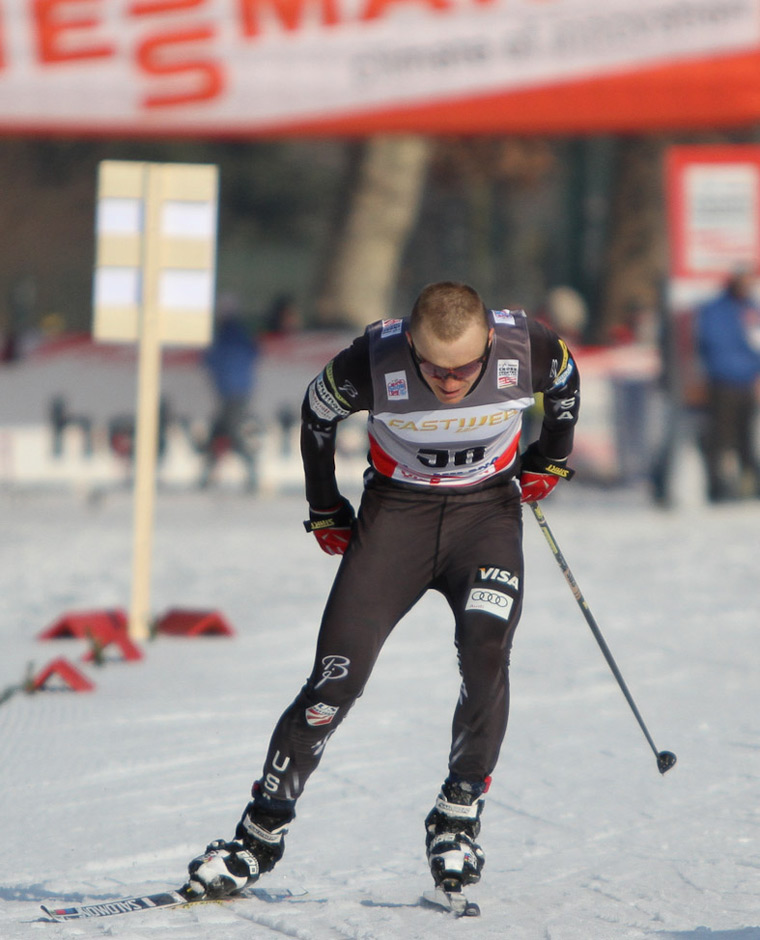
Germany’s Evi Sachenbacher-Stehle (bib-27) in the quaterfinals of the 2007 Tour de Ski in Prague. (Photo: Wikimedia Commons)
A career ended prematurely, for no reason.
During the 2014 Winter Olympics in Sochi, Russia, German biathlete Evi Sachenbacher failed a doping test. Although the ensuing ban was subsequently reduced from two years to six months, it effectively ended her career.
New information seems to confirm that Sachenbacher’s positive drugs test at the 2014 Winter Olympics in Sochi had nothing to do with deliberate doping. Rather, she was used as a sacrificial pawn by Russian doping authorities, according to an article on rtl.de.
In his recently published autobiography, doping meister turned whistleblower Grigory Rodchenkov wrote that with no positive doping tests in the first week of the Sochi Olympics, the Russian doping machine needed to expose someone in order to prove that they were doing good work.
From 2006 to 2015, Rodchenkov headed Russia’s Anti-Doping Center, the only laboratory in Russia accredited by the World Anti Doping Agency (WADA). At the 2014 Winter Olympics, Rodchenkov managed the anti-doping testing. While he concocted a recipe of three banned substances to administer to Russian athletes, he and others developed a sophisticated system to replace Russian athletes’ drug-contaminated urine samples with clean samples.
The July 25 issue of The Daily Mail published extensive excerpts from The Rodchenkov Affair, Rodchenkov’s new tell-all detailing his decades-long involvement with the Russian doping system both as an athlete and an administrator. Rodchenkov was initially exposed to doping as a college distance runner, taking steroids. While a successful collegiate runner – with chemical help – Rodchenkov didn’t turn into an elite athlete. His “enhanced” college running success did spur his study of chemistry.
In November 2015, WADA identified Rodchenkov as the ringmaster in the Sochi doping scandal. He was compelled to resign. Within days, fearing for his life, Rodchenkov left Russia for the United States. His paranoia may not have been irrational, as two other officials died suddenly in February 2016. In May 2016, Rodchenkov gave an extensive interview to the New York Times about the rigged testing process in Sochi.
This brings us back to Sachenbacher, the German biathlete who tested positive in Sochi. In one of her two urine samples Sachenbacher submitted during the Olympics, the testing lab claimed it discovered traces of the banned substance methylhexanamine.
Developed by Eli Lilly & Co in 1948, methylhexanamine was marketed as a nasal decongestant. Although it was withdrawn from sales in the 1970s, methylhexanamine began appearing as an ingredient in various dietary supplements in the early 2000s. Supplements incorporating this drug are generally promoted as fat loss products or for extra energy during workouts.
In his book, Rodchenkov asserted that methylhexanamine “usually occurred in huge concentrations.”
Rodchenkov also characterized Sachenbacher’s result as a “borderline case,” adding “If I had already logged five real violations, I might not have reported her. But we needed blood. She became withdrawn from circulation and the punishment did not really match the violation.”
When she learned of the positive finding, Sachenbacher protested, saying that she must have unknowingly ingested it in a tea powder. In the summer of 2014, she received a two-year competition ban.
Sachenbacher appealed to the Court of Arbitration for Sport (CAS), which determined that she didn’t deliberately ingest methylhexanamine. Her ban was commuted to six months from the date of the test
The Munich, Germany, public prosecutor’s office investigated Sachenbacher following the Olympics. According to Der Spiegel, the prosecutor later deemed that Sachenbacher hadn’t actually taken the drug “because the active ingredient content is too low.”
After the CAS ruling, Sachenbacher was allowed to immediately resume training and competition. However, the positive finding and subsequent battle to clear her name exhausted her, and she opted to retire.
The silver-medal winning Russian men’s relay team at the 2014 Olympics. Alexander Bessmertnykh, Maxim Vyegzhanin, and Alexander Legkov were disqualified for doping, but just had their bans overturned by the Court of Arbitration for Sport.
The Court of Arbitration for Sport (CAS) has overturned doping bans assigned to eight cross-country skiers based on investigations into manipulation of the anti-doping process at the 2014 Winter Olympics.
“In 28 cases, the evidence collected was found to be insufficient to establish that an anti-doping rule violation (ADRV) was committed by the athletes concerned,” CAS wrote in a press release. “With respect to these 28 athletes, the appeals are upheld, the sanctions annulled and their individual results achieved in Sochi 2014 are reinstated.”
The athletes whose results will be reinstated are:
50 k gold medalist and relay silver medalist Alexander Legkov
50 k silver medalist, team sprint and relay silver medalist Maxim Vylegzhanin, also fourth in the 30 k skiathlon
relay silver medalist Alexander Bessmertnykh, also seventh in the 15 k classic
Evgeny Belov, 19th in the 30 k skiathlon and 25th in the 15 k classic
team sprint silver medalist Nikita Kriukov, also 13th in the men’s sprint
Alexei Petukhov, eighth in the men’s sprint
Evgenia Shapovalova, 28th in the women’s sprint
Natalia Matveeva, 20th in the women’s sprint
The disqualifications of skiers Julia Ivanova, Yulia Tchekaleva, and Anastasia Dotsenko were upheld, although CAS held that instead of being banned from the Olympics for life, the three women were merely banned from the 2018 Games.
The cases of biathletes Olga Zaitseva, Olga Vilukhina, and Yana Romanova have not yet been handled.
The eight athletes whose disqualifications were overturned had not been invited to the 2018 Olympics, and many other Russian athletes who had not been convicted of doping offenses also did not meet the IOC’s requirements of proof of being clean either. Thus, it is doubtful whether the CAS appeals will affect the Olympic rosters.
CAS did not release any information about how the arbitration panel came to its decision.
“Although the operative part of the decision is issued, the principle of confidentiality of the procedure still applies,” Legkov’s lawyer, Christof Wieschemann, wrote in a statement emailed to the media. “I assume that all parties involved will respect this. The panel has to decide in its judgment what details of the proceedings becomes subject of the reasoning of the decision and therefore will also become public. We will wait for the reasoned decisions.”
The evidence in the McLaren report showed, for instance, that anti-doping sample bottles belonging to Legkov, Vylegzhanin, Shapovalova, and Petukhov, among others, showed marks consistent with having been tampered with. A sample belonging to Vylegzhanin also showed discrepancies in the reported specific gravity.
There was no explanation offered as to why this evidence is not valid in proving an anti-doping rule violation.
Likewise, CAS offered no explanation as to why this testimony was not sufficient to prove an anti-doping rule violation.
“Dr. Rodchenkov testified fully and credibly at CAS,” Rodchenkov’s lawyer, Jim Walden, wrote in a statement. “His truth has been verified by forensic evidence, other whistleblowers, and, more recently, recovery of the Moscow lab’s secret database, showing thousands of dirty tests that were covered up. The panel’s unfortunate decision provides a very small measure of punishment for some athletes but a complete ‘get out of jail free’ card for most. Thus, the CAS decision only emboldens cheaters, makes it harder for clean athletes to win, and provides yet another ill-gotten gain for the corrupt Russian doping system generally, and Putin specifically.”
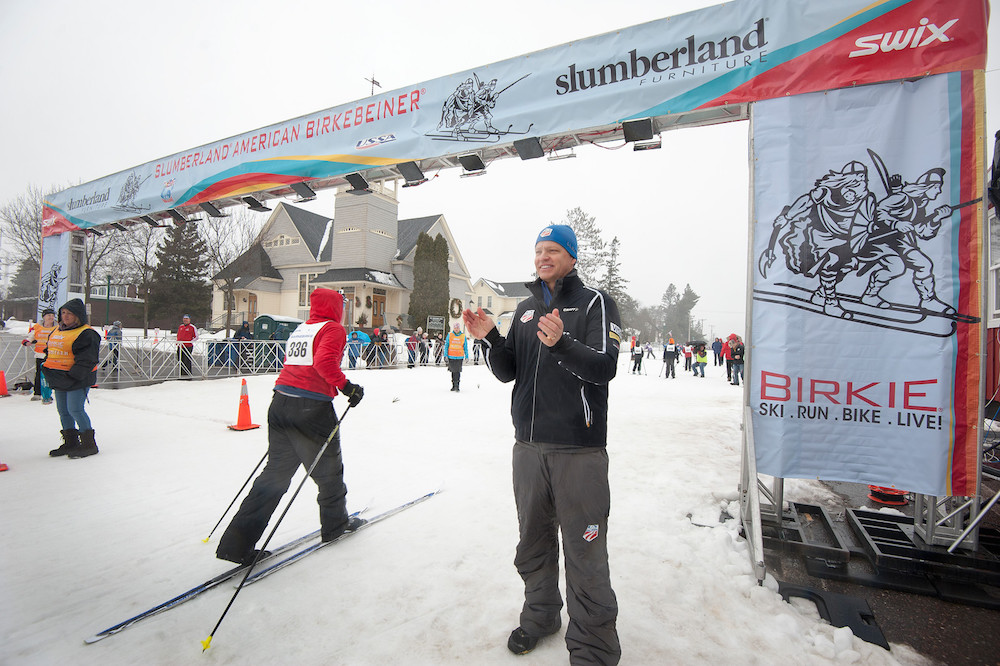
USSA President and CEO Tiger Shaw cheers on kids in the Barnebirkie race during the American Birkebeiner. (Photo: USSA/Tom Kelly)
ZURICH, Switzerland—Tucked at the top of U.S. Ski and Snowboard’s list of proposals for policy changes at the recent International Ski Federation (FIS) Technical Meetings here was this: “Independent Doping Panel.”
The idea was developed along with the Norwegians, who submitted an identical proposal. U.S. Ski and Snowboard President and CEO Tiger Shaw explained that at the moment, FIS decisions made on doping may be made by individuals who also serve other roles in the organization or internationally.
“The idea is just to have a more independent panel at FIS,” Shaw said in an interview before he headed to the FIS Alpine World Cup a few hours away in Sölden, Austria. “What if, for instance, it’s a Russian who is the head of the [doping panel], and we are talking about sanctioning Russia from the Olympics? You can imagine that there would be a sense of conflict of interest there.”
“You cannot let a country compete that has had more than 1,000 people overtly cheating for years, where that has been proven,” Shaw said. “What the hell are we doing? The athletes have to stand up and demand that. Throw the Russians out [as a country], and let their athletes compete if they are clean and they can prove it.”
Strong words. But Shaw’s feelings about the current “soap opera” surrounding Russian doping are symptomatic of broader governance changes that U.S. Ski and Snowboard is seeking in the sporting world.
“FIS is typical as compared to a lot of older European governance bodies,” he said. “The concept of conflicts of interest is somewhat new in the last couple of decades, and in the case of FIS there has been very little done [to address this].”
Indeed, the International Olympic Committee (IOC) only this month required all of its members to sign a commitment to “ethical principles” for the first time. Included in the document was a primer on the correct way to handle conflicts of interest, and it was almost entertainingly basic in the level of information presented.
“Globally, we want to really push a movement to remove the conflicts of interest between anti-doping and sports organizations around the world,” Shaw said. “The conflicts of interests there are rife and absolutely absurd.”
For instance: Gian Franco Kasper, the President of FIS, is also a member of the IOC Executive Board, and was a member of the World Anti-Doping Agency (WADA) Executive Board from 2003-2016. Are the best interests of all three of those organizations always served by the same decision, and it not, then what is one to do?
And so dealing with the Russia situation is task number one. But it’s part of a bigger picture – a picture U.S. Ski Team athletes and coaches have become noticeably more outspoken in interviews and on social media in the last year.
“There are a lot of Europeans within these establishments who are trying to protect the status quo,” he said. “They are not happy with us. We are the obvious ones to point to because we are becoming the loudest. And Trump doesn’t help… [He] makes it easy to say that we’re on a self-serving mission. No, we’re on a sport-saving mission. If other countries aren’t going to step up and be as loud as we are, then we will just get louder.”
Potential Doping Ban for Six Russian Skiers
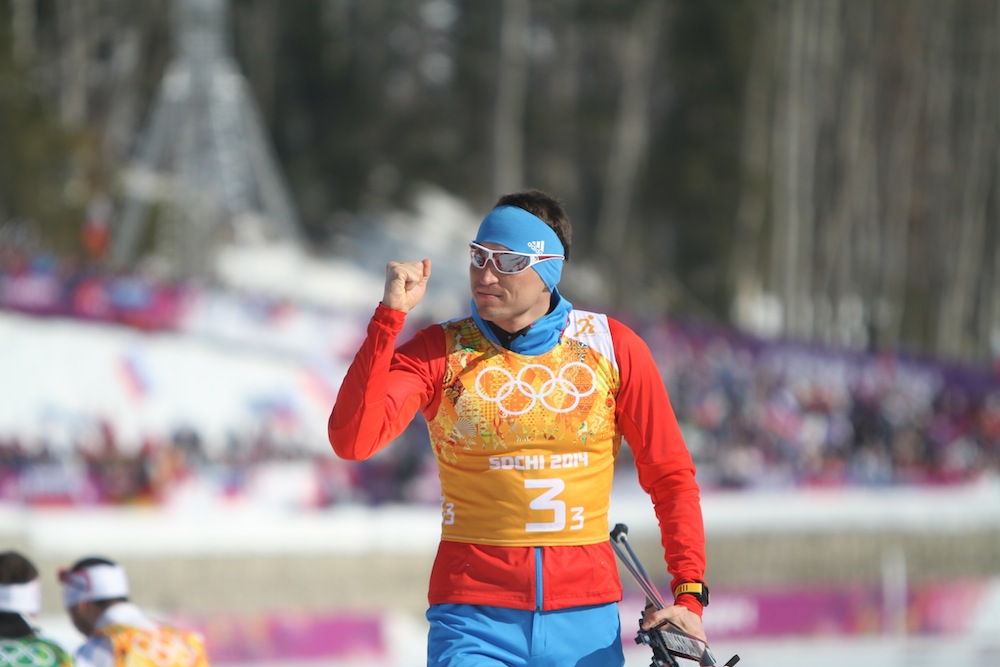
The Court of Arbitration for Sport decided that there was a “reasonable possibility” that Alexander Legkov had doped at the 2014 Olympics. Here, he pumped his fist after Russia won silver in the 4 x 10 k relay, their nation’s first medal in cross-country at the Sochi Olympics.
Shaw believes that there is plenty of evidence in the McLaren Report to justify rule violations brought against the athletes, and questions why FIS hasn’t charged them already.
At the moment, FIS is waiting for the IOC to share information from a disciplinary commission which could add to the evidence in the skiers’ cases. But the delivery date on that information has been pushed back time and time again.
When asked this week whether FIS had received any information from the IOC commission regarding the six Russian athletes, FIS Secretary General Sarah Lewis replied:
“As outlined previously you will need to address this question to the IOC. We made sure the IOC is aware of the dates of the start of the FIS Cross-Country World Cup in late November and as far as we are informed the IOC is aiming to deal with the cases involving athletes under FIS authority before that.’”
When the Court of Arbitration for Sport (CAS) reviewed the provisional suspension of the athletes, and in particular 2014 Olympic gold medalist Alexander Legkov, it signaled that it largely believed the evidence in the McLaren Report and did not buy character assassination against the report’s main source, whistleblower Grigory Rodchenkov.
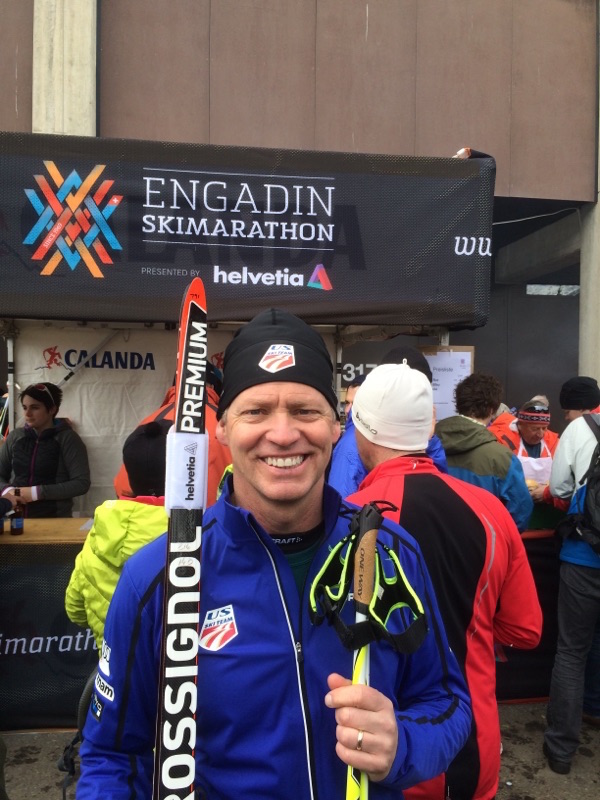
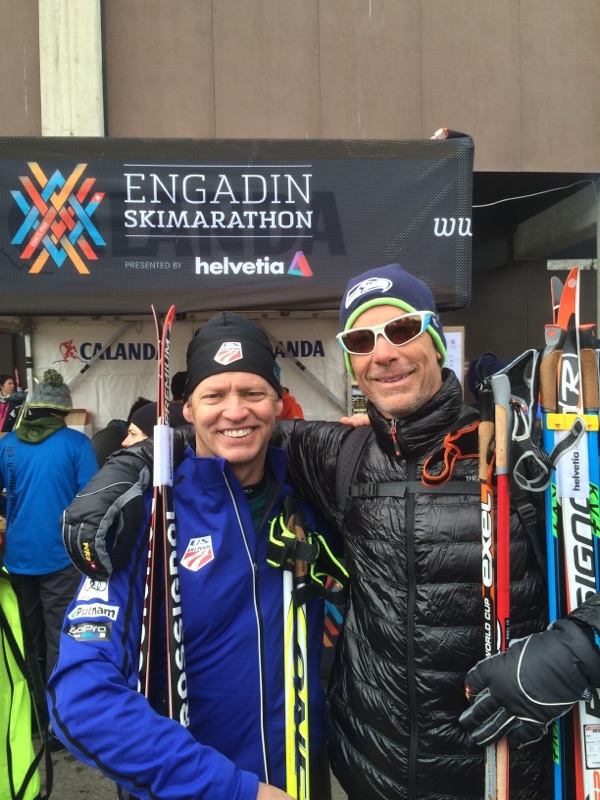
Tiger Shaw (l) and Tony Weiderkehr at the 2016 Engadin Ski Marathon. A former Olympic alpine skier, Shaw has become not only an enthusiastic supporter of U.S. Ski and Snowboard’s cross-country team but also a practitioner himself. (Photo: Fast Big Dog)
“I don’t understand the comment she made to you,” Shaw said of Lewis’s email. “FIS ultimately has to decide whether or not to charge the skiers. So far they have provisionally suspended them, presumably to gather more evidence. It’s logical that FIS is waiting to hear from the [IOC] commissions, because there will be additional evidence in there… [but] CAS, when they reviewed the provisional suspension, said essentially that the information and the evidence in the McLaren report is enough to convict. So you have the appellate body itself saying, we uphold your suspension. You have the evidence, but you have to make a decision.”
Current Investigations and a Broader Russian Ban
What is going on with the IOC commissions, which are taking so long?
The McLaren Report already contained evidence that Russian athletes had been involved in an elaborate sample-swapping scheme at the 2014 Olympics, and email evidence also showed evidence that doping violations were covered up in the years preceding 2014 as well.
Rather than act on that evidence, the IOC commissioned two more committees. One, headed by Denis Oswald, was tasked with looking at the guilt of individual athletes; another, headed by Samuel Schmid, was tasked with looking at the systematic nature of the doping in Russia. Schmid apparently said that he would have his work finished by December – after the winter sports season has already begun.
It has been months since the commissions began their work, and so far nothing has come out of it.
“Look at the Schmid and Oswald Commissions, which the IOC commissioned after the Independent Person report came out, that McLaren wrote,” Shaw said. “The IOC is commissioning more, to re-study what was already studied by an independent person report triggered by WADA, which is a child organization of the IOC. So it’s questioning itself. It has dragged this out for a year now.”
Against this backdrop and inaction, a number of organizations and individuals are nonetheless calling for Russia to be banned from the upcoming 2018 Olympics based on the McLaren Report. Among them are some spectators and athletes, but also 37 national anti-doping agencies (NADO’s), including USADA, the Canadian Centre for Ethics in Sport (CCES), and many others.
By comparison, only 14 NADO’s signed on to a similar statement urging Russia to be banned from the 2016 Olympics in Rio de Janeiro. Feelings on the issue have if anything become stronger since then as the IOC continues not to act.
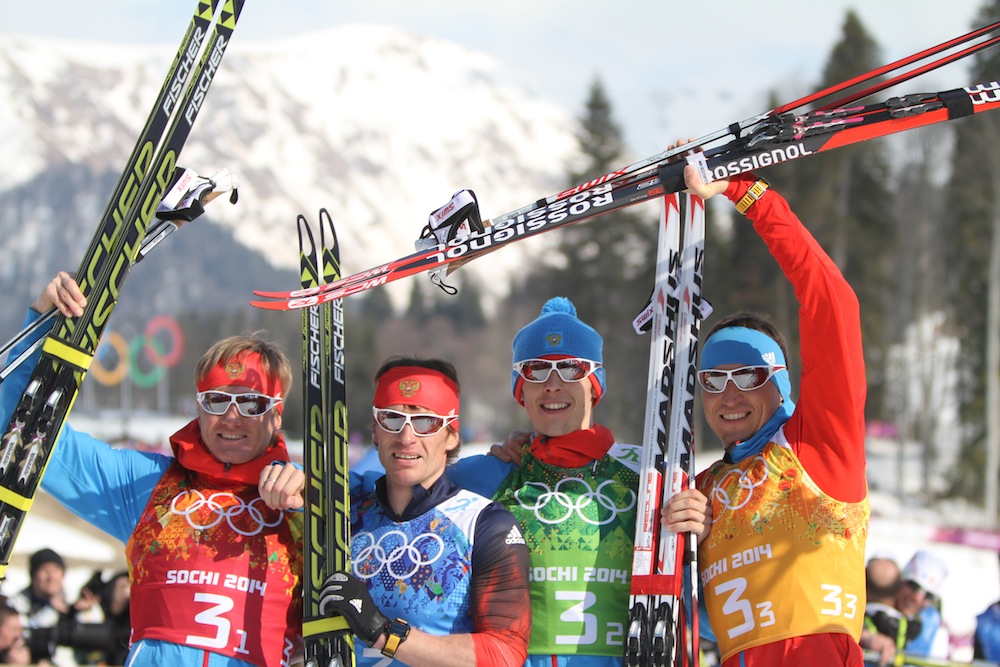
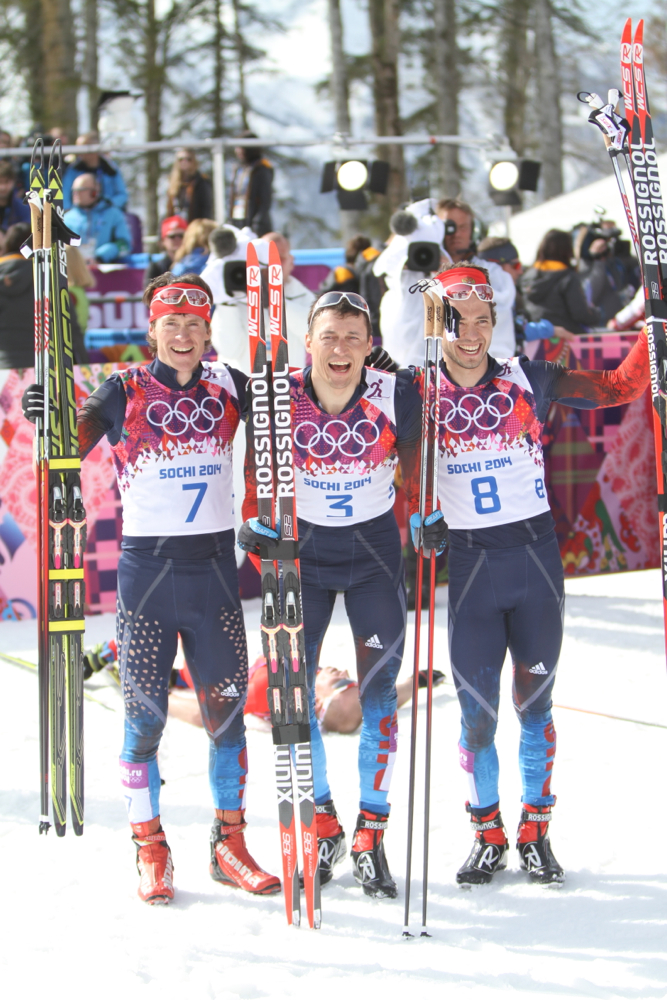
The Russian podium grinning ear-to-ear after Alexander Legkov (3) won gold, Maxim Vylegzhanin (7) earned his third silver in Sochi, and Ilia Chernousov took bronze in the 50 k freestyle mass start, the last race of the 2014 Winter Games. Both Legkov and Vylegzhanin were implicated in the McLaren Report.
Calling for a Russia ban is seen by some as a kneejerk reaction, and an unfair one, but Shaw says that it is grounded in the kinds of statutes his organization and others around the world agree to be bound by.
“They have violated tons of anti-doping rules and FIS statutes,” Shaw said of Russia. “The statutes call for suspending a member federation if they do that, as well as if there are more than four doping convictions in a single year. Well, FIS is heavily pursuing at the moment [six athletes]. All of it ends up in the logical conclusion of FIS sanctioning Russia and excluding them from the season, which also means the Olympics.”
As for potentially innocent athletes caught up in the middle of it, there is a solution.
“There is a compromise that’s possible,” he said. “Suspend Russia, but allow athletes that have been continuously tested outside of competition in the preparation for the Olympics. In cross-country that probably means all summer. If they tested clean, then let them compete under an independent flag.”
That compromise, though, may have expired. Summer is over; athletes have half a training year under their belts and this outside-of-Russia testing and surveillance was never put into place, because decisions were put off about how to deal with Russia.
“Of course because of the general foot-dragging of the IOC, there is no time left,” Shaw said. “Everybody’s backs are up against the wall, unnecessarily, unfortunately, but maybe by design.”
How The System Could Work
“By design” gets at some of those conflicts of interest. Shaw says that the responsibility for investigating, trying, and sanctioning athletes shouldn’t all be housed with FIS and the IOC anyway.
At the moment, there is a mixture of agencies responsible for testing athletes. Each country has (or should have) their own anti-doping agency; in the United States, that’s USADA. Each international sports federation, like FIS, also has to do testing and deal with cases. Then, at the Olympics, all of that responsibility is transferred to the IOC.
In each case, there are conflicts of interest, Shaw says. A country may want to hide positive tests by their star athlete. That’s certainly what Russia did, to a massive extent.
The same is true for international federations.
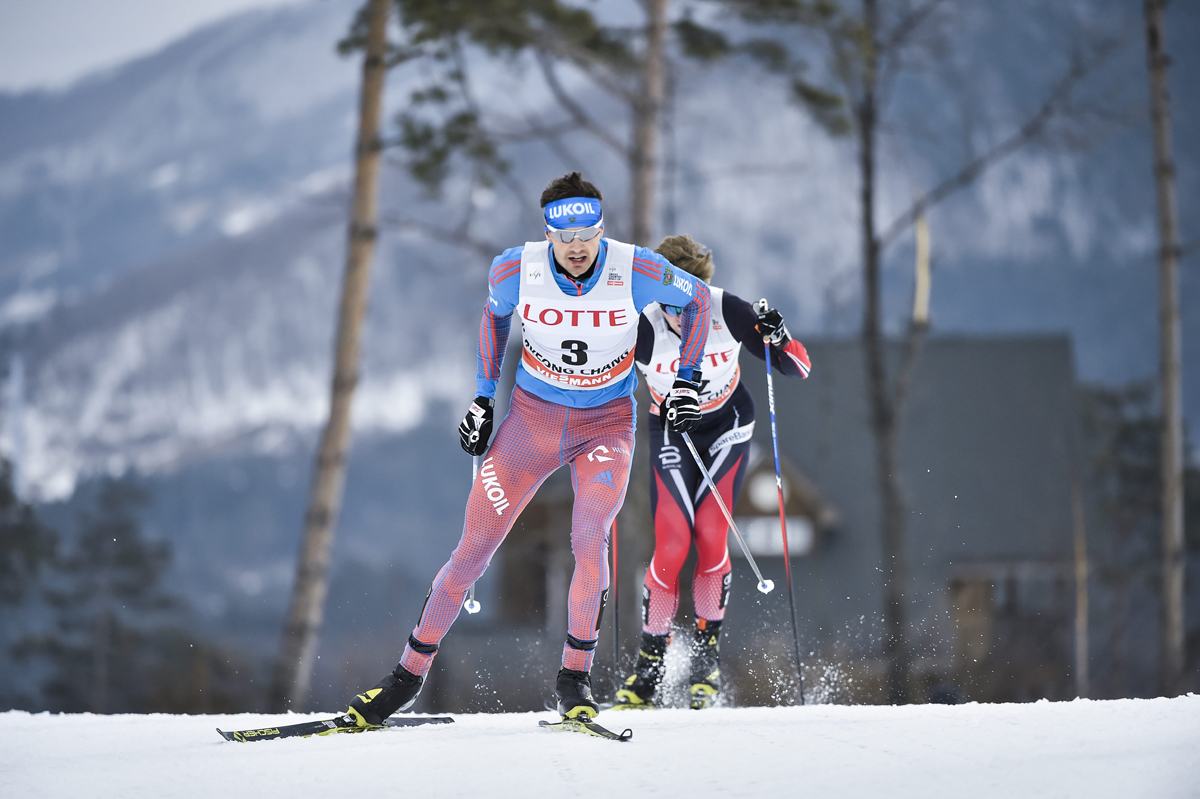
Russia’s Petr Sedov en route to his first non-stage World Cup, in the PyeongChang World Cup 30 k skiathlon in South Korea in 2017. Russia hopes to compete there again at the 2018 Olympics; many are calling for them not to. (Photo: Fischer/NordicFocus)
“What if you look at a smaller [international federation] that might have one super famous athlete,” Shaw said. “It’s going to have a huge economic impact on that federation’s worldwide image and brand [if that athlete fails a doping test]. That tiny federation might have 12 employees. How are they going to deal with this? It’s daunting.”
Then there is the IOC, which has plenty of money and resources, but at the moment is slow as molasses in dealing with its doping scandal.
“[IOC President] Thomas Bach obviously doesn’t want Usain Bolt to be disqualified right before the Rio Games,” Shaw said, using a hypothetical example. “It’s a major conflict of interest, a financial one as well as a moral and branding one. So there has to be a revamp of that whole thing.”
Instead, he asks, imagine how a criminal justice system works.
“You have an independent body that makes the rules – the laws,” he explained. “Then you have an independent agency that enforces them – that’s the cops. This is the ideal, not that it doesn’t get corrupted in the U.S. or anywhere else. Then you have another independent system – the courts. Even within that, you have independent systems where you have a jury of your peers and you have a judge. And then if anyone wants to challenge that you go to a higher court.”
Doping and sports governance is pretty far from that model, with the same organizations often making the rules, investigating cases, and handing out punishments.
“CAS does appear to be reasonably independent, thank God,” Shaw said of the highest court in sports. “But we need a single entity to run each of those other functional roles. We need a body to make anti-doping rules for the world of Olympic sports. Then we need enforcement. There could be multiple levels, but there has to be one body which is really controlling it all and enforcing independence across all of that… So the WADA-[national anti-doping agency] arrangement is not bad, but it’s politically screwed up. We need to fix that.”
Under such an arrangement, international sports federations could drop much of their anti-doping programs and focus merely on enforcing decisions made by other bodies. That would allow them make strategic plans for growth of their sports, something Shaw sees as sorely lacking in many international federations.
“Hopefully in the future, all the federations pay into a pool, and someone else takes care of it,” Shaw said. “And then you can focus on your sport and your brand. Hopefully that’s not a dream.”
Nuts and Bolts
So how does the dream become reality?
“You get excited about change and you think it can happen soon,” he said of U.S. Ski and Snowboard’s proposed reforms. “And then you run smack into political stalling. We see this happen at our level – you are trying to argue the merits of a position with one of our counterparts from another country. They say they agree but they aren’t going to do anything about it. It’s the most deflating thing you can run into.”
Regarding the situation with Russia, for instance, Shaw said that few other national ski federations are outspoken about the issues.
“They are confused and choosing not to study this closely, or do much about it,” he said. “And that’s simply because of the control exerted over them… You can’t have a council member of an international federation saying that they aren’t going to do anything about it because they are worried about re-election and angering the leadership. That is not leadership.”
Shaw is not alone in becoming a loud voice in the arguments over doping. Max Cobb, the President of the United States Biathlon Association and an Executive Board member at the International Biathlon Union, is also a vocal proponent of clean sport. Scott Blackmun, the CEO of the U.S. Olympic Committee, recently said that “at some point, justice delayed is justice denied, and we are fast approaching that point” regarding the Russia scandal. USADA CEO Travis Tygart has long been a vocal leader in the NADO community.
All of that means that the U.S. is sometimes framed as a bully on the issue, including in the ski world.
“There are a number of people and countries who love to say, the U.S. is trying to get Russia thrown out so they can win more medals,” Shaw said. “We want the [clean] athletes to be able to compete, but yes, we want Russia thrown out. So do 36 other countries. 36 other anti-doping organizations have called for this. What more of a majority do you need?”
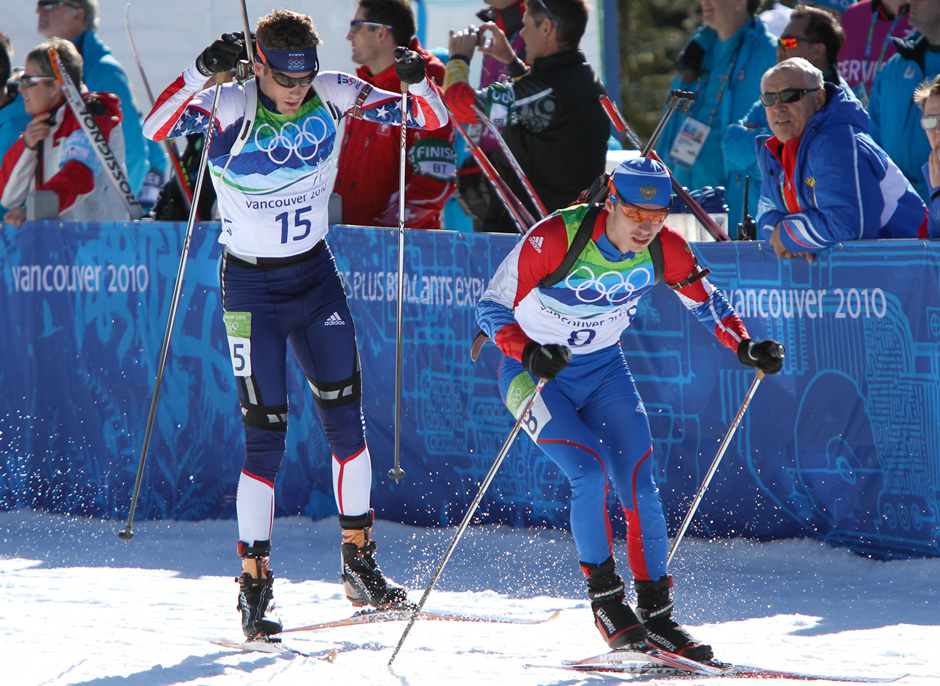
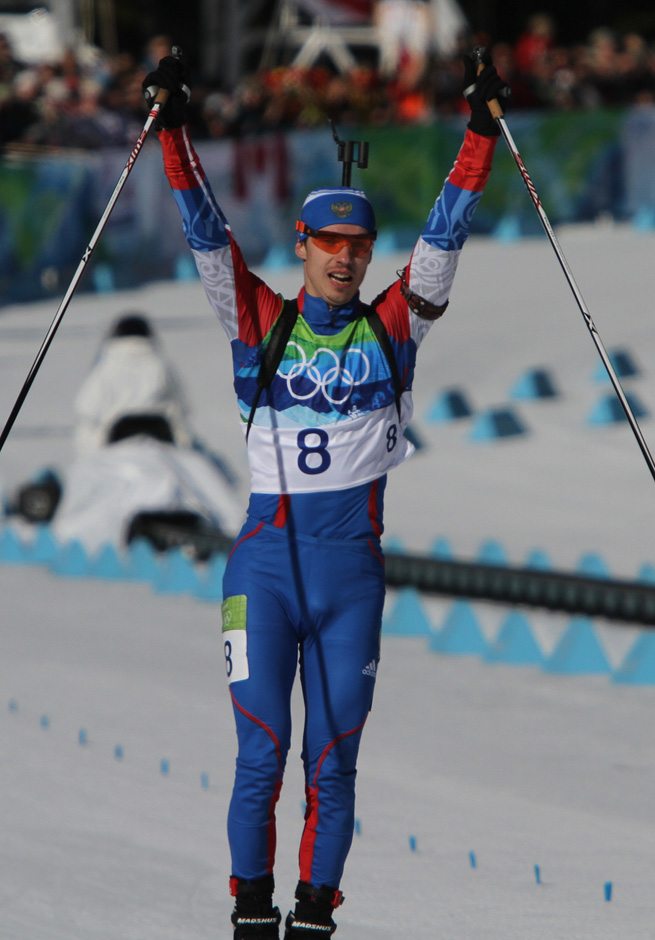
Evgeniy Ustyugov of Russia celebrates his victory in the 15 k biathlon mass start in the 2010 Olympics in Vancouver, Canada.
As the extent of the doping scandal enveloping Russian sports grows larger, competition at the 2010 Olympic Games in Vancouver, Canada, may also be tarnished.
More questions are also being raised about why the Moscow anti-doping laboratory was accredited to do testing during the 2014 Olympics despite warnings from a whistleblower that the government agencies were interfering with anti-doping work.
And criticism is growing of they way that the World Anti-Doping Agency (WADA) interacted with whistleblowers, and why the organization did not start an official investigation the claims originally brought to them in 2010 until five years later, in 2015.
Vancouver Olympic Results in Peril?
In an article in the Washington Post on Thursday, it was revealed that whistleblower Vitaliy Stepanov – at that time working for the Russian Anti-Doping Agency, RUSADA – initially met with WADA representatives at the 2010 Winter Olympic Games in Vancouver.
Stepanov has been in the news since his evidence was used in a German documentary in December 2014. But there has been little mention until now that he first acted in Vancouver, or that the information he brought was relevant to those Games.
Earlier this spring, another whistleblower had told the New York Times that staff at the anti-doping laboratory at the 2014 Olympics in Sochi, Russia, had manipulated samples belonging to many Russian athletes including 14 cross-country skiers.
That whistleblower, Grigoriy Rodchenkov, was the head of RUSADA’s testing laboratory in Moscow at the time. Because those Games were in Russia, state security officers of the FSB were able to infiltrate the anti-doping laboratory – an allegation which was also mentioned back in November in the WADA Independent Commission’s first report. Rodchenkov said that he colluded with the FSB agents to replace “dirty” samples with “clean” ones and help Russian athletes avoid doping bans.
The 2010 Olympics were not in Russia, and the anti-doping laboratory used at those Games was not, so far, alleged to have been corrupted in the same way.
Instead, with regards to Vancouver, Stepanov had a similar story to that which he presented regarding track and field from the very first German documentary: that star athletes were not tested enough or that their positive tests could be made to disappear.
He said that he had spoken to a colleague about a list of athletes whom RUSADA was forbidden to test in the leadup to the Games, effectively protecting them from anti-doping activities while Russia.
The Washington Post reported that this list had been sent to the laboratory from the government Ministry of Sport.
Vitaly Mutko, the Russian Minister of Sport, is now being personally dragged into the doping scandal. In a new documentary to air on Wednesday evening, ARD will allege that Mutko helped hide the positive test of a top Russian soccer player.
The Ministry of Sport said that it “firmly rejects the allegation that it has failed to take the necessary steps to reform its anti-doping operations”, according to The Guardian.
While a “no-test list” leading up to the 2010 Olympics would have protected athletes who were at home in Russia to a large extent, it would not have necessarily affected testing programs managed by international federations.
Indeed, Russian athletes were caught doping and suspended by the International Ski Federation and the International Biathlon Union in the leadup to the 2010 Olympics. That included Yuliya Tchepalova, a prior three-time Olympic gold medalist skier; 2006 Olympic gold medalist Evgeny Dementiev; biathlon World Champion Ekaterina Iourieva; and Olympic biathlon relay gold medalist Albina Akhatova.
What About Winter Sports?
In a recent press release, the International Olympic Committee (IOC) stated that its Executive Board had pledged more money and resources towards anti-doping investigations before the Summer Olympics take place in Rio de Janerio, Brazil, in August.
A subset of anti-doping samples from the 2012 and 2008 Summer Olympics have already been re-tested using new and improved methods. 31 new positive tests were revealed from the 2008 Olympics, and 23 from the 2012 Olympics.
Samples from the 2014 Olympics are reportedly in the midst of being analyzed, although no results have been reported. On Friday, Time magazine published a story based on a visit to the Moscow laboratory, reporting that the 9,000 or so samples from the Sochi Olympics are still sitting in refrigerators there. This would suggest that re-testing has not yet begun.
In addition, the reporters saw a refrigerator with what acting lab director Marina Dikunets described as 40 positive samples from Sochi. There was a chain around the fridge and a large padlock, the key to which she claimed nobody knew the location.
If true, this certainly suggests that there are more positive tests from the 2014 Games, as only eight athletes were kicked out of the Sochi Olympics for doping.
Neither the IOC nor WADA have mentioned the possibility of re-testing samples from the 2010 Games. Samples from the 2006 Olympics in Torino, Italy, meanwhile have been re-analyzed – but results are not discussed publicly.
There have long been rumors that Estonian cross-country skier Kristina Smigun was snagged by that re-testing program, with the Estonian Olympic Committee telling Norway’s TV2 that they had been notified of a positive test in 2013. However, the International Ski Federation, WADA, the Estonian Ski Federation, and the Estonian Anti-Doping Association all said that the matter was in the hands of the IOC, which has been silent on the issue other than to say that there were many lawyers involved.
Thus while the IOC is hustling to expedite proceedings against athletes who could potentially compete this summer in Rio de Janeiro, progress in finding and prosecuting past dopers is moving much more slowly for winter sports.
People are noticing.
“The IOC last month sped-up their release of results from the Beijing 2008 and London 2012 re-tests in order to detract from negative doping stories surrounding Sochi 2014,” Olympic sports commentator Nick Butler wrote on Inside The Games on Monday.
The Sochi Laboratory
Meanwhile, information from Stepanov is increasingly drawing into question why WADA approved the Sochi anti-doping laboratory – a satellite of the Moscow laboratory – to handle testing at the 2014 Olympics.
In November, 2013, WADA had put the Moscow laboratory (and by association its Sochi satellite) on probation.
WADA leadership instead decided to effectively put the lab on probation, asking them to hire independent quality management experts immediately and to address the Disciplinary Committee’s concerns by April 1, at which point the Sochi Olympics had already happened. Thus the samples from the Olympics were tested by the Sochi laboratory after all.
In an interview in The Guardian last week, WADA Director General David Howman implied that he wanted to have the laboratory suspended, but that a committee decision – likely referring to WADA’s Executive Committee, not the Disciplinary Committee – prevented that.
“We thought the lab would lose its accreditation,” Howman said. “It didn’t.”
However, it’s now certain that even at that time, Stepanov – the whistleblower – had been speaking with WADA directly about shortcomings, government influence, and corruption in the Moscow laboratory.
There were other reasons that WADA likely wanted to keep the laboratory accredited for the Olympics, namely convenience.
“It is logistically a nightmare to think about either bringing in lab equipment from somewhere else to set up at the Games in Russia, or to export the samples,” said Max Cobb, the U.S. Biathlon Association CEO who served as the Technical Delegate for the Olympic biathlon competitions in Sochi. “I can imagine that neither one of those prospects was very appealing for the IOC or WADA. So there definitely was a rationale there.”
Still, Cobb questioned how that decision could have been taken given information that Stepanov had shared in three in-person meetings and hundred of emails to WADA at that point in time.
“Reading the recent media reports on WADA’s response to Stepanov’s whistleblowing, and the Daily Mail’s July 6, 2013 story on systematic doping and cover-ups by the Moscow lab, it’s difficult to understand how WADA’s committee did not decertify the lab at their fall meeting in 2013,” Cobb wrote in an email. “Did WADA inform the committee about Stepanov’s whistleblowing? If they did, it’s hard to understand the decision. If WADA didn’t, why [not]?”
In general, WADA’s dealings with Stepanov and his wife, Yuliya – a former athlete who began recording dealings with coaches, doctors, and officials to help bring light to the doping crisis – are increasingly being brought into question.
After years of sending information to WADA and seeing no progress towards an investigation, Stepanov was beginning to wonder if his efforts had any point.
“I saw that my wife, everyone who was inside the Russian system, they were right,” he told the Washington Post. “There was no doping fighting. It is just politics.”
Eventually, WADA Chief Investigative Officer Jack Robertson referred Stepanov to German journalist Hajo Seppelt in 2014. Seppelt’s work focusing on Russian track and field led WADA to do its first investigative report, issued in November 2015.
Robertson hasn’t commented on the organization’s treatment of whistleblowers. In explaining why there was no investigation in the first five years when Stepanov was in contact with the agency, WADA officials have repeatedly stated that not until a new World Anti-Doping Code was put in place in 2015 did they have investigative powers.
Olivier Niggli will soon take over Director General duties from Howman and recently told Reuters that according to the 2009 Code, which was in place for five years, the agency’s hands were tied in terms of gathering information on their own.
“We could not get more evidence on our own and passing it onto the Russians was not an option,” said Niggli. “We were prudent, we were very careful about moving forward at a pace, that now might seem too slow.”
“In simple terms, it came down to the fact that we, as an organization, didn’t have any investigative powers,” WADA spokesman Ben Nichols told the Washington Post.
However, the 2009 Code does not seem to explicitly prohibit investigations; quite the opposite.
In section 20.7, “Roles and Responsibilies of WADA,” the 2009 Code states that WADA must “conduct Doping Controls as authorized by other Anti-Doping Organizations and to cooperate with relevant national and international organizations and agencies, including but not limited to, facilitating inquiries and investigations.”
That phrase, “not limited to”, suggests that if WADA were to see the need to investigate, it would have the authority to do so.
“WADA’s foot-dragging has raised serious questions about the agency’s willingness to do its job,” U.S. Anti-Doping Agency CEO Travis Tygart wrote in an editorial in the New York Times in May.
So what happens next? The IOC has set aside additional funding for anti-doping efforts leading up to Rio de Janeiro. And WADA as appointed Professor Richard McLaren to head its independent commission looking into the Sochi scandal.
“It’s obviously a good sign that more resources are being put toward ensuring clean and safe sport,” Cobb, the U.S. Biathlon Association CEO, said. “So that is needed. WADA is desperately underfunded. I’m not convinced that the underfunding was the problem when it comes to errors in judgment that were made around the naming of the Sochi lab. But more effort being made is very positive news.”
In a new investigation by CBS news, Vitaly Stepanov has alleged that four Russian athletes who won gold medals at the 2014 Winter Olympics were using steroids.
Stepanov and his wife Yuliya initially came forward to German journalist Hajo Seppelt and revealed extensive state-sponsored doping within Russian track and field. That led to an investigation by the World Anti-Doping Agency (WADA), confirming the allegations as true. Rampant systematic doping within Russian track and field led to the team being barred from international competition for the foreseeable future.
In WADA’s report, released in November, the commission briefly touched on winter sports. For instance, they wrote that the Russian state security agency FSB was present in the anti-doping laboratory at the Sochi Olympics. However, despite a broad mandate to investigate doping in sports, that commission stuck almost exclusively to Russian track and field while at the same time acknowledging that the problems extended into other sports.
The CBS news story appears to go farther. Besides turning additional focus on the Russian track and field program – which is at risk of being barred from competition at the upcoming summer Olympic Games in Rio de Janeiro, Brazil – it also delved further into conversations that Stepanov had with others in the Russian Anti-Doping Agency, RUSADA.
For instance, Stepanov recorded Skype conversations in which Grigory Rodchenkov, the former head of Russia’s anti-doping laboratory, who told him of a list of athletes he had protected from positive samples, including four Sochi gold medalists. He appears to be referring to steroid use.
Then there was this: “FSB tried to control every single step of the anti-doping process in Sochi,” Stepanov said.
Rodchenkov is now exiled in the United States as well.
As for who the four medalists could be, there are 26 gold medalists from 13 events, with some athletes earning more than one gold. They are:
Evgeni Plushenko – Figure skating team trophy
Yulia Lipnitskaya – Figure skating team trophy
Tatiana Volosozhar – Figure skating team trophy & pairs skating
Maxim Trankov – Figure skating team trophy & pairs skating
Ksenia Stolbova – Figure skating team trophy
Fedor Klimov – Figure skating team trophy
Ekaterina Bobrova – Figure skating team trophy
Dmitri Soloviev – Figure skating team trophy
Elena Ilinykh – Figure skating team trophy
Nikita Katsalapov – Figure skating team trophy
Adelina Sotnikova – Figure skating ladies’ single
Alexey Volkov – Biathlon men’s 4 x 7.5 k relay
Evgeny Ustyugov – Biathlon men’s 4 x 7.5 k relay
Dmitry Malyshko – Biathlon men’s 4 x 7.5 k relay
Anton Shipulin – Biathlon men’s 4 x 7.5 k relay
Alexandr Zubkov – Bobsled 2-man & 4-man
Alexey Voyevoda – Bobsled 2-man & 4-man
Dmitry Trunenkov – Bobsled 4-man
Alexey Negodaylo – Bobsled 4-man
Alexander Legkov – Cross-country skiing men’s 50 k
Viktor Ahn – Short-track speed skating men’s 1000 meters, 500 meters, & 5000 meter relay
Semion Elistratov – Short-track speed skating men’s 5000 meter relay
Vladimir Grigorev – Short-track speed skating men’s 5000 meter relay
Ruslan Zakharov – Short-track speed skating men’s 5000 meter relay
“All his so-called revelations are based on speculations and are being actively distributed,” Russian sports minister Vitaly Mutko told the TASS news agency of Stepanov’s claims. “The Olympics in Sochi have ended a long time ago. [It was] not Russia collected doping tests then [but the IOC], and everything was held under very strict control. I don’t know whether we should endlessly refute Stepanov’s (claims). We will see if there are any legal risks for us, we will think about defense… It is obvious that someone wants to harm Russian sports. Stepanov has exhausted the topic of doping in athletics, now he has probably started with the Sochi Olympics.”
If confirmed, the allegations will be yet another instance of journalists uncovering scandals that WADA itself failed to detect. In this case, the WADA commission would have had the opportunity to include Sochi results in its investigations, but apparently chose not to.
“We will watch the program with interest,” WADA spokesman Ben Nichols told Reuters. “We will not comment further until we have viewed the program in full.”
This revelation was a teaser for longer programs by CBS this weekend, which may reveal further information about winter sports. The interviews with the Stepanovs will be broadcast on 60 Minutes Sunday, May 8 at 7 p.m. ET/PT, and another excerpt will be included on the CBS Evening News at 6:30 p.m. ET/PT.
Noah Hoffman two days before his first race at his first Olympics in Krasnaya Polyana near Sochi, Russia. (Photo: NoahHoffman.com)
A week ago, Noah Hoffman was in Toblach, Italy, nearly 3,000 kilometers away from the site of the 2014 Winter Olympics in Sochi, Russia, resting up and recouping for one last weekend of World Cup racing.
After his last pre-Olympic race on Feb. 1, the 24-year-old Aspen, Colo., native would have seven days to gear up for his first Games. One of seven Olympic rookies on the U.S. cross-country team’s 14-athlete roster (along with Erik Bjornsen, Sadie Bjornsen, Sophie Caldwell, Jessie Diggins, Ida Sargent, and Brian Gregg), Hoffman wasn’t alone in the nuance and whirlwind of the massive leadup, which intensified after the athletes flew to Munich on Monday for processing, where they received their credentials and uniforms.
“Uniforming was like shopping in a giant apartment store with really helpful employees where everything was free and you can’t say no,” Hoffman wrote on his blog. “We were handed checklists of all the stations we had to visit, and we could go in any order we liked. The whole thing was in a big warehouse.” The next day, the team arrived in Russia.
FasterSkier caught up with Hoffman, of Ski & Snowboard Club Vail/Team HomeGrown, on Jan. 30 to talk about everything from his training to his mentality and goals before the Olympics. Hoffman plans to compete in four events: the 30-kilometer skiathlon, 15 k classic individual start, 4 x 10 k relay, and 50 k freestyle, respectively.
Noah Hoffman (r) chases the the overall World Cup leader, Martin Johnsrud Sundby of Norway, during training at the 2014 Winter Olympics at the Laura cross-country center on Friday in Krasnaya Polyana near Sochi, Russia. “I tucked by him going at least 30 mph,” Hoffman wrote on his blog. (Photo: NoahHoffman.com)
FasterSkier:So the taper has begun?
Noah Hoffman: Oh yeah, I’ve hardly trained at all. I took the last two days off and today [last Thursday] I think I skied for 30 minutes. It is definitely that time of year.
FS:How does that feel? Are you restless?
NH: I’m pretty restless, for sure. I’m glad to be out of Seiser Alm [Italy] because there was not a lot going on up there. It was actually a tough place to be tapering, but it would be a great place to train five hours a day and be really tired when all you want to do is eat, sleep and ski, but when you don’t have much going on I was struggling to stay happy just because there was so little to do and so little going on.
FS: When did the Olympics start to feel real?
NH: I read a bunch of stuff to get psyched about the Games. Until then I’d been stockpiling it and putting it off to the side. I went through and looked at the maps of the villages … and it’s coming right up … it’s crazy.
FS: How are you keeping nerves in check?
NH: Honestly, I don’t feel like getting too excited has been an issue for me. Like I said, I was dealing with staying happy in Seiser Alm which means that I wasn’t worrying. I was being a little more introspective. I honestly haven’t been that focused on the Games. I’ve been working on a little trip I’m taking after the Games, like a little vacation. Looking beyond them has helped a little bit in terms of not taking them totally out of proportion in my own mind. I think that the best thing I can do is treat them as another race, because I give it my all in every race. I just need to go there and execute my plan. The reason I should ski better in these races is because my training plan is tailored to them, not because I do anything different once I’m on the start line.
FS:How do you feel about where you’re at?
NH: It’s up and down, as always. There are many, many races that I wish I had back. There are some races where I just didn’t have it, but the true standouts: the best time of the day in the last race of the Kuusamo Triple and the second-best time of the day in the point-to-point race in the Tour. Those are really high, highs, those are better races than I anticipated coming into this season. It gives me a ton of confidence, especially in my skate skiing. I continue to be frustrated in my classic skiing and I believe I’m a better classic skier than I’ve shown this year. But I’m really excited about my skate skiing, and I think it’s an indicator that my fitness is really good and that the work that I did through my surgery last spring was really good, and that the work that I’ve done with Zach Caldwell on my skate technique has gone really well.
I’m really excited to take confidence in the process because I have clear indicators that it’s going in the right direction and I really believe that anytime I’m on the start line I can be top-10 in the World Cup, which is something that I have not had in the past. I haven’t had a really disappointing skate race all season. There haven’t been that many skate races … There’s basically been three: two that I was top three in and the one in Davos where I was good, but not great. And so there’s a lot of skating coming up in the Olympics, the second half of the [skiathlon] pursuit next week and then the 50 k and I’ll probably do a skate leg of the relay. I feel like I’m on track in my goals being among the best skiers in the world in a couple of years.
FS: Which of those events are you most focused on?
NH: [The skiathlon and 50 k skate] bookend the games; they’re two weeks apart. I am confident in my classic skiing. I feel like it’s not that far away and I believe I can easily stay with the group through the classic portion of that skiathlon, and then it just becomes a mass start skate race. At that point, I’ve proven this year that I’m one of the best skaters in the world and I think that’s a really, really good opportunity for me. And then of course the 50 k skate is on the hardest course in the world, it’s a long distance race, it’s at a little bit of altitude [around 6,000 feet], all of which plays right to my strengths. That is gonna be an amazing experience and I’m really looking forward to that race. I feel like the 15k classic; I can accomplish other goals in that race. I have an outside chance at a medal in the two mass start races but not in the classic race. A top 15 or top 20 result is very achievable in that race and if I achieve something along those lines I’ll be very happy.
FS: How did prequalifying for the Olympics affect your confidence?
NH: I was happy with my results last season, and going into this season, making the Olympic team was never on my mind. Not making the Olympic team would have been a step in the wrong direction. That probably would have made me question my sole focus on skiing and so I’ve really just been looking forward. Doing well in Sochi was always a step towards my bigger career goals. It’s really nice to be in that position, but there is still a long, long way to go to accomplish my goals, and so I’m just looking forward.
FS:How has it been being the lone distance guy on the team for most of the season, until now?
NH: I like to train by myself anyway and I have a lot of faith and trust in my personal coaches and I really believe that working with them, especially working with [1992 Olympian] John Callahan out of Aspen has been critical to my success. So I think it would actually be more challenging if I were on a team with more really high-end distance skiers because I would feel definitely torn – do we want to train more in a German style as a big group and really push each other, or do we want to train more in a Norwegian style and hope that we all each do well independently? And so I’m not really left with that choice, but I think that doing it independently is my choice anyway.
Having guys like Newell and Simi on the team is really, really good for me to be able to work on my weaknesses and I can learn a ton from them and I respect them and their skiing immensely and I really enjoy spending time around them as well, but I think that not having them be directly competitive with me in most races and having them be on slightly different schedules works really well and is a really nice balance. I’m looking forward to having more distance guys in the future to push me, you know having Erik Bjornsen and Brian Gregg and of course [Kris] Freeman who’s been a mentor for me on the distance side of things. Really important to have those guys around for me I can learn a lot from them also.
FS: And your parents will be watching you at the Olympics from home?
NH: They came to the last few days of the Tour de Ski and we took a little vacation afterwards, but it was just a little too expensive and a little too logistically challenging to get to Sochi. They’re very excited to be able to follow it from home and I think NBC is gonna have good coverage.
Also on his blog, Hoffman confirmed Friday that he would walk in the Opening Ceremony, two days before his first race and the eve of the women’s 15 k skiathlon.
“I decided to attend, and I’m really excited. I am going to return on the early shuttle departing after we walk in,” he wrote. “I’m bummed to miss the show, but I’m hoping to be in bed by midnight. The bus that stays for the whole ceremony is scheduled to return at three in the morning.”
Todd Lodwick (U.S. Nordic Combined) after a strong jumping in the team competition at the 2010 Winter Olympics in Vancouver, B.C., where Lodwick helped the U.S. win silver.
In 20 years of competing internationally, Todd Lodwick never had anything like this happen to him.
The risk was inherently always there, hitting the big jumps at speeds around 90 kilometers per hour, but the U.S. Nordic Combined veteran had essentially been lucky — and he still was despite crashing hard in a provisional jump on Jan. 10 at the World Cup in Chaux-Neuve, France.
The 37-year-old from Steamboat Springs, Colo., didn’t hit his head and remained conscious throughout, feeling no pain initially but realizing something was very wrong after hearing a crack and sliding down to the bottom, where he did a “10-point check” of his body. There, he discovered he couldn’t move his left arm high above his head.
First responders put the dislocated shoulder back into place, and that’s when the pain set in.
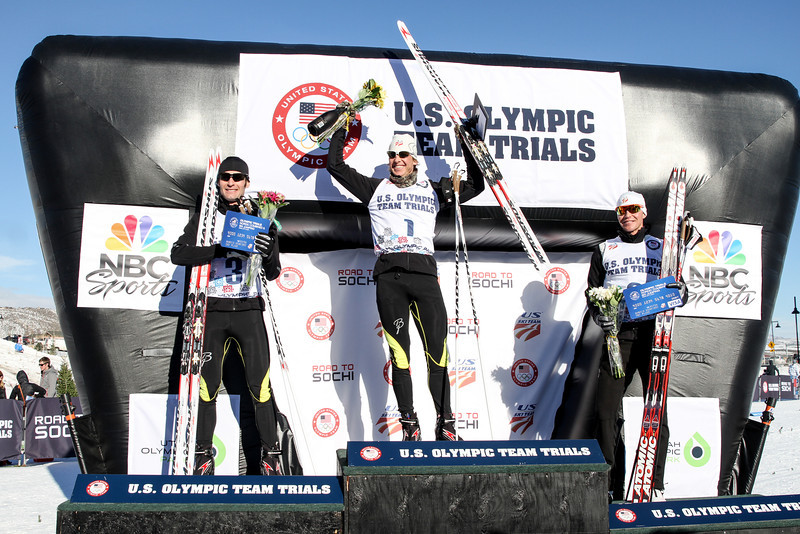
Todd Lodwick (c) tops the podium at the 2014 U.S. Nordic Combined Olympic Team Trials on Dec. 28 in Park City, Utah, with teammates Bryan Fletcher (l) in second, and Billy Demong in third. (Photo: Sarah Brunson/U.S. Ski Team)
“I was kind of numb,” Lodwick said on the phone while icing his shoulder between training sessions on Tuesday. “Your mind goes in a million directions.”
The medical attention he received was “brilliant,” Lodwick said. “[They] made sure I got the best care possible.”
Understanding he wasn’t going to compete the next day and needed to get his shoulder fully evaluated, Lodwick flew out Saturday morning to the U.S. Ski Team’s headquarters in Park City, Utah. He received an MRI that night, which revealed he had strained tendons and muscles as well as dislocated his left shoulder.
He was instructed to immobilize it for 2 1/2 weeks — four weeks before the 2014 Winter Olympics kick off in Sochi, Russia.
“It’s bad timing, but I feel very much in good hands with the staff and friends and family and support here in Park City and at home,” Lodwick said.
After hiking on the treadmill on Monday, he did intervals Tuesday morning and planned to train that afternoon.
“I’m just excited for each day to come and for the training to commence,” he said of resuming his pre-Olympic regimen.
While he was disappointed to miss out on this weekend’s World Cup in Seefeld, Austria, Lodwick said he was “taking it day by day” and listening his doctors’ recommendations. That will also dictate when he heads back overseas.
Fortunately, he said he’s not on major pain medication and is able to sleep through the night. And he can have piece of mind, knowing he prequalified for his sixth Olympics — the most of any American Winter Olympian — after winning the U.S. Nordic Combined Olympic Trials on Dec. 28 in Park City.
He described the incident as “one of those fluky things that happens in ski jumping,” adding that it won’t affect his confidence on the hill.
“I’m a veteran of the sport, and like I said, it’s the first time I’ve ever had an accident like this,” Lodwick said. “I know what it takes to get myself back in shape and hopefully back from this injury. … I’ve kind of got the reputation of the indestructible man.”
Pointing to the strength of the U.S. team, Lodwick added, “I have every intention of being part of that team. It’s going to be a privilege to walk in the Opening Ceremony, should I have the chance.”
“We have every intention of him competing in Sochi,” U.S. Head Coach Dave Jarrett wrote in an email.
“I’m a firm believer that things happen in life for a reason,” Lodwick explained. “How the cookie crumbles, we’re going to move forward with every intention to go to the Olympic Games.”
U.S. Ski Team (USST) member Sophie Caldwell races to the fastest qualifying time in the new USST World Cup suit at the Frozen Thunder classic sprint on Oct. 24 in Canmore, Alberta. While the team has yet to unveil it’s Olympic suits, some element of pink is a good guess for the women — and not because it’s girly.
The United States Olympic Team will wear gear designed by fashion mogul Ralph Lauren for the opening and closing ceremonies of the 2014 Sochi Winter Olympic games.
What’s more, the uniforms worn during the ceremonies will bear the ‘Made in the USA’ label. That decision is at least partly in response to flak from Congress last year after it was discovered apparel worn by U.S. athletes during the 2012 London Summer Olympic ceremonies was actually made in China.
The uniforms include heavy blue pea coats with a wide red stripe around the bottom, sweaters with woven reindeer prancing across the front, and heavy black hiking boots complete with fire engine red laces. The entire ensemble looks as if a yacht club and a bunch of alpine climbers got together for a clothing swap.
But there’s still no word on what U.S. Nordic skiers athletes will wear in competition. The U.S. men’s hockey team released photos of their jerseys last month. Manufactured by Nike, the jerseys are as one might expected: red, white and blue, with USA emblazoned across the front and stars covering the shoulders. It’s unclear where they are being manufactured and they received only lukewarm reviews, with more than one source referring to the detailing as nothing more than “gimmicky crap.”
According to USA Today, the Canadian men’s hockey players are more than pleased with their jerseys, also made by Nike and complete with the same kind of “gimmicky crap,” plus wing-like maple leaves on the shoulders.
The entire ensemble looks as if a yacht club and a bunch of alpine climbers got together for a clothing swap.
But mum is the word on suits for U.S. cross-country skiers and biathletes.
Andy Newell of the USST clocking the fastest time in the Frozen Thunder classic sprint qualifier on Oct. 24. He went on to place second in his new World Cup suit.
“I’m not certain if I’m allowed to comment on the Olympic suits and honestly, I haven’t seen them yet,” U.S. Ski Team Olympic hopeful Holly Brooks wrote in an email.
It’s safe to say the suits are likely to involve spandex.
“I know they will be a play on what we already have with a ‘patriotic flare.’ Let’s just say that,” she added.
Margo Christiansen, U.S. Ski and Snowboard Association (USSA) communications director, wrote in an email that “athletes haven’t been issued the Olympic uniforms yet. We need to get through qualifying the team first!”
While other sports like luge have unveiled their race-day outfits for both the men and women and the U.S. bobsled teams have given at least a sneak peak, those of the nordic skiers remain a mystery.
“We’re currently working with the manufacturer to get a better understanding of timing,” Christiansen wrote.
“[That’s] the World Cup uniform. They will receive a totally different suit and design for Sochi.” — Margo Christiansen, USSA communication director on the U.S. Nordic Ski Team’s recently revealed suits
One thing is for sure: the suits that debuted at the Frozen Thunder Classic last month in Canmore, Alberta, were the U.S. Ski Team’s new World Cup suits. “The girls have pink accents and the guys have blue accents,” Christiansen confirmed.
There has also been mention of neon orange. Christiansen clarified a few details. “The orange … is in a training jacket for the guys, girls have pink accents in the training jacket. This is all the World Cup uniform,” she explained. “They will receive a totally different suit and design for Sochi.”
According Brooks, not everyone is keen on the orange. “I like the pink because it’s bright and distinctive, but I like the orange even better because it’s actually one of my favorite colors,” she explained.
The women’s puffy warm up jackets are pink this year. “We make quite a statement when we’re all wearing our coats traveling in a pack,” she said. “We’ve gotten lots of compliments so far.”
So what is with women and racing in pink? “It’s distinctive and bright,” Brooks explained.
Does it makes the team look girly?
“If nothing else, I think it helps us make the statement that we are girls but we can be fast, work hard and be serious about sport,” she wrote. “I don’t think we need to wear non-girly colors to prove that we’re athletes.” But for now, there is no word on whether the ski team pink will makes its way to the start line for races in Sochi.
Ivan Babikov (CAN) racing to a career-best fourth in the 15 k freestyle individual start at 2013 World Championships in Val di Fiemme, Italy. (Photo: Fiemme2013)
Ivan Babikov knows the deal when it comes to Olympic years. Having already competed in two previous Olympics, the Canadian World Cup Team member is entering this season with the confidence that comes from knowing how the game works. At 33, he’s essentially prequalified for this season’s Olympics in Sochi, Russia, and so far all of his prep work is going according to plan.
Babikov ended last season with some serious fatigue, but all wasn’t lost.
“It actually turned out the best ever,” he wrote on his blog. “With scoring points in pretty much every World Cup Race before Christmas, awesome result at Tour de Ski, and 4th place at the World Championship 15km skate race, which let me finish in top 20 in the World Cup Overall.”
Babikov biking on the South Rim Trail at the California training camp this fall. (Photo: ivanbabikov.com)
Babikov’s fourth-place finish at World Championships was the best ever by a Canadian man in that event, and his runner-up result at the Tour de Ski hill climb earlier the season — also in Val di Fiemme, Italy — was also notable.
“I just went straight to vacation, without even finishing Canadian Nationals,” Babikov continued. “I was exhausted mentally and physically, tank was empty, no juice left.”
After a bit of a reboot, Babikov moved on from that exhausting-yet-successful season to build upon what he knows works for him.
His early season saw the familiar iteration of a June training camp in Bend, Ore., followed by a New Zealand camp in August, where Babikov has been going for the past six years.
Babikov getting some cross-training during his national-team training camp this summer in Bend, Ore. (Photo: Ivan Babikov)
The Canadians have the benefit of training on the Haig glacier just outside of Canmore, Alberta, where Babikov lives. Even so, the Russian native feels that the benefits of accessing many kilometres of trail, combined with the mid-winter conditions, more than make up for the hassle of travelling to New Zealand.
This fall included a new national-team camp in Truckee, Calif., for high-altitude training. Besides that, Babikov has stuck to his usual regimen.
“[I’m] not trying to reinvent the bicycle, you know how they say?” Babikov said in a recent phone interview.
However, with the lessons of last season, Babikov’s main goal for this winter is to “pace the season well and pace the energy.”
“The season is long, and the Olympics are at the end of it, so you’ve got to pace [the World Cup races and the Tour de Ski] and get in good shape for February,” he said. “That’s what matters the most. But, yeah, we’ll see what’s gonna happen.”
Ivan Babikov (r) and his teammates on the Canadian World Cup team, Alex Harvey (c) and Lenny Valjas (l), during a rollerski near Truckee, Calif., in October. (Photo: Ivan Babikov)
Babikov has already seen some indication that his fitness is close to where he wants it; in an informal time trial at Canmore’s Frozen Thunder earlier this month, Babikov beat a solid group of Canadian and U.S. competitors in the distance skate race.
Looking ahead to the Olympics in February, Babikov is especially excited about racing in his country of birth. Although he was born and raised in Kozhva, a tiny town close to the Arctic Circle far away from Sochi, he said, “It’s going to be special … going back to your motherland and race. Not many athletes in the world get a chance to race two home Olympics. … I raced one in Vancouver and then [Sochi]. That’s already pretty special.”
At the same time, he doesn’t want to put too much emphasis on his results there.
“It’s all energy wasting … thinking too much and then getting too excited and too psyched,” he said. “I try to waste as least energy as possible and then just focus on the races.”
Fortunately, he said the courses suit him.
“There’s [a] huge uphill in the skate part and of course I love that,” Babikov said. “Harder is better for me. I’m not super-speedy guy, but I can manage those uphills.”
“What matters most is that the athletes are in the top shape for the best moment for those two weeks,” he added. “Whoever feels the best is going to [do best]. That’s why it’s so important to pace your season and save some energy for February.”
And, despite racing as a Canadian, Babikov is not worried about feeling like an outsider in his homeland.
“I still have my Russian passport and I’m still Russian,” he said. “We [my wife and kids] still speak Russian at home. So it’s like when some people have two houses, but they’re both home, and that’s kind of what it is for me. Of course, my home home is Canada, but I still know so much about Russia and it’s not going to be weird at all. It’s going to be like, ‘Oh yeah, I’ve been here so much and I’m comfortable here,’ that kind of stuff.”
Until leaving for the World Cup circuit at the end of November, Babikov is doing his best to keep things normal and spend time with the family. His 11-year-old son Sergei, a budding biathlete, has his first race coming up.
“He’s going to start racing even before me!” Babikov says.
Ivan Babikov and his son Sergei, now 11, in 2008. (Photo: Ivan Babikov)
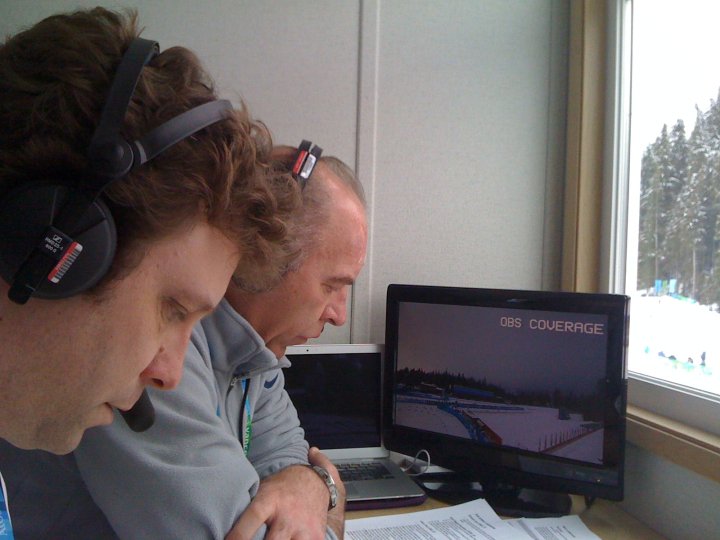
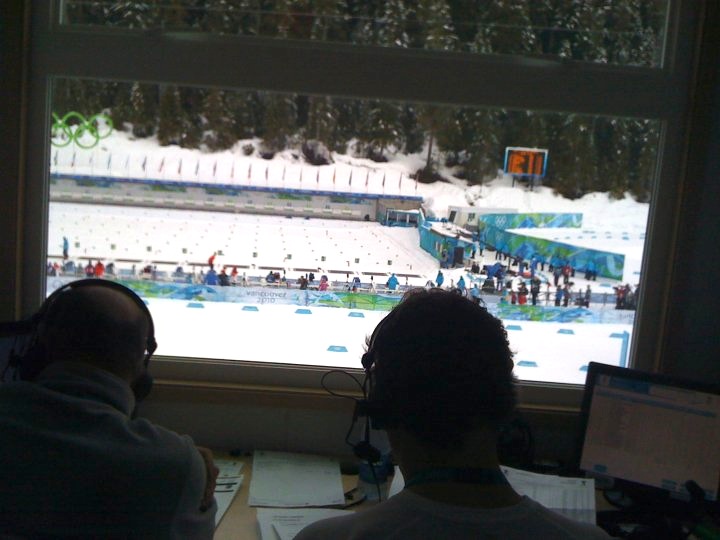
NBC Olympic commentators Chad Salmela (l) and Al Trautwig prepare for a biathlon event in a booth overlooking the stadium during the 2010 Vancouver Games in Whistler, British Columbia. (Photo: Chad Salmela)
Olympic commentary is nothing new for Chad Salmela, head coach at the College of Saint Scholastica in Duluth, Minn. In February, he’s headed to Sochi, Russia, where he’ll be one of NBC’s main commentators for the 2014 Winter Games.
Because the Olympics’ official broadcast network hasn’t given him a production schedule yet, Salmela was unsure which sports he’d be covering. Regardless, the former US Biathlon member and national-team coach is looking forward to working alongside NBC’s long-time legend Al Trautwig.
“For what NBC is looking for, Al is beyond great,” Salmela says of his colleague. “For the most part, I think he’s brilliant.”
Salmela, who got his commentary starts as an in-stadium color commentator at the 2002 Olympics, says working with Trautwig sets his mind at ease. He lets Trautwig drive the storytelling when it comes to interpreting races.
“He’s definitely the most experienced guy I have ever worked with,” Salmela says.
The 2014 Olympics will be Salmela’s fourth time covering the Games, but he hasn’t always had a seat in the booth at the finish line. Long before NBC tapped him, he was the voice behind a PA system. In 1998, he was asked to announce the US Biathlon Team trials, just a year after he retired from the sport.
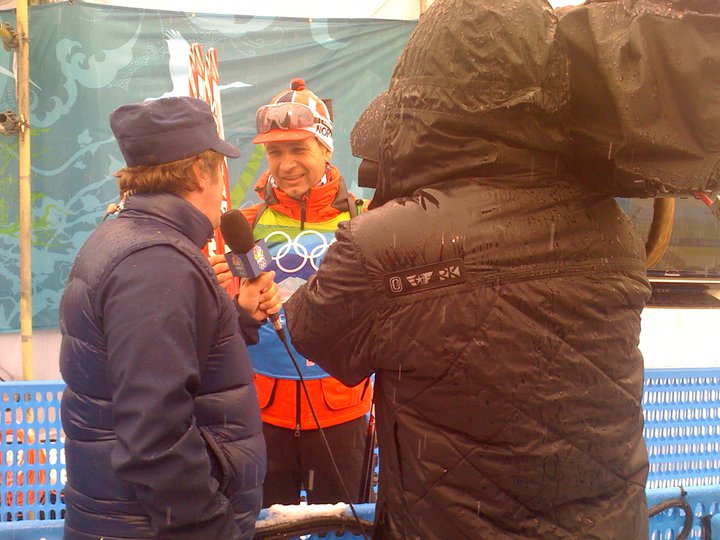
Chad Salmela (c) interviews Norwegian biathlete Ole Einar Bjørndalen (l) after his men’s relay team won gold at the 2010 Olympics and he became the most successful biathlete in Olympic history with nine career medals. (Courtesy photo)
“Everyone was like ‘Wow! You’re really good at this,’ he recalls. ” I was just kind of like a hack.”
Salmela worked the Junior Olympics the next year, “for, like, a few hundred bucks a week,” he says. But word gets around and that’s how he ended up at the Olympics.
“My reputation as a commentator had kind of grown within the small community of nordic skiing,” he says.
His big break came in Salt Lake City in 2002, where he commentated biathlon as well as the women’s 30-kilometer cross-country race.
“I’m genuinely excited when I see the defining moves in an event, and other sports have plenty of people who do the same thing,” Salmela says. “John Madden or Cris Collinsworth is doing it with the NFL right now. One things that [they’re] very adept at is having a very conversational analysis and identifying things that some people might miss in the way a game is unfolding.”
It helps that Salmela is well-connected, working alongside Emmy award-winning producers and others who have produced sports shows for cable television for years. But he says his connections have only gotten him so far, adding that he has natural skill. And he doesn’t practice out of fear it might get in his way.
“I feel like my strength is that I have a genuine delivery,” he says. “I’ve always been obviously a talker. I’ve always been very analytical, which is what makes me a strong coach, and I’ve been involved in the sport as an athlete and coach at a very high level and you put all those pieces together and that’s what John Madden had.”
Salmela was first told he would only call biathlon, but it looks like he may also work the cross country races and nordic combined as well. He commentated all three sports at the 2010 Vancouver Olympics in British Columbia, and in 2006, he worked as a biathlon analyst at the Torino Winter Games.
This time around, he asked a few friends and contacts to join him in Sochi, including former teammate Stacey Wooley, a 1998 Olympic biathlete.
“She’s going to be kind of learning to do it on the fly as the back-up color commentator for biathlon,” Salmela says.
He may be biased, after eight years on the national team and several more coaching and developing biathlon, but he says it’s one of the better sports to call.
“Biathlon inherently has a lot of pieces to it that are very dramatic on television,” he says. “I would say it’s like golf tournament on speed,” he laughs. “A golf tournament has these very poignant moments that are high pressure, but they’re very slow in coming and it takes four days … If you compress a golf tournament into a half hour, you’ve got biathlon. Everything is intensified.”
Whitney Onboard
While Salmela is in the driver’s seat, former U.S. Ski Team member Rob Whitney will work behind the scenes. Whitney describes himself as the “stats guy.”
“I’m the guy that is the extra ears, watching other screens, sliding them sticky pads with quick facts, sending one-liners to Facebook,” Whitney says of his rookie gig.
“In preparation mode,” is how Salmela describes the scene just before the start of a biathlon event, which he commentated for NBC with Al Trautwig in 2010. (Courtesy photo)
Married to U.S. Ski Team member and Olympic hopeful Holly Brooks, Whitney isn’t worried about being stuck in a booth.
“I’m going to have the best seat in the house!” he exclaims. “[It’s] like front row seats at the hockey game here.”
Solely committed to the cross-country races in Sochi, he’s not exactly sure what will happen if his wife is racing. “If it looks like Chad and Al have it under control, maybe I’ll be out there roaming around,” he says.
Whitney admits he’s nervous when it comes to his position, but even more so, the mystery of Russia has him wondering what exactly might go down.
“Russia is kind of a mysterious place, I think,” he says, adding that his opinion could stem from his American roots and a continued memory of the Cold War, or maybe just the distance. “It’s really far away.”
But that seems ironic, coming from an Alaskan native.
“It’s not like we just be-bop over!” he jokes. “You know, go to Sarah Palin’s place and see where it is and get in an airplane and fly straight there!”
But overall, Whitney’s pretty excited, knowing that he’ll look back in a decade or two and think the experience was “rad!”
“I mean, I could be helping announce history,” he says. “Kikkan Randall might win a gold medal!”
APU’s Rosie Brennan (front), followed by Annie Pokorny and Erika Flowers of the Stratton Mountain School (SMS) T2 Team during intervals with Stratton earlier this year. (Photo: Sverre Caldwell)
This is the first profile in a series about Olympic hopefuls and pre-qualified athletes preparing for the 2014 Winter Games. While we won’t get to everyone who could potentially make it to Sochi, Russia, we’ll do our best to provide snapshots of what individuals endure in the process of getting there.
***
Each obstacle 24-year-old Rosie Brennan encounters in her quest to make the U.S. Olympic ski team for the first time in her young career falls in one of two categories: things she can control and things she can’t.
Rosie Brennan (r) on the podium with U.S. Ski Team veterans Liz Stephen (c) and Kikkan Randall, who placed first and second, respectively in the 30-kilometer classic at U.S. Distance Nationals in April in Soda Springs, Calif. Brennan was third for a career best in the distance race.
The Park City, Utah, native can’t do anything about the seemingly bottomless depth in U.S. women’s skiing, not only on the national team, but extending through domestic clubs like Alaska Pacific University (APU), with which she’s affiliated.
But to get to Sochi, Russia, she needs World Cup starts. The only way to earn those without being on the U.S. Ski Team (USST) is to advance to the top of the domestic SuperTour standings.
A national title in the 10-kilometer skate race, seven SuperTour wins and a bronze in the 30 k classic at nationals last season gave Brennan a firm grasp on the 2012/2013 Continental Cup lead (by 147 points to be exact). As a result, she will start this season on the World Cup circuit, right where she finished this spring.
“I was really happy to see those results on the results page, rather than trying to convince myself I had made improvements,” Brennan said on the phone Monday. “Of course, it always helps when you race really well in the beginning of the year because your confidence just skyrockets.”
Brennan climbed the podium numerous times in collegiate and junior-national competition, but last season’s results were her most consistent at the next level since joining APU in 2011.
It didn’t come easy or without pain. Six years ago as a Dartmouth College freshman, Brennan injured her back doing double-pole intervals in Lake Placid, N.Y. She didn’t get a clear diagnosis of the injury until this spring, when the pain had become so severe that she was experiencing loss of sensation in her lower leg. She exhausted her search for medical answers from doctors, physical therapists and specialists in Utah. Then, a breakthrough came in Alaska.
She met with physical therapist Zuzana Rogers, a former member of the Czechoslovak and Slovak alpine teams who’s contracted through APU. Rogers diagnosed Brennan with a bulging disc (L5-S1) in her lower back, which damaged the nerves running down her leg.
“That made the biggest difference for me,” Brennan said. “Just having a consistent physical therapy plan and working every week with [Rogers].”
APU head coach Erik Flora lended personal experience and an eye for technique, Brennan said. Flora had his racing career cut short because of a back injury.
Rosie Brennan (APU) racing to third in the 30 k classic mass start at U.S. Distance Nationals in April in Soda Springs, Calif. (Photo: Mark Nadell/MacBeth Graphics)
“We’ve really tried to change my body position during all activities into a position where my back is safe,” Brennan said. “We’re not demanding so much out of it and I’m not risking making it worse.”
Brennan views the technique work not only as a mode of injury prevention, but also a way to improve her skiing ability. She wants to improve her sprinting, but has been unable to work on it with the back limitations.
“Right now, Rosie’s strength is in classic distance racing,” Flora wrote in an email. “If you look at last year, she has also really improved her skating. This summer, we have been able to take another step in skate and classic. I see her more balanced starting this season.”
Brennan raced on the USST during college (2007-2009) and started several World Cups last season (Stockholm, Falun, Oslo, Drammen, Lahti, and Canmore), but will still be a rookie to the early season venues. The first familiar place she will compete is Soldier Hollow in Utah for U.S. nationals in January.
Brennan hopes starting the season on the World Cup will favor her more than finishing there. She felt her performance lagged late in the season due to fatigue from several months of racing and travel.
Flora has structured on-snow training camps this summer on Alaska’s Eagle Glacier around conditions that may be present in Sochi and at Soldier Hollow. The rest of Brennan’s training plan will remain largely the same as last year, with adjustments based on how her back is feeling.
“When [Brennan] joined us, she talked about primarily being a sprinter,” Flora wrote. “I have learned she is incredibly responsive to distance training. If we push base volume, she gets very fit.”
Rather than worry about what could go wrong in chasing the Olympic dream, Brennan visualizes what could go right and uses it as motivation.
“I’m just trying to focus on how I can learn from my World Cup experiences last year and use that to train better this summer and prepare myself for the fall World Cups and try and make my impact then,” Brennan said.
“Rosie’s trajectory is definitely on route to being one of the top U.S. women,” Flora added. “It is a matter of time.”
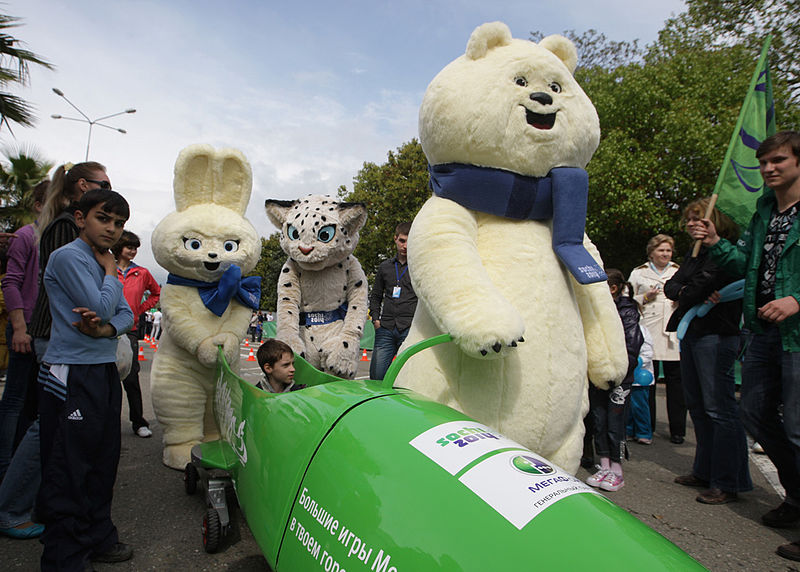
The official mascots of the 2014 Winter Olympics, a polar bear (r), European hare (l) and an Amur leopard (c), walk the city streets in May during the “2014 Winter Olympics: 1,000 Days To Go” festival in Sochi, Russia. (Photo: Wikimedia Commons)
We’re at the 199-days-and-counting mark if you’re keeping track of how much time remains until the start of the 2014 Winter Olympics in Sochi, Russia, and we know many of you are. In case you haven’t been reading every ounce of pre-Olympic coverage, we’ll do our best to stay on it and provide relevant nordic updates throughout the next sixth months.
For now, here’s some noteworthy starter information:
1. Opening ceremony: The 22nd Winter Olympic Games will kick off Friday, Feb. 7, in Sochi, Russia. Closing ceremony 16 days later on Sunday, Feb. 23.
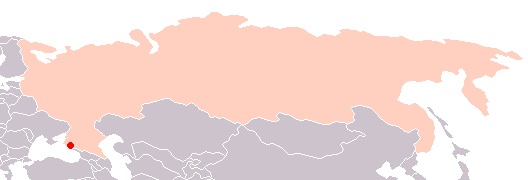
Sochi (as indicated by red dot) in southwestern Russia. (Photo: Wiki Commons)
2. Where: Sochi, which spans some 145 kilometers (90 miles) with a population around 345,000 along the shores of the Black Sea in western Russia.
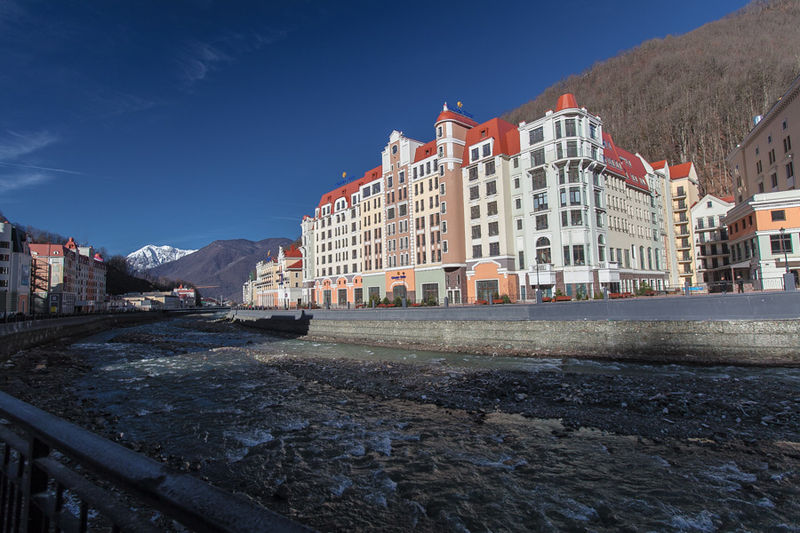
Krasnaya Polyana, an urban mountain town about an hour drive (70 kilometers) inland from Sochi, is where all the snow-sport events will be held (i.e. cross-country skiing, biathlon, alpine, freestyle, snowboarding). In 2010, it had a population of about 4,500, but expect a lot more people buzzing around in February.
3. Climate: Categorized as humid subtropical, Sochi typically experiences mild winters averaging 11 degrees Celsius (52 Fahrenheit) during the day and 4 degrees Celsius (39 degrees Fahrenheit) at night from December to March. What could that mean for snow sports? Another potentially tricky year, just like in 2010 in Vancouver, British Columbia, and 1998 in Nagano, Japan. In both previous Olympics, weather postponed events, but everything eventually took place. According to Philip Hersh of the Chicago Tribune, the Russians are stockpiling snow.
The Golden Tulip Rosa Khutor Hotel on the Mzymta River in Krasnaya Polyana, Sochi. (Photo: Wiki Commons)
4. Money: Hersh posed the question as why a palm-tree-laden, authoritarian nation would be awarded the Winter Games. Because of “Russian supremo [president] Vladimir Putin,” he wrote, who promised an unlimited budget and has already overspent it. Last February, a year from the Olympics, Russia had spent $51 billion dollars, $11 billion more than China’s previous record-setting grand total for the 2008 Summer Games.
Some $130 million dollars alone was set aside for a road connecting Krasnaya Polyana to Sochi, and according to the Christian Science Monitor, that makes it the world’s most expensive byway. “That’s about 50 times the average cost of a highway in the United States,” former deputy prime minister Boris Nemtsov told the Monitor.
5. A first: Neither Russia nor the former Soviet Union ever hosted the Winter Olympics,although it’s long been considered a winter-sports stronghold. Who could forget then-president Dmitry Medvedev’s televised remarks four years ago, after Russia’s showing at the Vancouver Games. “Those responsible should take the brave decision and sign a letter [of resignation]. If they can’t, we will help them,” he said of the Russian officials and sports bureaucrats blamed for a lack of medals and disappointing sixth-place finish in men’s hockey.
6. A dozen new events: Stay tuned for the brand-new biathlon mixed relay, women’s ski jumping, luge team relay, figure skating team event, men’s and women’s halfpipe and slopestyle freestyle skiing, and men’s and women’s slopestyle and parallel slalom snowboarding.
7. How to watch: According to the Tribune, prime-time coverage on NBC will be delayed, but more than half the Olympic events will be live on some NBC network, and every event will be streamed live.
8. Boycotts: Remember Beijing and the civil-rights movements surrounding the Games? Same sort of thing here, except Russia isn’t just ignoring protesters, it’s threatening them to stay away. Putin recently signed a law allowing police officers to arrest tourists and foreigners they suspect of being homosexual, lesbian or “pro-gay,” the New York Times reported. What? Yep, if this stands, those arrested could be detained for up to 14 days – that includes Olympic athletes, coaches, trainers, family members, fans and spectators. Earlier in June, Putin signed another bill classifying “homosexual propaganda” as pornography, which essentially means that anyone who condones homosexuality to someone underage could face fines or jail time.
The International Olympic Committee (IOC) responded with a statement that read, “The IOC would like to reiterate our long commitment to non-discrimination against those taking part in the Olympic Games, the IOC is an open organization and athletes of all orientations will be welcome at the Games.”
A leading international organization, Human Rights Watch (HRW) wrote a letter to the IOC urging it “to take additional steps to send a clear signal to the Russian authorities that discrimination of people based on their sexual orientation and gender identity is at sharply at odds with Russia’s human rights and Olympic commitments.”
HRW also encouraged the IOC to get a guarantee that Russian authorities will not adopt or implement homophobic legislation.
“We also urge you to press the authorities to state publicly that, as Olympic Host, Russia will ensure, without distinction, the safety and the freedom of expression and association of all athletes, coaches, fans, and others who will attend the Sochi Games.”
9. No laundry: Don’t hang it from balconies or use window air conditioners, because Sochi doesn’t want to see it. Residents could face fines up to $46 dollars, The Moscow Times reported, for clothes on the line or air conditioners that look “chaotic.”
The city “should look especially decent in a zone of international hospitality,” Sochi’s deputy mayor Yevgeny Gorlov wrote on the local government’s website last week. “If people have made the decision to install an air conditioner, they should have a symmetrical location on the building and be agreed upon with all the [other] owners … in an agreed scheme.” This is in effect for the preparatory period before the Games, but it brings up a previous concern: are people going to need air conditioners at the Winter Olympics? (See No. 3).
10. A polar bear, a European hare and an Amur leopard: These are the three official mascots of the Games, decided by a public vote (another first for Russia, according to the Sochi 2014 organizing committee).
The official mascots of the 2014 Sochi Winter Olympics (Photo: Wiki Commons)
11. “Hot. Cool. Yours.” The official Olympic slogan. Organizing Committee President and CEO Dmitry Chernyshenko said in a statement it’s aimed to bring more foreigners to Sochi and make Russians proud.
“The Sochi 2014 slogan says it’s impossible not to take part, impossible not to watch, impossible not to get excited and it’s worth being proud because these are our Games,” Chernyshenko said.
“Hot” and “cool” are references to Sochi’s sun-and-snow climate and symbolize progressive movement forward.
Sun Valley’s Mikey Sinnnott racing to the third-fastest qualifying time in the SuperTour Finals classic sprint at Auburn Ski Club in Soda Springs, Calif., in April. Sinnott went on to make the A-final and place sixth in the sprint, and captured two bronze medals (freestyle prologue and hill climb) to finish as the 2012/2013 SuperTour leader. (Photo: Mark Nadell/MacBeth Graphics)
When he last attempted to make the Olympics, Mikey Sinnott was four years younger and admittedly a step quicker. But the 28-year-old Sun Valley Ski Education Foundation (SVSEF) skier is confident he can offset aging with accumulated experience and earn a spot on the U.S. Olympic Team for the first time in his career.
Finishing the 2012/2013 season as the overall U.S. Ski and Snowboard Association (USSA) SuperTour points leader gives Sinnott the right to compete on the World Cup circuit this winter – a place he has been before (in 2012) and knows can be unforgiving.
“I think in the past you kind of set up your season to get World Cup starts, so you’re kind of hitting that early season performance and then you’re kind of coming down from it when you get to the World Cup,” Sinnott said in a phone interview from his hometown of Sun Valley, Idaho. “This year I’ve got months beforehand where I can build and really organize it so that I’m hitting the World Cup in my top fitness.”
The ball is already rolling toward the November World Cup opener in Kuusamo, Finland. Sinnott recently returned from his second on-snow training camp in Bend, Ore., where he had been since May. With his racing schedule focused solely on World Cups, U.S. nationals and ideally the 2014 Olympics in Sochi, Russia, Sinnott said the less-compressed calendar would allow him to insert training blocks where travel between race weekends was previously.
Sinnott at a World Cup freestyle sprint in January 2012 in Milan, Italy, where he placed 68th in the qualifier.
“It was really nice to see as we swing back into training how positively my body has responded to the rest,” Sinnott said of his post-season recovery. “I still feel like I have a great base built in, and that’s from the years of training before.”
Past years have included national podiums, Boulder Mountain Tour and Noquemanon ski-marathon titles and international starts at the World Junior Championships, Under-23 World Championships and World Cups. The most recent season was a good one for Sinnott, but he was hesitant to call it his best.
“I don’t really think that I had too much peak fitness last year, but I’d like to think that a couple of times when I felt stronger I would have been fairly competitive [at the international level],” Sinnott said. “There’s just so many variables that it’s hard to say. When I’m skiing well, will that transfer over to the World Cup? What makes me ski well maybe at one race isn’t [necessarily] what’s going to make me ski well at the World Cup.”
Sinnott missed nearly an entire month of training last September due to illness. He thought the Olympics were a realistic goal four years ago, but said he overtrained and as a result, got sick.
“It’s just been a consistent progression and kind of fixing the problems,” Sinnott said. “I’m kind of putting the past seasons all together to make one great season.”
Sinnott will get back on snow in Alaska later in the summer and Canmore, Alberta, before the racing season kicks off. World Cup starts and the Olympics looming have not altered Sinnott’s mindset heading into the new season, but he compared the 24- and 28-year-old versions of himself.
“I think there’s big differences between the two,” Sinnott said. “But I’d say both of them were good athletes – prepared, ready and on the cusp of a potential Olympiad.”
The IOC Coordination Commission completed its eighth site visit to Sochi last week. FIS president Gian Franco Kasper was unimpressed with the preparation at the ski venues. (Dave Jarrett photo)
If the ski arenas currently under construction in Sochi, Russia, remain at their current size, the International Ski Federation is going to be unhappy with spectator capacity for Olympic ski competitions come 2014. International Ski Federation President and International Olympic Committee member Gian Franco Kasper criticized the venues for being unprepared for the Games based on his observations from last week’s site visit.
At a Tuesday press conference in Cavalese, Italy, for the Val di Fiemme World Championships, Kasper fielded questions about his recent inspection of the Olympic venue. “We were shocked at what happened to the audience,” Kasper said according to German ski news site xc-ski.de. He also thought transportation logistics were sub-par: “[The] road access is completely misjudged,” he said.
Organizers estimate that 7,500 spectators will be able to watch ski jumping, for example, an event that will be held directly adjacent to the cross-country arena. Seating includes specially designated sections for media and event personnel, so Kasper expects the real number of available tickets to be inadequate. FIS events constitute “50 per cent of the medal decisions” at the Winter Games and should be treated accordingly, he said.
Last week’s site visit was the eighth one of its kind since construction began in Sochi, and at its conclusion IOC Coordination Commission Chairman Jean-Claude Killy declared the venue on its way to delivering top-quality Games for all stakeholders in 2014.
“It all bodes well for a successful season of test events ahead, as well as for a great legacy left behind for the local population,” Killy said in a Sochi 2014 press release.
There are several competitions scheduled in Sochi this winter as part of a key pre-Olympics test season. According to Organizing Committee President Dmitry Chernyshenko, an unprecedented 47 total test events will take place over the coming months to “check the venues and surrounding infrastructure to ensure we’re 100 per cent prepared.”
The FIS cross-country and nordic combined World Cups both stop in Sochi in early February. Nordic combined athletes already competed at the venue for the FIS Summer Grand Prix this July.
Despite his concerns, Kasper believes there is still time for improvements to the site. “These are problems [to be] solved in the coming months,” Kasper said. Sochi organizers will be present at another press conference in Cavalese later this week, and he encouraged journalists on Tuesday to take the opportunity to ask them critical questions.
Todd Lodwick (second from left) after winning Sunday’s competition at the FIS Summer Grand Prix in Krasnaya Polyana near Sochi, Russia. Austrians Bernhard Gruber (l) placed second and Tomaz Druml was third. (Dave Jarrett courtesy photo)
At the biggest international competition of the summer, hardly anyone could blame the Americans if their heads weren’t totally in it.
It’s not that they weren’t focusing on nordic combined’s International Ski Federation (FIS) Summer Grand Prix. They just had a lot of other things to absorb during their first visit to Sochi, Russia.
For veteran competitors like Todd Lodwick, Johnny Spillane and Billy Demong, the new venue was a welcome change to their routine trips to the sport’s typical sites. Sure, they loved their jumps in Park City, Utah, and enjoyed getting some practice in Oberstdorf, Germany, before heading to Russia about a week ago. But sometimes, unique sights are the most stimulating.
View from the top of the 2014 Olympic ski jumping complex near Krasnaya Polyana, Russia. (USSA/Dave Jarrett photo)
The U.S. Nordic Combined team soaked up plenty last weekend at the under-construction venue near Krasnaya Polyana, about 40 kilometers northeast of Sochi. For the 2014 Olympics, the “Mountain Cluster” will host all the of the ski, snowboard and sled events (bobsled, luge and skeleton) and high-speed gondolas and trains will be in place to get people where they need to be.
Eighteen months before the Winter Games, U.S. head coach Dave Jarrett estimated there were 60,000 laborers running around, working around the clock in six-week shifts to get the job done. The Americans were only there for an extended weekend at the Summer Grand Prix (SGP) July 21-22, yet managed to capture the energy.
“I think everyone was psyched, especially the older guys,” Jarrett said on the phone from Florida, where he met his family for vacation after returning from Sochi. “It’s not every year that they get to go to a new jump or a new place. It [can be] like Groundhog Day all over again. Those guys were psyched to be somewhere new.”
The oldest member of the A-team, Lodwick, 35, did exceptionally well in the hot and humid conditions, with temperatures around 95 degrees Fahrenheit that rose higher on the newly paved rollerski track. After placing second on Saturday, Lodwick won gold at the Grand Prix on Sunday and raced the fastest time on both days.
While Lodwick couldn’t be reached for comment, Jarrett talked about his performance – more impressive considering Lodwick hadn’t competed since December of last season. The 2009 World Champion last won a race nearly two years ago at a Continental Cup in his hometown of Steamboat Springs, Colo. A five-time Olympian, Lodwick hadn’t been on the podium since the 2010 Vancouver Games, where he won silver in the team event, yet had six World Cup victories and 26 podiums to his name.
“He’s definitely a competitor,” Jarrett said. “He’s been around for a long time. I wouldn’t bet against him, but I wouldn’t have picked him to do as well as he did … on the jumping hill. I think he was really psyched and I think it gives him some motivation moving forward.”
Sochi’s nordic-combined jumps, which will be used in competitions leading up to the 2014 Winter Olympics, as seen in July. (Dave Jarrett courtesy photo)
Jarrett knew Lodwick could dominate a relatively thin Grand Prix field in the 8.8 k rollerski race, but was surprised by how well he jumped on the 140-meter large hill. On Saturday, Lodwick ranked ninth in the jump and climbed seven places in the Gundersen-start race to finish second, and Sunday, he finished fifth in the jump and landed the top spot overall.
“He’s been obviously doing a good job,” Jarrett said, adding that Lodwick hadn’t jumped as well in practice leading up to the event.
Four months ago, Jarrett wasn’t sure what Lodwick’s plans were. He essentially took last year off to remedy some pulmonary issues, and with a wife and two young children at home, Jarrett couldn’t blame him. However, with the 2014 Olympics fewer than two years away, Jarrett had a more frank discussion with Lodwick this spring.
“He and I sat down in March, and basically, I required him to make a commitment,” Jarrett said. “If he wasn’t going to commit to being a full-time athlete and good teammate, then there wasn’t going to be a place for him because he technically didn’t qualify for the team based on his results last year.”
With his sixth Olympics in sight, Lodwick chose to commit. According to his biography on the U.S. Ski and Snowboard Association (USSA) website, Lodwick said last season was a difficult because his asthma prevented him from training.
“I got down on myself and wondered if this was something I wanted to continue to do,” Lodwick said. “But this sport provides so much more to me than winning. I’m truly passionate about it. And with the staff we have and the athletes on the nordic combined team, I couldn’t ask for a better bunch of guys to work with to push the sport to the next level.”
Lodwick wasn’t the only American who shined in Sochi; Spillane and Taylor Fletcher also made the top 10 on Sunday.
Spillane, who finished seventh overall, said he was pleased with how things went at the SGP, but didn’t put too much thought into summer results.
“It really doesn’t matter at all, but the trip served its purpose for us to go there and get a feel for what it’s like over there,” Spillane said on the phone from Steamboat Springs. “As far as the competitions go, I was happy with how it went, and my goals aren’t to do well in July by any means.”
On the phone in Park City, Fletcher confirmed that his 10th place was a Grand Prix career best, but that didn’t mean a whole lot to him, either.
“It wasn’t a full field, which is kind of a bummer, but it’s good to go,” he said of the competition, which included several top jumpers from Austria and Japan, but lacked some of the best athletes from Norway and Germany. “Nonetheless it was still a good show and everybody had a good time.”
The Big Picture
Aside from testing Sochi’s new venue, the U.S. team also wanted to get its bearings before traveling to Russia again this winter. From Feb. 2-3, they’ll compete on the same large hill near Krasnaya Polyana and race a similar course.
About Taylor Fletcher and Billy Demong’s Grand Prix DQ’s:
According to Jarrett, the Grand Prix presented a good opportunity to compete at a new World Cup and Olympic venue, but he didn’t take it too seriously.
“On the jumping hill, it was clear that we certainly made improvements, which was what we were looking for,” Jarrett said.
“To have those guys ski as well as they did was a bonus, but if they were horribly slow it wasn’t going to be the end of the world either. It turned out well.”
Demong finished seventh on Saturday and was disqualified Sunday because his suit was three centimeters too loose. On Saturday, Taylor Fletcher was disqualified after the jumps because his undersuit had holes in it.
Jarrett didn’t have a problem with the Demong’s disqualification – Demong opted not to tighten his suit the night before – but he did take issue with Fletcher’s DQ.
“Taylor got disqualified because he broke an undersuit rule, an underwear rule,” Jarrett said with a laugh. “They didn’t enforce it last year. … They pick certain people to get checked every day, but the threat of being checked is there all the time.”
Regardless, Jarrett couldn’t believe he was spending so much time discussing threads, needles and bobbins.
“Now your suits basically become illegal because it becomes too big after a few jumps,” he said.
“Tongue and cheek, I joked that we ought to hire a seamstress instead of a second service guy [to travel with us]. It’s pretty stupid when a sport comes down to that. … We brought our sewing machine from Europe and those guys were sewing their suits before the competition.”
“The Grand Prix is just that; there wasn’t a lot of teams that came to Sochi,” Jarrett said. “It’s more important to just be there and jump on the jumps more so than the competition.”
In the winter, racers will have to do the full 10 kilometers on a slightly longer loop (the rollerski course was shortened to keep within maximum climbing limitations), and they’ll start and finish in the jumping flats so that spectators can watch from their stadium seats.
Another difference is that skiers probably won’t sink into the pavement like they did last weekend.
“It was so hot out that our rollerski [pole] tips were sticking; we were digging into the pavement and our wheels were running on hot, hot tar,” Fletcher said. “It’s a hard course and it’s going to [be] really challenging in the winter because everything’s going to be a little bit longer and … you’re not going to have the same speed that you have on rollerskis, I don’t think.”
Fletcher’s older brother, Bryan, tried to look beyond his results last weekend (16th on Saturday, 21st on Sunday) and envision himself competing there this winter.
“I held some hopes for the jump hill however after an extremely tough week in France for our TDF [Tour de France] camp, I knew I would be tired heading into the competitions,” Bryan wrote in an email, referring to the team’s preceding cycling camp in the French Alps. “I am not strong in extreme heat and humidity and Sochi had plenty of both.”
Outside of competition, he noted the magnitude of the development going on near Sochi, referring to the amount of construction as “astronomical.” All the snow venues will be accessed by gondolas and trains, which “could be fantastic for spectators,” he added.
According to Spillane, there weren’t a huge amount of local spectators at the Grand Prix, but that was to be expected given its location.
“The venues are not near anything; it’s a ways from the city,” he said. Taylor Fletcher estimated it took an hour and a half to drive there from Sochi.
“All the hotels are under construction so there’s nothing done,” Spillane added. “It’s pretty incredible actually.”
Before the Grand Prix competitions, the U.S. team hiked to a vantage point with former Canadian nordic-combined coach Nik Petrov, who works for the Russian Olympic Committee.
“He kind of pointed everything out up high,” Taylor Fletcher said. “We could see where everything was going, where the [athletes’] village is going to be an whatnot.”
One of the purposes of the trip was to find the best accommodations, and while their American-style hotel near their venue was suitable, they weren’t sure what other options would become available in the meantime. Jarrett felt the OC might be in a bit of a time crunch.
“It’s a big undertaking,” he said. “I guess the road from the Sochi airport up to Krasnaya Polyana, the valley where everything happens, used to take two hours to go almost 50 k’s. Now they built this high-speed highway and double-decker highway up this valley. It looks like it’s going be really nice when they get everything done, tons of hotels, tons of skiing, but we’ll see, they don’t have a lot of time. I guess they have no choice.”
***
Team photos from Sochi:
The high peaks of Krasnaya Polyana, a mountain resort near Sochi, Russia, where the 2014 Olympics will take place. (Taylor Fletcher photo)
A view of the valley in Krasnaya Polyana, where the 2014 Olympic snow sports will take place at the “Mountain Cluster” venue about 50 kilometers northeast of Sochi, Russia. (Taylor Fletcher photo)
During a hike near Krasnaya Polyana, Russia, the U.S. Nordic Combined team took some photos of the 2014 Olympic nordic combined and jumping venue in the valley below. (Dave Jarrett photo)
Hanging out on the rocky beaches of the Black Sea on the coast of Sochi. (Dave Jarrett photo)
Warming up on the rollerski course at the nordic-combined venue in Krasnaya Polyana near Sochi, Russia. (Dave Jarrett photo)
Switchbacks a-plenty at the rollerski course at the nordic-combined venue in Krasnaya Polyana near Sochi, Russia. (Dave Jarrett photo)
The runner-up on Day 1 of the FIS Summer Grand Prix in Sochi on Saturday, American Todd Lodwick (l) stands on the podium with Austrian winner Bernhard Gruber (c) and Akito Watabe of Japan (r). (Dave Jarrett photo)
The big downhill on the rollerski course at the nordic-combined venue in Krasnaya Polyana near Sochi, Russia.
Sochi’s nordic-combined jumps, which will be used in competitions leading up to the 2014 Winter Olympics, as seen in July. (Dave Jarrett photo)
View from the top of the 2014 Olympic ski jumping complex near Krasnaya Polyana, Russia. (USSA/Dave Jarrett photo)
Looking down at Sochi’s nordic-combined venue in Krasnaya Polyana, Russia, during a hike in late July 2012. (Taylor Fletcher photo)
Top of the 140-meter large hill at the nordic-combined and ski jumping venue in Krasnaya Polyana near Sochi, Russia. (Taylor Fletcher photo)
Todd Lodwick (second from left) after winning Sunday’s competition at the FIS Summer Grand Prix in Krasnaya Polyana near Sochi, Russia. Austrians Bernhard Gruber (l) placed second and Tomaz Druml was third. (USSA/Dave Jarrett courtesy photo)


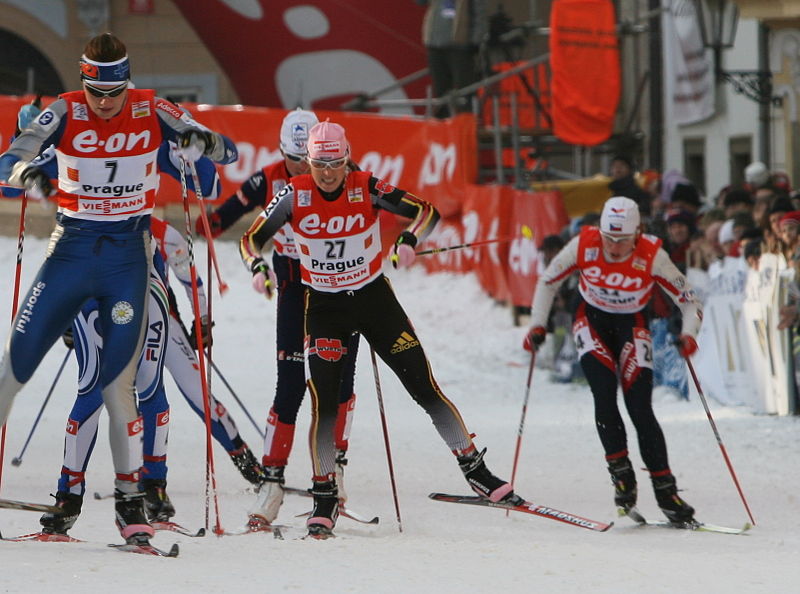
 In his recently published autobiography, doping meister turned whistleblower Grigory Rodchenkov wrote that with no positive doping tests in the first week of the Sochi Olympics, the Russian doping machine needed to expose someone in order to prove that they were doing good work.