Still craving more of the World Cup? Here are some comments from a few of the U.S. skiers who closed their international-racing seasons at World Cup Finals last Sunday in Falun, Sweden:
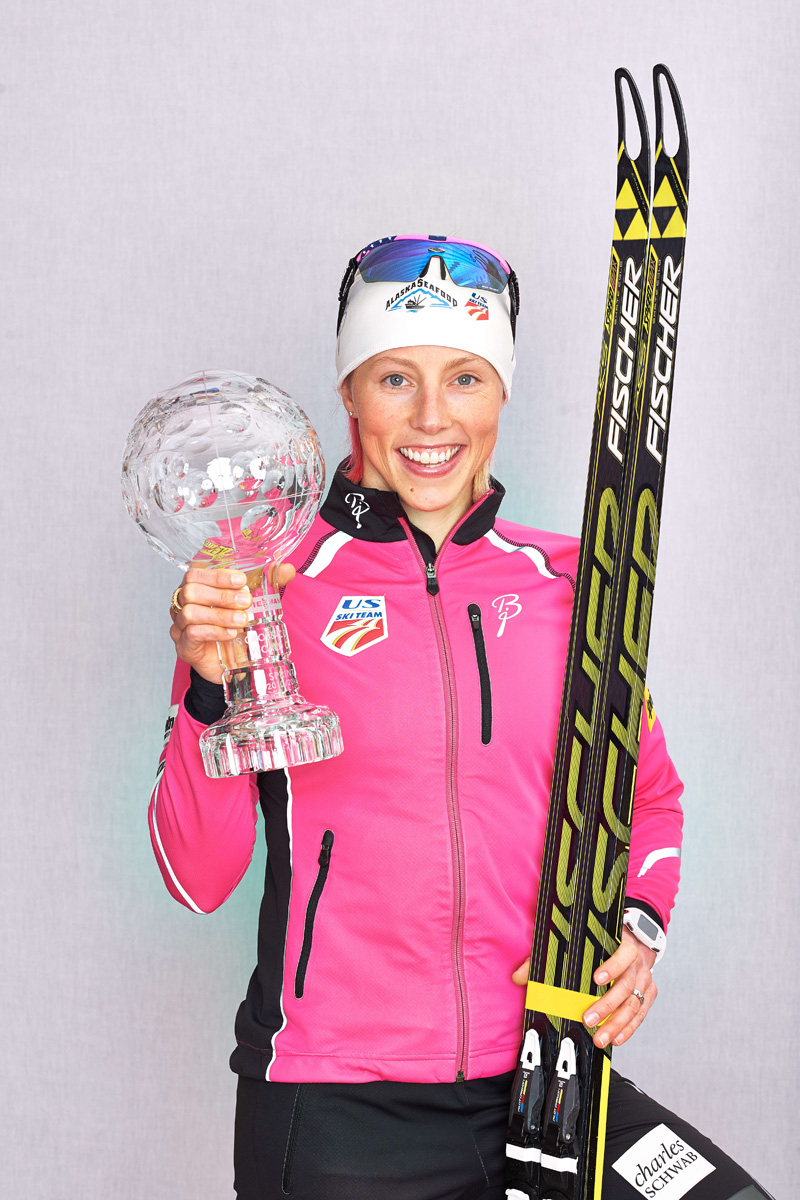
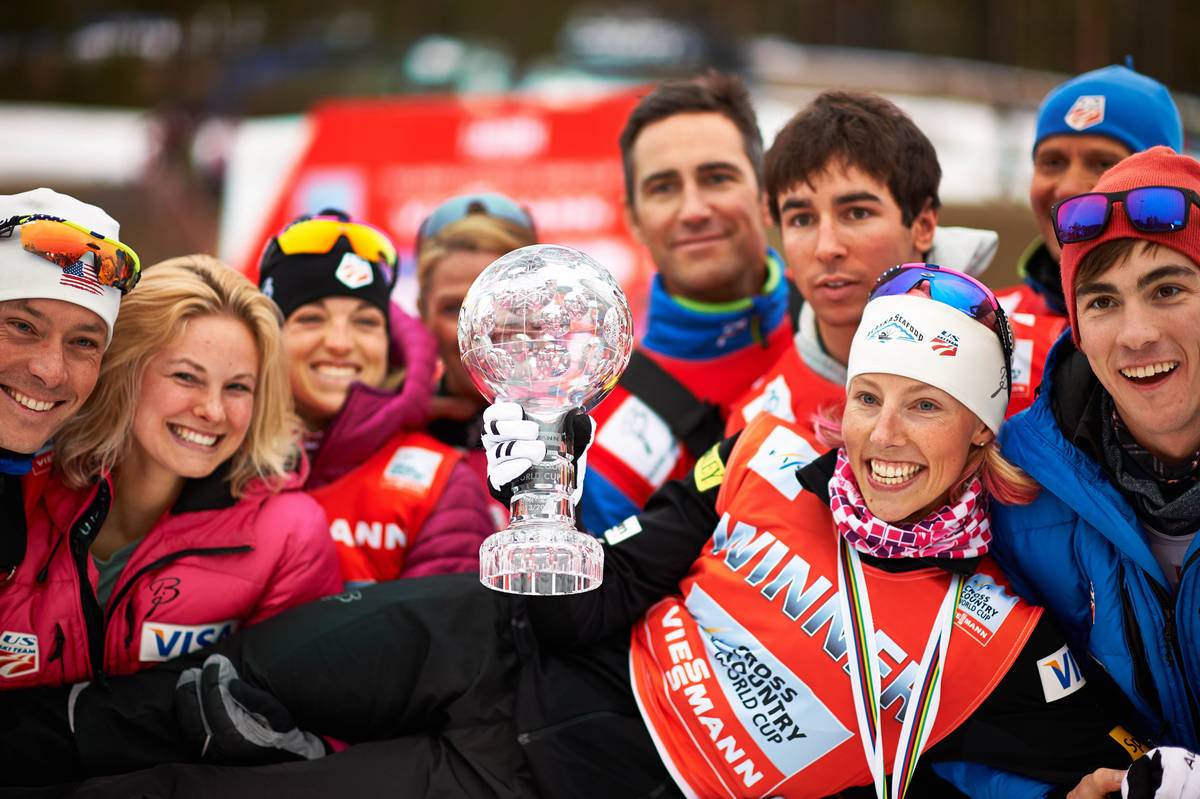
Kikkan Randall with her third consecutive Sprint World Cup Crystal Globe. (Photo: Fischer/Nordic Focus)
On finishing out the World Cup season:
“The race … was a great opportunity for me. I have had a number of races on the World Cup this season but only one other race has been a distance skate and that came only days after a long slow Birkie and flying across the Atlantic. I felt recovered, adjusted to the time and ready to ski hard. Despite only having a few distance skate races I have stayed positive with every opportunity to race and I feel like I have learned an incredible amount going into this next training season, especially for my classic skiing.” — Caitlin Gregg (Team Gregg/Madshus), 37th in 10 k freestyle pursuit, with the 25th-fastest time
“I felt like my energy was good. I think maybe I have lost a bit of fitness over the last couple of weeks for sure, but it is what it is, I am glad it is over. I’m excited for a training year to revamp, because I need it at the moment.” — Noah Hoffman (U.S. Ski Team), 21st in 15 k freestyle pursuit, with 29th-ranked time
“Starting in the wave with some of the world’s fastest guys, my goal was to go out hard, hang with them, and go like that until I blew up. I wanted to ski as aggressively as possible, which in distance skate races can sometimes be hard for me to do. I did just that. Something about that aggressive mentality switched me into some of the best skating of my life. I felt calm and collected, and like my technique was decent, even while hammering very hard and going pretty fast. I got a split or two saying I was right around 30th for time on day, which would be absolutely insane for me to be in the ballpark of scoring World Cup distance points in a skate race.” — Reese Hanneman (Alaska Pacific University), 37th in final pursuit with 34th-fastest time
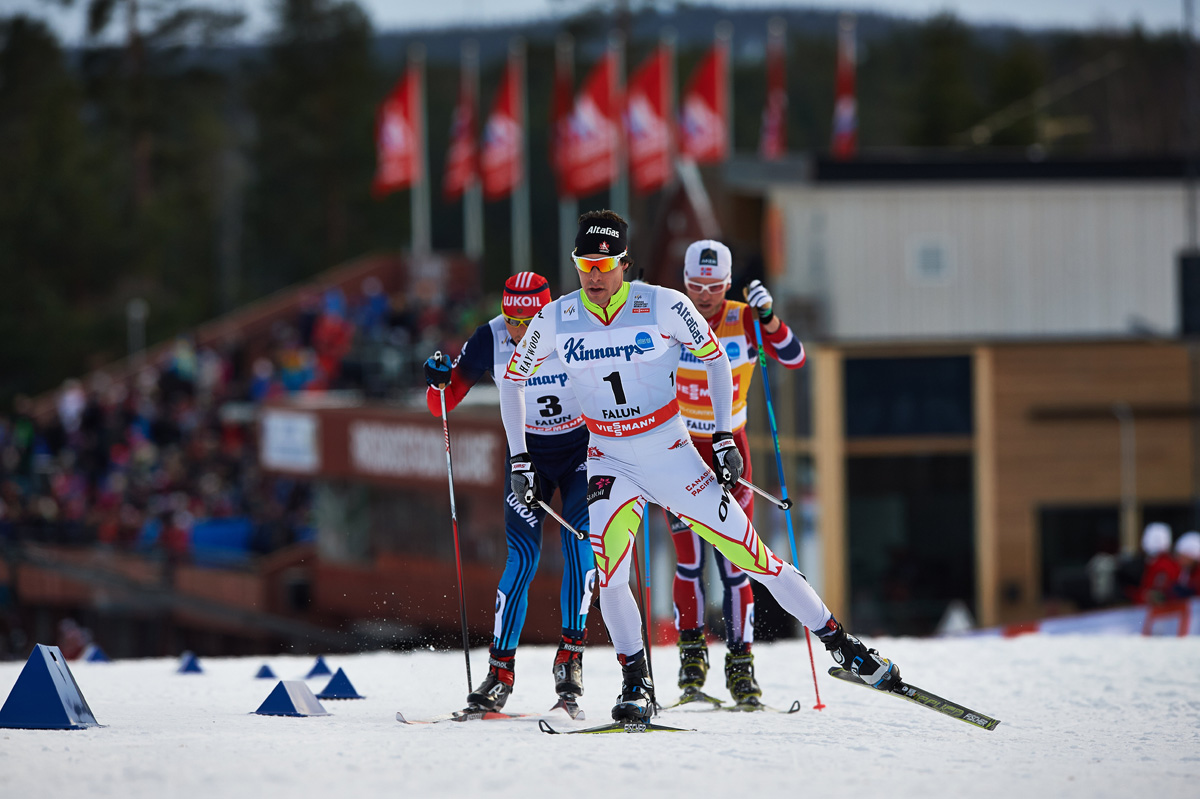
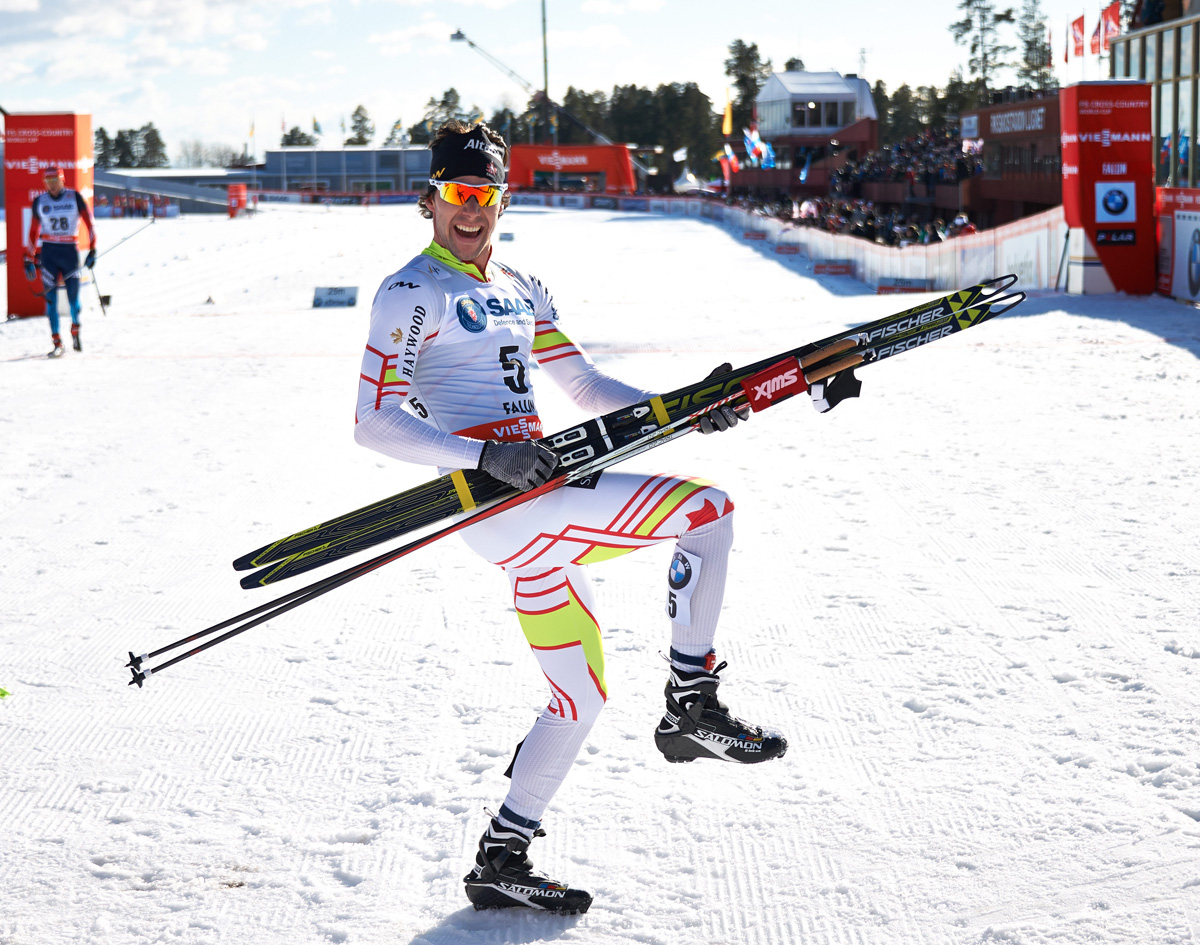
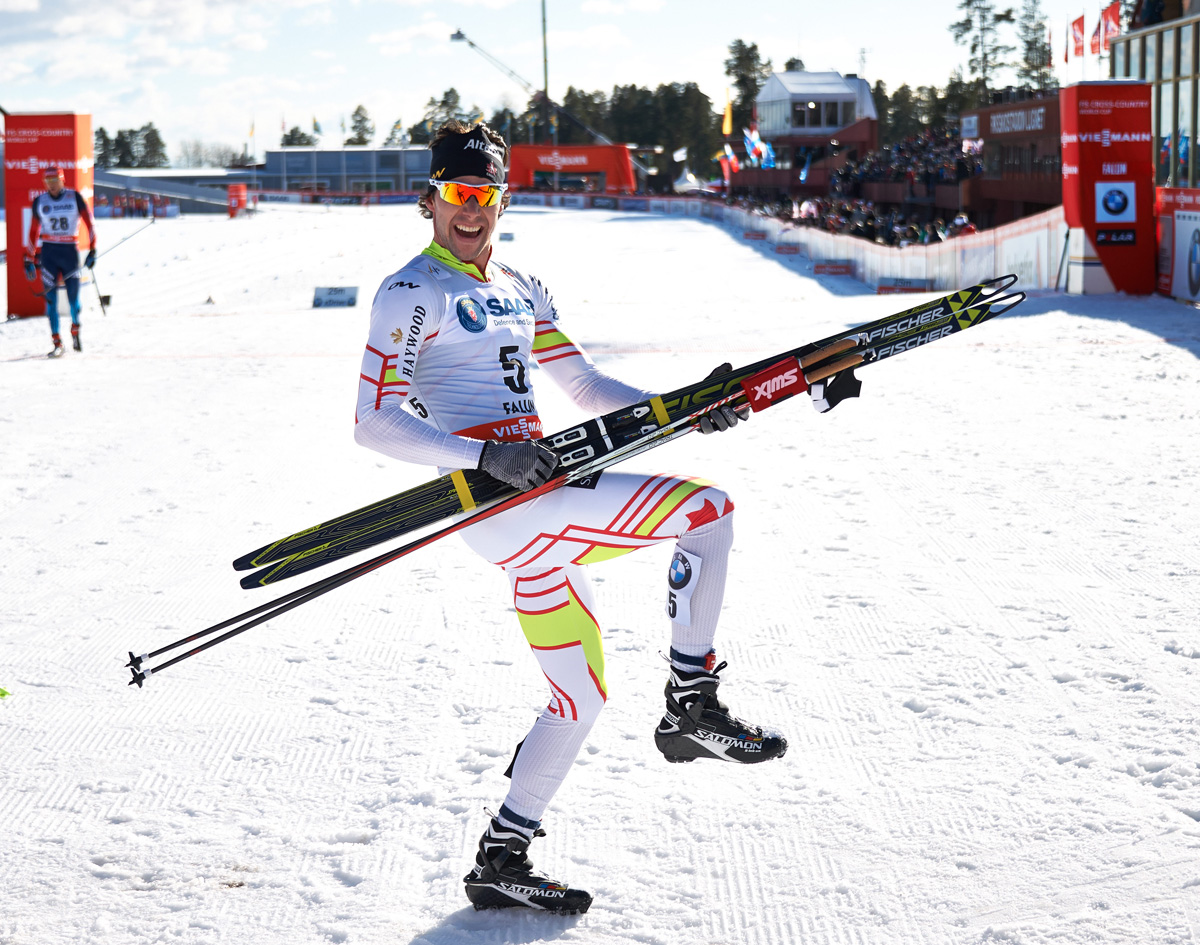
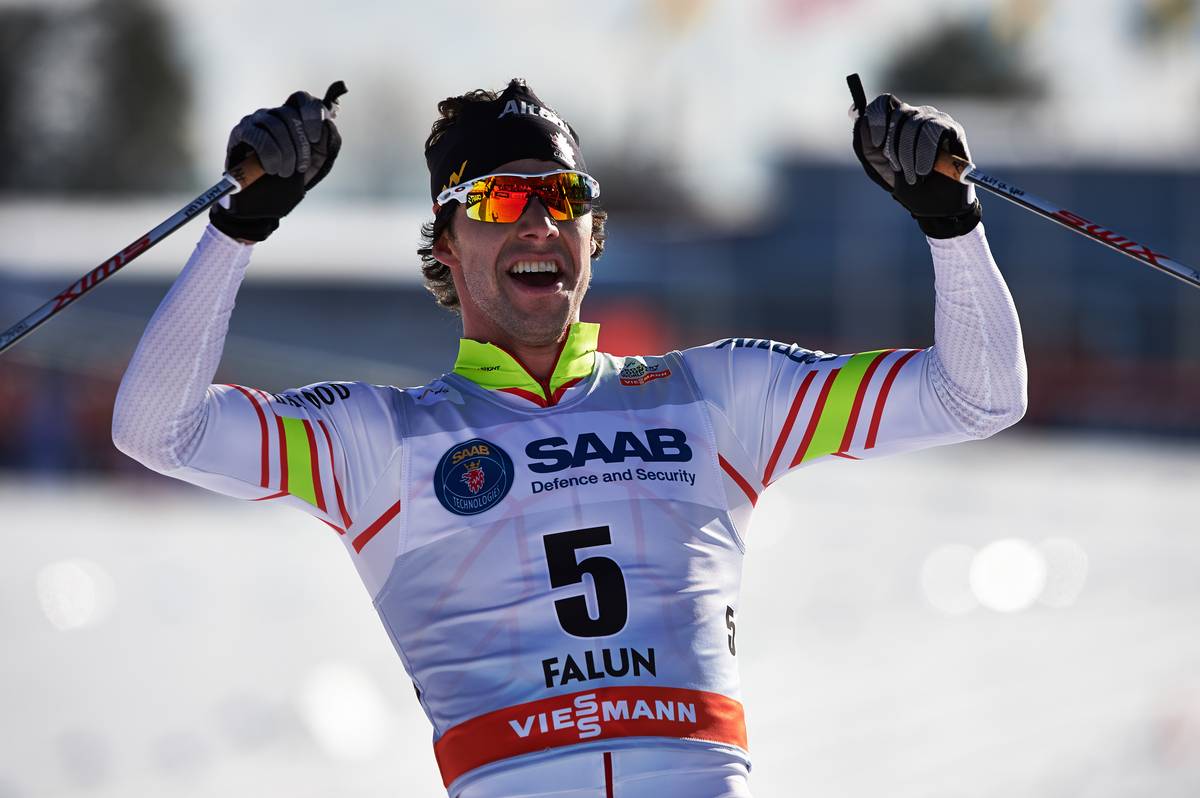
Canada’s Alex Harvey (1) started first and finished second in the men’s 15 k freestyle pursuit at World Cup Finals for a career-best third overall in the World Cup. (Photo: Fischer/Nordic Focus)
“10 k skates tend to be the race I dread the most, but [Sunday] wasn’t disastrous and I’m looking at it positively. I can’t say is was my favorite race, but I think I was able to try to follow some really good girls until I blew up and that in itself is an accomplishment for me for a skate distance race. It was really cool to see Liz, Sadie, Kik, Noah, and Alex [Harvey] have great races and that topped the weekend for me. I was beyond happy with how the classic sprint went, so moving forward I didn’t have many expectations and it was cool to see my teammates have some good performances.” — Sophie Caldwell (U.S. Ski Team), 39th in 10 k pursuit, with 37th-ranked time
“When I put my goals down for the season, the biggest goals were on the Olympics and the secondary goals were to fight for the Sprint Cup and I did that. I didn’t really think about [the overall World Cup] too much. … Going into [Sunday], I didn’t want to look at the points too closely because I knew Kerttu [Niskanen of Finland] was in a good position. When I fell I was like, ‘Oh man, I hope this [didn’t cost me] fifth.’ … Given my racing strategy for the season [sixth overall is] a good finish [after training through] the entire Tour — there’s a lot of points available there — and making my training a little more sprint-specific, it took me a while to find my distance skiing again.” — Kikkan Randall (U.S. Ski Team), 13th in 10 k pursuit, with 16th-ranked time
On season highlights:
“The fastest time of the day in Kuusamo and the top-10 finish there, and the second-fastest time in [the Tour de Ski 35 k freestyle pursuit to Austria’s Johannes] Duerr [who was kicked out of the Olympics after testing positive for EPO] so I would call that the fastest time of the day. Doing that twice was encouraging, but I have to get to that level more constantly. … The Olympic results weren’t what I was looking for, but I would say definitely an improvement over last season and a lot more work to do.” — Hoffman
On what’s next:
“It’s been a long season and I have raced every weekend since mid-November except for two weekends, I have traveled a lot and I have prepared for a variety of different types of races, all in all I am still feeling good and still motivated to race Super Tour Finals in Alaska :)” — Gregg
“It’s been a busy three weeks [since the Olympics … definitely [Saturday] and [Sunday] the legs were pretty tired, but it’s a good feeling to be tired. I know being back home will be an energy boost.” — Randall
“I’m going home for two days before heading to Alaska. I can’t put into words how excited I am to go home for a couple days and I’m also really excited to be united with the SMS T2 team in Alaska!” — Caldwell
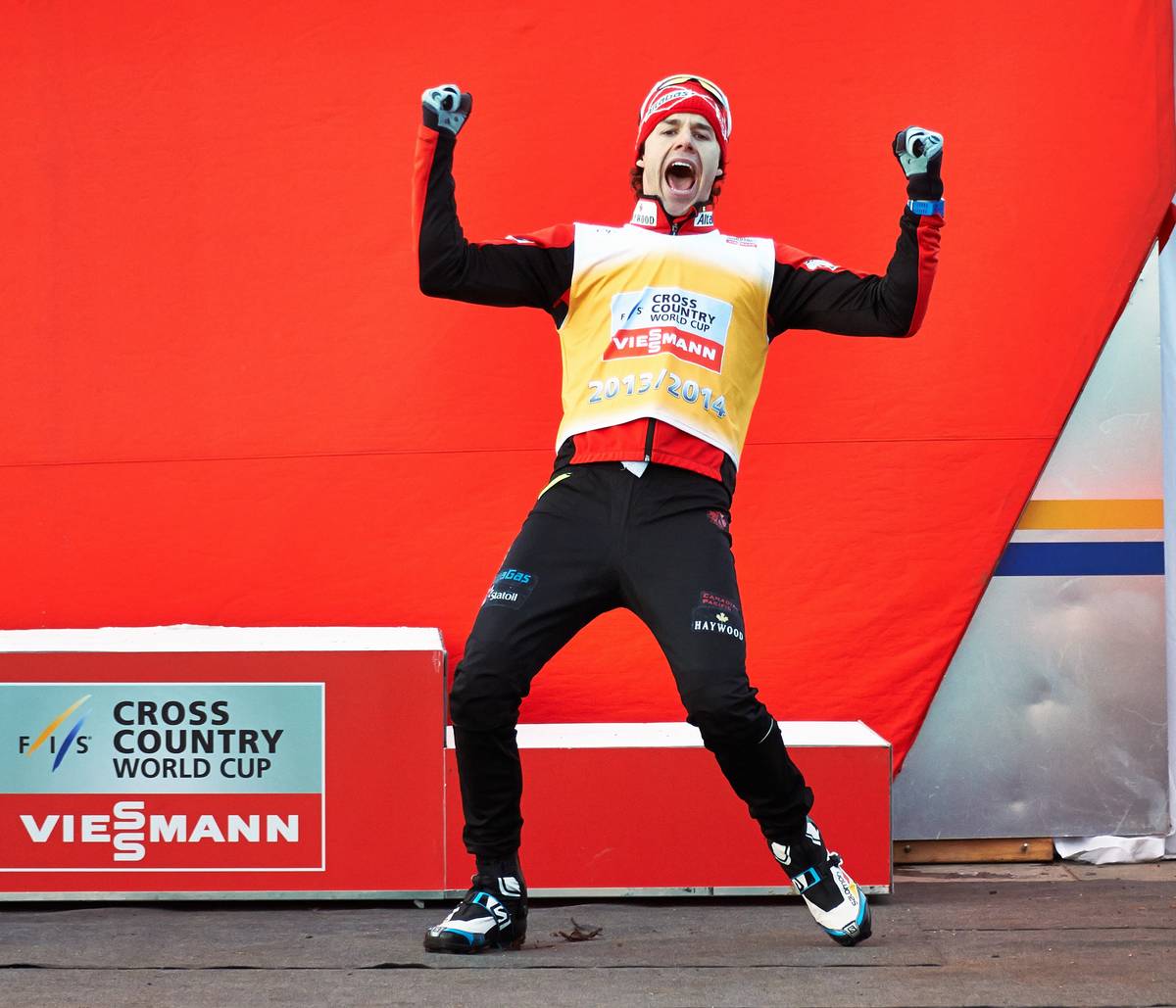
Canada’s Alex Harvey celebrates third place in the overall World Cup. (Photo: Fischer/NordicFocus)
Alex Harvey started Sunday’s 15-kilometer freestyle pursuit in Falun, Sweden, with one thing on his mind: a first- or second-place finish would put him on the overall World Cup podium.
After the 25-year-old Canadian won Saturday’s 30 k skiathlon race he took the lead in the Falun mini-tour, and seized a 26 second advantage in Sunday’s pursuit race ahead of Martin Johnsrud Sundby of Norway and Alexander Legkov of Russia. The skiathlon victory also put him in contention for third place in the overall World Cup standings, a fact he learned from Sundby after Saturday’s race. To accomplish this he would have to hold off either Sundby or Legkov.
Harvey said to FasterSkier on Saturday that the “optimal plan is to stay away [from Sundby and Legkov], but Plan B isn’t bad either,” referring to skiing with the two chasing skiers.
Before the race, Justin Wadsworth, Head Coach of the Canadian National Team spoke with Harvey. “We just talked before the start about the course and then I asked him if he had any plans and he said that he was just going to go out and ski steady, not bury himself and see if he could hold them off.”
Harvey started his race by skiing steadily and smoothly through the winding and hilly course.
“I started at my own pace, but didn’t want to go into the red zone; I knew they were coming,” Harvey told Cross Country Canada, according to a press release.
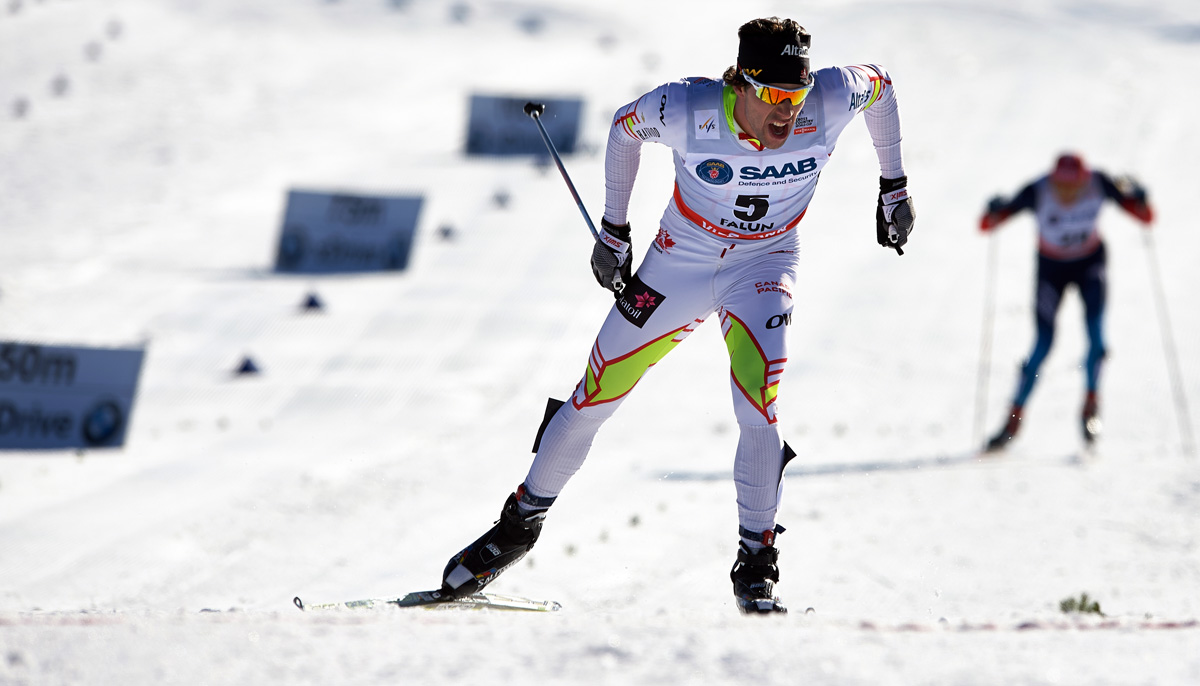
Alex Harvey racing to a victory in Saturday’s skiathlon. (Photo: Fischer/Nordic Focus)
Just over a kilometer into the race, Harvey still had a 25-second lead on Sundby and Legkov, but by the 3 k mark the pursuers were 16 seconds behind him.
With Sweden’s Daniel Richardsson trailing Harvey by 54 seconds, and another Swede Marcus Hellner leading a chasing pack of six skiers some two minutes behind the leader, it was essentially a three-man race for first place. Sundby led Legkov and made a hard push to catch up with Harvey, and after 3 k they steadily approached Harvey ahead of them.
“I was kind of hoping that he could ski out in front of those guys,” said Wadsworth. “Twenty-six seconds is quite a bit, but at the same time when there are two of the world’s best skiers really pushing each other on certain sections it’s almost impossible to hold them off.”
By the time Harvey reached the famous Mörderbakken climb, Legkov and Sundby were only a few seconds behind him and by the top of the climb they had caught him.
“They came back to me at the six-kilometre mark,” said Harvey. “Then it became tactical.”
“He did a really good job for the first couple of k maintaining the time gap, and then Sundby pushed and the time gap came all the way down until they caught him,” Wadsworth said. “That happened pretty fast, but Alex never panicked. He knew he had pretty good skis.”
After Harvey had been caught he continued to lead the three men. With the chasing group so far out of contention there was little pressure to maintain a fast pace, and Harvey appeared calm in the lead, and the pace manageable.
“Alex was looking super relaxed even up to the point they got him,” said Wadsworth. “So it wasn’t like Alex was stressing and then they caught him. I was pretty confident that he was going to be pretty rested for the last push.”
Meanwhile, Richardsson, who had started nearly a minute behind Harvey and was skiing in fourth position, looked to have elevated his pace, perhaps having been informed that the pace had slowed somewhat at the front of the race.
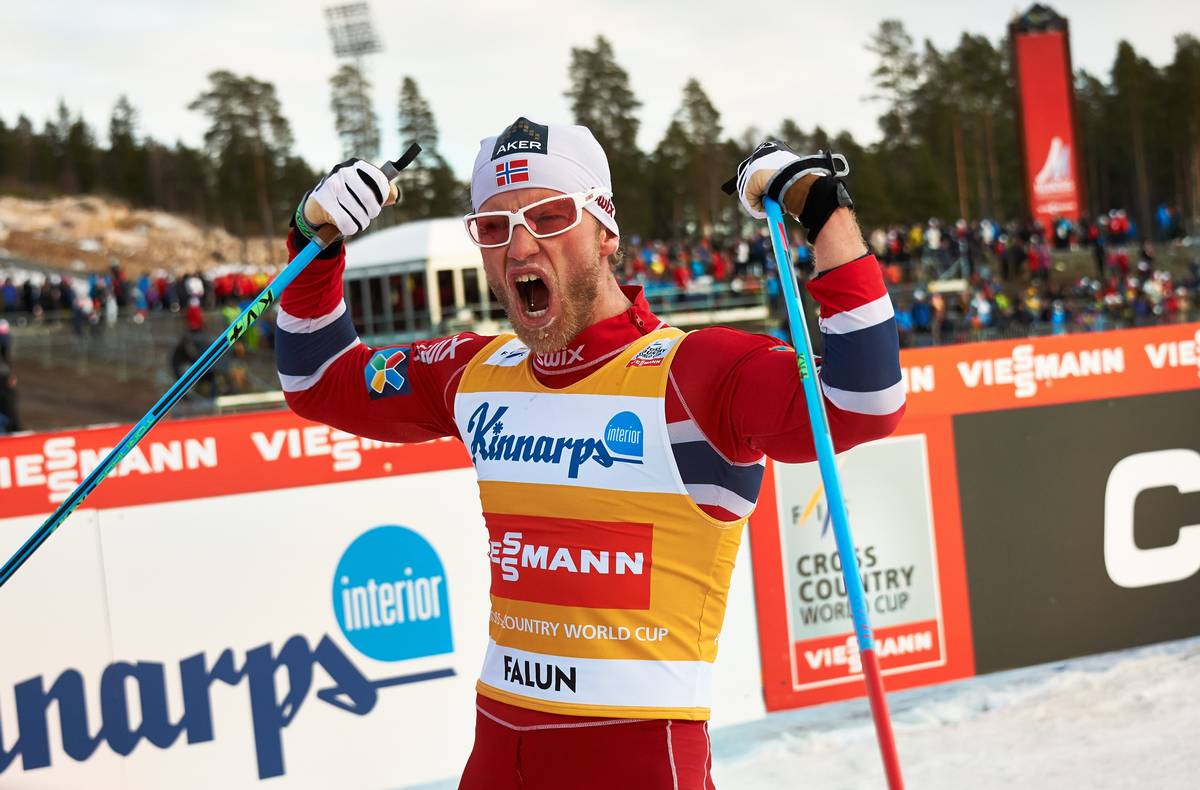
Martin Johnsrud Sundby celebrates his victory in the 15 k freestyle pursuit at World Cup Finals in Falun, Sweden. (Photo: Fischer/Nordic Focus)
Richardsson crept to within 40 seconds of the leaders until Sundby took back the lead from Harvey and began to push the pace once again. Sundby tested the two others with some aggressive hill climbing, but both Legkov and Harvey stayed with him.
Going through the stadium with 3.7 k remaining, Sundby looked to relinquish his lead, pointing at Legkov, who up to that point had not taken a turn in the lead. Legkov made no move to take the lead as Sundby slowed, and it was Harvey who ended up taking the reigns at the front of the race.
Harvey led until the base of the Mörderbakken climb, 2.7 k away from the finish line. As the skiers began the climb, Legkov attacked with his powerful hill climbing. Sundby was quick to respond to the challenge and sped ahead of Harvey to stay close to the Russian’s skis.
Legkov slowed the assault mid climb, and Sundby, sensing an opportunity, immediately counterattacked. The Norwegian hammered up the upper half of the long hill, and this time it was Harvey who responded, while Legkov was too sluggish to match Sundby’s speed.
With Legkov a few seconds behind, it was a battle between Sundby and Harvey. Sundby’s rapid climbing on a late hill proved too much for Harvey, and the Norwegian gained an advantage by several seconds heading into the stadium.
“Those are two of the best in the world and are both Olympic medalists,” said Harvey of Legkov and Sundby. “I knew it wouldn’t be easy, but I also knew I needed to beat one of them to get into that top-three. Once Legkov couldn’t respond, I knew I just had to stay on my skis. I had great shape and the skis were really good!”
In the end, Sundby had enough time to savor his victory. Harvey took second, the result he needed for the coveted podium position on the overall World Cup standings, and Legkov was third.
It has been a breakthrough season for Sundby: he won the Tour de Ski, the overall World Cup title, and on Sunday, the Falun mini tour. “It’s been an incredible season,” Sundby told FIS. “I worked really hard for this. It was really a good battle with Legkov and Harvey today. I knew I wanted to have a [gap] between me and Alex in the finish. I am looking forward to the World Championships next year. Falun is a place with a great atmosphere.”
To NRK, Sundby said, “I have had the smoothest season of all, even if you can pick out a race here and there where I got a beating. But overall, I have been the world’s best skier.”
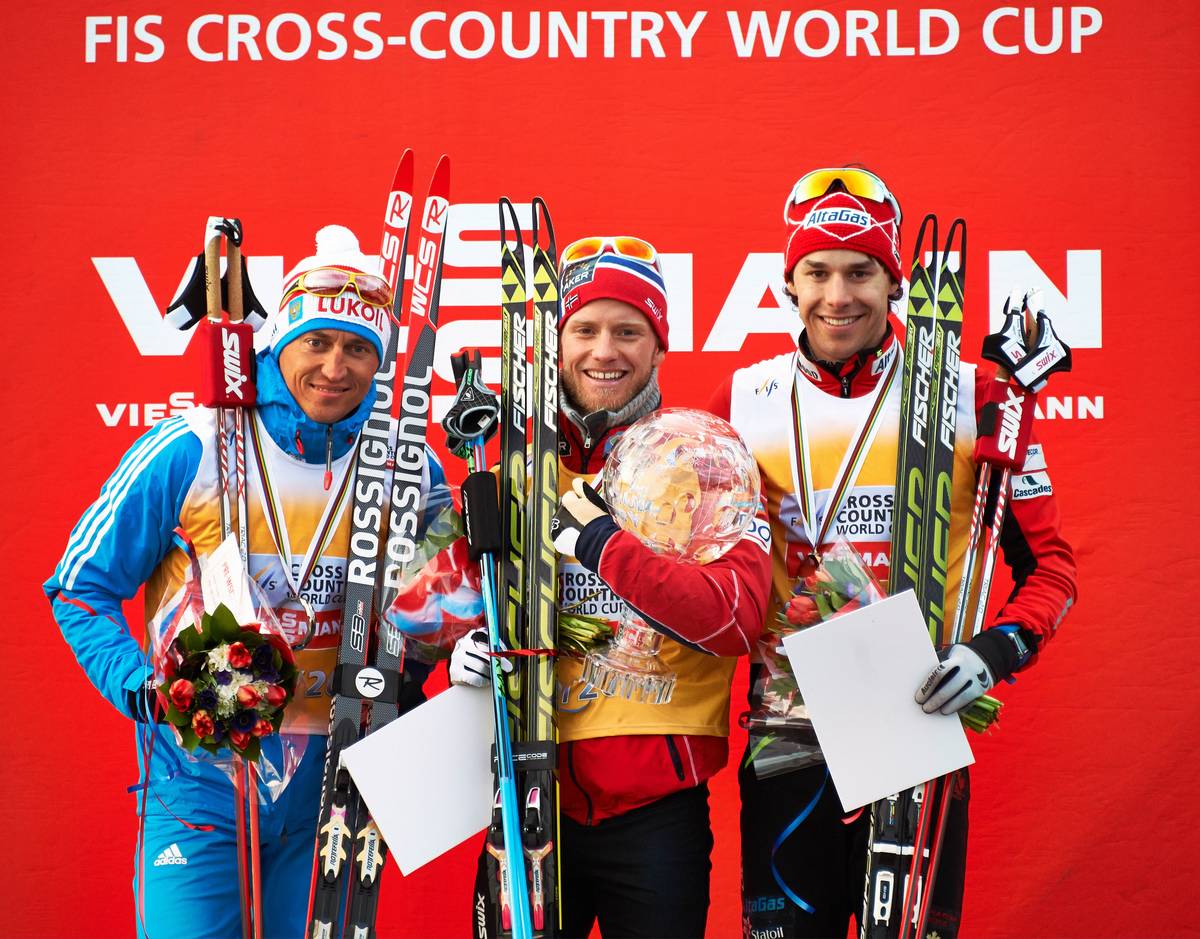
The overall World Cup podium. (l-r) Russia’s Alexander Legkov in second, Norway’s winner Martin Johnsrud Sundby, and Canada’s Alex Harvey in third. (Photo: Fischer/Nordic Focus)
“Before the season, I had not thought I would win the World Cup,” Sundby continued. “I thought maybe top five. I was number seven last year and felt that I was a little better and would raise some places this year. But it has gone way over expectation.”
Harvey’s third-place finish on the overall World Cup was an important achievement for the Canadian National Team.
“It definitely gives some satisfaction with what has been a frustrating year for us, but the overall World Cup is a pretty amazing thing,” Wadsworth said. “Especially to place in the top three when you are a North American is a real feat because it means you have to be in Europe all winter and posting every weekend that you can. In the last three years we’ve had Devon [Kershaw] in second overall in the World Cup and Alex [Harvey] third now so it leaves all of us with a good taste.”
“I’m super stoked,” said Harvey of his podium. “That was a super-nice way to end the season … I had kind of given up on the overall when I had to pull out of the final stage of the Tour de Ski because so many points are given in that race, but I was able to gain a lot in the last weekend.”
“When I grew up it was never something I thought about. My dad [Pierre Harvey] was never better than eighth in the overall. Just being on the World Cup podium was something we all dreamt of in Canada. We have come a long way. We know we can be fighting for the top every weekend. Devon [Kershaw] was second a couple of years ago, and now I’m third. We take a lot of satisfaction showing that we can be consistent.”
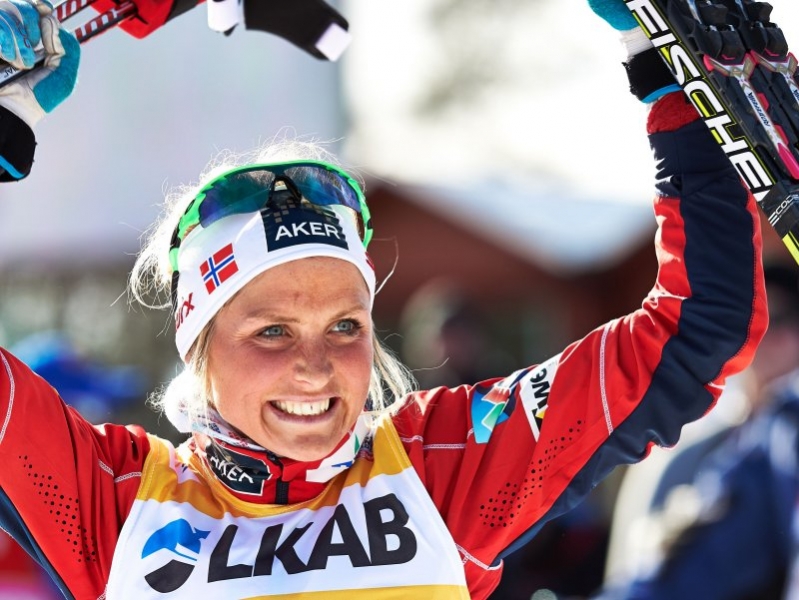
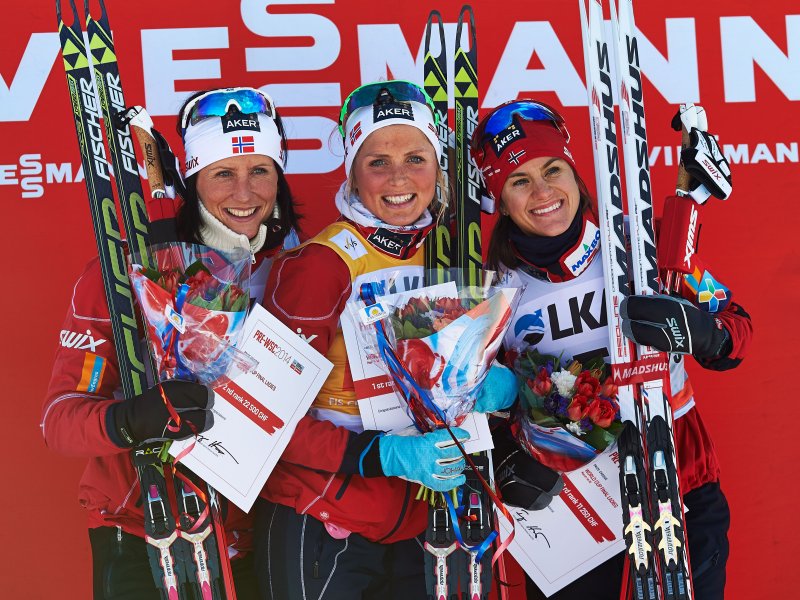
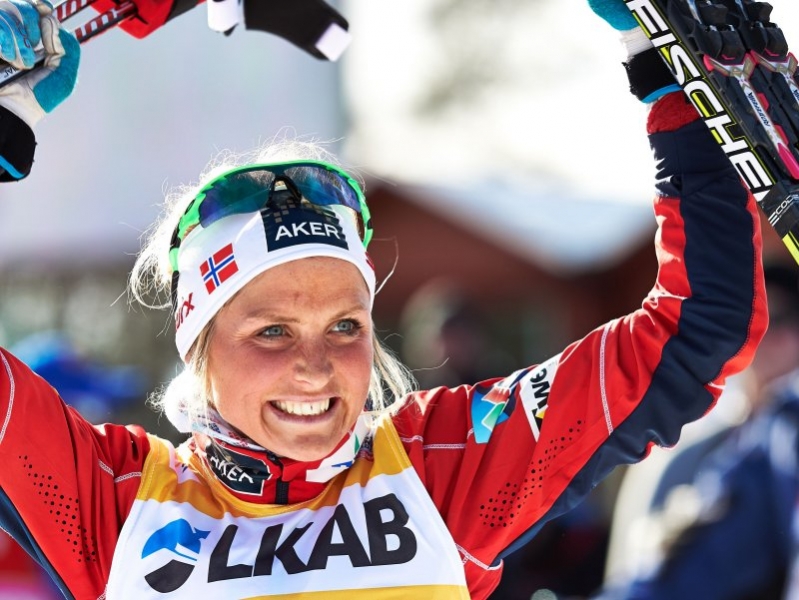
Norway’s Therese Johaug celebrates a nearly 30-second victory over teammate Marit Bjørgen in the World Cup Finals 10 k freestyle pursuit on Sunday in Falun, Sweden, which sealed Johaug’s first overall World Cup title. (Photo: Fischer/Nordic Focus)
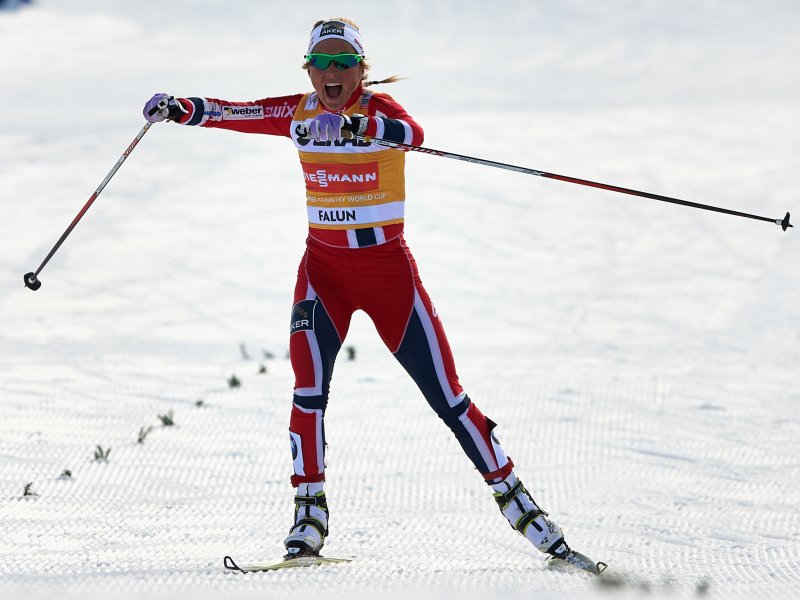
That blood-curdling scream and shouts in Norwegian were sounds of elation from Therese Johaug at the finish of World Cup Finals Sunday. Usually a bridesmaid to her veteran teammate Marit Bjørgen, 33, Johaug was finally a bride — even better, a World Cup overall champion in the final race of the season.
Johaug had started with a 15-second lead in the 10-kilometer freestyle pursuit and just seven points separating her from Bjørgen in the race for the World Cup crown. A six-time Olympic gold medalist, Bjørgen had won the overall title three times. Johaug had yet to do so.
The women’s 10 k freestyle pursuit podium on the last day of World Cup Finals and the 2013/2014 season, with three Norwegians: winner Therese Johaug (c), runner-up Marit Bjørgen (l), and Heidi Weng in third. (Photo: Fischer/Nordic Focus)
This time around, Bjørgen was the underdog, ever so slightly. She cut down her starting deficit to 11 seconds in the first kilometer, then held it for the next couple. By 3.2 k, however, Johaug started to pull away and regained her 15-second cushion halfway point.
Less than a kilometer later, the younger Norwegian laid it out definitively, putting five more seconds between her and Bjørgen.
On what will be the 2015 World Championships course in Falun, Sweden, catching Johaug would be no easy task over the next two loops. With 2.5 k to go, Johaug was nearly 23 seconds ahead of Bjørgen and almost two minutes up on Finland’s Kerttu Niskanen, who was having a race of her own to hang onto third after starting 1:18 back from Johaug.
At this point, Norway’s Heidi Weng had made up 20 seconds on Niskanen after starting in fifth. She passed Sweden’s Charlotte Kalla, who started two seconds ahead of her in fourth, and stalked Niskanen, letting the Finn lead until just before the finish.
Johaug was so far ahead — almost 29 seconds by 8.2 k — she started to take in her surroundings as she entered the finish. By the final straightaway, without Bjørgen anywhere in sight, it hit her. She started screaming then yelling something along the lines of, “What happens!” repeatedly at the finish, according to NRK.
At the finish, she waited for Bjørgen, who came across the line smiling and immediately hugged Johaug, who had captured her first Crystal Globe by 29.2 seconds in 24:25.5.
Norway’s Therese Johaug celebrates a nearly 30-second victory over teammate Marit Bjørgen in the World Cup Finals 10 k freestyle pursuit on Sunday in Falun, Sweden, which sealed Johaug’s first overall World Cup title. (Photo: Fischer/Nordic Focus)
“This is a feeling that I never thought I would experience,” Johaug told NRK, according to a translation. “Winning the World Cup has been a dream since I was a little girl. But I really thought that I should not do it because I have been too bad in the short races.”
Bjørgen won Friday’s classic sprint to start World Cup Finals, but it was Johaug who used the fear of getting caught to fuel her to victories in both Saturday’s skiathlon (by 33.6 seconds over Bjørgen) and Sunday’s pursuit.
“I tried to catch Therese but she was very strong the whole way today,” Bjørgen told FIS. “I would have had to skied better yesterday to be able to do something about the result today. I am very happy for Therese.”
With the 200 points she got Sunday, Johaug won the overall title by 47 points. Norway’s Astrid Uhrenholdt Jacobsen, who did not race on Sunday, held her position in third, 524 points behind Bjørgen. According to FIS, it was the first time since 1995 that one nation dominated the overall World Cup podium.
Weng, who edged Niskanen by 0.5 seconds for third after a drag race to the line — in which she initially led the downhill into the stadium, then Niskanen caught her on the last rise before the finish — finished fourth in the overall World Cup. She was 68 points ahead of Niskanen, who rose to fifth in the overall standings, 42 points ahead of American Kikkan Randall.
The World Cup sprint champion, Randall placed 13th on Sunday. Chasing down 10th with 500 meters to go, Randall said she fell while taking a downhill corner a little too aggressively.
“I was trying to get every bit of speed I could to get into the stadium,” she said. Her skis suddenly skid out into different directions, sending her into a face plant and leaving her chasing two women that passed her.
“That was really tough because you cary a lot of momentum out of that turn,” Randall said.
Annoyed with her blunder for some 20 minutes after the race, Randall said she eventually put it into perspective. Niskanen had made up considerable ground to take fifth overall, and considering Randall’s sprint-heavy training and Olympic focus, in which she skipped the Tour de Ski and its potential World Cup points to train, she had to be satisfied with sixth.
Last year, she was third overall — a first for a U.S. woman — and Randall said she’d like to be on the overall World Cup podium again. But looking back on this season, she said it’s “certainly been fun.”
“Definitely yesterday and today the legs were pretty tired, but it’s a good feeling to be tired,” she said. “It’s an amazing opportunity to be here racing the World Cup, but it’s been a long year of living in hotel rooms being away from home.”
Randall said she’ll miss the World Cup grind in a couple weekends, but for now, she’s looking forward to her homecoming in Anchorage, Alaska, and racing there March 22-28 at SuperTour Finals and U.S. Distance Nationals.
“I know being back home will be an energy boost,” she said.
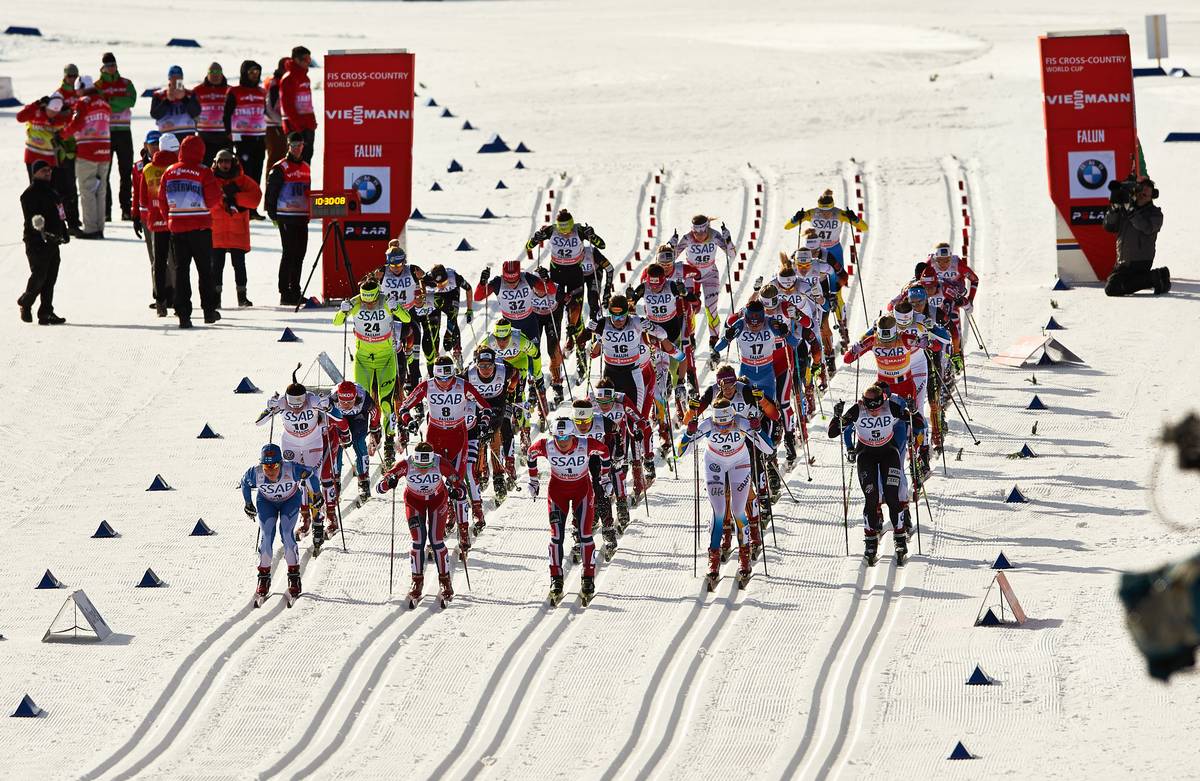
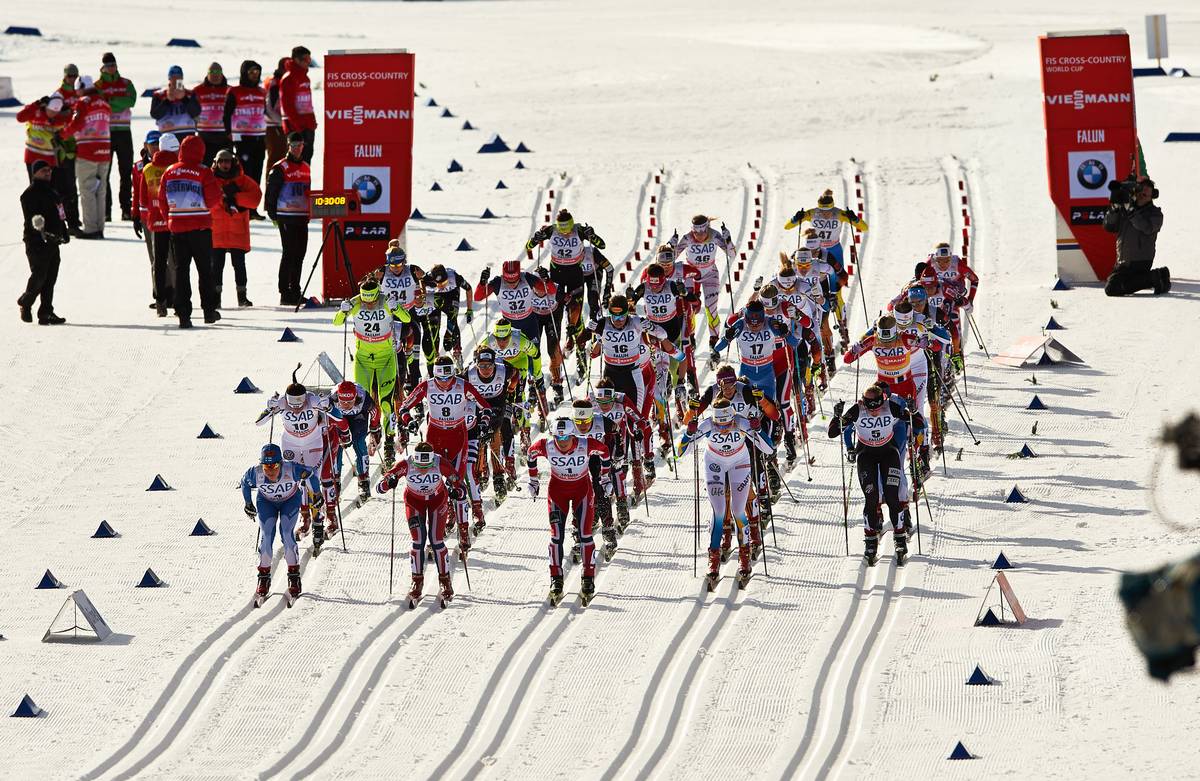
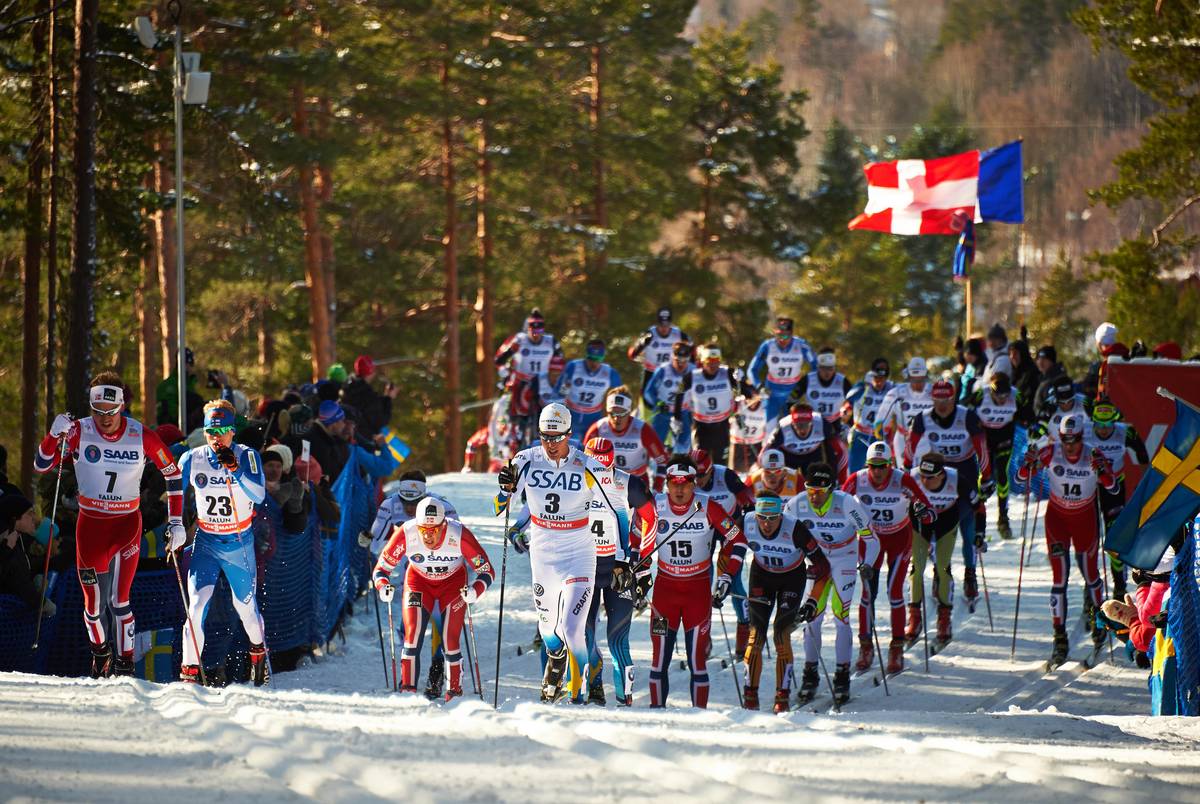
The start of the women’s 15 k skiathlon on Saturday at World Cup Finals in Falun, Sweden, with American Kikkan Randall in the front row at the far right. Randall went on to place 20th for the second-best U.S. women’s result after Liz Stephen in 15th. (Photo: Fischer/Nordic Focus)
With two races left in the World Cup season, Liz Stephen could’ve raced like she had nothing to lose. But the skiathlon is a race of strategy as much as skill, and on Saturday at World Cup Finals in Falun, Sweden, the longtime U.S. Ski Team member decided she’d better start conservatively in classic.
Hovering in the mid-30’s for most of the race, Stephen later explained that the first half of the women’s 15-kilometer skiathlon, turned out to be a “pretty standard classic race” for her. No bells or whistles, but she didn’t need them. She had 7.5 k to make up ground.
About a minute and a half behind the leader, Norway’s Therese Johaug, at the halfway point, Stephen in 37th transitioned smoothly to skating and began her own race. Between 8.2 and 9 k, Stephen rose from 34th to 25th. With less than 4 k to go, she was up to 16th.
“The skate portion went much better than the racing has been going lately,” Stephen, 27, wrote in an email. “The body was really ready to race out there during the skate.”
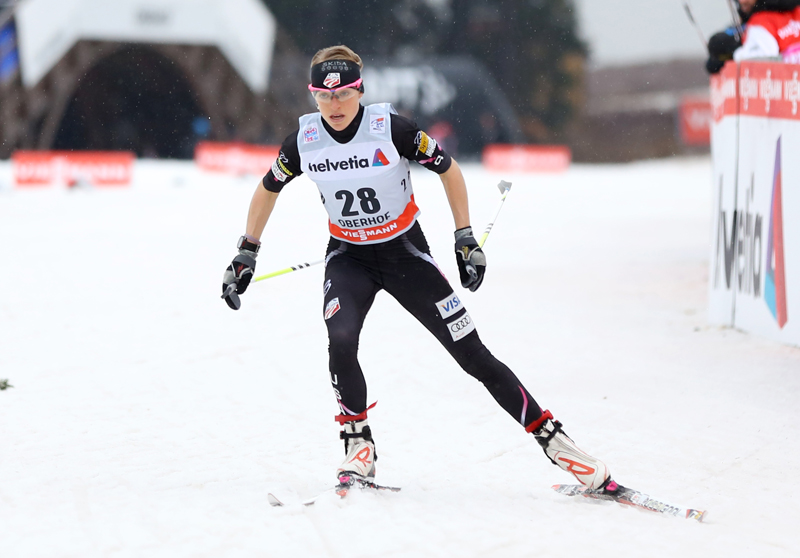
Liz Stephen (U.S. Ski Team) racing earlier this season in the freestyle prologue at the first stage of the Tour de Ski in Oberhof, Germany. (Photo: Marcel Hilger)
She ended up picking off one more person (Finland’s Krista Lahteenmaki) to finish 15th, 2:08.3 behind Johaug, who won by more than 33 seconds. The result put her 18th in the World Cup Finals standings and 15th in the season-long distance ranking— tying her personal best from last year. With one race remaining on Sunday, the 10 k freestyle pursuit, she was 17th in the overall World Cup.
“The goal going into the season was top 15 in the overall and top 10 in the distance list,” Stephen wrote. “I am close to those goals, and improving over last year’s standings in the overall is certainly something to recognize as a step in the right direction.”
Last season, she was 20th overall — 22 places better than she had been the year before.
“I am happy that the season is coming to an end and going home for a break is in sight,” Stephen wrote. “I am not so much tired as mentally ready to change it up, get out of hotel rooms for a while and be back in the USA with my family for a while. Recharge a bit.”
First, she’ll go with most of the team to Anchorage, Alaska, next week for SuperTour Finals and U.S. Distance Nationals March 22-28.
Looking back on the season, Stephen emphasized the success of her teammate, Kikkan Randall, the three-time defending World Cup Sprint champion, and how she has impacted the rest of the team.
“She has taught me to believe in myself, how to work harder, try new things, be open to the idea of being the best in the World someday,” Stephen wrote. “The fact that she instills this fun atmosphere on our team while also kicking serious a** on the world cup, year in and year out is really inspirational and special to be a part of. I’m really very proud of her and to be her teammate in so many ways.”
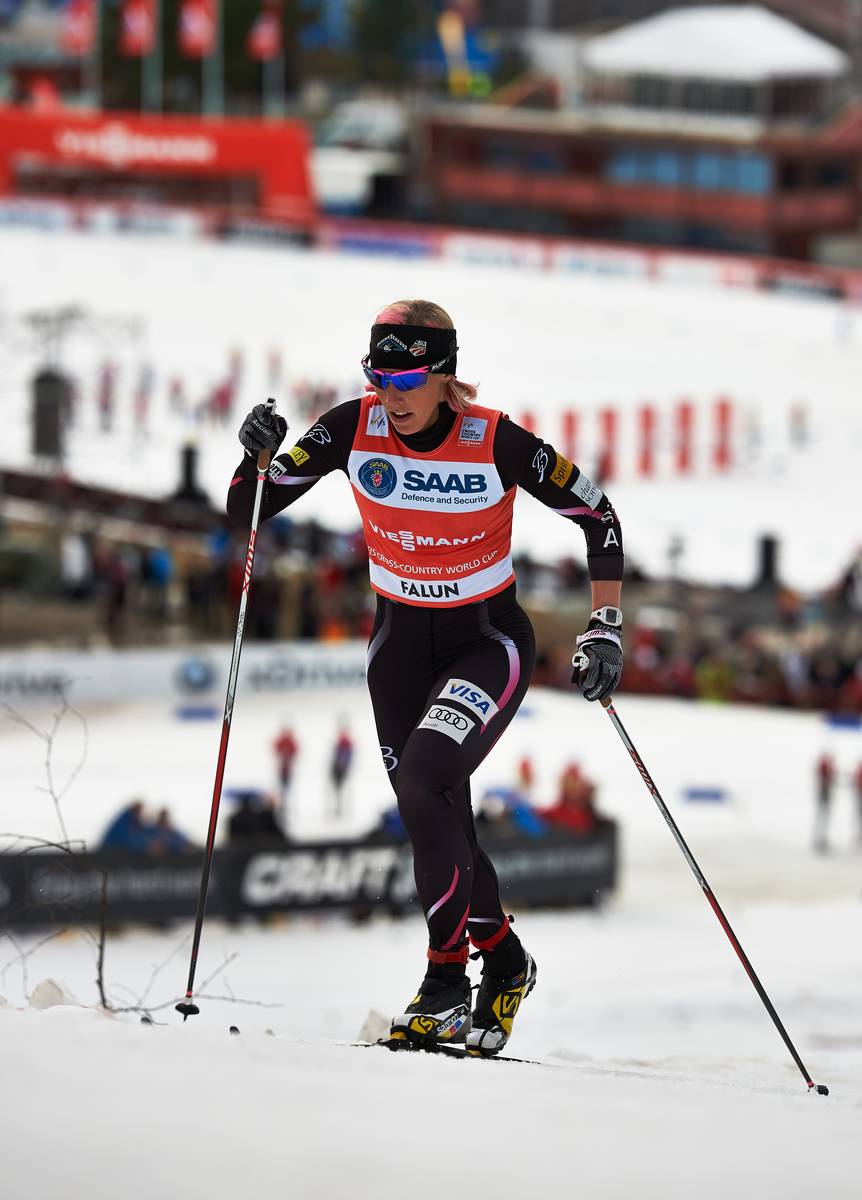
Kikkan Randall (U.S. Ski Team) in Friday’s classic sprint qualifier at World Cup Finals in Falun, Sweden. She went on to place fourth in the final and take home her third-straight Sprint World Cup Crystal Globe. (Photo: Fischer/Nordic Focus)
Randall finished 20th (+2:25.6) on Saturday in one of the few World Cup skiathlons in her career. The result put her 17th in the distance rankings, and kept her in fifth overall — 30 points behind Norway’s Heidi Weng in fourth.
“I wanted to be up in the top 15 so I fell short of that goal today,” Randall wrote in an email. “I still have some good opportunity to move up tomorrow and I need to fight for every point.”
Randall skied around 20th for much of the race, moving up from 21st at the transition to 19th at 8.2 k. Lahteenmaki edged her by 0.4 seconds for 19th, and Randall finishing four seconds ahead of her U.S. teammate, Sadie Bjornsen.
“To have a good result you have to go with that opening pace and try to stay up near the front,” Randall explained. “I tried to start hard but my body was pretty tired from the sprint yesterday. I was skiing mid pack in the classic and then headed out on the skate with some girls to chase. I had some good sections were I felt I was picking up time and then some bad parts where I had a hard time keeping my glide up in the skate. I came into the stadium with a couple girls but didn’t ski the finish very well. It was an okay day for me.”
Like Stephen, she was excited to wrap up the season.
“It’s been a lot of racing and a lot of emotional energy, especially in the last six weeks,” Randall wrote. “It’s been a pretty good season. Overall I was happy with my consistent sprint performance but felt I went backwards a step in my distance skiing. And of course the Olympics was my biggest goal of the season and I didn’t reach my goals there. I am definitely ending this season wanting more.”
Bjornsen started faster and was 12th through 6 k and ninth at the transition at 7.5 k, just 43 seconds behind Johaug.
“The pace went out super hard from the start,” Bjornsen recalled. “It was quite windy out there, and I was breaking wind in my outer track for the first couple of k’s … so I was struggling to stay on pace. After jumping in behind some girls, I found control, and the classic portion went really well from that. I had great skis. I chose to go on the slicker side, which made for some rocket fast skis on the downhill.”
The transition to skating proved to be Bjornsen’s biggest challenge as she slipped to 17th within the first kilometer out of the stadium. She recalled a pack of about 10 people passing her in the first 10 minutes, and was in 20th with 4 k remaining.
“I was able to turn it around shortly after when I got the feelings back in my legs,” she wrote. “It was fun to be out there trying to ski with Kikkan, and then reel back some of the skiers that had passed me by the end.”
Conditions were a factor as the night before brought a mix of rain, sleet, then snow, according to Stephen. “But the skiing was good,” she explained. “Pretty transformed snow and the high winds blew some snow into the tracks in places making the conditions slow in some spots and very fast in others.”
The course itself is what many of these same racers will be tackling at World Championships next season. Several North Americans said they liked the course, and Stephen described it as “hard, fair and fun.”
“The are a fun level of challenging!” Bjornsen wrote.
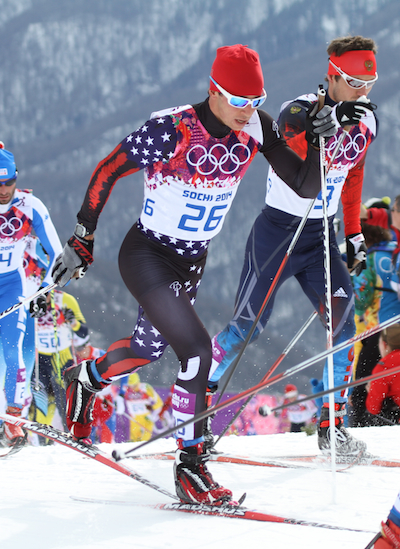
Noah Hoffman (U.S. Ski Team) racing to 35th in the 30 k skiathlon at the Olympics in Sochi, Russia.
Going against his instincts, he decided to play it relatively safe and pace himself throughout the men’s 30 k skiathlon. Hoffman, 24, is known for his tendency to try to lead or stick with the leaders in distance mass starts, but his goal was to score around 20 to 25 points throughout the three-race Finals to put him in the Red Group in the distance standings.
“I scored 13 points today so I need to do something similar to tomorrow,” he said of the pursuit. “Which is nice, better than it could have been.”
Out of the start, he said the pace wasn’t too fast, but he focused on gradually working his way up from just outside the top 40 to 25th within the first 3.75 k. He was 20th at 5 k, 14 seconds behind the leaders, and halfway through the classic leg Hoffman was skiing 30 seconds back in 22nd.
“I was trying to be patient and stay a little more conservative,” he said. “I wanted to be skiing a little further back in the group. I did that and I don’t know that my strategy mattered that much today because I wasn’t quite good enough to be able to go with that fairly large group that ended up shelling everybody else.”
The group he was talking about was the chase pack, which Norway’s Eldar Rønning initially led to try to cut down a 20-second gap on the four leaders at 8.7 k. Hoffman was at the tail end of the group with Ivan Babikov in 23rd and 24th, respectively, and with one lap to go in classic he was detached, trailing the leaders by 45 seconds with Norway’s Sjur Røthe.
“I did end up with a good ride behind Sjur Røthe for the classic, which was really good and I know he is a great skater and he proved that today,” Hoffman said. (Røthe ended up seventh.)
“I was definitely hoping to be able to go with him which would have led to a really good result, but I just wasn’t quite good enough in the skate,” he added. “I have had a little bit of a tough time transitioning from classic to skate and I need to continue to work on that. Once I got into the skate, in the last two laps of the skate I was feeling better and moving up more.”
For the second half of the race, Hoffman mostly stuck around 20th. He heard he was in 19th about halfway through the skate leg, which was where he figured he needed to be.
“It was definitely the right thing to do, it is what I need to do more of,” Hoffman said of his pacing strategy. “There was definitely a couple of movements where I was like, I could definitely move up from here, and then I had to settle myself down and say this was a fine place to be. But for the most part, I think it was good. I did what I wanted to do and I think I am learning slowly, slower than I would like to be.”
At this point in the season, Hoffman said his energy is good, but he’s excited to go home and will stop at his base in Park City, Utah, between racing in Alaska and vacationing in Mexico.
“I think fitness is tailing off a little bit; I train a lot less than my teammates throughout the winter and it has been a long time since I have done any substantial training,” he explained. “But that is fine … [to] still be able to ski into the points with this fitness is good so I am looking forward to a little bit of domestic races when I go home, something I haven’t done in two years.”
Hoffman ranks 28th in the World Cup distance standings, just within the top-30 U.S. team criteria, and 35th overall with one race to go. He will start 21st, 4:19 back from Harvey as the leader and a second behind 19th and 20th in Sunday’s pursuit.
Canada’s Alex Harvey celebrates in his traditional fashion after winning his third World Cup race of the season, the 30 k skiathlon and second stage of World Cup Finals on Saturday in Falun, Sweden. (Photo: Fischer/Nordic Focus)
Thirty kilometers is a long time to get to know somebody, and when you’re already pretty well aquatinted, well, then it comes down to mind games.
Canada’s Alex Harvey knew he’d be better off following the lead of three others for the first half of the men’s 30-kilometer skiathlon — the classic portion — at World Cup Finals on Saturday. Plenty of kick made it easy for him to stay in contact on what he considered his weakness: the big, steep hill, known as Mörderbacken in Falun, Sweden.
The men had to ascend it eight times total — four loops of classic, four loops of skate. Harvey stayed comfortable behind Sweden’s Daniel Richardsson, Norway’s Martin Johnsrud Sundby, and Russia’s Alexander Legkov, entering the transition in fourth and emerging out of it in first.
Everybody else was at least 21 seconds behind, and not a threat according to Harvey. Even when Finland’s Matti Heikkinen started to go for it in early in the skate leg, leading the chase pack in an effort to close the gap on the four leaders, Sundby, Legkov and Harvey kept it cool, even “chill,” Harvey said.
Daniel Richardsson leads the men’s 30 k skiathlon on Saturday during the first of eight laps in the penultimate race of World Cup Finals in Falun, Sweden. Richardsson went on to place fourth behind Canada’s Alex Harvey, Norway’s Martin Johnsrud Sundby, and Russia’s Alexander Legkov, respectively. (Photo: Fischer/Nordic Focus)
Meanwhile, Richardsson, who initiated the breakaway with a relentless double pole about 5 k in, started to falter. With 10 1/2 k to go, he was trying to minimize a gap of his own to the front three. Harvey was surprised the Swede fell off the pace, but said Richardsson, who turned 32 on Saturday, pulled their weight for most of the classic leg, and he’s known as a better classic skier.
And then there were three. The breakaway trio stuck together for the rest of the race, never looking back to see where Heikkinen was (he lost steam about 5 k into the skate leg), and not worrying about the chase pack, which included the likes of Devon Kershaw — who led its charge halfway through 9 k into classic portion.
The front four had gapped the masses between 5 and 6 k; there was still plenty of race ahead of them, yet they skied smart enough to put more time into the chase group in the skate leg.
With 10 k to go, France’s Jean-Marc Gaillard was leading the pack in fifth, 36 seconds behind the leaders. No way was he or anyone else going to bridge 30-plus seconds alone, let alone into a headwind, Harvey thought.
So it was the Canadian, Norwegian and Russian — all essentially guaranteed a podium in the penultimate race of World Cup Finals, but everyone wanted to win.
After the transition, Sundby led up the long gradual climb out of the stadium, just like he did on every other lap, and the others let him do so into the headwind on a windy, above-freezing afternoon. Harvey decided it was time to take his turn up front soon after, not so much for courtesy but strategic reasons.
“I was leading on the climb just because I wanted to set my own pace,” he said. “I didn’t know how the other guys were [feeling] and I felt like the most vulnerable place for me it always is uphills. It was the best position to react on the front.”
And so he led up Mörderbacken — every time.
Throughout the next four laps, the pace remained somewhat relaxed, even lulling at times. Harvey said he wasn’t worried about Legkov or Sundby attacking the last time up Mörderbacken because he had a sense everyone was pretty gassed at that point.
Canadian Alex Harvey edges Norway’s Martin Johnsrud Sundby (not shown) by 0.4 seconds for the 30 k skiathlon victory at World Cup Finals on Saturday. Russia’s Alexander Legkov (behind) placed third. (Photo: Fischer/Nordic Focus)
Harvey got up front anyway, skiing up the middle of the long climb to minimize the amount of space anyone would have to use to get around him. If anything, their pace slowed, with Richardsson as the next closest competitor 19 seconds back.
By the final uphill 180-degree turn, Harvey almost came to a stop in first — all part of the plan, he later explained. Canadian Head Coach Justin Wadsworth was relieved.
“I was worried he was leading so much,” Wadsworth said. “I told him that after the race, ‘Oh man, you had me worried you were going to lead down the last downhill,’ which was I think on this course, a bit of a curse. … He just put on the brakes at the last second … and I was really happy to see that, because when he did that I knew he had a lot of confidence in his skis and his body.”
Just like Harvey guessed, Legkov went for the open space and Harvey went from first to third, remembering the value of the slipstream on the last downhill into the stadium. The Canadian had gone from sixth to fourth with a similar tactic in Friday’s classic-sprint final, and this time, he was going to use it to ski to a victory.
“I knew my skate skis were good all day, [and] Legkov and Sundby, they’re not the strongest sprinters,” Harvey said.
Sundby had two skate-sprint podiums at the Tour de Ski and won the Kuusamo mini tour at the beginning of the season, and considering that, Harvey thought he would the toughest to beat in a sprint. Really though, he just wanted to enter the stadium in second or third — didn’t matter which order.
With a couple hundred meters to go, Harvey took advantage of a narrow opening between Sundby on the left and Legkov on the right to follow Sundby toward the finish in second. While Harvey followed the course’s natural line to the right behind Sundby, he said Legkov moved left into his path and he broke the Russian’s pole as a result.
“I tried to stay in Sundby’s draft because Legkov was so sketchy today,” Harvey said, noting Legkov crashed three times (once classic skiing out of the stadium, another time at the classic-bonus prime and one more up Mörderbacken — all on his own).
While Sundby and Harvey dueled to the finish, Legkov skied alone in third, finishing 5.9 seconds back. The Canadian pushed up and over the last rise to the line, edging Sundby — the overall World Cup champion — by 0.4 seconds to win in 1:18.07.6.
Sundby later told Harvey in doping control that he was in contention for a World Cup overall podium, which he hadn’t realized and would be a career best. Harvey will have to hold off Sundby and Legkov, who will start 26 seconds behind him in Sunday’s 15 k freestyle pursuit, to win the World Cup Finals mini tour and claim 200 points that comes with it (and would put him ahead of Norway’s Chris Andre Jespersen in third in the overall standings).
But on Saturday, Harvey took some time to celebrate his third World Cup victory of the season, yelling exuberantly with a final “Yes!” at the finish, and getting congrats from his teammate Devon Kershaw, who had one of his best races of the season in 12th.
Canada’s Alex Harvey celebrates his third World Cup win of the season after a 0.4-second victory in Saturday’s 30 k skiathlon at World Cup Finals in Falun, Sweden. (Photo: Fischer/Nordic Focus)
“I enjoyed it right after the race, on the podium and everything, it was pretty sweet,” Harvey said. “It’s been such a good season for me with three wins. The skiathlon, since I’ve been a junior, it’s always been my favorite race. It took me a while to get good at sprinting.”
Wadsworth said Harvey will probably have to be in the top two Sunday to secure third in the overall World Cup.
“After the year we have had, for him to end up third overall tomorrow, it just shows that Alex is a guy for the future, that he can contend for the overall World Cup,” Wadsworth said. “We are playing on such a different field as North Americans because we have to deal with being on the road all year long. I don’t think people really put enough weight into that. For Alex to rebound after a hard Olympics and difficult races here and there, and we have been living out of a hotel since November, I think it really, really speaks strongly to the quality all-around skier that he is.”
While the 25-year-old Harvey acknowledged that every season has its highs and lows, he felt fortunate that his didn’t have many. His health was good, he didn’t get sick or injured, he pulled out of one race at the Olympics to save energy for other races, and while the Olympics were marked by some waxing woes, he said there were plenty of non-race-related things in Sochi to focus on.
“We controlled the things that we could control and we came into the season with a good plan,” Harvey said. “The body was there every weekend except [the first one in] Kuusamo. I’ve had a lot of fun this year, just always fighting for the top 10. It went by really fast there … it was just high spirits the whole winter.”
Before this season, Harvey had one career World Cup win. He went on to win the first prologue stage of the Tour de Ski in Oberhof, Germany, and then a World Cup skate sprint in Szlarska Poreba, Poland.
If he wins tomorrow, great, Harvey said. Twenty-six seconds is a lot of time to start ahead of anyone else, and if Sundby and Legkov charge hard enough to catch him, then he might find himself in a similar position as Saturday — trying to outsmart and outsprint them to the finish.
“The optimal plan is to stay away, but Plan B isn’t bad either,” Harvey said.
While Kershaw came through in 12th, 1:13.7 behind Harvey, the third Canadian in the race, Ivan Babikov placed 23rd (+3:42).
“It’s cool to see that he’s back in the top 15,” Harvey said of Kershaw. “There was nothing free today. It was windy. It was a slow 30 k. An hour and 18 is not fast.”
Wadsworth said Kershaw’s result didn’t surprise him.
“Devon, when he gets in the situation where he doesn’t have anything to lose … he was relaxed today and I think our skis were quite good,” Wadsworth said. “He just went out there and did what he normally could do, that is the kind of shape he is in. It was nice for him to just turn things off and put it on auto pilot.”
On Friday, Kershaw placed 40th in the sprint, which he described in an email as “another hard effort in a long list of hard efforts on the sprint front this season.”
“I was and am very disappointed with how my sprint season went this year,” Kershaw wrote. “I only qualified in 2 individual sprints (Oberhof skate sprint, and Poland) and got bumped in the 1/4 finals in each of those – so that’s a long cry from being on the podium in both classic and skate sprints like I have been back in 2011 and 2012. Something isn’t working – and I guess now it’s safe to say that something didn’t work – as my sprint season is done for this year.”
He explained he’ll have to spend time to figure out what went wrong and how to get back the speed that’s characterized most of his career. “This is the first season in awhile where I have no top 10 sprint results on the World Cup,” Kershaw wrote.
“I am not feeling very good – I mean, that’s pretty evident. I got pretty sick in Sochi, and then in Lahti I was still not 100% there either, but went for it by racing both races – which didn’t go well,” he added. “I have since been healthy, but my lungs are holding on to something – I could feel that a lot in the qualifier for sure. Still though, skiing around easy I don’t feel too bad, just feels like my top end is non-existent.”
His goals for the rest of World Cup Finals, “to have a distance race where I feel half-decent,” Kershaw wrote. He likely did that on Saturday.
Babikov recently returned to Europe after going back to Canada for a week to recover from illness post-Sochi. He said his skis felt a bit draggy in Saturday’s classic portion and his legs weren’t quite there in skating, but all things considered, he felt reasonably good, skiing with American Noah Hoffman and Norway’s Sjur Røthe until late in the skate leg. They dropped him with at least one lap to go and he skied alone for the rest of the race.
“That is the end of the season usually, everybody races with whatever they have in the tank,” Babikov said.
On Sunday, he’ll start 25th with Russia’s Evgeniy Belov in 24th, 5:13 behind Harvey. They have about a 50-second gap to 22nd.
“Of course I will try to ski as fast as I can,” he said.
As for his teammate: “Alex is on fire lately, he is in great shape and having the best season for him ever,” Babikov said. “It was great to see him win today, well, I did not see that, but I saw him in the finish.”
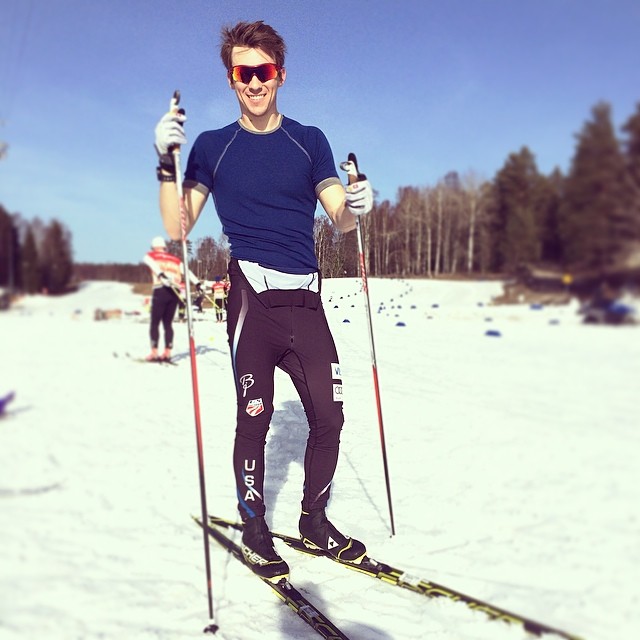
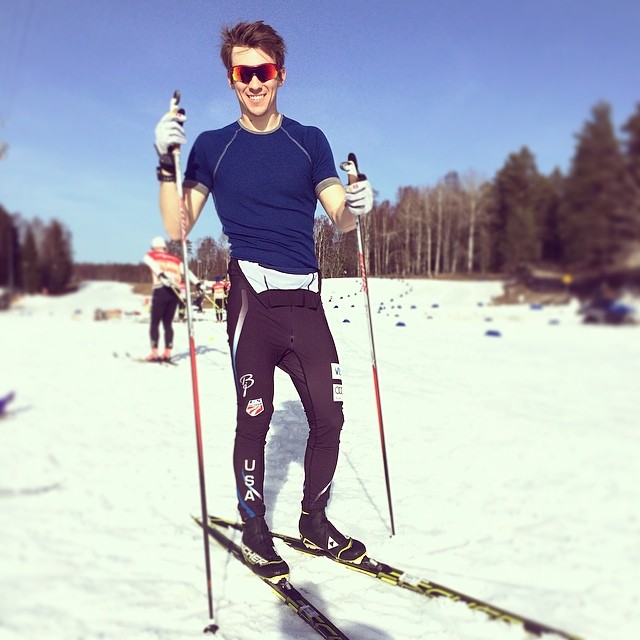
Reese Hanneman training in spring-like conditions at World Cup Finals in Falun. (Photo: Reese Hanneman/Instagram)
Reese Hanneman was so close, heartbreakingly close, encouragingly close, however you look at it, 0.45 seconds from making it into the points at World Cup Finals as a 24-year-old U.S. Continental Cup leader.
Sixteen days after his first World Cup of the season, Hanneman notched his all-time best World Cup result on Friday: 31st in the classic sprint in Falun, Sweden. The leader at the end of the last SuperTour period, the Alaska Pacific University skier earned his way to Europe, but in a field of fewer than 50 competitors, most of which have made the World Cup top-50 cut to get to Falun, there’s always a fear of finishing last.
Hanneman was far from it on Friday, nearly qualifying for the rounds, which would’ve made him the third American to do so this year.
“To be that close to the heats, and scoring points, is brutal,” Hanneman wrote in an email. “I felt good, but I didn’t even execute it perfectly. There are a few places I know I could have been faster. But there is nothing like a 31st on the World Cup to make you so hungry for the future.”
Reese Hanneman (r) and U.S. women’s coach Matt Whitcomb (l) celebrate with Kikkan Randall (front) after Randall won her third-straight Sprint World Cup Crystal Globe, receiving it at a ceremony following Friday’s classic sprints at World Cup Finals in Falun, Sweden. (Photo: Fischer/Nordic Focus)
U.S. coach Matt Whitcomb was excited about Hanneman’s performance, considering he’s been in their development pipeline for several years. This season, just over two weeks ago, marked his international World Cup debut.
“To put the carrot that close to his face at the end of the season, he’s going to go home more motivated than ever,” Whitcomb said. “It’s a significant accomplishment to come that close to even qualifying for a World Cup sprint … He can review the tape from today and see a few mistakes that he made, very small ones, but that’s all it takes to find that half-second.
“He’s made a big step this year, and APU and all his coaches and all his sponsors have done such a great job of bringing him along patiently,” Whitcomb added. “He’s struggled at times and he’s constantly training with one of the toughest groups of guys in the country and to have patience with the ups and down has really paid off for Reese and he’s seeing this weekend that he can be a World Cup sprinter.”
Since winning his first national title and making the podium in three out of four races at U.S. Cross-Country Championships in January, Hanneman has known this trip was coming with a “pretty decent lead in the SuperTour overall” and Period-1 SuperTour leader Brian Gregg over in Europe racing and preparing for the Olympics.
“I didn’t set too many performance goals for myself over here for all of these World Cups,” Hanneman wrote.
He finished 80th in the skate sprint in Lahti, Finland, a course he felt didn’t play to his strengths. The Drammen classic sprint and Holmenkollen 50 k in Norway were next, and Hanneman knew both would be “insanely deep and competitive fields.”
His goal was to simply ski his best and try to find a sense of normalcy in what he found to be an intense World Cup setting.
“I think for the most part, I have been able to do that. I feel at home, and prepared to compete with these guys, for the first time in my life,” he wrote. “And that’s huge. I guess, in years past any time I raced a World Cup I would be starstruck and running around trying to get autographs and stuff… now I’m over that. Now I’m just like, Johaug, meh, whatever… :)”
On Saturday, Hanneman placed 38th in the 30 k skiathlon, 40.3 seconds ahead of U.S. Ski Team sprinter Andy Newell in 39th. It was his best distance result on the World Cup and second-best individual finish of his career.
“To finish 38th in a World Cup distance race (yes I know there are only like 42 finishers), is good for me, because there are no stragglers here,” Hanneman wrote. “These are literally the best 50 guys in the world, and that’s it. Being here as just the Conti Cup leader, it is encouraging for me to be able to be competitive at all.”
He finished one place and just over a minute behind 2013/2014 World Cup Sprint champion Ola Vigen Hattestad of Norway.
“My goal for today was to ski a strong classic leg and then try to do my best in the skate,” Hanneman explained on Saturday. “I felt good in the classic, but was afraid about pushing it too hard, knowing I still had a brutal 15k skate ahead of me. I hoped to be skiing in the top 30 for the classic leg, and I ended up skiing with the 28-33 group for most of it so I was right there. Haha, it was actually me and like four of the best sprinters in the world (Brandsdal, Peterson, Gloerson, Hattestad), so I was feeling pretty stoked.”
Hanneman described the above-freezing temperatures on a sunny afternoon as “crazy. I have never seen such variable snow in one race. Some parts were absolute saturated, watery deep mashed potatoes, and some parts were drifting cold dry new snow. It was really strange.
“In the skate portion you could be tucking straight down a hill and then all of the sudden your skis would grab as if you had caught your klister, it was weird,” he wrote. “So considering the insane variability, my skis in both techniques were incredible. The US coaches and wax techs, and Eli Brown who is waxing my skis, did what I thought was an exceptional job on what must’ve been one of the hardest waxing days ever.”
Looking ahead to Sunday’s 15 k freestyle pursuit, Hanneman explained that he’s once again going to try for his best and ski aggressively.
“Tomorrow is definitely not my forte, and I will be skiing alone,” he wrote. “So I just want to put in a hard effort and hang on.”
Just Shy of Points
Also just outside the top 30 in Friday’s classic sprint, U.S. Ski Team member Jessie Diggins placed 34th, 1.15 seconds from qualifying. In an email, she explained that she was satisfied with the result her first race back since getting sick after the Olympics.
“Classic sprinting has never really been my thing, but it’s also nice to have some big goals to work on for next year,” Diggins wrote. “I’m still looking forward to qualifying in a classic sprint!”
With a lingering cough she’s told will fade soon, Diggins went with the attitude of “ ‘Screw it … I just want to race!’ ” and decided to give everything she could at World Cup Finals.
“I don’t have really specific results-oriented goals since I don’t know where my body will be in distance racing,” she wrote. “But my overall goals are to enjoy the experience and give 100% so I can finish out the season knowing I didn’t hold anything back.”
On Saturday, Diggins placed 36th in the 15 k skiathlon. Her teammate, Ida Sargent finished 10 seconds later in 37th, and Continental Cup leader Caitlin Gregg (Team Gregg/Madshus) placed 40th, six seconds ahead of Sophie Caldwell in 41st.
On Friday, Sadie Bjornsen, Kikkan Randall, Caldwell, and Sargent all made the rounds, with Randall and Caldwell advancing to the final, where they placed fourth and sixth, respectively.
Gregg finished 48th in the sprint. “I had fantastic skis and felt like I had skied super well,” she wrote in an email. “When I looked at the results board I saw that I had only beaten one girl, but then I realized she didn’t even start 🙁
“I am continuously impressed by how well our USA girls are skiing, we had 4 qualify and Diggs was right there as well then two moved onto the final!” the 2014 American Birkebeiner champion added. “It’s incredible to be in this positive atmosphere!”
Several members of the U.S. Ski Team lift up Kikkan Randall after she won her third-straight World Cup sprint Crystal Globe on Friday in Falun, Sweden. From left to right: U.S. Women’s Coach Matt Whitcomb, Jessie Diggins, Liz Stephen, Chris Grover, Noah Hoffman, and Reese Hanneman. (Photo: Fischer/Nordic Focus)
Andy Newell was eighth in Friday’s 1.4-kilometer classic sprint at World Cup Finals, and while that’s nothing to scoff at, it’s not anywhere near what the 30-year-old U.S. Ski Team sprinter is accustomed to.
In 103 World Cup starts, Newell has tallied three outright podiums. He’s finished in the top 10 of the World Cup sprint rankings three out of the last four years, excluding this season.
He’s never won a race, but has been the most consistent man on the circuit when it comes to scoring points. He’s usually one of the fastest in qualifiers, and hasn’t missed the top 30 needed to advance to the heats in the last two seasons.
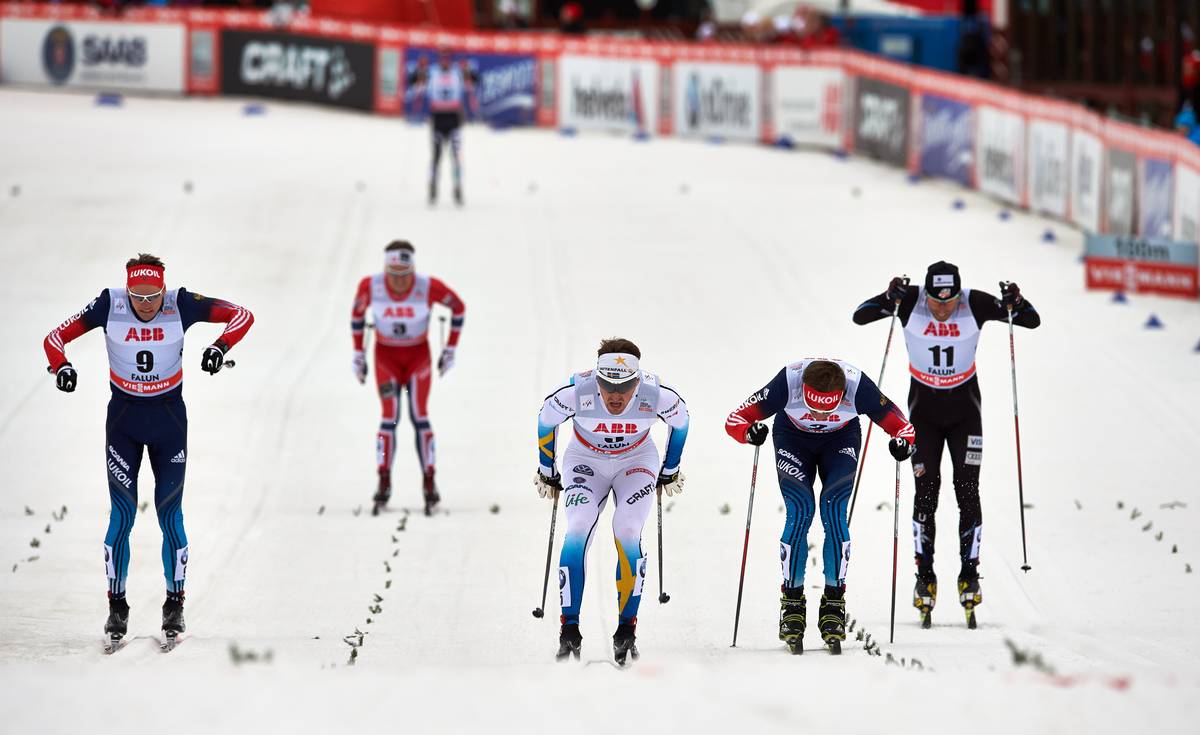
American Andy Newell (11) racing for a spot in Friday’s classic-sprint final against Russia’s Nikita Kriukov (l), Sweden’s Teodor Peterson (in white), and Sergey Ustiugov (second from r) in the men’s 1.4 k semifinal at World Cup Finals in Falun, Sweden. Newell placed fourth and did not advance for eighth overall. (Photo: Fischer/Nordic Focus)
That’s all great, Newell said in a phone interview, but it becomes increasingly harder to meet the bigger, season-long goals when you’re having trouble getting past the quarterfinals.
Newell squeaked into the semifinals on Friday as a lucky loser who finished third in his quarterfinal, but the ticket came with a warning after he apparently took too many skate strides while jumping in and out of the tracks before the finish.
To his credit, Newell wasn’t the only man reprimanded; Finland’s Martti Jylhä received a similar warning after placing second in his quarterfinal. Both men went on to ski the final (unlike overall sprint champion Ola Vigen Hattestad of Norway, who was relegated to last for obstruction in Jylhä’s quarterfinal).
“It’s not a huge deal because I’m typically really good about not skating in classic races,” Newell said. “That’s just been my first offense in the last few years.”
A second yellow card could equal a disqualification in a future race, but with two distance races left in the World Cup season, both of which involve skating (Saturday’s skiathlon and Sunday’s 15 k freestyle pursuit), Newell wasn’t too concerned. He was more preoccupied with the fact that he finished 15th in the overall Sprint World Cup.
“That’s a pretty disappointing finish for me,” he said. “Even though I finished eighth today in the race, I actually got passed by two people in the sprint standings. It’s really tight this year, but I definitely needed a podium in there.”
Newell finished fifth in the Sprint Cup last year and a career-best fourth in 2010. “I still have my eyes on a top-three finish and definitely looking towards a Globe at some point,” he said.
As for his races, the Shaftsbury, Vt., native said he enjoyed the course and felt like he was skiing tactically well, especially on the uphills. Off the back of his semifinal early, Newell charged to the front of the pack up the first climb, even with Russia’s Sergey Ustiugov. The only American to qualify for the rounds, Newell slipped to third, then fifth on the curving downhill, and positioned himself in fourth before the finish. There, he was out-double-poled by Russia’s Nikita Kriukov for third (Kriukov ended up challenging Ustiugov for second in a photo finish).
Newell said his finish played out similarly in both his quarterfinal and semifinal.
“In both cases, [I] came into the finishing stretch in good position and just maybe didn’t have enough in the double pole in the end,” he said.
He finished 1.18 seconds behind Sweden’s Teodor Peterson, who won the semifinal and went on to win the final as well. Their semifinal was the slower of the two, and Newell did not advance to the final.
While that’s sprint racing, Newell said it’s been a little more about a lack of momentum for him.
“I struggled a little bit this year making it into the finals, which is not what you want to see,” he said.
He was second in three skate qualifiers and made the finals in Szlarska Poręba, Poland, in January, where he placed sixth for his season-best sprint. While his training was similar to the previous year, Newell said he mostly needed to race more heats.
“Sprint racing is a momentum sport, and you get stuck for the last few weeks here on the World Cup, I haven’t been making it past the quarterfinals and that’s not great practice,” he said. “That’s what makes sprinting hard. The worse you do, the less practice you get at racing World Cups.”
He pointed out the success of his teammate on the U.S. Ski Team and Stratton Mountain School T2 Team, Sophie Caldwell, who’s made the final in three out of the last four sprints.
“She’s been racing a lot of heats and she continues to move on,” Newell said. “If you’re a skier that hasn’t made it through the quarterfinals in a few weeks, you sort of lose your game.”
Two weeks after notching her first World Cup podium in the skate sprint in Lahti, Finland, Caldwell advanced to Friday’s 1.2 k women’s final, along with teammate Kikkan Randall. The overall Sprint World Cup champion for the third-straight season, Randall placed fourth and Caldwell took sixth, a career best for the 23-year-old Vermonter in a classic sprint.
In addition to Randall and Caldwell, two other American women made the heats, with Sadie Bjornsen qualifying in fifth and Ida Sargent advancing in 24th.
Bjornsen squared off against both Randall and Caldwell in the quarterfinal, and finished third behind them in that order. While she was fewer than seven-tenths of a second behind Randall, their heat was the slowest, eliminating Bjornsen’s shot at moving on as a lucky loser and putting her 13th overall.
“It was a fun race out there today, but I have to say, it left me wanting more,” Bjornsen wrote in an email. “It is nice to see that I have a good form back after a little break in the middle of the season with illness, but I think I have found my grove again.”
Bjornsen, 24, explained qualifying for her first World Cup Finals was an achievement in itself. She wrote that it was fun to compete against two of her teammates, and while she got off to a strong start and took the lead at the top of the climb before the stadium, she “just didn’t have the extra gas at the end.”
With all three Americans leading down into the grandstand, Randall moved to the front over the last rise and Bjornsen followed in second. Caldwell stayed in close contact and passed Bjornsen before the finish, clocking in 0.27 seconds behind Randall.
“I went out there with no strategy in mind, other than to look for openings … and that found me in the front most of the race,” Bjornsen wrote. “It was challenging to race from the front with so much drafting out there, but again, you have to learn from every race. Surprising so, I still haven’t gotten to do much sprint racing this year, but I just keep trying every weekend, and one of these times it will come together as it should and could!”
If two people had to beat her, she was glad it was her teammates.
“I wish I could have been racing along side them, but that day will come for many of us on the team that are just outside that advancing place!” Bjornsen wrote. “Largest congrats of the day goes to Kikkan for winning her third sprint globe! Again and again she keeps proving she is in fact the best!!”
Bjornsen finished 45th in the Sprint World Cup after missing several races in the middle of the season due to illness. Randall led the group in first, 43 points ahead of Germany’s Denise Herrmann in second, and 65 points ahead of Norway’s Ingvild Flugstad Østberg in third.
Caldwell placed eighth in the final sprint standings, and teammate Jessie Diggins, who was outside the top 30 in 34th on Friday, notched 20th to make the Red Group.
Ida Sargent was two places from making the Red Group in 32nd. Another Vermont native, she placed 20th overall after finishing fourth in her quarterfinal, 4.28 seconds behind Herrmann, who won the heat.
U.S. women’s coach Matt Whitcomb said Sargent was disappointed to lose contact with the front three on a technical downhill while skiing in fourth.
“She missed the draft that was pretty critical if she wanted to advance to the semifinal,” he said. “But she was skiing fast; she’s in good shape.”
Considering the U.S. put three in the top 10 (including Newell) on Friday, Whitcomb said it was a successful day for both the men and the women.
“To put four girls in the heats at World Cup Finals is a big accomplishment,” he said. “First day of Finals, this Friday in Falun has traditionally been a pretty big day for the women’s team and it was again today, with four in the top 20 and two girls in the finals. It was pretty exciting to have Sadie, Sophie and Kikkan go one, two, three in their quarterfinal heat.
“We had exceptional skis out there, both kick and glide,” he added. “Overall just such a tremendous end to a really successful year for Kikkan grabbing the third-consecutive sprint Globe is such a big accomplishment and to finish it with a fourth place in a classic sprint is really big. I’m so proud of Kikkan and Sophie and the whole team – it’s a team accomplishment.”
— Pasha Kahn, Seth Adams, and Rosalie Lipfert contributed reporting