Tag: 2014/2015 IBU World Cup

  • Canada Notches Best-Ever Fifth in Men’s Biathlon Relay, Team ‘Pushing For Even Better Result’

    Canada Notches Best-Ever Fifth in Men’s Biathlon Relay, Team ‘Pushing For Even Better Result’

    Scott Gow took the Canadians from ninth up to fifth place in the third leg of the World Cup men's relay in Oslo, Norway, on Sunday. (Photo: Biathlon Canada/NordicFocus)
    Scott Gow took the Canadians from ninth up to fifth place in the third leg of the World Cup men’s relay in Oslo, Norway, on Sunday. (Photo: Biathlon Canada/NordicFocus)

    When Brendan Green crossed the finish line of Sunday’s 4 x 7.5-kilometer relay at Holmenkollen in Oslo, Norway, he was in fifth place.

    It wasn’t simply a good day for Green, or a personal best. That fifth-place finish was the best men’s relay ever in Biathlon Canada’s history.

    “It was a really good day for our team,” Green said in a phone interview. “Last night we had a team meeting and talked a little bit about the potential for our team. We talked about our specific start order and what we thought we could bring to the team on each leg. And today things definitely came together for us. Everyone had really solid legs for the relay.”

    The Canadians finished a minute and 35 seconds behind the winning Russian team. The stellar result comes in a season which has seen substantial changes to the World Cup roster. Star Jean Philippe Le Guellec retired after the 2014 Olympics, and Scott Perras is back in Canada training.
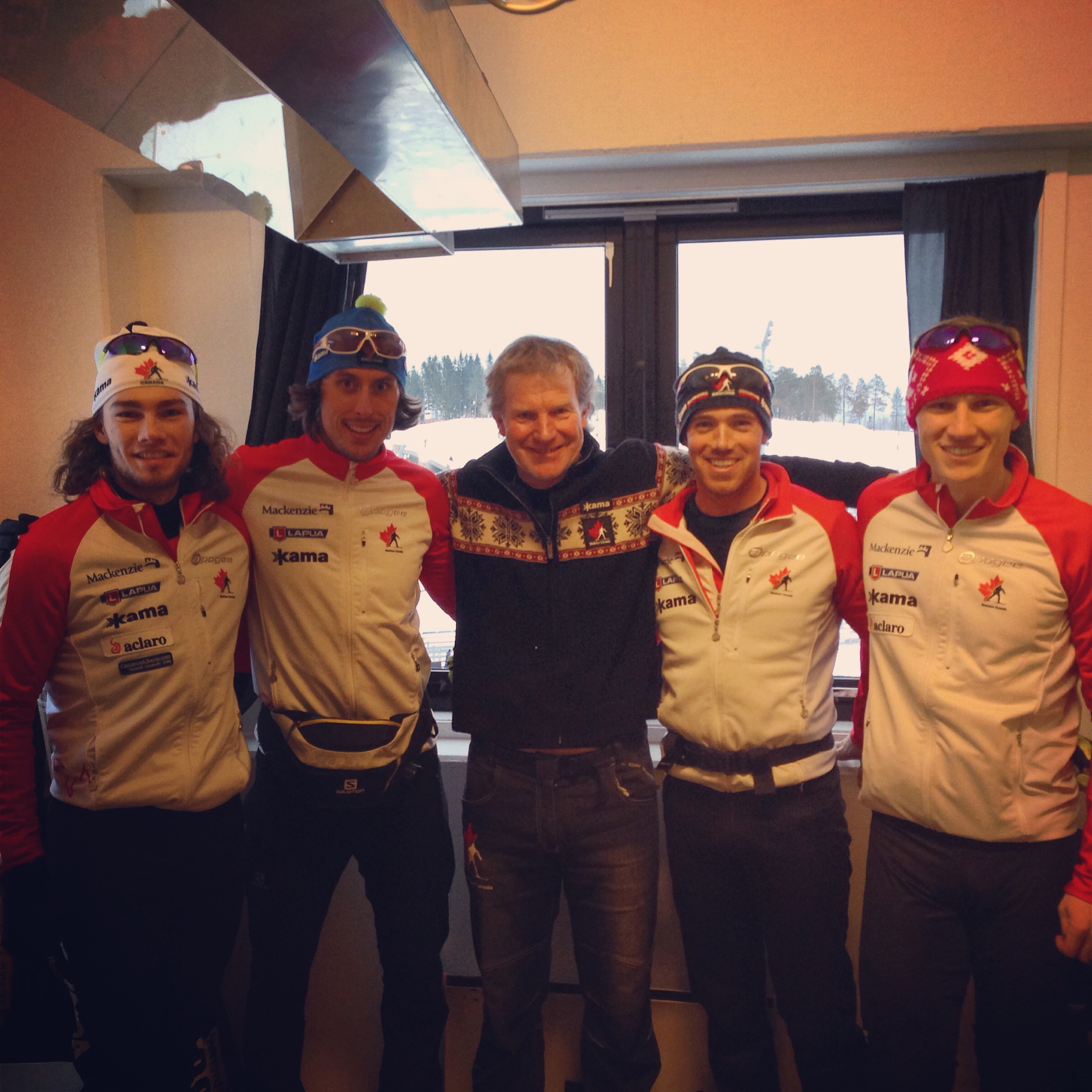
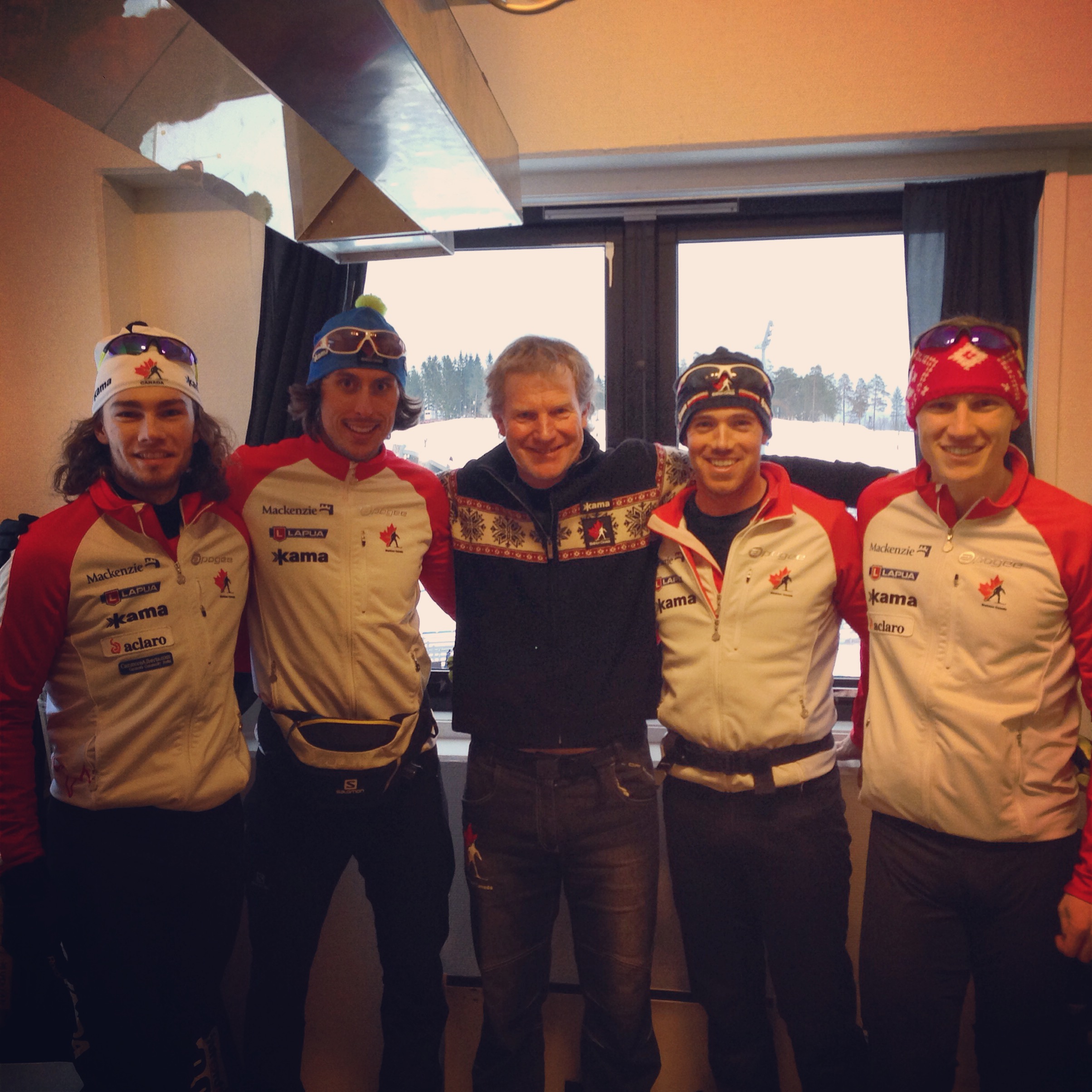
    The Canadian men's relay team of Christian Gow and Brendan Green (left) and Nathan Smith and Scott Gow (right) poses with head coach Matthias Ahrens in Oslo after placing fifth in the 4 x 7.5 k competition. (Photo: Rosanna Crawford)
    The Canadian men’s relay team of Christian Gow and Brendan Green (left) and Nathan Smith and Scott Gow (right) poses with head coach Matthias Ahrens in Oslo after placing fifth in the 4 x 7.5 k competition. (Photo: Rosanna Crawford)

    Instead, since the first men’s relay this season in Oberhof, Germany, Canada’s relay team has included 21-year-old Christian Gow, who skied leadoff and is in his first season on the World Cup. Gow shot like a pro, cleaning all ten of his targets without touching his spare rounds and tagged off in 14th, 50.5 seconds behind Germany’s Erik Lesser.

    “I was pretty confident that I would be able to clean the race today,” Gow wrote in an email. “I have been shooting really well all season and felt awesome in zero. You never know if everything will line up completely right for that 100%, but I was confident today and was happy to achieve it!”

    Canadian Head Coach Matthias Ahrens wrote that Gow’s performance had never been a question mark in his mind.

    “I believe Christian had proven some good relay qualities in previous relays in Oberhof and Antholz already with good shooting efficiency,” he explained.

    Gow is learning to deal with the excitement and the pressure of the World Cup.
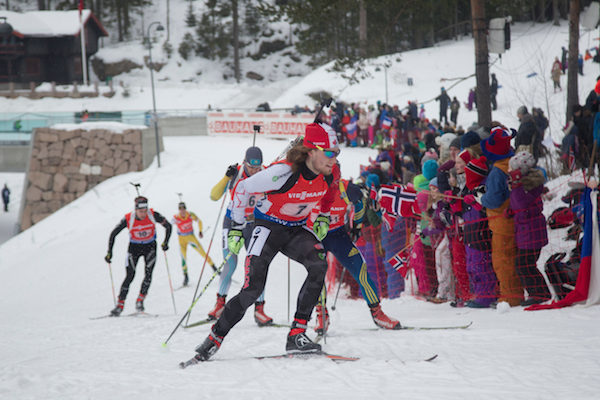
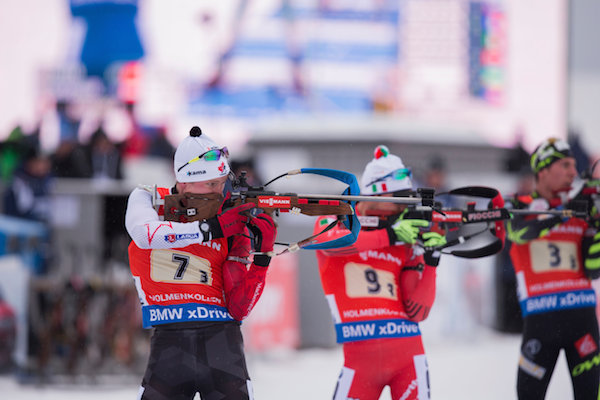
    Christian Gow (foreground) gunning his way through the first leg of the World Cup men's relay in Oslo, Norway. (Photo: Biathlon Canada/NordicFocus.com)
    Christian Gow (foreground) gunning his way through the first leg of the World Cup men’s relay in Oslo, Norway. (Photo: Biathlon Canada/NordicFocus.com)

    “The past several relays have all been a great learning experience for dealing with the more unique aspects of World Cup racing, such as the incredible noise from the stands, or racing next to one of your personal idols,” he wrote. “I honestly hardly thought about the crowd today, and I don’t think too much about the guys around me either. When I am in the range I am focused on what I am doing and I try not to think about anything else.”

    That showed, and Gow’s work on the range upped the ante for his teammates – including his brother Scott, who was racing the third leg of the relay.

    “Seeing Christian clean was one part inspiring and one part nerve-wracking,” Scott Gow wrote in an email. “It was awesome to see him shoot so well and set the tone, but at the same time it added pressure for me to do well too and build on his great opening leg. Overall I would say it was motivating but I was definitely nervous waiting for Nathan to tag me.”

    Nathan Smith, the second-leg skier, turned in a strong performance of his own. He used a spare round in each shooting stage and moved the team up to ninth. But more importantly, by turning in the second-fastest ski time he cut ten seconds off of the team’s gap to the leaders.

    “I had a lot of confidence in my shooting and knew that being the third race of a weekend, I would probably also have a really strong ski day,” Smith wrote in an email. “Shooting went pretty well, it was a little windy. The only disappointment was missing my last prone shot. I think I just got a little ahead of myself.”

    “Christian [Gow] is a really good shooter, and he’s really fast, so he has always been reliable. That first leg is a great place for him and he gets the job done really well in that position.” — Brendan Green

    For Scott Gow, who used two spare rounds and moved the team up to fifth, things just came together on Sunday.

    “I felt the best on skis today since before Christmas,” he wrote. “I had a decent opening lap which is unusual for me, and I was able to maintain speed for the whole race with a nice kick at the end to pull into 5th. I lost some time in standing, but prone was solid and my skiing was good enough to keep the team in the mix.”

    Green dropped the team to sixth, briefly, after using two spares in prone, but skied back up to fifth.
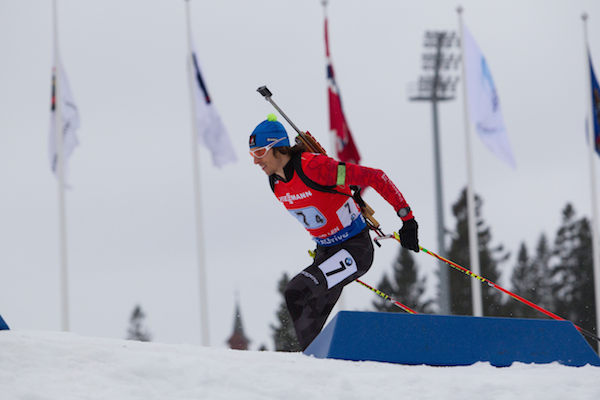
    Brendan Green anchoring the Canadian relay in Oslo. (Photo: Biathlon Canada/NordicFocus)
    Brendan Green anchoring the Canadian relay in Oslo. (Photo: Biathlon Canada/NordicFocus)

    “It was a little bit tricky wind in prone,” Green said. “It was a complete 180 from zeroing. I hit my first three shots but then missed the next two, so I sort of paused before I loaded my spares and made that extra correction.”

    After cleaning standing, Green then turned in the second-fastest closing loop to hold onto it, despite fears of challengers from behind.

    “I was able to leave the range just ahead of Italy and Ukraine,” Green said. “I knew they were close behind. So on that last loop I really tried to redline it and go as hard as I could. And I knew France was close – partway through my loop I could hear some cheering and I thought, oh man, Fourcade must be closing in. So then I tried to really go for it and not look back, and hold those guys off.”

    For all the team’s members, the race was a culmination of the Oslo weekend. Smith had drawn on his confidence from finishing 12th in the 20 k individual; Scott Gow had focused on the lessons he learned in the earlier races of the weekend.

    “My skiing wasn’t great in the individual and, despite shooting 85%, didn’t shoot well enough for a good result,” he wrote of finishing 60th in the 20 k. “After that race I wanted to refocus on skiing efficiently and being more deliberate in the range, and that’s exactly what I was able to accomplish on race day in the Sprint. My result in the sprint race gave me added confidence for today’s relay. I wanted to use today as an opportunity to build on my skiing and shooting and try to do better.”

    And for Christian Gow, he acclimated back to Europe after heading home to Canada for a training break and then sitting out the 20 k due to jet lag.

    “It was great to get back here on the World Cup again after my brief break back home,” he explained. “I think it was important for me that I took a break in order to feel ready to go for the next month of racing.”

    The youngest team member is now looking forward to his first World Championships experience. And with the best-ever result in their back pocket, Canada is looking forward, too. Their relay there will have the same roster, likely in the same order.

    “I think today’s result showed all of us the type of placing we can achieve,” Christian Gow wrote. “From that standpoint I think it will give us a bit more confidence, but also more drive to keep pushing for an even better result.”

    “A result like today will definitely give us a little extra confidence and motivation heading into the two week break and World Championships,” Smith agreed. “Another top 6 is what we’re aiming for. Outside of the World Champs, Nations Cup points are especially important for us this year. Right now we’re sitting in 8th which means 5 start spots for next year. It would awesome to grab that extra spot for the Canmore World Cups in 2016.”

    Results

  • 21-Year-Old Dahlmeier Wins First IBU World Cup; Dunklee Ninth, Cook 28th for U.S.

    21-Year-Old Dahlmeier Wins First IBU World Cup; Dunklee Ninth, Cook 28th for U.S.

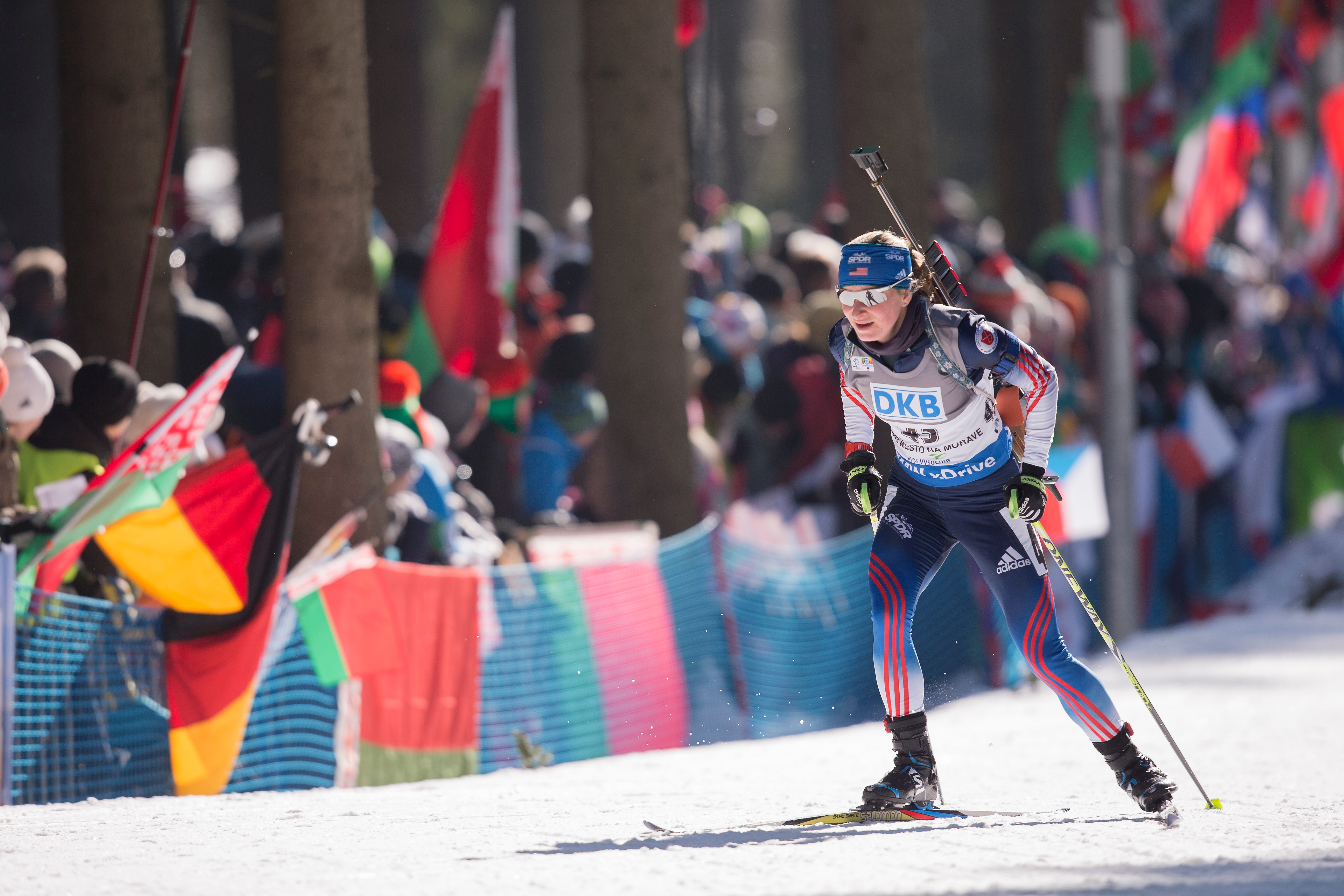
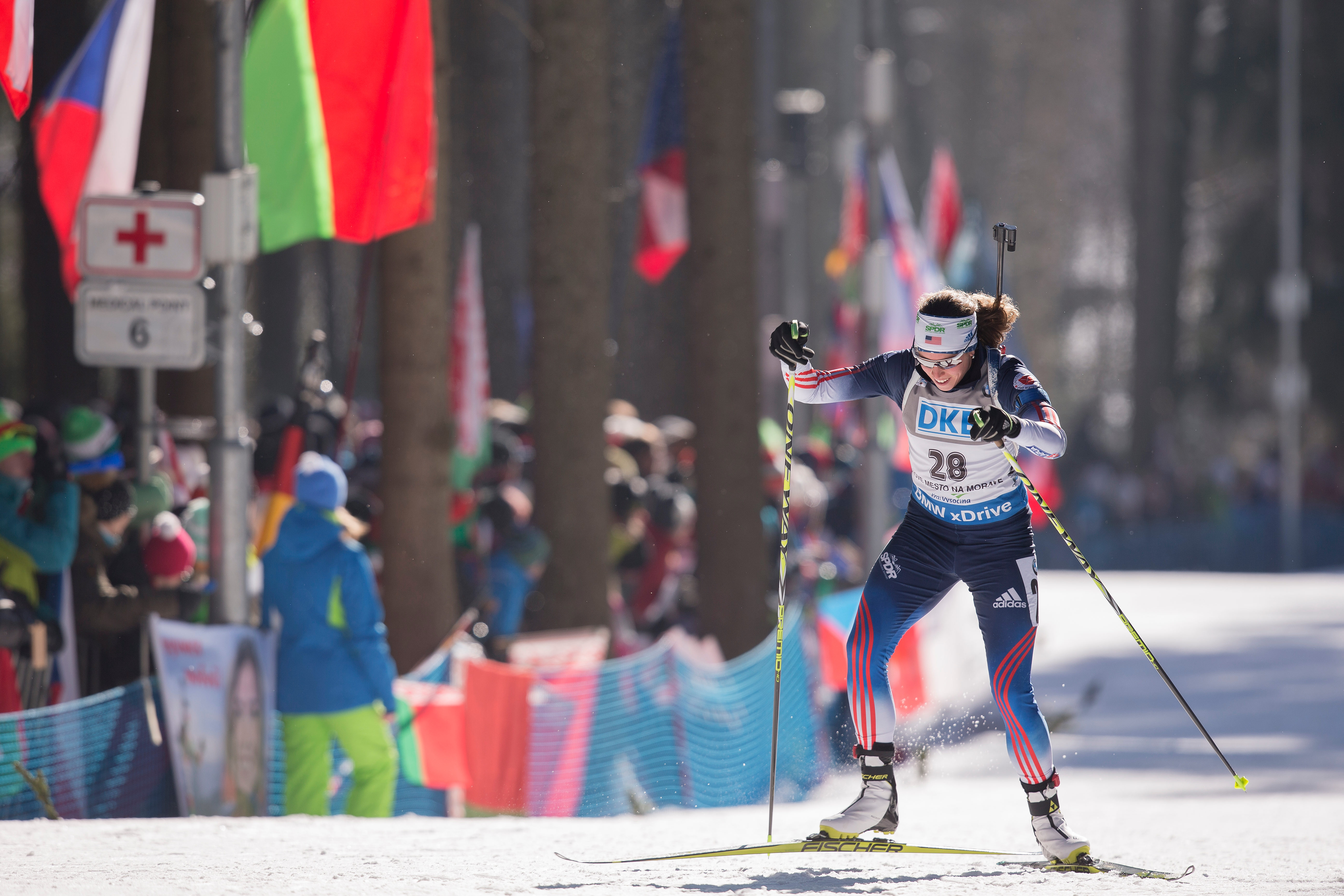
    Susan Dunklee on her way to a ninth-place finish in the World Cup 7.5 k biathlon sprint in Nove Mesto, Czech Republic (Photo Credit: U.S. Biathlon/Nordic Focus)
    American Susan Dunklee on her way to ninth place, for her third-straight individual top 10, in the women’s IBU World Cup 7.5 k sprint in Nove Mesto, Czech Republic. (Photo Credit: USBA/Nordic Focus)

    Laura Dahlmeier of Germany had just enough speed on the final loop to beat teammate Franziska Hildebrand, winning Saturday’s 7.5-kilometer biathlon sprint in Nove Mesto, Czech Republic, to earn her first-ever World Cup victory.

    She finished in an overall time of 21:33.4 and topped Hildebrand by 1.0 second.

    Hildebrand had the fastest cumulative time by 15.8 seconds heading into the third of three loops, but Dahlmeier was 16.8 seconds faster on the third loop. Neither skier missed a shot.

    “Since I was a little child, I always said that I wanted to come to the World Cup, and that I wanted to win,” Dahlmeier told the IBU’s Jerry Kokesh. “Today it is so, I’m in the first position and it’s amazing for me.”

    It was an impressive result for a young German team: Dahlmeier is just 21 years old, and Hildebrand, at 27, is one of the most senior members of the team. It was also a career-best for Hildebrand, who was thrilled to go 1-2 with her younger teammate.

    “It is amazing,” Hildebrand said in the press conference. “I felt a little tired from the relay, so I said I would just see what would happen today … The last loop was hard. I am happy to reach the podium.”

    The result satisfied the win-hungry German fans, who have high expectations every year. Dahlmeier made it clear that it was satisfying to prove wrong those who had questioned the ability of the young women’s team.

    “You can see that our concept works,” she told German broadcaster ZDF. “It was right to go with not so high expectations for the season. But we have shown that we can do it, and that people like [Darya] Domracheva or [Kaisa] Mäkäräinen are beatable.”

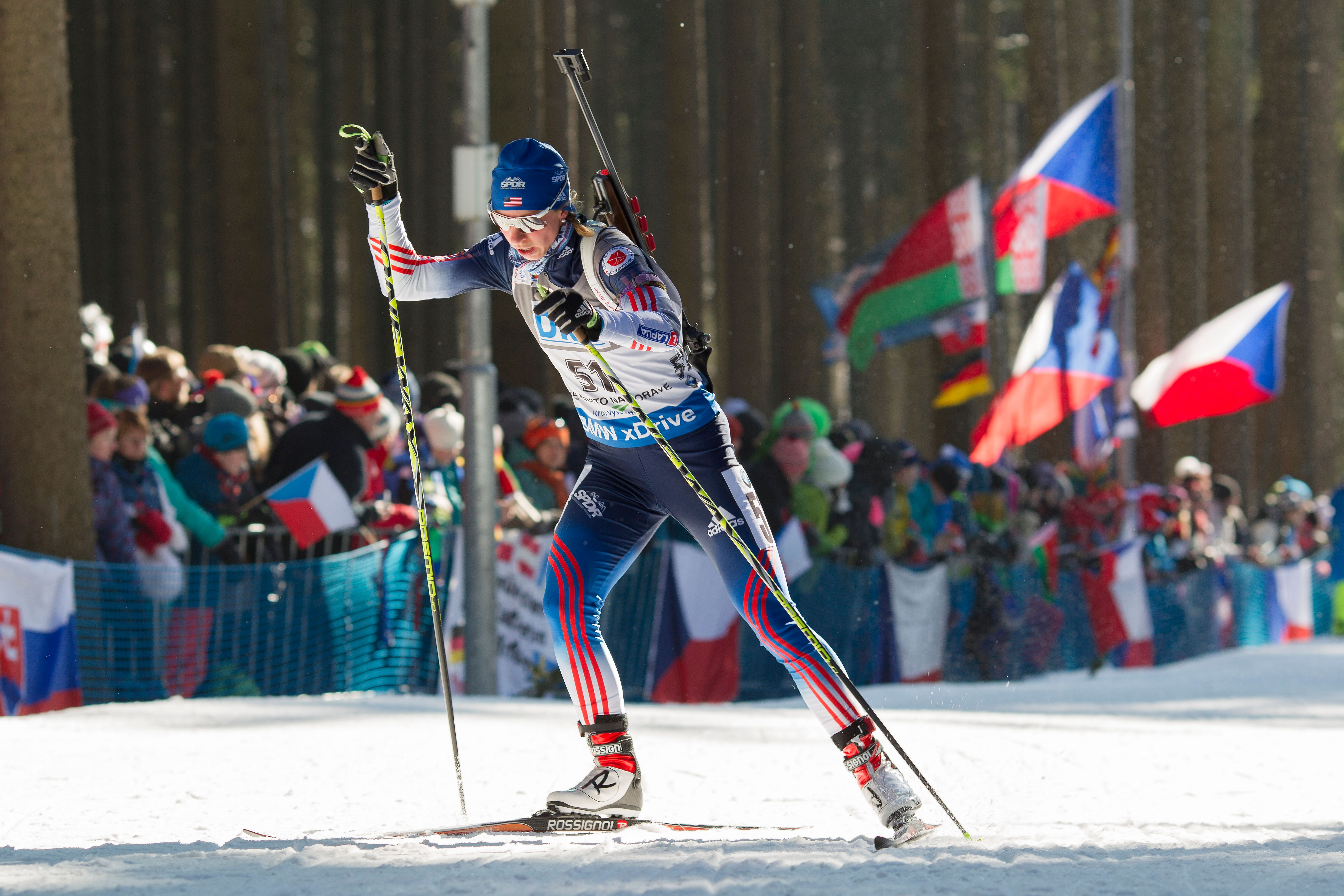
    Hannah Dreissigacker took 39th in the IBU World Cup 7.5 k sprint in Nove Mesto, Czech Republic (Photo: U.S. Biathlon/Nordic Focus)
    American Hannah Dreissigacker took 39th in the IBU World Cup 7.5 k sprint in Nove Mesto, Czech Republic. (Photo: USBA/Nordic Focus)

    Veronika Vitkova of the Czech Republic was third (+13.9), having missed one shot in the prone stage. The 32,000 fans in Nove Mesto were undeniably rooting for a home team victory; the noise when Vitkova and her teammates were on course and on the range was substantial. But the Czech women couldn’t come through. Gabriela Soukalova tied for 20th with one penalty.

    Darya Domracheva of Belarus missed one shot in each shooting stage and was fourth (+23.0), while Marie Dorin Habert of France ended up fifth (+26.9) after finishing the first loop in third and missing two shots in the standing stage.

    The top North American racer was American Susan Dunklee, who placed ninth (+46.3). She was 17th following the second loop after missing a shot in the standing stage, but pushed herself into the top ten by skiing the eighth-fastest final loop of the day. It marked her third-straight top-10 finish this season.

    Dunklee explained in an email that the 2.5 k course in one of her favorites on the World Cup circuit.

    “There are a lot of steep climbs, and my strongest technique is V1,” the 28-year-old wrote. “The climbs are hard, but it is crucial to also push hard on the flats and gradual downs after the uphills – that is where I tried to make up time today.”

    On the range, Dunklee explained that she chose to shoot on point 30 during the standing stage because it is more protected from the wind. While she did have one late miss, she was happy about how she executed her shooting.

    This result comes after a warm-up that she explained felt tense. She wrote that the team was involved in a significant traffic jam on the way to the race and barely made it on time, due to the “32,000-plus” fans driving to Nove Mesto. However, she was able to relax after skiing around for a bit before the race.

    Her teammate Annelies Cook also had an impressive performance, placing 28th (+1:19.8) and earning her her third-best sprint result ever on the World Cup, and her best result so far this season.

    “I am feeling really happy and also relieved,” she wrote in an email. “It has been a long time since I was able to put together a good race in both skiing and shooting, long enough to start to wonder if it was still possible.”

    Anneiles Cook took 28th in the IBU World Cup 7.5 k sprint, earning her third-best World Cup sprint result ever (Photo: U.S. Biathlon/Nordic Focus)
    American Anneiles Cook took 28th in the IBU World Cup 7.5 k sprint, earning her third-best World Cup sprint result ever and her best result this season. (Photo: USBA/Nordic Focus)

    The 30-year-old Cook explained that she tried to channel the positive energy from the large crowd on hand, and then take advantage of the long approach to the range in order to relax.

    “I try not to think about what is possible until the last loop because so much can change in a second and it is better to just be in the moment,” she explained.

    She added that it was a great feeling to be able to ski hard on the last loop and “feel like you are actually being competitive on skis.”

    The other American woman who qualified for Sunday’s pursuit was Hannah Dreissigacker, who finished 38th (+3:09.7)

    “I just tried to really ski my own pace on the first lap and keep it in control so that I’d have more left for the end.  I focused on being relaxed and having good technique,” she wrote in an email.

    She wrote that during shooting she was focusing on the basics of “breathing and trigger” – as she explained it is easy to lose that focus – and it worked today, as she only missed one shot in the standing stage.

    “In standing I think I may have come in a bit too hard, and I got shaky legs,” she wrote.

    She wrote that she tried to ski as hard as she could on the last lap, though was passed by Domracheva and knew she should not try and stay with her too early. However, she kept her in her sights on her way to the 30th-fastest final loop of the day.

    U.S. Women’s Head Coach Jonne Kähkönen explained in an email that it was a great day overall for the women’s team.

    He wrote that he knew the American women could have a solid result as a team as well as individuals, based on both training over the last few weeks and the progression over the course of the season so far.

    “I know that we have trained well and have used the opportunity in-between the World Cup races to always aim for even better, so based on that I was feeling confident for the day,” Kähkönen wrote.

    He added that Dunklee has been consistently performing well and that it was encouraging to see Cook and Dreissegacker also “stepping it up.”

    “I know that they have the potential to ski like this consistently,” he wrote.

    Neither Canada’s Audrey Vaillancourt nor American Clare Egan qualified for the pursuit, as Valliancourt placed 66th (+3:09.7) and Egan took 73rd (+3:43.4). In her first World Cup individual race, Egan cleaned prone but missed four standing shots.

    In an email, Egan explained that while she executed her plan on her first shooting stage, she didn’t do a good job controlling her rifle in standing.

    “But of course no matter what happens in biathlon, you have to keep pushing hard,” she wrote. “I did not think about my misses after I left the mat, I just skied as fast as I could to the finish line. Although I am disappointed about the standing, overall I am pleased with my performance because there were a lot of good things about it, and I know I can improve on the bad ones. I can’t wait to race three times next week in Oslo!”

    “For Clare, it was good to see the start and the prone stage,” Kähkönen wote. “She did a great job executing the game plan there. As for making it to the next level, there are really no short cuts – just hard work.”

    Canada’s Rosanna Crawford did not finish after missing her first shot in the prone stage, then hitting the next four – in the wrong lane.

    “I usually choose my lane as soon as I can see the targets and repeat it a couple times to myself. I didn’t do that today because I was analyzing the wind flags really hard,” Crawford wrote in an email.

    After skiing her penalty loop, her coach told Crawford that she had cross-fired and was facing eight minutes of penalties, so she decided to stop.

    “I’ve never cross fired before in a race and from what everyone tells me I’ll probably never do it again!” she wrote. “Lots of things to learn from this race but stewing and being angry won’t help me for next week.”

    The seventh weekend of the IBU World Cup finishes tomorrow in Nove Mesto with the women’s 10 k pursuit and the men’s 12.5 k pursuit.

    Alex Kochon and Chelsea Little contributed reporting