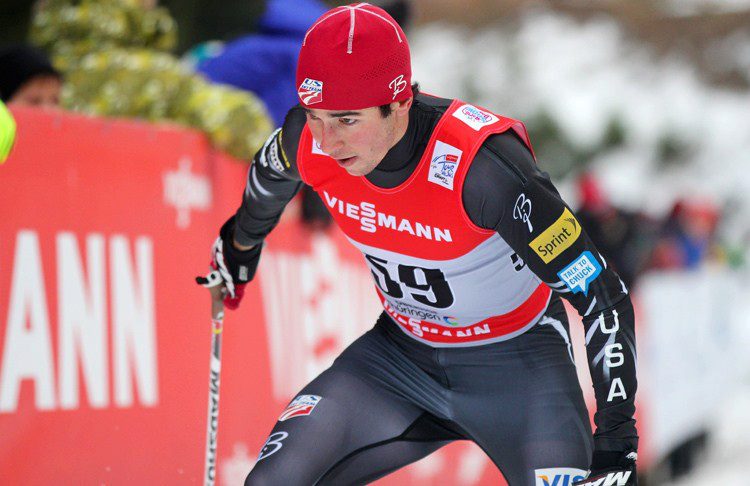
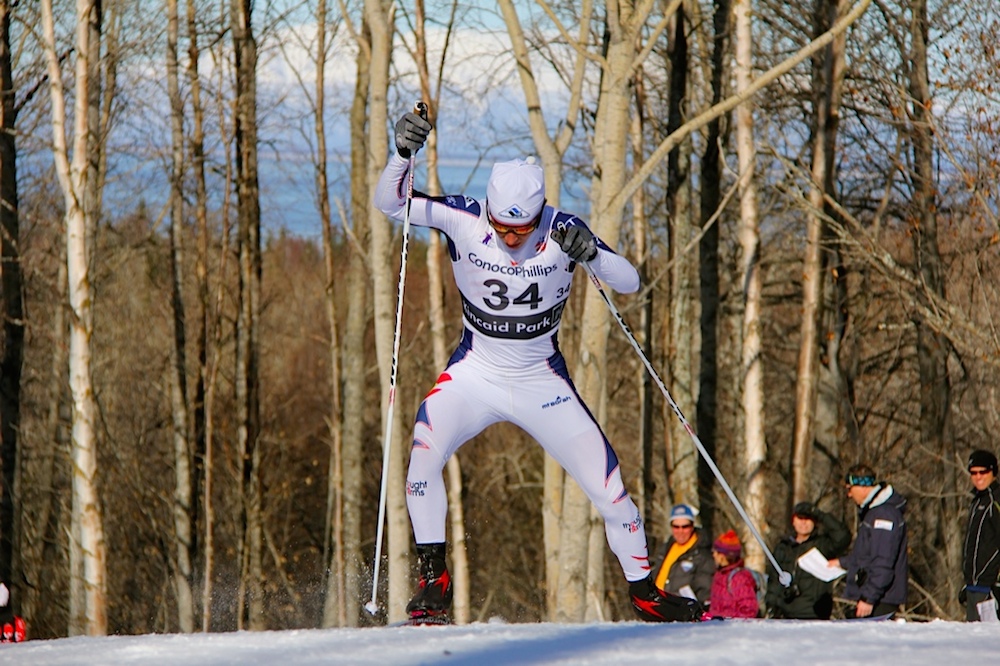
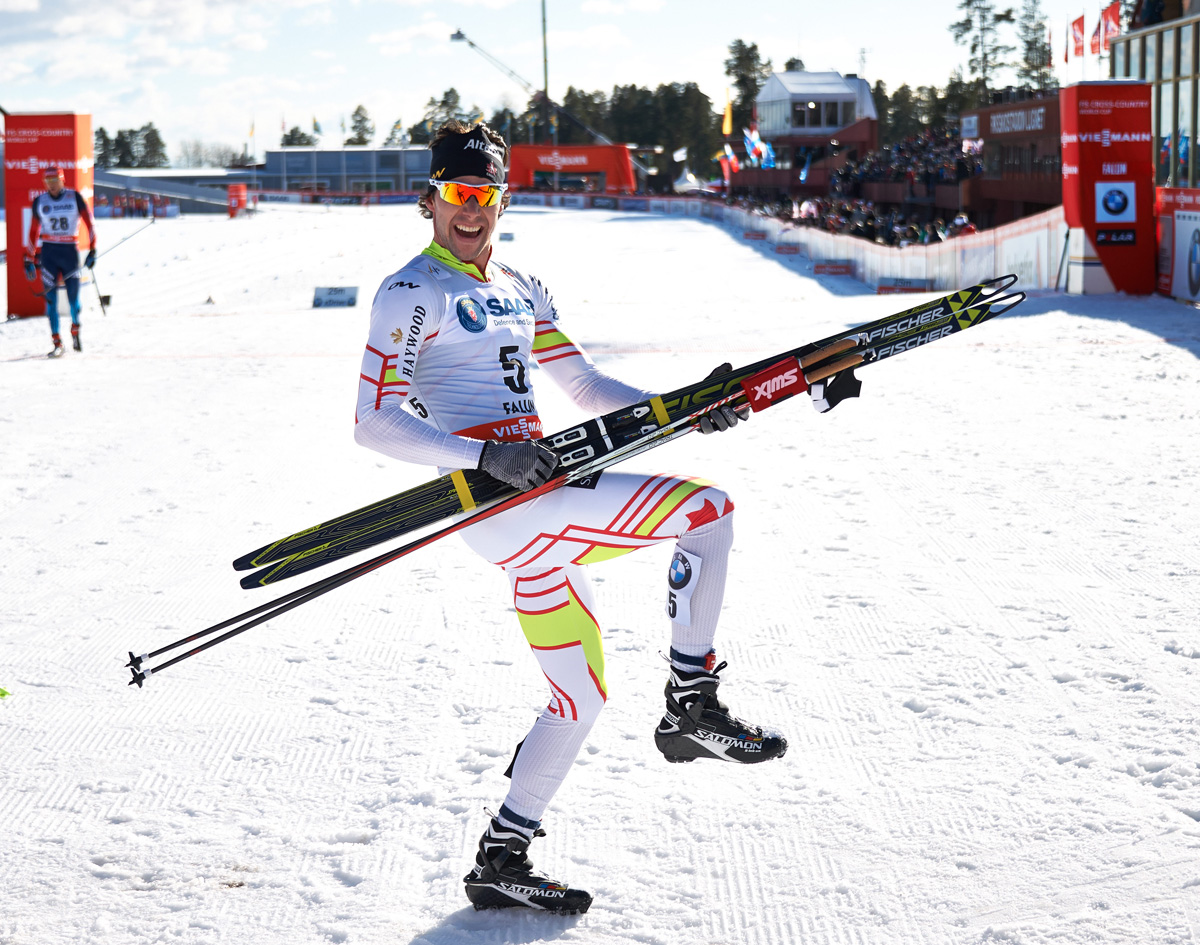
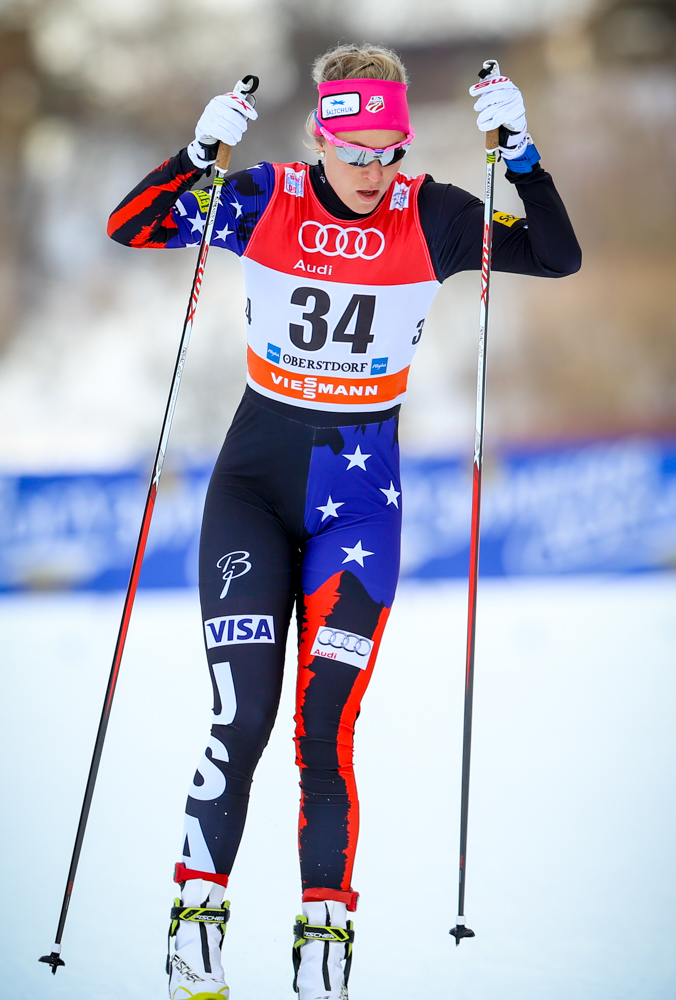
Noah Hoffman placed 38th in Sunday’s 15 k freestyle in Östersund, Sweden. It was his first World Cup finish since March 2014. He is pictured here racing in the 2014 SuperTour Finals at Kincaid Park in Anchorage, Alaska. (Photo: Rob Whitney)
Noah Hoffman entered Sunday’s 15 k freestyle individual start in Östersund, Sweden with uncertainty, but exited with a clear objective of improvement. The race was the 25-year-old’s first World Cup finish since March of 2014 and marked Hoffman’s first competition after a November crash in Kuusamo, Finland that resulted in a broken fibula.
Hoffman finished his day in 38th, 1:54.2 behind the weekend’s sprint and distance winner, Finn Hågen Krogh of Norway. He was the top North American finisher of the day.
According to Hoffman, the race was a good start to a season that many thought was over for the U.S. skier.
“Obviously 38th is not where I want to end up, even for top results this year after everything that’s happened,” Hoffman said in a phone interview. “It’s a great place to build from and I think I will build going forward, given how the training structure, training load, the altitude, and the injury have played out. I feel like I’m on the upswing and I can build on that.”
Hoffman explained that while he was nervous to be racing again, none of his anxieties revolved around his ankle. The Colorado native said that there was no pain during the competition, and that he didn’t think about his injury while competing in the three lap race.
Hoffman entered Sunday’s race after living at roughly 10,000 feet during his recovery in Colorado. Due to the effects of several months of high altitude training, Hoffman said he needed to focus on having a fast start. While he explained that his actual first kilometers were slower than they felt, he clocked the 33rd fastest time at the 1.8 k mark. From there he slowed, however, ranking in the 50s at 3.5 k.
As Hoffman passed the 5 k mark and lapped through the stadium, Canadian Ivan Babikov began his race and eventually caught the American. The two skied together for the remaining laps of Hoffman’s race.
“[Babikov] was charging on that lap and I got a ride. It was a challenge to stay on him on his first lap,” Hoffman said. “Then he settled a little bit. It was a little easier on the last lap but I didn’t feel quite strong enough to go around him. I got a 10 k ride from him which was nice to show me the pace.”
While Hoffman was pleased with the race, he said it demonstrated his skiing was not at the level it could be.
“I executed my plan, but none of it was that fast. I hope to continue to execute well but to do it at a higher level in the coming weeks,” he said.
U.S. Ski Team Women’s Coach Matt Whitcomb said in a phone interview that he was excited to see Hoffman racing again and that Sunday’s effort was a good start before World Championships in Falun, Sweden, which begin Feb. 18.
“The race turned out to be a stronger result than what was unfolding at Kuusamo that day before he crashed. So, with clear fitness, he just needed a good hard effort under his belt. I think he’s anxious and excited for these races coming up, and hopefully he’s feeling more confident now that he’s got one under his belt. 38th is nothing to be disappointed with,” he said.
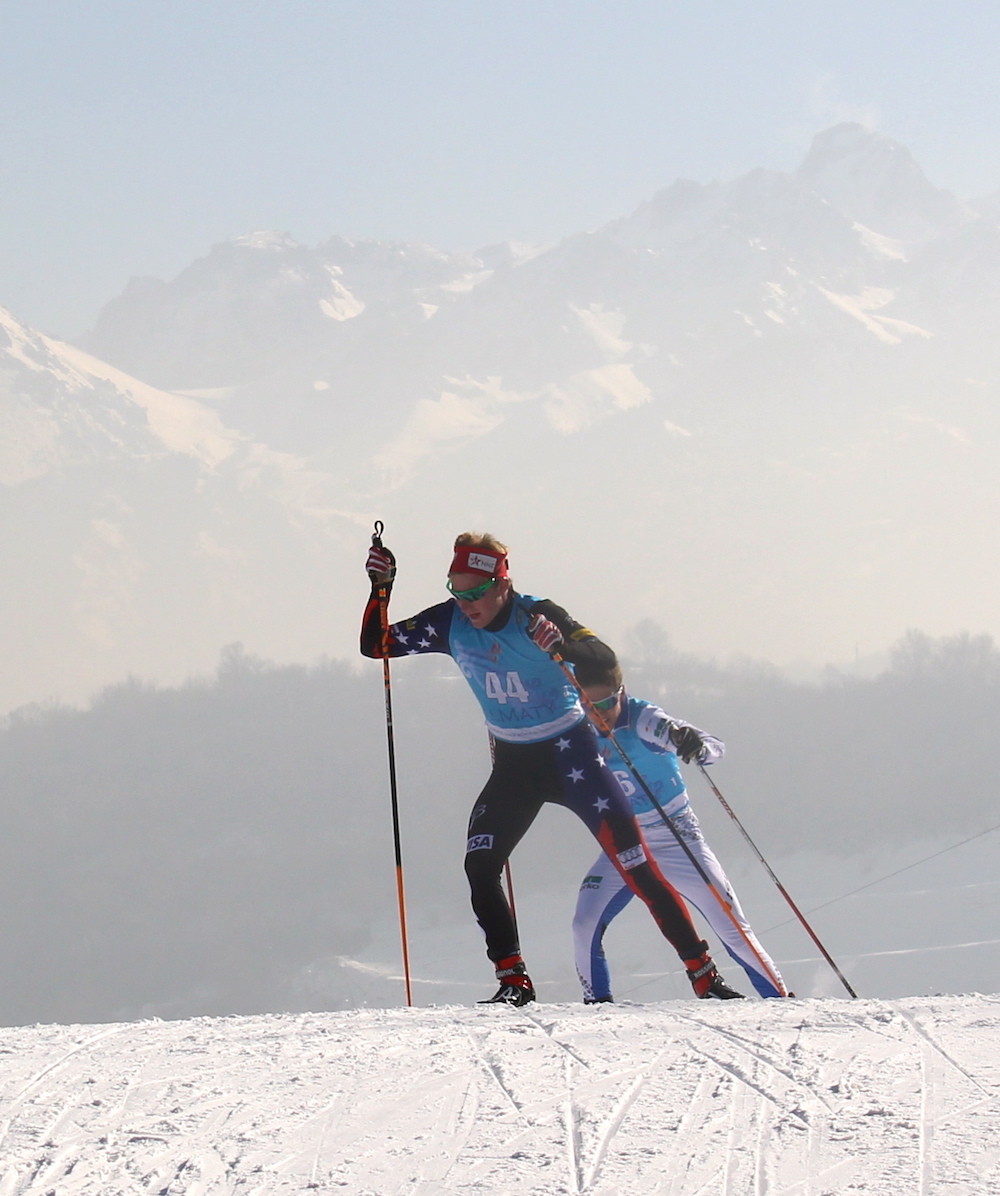
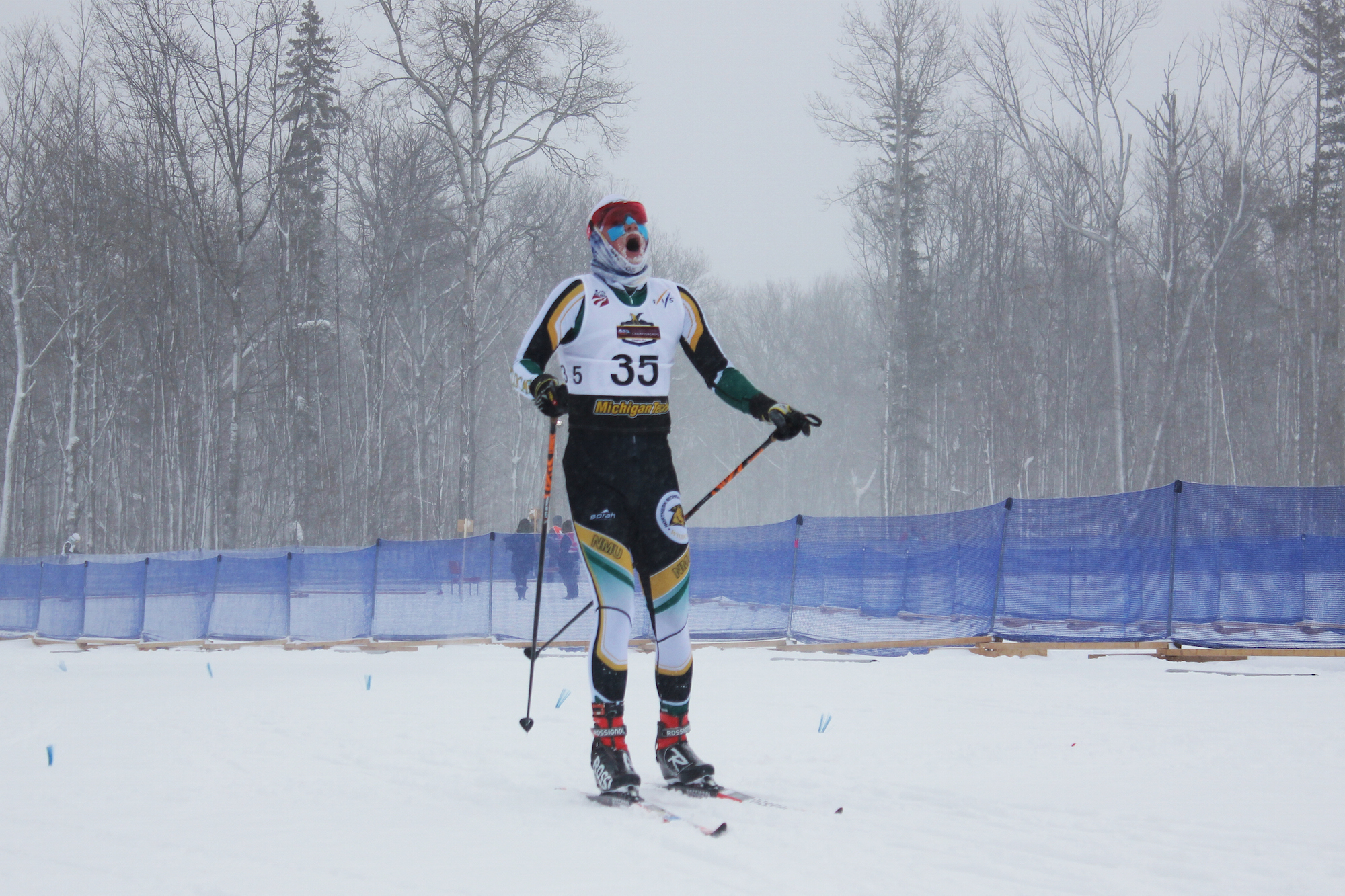
Kyle Bratrud finished 84th in the Wold Cup debut in Östersund, Sweden. He is pictured here racing to 19th in his first race of the 2015 U23 World Championships, the 15 k freestyle in Almaty, Kazakhstan. (Photo: Bryan Fish/USSA)
Three other Americans competed in Sunday’s 15 k with Erik Bjornsen in 60th, Matt Gelso in 71st, and World Cup newcomer Kyle Bratrud in 84th. Both Bjornsen and Gelso had strong starts to their races and were ranked in the high 40s and low 50s after the first kilometers, but slowed as the race progressed.
Sunday’s World Cup was Bratrud first and it started with high profile company, as the Northern Michigan University skier started ahead of Switzerland’s Dario Cologna and three spots ahead of overall World Cup leader Martin Sundby of Norway. While Bratrud only skied with the famed skiers for a several minutes, he wrote he was excited to catch a small ride.
Near the beginning of his race, Bratrud fell on an ice patch and crashed into a nearby fence. While the 22-year-old only broke the heel plate of his binding, he explained his left quad was was bruised and his hip flexor strained.
“This was definitely my biggest crash of my career, but luckily all that broke was one heel plate,” he wrote in an email. “That being said, the rest of my race was pretty hard to get into both physically and mentally. I was the last person on the course and it took my body a while to respond after the trauma. The Swedish fans were really supportive, though, and I got multiple USA chants. I am pleased to have my first World Cup in the books”
Whitcomb said he hoped the race would be the first race of an extensive World Cup career for Bratrud.
“This was very exciting, because Kyle was starting what could be a very long World Cup career. It’s going to take a few races to get things going, but he showed us in Kazakhstan that he can mix it up with the best, and he showed everyone in Houghton that he can mix it up with the best of the U.S., and I have good confidence that over time he’ll be able to mix it up with the best of the world in the World Cup. But it’s going to take some time,” he said.
With the World Cup weekend in Östersund complete, competitors now travel to Falun, Sweden where they will compete in the 2015 World Championbshps starting Feb. 18.
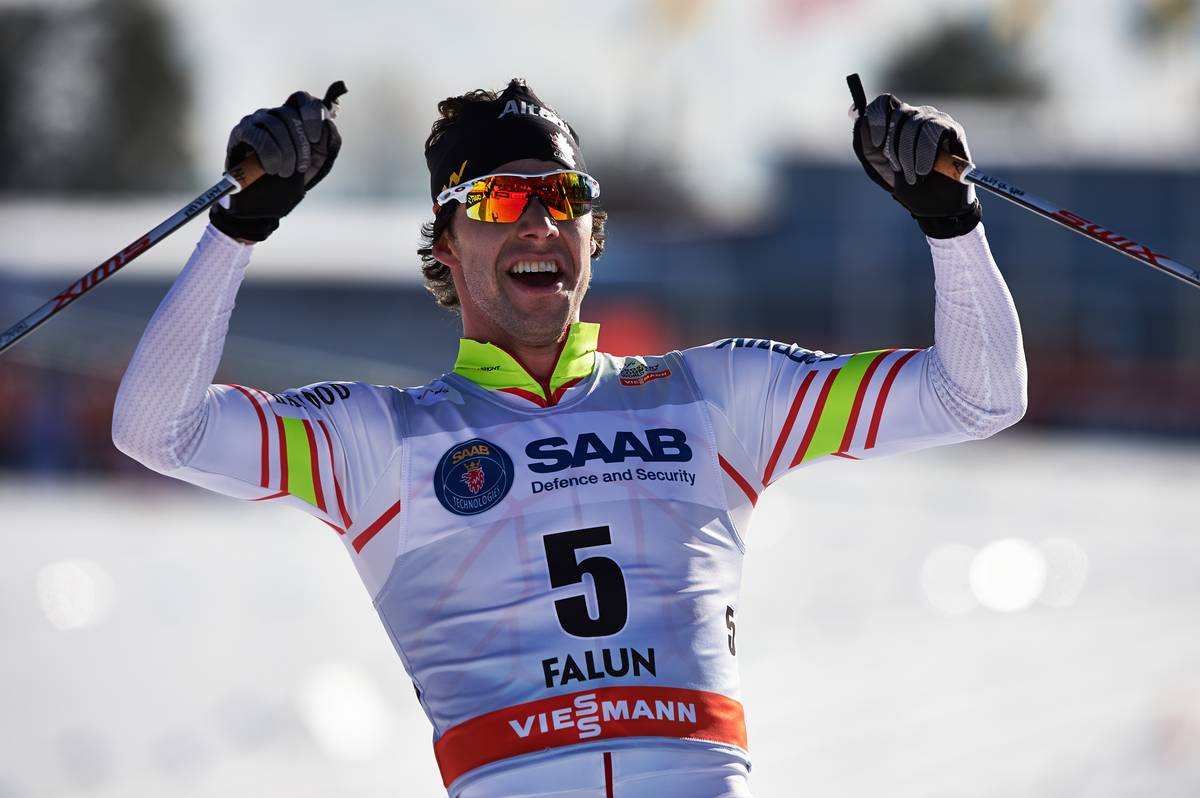
Canada’s Alex Harvey finished second in Saturday’s 1.2 k classic sprint in Östersund, Sweden to earn one of his best World Cup results of the season. Here he’s pictured after winning the 30 k skiathlon and second stage of 2014 World Cup Finals in Falun, Sweden, the site of the upcoming 2015 World Championships. (Photo: Fischer/Nordic Focus)
When it comes to the World Cup, competitor’s personal expectations aren’t always met. But for Alex Harvey it was a good thing that Saturday’s 1.2-kilometer classic sprint didn’t go the way he thought it would. After examining the course, Harvey didn’t see much potential for a top result. It was a short loop that featured steep hills, and the 26-year-old Canadian had completed an altitude camp in Italy just days before.
However, as the men’s final entered the finish Harvey wasn’t an onlooker. Instead, he was in the thick of the action with 100 meters to go, double poling to fight for his best non-stage World Cup result of the 2014/2015 season.
Harvey finished second to Finn Hågen Krogh of Norway, who skied to victory with a time of 2:25.28. Harvey skied across the line in a close second, 0.47 seconds back. Timo Andre Bakken, also of Norway, placed third after winning the qualification round earlier in the day. He finished 1.41 seconds back from Krogh.
In fourth was Norwegian Sondre Turvoll Fossli, who competed in Östersund after winning the classic sprint at the U23 World Championships in Kazakhstan earlier this month. He was 4.27 seconds back from the win. Matias Strandvall (+5.86) of Finland and Alexander Panzhinskiy (+9.30) of Russia finished fifth and sixth.
Krogh skied a smart and technical race throughout the day. He placed himself behind the leaders in the beginning of both the quarterfinal and semifinal, yet surged ahead in the final meters of the 1.2 k course. In the final he did the same, but roughly halfway through the race he attempted to gap the field. While his fellow podium finishers were able to keep contact, it was a strategy that worked, as Krogh stretched out the pack and cruised across the line in first.
“It is great to have another win this season. It was really challenging today and it was important to race smart and stay out of trouble. I always tried to stay near the front and in the end it worked for me,” Krogh told the International Ski Federation (FIS) after his win.
Krogh is not officially slated to start at the 2015 World Championships set to begin next week, despite being a member of Norway’s team for the event. He explained that the result was a step towards earning a coveted Norwegian spot at the starting line in Falun. He also has a case for a start position in his world ranking. Krogh is now the World Cup sprint leader after Saturday’s win, toppling Italian sprinter Federico Pellegrino who finished Saturday’s race in 10th.
Unlike Krogh, Harvey had a roller-coaster ride to his best World Cup result of the season. Qualifying in 26th position, Harvey entered a stacked quarterfinal featuring Pellegrino and Norwegians Ola Vigen Hattestad and Pål Golberg. Harvey spent much of the race near the back of the pack, at one point falling to fifth in the second half of the race.
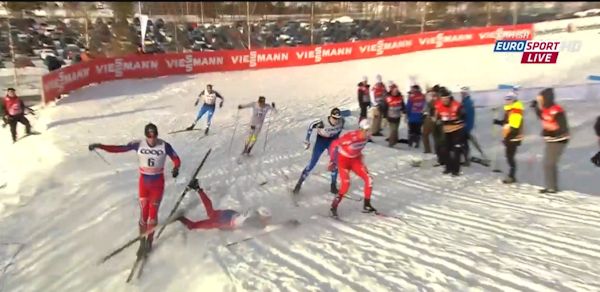
Pål Golberg (6) and Ola Hattestad of Norway slide off course in Saturday’s 1.2 k classic sprint in Östersund, Sweden. (Photo: CCC)
With Hattestad and Golberg in the lead, the skiers rounded a sharp corner before climbing the final hill. It was there the Norwegians fell victim to a race-ending crash as Hattestad slid into Golberg and the two flew off the course. With the leaders out, Pellegrino and Harvey took advantage of the situation to cruise into first and second.
“I still think I would have snuck into a lucky loser spot because our heat was really fast,” Harvey speculated in a post-race interview. “I was second but I think if those guys had stayed on their skis I would be lucky loser.”
Harvey once again started near the back of the pack in the semifinal, but surged ahead in the second half of the course to take second behind Fossli and ensure his advancement to the final. He explained that his skis in the quarterfinal had too much kick but that they were perfect by the time he started the semifinal.
“In the second lap I knew that guys would start fading a bit, so I was able to make my way to the front,” Harvey said of the heat.
In the final, Harvey had a slow start but inched forward through the pack over the first lap. By the time Krogh attempted to break away from the six men, Harvey was the first to respond, trailing the Norwegian closely and breaking even with him throughout much of the remaining meters.
“I think physiologically I’m not as fast as the pure sprinters. I’m not fast enough on the first lap, but on the second lap the pure sprinters get a little tired and I stay the same,” Harvey explained of his ability come from behind in the final.
Heading into the finish, Harvey lost a little ground to Krogh and was unable to match the Norwegian’s speed in the final 100 meters. Although the win was just out of sight, Harvey maintained his speed to outlast a late charge by Bakken.
“I was close to being perfect but just missing a little at the end,” Harvey said of the final.
Bakken, who skied in his first-ever World Cup final and notched a first career podium, said that the course favored his strengths and that the roughly 10,000 person crowd in Östersund was impressive because of their enthusiasm.
“I felt this was a good course for me and I am happy to have my first World Cup podium. I am Norwegian Champion this year but I have not much success on World Cup so this is a great feeling,” Bakken said to FIS.
Valjas 13th, Jones 21st for Canada
Harvey’s teammate Lenny Valjas was the only other Canadian male to qualify for Saturday’s heats in 18th position. In the quarterfinals, he spent much of the race in last position but was able to take advantage of a crash by Sweden’s Calle Halfvarsson to advance through the pack and take third. Valjas was only 0.05 seconds away from a lucky loser position and ultimately finished his day in 13th.
Jess Cockney was the final Canadian male, placing 75th.
Canada’s Perianne Jones skis behind Norway’s Celine Brun-Lie and Sweden’s Ida Ingamarsdotter in the quarterfinals of Saturday’s 1.2 k classic sprint in Östersund, Sweden. (Photo: CCC)
For the women, Perianne Jones raced to 18th in qualification. She skied to fifth in her quarterfinal to claim 21st overall.
“My qualifier was great – for sure the strongest one this year by far,” Jones wrote in an email. “I had some great skis, and executed everything the way I wanted to. I maybe used a little too much energy on the first lap, but overall I was really happy with it.”
Jones said that while she was in good position early on in her quarterfinal, she was unable to match the leader’s speed and lost ground.
“I wouldn’t have done anything differently, I need to be able to ski with those girls for the entire race, not just the first half,” she wrote.
In her first World Cup start, teammate Olivia Bouffard-Nesbitt was the only other Canadian woman to race Saturday. She finished 55th overall.
Harvey will not participate in Sunday’s 15 k freestyle individual start. He explained that while he wanted to use the race as training, his coaches’ plan said otherwise. As he and the Canadian squad shift their focus to World Championships, which start Feb. 18th, Harvey said that Saturday’s result is a boost before the year’s most anticipated races.
“It gives me a lot of confidence. I think the speed is there for sure and I know the endurance is there too,” he explained.
According to Harvey, the key to a successful championships will be to stay healthy and stick to his planned routine.
“I need to stay healthy. That’s always number one,” he said. “It’s routine now. I’ve been to a lot of championships, even from my junior days. I know the drill and how to prepare. So I’ll just stick to the plan and trust the plan and trust the shape.”
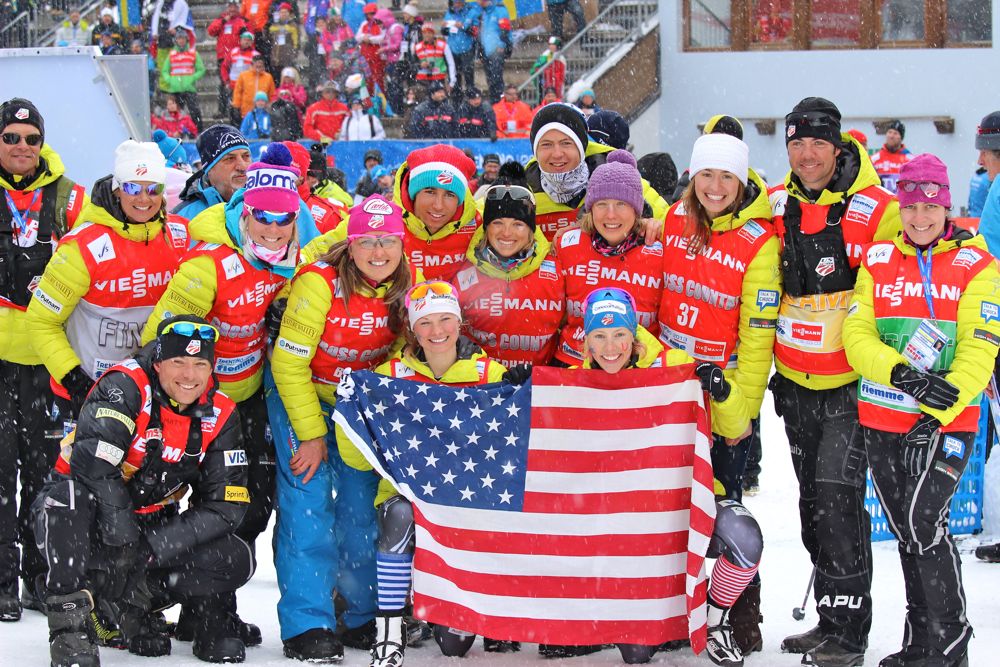
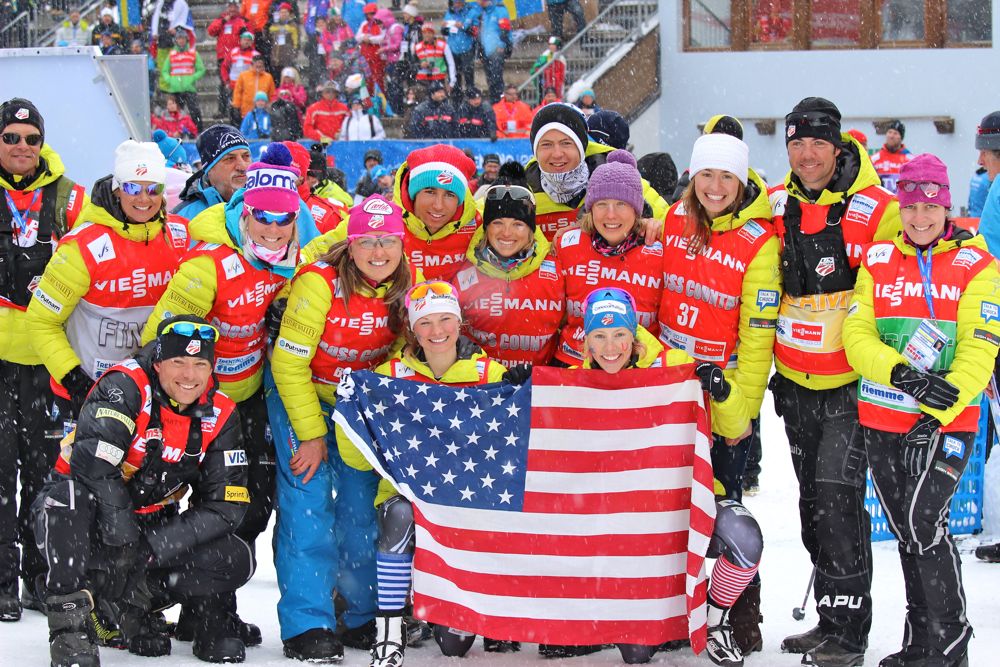
The 2013 U.S. World Championship team poses in Val di Fiemme, Italy, after Kikkan Randall and Jessie Diggins (front right, and left, with flag) won the women’s freestyle team sprint.
On Monday, the U.S. Ski and Snowboard Association (USSA) announced its selections to the U.S. cross-country team for the 2015 FIS Nordic World Championships in Falun, Sweden. The large team of 16 athletes will represent the U.S. in the most-anticipated event of the 2014/2015 season, which takes place Feb. 18 to March 1.
The team of 16 is headlined by defending 2013 world champions in the freestyle team sprint, Kikkan Randall and Jessie Diggins. They will be joined by fellow U.S. Ski Team (USST) athletes Liz Stephen, Sophie Caldwell, Sadie Bjornsen, and Ida Sargent. Two additional women from the domestic circuit, Rosie Brennan (Alaska Pacific University) and Caitlin Gregg (Team Gregg/Madshus), will also compete in Sweden.
On the men’s side, Andy Newell and Simi Hamilton were the only lone two national-team members to prequalify for the championships. They will be joined by fellow USST members Noah Hoffman and Erik Bjornsen, along with Kris Freeman (Freebird), Dakota Blackhorse-von Jess (Bend Endurance Academy), Matt Gelso (Sun Valley Ski Education Foundation), and Kyle Bratrud (Northern Michigan University).
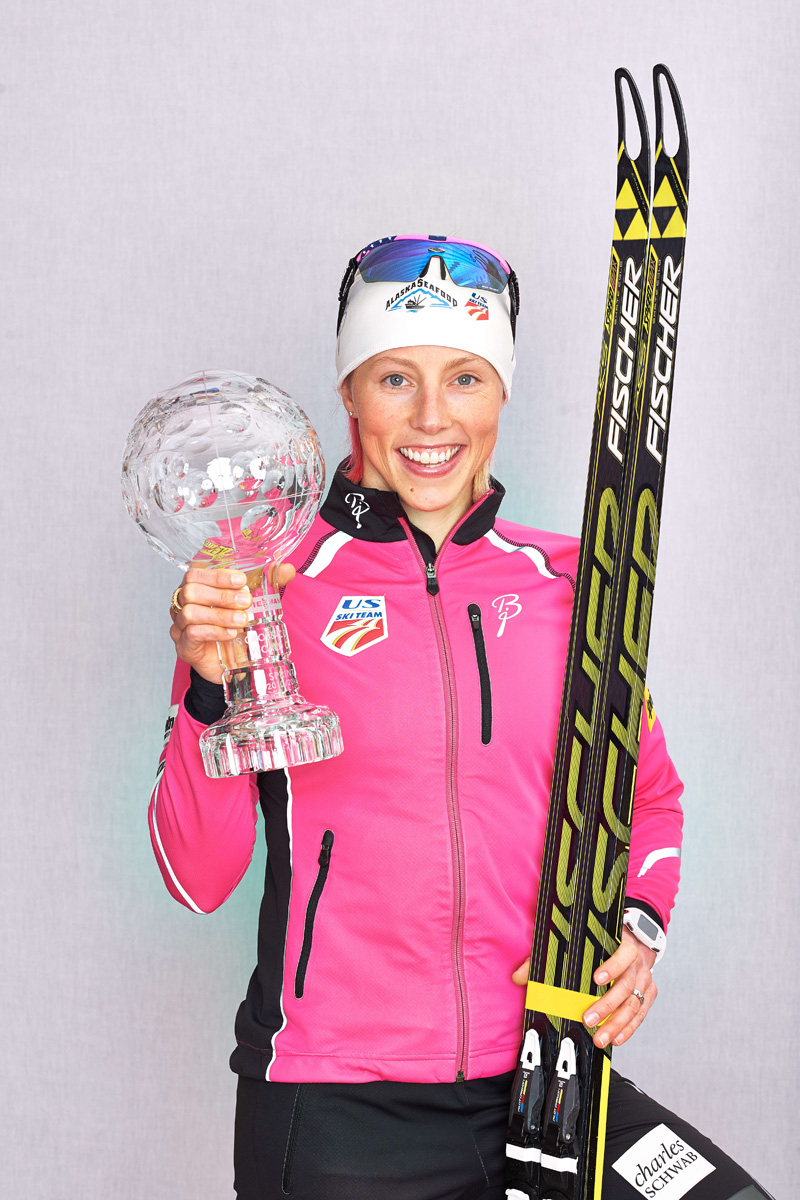
Kikkan Randall with her third consecutive Sprint World Cup Crystal Globe. (Photo: Fischer/Nordic Focus)
The 2015 U.S. World Championships team is larger than in past years. The 2013 roster featured 13 skiers while the 2014 U.S. Olympic team numbered 14.
According to USST Head Coach Chris Grover, the reason for the team’s growth is due to a need to fill the four starting spots allotted to the U.S. in each race. In 2014, one more woman (Holly Brooks) qualified for the Olympics via the World Cup than in 2015 for the World Championships. Grover and the USST recognized that, based on the USST’s World Cup performances earlier this year, they needed one more classic and an additional freestyle skier.
“That was natural to take Rosie [Brennan] and Caitlin [Gregg] as they had won those races at nationals and they were the next women on the points list. It made it easy,” Grover said in a phone interview after the team announcement.
Brennan, who won three out of four races at U.S. Cross Country Championships in Houghton, Mich., earlier this month, has traditionally excelled in the classic technique, while Gregg is known as a strong skater.
Grover explained that because the two men who qualified via the World Cup — Newell and Hamilton — are sprint specialists, there was a need for multiple distance skiers on the men’s team.
“We have some good sprinters already so we needed some distance skiers, and that’s why we took the top-four distance guys on the national ranking list,” he said.
Apart from prequalified athletes, this year’s team was entirely selected from the fourth publication of the USSA points list. Brennan and Gregg were the top two domestic skiers on both the distance and sprinting lists. Hoffman, Freeman, Gelso, and Bratrud were the first four skiers in the distance rankings, while Blackhorse-von Jess and Erik Bjornsen were the top skiers (apart from Newell and Hamilton) in the sprint rankings. Coincidentally, every skier who won a national title at this year’s nationals (Brennan, Gregg, Freeman, Bratrud, and Blackhorse-von Jess) will ski in Falun.
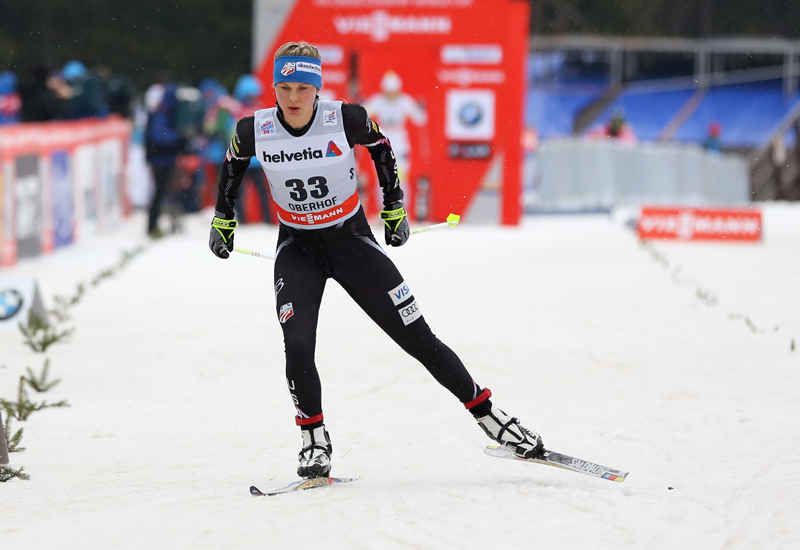
Jessie Diggins (U.S. Ski Team) racing in the 2014 3 k freestyle prologue at Stage 1 of the Tour de Ski in Oberhof, Germany. (Photo: Marcel Hilger)
“It worked out really well. If you went down and took the next athletes based on points, you ended up taking every athlete who happened to win at the U.S. National Championships this year,” Grover said. “That was a nice coincidence of how USSA points reflected performance this fall.”
The USST has an idea of which athletes will compete in the each of the 12 races. Final decisions for the first competitions in Falun will be based on results from the next World Cup from Feb. 14-15 in Östersund, Sweden.
“We’ve got a few people penciled in and we have a lot of alternates in every race so it really depends on what we see in Östersund in the classic sprint and the 15 k freestyle. On the women’s side it is a little bit more cut and dry because we have results from the World Cup,” Grover explained.
There’s also room for expansion of the 16-person team, as each nation is allowed 24 athletes (12 male and 12 female). According to Grover, any additional selections will be made based on results from next week’s Junior/U23 World Championships in Almaty, Kazakhstan.
“Somebody needs to have a standout performance to demonstrate that they would ski faster than somebody who is already on the World Championship team: a top-eight, top-five, or podium performance,” he said of the possibility of additional picks.
The Athletes
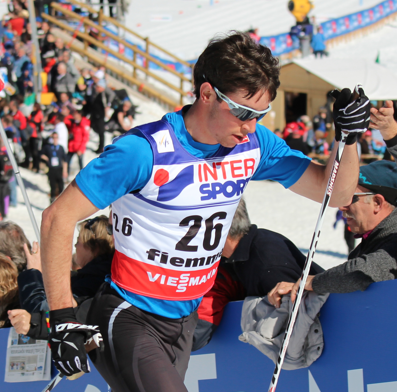
Colorado native Noah Hoffman of the U.S. Ski Team racing in the 2013 World Championships in Val di Fiemme, Italy.
The team announcement comes on the heels of the Americans’ best results of the 2015 season in Rybinsk, Russia. Over the course of the three-race weekend, Stephen took second in the 10 k freestyle for the best-ever distance result of a U.S. woman, and Diggins placed fifth in the both the sprint and skiathlon to match her career best.
At the same time, the World Cup weekend in Russia was also missing many of the circuit’s top skiers, with Norway’s Marit Bjørgen, Therese Johaug and Heidi Weng, among others, opting for a training block following the Tour de Ski. Because of the smaller field, Grover said he didn’t read too much into the results.
“The good thing is that the athletes, like Jessie with her fifth places and Liz, are coming into incredible shape,” he explained. “If they can make a little step between now and Falun, it would be really exciting.”
Randall, three-time winner of the Sprint World Cup crystal globe, had uncharacteristic results early in the 2014/2015 season, failing to qualify for her signature event, the freestyle sprint, in December in Lillehammer. After exiting the Tour de Ski, Randall returned home to Alaska to make a “drastic change” before returning to Europe to focus on Falun.
“We had to look at the big goals of the year [at World Championships] in Falun, and I wanted to make sure I could try to make a drastic change in my racing before then,” Randall said earlier this month. “[I] really figured a change in scenery, a change in pace, and a time to actually come home where you can actually recover and recharge was the best way to ensure good performances in Falun.”
Sadie Bjornsen skating to seventh place in the 2015 3.3 k Tour de Ski prologue in Oberstdorf, Germany (Photo: Marcel Hilger)
Randall is also forgoing the current USST altitude camp in Davos, Switzerland. She flew to Östersund on Jan. 26 to train and prepare with her husband and FIS communications employee Jeff Ellis.
“I’ll have almost three weeks before the World Cup in Östersund, so that’s a good training period to actually work on fine tuning things with some good interval training and then hopefully rest a little bit going into [the] Östersund [World Cup]. And off we go,” she said.
Hoffman will also return to competition in Östersund. His fitness and racing ability is still unknown after breaking his fibula in a crash during the first World Cup weekend of the year. After undergoing surgery in December, Hoffman has been recovering in Colorado. As part of his rehabilitation, the 25 year old used a combination of physical therapy, a ski erg, and double-pole workouts to maintain his fitness in an effort to make a comeback for the in Falun. Recently, he graduated to techniques such as skating and striding.
“Noah’s recovery is going really well and he’s at the point now where he’s transitioning out of double pole only and starting other techniques. If everything continues to go well, we’ll see him in the 15 k in Östersund,” Grover said. “At this point he is a wild card. I don’t think anybody, including Noah, knows what to expect.”
The remaining USST athletes, including Sadie Bjornsen, who was consistently the top American skier in Period 1 of the World Cup, will look to peak for worlds.
Rosie Brennan (c), leads Liz Guiney (l) and Anne Hart shortly after the start in the women’s 1.5 k classic sprint final at U.S. Cross Country Championships in Houghton, Mich. (Photo: Christopher Schmidt)
The U.S. team will also feature a strong showing of domestic skiers. Even though they haven’t been on the World Cup circuit for the entirety of the season, they are expected to perform. As in the past, the USST reiterated that it chooses athletes for the world’s biggest competitions because they are at a high level of performance, not to give them international racing experience.
According to Grover, Freeman’s and Gregg’s past World Championships and World Cup experience will aid in the team’s search for performance. Freeman, a former longtime USST member, will compete in his eighth World Championships. Gregg raced the World Cup circuit from November to December before returning to the U.S. for nationals. Plagued by shingles before her first starts of the season, Gregg said that illness prevented her from demonstrating her true potential.
Of the six domestic skiers, four are making their debut appearance in a World Championships: Blackhorse-von Jess, Brennan, Gelso, and Bratrud. The event will serve as a test to see how they shape up against the World’s best.
Grover wants to see Blackhorse-von Jess, who won both sprints at this year’s U.S. nationals, translate his domestic success into international performance.
“He has been dominant in the sprint field in the U.S. Now he needs to prove to everybody that he belongs at the next level. Qualifying in the individual sprint is somewhere where he should be,” Grover said.
The same goes for Brennan, who Grover said has proven she deserves to be at the international level. Brennan won three of four races at the U.S. nationals (and podiumed in all four) and in Rybinsk, finished 13th in the World Cup 10 k and 20th in the 15 k skiathlon. This will also be her first World Championships.
“Rosie is in great shape. She’s demonstrated all fall that she is the number one athlete in the U.S. to beat,” Grover said. “She had some super good results in Rybinsk that demonstrate that she’s at a pretty high level of fitness. Is her fitness better than the distance women on the national team? They’re probably a little bit ahead, but she’s right there.”
Kyle Bratrud crosses the finish line of the men’s 15 k freestyle at the 2015 U.S. Cross Country Championships in Houghton, Michigan. Bartered won the race by more than 50 seconds.
Another first-timer is Gelso, who started international competition this season in Otepää, Estonia, as the Period 1 SuperTour leader. He will look to improve results from his first two weekends of World Cup racing.
There is one exception to the USST rhetoric of performance in the choice of Bratrud. A senior at Northern Michigan University, Bratrud won the 15 k freestyle by more than 50 seconds at U.S. nationals and was third in the 30 k classic in Houghton. According to Grover, the main incentive in choosing Bratrud was to give the young skier more international experience after the U23 World Championships in Almaty, Kazakhstan, and to fill extra starting spots.
“The place for him to really make his mark is the U23 World Championships. That’s the most appropriate level of competition for him now, as well as the younger men and women. World Championships should just be a little bit of a bonus,” Grover explained.
In an email to FasterSkier, Bratrud wrote he was “very honored to be named” and excited to gain experience in both the World Cup and World Championships races.
“This is a gigantic accomplishment for me and not necessarily something that I targeted going into this year. I really think this is a step in the right direction towards accomplishing my goal of making the USST,” he wrote. “I am super stoked to see how the big boys race and hopefully I can contribute to the team in some way! It will be a great step in my ski career.”
What to Expect in Falun
Simi Hamilton celebrates his first victory and podium in the third stage of the 2014 Tour de Ski in Lenzerheide, Switzerland. (Photo: Fischer/Nordic Focus)
According to Grover, the USST’s “target events” are the same as in past years due to relatively low athlete turnaround. The first of these events is the women’s freestyle team sprint, in which the U.S. is defending world champion. Despite the return of Diggins and Randall, Grover explained that there are several women who are being considered for the two-person team.
“The ideal situation is to have three or four women that could potentially do that race on a given day, depending on what their current level of fitness is and what their health status is,” Grover said. “Obviously Kikkan Randall and Jessie Diggins are favorites, but there’s a number of other women who have skied well over the season: Sadie Bjornsen, Ida Sargent, Sophie Caldwell, Rosie Brennan, and all those athletes are under consideration for that event.”
Since the the team sprint is the third competition of worlds, a decision will be made regarding the members of the team after athletes demonstrate their fitness in the previous two races in Falun and the Östersund World Cup.
According to Grover the freestyle team sprint is the most promising event for the men. He said that the event is always a “wild card” due to the necessity for luck and favorable conditions. In last year’s Olympics, Hamilton and Bjornsen teamed up to take sixth in the classic team sprint.
Another target event is the women’s 4 x 5 k relay, in which the U.S. placed fourth in 2013. With a strong Norwegian team, Grover said that the U.S. would need to challenge Sweden, Finland, and Germany to fight for a remaining podium spot.
Both the men’s and women’s individual classic sprints will also prove a chance for the U.S. skiers to shine, despite their usual strength in freestyle races. In the first World Cup sprint of the 2015 season, Sargent notched a career-best fifth in the classic sprint. Grover also pointed to the 10/15 k freestyle races as strong events for both Stephen and Hoffman. The two finished fifth and 15th, respectively, in the same races in the 2013 World Championships.
Currently the majority of the team is at an altitude camp in Davos before heading to Östersund. Once there they will be join the remaining World Championship teammates including Randall, Gregg, Hoffman, Freeman, and Bratrud.
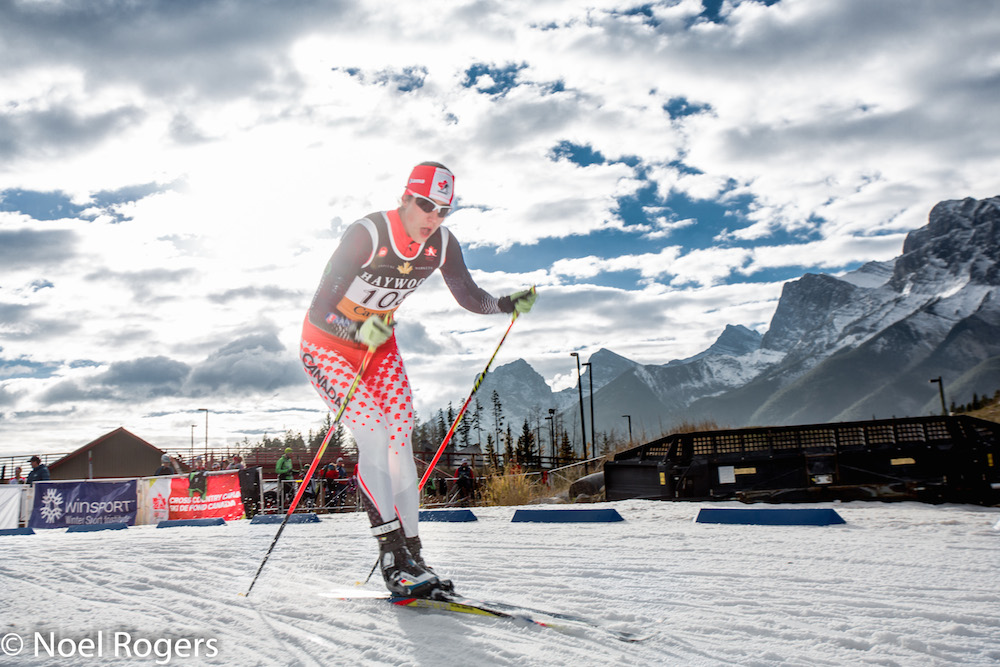
Rosanna Crawford racing in Canmore, Alberta, in October 2014. Crawford was the top Canadian woman in Ostersund, Sweden, today. (Photo: Noel Rogers/Bow Valley Photography)
It was a rough day, literally and metaphorically, for the biathletes competing Saturday in Östersund, Sweden. Artificial snow, saved snow and shoveled snow made for a treacherous course, though winds were calm.
Two Canadians broke through the bumpy conditions to have strong races in the IBU World Cup men’s 10-kilometer and women’s 7.5 k sprint — Nathan Smith and Rosanna Crawford finished ninth and 12th, respectively. The rest of the Canadian team did not fare as well, with no other skiers finishing in the top-60 to advance to Sunday’s pursuits.
Smith shot clean to earn his ninth-place finish, while the next Canadian man to finish was Marc André Bédard in 61st (+2:39.1) who missed one target in standing, and Brendan Green (+2:42.1), who missed one in prone and two in standing. This is only Smith’s fourth career top 10, and Canada’s first top 10 of the season.
“Obviously, I’m really happy with the result,” Smith told FasterSkier. “A top 10? I don’t have that many of those, yet.”
For the Canadian women, Crawford was happy with her race, finishing in 12th place (+1:10.3), in spite of missing a target in both prone and standing. But the women’s side was similarly disappointing, with Zina Kocher as the next Canadian woman in 66th place (+2:34.9, +4), and uncharacteristically bad shooting plaguing both Megan Heinicke, who finished 82nd (+3:23.6, +2) and Audrey Vaillancourt, who finished 88th (+3:31.7, +3).
An email to head coach Mattias Ahrens went unanswered as of this writing.
Scott Perras did not start due to a cold: “It’s really too bad,” he wrote in an email. “I am normally pretty healthy throughout the race season. This is my first DNS at any level of racing and I don’t much care for it.”
Smith’s strong result can be credited due to what he called “one of [his] best shooting races ever,” having the 10th-fastest shooting time of the day (+2.9) with no misses.
“After the individual I was pretty disappointed with my standing shooting,” he said. “So I took a day off of shooting and then yesterday I really focused on having really high quality in training, and the same with today during the race. I just tried to be very disciplined, I guess I could say. And it really paid off.”
“It’s not the best that I’ve been on skis in the last year and a half,” he added, “but it’s good still. Just not my best.”
For her part, Crawford was somewhat disappointed in her shooting, and in fact appeared to be having a pretty ho-hum race after the 2nd lap, being in 27th place. But on that final lap, she turned it up, delivering the 7th-fastest course time and moving herself into 12th place.
“This is kind of funny,” Crawford laughed. “I’ve always been kind of the opposite – a really strong starter and then have struggled with finishing loops, but Zina Kocher and I got to train together a lot this year and that’s always been her strength, so being able to work with her all summer long I think has been very beneficial to me to getting that finishing speed.”
Though course conditions were poor, neither Smith nor Crawford complained. Smith benefited from being an early starter, before course conditions deteriorated too much. He highlighted some of the downhill corners as being particularly treacherous.
“They shoveled [the corners], so I didn’t really know what to expect,” he said. “They were okay because you just sort of bounce over the bumps. But then, as each lap went on, the ruts got deeper. I’m sure that, for the last starters, it was pretty scary on those corners.”
Crawford thought that the poor course conditions matched her strengths.
“I’ve always been pretty strong on downhills, so I think that’s a huge advantage for me on a course like this,” she said. In fact, relative to other skiers, course conditions probably helped her out. “It didn’t hurt me, for sure.”
As for her shooting, Crawford made no excuses:
“It was pretty calm on the range, so it was definitely all me. A little bit more focus can go a long way.”
Though Crawford had told FasterSkier that she was hoping for top-10, she was far from disappointed with her finish.
“I’m not expecting to be in the top-10 every single race,” she said. “If I’m consistently in the top-25/top-15 area that’ll make me happy,” adding that she’d still like to get more top-10 finishes this year than she did last year.
“And for sure to be on the podium at least once this year,” she added.
After such a grab bag of results feelings on the the time are pretty mixed.
“Obviously some of us have had great races,” Smith said. “But I’m sure Brendan and Marco, and the other girls, are pretty disappointed about not making the pursuit.”
Smith and Crawford are looking forward to tomorrow’s pursuit with differing baselines for what to expect. Smith is looking forward to what he regards as his best format, while Crawford is apprehensive about what she regards as a weakness.
“It’s a shooting race,” Smith said. “I think shooting speed is more important, which is probably my biggest strength. I can take advantage of that as long as I hit most of the targets.”
Crawford echoed that assessment, but a bit more apprehensively.
“Pursuits were a bit of a weakness for me last year, shooting wise,” she wrote in response to follow-up questions. She hopes to simply hold her position and stay in the top 15, but that she’ll be happy if she is able to follow her range plan and “stay focused on myself and not get caught up in what’s going on around me.”
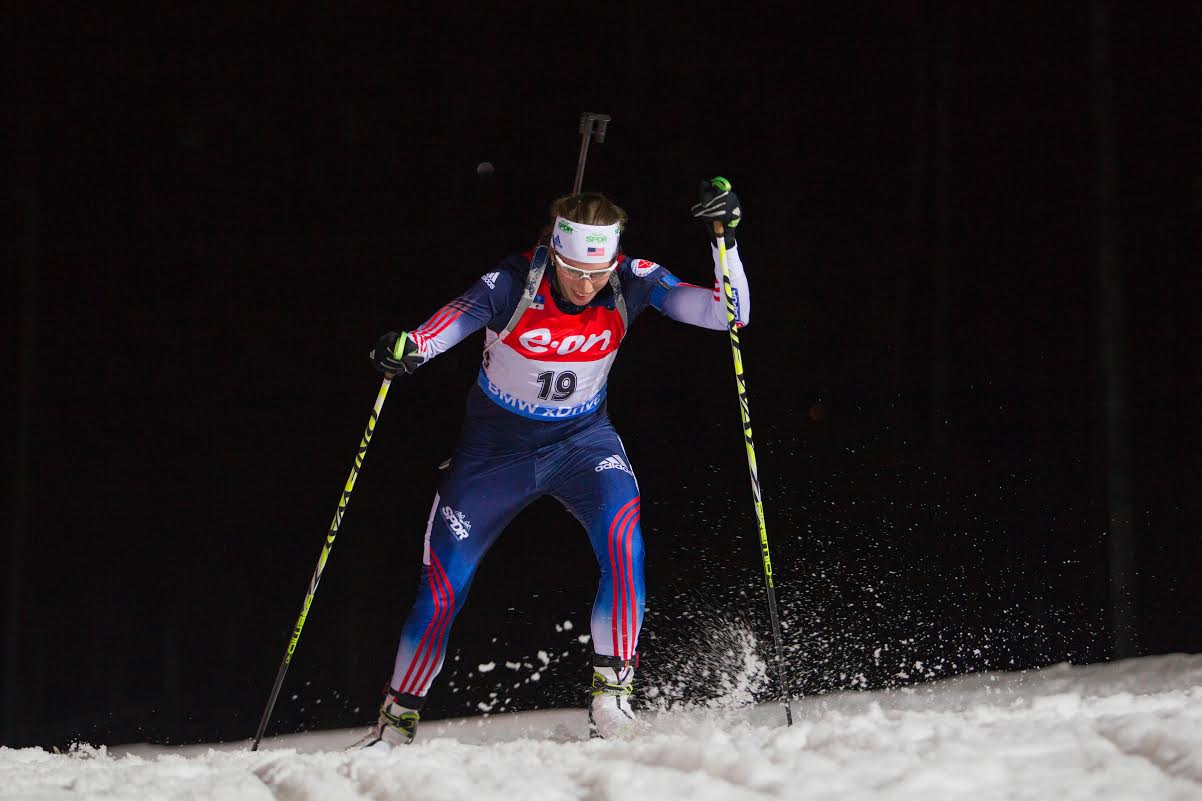
Susan Dunklee (US Biathlon) en route to 21st in Thursday’s 15 k individual at the IBU World Cup opener in Östersund, Sweden. (Photo: USBA/NordicFocus)
It wasn’t pretty out there, American Susan Dunklee explained an email about the women’s first individual race of the season. “Deep slush with unpredictable patches of ice underneath” made for some not-so-graceful skiing in Thursday’s 15-kilometer World Cup race in Östersund, Sweden, she wrote.
But Dunklee found some comfort knowing that everyone else was flopping around, too.
US Biathlon’s early starter in bib 19 (of 96), she explained that the conditions worsened as the race wore on, but the snow was already deep and sluggish at the start. Still, she ended up skiing faster than most of the field with each passing loop, recording for the seventh-fastest course time overall (and the eighth- and sixth-fastest second and third loop times, respectively).
And while she initially finished 11th and ultimately ended up 21st with three penalties, 3:59.1 minutes behind Belarusian winner Darya Domracheva, Dunklee explained she wasn’t feeling in top form.
“My body did feel a little tired and I didn’t feel ‘sharp’ today,” she wrote. “I focused on whatever hill or corner was immediately ahead of me. This was a day to use the head as much as the muscles; constantly assessing and reacting to which side of the track had less slush and a harder surface.”
After cleaning the first prone, Dunklee missed two on the second stage for two minutes of penalties. She went on to clean her second prone and miss one on the final standing.
All the while, she didn’t hear any splits until her final loop. Even if she had, with just 18 women ahead of her, they wouldn’t have given her the most accurate sense of where she’d end up.
“Anything can happen in the shooting range, especially in the last stage when the pressure is on, so I take any mid-race splits with a grain of salt,” she explained. “The Individual is particularly unpredictable.”
Leaving the range for the last time, she was 11th at the time — which was where she’d end up at the finish. From there, Dunklee waited as she gradually slipped just outside the top 20, with later starters like Domracheva, third-place finisher Valj Semerenko (Ukraine), Tiril Eckhoff (Norway), Ekaterina Glazyrina (Russia), Sophie Boilley (France), Olga Podchufarova (Russia), and Megan Heinicke (Canada) placing in the top 12.
Enora Latuilliere (France), Weronika Nowakowska-Ziemniak (Poland), Franziska Pruess (Germany), Luise Kummer (Germany), and Jitka Landova (Czech Republic) also snuck ahead of her in the top 20.
“Darya passed me as if I were standing still and Tiril also caught me before the finish, so I was surprised to see I have the 7th fastest ski split,” Dunklee recalled. “They left me in the dust. It goes to show how wide open the field is this year — so many top women retired last year and now there is less depth and tremendous opportunity.
“I am happy to start off the season with a bunch World Cup points,” she added. “It’s a great feeling to know I still have plenty of room to improve too.”
The second U.S. finisher was Annelies Cook, who placed 73rd (+9:23.6) after four penalties (1+2+0+1). The team’s third woman, Hannah Dreissigacker was 86th (+11:19.7) with seven misses (3+0+1+3).
“Today certainly wasn’t our strongest team showing,” Dunklee said, after she and three teammates combined for seventh in the mixed relay on Sunday. “We often struggle at the start of the season. Many of the other teams have had more on-snow time than us, and lots of athletes are peaked right now because they had to recently qualify for a spot on their nation’s squad. The season is long, and we still have time to tune up. We will get there.”