Tag: 2015 FIS Nordic World Ski Championships

  • Looking to Lahti: Inside the USST’s World Champs Selection Criteria

    Looking to Lahti: Inside the USST’s World Champs Selection Criteria

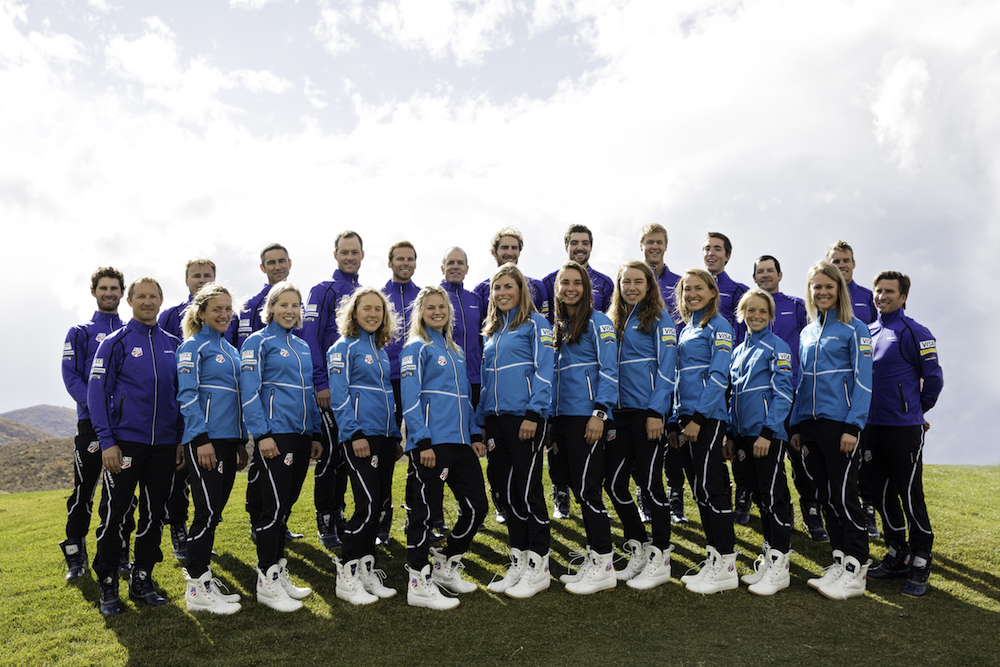
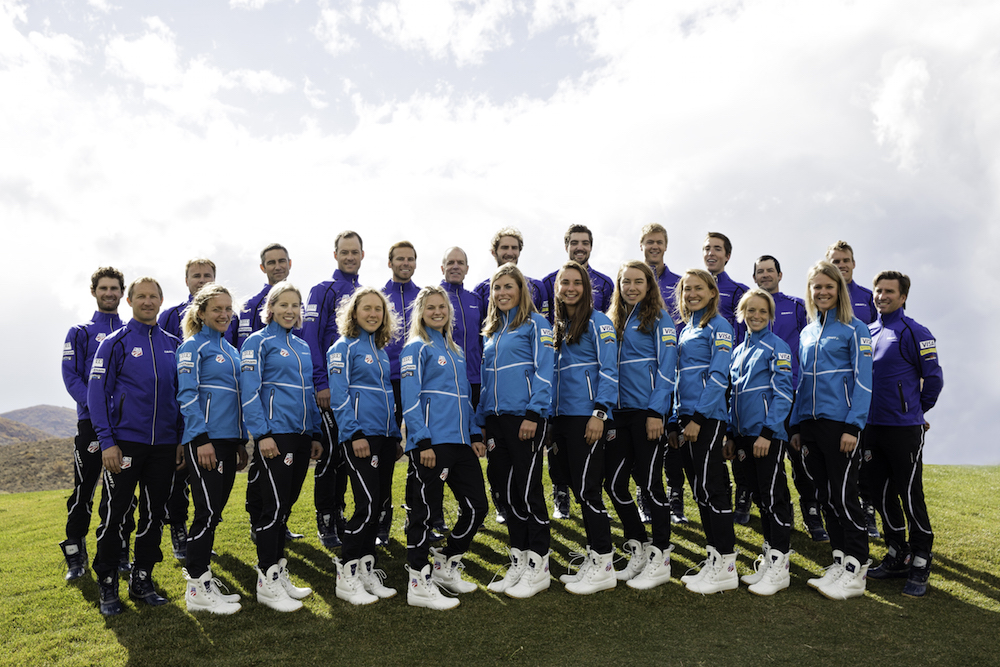
    The 2015/2016 U.S. Nordic Ski and Nordic Combined teams during a team photo shoot in their new uniforms on Monday, Oct. 19, in Park City, Utah. (Photo: USSA)
    Last season’s 2015/2016 U.S. Nordic Ski and Nordic Combined teams pose for a photo shoot in October 2015 in Park City, Utah. (Photo: USSA)

    American cross-country skiing does not have a trials system. That is, selection to the U.S. team for international championship events – the Olympics and World Championships – does not involve having everyone show up in the same race (or race series) on the same day, top finishers make the team. Championship teams used to be picked this way; Luke Bodensteiner writes memorably in Endless Winter: An Olympian’s Journal of his experiences at Anchorage’s Kincaid Park for the 1994 U.S. Olympic Trials. (Spoiler alert: as the subtitle suggests, he made the team.)

    But the current approach is somewhat more elaborate, including ranking lists and points and a variety of criteria that are primarily objective, but are also supplemented by discretionary factors. As we approach the winter of 2016/2017, and the country’s top skiers await the first intervals of fall with dreams of competing at the FIS Nordic World Ski Championships in Lahti, Finland, FasterSkier breaks down the selection criteria that set forth the ways in which a U.S. athlete may be named to the team.

    New selection criteria: Last winter’s results are out, this winter’s results are in

    The U.S. Ski and Snowboard Association’s (USSA) full selection criteria for Lahti are available here. This document reflects the final stage of a long process. In January 2015, shortly after he had shared the selection criteria for the 2015 World Championships in Falun, U.S. Ski Team Head Coach Chris Grover wrote on his blog about his intent to work on updating the criteria before it came time to select athletes for Lahti.

    “I’ve organized a working group of top US coaches this summer and fall to help us create a new selection criterion for Lahti 2017,” Grover wrote in response to a question about the interaction between objective and subjective criteria. “One important aspect of this new criteria is creating a head-to-head format in fall SuperTour racing (including U.S. Nationals) that provides an athlete with a clear path to Championship selection, without the guesswork of looking for races with low points. We are currently running the criteria by our legal department to ensure that, like all of our criteria, it’s fair, clearly understandable, and complies with the Amateur Sports Act.” *

    Eighteen months later, in June 2016, Grover wrote that he was “excited” about the updated selection criteria for the U.S. team for Lahti. He wrote that “the Objective and Discretionary selection procedures in [the new] criteria are very similar to what we have used in the past. The big change, however, comes in how Additional Team Selections are made. In the past, additional selections have been made using FIS or USSA points, which are created by scoring points races on a year-round continuum. This new criteria relies on head-to-head SuperTour and U.S. Nationals racing in the fall/early winter of the season of the Lahti Championships themselves.”

    Grover wrote that the new criteria are intended to reduce the temptation for athletes to chase FIS or USSA points, or even to “willingly manipulate the results of races” with an eye to improving points.

    He added, “This criteria rewards head-to-head competition in the season of the Championships. Athletes who skied fast in the spring of the previous season no longer have a potential advantage over those athletes skiing fast in the current season. The criteria provides a clear path for athletes to the World Championships. The athlete that is winning races is most likely going to make the Team. The guesswork of improving one’s FIS or USSA points is removed.”

    U.S. Ski Team Women’s Coach Matt Whitcomb concurs. As he told FasterSkier earlier this summer, the new focus on results solely from the 2016/2017 race season is “definitely a criterion that focuses more on how athletes are skiing closer to the Championships. It’s a very important concept, I think, that from what I can tell the entire ski community is behind.”

    (Concern over what is effectively a year-long window for the development of USSA points, and the implications of making championship-team selections on this basis, is not of recent vintage. In December 2001, Cory Smith, at the time an elite American skier, blogged about his disfavor with selecting skiers for the 2002 U.S. Olympic team on the basis of the most recent USSA points list, when the relatively low-key races held at Spring Series 2001 ended up having a disproportionate effect on the USSA rankings list used for Olympic selection many months later.)

    Inside the selection criteria: World Cup success as an objective path to selection
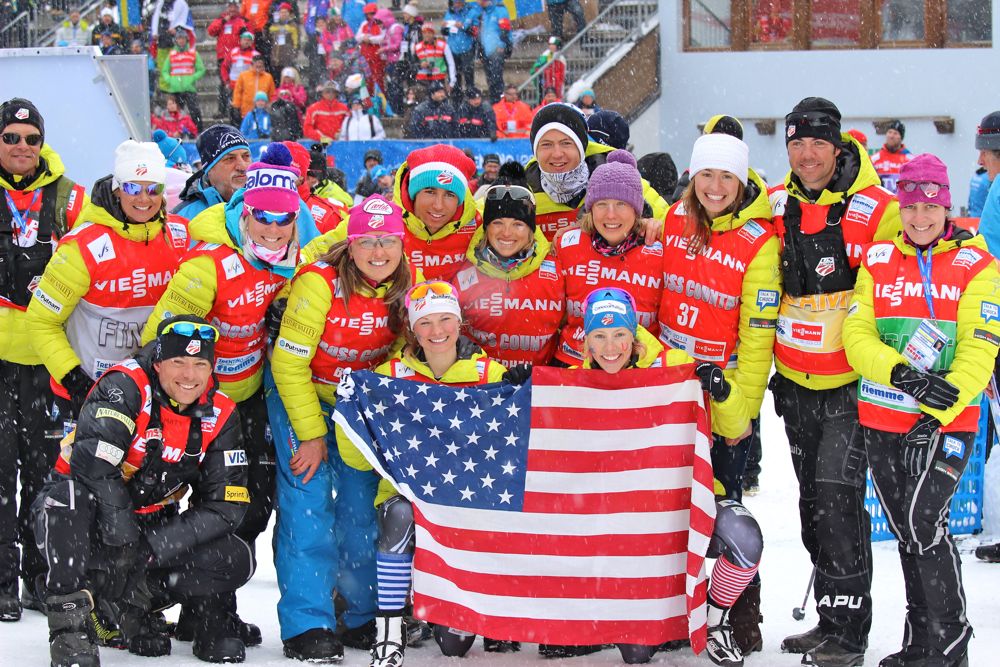
    The 2013 U.S. World Championship team poses in Val di Fiemme, Italy, after Kikkan Randall and Jessie Diggins (front right, and left, with flag) won the women’s freestyle team sprint.
    The 2013 U.S. World Championship team poses in Val di Fiemme, Italy, after Kikkan Randall and Jessie Diggins (front right, and left, with flag) won the women’s freestyle team sprint.

    The selection criteria themselves include a mix of objective standards and discretionary options. Performance on the World Cup is the easiest and most direct way to merit selection to the team, but there is also the option of skiing on via domestic results on the SuperTour. Probably.

    Starting with objective standards: The objective standards look solely to an athlete’s performance on the World Cup. An athlete will be automatically selected to the World Championships team if they have either (1) a “ranking in the top-50 in the Distance World Cup standings or the top-50 in the Sprint World Cup standings as of January 16, 2017,” or (2) a “top-8 individual final World Cup result” in one of three selected race formats between the start of the upcoming World Cup season and Jan. 16, 2017.  (The full document explains various tie-breaking procedures and additional principles; for example, a top-8 individual sprint finish trumps a top-50 sprint points ranking.)

    The three specified race formats in which a top-eight finish will lead to team membership are “Sprint F, individual start 10/15 km C, and 15/30 km Skiathlon.”

    This does not account for all of the individual races in the first half of the World Cup calendar – individual races in other formats include a classic sprint in Ruka, a classic sprint in Lillehammer, a 5/10 k skate in Lillehammer, a 15/30 k skate in Davos, and six of the seven races in the Tour de Ski (all save the opening skate sprint).

    In an email to FasterSkier, Grover explained that this distinction is by design. “Only individual events in the specific format we are racing in Lahti qualify for top-8 automatic qualification,” he wrote. “Classic sprints [which will be held in Lahti in the team sprint format] are not included in this specific part of the criteria because the aerobic and anaerobic demands of team sprint are different enough from individual sprint.”

    Grover addressed the possibility that an athlete could achieve a top-eight individual result on the World Cup, but do so in some race format other than the three designated ones of skate sprint, 10/15 k individual start classic race, and full-distance skiathlon.

    “An athlete that has scored a top-8 in any event will most likely score enough [World Cup] points in that single race to make the top-50 discipline qualification standard,” he wrote. And “at the end of the day, we want any athlete that can finish in the top-8 on the [World Ski Championships] team. We also have discretion to use in the event that a top World Cup performance by a given athlete fails to qualify them outright for the Lahti Team. The top-8 criteria has an element of redundancy in it, but it is important in the event that an athlete only gets 1/2 points for that performance if it comes during the Lillehammer mini-tour [on December 2-4] or the [Tour de Ski].”

    The possibility of discretionary picks

    Grover had alluded to USSA’s discretion to make additional selections. As the criteria document states, “The USSA may select additional athletes to the Team using coaches’ discretion, using factors other than objective criteria.” (This language is unchanged from the criteria that governed selection to the U.S. team for Lahti in 2015.)

    These discretionary factors include everything from results in last season’s races to “attitude,” “illness or injury during the selection period,” and “Indicia of medal potential in future Olympic or World Championship competition, which would be materially enhanced by selection to team.” Finally, a catch-all provision states that USSA may make discretionary selections for nearly any other reason if the objective criteria do not reach the desired goal: “Other unanticipated failure of objective criteria to select an athlete likely to achieve competition results consistent with USSA program goals for World Championships.”

    Whitcomb told FasterSkier in July that making discretionary picks was “one of the harder parts” of his job as a coach, stating, “We love not to do it.” Though he added, “But in any criteria, discretion can often be one of the most important pieces.”

    Inside the selection criteria: SuperTour success as a likely but not guaranteed  path to selection

    After USSA selects athletes via objective criteria based on World Cup performance, then, potentially, via discretionary factors, “any remaining positions” for the Lahti team “may be filled by considering the athlete ranking highest on the 2017 Championship Selection List.” (Technically speaking, the document says that remaining positions may be filled rather than will or shall be filled, meaning that USSA would not be strictly required to name a leading domestic skier to the team if it did not want to.)

    The scoring system for the 2017 Championship Selection List is explained in detail in the full selection criteria document. Briefly put, the list takes an athlete’s two best finishes “in a single discipline (sprint or distance)” and looks for the highest point total, based on awarding SuperTour points on a standard basis plus bonus points for a top-3 podium finish at U.S. Nationals. Notably, the window in which these performances may occur is only the first half of the 2016/2017 season, and does not – unlike the rolling USSA standard points list – include the second half of the 2015/2016 season.

    The highest ranked athlete on this list (who was not otherwise selected via objective criteria or discretionary factors) “may be recommended by the Head Coach to the Selection Committee, who may nominate additional selections.”

    The “Head Coach” is Grover. The “Selection Committee” is not literally defined elsewhere in the selection criteria document, but the document does discuss a “discretionary selection review group comprised of the USSA President and CEO, the Executive Vice President, Athletics, and the athlete representative from that sport who is a member of the USSA Board.” Grover clarified in an email that, in practice, the discretionary selection review group is the same as the “Selection Committee.”

    The USSA President and CEO, Executive Vice President for Athletics, and cross-country skiing athlete representative are currently Tiger Shaw, Luke Bodensteiner, and U.S. Ski Team member Rosie Brennan, respectively.

    Looking back and looking forward

    So how did this all play out in practice when it came time to select the team for Falun? Two years ago, eight athletes qualified objectively via their World Cup results. Another eight athletes were selected based on the most recent USSA points list. Finally, one athlete was selected via discretion.

    Specifically, Sadie Bjornsen, Sophie Caldwell, Jessie Diggins, Kikkan Randall, Ida Sargent, Liz Stephen, Simi Hamilton, and Andy Newell qualified for the U.S. team for Falun via objective criteria based on their World Cup rankings in the 2014/2015 season. Rosie Brennan and Caitlin Gregg for the women, plus Erik Bjornsen, Dakota Blackhorse-von Jess, Kyle Bratrud, Kris Freeman, Matt Gelso, and Noah Hoffman for the men, were then “entirely selected from the fourth publication of the USSA points list,” FasterSkier wrote soon after the selections were released. Finally, Ben Saxton was added to the team a few weeks later following his strong results at 2015 U23 World Championships in Almaty, Kazakhstan.

    “Brennan and Gregg were the top two domestic skiers on both the distance and sprinting lists [as of mid-January 2015],” FasterSkier wrote at the time. “Hoffman, Freeman, Gelso, and Bratrud were the first four skiers in the distance rankings, while Blackhorse-von Jess and Erik Bjornsen were the top skiers (apart from Newell and Hamilton) in the sprint rankings.”

    The U.S. team for Lahti is tentatively scheduled to be announced on Jan. 23, 2017. The first race at World Championships is the skate sprint on Feb. 23.

    * Footnote: The Amateur Sports Act of 1978, officially known as the Ted Stevens Olympic and Amateur Sports Act, 36 U.S.C. §§ 220501 et seq., “establishes a legal framework for protecting the participation opportunities of Olympic sport athletes,” one commenter explains. The Act mandates the creation of an Athletes’ Advisory Council, and describes procedures under which an athlete may submit eligibility disputes to binding arbitration. A related provision, section 9.1 of the Bylaws of the U.S. Olympic Committee (USOC), states that USOC “shall, by all reasonable means, protect the opportunity of an amateur athlete to participate if selected (or to attempt to qualify for selection to participate) as an athlete representing the United States” at the Olympics or World Championships.

  • FasterSkier’s Collegiate Skiers of 2015: Kyle Bratrud and Veronika Mayerhofer

    FasterSkier’s Collegiate Skiers of 2015: Kyle Bratrud and Veronika Mayerhofer

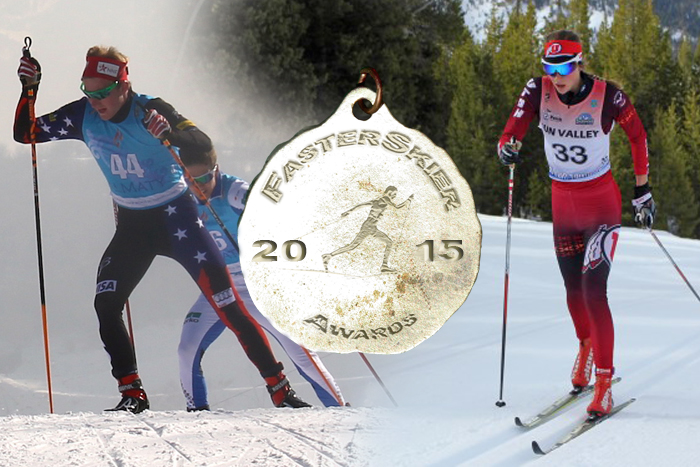
    Kyle Bratrud and Veronika Mayerhofer are FasterSkier's collegiate skiers of the year.
    Kyle Bratrud (l) and Veronika Mayerhofer (r) are FasterSkier’s collegiate skiers of the year.

    With the 2014/2015 season officially in the rearview, FasterSkier is excited to unveil its annual award winners for this past winter. Votes stem from the FS staff, scattered across the U.S. and Canada, and while not scientific, they are intended to reflect a broader sense of the season in review. 

    We kicked off the series Monday with awards for Junior Skiers of the Year (SOTY), Katharine Ogden and Sean Doherty. This second set of honors goes to outstanding male and female skiers on the U.S. NCAA collegiate circuit. 

    ***

    Kyle Bratrud, Northern Michigan University

    For a 22-year-old, Kyle Bratrud had a momentous 2015 season.

    The Northern Michigan University skier came out swinging at the 2015 U.S. Cross Country Championships, winning the 15 k freestyle individual start by 5o seconds over veteran Kris Freeman. The win and his subsequent bronze in the 30 k classic mass start started Bratrud on a whirlwind European adventure that would take him from competing at the U23 World Championships in Kazakhstan to being the second-youngest member of the American FIS Nordic World Ski Championships team in Sweden.

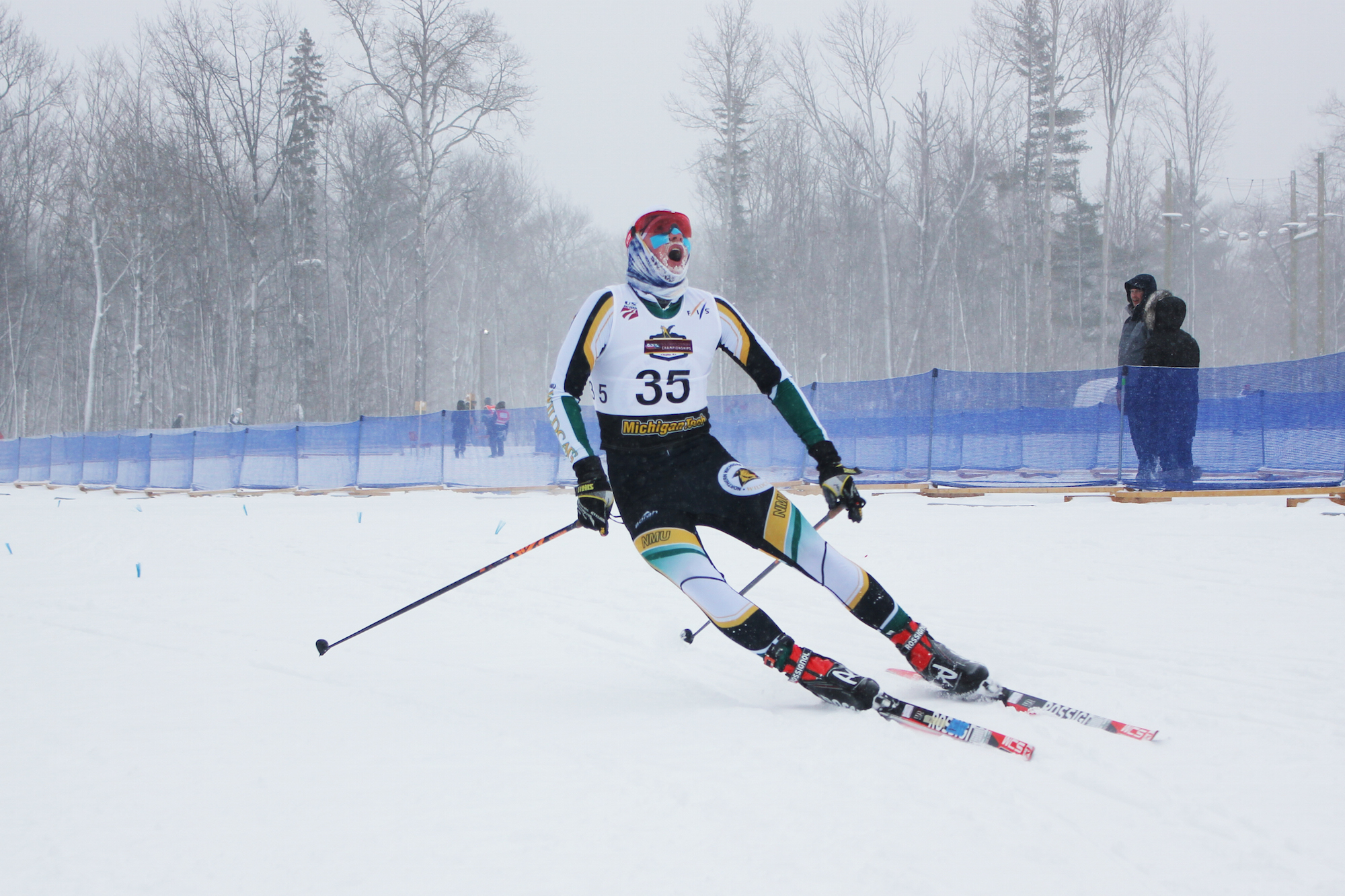
    Kyle Bratrud collapses after his 51-second win in the men's 15 k freestyle at the 2015 Cross Country Championships in Houghton, Mich.
    Kyle Bratrud collapses after his 51-second win in the men’s 15 k freestyle at the 2015 Cross Country Championships in Houghton, Mich.

    Entering the season, the Eden Prairie, Minnesota native told FasterSkier that his goals for the year were to qualify for the U23 World Championships and earn a podium at the NCAA Championships in Lake Placid, N.Y. After his successful week at U.S. Nationals it was clear that the NMU senior was well on his way to completing his goals. At the U23 World Championships, Bratrud’s best finish was 19th in the 15 k freestyle.

    When the USST announced its World Championship team in late January many were surprised and pleased to see Bratrud’s name on the list. According to USST Head Coach Chris Grover, the decision to select Bratrud was an investment in the future.

    For Bratrud, his selection was a major step in his career that offered valuable experience in the year before he jumped into professional racing. “This is a gigantic accomplishment for me and not necessarily something that I targeted going into this year. I really think this is a step in the right direction towards accomplishing my goal of making the USST,” he wrote in late January. “I am super stoked to see how the big boys race and hopefully I can contribute to the team in some way! It will be a great step in my ski career.”

    At World Championships Bratrud raced the 15 k freestyle individual start and as the third leg of the men’s 4 x 10 k relay. The relay was significant for the 22-year-old as it provided him with international experience that is extremely rare for a collegiate skier.

    “They asked me if I wanted to be in it and I said sure. I was flattered,” he said after the relay. “It’s another race on the international stage for me so I was all for it. I knew I was going to get my butt kicked around a little bit out there but that’s how you get better, racing these guys.”

    Bratrud returned to the U.S. after what he called an exhausting European tour and arrived in Lake Placid for the NCAA Championships. He raced to seventh in both the 10 k freestyle and the 20 k classic. He was the first American in the mass start.

    Bratrud will graduate from Northern Michigan University this spring. He plans to race for the CXC elite team in the 2015/2016 season.

    Veronika Mayerhofer, University of Utah

    University of Utah's Natalia Mueller (l) and Veronika Mayerhofer (r) at the 2015 U.S. Distance Nationals 30 k freestyle mass start in Sun Valley, Idaho as part of the year's SuperTour Finals . (Photo: flyingpointroad)
    University of Utah’s Natalia Mueller (l) and Veronika Mayerhofer (r) at the 2015 U.S. Distance Nationals 30 k freestyle mass start in Sun Valley, Idaho as part of the year’s SuperTour Finals . (Photo: flyingpointroad)

    It’s clear that Veronika Mayerhofer is an unassuming and good-natured person. If you meet her in a ski race, however, watch out – the University of Utah skier is always a threat and has the experience to back it up. Her achievements aren’t surprising, as the 22-year-old has competed for the Austrian National Team and raced at the 2013 FIS Nordic World Ski Championships and the 2014 Winter Olympic Games.

    In her first year as a Ute Mayhofer rose to the top a strong field of international and domestic collegiate women. She ended the regular season ranked second in the Rocky Mountain Intercollegiate Ski Association (RMISA) and earned the year’s Women’s Nordic MVP award for the region. She was the only skier to finish in the top five of all regular season races.

    At the NCAA Championships in Lake Placid, N.Y. the Austrian won the 5 k freestyle individual start by a large 13.2 seconds and finished second in a sprint finish at the end of the 15 k classic mass start.

    “It’s my first year of college racing and I was so happy that I could go to the NCAAs,” Mayerhofer said after her NCAA 5 k win. “I really enjoyed it so much because it is so much for the team and not just individual racing, because cross country skiing is so much on your own. It’s maybe less pressure and everyone is so happy for you.”

    Mayerhofer’s impressive skiing led the University of Utah women – including Sloan Storey and Anna-lena Heynen – to earn the most team points in both of the NCAA women’s nordic races. Their strong performances contributed to a third-place finish for the Utes.

    The Austrian’s season didn’t end there. She competed at the 2015 U.S. SuperTour Finals in Sun Valley, Idaho, skiing amongst the best American skiers throughout the entire week. Her strongest performance was perhaps in the mixed team relay where she brought her team from a far seventh to first. She posted the fastest third leg and overcame a charging and motivated Chelsea Holmes (APU) in the process.

    In addition to FasterSkier’s Colliegiate Skier of the Year Award, the 22-year-old was also named the United States Collegiate Ski Association’s skier of the year. Mayehofer will return as a sophomore to the University of Utah in the upcoming season.

    Honorable Mentions:

    Patrick Caldwell, Dartmouth College

    Caldwell also had a breakthrough season that rivaled Bratrud’s. The Vermont native raced to third in the 15 k freestyle at U.S. Nationals which was enough to earn him a spot on the U23 World Championships team. In Kazakhstan Caldwell finished 15th in the 15 k freestyle and 20th in the 30 k skiathlon. Throughout regular the season, Caldwell won all but one of the Eastern Collegiate Ski Association races at which he was present. At the NCAA Skiing Championships, Caldwell won the 10 k freestyle individual start to cap a largely dominant season. He finished 10th in the 20 k classic mass start.

    Emilie Cedervaern, University of New Mexico

    Cedervaern finished the 2015 season as the RMISA’s top-ranked woman. Over the course of the regular season the Lobo earned seven podiums, four of which were wins. She continued her dominance into NCAA’s where she placed third in the 5 k freestyle and won the 15 k classic in a sprint finish over Mayerhoffer.

    ***

    See also: Junior SOTY

  • Classic Northug: Norwegian Appears from Nowhere to Claim Victory in World Champs 50 k

    Classic Northug: Norwegian Appears from Nowhere to Claim Victory in World Champs 50 k

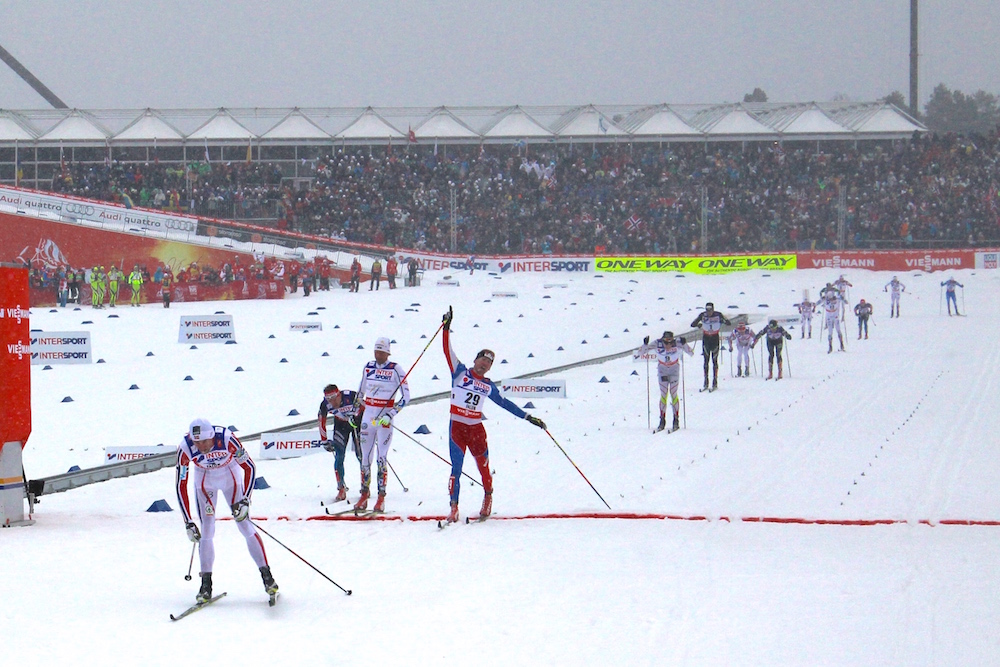
    Petter Northug catches his breath after wining the 50 k classic mass start at the 2015 FIS Nordic World Championships in Falun, Sweden. Behind him, Czech skier Lukas Bauer celebrates second as Johan Olsson crosses in third and Maxim Vylegzhanin finishes fourth.
    Petter Northug catches his breath after wining the 50 k classic mass start at the 2015 FIS Nordic World Championships in Falun, Sweden. Behind him, Czech skier Lukas Bauer celebrates second as Johan Olsson crosses in third and Maxim Vylegzhanin finishes fourth.

    FasterSkier’s coverage of the 2015 FIS Nordic World Ski Championships in Falun, Sweden, is brought to you by the generous support of L.L. Bean, now featuring a complete line of Kikkan Randall training wear.

    FALUN, Sweden — Good things comes to those who wait. If you’re Petter Northug, that good thing just happens to be a gold medal.

    Northug patiently waited until the final meters of the men’s 50 k classic mass start to win his fourth gold medal of the 2015 FIS Nordic World Ski Championships. Before the last kilometer, the Norwegian hadn’t skied above 10th position and fell as far as 48th at 5 k into the race. Nevertheless, he overcame a flying Lucas Bauer and determined Johan Olsson of Sweden in the final meters to cross the line with a time of 2:26:02.1. Bauer trailed by 1.7 seconds to take the silver while Olsson finished 2.0 seconds back for third in the snowy and soft conditions.

    The start of Sunday’s race began like most others in Falun – there was a light snow that fell on a roaring crowd of over 30,000, and conditions seemed to be stable. That soon changed as the snow developed into thick, wet flakes that piled on the tracks. With temperatures in the upper 30s, the course began to crumble as over 50 skiers took to the trails. By the end of the near two-and-a-half hour race, volunteers were forced to shovel meter-deep slush from multiple points on the trail.

    “It was very tough. I think one of the deepest conditions that I’ve ever skied,” Bauer, a veteran World Cup skier from the Czech Republic, said after his second place finish. “It was tough for everbody, it doesn’t matter if you ask first or last.”

    Despite the conditions, Northug’s three Norwegian teammates – Martin Johnsrud Sundby, Didrik Tønseth, and Niklas Dyrhaug –  commanded the race from the start as a pack of over 40 skiers developed in the early kilometers. Sundby sat out the Championships’ earlier races due to illness, and the 50 k was his first race since his recovery. Behind the Norwegians were Olsson, top-ranked Dario Cologna of Switzerland, and Alex Harvey of Canada.

    Throughout the first laps of the course – which consisted of subsequent blue and red 5 k laps that were combined to total five loops of 10 k – the leaders changed frequently and the large pack remained intact. At one point Harvey, fellow Canadian Ivan Babikov, American Noah Hoffman, and Great Britain’s Andrew Musgrave occupied the the top four spots as they crossed the 7.8 k mark.

    While Hoffman and Musgrave would soon fall from far from the lead, their Canadian counterparts did not. After the pack completed the first 10 k loop of the day, Olsson took the lead with the aim of increasing the speed of the pack. He said after the race that the slower the pace went the worse the outcome would be for both he and his teammates.

    Olsson chasing Tonseth 19 k
    Johan Olsson at the 19 k mark in the 50 k at the 2015 FIS Nordic World Ski Championships in Falun, Sweden. The Swede finished third overall after a sprint finish with Petter Northug and Lukas Bauer.

    At the front, Olsson began his lead before 10 k to just after the 20 k mark. The Swede gave a famous performance in the 2013 World Championships 50 k where he broke away at 11 k to take the victory by 12.9 seconds. Olsson said he was unable to give a similar performance due to the conditions, where falling snow and a rapidly deteriorating course resulted in slow skiing regardless of the effort. Deciding to sit back and conserve energy, the 34-year-old, sat back to let Dyrhaug take the lead before 25 k.

    “I had to take a little bit of rest when I realized that there was no use to make a large part of the work when I had been much in front for 25 kilometers,” Olsson said of his relinquished lead.

    Dyrhaug opened up a gap, which at one point neared 10 seconds. He was then replaced by an unlikely leader – Babikov.  The Canadian, who’s traditionally excelled in freestyle, skied up the hills focused on his own pace. At times he would turn around, see he was leading by several seconds, and take a break till the pack caught up.

    Babikov’s lead lasted for less than 5 k as Olsson’s teammate, Anders Södergren, took charge, hoping to push the pace and spread out the leaders. At one point Soedergren led by over 18 seconds, but his lead was chipped away by Russia’s Maxim Vylegzhanin and France’s Maurice Manificat as the snow and lack of a draft hampered his progress. The two skiers caught the Swede and and eventually overcame him after 40 k.

    “To go in the front, it turned me up,” Södergren said to FasterSkier about his lead. “I felt really strong with good stick on the skis. It was hard to be in the front with the snowfall. I was never tired but it was better to go back into the group.”

    Sodergren leading 39 k
    Södergren leads the pack at 39 k in the men’s 50 k classic at the 2015 FIS Nordic World Ski Championships in Falun, Sweden.

    With just 5 k to go Manificat and Vylegzhanin were leading the charge through the stadium, unaware of a fateful choice made behind them. Bauer, who had been in and out of the top 10 for the majority of the race decided to take his second ski exchange before the final lap of the race. It was a risky move as the Czech skier lost precious time before entering his final 5 k.

    “The first plan was [to change at] 15 then 35 but the reality was 25 and after 45 k. I think almost everyone went for exchange after 35 k and I decide in the moment that no, I would not change the skis because I had quite good skis,” Bauer said in a press conference. He explained that after 35 k he struggled to keep up with the pack because his skis were slow on the downhills. While he was able to maintain his position, he knew something had to change.

    With his second ski exchange at 45 k, the 37-year-old tackled the last climbs and curving downhills with gusto, and it was soon obvious he made the right choice.

    “I think it was quite big advantage for 5 k,” he said. According to Bauer, he knew that his finishing sprint wasn’t as strong as his competitors and needed an advantage in the last lap. Better skis were the solution.

    Moving up through the pack, Bauer eventually reached the front to ski with Vylegzhanin in the final hills of the course before the stadium. The two were joined by Olsson who lost ground on the climbs but recovered time on the downhill into the stadium.

    Bauer finish
    Lukas Bauer of the Czech Republic rests after the finish of the 50 k classic mass start at the 2015 FIS Nordic World Ski Championships in Falun, Sweden. He finished second on the day.

    Behind them, Northug was making moves of his own. Leaving his steady 10th-place position, the Norwegian began to overcome skier by skier on the final two hills. Joined by Harvey, the two entered the stadium in fourth and fifth position.

    As they began to tackle the short incline on the stadium’s short horseshoe hill Northug gave a running sprint to overcome a several second deficit and make contact with Olsson, Vylegzhanin, and Bauer.

    The four entered the stadium and jostled for position. Northug stepped out of the tracks to find the faster snow between Vylegzhanin and Bauer and began to double pole with impressive intensity. Squeezing by the skiers, he inched ahead and crossed the finish line in first.

    Behind him, Bauer held on to second while Olsson barely passed the Russian, whose speed deteriorated after he decided to stay in the slower tracks. Harvey, who was unable to respond to Northug, crossed the line in fifth, 6.0 seconds back.

    “It is difficult for me to describe this. I’m just tired, empty of emotion and in a separate world,” Northug said after his sensational finish.

    The victory was Northug’s fourth at the 2015 World Championships and his 13th overall. The gold medal is also his fourth in the 50 k, with additional wins at the 2009 and 2011 Championships and the 2010 Olympics. The number ties Swedish skier Sixten Jernberg who won two World Championship titles in 1958 and 1962 in addition to the 1956 and 1964 Olympic titles.

    According to Northug, there was no particular part of Sunday’s 50 k that necessarily suited him. He explained in a press conference that his plan was to remain in the middle of the pack until the final 10 k, and then make his way towards the front.

    Northug shakes Keishin Yoshida's hand after race
    Petter Northug talks with Japan’s Keishin Yoshida after the 50 k classic at the 2015 FIS Nordic World Ski Championships in Falun, Sweden. Yoshida finished 16th while Northug won.

    After his finish, Northug told NRK Sport that one of his favorite parts about racing is the actual finish, especially in a long 50 k.

    “It is a great relief to go in the finish. The feeling of crossing the finish line first is indescribable. That is what we train for, and that is what we hope to replicate in Championships,” he said. “I have had the opportunity several times here in Falun. It is the feeling that is difficult to describe. It is so good that you do everything you can to get it back.”

    Northug has faced a turbulent year after crashing a car in May and subsequently being charged with intoxicated driving. The Norwegian rarely mentions his thoughts surrounding the incident, but said to NRK that Sunday’s win was the high of two extremes in the past year. He explained that his complete focus on training in the 2015 season has been essential to his four victories in Sweden.

    “There are two extremes, from being completely down to win four gold in a World Championships” he said. “The road has been long, it has been a lot of training, many tough sessions. But the plan we put in May has been solid. It has been very quality of what we have done and that is why I have been in such good shape that I’ve been in this Championship.”

    Unlike Northug, the second place finisher from the Czech Republic hasn’t seen a World Championships podium in many years. Bauer’s only other time on the podium was at the Liberec Worlds in 2009 where he finished second in the 15 k classic. When asked to describe what the podium meant to him, Bauer described it with one word: satisfaction.

    “It’s very nice to have again a medal in World Championships,” he siad. “I said to Johan [Olsson] that I forgot what to do in the prize giving ceremony and everything. It was a long time ago and it’s nice to return.”

    Olsson, on the other hand, is no stranger to the 2015 World Championships podium. Prior to Sunday he won the 15 k freestyle and took silver in the 4 x 10 k relay. The 50 k bronze completed the medal trifecta at the World Championships. Despite his accomplishments, Olsson said he had higher expectations for the 50 k.

    “Third place was not exactly what I had hoped for, but I will of course be happy about the medal. I too had a little bit of luck to clinch the bronze,” he said.

    Olsson attributed much of Sweden’s success at the Championships to the national team coach, Rikard Grip. The Swedish medalist explained that Grip created an atmosphere where teammates pooled their knowledge for the betterment of each skier. He also credited the mixture of skiers on the team, saying, “there’s a mix between young, offensive thinking and some old guy that has a lot of experience” in reference to himself.

    Results

  • Canada 10th, U.S. 11th as North American Men Duel in World Champs Relay

    Canada 10th, U.S. 11th as North American Men Duel in World Champs Relay

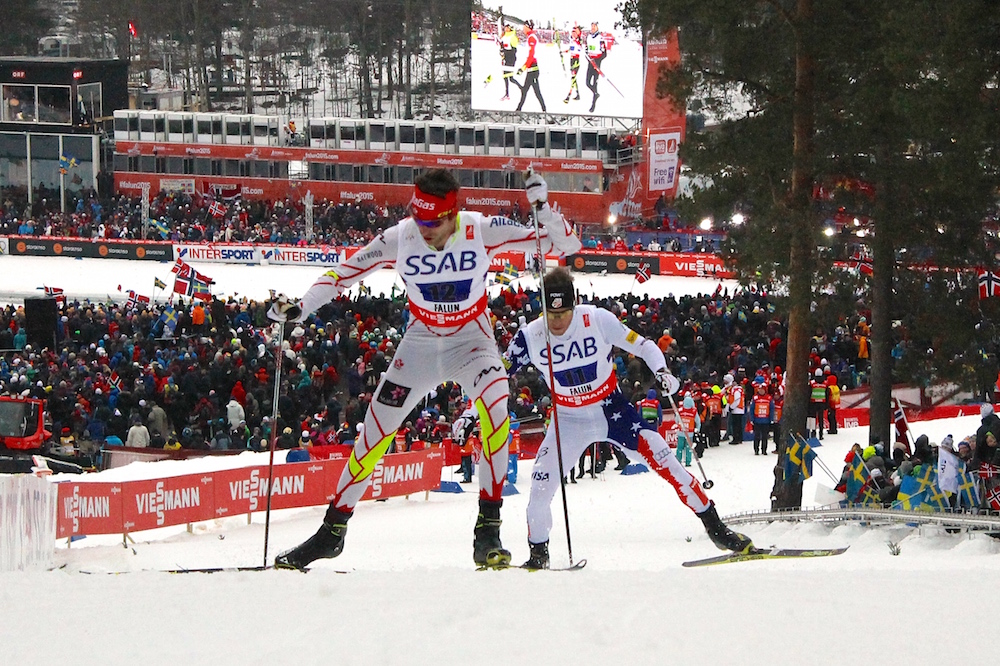
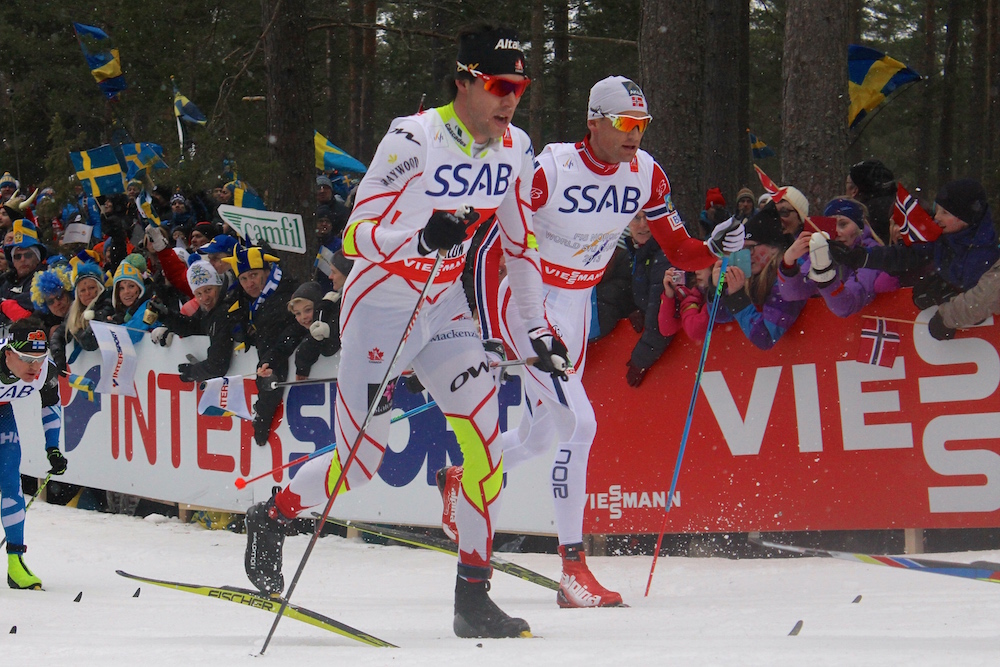
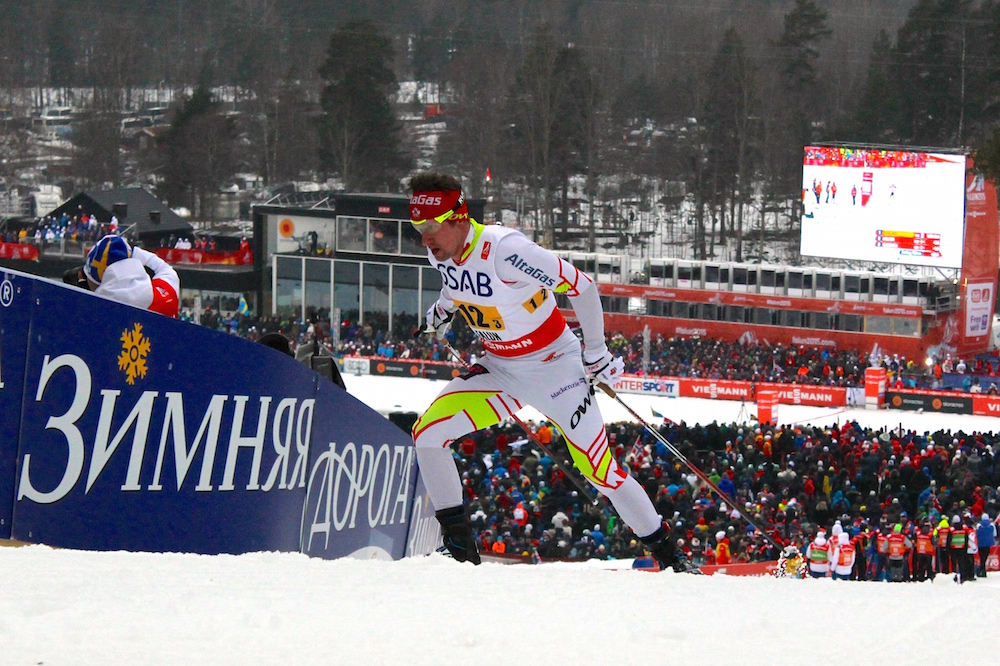
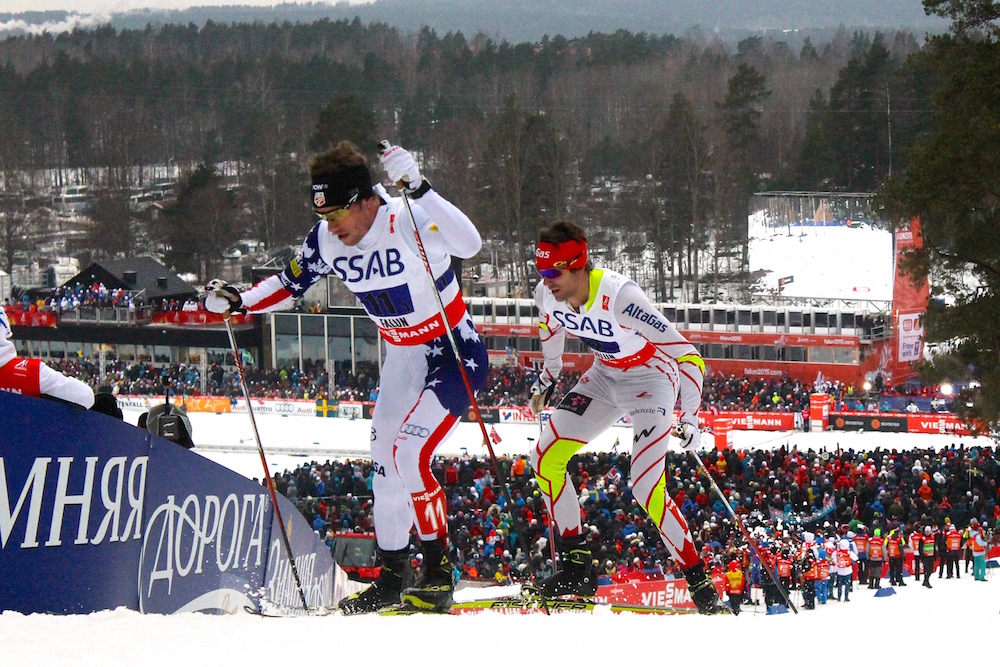
    Lenny Valjas of Canada leads Simi Hamilton of the United States on the last lap of the men's 4 x 10 k relay at World Championships in Falun, Sweden.
    Lenny Valjas of Canada leads Simi Hamilton of the United States on the last lap of the men’s 4 x 10 k relay at World Championships in Falun, Sweden.

    FasterSkier’s coverage of the 2015 FIS Nordic World Ski Championships in Falun, Sweden, is brought to you by the generous support of L.L. Bean, now featuring a complete line of Kikkan Randall training wear.

    FALUN, Sweden — It was a North American battle royal in Sweden as the the U.S. and Canada dueled in the last leg of the men’s 4 x 10-kilometer relay at the 2015 FIS Nordic World Ski Championships. American Simi Hamilton attempted to ditch his Canadian counterpart on the climbs while Lenny Valjas tried to lose the Amercian on the downhills – both to no avail. Ultimately, North American relay supremacy was decided in the final meters as Valjas out-sprinted Hamilton to the line.

    Ahead of the North Americans Norway defended its 2013 relay title with Petter Northug finishing with a time of 1:34:18.5. He bested Calle Halfvasson by just 0.6 seconds to give Sweden its second silver medal of the Championships. France provided an inspiring performance to repeat the nation’s bronze medal showing from the 2014 Olympic games.

    Canada and the U.S. finished 3:03.5 and 3:04.9 behind the Norway to take 10th and 11th.

    While the two North American nations are close friends and training partners, they’ve always been friendly competitors. Canada’s two time medalist in Falun and starter of the relay’s scramble leg said that he and his team entered the competition with two goals – improve on their 12th place finish at the 2014 Olympics and beat the U.S. team.

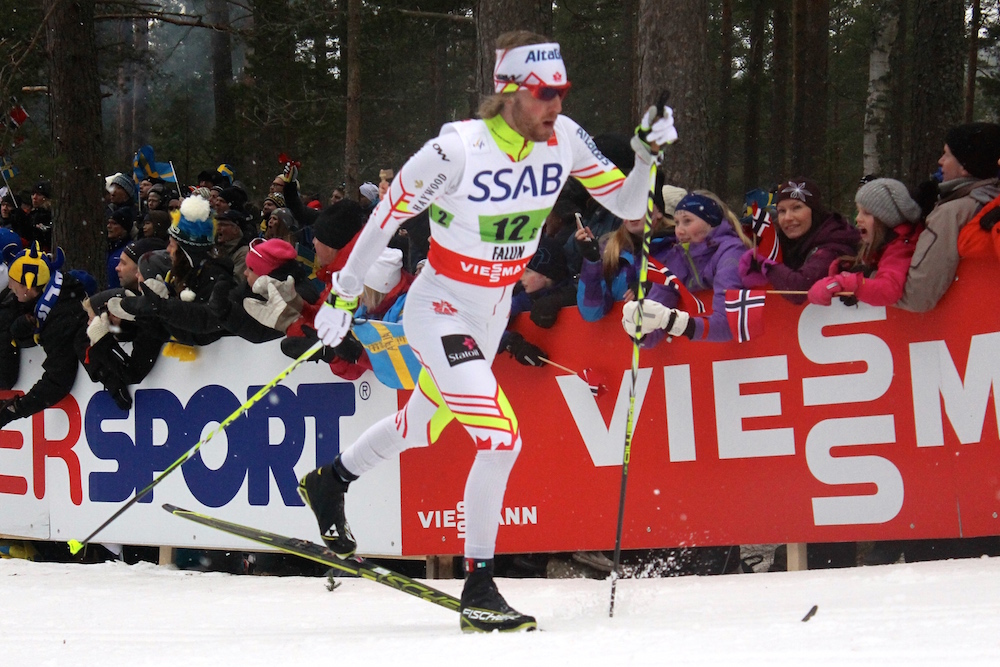
    Alex Harvey led Canada out of the gate in the men's 4 x 10 k relay at 2015 World Championships.
    Alex Harvey led Canada out of the gate in the men’s 4 x 10 k relay at 2015 World Championships.
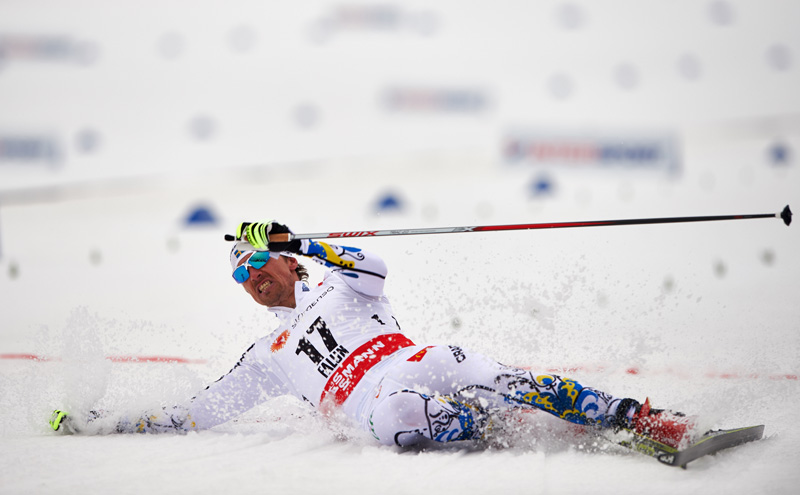
    Early in the race it appeared that Canada had secured its goals, as Harvey skied at the front of the 10 k leg. The Quebec skier, who is hoping to earn another podium the weekend’s 50 k, said he used the relay as preparation for Sunday as he hasn’t raced since claiming bronze in last week’s 30 k skiathlon.

    Harvey explained his body responded well to the effort and decided to hang on to to Russia’s Maxim Vylegzhanin and Norway’s Niklas Dyrhaug when they made a move on Mördarbacken, otherwise known as ‘Murder Hill’. As the pack entered the stadium and readied to tag off to their respective teammates, Harvey took advantage of superior skis and gave his teammate Graeme Killick a slight lead over the field of seventeen teams.

    “It was really scary going out first,” Killick said of his 1.3 second lead. “ [It was] a really tough pace there right off the start.”

    Killick managed to stay with the leading pack for the first half of his leg, but by the 6.5 k mark he trailed by over 30 seconds. “The plan was not to blow up, but eventually it was a bit too much up Mörderbacken,” he said, explaining that once he lost contact his main objective was to ski smooth and relaxed.

    With Killick quickly losing time on the leaders, the American team began to make their advance.

    Graeme Killick of Canada on his second loop in the men's 4 x 10 k relay in Falun, Sweden, on Friday.
    Graeme Killick of Canada on his second loop in the men’s 4 x 10 k relay in Falun, Sweden, on Friday.

    In the relay’s first leg, U.S. scrambler Erik Bjornsen skied between fifth and tenth to keep the U.S. in contact with the leaders. As the top skiers’ speed increased the 23-year-old was dangerously close to losing the advantage of the pack. The American gave several strong pushes to match pace and eventually finished his leg 32.9 seconds behind Harvey.

    “We talked about, you know, don’t fight too hard for seconds if it’s going to lose minutes,” Bjornsen said of his strategy. “Trying to ski the last lap pretty smart so that you’re not hanging on too long if it’s going to cost you minutes.

    “My goal was to try to hang on as long as I can, and come up pretty close to that first group. I’m happy with what I did,” he added.

    Bjornsen tagged off to teammate Noah Hoffman in 10th and the American left the stadium alone. Hoffman said it was an advantage to ski by himself, as it allowed the Colorado native to focus on his pacing and technique. Hoffman knew he couldn’t lose many seconds to the leaders as the possibility of getting lapped was high, especially given the 2.5 k course.

    “In these relays you get exploded off the back you’re never going to ski back to the group, so keeping in contention for as long as possible is the best way to stay in the race,” Hoffman said. “On a 2.5 k lap there are going to be a lot of teams out there who will get lapped. If we don’t get lapped it will be a successful race for us.”

    At roughly 3 k into the second leg Switzerland’s Dario Colonga, along with team’s from Japan and the Czech Republic, caught Hoffman. The American was able to hold the Swiss on the uphills, but Colonga eventually pulled away. Hoffman then used a ride with Jaks Martin of the Czech Republic to make contact with several teams who were struggling ahead, one of which was Canada.

    “Some of those guys seemed pretty shattered and we were catching the remnants of the group that had exploded ahead of us, which is always a good way to go,” he said.

    By the time the new group of skiers reached the end of the relay’s second leg, Hoffman had passed Killick and the two teams were ranked ninth and 11th.

    Noah Hoffman of the United States on his third loop in the men's 4 x 10 k relay in Falun, Sweden.
    Noah Hoffman of the United States on his third loop in the men’s 4 x 10 k relay in Falun, Sweden.

    According to Hoffman, his 10 k leg demonstrated a return to form. The American, who expressed discouragement by his results in the Championships skiathlon and 15 k, explained his leg in the relay was a step in the right direction especially for his classic skiing.

    “Best race of the season, so a step in the right direction,” Hoffman said. “The last year has been a struggle for classic but today was the best classic skiing I’ve done in a year. It wasn’t spectacular by any means, but It was a step in the right direction.”

    With Hoffman’s leg complete Kyle Bratrud took over for the Americans. The Northern Michigan University skier was originally scheduled for one race at the Championships – Wednesday’s 15 k freestyle – but was propositioned by the American coaching staff be the third leg of the relay.

    “They asked me if I wanted to be in it and I said sure. I was flattered,” he said of his selection. “It’s another race on the international stage for me so I was all for it. I knew I was going to get my butt kicked around a little bit out there but that’s how you get better, racing these guys.”

    Bratrud explained that he hadn’t fully recovered from the 15 k and complained of tired legs that felt better by the last kilometers. At that point Canada’s Ivan Babikov had passed the Minnesota native.

    Ivan Babikov of Canada finding his legs towards the end of the third leg of the men's 4 x 10 k relay.
    Ivan Babikov of Canada finding his legs towards the end of the third leg of the men’s 4 x 10 k relay.

    Babikov lost time to Bratrud in the first laps of the third leg, but eventually fought back to bring Canada into 11th place by the relay’s final exchange. Kyle Bratrud entered the exchange 2.4 seconds behind the Canadian in 12th.

    “It was not so great,” Babikov said. “The first lap was way too fast for me. Those guys went out way too fast and I couldn’t manage that speed. Then I picked up a bit at the end.”

    With Valjas and Hamilton on course, the fight for North American relay supremacy began to heat up. Hamilton surged ahead to ski together with Valjas and the two remained together for the rest of the final 10 k. Both skiers had their sights set on the German and Czech Republic teams roughly 20 seconds ahead, but when it became apparent they were out of reach the fight for 10th position began.

    Hamilton said he made a push to leave Valjas behind halfway through the final leg, but once the Canadian remained close behind he reevaluated his strategy and decided to stick behind his friend and competitor until the finish. Valjas, on the on the other hand, continually attempted to ditch Hamilton to no avail.

    “I was trying everything,” Valjas said of his leg with Hamilton. “I tried my early attack up the main sprint hill, and he stayed with me. I regrouped, and on the next hill I just really slowed down over the top and tried to sneak attack, just as we started going downhill I started sprinting to see if I could break the draft. That worked a bit, but then he caught up.”

    Valjas entered the final meters with Hamilton just behind, and the two strong sprinters gave a final push to claim the last spot in the top-10. Valjas was victorious, beating the American to the line by 1.4 seconds.

    “It was a good fight right to the finish. I wasn’t looking back, I knew he was coming,” Valjas said.

    The 10th place finish for Canada was an improvement on their 12th place at the 2014 Olympic games. Valjas that he was pleased with the way his team skied, but hoped that the future would bring better results.

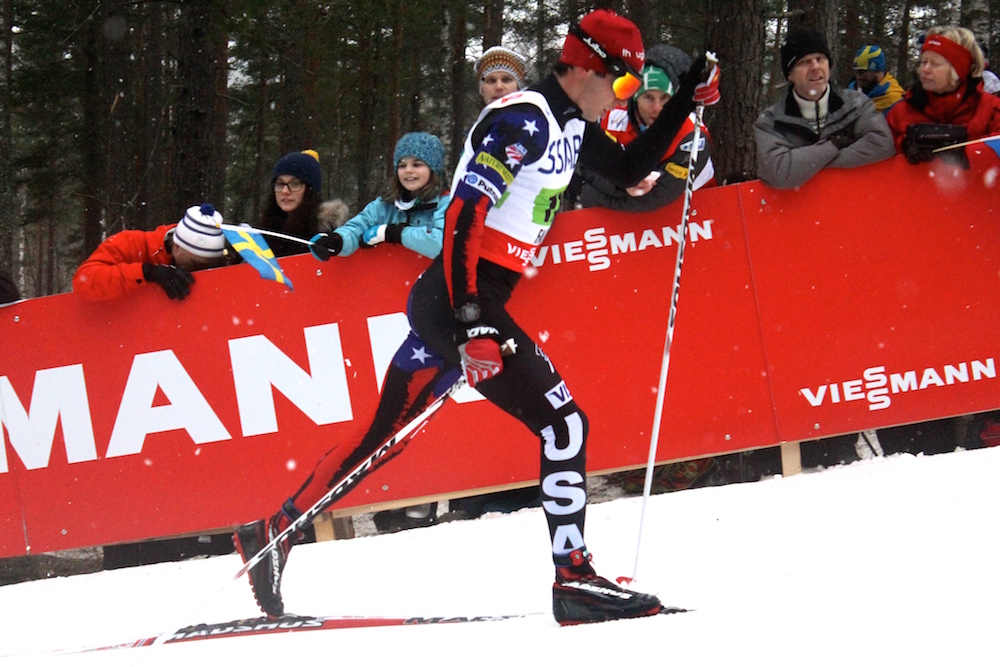
    American Simi Hamilton leading Lenny Valjas of Canada over the top of a hill in the men's 4 x 10 k relay at 2015 World Championships in Falun, Sweden.
    American Simi Hamilton leading Lenny Valjas of Canada over the top of a hill in the men’s 4 x 10 k relay at 2015 World Championships in Falun, Sweden.

    “We’re extremely happy and I think everyone skied extremely well. A few of us including myself know that we can race differently next time,” Valjas said after the finish. “We’re all learning. I’m excited for the next version of this race. See if we can do better, both the Americans and the Canadians. We’re not far from the main group, the sixth and seventh place guys.”

    Hamilton said he was proud of his team’s effort and that Friday’s result will be motivation for a better performance in the future.

    “All those guys skied awesome legs and I got tagged off in a great position,” he said. “I wish I could have skied that last lap a little better or caught those two guys in front of us so it always gives you goals for the future.”

    According to U.S. Ski Team Head Coach Chris Grover, the Americans did especially well considering the team’s level of experience.

    “We definitely entered a young team today,” Grover explained. The 2015 Championships is Bratrud’s first and both Bjornsen and Hoffman are relatively young. While Hamilton has anchored several relays, he’s primarily focused on sprinting. “I’m really super proud of how all four of these guys skied. They all kept it super close. We knew this was a course with such a short skate leg that there were teams that were in danger of getting lapped and pulled.”

    Results

  • After the Medals with Jessie Diggins and Caitlin Gregg: FasterSkier Exclusive in Falun

    After the Medals with Jessie Diggins and Caitlin Gregg: FasterSkier Exclusive in Falun

    FasterSkier’s coverage of the 2015 FIS Nordic World Ski Championships in Falun, Sweden, is brought to you by the generous support of L.L. Bean, now featuring a complete line of Kikkan Randall training wear.

    FALUN, Sweden — Just a day after Jessie Diggins and Caitlin Gregg earned a surprise double podium in Tuesday’s 10 k freestyle at the 2015 FIS Nordic World Ski Championships – the first distance podiums for American women in a championships – FasterSkier caught up with the pair in Falun, Sweden. The two discuss the media spotlight, their initial reactions to the results, and what their podiums mean for U.S. cross country skiing.

    The U.S. women will look to capitalize on the momentum from Tuesday’s podiums in Thursday’s 4 x 5 k relay. If the team places in the top-three it will be the first medal for an American team, male or female, in a relay event. See the start list here.

  • Olsson Completes ‘Mission Impossible’ with 15 k Victory at World Championships

    Olsson Completes ‘Mission Impossible’ with 15 k Victory at World Championships

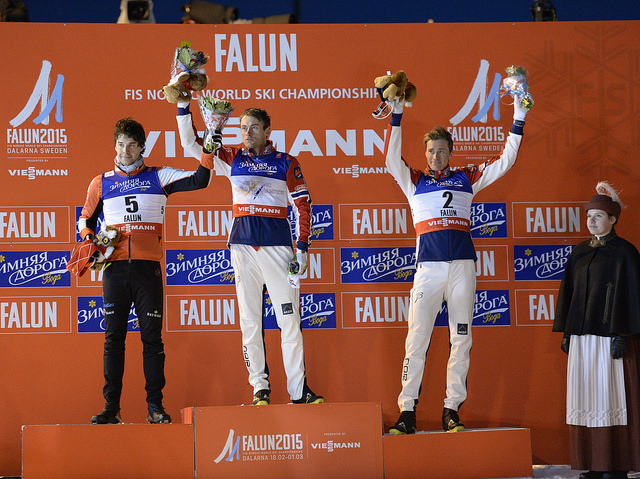
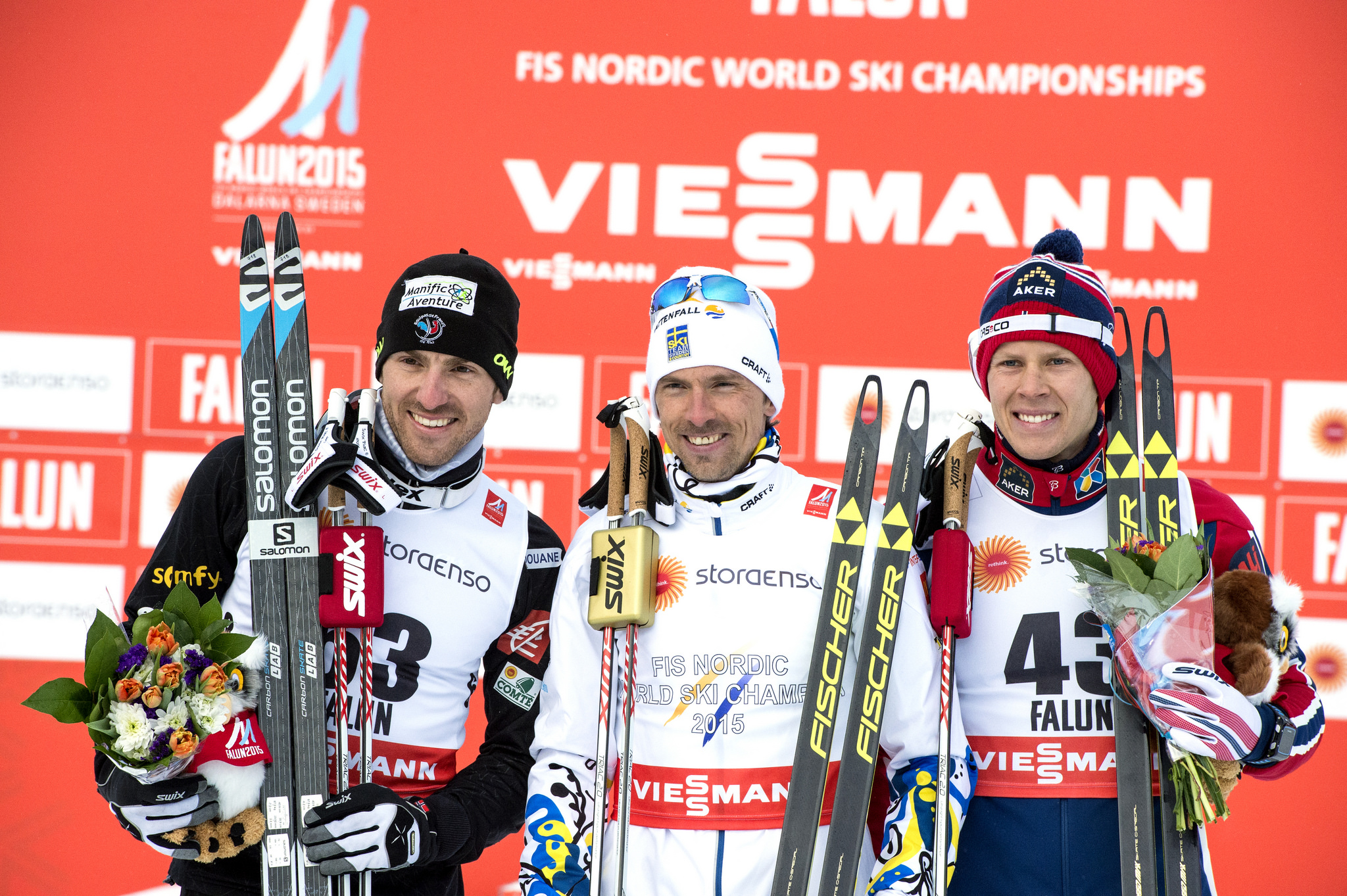
    France's Maurice Manificat (l), Sweden's Johan Olsson (c) and Norway's Anders Gløersen (r) in Wednesday's 15 k freestyle podium at the 2015 FIS Nordic World Ski Championships in Falun, Sweden. Olsson won the race by 17.8 seconds over Manificat. Gløersen finished third, 19.2 seconds back. (Photo: Falun 2015)
    France’s Maurice Manificat (l), Sweden’s Johan Olsson (c) and Norway’s Anders Gløersen (r) in Wednesday’s 15 k freestyle podium at the 2015 FIS Nordic World Ski Championships in Falun, Sweden. Olsson won the race by 17.8 seconds over Manificat. Gløersen finished third, 19.2 seconds back. (Photo: Falun 2015)

    FasterSkier’s coverage of the 2015 FIS Nordic World Ski Championships in Falun, Sweden, is brought to you by the generous support of L.L. Bean, now featuring a complete line of Kikkan Randall training wear.

    FALUN, Sweden — It was a self-described ‘mission impossible’ for Johan Olsson at the 2015 FIS Nordic World Ski Championships. The 34-year-old, who plans to retire after the 2015 season, barely raced in the year prior to the championships due to illness. When he wasn’t bedridden, the Swede was separated from his family and wondering whether he should have retired a year earlier.

    It appears his mission impossible wasn’t unattainable, after the Swedish skier coasted to victory in Wednesday’s 15 k freestyle individual start with a time of 35:01.6. Olsson won by a large margin, finishing 17.8 seconds ahead of Frenchman Maurice Manificat. Anders Gløerson placed third and crossed the line 19.2 seconds behind the Swede.

    An early starter in bib 17, Olsson realized that conditions would deteriorate as skiers traversed the 7.5 k loop and planned accordingly. He skied the first lap aggressively to take advantage of the fast conditions while they lasted. While his loop was the second-fastest by 0.3 seconds behind Manificat, Olsson excelled through the deepening snow to post the fastest finishing time. He remained in the leader’s chair for the rest of the competition, watching skiers fail to best his winning effort.

    Johan Olsson of Sweden collapses after posting the best time in Tuesday's 15 k freestyle at the 205 FIS Nordic World Ski Championships in Falun, Sweden (Photo: Fischer/Nordic Focus)
    Johan Olsson of Sweden collapses after posting the best time in Tuesday’s 15 k freestyle at the 205 FIS Nordic World Ski Championships in Falun, Sweden (Photo: Fischer/Nordic Focus)

    “I knew I had done a really good race – perhaps the best skating race of my life” Olsson told the press after his finish. “I was able to push very hard all through the race. I was trying to be very aggressive in the beginning to get a good first lap as my starting number at 17 would be an advantage in these conditions to go quite early.”

    Olsson credited much of his performance to a strong Swedish wax team that provided him with “the best skis in the field.” He said that half of his medal belonged to his personal wax technician, who also serviced the skis teammate Charlotte Kalla used in Tuesday’s 10 k victory.

    Olsson has stepped away from World Cup competition in recent years to focus on championship events. He started no World Cup competitions in 2014, and his only race of 2015 was the recent Östersund 15 k where finished fifth. The Swede’s strategy appears to have worked, especially given his championship results from the past three years. In the 2013 World Championships he was second in the 15 k freestyle and first in the 50 k classic. At the 2014 Olympics he was second in the 15 k classic.

    “When you have a goal and a mission that’s really impossible, that’s what gets me going,”Johan Olsson  

    “I don’t think anyone has invested so heavily in the World Championships as I have,” he explained. “I have left the World Cup behind me completely and had a clear plan for the World Championships.”

    Even with a reduced racing schedule, Olsson’s path to success hasn’t been easy.

    Johan Olsson of Sweden smiles after his win in the 10 k freestyle at the 2015 FIS Nordic World Ski Championships in Falun, Sweden.
    Johan Olsson of Sweden smiles after his win in the 15 k freestyle at the 2015 FIS Nordic World Ski Championships in Falun, Sweden.

    The world champion lost a month of training in December when he succumbed to a strong virus that left him bedridden. At the time, he believed his last year of racing might have been for nothing.

    “When i was sick, I was wondering why did I continue one more year,” he said. “I was trying to do some mission impossible for the championships. Of course as an athlete you don’t belive in yourself when you can’t train and can’t do anything.”

    Despite the low moral, Olsson continued to build fitness with his sights set on the Championships in Falun. After his recovery he trained roughly 100 hours in January and skied over 300 k in just 15 days. The training came at a price, however, as Olsson was unable to see his two children – who were in attendance at Wednesday’s race – for seven weeks prior to the Championships in Falun.

    “From the new year, no one has put in as much effort as I have done,” he said in a press conference. “I haven’t seen my kids for seven weeks and that is quite strainful to have two small kids at home and not see them. Every night you think is it worth it to be away from your kids.”

    Olsson added that while the decision to be apart from his family was difficult, it was days like Wednesday that he and his wife “are pretty convinced that it was worth it.”

    “When you have a goal and a mission that’s really impossible, that’s what gets me going,” he said.

    In second, Manificat earned the first French medal at a cross country World Championships event in 10 years since Vincent Vittoz was crowned victor in the 2005 30 k pursuit. He is now one of only four French men to claim a medal at Worlds.

    Maurice Manificat realizes his podium placement after the finish of the 10 k freestyle at the 2015 FIS Nordic World Championships in Falun, Sweden. He finished second to earn the first World Championships medal for France in 10 years.
    Maurice Manificat realizes his podium placement after the finish of the 15 k freestyle at the 2015 FIS Nordic World Championships in Falun, Sweden. He finished second to earn the first World Championships medal for France in 10 years.

    Manificat entered Wednesday’s race with confidence – he hasn’t finished lower than eighth in a 15 k freestyle event in the 2015 season. At the pre-World Championships 15 k freestyle in Östersund, he also placed second.

    As one of the day’s late starters in Bib 63, Manificat skied through the worst of the wet, soft snow. While it made the race more difficult, he explained that he excels in such conditions.

    “The last lap, the snow was softer maybe. But I like the soft snow and it is no problem” he said to the press. “I felt difficulty so I knew it would be difficult to keep the medal. But I believed it until the end and I did it to the finish line.”

    Gløersen also faced a soft course, and explained he believed results were fair to all starters.

    “There was good glide in the the snow,” he said. “You have to fight harder the whole way around and try to think too much about the feeling and think about the results to motivate myself to stay in the race.”

    Gløersen is one of Norway’s best sprinters, but has demonstrated a shift to distance skiing in the 2015 season. In December, he won the Davos 15 k freestyle. He explained he didn’t want to enter Wednesday’s race with high expectations because of his inexperience in distance racing.

    Anders Gløersen of Norway en route to his third place finish in Wednesday's 15 k freestyle at the 2015 FIS Nordic World Ski Championships in Falun, Sweden. (Photo: Fischer/Nordic Focus)
    Anders Gløersen of Norway en route to his third place finish in Wednesday’s 15 k freestyle at the 2015 FIS Nordic World Ski Championships in Falun, Sweden. (Photo: Fischer/Nordic Focus)

    “It’s been my goal this entire season to qualify for the team for the 15 k here. In my head I’ve been preparing to fight for a medal, so for me it’s not surprising,” he said. “I may be a little reluctant to say that I thought I could get a medal. I’ve been a sprinter for now six, seven years on the World Cup, so for me to just suddenly start focusing on the 15 k to say I was going for a medal was a bit too high. I‘m just really happy to achieve my goal today.”

    Gløersen’s result comes on the heels of a difficult waxing day for the Norwegian women. In Tuesday’s 10 k the team’s best finish was 22nd, with previous favorites like Marit Bjørgen finishing outside the top-30.

    There was no such trouble for Norway in Wednesday’s 15 k, as Gløersen said his skis were gliding well. Norwegian men’s coach Trond Nystad echoed Gløersen saying, “the skis seemed to have worked and they seemed to be a lot better than yesterday.”

    With four in the top-nine, Nystad explained the Norwegian national team was pleased with the day’s results given the level of competition.

    “We knew it was going to be hard to get a medal,” he told FasterSkier. “The men’s race is pretty tight so one second back or one second forward can mean one or two places. We were in the medals so we were psyched. We were actually pretty happy that we did well as a team.”

    The only Norwegian result outside the top-10 was from Petter Northug who finished his day in 62nd. Northug has already been crowned world championships twice in Falun, with wins in the classic sprint and team sprint. According to Nystad, Northug wasn’t feeling well and decided to “tour” so that he could rest for the upcoming relay and 50 k classic mass start.

    Racing at the 2015 FIS Nordic World Ski Championships in Falun, Sweden continues Thursday with the women’s 4 x 5 k relay.

    Results

  • American Men Seventh, Women Eighth in World Champs Team Sprint

    American Jessie Diggins, in the 2013 World Championships winners bib, chases Germany's Denise Herrmann in the women's 6 x 1.2 k freestyle sprint final on Sunday at 2015 World Championships in Falun, Sweden. Second in their semifinal, the U.S. placed eighth in the final and Germany was fourth behind Norway, Sweden and Poland, respectively. (Photo: FlyingPointRoad)
    American Jessie Diggins, in the 2013 World Championships winners bib, chases Germany’s Denise Herrmann in the women’s 6 x 1.2 k freestyle sprint final on Sunday at 2015 World Championships in Falun, Sweden. Second in their semifinal, the U.S. placed eighth in the final and Germany was fourth behind Norway, Sweden and Poland, respectively. (Photo: FlyingPointRoad)

    FasterSkier’s coverage of the 2015 FIS Nordic World Ski Championships in Falun, Sweden, is brought to you by the generous support of L.L. Bean, now featuring a complete line of Kikkan Randall training wear.

    FALUN, Sweden — “Today gives us a real appreciation for when we were on podiums and when we were winning these events,” U.S. Ski Team Head Coach Chris Grover said Sunday from the 2015 FIS Nordic World Ski Championships. The day marked the much anticipated freestyle team sprints, where Jessie Diggins and Sophie Caldwell joined forces to place eighth in the women’s 6 x 1.2 k, and Andy Newell and Simi Hamilton skied to seventh in the men’s 6 x 1.4 k.

    The U.S. women’s team entered Sunday’s race wearing the customary bibs marking them as reigning world champions. Two years ago in Val di Fiemme, Italy Diggins and star-sprinter Kikkan Randall paired to win the first-ever world championship gold by U.S. cross country skiers. The atmosphere was different in Falun, however, with the Americans acknowledging they were far from the level of skiing witnessed in 2013.

    An unstoppable Norwegian team of Ingvild Flugstad Østberg and Maiken Caspersen Falla claimed the women’s team sprint with a time of 14:29.57. Sweden and Poland rounded out the podium, while the U.S. finished 34.06 seconds back from the winners in eighth.

    While a medal was out of reach for the Americans in the 2015 team sprint, they walked away from the competition with their heads held high, proud of the effort they gave on the fast, hard 1.2 k course.

    “I was so proud of Soph and I have to say, I think we had at least twice as much fun as anyone else out there,” Diggins said in a post-race interview. “We got to put on those defending world champ bibs and that’s a cool thing.”

    The Americans started their day in the second women’s semifinal where they skied to claim an automatic advancement to the final. They entered the heat with the usual team sprint strategy – save as much energy as possible – which kept them in the top-two for the majority of the race. By the time Caldwell tagged Diggins for her last lap, however, the team was sitting in fifth and nine seconds out of first.

    Diggins explained that while it was likely their team would have qualified as a lucky loser had she held position, she decided to give it her all and fight for an automatic qualification to the final “just in case.” Diggins soon gapped the women fighting for second behind Germany, and skied the rest of the race in a comfortable qualifying position.

    With their spot in the final secured, the two Americans once again focused on conserving their energy. Thier rest was hampered by the unlucky draw of the second semifinal heat, which resulted in a half hour of rest less than the first semifinals competitors – including the three eventual podium finishers: Norwegians, Swedes and and Poland.

    Despite the deficit in recovery time, Caldwell started the final in third position. She eventually fell to a close sixth as she entered the exchange, just two seconds out from the Norwegian leaders. Diggins exited the stadium in fifth holding a constant position throughout her first leg. The four skiers in front of her  pulled ahead on the hills, but Diggins caught them on the downhill into the stadium.

    “I was behind the first four girls and trying to do as little as possible, so I let them gap me over the top,” Diggins said. “My skis were so fast that I came into the tag zone with them.”

    Diggins said she entered the stadium with too much speed. Unable to slow before colliding with a German skier, and the Minnesota fell after tagging Caldwell for the next leg.

    “I had a couple falls out there today,” she explained. “We came into the tag zones way faster than we thought. The first time I came in, Germany wasn’t going fast enough and I couldn’t go right and I couldn’t go left so I went into her and fell. The second time it was a similar thing.”

    Caldwell dropped to seventh in her second leg after the exchange, and from there the U.S. remained between seventh and ninth for the rest of the race.

    The men's final in Sunday's 1.4 k freestyle team sprint at the 2015 FIS Nordic World Ski Championships in Falun, Sweden. (Photo: flyingpointroad)
    USA skis in fourth in the men’s final in Sunday’s 1.4 k freestyle team sprint at the 2015 FIS Nordic World Ski Championships in Falun, Sweden. (Photo: flyingpointroad)

    “The first leg was good but by no means easy. I started to get some tired legs and Grover told me to pace the next laps so that I could stay as close as possible,” Caldwell said of the strategy in her final two laps. “If I was going to try and go out and stay with them from the start I would blow up big time and then I’d lose even more time. I let them go a little and gave Jessie have the tough job of trying to catch up. I tried to judge how I was feeling and ski at the smartest race I could based on that.”

    Diggins explained that she attempted to catch the leaders in her second leg, but spent too much energy and ‘blew up’ in the third and final pass around the 1.2 k course. The 23-year-old was in a close battle for seventh with Laurien van der Graaff of Switzerland in the last meters but ultimately lost in the final lunge.

    Despite her status as a defending world champion, Diggins explained that she entered Sunday’s team sprint with less pressure than in 2013. According to the American skier, she and Randall were the favorites to win the race after strong performances earlier that season. The Americans didn’t enter the 2015 event with the same expectations, though the team often referred to it as their best chance of a medal in Falun.

    Despite the lowered expectations, Diggins said she had been focused on Sunday’s sprint since the previous year.

    “This is one of those races where I’ve visualized skiing this course since May,” Diggins siad. “I’ve been psyching it up in my mind, which is both good and bad because by the time we raced it I had already done it a million times.”

    Caldwell also felt the pressure of racing in the USST’s best chance at a medal. “I’ve never been this nervous for a race in my life,” she said. “You can ask all my teammates, I wasn’t able to function for the past 24 hours. Everyone did a really good job of reminding us that even though they (Diggins and Randall) were defending championships, we’ve never done a team sprint together and I’m not 2013 Kikkan.”

    Caldwell added that she hoped to team with Diggins again, and explained that even though Sunday’s race wasn’t medal worthy she believed the two could be ‘great’ in the future.

    Andy Newell, USST, trails Finn Hågen Krogh in the the semifinal of Sunday's 6 x1.4 k team sprint at the 2015 FIS Nordic World Ski Championships. Newell and his teammate Simi Hamilton took seventh overall. (photo: flyingpointroad)
    Andy Newell, USST, trails Finn Hågen Krogh in the the semifinal of Sunday’s 6 x1.4 k team sprint at the 2015 FIS Nordic World Ski Championships. Newell and his teammate Simi Hamilton took seventh overall. (Photo: flyingpointroad)

    Newell, Hamilton Team Up to Take Seventh

    Newell and Hamilton took to the line of the men’s team sprint final following their third place finish in the semifinals. Like their female counterparts, the men were in the second heat of the day and thus had less time for recovery.

    Skiing outside podium contention for the majority of the six laps, the American men eventually raced to seventh behind the dominant performance of Norway’s Petter Northug and Finn Hågen Krogh. Second went to Russia, while the Italians defended their 2013 bronze in exciting fashion. The American team ultimately finished 17.48 seconds behind the winning time of 15:32.89.

    Hamilton explained that while the pace was relaxed at first it became more challenging as the leaders increased the tempo. He added that the course was challenging due to the varying terrain.

    “It was a course where in some places it’s really advantageous to be leading and in others it is not, Hamilton said.  “It’s tough to make yourself hang out in the pack because there are some technical corners where it’s a big advantage to be in front.”

    For the first half of the race the Americans sat between fifth and seventh. By the final exchange, however, Newell tagged Hamilton in ninth. “You’re actually not breathing that hard but your legs are so blown out by the finish,” he said of the demanding race.

    Hamilton said he entered his final lap ready to “let it fly.” He ultimately brought the U.S. to seventh after passing Sweden, when Teodor Petterson lost his pole, and France, after Baptiste Gros fell in the last 500 meters and lost a ski.

    Reflecting on Sunday’s race, Newell explained he cared less about the placement of the team and rather how close the two were to the sprint’s leaders.

    “It’s not so much that we care about places,” Newell said of Sunday’s objectives. “We want to stay as close as we can to the leaders. To us there’s not really a big difference between finishing seventh or eighth, or even sixth. We want to be close to the podium and that’s our ultimate goal.”

    Hamilton agreed, adding that he set a personal goal of sixth for the day.

    “We skied alright but we can both do better than that,” Newell said. “At least we were in the final and at least we were pretty close to those guys. Just a little more improvement and we’ll both be in there.”

    Grover said he was pleased with efforts from all four athletes gave in the team sprint. At the same time, he acknowledged that the U.S. teams in Sunday’s race were below the high level of competition shown by Sunday’s top competitors.

    “I think people for sure skied really well all day. That’s just where we are right now,” Grover said of Sunday’s performances. “Of course we wanted to be ahead of there right now, but it gives you appreciation for when you do have two athletes that are at an extremely high level and can put them together to create that podium.”

    Results: Men | Women

  • Johaug Powers to Skiathlon Victory as Jacobsen and Kalla Battle for Second in Falun

    Norway's Therese Johaug celebrates her win the 2015 FIS Nordic World Ski Championships 15 k skiathlon in Falun, Sweden. She finished over five seconds ahead of teammate Astrid Jacobsen and Charlotte Kalla of Sweden who finished second and third, respectively. (Photo: flyingpointorad.com)
    Norway’s Therese Johaug celebrates her win the 2015 FIS Nordic World Ski Championships 15 k skiathlon in Falun, Sweden. She finished over five seconds ahead of teammate Astrid Jacobsen and Charlotte Kalla of Sweden who finished second and third, respectively. (Photo: flyingpointroad.com)

    FasterSkier’s coverage of the 2015 FIS Nordic World Ski Championships in Falun, Sweden, is brought to you by the generous support of L.L. Bean, now featuring a complete line of Kikkan Randall training wear.

    FALUN, Sweden —  Mördarbacken, or “murder-hill”, has its name for a reason. It’s a long, steep pitch where competitors either sucumb to fatigue or thrive on the challenge of the climb. Such was the case in Saturday’s 7.5-kilometer classic + 7.5-kilometer freestyle skiathlon at the 2015 FIS World Ski Championships. Norway’s Therese Johaug embraced the challenge of her last time on the hill and powered ahead of teammate Astrid Jacobsen and Charlotte Kalla of Sweden in to take her first-ever win in a championship skiathlon.

    Johaug held the lead and collapsed across the finish line to earn her third individual World Championship. She ended her 15 k effort with a time of 40:57.6, over five seconds ahead the heated battle for second between home-crowd favorite Kalla and Jacobsen. In the end Jacobsen crossed the line ahead of Kalla by 0.3 seconds to take silver. The two finished 5.7 and 6.0 seconds behind Johaug, respectively.

    Saturday’s skiathlon started in typical fashion with defending World Champion, Marit Bjørgen, commanding the charge out of the stadium with a group of fellow Norwegians, Swedes and Finns hot on her tail. The pace was relaxed and roughly 30 skiers grouped together in the first kilometers.

    Unsatisfied with the speed of the pack, Johaug took charge from her teammate and quickened the tempo. The Norwegian and Kalla traded the lead throughout the majority of the first 7.5 k as the fight for gold was narrowed to six skiers, with the two leaders plus Jacobsen, Bjørgen, Kerttu Niskanen of Finland, and Sofia Bleckur of Sweden all within 10 seconds.

    Therese Johaug leads the push in the classic leg for the women's 15 k skiathlon at the 2015 FIS Nordic World Ski Championships in Falun, Sweden. (Photo: flyingpointroad.com)
    Therese Johaug leads the push in the classic leg for the women’s 15 k skiathlon at the 2015 FIS Nordic World Ski Championships in Falun, Sweden. (Photo: flyingpointroad.com)

    As the group entered the freestyle portion, Johaug explained she began to tire and questioned her aggressive tactics in the race’s classic portion. “I wanted to go out hard from the start, but when I came into the swap zone from the classical part I thought I maybe had gone out too tough,” the world champion said in a press conference. Given her fatigue, the 26-year-old rested behind Jacobsen and Kalla as they exited the stadium.

    Clocking the second-fastest pit time, Jacobsen left the exchange in first. The Norwegian explained that she hadn’t planned to be at the front so early given her starting spot but was pleased to find herself skiing with Johaug for much of the classic portion.

    “I wasn’t good seeded so I started on the third line but everything opened up and I could go behind Therese. She’s skiing so well right now, but it’s easy to follow her because she has good rhythm,” Jacobsen said.” When Therese attacked first on the classic, then I just thought that I should try and follow.”

    Jacobsen skied with large, bold glides as she led Kalla and Johaug into the second half of the course. She knew her skiing was strong but expected to see a large train of women following close behind. Instead, Jacobsen, Kalla and Johaug skied alone, with defending world champion Bjørgen nowhere in sight. “I was surprised that we were suddenly only three left because I thought there was going to be a big line behind,” she said.

    With roughly seven kilometers left, Kalla took the lead and increased the pace with Johaug hot on her tail. While Jacobsen struggled on many of the climbs, she made contact with the two skiers on the downhills.

    As the three started up Mördarbaken for the last time, Johaug made a decisive move. Swerving around a slowing Kalla, the Norwegian began to jump-skate  the steep hill to accept its challenge wholeheartedly. The move was successful, as Johaug lengthened her lead over the two skiers with each stride. By the time she reached the top of Mördatbacken at the 12.5 k mark, Jacobsen and Kalla trailed by 5.1 seconds and 11.3 seconds, respectively.

    “My chance was to attack on the last hill,” Johaug said. “I tried and I made a gap. My legs was really stiff to the top, but I tried to work really hard with myself so I could pass the finish line that know I that I was the World Championship.”

    Jacobsen attempted to stay with her teammate but after several meters knew the attempt was futile. “When she attacked again on skating it was just game over,” Jacobsen said. “I tried to follow but I had no chance.”

    With gold all but secured for Johaug, the race became a heated fight for second. Jacobson’s attempt to stay with Johaug cost her precious energy and Kalla soon caught her. For the remaining 2 k, Kalla gained a narrow lead on each of the uphills while Jacobsen surged back on the downhills.

    The game of cat and mouse was almost over as Norwegian and Swede entered the stadium together. The two rounded the U-turn and jostled for the best lane into the finish. Afterwards, Jacobsen said the fight gave her extra energy to out-sprint Kalla across the line.

    “When Charlotte caught me again, then I felt ‘ok, I need to stay on two feet so you can take the last medal.’ But when I came down to the stadium, I practiced so much on this last climb on the stadium, I just had to do it as well as I did in training yesterday,” Jacobson explained. “Then we were fighting towards the finish line, like what lane to take. I felt a bit provoked so I got more energy.”

    Johaug, who started Saturday’s race as one of the favorites, explained that the skiathlon victory was something she had been working towards all season. “It was a dream here to take gold medal,” she said in a press conference. “I have trained more than a thousand hours over the past year to experience this. I really love the course here, it’s my type of course.”

    She said the roughly 45,000 fans who lined the course gave her energy as she climbed Mördarbacken. Johaug added that it was great to have such a heated competition between two rivals, Norway and Sweden, in front of die-hard fans from both countries.

    Although she was unable to match the form of her teammate, Jacobsen compared her silver medal to a win. It was her first individual World Championships medal in eight years after earning gold and two bronze in Sapporo, Japan.

    The years since have been filled with difficulty for the 26-year-old. Just one day before the start of the 2014 Olympic Games, her brother and training partner passed away unexpectedly, causing emotional hardship for the Norwegian throughout the event and remainder of the year. Later that season she crashed into a lamppost in the Holmenkollen 30 k and was rushed to the hospital. With no serious injuries resulting from the crash, Jacobsen began what looked to be a productive training season that spring. By the fall of 2014, however, Jacobsen told NRK that her body was no longer responding to training.

    Charlotte Kala leads Therese Johaug and Astrid Jacobsen in the final kilometers of Saturday's 15 k skiathlon at the 2015 FIS Nordic World Ski Championships in Falun, Sweden. (Photo: flyingpointroad.com)
    Charlotte Kala leads Therese Johaug and Astrid Jacobsen in the final kilometers of Saturday’s 15 k skiathlon at the 2015 FIS Nordic World Ski Championships in Falun, Sweden. (Photo: flyingpointroad.com)

    Jacobsen started the year’s World Cup circuit in Lillehammer, Norway, where she placed in the 30s. Her next World Cup came after a long break when she won the 10 k freestyle in Rybinsk in late January. Although Jacobsen’s participation in World Championships appeared to be a longshot at the turn of the year, her win in Russia along with a strong Norwegian National Championships, secured her spot in Falun.

    Jacobsen told FasterSkier that her main goal in Saturday’s skiathlon was to enjoy racing and allow the experience to sink in. “My biggest goal was just to go out there and enjoy and have fun. This is the World Championships and it’s our biggest feast. I just decided that I didn’t want the seriousness to take all the space, so my goal was to enjoy today and just suck in all the good atmosphere,” she explained.

    Jacobsen said that racing Kalla in front of the large Swedish and Norwegian crowds was a memorable experience that motivated her throughout the 15 k. The Norwegian explained that she races best when she’s positive and enjoys what’s she’s doing.

    “To ski out there today was awesome because [there were] so many Norwegians and even more Swedes. This dual between Charlotte and me made the crowds go crazy. These 40 minutes went away so fast,” she said to Fasterskier. “I created some really good memories, and that was my biggest goal.”

    With her third place, Kalla earned her first individual World Championships medal in front of a home crowd. She explained in a press conference that an individual medal was her main goal of the 2015 season. “I’m very happy to have an individual world champion medal. I have worked hard for this and it has been a special season for me,” she said.

    According to the Swede, the pressure from the home crowd was nerve-wracking but ultimately motivating.

    “I was quite nervous today in the morning getting into the competition area. I saw from my hotel window that there was a lot of audience going to the Lugnet,” she explained. “When I came to the track and started to test the skis I just focused everything good during the warmup. It was fantastic to go on Mördarbacken and hear all the audience because they were cheering for me and I felt that everyone was there for me to do a really good race today.”

    Finishing sixth, Bjørgen ended her day far from where many expected. She explained that Johaug’s pace was too fast for her to maintain contact.

    “It was tough for me out there today. My body just wasn’t there. I felt it as soon as Therese surged on Mördarbacken the first time. I just had to let go,” Bjørgen said to Norwegian reporters. “It was too hard when we had to ski hard and fast for a longer period than the sprint.”

    While the World Cup points leader was unable to achieve her quest in Saturday’s skiathlon to tie Russian Elena Välbe for the most World Ski Championships wins, Bjørgen said she was happy to see Jacobsen on the podium given the hardships she has faced.

    “She deserved this medal after all she’s been through this last year, starting with the death of her brother during the Sochi Olympics and then illness and injuries all through the summer and fall,” Bjørgen said.

    Racing continues Sunday in Falun with the men’s and women’s team sprint competition.

    Results

  • Stephen Leads North Americans in 11th in World Champs Skiathlon Despite Fatigue

    Liz Stephen racing to 11th in Saturday's 15 k skiathlon at the 2015 World Championships in Falun, Sweden. (Photo: flyingpointroad.com)
    Liz Stephen racing to 11th in Saturday’s 15 k skiathlon at the 2015 World Championships in Falun, Sweden. (Photo: flyingpointroad.com)

    FasterSkier’s coverage of the 2015 FIS Nordic World Ski Championships in Falun, Sweden, is brought to you by the generous support of L.L. Bean, now featuring a complete line of Kikkan Randall training wear.

    FALUN, Sweden — Saturday’s 15-kilometer skiathlon at the 2015 FIS Nordic World Ski Championships went better than Liz Stephen expected. The American entered the day with few goals due to fatigue from the prior week’s training, but exited with an 11th place finish that landed her 1:45 behind race-winner Therese Johaug,

    “It was much better than I expected it to be,” Stephen said a post-race interview. “I’ve had a little bit of low energy – just tired muscles and fatigue – coming out of the training week. I’ve been resting a bunch, but today I didn’t really have any expectations, I just wanted to get a race out of the way and test out how racing felt.”

    Wearing bib five and starting in the first row of the mass start chevron, Stephen led the pack from the start, along with Norwegians Johaug and Marit Bjørgen. Her action at the front was short lived, however, as the 27-year-old fell back to roughly 15th place in the first 500 meters. Often a slow starter, Stephen said the pace of the pack was relaxed, which helped her maintain contact.

    “I’m not a super fast starter,” she said. “I have to say, that was the chilliest mass start I’ve ever done. I don’t know if maybe Marit wasn’t feeling so good or whoever pushes the pace up there just kept it chill, but I couldn’t believe how easy it was in the beginning. So it worked out okay for me.”

    Liz Stephen, USST, leading Riitta-Liisa Roponen of Finland as she skied to 11th in Saturday's 15 k skiathlon at the 2015 World Championships in Falun, Sweden. (Photo: flyingpointroad.com)
    Liz Stephen, USST, leading Riitta-Liisa Roponen of Finland as she skied to 11th in Saturday’s 15 k skiathlon at the 2015 World Championships in Falun, Sweden. (Photo: flyingpointroad.com)

    Stephen maintained her position in the group, trying to hold her standing before the switch to freestyle – her stronger technique – at 7.5 k. The Vermont native entered the stadium in 20th and clocked the eighth-fastest pit time. Stephen began her attack as she transitioned from classic to freestyle. She made her way through the pack, nearing one of the competition’s favored skiers.

    “[I] started to see Heidi [Weng] and Marit. The last time I think I saw Marit in a race was Liberec in 2009, so it was motivating to see her right up there,” Stephen said of seeing the famed Norwegian, who skied to sixth in the skiathlon. “If you see Marit it must be at least fairly good.”

    Stephen entered the stadium in a fight for seventh which included Norwegian Heidi Weng, Riitta-Liisa Roponen of Finland, Maria Rydqvist of Sweden and Eva Vrabcova-Nyvltova of the Czech Republic. As they sprinted the final meters Stephen fell behind to finish 11th overall.

    While Stephen missed the top-10, her skate leg was the fourth fastest of the day. Her time of 21:04 in the final 7.5 k was only bested by the three podium finishers: Johaug, Astrid Jacobsen of Norway, and Charlotte Kalla of Sweden.

    With Saturday’s race complete, Stephen will look to Tuesday’s 10 k freestyle as her best chance for a top performance.

    “I have a few days for recovery now, and that’s kind of my key individual race,” she siad, referring to the 10 k freestyle. “I have some focusing to do and figure out exactly how I want to ski the course and ski it the best I can. I’m really excited.”

    Teammate Sadie Bjornsen was also pleased with her race after finishing 20th overall and skiing the 17th fastest classic and 22nd fastest freestyle legs. “It was really fun and I’m happy with it,” Bjornsen said in an interview. “Pursuits have never been my strongest suit, and so it’s always a goal to come away from a pursuit feeling good.”

    Sadie Bjornsen, USST, races to 20th in Saturday's 15 k skiathlon at the 2015 World Championships in Falun, Sweden. (Photo: Flyingpointroad.com)
    Sadie Bjornsen, USST, races to 20th in Saturday’s 15 k skiathlon at the 2015 World Championships in Falun, Sweden. (Photo: Flyingpointroad.com)

    Bjornsen explained that she struggled in the classic portion of Saturday’s race – a technique that usually favors the Washington native. In the end, however, she recovered for a strong second half after skiing in a grouping of competitors. The 25-year-old used the roughly 45,000 fans that lined the trails of the Falun Lugent Ski Stadium as motivation while traversing the challenging course.

    “Mördarbacken (a large climb called ‘murder-hill’) was just filled with fans, and it was actually spectacular because I could take my brain outside of my head and just listen to the crowd to channel some rhythm to keep going up that hill,” she said. “I definitely am thankful for that hill and that crowd today.”

    “It’s a feeling that I can’t even explain,” Bjornsen added. “But it’s one of those things I’m going to remember past ski racing – the feeling of that crowd powering you.”

    In 30th place American Rosie Brennan said she enjoyed skiing alongside the cheering crowd, but that the number of people was often overwhelming.

    “I like cross country skiing because I like being alone in the woods,” she said. “Having so many people around is something you have to adjust to.”

    Brennan fell in the first meters of the skiathlon and fought to reclaim her position in the group of women for the rest of the classic portion. She eventually made her way up to 23rd, but the Alaska Pacific University skier explained the effort used to comeback ultimately affected her freestyle leg.

    “I fell right out of the start, so I was really far back in the classic,” Brennan said. “I worked pretty hard to get back up and I got to the position I wanted to be in right at the end of the classic race. I didn’t feel like I had much time to kind of relax, which I think probably stressed me out in the skating.”

    Rosie Brennan, USST, skis 30th place in Saturday's World Champs 15 k. (Photo: flyingpointroad.com)
    Rosie Brennan, USST, skis to 30th place in Saturday’s 15 k skiathlon at the 2015 World Championships in Falun, Sweden. (Photo: flyingpointroad.com)

    Just over 30 seconds behind Brennan was Kikkan Randall, who said her entry in the skiathlon was a last-minute decision. Randall struggled with the classic portion, but explained she was able to ski a solid second half after switching to freestyle.

    “I was kind of interested to see what I would feel like out there today. I tried to go in with a positive mindset, but once again I think I felt better and skied better in the warmup,” she said. “Things are not clicking. I’m not getting the good race feel where I can get into a good pace and work there. It is challenging mentally to not be feeling that, not to be feeling in the hunt.”

    “[I’m] just kind of playing it day by day, and searching, and trying to find better feelings,” she added.

    Randall entered the skiathlon after USST coaches decided that she would not start in Sunday’s team sprint. Randall is the defending world champion in the event after she and Jessie Diggins won the title at the 2013 Championships in Val di Fiemme, Italy. The 2015 team will consist of Diggins and Sophie Caldwell.

    The final North American in Saturday’s race was Canadian Perianne Jones, who ended her day in 37th. Jones, a strong sprinter who is competing in her fourth World Championships, said the classic portion of her race went especially well.

    “The classic felt great,” Jones said after the race. “When we switched to skating, for sure people started to go by me pretty quickly.  I tried to just latch on to people as they went by and stick with them for a little while.  It was really painful but better than it could’ve been.”

    Jones will not compete in Sunday’s team sprint as both her teammates, Olivia Bouffard-Nesbitt and Emily Nishikawa are recovering from illness in Östersund, Sweden.

    Results

  • Rydzek Realizes Every Child’s Dream as Nordic Combined World Champ; Taylor Fletcher Leads U.S. in 19th

    Germany's Johannes Rydzek celebrates his first World Championships title in the first nordic-combined competition of 2015 World Championships on Friday in Falun, Sweden. (Photo: FlyingPointRoad)
    Germany’s Johannes Rydzek (5) celebrates his first World Championships title in the first nordic-combined competition of 2015 World Championships on Friday in Falun, Sweden. He edged Italy’s Alessandro Pittin in the normal hill/10 k individual by 1.3 seconds. (Photo: FlyingPointRoad)

    FasterSkier’s coverage of the 2015 FIS Nordic World Ski Championships in Falun, Sweden, is brought to you by the generous support of L.L. Bean, now featuring a complete line of Kikkan Randall training wear.

    FALUN, Sweden — Johannes Rydzek hadn’t seen the podium in a World Championships competition since his first World Championships in 2011 in Oslo, Norway, where he won three silver medals between the large-hill individual and two team events.

    Four years later, the 23-year-old German rose to gold in the normal hill/10-kilometer individual on Friday, the first day of nordic combined at 2015 FIS Nordic World Ski Championships.

    “Every child that comes to sport has this dream to be a world champion, and now I am one,” Rydzek told the Associated Press.

    Rydzek jumped to fifth on the 100-meter hill at Lugnet Arena in Falun, Sweden, then overcame a 31-second starting deficit to make a break for first on the last lap of the 10 k Gundersen start. Rydzek answered an attack from Italian leader Alessandro Pittin with about half a kilometer to go, trailing him down into the stadium. On the final rise before a sweeping downhill toward the finish, Rydzek passed Pittin and outlasted him by 1.3 seconds for the win.

    “I tried everything to go alone,” Pittin told the AP. “But for sure, Johannes was faster than me when we entered the stadium.”

    Pittin had raced up to second with the fastest ski time, latching onto the lead pack on the fourth-and-final lap. He jumped to 14th and started the 10 k race 1:16 minutes behind Germany’s Eric Frenzel, who led the jumping portion.

    Rydzek posted the fourth-fastest ski time to win in 26:38.9, while France’s defending Olympic champion Jason Lamy Chappuis finished third (+5.0) after starting third, 25 seconds back. Frenzel placed fourth (+6.1) with the 20th-ranked time.

    Håvard Klemetsen led Norway in fifth (+9.6) after starting sixth, and Japan’s Akito Watabe and Yoshito Watabe placed sixth (+12.2) and seventh (+14.4), respectively. The two were among the most competitive in the jump on a windy afternoon, which included delays, with Yoshito soaring to second and Akito ranking fourth heading into the 10 k.

    Norway’s Jørgen Graabak improved from 11th to eighth, Germany’s Fabian Riessle rocketed from 23rd to ninth with the fifth-fastest time, and Austria’s Bernhard Gruber went from 17th to 10th overall.

    U.S. Nordic Combined's Taylor Fletcher (25) racing to 19th in Friday's 10 k after jumping to 25th on the normal hill in Falun, Sweden. Fletcher was the lone American in the top 20 on the first day of nordic combined at the 2015 World Championships. (Photo: FlyingPointRoad)
    U.S. Nordic Combined’s Taylor Fletcher (25) racing to 19th in Friday’s 10 k after jumping to 25th on the normal hill in Falun, Sweden. Fletcher was the lone American in the top 20 on the first day of nordic combined at 2015 World Championships. (Photo: FlyingPointRoad)
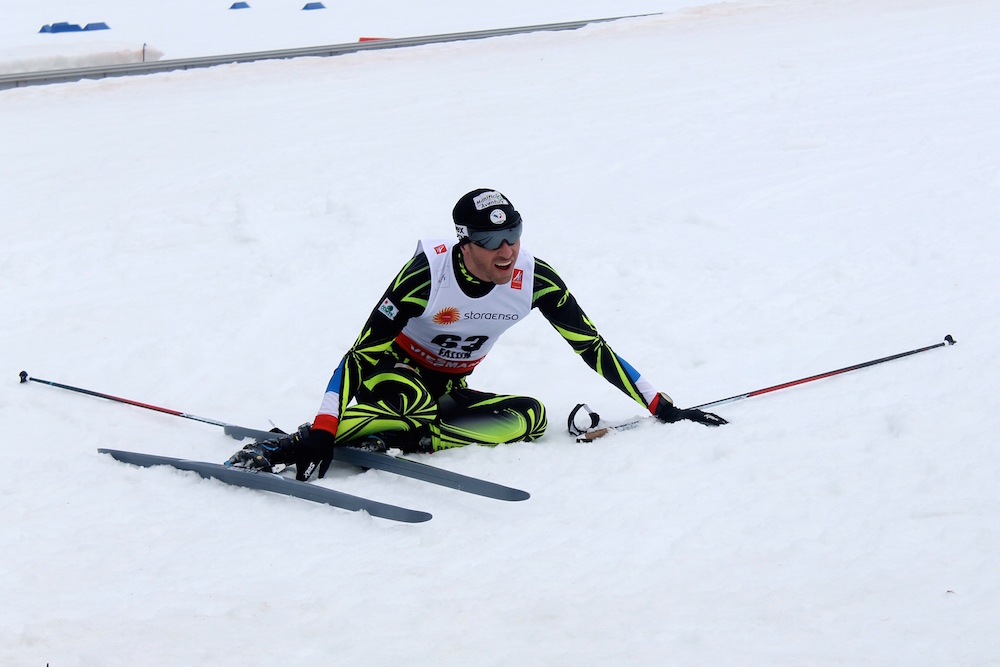
    Taylor Fletcher led the U.S. in 19th after starting 25th, 1:31 behind Frenzel, and finished 1:32.5 after Rydzek. His ski time ranked 18th.

    “I felt like I had good speed, I just I never got into a rhythm,” Fletcher said afterward. “I felt like I was swimming and I was never comfortable. I had people stepping all over my poles and I was going in and out of the line of people trying to move up, and I didn’t race my style.”

    Fletcher started four seconds behind his older brother Bryan, who jumped to 20th and ended up 21st (+1:40.9).

    “We were really hoping that we’d be able to pull away or work together and pull up to the front, but with the way the conditions were and just how I was skiing, it was really hard to actually make up ground on anybody,” Bryan said.

    While temperatures cooled slightly to around 35-degrees Fahrenheit by the start of the race at 4 p.m., the course had turned to a mashed-potato-like consistency with the sun beating down on a 40-degree afternoon.

    The 50-man field saw the jumping portion delayed from 10 a.m. to 1:30 p.m. because of winds, leaving competitors with about 50 minutes after the last jump to prepare for the pursuit-style race.

    “We didn’t get much of a warmup and we were only able to ski the upper part of the course,” Bryan said. “They didn’t have the full course open or anything so that was tough. It was a quick turnaround.”

    Ben Berend (U.S. Nordic Combined) competing in his first World Championships competition on Friday in Falun, Sweden. After jumping to 16th on the normal hill, Berend finished 45th in the 10 k. (Photo: FlyingPointRoad)
    Ben Berend (U.S. Nordic Combined) competing in his first World Championships competition on Friday in Falun, Sweden. After jumping to 16th on the normal hill, Berend finished 45th in the 10 k. (Photo: FlyingPointRoad)

    He noted that his teammate Ben Berend, in his first World Championships, had more adversity to deal with jumping as the ninth starter in the first group.

    “Every time they were going to start the competition today, he’d have to get dressed, go all the way to the top of the jump and by the time he’d get there, they’d say, ‘OK we’re not going to do it,’ and he’d have to come right back down,” Bryan said. “For us in the later group, it wasn’t nearly as bad. It certainly is a lot of warming up and then, ‘OK, we’re not going yet.’ … It’s the same for everybody. It used to happen a lot more on World Cup then it does these days with TV and everything, but it’s just something you have to deal with.”

    Berend jumped to 16th, the second best of the four Americans after Billy Demong leapt to 10th.

    After having competed at one World Cup beforehand, the 19-year-old Berend was surprised to discover he led the jump through the first 18 men.

    “I went and actually got equipment checked. I was in there forever and I came back out and they were like, ‘You’re still in the lead. You need to come back to the leader’s chair,’ ” he recalled. “I’ve never been there before so that was a pretty awesome experience being able to take that in.”

    The 19th jumper, Demong bumped him out of it.

    “Having Bill take me out of that leader’s chair, it couldn’t have been more perfect,” Berend said.

    “They were like, ‘You’re still in the lead. You need to come back to the leader’s chair.’ ” — Ben Berend (U.S. Nordic Combined), who was 16th in Friday’s jump and 45th overall for his career best in his second World-Cup-level individual competition

    Demong went on to finish 25th in the 10 k (+1:51.8), and Berend placed 45th (+4:54.6).

    “I’m not fast enough to ski at the front of these races,” Berend said. “The conditions just made it tougher so the race was pretty brutal, but you learn. It was good experience for me out there. … Overall it was an awesome day. I’m looking forward to learning from this and moving on to better results in the future.”

    Demong noted that this was Berend’s first World Championships and third-ever World Cup event (after two competing twice at last month’s World Cup in Schonach, Germany).

    “To execute well and sit in the lead, that’s huge,” Demong said. “At 19 it’s a lot easier to train a few years and get faster at cross country than it is to make a ski jumper. Ski jumping is a really funny sport. When I was his age I was a great jumper, but I struggled in cross country. I’d rather start with someone who is a talented athlete, a great jumper, and try to teach them the cross-country side.”

    In his eighth World Championships, the 34-year-old Demong explained that jumping has been his strong point this year.

    “I haven’t competed a whole lot, and seemingly in my old age not training much for jumping has paid off,” he said. “The same can’t be said about cross country. I haven’t raced super well this year, but it’s been stable. Today, I started out harder, hoping to make something happen and paid for it the second half of the race. Ordinarily, these were my racing conditions. When I was my fittest this is where I would win, like Vancouver and Liberec. That being said, when you’re not the fittest, it is punishing.”

    The second of four nordic-combined events is scheduled for Sunday with the 4 x 5 k team event.

    “Sunday is going to be great if we can jump like we did today,” Demong said. “I think Taylor and Bryan skied a really good first half today. They’ve been two of the fastest, if not the fastest guys this year, so hopefully I can pull my stuff together and we’ll have a fight for a medal.”

    — Lander Karath contributed reporting

    Results

  • Harvey Rockets from Last to Claim Second in World Champs Sprint Behind Northug

    Norway's Petter Northug (l) and Canada's Alex Harvey (r) lunge in Thursday's 1.4 k classic sprint at the 2015 FIS Nordic World Championships in Falun, Sweden. Northug won the are by 0.05 seconds over Harvey, who earned his best individual finish at a Championships. (Photo: flyingpointroad)
    Norway’s Petter Northug (l) and Canada’s Alex Harvey (r) lunge in Thursday’s 1.4 k classic sprint at the 2015 FIS Nordic World Championships in Falun, Sweden. Northug won the are by 0.05 seconds over Harvey, who earned his best individual finish at a Championships. (Photo: flyingpointroad.com)

    FasterSkier’s coverage of the 2015 FIS Nordic World Ski Championships in Falun, Sweden, is brought to you by the generous support of L.L. Bean, now featuring a complete line of Kikkan Randall training wear.

    FALUN, Sweden — Alex Harvey may tell you he’s a distance skier, but don’t let him fool you. As demonstrated by his performance in Thursday’s classic sprint at the 2015 FIS Nordic World Ski Championships, Harvey is certainly one of the word’s best all-around skiers.

    Starting each of his three heats at the back of the pack, Harvey appeared to be out of the running as skiers traversed the hilly course that featured 1.4 k of twists and turns. However, by the end of every race the 26-year-old from Saint-Ferréol-les-Neiges, Quebec propelled himself into qualifying position. In the final his come-from-behind tactics earned him second overall.

    Lunging for a photo finish with Norwegian Petter Northug Harvey topped his previous best individual finish at Worlds – third in the same event in 2013 at Val di Fiemme, Italy. Thursday, he finished 0.05 seconds behind Northug who crossed the line with a time of 3:02.32. Northug’s teammate Ola Vigen Hattestad took the last podium position after a photo finish with Russian Nikita Kriukov. The two trailed the victor by 0.35 and 0.38 seconds, respectively.

    Italian sprinter Federico Pellegrino was fifth and finished 0.67 seconds behind Northug. He was followed by Norwegian Thomas Northug to take the last spot in the heat. He was 17.28 seconds behind his brother after leading the first third of the final.

    Harvey began his day on a strong note, placing fifth in the qualification round. He finished 2.4 seconds behind the qualifier winner, Kriukov, despite skis that were “too light on kick.”

    “The qualifier was a great start for me. I’m never that strong in qualification, usually. I was really happy to see that,” he said in a post-race interview.

    Once in the quarterfinals, Harvey explained he struggled tactically, but was able to recover in time to take advantage of several strategic openings near the end of the race. He charged past Calle Halfvarsson of Sweden in the final meters to finish second behind Pellegrino and secure a spot in the semifinals.

    According to Harvey, the Canadian  regrouped after the close call and thought to himself, “this is on now.”

    Harvey’s semifinal would present a different challenge, however, as it featured four Norwegians including the two Northugs, Hattestad, and Eirik Brandsdal. The Canadian knew the Norwegians would push for a fast heat so that all four could advance to the final via automatic qualification and lucky loser positions. Harvey ultimately spoiled their party as he was able to finish in a close fourth position. The heat was one of  the quickest on the day, and Harvey’s time was fast enough to advance him to the final.

    “[I] just [had to] bite my teeth on the climbs and be strong in the finish,” he said of his effort in the semifinal.

    The men's 1.4 k freestyle sprint at the 2015 FIS Nordic World Ski Championships. Canadian Alex Harvey (l) placed second, Norwegian Petter Northug (c) earned first, and Northug's teammate Ola Vigen Hattestad (r) finished third. (Photo: Falun2015)
    The men’s 1.4 k classic sprint at the 2015 FIS Nordic World Ski Championships. Canadian Alex Harvey (l) placed second, Norwegian Petter Northug (c) earned first, and Northug’s teammate Ola Vigen Hattestad (r) finished third. (Photo: Falun2015)

    The much anticipated final began with strong push from Thomas Northug, who led each of his heats to much success throughout the day. He powered out of the stadium and up the largest climb with Hattestad and the rest of the pack following closely behind. As the six skiers tackled the steep pitch, Petter Northug made a forceful move on the inside and bounded past his two teammates to take the lead.

    Heading into the downhill, Harvey was in sixth and close to losing contact with the group. “I’m just too slow at the start so I couldn’t contend near the front,” he said of his position.

    But Harvey wasn’t about to give up. As the skiers entered the second major climb of the course, the Canadian took advantage of a slowing Thomas Northug to surge past the Norwegian and Kriukov into fourth position.

    Pellegrino led Northug and Hattestad into the stadium to the cheers of 18,000 fans, as Harvey rapidly gained. With 200 meters to go, Harvey powered past Hattestad to ski alongside Pellegrino and behind Northug. The Canadian soon realized he had the energy to overcome the leading Norwegian, and moved to the left track to challenge Northug.

    The top four skiers were tightly grouped as each meter progressed, with Harvey leading the charge just inches behind Northug. The Canadian nearly pulled even with Northug at the finish line and attempted to out-lunge him. While the initial results reflected a near-tie, it was Northug who was able to outlast the Canadian by 0.05 seconds for the win.

    “It’s a big relief when you’re crossing the line first. A sprint day is really long you have to focus for many hours,” he said in a post-race press conference. “You just try to stay focused and have your plan. For sure, I wanted to have everyone as tired as possible. That was my plan when I felt that the speed was going a little bit down on the first climb. I’m happy with my tactic and my final … I think I couldn’t do anything else.”

    Northug, who had a turbulent year after an arrest for drunk driving in May, explained the focus of the season has beenWorld Championships and that the dates of the event had been “marked with red.” Northug has yet to win a World Cup in the 2015 season and said that he earned his starting spot in the World Championships sprint after winning the Norwegian National Championships sprint earlier this month. The Norwegian has now won every single competition at World Championships over the course of his career with the sprint victory in Falun.

    According to the 29-year-old, Thursday’s final was especially meaningful because it gave him the opportunity to race his younger brother, Thomas.

    “For sure it’s big. It means a lot to me, maybe more than my brother, that we were racing together.” Northug said. “It gives you a little bit extra to be fighting with your brother.”

    Canada's Alex Harvey celebrates his second place finish in Thursday's 1.4 k freestyle sprint. Harvey skied from behind in each of his heats to achieve the result. (Photo: flyingpointroad.com)
    Canada’s Alex Harvey celebrates his second place finish in Thursday’s 1.4 k classic sprint. Harvey skied from behind in each of his heats to achieve the result. (Photo: flyingpointroad.com)

    Canadian National Team Head Coach Justin Wadsworth said he believed Harvey could have overcome Northug, had the finishing straightaway been longer.

    “I think if it would have been five more meters, he would have won the race,” Wadsworth said in a post-race interview. “[Harvey] said ‘oh i timed it kind of bad,’ but I think it was an amazing race, especially after being in last place at the top of the hill.”

    Harvey reflected a similar sentiment, saying that he was gaining on Northug as they approached the finish. However, the Canadian was cautious in his speculation, adding, “I wouldn’t redo the race just to take that chance.”

    When asked how he was able to advance from dead-last to a podium position, Harvey explained that his come-from-behind day wasn’t necessarily planned.

    “I would like to lead on this course on the first hill if I could. [The course] is a bit more endurance-based and I am a bit more of an endurance-based athlete.” he said.

    Despite trailing the pack at the key point in the race, Harvey explained the first hill was more of a “warmup” and the second hill was where he needed to make his move. The Canadian added that he was confident in his skiing despite his position, because he knew his finishing speed was strong.

    Wadsworth agreed, adding that fast skis also played a large role in Harvey’s performance.

    “I think he knows what he’s capable of and he knew the skis were good enough to do that,” he said. “This course has such a fast downhill. Then all you have to do is run up that and everyone is going to run the same. Then you have to have enough speed for the end and his double poling has been really good.”

    Louis Bouchard, Harvey’s personal coach for the last 10 years and head coach of the Pierre-Harvey National Training Centre, said the course largely favored the 26-year-old because of its lengthy hills and prolonged finish. He explained that as the day went on, Harvey grew in strength while his competitors became tired.

    Bouchard pointed to his athlete’s development as another piece of the Harvey success story. “The maturity and he’s more stable, he has less injury, he can train more and recover more, so I think it’s normal to expect to see him get better and better at 26 years old,” he siad.

    Canada's Alex Harvey skiing in his quarterfinal en route to second in the 1.4 k classic sprint at the 2015 FIS Nordic World Ski Championships in Falun, Sweden. (Photo: flyingpointroad.com)
    Canada’s Alex Harvey skiing in his quarterfinal en route to second in the 1.4 k classic sprint at the 2015 FIS Nordic World Ski Championships in Falun, Sweden. (Photo: flyingpointroad.com)

    Bouchard also explained that Harvey’s best-ever individual finish at a World Championships was meaningful, both on the individual level and because of the implications for the team. Cross Country Canada’s funding was reduced after a medal-less 2014 Olympics, and a strong result such as Harvey’s at the World Championships will help many within the organization to argue for increased finances.

    “Now we can expect so many things,” he said. “You need it for the program. You need it for the development. That is a benefit for everybody in Canada, so that is good.”

    As Harvey looks to the remainder of the Championships he will focus on Sunday’s 30 k skiathlon and the following week’s 50 k classic mass start. Last year in the 2014 World Cup finals Harvey won the 30 k skiathlon on the trails of Falun. While the course is slightly different in 2015, Harvey is hopeful that he will find similar success. He also joked that if either distance race were similar to Thursday’s sprint, he would have a longer time to win a final sprint.

    “The 50 k will take longer to do that last stretch so maybe I will have time to go around him,” Harvey said, referring to his finishing battle with Northug.

    In third, Hattestad said he was relieved to have won the photo finish over Kriukov.

    “If I had lost the photo finish against Kriukov, it would be a black day.” he said to Fædrelandsvennen. “There are small margins between success and failure. He came quickly, and I thought I lost it. It was lovely to see that I was ahead.”

    Hattestad added that he entered the championships with high hopes due to his fitness since the new year.

    Only 0.32 seconds from the podium, Pellegrino finished his day in fifth, marking his best classic sprint result to date. The Italian won the last three freestyle sprints on the World Cup circuit and considers himself a freestyle specialist.

    “I am satisfied because I did 100 percent of my possibilities, not only physically, but also mentally. I tried to make the best tactic that my abilities could do so I am satisfied,” he said expressing his excitement for Sunday’s team sprint.

    “This season for me was a very good season in free technique, today was classic technique. I know that physically I have to grow up, I have to be more strong, so for me in fifth place is good,” he added.

    Cross country competition at the 2015 Nordic World Ski Championships continues Saturday with the 15/30 k skiathlons.

    Results

  • For Aspiring Skiers, World Championships Qualifier Much More Than a Race

    For Aspiring Skiers, World Championships Qualifier Much More Than a Race

    Seventeen-year-old Chi Chunxue celebrates her qualifying win on Wednesday in the women's 10 k freestyle, which advanced her along with the top 10 to the remaining distance races at 2015 FIS Nordic World Ski Championships in Falun, Sweden.Bosnia and Herzegovina's Tanja Karisk placed second (+49.3) and Australia's Casey Wright was third (+1:07.5).
    Seventeen-year-old Chi Chunxue (c) celebrates her qualifying win on Wednesday in the women’s 10 k freestyle, which advanced her along with the top 10 to the remaining distance races at 2015 FIS Nordic World Ski Championships in Falun, Sweden. Bosnia and Herzegovina’s Tanja Karisk (l) placed second (+49.3) and Australia’s Casey Wright was third (+1:07.5).

    By Colin Abbott

    FasterSkier’s coverage of the 2015 FIS Nordic World Ski Championships in Falun, Sweden, is brought to you by the generous support of L.L. Bean, now featuring a complete line of Kikkan Randall training wear.

    FALUN, Sweden — The buzz is building at the 2015 FIS Nordic World Ski Championships with the completion of the first races in Falun. Wednesday saw the individual-start distance qualification races take place with 45 women and 69 men and women skiing 5 kilometers and 10 k, respectively.

    These initial races did not crown world champions, but they have another purpose that is just as important to the athletes racing. These races offer the opportunity for skiers that have not in the past year made the minimum International Ski Federation (FIS) point standard for men (90 points) and women (120 points). The top-10 men and women in these races qualify for the remaining distance races at World Championships (the skiathlon, individual start and mass start).

    Athletes selected with these races are part of a nations quota of starts. Most countries with a regular presence on the World Cup have athletes with low FIS points and select teams long before the start of the World Championships. This leads to lesser-known ski nations concentrating on these races as an opportunity for athletes to qualify and participate in World Championships.
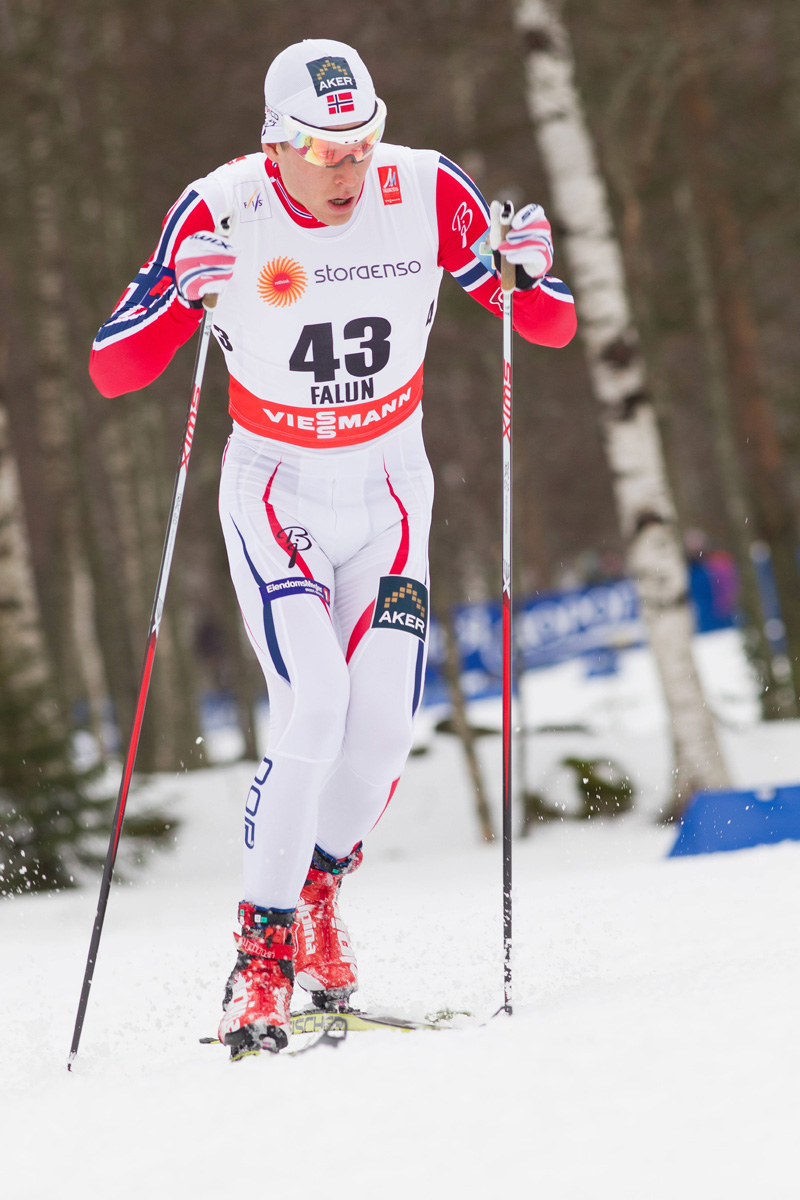
    Mark Rajak racing for Trinidad and Tobago in Wednesday's 10 k freestyle individual start qualification race on the first day of 2015 World Championships in Falun, Sweden.
    Mark Rajak (19) racing for Trinidad and Tobago in Wednesday’s 10 k freestyle individual start qualification race on the first day of 2015 World Championships in Falun, Sweden.

    After the races on Wednesday, FasterSkier caught up with skiers hailing from countries where many citizens will never see snow. Trinidad and Tobago, Iran, Australia, and Brazil offered us a glimpse into the role of skiing in their nations.

    The Australian ski program has grown into a World Championships team that includes 11 athletes and six support staff. Central to their success as a nation is a development program termed the “Victorian squad” — an inclusive, tiered learn-to-ski program focused on teaching children how to ski and supporting athletes who want to race. Those young racers have athletes such as Callum Watson and PK Kovacs to look up to now which, according to 22-year-old skier Mark Pollock, is key to motivating and developing high-performance skiers.

    At a certain point, the lack of snow makes it difficult to progress as an athlete in Australia. Their best skiers are seeking out options to continue skiing in other places. Last summer, Pollock trained with the Bridger Ski Foundation in Bozeman, Mont., while his teammate Jessica Yeaton trained with Alaska Pacific University in Anchorage, Alaska. These training initiatives taken by Australian athletes have allowed them to improve their depth and competitiveness internationally, with Yeaton qualifying for the nation’s full-fledged World Championships team outright.

    Fabrizio Bourguignon racing for Brazil  in Wednesday's 10 k freestyle individual start qualification race on the first day of 2015 World Championships in Falun, Sweden.
    Fabrizio Bourguignon racing for Brazil in Wednesday’s 10 k freestyle individual start qualification race on the first day of 2015 World Championships in Falun, Sweden.

    Brazil was represented by three national team members on Wednesday: one woman, Mirlene Picin, and two men. Leandro Lutz, 33, and Fabrizio Bourguignon, 38, have both been skiing for a number of years. Like Yeaton and Pollock, Lutz decided that in order to optimize his training, an on-snow location was necessary for part of the year. Lutz chose to spend the first half of this winter in Denver, Colo., to train on snow in order to prep for three months of racing in Europe. And like Australia, Brazil is experiencing a growth in the popularity in skiing. According to Lutz, there are seven Brazilian junior racers currently in Europe — three racing the IBU Youth/Junior World Championships in Belarus and the remainder racing FIS junior races in Scandinavia.

    Racing the sprint on Thursday is another Brazilian, Leandro Rubella. Two years ago, Rubella started a social project in Sao Paulo to help children from impoverished families escape violence and poverty and establish the skills needed to live a good life. This project took the unlikely form of a learn-to-rollerski program. A key message of this initiative is that “anything is possible.” The hope is that a citizen from a country with no snow can make it to the Nordic World Championships, a child born into poor circumstances will see that it is possible to overcome the most difficult challenges.

    The birth of a similar program may soon occur in another tropical country, Trinidad and Tobago. Mark Rajack, 33, toed the start line Wednesday afternoon in Falun to compete for the Caribbean island nation in his first international race. Even though Rajack, who has lived in Ottawa, Ontario, since a young age, has only been skiing for two years, he sees the potential for skiing to bring positive changes to his native country.

    Rajack sees benefits similar to those envisioned by Rubella in Brazil. In addition to teaching important life skills, Rajack sees a rollerski program as a way to teach citizens a skill that would allow immigrants from Trinidad and Tobago to easily integrate with societies in the Northern Hemisphere, should they choose to leave their country. This vision originated with the positive experience Rajack has had with the ski community in Ottawa.

    Seyed Sattar Seyd of Iran (l) with his coach after the men's 10 k freestyle individual start qualification race on the first day of 2015 World Championships in Falun, Sweden.
    Seyed Sattar Seyd of Iran (l) with his coach after the men’s 10 k freestyle individual start qualification race on the first day of 2015 World Championships in Falun, Sweden. He placed eighth to qualify for the remaining distance races at the championships.

    Seyed Sattar Seyd posted one of the best Iranian cross-country skiing results ever on Wednesday after finishing eighth in the men’s qualifying race. Seyed, 27, is an experienced racer, having competed in both the 2010 and 2014 Winter Olympics.

    Iran now has a FIS-homologated race site at Knoor, approximately 60 k outside its capital of Tehran. Much of the training done by Iranian athletes happens within the borders of Iran and it appears that the current government will assist in keeping it that way. The addition of a biathlon range is planned for the Knoor facility in the near future and the Iranian contingent here in Falun sees a bright future for the sport.

    Below are the top-10 competitors that qualified for the remaining distance races at 2015 World Championships. Those who did not qualify have the opportunity to race Thursday’s 1.4-kilometer classic sprint qualifier.

    OFFICIAL RESULTS 

    Women’s 5 k freestyle

    1. CHI Chunxue 1998 CHN 13:33.8
    2. KARISIK Tanja 1991 BIH +49.3
    3. WRIGHT Casey 1994 AUS +1:07.5
    4. TRNKA Anna 1994 AUS +1:07.8
    5. MUIZHNIECE Anda 1991 LAT +1:09.7
    6. PASHKOVSKA Inga 1992 LAT +1:37.3
    7. PAPP Ildiko 1982 HUN +1:39.1
    8. KIROSKA Rosana 1991 MKD +1:44.9
    9. KLAUZA Laima 1969 LAT +1:47.0
    10. GALSTYAN Katya 1993 ARM +1:49.2

    Complete women’s results

    Men’s 10 k freestyle

    1. BELOMAZHEV Stanimir 1988 BUL 23:56.8
    2. PLAKALOVIC Mladen 1991 BIH +16.6
    3. KONYA Adam 1992 HUN +31.4
    4. HULGAARD Lasse 1991 DAN +47.6
    5. SLOTINS Roberts 1991 LAT +54.5
    6. SMRKOVIC Rejhan 1991 SRB +57.8
    7. PAIPALS Janis 1983 LAT +1:05.1
    8. SEYD Seyed Sattar 1987 IRA +1:11.4
    9. HADZIFEJZOVIC Dzevad 1991 SRB +1:23.3
    10. ANGELIS Apostolos 1993 GRE +1:30.9

    Complete men’s results

    About the Author: Colin Abbott hails from the Yukon Territory where he learned to ski and race from a young age. Years later his life mostly revolves around skiing. At the moment, Colin is racing for the Yukon Elite Squad and the Carleton Ravens university team. He sits on the board of directors for Cross Country Canada and is involved in the education and womens committees there. He has also started writing ski-related articles for XCOttawa and FasterSkier and for the next week is supporting the Trinidad and Tobago team at FIS Nordic World Ski Championships.