From the FasterSkier archive — posts syndicated from athletes’ and coaches’ own blogs between 2004 and 2012, kept online as published. Current coverage is at fasterskier.com.
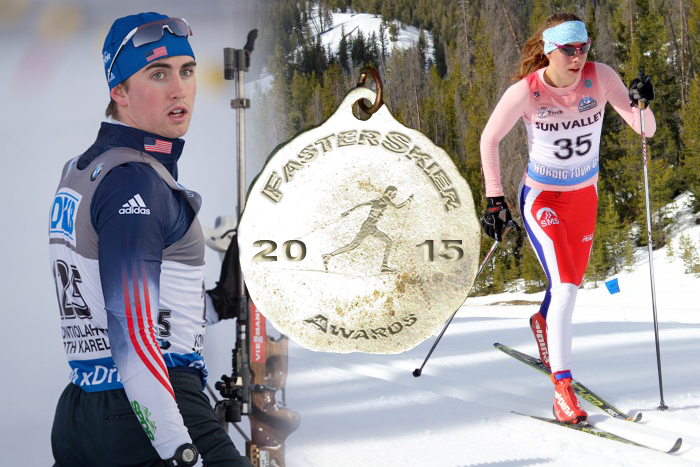
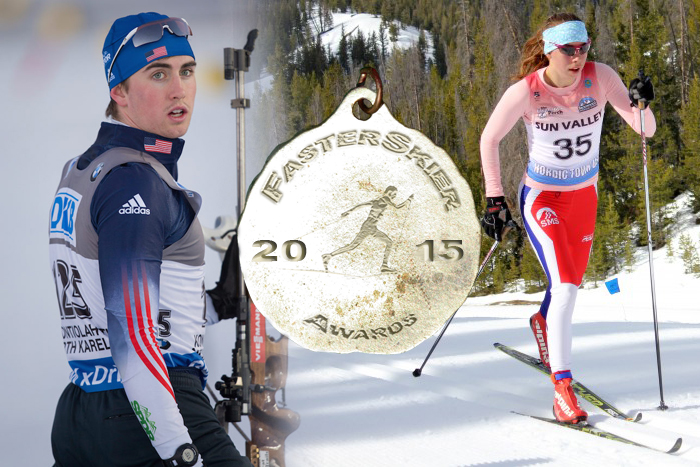
Sean Doherty and Katharine Ogden are FasterSkier’s Junior Skiers of the year.
With the 2014/2015 season officially in the rearview, FasterSkier is excited to unveil its annual award winners for this past winter. Votes stem from the FS staff, scattered across the U.S. and Canada, and while not scientific, they are intended to reflect a broader sense of the season in review.
We’re kicking off the series by honoring the youngest skiers of the bunch with Junior of the Year, awarded to one outstanding male and one female in the U.S. and/or Canada.
***
Katharine Ogden, Stratton Mountain School
The many achievements of Katharine Ogden, FasterSkier’s Junior Skier of the Year for 2015, make it easy to forget she is only 17 years old.
Despite her young age the Stratton Mountain School skier kept up with the best of the American women in the 2014/2015 season. Long before the winter, Ogden demonstrated her abilities with a third place finish behind Liz Stephen and Caitlin Gregg in the annual Climb to the Castle rollerski race in Lake Placid, N.Y.
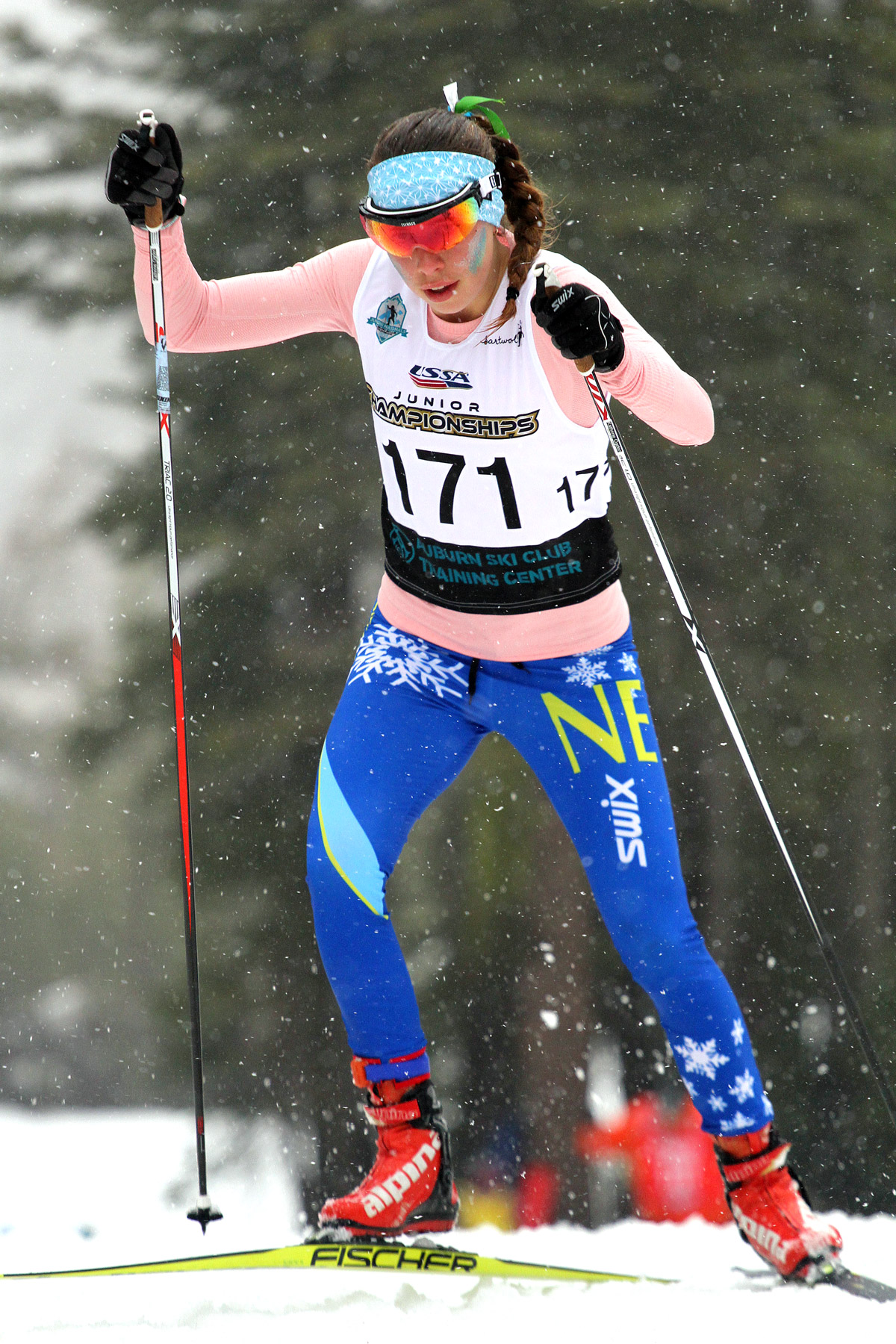
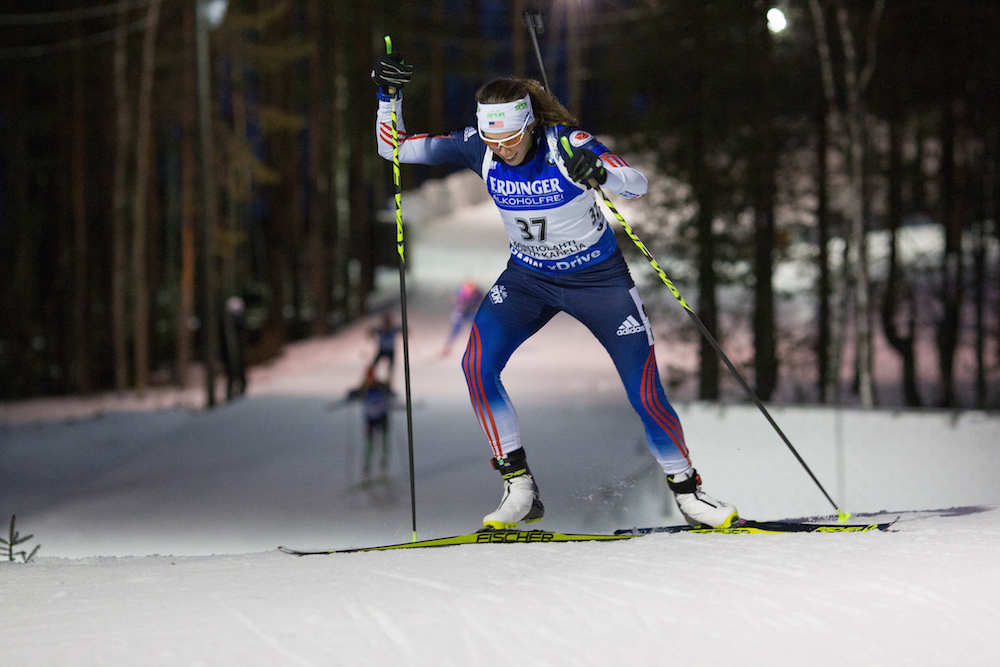
New England’s Katharine Ogden (Stratton Mountain School) racing to a 26.8-second win at the 2015 U.S. Junior Nationals in Wednesday’s 10 k freestyle at Auburn Ski Club in Soda Springs, Calif. (Photo: Mark Nadell/MacBeth Graphics)
Come winter, Ogden continued her impressive racing as she traveled through the SuperTour circuit – claiming second in the West Yellowstone 10 k freestyle and third in the Bozeman 10 k classic behind a dominant Rosie Brennan who would later be named to the U.S. World Championships team.
Unsurprisingly, Ogden finished in the top ten of all but one race at the 2015 U.S. Cross Country Championships and handily won the junior women’s 5 k. The week would serve as a launching point for her first trip to the Junior World Championships in Almaty, Kazakhstan.
In the first race of Junior Worlds, a 5 k freestyle, Ogden placed an impressive 11th. The best was still to come for the 17-year-old, who finished sixth just two days later in the 10 k skiathlon. The result tied the best-ever distance finish by a U.S. skier at Junior Worlds.
“It was really cool to be able to ski with some fast, aggressive Europeans and to experience a crazy, Euro-style mass start for the first time,” she wrote to FasterSkier after the historic result. “This was a really good, encouraging result for me, and going forward it is really awesome to have the learning experience from my first international mass-start race.”
To round out a successful year Ogden earned four podiums at the 2015 Junior National Championships, three of which were victories. Ogden has two more years as a junior and will enter the 2015/2016 season as one of America’s most promising young skiers to date.
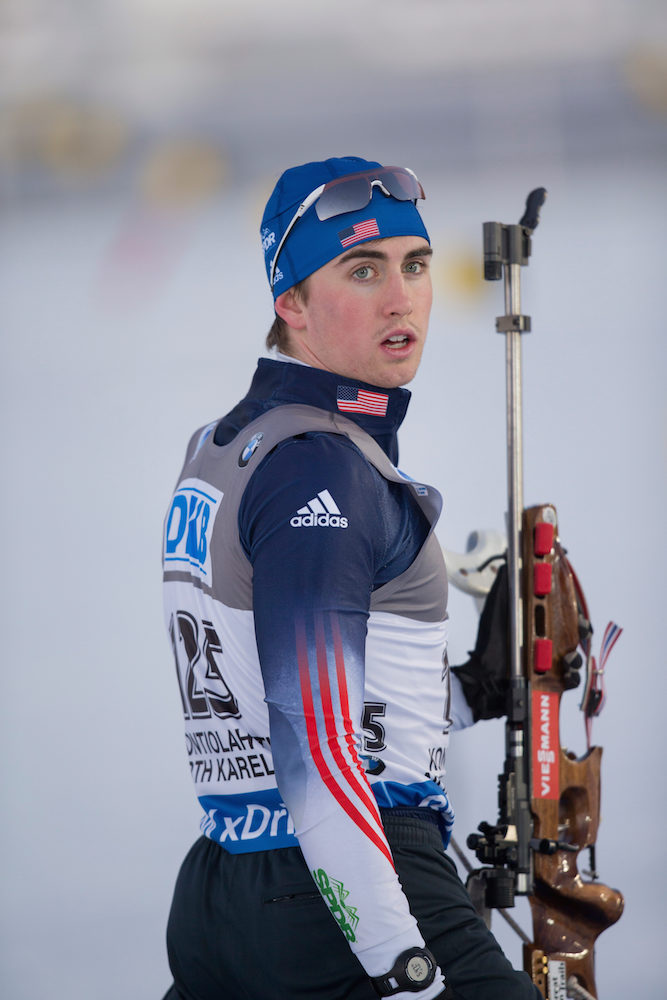
Sean Doherty, U.S. Biathlon
FasterSkier’s Junior of the Year award isn’t new territory for Sean Doherty. The 19-year-old won the honor in 2013, and since then he’s added a large list of accolades to his name.
The Conway, N.H. native won two golds and a silver at the 2014 IBU Junior World Championships and subsequently competed in the 2014 Olympics as one of the youngest starters in the relay, helping the U.S. finish in 16th position.
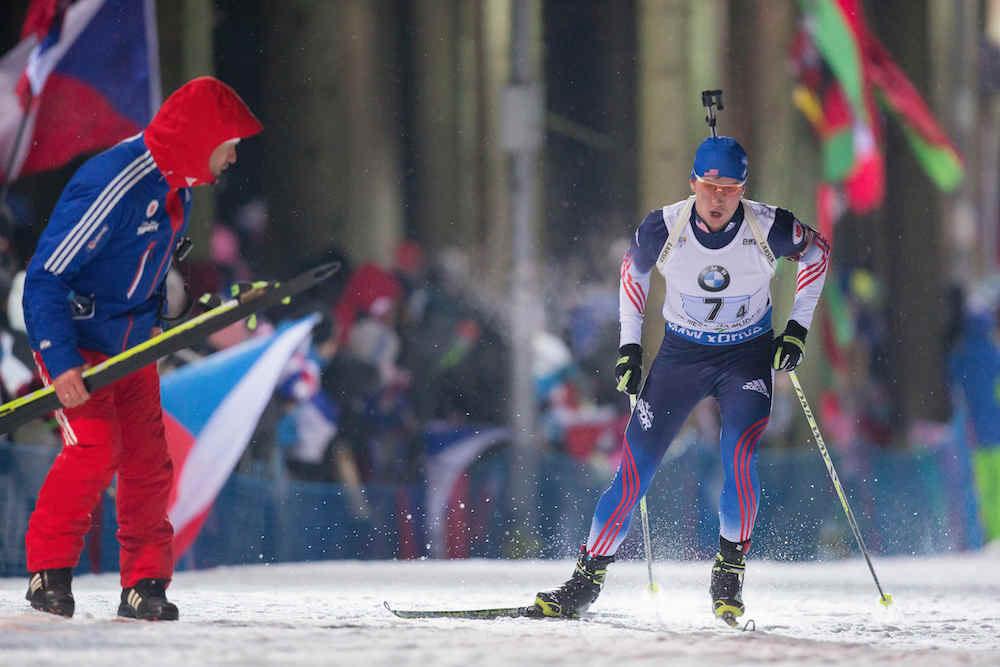
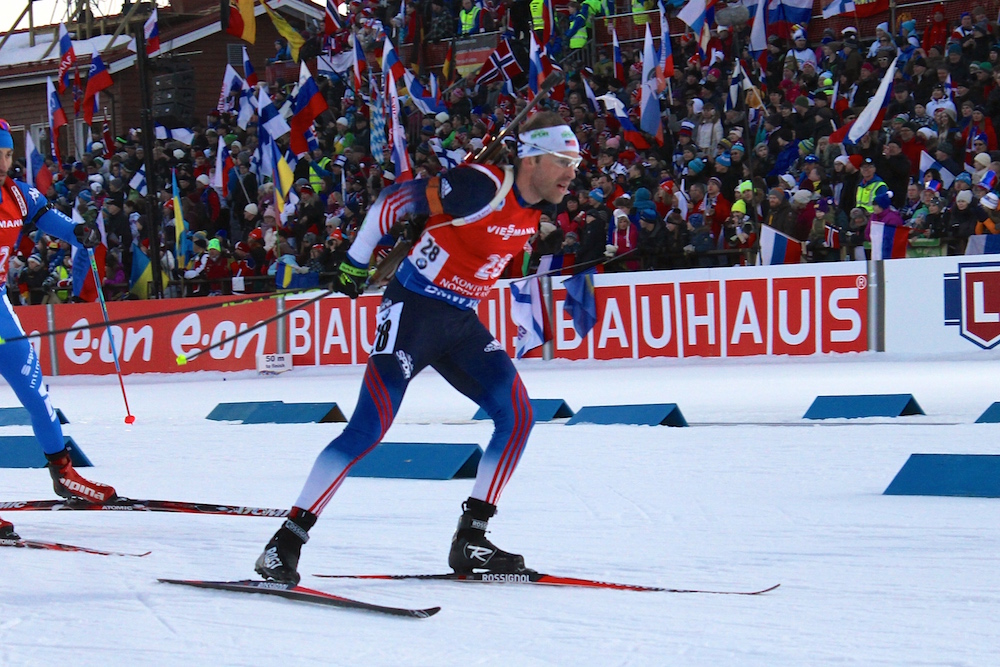
Sean Doherty racing in the mixed relay at the IBU World Cup in Nove Mesto, Czech Republic earlier this year. (Photo: USBA/NordicFocus)
The 2014/2015 season was a large jump for Doherty who graduated from biathlon’s youth category into the more competitive junior realm. It appears he took well to the transition, earning a third-place finish in the 2015 IBU Junior World Championships sprint in Minsk, Belarus. Doherty was the top North American in the event’s other two races, finishing 11th in the pursuit and 14th in the individual.
U.S. Biathlon Association CEO Max Cobb sung the 19-year-old’s praises after his impressive bronze medal. “That Sean was able to win the Junior World Championship bronze medal with one penalty as a first year junior in Minsk speaks volumes for his dedication to excellence and the great support of the coaches and team around him,” Cobb told FasterSkier in an email. “It’s a huge accomplishment to succeed like this as an American in Europe’s favorite winter sport.”
The biathlete didn’t stop there. He joined the American team at the 2015 IBU World Championships in Kontiolahti, Finland in March as the team’s youngest memeber. His placement of 45th in the pursuit marked his best-ever result at the World Cup level.
Doherty was recently named to the USBA A-team. If his performances in recent years are any indicator of the future, there’s more success to come from face of America’s young biathletes.
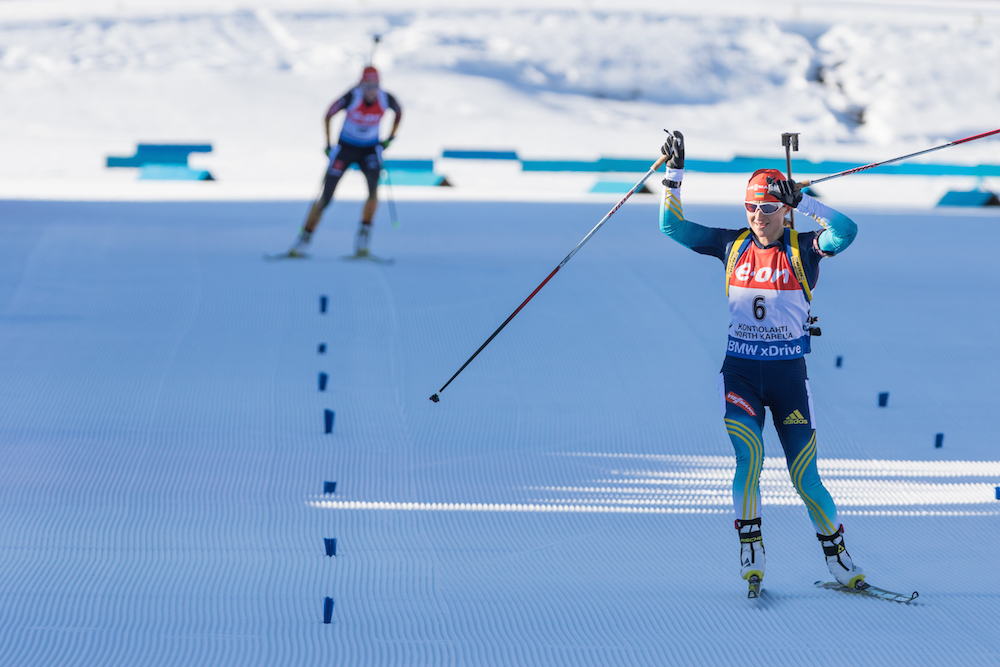
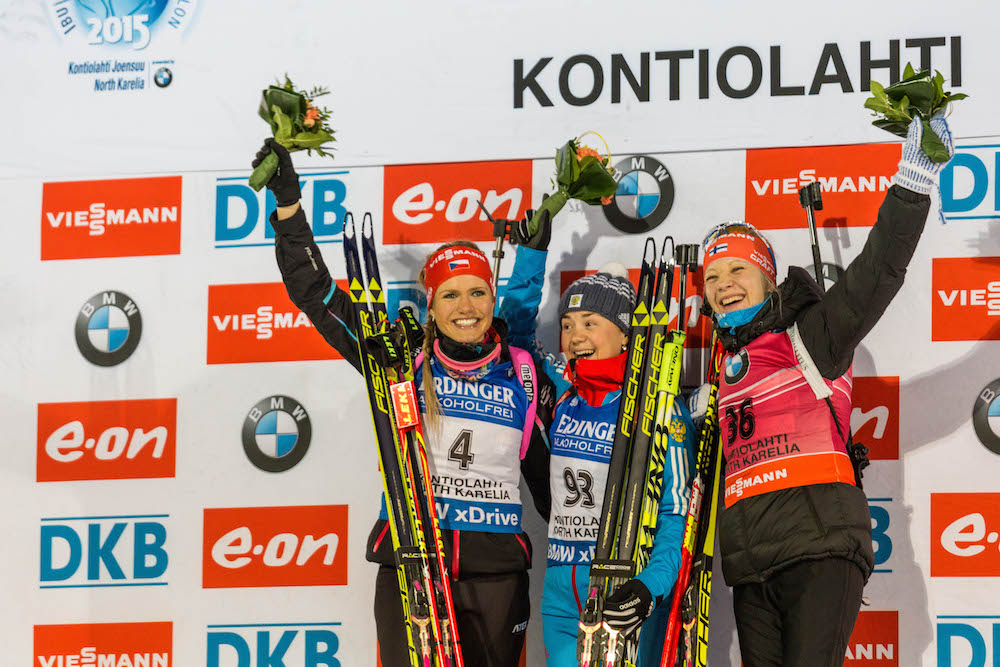
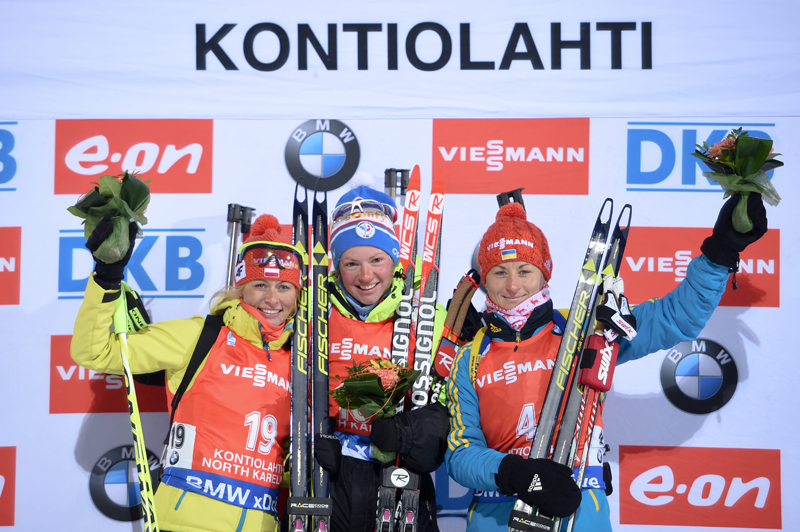
Ukraine’s Valj Semerenko (r) celebrates her first World Championships victory on Sunday in the women’s 12.5 k mass start at 2015 IBU World Championships in Kontiolahti, Finland. She beat Germany’s Franziska Preuss by 6.2 seconds. (Photo: Kontiolahden Urheilijat/Risto Kuittinen)
KONTIOLAHTI, Finland — Perfect shooting wins the race, at least that was the adage that summed up the women’s 12.5-kilometer mass start on the final day of 2015 IBU World Championships.
Valj Semerenko, a 28-year-old Ukrainian with an Olympic gold medal from last year’s relay and multiple World Cup podiums, sat quietly in the pack throughout most of Sunday’s mass start. She didn’t charge to the front on the first lap, like Darya Domracheva of Belarus did. Instead, she positioned herself in the top 20 of 30 starters and waited for natural opportunities to move up.
Opportunities like the first prone stage, where she and 17 others cleaned on a bluebird, windless afternoon. Semerenko moved into 11th, 15.3 seconds back from Domracheva in first.
While the Belarusian set off for another blistering lap, leaving the range 8 seconds ahead of Russia’s Ekaterina Yurlova in second, Semerenko squeezed into the top 10 before the second shooting.
There, she cleaned again, along with nine others, including Domracheva. As Domracheva set out again in the lead, 6.5 seconds ahead of Russia’s Daria Virolaynen, it seemed like the race could very well continue along the same lines — with Domracheva jetting off the front.
That is, until Domracheva missed two in the third stage and dropped to eighth.
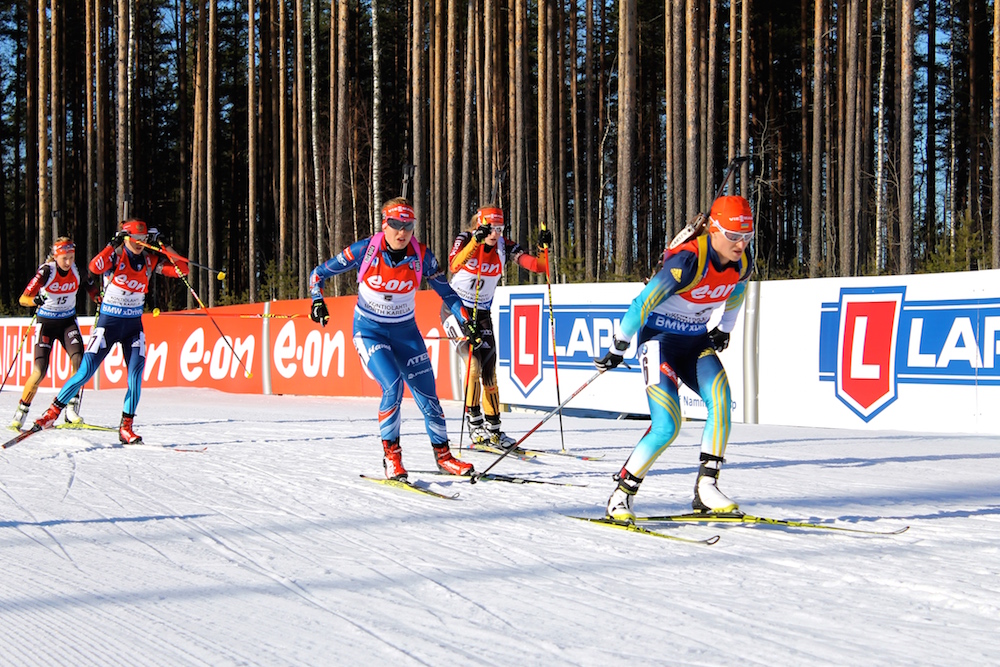
Ukraine’s Valj Semerenko (r) leads a five-woman chase pack into the range during Sunday’s 12.5 k mass start at 2015 IBU World Championships while chasing Darya Domracheva of Belarus (not shown), with Gabriela Soukalova of the Czech Republic, Germany’s Franziska Hildebrand, Russia’s Daria Virolaynen, and Germany’s Franziska Preuss, respectively.
Behind her, Semerenko led a chase pack of five into the range, with the Czech Republic’s Gabriela Soukalova, Germany’s Franziska Hildebrand, Virolaynen, and Germany’s Franziska Preuss, respectively.
The Ukrainian cleaned the first standing stage the fastest, heading out on her fourth lap two seconds ahead of Hildebrand and Preuss, and three seconds ahead of Soukalova — all of which cleaned as well. Domracheva was left with two penalty loops, emerging 36 seconds behind them.
Soukalova, Preuss and Semerenko took turns leading over the penultimate lap, while Hildebrand fell off the pace. In the final standing, Semerenko hit the last of her targets to complete her perfect 20-for-20 day, sending a clear message to the 29 women behind her. She left the range 19.1 seconds ahead of Preuss, who had her first penalty of the race in that stage, and Hildebrand cleaned her fourth stage to move back into third.
“I left the shooting range with Franziska Hildebrand and I thought, ‘Oh god, it’s going to be a hard loop,’ because she’s really in shape at the moment,’ ” Preuss recalled in a post-race press conference. “When I had a look back, I thought, ‘There are much more athletes now.’ I just wanted to give everything.”
While Preuss pushed to close the gap on the last lap, she couldn’t quite reach Semerenko, who finished 6.2 seconds ahead of her for her first World Championships title in 34:32.9.
“I was thinking that when I win, I’m gonna take the Ukrainian flag,” Semerenko told the IBU through a translator. “But when I got to the end with all the people chasing me, I just forgot with all the stress.”
She added that she was grateful for the support of her sister, Vita Semerenko, who has been sidelined this season with an injury.
“I would like to thank her for her support here, and actually she was at the track at the last hundred meters to give me the flag, but I only noticed her when I passed her,” Semerenko said with a laugh.
“I’m the champion and I’m so happy about it,” she said in the press conference. “It is important not only for me but also for my country. I’m full of emotion.”
While IBU Overall World Cup leader Darya Domracheva (Belarus) led the first half of Sunday’s 12.5 k mass start, she missed two standing targets and placed fourth in her last chance to medal at 2015 IBU World Championships in Kontiolahti, Finland. (Photo: Kontiolahden Urheilijat/Kari Kuninkaanniemi)
On the final lap, Italy’s Karin Oberhofer, Domracheva and Soukalova all caught Hildebrand, overtaking her before 11.8 k.
By the finish, Oberhofer dug deep to hold off Domracheva for bronze, finishing 2.1 seconds ahead of her and 12.6 seconds behind Semerenko. The Italian had rebounded from two early penalties — one on each prone stage.
“I had wonderful skis, I tried to do my best and I’m very, very happy,” Oberhofer said through a translator.
While Domracheva took fourth (+14.7) with the fastest overall course time, Soukalova was another 11.5 seconds behind in fifth (+26.2). Hildebrand finished sixth, 5.5 seconds later, and Germany put three in the top eight with Laura Dahlmeier in eighth (+39.9).
For Preuss, the silver matched her World Cup career best, in which she placed second in the mass start in January in Ruhpolding, Germany. On Friday, she helped the German women’s team achieve gold in the relay.
“The week started really good for me with my [21st] birthday [on March 11], then the gold medal in the relay,” Preuss said. “It was absolutely amazing to stand on top of the podium and unbelievable, and today, the second individual medal in the mass start, it’s really amazing.”
Dunklee 20th, Heinicke 24th
Susan Dunklee (US Biathlon) en route to 20th in the women’s 12.5 k mass start at 2015 IBU World Championships on Sunday in Kontiolahti, Finland. (Photo: USBA/NordicFocus)
Susan Dunklee narrowly qualified for the mass start in the 30th and final spot available after winning a tiebreaker with Finland’s Mari Laukkanen (Dunklee had the single-best individual result between of the two of them in 12th at these World Championships).
Considering that, she was grateful to have made it.
“It was kind of like an icing-on-the-cake moment,” Dunklee said after the race. “I’ve done what I needed to do at these championships, now I can kind of relax and have fun and see what happens. Sometimes I have my best races when I’m in that position. That didn’t happen today, but it could have.”
Dunklee finished 20th, 2:01 behind Semerenko, with five penalties: one on each prone stage, two in the first standing and another in the final standing.
“I haven’t seen where my shots went yet, but I have a feeling I had a couple split-outs,” she explained. “I could’ve sworn one of the standing I had a paddle quiver, but not fall. … I had a couple that felt like good shots, but I don’t know what happened. You miss one, it puts you right away toward 20th place coming into the second shooting, and then if I keep missing one, that holds steady. I knew [I needed to] not miss one if I wanted to move up.”
While the 29-year-old Dunklee left the range in 23rd after the last stage, she skied the fifth-fastest course time overall to finish in the top 20. She ended World Championships with two individual top-20 results, eighth place in the mixed relay, and 12th in the women’s relay.
“I always set really high goals for myself,” Dunklee said of her season overall. “I got a few top 10’s this year. I was hoping for more for sure. I was hoping to get to them earlier in the season, too. I’ve made some huge improvements with my ski technique. My shooting percentage I think has been a little more consistent, and now I’ve got a lot of things I know I want to work on as soon as summer rolls around.”
There is still one more stop on the World Cup circuit, with a sprint, pursuit and mass start in Khanty-Mansiysk, Russia, this coming Thursday through Sunday.
Megan Heinicke (Biathlon Canada) on her way to 24th in the women’s 12.5 k mass start at 2015 IBU World Championships on Sunday in Kontiolahti, Finland. It was only the second mass start of the 26 year old’s career.
Canadian Megan Heinicke qualified for Sunday’s race as well in 26th, for the second mass start in her career. She competed in her first two months ago at the Ruhpolding World Cup, where she placed 23rd.
“When I was zeroing today, I had to look at my coaches like, ‘Um, prone, prone, standing, standing, right?’ ” she said of the shooting order.
Heinicke got that down, hitting 19 of 20 targets with a single prone miss. One of nine women who shot 95 percent or better, she finished 24th, 2:22.2 behind the winner.
“That was a pretty awesome end to the season,” Heinicke said. “That was my last race and I had really good shooting again with just one miss.”
In the last eight days of individual racing, Heinicke tallied four top-30 results (including the mass start), with 21st in the 15 k individual, 23rd in the sprint and 28th in the pursuit. In all of those races and the women’s relay on Friday, she hit at least 90 percent of her targets.
“I guess I had really high expectations shooting-wise because I’ve been shooting so well,” Heinicke said of the mass start. “Skiing, I know to expect it to feel hard. We had really great skis this week so I was kind of trusting the skis to be good, and I just wanted to try to ski smart … and not kill myself the first few runs up the hill and make sure I was kind of settled enough for good shooting.”
Heading into her last lap, after cleaning her third-straight stage, she glanced at the scoreboard and saw that she was 20th.
“I was like, top 20, is it possible?” the 26 year old said. “… Mostly I was like, ‘It’s your last race, be ready to fight. Just kill yourself if you have to.’ ”
Despite a long bout with illness leading up to World Championships, which derailed some of her skiing fitness, Heinicke explained she was excited about the gains she’d made in shooting.
“This year has been a really big step forward for me in terms of shooting and consistency, so every time this keeps happening, I’m just … super happy, super relieved, and really, really motivated for next year,” she said.“I feel like I’m at maybe 60 percent of my potential skiing, with health and training things, so I’m like, ‘Oh, if I have a healthy season next year, if I can maintain the shooting, then I’m just really motivated about the potential.’ ”
She was also inspired by performances she’d witnessed by her teammate, Rosanna Crawford, as well as Dunklee.
“I’m watching … what they’re able to achieve, and I’m just like, ‘OK, I want to fight to be there, too,’ ” Heinicke said.
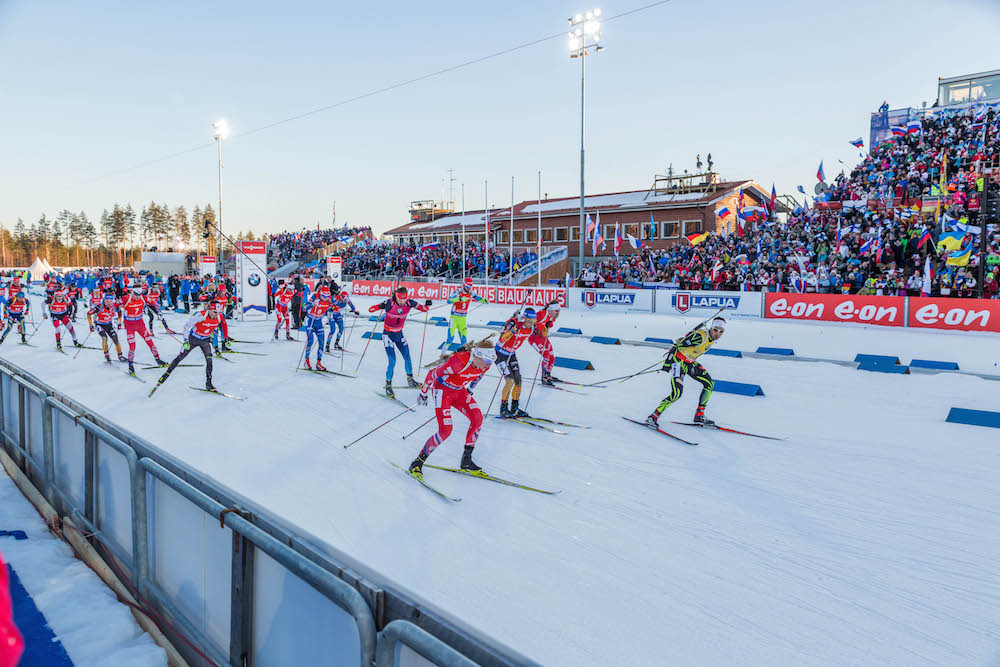
Start of the men’s 15 k mass start on Sunday at IBU World Championships in Kontiolahti, Finland, with Martin Fourcade (r) and Norway’s Johannes Thingnes Bø (l) leading and Canada’s Nathan Smith (behind Bø in red and white) near the front. Smith went on to miss two on the first shooting stage and one in the third stage to finish 23rd overall. (Photo: Kontiolahden Urheilijat/Kari Kuninkaanniemi)
KONTIOLAHTI, Finland — All four North American men in Sunday’s 15-kilometer mass start had moments from 2015 IBU World Championships they could hold onto, high points of the last week and a half they could drum up and replay in their minds.
Some were fresher than others. For American Lowell Bailey, it was cleaning every stage after a single miss on his first prone of the mass start, leading a chase group behind the leaders then tagging on to the main pack and finishing 35 seconds behind the winner in 13th — his best result of these World Championships.
For his teammate, Tim Burke, who finished 10.6 seconds behind him in 14th, it was racing hard on his second lap to catch the leaders, then hanging in and beating out Norway’s Emil Hegle Svendsen, who racked up two silver medals over the last week, in a photo finish. It was also Burke’s best result of the 2015 championships.
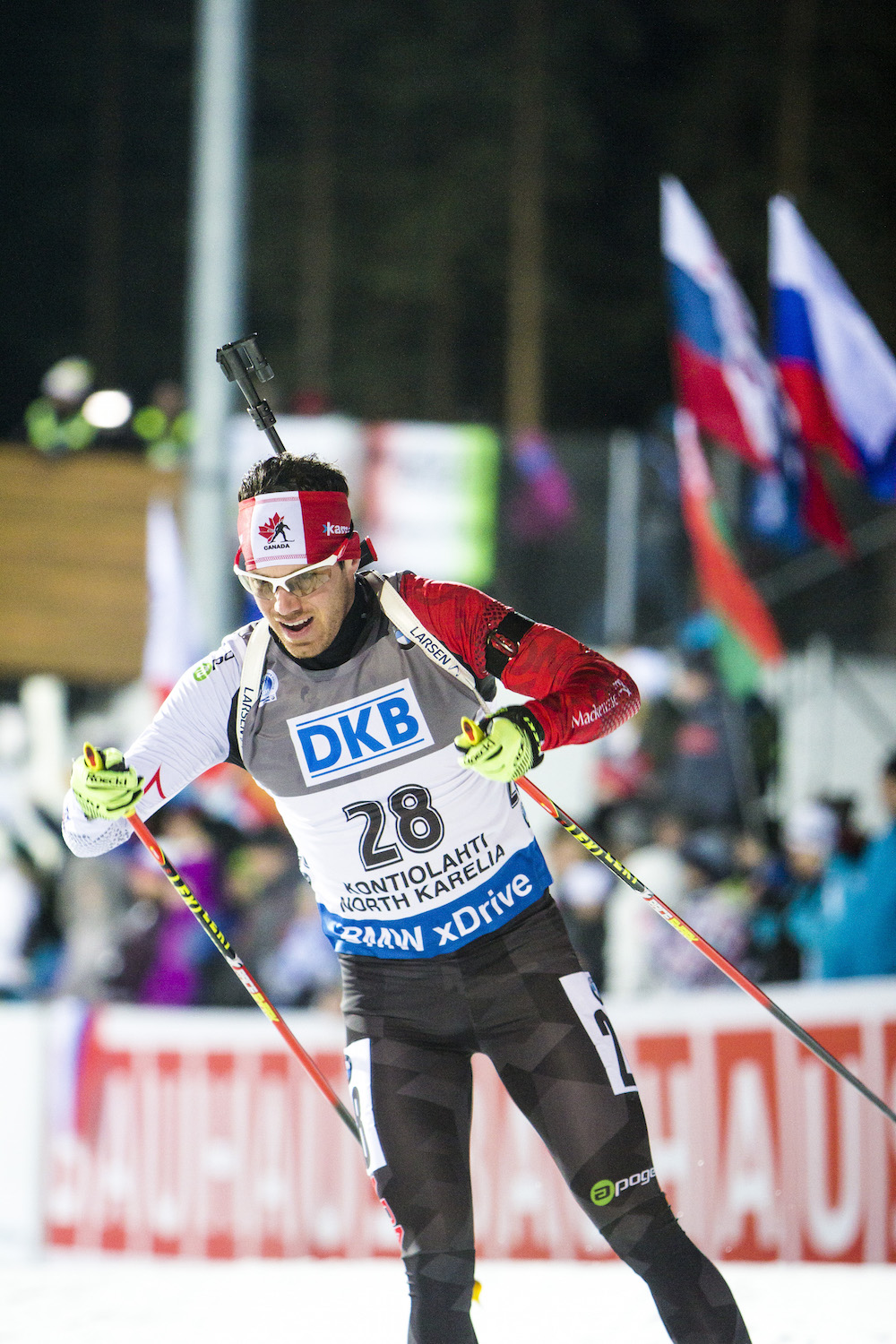
Canada’s Brendan Green experienced the sensations of skiing fifth on his second-to-last lap of the mass start after cleaning all three stages leading up to that point. While he fell behind over the next 2.5 k and missed one of his shots in the final standing for 19-for-20 shooting, that kind of shooting was still something he could be proud of. He also tallied his third 21st place in four individual races at worlds, and he placed 16th in the pursuit.
And his teammate, Nathan Smith had the physical evidence of a silver medal to remind him what he accomplished eight days earlier.
“It would be nice to have another race close to that level,” the 29-year-old Smith said after placing 23rd in the mass start with three penalties, two of which came in the first prone. He finished 1:19.4 behind Slovenia’s Jakov Fak, who won in 36:24.9.
On March 7, Smith became the first Canadian male biathlete to medal at World Championships. The next day, he placed 13th in the pursuit, and on Thursday, finished 44th in the 20 k individual. On Saturday, he hit all 10 of his targets as the second leg of the men’s relay to lift the Canadians from 22nd to 10th. They ended up 19th.
“I’d say my relay was close to that level, but I’m still pretty happy with how world champs went,” Smith said. “Before this, my best race ever at world champs was [43rd in 2012] so all my races have been better than that.”
Lowell Bailey (US Biathlon) en route to 13th in the men’s 15 k mass start for his best result of the 2015 IBU World Championships in Kontiolahti, Finland.
Bailey put himself in contention for what looked like a possible top 10 heading into his last lap on Sunday. After a single prone penalty put him back in 23rd, 26.4 seconds out of the lead, he rose to 11th after the last shooting without another miss all race.
“I was happy with my mental game today,” Bailey said. “I was able to stay with it and even in the last standing, while I was shooting, it was just, ‘I’m here, I’m shooting and I’m trying to do what I know how to do. The race is whatever it’ll be.’ ”
After the first prone, Bailey, Burke and Smith all slipped outside the top 20 with at least one miss (Smith had two). The top 20 men out of that stage cleaned, including Green in 16th.
“It’s a tough way to start off a mass start because that group of clean guys leaves and you’re left kind of at the back of the pack,” Bailey explained. “I just tried to regroup. I knew that it’s only one penalty, it’s a four-stage race, so I really just tried to … pace myself and stay in it so I had a little bit left on the last loop, which was good to have.”
Within 25 seconds of Norwegian race leader Ole Einar Bjørndalen heading into the last lap, Bailey initially dropped to 13th when Russia’s Evgeniy Garanichev and Svendsen passed him. He passed Svendsen back after the steepest climb and nearly caught Sweden’s Fredrik Lindström, finishing 0.3 seconds behind him in 13th.
“I’m happy, top 15 at world champs, it’s where I wanted to be,” Bailey, 33, said after his ninth World Championships. “This week’s been kind of up and down. I’m happy with my shooting and the relays [with eighth place in the mixed relay] were solid. Overall, there was no fireworks, but it was a solid week for me, especially considering where I came from. I wasn’t even in the points [at the World Cup] in Oslo. I was sick for the other World Cup before that.”
Burke, also 33 and in his ninth World Championships, was pleased with his second individual top 15 and third top 20 over the past eight days in Kontiolahti.
He explained he had to reset after Saturday’s relay, in which he used four spares and skied two penalty loops on the third leg to drop from eighth to 15th.
Tim Burke (US Biathlon) approaches the range during the men’s 15 k mass start on the last day of 2015 IBU World Championships in Kontiolahti, Finland. He went on to place 14th for his best result of the championships.
“It was tough to regroup after that,” Burke said. “I felt bad for the other guys because they did a great job, but I just wanted to refocus and try to have a solid race here today.”
Before the mass start, he decided he was going to take his time shooting and go back to the basics.
“I knew I was going to give away time on the shooting range, but I didn’t care,” Burke said. “Just try to go for each shot, one shot to the next. I felt a lot more comfortable doing that, and that combined with really good skiing today, I was very happy with how I felt. I was able to attack a lot.”
After an early prone penalty put him back in 26th, 32.1 seconds out of first, Burke pushed hard on his second lap to catch the 24-man lead pack and came into the range within 13 seconds of Norway’s Johannes Thingnes Bø up front.
“I just went out aggressive on the loop and halfway through, I realized that front group was taking it easy,” Burke recalled. “I saw I had an opportunity to catch back up, and any time you can do that, you have to do it.
“I definitely burned some matches on that second loop catching up,” he added. “Luckily, I shot clean in the second prone so I was able to get back in the group and take a breather for a loop.”
While taking it easy within the lead pack doesn’t usually happen, but Burke explained this race was unique.
“It was pretty crazy, the front group was just not going fast,” he said. “No one wanted to lead. There were 20 guys that came into the last shooting. I’ve never seen that.”
Out of the final stage, Bjørndalen emerged 1.6 seconds ahead in first, having cleaned all four stages. Fellow Norwegian Tarjei Bø cleaned the last shooting to head out in second, and Ondrej Moravec of the Czech Republic left the range in third, 3.4 seconds back. Also with a clean final standing, Fak was the fourth man to join that group, 4.1 seconds after Bjørndalen.
While the frontrunners battled for three podium spots, there was a 10-second gap to Germany’s Simon Schempp, who cleaned the last stage to move into fifth. France’s Simon Fourcade, Svendsen and Garanichev each missed one to fall back in the standings, from second to sixth for Fourcade, and 12th and 13th for Svendsen and Garanichev, respectively.
That’s where Bailey found himself in 11th, and Burke was 37.5 seconds back in 17th after two more penalties, one on each standing stage. Burke skied the sixth-fastest course time overall to finish 14th, just ahead of Svendsen in 15th and one-tenth of a second ahead of Germany’s Benedikt Doll in 16th.
“Overall, solid,” Burke said of his World Championships. “It’s better than what I’ve done so far this year so I have to be happy with that, but it’s not what I’m here for. It’s not what I think I’m capable of, but it’s a step in the right direction.”
Brendan Green (Biathlon Canada) racing the men’s 15 k mass start on the last day of 2015 IBU World Championships in Kontiolahti, Finland. While he skied up to fifth with clean shooting through the first three stages, he ended up 19th with a miss on the last stage and placed 21st.
With three flawless shooting stages, Green started his penultimate lap in fifth, 13.6 seconds behind Simon Fourcade, the leader at the time, and 6.4 seconds behind Moravec in fourth.
“That was pretty fun,” Green said of the race overall. “It was unreal how tight it was. I don’t think I’ve ever been in a mass start quite like that. It was fun to be in the mix. The skiing still isn’t quite there, but the saving grace was being in the pack of guys. I think that enabled me to dig a bit deeper and hurt a bit more.”
While skiing alone in fifth, the 28-year-old Canadian said the pace picked up considerably on that lap, which he expected. On the climb known as the “wall,” Green was 16 seconds back in 13th, just ahead of Burke.
“Lower down on the course I got caught by a group,” Green said. “I was able to kind of stay with them, but it was so tight. There was a big group of guys and I don’t think anything was really decided until that last standing.”
There, he missed one and dropped to 19th, 43.5 seconds out of the lead. Green finished 21st, 1:08.3 after the winner.
“I gave it my best today and it was working out pretty good until the last standing,” he said. “I have to be happy with the shooting today. It was a good race and it’s more experience under my belt for the future.
“All in all for the championships, I’m pretty happy with how I did,” Green added. “I wish my preparation could’ve been better and more as planned, but that’s the way it goes sometimes.”
Leading into the championships, Green had to rehab a back injury and spent some time away from skiing.
“Hopefully next year my form is a little better and I can keep the same shooting and improve upon these results,” he said.
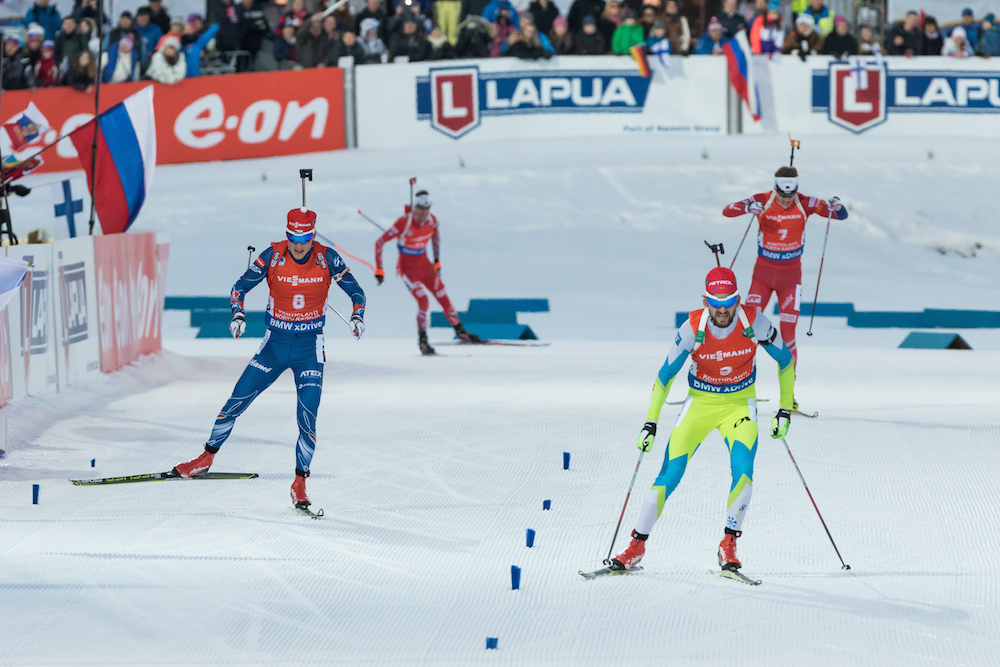
Slovenia’s Jakov Fak (r) attacked on the last lap and held off Ondrej Moravec of the Czech Republic (l), in second, and Norway’s Tarjei Bø (back r), in third, as well as Norway’s Ole Einar Bjørndalen (back l), in fourth, to win the men’s 15 k mass start on the last day of 2015 IBU World Championships in Kontiolahti, Finland. (Photo: Kontiolahden Urheilijat/Risto Kuittinen)
Fak Finally Gets His
As predicted, the race came down to the final shooting, and really, the last lap, where Fak took control. Without wasting much time, the Slovenian made a point to get in front of Moravec and the Norwegians, and by the top of the wall, he had successfully gapped Bjørndalen and Tarjei Bø.
“After the shooting, I saw that Ole Einar was in front of me,” Bø recalled in a press conference. “I turned around and saw these two guys [Moravec and Fak] and I knew the medals would be delivered out to three of the four. I was trying to go for the gold medal. Jakov increased the speed in the second last of the uphills. I tried to follow him and I did it almost as good as I was planning to, but in the last hill, he and Ondrej were too strong for me and Ole … there was no energy left.”
Moravec held on, but barely.
“I know how fast he is,” the Czech said of Fak, whom he has trained with for several summers. “He take a little bit advantage on the last uphill, so I say, ‘OK, you win,’ but I believe that I can take some medal in the end.”
The two sprinted toward the finish together, and Fak outlasted Moravec by a 1 second for his first medal of the week and second World Championships title.
“It was a very hard World Championships for me,” Fak explained in the conference. “When you look at the competition schedule before the World Championships, you see a lot of races, then when you are not satisfied with your competitions, you have less and less chance every day.
“Today was the last day,” he continued. “When I was standing on the start, I saw all the medal winners before me. I was the first with the number without the medal and I wanted to get it so much.”
He earned it ahead of not only Moravec, but also Bø, who medaled in five out of six races at 2015 worlds (excluding the 20 k individual). Bø finished 3.7 seconds back in third for his fourth bronze of the week. He also earned silver with the men’s relay on Friday.
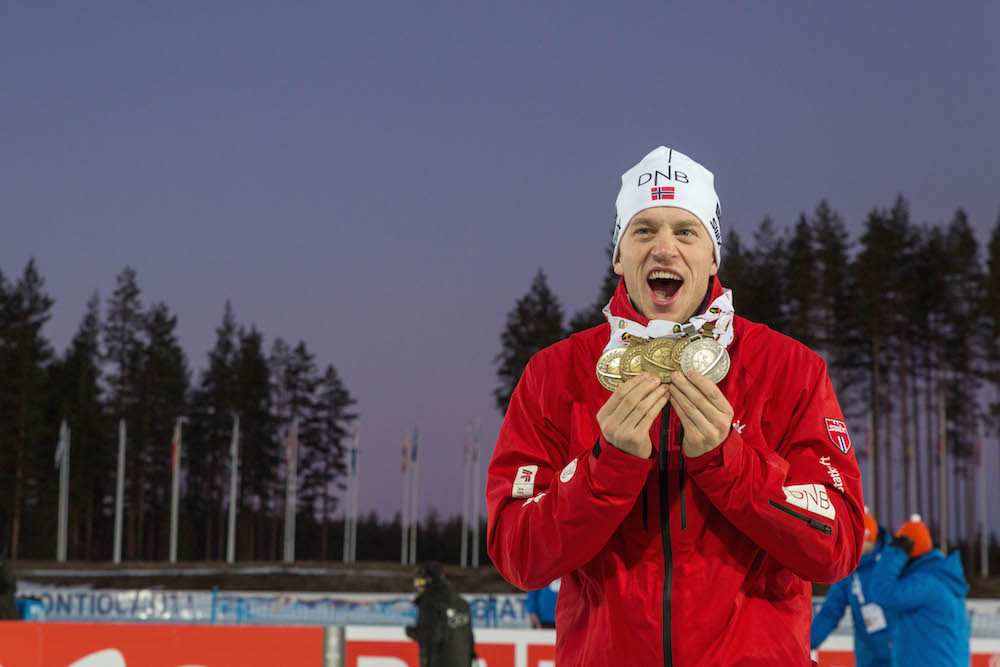
Norway’s Tarjei Bø with his five medals from 2015 IBU World Championships in Kontiolahti, Finland. He took bronze on Sunday in the men’s 15 k mass start, the final race. (Photo: Kontiolahden Urheilijat/Kari Kuninkaanniemi)
“In both Khanty-Mansiysk and Nove Mesto [World Championships], I took individual gold medal. I like that color better,” said Bø, a four-time world champion between 2011 and 2013. “But still with five medals, even if it’s not a gold medal, I’m so happy. It was a strange winter and even here, I’m not skiing as good as I’m hoping to do, but my shooting has been incredible.”
Fak, Moravec and Bø all shot 19-for-20, with Fak missing one in the third stage, Moravec missing one in the first prone, and Bø missing one in the third stage as well. Bjørndalen cleaned and ended up fourth, 10.2 seconds after Fak and 6.5 seconds off the podium.
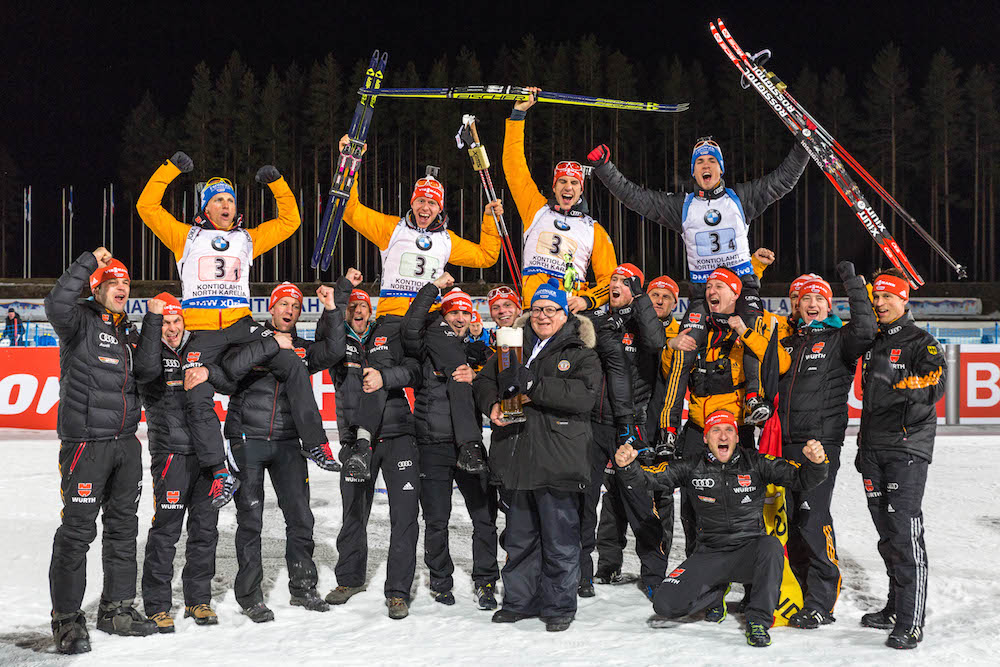
A happy German team celebrates its second win in two days of relays at 2015 IBU World Championships in Kontiolahti, Finland, with the men’s 4 x 7.5 k victory on Saturday. Above, from left to right: Erik Lesser, Daniel Böhm, Arnd Peiffer, and Simon Schempp. (Photo: Kontiolahden Urheilijat/Kari Kuninkaanniemi)
KONTIOLAHTI, Finland — After more than a week of waiting, Simon Schempp could finally enjoy the 2015 IBU World Championships in Kontiolahti, specifically the last two hundred meters of the men’s 4 x 7.5-kilometer relay and everything that came after that.
Schempp, 27, had been given the task of anchoring the German team on Saturday, and after two races in which he failed to medal (including his 77th place in the sprint), it seemed like a tall order.
But Schempp spent much of this season ranked second overall in the IBU World Cup, so he simply needed to restore his confidence back to its pre-World Championships level. He did so in Thursday’s 20 k individual, placing eighth.
“I caught the self confidence for today and was prepared for this relay,” he explained in press conference after Saturday’s relay.
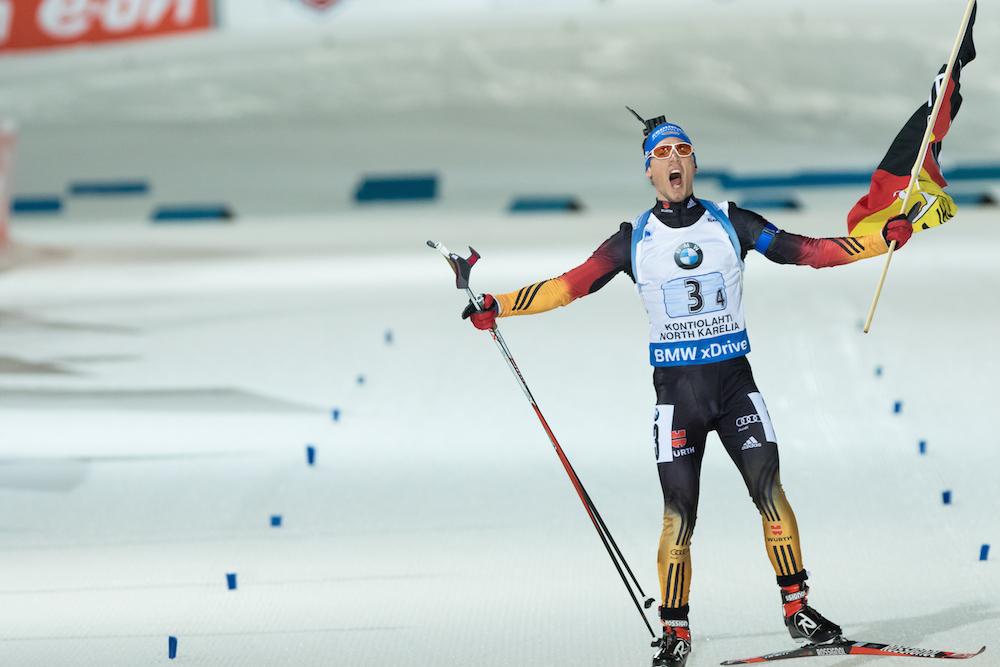
Germany’s Simon Schempp soaks up his team’s victory after anchoring the men’s relay to gold on Saturday at 2015 IBU World Championships in Kontiolahti, Finland. (Photo: Kontiolahden Urheilijat/Risto Kuittinen)
Things were better then — he had secured a 15.4-second victory for his team, matching the gold the German women won in the 4 x 6 k relay the day before.
His teammate Arnd Pfeiffer shot a perfect 10-for-10 on the third leg to tag him in first at the final exchange, 15.3 seconds ahead of Norway. Schempp proceeded to clean prone without any need for spares then used a single spare in standing to leave the range for the last time 15 seconds ahead of Emil Hegle Svendsen in second.
Svendsen also shot clean on his first stage and used a spare in standing to neither make up nor lose ground to Schempp, which he tried to change on the last lap. Meanwhile, French anchor Martin Fourcade went from fifth (behind the Czech Republic and Slovenia) to fourth on his first lap and used one spare to emerge from prone in third, 41.6 seconds out of first and 28.3 seconds from second.
The next time and final time around, Fourcade rattled off five quick shots to clean standing with the second-fastest range time. He remained in third, but within 25.6 seconds of Schempp and 10.6 of Svendsen.
Considering that, Svendsen had to think about defending silver and pressing for gold simultaneously on his last 2.5 k loop.
“I just tried to ski fast and didn’t look much behind,” Svendsen said in the press conference. “I tried to catch Simon, but had no chance.”
After being cheered on by his teammates while leaving the range, Schempp extended his gap to 19 seconds a kilometer into the final lap, then 20.9 seconds less than a kilometer later.
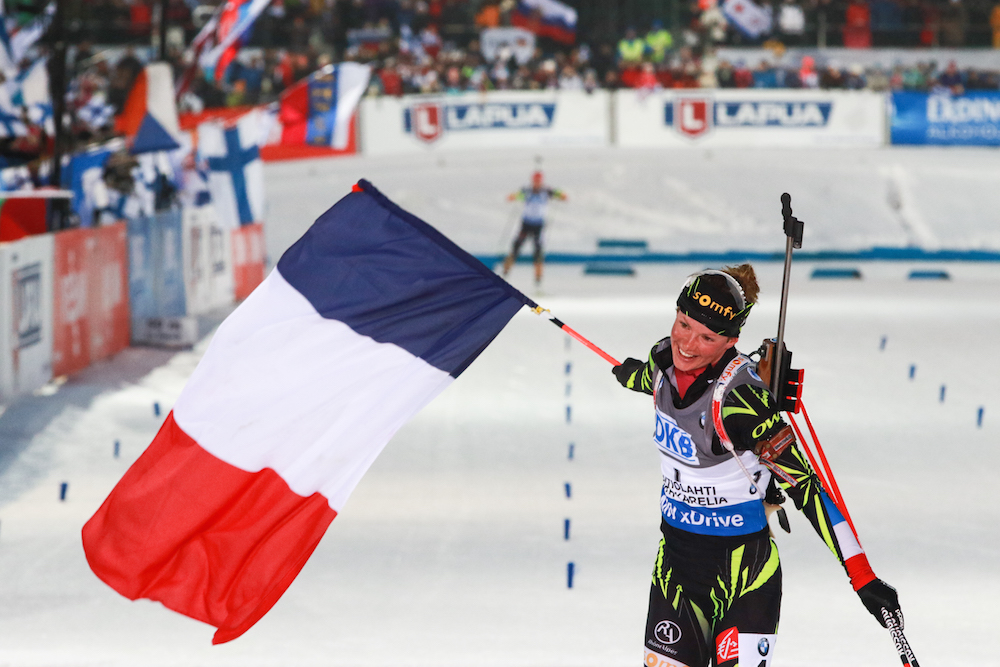
He finished 15.4 seconds ahead of Svendsen, taking the time to enjoy the finishing stretch while carrying the German flag.
“Only the last two-hundred meters I could enjoy because before, I gave all I have,” Schempp said. “I’m really happy and proud to be a part of this team.”
The Germans achieved gold with first and second skiers, Erik Lesser, who won the pursuit last Sunday, and Daniel Böhm, who opened the championships in sixth with the mixed relay.
Lesser hit all 10 of his targets without any problems to hand off in third, 6.4 seconds behind Norway’s Ole Einar Bjørndalen, who also cleaned to take the lead, and France’s Simon Fourcade, who cleaned as well to trail in second.
“I think all the team was determined to get a medal today,” Simon Fourcade said in the conference. In the last week, he placed fourth in both the sprint and 20 k individual.
“I know the relay is not only about me; I wanted to do my best on the first leg to give the best position to [my teammates],” he added.
During the second leg, Norway dropped to fifth with three standing spares from Tarjei Bø. Jean-Guillaume Béatrix used one spare in each stage to bring France into first by the second exchange, 0.7 seconds ahead of Italy and 3.1 seconds ahead of Böhm — who used two standing spares to keep Germany in third.
“Today, I felt a lot of tension in our team. Everybody wanted to have this victory,” Böhm recalled. “Watching the two others after me was harder than skiing.”
“I felt a lot of tension in our team. Everybody wanted to have this victory. Watching the two others after me was harder than skiing.” — Daniel Böhm, Germany’s second leg on its gold-medal winning relay
Just over a year ago, the German men took silver in the 2014 Olympic relay behind Russia. They had the same team and same order.
“I was very nervous today, even more nervous before the individual races,” Peiffer said.
Johannes Thingnes Bø of Norway leads Germany’s Arnd Peiffer up and over the wall during the third leg of the men’s 4 x 7.5 k relay at 2015 IBU World Championships in Kontiolahti, Finland. Germany went on to win gold and Norway took silver ahead of France. (Photo: Kontiolahden Urheilijat/Janina Joutsen)
He took the lead with a flawless prone, leaving the range 2 seconds ahead of Norway’s Johannes Thingnes Bø, who also cleaned. Bø passed him early in the lap and the two skied together into the range for standing. There, Peiffer cleaned again and Bø used a spare, which made the difference.
“I knew that I was together with Johannes and it was going to be a hard last lap so I tried to save some energy and tried to [have a] good standing shooting,” Peiffer explained.
He left the range 13.3 seconds ahead of Bø, and the Czech Republic’s Michal Slesinger moved into second during that last lap of the third leg, coming within 14 seconds of Peiffer. Bø passed Slesinger back before the exchange, and the Czech tagged in third — one tenth of a second behind Norway.
With Ondrej Moravec skiing the last leg, the Czech Republic slipped to fourth with his three prone spares. Russia’s Anton Shipulin and Austria’s Dominik Landertinger both hit every standing target without any slipups to overtake Moravec before the final lap. The Czech fell to sixth, where he would end up at the finish, behind Russia in fourth and Austria in fifth.
While Germany won in 1:13.49.5 and Norway was 15.4 seconds back in second, Fourcade pushed hard on the last lap aim for silver, but came up 18.2 seconds short in third.
“I was really happy to conclude what the team did,” Fourcade said in the conference. “Jean-Guillaume and Simon [Fourcade] were perfect on the track and on the shooting range. I think we had a bit more pressure, but we are really satisfied with this third place.”
Bailey Surges for Early Lead
AmericanLowell Bailey thrust himself into the spotlight as the first skier for the U.S., taking the lead 1.8 k in and holding it as he and the 27-team field approached the range for the first time.
Lowell Bailey (US Biathlon) led early as the first leg in the men’s 4 x 7.5 k relay at 2015 IBU World Championships and ultimately handed off in seventh. The U.S. ended up 14th with two penalties and 11 spares in Kontiolahti, Finland. (Photo: USBA/NordicFocus)
Perhaps even more impressive was the fact that Bailey started near the back of the pack in the seventh of nine rows.
While the start was congested from his vantage point, Bailey explained he was able to use his fast skis and an eye for an opening before the first descent to move toward the front. By the first uphill, he found himself around fourth.
“Then I got to the front, and I think [Austria’s Daniel] Mesotitsch was trying to slow things down,” Bailey said. “On the wall, I just figured there’s no real advantage in this range to go in third or fourth. Normally it can be, but in this range, being in first is fine.
“I was just going my own pace and I wasn’t sure where that would end up, but I figured there can’t be any harm in going to the front and staying up there,” he added. “No one wanted to pass and that was fine with me.”
During that prone stage, Bailey cleaned without any spares and left the range in sixth, 3.6 seconds out of first. The following lap, he pushed the pace once again on the “wall,” the course’s biggest climb, to move into second behind Mesotitsch.
American Lowell Bailey (r) enters the range for prone with race leaders Daniel Mesotitsch of Austria (second from r), France’s Simon Fourcade (second from l), and Norway’s Ole Einar Bjørndalen (l) during the men’s 4 x 7.5 k relay at 2015 IBU World Championships in Kontiolahti, Finland.
Bailey entered the standing stage with the leaders, where he used two spares to clean standing and slipped to ninth, nearly 23 seconds out of first. He went on hand off to teammate Leif Nordgren in seventh, 30.3 seconds back.
“I lost contact with that lead group, but all in all, I was pretty happy with it,” Bailey said of his race. “Using two extras, that’s an extra 20 seconds, but what we want to do today is, if we all can perform at our normal capacity, then I think we can have a solid result. It’s not like all four of us have to shoot the moon. We all have to have good, solid days.”
On a good day, the U.S. would finish with less than eight spares, he said. Even better would be if they ended up with six.
“It’s not like all four of us have to shoot the moon. We all have to have good, solid days.” — Lowell Bailey (US Biathlon)
Despite Nordgren keeping the team in contention, using one spare in each round and tagging Tim Burke in eighth at the second exchange, the Americans ended up with more extras and penalties than they’d hoped.
Burke used one spare in prone then all three in standing before skiing two penalty laps. When Nordgren tagged him in eighth, Burke had been 34.7 seconds out of first. By the time he handed off to anchor Sean Doherty, the U.S. was 2:22 back in 15th.
Leif Nordgren (US Biathlon) leads Jaroslav Soukup (Czech Republic) while skiing the second leg for the U.S. men’s relay team at 2015 IBU World Championships in Kontiolahti, Finland. After receiving the tag from Lowell Bailey in seventh, Nordgren handed off to Tim Burke in eighth. (Photo: USBA/NordicFocus)
“Standing, I bobbled the spare a little bit … it was probably an extra second or two,” Nordgren explained of his second leg. “I came back again with one extra and pushed as hard as I could the last loop. In the relay, you just have to do what you can, and hopefully it comes together [for] all four of us.”
Doherty used all three spares during prone, but escaped without a penalty to hold onto 15th. In standing, he hit every target without any extras to move into 14th.
He finished 14th, 3:31.6 behind Germany and 6.5 seconds after Finland in 13th. In all, the Americans had two penalties and 11 spares.
“I stared pretty hard and I paid for it in prone,” Doherty said. “I had a good skiing day today and course is in good shape, so it was fun, but it was tough to be out of the mix a little bit.”
Earlier this season, Doherty, 19, skied the second leg on the U.S. men’s relay, which placed eighth at the World Cup in Antholz, Italy. Before that, he was the third leg on the team that placed 16th at the 2014 Olympics.
In terms of what it felt like to anchor his first World Championships relay, Doherty said he didn’t read too much into the start order.
“It’s a compliment in a way if they think I’m mature enough as an athlete to handle that role well,” he said. “It wasn’t the same pressure as if we were fighting for the medals, but still, I’m not gonna want to miss.”
Christian Gow Gets Up Front, Smith Shoots 10-for-10
Starting Saturday’s race off for Canada, Christian Gow started in the second row in bib 6 and moved into fifth by 1.8 k. Following Bailey, he entered prone in the lead pack, around seventh.
Christian Gow (Biathlon Canada) approaches the range for his standing stage during the men’s 7.5 k relay at 2015 IBU World Championships in Kontiolahti, Finland.
“I thought quite a bit about the start of this race and just the way the course flows,” Gow, 21, explained.
He wanted to avoid the accordion stop-and-go effect of being near the back before short pitches and any crashes on a particularly icy downhill corner.
“I knew I wanted to be right with the top guys,” Gow said. “I knew that was totally possible. I had a blast on that first loop. … It felt so easy to just stay right at the front. That’s an amazing feeling. I know it doesn’t mean much, per say, but to be able to ski with some of my idols and just feel so relaxed, like really feel like I belong in that group, the relays are for sure my favorite for that. It’s such a great experience and so much fun.”
In prone, he used two spares to drop to 24th, 27.5 seconds out of first. He moved back into 23rd heading into the range for standing, before using another extra there and heading into his last lap in 22nd.
“I’m really happy with what I did skiing,” Gow said. “I finally felt strong on skis, but my shooting wasn’t quite there. I think I was pretty nervous coming in just so far up. I don’t think I was quite as settled as I should have been.”
Gow tagged teammate Nathan Smith in 22nd, 1:20 back. Smith proceeded to shoot a perfect 10-for-10 with the fastest shooting and fourth-fastest course times of the second leg to bring the Canadians to 10th.
“It was actually a really good race for me, my second best race here,” said Smith, who earned silver in the sprint last weekend. “I skied pretty relaxed. It was pretty icy, though, so my shins were hurting by the last lap. If I can do a race like today again tomorrow [in the mass start], it will be a really good result.”
In terms of team goals, he said their “middle goal” was a top eight, “really good would have been top six.” At the last World Cup relay in Oslo, Norway, the Canadian men placed fifth with the same lineup. They were seventh at the Olympics with Jean-Phillipe Le Guellec, Scott Perras, Brendan Green, and Smith as the anchor.
“It’s so fast right now that if you have a few spares, it puts you way back, more than normal,” Smith explained of Saturday’s boilerplate conditions.
After he tagged Scott Gow in 10th, 44.8 seconds behind the leaders, Gow used all three spares and had two penalty loops in prone to fall to 19th, 2:11.1 out of first.
“The whole race wasn’t very good,” Scott Gow said. “I felt good going into today, but I was gassed the whole time and then prone was really bad, I have no idea what happened there.”
In standing, he used two more spares but remained in 19th, 3 minutes back, before tagging Green in the same position, 3:48.5 behind.
“[I] was so far back that they only thing I could try to do was to ski hard and try to make up as much time as possible. It couldn’t get any worse so it was worth just going for it,” Scott said.
“We came in fifth in Oslo, we’ve had sixth places, top tens before, so I think the expectation was if everyone pulled their own weight and put in little bit extra in the range, that we could walk away with a top eight and maybe another fifth place would be great,” he added. “It’s a little disappointing to not even be close.”
Receiving the tag 40 seconds behind Sweden, which was 18th, Green said he raced hard for a couple laps to see if he could catch its anchor, Ted Armgren, but he was too far ahead.
Green cleaned prone and used one standing spare to maintain 19th and avoid being lapped, which happened to Poland in 20th as well as seven other teams behind them.
“On the last loop, the techs told me I had a cushion so I was able to relax and kind of coast it home,” Green said after finishing 19th, 5:03.4 behind Germany.
In all, the Canadians had two penalties and nine spares.
“Today definitely didn’t turn out the way were hoping, but the guys tried their best,” Green said. “It happens from time to time. It’s always unfortunate when it’s at World Championships, but you’ve got to roll with the punches, I guess.”
He said his solid-shooting streak was a good indicator for Sunday’s mass start, which he qualified for along with Smith for Canada, and Burke and Bailey for the U.S.
“I’m definitely a little tired. Tomorrow will be the sixth race [here], but I’m definitely excited at the opportunity,” Green said. “Mass starts are always a lot of fun and pretty tense, so looking forward to it.”
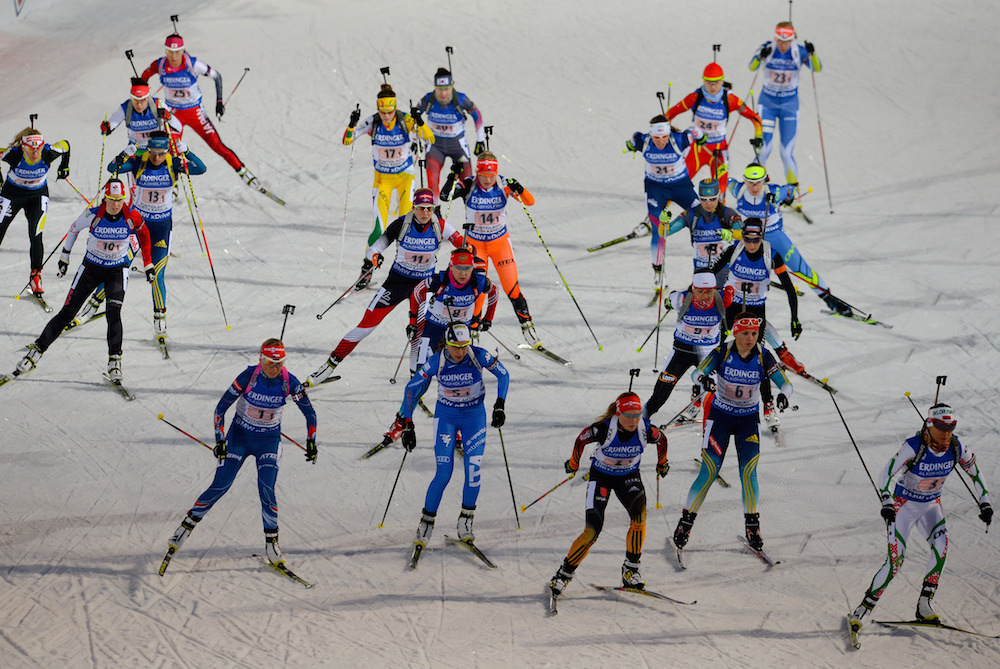
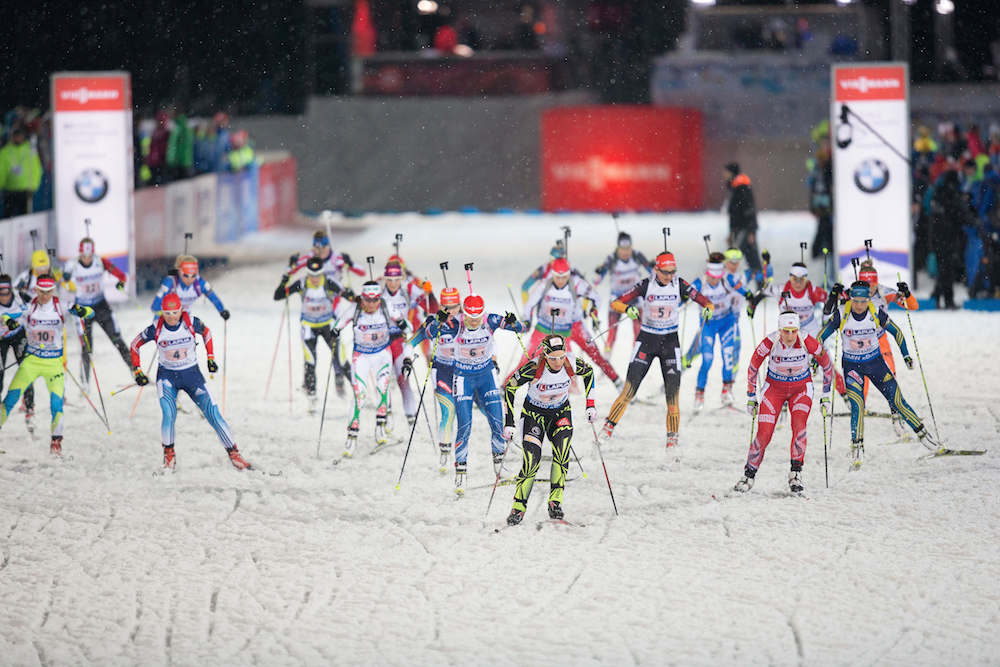
The start of the women’s 4 x 6 k relay at 2015 IBU World Championships on Friday in Kontiolahti, Finland, with Germany’s Franziska Hildebrand (4) near the front with Belarusian Nadezhda Skardino (3), Canada’s Megan Heinicke (10) at left, and American Susan Dunklee (21) near the back right. (Photo: USBA/NordicFocus)
KONTIOLAHTI, Finland — Not long after finishing the women’s 4 x 6-kilometer relay at 2015 IBU World Championships, Laura Dahlmeier sprinted past reporters to jump into the arms of one of her teammates, her rifle still attached to her back.
A German sports broadcaster employee quickly ushered the 21-year-old Dahlmeier and her three teammates to the Sportschau platform overlooking the stadium where they had just destroyed the 25-team field.
In the minutes before, Dahlmeier built on a 30-second lead her teammate Vanessa Hinz established on the third leg to anchor Germany to a 1:00.3-minute win. Hinz had used just one spare in prone to clean both her stages and skied the second-fastest third leg to leap from third into first — and considerably ahead of anyone else.
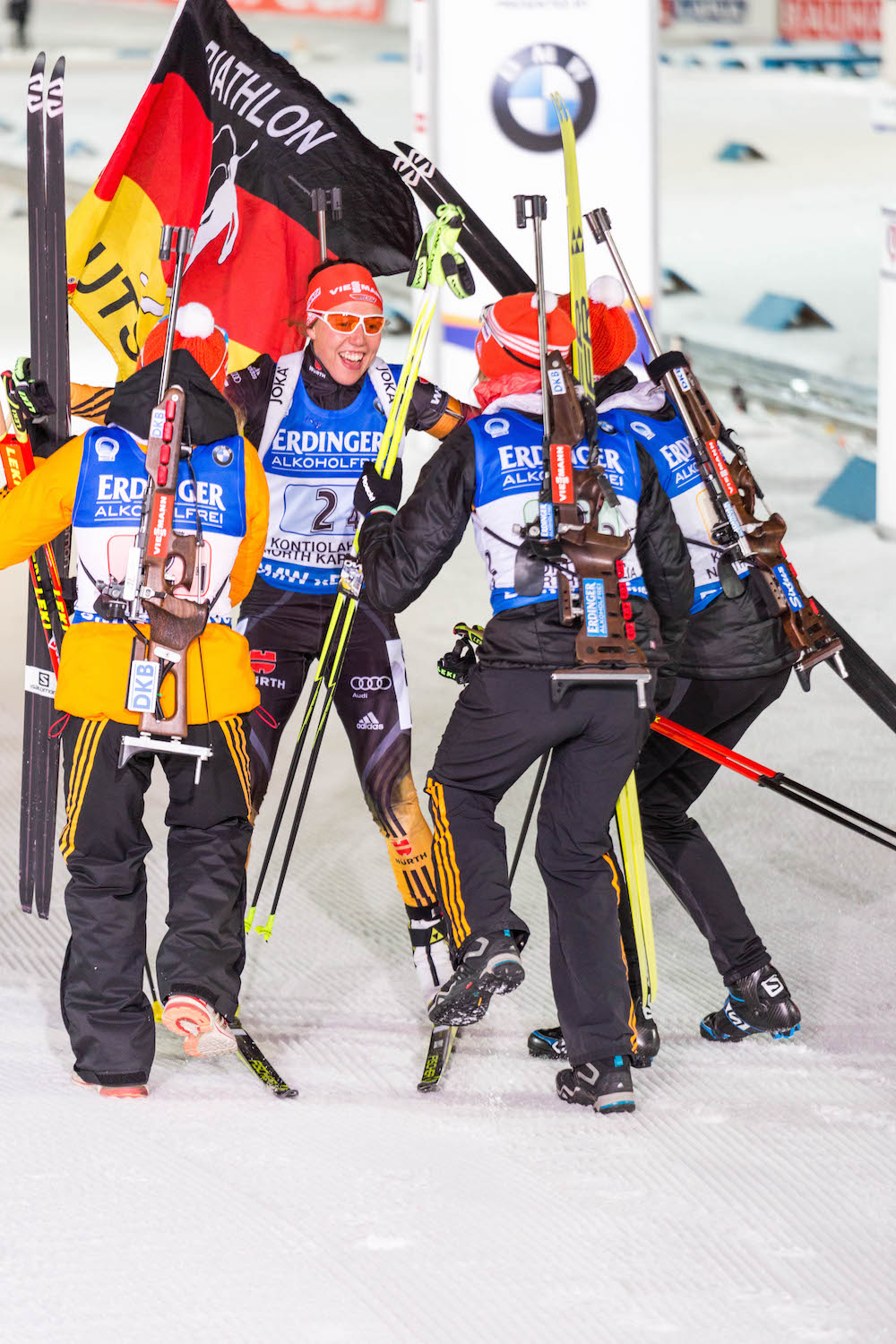
The German women’s relay rushes the finish line to greet anchor Laura Dahlmeier, who secured their win by more than a minute over France in the 4 x 6 k relay at 2015 IBU World Championships in Kontiolahti, Finland. The German team included Franziska Hildebrand, Franziska Preuss and Vanessa Hinz. (Photo: Kontiolahden Urheilijat/Kari Kuninkaanniemi)
With Franziska Hildebrand and Franziska Preuss skiing first and second, respectively, the Germans combined to secure gold ahead of France in second and Italy another 5.8 seconds back in third.
“I think it was a dream of all of ours to be world champion and now the dream is true,” Dahlmeier said in a press conference after her team used six total spares and avoided any penalties for the win in 1:11.54.6.
France, with Anais Bescond, Enora Latuilliere, Justine Braisaz, and Marie Dorin Habert (the latter of which had already won two golds at these world championships), had nine spares and one penalty from Braisaz on the third leg. Habert lifted them from fourth and 1:18.8 behind Germany to silver — her fourth medal in as many races in Kontiolahti, including silver in the mixed relay — using two spares in prone and none to clean standing.
The Italians, with Lisa Vittozzi, Karin Oberhofer, Nicole Gontier, and Dorothea Wierer, led through the second exchange after Oberhofer elevated them from fourth to first with four total spares and the fastest course time of the second leg. Gontier started out 2.5 seconds ahead of Czech Republic, but slipped to third after using two spares on each of her stages.
“I’m not so in shape now and I have to thank my teammates, they are so strong,” Gontier said in the press conference.
She tagged Wierer in third, behind Germany and Russia, respectively. Habert and Wierer both overtook Russia’s anchor Ekaterina Shumilova in the final stage, where Shumilova used two spares, Habert cleaned, and Wierer used one. Wierer left the range in third, 0.6 seconds behind Habert and about 10 seconds ahead of Shumilova in fourth.
“I was so worried about the Russian girl and I thought, ‘I don’t want fourth position,’ ” Wierer said. “I really give all for the team, but I was really, really nervous.”
The team that didn’t lack confidence was Germany, with three women under the age of 23 (Hildebrand is the oldest at 27).
“We are a young team and a strong team and it’s a perfect day for us,” Dahlmeier said after cleaning both her stages to tally her second World Championships medal (following her individual silver in last weekend’s pursuit).
“We are the best team,” she told Sportschau.
Russia, with Ekaterina Glazyrina, Daria Virolaynen, 15 k individual gold medalist Ekaterina Yurlova, and Shumilova, finished 10.7 seconds off the podium in fourth. Norway placed sixth, Ukraine was sixth, Belarus took seventh, and the season-long relay favorites, the Czech Republic (which won the mixed relay) finished eighth, 3:11.7 behind the winners.
The Czechs came through the first exchange in 12th after Eva Puskarcikova’s first leg, 26.4 seconds out of first, and Gabriela Soukalova lifted them to second, 2.5 seconds back. They fell to eighth during Jitka Landova’s third leg, in which she had a standing penalty and six spares. Anchor Veronika Vitkova used three spares and had two penalty laps in prone, then went on to clean standing before finishing eighth.
Canada 10th, U.S. 12th
While the Germans drew a significant amount of attention with their win, two North American squads stood together near the finish, cheering their teammates on with each passing lap before waiting to congratulate their anchors as well.
Rosanna Crawford (Biathlon Canada) racing the second leg in the women’s 4 x 6 k relay at 2015 IBU World Championships in Kontiolahti, Finland. Despite a penalty, she brought her team from 14th to 11th, and the Canadians finished 10th. (Photo: Biathlon Canada/NordicFocus)
Canada’s second leg, Rosanna Crawford was one of them, standing near the finish and looking for her teammate Julia Ransom, who had anchored their team to 10th.
Audrey Vaillancourt had tagged Ransom in 10th, improving one place after Crawford put her in 11th at the second exchange. Ransom, a 22-year-old World Championships rookie, used two spares on each of her stages to help the team meet its personal goal: a top 10.
She held off Austria’s Katharina Innerhofer by 0.5 seconds to finish 10th, 3:39.5 behind Germany. In total, the Canadians used 10 spares and had one penalty (which came on Crawford’s standing stage).
“Megan [Heinicke] tagged me off into a great spot, [and I] came in prone … with the group,” Crawford explained.
She had entered her first stage around 12th after Heinicke tagged her in 14th, 33.8 seconds out of the lead. (The team’s first leg, Heinicke used a single prone spare and cleaned standing.) Crawford cleaned prone, then went on to use three spares in standing while trying avoid the penalty loop, which she ultimately had to ski around once.
“Standing, I came in and missed my middle shot and loaded my first spare quickly and missed,” Crawford explained. “As I loaded my last spare, I took my rifle down and shook my legs out and missed.”
Not only did the penalty loop cost her, but the three spares, which she estimated takes her six to 10 seconds to load apiece, set her back as well. Regardless, Crawford skied the sixth-fastest second leg to tag Vaillancourt in 11th, 1:08.6 behind the leader.
Audrey Vaillancourt (Biathlon Canada) during prone shooting earlier this week at 2015 IBU World Championships in Kontiolahti, Finland. She was the third leg of the Canadian women’s relay that finished 10th on Friday. (Photo: Biathlon Canada/NordicFocus)
Vaillancourt, 23, went on to use two prone spares and cleaned standing outright to bring the team to 10th, 1:45.3 out of first.
“I didn’t really know what place I was in at any time, it was just good to always have a pack of people [around me],” Vaillancourt said. “I passed people in the standing so that felt awesome. It’s always such a good feeling, like, ‘Yeah!’ … I was a little tired on the last lap, but I’m happy.”
Ransom used two spares in prone, rising to ninth, and then two more in standing to drop one spot to 10th.
“I saw eight and ninth ahead of me on the climbs,” she recalled. “You’re just gunning for those and didn’t look back.”
In her first World Championships relay, Ransom said she was “terrified” to anchor, “mainly because I saw the start list and saw a lot of medalists hanging out in the fourth [leg] with me.
“In zero I was pretty nervous, but you quickly fall back into race mode,” she added. “Even though you start with [Belarusian Darya] Domracheva, you put it aside. Once I was on the track and I could feel like I could ski like myself it was fun and I loved it.”
Rosanna Crawford (Biathlon Canada) trails Nadzeya Pisareva of Belarus during the second leg of the women’s 4 x 6 k relay at 2015 IBU World Championships in Kontiolahti, Finland. The Canadians went on to place 10th. (Photo: Biathlon Canada/NordicFocus)
Overall, the Canadians were pleased with their performance, with two relative newcomers on the team. While it’s Vaillancourt’s second World Championships, this season was her first full time on the World Cup.
“[Last night], we talked about that if we all bring our A-game, a top 10 is realistic and a top eight would be the perfect race,” Crawford said.
“I don’t think that we can say that we had a perfect performance as a team today, so I think that makes it even more awesome that we made our goal,” Heinicke said. “We have been mixing up our relays a ton this year. This is only the second time us four have raced together and we have never had this order. Lots of experiment; it’s been good.”
Dunklee Fastest First Leg
The Americans tied their season best in 12th, with Susan Dunklee, Hannah Dreissigacker, Annelies Cook, and Clare Egan. Despite starting in the seventh of nine rows at the start, Dunklee skied the fastest course time of all the first legs to put her team in third, 3.7 seconds behind Poland, which led through the first exchange.
“I almost prefer starting in one of the back rows,” Dunklee explained in an email after the race. “I love the rush of having to maneuver through the pack and chase people down. It just feels like a really fun game. It helps a lot that my fitness is in peak form right now, and the course suits my strengths with that big wall climb.”
Susan Dunklee (US Biathlon) follows Germany’s Franziska Hildebrand (r) into range for the first shooting in the women’s 4 x 6 k relay at 2015 IBU World Championships in Kontiolahti, Finland. Germany went on to win, and the Americans placed 12th to match their season best.
By the 1.3 k checkpoint, Dunklee had skied up to second behind Hildebrand.
“I don’t know how Susan just careened to the front of the pack like that,” Heinicke observed. “It was pretty impressive. I was in the second half and it was the most aggressive mass start I have ever been in, so much bumping and ski stepping and poles. It was a little bit chaotic and also exciting.”
Dunklee held her position in second entering the range for the first time, where she used two spares and had some trouble unhooking her sling from her arm. Dunklee left the range in 21st, 26.5 seconds behind Hildebrand, who cleaned without any spares.
The American spent the next lap skiing up to 12th before cleaning her standing stage to improve to seventh. Poland’s Monika Hojnisz cleaned her second-straight stage without any spares to take the lead, 2.4 seconds ahead of Russia.
Meanwhile, Dunklee left the range 14 seconds back in seventh. Over the next lap, she skied back up to third, tagging Dreissigacker 3.7 seconds out of the lead.
“I’m getting used to that; I expect Susan to hand off to me in the top five at least,” Dreissigacker said. “I should be getting better at it, and I still seem to be struggling with get being put in that position. I think I’ve always liked being one of the chasers not one of the chased.”
Coming into the range for the first time, Dreissigacker was fourth behind Poland, Italy and Russia, respectively. There, she had to use three spares to hit all of her targets.
“I kind of pulled off two shots accidentally, just way too fast with the trigger,” Dreissigacker explained. “I think I was a little excited, my fingers had gone a little bit number for some reason. … Using the third spare is always really bittersweet. You’re bummed that you had to use three, but you’re always so happy you hit that last one and didn’t do a penalty loop.”
Hannah Dreissigacker (US Biathlon) skied the second leg for the U.S. in the women’s 4 x 6 k relay at 2015 IBU World Championships in Kontiolahti, Finland. After receiving the tag from teammate Susan Dunklee in third, she came through the second exchange in 10th. The Americans finished 12th. (Photo: USBA/NordicFocus)
She left the range in 11th, 37 seconds behind Russia up front. In standing, Dreissigacker used two spares to head out for her final lap in 10th.
“Hoping that one of these days I can use not quite so many spares,” she said.
Dreissigacker tagged Cook in 10th, 1:06 out of the lead. Cook used two spares in each stage to hand off to Egan in 11th, 2:05.4 back.
“That is not like awesome shooting, but I think we all had a little bit of the nightmare of the last relay, where we had six penalty loops, in the back of our head,” Cook said, referring to the last World Cup relay in Oslo, Norway, where the Americans were in 18th before being lapped. “So we were all kind of like, ‘OK! I’m really happy that didn’t happen again!’ I felt really good skiing and it was fun. I felt like I was in the mix, which is exciting.”
In terms of team goals, she said they didn’t target a specific place.
“We didn’t do that many relays this year [and] we’ve got some new faces,” Cook said. “I think for us, it is just about getting experience … We have had a pretty steady relay team the last few years so now we are kind of rebuilding that up. Today we just wanted to have fun and to feel like after the race, we would all be in good moods and happy.”
In her first World Championships, Egan anchored the U.S. to 12th, 3:44.8 behind Germany and 0.8 seconds out of 11th. The 27-year-old US Biathlon development skier cleaned her first stage to move into eighth after prone, then used three standing spares, which put her back in 13th.
“I wish I had just used two [spares] because we would have been 10th instead of 12th,” Egan said, estimating it takes her about 20 seconds to load each spare. “That is my only regret. I got really close … I passed one person and I finished within a second [of 11th].
“This is my first relay that I have not had two penalty laps in standing. So big improvement for me,” she added. “I just tried to ski my own race and remember that I am always trying to gain experience.”
At the end of the day, Dunklee pointed out that 12th matched their best result of the season.
“It certainly wasn’t a perfect performance and there were several teams within reach ahead of us. I think it is good to be hungry for a higher place and know the possibility is there, but this was also result we can finish the season feeling proud of,” she wrote.
A relieved Martin Fourcade of France crosses the line in first in Thursday’s 20 k individual at the 2015 IBU World Championships, 20.9 seconds faster than Norway’s Emil Hegle Svendsen to win his first medal of the championships in 47:29.4 in Kontiolahti, Finland. (Photo: Kontiolahden Urheilijat/Kaisa Kontiainen)
KONTIOLAHTI, Finland — Approaching the final shooting of Thursday’s 20-kilometer individual race at IBU World Championships, about eight seconds out of first, Martin Fourcade knew there was only one thing to do: hit every target.
But he didn’t overthink it. In fact, the 26-year-old Frenchman said he was on “automatic pilot” for that final standing stage. With the third-fastest range time for that bout, he ripped off five shots and knocked down each one. Fourcade took the lead, 3.5 seconds ahead of Norway’s Emil Hegle Svendsen, who started 8 1/2 minutes before him. Then he tore into his final 4 k lap.
“I was really focused and I was looking straight at my coach because I wanted to feel the confidence in the eyes,” Fourcade said in a post-race press conference.
He had made all but one shot leading up to that point, missing one on his first standing. There, Fourcade in bib 34 of 127, slipped from first to ninth overall, 34 seconds behind Norway’s Johannes Thingnes Bø in first. From then on, Fourcade clawed back into contention for his first individual medal of the 2015 World Championships.
“I thought this morning that I won seven of my last 10 individual races in the World Cup so that means that’s a good competition for me,” he said of the 20 k. “But I also have to remember that I was 84th in the [individual at the] opening of the season in Östersund. That’s biathlon and that’s what makes it so exciting.”
Fourcade had started the 2015 World Championships off with silver in the mixed relay, then placed 12th in the sprint before finishing seventh in the pursuit. While the individual medal eluded him until Thursday, Fourcade said his mind wasn’t on that during the race.
“I knew after two shoots that I was not far from the lead, even with one penalty so I knew that anything was possible,” he said. “It was more about what I have to do than which result I could take.”
Emil Hegle Svendsen of Norway racing to silver in the men’s 20 k individual at 2015 IBU World Championships in Kontiolahti, Finland. (Photo: Kontiolahden Urheilijat/Kari Kuninkaanniemi)
The man he finished 20.9 seconds ahead of and essentially took gold from, Svendsen felt similarly. The eight-time world champion and three-time Olympic gold medalist had yet to reach the podium this year in Kontiolahti, either.
“I think it’s been three months since I had a good race,” Svendsen, one of four men to clean the four-stage race, said in the press conference. “It’s been a long time since I’ve been feeling like I could be on the podium and it’s good to be back. I always want to be on top and people expect that of me. I’m very proud of my silver today.”
Fourcade entered the race as the defending world champion from 2013, as well as the 2014 Olympic champion in the 20 k individual in Sochi, Russia. Two years ago at World Championships in Nove Mesto, Czech Republic, he took a medal in every event except the mass start.
Heading into Thursday, with two individual races remaining at worlds, some wondered if the favorites like Fourcade and Svendsen would make it back to the podium. So far, these championships have been highlighted by several gold medalists without a prior World Cup win.
“My beginning of World Championship is not bad,” Fourcade said. “I had a really good mixed relay. … In the sprint, I was kind of unlucky with the wind conditions. A lot of athletes missed in that race. Emil did, also the second in the World Cup rankings, Simon Schempp [of Germany] had seven mistakes.”
But what mattered most at the end of the day to Fourcade, the overall World Cup leader, was what he had achieved. His older brother, Simon Fourcade, 30, had started third and led the race with perfect shooting until Svendsen came through, cleaning and skiing faster to finish 24.8 seconds ahead of him. While Svendsen’s lead seemed significant, it wasn’t anything Fourcade couldn’t widdle down. On the final lap, he made up more than 17 seconds on Svendsen.
“When I think about where I was this spring, thinking about missing the biathlon season due to my mononucleosis, today I was so proud to be on top of the podium and winning the individual,” Fourcade said. “That is something that is so crazy, and I realize how lucky I am.”
A happy Ondrej Moravec (Czech Republic) after taking bronze in the men’s 20 k individual at 2015 IBU World Championships on Thursday in Kontiolahti, Finland. (Photo: Kontiolahden Urheilijat/Kari Kuninkaanniemi)
Only one later starter came anywhere close to the top two: Ondrej Moravec of the Czech Republic. He started 40th, three minutes after Fourcade, and cleaned every stage except his first standing — just like Fourcade. He entered the last lap with nearly 32 seconds to make up on Fourcade and a 14-second deficit to Simon in third.
“I had good information [on that loop],” Moravec said in the press conference. “I heard in the beginning of the loop that maybe I lost some seconds, but I tried to push so hard so I’m satisfied I did it.”
He bested the time of one of the Fourcades, edging Simon by 5.2 seconds for bronze. It was Simon’s second fourth-place finish at these championships after he missed the podium by 4.2 seconds in the sprint.
For Moravec, it was his second medal of the championships after anchoring the Czech mixed relay to gold a week ago. A silver medalist in the pursuit and third in the mass start at the Sochi Olympics, he had never reached the World Championships podium until this year.
“I think the big events are motivation for all of the athletes, especially World Championships,” Moravec said. “It’s a big motivation for me and I’m so glad I take the medal.”
Ukraine’s Sergey Semenov placed fifth, 56 seconds behind Fourcade, with a single penalty on his first prone, and Norway’s Ole Einar Bjørndalen made the flower ceremony as well in sixth (+1:12.1) with one miss on his first prone. After two initial clean stages, Bø ended up seventh with one penalty on his second prone.
In addition to Svendsen and Simon Fourcade, Russia’s Alexey Volkov (in ninth) and Yuryi Liadov of Belarus (in 17th) were the two other competitors to shoot 20-for-20.
“The conditions were perfect,” Svendsen said. “The tracks was really good and practically no wind on the shooting range so good day to shoot 20.”
Green 21st, Bailey 24th
Brendan Green (Biathlon Canada) on his was to 21st in the men’s 20 k individual at 2015 IBU World Championships on Thursday in Kontiolahti, Finland.
Leading the way for Canada, Brendan Green finished in his somewhat-habitual spot of 21st on Thursday (after tying for 21st in the sprint last weekend and placing 21st in the 20 k individual at the Sochi Olympics). It was his second-best result of the championships so far, after he placed 16th in the pursuit.
“It’s been a really phenomenal week shooting,” Green said after going 19-for-20 with a single penalty on his first prone. “I’m a little bit surprised … In our training camp, I really wasn’t able to shoot much at all. Today, I really wasn’t able to do anything on the skis, and unfortunately wasn’t able to capitalize on the really good shooting.”
The 53rd starter, he worked his way into the top 30 with three-consecutive clean stages, including the last standing. At the finish, Green sat in the top 20 and ultimately finished 11.9 seconds outside of it in 21st, 2:59.6 behind Fourcade.
“I’m definitely happy with my result this championships, but when I bring my worst skiing of the year here it’s a little frustrating,” the 28 year old said. “The shooting’s just really clicking at the moment.”
While his shooting time ranked 11th, his overall course time was 49th. Green explained that Kontiolahti’s steep and “punchy” climbs don’t necessarily suit his strengths (he prefers more gradual or rolling terrain), adding that wasn’t an excuse. During the race, he backed off on the climbs slightly to prevent himself from red lining.
With the effort and the World Championships points he’s accumulated throughout the week, Green appeared to have qualified for Sunday’s mass start in 23rd out of 30 starters, based on a provisional start list. Americans Tim Burke, who was 31st on Thursday, and Lowell Bailey, who led his team in 24th, also qualified in 26th and 28th, respectively.
Canada’s Nathan Smith, who placed 44th in the individual with five penalties, had already secured his start with his sprint silver medal.
Lowell Bailey (US Biathlon) en route to 24th in the men’s 20 k individual at 2015 IBU World Championships on Thursday in Kontiolahti, Finland. (Photo: USBA/NordicFocus)
In his ninth World Championships, Bailey, 33, finished 24th in the 20 k with despite two early prone misses. He went on to clean his next three stages to finish 3:10 behind Fourcade.
“The only way to get back into the race is to shoot well,” he said. “I misjudged the wind. I was out on the left and I should’ve taken more clicks. I saw a lot of guys missing early and I should have reacted and I wasn’t decisive enough with the first prone. I’m happy with the rest of the race. I skied better than I have this whole series so that’s the silver lining.”
Surprised to miss two on his first bout — he said he hadn’t missed a prone all week — Bailey made corrections that led him to rise from 101st overall after the first stage to 23rd after the last standing. He ended up with the 22nd-ranked shooting time and 35th-ranked course time overall.
Burke was the second American in 31st, and despite having four minutes worth of penalties, he finished 3:52.7 behind the winner with the seventh-fastest course time.
Tim Burke (US Biathlon) on his way to 31st in the men’s 20 k individual at 2015 IBU World Championships on Thursday in Kontiolahti, Finland. (Photo: USBA/NordicFocus)
“I feel like this year has probably been my best ski year ever and at the same time it’s been for sure my worst shooting year, so it’s frustrating,” Burke said.
While his shooting on Thursday was an improvement over recent races, with one miss in each of the first two stages and then two more in the final standing, he said, “It’s not bad, but it’s not world class, and that’s all I’m interested in.
“Today was one of my better days this year on skis; I felt strong the whole race, but four is just way too many penalties for an individual race with conditions like this,” he added, referring to the hard-packed, icy course.
After a clean third stage, he thought a top 10 might have been possible if he hit all his targets on the fourth stage. He crossed the finish line in 11th and ended up 31st.
Threatening to beat Burke’s time at the finish, his teammate Leif Nordgren, who started nearly 40 minutes after him, placed 33rd, 3.4 seconds after Burke.
Leif Nordgren (US Biathlon) racing to 33rd in the men’s 20 k individual at 2015 IBU World Championships on Thursday in Kontiolahti, Finland. (Photo: USBA/NordicFocus)
Nordgren cleaned his first stage before missing one on each bout thereafter. He had the ninth-fastest range time overall.
“Any time you are in an individual, you have to see one or zero misses to have a really good day,” he explained. “I was definitely aiming for 95-percent shooting and good skiing. I am really happy with the way I skied. I think I was pretty strong, and shooting was so-so.”
While 33rd stood as his best individual result of these championships, Nordgren said his showing in Kontiolahti left something to be desired.
“I am a little disappointed on how the week has gone individually,” he said. “With the shape I had coming in and how I started off in the mixed relay [in which he anchored the U.S. to eighth], I was really hoping for more.
“My shape is good, better than it has been in a couple of years,” he added. “And that has carried through a couple weeks now. I feel like, in that regard, I have kind of gone up a step and I can be happy with that and take that … the next season.”
Sean Doherty (US Biathlon) placed 47th on Thursday in the men’s 20 k individual at 2015 IBU World Championships in Kontiolahti, Finland, for the second-best result of his career. (Photo: USBA/NordicFocus)
Nineteen-year-old Sean Doherty was the fourth U.S. man in 47th (+5:15.5) with three penalties (0+1+2+0). The result was his second best of his career after placing 45th in the pursuit last weekend.
“I knew I was capable of a little better shooting, but I feel like I skied a great 20 k,” he said. “I just tried to start under control with the pace and try to keep picking it up lap to lap, and it worked out well.
“My prone shooting has been a little up and down lately, but standing was good and I’m looking forward to the relay [on Saturday],” Doherty added. “I’m happy with my individual performances [here]. It was really good to make the pursuit; that was a big goal of mine. I’m getting good experience and things to work on for the summer.”
Canada’s second man, Smith placed 44th (+5:03.2) with five minutes of penalties (0+1+2+2). After a clean first prone, he initially had the lead as the 28th starter. Fourcade came through 2 seconds faster to take control, and Smith went on to miss one on his second shooting to fall out of the top 10.
“I thought with the one standing miss that, OK, I can still hit 19, it’s still gonna be a really good race,” Smith reflected. “My second prone felt sketchy and I missed two, and I kind of lost my edge bit in the last standing, too.”
Five days after he medaled in the sprint, Smith said felt relaxed before Thursday’s race.
Nathan Smith (Biathlon Canada) cleaned his first shooting to take an early lead, but missed five total to end up 44th on Thursday in the men’s 20 k individual at 2015 IBU World Championships in Kontiolahti, Finland. (Photo: Kontiolahden Urheilijat/Samuli Kuittinen)
“I felt like the last couple days went back to normal,” he said. “[But] you have that in the back of your mind, that if I have the perfect race I can medal, but I don’t think the pressure is what I did it. It’s just a day where I missed five.”
Canadian brothers Scott Gow and Christian Gow finished eight seconds apart in 63rd and 65th, respectively. Scott missed four (1+1+1+1) while Christian missed three with a clean last standing (1+1+1+0).
“I was hoping for 90-percent [shooting] or more, especially because it is such a nice day on the range. The wind is so marginal compared to what we have been dealing with,” Scott said. “Eighty percent is the minimum so I achieved the minimum. It is not necessarily a disappointment, but the goal was more 90 percent, so in that sense it is a little bit of a letdown.”
In two previous races in Kontiolahti, Scott, 24, placed 50th in the sprint and 52nd in the pursuit.
“It was kind of average for me,” he said. “No standout races where I shot 100 percent and was flying on the track, but I also didn’t have a total meltdown where I only hit half my targets and was totally dying. Overall I’m happy.”
For Christian, 21, it was his best result in two races at worlds after placing 73rd in the sprint.
“I struggled a bit this week shooting,” Christian said. “Today I just wanted to relax and hit some targets. All three misses were completely my fault, just overthinking the last shot two times. I was happy to come in on the last one and clean it no problem and get back into the rhythm. I’m hoping that good feeling back on the range, I can carry that forward to the relay for a good shooting day.”
In terms of how he’ll leave his first World Championships, he said a recent chat with his coach helped him put it in perspective.
“I hold myself to a really high standard,” Christian said. “Racing on the World Cup has been pretty challenging for me for that just because it is so tough to feel like you are accomplishing anything. Everyone is so fast and everyone is such a good shooter, there is no room for error at all.
“I am happy to be here,” he added. “Of course, I would like to come away with some results that later on I could look at and be super proud of. I am not going to be disappointed with what I have done so far. I am just trying to learn from it and make the most of it while I am here.”
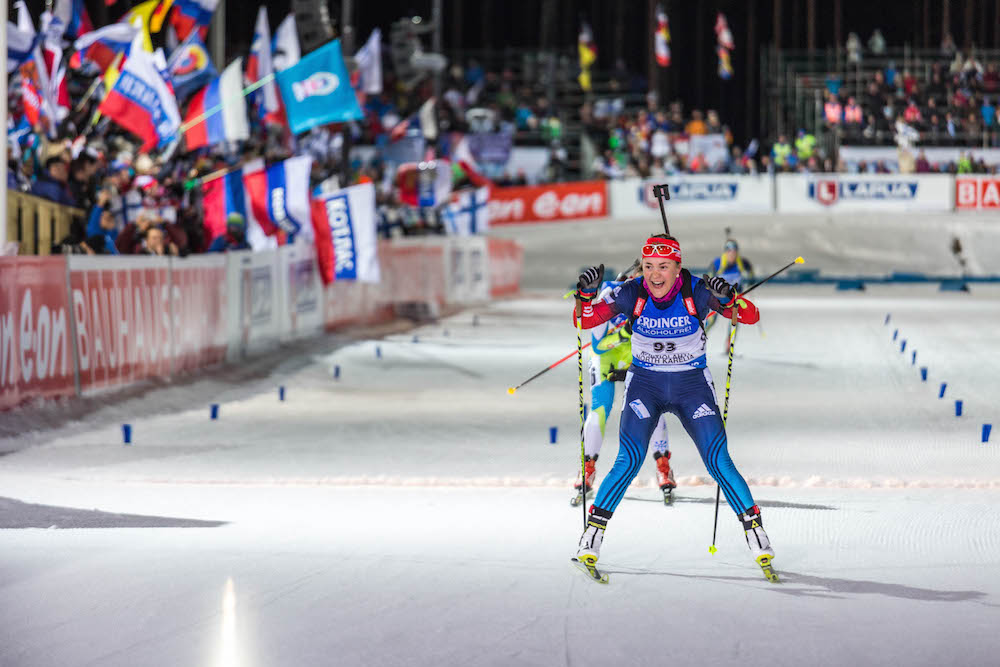
Russia’s Ekaterina Yurlova reacts after sealing her first career victory and podium on the World Cup level at IBU World Championships on Wednesday in the women’s 15 k individual in Kontiolahti, Finland. (Photo: Kontiolahden Urheilijat/Kari Kuninkaanniemi)
KONTIOLAHTI, Finland — When Ekaterina Yurlova earned two bronze medals at the IBU Open European Championships in Otepää, Estonia, her dad told her: “OK, now your next step is World Championship,” she recalled.
That was just over a month ago. On Wednesday, the 30-year-old Russian pulled out a surprise win to answer her father’s prophecy: a gold at 2015 IBU World Championships in the 15-kilometer individual. She had started 93rd of 105 women in the race and ended up as the only one with perfect 20-for-20 shooting.
“I said to him, ‘You’re crazy,’ ” Yurlova explained in a post-race press conference. “But now I think he’s not crazy.”
Yurlova herself looked stunned at the finish, holding her head and closing her eyes as it all set in at once. She had a great run throughout the evening race in front of 10,800 spectators — rising to third with a clean first shooting and the third-fastest course time on the first lap. After hitting all of her targets on her second stage, the Russian sat in fourth behind Italy’s Karin Oberhofer in first and the Czech Republic’s Gabriela Soukalova and Veronika Vitkova in second and third, respectively.
Fourteen seconds out of the lead after that first standing, she rose to second with a clean third stage. Soukalova, who started fourth and remained as a top contender from start to finish, cleaned those three initial stages as well, and leaving the range for her second-to-last lap, she was 15 seconds ahead of Yurlova.
The time gap went out the window when Soukalova came into the range for the last time and missed one for a one-minute penalty. While it took some time for Yurlova to tick off the laps 89 starters later, she ended up cleaning her fourth-straight stage to take the lead, 32.8 seconds ahead of Soukalova.
Ever since she finished, Soukalova had the time to beat in 41:55.4, holding off Finland’s local favorite Kaisa Mäkäräinen by 1.2 seconds. That time held up until Yurlova crossed the line 23.2 seconds faster in 41:32.2.
For the third time in her career, Yurlova cleaned an four-stage individual race. It was also her first podium and victory at the World Cup level. Her previous World Cup best was fifth in a mass start two seasons ago in Pokljuka, Slovenia.
“This is my first race of this World Championship and I wanted to be in podium,” she said. “It was my dream, but I never know that I can win.”
The women’s 15 k individual podium at 2015 IBU World Championships, with Russian winner Ekaterina Yurlova (c), silver medalist Gabriela Soukalova (l) of the Czech Republic, and Finland’s bronze medalist Kaisa Mäkäräinen (r). (Photo: Kontiolahden Urheilijat/Kari Kuninkaanniemi)
While Soukalova’s longtime lead at the finish didn’t stand, she said at the press conference that she was happy with silver. She and her team won gold earlier at these Championships in the mixed relay.
“It’s awesome and it was a really difficult season,” Soukalova said. “I didn’t think that I’m able to get a medal from this championship, but that’s nice.”
She wasn’t crushed when she was bounced from the lead by such a late starter. In fact, she didn’t realize she was in the hunt for gold until her last lap.
“I thought it’s gonna be really nice to [finish] in top five,” she said.
While Soukalova posted the fifth-fastest course time and Yurlova’s time ranked 19th (although her range time was notably quick in fifth), Mäkäräinen, who started 36th, was the fastest on course in the the five-lap race.
Hailing from the nearby city of Joensuu, where most of the World Championships accommodations are located fewer than 20 kilometers south of Kontiolahti, Mäkäräinen earned her first medal of the championships — bronze — 24.4 seconds off the win.
She cleaned prone but missed one on her first standing and another on her second prone before cleaning her final standing. The two misses put her two minutes back, and while she slipped into 11th after the third stage, she was back up to fifth leaving the range for the last time.
A fast last lap put her in contention with Soukalova for what looked to be the win at the time (well before Yurlova).
“In the first standing I had a lot of difficulties,” Mäkäräinen said in the press conference. “My legs were shaking right before I started to shoot. I missed the first target and I thought, ‘This is not going to work now,’ but I fight with every shot and I hit the last four. I was really lucky also there. And in the prone, I don’t really know what happened, maybe I was waiting too long, and the last shooting I don’t remember anything.”
She did remember hearing how far she was behind Soukalova going into the last lap. It was 27.2 seconds, to be exact.
“I never thought that I could be so close [at] the finish line,” Mäkäräinen said. “I knew that I did a good jump in a last loop so I wasn’t too sad about that.”
While she acknowledged she was slightly relieved with the medal (which she took by 0.4 seconds ahead of Italy’s fourth-place finisher Dorothea Wierer), Mäkäräinen added that wasn’t how she preferred to view her bronze.
“It was a new day today, new race, I did my job pretty OK,” she said. “I’m happy that I had a good day in the World Championships.”
Darya Domracheva of Belarus missed three on her first standing to slide into the 50’s overall after the second stage. By the third stage, she had recovered to 27th with another clean prone, but she had one more penalty on the last standing to finish 16th, ultimately 2:54.6 behind Yurlova.
Dunklee 12th for U.S.; Canada’s Heinicke Tallies Third-Straight Top 30
Susan Dunklee (US Biathlon) racing to 12th in the women’s 15 k individual on Wednesday at 2015 IBU World Championships in Kontiolahti, Finland. It was her best individual result of the championships so far. (Photo: USBA/NordicFocus)
American Susan Dunklee started 30 seconds after Mäkäräinen in bib 37. While she missed two standing to fall back into the 30’s, Dunklee cleaned her next two stages and missed one on the last standing to end up 12th (+2:43.0). She had the sixth-fastest course time (4.5 seconds behind Soukalova, who was fifth fastest on course).
While Dunklee called the early misses, “not an auspicious way to start,” she explained that they took the pressure off. She thought, “It’s not gonna be a perfect race, but I can just focus on doing my normal thing,” she explained in a post-race interview.
After her first prone, she caught a glimpse of the board her coaches showed her out on course, which indicted where her shots landed outside the target. For the next prone, she made a couple corrections.
During one lap, Dunklee skied with Germany’s Laura Dahlmeier (in bib 21) and Ukraine’s Valj Semerenko (in bib 20), which she said helped her push her tempo.
“There were times when I wanted to back off a bit, but Laura was pulling and gapping me a bit and I was like, ‘I can’t let her get a gap because I’ll lose the draft,’ ” Dunklee explained.
Dahlmeier went on to place sixth (+40.5) behind Russia’s Daria Virolaynen in fifth (+37.9). Semerenko finished 15th.
With her best shooting of the week so far and best individual result at these World Championships, Dunklee was pleased to be feeling back on track.
“My biggest problem the last couple days has been just getting my head back on straight and finding the fun again and the normal race feeling,” she said. Last weekend, she placed 42nd in the sprint and 34th in the following pursuit.
“The sun came out late afternoon today, and while we were warming up there was a soft, golden light and it made me really relaxed and happy,” Dunklee added. “I felt excited about the start of the race.”
Regardless of whether Wednesday’s result is enough to qualify Dunklee for the 30-person mass start on Sunday, she said she was happy. “I’m glad to have had a good one,” she said.
“While we were warming up there was a soft, golden light and it made me really relaxed and happy. I felt excited about the start of the race.” — Susan Dunklee, 12th
Canada’s Megan Heinicke tallied her third-consecutive top 30 of the week, placing 21st (+3:23.3) for her World Championships career best. She hit 19 straight shots before missing her final target.
Megan Heinicke (Biathlon Canada) racing to 23rd in the 7.5 k sprint at 2015 IBU World Championships on March 7 in Kontiolahti, Finland. In Wednesday’s 15 k individual, Heinicke placed 21st for a career best at World Championships (and at the Olympic level).
“I’ve hit 20-for-20 twice already this year so I feel like there was 15 thoughts going through my head, like, slow motion during the last shot,” she reflected. “I’m so, so happy with 19, but I’m pretty sure I missed the last shot because I was thinking, ‘Oh, I’m going to hit 20!’ ”
During the race, Heinicke wasn’t sure it was going so well. On her first lap, she heard her team’s staff tell her she needed to ski faster.
“I was like, ‘Oh gosh, this is going to be a disaster,’ and then actually, I kind of felt better lap by lap,” she said less than a week after recovering from a monthlong illness.
“I was prepared for way worse,” Heinicke said of World Championships overall so far. “I fought hard out there. I really delivered what I was able to. There’s always the ‘if’ thought: if I was in better shape and skiing four-percent faster, but I mean, I’m happy with it.”
Dunklee’s U.S. teammate, Annelies Cook was on track for a breakthrough performance after cleaning her first three stages. The third starter, she found herself in second after the third shooting behind Soukalova and at the end of the day, her time leaving the range for the second-to-last lap ranked sixth.
US Biathlon’s Annelie Cook (second from l) on the range with Slovakia’s Jana Gerekova (l), among others during one of her two standing stages in the 15 k individual on Wednesday at IBU World Championships in Kontiolahti, Finland. (Photo: USBA/NordicFocus)
However, in the final standing, Cook missed four shots — the first, second, fourth, and fifth — to fall toward the back of the pack. She ended up 47th (+5:26.8) with four penalties.
“My heart is a little broken,” Cook said afterward. “I blew it. I just wanted it so bad and I tried too hard. Classic case of wanting it too much. Everything else felt easy and relaxed. I tried to stay relaxed the whole race, not come into the range too gassed, and I think the conditions were really good today so that made it a lot easier …
“Sometimes biathlon is really mysterious,” she added. “You don’t know what makes one [race] good from the next, but the last stage was just bad. I was too tense and I was just trying to hard.”
World Cup rookie Clare Egan, also of the U.S., notched her second-best result of her career in 51st (+5:45.7) after back-to-back clean stages for her first prone and first standing. She went on to miss two in the third stage and two more in the final standing.
Clare Egan (US Biathlon) during one of two shooting stages in the women’s 15 k individual at IBU World Championships on Wednesday in Kontiolahti, Finland. She placed 51st for her second-best result of World Championships and her career. (Photo: USBA/NordicFocus)
“’I’m still learning, especially with the standing, so any time I can even just miss one in standing is great,” Egan said. “My best World Cup place coming into world champs was 73rd, and I’ve done way better than that so far so I’m really psyched.”
In placing 40th in the sprint last Saturday, she qualified for last the pursuit, where she placed 52nd. While Wednesday marked another top result for the 27-year-old Egan, she said it was her brother’s presence that made her day.
“My brother Graham flew in today from New York so he was out there on the course with an American flag,” Egan said. “That was my favorite part of the race.”
Also for the U.S., Hannah Dreissigacker placed 67th (+6:49.7) with five penalties (2+1+1+1).
“Ones are OK, twos are bad,” Dreissigacker said of the number of misses per stage. “That’s sort of where my standard is for myself. If I had [missed one each time], I would be, like, not a good day, but not bad. But five, I mean, that’s too many.”
She described feeling flat during the race and attributed it to possibly hunger.
“I don’t think I ate enough because it’s such a late-in-the-day race,” she said of the 6:15 p.m. start. “I was getting kind of hungry before the race and I felt like I kind of ran out of energy. I’m not sure I timed that quite right. I should have known better…
“For some reason, I’m just sort of struggling a little bit here in general,” Dreissigacker added. “Today was tough because I actually felt OK for the most part. The last three stages I missed the last shot every time, which is sort of a classic biathlon mistake. I think I guess I must not have followed through enough.”
Two Canadians had five penalties as well: Audrey Vaillancourt (2+0+1+2) and Julia Ransom (2+1+1+1). While Vaillancourt placed 79th (+8:05.3), Ransom in her first World Championships was 84th (+8:23.9).
“It’s just a bad week on the range,” Vaillancourt said. “It’s hard to start with two misses, and you’re like, ‘Nice, now I have three more bouts to go.’ ”
Typically a strong shooter, she added that sometimes that’s the way biathlon goes.
“Some weeks you just don’t get that feeling of, it’s easy,” she said.
And Vaillancourt didn’t think her off week had anything to do with the stakes at World Championships.
“I’ve been fighting all year to get my place here. It’s not like I’ve been thinking of only World Champs all year,” the 23 year old said. “To me, it doesn’t really make a difference if I do super well on the World Cup or super well at World Champs because it’s not like I’m really close to a top eight.”
After the pursuit three days earlier, in which she placed 57th, Ransom explained she focused on getting into a “better headspace” for the 15 k.
“I was so overwhelmed and I was excited, but also really distracted [during the pursuit] so I kind of brought it together and I really wanted to focus on pacing,” she said. “We don’t do a lot of individuals; this is definitely the hardest one I’ve ever done, and I think I found a happy medium with the pacing. Maybe a little too easy, but I’m learning.”
Like several North Americans, she struggled with her first prone and had two early penalties.
“The wind had changed on me, which I wasn’t expecting,” Ransom said of her first shooting. “I [made] a big correction for prone … I’ve been struggling with standing the last couple weeks, so I’m glad I kind of brought it back to a half-decent level. It’s a work in progress. These World Champs have been an interesting experience.”
Perhaps the most disappointed North American of the day was Rosanna Crawford, a medal hopeful, who finished 87th (+9:05.1) with eight penalties (2+2+2+2).
“It was really bad,” she said.
Before World Championships, she and her boyfriend Brendan Green, also on the Biathlon Canada national team, discussed the worst that could happen in Kontiolahti, Crawford explained.
“The worst that could happen is a really bad race,” she continued. “It’s not that bad in the scheme of life, but this is something I’ve dedicated my whole life to and to not achieve my goals is disappointing. I feel like I’m letting down everyone who’s helped me get here, and I know I’m capable of so much more.”
On Tuesday, Crawford watched a Finnish TV interview with U.S. cross-country skier Kikkan Randall.
“Kikkan was talking about how disappointed she was with the Olympics, and yeah, you set these big goals, but then you also need to set the goals of being able to leave a championship happy,” Crawford said. “I don’t think I did that. I didn’t set those goals and even if I had, I didn’t achieve them. I didn’t do what I know I’m capable of today, and I really wanted another chance in the mass start and now that’s not gonna happen.”
The final race of World Championships, the 12.5 k women’s (and 15 k men’s) mass start includes the top-15 ranked competitors on the World Cup circuit with 15 others who do exceptionally well at worlds. The sprint and pursuit carry a hefty weight (with the sprint factoring into the start of the pursuit), and the individual races are the last ones to count toward the mass start.
Based on a provisional start list, Heinicke and Dunklee have qualified for Sunday’s mass start in 26th and 30th, respectively.
Erik Lesser of Germany celebrates his win in the 12.5 k pursuit at the 2015 IBU World Championships in Kontiolahti, Finland. (Photo: Kontiolahden Urheilijat / Jarno Artika)
KONTIOLAHTI, Finland – It was only a matter of time before Erik Lesser climbed to the top of the podium. The German biathlete was close in the past past – in 2014 he earned two Olympic silvers in the individual and relay events and has frequented the IBU World Cup podium four previous times.
Lesser will no longer lack gold in his trophy case after Sunday’s 12.5 k pursuit at the 2015 IBU World Championships where he skied and shot to a time of 30:47.9. He was joined on the podium by Anton Shipulin of Russia, who finished 17.0 seconds back. Tarjei Bø placed third, 18.7 seconds behind.
The day began with Tarjei Bø’s brother Johannes Bø in bib 1. The Norwegian had a 12 second advantage over second place starter, Canada’s Nathan Smith, after winning Saturday’s 10 k sprint. Just behind them was Tarjei Bø, who began the race 25 seconds behind his brother.
The three biathletes skied the 2.5 k course alone for the first lap and entered the stadium hoping to clean the first prone stage and hold their time advantage. Johannes Bø and Smith both missed two to take them out of the lead, while Tarjei Bø cleaned to remain in the running.
Erik Lesser of Germany (5) was the only biathlete in Sunday’s 12.5 k pursuit to clean all four shooting stages. His win was the first of his career. (Photo: Kontiolahden Urheilijat / Jarno Artika)
Tarjei Bø wasn’t the first skier to exit the stadium, however. Instead it was Simon Fourcade of France followed by Lesser. The Frenchman and the German started in bibs 4 and 5, and each began 30 seconds back from the leader. They overcame the deficit with quick shooting and strong skiing in the first loop.
Joining them to create a lead pack was Simon Fourcade’s brother and IBU World Cup overall leader Martin Fourcade, who shot clean in his first prone to make contact. Trailing him was Tarjei Bø. After the second stage of prone, however, the group dropped Martin Fourcade after the French biathlete missed one.
Lesser created a large lead over the rest of the field after cleaning in the first standing stage. Both Tarjei Bø and Simon Fourcade missed one to give the German a 22 second lead.
Once Lesser cleaned the final stage of shooting and became the only competitor to clean all stages, it was clear he had secured the win. As he entered the stadium he crossed his arms above his head to make a X, paying tribute to his region of Saxony. After the race, he said that the day was his first “perfect” day since racing on the IBU Cup circuit.
“In the World Cup it was my first perfect race,” he told reporters. “I did some perfect race in the IBU cup before… It was my first perfect race and especially at the World Champs, it’s really amazing.”
The German explained that he knew there was a potential for a podium going into Sunday’s sprint, but that due to the nature of the sport nothing was guaranteed.
“I know that I’m in good shape and I can work really good in the shooting range and also in the track, but I think nobody has really feeling for the victory because in biathlon anything can happen,” he explained. “Biathlon has it’s own rules and today it was a good day for me.”
Tarjei Bø of Nroway celebrates his third bronze medal of the 2015 IBU World Championships in Kontiolahti, Finland. (Photo: Kontiolahden Urheilijat / Jarno Artika)
The remaining podium positions weren’t as clear-cut as the German’s victory. Russian Anton Shipulin had risen from 18th position to third before the final shooting, and when second-ranked Tarjei Bø missed one shot, he exited the range within seconds of the Norwegian. The two skied together in the last lap until the final half-kilometer, where Shipulin maneuvered around Bø. Unable to respond, Bø trailed Shipulin across the line as the two finished second and third.
Although Shipulin started with bib 18 and 1:03 behind the first starter, he explained that he believed a podium was possible in the pursuit.
“Actually I thought about it before the race that I could fight today,” he said to the press. “Here in Kontiolahti the conditions are very hard but after the second shooting I saw that the competition was very close.”
As the top-ranked Russian at World Championships, Shipulin was the favorite of the many Russians in attendance in Kontiolahti. Despite his huge fan base, he said that he felt little pressure to medal. Shipulin’s silver is the first medal for Russia at the 2015 IBU World Championships.
“There was not a lot of pressure,” he said. “I know there were a lot of people who were expecting medals for our team. The relay is our favorite race, and we hope to get more medals in the future.”
Tarjei Bø’s bronze medal is his third of the Championships after he finished third in both the mixed relay and the 10 k sprint.
“[This is] far more than I expected,” the Norwegian said. “I’m full of confidence of course. My shooting has never been better. Today was tough to mobilize the energy to shoot good. I had to do a really good job to shoot the targets.”
Canada’s Nathan Smith leaves the range for the first time in Sunday’s 12.5 k pursuit at the 2015 IBU World Championships in Kontiolahti, Finland.
Smith Leads North Americans in 13th
Although Smith started in second position, the two misses in his first shooting stage brought him down to 13th and over 30 seconds from the leaders. He fluctuated in the teens for the rest of the race as he missed one shot in each of the three subsequent stages.
“My shooting was a little off today. It was tough shooting and it was a little bit worse than it needed to be,” he said in a post race interview.
Smith explained that after his first two misses he still believed he could contend with the race’s leaders. However, with the subsequent misses in standing he said the race became a fight to maintain his position.
“I knew if I could shoot well in the rest of the race it could turn out really well, but I just did the best I could and then fought hard on the last lap to maintain my position,” he said.
Given his historic podium just a day earlier, Smith explained that he would have been happy with any result in the pursuit, and that he was especially pleased with 13th. “I thought to myself that I could have the worst race today and end up 60th, and it wouldn’t really matter,” he said. My biggest goal was yesterday. 13th was still a really good result so I’m happy with that.
According to the 29-year-old, the podium and its responsibilities, whether they be with the media or the awards ceremony, took a toll on his energy and provided valuable lessons for the future.
“It’s just a learning experience,” he explained. “Yesterday with all the media stuff and the prize ceremony, that was pretty taxing energy-wise and a distraction too obviously. Those guys are used to doing that practically every weekend so they can calm down right after.”
“I didn’t sleep very well last night,” he added, citing the continued excitement over his silver medal. “I probably slept like five hours so I was a little groggy this morning.”
Not far behind Smith was fellow Canadian Brendan Green, who advanced from 21st position to 16th after three rounds of clean shooting and one miss in his final standing stage. In the last loop Green could see Smith ahead of him and worked to keep his teammate in sight. Although he couldn’t catch Smith, he passed Jaroslav Soukup of the Czech Republic to gain a position, but was ultimately overcome by Dominik Landertinger of Austria before the finish.
Green said he was pleased with the pursuit despite the steady drizzle of rain that fell on competitors throughout the entire day. He explained that his shooting was near the best of the season.
“I’m really pumped with the shooting today. It was again really challenging conditions with the wind but I was able to handle that really well and able to execute what was a very good race on the range. It was one of the better ones of the season,” he said.
U.S. biathlete TIm Burke prepares to shoot in the 12.5 k pursuit at the 2015 IBU World Championships in Kontiolahti, Finland. he finished 20th on the day. (Photo: USBA/NordicFocus)
The first American finisher in the 12.5 k pursuit was Tim Burke, who placed 20th. Burke began in bib 15 and shot clean in both prone stages to rise to sixth after the second shooting. He held the position throughout the third loop, but fell to 10th after missing two in the first stage of standing. He missed another two in the second stage to fall to 22nd, but passed two skiers in the last lap to earn his eventual position.
Burke entered Sunday’s pursuit with an aggressive mentality. He knew that to get into his goal of the top five he would need to take some risks. While the risks didn’t land him in the desired position, Burke said he didn’t regret his strategy.
“It was super windy, but I took every risk today. Both standings, I just went for it, really fast shooting. I didn’t care about getting a 10th place, I wanted a top five or it didn’t matter, so that’s what I went for,” he said in an interview. “It didn’t work out but I felt really good on the skis today. Definitely an improvement from the sprint so I’m looking forward to the next race.”
Prior to the 2014/2015 season, Burke was a usual in the top 20 and often cracked the top 10. This year, however, the American has struggled to reach his top form in shooting. According to Burke, Sunday’s pursuit was a step in the right direction.
“I feel like I’ve been in great shape all year and I feel like I still have that here. Just coming here and trying to gain my confidence again in the shooting again, I definitely lost that in the middle of the season. I’m feeling better now and it’s biathlon, anything can happen,” he said.
American Lowell Bailey skiing to 36th in Sunday’s 12.5 k pursuit. (Photo: USBA/NordicFocus)
Much like Burke, teammate Lowell Bailey started his race with two clean prone stages. After the second shooting he was in 11th, but in the third round he missed four shots to bring the biathlete down to 35th place. He missed one more in the last shooting stage to ultimately finish 36th.
“I just got a little unlucky in the third stage and it was really windy but I figured I could hit more than one. It was over after that,” he said. “After that I just tried to stay in my own zone and ski my own race and try to salvage something out of it.”
In 45th was U.S. biathlete Sean Doherty, who overcame 10 positions after starting in bib 55. The decorated junior biathlete said that he began the race with the aim of improving his standing. He accomplished his goal after missing only three shots and cleaning the first standing stage.
“I was hoping to just shoot pretty well and move up a bunch,” he said. “We had good skis today and I just wanted to go for it. There’s a lot more room to move up than there is to move back on a day like today.”
In 51st was teammate Leif Nordgren who said that his result from the prior day’s sprint weighed heavily on the biathlete during the pursuit. Despite what he described as decent skiing, Nordgren said that he struggled in shooting. The American had a total of six misses.
“Today I’m still actually really bummed about yesterday’s race,” he said. “As much as I tried not to think about it over the night and think about this race, I still brought that into today which is not what you want to do in biathlon. This race today is a lot easier to forget so I think it will be easy to bounce back.”
Scott Gow of Canada finished one spot behind Nordgren in 52nd. Gow said he was hoping for more in the pursuit but was happy to be racing in Finland.
“This is my first pursuit this year so I think that was a little bit of a disadvantage for me,” he said. “I’m happy I was here. I’m happy to have raced. It wasn’t a total meltdown so I’m ready to go onto the next one.”
France’s Marie Dorin Habert celebrates her second win in two-straight races at 2015 IBU World Championships after taking gold in Sunday’s 10 k pursuit in Kontiolahti, Finland. She finished 15.3 seconds ahead of Germany’s silver medalist, Laura Dahlmeier. (Photo: Kontiolahden Urheilijat/Jarno Artika)
KONTIOLAHTI, Finland — Ask anyone who follows biathlon who the favorites were going into the 2015 IBU World Championships, and they would have been sure to mention Finland’s Kaisa Mäkäräinen and Darya Domracheva of Belarus. Of course there were others, but Marie Dorin Habert — the French skier who gave birth to her first child in September?
She couldn’t believe it, either.
“I don’t have words,” Habert, 28, said in a press conference following her third medal in as many races at World Championships and her second-straight gold. “It’s just crazy for me, and everything is right with me in these World Championships.”
After winning Saturday’s 7.5-kilometer sprint and starting with a 10-second lead in the women’s 10 k pursuit on Sunday, Habert kept herself in contention for another victory by hitting all of her targets in her first two stages.
The competitor who started closest to her, Weronika Nowakowska-Ziemniak of Poland, held her own in second for the first two stages as well, despite missing one on her second prone. She came out of the penalty loop 43.8 seconds after Habert, yet remained in second until the third shooting.
There, Habert came into standing first and missed two targets. Her clean streak had ended and some 12,800 spectators in the stands wondered what would become of Habert.
Germany’s Laura Dahlmeier racing to silver in the women’s 10 k pursuit on Sunday at 2015 IBU World Championships in Kontiolahti, Finland. (Photo: Kontiolahden Urheilijat/Kari Kuninkaanniemi)
Meanwhile, Germany’s Laura Dahlmeier, who started fourth, 29 seconds after Habert, had moved into third by the first stage despite an early prone miss. Dahlmeier cleaned the second prone as well as the first standing to leave the range 20 seconds behind Habert, who had just completed her two penalty loops.
“When I missed two, I said, ‘Ooh! It’s bad for me. I have to be fast,’ ” Habert recalled.
She went on to ski the second-fastest course time on her third lap and remained ahead of Dahlmeier. Both missed one in the second-and-final standing, and Habert headed out on her third lap with a 27.3-second lead.
Meanwhile, Nowakowska-Ziemniak had two additional penalties on her third stage to slip to third, 43.8 seconds behind Habert. While she cleaned her final stage, she left the range in fourth, five seconds behind Russia’s Ekaterina Shumilova, the only woman to hit all 20 of her targets.
The final clean stage lifted Shumilova, who started sixth, from fourth to third — until Nowakowska-Ziemniak tracked her down on the final lap.
“I asked myself, ‘Weronika, do you fight, or do you get just a fourth place and it’s still OK?’ ” Nowakowska-Ziemniak reflected in the press conference. “After one second, I answer to myself, ‘Of course, I am fighting.’ I was trying to catch [Ekaterina] as fast as possible and I did it quite fast … On the uphill, my coach told me she’s twenty meters behind me, so I realize that, yes she fall down, and then I push even harder to not let her catch me.”
“I asked myself, ‘Weronika, do you fight, or do you get just a fourth place and it’s still OK?’ After one second, I answer to myself, ‘Of course, I am fighting.’” — Poland’s Weronika Nowakowska-Ziemniak, pursuit bronze medalist
While Nowakowska-Ziemniak left the Russian behind in the race for bronze, Habert continued to forge ahead up front, entering the finishing straight alone and grabbing a large French flag from the sidelines. She waved it proudly and completed her trifecta of medals (silver in the mixed relay, gold in the sprint, and now gold the pursuit), crossing the line first in 30:07.7. Dahlmeier finished 15.3 seconds later for silver, her first World Championships medal.
Poland’s Weronika Nowakowska-Ziemniak en route to bronze in the women’s 10 k pursuit at 2015 IBU World Championships in Kontiolahti, Finland. (Photo: Kontiolahden Urheilija/Jarno Artika)
“I’m totally happy. It was a big dream since I was a little child,” the German said in the conference. “Now I have this silver medal and it’s a perfect day for me, and also, I’m really happy for Marie. It’s perfect.”
Nowakowska-Ziemniak finished 31.6 seconds after Habert and 17.1 seconds ahead of Shumilova for bronze, her second medal in as many races after notching her first World Cup-level podium on Saturday.
“It’s crazy because I was waiting so many years to be on the podium and yesterday I get the first medal and today the second,” Nowakowska-Ziemniak said. “I was feeling much better on the track, but the shooting range I wasn’t perfect, but it’s still a medal so I’m really happy.
“You can’t imagine how happy people in Poland were with the medals because in the winter sport, this winter wasn’t so good for the Polish teams, for ski jumpers and cross-country skiers,” she added. “So the medal in biathlon, it was something really, really important for the association and for my teammates.”
Marie Dorin Habert of France racing to gold in the women’s 10 k pursuit at 2015 IBU World Championships on Sunday in Kontiolahti, Finland. It was her third medal in as many races at these World Championships and second-straight gold.
Habert simply stated: “I’m more happy than yesterday.”
Saturday’s sprint bronze medalist, Valj Semerenko started 20 seconds after Habert and ended up 19th (+2:23.8) after missing three on her first prone. She had another penalty on her second stage, then cleaned her first standing before missing two more for a total of six penalties.
Mäkäräinen could lay claim to the most impressive ski of the day, racing up from 35th to 12th with the fastest overall course time. She finished 1:28 behind Habert with two prone penalties and a standing miss.
Domracheva had the second-fastest course time, 33 seconds slower than Mäkäräinen, yet rose from 25th to finish seventh with two total penalties — one on the second prone and another on the second standing.
Gabriela Soukalova of the Czech Republic improved from 18th to fifth (+58.0) with a single miss on the first stage, and Germany’s Franziska Hildebrand went from 10th to sixth (+1:00) with two penalties.
Despite temperatures around 40 degrees Fahrenheit with misting precipitation, conditions were firmer and even icy for the women’s race — which followed the men’s pursuit earlier in the afternoon.
Crawford, Heinicke in the Top 30
Rosanna Crawford (Biathlon Canada) on her way to 25th in the women’s 10 k pursuit at 2015 IBU World Championships in Kontiolahti, Finland. She started 32nd.
Among the North American women, Rosanna Crawford of Canada knocked off seven places to finish 25th (+2:51.5) after starting 32nd, 2:13 after Habert.
While she missed two early prone shots, Crawford cleaned her second stage to move back into the top 30. One more miss on her first standing put her in 27th leaving the range, and she proceeded to clean her final stage.
“On my first prone, I shanked one to the left, one to the right and one to the center,” Crawford explained. “Usually when I see that on the board I say, ‘Oh you idiot, just hit the frickin’ targets,’ and I did.”
All things considered, with the sixth-fastest range time and 24th-ranked course time, she said she was happy.
“To be 32nd [yesterday] and two-thirds back was very surprising so I was happy to make some points and still know I’m in it for the rest of the championships,” she said. “Two less misses on that first one would have been glorious.”
In doing so, Crawford would have matched her boyfriend Brendan Green’s 95-percent shooting in the men’s pursuit. “I’ll let him have it this time,” she said.
Also for Biathlon Canada, Megan Heinicke finished in the top 30 for the second-straight race after starting 23rd. She ended up 28th (+3:19.4) with 90-percent shooting, missing one early prone and another target on her last standing.
Megan Heinicke (Biathlon Canada) en route to 28th in the women’s 10 k pursuit at 2015 IBU World Championships in Kontiolahti, Finland. She started 23rd.
“I’m … relieved,” Heinicke said. “Two times in the top 30, I’m really glad with that and considering my fitness coming in, I basically feel like I put pretty close to my best out there. Tried to ski tactically, skied behind people when I could.”
Sick for much of the last month, she explained her expectations for her skiing form were low coming into World Championships.
“I need to count on the shooting and I’m really glad I brought it together,” she said. “I’m kind of sad about the prone miss because that one was really on me, and I was like, ‘Oh dang it, you just did that,’ but the standing miss, I don’t actually know what happened so I’m not gonna beat myself up about it either way.”
On most of Heinicke’s best days, there’s a common theme: her strength in shooting. While she excelled in shooting as a junior, she said she struggled with it in the last few seasons. However, this season, she felt more at ease.
“I’ve had some big changes in my life recently and I’m feeling a lot more relaxed and a lot more balanced,” Heinicke said. “I’m under a lot less pressure, internal and external, and I’m just enjoying it. Instead of standing there, like, ‘Please hit this, let it be OK,’ or really worrying about results, I’m way more task-oriented and I’m like, ‘Oh yeah, I worked on this, and I’m confident.’ ”
Dunklee Third-Fastest Skier
American Susan Dunklee had the third-fastest ski time after Mäkäräinen and Domracheva, and improved from starting 42nd to finishing 34th (+3:58.1) despite six penalties.
Susan Dunklee (US Biathlon) started 42nd and skied up to finish 34th in the women’s 10 k pursuit at 2015 IBU World Championships in Kontiolahti, Finland.
“The prone shots that I missed were really bad shots,” Dunklee said after missing two in each of her first two stages. She went on to miss two apiece in both standing stages.
“Skiing felt better today. The shooting was more normal speed, and I’m really happy after yesterday,” she added. “You start getting this little seed of doubt in your mind about your shooting ability when you pull a stunt like that, so I was glad to have normal-feeling shooting even if it wasn’t a great percentage.”
While 42nd wasn’t where she had hoped to end up in the sprint, which has implications for next Saturday’s mass start (as does the pursuit), Dunklee made sure to push to the end.
“Partway around the last loop yesterday, I reminded myself, ‘You are a fighter. I don’t care how you’re doing, that’s part of who you are and you’ve got to live up to that today,’ ” she recalled. “So that’s what I did.”
The second U.S. woman in her first-ever pursuit, Clare Egan started 40th and finished 52nd (+6:29.2) with seven penalties (1+1+3+2).
Canada’s World Championships rookie, Julia Ransom placed 57th (+8:02.8) after starting 52nd. She also missed seven (1+2+2+2).
“My legs were basically cooked from yesterday,” Ransom said. “To have consistent misses, that was hard and I feel like it was something that I had to get out of my system. It was my first pursuit on the World Cup and I had to pay my dues.
“I really enjoyed racing,” she added. “There are some parts where you miss and you’re near the back and you want to cry, the bottom lip starts to quiver a bit, but at the end of the day I’m proud that I made it here.”
With two days off until the next race in Kontiolahti (the women’s 15 k individual), most of the racers were excited for a break.
“I’m going to start with a massage and go from there,” Ransom said.
Nathan Smith (l) on the 2015 IBU World Championships 10 k sprint podium on Saturday with Norwegian brothers Johannes Thingnes Bø (c) and Tarjei Bø (r) in Kontiolahti, Finland. Smith placed second for Canada’s first-ever men’s podium at World Championships.
KONTIOLAHTI, Finland — As Norwegian brothers Johannes Thingnes Bø and Tarjei Bø prodded and joked with each other on the podium of the men’s 10-kilometer sprint at IBU World Championships on Saturday, Nathan Smith simply grinned from the second-highest step on the podium.
Finally, after the first round of many congratulations to come, it was starting to set in for the 29-year-old Canadian.
Smith had just done something no other Canadian male had done before: he medaled at World Championships. Not only did he place in the top three, he finished squarely in second, 12.1 seconds behind winner Johannes Thingnes Bø, and 13.2 seconds ahead of Bø’s older brother Tarjei for silver.
“When Johannes was 16, 17 years old he started winning Junior World Championships and he was following my steps all the time,” Tarjei, 28, reminisced in a post-race press conference. “We talked about this a lot during the summertime when we were at home training together. We love to compete and we love to fight each other, but still we are the team against the rest of the world so today is a big day for us.
“We beat the world almost — it was only Nathan who came between us so congrats to him,” he added with a laugh.
Everyone laughed.
Nathan Smith (Biathlon Canada) racing to Canada’s first men’s medal at IBU World Championships on Saturday in the 10 k sprint in Kontiolahti, Finland. Smith achieved silver for his first career podium at the World-Cup level. (Photo: Fischer/NordicFocus)
Then there was Smith, a regular top-10 contender on the World Cup for the last two seasons, but unlike the Bøs, someone who had never tasted the podium before. Going into World Championships, his personal best was fifth in the pursuit on Nove Mesto, Czech Republic, just under a month ago.
“It’s overwhelming,” Smith said of the attention he received Saturday as soon as the results were final. “I knew I could have some good races, but you never really believe it until you do it. It’s hard to explain, it feels great though.”
All that came after shooting slump in January, when Smith placed 78th in an IBU World Cup sprint in Antholz, Italy.
“I took some time away from my rifle and then I came back into Nove Mesto and Oslo and my shooting was right up there again so I had a lot of confidence with my shooting,” he said after hitting nine of 10 targets on a windy range in Kontiolahti on Saturday.
“My skiing’s been pretty consistent all year. I haven’t had too many days where I’m dying out there, so I knew if I had an average day and nine or 10 here with the wind, that it could be really good.”
Yet after starting 12th and taking the lead at the finish by 30 second, Smith wasn’t exactly sure what “really good” would amount to. He was bumped down one place by 21-year-old Johannes Thingnes in bib 16, but after that, no one came close.
Based on World Championships rules for “unusual weather conditions,” the grouping system that determined starting order was altered for Saturday to allow nations with competitors ranked in the top 50 on the World Cup to enter “any draw group they choose.”
Naturally, with a salted course for the just-above-freezing temperatures and the forecast for snow later in the day, the top men decided to go first. And out of 127 competitors, Smith was close enough to the front that it worked out for him as planned.
Nathan Smith approaching the range at the IBU World Championships 10 k sprint on Saturday in Kontiolahti, Finland. Smith went on to place second for a historic silver for the Canadian men’s program.
With a headwind coming into his first shooting, he took note of the gusts from his right side and clicked a couple to the right. After hitting his first three prone shots, Smith felt the wind pick up even more, so he shaded, which led to perfect 5-for-5 shooting.
“I got a little lucky for my last hit,” Smith recalled.
That put him in second after prone, and he went on to ski the sixth-fastest second lap (out of three). In his second-and-final stage, Smith missed one, which was a success considering two men in the entire field finished the race with perfect 10-for-10 shooting (Tarjei being one of them).
“I tried so hard in standing; I didn’t just whip though it and throw some shots away,” Smith said.
However, he posted the sixth-fastest range time in standing to finish the race as the fourth fastest on the range overall. On skis, he was seventh fastest overall on course.
“I worked really hard on the skis,” he added.
“We beat the world almost — it was only Nathan who came between us.” — Tarjei Bø, Norway’s sprint bronze medalist
“Before the race, Nathan knew that this course suited him,” Canadian national team coach Roddy Ward explained. “He doesn’t like gradual climbs, but the steeper climbs he feels comfortable with — offset. There’s quite a lot of that here. So he was pretty confident out there and he definitely looked like he had really good fitness.”
Ward was out on course for most of the race while Canadian head coach Matthias Ahrens was in the range. But before he ventured out, he caught a glimpse of Smith whipping through the stadium.
“I watched Nathan go around and I thought to myself, ‘Nathan’s gonna be a hero back home after this race,’ ” Ward predicted. “And then I said, ‘Don’t jinx it!’ and then I said, ‘I can’t jinx it.’ I was pretty confident. He knew he was in good shape, too. I think he had pretty good confidence, but hey, he’s on the podium for the first time ever in a World Championships so of course it’s a bit of a surprise.”
Like many who have followed Smith’s progression, from breaking out at the 2014 Olympics with three top-15 results in Sochi, Russia, Ahrens knew it was a long time coming.
“With his good shooting and efficient shooting — shooting usually very fast — and then given that he had really good ski speed today, he was already looking quite solid, quite early,” Ahrens reflected. “[He has] the shooting efficiency, he shoots accurate, but also very fast. He’s always on the top five in the World Cup in that particular category when you analyze the race. His skiing has improved over the last three years and he’s now at a point, if everything comes together, then he can be on the podium.”
The men’s 10 k sprint podium at 2015 IBU World Championships in Kontiolahti, Finland. From left to right: Silver medalist Nathan Smith (Canada), gold medalist Johannes Thingnes Bø (Norway), bronze medalist Tarjei Bø (Norway), Simon Fourcade (France) in fourth, Erik Lesser (Germany) in fifth, and Evgeniy Garanichev (Russia) in sixth. (Photo: Fischer/NordicFocus)
So the snowflakes fell at the right time and right place for Smith, who made history for Biathlon Canada. Previously, no man had medaled at World Championships, and Smith followed up on the success of former teammate Jean-Philippe Le Guellec, who won a World Cup sprint in 2012 in Östersund, Sweden, and retired after last season.
Retired biathlete Myriam Bédard holds the Canadian women’s and overall record with two golds from the 1994 Lillehammer Olympics and another from 1993 World Championships.
“I think how things started for our team was having Jean-Philippe Le Guellec leading our young men to success in the way that he actually was the first one on the podium, winning a World Cup, and that gave them confidence that really they all could do it,” Ahrens said. “That made a big mental breakthrough to our team, to the men, in many ways. The confidence, being able to do it in racing, but also what it takes in training to get there.
“It shows the younger athletes what is possible when they put the work in, when they put the belief in,” he added.
The silver medal was also huge in terms of future funding for Biathlon Canada. On the heels of Cross Country Canada’s Alex Harvey racking up silver and bronze at the FIS Nordic World Ski Championships last month in Falun, Sweden, biathlon essentially had to bring home some hardware as well to ensure an adequate budget from Own The Podium — Canada’s governmental branch of sport funding — for next season.
“This is important for our funding because we are just actually judged by medals at World Championships or Olympic Games,” Ahrens explained. “Therefore it’s a very important step in the right direction.”
“It shows the younger athletes what is possible when they put the work in, when they put the belief in.” — Biathlon Canada Head Coach Matthias Ahrens on Nathan Smith’s silver-medal performance
To his own surprise, Smith reached that marker in the first individual race of 2015 World Championships. Going into Saturday’s race, he later explained he would have been happy with a top eight. Three years ago, he wasn’t sure how much longer he’d last as a professional biathlete.
“Going into the Olympics last year, I was thinking it was going to be my last year,” Smith explained. “I was like, I’m going to do whatever I can to get to the Olympics.”
Two summers ago, he made some significant tweaks to his training and preparation. He targeted his weaknesses and honed in on them, like uphill rollerskiing. He made his own rifle stock, which he currently uses, and started doing things he had never done before, such as dry firing.
“We always say that North Americans in general are late developers compared to the Europeans,” he observed. “We’re, like, five years behind them in development. I think it just takes a bit longer when we’re isolated in Canada.”
As of Saturday, Canada’s on the map. Smith went head to head with top skiers like Russia’s Evgeniy Garanichev, who started 11th and led after a clean prone, as well as Johannes Thingnes, and was fast enough to hold off Tarjei, who posted two perfect stages.
Like Smith, Johannes Thingnes had one standing miss, and started 16th to come through each checkpoint with the consistently fastest times. At the end of the day, the Norwegian had the fastest course time as well.
“It was maximum of what we could expect today, two brothers on the podium for the first time and also my first [World Championships] gold medal in my first [individual] start,” Johannes Thingnes said in the press conference. “So it could not have been better.”
After the press conference, Smith said he hadn’t talked to his parents yet — they were on a bike trip in Argentina.
“Usually they wake up really early in the morning to watch [my races], but I don’t think they have reliable internet there so we’ll see when they find out,” he said casually. “I’ll send them an email.”
Three Canadian Men Make Pursuit
Also for Canada, Brendan Green placed 21st (+1:14.3) with a single standing penalty and Scott Gow was 50th (+2:06.2) with one prone miss and one standing miss, to qualify for the pursuit. The youngest man on the team, Christian Gow finished 73rd (+3:11) in his World Championships debut. After starting 109th, he faced some of the toughest, slowest conditions of the men’s race and came away with three penalties — one in prone and two in standing.
Canada’s Brendan Green on his way to 21st in Saturday’s 10 k sprint at IBU World Championships in Kontiolahti, Finland. He’ll start Sunday’s pursuit 1:14 behind the race leader.
“I just figured that if I felt decent on the skis and I knew I’d have to have some good shooting, probably at least eight, maybe nine out of 10, and I thought that was really possible,” Christian explained. “But the wind was a bit tricky and I think I gave away a shot prone. Standing was just tough. I felt really unsettled. Every time I lined up on the target, the wind seemed to push me away.”
On his way to the starting line, Christian realized that Smith had all but secured second.
“I couldn’t even believe it,” he said. “We know as a team we’re quite strong, and Nathan and Brendan especially have been really really close to the top. … I think sometimes they underestimate themselves a little bit … I knew they could hit the podium with the right race. When I started, that’s when I realized he was going to hold that because that’s when all the threats were coming in [and] his time was better than theirs. That was awesome.”
“I saw [Nathan] clean prone and I saw him leading standing with one miss,” said older brother, Scott Gow, 24, who started 55th. “I thought, ‘Oh, maybe he’ll do well.’ He stayed up there. It was motivating to try and go out there and put in a good ski race and aiming to shoot as well or as better than him. It was more motivating to see him do so well.”
Personally, Scott said he had hoped for a top 30.
“That’s my personal goal at every race,” he said. “Today, with the wind the way it was I figured 80 percent, 90 percent shooting would [be enough], and I made the low end of that. The skiing suffered a little on the last lap. I was just kind of tanked.”
Not long after Smith started, Green took to the course and ended up tying Belgium’s Michael Roesch for 21st.
“I’m a little bit disappointed and I was hoping for better skiing,” Green said. “With the shooting I had on a day like today, I would expect a better result. It wasn’t a disaster, it was just the skiing wasn’t quite there. I’m not sure why that is. I’m set up well for the pursuit.”
In Sunday’s 12.5 k pursuit, Green will start alongside Roesch, 1:14 behind Johannes Thingnes, while Smith will head out 12 seconds after the race leader in second.
“Obviously in a pursuit, I’m going to have an advantage over everyone except Johannes, so that’s an advantage,” Smith said in the press conference. “But there’s so many guys breathing down our necks that I’ll have to fight really hard to maintain it.”
“Everything is possible,” said Tarjei, who will start 25 seconds behind his brother. “Two races now, two medals [for Norway], and same with my brother, so I have to win tomorrow to catch up with him. No chance.”
“It’s kind of funny,” Smith said of being sandwiched between the Bø brothers. “I do feel a little left out, but I’m happy for them.”
Tim Burke (US Biathlon) on his way to 15th in Saturday’s 10 k sprint at 2015 IBU World Championships in Kontiolahti, Finland. It was his best sprint since placing 13th at the second IBU World Cup on Dec. 12 in Hochfilzen, Austria. (Photo: USBA/NordicFocus)
KONTIOLAHTI, Finland — Starting fifth out of 127 men in Saturday’s 10-kilometer sprint at 2015 IBU World Championships turned out in Tim Burke’s favor. The American relied on what he considered “solid” 8-for-10 shooting to achieve his best sprint result since December and put himself in contention for Sunday’s pursuit.
“It was an OK race for sure,” Burke said after finishing 15th, 59.6 seconds back from Norway’s Johannes Thingnes Bø, who won in 24:12.8. “It’s been a really frustrating season for me. I was confident coming here that I’m in good shape; I’ve had a good training camp, I’ve been healthy for a long time. I wanted to come out today and put down a solid race and I think I accomplished that.”
Burke last made the top 15 in a sprint on Dec. 12 at the second IBU World Cup of the season in Hochfilzen, Austria. There, he placed 13th and went on to finish 25th in the pursuit.
Despite missing two targets on Saturday, Burke didn’t have to make as many trips to the penalty loop as several competitors did. Only two men cleaned all 10 shots (bronze medalist Tarjei Bø, of Norway, and Jaroslav Soukup, of the Czech Republic, who placed 11th), and most of those outside the top 40 missed three shots or more.
Conditions were blustery, with temperatures dropping right around freezing before the start, and a crosswind making for an especially challenging afternoon on the range. The snow was variable, too, according to Burke, who noted that some parts of the salted course were firmer than others.
Burke started out by missing one prone shot to leave the range in fifth. One lap later, he chose to shoot in the far left side of the range — not in the middle where the headwind from the right was the worst — and missed one standing target to move into third. After initially crossing the finish line in second, Burke was pleased to end up toward the front of the pack.
“As you saw, a lot of penalties, so [one miss on each stage], I think that’s average-to-good today,” Burke said. “Skiing was solid, but it wasn’t great. I felt a little bit off on the first loop and a little bit better on the second and third.”
He posted the 22nd-fastest course time and 23rd-ranked range time overall to put himself 1 minute behind the leader in Sunday’s 12.5 k pursuit.
Lowell Bailey (US Biathlon) pauses while on the range during Saturday’s 10 k sprint at 2015 IBU World Championships. He had 9-for-10 shooting to finish 17th in Kontiolahti, Finland. (Photo: USBA/NordicFocus)
Another US Biathlon team veteran, Lowell Bailey started 40th and placed 17th, 1.9 seconds back from Burke and 1:01.5 behind the winner, after a clean prone and one standing miss.
“I was happy with the shooting,” Bailey said after posting the eighth-fastest overall shooting time. “It was a big opportunity ski-wise, but I’m still not quite back to my shape I had in January. It’s getting better with every race.”
At the last World Cup sprint in mid-February in Oslo, Norway, both Burke and Bailey finished outside the top 60. The last time Bailey placed higher than 17th in a sprint was Dec. 19 in Pokljuka, Slovenia, where he was 16th.
“I tried to pace myself on that first lap, pushing myself, but not going under so I had something left in the tank,” Bailey said of Saturday’s race. “I definitely was fighting on the last lap, but didn’t quite have the top form I wanted to have. … It’s motivating to shoot well and it makes you push a little harder out on the course. There’s definitely a mental element to it.”
Also for the U.S., Leif Nordgren started 22nd and finished 45th (+1:56.6) after cleaning prone — like Bailey — but missing three in standing.
Leif Nordgren (US Biathlon) on his way to 45th in the 10 k sprint at 2015 IBU World Championships in Kontiolahti, Finland. (Photo: USBA/NordicFocus)
“That was a perfect day for a good opportunity and I blew it,” Nordgren said. “I shot very slow and conservative in prone and came away with five hits. Standing, I tried to do the same thing, but I think it was pretty windy at that point. I didn’t handle it very well.”
At the end of the day, he posted the 32nd-ranked course time.
The final U.S. skier, 19-year-old Sean Doherty qualified for the pursuit in his first World Championships race after placing 55th (+2:28.9). Doherty started 97th and had a total of three penalties — two prone and one standing.
“I got caught with less wind than I was expecting,” he noted. “I’m not sure where my misses were. The wind today was off and on. Some people got bad luck some got good luck.
“I’m feeling great skiing. I think I really did well today,” Doherty added. “My goal is to always hit more targets. I know I’m capable to do that, it’s just always kind of frustrating when it doesn’t quite happen.”
All four of the American men are slated to start Sunday’s pursuit, with Burke heading out with Yuryi Liadov of Belarus, one minute after Johannes Thingnes Bø, and Bailey starting 2 seconds later. Nordgren will start 1:57 back and Doherty 2:29 behind in 55th out of 60.
The women’s podium in Saturday’s 7.5 k sprint at the 2015 IBU World Championships in Kontiolahti, Finland. (From l-r) Weronika Nowakowska-Ziemniak of Poland (2nd), Marie Dorin Habert of France (1st), and Valj Semereko of Ukraine (3rd). (Photo: Fischer/Nordic Focus)
KONTIOLAHTI, Finland – While many men complained of the blustery Finnish weather in Saturday’s 2015 IBU World Championships sprint, they would soon become thankful for their race conditions after the start of the women’s sprint. Just half an hour before the start of the race — a 7.5-kilometer sprint — the wind strengthened and was joined heavy snow, making for blizzard-like conditions on the second day of competition in Finland.
While the weather did its best to subdue the competitors, it was Marie Dorin Habert of France who landed on top of the podium. She earned her first-ever World Championships gold in addition to a first-career victory after cleaning prone and missing one shot in standing to notch a time of 22.16.8. Behind her was Weronika Nowakowska-Ziemniak of Poland, the only competitor to clean both prone and standing. The Polish biathlete, whose silver medal is the first podium of her career, finished 9.6 seconds back. Rounding out the podium was Valj Semereko of Ukraine, who missed one in standing to cross the line 19.7 seconds behind Harbert.
Saturday began with numerous expectations, the most popular of which was a predicted showdown between hometown-favorite Kaisa Mäkäräinen and overall IBU World Cup leader Darya Domracheva of Belarus. Mäkäräinen, who started with bib 6, battled the worst of the weather and faced a slow course that had barely been skied-in ahead of her. When she reached the first shooting stage, the 32 year old had posted the fastest course time on the first loop. But her lead would soon be gone as the Finnish skier missed three shots to the audible shock of the crowd. Mäkäräinen eventually missed two more shots in standing to finish 35th.
Kaisa Mäkäräinen of Finland was a favorite in the 7.5 k sprint but ultimately finished 35th.
Next up was Dormacheva in bib 10. The Belarusian had a promising start after missing one shot in prone and skiing the fourth-fastest course time, but eventually succumbed to the conditions in standing where she missed four of five shots to ultimately finish 25th.
With the two favorites out of contention, an opportunity was presented to the rest of the field. Semerenko, in bib 4, had already finished and posted the time to beat after notching the fastest range and shooting times of the day. Habert, in bib 16, wasn’t far behind Domracheva and chased the Belarusian. In the process, she posted the fastest cumulative time in the first lap. Her second and third laps were the second and third fastest of the day — enough to move her past Semerenko.
Meanwhile, Nowakowska-Ziemniak was three starters behind the Frenchwoman. Where she failed to match Habert in course time she overcame in range speed, earning the seventh overall ranked time on the day. After she cleaned the second round of shooting, the Pole worked to make full use of her advantage. In the end, however, it wasn’t enough to overcome Habert.
According to Habert, she knew before the race that a podium was likely but never expected to take her first individual gold in the 7.5 k sprint.
“I didn’t expect it was possible for me” she said in a press conference. “I wanted to be on the podium, but to win I think that it’s too hard for me, but it was done so it was nice.”
Habert explained that she didn’t mind the conditions, but acknowledged that her favorable view of the strong wind and blowing snow was likely due to her victory.
“It was hard conditionsn but it’s right for me so I’m happy for these hard conditions,” she said. “It was hard on the track because of the snow and shooting range because of the wind, but today it was nice for me.”
Valj Semereko of Ukraine racing to bronze in Saturday’s 7.5 k sprint at teh 2015 IBU World Championships in Kontiolahti, Finland. (Photo: Fischer/Nordic Focus)
The French biathlete gave birth in September. While she trained during her pregnancy, Habert said that she was uncertain as to how she was able to come back for such a successful season.
“Maybe I’m stronger before,” she explained. “I don’t have an answer of this progress, but I’m happy I’ve progressed.”
In second place, Nowakowska-Ziemniak said that she believed the 2015 World Championships would be her last prior to her podium. With Saturday’s silver medal, however, the Polish biathlete said that the joy of being on the podium might convince her to stay in the sport longer.
“I didn’t win, but I’m sure that I am the most happy person today here,” she said in a press conference. “It’s an amazing moment here in my career.”
Two of Nowakowska-Ziemniak’s teammates also finished in the top 10, with Krystyna Guzik in fifth and Magdalena Gwizdon in seventh. The bronze medalist explained that although the Polish women faced a hard season where results failed to live up to expectations, she was proud of her teammates for performing when it mattered.
“As a team, we’ve got many problems during this season with the shape but I’m triple happy that the whole team showed today that we are really strong and we deserve to be this high in the world,” she said. “I’m very happy for myself and for my teammates also.”
The sprint’s bronze medalist, Semerenko, has been on the podium four previous times this season and said that her main objective on Saturday was to achieve a solid position for Sunday’s pursuit.
“This is indeed a very good season for me,” Semerenko said. “I’m very happy about this race although I didn’t expect to be on the podium today, but I wanted to be close for pursuit race.”
Megan Heinicke racing to 23rd in Saturday’s 7.5 k sprint in Kontiolahti, Finland at the 2015 IBU World Championships. (Photo: Fischer/Nordic Focus)
Canada’s Heinicke Skis to 23rd; North Americans Left Wanting More
The snow and wind took a hard hit on the North Americans as they battled the elements to ski and shoot to the best of their abilities.
Canada’s Megan Heinicke was ultimately the top finisher in 23rd after missing one in prone and cleaning standing. Although she had the 78th-fastest course time, Heinicke was able to notch a top-30 result with precise shooting and the 18th-fastest range time.
“I was really happy with the shooting,” Heinicke said in a post-race interview. “Standing I was really satisfied with because I waited and I took the shots in the right moment. Usually standing shooting in the wind is something I’m not super confident about, and I feel like it’s been a weakness over the last years, so I’m really satisfied with the standing today.”
Heinicke was originally slated to start World Championships on Thursday in Canada’s mixed relay, but sat out to continue recovering from illness in Germany.
“I have been sick for 17 days out of the last 30, and I have two more days of antibiotics to go so I flew in late and didn’t do the mixed relay,” she explained.
The 26 year old said she entered Saturday’s sprint with no result-oriented goals, but instead was focused on shooting well and skiing smart. She was also aided by the earlier success of her teammate Nathan Smith, who was the first Canadian male to earn a World Championships medal after placing second in the preceding 10 k sprint.
“I was getting ready for the race and I was like, ‘I’m not gonna cry, just focus on your own race,’ ” Heinicke said. “I feel like we have a few athletes that have been flirting with the podium so it’s just really, really amazing to have someone do it.”
Behind Heinicke in 32nd was teammate Rosanna Crawford. The 26 year old, who was one of the first starters in bib 5, just ahead of Mäkäräinen, dealt with the worst of the blowing snow but managed to notch the 10th-fastest split in the first loop after cleaning prone. It was in standing that Crawford ran into trouble, ultimately missing three shots and losing precious time.
“I knew it was going to be the hardest in standing,” Crawford said in an interview. “Maybe I accepted defeat before I even got to the range.”
Susan Dunklee racing to 42nd in Saturday’s 7.5 k sprint at the IBU World Championships in Kontiolahti, Finland. (Photo: USBA/NordicFocus)
Once in the penalty lap, Crawford explained that the loop was incredibly slow due to the new snow and lack of skiers ahead of her.
“The penalty loop was awful because nobody was had been skiing in it,” she said. Crawford added that while she faced an “uphill battle” in her quest to qualify for the World Championships final mass start next weekend, she is looking forward to racing again.
The next North American and top U.S. biathlete in the women’s sprint was World Cup newcomer Clare Egan. A late starter, Egan said she benefitted from the break in snowfall that occurred midway through the race. However, the break in weather wasn’t the only reason for her success. According to the former University of New Hampshire skier, the steep hills on the 2.5 k course suited her skiing and aided her in qualifying for her first World Cup-level pursuit.
“[The course] has a really big climb in it and I pushed up that climb,” Egan said. “I’ve been working a lot with our coaches since we’ve been here on how to ski the flats and I think I did a pretty good job with what we’ve been working on.”
Egan missed two shots in both prone and standing, but said that compared to her previous World Cup shooting record, Saturday’s performance was an improvement. Prior to the World Championships sprint her previous best result was 73rd in a Nove Mesto sprint earlier this season.
“I wish I would have shot a little better, but honestly, I think I missed four in standing in both the other World Cup sprints I’ve done. Today I only missed two so that was an improvement and hopefully I’ll keep improving,” she explained.
Just two places behind Egan was veteran U.S. biathlete Susan Dunklee. The 29 year old has consistently placed in the top 30 and is no stranger to the top 10. In the sprint, Dunklee explained she lost confidence in the shooting range. She missed one in prone and two in standing, and marked the 101st-ranked range time of 103 finishers.
“I’m really bummed,” Dunklee said after the race. “I spent more time on the range than maybe ever. I was one shot at a time because it was so windy and so gusty. I just kind of lost my rhythm and flow and confidence, especially in the standing.”
While Dunklee acknowledged the difficult weather was a factor in her shooting, she said it was a part of racing that every competitor had to deal with. According to Dunklee, she entered the sprint with the goal of performing at the level she’s been at in the 2015 season, but hoped for something even better.
“I did want it, maybe a little bit too badly,” she said. “That’s the curse.”
First-time World Championships competitor Julia Ransom of Canada cleaned prone to rank 13th after the first shooting but fell to 52nd position after missing three in standing. She said she was very pleased with her result, which was the best of her World Cup career.
“I’m pumped. It’s the first pursuit I’ve made on World Cup and it’s been a really big jump from IBU Cup to World Cup so I’m happy,” Ransom said.
Ransom is no stranger to Kontiolahti. In 2012, she earned a silver medal in the Junior World Championships pursuit. Although this year is her first senior World Championships, Ransom said that the experience hasn’t been too different from the World Cups she’s attended.
“It’s feeling relatively the same. Nothing too exciting, but racing at night is fun, different. We’re going to bed at midnight, waking up at 9:30 and 10,” she said. “It’s the same faces just different names.”
Finishing 61st, U.S. biathlete Hannah Dreissigacker was one spot away from qualifying for Sunday’s 10 k pursuit. Dreissigacker said that she was interested to review her shooting with her coaches, as she was surprised the wind affected her so negatively.
“It was windy so I’m sure that affected me. Normally in prone, I’m not intimidated by the wind. I take clicks and I’m confident,” she explained.
Teammate Annelies Cook finished 68th and said her skiing felt much better than it had all season. At the same time, she explained that she was disappointed in her shooting. “I felt good skiing, but I let myself down in my shooting,” she said. “I definitely struggled a lot in standing with the wind, and I made a careless mistake in prone, accidentally pulling the trigger when I didn’t mean to.”
Canadian Audrey Vaillancourt ended the day in 77th and said that while the day was bad for her, she was read to move on to the next race.
“When I came into prone it was like a tornado. Prone is not that bad normally. I don’t think I clicked enough. It was very, very hard today,” she said.
Susan Dunklee (US Biathlon) pushes up a climb during Thursday’s mixed relay at 2015 IBU World Championships in Kontiolahti, Finland. (Photo: USBA/NordicFocus)
KONTIOLAHTI, Finland – Slushfest was the word that best described the opening race of the 2015 IBU World Championships. The respective courses in the 2 x 6 + 2 x 7.5 kilometer mixed relay featured soft, wet snow that made even the most experienced skiers look like beginners. Despite the challenging conditions, both the U.S. and Canadian teams skied and shot their way to match their best World Championships results in the event.
Battling the deteriorating course and the above-freezing temperatures, the Czech Republic skied to the victory in the mixed relay with a time of 1:20:27.2. The U.S. team consisting of Susan Dunklee, Hannah Dreissigacker, Lowell Bailey, and Leif Nordgren placed eighth and finished 1:46.6 behind the victors. The Canadian team of Audrey Vaillancourt, Rosanna Crawford, Nathan Smith, and Brendan Green ended their day in 12th, trailing by 2:27.9.
The American squad had a strong start to the relay as the team’s scramble leg, Dunklee, charged in the first meters to bring the U.S. into third. Skiing behind the Czech Republic and France, Dunklee maintained a consistent rhythm in the soft, wet snow. On the 2 k course’s major climb, dubbed “the wall,” Dunklee passed the French team to ski second into prone shooting.
Dunklee used one spare in prone to exit the range in eighth position. She soon made up lost ground on the leaders, however, and was third behind Japan and the Czech Republic by the end of her second 2 k lap.
According to Dunklee, she enjoys chasing down her competitors even if it means her shooting wasn’t perfect.
“That’s kind of my style in the relays,” she said in a post-race interview. “There’s always people to chase, even if I have to use a spare or two. Then I just use the chasing, hunting-down mode to get people. It’s fun.”
Susan Dunklee (US Biathlon) follows Veronika Vitkova of the Czech Republic during Thursday’s mixed relay at the IBU World Championships in Kontiolahti, Finland. (Photo: USBA/NordicFocus)
Dunklee used another spare in standing but exited the range in fifth. Once again using the thrill of the chase, Dunklee skied the second-fastest final lap to tag Dreissigacker in third position.
“One of these days it would be nice to clean without having to use the spare,” Dunklee said. “I haven’t done that this year, but I felt happy that I was within touch of the leaders. I got to ski a lot with Veronika [Vitkova of the Czech Republic] so that was really nice. She’s a good skier.”
Dreissigacker entered the first meters of her race without many skiers around her, but began to navigate the difficult conditions to the best of her abilities.
“It just feels awful, skiing today,” she said of the race. “Even if you’re going fast compared to other people, it’s not going to feel good.”
In prone, Dreissigacker used three spares and had to ski a penalty lap. When the penalty was all said and done, Dreissigacker had fallen to 13th. She maintained her position throughout the second lap and used two spares in standing to eventually tag the team’s third leg, Bailey, in 15th.
Dreissigacker said that she didn’t know why she missed the targets in prone and was curious to get her coaches’ opinions regarding what went wrong. Despite her performance in prone, she said that she was able to pull herself together to have a strong final two laps and shoot well in standing.
“I tried to go back to the basics and shoot normally, which is what I thought I was trying to do in prone too,” she said. “Sometimes it works and sometimes it doesn’t. I got to ski with people for the second two laps. I felt good about my skiing just judging who I was skiing with.”
Hannah Dreissigacker (7) racing the second leg for the U.S. during Thursday’s mixed relay at 2015 IBU World Championships in Kontiolahti, Finland. (Photo: USBA/NordicFocus)
After watching competitors struggle in the deepening snow, Bailey entered the third leg of the relay hoping to ski smoothly and efficiently.
“My goals were to not flounder around and waste energy and to try and stay smooth,” he said. “I just had to try and ski smooth. The ski technique is not pretty out there. It’s more about just gaining ground with every step and trying to move down the track as fast as you can.”
Bailey cleaned both prone and standing to bring the U.S. team to 11th. The 33 year old had the second-fastest shooting and range times of the third leg. Bailey said he was happy to clean both prone and standing given the prior month, during which he was sick and unable to race. He explained that he spent much of the leadup to World Championships visualizing his shooting and skiing.
“It’s been a challenging month for me. I got sick and I haven’t had much racing so this was a good chance to get a race in,” he said. “I really had focused in the last two weeks of training going through World Champs, trying to visualize how they should go. You always like it to go the way you laid it out in your game plan so I was happy with that and hoping to stay in that mode the rest of the time.”
Starting the final leg in 11th, Nordgren’s mission was to pass as many teams as possible in the final 7.5 k of the relay. After skiing a solid first lap and using one spare in prone, he brought the team to ninth. Depsite the gain of two places, Nordgren explained the one miss in prone lost him the chance to ski with a pack he had almost caught. Instead, he skied the majority of his second lap alone.
Leif Nordgren after the finish of the mixed relay at the 2015 IBU World Championships in Kontiolahti, Finland. The U.S. placed eighth to match its best World Championships finish (and last year’s Olympic result) in the mixed relay.
In an attempt to make up as much ground as possible before the third lap, Nordgren “threw caution to the wind” in standing. The 25 year old ultimately cleaned his second shooting, which left him in good position his the final lap.
With just 2.5 k to go Nordgren was in rapid pursuit of the two teams ahead of him – Germany and Italy — and was make up ground. Despite considerable gains on the two teams by the midpoint of the lap, Nordgren said the distance was too much to overcome.
“In the third loop [Germany and Italy] were right there the whole time, but I couldn’t catch them,” he said. “I think I had it down to three or four seconds halfway through the loop, but I could never quite get contact with them. In the end, I just had to let them go.”
Nordgren crossed the line in eighth, happy with his effort and excited to see what the rest of the Championships will bring.
“I feel confident and I’ve had good shooting all year. I think today kept that confidence high,” he said. “The skiing has been coming around the last couple of World Cups and I don’t think today was any worse, so who knows what will happen.”
Overall, the Americans were pleased with their results, but said they believed that on the right day, they could place higher.
“This is an event where we feel we have the potential for a podium as a relay. We’ve got the depth to pull that off if we have a good day so that’s always in the back of the mind,” Dunklee said.
Canadian Brendan Green catches his breath at the finish of the 2015 IBU World Championship mixed relay. Canada finished the race in 12th position.
After Rocky Start, Canada Comes Back for 12th
The Canadian squad had a much different start than the Americans. Due to their lower ranking in the mixed relay, the team wore bib 22 and was placed in the eighth row of competitors.
According to Vaillancourt, the Canadian scrambler, the position made it nearly impossible to move at race pace in the first kilometers due to the soft conditions that accentuated the accordion effect of the pack.
“It was really chaotic on the first lap. Girls were crashing and the first hill I just stood there,” she said. “The first tiny little hill everyone was just tangled and I was just sitting there for five seconds and I was like, ‘Oh my god, I can’t move, I can’t move.’”
She eventually escaped the mayhem to use one spare in both prone and standing to bring Canada to the exchange in 20th position. Crawford, the team’s second leg, entered the course looking to use the flats to her advantage, but struggled on the hills.
“I felt like I was really strong on the flats so I tried to take as much advantage as I could there because I knew I was going to get crushed on the uphill, which I did,” she said. “On the uphill I didn’t even know what to do. I tried coaches’ skating and just tried to do anything I could to get there as fast as possible.”
Vaillancourt was not slated to start Thursday’s mixed relay, but stepped in when Megan Heinicke came down sick.
In the second leg, Crawford used one spare in prone and cleaned standing to move into 12th before her final 2 k lap, but ultimately fell to 15th before the team’s second exchange. She clocked the third-fastest range time of the second leg.
Much like Crawford, the team’s third leg skier, Smith, used one spare in prone and cleaned standing. His range time was the fourth fastest of the first men’s leg. Given his accurate shooting and strong skiing, Smith brought the team to 11th before the final leg. He explained that because he was tagged in 15th, he focused on his individual skiing and shooting more than he would have if the team were fighting for a top position.
“It’s probably the most challenging conditions you’ll ever see,” Smith said. “… Standing was really good. I was a little bit shaky for one shot and then I had the discipline to reset and make sure I hit all those shots.”
Canada’s anchor, Green cleaned both prone and standing but ultimately lost one place to finish 12th. The 28 year old, who has dealt with lingering back problems for several years after surgery, said that a February crash in Oslo left him unable to participate in regular intensity training in the weeks leading up to World Championships. According to Green, Thursday’s main focus was getting the body back into racing form before the sprint.
Much like the Americans, the Canadian team suggested Thursday’s result was far from their true potential.
“I don’t know, the mixed relays for us are kind of cursed,” Green said. “It’s been a few years where we’ve been able to put together a good mixed relay, but it really is one of the races that should be our strongest so I don’t know if we’re a bit jinxed or what.”
Ondrej Moravec celebrates a sizable win for the Czech Republic in Thursday’s mixed relay at 2015 IBU World Championships in Kontiolahti, Finland. (Photo: Kontiolahden Urheilijat/Jarno Artika)
KONTIOLAHTI, Finland — At least one team finished with big smiles at the end of Thursday’s epically slow-and-slushy 2 x 6 + 2 x 7 kilometer mixed relay on the first day of the 2015 International Biathlon Union (IBU) World Championships in eastern Finland.
Ondrej Moravec anchored the Czech Republic to gold, and with plenty of time to play with before doing so, he grabbed his nation’s flag from a stadium spectator to carry across the line.
Ondrej Moravec celebrates at the finish after anchoring the Czech Republic to gold in Thursday’s mixed relay at 2015 IBU World Championships in Kontiolahti, Finland. (Photo: Kontiolahden Urheilijat/Jarno Artika)
Picking up one leg and pumping his free arm in the air, Moravec flashed a huge grin at the 4,500-person crowd and was greeted by three happy teammates in the finishing pen. Like the rest of the 26-team field, they had been through a lot in the last 1:20.27.2 hours, but what counted was that they handled the conditions better than any other team and came out on top.
Veronika Vitkova, Gabriela Soukalova, Michal Slesinger, and Moravec combined for a penalty-free effort, using a total of eight spares en route to the win. They finished 20.2 seconds ahead of France, which used eight spares as well. The defending Olympic mixed-relay champions, Norway finished third, 27.7 seconds back with three spares and a penalty loop.
While the Czech Republic, which notched silver from the mixed relay at the 2014 Sochi Olympics, consistently skied in the top three, its team mostly had the task of chasing down Belarus, which got out to an 20-second lead with second-leg Darya Domracheva.
Domracheva had come back from getting tagged in fifth, 19.4 seconds behind Vitkova as the first-leg leader. After trailing Japan’s Fuyuko Suzuki for most of her three 2 k laps, Vitkova pushed ahead of her before the exchange to give Soukalova a 2.1-second lead.
And while Soukalova was put in a prime position, after Vitkova used two spares on each round but cleaned to keep them at the front of the pack, she was nervous.
“I was afraid of the race before the start because I really don’t like these conditions,” Soukalova said in a post-race press conference about the at-least-ankle-deep snow in above-freezing temperatures. “It was really hard, but I tried to go [in] with a clear mind and just enjoy the race.”
Finland’s Kaisa Mäkäräinen racing from 11th to second as the second leg of the mixed relay at 2015 IBU World Championships in Kontiolahti, Finland. Her team went on to place ninth. (Photo: Kontiolahden Urheilijat/Jarno Artika)
She ended up cleaning both her stages and tagging Slesingr in third, 25.7 seconds after Domracheva and 5.7 seconds behind Finland’s Kaisa Mäkäräinen, who cleaned to bring her team from 11th (after Mari Laukkanen’s first leg) to second.
“You could see in the end of the race, one kilometer before the finish, I was completely exhausted,” Soukalova said. “So I really appreciate the good job of the rest of the team.”
After the second exchange, Slesingr brought the Czechs to second with a clean prone and two standing spares. He followed Vladimir Chepelin of Belarus out of the range for the second time, about 25 seconds back, after Chepelin used three standing spares.
With one 2.5 k lap to go, Slesingr closed the gap to 11.7 seconds and tagged Moravec in second. Norway handed off in third, 45 seconds back, after Johannes Thingnes Bø lifted the team from sixth to third with clean shooting.
From there, Moravec proceeded to stalk Belarusian anchor Yuryi Liadov, who used one spare in prone. On the second lap, Moravec passed Liadov and led him into the range for the last time.
While Liadov missed three more standing to leave the range for the last time in fourth, 25.7 seconds out of first, Moravec (who used one spare in each bout) remained in control heading into the final lap, leading France’s Martin Fourcade in second by 18.2 seconds. Fourcade cleaned both stages to bring France from fourth to second by the last stage, and he ended up skiing the fastest anchor leg to come within 15 seconds of Moravec by 6.1 k.
But with 1.4 k to go, the Czech anchor solidified the victory with the second-fastest course time on the last leg, 7 seconds slower than Fourcade.
“I was so surprised the Belarusian guy was a long time ahead of the race,” Moravec told the IBU media after the race. “I think it was also pretty good result for them, but I believe for myself that I can beat him and I did it and I was so happy.”
Anais Bescond of France (center, in black) leads the first leg out of the start in Thursday’s mixed relay at IBU World Championships in Kontiolahti, Finland. (Photo: Biathlon Canada/NordicFocus)
Belarus finished fourth, 31 seconds out of first and 4.3 seconds off the podium.
“I think it was a pretty good race for everybody on the team,” Moravec said in the press conference. “It was perfect.”
After Anais Bescond’s first leg, in which she used four spares (one prone and three standing), France rose from 12th to fourth with Marie Dorin Habert, who cleaned prone and used one standing spare. She also skied the third-fastest second leg after Mäkäräinen and Domracheva, respectively.
“I’m very happy with this medal and I hope next year we could change medals with the Czechs,” Habert said in the conference. “We have to work hard for it, but it’s a very nice day for the French team, too.”
Jean-Guillaume Béatrix kept France in fourth with a clean first stage and used three spares standing, coming into the final exchange 1:10.5 out of the lead and 25.6 seconds after third.
“It’s like running in the sand here,” Beatrix recalled. “I’m happy that in the end we can be on the podium because it was unbelievably hard.”
“It’s like running in the sand here. … It was unbelievably hard.” — Jean-Guillaume Béatrix (France)
Fourcade clawed back more than 15 seconds within his first two kilometers and proceeded to shoot a perfect 10-for-10 to keep his team ahead of Norway for silver.
The 2 x 6 + 2 x 7.5 k mixed relay at 2015 IBU World Championships in Kontiolahti, Finland, with the Czech Republic gold medalists (c), France (l) in second, and Norway (r) in third. (Photo: Kontiolahden Urheilijat/Jarno Artika)
“I have no thoughts about missing the team relay,” Fourcade said when asked whether he considered skipping the coed event to prepare for other races at World Championships. “It was important to me and important to team France so I’m really happy I did [it] and really happy we catch some medals.”
While Norway’s Fanny Well-Strand Horn cleaned both her stages to tag off in sixth, Tiril Eckhoff used all three spares in standing and skied a penalty loop. Yet she still managed to keep Norway in sixth, 1:32.4 out of first.
“It always sucks to get the penalty, but I just have to go and hope for the guys to take medal and they did so that was really good,” Eckhoff said.
The team’s third leg, Johannes Thingnes Bø noted how fast their skis were despite the conditions.
“The most [important] part of my race was the good skis today — they were really fast and also our shooting today was really strong,” the 21-year-old Bø said. “We had just one shooting that was bad. We are happy to get a medal.”
The Norwegian mixed-relay team, (from left to right) with Fanny Well-Strand Horn, Tiril Eckhoff, Tarjei Bø, and Johannes Thingnes Bø, after earning bronze at 2015 IBU World Championships in Kontiolahti, Finland.
His older brother, Tarjei Bø, who anchored the team to third, cleaned as well.
“We are always happy with the medal. Of course, we’re going for the gold medal each relay … but still bronze is good,” Tarjei, 26, said. “It’s a big difference with bronze medal and fourth place. I think as a group, we’re happy.”
And at the end of the day, the Belarus team — at least Domracheva — wasn’t bummed, either.
“This is the best place for a few years for us in mixed relay,” she told the IBU. “From start to start, we have better and better results. Fourth place is really close to the podium, and I’m glad with my own race and it was not easy conditions today. We saw for our guys also some really strong competitors, and it was a good biathlon fight.”
Also in the top 10, Austria placed fifth (+1:00.3) with three total spares, Germany was sixth (+1:22.8) with six spares, Italy finished seventh (+1:24.7) with 10 spares, and the U.S. tied its best World Championships mixed-relay result in eighth (+1:46.6) with one penalty and eight spares. Finland ended up ninth (+1:59.5) with eighth spares and Russia was 10th (+2:00.2) with just two spares.
Ukraine finished 11th (+2:10.3) ahead of Canada in 12th (+2:27.9). The Canadians tied their nation’s mixed-relay best at World Championships in 12th (a year after placing 11th at the Olympics) with a total of four spares. After leading the first two laps of the race, Japan placed 21st out of 26 teams.
The Czech Republic mixed relay team celebrates with anchor Ondrej Moravec (second from l) at the finish after winning Thursday’s race by 20.2 seconds over France at 2015 IBU World Championships in Kontiolahti, Finland.
Kaisa Mäkäräinen, Finland’s IBU Overall World Cup champion, with her crystal globe at the IBU’s Trophie Night at the end of last season. (Photo: IBU/Evegeny Tumashov)
For Kaisa Mäkäräinen, everything leading up to last season was build up. In her second Olympics, the 31-year-old Finnish biathlete was aiming for the podium, more precisely — a medal, in Sochi, Russia. She had a World Championships gold and silver from 2011, and won the overall World Cup crown that same season, but the Olympics three years later were different.
In the end, her top finishes of sixth in Sochi’s mass start and ninth in the individual race were somewhat of a letdown.
“Of course winning an Olympic medal is something special, which I couldn’t do, but I had kind of accepted that because I was so sick during Sochi,” Mäkäräinen explained in a recent email to FasterSkier. “I did my best but it was mentally really hard time because I couldn’t make my normal routines before races and I didn’t even know [the] day before if I could make the whole race [the] next day! So it was really stressful time…”
Allergies were to blame, she added, but it wasn’t that simple.
“I always get a really bad cough … (you should hear me when I´m coughing..!!) and it always lasts really long,” she wrote. “I never become ‘just a little sick’ and the cough lasts easily 1-2 weeks and is worst during nights so I cannot sleep so well.”
At the Olympics, she laid awake for two nights between the individual and mass-start races, “just coughing on the sofa,” she recalled.
“I never become ‘just a little sick’ and the cough lasts easily 1-2 weeks…” –– Kaisa Mäkäräinen, 2013/2014 IBU World Cup champion on her returning bouts with illness
And she couldn’t write it off as a single, badly timed illness. Last season, Mäkäräinen was sick before the International Biathlon Union (IBU) World Cup circuit started in late November, as well as during the Antholz-Anterselva World Cup in January and the Olympics in February.
Finnish biathlete Kaisa Mäkäräinen shooting at her home course in Kontiolahti, Finland, where she hosted the U.S. women’s team in late July. (Photo: Jonne Kähkönen)
“The end of the season was super fun, I got in [the] flow and even though it was a big fight with Tora in Holmenkollen, I was finally the one who stayed more calm in last race ;)” Mäkäräinen wrote. “That race was probably the biggest win mentally in my last season.”
By early May, she was coughing again — this time for two weeks straight — sapping some motivation out of the start of her new training season.
“I didn’t get such an advantage from my World Cup victory,” she wrote. “I think I forgot that pretty soon.”
Then she lost her voice for two months.
“I spoke during those months but it was not really allowed, and my voice was really low,” she wrote. “It came back little by little to close to my normal voice in beginning of July but docs say there are still something wrong and we try to figure out what it is… I have had asthma since I was 15 years [old], so it probably just gets worse year by year and makes me more and more easily sick.”
She spent the rest of July getting back to a normal routine, training mostly by herself and her boyfriend at her home course in Kontiolahti, Finland, the site of the 2015 IBU World Championships. Late last month, she got a social-and-training boost when three U.S. women and her former coach Jonne Kähkönen visited, working out with them and showing them around the area.
“It was good training together,” Mäkäräinen wrote. “It’s nice to get some company for trainings, especially for biathlon trainings. And it was nice to show them where I train when I’m at home.”
Shooting with them helped her as well, giving her a group-pressure scenario she doesn’t experience daily. But when she’s not hiking or biking with her boyfriend, she can almost always find other skiers training at Kontiolahti, she added.
Still working with personal coach Jarmo Punkkinen, Mäkäräinen will reconvene with her team (including two other A-team women Mari Laukkanen and Markkanen Sanna) and new head coach Marko Laaksonen on Aug. 17 at a camp in Obertilliach, Austria.
Laaksonen coached the Finnish biathlon team Mäkäräinen’s first year on it in 2004/2005, but now she explained he’s more of a team leader who observes her at training camps and gives her coach feedback. She last saw Laaksonen at the team’s first camp in early June, then missed their July camp in Finland to train on her own elsewhere in Europe.
The U.S Biathlon women’s team and Kaisa Makarainen (second from l) at the top of Koli, the highest point in southern Finland, after an uphill, interval rollerski in late July. (Photo: Jonne Kähkönen)
From Aug. 1-3, she competed at the Blink rollerski festival in Norway, placing third on the first day — a 7-kilometer hill climb in Lysebotn — behind American cross-country skier Liz Stephen and Norway’s Kristin Størmer Steira, respectively. She won the race last year, but was pleased she was able to make the podium this time around.
“Blink was great, as always. I have been there five or six times (can’t remember) and go again every year to get some hard but good training in,” she wrote. “Every year after the uphill race I say myself that this was the last time here, it feels so hard to climb it… but then I go next year again. I think that in every athlete there’s little masokist [sic] inside us ;)”
She described her hill-climb result as a “nice surprise. Of course there was a big gap to Liz and Kirstin, but it’s ok … in winter we never do such a climbing races so it’s little special.” In the following 6.3 k biathlon mass start, she placed second, and was fourth on the final day of biathlon sprints.
“I think that in every athlete there’s little masokist [sic] inside us ;)”
Looking ahead to this season, she’s hoping to stay healthy.
“I just want to get a good winter … have fun, enjoy my job, not to stress too much but still have full focus and concentration to get as good result as possible in every single race I start,” she wrote.
With a home World Championships to her advantage — and sprint-and-pursuit podiums in Kontiolahti in 2012 and 2014 (including two sprint victories last season) — she explained she’ll try to enjoy every moment there from March 3-15.
“[It] will be great to live at home and sleep in own bed while others are in hotel,” she added.
While she doesn’t like the beginning of the World Championships course, with about half a kilometer of flat then a “big downhill,” she’s a fan of its uphill sections and the final “wall” back up to the range, which doesn’t allow any rest before shooting.
“That fits for me!” she wrote.
The International Ski Federation (FIS) Cross-Country World Championships will be held beforehand Feb. 8-March 1 in Falun, Sweden, and after competing at the 2013 FIS World Championships in Italy, she’s considering racing the 10 k skate in Falun.
But she’ll have to qualify for the team first and explained she doesn’t want to skip any IBU World Cup races while trying to repeat as overall World Cup champion.
“We’ll see how everything goes,” Mäkäräinen wrote.
At IBU World Championships, she’s focused on the sprint, pursuit, individual, and mass start.
“Sorry to say but relays are not so nice to run,” she wrote.
The U.S. Biathlon Women’s A-team, including Hannah Dreissigacker (l), Susan Dunklee (second from r) and Annelies Cook (r), with Russia’s Ekaterina Yurlova (second from l) and Finland’s Kaisa Mäkäräinen (c) at the 2015 World Championships range in Kontiolahti, Finland. (Photo: Jonne Kähkönen/USBA)
When the U.S. Biathlon women step out onto the trails at Kontiolahti, Finland, next March, there should be some muscle memory that comes into play on the 2015 International Biathlon Union (IBU) World Championships course.
They’ve been spending the last two weeks there, rollerskiing and testing their technique and fitness the loops, and learning more about the course and Finnish culture with reigning Overall World Cup champion Kaisa Mäkäräinen.
On July 20, the three 2014 U.S. Olympians and women’s A-team members — Susan Dunklee, Annelies Cook and Hannah Dreissigacker — arrived in Kontiolahti, about 450 kilometers northeast of Helsinki. There, U.S. Women’s Coach Jonne Kähkönen set up several training sessions with Mäkäräinen, his former athlete, who also took the team orienteering, to her favorite local swimming holes, and joined them for a barbecue.
Susan Dunklee racing to seventh in the IBU World Cup pursuit last March in Kontiolahti, Finland. (Photo: USBA/NordicFocus)
“It has been helpful to try to keep up with her on skis and have a few head-to-head shooting duels,” Dunklee wrote in an email. “Ekaterina Yurlova from Russia joined us one morning as well. A few Finnish juniors also joined us for a time trial. It can be difficult in the race season to really get to know athletes from other countries, but it is a lot easier in the summer when everything is more relaxed.”
On Wednesday, Dunklee flew to Norway with Mäkäräinen to compete in the Blink rollerski festival from Thursday to Saturday in Sandnes and Lysebotn. She will be the first U.S. female biathlete to race in the world-famous event, and plans to do the uphill climb and biathlon races at Blink.
“I am most excited about the opportunity to get lots of head-to-head shooting practice against some of the world’s best under the pressure of a race,” she wrote. “That is something that is very difficult to simulate in the training season, so it will be a valuable experience.”
Before her team’s camp in Finland, Dunklee spent her rest week backpacking between huts in Norway. Despite hiking one day for more than nine hours by herself (after bypassing one hut to get to the next), she described it as relaxing.
“The week in Norway was good for the soul,” she wrote. “Sometimes your head needs some recovery too.”
In Kontiolahti, the U.S. women did most of their rollerski-combo workouts at the World Championships range, familiarized themselves with the course’s climbs, and experimented with corners and transitions throughout the loops, Dunklee explained.
“Of course skis move a lot differently than rollerskis, and even in the winter, we have to be prepared to adapt our skiing style day-to-day based on snow conditions,” she added. “This course has one steep wall that I absolutely love (mostly because I know lots of other athletes hate it) and the terrain suits my strengths: V1 and V2 alternate.”
“This course has one steep wall that I absolutely love (mostly because I know lots of other athletes hate it)…” — Susan Dunklee on Kontiolahti’s 2015 IBU World Championships course
Cook explained that her main goal at the Scandinavian camp (with another stop at the Torsby ski tunnel in Sweden next week) was to focus on quality training without distractions.
Finland’s Kaisa Mäkäräinen climbing to a victory in the Lysebotn hill climb last season at the Blink Festival in Norway. The 2014 edition of the race took place Thursday, with Makarainen and Americans Susan Dunklee and Lowell Bailey competing. U.S. cross-country skier Liz Stephen won the women’s race. (Photo: blinkfestivalen.no)
“I hate missing out on life and sometimes at home that means I get overwhelmed trying to do everything,” she wrote. “Here in Finland, I can just keep it simple. I also want to do that for training — to keep working on confident shooting and skiing, but keeping it really simple and intuitive.”
While in Kontiolahti, the team stayed at cabins at a campground near town, Cook explained. They commuted on trails with a cruiser bike, visiting lakes and picking blueberries along the way. Outside of training, they didn’t have to worry about too much; Kähkönen’s wife cooked them Finnish meals and treats.
Mäkäräinen also went out of her way to accommodate the Americans.
“It was great for me to get the chance to ski against her in a normal time trial just to see where she is better than me,” Cook wrote. “We also have a small group so it is great to have one extra person around to mix it up!”
Dreissigacker explained that it had been fun getting to know Mäkäräinen better.
“It makes you realize that the World Cup leader is just a normal, hardworking person,” she wrote.
“It makes you realize that the World Cup leader is just a normal, hardworking person.” — Hannah Dreissigacker on training with Finland’s Kaisa Mäkäräinen
Finishing up their second week in Kontiolahti, Dreissigacker described the beautiful weather and valuable training they’d experienced. Even a windy day, like Thursday, made for good practice on the range.
“It’s a unique course with some really steep big hills, but also a lot of flat,” she added. “So it’s good to get more practice skiing here.”
“The world championship course is just hard,” Cook wrote. “There is a massive uphill wall that is going to be a killer no matter what way you slice it. But it is cool to try some things that will make it faster to ski up so the suffering has a bigger payout!”
In Torsby, Cook and Dreissigacker will meet up with other U.S. Biathlon teammates (including Dunklee) and shift to snow for technique work and ski testing.
“It will be fun to have the entire team there — men, women, techs and coaches,” Dreissigacker wrote. “The team atmosphere is always a lot of fun when we’re all together.”