Tag: 2015 Ruka Triple

  • Sundby Clinches Ruka Triple with 44-Second Pursuit Win; Harvey 7th Overall

    Sundby Clinches Ruka Triple with 44-Second Pursuit Win; Harvey 7th Overall

    Norway's Martin Johnsrud Sundby raced to an uncontested victory in the men's 15 k classic pursuit on Sunday, the final stage of the Ruka Triple in Kuusamo, Finland. He won the pursuit by 44 seconds and took the mini-tour victory in the season-opening World Cup weekend. (Photo: Fischer/NordicFocus)
    Norway’s Martin Johnsrud Sundby raced to an uncontested victory in the men’s 15 k classic pursuit on Sunday, the final stage of the Ruka Triple in Kuusamo, Finland. He won the pursuit by 44 seconds and took the mini-tour victory in the season-opening World Cup weekend. (Photo: Fischer/NordicFocus)

    Count them: six in a row.

    That’s how many World Cup tours Martin Johnsrud Sundby of Norway has won. He kept his streak alive in the final stage of the Ruka Triple mini tour on Sunday, the 15-kilometer classic pursuit in Kuusamo, Finland.

    With a 44.7-second win over Petter Northug, also of the Norwegian national team, Sundby, 31, illustrated he’s a world-beater and is primed to defend his World Cup overall title for the third-straight year.

    “It is a good start of the World Cup season. Today’s race was tougher than yesterday,” Sundby told FIS.
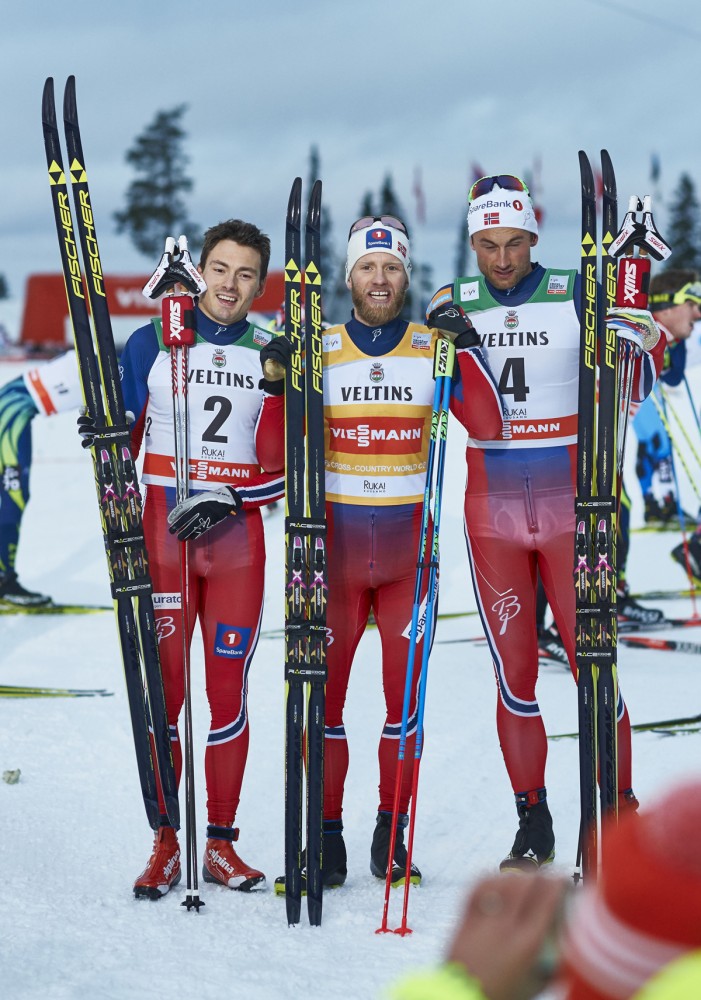
    The all-Norwegian men's podium after the Ruka Triple 15 k classic pursuit on Sunday at the World Cup in Kuusamo, Finland, with, Martin Johnsrud Sundby (c) in first, Finn Hågen Krogh (l) in second and Petter Northug (r) in third. (Photo: Fischer/NordicFocus)
    The all-Norwegian men’s podium after the Ruka Triple 15 k classic pursuit on Sunday at the World Cup in Kuusamo, Finland, with, Martin Johnsrud Sundby (c) in first, Finn Hågen Krogh (l) in second and Petter Northug (r) in third. (Photo: Fischer/NordicFocus)

    He won Saturday’s 10 k freestyle to take the mini-tour lead, then started Sunday’s pursuit with a 14-second head start on teammate Finn Hågen Krogh. While the two never skied together — and actually skied alone for most of the race — they both ended up on the podium.

    Krogh faded in the final third of the race, and Italy’s Francesco de Fabiani and Norway’s Didrik Tønseth caught him with about four kilometers to go. He stayed with them, then dug especially deep to edge de Fabiani by 0.1 seconds for third, less than two seconds behind Northug.

    “I was completely on the [brink] when [the chase group] overtook me,” Krogh told NRK.

    Norway took every spot on the podium, but de Fabiani in fourth kept the powerhouse nation from a top-six sweep. Norway’s Niklas Dyrhaug and Tønseth placed fifth (+48.5) and sixth (+50.6), respectively, and Alex Harvey of Canada was another five seconds back in seventh. In all, Norway put seven in the top 10.

    For Harvey, it was his best finish in the Kuusamo mini tour after placing 11th overall there in 2011. He was second in Saturday’s 10 k freestyle to put himself sixth in the tour heading into the final pursuit.

    “I am super satisfied with the weekend,” Harvey said in a Cross Country Canada press release. “I just felt I had something more in me today than seventh.”

    The Norwegian domination began at the outset. Sundby started alone ahead of Krogh, followed by another Norwegian, Anders Gløersen, 19 seconds back in third. Northug started fourth, 24 seconds after Sundby and a second ahead of Harvey and Switzerland’s Dario Cologna, who placed third in Saturday’s 10 k.

    While Harvey and Cologna headed out together 25 seconds back, the two formed a coalition to battle the elements, particularly the wind, and try to rein in Sundby. However, just before the 4 k mark, Sundby was already 44 seconds ahead of Krogh, 47 seconds ahead of Sweden’s Martin Johansson (who started seventh), and 48 seconds ahead of Cologna, de Fabiani, Harvey, and Gløersen, respectively.

    By 5 k, Krogh had successfully broken away from the rest of the field, skiing 13 seconds ahead of them and 42 seconds behind Sundby. Behind him, Harvey and Cologna stuck with the chase pack that remained seven-men strong by 6.4 k.

    With two laps remaining at 10 k, Cologna had fallen off the pace slightly and slipped to 16th, while Harvey skied in seventh, 15.5 seconds behind Krogh and 1:12 behind Sundby.

    When Tønseth, de Fabiani and Johansson accelerated at the start of the second-to-last lap to catch Krogh, the chase pack split and left Harvey, France’s Maurice Manificat and three Russians — Alexander Legkov, Sergey Turyshev and Maxim Vylegzhanin — in a group of their own. From there, Harvey had to fight for a top 10.
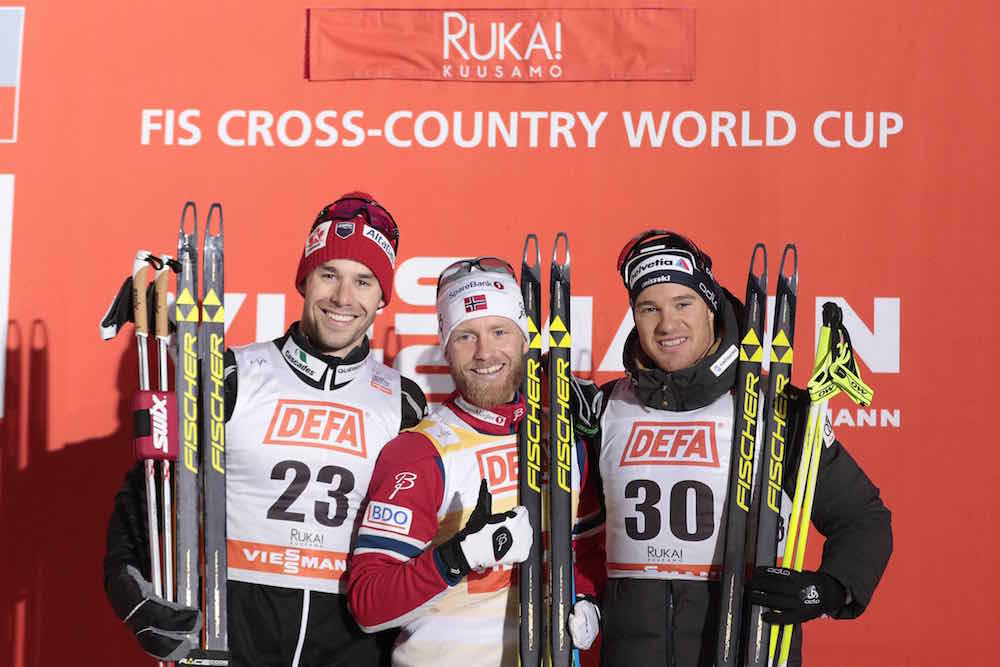
    Canadian Alex Harvey (l) placed second in Saturday's 10 k freestyle at the World Cup in Kuusamo, Finland, to share the podium with Norwegian winner Martin Johnsrud Sundby (c) and Switzerland's Dario Cologna  (r) in third. (Photo: CCC/NordicFocus)
    Canadian Alex Harvey (l) after placing second on Saturday in the World Cup 10 k freestyle in Kuusamo, Finland, to share the podium with Norwegian winner Martin Johnsrud Sundby (c) and Switzerland’s Dario Cologna (r). (Photo: CCC/NordicFocus)

    “It was a tough race for sure. I felt really good, in fact I think it was the best day I had physically, but it was really tricky waxing conditions,” Harvey explained.

    “Our skis really weren’t that bad. The speeds were average, but the difference was the Norwegians and Italians had the best skis,” he added. “I was right there until the final kilometer, but I think as the track started [deteriorating], I lost the group on the last downhill.”

    This Kuusamo course can be like shock therapy. The Ruka hills no joke for World Cup skiers in midseason form, let alone the opening races on this year’s World Cup circuit. A big climb marks the central portion of the 2.5 k loop that the men rounded six times.

    According to Canadian head coach Justin Wadsworth, his team approached the race with a straightforward mindset.

    “We didn’t talk about anything strategy wise before the race. We were so focused on the skis,” he said in a post-race phone interview. “I just told the guys that the only piece of advice that I could really offer was everyone is going to be in the same boat, and it’s going to be hard. So, that was the main thing. Just don’t worry if the skis don’t work everywhere because it’s going to be hard.”

    Although the Canadians had a relatively strong day, with Harvey in seventh and Devon Kershaw in 23rd (after starting 29th), Wadsworth said they may have come up short with ski prep.

    “We feel like we were scrambling a little bit on the skis. We were a bit slow. We could have a little bit more time for that, at least to test today,” he said. “I think maybe we focused a little too much on the the powder testing, some of the glide testing, and that pushed it a little bit later than we wanted. So we didn’t have have as much time as we like to test the kick, which is a priority because it was very, very hard day.”

    “We know what mistakes we made and the skis were a bit slow for all the athletes on the fast downhills, so that was definitely an issue,” Wadsworth continued.

    On a day with 92-percent humidity and temperatures just below freezing, no one’s skis worked everywhere. There was some striding, some ski-running, some herringbone.

    “It was one of the hardest World Cups I’ve ever watched as far as that nobody had the skis that they could run up everything and then glide well,” Wadsworth noted. “There were guys icing. They were slipping in the tracks, out of the tracks. It was a really tough race in that respect.”

    U.S. coach Matt Whitcomb reiterated the universal waxing conundrum. “The conditions today were very very difficult,” he said on the phone. “Picture some of the worst classic conditions you’ve skied in and it was pretty much that.”

    With the relentless climbs, a course profile that rarely backs off, coupled with the dicey kick, the race took a collective toll on the field.

    Meanwhile, lurking at the tail end of the top 20 with five kilometers to go, Northug kept the frontrunners within sight. In the final kilometers, he worked his way forward, eventually closing the gap on those ahead.

    With 2.5 k remaining, he was up to seventh behind Harvey. Then at 14 k, he began stalking Tønseth, de Fabiani and Krogh while skiing in fifth.
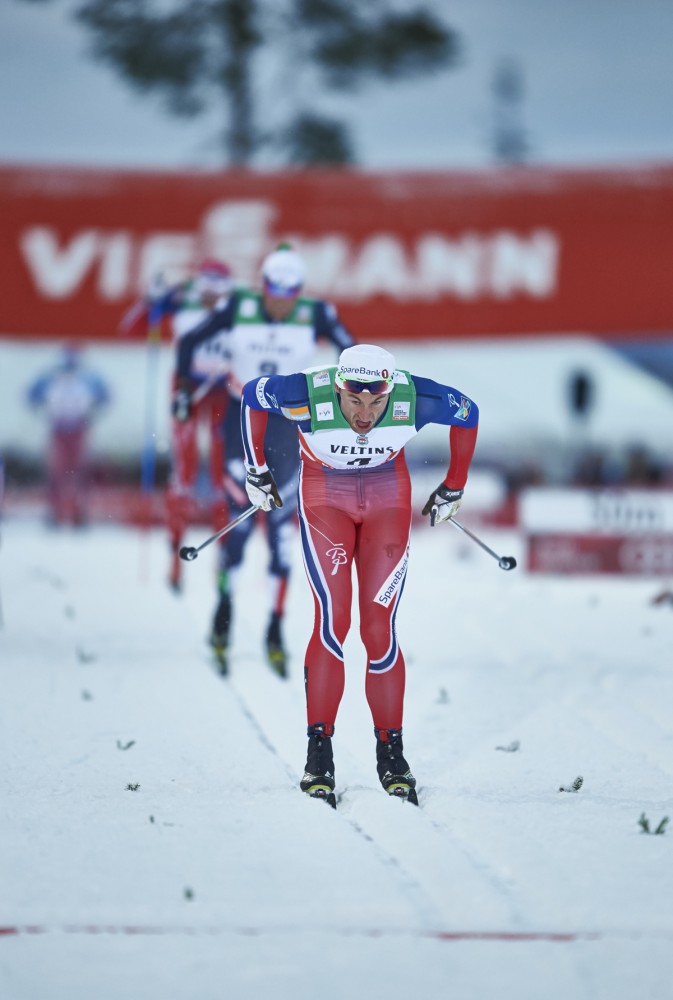
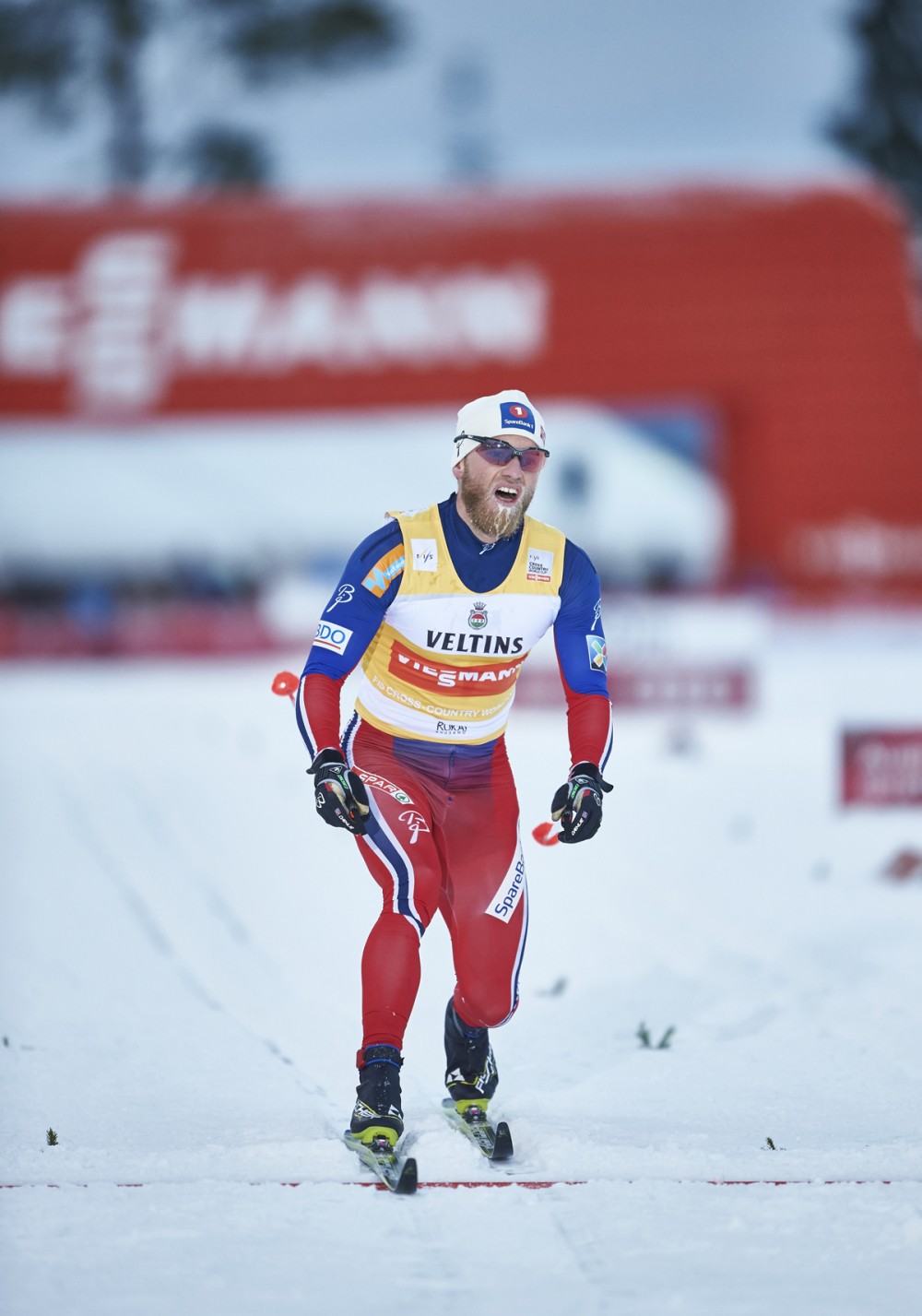
    Petter Northug powers to second in the men's 15 k classic pursuit on Sunday, the final day of the Ruka Triple World Cup in Kuusamo, Finland. (Photo: Fischer/NordicFocus)
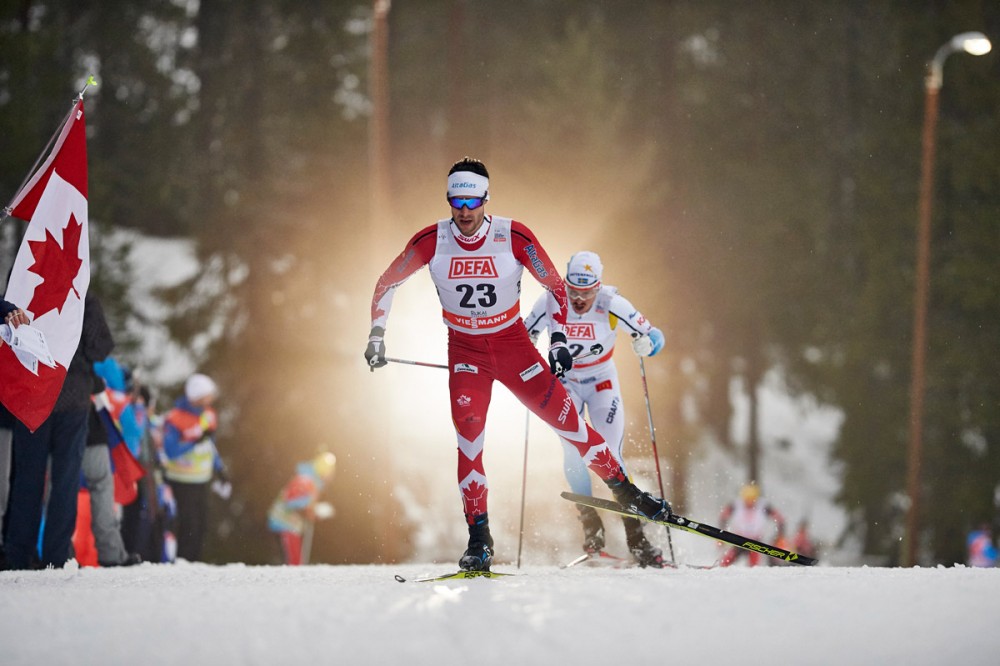
    Petter Northug powers to second in the men’s 15 k classic pursuit on Sunday, the final day of the Ruka Triple World Cup in Kuusamo, Finland. (Photo: Fischer/NordicFocus)

    Sundby crossed the line in 37:10 without anyone in sight. Almost 45 seconds later, it was Northug who steamrolled ahead of Krogh and de Fabiani and left them fighting for third.

    Ever the tactical chameleon, Northug was clearly gassed at the finish. He lay prone on his back, lungs heaving. When he finally spoke to reporters, Northug explained his form and technique were not quite up to his liking.

    “I was tired. I’m not in shape to go with these guys yet … so I was [skiing] back there and I was annoyed at myself,” he said to NRK, according to a translation. “It was about being in the right place at the right time.”

    The duo that had hoped to gain places as a unit, Harvey and Cologna faded slightly in the end to finish seventh and 13th (+1:18.8), respectively.

    As is his style, Sundby remained humble.

    “The first two laps were hard, so I tried to maintain the pace the rest of the race,” he told NRK, according to a translation. “This weekend I have had wonderful fine skiing. Things worked out and I’m in good shape. This winter I think will be exciting and I think I get a lot of exciting duels with these guys here.” 

    “I wanted the other guys think they cannot catch me, but I started way too fast,” Sundby told FIS. “I got extremely tired. After 7.5 k, I did not know how to continue. I am happy I am leaving Ruka with the overall victory in the mini-tour.”

    The fastest time on the day belonged to Dyrhaug, who completed the course in 37:08.1, almost two seconds faster than Sundby.
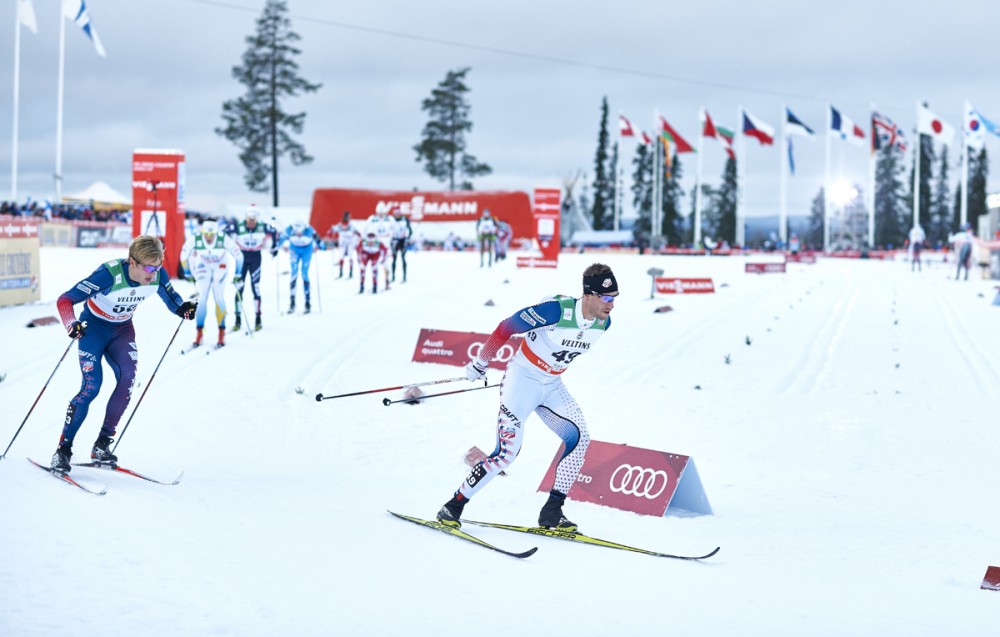
    Erik Bjornsen (l) chases U.S. teammate Simi Hamilton  during Sunday's World Cup 15 k classic pursuit at the Ruka Triple mini tour in Kuusamo, Finland. Bjornsen led the U.S. men in 46th and Hamilton placed 68th. (Photo: Fischer/NordicFocus)
    Erik Bjornsen (l) chases U.S. teammate Simi Hamilton during Sunday’s World Cup 15 k classic pursuit at the Ruka Triple mini tour in Kuusamo, Finland. Bjornsen led the U.S. men in 46th and Hamilton placed 68th. (Photo: Fischer/NordicFocus)

    The top American male was Erik Bjornsen, who finished the Ruka Triple 46th overall (+2:10.3) with the  43rd fastest time of the day.

    In an email, Bjornsen wrote he feels like he’s building his form. “I know I have to be at the top of my game to post an impressive World Cup result and I’m just not quite there right now,” he wrote.

    Racing in massive fields with world-class talent, each World Cup weekend is a learning experience, the 24 year old explained. “Racing over here is just so different, I’m trying my best to learn from all these experiences.”

    Also for the U.S., Noah Hoffman finished the weekend in 52nd (+4:25), Simi Hamilton was 68th (+5:29), Kris Freeman 73rd (+5:44.2), and Andy Newell did not finish.

    “We had some big hits this weekend and some big misses,” Whitcomb said of the U.S. Ski Team’s overall showing in Kuusamo. In the women’s pursuit, Sadie Bjornsen led the team in 14th. “It’s the first weekend of World Cup racing and Kuusamo presents some of the toughest waxing and skiing conditions of the season. It’s an agressive introduction.”

    After Harvey in seventh and Kershaw in 23rd (+1:48.5), Ivan Babikov placed 50th (+4:17.2) for Canada, Graeme Killick was 55th (+4:38.9), Michael Somppi 81st (+ 7:08), and Len Valjas did not start Sunday’s race.

    World Cup racing continues next Saturday and Sunday with a skiathlon and relay in Lillehammer, Norway.
    Results | Winner of the day

  • Sadie Bjornsen Rides ‘Patience and Optimism’ to Best-Ever 14th in Ruka Triple

    Sadie Bjornsen Rides ‘Patience and Optimism’ to Best-Ever 14th in Ruka Triple

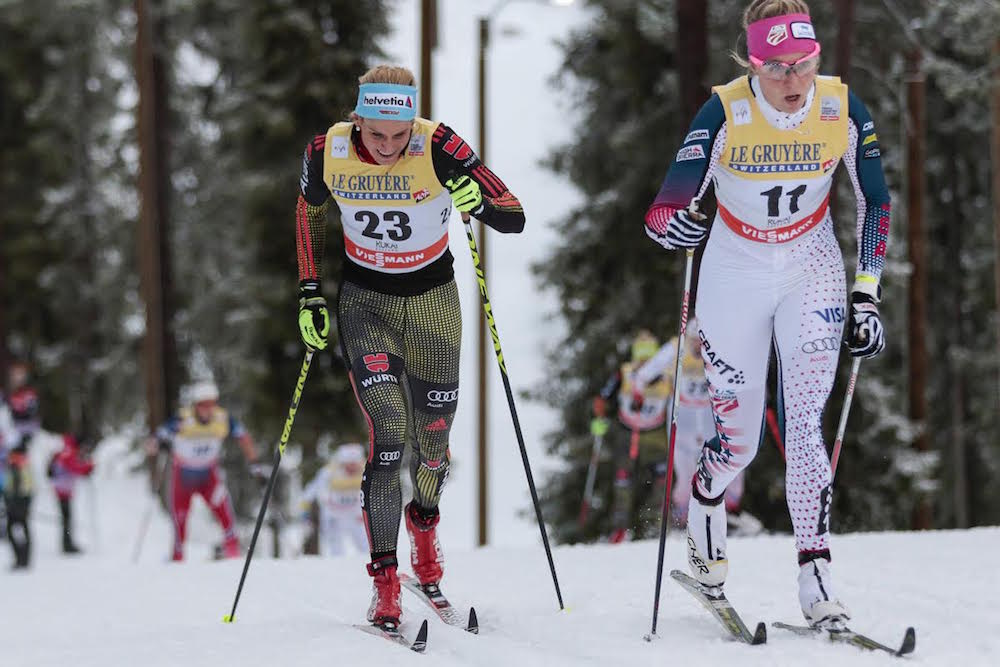
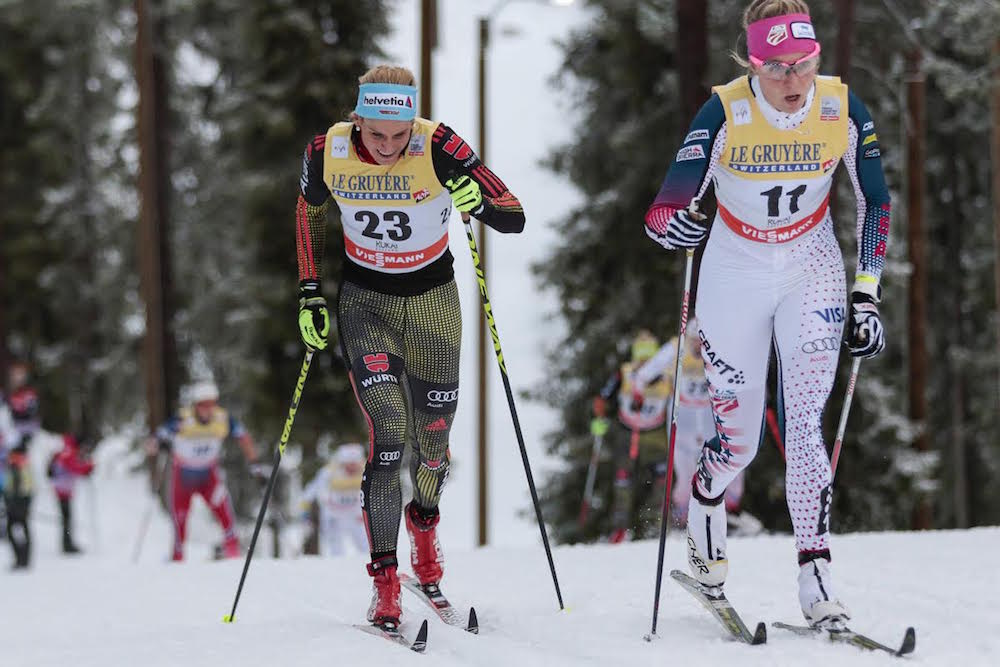
    Sadie Bjornsen (r) of the U.S. Ski Team leads Germany's Nicole Fessel  (l) during the women's 10 k classic pursuit on Sunday at the Ruka Triple World Cup in Kuusamo, Finland. Bjornsen started 11th and went on to place 14th. (Photo: Fischer/NordicFocus)
    Sadie Bjornsen (r) of the U.S. Ski Team leads Germany’s Nicole Fessel (l) during the women’s 10 k classic pursuit on Sunday at the Ruka Triple World Cup in Kuusamo, Finland. Bjornsen started 11th and went on to place 14th. (Photo: Fischer/NordicFocus)

    It’s easy to get caught up in results and what could have been. Ask Sadie Bjornsen. The 26-year-old U.S. Ski Team member was shooting for a top 10 in Sunday’s 10-kilometer classic pursuit at the World Cup in Kuusamo, Finland.

    After putting herself in 11th to start the final stage of the Ruka Triple mini tour, Bjornsen considered 10th or better to be a reasonable goal. That is, until you factor everything else that typically happens in Kuusamo.

    On Sunday, a mixture of rain and snow falling amid a windy, 32-degree morning, paired with a combination of natural and manmade snow on the course, made for a lot of variables. With that in mind, Bjornsen noted that it was imperative to stay positive.

    She would know. Two years ago, she had her breakthrough result in the Kuusamo 5 k classic, placing seventh. The day before, Bjornsen qualified third in the classic sprint.

    She ended up 17th overall in the 2013 Ruka tour. On Sunday, she posted a new personal best in the Ruka Triple in 14th overall. And while it wasn’t the top 10, it took a lot of work to get there.

    “It was another fun, and extra challenging day of racing in Kuusamo,” Bjornsen wrote in an email after Sunday’s pursuit, in which she finished 14th, 2:05.6 behind Norwegian winner Therese Johaug.

    She had started 35 seconds behind Johag. By 2.5, Bjornsen was about a minute back in 14th, and at the halfway point, she remained in 14th, about a minute and 24 seconds back. That’s partly because Johaug was putting a lot of time into the field; at 5 k, she had a 24.5-second gap to Norwegian teammate Ingvild Flugstad Østberg (who started with her).

    But Bjornsen was also struggling.

    “My first [2.5 k] lap was really hard, because I realized I had no kick in the track, and I felt like I was being passed by people constantly,” she recalled. “Finally, by the second lap, I pulled myself together, and decided to just ski outside of the track for the majority of the race, and then things worked out much better! I was even having a lot of fun on the final lap!

    “Patience and optimism is the key on a day like today though, because there is such a variety of things that are going on,” Bjornsen added. “… I could have easily continued to struggle and drop after that first lap, but I gave myself a little smacking and realized I had to make my opportunity today.”

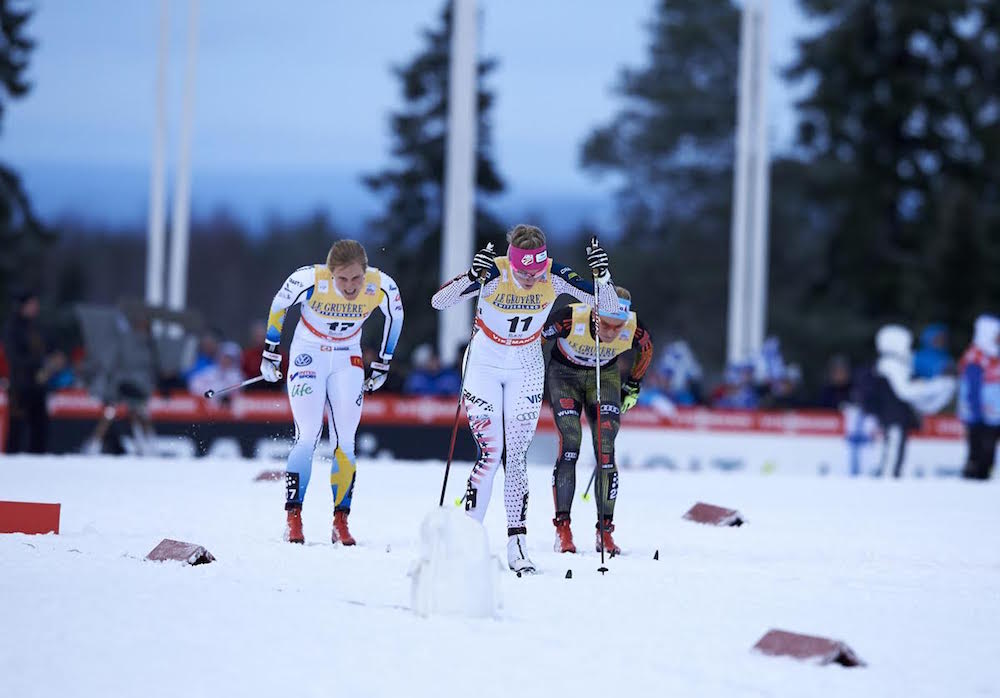
    Sadie Bjornsen (c) skis with Sweden's Hanna Falk (l) and Germany's Nicole Fessel (r) during the women's 10 k classic pursuit on the last day of the Ruka Triple in Kuusamo, Finland. Bjornsen placed 14th in the first World Cup and mini tour of the season. (Photo: Fischer/NordicFocus)
    Sadie Bjornsen (c) skis with Sweden’s Hanna Falk (l) and Germany’s Nicole Fessel (r) during the women’s 10 k classic pursuit on the last day of the Ruka Triple in Kuusamo, Finland. Bjornsen placed 14th in the first World Cup and mini tour of the season. (Photo: Fischer/NordicFocus)

    Instead of paying attention to the athletes near her, Bjornsen focused on doing her best with what she had available, she explained. That made her happier in the end.

    It was also the key to her success, according to U.S. women’s coach Matt Whitcomb. After the race, he observed that the athletes who didn’t openly complain about how bad the wax was were the ones that fared best.

    “Our athletes never complain about the wax midrace, but every now and then you hear another athlete yell in disgust about the wax,” he said. “… Everyone is slipping and sliding around this course and it was those that said, ‘This is what I’ve got, what do I have to do?’ [that succeeded.]”

    “Sadie’s race was impressive, but also her reflection on the race was mature,” Whitcomb added. “She discovered after a lap that the way she was skiing wasn’t working. To get out of the tracks on the uphill gave her the biggest benefit. … She resettled, put in three really good laps and was able to hang onto a top 15.”

    “There was no simple answer out there today, it was a challenge no matter what!” Bjornsen explained. “My wax tech did such an awesome job of keeping me relaxed and confident with what was going to happen, so I am so thankful for that!

    “I am really stoked to finish with my best tour result ever,” she concluded. “I am really satisfied with the weekend, and I know there is more to come, and more ‘less challenging conditions’ to come as well!”

    After Bjornsen, teammate Jessie Diggins started 19th, 47 seconds behind Johaug, and finished 38th (+3:17.4). She skied within the top 30 for the first 2.5 k before falling two minutes off the pace between 4 and 5 k.

    “I struggled in these conditions, but it was an important step forward for me on the mental side of racing,” Diggins wrote in an email. “A few years ago, I might have heard that I was out of the top 30 and stopped skiing as hard as I could, but I never gave up and kept looking for those seconds out there, and I’m proud of that.”

    A weekend after winning both FIS races in Gällivare, Sweden, including a classic sprint, Sunday’s classic distance result left Diggins disappointed, Whitcomb said.

    “She’s made big progress on her classic skiing, but today’s conditions required the ability to really feather the kick,” he explained. The best classic skiers who could maintain their technique despite spotty kick tended to do better, he added

    But Diggins wasn’t concerned.

    “I feel that my fitness is in a good place for the start of the year, and when I let my body recover from the past few weeks of good training and the 5 races I did in the last 9 days I should see a fun boost!” she wrote.

    The second-fastest U.S. woman in the pursuit, Rosie Brennan started 34th (1:09 back) and finished 34th (+3:08.5) with the 33rd-fastest time of the day.

    “I had my eyes on the top 30 both for the tour and the time of day. I fell just short of both, but I guess I’m putting in my time so to say,” Brennan wrote in an email. “No one had perfect skis so it was all about finding ways to make it work. I started a little slow with some apprehension for both the downhills and my skis, but eventually started finding ways to make it all work.”

    While her race had its ups and downs, “some laps I felt I had figured it out and other laps I felt like I couldn’t make anything work,” she explained, Brennan was ultimately pleased with her start to the season.

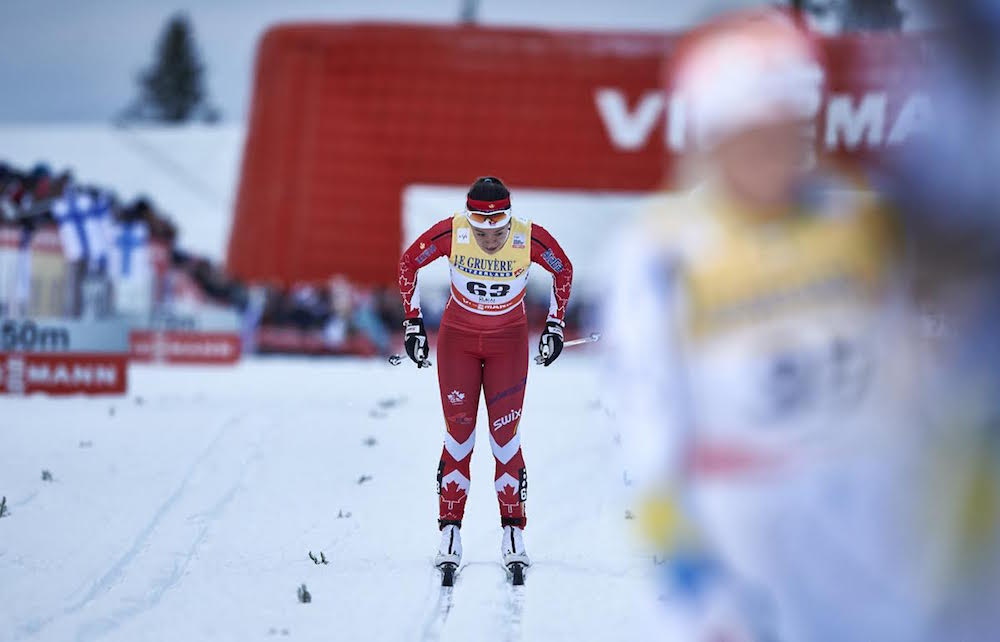
    Emily Nishikawa of the Canadian Development Team skiing to 60th in the 10 k classic pursuit at the World Cup in Kuusamo, Finland. (Photo: Fischer/NordicFocus)
    Emily Nishikawa of the Canadian Development Team skiing to 60th in the 10 k classic pursuit at the World Cup in Kuusamo, Finland. (Photo: Fischer/NordicFocus)

    “I learned a lot over the weekend and got my mind back into ski racing which I think will set me up well for the coming weeks,” she wrote.

    “She skied so steady in the mid 30s,” Whitcomb said of Brennan. “I know she’s a little disappointed, but points don’t come easy, particularly in Kuusamo and Lillehammer in these first two World Cups … I think it bodes well to Rosie’s trajectory.”

    Also for the U.S., Ida Sargent — who placed seventh in Friday’s classic sprint — rose from starting 54th to finish 44th overall. Liz Stephen placed 59th, and Caitlin Gregg was 68th.

    “I was really pleased with the whole process [this weekend],” Whitcomb said of his team. “… We really operated like medalists should … However, it wasn’t all fluffy like that. We had some disappointing results.”

    On the men’s side, Sadie Bjornsen’s younger brother Erik led the team in 46th overall

    “Overall, I feel good about where this team is,” Whitcomb said. “The good results weren’t completely absent this weekend … but we’re heading to Norway to prove we’re in better shape than we showed this weekend.”

    Canada’s lone female competing in Kuusamo, Emily Nishikawa placed 60th (+5:11.8) after starting 63rd. Annika Taylor, a University of New Hampshire graduate and former Far West Nordic junior who’s now racing for Great Britain, went from 67th to 62nd overall (+5:33.7) in the tour.

    Results | Winner of the day

  • Canada’s Harvey in the Hunt for Ruka Overall, Second in 10 k Skate

    Canada’s Harvey in the Hunt for Ruka Overall, Second in 10 k Skate

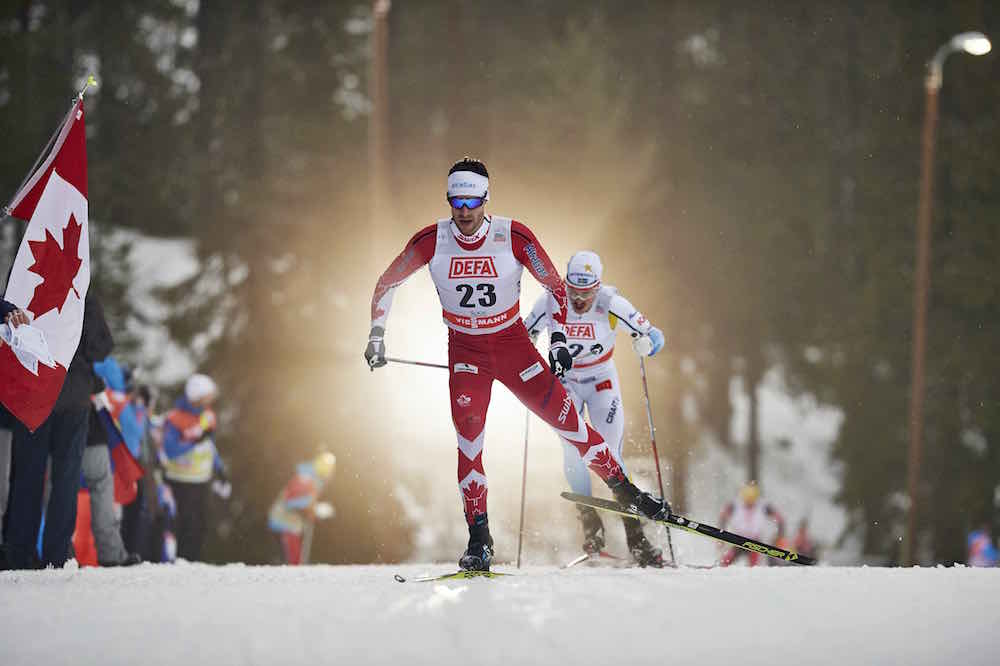
    Canada's Alex Harvey powers to second in the World Cup 10 k freestyle, the second stage of the Ruka Triple in Kuusamo, Finland. (Photo: Fischer/NordicFocus).
    Canada’s Alex Harvey powers to second in the World Cup 10 k freestyle, the second stage of the Ruka Triple in Kuusamo, Finland. (Photo: Fischer/NordicFocus).

    Although it’s only Day 2 of a young World Cup season, the image of Alex Harvey posing for cameras amongst the podium trio could become common. It has been in the past for the four-time world championship medalist; it just doesn’t usually come this early in the season.

    In the men’s 10-kilometer freestyle on Saturday, the second day of the Ruka Triple mini-tour in Kuusamo, Finland, Norway’s Martin Johnsrud Sundby skated to the win in 21:05.5. Harvey of the Canadian World Cup Team finished in second, 11.2 seconds off the pace, and Swiss Olympic champion Dario Cologna rounded out the podium in third, 0.4 seconds back from Harvey.

    Canadian Alex Harvey (l) placed second in Saturday's 10 k freestyle at the World Cup in Kuusamo, Finland, to share the podium with Norwegian winner Martin Johnsrud Sundby (c) and Switzerland's Dario Cologna  (r) in third. (Photo: CCC/NordicFocus)
    Canadian Alex Harvey (l) placed second in Saturday’s 10 k freestyle at the World Cup in Kuusamo, Finland, to share the podium with Norwegian winner Martin Johnsrud Sundby (c) and Switzerland’s Dario Cologna (r) in third. (Photo: CCC/NordicFocus)

    Harvey, 27 is not exactly “green” when it comes to top-three results on the World Cup. But many things are new to Harvey and for the Canadian team.

    First there’s the early results.

    “It’s my first podium ever before Christmas and in Kuusamo it has been quite bad for me in skating. In the past, my best skating result here was 17th,” Harvey said in a post-race phone interview.

    A fast start for Harvey is something new; a common thread in his skiing had been about building into the season and progressively into races. Although one distance race is a small sample size, Harvey and Canada’s head coach Justin Wadsworth believe this will be among many data points marking Harvey’s rise as a contender for the overall World Cup crown.

    Second, there’s the seemingly “new” legs under Harvey. That’s the result from surgery on his iliac arteries this summer. Postoperative, Harvey says the blood flow in his legs make it so he can sustain harder efforts on steep uphills.

    The first thing that I noticed this summer and running training, I could actually push,” Harvey said. “In the past, I couldn’t get my heart rate past 155 in running because I was purely relying on my legs. And in skiing, I was able to have good results because I could compensate with the upper body. But any time there was a course where the legs were involved, a lot like Kuusamo, like the Tour de Ski climb, I could not really play for the top ten.”

    Wadsworth predicted Harvey’s second place would be part of a trend. “From what we’ve seen from Alex in training this year, it’s been everything pointing to this,” he said.

    The second stage of the Ruka Triple, the 10 k skate, was a proving ground. Kuusamo’s course is a grind. The type of course where it’s all about steep uphills with little recovery time. A course where if Harvey’s legs were going to flood or be sluggish, he’d know right away.

    “I was pretty confident that it would be good in racing but you never know until you get a result. Black on white, written on paper,” Harvey said.

    Starting 23rd, Harvey motored as soon as he tripped the gate. Building into the race, with increasingly faster splits is a Harvey hallmark. However, on this race day, the new sensations made for a change of strategy — he wanted to go sustainably fast enough to clock top-five splits throughout the race.

    “Today, 1.5 k atop of the first big hill when I was getting good splits and my legs were not completely seizing up, I knew it was going to be a good day,” he said.

    The consistency of Harvey’s effort is reflected by his splits: at 3.1 k, he was fourth, and fourth again at 6.2 k. At 8.1 k, fourth again. He picked up his pace towards the end.

    “In an individual start I always try to pick it up for the last ‘k’ for sure,” he said. “That’s when a lot of guys are coming undone and I think for me historically in the past, that’s where I’ve been able to move from top five to the podium.”

    Dario Cologna finishes .4 seconds behind Harvey in the 2nd stage 10 K freestyle: Ruka Triple 2nd stage. (Photo Credit: Fischer/Nordic Focus).
    Dario Cologna (l) finished 0.4 seconds behind Harvey in the 10 k freestyle, second stage of the Ruka Triple World Cup on Saturday in Kuusamo, Finland. (Photo: Fischer/NordicFocus).

    Harvey crossed the line in first, bumping Norway’s Anders Gløersen out of the leader’s chair with a time that was 3.4 seconds faster than Gløersen’s. His work done, Harvey watched the adjacent screen with live results. Deciphering the list of splits, it became clear: Cologna was a threat.

    With about one kilometer to go, there’s a steep headwall of a climb. Wadsworth positioned himself there with friend and Swiss coach Christian Flury, who used to coach in Canada. They provided splits for their skiers, and noticed the duel evolving.

    “Oh yeah, when Dario went by on the last lap there when Christian was giving him all the info, how tight it was with Alex, we knew it was going to be tight at the finish,” Wadsworth said.

    Cologna bested Harvey at every split, except the one that matters. Cologna slotted into second at the finish, 0.4 seconds behind.

    With many big names still on the course — Northug and Sundby among them— Harvey knew any one of them could ski him out of contention.

    Sundby remained in the hunt. Having secured the overall World Cup the past two years, it seems Sundby rarely has an off day. Saturday’s race confirmed that consistency; he posted the fastest splits at every checkpoint after 1.2 k.

    Awaiting Sundby’s finish, Harvey said he knew what was coming.

    I was excited, but, I mean Sundby had quite a bit gap on me throughout the whole race. Like 5-10 seconds the whole race,” he said. “Unless he crashed … I didn’t really think I was going to beat him.”

    Harvey’s exit from the leader’s chair came at the hands of Sundby, who finished in just over 21 minutes — a super-human effort even for Sundby.

    It was hard today, tougher than I had envisioned beforehand. In this course you get no rest for two seconds,” Sundby told Norwegian broadcaster NRK.

    With the win, Sundby becomes the Ruka Triple’s overall leader by 13.8 seconds followed by teammate Finn Hågen Krogh in second.

    Another notable finish was Harvey’s teammate, Devon Kershaw in 24th. That stood as Kershaw’s best freestyle distance result since he won the 15 k skate in Rybinsk, Russia, in 2012. (He placed second in a 4.5 k freestyle prologue at the 2013/2014 Tour de Ski behind Harvey.)

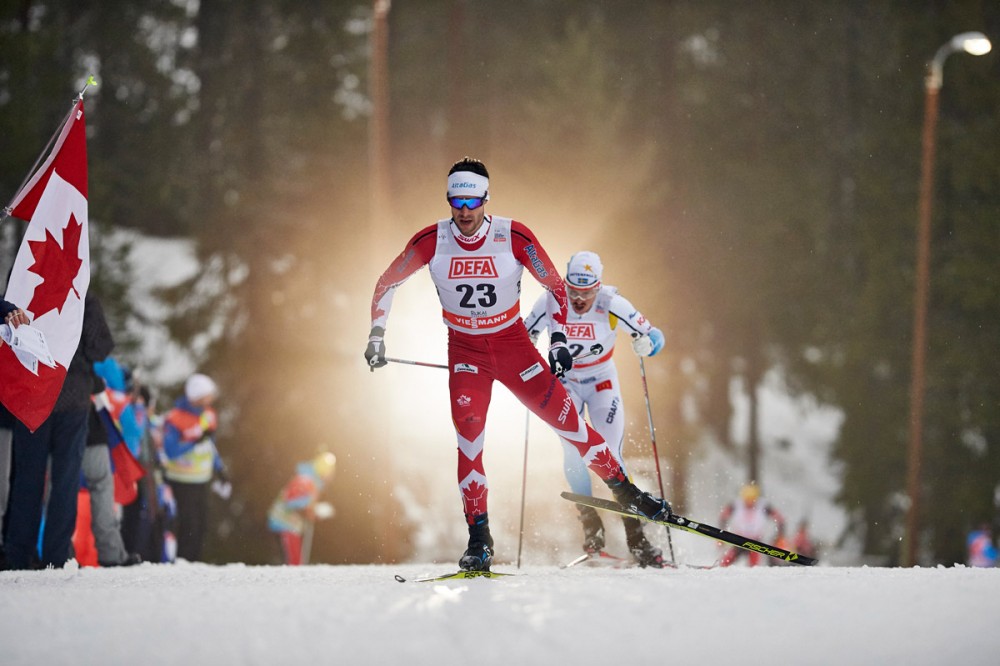
    Devon Kershaw races to 24th in the 10 k freestyle: Ruka Triple stage two. (Photo Credit: Fischer/Nordic Focus).
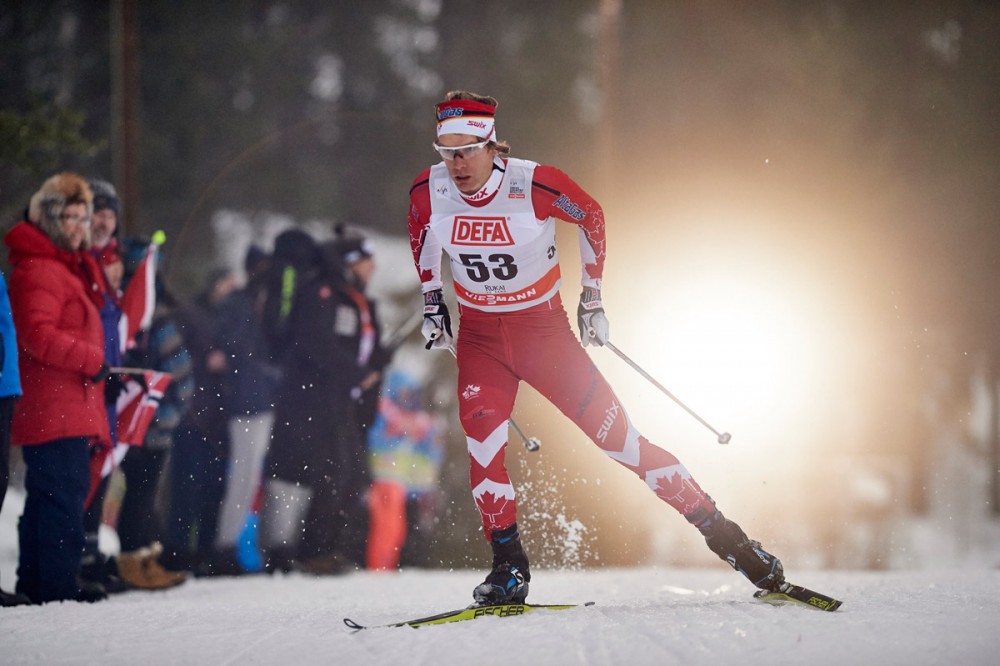
    Devon Kershaw races to 24th in the Ruka Triple 10 k freestyle at the World Cup in Kuusamo, Finland. (Photo: Fischer/NordicFocus).

    “I mean, for me in an individual start skate to hit the points is a solid outing — so that shows that I must have felt ok,” Kershaw wrote in email.

    Kershaw’s start bib number, 53, played into his race strategy. He started a bit conservatively, knowing eventual winner Sundby started next, only 30 seconds behind him.

    “If you can catch a ride from the best skier in the World — you try your darnedest to do just that for as long as you possibly can,” he wrote.

    Kershaw skated behind Sundby for 5 k.

    “Of course the upside when you start 30 seconds up on the World #1 the last two years in a row is that if you can stay on his pace — it can help you….but the real goal was to stay on Sundby the whole way once he caught me — and I completely came undone with about 1.8km to go — and lost oodles of time (about 15 seconds) to the line,” he added. “When he launched his attack to the line I completely blew up and I was on fumes to the finish from there.”

    Sunday’s final stage, a 15 k classic pursuit, will see Sundby start with nearly a 14-second head start. He’ll be chased by a who’s-who of skiing. But the duo to watch may be Harvey and Cologna starting 25 seconds back in fifth and sixth behind him — they’ve struck an alliance.

    “I talked with Dario already. We are going to share the workload tomorrow,” Harvey said. “I don’t really expect Petter [Northug], to be doing much work. We have an advantage over Sundby, just cause we can share that. Today was quite windy in the stadium and on the flat sections. It’s good to take a different leads.”

    Whether that alliance and those tactics succeed remains to be seen: Sundby is a force.

    Also for Canada, Ivan Babikov placed 52nd, Graeme Killick 57th, Michael Somppi 93rd, Len Valjas 95th, and Jess Cockney 101st of 111 finishers.

    Simi Hamilton led the U.S. men in 49th, Erik Bjornsen placed 54th, Noah Hoffman 58th, Andy Newell 85th, and Kris Freeman finished 88th after falling and breaking his pole. According to U.S. coach Matt Whitcomb, he was skiing just outside of the top 30 before that.

    “It was a good race from Simi Hamilton who was flirting with the top 30 through 5 k,” Whitcomb said. “He started fading a bit in the second lap, but grabbed a couple more spots the last 2k to finish 49th. He demonstrated some great skate fitness and is going to be an exciting athlete to watch in Davos in two weeks.”

    Men’s results | Tour Standings | Sunday’s pursuit start list

  • Top 20 for Bjornsen, Diggins in Ruka 5 k Keeps Them in Mini-Tour Contention

    Top 20 for Bjornsen, Diggins in Ruka 5 k Keeps Them in Mini-Tour Contention

    Sadie Bjornsen racing to 14th in the women's 5 k freestyle at Saturday's World Cup in Kuusamo, Finland. Her finish put her in 11th overall heading into the final day of the Ruka Triple mini tour. (Photo: Fischer/NordicFocus)
    Sadie Bjornsen racing to 14th in the women’s 5 k freestyle at Saturday’s World Cup in Kuusamo, Finland. Her finish put her in 11th overall heading into the final day of the Ruka Triple mini tour. (Photo: Fischer/NordicFocus)

    It was a fight for every second in the women’s 5-kilometer freestyle on a damp morning during the second day of World Cup racing in Kuusamo, Finland.

    Sadie Bjornsen led the American women in 14th on Saturday, 41.8 seconds behind Norway’s Therese Johaug, who won in 11:23.8. Less than two seconds behind Bjornsen, another U.S. Ski Team member Jessie Diggins tied for 16th with Russia’s Alevtina Tanygina — 43.6 seconds behind Johaug.

    In the 500-meter race, 55 seconds separated the top 30 women, making every second count in the results.

    “Everything is so tight, a half second will move you up or down a place,” Diggins said in a phone interview after the race. “So it’s really important to look for places to get every second you possibly can, figure out what spots you are good at and where you can make up time.”

    All 85 female finishers posted times within 2 minutes and 13 seconds of one another, and 59 of the racers took between 12 and 13 minutes to complete the one-lap course. Johaug’s 17.8-second win over Sweden’s Charlotte Kalla stood as the largest time gap between any two finishers.

    “The difference between a good race and your best race ever here can be ten seconds,” U.S. women’s coach Matt Whitcomb explained in a post-race phone interview.

    Caitlin Gregg of the U.S. Ski Team racing in Saturday's World Cup 5 k freestyle in Kuusamo, Finland. While she had the eighth-fastest split at 1.2 k, she ended up 48th. (Photo: Madshus/NordicFocus)
    Caitlin Gregg of the U.S. Ski Team racing in Saturday’s World Cup 5 k freestyle in Kuusamo, Finland. While she had the eighth-fastest split at 1.2 k, she ended up 48th. (Photo: Madshus/NordicFocus)

    This was illustrated by the rest of the American women as they posted competitive times, but ended up farther down the results than most of them had hoped for. Rosie Brennan took 35th (+59.5), Liz Stephan was 43rd (+1:06.4), Caitlin Gregg 48th (+1:11.8), Sophie Caldwell 56th (+1:22), and Ida Sargent 68th (+1:36.4).

    “The girls put in a great effort, just a bit shy of where they wanted to be in some cases, but it was a good process and a good team effort,” Whitcomb said. “Two in the top 20 is a decent day for us and Rosie was close to skiing in the points [top 30].”

    “I’m happy, but I wanted more, which is great because I know I have a lot of fire for the rest of the season,” Diggins said.  “I know the fitness is there, right where I wanted it to be at the beginning of the season.”

    This sentiment was shared by several team members. “I was happy with how I skied and hope to be pushing for that next gear,” Brennan wrote in an email.

    “Today didn’t feel as good as last weekend, but I am still psyched about where my fitness and preparation are,” Gregg wrote, referring to the U.S. team’s season-opening FIS races in Gällivare, Sweden, where she placed third in the 10 k freestyle. Diggins won that race; her second-straight last weekend.

    According to Whitcomb, the team’s universal goal was to “ski with 11 or 12 minutes of pure focus,” in Saturday’s 5 k. “This is the kind of course that if you start to space out for a moment or two, the race can leave your control.”

    An 11-12 minute race also left little room to race conservatively. Diggins said her plan in the short-distance race was to “charge from the start.”  This was also Gregg’s game plan as she posted the eighth-fastest time through the first time check at 1.2 k.

    “I knew that if I wanted to be anywhere in the mix of the top girls I would have to start hard!” she wrote. “Unfortunately I felt like I wasn’t quite myself and although the pace felt good and my skis were fast, I wasn’t as powerful and high energy as I usually am during skate races.”

    Gregg faded in the second half to finish 48th, but Whitcomb commended her effort.

    “It’s is a great way to blow up, but also a great way to win races,” he said of her go-hard-from-the-gun tactic. “You can ski conservatively and go for 30th or take it out hard and shoot for the podium.”

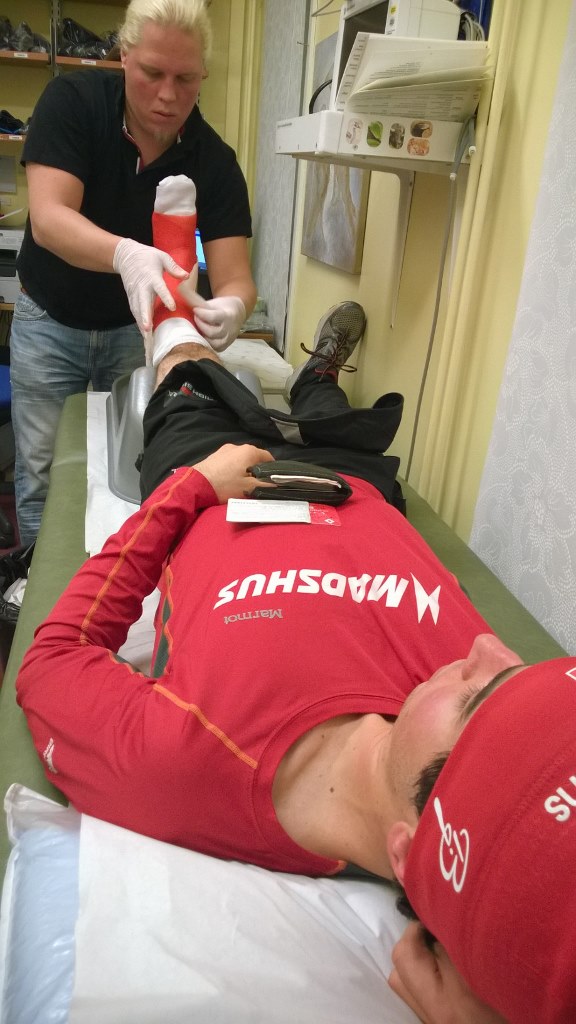
    Hoffman getting a hard cast on his left leg for travel. (Photo: NoahHoffman.com)
    Hoffman getting a hard cast on his leg before traveling back to the U.S. after breaking his fibula last year in the season-opening distance race in Kuusamo, Finland. He placed 58th in Saturday’s 15 k freestyle, behind U.S. teammates Simi Hamilton in 49th and Erik Bjornsen in 54th. (Photo: NoahHoffman.com)

    The humidity and rain the night before and the morning of took a toll on the course, creating soft conditions and some harrowing downhills.  The most challenging part of the course is a sketchy downhill corner, nicknamed “Noah’s corner” after Noah Hoffman’s crash and broken fibula at last year’s Kuusamo 15 k classic.

    “It comes right after a tough uphill so your legs are just flooded,” Bjornsen said of the hairpin corner. “It is tough on everyone.”

    While all of the American women stayed on their feet, Diggins pointed out that descent as a spot she lost seconds. “I know I am better at downhills than that, I just got a bit freaked out,” she said.

    Despite the challenging conditions, the team commended the wax techs for preparing fast skis.

    “It always amazes me they can put together awesome skis in challenging conditions with such a small team,” Bjornsen said.

    After placing seventh in Friday’s classic sprint and 14th on Saturday, Bjornsen is currently 11th in the overall standings heading into the 10 k classic pursuit on Sunday.

    “A couple of years ago I was in a similar position, but now I feel more confident in my overall fitness. I’m excited for tomorrow,” Bjornsen said.

    Diggins in 19th overall is also poised to move up in the overall standings.

    “Both Sadie and Jessie have a chance to ski into the top ten with a good classic race tomorrow,” Whitcomb said. “We are very much looking forward to that. The rest of the girls are within striking distance of the top 30 so it is going to be a fun day.”

    Sunday’s classic pursuit features an especially challenging course with significant climbing.  Bjornsen described it as “basically skiing up a wall.”  Diggins said the course poses unique challenges because the hills are so steep; you are basically running on skis.  “A big goal is just keeping my technique together on the long climbs,” she said.

    With Johaug heading out first, the pursuit will feature 27 women starting within a minute of her, with Bjornsen 35 seconds back and Diggins heading out 17 seconds later.

    “It will almost be like a mass start because we are all packed in there so tight,” Bjornsen said.

    The pursuit format creates an exciting culmination of a mini tour and a chance to considerably shake up the overall standings.

    “I really like pursuit starts because you get to start with people of similar speeds and really focus on picking people off,” Brennan wrote. She’ll start 34th, 1:09 back. “I love classic skiing so I am excited to see if I can find my rhythm tomorrow.”

    “There was a lot of good that came out of today,” Whitcomb said. “Whether the athletes are disappointed or excited after today, we are all fired up for tomorrow.”

    Results | Tour standings | Women’s pursuit start list

  • Sundby Wins Ruka 10 k; Harvey Hits Podium for First Time Before Christmas

    Sundby Wins Ruka 10 k; Harvey Hits Podium for First Time Before Christmas

    Canadian Alex Harvey (l) placed second in Saturday's 10 k freestyle at the World Cup in Kuusamo, Finland, to share the podium with Norwegian winner Martin Johnsrud Sundby (c) and Switzerland's Dario Cologna  (r) in third. (Photo: CCC/NordicFocus)
    Canadian Alex Harvey (l) placed second in Saturday’s 10 k freestyle at the World Cup in Kuusamo, Finland, to share the podium with Norwegian winner Martin Johnsrud Sundby (c) and Switzerland’s Dario Cologna (r) in third. (Photo: CCC/NordicFocus)

    (Note: This brief recap of the men’s 10 k freestyle race at the Kuusamo World Cup on Saturday was published before a full article about Alex Harvey and his second-place finish. For a more detailed account of Harvey’s race, click here.)

    The Canadians have said it before, and they’ll probably say it again: they don’t expect much before Christmas — specifically, results-wise during Period 1 on the World Cup.

    That’s why Alex Harvey’s podium on Saturday in the second race of the World Cup season, the 10-kilometer freestyle, came as a pretty big surprise for the 27-year-old Canadian World Cup Team member.

    This spring, Harvey had surgery on his iliac arteries in both his legs in hopes of remedying a longtime blood-flow issue that affected his skiing, mostly while skating up hills. Before the surgery, he skipped hill-climb freestyle events like the final climb of the Tour de Ski. This year, he was hoping he wouldn’t have to.

    After placing second in Saturday’s skate race in Kuusamo, Finland, one of the most brutal courses on the World Cup circuit, he’s feeling good about his chances.

    “It is my first podium ever before the Christmas,” Harvey told FIS after the race, in which he finished 11.2 seconds behind Norway’s Martin Johnsrud Sundby, who won in 21:05.5 and moved into first in the Ruka mini tour. In Friday’s classic sprint, Harvey missed qualifying in 47th.

    “Ruka was not the best for me because of the steep uphills. It is a good sign of recovery to be on the podium,” Harvey added. “My skis were working very well. I had to push a lot with my legs because the snow was soft.”

    Alex Harvey racing to second in the men's 10 k freestyle on Saturday at the Ruka World Cup in Kuusamo, Finland. (Photo: CCC/NordicFocus)
    Alex Harvey racing to second in the men’s 10 k freestyle on Saturday at the Ruka World Cup in Kuusamo, Finland. (Photo: CCC/NordicFocus)

    The 23rd starter, Harvey originally bumped Norway’s Anders Gløersen out of the leader’s chair, finishing 3.4 seconds ahead of him. Switzerland’s Dario Cologna started 30th and came within 0.4 seconds of Harvey, but finished second to him at the time.

    Until Sundby came charging into the finish in bib 54, Harvey enjoyed the hot seat. He sat back, appeared relaxed, then stood up to welcome his challenger into the finish. Sundby consistently clocked faster times through each checkpoint on the course, and around 8 k, he was nearly 17 seconds ahead of Harvey (who’s time ranked fourth behind Sweden’s Martin Johansson and Cologna, respectively).

    While Harvey’s final two kilometers kept him in contention for the podium, he anticipated well ahead of time that Sundby was going to take the win. He walked over to Sundby in the finish pen, and as the defending overall World Cup champion gasped for air, Harvey congratulated him. “You still got it,” he said.

    With the win, Sundby, who placed 14th in Friday’s classic sprint, moves into first in the Ruka tour standings with one race to go: the 15 k classic pursuit on Sunday. He has a 13.8-second lead on Norwegian teammate Finn Hågen Krogh, and is 19.4 seconds ahead of Gløersen in third after Gløersen placed fourth on Saturday.

    Johansson placed fifth in the 10 k, and Krogh tied Russia’s Alexander Legkov for sixth.

    “I reckon I have some seconds [to play with] tomorrow; you have to prepare mentally for doing that,” Sundby said of his lead going into the final race. “But hopefully I will have a good game tomorrow and a nice end to the tour.”

    Petter Northug, who was third on Friday and 16th on Saturday, will head out of the gate fourth, 24 seconds behind Sundby, and Cologna and Harvey will follow in fifth and sixth, 1 second later.

    He explained he would try to work with Cologna to pick off the places.

    “It is going to be a big fight,” Harvey said in a Cross Country Canada press release. “We will have to see how we wake up in the morning. We have all had two days of racing. I’ll ski as hard as I can tomorrow and hopefully get off to a good race.”

    “Before the first World Cups you never know where you [stand],” Cologna told FIS. “I wanted to keep the steady pace, but it was not always easy. Towards the end of the race I lost some time. Alex was very fast today.”

    Also in the men’s race, Canadian Devon Kershaw placed 24th. His teammates Ivan Babikov placed 52nd, Graeme Killick 57th, Michael Somppi 93rd, Len Valjas 95th, and Jess Cockney 101st of 111 finishers.

    Simi Hamilton was 49th for the U.S., Erik Bjornsen was 54th, Noah Hoffman 58th, Andy Newell 85th, and Kris Freeman finished 88th after falling and breaking his pole.

    Men’s results | Tour standings