From the FasterSkier archive — posts syndicated from athletes’ and coaches’ own blogs between 2004 and 2012, kept online as published. Current coverage is at fasterskier.com.
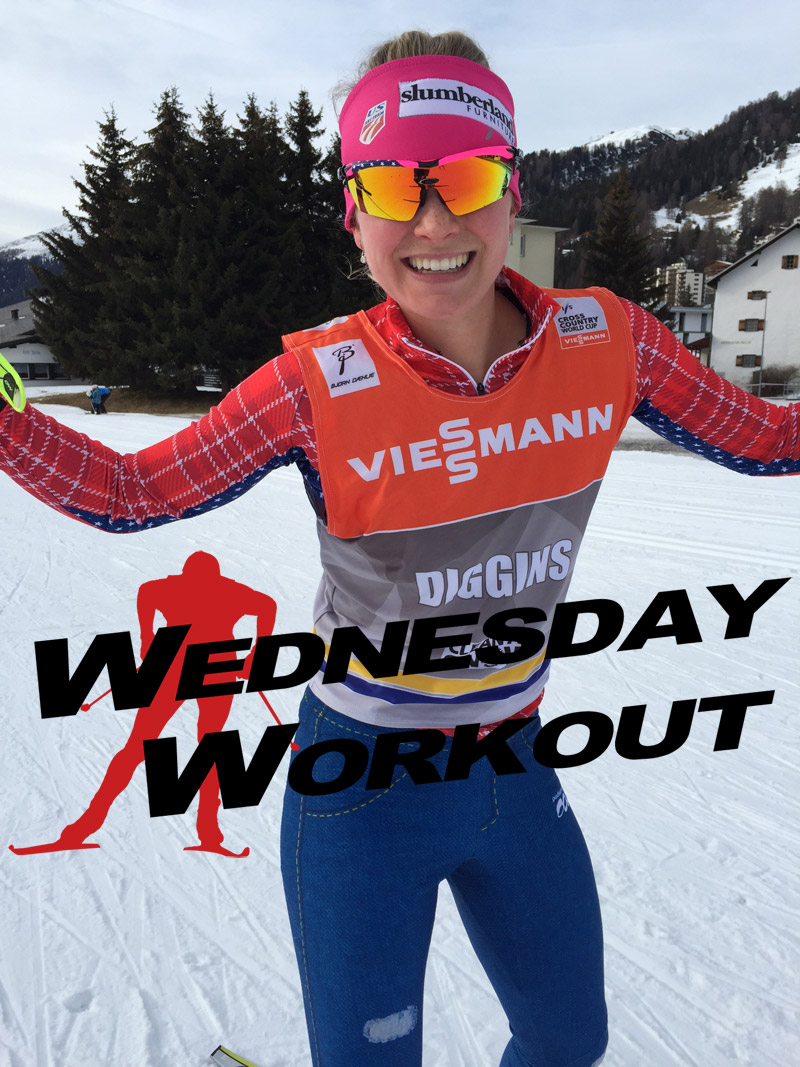
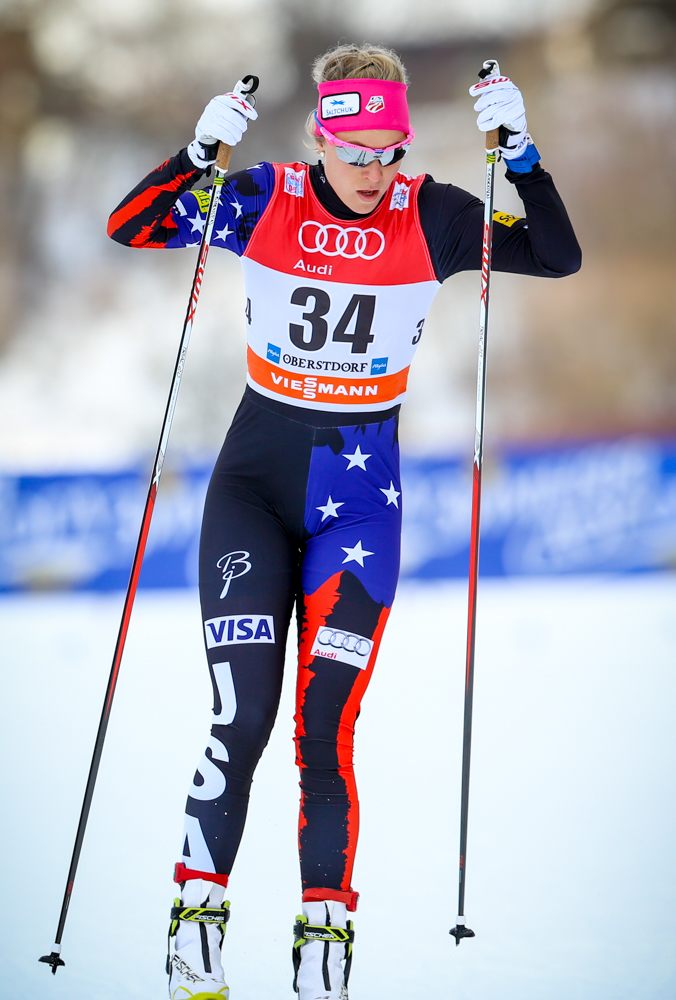
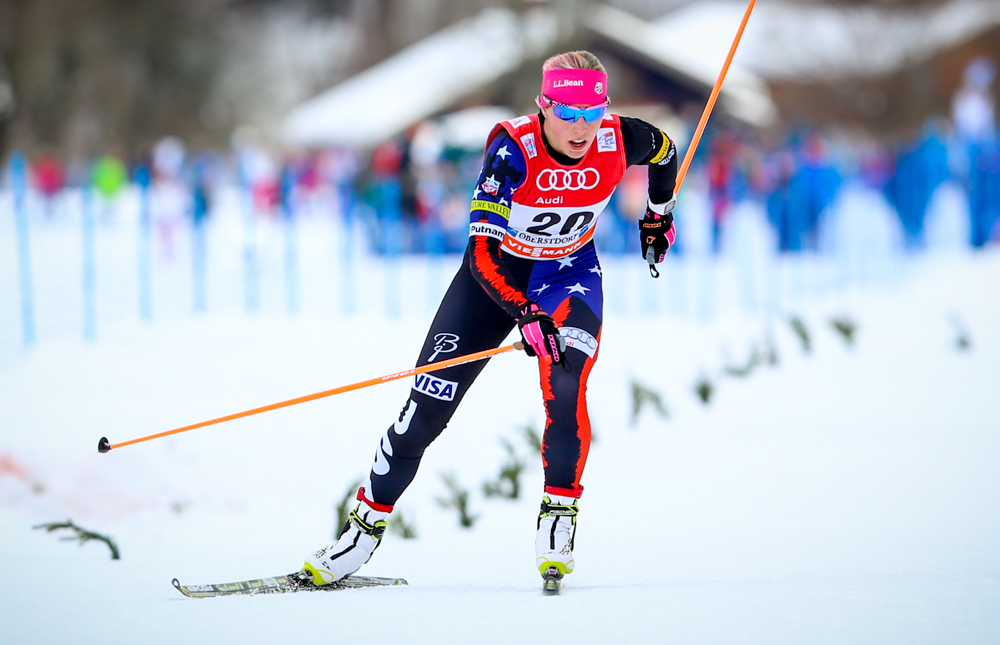
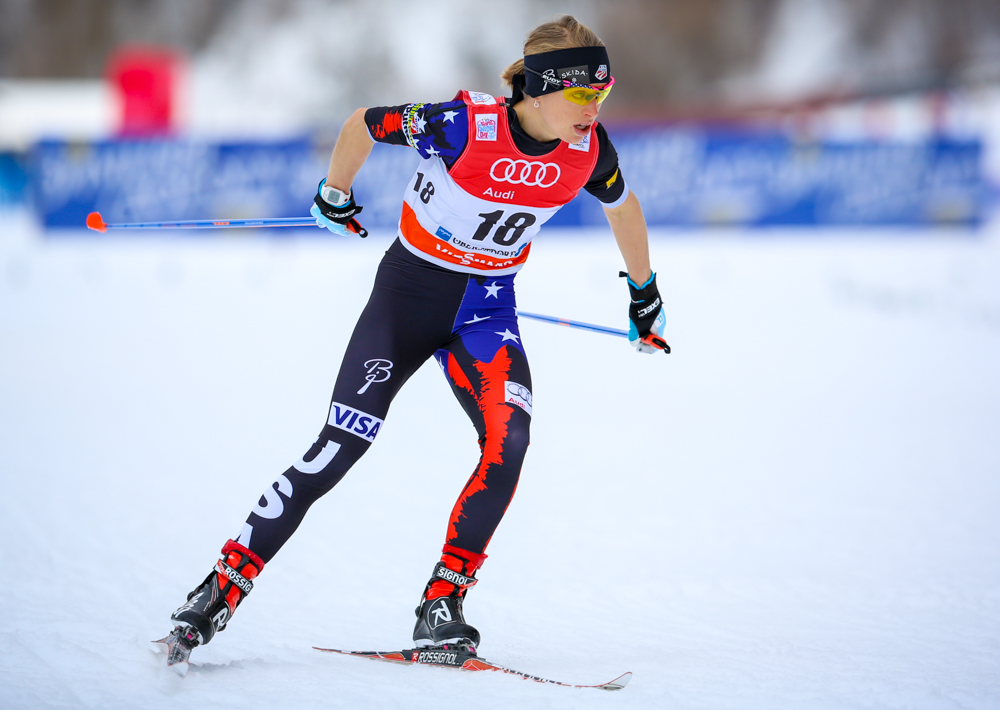
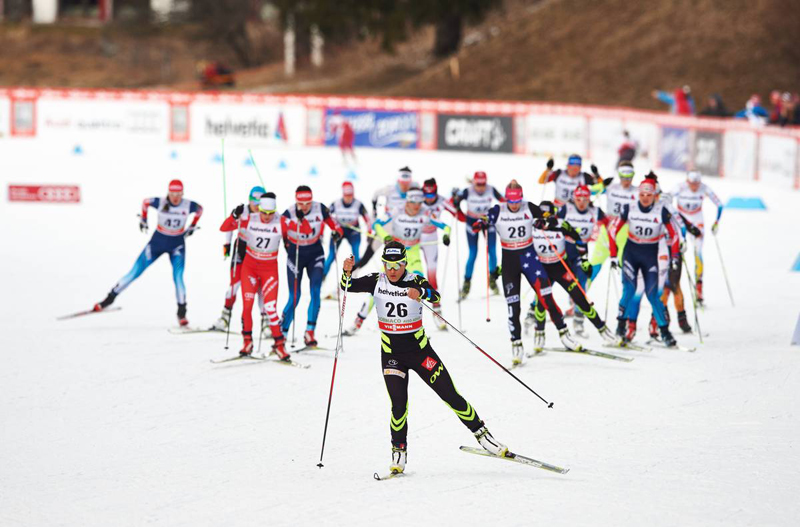
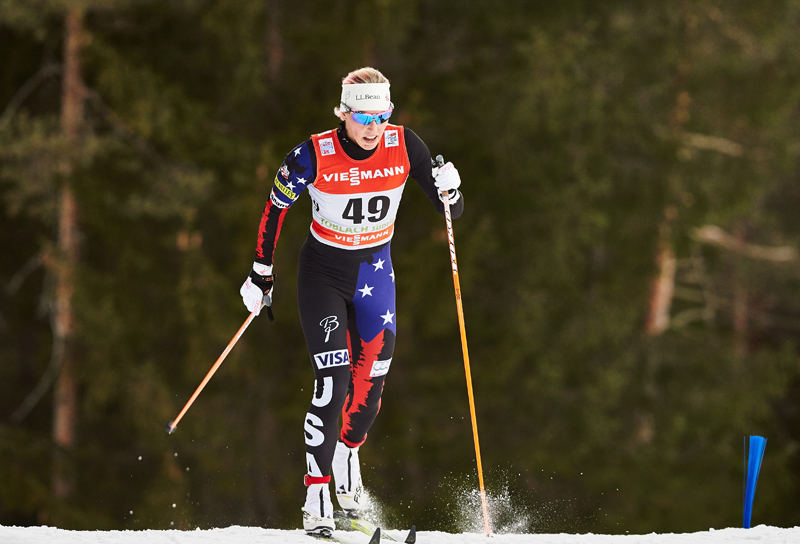
Jessie Diggins (U.S. Ski Team) on a prologue-practice day in December 2014 in Davos, Switzerland. (Courtesy photo)
Here’s a blast from the past. Two seasons ago, we asked Jessie Diggins, of the U.S. Ski Team, how she prepped for a prologue as the first stage of the 2015 Tour de Ski. She explained she did a “prologue practice day” about a week and a half before the Tour-opening 3 k freestyle prologue. Read the original workout here.
***
[circa December 2014]
When it comes to Tour de Ski prep, World Cup racers do a lot more than just chill over the holidays and rest up for the seven-stage tour. Jessie Diggins is one of two U.S. Ski Team members who plans on completing the tour (along with Liz Stephen), and to kick things off on the right foot, she does a “prologue practice day” about a week-and-a-half out from the first event: the freestyle prologue in Obertsdorf, Germany (which takes place this Saturday).
“We almost never race prologues, and it’s such a funny distance at 3 km, but in the start of the Tour de Ski we race one!” Diggins, 23, explained in an email. “I like to take an interval workout and turn it into a time trial to practice my pacing and tempo for a 3km. If I have good energy that day, I’ll do two of them, so that I can play around with my pacing and tactics and learn from the different times.
“I’ll also skate it since for whatever reason it seems like the World Cup prologues are usually skate,” she added.
The workout takes about 1:45 to 2 hours from start to finish.
30 minute warmup: just skiing easy
5-8 minute Level 3 “to get my body going and warm up my lungs”
Ski back to the start area, start first prologue. “I will have mapped out a course beforehand —figured out where about 3km is on the trail and given myself a fairly realistic course. This week, I just raced part of the Davos course!”
After first prologue, ski easy for 10 minutes to let legs recover and lower heart rate back to normal
Start second prologue
Cool down: slow ski for 20-30 minutes
“I also like to wear a full race suit and bib when I’m doing this so I can get into the racing mindset a little easier,” Diggins explained. “And of course, if the trails are crowded people tend to let you pass easier if you’re wearing a race bib! :)”
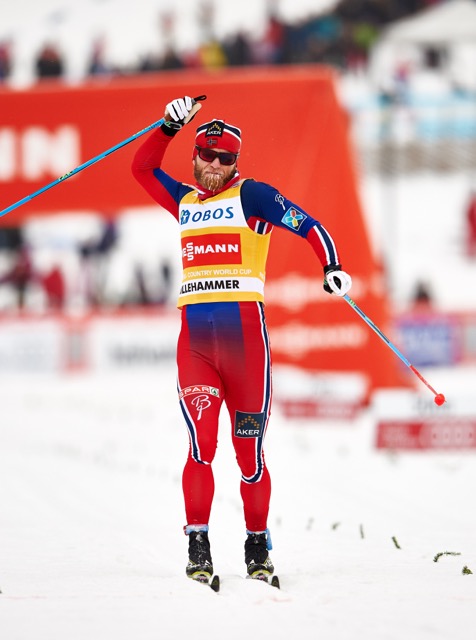
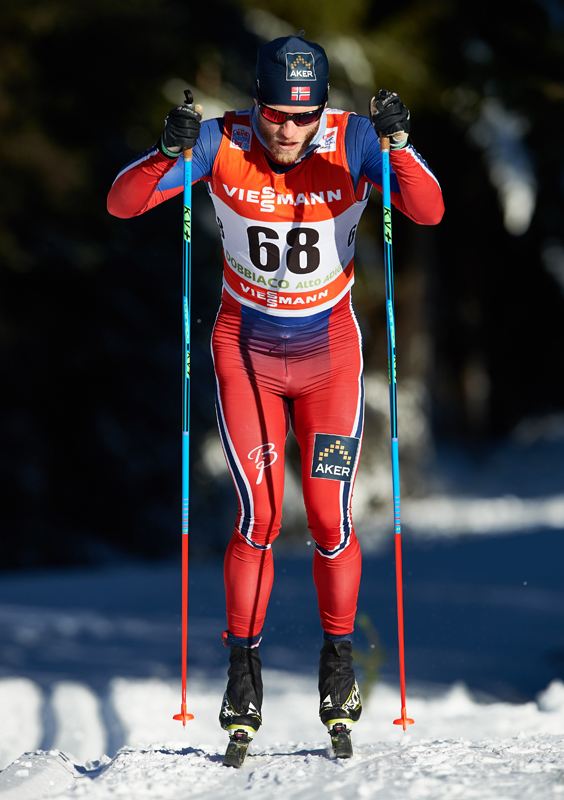
Martin Johnsrud Sundby (Norway) after winning the men’s 15 k classic pursuit for the overall Lillehammer mini-tour title in December 2014 in Norway, following the Davos World Cup. (Photo: Fischer/NordicFocus)
Norway’s Martin Johnsrud Sundby has been stripped of his 2015 Tour de Ski and 2014/2015 overall World Cup titles after the Court of Arbitration for Sport (CAS) upheld an appeal by the World Anti-Doping Agency (WADA) against him and the International Ski Federation (FIS).
The reigning three-time overall World Cup champion, Sundby, 31, was penalized for twice exceeding the amount of salbutamol, also known as albuterol and a “standard therapy against asthma symptoms,” according to a FIS press release, allowed in an athlete’s system and not possessing the necessary medical exemption when he was tested.
Based on WADA rules, the maximum amount that is allowed to be inhaled is 1600 micrograms over 24 hours. Sundby’s samples taken Dec. 13, 2014 after the 15-kilometer classic in Davos, Switzerland, and Jan. 8, 2015 after the 25 k freestyle pursuit at the Tour de Ski in Toblach, Italy, and analyzed by a WADA accredited laboratory exceeded those limits.
“While the medication is normally applied by a handheld metric dose inhaler (MDI), the athlete used a nebulizer to administer the prescribed salbutamol for the treatment of his asthma, which requires a higher labelled dosage than the MDI and thereby exceeded the allowed maximum dose,” FIS stated in its press release on Wednesday. “The FIS Doping Panel had therefore found that the athlete had not committed an anti-doping rule violation when he used a nebulizer as a legitimate means to administer salbutamol instead of a metric dose inhaler (MDI).
“The CAS found however that the epithet ‘inhaled’ was meant to distinguish inhalation from other mechanics of inhalation like ingestion or injection and did not refer to the stage of administration (e.g. the amount that comes out of the device or which was eventually delivered to the athlete’s mouth or lungs),” the release continued. “The allowed dose must be understood as the dose prescribed by the doctor, i.e. the ‘labelled’ or ‘nominal’ dose. Any higher dose, e.g. because of the need to use a nebulizer, requires a Therapeutic Use Exemption (TUE). When the tests were conducted in December 2014 and January 2015, the athlete was not in possession of a TUE and therefore found guilty of an anti-doping rule violation.”
WADA appealed the FIS Doping Panel’s decision, made Sept. 4, 2015, which defended Sundby. The CAS upheld WADA’s appeal and, effective July 11, 2016, sanctioned Sundby for two months. FIS announced this decision in its press release.
“I was at the store when the team doctor called. I was told that I had been over the limit twice,” Sundby said at a press conference as reported by NRK, according to a direct translation. “There and then it felt like the sky came crashing down. I could not believe it. I have never ever used an asthmatic dose that hasn’t been prescribed.”
“It felt like the sky came crashing down. I could not believe it. I have never ever used an asthmatic dose that hasn’t been prescribed.” — Martin Johnsrud Sundby
According to FIS, while CAS “acknowledged in the athlete’s favour that he had not intentionally broken the rules, that has a medical condition requiring the administration of salbutamol and that he had used salbutamol by nebulizer as prescribed by his team doctor, as he had done so before without any problems,” they also noted that anti-doping rules must be strictly adhered to and “that the prescription of the team doctor as to the use of the nebulizer to administer salbutamol outside of a hospital was arguably questionable from a medical point of view as well as the fact that the athlete and his team doctor had not made any enquiry of WADA, FIS or the manufacturer whether inhalation by a nebulizer would still require a TUE under the revised anti-doping rules.”
Sundby’s win on Dec. 13, 2014 in Davos (where he edged his teammate Didrik Tønseth by 6.6 seconds) and third-place finish in the Toblach 25 k (behind teammate Petter Northug and Sweden’s Calle Halfvarsson, respectively) have been nulled. In addition to being disqualified from those races, Sundby is no longer listed as the overall champion of the 2015 Tour de Ski, after he initially won the final hill climb by 34.5 seconds over Northug in Val di Fiemme, Italy. Northug is now listed as the winner and Sundby is not on the final results. Sundby is also no longer the 2014/2015 overall World Cup champion, Switzerland’s Dario Cologna is.
In a separate press release, FIS announced the recalculated results and standings from 2014/2015:
“The impact on the 2014/15 FIS Cross Country Cup World Cup standings and FIS Tour de Ski standings are as follows:
– Sundby forfeits the 143 points he earned for the two races where he has been disqualified – 100 World Cup points for the victory in Davos and 43 points for his third place finish in Toblach.
– With the Sundby disqualification on the 13th December 2014, the podium for the 15 km classic in Davos (SUI) is now as follows: 1. Didrik Toenseth (NOR); 2. Dario Cologna (SUI); 3. Sjur Roethe (NOR).
– With the Sundby disqualification at the 8th January 2015 in the 25 km pursuit in Toblach (ITA), the podium for that race is now as follows: 1. Petter Northug JR. (NOR); 2. Calle Halfvarsson (SWE); 3. Evgeniy Belov (RUS).
– In accordance with the Tour de Ski regulations, Sundby also forfeits his overall 2015 Tour de Ski victory and 400 World Cup points he earned for it as well as prize money of CHF 108’000. The new standings for the 2015 Tour de Ski are as follows: 1) Petter Northug JR. (NOR); 2. Evgeniy Belov (RUS); 3. Calle Halfvarsson (SWE).
– The breakdown of prize money from the Tour de Ski 2015 that Sundby has to return for redistribution to the newly ranked athletes is as follows: CHF 90,000 or first place in the Tour de Ski, CHF 2,000 from the third place of the Tour de Ski sprint standings and the World Cup earnings for the two races, CHF 15,000 for the victory in Davos and CHF 1,000 for the third place finish in Toblach.
– Additionally, Sundby forfeits the World Cup points and prize money from the remaining Tour de Ski races after Toblach, namely the last two stages in Val di Fiemme in which he finished 8th and 3rd. This amounts to a further 73 World Cup points and CHF 1,000 in prize money.
– The final 2014/15 FIS Cross Country World Cup standings have also been recalculated and are as follows: 1. Dario Cologna (SUI) – 1103 points; Petter Northug JR. (NOR) – 1047 points; Finn Haagen Krogh (NOR) – 897 points. Sundby moves down to sixth place in the overall World Cup standings with 748 points and forfeits CHF 22,275 in the overall World Cup prize money standings.
– In total, Sundby forfeits 616 World Cup points for the 2014/15 season and CHF 131,275 in prize money. This includes all races directly and indirectly affected by the CAS decision.”
“I was sure that the case would be dropped quite fast, but then it turned out that WADA didn’t understand the rules in the same way as the whole Norwegian medical team,” he continued. “When WADA appealed, I thought it was a formality. I went into the 2015/2016-season knowing I was innocent, and also that I was acquitted. I think the verdict is totally unreasonable. I have to live with it, and I will stay strong knowing I have done nothing wrong.”
“FIS fully shares the view of the CAS that Martin Johnsrud Sundby is not to be considered as an intentional doping offender but that his sanctions result from the strict application of the anti-doping rules and the WADA Prohibited List as a consequence of his reliance on questionable medical advice to administer salbutamol outside a hospital,” FIS concluded.
“I am pleased that the Norwegian Ski Association so firmly takes responsibility for what happened, and that they so firmly emphasize that I personally have not tried to do anything illegal in this case,” Sundby said in the team press release, according to a direct translation. “Of course, I understand that this case is of public interest, and that’s why I come to this press conference and reply to media inquiries. However, I ask for understanding that I will return to the two most important things in my life after this: my closest family and my career as a ski racer.
“The situation I am in currently is any athlete’s nightmare. I’ve always competed clean. I hope and believe this case will not have further consequences for my future career or my preparation for the upcoming season.”
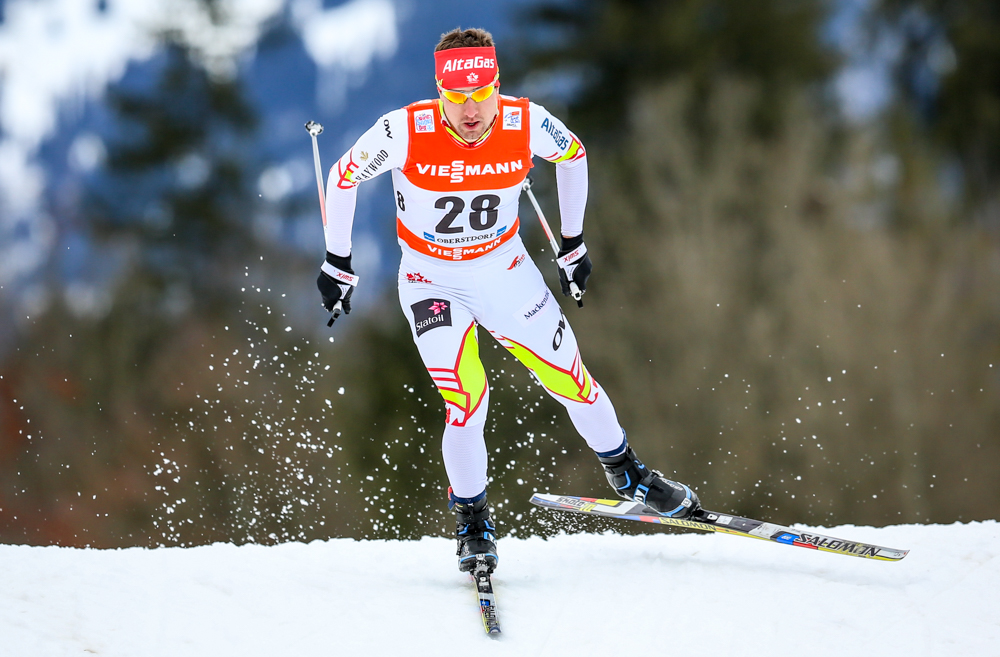
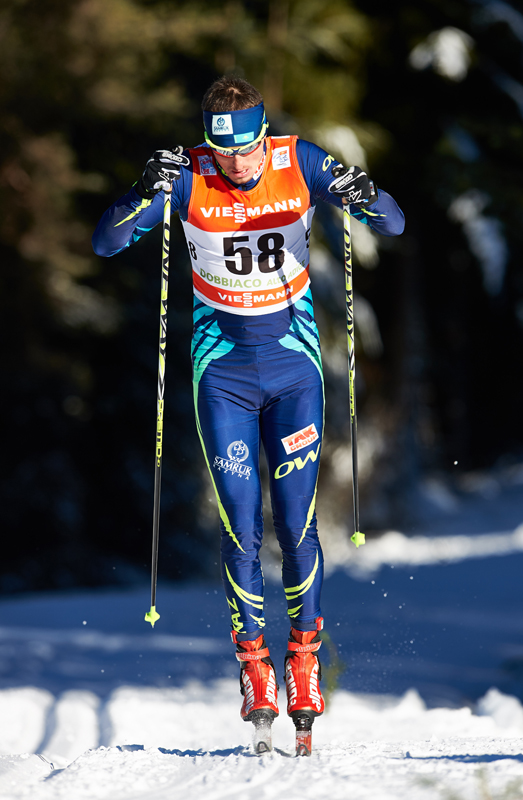
Canada’s Ivan Babikov placed 57th in the 4 k freestyle prologue to start the 2015 Tour de Ski on Jan. 3 in Oberstdorf, Germany. (Photo: Marcel Hilger)
The Tour de Ski is one of those beasts that rarely goes according to plan, but for a couple Canadian skiers, including Devon Kershaw and Ivan Babikov, the seven-stage series was especially off track this year.
Kershaw and Babikov were the lone Canadian World Cup Team members still in the Tour for the last stage on Sunday: the 9-kilometer freestyle pursuit up Alpe Cermis in Val di Fiemme, Italy.
With disastrously slow klister skis in Saturday’s 15 k classic mass start, the pair and teammate Alex Harvey plummeted through the Tour rankings (Harvey finished 34th to end up 16th overall. He withdrew before Sunday’s pursuit due to a pre-existing circulation issue that bothers him in ultra-steep skate hill climbs).
In the final pursuit, Babikov and Kershaw started 34th and 35th, respectively, 8:09 and 8:15 behind Norwegian leader Petter Northug.
“It (as you witnessed) was a really disappointing event for me,” Kershaw wrote in an email on Sunday. “I was trying my best to stay positive and present to give myself the best chance everyday — even though after most of the competitions I was pretty down on myself with how things were going.”
Babikov was able to move up to 31st by skiing the 12th-fastest time in the 9 k race, while Kershaw stayed in 35th with the 40th-ranked time.
Devon Kershaw racing last season at World Cup Finals in Falun, Sweden.
“I tried to rally and decided that even though there was absolutely nothing to gain for today up that monster hill, I was going to take the start and just do my best,” Kershaw explained of his decision to continue the Tour after what he described as his biggest disappointment of the season: Saturday’s 15 k classic.
“I’ve never been good up that beast, but I was starting in the wave for the first time ever, so I thought perhaps that could have been an advantage,” he added. “I know that Ivan is amazing up the hill usually, so the race plan was pretty simple. Stay with Babs for as long as possible.”
Babikov is typically one of the fastest up Alpe Cermis: in 2009 he clocked the fastest pursuit time, and last year he had the fourth-fastest time. However, on Sunday, he wasn’t able to pull out quite that performance, but he did grab some World Cup points for his pursuit time.
During the race, he thought it was going well after starting with what he considered a fast group.
“We were moving well on the flat part and then on the uphill, I kind of dropped all of them,” Babikov said on the phone. “I was moving well passing people and compared to past years, my legs felt good. I thought like I was moving well, but when I heard I only got 12th time, I was kind of a bit disappointed. I don’t know how I lost all that time or where.”
He did notice that the top-10 men broke the record for fastest-time ever up the mountain.
“I think before, the fastest time ever was by [Lukas] Bauer [of the Czech Republich] and now they all almost beat it by a minute,” Babikov said. “That was really surprising and conditions wasn’t even that fast — it was actually raining.”
While he improved slightly to 31st in the Tour (and Kershaw ended up 35th), it was a far cry from where Babikov, a distance skier and hill-climb specialist, had hoped to end up in one of his target events of the season.
“That was my worst hill-climb result in all of the years, even when I was sick, and a few years ago I was skiing with, not broken ribs, but I went to hospital — I crashed in Oberstdorf,” he said, referring to his 2012 Tour. “I had to finish the Tour with a support brace and still like I was 11th that day. So it is kind of a bit bitter and disappointing and that is one of my best races of the year, but … maybe I should have pushed harder. I don’t know where I lost all of those seconds, it is hard to say, maybe they were moving faster in the flat.”
In the coming days, Babikov said he will reflect and try to figure out what happened.
“Maybe it is just shape or maybe it is just the day before that in the classic skis when we missed the skis completely,” he said. “Maybe that kind of had a bit negative mental kind of thing.”
Kershaw explained that while this was his worst Tour yet, he had glimpses of good skiing in several stages, such as the freestyle sprint, the 10 k classic and pursuit skate.
“The take away from the Tour for me is a mixed bag,” he wrote. “I had some ok races for where I am right now. Of course I feel like I am WAY off where I should be, but I’m trying to focus on the baby steps. … It fell apart badly here in Val di Fiemme … I’ve dropped out before because of sickness, but I’ve never been destroyed like this.
“Still, onwards and upwards I guess,” he added. “Next up is some quiet time in Seefeld [Austria] then to Rybinsk [Russia, for the World Cup]. I have good memories of those tracks, so I will have some quiet days, then start preparing from there. And then the big goal of the season remains the same – World Championships. I have my eyes on feeling my best in the 50 k classic, so I’ll try and keep my eyes on that prize and keep my head up. It’s feeling heavy after the beat down today, but hopefully some nice chill days in Seefeld will help with that.”
Babikov pointed out that Harvey “had a boss tour and some podium results. Of course that is good for our team,” he said. “But in the overall, Devon’s disappointed, [and I’m] disappointed, too. Lenny [Valjas] had some health issues in the Tour so I am sure he would have showed some much better results.
“Half of the season is kind of done so we are all kind of all looking forward to the next period and the World Cup in Rybinsk. I am looking forward to get back to Russia and the World Champs … Hopefully we will turn it around and have some better skis and better bodies, better shape in the next races.”
— Alex Kochon and Matt Voisin contributed reporting
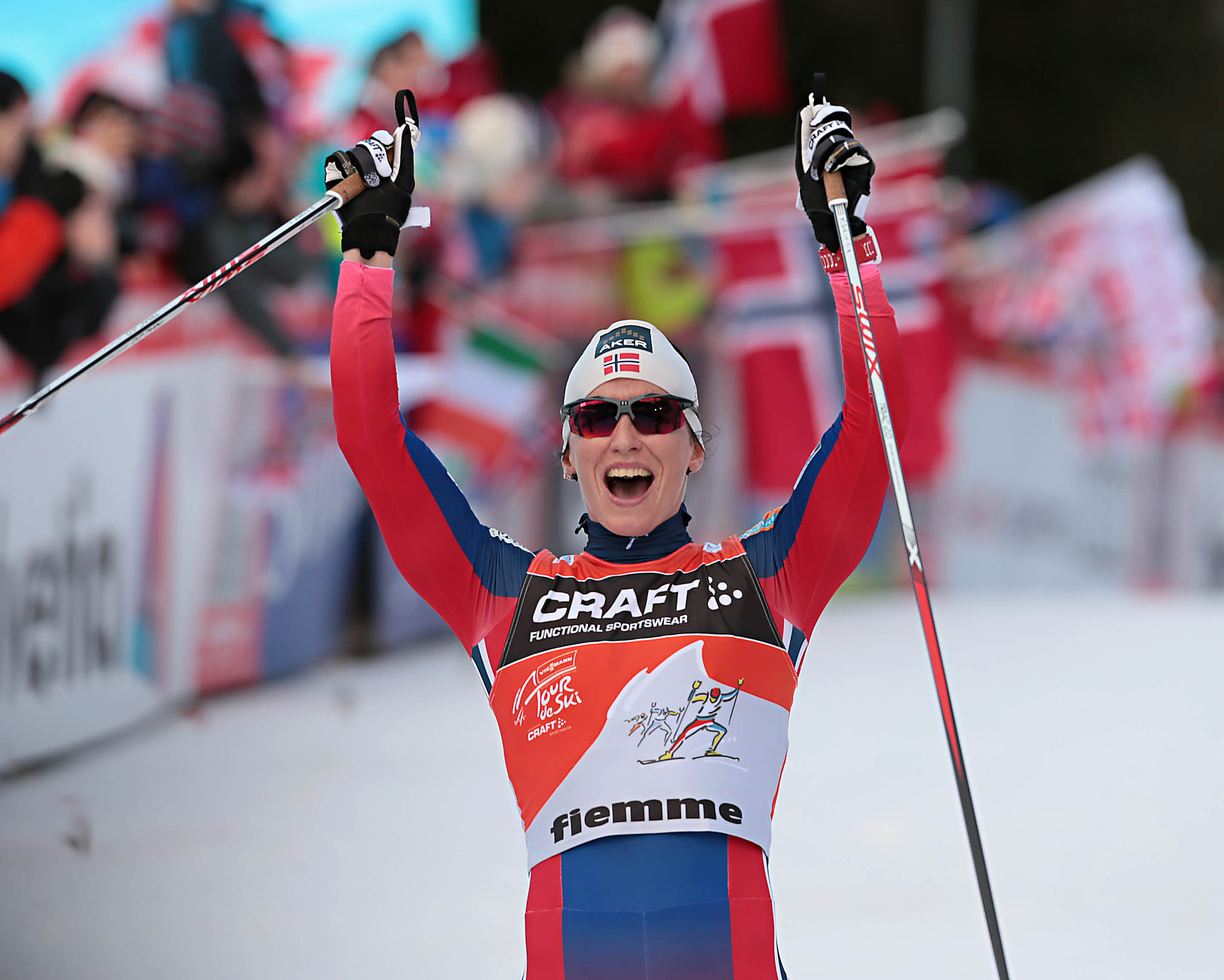
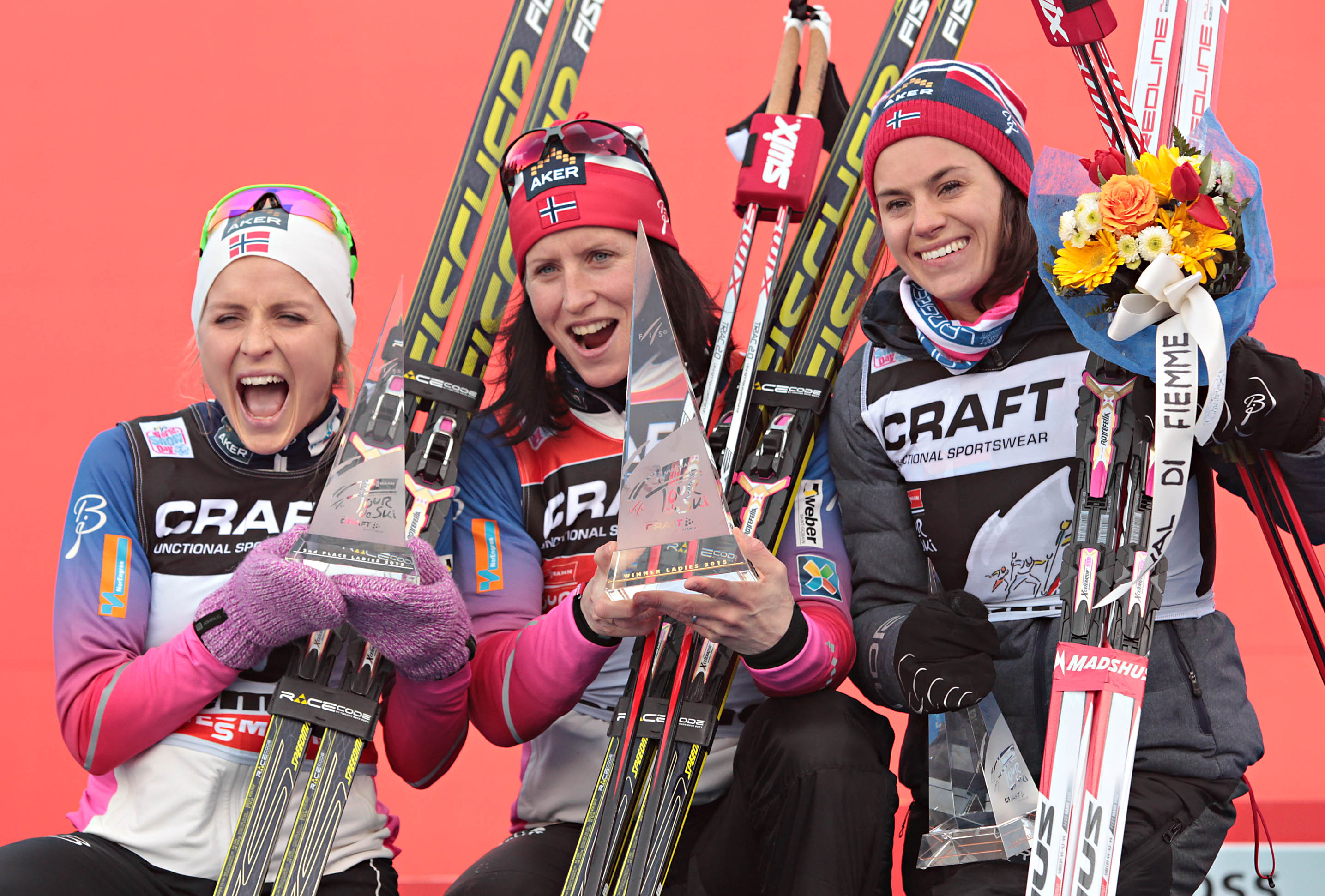
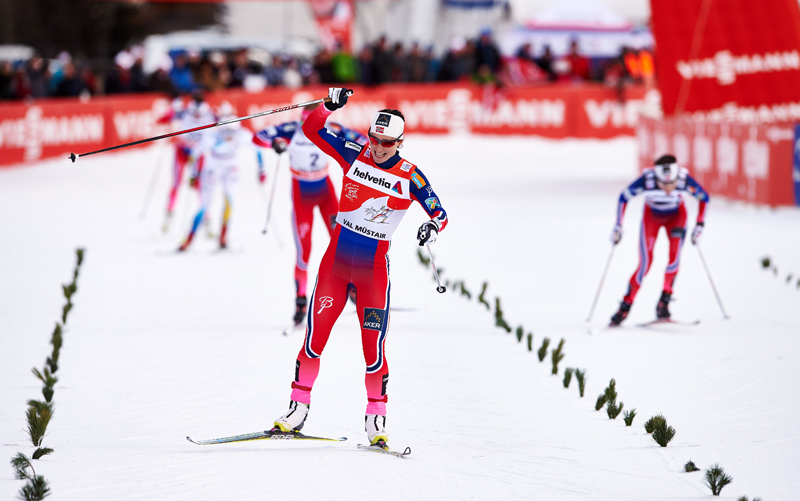
Marit Bjørgen of Norway celebrates her 2015 Tour de Ski victory at the finish line of the final stage in Val di Fiemme, Italy (Photo: Val di Fiemme/www.fiemmeworldcup.com)
It seemed inevitable for most of the Tour, but it is now official: Norway’s Marit Bjørgen has her first-ever Tour de Ski title after Sunday’s 9 k freestyle pursuit in Val di Fiemme, Italy.
Going into the final stage, there was not much drama over who would come out on top; Bjørgen started the day with a lead of 2:11.2 over fellow Norwegian Heidi Weng and 2:50.3 over defending champion Therese Johaug, also of Norway. She would not let her teammates get anywhere near her, crossing the line in a time of 33:27.5.
“It is a big victory for me. To win the FIS Tour de Ski has been a goal for me for a long time. It took me nine years to achieve it,” Bjørgen said to FIS.
The 34-year-old also described it as “an amazing feeling” to share the experience with her teammates.
“They mean a lot [to] me. They motivate me and they push me in training every day,” she said.
Stage-six winner Johaug completed the notoriously difficult course with the fastest time of the day (32:16.4) and finished 1:39.2 behind Bjørgen. Weng started the day in in front of Johaug but took third (+1:59.5), unable to maintain Johaug’s furious pace despite posting the second-fastest time of the day (33:15.8).
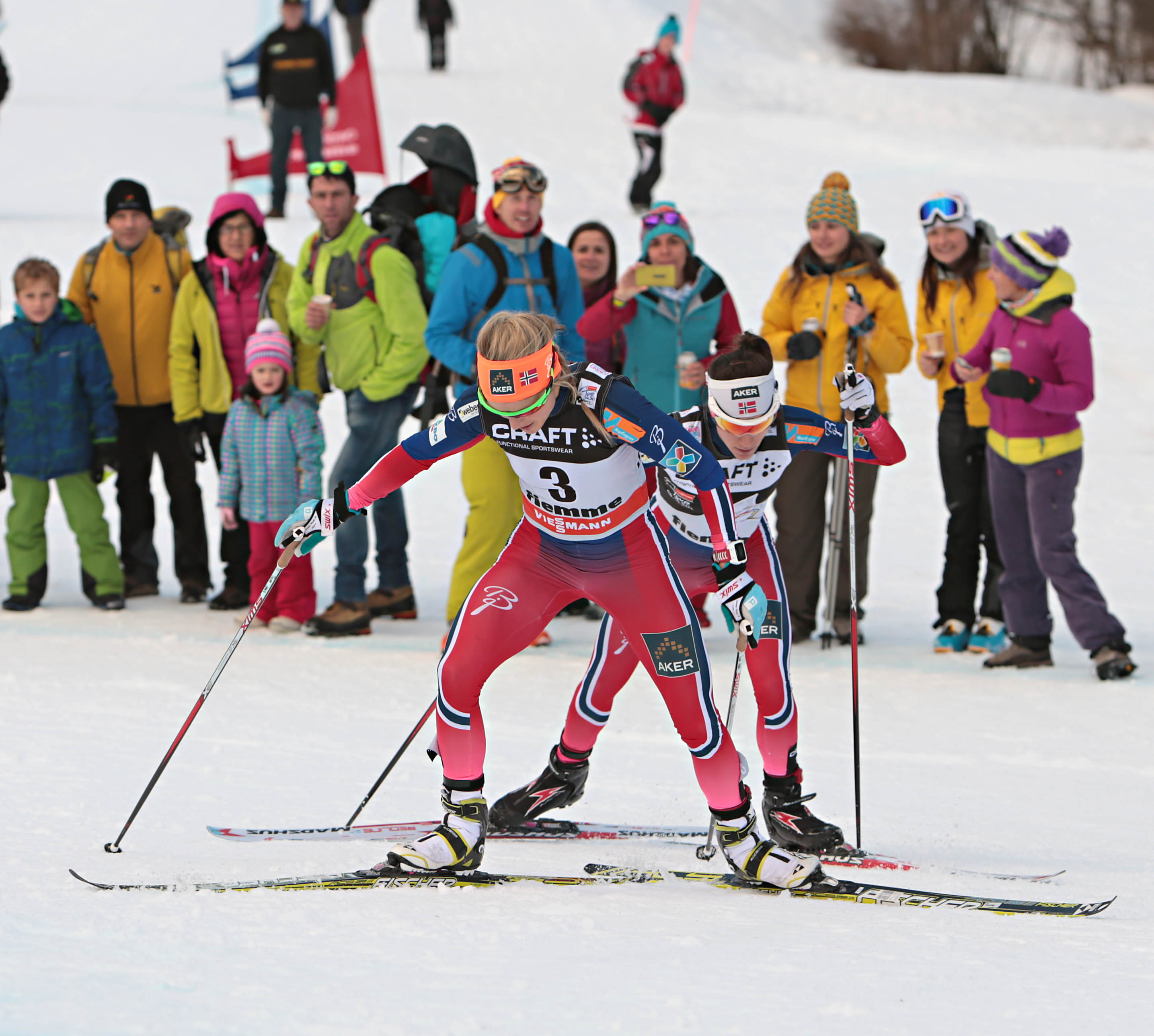
Therese Johaug (bib 3) leads Norwegian teammate Heidi Weng as they race in the final stage of the 2015 Tour de Ski in Val di Fiemme, Italy (Photo: Val di Fiemme/www.fiemmeworldcup.com)
“Everyone hates the final climb, but I love it,” Johaug told FIS.
The 26-year-old said she knew she was out of the competition for first overall before the stages in Toblach, Italy, and was satisfied with second place and her performance in the final two stages in Val di Fiemme.
Weng told FIS she feels she put together her best races ever at this point in the season, and that it was “absolutely unbelievable” to be on the podium after every stage of the Tour.
It is the second consecutive year that Norwegian women have swept the top three places on the overall Tour standings.
American Liz Stephen – who took seventh in the 2014 Tour and was the only North American skier left in the field – started the day in sixth but managed to climb into the fourth position in front of Poland’s Justyna Kowalczyk, who did not finish, and Norway’s Ragnhild Haga.
Stephen said in a phone interview, “I knew there were a few girls right behind me, and we skied the flats together. The girls actually pulled me along for that whole flat section, so I was able to hang in and conserve my energy.”
However, Haga would reclaim the lead over Stephen in the final kilometer.
“[Liz was] perhaps was a bit too aggressive in her approach to the climb. She caught them [Haga and Kowalcyzk] very quickly but then skied the middle section of the hill under extreme fatigue,” wrote USST Women’s Coach Matt Whitcomb in an email.
“I think Ragnhild skied such a strong race and I just made up a little too much time too quickly on her,” Stephen said.
The 27-year-old stayed just behind Haga throughout the steep pitch before the finish, and for a moment it looked like Stephen was going to catch her, Whitcomb wrote.
But with about 100 m to go, it was clear that Haga had more energy to spare than Stephen. Haga crossed the line 7:32.2 behind Bjørgen to complete a Norwegian sweep of the top four.
American Liz Stephen leads Norway’s Ragnhild Haga during the charge up the final hill of the seventh stage of the 2015 Tour de Ski in Val di Femme, Italy (Photo: Val di Fiemme/www.fiemmeworldcup.com)
“It’s hard to lose a battle like that, but it was Marit who greeted Liz first at the finish. That takes the edge away,” Whitcomb explained.
Stephen said she was happy with the way she was able to stay with Haga and fight to the end, the product of “a lot of mental work and confidence building” throughout the season.
“A lot of times once somebody goes by it’s over … I really tried to latch on and actually make another move towards the finish,” she said.
Stephen finished the Tour in fifth (+7:41.8), which is the best result ever for an American in the Tour de Ski. She also posted the fourth-fastest time of the day in 33:29.9, which was just 2.4 seconds slower than Bjørgen’s time. She is now 11th overall in the World Cup standings.
Whitcomb wrote that Stephen set a goal last summer to finish in the top five in the Tour.
“Watching an athlete accomplish a top-tier goal like that is really satisfying and we are all very proud of her ability to prepare and execute,” he wrote.
“I’m working really hard on having the confidence to ski with the big dogs and know that I belong there,” Stephen said. “I guess I’m really happy to prove it to myself that I can be there.”
Though Stephen was happy with her individual result, she said “it takes a team” and that she could not have accomplished what she did without the seven other Americans sticking by her throughout the final stages.
Meanwhile, four-time Tour champion Kowalczyk apparently fainted about 900 m before the finish and was taken away in an ambulance, according to Eurosport.com. She was already having a difficult race, having fallen to ninth after 8.1 k.
Not much is known about her condition at this point, though reportedly after two hours in the hospital she was feeling better.
Eva Vrabcova-Nyvltova of the Czech Republic finished in sixth (+8:29.4), while Germans Nicole Fessel and Diane Herrmann captured seventh (+8:55.8) and eighth (+9:35.1), respectively.
Bjørgen continues to top the World Cup standings with 1588 points, expanding her lead after earning 400 points for her Tour victory. Johaug sits in second (1138), Weng is in third (1017), while Haga is far back in fourth (632). Ingvild Flugstad Østberg, a Norwegian who left the Tour after stage four, rounds out the top five (609).
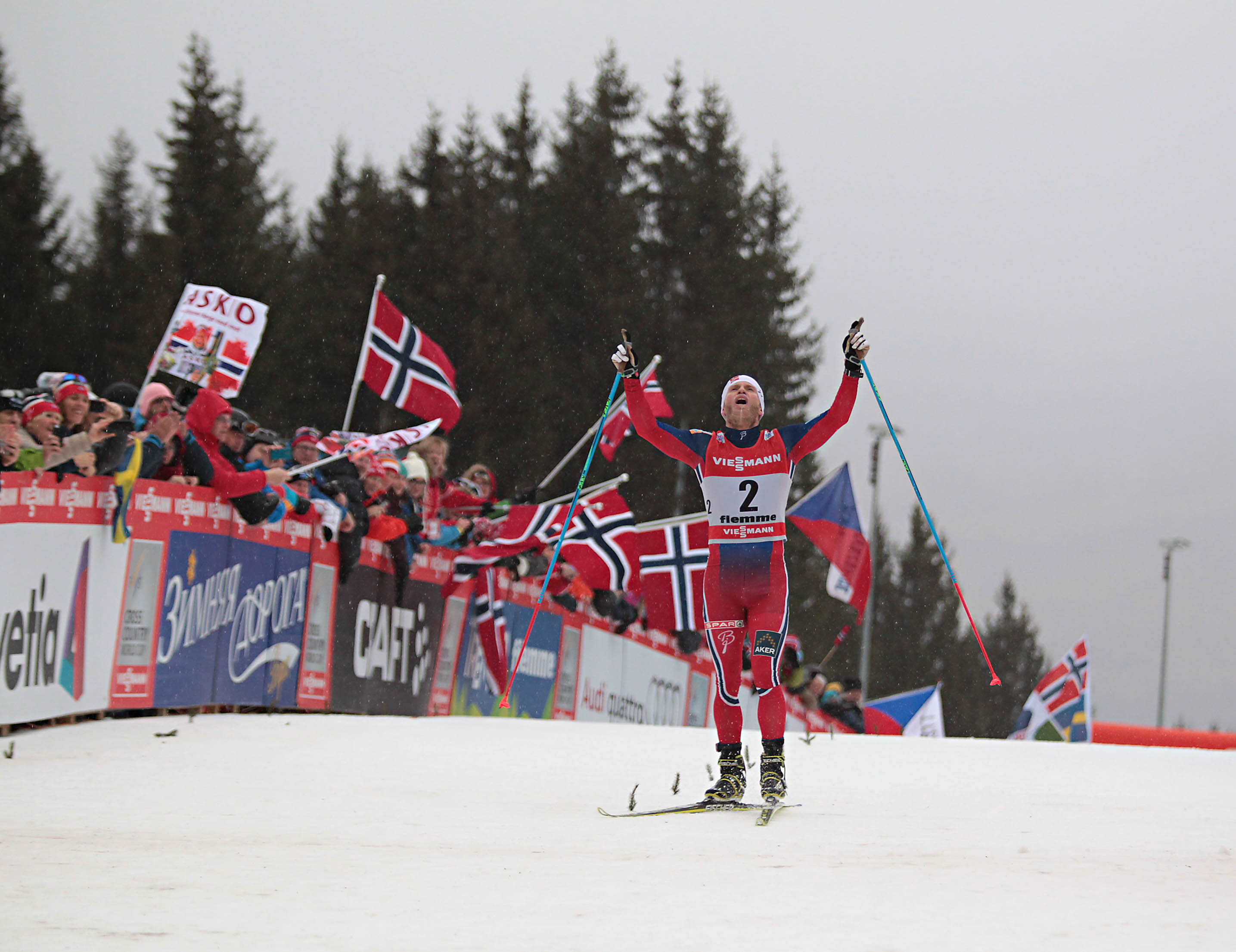
An elated Martin Johnsrud Sundby of Norway crosses the finish line at the top of Alpe Cermis to wrap up his second consecutive Tour de Ski title on Sunday in Val di Fiemme, Italy. (Photo: (Photo: Val di Fiemme/www.fiemmeworldcup.com)
After nine days of racing, the Tour de Ski came down to four people who had a chance to win the overall title: Norway’s Petter Northug and Martin Johnsrud Sundby, Calle Halfvarsson of Sweden and Evgeniy Belov of Russia. The four top places were only separated by 45 seconds. Whoever climbed the Alpe Cermis the fastest out of this group would win.
Sunday’s seventh stage of the Tour de Ski featured a 9-kilometer ascent of one of the most famous mountains in cross-country skiing: Alpe Cermis in Val di Fiemme, Italy. From the start, it is a 1.8 k lap back through the stadium then to the Alpe. Leading to the base is a relatively small downhill before the climb begins. From the bottom to the top is 425 meters of elevation gain, giving skiers a total climb of 495 meters (1,624 feet). Scattered throughout the climb is a 26.5-percent grade, a 24-percent grade and finally, a 28-percent grade before the finish.
Since he was leading the Tour, Northug had the disadvantage of being the rabbit for everyone to pace off at the start. With a three-second lead over Sundby, he had to face the mental aspect of holding off the chasers and potentially getting caught. Second was Sundby followed by Halfvarsson and Belov, who started third (+27) and fourth (+35) behind Northug, respectively.
Interestingly enough, at the start, Sundby let Northug stay away. At 1.8 k, Northug still had a three-second lead over Sundby after pushing the pace on the flat section, trying to gain as much advantage as he could before the climb. Sundby was within striking distance, but opted to sit back for the perfect time to make a move. That opportunity came around 6.2 k.
Sundby quietly slipped outside and around Northug to take the lead. This was very similar to the move Sundby made during this stage last year. The only difference was that Sundby attacked about 200 meters into the final climb, and on Sunday, he attacked on the flatter downhill section.
Sundby’s plan now was to ever so slightly ramp up the pace and see if Northug could hang on. Between the two, Sundby was more of a lightweight, giving him that advantage as they prepared to climb.
As the situation for first and second started to play out, the battle for third and fourth was just as intense. At the same 6.2 k mark, Halfvarsson and Belov were side by side, neither one getting ahead of the other. If an attack was made here, would they be able to bridge up to the Sundby/Northug battle just 46.9 seconds ahead of them? If they could work together and not fight each other, there could be an opportunity to catch the Sundby and Northug up front.
The attack at the 6.2 mark was ultimately the winning move for Sundby and it was apparent as soon as he passed Northug. Sundby opened up a seven-to-eight-meter gap and did so using the V2 technique. Behind him was a struggling Northug trying to keep pace using a labored V1 climb technique. He was slowing down, and Sundby was skating away.
At the 7.1 k timing section, Sundby’s lead was growing quickly. He came through in 15:38, and Northug was 13.2 seconds behind — a time that Halfvarsson and Belov would soon be getting from their respective coaches. Halfvarsson led them through, 42.6 seconds back, as Belov trailed by 0.8 seconds. The pair was within 30 seconds of Northug, but more importantly, they were chipping away at Sundby as well.
At 8.1 k, the 29-percent-grade section and hardest part of the climb, Sundby looked back several times, realizing that Northug wasn’t going to be able to catch him. He came through 33.4 seconds ahead of Northug and 50 seconds ahead of Halfvarsson and Belov, who were now within 17 seconds of second place. But making up that ground to Northug in 900 meters wouldn’t be easy.
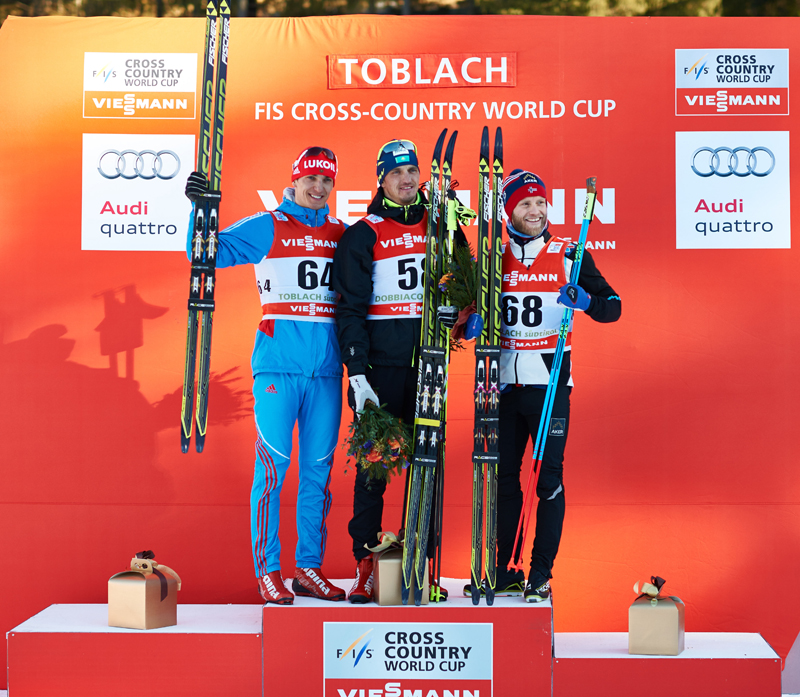
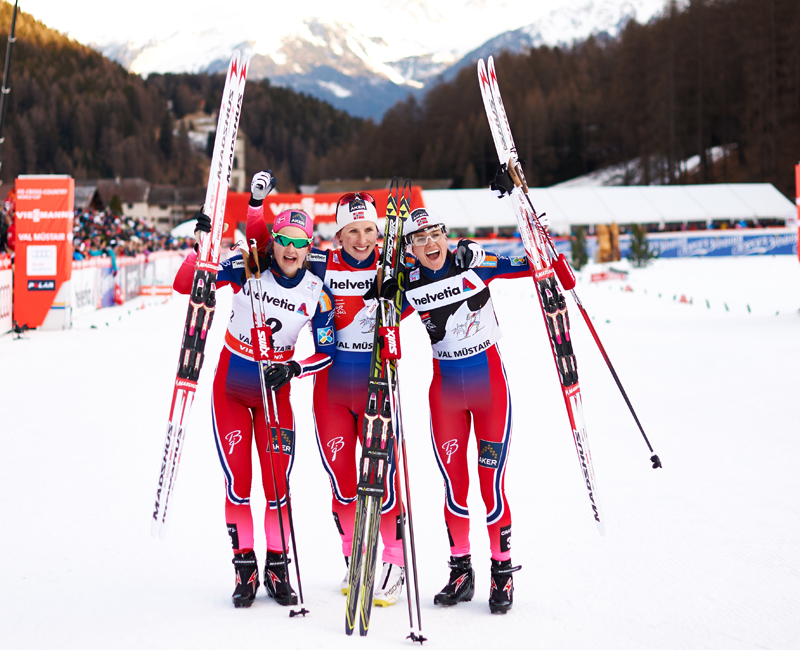
The men’s 2015 Tour de Ski overall podium following Sunday’s 9 k freestyle pursuit: with winner Martin Johnsrud Sundby (c) of Norway, runner-up Petter Northug (l) of Norway, and Russia’s Evgeniy Belov in third. (Photo: Val di Fiemme/www.fiemmeworldcup.com)
At the final time check before the finish at 8.5 k, Sundby all but wrapped up his second-consecutive Tour de Ski title with a 35.2-second margin to Northug.
Skiing behind Halfvarsson most of the race, Belov finally passed the Swede to move into third and came through the checkpoint ten seconds behind Northug. Halfvarsson in fourth slipped to 12 seconds behind Belov.
All that was left for Sundby to do was finish and secure another coveted Tour title in his second time racing the multi-stage series. Exhausted, Sundby crossed the line, uncontested, in 29:27.4. Sundby now joins Switzerland’s Dario Cologna as the only male skier to win consecutive Tour titles.
“This is much, much bigger for me to win this year than last year,” Sundby told NRK after Sunday’s race, according to a translation. “Last year was not quite as strong competition. This year I had the pressure on me.”
With first place taken, the race came down to a battle for second. With time splits on Belov behind him, Northug upped the pace ever so slightly. This move gave him all the advantage he needed, finishing second, 34.5 seconds after Sundby and 16.6 seconds ahead of Belov in third. Halfvarsson held onto fourth place, 1:04.2 behind the winner and more than a minute ahead of Cologna in fifth (+2:06.6).
Northug has finished second in this stage four times and made the overall Tour podium six times.
“I am very happy to be second in the Tour,” Northug told FIS after the race. “Me and Martin were very working well together before the start of the climb. Martin sped up on the hill. I could not follow him but I found a good rhythm and I am happy to be second.”
Commenting on his strategy, Northug told NRK, “I tried to go fast into climb along with Martin. My plan was to find my own rhythm. I tried to go on a lighter gear, so I had a faster gear to go on, because I figured that Calle and Belov were coming fast from behind.”
Commenting on his own race strategy, Sundby told FIS, “Today feels just amazing. I did not have the best start today. I did not feel good at the beginning. Petter was pushing hard after the start and I did not know if I could follow him. I am so happy and relieved to win. Mentally it was the biggest challenge ever.”
In an interview with Eurosport, Sundby said that he was “extremely tired after yesterday’s race and was thankful to recover afterwards. The last hill was never racking but I’m so happy to come in first, too.”
An elated Belov told FIS, “It is my biggest achievement of my career. It feels great to be third in the Tour de Ski. At the beginning of the climb Calle tried to attack but I could follow him. Later on I saw it was harder and harder for him to keep the pace and I decided to attack. When I saw that gap got bigger on Calle I started to believe I could finish in third place.”
The fastest man of the day was Italy’s Roland Clara, who completed the climb in 29:13.0, just 2.1 seconds ahead of France’s Maurice Manificat in second.
As a result of his stage win and overall Tour de Ski title, Sundby claimed first position in the race for the season-long overall World Cup title. His 1189 total points is 340 points ahead of second place Northug. Siting in third place is Halfvarsson with 809 points.
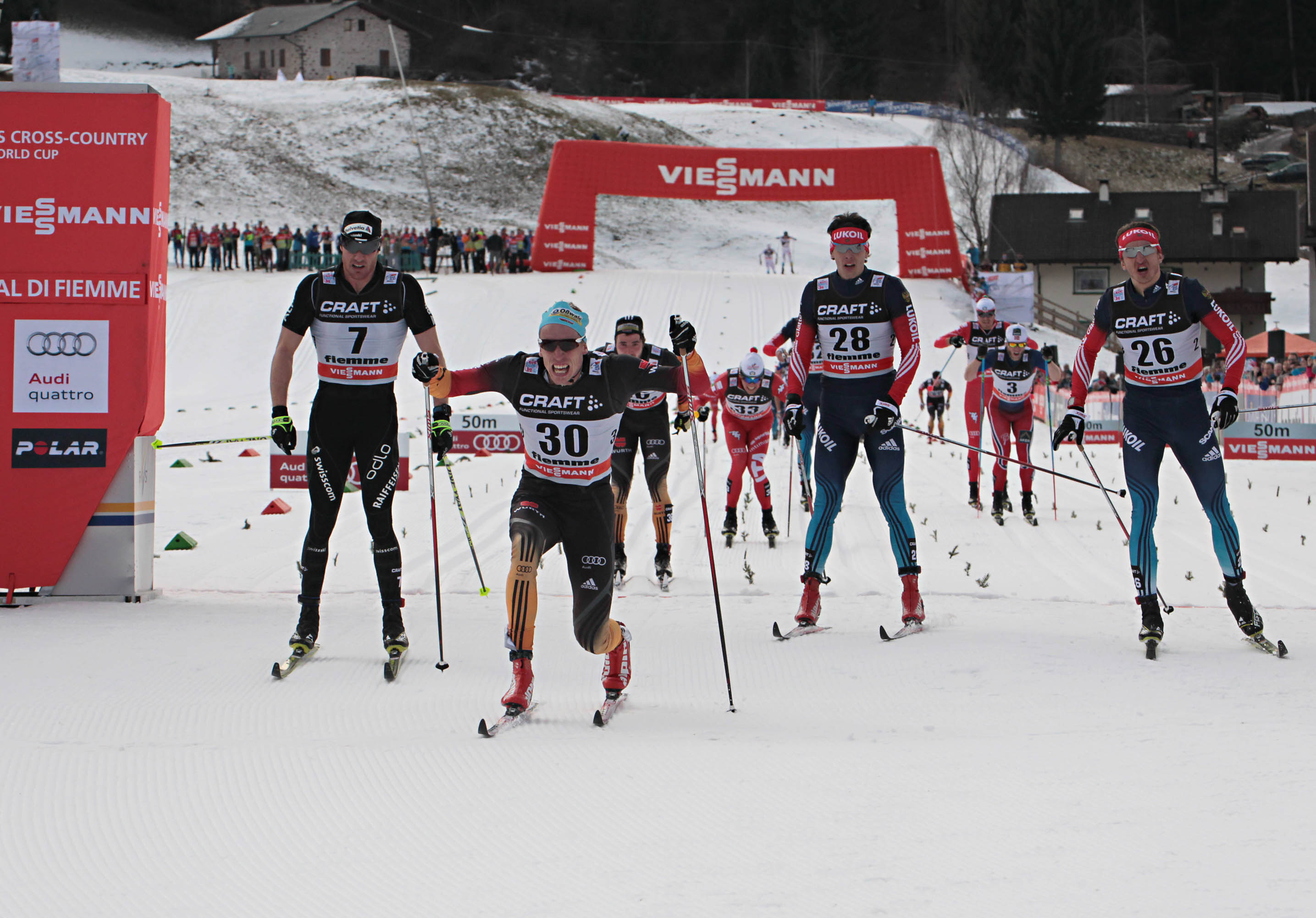
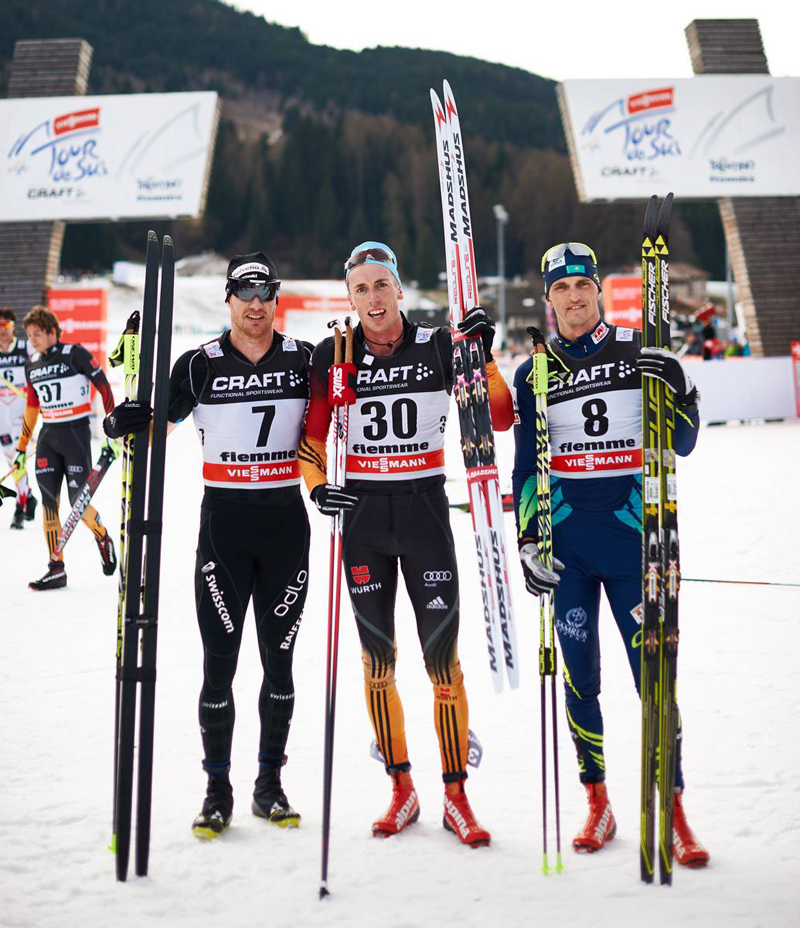
Tim Tscharnke (bib 30) of Germany begins to celebrate after a narrow victory over Kazakhstan’s Alexey Poltoranin (out of frame) in Saturday’s Tour de Ski 15 k classic mass start in Val di Fiemme, Italy (Photo: Val di Fiemme/www.fiemmeworldcup.com)
Saturday’s 15 k men’s classic mass start in Val di Fiemme, Italy, had no shortage of excitement – with the top five separated by less than a second – and sets up a potentially dramatic final stage of the Tour de Ski.
In a sprint to the finish line, it was Germany’s Tim Tscharnke winning the Tour’s sixth stage by mere inches. Tscharnke, who began the race 30th in the Tour standings, outlunged Alexey Poltoranin of Kazakhstan (+0.0) to finish in 46:48.8.
Tscharnke was positioned behind the leaders for much of the race and was ninth after 11 k, 6.8 seconds behind Tour leader Petter Northug of Norway. However, as skiers such as Northug and Norwegian Martin Johnsrud Sundby slowed their pace after sprinting to collect bonus points, Tscharnke was able to make his move along with other racers who held back.
“We did not focus on sprints, we just wanted to go for a good position in the finish,” Tscharnke told FIS.
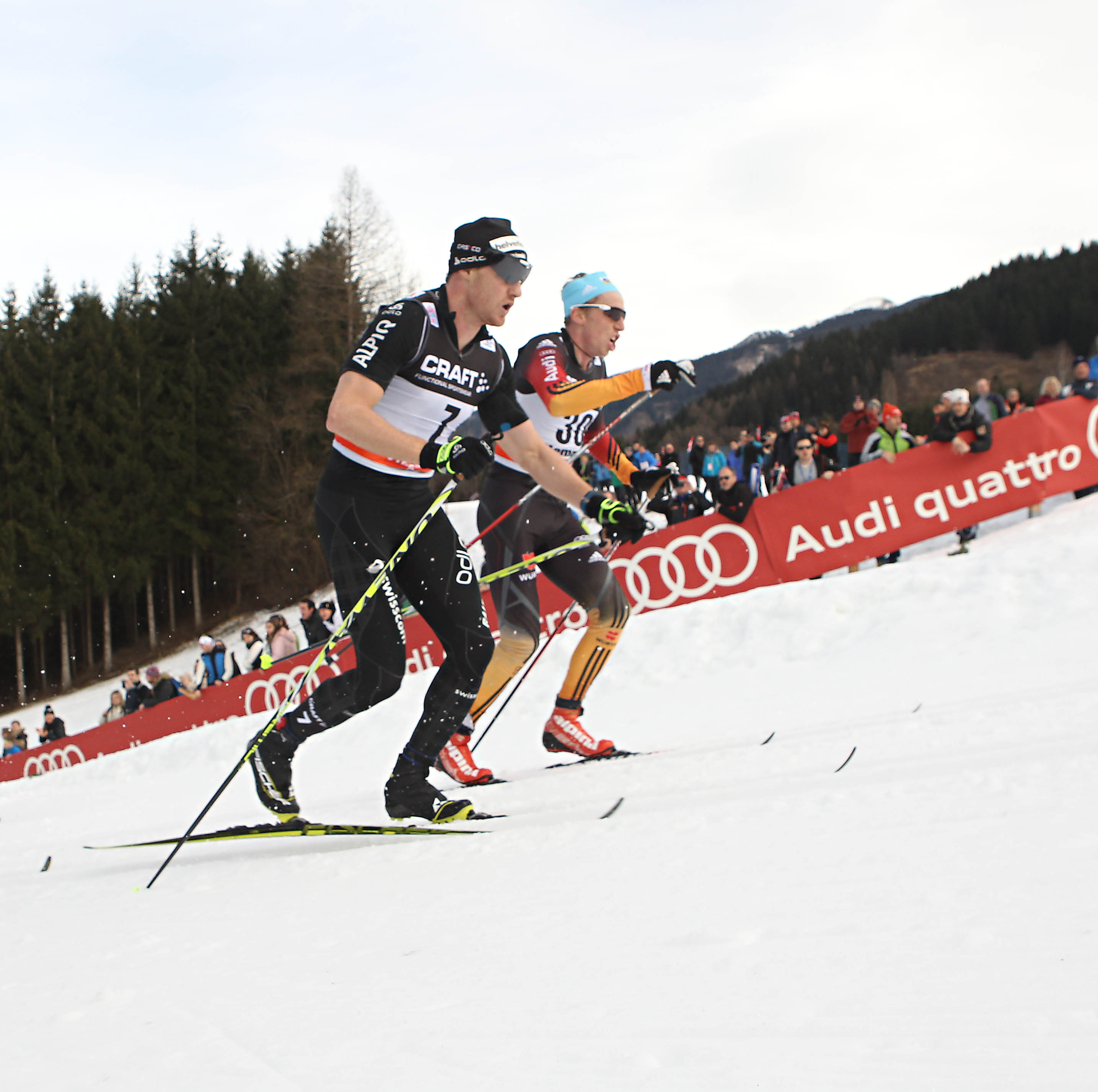
Switzerland’s Dario Cologna (bib 7) and Tim Tscharnke of Germany (bib 30) race in the Tour de Ski 15 k classic mass start in Val di Fiemme, Italy. Tscharnke would go on to win in a photo finish. (Photo: Val di Fiemme/www.fiemmeworldcup.com)
“It’s a little bit of a surprise for me to win today,” the 25-year-old explained. “Thomas [Bing] and me wanted to be in the front of the pack. We helped each other.” Bing would end up finishing sixth (+2.0).
Tscharnke’s Tour got off to a rough start, as he took 73rd in the 4 k Obsertdorf prologue. However, he has since been posting better and better results, and with Saturday’s victory he has his best World Cup result of the season by far. His previous best was in Wednesday’s 10 k classic interval start in Toblach, when he took 24th.
Tscharnke said, according to the German newspaper Frankfurter Allgemeine, that this victory meant more to him than his last World Cup victory, a 15 k classic mass start in Canmore, Alberta, in Dec. 2012. He explained that he underwent intense training over the holiday break, especially on the roller ski and the treadmill, and that it is a relief to see the hard work pay off.
He is now 15th in the Tour standings, 4:20.8 behind the leader, Northug.
Dario Cologna was contending for the win during the final sprint and took third (+0.4), despite an earlier crash. About 29 minutes into the race, he tangled skis with Russian Evgeniy Belov while descending a fast hill, and both skiers went falling to the ground. Belov, who is fourth in the overall Tour standings (+35.3), would end up taking 17th (+14.1).
“I had to spend some energy to come back after the crash but I managed to finish on the podium. It will be difficult to go for podium in the Tour but you never know what can happen on the climb,” Cologna said to FIS, referring to the long climb that makes up much of Sunday’s 9 k freestyle pursuit.
Cologna is fifth in the Tour standings (+1:46.6) and 1:19.8 behind the third-place skier, Sweden’s Calle Halfvarsson.
Meanwhile, two Russian skiers, Stanislav Volzhentsev and Alexander Bessmertnykh, both stayed well behind the leaders throughout the race and were able to conserve enough energy to take part in the final sprint to the finish. Volzhentsev just edged out Bessmertnykh in a photo finish to take fourth (+0.7).
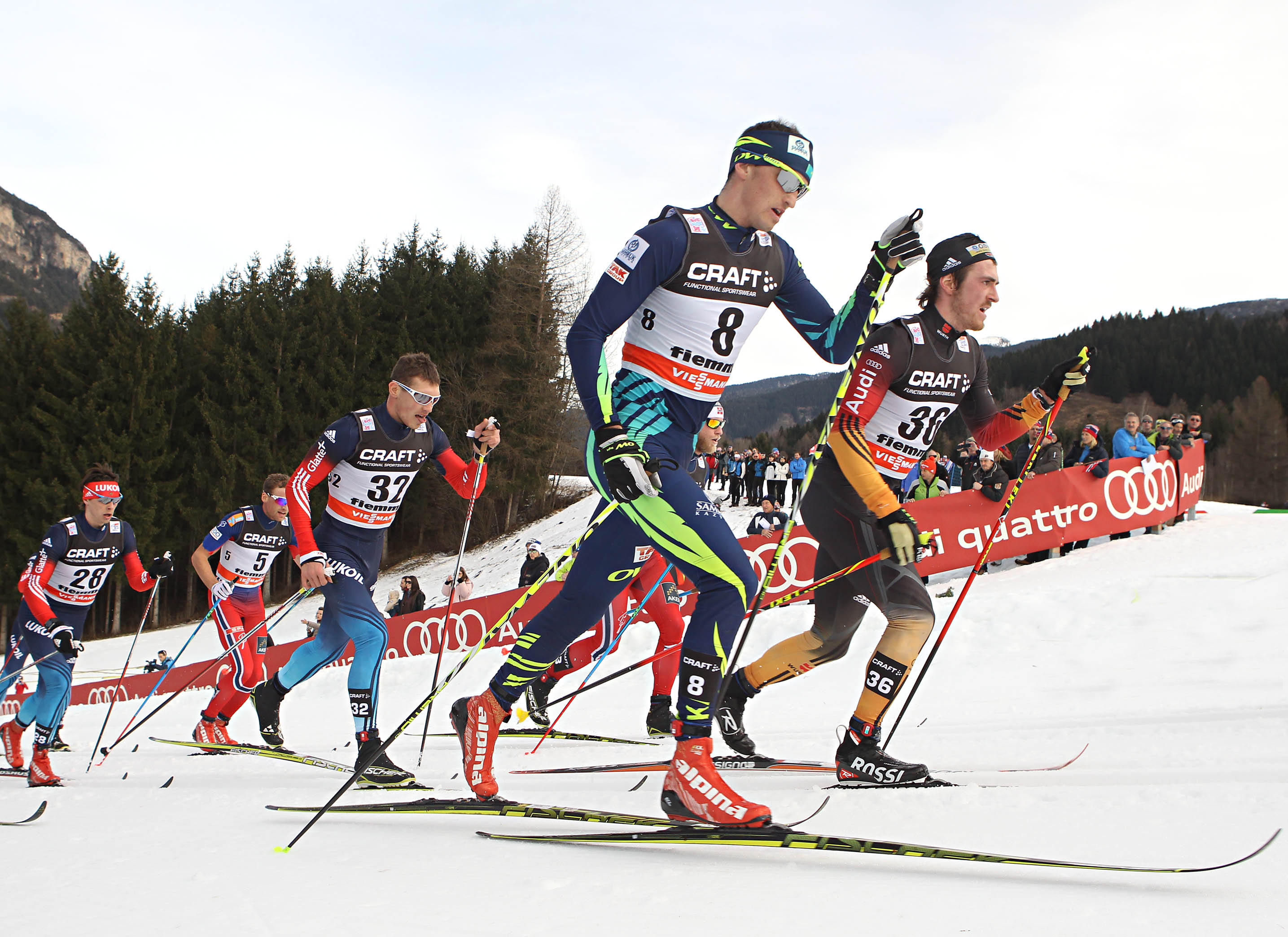
Kazakhstan’s Alexey Poltoranin (bib 8) races alongside Germany’s Thomas Bing (bib 36) in the Tour de Ski 15 k classic mass start in Val di Fiemme, Italy (Photo: al di Fiemme/www.fiemmeworldcup.com)
With a podium consisting of Tscharnke, Poltoranin, and Cologna, Saturday featured the first podium of the season without a Norwegian present.
Northug finished the race in 21st (+17.2), which was just barely enough to hold the overall Tour lead over teammate Sundby, who finished in eighth (+4.1) and was the highest-placing Norwegian. Sundby also crashed on one of the course’s steeper downhills, falling alongside Niklas Dyrhaug five minutes into the race.
Northug explained to FIS that Saturday’s race was all about collecting bonus points.
“I knew many skiers were saving energy for the finish. The last bonus sprint cost me a lot of power,” Northug said.
The current Tour standings set up a tight race for the overall Tour title, which will be decided in Sunday’s final stage in Val di Fiemme. Northug is just 3.1 seconds ahead of Sundby, while Halfvarsson, who was 27th on Saturday (+30.0), is 26.8 seconds behind Northug in third and within striking distance.
“It will be a hard fight for the podium tomorrow,” Northug said. “It has been a tough Tour de Ski. If you have a really bad day you can easily lose many minutes.”
At this point on the Tour, the men’s North American contingent consists entirely of Canadians. Alex Harvey finished his Tour by taking 34th (+2:12.5), and dropped from sixth to 16th in the overall standings. Teammates Ivan Babikov and Devon Kershaw finished 40th (3:28.6) and 41st (3:39.5), respectively.
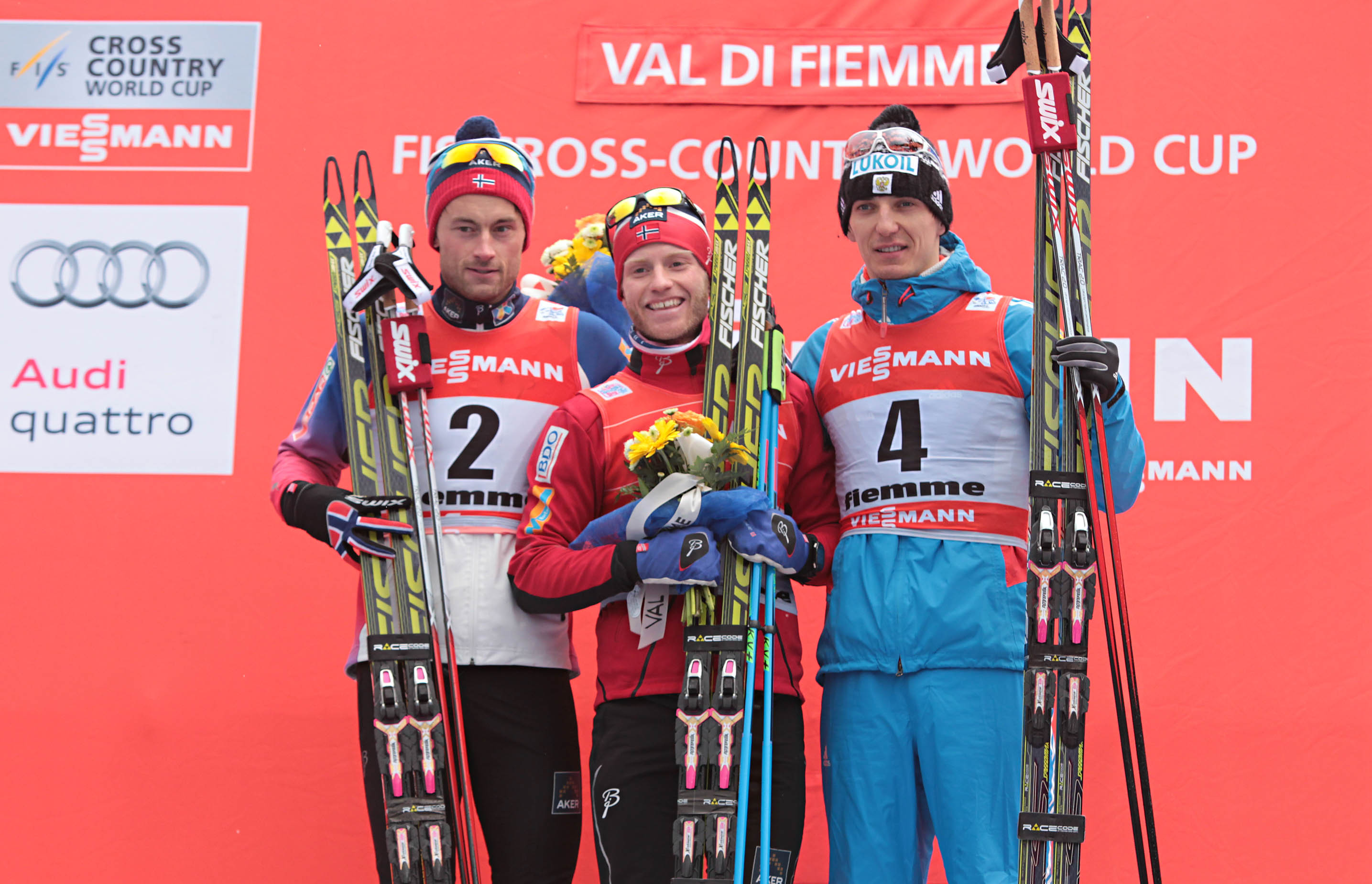
Dario Cologna (SUI), Tim Tscharnke (GER), Alexey Poltoranin (KAZ), (l-r) take the podium in the men’s classic mass start in Val di Fiemme, Italy. (photo:Fischer/Nordic Focus)
Therese Johaug of Norway celebrates her win in the 10 k classic mass start in Val di Fiemme, Italy – and being the first woman to beat Marit Bjørgen in this edition of the Tour de Ski. (Photo: Val di Fiemme/www.fiemmeworldcup.com)
After skiing together and taking turns leading through the first 9 k, the final stretch to the finish became a three-way thriller between the usual suspects among the Norwegian women where Therese Johaug eked out everything to beat Marit Bjørgen to the line.
For Johaug, winning the sprint finish in the 10 k classic mass start in Val di Fiemme, Italy, was a huge victory in a Tour de Ski that has been a bit off for the defending champion. Johaug crossed the line in 33:10.4, just over 1 second ahead of Bjørgen and 5.5 seconds ahead of Heidi Weng in third place.
“I was determined to stick with Marit (Bjørgen) up the last hill, and I knew I had great skis, and my double-poling was really strong toward the end of the race,” Johaug said to NRK reporters after the race. “It was amazingly fun to win today. It feels so good after struggling a bit so far in the Tour de Ski. Now I felt my body was with me, and I love these courses here in Val di Fiemme.”
The podium trio had a huge gap to Aino-Kaisa Saarinen of Finland, who clocked in 1:13.1 behind Johaug. Liz Stephen delivered a strong fifth place, 1:39.6 behind Johaug; Polish star and classic specialist Justyna Kowalczyk was disappointed in seventh place.
A clan with a plan
The Norwegian trio on course, with Marit Bjoergen in the lead. (Photo: Val di Fiemme/www.fiemmeworldcup.com)
The Norwegian women, who have been dominating the podium so far in this Tour de Ski as well as in the World Cup season as a whole, had a plan prior to the sixth stage today.
Bjørgen’s plan was to conserve energy and prepare for the final stage up Alpe Cermis tomorrow. Johaug, who has been struggling more this Tour, was told to hold back – at least on the first lap. She managed to stick to the plan exactly one lap. Two meters into the second lap, Johaug was in the lead and set the pace. And the trio already had a huge gap on the rest of the field.
But group plans had to go out the window because of the presence of sprint “preems”: bonus seconds awarded to each of the first skiers across the line at two intermediate points during the race.
The time didn’t mean much to Bjørgen, who already had a roughly two-minute lead in the Tour de Ski after winning every single previous stage. But each second counted dearly for Weng and Johaug. Before today’s stage Weng sat in second place and Johaug in third, but Johaug is an expert at the final stage climbing up the Alpe Cermis. She wanted to narrow the gap to Weng so she could be sure of passing her; Weng wanted to widen the gap to prevent that from happening. It all came down to the bonus seconds.
At the 5 k mark, Weng was in the lead, 0.4 seconds ahead of Johaug and 0.8 seconds to Bjørgen. Approaching the sprint, Bjørgen predictably let Weng and Johaug fight for the bonus seconds. Johaug had the longest toe across the sprint line, collected the 15 bonus seconds and reduced the overall gap to Weng by 3 seconds. Weng cashed in 12 seconds and Bjørgen received 10 seconds in the sprint.
Thriller sprint finish
Johaug reacting to having won the sprint finish. (Photo: Val di Fiemme/www.fiemmeworldcup.com)
Bjørgen pulled the group of three into the final kilometer, looking confident going into the finish. She turned on the turbo on the last hill, but lost the sprint finish to Johaug after, perhaps, a tactical mistake. Johaug was able to stay in Bjørgen’s draft all the way down the hill, and was still tucking behind her as Bjørgen started double-poling. When Bjørgen decided to switch tracks before entering the finishing lanes, she handed Johaug the opportunity to pass her.
In almost every other time the pair has faced off in a sprint finish, Bjørgen has won – so it may not have seemed like a big deal. But Johaug turned it up to an extra gear and pulled away from her older teammate, stopping Bjørgen’s Tour de Ski winning streak.
It wasn’t an accident.
“I worked yesterday with my coach on my classical technique,” Johaug said in a FIS press release. “I knew Marit would be strong on the last hill but I could follow her.”
The effort was taxing: Johaug collapsed in the snow before sitting up and screaming in victory. She was excited and almost as surprised as anyone else.
“Shit, I’ve got more speed than her,” Johaug told NRK she thought as she drew even with the Tour leader.
Weng stuck with Bjørgen and Johaug all the way to the finish chutes, but had to settle for third place for the stage. She is still solidly in second place overall, and with a good day tomorrow, her 39 second lead to Johaug could be enough to defend that second place to the top of the monster hill Alpe Cermis.
It was a tough day for Justyna Kowalczyk of Poland. The four-time Tour de Ski champion bled more time to the leaders, and is now more than seven minutes back from another title. (Photo: Val di Fiemme/www.fiemmeworldcup.com)
Neither Saarinen nor Stephen of them was able to make up time on the final kilometer.
It was by far the best result all season for Saarinen, who struggled with a foot injury in the off-season.
“This was no longer a step, but a leap forward,” she told Finland’s Helsingen Sanomat newspaper. “I have received what I went for… It is a pretty good performance. Yes, it is on the way up and I’m beginning to seriously think about properly profiting at Falun [World Championships].”
As for Steven, on paper it was her best classic result yet. (With less than a full World Cup field present at such a late stage in the Tour – for example teammate Sadie Bjornsen dropped out of the seven-stage event – the race might have been less competitive than some others. On the other hand, the Norwegians didn’t seem to treat it that way, and Saarinen, like today, finished fourth in this event at the 2014 Olympics.)
“I had great skis today. It’s so warm and it was perfect klister skiing out there,” Stephen in a USSA press release. “These courses really suit the way I ski, steep hills and long hills. I really liked being in Val di Fiemme with the memories of World Championships.”
Stephen beat Norway’s Ragnhild Haga by 10.9 seconds, and has thereby made herself a serious threat to Haga’s fourth place in the overall Tour de Ski. Stephen, known as one of the best climbers on the circuit, sits less than a minute behind Haga in sixth place in the overall standings.
“It’s my favorite event of the whole year,” Stephen said in the press release. “It’s just you and the mountain, the gates and the people. I won’t sleep much tonight because I can’t wait for tomorrow.”
Poland’s Justyna Kowalczyk, a four-time Tour winner who has dominated the classic ski stages in previous editions of the event, finished in seventh place, 1:47.2 behind Johaug. She sits in fifth overall, but more than seven minutes back from Bjørgen. It’s a huge change from previous seasons, and even Kowalczyk can’t put her finger on what went wrong.
She initially tried to go with the Norwegian trio, and indeed lasted almost a kilometer longer than every other woman. But then she was dropped, and after a few more kilometers could not hold onto fourth place.
“At some point, I disconnected the electricity,” she told the Polish media. “Then I learned about what it’s like to be a skier on tour with fatigue.”
She slipped through the field; by the finish, she looked crushed and despondent.
“It’s hard for me to analyze at the moment the cause of my poor performance skiing,” she told Eurosport Poland. “If it wasn’t the Tour de Ski, I might not have finished. There was even talk about that. What kept me alive was only thinking how foolish it would be to abandon when there is still a chance of a good placing in the event. My goal is to finish the Tour de Ski.”
Sadie Bjornsen skating to seventh place in the 3.3 k Tour de Ski prologue in Oberstdorf, Germany (Photo: Marcel Hilger)
It’s not easy being the person who has to say when. But that’s Erik Flora’s job, as head coach and director of the Alaska Pacific University Nordic Ski Team, which includes three U.S. Ski Team members and a fleet of top domestic skiers.
In the middle of the pinnacle event of the season for stateside racers — U.S. Cross Country Championships in Houghton, Mich. — Flora had to take the time to check in with his World Cup athletes, including Kikkan Randall, Sadie Bjornsen and Erik Bjornsen, who competed in the Tour de Ski earlier this week.
The Bjornsen siblings raced through the fourth stage of the Tour, the 5- and 10-kilometer classic races in Toblach, Italy, and Randall went one stage beyond to end her run with the 15 k freestyle pursuit, also in Toblach.
When each would stop the Tour and move on to a training camp in Ramsau, Austria, had been predetermined before the seven-stage series began. But when someone like Sadie was having some of the best races of her career, and leaving her first-ever Tour in seventh overall, it made actually withdrawing harder than expected.
“Man, that was a hard decision, sitting in seventh and her coach to advising her to keep with her plan,” Flora reflected inside APU’s wax trailer at the Michigan Tech Trails in Houghton. He was finishing up his duties for the day at nationals on Thursday, shortly after the end of the last junior mass start.
However, the decision was calculated, he said.
“Sadie is in good form — really good form,” Flora began. “She has made a big step this year and we can see that all the way through the summer … training went better than it has ever gone.”
She and the rest of the U.S. team got through Period 1, the first four weekends of World Cup racing, and that was “a long bat of racing,” he said. Most top World Cup racers plan breaks in advance during the season: “As far as recently, we don’t really see any of the top ladies racing all the way though the season,” he added.
Kikkan Randall skating to 22nd in the Tour de Ski prologue in Oberstdorf, Germany. (Photo: Marcel Hilger)
For Sadie, Flora said they reasoned it made sense to have her compete throughout Period 1, then train over the holidays before embarking on her first Tour de Ski.
“That would be a pretty substantial stress and then she could take a break now and then race the next two weekends in the World Cup,” he added. “I think it is important for a lot of the young athletes to get the experience of racing a lot of the different venues and learning about the different venues and that was the goal for Sadie.
“I think she can be one of the top skiers here over the next few years and to be able to learn each venue while she is young and still up-and-coming is very important,” Flora said. “The Tour is also one of those goals this year, mainly to get a feel for how the Tour works and obviously she got the hang of that pretty quickly, but when she called me and the question was, ‘Should I keep going?’ I thought that it was good.”
They could have encouraged her to continue, then sit out the next two World Cup stops in Otepää, Estonia (Jan. 17-18) and Rybinsk, Russia (Jan. 23-25), “or pull out of the Tour now and have a chance to race the next two World Cup weekends. You know she had met all of her goals up to this point and she would have done well had she stayed in the Tour, but next year we will make another run at that again,” Flora said.
“It’s definitely really hard to have to drop out – or not have to, but I’ve chosen to drop out just to save some energy because I’m going to race in Estonia next weekend,” Sadie said on the phone on Wednesday. “But it’s gone better than I expected, and I think it’s so much fun. … I can’t imagine what you would feel like after doing seven, or nine races next year, I feel like you would feel so accomplished just finishing it. Four days is extremely hard, so I definitely respect the whole Tour de Ski so much more after this.”
While she’s headed to Ramsau, Randall is going home to Anchorage, Alaska, before flying to Sweden at the end of January to prepare for the last World Cup before World Championships (Feb. 14-15 in Östersund, Sweden). Later that week and into early March, she and the team will compete at World Championships in Falun, Sweden.
According to U.S. Ski Team Head Coach Chris Grover, Randall planned to leave Friday for Alaska, where she’d spend about 16 days trying “to kind of take a break from the World Cup and just get re-centered,” he said. “That is a new plan for her; she was never really planning on finishing the Tour.”
Flora explained he talked to Randall on Thursday morning about it.
“It was something that I suggested a few days ago,” he said. “Kikkan has spent a lot of time racing over in Europe over the last few years and she has gotten very good at it. [I’m] always really impressed with the way that she races and trains and travels.
“Period 1 this year hasn’t gone that well for Kikkan and so we wanted to just take a little bit of time,” he added. “We made a plan to just race through this [fifth] stage in the Tour, that was always the plan, race the first five stages and then again take a training break and prep and get ready for the World Championships.”
Considering her trends in training and racing, and how much of both she’s done over the last few months, “we decided it would be smart to just take a break and get some rest,” Flora said. “When racing is going well and you’re in a good place in Europe, it is much better to stay there and race. Sometimes it makes sense to take a little break and refocus, and that was my recommendation, to come home take a training break and refocus and go back over for a camp and get ready for World Championships.”
While Randall could not be reached for comment on Friday, she wrote in an email to members of the press after Thursday’s stage, “With 5 races now under my belt I am leaving the Tour and taking some time to recover and rediscover my top form. The big focus on the season is still the Falun World Championships and I am focusing all my efforts on being in the best shape in February.”
Andrew Musgrave (GBR) earned a historic fastest time in the 25 k pursuit in the fifth stage of the Tour de Ski. He now sits in 11th on the overall Tour rankings. Musgrave is pictured here at the 2013 World Championships in Val di Fiemme.
Andrew Musgrave is having a historic 2015 Tour de Ski. After a series of strong classic races and a 18th place in the freestyle sprint, the British skier earned the fastest time in the fifth stage’s 25 k freestyle pursuit in Toblach, Italy. Starting the day in 21st, Musgrave crossed the line with a course-time of 53:29.3, improving his Tour standing to 11th.
FasterSkier caught up with Musgrave as he prepared for the final two stages of the Tour in Val di Fiemme, Italy to talk about the race, his goals, and the future of British skiing.
FasterSkier: Yesterday you earned the fastest time in the 25 k, which is your best result in a World Cup and a historic moment for both and your team. How are you feeling right now?
Andrew Musgrave: I definitely haven’t won a World Cup before so it was a lot of fun. It was definitely a good result and hopefully it will get some good media coverage at home and promote skiing in Britain. In pursuit-style skiing you can’t read too much into the fastest time because it depends on who you end up starting with and how fast you go and what they do at the front. It was awesome but at the same time you can’t read too much into it.
FS: Why was yesterday’s pursuit so successful for you? what was your winning combination?
AM: I was quite lucky with my start. I did start right behind [Maurice] Manificat. So I just sprinted from the start, caught up with him, and tagged on behind him for 25 k. Also the wax team did such a good job with our skis. It was so fast it was almost like I was cheating because I got so much rest. The other guys were free skiing and I was just sitting behind in a tuck.
FS: I’m guessing you’ve received an outpouring of support from home. How has that been?
AM: For the people who follow cross country skiing, I’ve gotten a lot of messages from them saying well done and what a good day it was. It’s not every day in British skiing that you get messages from lots of different people. It’s definitely a pretty cool experience.
FS: The Tour has been pretty good for you with the a top-20 in the Val Mustair sprint and a couple strong classic races.
AM: Val Mustair was actually really good fun because both myself and the other British skier Andrew Young made it into the top-20. We have a little rivalry and heat got me in 15th. My brother actually sent me a message that said ‘the only reason you went fast [in the pursuit] was so that you could out-do Andrew Young’s result from the sprint in Val Mustair. The Tour in general has gone pretty well and it was cool to see that there were two of us, and not just me. Andrew pulled out after Val Mustair and headed to Scandinavia to race in the Scandinavian Cup in Falun this weekend.
FS: With two stages left in the Tour de Ski what are you looking to do in the remaining two stages?
AM: It’s a good question. First thing is first, I’m going to try and get through the 15 k without loosing too much time. That’s my main aim for tomorrow. Classic has never been my best – I actually had a pretty good day in Oberstdorf where I ended up in 26th. The classic in Toblach was ok but I double-poled that so it is hard to say. I don’t think anyone is going to double-pole the course here in Val di Fiemme. If I get through that without loosing too much time then hopefully I should be able improve up the hill on the last day. I had a pretty good day up the hill last year so hopefully I can do it again. Maybe I can be in the top-15, maybe the top-10. I don’t know. I’m just going to take it as it comes.
FS: Andrew Young’s success demonstrates that the British team is growing. How do you see the team progressing in the future and do you see further success for the British team on the horizon?
AM: I hope so. Definitely me and Andrew have improved the last few years so hopefully we’ll be able to keep that up. There are now another few guys at the senior level racing with us – we had a team of four at the Olympics last year. Hopefully a few of those guys will start getting some points on the board at the World Cup, and hopefully that will lead to a bit more interest in the sport in Britain, and more people getting involved in the sport in general.
FS: What needs to happen for British skiing to grow?
AM: If you get one or two good results at the Olympics or World Championships level, it can make it into the media. It might catch more people’s attention and get a few more people involved in skiing. In a country like Britain where there isn’t that much snow, cross country skiing is never going to be that big of a sport. What’s really important is getting a really good fixture in place and keeping as many people in the sport as possible who start getting involved with it at one point or another.
FS: What can we expect to see from you in the rest of the season? What do you want to accomplish in the remaining World Cups and at World Championships.
AM: The two biggest focuses this year were the Tour de ski and will be the World Championships. After racing here I’m going to head back to Norway and get in a good training block in before the World Championships. So I’m not going to make the World Cups in Russia or in Estonia. I’ll race in the Norwegian Championships to get back into things. Then I’ll race the World Cup before the World Championships in Östersund. After the Tour the main focus is on the Championships, and especially the pursuit and the 15 k there.
FS: What are your goals for the Championships? A possible medal?
AM: It would be awesome. If I end up having the best day of my life with the best skis of my life, I could end up on the podium. Realistically I should be pretty happy if I am within the top-10 at World Championships. That’s what I’ve given myself as a goal – a top-10 in the skate race at World Champs.
Liz Stephen races in Saturday’s Tour de Ski 3.3 k prologue in Oberstdorf, Germany (Photo: Marcel Hilger)
Only two Americans raced Thursday in the Tour de Ski’s fifth stage, a 15 k freestyle pursuit in Toblach, Italy.
Liz Stephen had the eighth fastest time of the day (37:25.6), but still finished 5:31.9 seconds behind Norwegian Marit Bjørgen (36:37.9), Thursday’s winner and overall Tour leader. Stephen remains in 14th in the Tour standings.
USST Head Coach Chris Grover said that Stephen had a good race, even though it is not a course that plays to her strengths.
“There is not much V1 in it; it is more of a big powerful skier type course with a lot of V2, V2 alternate, a lot of transitions,” he explained. “But another great performance by her.”
Meanwhile, Kikkan Randall – who decided that this would be her last race of the Tour – improved three places to finish 25th (7:21.7) and posted the 17th fastest time of the day in 37:53.6.
Randall was coming off what she described in an email to the press as a “disappointing” 5 k classic race on Wednesday.
“It seemed like it was going decent through 2.5 k and then I ran up against a wall again trying to really shift into my top climbing gear. I fell apart in the second half and crossed the line way off my expectation,” she wrote.
Randall explained that in Thursday’s 15 k she started in a wave of other skiers and had a difficult first lap, but improved as the race progressed.
Kikkan Randall racing in the 5 k classic in the fourth stage of the 2015 Tour de Ski (Photo: Fischer/Nordic Focus)
“The first lap my body was slow to respond but it came alive through the race and I ended up feeling strong on the second and third laps. I was able to move up a few places and end with a more satisfying effort,” she wrote.
Randall will not participate in the final two stages of the Tour, which she was never planning on finishing.
“The big focus on the season is still the Falun World Championships and I am focusing all my efforts on being in the best shape in February,” Randall explained.
Now, Randall will travel home to Alaska, Grover explained, and “spend about 16 days at home just to kind of take a break from the World Cup and just get re-centered and not focus on traveling and racing so much.”
Jessie Diggins, who was 40th on the Tour, did not start on Thursday.
Grover said Diggins woke up with a cold, and decided it was not worth it to keep pushing.
“She was really hoping to do the whole Tour so just a bit of bad luck, but that is just part of the game in the Tour de Ski. It is so much racing and so much traveling, it is just a battle to stay healthy,” Grover said.
Diggins finished the Tour the last two years, taking 21st in 2013 and 13th in 2014. Now she is focusing on the World Championships, Grover explained, and will go to a training camp with Stephen before World Cup races in Rybinsk, Russia, from Jan. 23-25.
The women’s team is now left with just one athlete, Stephen, racing in the Tour.
“That is a bummer to just have one athlete at the end, but we knew we would be small at the end anyway,” Grover said.
Alex Harvey (CAN), Dario Cologna (SUI), Daniel Richardsson (SWE) and Alexey Poltoranin (KAZ), (l-r) during Thursday’s Tour de Ski stage. (photo: Fischer / Nordic Focus)
Alex Harvey’s plan to work with Norway’s Niklas Dyrhaug may have slowed him down in Thursday’s Tour de Ski 25-kilometer freestyle pursuit, but he was still 0.4 seconds fast enough to jump Switzerland’s Dario Cologna in the Tour standings and improve from seventh to sixth overall.
The Canadian is now sixth overall, 2:01.0 minutes behind leader Petter Northug of Norway. He finished Thursday’s pursuit in sixth, 1:46.0 minutes behind Northug (53:36.9), and had the 21st fastest time on the course – five laps around a 5 k loop – in 54:35.1. However, Dyrhaug edged him out at the finish line by 0.1 seconds to take fifth.
“I’m happy with the results but time-wise I’m a bit disappointed by the other guys in the group,” Harvey said in a phone interview.
He explained that Dyrhaug – who started the day eighth overall – approached him before the race and said he wanted to work together to catch Cologna. Harvey agreed, but Dyrhaug set a slow pace from the start, and he estimated they quickly lost 10 seconds to Cologna.
However, he said the pace finally quickened when Sweden’s Daniel Richardsson caught up to them.
Niklas Dyrhaug (NOR) and Alex Harvey (CAN), (l-r) each moved up the overall Tour de Ski results. (photo: Fischer / Nordic Focus)
“Richardsson had a really good day so when he caught up to us, him and I could work well to close the gap. By then it was maybe up to 30 seconds to Dario, but we could work well, and I think Dario was starting to fade a little bit,” Harvey said.
At that point, Harvey knew the top-four skiers were too far ahead to be caught, so the race turned into a battle between him, Richardsson, Cologna, Dyrhaug, and Kazahstan’s Alexey Poltoranin for fifth.
Harvey said no one was willing to take a big pull, and the group ended up sitting.
“We [Richardsson and I] saw that Dario and Dyrhaug were sitting, so we didn’t want one of them to attack right after we took a big pull and get dropped. So when not that many people are trying to work, people get pretty pissed, and I guess that was what was going on,” Harvey explained.
The results was a final charge for fifth among the five racers, with Dyrhaug taking it by a fraction of a second.
“I think we could have skied probably 45 seconds to a minute faster if Dario, Daniel, Niklas, and I really pushed,” Harvey said. Dyrhaug – who Harvey said he has a “good relationship” with – went up to him after the race and apologized for not pulling, according to Harvey.
Despite his frustrations with the speed, Harvey said the course was fairly fast.
“Every 5 k I would throw in maybe four or five offsets – on climbs I can skate in that technique – so everything else was one skate or two skate. It was pretty fast snow,” he said.
Harvey will race in the 15 k classic mass start in Val di Fiemme, Italy, on Saturday, but will forgo Sunday’s final stage, a 9 k freestyle pursuit. This will be the third year in a row he will skip the final stage of the Tour.
However, he thinks he has a shot at the podium on Saturday.
“I’ve had really good races in the past in Val di Fiemme … It’s a race that I’ve done well in the past, and the classic this year has been feeling really good, and today because we didn’t push so hard I’m not really tired,” he explained.
Two other Canadian men competed in the pursuit. Devon Kershaw started the day in 29th but improved to 25th (+4:11.0), while Ivan Babikov started and finished in 31st (+4:13.9). Babikov also had the 23rd fastest race of the day, with a time of 54:39.2.
The three American men withdrew from the Tour after Wednesday’s 10 k.
Calle Halfvarsson (SWE), Evgeniy Belov (RUS), Martin Johnsrud Sundby (NOR and Petter Northug (NOR), (l-r) come to the line at the end of the Tour de Ski pursuit in Cortina-Toblach (ITA). (photo: Fischer / Nordic Focus)
Norway’s Petter Northug won the 25 k skate pursuit in Toblach, Italy, after surging past the leading trio on the final hill and making the sprint finish look easy. The Norwegian now leads the Tour de Ski, a seven-stage race series, by seven seconds with two competitions to go.
Northug started the race two seconds ahead of his teammate Martin Johnsrud Sundby and seven seconds in front of Russia’s Evgeney Belov. Calle Halfvarsson of Sweden started 14 seconds behind Northug. However, the three chasers quickly passed Northug, who hung out in the back of the trio throughout the race.
A master tactician, Northug surged into the last hill and made his move over the top, putting a gap on Halfvarsson over the hill and into the finish chute.
Evgeniy Belov (RUS), and Martin Johnsrud Sundby (NOR) did the majority of the work for the lead foursome. (photo: Fischer / Nordic Focus)
“I managed to push my weight over the last hill and used that to my advantage so I could pick the chute to the finish line,” Northug said to NRK reporters after the race.
The star noted that he was not in a position to contribute in front today.
“I was focusing on hanging onto the group. They were all stronger than me today, but it was fun to hang with the big boys,” Northug explained.
However, the tactics – of hanging with the pack but not leading, and then burning competitors in a sprint finish – is nothing new for Northug, who often justifies his lack of leadership in group skiing by saying that he’s tired.
Not everyone was impressed. While Northug was pointing to his bib and gesturing in celebration of his win, Belov, who finished fourth in the sprint finish and did not collect any bonus seconds, angrily pointed his finger at Northug.
“This was only the fifth stage, it was not the final Tour de Ski, which we were racing for today,” he told Sweden’s Dagbladet newspaper. “In this case, you have to help the group during the race. He just went back and let the rest of us do the job. I don’t think it’s the way you should do this, and that’s why I both reacted in the finish and am angry now.”
Belov and Sundby led the four-man group for much of the race.
With the 15 bonus seconds awarded to the winner, 10 to second place, and 5 to third, Northug is now seven seconds in front of Halfvarsson in second place overall and 12.2 seconds ahead of Sundby, who is defending the 2014 Tour de Ski overall title.
Northug said that he is excited to try to add more bonus seconds in the 15 k classic mass start on Saturday, but doesn’t consider himself a favorite for the overall title, where he believes Sundby the best bet.
“Calle (Halfvarsson) and I suck equally bad at the monster hill,” Northug said. “I would like to have a minute down to Sundby going into the big hill on Sunday.”
Wants to go neck-a-neck with Northug on Sunday
Halfvarsson didn’t argue with Northug’s comment on his chances up Alpe Cermis, but he cherishes the idea of measuring strengths in real time.
“It would be really fun to go into that hill even with Northug on Sunday,” Halfvarsson said to NRK reporters after the race. “Then we could really see who of us is the fastest.”
As for today’s race, Halfvarsson was pleased to finish only two seconds behind Northug and beat both Sundby and Belov.
“I am super content with my race today,” Halfvarsson said to NRK reporters after the race. “I had to work really hard in the beginning to make it up to the front and that cost me a lot. I kept thinking to myself that I wanted to hang in there for one more lap, and then one more lap and then it was the last lap. I didn’t expect to have a chance to hang with these guys today. But it wasn’t me who set the speed. That was Sundby and Belov’s work. I tried to contribute when I could.”
He was also pleased to have added time on Dario Cologna of Switzerland, a previous many-time Tour winner, and Swedish teammate Marcus Hellner. Completely exhausted, Halfvarsson is looking forward to a rest day on Friday before he tries to stay on the Tour de Ski podium in the last weekend of competition.
Today’s stage was originally a 35 k point-to-point skate pursuit, but due to lack of snow, it was changed to a 25 k consisting of five laps on the same 5 k course that was used for Wednesday’s 10 k classic competition. After five of seven stages, the top four overall have a solid gap on the rest of the field going into the last two stages of the Tour.
Niklas Dyrhaug of Norway won a sprint finish for fifth place, besting Canada’s Alex Harvey, Cologna, and Wednesday’s classic 10 k winner Alexey Poltoranin of Kazakhstan.
““My optimistic goal was to ski back into the top-five. I just got outsprinted at the end, but I improved on my result so I have to be happy with today,” Harvey, who started in bib seven, said in a CCC press release. “The group didn’t push too hard today so I’m feeling less tired than I did at this point last year.”
The fastest overall time of the day belonged to Andrew Musgrave of Great Britain, who started in 21st and moved up to 11th place, narrowly losing a sprint finish with Russia’s Maxim Vylegzhanin, a favorite from Tour de Skis past.
While an isolated pursuit time doesn’t count as a traditional World Cup win, it’s still historic for Great Britain.
“What a day, what a week, the word legend springs to mind – it was a great race today particularly after the result in Val Mustair and Muzzy’s best ever Classic World Cup race yesterday,” British Cross Country coach Roy Young said in a British Ski and Snowboard press release.
With the chase group two minutes behind the top four racers, the fight for the overall title has now been narrowed to Northug, who has a seven-second lead to Halfvarsson, 12.2 seconds to Sundby and 12.4 to Belov.
The two editions in which Northug was leading after the Toblach pursuit are the only two seasons where the leader after this stage did not win the overall. In their previous Tour de Ski victories, both Cologna and Sundby led after this stage. Cologna won in 2011 and 2012, and Sundby won in 2014.
The men’s 10 k classic podium at the fourth stage of the Tour de Ski on Wednesday in Toblach, Italy: (from left to right) Russia’s Evgeniy Belov in second, Kazakstan’s Alexey Poltoranin in first, and Norway’s Martin Johnsrud Sundby in third. (Photo: Fischer/Nordic Focus)
Alexey Poltoranin of Kazakhstan proved that once in a while you just need to muscle your way to first place. He opted to use skate skis and double poled his way to the victory during Wednesday’s 10-kilometer classic race, the fourth stage of the Tour de Ski in Toblach, Italy.
The men’s two-lap course featured gradual two-kilometer climb out of the start, followed by a rolling but overall downhill descent to the finish. The relative grade of the course led several of the top men to use skate skis and double pole the entire course as an opportunity to gain a lot of time on the downhills and recover in time to go back up the climb.
Alexey Poltoranin of Kazakhstan racing to the Tour win in Stage 4: the 10 k classic individual start on Wednesday in Toblach, Italy. (Photo: Fischer/NordicFocus)
Heading into the fourth stage, Tour leader Petter Northug of Norway held a 25.1-second lead over teammate Martin Johnsrud Sundby and Sweden’s Calle Halfvarsson was 27 seconds back in third overall. Russia’s Evgeniy Belov stood in fourth (+38.7), Canada’s Alex Harvey was fifth (+54.2) and Switzerland’s Dario Cologna was 1:03 back in sixth. Poltoranin was 1:04.3 behind Northug in seventh.
Northug has had success in this discipline in the past. His nine victories are the most podiums in classic Tour stages since the Tour de Ski started nine years ago.
Poltoranin has also seen his share of classic victories, winning three of the last five classic stages of the Tour, including individual starts and mass starts.
At 2.1 k on Wednesday, Northug, who decided to stick with classic instead of skate skis, crossed the checkpoint 16.2 seconds behind Russia’s Alexander Bessmertnykh in first. Several men ahead of Northug were faster on skate skis, including Sweden’s Daniel Richardsson, who topped Bessmertnykh’s 1.7 k time by 4.5 seconds in first at the earlier checkpoint.
Richardsson clocked the fastest time through the finish in 23.12.2, holding his own there until Poltoranin, also on skate skis, bumped him to second by 20.4 seconds with a new time to beat of. 22:51.8.
Meanwhile, Cologna, Belov, Sundby, Northug and Halfvarsson tried to match his time while striding.
When Poltoranin claimed the lead at the finish, it was obvious where he made most of his time up: the descent to the finish. At the last timing split at 7.1 k, Poltoranin ranked seventh-fastest through all 70 finishers, 10.6 behind Belov in first. The Russian had risen from seventh at the first 1.7 k checkpoint to third at 5 k, behind Halfvarsson and Poltoranin, respectively, then first with slightly less than 3 k to go.
With Poltoranin in the leader’s spot, attention shifted to the remaining skiers still out on course. Belov was the only real threat to upset Poltoranin, but when he crossed the line 0.5 behind, the victory seemed all but wrapped up for Poltoranin.
One by one, the remaining contenders crossed the line unable to beat Poltoranin’s time: Cologna was 14.3 seconds off the mark, Sundby was 4.2 seconds short, Halfvarsson came up 9.4 seconds shy, and Northug — the last starter — finally finished 22.8 seconds behind in seventh.
Norway’s Martin Johnsrud Sundby racing to third in Wednesday’s 10 k classic, the fourth stage of the Tour de Ski in Toblach, Italy. (Photo: Fischer/Nordic Focus)
As it shook out, Belov was closest for second in the 10 k, Sundby notched his second-straight podium in third, ahead of Halfvarsson and Cologna in fourth and fifth, respectively. Richardsson ended up sixth, and Northug placed seventh to retain his overall Tour lead by just 1.5 seconds over Sundby heading into Thursday’s 25 k freestyle pursuit in Toblach.
And while Sundby was most concerned on his overall Tour finish, which will be determined at the final climb on Sunday, he said that shouldn’t take anything away from someone like Poltoranin, who was gunning for the stage win and put himself in fifth overall behind Belov and Halfvarsson, respectively.
“I was completely tired after yesterday,” Sundby told FIS. “I have full respect to Alexey [Poltoranin] for his achievement.”
For Poltoranin, the decision to go with skate skis was the right one. He was the only one in the top 10 in the overall standings that didn’t use classic skis. In the end, the gamble paid off with his first World Cup stage win of the season and an improvement by two places in the overall Tour standings with three stages to go.
“To double pole the whole competition was a new experience for me,” he said. “I had great skis, they were very fast. I decided to go on skate skis only 10 minutes before the start.”
As a result of Sundby’s third-place finish and the five bonus points that went with it, he narrowed the margin to Northug to 1.5 seconds, which should make for a tight 25 k pursuit on the same course on Thursday.
When asked about his chances to win the overall Tour title, Northug told NRK reporters that the only way that can happen is if, “The snow in Alps Cermis must melt.”
For Stage 5, Northug will start 2 seconds ahead of Sundby, and Belov will head out 7 seconds back in third. Halfvarsson starts with a 14-second deficit in fourth, followed by Poltoranin (+27.0), Cologna (+55) and Harvey (+1:08), in fifth through seventh, respectively.
Canada’s Alex Harvey racing to 14th in the men’s 10 k classic individual start on Wednesday at the Tour de Ski’s fourth stage in Toblach, Italy. (Photo: Fischer/NordicFocus)
It’s a thought that crosses most racers minds: if only I’d been that much faster…
For Canada’s Alex Harvey on Wednesday, it was 10 seconds he was looking for. Ten fewer seconds would have elevated him from 14th to ninth in the men’s 10-kilometer classic individual start, the fourth stage of the Tour de Ski in Toblach, Italy.
And that would have put him closer to Switzerland’s Dario Cologna in the overall Tour de Ski standings heading into Thursday’s 25 k freestyle pursuit in Toblach.
Harvey started the day in fifth overall in the Tour through three stages, with a nine-second margin to Cologna in sixth. The Canadian World Cup Team member ended the fourth stage in seventh, 1:08 behind Tour leader Petter Northug of Norway and 13 seconds behind Cologna, who will start Thursday’s pursuit in sixth.
“A top 15 is always satisfying, but … I was probably hoping for something a bit better than that,” Harvey said on the phone about his 10 k classic result on Wednesday. “I wish I could have skied at least 10 seconds faster to start with [Cologna] tomorrow, but yeah, it is not a bad day.”
Harvey’s 14th-place finish came a day after he placed 16th in Stage 3, the freestyle sprint in Val Müstair, Switzerland — where he missed out on the semifinals after losing a quarterfinal lunge, which he called a “rookie mistake” at the time.
“I didn’t go too far in the rounds yesterday so I didn’t feel too spent and I’m feeling good right now,” Harvey said.
His biggest problem in the two-lap individual start on Wednesday was he started too slow, he said.
“I started a bit too conservative, so the first few splits were having me 20th or 25th,” Harvey recalled.
At 1.7 k, his time ranked 22nd, about 10 seconds behind the race leader at that point: Daniel Richardsson of Sweden.
“That wasn’t so good so I reacted to those, but I think too aggressively,” Harvey said.
He jolted to 14th at the halfway mark and 11th with about 3 k to go, but that might’ve been too much of an effort at the wrong point in the race, he explained.
“Looking back, I should have started a bit faster and kept it steady the whole way rather than starting a bit too slow, then try to punch it and pay for it later on,” he said. “Sometimes you try that and then you end up starting too hard, but that is what I wish I could have done.”
In the end, he finished 36.4 seconds behind winner Alexey Poltoranin of Kazakhstan, who posted the top time of 22:51.8. The result put Harvey seventh overall in the Tour, and he’ll start Thursday’s pursuit in that spot, 1:08 behind Northug.
The thing about the pursuit is — it isn’t the usual 35 k trek from Cortina to Toblach, where Harvey has found success with a Tour de Ski podium as recent as last year.
Without enough snow on that route, organizers shortened the distance to 25 k and decided hold it on the 5 k loop in Toblach.
“In the past, it’s [been] 17 kilometers of nonstop effort and then kind of glide back down to the stadium for 15 k, and then you finish with a little loop,” Harvey said of the Cortina-to-Toblach stage. “But this year, it is on the 5 k [course in Toblach], so it is more like real skiing. There is going to be little climbs and little downhills to recover, so it will be a bit of a different dynamic because in Cortina, you have to start off at a pace that you know you can hold for 17 kilometers … so this is more like a normal race tomorrow.”
That might be good for some people, but Harvey’s teammate Ivan Babikov wasn’t ecstatic about it. Babikov placed 32nd on Wednesday, 1:11.1 back from the winner. Canada’s Devon Kershaw took 21st, 48.4 seconds back, with consistent skiing and a faster last few kilometers.
“I have never really done so well [on this course]; it’s really more for like big guys,” Babikov said on the phone Wednesday. “It is really flat and lots of kick-double pole so [you’ve] really got to be producing a lot of power there to ski fast. [There’s] not so much climbing, not so much striding there.”
Several men double poled Wednesday’s race — which wouldn’t be unusual except for the distance: 10 k.
“When you hear there are people that double poled the course it means that it is not quite as hard some other classic courses,” Babikov explained. “I didn’t know what to expect; I knew it was going to be something like that, but it sucks not being able to get in the top 30 or ski a bit faster. I am not really sure where I lost all that time, but I guess double-pole kind of got me in some places.”
Harvey said considered double poling on Wednesday and brought his skate skis to the start line, but opted for to go on classic.
“If it had been a normal World Cup weekend, I think a lot more guys would have double poled because I think it was a bit faster, but you have to think ahead,” Harvey said. “Tomorrow is going to be really long and really hard. There is still [the last two stages in] Val di Fiemme coming so moving forward, it might not be the most efficient way to spend your energy just because you really blast your upper body muscle doing that.
“Poltoranin won [on skate skis] by half-a-second, so that is really good for him, but I think that is costing a lot to take that risk,” he added. “So I chose classic skis to try to have energy for tomorrow.”
With his sights set on moving up on Thursday, Harvey in seventh will start with a 13-second gap to Cologna in sixth and Poltoranin will start 41 seconds ahead of him in fifth. He predicted that the top-four men (Northug, Norway’s Martin Johnsrud Sundby, Russia’s Evgeniy Belov, and Sweden’s Calle Halfvarsson, respectively) would be out of his reach, “unless something bad happens,” he said.
“I am in a bit of a tricky spot because of course I am going to try to catch Dario, but Dario has been a machine before on that stage so I’ve got to make sure I don’t blow up just trying to catch him,” Harvey said. “I will try to ski fast on the flats and chill on the climbs; there is nothing too steep here so that is good. I will have him in my sights for a while so hopefully [I can] slowly make some time up on him.”
Norway’s Niklas Dyrhaug will start 8 seconds behind Harvey, which the Canadian also saw as a potential opportunity.
“If he catches me, he will have spent a bit of energy just to close that gap and if we don’t explode, I think we have a good chance to catch and pull Poltoranin in and then ski for the top five,” Harvey said. “So that would probably be the ideal scenario because the top-four. yeah, unless they have a fight…”
He predicted that Northug, starting just 1.5 seconds ahead of Sundby, would let Sundby lead and pull him for most of the race.
“Sundby will get pissed at one point and then the other guys like Belov, who had a huge race today and a really big race [in the sprint] — he is better in classic so I am not sure how much work he would do,” Harvey hypothesized. “Then, if Sundby is good on the climb, but Petter is not that good so he might just be pissed and say, ‘Dude you’ve got to keep Dario away,’ and then I don’t know, I could see them getting in a fight on the tracks, so that could happen…
“Then Dario, Niklas and I could just come and ‘Hey-yo!’ ” he added with a laugh. “But no, we will see.”
Kershaw will start 29th, 3:13 after Northug, and Babikov will head out 45 seconds later in 32nd. While Babikov explained he’ll try to put some time into the top-20 men, he wasn’t sure how that would play out in a fast distance race.
“People may be feeling tired now, you never know for the Tour,” he said. “You are always planning for some stuff and then it doesn’t happen. The 25 k is quite long, but it is going to be quite fast so I am not sure it is going to take too much time to ski 25 k tomorrow.
“I will still do my best tomorrow and try to catch some people ahead of me,” Babikov added. “I’m not afraid to die tomorrow on the course, it is more, do I have enough speed to go fast on those gradual uphills and be able to close some time on the group ahead?”
The team’s fourth World Cup Team member, Lenny Valjas ended his Tour on Tuesday following the sprint.
Kikkan Randall racing in the 5 k classic in the fourth stage of the 2015 Tour de Ski. She placed 42nd and will race in Thursday’s 15 k pursuit before exiting the Tour. (Photo: Fischer/Nordic Focus)
While Norwegian Marit Bjørgen continues to grab headlines in the 2015 Tour de Ski, American Sadie Bjornsen is quietly having a fine Tour of her own.
Bjornsen finished eighth overall in Wednesday’s 5 k classic interval start in Toblach, Italy, 22.7 seconds behind winner and Tour leader Bjørgen who finished the course in 12:48.5. The 25-year-old – who is participating in her first Tour – is now seventh overall in the Tour standings.
Despite her high standing, Bjornsen, like the majority of her American teammates, is deciding not to compete in the last three stages. She said over the phone that she would like to save her energy before World Cup races in Otepää, Estonia, two weekends from now.
“It’s really hard to stop now … but I made the decision already. I’ve been talking about it for a month, and that was the plan,” Bjornsen said.
In Wednesday’s race Bjornsen explained she did not want to start out as conservatively as she has in recent races. To help herself out, she broke up the course into six sections and treated each section as a separate interval session.
“I was just going to go out there and lay it all out,” she said. “I was going to go absolutely as hard as I could on every uphill section. And I think that I started more aggressive than I maybe ever have.”
Throughout the race she could hear her splits and knew she and eventual fourth place finisher Emma Wiken of Sweden were neck-and-neck. However, Bjornsen said she “forgot to conserve some energy for that last climb” and lost some momentum while attempting to pass another skier in the final descent into the stadium, which resulted in lost time.
Despite what could have been, Bjornsen is still excited about how her final 2015 Tour race played out.
Sadie Bjornsen in the Prologue of the 2015 Tour de Ski. (Photo: Marcel Hilger.)
“I’m pretty stoked … it’s good to finish the race and know you went as hard as you could,” she said.
The excitement extended to USST Head Coach Chris Grover who said Bjornsen’s performance was the highlight of the day.
“She seemed to have good energy all day, and I know she had been really looking forward to this particular race, being a strong classic skier and knowing that the 5 k is a good event for her,” he said in a phone interview. “Fortunately we were able to get her some pretty good skis.”
Meanwhile American Jessie Diggins skied to a 19th place finish, 52.1 seconds behind Bjørgen.
“I’m really psyched with [the result]. Any time I can score points in a classic race is a good day, and especially a top-20 in a classic race for me is a really good thing,” she said in a phone interview.
She explained that Wednesday’s strong finish was a much needed effort after a frustrating 10 k classic pursuit on Sunday, where she finished 56th and lost nearly four minutes to Bjørgen.
The 23-year-old skied the 38th fastest split 2.1 k but made up time on the second half of the course, which featured a long downhill section. She said her goal was to be as smooth as possible on the uphills and be aggressive on the downhills.
Although Diggins’ kick and glide looked smooth and focused on the short course, the moments before the race were stressful due to the difficult waxing conditions. According to Grover, the USST the team was “scrambling” to find the correct wax combination, as hard-wax too slick and and klister was too slow.
“With all the man-made snow and all the strange weather, the waxing conditions have been really tricky. It was actually really stressful before the race because we couldn’t be on the course until after the boys were done,” she explained.
Unlike Bjornsen, Diggins plans to finish the Tour. She said that during the last few years she used the Tour as “a huge training stimulus” before the World Championships and Olympics – a strategy that Diggins said has continued to work in her favor.
“If it’s not broke, don’t fix it,” she said.
Teammate Liz Stephen will join Diggins in the remainder of the races. She is ranked 16th overall in the Tour after a 29th place finish (+1:01.6) in Wednesday’s race.
The 27-year-old wrote in an email that she was able to ski with plenty of energy, despite historically having difficulties in short classic races.
“The conditions were great. I had great skis and though it is green grass all around, the course was in great shape,” she wrote, adding that she is looking forward to the next three stages. Stephen has historically performed well in the final hill climb of the Tour, where she clocked the third fastest time in 2014.
Kikkan Randall led the remaining Americans in 42nd (+1:20.6) after a fast start where she clocked the 17th fastest time after 1.7 k. Sophie Caldwell was just behind in 45th (+1:25.6). Neither will finish the tour, though Randall will race in Thursday’s 15 k pursuit in Toblach.
Caldwell wrote in an email that she got off to a slow start due to fatigue, but picked up the pace in the second half and managed to climb from 49th position after 1.7 k.
“Usually the opposite of what happens to me,” she explained of her slow start.
“I wouldn’t say it was a great race, but I felt okay and feel like my distance skiing is moving in the right direction,” she wrote.
Ida Sargent was 46th (1:31.0) despite having the 20th fastest time after 1.7 k and the 22nd fastest after 2.1 k. She wrote in an email that she went out too hard and just “blew up.”
Though Sargent will not complete the final three stages of the Tour, she explained the experience was valuable.
“This has been my first time racing it,” the 26-year-old wrote, “and overall my results are definitely not what I was hoping for. But it has been a really good experience to race and travel this much.”
Once Randall finishes Thursday’s 15 k pursuit, the team, with the exception of Diggins and Stephen, will travel to Ramsau, Austria where they will recover and train before the World Cup classic sprint and freestyle team sprint that will take place Jan. 17 and 18 in Otepää, Estonia.
Both Diggins and Stephen will compete in the remaining three races of the Tour, after which they will rest in Italy with U.S. assistant coach Jason Cork and travel to meet up with the rest of the team in Russia in late January.
Marit Bjoergen (NOR) going for the 5k classic Tour de Ski stage win in Cortina-Toblach, Italy (ITA). (photo: Fischer/Nordic Focus)
Norway’s Marit Bjørgen was untouchable again, for the fourth day in a row as she won the 5k classic in Toblach, Italy, and widening her overall gap to 1:34.3.
Bjørgen doesn’t look like she’s planning to slow down. She doesn’t feel that way either, as she tells reporters after the race.
“I don’t really feel particularly worn down after these four races, so that’s good,” Bjørgen said to Norwegian TV station NRK after the race.
Bjørgen had nearly 20 seconds down to Polish archrival Justyna Kowalczyk over the fast 5k course. She was over 10 seconds faster than fellow national team racer Therese Johaug, and 13 seconds ahead of Heidi Weng.
But while reporters and commentators hold Bjørgen as the likely overall winner barring illness or accidents, Bjørgen still doesn’t take anything for granted.
“We are still three races from the top of Alpe Cermis. A lot can happen, and a lot has happened in the last races before,” she said.
“But I’m in good shape and I feel like I’m in a great flow. It all feels so easy, and I haven’t really felt very tired after any of the events in the Tour so far,” said Bjørgen, pleasantly understating the facts.
Sadie Bjornsen was eighth in the 5k classic, earning herself some honorable mention from the Norwegian TV commentators as she progressed through the course.
“Sadie Bjornsen is one to watch among the American girls. She’s done surprisingly well throughout the Tour this year,” they noted during the event.
Bjornsen was excited about her performance as well, as she told FasterSkier in a phone call after the race, “I love 5 k classics, and I was just going to go out there and lay it all out. … I think that I started more aggressive than I maybe ever have. I was constantly getting splits on the course that I was two seconds off from the lead, four seconds off from the lead, so I knew it was a tight race.”
Sweden’s Emma Wiken was close to breaking into the Norwegian domination with her fourth place today, and Justyna Kowalczyk was fifth after posting the fastest time at the 1.7k mark.
At the end of the day, this leaves the usual three Norwegians on the overall podium after four of seven stages: Bjørgen in first, with Weng in second place, 1:34.3 behind, and Johaug in third place, 2:16.5 behind Bjørgen.
All in awe of the queen
Her fellow national team racers are impressed and full of admiration of Bjørgen.
Tour de Ski title defender Therese Johaug, who was third in the 5k today and delivered a much stronger performance today than in the sprints yesterday, has already surrendered the overall title to Bjørgen.
Therese Johaug (NOR) on her way to third place. (photo: Fischer/Nordic Focus)
“It’s incredible to watch her ski. She’s incredibly strong. There is nothing we can do about her now. Mom’s in charge,” Johaug said, referring to the 34-year-old Bjørgen as the mother of the team.
Third-place finisher in today’s 5k, Weng is also impressed with her teammate.
“I can’t wait for Bjørgen to be standing at the top of the podium after the final stage,” Weng said to NRK after the race.
“She’s deserved that more than anyone I know,” Weng added.
As for her own performances, which have landed her in a solid second place overall, Weng is more than content.
“I’m just enjoying myself out there, and I’m gaining quite a bit on Therese (Johaug) at the end of the race, so that’s promising,” Weng said after the 5k.
“I’m a bit slow off the start, but I build a lot of steam toward the end. I was really ready to do another lap,” she said with a smile.
Ingvild Flugstad Østberg is now fourth overall in the Tour de Ski, but leaves the Tour after today’s 5k. Her main goal with the Tour was to put in a request for a spot on the relay team that will represent Norway at the 2015 FIS World Championships in Falun next month. She certainly has made herself a hot candidate.
“I feel like I’ve done a lot of good races lately, and I still feel like I have room to improve. But it’s a bit sad to leave here now, it’s so fun to race!”
When Østberg leaves the Tour, Justyna Kowalczyk moves up to fourth place overall, but almost three and a half minute back from Bjørgen. The Norwegian women’s dominance is no coincidence. It’s a combination of endurance, experience, strength, technique and a deep team that lifts the overall performance. That foundation has been laid over years.
Bjørgen willing to sacrifice Falun for Tour de Ski
In the nine-year history of Tour de Ski, Bjørgen has collected nine stage victories, and 21 Tour de Ski podiums. She has 29 Olympic and World Championship medals, she has won the overall World Cup three times, the sprint World Cup four times and the distance World Cup twice. But she has never won the overall Tour de Ski.
Today Bjørgen touched her own Tour de Ski record: The only female skier to have four stage wins in one and the same tour. She did that in the 2011/2012-season, when she was second overall behind Kowalczyk.
After the sprint victory at Val Müstair, Switzerland, yesterday, Bjørgen told reporters she is willing to sacrifice potential medals at the World Championships in Falun, Sweden, next month for the overall Tour de Ski 2015 victory.
“I’m taking that chance just by being here,” Bjørgen said to NRK prior to the 5k in Toblach.
It is no secret that seven races in nine days can take a toll on the body, wear skiers down and leave them susceptible to illness and injuries. It has happened to numerous Tour de Ski athletes before, and several skiers are sitting out the Tour just to avoid the exposure – including Sweden’s Charlotte Kalla.
Therese Johaug (NOR), Marit Bjoergen (NOR) and Heidi Weng (NOR), (l-r) share the podium of Wednesday’s 5k classic stage in Cortina-Toblach (ITA) during the Tour de Ski. (photo: Fischer/Nordic Focus)
Sophie Caldwell (USA) shows her cornering skills in Val Mustair (SUI). (photo: Fischer/Nordic Focus)
While she may not be back to her winning ways, American Kikkan Randall still put together a solid performance during the women’s Tour de Ski 1.4 k freestyle sprint in Val Müstair, Switzerland.
“It was fun to return to Val Müstair where I had a great performance two years ago. We didn’t get to compete under the lights this time but it was sunny and beautiful,” she wrote in an email to the press. Randall won that Tour stage, a freestyle sprint on the first day of 2013, over Weng and Norway’s Ingvild Flugstad Østberg.
Randall took care of business during qualifying, finishing 13th and +8.77 behind Norwegian Marit Bjørgen (3:38.62), who would win the final heat and earn her third straight Tour victory. The 32-year-old then finished third in the final and fastest quarterfinal heat of the day to earn a lucky loser spot, +1.95 behind Norway’s Heidi Weng (3:36.35).
“[The Norwegians] set a hard pace the whole heat and I did my best to stay in close,” Randall wrote. “I tried to come out of the draft off the final turn but didn’t put together a great final sprint … Thankfully it was good enough for lucky loser.”
Maiken Caspersen Falla (NOR) and Kikkan Randall (USA), (l-r) during the heats in Val Mustair (SUI). (photo: Fischer/Nordic Focus)
In the semifinal, Randall maintained a position in the back of the pack throughout the race, but Østberg set a pace that prevented her from making a decisive move. She finished the heat in fifth, 3.20 behind Østberg (3:35.84), and ended up tenth overall.
While Randall was disappointed that she did not have the strength to keep up with the Norwegians, she wrote that she was happy to be close to advancing to the final.
“I still haven’t quite found all my gears yet but it’s good to keep getting in hard efforts and inching my way back to top form,” she explained.
Meanwhile, American Sophie Caldwell had a fine day of her own. The 24-year-old qualified in seventh (+7.16) before winning her quarterfinal heat. In a moment reminiscent of her semifinal heat in Sochi, when she defeated Østberg in a photo finish by 0.01 seconds, Caldwell narrowly outlunged Italy’s Gaia Vuerich to win by 0.05 in 3:42.25.
Caldwell explained over the phone that she made the tactical decision to remain behind Norway’s Therese Johaug, who “is not known for her sprint finishes,” and Vuerich, who Caldwell has often competed against in sprint finishes. She made her move on the final stretch, setting up another exciting battle with Vuerich.
“I think one of my strengths has always been the final stretch in sprinting for as long as I can remember, and I’m not sure why that is; I just find an extra gear there and have a pretty quick sprint finish,” Caldwell said.
United States Ski Team Head Coach Chris Grover expanded on Caldwell’s race over the phone, saying that during one of the major turns on the first lap she took a less icy, outside line while all the other skiers took an inside line. He said Caldwell’s line was not the ideal one for carrying momentum.
However, “to her credit, she saw that preferred line during the race and the second time down when she came to the finish she just nailed that [corner], and was able to catapult into a position where she was able to go and win the quarterfinal,” Grover said.
Grover said Caldwell has the unique ability to preserve and create speed through a transition instead of gripping or locking up and losing speed.
“She really sets herself up to carry a lot of momentum out of the corners and I think that is really one of her strengths,” he continued.
Caldwell explained her tactics for the semifinal, saying she wanted to stick with the leaders for as long as possible. She stayed true to her tactics and spent most of her semifinal behind the leaders, though failed to challenge Bjørgen or Sweden’s Stina Nilsson down the stretch – “they opened up a bit of a gap on me on the uphill,” Caldwell said. She finished in third, 1.24 seconds behind Bjørgen (3:39.04).
Unfortunately, the fast pace of the second semifinal prevented Caldwell from moving on as a lucky loser. She finished seventh overall, which is her best World Cup result of the season. Especially after a summer during which she broke both of her elbows, she is happy about where she is.
“I’ve been really psyched about how things have been going lately. I feel like I’ve been taking a big step each weekend, and doing a little better and a little better in sprints, and I think physically I’m getting stronger,” she explained.
American Sadie Bjornsen is in ninth place on the Tour after finishing 13th overall on Tuesday. She had a strong qualifier, finishing in 12th (+8.64), before being outsprinted for the second-place spot by Norwegian Ragnhild Haga at the finish of her quarterfinal heat. She finished 3.44 seconds behind Østberg, who comfortably won the heat in 3:39.58.
Grover said it was a great qualification for Bjornsen, especially after the frustrations of the last sprints in Davos, where she failed to qualify in two consecutive weekends.
Meanwhile, American Jessica Diggins qualified in 26th and ended up 23rd overall after finishing fifth in her quarterfinal heat (+4.66) behind Nilsson. She skied off to a fast start and was in first place until about halfway through the race, “but by her own admission I guess she ran out of a bit of gas,” recalled Grover.
Roman Furger (SUI) is followed by Len Valjas (CAN), (l-r) in quarterfinal action in Val Mustair (SUI). (photo: Fischer/Nordic Focus)
It looked like Canada’s Alex Harvey would easily advance to the semifinals of Tuesday’s Tour de Ski 1.4 k freestyle sprint in Val Müstair, Switzerland. But by making what Harvey called a “rookie mistake,” Harvey allowed Sweden’s Simon Andersson catch him in the final stretch and outlunge him to take second in their quarterfinal heat.
Going around the final corner, Harvey – who was second in Sunday’s stage, a 15 k classic pursuit – controlled the second-place position behind Sweden’s Calle Halfvarsson.
“I thought I was second for sure, so I looked on the left to see if anybody was coming. I thought that nobody was coming so I started easing up a little bit, which is the last thing you need to do. I mean, the first thing you learn as a ski racer is to ski over the line,” Harvey explained over the phone.
Until the final moments, the 26-year-old raced well, especially after being caught behind an early crash by Germany’s Thomas Bing. He stayed behind but within striking distance of the leaders, then made his move on the steep hill before the descent to the stadium, where he went from fifth to second.
“I kind of messed it all up in the last 50 m. So that was really dumb of me,” he said. He ended up 0.23 seconds behind Halfvarsson, who won the heat in 3:17.43. Andersson finished 0.16 seconds behind.
Petter Northug (NOR) controls the pace during the a quarterfinal heat with Len Valjas (CAN), Simeon Hamilton (USA), Ilia Chernousov (RUS) (l-r) following behind. (photo: Fischer/Nordic Focus)
Meanwhile, American Simi Hamilton – who won last year’s Tour freestyle sprint in Lenzerheide, Switzerland – was the lone American to qualify, making it through to the rounds even after suffering a crash on an icy corner during qualification. He qualified in 30th (+8.53), just 0.04 seconds ahead of the 31st place skiers.
A year after winning in Lenzerheide, Hamilton said he was not putting any extra pressure on himself.
“A ski race is a ski race,” he said over the phone. “This is a totally different course, much longer, and I think when you try to compare one day to another day it never works out very well because everything changes so quickly.”
About the crash in the qualifier, Hamilton said he was on the ground for a few moments, but fortunately his skis were still pointed downhill. He explained that there was probably one place were a skier could crash on the course and not lose much time, and he happened to fall at that spot.
Hamilton then skied a strong quarterfinal in the fastest heat of the day. He spent most of the first lap in back of his heat, before making his move in the descent to the stadium and challenging Dusan Kozisek of the Czech Republic and the leader, Northug. Northug won the heat in 3:13.51, and Kozisek outlunged Hamilton for second (+0.60). Though Hamilton took third (+0.65), he made it to the semifinals as a lucky loser.
In his semifinal heat, the 27-year-old maintained a position just behind the leaders for most of the race, but despite his final push he finished the heat in fourth, 1.69 seconds behind Russia’s Evgeniy Belov (3:16:20). He ended up eighth overall, and is 52nd overall on the Tour.
Hamilton said in the semifinal he was trying to replicate his tactic of hanging in the back and trying to make a move during the second lap.
“I felt really relaxed heading into that second lap and when I tried to make another move my body just felt a little bit flatter than it had in the quarterfinal, and I wasn’t able to put in quite the surge that I needed to or wanted to,” he explained.
Despite the feeling of flatness, Hamilton is excited about his fitness, saying today’s result is not an indication of where his body is now.
“I think it’s a fluke flat day and I’m looking forward to more racing to come soon,” he said.
American teammate Andy Newell had a frustrating day, finishing 83rd out of 83 finishers in qualifying after crashing ironically in the same corner which had taken his teammate Hamilton down.
“When he came through on his split I think he was in fifth or so,” USSA Cross Country Head Coach Chris Grover said over the phone. “But he spun out on an icy berm on the top corner of the course, unfortunately, and then he tried to get up and basically ended up into the signage so his day was over.”
Newell was actually the last skier left on the course so, had he not crashed, would have knocked Hamilton out of the quarterfinals, as Hamilton was sitting in 30th.
“[This is] so disappointing for Andy because he looked really good, and he is of course just having such a disastrous Tour right now,” Grover said.
“It sucks because it has been so hard for me trying to score points on the World Cup this year. I am pretty frustrated with that,” Newell told FasterSkier. However, he at least was happy that Hamilton was not bumped out of the quarterfinal.
“We still had one person in the heats. It was kind of a lose, lose situation on that one.”
Canadian Devon Kershaw, who had a disappointing first two stages in Oberstdorf, qualified in 19th, 7.76 seconds behind top qualifier and Tour leader Petter Northug of Norway (3:10.60).
Kershaw stayed in the back of the pack during his quarterfinal heat, which was won by Poland’s Maciej Starega (3:16.24), and was never able to make a move in order to challenge the leaders. He finished the heat in fifth, 3.19 behind Starega, and ended up 22nd overall. However, this was his best finish on the Tour and his best overall result in a World Cup race since finishing 14th in the Ruka, Finland, 15 k classic distance race on Nov. 30.
Canadian Lenny Valjas qualified in 20th, but struggled with the pace of his quarterfinal heat – the fastest heat of the day, which Northug won. Valjas finished it in sixth (+3.74), and was 28th overall.
“It was good to qualify for the heats, but I wanted a little more,” Valjas said to Cross Country Canada. “I went out really fast today, and just had nothing left up the final hill. I just didn’t have the energy today, but I gave it all I had.”
Valjas has dealt with a cold throughout the week, and has decided to pull out of the Tour’s remaining four races.
Norway’s Marit Bjørgen celebrates another victory in the 2015 Tour de Ski, crossing the finish line in Val Mustair, Switzerland. (Photo: Fischer/Nordic Focus)
Norway’s Marit Bjørgen proved once again that she is the hands down favorite to with this year’s Tour de Ski competition by setting the fastest qualifying time in Tuesdays 1.4 k course and continuing that pace all the way to the final.
Stage 3 in Val Müstair, Switzerland featured a two lap course with a climb at the start topping out at a 20 percent grade and several sweeping turns that were getting icy as the qualification round finished up. Early in qualification the inside lines were the ideal setup to capitalize on the icy conditions and fast snow.
The quarterfinals started with the fastest qualifier Bjørgen flying out of the gate fast, getting the inside line on the first turn and quickly pulling away from the rest of the field. Her only issue in the race was a pole plant that ended up between her skis causing her to stumble and lose balance. She recovered and didn’t miss a beat up the hill. Evgenia Shapovalova from Russia was the second qualifier out of heat one, +3.09 behind winner Bjørgen’s time of 3.38.78.
Heat two featured Bjørgen’s closest competitor for the overall Tour de Ski title, Norwegian teammate Therese Johaug. If Johaug, +1:06.8 behind entering today’s race, had any chance to defend her Tour de Ski title from last year she had to advance to keep pace with Bjørgen and earn valuable points.
At the start it seemed Johaug would advance easily attacking early and taking the lead to the first climb. Sophie Caldwell from the United States and Italy’s Gia Vuerich thought otherwise. The duo out sprinted Johaug at the finish to advance to the next round. Johaug went from first to third in a matter of seconds making her Tour de Ski title defense more challenging. Caldwell took the heat with a time of 3:42.25, only +0.05 ahead of Vuerich in a photo finish.
“I am very disappointed now,” Johaug told NRK reporters after her race. “I had hoped for semifinals. Then everything would have looked different, it’s very big difference in the quarterfinals and semifinals in the end.”
In the third quarterfinal heat the United States’ Jessie Diggins got out to an early lead but faded and was passed by Swiss crowd favorite Laurien Van Der Graaff and Sweden’s Stina Nilsson. The pair was able to pull away on the downhill and have their own sprint to the finish resulting in another photo finish. Nilsson first, (3.40.71) and Van Der Graaff was second, +0.05 behind.
Norway’s Ingvild Flugstad Østberg highlighted the fourth heat. At the start, Østberg easily pulled away from everybody in her heat and continued the pace all the way to the finish. It was an interesting tactic because she didn’t let up until the very end, expending a lot of energy in the process. Her time of 3:39.58 was +3.16 faster than her teammate and second place finisher Ragnhild Haga.
The fifth and final heat featured Norway’s Heidi Weng who was determined to challenge Bjørgen for the stage win today. She was able to really push the pace at the start and set the fastest quarterfinal heat time at 3:36.35. Teammate Maiken Caspersen Falla was +1.26 behind. As a result of the lightening pace, American Kikkan Randall was able to secure the lucky loser and advance to the semi-final round. Hanna Kolb from heat three was the other lucky loser advancing.
The first semifinal began with Bjørgen taking the same strategy as she did in the quarters, get out front fast and stay out of trouble. The pace was slightly slower than her first race letting the chase group of Nilsson and Caldwell stay within striking distance. Bjørgen made sure they didn’t get to close attacking on the climb of the second lap and pulling away for the win. Caldwell wasn’t able to keep up with Nilsson and dropped back to finish in third. Bjørgen crossed the line in 3:39.04 with Nilsson +0.77 behind.
As expected in the second semifinal heat, Østberg took a commanding lead at the start and skated away from the rest of the field. The chase group of Weng, Falla, Van Der Graaff and Randall tried to match the pace but weren’t able to keep up with the charging Oestberg. Randall was the first to lose touch and fall off. Seeing an opportunity, Weng was able to break off from the group and take second place, +0.40 behind Østberg time of 3:35.84.
As a result of the speed of the second semifinal, Falla and Van Der Graaff were the lucky losers advancing to the finals. They finished third and fourth in the heat!
From left to right, Norway’s Ingvild Flugstad Østberg in third, Marit Bjørgen in first and Heidi Weng in second sweep the podium in Val Mustair, Switzerland. (Photo: Fischer/Nordic Focus)
The finals were set with four Norwegians, Bjørgen, Østberg, Weng and Falla. Nilsson from Sweden and Van Der Graaff from Switzerland rounded out the six women field.
At the start, it was Østberg taking the early fast lead followed by the other Norwegians. Bjørgen opted to stay back in third position and watch her younger teammates set the early pace. The four easily pulled away from the remaining skiers, Graaff and Nilsson. Unfortunately Stina Nilsson broke a pole early in the race and missed all opportunity to join the lead pack as they skated away.
After a lap of sitting back and watching, Bjørgen used her experience to pick the ideal line through the bunch and attacked on the second climb and within seconds distanced herself from Weng and Oestberg who had no response. Bjørgen descended with a huge lead and crossed the line for her third win in as many stages in this year’s Tour de Ski and opened up a +1.11.2 lead over second place Heidi Weng.
The race for second and third was very close; Weng was able to hold of Østberg for second and a charging Nilsson who recovered nicely from her broken pole took fourth. With Falla and Van Der Graaff rounding things off in fifth and sixth, respectively. This was Weng’s third consecutive podium in this year’s Tour de Ski competition.
“It’s really fun to ski when your body is feeling so good. My skis were great, the guys did an awesome job on them today again, and my legs were fast. When you have good skis and good legs, you go fast,” remarked Bjørgen to Norwegian TV reporters after the race.
This win gave Bjørgen a sizeable lead for the overall Tour de Ski title, but she isn’t celebrating yet.
“We have four more races to go,” she told NRK. “We are not even halfway through the Tour, and I have to make it to Val di Fiemme,” adding that “I have two minutes to spare to Johaug, and I’m thankful for that. It’s 10k classic next, but this time, the two of them don’t get the benefit of working together to catch me.”
Her teammate might think that she should be – Johaug seemed to think the Tour was a lock at this point.
“I don’t stand a chance at the overall anymore,” Johaug said to NRK reporters. “Marit beat me by 10 seconds in the qualifier, and I’m too far behind now. The overall title is pretty much determined. But there are still more podiums to fight for. Now I need to get ready for the race tomorrow and prepare to do my best.”
“From the prologue I had a good feeling,” remarked Bjørgen to FIS reporters afterwards. “My goal was to make it to the final to gain some seconds on Therese and Heidi. In the final I managed to build a gap on the big hill. I think I am in a good position before the Tour de Ski stages in Italy.”
Bjørgen now leads the Tour overall by +1.11.2 over Weng in second and +2.00.7 over Johaug in third.
Wednesday’s Stage 4 features a women’s 5 k classic individual start and men’s 10 k in Toblach, Italy.
Alex Harvey (l) on the podium after placing second in the men’s 15 k classic pursuit at the second stage of the Tour de Ski on Sunday in Oberstdorf, Germany. Norway’s Petter Northug (c) won it by 0.6 seconds and Sweden’s Calle Halfvarsson was third. (Photo: Marcel Hilger)
What is it about the Tour de Ski that works for someone like, say, Alex Harvey? In the last three years, the Canadian World Cup Team member has notched six podiums in the multi-stage event, including second place on Sunday in the men’s 15-kilometer classic pursuit in Oberstdorf, Germany, which put him second overall in the Tour after two stages.
And while he’s hit the podium in other World Cup and World Championships races, like at World Cup Finals last season, all but four of at least a dozen of his World Cup top 3’s have come from stage races — like the Tour.
On Sunday, he told Cross Country Canada that he likes the big stage: “I get excited but I think Oberstdorf the time of year that we race this is good for me,” he said.
After four weeks of racing to start the season, he explained that allows him to get back into top form.
“The timing of the Tour is just good for me,” Harvey added.
FasterSkier spoke with Harvey on the phone Monday, after he spent much of the afternoon resting and gearing up for Stage 3 of the Tour de Ski in Val Müstair, Switzerland.
The Canadian team stayed in a hotel 20 minutes from the venue and just across the border in Italy, near Malles, he said.
FasterSkier: How’s Switzerland?
Alex Harvey: It’s really sunny, there’s not much snow, but it’s nice weather out. … The snow and the track is good. It’s really fast snow. The corners are a bit icy — it’s all manmade snow.
It’s actually a lot like it was two years ago here [in January 2013] on the course, but [then] we could ski everywhere else down the valleys on natural snow, but the course was manmade snow just to guarantee the snow.
It’s green everywhere else other than on the race course, but it’s fine. We’re not trying to train or anything today. We just skied for like an hour, just more like a recovery ski kind of thing. It was on a 700-meter loop so it was good that it was only an hour workout.Oberstdorf
[Tuesday’s freestyle sprint is twice around the 700-meter loop. Race organizers had originally installed a jump, or sort of step down, as an added obstacle, but decided to remove it on Monday.]
FS: What did you think of that jump? Was it like the one at the Quebec World Cup (in December 2012)?
AH: For me, it was not really a problem, but I think some girls crashed in the corner.
It was pretty much the same height [as the one in Quebec, which was about 30 centimeters high], but it was in the middle of a downhill so you came up faster. I was actually just trying to absorb it, like in alpine, to not take any air to try to stay compact, but it’s pretty much the same height, but just on a downhill instead of a flat.
FS:How do the conditions in Val Müstair compare to what you skied on the first two stages in Oberstdorf?
AH: It’s more stable conditions, but Oberstdorf it was natural snow for most of it. They had a warmup loop in Oberstdorf and everything, like here, for sure tomorrow we’ll be running, but it’s gonna be pretty firm and fast snow here tomorrow.
Alex Harvey racing to 13th in the 2015 Tour de Ski’s opening 4.4 k freestyle prologue last Saturday in Oberstdorf, Germany. (Photo: Fischer/NordicFocus)
FS: Looking back to yesterday’s pursuit: had you planned to race it that way?
AH: It was close to perfect, like six-tenths away from perfection, but no, it was good. I had really good skis. I felt good in the morning, like, I felt really ready, you know? You wake up and you’re fresh in your head and awake.
Testing skis, I felt like I had a good body and I knew I had a really good group off the start with Martin [Jaks of the Czech Republic] and Eldar [Rønning of Norway] and [Russia’s Maxim] Vylegzhanin. I knew those guys would be strong chasers to try to close back on [Swiss leader Dario] Cologna, and I was actually surprised how fast we came back. … Dario and Calle [Halfvarsson of Sweden], it doesn’t seem like they really tried to stay away so that was good for us. We came back after 3.5 k and I could recover from that effort and stay in good position. The rest was just fighting for good position to try to stay near the front and avoid crashes or breaking equipment, and have my own lane for the last climb. That was my plan and I did all of that.
FS: How stressful or chaotic was it trying to stay at the front of the pack for the rest of the race?
AH: Along the flats, guys were fighting pretty hard to be in position, but once I got near the front, I was behind [Norway’s Niklas] Dyrhaug in second place, and I took my own lane up the hill so from then on I knew nobody would go around me. There was only four tracks up the hill and I had my own track.
So for me, it was actually not that chaotic because I was in the front there on the hill. It was just the whole lap until that hill … everybody has the same plan. Everybody’s plan is to hit the base of the hill in the top four so they can choose one of the four tracks, so that’s where it was more chaotic, but once I was near the front and up the hill, it was actually a pretty smooth ride. It was painful, but I could ski in my own tracks so that was good.
FS:You stayed out of trouble on the right side then came up over the hill in the top four. What were you thinking then before the downhill and straightaway into the finish?
AH: I for sure didn’t want to hit the top of the hill in first because it’s just such a fast hill and quite a long straight. I wanted to have some kind of a draft, so the ideal position was maybe third to fifth, so I think I crested over the top in fourth. I wanted to give a bit of space to try to slingshot over the last bridge, but then things got a bit messy in the front so I had to go around these guys [including Italy’s Francesco De Fabiani].
I lost a bit of speed there, but my goal was just hit the top of the hill in the front and then, if a guy really wants to fight for one more position, I’ll give that position because I didn’t care. There would be a huge draft going down the hill. So I did that and things got a bit messy in the corner. I kind of went around first on the right then I cut left on the inside, and it was not perfect but it was good enough to come in second.
FS:What did you think of your double-pole finish?
AH: I always trust my double-pole finish so I was more happy that I was actually able to stay near the front the whole race. Sometimes I have to drift a bit on the climbs just because it gets too hard too early, so for me, I was able to put myself in a position where I was able to use one of my biggest strengths in classic, which is my double poling. I was happy that it was still there for sure, but I was more happy that I was able to actually stay near the front for the whole race.
FS: What is it about the Tour that often brings out your best?
AH: Like always, it’s a lot of different things, but this was a good start of the season, like seventh in Kuusamo was the best I could’ve asked for pretty much, so I knew I was coming in in good shape. But there is still a difference between seventh and a podium.
I feel like I always need a couple weekends of racing under my belt to really get going and I always kind of carry a fairly big training load during the first period of the World Cup just to really be confident that I can peak at the right time, which is for me, World Championships this year.
Because there’s always bit of fatigue and I don’t feel super, super sharp first period, I’m just not contending for the podium. But then you can start chilling a bit the last week of those first four races. The second weekend in Davos I could relax a bit, then I had a good training block with no races so I could do good volume in Livigno [Italy over the holiday break], then I had a bit easier time just after the New Year, then the Tour was starting so, I don’t know, it’s just the time of the year is good.
But also, we’ve always had a pretty small team at the Tour. This year it’s just four of us, so the logistics, who can get a massage right after the race and we can get in one car and we’re pretty fast to get out of the hotel and everything. I think when you start adding that, the later races for us are sometimes good. [In 2013], Len and I were second and third in the second-to-last stage; we’ve had good races near the end of the Tour. I think that’s the fact that we’re such a small team. We can be pretty efficient with the recovery and with transportation and moving from one site to the other, so I think that’s helping us down the stretch.
Mostly it’s the time of the year, the shape is starting to come around nicely now and can really race at a good enough level to contend at least for a podium.
FS:Since you’re not planning to do the final climb and final stage again, what are your overall goals for the Tour?
AH: For sure, it’s not about the overall, but last year, the long stage, the 35 k [freestyle pursuit from Cortina to Toblach, Italy], I was third there. You need to be in a good place in the overall to start in a good group to contend for the podium there, so I still need to have the next two races to have good results.
Tomorrow [my goal] is to get at least in the semis to get some bonus seconds, just to stay in a good position to head to Toblach and get in a good group to start that last day [the 35 k freestyle pursuit], and then the [10] k classic [on Wednesday] could be pretty sweet, the mass start, because I won’t be going for preems so I’ll hopefully be more fresh than the guys that went for preems on the last lap. So yeah, hopefully I can get another strong result there.