From the FasterSkier archive — posts syndicated from athletes’ and coaches’ own blogs between 2004 and 2012, kept online as published. Current coverage is at fasterskier.com.
The second day of 2015 U.S. Junior Nationals featured the 5- and 10-kilometer freestyle individual starts, with the U16 men and women skiing two laps of a 2.5 k course, and the U18 and U20 men and women racing four laps.
Racing resumes again on Friday with the 5/10/15 k classic mass starts. Race schedule
Below are some podium shots from Wednesday at Auburn Ski Club in Soda Springs, Calif., courtesy of Mark Nadell/MacBeth Graphics. View his complete gallery here.
The U16 women’s podium from Wednesday’s 5 k freestyle at 2015 U.S. Junior Nationals at Auburn Ski Club in Soda Springs, Calif. (Photo: Mark Nadell/MacBeth Graphics)
The U16 men’s podium from Wednesday’s 5 k freestyle at 2015 U.S. Junior Nationals at Auburn Ski Club in Soda Springs, Calif. (Photo: Mark Nadell/MacBeth Graphics)
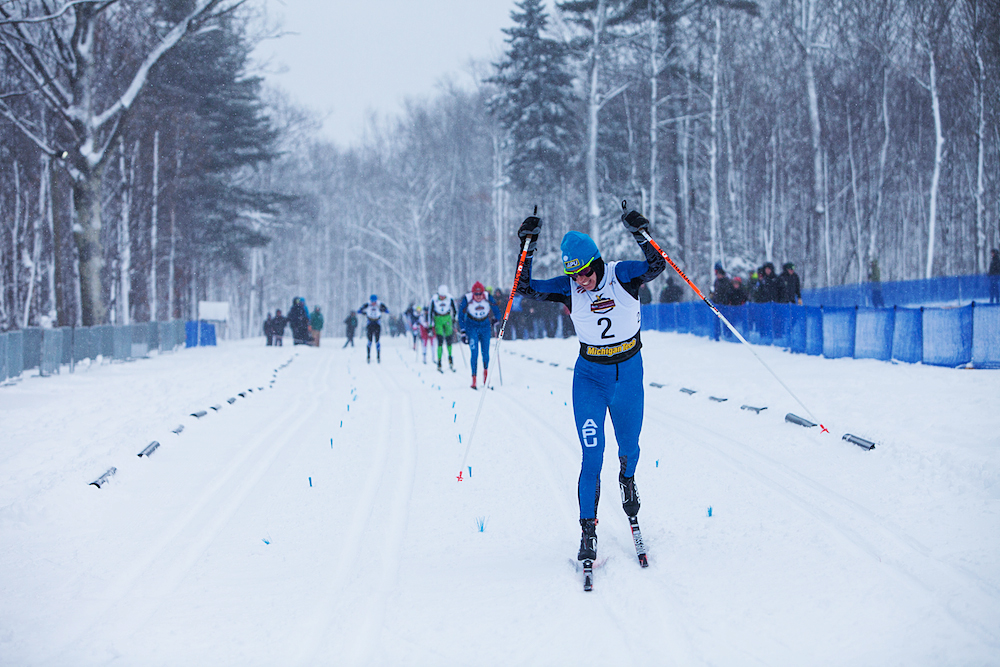
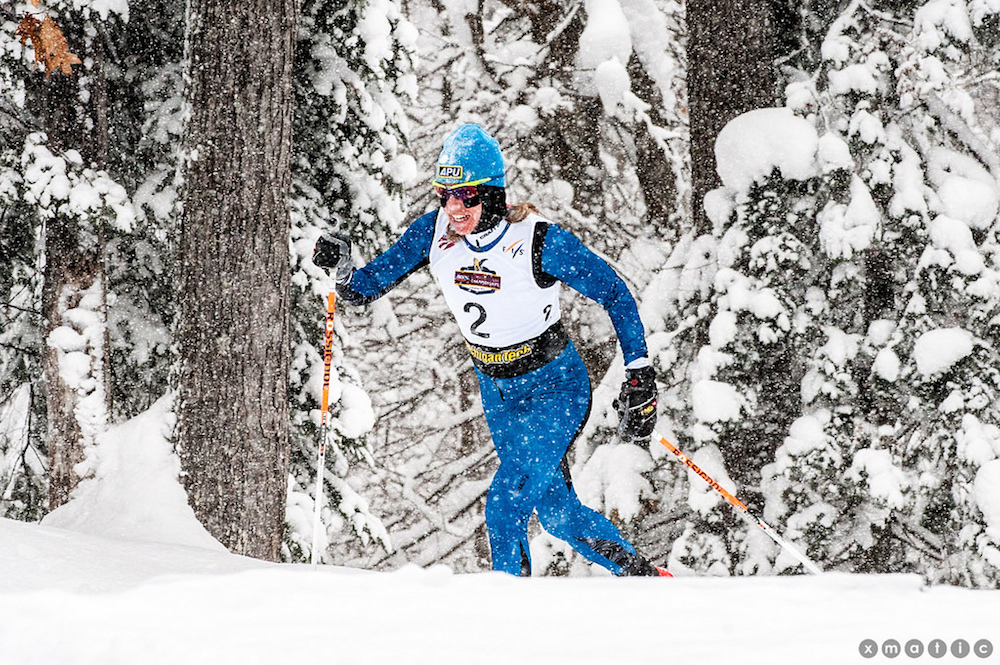
The U18 women’s podium from Wednesday’s 10 k freestyle at 2015 U.S. Junior Nationals at Auburn Ski Club in Soda Springs, Calif. (Photo: Mark Nadell/MacBeth Graphics)
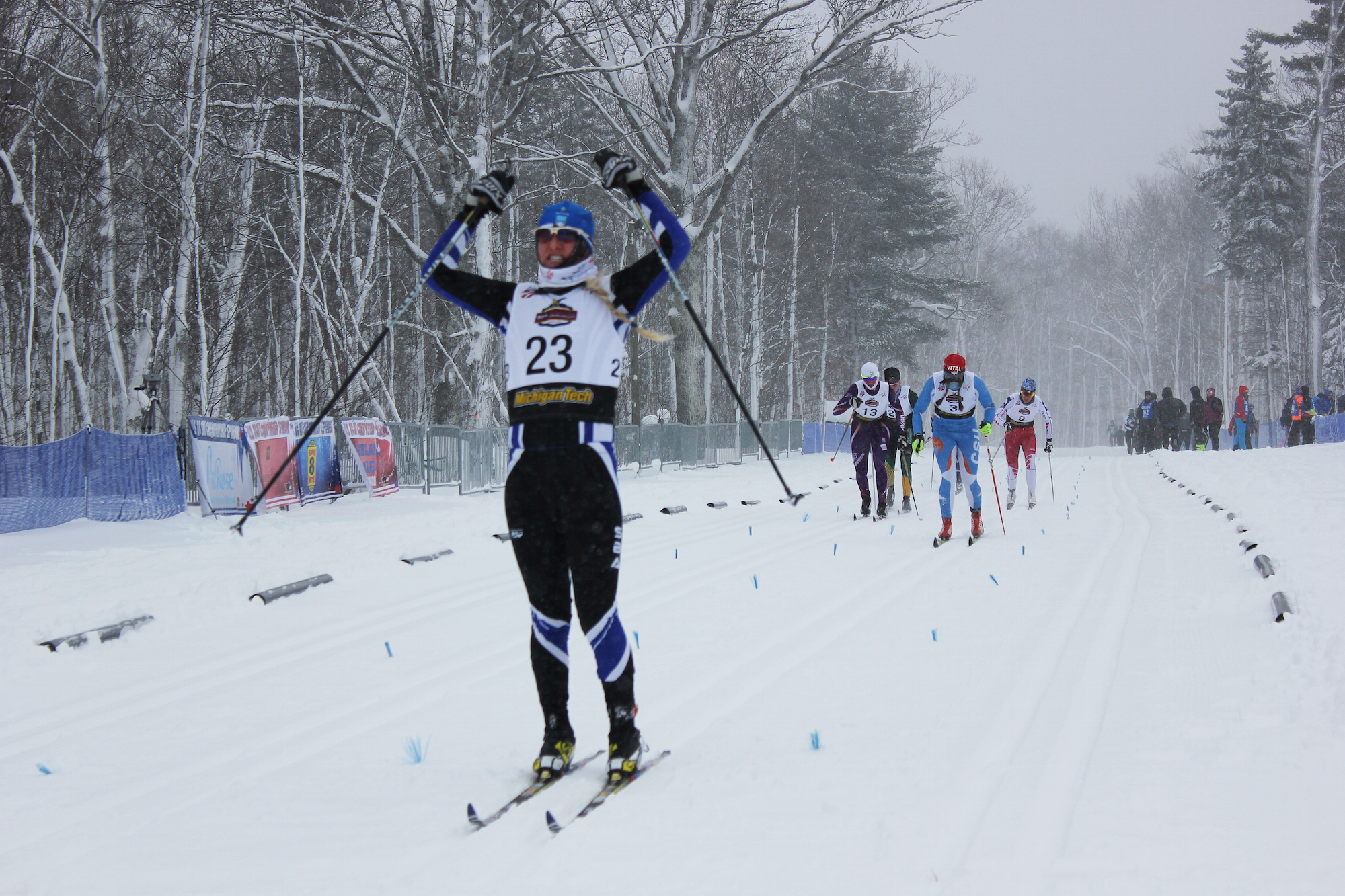
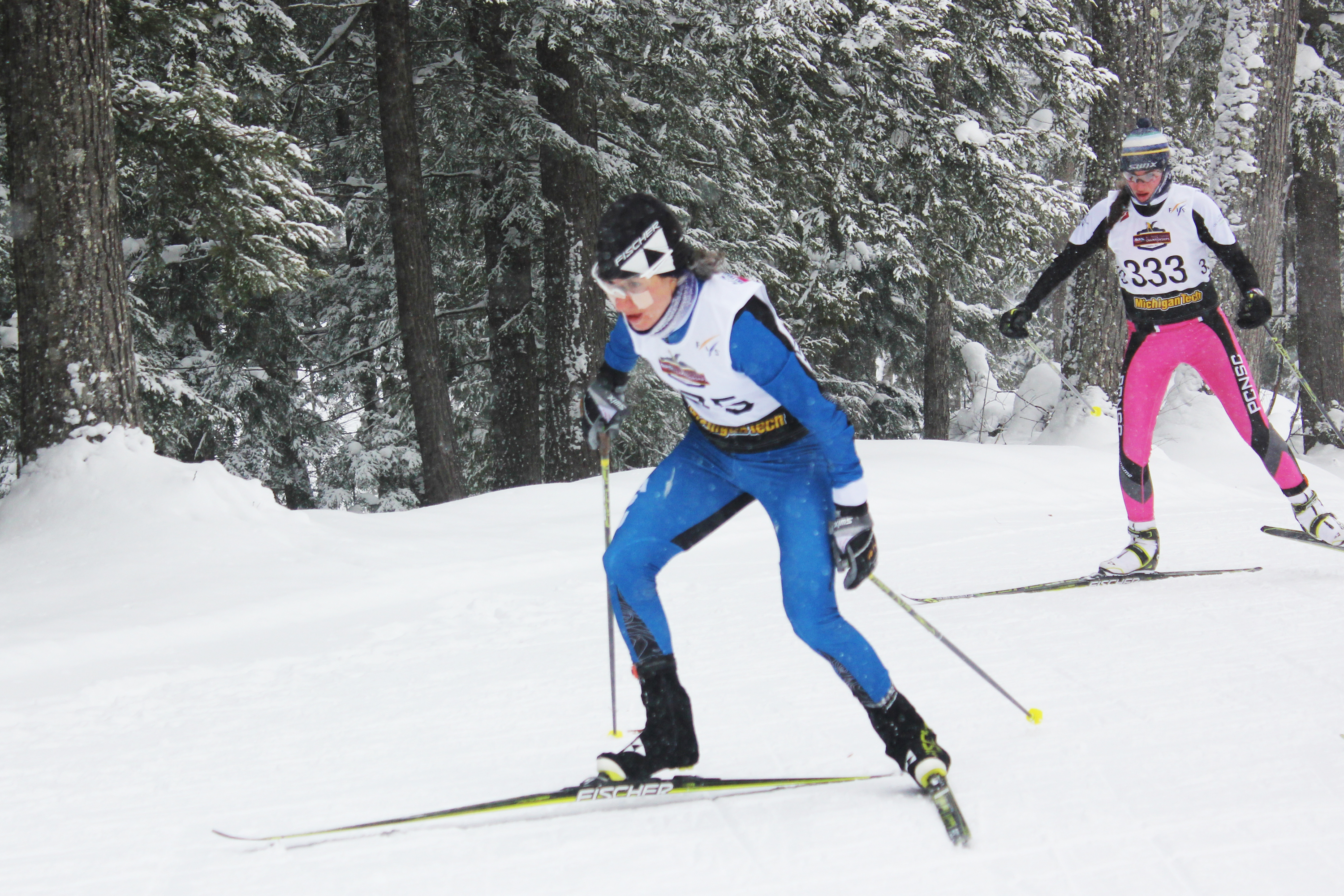
New England’s Katharine Ogden (Stratton Mountain School) racing to a 26.8-second win at the 2015 U.S. Junior Nationals in Wednesday’s 10 k freestyle at Auburn Ski Club in Soda Springs, Calif. (Photo: Mark Nadell/MacBeth Graphics)
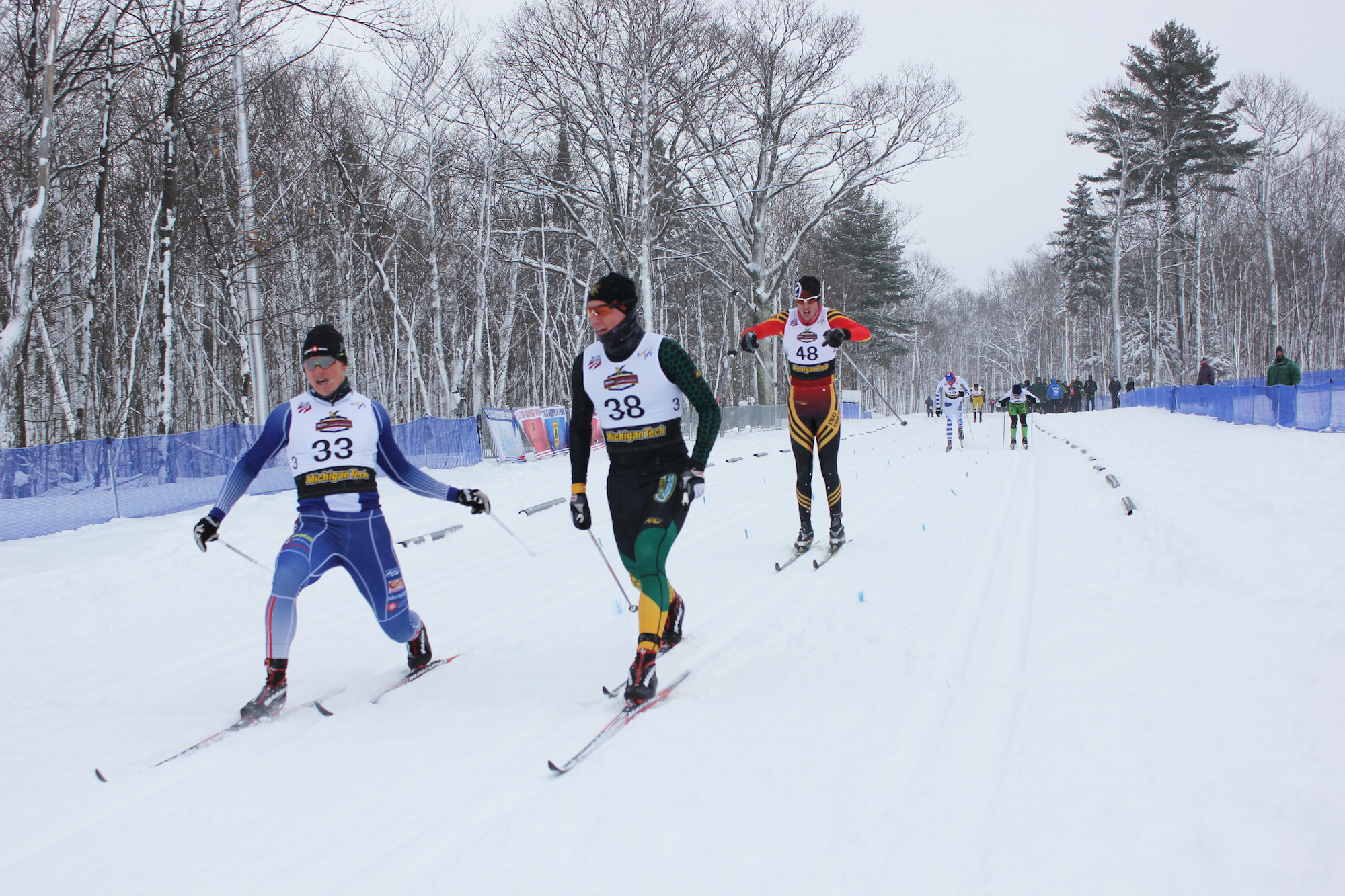
The U18 men’s podium from Wednesday’s 10 k freestyle at 2015 U.S. Junior Nationals at Auburn Ski Club in Soda Springs, Calif. (Photo: Mark Nadell/MacBeth Graphics)
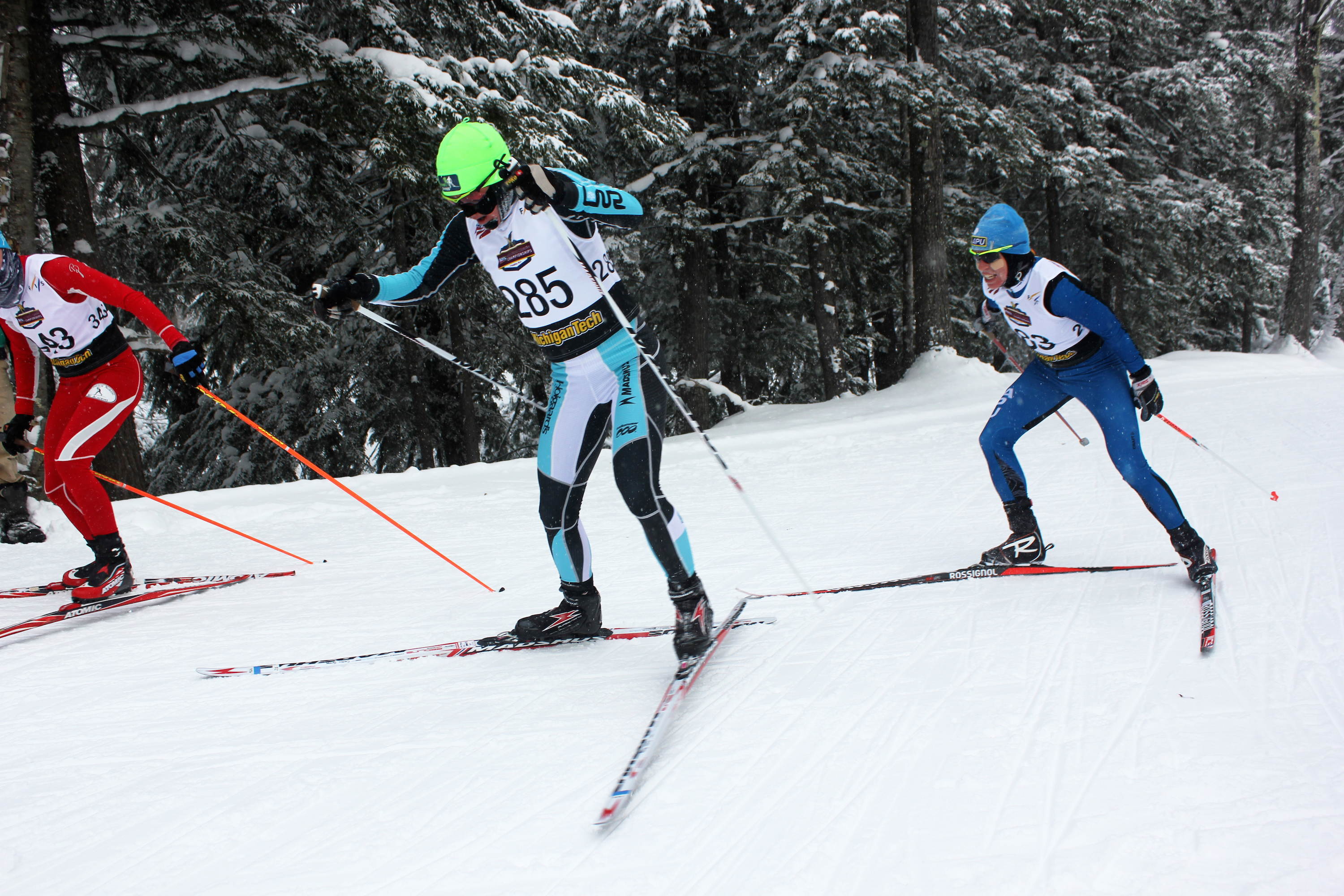
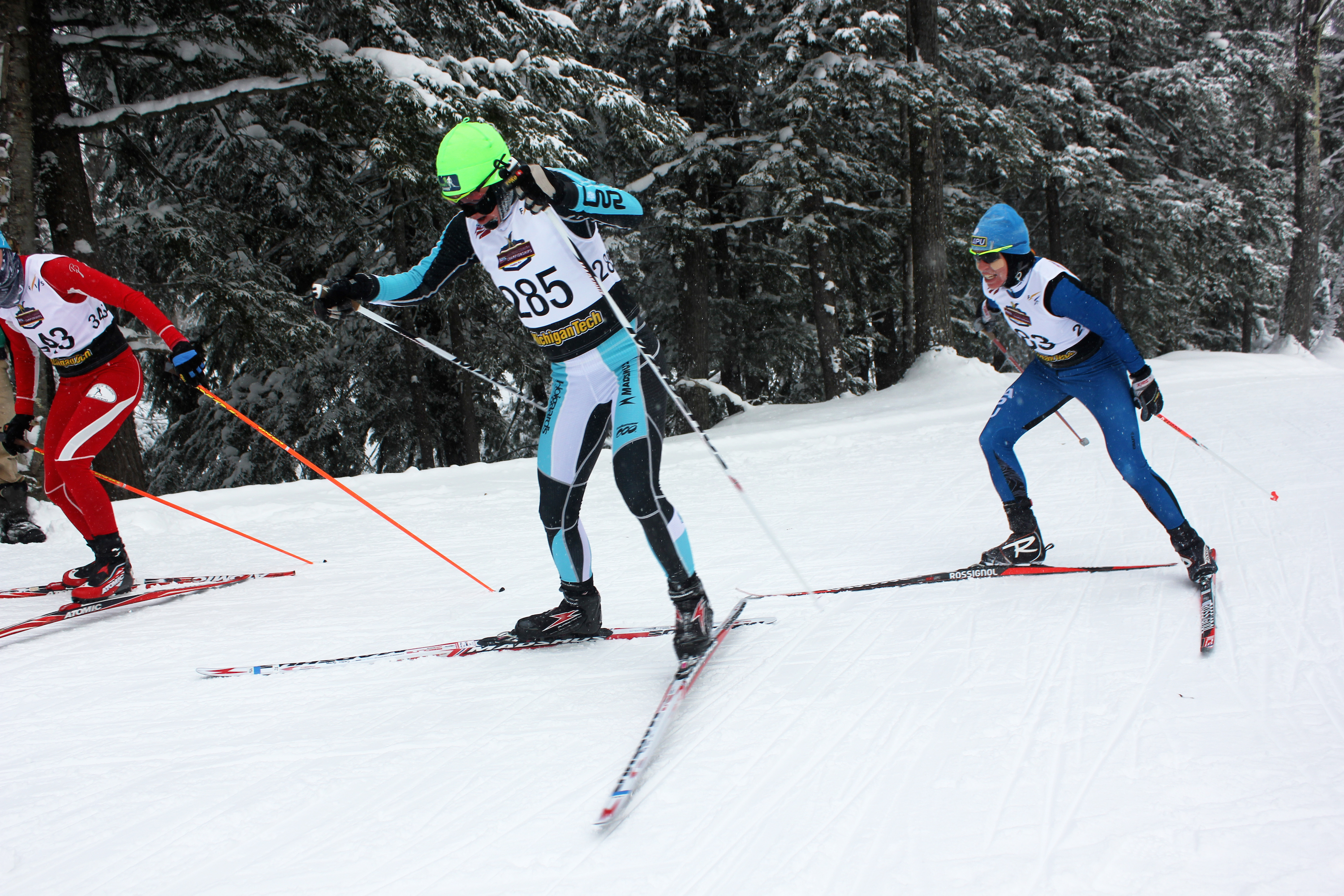
Mid-Atlantic’s Karl Schulz (New England Ski Educational Foundation) racing to a 5.3-second win at 2015 U.S. Junior Nationals in Wednesday’s 10 k freestyle at Auburn Ski Club in Soda Springs, Calif. (Photo: Mark Nadell/MacBeth Graphics)
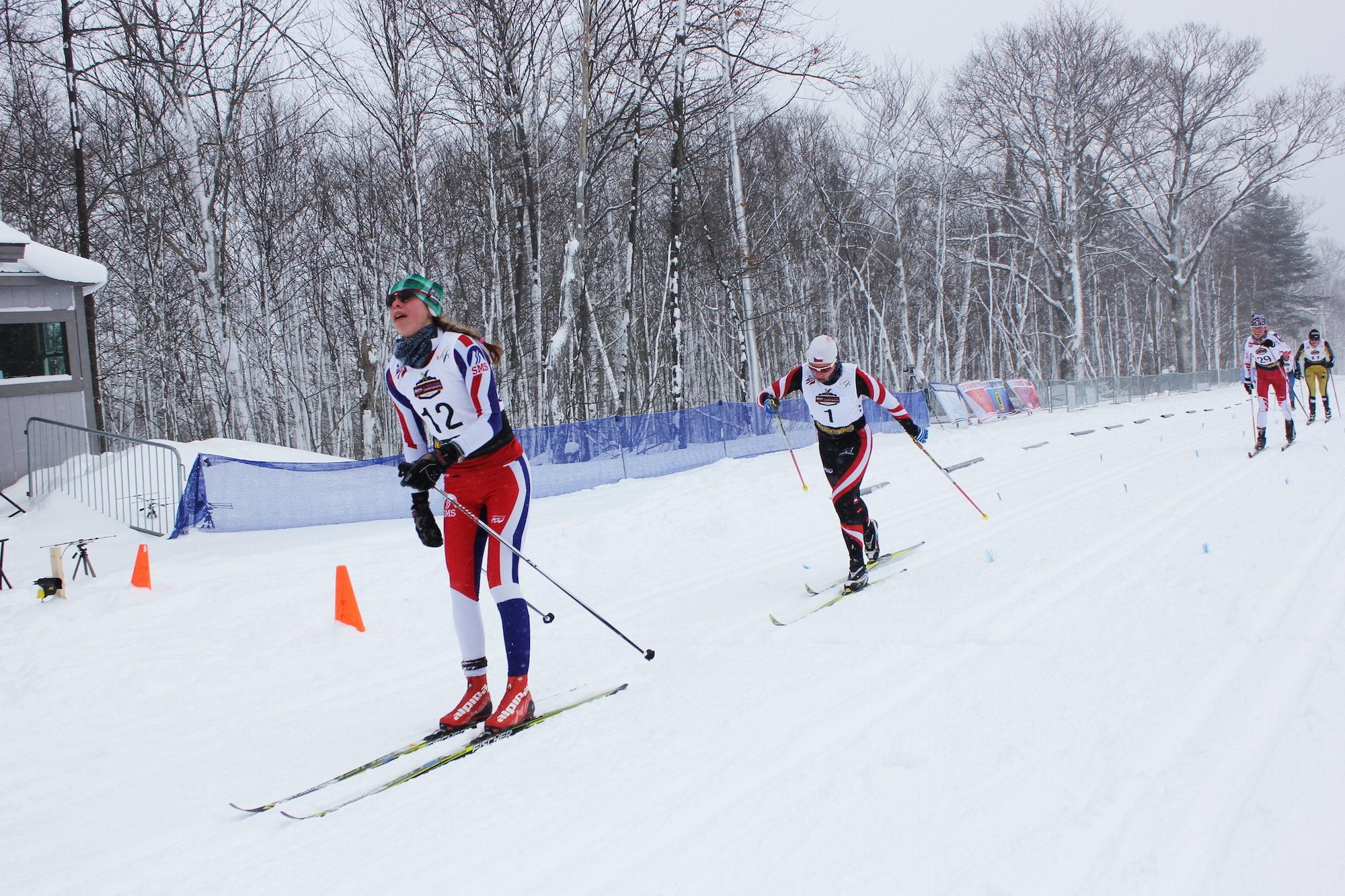
The U20 women’s podium from Wednesday’s 10 k freestyle at 2015 U.S. Junior Nationals at Auburn Ski Club in Soda Springs, Calif. (Photo: Mark Nadell/MacBeth Graphics)
The U20 men’s podium from Wednesday’s 10 k freestyle at 2015 U.S. Junior Nationals at Auburn Ski Club in Soda Springs, Calif. (Photo: Mark Nadell/MacBeth Graphics)
Skate Distance: We liked Toko HF Blue with Jetstream Blue 2.0 Powder with Jetstream Blue 2.0 Bloc on top. The Jetstream Blue 2.0 Bloc ran really well all week as we revisited testing.Classic Sprint: Conditions were slow and sloppy with a fair amount of snow coming down throughout the day. We shortened our athletes kick zones for the sprint to speed up skis. For glide we like the same HF Blue and Jetstream Blue 2.0 Powder and Bloc.
Classic Mass Start. The course was mostly either up or down with very little gradual terrain. We went with a warmer kick wax than we expected since the glide wax on the ski plays a larger role in ski speed when one is going downhill at higher speeds. The additional kick helped our athletes stay smoothed and relaxed on the courses many climbs. For glide wax the blue Jetstream 2.0 Powder, and especially the Bloc, provided great high end speed.
Skate Sprint: The unwavering cold temperatures kept our glide test results the same as during the previous races. Adding the Jetstream Blue 2.0 Bloc on top of Toko HF Blue really picked up ski speed. We were impressed by this since gains from using high or pure fluorinated wax over non-fluorinated paraffins can be diminished at such cold temperatures.
We basically lived in the Toko Arctic Mitt all week and was very appreciative of how well it performed. Looking back over the week and the Toko waxes we used, the new blue 2.0 block was the biggest stand out to us. It definitely is head and shoulders above the 1.0 bloc and ran well in conditions where non-fluorinated waxes were in the testing mix.
– Spencer Eusden, FWXC Elite Team
Temperatures near zero with high winds made for cold dry snow for the week of US Nationals. Anticipating the colder temperatures we focused on hardening our ski bases prior to the races with Toko LF Blue and Toko Cold Powder. It turned out that HF Blue and Cold Powder consistently won the parrafin test and we ran it all week. For the 15km Freestyle I made the mistake and went on a liquid from another brand that was fast for a kilometer but then slowed down. Thankfully we were able to make a change for the Women’s 10km to a mix of Blue 2.0 Powder corked in with a block corked in on top. Caitlin’s skis ran great and she was able to ride them to her 5th National Championship. On the classic sprint day we added Helix Blue 2.0 to the mix. We are very impressed with the Helix 2.0 line. I ended up with my top result at Nationals from my weakest event: the Classic Sprint. We again had a good day in the Freestyle Sprint with Caitlin winning the qualifier and finishing 2nd in the A final. We ran a mix of Jetstream Blue Block and another bloc corked in with Blue Helix 2.0 over the top.
– Brian Gregg, Team Gregg
10/15k skate race: Cold temps, most athletes were on their coldest skis. I went ahead and treated bases with several coats of good cold glide wax to make sure they were adequately hard. I found LF under layers were running comparably well or better than HF so that was my under layer before race day. I went ahead and burnt in Toko jetstream blue block mixed with X-cold as I felt it was running a bit faster than the powder equivalent. I used fiberlene on the iron and made sure the existing structure on the ski was de-tuned as much as possible. I was a little worried about the durability of a block application vs powder but with a hot application it didn’t seem to be an issue. I hit the skis again with another corked block application for additional first lap speed.
Classic sprint: I again continued hardening the skis with cold wax. I went with an HF under layer on the day and continued blocking the skis during rounds as it seemed to again give better speed than burning in powders.
For kick I tested a number of different things. Contrary to what I imagined I found that a hard wax binder cut with a warmer blue wax, then shelled with an Xcold kick wax gave both better speed and kick than straight cold hard wax. It seemed that given the snow sheer having a soft under layer of binder covered with a fast hard shell allowed for better kick and speed than straight cold hard wax. This combo worked well for the team with Ben Saxton ending up second on the day and Annie Hart finishing 4th!
Mass Start Classic: I went with a similar kick decision, but burned in powders for added durability, then finished with a block. Finding the right balance between kick security and ski speed in the slow falling snow seemed to be the most critical factor in delivering good skis. While the snow wasn’t falling as hard as the sprint day, and snow sheer didn’t seem as bad as the sprint day, I still started light on kick wax, adding a warmer wax under foot until the athlete was certain of their kick, then went ahead and shelled it with a colder hard wax.
Skate Sprint: Nothing too much different to report for the skate sprint. I kept hardening all of the skis throughout the week, making sure they got lots of coats of cold wax and trying to take as much structure out of the ski as possible. I went with an HF under layer and again went with a cold block application throughout the rounds
Overall on the week, I would say that having a dedicated cold ski for classic and skate is very important. Making sure that ski is appropriately hardened and seasoned seemed to make for that little extra bit of speed that is so important in slow snow like we saw all week.
Some general feedback and thoughts for the week: the week was dominated by really cold temps and slow snow. I really like the Toko waxes, especially in the blue range. I had good luck with both Jetstream 2.0 block, the powder and the X-cold powder. I tested some combo of straight JS Blue 2.0 block, block with x-cold powder, and JetStream 2.0 powder with x-cold. Results seemed really good with the block and x-cold combo winning many speed tests. I often went ahead and powdered for durability.
Toko X-cold kick wax has continually impressed me as both a solid training wax and race wax. It delivers good speed when speed is hard to find and solid kick.
– Patrick O’Brien, Head Coach Elite Team
Skate Distance
Racing began this week at the US National Championships in Houghton, MI with the 10/15k Freestyle races. For snow conditions we experienced cold, fresh, wind blown, lake effect snow. This combination made for very poor gliding snow. We found LF Blue/XCold Powder mix, hardened up the base to provide the best breakaway speed. When testing powders, we saw no difference from our base wax to powders in breakaway speed but at top speed, the powders were clearly better. The powder that we went with was a mix of Jetstream Blue 2.0 and XCold Powder.
Classic Sprint
For the classic sprint, we continued to see the same trend with snow conditions: Cold, New, and Windblown. For glide wax, we stuck with same combination that worked well for us in the skate distance race. We ran LF Blue/XCold Powder Mix with Jetstream Blue 2.0/Cold Powder on top. When working on kick, application method proved to be the largest factor in ski speed. The biggest thing we found was we needed to manage the length of the pocket and the thickness of the application. Because of the aggressiveness of the snow any extra bit of kick wax that was not needed would only slow down the glide. With it being a classic sprint, we skipped a binder and went with straight XCold Gripwax for the kick.
Mass Start Distance Classic
In the Classic distance race we had our first experience with races happening without snow falling. For the Junior men’s 10k and the Senior Men’s 30k, the forecast left us confident that we could run HF Blue/XCold Poweder and Jetstream Blue 2.0 as our glide layers. The lake effect snow, which came down very dry, would glaze very quickly due to the high humidity after only a few skier passes. This made HF waxes jump the LF waxes we ran in the previous race fairly significantly. For Senior women, we anticipated by that point we would have some snow falling so we kept with the HF Blue/XColdpowder mix but we also added in XCold powder to the Jetstream Blue 2.0.
For kick layers, in the junior men’s race we went with an Ironed in layer of XCold Gripwax, full layer XCold Gripwax, Blue Gripwax, and a full cover of XCold Gripwax. Men’s race, we used a Green binder ironed in, Three tapered layers of Blue Gripwax, and two tapered XCold Gripwax Layers. For women’s race we ran similar to men but decreased layering by 1 on the final XCold Gripwax and also finished with a short zone of Blue Gripwax under the toe.
Skate Sprint
For the final race of the week, we finally were awarded with some nice weather. Temperatures were a lot more moderate then the days previous and the sun was out for the heats. We ended up going with an HF Blue/XCold Powder mix for the paraffin layer and top with Jetstream Blue 2.0 for the qualifier. In the heats we ran the same base layers but added in Helix Blue 2.0 when the trails really started to glaze.
Overall
I have to say that I am really impressed with the new 2.0 products that have come out. In my experience I have always had great success with the whole Toko Red waxes in the Midwest. Slightly older snow, in temps from mid teens to twentys has always been rocking for the whole red line. It’s good to see the blue line catching up to the other typical Midwestern favorites like Start Green. The combinations that I ran this week during US Nationals were the exact same as what I ran for junior nationals up in Fairbanks. In cold, aggressive snow, I am always trying that Jetstream Blue/XCold Powder mix. I’ve done some basic 1 to 1 comparisons while out skiing and the 2.0 blocks and powders usually take the win in the tests.
– Andy Keller, CXC Elite Team Head Coach
First off, we found Toko toppings to run exceptionally well throughout the championships. We were on Toko 2.0 blue block and/or powder for every day of racing, and for almost every individual race. HelX Blue 2.0 Spray was in the mix a few times. It may have been a difference in application, but we never found it better when the Toko testers found it better, even applying over blue block like they had said.
– Tim Baucom, Head Waxer, SVSEF Gold Team
Waxing “Cold” Racing Skis in General
Generally the difference between cold and universal skis are flex (more contact on cold skis), structure, and often times base material. These are what differentiate. In terms of preparing a cold ski to be “cold” in general, a common mistake is to only use cold waxes. We have noticed that if you only wax your cold skis with hard waxes, the skis accept less and less wax. For this reason, it is good to put some softer waxes now and then in the cold skis too.
When waxing with hard cold waxes, a key point is that the iron needs to be hot enough and exposure long enough that the wax becomes opaque such that there is no air at all between the wax and the ski. This is the most common mistake. This means that when the wax is scraped off, except for in the groove (if it was not specifically ironed which is a sound technique), the wax should not at all “spring” off the base, but rather come off like fine sawdust. If the wax has been applied such that it is opaque and comes off very fine rather than jumping off the ski in chunks, it will be a good application both on race day in when waxing skis to harden the bases in general.
Race Wax Tips
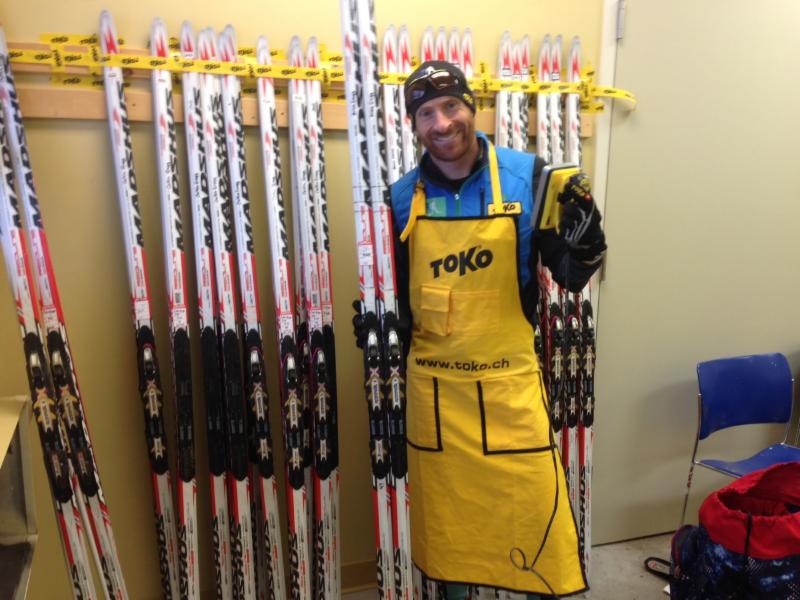
The Toko Tech Team, a regional team of wax technicians almost all of which have been working for Toko for over 10 years, have tons of experience, and have been very well trained, research and prescribe race wax tips for you. There is a local and respected name behind every wax tip. Toko race wax tips are generally posted 2 days before an event and updated if needed. This is the most important thing that we do in the Nordic market.
We are conducting over 100 wax clinics for you to attend and learn throughout the country. Click here for the schedule. Clinics will continue to be added, so be sure to check back.
Toko US Facebook Contest
Toko US has started a promotion on its Facebook page where questions are asked and the first correct recipient receives a prize.
Questions range from Toko trivia to “where was this photo taken”? Like Toko US today to have some fun and win some prizes!
This contest will run all winter!
Note: there is a Toko worldwide fb page which is quite good, but the contest will be on the Toko US site.
Dakota Blackhorse-von Jess of the Bend Endurance Academy earned his second national title of the week on Saturday with a win in the 2015 U.S. Cross Country Championships 1.5 k freestyle sprint in Houghton, Mich.
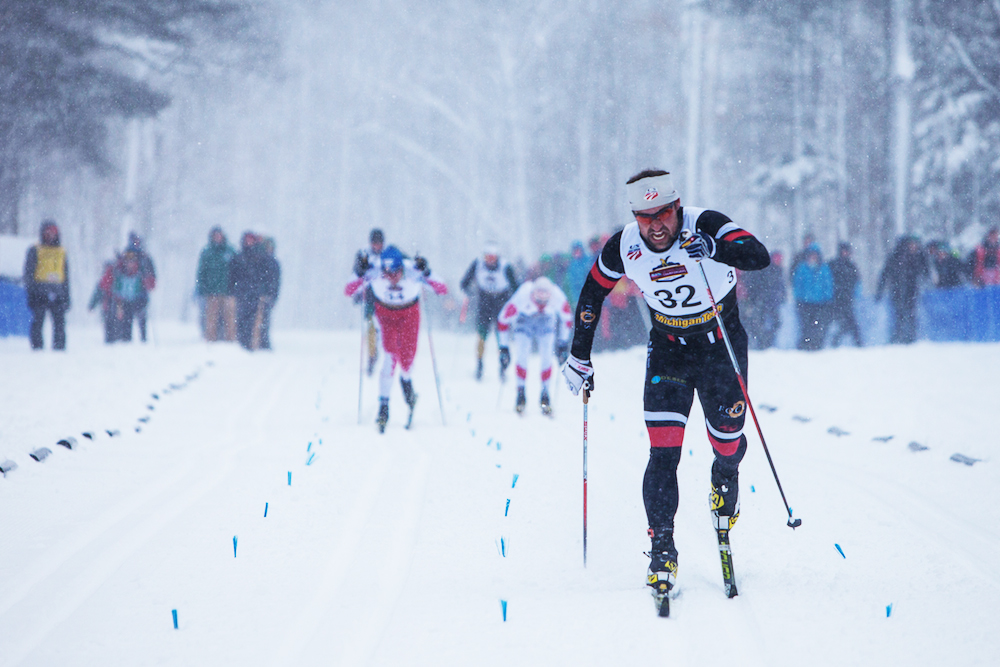
HOUGHTON, Mich. – In the final race of the 2015 U.S. Cross Country Championships, surprises were few and far between on Michigan Tech Trails. Tuesday’s classic sprint champion, Dakota Blackhorse-von Jess of the Bend Endurance Academy, qualified first with 3 1/2 seconds to spare in Saturday’s 1.5-kilometer freestyle sprint, demonstrating that he was well on his way to another national title.
If the qualifier hinted at Blackhorse-von Jess’s dominance, the heats confirmed it, with the Bend skier easily earning wins in both his quarterfinal and semifinal. Once the final was underway, it was only a matter of time before the characteristic black, red and white suit emerged from the woods at the head of the pack and across the finish line in first.
With a time of 3:31.02, Blackhorse-von Jess came out on top in the final, besting second-place finisher Tyler Kornfield of Alaska Pacific University (APU) by 1.16 seconds. Just behind Kornfield, a lunge for third resulted in a podium finish for APU’s Reese Hanneman (+2.57) and fourth for Kris Freeman (+2.62). Rounding out the final were APU’s Lex Treinen (+4.01) in fifth and Norwegian Michigan Tech exchange student Håkon Hjelstuen (+6.23) in sixth.
Perhaps the biggest surprise of the day was the presence of the sun, which made its first appearance Saturday since a training day on Jan. 2. With the sun came the same cold temperatures that competitors had faced all week, thus resulting in relatively slow and difficult snow conditions for the sprint.
“That race course in this snow is way more challenging than it looks,” Blackhorse-von Jess said in a post-race interview about the conditions he and his competitors faced. “It’s hard, especially as a fast-twitch guy, pushing against slow snow. You’re not going very fast and it hurts, it hurts a lot.”
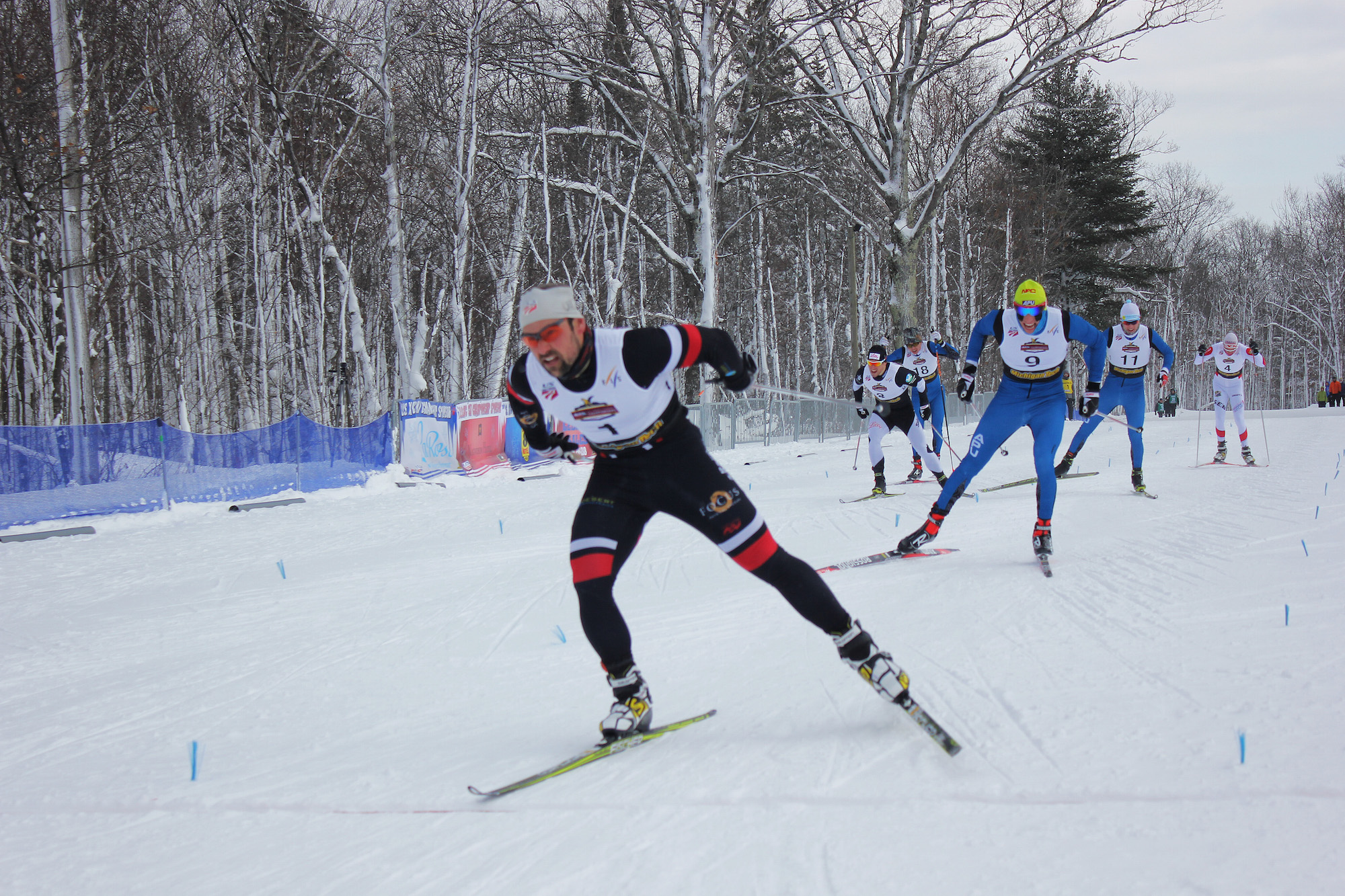
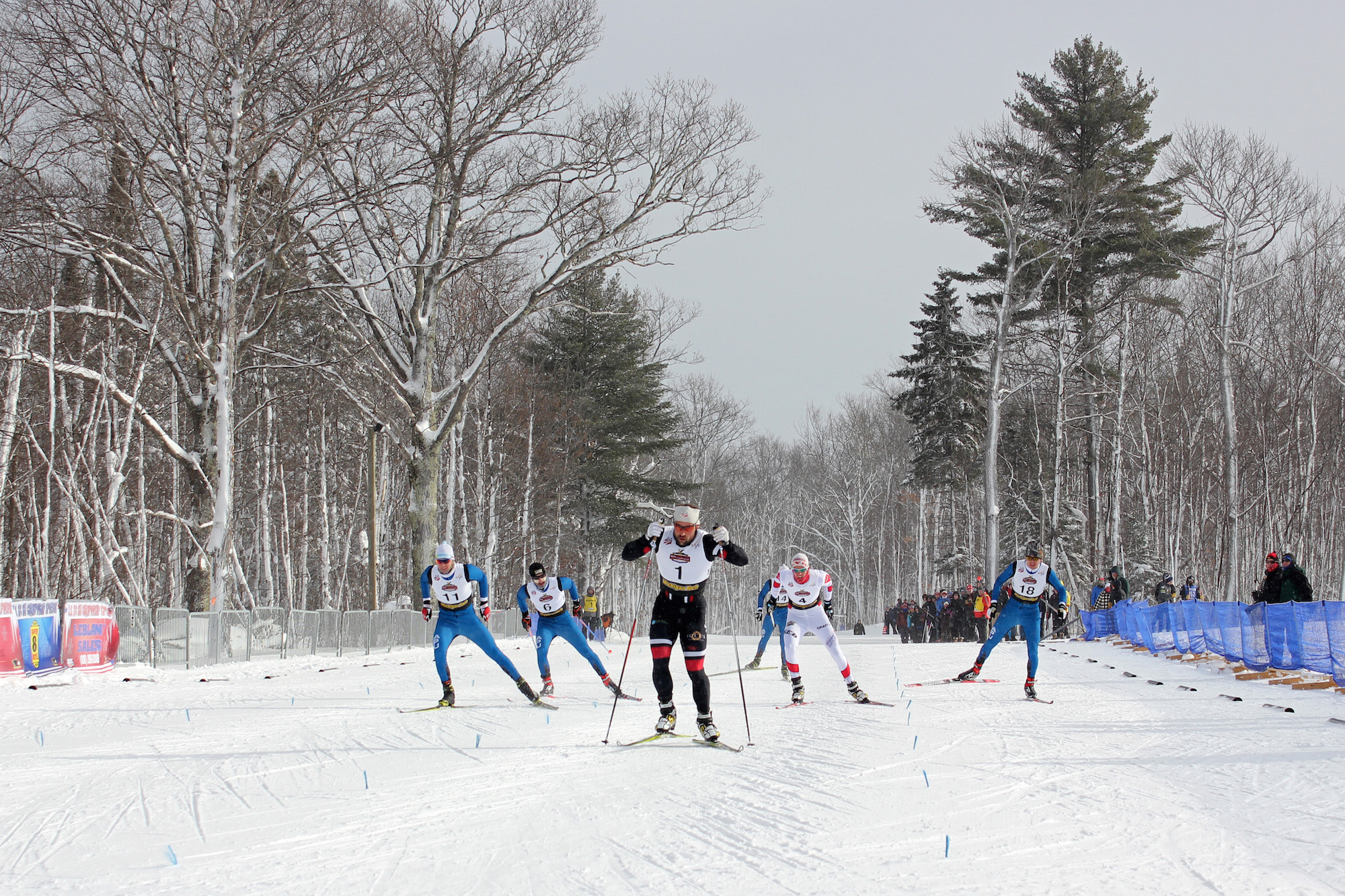
The men’s final accelerates toward the finish in the 1.5 k freestyle sprint at the 2015 U.S. Cross Country Championships in Houghton, Mich.
According to Blackhorse-von Jess, the snow speed increased throughout the afternoon, and when the six men of the final lined up to start, they were ready to clock the fastest times of the day.
When the gun went off at the start of the final, Blackhorse-von Jess and Hanneman double-poled to the front, hoping to avoid any entanglements within the action of the pack. Despite their best efforts, however, the four other men remained on their heels as they traversed the winding course.
“I was feeling that I was strong enough to ski at the front the whole way, today, so I thought tactically that would be the best thing,” Hanneman said of his strategy in the final. “I just went from the gun and got in front and tried to keep it about half way through and then just turn the afterburners on and see if I could just drag race anybody that tried to come around me.”
According to several competitors, as the group sped closer to the finish, the pack’s competitive nature began to flare, resulting in aggressive skiing and flying poles. At one point, Freeman explained he used “a few choice words” when a fellow skier repeatedly stepped on his poles.
“But there was no intimidating him, though – that’s a good thing. It was a solid final,” Freeman said.
While the group jostled behind him, Hanneman’s stint in the front seemed to be working. However, once the skiers hit the final third of the course, Blackhorse-von Jess surged ahead. With Blackhorse-von Jess pulling away and Hanneman and the four trailing skiers unable to respond, the final was shaping into a race for second.
Kornfield, who was sitting in fifth as the pack entered the last 150 meters, saw an opening on the outside and swung around Hanneman and Hjelstuen. Focusing on Blackhorse-von Jess, he powered his way behind the eventual winner to take a decisive second place.
With Kornfield charging to second, another skier was threatening Hanneman’s run for the podium. Freeman, who had come from behind in the right lane was almost even with Hanneman as they approached the finish. With massive lunges from both skiers as they crossed the line, it was uncertain who had earned the last podium finish. Moments later, however, Hanneman was revealed to be the third-place finisher, just 0.05 seconds ahead of Freeman.
After the race, Blackhorse-von Jess said his second national title of the week demonstrated he is at a high level of training and fitness.
“It’s more a validation of where I’m at in my training and where I am as an athlete in my career,” he explained. “I’m at the place in my career where I’m ready for next level.”
His goal for nationals was to win both sprints. In doing so, he hoped to make the case for a starting spot in Europe later this season, more specifically at the 2015 World Championships this February in Falun, Sweden. With the selection criteria period ending Jan. 18, the 29 year old said that he had done everything in his power to earn starting spots in Europe.
“I’ve done what I can do. The plan is to be ready if we get the call and obviously with the SuperTour and those two World Cups, if I can guarantee those, I will go and I will be ready. And if the phone rings and they send us over earlier, I’ll be there,” he said, referencing the Period 4 World Cup starts granted to the SuperTour sprint leader in March.
Championship selection aside, Blackhorse-von Jess said that this season has centered around returning to the true nature of the sport and the camaraderie that surrounds it. He explained that while many of the racers in his generation of skiing have moved on to other endeavors, they still have an impact on him to this day.
“I get messages from them every day that are like, ‘Man I’m so excited for you. I love you so much.’ There was a great photo that [Zach] Caldwell took of Sylvan [Ellefson] and I after he won his 30 k championship [in 2014]. Looking at that photo, that’s what ski racing is. That’s what kept me in the sport for so long and that’s why I’m still here,” he said.
Tyler Kornfield (APU) celebrates after winning his semifinal and advancing to the final Saturday’s 1.5 k freestyle sprint. He ultimately finished 2nd.
With a new generation making its way into the upper ranks of American skiing, Blackhorse-von Jess said he’s excited for them to take his place as he makes the next step in his skiing abilities – which he believes are on par with top-30 placement on the World Cup.
One such skier from that generation is Saturday’s runner-up, Kornfield. While the 23 year old is relatively young, he has the hardware to prove his abilities. With a national title in the 2010 classic sprint at 18, he was the youngest skier to win at a U.S. Cross Country Championships. He earned another national title in the 2012 classic sprint. However, since then, Kornfield had yet to return to a national podium until Saturday.
Kornfield explained that he felt heightened pressure before Saturday’s sprint as he needed a top-five result to earn a trip to the European continental cups this year. With his other 2015 nationals results outside the top 15, Kornfield’s season rested on the freestyle sprint.
“I’ve had an OK week so far, but nothing that really shot me to where I wanted to go, so this is really exciting for me,” he said in a post-race interview.
The APU skier also explained his return to the national podium after a three-year absence demonstrates his potential as a successful professional skier.
“It definitely isn’t good feeling that you may have peaked young, so it’s good to finally get back up there,” he said.
Taking the final podium spot, Kornfield’s teammate Hanneman said that his result was a mental and physical victory after a difficult Period 1 on the World Cup where he struggled to meet his own expectations.
Reese Hanneman (APU) and Kris Freeman (Freebird) lead the men’s final in Saturday’s 1.5 k freestyle sprint at the 2015 U.S. Cross Country Championships in Houghton, Mich.
He explained that due to possible overtraining, his usual form — which earned him a 2014 national title and the overall SuperTour leader position — has been absent in the 2015 season. This week has been a turning point for Hanneman as he continues to search for an improved mental and physical state.
“This whole week I have been starting to feel better and better — more like myself. It is a huge affirmation that I am coming out of the hole that I was in,” he said. “I am starting to feel good, fit, and fast.”
According to Hanneman, the key to improved skiing over the remainder of the season will be more rest so that his body can recover and begin to feel the benefits of the year’s training.
Despite missing out on third to Hanneman in the lunge, Freeman said he was pleased with fourth, given that he failed to qualify for the heats in Tuesday’s classic sprint. According to the 34 year old, the classic sprint was the first time he failed to make the heats, let alone the final, of a nationals sprint.
“Before this event I had never missed a finals at a nationals that I raced in,” he said. “Now I can say that I’ve never missed a finals that I’ve qualified for. I have more force at the sprints at nationals than I’d like to admit, but I did everything I could today.”
Freeman leaves Houghton with a 30 k national title and a second-place finish in the 15 k freestyle. He plans to return home to New Hampshire and train until SuperTour racing begins Jan. 30 in Craftsbury, Vt.
“It would be a hard justification to not do it at this point,” he said of his possible selection.
Saturday’s sprint marked the final race of the 2015 U.S. Cross Country Championships. The event will return to Houghton in January 2016.
Notes:
– Freeman said that the 2015 U.S. Cross Country Championships were the coldest ski races that he’s ever attended in his 15 years of professional ski racing. “I have never ever been in a place where it was this cold and it snowed so much for so long,” he said. “I’ve been pro 15 years and I’ve never woken up every morning and just been like, ‘Really?’ Even in Anchorage, in the years it was cold, it wasn’t snowing. I’m guessing next year’s will be 60 degrees and there’ll be shoveling.”
– Ben Saxton (SMST2/USST), who placed second in Tuesday’s classic sprint, qualified 24th in the freestyle sprint on Saturday after crashing, but failed to advance past the quarterfinals, where he was third in his heat. Saxton, who finished 57th in the 15 k freestyle, called some of his races this week “disasters” and explained he wasn’t at the top of his game in Houghton. “The bottom line is I wasn’t sharp this week,” he said. “Not being sharp is hard. I think I let a few things get to me as far as expectations other people have of me, being on the U.S. Ski Team. That’s something I need to be better at.”
– Welley Ramsey (Maine Winter Sports Club) scratched from Saturday’s sprint heats after qualifying 28th due to illness he’s been fighting all week.
– Ten athletes were named to the U23 World Championships team after Saturday’s sprints: Kyle Bratrud (Northern Michigan University), Logan Hanneman (University of Alaska Fairbanks), Ben Saxton (SMST2/USST), Patrick Caldwell (Dartmouth College/USST), Scott Patterson (APU), Joanne Reid, Annie Pokorny (SMST2), Anne Hart (SMST2), Paige Schember (Sun Valley Ski Education Foundation), Deedra Irwin (Michigan Techological University).
1.5 k freestyle sprint at the 2015 U.S. Cross Country Championships in Houghton, Mich.
1.5 k freestyle sprint at the 2015 U.S. Cross Country Championships in Houghton, Mich.
1.5 k freestyle sprint at the 2015 U.S. Cross Country Championships in Houghton, Mich.
1.5 k freestyle sprint at the 2015 U.S. Cross Country Championships in Houghton, Mich.
1.5 k freestyle sprint at the 2015 U.S. Cross Country Championships in Houghton, Mich.
1.5 k freestyle sprint at the 2015 U.S. Cross Country Championships in Houghton, Mich.
1.5 k freestyle sprint at the 2015 U.S. Cross Country Championships in Houghton, Mich.
1.5 k freestyle sprint at the 2015 U.S. Cross Country Championships in Houghton, Mich.
1.5 k freestyle sprint at the 2015 U.S. Cross Country Championships in Houghton, Mich.
1.5 k freestyle sprint at the 2015 U.S. Cross Country Championships in Houghton, Mich.
1.5 k freestyle sprint at the 2015 U.S. Cross Country Championships in Houghton, Mich.
1.5 k freestyle sprint at the 2015 U.S. Cross Country Championships in Houghton, Mich.
1.5 k freestyle sprint at the 2015 U.S. Cross Country Championships in Houghton, Mich.
Dakota Blackhorse-von Jess of the Bend Endurance Academy earned his second national title of the week with a win in the 2015 U.S. Cross Country Championships 1.5 k freestyle sprint in Houghton, Mich.
1.5 k freestyle sprint at the 2015 U.S. Cross Country Championships in Houghton, Mich.
1.5 k freestyle sprint at the 2015 U.S. Cross Country Championships in Houghton, Mich.
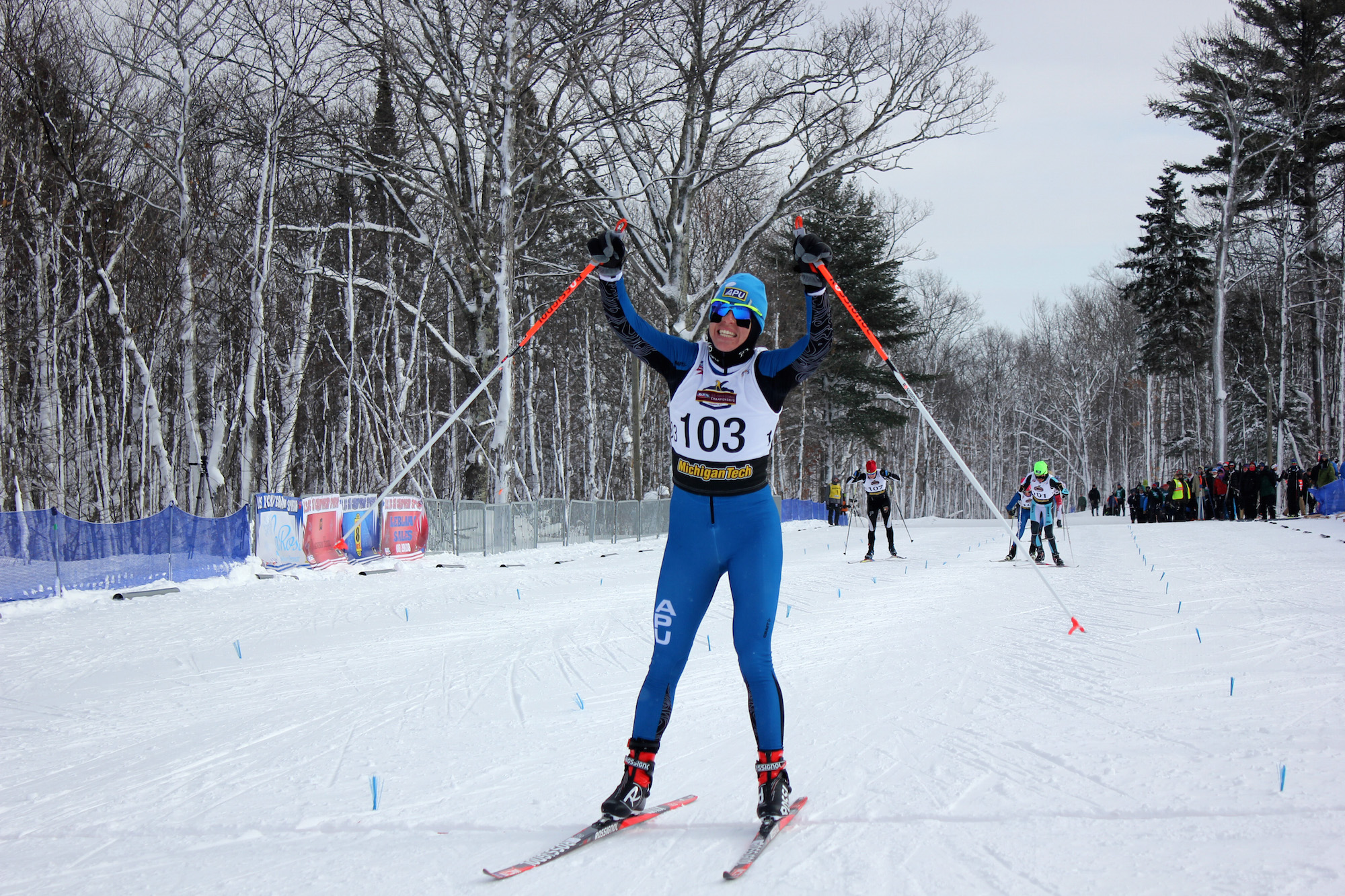
Alaska Pacific University’s Rosie Brennan notches her third-straight win in the last race of U.S. Cross Country Championships with a skate-sprint victory in Houghton, Mich.
HOUGHTON, Mich. — Rosie Brennan only needed to hear two words from her coach, Erik Flora, before the start of the women’s 1.5-kilometer freestyle-sprint final: “Send it.”
That gave the 26-year-old Alaska Pacific University (APU) skier the go-ahead and guidelines to propel herself to first place for the third time this week at U.S. Cross Country Championships — something she wasn’t sure was possible heading into Saturday’s race.
Brennan hadn’t felt good warming up; in fact, she said she felt “horrible” since the day before the last event of nationals, a race which she considered her weakest.
“Skate sprinting is not my strong suit,” she said. “This was probably the race I expected to win the least.”
In the two races directly before, she added two national titles to her resume in the 1.5 k classic sprint on Tuesday and 20 k classic mass start on Thursday. On track for her third straight in four races at nationals (and seventh-consecutive podium in two months), Brennan didn’t doubt herself, but she wasn’t sure what she had left, either.
“Yesterday testing skis, I was like, ‘Erik, I can’t tell the difference between my skis. I can’t focus. I’m so tired,’ ” she recalled. “I was assuming that most people felt that way. I guess that’s when you really have to believe in your summer training and everything that you’ve done. If you show up on the start line, I just strongly believe in giving it your all no matter what.”
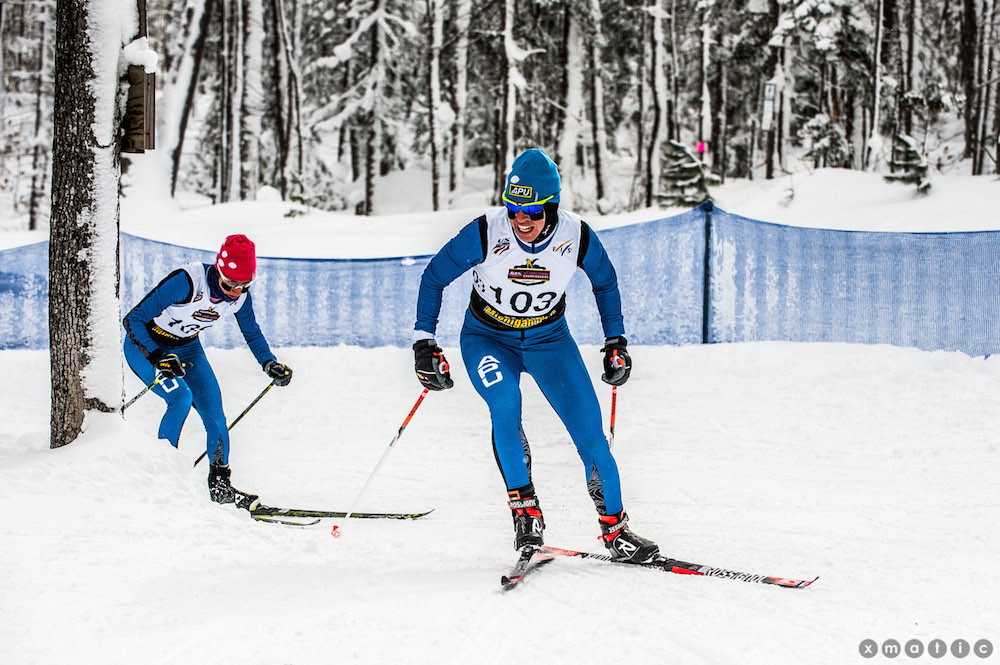
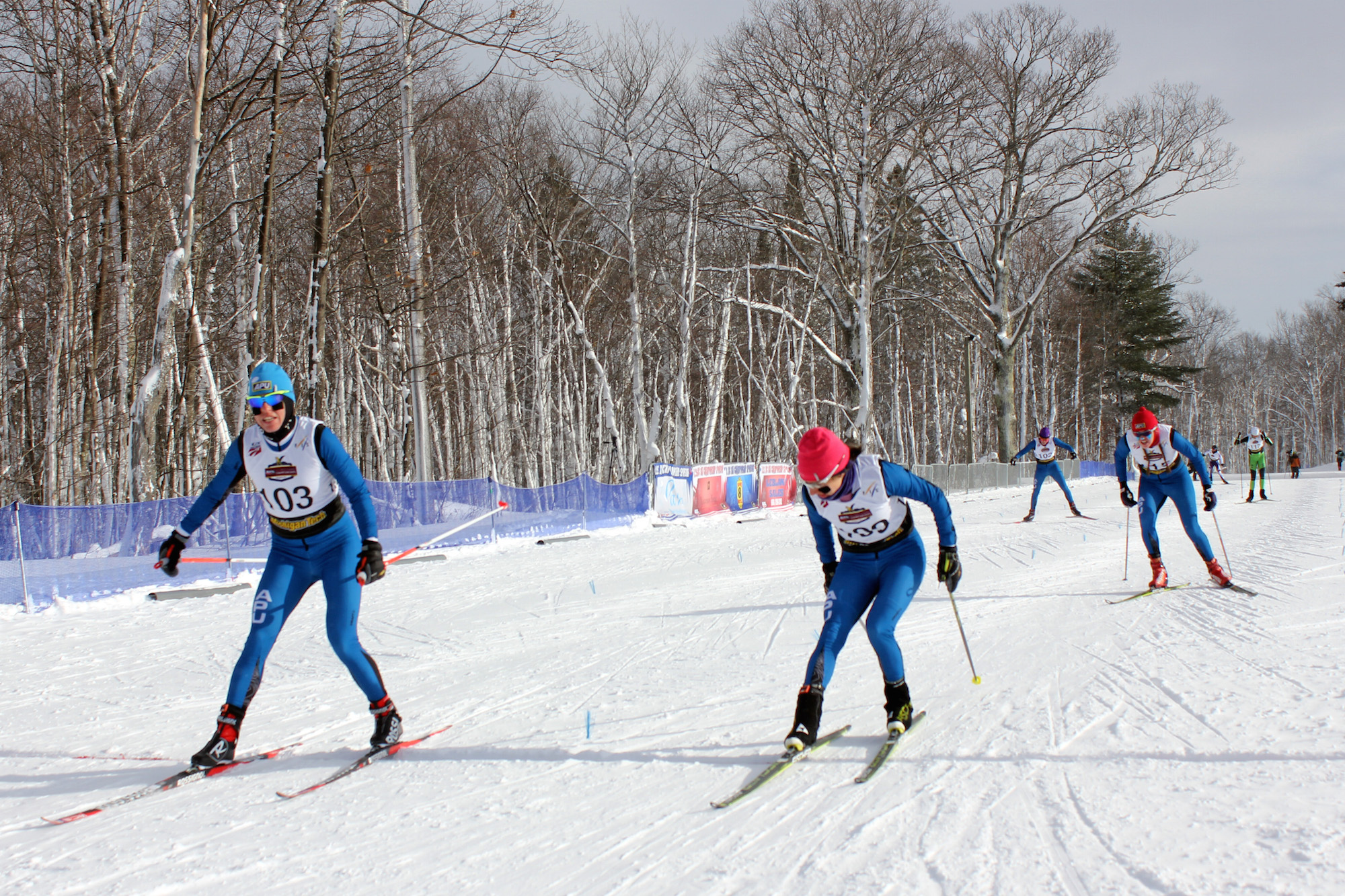
Rosie Brennan (103) leads APU teammate Chelsea Holmes during the women’s 1.5 k freestyle-sprint final at U.S. nationals in Houghton, Mich. (Photo: Christopher Schmidt)
That was the plan, and she stuck to it. Shooting out of the start, Brennan put herself up front, just ahead of APU teammate Chelsea Holmes, who was in her first sprint final at nationals.
“I’m not the fastest starter,” said Holmes, who’s best known as a distance skier. “I was just able to follow, and you can free-ski your way on the downhill into the position you want if you are not in first. So I did that and just tried to stay with Rosie.”
Meanwhile, she and the rest of the six-woman final knew what was coming: “[Rosie] is super strong and she is going to hammer,” Holmes explained.
Brennan wanted to lead and pick the most direct line on the course’s two steepest uphills. She also knew she needed to push over the tops of the hills, “[that] was really where people were kind of breaking,” she said, as well as rely on what she considered her strongest technique in skating: V2ing up steep pitches.
“Everyone was with me, at least Chelsea was with me … as we headed into the second uphill,” she recalled. “I just put my head down there and didn’t look back until I was well around the corner.”
Caitlin Gregg (c) edges Jennie Bender (l) for second place in the women’s 1.5 k freestyle-sprint final (behind Rosie Brennan), while Chelsea Holmes pushes for fourth at U.S. nationals in Houghton, Mich.
Caitlin Gregg of Team Gregg/Madshus, the top qualifier with a time of 4:15.77 (2.23 seconds ahead of APU’s Jessica Yeaton in second and 2.26 seconds faster than Brennan in third) moved from near the back of the pack to third behind Holmes on the second climb.
“Caitlin made a really impressive move… and if I had the legs to follow her I would’ve,” Erika Flowers of the Stratton Mountain School (SMS) T2 Team recalled with a laugh.
“[The final] went out pretty fast and people were kind of jockeying for position,” she added. “I tried to take some outside lines, those weren’t fast. I tried to take some inside lanes, and it just kind of slowly strung out.”
As the sun peaked brightly through the tall birch trees for the first time all week, Brennan began to gap the field, and Holmes pushed hard to reign her back in and distance herself from Gregg in third behind her.
“I ended up getting boxed out in one of the climbs, which is kind of key,” Gregg explained. “That’s where Rosie and Chelsea got away so then I found myself kind of playing catchup for the rest of the race.”
Brennan looked back and saw the cushion she had created, but she still wasn’t comfortable.
“Knowing that Chelsea’s really strong also in skate and [APU teammate] Becca [Rorabaugh] has a hell of a finish, I just didn’t want to take any chances,” she said.
Pushing toward the finish, she heard Flora again. This time, he told her to switch to another gear.
“I thought everyone was catching me so I really didn’t want to look around at that point, and I just tried to give every last bit of energy I could,” she said. “I was like, ‘Oh no, I don’t even want to know if someone’s coming.’ I just went as hard as I could.”
“I was like, ‘Oh no, I don’t even want to know if someone’s coming.’ I just went as hard as I could.” — Rosie Brennan, after winning third-straight race at U.S. Cross Country Championships on Saturday
While there was a three-way battle for second playing out behind her, no one came close to Brennan. The moment she crossed the line, she threw her arms up with what little energy she had left.
Rosie Brennan (APU) catches her breath after winning the women’s freestyle-sprint final by more than six seconds at U.S. nationals in Houghton, Mich.
Brennan had done it, winning in 4:17.93 by 6.1 seconds for her third-straight national title in a week — the first cross-country skier to do so since her teammate and U.S. Ski Team member Kikkan Randall won all four races at 2010 nationals in Anchorage, Alaska.
It was her fifth title overall, and she knew her family — following her results remotely and checking in daily from Park City, Utah — would be proud. Brennan’s father passed away in August, and she said she struggled over the holidays, which weren’t the same anymore.
“It was hard to feel like I was really preparing for nationals,” she said. “One, I was rollerskiing and running, and I just wasn’t in a very happy place. My team has just been so amazing. I’m just the happiest when I’m with them racing, and [coach] Erik [Flora] has just been unbelievable. It’s just my happy place so I think that makes my family happy, too, to know that I’m doing well.
“Of course, I wish my dad could be here to see it — he would be ecstatic,” she added.
After qualifying in third, Brennan won her quarterfinal handily by 3.78 seconds over Joanne Reid, a 2013 University of Colorado-Boulder graduate and NCAA champion. She then went on to edge Holmes by 0.13 seconds for the win in the second women’s semifinal.
Caitlin Gregg (r) leads Jennie Bender (second from r) and Stratton’s Anne Hart and Erika Flowers in the first women’s semifinal with 500 meters to go in the 1.5 k freestyle sprint at U.S. nationals in Houghton, Mich. Bender went on to win the semifinal ahead of Gregg.
Jennie Bender, of the Bridger Ski Foundation, also won her quarterfinal (ahead of Craftsbury’s Caitlin Patterson) and the first semifinal (by 1.4 seconds over Gregg), to advance to the final as well.
After trying to conserve energy in headwind early on in the final, Bender inadvertently slipped toward the back on the second climb. With less than 500 meters to go, she decided to give it her all and see how many places she could make up.
“The last part, you can see your fate ahead of you so it was like, ‘How deep can I dig?’ ” Bender recalled. “I wish I could dig a little sooner.”
The defending skate-sprint champion, Bender overtook Holmes in the finishing stretch and came with 0.32 seconds of Gregg in second, but Gregg got to the line just before her for her second podium in as many races at nationals (after winning the opening 10 k individual skate race, in which Holmes was second and Brennan placed third).
“I just couldn’t close that gap [to Brennan], so it was a little bit of a mistake on my part,” Gregg said. “But that’s what happens in sprint racing.”
Bender reached the podium for the first time this week in third, 6.43 seconds after Brennan, and Holmes achieved a career-best national sprint result in fourth (+7.77).
“I definitely gained a lot more ground than I initially anticipated,” Bender said. “It was definitely a different gear. I let the skis do the work for me, which is also not usually how I skate ski — I usually just try to power through everything. My skis were running well and the wax was good despite it being really, really cold out — it feels faster than it has all week.
“My goal was to get on the podium today,” she added. “This week was kind of off for me mentally and physically.”
After hanging in second for most of the race, Holmes explained she started to fade on the final corner before the last 200 meters into the stadium.
“My legs were getting a little weak, I guess, and coming up the stretch I just I didn’t have the kick,” Holmes explained. In addition to placing second in the 10 k, Holmes was the third American in the 20 k this week at nationals.
APU takes first through third the second semifinal with Rosie Brennan (l), Chelsea Holmes (c) and Becca Rorabaugh (r), respectively, in the 1.5 k freestyle sprint at U.S. nationals in Houghton, Mich. In the final, all three landed in the top five.
“I would I’d say my lack of finishing kick has really summed up this week,” she said. “The better you get, the closer you taste it. … I am still happy with it; that is a really good sprint for me.”
Coming into the finish in fifth, Rorabaugh pushed to gain ground on the three women just ahead of her — Holmes, Bender and Gregg — but ended up fifth, 2.5 seconds behind Holmes and 10.3 seconds behind Brennan. Six seconds after Rorabaugh, Flowers finished sixth.
“I’ve only ever been in one other A-final in my life so I was fired up,” Flowers said. “I think the sun definitely put a smile on everyone’s face today, which helped a lot.”
Gregg was especially pleased with her qualifier, which comes with valuable USSA points in her quest for making the 2015 U.S. World Championships team — should it select additional members beyond the U.S. Ski Team (USST).
“Every week I’m feeling stronger and stronger, so today was a good race,” she said. “I made a little bit of a tactical error in the final, but I felt strong and I feel like I’m leaving on a good note. I’m happy to be on the podium.”
Gregg, 34, skipped the 20 k mass start to “make sure that I’m not pushing the limit to the point where I have the end of my season come before I need it to,” she said on Thursday. “I’m trying to prepare well and conservatively and race when I feel the best. A long race right now doesn’t seem like it would help my training and preparation, should I make it. The goal is to save up and train well, as if I’m going to World Championships.”
As of Jan. 2, Gregg was one point ahead of Brennan in fourth (behind USST members Liz Stephen, Jessie Diggins and Sadie Bjornsen, respectively) on the USSA distance list. Alternatively, Brennan was about three points ahead of Gregg as the top-ranked domestic racer (behind USST members Sophie Caldwell, Randall, Diggins, Bjornsen, and Ida Sargent) in the USSA sprint standings.
While Gregg spent November and December on the World Cup circuit, Brennan earned World Cup starts for Period 2 as the early season SuperTour leader (and is leaving for Estonia on Tuesday before the Otepää World Cup next Saturday and Sunday). She has won six out of eight races so far this season — placing fifth in the opening skate sprint in West Yellowstone, Mont., and second in the nationals 10 k skate last Sunday.
“I didn’t expect to win [today] at all. It was just a huge relief — it’s amazing,” Brennan said. “I’m so happy that I can make my weakness a strength and to be able to get three titles, that’s huge for me. It’s by far the best week of racing I’ve ever had in my life.”
Notes:
The final day of U.S. nationals on Saturday turned out to be the mildest competition day of the week: with temperatures around 1 degree Fahrenheit in the morning warming up to a high of 14 degrees by the afternoon.
Gregg won the first women’s quarterfinal by a 2.92 seconds over Flowers, and Bender topped the second quarterfinal by 3.31 seconds over Patterson. Rorabaugh edged 16-year-old Hannah Halvorsen (Sugar Bowl Academy) by 0.67 for the third quarterfinal win, and Holmes topped Yeaton by 2.08 seconds in the fourth quarterfinal.
Liz Guiney (Craftsbury Green Racing Project) and Anne Hart (SMST2) both advanced to the semifinals after placing third with the next-fastest times beyond the top two in each quarterfinal. Guiney was in Bender’s heat and Hart raced against Holmes.
Halvorsen ended up as the top junior overall in ninth (after placing fifth in her semifinal behind Bender, Gregg, Flowers, and Patterson, respectively).
Ten athletes were named to the U23 World Championships team after Saturday’s sprints: Joanne Reid, Annie Pokorny (SMST2), Anne Hart (SMST2), Paige Schember (Sun Valley Ski Education Foundation), Deedra Irwin (Michigan Technological University), Kyle Bratrud (Northern Michigan University), Logan Hanneman (University of Alaska Fairbanks), Ben Saxton (SMST2/USST), Patrick Caldwell (Dartmouth College/USST), Scott Patterson (APU)
Kris Freeman (Freebird) clinches his 17th national title in the men’s 30 k classic mass start on Thursday, ahead of APU’s Lex Treinen (left, behind), NMU’s Kyle Bratrud (behind Treinen) and APU’s Eric Packer (directly behind Freeman at right), at U.S. Cross Country Championships in Houghton, Mich. (Photo: Christopher Schmidt)
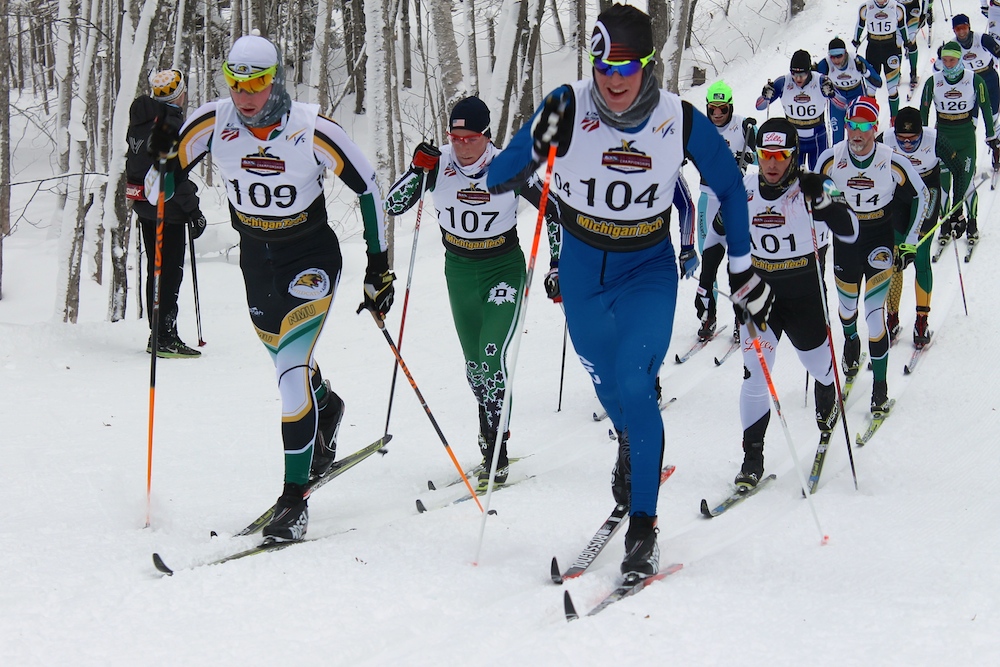
HOUGHTON, Mich. — With 11 men together at the start of the last 10-kilometer lap in Thursday’s 30 k classic mass start at U.S. Cross Country Championships, Kris Freeman knew he had to make something happen.
If he continued to ski in the pack and wait to see how the places shook out in the 100-meter finishing straight, the second-ranked U.S. distance skier (after U.S. Ski Team member Noah Hoffman) didn’t like his chances in a last-ditch sprint.
“I knew that somewhere in the last five k I had to go, and I had to go hard,” said Freeman, 34, who skis independently as Freebird, after the third of four national races at the Michigan Tech Trails.
The men directly around him with eight kilometers to go — including two Sun Valley Ski Education Foundation (SVSEF) Gold Team members (Matt Gelso and Miles Havlick), three Alaska Pacific University (APU) skiers (Lex Treinen, Scott Patterson and Eric Packer) and three Northern Michigan University (NMU) athletes (Fredrik Schwencke, Kyle Bratrud and Adam Martin), as well as Dartmouth’s Paddy Caldwell (also of the Stratton Mountain School T2 Team and U.S. Ski Team D-team) — generally anticipated Freeman’s move as well.
But all of them realized that leading was significantly harder in the cold-and-slow conditions with temperatures around 3 degrees throughout the day. Freeman tried it out, pushing the pace a couple times early in the first lap “just to experiment and see if I could hurt the field,” he said. “I just couldn’t.”
Kris Freeman (near), Dartmouth’s Paddy Caldwell (l), and NMU’s Fredrik Schwencke (behind Freeman) near the front of the pack around 2 k into the men’s 30 k classic mass start on Thursday at U.S. nationals in Houghton, Mich.
The four-time Olympian decided to hang back and attack somewhere on the second half of the last lap.
“I think I went with two-and-a-half k to go,” Freeman said. “And I knew I had a really good attack for two k, then my last 500 meters was pathetic.”
But it was enough for the win. On the second-to-last climb, Freeman successfully gapped Gelso, Patterson and the four others in the chase pack (Norris, Treinen, Packer and APU’s fifth man Reese Hanneman, respectively), and he frequently checked over his shoulder to make sure they weren’t reining him in.
“I had to double pole one long downhill that’s usually recovery so that they wouldn’t get back on me,” Freeman said of the final descent before the last climb toward the finish.
Treinen took advantage of an unfortunate misstep and crash from his teammate, Patterson, who had been skiing with Gelso in second with a kilometer to go.
“I was kind of moving tracks and stumbled a little bit,” Patterson said of the final downhill. “I was wobbly out on one ski, trying to correct, but it just wasn’t enough — spun around, totally my fault, didn’t hit anyone else, they all moved around me, and it was a quick little fall, but still not something you want right at the end.”
Four of his teammates — Treinen, Norris, Packer and Hanneman — navigated around him, as did Bratrud. Gelso stayed out of trouble but lost steam up the final ascent.
Kris Freeman pushing hard for first with 200 meters to go in the men’s 30 k classic mass start at U.S. nationals in Houghton, Mich.
While Freeman forged ahead up the gradual hill, again looking back to see who was closest to him, his pain emitted through his facial expressions as he strode toward the finish.
Behind him, Treinen, on his 25th birthday, worked his way from fourth to third behind Bratrud and ahead of Gelso and Norris.
“Kyle Bratrud came up from behind and he looked like he was charging pretty hard so I tried to stay behind him for as long as I could, and on the last uphill, just gave it everything,” Treinen said. “I tried to break him — it just barely worked.”
Treinen edged the 21-year-old NMU senior, who won Sunday’s 15 k freestyle to start nationals, by 0.4 seconds to claim second for his first national podium. He finished 3.7 seconds behind Freeman, who won his 17th national title in 1:31:14.8.
“They were yo-yoing [behind me] and I was totally loaded coming up into the finish,” Freeman recalled. “If someone had sprinted by me, there would’ve been no response. There was nothing I could do.”
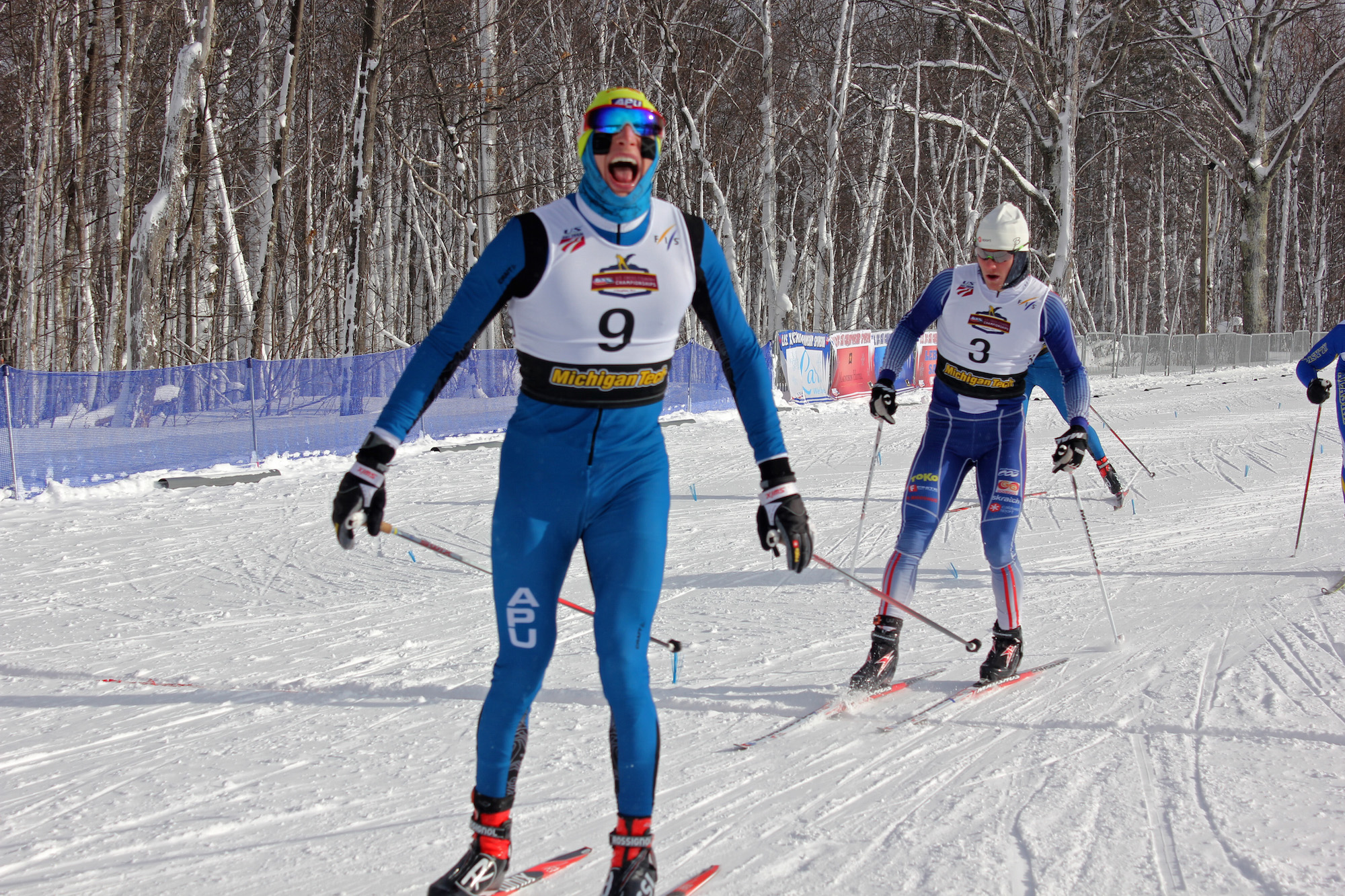
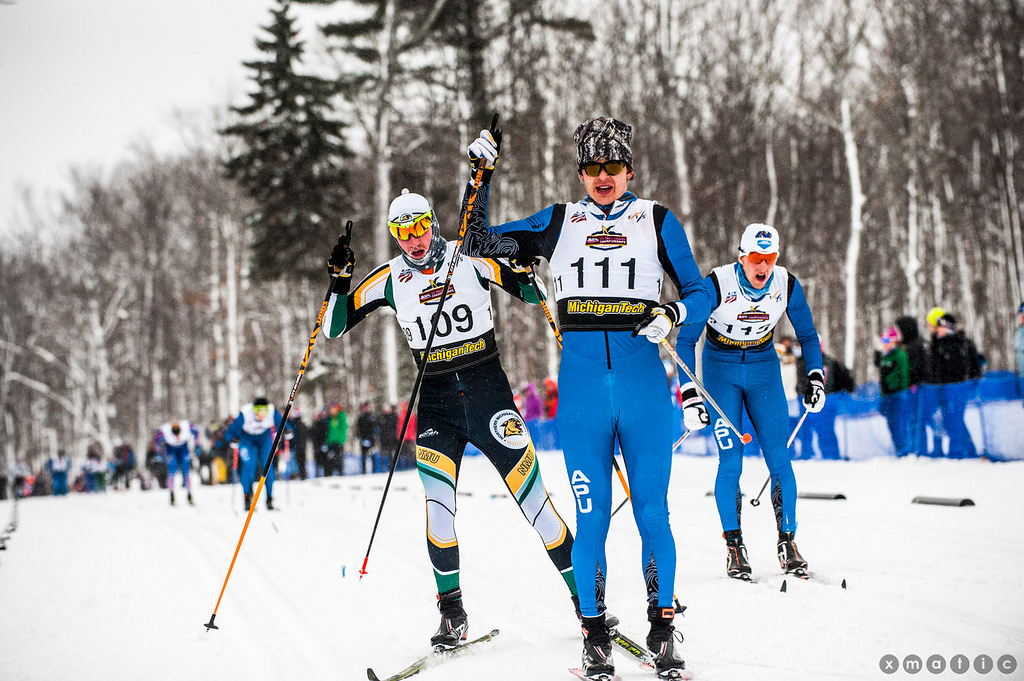
APU’s Lex Treinen (111) celebrates his second-place finish and first national podium after the 30 k classic mass start at U.S. nationals in Houghton, Mich. NMU’s Kyle Bratrud (109) placed third, and APU’s Eric Packer (r) secured fourth. (Photo: Christopher Schmidt)
“Lex and I were gaining on [Freeman] at the end so who knows how it would’ve played out if there was another k to go,” Bratrud recalled.“I found myself leading a decent amount and then when Kris took off and kind of split the field up, I was able to at least pick up most of the pieces.”
On Sunday, Freeman placed second to Bratrud in the individual skate race.
“Even though the skate race didn’t go quite like I wanted, the sensations I had were great,” he reflected. “Today except for the last 500 meters, I felt like I was in total control and I just feel totally different then I did last year. This should absolutely cement my place on the World Championship team and that’s been my goal all year.
“SuperTour points are nice, but I want to go prove I’m one of the best in the world at World Champs,” Freeman added.
The U.S. World Championships team will be tentatively announced on Jan. 26, according to the team-selection criteria. The first criteria is based on World Cup results in the selection period (from Nov. 29, 2014 to Jan. 18, 2015); the second is coaches’ discretion, and the third, should it come down to it, is based on the best-ranked athletes in the 4th edition of the USSA Sprint and Distance Points List, which will be released Jan. 23.
Heading into nationals, Freeman ranked second in the 3rd USSA distance points list (including races before Jan. 2), nearly six points ahead of Gelso in third.
That made him one of Freeman’s biggest perceived threats on Thursday.
“Gelso looked really comfortable on his skis; he was having good kick everywhere and he’s right behind me on the points list and he’s having a great season,” Freeman said. “Kyle also obviously just had a great race so those two I kept looking at.”
Kyle Bratrud (NMU) and Scott Patterson (APU) leading the U.S. nationals men’s 30 k mass start around 2 k on Thursday in Houghton, Mich.
Bratrud explained he came into the race more relaxed than he had anticipated after winning his first national title (and with it, his first national top 20) earlier in the week.
“All summer I had been targeting this 30 k and into the fall, I started realizing that maybe the 15 k would be a better shot for me,” he said. “Winning that I felt like I had a pretty successful week even if I was dead last in this race. I was just out there having fin. It’s fun to do well.”
Freeman felt similarly. After digging himself into a self-described hole last season, Freeman was enjoying racing again.
“I backed off my training a little bit; I’m more relaxed. I’m accepting that I’m 34, I can’t train a thousand hours anymore and expect to recover the same why I did,” he said. “And ski racing’s fun.”
While Freeman was gunning for 2015 World Championships next month in Falun, Sweden, Bratrud put himself in prime position to be nominated to the U23 World Championships team his previous win at nationals. Another podium on Thursday prequalified him for NCAA Championships as well, as nationals double as a Central Collegiate Ski Association (CCSA) and NCAA Central Region qualifier for NCAA’s.
“It was a weight off my shoulder to win the skate race and pretty much guarantee U23’s so now I can go home and train for a bit and head over to Kazakhstan,” Bratrud said. “I’m prequalified for NCAA’s so I can come back and get another little block in and then hopefully race some of those fast [University of Colorado] Boulder Norwegian guys.”
NMU Claims College Cup
Four NMU skiers landed in the top 13 with Bratrud in third, Schwencke in 11th (who skied near the front of the pack and led the long climb up after the race’s halfway point, then raced in the top 11 with eight kilometers to go), Martin in 12th and Erik Soderman in 13th.
“The Northern Michigan guys put in some strong attacks on the second lap, and I think they widdled the field down [by the last lap],” Freeman said. “I tried working with Freddy [Schwencke] right before the end of the second lap, but we got caught and I just said, just tuck it in here until it’s time.”
With the highest-collective performance over three days at nationals, NMU won the 2015 College Cup.
“All my success comes from training with those guys every day and Freddy’s a very good classic skier so I was confident skiing next to him,” said Bratrud, who led through the 10 and 20 k lap checkpoints. “When he put the hammer down pretty hard when we came through the second time, just to be able to ski confidently with your teammate and be at the front of the race is a pretty good feeling and that gave me a good feeling going forward.”
APU Takes 5 of Top 8
This past summer, APU’s seven-person men’s team (with U.S. Ski Team member Erik Bjornsen, Reese Hanneman, Tyler Kornfield, Norris, Packer, Patterson, and Treinen) initiated a “#five2falun” slogan.
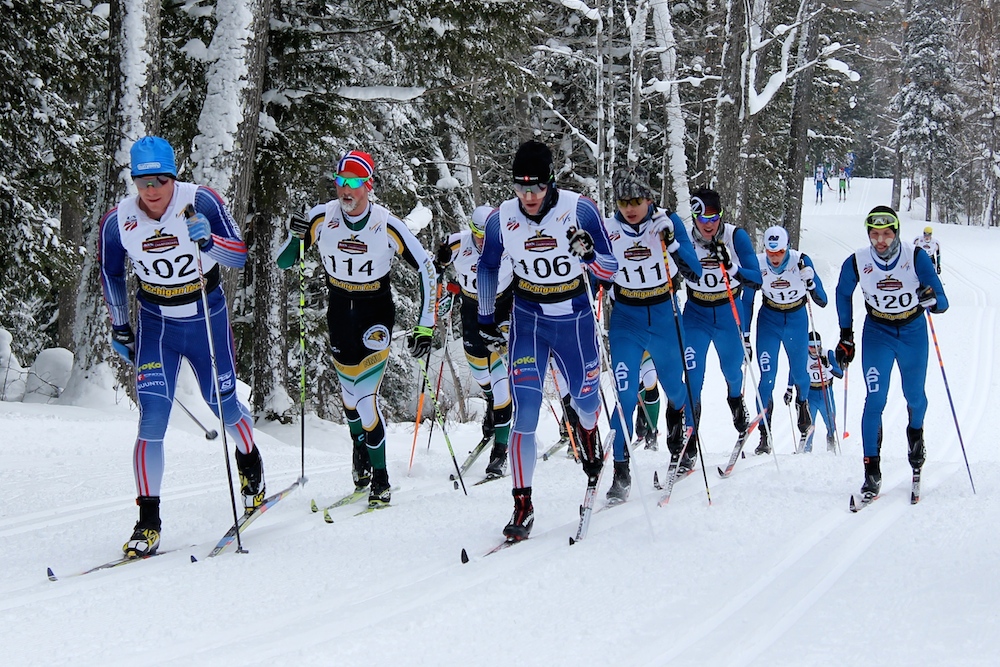
Sun Valley’s Matt Gelso (102) and Miles Havlick (106) lead the 11-man pack (with a fleet of APU and NMU skiers) around 22 k in the 30 k classic mass start at U.S. nationals in Houghton, Mich.
“It started as a joke; it’s all in good humor,” Hanneman explained at the time. “There was another elite team in the U.S. who, they last couple years, they had a campaign: six to Sochi. We thought, we can do our own little thing. Five because it starts with and ‘F’ because seven doesn’t really sound as good.
“Now we’re kind of using it as motivation for ourselves,” he added. “If [we] did actually send five to Falun from one team that would be absolutely insane. The men have traditionally been so spread out in the U.S. that we’re kind of excited about having a group of us that changes the landscape.”
On Thursday, after months of waiting for a breakout-team performance, the APU men got it.
Treinen led them in second, Packer rose from seventh to fourth (+4.9) over the last kilometer, and Norris finished 11.2 seconds after Freeman in fifth, 1.9 seconds ahead of Hanneman in sixth. Hanneman came back from 13th and 18 seconds behind the leaders at 20 k, to eighth with 1 k to go.
Gelso finished seventh (+14), and Patterson, who’s back after a pulmonary embolism kept him from racing from late October until mid-December, recovered from his fall on Thursday to edge Havlick and Caldwell by less than a second for eighth (+24.3). Havlick placed ninth (+25), and Caldwell was 10th (+25.1).
“I had a pretty good sprint so if I hadn’t had that fall who knows what would’ve happened,” Patterson said. “I would’ve been right there challenging for it, maybe not Freeman but the next guys.”
Treinen called his second-place finish “pretty special, especially because it’s my birthday. It was kind of in the back of my mind, not gonna lie — I was thinking about that.”
His previous national best was fifth in the 50 k classic mass start at U.S. Distance Nationals last spring.
“I feel like we were just waiting for him to have a good day and that was today,” APU Head Coach Erik Flora said. “He looked great, he looked energetic, he looked under good control and you could see so many times just like a smile on his face so it was really cool.”
Flora added that he was proud of the entire team, with five men in the top eight.
“To have all those boys in there fighting and challenging each other is just awesome,” he said. “I think that the training for those guys is working and their commitment to being skiers all that good stuff.”
“I’m just happy to have my teammates do so well as well,” Treinen said. “It’s the best team I’ve ever been on and I think we’re just starting to show what we’re made of.”
Packer rose from seventh to fourth with 200 meters to go, proving to himself that he was back on form after the flu took him out of commission the week before the 15 k.
“I couldn’t be happier with feeling good today,” the first-year APU member and Anchorage native said. “… I grew up skiing with all of the guys. We all started training together actually in middle school. It’s kind of cool to have five of those same guys that you started with at 12 or 13, five in the top eight today.”
Norris led at times during the race, including around 22 k with Gelso, and said he was disappointed to slip from fourth at the bottom of the last climb to fifth (when Packer passed him in the final stretch).
“It’s hard when you get passed in the last hundred meters … but it was my teammate and he’s a good finisher,” Norris said. “And I’m feeling better every race we do throughout the season.”
Moreover, he was excited for his team.
“We had the feeling that we were going to have some great results as a team and we hadn’t really shown that yet this year,” he said. “We all had great skis. Everyone’s skiing stronger so it’s cool to see Lex have a good sprint finish when he’s notoriously a distance guy and Packer have a good 30 k when he’s been good at sprints. Everybody’s improving their weaknesses.”
Notes:
Jørgen Grav (University of Vermont) was an early frontrunner in the men’s 30 k classic mass start at U.S. nationals in Houghton, Mich. (Photo: Christopher Schmidt)
Jørgen Grav (University of Vermont), who placed 24th, skied in the top five for much of the first lap, just ahead of Freeman, amid a large pack of about 30 separated by 15 seconds at 10 k.
Brian Gregg (Team Gregg/Madshus) finished 21st after skiing in the top 7 through 10 k, then slipping into the mid-20s on the second lap.
Tad Elliott (Ski & Snowboard Club Vail Elite Team) finished 36th in his first race at nationals after spending the earlier part of the week recovering from a flu/cold at home in Durango, Colo.
Ben Lustgarten (SVSEF) sat out the mass start as he’s been suffering from vertigo this week, which led him to miss Tuesday’s classic sprint as well.
Men’s 30 k classic mass start at U.S. Cross Country Championships in Houghton, Mich.
Men’s 30 k classic mass start at U.S. Cross Country Championships in Houghton, Mich. (Photo: Christopher Schmidt)
Men’s 30 k classic mass start at U.S. Cross Country Championships in Houghton, Mich.
Men’s 30 k classic mass start at U.S. Cross Country Championships in Houghton, Mich.
Men’s 30 k classic mass start at U.S. Cross Country Championships in Houghton, Mich.
Men’s 30 k classic mass start at U.S. Cross Country Championships in Houghton, Mich.
SSCV’s Tad Elliott (119) and Craftsbury’s Andrew Dougherty (131) Men’s 30 k classic mass start at U.S. Cross Country Championships in Houghton, Mich. (Photo: Christopher Schmidt)
Dakota Blackhorse-von Jess strides to a near seven-second win in Tuesday’s 1.5 k classic sprint at the 2015 U.S. Cross Country Championships in Houghton, Mich. (Photo: Jake Ellingson)
HOUGHTON, Mich. — As the heavy, wet snow fell on the trails of the Michigan Tech Nordic Skiing Center Tuesday morning, the first starter in the men’s 1.5-kilometer classic sprint at the 2015 U.S. Cross Country Championships emerged from the dense cloud of white.
Plowing through the roughly seven inches of snow that had fallen in three hours, Dakota Blackhorse-von Jess (Bend Endurance Academy) notched the second-fastest time of the day. But much like the wind and snow, he wasn’t going to stop there.
Similar to his female counterpart, Rosie Brennan of Alaska Pacific University (APU), Blackhorse-von Jess breezed through the quarterfinal and semifinal – earing the top spot in both. Once in the final, it was more of the same for the 28 year old, who surged over the course’s second-to-last hill to enter the stadium far ahead of his competitors and across the line with a smile and a winning time of 4:06.16.
The next competitor, Ben Saxton (SMST2/USST), crossed the line 6.29 seconds after Blackhorse-von Jess in second, while Michigan Tech skier Håken Hjelstuen of Norway rounded out the podium in third, 7.12 seconds back.
While Blackhorse-von Jess had the task of tackling the slow, new snow in qualification, he said it was a common factor between he and the other first starters. Once in the heats, he explained, the unusually slow nature of the race made tactics less important.
“In a four-and-a-half minute long race you just go ski and you wait and see what happens. Obviously there are certain spots on the course where certain people do different things better than other people. [For me] it wasn’t a goal to lead and it wasn’t a goal to be in last,” he said of his strategy in a post-race interview.
Although he wasn’t aiming to lead, it was a position that Blackhorse-von Jess found himself in during the quarterfinal. Entering the stadium with a sizable lead over David Sinclair (GMVS) and Forrest Mahlen (MSU), he skied across the line with the speed of a 30 k instead of a sprint.
In the semifinal it looked as if the same would happen as the heat of six skiers sped up the ultimate hill. However, there was one competitor who held onto Blackhorse-von Jess – Cole Morgan of the University of Vermont.
“In the semifinal Cole Morgan was on my tail and wouldn’t let go and it made it sound like there were a lot more people around. So I had to push it into the finish,” Blackhorse-von Jess said.
The Bend Endurance Academy skier held off the challenge and the two automatically advanced to the final, where a similar situation took place. On the second-to-last hill, again, Blackhorse-von Jess felt Morgan on his tails. At that point he made the push to lose the 20-year-old college skier.
“I said, ‘well, I’m done with this,’ and I took off. Suddenly the woods got quite and I was by myself, so I went for it,” he said.
Dakota Blackhorse-von Jess (Bend Endurance Academy) leads Cole Morgan (UVM) in the semifinal finish in the men’s 1.5 k classic sprint at the 2015 U.S. Cross Country Championships in Houghton, Mich.
Tuesday’s win is Blackhorse-von Jess’ second national championship. Although he has landed on the podium multiple times, his only other win was in a 2013 freestyle sprint at Soldier Hollow. He explained his win in that race was more meaningful because it was unexpected and “something I really had to fight for.”
The 2015 title is different for Blackhorse-von Jess because it’s been a part of his season plan for a long time, and the highlight of that plan is not a national championship.
”This year everything has been geared toward Word Championships so this is a stepping-stone. The goal was to put myself in a position to win and see if I can do it. So everything worked out really well and I’m excited. Obviously I can’t control if I go to World Championships but I know that the way we set up the training, we are on the upswing and things will continue to rise in February,” he said.
Blackhorse-von Jess will not be selected for World Championships based on the objective criteria outlined by USSA, which includes a top 60 ranking in the overall World Cup. However, he does have a chance in the additional objective criteria, which is based on USSA sprint and distance points. Blackhorse-von Jess currently sits in third position behind World Cup skiers Andy Newell and Simi Hamilton in the most recent sprint ranking list released Jan. 2.
While he has no control over whether he will be selected for World Championships, Blackhorse-von Jess does have a say in earning the 2015 SuperTour sprint title, which could result in World Cup starting spots later this season.
“I think that being the best of the rest is best I can do. The only thing in my control is winning the sprint SuperTour so I can secure those two world cup starts at the end. Obviously it would be great to go to World Championships, but two years ago I had a first and a third and I still didn’t go,” he said.
In the meantime, however, Blackhorse-von Jess is skipping the 30 k classic mass start on Thursday to focus on Saturday’s freestyle sprint. He explained that, historically, the second sprint of nationals has always been a challenge for him but this year he’s hoping that will change.
“The goal for us is to figure out how to get through the next four days to be able to have a good race, because I haven’t had an awesome race the second time,” he said.
The Fight for Second
Saxton’s silver medal finish is his second in two years. In 2014, he was the runner-up to the national title behind Torin Koos in the freestyle sprint at Soldier Hollow.
En route to this year’s podium finish, Saxton had to maneuver a challenging quarterfinal to advance to the next round. In what he called the “quarterfinal of death,” Saxton faced a collection of strong sprinters including Reese Hanneman (APU), Tyler Kornfield (APU), Eric Packer (APU), Matt Gelso (SVSEF) and Welley Ramsey (MWSC). The heat was the fastest quarterfinal of the day, but Saxton crossed the line in first followed by Packer and Hanneman, both of whom advanced.
Ben Saxton holds his position over APU’s Eric Packer and Reese Hanneman during one of Tuesday’s quarterfinals in the men’s 1.5 k classic sprint at the 2015 U.S. Cross Country Championships in Houghton, Mich.
“You could have taken those six names and said this will be the A-final for today, and I wouldn’t have doubted you for a second. They are all really strong skiers, so I felt really lucky to advance out of that,” he said in a post-race interview.
By the time he reached the final Saxton was ready to fight for the top spot. At the start, however, he had trouble finding his top speed and suffered the consequences.
“In the final it was the first time all day I had a bad start and it came back to bite me. There were only two or three lanes in play when you’re going around the course, so when I fell down to sixth from the gun there was no way for me to move myself up,” he said of the final.
But he did move himself up, and by the time he reached the bottom of the last climb Saxton was third with a considerable distance to make up on Hjelstuen who was sitting in second. With a surge of energy Saxton reached the Norwegian and skied past him to gain an advantage on the straight away into the finish and earn silver.
While Saxton said he was hoping to win Tuesday’s race, he explained that a podium finish is never disappointing.
“Dakota is a good friend and he is the standard for domestic sprinters so there is no shame in watching him do his thing. I’m barely 21 and Dakota is almost 8 years older than me so there’s some catching up to do. I have so much to learn from him and I’m just psyched to do that for now,” he said.
The finish comes after Sunday’s 15 k freestyle in which Saxton finished 57th – a result that he said left him shaken.
“It’s nice to have some mojo back. It was a pretty tough day on Sunday,” Saxton explained.
Brian Gregg (l) Logan Hanneman (c) and Håken Hjelstuen Men’s 1.5 k classic sprint at the 2015 U.S. Cross Country Championships in Houghton, Mich.
Hjelstuen, a student at local Michigan Tech and native of Oslo, Norway, qualified first and had a successful campaign throughout the quarterfinals and semifinals. However, by the time he reached the final, his kick wax was deteriorating.
“My kick was not good in the semifinal. We tried to fix it for the final, but it got worse. Up the last hill I was fourth or fifth and I really wanted that podium so I was just double-poling all I could. Maybe with better kick I could maybe fight Dakota. I would have been fun to have a fight close to the end,” he said after the final’s completion.
While he is a student at MTU, Hjelstuen has yet to become a racing member of the Huskies’ ski team. Since he is an exchange student, his eligibility for NCAA racing has been up in the air. However, he predicted that within the next week the issue would be resolved.
A Strong Showing for Vermont
Men’s 1.5 k classic sprint at the 2015 U.S. Cross Country Championships in Houghton, Mich.
Despite challenging Blackhorse-von Jess in the middle of the course, Morgan ultimately ended his day in fourth. The University of Vermont senior from Bozeman, Mont. originally worried that the day would be a “grinder” due to the slow snow he faced in qualification, but found that conditions improved once organizers had groomed the trail between then and the heats.
While Morgan said he normally has a tendency to start too hard, a key factor in Tuesday’s strategy was to hold back until it the second third of the race.
“I just tried to tuck behind people for most of those heats until the last half kilometer where it was just rolling. It worked in the quarter and the semi, but in the final I got a little tired so I didn’t really have quite the punch as the other ones,” he explained.
Morgan was the second U23 skier behind Saxton, thus earning valuable points for a possible bid to make the U.S. U23 World Championship team. In regards to the U23 Championships, Morgan said he’s more focused on the season’s college races, but will see where he stands when the selections are announced Saturday.
“That wasn’t one of my big goals coming into here. I’m just looking to get some good racing before the college season. We’ll see how it ends up at the end of the week and how I feel there,” he said.
The University of Vermont saw another of its skiers in the final in the form of Jørgen Grav.
Grav, a junior from Oslo, Norway, said that he felt faster in the qualification and quarterfinal because he could ski his own pace. In the semifinal and final, he said it was more difficult to ski efficiently due to the grouping of the pack.
Men’s 1.5 k classic sprint at the 2015 U.S. Cross Country Championships in Houghton, Mich.
“Other than that I’m pretty satisfied. I didn’t expect to get to the A-final. I would say I was a very lucky loser,” Grav, who advanced to the final as a lucky loser, said after the race.
With their fourth and fifth place finishes, Morgan and Grav, were the top affiliated college skiers (as Hjelstuen has yet to gain eligibility). Prior to Tuesday’s race, UVM was ranked second behind Northern Michigan University in the Championship’s College Cup rankings.
“We worked pretty hard and we tried to hang on. We finished strong… It was great having a teammate in the final,” he said.
Taking the last spot in the final was Sun Valley’s Miles Havlick, who said that despite making a few tactical errors, he was happy with his result.
“I think the longer sprint and the conditions played in my favor as more of a distance skier,” he said in a post-race phone interview.
The 2015 U.S. Cross Country Championships continue Thursday with a 20/30 k classic mass start for senior skiers and a 10/5 k classic mass start for juniors.
Rosie Brennan (APU) celebrates her definitive win in the women’s 1.5 k classic sprint on Tuesday at U.S. Cross Country Championships in Houghton, Mich., where she notched her third national title. (Photo: Jake Ellingson)
HOUGHTON, Mich. — As Rosie Brennan plowed through the fresh powder and tried to pick out what she thought was the best lane for the women’s 1.5-kilometer classic sprint at U.S. Cross Country Championships on Tuesday, she thought, this is brutal.
Not only did she have to start first in the qualifier, which began at 10 a.m. after nearly half a foot of fresh snow had fallen since two hours earlier, when the groomer last passed over the Michigan Tech course, but Brennan had nobody starting directly behind her, either. Caitlin Gregg (Team Gregg/Madshus) in bib No. 2 had scratched.
“I had no idea how fast I was going relatively, plus I was plowing the tracks for everybody so it actually was kind of unfortunate,” Brennan recalled with a laugh. “But I just tried to tell myself that if I skied well, that I had to be moving fast enough and just hope for the best.”
The Alaska Pacific University (APU) veteran ended up second in the qualifier, 1.16 seconds behind Eliška Hájková, a 2013 University of Colorado Boulder graduate and current Boulder Nordic Junior Racing Team coach, who clocked the fastest time of 5 minutes, 18.63 seconds.
After the race, several described it as more like a prologue or even a distance race than a typical sprint. At least for many, it felt that way.
“I kind of felt like I was doing a 5 k,” said Brennan’s APU teammate Becca Rorabaugh, who qualified 10th.
Fortunately for the racers, the track got faster by the time the heats rolled around at 12:30 p.m., and there were more options that the one track Brennan picked to lead 136 women out in the qualifier.
The organizers re-groomed the loop after the men’s qualifier ended at 11:50, and with wet snow from a northwest wind off Lake Superior about 10 miles north, the course set quickly before the women’s quarterfinals started 40 minutes later.
It was still about 7 degrees with a biting wind shooting across the stadium start and finish, but racers seemed unfazed once they got moving. With the snow still falling, as long as they could find a skied-in track, they were generally happy.
Rosie Brennan leading her quarterfinal in Tuesday’s 1.5 k classic sprint at U.S. Cross Country Championships in Houghton, Mich. (Photo: Christopher Schmidt)
The blizzard let up by the afternoon, right about the time Brennan started to come into her own. With three SuperTour victories out of four races on the circuit this season (and a national podium on Sunday), she had the confidence — and she soon realized she had the ski speed as well.
“I thought it would be more prudent to be patient basically on top of the big climbs because it’s still half a [kilometer] to the finish,” she explained, “But I just noticed how fast my skis were.”
Seeing that, the 26-year-old Park City, Utah, native decided to take advantage of the gap she had created and extend her lead on the downhills then up the final gradual climb to the finish.
Brennan won her quarterfinal by 2.55 seconds over 17-year-old Katharine Ogden of the Stratton Mountain School (SMS) in second. In the semifinal, she again stole the show ahead of 16-year-old runner-up Hannah Halvorsen (Sugar Bowl Academy) and Anne Hart (SMST2), who advanced as the lucky loser in third, 1.18 seconds behind Brennan.
Ogden in fourth — ahead of Erika Flowers (SMST2) in fifth and another New England skier, Julia Kern (Cambridge Sports Union) in sixth — did not advance. The three women went head-to-head in the B-final (along with Hájková, Michigan Tech’s own Deedra Irwin, and APU’s Rosie Frankowski), where Ogden bested Hájková by nearly a second to win the heat and tie her best-senior-nationals result in seventh.
Stratton’s Katharine Ogden (l) winning the women’s classic-sprint B-final for seventh overall on Tuesday, ahead of Eliška Hájková (Boulder Junior Nordic Racing Team), at U.S. Cross Country Championships in Houghton, Mich.
“I kind of went in with not a lot of expectations, just hoping to do the best I could and I was pretty psyched with how it ended up,” Ogden said. “It’s also really cool to see Julia Kern [who qualified in third], is a junior; she was in my heat, and Hannah Halvorsen is even younger than me and she [was] in this A-final.”
Six women lined up for the A-final, four of them ages 23 and under. Brennan and Rorabaugh were the most experienced in the group, and Hart had raced one national A-final before, but none of the other three — Halvorsen, Liz Guiney (Craftsbury Green Racing Project) and Heather Mooney (Middlebury College) — had previously made it that far in national sprint.
“At that point, it was just very exciting,” Halvorsen recalled. “I wasn’t really worried — I just wanted to have fun out there. It was just an honor to get to race with those super-fast girls and go as hard as I could.”
For Brennan, it was a matter of business. She wondered if she had the snap she needed to win her third national title, especially given how long the course felt and how cold it was.
“It’s hard to feel great all the time,” Brennan said. “I really just tried to trust the fitness that I’ve built and try to keep skiing and not look back and just keep going.”
That’s exactly what she did, and to no one’s surprise in the final.
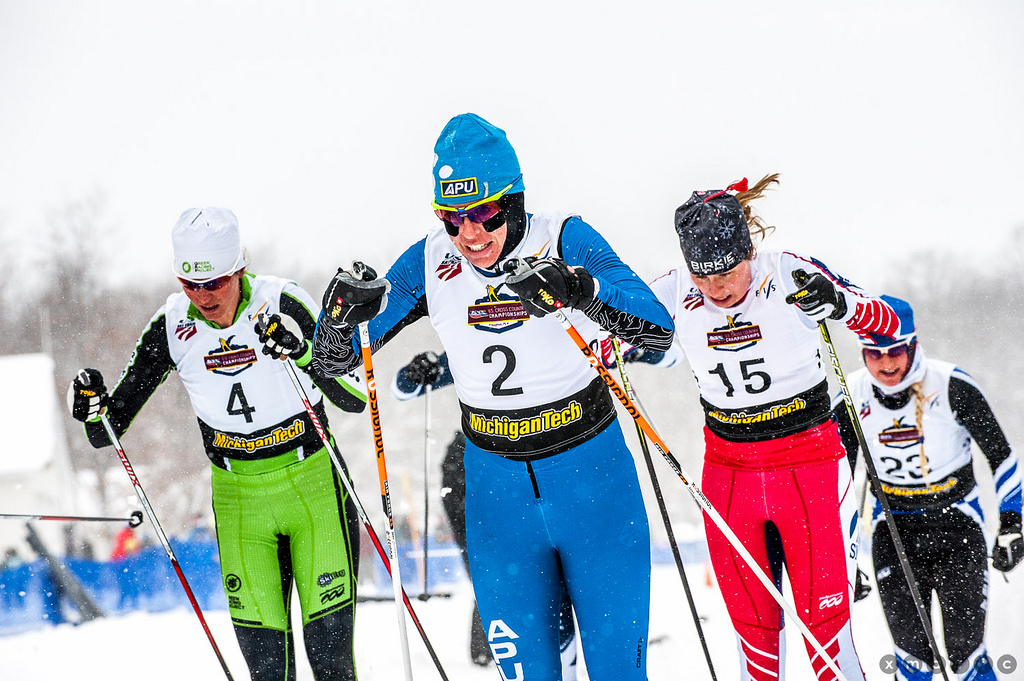
Rosie Brennan (2), leads Liz Guiney (4), Anne Hart (15) and Hannah Halvorsen (23) shortly after the start in the women’s 1.5 k classic sprint final at U.S. Cross Country Championships in Houghton, Mich. (Photo: Christopher Schmidt)
“I knew Rosie was just gonna blow it out of the water so I just tried to hang on,” Rorabaugh said with a laugh.
Brennan did just that, surging to front of the pack out of the start, slightly ahead of Rorabaugh and Guiney, and directly in front of Hart before the downhill out of the stadium. According to Rorabaugh, Brennan attacked on the course’s two steeper climbs — most notably on the slight downhill in the middle and on the second hill about two-thirds of the way through.
“It’s kind of like training, like, ‘Oh, Rosie’s going away on a hill again, this is my chance to hang on,’ ” Rorabaugh said.
But unlike some training sessions in Anchorage, Alaska, this time, Brennan dropped Rorabaugh and the rest of the field for good.
“I actually was putting most of my time in over the top of that first uphill and in the downhill,” Brennan said. “And then I guess the second uphill, I just surged to the top of that and then just tried to relax and ski it in.”
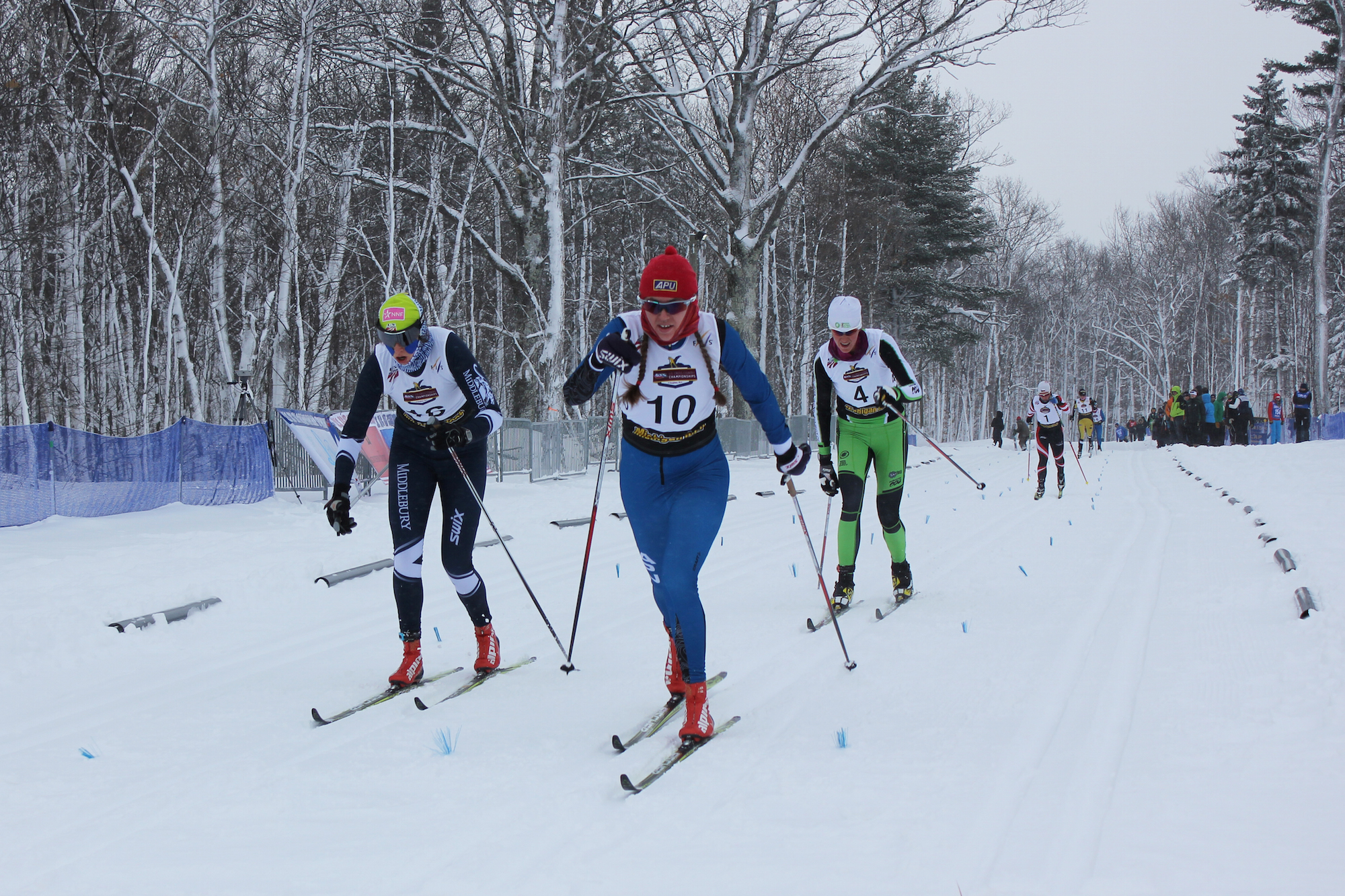
Becca Rorabaugh (10) leads Heather Mooney (l) and Liz Guiney (4) into the finish in the semifinal of the U.S. Cross Country Championships women’s 1.5 k classic sprint on Tuesday in Houghton, Mich.
Just like each of her preceding heats, she won the final comfortably by 6.82 seconds in 4:52.72.
Rorabaugh sensed a couple women gunning behind her for second, so she sped up on the final gradual climb before the stadium straightaway.
“I figured they were close enough that I should just go as hard as I could, so I was happy that the finishing stretch was striding today,” she said of the still-dragging conditions.
After securing the win, Brennan looked behind her to welcome her teammate and the rest of her competitors (including Guiney as a former Park City teammate) across the line. She and Rorabaugh embraced after delivering the 1-2 APU punch, and Guiney, who finished 3.67 seconds later, stayed 2.4 seconds ahead of Hart for her first national podium in third.
“[I’m] tired, cold. I’m ecstatic, honestly,” Brennan said with a laugh after. “Last year, I technically got the national championship [in the classic sprint], but I was second [to Russia’s Natalja Naryshkina] so to win outright is that much sweeter. I really like classic sprinting so it was just good — good course and good skiing for me.”
“It’s hard to feel great all the time. I really just tried to trust the fitness that I’ve built and try to keep skiing and not look back and just keep going.” — Rosie Brennan (APU), two-time national classic sprint champion
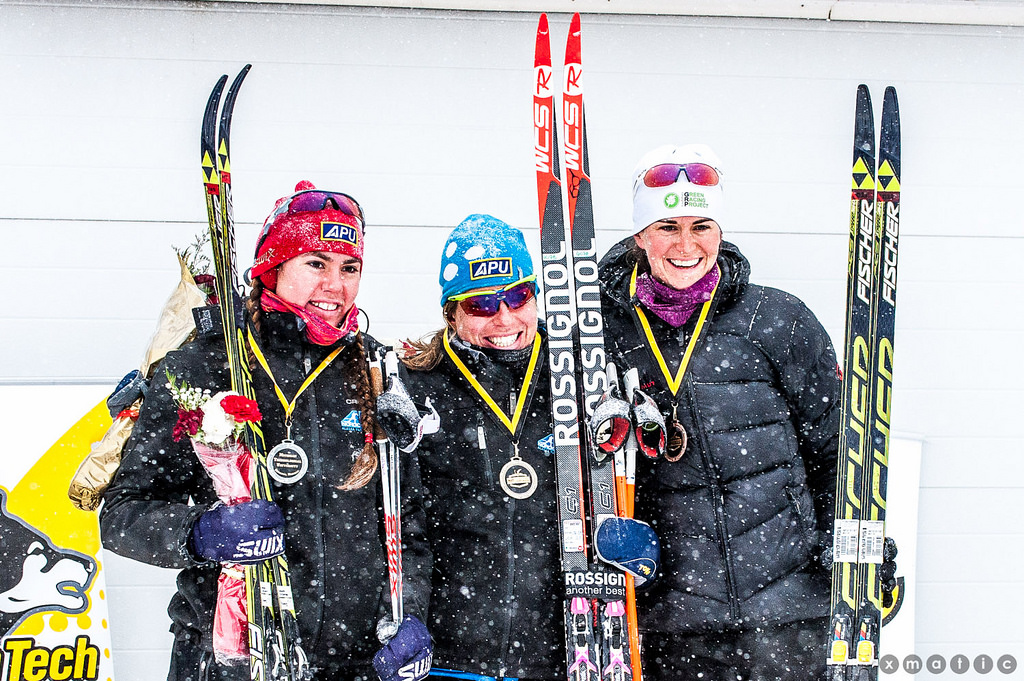
APU’s Rosie Brennan (c) and Becca Rorabaugh (l) on the podium in first and second, respectively, and Liz Guiney (Craftsbury Green Racing Project) in third in the women’s classic sprint at U.S. nationals in Houghton, Mich. (Photo: Christopher Schmidt)
It was also her fourth win out of six SuperTour races this year. Rorabaugh said she was happy the two could team up to take first and second.
“We work really hard together all the time so it’s really great to have it play out like this,” she said.
Guiney, a 23-year-old, first-year senior who qualified in fourth, placed ninth the last two years at nationals in the classic sprint (in 2013) and freestyle sprint (in 2014).
“It’s really exciting,” said Guiney, who won her quarterfinal ahead of Frankowski and placed third in her semifinal behind Brennan and Rorabaugh, respectively. “It’s kind of a cool realization for me that I can be up there.”
Hart improved upon her best nationals finish (which was fifth in the 2013 skate sprint) in fourth on Tuesday, about 13 seconds behind Brennan, and explained her main goal after qualifying in 15th was to keep an open mind and chip away at the heats.
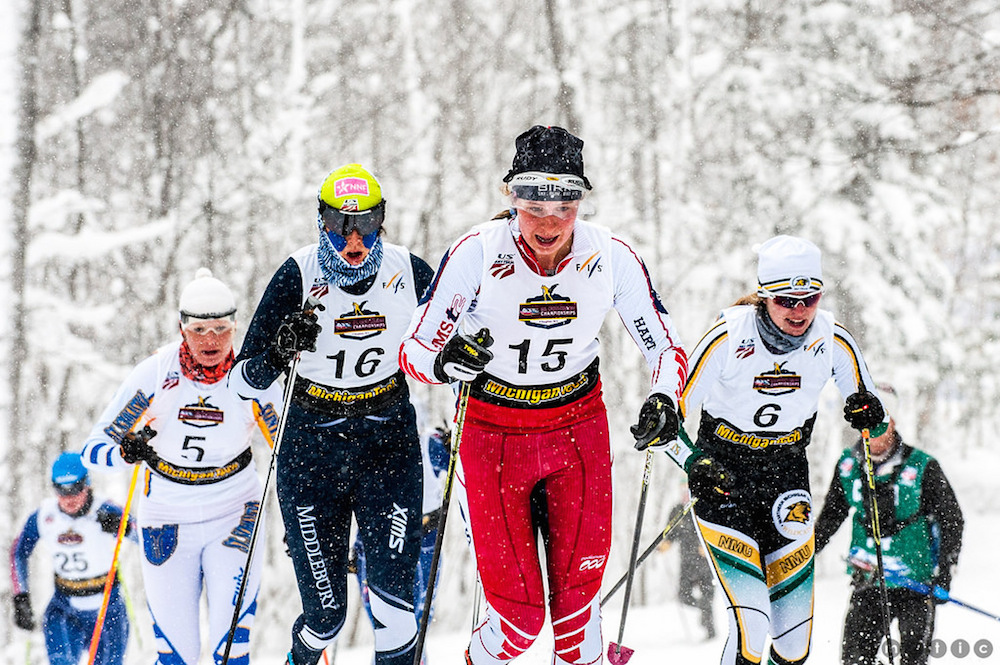
Anne Hart (SMST2) leads her quarterfinal ahead of Middlebury’s Heather Mooney (16) and Northern Michigan University’s Vivian Hett (6). (Photo: Christopher Schmidt)
“It was really anyone’s day out there,” she said. “When you look at [Sunday’s 15 k] skate race with Kyle [Bratrud] having such a standout race, you just have to remember that anything can happen.”
Hart won her quarterfinal by 1.32 seconds over Mooney, advanced out of the semifinal in third, and by the time the final rolled around, she was mostly aiming to stay in front of her fellow U23 competitors.
“[Stratton coach] Pat [O’Brien] gave us stunningly fast skis today, so all of the starts the plan was, I figured Rosie was going to be the fastest out there,” Hart recalled. “I was just like, if I can just get myself right behind her and stay on her as long as possible…”
She did so on the first climb, but by the second hill, she thought, “ ‘OK, maybe not,’ ” Hart said. “From there on out, it was just kind of battling for spots and with U23’s, every spot matters, so I was just willing myself to the finish line.”
Her father was cheering her on from the sidelines, which helped, she said.
“I graduated from Dartmouth last year and the first year out of college, I’ve been told a million and a half times by everyone and their mother that … it’s really different,” Hart said. “I just had what I call a bunch of vanilla races [to start the season], and so it’s just a confidence booster to say, ‘I’m doing this for a reason, I can do this.’ … So it’s gonna help me sleep better at night I think.”
“It’s just a confidence booster to say, ‘I’m doing this for a reason, I can do this.’ ” — Anne Hart (SMS T2 Team), fourth
Sixteen-year-old Hannah Halvorsen celebrates her quarterfinal win on Tuesday in the women’s 15 k classic sprint at U.S. Cross Country Championships in Houghton, Mich.
Halvorsen in fifth (+15.16) said her parents also buoyed her throughout the day.
“My parents were really believing in me so I decided I’d give it what I have and I was pretty surprised that I was able to do really well in the heats,” Halvorsen said. “I had a lot of fun skiing with some fast girls.
“I’ve been training this year with World Juniors kind of on my mind, but just trying to focus on the process and ski as well as I can,” she added. “So we’ll see what happens and how the points play out.”
Twenty-year-old Mooney in sixth (+15.36), in her senior year at Middlebury, improved upon her two eighth-place finishes at nationals in the classic sprints in 2013 and 2011.
“I was in the A-final at Spring Series when I was a J2, same race, but I was psyched [about today],” she said after qualifying 16th. “[I] tried to go into it without any expectations … definitely was intimidated by a six-minute sprint course, but just took each one as it came.”
As for her goals for the rest of the season — and whether U23 World Championships are at the heart of them — Mooney said not necessarily.
“This sounds really silly — I’d like to race fast enough to be among the top U23’s, but I love college racing and this is my last year and I’m really excited to try to race really consistently and be at the top of the college circuit, focusing on NCAAs,” she said. “I’d love to make [U23 World Championships], but also I’m going to spend the winter in the East and I’m excited for that.”
Note: The defending freestyle sprint champion and 2013 classic sprint champion, Jennie Bender of the Bridger Ski Foundation crashed out of contention while leading up and over a climb near the end of her quarterfinal. She placed fifth, 7.8 seconds behind Rorabaugh as the quarterfinal winner, and did not advance to the semifinals.
“I was leading, then I was on my face,” Bender recalled in an email. “Knocked the wind out of me. … I am pretty disappointed, because I came into this race with high hopes, but that’s sprint racing. Looking forward to the skate sprint.”
HOUGTON, Mich. — The first day of racing at the 2015 U.S. Cross Country Championships is over after a flurry of exciting action in the 10/15 k freestyle intervals starts. In the men’s 15 k Kyle Bratrud (NMU) bested Kris Freeman (Freebird) by 50 seconds to take his first national championship, while Caitlin Gregg (Team Gregg/Madshus) held off a strong APU women’s team in the women’s 10 k to gain yet another championship title.
Check out our photo galleries from both races below:
Men’s 15 k freestyle, 2015 Cross Country Championships, Houghton, Michigan
Men’s 15 k freestyle, 2015 Cross Country Championships, Houghton, Michigan
Men’s 15 k freestyle, 2015 Cross Country Championships, Houghton, Michigan
Men’s 15 k freestyle, 2015 Cross Country Championships, Houghton, Michigan
Men’s 15 k freestyle, 2015 Cross Country Championships, Houghton, Michigan
Men’s 15 k freestyle, 2015 Cross Country Championships, Houghton, Michigan
Men’s 15 k freestyle, 2015 Cross Country Championships, Houghton, Michigan
Men’s 15 k freestyle, 2015 Cross Country Championships, Houghton, Michigan
Men’s 15 k freestyle, 2015 Cross Country Championships, Houghton, Michigan
Men’s 15 k freestyle, 2015 Cross Country Championships, Houghton, Michigan
Men’s 15 k freestyle, 2015 Cross Country Championships, Houghton, Michigan
Men’s 15 k freestyle, 2015 Cross Country Championships, Houghton, Michigan
Men’s 15 k freestyle, 2015 Cross Country Championships, Houghton, Michigan
Men’s 15 k freestyle, 2015 Cross Country Championships, Houghton, Michigan
Men’s 15 k freestyle, 2015 Cross Country Championships, Houghton, Michigan
Men’s 15 k freestyle, 2015 Cross Country Championships, Houghton, Michigan
Men’s 15 k freestyle, 2015 Cross Country Championships, Houghton, Michigan
Patrick Caldwell finishes the men’s 15 k freestyle in fourth place at the 2015 Cross Country Championships in Houghton, Michigan.
Men’s 15 k freestyle, 2015 Cross Country Championships, Houghton, Michigan
Men’s 15 k freestyle, 2015 Cross Country Championships, Houghton, Michigan
Men’s 15 k freestyle, 2015 Cross Country Championships, Houghton, Michigan
Kyle Bratrud collapses after his 51-second win in the men’s 15 k freestyle at the 2015 Cross Country Championships in Houghton, Mich.
Men’s 15 k freestyle, 2015 Cross Country Championships, Houghton, Michigan
Men’s 15 k freestyle, 2015 Cross Country Championships, Houghton, Michigan
Men’s 15 k freestyle, 2015 Cross Country Championships, Houghton, Michigan
Women’s 10 k freestyle, 2015 Cross Country Championships, Houghton, Michigan
Women’s 10 k freestyle, 2015 Cross Country Championships, Houghton, Michigan
Women’s 10 k freestyle, 2015 Cross Country Championships, Houghton, Michigan
Women’s 10 k freestyle, 2015 Cross Country Championships, Houghton, Michigan
Women’s 10 k freestyle, 2015 Cross Country Championships, Houghton, Michigan
Coach Erik Flora runs to grab a new pole for Rosie Brennan, APU, 3rd after she broke her pole and was given an oversized one. Women’s 10 k freestyle, 2015 Cross Country Championships, Houghton, Michigan
Women’s 10 k freestyle, 2015 Cross Country Championships, Houghton, Michigan
Women’s 10 k freestyle, 2015 Cross Country Championships, Houghton, Michigan
Caitlin Patterson (Craftsbury Green Racing Project) racing to fourth in the women’s 10 k freestyle at 2015 Cross Country Championships in early January in Houghton, Mich. Patterson also notched second in the 20 k classic mass start at nationals.
Women’s 10 k freestyle, 2015 Cross Country Championships, Houghton, Michigan
Women’s 10 k freestyle, 2015 Cross Country Championships, Houghton, Michigan
Women’s 10 k freestyle, 2015 Cross Country Championships, Houghton, Michigan
Women’s 10 k freestyle, 2015 Cross Country Championships, Houghton, Michigan
Women’s 10 k freestyle, 2015 Cross Country Championships, Houghton, Michigan
Women’s 10 k freestyle, 2015 Cross Country Championships, Houghton, Michigan
Women’s 10 k freestyle, 2015 Cross Country Championships, Houghton, Michigan
Women’s 10 k freestyle, 2015 Cross Country Championships, Houghton, Michigan
Women’s 10 k freestyle, 2015 Cross Country Championships, Houghton, Michigan
Women’s 10 k freestyle, 2015 Cross Country Championships, Houghton, Michigan
Women’s 10 k freestyle, 2015 Cross Country Championships, Houghton, Michigan
Women’s 10 k freestyle, 2015 Cross Country Championships, Houghton, Michigan
Women’s 10 k freestyle, 2015 Cross Country Championships, Houghton, Michigan
Women’s 10 k freestyle, 2015 Cross Country Championships, Houghton, Michigan
Women’s 10 k freestyle, 2015 Cross Country Championships, Houghton, Michigan
Women’s 10 k freestyle, 2015 Cross Country Championships, Houghton, Michigan
Women’s 10 k freestyle, 2015 Cross Country Championships, Houghton, Michigan
Women’s 10 k freestyle, 2015 Cross Country Championships, Houghton, Michigan
Women’s 10 k freestyle, 2015 Cross Country Championships, Houghton, Michigan
Caitlin Gregg (l) of Team Gregg/Madshus leads Rosie Brennan (r) of APU on in the final lap of the 10 k freestyle at the 2015 U.S. Cross Country Championships in Houghton, Mich. Gregg won the race, while Brennan earned third place.
HOUGHTON, Mich. – Individual starts are often considered less exciting than their mass start counterparts, but the women’s 10-kilometer freestyle at the 2015 U.S. Cross Country Championships proved they can hold just as much exhilaration.
Caitlin Gregg of Team Gregg/Madshus won the race with a time of 30:31.5, roughly 12 seconds ahead of the next competitor. What the results don’t say, however, is how Gregg earned her first victory of the season.
Two of the competition’s favorites, Gregg and current Super Tour leader Rosie Brennan, of Alaska Pacific University (APU), started 30 seconds apart with Brennan donning 283 and Gregg 285. Gregg would have to gain on Brennan if she had any hope of winning, while Brennan needed to ensure that Gregg didn’t make up any ground.
At roughly 1 k into the race, misfortune hit Brennan as she planted a pole between in her ski and fell face-first into the snow. Getting up quickly, Brennan tried to pole again but face-planted for a second time before realizing her pole was broken.
While she retrieved a replacement, it was too big, causing her to ski in a lopsided manner. She didn’t receive a smaller one until two or three k later when she passed her APU coach, Erik Flora.
At that point Gregg had already made up the 30-second deficit.
“I was definitely a little flustered and then Caitlin caught me as a result. I tried to just relax and tell myself that she could be winning by a minute,” Brennan said in a post-race interview.
Now skiing together, the two competitors worked in tandem to battle the slow terrain resulting from cold temperatures and blowing snow.
Rosie Brennan (APU) skis with an oversized pole in the first lap of the women’s 10 k freestyle at the 2015 U.S. Cross Country Championships in Houghton, Mich.
“I was really fortunate because Rosie Brennan had a crash and broke her pole and so I caught her. Skiing behind someone is a lot easier so I got a good ride with her. We switched on and off,” Gregg said after the race.
After the two reached the middle of the second 5 k lap, Brennan explained that she decided there was nothing to lose, and took off in an attempt to earn back the 30 seconds she lost to Gregg.
“I felt a lot better in the second lap. I pulled myself together and I found the fitness I was looking for,” she said of her last-ditch effort.
While she pulled away and finished a sizable distance ahead of Gregg, it wasn’t enough to bridge the 30-second gap, and Brennan ultimately finished 12.6 seconds back for third place behind Gregg and APU teammate Chelsea Holmes in second.
“It makes me feel frustrated, but also happy that I have the fitness I thought I did,” Brennan said of the day.
Flora, who has coached Brennan for several years, explained that he was proud of his skier even though she was unable to demonstrate her full potential.
“She is in good racing form. The pole thing, that is unfortunate, but I guess that is racing. She did well, really well considering everything,” he said after the race.
Attributing much of her success to the fast skis and her ability to fight in adverse conditions, Gregg explained she’s often at her best on a restless course like Houghton’s and that slow conditions like Sunday’s bring out her best skiing.
Gregg, who recently returned stateside after competing on the World Cup this fall, said that she hasn’t felt like herself this year but that Sunday’s race was a step in the right direction. She explained that after being near the back of the pack in Europe, seeing her name at the top of the result sheet was a confidence booster.
“The idea of being towards the front of the result sheet – that’s a lot better for sure, psychologically.” She said pointing out that she’s still searching for her highest gear but that she’s “optimistic in the sense that this year can really get better.”
Prior to Sunday’s race, Gregg explained that a possible reason for her poor results on the World Cup came in the form of shingles. Having contracted the illness upon arriving in Europe, Gregg said that she often felt drained of energy while racing against the best in the world.
“It wasn’t until the second weekend in Davos, when it was a 10K Skate race at altitude and should have been my best race, that I realized the virus might have zapped me a bit more than I thought. I am still not sure if it had any affect on my race results though?” she wrote in a previous email.
Gregg explained the 10 k at nationals marked an improvement in her energy — in Europe she would often tire after 3 k of racing while in Houghton she said it was after 7 k where her drive started to wane.
In second place, Holmes (+12.1) also said that Sunday’s race didn’t “feel great,” but chalked it up to the slow snow and arctic winds. She explained that the near zero-degree temperatures motivated her start and finish her race as fast as possible, so that she could stay warm.
Chelsea Holmes (APU) finished second in Sunday’s 10 k freestyle individual start at the U.S. Cross Country Championships in Houghton, Mich.
Holmes joined the APU squad this fall after skiing for Sun Valley in the 2014 season. Flora said that while fall is often too late for skiers to join his team, the combination of familiarity with Holmes and her roots in Girdwood, Alaska, won him over.
“She’s awesome; lots of energy, good enthusiasm, hard trainer, and brings a lot of really good distance skills to our group and so it helps balance the team. We have a few good sprinters, a few good classic skiers, and a few good skaters, so having Chelsea on our team is great,” he said of the 27-year-old Holmes.
Caitlin Patterson (+32.2) of the Craftsbury Green Racing Project finished fourth, and said that she was hoping for a better performance. She explained that unusually icy conditions in her hometown of Anchorage, Alaska, had her used to fast skiing with long glide, resulting in a rough transition to the slow snow in Houghton.
“It’s interesting coming from Anchorage where we were skiing on ice. That snow was so fast and I was working on V2ing up the hills and feeling like I could glide a lot. Here it’s hard to get a sense of whether I’m actually moving, when I’m feeling like I’m not gliding at all on the uphills,” she said.
Fifth-place finisher Jessica Yeaton (+32.8) cemented APU’s dominance in the women’s 10 k delivering the team’s third finish in the top five. Yeaton, who graduated from Montana State University in the spring of 2014 is a dual citizen of the U.S. and Australia. After racing in the southern hemisphere this past summer she is now a member of the national team who trains with the APU squad in Alaska. Later this winter she will compete abroad in several World Cups and the 2015 World Championships in February.
Yeaton, who had a self-described slow start to the season in the West Yellowstone and Bozeman SuperTours, said as soon as she caught 18-year-old superstar and eventual sixth place finisher Katherine Ogden, she realized she was having a good race. The pair skied together for the remainder of the competition playing what Yeaton called a “game of cat and mouse.”
And while the races in Houghton mean nothing for qualification or points for Yeaton, she explained that they were good practice for later in the season.
“I’m using U.S. nationals as good training races and it doesn’t really matter how I do here, but it does in the sense of building confidence,” she said.
With three skiers in the top five, Flora said his team’s success was attributed to the athletes’ motivation and camaraderie
“Today was probably the training, good teammates pushing each other, and all that good stuff,” he said. “Chelsea and Rosie we definitely expected them to be in the fight for the podium, but I think the big success of the day is Jessie Yeaton,” he said.
Northern Michigan University senior Kyle Bratrud leads Brian Gregg (Team Gregg/Madshus) about 5 k into the first of two laps in the men’s 15 k freestyle, the first race of U.S. nationals in Houghton, Mich. Bratrud went on to win by 50 seconds for his first national title, and first top 2o at senior nationals, and Gregg finished 14th.
When Kyle Bratrud woke up Sunday morning, he thought, great — a couple inches of fresh snow, temperatures hovering around the single digits — perfect.
The 21-year-old Northern Michigan University (NMU) senior was actually serious when he talked about reveling in the conditions after the men’s 15-kilometer freestyle individual start, which kicked off a blustery and snowy first day of U.S. Cross Country Championships.
“As a smaller guy, the slower the better for me,” Bratrud said.
And the longer the race, like twice around a new 7.5 k loop at the Michigan Tech Trails, the better, he added. “I’m a pretty endurance-based guy,” he said.
Three weeks ago, Bratrud placed third in a 15 k classic mass start and fourth in a classic sprint, both Central Collegiate Ski Association (CCSA) races held on the same courses in Houghton. NMU is 100 miles southeast in Marquette, Mich.
Sunday marked his first time skating Michigan Tech’s new 7.5 k course, at least in a race, yet he already knew it well. And when he burst out of the start in bib 35 of 197 men, he quickly found he was the race leader through every point he received splits.
“I never actually got a number [for time ahead], but just to get the first split, to hear that I was the race leader, it felt like a Central race,” he recalled. “I get leader splits a decent amount there so to get it here was something else. I definitely wasn’t expecting that.”
With just five other A-seeded skiers behind him, Bratrud realized he was beating top contenders like Kris Freeman (Team Freebird) and Matt Gelso, of the Sun Valley Ski Education Foundation (SVSEF) Gold Team, who started before him.
By the end of the first lap, he had a 27-second lead over Freeman in second. One of Bratrud’s friends and summer training partners at Alaska Pacific University (APU) in Anchorage, Logan Hanneman of ranked third through 7.5 k, another 4.2 seconds after Freeman.
Bratrud said he never knew exactly how much he was leading by, but he did know that if he kept it up, he was on his way to his first national title and his best national finish by 23 places.
With U23 World Championships on his mind in his last year of eligibility (Bratrud turns 22 on Feb. 9th), the Minnesota native held his own and won the 15 k in 42:01.6, exactly 50 seconds ahead of Freeman, who started three minutes ahead of him.
“I was just excited the whole way; I’ve never been in the top 20 at U.S. nationals so that was a little bit an improvement,” he said with a laugh.
Last year at the U.S. championships in Midway, Utah, Bratrud posted a best result of 24th in the classic sprint. He was 29th in the 15 k classic and 48th in the 30 k freestyle mass start. Two seasons ago, he made it to the 2013 Junior World Championships in Liberec, Czech Republic.
“Last year [nationals] was at altitude and I don’t ski very well at altitude, so I didn’t feel like my results there were very indicative of where I should be,” he said. “I’ve had some good results at NCAA’s [Championships] and I knew at least a top 10 was possible, that was my goal, so to win was something else.”
His goal had been to peak at nationals, less than 1,000 feet above sea level in Houghton. With a win, he put himself in a prime spot to be nominated to the U23 World Championships team, which will be announced after the final national race next Saturday.
“To make U23s, you’ve got to race well at nationals,” he said. “I’ve been skating well all year so the 15 k was kind of my goal and I’m really excited for the 30 k as well, but it’s sweet to start the week with a win.”
Kyle Bratrud (second from r) with his mom, sister, dad and brother after he won the 15 k freestyle on Sunday at U.S. nationals in Houghton, Mich.
His family was also there to watch him do so, including his mom, dad, sister and brother. Bratrud said he was happy to ski well in front of them, as well as several Midwest (and non-Midwest) friends and parents.
“Being from Northern Michigan, we ski here almost every weekend … so I knew the course really well and I knew where I could push myself and where I need to take it a bit easy,” he explained, emphasizing he attacked the long, gradual uphills as opposed to the steepest terrain. “It just felt like another Central Region race for me, just a few more people, but it was really good.”
Bratrud led two NMU skiers in the top five with sophomore Fredrik Schwencke in fifth, 1:11.6 back. In his second season at NMU (after coming to the university from Norway with assistant coach Haakon Baanerud last year), Schwencke also knew the Michigan Tech Trails well.
On Dec. 21, he won the CCSA 15 k classic race, edging Bratrud in third by 1.1 seconds.
“We know this course very well, we’ve raced here a lot and we know we have a good team,” Schwencke, 22, said after Sunday’s race while standing near his dad, who was visiting from Oslo, Norway, with his mom and brother.
While he was pleased to race well in front of his family, in Michigan for a week and a half and leaving before Thursday’s 30 k classic mass start, Schwencke thanked NMU head coach Sten Fjeldheim, the 2014 national collegiate coach of the year.
Matt Gelso (SVSEF) led NMU sophomore Fredrik Schwencke for most of the men’s 15 k freestyle individual race at U.S. nationals in Houghton, Mich. Gelso placed fourth and Schwencke finished 18.8 seconds behind him in fifth.
“I was hoping for great skis and we had really great skis today,” Schwencke said. “I think our team benefits from slow conditions. We’re not that fast of skiers so we do well when it’s slow.
“It’s been two exciting years,” he added. “Today was a really good day. I feel much better in classic so it was kind of a surprise doing that well in skate so I’m really excited for the next couple races.”
Also for NMU, Adam Martin placed 13th and Ian Torchia was the top junior in 16th.
Fjeldheim called the men’s team’s performance “solid” and a direct result of an entire season of training. He was also proud that they’re all full-time students who trained 85 to 92 hours a month from September through November.
“Our guys have been super positive and they have been a really fun group to coach,” he said. “They have been working together really, really well. Not just our top four guys, but our whole men’s team; we have seven guys. We have some young enthusiasm in the team .. and right now, it is just good energy and solid training, you know, there is no secret.
As for Bratrud, Fjeldheim referred to him as a straight-A student with a “hell of a motor.”
“He has really made a huge commitment to this sport,” he explained. “We work a lot on balancing the athletes’ life between academics and athletics and I think that is what has really helped him. He has kept a really good perspective and I know and Kyle knows now that developing to be a good skier takes anywhere from five to ten years.”
Now that Bratrud has almost four years of collegiate-skiing experience, Fjeldheim said in another six, he could be “one of the best skiers we have had in a long time. He has just a really, really solid attitude.”
Freeman Second, Caldwell Captures Third
Kris Freeman (Freebird) racing to second in the men’s 15 k freestyle on the first day of U.S. nationals in Houghton, Mich.
Freeman in second was surprised to see Bratrud at the top of the results list, but said that’s what nationals is all about.
“He wasn’t really on my radar, but I guess that’s what nationals is for — for people to come out of the woodwork,” the 34-year-old,16-time national champion said.
After a slower start than he would’ve liked, the four-time Olympian rallied to post the fastest splits through 23 starters.
“I was surprised I was behind in the splits early and I just fought as hard as I could,” Freeman said. “[In] the initial couple kilometers, I was twenty seconds down which was not normal and I didn’t go out easy, either, so I’m not sure what was going on there.”
He tried to latch onto Scott Patterson (APU), who started 15 seconds ahead of him, and closed on him in the first kilometer, but Patterson began to pull away on the initial long climb back up.
“I was getting pretty discouraged until we got to the top of the course and both he and [Sun Valley’s] Miles [Havlick, who started 30 seconds ahead of Freeman] came into view,” he added.
The three skied together and Freeman clawed back the time on Paddy Caldwell (Dartmouth College/Stratton Mountain School T2/U.S. Ski Team) and Gelso, who started behind him.
“I guess it was OK,” Freeman said of his result. “I was second to Kyle, who had a hell of a day so, what can you do?”
Paddy Caldwell (Dartmouth/SMST2/U.S. Ski Team) racing to third in the men’s 15 k freestyle individual start at U.S. nationals in Houghton, Mich., for his first-ever podium (and top 15) at senior nationals.
The eventual third-place finisher, Caldwell was fifth fastest at the halfway point, 0.7 seconds behind Gelso in fourth, 1.1 behind Hanneman, and 5.3 back from Freeman — whom he started 30 seconds after.
“I was hearing five to twenty [seconds] behind Kris most of the time,” Caldwell recalled. “I saw him only once in the beginning of the race and then I was just hearing that I was some distance behind, but that’s all I heard.”
The 20 year old ended up third overall for his first senior-nationals podium, 2.7 seconds behind Freeman and one-tenth of a second ahead of Gelso in fourth. Last year at nationals in Utah, he was 16th in the 15 k classic for his previous best.
“That was awesome,” Caldwell said of Sunday’s race, after pulling his neck warmer over his eyes for a moment to defrost his eyelids. “It was definitely an intense race: real cold, snowy, a lot of people out there, which is really fun, but … tough. But it’s awesome doing a 7.5 k loop. I don’t know if I’ve ever done that, that was pretty fun.”
At his last race at the Eastern Cup in Middlebury, Vt., Caldwell won the 15 k freestyle mass start by a minute and 17 seconds. He explained that he used that event — which was of the same distance and skate format on a similarly hilly course — as a tuneup for nationals.
“I wanted to go as hard as I could that race … because I knew today was going to be a day with a lot of solo skiing, which it was” he said. “I skied by myself about the entire time [today] so I really wanted to test that out a couple weekends ago.”
Gelso started 1:45 behind Caldwell and nearly matched his time, but fell 0.1 seconds short.
“I am slightly disappointed in that. I was hoping to be a little higher,” Gelso said of fourth place.
After starting 15 seconds behind Schwencke, he caught up to the Norwegian within the first two kilometers and the two stayed together for much of the race. Schwencke called sticking with Gelso his “main task.”
“It was kind of nice … he caught up with me, I just tried to hang on,” he said. “He gapped me a bit at the very end, but … I benefited from that.”
Gelso topped Schwencke by 18.8 seconds at the finish. He spent the holidays at his home in Truckee, Calif., training at some 6,000 meters above sea level.
“Coming from altitude, I just wanted to go out hard because I would have the benefit of being able to recover quick,” Gelso reflected. “So go out hard and keep it rolling.”
At points throughout the race, he heard he was in second or third. At 7.5 k, his time ranked fourth, 0.4 seconds behind Hanneman.
“I knew it was super tight,” he said.
Rogan Brown of the University of Vermont placed sixth, 1:19.4 behind Bratrud, David Norris (APU) was seventh (+1:26.2), Matt Liebsch (XC United/Gear West) eighth (+1:27.3), Lex Treinen (APU) ninth (+1:45.6), and Patterson 10th (+1:49.7).
Hanneman ended up 11th (+1:53.9), and Havlick was 12th (+2:02.5).
One of APU’s World Cup skiers, Reese Hanneman was listed to start but did not race. According to APU Head Coach Erik Flora, he had been planning to race three out of four events at nationals.
“Going through Period 1 [on the World Cup] is a good stress and a good experience, and coming here, we are looking at the sprint races and the 30 k,” Flora said. “We thought focusing on the three out of the four was going to be a good way and that was going to give him an extra day of prep as well.”
During the women’s 10 k on Sunday afternoon, the sprint race was rescheduled from Monday to Tuesday because of forecast sub-zero temperatures and high winds. Flora said if they’d known about the switch beforehand, Reese Hanneman might have done the 15 k with an extra day of rest before the sprint.
Former U.S. Ski Team member Tad Elliott, of the Ski & Snowboard Club Vail Elite Team, was also missing from Sunday’s race as he recovered from “some sort of flu/cold” in Durango, Colo., he explained in an email.
“Then [I] coughed so hard I injured my back!” Elliott wrote. “I am on the mend and hope to show up later in the week to race. I am still in Colorado getting mom’s love and soup and broth!”