From the FasterSkier archive — posts syndicated from athletes’ and coaches’ own blogs between 2004 and 2012, kept online as published. Current coverage is at fasterskier.com.
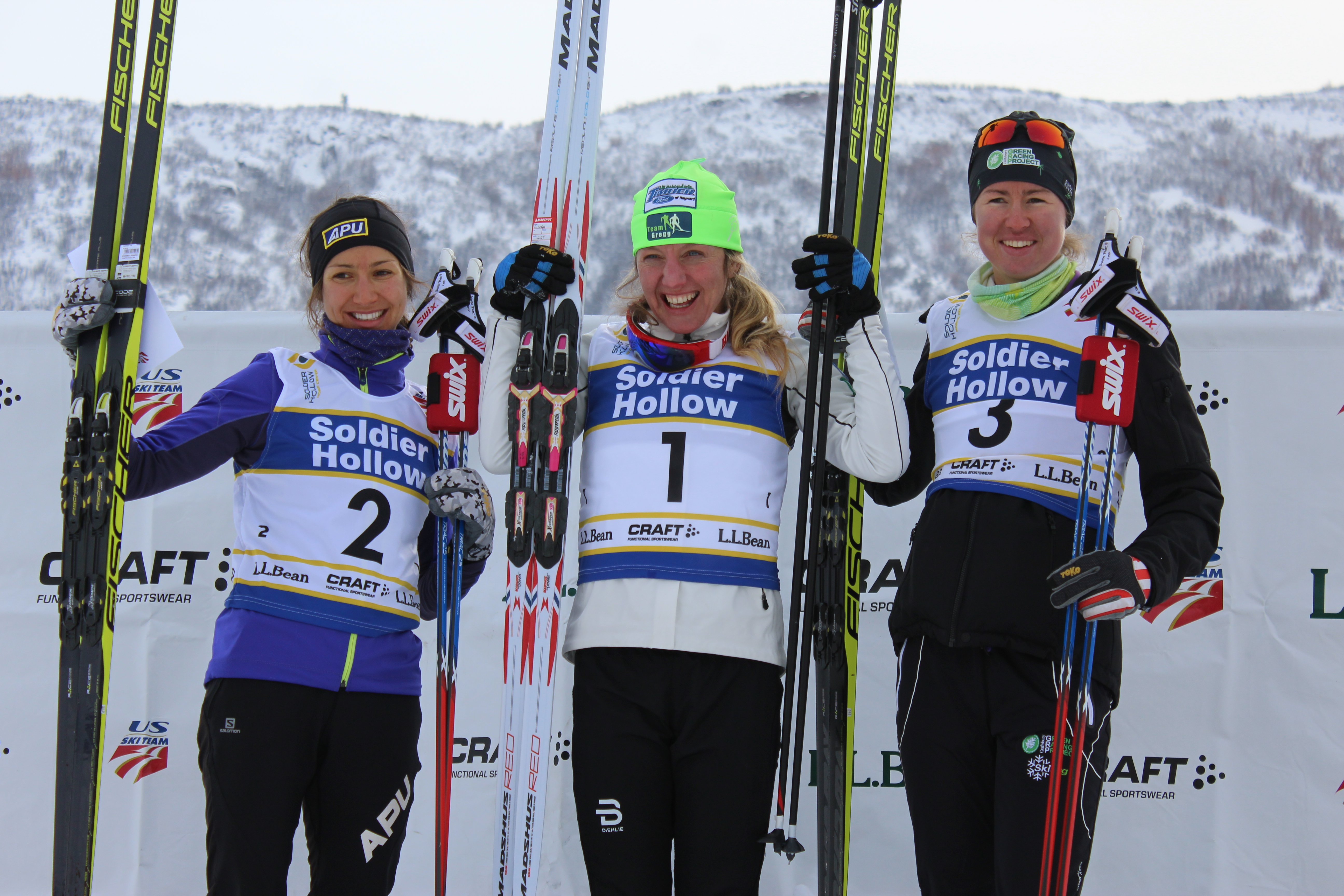
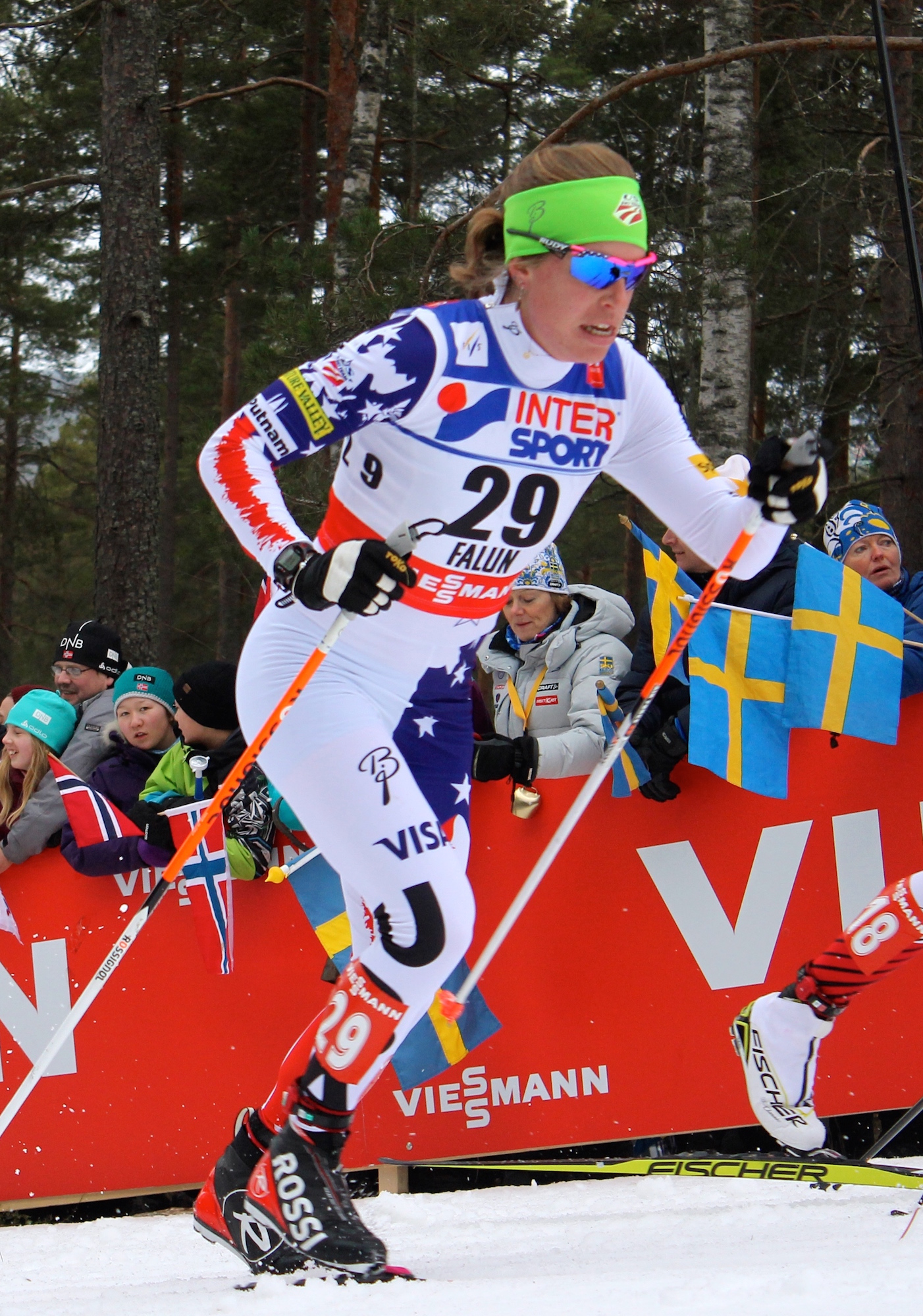
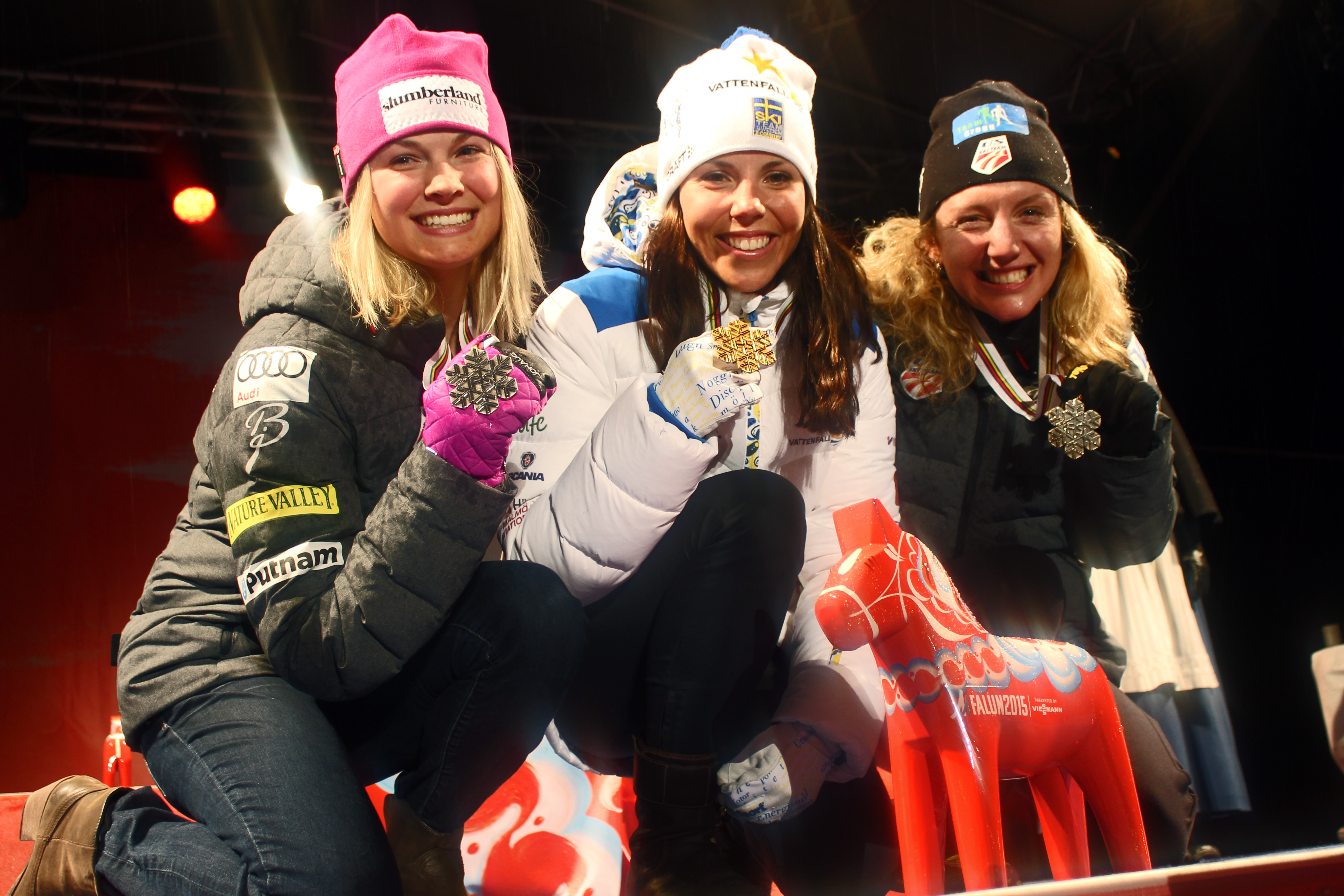
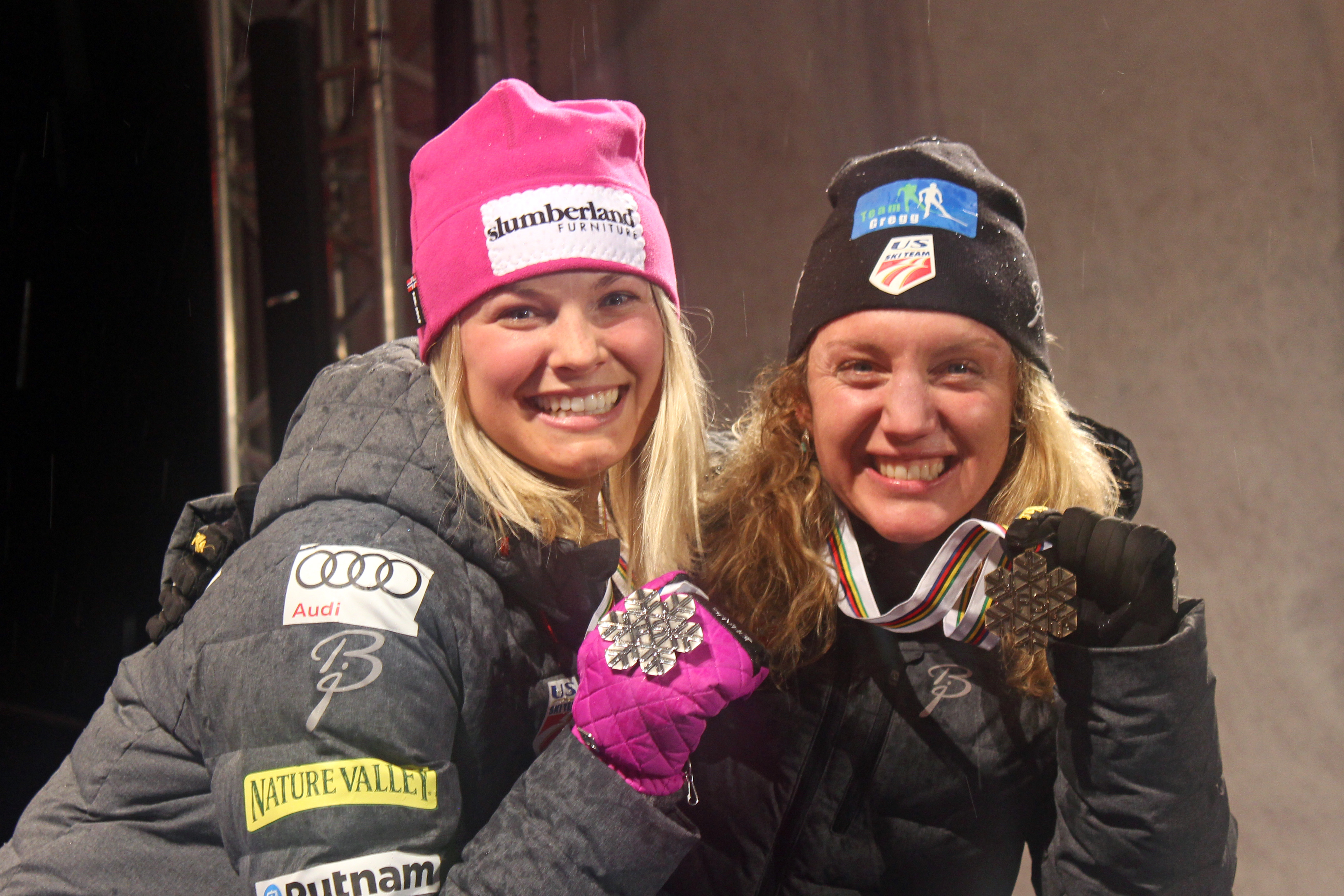
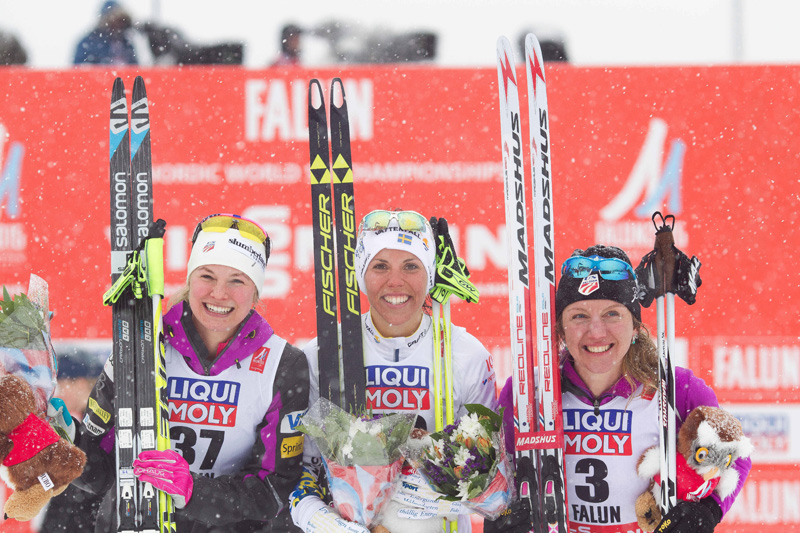
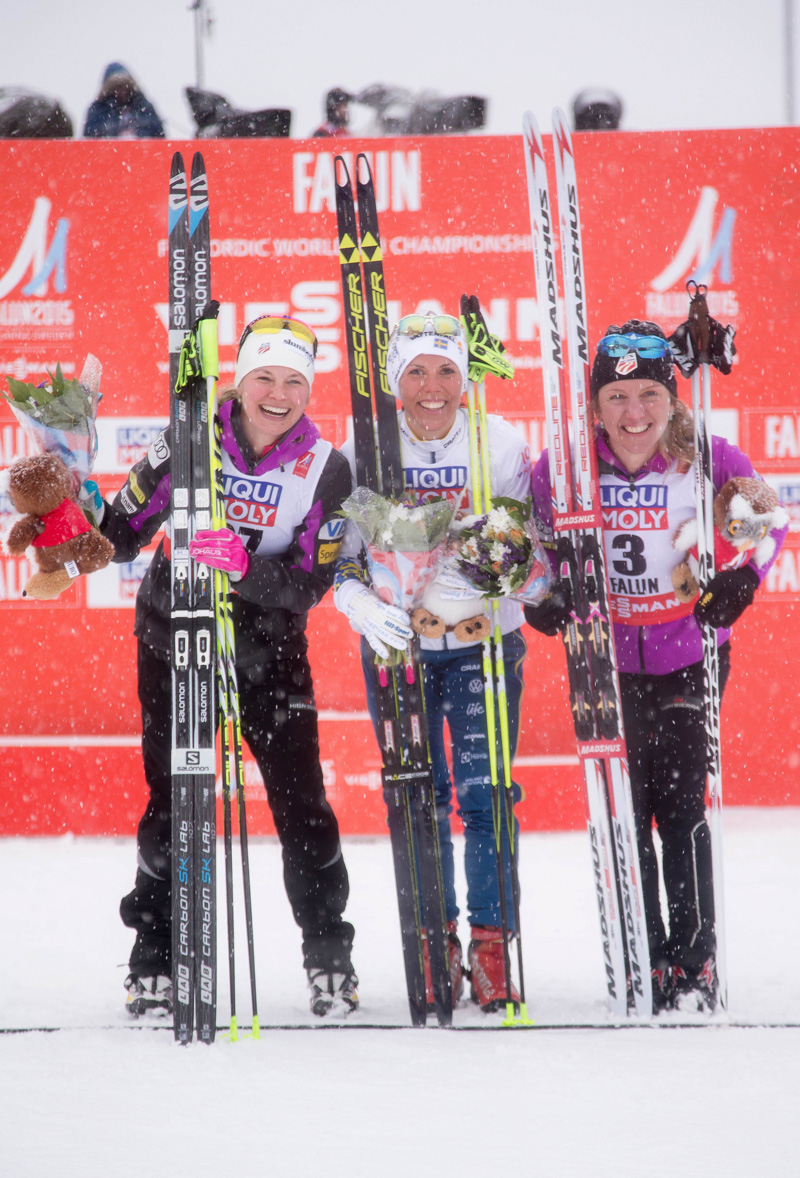
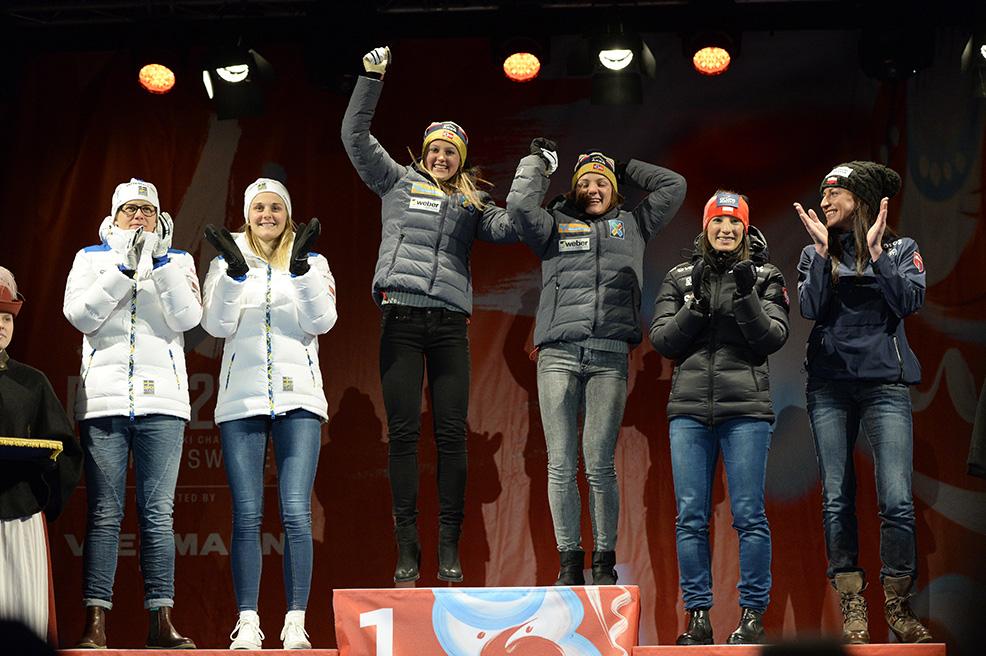
The women’s 10 k freestyle podium on the first day of 2017 U.S. Cross Country Championships at Soldier Hollow, with (from left to right) Chelsea Holmes (APU) in second, race winner Caitlin Gregg (Team Gregg) and Caitlin Patterson (Craftsbury Green Racing Project) in third on Saturday in Midway, Utah.
MIDWAY, Utah — With four grueling uphills per lap, the new U.S. Cross Country Championships women’s 10-kilometer course at Soldier Hollow (SoHo) totals some 400 meters of solid incline. Divide those 400 meters by eight and what do you get? The hill metricCaitlin Gregg, based in Minneapolis/St. Paul, Minn., has used as a race-season springboard for the past nine years.
Maybe flats are easier to find on Gregg’s Twin City turf than the hills that abound in SoHo. But the 36 year old still considers herself a climber.
Gregg proved a point after she won by 2.2 seconds in the women’s 10 k freestyle on Saturday, the first day of nationals: put a hill, any hill, in front of her and she’s going to climb it — whatever form that hill happens to take.
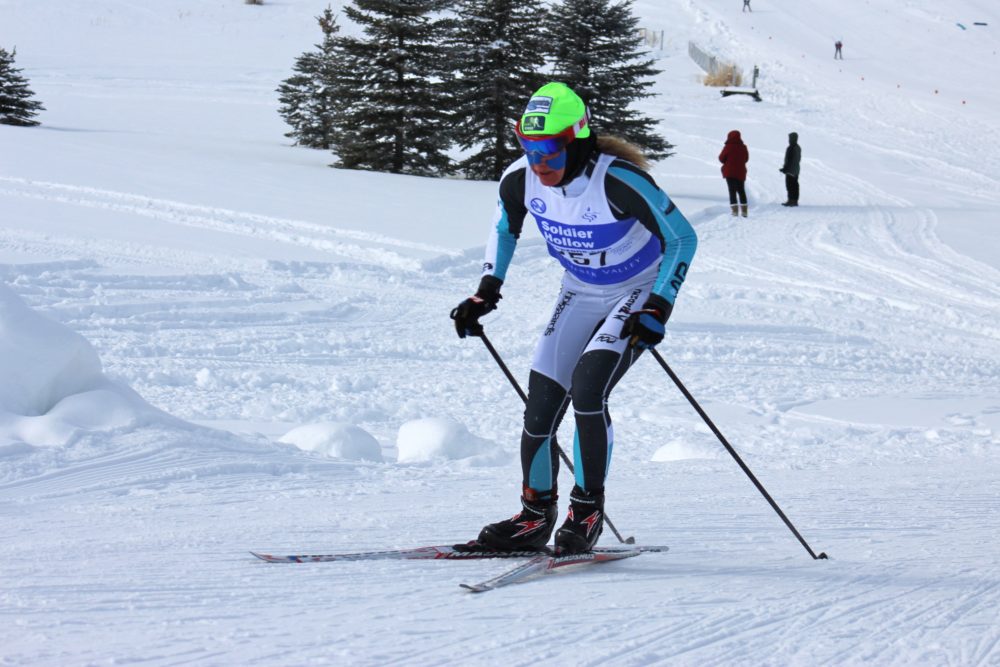
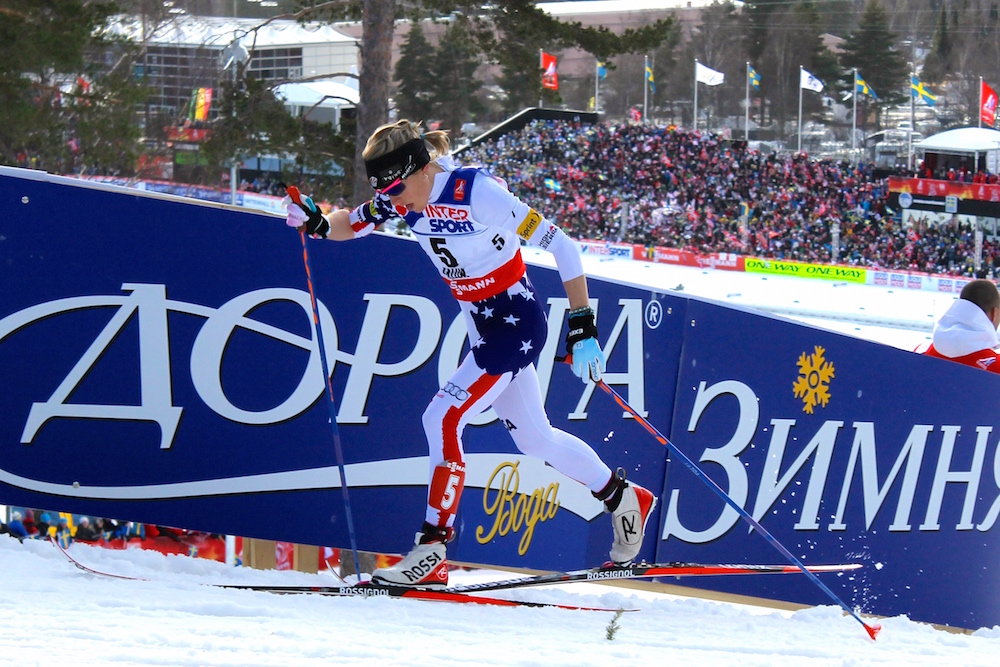
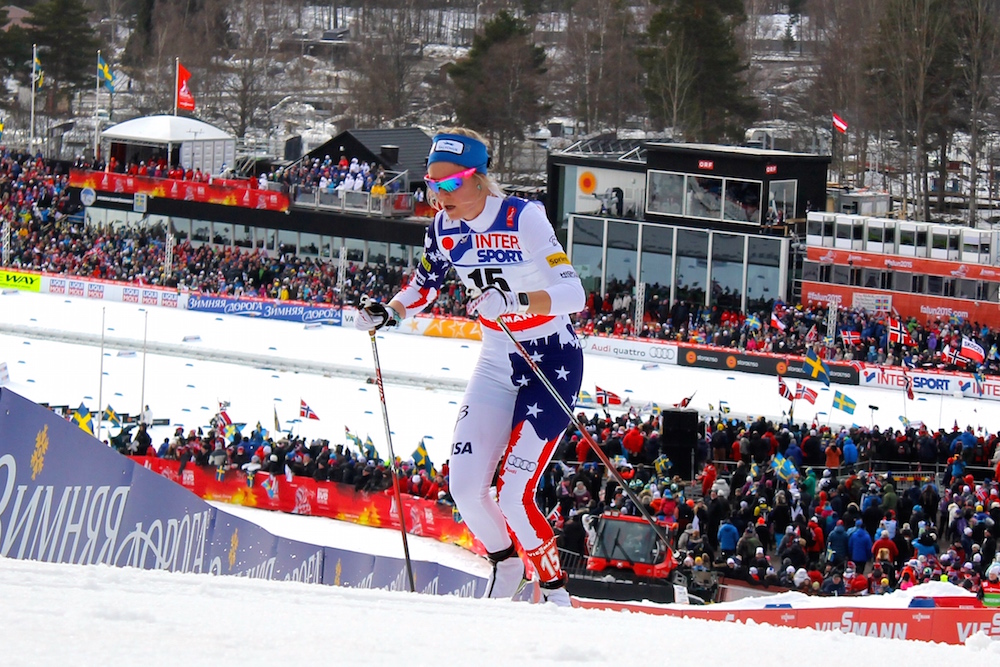
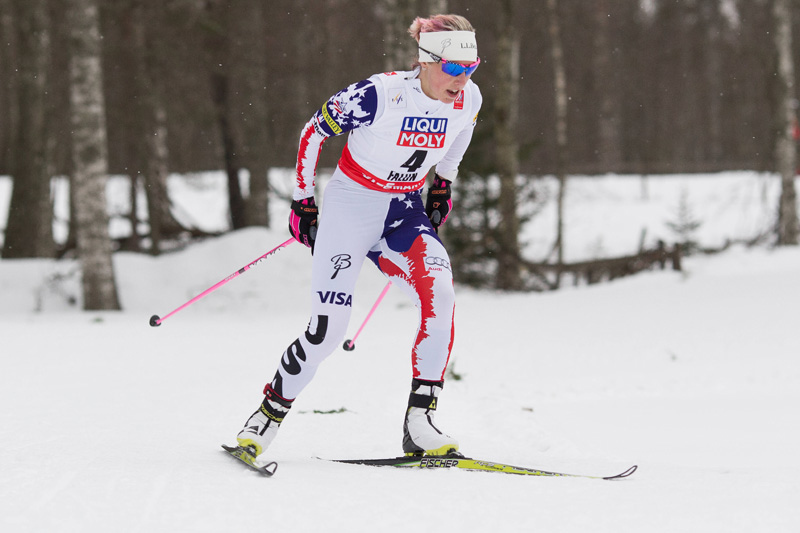
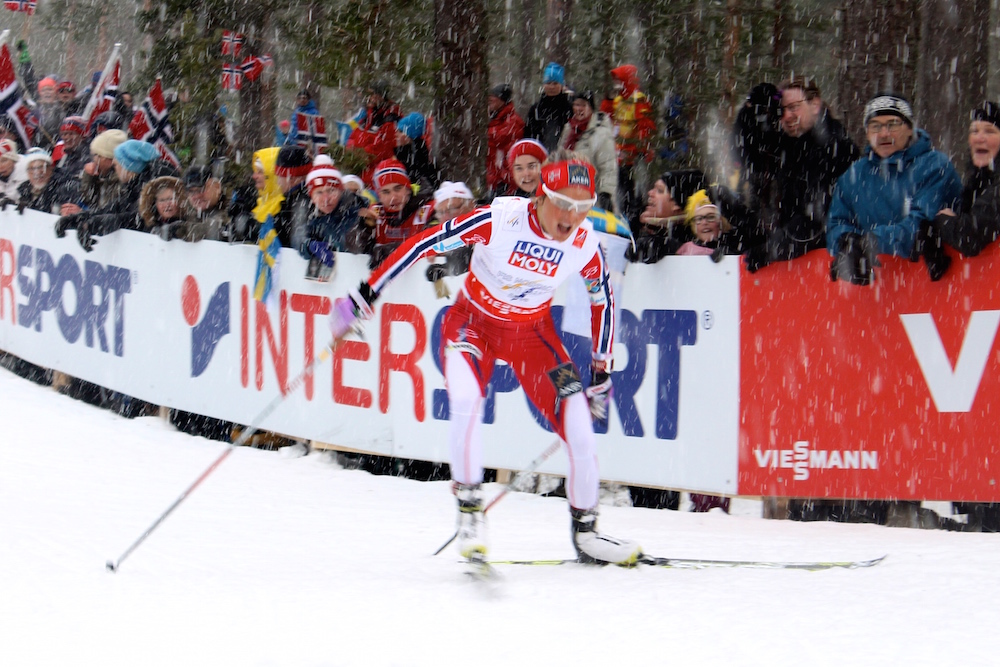
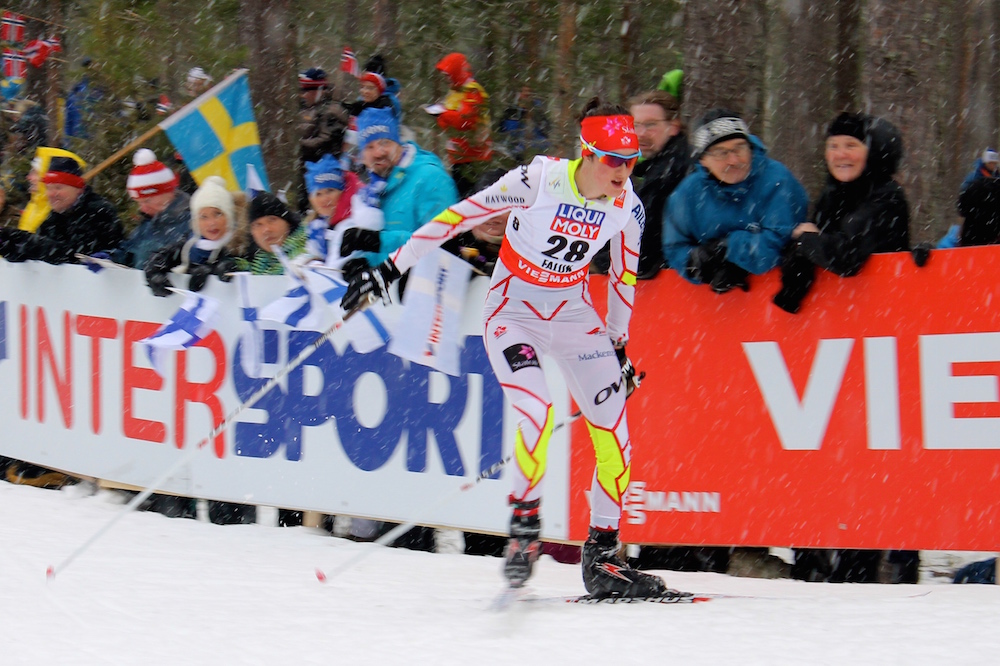
Caitlin Gregg of Team Gregg on her way to a first place finish in the women’s 10-kilometer freestyle event on Saturday at U.S. nationals in Midway, Utah.
In 2014, Gregg missed making the U.S. Olympic team, after competing in Vancouver in 2010.
Now representing Team Gregg with her husband Brian, she has her sights set on 2017 World Championships in Lahti, Finland. Gregg’s chances for world champs, however, depend greatly on her performances this week at U.S. nationals.
So far, with her first place finish in 27:00.6 — Gregg’s eighth national title, according to the International Ski Federation (FIS) records — she’s off to a good start.
“My competition has been really strong this year and that is something that I don’t think is a negative at all,” Gregg told FasterSkier on Saturday. “The goal of this entire country is to really step it up and be more competitive on the international field.”
“I want it to be the top athlete, whoever it is [who goes to World Championships],” Gregg said. “Whether it is me or not, I just want [today’s 10 k] to be an opportunity for domestic athletes to get there.”
The other domestic athletes Gregg referred in particular were her Saturday podium counterparts, Chelsea Holmes of Alaska Pacific University (APU), who finished second (+2.2), and Caitlin Patterson of the Craftsbury Green Racing Project (CGRP) in third (+9.1).
Holmes earned World Cup starts last season and competed in the Ski Tour Canada, where she scored her first World Cup points. She explained she is taking the U.S. nationals day by day.
“For me, I just try focusing on every day doing my best,” Holmes said. “I’m not a number person. I just try to do as best as I can and I kind of see where it gets me.”
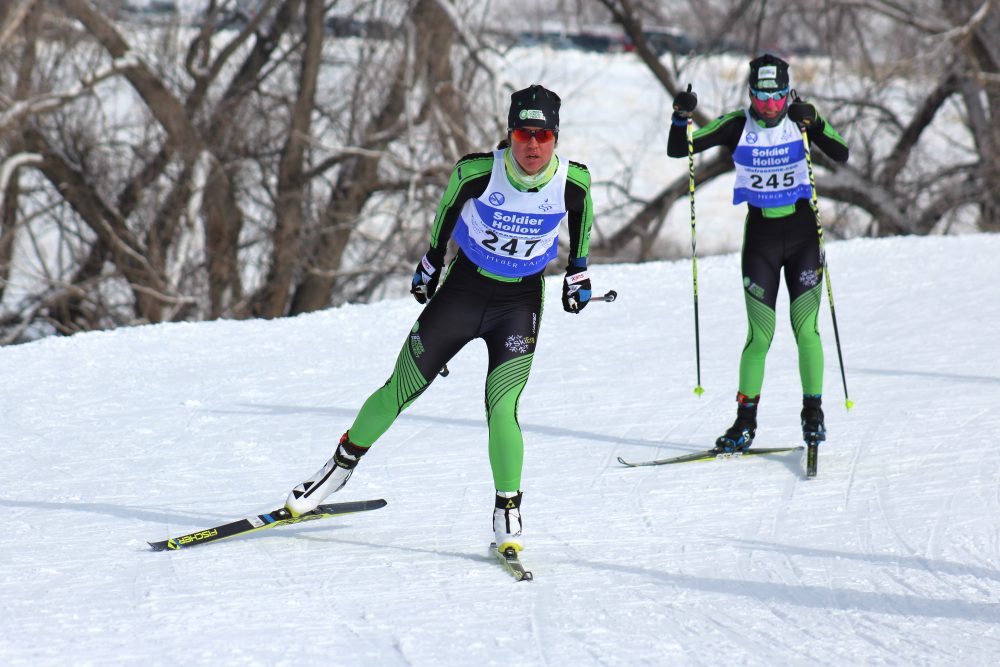
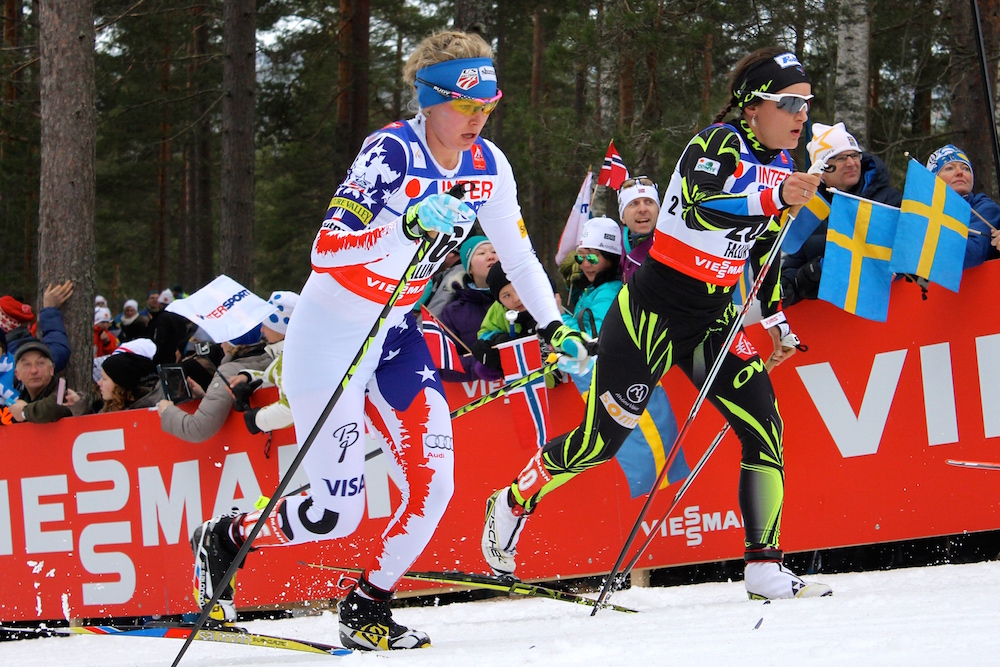
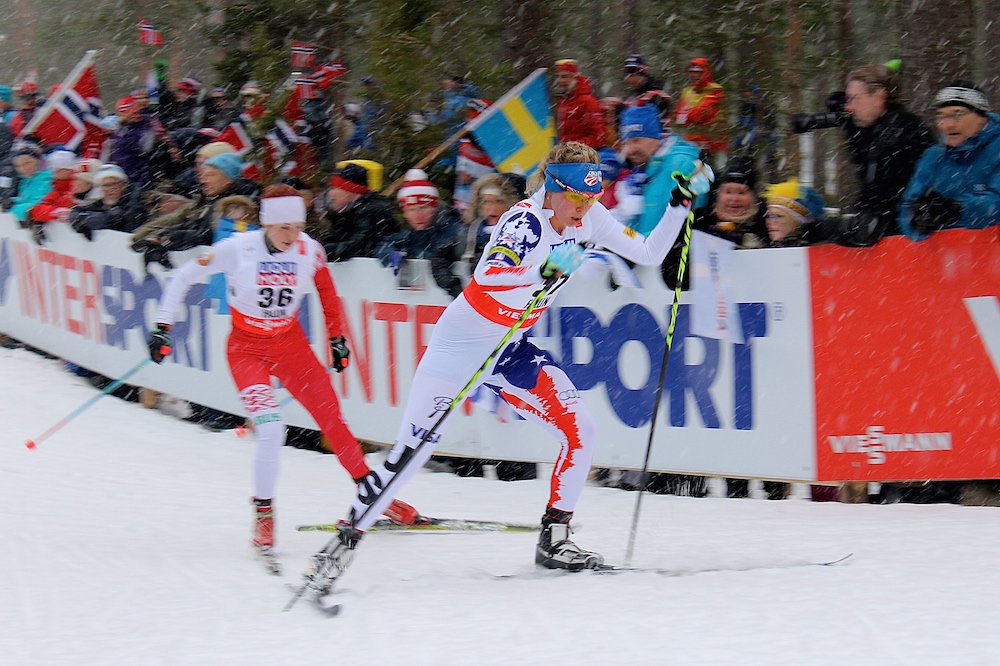
Caitlin Patterson leading her Craftsbury Green Racing Project teammate Kaitlynn Miller during the women’s 10-kilometer freestyle on Saturday at U.S. nationals in Midway, Utah.
Patterson, on the other hand, recently returned to the U.S. after racing on the World Cup for Period 1. She also scored World Cup points in November, and entered nationals confident she was a podium contender.
“I had some pretty solid races [in Period 1] – some ups and downs there, too – and I was certainly hoping to come back and be able to have a strong showing here today,” Patterson said on Saturday. “Today was actually a little bit of a tough day for me, I didn’t quite feel as snappy as I was hoping, but I ended up OK.”
Both Patterson and Holmes started in front of Gregg, who indicated she received no specific splits. But she did hear her positions being called out. At various points they ranged from second to fifth and sixth.
“I didn’t really have a rabbit,” Gregg said. “So I tried to catch as many people as I could. I knew it really wasn’t really the longevity that was the issue it was just the right moment to attack. So I made a plan to attack at about 6 k and attack hard.”
Around 6 k, Gregg did as she planned and put down the hammer, especially on the uphills. Despite being “in the hurt train” during her last 4 k of racing, she finished with just over two seconds to spare on second place.
“It was more about racing against myself,” Gregg explained. “Be patient and then go.”
Katharine Ogden of the U.S. Ski Team and Stratton Mountain School was fourth (+20.0) and the first under-23 finisher. Becca Rorabaugh and Rosie Frankowski finished fifth (+58.4) and sixth (+1:05.0), respectfully, to give APU three of the top six.
“I felt like I was able to move pretty well, most of it, but you really had to keep the pressure on the whole time,” Rorabaugh said. “Your body didn’t want to do it today, but you had to kind of just go there anyway.”
Originally from Fairbanks, Alaska, Rorabaugh said the cold weather on Saturday morning — which delayed the women’s start by an hour — suited her.
“I mean, I’m from Fairbanks. I can’t help it, I like it a little bit,” she said. “I wouldn’t consider myself as much of a skate skier, so this is my best skate result at nationals in a distance race so I’m excited about that. But I think the cold, definitely I have a comfort in the cold.”
Taylor Fletcher delivered the 2015 FasterSkier nordic combined performance of the year. (photo: Flyingpointroad)
Taylor Fletcher
The youngest of the two Fletcher brothers is doubling up with his second FS Award of 2015, this time in the performance category for his showing in Sapporo, Japan.
There in late January, Taylor, 24, rose from 28th on the large hill to third in the 10-kilometer Gundersen start with the fastest cross-country time for his second-career World Cup podium.
He worked with older brother Bryan, who jumped to 27th and started two seconds ahead of him, as the two tried to pick off the places with a “controlled but quick pace,” according to Taylor.
While Bryan was battling sinus/head cold symptoms in Japan and planned to settle into the lead group once they caught it, Taylor wasn’t ready to let up.
“Taylor went right to the front, as soon as he did that the group shattered and guys were coming off the back,” Bryan recalled.
Taylor continued to push the pace, dwindling the pack of 15 into two remaining groups of three and five. Ultimately, the race came down to an all-out sprint for the final 1 1/2 kilometers.
“It was a matter of putting yourself in a position at the end,” Taylor wrote in an email. “I decided it was better to ‘Go Ugly, Early’ and not wait for the field sprint. So just into the first hill I made almost a cycling attack and tried to get away from the rest of the skiers.”
Two men passed him in the stadium before the finish: German winner Eric Frenzel, who topped him by 3.5 seconds and Japan’s Akito Watabe, who was 1.7 seconds ahead of him in second. The bronze medal marked Taylor’s second individual podium since 2013 in Seefeld, Austria.
“To get another podium feels incredible as I knew it was possible,” Taylor wrote. “My last podium was not a fluke. I have been struggling with my jumping for a year and half now but in the last couple weeks it has been getting better.”
Honorable mention
Bryan Fletcher
While Bryan placed eighth that day in Sapporo and skied the second-fastest 10 k behind his brother, that wasn’t the single performance that earned him honorable mention.
At 2015 World Championships in Falun, Sweden, the 28-year-old Bryan notched his season-best individual result (and career best in four World Championships) of fifth in the large-hill/10 k. He skied up from 13th to do so.
“It was like, ‘Well since these are the Championships, and it’s not really worth being anything but on the podium, I’m just going to go for it as hard as possible and lay it all out there,’ ” he recalled.
He started 44 seconds behind Austria’s Bernhard Gruber, who led the competition after the jump, and finished 23.4 seconds behind Gruber, who also won outright. Bryan was 8.5 seconds off the podium and 8.3 seconds out of fourth.
“To be on the podium would have been a dream come true, but to be in the fight was more what I was really looking for,” Bryan said after his career-best World Championships individual result.
“I really just want to ski a good race, a good race to the best of my ability and the best of my performance,” he added. “I was happy that I was able to do that today.”
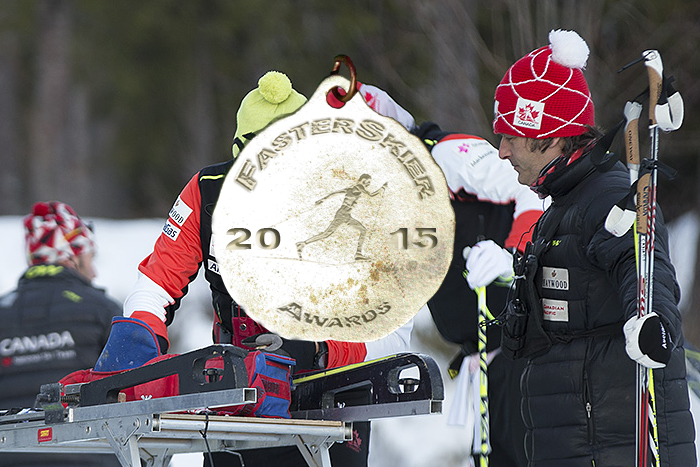
Louis Bouchard (r), a Canadian World Cup Team coach and Alex Harvey’s personal coach, at work with the team’s wax staff. Bouchard is FasterSkier’s pick for 2015 Coach of the Year. (Photo: Cross Country Canada)
With the 2014/2015 season officially in the rearview, FasterSkier is excited to unveil its annual award winners for this past winter. Votes stem from the FS staff, scattered across the U.S. and Canada, and while not scientific, they are intended to reflect a broader sense of the season in review.
***
Louis Bouchard has been Alex Harvey’s go-to coach for the last decade and the man in charge of the Pierre-Harvey Training Centre — one of three national training academies in Canada — for 15 years.
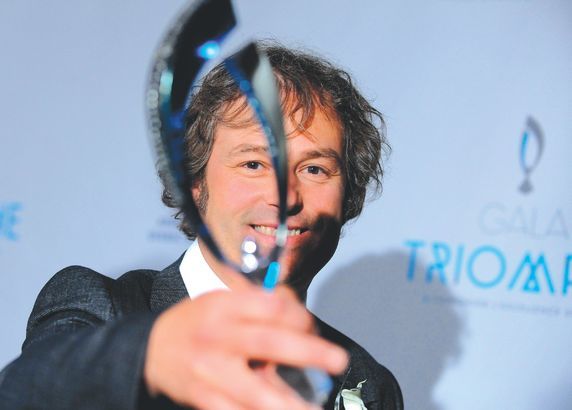
Also Cross Country Canada’s co-World Cup coach, Bouchard is well known across the country and internationally. He’s won multiple awards, including the 2014 Gala Triomphe International Coach of the Year, one of 15 accolades recognizing top athletes, coaches, volunteers, and sporting events around Québec City.
Louis Bouchard, Gala Triomphe 2014 Coach of the Year (Photo: CCC/Simon Clark)
The soft-spoken French Canadian re-entered the spotlight this past February when Harvey, 26, lunged for a best-ever silver in the classic sprint at 2015 World Championships in Falun, Sweden. Not only had Harvey outdone his previous best of third in the classic sprint at 2013 World Championships, he also secured an important initial medal for Canada.
“Now we can expect so many things,” Bouchard said after the Falun sprint. “You need it for the program. You need it for the development. That is a benefit for everybody in Canada, so that is good.”
Development was key when it came to Harvey’s rise to two individual medals at 2015 World Championships in the classic sprint and the skiathlon (in which he took bronze two days later).
“He’s more stable, he has less injury, he can train more and recover more, so I think it’s normal to expect to see him get better and better at 26 years old,” Bouchard said.
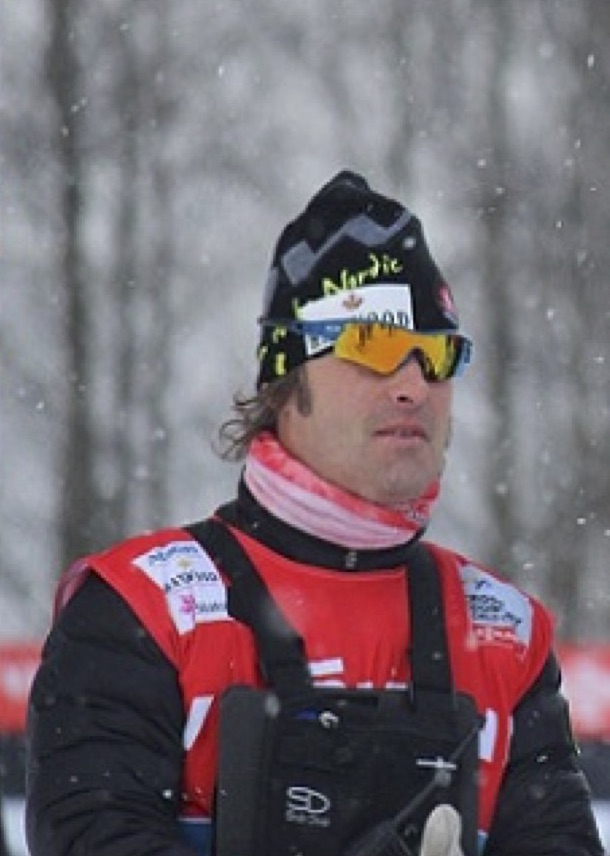
Louis Bouchard (Photo: CCC)
And Bouchard is also responsible for developing a strong contingent of up-and-coming skiers in and around Québec City. Five of his athletes were nominated to the 2015/2016 national junior team (Anne-Marie Comeau, Marie Corriveau, Phillipe Boucher, Zachary Cristofanilli, and Olivier Hamel), and Cendrine Browne was one of five women named to Canada’s senior team (specifically, the C-U23 development team).
“I spend a lot of time thanking the people who occupy each of the development stages in my sport. Without them, I would not have this success,” Bouchard said after receiving his 2014 Gala Triomphe award, according to a translation. “I’m just finishing a job that was started long ago with Alex, as well as other athletes. All these people are important.
“We have developed a healthy human relationship exchange,” he added. “Alex is an academic, me, coach. He teaches me and I learn it.”
This season, Bouchard and national-team head coach Justin Wadsworth will trade off weekends heading the World Cup Team in Europe. The two have worked together with the team’s highest-level athletes for the last five years.
“Louis and I [have] a great relationship and great communication,” Wadsworth said shortly after CCC announced its integrated coaching structure in April. “I think that working relationship now is almost stronger than ever.”
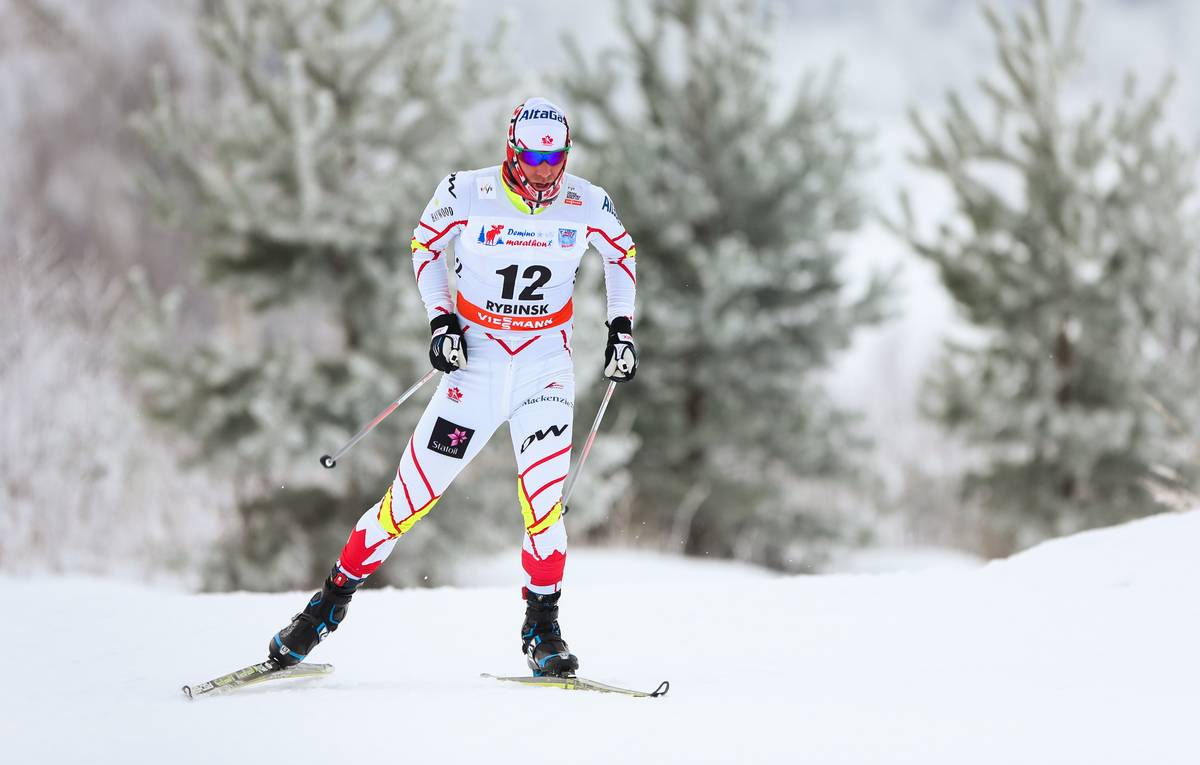
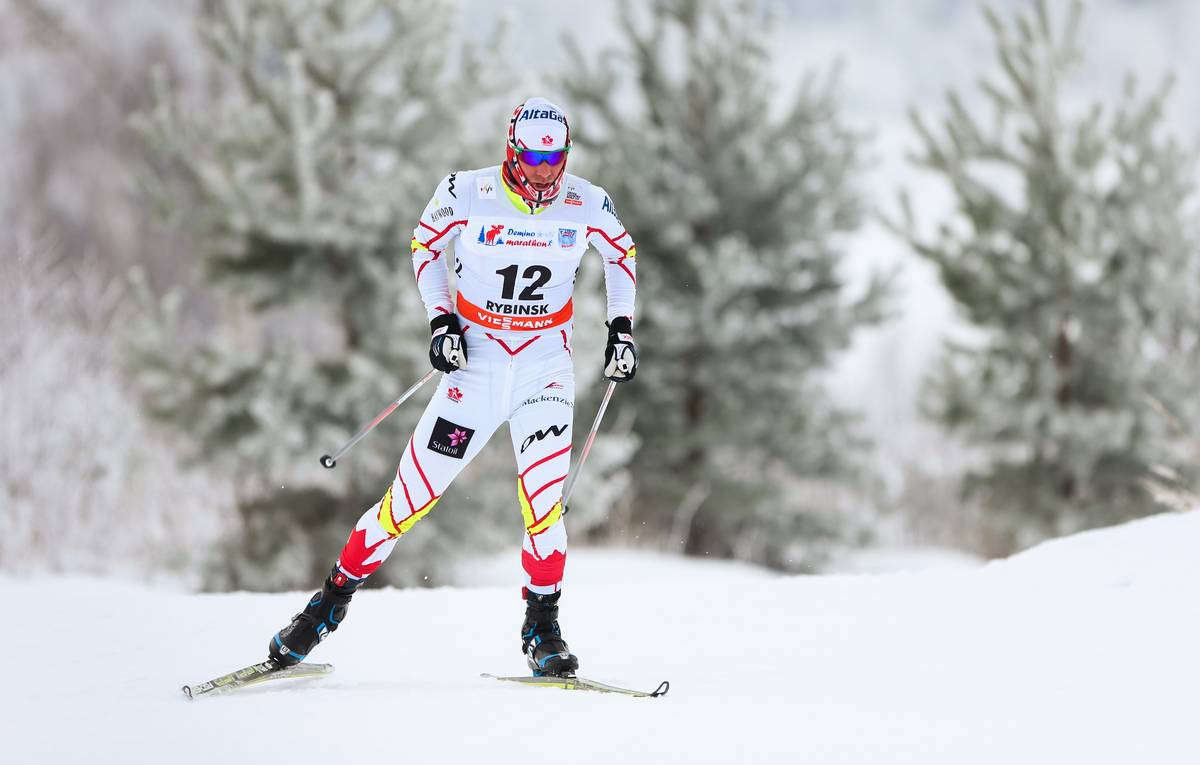
Devon Kershaw (Canadian World Cup Team) racing to 36th in the World Cup 15 k freestyle individual start on Jan. 23 in Rybinsk, Russia. (Photo: Fischer/NordicFocus)
What started out like any other cold turned into a season-ending downward spiral for Devon Kershaw, who, in the midst of what would have been his eighth World Championships, had to forgo racing and head to his fiancée’s home in Oslo, Norway, to recover.
A day after being diagnosed with mycoplasma pneumonia, commonly known as walking pneumonia, Kershaw found himself in the car last Saturday with his mom and fiancée Kristin Størmer Steira’s parents — driving from Falun, Sweden, to Oslo.
It all happened fairly fast, but the 32-year-old Canadian World Cup Team member couldn’t say he didn’t see it coming.
“The World Cup weekend in Östersund [Sweden], I came down with a really light cold, nothing that serious, just had a little bit of coughing and not feeling that good and a little bit of congestion,” Kershaw, a 2011 World Championships team-sprint champion with Alex Harvey, said in a phone interview on Wednesday.
“It was a really wussy cold, but I wanted to be careful ahead of World Championships so I didn’t travel down with the team from Östersund to Falun,” he explained. “I stayed up in Östersund, but I just never got better and the races kept ticking by.”
Devon Kershaw tuning up his classic sprinting in a preseason race on Oct. 24 at Frozen Thunder at home in Canmore, Alberta. (Photo: Angus Cockney)
At World Championships in Falun, Kershaw had planned to do the classic sprint, 30-kilometer skiathlon, 4 x 10 k relay, and 50 k classic mass start, as well as the team sprint if he raced well enough to make the two-man team.
But with each passing day and little improvement in his health, the races went on without him. Kershaw remained in Östersund until Sunday, Feb. 22, when he drove to Falun with three other teammates that had been fighting illness as well. While each of them got better and competed in the championships, he didn’t.
The morning of his trip to Falun, Kershaw started coughing uncontrollably. Unable to stay in Östersund, he traveled with his teammates to Falun. Burdened with a dry cough there, he felt his energy had improved.
“I think I started lying to myself because I really wanted to race the relay on Friday,” he reflected. “I was trying to ski, but I didn’t do any intensity or anything and it was just getting worse and worse. I wasn’t sleeping that well because every time I lied down I’d cough incessantly and we didn’t have a team doctor with us at that point.”
By the time he got there, Harvey’s mom, Canada’s volunteer doctor for beginning of World Championships, was already on her way fly back to Quebec.
“That week we didn’t have the team doctor with us,” Kershaw explained. “Thursday I tried skiing again and realized really fast that I wasn’t going to be able to do [the relay]. I was just feeling way too bad and coughing like crazy, couldn’t ski at all without having to stop and really cough, like lung-busting coughing.”
He arranged to meet with Norway’s team doctor, Knute Gabrielsen, and physiologist, Erland Hem, whom he described as an expert on lung function.
“They checked me out and did a bunch of tests and it turns out I had mycoplasma pneumonia,” Kershaw explained. “That ended my World Championships and ended the season actually. There’s only two weeks left of the season and I won’t be able to recover in time to do the 50 k in Holmenkollen [on March 14]. It’s too close. Especially a 50 k race, it’s not going to happen.”
He last raced Jan. 25 at the World Cup in Rybinsk, Russia, where he was 34th in the 30 k skiathlon and 36th in the 15 k freestyle on Jan. 23.
“I’m gutted,” he said. “My season ended before it started. Like every team, my training was really tailored towards the four [or] five races at the World Championships and I felt like I was in really good shape coming out of the training camp we did, and I have a lot of experience, too, so I trust that shape. … To not even get the chance to use it at all is really discouraging.”
“It’s like my car broke down on the way to the exam, but I live like far away and there’s no way I can get to the exam, and I got a zero.” — Devon Kershaw on having his season end with walking pneumonia
He started on antibiotics as soon as he was diagnosed, but as of Wednesday of this week, Kershaw said they didn’t seem to be working as well as he’d hoped. He wasn’t sleeping through the night and the inhalers he was on hadn’t cleared his lungs.
“I think the name of the game is really just patience,” he said.
Looking back on his season, essentially two months long, Kershaw described it as “bad,” with highlights at the World Cup opener in Kuusamo, Finland, where he placed 14th in the 15 k classic, and in the Tour de Ski freestyle sprint, when he qualified for the first time this season and finished 22nd. Over the next two stages of the Tour, he placed 21st in the 10 k classic and 25th in the 25 k freestyle pursuit.
“If you look through my history, my speed before Christmas … especially in sprint qualifiers, is usually pretty bad. I think I’ve only been in the final once before Christmas in my whole career,” he said. “So I wasn’t qualifying before Christmas, which was kind of normal but a bit frustrating and skating was a real problem…
“The Tour wasn’t spectacular by any stretch of the imagination; it started actually quite bad. Again the skating just wasn’t quite feeling that great,” he continued. “We had a major debacle with the skis in the 15 k [classic] mass start in Val di Fiemme the [second-to-last stage] of the Tour de Ski and that destroyed all our chances. Ivan [Babikov] and Alex and myself, we were minutes behind with like some of the worst skis I’ve ever had. That ended the Tour right there, which was tough. [Then leading up to] Rybinsk, I was training a ton and doing a lot of volume and my mind was on the World Championships so it didn’t really work out that well in Rybinsk, either…”
So that was it. For the last week, Kershaw said he was doing his best to pass the time, playing some guitar and trying to get his energy back. Once he started feeling better, he planned to finalize some wedding plans with Steira in Lofoten, a group of islands in northern Norway. The two have a wedding date set there for July 26.
He also planned to get an X-ray in a month to check on his recovery.
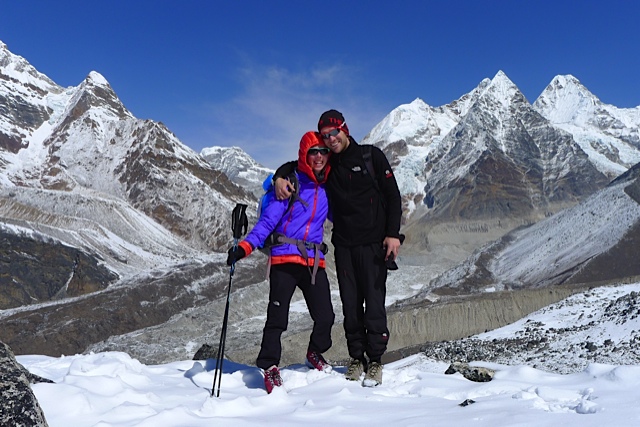
Kristin Størmer Steira (l) and Devon Kershaw during a day hike on one of their acclimatization days in Nepal’s Himalayas. The couple got engaged last April after summiting Mera Peak during a three-week trek. (Photo: Devon Kershaw)
Meanwhile, Steira was taking classes toward her MBA degree and healing a foot injury she sustained on a run two days before the 30 k classic mass start at World Championships. That prevented the 33-year-old Norwegian from competing in what would have been her seventh World Championships. A fractured pelvis previously derailed the first half of Steira’s season.
“This week she’s trying to get some answers and in the meantime she’s going to school,” Kershaw said on Wednesday. “She’s had an MRI done, but she hasn’t heard anything yet. She’s pretty discouraged, too. She trains so hard. To come back from a fractured pelvis and even make the Norwegian [World Championships] team is ridiculous. I was really proud of her. When she called me and said, ‘I can’t kick my skis. My foot’s really sore,’ I’m just like, ‘What? Two days ago you were just so smiley and good and loving it and things were great.’ So she had some really bad luck, too.”
If Kershaw is feeling up to it and still in Oslo (not up north in Lofoten) next weekend, he explained he would watch the 30 and 50 k season-ending World Cup races in Holmenkollen.
“That might be wishful thinking, but we’ll just see how the body recovers,” he stated. “It’s always so hard to watch races that you want desperately to be competing in, but that’s life sometimes and you got to take your knocks on the chin and keep going.”
In late April, he said he’ll head back to Canada to hopefully do some ski touring before revving up for another season. If Steira’s foot injury isn’t too serious, she’ll likely join him in May in Canmore, Alberta.
“I would like to ski next year purely because you can’t go out like this,” Kershaw said. “I showed that I can still ski at an international level and I know that I can still do the training that allowed me to. I was in good shape before all this happened and I know that’s lip service now, but at the same time I do have a wealth of experience. It’s not like I was getting murdered-murdered on the World Cup every weekend.”
Next year, he’s looking forward to competing at 2016 World Cup Finals, dubbed the Tour du Canada, which will take place at five venues across Canada: Gatineau, Montréal, Québec City, Canmore, and Lake Louise.
“Racing at home like that is a pretty incredible opportunity,” Kershaw said. “In the short term, it’s hard mentally, you feel like you’re beat up. You did so much in preparation. I’ve already trained 800 hours already this year and all for what? At the end of the day you’re like, God damn. It’s like my car broke down on the way to the exam, but I live like far away and there’s no way I can get to the exam, and I got a zero. Not being able to sit down and write it is going to take some time to get over for sure, but I’m still keen and I think we have a good team.
“This year for sure, Alex has been a major standout. For the last two seasons, no questions, Alex has been keeping our team afloat because others, myself included, we haven’t delivered like we have in the past,” he added. “So it’s time for us to start pulling our weight a bit joining Alex on the international level. I’m still motivated, absolutely, but you want to do it properly, too. We’ll just have to see how long it takes to fully recover from this.”
Canada’s Alex Harvey (l) leads Russia’s Maxim Vylegzhanin (4) and the Czech Republic’s Lukas Bauer (29) up a steep hill around 29 k in the men’s 50 k classic mass start at 2015 World Championships in Falun, Sweden.
FasterSkier’s coverage of the 2015 FIS Nordic World Ski Championships in Falun, Sweden, is brought to you by the generous support of L.L. Bean, now featuring a complete line of Kikkan Randall training wear.
FALUN, Sweden — After two medals at the 2015 FIS Nordic World Ski Championships, it was easy for Alex Harvey to think what could have been in the moments after the men’s 50-kilometer classic mass start on Sunday.
He had just been recognized at a snowy medals ceremony, held in the center of the stadium on the final day of Falun’s World Championships. But instead of a gold, silver or bronze, the 26-year-old Canadian received a wooden horse.
Fifth wasn’t what he had gone into the race hoping for, and had he made a few different decisions during it, Harvey couldn’t help but speculate he would have been in podium contention by the finish.
“I should have adapted my strategy better in the race and not try to go for the breaks,” Harvey said, noting the snowfall and choppy conditions made it nearly impossible to ski away from the group. “It is my best championship ever so I am really happy, but today, it felt like I could have got a bit better.”
Conditions were as slow as they get on Sunday, once again a few degrees above freezing and with wet snowfall — which came down heavily at times during the race — that made the salted course even softer.
“It was one of the slowest 50 k’s in modern history,” Harvey said, referring to the winning time of 2 hours, 26 minutes. “It was slow everywhere.”
“Some places it was perfect, really nice, and some places it was just mashed potatoes,” said his teammate, Ivan Babikov. “Couldn’t ski, couldn’t walk it, especially at the beginning of [each] lap, it was really bad. … The last uphill was the worst … just going in knee-deep slush.”
Canada’s Graeme Killick skiing with eventual winner, Petter Northug of Norway (r), around 14 k of the men’s 50 k classic mass start at 2015 World Championships. Killick went on to place 19th for a career-best international result.
Canada’s third man in the race, 26-year-old Graeme Killick, found the hardest part to be the initial ascent out of the stadium.
“It was so loose, you felt like you needed a canoe to get through [it],” Killick said.
Harvey, Babikov and Killick all put themselves squarely in the lead pack out of the start. At 3.3 k, Harvey and Babikov were in the top seven, within 2.4 seconds of the leader (Norway’s Didrik Tønseth at the time). Upon returning to the stadium at 5 k, Harvey and Babikov skied together in seventh and eighth, still 2.4 seconds back, while Killick was another eight seconds behind in 30th.
After topping the biggest climb on the course, affectionately known as Mördarbacken, Babikov and Harvey led the 49-man pack with American Noah Hoffman and Great Britain’s Andrew Musgrave just behind them. There, at 7.8 k, Killick was 2.4 seconds back in 13th.
“When you’re going easy, you might as well be in the front, because then that’s when everybody’s sketchy on the downhills,” Harvey explained. “There’s guys who are not going easy just to follow that pace, and they’re sketch on the downhills. So when the pace is that slow, it’s good to be at the front.”
At the bottom of the course at 10 k, Babikov was still in the lead, just ahead of Hoffman and Finland’s Matti Heikkinen, as well as Sweden’s defending 50 k world champion, Johan Olsson. Over the next 10-plus kilometers, Olsson took control up front, sharing the workload with competitors like Heikkinen, Tønseth and Russia’s Maxim Vylegzhanin.
But the Swede never made the move that Harvey, for one, was waiting for.
“Everybody thought Olsson would try to break away,” Harvey recalled. “He was trying — he would open 15-second gaps and stuff, but it would always come back on the downhill.
“I should have read the situation better and adapted the plan more than I did,” he added. “I knew Olsson was in good shape and really motivated, but with the snow falling there was … no point trying to break away. [I] spent a lot of energy there.”
Norway’s Niklas Dyrhaug and Sweden’s Anders Södergren spent some time in the limelight leading for much of the third of five 10 k complete laps.
At 27.8 k, once again at the top of Mördarbacken, Harvey led again, ahead of Vylegzhanin and the Czech Republic’s Lukas Bauer, while Olsson hung in seventh, 5 seconds behind. Killick and Babikov were about 12 seconds back in the top 30.
At 30 k, Olsson left the stadium first, 0.9 seconds ahead of Vylegzhanin and 1.5 seconds ahead of Kazakhstan’s Alexey Poltoranin in third, while Harvey skied 1.9 seconds back in fourth. Babikov was within four seconds of the lead in sixth, and Killick was just 6.2 seconds back in eighth.
“Our skis were just amazing,” Killick said. “You can feel better than what you’re actually at so I was keeping that in mind, just trying to stay as relaxed as possible and even if I felt like I could be skiing right up at the front, just trying to stay relaxed in the top 15 there and not overdoing it on the steeps and using the skis on the downhills to get back in there.”
Ivan Babikov (20) leads Canadian teammate Alex Harvey (l) up Little Mördarbacken around 34 k into the men’s 50 k classic mass start at 2015 World Championships in Falun, Sweden.
Team tactics weren’t a part of the plan, according to Canadian National Team Head Coach Justin Wadsworth. But with three men in the lead pack, it made the race a lot more fun for the Canadians.
“It’s always easier to ski with your teammates,” Wadsworth said. “When they could do that, they were taking advantage of it. Everybody had good skis and you kind of feel a little something extra when you see your whole team up there in the front of the race for most of the race.”
Like everyone else in the race, Harvey and Killick changed their skis twice, but Babikov was one of two skiers out of 45 finishers that switched just once (Japan’s Hiroyuki Miyazawa was the other).
“I couldn’t believe that my skis were so good,” Babikov recalled.
One reporter thought he saw him laughing at one point.
“I was just smiling,” Babikov said. “I was enjoying myself.”
Around 34 k, Babikov went several meters off the front of the pack while Harvey and the rest of the group followed up Lille “Little” Mordarbacken. Both he and Harvey said the pace was slow at the time — Harvey described it as Zone 2 — and at the tops of a series of hills, Babikov glanced back, stopped and waited for everyone else to catch up.
“I didn’t realize I had a gap,” Babikov said. “It was maybe a bit foolish, but I had no idea. It was not my intention to drop the pack, I was just trying to keep the pace up [the hill] the same.”
“I couldn’t believe that my skis were so good … I was just smiling. I was enjoying myself.” — Ivan Babikov, Canadian World Cup Team member, after leading several parts of the 2015 World Championships 50 k classic mass start
At 35 k, Babikov and Killick blew past the pit stop to leave the stadium in first and third, respectively, with Bauer between them. Harvey opted to use his second available ski change and emerged from the stadium in 13th, 16 seconds back. Just over a kilometer later, Harvey was back in sixth, 12 seconds behind Södergren, who by then had opened up a nine-second gap on Olsson in second.
“We said change if your skis don’t feel good; we kind of gave him the option,” Wadsworth explained. “Killick kept going and Babs kept going, but Harvey changed, and you never know, maybe that was the right [decision].”
Ivan Babikov (Canada) leading around 34 k into the men’s 50 k classic mass start at 2015 World Championships in Falun, Sweden. He went on to place 30th.
About a kilometer later, on the far side of the course, someone skied over Babikov’s pole and broke it, Babikov said. He dropped to 24th, nearly 28 seconds out.
“I fell out of the group; it took some energy to get back,” Babikov said. “Maybe that cost me.”
By 40 k, the pack had pulled Södergren back in, with France’s Maurice Manificat, Vylegzhanin and Harvey leading the effort. Killick hung in 21st, 36 seconds back, and Babikov was in 27th, nearly 50 seconds out of first.
“It was really good for two-thirds [of the race],” Babikov said. “Last 10 k, that was really rough, I started cramping everywhere. I couldn’t even sit down on the downhill.”
Throughout the final 10 k, the pace picked up considerably, with Harvey pushing to keep himself in the medal hunt while skiing in the top 10.
“He looked strong, but the pace was going hard and I could tell he was trying to position himself, but not quite getting into the top four,” Wadsworth said.
That is, until he put himself in fifth by passing Switzerland’s Dario Cologna in the stadium before the finish. Coming off a high-speed downhill, he used his momentum to slip past Cologna and stay ahead of him on the final rise and curving descent toward the finishing straight.
“With five k to go, or by the top of Mördarbacken, I started getting low-energy levels,” Harvey said. “I was still in contention on the [final steep uphill] and then I was completely spent. … There was just four guys ahead of me by [the last rise], so I was still within reach of the podium, but I couldn’t move. I couldn’t make any speed.”
Canada’s Alex Harvey (9) works within a chase pack around 39 k with Russia’s Maxim Vylegzhanin (6), France’s Maurice Manificat (7), and Sweden’s Johan Olsson (r) during the men’s 50 k classic mass start at 2015 World Championships in Falun, Sweden.
He finished 6 seconds after Norwegian winner Petter Northug, while Bauer took silver, 1.7 seconds back, and Olsson edged Vylegzhanin for third by 0.8 seconds. Harvey finished 3.2 seconds later in fifth.
“I didn’t have anything left,” he said.
Killick placed 19th (+1:44.1) for his best international result after placing 28th in the 50 k freestyle mass start at the Olympics last year. With that performance in mind, he said he aimed for a top 30 on Sunday.
“I was just hoping I would hang in there and not cramp on the last few laps,” Killick said. “[When it comes to] 50 k’s, it seems like they’re really hit and miss for me. Domestically I’ve struggled to get top 15, but internationally, my best results have been in the 50. If I’m in shape, they can go really well, but I would say the focus for me [at World Championships] was the pursuit [skiathlon], which I didn’t end up doing because I got sick in Östersund two weeks ago. When that was out, the 50 became the main focus.”
He said the fans lining the course, which included his parents and girlfriend, helped motivate him in the tough conditions.
Graeme Killick, of the Canadian Development B-team, after finishing a career-best 19th in the 50 k classic mass start at 2015 World Championships in Falun, Sweden.
“Just the whole way up Mördarbacken, they’re cheering you the whole way,” he said. “It gives you the little bit extra to get up the hard hill like that.”
Reflecting on his season so far and first World Championships, Killick, a Canadian National Development B-team member, said he was excited about his prospects.
“This year I was able to start on the World Cup for the first time in my career and spend a significant portion of the year over here,” he said. “Just seeing the level and seeing how these guys train and race I think has given me a lot of ideas for next year. I’m really excited to try to take the next step and become a contender here on the World Cup.”
Babikov finished 30th (+3:48.4), and he said he was pleased with his effort, all things considered.
Canada’s Alex Harvey after finishing fifth in the 50 k classic mass start at 2015 World Championships in Falun, Sweden.
“It was a bit too much for me at the end, just a bit of the on-and-off pace, and that’s what put me under,” he explained. “I used what I had today. I gave my 110-percent for sure.”
With three men competing out of a possible four (Kershaw had to skip the one race he planned to compete in at World Championships after being diagnosed with walking pneumonia), Wadsworth spoke positively about their results.
“They all skied pretty strong, and fifth place is not bad,” Wadsworth said. “We were obviously hoping for a medal, but it’s been a good championships.”
For most everyone on the team, he said the results met or exceeded expectations. And it took a total team effort, from the wax technicians, who “nailed the skis so many times in a row” to Cross Country Canada’s high-performance director Tom Holland “running around the grocery store, buying food for our cook,” Wadsworth said.
“We brought a strong team that came here and all did well,” he said. “That’s awesome. That’s what we’re looking for.”
Noah Hoffman (right) of the U.S. Ski Team strides along with eventual race winner Petter Northug of Norway at 34 k into the 50 k classic mass start in Falun, Sweden. Hoffman placed 31st.
FasterSkier’s coverage of the 2015 FIS Nordic World Ski Championships in Falun, Sweden, is brought to you by the generous support of L.L. Bean, now featuring a complete line of Kikkan Randall training wear.
FALUN, Sweden — It wasn’t a great day for most men in the 50 k classic mass start which concluded 2015 Nordic World Championships on Sunday.
With slushy tracks to start with, exacerbated by large, wet snowflakes falling throughout the competition, it was a serious suffer-fest. Downhill corners degraded throughout the day so that on a few, almost every descent was a near-crash. The 50 kilometers took a grueling two hours and 26 minutes to complete, even for the fastest men.
“It was hard,” said U.S. skier Noah Hoffman, who was completely spent at the finish. “Soft conditions. Soft snow.”
The time was 16 minutes longer than the same competition in Val di Fiemme two years ago. 16 more minutes of slush, of sloppy tracks, of trying to stay on your feet while somehow moving fast.
The U.S. men’s team was already short a member by the start of the competition, as Kris Freeman was still recovering from a cold and decided not to race.
Erik Bjornsen (right) skis with Finland’s Sami Jauhojaervi in the 50 k classic mass start.
“I felt really bad during the 15 k [on Wednesday] and woke up the next morning with cold symptoms,” he wrote in an e-mail. “It’s been a rough week.”
Matt Gelso dropped out after 22 kilometers. That left Noah Hoffman and Erik Bjornsen to slog it out alone.
“I mean, it was a bad race,” said Bjornsen, who placed 43rd and crossed the line more than 14 minutes behind the leaders. “It was tough conditions. I couldn’t find the kick today. I think it takes a special technique to ski in this stuff. I was struggling.”
Only two men finished behind him, the rest – a dozen different skiers – having dropped out. But Bjornsen didn’t see any reason to give up, even if he was having a bad day.
“It’s another start,” said the 24-year-old. “I was able to fight with a group for 15 k, so – I mean, I knew going into it that I wasn’t going to be fighting for a great spot. But I’m just trying to think of the future. Hopefully in a few years down the road I can be strong in all events. So I don’t think there’s any reason to sit out events like this. I might as well give it my best shot and try to learn what I can.”
Hoffman was hoping to find some form after sitting out weeks of ski training after breaking his leg in the first competition of the season in Ruka, Finland. His first World Cup competition since the injury came two weeks ago, and he had called his leg of Friday’s 4 x 10 k relay the “the best classic skiing I’ve done in a year.”
In the 50 k, Hoffman finished 31st, three minutes and 53 seconds behind the leaders.
Hoffman with Italy’s Giorgio Di Centa – an Olympic double gold medalist who at 42 years old is retiring after this competition. “As the last race I could not choose a worse day,” Di Centa said after the finish.
“It always hurts to be just outside the top 30,” he grimaced. “The pace at the lead was not high but I was still sort of struggling a little bit. I got dropped, and then got back on, but I’m just not skiing – the 30’s seem to be where I am right now. I hope to get better.”
Hoffman gave thanks to the wax team, saying that exchanging his skis at 25 k and 35 k made a big difference in his skiing. After racing with the lead pack in the beginning of the race, he had fallen off the pace. But after switching skis at 25 k, he was able to regain contact for a time.
After the second ski change, he wasn’t as lucky.
“That’s kind of when things strung out and I was just on the wrong side of that string,” Hoffman said. “Then some of the guys who were back off that lead group skied back through me in the last couple of kilometers. I just didn’t have much left at that point.”
With World Cup races still to come in Lahti, Finland, and in Oslo, Norway, Hoffman hopes that he is making gradual steps towards regaining the level of skiing and results he was expecting before the injury.
“I think the fitness is good,” he said. “I have been struggling to find race speed, so in that sense 50 k should be better because it’s just not as fast, especially today. It’s kind of similar to the other day, I felt not terrible, not great, just kind of chugging along. You know, I felt good in the beginning and I was skiing up near the front. But just nothing special. Nothing special, not terrible.”
U.S. skiers Liz Stephen (left) and Rosie Brennan racing into the top 16 in the women’s 30 k classic mass start at 2015 World Championships in Falun, Sweden.
FasterSkier’s coverage of the 2015 FIS Nordic World Ski Championships in Falun, Sweden, is brought to you by the generous support of L.L. Bean, now featuring a complete line of Kikkan Randall training wear.
FALUN, Sweden — Everyone knows the U.S. women are strong skaters. It’s been proven again and again by the World Cup sprint globes, World Championships medals, and Tour de Ski final climbs. So when all three U.S. finishers place in the top-20 in the most anticipated 30 k mass start of the year, it was safe to assume no classic skiing was involved.
Wrong.
In Saturday’s 3o k classic mass start at the 2015 FIS Nordic World Ski Championships the U.S. proved it could mix things up in classic distance racing, as Liz Stephen, Rosie Brennan, and Sadie Bjornsen skied away to 11th, 16th, and 20th place finishes. They followed dominant performance by Norway’s Therese Johaug, who was victorious with a time of 1:24:47.0.
Things started off with the U.S. in the spotlight. Stephen, starting in row one, had what she characterized as an unusually good start – striding alongside Marit Bjørgen and Heidi Weng of Norway. Stephen later slipped to 24th as teammate Bjornsen rose through the ranks from bib 15 to lead the race.
“There was one point at 5 k where I was leading the race,” Bjornsen laughed. “Like, this is fun, but….”
By the time Johaug made a break for the lead at roughly seven kilometers into the race, the Americans were out of the lead pack. What they lacked in position, however, they made up for in teamwork as they skied with other chasers to stay in the race – Brennan was in 13th while Stephen climbed back into 14th place followed by Bjornsen in 17th.
U.S. Ski Team member Liz Stephen on the first lap of the 30 k classic competition at the 2015 FIS Nordic World Ski Championships in Falun, Sweden.
“In general I work my way into races probably more than most,” Stephen said. “I knew that people were going to come back to me, maybe not everybody, but certainly people. I was just fighting with a group that I was with to kind of move us all up. When we changed skis, I was really happy to change skis as they were noticeably faster.”
As the race continued women began to drop from the pack that contained Stephen and Brennan. Stephen charged and after several more times up the Falun courses’ punishing climbs, she skied her way into tenth place.
While the much of the course remained firm, the snow on each climb was turning to slush. Some teams struggled to find kick, as skiers like third place finisher Charlotte Kalla of Sweden and Aino-Kaisa Saarinen of Finland were forced to herringbone up the Mörderbacken climb. The Americans’ skis were good, however, and Stephen thrived in the slow snow.
“I was praying that they weren’t going to salt today because a icy classic course is not what I want,” Stephen explained. “It was getting slushy in places but it held together really well. I’d always rather have slow conditions than fast.”
Stephen’s steady pace caught Teresa Stadlober of Austria and dropped Norway’s Martine Ek Hagen, who had been tight on her ski tails at 25 k. At the same time, Ingvild Flugstad Østberg also of Norway, managed to catch up after a slow start that had left her over 30 seconds behind Stephen.
Liz Stephen on her way up one of the last hills in the 30 k race.
The two came into the finishing straight together but Østberg, who won team sprint gold earlier in the Championships as well as two individual World Cup sprints this season, had more speed at the end.
“I was hoping for a top-10,” Stephen said. “11th is pretty close and to be out-sprinted by Ingvild I think is ok. The strategy was to try and have a good start which I did, and to just ski the best classic I could – relax and keep the technique together because that’s when I go the fastest.”
Despite missing the top-10 the race was one of the top classic races of Stephen’s career. This season she had a breakthrough at the Tour de Ski, finishing fifth in a 10 k classic mass start in Val di Fiemme, Italy. Before that, she had finished sixth in another 10 k classic in Poland.
Stephen placed 16th in the same event at 2013 World Championships in Val di Fiemme, and also 16th in the 30 k freestyle at 2011 World Championships in Oslo, Norway. No American woman has placed in the top 10 of a World Championships 30 k since the event debuted in 1989 (before that, when the men competed in a 50 k, the women skied only 20 k, or before 1982, they simply did not compete in long distances at all).
Rosie Brennan skiing in the lead pack in the first 10 kilometers of the women’s 30 k classic at the 2015 FIS Nordic World Ski Championships in Falun, Sweden. She finished 16th on the day.
Two More Top-20
Halfway through, Brennan and Bjornsen were in a group fighting for 15th place.
“I knew that it was going to go out hard, so I thought, I’m going to fight with everything I have for 10 k, and then hope they slow down a little bit and I find a group to ski with,” Brennan explained. “It worked out pretty well, I got a nice little to work with for most of the race.”
Bjornsen was also hoping to hold onto the leaders as long as she could.
“I haven’t been feeling on fire lately, so I just wanted to fight as long as I could and then see what happens,” Bjornsen said. “That’s the way 30 k’s work. Or at least that’s how I have raced 30 k’s in the last couple of years, is to just hold on as long as possible and some days you can, some days you can’t. Today I definitely struggled right around 10 or 15 k.”
But while Bjornsen was unable to stay with the pack, her Alaska Pacific University teammate Brennan just kept on going.
“I knew I was in a good group that was going to mean a good result, and that maybe if we kept charging we’d catch some stragglers from the front group,” she said. “So I just tried to hang on and keep going.”
In the 5 k she was passed by a few skiers – Østberg and Seraina Boner of Switzerland – and caught by Justyna Kowalczyk of Poland. When Kowalczyk went past Brennan, the American fell behind by roughly 16 seconds at the 27 k mark.
“I was really bummed that I couldn’t catch her in the relay,” she said of the two-time Olympic gold medalist. “So when she passed me I was like, ‘now’s my chance! I can get her back.’ I have really bad downhill skills, but she’s also not exactly known for her downhill skiing. So I was like, this is the perfect person to come into the stadium with. I’ll just go for it!”
And go for it she did.
Determined to make up that ground she lost, Brennan demolished the time difference between her and Kowalczyk. Less than a kilometer from the finish, the two were once again skiing together. As the two climbed to short stadium hill, Brennan pulled ahead of the Polish skier to to take the lead into the final meters. She double-poled furiously to stay ahead, out-sprinting Kowalczyk to the line by one tenth of a second.
“You don’t have to tell Rosie to catch somebody. She’s on it,” U.S. Ski Team women’s coach Matt Whitcomb said after Brennan’s finish. “We started giving splits from Kowalczyk to Rosie with about 2 k to go. We figured that with 16 seconds back it could be done.”
Sadie Bjornsen striding up one of Falun’s tough climbs, 18 k into the 30 k classic mass start at 2015 FIS Nordic World Ski Championships. She finished her day in 20th.
Just over a minute later, Bjornsen crossed the line in 20th place.
“It wasn’t the most spectacular race, but I’m certainly happy to have a sub-par race and be in the 20’s,” Bjornsen said. “I’m happy. It was fun. A great way to end the Championships, to spend an hour and a half skiing in that crowd and going through the pain train, and then recovering, and then more pain train.”
Bjornsen, too had a finishing battle, in her case with Anne Kyllönen of Finland.
“The only thing that was keeping me going at the end is that I was skiing next to one of the Finnish girls who I sprint with, and I was like, okay, I know I can be stronger than her – even if I don’t really know if I’m stronger than her!” Bjornsen laughed. “But at least I know how she skis, and I’m going to decide that I’m actually stronger than her right now.”
It was Bjornsen’s third result in a row in roughly the same position: she finished 20th in the 15 k skiathlon and 19th in the classic sprint. While she’s relieved to have consistent performances on days that she doesn’t feel her best, she also said that it can be hard to have consistently good, but not standout, results.
“I guess consistency is the answer this year,” Bjornsen said. “It’s hard to be patient because last year I had some races that were way high, and some that were way low, and this year it’s more stable. It’s sometimes hard.”
Brennan, who is in an earlier stage of her international career despite being a many-time teammate of Bjornsen’s at World Junior Championships and Under-23 World Championships, feels different: she’s having breakthrough results after coming to Europe as the Continental Cup leader in mid-January.
“If you had asked me at the beginning of the year, no way,” she said when asked whether she had expected to leave World Championships with this caliber of results. “Not a chance. After I came over here and started having a few good results, I was hoping that I could find some sort of peak here and have some good results. So I’m really happy with how it went. I wish I could have raced more races, but it was my first time, so I have to earn my way onto all the starts.”
“The only way I was going to finish the race was if I was having a really good day”
Jessie Diggins was the fourth American starter in Saturday’s 30 k, but entered with a different mentality than her fellow teammates. After talking with her personal coach, USST assistant Jason Cork, the two decided that the only way Diggins would finish the 30 k was if race was going well.
“I came up with a plan with my coach to start and the only way I was going to finish the race was if I was having a really, really good day,” Diggins explained.
Jessie Diggins of the United States skiing with Celia Aymonier of France early on in the 30 k classic race at the 2015 FIS Nordic World Ski Championships in Falun, Sweden. Diggins later dropped out.
The Minnesota native began the race as the sixteenth ranked skier and held her position for much of the first kilometers. At the 3.3. k mark she was skiing 11 seconds behind Bjørgen and Johaug and by the time she reached the top of Mördarbacken she was in contact with the large group of leaders.
The deciding factor of Diggins’ race took place soon after. According to the 23-year-old an unidentified skier changed lanes in front of her, causing Diggins to crash and lose precious time. While she was in 19th at the 5 k mark and only 16.8 seconds from the lead, Diggins crossed the 6.2 k checkpoint in 30th and trailed by 1:01.6.
“After [the crash] I just wasn’t skiing as confident and as well as before,” she said.
Having lost contact with the top skiers Diggins exited the race just after the 10 k mark.
According Diggins, who was the silver medalist in Tuesday’s 10 k freestyle, she was content to stick with the plan. She explained that an entire 30 k effort would have left her fatigued for the following week’s World Cup races in Lahti, Finland and that a 10 k time trial was good preparation for the end of the season.
“Doing a 10 k time trial was perfect and exactly what I needed because it set me up really well for the 10 k in Lahti,” she explained. “There was so many great things that I got out of today without even finishing the race. It was a good experience and at first I was feeling, ‘oh maybe I should have kept on going’ but to be honest it would have been a really bad decision for me to finish that race.”
Diggins explained that a top-15 or top-20 would have been an excellent result for the 23-year-old in Saturday’s 30 k mass start. Historically, Diggins has only cracked the top-15 in one World Cup classic distance race – a 5 k in the 2014 Tour de Ski where she finished 10th. Diggins also dropped out of the 30 k classic mass start in the 2013 World Championships after a hard crash.
Satisfaction and Hunger
After the finish of Saturday’s 30 k, U.S. Ski Team women’s coach Matt Whitcomb was beaming.
“It’s the technique that we were probably criticized most for, the classic distance,” Whitcomb explained. “We put some of those criticisms to rest but at the same time I know we can do better.”
Whitcomb explained that a key factor in landing three skiers in the top-20 was the ski exchange occurring at 15 k. It’s an area where the USST has struggled in the past, most notably at the 2014 Olympic Games in Sochi, Russia. Whitcomb explained that in the laps prior to Saturday’s exchange, the U.S. coaches informed their athletes which racers were changing skis ahead of them. The skiers then decided on their own whether they wanted to exchange pairs or keep skiing through the lap. All three women changed skis to much success.
“Of the four or five opportunities we’ve had at ski exchanges I feel like this is the first one we’ve got right,” he said. “It’s a format that’s always a little tricky and what we did was give the athletes as much information as to what the packs ahead of them are doing and then allowing them to make the decision alone.”
In a day where all three U.S. skiers proved their mettle, Whitcomb said Brennan’s 16th-place was a standout performance. He explained that the Alaska Pacific University skier has excelled on the World Cup circuit since arriving in early January, adding new energy to the team. Brennan, who dominated the SuperTour circuit in the fall and early winter, has been consistently in or near the top-30 of the world’s best. Her top World Cup of her career came in Rybisnk, Russia this January, where she finished 13th in the 10 k freestyle.
“If there is a most improved skier award it goes to Rosie, potentially on the entire World Cup,” Whitcomb said. “I don’t know if any nation has had an athlete show from their continental cup with no prior success and hit it out of the park the way that she has.
“She’s being rewarded for years of hard work. It’s been a tough year for her, and to see all the work pay off and incredible results from start to finish is really neat,” he added.
As Whitcomb and the USST women look ahead to the rest of the season the USST coach said they will use the momentum from Saturday’s 30 k to fight for even better results. “We’ll take a lot of satisfaction from today and apply what what we are still hungry for as we look ahead to Lahti and Oslo this year,” he explained.
Norway’s Therese Johaug, still attacking on one of the final climbs of the 30 k classic course at 2015 World Championships in Falun, Sweden. She went on to win by 52.3 seconds for her first 30 k classic title.
FasterSkier’s coverage of the 2015 FIS Nordic World Ski Championships in Falun, Sweden, is brought to you by the generous support of L.L. Bean, now featuring a complete line of Kikkan Randall training wear.
FALUN, Sweden — While Therese Johaug made Saturday’s 30-kilometer classic mass start look like a solo walk in the park, the 26-year-old Norwegian’s race didn’t come without some serious anxiety.
The first minor cause for concern came around 7 k. Skiing at the front of the 49-woman pack out of the start, Johaug found herself leading with teammate Marit Bjørgen, Sweden’s Sofia Bleckur and Charlotte Kalla, and Poland’s Justyna Kowalczyk.
Sweden’s Sofia Bleckur (center) leading the race early up Little Mordarbacken with Norway’s Marit Bjørgen (near) and Therese Johaug (2), and Sweden’s Charlotte Kalla (8).
As they completed the red loop comprising the first half of each 10 k lap, Johaug decided pace was too slow. She didn’t want to attack, but she did want to pick it up a bit to break up the large group.
She did so on the largest climb on the second half of the course, known as “Big Mördarbacken” on the blue loop.
“I feel that the skis were so good and I had also really good grip, but I never thought I will get a gap there,” Johaug said in a post-race press conference. “I thought the other girls were behind me.”
As she reached the high point, they weren’t — at least they weren’t as close as she thought.
“The coaches standing at the top said that I had five or six seconds on the others, and I thought, ‘Oh my God, it’s early. I have 23 kilometers to the end,’ ” Johaug recalled. “But I understand that the skis were really good and the shape was good so I just focused on myself and the technique.”
Therese Johaug of Norway skiing well ahead of the pack around 19 k into the women’s 30 k classic mass start at 2015 World Championships in Falun, Sweden.
After leading Kowalczyk, Kalla, her two teammates Heidi Weng and Bjørgen, Finland’s Kerttu Niskanen, and Bleckur up the climb, Johaug came through the 7.8 k timing point nearly 8 seconds ahead of anyone else. Kalla was in second, followed by Finland’s Aino-Kaisa Saarinen and five others in the group. From there, Johaug continued to distance herself from the women behind her — coming through the stadium at 10 k with a 17-second lead on Bjørgen in second.
One-and-a-half kilometers later, back on the red loop, she was more than 40 seconds ahead of Niskanen and Saarinen, which led the chase pack in second and third.
“I heard all the ways in the tracks that I get more and more seconds to the girls behind me,” Johaug said. “It was amazing to ski here and the people around the tracks, they give me so much energy.”
In all the excitement, she got a little confused. Coming down off the red trail and back into the stadium for an opportunity to change skis at 15 k, Johaug feared she took a wrong turn and suddenly wondered whether she had accidentally skied on the blue course.
“I began to snowplow and stopped completely,” she told NRK, according to a translation. “I yelled to the officials, ‘I have gone wrong?’ I almost started to cry.”
Unable to get an answer fast enough, she pressed on, fearing disqualification if she inadvertently took a shortcut and missed the stadium.
“I just bet that I was on red. I came down and thought ‘yes, yes!’ when I saw it was correct,” she recalled.
Finland’s Kerttu Niskanen (10) and Sweden’s Charlotte Kalla (8) skiing together with another Swede, Sofia Bleckur (22), Norway’s Marit Bjørgen (l) and Heidi Weng (3), and Finland’s Aino Kaisa Saarinen (21) in pursuit of Therese Johaug, a Norwegian who dropped the field to score a big win in the 30 k classic.
By then, the chase group had made up some ground on her. While Johaug changed skis, the two Finns — Saarinen and Niskanen — did not, and were within 30 and 31 seconds of her leaving the stadium at 15 k.
Bjørgen and everyone else in the chase pack switched to a freshly waxed skis as well, and Bjørgen left the pit stop in fourth, 11 seconds after Niskanen. Weng followed, as did Bleckur and Kalla, all of which were within 45 seconds of Johaug.
Meanwhile, Sweden’s Anna Haag in eighth led a second chase group around 27 seconds back, with Germany’s Stefanie Böhler, Austria’s Teresa Stadlober, Norway’s Martin Ek Hagen, the Czech Republic’s Eva Vrabcová-Nývltová, and Americans Rosie Brennan and Liz Stephen.
Back on the blue course, Johaug gathered time back while ascending Mördarbacken for the second time, while Bjørgen caught and challenged the Finns on the same climb. By 16.2 k, Bjørgen was up to second, 54.4 seconds behind Johaug and just ahead of Niskanen in third. About 9 seconds later, Saarinen skied alone while Weng and Bleckur stuck together another four seconds back.
Kalla came through the checkpoint in seventh, 24 seconds after Bjørgen, and Vrabcová-Nývltová, Stephen, Stadlober, Brennan, Böhler, Hagen, and Haag were another 17 seconds back in eighth through 14th place.
Johaug didn’t know it, but she had successfully strung out the group as she’d intended. Except by 17.8 k, with more than a minute gap to second, it didn’t really matter.
Soaring down into the stadium with a 1:05 lead on Bjørgen, Johaug continued to push, as did Bjørgen and the rest of the women chasing a podium.
The deficit was up to 1:15 by 25 k, where Johaug came charging through the stadium for the second-to-last time, skipping a feed there and keeping her head down.
Sweden’s Charlotte Kalla charging alone to bronze in the 30 k classic at 2015 World Championships in Falun, Sweden.
About a kilometer back, Kalla worked hard up Little Mördarbacken to pass Bleckur and Niskanen and put herself in third. With 5 k to go, she was 2:08.1 behind Johaug and 53 seconds behind Bjørgen. Leaving the stadium with Niskanen, Weng and Bleckur, Kalla dropped them a kilometer later. By 27.8 k, she was within 35 seconds of Bjørgen, and 12 seconds ahead of Niskanen.
“You have to never stop believing,” Kalla said at the press conference. “The audience around the track gave me so much energy. When I was about 10 seconds up, the coaches told me I [put] seconds [into] second and that gave me more energy when I reached the bronze group. I recognized that I had good skis and I decided to push as hard as I could to get a gap.”
With 2.2 k to go, Johaug had kept herself 1:13 ahead of Bjørgen and was essentially in the clear. As she crested the second-to-last sprint climb, Norwegian fans showered her with champagne. She could literally taste the win.
On the next uphill, she took a Norwegian flag from the sidelines and carried it in one hand all the way to the finish — even up the final stadium ascent.
“Then I could look up and see how much people that were in the arena,” she said. “When you’re training a lot, it’s these memories that are so huge. Also the sun came out in the end of the race. The championships can not end better.”
Temperatures were around 38 degrees during the race on another partly cloudy afternoon in Falun. The sun peaked through the clouds a couple times, especially toward the end of the 30 k.
Norwegian fans spray champagne at Therese Johaug as she skis towards gold in the women’s 30 k classic at 2015 World Championships in Falun, Sweden.
With a winning time of 1:24:77, Johaug secured her third gold of these championships (after winning the 15 k skiathlon and 4 x 5 k relay with Norway) for her seventh World Championships title. Bjørgen held her own in second, 52.3 seconds behind, and Kalla finished 1:31.6 after Johaug in third.
For Bjørgen, it was her first silver and third medal of the 2015 worlds (after winning the classic sprint and anchoring the relay). Coming into the 30 k classic, she was unbeaten in the event since Kowalczyk won the event at the 2010 Olympics. Johaug had won the 30 k skate at Holmenkollen in 2011 and 2013, but never a 30 k classic.
“I never have like been in such good shape before. It feels good to have it here at World Championships,” Johaug said. “I have been training a lot for this distance, and before we start this championships, it was this day I was really looking forward to. That I can reach my goal and take the gold medal here today, it’s a dream.”
“I tried [to catch her], but she was too strong today and I didn’t have a chance,” Bjørgen said at the conference. “After 15 kilometers, we changed skis and I had a gap back to the other girls then I knew it was possible to take the silver. I’m really really happy for it.”
Diehard fans
With less than three kilometers to go, a Norwegian fan running alongside Bjørgen with a selfie stick slammed into a tree. Once he came to, Erlend Holberg, 24, told NRK that he had been waiting for Bjørgen to pass by, and when she did, he sang while sprinting through the woods next to her.
“Suddenly, I ran straight into a tree and fall to the ground,” he said, according to a translation. “… It was most important to focus on Bjørgen. I was very focused on the task.”
Norway’s Marit Bjørgen charging over the top of a hill a kilometer from the finish en route to silver in the women’s 30 k classic at 2015 World Championships in Falun, Sweden.
Bjørgen didn’t see it happen, but after finishing, she heard about the collision, which was caught on video.
“[At first] I thought, ‘Oh, maybe it was one of our coaches,’ ” Bjørgen said. “I don’t know who the man is. … He [got] up again. Maybe he’s a little bit … in the head.”
She pointed at her head and circled her finger around to gesture “crazy.”
After the final women’s race in Falun, Bjørgen said she considered these World Championships a success.
“We had some bad skis on the 10 k and not the best day on the pursuit, but I have three medals and I’m really really happy with that,” she said.
For Kalla, her fourth medal of the championships (in every race she competed in) marked her first in a 30 k classic event.
“My biggest goal this season was to go very well in Falun and feel that I did every thing I could every single race I started in,” she said. “I’m really satisfied with the way I have done my competitions.”
Niskanen took fourth, 31.6 seconds off the podium and 1:55.2 after Johaug, and Bleckur finished fifth (+ 2:09.3). Böhler was sixth (+2:36.9), Saarinen placed seventh (+2:45.2), Weng eighth (+2:45.7), Vrabcová-Nývltová ninth (+2:52.4), and Østberg passed Stephen in the stadium for 10th (+3:01.1).
The 30 k classic runner-up at the 2013 World Championships to Bjørgen, Kowalczyk finished 17th (+3:56).
Canada’s Emily Nishikawa skiing to 32nd in the women’s 30 k classic at 2015 World Championships.
FasterSkier’s coverage of the 2015 FIS Nordic World Ski Championships in Falun, Sweden, is brought to you by the generous support of L.L. Bean, now featuring a complete line of Kikkan Randall training wear.
FALUN, Sweden — It was another almost-there day for Emily Nishikawa of Canada, who finished 32nd in the 30 k classic at World Championships on Saturday.
After scoring her first World Cup points in Davos, Switzerland, earlier this season, Nishikawa has been hovering around the top 30. The placed 30th in the 10 k freestyle on Tuesday, and almost matched that today. In fact, she was in 31st coming into the stadium, but slipped on one of the last corners. That allowed Laura Orgue of Spain to glide past her, and Nishikawa couldn’t catch back up.
Nevertheless, her takeaway from this year’s World Championships is a positive one, emphasizing improvement over past editions – at last years Olympics she did not break into the top 40 in individual racing, and two years ago in Val di Fiemme, Italy, she was lapped in the 30 k classic.
“This was probably one of my better 30 k’s,” Nishikawa said at the finish. “It was still a hard race and I wouldn’t say that it was one of my best races, but I was just saying to Justin [Wadsworth], each 30 k I do is getting better and better, so in that sense it was positive. There’s still a lot of work to do to get the hang of racing 30’s because they are just so hard. But it’s a million times better than last World Champs.”
Canada’s women’s team came into World Championships with little pressure and few external expectations. Perianne Jones, the most accomplished skier on the team, finished 24th in the classic sprint, and ended up racing more distance competitions than usual – including finishing 32nd in the 10 k freestyle, her best distance result in two years.
The third member of the team, 22-year-old Olivia Bouffard-Nesbitt, finished 52nd in the 10 k freestyle, her only start of the Championships.
Considering that Canada did not even name any women to their World Cup “A” team this year, Nishikawa considers her improvement a major success.
“I’ve improved a ton this year,” she said. “To be top-30 in the 10 k and then 32nd today, it’s a step in the right direction. I want to improve on that and get into the top 20 soon. I think the improvement has been huge since last World Championships, and you have to be happy with that.”
Canada’s roster for next weekend’s World Cup competitions in Lahti, Finland:
men
Alex Harvey
Ivan Babikov
Len Valjas
Michael Somppi
Kevin Sandau
Jesse Cockney
Graeme Killick
women
Dahria Beatty
Cendrine Browne
Olivia Bouffard-Nesbitt
Emily Nishikawa
Andrea Dupont
Heidi Widmer
Canada has traveled to several World Cups this season without bringing any women, but in the coming weeks Nishikawa will head to Lahti, Finland, and then Drammen and Oslo, Norway, and meet up with more Canadian teammates than she has seen in Europe all year.
“Some of the girls who are on the ‘B’ tour right now will be there,” Nishikawa said. “That will be really cool.”
Wadsworth, the Canadian National Team Head Coach, was impressed with Nishikawa’s skiing.
“She has brought a different level of commitment and a different level of umph to the racing over the whole season,” he said. “The whole team is really proud of her. I think there will be really good things to come from her in the next couple of years.”
He hopes that Nishikawa’s recent experience in the World Cup points will be shared with her younger teammates.
“Emily – they definitely look up to Emily, and the younger generation of skiers we have coming up now are going to be good also,” he said. “The more times we can get everybody together, especially over here and racing, the better. It will be great and it will be a good opportunity for us.”
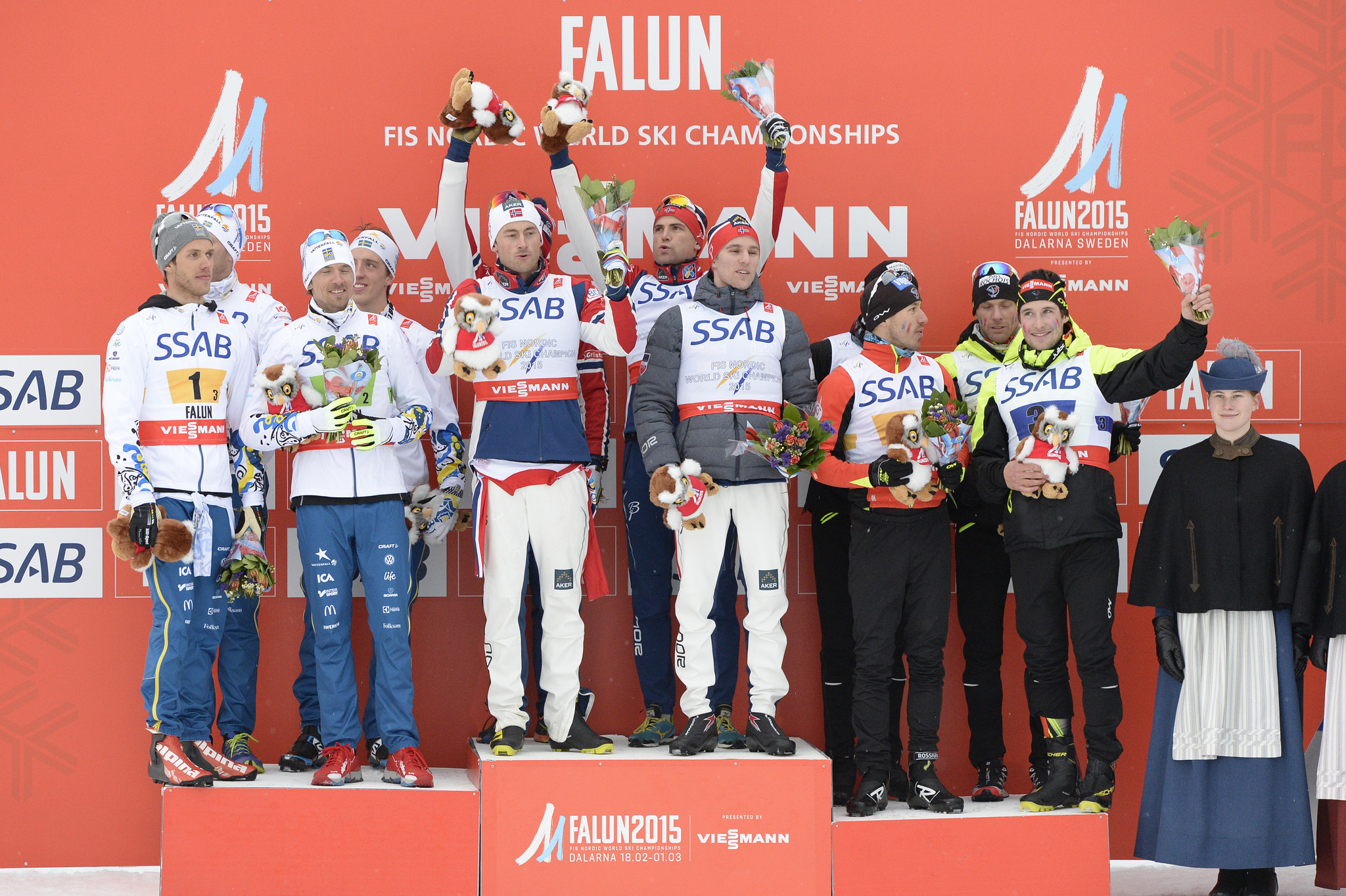
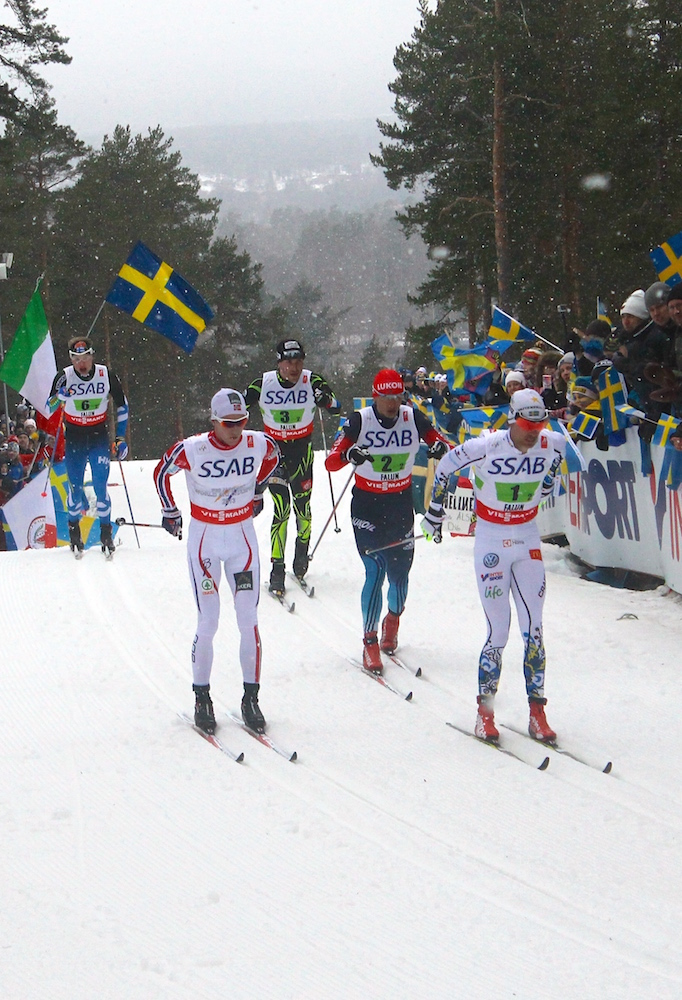
Sweden’s Calle Halfvarsson leads Norway’s Petter Northug (c) and France’s Adrien Backscheider on the second-to-last major hill on the last lap of the men’s 4 x 10 k relay at 2015 World Championships in Falun, Sweden. Northug went on to edge Halfvarsson by 0.6 seconds for gold, Sweden took silver and France was 8.9 seconds back for bronze.
FasterSkier’s coverage of the 2015 FIS Nordic World Ski Championships in Falun, Sweden, is brought to you by the generous support of L.L. Bean, now featuring a complete line of Kikkan Randall training wear.
FALUN, Sweden — All of Calle Halfvarsson’s trash talking gave Petter Northug something to get fired up about in the last couple hundred meters of the men’s 4 x 10-kilometer relay at FIS Nordic World Ski Championships on Friday.
Trailing Halfvarsson down into the stadium and leading up to the final rise before the finish, Northug rode on the tails of the Swede and blew past him on the climb, before giving him the ultimate run on the descent toward the finish.
There, Northug, who had already racked up two golds at these championships (in the classic sprint and freestyle team sprint), V2-ed like a madman to keep the slightest edge on Halfvarsson over the finishing flat. The Norwegian did so, and Halfvarsson let up about 20 meters before the line to accept his defeat.
It’s a lesson as old as time: talk smack and be ready to deal with the repercussions. Halfvarsson had to settle for silver when he was leading the fight for gold, and then watch Northug shush him at the finish.
That’s right, Northug, the now 12-time world champion (with two Olympic golds as well), put his finger to his lips after crossing the line, looking at cameras rather than back at Halfvarsson to send a message to the Swede.
The French men’s relay team (right) skied the entire World Championships 4 x 10 k with the Norwegians (center) and Swedes, proving something to themselves and the ski world: they belong as championships medalists. (Photo: Falun2015.com/Flickr)
“When Calle crosses the finish line, [I wanted to] make it hurt so much that he takes [it] with him for a lifetime,” the 29-year-old Northug told NRK, according to a translation, after sealing the win for Norway in 1:34.18.5, six-tenths of a second ahead of Sweden.
So what exactly did Halfvarsson do to get him so riled? A year ago, he said he would beat Northug in a finishing sprint on home soil in Sweden. Unfortunately for Halfvarsson, in front of more than 41,000 spectators in Sweden on Friday, it didn’t happen.
The Swede led much of the last lap, countering Northug’s attack on the second-to-last major climb on the 2.5 k freestyle course while France’s Adrien Backscheider clung to the duo as well.
The three had skied on their own, a healthy distance away from Russia in fourth, since the end of the second classic leg. Sweden’s Johan Olsson had brought the team from seventh and 20 seconds out to first, ahead of France’s Maurice Manificat and Norway’s Didrik Tønseth, by the halfway point amid heavily falling snow — which lightened up considerably for the first skate leg.
“It was really nice to be able to exchange first,” Olsson said in a press conference, after tagging Swedish teammate Marcus Hellner with a 6.7-second lead on France’s third skier, Robin Duvillard. “I was a little bit worried before the race. Yesterday I didn’t recover so much after the 15 k race. Of course I’m really satisfied with my race and the other guys as well.”
After catching the leaders, Johan Olsson of Sweden (1) skied through to the lead on the second leg of the men’s 4 x 10 k relay in Falun, Sweden. Here he’s shown leading the third of four laps with Norway’s Didrik Tønseth (left) and Russia’s Alexander Bessmertnykh (2), and Maurice Manificat of France (3).
A two-time world champion, Olsson won Wednesday’s 15 k freestyle individual start by 17.8 seconds over Manificat in second, and Norway’s Anders Gløerssen took bronze, 19.2 seconds behind.
On Friday, Gløerssen skied the third leg for Norway, heading out 14.1 seconds after Hellner, and over the course of his four 2.5 k laps, he lifted Norway to first.
“I tried to set my own pace in the start and when I went out on the second lap, I was closing a little bit so I tried to speed up and close the gap,” Gløerssen said in the conference. “When I joined with the teams in front, I was a little bit tired so I tried to calm down. In the end i made a little attack just to see what happened.”
The result was Norway leading France by 3.8 seconds to start the last leg. Hellner tagged Halfvarsson in third, 6.4 seconds out of first.
“I think [Olsson] did a fantastic job and I was really satisfied with that gap, but I tried really hard but I wasn’t so strong today,” Hellner said. “The other guys were stronger and I lost some seconds to them.”
With one last skate leg to go, Northug led Halfvarsson and Backscheider out of the stadium. The Frenchman put himself in first for the first of two steeper climbs, both of which were used on the championships sprint courses, while Halfvarsson and Northug followed closely in second and third.
Meanwhile, Russia’s Evgeniy Belov pushed to catch the leaders, after his teammate Alexander Bessmertnykh brought his team from sixth to fourth on the second classic leg. Bessmertnykh finished his leg 32.4 seconds out of first and 18.3 seconds behind third. Alexander Legkov kept the Russians in fourth, tagging Belov about 40 seconds out of the mix.
From there, Belov — who ended up skiing the fastest anchor leg — cut the deficit in half early. Behind him, Italy’s Federico Pellegrino, Switzerland’s Toni Livers and the Czech Republic’s Petr Knop contended within a chase group. Germany’s Tim Tscharnke and Finland’s Ville Nousiainen skied together in eighth and ninth, and Simi Hamilton of the U.S. initially led Canada’s Lenny Valjas on the first of their fourth laps together in 10th and 11th.
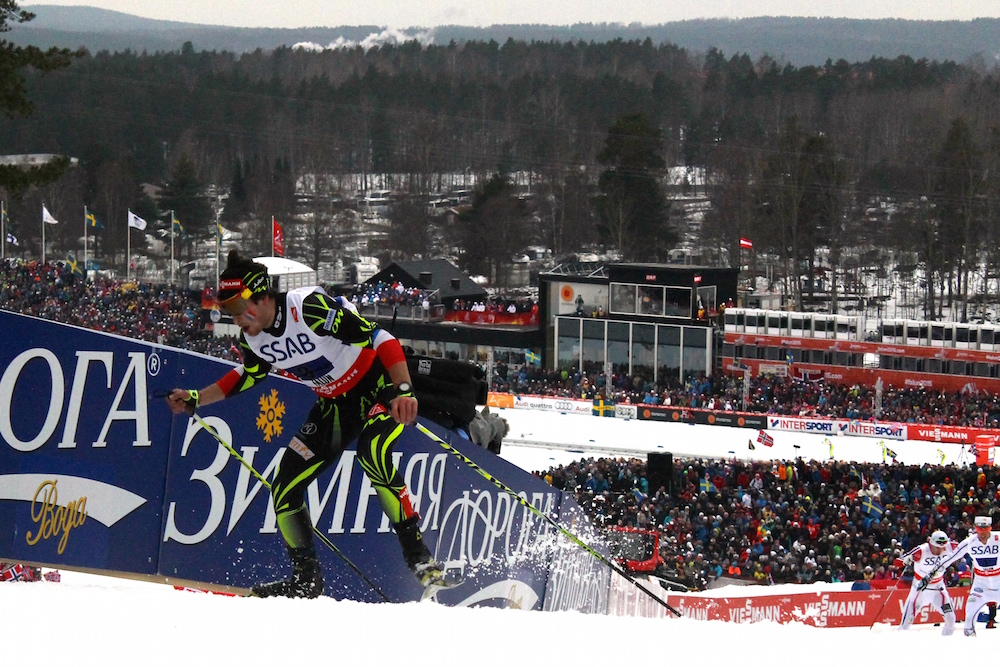
Adrien Backscheider attacks around 3 1/2 k into his 10 k skate leg as the anchor for France in the men’s 4 x 10 k relay at 2015 World Championships in Falun, Sweden. He went on to place third behind Norway’s Petter Northug and Sweden’s Marcus Hellner, respectively.
About 3 1/2 k into the final 10 k leg, Backscheider decided to push the pace to ensure a medal. Russia was closing, or so he thought, and he didn’t want Belov to get anywhere near the top three.
“I started in second position and I just skied to make the gap with the Russian guy,” Backscheider told FasterSkier.
A 22-year-old bronze medalist from this year’s U23 World Championships, Backscheider’s timing wasn’t exactly spot on. While he slightly increased the distance to Belov to 26.7 seconds at 5 k and was seven seconds ahead of Halfvarsson and Northug at the halfway point, the Swede and Norwegian pulled him back in by the third lap.
On that same lap, Livers and Pellegrino two minutes behind the leaders dropped Knop, while Tscharnke and Nousiainen, Valjas and Hamilton, continued to ski in their own mini groups within the top 11.
With just over a kilometer to go, Northug upped the ante and tried to pass Halfvarsson on the first, longer climb. Halfvarsson stayed in front of him, while Backscheider matched them stride for stride in third over the top.
Not long after on the next steep uphill, Halfvarsson took his turn — looking at Northug and attacking at the base. Northug stuck on him, tucking behind him in second, while Backscheider hung on at the back.
“I didn’t want to be in front in the sprint hill; I wanted to stay in second, conserve power and I also didn’t want to [ski into] the wind,” Northug said in the press conference. “The last 150 meters was not that good, but I think it was pretty difficult today because it was really icy [in the finishing stretch].”
Racers had a mix of conditions, from light to heavy snow to in the classic portion, to hardly any precipitation for the skate legs. Organizers salted both courses beforehand to cope with the above-freezing temperatures and near-100-percent humidity, which has made the track increasingly soft throughout the week.
While most of the skate course was breaking down, the finishing straight was fast and hard-packed. There, Northug and Halfvarsson focused on skiing fast while staying on their feet.
“The most important thing is to cross the finish in first,” Northug said after racking up his fifth World Championships relay gold.
“You never know what’s going to happen in a relay, but we had a better chance this year on the last leg than in Sochi,” he added, referring to last year’s Sochi Olympics, in which the Norwegian men placed fourth behind Sweden, Russia and France, respectively. “It feels good to be back on top again. … It’s a lot of pressure on the Norwegian team before a relay. We knew before the championships that only gold makes the Norwegians satisfied.”
The defending Olympic relay champions, which came 0.6 seconds short of gold on Friday, Sweden took silver with essentially the same four-man lineup (except Halfvarsson in place of Lars Nelson, who scrambled for the team in Sochi).
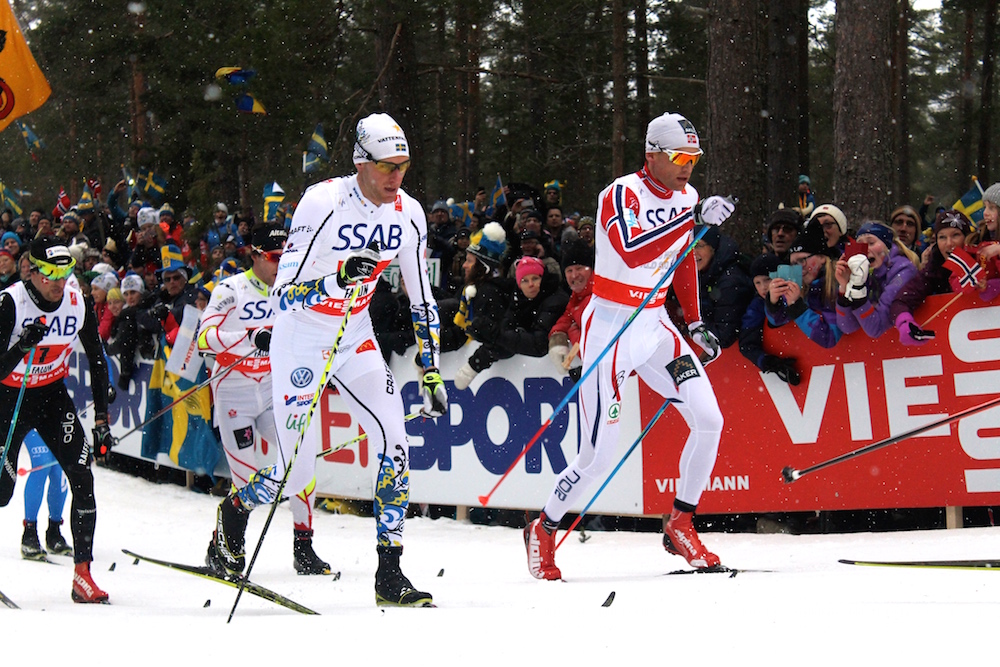
Daniel Richardsson of Sweden and Niklas Dyrhaug of Norway leading the men’s 4 x 10 k relay in Falun, Sweden.
This time around, Richardsson led Swedes out instead, finishing his first leg in seventh behind Canada’s Alex Harvey in first, Finland’s Sami Jauhojaervi in second and Kazakhstan’s Alexey Poltoranin in third. Norway’s Niklas Dyrhaug tagged in fourth, followed by Germany’s Johas Dobler and Russia’s Maxim Vylegzhanin, respectively.
While the top six were within 5 seconds of one another at the first exchange, Richardsson was 20.5 seconds back in seventh. (France’s Jean-Marc Gaillard was another 0.7 seconds back in ninth, behind Italy’s Francesco de Fabiani in eighth.)
“Yesterday I was a little bit worried that we wouldn’t take a medal at all,” Olsson said. “We know that Norway is the team to beat, and with Petter as the last leg, he’s almost Mr. One-Hundred Percent at the finish. … We’re satisfied with the medal, but of course we would be more satisfied with the gold.”
For Halfvarsson, it was personally his first medal of his home championships. Two years ago at World Championships in Val di Fiemme, Italy, the Swedish men’s relay — with the same team and order — placed second to Norway by 1.2 seconds.
After Friday’s race, Halfvarsson realized his mistake.
“[Northug] came into my draft behind and got better speed and knew exactly how he’d run into the [downhill corner before the finish],” Halfvarsson told HD.se, according to a translation.
“I had trouble keeping track of where he was, then suddenly he just takes off. It might have been better to get in back of him before the stadium.”
He acknowledged that Northug was stronger, as did Backscheider, who finished 8.9 seconds back in third for bronze for France.
“The finish was hard — I need more experience to have a better finish,” Backscheider said at the press conference.
Regardless, France was pleased to repeat its bronze medal following the 2014 Olympics.
“We believed that it is possible,” Manificat said in the conference. “Championships is always a surprise, but we fight for this and … it’s really perfect.”
Russia’s Evgeniy Belov in fourth tries to close the gap to the top three, on his first of four laps in the men’s 4 x 10 k relay at 2015 World Championships in Falun, Sweden.
Belov finished fourth for Russia, 31 seconds after Norway, and Livers skied away from Pellegrino to finish fifth for Switzerland, 2:03 behind Norway and 24.2 seconds ahead of Italy in sixth.
Tscharnke and Nousiainen raced to a photo finish for seventh, in which Germany had the edge, while the Czech Republic placed ninth 5.6 seconds later.
Canada’s Valjas held off Hamilton by 1.4 seconds for 10th (+3:03.5).
Norway’s prime minister, Erna Solberg, attended the race and personally congratulated her nation’s four-man team after the finish.
“I enjoyed it very much,” she told FasterSkier. “But it became a bit too exciting. I always want them to have a bigger lead in the last part, but of course Petter Northug is like this. He keeps it until the last 200 meters. … He always makes me nervous.”
Bryan Fletcher (U.S. Nordic Combined) racing to fifth in while skiing with a chase pack during Thursday’s 10 k at 2015 World Championships.
FasterSkier’s coverage of the 2015 FIS Nordic World Ski Championships in Falun, Sweden, is brought to you by the generous support of L.L. Bean, now featuring a complete line of Kikkan Randall training wear.
FALUN, Sweden — Bryan Fletcher knew there was one thing that could elevate him to the podium on Thursday at FIS Nordic World Ski Championships, and it wasn’t going to be playing it safe.
The 28-year-old U.S. Nordic Combined skier decided to go with the “go-big” mindset on the 134-meter large hill, and in doing so, he jumped to 13th on Thursday morning — a huge improvement from his 20th-ranked jump in the normal-hill individual competition at Falun World Championships, where he ended up 21st last Friday.
Bryan Fletcher (U.S. Nordic Combined) jumping in Sunday’s four-man team event at the 2015 FIS Nordic World Ski Championships in Falun, Sweden. (Photo: FlyingPointRoad.com)
“Today, I came into jumping in attack mode,” Fletcher recalled after Thursday’s 10-kilometer Gundersen start. “It was like, ‘Well since these are the Championships, and it’s not really worth being anything but on the podium, I’m just going to go for it as hard as possible and lay it all out there.’ ”
Starting the race 13th and 44 seconds behind the jump leader, Austria’s Bernhard Gruber, meant Fletcher could actually move up enough to matter.
“I jumped pretty well, put myself in contention, and then going into the race I was pretty nervous because being in contention is exciting but it’s also like, ‘Uh oh, now what do I do?’ ” Fletcher said.
Before Thursday, his previous individual best in four World Championships was 14th. He won a World Cup two years ago, but had not placed better than fifth in an individual competition since. He called upon his experience from a month ago in Sapporo, Japan, where he placed eighth and ninth in back-to-back World Cup competitions.
On a dark-and-damp Thursday afternoon, Gruber took off 5 seconds ahead of France’s Jason Lamy Chappuis in second and another Frenchman, Francois Braud, who started 7 seconds back in third. After that, the fifth- through eighth-best jumpers started within six seconds of one another, 23 to 29 seconds after Gruber, and Fletcher headed out six seconds after 11th and one second out of 12th.
“My goal was to ski a tactically smart race and not be in the front too much, but do enough work to put myself in contention,” Fletcher explained.
He ended up completing the first of four 2.5 k laps in 10th, toward the front of a 14-man pack. The group trailed the three frontrunners: Lamy Chappuis, Gruber and Braud, respectively. Japan’s Yoshito Watabe skied alone in fourth, 15 seconds behind them, while the chase pack reined him in from another 15 seconds back.
By 3.8 k, Norway’s Magnus Moan continued to lead the chase in fourth, with Fletcher in eighth and Watabe back in 11th. By the halfway point, the group was 30 seconds behind the three leaders, with Moan still in fourth, Germany’s Johannes Rydzek and Tino Edelman in fifth and sixth, and Fletcher up to seventh. Less than a kilometer and a half later, Fletcher was at the front of the pack in fourth, just 19.3 seconds behind the top three.
There, the American pushed to bridge the gap to the podium. Mostly focused on a medal, he gave his all while leading at least 11 others directly behind him.
“There were a lot of guys in our pack,” he said. “I think at one point it was all the way from third to 20th, and if you glance over your shoulder, you’re like, ‘Oh man, what am I doing at the front of this thing? I’m wasting so much energy.’ But at the same time, the guys that were at the front, myself included, were kind of really trying to get more people to share in the workload because we wanted to ultimately catch the front of the race and then be able to work past that.
“I think we were caught in a zone where we were working, and then also trying to rest at the same time,” he added. “It was tough to organize, but I feel like Magnus and I did a good job of sharing the workload as much as possible, and then also breaking away from the rest of the guys in that train to give ourselves a shot.”
With one lap to go, Fletcher was still in fourth, 20 seconds out of third. Moan clung to him in fifth, and Rydzek skied in sixth, followed by 10 others. Over the next 2.5 k, Moan attacked, Rydzek went with him and Fletcher worked to stay in the fight for fourth, while the rest of the pack dropped off the pace.
“I jumped on them and was actually really surprised when I looked back and we were clear of the group,” Fletcher said. “I was kind of relieved because I knew it was just us, and we were catching up to third place really fast so I was going all out trying to get there.”
American Bryan Fletcher (l) after finishing fifth to Austria’s Bernhard Gruber (1) in the individual large hill/10 k at 2015 World Championships in Falun, Sweden. It was Fletcher’s World Championships career best and a season best as well.
While Moan and Rydzek charged to the finish, Fletcher lost contact on the last two uphills. Gruber cruised into the stadium and finish uncontested to win in 22:45.8, 11.9 seconds ahead of Braud in second. Rydzek and Moan overtook Lamy Chappuis in the last kilometer and sprinted to the line for third. Rydzek took it by 0.2 seconds, 14.9 seconds after Gruber, Moan settled for fourth, and 8.3 seconds later, Fletcher finished fifth (+23.4).
“I was hoping I could beat those guys on the hill, but they were strong, they skied a great race, and obviously I [felt] the legs at the end,” Fletcher said. “This is a personal-best result this season for me and in a World Championship event. To be on the podium would have been a dream come true, but to be in the fight was more what I was really looking for.
For me, I really just want to ski a good race, a good race to the best of my ability and the best of my performance,” he added. “I was happy that I was able to do that today and I was in the fight.”
“To be on the podium would have been a dream come true, but to be in the fight was more what I was really looking for.” — Bryan Fletcher, fifth for a career-best individual result at World Championships
His younger brother Taylor, who jumped to 34th and raced up to 29th, 1:51.7 after Gruber, patted him on the shoulder afterward.
“I think that’s the best [U.S. Nordic Combined has] done since 2009 for an individual result so hats off to him,” Taylor said of Bryan’s new World Championships marker. Teammate Billy Demong won the large hill/10 k at 2009 worlds in Liberec, Czech Republic, and in 2011, he placed sixth in the same event.
“[Bryan] really pulled it together today and skied a smart race by the looks of it, and was able to finish hard, which is the most important thing here,” Taylor said.
The second American on Thursday, Taylor wasn’t pleased with his performance after putting himself 2:01 back after the jump.
“It’s hard to say what could’ve been,” he said. “But knowing how I’ve been skiing, I could’ve been up there for that medal. I’ve had a lot of really good jumps and I’ve had huge improvements in my last competitions, and I gotta be satisfied with that but at the same time I’m really disappointed … when it came time to show that work and that effort, I fell short a little bit.”
While Bryan posted the eighth-fastest course time, Taylor, 24, ranked 10th fastest of 47 men in the 10 k.
“I’m probably the most competitive guy out here,” Taylor said. “I yelled at guys in the track earlier because I just wanted to go. I can’t settle for something. I want it more and more and I’m going to work my ass off to get it.”
Bryan Fletcher (U.S. Nordic Combined) after finishing fifth in the large hill/10 k at 2015 World Championships in Falun, Sweden, for an individual season best and career best at World Championships.
Also for the U.S., Demong went from 30th in the jump to 33rd overall (+2:27.3), and Adam Loomis improved from 44th to 41st (+3:46.5) at the end of the day.
With one competition left at World Championships — the 2 x 7.5 k team sprint — Taylor, for one, was looking for redemption.
“I know what I did on the hill and what happened and I’ve got one more event [the two-man team sprint] on Saturday, where it’s probably going to be Bryan and I and that’s gonna be special,” he said. “Hell, if he’s skis like he did today, and I jump better on the hill like I know I can, there’s no reason in hell why we shouldn’t be first, second or third.”
Canada’s Ivan Babikov (29) leads a train of skiers on the second lap of Wednesday’s 15 k freestyle up Mördarbacken: the longest, steepest hill of the 2015 World Championships course. Babikov placed 20th after a considerably faster second lap.
FasterSkier’s coverage of the 2015 FIS Nordic World Ski Championships in Falun, Sweden, is brought to you by the generous support of L.L. Bean, now featuring a complete line of Kikkan Randall training wear.
FALUN, Sweden — It only took a kilometer or so for Ivan Babikov to realize that he needed to go much, much faster. Two years ago at World Championships, the Canadian World Cup Team member placed fourth in the 15-kilometer freestyle individual start. In Falun on Wednesday, he was practically in last place for the first few thousand meters of the same race.
“The gaps right away were shocking,” Babikov recalled after the 15 k freestyle at 2015 FIS Nordic World Ski Championships. “I couldn’t believe it, like, ‘What the hell? I’m not skiing that slow. What’s going on?’ ”
That moment gave him the kick he needed to get going, but yet throughout the first of two 7.5 k laps, he struggled to find a consistent pace.
Fortunately for him, that was the worst of it.
Ivan Babikov (Canadian World Cup Team) on his first of two laps in the men’s 15 k freestyle at 2015 World Championships in Falun, Sweden. He went on to place 20th. Two years ago, Babikov was fourth in the 15 k freestyle at 2013 World Championships.
“The worst was the first two splits, after that I couldn’t hear too much at the end of the course [in the stadium],” he said. “Then, second lap, I felt like i was picking it up.”
Babikov, 34, went from ranking 70th of 86 men at 1.5 k to 45th at the halfway point. After starting 29th, he sped up considerably on his second lap, clocking the eventual 23rd- and 21st-fastest times at 11.4 k and 12.8 k, respectively.
He finished 20th, 1:45.4 minutes behind Sweden’s Johan Olsson, who won the race by 17.8 seconds on home soil in 35:01.6. Considering it was a ways off from his fourth place at the last World Championships, Babikov had mixed feelings about his result.
“My pacing was really weird — I don’t know how to feel about it,” Babikov said, noting that his second lap ended up being 24 seconds faster than his first.
“I don’t know how that’s possible,” he added. “I kind of had in my head that the second lap will be really important so maybe that made me go too slow in the first lap, but it didn’t feel like it. … I kind of turned it around and had an amazing second lap. It’s hard to wrap my head around what happened, today was so weird.”
While he explained that skis made a “huge difference” in the slushy snow on the 5-degree Celsius overcast afternoon, with sprinkles of rain toward the end of the race, he added that his team’s skis were on par with most other nations’. At the same time, a few teams had “rockets” despite the variable conditions, he observed.
Graeme Killick (AWCA/Canadian National Development B-team) racing to 32nd in the men’s 15 k freestyle individual start, his first race of 2015 World Championships in Falun, Sweden. (Photo: Fischer/NordicFocus)
“I would say 70 percent of the course was just mush,” Babikov said. “Some of the steep uphills were ankle-deep slush.”
Throughout the race, he was unable to take full advantage of his strength in climbing. Most of the course was one-skate (V2), with the exception of the long, grinding uphill known as Mördarbacken. Babikov said only a minute or two of the 7.5 k loop, the steepest part of it, required offset (V1).
“I felt good on Mördarbacken, so climbing was not problem,” he said. “When I went to the second lap, I realized I still have a lot of energy so I started pushing all out…
“Top 20 sounds nice, but when you think about my fourth place, which came really surprisingly two years ago, it’s not even close,” he added. “Considering everything, I would probably be OK [with today’s result].”
By everything, Babikov meant the nasty cold, “some kind of viral thing,” he came down with a month ago in Rybinsk, Russia. After that World Cup, he flew home to Canada and spent the better part of the next week there down and out. When he returned to Östersund, Sweden, for the last World Cup before World Championships, Babikov placed 49th in the 15 k freestyle.
“I didn’t really know what to expect,” he said of Wednesday’s race, his season-long focus. “I had some good skating in the skiathlon a few days ago and that kind of gave me a piece of my mind. Every day is different so I tried to give 100 percent.
Jess Cockney (AWCA/Canadian National Development B-team) racing to 57th in the 15 k freestyle at 2015 World Championships in Falun, Sweden. It was his first distance race in nearly three months. (Photo: Fischer/NordicFocus)
“Going into the relay, I think it’s a good sign,” he added of Friday’s 4 x 10 k team event. “I’m more positive about [today’s] race than bummed out.”
The second-fastest Canadian on Wednesday, Graeme Killick placed 32nd in his World Championships debut, 2:26.7 back from Olsson. The result stood as a career best at the World Cup level (excluding Olympics) after placing 39th in a World Cup 15 k classic last season in Toblach, Italy.
At the 2014 Olympics, Killick went on to place 28th in the 50 k freestyle mass start. Also in Sochi, Russia, he finished 44th in the 30 k skiathlon and 65th in the 15 k classic.
Recently, the 25-year-old Canadian National Development B-Team skier hadn’t raced since Rybinsk on Jan. 23 and 25, where he was 43rd in the 15 k freestyle and 40th in the skiathlon. Sick for the beginning of World Championships, he didn’t arrive in Falun until Sunday (Killick, Devon Kershaw, Emily Nishikawa, and Olivia Bouffard-Nesbitt stayed back in Östersund to recover from their illnesses for the first few days of worlds).
On Wednesday, Killick said he had been feeling well for the last three days.
“Skate really isn’t my strength so I think I didn’t quite blow up like I normally would on a course like this, so I think it was OK,” he said of his 15 k. “Good lead-up into the 50 [k classic mass start on Sunday] and just good to get a hard effort in after missing the [skiathlon].”
Jess Cockney after his final race of 2015 World Championships, the 15 k freestyle, in which he placed 57th in Falun, Sweden.
His teammate on the Alberta World Cup Academy (AWCA) and national-development team, Jess Cockney raced his first distance event since Dec. 7, when he was 67th in the World Cup 15 k classic pursuit in Lillehammer, Norway.
With fellow Canadians Alex Harvey preparing for other races (the relay and 50 k) and Kershaw also saving his energy for the final races of World Championships, Cockney asked his coaches if he could enter the 15 k skate and considered it a bonus.
“I just wanted to see if I could be consistent and have some of the hard training show itself in a result today,” Cockney said after placing 57th (+4:14.5). “I don’t think it really did, but it’s still good to be skiing distance races again. … I’ve just gotta work on fitness.”
Reflecting on his first World Championships, where he raced the classic sprint (49th), team sprint (13th) and 15 k skate, the 25-year-old Cockney said he’s learned a lot.
“I think I’m still not totally there mentally for the big races,” he said. “I kind of psyche myself out still a bit. I did at the Olympics last year and I did last week for the sprints so [I need to] just work on a little bit of mental training because we do enough stuff physically that my brain’s gotta be there, too.”
Noah Hoffman (U.S. Ski Team) racing to 34th in the men’s 15 k freestyle at 2015 World Championships in Falun, Sweden.
FasterSkier’s coverage of the 2015 FIS Nordic World Ski Championships in Falun, Sweden, is brought to you by the generous support of L.L. Bean, now featuring a complete line of Kikkan Randall training wear.
FALUN, Sweden — It’s not easy following a double-medal act. A day after two U.S. women, Jessie Diggins and Caitlin Gregg, racked up silver and bronze in the 10-kilometer freestyle at 2015 FIS Nordic World Ski Championships, their male teammates finished outside the top 30 in the men’s 15 k individual start.
Not that they were trying to compete with Diggins and Gregg, but after all the hype surrounding the U.S. women’s achievements, it was difficult for some of the American men to get excited about their results on Wednesday.
“I had trouble getting going a little bit,” U.S. Ski Team (USST) member Noah Hoffman, who led the U.S. men in the 15 k in 34th, said after his race. He finished 2:35.6 behind Sweden’s Johan Olsson, who won by 17.8 seconds in 35:01.6.
“[I skied] kind of just very even-keeled and neutral, but certainly nothing special, so not quite what I was looking for,” Hoffman added.
The seventh starter out of 86, he posted split times throughout the two-lap race that ultimately ranked in the top 40. While they indicated consistent skiing, they weren’t as fast as he wanted, and he said he lost time all over the course.
“It’s been a little discouraging,” he said of his World Championships thus far, which included one other race: the 30 k skiathlon, in which he placed 44th last Saturday. This season, he’s only completed three races after a broken leg in the 2014/2015 World Cup opener derailed his World Championships prep.
“It was not the year I planned on and [I’m just trying] to build on every race,” Hoffman said. “The season’s not over and I’ll think about moving on from the end of the season once the season comes to a close.”
In a blog post Wednesday evening, Hoffman reflected more on his race.
“I executed today more or less how I wanted to. I skied relaxed with high energy,” he wrote. “The race was a step in the right direction from Saturday’s skiathlon, and there’s nothing for me to do but keep preparing as well as I can and hope my form comes around.”
Erik Bjornsen (U.S. Ski Team) at the top of Mördarbacken on his first of two laps, en route to 47th in the 15 k freestyle at 2015 World Championships in Falun, Sweden.
After Hoffman, Erik Bjornsen placed 47th for the U.S., 3:19.5 after Olsson, Kyle Bratrud was 52nd (+3:58.7), and Kris Freeman finished 59th (+4:25.9).
Bjornsen and Bratrud explained they came into the 15 k generally aiming for a top 40. Bjornsen finished 22.9 seconds back from that goal.
“Some spots were good. It felt like the body was firing. The results weren’t great,” the 23-year-old Bjornsen said.
He started 64th, one minute behind Bratrud in bib 62, and 30 seconds ahead of Norway’s Petter Northug. At one point, Northug nearly caught him, and Bjornsen was prepared to take advantage of a boost by trying to stay with him.
“All of a sudden, I could tell he wasn’t behind me anymore, and I looked back on one downhill and he was way back there,” Bjornsen said. “It would’ve been one thing if it was someone like [Switzerland’s Dario] Cologna, but with Northug, I figured he went for it and then wasn’t feeling it and started walking or something.
“I saw some fast guys behind me. I was hoping to at least ski with somebody out there, but it didn’t happen,” he added. “I felt like I was hammering a few hills and felt all right, but I lost some time somewhere.”
At 1.5 k, Bjornsen heard he was 17 seconds down to the race leader at the time.
“I was like, ‘Woah, that was quick,’ ” he recalled.
Despite pushing harder, he still didn’t feel like he was having a great race.
“There were parts today when I felt really good and obviously I felt great about the pursuit,” Bjornsen said, referring to his 28th-place finish in the World Championships 30 k skiathlon. “I think that I did a good job peaking for this championship. I love head-to-head racing so hopefully I’ll get a chance to do that on the relay [on Friday].”
American Kyle Bratrud (Northern Michigan University) racing to 52nd in the men’s 15 k freestyle at 2015 World Championships in Falun, Sweden.
A Northern Michigan University senior in his first World Championships, Bratrud was pleased with how he fared in his signature race on Wednesday.
Early last month, Bratrud, 21, punched his ticket to U23 World Championships, and ultimately the Falun World Championships as well, with a 50-second win in the 15 k freestyle at U.S. nationals.
On Wednesday, he was looking to improve on his 84th place from 10 days earlier in the 15 k freestyle at his first-ever World Cup in Östersund, Sweden. He knocked off 32 places and didn’t crash, so he considered it a success.
“It was really soft, but I think that probably benefited me being a small guy,” Bratrud said of the slushy conditions on a 40-degree, damp-and-overcast afternoon. “I felt like I kept my tempo up pretty much the whole race. I died a little bit at the end, but it was a lot better paced than it was in Östersund so that was good. It was a good way for me to end my time in Europe.”
He ended up beating Northug, who placed 62nd.
“He’s been one of my idols since I’ve grown up,” Bratrud said. “I wouldn’t say I’m better than him, but to beat him is pretty cool.”
Now done with his first-and-only race of World Championships, Bratrud planned to head back to Marquette, Mich., to “catch up on the month and a half of homework” before heading to NCAA Skiing Championships in Lake Placid, N.Y., in mid-March.
“We have a really strong team so I want to go back and put together a solid effort at NCAAs,” he said.
American Kris Freeman on his way to 59th in the 15 k freestyle at 2015 World Championships in Falun, Sweden. (Photo: Fischer/NordicFocus)
After placing 59th, Freeman called his race “horrible.”
He started eighth, right after Hoffman, and his 1.5 k time ended up ranking 33rd. By 7.5 k, he slipped to 42nd and then 55th by the 12.8 k checkpoint.
“I don’t understand — I felt pretty good this morning and I felt good on the first lap, and then it was just lights out and I couldn’t ski anymore,” Freeman said. “In this kind of snow, once you get a little tired you start to sink and if you’re feeling good you stay on top and float, and I was sinking. I’m really confused and disappointed.”
While he wasn’t sure whether he’d race Friday’s 4 x 10 relay, which the U.S. Ski Team won’t divulge until the start list has been posted Thursday evening, Freeman expected to race Sunday’s 50 k.
“Right now I feel like it’s a really long way and I’ve got to figure something out,” Freeman said. “I just want to feel the way I’ve been feeling this year and the first two races [of World Championships] I just haven’t felt like that at all.”
The U.S. took two out of three spots on the podium in Tuesday’s 10 k freestyle at 2015 World Championships. From left to right at the medals ceremony: silver medalist Jessie Diggins (USA), gold medalist Charlotte Kalla (Sweden) and bronze medalist Caitlin Gregg (USA) at the medals plaza on Tuesday night in Falun, Sweden.
FasterSkier’s coverage of the 2015 FIS Nordic World Ski Championships in Falun, Sweden, is brought to you by the generous support of L.L. Bean, now featuring a complete line of Kikkan Randall training wear.
FALUN, Sweden — When Jessie Diggins crossed the finish line in Falun’s Lugnet Arena she collapsed. Unable to breathe and near tears after completing the 10-kilometer freestyle interval start at the 2015 FIS Nordic World Ski Championships, Diggins could barely move. She felt a hand on her back, but was hardly able to recognize who was comforting her.
The hand belonged to teammate Caitlin Gregg. The 34-year-old Gregg was the third starter and finished long before Diggins. She led the results for much of the day — unsurprising at first as the lower seeded skiers were at the front of Tuesday’s start list. However, she remained in the leader’s chair as skier after skier failed to match her time. It was only until Diggins finished that Gregg lost the lead.
When the whirlwind day — filled with blowing snow, tears and cheers — was complete, Diggins and Gregg placed second and third, respectively, behind home-crowd favorite Charlotte Kalla of Sweden. Kalla’s time of 25:08.8 outpaced Diggins by 41.0 seconds and Gregg by 46.9.
The results were historic. Until Tuesday, no American woman had earned a distance podium at an international-championship event. With the U.S. women’s results in the 2015 World Championships 10 k freestyle, that feat was accomplished twice over.
“I still cannot believe that this is happening, it feels like it is still sinking in.” Diggins said after the flower ceremony.
Caitlin Gregg (Team Gregg/Madshus) racing to bronze on Tuesday in the 10 k freestyle at 2015 World Championships in Falun, Sweden. Gregg finished third behind Swedish winner Charlotte Kalla and fellow American Jessie Diggins, who was second. (Photo: Madshus/NordicFocus)
The night before the 10 k freestyle U.S. Ski Team women’s coach Matt Whitcomb gathered the team for a pep talk. According to Diggins and Gregg, the theme of his speech revolved around the simple question: Why not?
He emphasized that many skiers count themselves out before they’ve even had the chance and that every member of the U.S. team had the opportunity to achieve their best. The two skiers didn’t know it at the time, but Whitcomb’s central message — anything is possible –– would become a reality the next day.
Taking Whitcomb’s advice, both athletes entered the 10 k with high expectations. Diggins, a regular on the World Cup circuit, explained her goal was a top six: “If I was having an amazing day,” she said.
Prior to Tuesday her best result in a World Championships distance race was 23rd, while her best World Cup distance result was fifth. Gregg, on the other hand, skied with the goal of being an early leader. She easily accomplished her objective, but soon realized that her time was much better than she could have expected.
“My goal was to try to come in, be the leader, and put in a good time,” she said. “I think it took maybe another twenty or thirty skiers before I started realizing that it was actually a really, really good time.”
Gregg watched Diggins from the leader’s chair as the 23 year old trailed on the final climb and then roared into the finish to best Gregg by nearly six seconds. “Then all of a sudden things started to become a reality,” she said.
“I was hoping for maybe a top six if I was having an amazing day but I didn’t think that – of course I was skiing so hard and giving it everything I had – I just didn’t realize that everything I had was going to be a medal.” — Jessie Diggins, 2015 World Championships 10 k freestyle silver medalist
Conditions played a large role in Tuesday’s race, with light snow falling from the start. As the 10 k progressed, the flakes became larger and wetter, leaving many teams with poor wax. The Norwegians, whose powerhouse skiers like Marit Bjørgen, Therese Johaug, Heidi Weng and Astrid Uhrenholdt Jacobsen often sweep the podium, were nowhere to be seen on the leaderboard. Their top finisher was Weng in 22nd, and the team complained of dragging skis in the new snow.
In sharp contrast, the U.S. skiers lauded their wax technicians for speedy skis. When asked by the Norwegian press whether her medal could be explained by the poor wax of the other competitors, Diggins said that waxing, good or bad, is part of ski racing.
“I wasn’t thinking about [the Norwegians] because a lot of times they have great skis. They don’t sit up here [when they medal] and say it was their skis,” she said. “I know I was lucky with the skis and how the snow was, but I also took advantage of the opportunity.”
“It was nice of Norway to share the podium,” she added with a smile.
As an early starter with bib 3, Gregg avoided the worst of the snow. Before the start, she wasn’t thrilled with the starting position because there wouldn’t be many opportunities for splits on course. Looking back, however, Gregg said the position was beneficial given the conditions.
“It’s hard to say, you can’t predict those kind of things but when they happen, you have to take opportunities like that and grab them and go,” she said.
This is Diggins’ second-career World Championships medal. Her first came from the 2013 freestyle team sprint in Val di Fiemme, Italy, where she joined forces with Kikkan Randall to claim gold. The pair was the first to earn a World Championships title in the history of U.S. skiing.
Diggins said that her first World Championships podium was much different than Tuesday’s. In 2013, she expected to medal in the event, while in 2015 she didn’t feel that pressure. According to the Minnesota native, Tuesday’s podium — while an individual start — felt like a team event because she and Gregg, who now lives in Minneapolis, shared the podium.
“To be here with Caitlin, it feels like another team event,” she said. “Just the fact that we’re making some history here as the first U.S. women to podium in a distance event at Championships is really crazy and it’s still sinking in.”
Gregg hasn’t been at, or near, the top of international skiing since the start of her career. The 34-year-old’s best World Cup result was in a 2010 Canmore World Cup, where she place 14th in the 10 k freestyle. Her next best result was last year in Falun at the 2014 World Cup Finals where she had the 25th fastest time in the 10 k pursuit. Last season, Gregg missed a spot on the Olympic team despite dominating the domestic distance circuit.
Americans Jessie Diggins (l) and Caitlin Gregg (r) hold up their silver and bronze medals from the 10 k freestyle at the 2015 FIS Nordic World Ski Championships in Falun, Sweden.
As the 2014 SuperTour leader, Gregg started the 2014/2015 season on the World Cup, but contracted shingles and consistently race in the 50s on the World Cup.
Due to USSA criteria and the previous year’s Olympic selections, it appeared uncertain whether or not Gregg would be named to the U.S. World Championships team. Come Jan. 26, however, Gregg’s name was on the list and she was preparing conquer the 10 k freestyle — a race she had been focusing on all year.
According to Gregg, Tuesday’s bronze medal was validation of a career that’s consisted of hard work and perseverance. She said her medal sent a clear message that developing skiers who aren’t often given the best opportunities from the start of their careers can still be successful — all it takes is a little passion and grit.
“If you really truly feel it in your heart, keep pushing, keep pushing,” she said. “Anything is possible. Obviously, a lot of things fell together today for me, but I think it is a super strong message.”
“Some skiers just take a little bit longer to get going,” she added with a laugh. “You can win your medal at 34 years old.”
To race the World Championships 10 k freestyle Gregg skipped the 2015 American Birkebeiner last weekend — a race both she and her husband Brian attempt to participate in every year. Gregg explained that many of her fans, friends and fellow competitors were disappointed that she couldn’t race in Wisconsin, but that her podium would likely help them forgive her.
“I know people were a little bit bummed I missed the Birkie, but I think they’re gonna forgive me this time,” she said.
After finishing the Birkie, Brian hopped on a plane to Sweden, arriving just in time to help test Gregg’s skis on Monday. He said that his wife’s focus and perseverance was the key to Tuesday’s success. He cited Gregg’s failure to make the U.S. Ski Team (USST) after the 2007 World Championships in addition her absence from last year’s Olympics as speedbumps in her career, and explained her ability to overcome such obstacles allowed her to fight for Tuesday’s podium.
“Sometimes when there’s more chaos, she does better,” he said. “She does well in these high-pressure championship events and nails the races she needs to nail.”
According to Whitcomb, the 10 k freestyle was always the U.S. women’s best shot at a medal in Falun.
Americans Jessie Diggins (l) and Caitlin Gregg (r) share the women’s World Championships 10 k freestyle podium with Sweden’s Charlotte Kalla (c), who won the race by 41 seconds for her first individual gold on Tuesday in Falun, Sweden. Diggins took second while Gregg took third, 46.9 seconds back. Both finishes were the best distance result in history for a U.S. woman at a World Championships. (Photo: Fischer/NordicFocus)
“A lot of people have been talking about the team sprint being our best chances for a podium and I was absolutely in disagreement,” he said. “It was this day. I didn’t know who it was going to be, that’s for sure, but the 10 k and the relay are just fantastic events for us.”
Whitcomb added the USST’s ability to push through much of Tuesday’s adverse weather conditions also aided in Gregg’s and Diggins’ performaces.
“I think it was Phil Mickelson who always looked to those rainy days and said, ‘Bring it on because I know it’s gonna to bum people out. And this is not gonna bum me out.’ So today is our day for that,” he said.
Both Gregg and Diggins said that while cross-country skiing in the U.S. is not popular or well-funded like many European programs, the Americans create an environment that allows for success.
“It’s taken so many people to get us here,” Diggins said. “It took an amazing team of people here at the World Championships and this team of girls that we have been traveling around the world with.”
“I feel like the podium doesn’t just belong to us, it’s like skiing in the United States that’s there on the podium today,” she added.
Whitcomb agreed, saying a combination of peak fitness and U.S. team atmosphere were key to creating an environment for success.
“We knew what we needed to enter the championships with and that was rested athletes and a team that was tightly bound,” he explained. “I think you saw on some of our recent media productions that this team has come together really tightly and when the team is right, the racing is right.”
USST Head Coach Chris Grover added that two podiums at World Championships will help raise awareness for cross-country skiing in America.
“It helps us build a story about these underdogs from a country where we don’t have a big of a budget as some of our competitors or where cross country skiing is appreciated like it is in Scandinavia. Hopefully we can continue to ignite a new generation of young U.S. athletes,” he said.
Kikkan Randall racing to 15th in the 10 k freestyle individual start at the 2015 FIS Nordic World Ski Championships in Falun, Sweden. (Photo: Fischer/Nordic Focus)
Four U.S. Women in the Top 15
Diggins and Gregg weren’t the only U.S. skiers to turn heads Sunday. Liz Stephen (+1:06.4) skied to 10th, as a late starter who battled some of the worst of the snowy conditions. Before the 10 k, Stephen was seen as a U.S. favorite for a distance medal.
“Certainly it’s not the podium I put down on my goal sheet and that was in my brain when I started the race but I’m really happy with the effort. My day was in Russia this year and it will come again. I’m just so happy for the U.S. Ski Team,” she said, smiling.
“I’ve always skied for the effort and the team and the love I have for the sport, and today was a perfect representation of all of those,” Stephen added. “The podium is just a gold star you get at the end. The people and the sport are why I do it.”
Whitcomb was impressed with Stephen’s skiing and said it was the best he had seen from the 27-year-old team veteran.
“I’ve never seen Liz ski so perfectly as she did today. It’s the best I’ve ever seen out of her,” he said.
Just down the results sheet was Randall (+1:25.2) who finished 15th to give the U.S. women one of their best collective distance results to date. As the fourth starter of the day, Randall left the finish area with little idea of her placement and said her effort in the 10 k was far from what she wanted.
“I didn’t have a lot of snap out there, so yeah, another tough one,” Randall said. “Such a great atmosphere and such a great course, and not able to take advantage of it.”
Whitcomb explained that he had never seen a day like Tuesday’s where all four skiers placed within the top 15 and called it “picture-perfect.”
Americans Jessie Diggins (l) and Caitlin Gregg (r) share the women’s World Championships 10 k freestyle podium with Sweden’s Charlotte Kalla (c), who won the race by 41 seconds for her first individual gold on Tuesday in Falun, Sweden. Diggins took second while Gregg took third, 46.9 seconds back. Both finishes were the best distance result in history for a U.S. woman at a World Championships. (Photo: Fischer/NordicFocus)
FasterSkier’s coverage of the 2015 FIS Nordic World Ski Championships in Falun, Sweden, is brought to you by the generous support of L.L. Bean, now featuring a complete line of Kikkan Randall training wear.
FALUN, Sweden — All over the trails of the 2015 FIS Nordic World Ski Championships venue in Falun, people buzzed about Charlotte Kalla. They sang her name, cheered anytime the stadium announcer brought her up and roared as she skated by during the 10-kilometer freestyle individual start on Tuesday.
Three days earlier at her home nation’s World Championships, the 27-year-old Kalla had claimed a bronze medal in the 15 k skiathlon. One of Sweden’s best medal chances throughout the championships, there were a couple other races that Kalla, a 2010 Olympic champion in the 10 k skate and 2011 world champion in the classic team sprint (with Ida Ingemarsdotter), had been considered a favorite in as well. The 10 k skate was at the top of the list.
So when she soared through each timing point on the women’s course (made up of two unique loops) more than 10 seconds, then 20 seconds, 30 and finally 40 seconds ahead of any of the 48 women who started before her, the 13,800-strong crowd went nuts.
Sweden’s Charlotte Kalla racing to her first-career individual gold at 2015 World Championships in Falun, Sweden. Kalla won the 10 k freestyle by 41 seconds over silver medalist Jessie Diggins and 46.9 seconds over another American, Caitlin Gregg, in third. (Photo: Fischer/NordicFocus)
“I was a little bit nervous before the start and for the whole morning; I just longed to go to the competition area and put on my race bib,” Kalla said in a post-race press conference. “When the speaker presented me before the start, it was an amazing atmosphere in the stadium. I had to keep calm and focus on skiing all the way and not just go crazy because there was a big crowd cheering for me.”
While Swedish spectators grew increasingly giddy over Kalla, the 49th starter of 71, two other names became a big part of the conversation at Lugnet Arena: Caitlin Gregg, an early leader in bib 3, and later in the race, Jessica Diggins in bib 37.
Known in the U.S. as Jessie, Diggins wasn’t exactly a surprise; the 2013 World Championships freestyle team sprint champion (with Kikkan Randall), she had already earned her stripes and risen to the forefront of international cross-country skiing.
But Gregg?
One Norwegian journalist said after the race he couldn’t even find her International Ski Federation (FIS) profile. It existed, but with a top World Cup result of 14th in the 10 k skate in 2010 in Canmore, Alberta, and an individual best of 47th at her last World Championships in 2009 in the 30 k freestyle mass start, one might understand why the independent American skier was overlooked.
“I must admit, I have never heard of her,” Norwegian women’s coach Egil Kristiansen told NTB afterward.
With a finishing time of 25:49.8, Gregg put herself in the leader’s chair for what ended up being almost half the race. Her fellow U.S. World Championships team member, Diggins ultimately bumped her out of it by 5.9 seconds.
Lightly falling snow at the start turned into a full-fledged downpour of wet-and-heavy snowflakes throughout the race, making an already soft track in above-freezing temperatures even slower. And while some of the Norwegians, like Therese Johaug, later said they felt like they were skiing on glue, the U.S. women didn’t seem to have a problem. Nor did Kalla.
Sweden’s Charlotte Kalla in the leader’s chair after essentially securing her first individual gold at a World Championships in the 10 k freestyle at 2015 worlds in Falun, Sweden.
The Swede rounded the course in 25:08.8, 41 seconds faster than Diggins to replaced her in the fur-covered chair at the finish. Kalla hardly spent any time in it, though, congratulating Diggins on a strong race before sitting down briefly for a few photos then getting up to put on dry clothes. By the time she returned to the finishing pen, the race was just about over.
And nobody — none of the Norwegians, including Johaug, the 10 k skate’s defending world champion, nor Marit Bjørgen — came anywhere close.
“I think I had the focus on the right thing for the most of my race,” Kalla said in the press conference. “[I heard] coaches screaming that I’m going for the gold medal, but it’s putting that behind me and trying to ski as fast as possible.”
At 1.5 k, Johaug in bib 63 came within 8.2 seconds of Kalla, and Finland’s Kerttu Niskanen, the 47th starter, was 11.4 seconds back in third. Norway’s Astrid Uhrenholdt Jacobsen started 43rd and ended up 11.8 seconds off Kalla’s time at that marker, and Bjørgen, who started 65th, was 12 seconds behind Kalla at 1.5 k.
By the halfway point, Kalla was 17.5 seconds up on Diggins and 25 seconds ahead of Gregg in third. Another Swede, Maria Rydqvist ranked fourth at 5 k, 27.1 seconds behind, and Poland’s Sylwia Jaśkowiec — coming off bronze in Sunday’s freestyle team sprint — stood in fifth (+28.2).
Also at 5 k, Heidi Weng as the top Norwegian in bib 61 clocked through 49.8 seconds after Kalla. Jacobsen ranked 22nd there (+49.9), and Johaug and Bjørgen were 26th and 32nd, respectively, with Bjørgen more than a minute back with 5 k to go.
Kalla came through the 6.3 k checkpoint 36.3 seconds faster than Gregg in second place and 36.6 seconds ahead of Diggins in third. By 7.8 k the Swede was up to 40.2 seconds ahead of Gregg and 40.9 ahead of Diggins. Kalla extended that gap in the last two kilometers to win by 41 seconds for her first individual title at World Championships.
“It’s a dream come true, to become world champion at home,” Kalla told Expressen. “It probably has not really dawned on me yet. I need enough time for it to melt in.”
Diggins, who achieved silver for the best-ever U.S. women’s distance result at an international championships, and Gregg, who helped notch a historic U.S. double podium with bronze, felt similarly. Once the results were final, the 23-year-old Diggins fell to her knees in tears. Gregg, 11 years her elder, hugged her at the finish.
Jessie Diggins (U.S. Ski team) leads Ekaterina Rudakova (l) of Belarus, whom Diggins passed, up “little” Mördarbacken early in the women’s 10 k freestyle individual start at 2015 World Championships in Falun, Sweden. Diggins went on to take silver for the best-ever U.S. women’s distance result at an international championships.
“World championships and Olympic games, sometimes crazy things happen, and people who are favorites don’t always come out on top,” Diggins said. “You never know, especially with the snow today, [I thought], ‘Okay, here’s a chance. Why not me? Someone’s going to be on the podium and I have as good shot, I’ve trained as hard as anyone, and I want it as much as anyone,’ so I think with that in mind, we just went out there for every second.”
“Right off the bat, I just knew everything was clicking,” Gregg recalled. “It was that fantastic feeling you hope for when you get to a championship event, of like, yeah, this is just happening, keep it going, keep it going. I knew that I could only put down the best effort I could. I’ve been talking to [my husband] Brian and really trying to outline how to approach the course, and I just basically was executing my plan for the day and skiing consistently and skiing aggressively the whole way.”
With a goal of being in the race leader, she accomplished that, but it took some time for Gregg to realize that she was an actual podium contender.
“I knew I had two girls [starting] ahead of me,” Gregg said, referring to Japan’s Yuki Kobayashi in bib 1 and Italy’s Marina Piller in bib 2. “I looked at their results from previous races to know where they were on the World Cup so I used that to kind of say, OK if I’m pulling them in, this is a really good race for me…”
Also for the U.S., Randall started fourth, 30 seconds behind Gregg, and ended up 15th, 1:25.2 behind Kalla. The U.S. women put four in the top 15, with Liz Stephen finishing 10th (+1:06.4).
Caitlin Gregg (Team Gregg/Madshus) racing to bronze on Tuesday in the 10 k freestyle at 2015 World Championships in Falun, Sweden. Gregg finished third behind Swedish winner Charlotte Kalla and fellow American Jessie Diggins, who was second. (Photo: Madshus/NordicFocus)
“I did get a back split at one point that I was still tied for the lead at one-and-a-half k, which was a really positive feeling out there,” Gregg explained. “After that, it just all kind of drowned out — I don’t remember hearing any splits or anything. It was all just kind of mumble jumble.”
Diggins said she also stuck to her race plan, which involved breaking the course down into eight climbs, attacking each one then making a point to recover after each as well.
“As it was snowing, I knew that the course was going to get slower, so on the downhills I was setting my skis on edge and going knocked-kneed because maybe I would have fallen,” she said. “It was very fast. I was happy to stick with the plan and pace Mördarbacken [the big climb] like I wanted to. The crowds and the fans are amazing, but then you would just start wanting to go crazy and then do you blow up.”
While Scandinavian fans also cheered loudly for contenders like Johaug and Bjørgen, it wasn’t their exuberance that caused the Norwegians to have a massive off day.
“I think the skis were not perfect today, so it’s not only the snow,” Bjørgen told reporters afterward.
Bjørgen, a 34-year-old, 20-time World Championships medalist, ended up 31st, 2:23.6 behind Kalla, for her first time outside the top 24 in a World Championships race in at least 14 years. According to Norwegian media, the team didn’t anticipate the amount of snowfall that settled in Tuesday afternoon, and the Swedish ski federation had its own meteorologist, which predicted the exact conditions. Based on online weather models, the U.S. Ski Team also expected the snow.
“There were several things that worked out [for our team today],” U.S. Ski Team Head Coach Chris Grover told VG. “The snow played a big role. Obviously, we had seen snow in the weather forecast.”
But for some reason, the Norwegians missed the memo and all five of its women missed the top 20. Weng as the top skier finished 22nd (+1:51.9), Johaug was 27th (+2:14), Ragnhild Haga was 29th (+2:20.4), and Jacobsen ended up 33rd (+2:32.4). And while they were disappointed, Johaug told reporters she wasn’t angry.
Norway’s Therese Johaug racing up “little” Mördarbacken early in the women’s 10 k freestyle individual start at 2015 World Championships in Falun, Sweden. She went on to place 27th for her first non-top 10 at a World Championships.
“I don’t blame the guys in the wax trailer, they work their butts off,” Johaug told Dagbladet, according to a translation. “Most of the time they nail it, but today they didn’t. That’s too bad. It’s not the end of the world, but I know I’m better than 27th.”
In five-career World Championships, Johaug had never been outside the top 10.
“That’s just ridiculous,” she added. “I pretty much cant remember the last time that happened.”
Moving on, she vowed four Norwegian women would be hungry for Thursday’s 4 x 5 k relay.
“I can promise you that there are four very revenge-crazed Norwegian girls at the start line there,” Johaug said.
At the end of the day, the several coaches complimented the Americans. U.S. women’s coach Matt Whitcomb said the door of their wax room hadn’t shut with so many people stopping by to congratulate them.
Norway’s Marit Bjørgen racing up “little” Mördarbacken early in the women’s 10 k freestyle individual start at 2015 World Championships in Falun, Sweden. She went on to place 31st for her time outside the top 30 in at least 14 years of World Championships competition.
“It’s a huge surprise,” said Kristiansen, the Norwegian women’s coach. “If anyone had put money on this podium before the race, I believe they would be very rich by now.”
VG pointed out that the U.S. Ski Team has 10 percent of the budget of the Norwegian national team, which spends about $7 million dollars a year.
“For us as a smaller ski nation, we must get everything to fall into place on the same day,” Grover told VG. “We were a bit lucky that several of our girls started a little early, but we also had wonderful skiing.”
The Norwegian saga aside, Kalla considered her gold on Tuesday more meaningful than her 2010 Olympic win because of the level of competition she faced.
“It is much tougher competition among the ladies in the World Cup now,” she told Expressen. “So it feels larger.”
Rydqvist was the second Swede in the top four, 48.6 seconds behind Kalla and 1.7 seconds off the podium. France’s Anouk Faivre Picon placed fifth (+55.2), Switzerland’s 21-year-old Nathalie von Siebenthal notched sixth (+59.2), and Japan’s Masako Ishida finished seventh (+1:02.5). Niskanen ended up eighth (+1:04.5), Switzerland put two in the top 10 with Seraina Boner in ninth (+1:05.8), and Stephen was the third U.S. woman in the top 10 in 10th.
Canada’s Emily Nishikawa (Alberta World Cup Academy/National Development Team) racing to 30th in Tuesday’s 10 k freestyle for her best World Championships result at 2015 worlds in Falun, Sweden. Nishikawa led the Canadian women with the result and Perianne Jones placed 32nd. (Photo: Fischer/NordicFocus)
FasterSkier’s coverage of the 2015 FIS Nordic World Ski Championships in Falun, Sweden, is brought to you by the generous support of L.L. Bean, now featuring a complete line of Kikkan Randall training wear.
FALUN, Sweden — With the pressure off, the Canadian women posted some career-best performances on Tuesday in the 10-kilometer freestyle individual start at 2015 FIS Nordic World Ski Championships.
In Emily Nishikawa’s first race coming off illness, which kept her and fellow Canadian World Championships team member Olivia Bouffard-Nesbitt back in Östersund, Sweden, until Sunday, recorded her first top 30 at her second World Championships.
“I was sick last week so I didn’t really know what to expect, how my body would react,” Nishikawa said after placing 30th, 2:20.5 behind Sweden’s Charlotte Kalla, who won the 10 k skate in 25:08.8. “It could’ve gone either way and it went well today, so I’m very happy with that.”
Canada’s Perianne Jones (Alberta World Cup Academy/National Development B-Team) racing to 32nd for her best World Championships distance result at 2015 worlds in Falun, Sweden. (Photo: Fischer/NordicFocus)
Meanwhile, team veteran Perianne Jones notched yet another best distance result at worlds in 32nd after placing 37th in Sunday’s 15 k skiathlon. And in what she anticipates to be her last season of professional racing, and ultimately her last races, Jones, 29, didn’t expect to do any of the distance races.
“I had zero expectations going in,” Jones said after finishing 2:26.7 back from Kalla. “Coming into these championships, I thought I was going to do the sprint and the team sprint … and I ended up doing the sprint and the 10 k and the pursuit.”
Even on the World Cup, Jones hadn’t done better than 32nd in a distance race since placing 30th two years ago in a 15 k classic mass start in Nové Město na Moravě, Czech Republic.
And then there was Nishikawa, 25, who cracked the top 30 for the first time this season on the World Cup, placing 29th in the 10 k classic in December in Davos, Switzerland.
The 54th starter out of 71, the Alberta World Cup Academy (AWCA) and Canadian National Development Team skier faced some of the toughest conditions of anyone in Tuesday’s race, skiing two different loops of a 10 k course in heavily falling, wet snow.
“It was snowing pretty heavily, [but] my skis felt great,” Nishikawa recalled. “I pushed as hard as I could … I was just dying to get here to Falun. I’m so happy to be here and to be racing is a real treat.”
Nishikawa, Jones and Canada’s third woman at the championships, Bouffard-Nesbitt, warmed into their races, with Nishikawa’s 1.5 k time ranking 45th, followed by Jones in 46th and Bouffard-Nesbitt in 53rd.
By 5 k, Nishikawa was up to 35th and 2.8 k later, 33rd, before closing hard for 30th. At the end of the day, she finished 3.1 seconds ahead of Norway’s star skier Marit Bjørgen, who placed 31st (for her first result outside the top 24 in a World Championships in at least 14 years).
Jones, who sped up to clock the 34th-ranked 5 k time and 32nd 6.3 k time, finished 6.2 seconds behind Bjørgen, the 65th starter.
“I was lucky I started early — I was number 22 so I have probably never been that close to Bjørgen in a skate distance race ever,” Jones said. “I just wanted to ski hard and pick a pace up those hills I could maintain. I was pretty sure the girl behind me [France’s Coraline Thomas Hugue] was going to catch me, so I just tried to stay with her for as long as possible.”
While Hugue had a career-best day of her own in 12th, Jones said this race would go down as one she’d remember — and likely her last international race.
“This was my final World Champs, probably my final international ski race,” she said. “After last year, I just kind of wanted to give it another shot, and it has been a good year in a lot of ways — I have been really healthy, more than I have been in the past. I think these last few distance races, too, I have surprised myself a little bit even though they weren’t in the plans.
“This is the first time this week that I skied with teammates, so it is really nice to have the other girls here and for us all to come to the start line together and to have a teammate to hug at the finish line,” Jones added. “It has been a great year and I think there are lots of good ladies coming up and it has been fun to spend a year with them and hopefully pass some things on.”
Canada’s Olivia Bouffard-Nesbitt (Rocky Mountain Racers) racing to 52nd in Tuesday’s 10 k freestyle, her debut race of 2015 World Championships in Falun, Sweden.
In her first World Championships, Bouffard-Nesbitt, of Rocky Mountain Racers, placed 52nd, 4:05.4 behind the winner.
“Today was just a really cool experience,” she wrote in an email. “I was loving every second of it. The fans, the atmosphere, the location, the conditions, so many things that made today amazing and memorable.”
Less than three weeks ago, Bouffard-Nesbitt earned her spot on Canada’s World Championships team with a 12th-place finish in the skiathlon at U23 World Championships in Almaty, Kazakhstan. Coming off that performance, she came down with a long-lasting cold.
“The race itself wasn’t great,” Bouffard-Nesbitt wrote of Tuesday’s race. “My movements were lacking power, and I didn’t feel that race fitness that generally leads to good races. I was missing that ability to really push, my body just wasn’t really doing it today.”
She hoped the effort would be good preparation for Saturday’s 30 k classic mass start.
“I was dealing with pretty low energy and a cold last week, but I’ve bounced back from that and am healthy now,” the 22 year old wrote. “I’m not upset about my race. I just raced my first ever World Champs and I’m totally psyched about that. There isn’t much that can take away from how amazing it was to be on the start line! And there was so much to be stoked about today too.
“Today wasn’t about me. I raced, and I was super pumped about being in the race, but I was also super excited for [American medalists] Jessie [Diggins] and Caitlin [Gregg] who had just mind blowing performances, and for Emily having her second top 30 of the year!” Bouffard-Nesbitt added. “It was a pretty great day!”
With three women at World Championships, Canada will not field a relay for Thursday’s 4 x 5 k team event. Instead, Nishikawa and Bouffard-Nesbitt will likely focus on the final race in Falun: the 30 k classic on Saturday.
FasterSkier’s coverage of the 2015 FIS Nordic World Ski Championships in Falun, Sweden, is brought to you by the generous support of L.L. Bean, now featuring a complete line of Kikkan Randall training wear.
FALUN, Sweden — Two days after Alex Harvey earned his second medal of the 2015 FIS Nordic World Ski Championships, more than any other Canadian at a Nordic World Championships, FasterSkier caught up with the 26-year-old Harvey in Falun, Sweden. With two more races on his schedule at worlds, he talks about his last few days in the limelight and the possibility for taking home more hardware.
Norway’s Petter Northug (l) leads the Czech Republic’s Ales Razym (second from l), Canada’s Lenny Valjas (third from l), Poland’s Maciej Starega (6), American Simi Hamilton (5), and Kazakhstan’s Nikolay Chebotko (r), among others, in the freestyle team-sprint semifinal at 2015 World Championships on Sunday in Falun, Sweden. Norway went on to win the heat, the U.S. was third, and Canada placed seventh. (Photo: FlyingPointRoad.com)
FasterSkier’s coverage of the 2015 FIS Nordic World Ski Championships in Falun, Sweden, is brought to you by the generous support of L.L. Bean, now featuring a complete line of Kikkan Randall training wear.
FALUN, Sweden — Canada’s Jess Cockney and Lenny Valjas could see exactly where they needed to be in the men’s 6 x 1.4-kilometer team sprint on Sunday, they just couldn’t quite get there before the finish.
That was the difference between the pace during something like a World Cup, where they placed eighth in the freestyle team-sprint final last month in Otepää, Estonia, and the Nordic World Ski Championships.
“We tried to stay, obviously, in the group, in the front of the group if possible,” Valjas said after Sunday’s race, in which the Canadian men missed advancing to the final after placing seventh in their semifinal for 13th overall.
“The first couple of laps [we were focused on] just spending as little energy as possible, and then on the last laps give everything we had and stay out of trouble,” he added. “Everything worked to plan, it was just we were a little bit too far back, a second or two.”
In his first World Championships, Cockney, 25, skied them into fifth on his first of three laps in the second semifinal. Valjas then slipped to eighth, where they remained for the next two laps.
With Petter Northug, who anchored Norway to the semifinal and ultimately the final win on Sunday, leading up front, the pace slowed significantly on the semifinal’s fourth lap. Despite Valjas posting the fastest course time of anyone on that lap, he tagged Cockney in the same position in eighth.
The fact that the race was slowing wasn’t necessarily good for the Canadians, which regained contact on that lap but struggled to pick off the places. In order to guarantee themselves a spot in the finals, they needed to finish in the top two. Beyond that, the six fastest teams between the two semifinals move on. Since the first heat was faster, that didn’t leave teams outside the top two with much hope in the second semifinal.
“You can hear in the stadium, they were saying this heat is six seconds slower than the first heat, so you start to think,” Valjas recalled. “You got to be ready to go. You know that the heat can go six seconds faster, so just being in a spot to react when it does get faster.”
On Cockney’s final lap, he rose to fifth once again — behind Russia, Norway, Germany, and the U.S. — with the third-fastest time on that leg. From there, Valjas dropped two places to finish seventh, 2.27 seconds behind the Norwegian winners and 1.24 seconds away from a lucky loser spot. Norway and Russia advanced out of their heat in first and second, as did the U.S. in third, Poland in fourth and Germany in fifth. Belarus did not qualify in sixth (+2:07).
The first semifinal was about nine seconds faster than the second, with Italy winning it in 15:34.02. Norway won the second heat in 15:43.06.
“We were hoping to ski ourselves into the final, for sure, and fight for the top two, top four spots in the heat, so that’s where we thought we would be,” Cockney said.
“I just wish I was with that group of four in the front,” Valjas added. “I was a second and a bit behind them; there’s no coming back from that. When you are that far back, there’s no draft, you’re kind of stuck.”
Overall, the two explained they felt better than they had earlier in the week and earlier this season.
“It felt better today, for sure, than the classic sprint,” Cockney said. He was 49th in the classic sprint at World Championships three days ago. “I think my skate skiing is decent right now. I don’t think I’m in 100-percent top shape. I think I was pretty good at the start of the year, before Christmas, just trying to find that shape again. Still have a little bit of racing here to do.”
In the same sprint, Valjas placed 14th.
“I’m feeling better — first half of the year, it was tough,” Valjas said. “Made some changes with intensity, and I feel much better. … We have one more [race], hopefully the relay, if I get selected, so gotta just keep getting the fitness better. It’s coming, it’s going in the right direction.”
Canadian National Team Head Coach Justin Wadsworth called it a “good effort. I think they skied pretty smart,” he said.
“They just weren’t quite there at the end,” he said. “If they both could of just made a spot each on the big uphill there, I think it would have put them in a little bit better contention for the final sprint.
“This is a really fast finish, especially when the conditions are like this and the skis are running fast, it is hard to pass a lot of people,” Wadsworth added. “You’re trying to get around from eighth to fourth. I was trying to yell at them that they needed to be top four from the times we were seeing, but they were just trying to stay the pace.”
The Canadian women did not field a team sprint, as two out of three women on its World Championships team (Emily Nishikawa and Olivia Bouffard-Nesbitt) planned to arrive in Falun on Sunday after recovering from illness in Östersund, Sweden.
Ingvild Flugstad Østberg (in red bib) awaits her longtime friend and Norwegian teammate Maiken Caspersen Falla at the finish of the women’s 6 x 1.2 k classic sprint on Sunday at 2015 World Championships in Falun, Sweden. The two took gold by more than eight seconds over Sweden. (Photo: FlyingPointRoad)
FasterSkier’s coverage of the 2015 FIS Nordic World Ski Championships in Falun, Sweden, is brought to you by the generous support of L.L. Bean, now featuring a complete line of Kikkan Randall training wear.
FALUN, Sweden — With Marit Bjørgen out of the freestyle team sprint on Sunday after what she considered a disappointing sixth-place finish in Saturday’s skiathlon at 2015 FIS Nordic World Ski Championships, that left someone to step up in her absence.
The Norwegian national-team staff decided one of their best bets was Ingvild Flugstad Østberg, a longtime friend of their other athlete in the race, Maiken Caspersen Falla.
Teammates for the last decade, the two wouldn’t have wanted it any other way.
“If there is anyone who makes me better, it’s Ingvild,” Falla, the 2014 Olympic classic-sprint champion told NRK, according to a translation, after Sunday’s race.
“We’ve known each other a long time and push each other on countless sessions,” Østberg added.
Both 24, the two are nearly three months apart in age, with Falla being the elder. Partners in the World Cup freestyle team sprint last month in Otepää, Estonia, Falla and Østberg placed second, 0.85 seconds behind Sweden’s Ida Ingemarsdotter and Stina Nilsson in first.
While the Swedes stuck with their winning order, the Norwegians switched it up on Sunday, with Østberg leading out and Falla anchoring the 6 x 1.2-kilometer freestyle team sprint. The combination worked, as the two won the first semifinal of the day ahead of Poland’s Justyna Kowalczyk and Sylwia Jaśkowiec. The two teams automatically advanced to the final, and Sweden in third earned a spot as one of six teams with fast-enough times to move on as well.
Germany’s Nicole Fessel and Denise Herrmann won the second semifinal, and the Americans, with Sophie Caldwell and Jessie Diggins, placed second in that heat. Finland, Russia and Slovenia advanced as well, along with France and Switzerland from the first semifinal.
Poland’s Justyna Kowalczyk leads Norway’s Ingvild Flugstad Østberg on the second lap of the women’s 6 x 1.2 k freestyle team sprint on Sunday at 2015 World Championships in Falun, Sweden. Østberg reclaimed the lead for good for Norway. (Photo: FlyingPointRoad)
In the final, Norway got down to business from the start, with Østberg leading out of the stadium and into the first-and-only climb of the women’s 1.2 k course. Fessel and Ingemarsdotter followed, while the U.S. positioned itself in fourth with lead-out skier Sophie Caldwell.
By the time the pack returned to the stadium, Kowalczyk put herself in third for Poland, less than half a second behind Østberg in first and Fessel in second. Ingemarsdotter came through the exchange in fourth (+0.88), Slovenia’s Katja Visnar tagged Nika Razinger in sixth (+1.47) while the U.S. was 2.01 seconds back in sixth.
One lap later, Germany was up to first with Herrmann, and Jaśkowiec was 0.55 seconds back in second and Falla 0.57 seconds behind in third. The silver medalist from Thursday’s classic sprint, Nilsson came through in fourth (+1.01) for Sweden, with Diggins three-tenths of a second behind her in fifth. Flying into the exchange and prohibited from snowplowing to stop, Diggins ran into one of the Germans and nearly caused Ingemarsdotter to crash before the Swede headed out on her second loop.
“The U.S. was falling in front of me so I had to go around them,” Ingemarsdotter said in a press conference. “It was a little bit scary for a while, I think, ‘Oh I hope, I don’t fall.”
She didn’t.
With two of six laps completed, the race for gold appeared wide open — until Østberg launched an attack on the steep climb.
Fessel went with her, as did Kowalczyk, while Ingemarsdotter started to fall off the pace and Caldwell drifted farther back in fifth. Østberg led Fessel into the exchange, where they tagged in first and second, respectively, 0.43 seconds apart. Kowalczyk tagged her teammate some 3 seconds out of first, while Ingemarsdotter was another second back in fourth and Visnar 10.17 seconds behind in fifth. Behind Russia in sixth (+10.41), the U.S. slipped to seventh (+11.21).
Heading out on her second lap, Falla made a point to stay up front and push the pace, leading Herrmann up the steep climb while Jaśkowiec and Nilsson clung tightly to them. Diggins moved up into fifth several seconds behind the leaders, while Falla widened the space between her and everyone else on her way back down into the stadium.
By the time she reached the tag zone, Falla put Norway 1.07 seconds ahead in first, followed by Herrmann, Jaśkowiec (+1.67), Nilsson (+2.56), and Diggins (+16.28).
Her final time around, Østberg went for it once more on the sprint hill, this time dropping Fessel. Kowalczyk took advantage of the fading German and moved into second over the top, while Østberg led by a significant margin on the way down. Meanwhile, Kowalczyk, Fessel and Ingemarsdotter pushed to take hold of second.
“I had a little gap to Poland and Germany so I just tried to push everything I had to get Stina in as good a position as possible for the last lap,” Ingemarsdotter recalled. “I know if Stina has a little bit feeling that she is with them, then no one will beat her.”
While she put Sweden in fourth, Østberg gave Falla a 6.11-second head-start for their final lap. Kowalczyk tagged Jaśkowiec in second, six-tenths of a second ahead of Germany in third and nine-tenths of a second ahead of Sweden.
Falla continued to plug away alone up front, while Jaśkowiec, Herrmann and Nilsson jockeyed for position in the chase pack. On a tight turn before a final descent into the stadium, Nilsson came from behind and nearly collided with Herrmann. The two stayed upright, but Herrmann dropped to fourth while Jaśkowiec led Nilsson into the finishing stretch.
The women’s freestyle team sprint podium at the medals ceremony on Sunday night at 2015 World Championships in Falun, Sweden. Norway’s Ingvild Flugstad Østberg (third from l) and Maiken Caspersen Falla (third from r) teamed up for gold, Sweden’s Ida Ingemarsdotter (l) and Stina Nilsson (second from l) took silver, and Poland’s Sylwia Jaskowiec (second from r) and Justyna Kowalczyk (r) tallied bronze. (Photo: Falun2015/Twitter)
There, Falla, the 2015 World Championships classic-sprint bronze medalist, crossed the line uncontested for the Norwegian victory in 14:29.57.
“We were planning to start a little bit easy in the first round and speed up in the second and give it all in the last round, and we did as planned,” Østberg explained in the conference. “It was amazing to give Maiken some seconds and she was really strong in the last lap, and then we could cross the finish line first. That was amazing.”
Nilsson outsprinted Jaśkowiec to clinch second for Sweden, 8.17 seconds after Norway and 0.31 seconds ahead of Poland.
“I was very inspired by Ida’s amazing last lap so I felt that the medals were really close,” Nilsson said after her second-straight silver. “I gave it everything I had on the last lap and I’m very happy it worked out well.”
“I saw only the back of Falla,” Jaśkowiec recalled in the conference. “I was going [for] second place in the finish area, but I felt in my back that somebody push very fast and I tried to focus on only to get the final line. Stina was amazing with amazing finish and I could just only watch how she passed, but bronze medal is for us. I am really happy we could even be a part of this today.”
Her teammate, Kowalczyk was just as thrilled after missing out on a medal when she placed fourth in the classic sprint on the first day of World Championships.
“Before the race, I was sure that we’ll be good because Sylwia has really good skating, but there was five or seven really strong teams,” Kowalczyk told FasterSkier. “I am so happy because this is the first medal for Poland [at these World Championships], and I’m so happy for me and of course for Sylwia because she’s ranking number two in Poland now, who have the medals in cross-country skiing. … It’s not only Justyna now.”
Jaśkowiec reveled in her first World Championships medal after coming back from a rollerski accident in 2010.
“Four years ago, I had a very bad accident and I spent one year on rehabilitation so comeback was very tough,” she said in the conference. “I have a lot of thought if I could come back in skiing — the level is so high that I felt that the top athletes just run away from me so today it’s a huge satisfaction and my dream has come true. I know that the tough time was worth so much pain and fighting, and I hope that my courage just now start to be faster and faster and it will be the beginning of the show.”
Herrmann anchored Germany to fourth, 11.57 seconds back from the winners and three seconds off the podium. Russia’s Anastasia Dotsenko and Natalia Matveeva improved to fifth (+29.19) after ranking ninth at the second-to-last exchange. France was sixth (+30.26) with Coraline Thomas Hugue and Celia Aymonier, and Switzerland was seventh (+33.98) with Seraina Boner and Laurien van der Graaff.
The U.S. finished eighth (+34.06) after slipping from fifth to eighth on Caldwell’s last lap. Slovenia placed ninth (+42.39) and Finland — which reached the team-sprint podium in the last three World Championships — was 10th (+42.9) with Riikka Sarasoja-Lilja and Anne Kyllönen,
At the last World Championships in Val di Fiemme, Italy, the U.S. won the freestyle team sprint with Diggins and Kikkan Randall in 2013. Sweden took silver with Charlotte Kalla and Ingemarsdotter, and Finland earned bronze with Sarasoja-Lilja and Krista Lahteenmaki (now Pärmäkoski).
Østberg and Falla placed fourth in that race, some 20 seconds after the U.S. and 10 seconds off the podium. After that showing, Østberg viewed Sunday as an opportunity.
“When Marit said she wasn’t supposed to go [in the team sprint] then I’m really happy that I could show that I also could do a really good job,” she said in the conference. “In 2013, we were the same team and the same distance and then I ruined it, and today we could do this for the team and to do this with Maiken is amazing. We’ve been teammates for several years and good friends so that’s an awesome feeling.”
“In 2013, we were the same team … and then I ruined it, and today we could do this for the team and to do this with Maiken is amazing.” — Norway’s Ingvild Flugstad Østberg, who won gold with teammate Maiken Caspersen Falla on Sunday in the 2015 World Championships freestyle team sprint
“We were a proper gold team today,” Falla told NRK, according to a translation. “It means so much to stand here with Ingvild — we’ve been through so much together.”
The two set the tone for back-to-back Norwegian victories on Sunday, as Finn Hågen Krogh and Petter Northug teamed up for gold in the men’s 6 x 1.4 k team sprint later that afternoon. They beat Russia’s Alexey Petukhov and Nikita Kriukov by 5.64 seconds.
Russia’s Maxim Vylegzhanin (l) and Switzerland’s Dario Cologna (r) go head to head for first in the finishing stretch of the men’s 30 k skiathlon on Saturday at the 2015 World Championships in Falun, Sweden. Behind, Canada’s Alex Harvey (second from l) and Norway’s Didrik Tønseth battle for third. The spectator grand total for the day was 44,300 people. (Photo: FlyingPointRoad.com)
FasterSkier’s coverage of the 2015 FIS Nordic World Ski Championships in Falun, Sweden, is brought to you by the generous support of L.L. Bean, now featuring a complete line of Kikkan Randall training wear.
FALUN, Sweden — The Canadian team chef better get cooking. After promising cakes in exchange for medals at 2015 FIS World Ski Championships, the man by the first name of Mattias will have to get working on his second batch following Alex Harvey’s second medal in as many races so far in Falun.
When the team hired the Swedish chef for the two-week championships, some of its athletes requested cakes, according to Canadian World Cup Team member Ivan Babikov.
“He joked back, ‘Well if there will be medals, there will be cakes,’ ” Babikov said. “Now he makes more cakes for Alex to celebrate with another medal.”
Babikov’s teammate, Harvey became the first Canadian to rack up two medals at a single Nordic World Championships, and he did so in the first two races. Harvey, 26, found a final gear to rise from fourth to third in Saturday’s 30-kilometer skiathlon, passing Norway’s Didrik Tønseth late in the finishing stretch for bronze.
Alex Harvey (Canadian World Cup Team) leads up Mördarbacken early in the classic portion of the men’s 30 k skiathlon, ahead of Estonia’s Aivar Rehemaa (52), Russia’s Evgeniy Belov (2), Switzerland’s Dario Cologna, and Norway’s Niklas Dyrhaug (5) among others. Harvey went on to place third for his second-straight medal of the 2015 World Championships in Falun, Sweden. (Photo: FlyingPointRoad)
After spending most of the six-lap race in the lead, Harvey was pleased to end up third, 1.6 seconds behind the winner, after Switzerland’s Dario Cologna attacked the last time up the most grueling climb on the course: Mördarbacken. Russia’s Maxim Vylegzhanin went with him, and Tønseth eventually latched onto the two leaders with just over two kilometers remaining.
Meanwhile, Harvey in fourth concentrated on reining in the leaders, while Cologna and Vylegzhanin duked it out up front. On the last major climb, Vylegzhanin maneuvered around Cologna and boxed him out over the top before descending into the stadium.
The defending Olympic champion (in both the skiathlon and 15 k classic), Cologna hung on tight, but wasn’t able to get ahead of the Russian, as Vylegzhanin sealed his first World Championships title in 1:16:25.9 hours, 0.4 seconds ahead of Cologna.
“I simply don’t have the words to describe how happy I am over this gold medal,” said Vylegzhanin, a three-time runner up at World Championships (twice in the 50 k freestyle mass start and once in the 30 k pursuit), during a press conference. “It has been a really long journey here.
“Throughout the race it seemed like everyone around me was really, really strong,” he added. “I gave it everything I had in the final spurt and didn’t really get the feeling that it was enough for gold until I passed the goal line.”
Harvey finished 1.6 seconds back in third and 1.8 seconds ahead of Tønseth in fourth. France’s Maurice Manificat took fifth (+10.2), and Calle Halfvarsson finished as the top Swede racing for 44,300 adoring spectators in sixth (+22.8).
After slipping about seven seconds back from the three leaders with about 1 1/2 k to go, Harvey charged hard to close the gap, and nearly caught them on the second-to-last climb. While Cologna and Vylegzhanin skied out of reach, Harvey trailed Tønseth closely, passing him 5 seconds before the finish.
“It was so mushy and I was starting to not see clearly,” Harvey recalled, noting that his legs felt extremely spent after 15 k of classic followed by 15 k of skating on Falun’s notoriously tough course — and in soft conditions on an above-freezing afternoon. “I knew my legs were not 100 percent, so I wouldn’t have an amazing sprint, but it was good enough to grab one place, that was good for the podium.
“I had two medals in my career in World Championships, and now I have two in three days,” he added after achieving his fourth medal. “It’s crazy.”
“I had two medals in my career in World Championships, and now I have two in three days. It’s crazy.” — Canada’s Alex Harvey after winning bronze in Saturday’s skiathlon
An early leader with Finland’s Iivo Niskanen, Harvey skied in second for much of the first few kilometers before following Sweden’s Lars Nelson, France’s Jean Marc Gaillard and Swedish race-favorite Marcus Hellner, respectively, at the 5 k checkpoint.
As the climbs began on the second classic lap, Gaillard initiated a break from the large lead group, and Nelson went with him. Nelson looked back at one point to gauge the space behind them and nearly tripped up in the tracks, but he regained his composure and the two skied together up front until about 8.5 k. There, Harvey at the front of the chase pack caught them.
“I was trying to see if guys would want to break away. When I saw that it was Gaillard and Lars Nelson, I mean, they are good skiers, but not the favorites, I decided not to go with [them],” Harvey said.
Had it been someone like Cologna or Russia’s Evgeniy Belov “or some guys I think can go all the way, then I would have pushed it to break away [with them],” he added. “The plan was to try to break away if it was possible, but it just didn’t happen.”
Instead, Harvey aimed to control the pace from the driver’s seat, leading Nelson into the stadium at the end of 10 k. With one 5 k classic lap to go, 25 men remained within eight seconds of the lead and 18 of them were 3 seconds from Harvey.
By 11.5 k, Niskanen was back up front again, just ahead of Harvey, and Tønseth held his position in third while Nelson skied in fourth. Vylegzhanin hovered in fifth while Cologna was a few seconds back in seventh. Throughout the next lap, the lead switched several times between the frontrunners, including Tønseth and Gaillard, but by the ski change at 15 k, Harvey was back in first.
He and Gaillard entered the transition simultaneously, and Harvey emerged 0.3 seconds faster. On the following skate lap, the Canadian sensed something he hadn’t felt during the classic — his body wasn’t feeling so great. In fact, it hadn’t felt very good in freestyle races this season, he later explained.
Canada’s Alex Harvey leads Russia’s Evgeniy Belov (2) and the rest of the lead pack the first of three times skating up Mördarbacken around 18 k in the men’s 30 k skiathlon at 2015 World Championships in Falun, Sweden. (Photo: FlyingPointRoad)
Harvey reasoned his best chance for staying in the race required that he keep leading, and he did so for the next five kilometers.
“[I decided] I am going to stay in the front and go slow on the climbs, because that is where I am weak in skating, and try to do that for as long as I can,” Harvey said.
By the end of the first skate loop, he led 15 men within seven seconds of him through the stadium.
With two laps to go, the Canadian sprint silver medalist started to show some wear as Hellner moved to the front ahead of Belov, Norway’s Niklas Dyrhaug, Tønseth, Vylegzhanin, Cologna, and Harvey, respectively. At 21.3 k, Harvey was 4.5 seconds back in seventh.
Even there, though, Canadian National Team Head Coach Justin Wadsworth wasn’t concerned.
“[Leading is] what he did a lot last year in the skiathlon that he won here in the World Cup Finals, and he said he felt like that was the way he wanted to do it,” Wadsworth said. “He wanted to control and not let people make surges, and he knows that a lot of people respect him right now … no one attacked him; they knew he was one of the favorites. When you can play or use that as your advantage, I think it’s huge.”
“When Hellner went on the second lap, I just had to drift back,” Harvey explained. “If I pass the line, it just doesn’t come back. [My leg started to cramp], so I just had to feather it a little bit.”
That same lap, by the second-to-last climb, Harvey worked his way back up front while the two Russians in the mix — Belov and Vylegzhanin — clung tight to him.
Wadsworth noticed how Harvey one-skated (V2-ed) most of the course while others relied on the more labor-intensive offset (V1).
“The speed was slow enough that he could do that,” Wadsworth said. “He knew he was saving himself and he knew the legs were going to get tired at the end no matter what.”
Hellner led the last time through the lap zone, followed by Belov, Harvey, Vylegzhanin, Dyrhaug, Gaillard, and Manificat, in that order. Cologna came through with the pack, 2.3 seconds back in eighth, just ahead of Halfvarsson, Tønseth and Norway’s Petter Northug.
With 5 k remaining, Cologna advanced to third early in the lap to prepare for the final push. Meanwhile, Harvey skied in seventh leaving the stadium, then rose to third once more before the start of the big climbs.
There, Cologna made what he hoped would be the game-changing attack: “I knew that I’m strong in the uphill so I was not sure what I have to do and when I have to go, but in the end I was in front on Mördarbacken the last time,” he told FasterSkier. “So I said, I will try everything, and I think it was the right tactic.”
Tønseth worked hard to get back in contact with Cologna and Vylegzhanin, who immediately went with him up the remainder of the hill, while Harvey and Manificat fell off the pace in fourth and fifth.
Along the next flat, Harvey decided to go hard in pursuit of third place or better.
“You’ve just got to be selfish; I made [Manificat] work on the flat and downhill stuff to get the draft and then as soon as we hit the next little hill, I just went by him and I went full blast,” he said.
Harvey dropped Manificat and bridged the gap to Tønseth on the penultimate climb. Up front, Cologna let up slightly to prepare for the finishing showdown with Vylegzhanin.
“I let him go in the last uphill because I thought maybe it’s a little better to relax on the last downhill to focus for the sprint, but I was not able to pass him again in the finish,” Cologna said. “Vylegzhanin was still there and a little bit fresher at the end.”
Despite missing out on gold by four-tenths of a second, Cologna was happy with silver.
“It’s always great to win a medal,” he said. “Everybody wants to be in good shape and to win, so it was a very good start for me, these championships, and it’s good to have the medal already in the first race. Now I’m looking forward to the next one.”
For Canada, ‘The biggest thing is redemption’
A few seconds behind, Harvey concentrated on staying on his feet before going for bronze.
“I was first trying to just stay on my skis because my legs were pretty jammed,” he said.
“It’s a great day for me. Hard to believe,” he said in a Cross Country Canada press release. “The skis were fantastic. I had really good training over the summer, and I think the wax team are doing such a great job, it’s hard for me not to be on the podium these days.”
“We’re so pumped about this,” Wadsworth said. “I think we came into the day really feeling like Alex could win the race, but realistically, how his legs are doing skating these days, a medal today is as good as gold. We couldn’t want anything more.
“The biggest thing is redemption for our wax team,” he added. “We really battled after Sochi last year, and we added some new people and took a lot of time in the summer to meet together and to get communication working. There’s been some hiccups through the winter, but we’ve kept really pushing to get on top of it and it’s paid off. That’s the thing that’s the most exciting.”
Babikov, who placed 23rd on Saturday after skiing up from 30th at the transition, said the team was beyond excited for Harvey — even when some of them weren’t personally having their best races.
“Compared to Alex’s medal, [23rd is] not so good, but I’m just really happy and pumped for him,” Babikov said. “Every single person on the team … we’re just so psyched. It’s the best world championships so far for Cross Country Canada. We’re so happy for Alex. It’s good for us, it’s good for our team, it’s awesome that one of the best guys in the world is on our team and we train together.”
“It’s the best world championships so far for Cross Country Canada.” — Ivan Babikov, Canada’s second man in Saturday’s skiathlon in 23rd
For Harvey, it was his fourth World Championships medal of his career. In 2011, he won the classic team sprint with Devon Kershaw, and in 2013, he was third in the individual classic sprint — the event he claimed silver in two days ago.
Wadsworth noted the impact this had on the program after Canada took home one medal between the last two previous championships (2013 World Championships and the 2014 Olympics).
“To have two medals [in Falun], it’s more [about] showing that we do have one of the best programs for waxing and we’ve invested a lot in it,” he said. “We’ve also done things that are a little bit different than other teams or the U.S. by having a little bit smaller team. We’re here to get medals and this is what’s going to help our program in the long run, where we can put it back into development and other things. We have to go for it at these big events like this.”
While Canada’s plan for Sunday’s team sprint was originally to start Harvey and Lenny Valjas, Wadsworth explained that would likely change out of a need to rest Harvey.
On Saturday night, Jess Cockney and Valjas were listed to start.
“It was [going to be Alex] and Len, but the way his legs were kind of acting at the end of [today’s] race, we’re … thinking that he might not do it and start to recover for the 50 k, maybe use the relay as a tuneup for that,” Wadsworth said.
During Saturday’s race, Babikov explained he struggled with the sugary conditions during his classic leg and couldn’t blame it on his skis.
“[Alex and I] had the same skis prepared so I think it was just me, I was just struggling with those conditions,” he said. “Maybe I was too tight … Most of the time in the skiathlon I have a problem with classic so I maybe worked too hard to stay with the pack so that made me too tired. That’s why I was surprised I felt so good in skate.”
A minute behind Harvey at the halfway point, Babikov had the seventh-fastest transition time and immediately started picking off places during the freestyle leg. Twenty-eighth at 20 k, he was up to 23rd at 21.3 k.
“[I came into the ski change] ten or 15 seconds behind [Italy’s Roland] Clara, some Germans [Jonas Dobler and Florian Notz] and some Japanese athletes [Keishin Yoshida and Akira Lenting],” he said. “I think I was with [Finland’s Sami] Jauhojaervi. I started fighting them and catching them one by one, and the group kind of exploded … I worked my way up. It took me half a lap to catch that group ahead of me, maybe on the Mördarbacken, I caught them.
“I had a good feeling skating and was feeling pretty satisfied with my skate part,” Babikov concluded after finishing 2:43.8 behind Vylegzhanin in 23rd.
For the rest of World Championships, he was looking forward to the 15 k freestyle “and maybe the relay,” he said.