Tag: 2016 FasterSkier Awards

  • FasterSkier’s Cross-Country Skiers of 2016: Alex Harvey and Jessie Diggins

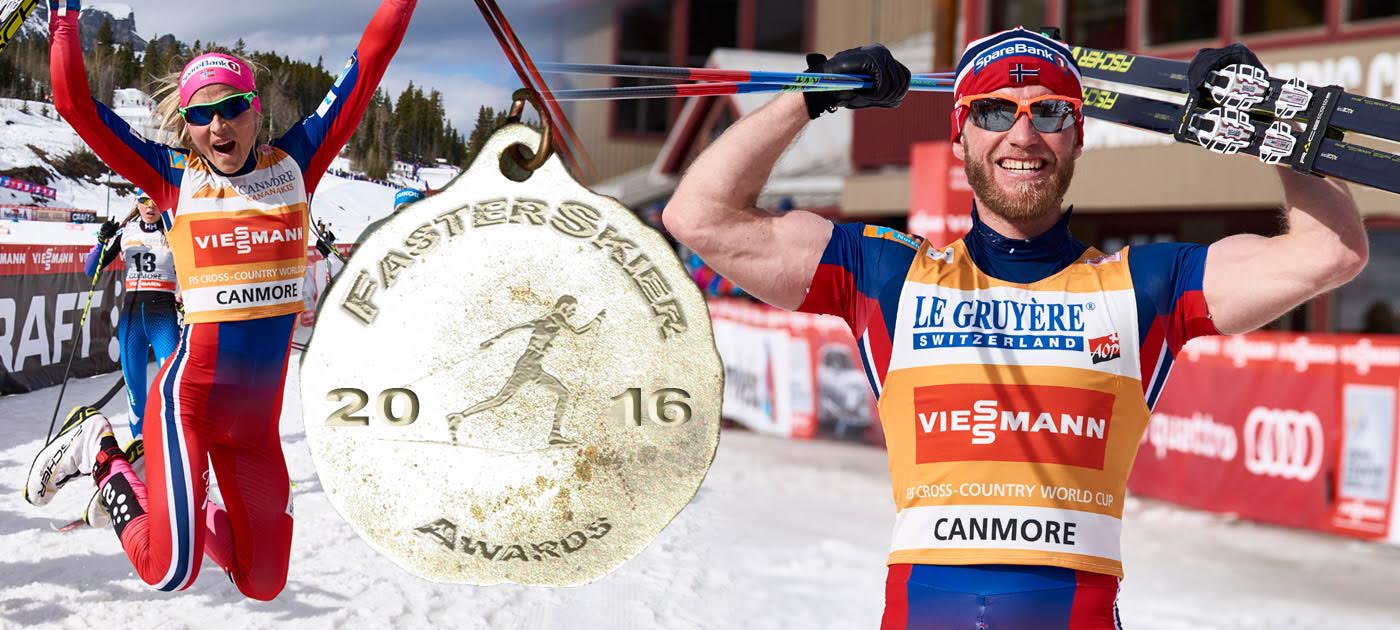
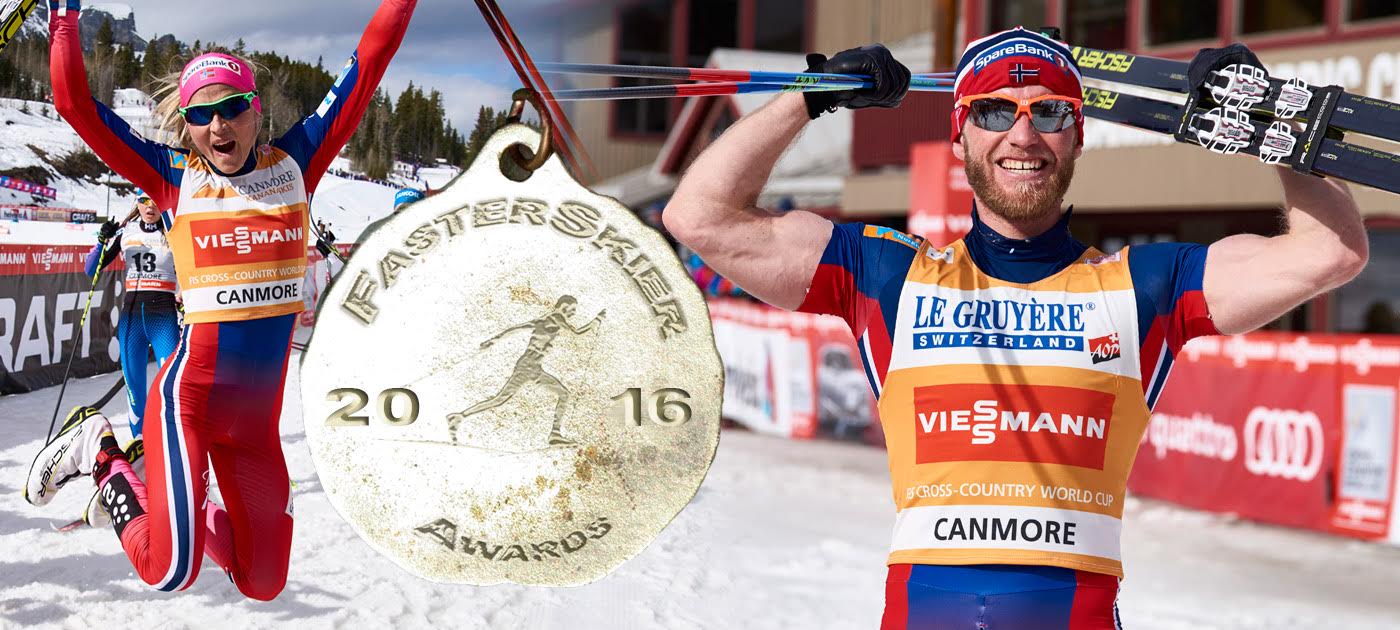
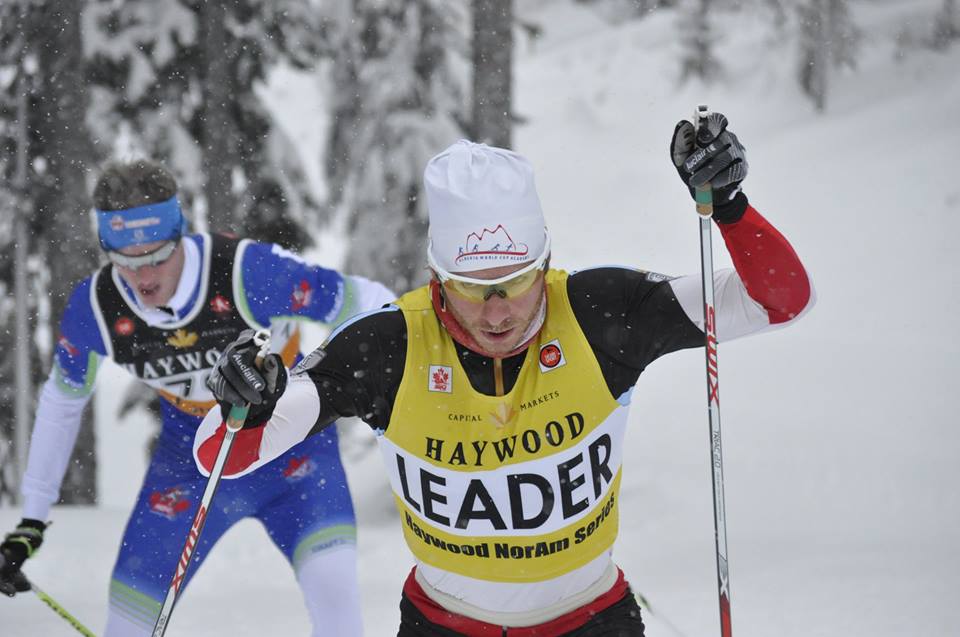
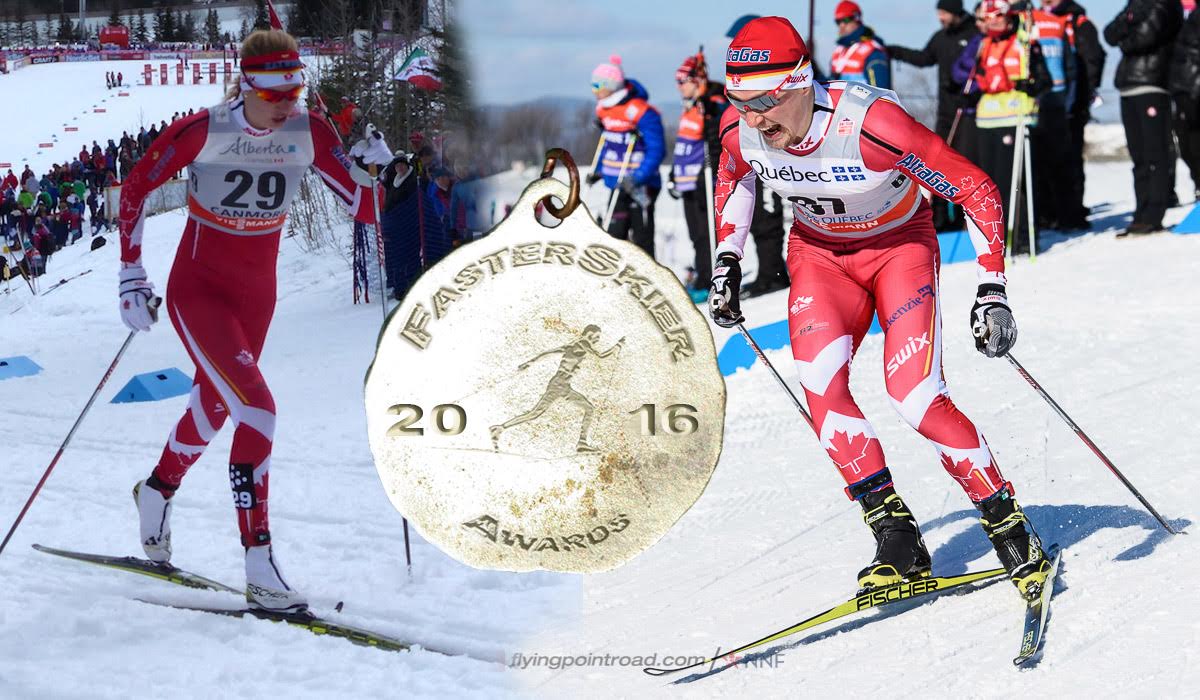
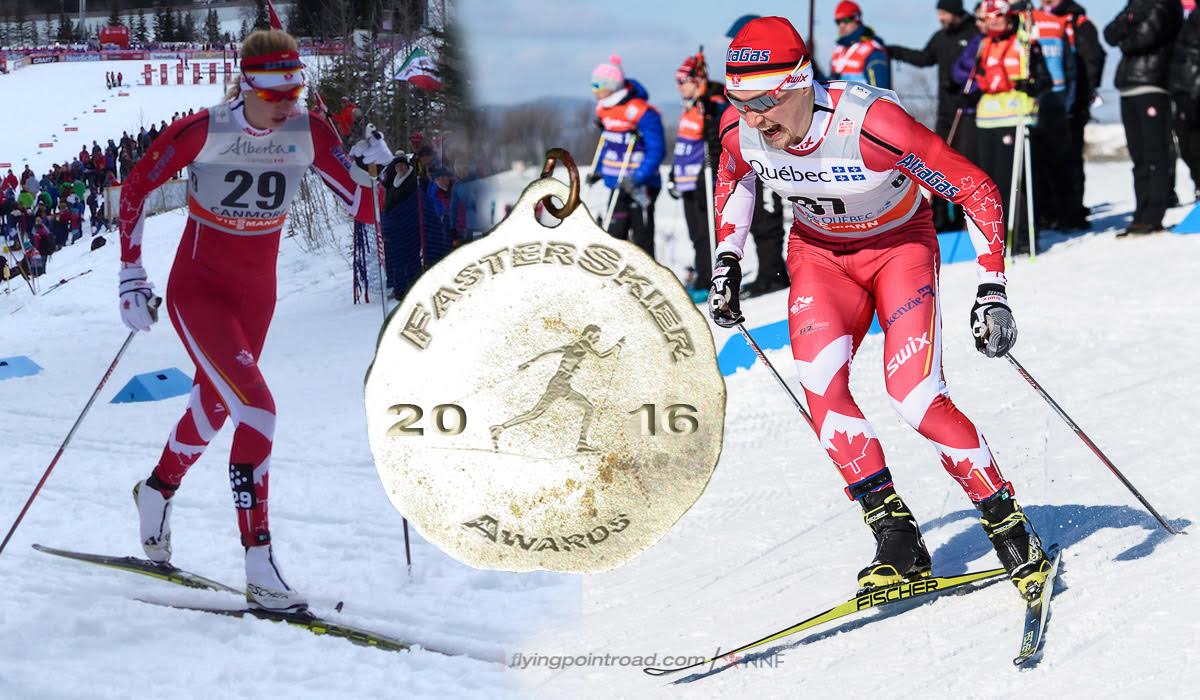
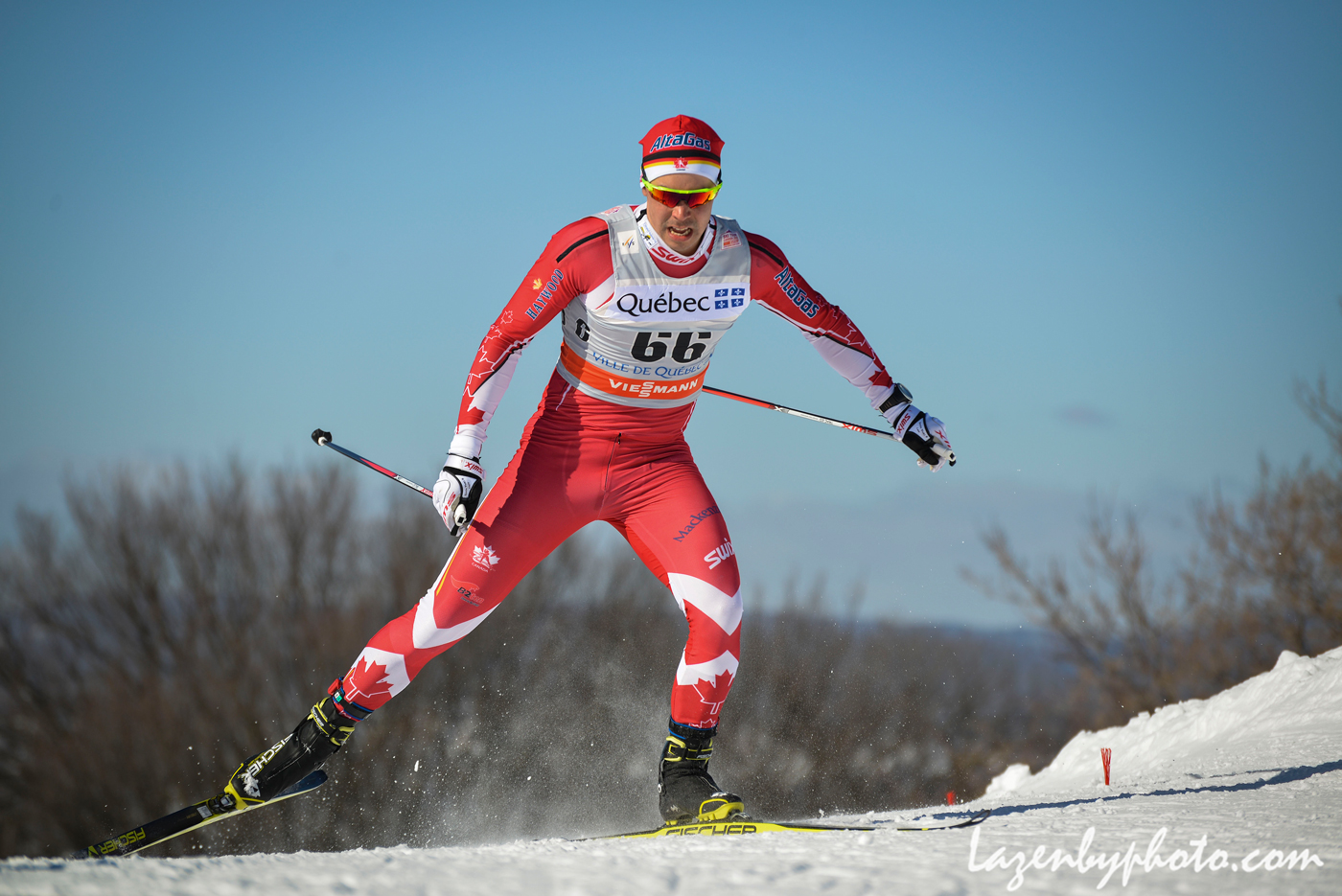
    Jessie Diggins (l) of the U.S. Ski Team and Alex Harvey (Canadian World Cup Team) are FasterSkier's Cross-Country Skiers of the Year. (Photos: FlyingPointRoad.com)
    Jessie Diggins (l) of the U.S. Ski Team and Alex Harvey (Canadian World Cup Team) are FasterSkier’s Cross-Country Skiers of the Year. (Photos: FlyingPointRoad.com)

    This is it! Our final award of 2016. This set of honors goes to outstanding male and female cross-country skiers during the 2015/2016 season.

    See also: Breakthrough Skiers (Canada & U.S.) | Biathletes | Coaches | Collegiate Skiers | Continental (Canada & U.S.) | International Skiers and Performances | JuniorsNordic Combined | Para-Nordic | Performances (Biathlon & Cross-Country)

    ***

    Alex Harvey, Canadian World Cup Team

    In recent years, it’s hard to argue that it’s become Norway’s World Cup game to lose. The overall World Cup men’s standings this year confirms that premise: it’s congested with Norwegians. First, second, third, sixth, eighth, ninth, and 10th — all those places went to Norway.

    Canada’s Alex Harvey stymied a bit of that perfection. He finished the season in seventh overall. As the lone North American male in the overall top 30, Harvey has proved he’s amongst the best all-around skiers on the globe. Since 2009 when he began racing World Cups full time, Harvey has placed in the top 10 of the final World Cup overall rankings five times, with a career-best third in 2014.

    Coming into this season Harvey had recovered from iliac artery surgery. Pre-surgery, Harvey suffered from poor blood flow in his legs, which impeded his skating up steep uphills at full capacity. Post-surgery, Harvey began setting personal records for several runs he has used as test pieces over the years. All signs pointed towards a full recovery and an improved Harvey. But surgery is still surgery.

    Of the 30 individual World Cup races he entered this season, Harvey was only out of the points in six. And in nearly 50 percent of those starts, he skied into the top 10, including two podiums. That’s a success.

    Harvey is a skier with high expectations for himself. He is, after all, a four-time World Championships medalist. At 27 years of age, Harvey has proven himself to be a medal contender in either the sprints or distance events. With high benchmarks set by the likes of overall World Cup winner Martin Johnsrud Sundby, runner-up Petter Northug and Finn Hågen Krogh (all from Norway) as well as Russia’s Sergey Ustiugov (who placed fourth overall behind them), Harvey has his work cut out for him in 2017 in terms of improving on his overall finish.

    But amidst the sea of hyper-competitive Norwegians and the upstart Ustiugov, Harvey held his own this year, setting benchmarks, too, for North American perseverance.

    Jessie Diggins, U.S. Ski Team and Stratton Mountain School T2 Team
    JDiggs

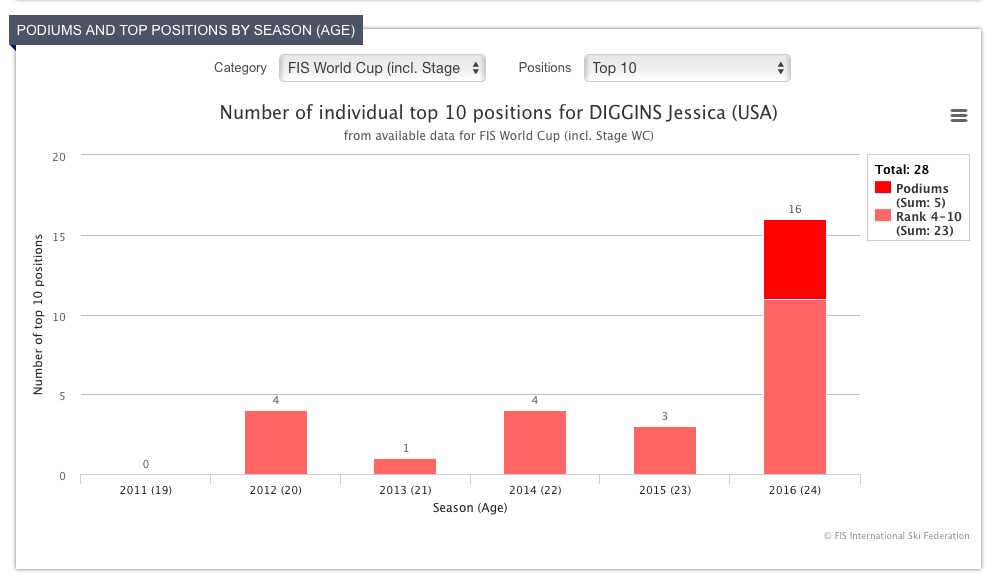
    Imagine your’re back in school and it’s time to learn about bar charts and trends. The above chart, created by the International Ski Federation (FIS), is pretty simple: on the horizontal axis is time and on the vertical axis is number of top-10 positions. In this case, the graph refers to Jessie Diggins and the number of individual top-10’s she’s earned on the World Cup for the years 2011 to 2016.

    Before this year, Diggins career best top-10 total in a World Cup season was four.

    Above year 2016 on the chart, it looks like a lording skyscraper representing her top-10 finishes. It’s obvious Diggins had a breakthrough in 2016 — she quadrupled that former career best total of four top-10’s, upping it to 16.

    What’s the trend here? That at the age of 24, in either sprint or distance, Diggins is learning to take charge. She was in the points, top-30 overall, in all 11 sprints this year. Traditionally thought of as a skate specialist, she made the finals and placed sixth on the Ski Tour Canada’s Stage 5 classic sprint.

    She’s a feisty classic distance racer too. She placed fifth overall on the final Ski Tour Canada (STC) stage, a 10 k classic pursuit in which she skied the third-fastest time on the day.

    And we know she kills when skating.

    This season she stood on five podiums, including a sprint win in Toblach, Italy, anchored the best-ever finish for a U.S. women’s 4 x 5 k relay, skiing them into a historic second place, and was an athlete other women on the World Cup took notice of, finishing the season in eighth overall.

    Although one does not become a North American ski racer for the money — the endorsements aren’t exactly lucrative — according to FIS, Diggins earned 46,500 Swiss Francs in winnings this season. That amounts to nearly $49,000 dollars. It’s a total that shows a U.S. cross-country skier can earn a professional wage commensurate with their professional athletic credentials.

    Like Kikkan Randall before her who set a new standard for North American excellence, Diggins is breaking barriers.
  • FasterSkier’s Biathlon Performances of 2016: Dunklee and Canadian Men’s Relay

    FasterSkier’s Biathlon Performances of 2016: Dunklee and Canadian Men’s Relay

    Susan Dunklee (l) and the Canadian men's relay earned FasterSkier's biathlon performances of the year with their results at the Presque Isle World Cup and World Championships, respectively. (Photo: USBA/NordicFocus & JoJo Baldus)
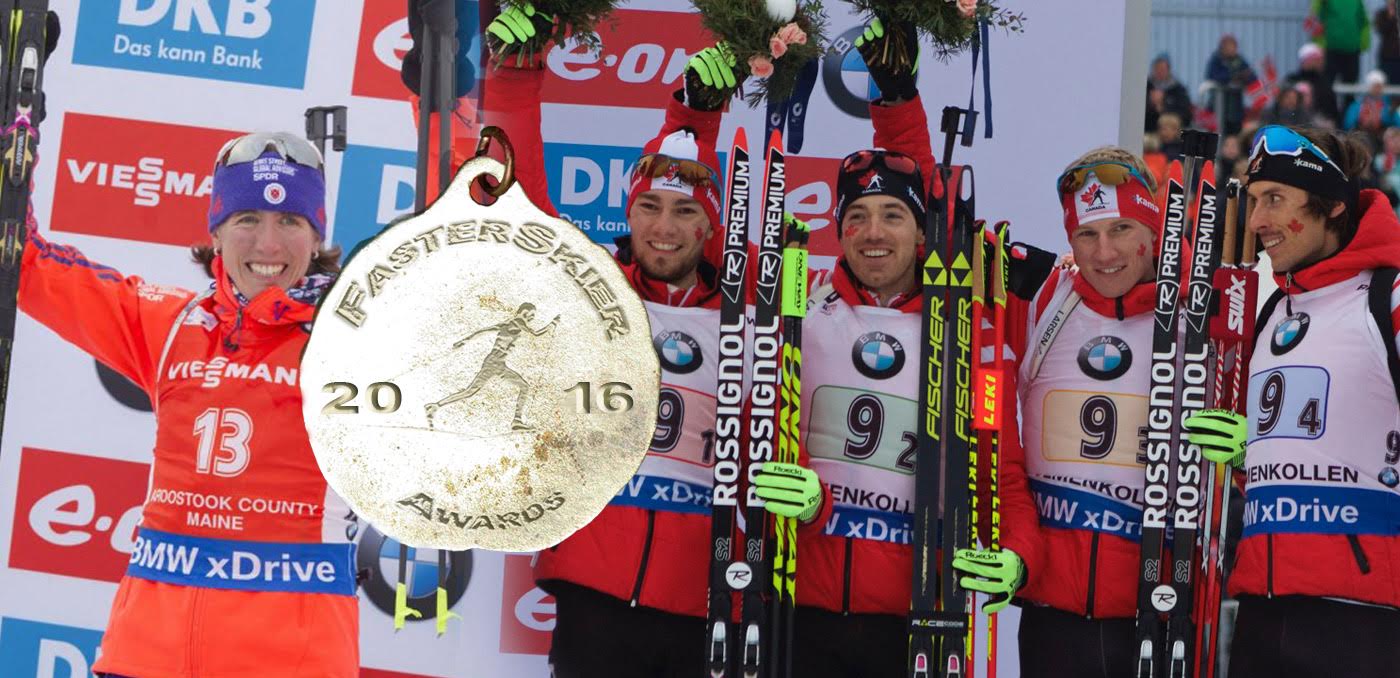
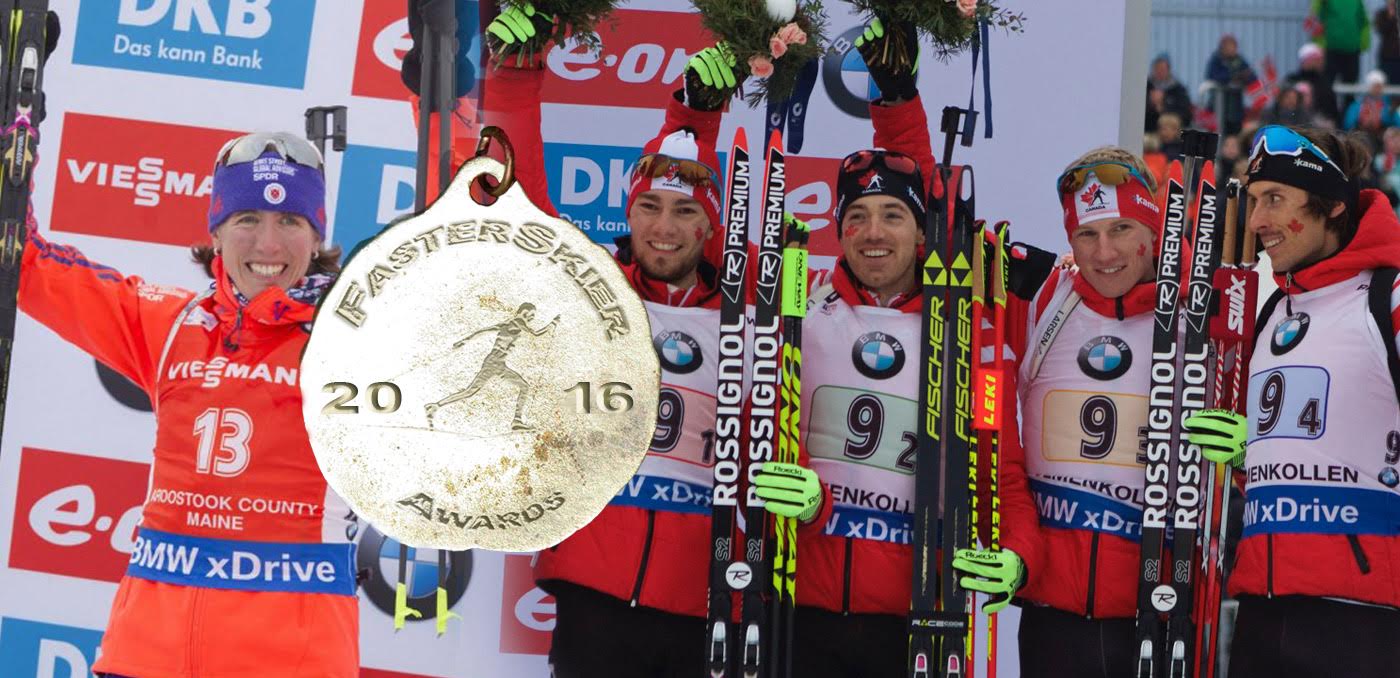
    American Susan Dunklee (l) and the Canadian men’s relay, with (from l to r) Christian Gow, Nathan Smith, Scott Gow, and Brendan Green, earned FasterSkier’s biathlon performances of the year with their results at the Presque Isle World Cup and World Championships, respectively. (Photos: USBA/NordicFocus & JoJo Baldus)

    We’re entering the homestretch for the 2015/2016 FasterSkier awards, chosen by our staff based on performances last season. While not scientific, these points of recognition are intended to reflect a broader sense of the season in review.

    The following set of honors goes to outstanding North American male and female biathlon performances of the year. Cross-country performances of the year will follow.

    Previous categories: Breakthrough Skiers (Canada & U.S.) | Biathletes | Coaches | Collegiate Skiers | Continental (Canada & U.S.) | International Skiers and PerformancesJuniorsNordic Combined | Para-Nordic

    ***

    • Susan Dunklee (US Biathlon): Presque Isle World Cup 10 k sprint

    Both Susan Dunklee and teammate Lowell Bailey seemed to have breakthroughs after the 2014 Olympics in Sochi, Russia: they had notched best-ever finishes for Americans, with Dunklee 11th in the mass start and Baily eighth in the individual, and then picked up their first World Cup podiums in the weeks post-Olympics.

    Heading into 2015, the team (as well as its fans) was giddy with the possibility of more podiums. But none came.

    Dunklee delivered this season in Presque Isle, Maine, exactly where those fans could most appreciate it. Shooting a perfect 10-for-10 in the 10-kilometer sprint, she sped past many pre-race favorites and finished second, 17.8 seconds behind Gabriela Soukalova of the Czech Republic (who later won the World Cup Total Score).

    “I knew I probably had one of my best races in my life and I’d done it at home and my parents were there,” Dunklee said after the race. “I just felt really good about my performance. I was really happy.”

    It was close, with second through fourth place separated by fewer than three seconds. But Dunklee, an early starter, got to watch her time hold despite challenges from the likes of Marie Dorin Habert of France.

    “You still need to fight like hell,” Dunklee recalled of heading out on the final loop knowing that times were tight. “When you’re having that sort of race, you don’t want to lose a second anywhere … I’ve just got to fight for the next seven minutes or whatever it takes.”

    Dunklee had a solid season, just as she has for each of the last several years; consistency on the World Cup circuit landed her in 14th place in the Total Score, the best ever for an American woman.

    But consistency doesn’t breed excitement quite the same way that podiums do.

    “It’s unbelievable,” U.S. women’s coach Jonne Kähkönen said. “Just to be able to grab the podium on the home soil, home World Cup, even if it’s not the hometown, but there’s a lot of friends and family and fans that are great support. The local community is just awesome, so it means the world to us.”

    Dunklee is now tied for the best performance ever by an American, along with Tim Burke, Anna Sonnerup, Joan Smith, and Josh Thompson, all of whom also won silver at World Cup or World Championships events.

    Next up? The U.S. is still waiting on a gold.

    • Canadian men’s relay team (Christian Gow, Nathan Smith, Scott Gow, and Brendan Green), World Championships men’s 4 x 7.5 k relay

    While Dunklee’s second-place finish was historic, it didn’t send the same shock waves as another record-setting result which came a few weeks later: when the Canadian men’s team broke through for bronze in the World Championships relay in Oslo, Norway, earning their country’s first-ever relay medal.

    “In a relay anything is possible,” anchor racer Brendan Green said at the time. “Today we all really put it on the line together. Every single one of us raced really well. When that happens, when things come together like that, it’s really incredible.”

    It was easily the most surprising result of the championships, and the athletes themselves said that they hadn’t seen it coming – they had thought a top five was possible. The medal? Maybe in a few years, they had hoped.

    Some aspects of the performance were predictable. The Canadians tied with Germany and the U.S. for the best shooting on the day – not surprising because they already were a great shooting team, with Christian Gow the fourth-most accurate shooter on the World Cup and Smith the fifth-fastest.

    And seeing Nathan Smith bring the team to the front of the field? He has won an individual World Cup, so that wasn’t unusual.

    Seeing Green anchor the team like a pro? He has done it dozens of times, and also has five individual top-10 finishes to his name – although shooting a perfect ten-for-ten when a medal is on the line is a whole different story. Green was stone-cold as the anchor even though he said his nerves were a nightmare.

    Perhaps what fans hadn’t been expecting were the stellar performances of the Gow brothers, who are the younger members of the Canadian team. Christian Gow, then 22 years old, tagged off just 14.7 seconds behind the leaders on leg one, handing over to Smith, who skied into a more or less dead heat with the leaders on leg two.

    Older brother Scott, 25, turned in one of the best ski performances of his career, casually hanging with Norway’s Johannes Thingnes Bø, a many-time World Cup winner who later went on to take gold in the 15 k mass start.

    “Watching Christian tag off really close, and then Nathan obviously moved us right into contention… I thought, OK, I have to [stay with him], I don’t have a choice,” Scott said. “I don’t know if I believed I could, but I had to, to try and keep our team in it. I’m just happy that I was able to stay right behind Johannes for most of it and hang on.”

    He did hang on, tagging off in third; Green sealed the deal; history was made.

    “Every year you kind of think it’s coming,” National Team Coach Roddy Ward said. “It’s close, it’s close, and we’ve been close for a couple of years. We were close enough, I guess, that on the right day we were there.”

    Maybe next time the commentators won’t be so surprised.

    Honorable mentions:

    • Canadian mixed relay team (Rosanna Crawford and Nathan Smith), single mixed relay at Östersund, Sweden, World Cup
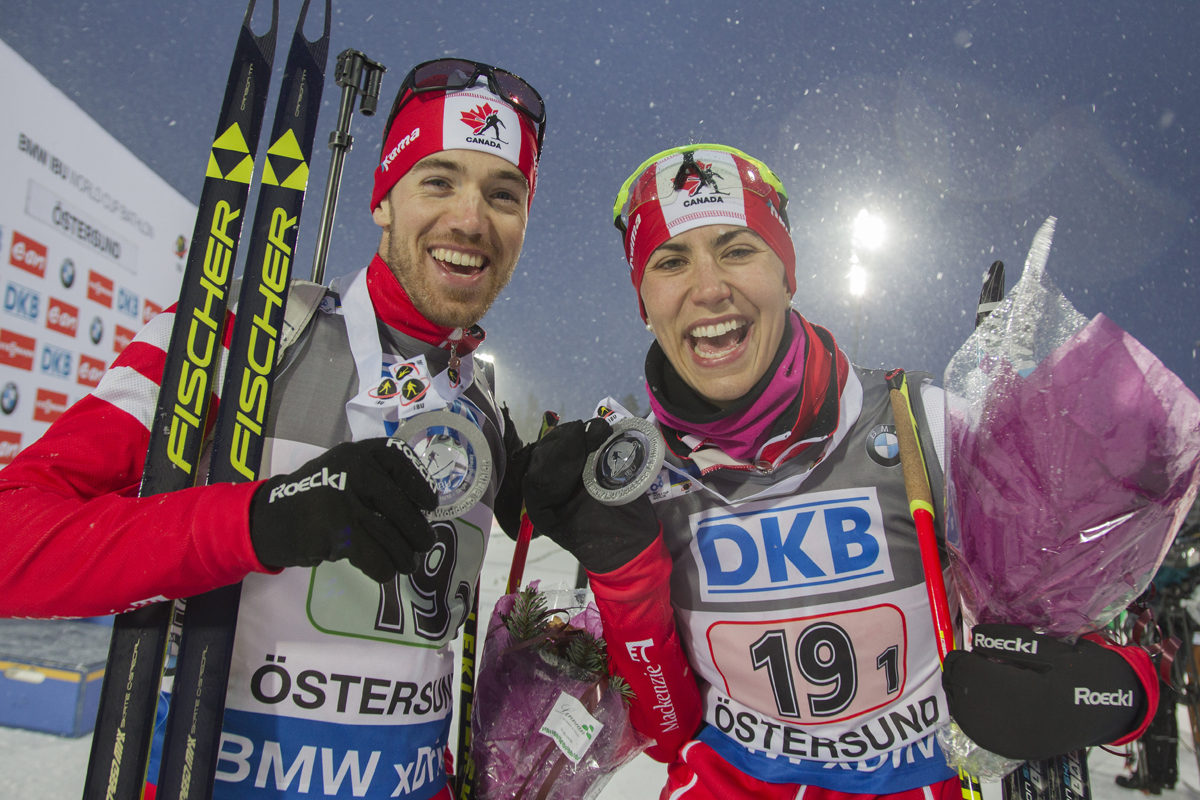
    Nathan Smith and Rosanna Crawford celebrate their second-place finish in the World Cup single mixed relay in Oestersund, Sweden. (Photo: Fischer/NordicFocus)
    Nathan Smith and Rosanna Crawford celebrate their second-place finish in the World Cup single mixed relay in Östersund, Sweden. (Photo: Fischer/NordicFocus)

    Canada had actually started the year off with a relay “bang”: in the very first World Cup competition of the season, Nathan Smith and Rosanna Crawford teamed up for silver in the mixed relay.

    Despite a rocky start and nine spare rounds, they managed to avoid the penalty loop and finished 11.9 seconds behind Norway, claiming Canada’s first ever World Cup relay podium.

    “It feels amazing,” Crawford said at the time, before pointing out that she’s still hunting for her first individual podium. “I don’t want to downplay it. Those team events, it feels so exciting and I feel so lucky to share the podium with my teammate who I’ve trained with for so long. But also, it’s probably not the same as an individual podium, which is definitely what I’m gunning for this year.”

    • U.S. (Susan Dunklee, Hannah Dreissigacker, Tim Burke, and Lowell Bailey) and Canadian (Rosanna Crawford, Sarah Beaudry, Macx Davies, and Brendan Green) mixed teams, Mixed relay at Canmore World Cup

    Perhaps team events were just the thing for North American biathlon teams this season. In Canmore, Alberta, both the Americans and Canadians were in the hunt for the podium until late in the race. The U.S. ended up fourth, less than two seconds off the podium, and the Canadians ten seconds behind them in sixth.

    The result was a best-ever mixed relay for the U.S., with Canada tying its previous best in the two-man, two-woman event.

    “It’s easy to say, ‘Oh man, if I had known, I would’ve skied two seconds faster,’ but I really don’t think I could’ve,” U.S. anchor skier Lowell Bailey said of finishing less than two seconds out of third. “I put everything I could have into that last lap. It’s bittersweet, but it’s also our best result ever in the mixed relay. …  Fourth is where we ended up, and I think we have to be satisfied with that and keep that momentum going forward.”

  • FasterSkier’s International Skiers and Performances of 2016

    FasterSkier’s International Skiers and Performances of 2016

    2015/2016 overall World Cup winners Therese Johaug (l) and Martin Johnsrud Sundby are FasterSkier's International Skiers of the Year. (Photos: Fischer/NordicFocus)
    2015/2016 overall World Cup winners Therese Johaug (l) and Martin Johnsrud Sundby are FasterSkier’s International Skiers of the Year. (Photos: Fischer/NordicFocus)

    The 2015/2016 awards continue, chosen by the FasterSkier staff based on performances from last season. While not scientific, these points of recognition are intended to reflect a broader sense of the season in review.

    The following set of honors goes to outstanding male and female international skiers of the year and the male and female international performances of the year. 

    Previous categories: Breakthrough Skiers (Canada & U.S.) | Biathletes | Continental (Canada & U.S.) | Coaches | Collegiate Skiers | JuniorsNordic Combined | Para-Nordic

    International Skiers of the Year: 

    Martin Johnsrud Sundby, Norway

    Frozen beard, big-time work ethic, and a perfectly proportioned combo of confidence and humility, in 2016, Norway’s Martin Johnsrud Sundby was a model of supreme day-to-day fitness and season-long endurance. Just a single win from his 2016 World Cup accomplishments would make a season for some and even define a career for others. Here’s a sampling of Sundby’s 2016 race season:

    • 14 individual World Cup wins
    • Inaugural Ski Tour Canada (STC) win
    • Third-straight Tour de Ski title
    • A 50 k classic Holmenkollen victory. (It was Sundby’s first Holmenkollen 50 k victory in nine 50 k World Cup starts there).

    Known as a distance dominator, Sundby also proved his worth in the sprints. He finished fourth in three sprint races and ended up 13th overall in the Sprint World Cup.

    Sundby has taken the overall Crystal Globe the last three seasons. Prior to his three-year grip on the overall, Sundby’s best end-of-season overall ranking was eighth in 2013. Between 2007 and 2012, his end of year rankings were 146th, 68th, 13th, 42nd, 28th, and 19th. Not exactly the numbers we associate with his superstar status.

    The years when he has struggled are not lost on Sundby. “To grow old in the profession I have chosen, with the genetic infirmities I have, one must also do much right. I have so sensitive respiratory and lung problems and asthma,” Sundby said according to a translated article.

    At 31 years old, and now a father of two, Sundby has much to juggle along with his aspirations for more athletic glory. “No matter how I twist and turn it, I do not have many years left at the top. I must take advantage of the years well,” Sundby said.

    No doubt, Sundby has used the last three years well; exploiting a high tolerance for big training loads and a gift to see that training materialize in podiums.

    With next year’s World Championships looming, Sundby has a clear goal for 2017; he’s never won an individual World Championship gold. It’s still unclear if Sundby will continue racing into 2018, but an Olympic void also remains; no Olympic golds.

    Therese Johaug, Norway

    Many athletes are gifted opportunities, but few are able to capitalize. Over the course of a World Cup season, there seems more that can go wrong than right. There’s possible sickness and injury, poor form, bad skis, and other Norwegian upstarts emerging. So much must align for an athlete’s potential to morph into results.

    Johaug’s big gift this year was the absence of 2015 FasterSkier international female skier of the year, Marit Bjørgen, due to the birth of Bjørgen’s first child.

    To her credit, Johaug made the best of her opportunities and seized both the day and the season. She won her second-career overall World Cup in dominating fashion.

    If you’ve ever listened to Johaug interviewed post-victory, you’ll undoubtedly heard her say this: “The shape is good.”

    The shape was good from the start of the season in Finland to its conclusion in Canada. During that journey, Johaug only impressed. She ultimately tied Marit Bjørgen’s record of 17 wins in a World Cup season.

    She won the Ski Tour Canada, the Tour de Ski and the Holmenkollen 30 k classic. In fact, she won all but three distance World Cup races this season. One of those non-wins was the STC Stage 4 10 k freestyle pursuit in Quebec City. Johaug actually skied that race’s fastest time on the day. Not shabby.

    Just a distance skier you say. She placed in the top 10 in five different sprints this season.

    Next season will present Johaug just what an elite athlete at the pinnacle of their sport needs; new challenges to stay motivated. Bjørgen, of course, will be back. So, too, will two other Norwegians capable of derailing the Johaug-express, second in the World Cup overall Ingvild Flugstad Østberg, and third overall Heidi Weng.

    International Performances of the Year:

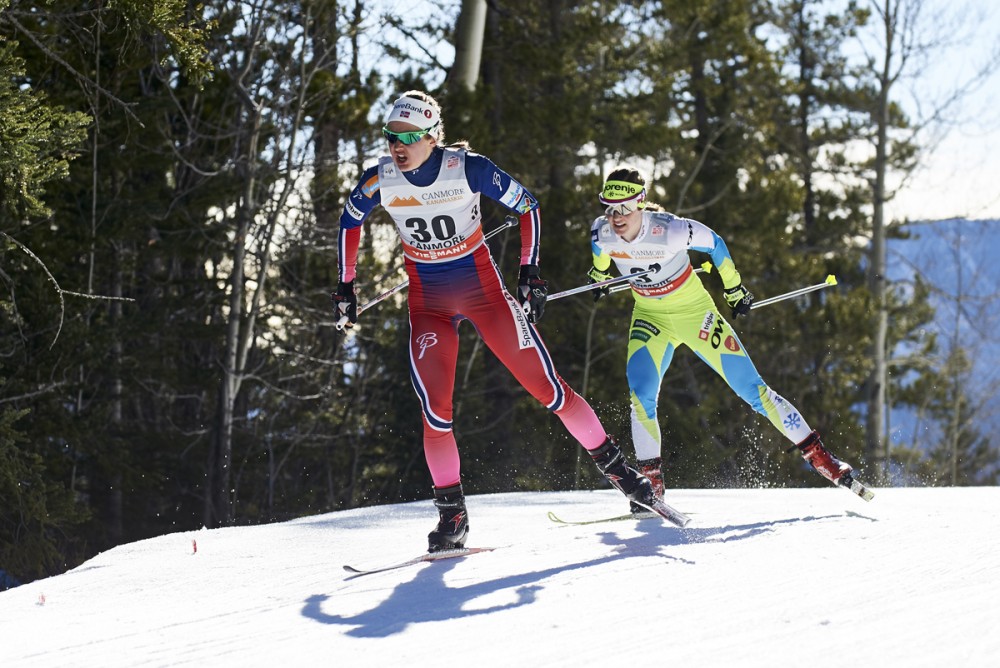
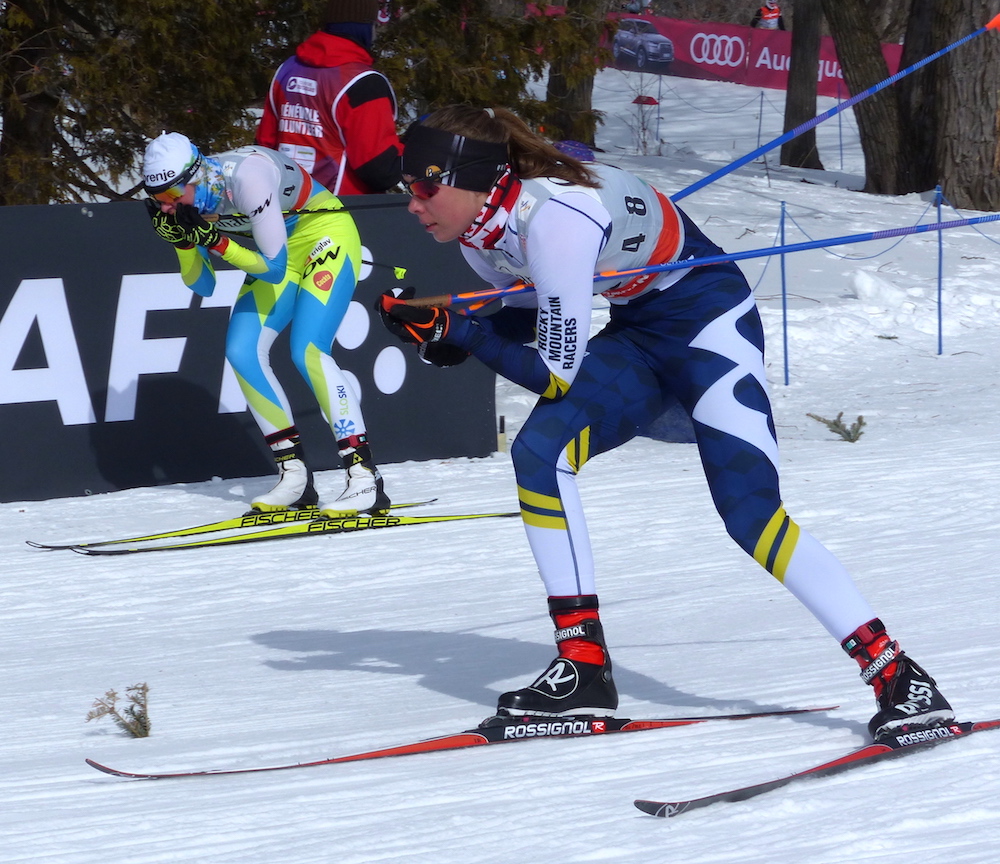
    Norway's Ingvild Flugstad Østberg leads Slovenia's Alenka Cebasek during the women's 10 k freestyle at Stage 7 of the Ski Tour Canada in Canmore, Alberta. Østberg went on to win the stage by 23 seconds over her teammate Heidi Weng. (Photo: Madshus/NordicFocus)
    Norway’s Ingvild Flugstad Østberg leads Slovenia’s Alenka Cebasek during the women’s 10 k freestyle at Stage 7 of the Ski Tour Canada in Canmore, Alberta. Østberg went on to win the stage by 23 seconds over her teammate Heidi Weng. (Photo: Madshus/NordicFocus)

    Ingvild Flugstad Østberg (Norway): 10 k freestyle at Stage 7 of the STC

    Since 2012, Østberg has become a consistent force in the sprint standings. In 2012, she was eighth overall. The next four years culminated with a third, fourth and two successive second-place in the overall sprint standings.

    But early this season, Østberg made clear Johaug best keep an eye on her. In Lenzerheide, Switzerland, Østberg scored her first career World Cup distance win. If that race in Lenzerheide was her debut, then the STC’s Stage 7 freestyle individual start was Østberg’s coronation.

    In what should have been a Johaug victory or a Weng win, Østberg crushed. She ranked second at the first time check, but upped her speed and punched first and first at the second and third checkpoints. Østberg beat second place finisher Weng by 23 seconds and relegated Johaug (who eventually went on to win the Ski Tour Canada overall) to sixth place (+40.1).

    FasterSkier interviewed Østberg during the STC. In particular, she discussed her emergence as a distance threat, not only a sprint shoe-in.

    “Many years now that I am a sprinter, but I’ve always said I am not a sprinter,” Østberg said at the time. “Don’t call me a sprinter because I want to be an all-around skier and I want to do good in all kind of distances.”

    True to reputation, Østberg was second overall in the sprint World Cup. However, she was third overall in the final World Cup distance standings. Add all that up and you have an all-around skier: Østberg was second for the World Cup overall with 2302 points. Johaug, the overall winner, ended with 2,681 points.

    Federico Pellegrino (Italy): skate sprint streak

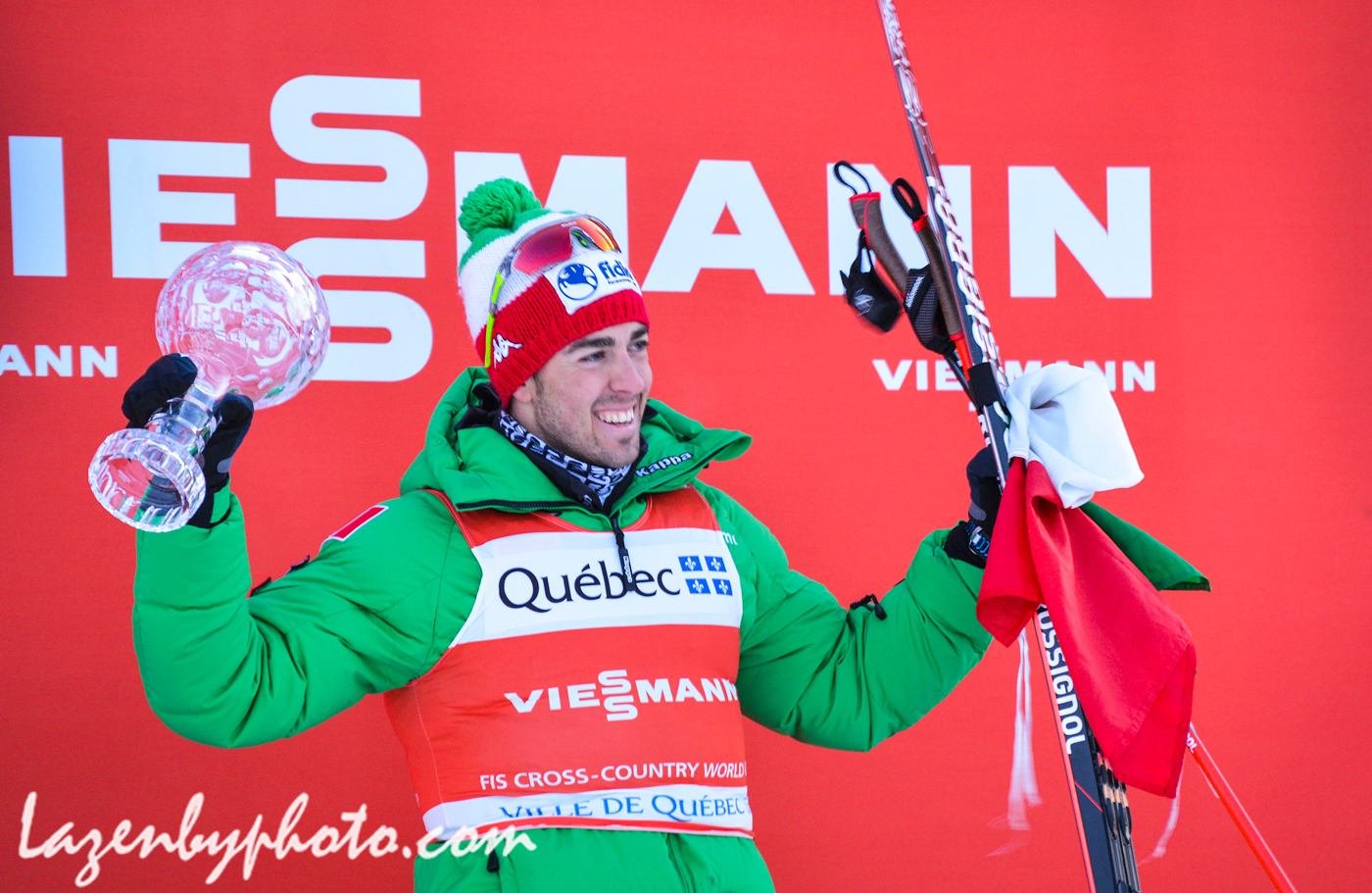
    Italy's Federico Pellegrino became the first non-Scandinavian male to win a Sprint World Cup Crystal Globe on Friday, placing 21st in the freestyle sprint in Quebec City. (He needed to finish in the top 22 to lock up the title.) (Photo: John Lazenby/Lazenbyphoto.com)
    This season, Italy’s Federico Pellegrino became the first non-Scandinavian male to win a Sprint World Cup Crystal Globe.(Photo: John Lazenby/Lazenbyphoto.com)

    Perhaps there’s a reason the term “three-peat” just sounds like a nice tidy package of victories. “Four-peat”, on the other hand, just doesn’t sound as familiar. That may be because winning something four times in a row is that much harder to do.

    During the 2015/2016 World Cup season, Pellegrino did accomplish a three-peat. He won three consecutive skate sprints. This season, he did one better.

    From Davos, to Toblach, to Lenzerheide, to Slovenia, Pellegrino did something unprecedented on the World Cup scene. According to FIS, Pellegrino was the first skier to win four consecutive freestyle sprints.

    Coming into the STC, Pellegrino struggled in the classic sprints. In chronological order, here’s Pellegrino’s  classic sprint results on the World Cup this season; seventh, 14th, 26th, and 21st. It shows a heavy reliance on his freestyle skills.

    The final sprint of the season, Stage 5 of the STC, was a classic sprint. It’s possible that having already locked up the sprint crystal globe — in no small part due to his skate sprint streak — prior to the race boosted his confidence. Pellegrino strided to a Stage 5 classic sprint win.

    Pellegrino ends the season as the winningest Italian male ever to ski on the World Cup with eight wins total. All but one of those victories have come in freestyle technique.

    Four skate sprint wins in a row was a record. And with a first-ever career classic sprint win to close out the season, it’s a nice goodbye.

  • FasterSkier’s Canadian Continental Skiers of 2016: Andy Shields and Dahria Beatty

    FasterSkier’s Canadian Continental Skiers of 2016: Andy Shields and Dahria Beatty

    The 2015/2016 aggregate NorAm leaders Andy Shields (l) and Dahria Beatty are FasterSkier's Continental Skiers of the Year for Canada. (Photos: Fischer/NordicFocus and W. James MacLean)
    The 2015/2016 aggregate NorAm leaders Andy Shields (l) and Dahria Beatty are FasterSkier’s Continental Skiers of the Year for Canada. (Photos: Fischer/NordicFocus and W. James MacLean)

    The 2015/2016 awards continue, chosen by the FasterSkier staff based on performances from last season. While not scientific, these points of recognition are intended to reflect a broader sense of the season in review.

    Previous categories: Breakthrough Skiers (Canada & U.S.) | Biathletes | Coaches | Collegiate Skiers | Juniors | Nordic Combined | Para-Nordic

    ***

    Andy Shields, Thunder Bay National Development Centre

    One point. That was the difference between the men’s overall NorAm winner and the runner-up of Canada’s Continental Cup circuit this season, and emerging skier Andy Shields came out on top.

    The 25-year-old Thunder Bay National Development Centre member — who broke through at the World Cup level with the 30th-fastest time in the men’s 15 k freestyle pursuit at the Ski Tour Canada (STC) in Quebec City — made his international World Cup debut this season. In all, he tallied eight World Cup starts in 2016 (including six stages of the Tour), but it’s what he did on the NorAm that makes him our choice for Continental Cup Skier of the Year.

    “It was a pretty good race,” Shields told FasterSkier after the Quebec City pursuit, his second World Cup distance race, in which he placed 65th with the 30th-best time. “The wave start I was in was pretty quick, so I was able to get in the front group with them, and they pulled me along to a really good time on the day. Pretty happy that I’m able to manage that pace.”

    Shields started 2015/2016 modestly, with an 11th-place finish in the freestyle sprint at the U.S. SuperTour opener in West Yellowstone, Mont., followed by a 37th place in the 15 k skate the next day.

    In the first NorAm of the season in Canmore, Alberta, Shields reached the podium in the classic sprint, placing third behind his NDC teammate Bob Thompson and Patrick Stewart-Jones, of the Alberta World Cup Academy (AWCA), respectively. From there, Shields continued to gain momentum, winning the skate sprint at the next NorAm in Sovereign Lake, B.C., and placing fourth in the 15 k skate race before leaving for nearly a month of World Cup racing in Europe.

    Upon returning to Canada in late January, Shields didn’t waste any time jetting to first and second in two NorAm distance races in Mont Sainte-Anne, Quebec. He went on to win the 20 k classic mass start at Eastern Canadian Championships, and at Western Championships, he finished in the top six in all four races: placing second in the 20 k classic mass start and third in the classic sprint. After that, Shields packed his bags for the STC, raced six World Cups in nine days, then finished his season at Canadian Ski Nationals in Whitehorse, Yukon. There, he missed the podium in four individual races, but reached the skate sprint final and placed sixth.

    Between the men’s NorAm distance and sprint races this past season, Shields was the most consistent — besting Kevin Sandau (AWCA) by the slimmest of margins (1 point) in the men’s overall. Shields was fourth in the overall sprint standings, behind Julien Locke (Black Jack), Bob Thompson (NDC Thunder Bay), and Patrick Stewart-Jones (AWCA), respectively.

    Dahria Beatty, Alberta World Cup Academy/Canadian U23 Development Team

    The winner of the both the women’s NorAm overall and sprint series, Dahria Beatty dominated from start to finish last season, winning both a distance skate race and classic sprint at the Canmore NorAm opener, then winning four more NorAms before taking part in the STC.

    During her first-ever World Cup tour, in which she notched 15th in the Canmore classic sprint, Beatty turned 22. The national U23 development team skier went on to win two out of three individual races she competed in at nationals in her hometown of Whitehorse (winning the 10 k skate and skate sprint, and placing second in the 5 k classic).

    For her 15th place — her first individual World Cup top 30 — FasterSkier dubbed her Breakthrough Skier of the Year. For her performances at home in Canada on the NorAm circuit, finishing in the top eight of every race she competed in this season, Beatty is Continental Skier of the Year.

    “My ideal goal for this season would be able to crack the top 30 on the World Cup,” Beatty said in December before leaving for Canada’s U25 B-Tour trip in Europe. “That’s a big goal…”

    Honorable mentions

    Kevin Sandau, Alberta World Cup Academy

    Race winner Kevin Sandau (AWCA) (r) in the leader's bib leads Bob Thompson (Team Hardwood) during the men's NorAm 15 k freestyle individual start on Sunday in Vernon, British Columbia. (Photo: XTS Photography)
    Kevin Sandau (AWCA) in the NorAm leader’s bib leads Bob Thompson (r) during the men’s NorAm 15 k freestyle individual start at Sovereign Lake, B.C. Sandau went on to win by 37 seconds over Knute Johnsgaard (not shown). (Photo: XTS Photography)

    Kevin Sandau’s only 27, but it feels like he’s been at the forefront of Canadian cross-country skiing for a long time. After debating whether he would compete in 2015/2016, Sandau started the winter on a tear, winning back-to-back Canmore distance races in December and remaining undefeated in NorAm distance races until Easterns in early February (where NDC Thunder Bay’s Michael Somppi dethroned him in the 15 k skate).

    After that, Sandau never reached the top of the podium again, but he came close in second in the 10 k skate at Westerns (behind Russell Kennedy of Canmore Nordic). At the end of the season, he finished second in the NorAm overall with 724 points, one short of Shields.

    On March 26, after placing fifth in his final race of the season (the 50 k classic mass start at nationals), Sandau announced his retirement on Facebook.

    “Today marks the end of my racing career. The memories are countless and the experiences beyond amazing. I can’t think of a better way to have spent the past 10+ years,” he wrote. “Thanks so much to all the volunteers, coaches, teammates, skiers, parents, fans and role models for the journey. I’m looking forward to the next chapter and hope it’s as good as the last. KevOut.”

    Sandau previously stated that his season-long goal was to qualify and focus on the STC. He did so, placing 43rd overall in the Tour. In his career, he raced 29 World Cups, starting with his first in 2008 in Canmore.

    Besides skiing, Sandau brought humor to his ski racing and shared it on social media.

    In a prank April Fools’ article on FasterSkier, Sandau played along with the idea that he would be Canada’s next head coach.

    “I feel like my practical experience on the domestic circuit and top-50ish on the World Cup is what really sets me apart from the rest,” he jested. “You learn a lot of racing in the back of a World Cup, it’s like the best seat in the house, and you can watch firsthand the whole race as it unfolds, at least for a little bit.”

    Cendrine Browne, Pierre-Harvey National Training Centre/U23 Development Team

    "Me and Dahria [Beatty] worked together to stay on the tail of Emily Nishikawa, who's our best Canadian. It was a tough course with few spots to rest. ... Today was a critical stage because we were afraid to get lapped by the winner, but we didn't so we're now heading to Canmore with confidence." -- Cendrine Browne (CNEPH/CNST)
    Cendrine Browne at the Ski Tour Canada in Quebec City. (Photo: John Lazenby/Lazenbyphoto.com)
    Second to Beatty by 160 points in the NorAm overall, Cendrine Browne, a 22-year-old member of the Pierre-Harvey Training Centre (CNEPH) in Quebec and national development team, was one of Beatty’s biggest rivals on the circuit.

    After placing second to her in the first sprint of the season in Canmore, Browne joined Beatty on the European B-tour trip. She returned to her home trails at MSA to win both the 5 k classic and 10 k freestyle pursuit — but Beatty didn’t race.

    “I chose to race because I would have done intensity anyways,” Browne wrote in an email afterward. “The Noram points are also interesting if I win.”

    Browne beat Beatty outright in the 10 k freestyle at Easterns, then bested the women’s field by nearly 53 seconds in the 15 k classic mass start at Westerns (ahead of Annika Hicks of Canmore Nordic and Katherine Stewart-Jones of NDC Thunder Bay and the national development team, respectively).

    Browne finished the eight-stage STC in 40th overall and placed second to Emily Nishikawa in the season-ending 30 k classic mass start at nationals.

  • FasterSkier’s Coaches of 2016: Cami Thompson-Graves and Ruff Patterson

    FasterSkier’s Coaches of 2016: Cami Thompson-Graves and Ruff Patterson

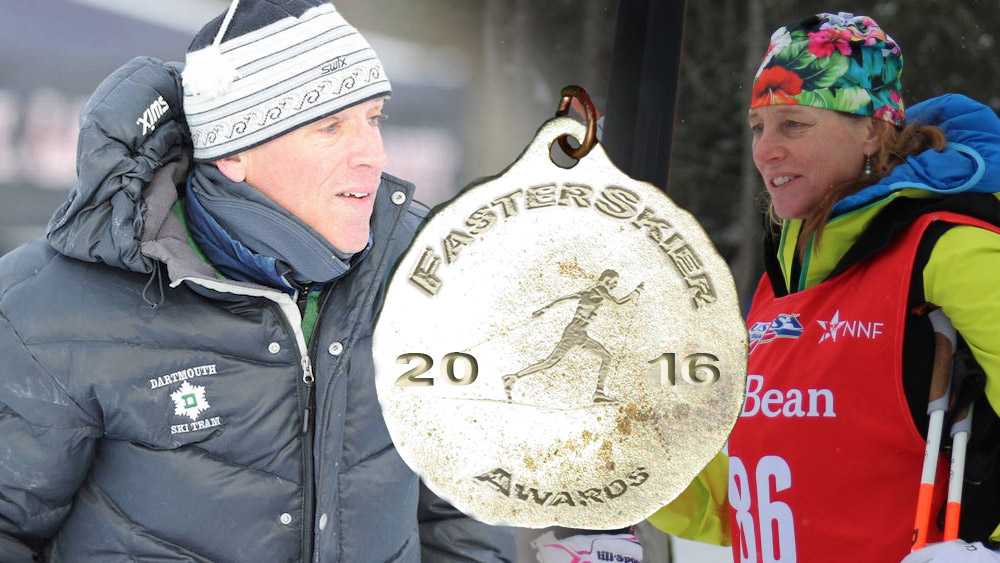
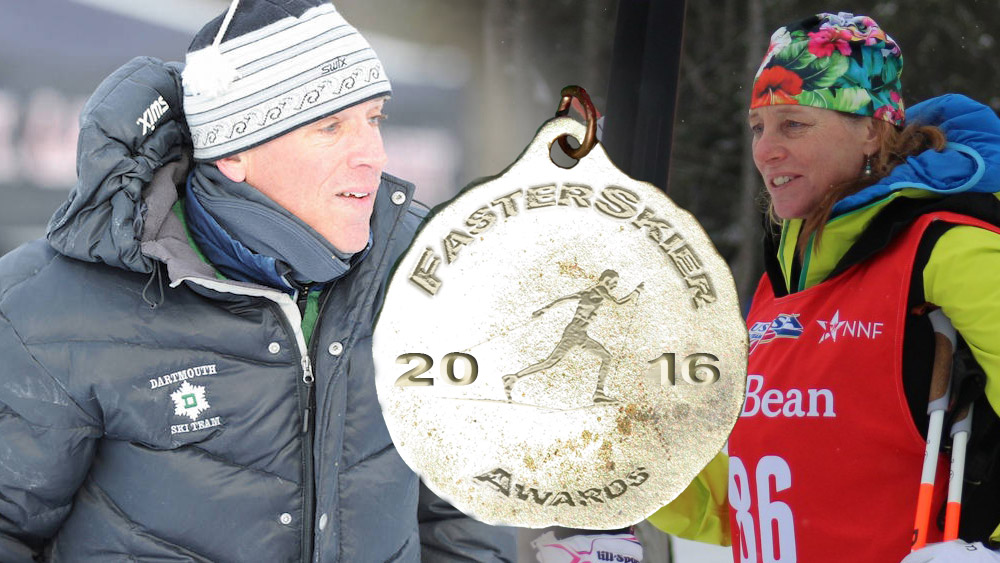
    Dartmouth's longtime coaches Ruff Patterson (l) and Cami Thompson-Graves are FasterSkier's coaches of the year. (Photo: Dartmouth Sports/FasterSkier)
    Dartmouth’s longtime coaches Ruff Patterson (l) and Cami Thompson-Graves are FasterSkier’s coaches of the year. (Photo: Dartmouth Sports/FasterSkier)

    The 2015/2016 awards continue this week, chosen by the FasterSkier staff based on performances from last season. While not scientific, these points of recognition are intended to reflect a broader sense of the season in review.

    Previous categories: Breakthrough Skiers (Canada & U.S.) | Biathletes of the Year | Collegiate Skiers | Juniors | Nordic Combined | Para-Nordic

    ***

    There are a few teams which have dominated college skiing in the last few years: Denver and Colorado trading back and forth for 10 of the last 12 NCAA titles. Northern Michigan University dominating Midwest cross-country skiing.

    And, in the East, the University of Vermont. The Catamounts won 21 straight Eastern Intercollegiate Ski Association (EISA) carnivals coming into this season, meaning no other team had won in almost four years. They also won the 2012 NCAA Championships, one of the few teams to break Denver-Colorado dominance.

    But at the Colby Carnival in Maine, the second weekend of the 2016 EISA season, the other team to break the Denver-Colorado pattern – 2007 NCAA champions Dartmouth College – began their rebound, edging UVM by four points for the combined men’s, women’s, alpine, and nordic title.

    “It has been a long spell of 2nd place finishes and we all knew we could do it,” Dartmouth Director of Skiing Cami Thompson-Graves wrote in an email this spring. “It was just a matter of putting things together at the same time. Certainly the strength of our Alpine teams helped, but we also had some solid performances on the Nordic side too.”

    Helmed by Thompson-Graves on the women’s cross-country side and Ruff Patterson on the men’s cross-country side, and with a storied past, it’s hard to ever consider Dartmouth the underdogs in a ski race. But it still seemed like an upset.

    Then Dartmouth won the UVM Carnival. Then UVM won the Dartmouth Carnival. It was competition that the Eastern circuit hadn’t seen in years.

    “The excitement of the team was great,” Thompson-Graves wrote. “I knew it had been a while but hadn’t considered just how long it had been, and so winning early in the season was a great boost, and helped keep the team fired up through the season, despite the lack of snow and constant wondering of where/what we would be racing from week to week.”

    Dartmouth went on to earn fifth place at NCAA Championships in Steamboat Springs, Colorado, the top team from the Eastern division.

    After the whole Championships with only one race remaining, UVM trailed Dartmouth by just two points. That race was the women’s 15 k mass start; UVM had won seven women’s cross-country races over the course of the season, compared to three for Dartmouth.

    But Thompson-Graves’s Dartmouth women’s team pulled away, with Dartmouth securing fifth place and UVM slipping to seventh.

    “Steamboat was fun — I always like racing there, despite the elevation,” Thompson-Graves wrote. “The first race was tough, and the results were average but it was great to put it together for some stronger results in the final race. Of course, we want more, but 5th was a result to be proud of this year.”

    Dartmouth wasn’t the best college team in the country, even when breaking things down into nordic and alpine. National titles, however, are not the only measure of coaching success. Thompson-Graves and Patterson have shaped a large segment of skiers who are contributing to American success internationally, as well as fueling the ever-more-competitive senior domestic circuit.

    This year alone, Dartmouth alumni women made up half of the World Championships team for U.S. biathlon (Susan Dunklee and Hannah Dreissigacker) and three-eighths of the U.S. Ski Team’s senior team (Sophie Caldwell, Ida Sargent and Rosie Brennan).

    When the Ski Tour Canada picked up extra American and Canadian quota spots, three more Dartmouth skiers joined the World Cup: Annie Hart, Eric Packer and Dakota Blackhorse-von Jess. Elsewhere in the ski world, fellow alum Erika Flowers finished third in the American Birkebeiner, and Paddy Caldwell, still college-aged but skiing primarily with a senior team, was the top American finisher in the 15 k skate at U23 World Championships.

    Only four U.S. athletes stood on individual World Cup podiums in nordic sport this season, and half came from this group: Dunklee (second in a biathlon World Cup in Fort Kent, Maine) and Caldwell (who won a Tour de Ski stage in Oberstdorf, Germany).

    (Brennan was also part of the third-place U.S. relay team in Lillehammer, Norway.)

    And the other two podium finishers – Jessie Diggins and Simi Hamilton – happen to be part of the SMST2 team, which is coached by Patterson’s former All-American skier Patrick O’Brien. Their head coach on the U.S. Ski team is another of Patterson’s former athletes, Chris Grover.

    Those are just a few Patterson and Thompson-Graves’s former athletes who have gone on to coach at every possible level, with some encouraging participation at a young age and building the U.S. skiing pipeline from the bottom, while others help point talented college and senior athletes towards elite success.

    Thompson-Graves is also now a member of the International Ski Federation’s Ladies Cross Country Committee, where she is pushing for better representation of women at all levels of skiing.

    Patterson is retiring after this season, but Thompson-Graves will continue to helm the program into the future. While watching their former athletes excel at the senior level must be satisfying, there’s still plenty going on in their day jobs.

    “It was great to knock UVM off the top a couple of times this year!” Thompson-Graves wrote in her email.

  • FasterSkier’s Canadian Breakthrough Skiers of 2016: Dahria Beatty and Knute Johnsgaard

    FasterSkier’s Canadian Breakthrough Skiers of 2016: Dahria Beatty and Knute Johnsgaard

    Dahria Beatty (l) and Knute Johnsgaard (r) are FasterSkier's Breakthrough Skiers of the Year for Canada. (Photos: Peggy Hung & Flying Point Road)
    Dahria Beatty (l) and Knute Johnsgaard (r) are FasterSkier’s Breakthrough Skiers of the Year for Canada. (Photos: Peggy Hung & Flying Point Road)

    The 2015/2016 awards continue this week, chosen by the FasterSkier staff based on performances from last season. While not scientific, these points of recognition are intended to reflect a broader sense of the season in review.

    Previous categories: American Breakthrough SkiersBiathletes of the Year | Collegiate Skiers | Juniors | Nordic Combined | Para-Nordic

    ***

    Canadian Breakthrough Skiers

    Dahria Beatty, Alberta World Cup Academy/Canadian U23 Development Team

    Dahria Beatty is the definition of breakthrough skier of the year for Canada, as the 22-year-old Whitehorse, Yukon, native placed 15th in a World Cup classic sprint in front of a home crowd at the Ski Tour Canada (STC) in Canmore, Alberta.

    Before that, her best individual World Cup result had been 32nd in a freestyle sprint in January in Planica, Slovenia. That was two spots away from qualifying for the heats, two spots away from the points, and she blew both away by reaching the quarterfinals in Canmore.

    And she almost made the semifinals.

    “I pushed really hard and missed out on the lucky loser position by I think 0.3 of a second,” said Beatty, a member of Canada’s U23 Development Team and the Alberta World Cup Academy in Canmore. “It was by far my best result ever … My best result at World Juniors is [15th] so to have that on the senior World Cup level is amazing.”

    Beatty opted out of U23 World Championships this year to focus on the STC, of which she raced seven of eight stages.

    “You always feel a little bit like maybe I’m not quite good enough to be here,” Beatty told FasterSkier after the Canmore classic sprint. “But having a day like this makes me go, even if some days aren’t that great. There is something in there that I can be able to compete at this level and that’s nice to know.”

    Beatty finished the NorAm season as the overall winner and tallied national titles in two out of the four races she competed in at Whitehorse in late March (the 10 k freestyle and skate sprint).

    She rivaled World Cup regular and national B-team member Emily Nishikawa throughout the week at nationals, with Nishikawa tallying two titles as well (in the 5 k classic and 30 k classic mass start).

    “Emily is a very strong skier, but I think we have a group of girls now ready to join her at the World Cup level,” Beatty told Cross Country Canada, according to a press release. “At least we are certainly ready to try. I think it is time we have a real women’s team over in Europe which is definitely going to make us stronger together if we continue to push each other.”

    Beatty topped the overall NorAm standings after nationals with 960 points, 160 more than runner-up Cendrine Browne, of the Pierre Harvey National Training Centre. The NorAm winner for the last two seasons, the 26-year-old Nishikawa placed 14th overall after spending the entire season in Europe.

    Knute Johnsgaard, AWCA/Canadian U23+ Development Team

    Another Whitehorse native who spent the last season training with the AWCA in Canmore, Johnsgaard, 23, broke into the points in the first stage of the STC. After previously having placed outside the top 50 in World Cup races, Johnsgaard qualified 29th and finished 30th in the freestyle sprint in Gatineau, Quebec.

    “Thanks to everyone who helped me score my first World Cup point yesterday!” Johnsgaard tweeted on March 2. “Hopefully many more to come.”

    “I was just trying to relax … and maybe make a move on the second lap,” he told FasterSkier after being eliminated in the quarterfinals. “Everyone is so strong … I don’t think it was much about tactics today, just the strongest skiers went through.”

    It was his sixth World Cup race. Johnsgaard raced a total of 10 this season, making his international World Cup debut in Planica, Slovenia, and finishing the winter on the overall NorAm podium in third (behind Andy Shields and AWCA teammate Kevin Sandau).

    In the season-ending races at nationals, Johnsgaard placed third and fourth in the 10 k classic interval start and 50 k classic mass start, respectively — behind World Cup regulars Alex Harvey and Len Valjas to start the week, and trailing Harvey, Graeme Killick and Ivan Babikov in the final mass start.

    Honorable mentions

    Maya MacIssac-Jones, Rocky Mountain Racers

    Canada's Maya MacIsaac-Jones (Rocky Mountain Racers) on her way to 30th in the women's 1.7 k freestyle sprint qualifier at the Ski Tour Canada's opening stage in Gatineau, Quebec. She went on to place 29th for her first World Cup points. (Photo: Peggy Hung)
    Canada’s Maya MacIsaac-Jones (Rocky Mountain Racers) on her way to 30th in the women’s 1.7 k freestyle sprint qualifier at the Ski Tour Canada’s opening stage in Gatineau, Quebec. She went on to place 29th for her first World Cup points. (Photo: Peggy Hung)

    With a six-syllable, three-part name, Maya McIssac-Jones of Rocky Mountain Racers gets our vote for women’s breakout honorable mention. In a single season, this 20 year old won her first NorAm race then proceeded to place 31st in her first European World Cup in Planica.

    “I was both shocked and very excited to finish 31st!” MacIsaac-Jones wrote in an email after the Planica skate sprint. “Although I would have loved to race in the heats, my result today gives me confidence and belief in myself that I am capable of top-30 results on the World Cup circuit.”

    McIsaac-Jones qualified for the STC, then achieved her goal — finishing 29th in the Stage 1 Gatineau skate sprint.

    “It really means a lot for me to be in the points today,” MacIsaac-Jones said afterward. “I hope this will help inspire the other Canadian skiers on the tour with me and I hope this shows we are capable of being in the mix.”

    In Stage 3 in Quebec City, she placed 34th in another skate sprint and finished her first World Cup tour in 49th overall. In her final race of the season at nationals, she placed third in the skate sprint (behind Beatty and Olivia Bouffard-Nesbitt) and ended up second to Beatty in the NorAm sprint standings (25 points shy of first).

    Jess Cockney, Canadian B-team

    Jess Cockney racing to 29th in the freestyle sprint qualifier at Stage 3 of the Ski Tour Canada in Quebec City. (Photo: John Lazenby/Lazenbyphoto.com)
    Jess Cockney racing to 29th in the freestyle sprint qualifier at Stage 3 of the Ski Tour Canada in Quebec City. He went on to place 10th after reaching the semifinals. (Photo: John Lazenby/Lazenbyphoto.com)

    If we had an award for comeback skier of the year, Cockney would get it, but since we don’t — breakthrough honorable mention makes the most sense for this 26 year old from Yellowknife, N.W.T.

    After starting the season on the World Cup and finishing outside the top 60 in individual sprints, Cockney returned to Canada for some NorAm racing and notched podiums in the skate sprint (third place) and 20 k classic mass start (second) at Eastern Canadian Championships.

    He made the standard for the STC, and raced to 10th in the skate sprint in Quebec City. It was his best individual World Cup result since placing ninth in the skate sprint in December 2012 in Canmore.

    “Man, I have had a really hard go of it this year,” Cockney told FasterSkier after the Quebec City sprint. “Nothing was working at the start of the year … So this is a big lift. I’m really happy with that. Skiing a semifinal is always awesome. Nice to have a two-heat day again.”

    In his final race of the season, Cockney placed fourth in the nationals skate sprint behind Harvey, Valjas and NorAm overall sprint winner Julien Locke. He finished the NorAm season ninth in the overall sprint standings.

  • FasterSkier’s Nordic Combined Skiers of 2016: Bryan Fletcher and Jasper Good

    FasterSkier’s Nordic Combined Skiers of 2016: Bryan Fletcher and Jasper Good

    U.S. Nordic Combined World Cup skier Bryan Fletcher (r) and junior Jasper Good (r) are FasterSkier's Nordic Combined Skiers of 2016. (Photos: Jasper Good and JoJo Baldus)
    U.S. Nordic Combined World Cup skier Bryan Fletcher (r, seen racing in Lahti, Finland, and 19-year-old Jasper Good (r), racing to 11th at 2016 Junior World Championships, are FasterSkier’s Nordic Combined Skiers of 2016. (Photos: Jasper Good and JoJo Baldus)

    With the 2015/2016 season officially in the rearview, FasterSkier is excited to unveil its annual award winners for this past winter. Votes stem from the FS staff, scattered across the U.S. and Canada, and while not scientific, they are intended to reflect a broader sense of the season in review.

    ***

    Bryan Fletcher, U.S. Nordic Combined A-team

    In a season without any World Championships and without any podiums for U.S. Nordic Combined, the eldest man on the team — 29-year-old Bryan Fletcher — stood as the most consistent on the World Cup from December 2015 through March 2016.

    Leading the team without the likes of Billy Demong (who retired last spring) and with just one other World Cup veteran on the A-team (younger brother Taylor Fletcher), Bryan finished the season 20th overall in the World Cup. Taylor ranked 31st overall.

    Together, the two brothers placed sixth in a team sprint in late February in Val di Fiemme, Italy. Individually, Bryan had a season best of seventh in Seefeld, Austria, where he also placed ninth for his second-best result of 2015/2016.

    Taylor, 25, tallied three Continental Cup podiums in December at home in Park City, Utah, including a victory, and spent much of the World Cup season hovering around the top 25.

    “The team sprint was for sure Taylor’s and I’s highlight of the weekend,” Bryan wrote in an email after the Val di Fiemme World Cup. “It was nice to have some decent jumps and a solid race to get us into the fight. It’s the best team sprint result we have had as a duo and the best since Todd Lodwick and I were fourth in Ramsau in 2013 I believe. Honestly, while 6th is a solid result, Taylor and I were hoping for a little more …”

    That desire for more was the running theme of the season, at least for Bryan. At the preceding World Cup in Kuopio, Finland, he placed 12th with the second-fastest time in the 10-kilometer skate race.

    “I am happy to be 12th, but I was hoping for a little more,” he told USSA.

    Overall, the team found positives within its performances. Up-and-coming athletes, like Ben Berend, posted competitive jumps.

    “…The highlight was Ben Berend jumping to 10th,” Bryan wrote of the Val di Fiemme weekend. Berend went on to place 34th. “It was awesome to see him step up his game there and he hung tough in the race narrowly missing out on points in some incredibly hard conditions.”

    In all, the 20-year-old Berend’s career best was 33rd, which he posted in February in Lahti, Finland.

    Honorable mention:

    Jasper Good, U.S. Nordic Combined C-Team

    Jasper Good is a name you should get used to reading. Hailing from Steamboat Springs, Colo., Good, 19, led the U.S. nordic combined athletes at Junior World Championships this past February in Rasnov, Romania.

    In his fourth trip to Junior Worlds, Good notched 11th and 12th in the individual competitions and sixth with teammates Jared Shumate, Stephen Schumann, and Ben Loomis in the 4 x 5 k team event.

    Americans (from left to right) Ben Loomis, Stephen Schumann, coach Martin Bayer, Jared Shumate, and Jasper Good after an individual competition at 2016 Nordic Combined Junior World Championships. Not pictured: Koby Vargas. (Photo: Jasper Good)
    Americans (from left to right) Ben Loomis, Stephen Schumann, coach Martin Bayer, Jared Shumate, and Jasper Good after an individual competition at 2016 Nordic Combined Junior World Championships. Not pictured: Koby Vargas. (Photo: Jasper Good)

    “I wanted to put myself in the fight for a top 10 finish and I did that both days so to some degree I am happy with that,” Good wrote in an email afterward.

    “Although I really wanted to break the top 10 I am happy as I was able to put two consistent competitions together,” he continued. “Both days were what I would call an accurate portrayal of my average level. I am happy that my average had me finishing in the top 15 on both days but a little disappointed I wasn’t able to have a slightly above average day to get me into the top 10.”

    According to Good, sixth in the relay was a team best at junior worlds.

    “I think the fact that our team event rank has been improving every year I have been on the team is a huge testament to the potential coming up in US Nordic Combined!” he wrote.

    At the Park City Continental Cup, Good notched three top 20’s with a best result of 13th.

    Of note:

    The 2015/2016 Nordic Combined World Cup season was a tough one in terms of lack of snow, especially for teams like the U.S. fighting for quota spots.

    “We earned a wildcard in the first period with the results at Soldier Hollow,” U.S. Nordic Combined coach Dave Jarrett explained in January, after three of five World Cup weekends had been canceled. “Every race that we have had the ability to start five guys on the World Cup has been canceled so far. … We really needed to get some new names on the points scoring list that we haven’t had before.”

  • FasterSkier’s Biathletes of 2016: Susan Dunklee and Tim Burke

    FasterSkier’s Biathletes of 2016: Susan Dunklee and Tim Burke

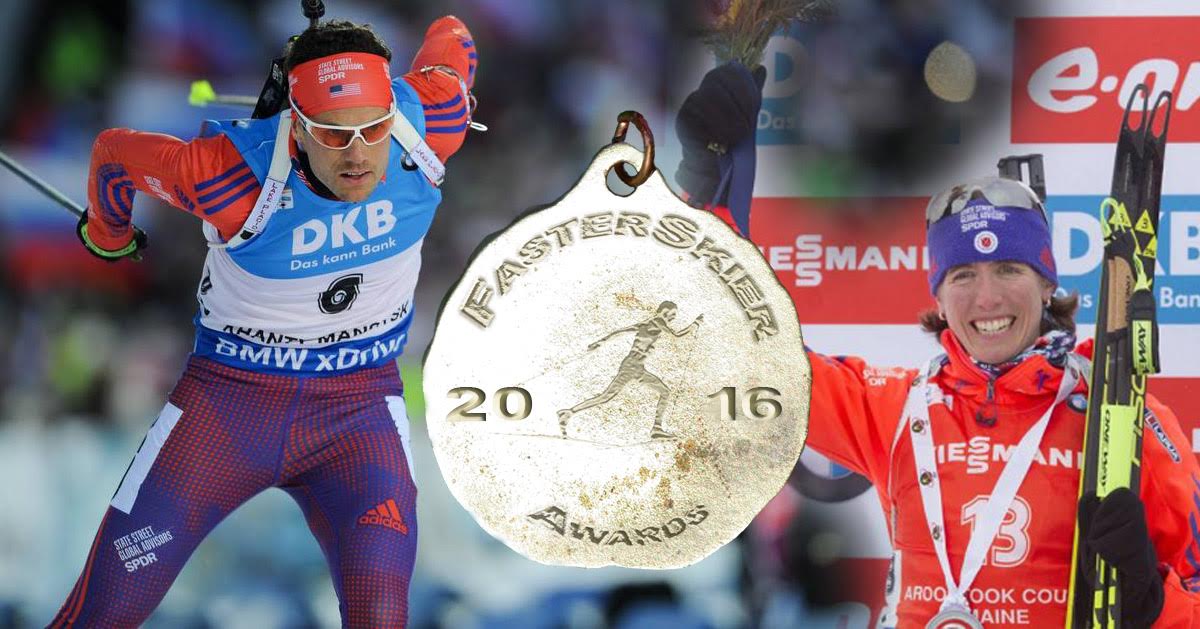
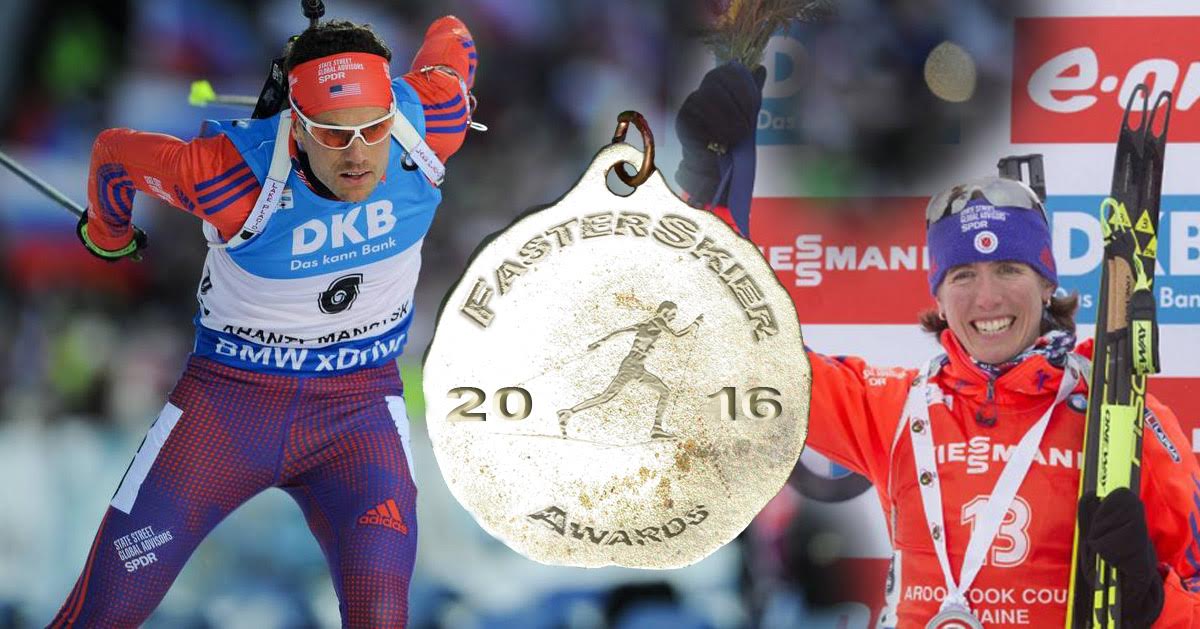
    Tim Burke and Susan Dunklee, both of US Biathlon, are FasterSkier's Biathletes of 2016. (Photos: USBA/NordicFocus)
    US Biathlon’s Tim Burke (l), seen racing at the end of the season in Khanty-Mansiysk, Russia, and Susan Dunklee (r), after earning silver at the IBU World Cup in Presque Isle, Maine, are FasterSkier’s Biathletes of 2016. (Photos: USBA/NordicFocus)

    With the 2015/2016 season officially in the rearview, FasterSkier is excited to unveil its annual award winners for this past winter. Votes stem from the FS staff, scattered across the U.S. and Canada, and while not scientific, they are intended to reflect a broader sense of the season in review.

    ***

    Susan Dunklee, US Biathlon

    Susan Dunklee has been on the rise for several years, and this season U.S. fans got to see her potential as a biathlete up close and personal: in Presque Isle, Maine, she placed second in the 10-kilometer World Cup sprint, a career-best performance and the second podium of her career.

    “To be able to have a best result on home soil and we only have a North American World Cup every five years, I couldn’t ask for anything better,” Dunklee said on the phone after the race. “It’s just phenomenal.”

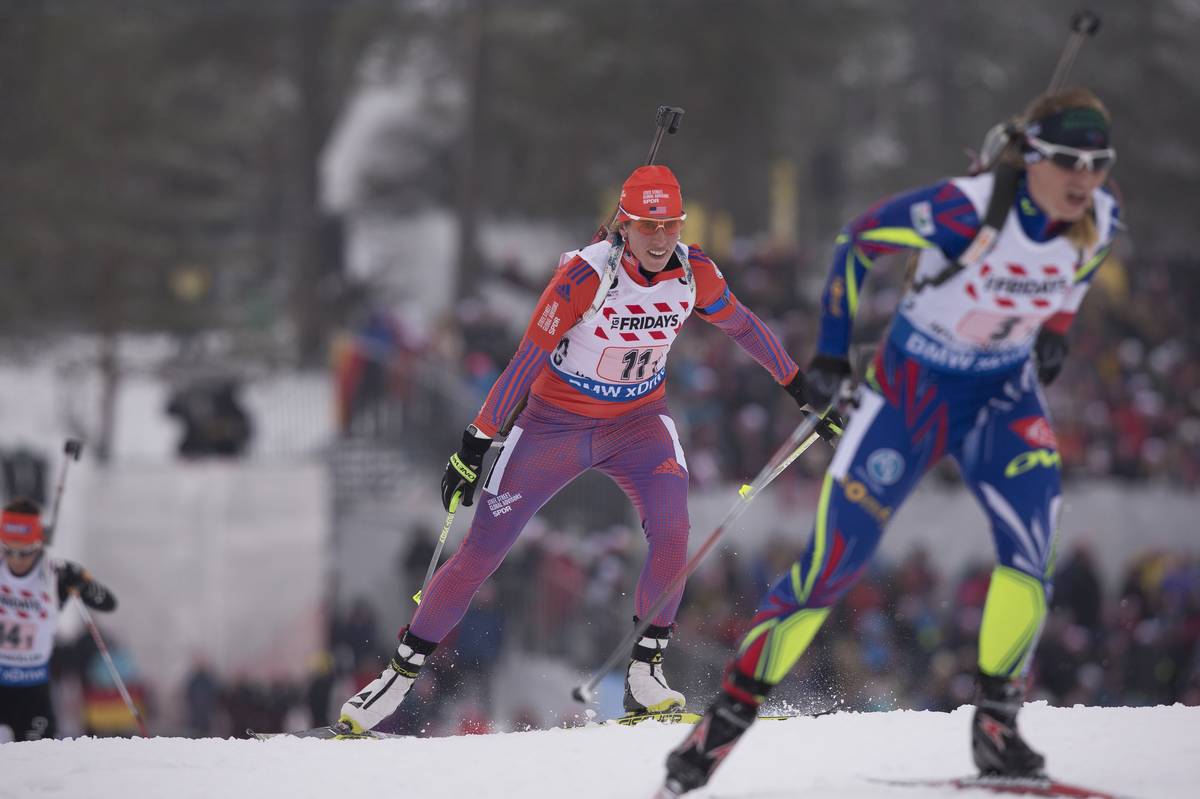
    Susan Dunklee (US Biathlon) trails France's Anais Bescond during the first leg of the mixed relay at 2016 IBU World Championships in Oslo, Norway. Dunklee went on to tag off in first, 1.6 seconds ahead of Norway. (Photo: USBA/NordicFocus)
    Susan Dunklee (US Biathlon) trails France’s Anais Bescond during the first leg of the mixed relay at 2016 IBU World Championships in Oslo, Norway. Dunklee went on to tag off in first, 1.6 seconds ahead of Norway. (Photo: USBA/NordicFocus)

    But that wasn’t Dunklee’s only highlight of the season. Earlier she had placed sixth in both the sprint in Pokljuka, Slovenia, and the mass start in Ruhpolding, Germany.

    Then at World Championships in Oslo, Norway, she won the first leg of the mixed relay in thrilling fashion, passing Norway’s Marte Olsbu on the final uphill in the stadium and never looking back.

    “I have been close behind the leader tagging off many times, but I have never tagged off in first,” she said at the time. “On the last loop I was hungry to finally win my leg today and I wanted to give Hannah [Dreissigacker] the experience of leaving in the lead in front of a packed Norwegian crowd.”

    Dunklee then went on to finish eighth in the sprint, tenth in the pursuit, 11th in the mass start, and 18th in the individual at World Championships. Her season-ending spot of 14th in the World Cup Total Score is the best ever achieved by a U.S. woman.

    As teammates Dreissigacker and Annelies Cook are retiring, Dunklee will helm the U.S. women’s team into the future – and seems very able to do so.

    Tim Burke, US Biathlon

    Tim Burke had a rough 2014/2015, but re-focused his efforts coming into the season and began to return to the form that had kept him as the best U.S. biathlete for many years.

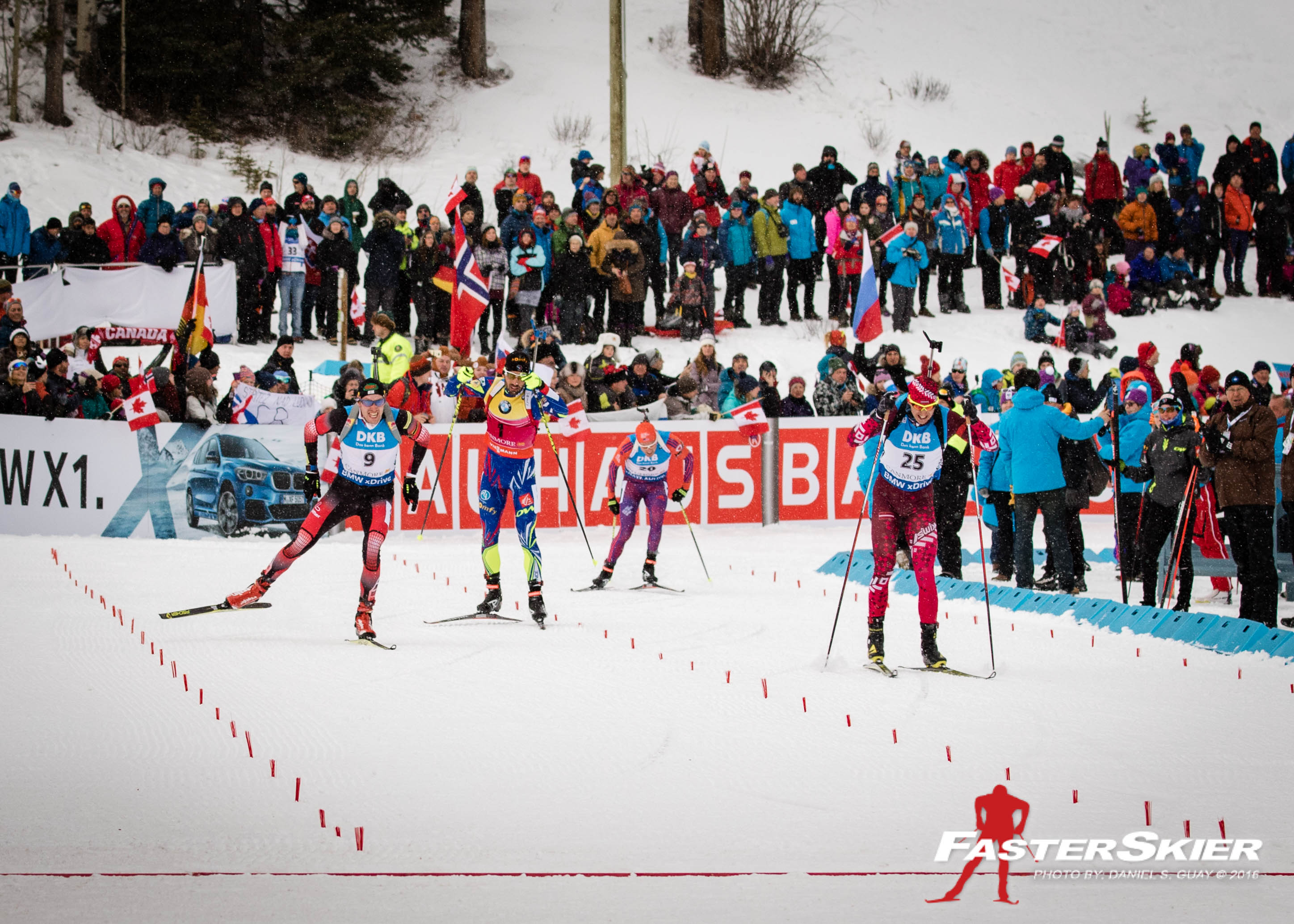
    Latvia’s Andrejs Rastorgujevs (25) and Austria’s Dominik Landertinger (9) lead the race for fourth, which Landertinger took by 0.2 seconds. France's Martin Fourcade (second from l) placed sixth in the mass start, 1.5 seconds ahead of American Tim Burke (behind) on Saturday at the IBU World Cup in Canmore, Alberta. (Photo: Daniel S. Guay)
    Latvia’s Andrejs Rastorgujevs (25) and Austria’s Dominik Landertinger (9) lead the race for fourth, which Landertinger took by 0.2 seconds. France’s Martin Fourcade (second from l) placed sixth in the mass start, 1.5 seconds ahead of American Tim Burke (behind) on Saturday at the IBU World Cup in Canmore, Alberta. (Photo: Daniel S. Guay)

    “I feel like I have performed really well, maybe more consistently than I ever have,” Burke said after finishing 12th in the World Championships mass start. “Last year was so disappointing for me. I was really up and down, more down than up, that I think that this was a really big step back up to where I should be.”

    Burke got his first top-10 of the season before Christmas, racing from 14th up to ninth in the pursuit in Pokljuka.

    But the fireworks came later: he was seventh in both the mass start at the Canmore World Cup, and the pursuit in Presque Isle.

    Then, after finishes of 12th, 14th, and 17th at World Championships, Burke headed to the last World Cups on the season in Khanty-Mansiysk, Russia, where he snagged sixth place in both the sprint and pursuit.

    After finishing 15th in the World Cup Total Score, Burke is still hungry.

    “These are my two best results of the season so I can’t be too disappointed,” he said after Khanty-Mansiysk. “But I am also like most athletes in that I always want more!”