From the FasterSkier archive — posts syndicated from athletes’ and coaches’ own blogs between 2004 and 2012, kept online as published. Current coverage is at fasterskier.com.

Tag: 2016 Frozen Thunder

  • Second to Valjas in Skate Sprint Qualifier, Thompson Takes Top Prize

    Second to Valjas in Skate Sprint Qualifier, Thompson Takes Top Prize

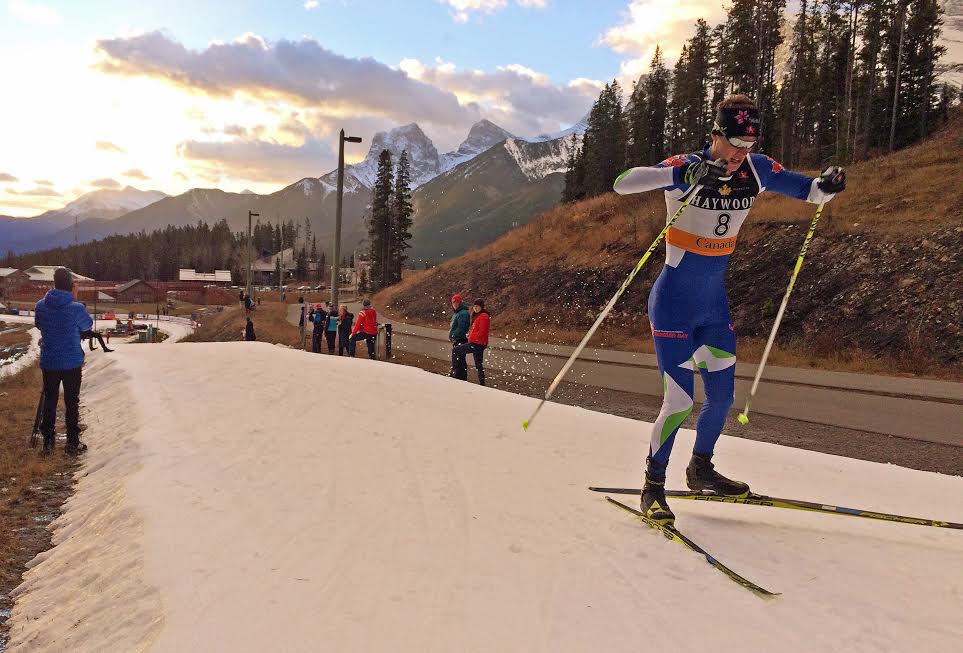
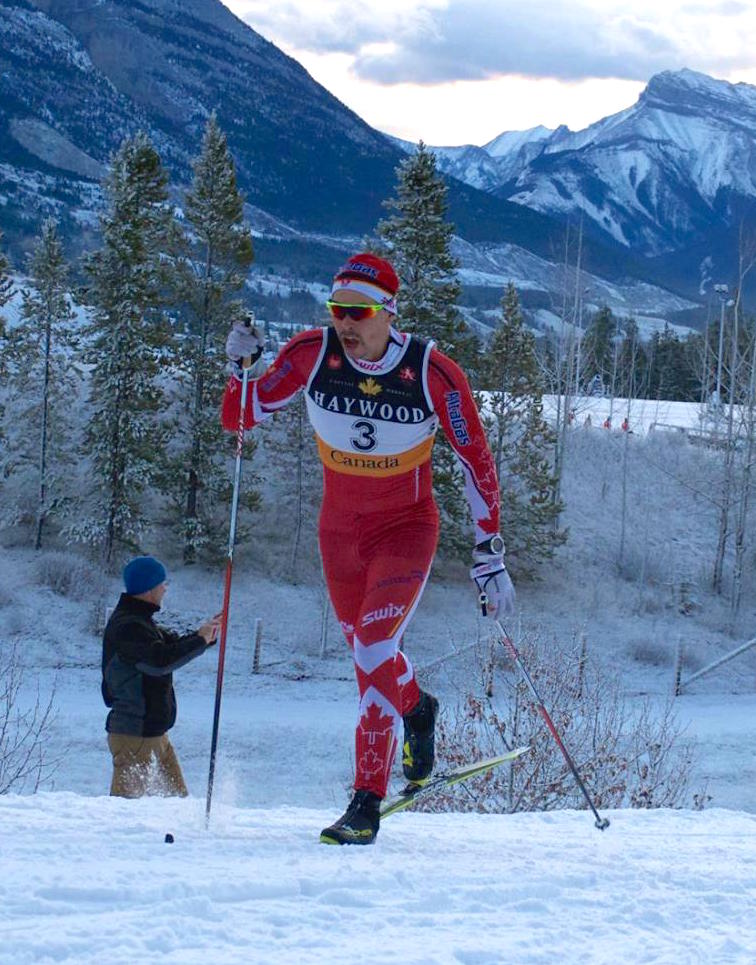
    Bob Thompson (NDC Thunder Bay) sprinting to second in Thursday's skate-sprint qualifier at Frozen Thunder in Canmore, Alberta. The performance earned him the final spot on Canada's World Cup team for Period 1. (Photo: Drew Goldsack)
    Bob Thompson (NDC Thunder Bay) sprinting to second in Thursday’s skate-sprint qualifier at Frozen Thunder in Canmore, Alberta. The performance earned him the final spot on Canada’s World Cup team for Period 1. (Photo: Drew Goldsack)

    Qualification-only sprint races can be a little dull.  Four minutes of pain and done. Describing the action?  Even more dull.

    But for Bob Thompson of the Thunder Bay National Development Centre (NDC), Thursday’s freestyle sprint qualifier in Canmore, Alberta, was one he’ll hold in his mind for a long time. For him, a 25 year old who skied his first World Cup races at home at the Ski Tour Canada last March, placing second in the Frozen Thunder skate-sprint qualifier meant a trip to Europe for his first overseas World Cups.

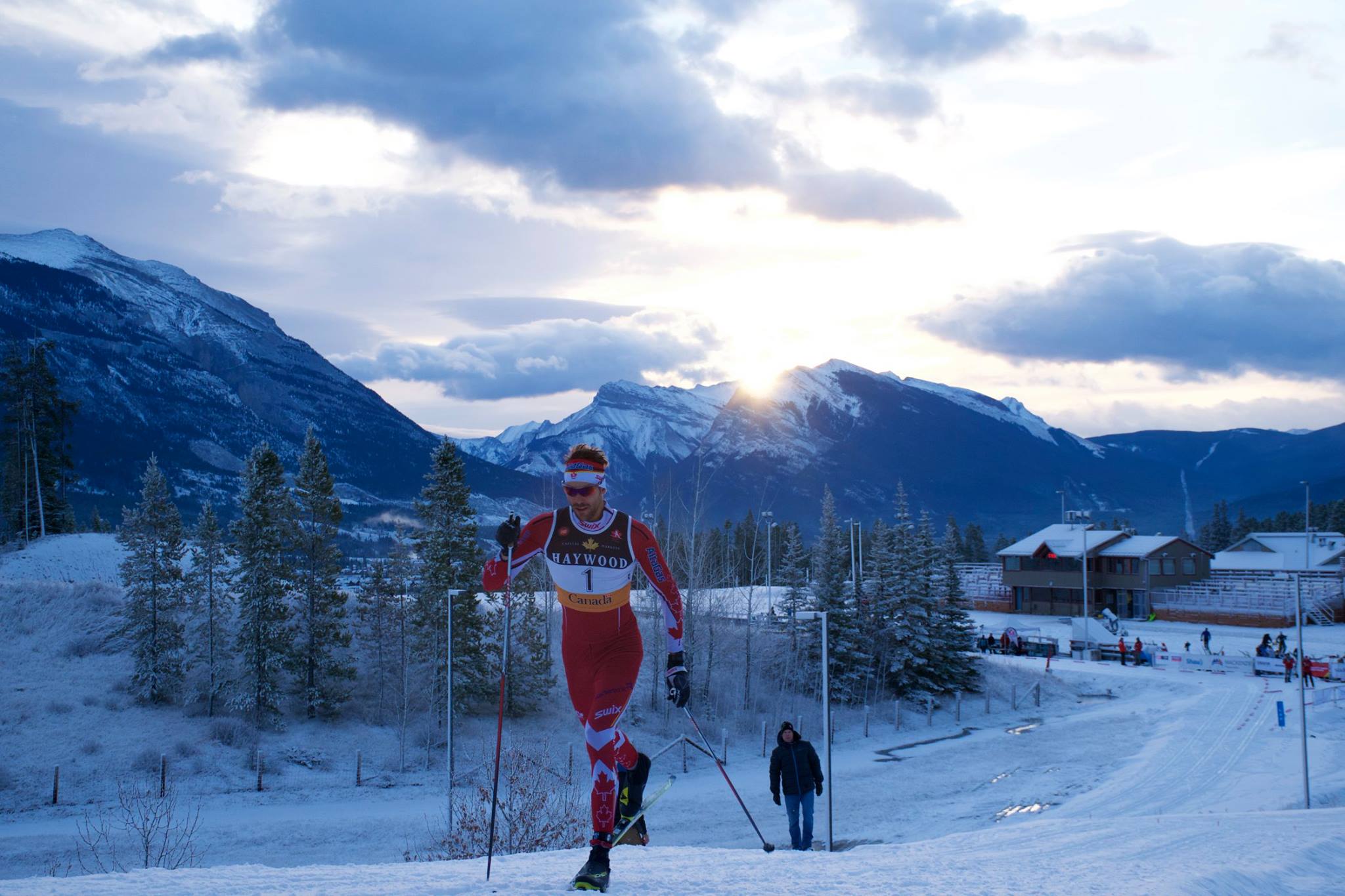
    On Thursday, the final day of racing on Canmore’s early season snow, affectionately known as Frozen Thunder, Len Valjas (who hails from the same club as Thompson, Team Hardwood in Ontario) won the men’s qualifier in 3:25.23. Thompson’s time was just six-hundredths of a second slower, but enough to get him the final men’s quota spot for World Cup Period 1.
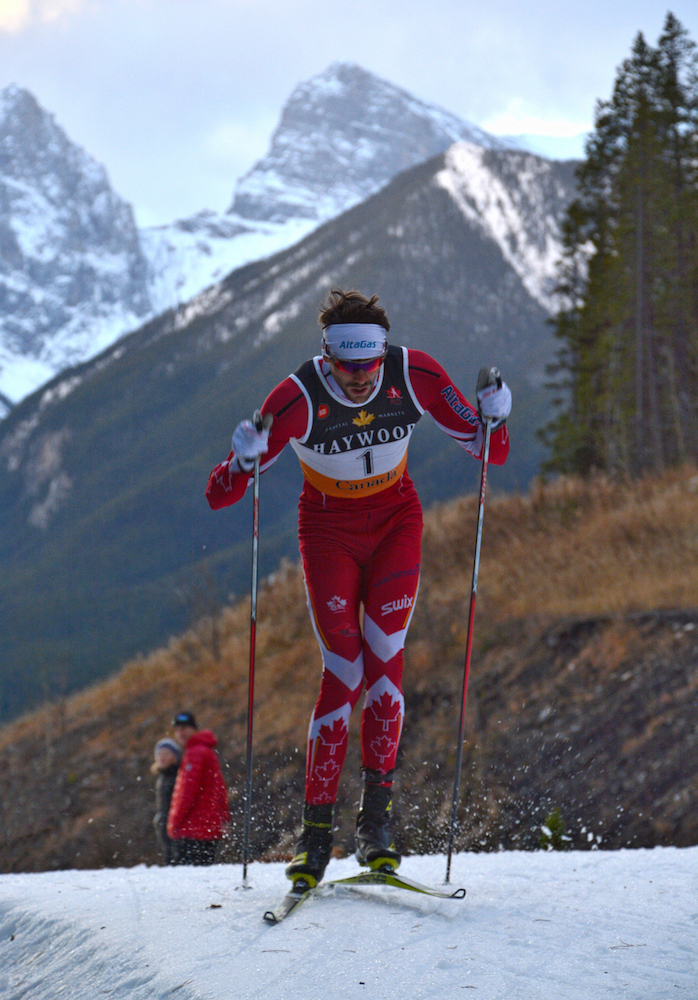
    Len Valjas sprinting to victory in the skate qualifier. (Photo: Glen Crawford Production Services)
    Len Valjas (Canadian World Cup A-team) sprinting to the victory in the skate sprint qualifier at Frozen Thunder on Thursday in Canmore, Alberta. (Photo: Glen Crawford Production Services)

    Valjas, a World Cup A-team member, was preselected for Period 1.

    Jess Cockney, of the World Cup B-team, won Tuesday’s classic sprint qualifier to lock down the first of two selections, an achievement that was officially announced at 9 a.m. Thursday, 30 seconds before Valjas attacked the course wearing bib 1.

    Two other favorites for the final World Cup spot, Julien Locke (Black Jack/NST U-25 Team) and Simon Lapointe of the Pierre-Harvey Training Centre (CNEPH) placed third and fourth, 0.22 and 1.29 seconds back, respectively. Graeme Killick, belying his distance-specialist persona, finished fifth.

    “The race today was great,” Thompson wrote in an email shortly after the race. “I told [my coach] Timo [Puiras] at the finish I was happy with how I performed and followed the plan and either way I wasn’t going to say I didn’t race my best.

    “I wanted to keep things controlled,” Thompson wrote of his race plan. “It’s important to keep the speed high on both laps and especially finishing the second half of the lap fast as it is mostly flat and rolling. Being able to really go the second time up the climb was what I was planning for. … Being out there and able to do that was great.”

    Like many of the sprinters seeking one of two remaining men’s World Cup spots, Thompson made this week a training target.

    “Timo and I had the plan made to be fast for these races since very early in the year,” he wrote. “Not much was changed other than the last few weeks of prep, dropping some volume and moving into more of a sprint intensity focused block.”

    Cross Country Canada (CCC) High Performance Director Tom Holland, a member of the selection committee and chief of competition for these races, studied the race closely.

    “Watching this morning, I wouldn’t call it tactics,” Holland said on the phone. “But the way people can ski corners, probably made the difference between who was the winner and who was second.”

    To put that in context, the difference between first and third was 0.22 seconds, or 1.5 metres at an average speed of 25 kilometers per hour. It wouldn’t take much of a difference to gain or lose that five feet.

    Last spring, CCC and a group of coaches decided on the using the sprint qualifiers to fill out the team for World Cup Period 1. 

    “The results show … that there’s five or six guys here that are reasonably close,” Holland said of the level of competition in Canada.

    Of those top skiers, CCC wanted to determine “who could do a qualifier fast for the World Cup and try to match it up with some of the courses they’ll be skiing in November and December.”

    The course held up fairly well for the men, despite the warm weather, with all the selection favourites starting within a five-minute period.
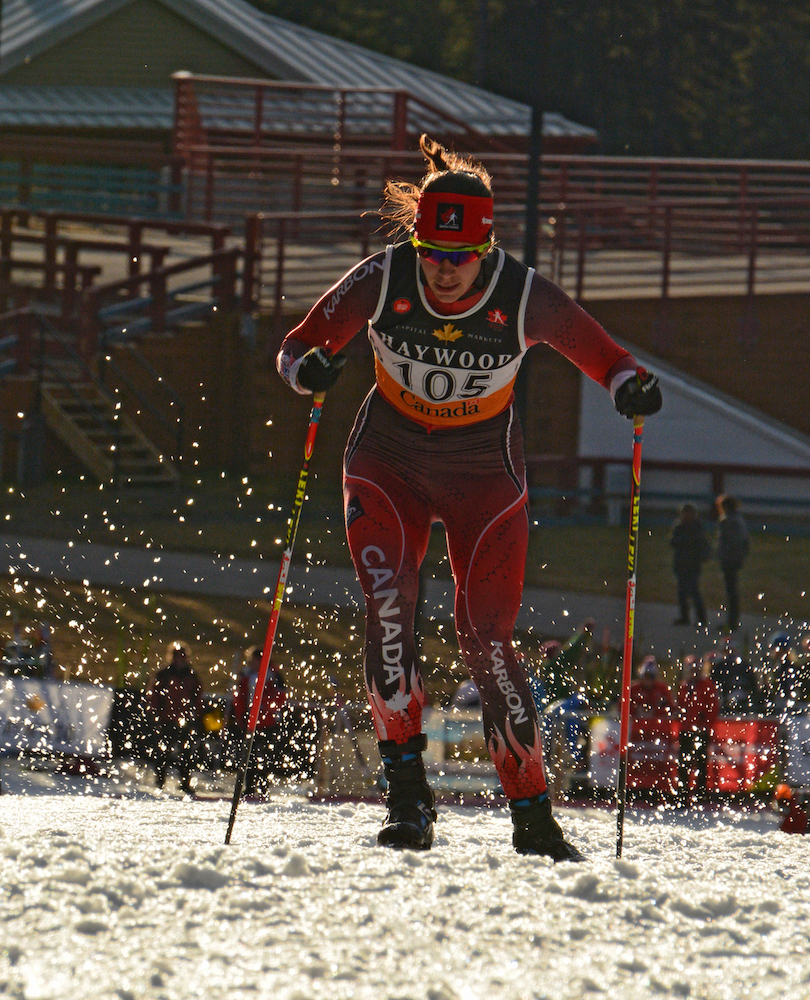
    Rosanna Crawford (Biathlon Canada) blasting the first climb of the two-lap course at the Frozen Thunder skate-sprint qualifier on Thursday. She won by 3 seconds. (Photo: Glen Crawford Production Services)
    Rosanna Crawford (Biathlon Canada) blasting the first climb of the two-lap course at the Frozen Thunder skate-sprint qualifier on Thursday. She won by 3 seconds. (Photo: Glen Crawford Production Services)

    “The track had broken down and was soft where the guys had skied,” women’s second-place finisher Olivia Bouffard-Nesbitt wrote in an email. “But there were a few sections of fast, firm snow to be found near the edges of the trail.”  

    The women started after all 34 men had completed two laps.

    Biathlon Canada’s Rosanna Crawford won the women’s qualifier in 3:58.20, followed by Bouffard-Nesbitt, 3.02 seconds behind, and Caitlin Gregg (Team Gregg/Madshus) in third (+4.5).

    “Conditions were a little bit mixed with some harder, almost icy sections and then some really soft, deep and slushy sections,” Gregg wrote of the course. “The conditions were the same for everyone so I don’t think it affected the results. I did speak to some other athletes afterwards who agreed that the conditions were tricky to master and really good practice!”

    “It was a fun race, super quick!” Crawford wrote in an email. “The Frozen Thunder loop is interesting, there’s always a hill and then a break, so you are able to push harder than on a normal race course I would say.”

    Four women were preselected to fill Canada’s women’s quota of three plus Continental Cup winner Dahria Beatty for World Cup Period 1: Emily Nishikawa (World Cup B-team), and U-25 Team members Beatty, Cendrine Browne and Maya MacIssac-Jones.

    On the men’s side, Canada’s quota is six plus Continental Cup winner Andy Shields. For the first period of the World Cup, it will field an eight-person team of Thompson and Cockney, and preselected athletes Alex Harvey, Devon Kershaw, Valjas, Killick, Knute Johnsgaard, and Shields.

    Note: The information regarding Canada’s World Cup team quota has been updated to reflect that four women total can start for Canada in Period 1.

    Complete results

    — Alex Kochon contributed

    Annika Hicks rocking the new AWCA suit to 4th place (Photo: Glen Crawford Production Services)
    Annika Hicks rocking the new AWCA suit to fourth in the women’s skate sprint qualifier at Frozen Thunder on Thursday. (Photo: Glen Crawford Production Services)

    FasterSkier is seeking photos from the 2016 races at Frozen Thunder. Please email submissions with caption and credit info to info@fasterskier.com.

  • With World Cup Starts Up for Grabs, Cockney Wins Frozen Thunder Classic Sprint Qualifier

    With World Cup Starts Up for Grabs, Cockney Wins Frozen Thunder Classic Sprint Qualifier

    Jess Cockney (Canadian World Cup B-team) racing to first in the men's classic sprint qualifier at Frozen Thunder on Tuesday in Canmore, Alberta. The win should secure his spot with the Canadian national team at World Cup Period 1. (Photo: Jenn Jackson)
    Jess Cockney (Canadian World Cup B-team) racing to first in the men’s classic sprint qualifier at Frozen Thunder on Tuesday in Canmore, Alberta. The win should secure his spot with the Canadian national team at World Cup Period 1. (Photo: Jenn Jackson)
    Update: Early Thursday, Cross Country Canada (CCC) announced that Jess Cockney has been selected for World Cup Period 1, referencing both his Olympic history and last season’s World Cup top-10 result. 

    ***

    For most of the 88 racers at the Canmore Nordic Centre on Tuesday, it was a chance to train with a race bib on. But for some top male sprinters seeking World Cup starts, it was already one of the most decisive days of their season.

    The Frozen Thunder classic sprint followed a King’s Court format, a more casual approach that guarantees all racers three heats. After the qualifier, competitors were divided into groups of four based on their finish times, regardless of gender or category.  In each heat, the top two moved up one group and the bottom two moved down one group.

    As an example, Canadian Para-Nordic standout Mark Arendz qualified 64th and shared his first heat with three junior women. After winning two heats, Arendz reached the final, where he lined up alongside Friday’s female distance winner Chelsea Holmes and two junior men.

    The format resulted in a relaxed day for most, with evenly matched heats. As with Friday’s 7.5- and 12-kilometer freestyle interval starts, everyone used the same wax for qualification. The addition of a no-double-pole zone for the qualifications ensured that everyone chose grip.

    For the Canadian male sprinters who hadn’t already qualified for World Cup Period 1, the pressure was on. For the winners of the sprint qualifiers on Tuesday and Thursday (with a freestyle sprint qualifier only on Thursday at 9 a.m. Mountain time), they would each be rewarded with one of two remaining World Cup spots.

    Len Valjas (Canadian World Cup A-team) racing to second in the men's classic sprint qualifier on Tuesday at Frozen Thunder in Canmore, Alberta. Valjas is pre-selected for World Cup Period 1. (Photo: Jenn Jackson)
    Len Valjas (Canadian World Cup A-team) racing to second in the men’s classic sprint qualifier on Tuesday at Frozen Thunder in Canmore, Alberta. Valjas is pre-selected for World Cup Period 1. (Photo: Jenn Jackson)

    On Tuesday, Jess Cockney of the Canadian World Cup B-team staked his claim, winning the classic-sprint qualifier in 3:51.66, 4.09 seconds ahead of World Cup A-team sprinter Len Valjas. Distance specialist Graeme Killick posted the third-fastest qualifying time, 6.98 seconds back and 0.49 seconds ahead of fourth-place finisher Knute Johnsgaard, completing a top-four sweep for the Canadian national team.

    “It’s a huge help to be on snow this early for us and the fact that it’s available in my hometown is incredibly lucky,” Cockney, who trains in Canmore, wrote in an email about the Frozen Thunder trials races.

    The other favourites for the remaining World Cup spot finished fifth through seventh: Bob Thompson, of the Thunder Bay National Development Centre (NDC), who was 9.12 seconds behind in fifth; Simon Lapointe, of the Pierre-Harvey Training Centre (CNEPH) in sixth (+9.95), and Julien Locke (U25 Team/Black Jack) in seventh (+10.26). 

    After Tuesday’s races, Cockney explained that he expected to be chosen for the first World Cup period as a result of his qualifying win.

    “I haven’t heard anything official but that was the understanding I had of the criteria,” Cockney wrote.

    According to Cross Country Canada’s published criteria, sprint selections for World Cup Period 1 “may be made” based on the race winner or winners in each of the two Frozen Thunder sprints. If unable to select the winners (i.e. pre-selected athletes win), second-place finishers may be chosen. There were other possibilities, in less preferable order, and ultimately, a five-person selection committee will determine who gets to go.

    Cockney skipped the heats, explaining that he felt “under the weather a bit [Monday] and I’m trying to make sure I don’t make it any worse.” Killick and Valjas skied two heats before ending their days early due to similar concerns.

    In the heats, Locke, a national-team rookie, won all three of his heats to take the overall victory. Brian McKeever of the Para-Nordic Ski Team placed second and John Hegman of the Sun Valley Ski Education Foundation (SVSEF) in Idaho was third.

    “I was happy to see my teammate Jess Cockney ski very well and make the criteria,” Locke wrote in an email. “Personally, I had a subpar ski in the qualifier but everything went well in the heats. I felt that I was skiing well technically in the soft snow and I’m satisfied with where the shape is at right now. I am looking forward to the final selection on Thursday.”

    Locke was one of several skiers excited by live TV coverage: “For the first time that I have seen in Canada, there had a TV crew on-site broadcasting the races live. Great work Shaw [TV Calgary]!”

    Canadian television stations typically edit and delay broadcast of nordic races.

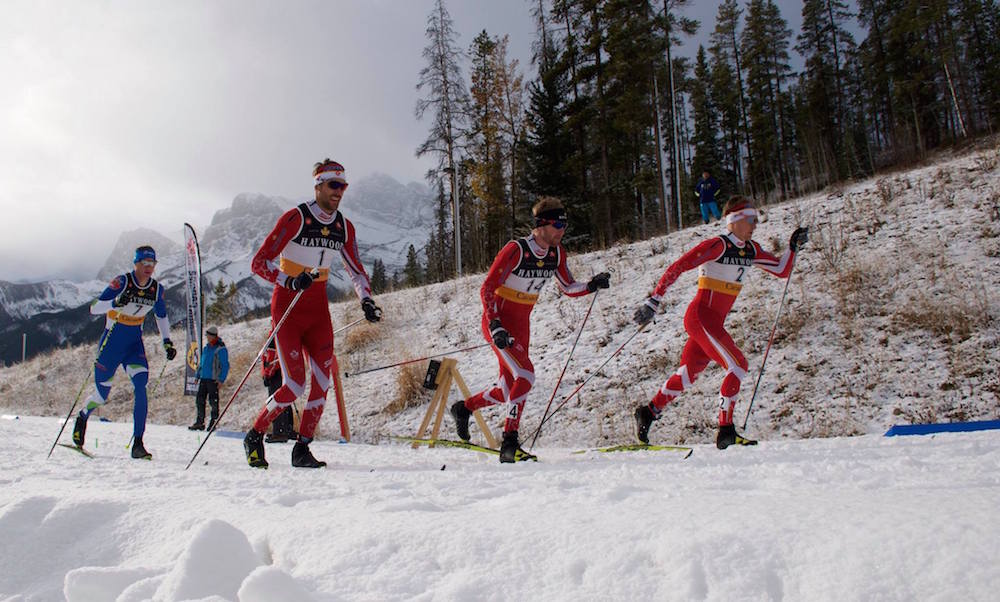
    (From left to right) Bob Thompson (NDC Thunder Bay), Graeme Killick (AWCA/NST A-team), Lenny Valjas (NST A-team) and Knute Johnsgaard (AWCA/NST U25 Team) go head-to-head in a classic sprint heat at Frozen Thunder in Canmore, Alberta. (Photo: Jenn Jackson)
    (From left to right) Bob Thompson (NDC Thunder Bay) chases Lenny Valjas (NST A-team), Graeme Killick (AWCA/NST B-team), and Knute Johnsgaard (AWCA/NST U25 Team) during a classic sprint heat at Frozen Thunder in Canmore, Alberta. (Photo: Jenn Jackson)

    “These races are a fun way to get into the racing spirit!” McKeever wrote in an email.  “Other than that, I don’t put any importance on them seeing as how it’s October and the big races are a long ways off.”

    He appreciated the casual-sprint format for training purposes.

    “King’s Court is a good way for every starter to get a full set of rounds in a sprint, regardless of qualification time,” he wrote. “It also pits people against others of similar ability which can be fun instead of getting shelled by the top guy/girl in the quarterfinal as happens sometimes. However, it does take a lot of time to get through the series of races and it makes for a lot of fatigue. I think I’m more tired after today than after a long Ski Classics race!”

    Fatigue was a common theme among the racers as most are in the middle of a high-volume, on-snow block. Johnsgaard finished sixth in the A-final after qualifying in fourth.

    “I feel really good about my race today,” Johnsgaard wrote. “I’m fortunate to already be qualified for Period 1 on the World Cup, so I can focus on the road ahead rather than the races this week. The conditions were slow but everyone was on the same wax, at least for the qualifier so we all suffered together!”

    In addition to Johnsgaard, of Canada’s U25 Team and Alberta World Cup Academy (AWCA), pre-selected skiers for the World Cup Period 1 include Valjas, Killick, Alex Harvey, Devon Kershaw, and Andy Shields.

    “It’s a great chance for me to practice going fast on snow but to me it’s not nearly as important as to the guys trying to nab the last World Cup spots,” Johnsgaard added.

    Killick was also in training mode, but as with most elite athletes, the competitive urge is always there. “I took the qualifier pretty seriously,” Killick wrote. “It’s a good chance to gauge my speed with all the top guys competing for a spot over-seas.”

    Pre-selected Beatty Top Female Qualifier; Phinney Wins Final  

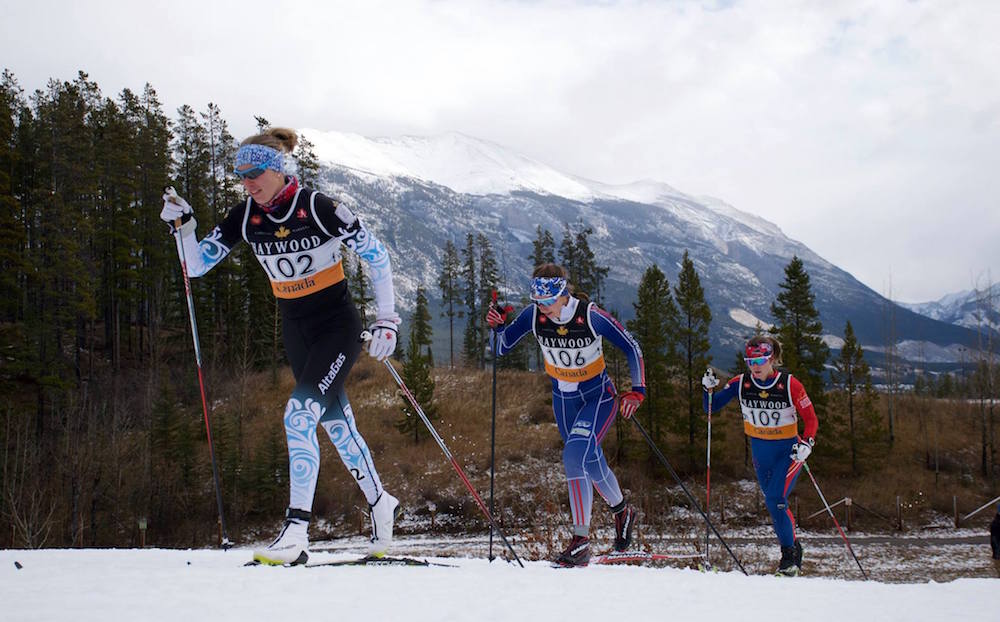
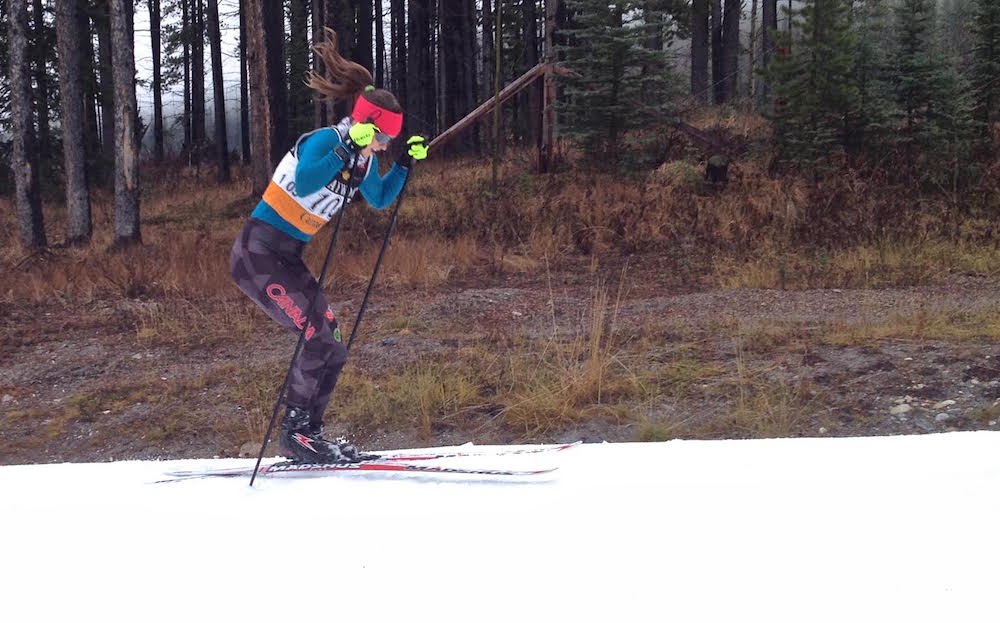
    Dahria Beatty leads Kelsey Phinney and Annika Hicks in the ladies final (Photo: Jenn Jackson)
    Dahria Beatty (102) leads Kelsey Phinney (106) and Annika Hicks (109) in the women’s final at the Frozen Thunder classic sprint on Tuesday in Canmore, Alberta. (Photo: Jenn Jackson)

    With all of the national-team senior women prequalified for World Cup Period 1, the women’s qualifier and heats had a more relaxed feel, especially for an American like Kelsey Phinney. The Sun Valley skier won her final and explained in an email that she’s enjoying her first visit to Frozen Thunder.

    “King’s Court sprinting was really fun! I liked that it allowed the women and men to do heats together, and that it gave the day a relaxed feel,” she wrote. “I’ve done King’s Court sprints in training before, and I like that everyone gets the experience of racing a full round of heats. I was skeptical at first with so many racers, but Zone4 did an incredible job timing and it ran really smoothly. The big difference between regular heats and King’s Court is that your qualification place matters more because there are only a couple heats to move up to get into the A final.”

    Phinney qualified 49th in 4:40.40, 4.14 seconds behind Canadian U25 Team member Dahria Beatty, who was the first woman in 44th. Annika Hicks (AWCA) qualified in 47th as the second woman, 1.57 seconds back.

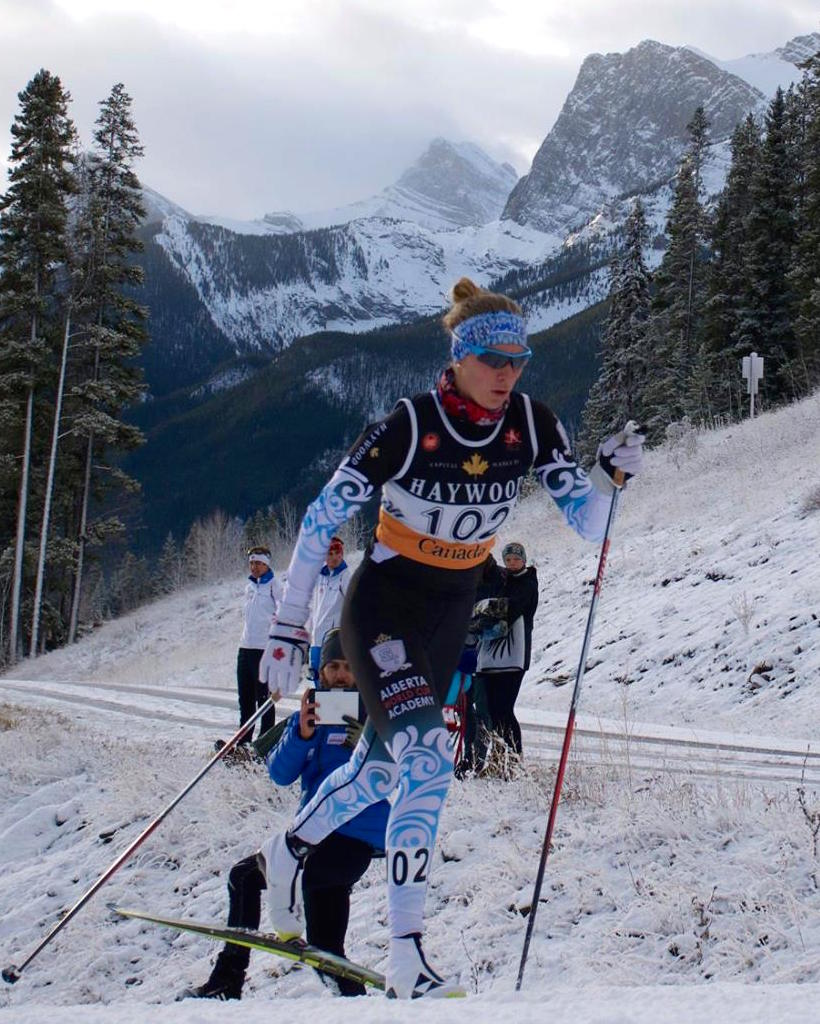
    Dahria Beatty (AWCA/NST U25-team) was the fastest woman in the classic sprint qualifier on Tuesday at Frozen Thunder in Canmore, Alberta. (Photo: Jenn Jackson)
    Dahria Beatty (AWCA/NST U25-team) was the fastest woman in the classic sprint qualifier on Tuesday at Frozen Thunder in Canmore, Alberta. (Photo: Jenn Jackson)

    In the third heat, the organizers pulled the top women together for their own A-final.  There, Phinney beat out Beatty and Hicks.

    “I’m happy with today!” Phinney wrote. “I love racing heats, so I’m always happy to get a full day of heat racing with speedy competitors. We’ve put in a big volume week on snow and so it was good to end this block with a fun day of sprinting. I was pleasantly surprised that I felt pretty fast despite being tired from a big week of training. Also there was fresh snow on top of the man made loop, so we had some tricky conditions. It was definitely a good day to work on skiing in tough conditions.”

    “My race was alright,” Beatty wrote in an email. “I definitely feel like I am still missing my top speed but that’s what these races are for. They are the perfect opportunity to get tuned up for the race season and remind the body how to move really fast.”

    Hicks rounded out the podium with enthusiasm.  “I felt strong today and it was a good confidence booster going into the start of the season,” she wrote. “Qualifying second behind Dahria was a huge surprise though! I’m usually not a strong qualifier but felt like I skied really well today.”

    Results: Qualifier | King’s Court

    The start of an all-women's heat at the 2016 Frozen Thunder classic sprint, which followed King's Court format. (Photo: Matthias Ahrens)
    The start of an all-women’s heat at the 2016 Frozen Thunder classic sprint, which followed King’s Court format. (Photo: Matthias Ahrens)

    FasterSkier is seeking photos from the 2016 races at Frozen Thunder. Please email submissions with caption and credit info to info@fasterskier.com.
  • Holmes and Green Take 2016 Frozen Thunder Distance Titles in More of a Training Scenario

    Holmes and Green Take 2016 Frozen Thunder Distance Titles in More of a Training Scenario

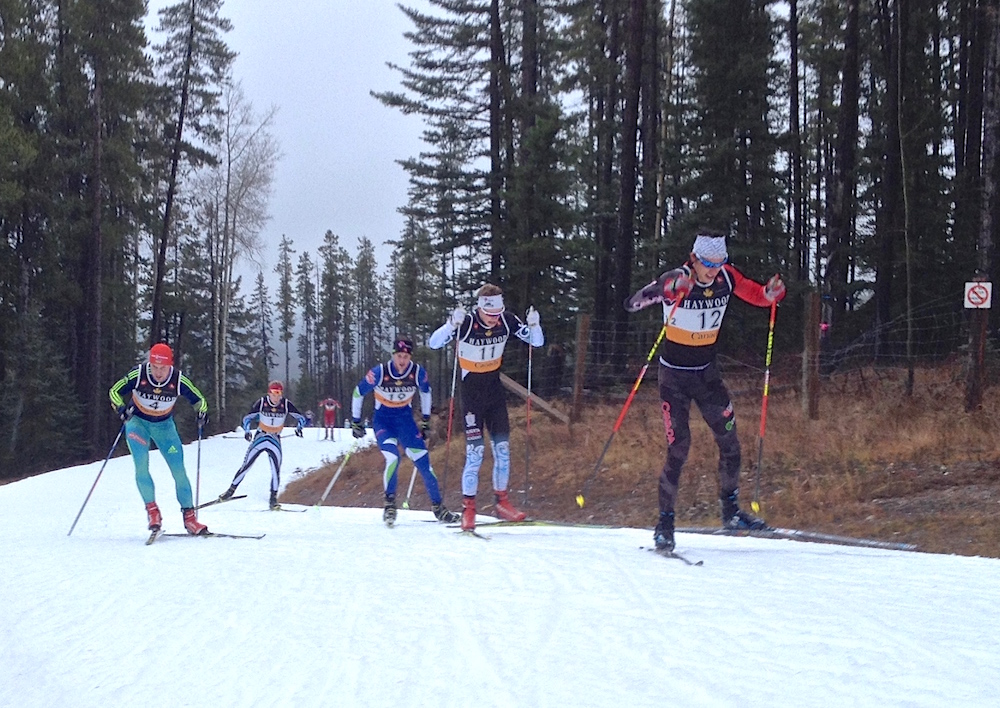
    Biathlon Canada's Brendan Green (r) leads Ukrainian biathlete Olexandr Zhrynyi (4) and Canadians Jack Carlyle, (11), NDC Thunder Bay's Bob Thompson (19) and Gareth Williams (1) during the men's 10 k freestyle interval start on Friday at Frozen Thunder in Canmore, Alberta. (Photo: Matthias Ahrens)
    Biathlon Canada’s Brendan Green (r) leads Ukrainian biathlete Olexandr Zhrynyi (4) and Canadians Jack Carlyle, (11), NDC Thunder Bay’s Bob Thompson (19) and Gareth Williams (1) during the men’s 12 k freestyle interval start on Friday at Frozen Thunder in Canmore, Alberta. (Photo: Matthias Ahrens)

    On Friday, the Canmore Nordic Centre celebrated Day 7 of Frozen Thunder with freestyle interval-start distance races, Canada’s first unofficial on-snow races of the 2016/2017 season. As with previous years, the nordic community has been out in force on Alberta’s early season ski trails.

    Local skiers include members of Canada’s cross-country, biathlon and Para-Nordic teams as well as three larger clubs. The U.S. and Ukrainian biathlon teams are also in Canmore, along with a salting of top cross-country skiers from the western U.S.

    With no points or selection opportunities on the line for Friday’s race, most considered it a training race. A second day of rain led some athletes to drop out or skip the distance race altogether, leaving a grand total of 97 finishers, all using the same low-fluoro wax.

    Chelsea Holmes of Alaska Pacific University (APU) won the women’s 7.5 k freestyle in 18:18.6.

    “We had fantastic conditions,” she wrote in an email. “It was a little bit like the APU summer training grounds on Eagle Glacier :)”  

    The men started first, leaving the women with a chewed-up surface of a few inches of wet, corn snow on a firmer base. Regardless, conditions remained mostly consistent from the first to last female starter.

    Holmes explained she came to Canmore to spend time with her husband, who works in nearby Banff, and “to get in a race effort with a bib on and try to get my body going” before heading back to natural snow in Alaska.

    Caitlin Gregg (Team Gregg/Madshus) placed second, 6.3 seconds off of Holmes’s winning time.

    “I was pretty happy with my race today,” Gregg wrote. “It was honestly one of those days when I didn’t feel great (energy-wise) on course but I skied well and the result was quite good. I raced on a new pair of my Madshus skis and felt like they were a huge part of my speed out there when I was a bit off ;)”

    Whereas Holmes had four weeks of glacier skiing in the summer, Gregg hadn’t been on snow since March.

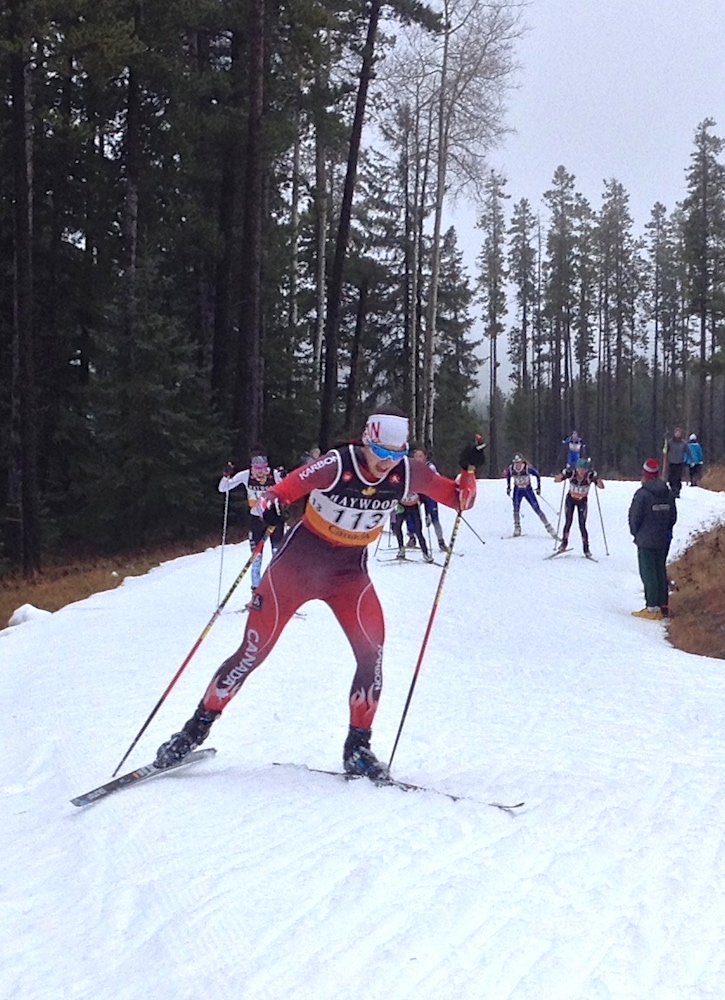
    Biathlon Canada's Rosanna Crawford racing to third in the women's 7.5 k freestyle on Friday at Frozen Thunder in Canmore, Alberta. (Photo: Matthias Ahrens)
    Biathlon Canada’s Rosanna Crawford (113) racing to third in the women’s 7.5 k freestyle on Friday at Frozen Thunder in Canmore, Alberta. (Photo: Matthias Ahrens)

    “It was pretty soft [conditions] but I tried to figure out how to maintain speed by playing around with my power, tempo and technique,” Gregg wrote. “I find myself racing some softer loop courses during the year and wishing I had more practice for those conditions so today was a great learning day!”

    Biathlon Canada’s Rosanna Crawford, who lives and trains in Canmore, was the top Canadian, placing third, 42 seconds back from Holmes.

    “Today was not great for me,” Crawford wrote in an email. “Definitely didn’t feel great on the skis. Heavy legs. We are at the end of a pretty tough intensity block with 5 sessions on the roller ski treadmill that can leave you feeling pretty drained. The soft slushy snow also doesn’t work great for a tall girl like me!”

    Crawford spent three weeks of August skiing in New Zealand with the national team and is excited to be wearing a bib on snow again.

    “I love sprints and wish that I could race more of them!”  she wrote. “We did a prologue in our fall Testival this year, a 3km race and that went really well for me, so hopefully I can transfer that over to snow for the skate qualifier next week!”

    Like the other racers, she didn’t take the race results too seriously.

    “These races don’t mean much […] because you don’t know how loaded or tired athletes are going into them. It’s just fun to get back on snow and feel the race vibes and nerves!”

    Olivia Bouffard-Nesbitt of the Alberta World Cup Academy (AWCA) and U25 national team placed seventh (+1:14.7), behind her teammate on both teams Dahria Beatty in fourth, Julia Ransom (Biathlon Canada) in fifth, and Mary Rose, of the Sun Valley Ski Education Foundation (SVSEF) Gold Team, in sixth.

    National team biathlete Julia Ransom racing to 5th place. (Photo: Matthias Ahrens)
    Biathlon Canada’s Julia Ransom racing to fifth place in the women’s 7.5 k freestyle on Friday at Frozen Thunder in Canmore, Alberta. (Photo: Matthias Ahrens)

    “I was very happy with the race today, Bouffard-Nesbitt wrote in an email. “I had a tough summer, spending 3 months on crutches due to a foot injury. My first real intensity session was only a couple of weeks ago, so I really had no expectations going into the race today. I’m happy with my decision to race because; it felt good to push hard and I was happy to see that I hadn’t lost too much fitness over the summer. This was definitely a training race for everyone, not much ski testing was done and everyone was on the same wax (LF6).”

    She added that snow skiing caused less pain in her foot than rollerskiing, and Frozen Thunder marked the first time she had been on snow since March.

    “[That’s] probably the longest I’ve gone off snow for the last 5 or 6 years, so it feels really good,” Bouffard-Nesbitt wrote.

    Green Edges Gelso 

    Another leading member of Biathlon Canada, Brendan Green won the men’s 12 k, completing the six laps in 23:11.2 to edge out Matt Gelso (SVSEF Gold Team) by 4.6 seconds.

    “All in all I think I raced well,” Green wrote in an email. “This was our first hard effort on snow and I feel like I was able to put in quite a good effort.  There are still areas for me to work on but today was a good test.”

    Green is seeing value from three weeks of New Zealand snow and the first week of Frozen Thunder. “This training season encompassed the most time I’ve ever spent on snow, and I think this has been really positive for me,” he wrote.

    After ideal snow at New Zealand’s Snow Farm and first five days at home in Canmore, Green explained he was happy to race in trickier conditions.

    “The course was soft but not unlike conditions we often face while racing in Europe, so in that regard it was good practice,” he wrote, adding that the Frozen Thunder course has been holding up well. 

    “Honestly I felt a little slow motion out there today, but that is pretty standard for an early season effort like this,” Gelso wrote in an email. “It certainly feels great to have performed as well as I did today, but the races that count begin in December and that’s when I want to be skiing fast.”

    Gelso saw having bib 16 of 65 as an advantage.

    “Conditions did change throughout the men’s race with much later starters seeing a pretty soft and chopped up course for their whole race instead of just the last 4 laps or so,” he wrote.

    Despite four weeks of skiing in Falls Creek, Australia, with his team this summer, “an extra week of skiing at the end of October goes a long way towards being prepared to race well in early December,” Gelso noted.

    Third place went to Ukrainian biathlete Olexandr Zhyrnyi, who finished 8.1 seconds back.  Para-Nordic star Brian McKeever placed fourth, 4.3 seconds behind Zhyrnyi and 1.3 seconds ahead of Russell Kennedy (AWCA).

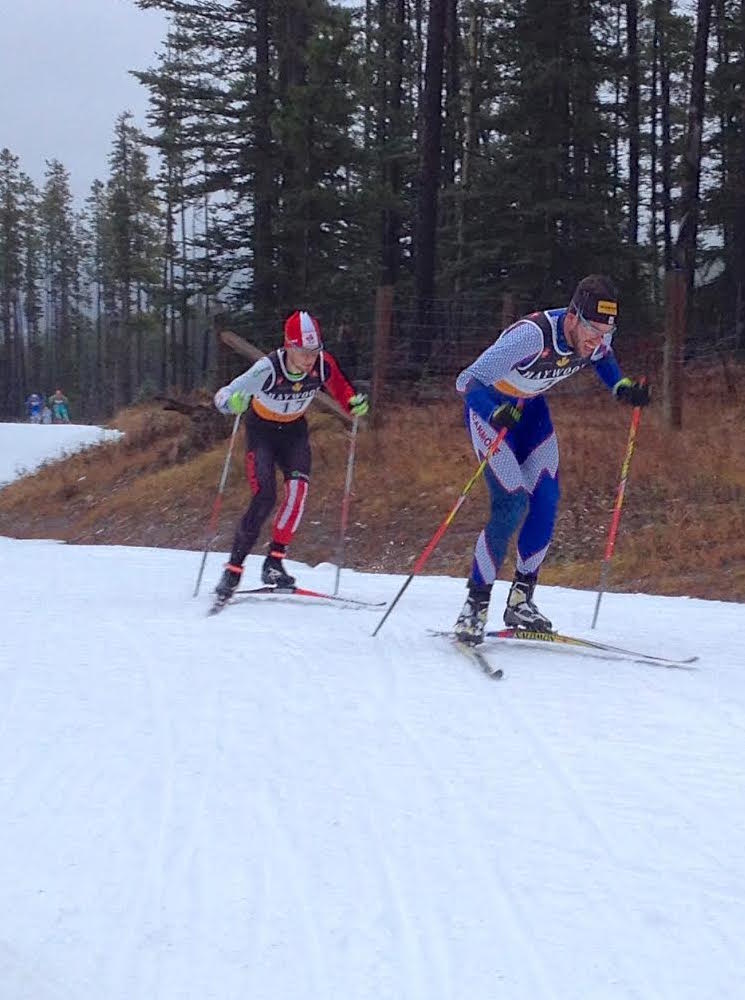
    Russell Kennedy leads national team biathlete Christian Gow (Photo: Matthias Ahrens)
    Russell Kennedy (AWCA) leads Christian Gow (Biathlon Canada) in the men’s 12 k freestyle on Friday at Frozen Thunder in Canmore, Alberta. (Photo: Matthias Ahrens)

    “I felt good about my race today,” Kennedy wrote in an email. “It’s always good to start the season on a positive note!”

    Kennedy didn’t travel for summer snow, which made local skiing more important to him.

    “Frozen Thunder is definitely a huge asset to western North America. There is no doubt that it helps get you into ski shape long before the season starts,” he wrote.

    Brian Gregg (Team Gregg/Madshus) was a bit disappointed with his 14th place, 39.2 seconds back, but is more focussed on preparing for future races.

    “It is nice to not have to worry about the wax component of the race,” he wrote after Friday’s race. “30 second intervals gave plenty of room on the course and the course is at least two skiers wide.  The organizers and volunteers have a dialed operation.”

    With only a week on snow in summer at Haig Glacier, Gregg is enjoying the chance to learn about his skis and be surrounded by elite skiers.

    “I love skiing on snow!” he wrote. “The setup on Frozen Thunder is fantastic too as it offers the ability to easily test skis in a variety of snow conditions.  Although it is unique to be on snow that has been saved all summer, we are finding ourselves racing more and more on transformed man made snow.”

    Complete Results

    Racing continues with a classic sprint on Tuesday, Nov. 1 and a freestyle sprint on Thursday, Nov. 3, both starting at 9 a.m. mountain time.  Two Canadian men will be selected for the World Cup Period 1 based on the qualifying results.  If you live in the region, Shaw TV Calgary will have live coverage of the classic sprint from 10 a.m.

    FasterSkier is seeking photos from the 2016 races at Frozen Thunder. Please email submissions with caption and credit info to info@fasterskier.com.
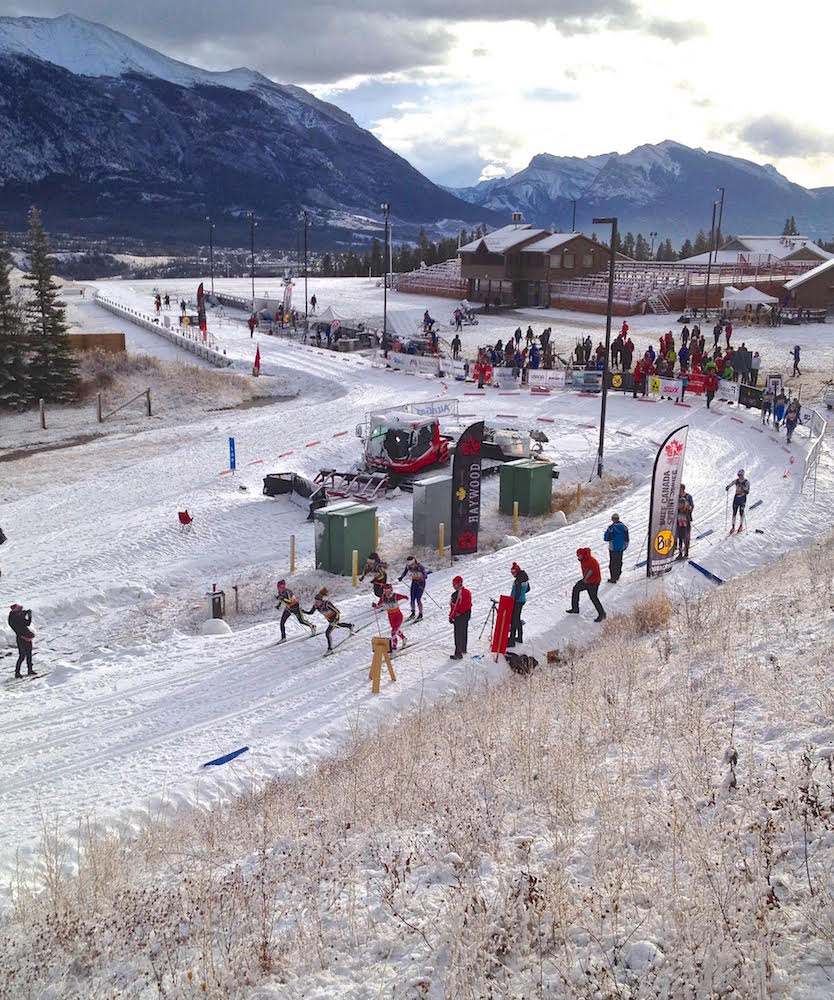
    Building the biathlon range for Frozen Thunder 2016 (Photo: Matthias Ahrens)
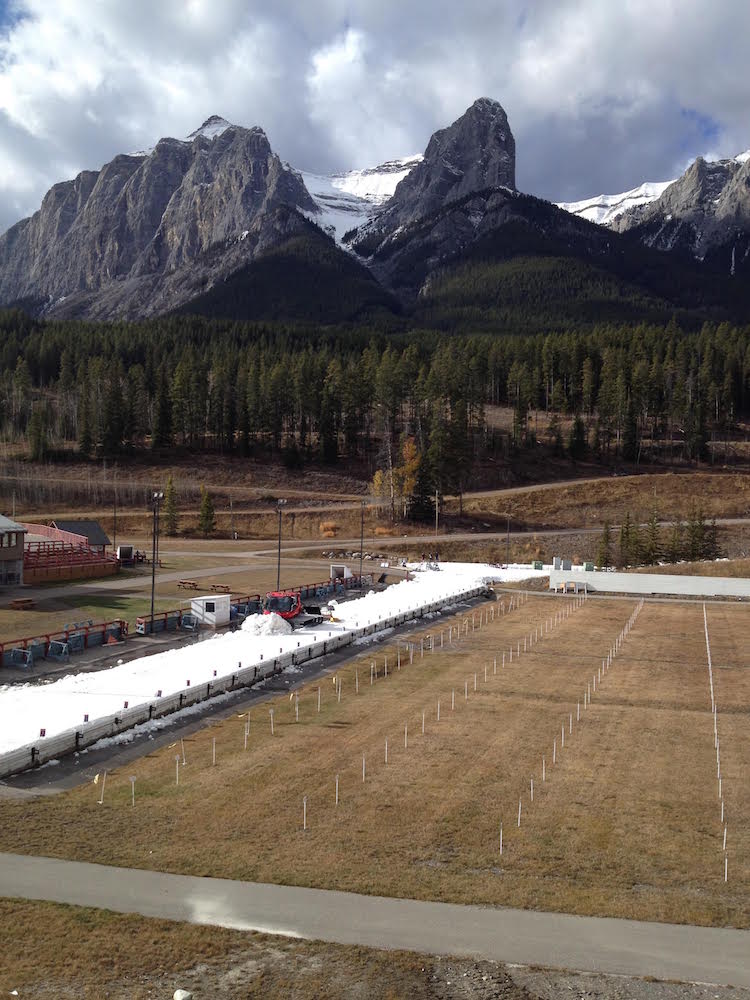
    Building the biathlon range for Frozen Thunder 2016 at the Canmore Nordic Centre in Canmore, Alberta. (Photo: Matthias Ahrens)