Tag: 2016 Lillehammer Mini Tour

  • Sundby Tops Again; Harvey 9th in Lillehammer Mini Tour

    Sundby Tops Again; Harvey 9th in Lillehammer Mini Tour

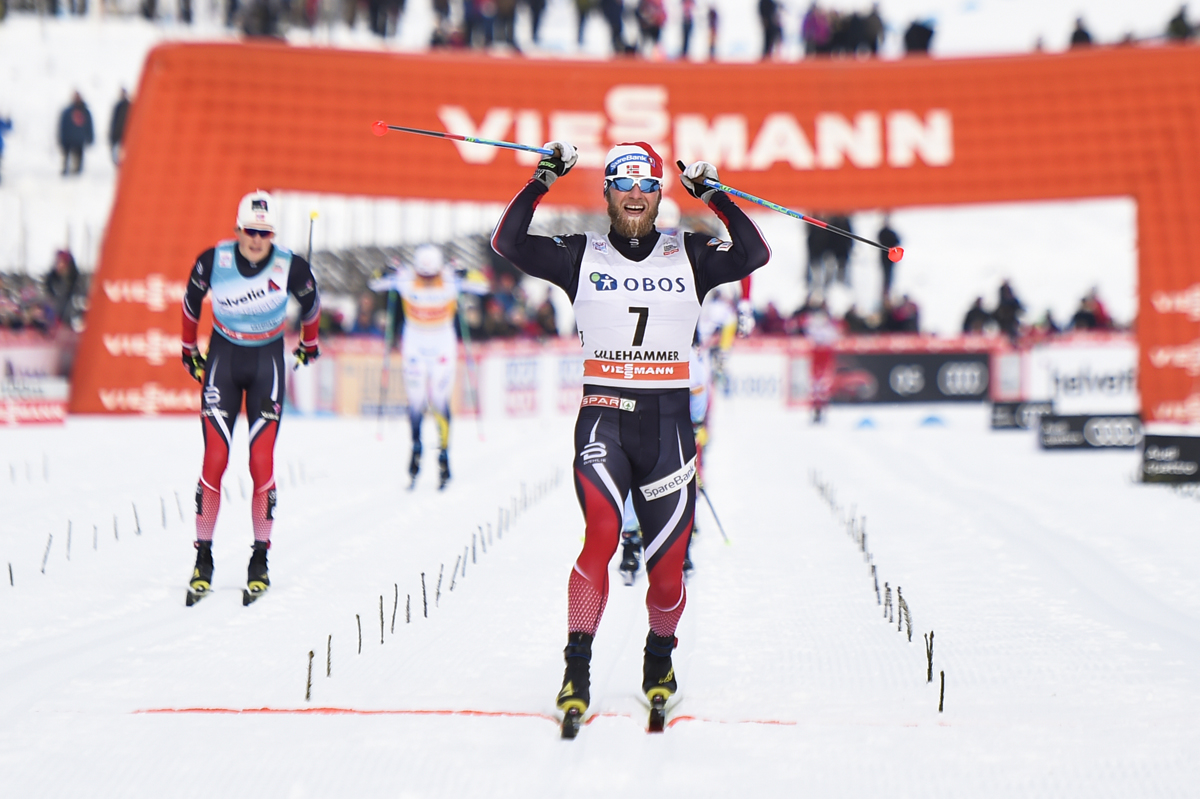
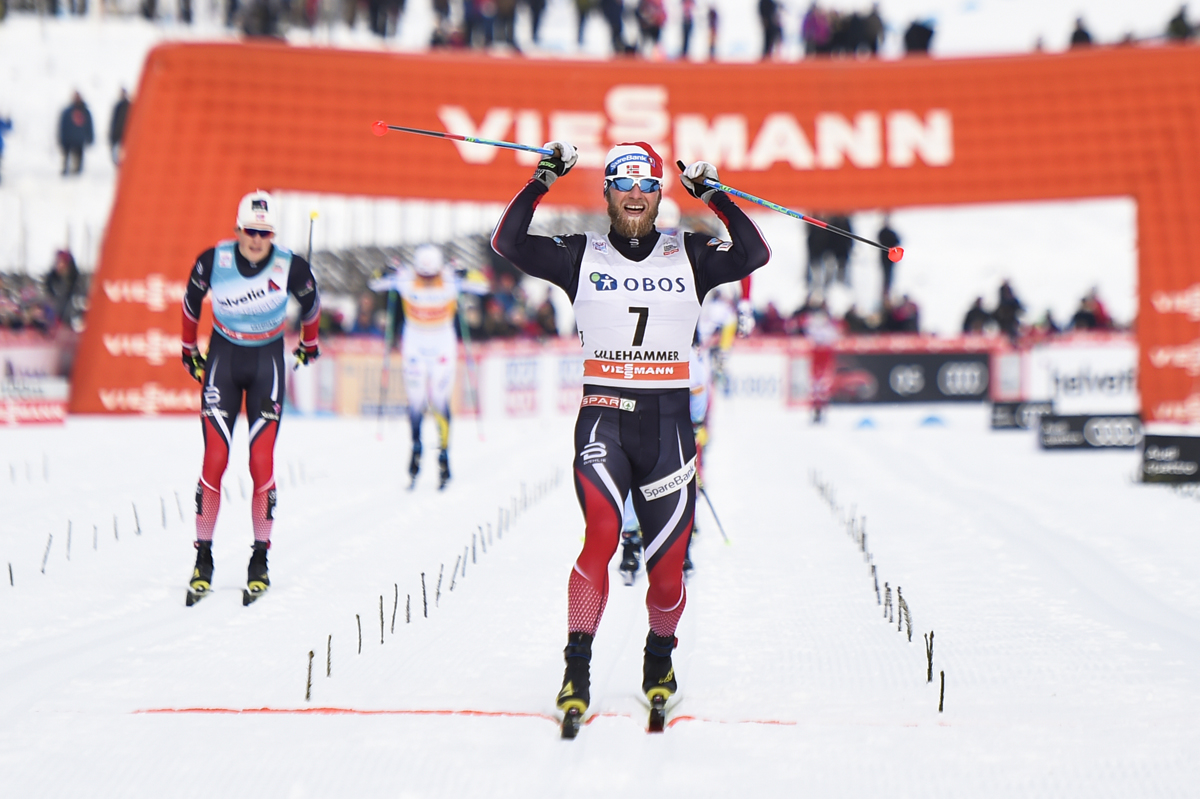
    Martin Johnsrud Sundby of Norway celebrates his 15 k pursuit win on Sunday, the final day of the first mini tour of the season in Lillehammer, Norway. (Photo: Fischer/NordicFocus.com)
    Martin Johnsrud Sundby of Norway celebrates his 15 k pursuit win on Sunday, the final day of the first mini tour of the season in Lillehammer, Norway. Another Norwegian, 20-year-old Johannes Høsflot Klæbo (l) placed second. (Photo: Fischer/NordicFocus.com)

    Note: This article has been updated to include comments from U.S. Ski Team member Noah Hoffman and APU skier Eric Packer. 

    When exactly was the race’s defining moment on Sunday during the final mini-tour stage, a 15 k classic pursuit in Lillehammer, Norway?

    It wasn’t at the start when tour leader, Sweden’s Calle Halfvarsson, cruised out with a 28-second head start on the next released skier, Russia’s Sergey Ustiugov.

    It wasn’t the time check at 2.2 k, despite a growing chase group rife with Norwegian colors. At that point, Halfvarsson strided powerfully with a sizable 49-second lead on the likes of Norway’s Martin Johnsrud Sundby.

    Here’s the moment.

    Around 8.3 k heading up the course’s longest climb, Halfvarrson’s skis slipped. On cue, Halfvarrson glanced behind as if the catch to come couldn’t be over too soon.

    It was like a band of released hounds chasing down the maimed fox. The time back to the chasers had shrunk to 22 seconds.

    The group of salivating oncomers included Sundby and teammates Finn Hågen Krogh, Emil Iversen, and Pål Golberg, Johannes Høsflot Klæbo, Simen Hegstad Krüger, and Sweden’s Marcus Hellner, Finland’s Matti Heikkinen, and Canada’s Alex Harvey.

    From then on the Swede seemed to ski in fear.

    The catch came four kilometers later. Then Sundby tried make the race his own. He had an eight-second lead with a little less than two kilometers to go. But this is not a dominate Sundby. His skiing is somewhat more subdued. His attack less of a kill shot and more of an alpha’s warning that he’s still there.
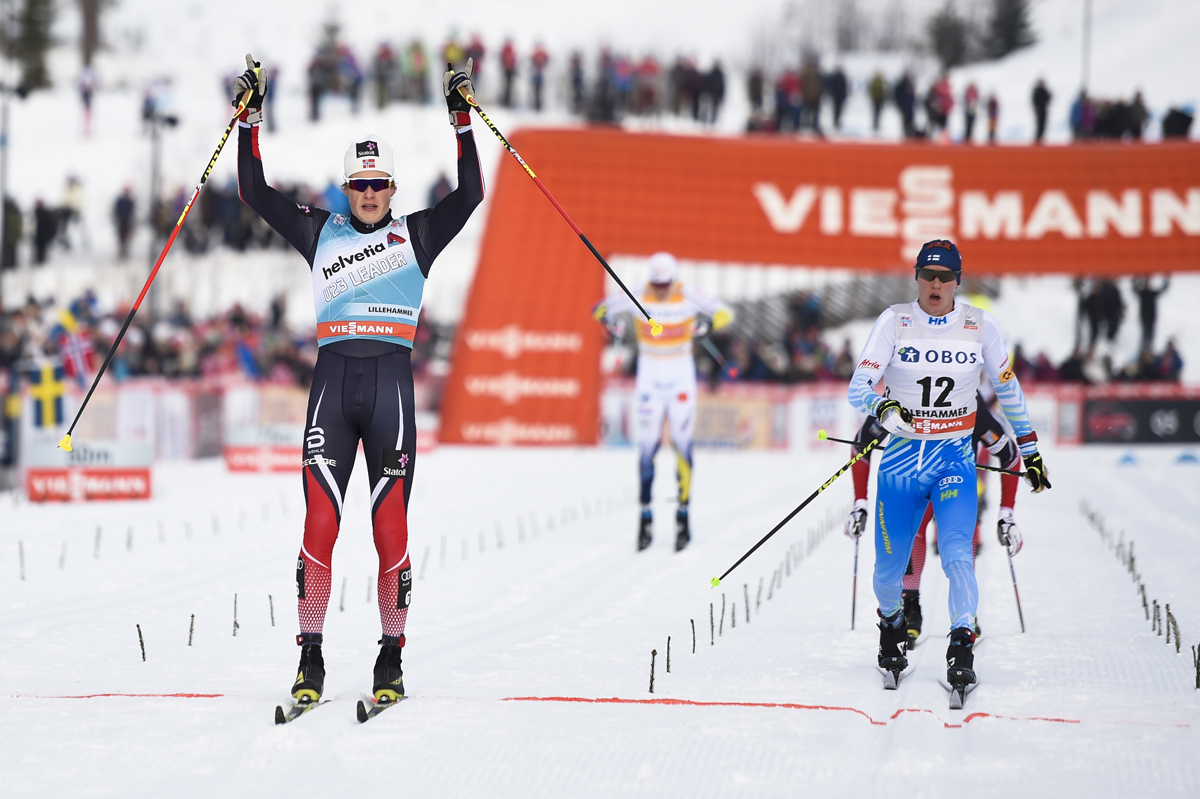
    Norway's Johannes Høsflot Klæbo celebrates his second-place finish in the men's 15 k classic pursuit, ahead of Finland's Matti Heikkinen (12) in third, at the World Cup mini tour in Lillehammer, Norway. (Photo: Fischer/NordicFocus.com)
    Norway’s Johannes Høsflot Klæbo (l) celebrates his second-place finish in the men’s 15 k classic pursuit, ahead of Finland’s Matti Heikkinen (12) in third, at the World Cup mini tour in Lillehammer, Norway. (Photo: Fischer/NordicFocus.com)

    Sundby hung on for the stage and overall Lillehammer mini tour win sharing the podium with 20-year-old, second-place finisher Klæbo (+2.3), and fastest time of the day skier Heikkinen (+2.7) in third.

    “It was an interesting race,” Sundby said during the post-race press conference. “Calle set quite a good pace from the beginning. It looked like he had full control of the race. Suddenly after five or six k, he struggled with the kick, and we really had a chance to catch up with him. I tried to make my move when we left the stadium for the last time. I tried to keep the pace high all the way up on the longest hill. Luckily I gained some meters and won in the end.”

    Leaving Lillehammer, Sundby finds himself in a familiar color: he’s wearing yellow as the overall World Cup leader. Halfvarsson is 34 points back in second, Klæbo is third overall, 46 points back.

    Harvey Hunting in Front and Kershaw Moving into the Points

    Coming into the third and final day of racing in Lillehammer, Canada’s Harvey sat in eighth place, 51 seconds back from Halfvarsson and one second behind Sundby, the seventh starter in the pursuit. Strategically speaking, Harvey had his Norwegian rabbit. The only question was could he hang on?

    Affirmative. No matter where you checked for race stats, live in Lillehammer, an Internet stream, or live FIS timing, you’d see Harvey’s name and the maple leaf. Up until 12.2 k, Harvey stuck to the chase group like a limpet.

    “I think I had the fastest skis in the group,” Harvey told FasterSkier’s reporter in Lillehammer.  “But I went too limited on the kick … on the hills I was drifting because I couldn’t really go … but it’s my mistake because our skis were really, I think we had the best skis in the field today. But I took a pair that was a little too aggressive I think.”
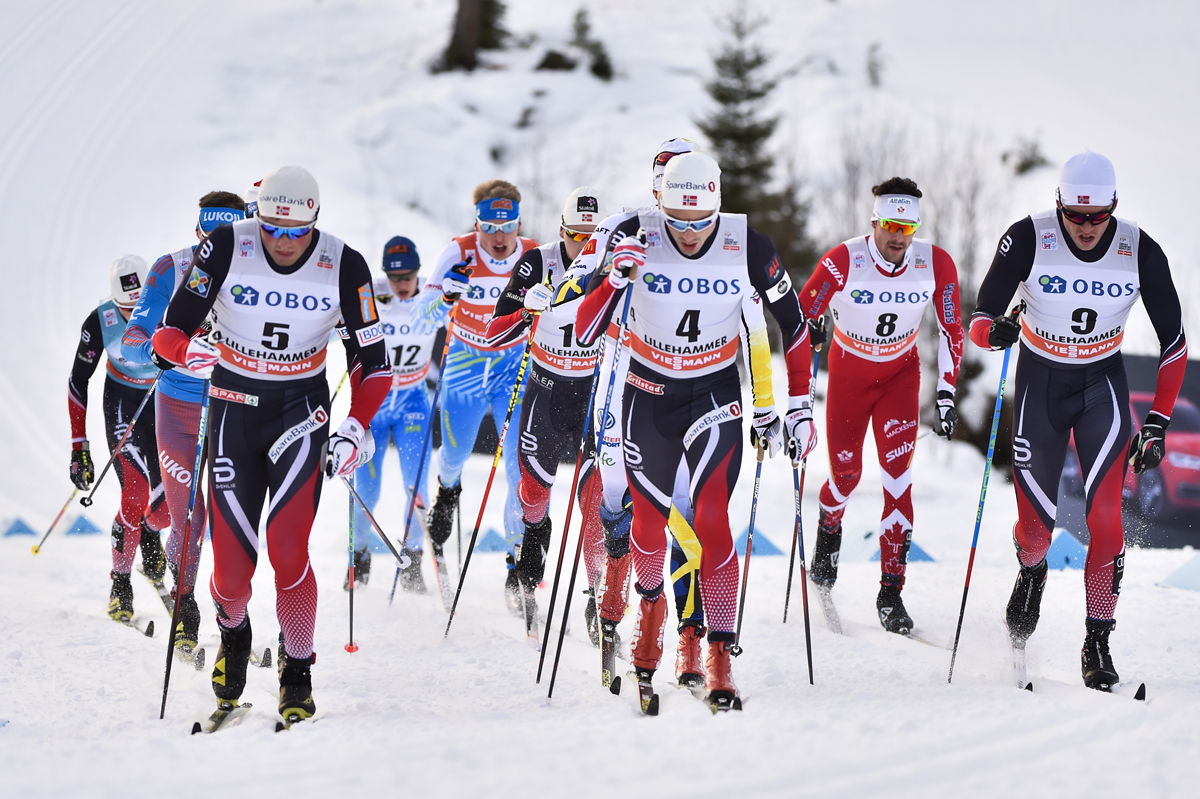
    Norway's Finn Hågen Krogh (4) and Emil Iversen (5) leading the charge in the men's 15 k classic pursuit on the final day of the World Cup mini tour in Lillehammer, Norway, with Canadian Alex Harvey (8) in the mix. (Photo: Fischer/NordicFocus.com)
    Norway’s Finn Hågen Krogh (4), Emil Iversen (5) and Pål Golberg (9) leading the charge in the men’s 15 k classic pursuit on the final day of the World Cup mini tour in Lillehammer, Norway, with Canadian Alex Harvey (8) in the mix. (Photo: Fischer/NordicFocus.com)

    As the finished neared, Harvey eventually lost 16 seconds to the Sundby pack, ultimately placing ninth overall in the mini tour. Harvey added that he’s feeling confident after the three-stage Lillehammer mini tour. “I mean three races, three tops 10’s. I think the fitness is really steady and everything, the support team, the equipment has been really steady.”

    For some perspective on Harvey’s enthusiasm, here’s some context: after last year’s opening three-day Ruka mini tour, Sundby won the overall by 44 seconds. The next 2015/2016 weekend in Lillehammer, a 30 k skiathlon, Sundby again soloed to a 44-second win. During Weekend 3, in the 30 k freestyle in Davos, Switzerland, it was Sundby in first by 20 seconds.

    2016/2017 on the World Cup has begun with diminished margins for Sundby. A win is still a win. But for skiers like Harvey, Sundby is more human.

    “It gives us confidence I think,” Harvey said of the more-level World Cup playing field. “This year there’s nobody you know that’s invincible as compared to the last couple of years, so that’s motivating for everybody.”

    Harvey’s next stop is an all skate weekend in higher altitude Davos with a 30 k and sprint lined up. “Now we have to rest,” Harvey said of his week ahead. “Three races in three days is hard on everybody, and with a travel day coming up, we are going to have to recover from that. And then coming up in altitude, you got to really monitor your body well and re-test your equipment because that’s a new type of snow in central Europe. There is a bit more humidity in the snow and it’s a bit different … now it’s race-race, recover-recover, race-race, recover-recover until pretty much until the end of the season.”

    Harvey, who skied the sixth-fastest time on the day, leaves Lillehammer ranked 10th overall on the World Cup.

    The next best Canadian finisher was his fellow World Cup Team member Devon Kershaw who started 43rd, 2:01 behind Halfvarsson. Fifteen k later, Kershaw had moved up to finish 27th (+2:08.5) after skiing the 23rd-fastest time on the day.

    “The last stage was the one brighter spot of the mini tour,” Kershaw said over the phone. “The sprint didn’t go that great then the 10 k didn’t go that great either.”

    On Friday, Kershaw placed 42nd in the sprint. He was 40th on Saturday’s 10 k skate. “But I have been feeling good since the start of the season,“ Kershaw added. “I am just missing that fifth gear, but the legs and body are working well. I just can’t get into that last gear that you need on the World Cup to really compete at the top top.”

    Despite lacking that fifth gear, on Sunday Kershaw was set up with plenty of opportunities to pick off skiers.

    “Today was fun to move through the pack a bit and it’s too bad I couldn’t quite get to that next group in front of me,” Kershaw said of his attempt to close the gap to a group of skiers fifteen seconds in front. “I tried with everything I could to get on that group, but I just wasn’t strong enough today to make that last jump and that would have made it a lot easier, to have some skis to follow instead of of just plowing along at the sharp end of my group. But I cannot complain, I started the day 43rd and finished 27th. I did as good of damage that I could in 15 k. It was a step in the right direction for sure.”

    Kershaw, is now an Oslo resident as he’s married to former Norwegian star Kristin Størmer Steira. Kershaw said Steira’s father, mother, and sister all reside in Lillehammer and constituted a small-but-vocal Lillehammer fan club. Kershaw’s father-in-law served as assistant chief of competition during the mini tour. On Sunday, Kershaw’s wife, sister, mother-in-law, and even the family dog (who Kershaw stated was well trained and didn’t bark) were all trailside to see the Canadian veteran move into the World Cup points.

    The remaining Canadian finishers were Len Valjas (World Cup A-Team) in 46th (+3:44), Graeme Killick (World Cup B Team) 51st (+3:53.9), Knute Johnsgaard (U25 Team) 70th (+6:20.3), Bob Thompson (NTDC Thunder Bay) 79th (+8:16.3), and Andy Shields (NTDC Thunder Bay) 81st (+9:57.3)

    For the Americans, U.S. Ski Team (USST) member Noah Hoffman continued to show improving form on Sunday.

    Stage 3’s pursuit found Hoffman starting in bib 48, 2:08 back. Hoffman finished Sunday’s pursuit 36th after skiing the 29th-fastest time on the day (+1:30.2).

    “After last week’s disappointment I was really just looking to have a solid race where I skied within myself, with energy, with relaxed muscles, clean muscle environment and just tried to demonstrate my fitness a little bit,” Hoffman said on the phone Sunday night. “Both days I tried to do that and I think I was pretty successful both days. Certainly none of the results this weekend were something to highlight my season … I’m obviously looking for more, but a big step in the right direction from last week and that’s really much all I can ask at this point.”

    During the offseason, Hoffman implemented a training plan with a large percent increase in training hours.

    “He skied well and I think he is still coming out a little bit from underneath the load of all the training he has done,” U.S. Ski Team Head Coach Chris Grover said. “But the last couple starts he really feels like he is going in the right direction.”

    Erik Bjornsen (USST) began the day in bib 44 and dropped to 57th (+4:33.3)

    “Unfortunately for Erik, he had good skis, but he chose to go a little too thin on the wax I think,” Grover said of Bjornsen’s day. “He was too slick, so he started out really well. But with the massive climbs out there he just fatigued in a hurry and started going backwards after a bit … Erik is definitely disappointed because he wanted to ski well today. He had been looking at targeting this race and has been looking at it for a long time. He was pretty bummed out.”

    Simi Hamilton did not start and the remaining U.S. skier in the mini tour, Eric Packer (APU), placed 68th (+5:45.1).

    Despite his 68th place on Sunday, Packer, who emailed from Oslo before boarding a plane to Zurich, Switzerland, remains a sponge when it comes to the World Cup. “It’s been an awesome experience racing over here for period 1,” Packer explained. “The level of the competition is definitely high, and it’s been an adjustment getting used to racing WC vs Supertour, but I’m definitely learning a bunch and finding things to work on.”

    Although energized coming into the fall training season, Packer fell ill for the first three weeks of November. The Anchorage based skier took a full twenty days off from intensity training before traveling to Europe for period 1. “On the plus side, I think the illness allowed me to get some really quality rest, and my energy levels are great,” Packer added. “I can feel my form improving with each race, and am looking forward to the racing ahead.”

    84 skiers completed the mini tour. Packer started day 3’s 15 classic pursuit in bib 75, and placed 68th overall. Yet he skied the 58th fastest time on the day (+3:23.1). Only two places back from Ustiugov’s ski time, who began the race as the second starter. “The 15k Classic Pursuit in the Lillehammer mini tour went well for me, and was a big step in the right direction,” Packer wrote about the mini tour’s last stage. “I had a tough starting spot, toward the back of the field, but was able to bridge up to a good group and pick off some spots.   I finally felt like my body was working like it should, and ended up 58th for time on day.  Obviously I still want better, but for period 1 racing, and for distance, I was happy with the result.”

    World Cup racing resumes Saturday, Dec. 10, with a skiathlon in Davos, Switzerland.

    Results | Winner of the day | Final mini-tour standings 

  • Day 1 in Lillehammer: Halfvarsson is for Real, Harvey Places 10th

    Day 1 in Lillehammer: Halfvarsson is for Real, Harvey Places 10th

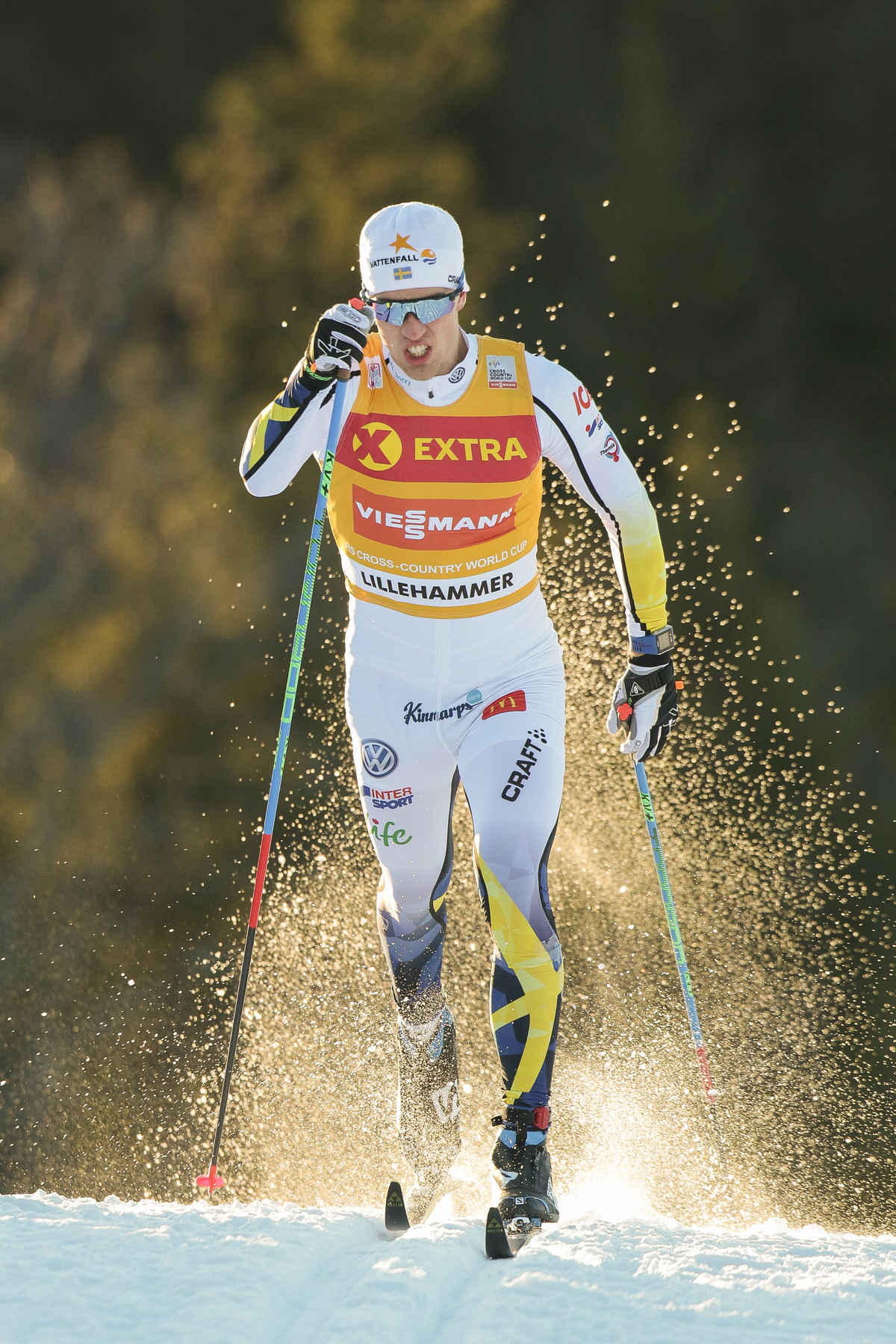
    Calle Halfvarsson of Sweden en route to his first World Cup win in three years, with a victory in Thursday's classic sprint in Lillehammer, Norway. (Photo: Fischer/Nordic Focus)
    Calle Halfvarsson of Sweden en route to his first World Cup win in three years, with a victory in Friday’s classic sprint in Lillehammer, Norway. (Photo: Fischer/Nordic Focus)

    Blue skies. The low, northern-latitude light basking Lillehammer, Norway’s storied tracks in a sublime wintery hue.

    That was only the setting for Friday’s 1.5-kilometer men’s classic sprint, the first stage of a three-day mini tour. The bucolic dreaminess was jolted by snow spraying off the backs of skis as the men charged up and down the three-hilled Lillehammer course.

    Sweden’s Calle Halfvarsson came to Lillehammer wearing the yellow bib as the overall World Cup leader. By race the race’s end, with sprinters coming in and out of sub-Arctic shadow, Halfvarsson took the sprint win in 3:31.83, securing his early season grip on yellow. It was the Swede’s second podium in the season’s early chapters. He placed second in the World Cup’s opening day classic sprint in Kuusamo, Finland, last Saturday.

    “I felt strong in the prologue and in all the heats,” Halfvarsson said during the post-race press conference. “I decided to go out of the track on the last climb because I had a better grip there. I think I am headed in the right direction. We will see tomorrow how things are.”

    Halfvarsson shared the podium with Norway’s Emil Iversen in second (+0.12), and Swedish teammate Teodor Peterson in third (+0.54).

    Ninety-eight men began the mini tour, setting off one by one during Friday’s sprint qualifier. From that initial 98, the field was culled to 30 skiers in the heats, 12 in the semis, six in the finals. And then of course there was one.

    Halfvarsson began the day the same place he finished it: he was the first qualifier in 3:28.44. He moved through the rounds placing second in quarterfinal two, and first in semifinal one where he edged Peterson by 0.10 seconds.

    Peterson qualified fourth, nearly six seconds behind Halfvarsson. Peterson then finished second in both his quarter and semi to advance to the finals, eventually placing third. “I’m satisfied with it, third is better than fourth and I feel like I tried my best in the final 100 meters but it didn’t work, though I’m still satisfied with the performance,” Peterson said during the press conference.

    Iverson’s route to the podium began with a slightly slower turn of pace; he qualified 13th in 3:37.39. Like Peterson, he, too, finished second in his quarter and semifinal. During the final, Iversen appeared to have been dropped by Halfvarsson’s fast skis, strong surge on the final uphill, and his double pole fury. A full 10 meters appeared to separate the skiers coming into the home stretch.

    “I always hope for a win, but second place is a good way to start the mini tour in Lillehammer,” Iversen explained when asked about his result at the press conference. “Being the best Norwegian of the day means I did a good job. The final was really fast. I tried my best on the final uphill, but Calle gained some meters and it was enough for him to win.” 

    Whatever distance there was between the eventual winner and Iversen was quickly diminished. Slotted right behind Halfvarsson, in the same lane, Iversen charged — eventually skiing onto the Swede’s tails a few meters from the finish. Iversen’s lunge for second place was a snazzy move; he swerved out and around Halfvarsson.

    Iversen was unable to better position himself for the finish by moving into the adjoining lane; by doing so he would have obstructed Peterson and risked obstructing him. The takeaway from Iversen’s burly finish should be a big warning shot to potential rivals: the young Norwegian can close seemingly insurmountable gaps with a frenzied finishing move.

    Of note, Norway’s Pål Golberg moved through the rounds with ease. Qualifying third and winning out until the final, Golberg’s sixth-place finish was cemented as soon as the starter’s gun fired. He snapped a pole at the start and did not receive immediate assistance from a coach for a pole replacement.

    Valjas, Harvey, Bjornsen Qualify

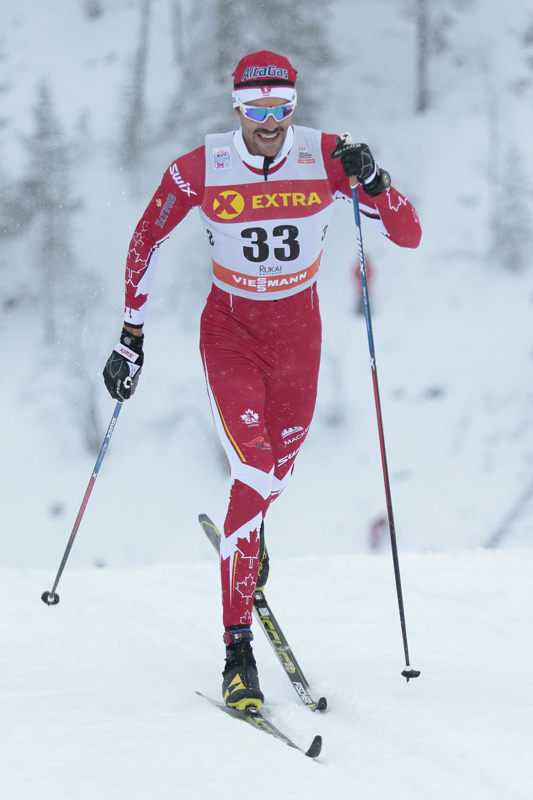
    Len Valjas racing in last weekend's classic sprint at the opening World Cup in Kuusamo, Finland. He missed the heats after placing 54th in that qualifier, but raced to 19th in Friday's classic sprint qualifier in Lillehammer, Norway. (Photo: Fischer/NordicFocus)
    Canada’s Len Valjas racing in last weekend’s classic sprint at the opening World Cup in Kuusamo, Finland. He missed the heats after placing 54th in that qualifier, but raced to 19th in Friday’s classic sprint qualifier in Lillehammer, Norway, before finishing 13th on the day. (Photo: Fischer/NordicFocus)

    Twelve North American men began the day’s race. Of those, only Canada’s Len Valjas, Alex Harvey, and U.S. Ski Team member Erik Bjornsen qualified for the sprint rounds.

    Valjas placed 13th overall after qualifying 19th (+10.24).

    Matching strides with eventual quarterfinal five winner Norwegian, Petter Northug, and last week’s 15 k classic winner in Kuusamo, Finland’s Livo Niskanen, Valjas initially looked posed to advance.

    “I felt good warming up for the quarterfinal so yeah, I was hoping for a little bit more today,” Valjas told Cross Country Canada, according to a press release, after the race. “But I had a lot of fun out there. I was skiing in the front for most of [my quarterfinal]. I don’t know, I felt really good and just got kind of boxed in coming into the finishing straight, so I jumped between the tracks, and it was just not enough, I couldn’t, or I needed a little more room to pass one more guy.”

    Valjas skied to third in his heat, only 0.19 seconds from advancing.

    It wasn’t an either-or affair with the Canadians. With Valjas easily qualifying, perhaps some of the pressure was off Harvey. On the phone after the race, Harvey was relaxed. He finished 10th overall for his first top 10 of the season.

    “The first thing I said to my tech after the quarterfinal was that this was mission accomplished today,” Harvey said. “I think there’s always a big break between 13th and 12th place for the bonus seconds.”

    For the mini tour, the overall standings after Day 1 are determined by taking a skier’s qualifying time and subtracting a time bonuses associated with their finishing place in the sprint. Harvey sits in 12th heading into the second day of racing — he received 13 bonus seconds for placing 10th on the day.

    Although satisfied, Harvey’s day could possibly have been even bigger. During his semifinal, just starting up the last of the course’s three hills, sprint winner Halfvarsson nearly skied over the tips of Harvey’s skis as he switched into the Canadian’s lane.

    “I was in good position following [Russia’s Sergey] Ustiugov, and I kind of saw the way he skied in the quarterfinal, I knew he would attack over the last bump,” Harvey said of his strategy moments before the impending Halfvarsson lane switch. “I was able to sneak in right behind [Ustiugov], but then Calle, he kind of changed tracks … His tails were pretty much on my bindings, or just in front.”

    Harvey had to pull up and lost his momentum.

    In an instant a gap opened Harvey was unable to close. After the semi, the jury issued Halfvarsson a yellow card for the move. Audible over the television broadcast feed moments after crossing the line, was Halfvarsson’s apology to Harvey.

    “It’s part of the game, it’s sprinting, it’s always tight, so there’s no hard feelings for me and Calle,” Harvey said of the incident.

    Other Canadians contesting the race were Canadian World Cup Team member Devon Kershaw who placed 42nd, Knute Johnsgaard (U25 Team) 51st, Bob Thompson (NTDC Thunder Bay) 52nd, Graeme Killick (World Cup B-team) 71st, and Andy Shields (NTDC Thunder Bay) 90th.

    On the American side, Bjornsen was the final skier squeaking into the rounds, qualifying 30th (+12.61).

    His quarterfinal was stacked with Halfvarsson and Norway’s new sensation, Johannes Høsflot Klæbo: these two skiers ran away with the heat, crossing the line nearly eight seconds ahead of the next-best placed skier. Bjornsen placed sixth in the heat and finished 24th overall.

    “I’m happy about the race and I’m happy about qualifying from the prologue, which I thought was good,” Bjornsen told FasterSkier in the mixed zone following his elimination. “I felt good through the race and I got some good double poling done”

    (Article continues below)

    https://www.instagram.com/p/BNhCjL3hBKV/?taken-by=sbjornsen&hl=en

    According to International Ski Federation (FIS) records, this is the fourth time Bjornsen has qualified for sprint heats and his first ever in classic technique.

    Adding to the accolades, Bjornson’s teammate and older sister Sadie Bjornsen qualified first in Thursday’s women’s sprint.

    “That was really great, we were talking about the hashtag #bjornsenbookends,” U.S. Ski Team (USST) Women’s Coach Matt Whitcomb said over the phone. “It was the joke around our athlete cabin this afternoon between the rounds and the qualification. They were first and 30th so that was pretty neat.

    “Erik has not qualified for too many sprints, but to qualify specifically in Lillehammer, in the lion’s den is quite impressive,” Whitcomb added.

    Andy Newell (USST) placed 47th in the qualifier. Newell explained in an email that he’s on the mend after fighting an elbow infection and recent cold symptoms.

    “I’m doing ok, but yes I have been fighting a cold for the past few days,” Newell wrote. “I took the last two days off completely from skiing but woke up this morning feeling ok so I made the decision to race. Despite not having any cold symptoms it was obvious that my strength and speed weren’t where they should be. It’s been a rough start to the season so far with the elbow infection before week 1 and then with cold this week. I’m not sure what the rest of the weekend will bring for me, but getting back to 100% will be the priority.”

    For the men, the mini tour features a 10 k freestyle Saturday and concludes with a 15 k classic pursuit on Sunday.

    Newell’s teammate Simi Hamilton (USST) followed him in 48th on the day.  

    “Definitely not the day I wanted out there,” Hamilton wrote in an email. “I’m pretty bummed with how I felt during the qualification, especially since I got my energy back after being sick for all of last week. But I think my body is coming around from illness and I’ve never historically raced super fast or felt great during the very beginning of the season. So I have confidence in knowing that I will feel better and better as the race year goes on.”

    Hamilton did mention his skis were solid. But Hamilton’s response in the email had more to do with his respect for his U.S. skiing peers than dwelling on where he’d like to be.

    “Although I didn’t walk away from the venue today with the race I had wanted to have, I was psyched to see our girls lay down some really fast qualifiers and was proud to watch them fighting with everything they had in the heats,” Hamilton wrote. “But I think the person I’m most proud of today is Erik [Bjornsen]. He’s one of the best classic skiers I know, and works incredibly hard day in and day out, and he deserved to score his first ever classic sprint points today. To be able to do that in Norway is especially noteworthy. It’s incredibly difficult to walk into the lion’s den here, no matter what the race, and I think this is a sign of things to come this season for Erik.”

    Other Americans contesting the sprints were Alaska Pacific University (APU) skier Eric Packer in 76th and Noah Hoffman (USST) in 89th.

    Results: Final Mini-tour standings (after Day 1)