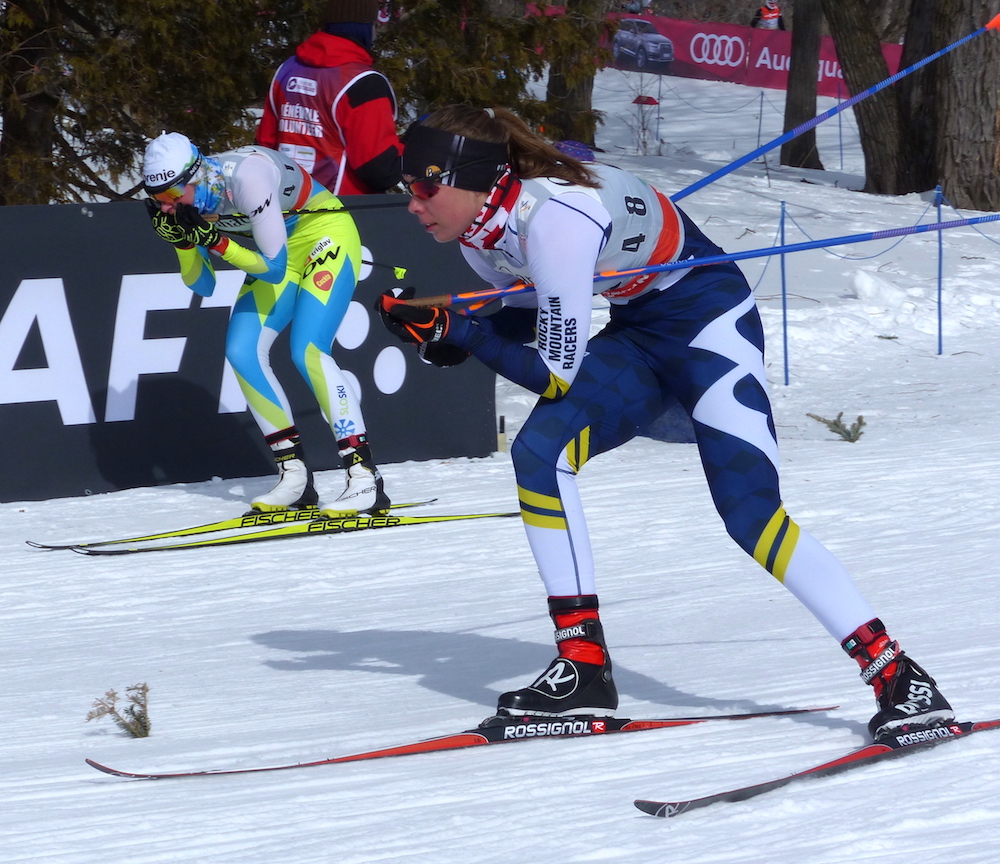
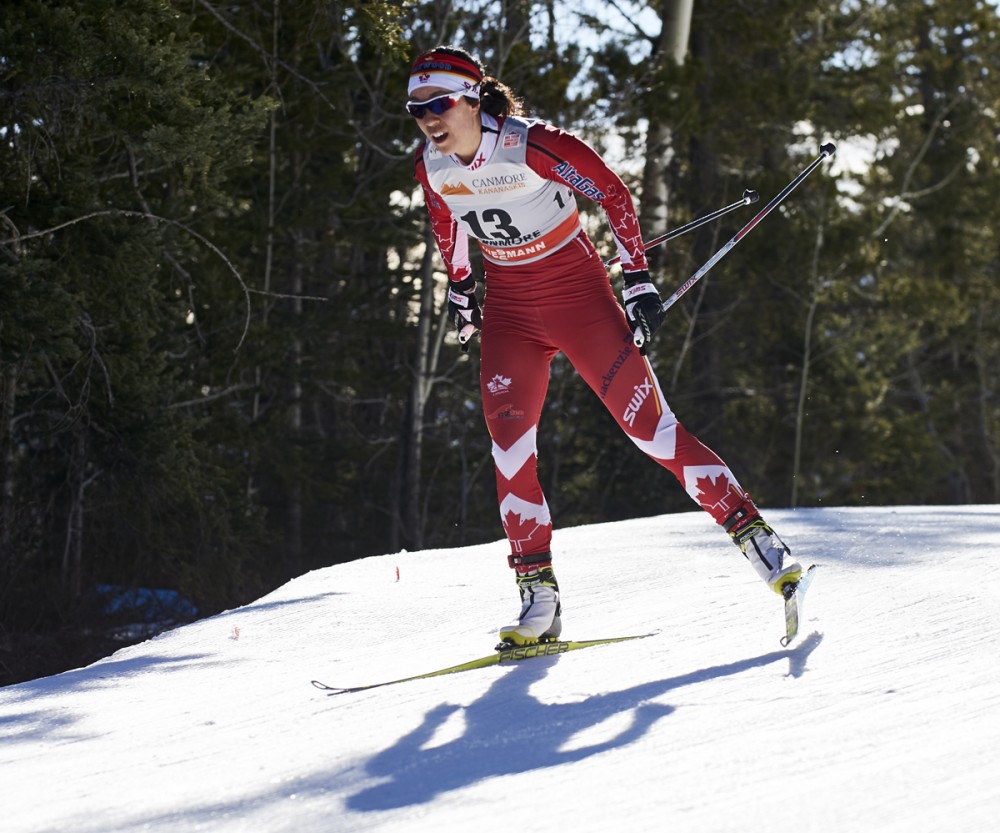
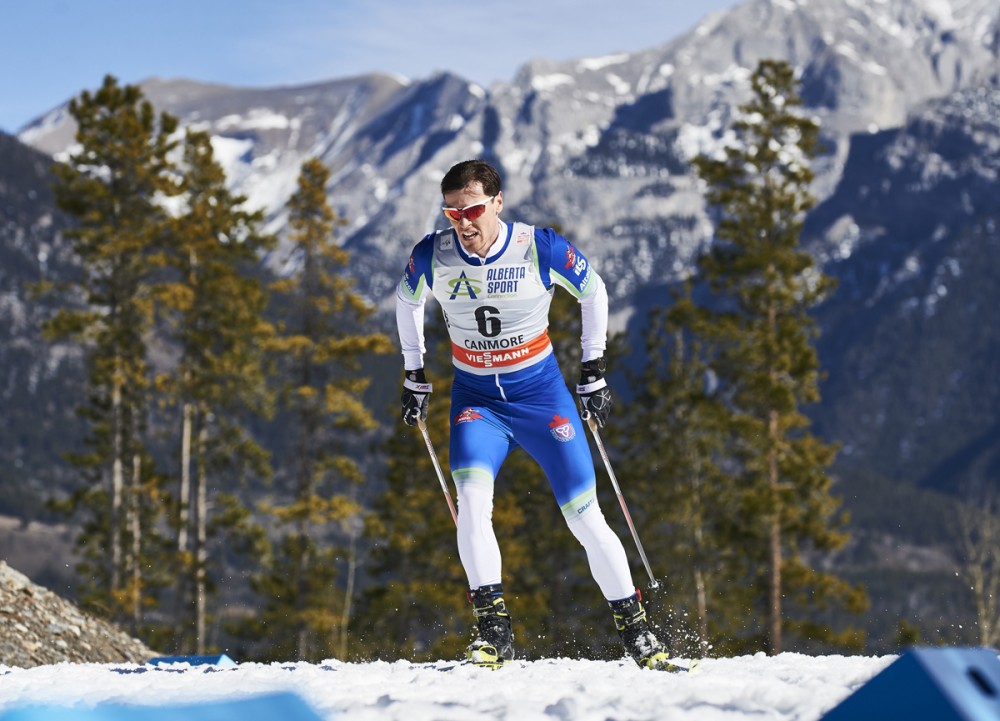
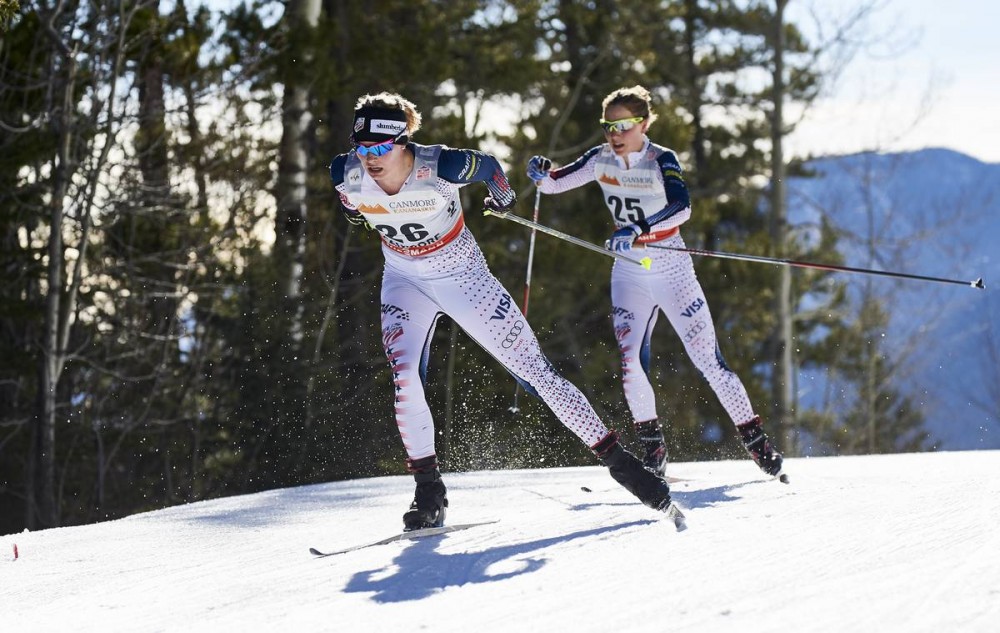
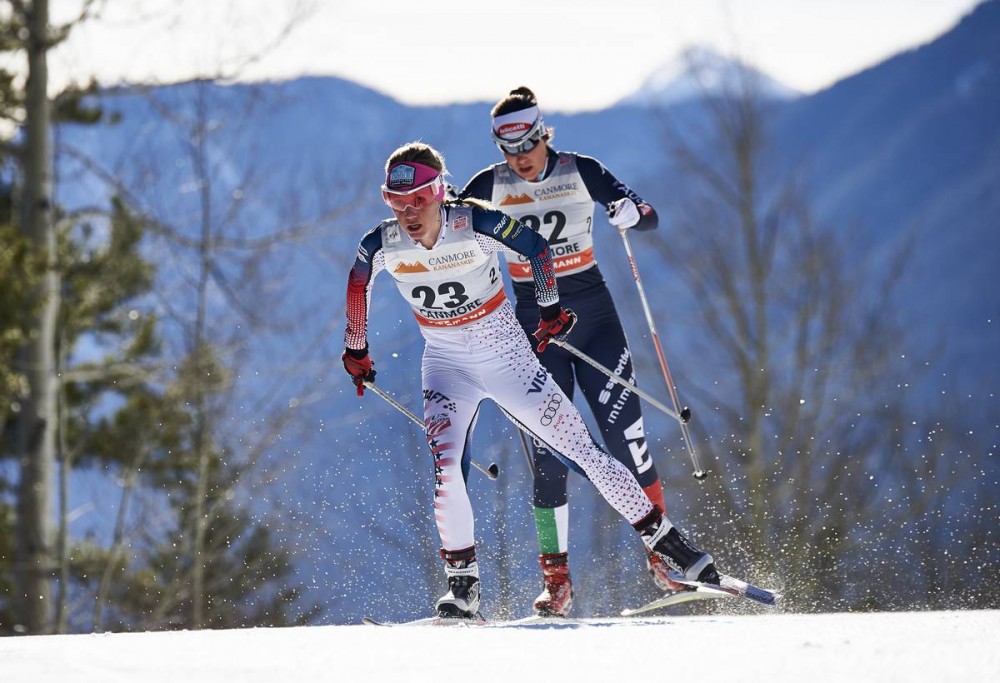
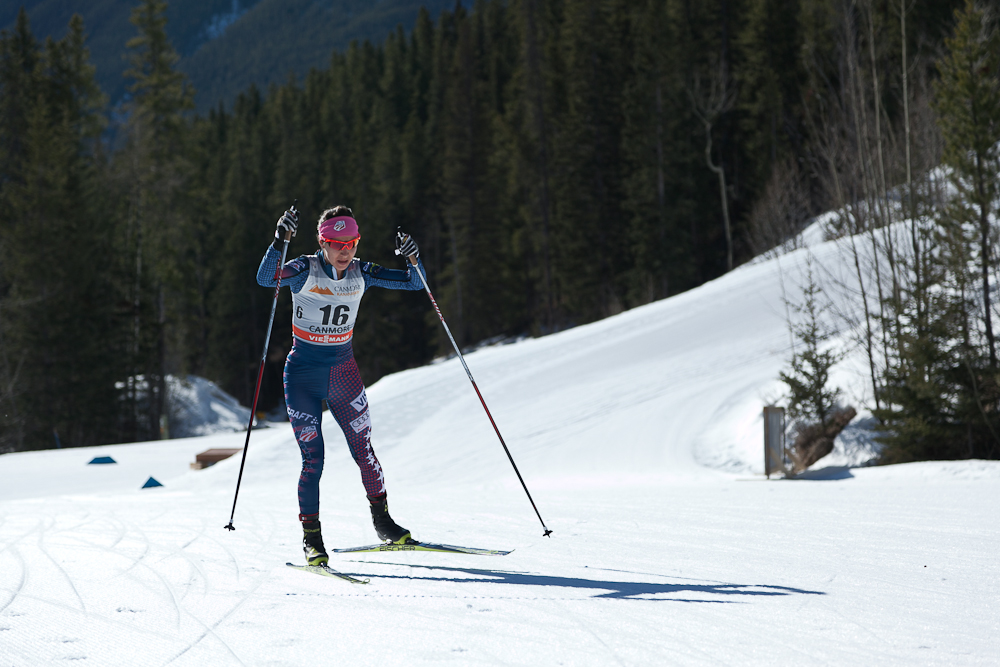
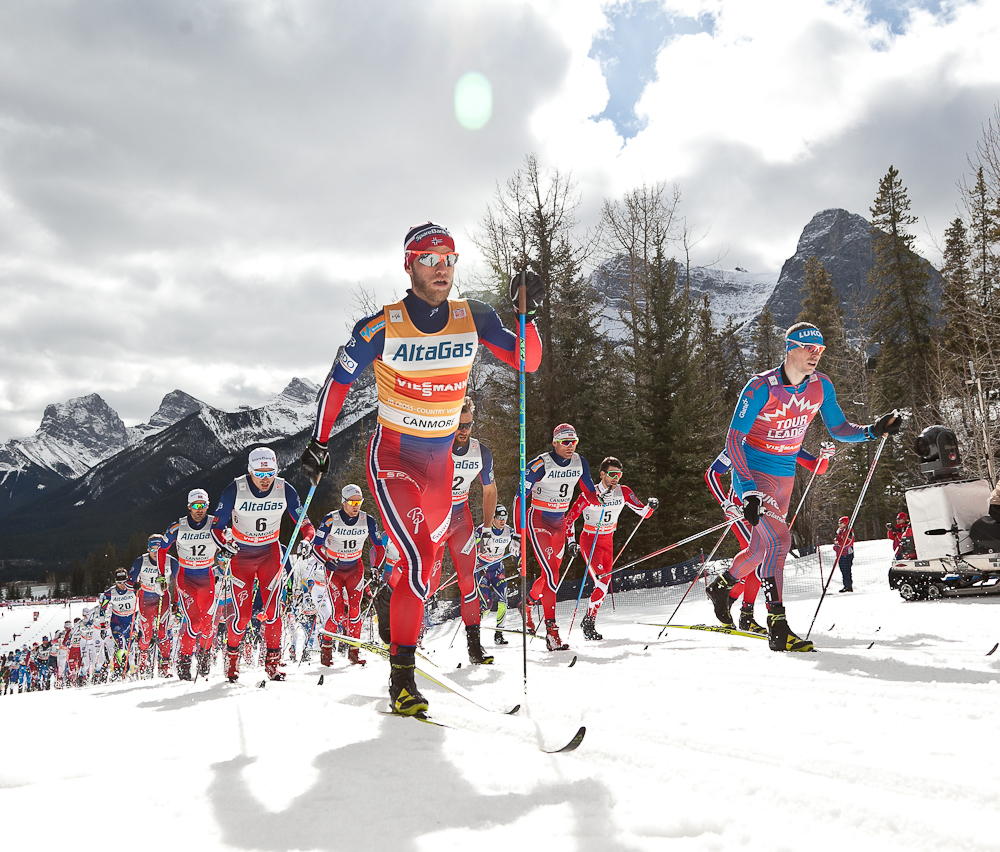
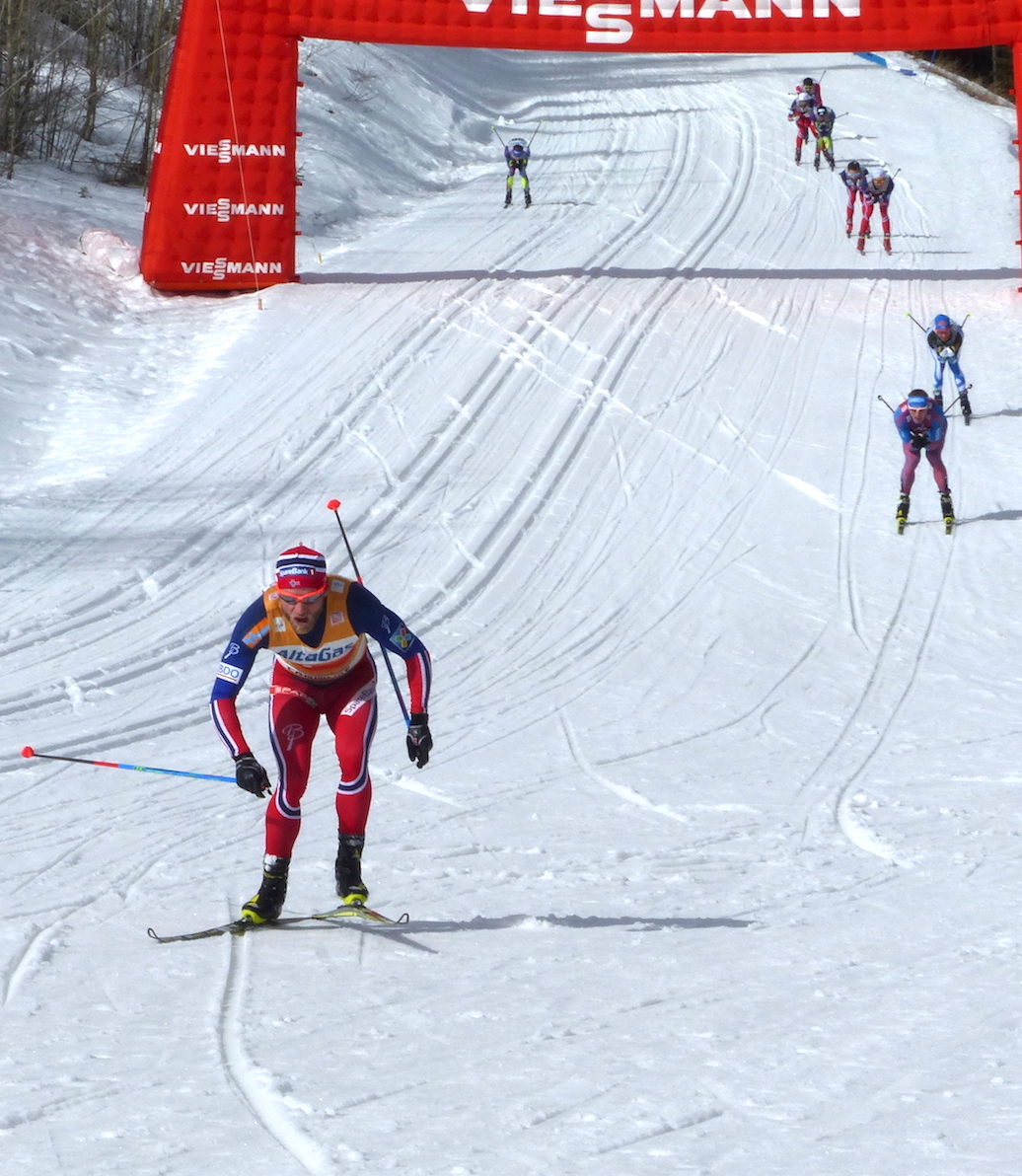
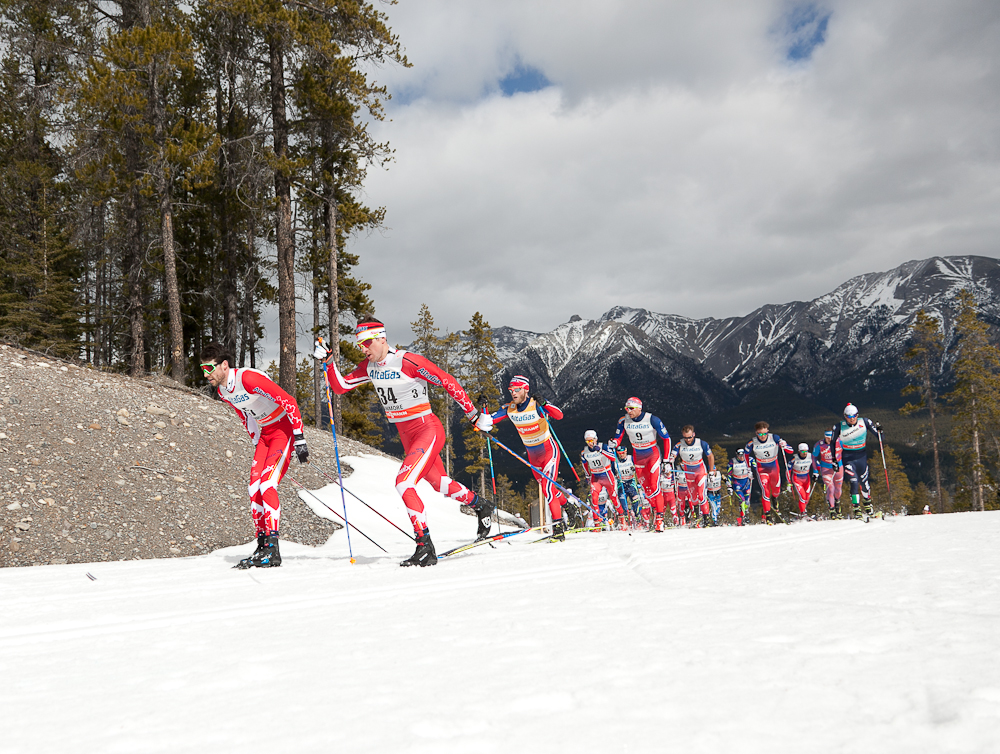
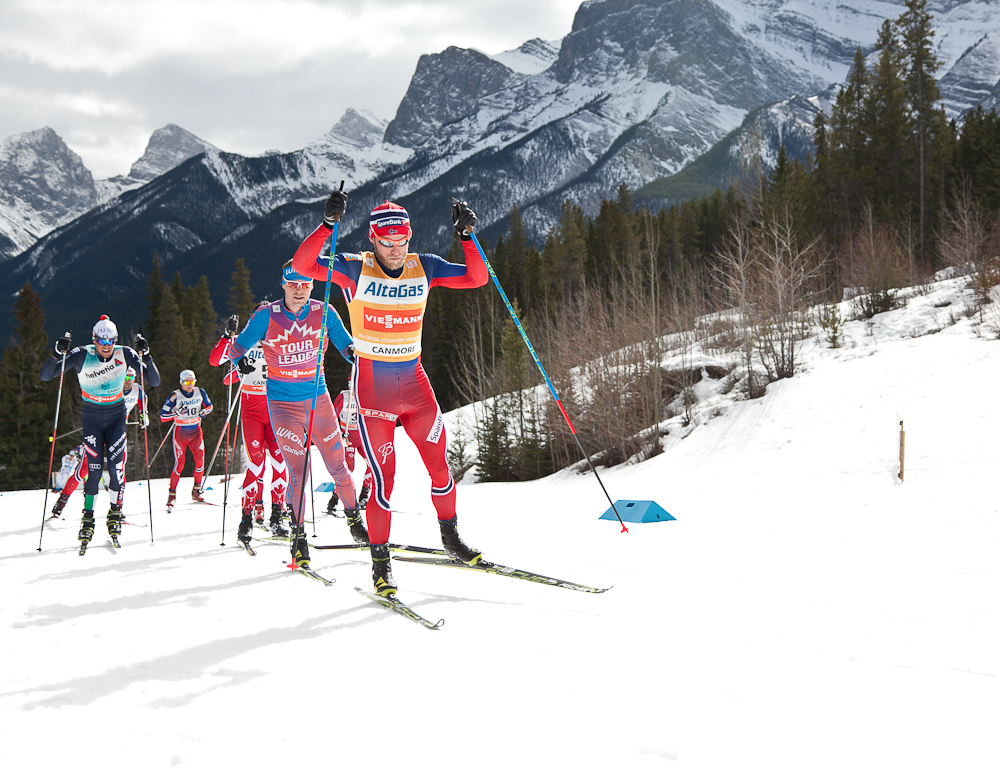
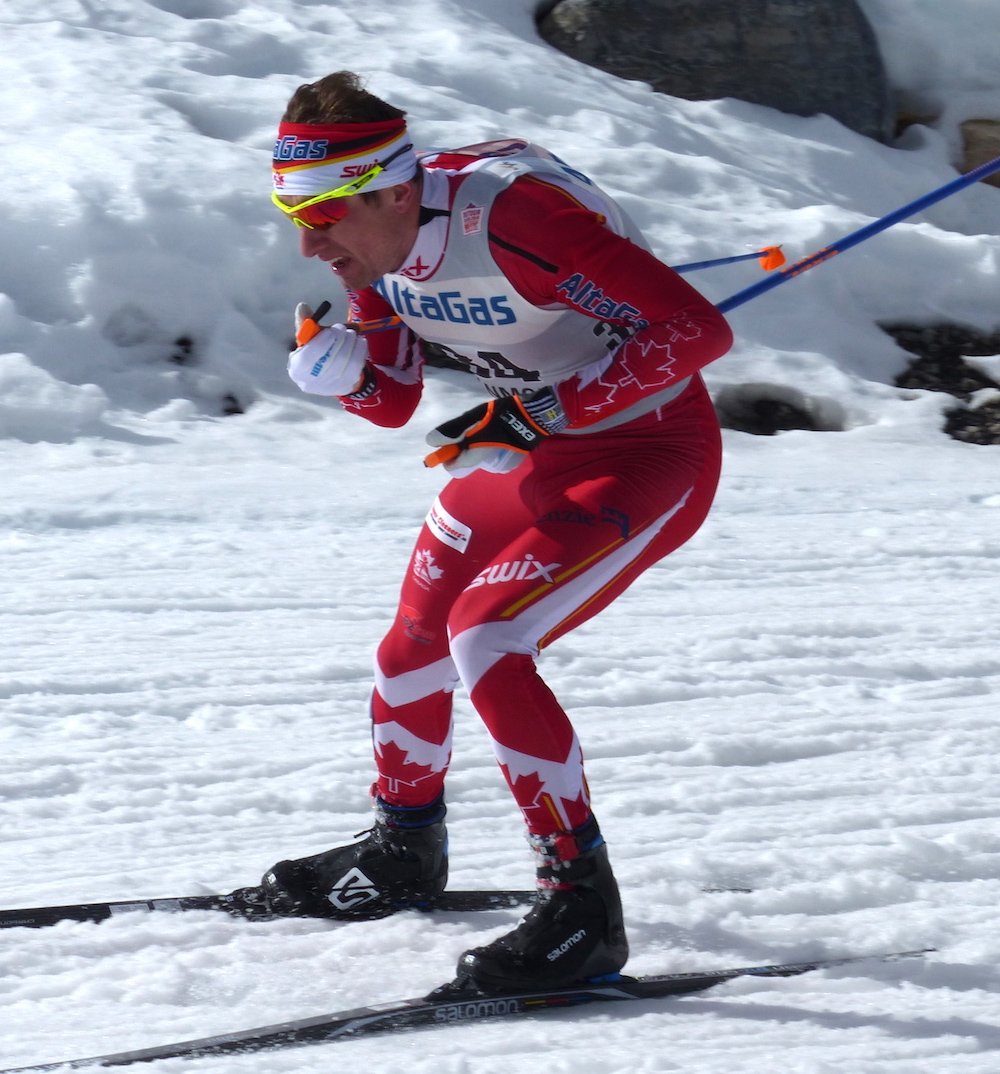
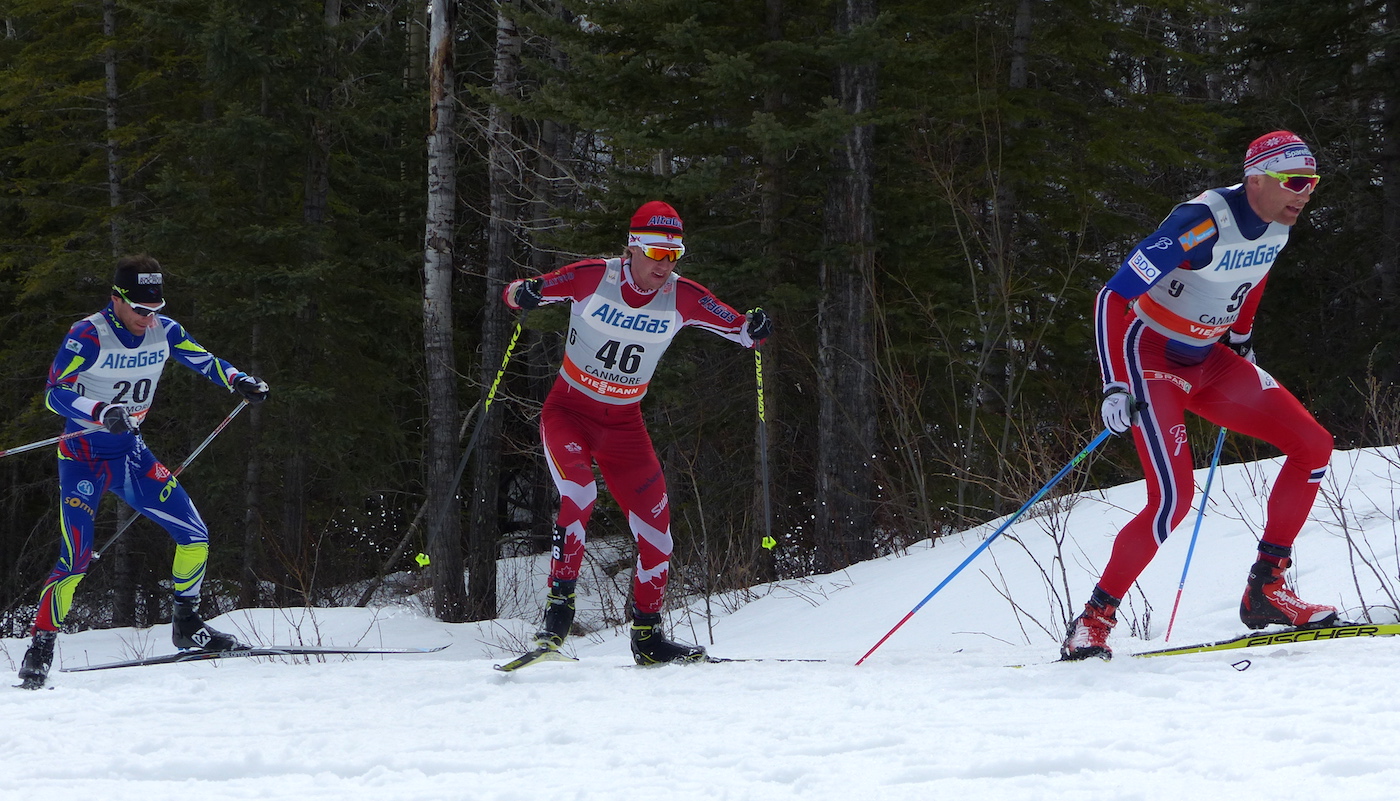
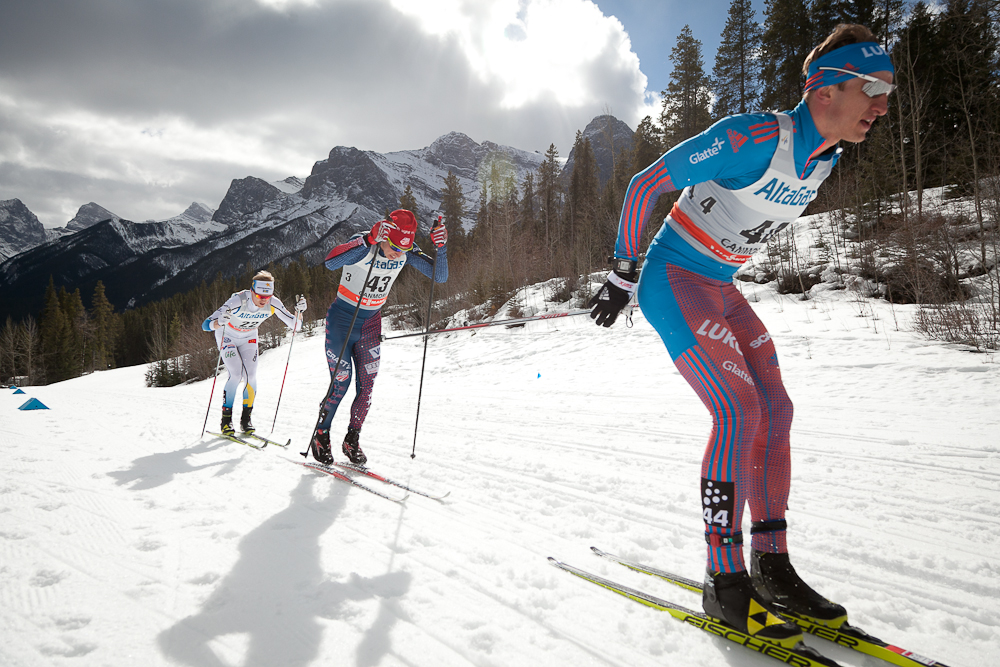
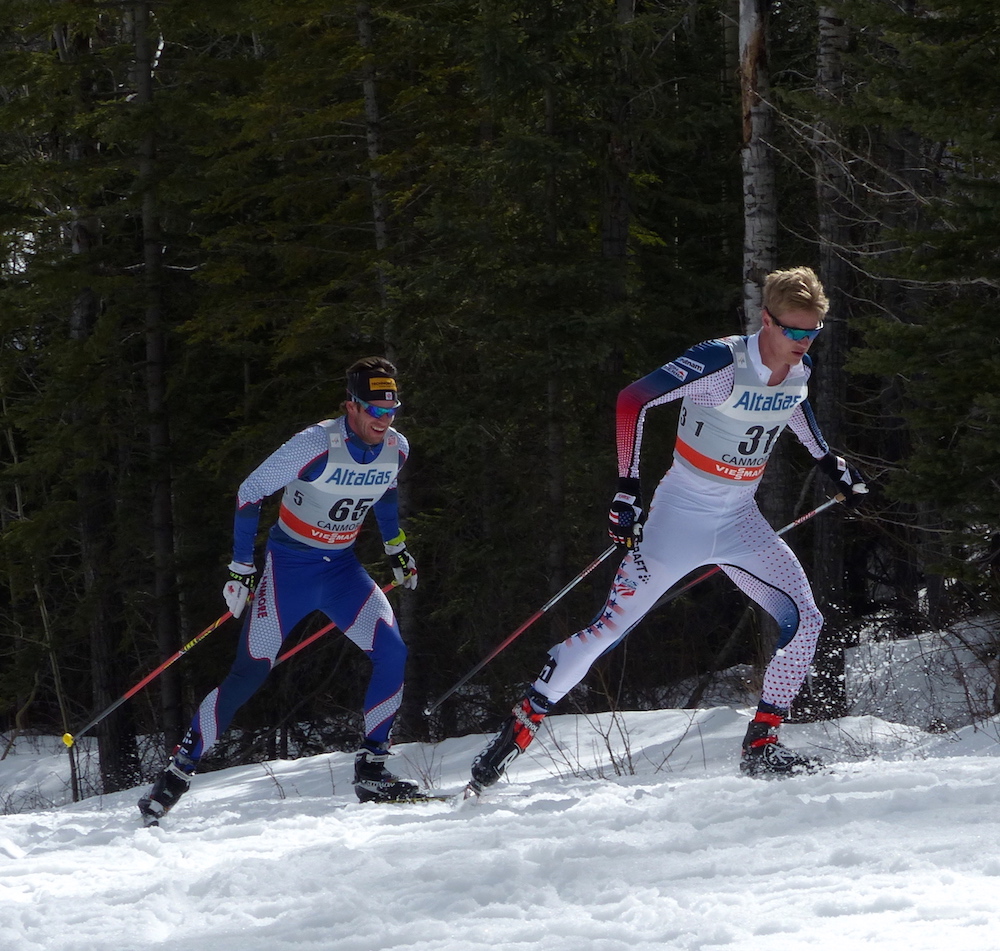
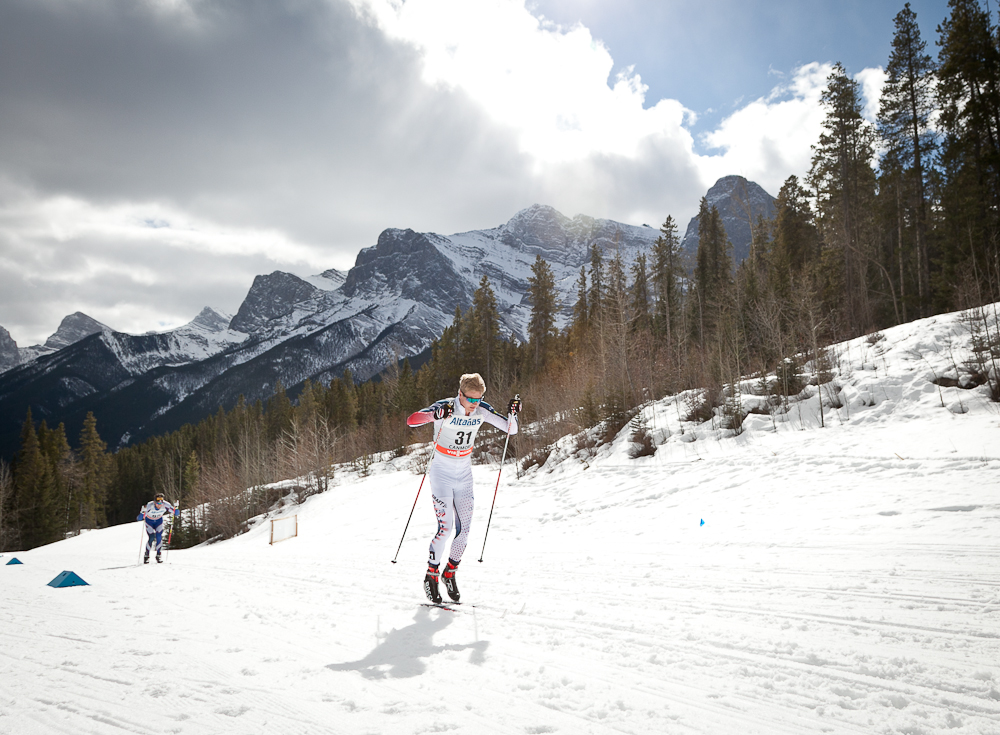
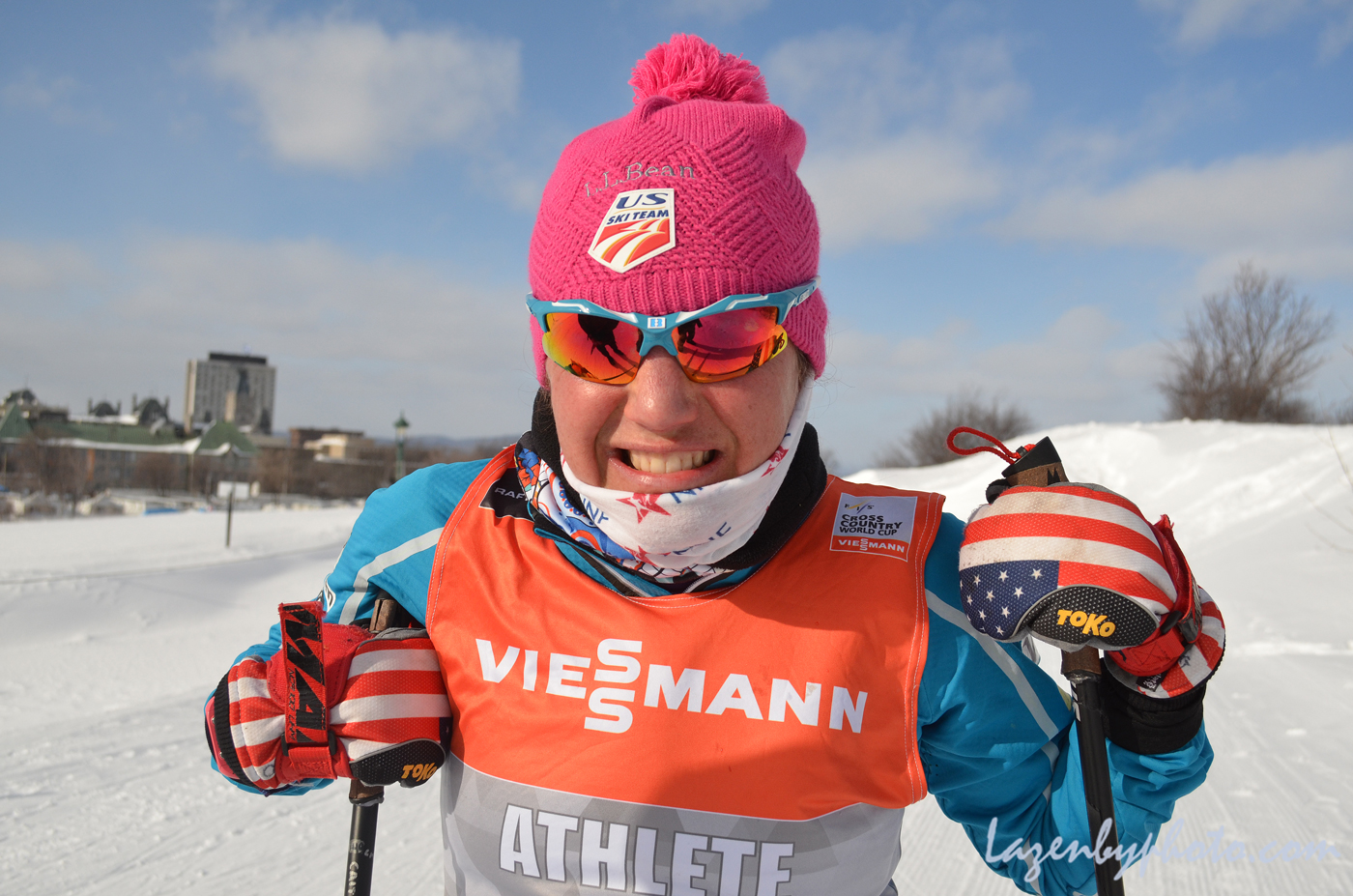
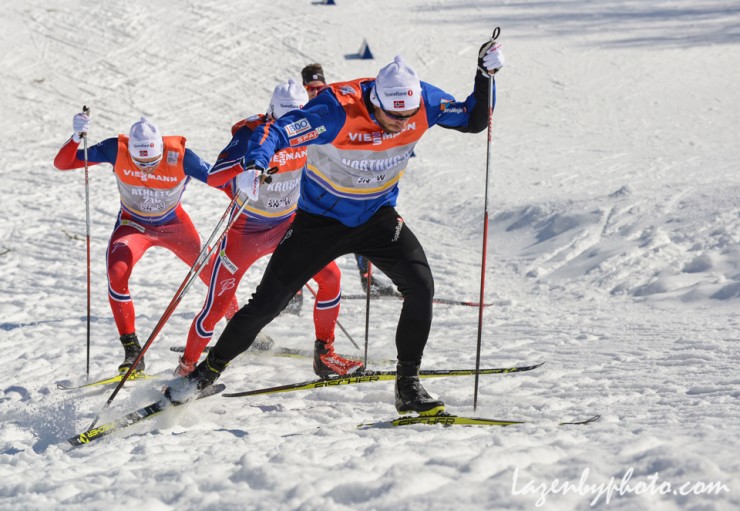
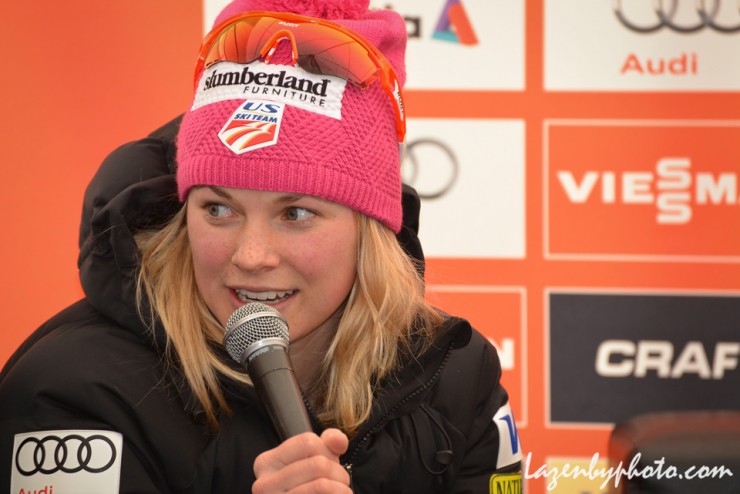
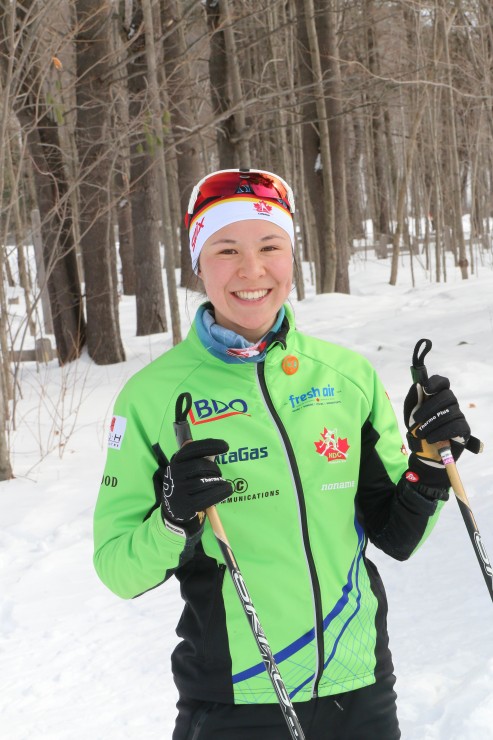
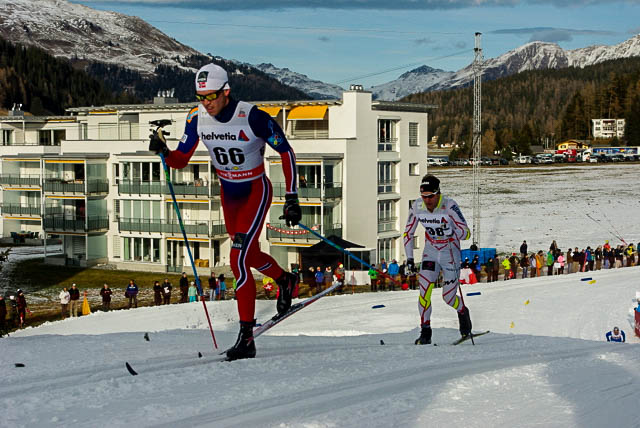
Maya MacIsaac-Jones qualifying 30th in the sprint at Ski Tour Canada stage 1. (Photo: John MacLean)
Welcome to “17 Questions for 2017″, where we are catching up with American and Canadian national-team members before the beginning of the winter season.
***
Maya MacIsaac-Jones was in high school when she competed in her first world cup in 2012 at Canmore, just a few hours away from her home. In 2016, she got her first World Cup top-30 in the Gatineau sprint stage of the Ski Tour Canada.
MacIsaac-Jones took the less common route of racing with her club instead of the one of the training centres, culminating in a 49th overall finish at STC wearing Rocky Mountain Racer colours. In 2016, she is a national team member and heading off to the World Cup for period one. At 21, she has two more chances at U23’s, starting with Soldier Hollow this season.
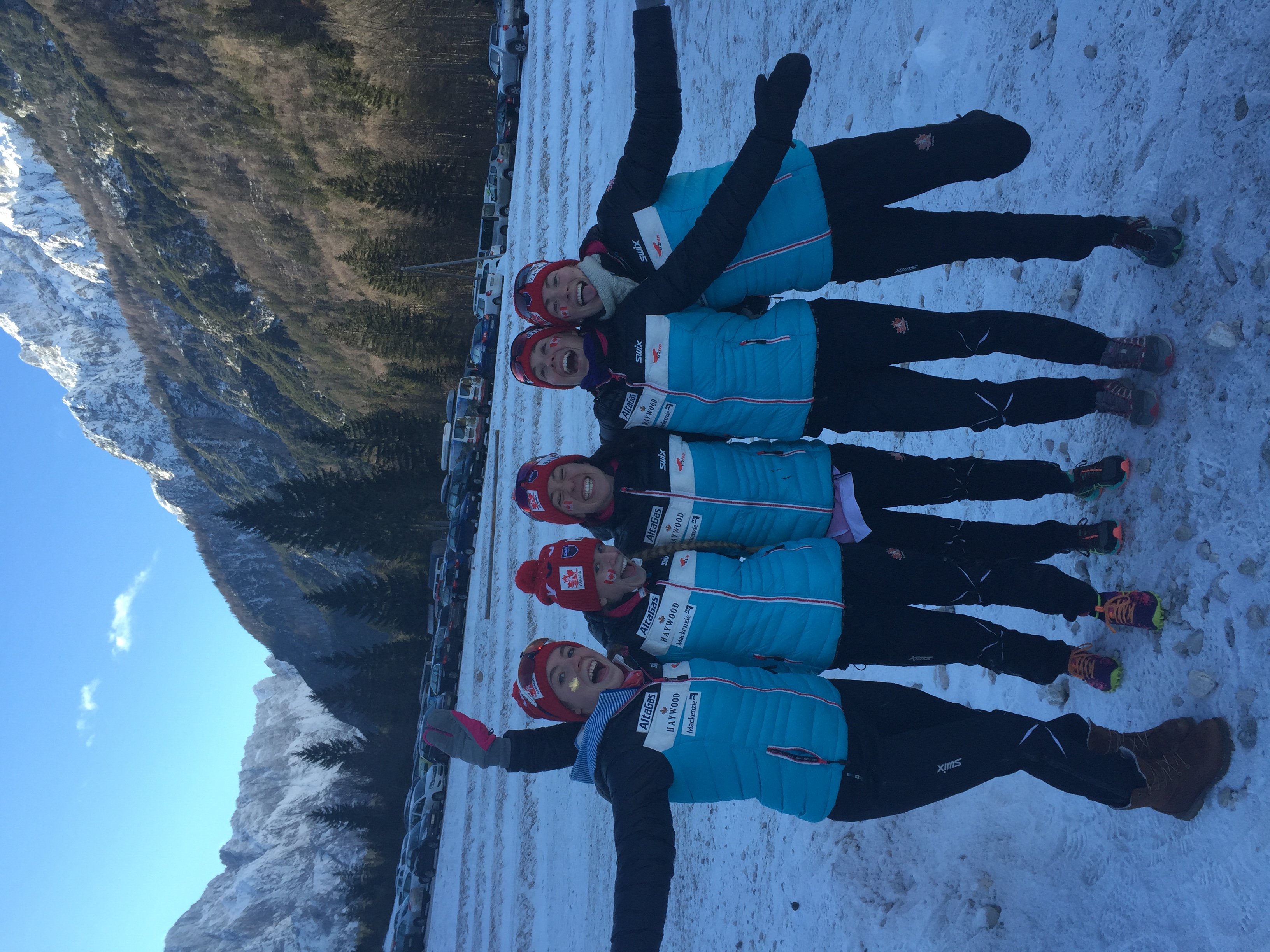
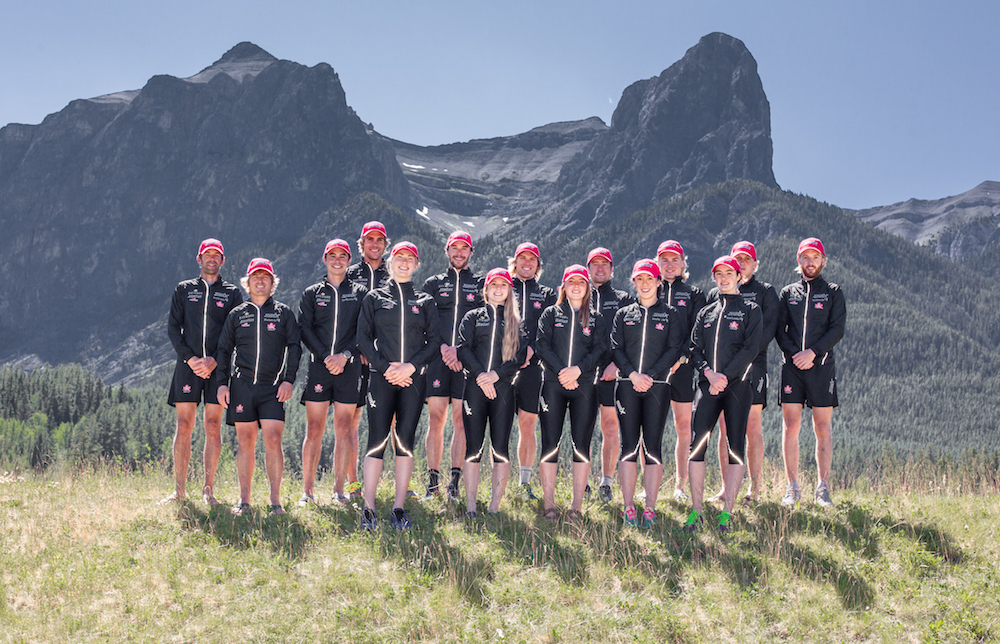
Canadian women’s team in Planica, Slovenia, 2016. (Courtesy Photo)
1. Biggest change in your life in the last five or so months since the ski season ended?
Training with the National Team and the Alberta World Cup Academy!
2. Biggest change in your training?
Switching to the national team strength program.
3. Major areas of improvement you’ve seen so far?
My classic striding technique! I’ve been lucky to have Kathy Davies as a technique coach this year, and I’ve been working with her on solidifying my basic body position.
4. Whom you’ve been working closest with this offseason (coaches or training partners)?
My AWCA coaches Chris Jeffries and Scott Perras, and my ski club coach John Jaques. My parents also give me great training and life advice when I need it!
5. Best trip in the last five months (and why)?
New Zealand training camp in August.
6. Favorite cross-training?
Running or hiking in the mountains.
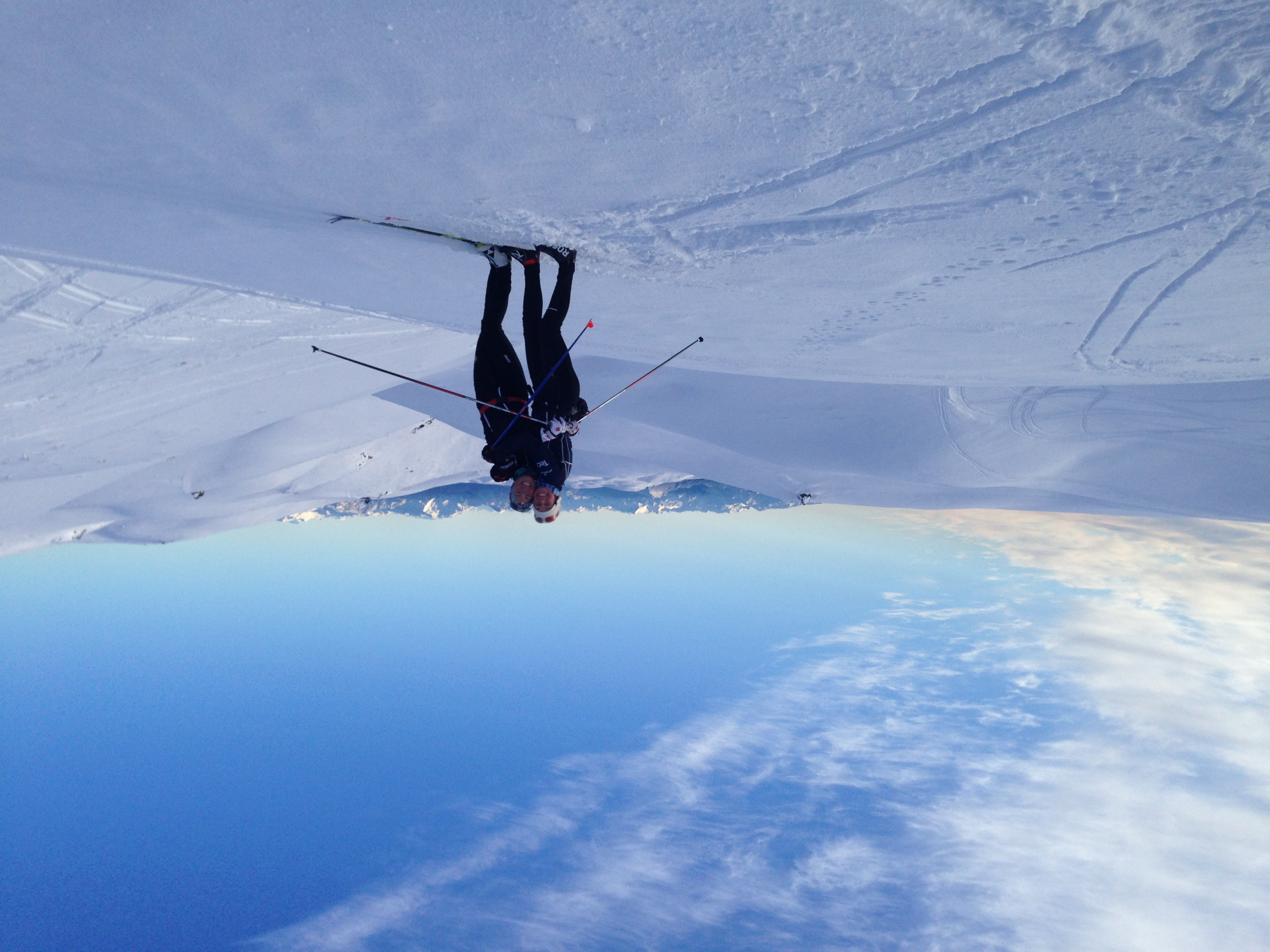
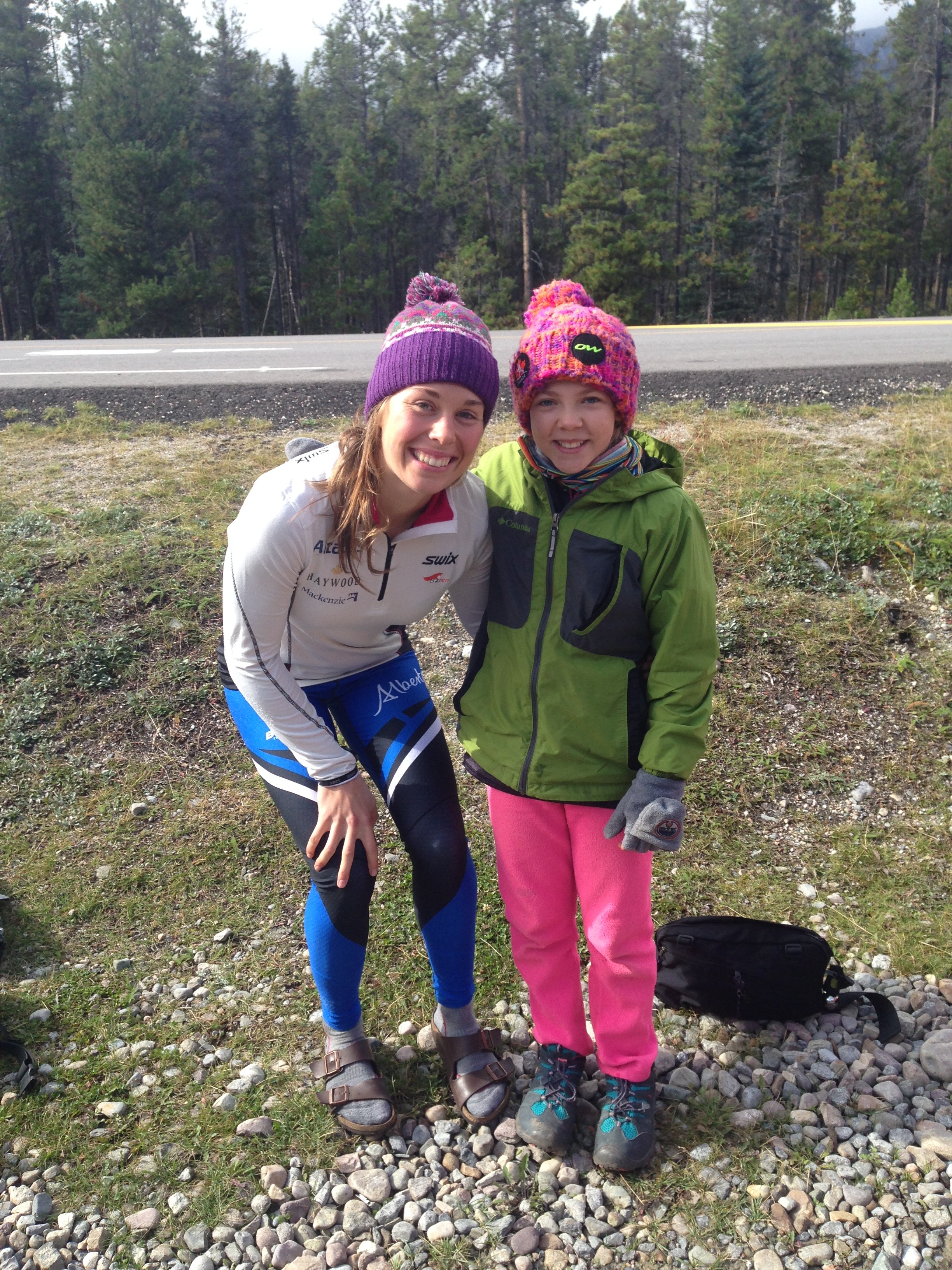
Maya MacIsaac-Jones and Dahria Beatty in New Zealand, 2016. (Courtesy Photo)
7. Favorite non-athletic activity or pastime this summer?
Camping, eating fresh fruit, and spending time at home on the farm in Athabasca.
8. Song that was your jam this summer?
Drops of Jupiter by Train.
9. All time favorite race moment?
Finding out I qualified for the sprint heats in the Gatineau World Cup and running over to give my coach John a huge hug after.
10. First thing you pack in your bag when you leave for Europe?
My journal and a Harry Potter book for reading the night before races.
11. Venue/event you’re most excited to visit this season?
Lillehammer, Norway. One of my good friends lives there with her family, so I’m really excited to see them!
Maya MacIsaac-Jones coaching at Cross Country Alberta. (Courtesy Photo)
13. Biggest sacrifice you feel you’ve made choosing this career path?
Not being able to attend school full time and get the university experience.
14. If you could change one thing about your sport, what would it be?
To add in a mixed relay or single-mixed relay (like in biathlon)!
15. What did you have for breakfast this morning?
Toast with jam, a sunny-side up egg, fruit, and tea.
16. In 5 years, I’ll be ____?
Hopefully still competing for Canada and finishing up my undergrad!
17. In 50 years, I’ll be ____?
Retired, going on adventures, and traveling the world with my husband!
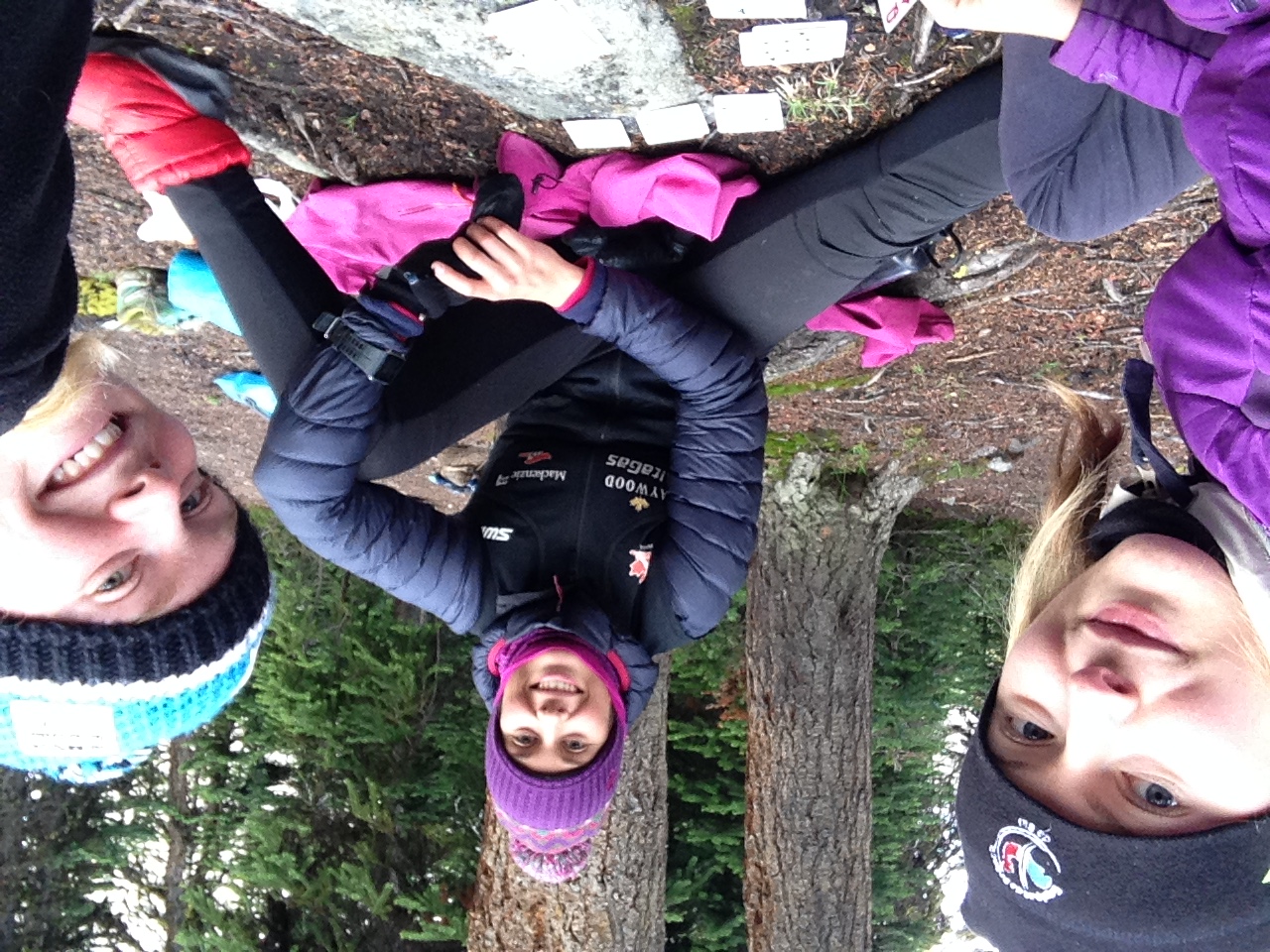
Maya MacIsaac-Jones (center) camping with friends. (Courtesy Photo)
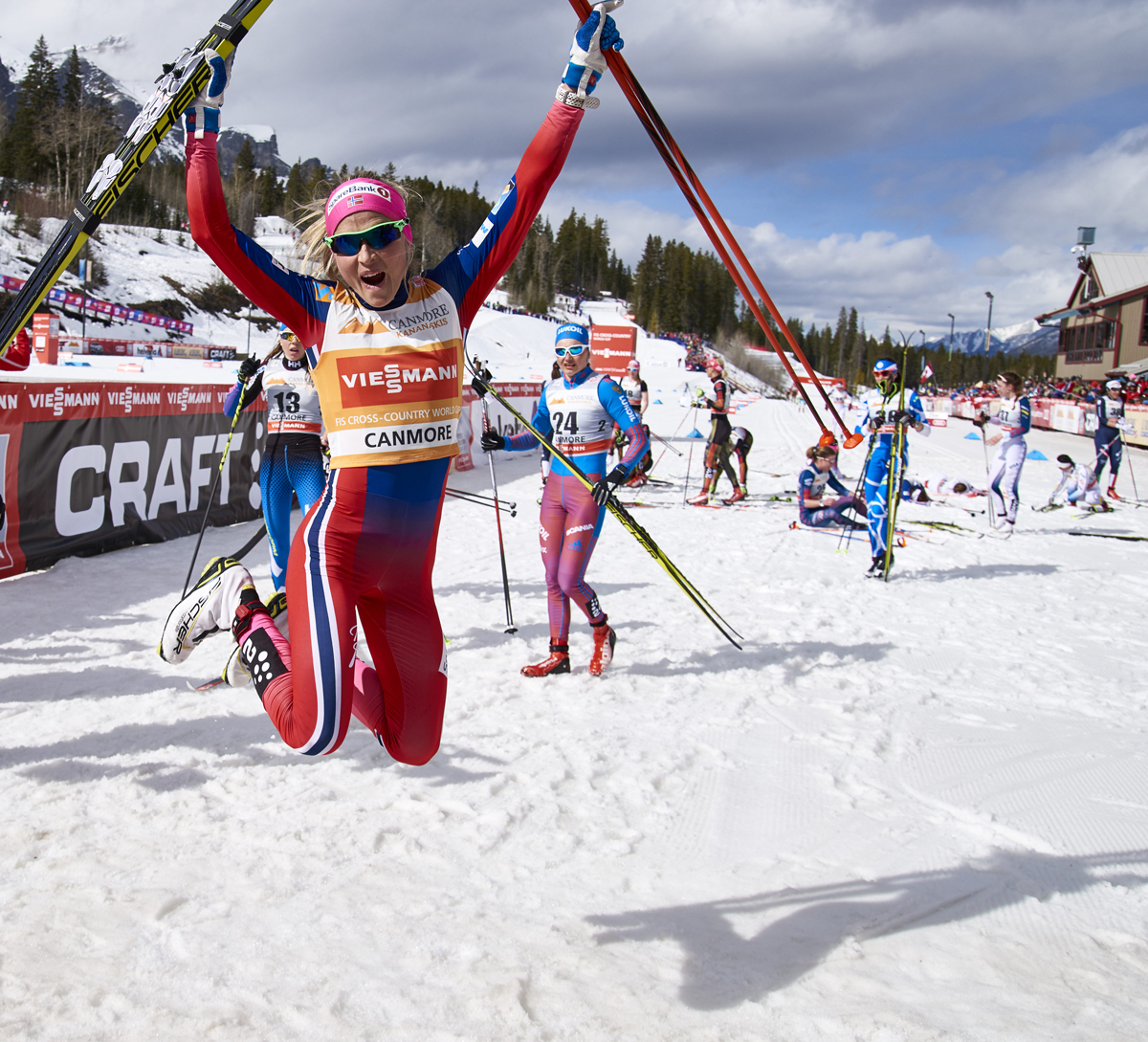
Norway’s Therese Johaug was happy to be done with the eight-stage Ski Tour Canada on Saturday, March 12. She won the Tour title along with the Overall and Distance World Cup Crystal Globes. (Photo: Fischer/Nordic Focus)
CANMORE, Alberta — After eight races in 12 days, the final day of the Ski Tour Canada last Saturday brought both extreme exhaustion and feelings of completion for the 14 Americans (10 women, four men) and 12 Canadians (seven men, five women) who made it to the culminating finish of the season-ending World Cups.
Here is some of the best from the North Americans who made it to the last two stages (the Stage 7 freestyle individual start and Stage 8 classic pursuit):
Canada’s Emily Nishikawa racing to 35th in the women’s 10 k freestyle at Stage 7 of the Ski Tour Canada in Canmore, Alberta. She went on to lead the Canadian women in 37th overall in the Tour. (Photo: Fischer/NordicFocus)
“It was initially very overwhelming, but once I got the hang of how things go on race day, it was really fun to be out racing with so many fast women.” — Kaitlynn Miller (Craftsbury Green Racing Project), 41st overall
“I’ve never done anything like this before. It is a test of will because you are either traveling or seeing the course … It is so different, I was so glad I had a chance to do this in a place like Canada where there are so many supporters. It was fun, I’m stoked it is over but it was actually really fun.” — Jennie Bender (Bridger Ski Foundation), 48th overall
“It was pretty intimidating in the beginning but I guess I’m kind of getting used to it.” — Katharine Ogden (Stratton Mountain School/USST D-team), 36th overall
On how the body held up:
“Before the race, I felt really nauseous and pale and I thought, ‘I should go drink some water.’ … I did not think today was going to go well at all. I was thinking best-case scenario would be finishing. I don’t know, I never know what my body is going to do, but my back felt good and I skied with a group, which was freaking awesome.” — Bender
2016 Ski Tour Canada finishers:
CANADA:
5. Alex Harvey
14. Ivan Babikov
16. Devon Kershaw
27. Graeme Killick
37. Emily Nishikawa
40. Cendrine Browne
43. Kevin Sandau
44. Olivia Bouffard-Nesbitt
47. Annika Hicks
49. Maya MacIsaac-Jones
49. Michael Somppi
50. Russell Kennedy
USA
5. Jessie Diggins
11. Sadie Bjornsen
24. Rosie Brennan
31. Chelsea Holmes
33. Caitlin Gregg
34. Ida Sargent
34. Noah Hoffman
36. Katharine Ogden
41. Kaitlynn Miller
42. Erik Bjornsen
43. Anne Hart
46. Scott Patterson
48. Jennie Bender
51 Tad Elliott
“I broke my finger about two weeks ago right before the Birkie but I felt solid there. When I start to get tired, my immune push-back starts flaring up and I was dealing with that a bit in the beginning of the tour and didn’t know how I would fare with all this hard racing. Honestly, I thought about pulling the plug after the first half, I was really suffering. But they said, ‘Go West, it is where you are from and the sunshine will do you well, stay relaxed and just enjoy ski racing.’ That is what I tried to do today and things have been coming around fast so it is kinda nice to feel that way.” — Tad Elliott (Ski & Snowboard Club Vail), after placing 41st in the 15 k freestyle at Stage 7 (he went on to finish 51st overall in the Tour)
“I just had to focus on the process and just ski as well as I could and I think I did that. I didn’t have much energy to work with so I had to make due with what I had. I skied as well as I could and just focused on technique.” — Emily Nishikawa (Canadian Senior Development Team), after placing 35th in 10 k freestyle at Stage 7 (she went on to place 37th overall in the Tour)
“The season is wearing on me. I’ve been traveling a lot and racing a lot this year and haven’t had time to do any volume training and I think that is showing, my body has nothing left to give.” — Michael Somppi (NDC Thunder Bay), after placing 50th in the 15 k freestyle at Stage 7 (he placed 49th overall in the Tour)
On finishing:
“Everyone was so awesome, I am glad I made it to the end. I’m stoked. Finished my first tour, I can’t complain.” — Russell Kennedy (Canmore Nordic), 50th overall
“My goal was just to finish without getting lapped and I achieved that so I am really pumped to have finished the Tour. … I learned that my fitness is good enough to make it through all these races, but it needs to get better in order to improve.” — Jessica Yeaton (Australian national team and Alaska Pacific University), 46th overall
“I raced it for myself. I didn’t have any expectations for today and I, 100 percent, wanted to race my own race. I crossed the finish line happy with my effort and that is all I wanted.” — Olivia Bouffard-Nesbitt (Canadian Senior Development Team), after placing 42nd in 10 k freestyle at Stage 7 (she went on to place 44th overall in the Tour)
“It is my first interval start on the World Cup ever. It was fun to kind of ski my own race, but Johaug just blew by me on the wall of course.” — Annika Hicks (Canmore Nordic) after placing 48th in the 10 k freestyle at Stage 7 (she went on to place 47th overall in the Tour)
“Honestly, I thought about pulling the plug after the first half, I was really suffering. But they said, ‘Go West, it is where you are from and the sunshine will do you well.’ ” — Tad Elliott, of Durango, Colorado
On highs and lows:
“There was definitely highs and lows. Racing this much is pretty taxing physically and emotionally, but every day I was training or racing I was thinking about how ‘effing’ awesome this is to do at home. It is something I might not be able to do it again, but I hope I will. It is such as privilege and every time I thought about it I was so thankful to be here.” — Bouffard-Nesbitt
“I got passed by both Therese and Heidi [in the 10 k freestyle], which was great, and I was like, ‘Holy sh*t!’ … Actually, proud moment of the race: I skied behind Therese on the downhill and she snowplowed and I did not so I was beating her on the downhill. But yeah, they climb like fiends. I don’t think I have the ability to go that tempo, being twice as big as both of them.” — Bender
“It is great if you can pick up a good ride, but today I had Sundby blow past me. You want that ride that is just a bit too fast, not one that is killing you.” — Scott Patterson (APU), after placing 47th in 15 k freestyle (he went on to place 46th overall in the Tour)
“I tried to ski with Maurice [Manificat] out there but then kinda exploded. I knew you follow Maurice it brings you to a top 20, within sight brings me to a top 30. I wasn’t able to accomplish that today, but to feel this good after all the health issues I’ve gone through recently is a sign of good things to come.” — Elliott after placing 41st in the 15 k freestyle at Stage 7
On takeaways from the Tour:
Canada’s Michael Somppi racing to 50th in the men’s 15k skate in Canmore, Alberta. He went on to place 49th overall in the Tour. (Photo: Fischer/Nordic Focus)
“I definitely feel like I have the endurance for long events like this — that is one of my strong suits. I seem to recover well. I mean, I am exhausted now, but I’ve still been getting out of bed and excited to race. I was racing pretty well on the domestic circuit, but it is just so different. I learned so much in the five distance races … In mass start races, you have to be aggressive and fight for those spots early on. I’m noticing my redline that I am comfortable skiing at in domestic races; the pace is different here.” — Kevin Sandau (Alberta World Cup Academy), 43rd overall
“I think it’s really just essential to getting us used to the World Cup atmosphere and no longer just feeling super nervous as you get to the start line. Making it more part of just any other race that you are able to focus more on the procedure of the race and feel the speed that these ladies race at and try to even just stay with it for five or 10 seconds through the race just gives you that little glimpse of where you need to be.” — Dahria Beatty (Alberta World Cup Academy/Canadian U23 Development Team) , 44th after Stage 7, (did not race Stage 8 due to a sore back)
“One of the big things is seeing just how hard all the women race at every race. In the NorAm circuit, we all ski hard but the World Cup is at a whole different level. These women go as hard as they can from the start until they collapse at the end. I think just being able to see just how hard they push shows me just how hard I need to be working and how hard I have to push to ski at this level.” — Maya MacIsaac-Jones (Rocky Mountain Racers), 49th overall in the Tour
“… The maturity and strength these guys have, it was good for me to see. I know the work I need to do in the summer and I am motivated to do it.” — Elliott
On future plans:
“Continue to train hard. I’ll stay at the centre next year and continue to try and improve. Also, keep working on the sprints.” — Sophie Carrier-Laforte (Pierre-Harvey National Training Centre), after placing 52nd in the 10 k freestyle at Stage 7 (she did not race Stage 8)
“I’ve been patient and I have had a long-term plan all the way through so I can see into my career now, but the support of a good coach is to keep that lid on. After Spring Series, I’m taking six weeks. I just ordered some Oakley golf gear, ordered some clubs from Wilson — I’m going to enjoy some golf and some warm weather and some mountain biking with my brother and come June maybe I’ll think about dusting off the rollerskis.” — Elliott
Video:Inside the Fence - Coming to North America
Ever wonder what European athletes think about coming to North America? Inside the Fence takes a look at the impressions from World Cup athletes participating in Ski Tour Canada
Posted by FIS Cross-Country Skiing on Thursday, March 10, 2016
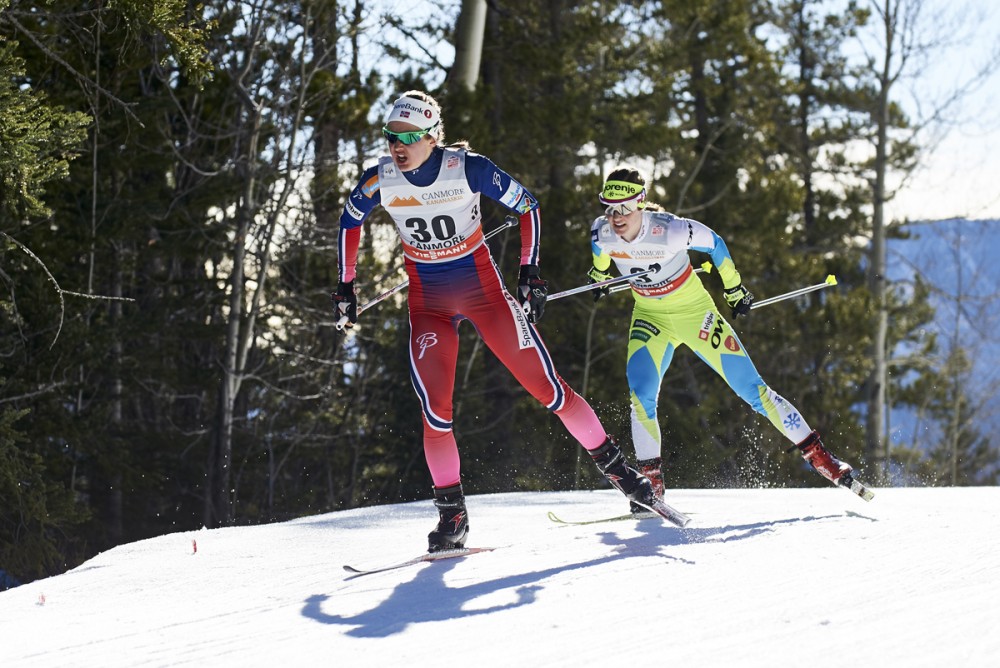
Norway’s Ingvild Flugstad Østberg leads Slovenia’s Alenka Cebasek during the women’s 10 k freestyle at Stage 7 of the Ski Tour Canada in Canmore, Alberta. Østberg went on to win the stage by 23 seconds over her teammate Heidi Weng. (Photo: Madshus/NordicFocus)
CANMORE, Alberta — High-alpine sun, firm snow and fast tracks were a Canmore Visitor’s Center dream during the Ski Tour Canada’s (STC) Stage 7 freestyle individual-start races on Friday. It was also a dream day for Ingvild Flugstad Østberg of Norway.
Hers is a name all over the top-three results during this year’s World Cup season. Østberg has podiumed in 18 individual races this year, one of which included a distance win at the Tour de Ski’s 5-kilometer freestyle pursuit in Lenzerheide, Switzerland.
In the women’s 10 k freestyle on Friday, Østberg crushed the field to win her second race of the season and a coveted Alberta World Cup Academy cowgirl hat along with it.
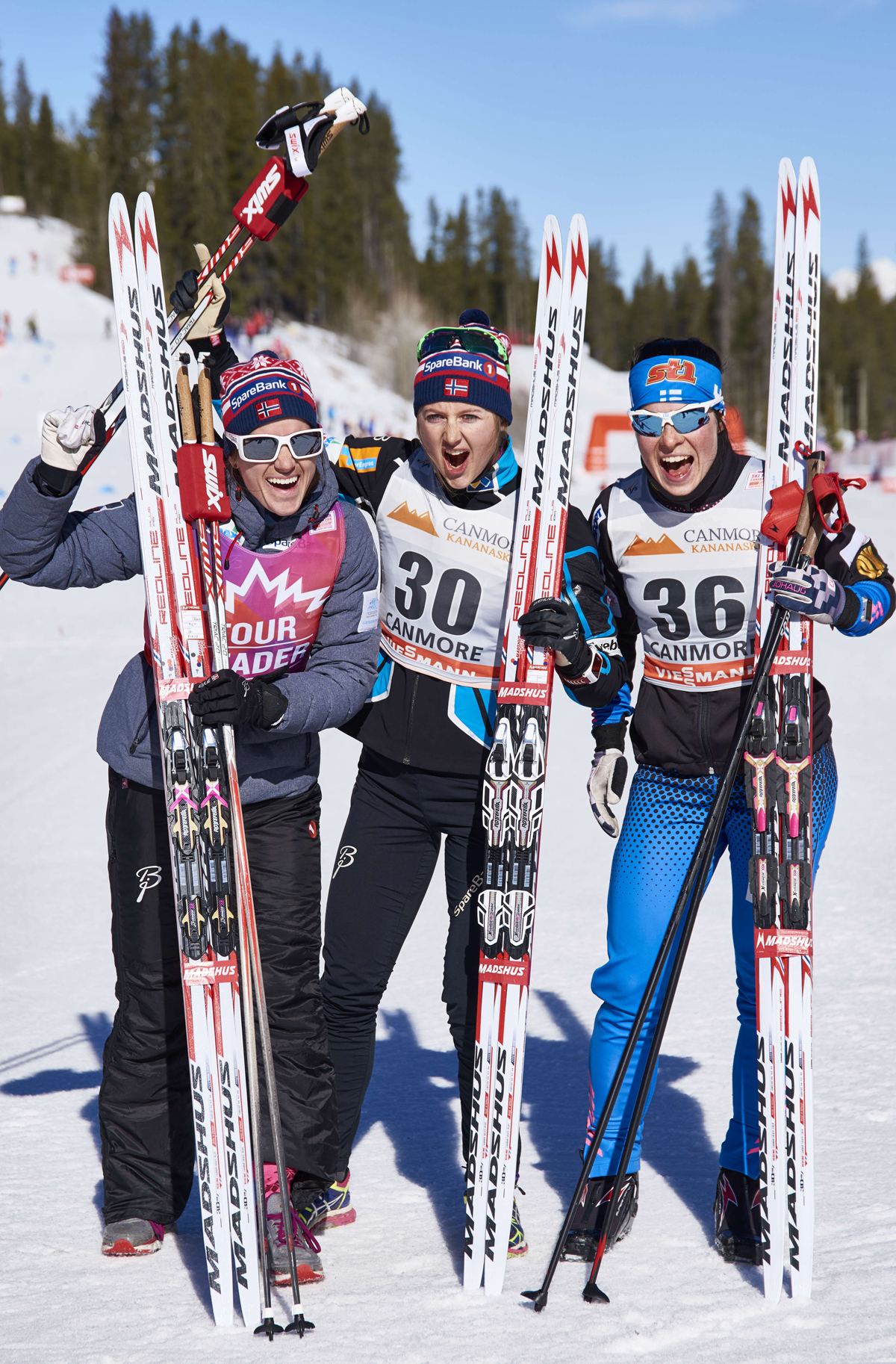
Finland’s Krista Parmakoski (r) broke up an all-Norwegian sweep of Friday’s 10 k freestyle podium, placing third behind Norwegian winner Ingvild Flugstad Østberg (c), and runner-up Heidi Weng (l) also from Norway, in Stage 7 of the Ski Tour Canada in Canmore, Alberta. (Photo: Madshus/Nordic Focus)
“The hat is perfect,” Østberg told FasterSkier. “I thought I was going to win a hat the other day when I started the sprint, but then I got this cool belt buckle. Now I got the hat so that is perfect. So that was motivation today.”
The western wear may not be the most conventional nordic head gear, but Friday, Østberg looked like she could have sported the new lid along with her lycra and still dominated.
Østberg climbed, glided the flats and hopped-stepped up the steeps faster and more efficiently than anyone in the 53-women field. The 10 k course took Østberg all of 23:20.1 minutes to complete and she gapped her nearest competitor, teammate and second-place skier Heidi Weng, by a stunning 23 seconds. Finland’s Krista Parmakoski was third, 24.5 seconds back, besting fourth-place skier Norway’s Kari Øyre Slind, by 0.1 seconds.
“This was unbelievable,” Østberg said in the post-race press conference. “I never thought I was going to win this kind of competition, 10 k skate individual start. I thought that was my weakest kind of competition, But today was perfect.”
Østberg was second at the first time check, and first at the second and third checkpoints. By 6.9 k, she was already 24 seconds up on Norway’s Therese Johaug. Despite her obvious speed on the course, Østberg explained she remained in a comfortable zone, within her limits.
“I was so focused on doing my best and focusing on the technique, and tried not to ski fast,” Østberg told FasterSkier. “It was like I felt my speed was average. I guess that is when you ski fast. I heard that I was fighting second and third place. I thought that was good. With two kilometers left my coach said you are fighting for the win. And then I was like, ‘Oh my God, are you kidding me?’ And then all of a sudden I was 23 seconds ahead, that is crazy. I thought it was my weakest kind of race. Turns out that I win, and it is my best. Crazy.”
Looking at Østberg’s podiums from the past few years, it’d be easy to compartmentalize her as a sprinter; a one-dimensional skier who would likely podium on sprint day, but could be feast or famine — most often famine — on distance days.
“Many years now that I am a sprinter, but I’ve always said I am not a sprinter,” Østberg explained to FasterSkier. “Don’t call me a sprinter because I want to be an all-around skier and I want to do good in all kind of distances.”
The 25 year old is mindful that she has a model on the Norwegian team.
“I see Marit Bjørgen and I see that it is possible, and I see myself in her or I see that I am like her, the same type,” Østberg said. “I’ve also said that I want to fight for medals in distance races. When I was in Sochi, I said I want to fight for it on the next Olympics. So I am ahead of my development, how do you say, my goals. This is kind of earlier than I thought I was going to be good in distance races, but it is so fun, I can ski fast and skating and classic and short and long races. Sometimes when Therese wins by one minute, you feel like she is so strong that you can never be as good as her. Today I see it is possible.”
“Sometimes when Therese wins by one minute, you feel like she is so strong that you can never be as good as her. Today I see it is possible.” — Norway’s Ingvild Flugstad Østberg, after her second win of the season, the 10 k freestyle at Stage 7 of the Ski Tour Canada
Johaug, who sits second overall with one stage to go, exactly 30 seconds behind Weng, found herself in a spot she rarely visits; off the podium in sixth place, 40.1 seconds behind Østberg. Not only was Østberg as good as Johaug, she proved next year Norway could have a four-way fight for the overall Crystal Globe — there’s Johaug, Weng, Bjørgen, and now Østberg.
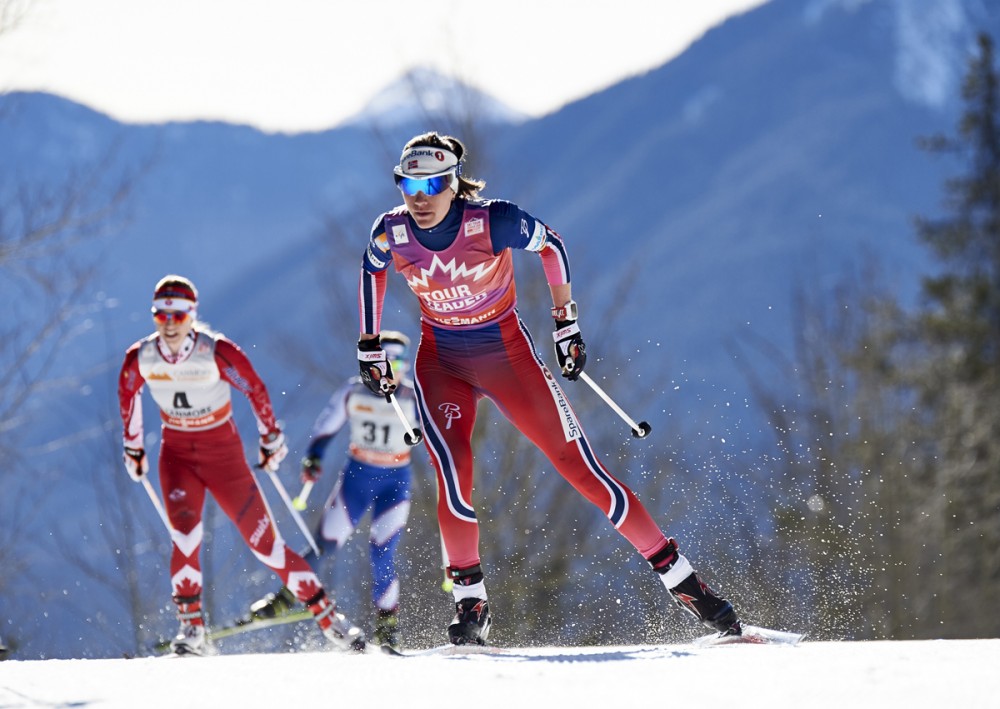
Norway’s Heidi Weng racing to second in the women’s 10 k freestyle at Stage 7 of the Ski Tour Canada in Canmore, Alberta. Here she’s seen leading Canadians Cendrine Browne (4) and Annika Hicks (31). (Photo: Madshus/NordicFocus)
This year, Østberg is second in the World Cup overall standings with 2051 points. Johaug is first with 2235 points.
Weng, third on the overall World Cup standings and first in the Ski Tour Canada (STC), knew the race was Østberg’s, but the STC could be hers.
“I start very slowly I think, but in the last lap I wasn’t very tired and Ingvild was so strong, so that’s good,” Weng said in the press conference. “I take some seconds to Therese and that was very good to hear. It’s been a good day.”
By placing second on Friday, Weng earned a 10-second time bonus, and a buffer from the always charging Johaug heading into Saturday’s final stage, a 10 k classic pursuit.
Diggins Digs in
Norway, Norway, Norway, Norway reads the STC’s top-four women’s overall standings. Finland, Norway, Finland, Finland, Sweden reads sixth through 10th. Sandwiched in between all that Scandinavian power, fifth overall, is U.S. skier Jessie Diggins.
Now a top-10 staple, Diggins skied aggressively on the twisting, technical, and energy-sapping course. Her three official time splits were fifth, sixth and sixth place. When the day’s serious challenger’s had finished, Diggins was fifth on the stage, one spot and 7.5 seconds ahead of Johaug.
Diggins explained each day on a Tour is unique. One day the body is good, the other, maybe bad.
“You know, I felt better than the last race,” Diggins said. “Not as good as I was hoping to feel, but also you just don’t know during the Tour. You just have to get out there and do the best that you can. You’re body is going to feel awesome or it’s not and it was a solid race. Not what I was hoping for, but it’s OK. It kind of goes in waves out there you feel good, you recover, or you don’t.”
U.S. Ski Team members Jessie Diggins (l) and Ida Sargent (r) racing to fifth and 38th, respectively, during the women’s 10 k freestyle at Stage 7 in Canmore, Alberta. (Photo: Salomon/NordicFocus)
The other grinding tour on the World Cup calendar is the Tour de Ski. It features the mother of all hill climbs, the Alpe Cermis, as it’s final stage. That beasty climb is atypical on the race circuit. Diggins noted that Saturday’s stage, a pursuit, will have its own drama, but a drama most skiers are more familiar with than those on the Cermis.
“A hill climb, it’s like not ski racing,” Diggins said. “It’s its own category. It’s totally, totally different. With the hill climb, you’re either really good at it or you’re not and people change by minutes. I mean minutes are made up and lost out there and it’s going to be more like seconds [on Saturday].
“It will be very interesting to see it as a normal pursuit race instead of a hill climb and I think that you might see less dramatic shifts, unless there’s some explosion out there,” she added. “I think it’s more fair in the interests of ending a tour. If you’re ending overall it’s nice to end it with a race that we do all year, instead of something we do once a year. I think it’s probably the most fair way to do it.”
Sadie Bjornsen, also of the U.S. Ski Team, skied to 17th on the stage (+1:25.0).
“It was okay,” Bjornsen said of her race. “It wasn’t great, but I went as hard as I could with all the rest of my energy. Seven days in, I’m tired. My second lap itself felt considerably slower than the first one and I think it was just hard to fight from the back of the pack today for those top positions.”
Her sensations were spot on. Bjornsen skied her first 5 k lap in 11:57.3. Bjornsen’s second 5 k was approximately three quarters of a minute slower.
Despite the interval start and a two lap course, Bjornsen skied on her own for much of her race.
“I didn’t really ski with anybody,” Bjornsen said. “I was kind of skiing on my own most of the day today, which with skate skiing, that’s been is a battle that I’m trying to figure out. I find that if I can skate behind somebody I can figure out the skate pacing. But today my goal was to work on my individual pacing and see what I could do. You know I feel like maybe I went out a little too hard and got tired, but at this point in the Tour, why not send it and see what you can do.”
With a solid race on the final stage, Bjornsen’s stars could align — she’s currently 11th overall in the Tour (+6:35.4), one spot out of the top 10 and 47 seconds behind tenth place Charlotte Kalla from Sweden.
“I’m really excited,” Bjornsen said. “Tomorrow is going to be, probably one of the toughest races of the year — and maybe in my life. We’ll see what can happen. It’ll be fun. Although honestly every race here in Canmore has felt somewhat like that hill climb. At this point it’s almost the same thing as a hill climb.”
Caitlin Gregg (U.S. Ski Team/Team Gregg), leads Italy’s Giulia Stuerz during the women’s 10 k freestyle at Stage 7 of the Ski Tour Canada in Canmore, Alberta. Gregg placed 19th for her season best. (Photo: Madshus/NordicFocus)
The third U.S. Ski Team (USST) women in the top 20 was Caitlin Gregg, 19th and 1:26.9 out of first.
“Today was awesome,” Gregg said. “My best finish of the season. Pretty psyched. Really, really close to the top 15 and you know I think considering I did a lot of racing in the last couple, last week. And after coming back from the Birkie, I feel like kind of on top of the world. That’s pretty sweet.”
Asked if she thought the renowned 50 k race set her up for success as the STC, “I would say probably not,” Gregg said. “I mean maybe, if we had a 30 k in here, it could have been. But it’s a lot of shorter racing and it’s just a different kind of racing, a different kind of event. But I’ve been pretty happy with my range, I suppose, of my ability. I was pretty close to qualifying in the sprint last week in skate. Then today to be a solid 19th. I think it speaks volumes to just the older you get, the more you can do in terms of length, but then keeping that speed going. So I’m pretty happy.”
Starting in bib 23, Gregg’s checkpoint split times reveal a consistent race: 20th, 19th and 18th.
“To be honest I wanted to go out kind of conservatively, which doesn’t seem to happen for me,” Gregg said.
She gained ground steadily on the women in bib 22, Italian Giulia Stuerz — Gregg’s new World Cup ally.
“But I was really lucky,” Gregg admitted. “I met up with an Italian girl, I caught her from 30 seconds ahead of me. She pushed me really well in the second lap. We worked together and I think it was her first time ever in the points. We raced together now in the mass start back in Quebec and we raced together I think in the skiathlon. We’re kind of joking, we’re like teammates now. We’re just pushing each other every race to get better and better. So I have a friend in Italy. … I’m known to make a lot of friends on and off the trails and so it’s always fun when they help you get your best and you help them get their best.”
After the stage, Gregg is 34th overall (+14:17.6)
The last North American in the top 30, and well within it, was Alaska Pacific University (APU) skier Chelsea Holmes. On Friday, Holmes earned her first World Cup points by placing 22nd (+1:35.1).
Chelsea Holmes (APU) racing to a World Cup carer best of 22nd during the women’s 10 k freestyle at Stage 7 of the Ski Tour Canada in Canmore, Alberta.
Despite her World Cup career best, Holmes admitted she felt less than optimal. “But I think everyone did,” Holmes said. “Which is something you have to remember.”
Holmes made her European World Cup debut this season on Jan. 16 in Planica, Slovenia.
“This year when I was in Slovenia, I had a hell of a time, I was so distracted by all the impressive people,” Holmes said of the high-octane international racing. “I just try to not pay attention to anyone else, it’s really hard otherwise. It’s really easy to get caught up in everything else going on around you.”
Seven stages through, Holmes has proven each day is unique and each race day begins with a blank results sheet.
“I thought about what I wanted to do and I knew it was going to be really tough today because the skiathlon was super rough,” Holmes said. “I definitely knew the first kilometer was like, ‘This is not going to go well.’ ”
She recalled U.S. Ski Team Women’s Coach Matt Whitcomb and APU Head Coach Erik Flora telling the team the night before that you don’t have to feel good to ski well.
“So you just have to keep going, I guess,” Holmes said.
Holmes will keep going. She has the privledge of racing the STC’s last stage on Saturday. She currently is 32nd overall (+13:39.9).
Also for the U.S., Rosie Brennan placed 31st, 0.8 seconds out of 30th (for 25th overall). Just over a week after her World Cup debut, Katharine Ogden, of the Stratton Mountain School (SMS) and USST D-team, placed 34th. Ida Sargent, of the Craftsbury Green Racing Project (CGRP) and USST was 38th, Annie Hart (SMST2) 39th, Kaitlynn Miller (CGRP) 41st, and Jennie Bender (Bridger Ski Foundation) 49th.
Leading the way for Canada, Emily Nishikawa (Canadian Senior Development Team) placed 35th (+2:11.3). Dahria Beatty, of the Alberta World Cup Academy (AWCA) and national U23 team, was 40th, Olivia Bouffard-Nesbitt (CNST) 42nd, Cendrine Browne, of the Pierre-Harvey Training Centre (CNEPH) and U23 team, 44th, Maya MacIsaac-Jones (Rocky Mountain Racers) 46th, Annika Hicks (Canmore Nordic) 48th, Sophie Carrier-Laforte (CNEPH) 52nd, and Jenn Jackson (Thunder Bay National Development Centre) 53rd.
Racing continues for the women on Saturday with the final stage, a 10 k classic pursuit.
— Gabby Naranja, Gerry Furseth and Alex Kochon contributed
Norway’s Martin Johnsrud Sundby (l) and Russia’s Sergey Ustiugov (r) leading the field out of the start of the men’s 30 k skiathlon at Stage 6 of the Ski Tour Canada in Canmore, Alberta.
CANMORE, Alberta — The sixth stage of the Ski Tour Canada (STC), the men’s 30-kilometer skiathlon on Wednesday, was a perfect storm of altitude, massive climbs and warm conditions. Some skiers faltered, moving back in the Tour’s overall standings, others took advantage of the make-or-break stage and seized the day.
Entering Wednesday’s race, Martin Johnsrud Sundby of Norway sat in fourth overall, 1:55.3 minutes behind STC leader, Sergey Ustiugov of Russia. Afterward, he had cut that nearly two minute gap in half.
The overall World Cup leader as well as Distance World Cup leader, Sundby won the skiathlon, which moved him up to third in the STC standings, 1:04.5 behind Ustiugov — who still wears the red bib as the Tour’s overall leader.
Norway’s Martin Johnsrud Sundby leading out of the final downhill and into the stadium for the skiathlon victory on Wednesday in Canmore, Alberta. He beat Russia’s Sergey Ustiugov by 2.8 seconds and Finland’s Matti Heikkinen by 3.7 seconds. (Photo: Peggy Hung)
A full-on sprint down the finishing stretch, which would determine the podium, resulted in Sundby beating Ustiugov by 2.8 seconds, throwing his arms up at the line as he did so. Finland’s Matti Heikkinen was 3.7 seconds back in third after recovering from a back injury and a subsequent slow start to the season.
Sundby’s finishing time of 1:16:29.7 hours, set the baseline from which other Tour contenders were compared. Ustiugov withstood the Sundby challenge. Others weren’t so lucky.
After placing sixth in the Stage 5 classic sprint, another Norwegian, Petter Northug Jr. remained second in the Tour, just 19.5 seconds behind Ustiugov. On his best days, Northug could likely diminish that margin, but that wasn’t the case for the skiathlon. Northug placed 11th (+17.6) on Wednesday, and lost valuable time to Ustiugov. The wily Norwegian is still second overall, but now trails the 23-year-old Russian — the World Cup’s newest all-around star — by 47.3 seconds..
“He has shown really good shape the last races and [Ustiugov] proved again that he is really strong,” Northug told FasterSkier after the skiathlon. “And he is now the favorite to win this tour, and yeah, for me it is just try to attack everyday.”
Two stages and 30 k total remain; a 15 k freestyle individual start on Friday and a 15 k classic pursuit on Saturday. Two days for Northug’s attack to manifest and two days for that 47.3 seconds to vaporize.
“The strategy is to try and attack on Friday and we will see what happens,” Northug said.
With the individual start on Friday and a pursuit on Saturday, formats where team tactics aren’t favorable, Northug admitted the STC crown will be his alone to earn.
“It’s two individual races. It is just to do the work by yourself,” Northug said.
Emil Iversen, another Norwegian who felt the effects of Canmore’s über climbs during the skiathlon, fell back in the standings. Iversen finished in 17th, 1:28.8 behind Sundby. Iversen had entered the race in third overall (+1:10.1), but 30 k of combined classic and skate skiing later, and he dropped to fifth (+2:53.1).
Iversen’s misfortune was good for another skier, namely Canada’s Alex Harvey, who leapfrogged from fifth to fourth overall (+2:51.0).
Harvey benefitted from what most racers described was an absolute grind of a course.
“It was a tough day especially in the skate,” Harvey said in a post-race interview. “Martin started pushing hard from the beginning. I was hoping that one of the guys in front of me would have a rough day and it happened to be Iversen. It moved me up to fourth place. The top three is far now, there is not much I can do about it. They can always have a really bad day but that’s beyond my control. So now I am just focusing on staying in the the top five.”
A Sum of Its Parts
The STC has eight stages over 12 days. And as part of the whole, Stage 6 was a doozy. From the outset of the classic leg, skiers were popped off the back, others were mired in the middle, while a select crew up front dealt with a searing pace.
Sundby played it smart near the front. He surged when needed and sat quiet in the draft at times. He won two 15-second time bonuses during the classic leg and another during the skate leg.
“It was a tough race actually, tough conditions,” Sundby said in the press conference.
For most of the classic leg, a large group of about 30 skiers remained together.
“Usually in these tracks in Canmore we are one big pack. It is difficult to ski ahead,” Sundby commented.
Canada’s Alex Harvey (l) and Ivan Babikov take control of the pace during the second half of the 15 k classic leg in Wednesday’s 30 k skiathlon at the Ski Tour Canada Stage 6 in Canmore, Alberta.
On the third of four classic laps, up a massive-and-decisive climb, Canadian World Cup Team members Ivan Babikov and Harvey set the tempo up front.
“Babikov went ahead of Alex,” Sundby told FasterSkier when asked about the Canadians’ move.
At first glance, it appeared the duo were possibly slowing things down, perhaps keeping Sundby and company from breaking things apart. Sundby said he thought that was not the case.
“I think the strategy was to keep a high speed,” Sundby said to FasterSkier. “I think Babikov offered to Alex there to increase the speed. Maybe some of the other guys felt it was too hard, fell off. It was difficult to pick up too much seconds in the classic track today, so they did an effort. It wasn’t able to get rid of too many guys.”
“We didn’t plan,” Harvey said after the race. “But when you see one of your teammates in the front, I was telling him where to go — go for the fast snow in the classic over the top and of course, go outside. I was shouting to him like what I thought was the best line. We tried to help each other.”
“We didn’t plan, but when you see one of your teammates in the front, I was telling him where to go … We tried to help each other.” — Alex Harvey on leading the pack in Wednesday’s skiathlon with Canadian teammate Ivan Babikov
Canadian Head Coach Justin Wadsworth explained the team’s strategy was plastic. In other words, they should see how the race plays out.
“We didn’t talk about that at all,” Wadsworth said of Harvey and Babikov leading. “Generally if the skis are good and you are feeling good and the pace doesn’t feel crazy, I think it’s actually not a bad place to ski. I am sure they were chilling out and just staying out of trouble, too, with a pack of thirty guys … anything can happen. You clip a pole, get hooked on a downhill, it’s not a bad plan to be skiing out in front.”
Sundby told FasterSkier that gaining time on the classic leg was a burden he chose not to pursue.
“Certainly the conditions today, it’s not easy to be first, it’s better to have a bigger speed from behind,” he said. “In the classic tracks, it’s 1.2 kilometer to the top of the big climb and from there it’s almost downhill to the stadium. If you have some seconds on the top, you always get flashed by everyone from behind. So it’s a difficult track to increase so much time.”
If you were following the race and the time splits with it, Sundby’s words rang true. A big group of skiers headed into the transition at 15 k vying for the lead. As the skate leg began, 10.3 seconds separated first from 27th place.
Sundby followed by Ustiugov, Harvey and Italy’s Federico Pellegrino (l) breaking apart the skate leg into a 12-skier pack during the men’s 30 k skiathlon at Stage 6 of the Ski Tour Canada in Canmore, Alberta.
The skate leg broke things apart further. Skier by skier, racers were winnowed from the front pack.
By 20 k in and 10 k remaining in the skate portion, a pack of 12 skiers remained up front. They included the three skiers that would eventually reach the podium — Sundby, Ustiugov, and Heikkinen — but also Norway’s Finn Hågen Krogh, Didrik Tønseth, Hans Christer Holund, and Northug. Two skiers sporting Canada’s red-and-white and maple leaf, Harvey and Babikov excited the home crowd with their possibilities.
With two k to go, those twelve skiers kept together — no one playing the roulette wheel of chances and sprinting ahead early. In the final moments, the man with the yellow bib marking his lead in the World Cup overall, Sundby, defined the day as his with the win.
“I thought that after the sprint yesterday that Sergey was going to be a bit more tired,” Sundby said in the press conference. “But he is so strong this tour and it’s impossible to gain too much seconds on him. I am happy about the race, a good team performance. We had a lot of Norwegian guys up there.
“We have only 30 k’s left. One race on Friday, one on Saturday,” Sundby added. “Everything is possible. But I need an amazing day on Friday, I think. Fifteen k skating is going to be decisive. I need a miracle, but it’s still possible to win this.”
“I need a miracle, but it’s still possible to win this.” — Norway’s Martin Johnsrud Sundby, third in the Ski Tour Canada, 1:04.5 behind Russia’s Sergey Ustiugov in first, with two stages to go
Ustiugov was calm and succinct in light of his lead.
“It was a good race for me,” he told FIS afterward. “I picked up a few bonus seconds. I am still in a lead of the Ski Tour. There are two important competitions left ahead and I have to stay focused.”
In another post-race interview, Finland’s Heikkinen told FIS he was satisfied with his result and his long return to form.
“It has a been a while since I was on the podium,” said the 32-year-old Heikkinen, who last placed third in a World Cup skiathlon in January 2015 in Rybinsk, Russia. “I had problems with my back in the autumn so it is great to be third today. I have had good results at the Ski Tour Canada. It is a positive sign for me. I need some good months of summer training and I believe I will be back 100 percent next winter.”
The Home Team
Ivan Babikov skiing to a season-best 10th in the Ski Tour Canada’s Stage 6 skiathlon in Canmore, Alberta. (Photo: Peggy Hung)
The stats reveal a solid day for the Canadian men: Harvey finished seventh (+7.6), Babikov captured a season-best 10th (+16.9), Graeme Killick (Canadian Senior Development Team) notched 19th (+1:34.2) to tie a career best, and Devon Kershaw (Canadian World Cup Team) placed 24th (+2:14.2).
“Anytime you get two in the top 10 it’s good and three in the top 20,” Wadsworth said. “So it’s definitely probably the best team distance race of the year today. It was good, I was really happy with it all around. I’m sure Alex wishes he were a little bit further ahead at the finish, but still pretty solid for the overall.”
Knowing your assets and mining them for success is something the Canadians saw play out on Wednesday.
“We know these courses really well,” Wadsworth said of the team’s home base, with the high-performance center (Bill Warren Training Centre) nearly adjacent to the Canmore Nordic Centre.
“Especially how the classic course is so tough here and we did a lot of intensity on it. We skipped Lahti [the last weekend of European World Cup races] and did a pre-camp. We did a couple of intensity sessions right on the courses and focused how to technically ski the big uphill and make sure they are standing up, getting really good pressure on the ball of the foot … So just small things like that. I feel like we have an advantage and we have really trained focusing this whole year on these, mainly on these four races here in Canmore.”
That focus paid dividends and Babikov was a huge beneficiary.
“I know this course like the back of my hand,” Babikov said. “I’ve been training on this, like, summer and winter every year. I just tried to stay with the group, tried to control the pace and fortunately I had a really good classic leg. On the skate leg, at the end my arms started cramping up, but I am super happy with the effort and the results.”
Babikov improved to 17th overall (+7:45.7) in the Tour.
Here in Canmore, it’s been showtime for the Canadians.
“The real money starts getting paid out here in Canmore with today as the crux,” Wadsworth said.
Canada’s Graeme Killick (c) skiing with Norway’s Niklas Dyrhaug and France’s Jean-Marc Gaillard. Killick finished 19th, tying a career best (from the 50 k classic at 2015 World Championships). (Photo: Peggy Hung)
Matching his best career World Cup result was 27-year-old Killick.
“It was good, a really a fun course on a beautiful day,” Killick said. “We had great skis as usual. It was just really fun to ski with such a good group of guys. I started out a little slow as I planned and kind of made up a few positions throughout the race. So pretty happy with my result overall.”
Killick moved into 27th overall (+10:34.1). “I didn’t expect that starting in 46th today,” he said. “It’s great news and good to be coming back every day a little bit from Montreal. That was kind of disaster for me. It is awesome.”
Kershaw was the fourth North American in the points. His 24th place on a brutal day has him 18th overall in the STC (+8:00.3).
At the exchange Kershaw remained in the game, only 4.8 seconds out.
“I felt really good in the classic,” Kershaw said. “My legs cramped on me pretty bad right after the exchange. So the skate was really difficult for me. But it was a great day for the team, so I am happy for the other guys.”
He explained that cramping so early in the skate was a problem he had to gradually temper.
“It’s hard mentally, but you have to try and get it out of your mind. That’s when skiing proper technically or as best as you can to limit the losses is important. The last 15 k I really struggled, it’s too bad because I felt good today.”
Two stages to go and Kershaw is looking ahead.
“It will be a battle,” he said. “I am really looking forward to Saturday. The 15 k classic is my favorite event and I’m going to be really tough in the 15 k skate. Hopefully I can get a ride or something because this course is punishing.”
The skiathlon was a setback for the U.S. None of it’s men finished in the points: the top 30.
“Rough for the guys,” U.S. Ski Team Head Coach Chris Grover said. “To have a 30 k skiathlon at this point so far into a tour and to have such soft conditions on such a hard course made it tough … Noah not happy with his race. Erik not happy with his race. I don’t think any of the guys that did move through today were really happy about their performance. But two days from now is a new day and we can have some good skate races”
American Noah Hoffman (43) racing to 35th in the men’s 30 k skiathlon, a best for the U.S. men in the sixth stage of the Ski Tour Canada in Canmore, Alberta.
Noah Hoffman posted the best U.S. men’s result in 35th place (+4:21.9).
“Really hard course. I was hoping for better honestly, but I don’t know, two more opportunities,” Hoffman noted. “It’s one of the harder courses we race all winter. It’s very comparable with the hardest courses like Kuusamo and Sochi and Val di Fiemme and Oslo. I mean, this is a world-class venue, a world-class course and I love being here.”
Hoffman said he stayed true to his plan and didn’t redline early on.
“I executed my plan of staying within myself on the classic and had pretty good energy left on the skate. Overall I just wasn’t where I wanted to be, but I skied the way I wanted to,” he said. “Individual start skate race is obviously a great opportunity for me and I’m looking forward to that on a really hard course.”
Erik Bjornsen began the day optimistically in bib 31. But his first words in his post-race interview tell his story.
“It was bad,” Bjornsen said after placing 49th. “I just didn’t feel good and was out of it from the beginning. It was hard and I was moving slow. I can ski with those guys, I just wasn’t on it today. I can’t really explain why.”
Recently Bjornsen has been on a streak popping top 30’s.
“The last month and a half has been great for me, so maybe I’m not ready for the altitude or something, I don’t know,” Bjornsen said. “I started in 31st so it’s been a great Tour for me so far. I posted my best sprint race in Quebec so I think that I’m a strong Tour skier. I went through hand surgery last year and that maybe has something to do with the inconsistency this year, but I just hope to get stronger year to year and I’d love to be a Tour skier in the future.”
American Erik Bjornsen leads Canada’s Russell Kennedy during the third lap of the freestyle leg in Wednesday’s 30 k skiathlon at Stage 6 of the Ski Tour Canada in Canmore, Alberta. (Photo: Peggy Hung)
For the Americans, Scott Patterson, of Alaska Pacific University (APU) was 55th, and Tad Elliott (Ski & Snowboard Club Vail) was 58th and will go on to race the remaining two stages. Eric Packer (65th), Reese Hanneman (67th) and Brian Gregg (68th) were lapped, thus ending their Tour.
Grover spoke of the disappointment those lapped skiers feel.
“The tough thing is that the finish of the classic course was the same as the finish of the skate course, and that last, whatever 0.8 kilometer, one kilometer, is together, so they stopped those guys before they were even able to switch over to skate,” Grover said. “Really disappointing for those guys.”
Seven other Canadians stayed in the Tour, with Kevin Sandau, of the Alberta World Cup Academy (AWCA) in 40th, Lenny Valjas (Canadian World Cup Team) in 46th, Knute Johnsgaard (AWCA/CNST) in 47th, Russell Kennedy (Canmore Nordic) in 52nd, Andy Shields (NDC Thunder Bay) in 53rd, Michael Somppi (NDC Thunder Bay) in 54th, and Patrick Stewart-Jones (AWCA) in 57th.
Bob Thompson (NDC Thunder Bay) was lapped for Canada, ending his run in the Tour and placing 62nd on the day. Simon Lapointe (Skinouk) did not start.
Racing continues Friday with Stage 7 of the STC, an individual 15 k skate.
— Gabby Naranja, Gerry Furseth, Alex Kochon and Harald Zimmer contributed
QUEBEC CITY — With the first half of the Ski Tour Canada in the rearview, we wanted to recognize the dozens of North American athletes that didn’t make it into the main reports from the third and fourth stages in Quebec City. Check out our assortment of images above from the pursuit race on Friday, March 5, as well as additional post-race comments below.
Cendrine Browne after placing 49th (up from 51st) as the second-best Canadian in the women’s 10 k freestyle pursuit at Stage 4 of the Ski Tour Canada in Quebec City on March 5. (Photo: John Lazenby/Lazenbyphoto.com)
“The wave start I was in was pretty quick, so I was able to get in the front group with them, and they pulled me along to a really good time on the day. Pretty happy that I’m able to manage that pace.” – Andy Shields, 65th in Stage 4 freestyle pursuit with 30th fastest time of day (scoring points in his second distance World Cup and eighth-career World Cup start)
“The first couple k, my legs were pretty shot and the pace was pretty high. I was thinking, ‘Well, this could be a rough one,’ but once it broke up a bit and once I got warmed up and got into the race, my legs started to feel better and actually I ended up enjoying it. It was a super nice day and tons of people watching, so it was a lot of fun.” – Patrick Stewart-Jones (AWCA), after placing 66th in the Stage 4 freestyle pursuit
“It hasn’t been the start that I had hoped for. The first three [races] were all solid. If today had been better I would have been pretty happy going to Canmore, but yeah, just wasn’t able to capitalize on the skate today, which is my stronger discipline.” – Michael Somppi (NDC Thunder Bay) after placing 67th in the freestyle pursuit
“I’d say [I’ve had] the most positive experiences from all the races so far, and I’ve definitely got a bunch of things to take away to learn and try to do better. But overall it’s been really great so far.” – Bob Thompson (NDC Thunder Bay) after placing 74th in pursuit
“It’s just amazing to race here. The crowds were just so loud, especially on those climbs. It was really fun, and just so many people cheering my name. It’s such a great atmosphere here. It’s just awesome.” – Emily Nishikawa (Canadian Senior Development Team), after placing 45th in pursuit
“The pace was really hard off the start because everyone was a little worried about getting lapped. … I don’t like starting in packs so I stayed at the back at the start and was able to have a little more energy for the third lap … I am pretty pumped that I made it through to this point. I am excited for the races in Canmore.” – Katherine Stewart-Jones (NDC Thunder Bay) after placing 58th in pursuit
“I went into the race with the mindset of trying as hard as I could for the first two laps to make sure that I didn’t get lapped out, and then just hanging on. So that’s what I did, and then on the last lap I died a bit, but I still managed to come in pretty well placed within the Canadians, so, happy with that.” – Maya MacIsaac Jones (Rocky Mountain Racers) after placing 60th in pursuit
“It’s been a tough time since coming back from [Junior] World Champs so far. … I think trying to take it on was all reasonable until my health took a turn for the worse, and that’s kind of what has piled onto itself and made things are a lot more challenging. Opportunities are becoming just more, step by step. Trying to learn and take the positives from each one of them.” – Jenn Jackson (NDC Thunder Bay) after placing 63rd in pursuit
“If I take in consideration my condition right now, it’s the end of the Tour for me. I have a problem with [coughing]. I take this race for fun and just gave everything for my friends, my family. … I gave everything and I’m happy for that.” – Marie Corriveau (CNEPH/National Junior Team), after placing 63rd in Stage 3 freestyle sprint (she did not start the freestyle pursuit the next day)
The opening ceremony at the 2016 Ski Tour Canada, held at the Grand Hall of the Canadian Museum of History in Hull, Quebec, just across the Ottawa River from Ottawa and a block for the sprint venue at Jacques Cartier Park. The evening included aboriginal dancers, Canadian Mounties, the introduction of athletes, and various speakers in front of a filled hall. (Photo: John Lazenby/Lazenbyphoto.com)
(Photo: John Lazenby/Lazenbyphoto.com)
(Photo: John Lazenby/Lazenbyphoto.com)
(Photo: John Lazenby/Lazenbyphoto.com)
(Photo: John Lazenby/Lazenbyphoto.com)
(Photo: John Lazenby/Lazenbyphoto.com)
(Photo: John Lazenby/Lazenbyphoto.com)
(Photo: John Lazenby/Lazenbyphoto.com)
With 49 North Americans competing at the Ski Tour Canada (26 Canadians and 23 Americans), there were a ton of tales to be told after the first two stages in Gatineau and Montreal, Quebec, respectively. FasterSkier did its best to check in with most of the North American racers.
Check out some of the best of our post-race interviews from Day 1 and 2 below (and a guide to team affiliations at bottom*).
For more on the top North American finishers, read our race reports:
“Being able to race in front of a home crowd and going around the course twice and hearing my name, like, left, right and center was pretty crazy. It was definitely just an incredible experience.” — Alannah MacLean (NDC Thunder Bay), after finishing 63rd in Gatineau sprint
“It was the loudest race I’ve ever done. It was crazy to hear all the noise. It was motivating.” — Olivia Bouffard-Nesbitt (CNST), 49th in sprint
“It was just really amazing to be at home and have so many people watching.” — Katharine Stewart-Jones (NDC Thunder Bay and originally from Nakkertok), 68th in sprint
“It’s really exciting because I get to race in front of my friends and family, which doesn’t happen very often, so that’s great to hear my name when I’m racing.” — Cendrine Browne (CNEPH/CNST), 55th in sprint
“It was an amazing atmosphere. So many people cheering, and I felt a little distracted…” — Dahria Beatty (AWCA/CNST), 45th in sprint
“The ambiance was pretty good and helped me a lot to do a good race.” — Simon Lapointe (Skinouk), 82nd in classic mass start
“Racing in front of a home crowd and just having so many fans out cheering for us is really special.” — Emily Nishikawa (CNST), 66th in sprint
“At every corner, at every point of the course there was a roar. It’s surreal racing in front of the home crowd. Looking to the crowd, and recognizing so many faces that are there to support you.” — Mark Rajack(Trinidad & Tobago/XC Ottawa), 86th in the sprint
“It’s just so great that we have such great volunteers and the organizing committees of all these places are really, ah, it’s fantastic.” — Devon Kershaw (Canadian World Cup Team), 50th in the sprint
“Having this many races here at home is a nice advantage for us, not having the jet-lag and [such]. It’s pretty special being able to race in front of the home crowd.” — Graeme Killick (CNST), 76th in the sprint
“Just tons of people cheering your name, and just cheering for Canada, so it’s really fun to be at home.” — Len Valjas (Canadian World Cup Team), 37th in the sprint
Americans:
Katharine Ogden (SMS/USST) racing to 59th in the women’s 10.5 k classic mass start in Montreal, Quebec, at the second stage of the Ski Tour Canada. (Photo: Flyingpointroad.com/NNF)
“It was exhilarating.” — Katharine Ogden (SMS/USST), 62nd in sprint
“It’s nice that people are speaking English and we can use our phones. There’s a lot more comfort involved than being over in like Finland or somewhere.” — Tad Elliott (SSCV), 81st in sprint
“The crowd is awesome. There’s so many Americans out here and it’s something special.” — Noah Hoffman (SSCV/USST), 74th in sprint
“Everything here is awesome. The fans are amazing, like half of them are from the U.S. I think, and the other half are from Canada so it’s pretty awesome to be here.” — Liz Stephen (USST), 59th in sprint
“I grew up in Vermont so it’s not that far. It really helps. It makes everything feel more comfortable. Any taste of home on the trail is amazing.” — Jennie Bender (BSF), 51st in classic mass start
“There were a lot of people cheering for us. A lot of Americans, a lot of Canadians. … Hope for even bigger crowds for the rest of the tour.” — Scott Patterson (APU), 75th in sprint
“It was awesome. You hear your name everywhere.” — Dakota Blackhorse-von Jess (Bend Endurance Academy), 54th in the sprint
Bonus: Great Britain
“There were a few people cheering me on, that was nice.” — Andrew Musgrave, 44th in sprint
What can you say about this opportunity?
“These are my first World Cups so I’m just going out here and learning as much as I possibly can and seeing what the next level of skiing is.” — MacLean, 64th in classic mass start
“It’s a really good team atmosphere. Everyone’s really stoked to have the opportunity to do these races in Canada.” — Michael Somppi (NDC Thunder Bay), 68th in sprint
“To have 12 girls here is just incredible. It’s really important for our women’s program.” — Nishikawa
“To have such a huge girls team is so awesome. I don’t think it’s ever been this big, and we’re all super supportive of each other. I think it’ll be a super-fun Tour.” — Annika Hicks (Canmore Nordic), 71st in sprint
“I’m racing against people that are four years older and have lots more experience than me so I’m here for more experience.” — Marie Corriveau (CNEPH/Canadian National Junior Team), 67th in sprint
“This is my first tour of World Cups, my first World Cups ever. So really every race is kind of a new adventure.” — Annie Hart (SMST2), 61st in classic mass start
How are you feeling?
Caitlin Gregg (Team Gregg/U.S. Ski Team) training on the course in Quebec City. (Photo: John Lazenby/Lazenbyphoto.com)
“I’m feeling really good. I have a ton of energy and I can tell that I want to just keep going and going and going, kind of that long-distance kind of style racing.” — Caitlin Gregg (Team Gregg/USST), 47th in classic mass start
“I’ve been getting over a chest cold after the last World Cup [in Falun]. I don’t know why, it was just a terrible recovery. I’ve been able to ski the last week, but I’ve only done two intensities and they both really sucked. So, all things considered, the lungs held up OK with the temperature, but I was just missing a bit of a snap.” — Valjas, after sprint
“I had a bit of issues with my back seizing. I’ve been struggling with that my last couple races.” — MacLean, 64th in classic mass start
“I had a couple crashes out there, broke a pole and my back seized on the second lap after the first crash. The first lap went really well actually, and I was right up there in the group and I felt like I was skiing well. After the tucking section, I came into the second lap and stood up and just, bam, my back completely seized. The last two laps were a real struggle.” — Beatty, 65th in classic mass start
“I don’t know what was going on, I was just so tired by the top [of the course]. …The body was doing something weird to me today.” — Andy Shields (NDC Thunder Bay), 76th in classic mass start
“I took a few spills, which sent me back a bit, but I felt good so I’m happy with that.” — Russell Kennedy (Canmore Nordic), 74th in classic mass start
What was your strategy?
“I took a lot of energy from the crowd and I just went out as hard as possible.” — MacLean, after sprint
“I really tried to stay composed. Everyone was rushing at the start. I kept my eyes opened, stayed on my skis and skied relaxed… Though I fell in the first lap like many others.” — Browne, 48th in classic mass start
“I just really wanted to survive it, you know, not get lapped. As silly as that seems, setting the bar pretty low, I haven’t had great classic races this year so it was a concern in the back of my mind and I’m happy to have survived. … I raced the first 3 k as if it was a 3 k race. I was kind of racing for my life out there, trying to get up as far up into the field as I could, as soon as I could to avoid crashes and bottlenecks and it worked.” — Bouffard-Nesbitt, 53rd in classic mass start
“I started really far back because I fell in the sprint … so it was just a matter of, let’s see how many spots I can move up, and I think I got about twenty so that was good.” — Bender, after the mass start
What were the course and conditions like in Montreal?
Kaitlynn Miller (Craftsbury Green Racing Project) on a cold training day in Quebec City on Thursday before the third stage of the Ski Tour Canada. (Photo: John Lazenby/Lazenbyphoto.com)
“It was a really technical course. The downhills were really icy and really hard to stay on your feet at some points, especially after some of the grueling uphills. I managed to stay upright and it was a success in that sense, but I wasn’t able to hang onto the group for as long as I would’ve liked.” — Knute Johnsgaard (CNST), 69th in classic mass start
“I started pretty far back. I was seeded 75th and I noticed right up the first hill that I was in dead last. I’m thinking, ‘Oh man, something didn’t go right with that start.’ It was kind of a weird course with sharp downhills that got skidded to ice so it just scraped off all your wax and then it was like, herringbone and double pole, herringbone and double pole.” — Patterson, 55th in classic mass start
“The downhills were very icy and very sketchy. Some of the most sketchy downhills I’ve had in a race. It was very icy around the turns and we were just all doing our best to stay on our feet and try not to get in any pileups.” — Eric Packer (APU), 67th in classic mass start
“It was a tough day. I think the conditions made the course and the race even more challenging. But it’s always a learning experience for me, only my second World Cup today so I’ll take what I can get.” — Jenn Jackson (NDC Thunder Bay), 63rd in the classic mass start
“I really enjoyed the course and just the energy of everyone cheering. My family and friends were there to watch so it was really fun.” — Kaitlynn Miller (CGRP), 39th in classic mass start
What are your goals for the Tour?
“I think all the Canadian girls are searching for those top 30s, and if a few of us can get it that’s gonna be great.” — Andrea Dupont (RMR), 56th in the sprint
“Definitely trying to stay in the competition every race. … My goal is really a top 30, and I hope to get it one of these races.” — Beatty
What race are you most looking forward to?
“Very excited about having two 15 k skates.” — Brian Gregg (Team Gregg), 83rd in sprint
“The pursuit in Canmore. It’s a course I know pretty well, and I had some great races on the exact course like for trials and other events. So I’m really excited to race the pursuit.” — Killick
“I’m excited to go back to Quebec, but I’m really looking forward to Canmore. For me that’s home. That’s a home venue.” — Blackhorse-von Jess (of Bend, Oregon)
“The classic sprint in Canmore. That suits me, that is my best event I think.” — Bob Thompson (NDC Thunder Bay), 52nd in sprint
“I think each event presents it’s own learning experiences and challenges, but a classic sprint in Canmore — I really enjoyed the classic sprint in Canmore on the NorAms — so hopefully we can have some good races there.” — Jackson, 58th in sprint
“Just getting to ski a lot of World Cups is a pretty awesome opportunity. Definitely looking forward to more of the distance races.” — Ogden
“I’m quite looking forward to the skiathlon in Canmore, but there’s going to be a lot of good stages, good crowd here, so I think all of the stages will be fun if the crowd is good the whole way.” — Musgrave, after the sprint
“The other athletes here worked their entire lives to be here. I literally started [skiing] three years ago and I just showed up. So my goal here is to come here and do justice to the sport and not erode the validity and integrity of the sport that these athletes worked so hard to create.” — Rajack, after the sprint
Also:
We missed NorAm leader Kevin Sandau (AWCA), but this video he made before the Ski Tour Canada sums up a lot (click here to view on YouTube)
*Guide to North American teams:
Canada:
– AWCA: Alberta World Cup Academy
– CNEPH: Pierre-Harvey National Training Centre (Centre National D’entraînement Pierre Harvey)
– CNST: Canadian National Senior Team
– NDC Thunder Bay: Thunder Bay National Development Centre
– RMR: Rocky Mountain Racers
USA:
– APU: Alaska Pacific University
– BSF: Bridger Ski Foundation
– CGRP: Craftsbury Green Racing Project
– SMS: Stratton Mountain School
– SMST2: Stratton Mountain School T2 Team (elite team)
Americans Andy Newell and Dakota Blackhorse-von Jess during official training on Monday, one day before the start of the 2016 Ski Tour Canada in Gatineau, Quebec. (Photo: John Lazenby/Lazenbyphoto.com)
(Note: This article has been updated to reflect the adjusted distances for the men’s and women’s classic mass starts in Montreal on Wednesday, March 2.)
The U.S. Ski Team is ready. And we’re sure the Canadians are bursting at the seams. Are you? Over the last week, World Cup cross-country ski racers from about 25 nations descended on Ottawa, Ontario, and the Gatineau just across the river in western Quebec in anticipation of the first of eight stages at the Ski Tour Canada, which doubles as World Cup finals.
Races start Tuesday with the men’s and women’s 1.7-kilometer freestyle sprints in Gatineau, with the elimination rounds starting at 1:45 Eastern time, and continue Wednesday about 200 kilometers east in Montreal, Quebec, with the first distance races of the Tour: the women’s 10.5 k and men’s 17.5 k classic mass starts.
With temperatures up around freezing on Monday afternoon, the Gatineau sprint course both softened and transformed under the sun. It cooled down considerably overnight, with temperatures around -17 degrees Celsius (1 Fahrenheit) and a forecast high of -10 (14 Fahrenheit) with high winds expected.
Looking down the finishing stretch at the World Cup course in Montreal, as seen Monday two days before the races there on Wednesday. (Photo: Francois Leger Dionne)
A blizzard is also on the way, with snowfall anticipated in Montreal starting between 4 and 5 p.m. on Tuesday. Accumulation could be around 25-30 centimeters (10-12 inches) of snow Tuesday night and into Wednesday: race day in Montreal.
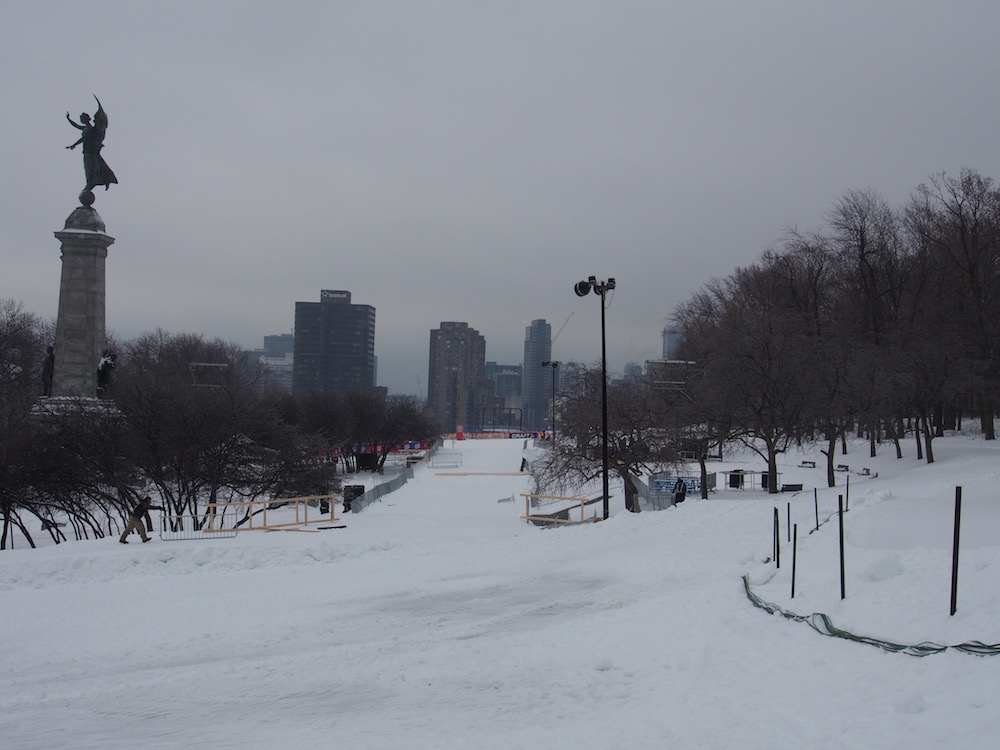
There, the 3.5 k course has been altered slightly from its original plan due to “technical challenges related to the water supply service,” which would have made snowmaking difficult atop Mount Royal, a large hill just west of downtown Montreal, organizers explained in press release earlier this month. The course was moved from the top to the bottom, near the George-Étienne Cartier Monument, “a location that is easily accessible to the public,” the release stated.
Snow conditions on Monday were “rock hard” and icy, according to one FasterSkier reporter, due to freezing rain Monday morning.
Like Gatineau, Montreal’s high temperatures were around freezing on Monday and forecast to be -10 Celsius on Tuesday and Wednesday.
Here is a collection of photos and quotes from the days leading up to the Tour, as well as a complete schedule below.
A sunny day for the final day of official training before the start of the 2016 Ski Tour Canada in Gatineau, Quebec. (Photo: John Lazenby/Lazenbyphoto.com)
A little wax testing on Gatineau’s 1.7 k sprint course, with the start/finish area visible at the upper right. (Photo: John Lazenby/lazenbyphoto.com)
Petter Northug (Norway) during official training on Monday in Gatineau, Quebec. (Photo: John Lazenby/Lazenbyphoto.com)
FasterSkier: “Is this your first time in Ottawa?”
Simi Hamilton: “It is! I’ve been up to Quebec quite a few times and obviously Canmore a whole bunch, but first time to Ottawa and it’s awesome. Really cool. The skiing up here is amazing. I was telling the crowd earlier, it’s probably the best skiing we’ve had all winter, on natural snow and just hundreds of k’s of trails out here. So it’s really cool.”
–Interview by Alex Slobodan
The German World Cup team during official training in Gatineau, Quebec. (Photo: John Lazenby/Lazenbyphoto.com)
Alex Harvey (Canadian World Cup Team) surrounded by media on Monday, one day before the start of the Ski Tour Canada in Gatineau, Quebec. (Photo: John Lazenby/Lazenbyphoto.com)
Patrick Stewart-Jones representing Canada during Monday’s press conference, the day before the Ski Tour Canada’s first stage in Gatineau, Quebec. (Photo: John Lazenby/Lazenbyphoto.com)
Jessie Diggins speaking on behalf of the U.S. team during Monday’s press conference, the day before the Ski Tour Canada’s first stage in Gatineau, Quebec. (Photo: John Lazenby/Lazenbyphoto.com)
Maurice Manificat during Monday’s press conference, the day before the Ski Tour Canada’s first stage in Gatineau, Quebec. (Photo: John Lazenby/Lazenbyphoto.com)
Stina Nilsson during Monday’s press conference, the day before the Ski Tour Canada’s first stage in Gatineau, Quebec. (Photo: John Lazenby/Lazenbyphoto.com)
Federico Pellegrino during Monday’s press conference, the day before the Ski Tour Canada’s first stage in Gatineau, Quebec. (Photo: John Lazenby/Lazenbyphoto.com)
(Photo: John Lazenby/Lazenbyphoto.com)
FasterSkier: “Have you ever been to Ottawa before?”
Francesco de Fabiani: “No, it is the first time I come in Canada and in America in general. I am surprised … Canada is a very nice place for cross-country skiing.”
FS: “What are your goals for the Tour?”
FDF: “Well, I hope to stay in the top 10 in the final ranking, but I know that it will be difficult with the free sprint. I don’t know how is the track in Montreal, the 20 k. And classic is my favourite technique, but if it is not so hard and someone can go with only double poling, I think that they will be difficult to stay with.”
FasterSkier: “What are your goals for the Tour?”
Erik Bjornsen: “I’ve had some pretty good races the last couple of weeks on the World Cup so I am hoping to keep that momentum going and score some points and just ski strong all the way through.”
A Russian athlete signs the toque of a local child at the Nakkertok ski trails in Cantley, Quebec, last weekend. (Photo: Doug Ranahan)
Nakkertok head coach Kieran Jones on the impact of a local World Cup: “Having the World Cup arrive in the Ottawa/Gatineau area is a great chance for our athletes to see what the strongest in the world look like. In North America you barely get to see the best cross country skiers on TV, much less in person, so the myth and legend grows to the point where they can seem inhuman. Having Northug, Kalla, and Caspersen Falla skiing around at Nakkertok really brings home the reality of the sport to the kids and young adults, and shows them that these fast skiers are still people, and are totally approachable, and people you can aspire to. The buzz that having the world in your city and club generates is great for the sport, and great for the club.”
Norway’s Maiken Caspersen Falla (in pink) skis by a young local skier at the Nakkertok ski trails on Saturday in Cantley, Quebec. (Photo: Doug Ranahan)
Norway’s Maiken Caspersen Falla training on Saturday at the Nakkertok trails in Cantley, Quebec. (Photo: Doug Ranahan)
Two Nakkertok juniors, Pat Paradine (in yellow) and Hugh Graham (left, in blue and black), chase Russian World Cup skiers on Saturday during training at the Nakkertok trails in Cantley, Quebec. (Photo: Doug Ranahan)
Nakkertok’s Hugh Graham (l) and Pat Paradine double pole behind two Russian World Cup skiers (not shown) at the Nakkertok trails in Cantley, Quebec, the weekend before the Ski Tour Canada stage in Gatineau, Quebec. (Photo: Doug Ranahan)
Nakkertok’s Alex Slobodian chases a Norwegian on the Nakkertok trails in Cantley, Quebec. (Photo: Doug Ranahan)
FasterSkier: “Have you been to Ottawa before?” Markus Cranmer, former German junior coach, now a Russian coach for Alexander Legkov’s training group: “No. It’s the first time for me to be here. Very nice, very nice for skiing and very nice tracks here. I’m really surprised! … Not too far from the city and so it’s very nice.”
“I’m looking forward to the entire experience and not putting too much weight into any single race,” Jackson wrote in an email. “Every race as my next best opportunity, in a Tour format you can’t write off any race because every day matters if you want to get to the next one. I am a more partial to the sprints though.
“Racing for Canada on home soil is pretty darn cool, but being able to represent my training centre (NDC Thunder Bay), province (Ontario), and club (Team Hardwood), is even more inspiring because they are the ones who have fostered my development as a skier to a level where I can be part of Team Canada.”
All races are expected to be broadcast on NBC Sports Live Extra (accessible to U.S. subscribers via cable or satellite), and all times are Eastern Standard Time.
Tuesday, March 1: Gatineau
(Not part of broadcast: Women’s qualifier at 11:15 a.m.: start list | Men’s qualifier at noon: start list)
1:45 p.m. – Men’s and women’s freestyle sprint heats
Wednesday, March 2: Montreal
12:00 p.m. – Women’s 13 k classic mass start
2:30 p.m. – Men’s 20 k classic mass start
Friday, March 4: Quebec City
3:30 p.m. – Men’s and women’s freestyle sprint
Saturday, March 5: Quebec City
3:00 p.m. – Women’s 10 k freestyle pursuit
4:00 p.m. – Men’s 15 k freestyle pursuit
Tuesday, March 8: Canmore
3:00 p.m. – Men’s and women’s classic sprint
Wednesday, March 9: Canmore
12:00 p.m. – Women’s 15 k skiathlon
2:30 p.m. – Men’s 30 k skiathlon
Friday, March 11: Canmore
11:45 a.m. – Women’s 10 k freestyle interval start
3:00 p.m. – Men’s 15 k freestyle interval start
Saturday, March 12: Canmore
3:00 p.m. – Women’s 10 k classic pursuit
4:00 p.m. – Men’s 15 k classic pursuit
The 2015/2016 Canadian National Senior Team, with co-head World Cup coaches Justin Wadsworth (l) and Louis Bouchard (second from l) and athletes (from l to right) Jess Cockney, Len Valjas, Dahria Beatty, Alex Harvey, Cendrine Browne, Devon Kershaw, Katherine Stewart-Jones, Ivan Babikov, Emily Nishikawa, Knute Johnsgaard, Olivia Bouffard-Nesbitt, technical services coordinator Joel Jaques, and Graeme Killick during a photo shoot in their new Swix training wear in Canmore, Alberta. (Photo: CCC)
Six years in as the Canadian national team’s head coach, Justin Wadsworth speaks with tempered confidence. And there’s good reason for that. After concluding an altitude camp in Park City, Utah, three weeks ago, he says the Canadians are fit, healthy and primed for what he hopes will be a special season.
FasterSkier reporter Jason Albert spoke with Wadsworth last Friday, Oct. 23, three days before the Frozen Thunder classic sprint in Canmore, Alberta.
Wadsworth attributes some of the team’s positive outlook to an organization emphasizing better communication and collaboration between the national team and regional training centres.
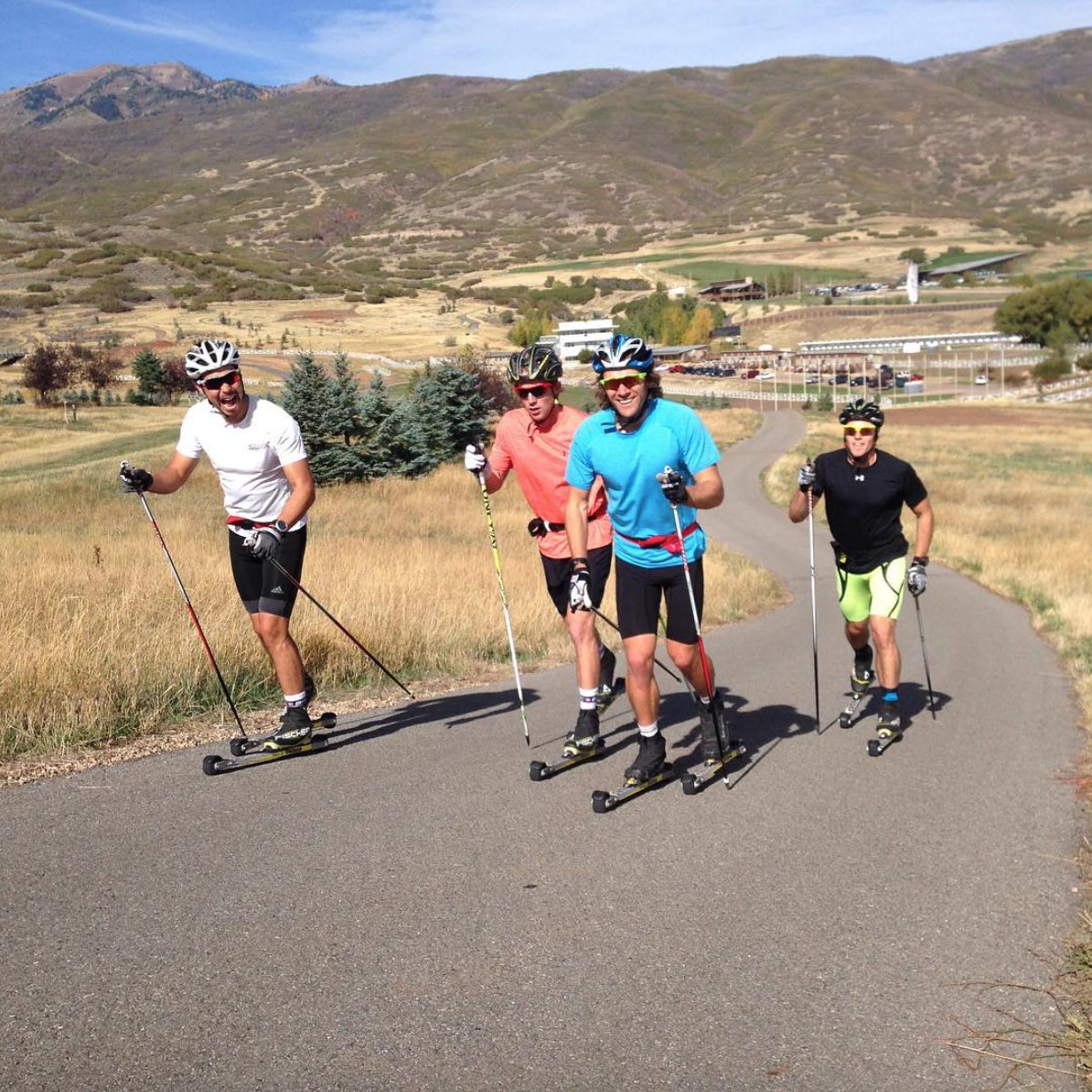
Graeme Killick, Jess Cockney, Devon Kershaw, and Michael Somppi rollerski at Soldier Hollow during their last day of a dryland altitude camp near Park City, Utah. (Photo: Ivan Babikov/Instagram)
“I feel like we’ve struggled with that a little bit in the past, but now more than ever, our training centres, coaches, and national training centre are really working closely together,” he explained.
Canada’s series of training camps this summer and fall were an opportunity for skiers striving for international starts to work out with World Cup skiers.
“I really feel like this year has been a huge success and a step forward a far as our collaboration with the training centres,” Wadsworth said. “I think we have a very methodical stable program and we are just checking off the boxes and now we are coming up to that part of the season where we have to transition all that into speed on the snow.”
According to Wadsworth, national-team skiers like Emily Nishikawa are ready for that transition.
“She’s in the best shape she’s ever been in by far,” he said.
He added that veteran World Cup skier Ivan Babikov is returning to his former levels of fitness.
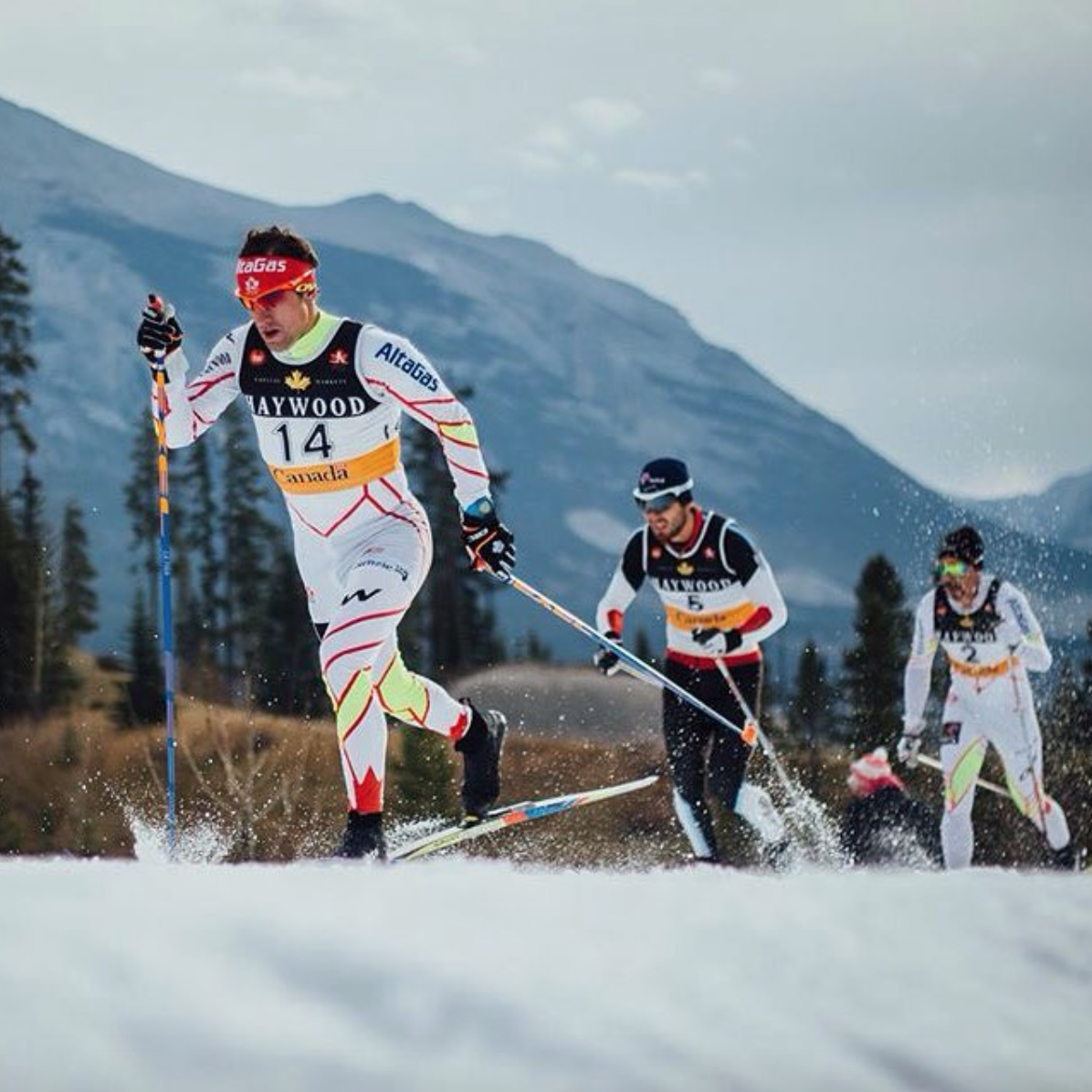
Canadian World Cup veteran Ivan Babikov (14) leads Patrick Stewart-Jones and Jess Cockney (r) during the Frozen Thunder classic sprint on Monday, in which he placed third. (Photo: Marie-Eve Bilodeau-Corriveau/Instagram)
“He showed us in the time trial in Soldier Hollow. He was five seconds behind Alex [Harvey] in that, and we all know where Alex is,” Wadsworth said.
With two individual World Championship medals last season, it’s hard to imagine Harvey could exceed expectations this season. But post iliac artery surgery, Wadsworth says Harvey is a new skier.
“His surgery really allowed him to come to a new level. He’s just been breaking all his running time trial efforts by minutes,” Wadsworth said. “He’s going to be scary this year with his legs feeling good.”
After on-snow racing this week at Frozen Thunder, the national team heads to Gällivare, Sweden, in mid-November for its final preseason training camp. The World Cup eventually lands in Canada in March for the 2016 Ski Tour Canada. As the host country, Canada is allotted 26 starts in the tour: 14 male and 12 female, Wadsworth said.
He acknowledged expectations are high. “Without a doubt our biggest race this year is the Tour of Canada,” he said. “It’s our World Championships, and we really want to have a lot of great results there from all different levels of our program.”
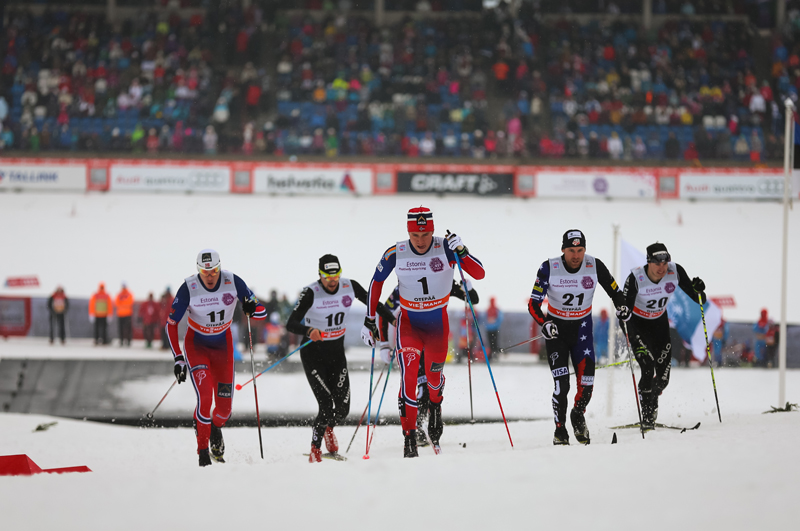
Norway’s Pål Golberg (1) leads Americans Andy Newell (21) and Simi Hamilton (30) up the first of two climbs in a classic-sprint quarterfinal last January at the World Cup in Otepää, Estonia. (Photo: Fischer/NordicFocus)
“I had a lot of good sprint races last season, and there are no championships this season, so winning the overall sprint World Cup is what motivates me the most,” Norwegian national-team member Pål Golberg said in a recent interview with FasterSkier at the Madshus factory in Biri, Norway.
Getting there requires a lot of hours, and the 25-year-old World Cup racer pointed out the importance of soaking up valuable training experiences and focusing on increasing one’s engine capacity. Golberg’s top training tip is to believe in your plan.
“There are so many training strategies you could try, but you have to decide on one plan and believe in that. That’s the most important part. Everything else builds on that,” he said, pointing out that this is true regardless of ambition level.
So how does he go about that?
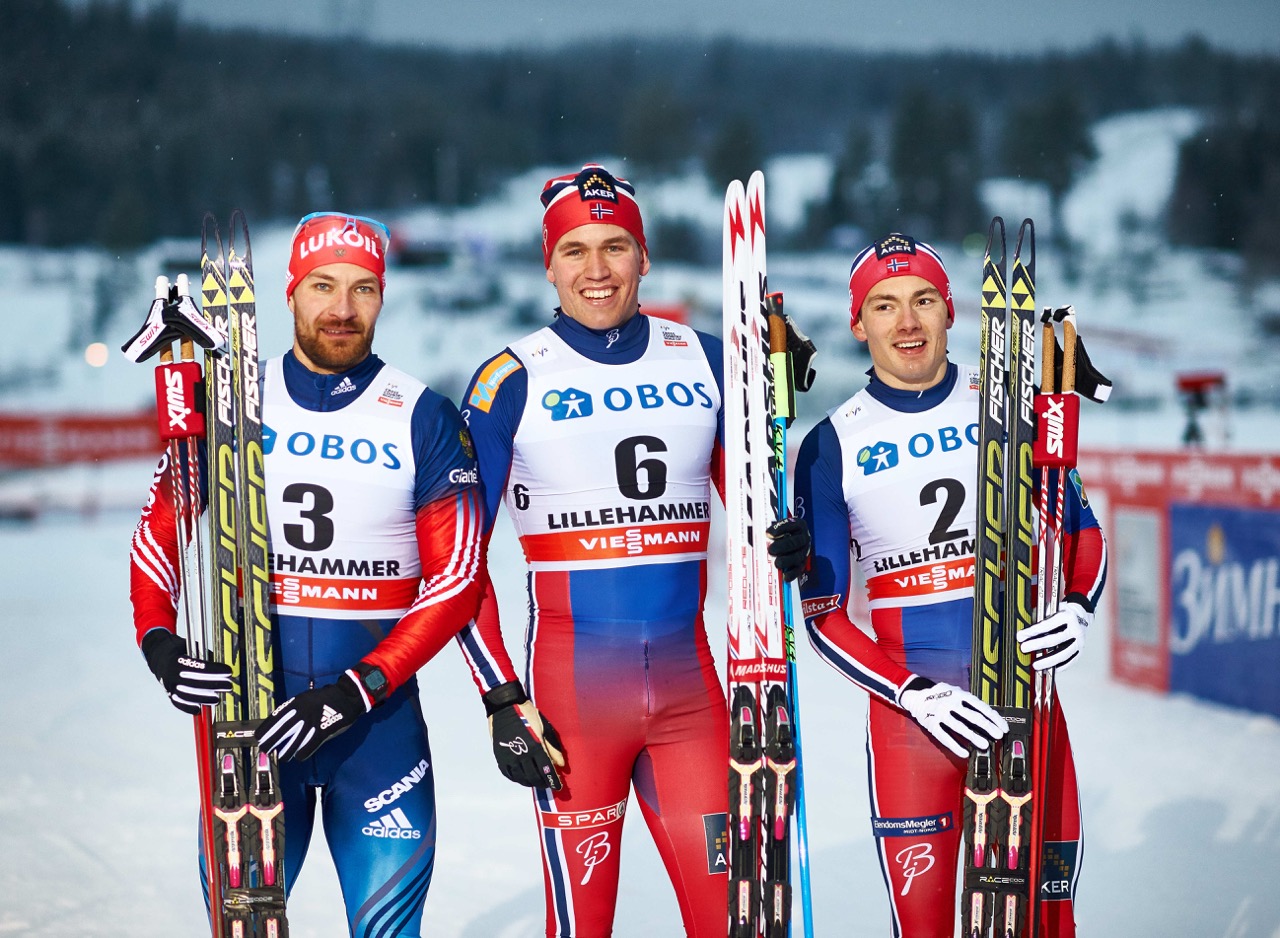
The men’s 1.5 k freestyle sprint podium at the 2014 World Cup mini tour in Lillehammer, Norway, with Norway’s Pål Golberg (c) in first, Russia’s Alexey Petukhov in second (l) and Norway’s Finn Hågen Krogh in third. (Photo: Fischer/NordicFocus)
Getting sick with a virus at the end of last season forced Golberg to change his training program significantly.
“I’ve done a lot of things differently this season compared to previous years,” he said, adding that it has been tough at times.
“I’ve had to change my priorities. I have to listen more carefully to my body and adjust my training plan accordingly. The result is that I logged quite a bit less volume than I planned to through the summer and early fall, and that’s disappointing,” he explained. “But you have to keep things in perspective. It just means that I can’t expect to be among the podium contenders in the early race season. However, I plan on being back in the mix by New Year.”
Best known as a sprinter, Golberg is not planning on racing the Tour de Ski this season. He’ll focus on a full recovery instead.
“There are a lot of other races that suit me better, and by skipping Tour de Ski, I get solid training periods on either side of Christmas,” he said.
At the same time, Golberg enjoys the thrill and excitement of multi-stage races, and is aiming for the Ski Tour Canada at the end of the season.
“Tour du Canada suits me and my strengths a lot better than Tour de Ski, because there are more sprints and more classic races,” he said, adding that he expects a fierce battle for the team amongst his Norwegian teammates.
“It will be a tight selection. I think everyone wants to race Tour du Canada this year,” Golberg said.
Capacity Over Brute Strength
More tours and mini tours have been a trend on the World Cup schedule in recent years, and Golberg welcomes that.
An emphasis on double poling is another trend in cross-country skiing, which started on the Ski Classics long-distance circuit. But even on the regular World Cup, more skiers are considering tossing the kick wax and muscling through a classic race on skate skis. Some analysts argue the double-pole trend will intensify unless the International Ski Federation (FIS) takes action regarding World Cup course profiles and technical requirements that favor diagonal striding. Accordingly, upper-body strength and double-pole technique has become an ever-so important part of elite training programs.
Pal Golberg of Norway leads Canadian Devon Kershaw in the World Cup 15 k classic last December in Davos, Switzerland.
Golberg explained his concern about the double-pole trend, and how it may come at the expense of traditional training.
“A lot of skiers put more emphasis on double poling, but I think many of them forget to put in enough time on improving their capacity, which is the limiting factor for cross-country skiing,” he said. “It’s one thing to prioritize double-poling a little more than before, but the overemphasis we are seeing now is something else. You will still ski most of the events with kick wax, and then it’s counterproductive to forget that all through the dryland season.”
Capacity is built via traditional bounding drills, moose hoofing, plyometrics and running, he explained.
“Double poling has to come in addition to that, on top of that solid aerobic foundation,” he added, pointing out that was particularly true for developing athletes.
“Capacity is particularly important for young skiers and juniors. This is the age at which you really need to focus on expanding the engine. It’s important to double pole, and it’s more important than it used to be, but I feel that it’s through those hard, ski-specific intensity workouts that you really push your limits to the max, and that’s where you get better,” he concluded.
Going the Distance
Golberg’s favorite workouts are over long distances in the mountains, with or without skis. For him, skiing is more than a career, and workouts are about more than simply getting faster and stronger.
He is passionate about being outside, and the mountains are where he feels the most at home. Those experiences fuel his workouts and keep him motivated through the tough days when the weather is wretched and the doorstep mile is particularly long.
“In the late winter, from February to March and through the spring until the snow melts, when days are longer and brighter, that’s when the mountains are at their best, and nothing beats long skiing workouts then,” he said. “Similarly, in the summer and fall, those long runs in the mountains deliver the best experiences. Those days deliver a little extra, and I just enjoy every minute.
“You have to hold on to those memories and sunshine moments, and save them for later,” he added. “It’s a lot easier and more fun to work out when it’s sunny and you’re not getting drenched to the bone. Earlier this fall there was a long, wet and cold period when it was raining sideways. That’s when I really have to dig deep to find the motivation, and I pull out those sunny memories.”
On the other hand, he finds a unique silver lining in those less-than-desirable days.
“It’s always nice to come back inside after cold and rainy workouts when you’re dreading to get out there,” Golberg said.