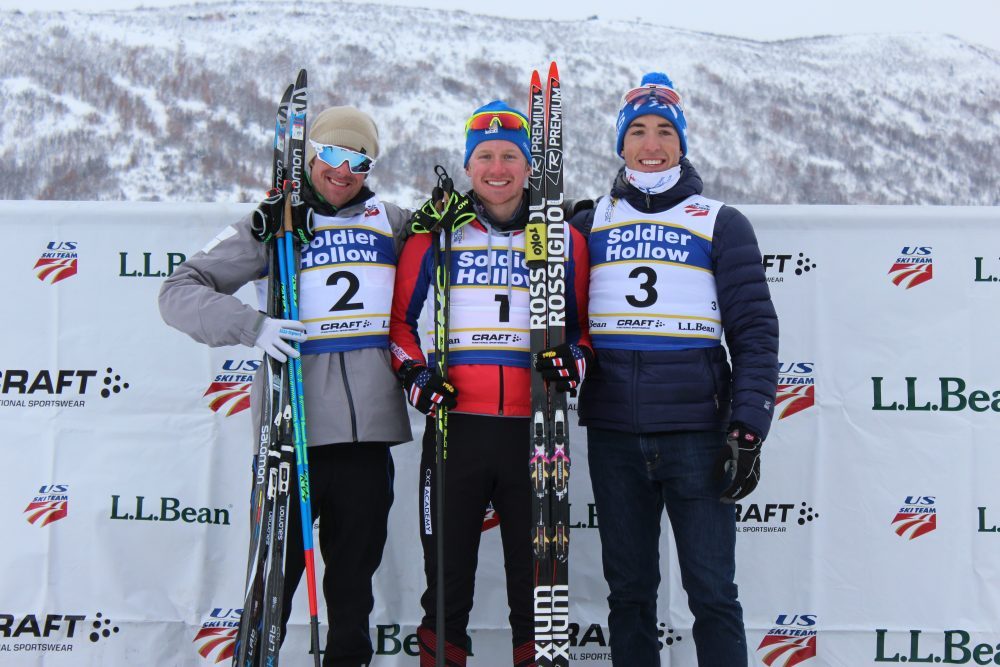
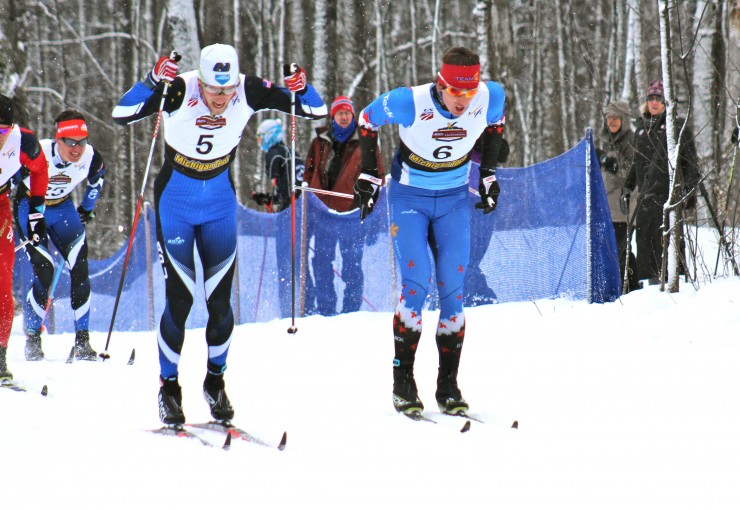
The “American” podium at U.S. Cross Country Championships for the men’s 15 k freestyle, with Kyle Bratrud of CXC (c) in first, Tad Elliott of SSCV (l) in second, and Patrick Caldwell of SMS (r) third. Moritz Madlener of Germany, competing for the University of Denver, was third overall and ahead of Caldwell.
MIDWAY, Utah — On Saturday at Soldier Hollow (SoHo) many of the variables that make cross-country skiing a conundrum were in play: morning fog and early hours, -8° Fahrenheit temps, a reluctant and too timid sun, a mix of artificial and natural snow.
It didn’t take a robust microphone to pick up the all-too-familiar sound of hard-packed, arctic-cold snow — think styrofoam.
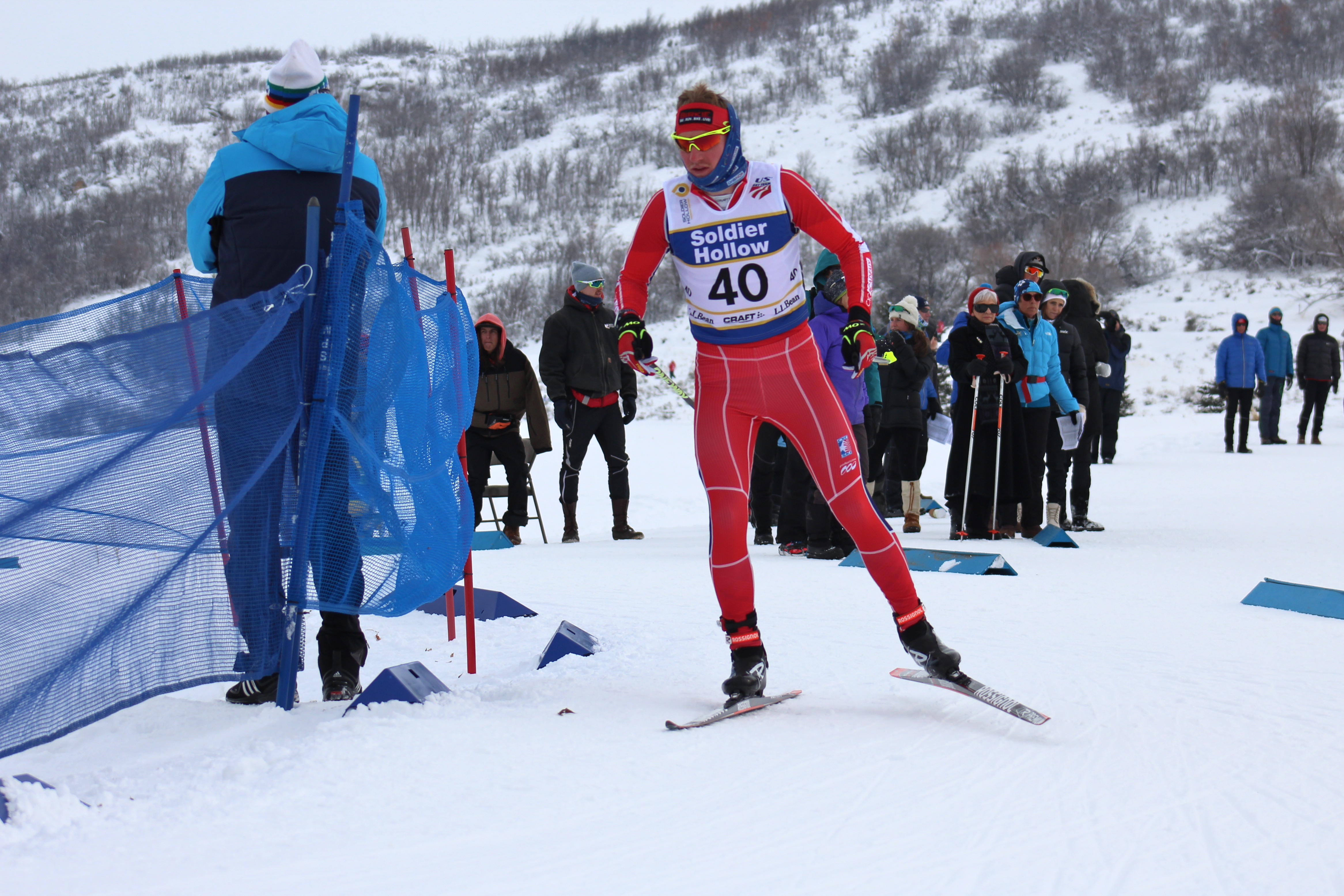
For the men’s race, starting at 1 p.m., the morning’s slow snow had morphed into a slightly more efficient gliding surface. The Central Cross Country (CXC) Team’s 23-year-old Kyle Bratrud made the most of it. He gapped the field and won Saturday’s 15-kilometer freestyle individual start in 34:52 minutes, repeating his title earned at 2015 U.S. nationals in Houghton, Mich.
Two-time World Championships team member Tad Elliott of Ski and Snowboard Club Vail (SSCV) placed second (+21.6).
Germany’s Moritz Madlener, a senior at the University of Denver and double podium finisher at last year’s NCAA Championships, took the third podium spot (+30.4). However, only 0.7 seconds back in fourth was Patrick Caldwell of the Stratton Mountain School (SMS). As the next-best U.S. finisher, Caldwell, a U.S. Ski Team D-team member, was the third American in the talent-deep field.
Kris Freeman (Team Freebird) was fifth overall (+36.0) and Sun Valley Ski Education Foundation (SVSEF) Gold Team member John Hegman placed sixth (+37.9). The pair were the fourth- and fifth-best Americans.
Another Title for Bratrud
Where this reporter sat in the SoHo infield — an intersection of the lap/finish lane in one direction and the beginning of a gutting climb in the other — the names Gelso, Patterson, Elliott, and Freeman were being shouted by coaches communicating who was at the sharp end of the leaderboard.
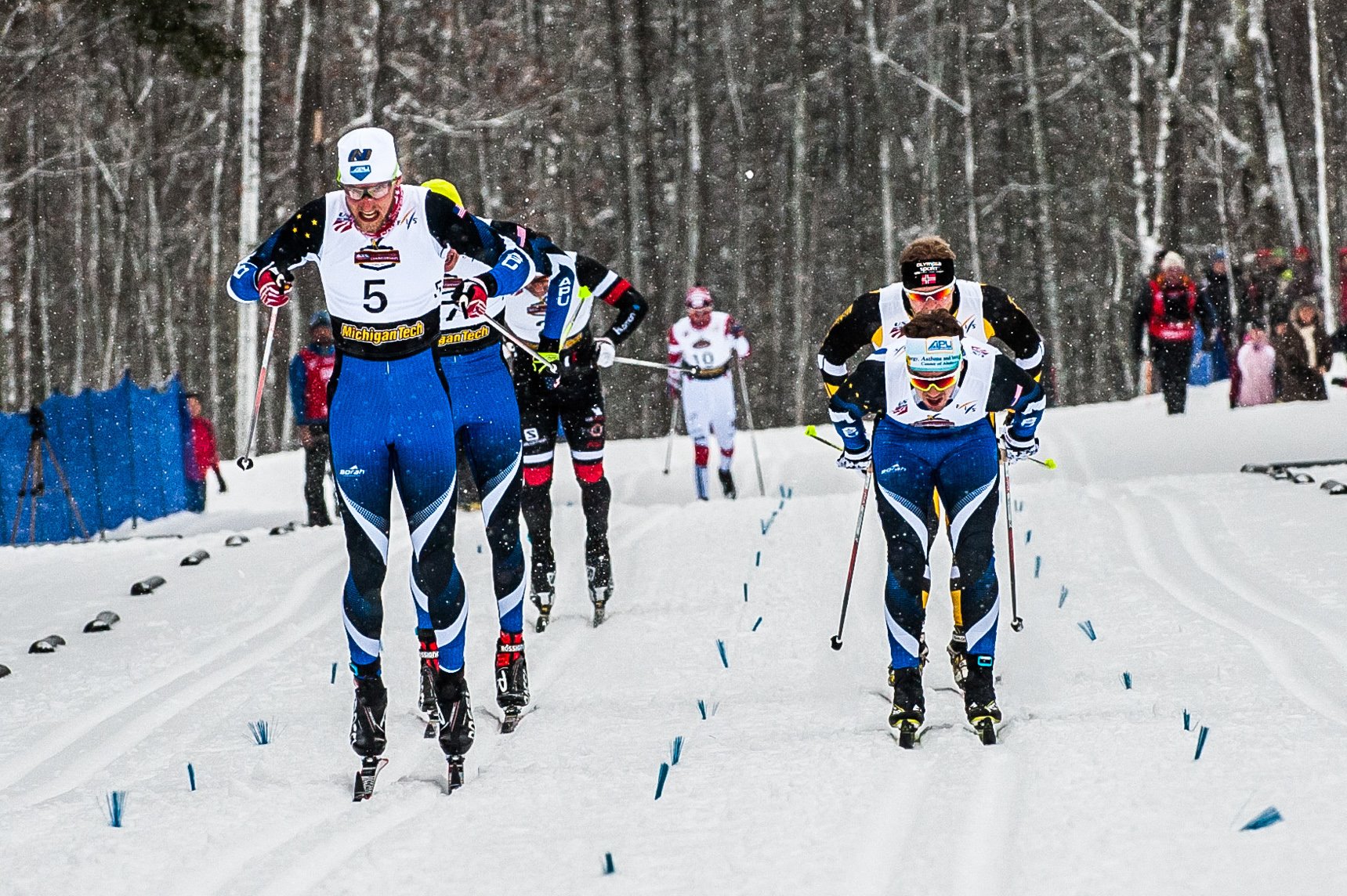
CXC’s Kyle Bratrud on his way to winning the men’s 15 k freestyle at 2017 U.S. nationals on Saturday at Soldier Hollow in Midway, Utah.
The name Bratrud was missing. Yet his statement was loud and clear, winning by 21.6 seconds over multiple national champion Elliott.
“Two years ago when I had a really good season, I basically started every race as fast as I could and either I blew up or did really well because I had a big lead,” Bratrud told FasterSkier after the podium ceremony.
“This last year, being at altitude for these first SuperTours really helped me feel what a good pace is, especially at altitude,” he continued. “I noticed some heart rates where I could sit for a while. If I went too far above that, then I would blow up. I tried to just stick with that and go off the feel of it, but make sure I was in control. I felt good the entire time.”
Although he lives and trains at low altitude, Bratrud’s month out west for early SuperTours and a seven day pre-race stay near SoHo mitigated any altitude adjustment concerns.
“The breathing was high, but it was manageable,” Bratrud said.
The upcoming World Championships in Lahti, Finland, loom large on the horizon for many skiers at nationals. That’s certainly the case for Bratrud, who also competed in 2015 World Championships in Falun, Sweden.
“[World Championships] has been my objective since the summer began, so this puts me in a position for it,” Bratrud said. “I knew after the SuperTours I was a little out of [the running]. I needed to get on the podium in one or both of these races. So today was a good start. I’m excited about the sprint tomorrow, but the 30 k is my next focus.”
The field should pay attention. Four days after winning his 2015 national title race, Bratrud placed third in the 30 k mass start classic in Houghton.
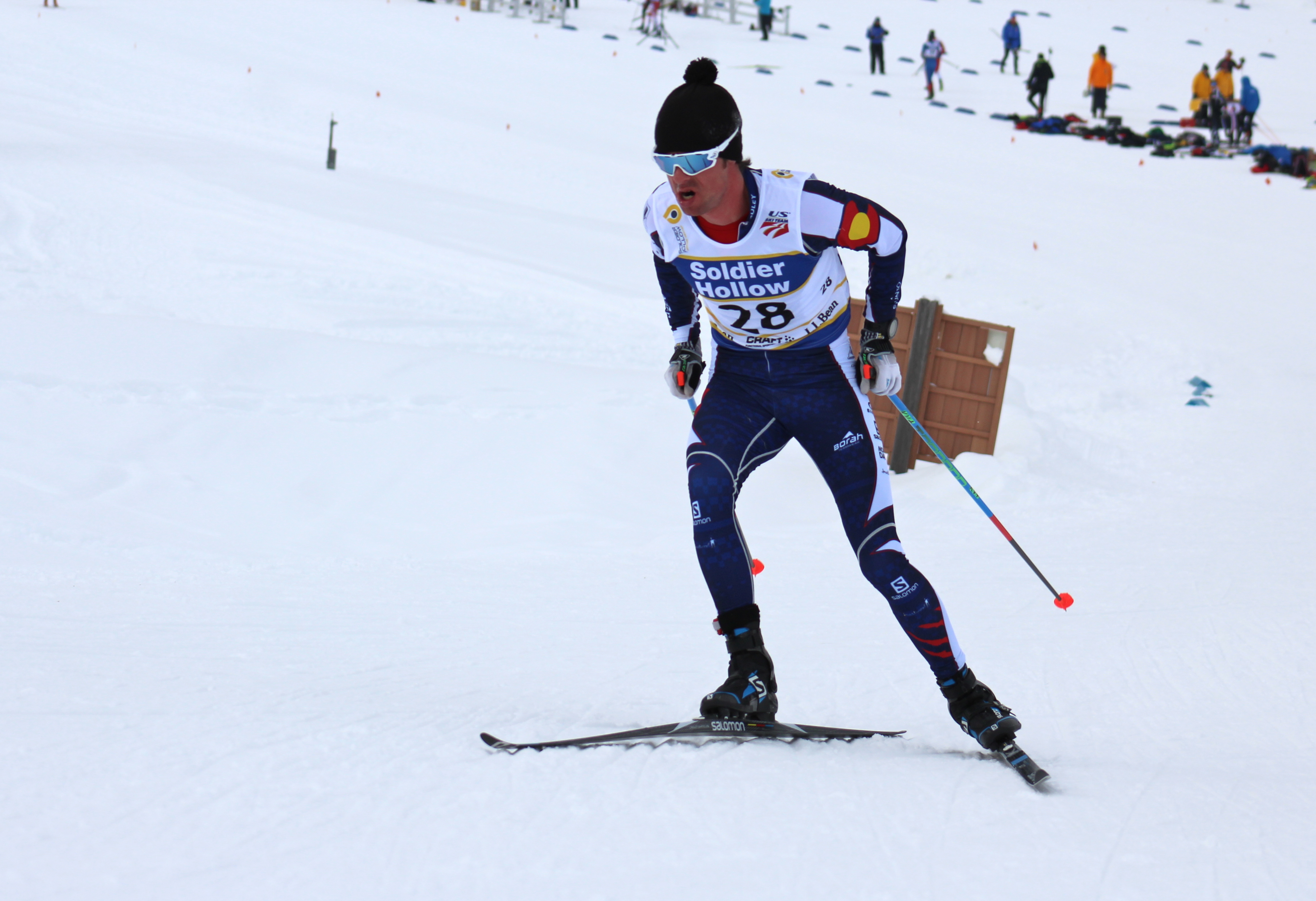
Tad Elliott (SSCV) skiing to second in the men’s 15 k freestyle at U.S. Cross Country Championships on Saturday at Soldier Hollow in Midway, Utah.
American Podium
No stranger to national podiums is the sinewy Elliott.
First in the 2011 U.S. nationals 30 k skate in Rumford, Maine.
First in the 2012 national 15 k skate, also in Rumford.
First in the 2016 national 30 k skate mass start.
Elliott has been second at nationals on five other occasion before Saturday. Take a breather at SoHo’s higher-than-most venue? Not really happening for Elliott: he’s 28 years old and charging.
Upbeat and grateful, Elliott, standing next to his twin brother Evan, mentioned the moment was special.
“It feels good to finish second, for sure,” Elliott said. “I mean, any time you get on the podium, especially at a race like this, it always feels good. My whole family is here except for my sister. But my twin brother Evan waxed my skis. My dad’s here. It’s also my mother’s birthday, she’s here watching, so that was cool, for sure.”
“It’s still a long road, I mean, there’s still times where it’s like a rollercoaster,” Elliott said of his gradual return to form. “I’m on the upswing. It’s good in that the symptoms are getting less and less. But I think the main thing today to get on the podium was wisdom: knowing to start slow, knowing to be in control, knowing you can throw down the last lap.”
Elliott also deflected some of the attention and took a moment to reflect on Bratrud’s dominance.
“Huge congrats to Kyle Bratrud, that kid was unbeatable today from the time gap we saw,” he marveled. “That’s quite an impressive effort for him. He’s a young guy too, it’s cool to see. I mean, he came from low altitude, and won here.”
As the third-fastest American, Caldwell stood on the “American” podium on Saturday. The Vermont-based skier has already qualified for U23 World Championships, to be held at SoHo at the end of the month.
“I think going into the day I wasn’t thinking about results as much as just hoping to feel good on the day, and give it my all out there,” Caldwell said after. “And I was definitely really psyched to be in contention for the podium. Bummed to miss [the overall podium] by a close margin, but I was definitely happy with the result overall.”
The race was as much a learning experience as a results oriented end game for Caldwell.
“I’d say the big takeaway is figuring out pacing, it’s definitely tricky up here at altitude,” Caldwell said. “And I think having the chance to race here before U23’s is going to be a huge advantage in figuring out pacing and trying to figure out where you can redline, where you have to keep it under control, and that kind of thing.”
Nationals continue Sunday with a full day of men’s and women’s classic sprints.
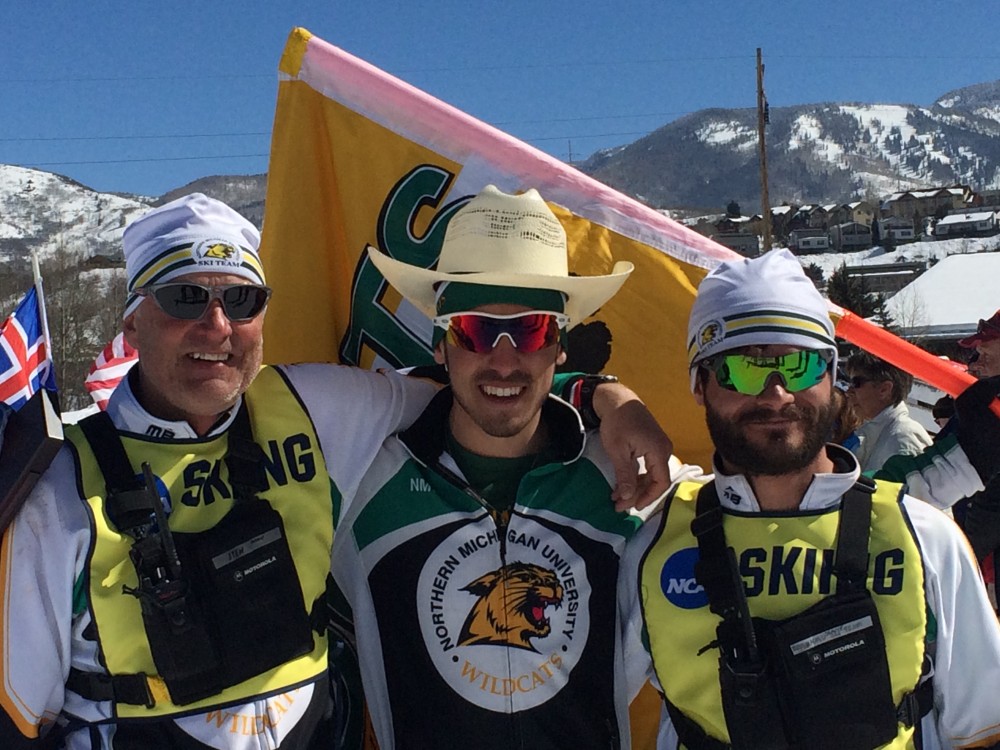
Ian Torchia (c) with Northern Michigan University Head Coach Sten Fjeldheim (l) and assistant coach Shane MacDowell after Torchia placed second in the men’s 10 k freestyle at 2016 NCAA Championship in Steamboat Springs, Colo. He went on to place fourth in the 20 k classic mass start. (Courtesy photo)
As the youngest in a family of five, it’s no wonder that Ian Torchia, an incoming junior at Northern Michigan University (NMU), considers himself “scrappy.” It’s also no wonder that, when it comes to sport, Torchia takes on skiing with tooth-and-claw grit. Within the first few hours of being a freshman on the NMU ski team, the Rochester, Minn., native established himself as tenacious if nothing else.
“Watching him ski on the treadmill the first time I worked with him, he was just raw,” Sten Fjeldheim, head coach of the NMU men’s and women’s nordic teams reflected in a phone interview. “His technique was, well, not pretty, but I knew he had a heck of an engine from his running times.”
After Torchia finished his freshman year just outside qualifying for NCAA Skiing Championships, he made it a goal to reach the championships the following year. As a sophomore, he not only qualified for NCAA’s, but he went on to place second in the men’s 10-kilometer freestyle and fourth in the 20 k classic mass start at the 2016 championships in Steamboat Springs, Colo.
By the end of his first two years at NMU, the 20-year-old Torchia had also tapped into another tool: technique. He asked his college coaches ceaseless questions, watched countless ski videos and began to implement what he saw on the screen into his own skiing.
“He’s just really good at being a student of his own sport: skiing,” Fjeldheim said of Torchia’s technical improvements.
However, the sophomore’s upward climb last season didn’t end with his work on the NMU ski team. In January, he won the junior men’s 10 k freestyle at U.S. nationals in Houghton, Mich. Also at nationals, he placed seventh among seniors in the men’s 15 k classic, and at 2016 Junior World Championships in Romania, he raced to 15th in the junior men’s 15 k freestyle.
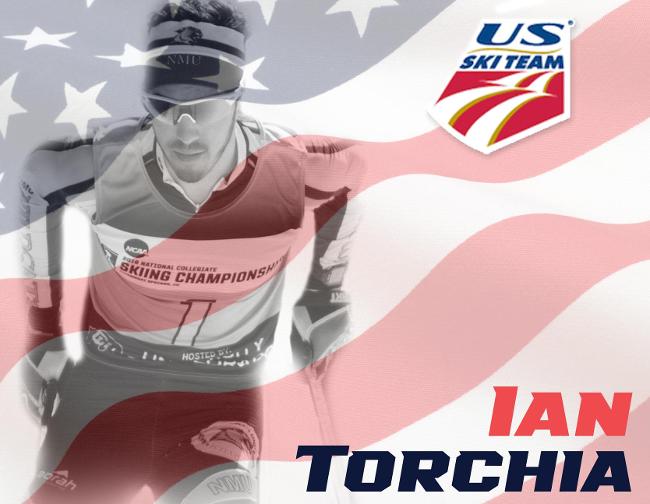
NMU designed the above image for a press release after Ian Torchia was nominated to the U.S. Ski Team D-Team. (Photo: NMU Wildcats)
Most recently, Torchia discovered he was among 16 athletes nominated to the U.S. Cross Country Ski Team.
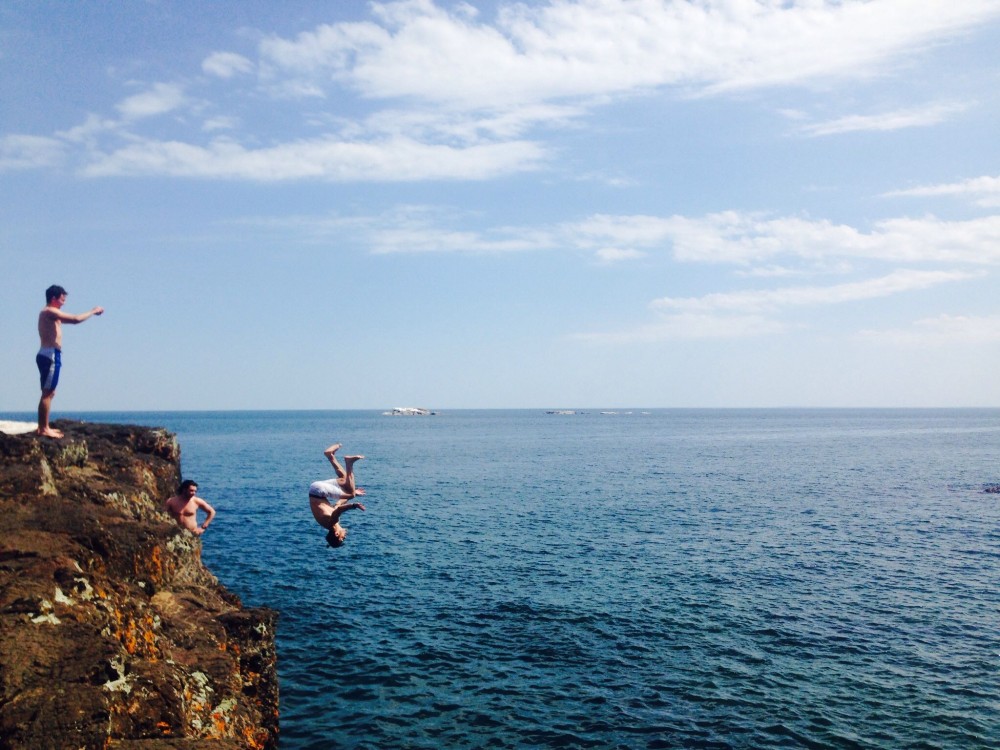
“I was on my way to go cliff jumping when Bryan Fish [U.S. Ski Team development coach] called me,” Torchia said on the phone. “The celebratory back flip didn’t go too well.” (According to Torchia, the backflip was more of a “back flop.”)
Though perhaps brazen when it comes to black flips and Lake Superior bluffs, the main sentiment Torchia spoke of was that of humility. In his eyes, the opportunity to ski for U.S. Ski Team ‘D’ (or development) Team is an opportunity to once again put his tenacity to the test.
“You know, there’s still two more levels of the U.S. Ski Team to go,” Torchia said of the ‘A’ and ‘B’ team levels. “If anything, [the nomination] just motivates me to train harder. I mean, the way I see it, it’s an honor to be named. I get invited to the camps and I get the uniform. It puts a bigger target on my back, but I’m OK with that.”
U.S. Ski Team (USST) Head Coach Chris Grover explained in an email that the team was “looking for athletes who can deliver big results in Europe against tough fields,” he wrote. “Ian was the standout USA male once again at World Juniors and posted his second consecutive top-15 result there.”
At the 2015 Junior World Championships in Kazakhstan, Torchia notched 11th in the 20 k skiathlon.
Moving forward, Torchia plans to accept the nomination and attend the two USST summer training camps, the first one taking place in Bend, Ore., this month and the second in Anchorage, Alaska. According to Fjeldheim, not much will change for Torchia in regards to training.
“He’ll pretty much be on the same training plan that he’s been on,” Fjeldheim said. “But I think the opportunity for him to ski with some other national-team skiers is going to be good.”
Along with accepting the nomination, Torchia also plans to continue attending NMU as a full-time student and eventually earn a degree in exercise science.
Ian Torchia (c) with his parents Mike (l) and Patricia after this year’s U.S. nationals in Houghton, Mich. (Courtesy photo)
“I think my mom would kill me if I wasn’t in school,” Torchia said.
But his reasons for staying in school extend beyond his so-called death sentence, even if it means suffering through organic chemistry finals. To Torchia, continuing his education sends a broader message to other nordic athletes, especially those trying to determine whether skiing in college can lead to a ski career.
“One of the main reasons why I wanted this to happen is to show that you can do it while you’re in college,” Torchia said of his national-team nomination. “It is hard to balance school and skiing, but it’s doable. [College skiing] is a pipeline.”
School, Torchia insisted, also gives him options outside of skiing.
“Make sure to have balance in your life between skiing and make sure skiing isn’t the only thing in your life,” Torchia said of how he found success in sport. “We kind of take that mentality here at NMU. We have the top GPA of all the sports teams here, so it’s both skiing and school. It’s a lifestyle and we love it. It’s hard, but you got to go for it.”
Beyond the importance Torchia finds in education, his NMU teammates and coaches also played a large role in his decision to continue his ski career on the college path. He cited post-practice conversations and training plans his coaches provided as a staple to his success.
“I could not have done this without Sten and [NMU assistant coach] Shane MacDowell,” Torchia said.
“Ian always shows up with a smile on his face,” Fjeldheim said. “Yeah, he like to pull pranks on me and his teammates every now and then and we prank him back, but he’s a great kid to have on your team as far as sportsmanship goes and manners. He’s very humble.”
“It’s a lifestyle and we love it. It’s hard, but you got to go for it.” — Ian Torchia, NMU junior and U.S. Ski Team rookie
With teammates like Adam Martin and Jake Brown, both first-team All Americans at this year’s NCAA Championships, Torchia views his peers as motivation and proof of where they, too, are headed.
“You can never get too big of a head around here because there will always be someone to serve you a piece of humble pie,” Torchia said. “I can say that I won’t be the last one to be named [to the U.S. SKi Team] out of NMU.”
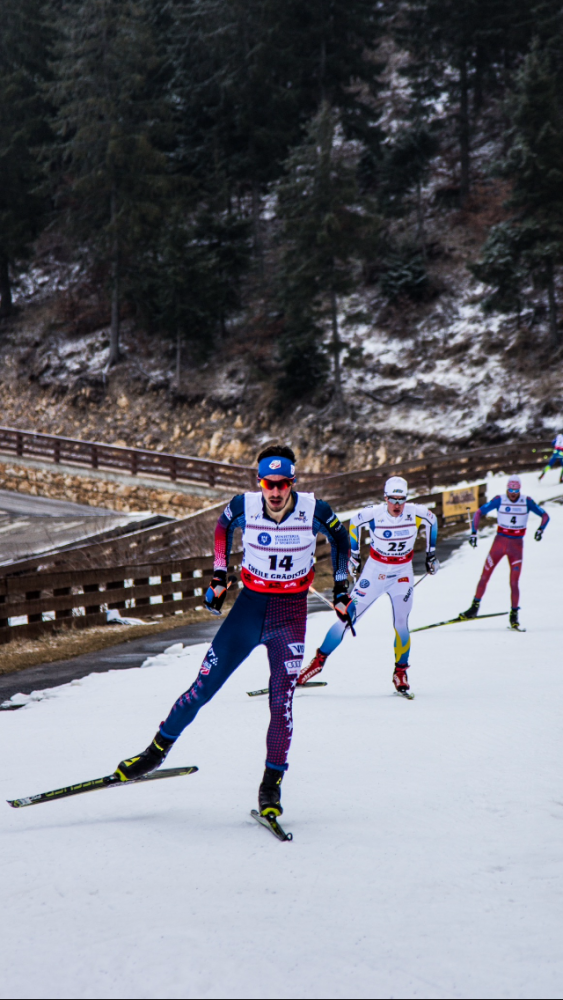
Ian Torchia (14) racing to 15th in the men’s 15 k freestyle at 2016 Junior World Ski Champioships in Rasnov Romania. (Photo: Thomas O’Harra)
With the nomination, Torchia is undecided as to where his ski career will be drawn after graduation day. Though not currently on the CXC team, joining the program is one potential route for him post-college.
“Kind of this past year, I guess I really thought about skiing after college,” Torchia said. “Right now, Kyle Bratrud is [in Marquette] skiing for [Central Cross Country] and we’re getting [Dartmouth grad] Oscar Friedman up here. I think we’re going to make a return to the days when CXC was a really a powerhouse. I can see myself here. We’ll see. It’s still a long way away.”
While Torchia’s five-year plan remains flexible, his 14 weeks of summer are at least set to go. This includes attending the two USST training camps, training in Marquette, Mich. (potentially with the likes of Kris Freeman, he said), and wedding crashing.
“I’m going to go home, surprise my mom on Mother’s Day and then head out to Bend for the camp there,” Torchia said. “Then I’ll come back [to Marquette] for June and then go out to Anchorage for that camp. And then it’s my sister’s wedding in Colorado. So it should be a fun summer.”
Particularly fun due to the training crew he plans to surround himself with.
“Basically the entire [NMU] guy’s team is going to be [in Marquette] this summer,” Torchia said. “We call it the Marquette Training Group: MTG. So, MTG 2.0 is kicking off this summer. We’re hoping that a few guest stars show up; there’s rumors that Bird [Kris Freeman] and Tad Elliott and Paddy Caldwell and Brian Gregg might be up here. So it’s going to be pretty kickass.”
While the USST nomination makes him a new training target to many, Torchia remains humble of where he’s been and where he’s headed. For now, he appears to prefer taking it one step at a time up the ski ladder — even when it comes to housing.
“I’ve got the Trailer Park Room,” he said, indicating that as one of the younger athletes, it may have fallen on him to take on the tiny living quarters in the NMU men’s ski house for the summer. “It’s the smallest room in the house, but I kind of like it. It doesn’t have a closet, very narrow and small, but I don’t know, I like it.”
Northern Michigan University’s Ian Torchia celebrating his nomination to the U.S. Ski Team D-Team this spring with a cliff jumping back-flip. According to Torchia, it ended as more of a “backflop.” (Photo: Abby Cook)
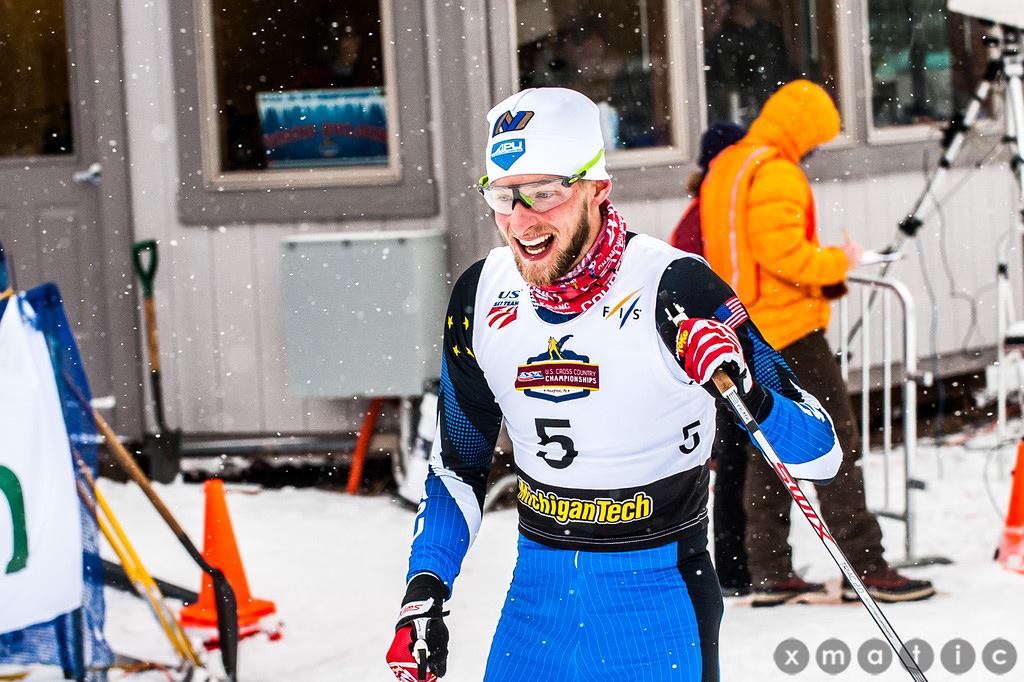
Eric Packer after winning his first national title in the classic sprint at 2016 U.S. Cross Country Championships in Houghton, Mich. (Photo: Christopher Schmidt)
Below is an interview with the 2016 U.S. national champion in the classic sprint, Eric Packer, a 25-year-old Alaska Pacific University skier and Dartmouth grad. This interview originally appeared on SlowTwitch.com and has been adapted for FasterSkier. SlowTwitch is a comprehensive resource for a wide variety of endurance sports, in particular triathlon, and has recently launched a new feature designed to introduce triathletes to nordic skiing. Last month, FasterSkier shared a SlowTwitch-original interview with another national champion, Tad Elliott.
According to Packer’s recent Facebook post, he officially qualified to race World Cup Period 4 (the eight-stage Ski Tour Canada from March 1-12) for the U.S.
***
Eric Packer (5) on his way to beating APU teammate Reese Hanneman (r) and the rest of the men’s final in the classic sprint at 2016 U.S. Cross Country Championships for his first national title. (Photo: Christopher Schmidt)
Fast Big Dog:Congratulations on winning your first US National Championship in nordic skiing in Houghton, Mich., on Jan. 9 in the classic sprint. … Sprint racing is very tactical, so walk us through how you qualified, made it through the rounds and went on to win the title.
Eric Packer: You are 100 percent correct. Sprint races are very strategic … and this race had the added dynamic of being in the classic technique. Ski equipment technology has evolved and athletes are getting stronger and stronger, so there is an emerging trend in classic races to double pole the entire course — no striding at all. This can be a very risky strategy and its success depends on several factors. Skis can run faster without kick wax, but having to double pole all of the uphills is very taxing and comes at a high energy cost. There is also the added variable of the different approaches required in qualifying versus the heats, as qualifying is all about a high, constant speed. There is virtually no drafting since you start in intervals, so you’re not worried about pulling someone along for most of the race only to have them blow by you at the end.
In the end, I decided I should double pole the qualifier (I actually used my skate skis, not classic skis with no kick wax), but then I switched to classic skis with kick wax for the elimination rounds. Thankfully, our ski techs at APU are some of the best in the business and they did an outstanding job giving us all very, very fast skis for the elimination rounds, so I felt like I had the best of both worlds – I could stride the uphills, yet I still had fast skis for the rest of the course. This was definitely the right call.
As for the races themselves, I did a good job following the strategy I outlined above: I used only the energy necessary to move on from each round and I advanced to the final having kept my efforts in check. Probably most importantly, I stayed strong mentally. Sprint racing can be very taxing psychologically, as it is a lot of races in a short period of time and you’re always thinking about how much time you have left to warm up, to cool down, when to eat, not to mention all of the other dynamics about the races themselves that we’ve already covered. Keeping that all together can be tough, so I think I was able to come out on top because I was a in good place both physically and mentally the whole day.
FBD:The last time we sat down, you had just been discharged from the hospital after what could have literally been a career-ending or even a life-ending injury. You fell off a 60-foot cliff while mountain running in Alaska. Is there any truth to the rumor that you ran off the cliff just to avoid skiing with me on Eagle Glacier?
EP: No, I’ll take skiing with you over falling off a cliff any day.
FBD: Thank you, I appreciate that. I’m not sure how many other people would make that same choice. …Describe what happened in this horrific accident and the impact that it had on your training.
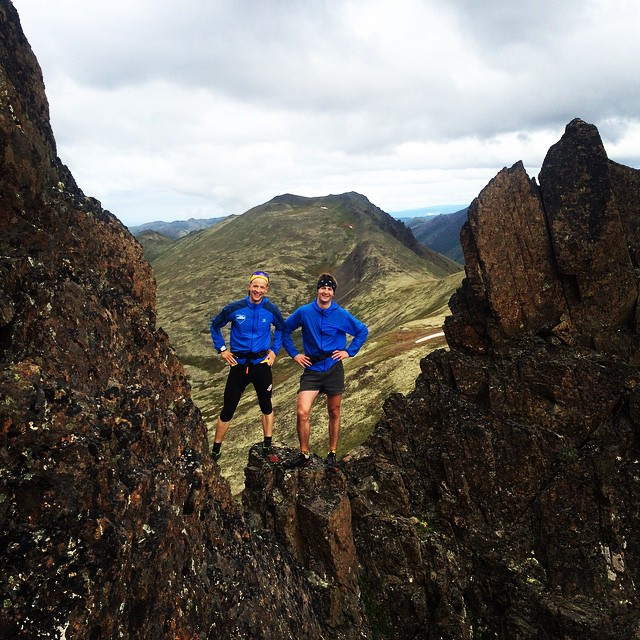
Eric Packer (l) with PK Kovacs “literally two minutes” before Packer fell more than 60 feet down a cliff. “When you see the photo, it is a very vivid illustration of just how unforgiving that terrain is in the Chugach Mountain Range,” Packer explained. (Photo: EricPacker.com)
EP: I was doing a mountain run with my teammates, I had a slight slip at just the wrong spot, then all of a sudden I was in free-fall. I dropped straight down 15 feet, then tumbled head over heels another 60 feet or so through this jagged boulder field. It was terrifying.
In terms of my actual injuries, I was incredibly fortunate for as bad as the fall was, I somehow managed to not break any bones, which still amazes me to this day. Don’t get me wrong though, it was still bad. I had bruises over my entire body and I felt like I had been hit by a bus. I think the hardest part was the mental side though, as the whole thing was so sudden and so unexpected. In a split second, I went from being a top level athlete to barely being able to get out of bed. The whole thing really scared me. It wasn’t necessarily what actually happened, as much as what could have happened. The doctors told me that at the speed I was traveling if I had hit my head, I easily could have been killed. What’s crazy is my teammate Scott Patterson took a photo of my teammate PK Kovacs and I literally two minutes before the fall happened, When you see the photo, it is a very vivid illustration of just how unforgiving that terrain is in the Chugach Mountain Range where we were running.
I was so banged up that I stayed home for a week with no training. Once I got the clearance from my doctor and PT to resume light activity, all I could do were easy walks. Even once I got to return to somewhat normal training, the first few workouts back were very hard on me, both mentally and physically. It hadn’t really been all that long since I was healthy, so it was still fresh in my mind how I should feel training, but I was just so far from away that, it was very hard to deal with. Not only was it very frightening how close I came to getting killed, but it was such a striking example how quickly you can lose everything.
I read the excellent interview you did with Tad Elliott about his struggles with illness and my situation is interesting because on one hand it is very similar but on the other hand, it is very different. In reality, mine was really more of a close call and the biggest impact was the mental side. Tad’s situation was long and drawn-out, but mine was very sudden and completely unexpected. So while I was very sore and completely out of commission for a few weeks, Tad’s situation played out over the course of several months or even years. What we most certainly have in common, though, is the changed perspective that these events brought on. I can’t speak for Tad, but I know in the end this accident actually ended up helping me.
FBD:One of the foci of this column is the role of adversity in success, as this is something that cross boundaries in all aspects of life. I don’t think there is any top level athlete that hasn’t had to come back from some type of setback, so describe how you were not only able to overcome this, but also how it actually helped lead you to national championship.
EP: Great question. I’ve thought about this a lot, as it is quite counter-intuitive that something like falling out a cliff could make you faster, but that’s exactly what happened. I got super lucky in that there was no lasting damage from my accident, but on the flip side I came very close to life-altering injury or worse. The whole time I wasn’t able to train there was certainly some anxiety about missing workouts, but overall I felt lucky — lucky that I survived and lucky that I still had the opportunity to ski race. Once I could get back to normal training, instead of feeling like I had to go out training, I now felt incredibly fortunate just to be able to go outside to do anything. Training became a privilege not a chore and I ended up having the best late summer/fall training of my career. In the end, that crazy accident helped me develop that little bit of extra motivation that I needed to take me to the next level.
I’m glad you brought this up too, as this phenomena is more common that you might think. My Alaska Pacific University teammate Scott Patterson was on that ill-fated run with me and he too had a similar experience last year. He was impaled by a ski in a freak accident and developed a pulmonary embolism. His injury was far more serious than mine also could have died. Scott also won a national championship this year in Houghton, with his win coming in the 15 k classic race. One of Kikkan’s [Randall] best seasons was preceded by her spending most of the summer in a walking boot due to a serious foot injury, yet that proved to be a breakthrough year for her too. What I went through is actually very insignificant compared to what each of them went through, but I think the common thread is that dealing with adversity helps you reach success.
“Training became a privilege not a chore and I ended up having the best late summer/fall training of my career.” — Eric Packer, 2016 classic sprint U.S. national champion
FBD:Crash or no crash, what would you say was the most significant contributing factor to your win?
EP: That’s easy. My team. I’m super lucky to be on the Alaska Pacific University ski team. I know I wouldn’t be where I am today if it wasn’t for this team. It is an amazing program. The coach, Eric Flora, was USOC coach of the year and that’s across all sports, not just skiing. If you trust your coach like all of us here at APU do, you don’t have to worry about your training. Our PT, Zuzana Rodgers, is also amazing. Thanks to her, I was able to get back from my accident much sooner than I thought was possible. The entire leadership group up here is so good that there is not too much more you could ask for as an athlete.
The training group is also unsurpassed. We all grew up together and began butting heads over 10 years ago in the local junior races. About two years ago we started getting everyone back together and the impact has been enormous. There is a commitment to group success that you don’t find a lot of other places. Choosing a path like triathlon or nordic skiing can be a lonely lifestyle, but when you have such a supportive team environment, it becomes a very fun journey.
Since we’ve know each other for so long, we’ve all had lots of ups and downs together and everyone really respects each other. We’ve all beaten each other in races, so everyone is well aware of that fine line between success and disappointment and how quickly the tables can turn on anyone. As a result, as a team we are not focused on the individuals, but rather on trying to move the whole group forward in a way that we haven’t yet seen in men’s skiing in the US.
FBD: In a way it is ironic that your accident happened running, as one of the central themes of this column is how good nordic skiing is for triathlon training and vice versa. Tell us a little bit about how you train for skiing in the offseason and how you think Nordic skiing can help triathletes
EP: One of my big goals this past offseason was to improve my running, as running is a very effective way to build your fitness base. As a result, running is very good for skiing and I believe that it carries over very well to both skate and classic technique. Going the other way, I think skate skiing is perfect winter training for cyclists as it has a lot of static loading of the muscles, while classic is best to improve your running. Triathletes should also keep in mind that both skate and classic are weight bearing but non-impact, so both are a perfect way to increase your training volume without a greatly increased chance of injury. And skiing is fun. I read your first article in this series and I couldn’t agree with your conclusions more – skiing is safe (very few cliffs on the tracks), warm, fun and overall excellent preparation for triathlon.
FBD:Let me ask you the same question I asked Tad Elliott, as it is such a relevant one to so many athletes that have dealt with illness or injury: what advice do you have for those in the process of working through this right now?
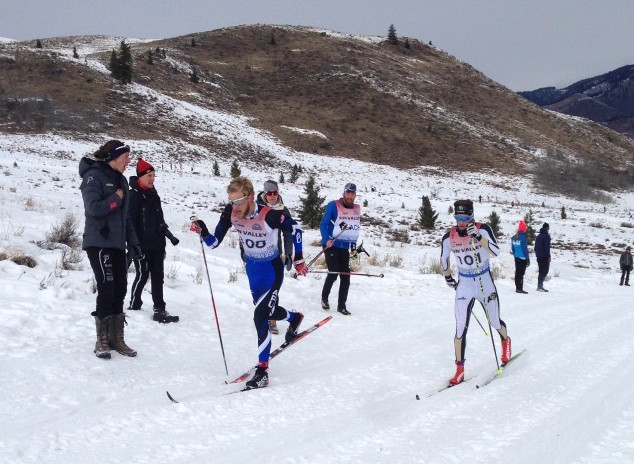
Eric Packer (l) and Mads Strøm (r) fight for second place on the last hill of their final lap of the men’s 15 k classic mass start at the December SuperTour in Sun Valley, Idaho. Strøm finished second and Packer placed third.
EP: The biggest piece of advice I can offer is to get qualified, objective advice right away. Being injured is incredibly frustrating and this makes it very hard to look at yourself analytically. A good coach, doctor or PT is both knowledgeable and objective. Injured athletes are usually neither of those things.
Every athlete should build a relationship with a coach, physical therapist and a doctor who really care about them and most importantly, understand them as both a person and as an athlete. When you’re injured, recovery is all about managing both the short-term and the long-term, so you need people who have perspective on both. I was intrigued when I read that Tad’s doctors and coaches started him back by sending him on short walks, as that is exactly what my team did for me. Would they give this same advice to a sedentary person? Maybe not, as that person might be content to just rest, but doing nothing would drive me crazy. Instructing an athlete to just sit still all day is probably some of the worst advice possible, so having people who understand this and are smart enough to prescribe an activity as safe and low-risk as walking is key.
What’s interesting, too, is the advice from the medical team can go both ways too: sure, they will often say, “take it easy, rest, recover, etc.,” but I’ve also had the opposite experience in which the issue I was dealing with I thought was serious, but the PT told me I could and should muscle through it. If I had been on my own, I would have lost valuable training time from an injury that wasn’t nearly as serious as I thought it was. Sometimes it is okay to train though pain, the key is knowing when this is a good idea and when it’s bad one, and you need to help to do this.
FBD: As a newly crowned national champion, what advice do you have everyone out there on their own journey, whether it is skiing, triathlon or any other endurance activity?
EP: The cool thing about endurance sport is that you get to choose your own destiny. It is really about the work that you do and how smart you are about recovery. When I first got started racing at a high level, this was hard for me to grasp. If I had a bad race, I’d blame my genetics, my skis and things I couldn’t control. But as soon I realized that I just wasn’t working as hard as others, that changed everything. It’s really about the work you put in. Once you understand and accept that you control your success, anything is possible.
FBD:You’ve had quite an eventful year. What is the most significant thing you learned?
EP: Take everything that comes at you, deal with it and no matter what, do not let the little things get to you. Everyone has to deal with adversity, what matters is how you respond.
Two days before my win in Houghton, I raced in the 30k that Tad won. I needed to get something like 10th place or better to qualify for a starting spot on the World Cup. This was a big goal for me and not only did I not do it, I wasn’t even close. To make matters worse, I got gapped off of the lead group at about 7 k in, so I just dangled in no-man’s-land for about 20k or so, knowing that I was missing this major goal. Earlier in my career, this would have stuck with me for a while and certainly ruined the rest of my races at nationals, but as a result of my accident, some great coaching from Flora and me figuring some stuff out on my own, I’ve learned to let things like this go quickly. So once that race was over, I only focused on what I could control: rest, recovery, good food, etc. I simply let the bad race go, moved on and prepared for the next race, and ended up winning for my first national championship.
Tad Elliott hammering for his fourth national title, and first one in four years, at 2016 U.S. Cross Country Championships earlier this month. Elliott (Ski & Snowboard Club Vail) won the 30 k freestyle mass start. (Photo: Christopher Schmidt)
Four days before Tad Elliott left Durango, Colo., for 2016 U.S. nationals in Michigan earlier this month, he did a brutal workout — his hardest one of the season.
“When using Firstbeat [heartbeat analysis] systems the last two years and going into Nationals, the files showed that I was a bit out of shape and hadn’t done enough hard training,” Elliott, a Ski & Snowboard Club Vail athlete, wrote in an email.
He couldn’t believe it; it certainly didn’t feel that way, but he trusted the data. So instead of allowing for a full recovery between intervals, he cut that rest time down.
What he was left with was what he calls the “Crumble Workout” — he pushes until he feels like he could crumble away.
Crumble Workout
(Elliott did this on “fast terrain at altitude trying to get ready for what the fast low courses at Houghton would feel like.”)
“I really think about moving quick. Moving my hands and legs fast,” he explained. “You can get away with it at low altitude but it hurts when you do it up high. Forcing myself to do it gets me sharper for low altitude.”
Full race warmup: 50 minutes. “I eat a bar partway through and make sure to hydrate well before and during the workout. During the 50 minutes, I do a 4-minute L3 [Level 3], then a couple of speeds to make sure I am really warm.”
Hard intervals: make each one better than the last, and aim to “blow up” during the last interval or two
2 minutes all-out
Recover: 1 minute Level 2 skiing
2 minutes all-out
Recover: 4 minutes easy
(Repeat 5 times)
Full cool down: 30 minutes, eating a protein bar immediately after and resting as needed.
“I blew up during the last two intervals. It hurt,” he recalled.
(Story continues below)
Tad Elliott doing a similar workout to the “Crumble Workout” on rollerskis last fall in Durango, Colo. (Courtesy photo)
Tad Elliott doing a similar workout to the “Crumble Workout” on rollerskis last fall in Durango, Colo. (Courtesy photo)
Last Saturday, he placed second to Kris Freeman in the 30 k White Mountain Classic in Jackson, N.H. Freeman double poled the entire classic race and edged Elliott by 1 second at the line.
“I tried to drop Kris before the finish and was blown before the finish,” Elliott wrote. “The course at White Mountain has hills for sure but the were over pretty quick and then a ton of downhill and flats. … Kris killed it I was impressed. I don’t think I could have double poled that course!”
Elliott is next headed to the SuperTours in Lake Placid, N.Y., this weekend and in Stowe, Vt., Feb. 6-7.
HOUGHTON, Mich. — The last day of racing at U.S. Cross Country Championships on the Michigan Tech Trails wrapped up last Saturday, Jan. 9, with the 1.5-kilometer classic sprint. At the end of the day, Alaska Pacific University’s Eric Packer and Craftsbury Green Racing Project’s Kaitlynn Miller both walked away with their first U.S. national title. From the qualifier, to the rounds, to the podium ceremony, FasterSkier provides the day’s top moments in photos. Special thanks to Christopher Schmidt.
Photo: Alaska Pacific University skier Eric Packer celebrates after crossing the line in first ahead of teammate Reese Hanneman during the men’s 1.5 k classic sprint on Saturday at U.S. nationals in Houghton, Mich. (Photo credit: Christopher Schmidt)
Photo: Didrik Elset of Michigan Tech University chose to double pole on skate skis from qualifier, shown here, all the way to the final during the men’s 1.5 k classic sprint on Saturday at U.S. nationals in Houghton, Mich. Elset went on to place third overall.
Photo: Cole Morgan racing for the University of Vermont during the qualifier for the men’s 1.5 k classic sprint on Saturday at U.S. nationals in Houghton, Mich. Morgan ultimately finished in eighth overall.
Photo: (left to right) Alaska Pacific University’s Reese Hanneman, Canadian Julien Locke of Team Black Jack, Håkon Hjelstuen of Lyn Ski, Didrik Elset of Michigan Tech University, Tyler Korfield of Alaska Pacific University, and Logan Hanneman, also of Alaska Pacific University, crest the top of a climb during their semi-final of the men’s 1.5 k classic sprint on Saturday in Houghton, Mich. Hanneman and Elset advanced automatically to the final, while Hjelstuen and Kornfield moved on as the two lucky losers. (Photo credit: Christopher Schmidt)
Photo: (left to right) Kris Freeman of Team Freebird and Scott Patterson of Alaska Pacific University follow Alaska Pacific University skier Eric Packer and Canadian Julien Locke of Team Black Jack during their quarterfinal of he men’s 1.5 k classic sprint on Saturday at U.S. nationals in Houghton, Mich. Packer raced to an overall first place, while Locke went on to place tenth.
Photo: Gaspard Cuenot tucking during his semi-final of the men’s 1.5 k classic sprint on Saturday at U.S. nationals in Houghton Mich. Cuenot raced to an overall ninth. (Photo credit: Christopher Schmidt)
Photo: (right to left) Reese Hanneman of Alaska Pacific University leads Michigan Tech University Didrik Elset, Canadian Julien Locke of Team Black Jack, and younger brother Logan Hanneman, also of Alaska Pacific University during the first semi-final of the men’s 1.5 k classic sprint race on Saturday at U.S. nationals in Houghton, Mich. (Photo credit: Christopher Schmidt)
Photo: (right to left) Dakota Blackhorse-von Jess of the Bend Endurance Academy Eric Packer of Alaska Pacific University, and Cole Morgan of the University of Vermont round a corner during the men’s 1.5 k classic sprint race on Saturday at U.S. nationals in Houghton, Mich. Blackhorse-von Jess advanced to the final as did Packer. Packer ultimately won first place overall, while Blackhorse-von Jess skied to a fifth place finish in the final and Morgan finished in eighth. (Photo credit: Christopher Schmidt)
The start of the men’s classic sprint final (from left to right), with Didrik Elset of Michigan Tech, Dakota Blackhorse-von Jess of Bend Endurance Academy ), Tyler Kornfield (APU), and Reese Hanneman (APU) at the start of the final for the men’s 1.5 k classic sprint on Saturday at U.S. nationals in Houghton, Mich. (Photo: Christopher Schmidt)
APU head coach Erik Flora (98) runs alongside his athletes Eric Packer (5) and Reese Hanneman during (4) the final of the men’s 1.5 k classic sprint at U.S. nationals in Houghton, Mich., in January 2016. (Photo: Christopher Schmidt)
Photo: (left to right) Alaska Pacific University skier Eric Packer double poles to his first ever U.S. nationals championship title, ahead of teammate Tyler Kornfield, Bend Endurance Academy racer Dakota Blackhorse-von Jess, Lyn Ski racer Håkon Hjelstuen, Alaska Pacific University skier Reese Hanneman during the final of the men’s 1.5 k classic sprint race on Saturday at U.S. nationals in Houghton, Mich. (Photo credit: Christopher Schmidt)
Photo: Alaska Pacific University’s Eric Packer (center) is all smiles as he stands at the top of the podium next to second place finisher and teammate Reese Hanneman (r) and third place finisher Didrik Elset of Michigan Tech University after the men’s 1.5 k classic sprint on Saturday at U.S. nationals in Houghton, Mich.
Photo: Katharine Ogden skiing for Stratton Mountain School during the qualifier for the women’s 1.5 k classic sprint race on Saturday at 2016 U.S. nationals in Houghton, Mich.
Photo: (left to right) Sun Valley Ski Education Foundation skier Deedra Irwin, Stratton Mountain School racers Katharine Ogden and Erika Flowers, along with Dartmouth College racer Corey Stock, Bridger Ski Foundation’s Jennie Bender and Northern Michigan skier Nicole Schneider striding up the first climb in their quarterfinal of the women’s 1.5 k classic sprint on Saturday at U.S. nationals in Houghton, Mich. Aer advancing to the semi-final and final, Bender raced to a third place finish overall, while Ogden took eighth. (Photo: Christopher Schmidt)
Photo: (left to right) Northern Michigan University’s Sarah Bezdicek and Felicia Gesior, stride up a climb behind Heather Mooney of the Craftsbury Green Racing Project and Alaska Pacific University’s Jessica Yeaton during their quarterfinal of the women’s 1.5 k classic sprint on Saturday at U.S. nationals in Houghton, Mich. Mooney raced to a tenth place finish overall; Gesior took ninth. (Photo credit: Christopher Schmidt)
Photo: Craftsbury Green Racing Project skier Liz Guiney (center) makes her way around a corner ahead of Northern Michigan University’s Lea Buenter (r), University of Alaska Fairbanks skier Nicole Bathe and Stratton Mountain School racer Julia Kern during their quarterfinal of the women’s 1.5 k classic sprint on Saturday at U.S. nationals in Houghton, Mich. Guiney advanced to the semifinal and finished the day in seventh overall. (Photo credit: Christopher Schmidt)
Photo: (left to right) Stratton Mountain School skier Anne Hart strides up a climb ahead of CXC racer Natalia Naryskina, and Alaska Pacific University’s Becca Rorabaugh during their semi-final of the women’s 1.5 k classic sprint on Saturday at U.S. nationals in Houghton, Mich. All three women advanced to the final, where Hart placed second overall, Naryskina sixth, and Rorabaugh fifth. (Photo credit: Christopher Schmidt)
Photo: (right to left) Kaitlynn Miller of the Craftsbury Green Racing Project corners the final turn into the finishing stretch ahead of Bridger Ski Foundation athlete Jennie Bender and CGRP skier Caitlin Patterson during their semi-final of the women’s 1.5 k class sprint on Saturday at U.S. nationals in Houghton, Mich. (Photo credit: Christopher Schmidt)
Photo: (left to right) Craftsbury Green Racing Project skier, Kaitlynn Miller out sprints Alaska Pacific University’s Becca Rorabaugh, Bridger Ski Foundation’s Jennie Bender, and Stratton Mountain School skier Anne Hart during the final 100-meters of the final for the women’s 1.5 k classic sprint on Saturday at U.S. nationals in Houghton, Mich. Miller took first, while Hart placed second, Bender third, and Rorabaugh fifth. (Photo credit: Christopher Schmidt)
Photo: (left to right) Anne Hart of Stratton Mountain School along with Craftsburu Green Racing Project Kaitlynn Miller and Bridger Ski Foundation athlete on top the women’s 1.5 k classic sprint podium on Saturday at U.S. nationals in Houghton, Mich. (Photo credit: Christopher Schmidt)
Photo: (left to right) Kaitlynn Miller of the Craftsbury Green Racing Project stands with teammates Heather Mooney and Liz Guiney after winning her first championship title in the women’s 1.5 k classic sprint on Saturday at U.S. nationals in Houghton, Michigan. Mooney raced to a tenth place finish overall and Guiney finished seventh. (Photo credit: Christopher Schmidt)
HOUGHTON, Mich. — Day 1 of the 2016 U.S. Cross Country Championships began with the women’s 10-kilometer and men’s 15 k classic individual starts on Sunday at the Michigan Tech Trails.
Caitlin Patterson (Bib no. 333) of the Craftsbury Green Racing Project is the races to first place overall finish in the women’s 15 k classic individual start on Sunday at U.S. nationals in Houghton, Mich. Her brother, Scott Patterson of Alaska Pacific University also took first in the men’s event. (Photo: Christopher Schmidt)
Alaska Pacific University’s Scott Patterson (r) leading Northern Michigan’s Adam Martin during the men’s 15 k classic individual start on Sunday at U.S. nationals in Houghton, Mich. Patterson took first in 40:26.4 and Martin third (+20.6). (Photo: Christopher Schmidt)
Alaska Pacific University’s Scott Patterson (l) leads Northern Michigan’s Adam Martin during the second lap of the men’s 15 k classic individual start on Sunday at U.S. nationals in Houghton, Mich. Patterson won the individual start in 40:26.4 and Martin placed third (+20.6). (Photo: Christopher Schmidt)
The Alberta World Cup Academy’s Kevin Sandau striding it out during the first lap of the men’s 15 k classic individual start on Sunday at U.S. nationals in Houghton, Mich. Sandau went on to place second overall (+19.0).
Alaska Pacific University’s Chelsea Holmes racing to a third place finish overall in the women’s 15 k classic individual start on Sunday at U.S. nationals in Houghton, Mich. (Photo: Christopher Schmidt)
Left to right: Alaska Pacific University’s Eric Packer powers around a corner ahead of Stratton Mountain School/U.S. Ski Team’s Paddy Caldwell and Team Gregg/Madshus’ Brian Gregg during the men’s 15 k classic individual start on Sunday at U.S. nationals in Houghton, Mich.
Kaitlynn Miller of the Craftsbury Green Racing Project racing to a second place finish overall in the women’s 15 k classic individual start on Sunday at U.S. nationals in Houghton, Mich. (Photo: Christopher Schmidt)
Alaska Pacific University’s Becca Rorabaugh (r) gets splits early on from APU head coach Erik Flora during the women’s 15 k classic individual start on Sunday at U.S. nationals in Houghton, Mich. Rorabaugh went on to finish fifth overall (+1:09.0).
Katharine Ogden of the Stratton Mountain School and U.S. Ski Team races to a fourth place finish overall (+1:05.1) in the women’s 15 k classic individual start at U.S. nationals in Houghton, Mich. (Photo: Christopher Schmidt)
Brian Gregg of Team Gregg/Madshus striding during the men’s 15 k classic individual start on Sunday at U.S. nationals in Houghton, Mich. Gregg placed fifth overall. (Photo: Christopher Schmidt)
Boulder Nordic Junior Racing Team’s Eliska Hajkova races to a sixth place finish overall in the women’s 15 k classic individual start on Sunday at U.S. nationals in Houghton, Mich.
Kris Freeman of Team Freebird strides to a sixth place finish overall (+40.8) during the men’s 15 k classic individual start on Sunday at U.S. nationals in Houghton, Mich.
Canadian Kevin Sandau (Alberta World Cup Academy) racing to second place in the men’s 15 k classic individual start on Sunday at U.S. nationals in Houghton, Mich. (Photo: Christopher Schmidt)
Alaska Pacific University’s Lex Treinen during his second lap of the men’s 15 k classic individual start on Sunday at U.S. nationals in Houghton, Mich. Treinen went on to place eight overall (+52.5).
Matt Liebsch of Gear West/Salomon and Sun Valley Ski Education Foundation’s Miles Havlick head towards the finishing stretch of the men’s 15 k classic individual start on Sunday at U.S. nationals in Houghton, Mich. Liebsch finished ninth overall (+57.3).
Stratton Mountain School’s Anne Hart leads teammate Erika Flowers to the finish of the women’s 15 k classic individual start on Sunday at U.S. nationals in Houghton, Mich. Hart placed eighth overall (+2:44.4) while Flowers took tenth (+3:03.4).
Central Cross Country’s Kyle Bratrud coming into the finishing stretch during the men’s 15 k classic individual start on Sunday at U.S. nationals in Houghton, Mich.
Alaska Pacific University’s Rosie Frankowski (r) receives splits from APU head coach Erik Flora during the women’s 15 k classic individual start on Sunday at U.S. nationals in Houghton, Mich. Frankowski finished ninth overall (+1:52.8).
Northern Michigan University’s Ian Torchia skiing to a seventh place finish (+ 47.8) on Sunday during the men’s 15 k classic individual start on Sunday at U.S. nationals in Houghton, Mich. His teammate, Adam Martin (NMU) (not shown) took second overall.
Alaska Pacific University’s Eric Packer was the third American and fourth overall in the men’s 15 k classic on Sunday at U.S. nationals in Houghton, Mich. (Photo: Christopher Schmidt)
Thunder Bay Nordic Development Center’s Michael Somppi (l) in front of Northern Michigan University’s Fredrik Schwencke (NMU) during the first lap of the men’s 15 k classic individual start on Sunday at U.S. nationals in Houghton, Mich. Somppi skied to a 10th place finish overall (+57.9).
The Craftsbury Green Racing Project women’s team: (from l to r) Caitlin Patterson, Kaitlynn Miller, coach Pepa Miloucheva, Liz Guiney, and Heather Mooney after the women’s 15 k classic individual start on at 2016 U.S. nationals in Houghton, Mich. Patterson and Miller placed first and second, respectively, on Sunday in the women’s 10 k classic on Day 1 of U.S. nationals.
HOUGHTON, Mich. — It is the eve of the first day of racing at U.S. Cross Country Championships and racers have arrived from around the country and brought an air of excitement and energy to the town of Houghton.
Houghton is situated in the Keewanaw peninsula, Michigan’s Upper Peninsula, near the northernmost tip of the state. Since it is not “on the way” anywhere, and many hours from any major city, you are not likely to find yourself in Houghton unless it is your destination.
However, Houghton is a cross-country ski mecca of the Midwest that draws skiers from around the country to enjoy 25 kilometers of world-class groomed trails on the campus of Michigan Tech University. The Michigan Tech trails are homologated, according to International Ski Federation (FIS) and U.S. Ski & Snowboard Association (USSA) standards, and thus able to host high-profile races.
Nationals are held at the same venue for two consecutive years and this is Houghton’s second year hosting the event following a frigid and snowy 2015 nationals. Houghton also hosted U.S. nationals in 2007-2008, the last time the event was held in the Midwest.
“We have a really good trail system that provides a good challenge to racers. I think we can have fair races because generally we have consistent conditions across the day,” said Joe Haggenmiller, head nordic coach at Michigan Tech University (MTU) and co-chair of the race organization committee.
Although coordinating a team trip to Houghton can be a logistical challenge, Houghton provides a great race venue with no shortage of community support.
“Our community is really excited to host it. We have a core of 20 people who are really dedicated and put a lot of time into this event and we have a group of about 100 volunteers who are ready to help,” Haggenmiller said.
The community support of the event was illustrated last weekend when nearly 100 people attended a work bee at the trails. Despite snow shortage concerns in mid-December, Houghton was reporting great ski conditions as of two weeks ago. However, Mother Nature was not finished throwing curve balls. On Dec. 23, Houghton weathered heavy rains and 50-70 mile per hour winds which created an icy, debris strewn trail. The race organizers sent out a call for help and the volunteers came out in force.
Volunteers took to the trail in groups assigned to a section of trail they would rake clear of debris. Together the teams raked all 25 k of trails just before another four inches of snow fell. This made the distance courses viable instead of the “low-snow” 2.5 k course that was beginning to look like reality. To ensure the courses would withstand a week of racing, work crews hauled 30 cubic meters of snow onto the course, mostly on the downhill corners.
“The conditions are really nice. They tilled last night and we set full depth tracks today,” said Jim Tervo, chief of competition. “It is really mid-season form, we are really pleased with the way it turned out.”
“Tomorrow should be a really fun day for the athletes because I think the kickwaxing should be pretty straightforward and it should be pretty fast,” Haggenmiller said. “I think the athletes will enjoy getting around the course well in mild conditions.”
U.S. Nationals 2016 Race Schedule:
Sunday, Jan. 3
Men’s 15 k classic individual start
Women’s 10 k classic individual start
Monday, Jan. 4
Men’s and Women’s 1.5 k freestyle sprint
Thursday, Jan. 7
20/30 k freestyle mass start
Saturday, Jan. 9
Men’s and women’s 1.5 k classic sprint
The Course
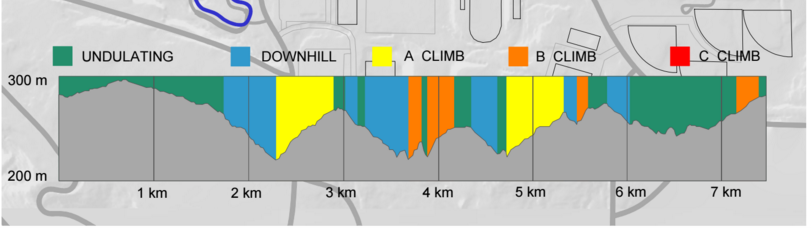
The entire schedule of races for nationals week will utilize the sprint course, 5 k course, 7.5 k course, and 10 k course. Each course is a variation of the same core loop. Sunday’s races: the women’s 10 k classic, will be 2 laps of 5 k,and the men’s 15 k classic will be 2 laps of 7.5 k.
The course features significant elevation change both in the form of steep, short climbs and long, gradual grinds. Several downhill sections require technical finesse, especially in fast conditions.
Several sections of the course will likely prove to be decisive:
Hairpin loop: This section is part of every distance race and includes a long gradual descent to a hairpin turn and then back up a grinding 7 percent grade for 0.3 miles. Racers will be carrying significant speed into the hairpin turn and will have to be prepared for the possibility of washed-out sections.
Peepsock climb: This is a 4 percent grade over 0.4 miles leading into the finishing stadium which will likely prove decisive in the mass start races. The 5 k course cuts off a portion of this section but still features a significant climb into the finishing straightway.
Elevation profile of the 7.5 k course being used for U.S. nationals at the Michigan Tech trails in Houghton, Mich.
Racing kicks off with individual start classic races on Sunday. The men’s 15 k begins at 10 a.m. Eastern time and the women’s 10 k at 1 p.m.
Live results can be found at Superior Timing and the event will also be live streamed courtesy of a partnership between Central Cross Country Ski Association (CXC) and USSA.
Craftsbury Green Racing Project’s Liz Guiney (l) and head coach Pepa Miloucheva during a ski on Saturday, Jan. 2 in Houghton, Mich., the day before the kickoff of 2016 U.S. nationals.
A Dartmouth skier heads out onto the Michigan Tech trail’s 5 k course on Saturday, Jan. 2, the day before 2016 U.S. nationals.
Kevin Sandau (l) of the Alberta World Cup Academy during a classic ski on the Michigan Tech trails in Houghton, Mich., on Saturday, Jan. 2, the day before the start of 2016 U.S. nationals.
Julia Kern (SMS/USST) testing skis early Saturday morning, prior to the start of U.S. nationals in Houghton, Mich.
Hannah Halvorsen (Sugar Bowl Ski Academy) amidst a group of APU skiers in the starting area on Saturday, Jan. 2, the day before the start of 2016 U.S. nationals.
Bridger Ski Foundation athletes Akeo Maifeld-Carrucci (l) and Jennie Bender soak up some precious Houghton sun on Saturday, Jan. 2 in Houghton, Mich., the day before the start of 2016 U.S. nationals.
Two Canadian athletes round their way back into the stadium Saturday, Jan. 2, the day before the kick-ff of 2016 U.S. nationals.
Last year on the Michigan Tech Trails during the 2015 U.S. Cross Country Championships in Houghton, Mich. While the lake-effect snow made for a grooming headache for the last year’s classic sprint, organizers are dealing with a different issue of low snow this year.
Although it continues to feel like fall across much of the Midwest, race organizers and USSA officials have announced that the 2016 U.S. Cross Country Championships will be held as scheduled in Houghton on Michigan’s Upper Peninsula.
Racing will include four days of competition beginning Jan. 3 and concluding Jan. 9 on the Michigan Tech trails. Head nordic coach of Michigan Tech University and co-chair of the race organizing committee Joe Haggenmiller recently outlined important information about the upcoming championships.
Despite unseasonably warm weather and low snow accumulations, the skiing in Houghton is currently quite good, he explained. This past weekend brought 12-14 inches of new snow on top of an icy base. After grooming, the trails have 2-4 inches of packed powder.
Although the situation is currently much better than it was a week ago, the forecast leading up to the race still may pose challenges. Rain is predicted on Wednesday and the trails will be closed to skiing in the effort to preserve the course. Clean snow is being gathered from the airport and other areas of town to patch the course if necessary.
With a priority of maintaining the course, the race course may be closed on non-official training days before and during race week. Alternate trail systems including Swedetown or Chassell trails will be options for training on these days. Course condition information on these trail systems can be found here.
Depending on the conditions, the courses might be changed. Snow-cover efforts will be focused on a 2.5-kilometer “low snow” course in case it needs to be utilized for the distance races. These decisions will be announced after the technical delegates review the course conditions and options on Dec. 31.
Early Season Challenges
Leading up to these races, in Houghton’s second-straight year of hosting U.S. nationals, it has been a frustrating season so far for skiers and coaches alike in the Midwest. Haggenmiller was one of them, with a responsibility made more stressful when the weather doesn’t cooperate.
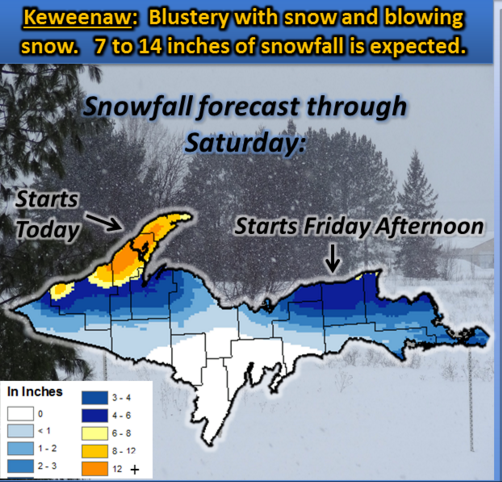
Houghton race organizers for 2016 U.S. nationals posted this forecast on Facebook last Thursday, Dec. 17.
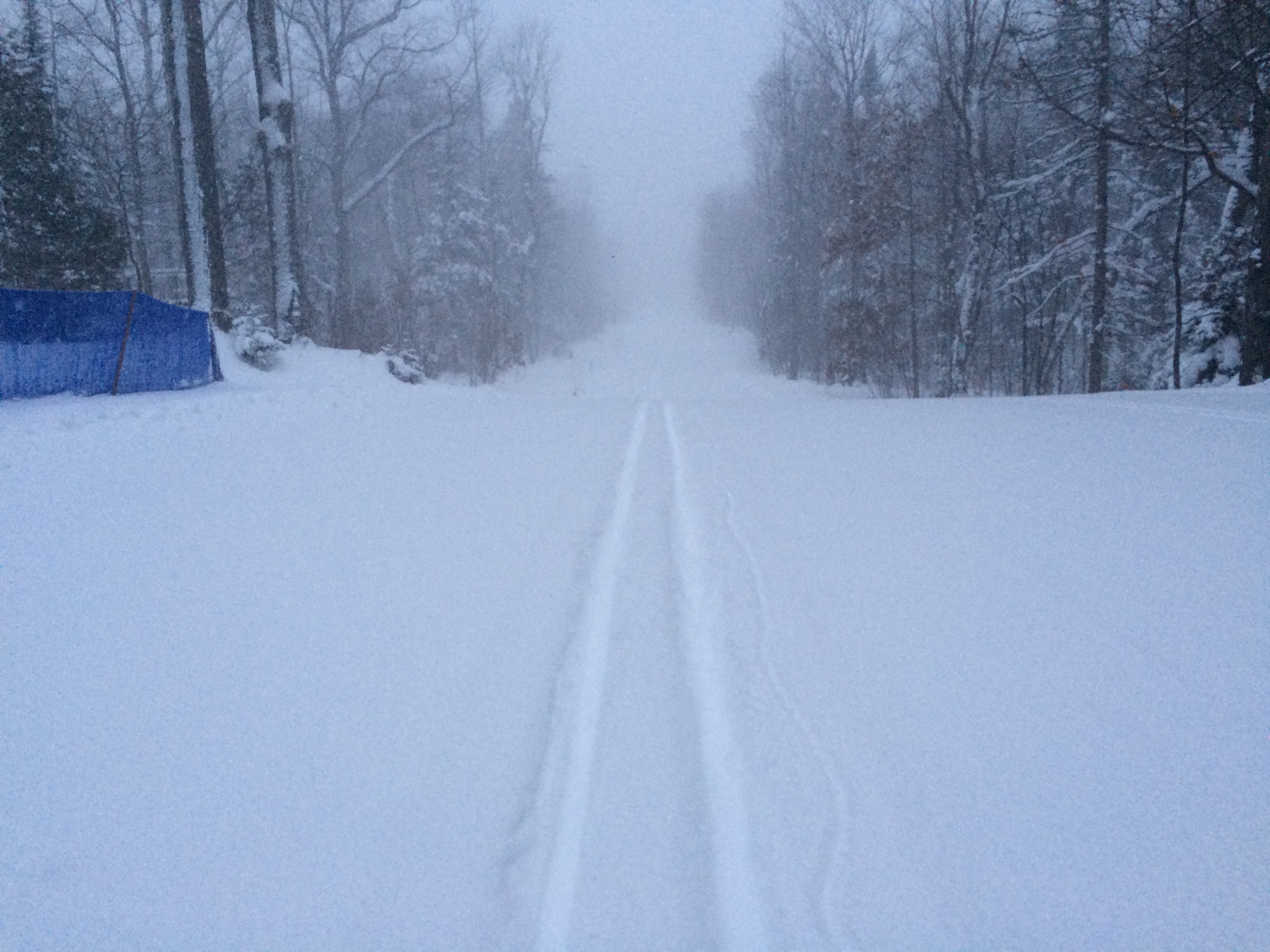
But nearly a week ago on Dec. 17, the Michigan Tech trails received 6-8 inches of now overnight and it continued to snow the next day.
“The snow that came down last night is decently dense stuff,” Haggenmiller said last Friday. He spoke to FasterSkier on the phone during a ski on the Michigan Tech trails, and noted he was using his good skis (as opposed to rock skis). “As they are rolling it, it’s probably giving us 2+ inches of base.”
Usually having adequate snow in January is not a problem for Houghton, which receives an average annual snowfall in excess of 200 inches and over 50 inches in December. However, weeks of unseasonably warm weather and little snowfall in Houghton and much of the Midwest brought concern about the feasibility of hosting a national championship in early January.
On Dec. 15, Haggenmiller released a statement outlining the viable options if the weather continued to be unfavorable, including farming snow to cover the sprint and 2.5 k courses, moving the races to the Michigan Tech’s alpine area, Mont. Ripley, with snowmaking capabilities, or moving the race venue to somewhere else in the Central region with better snow.
Mont Ripley, an alpine area owned by Michigan Tech University, as seen last year during 2015 U.S. Cross Country Championships in Houghton, Mich.
However, with more snow in the time since and an updated weather forecast, the nationals organizers are confident they’ll be able to stay put and stick to the trails used last year.
On Wednesday morning, a five-day forecast predicted temperatures dropping from above freezing on Wednesday down to the mid-20s by Sunday. Beyond that, temperatures are expected to stay well below freezing, with daily highs in the mid-20s and snow off and on throughout next week.
For updates, follow the U.S. Cross Country Ski Championships website or Facebook page.