Tag: 2016 YOG

  • Levins Goes ‘Back to Basics’ for 4th in IBU Youth Worlds Pursuit; Bankes Scores 3rd Top 20 in Osrblie

    Levins Goes ‘Back to Basics’ for 4th in IBU Youth Worlds Pursuit; Bankes Scores 3rd Top 20 in Osrblie

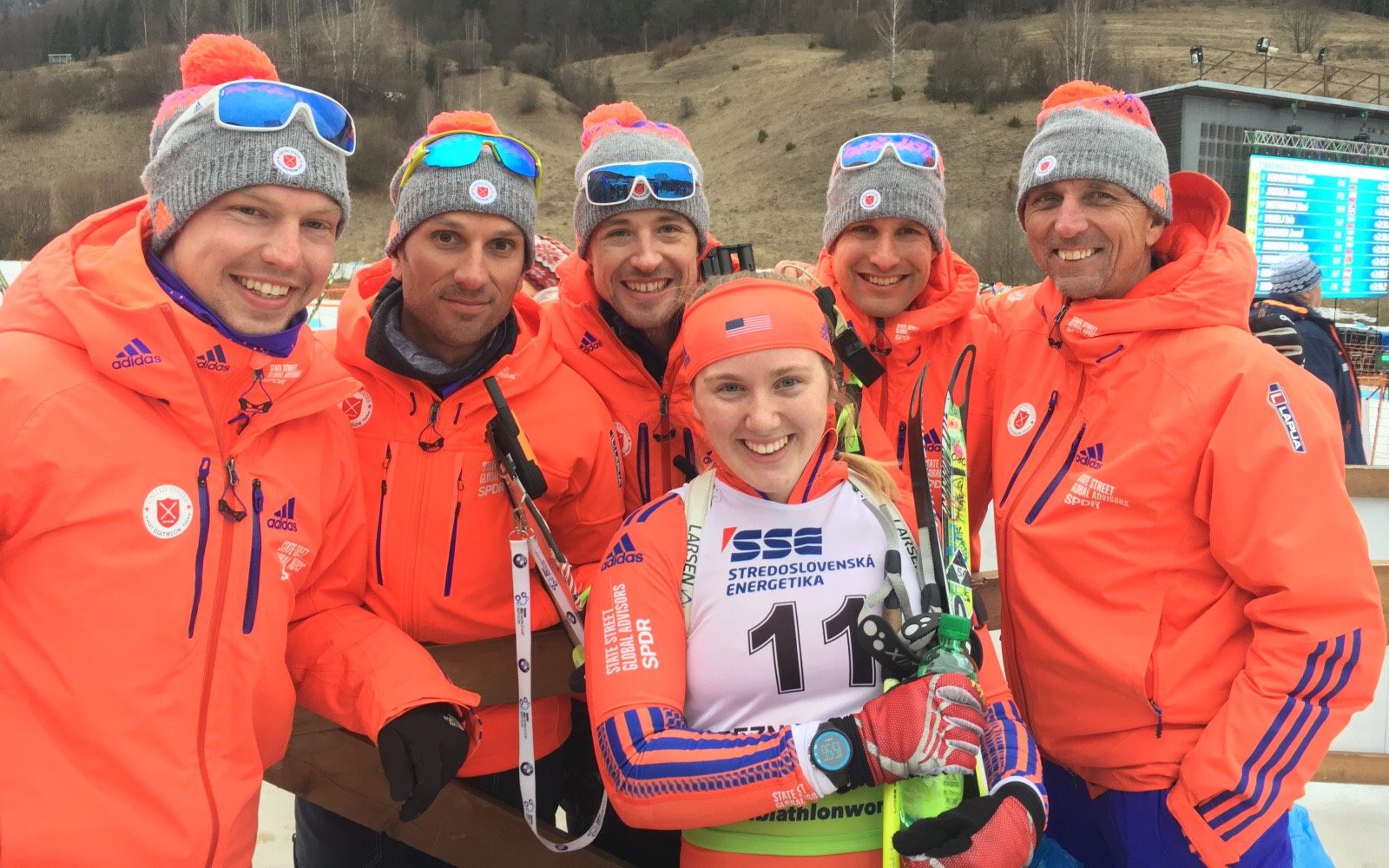
    Chloe Levins (11) with her US Biathlon support team (from left to right: Erik Lewish, Travis Voyer, Mathias Zacherl, Robert Gorgos, and Algis Shalna) after her fourth-place finish in the youth women’s 7.5 k pursuit, her career best in her third IBU Youth World Championships, on Sunday in Osrblie, Slovakia. (Photo: USBA)

    At just 18 years old, Chloe Levins has the wisdom of a seasoned veteran when it comes to biathlon. She accepts the inevitable ups and down of her sport, works hard to focus on herself and no one else, and treats every race as a learning experience.

    All of the above are often easier said than done. But Levins seems to have her head in the right place and the results are following. In three individual races over the past week at Youth World Championships in Osrblie, Slovakia, she’s finished in the top 15. On Sunday in the youth women’s 7.5-kilometer pursuit, she rocketed to fourth — tying her career-best result in an international race.

    “In my mind, I’m still a baby in this sport,” Levins wrote in an email on Sunday. “As we saw last week, Lowell [Bailey] prepared for two decades before winning a World Championship title. Today’s race was simply more preparation for the future. Every race is a learning experience, and every race that you’re in contention is an even better learning experience. So for now, I’ll keep learning.”

    A Middlebury freshman who plays collegiate golf in the spring and fall, Levins had previously finished fourth at last year’s Youth Olympic Games in Lillehammer, Norway. There, she started the pursuit in 22nd and rocketed to fourth, one spot off the podium. On Sunday, she started 11th, based on her sprint result on Friday, and shot 18-for-20 to finish fourth, 1:55.5 minutes out of first and 47 seconds out of third.

    Levins started the race by skiing around 11th for the first loop, then missed her first and last shots in the first shooting stage. That put her back in 17th heading out on her second loop, and she proceeded to clean the next three stages to work her way up to seventh before her final loop. There, she passed three more competitors to end up fourth.

    “After missing two, I got out of my own way and went back to basics,” Levins recalled. “My coach, Algis Shalna, always says, ‘Do what you normally do.’ The trick is believing that what you normally do will be good enough. Today, it was really close.”

    “There’s a fine line between being too cautious and perfectly aware in shooting,” she added. “That was the difference between my first shooting and the last three today.”
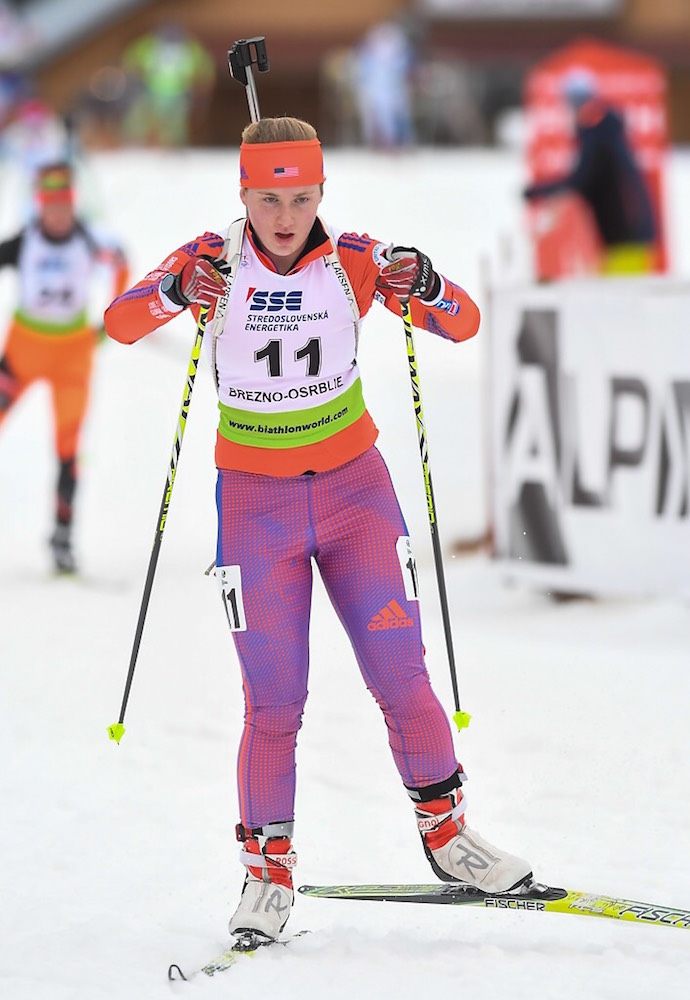
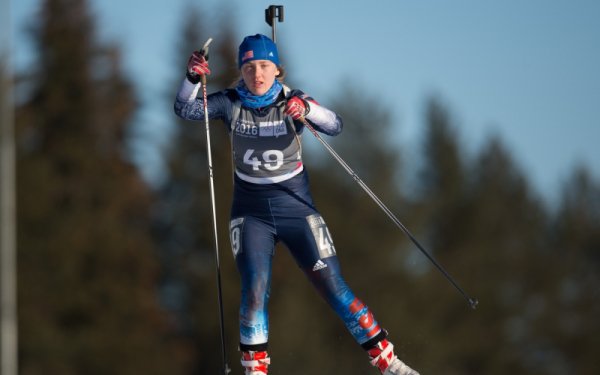
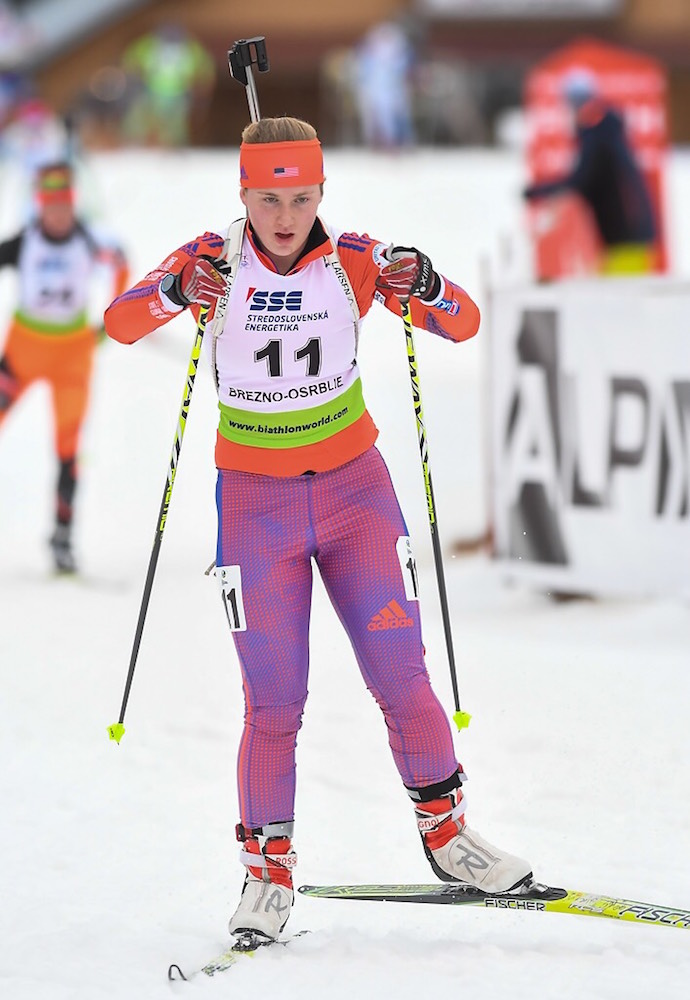
    American Chloe Levins racing to fourth in the youth women’s 7.5 k pursuit on Sunday in Osrblie, Slovakia, for her best result at her third IBU Youth World Championships. (Photo: USBA)

    She attributed her fast skiing (with the 11th-fastest course time) to “lightning” skis.

    “The wax guys have been making fantastic skis all week, and I can’t thank them enough,” she said of US Biathlon’s staff. “The team staff gave me some information on the last loop, but I didn’t hear them. I was in a different world, fighting for a medal in my mind’s eye. Honestly, I’m not quite sure when I passed the three girls who left the range in front of me. The track was really crowded with competitors that were on their fourth loop. If I were to guess, I passed one girl on the first hill out of the stadium and the other two on a flat .25k before the finish.”

    Ahead of her, Italy’s Irene Lardschneider secured her second-straight gold medal after winning Friday’s sprint and starting 1 minute and 7 seconds ahead of anyone else in the pursuit. She had four penalties, which came in the last two standing stages (0+0+2+2), but held onto first in 26:57.1. France’s Lou Jeanmonnot-Laurent finished 24.4 seconds later after skiing up from fourth at the start to second place, with a single miss (0+0+1+0). For the second-straight race, Italy’s Samuela Comola claimed bronze (+1:08.5) after starting third and shooting two penalties (1+0+1+0).

    Then there was Levins, who started 1:40 out of first and was one of six women to shoot 90 percent or better.

    “It kills me to come short of medal for the second year in a row, but it also makes me that much more hungry for next opportunity to compete,” Levins wrote. “Even though there’s no medal around my neck, shooting 90% and having the fastest ski time on the last loop are things to smile about.”

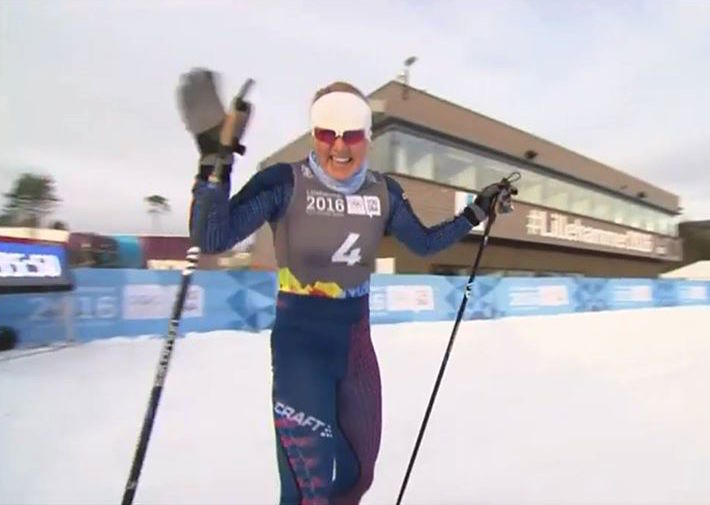
    Before the championships began, Levins told FasterSkier that the best advice anyone ever gave her about skiing or racing was to smile. And that’s been the running theme of her week.

    “I smile about the fact that I set three consecutive personal bests this week at Jr World Champs,” she wrote on Sunday. “It’s the ‘what ifs’ that give me motivation for the next. I’m leaving Slovakia with more drive than ever. There are many areas in shooting and skiing I can improve upon for next season. I’m really looking forward to getting down to work.”

    Levins led four North Americans in the youth women’s pursuit, with her U.S. teammates Amanda Kautzer and Grace Gilliland finishing 42nd and 53rd, respectively. Kautzer started 59th and picked off 17 places despite missing four targets (1+0+2+1) and finished 6:16.2 back. Gilliland started 55th and improved two places with six penalties (2+3+1+0), finishing 8:32.1 out of first in 53rd. Canada’s Shilo Rousseau followed in 54th (+9:02.1) with eight misses (3+1+2+2) after starting 45th.

    The youth women end the championships with the 3 x 6 k relay on Monday. Canada is entering Frédérique Pérusse, Rousseau, and Anna Sellers, while the U.S. team is Levins, Kautzer and Gilliland.

    Also on Monday, the youth men will race a 3 x 7.5 k relay. Thomas Hulsman, Adam Runnalls and Leo Grandbois are listed to start for Canada, and Vasek Cervenka, Jacob Pearson and Alex Kilby are listed for the U.S.

    Sprint Top 20 for Bankes, Ellingson; Bankes 16th in Pursuit

    In the junior women’s 10 k pursuit, Canada’s 19-year-old Megan Bankes capped off her gold-medal week with her third top 20. Bankes previously won the 12.5 k individual last Thursday, then finished 13th in Saturday’s 7.5 k sprint.
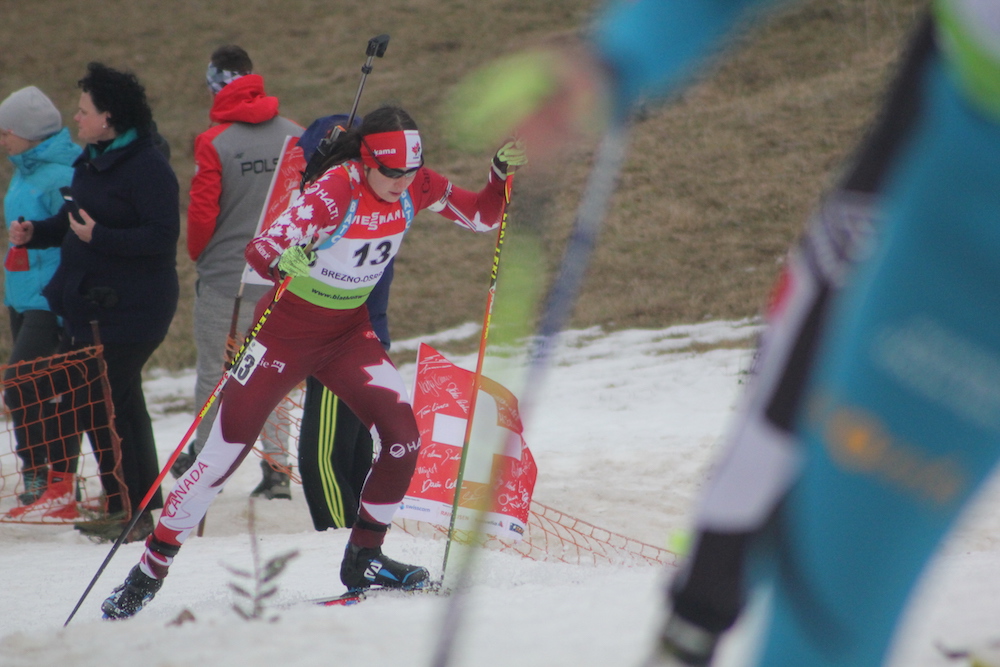
    Megan Bankes racing to 16th in Sunday’s junior women’s 10 k pursuit at IBU Junior World Championships in Osrblie, Slovakia. (Photo: Jacqueline Akerman)

    Going into Sunday’s pursuit, she made a goal to stay calm and focused and “overall just have a fun time racing the pursuit, and see how much I can move up!”

    She started 1:25 minutes behind the leader, Italy’s Michela Carrara, the winner of the sprint who left the pursuit starting gate with a 15-second head start. After cleaning the first prone stage, Bankes was up to ninth and 54 seconds out of first.

    Over the next three stages, Bankes missed four targets and had to ski four penalty laps as a result. The first miss on the second prone stage put her in 11th, then she slipped to 19th with two misses in the first standing. On the final standing stage, Bankes missed one more to leave the range in 20th. Before the finish, she picked off four skiers to take 16th place across the line. She finished 2:15.8 minutes behind Russia’s Valeriia Vasnetcova, who won the race with clean shooting. Vasnetcova was the only woman in the field to do so; in fact, she was the only racer — woman or man — that hit all 20 targets between four races on Sunday.

    Vasnetcova had started the pursuit in 24th, 1:52 out of first, and taken the lead by after cleaning the last stage. She posted the fastest course time as well and notched a 10-second victory, finishing in 31:49.5 minutes for her first medal of these championships (she also won gold in the relay last year with her Russian team at Youth Worlds in Romania).

    Carrara ended up second after missing three (1+1+1+0), and Norway’s Ingrid Tandrevold also picked up her second-straight medal, after starting second and finishing third (+10.8), with two penalties (0+0+1+1).

    While Bankes could not be reached for comment after Sunday’s race, she was pleased with her 13th place on Saturday.

    “My skiing felt pretty solid, and only 2 misses is pretty good for a sprint for me,” she wrote of her s8-for-10 shooting (1+1). “13th place is still pretty stellar…”

    Asked what it’s been like coming off a world-championship win, Bankes, who hails from Calgary and trains with the Biathlon Alberta Training Centre in Canmore, Alberta, explained she’s received a fair amount of media attention, “especially from back home, or at least way more than I’m used to!” she wrote on Saturday. “I’ve just been trying to focus on the next races, it’s still fairly surreal for me to be Junior World Champ for the individual, so I’m still fairly excited about that, but i’m trying not to get caught up in that and look forward to the next races as well.”
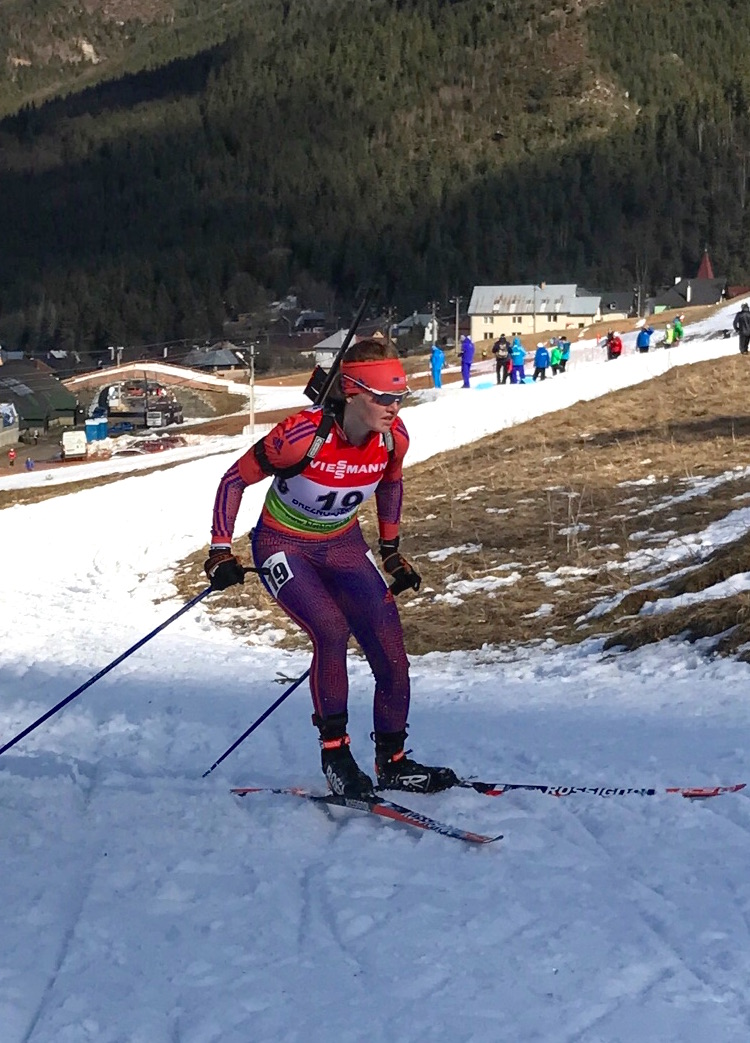
    American Siena Ellingson racing to 18th on Saturday in the junior women’s 7.5 k sprint in Osrblie, Slovakia, for her best result in her fourth IBU Youth/Junior World Championships. (Photo: Erik Lewish)

    The second North American in the top 20 of Saturday’s sprint, Siena Ellingson of the U.S. posted the first individual top 20 of her career in her fourth Youth/Junior Worlds. She finished 18th, 1:38.7 out of first, with a single standing penalty (0+1).

    In an email on Saturday, the 20-year-old Ellingson, of Minnetonka, Minn., explained that she had a tricky zero, which is the standard pre-race target practice.

    “The wind was switching back and forth so it was hard to get a good confirmation, I had to leave it where it was and start the race,” she wrote. “Having confidence in shooting is hard after a zero like that, but you just can’t worry about it.”

    She was pleased to find her first prone stage had wind similar to what she experienced zeroing, and she was able to hit all of her targets without making any adjustments.

    “Standing there was a bit of wind, but the miss was just a miss, not a problem with the wind,” Ellingson wrote. “I crossed the line in 6th, but I had only started bib 19, so there were quite a few fast girls still to finish. It’s always hard to guess where you’ll end up, but I was hoping to stay top 30.

    “I’m pretty happy with the race today, but there’s a lot I need to work on in the training season coming up,” she added.

    “An impressive result for Siena in a very competitive junior field,” US Biathlon assistant coach Erik Lewish wrote in an email. “Great skiing and shooting even with a crash during the race before her last shooting stage didn’t deter her. I was really proud that she could make her best result ever (and hopefully improve upon it tomorrow) here at her last junior worlds.”

    For the pursuit, she wanted to shoot well and enjoy the race. On Sunday, Ellingson started out with a miss in her first prone, then missed six more on the next three stages to end up 41st (+5:24.7), just outside the points, with seven penalties (1+2+1+3).

    Two other Canadians qualified for the pursuit, with Nadia Moser starting 31st and Emily Dickson 47th based on their sprint results. In the pursuit, Moser raced to her best result of the week in 30th (+3:43.5) with three penalties (0+1+0+2). Dickson repeated in 47th (+6:29.9) with four penalties (1+0+1+2).

    The junior women will race a 3 x 6 k relay on Tuesday, along with the junior men in the 4 x 7.5 k, to conclude the 2017 Youth/Junior World Championships. Start lists were not yet posted.

    Read about the youth men’s and junior men’s pursuits here.

    Pursuit results: Youth women | Youth men | Junior women | Junior men

    Relay start lists: Youth women | Youth men 

  • Levins, Cervenka Combine for Sixth in YOG Single Mixed Relay; Canada 13th

    Levins, Cervenka Combine for Sixth in YOG Single Mixed Relay; Canada 13th

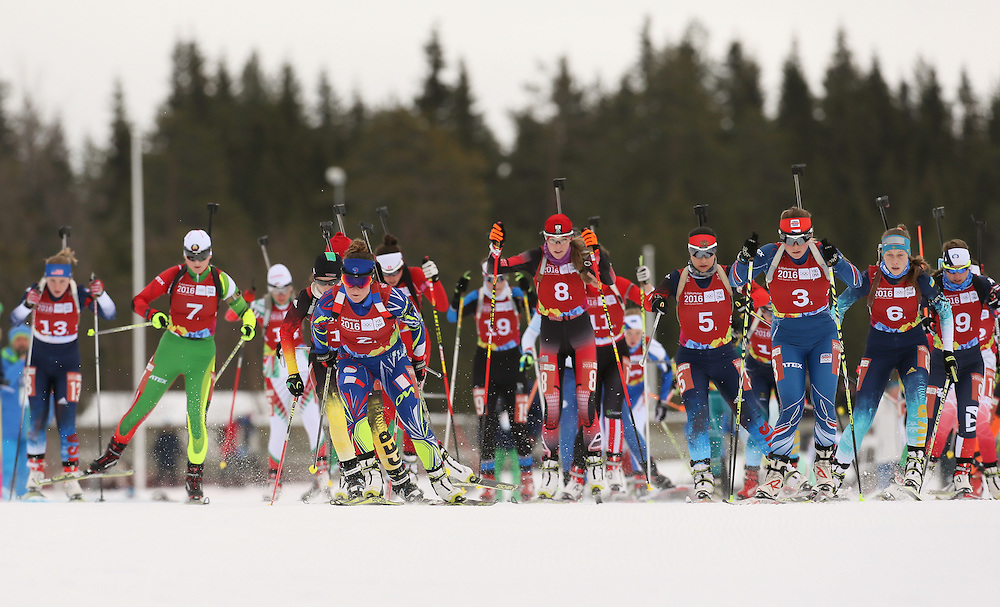
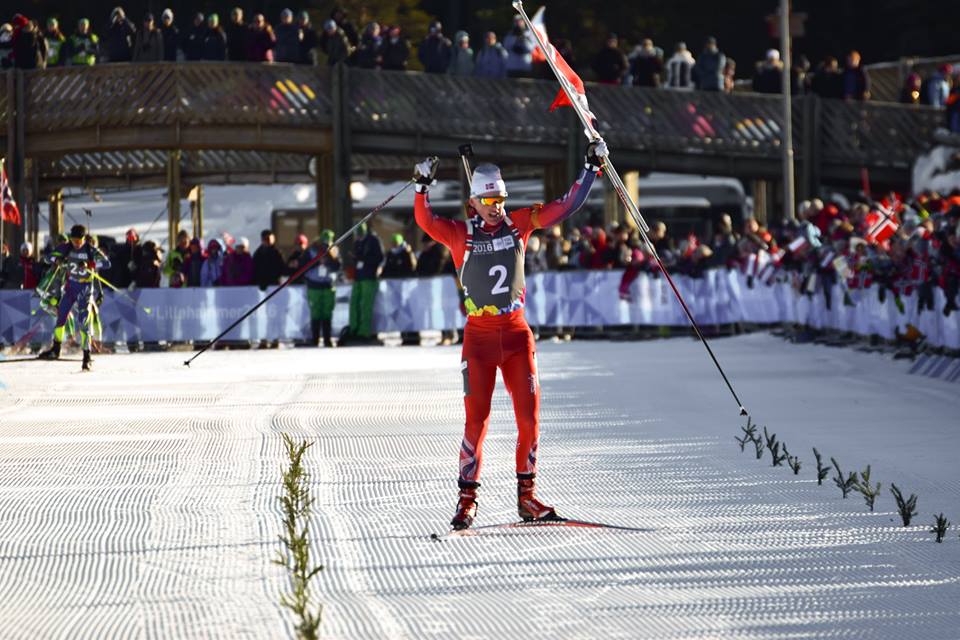
    The start of Wednesday's single mixed relay at the Birkebeineren Biathlon Stadium during the 2016 Winter Youth Olympic Games in Lillehammer Norway. (Photo: Arnt Folvik for YIS/IOC)
    The start of Wednesday’s single mixed relay at the Birkebeineren Biathlon Stadium during the 2016 Winter Youth Olympic Games in Lillehammer Norway, with Chloe Levins of the U.S. at the far left. (Photo: Arnt Folvik for YIS/IOC)

    Out of 27 teams, the U.S. found itself in second at the final exchange of the first-ever biathlon single mixed relay held at the Youth Olympic Games on Wednesday in Lillehammer, Norway. That was quite the rush for two 17-year-old Americans.

    “Getting tagged off in 2nd just behind a couple seconds behind Norway was surreal,” U.S. anchor Vasek Cervenka described in an email.

    In the biathlon pursuit two days earlier, Cervenka, a Czech Republic native who lives in Boulder, Colo., raced to 20th with 19-for-20 shooting. His teammate in the single mixed relay on Wednesday, Chloe Levins cleaned the four-stage pursuit and placed fourth.

    “Biathlon is similar to golf in that the main goal is to try to be in contention coming into the last stage (or round),” Levins, who skied the first and third legs for the U.S., wrote in an email. “During that last stage (or round), however, whatever happens is only partially in your control. Autopilot comes on, time takes over, and whatever happens is very difficult to control.”

    In the single mixed relay, each competitor rounded the 1.5-kilometer course six times — three times on each leg. They stopped to shoot twice during each leg (first prone, then standing). Misses could be remedied by using up to three spare rounds, but beyond those spares, an athlete had to ski 75-meter penalty loops for the number of targets they failed to clean.

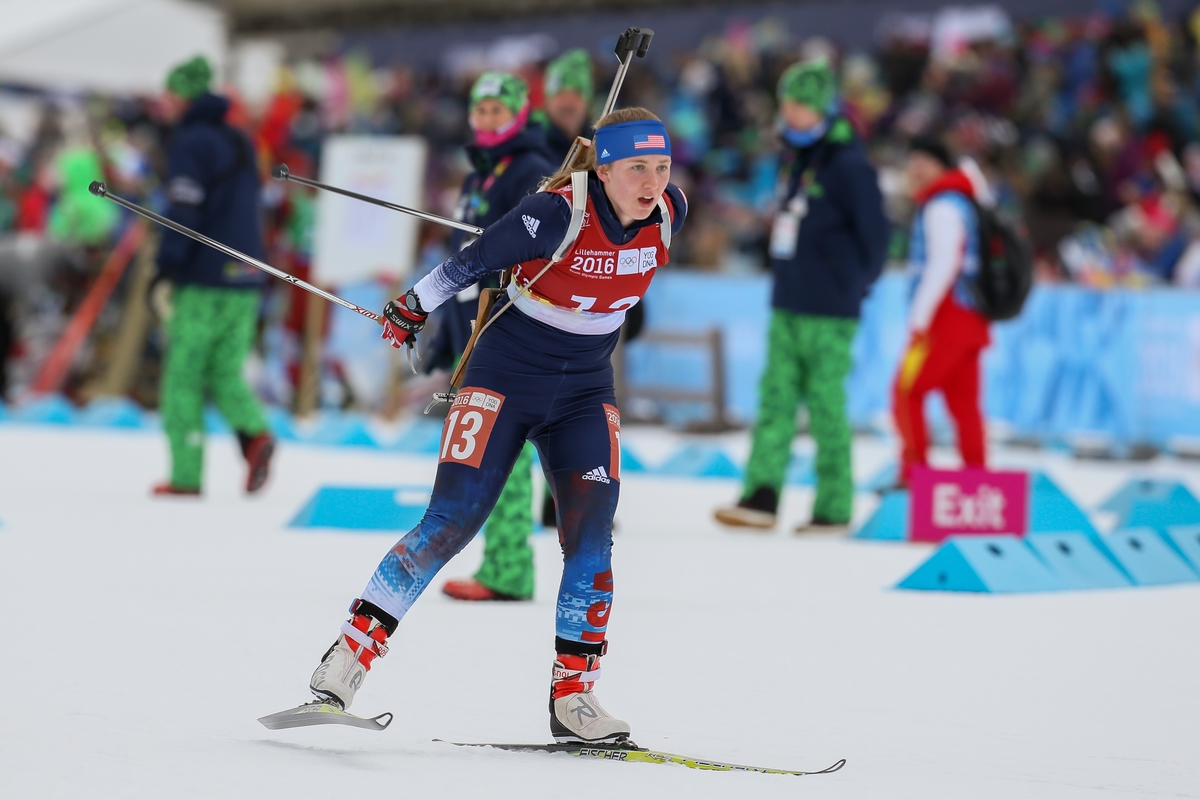
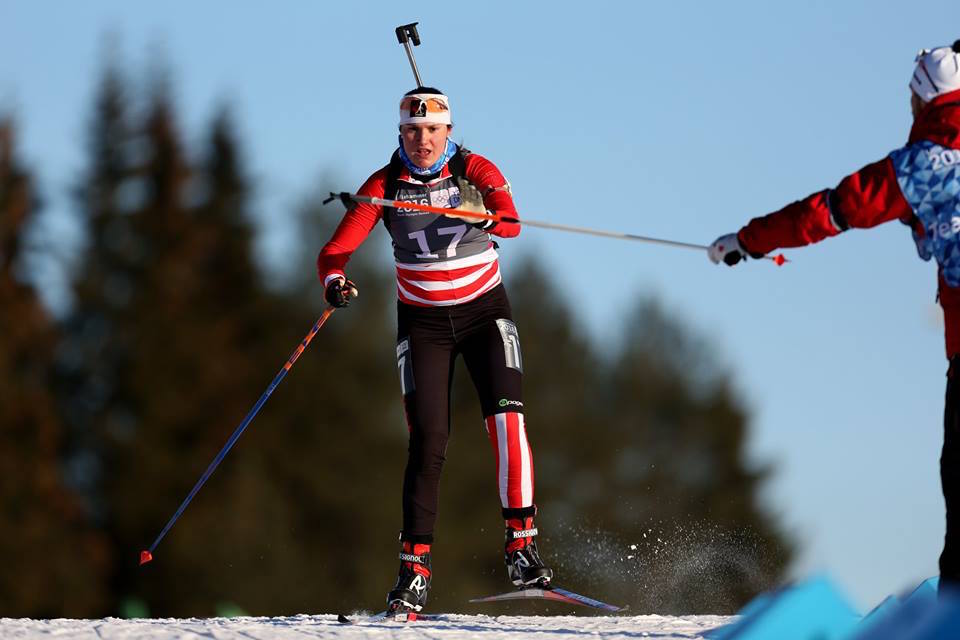
    U.S. biathlete Chloe Levins racing in the single mixed relay at the 2016 Youth Olympics in Lillehammer, Norway. With teammate Vasek Cervenka (not shown), the duo went on to place sixth. (Photo: Arnt Folvik for YIS/IOC)
    U.S. biathlete Chloe Levins racing in the single mixed relay at the 2016 Youth Olympics in Lillehammer, Norway. With teammate Vasek Cervenka (not shown), the duo went on to place sixth. (Photo: Arnt Folvik for YIS/IOC)

    Levins tagged Cervenka for the fourth-and-last leg, 2.2 seconds behind Norway and 1 second ahead of France in third. She had used a total of four spares throughout her four shooting stages and avoided the penalty lap (0+1, 0+0; 0+1, 0+2).

    “The start of the relay was very crowded,” Levins recalled. “Nevertheless, extremely fast skis and the use of just one extra round helped me navigate through some of the other competitors.”

    At the first exchange, she tagged Cervenka in seventh, 24 seconds behind China in first. Cervenka then cleaned his prone and used one spare in standing to tag Levins in fourth, 12.5 seconds behind Finland — which had moved into the lead. Meanwhile, China dropped to 10th with two penalty loops in the standing stage of that leg.

    “Vasek’s excellent shooting in his first leg put us in fourth, and set me up for a very exciting second round,” Levins explained. “During my second leg, I had more room to ski my own pace on the course. After using one extra round in the prone stage, I left the range with the leader in sight. I am a little frustrated that it took me two extra rounds to hit my miss in the last standing stage, but some mistakes by some of the more competitive nations opened the door for us to move into second position after my second leg.”

    On the last two legs, China hit all of its targets to recover from 10th into fourth, and then finally first at the finish. Fanqi Meng and Zhenyu Zhu claimed gold in 41:35.4, just two-tenths of a second ahead of Norway in second and 14.9 seconds ahead of Russia in third.

    The anchor legs for Norway, France, Russia, Germany, and the U.S. (Cervenka), used three spares apiece in their final standing stages. France also had a penalty, Germany had two penalties, and Cervenka had to ski a penalty loop as well after the last stage. That put the U.S. in sixth at the finish, 53.8 seconds behind the winners, with a total of one penalty and eight spares (0+0, 0+1; 0+0, 1+3 for Cerkenva).

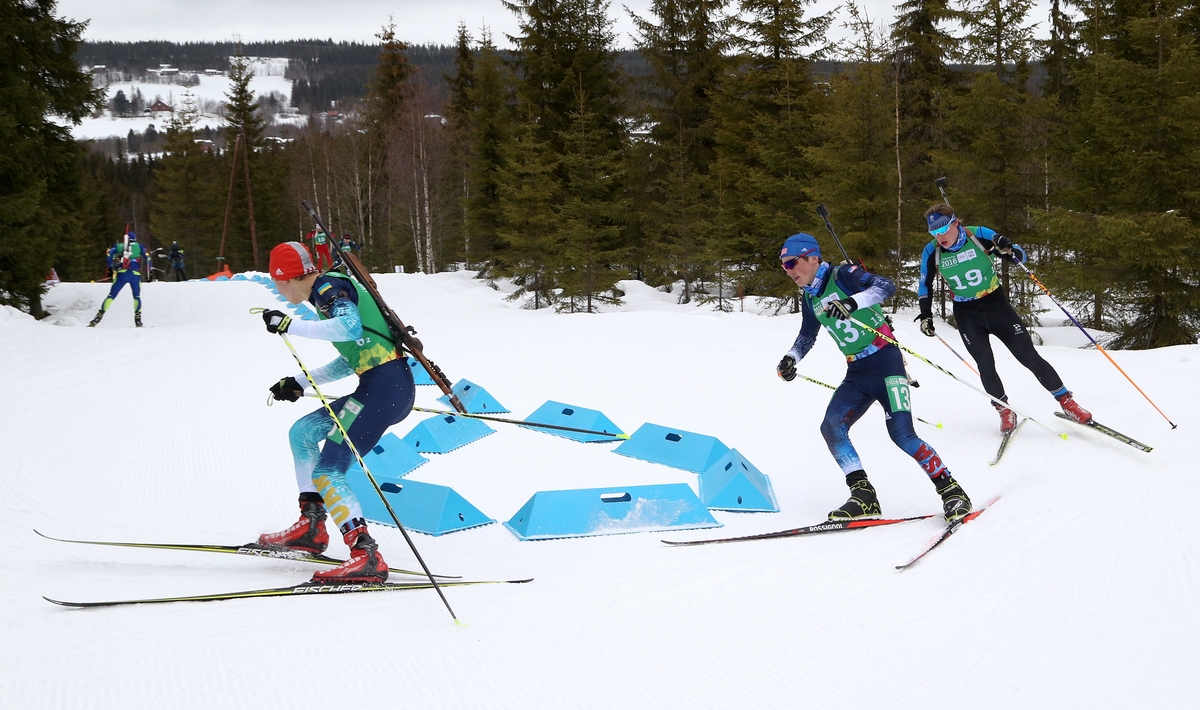
    Ukraine's Serhiy Telen (l) leads Vasek Cervenka of the U.S. (c) and Finland's Tuomas Harjula (r) around a turn in the single mixed relay at the 2016 Youth Olympics in Lillehammer, Norway. (Photo: Jed Leicester for YIS/IOC)
    Ukraine’s Serhiy Telen (l) leads Vasek Cervenka of the U.S. (c) and Finland’s Tuomas Harjula (r) around a turn in the single mixed relay at the 2016 Youth Olympics in Lillehammer, Norway. (Photo: Jed Leicester for YIS/IOC)

    “It is too bad that I couldn’t clean my last standing shooting,” wrote Cervenka, who turned 17 earlier this month. “We would of had a really great shot at a medal. I was pretty satisfied with our results in the end. All the guys in the top 6 had a solid half a foot in height on me and were overall stronger skiers. I am so proud of Chloe for her performance today, she is awesome.”

    Just 0.2 seconds from gold, Norway took silver with Marthe Johansen and Fredrik Qvist Bucher-Johannessen, with a total of one penalty and 12 spares. Russia earned bronze with Ekaterina Ponedelko and Egor Tutmin, with three penalties and 13 spares. France was fourth (+30.2) with Lou Jeanmonnot-Laurent and Emilien Claude combining for three penalties and eight spares, and Germany (Juliane Frühwirt/Danilo Riethmüller) finished fifth (+53.8), about five seconds ahead of there U.S., with one penalty and eight spares.

    “Today’s race was a great learning experience for Vasek and myself,” Levins wrote. “We are satisfied and thankful for all of the work and encouragement our coaches do and give to us during every race. We may not have made the podium, but I think we had the most fun today!”

    “I was pretty satisfied with our results in the end,” Cervenka wrote. “Thanks to my parents, coaches, teammates, and wax techs for tons of support and wicked fast skis.”

    Canada finished 13th (+3:23.0) with Tekarra Banser and Ben Churchill combining for two penalties and 10 spares. The anchor, Churchill cleaned three of four stages, using just one spare in his second prone stage (0+0, 0+0; 0+1, 0+0).

    “This was an excellent opportunity for us to try and do some damage among the field in a new event,” Churchill said in a Biathlon Canada press release. “It was a lot of fun to try and pace myself well through both legs, stay warm in the interim, and keep my cool mentally no matter how Tekarra was doing.”

    In Monday’s 10 k pursuit, Churchill shot 18-for-20 and achieved a career-best 10th. He had previously placed 17th in the 7.5 k sprint.

    “I went into the pursuit feeling hungry and aiming to improve on my sprint result,” Churchill said. “Taking some lessons from the sprint, I attacked the course more intelligently, pushing harder up the hill each time. Execution in the pursuit was much more put-together, and I was thrilled to notch my first top-10 result in an international competition. Big thanks goes out to our wax technicians and the invaluable behind-the-scenes support from our coach, Luke McGurk, and the rest of the Team Canada Mission Staff!”

    In the relay, Banser accounted for both penalties and nine spares  (0+2, 0+3; 2+3, 0+1). At the first exchange, the Canadians were in 21st, 1:47 back from the leaders, then improved to 14th (+1:27) at the second handoff, before Banser tagged Churchill for the last time in 16th, 2:16 back. He brought them to 13th at the finish.

    “Competing in the single mixed relay was exhilarating to say the least. Starting in a mass start format with 26 other countries made it tougher to focus, but I was able to get into my zone,” Banser said. “Fighting to stay with the pack on the first lap was challenging. The corners were tight and the other athletes were just as aggressive as I was. I ran into a few obstacles throughout my portion of the race, although I kept fighting to the last second and left nothing in the tank.”

    On Sunday, biathletes at YOG will wrap up with a four-person mixed relay.

    “My experience at YOG has been spectacular so far,” Levins wrote. “Because the Norwegian culture is rooted in cross-country skiing and biathlon, fans have flooded the stadium for every one of our competitions! It feels great to be a part of an atmosphere that cares so much about the sport Vasek and I dedicate so much of our time to. The organizers have done an excellent job of maintaining near-perfect snow conditions on the track as well.”

    “So far the YOG experience has been incredible,” Cervenka wrote. “So much time has been put into this event I am glad it is going so well.”

    Results

  • Bumps, Jumps, XC Cross, and Biathlon: YOG Weekend Roundup

    Bumps, Jumps, XC Cross, and Biathlon: YOG Weekend Roundup

    (Above: Complete race video of inaugural Cross-Country Cross event at the 2016 Youth Olympic Games. To view on YouTube, click here.)

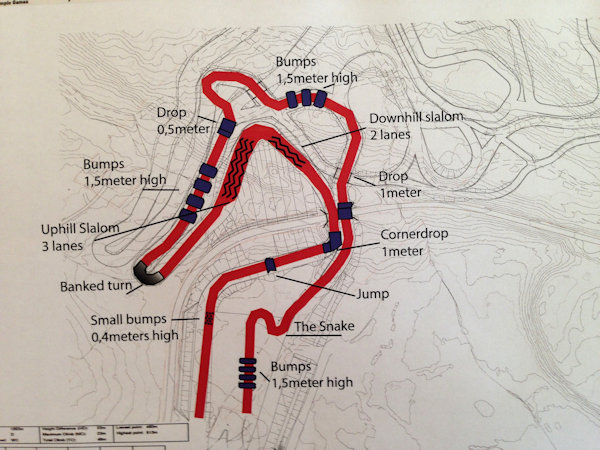
    Bumps? Jumps? An uphill and downhill slalom? While racing through an obstacle course on skis is challenging enough on its own, competitors at the 2016 Youth Olympic Games (YOG) in Lillehammer, Norway, maneuvered around obstructions and other racers as well last Saturday, Feb. 13, for the opening event: the Cross-Country Cross (XCX) 1.4-kilometer freestyle sprint.

    Beyond ‘bumps,’ the YOG’s first-race event competition also differed in sprint brackets. After racing a qualifier, the top-30 athletes advanced to one of three semifinals.

    The top two finishers in each semifinal then automatically advanced to the sprint final. The sprint final totaled 10 skiers: the two winners from each semi-final, as well as two lucky losers from the two fastest semifinals.

    The Cross-Country Cross (XCX) course at the 2016 Youth Olympic Games
    The Cross-Country Cross (XCX) course at the 2016 Youth Olympic Games

    Once on course, four 1.5-meter high ‘bumps’ greeted the athletes a little over 100-meters from the start. Competitors then cruised into a sharp lefthand turn, followed by a sharp righthand turn through a part of the course called ‘The Snake.’

    After The Snake, skiers tackled the course’s first major climb. In the following descent, racers spent some hang time while passing over a 1-meter high drop.

    With increased speed, competitors soared into the second major incline on course, as well as another series of three 1.5-meter high rollers and a 0.5-meter high drop.

    The next course challenge tested athlete’s coordination and balance during an alternating ‘bumps’ section. The section prompted many skiers to take on a classic striding arm and leg swing movement.

    After a tight hairpin turn, athletes then worked their climbing strength and stamina in an uphill slalom. Immediately upon cresting the top of the incline, competitors descended into a downhill slalom.

    With no major climbs left, racers worked their way over another jump and one final set of 0.4-meter high rollers before the flat 100-meter sprint to the finish.

    Sweden’s Moa Lundgren proved most adept on course. She remained unchallenged by any competitor all day, winning the qualifier in 3:27.59, as well as her semifinal and eventually the final in a time of 3:26.36.

    Finishing 1.7 seconds behind Lundgren was Swedish teammate, Johanna Hagstrøm.

    Rounding out the women’s top three was French skier Laura Chamiot-Maitral who crossed 3.21 seconds after Lundgrun.

    Hannah Halvorsen (Far West/Sugar Bowl Academy) qualified 10th in the first-ever Cross-Country Cross event at the 2016 Youth Olympic Games in Lillehammer, Norway. (Photo: Far West/Facebook)
    Hannah Halvorsen (Far West/Sugar Bowl Academy) qualified 10th in the first-ever Cross-Country Cross event at the 2016 Youth Olympic Games in Lillehammer, Norway. (Photo: Far West/Facebook)

    Two North Americans competed in Saturday’s XCX event for the first time, American Hannah Halvorsen and Canada’s Annika Richardson.

    Halvorsen qualified in 10th, 16.45 seconds back from Lundgren. She then advanced to semifinal 3, where she raced in third behind Chamiot-Maitral and Germany’s Anna-Maria Dietze until the uphill slalom.

    Losing steam during the climb, Halvorsen moved into fourth, while China’s Chi Chunxue cranked her way into third. Hot on Halvorsen’s heels through the slalom gates was Russia’s Yuliya Petrova.

    As the women came through the final bumps, Halvorsen moved to the outside right and Petrova gained momentum in the middle lane.

    Halvorsen finished the heat in fifth, 1.7 seconds off of earning a lucky loser spot and advancing to the final, and 3.7 seconds off the heat winner Maitral-Chamiot (3:36.20).

    After qualifying in 25th (+26.3), Richardson advanced to the first semifinal where she finished in ninth, 19.7 seconds back from her heat’s winner, Lundgrun.

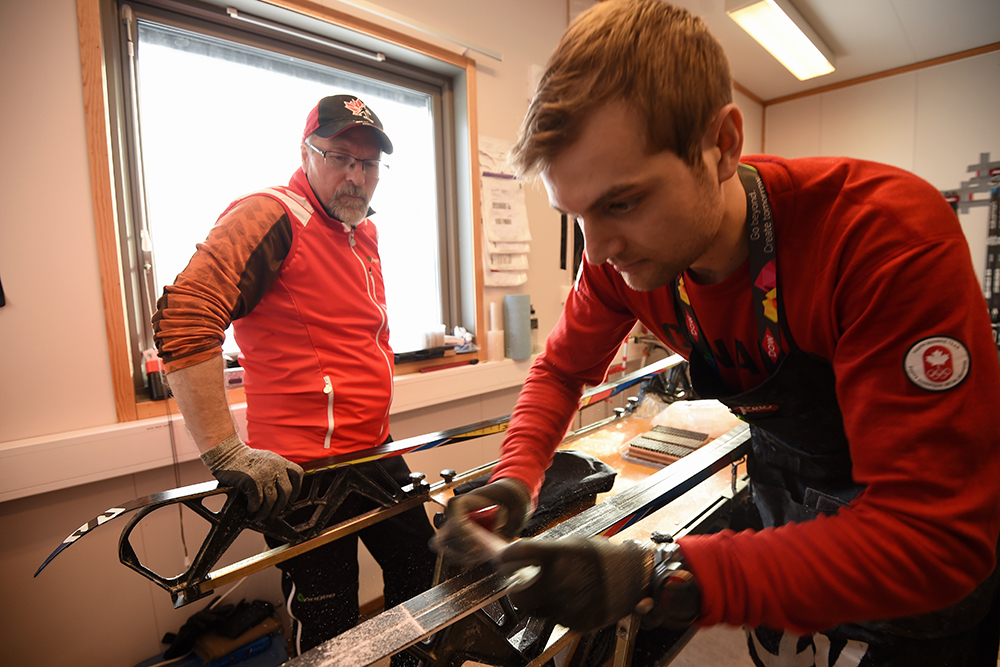
    Canadian wax technicians Mike Mappin (l) and Camille Cheskey (r) hard at work during the during the 2016 Winter Youth Olympic Games on Feb. 10 in Lillehammer Norway. (Photo: Jon Buckle for YIS/IOC)
    Canadian wax technicians Mike Mappin (l) and Camille Cheskey (r) hard at work during the during the 2016 Winter Youth Olympic Games on Feb. 10 in Lillehammer Norway. (Photo: Jon Buckle for YIS/IOC)

    “It went really really well all things considered,” Richardson said in an interview with Cross Country Canada.

    “Definitely a lot of stuff I can work on with the technical aspects of the course, but I felt really strong in the last half of my heat going up the hill. I’m just really grateful to be here and be experiencing all the Olympic spirit,” she added.

    Women’s results

    ***

    In the men’s event, Korea’s Magnus Kim topped the results. He won the qualifier in a time of 3:01.45, his semifinal and eventually the final in 2:59.56.

    In second place, 1.17 seconds off of Kim was Norwegian skier Thomas Helland Larson.

    Rounding out the men’s top three was Lauri Mannila of Finland, finishing 2.28 seconds behind Kim.

    Canadian skier Levi Nadlersmith and American Hunter Wonders nabbed the last two qualifying spots in 29th and 30th, respectively.

    Wonders advanced to the first semifinal, where he finished ninth, 8.8 seconds behind the heat’s winner, Kim.

    In his first international race ever, Nadlersmith also finished in ninth (+16.51) in the second semifinal.

    “I felt really strong climbing a the top of the course,” Nadlersmith told Cross Country Canada.

    “Going down into the last corner I had a weird line and I guess someone stumbled in front of me, so I had to do a quick maneuver to go around them. Then kind of after that I felt good, but lost a bit of my steam going over the last hill. I think for the most part I felt really good,” he added.

    Men’s results

    ***

    Day 2: Biathlon Begins

    While some were shooting cupid’s arrows on Sunday, Feb. 14, biathlon competitors at the YOG shot targets. The second day of events included the men’s 7.5 k and women’s 6 k biathlon sprints at the Birkeneineren Biathlon Stadium.

    On the men’s side, Emilien Claude of France won the event in a time of 19:01.5 after shooting clean during both the prone and standing stages.

    “In lap three, in my head it was ‘maybe I win, maybe second’,” Claude said, according to an Inside the Games press release. “But when I finished and saw that I was first, I thought, ‘Wow.’ ”

    Taking the second place silver medal, 7.1 seconds back, was Norway’s Sivert Guttorm Bakken, who missed one shot prone and one standing.

    Third place and the bronze medal went to Russian racer Egor Tutmin. Tutmin skied the first of the three 2.5 k laps the fastest and shot clean during the prone stage. However, after two penalties standing, he finished 18.0 seconds back from the race winner’s time.

    Two Canadians competed in Sunday’s event, including Ben Churchill and Leo Grandbois.

    Churchill finished in 17th overall (+1:35.5) with one penalty (1+0). Grandbois placed 22nd (+1:58.6) after missing two shots during the standing stage.

    The American men also had two competitors in Sunday’s 7.5 k sprint, Vasek Cervenka and Eli Nielsen.

    Cervenka was the first American across the line in 36th place (+2:50.7) after skiing four penalties (1+3). Nielsen finished one minute and 7.4 seconds after Cervenka in 46th, (+3:58.1) after a total of six penalties (2+4).

    Canada's Gillian Gowling receives a pole during the women's 6 k sprint at the Youth Olympic Games on Sunday in Lillehammer, Norway. (Photo: Lillehammer 2016 Olympic Games/Facebook)
    Canada’s Gillian Gowling receives a pole during the women’s 6 k sprint at the Youth Olympic Games on Sunday in Lillehammer, Norway. (Photo: Lillehammer 2016 Olympic Games/Facebook)

    With perfect shooting on Sunday, Germany’s Juliane Fruehwirt won the women’s 6 k sprint event, covering the 3 x 2 k course in a time of 18:23.5.

    Norwegian skier Marthe Krakstad Johansen was the next closest contender for the gold medal. After missing one shot standing, Johansen finished in second place, 5.6 seconds behind Fruehwirt’s time.

    Rounding out the women’s podium finishers on Sunday was bronze medalist Arina Pantova of Kazakhstan. After two penalties (1+1), Pantova completed the course 17.1 seconds behind Fruehwirt.

    American Amanda Kautzer cracked the top 10 on Sunday and finished in 10th overall (+58.9) after skiing two penalties (1+1). U.S. skier Chloe Levins missed the top 20 by 1.7 seconds, and finished in 22nd overall with a clean round of prone shooting, but two standing penalties.

    After cleaning both the prone and standing stages, Canada’s Gillian Gowling finished 30th (+2:27.8). Her Canadian teammate, Tekarra Banser finished 14.4 seconds later  in 35th (2:42.2) after two penalties (0+2).

    Results: Men | Women

    ***

    Chloe Levins shoots clean and races to a fourth place overall in the women's 7.5 k pursuit at the Youth Olympic Games on Monday in Lillehammer, Norway. (Photo: US Biathlon/Twitter)
    Chloe Levins shoots clean and races to a historic fourth place for the U.S. in the women’s 7.5 k pursuit at the Youth Olympic Games on Monday in Lillehammer, Norway. (Photo: US Biathlon/Twitter)

    Day 3: Levins Just Outside of the Medals, Fourth in Pursuit

    Monday marked the third day of the YOG and the second set of biathlon races with the 7.5 /10 k pursuits.

    The women’s 7.5 k pursuit event saw Ukraine’s Khrystyna Dmytrenko at the top of Monday’s podium.

    Starting 26 seconds back from Sunday’s race winner, Dmytrenko missed two shots during her first stage of prone shooting and then cleaned the rest of her shots to finish the 5 x 1.5 k course in a time of 25:12.9.

    In a photo finish, Norway’s Johansen bested France’s Lou Jeanmonnot Laurent by one tenth of a second. Johansen finished 7.5 seconds behind Dmytreno after skiing four penalties (2+0+1+1). Jeanmonnot Laurent finished 7.6 seconds off of Dymtrenko’s time after missing two shots standing (0+0+1+1).

    With perfect shooting, American Chloe Levins finished in fourth overall (+34.7), just outside of medal contention.

    “The pursuit in Lillehammer today was a dream,” Levins said according to a US Biathlon press release. “As Susan [Dunklee] said earlier in the season, every race is a team effort. We had great skis and excellent conditions for today’s race. My race was made on the shooting range. Of course, it is bittersweet to be close to the podium in 4th position, but I shot clean and skied well, so it is an incredibly satisfying result.”

    Read more about Levins’ historic result here

    American Amanda Kautzer finished in 27th (+4:04.2) with a total of eight penalties (3+2+1+2). Canada’s Banser finished in 35th (+ 5:43.6) after missing five shots (1+0+2+2) and her teammate Gowling placed 45th (+9:45.30) after missing six shots ( 1+1+2+2).

    After winning Sunday’s sprint, France’s Claude was the first skier on the Birkebeineren Biathlon Stadium’s 5 x 2 k course.

    Norway's Sivert Guttorm Bakken after winning the men's 10 k biathlon pursuit at the Youth Olympic Games on Monday in Lillehammer, Norway. (Photo: Lillehammer 2016 Olympic Games/Facebook)
    Norway’s Sivert Guttorm Bakken after winning the men’s 10 k biathlon pursuit at the Youth Olympic Games on Monday in Lillehammer, Norway. (Photo: Lillehammer 2016 Olympic Games/Facebook)

    Starting 7.0 seconds later was Monday’s eventual race winner and Sunday’s silver medalist, Bakken of Norway. Bakken missed four shots (1+1+1+1), but ultimately came away with the 10 k pursuit win in a time of 28:10.7.

    Moving up to second place after Sunday’s event was Russia’s Tutmin. With an extra penalty (0+1+3+1), Tutman completed the course one minute and 10.7 seconds behind Bakken’s time.

    Taking the event’s bronze medal was Said Karimulla Khalili of Russia. Khalili shot the same as Bakken and finished 1:17.7 behind the race winner.

    With two penalties (0+0+1+1), Canada’s Churchill crept into the top 10, finishing in 10th overall (+2:49.1). Cervanka of the U.S. improved his result from Sunday to 20th overall (+3:54.2) after missing just one standing shot.

    “Vasek also made a great comeback with 95 percent shooting score and a good skiing performance,” U.S. coach Jean Paquet said in a US Biathlon press release.

    “He looked more at ease on the skis and liked the fight on the course. He gained 16 positions by shooting well on the shooting range.”

    The next North American was Canada’s Grandbois, who placed 25th (+4:40.7)after skiing five penalties (1+0+1+3).

    In 46th was Nielsen of the U.S. (+8:13.4) with six penalties (0+2+2+2).

    Results: Women | Men