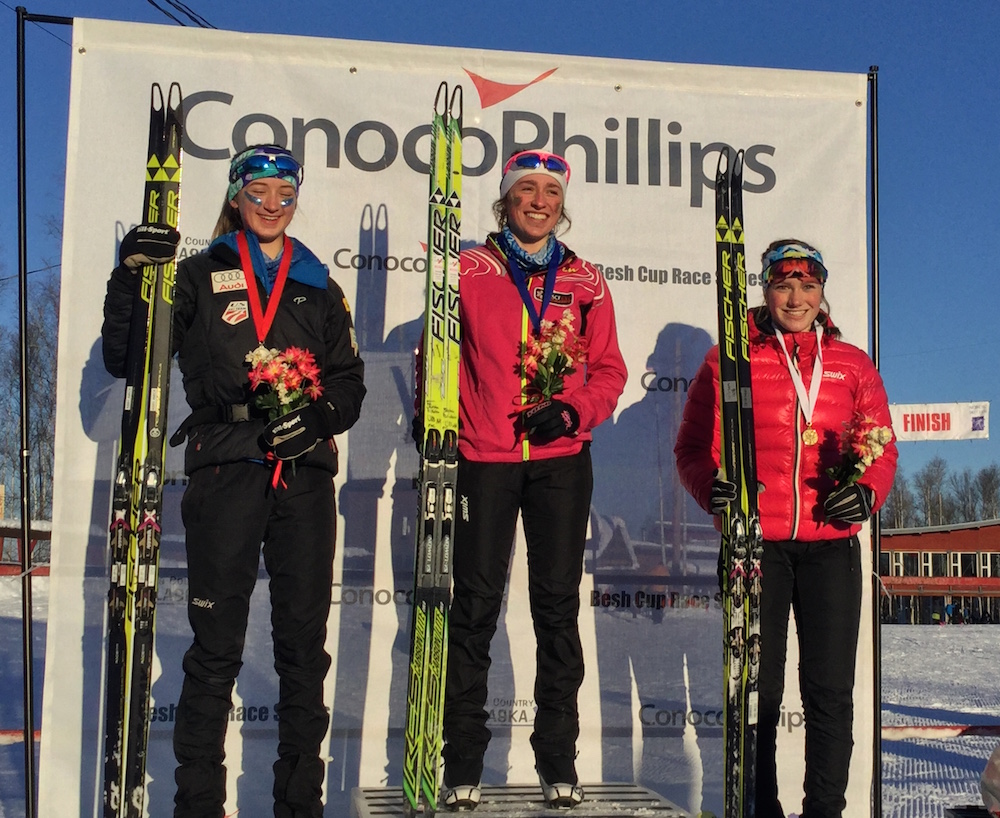
FAIRBANKS, Alaska — Alaska Airlines operates roughly 10 flights a day between Anchorage and Fairbanks. Last Friday morning many of those flights were packed with skiers, and ski bags piled up at baggage claim in Fairbanks, as Anchorage skiers streamed north for the final weekend of Besh Cup racing to select Alaska’s representatives to next month’s Junior Nationals in Lake Placid, N.Y. Two days later many of those same skiers returned south with plans to fly all the way to Lake Placid, where Team Alaska will have roughly equal representation from the state’s two largest cities.
The 2016/2017 Besh Cup series concluded with a pair of distance races at Birch Hill ski area: freestyle interval start on Saturday, classic mass start on Sunday. The weather for both days was Fairbanks at its mid-winter best, clear and sunny and relatively warm. Cold powder and hard glide waxes were de rigueur.
(The emphasis here is on relatively, as national FasterSkier readers might find Saturday’s race-time temperature of 10 degrees Fahrenheit, or Sunday’s reading of 2 degrees, objectively not all that warm. But it was -16 degrees at the airport on Sunday – Birch Hill’s elevated location on a hill above town often keeps it significantly warmer than the low-lying areas of central Fairbanks where official temperature readings are taken – and it is forecast to be -35 degrees in Fairbanks by later this week. So, relatively warm.)
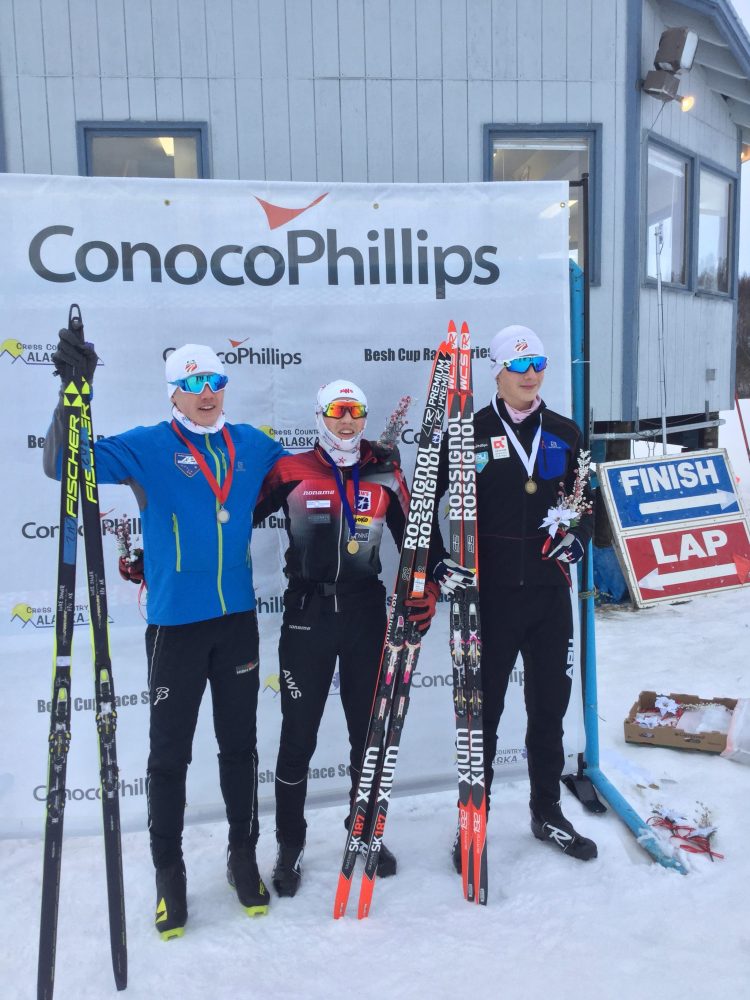
The first race on Saturday was the boys 10-kilometer freestyle individual start for racers in the U18 division and older, 45 starters in all. The overall podium on Saturday was U18 skier Ti Donaldson of the Nordic Ski Club Fairbanks racing team (FXC), Senior skier Cody Priest of Alaska Nordic Racing (ANR), and U18 skier Josiah Alverts (ANR).
Among U20 men, FXC skier Benjamin Koenig was first, leading his teammate Logan Mowry in second and Dax Cvancara of ANR in third.
The U18 boys division, which saw two of the top-three overall finishers, had Donaldson in first, Alverts in second, and APU skier Tristan Wiese in third.
U16 boys raced a 5 k skate individual start, covering one lap of the blue course that 10 k skiers completed twice. Eli Hermanson of Alaska Winter Stars (AWS) led the all-Anchorage-area podium in the 5 k, followed by George Cvancara of ANR and Zanden McMullen of APU.
Finally, the U14 boys raced a 1 k skate ski-cross event, with jumps, gates, slaloms, and other technical challenges. The event is a crowd favorite that, race organizers wrote, “helps develop skiers’ abilities to ski in a ‘pack’ along with developing technical skills.” (It may also soon be coming to a race series near you! Here is an example from the 2016 Youth Olympic Games in Lillehammer.) In another Anchorage-area sweep, Aaron Maves of APU took the A-Final, followed by Rudy Schumacher of AWS and Konrad Renner from ANR.
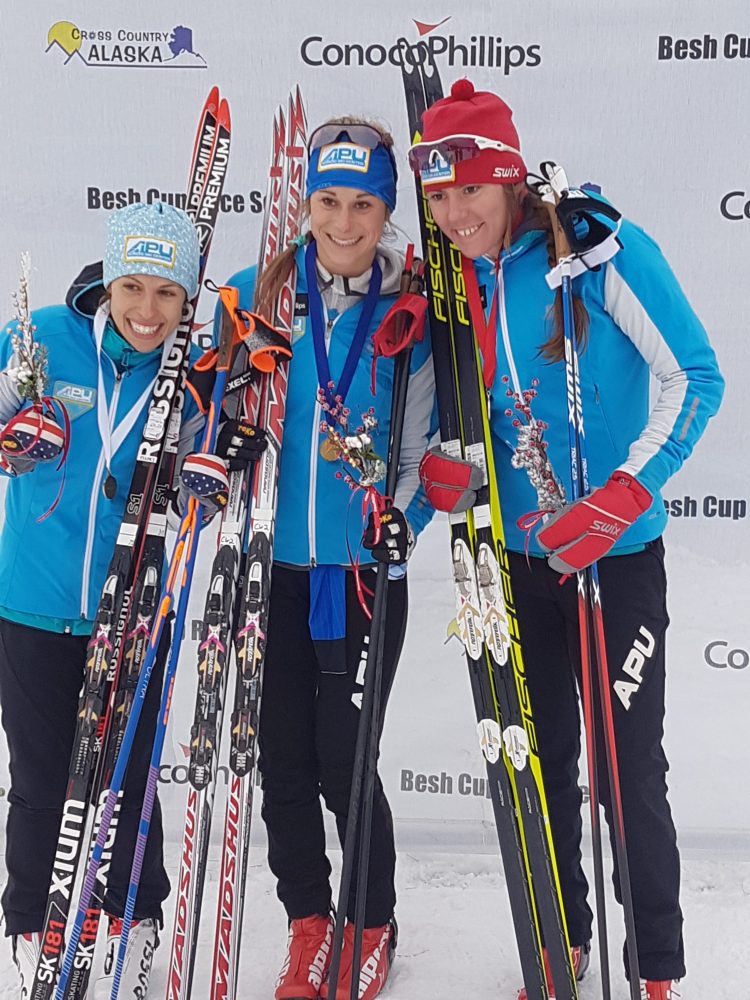
On the girls side, a field of 57 racers (U16 and older) contested a 5 k skate individual start. At the end of one lap around the blue course, APU skier Maggie York took the overall victory by 40 seconds over FXC skier Jenna DiFolco, with Kendall Kramer (FXC) another 14 seconds back.
York also topped the U20 podium. She was followed there by Alyeska Daniels and Lupua Oba, both of FXC.
DiFolco, second overall, was first among U18 girls. Second in this division was Abby Amick of APU, with ANR’s Addison Gibson third.
U16 girls took third through fifth overall in the combined U16/U18/U20/Masters field for the 5 k (there were no Senior skiers in the race). Locals Kendall Kramer and Kaya Ratzlaff of FXC led this division, with Annika Hanestad (ANR) third.
U14 girls also raced a 1 k ski cross. First here was Quincy Donley of AWS, continuing her winning ways from the Anchorage and Soldotna Besh Cup weekends. She was followed across the finish line of the A-Final by Marit Flora of APU and Katey Houser of ANR.
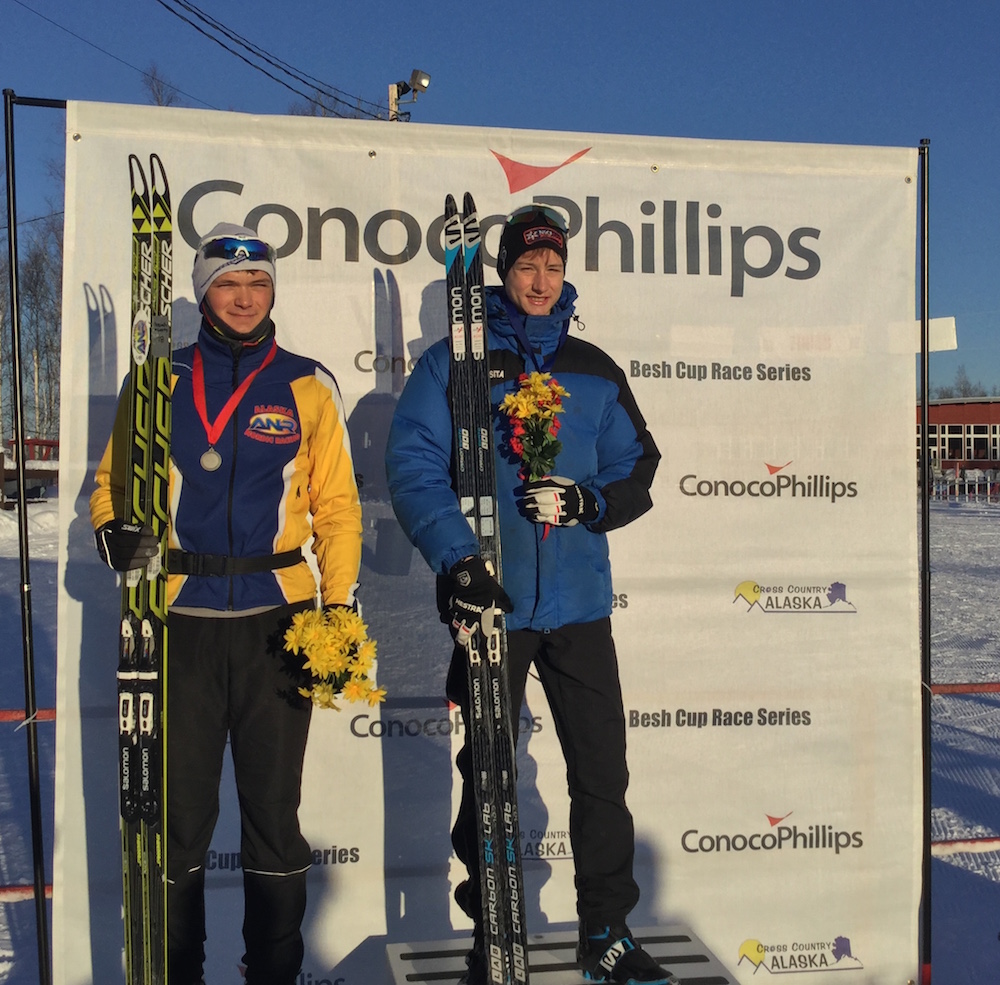
Saturday’s overall winner for the boys race, U18 skier Ti Donaldson, was racing on home turf. “I’ve had a few wins [in the Besh Cup series] in the past,” Donaldson told FasterSkier in an in-person interview following the race. “Most of them have been in Fairbanks. I’m from here, so definitely a home-field advantage.”
Donaldson came in expecting a “brutal” race, based on his knowledge of the course and his time previewing it. “But I knew it would be pretty fast conditions,” he continued – “it was nice and hard, and it wasn’t too cold. So I was pretty excited to see how it would go, and really just wanted to work the transitions and stay strong on the climbs, and crest over. So I stuck to that plan, and it worked out pretty well.”
Donaldson was looking forward to 2017 Junior Nationals in March.
“I’d be thrilled with a top-five finish,” Donaldson said of his goals for next month. “Two years ago, when I was racing the same kids, I placed fourth in a race, and so I’d like to repeat that result. That would be a good goal of mine.”
Jenna DiFolco, the U18 girls winner and second-place overall skier, was also racing at home. She credited “my FXC coaches” for waxing her winning skis, and had hot cereal for breakfast, with raisins and dried cranberries, at home before heading out to Birch Hill.
The race was “really fun,” DiFolco recounted in an in-person interview. “Warming up, I didn’t feel so good, I was feeling kind of tired, maybe I’d overdone it this week. And then I expected this course to be really hard, because there are so many hills. And it was definitely, like, it was a rough course. But it went a lot better than I expected it to.”
DiFolco described her strategy for racing a one-lap 5 k course with nearly constant climbing or descending: “The first part is mostly downhill, so I kind of just started out like a sprint almost, because I knew I’d be able to recover on the downhill. And the first couple of hills I was just trying to keep it light, keep it relaxed, and then really start hammering up South Tower [the high point of the course], because I got a big break after that. And then the last two hills are basically just hard, really hard.”
Looking ahead to Lake Placid, DiFolco said that she was “hoping to get a couple top-10 finishes.” She added, “A big dream, it’d be a big stretch, but I’m hoping to get, like, a podium would be really, really cool. But top 15, top 10 would be awesome.”
Sunday saw classic mass starts instead of freestyle individual starts, and temperatures around 10 degrees colder, but otherwise it was more of the same. Seven of eight age-group winners from Saturday picked up a second victory on Sunday, as a pair of distance races rewarded skiers who were consistent in both techniques. (The first two weekends had featured one sprint and one distance race apiece, leading to greater variability in the podium finishers.)
Sunday’s classic race also rewarded skiers who were good at traditional classic skiing, in light of the relatively slow snow and the impressive elevation change of a Birch Hill race course.
The trails at Birch Hill are built on the side of, well, a hill (also, there are birch trees). The courses used for this weekend’s races were marked by an impressive Height Difference (the elevation change between the lowest and highest points on the course) of 89 meters within a 5-kilometer course. The World Cup skiathlon race that was contested in South Korea the same weekend, on the trails that will be used for the 2018 Winter Olympics in PyeongChang, featured height differences of only 58 and 41 meters on the two skiathlon courses.
In fact, a height difference of 89 meters is a greater elevation spread than was present on most of the traditional World Cup courses this season, including in Davos (84m), Lillehammer (74m), Falun (69m), and Ulricehamn (57m). That said, some of those courses had more average climb per kilometer than the Birch Hill 5 k course. But only some of them. This may help explain why the winning time for a 10 k skate on Saturday was 29:22 for the men, and 16:15 for 5 k for the women, in a race with some of the top junior skiers in the country. (Winning times for Sunday’s 10 k classic races were 32:17 and 37:53.)
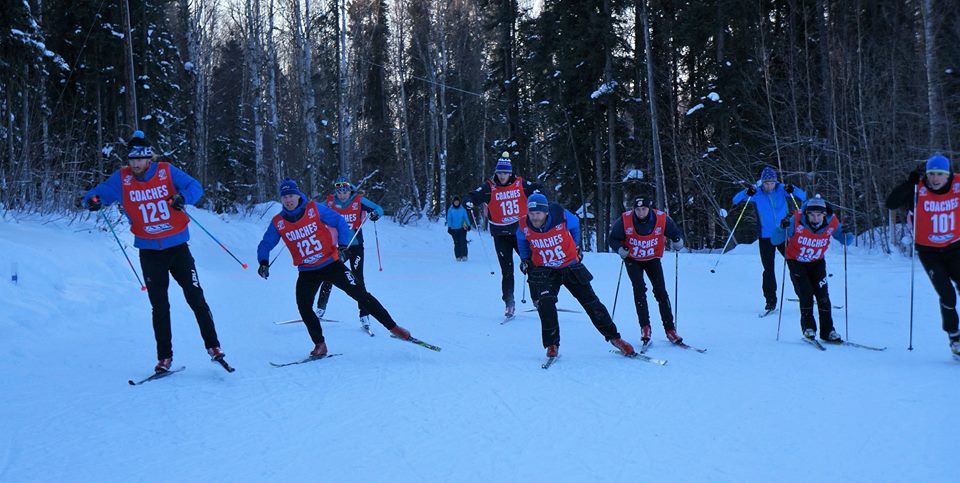
APU Devo and Master Coach Galen Johnston shared his thoughts on the effects of such a course profile after spending the weekend watching his athletes race up and down these hills. “One of the best parts of the weekend was to see how the combination of slow snow and lots of strideable sustained climbing put the focus of the [classic] races on striding and fitness rather than simply double pole strength,” Johnston wrote to FasterSkier on Monday.
“Courses designed like this can keep striding a viable, and even necessary part of classic skiing,” Johnston continued by email. “Birch Hill has some of the most progressive course designs that I’ve seen and it’s paying off. Skiers ski differently than they did even 10 years ago, and it’s really neat to see a course that can accommodate and challenge that change in style without turning things into an unskiable death march. Estle is keeping people very honest, but still allowing for ample fun,” Johnston concluded in reference to longtime Fairbanks race director and ski-course designer (and former U.S. Ski Team coach) John Estle.
On Sunday the best strider was DiFolco, who took first place in the 10 k classic mass start race by 19 seconds over Saturday’s winner York. Third overall was ANR skier Heidi Booher (ANR), another 23 seconds back.
York was again first in the U20 women division. The rest of the podium was also unchanged from Saturday, with Daniels in second and Oba in third.
DiFolco was again first among U18 girls. Second on Sunday was Booher, with Emma Nelson of ANR third.
There was a substantial drop-off in distance from U18 girls to U16 girls, with the latter group racing not 10 k but a 3 k classic mass start. First after just under 10 chaotic minutes was Kramer again, edging out her FXC teammate Ratzlaff by 0.7 seconds. Tjarn Bross rounded out the all-FXC podium in third.
U14 girls raced the same 3 k course as the U16 girls. And after 11 to 12 minutes of racing, it was precisely the same U14 girls podium as on Saturday: Donley, Flora, and Houser.
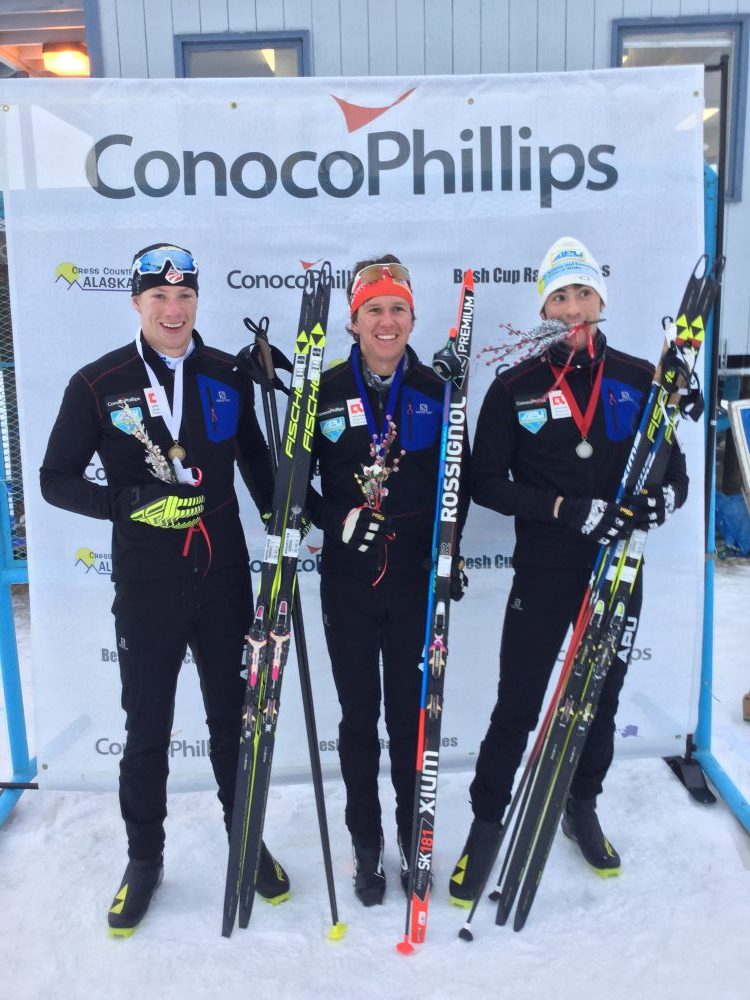
On the boys side, U18/U20/Senior/Masters skiers raced a 10 k classic mass start on the same course as the girls. First overall was Lukash Platil (officially unaffiliated, but listed on the University of Alaska Fairbanks (UAF) ski team roster), followed by Donaldson of FXC and Wiese of APU.
Platil was also first in the Senior men’s division. He was followed there by Kenny Brewer (now unaffiliated, formerly of UAF) and Matt Muffoletto (The Other Guys).
Among the U20 men, Koenig picked up his second first place of the weekend, and Mowry his second second place. Hamish Wolfe (APU) was third.
Donaldson and Wiese led the U18 boys. They were followed by Alverts, as the age group podium remained largely unchanged from Saturday.
The U16 boys raced a 3 k classic mass start. This was the only age group to see a new winner on Sunday, as Cvancara moved up from second the day before to nudge Hermanson down a step on the podium. Everett Cason of APU was third.
And the U14 boys (also 3 k classic) were again an all-Anchorage affair: Maves once again in first, Rowan Morse (APU) in second, and Schumacher in third.
Later Sunday afternoon a crowd gathered in the Birch Hill Recreation Center, ignoring Super Bowl LI then in progress, for the naming of Team Alaska for this year’s Junior Nationals (JNs).
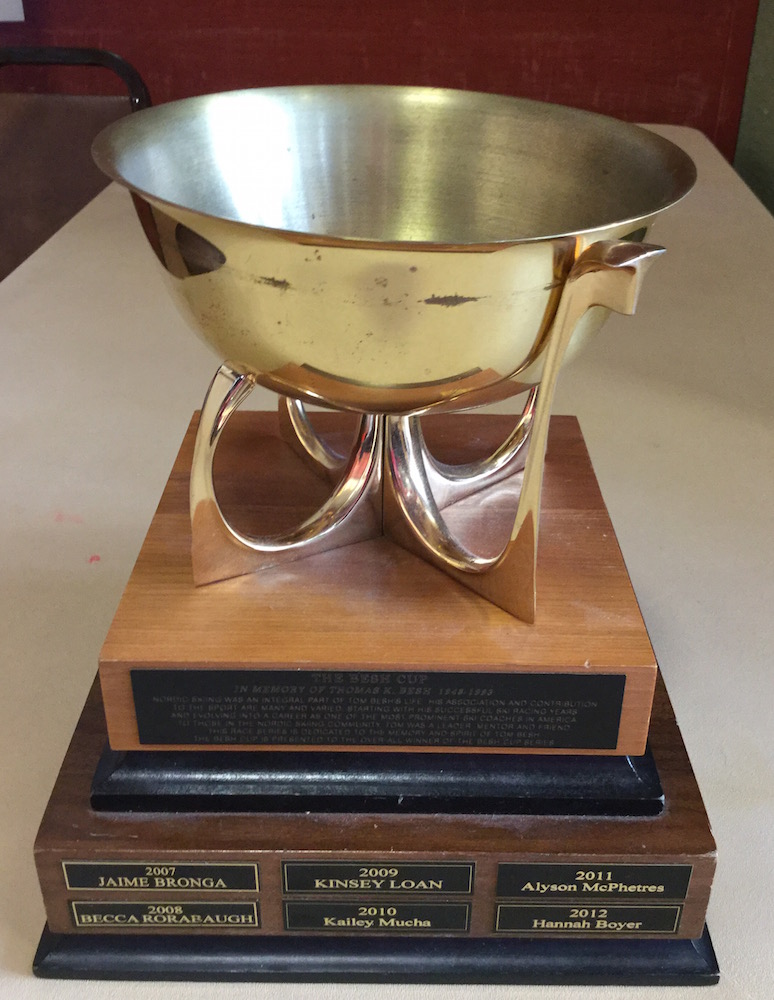
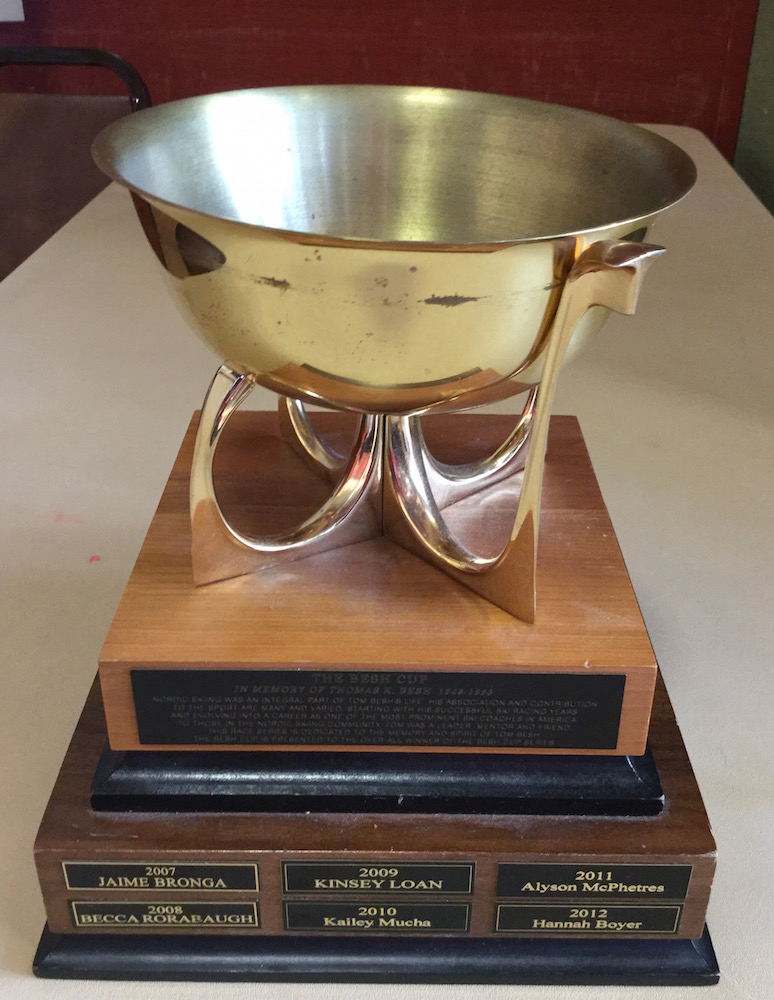
Cross Country Alaska also awarded the Besh Cup Trophy, given to the U18 or U20 skier with the greatest number of JN qualifying points across all six races combined. This year’s winners were Josiah Alverts for the boys and Jenna DiFolco for the girls. Their names will be added to a trophy, Stanley Cup-style, that includes on its plinth recognizable names from American skiing such as David Norris, Becca Rorabaugh, Reese Hanneman, Andy Liebner, Zach Hall, Eric Strabel, Kate Pearson, and Rob Whitney.
While winning the Besh Cup Trophy is undeniably prestigious, it also necessarily rewards the best skier who was in Alaska all winter for the races, as opposed to competing Outside or internationally. For example, among U18/U20 girls, you may have heard that the University of Alaska Anchorage’s Hailey Swirbul was racing in Soldier Hollow, while Molly Gellert was on the Scandinavian Cup trip in Norway.
DiFolco graciously acknowledged as much, telling FasterSkier on Sunday soon after receiving the trophy, “I think some of the fastest skiers are not here, because they pre-qualified [for JNs] and they went on big trips.” But DiFolco still skied the races and earned the results, including two firsts and two seconds in the final four races of the series.
“It’s pretty cool,” DiFolco said of the season-long honor. “I never would have really expected this to happen a year ago. … I’m pretty proud of it. I’m happy with it.”
Shortly after the awards ceremony ended the migration began to repeat itself in reverse, as out-of-town skiers loaded up cars in the Birch Hill parking lot for the 7-hour drive south to Anchorage or paraded ski bags through the Fairbanks airport. The flight home for Anchorage skiers was marked by ski hats, team jackets, and quiet chatter, as athletes talked about next month’s trip to the East Coast and parents fretted about missed school days and makeup work.
Junior Nationals begin in Lake Placid in early March. The first race is a 5/10 k freestyle individual start on March 6.
Results: skate interval start | classic mass start | overall points lists
***
FasterSkier is seeking contributions (written, photography or videography) from regional race circuits across North America. Please email info@fasterskier.com if interested.