Back in 2015, prior to her first go at a World Championships, Rosie Brennan was asked this: What’s your biggest motivation while racing?.
“I am most motivated by wanting to show that my hard work was worth it, that I did everything I could to go as fast as I could,” Brennan replied at the time. She was twenty six years old then, and now at 30 years old, the Park City native grinds away, still doing the hard work.
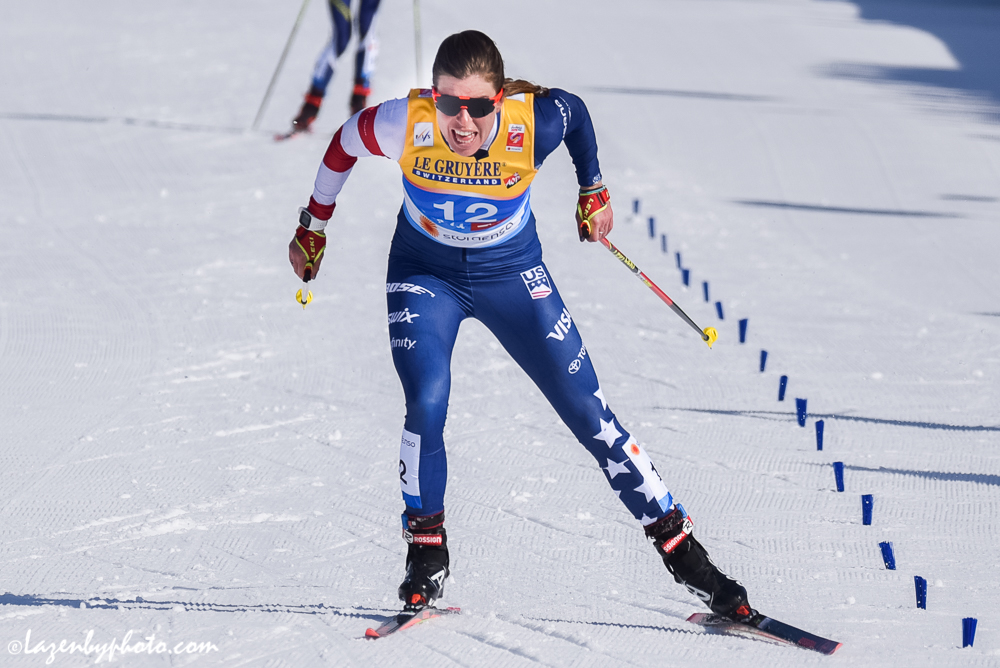
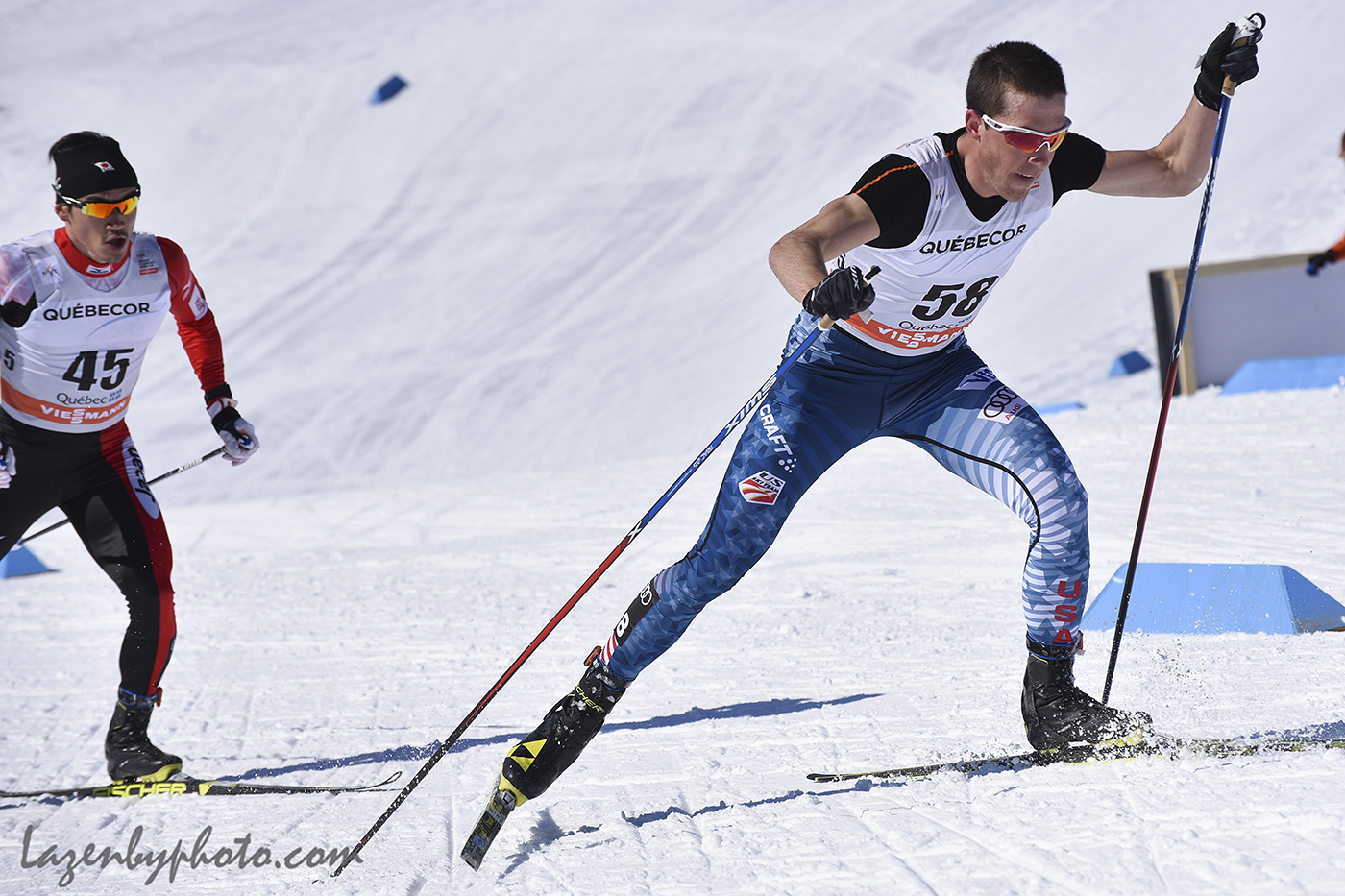
Rosie Brennan of the U.S. placed 10th in the women’s World Championship 15 k skiathlon in Seefeld, Austria. (Photo:John Lazenby/lazenbyphoto.com)
Brennan, a current member of the U.S. Ski Team’s A-Team, has had an on-again off-again career with the national team. She has, however, been a rock on the APU elite team where she’s surrounded herself with some of the nation’s top cross-country athletes.
In 2018, despite being nominated to the Olympic team, she developed a nagging virus that sapped her energy. She eventually returned to form — last season her best World Cup campaign to date. She ranked 27th in the distance standings and popped a career best sixth place in the Davos, Switzerland 10-kilometer skate.
We spoke to Brennan for the podcast as she finished up a ski team training camp based in Park City. We spoke about her recovery from illness and her role as an athlete representative at U.S. Ski & Snowboard.
Scott Patterson racing the second stage of the 2016 Ski Tour Canada, a 17.5 k classic mass start in Montreal. (Photo: Flyingpointroad.com/NNF)
Alaska Pacific University’s (APU) 25-year-old Scott Patterson isn’t easily distracted. His is a busy schedule with a repetitive cycle like something out of the movie “Groundhog Day”. In Patterson’s case, the routine goes something like this: wake, eat, train, eat, work, train, sleep … repeat.
“My general plan is I try to put in about 25 hours a week,” Patterson said over the phone from his home base in Anchorage. Just so we’re clear, that’s 25 hours per week working as a mechanical engineer. Beyond aspiring to the highest levels of the sport, Patterson has worked for the same engineering firm for five years — two as an intern and three as a part-time employee. He focuses on ensuring oil and gas pipelines are up to spec and corrosion prevention.
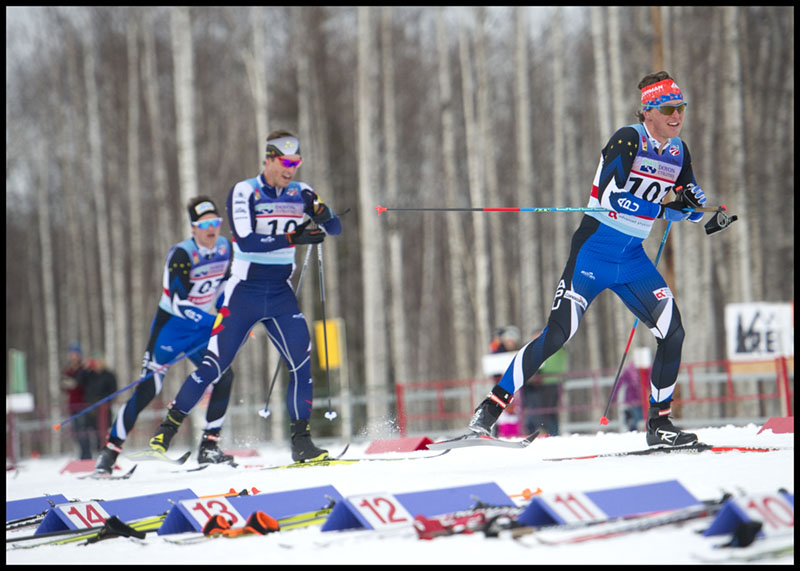
Scott Patterson (r) leads Kris Freeman (c) and David Norris (l) into the ski exchange during the men’s 22.5-kilometer skiathlon at 2017 SuperTour Finals in Fairbanks, Alaska. (Photo: Lance Parrish, Fairbanks)
If you think a classic-to-skate transition is tough, Patterson has dialed his training-to-work transitions.
“One of the things I’ve noticed is that I really kind of figured out how to nail down the transition, Patterson said. “I eat my food faster, driving in the car. Just like every single little thing is made to kind of streamline the day. And you’d probably say it’s a little OCD but it’s how I get through it, so it works for me.”
If you’re Patterson’s work boss, the question is has he clocked quality work time? If you’re Erik Flora, APU’s head coach, the question is has Patterson logged quality training? On average, Patterson said he trains two to two-and-a-half hours in the morning before a noontime arrival at work. He then trains another two to two-and-a-half hour block in the early evening. Amongst domestic skiers, he’s known to log a high volume of training hours.
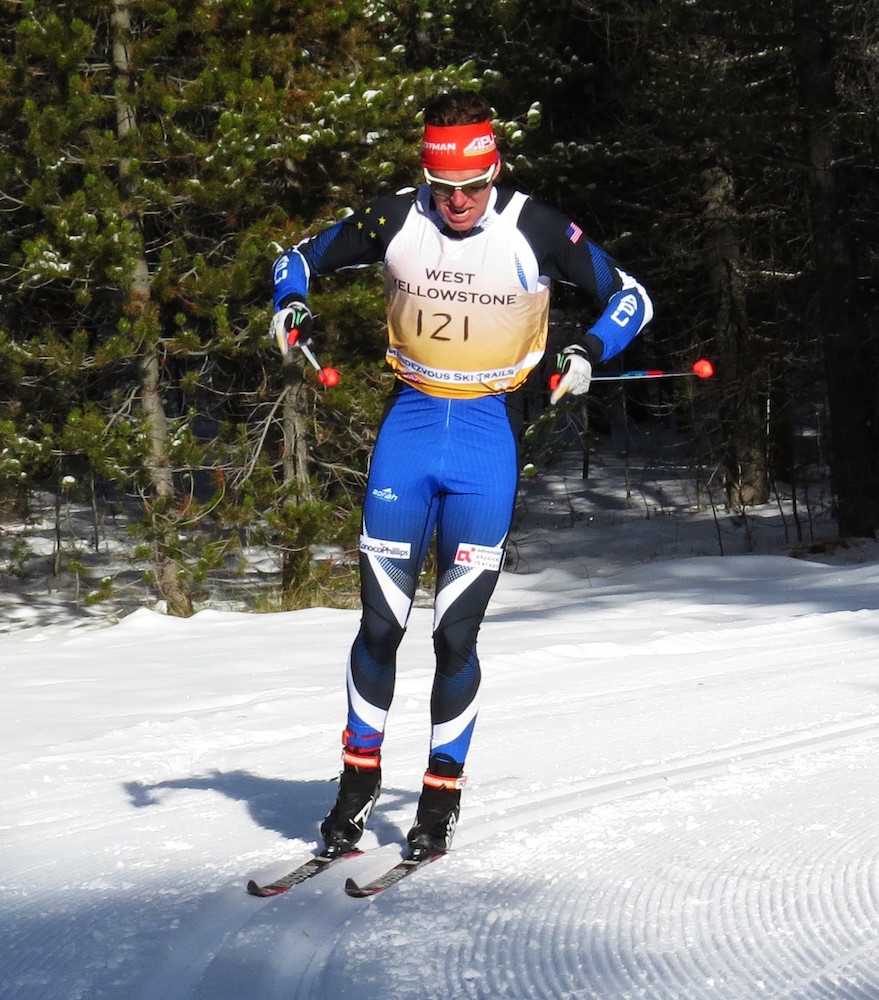
Scott Patterson double poling to the win in the men’s 10 k classic “pre-season” FIS race in November 2016 in West Yellowstone, Mont. (Photo: Ian Harvey/Toko)
Patterson began this year’s SuperTour distance skiing campaign with a third place in the 15 k skate in West Yellowstone, Mont. Then a week later in an equally loaded domestic field, Patterson won the 15 k skate at the first NorAm of the season at Sovereign Lake in Vernon, British Columbia.
Primed for his major objective of the year, qualifying for World Championships, Patterson figured one stellar race at U.S. nationals in early January would punch his ticket to Finland. The 15 k skate at nationals didn’t go as planned; he placed 16th (1:25.9 minutes back from the winner). And on a tricky waxing day for the 30 k classic mass start, Patterson finished fourth, about 12 seconds behind third-place skier Kris Freeman.
“I was definitely pretty bummed out. … I got sick about two days before I jumped into the 15 k,” Patterson said. “It was rough. I was coughing up mucus the whole time and struggling .”
U.S. Ski Team Head Coach Chris Grover acknowledged in an interview last month that he wanted to extend Patterson an opportunity to race at the PyeongChang World Cup. His rationale was simple: of the domestic male skiers proving themselves in the early season, Patterson — having not qualified for World Championships — lacked a chance to test himself internationally.
Patterson made the most of his chances, skiing to two ninth places in PyeongChang, South Korea, and placing 28th in the Holmenkollen 50 k classic mass start in Oslo, Norway.
Two seasons ago, in 2015/2016, Patterson had 13 individual World Cup starts. His best results were 32nd in the Holmenkollen 50 k classic and the 38th fastest time on the day in the Ski Tour Canada’s 15 k skate pursuit. On the 2015/2016 SuperTour circuit, Patterson was consistent, winning the 15 k classic at 2016 U.S. nationals as well as another 15 k classic, and placing second and third in two 15 k skate races.
Fast forward to this past season, 2016/2017, and the World Cup starts granted Patterson weren’t exactly a lifeline, but a knock on the door. Having missed out on his goal for the year, Patterson still understood a USST nomination wasn’t an outlandish expectation.
“I was kind of thinking of it especially after Holmenkollen,” Patterson said. “Going into the year, I was hoping I could ski well enough, but after Holmenkollen, I was realizing that I had scored points a couple times. That is what Grover and I had talked about. If I can get a few more in Canada [at World Cup Finals] and show it at the end of the season that I am better than the domestic field, and then I figured I put my best foot forward with sickness and everything, that was the best I could do and hope for a nomination there.”
With a path still open, Patterson finished the Quebec City World Cup Finals 41st overall, with the 30th-best time of day in the 15 k freestyle pursuit.
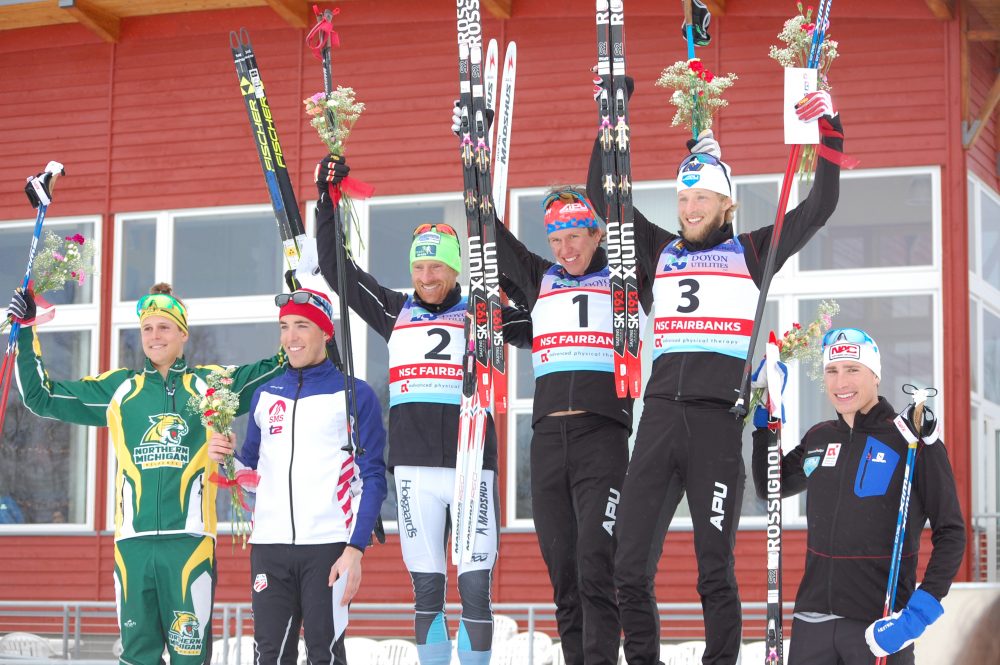
APU’s Scott Patterson (1) on the podium with Team Gregg’s Brian Gregg (2) and APU’s Eric Packer (3) after the men’s 50 k freestyle mass start at 2017 U.S. Distance Nationals in Fairbanks, Alaska. (Photo: Max Kaufman)
Patterson threw down an exclamation point to end the season at SuperTour Finals and U.S. Distance Nationals in Fairbanks, Alaska. He won both distance races — a 30 k skiathlon and 50 k skate mass start. When asked if he expected to dominate the domestic field in Fairbanks, Patterson was quick to answer.
“Not at all,” Patterson said. “That 30th place in Quebec, I kind of felt like I was faking it for the whole race. I wasn’t quite sure where my fitness was. I did a lot of leading got the pack, it was myself and Florian Notz from Germany kind of leading most of the race and David [Norris] and Paddy [Caldwell] both pulled some pretty good results out of our pack. Leading that pack, I was never like I am feeling great. I was kind of like, ‘Well, I am leading, I guess I should try hard and make it look like I am feeling good.’ I had no idea going into Fairbanks. Even that first race, the classic [leg] felt all right. I wasn’t sure I could handle the pace very well [and] I wasn’t sure that I could really push it further. But in the skate [leg], things clicked perfectly.”
Patterson was informed of his USST nomination in April. For now, he said, not much will change.
“It means that I am going to a few more camps,” Patterson said. “I have to leave Alaska a few more times. Over the years, I have figured out what works for me. Flora has learned what works for me, too. We are proceeding along the same path regardless of the nomination. The nomination just gives a few extra resources. All that is a good thing.”
Patterson also said he intends to race a full World Cup schedule, but currently his race schedule remains a work in progress. As far as early season objectives, Patterson is eyeing the World Cup 30 k skiathlon on Dec. 3 in Lillehammer, Norway.
“And then I’d like to overall, definitely be in the top 50 … make those Olympic criteria for the World Cup,” he said.
American Paddy Caldwell (SMS/USST) on his way to qualifying 20th in the men’s classic sprint at U23 World Championships at Soldier Hollow in Midway, Utah. He went on to place fourth in his quarterfinal and 18th overall for his best sprint result at U23 Worlds. (Photo: FlyingPointRoad.com)
Back in December of 2010, 15-year-old Patrick “Paddy” Caldwell was racing amongst grown men. He finished 17th in an International Ski Federation (FIS) classic sprint held in Craftsbury, Vt. Today, at 23, Caldwell skis for the Stratton Mountain School (SMS) Elite Team and is a newly minted U.S. Ski Team (USST) B-team member. To put things in perspective, during that 2010 Craftsbury sprint, Patrick O’Brien, Caldwell’s current primary coach and head of the SMS Elite Team, was nearly 23 at the time and placed fourth in the race.
The USST has a well-established development pipeline. Here’s the basic philosophy: have skiers find success at each rung of the ladder before exposing themselves to deeper competition as they progress towards more rarefied races. From local and regional events to junior nationals, OPA Cup trips, NCAAs, senior nationals, to Junior and U23 World Championships, Caldwell has paid his dues, notched benchmark performances, and maintained the grind to find success at each incremental step.
It wouldn’t be a stretch to say Caldwell embodies the spirit of a USST development model where skiers can remain in school, meet conflicting demands, and with a big dose of hard work and a smidge of luck, make progress as a skier.
Paddy Caldwell (U.S. Ski Team D-team/SMS) racing to 46th overall and 25th for time of day in the men’s 15 k freestyle pursuit at World Cup Finals in Quebec City. (Photo: John Lazenby/Lazenbyphoto.com)
In a phone interview two weeks ago, the Lyme, N.H., native explained that making the jump to the B-team wasn’t an explicit goal.
“I don’t think I officially wrote that down in a goal section or something like that in the beginning of the year,” Caldwell said while finishing up spring classes at Dartmouth College in Hanover, N.H. “By looking at it as sort of progression, it definitely has been a goal of mine. My goal was to be a competitive World Cup skier and that is a step that needs to happen.”
Caldwell’s 2016/2017 objectives highlighted U23 World Championships at Soldier Hollow outside Midway, Utah.
“I was really focused trying to peak for those events and put up the best results that I could in that field,” he explained.
At U23 worlds, he earned two top 10s, placing ninth in both the 15-kilometer skate and 30 k skiathlon.
Caldwell was granted starts for the World Cup’s closing weekend, a three-race mini tour in Quebec City. He placed 46th overall at World Cup Finals, but turned heads with a 25th-best time of day on the final-stage 15 k skate pursuit.
In the near term, despite his promotion, it’s life as usual for Caldwell. There’s school to finish up and training hours to log. (Caldwell returned recently to Hanover from the USST’s first on-snow camp of the year in Bend, Ore.)
“I think that is very much in the air,” Caldwell said when asked if he’d be racing a full World Cup schedule. “And it depends on a lot of things — foremost if I am skiing well. And those are plans I am still working out. I don’t know exactly what opportunities will be there. Those are things, discussions we’ll have later in the year.”
Caldwell will remain under the guidance of O’Brien at SMS. And from a funding standpoint, Caldwell said he won’t see a bump in USST funding.
“Not in terms of support from the U.S. Ski Team,” Caldwell said when asked if his B-team status came with greater financial support. “The last few years I have been really fortunate to be successful fundraising through the local community here in the Upper Valley in New Hampshire and Vermont. So I am really thankful for the support from local people in both the ski community and outside the skiing community. I think absolutely if I end up racing in Europe more, it will be a bigger expense, and those are things I am not completely dialed on yet.”
Caldwell is officially a senior at Dartmouth, having earned 32 of 35 credits for his bachelor’s degree while studying geography and economics. In 2015, he won the 10 k skate at NCAA Skiing Championships.
Paddy Caldwell (13) chases Kris Freeman in the 50 k freestyle mass start at 2015 U.S. Distance Nationals in Sun Valley, Idaho.
“I feel really fortunate to go to Dartmouth College and be able to balance skiing and education,” he said. “One of my goals, I’ve always been aimed at finishing an undergraduate degree in a timely manner. I’m really thankful to be at Dartmouth where there is a flexible quarter system. I’ve taken off most fall terms since I have started at Dartmouth as well as winter and been able to go in the spring and summer fairly consistently.”
As a discretionary pick for the USST, Caldwell has jumped a significant pipeline-hurdle. Domestically, his peers have been skiing in a tight pack — on this year’s SuperTour, the men’s side had several different standout performances.
“I think there is an aspect of added pressure,” Caldwell said of his new B-team status. “But I also think that that is an inherent part of our sport. At the end of the day, it comes down to racing fast. That pressure is going to be there no matter what team you are on. It is something that I try not to focus on and just see it as an opportunity to keep growing as a skier and not as a target on my back, because I think it is easy to see it that way. Absolutely there will be some pressure from that, it’s also not something that I am unfamiliar with. I think it’s part of the sport. You have to, at least for me, just focus on trying to achieve results for my own growth as a skier and not focusing on the stuff going on around me.”