Tag: 2017 FasterSkier Awards

  • FasterSkier’s 2017 Performances of the Year

    FasterSkier’s 2017 Performances of the Year

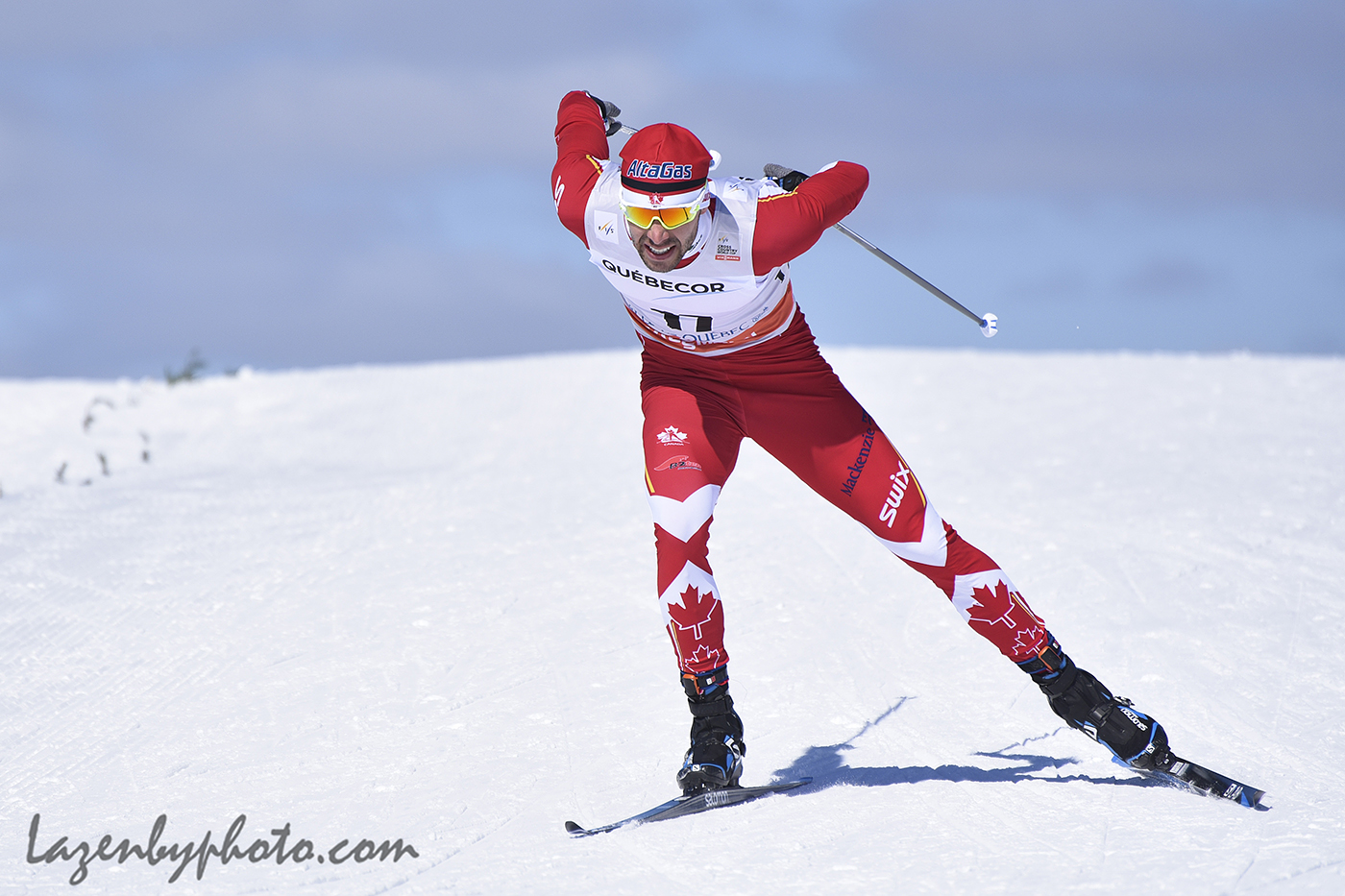
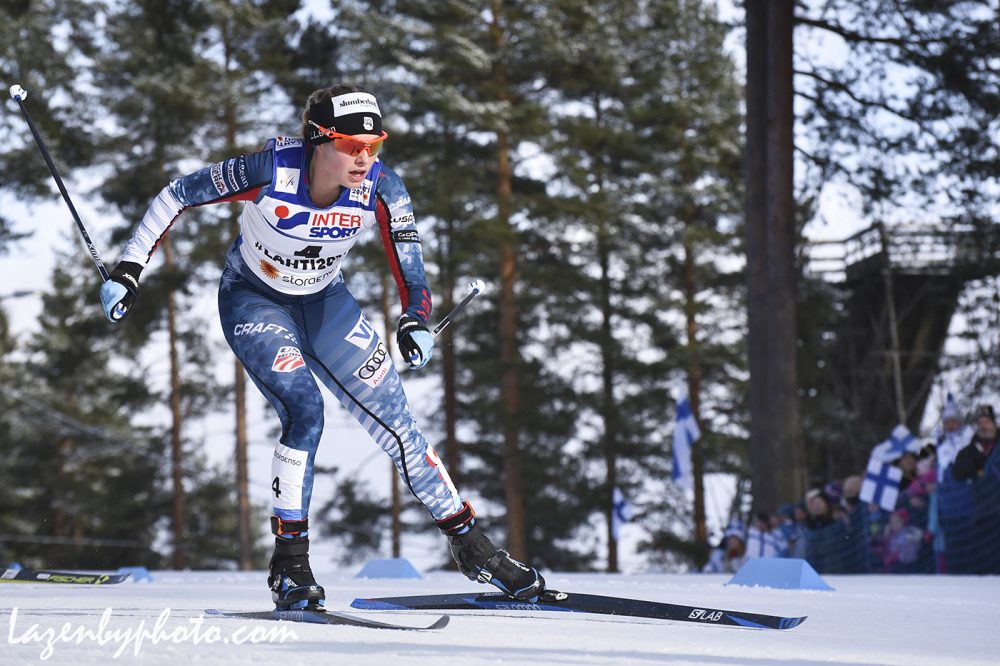
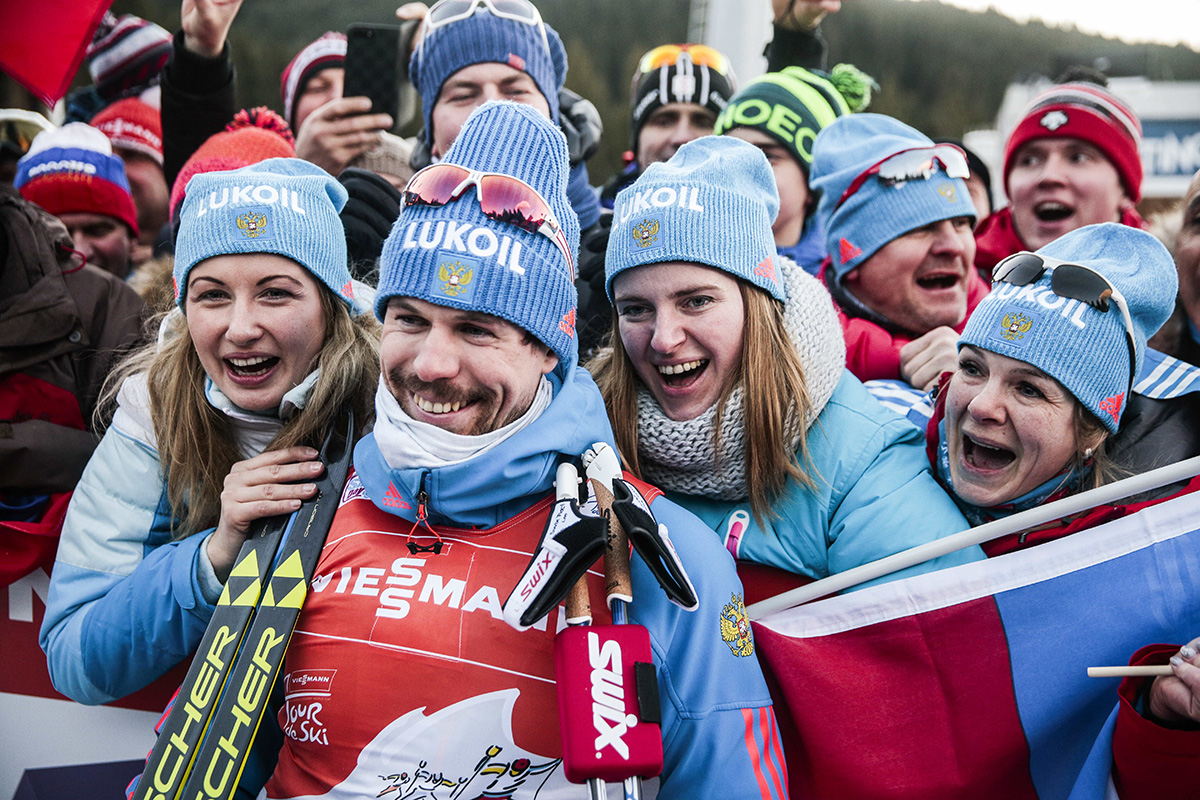
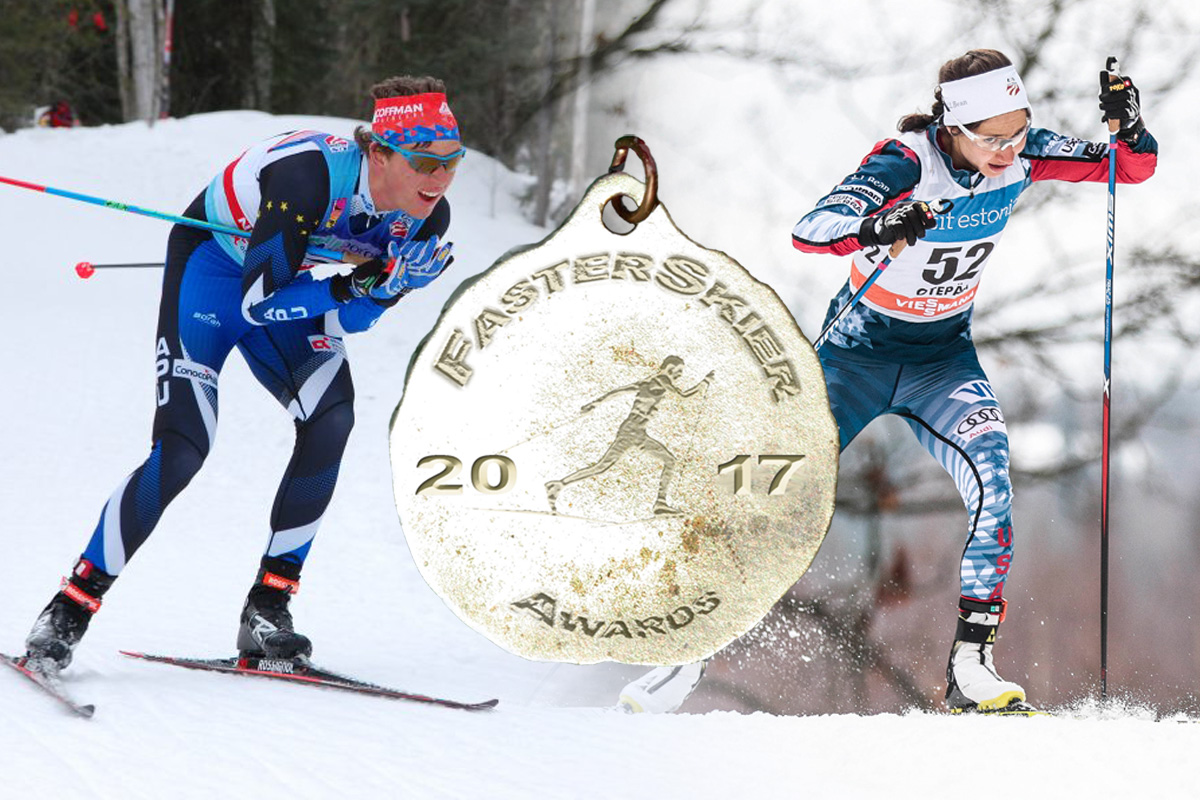
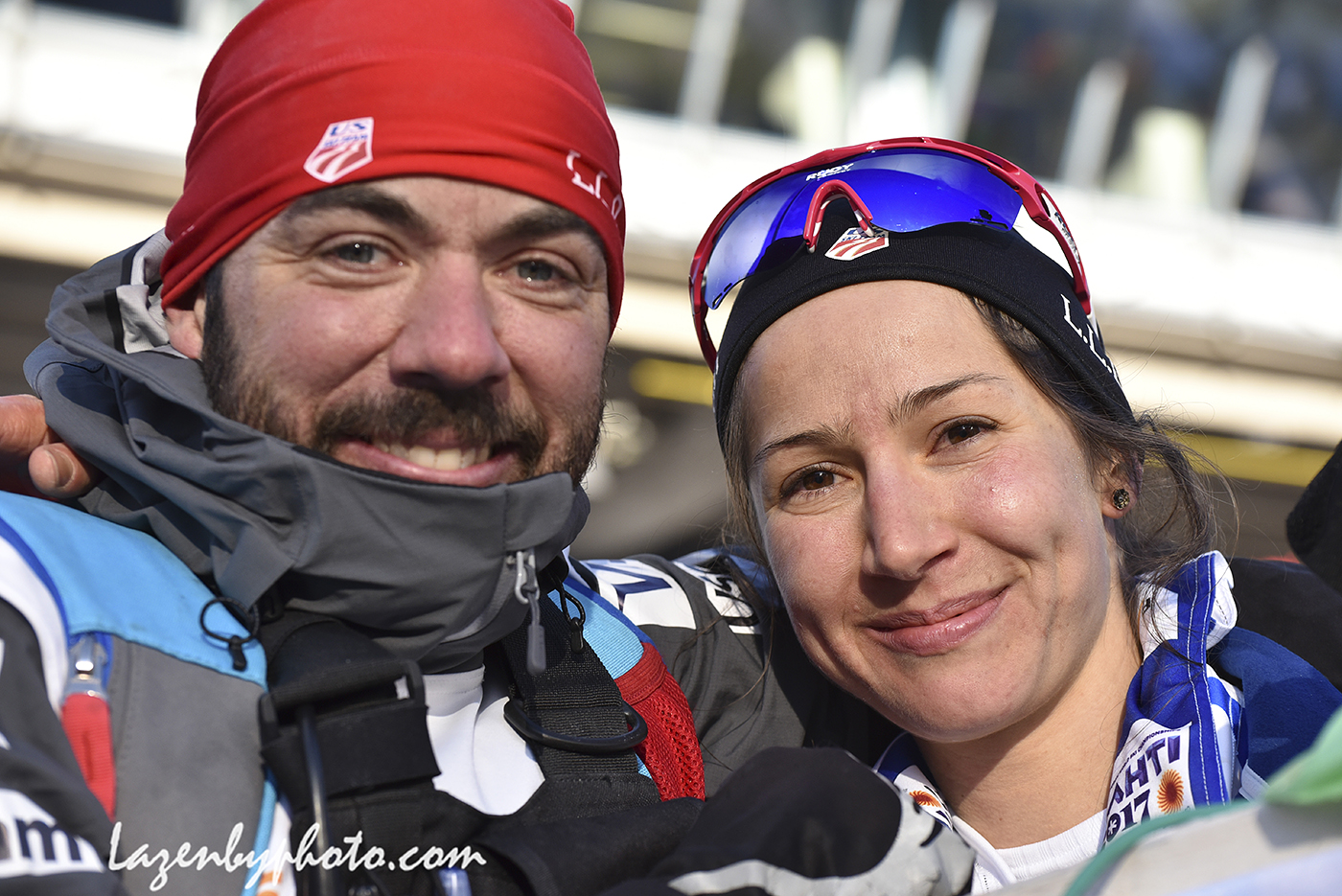
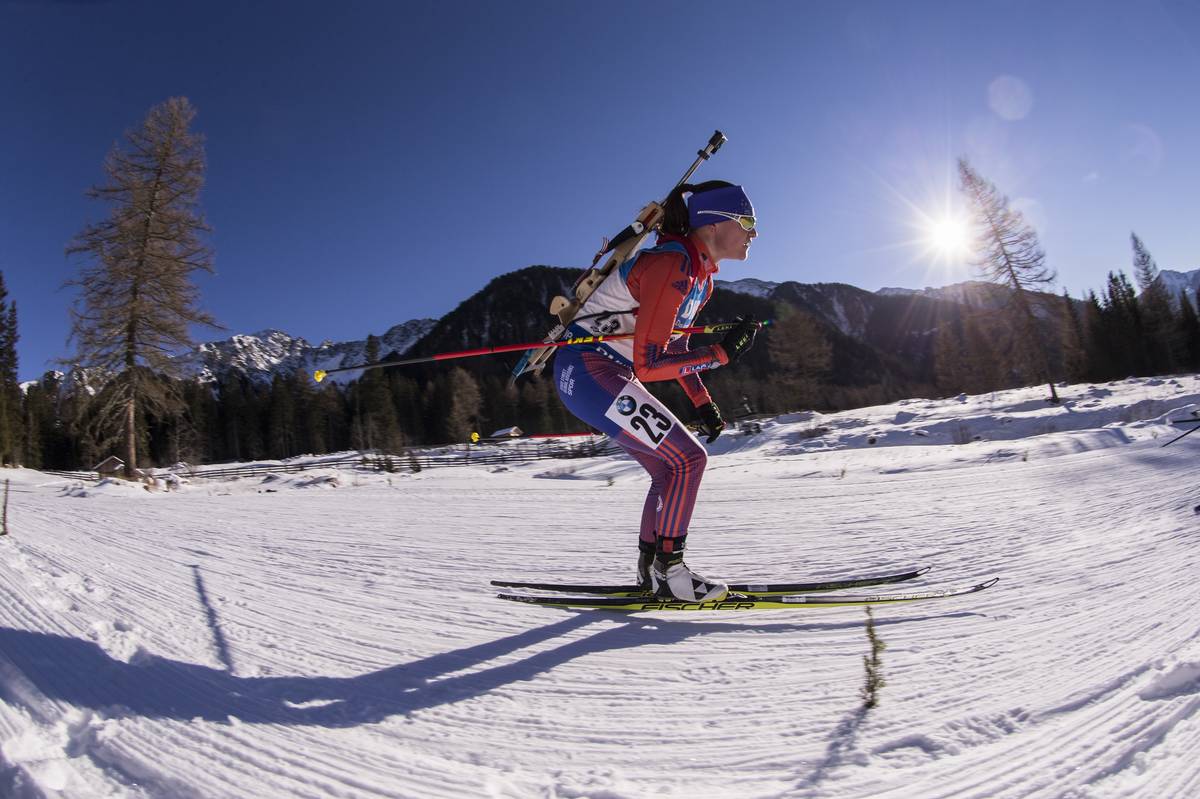
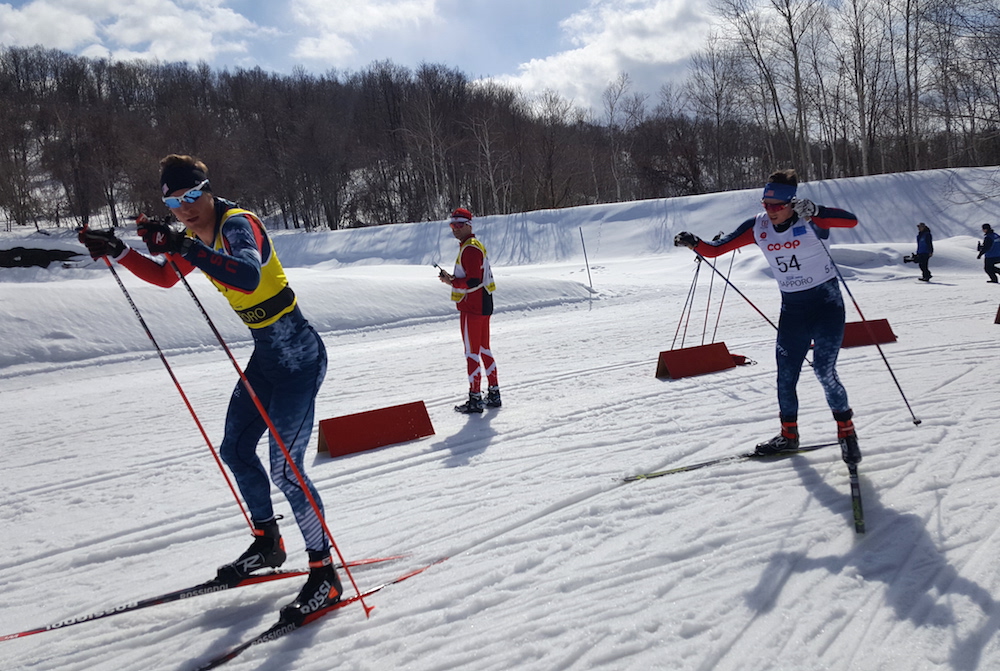
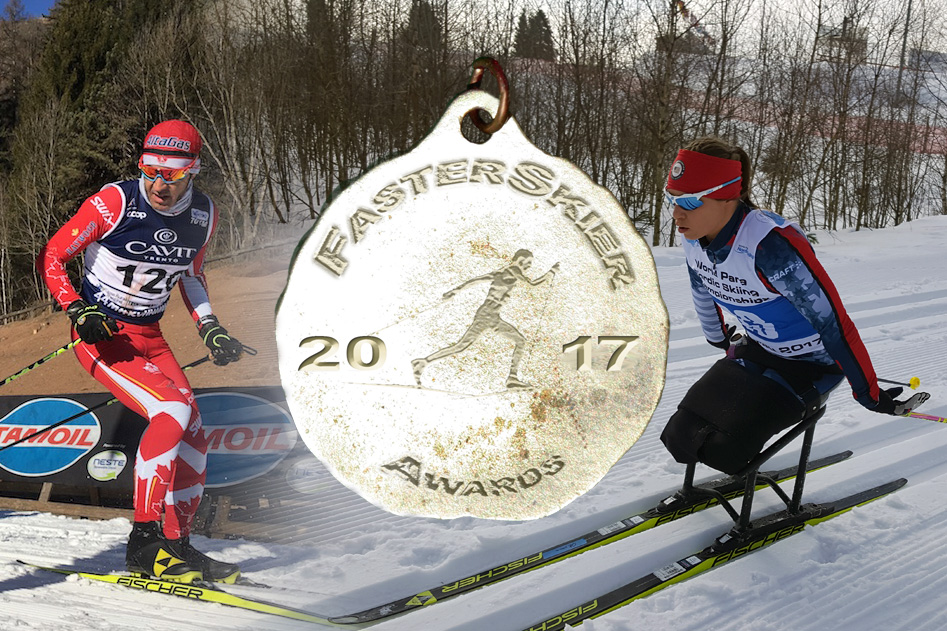
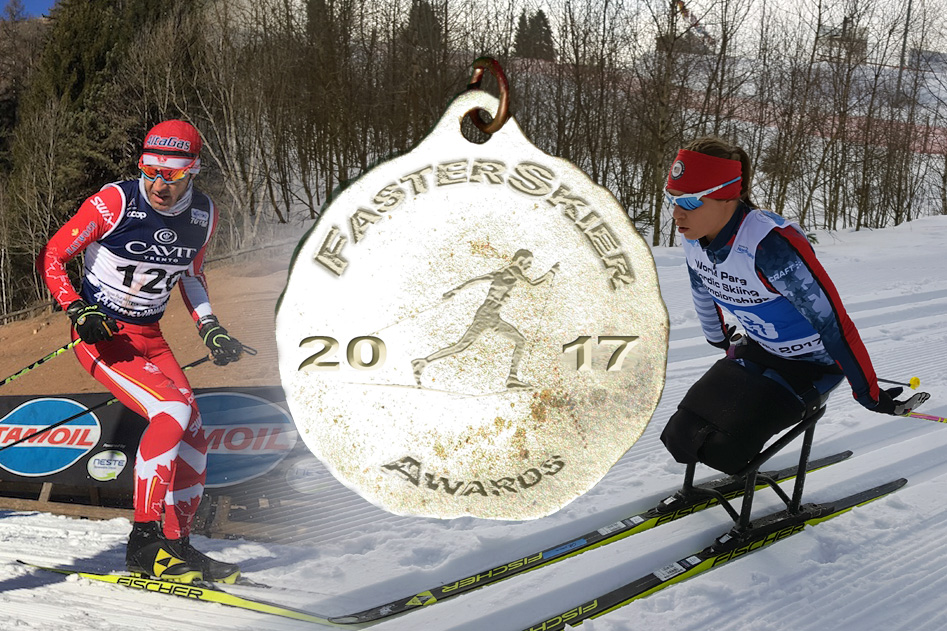
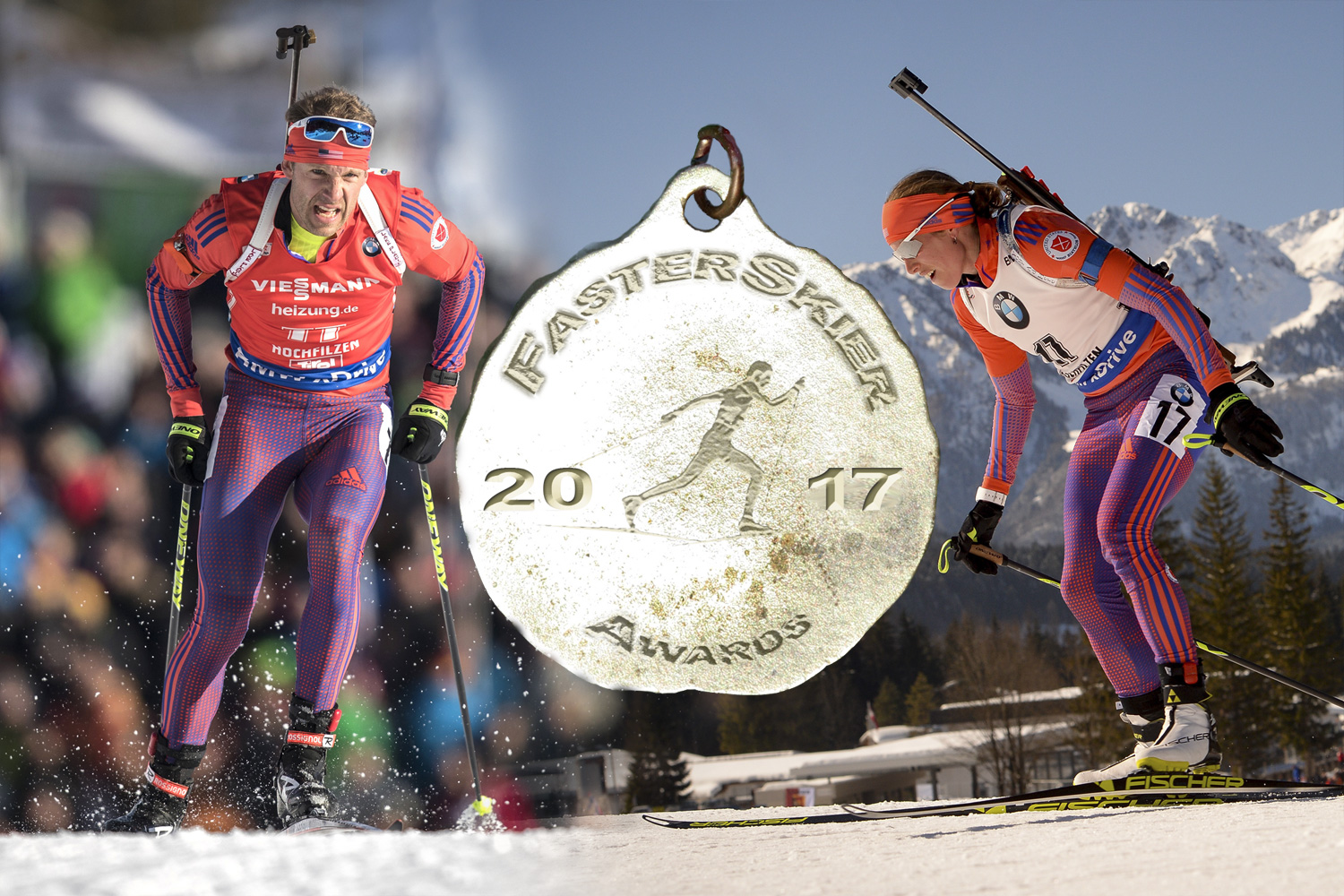
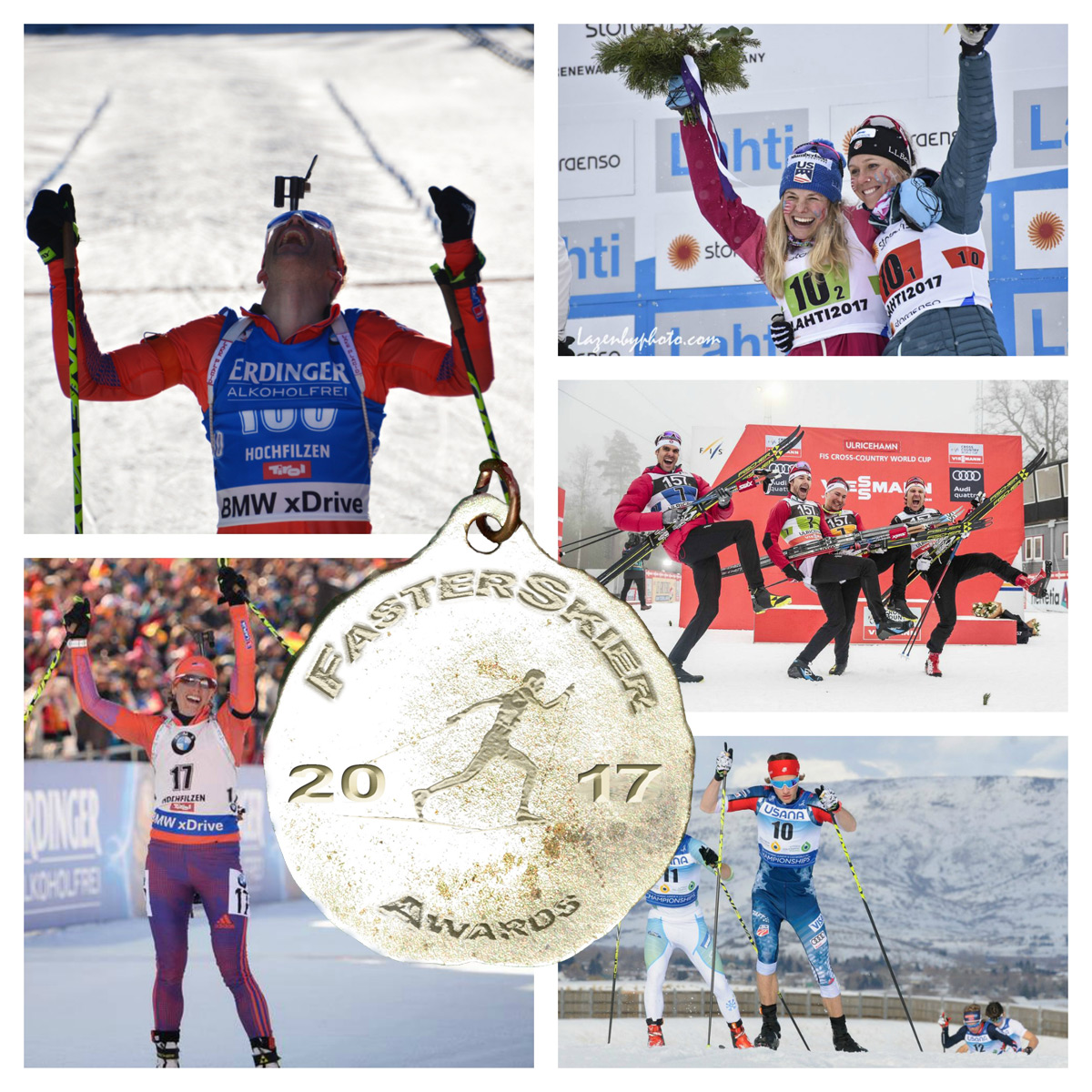
    FasterSkier’s Performances of the Year (clockwise, from upper right): Jessie Diggins and Sadie Bjornsen placing third in the FIS World Championships team sprint (Photo: John Lazenby/Lazenbyphoto.com), Canadian men’s relay placing third in Ulricehamn World Cup (Salomon/NordicFocus), Ben Loomis placing ninth at Junior World Championships (U.S. Ski Team/Tom Kelly), Susan Dunklee placing second at IBU World Championships (USBA/NordicFocus), and Lowell Bailey becoming the first American to win gold at IBU World Championships (Glen Crawford).

    This is it — the final award in our 2016/2017 awards series. Votes stemmed from the FS staff, scattered across the U.S., Canada, and Europe, and while not scientific, they’re intended to reflect a broader sense of the season in review. This honor goes to outstanding North American performances of the year across various nordic sports.

    Previous categories: Junior Skiers of the Year | Collegiate | Canadian Continental | U.S. Continental | Nordic Combined | Biathletes | Para-Nordic | Canadian BreakthroughsU.S. Breakthroughs | Coach | International | Cross-Country 

    ***

    Lowell Bailey (US Biathlon): Individual gold at IBU World Championships 

    When Lowell Bailey won the 20-kilometer individual at 2017 IBU World Championships, it was by about a slim margin as he could get away with: 3.3 seconds in a 48-minute race.

    What made his performance legendary wasn’t just that Bailey became the first American biathlete to ever earn the title of world champion. It was the way he did it: perfect 20-for-20 shooting, digging deep on his skis, rising to the meet the pressure of a nailbiter of a competition, and sealing the win with aggressive skiing on the final downhill into the stadium.

    Lowell Bailey (US Biathlon) racing to gold in the men’s 20 k individual at 2017 IBU World Championships on Feb. 16 in Hochfilzen, Germany. (Photo: USBA/NordicFocus)

    “In my mind, that was where the race began, the second I left the mat,” Bailey said of cleaning his 20th target.

    Watching from the finish line was the Czech Republic’s Ondřej Moravec, who had started with an earlier bib, also cleaned all 20 targets, and held a 6.4-second lead as Bailey left the range. It also would have been the first world title for Moravec, who had a gold relay medal but never an individual of his very own. The Czech — a veteran journeyman just like Bailey — shook his head and laughed as he watched his fate hang in the balance on the big screen.

    The 20 k individual is often nobody’s favorite race. It’s hard to keep track of what’s happening, with each athlete going through four shooting bouts and a seemingly interminable amount of skiing. The individual-start affair takes nearly two hours from first start to last finish. There are only a few on the World Cup schedule each year and persistent rumors that the format will be eliminated.

    But Bailey, Moravec, and their competitors proved that the individual can be as exciting as anything in the sports world.

    With just about a kilometer to go, Bailey had a tenth of a second on Moravec’s time. The stadium announcer asked the fans to cheer him around the last bit of the race course and they responded with a deafening roar.

    “Every hundred meters it was a sprint,” Bailey said. “Every hundred meters was ‘go as hard as you can for this hundred meters, and then when you get to the end of that hundred meters, go as hard as you can and just keep doing that.’ I thought the finish line was never going to come. I was just like, I don’t know how much longer I can do this, because the finish line is just not showing up.”

    It did, and Bailey had done it. The first American world champion let out a scream. He was mobbed by the press afterwards and his performance became one of the defining moments of the World Championships.

    “I know how important it really is for biathlon,” World Cup overall champion Martin Fourcade said of Bailey’s gold medal. “To see some people outside of Europe winning. I think that is the most we can do to make our sport bigger. I cannot be more satisfied about the guy winning today.”

    Susan Dunklee (US Biathlon): Mass-start silver at IBU World Championships 

    A few days later, Bailey’s teammate Susan Dunklee matched his 20-for-20 shooting and left the shooting range in the 12.5 k mass start with the race lead.

    American Susan Dunklee leaving the range first after the final shooting stage of the women’s 12.5 k mass start at IBU World Championships in Hochfilzen, Austria. She went on to place second for her first World Championships medal and the best result of a U.S. female biathlete at World Championships. (Photo: USBA/NordicFocus)

    In the final kilometers, she was caught and passed by Germany’s Laura Dahlmeier, the most successful athlete of the Championships who took home five gold medals. But her fifth and last one did not come easily: the pair were among the only women to shoot perfectly, and Dahlmeier had to chase hard on the last loop. In the end, Dunklee crossed the line 4.6 seconds after the German and won a silver medal, the first individual medal ever by a U.S. woman at a World Championships.

    “I had a feeling that [Dahlmeier] would catch me, because it is a lot easier when you are hunting than being hunted,” Dunklee said of not being able to follow the German and thus missing out on gold. “Unfortunately I didn’t quite have that today, but I am pretty happy with the race and it gives me something to aim for in the future.”

    While Dahlmeier was faster on her skis, Dunklee was the fastest on the shooting range, and it wasn’t even close. From the first bout of the race, she knocked down her targets in blazing fashion. That allowed her to leave the range first time after time, and set out around the course at her own pace. By the time she came to the last shooting stage, it seemed almost impossible that she could miss; a totally electric performance.

    “You have to get to the point where you trust that speed is better than shooting slow,” she said of her shooting training. “That takes a long time… today it worked.”

    Jessie Diggins and Sadie Bjornsen (U.S. Ski Team): Classic team sprint bronze at FIS World Championships 

    Jessie Diggins and Sadie Bjornsen gave us all a glimpse of what was to come when they finished first and third, respectively, in the women’s 5 k freestyle during the Tour de Ski in Toblach, Italy. That was Bjornsen’s first individual podium and Diggins’s third. Less than two months later, they returned to the podium together, this time in a team event at World Championships nonetheless. Bjornsen started first for the two-woman squad in the 6 x 1.3 k classic team sprint in Lahti, Finland, and Diggins anchored, skiing from fifth to third on the final lap and overtaking Sweden’s Stina Nilsson in the finishing stretch.
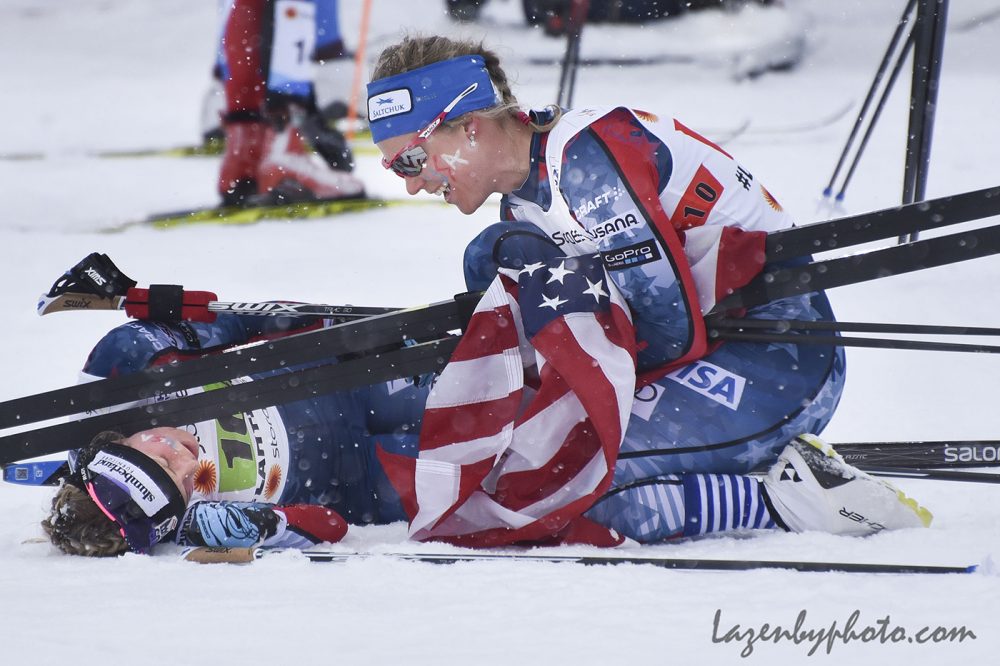
    Sadie Bjornsen (r) greets her U.S. teammate Jessie Diggins after Diggins outlunged Sweden’s Stina Nilsson (not shown) for the bronze medal in the women’s 6 x 1.3-kilometer classic team sprint at 2017 Nordic World Championships in Lahti, Finland. (Photo: John Lazenby/Lazenbyphoto.com)

    Diggins edged Nilsson by 0.19 seconds for the final spot on the podium. Following Diggins’s freestyle team sprint gold, which she won with Kikkan Randall at 2013 World Championships, bronze is the U.S. team’s next-best result. The medal was Diggins’s fourth at a World Championships (and second of the week in Lahti, Finland) and Bjornsen’s first.

    “I have been dreaming to be on a team sprint at World Championships or Olympics for a while now and it’s so cool to finally be here,” Bjornsen said afterward. “I think it’s finally sinking in, because I feel like I just wanna cry.”

    Out of all of the first-leg skiers in the final, Bjornsen posted the fastest splits on her first and second laps.

    While Diggins had previously taken silver earlier in the week in the 2017 World Championships skate sprint (and earned silver two years ago in the 2015 world champs 10 k skate), this was her first classic medal.

    “For me, this is one of the most exciting ones because, as Sadie said, it’s in classic,” Diggins said.

    In all, the U.S. team took home four medals from 2017 World Championships: two in the skate sprint (where Diggins placed second and Randall finished third), and technically two from the classic team sprint (one each for Diggins and Bjornsen).

    “This was an event that, in April, we talked about as an outside medal shot,” U.S. Ski Team Women’s Coach Matt Whitcomb said. “With that in mind, the team started brainstorming of a way of ‘coming from some sort of surprising attack’ when the time came in Lahti.”

    He explained that they didn’t select the team-sprint duo until about 12 hours before the race.

    “We had [Bjornsen] specifically skip the skiathlon because we thought with a little extra rest, she could be that much sharper,” Whitcomb said. Diggins ended up dropping out of the skiathlon to rest up for the team sprint the next day.

    “But we had four other women that were up for serious consideration for this spot and we didn’t make the call until yesterday afternoon at 2:25 p.m.,” he added. “[Bjornsen and Diggins] felt the pressure of being selected for this team and … they’ve awarded everybody that could have been on it.”

    Canadian men’s relay: Bronze at Ulricehamn World Cup

    On Jan. 15, Len Valjas returned to the World Cup podium for the first time in four years. He won the freestyle team sprint in Toblach with teammate Alex Harvey, marking Valjas’s first World Cup win and sixth career podium.
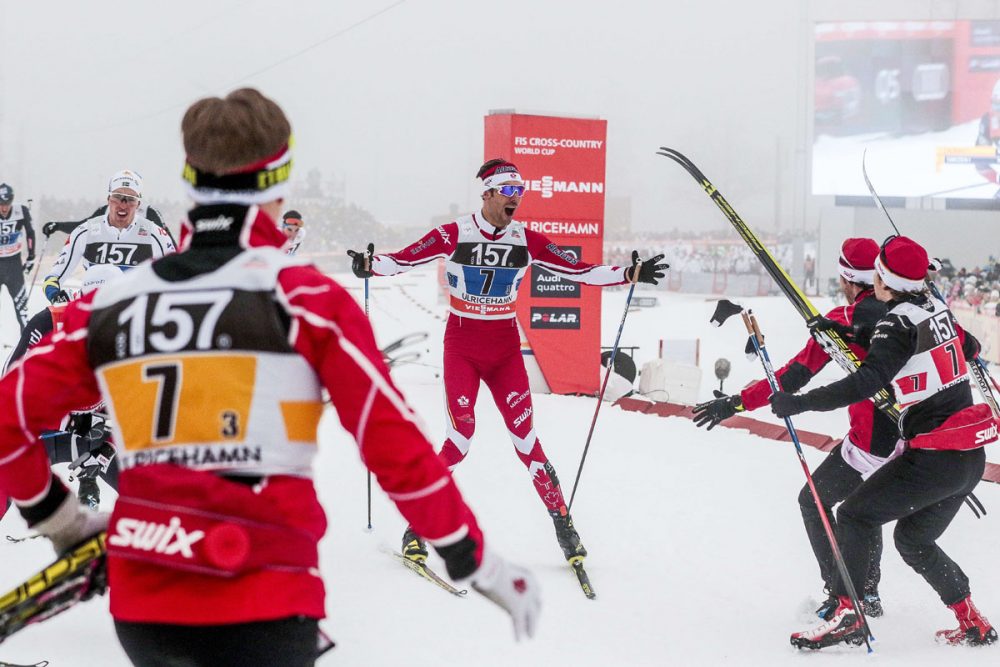
    Len Valjas (c) is greeted by his teammates Alex Harvey (far right), Knute Johnsgaard (far left) and Devon Kershaw after he anchored their team to third in the men’s 4 x 7.5-kilometer team relay for a team best in Ulricehamn, Sweden. (Photo: Fischer/NordicFocus)

    One week later, Valjas anchored his team’s 4 x 7.5 k relay to third at the World Cup in Ulricehamn, Sweden, for the best-ever Canadian men’s relay result. The program’s previous best was fifth in 2012.

    “We barely assembled one team, but that team made a miracle today, so we only needed one,” Canadian World Cup coach Ivan Babikov said after the Ulricehamn relay medal. Babikov competed on Canada’s 2012 relay team, retiring just last spring and transitioning to coaching.

    “I’ll never forget this day,” he added. “We’ve had individual podiums and individual medals, but the relay is special because it’s a show of strength for the whole team and the whole staff behind this team.”

    The four-man squad included veteran World Cup skiers Devon Kershaw and Harvey, as well as U25 national team member Knute Johnsgaard, who flew to Sweden just a few days before the event. By the first exchange, Kershaw put the Canadians in third, just 0.7 seconds out of first. Harvey went on to tag Johnsgaard 3.5 seconds back in fifth, and Johnsgaard as the third leg kept the team within striking distance in seventh, 5 seconds out of first.

    Over the final 7.5 k, Valjas raced his team into not just podium contention, but a threat for second place as well.

    “On the last lap, I was totally blocked on the hill, so I couldn’t actually empty the tank, which was probably a good thing for me,” Valjas recalled. “And then just after the hill I built up some speed, and passed five or six guys just double poling.”

    With about 300 meters to go, Valjas was up to second place behind Sweden’s Calle Halfvarsson in first. Norway’s Finn Hågen Krogh slipped past both of them on the final corner, leaving Valjas and Halfvarsson to duke it out for silver. The Swede took it and Valjas claimed third, 1.3 seconds ahead of Switzerland’s Curdin Perl in fourth, and the Canadian team was ecstatic.

    “I’ve never been the anchor in a relay,” Valjas explained. “I’ve been the second leg in some team sprints, but today was special, the best feeling I’ve ever had skiing, seeing my three teammates sprinting towards me at the finish line. I don’t think anything will ever top that, the first relay [podium] for Canada.”

    Harvey as the the team’s lone fully funded athlete explained that the relay medal could give the rest of his team a significant financial boost.

    “Because the results over the last couple of years internationally have been not stellar as a team, a lot of funding was cut for us,” Harvey explained after the race. “I think this result will really help those guys to be fully funded again.”

    Ben Loomis (U.S. Nordic Combined Team): Ninth at Junior World Championships
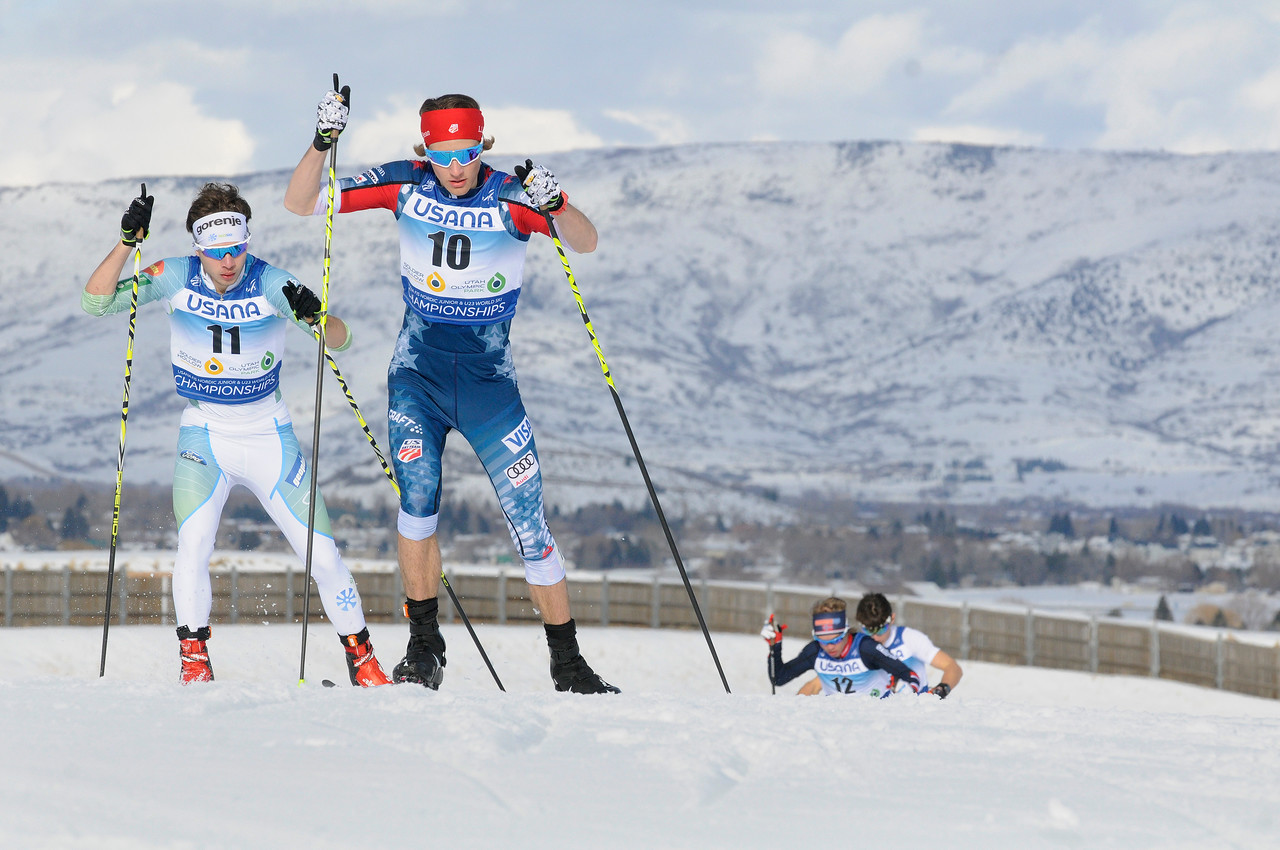
    American Ben Loomis (10) leading Slovenia’s Vid Vrhovnik (11) during the individual normal hill/5 k competition on Feb. 4 at Nordic Combined Junior World Championships at Soldier Hollow in Midway, Utah. Loomis finished ninth for a career best in his third Junior Worlds. (Photo: U.S. Ski Team/Tom Kelly)

    Out of the six U.S. nordic-combined skiers at 2017 Nordic Junior World Championships in Park City and Midway, Utah, came three top-10 results. Individually, 18-year-old Ben Loomis led the team in ninth after 16-year-old Stephen Schumann broke through earlier in the week in 10th in the normal hill/10 k.

    Together, the teammates raced to seventh in the 4 x 5 k relay, along with Elijah Vargas and Grant Andrews. Loomis moved the team from ninth to seventh on the third leg, and Schumann anchored them to seventh, 2:10 minutes behind Austria in first.

    Two days later, Loomis posted his first top 10 in his third Junior World Championships, finishing ninth in the individual normal-hill/5 k. He started the day by jumping to 10th out of nearly 50 competitors then picked off one place in the shorter-format race before the finish.

    “I was able to stay relaxed, focused and have my best competition jump of the week,” Loomis wrote in an email afterward. “The home hill advantage made a huge difference in my jumping. Prior to this week, I had little jumps on the hill this winter. Luckily, I know the hill well and was able to get in rhythm with the jump very quickly.”

    Loomis hails from Eau Claire, Wis., a town that actually does have ski-jumping facilities, he explained in an “Under 23 Questions” interview before the championships. He is currently based in Park City, where he trains with his older brother Adam.

    In the final competition of 2017 Junior Worlds, he was one of two U.S. men in the top 15. Schumann followed in 15th, racing up from his 20th-ranked jump.

    “Overall, I am very happy with my 9th place result,” Loomis wrote. “I was hoping for a little more, but to be 9th in the world is very special. I am already looking forward to next year’s competitions and approaching them with even more experience.”


  • FasterSkier’s Cross-Country Skiers of the Year: Alex Harvey & Jessie Diggins

    FasterSkier’s Cross-Country Skiers of the Year: Alex Harvey & Jessie Diggins

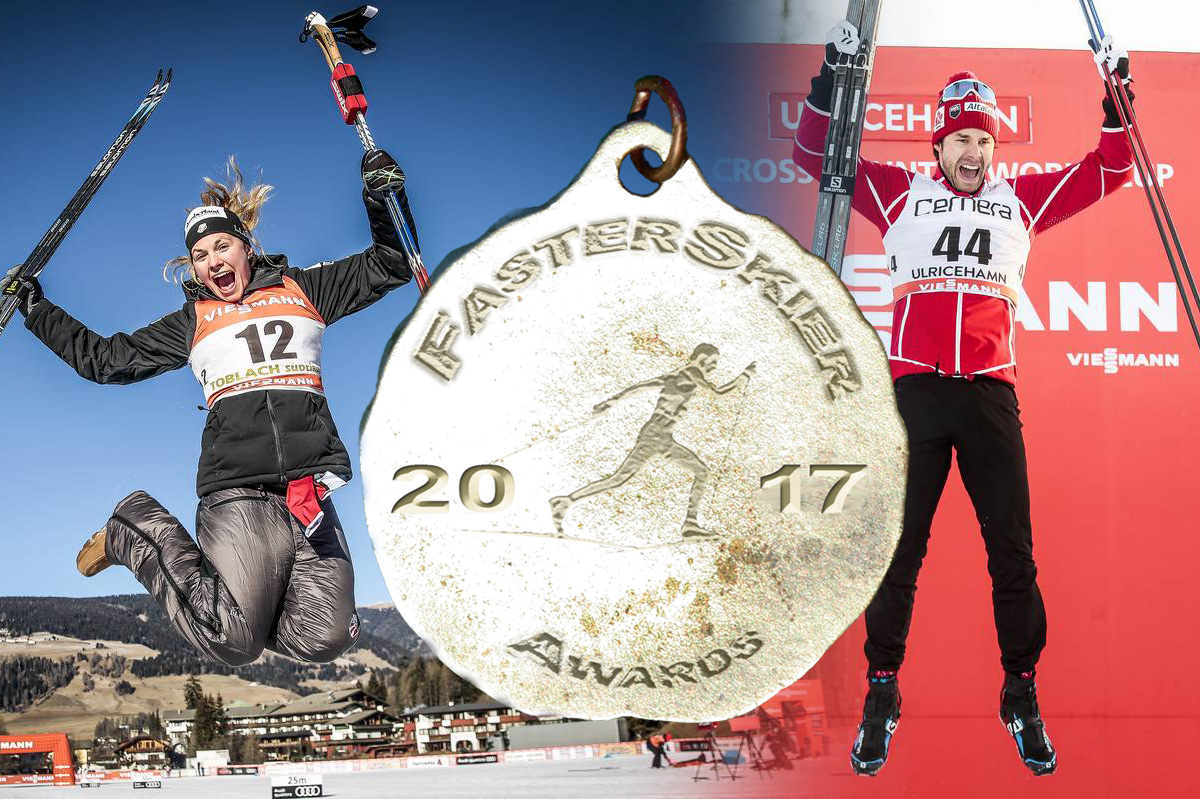
    Jessie Diggins (U.S. Ski Team) and Alex Harvey (Canadian World Cup Team) are FasterSkier’s North American Cross-Country Skiers of the Year. (Photos: Salomon/NordicFocus)

    With the 2016/2017 season officially in the rearview, FasterSkier is excited to unveil its annual award winners for this past winter. Votes stem from the FS staff, scattered across the U.S., Canada, and Europe, and while not scientific, they are intended to reflect a broader sense of the season in review. This honor goes to two outstanding North American skiers of the year. 

    Previous categories: Junior Skiers of the Year | Collegiate | Canadian Continental | U.S. Continental | Nordic Combined | Biathletes | Para-Nordic | Canadian BreakthroughsU.S. Breakthroughs | Coach | International

    ***

    Alex Harvey and Jessie Diggins are FasterSkier’s North American Cross-County Skiers of the Year. Sound familiar? No, you’re not going crazy; these are the same winners as last year.

    But this is only repeat in the sense that both athletes earned this award as standout North American World Cup skiers. They didn’t have identical seasons as last year; in fact, they continued to outdo themselves.

    Alex Harvey, Canadian World Cup Team/Pierre Harvey National Training Centre

    Alex Harvey (Canadian World Cup Team) racing to fourth in the men’s freestyle sprint qualifier on the first day of World Cup Finals on March 17 in Quebec City. He went on to win the final. (Photo: John Lazenby/Lazenbyphoto.com)

    If it weren’t for Martin Johnsrud Sundby and Sergey Ustiugov, Canada’s Alex Harvey could easily have been tapped for International Skier of the Year. The 28-year-old Quebec native finished third in the Overall World Cup and second in the Distance World Cup. He had been third overall once before — in 2014 — but two end-of-season World Cup podiums? That was something to write home about.

    Fortunately for Harvey, he was already right at home in Quebec City, where World Cup Finals were held March 17-19. There, he won the skate sprint to start the mini tour and raced to second in the 15-kilometer freestyle pursuit, putting him second in the mini tour. Over the course of the season, Harvey accumulated two regular-season individual World Cup victories and six podiums (including a freestyle team-sprint win with Lenny Valjas and 4 x 7.5 k relay bronze with Valjas, Devon Kershaw and Knute Johnsgaard). He placed seventh in the Tour de Ski for his best overall finish in the multi-stage event.

    Oh, and at World Championships, Harvey won the 50 k freestyle mass start, which stood as his first individual championships gold medal and his fifth medal total in four World Championships.

    Asked about his confidence ahead of next year’s Winter Olympics in PyeongChang, South Korea, Harvey told reporters on the last day of World Cup Finals he was “really confident, especially with [being] able to win a gold medal at world champs. It was the last race of the championships, so it was like, in French we say, quarter before midnight, it was just last chance to dance. … The team believed in me and I believed in the team and we were able to deliver on the last day so I think that itself gives me a lot of confidence for PyeongChang.”

    As for his overall World Cup finish, he said that had been a season-long focus.

    “Even though it’s not the win, it’s not the Crystal Globe, it still means a lot to me because we are on the road the whole winter,” he told reporters. “It’s a lot for me, and for the whole team. It means you can’t miss the skis too often in the season, can’t allow yourself to get sick or have a big dip in form, so that’s really important for me to be able to be third in the overall.”

    Jessie Diggins, U.S. Ski Team/Stratton Mountain School T2 Team

    Jessie Diggins (U.S. Ski Team) racing to fifth in the women’s 30 k freestyle mass start at the 2017 Nordic World Championships in Lahti, Finland. (Photo: John Lazenby/Lazenbyphoto.com)

    On the second weekend of the World Cup season, American Jessie Diggins scored her first win of 2016/2017 — in the 5 k freestyle in Lillehammer, Norway. It had been one of several events she had been eyeing for the season, and on Dec. 3, she delivered, beating Norway’s Heidi Weng and Marit Bjørgen for the top step on the podium.

    It was the second individual win of her career, with the other coming in a 5 k freestyle in Toblach, Italy, the year before. Almost exactly a year from the date of her first win, Diggins did it again in the 2017 edition of the 5 k skate in Toblach for her third-career individual win. She also proved herself an all-around contender in the 10 k skiathlon in Oberstdorf, Germany, a few days earlier, where she placed second in the third stage of the Tour de Ski.

    The 25-year-old Minnesota native went on to finish fifth in the Tour de Ski (tying the best American result in the Tour), and at Lahti World Championships, she captured two medals — silver in the skate sprint and bronze in the classic team sprint with Sadie Bjornsen — for her third and fourth career World Championships medals.

    “For me, this is one of the most exciting ones because … it’s in classic,” Diggins told FasterSkier after her team-sprint bronze. “And I don’t want to be just a skater, or just a 5 k skater. I want to be able to do it all, and do it with my team and do it for the team. So this is really pretty special for us.”

    Diggins ended the season with a four-race sweep of the SuperTour Finals/U.S. Distance Nationals in Fairbanks, Alaska, winning the 15 k skiathlon, skate sprint, mixed relay (with three Stratton teammates), and 30 k freestyle mass start. She finished the World Cup season sixth overall and seventh in the distance ranking — besting her eighth and ninth place finishes in those categories, respectively, from the season before.

  • FasterSkier’s International Skiers of the Year: Sergey Ustiugov & Marit Bjørgen

    FasterSkier’s International Skiers of the Year: Sergey Ustiugov & Marit Bjørgen

    FasterSkier’s International Skiers of the Year: Russia’s Sergey Ustiugov and Norway’s Marit Bjørgen. (Photos: John Lazenby/Lazenbyphoto.com)

    With the 2016/2017 season officially in the rearview, FasterSkier is excited to unveil its annual award winners for this past winter. Votes stem from the FS staff, scattered across the U.S., Canada, and Europe, and while not scientific, they are intended to reflect a broader sense of the season in review. This honor goes to outstanding international skiers of the year.

    Previous categories: Junior Skiers of the Year | Collegiate | Canadian Continental | U.S. Continental | Nordic Combined | Biathletes | Para-Nordic | Canadian Breakthroughs| U.S. Breakthroughs | Coach

    ***

    Sergey Ustiugov, Russian World Cup Team

    Russia’s Sergey Ustiugov celebrates with supporters after winning the final climb and his first Tour de Ski overall title in January at Alpe Cermis in Val di Fiemme, Italy. (Photo: Fischer/NordicFocus)

    Russia’s Sergey Ustiugov was dominant when it seemed to matter most this season. He finished second in the Overall World Cup, he won his first Tour de Ski (TdS) — punctuated with an unprecedented six victories in seven TdS stages, and he brought the deflated Russian team five medals at World Championships.   

    The day before World Championships began, five of Ustiugov’s teammates implicated in the second McLaren report detailing systematic state-sponsored doping at the 2014 Sochi Olympics had their provisional suspensions upheld by the Court of Arbitration for Sport (CAS). Those athletes were declared ineligible for the 2017 World Championships.

    It’s an open question whether that news motivated Ustiugov. Over the course of the championships, the 24 year old won gold in the 30-kilometer skiathlon and team sprint. He hauled in two silvers, one in the individual sprint, the other in the 50 k skate. He helped Russia, and himself, to a fifth medal: silver in a nail-biter 4 x 10 k relay, which Norway won.

    After that relay, Sundby called Ustiugov the best skier in the world during a press conference. And for most of the season, Ustiugov indeed proved himself one of the world’s best, if not the man to beat.

    Ustiugov stood on five other World Cup podiums outside the TdS, four of which were in individual races.

    Ustiugov, who turned 25 last weekend, gained recognition back in 2012 when he won four gold medals at the Junior World Ski Championships. In 2013 he racked up two more golds in the 15 k skate and 30 k skiathlon at U23 World Championships. He backed those performances up as he matured, winning a skate sprint and 15 k classic at the 2014 U23 Worlds.

    The young Russian skier’s rise to World Cup prominence hasn’t been meteoric. It’s been a steady step onto podiums at each stage of his international career. Ustiugov’s 2016/2017 season makes his case as Russia’s next best hope and he’ll likely remain Sundby’s foil in the upcoming Olympic year.  

    Marit Bjørgen, Norwegian World Cup Team

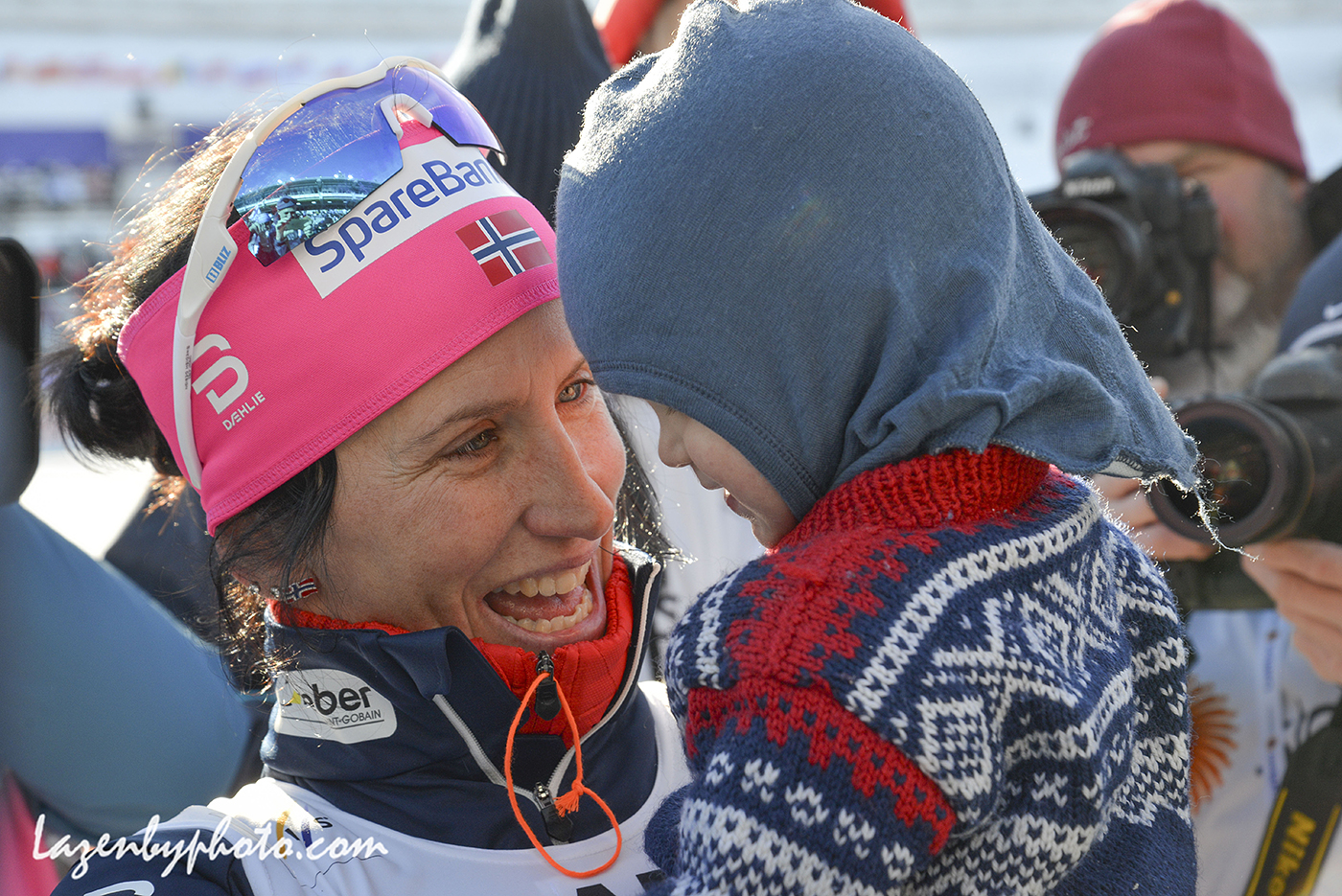
    Norway’s Marit Bjørgen with her 1-year-old son Marius after she won her 15th World Championships gold in the women’s 15 k skiathlon at 2017 World Championships in Lahti, Finland. (Photo: John Lazenby/Lazenbyphoto.com)

    Yes, she’s a new mom. But with the the 2016/2017 season in the review, Marit Bjørgen is the same ol’ machine. After skipping last season while pregnant with her first child, the 36-yar-old Norwegian (who turned 27 last month) opened the first distance race of the year with a win in the 10 k classic in Kuusamo, Finland, just 11 months after the birth of her son, Marius.

    It was the third race she had competed in since March and her second victory (she also won the Beitostølen 10 k FIS race the weekend before).

    Less than a week later, Bjørgen was back on the podium in Lillehammer, Norway, this time in third behind American Jessie Diggins in first and her Norwegian teammate Heidi Weng in second in the World Cup 5 k freestyle.

    She closed curtains on 2016 with two more top-three finishes: second in the La Clusaz 10 k mass start and first in the 4 x 5 k relay the next day, during which she posted the fastest second-leg time. The win was Bjørgen’s 25th relay victory and a predictor for the following two relays she’d enter this season in Ulricehamn, Sweden, and at World Championships in Lahti, Finland, both of which she anchored.

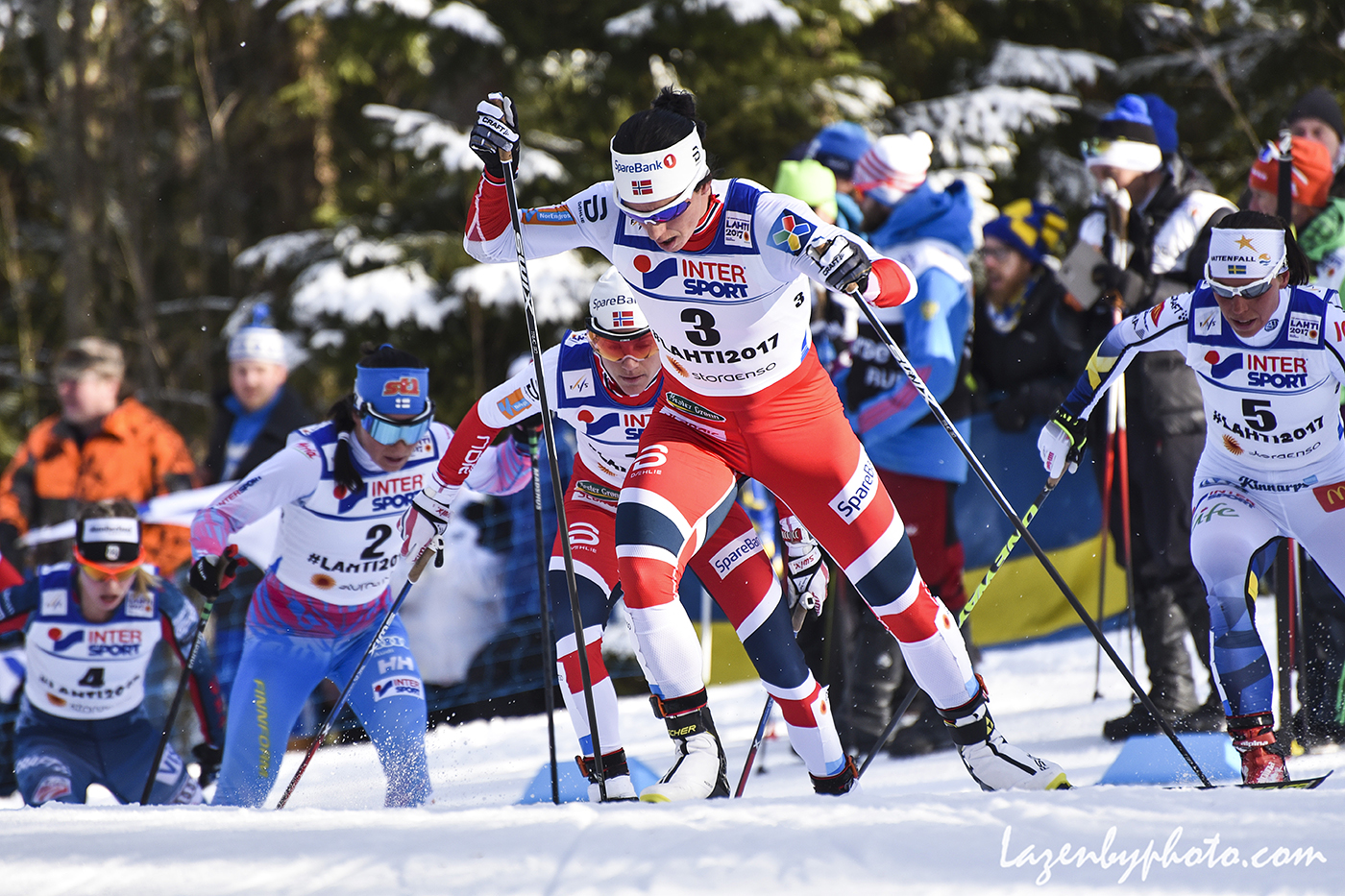
    Marit Bjørgen (3) leading the pack in the women’s 30 k freestyle mass start on March 4 at 2017 World Championships in Lahti, Finland. (Photo: John Lazenby/Lazenbyphoto.com)

    If there was any doubt about her ability to regain dominance, she wasted no time dispelling it.

    Opting to sit out this year’s TdS, Bjørgen returned to the World Cup race scene five weeks after La Clusaz, adding another 10 k win to her list. She’d tally four more 10 k victories — one of them at world champs — to end the season undefeated at that distance.

    By the end of world champs, Bjørgen had accumulated four gold medals. She’d go on to win the Holmenkollen 30 k classic mass start by more than two minutes and capped off the Québec City World Cup Finals with a mini-tour victory. All while simultaneously being a mom.

    Honorable Mention: Heidi Weng, Norwegian World Cup Team

    Two seasons ago in Kuusamo, Finland, in November 2015, Norway’s Heidi Weng made an honest mistake in a 10 k classic pursuit and “spaced”: she skied past the lap lane and into the finish, crossed the line and collapsed. She still had an entire lap to ski. Weng righted the situation, backtracked, and finished ninth.

    Who doesn’t make mistakes? Unfortunately Weng’s was exposed on the world stage.

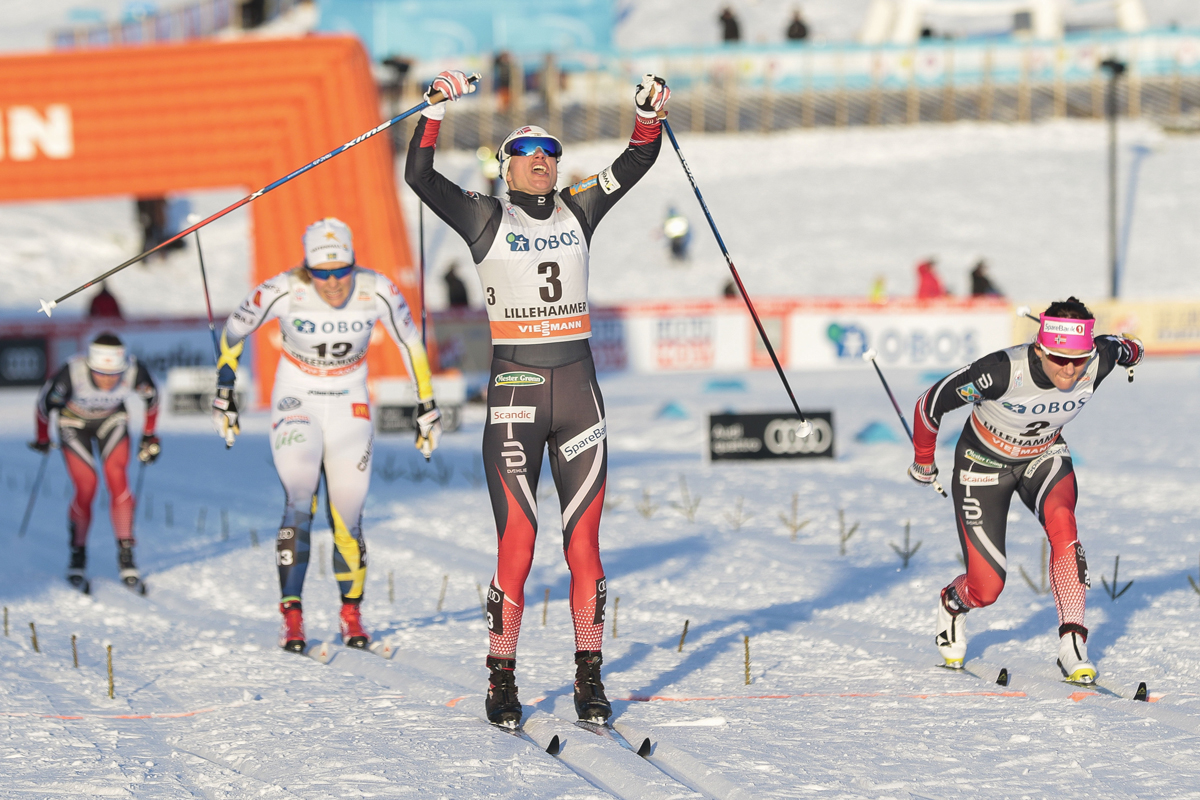
    Norway’s Heidi Weng (3) celebrates her third World Cup victory and first-career sprint win in the women’s classic sprint in Lillehammer, Norway. She edged her teammate Maiken Caspersen Falla (r) by 0.48 seconds. (Photo: Fischer/NordicFocus)

    At the time, her teammates Therese Johaug and Marit Bjørgen were the dominant Norwegian forces on the women’s side. It was as if Weng’s narrative would be continually defined by race place and time back to Johaug and Bjørgen.

    This past World Cup season, Weng proved her detractors wrong. She finished the season first in the Overall World Cup, first in the Distance World Cup and fourth in the overall sprint standings. That’s two crystal globes in Weng’s trophy case. Weng also won her first Tour de Ski.

    Those awards were for a stellar season in which the 25 year old sustained her fitness and motivation. But there’s more — she won two golds at World Championships in Lahti in the classic team sprint and 4 x 5 k relay. Weng added a silver to that collection when she placed second in the 30 k skate mass start.

    “I must have a little more confidence that I am a good skier because I always think I am not as good as the others, but now I have a better head,” Weng said after the last race of the season in Quebec. She placed second in the World Cup Finals mini tour, behind Bjørgen.

    Honorable Mention: Johannes Høsflot Klæbo, Norwegian National U23 Team

    There were a number of names Norway planned to enter in the first race of the season. Johannes Høsflot Klæbo was not one of them. He was a three-time Junior World champion in 2016, but his World Cup experience? None. That, however, did little to deter the 20-year-old from making a statement his first year racing on the circuit.

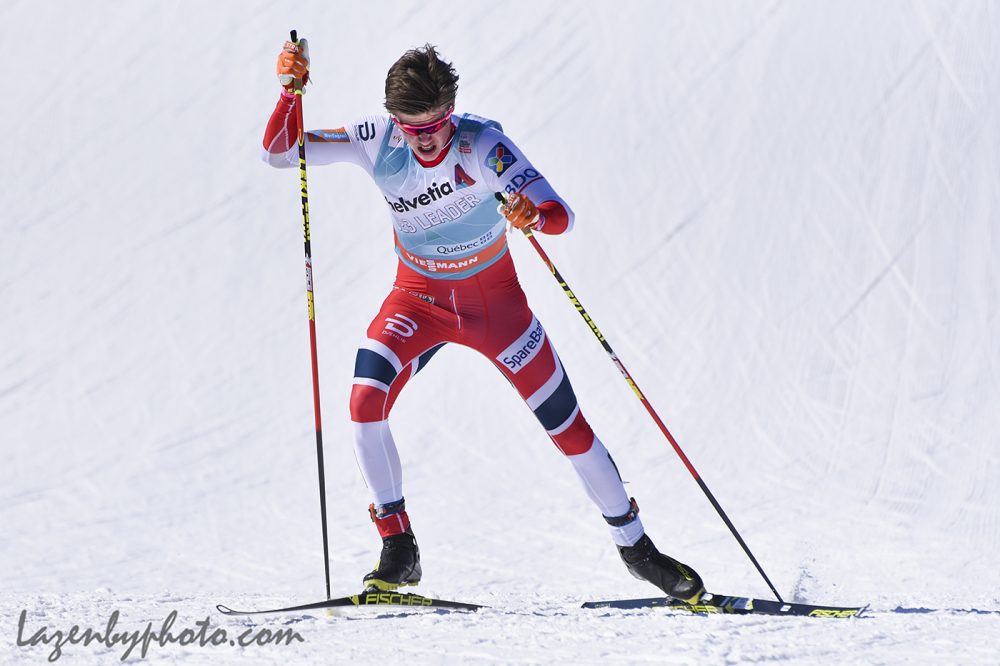
    Norwegian Johannes Høsflot Klæbo racing to his second career distance win in the men’s 15 k freestyle pursuit at World Cup Finals in Quebec City. (Photo: John Lazenby/Lazenbyphoto.com)

    In his debut World Cup race, one he wasn’t even originally supposed to start, Klæbo sprinted to third, after qualifying first to start the day. His second career World Cup sprint was just as sweet: he podiumed in third, finishing behind American Simi Hamilton and fellow Norwegian Sindre Bjørnestad Skar.

    And by the his third World Cup sprint, Klæbo was calling the shots. He earned his first World Cup win in February, besting his teammate Finn Hågen Krogh and Russia’s Ustiugov by more than half a second.

    In his first World Championships, Klæbo would take home an individual bronze medal in the skate sprint, just barely missing another medal in the team sprint.

    Following world champs, he would go on to place second in the Drammen sprint and win the final two distance races of the year (his first-ever distance World Cup wins) to win World Cup Finals. On top of all that, he also ended the season as the Sprint World Cup leader, earning his first Sprint Crystal Globe.

    Honorable Mention: Martin Johnsrud Sundby, Norwegian World Cup Team

    Norway’s Martin Johnsrud Sundby leads Finland’s Iivo Niskanen during the World Cup 50 k classic mass start at Holmenkollen last month in Oslo, Norway.

    There have always been racing hot streaks, peaks for major championships, timeless and historic runs on the World Cup. FasterSkier’s  International Skier of the Year could have gone to Martin Johnsrud Sundby, who has been on a roll of his own following a professional and emotional setback last summer when he was sanctioned for an anti-doping violation

    Back in full force for the 2016/2017 World Cup season, Sundby captured his third overall Crystal Globe in the last four seasons (he was stripped of his 2014/2015 overall title for the infraction).

    Those prizes were the result of 12 individual podiums, five of which were wins. All but one of the remaining podiums were for second place.

    In his final World Cup race of the season, the 50 k Holmenkollen classic, Sundby dueled with Finland’s Iivo Niskanen for much of the race. In the closing chapters of the race, Sundby pulled away for a solo win to the delight of tens of thousands of Norwegian fans.

    Yet Sundby did not win the Tour de Ski or secure his first-career individual World Championships gold medal. Make no mistake, Sundby’s season was stand out. But the albatross around Sundby’s neck, in particular when it comes to his standing as one of the all-time Norwegian greats, is still that individual world champs or Olympic gold. The next two years offer Sundby more opportunities for that world title: there’s the 2018 Winter Olympics in PyeongChang, South Korea, and the 2019 World Championships in Seefeld, Austria.

  • FasterSkier’s U.S. Breakthroughs of the Year: Chelsea Holmes & Scott Patterson

    FasterSkier’s U.S. Breakthroughs of the Year: Chelsea Holmes & Scott Patterson

    APU’s Scott Patterson (Photo: Max Kaufman) and Chelsea Holmes (Photo: Fischer/Nordic Focus) are FasterSkier’s U.S. Breakthrough Skiers of the Year.

    With the 2016/2017 season officially in the rearview, FasterSkier is excited to unveil its annual award winners for this past winter. Votes stem from the FS staff, scattered across the U.S., Canada, and Europe, and while not scientific, they are intended to reflect a broader sense of the season in review. This set of honors goes to breakthrough U.S. skiers.

    Previous categories: Junior Skiers of the Year | Collegiate Skiers of the Year | Canadian Continental Skiers of the Year | U.S. Continental Skiers of the Year | Nordic Combined Athlete of the Year | Biathletes of the Year | Para-Nordic Skiers of the Year | Canadian Breakthrough Skiers of the Year

    ***

    Chelsea Holmes, Alaska Pacific University

    Domestically and internationally, the U.S. women have been on a tear. And waking up on winter weekend mornings, most fans of the sport scroll to the top of the World Cup results list looking for U.S. podiums. Breaking into that scene can be tough with both a top-loaded international women’s program and several skiers based stateside ready to make the European jump.

    Chelsea Holmes (r) with her Alaska Pacific University (APU) coach Erik Flora after she placed a career-best 13th in the women’s 30 k freestyle mass start at 2017 World Championships in Lahti, Finland. (Photo: John Lazenby/Lazenbyphoto.com)

    “Peak when it matters and ski like you mean it,” may as well have been 30-year-old Chelsea Holmes’s mantra this year. The Alaska Pacific University (APU) skier and Girdwood, Alaska, native won the overall SuperTour (granting her World Cup starts for next year’s first World Cup period), and won the U.S. nationals 20 k classic mass start in January at Soldier Hollow (SoHo) near Midway, Utah. Three days before that, Holmes initially made her championship presence felt as she placed second in the 10 k skate at nationals, finishing just 2.2 seconds behind the winner, Caitlin Gregg (Team Gregg).

    En route to her 20 k classic win, Holmes pushed hard from the start and withered chasers, including U.S. Ski D-Team member Katharine Ogden, who ultimately placed second.

    Along SoHo’s terraced trails, Holmes’s blue-and-white APU suit remained in front, charging. After the race, Holmes was asked if she was concerned about bonking late in the race, a possible consequence of her steamrolling pace.

    “It’s a waste to think about that,” Holmes said. “If I blow up, I blow up. I have to believe that I blow up less than everyone else.”

    Those are the words of an athlete peaking and knowing full well they should have the confidence to take the “I might blow up” risk. Those risks brought reward: Holmes was named to the U.S. team for 2017 World Championships in Lahti, Finland.

    Actually racing in Lahti was another story.  Regarding the World Championships selection criteria, U.S. Ski Team (USST) Head Coach Chris Grover explained that selection would partially be based on “who we would start in which races in Lahti, because we absolutely want to fill every start spot, and we want to be able to have an alternate there in most cases as well, and that makes for some tough choices. Who’s skiing well domestically, who’s skiing well on the World Cup; it’s occasionally challenging to figure out which athletes are faster when they have the Atlantic Ocean between them.”

    Holmes did get a Lahti start. But that start wasn’t guaranteed. Jessie Diggins (USST) was slated to start, as was Gregg, both former World Championship medalists. According to Grover, the remaining spot was offered to Sadie Bjornsen (USST) and then Kikkan Randall (USST), both of whom declined.

    Score one for Holmes. On a tough Lahti course, Holmes looked like a 30 k start shoe-in. She finished 13th in the World Championships 30 k freestyle mass start, 1 minute and 28 seconds behind the winner, Norway’s Marit Bjørgen. It was her first top-20 result in a World Cup level race, in her World Championships debut.

    Scott Patterson, Alaska Pacific University

    Like his APU teammate, Holmes, Patterson also won the overall SuperTour and will be offered U.S. starts for Period 1 of the 2017/2018 World Cup.

    Patterson’s breakout season was more of a prolonged emergence than a “here I am” statement. Certainly he was for real early on, but so were a dozen other skiers. In late November, he won a season-opening 10 k classic International Ski Federation (FIS) race in West Yellowstone, Mont.

    A week later, the 25 year old from Anchorage, Alaska, placed third in the SuperTour’s opening distance, a 15 k classic also in West Yellowstone. Patterson followed that up with a win in the 15 k freestyle at the Sovereign Lake NorAm in British Columbia.

    Scott Patterson (1) atop the men’s 50 k freestyle podium at 2017 U.S. Distance Nationals in Fairbanks Alaska. Patterson (APU) placed first, Brian Gregg (Team Gregg) second, and Eric Packer (APU) was third. (Photo:Max Kaufman)

    That’s a pattern and the beginnings of a breakout.

    Patterson entered U.S. nationals in SoHo with low energy. Although his results were solid, they did not earn him a World Champs selection. His best result was a fourth place in the 30 k classic.

    Illness-free, Patterson was later given a chance on the World Cup in early February. In PyeongChang, South Korea, he scored his first individual World Cup points, placing ninth in the 30 k skiathlon.

    The week after World Championships, Patterson once again tackled a time-zone shift and Holmenkollen’s hefty course in Oslo, Norway. He emerged as the top American, once again in the points, placing 28th in the 50 k classic mass start.

    Officially, we’ll call that a breakthrough, a big one.

    Patterson maintained his form for the remainder of the season, proving in the domestic distance events he’ll willingly set the tempo and position himself for more international opportunities.  

    At the recently concluded U.S. Distance Nationals in Fairbanks, Alaska, Patterson took the crown in the 50 k freestyle mass start. He started the season-ending SuperTour Finals series with a win in the 20k skiathlon.

    APU Head Coach Erik Flora noted both Patterson and Holmes were deserving of their 2016/2017 achievements.

    “It was good to see Chelsea and Scott have strong international results this season,” Flora wrote in an email. “With more World Cup experience I see both being able to climb even further up the results. It is extremely hard to travel from the US to the Scandinavian or European World Cups and produce good results in only a few weekends of racing. The results are a testament to their hard work and dedication, plus it shows the level and depth in US skiing is continuing to build. All good things for the future.”

    Honorable Mention: Joanne Reid (US Biathlon)

    Joanne Reid (US Biathlon) racing in the women’s 15 k individual at the IBU World Cup in Antholz, Italy. (Photo: USBA/NordicFocus)

    Here’s the response 24-year-old Joanne Reid gave for question 16 of FasterSkier’s  17 Questions for 2017In 5 years, I’ll be ____?

    “In the mountains somewhere, smiling at the sky. It’s actually pretty rare for me to know what I’m doing next month, let alone five years from now.”

    Certainly five years is a long way out, but the Colorado-based skier should be myopic when it comes to the next few years. She’ll most likely be traveling the World Cup.

    The new-to-biathlon NCAA champion earned her first individual World Cup top 30 this year, skiing to a career-best 29th in the 15 k in Östersund, Sweden. Turning 25 next month, Reid learned to shoot a rifle at age 23.

    Honorable Mention: Jake Adicoff (U.S. Paralympics Nordic)

    Jake Adicoff (r) and his guide Sawyer Kesselheim (l) racing at IPC World Cup Finals last month in Sapporo, Japan. (Photo: US Paralympics Nordic)

    Jake Adicoff, 21, is a visually impaired skier on the U.S. Paralympics Nordic B-team. He finished the season ranked fourth in the International Paralympic Committee (IPC) Nordic Skiing World Cup standings.

    March brought several podiums for the Sun Valley Ski Education Foundation (SVSEF) alumni. He won his first World Cup race, the 20 k freestyle, in PyeongChang, South Korea, where next year’s 2018 Winter Paralympics will be held. He went on to win the sprint in PyeongChang, then finished his season with another win (in the 5 k classic) and a silver (in the 10 k) at World Cup Finals in Sapporo, Japan.

  • FasterSkier’s Para-Nordic Skiers of the Year: Oksana Masters and Brian McKeever

    FasterSkier’s Para-Nordic Skiers of the Year: Oksana Masters and Brian McKeever

    Canada’s Brian McKeever (Photo: Graham Longford) and American Oksana Masters (Photo: USOC) are FasterSkier’s Para-Nordic Skiers of the Year.

    With the 2016/2017 season officially in the rearview, FasterSkier is excited to unveil its annual award winners for this past winter. Votes stem from the FS staff, scattered across the U.S., Canada, and Europe, and while not scientific, they are intended to reflect a broader sense of the season in review. This set of honors goes to outstanding Para-Nordic skiers on the IPC World Cup circuit. 

    Previous categories: Junior Skiers of the Year | Collegiate Skiers of the Year | Canadian Continental Skiers of the Year | U.S. Continental Skiers of the Year | Nordic Combined Athlete of the Year | Biathletes of the Year

    ***

    Oksana Masters, U.S. Paralympics Nordic 

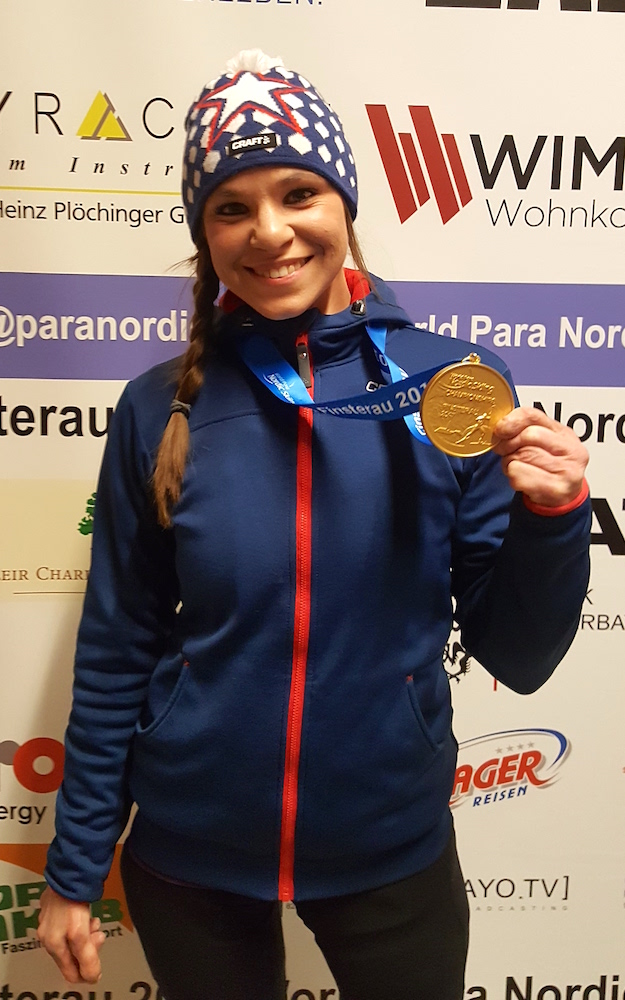
    Six medals in seven days. Four of them gold. Never before had a U.S. athlete taken home four gold medals from a World Para Nordic Skiing Championships, but U.S. Paralympics Nordic A-team member Oksana Masters changed all that.

    Oksana Masters (U.S. Paralympics Nordic) after winning her first IPC World Championships gold in the women’s cross-country sitting sprint on Sunday, Feb. 12, in Finsterau, Germany. (Photo: John Farra/US Paralympics Nordic)

    The 27-year-old sit skier racked up six World Championships medals in Finsterau, Germany, including her second-career biathlon win in the women’s 6 k sprint (her first came earlier this season in the first biathlon race of the year).

    “I am completely shocked,” Masters told media outlets after the sprint. “I entered this race with no expectations. I went from not being sure if I was going to be able to race the last two days to winning my first gold medal in biathlon. I’m so excited! I cannot wait to let this all soak in.”

    But Masters didn’t just dominate the world champs scene. After ending last season undefeated in every International Paralympic Committee (IPC) World Cup cross-country race she entered, she almost did it again, winning all but one cross-country race this winter (she placed second in the last cross-country race of the season).

    “I feel like I had a pretty great season, especially coming off training for a complete other sport that uses a complete opposite motion not too long ago,” Masters said, according to a U.S. Paralympics press release, referring to her handcycling training for the 2016 Summer Olympics.

    “I’m really happy with my season and my training,” she added. “I feel extremely hopeful to have to good races in PyeongChang next year.”

    Brian McKeever, Canadian Para-Nordic Skiing

    At 37, Canada’s Brian McKeever is a team veteran and a world leader in para-nordic skiing. In 2010, he became the first athlete in the world to be named to both Olympic and Paralympic teams. In his three Winter Paralympics, he’s accumulated 13 medals, 10 of them gold.

    And this year, after turning his focus to the overseas Ski Classics marathon series, he earned his 18th and 19th IPC World Championships gold, winning both the men’s 10 k and 20 k visually impaired races. Prior to that, he won the season-opening IPC World Cup sprint in Vuokatti, Finland. By the end of the season, he also qualified for and competed in the International Ski Federation (FIS) World Cup Finals in Quebec City, Quebec.

    Brian McKeever jumping in front of Norway's Petter Kaarby just before the final climb. (Photo: Graham Longford)
    Brian McKeever passing Norway’s Petter Kaarby just before the final climb of the 2017 Marciolonga in Italy. He finished 57th overall. (Photo: Graham Longford)

    “I think putting the focus on Ski Classics this year was really interesting. From struggling to hit the top 40 to suddenly to be able to ski with the leaders this year, that was good,” McKeever said after his final race at World Cup Finals.

    “I am learning as well in that, and I see the opportunities there with the older guys that are still at the top and that is highly motivating for a guy that is maybe beyond his peak, at least as far as age goes, but I am still having fun and still learning,” he added. “So that is motivating for me, to continually learn something when I am out racing.”  

    Honorable Mention: Mark Arendz, Canadian Para-Nordic Skiing

    Canada’s Mark Arendz, now 27, also opened his World Championships week with a win for his second world title and first podium at a top-level international race (in a non-Paralympic year) in three years after winning the men’s 12.5 k standing biathlon race

    He earned four more world champs medals, including a biathlon sprint gold, a biathlon individual silver, a cross-country bronze, and a relay bronze.

     “It has been an incredible season for me, but most noticeably I have brought my shooting back,” Arendz wrote in an email to FasterSkier. “It is now a strength and no longer holding me back. The other huge take away is I now have the confidence in my ski speed to be competitive in any Cross Country race.”

    “The highlights from the season for me were World Championships and the 10km Classic in Korea,” Arendz continued. “Worlds were fantastic for me. Five medals from six races; the confidence was there and I was in the best shape of the year. I carried that shape into the test event in Korea. For two out of three laps I was having my best classic race ever. After a little stumble I couldn’t regain my focus, but until then I had the confidence that I could win a Classic race. I will grasp that belief into the training season.”

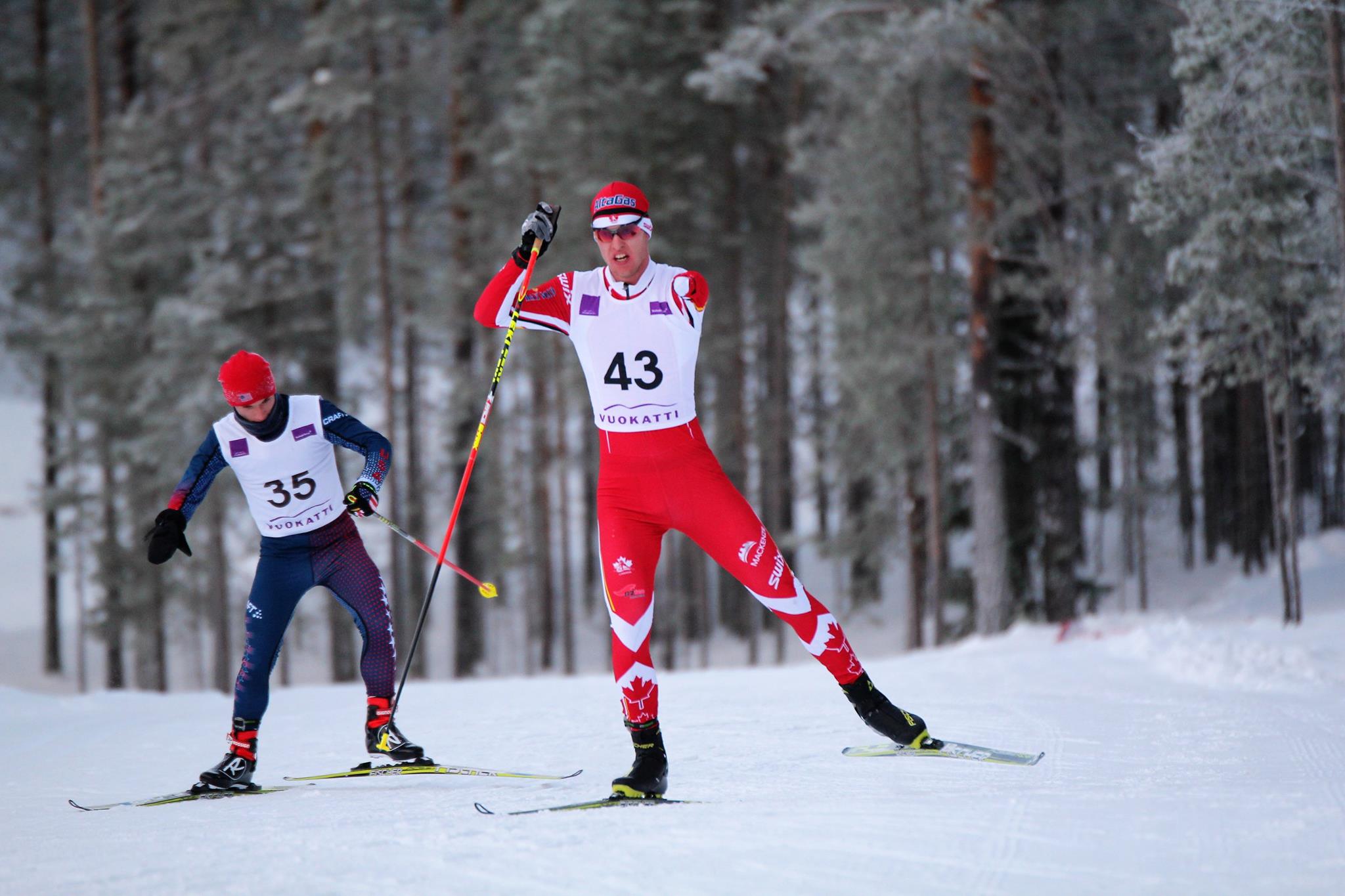
    Mark Arendz (43) of the Canadian Para-Nordic Ski Team racing to silver at the IPC World Cup on Dec. 12, in Vuokatti, Finland. (Photo: Canadian Para-Nordic Skiing/Facebook)
  • FasterSkier’s Biathletes of the Year: Lowell Bailey and Susan Dunklee

    FasterSkier’s Biathletes of the Year: Lowell Bailey and Susan Dunklee

    U.S. Biathlon’s Lowell Bailey (Photo: US Biathlon/NordicFocus) and Susan Dunklee (Photo: Fischer/NordicFocus) are FasterSkier’s 2017 Biathletes of the Year.

    With the 2016/2017 season officially in the rearview, FasterSkier is excited to unveil its annual award winners for this past winter. Votes stem from the FS staff, scattered across the U.S., Canada, and Europe, and while not scientific, they are intended to reflect a broader sense of the season in review. This set of honors goes to outstanding female and male North American biathletes on the IBU World Cup circuit.

    Previous categories: Junior Skiers of the Year | Collegiate Skiers of the Year | Canadian Continental Skiers of the Year | U.S. Continental Skiers of the Year | Nordic Combined Athlete of the Year

    Susan Dunklee and Lowell Bailey, to U.S. national team biathletes, each had historic seasons in their own right, marked by both consistently strong performances and historic peaks. Bailey won the first World Championships gold medal for an American biathlete – male or female – and Dunklee won a silver medal as the first U.S. woman in an individual-start race in those same championships.

    Then, like a tag team of comic book superheroes banding together, it seemed only fitting that they combined their strengths to also achieve the first World Cup podium in a team event for U.S. Biathlon in ages, putting an exclamation mark on their oustanding year.

    Susan Dunklee, U.S. Biathlon

    Dunklee, who already won FasterSkier’s female biathlete of the year award in 2015/2016, further improved on her strong performances from the prior winter with an even more remarkable season, thanks to increased accuracy and noticeably faster shooting times on the range after cleaning her targets rather deliberately earlier in her career.

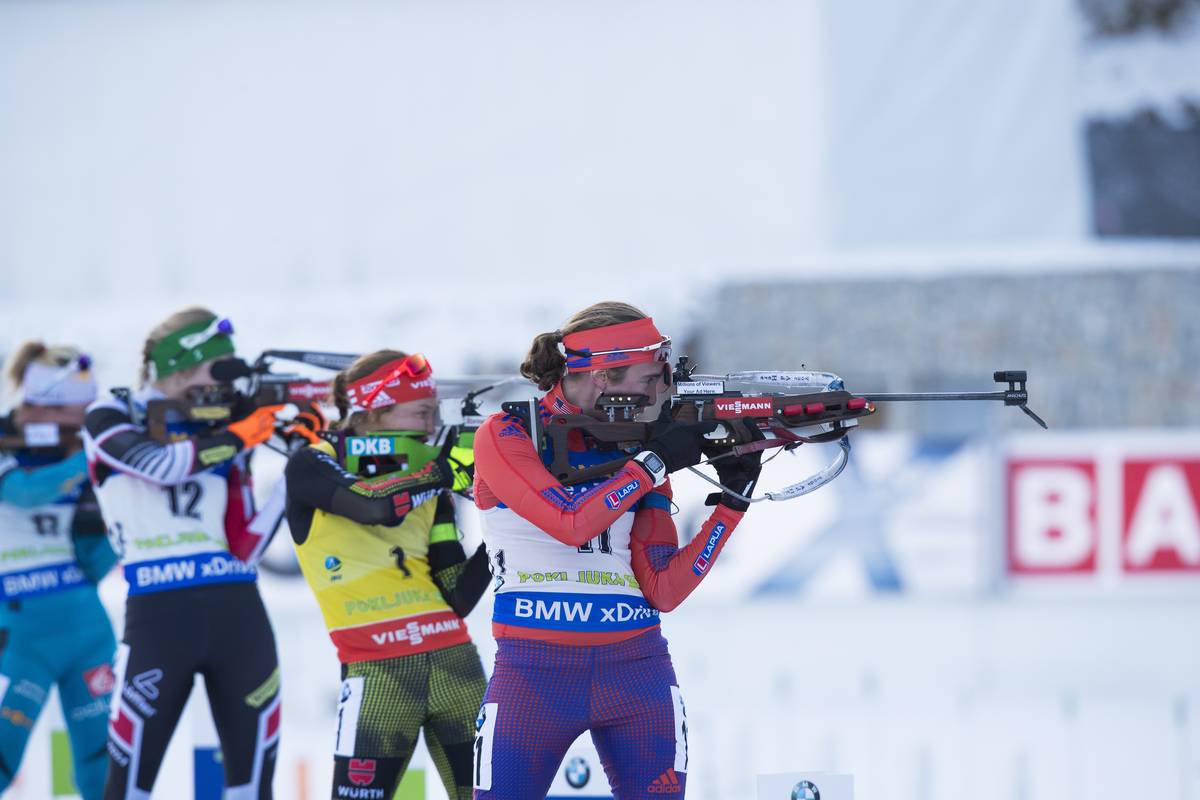
    Susan Dunklee (front) going head to head with Germany’s Laura Dahlmeier (1), Austria’s Lisa Theresa Hauser (12), and France’s Marie Dorin Habert (left) in the women’s 10 k pursuit at the IBU World Cup in Pokljuka, Slovenia. (Photo: USBA/NordicFocus)

    In the first half of the season she already achieved a third place in the sprint in Nove Mesto, Czech Republic, as well as two more top-five finishes.

    Then her powerful skiing and a clean 20-for-20 shooting performance – the first of her career in a four-stage race at the World Cup level – propelled her to a historic podium finish in the women’s 12.5-kilomter mass start at the World Championships in Hochfilzen, Austria.

    “I thought, I have to get the hell out of here!” Dunklee described her feelings after hitting the last target in that race in an interview with FasterSkier back then. And she did, leaving the range first and claiming the silver medal and her first podium at World Championships, after only being passed on the final loop by Germany’s Laura Dahlmeier.

    “Repetition and discipline and training will get you to be able to shoot fast in the race,” Dunklee reflected. “And you have to get to the point where you trust that speed is better than shooting slow. That takes a long time … [to] feel comfortable with that speedy rhythm. It has worked some days in races this year, and then other days it has totally fallen apart. But today it worked.”

    Dunklee followed up the highlight of her season with several more strong and consistent performances, three times just missing another World Cup podium in fifth place. And then she crowned her year with another success, placing second together with teammate Lowell Bailey in the single mixed relay at the World Cup in Kontiolahti, Finland, only behind a team from Austria.

    “I have dreamed for a long time being able to run into the finishing pen with a bib on and a rifle, and greet my teammates as they come in,” Dunklee described her new experience of winning as part of a team, in a phone interview after that race. “It’s so cool to finally do that. It’s definitely a dream come true.”

    Fittingly, Dunklee was also the only North American athlete qualified for the elite top-30 field in the final World Cup mass start of the season in Oslo, Norway. Despite struggling a bit with her shooting accuracy in that last World Cup weekend, she managed to overall claim the tenth position in the women’s Total Score standings, another highlight to end her best season to date.

    “This is the sort of history-making team that every athlete dreams of being part of during their lifetime,” Dunklee reflected on her season after the final race in an email. “We have staff who have worked for decades believing this level is possible. Now the door has been opened. I don’t think they will have to wait decades for the next relay medals or World Championships podiums.”

    Lowell Bailey, US Biathlon

    “Well, glad I didn’t stop,” Lowell Bailey told broadcaster ARD following his historic gold medal in the men’s individual race at World Championships, later reiterating that feeling in the press conference.

    “I’m so thankful for the people who came to me and allowed me to continue my career. The first one to think of is my wife Erika who supported me in my decision. We had our daughter Ophelia this summer, and of course this makes things much more interesting as a family. We had to be creative in our training this year, but it all worked out. So thankful for them, and grateful for everyone who has helped me.“

    Lowell Bailey (US Biathlon) celebrating a podium in the men’s 10 k sprint at the IBU World Cup in PyeongChang, South Korea. (Photo: USBA/NordicFocus)

    In retrospect, Bailey had definitely made the right decision to continue racing. Leading into the 2017 season, talk about his imminent retirement from biathlon after a long and successful career and his potential future as a “bison farmer” on the ranch of his father-in-law had become a bit of a running gag among some TV announcers and his fellow competitors.

    Bailey started out the winter with consistently good yet not outstanding results, with a ninth place in the pursuit in Nove Mesto his best result before the New Year’s holiday break, usually finishing between positions ten and twenty due to his slightly slower ski speed than the strongest athletes in the field.

    Following the break Bailey’s form improved leading up to the planned peak at World Championships in Hochfilzen, and he shot remarkably well during the second half of the season when he focused on some foundational principles of biathlon.

    “As you get to the competition season, you boil your shooting cues down to a few key principles,” Bailey explained in an interview with FasterSkier after his winning performance. “For me those are having a good trigger squeeze and follow-through. So it’s like two things. Trigger squeeze. Follow-through. And by the way, when you got to your first biathlon camp, those are two of the three things they teach you. But when you are in that situation, you are fighting for a World Championship medal, you have to keep things simple because that is all your brain is capable of.”

    With a clean 20-for-20 shooting performance in the men’s 20-kilometer individual race at the World Championships, Bailey held a small lead going out on the final lap over Czech Republic’s Ondrej Moravec, and what followed was truly one of the most exciting finishes of the season.

    “Fortunately I had great skis, and I had a U.S. staff member seemingly every hundred meters along that track,” Bailey told FasterSkier after the race. “But every hundred meters it was a sprint. Every hundred meters was ‘go as hard as you can for this hundred meters, and then when you get to the end of that hundred meters, go as hard as you can and just keep doing that.’ I thought the finish line was never going to come. I was just like, I don’t know how much longer I can do this, because the finish line is just not showing up.”

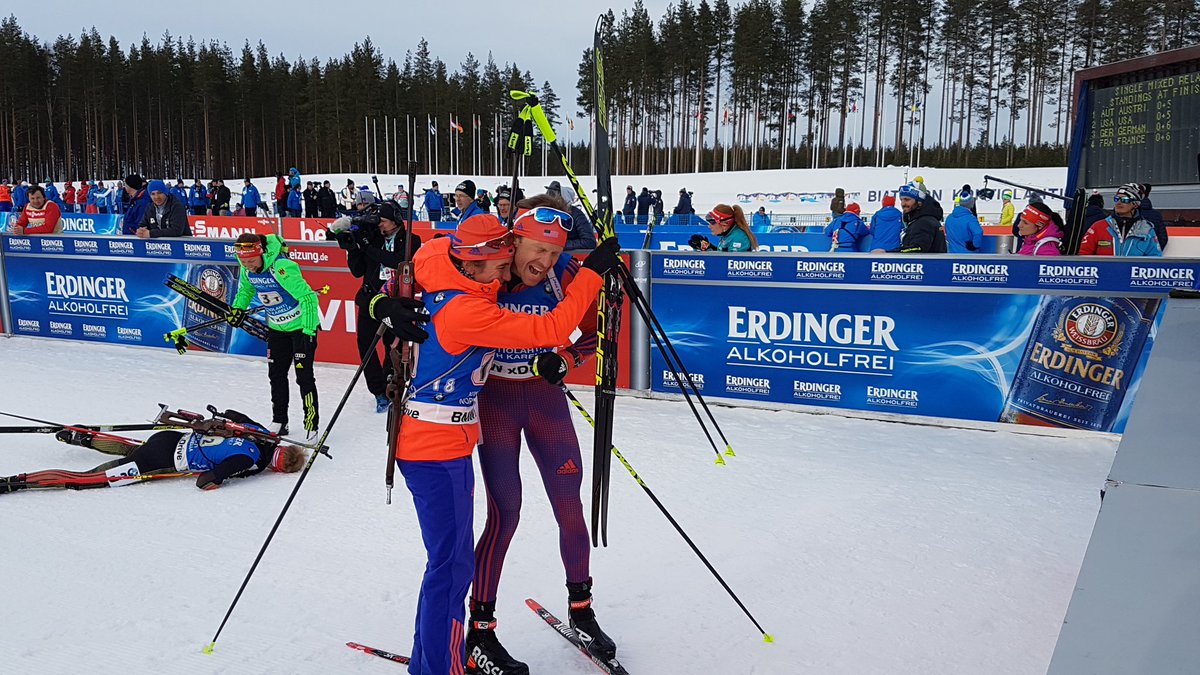
    When the line finally did show up, Bailey was 3.3 seconds ahead and fell elated into the arms of U.S. Biathlon Association (USBA) Chief of Sport Bernd Eisenbichler awaiting him, emotionally celebrating the first gold medal not just of Bailey’s career but for the whole U.S. Biathlon program.

    Susan Dunklee and Lowell Bailey celebrate after finishing second in the World Cup single mixed relay in Kontiolahti, Finland. Austria won the competition. (Photo: IBU/Twitter)

    “When I think about when I first met Lowell, he was probably 13 years old, in Lake Placid, and just this good young skier who put his heart into this and worked for this every day, for almost 20 years now,” USBA President Max Cobb told FasterSkier following Bailey’s gold medal. “I think it is a total validation of Lowell’s career.”

    As a sign of the respect Bailey commands among his peers, not just his own team but even his competitors seemed happy about the success, drawing high praise from silver medalist Moravec who so narrowly had lost out on gold, bronze medalist and World Cup dominator Martin Fourcade of France, and Germany’s Erik Lesser who had just missed the podium in fourth place.

    Bailey followed up on his medal with a second place in the sprint at the following World Cup in PyeongChang, South Korea, at the site of the upcoming 2018 Olympic Winter Games.

    “Sometimes you have these waves as an athlete, sometimes you can have also the opposite,” Bailey said in the press conference at PyeongChang. “I have been on this path since World Championships. I feel good physically and mentally, and confident on the shooting range and on the tracks.”

    Then he recorded another historic second place in Kontiolahti in the single mixed relay together with his teammate Dunklee.

    “It was my first single mixed relay and Susan’s as well, and we were totally psyched,” Bailey told FasterSkier after their shared podium. “This was the first time that you could hug your teammate in the finish zone… It’s a great moment to see both programs, both the men’s and the women’s teams, have a joint success like this.”

    Bailey finished the season in eighth place overall in the men’s World Cup Total Score standings, both a career-best for him and a historic best for a US biathlete, all the more impressive because he skipped the entire week of races in Oberhof, Germany, for a longer holiday and training break.

    “This is, by far, the best season of my life,” Bailey wrote in an email reflecting on his season after the last mass start of the year, where like Dunklee he had been the only qualified North American starter. “At 35 years old, I can say that I’ve waited a long time for this season.”