From the FasterSkier archive — posts syndicated from athletes’ and coaches’ own blogs between 2004 and 2012, kept online as published. Current coverage is at fasterskier.com.
Back in January 2016, Tad Elliott emerged back onto the national championship scene with a win in the men’s 30-kilometer freestyle mass start at U.S. Nationals in Houghton, Mich. It had been some time since the skier originally from Durango, Colorado had felt unleashed from the grips of the energy-sapping Epstein-Barr virus.
Elliott went on to make the 2017 Nordic Ski World Championship team in Lahti, Finland. There, it was hard to miss his stunning effort firing up the first big climb out of the stadium as he skied the third leg of the U.S. men’s 4 x 10 k relay. Talk about lightness and upward momentum. In Lahti, he also notched a 27th in the men’s 50 k skate. He is a former member of the U.S. Ski Team and a three-time World Championship team member. (Let’s not forget this is a two-sport athlete. On two-wheels, Elliott crushed as an elite mountain biker. He won two U23 National Championship in mountain biking.)
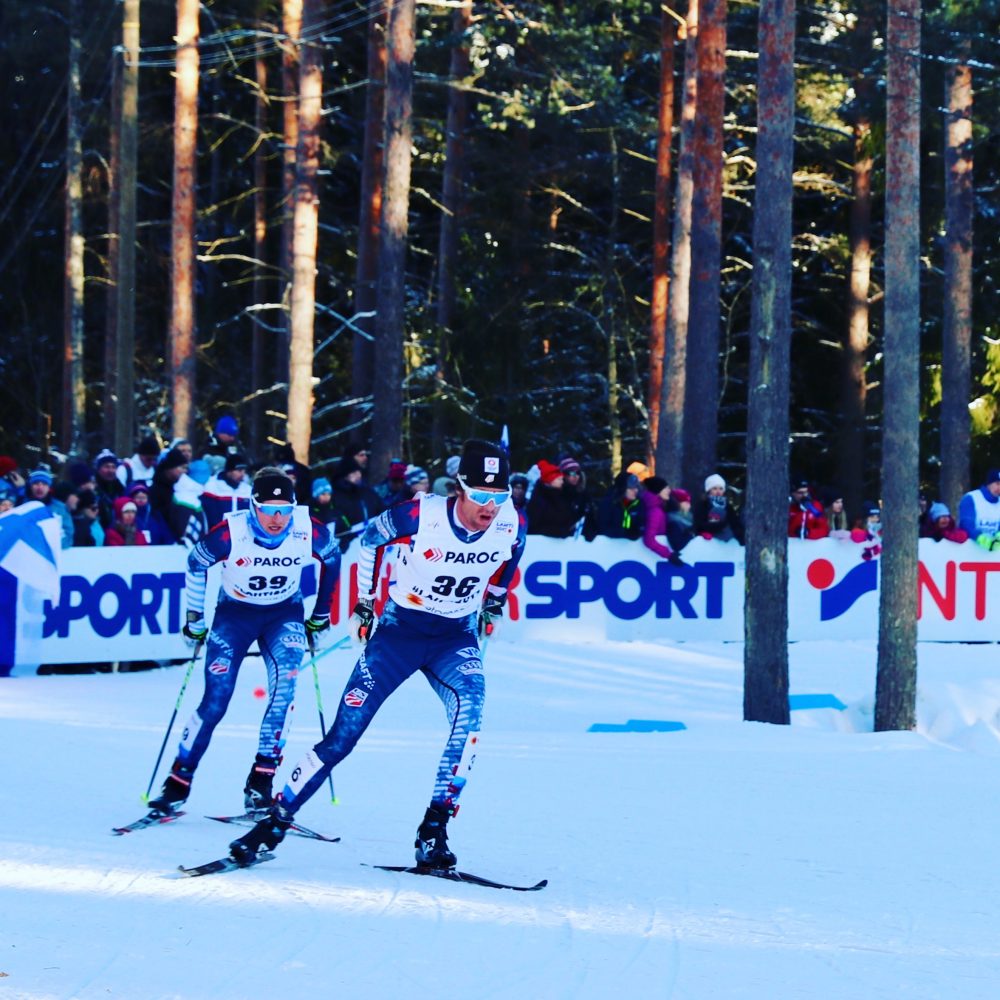
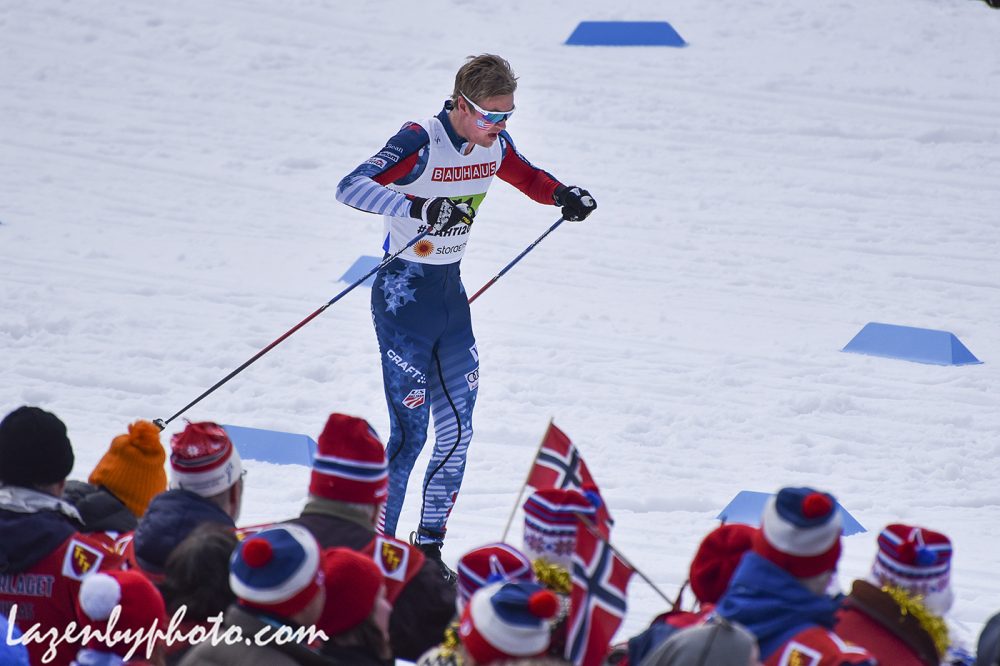
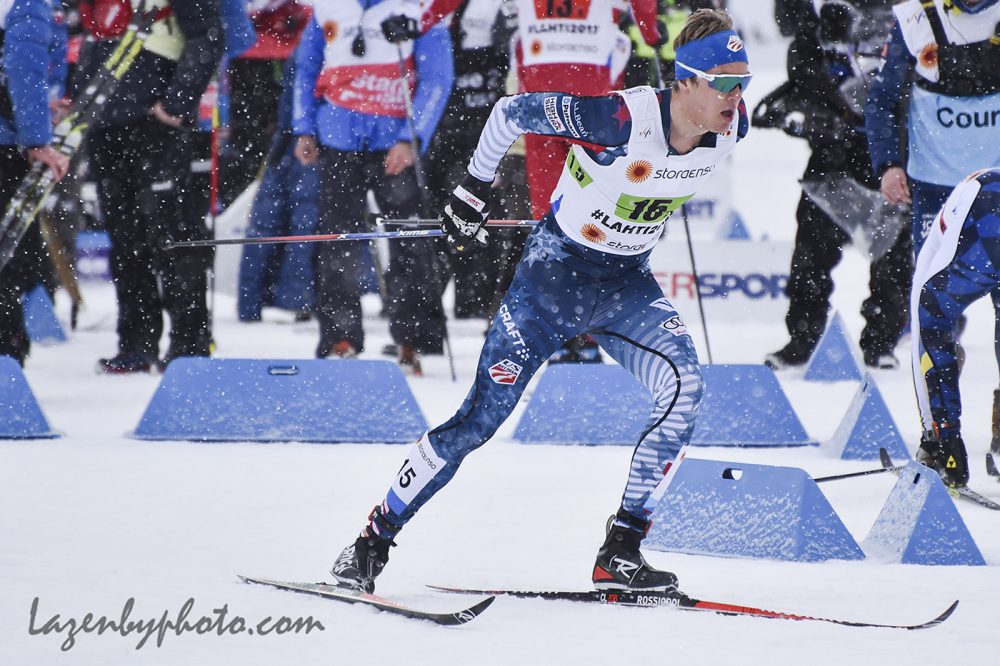
Tad Elliott (bib 36) and Kyle Bratrud (bib 39) during the men’s 30-kilometer skiathlon at the 2017 Lahti World Championships. (Photo: Matt Whitcomb)
Known as one of the finest skate skiers of his generation, Elliott’s upward trajectory unraveled in 2013 as he began struggling with symptoms of the Epstein-Barr virus. The winner of multiple national championships, Elliott began literally walking towards a life and a career premised on rest and recovery with the occasional aerobic stimulus to gradually bring him back into form.
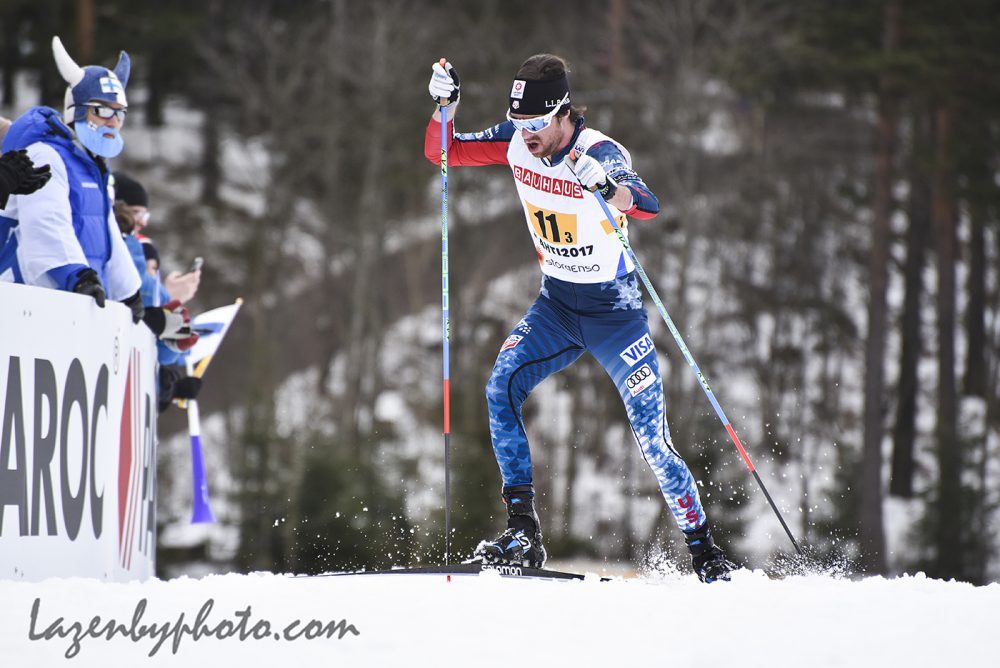
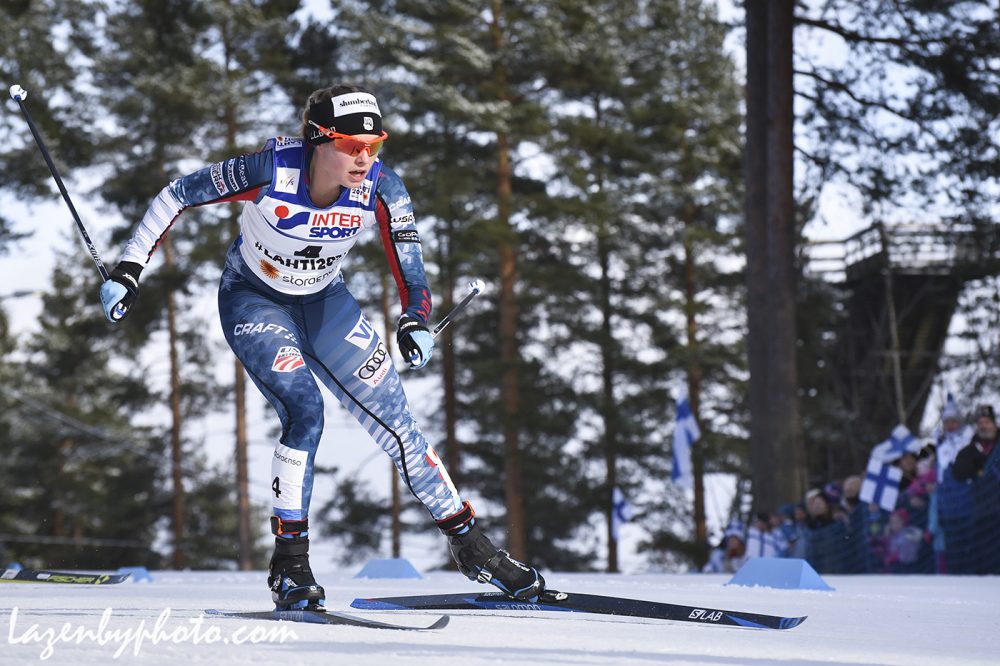
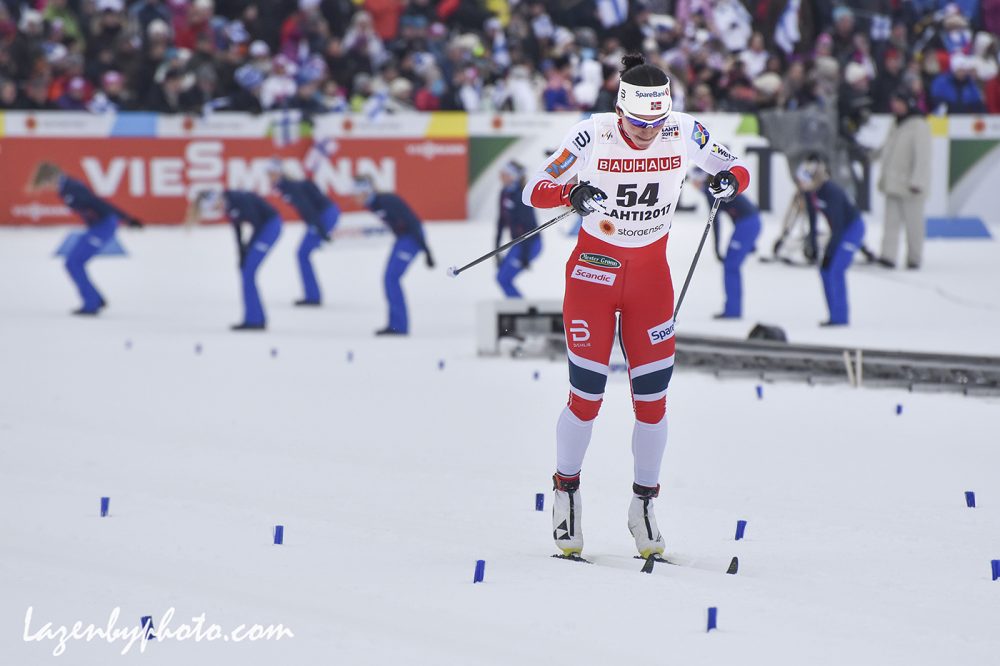
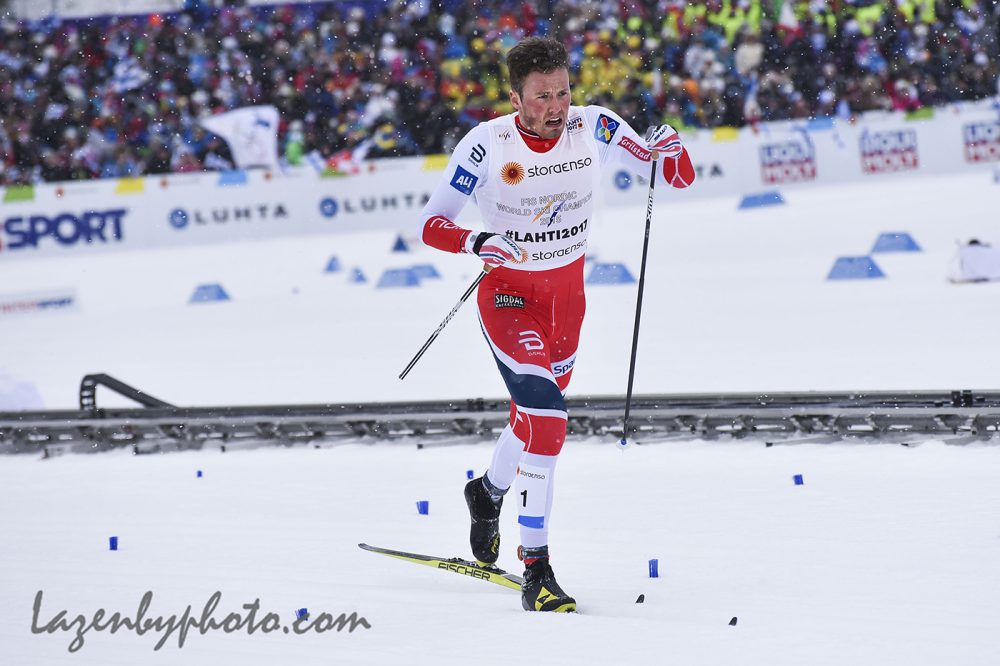
Tad Elliott racing the third leg of the U.S. men’s 4 x 10 k relay at the 2017 Nordic World Championships on Friday in Lahti, Finland. (Photo: John Lazenby/Lazenbyphoto.com)
In this episode of Nordic Nation, we tracked down the now thirty-year-old Elliott on October 9th, where he has begun undergraduate studies in sport physiology at the University of Northern Michigan. Elliott is also applying what he learned during his racing career as an assistant coach with the storied NMU program. He has also begun a side gig consulting athletes struggling with recovery and those wanting to develop sustainable training plans.
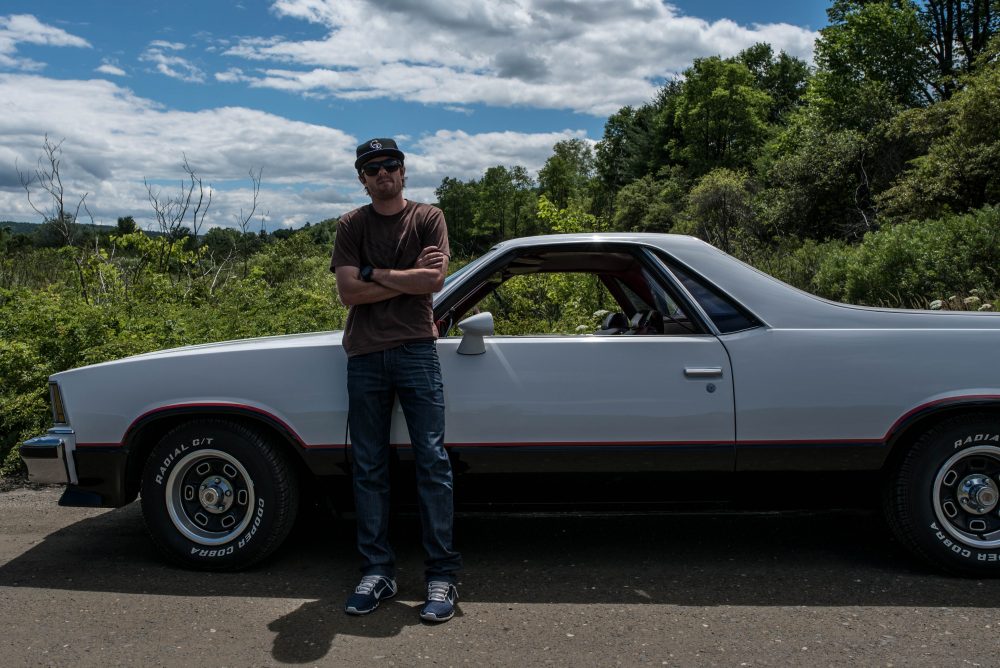
We have the go-ahead to post his email. You can reach out to him at tadelliott2@gmail.com if you’ve got questions as it relates to his experience with overtraining and the rebound. And he drives an El Camino that we are informed is stored indoors somewhere back east.
Norway’s Marit Bjørgen (3) crosses the line first as teammates Heidi Weng (r) and Astrid Uhrenholdt Jacobsen (l) duke it out for silver and bronze at the conclusion of the 2017 Nordic World Championships 30 k freestyle mass start in PyeongChang, South Korea. Weng finished second, Jacobsen third. (Photo: John Lazenby/Lazenbyphoto.com)
LAHTI, Finland — 1, 2, 3, 4: Norway’s Marit Bjørgen, Norway’s Heidi Weng, Norway’s Astrid Uhrenholdt Jacobsen, Norway’s Ragnhild Haga. That’s how the women’s 30-kilometer freestyle mass start at the 2017 Nordic World Championships ended on Saturday.
Bjørgen has two previous 30-kilometer championship titles, but Saturday’s was her first in freestyle. She won the race in 1:08:36.8 hours, just 1.9 seconds ahead of a hard-charging, photo-finishing Weng for second and Jacobsen for third. Haga finished fourth, 5.5 seconds off the podium and 7.4 seconds after Bjørgen.
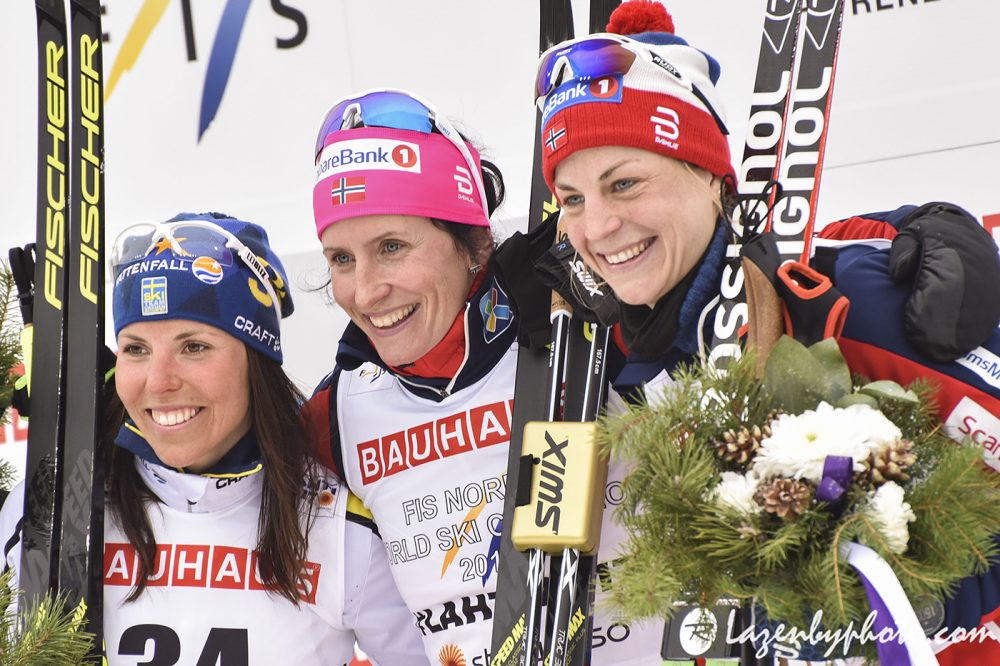
The women’s 30 k freestyle mass start podium at 2017 Nordic World Championships in Lahti, Finland, with Norway’s Marit Bjørgen (c) in first, Heidi Weng (l) in second and Astrid Uhrenholdt Jacobsen (r) third. (Photo: John Lazenby/Lazenbyphoto.com)
Weng explained that though she was aware Bjørgen’s move might come on the climbs and Jacobsen’s more likely on the downhills, her strategy was to stick with the two as long as she could.
“I knew that, for example, Marit is strong on the uphills, and Jacobsen is good to go down,” Weng said during a post-race press conference. “But … I just go and see what happens.”
“I don’t like 30 k’s,” the silver medalist admitted.
While Jacobsen has podiumed in a World Cup 30 k once before — two years ago in Oslo, Norway — Saturday’s 30 k top-three finish was her first at world champs. Almost immediately out of the start, Jacobsen was on the ground and ceded approximately twenty seconds to the sharp end of the pack. After hitting the ground hard, she righted herself and hammered; by two kilometers she was 10.8 seconds off of the front and catching their draft by five kilometers.
“It was a painful 30k for me,” Jacobsen said. “It was hard to get back, but I think my shape is crazy, so I managed to maneuver through everyone, even though there was a lot of stress in the pack to get back to the front. I feel lucky to be here today.”
For certain, Bjørgen was the racer to mark. Along with the relay, she had already taken gold in both distance races (the 15 k skiathlon and 10 k classic) over the last week.
But, due to what was described as icy and fast snow and many racers coming into the 30 k with self-proclaimed, top-end fitness, Bjørgen was unable to stamp her trademark move in this race. In other words, a group of nine skiers remained cohesive until the final headwall of a climb.
“I just concentrate and I always want to stay in the front for no problems, it could happen,” Bjørgen said. “It was different. There was high speed in the snow so it was not that difficult to go out front and hard. I just understand after 10 [k] that we needed to do something at the end of the race.”
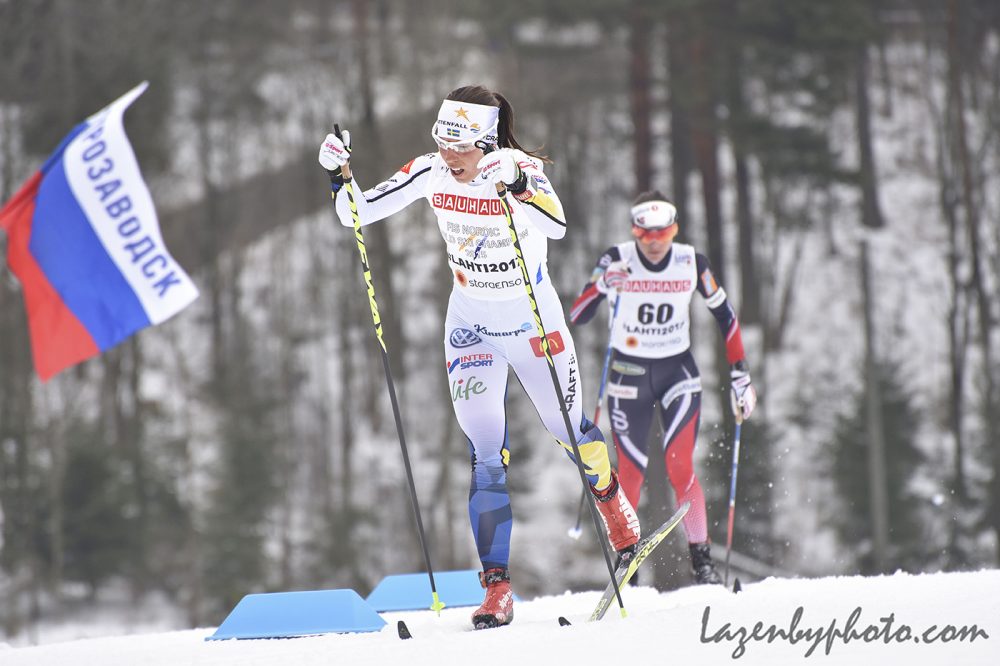
The pack behind Norway’s Marit Bjørgen, which includes Sweden’s Charlotte Kalla (5), Norway’s Heidi Weng (1), Norway’s Astrid Uhrenholdt Jacobsen (14), Finland’s Krista Parmakoski (2), and the U.S.A.’s Jessie Diggins (4), awaits the inevitable Bjørgen throw-down in Saturday’s 30 k freestyle mass start at 2017 Nordic World Championships in Lahti, Finland. (Photo: John Lazenby/Lazenbyphoto.com)
On this day, like the boss she is, she kept her cool. All this despite breaking a pole and her inability to shake the pack.
“I did. [it was] the first time I have done it in a race,” Bjørgen said, referring to her snapped pole. “I think the point that was broken was good it was just down in the stadium, so there were people standing around asking who need poles.”
Bjørgen may have difficulty returning to Norway for next week’s World Cup races in Drammen and Oslo as she’ll need to pass through Helsinki, Finland’s airport security with four golds in her carry on.
“That has to be the most amazing World Championship for me I was since I was coming,” the 36-year-old Bjørgen said. “I had this for a goal for me for fighting for four medals but being able to go home with four golds is incredible.”
North American Standout: Diggins 5th, Holmes 13th and A Breakthrough for Browne
The buzz in the media center after the race spoke less about Norway’s dominances and more about some stand-up North American performances. A Swedish colleague listening to the race on a live radio broadcast from Sweden, said many asked about one name in particular: Chelsea Holmes.
American Chelsea Holmes leads Germany’s Stefanie Böhler during the women’s 30 k freestyle mass start at the 2017 Nordic World Championships on Saturday in Lahti, Finland. (Photo: John Lazenby/Lazenbyphoto.com)
Holmes, an American skiing out of Alaska Pacific University (APU), finished 7.2 seconds outside of the top 10 in 13th (+1:28.1). Saturday’s competition was Holmes’s first World Championships race experience. The 30-year-old Alaska native made her European World Cup debut last season after having raced in the Canadian World Cup races in 2012 in Quebec City, Quebec.
Holmes hadn’t done any World Cup races this year until two weekends ago in Otepää, Estonia. Saturday was Holmes’s second time scoring points; her previous World Cup best was 22nd at last year’s Ski Tour Canada.
“I’m really happy,” Holmes said after Saturday’s 30 k. “The women’s team is so strong right now, that there was chance that I wouldn’t have been able to race at all, so I was super happy to be able to start. I love racing. I wanted to race badly, so I was so happy to be able to race.”
With a deep field of women to choose from, Holmes’s opportunity was almost bypassed. As U.S. Ski Team Head Coach Chris Grover explained, Holmes was the third American alternate for Saturday’s 30 k.
“We approached Sadie [Bjornsen], who of course has been on a World Cup podium in skate this year in 5 k, quite a different event, but we approached her, she really did not want to race today,” Grover said, adding that she wanted to prepare for the upcoming World Cup classic races in Norway.
“We talked to Kikkan about that start, but then Kikkan has already raced four times during this championships so she felt like this was a little too much for her,” Grover continued. “Then Chelsea was next.”
American Chelsea Holmes (r) leads Germany’s Stefanie Böhler during the women’s 30 k freestyle mass start at the 2017 Nordic World Championships on Saturday in Lahti, Finland. (Photo: John Lazenby/Lazenbyphoto.com)
For Holmes, the race couldn’t have played out better. She skied in a pack with Russia’s Yulia Tchekaleva, Switzerland’s Natalie von Siebenthal and Germany’s Stefanie Böhler. Sometimes at the head of the group, sometimes in the draft, Holmes never relinquished contact with a potential 10th place until the final kilometer.
“I was mostly surprised that they were still there,” Holmes said of her ability to stick within the chase pack of four.
“There were a couple of times where you take feeds, or accordion on the hills, and I’m like, ‘Oh my god, I’m going to fall off!’ and then I’d feel strong, and somehow bridge that gap,” she added. “I was a little surprised in the last 10 k there was a gap, and I had a couple of hills where I got bogged down, and I was like, ‘Am I going to go backwards?’ and then it came around. In the end, I didn’t have that little pop, to to ski to 10th instead of 13th.”
Finishing ahead of Holmes, the first American across the line was Jessie Diggins in fifth (+10.4). At this point, Diggins’s result, beyond the fact that it comes in a mega-distance, surprised no one.
“She has got a fifth, fourth, third, and second from this championships, so she has really arrived in the sport,” Grover said. “She has obviously been trending that way for a while, but she really stepped up across the board, so, super exciting.”
Her fifth place was the best American result in a World Championship 30 k. Diggins was in the hunt for a podium with nine other skiers deep into the race. When Bjørgen made her late in the game kill-shot, the nine skiers were moving up the final climb. This is where Sweden’s Charlotte Kalla, another winning threat on Saturday, stepped on her own pole putting her out of podium contention.
Jessie Diggins (U.S. Ski Team) racing to fifth in the women’s 30 k freestyle mass start at the 2017 Nordic World Championships on Saturday in Lahti, Finland. (Photo: John Lazenby/Lazenbyphoto.com)
With that, four Norwegians broke away and Diggins followed.
“I was actually smiling during the race and it was just really really cool, up until the last three to four minutes, to be right there with the leaders,” Diggins said. “I was like, ‘OK, this is possible,’ and thought I knew where they were going to go. Unfortunately I wasn’t positioned quite right so when the attack came, I kind of had to do some navigating.”
Diggins leaves these championships confident about her current and future place in the sport. Asked about the diversity of her strong performances in both the short and long distances, the 25-year-old Minnesotan responded that being a well-rounded skier has been the primary objective.
“I think that is the overall goal,” Diggins said. “I don’t want to be just a skater or just a sprinter or just a 5 k skater, I want to be able to be everything. I want to be an all around person who can show up and medal at any event. That’s the ultimate goal.”
She continued that some of her better results are yet to come.
“I am not even close to my peak yet … I have some years to keep working on it,” Diggins said. “I really want to be a threat in any event that I enter. Especially for the Olympic year, I mean, it is time we get a medal darn it, so we are going for it.”
The next two Americans across the line were Liz Stephen in 25th (+3:09.4) and Caitlin Gregg in 36th (+5:03.7). Stephen’s best 30 k result on the World Cup are two ninth places, one in 2013 and one in 2015, both at Holmenkollen in Oslo.
At the 2015 World Championships in Falun, Sweden, Stephen finished 11thin the 30 k classic mass start. Gregg medaled earlier in those championships, finishing third in the 10 k freestyle in Falun (behind Diggins in second).
“I felt incredible for the first 5, or 10 k, and then I don’t know what happened,” Gregg said. “I don’t know if I’m just out of touch with that racing feeling, because I haven’t been racing a lot, just training.”
The last race Gregg contested was the Boulder Mountain Tour on Feb. 4, which she won.
“I found myself in this kind of nondescript place, where I felt like I wasn’t necessarily tired, but I couldn’t push any harder,” Gregg explained. “My skis felt great, everything was great, I think it was just one of those days you hope not to have on a championship day. I wish there was something that I could point to, and say, ‘this went wrong,’ but everything was dialed. I just didn’t feel that extra zoom today.”
Canada’s Cendrine Browne (r) leads American Liz Stephen during the women’s 30-kilometer freestyle mass start at the 2017 Nordic World Championships on Saturday in Lahti, Finland. (Photo: John Lazenby/Lazenbyphoto.com)
Canada’s Cendrine Browne led her team in 26th (+3:16.0) for her best individual result to date and first time scoring World Cup points (top 30). Browne skied within 17 seconds of the race leader at 11 k, when the pace started to pick up. After that Brown lost contact with the front group.
“I felt no pain for the first 10 k. I was like, ‘Wow, I am in really good shape today. I think I can do this,’ ” said Browne, a World Championships rookie and Canadian U25 Team member. “After 15 k, I lost the first pack, but I was with a pack of three or four girls so we skied together and a couple of other girls joined us towards the end. I really surprised myself today. I had the legs, I had the power, I had the shape. It was awesome.”
The second Canadian to finish was Dahria Beatty in 34th (+4:45.2). Saturday marked Beatty’s second 30 k, and her first at the World Cup level (she raced the Canadian National Championships 30 k freestyle mass start in 2015, where she placed third).
“The first 5 k were awesome,” Beatty said. “It was fast day and I stayed with a big pack for a long time… then just kind of broke off the pack about 6 k and fought hard the rest of the race and couldn’t quite make it to that top 30 pack but could kind of see them in the distance. It was a really good race to learn and looking forward to another 30 k in a few weeks.”
Canada’s Emily Nishikawa finished 40th (+6:41.5) followed by Katherine Stewart-Jones in 41st (+7:18.6).
The final event of Lahti World Championships, the men’s 50 k freestyle mass start, takes place on Sunday.
Canada’s Dahria Beatty (l) leads Australian Barbara Jezersek across the line in the women’s 30-kilometer freestyle mass start at the 2017 Nordic World Championships on Saturday in Lahti, Finland. Beatty finished 34th and Jezersek 35th. (Photo: John Lazenby/Lazenbyphoto.com)
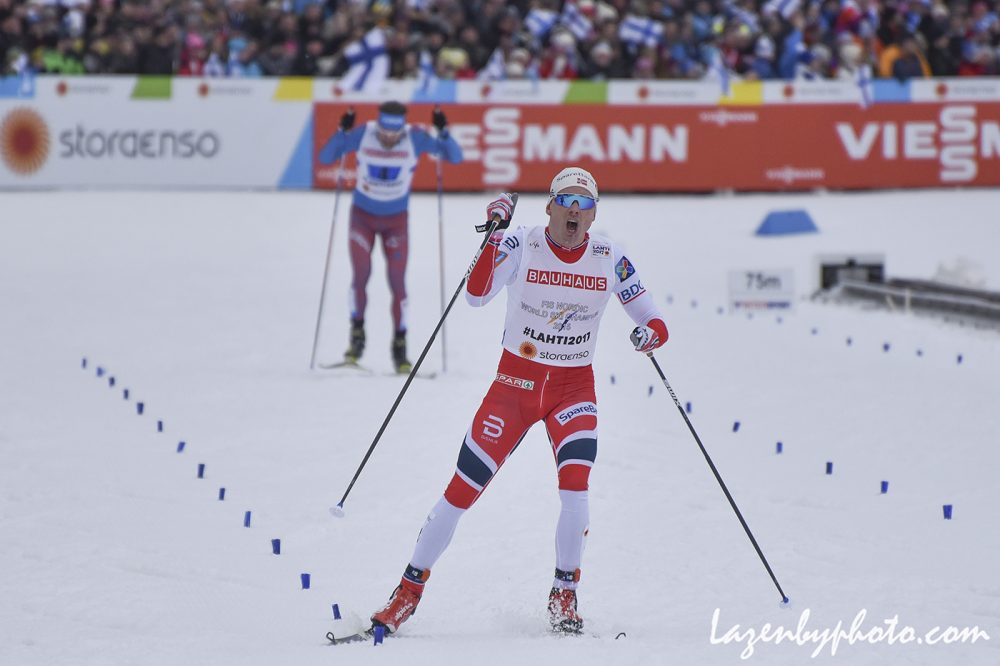
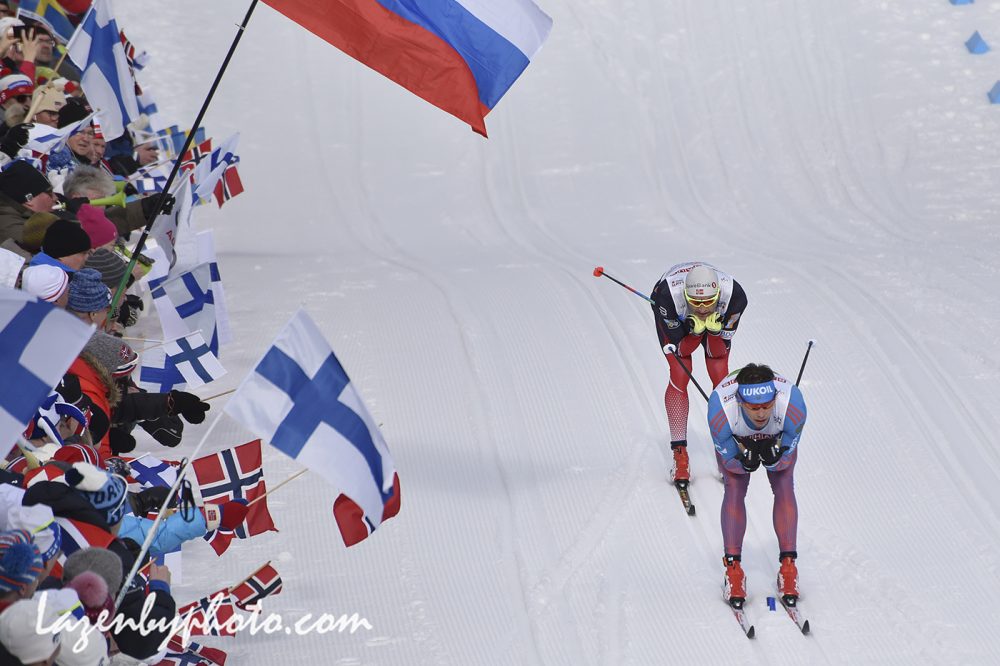
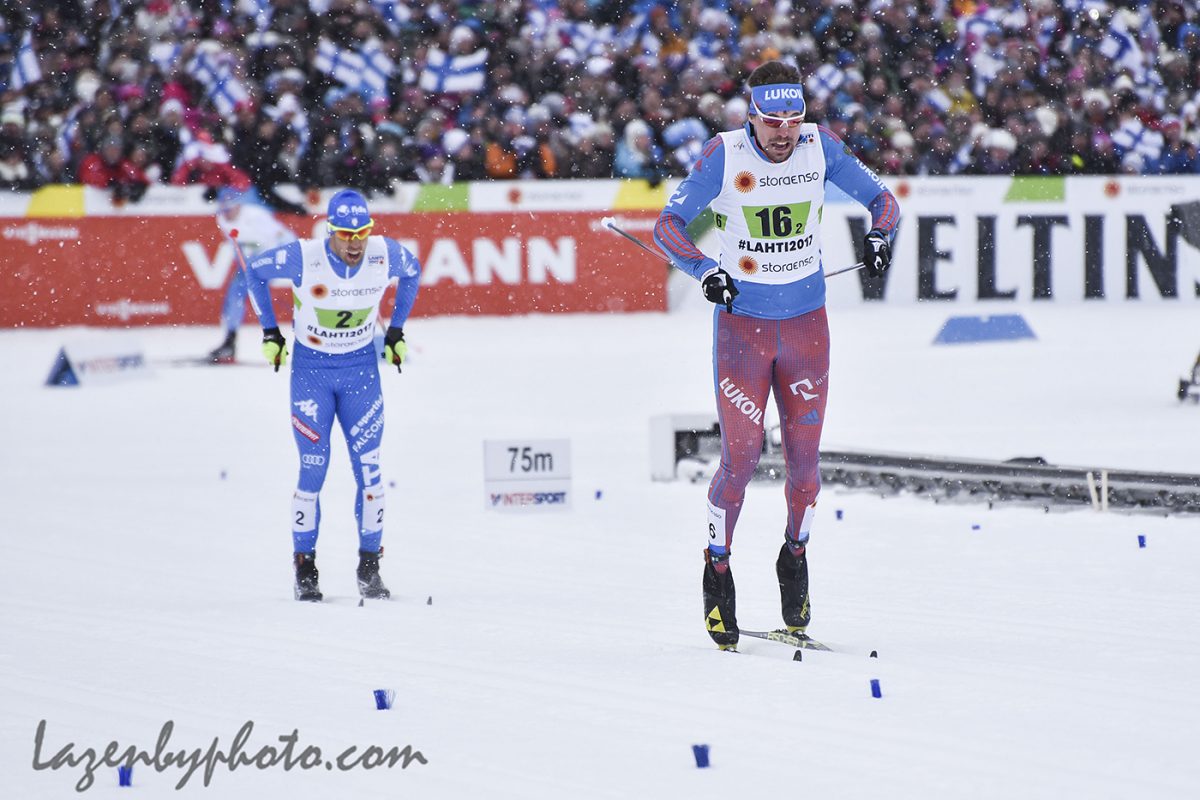
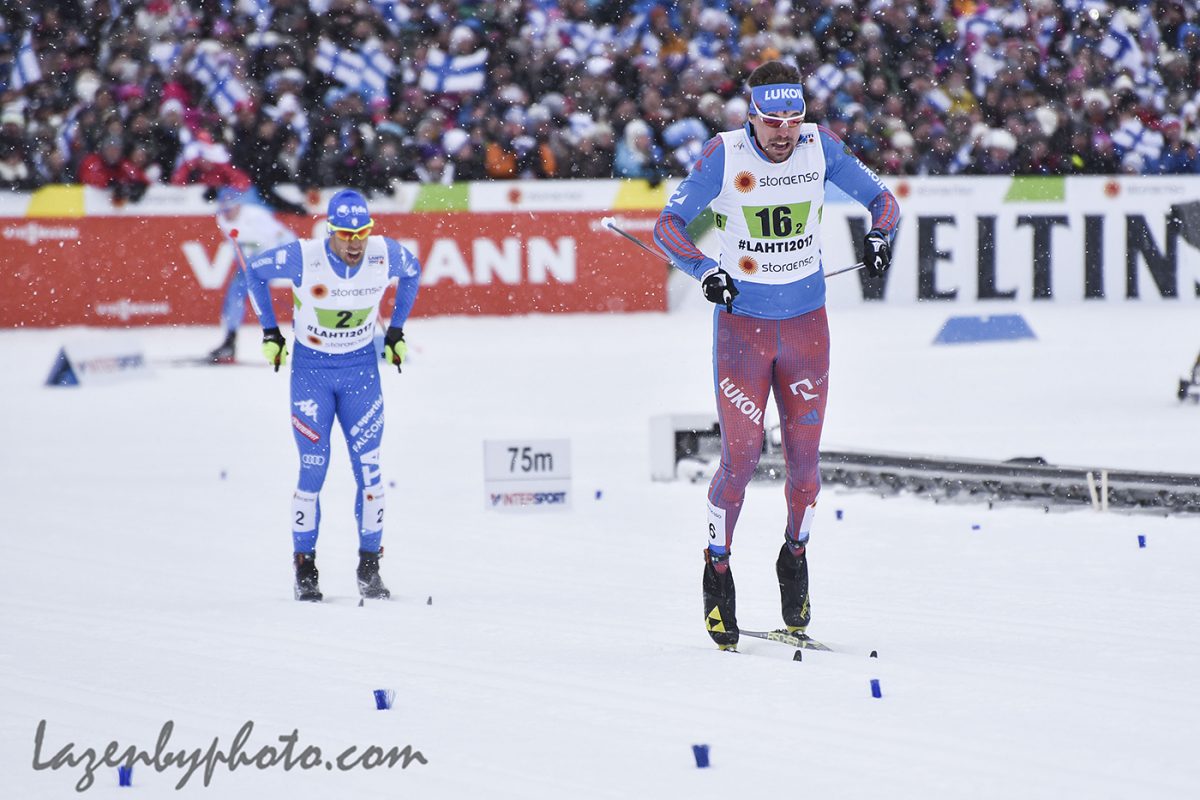
Norway’s Finn Hågen Krogh with the victory stoke as he wins the 4 x 10 k relay at the 2017 Nordic World Championships in Lahti, Finland, by 4.6 seconds over Russia’s Sergey Ustiugov (behind). (Photo: John Lazenby/Lazenbyphoto.com)
LAHTI, Finland — There were three medals up for grabs during Friday’s 4 x 10-kilometer relay at 2017 Nordic World Championships on Friday. Yet after the scramble leg, two distinct races: Norway and Russia’s dance for gold, and what eventually became a four-way tango between Finland, Sweden, Switzerland, and Germany for bronze and silver.
Russia’s Andrey Larkov and Norway’s Didrik Tønseth first strung out and then smoked the field late in their leg. By the tag to their second-leg skiers, Norway and Russia were twenty seconds up.
Russia’s Alexander Bessmertnykh leads Norway’s Niklas Dyrhaug as they sustain the break during the second leg of the 4 x 10 k relay at the 2017 Nordic World Championships in Lahti, Finland. (Photo: John Lazenby/Lazenbyphoto.com)
That margin grew to thirty seconds, as Russia’s Alexander Bessmertnykh and Niklas Dyrhaug finished Leg 2 and the transition to skating began.
Coming in just a half a minute later in third place, was Finland’s Iivo Niskanen, giving the fans a premature taste of the podium.
Racing the third leg was Norwegian Martin Johnsrud Sundby. Russia tried to match the Norway’s trump card with Alexey Chervotkin. The 21-year-old Chervotkin skied the third leg for Russia in both team relays that took place this season: the first in Nove Mesto, Czech Republic, the other in La Clusaz, France, where the team placed second both times to Norway.
However, the World Championship leg was the first time Chervotkin matched up against Sundby this year.
Late in the leg, it was unclear what Sundby’s strategy would be as the young Russian shadowed the 32-year-old Sundby move for move. With Sergey Ustiugov up for the Russians in the anchor leg against Norway’s Finn Hågen Krogh, many armchair-relay strategists would have thought the Norwegian’s line up ploy was a dud.
Not until 1.2 kilometers left in the leg did Sundby make a sufficient gap. At that point, the time spread from silver to gold was only eleven seconds. Not exactly a huge buffer for Krogh.
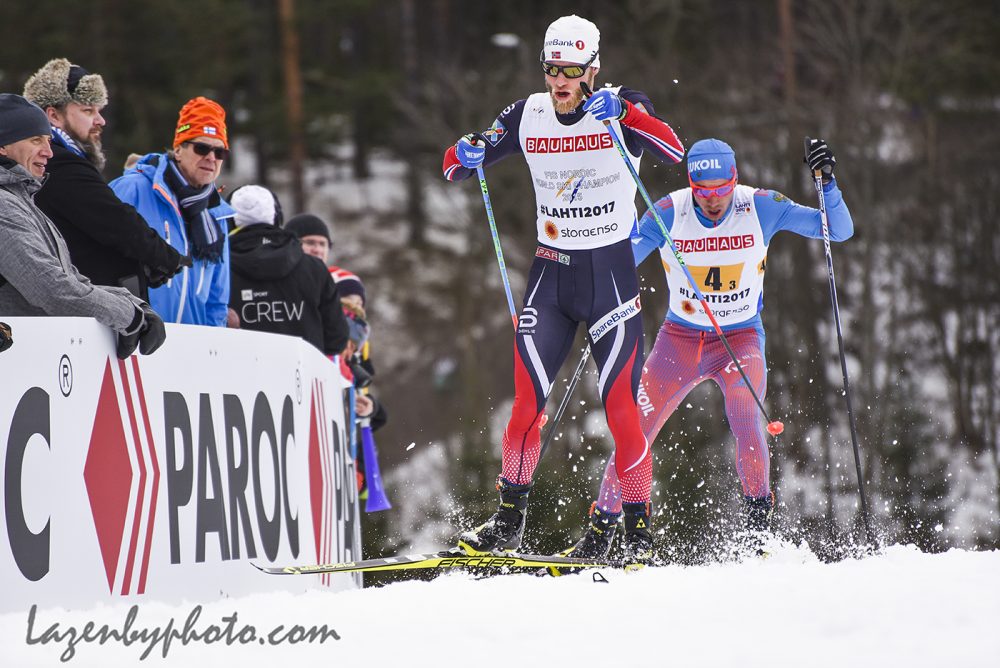
Norway’s Martin Johnsrud Sundby, marked by Russia’s Alexey Chervotkin (4), during a critical third leg of the 4 x 10 k relay at the 2017 Nordic World Championships in Lahti, Finland. (Photo: John Lazenby/lazenbyphoto.com)
By Sundby’s tag to the anchor skier, he had gifted Krogh a 17.7-second margin for error. The rhetorical question at the start of the fourth leg: when will Ustiugov catch Krogh?
“He’s the worst the worst guy you can have in back of you,” Krogh said during a press conference, referring to Ustiugov. “He made the race tough for me.”
At 1.3 k into that fourth leg, Ustiugov was 8.8 seconds back. In another 1.2 kilometers, it ballooned again to 11.6 seconds, and then it contracted again to 5 seconds with 3.8 k to go. But until the finishing stretch, when Krogh rounded the final turn with a 100-meter lead on the Russian, was Norway a sure win.
Krogh crossed first in a time of 1:37:20.1 hours for the ninth-consecutive Norwegian championship 4 x 10 k relay gold. Finishing 4.6 seconds later in second place was Russia’s Ustiugov.
“It’s not just for us, it’s the whole team,” Sundby said during a press conference of their ninth world-champs relay gold. “It’s for the waxers, it’s for the trainers. When you go the relay for the Norwegian team, you feel you’re going for your country. So it’s a massive victory for us.”
What kept the capacity crowd engaged was not so much the battle for gold and silver, but the fate of the on-again, off-again Finns.
Let’s back up to when Niskanen tagged off to Finnish skier Lari Lehtonen for the first freestyle leg. At that point, the Finns were in third, a solid 15 seconds ahead of France in fourth place, 32 seconds ahead of Switzerland in fifth, roughly 55 seconds ahead of Germany in sixth, and almost a minute ahead of Sweden in seventh.
“We are individual athletes, and you have to focus on your own leg,” Sweden’s Johan Olsson said after the race. “Both me and Daniel [Rickardsson] thought the medal chance was over when we had done two legs.”
The first sign that something was awry for the Finns was a restless home crowd. What may have been perceived as a plush-time cushion for Lehtonen was in fact cardboard thin.
Sweden’s Marcus Hellner (r) leads Germany’s Florian Notz (7), Switzerland’s Dario Cologna (behind Notz), and Finland’s Lari Lehtonen (8) during the men’s 4 x 10 k relay at the 2017 Nordic World Championships on Friday in Lahti, Finland. (Photo: John Lazenby/Lazenbyphoto.com)
Sweden’s Marcus Hellner and Switzerland’s Dario Cologna were on the hunt. Seemingly an afterthought, Hellner skied the fastest third leg, animating the race for bronze by pulling Sweden back into contention.
These four teams — Finland, Germany, Switzerland, and Sweden — stuck together through the exchange into the fourth leg until the last headwall climb, called Indian Hill.
It was then that Finland’s Matti Heikkinen hop-stepped around Germany and Switzerland, bringing Sweden’s Calle Halfvarsson with him.
“I know that Matti will go on the last uphill and it was good game for me to go after him,” Halfvarsson said during the press conference.
The two appeared to have dropped Switzerland’s Curdin Perl, until Perl miraculously slotted behind the Finn-Swede duo. Finland entered the final 100-meter stretch in a sprint for bronze.
One errant pole plant as Heikkinen ramped up his gear, causing him to fall to the ground was Finland’s loss and Sweden’s gain. Halfvarsson crossed third for Sweden (+2:31.8) and Perl fourth for Switzerland (+2:32), and Finland ultimately crossed fifth (+2:42.4).
(Story continues below)
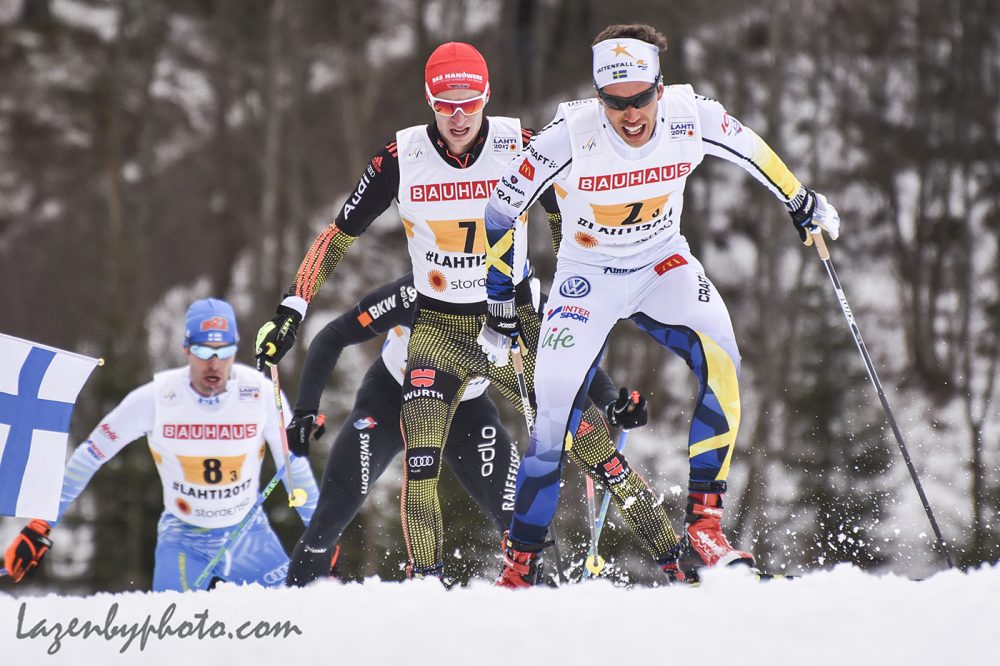
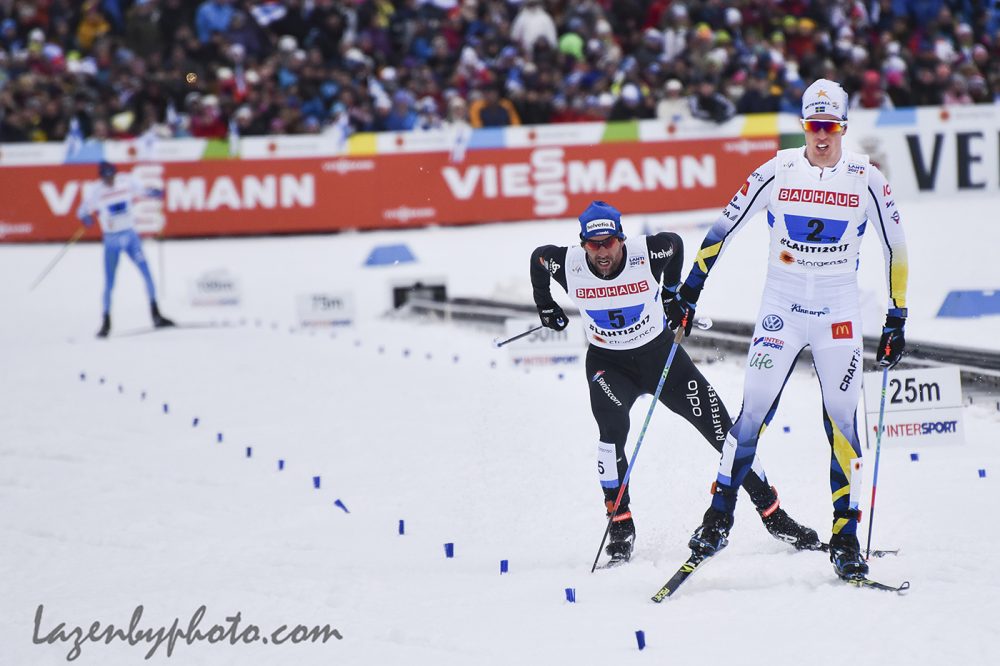
Sweden’s Calle Halfvarsson (2) crossing the line in third place, ahead of Switzerland’s Curdin Perl (5) in fourth at the finish of the men’s 4 x 10 k relay at the 2017 Nordic World Championships in Lahti, Finland. Finland’s Matti Heikkinen (far left) is seen after righting himself due to a errant pole plant. (Photo: John Lazenby/Lazenbyphoto.com)
The U.S. fielded a team comprised of Kyle Bratrud, Erik Bjornsen, Tad Elliott, and Simi Hamilton. Bratrud scrambled the first classic leg for the Americans, handing off to Bjornsen in 11th, 1:28.2 minutes behind the leader.
“I was definitely more nervous for this one because I was starting,” Bratrud said afterward.
While this is the second World Championships for Bratrud, a 24-year-old member of the Central Cross Country (CXC) Team, Friday was the first time he raced the scramble leg in a relay — he raced the third leg for the U.S. in the 2015 world champs 4 x 10 k relay in Falun, Sweden. Though he eventually lost contact with the front group, Bratrud was happy he was able to hold on for as long as he did, even if it caused him a yellow card for a technique violation.
“It was nice to at least see the front before they really picked up the pace,” Bratrud said.
“Props to Kyle on the yellow card,” Elliott wrote in an email. “Scrappy out there.”
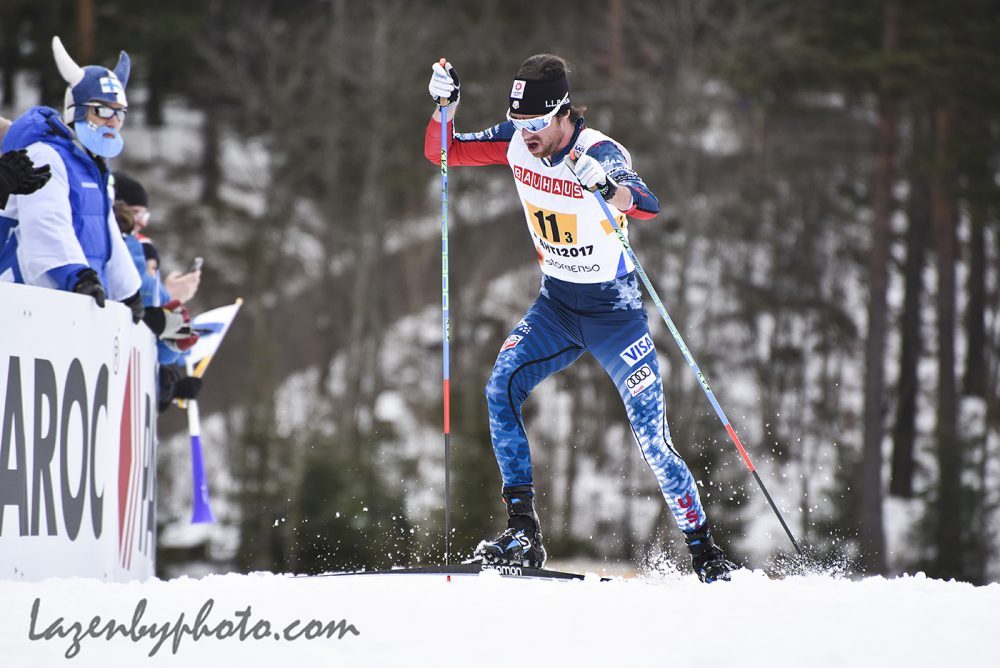
Tad Elliott racing the third leg of the U.S. men’s 4 x 10 k relay at the 2017 Nordic World Championships on Friday in Lahti, Finland. (Photo: John Lazenby/Lazenbyphoto.com)
While Bratrud had company for approximately one lap, Bjornsen raced completely alone.
“It’s not the position you necessarily want to be in, but took it for what it was worth and tried to charge up to the group in front of me, which was [the Czech Republic’s Lukas] Bauer and [Germany’s Jonas Dobler],” Bjornsen said.
“But I mean…they were moving fast,” the 25-year-old U.S. Ski Team member added. “I tried to mentally just keep pushing, but it’s tough to be out there by yourself. I felt pretty good, it’s just a different type of race.”
Bjornsen tagged to Elliott, for the Americans’ first freestyle leg. He skied the eighth-fastest third leg, 1:47 behind Hellner.
“I was also getting great splits from the coaches on making ground on the group in front of me,” Elliott wrote.”I wanted to catch them, I just didn’t really get there for Simi to save it all for his sprint. Simi skied one hell of a leg.”
Elliott handed off to Hamilton, the anchor leg for the U.S.
“By the time he tagged off to me, I think I was 10 or 15 seconds from [the Czech Republic, Kazakhstan and Italian teams],” Hamilton recalled. “They fortunately started pretty conservatively, which was nice for me.”
Those three teams were in fact 16 seconds ahead of Hamilton. He eventually closed that distance, putting the U.S. in contention for a top 10.
“I wanted to start fast and see if I could make up some time on them,” Hamilton siad. “And I did, I ended up catching them by the top of the climb after the tunnel. So I was psyched about that.”
However, when Hamilton came through for his fourth and final lap, the hill-laden course had taken a toll on his legs. He finished in 10th (+5:31.3), just half a second ahead of the Czech Republic’s Petr Knop in 11th (+5:31.8).
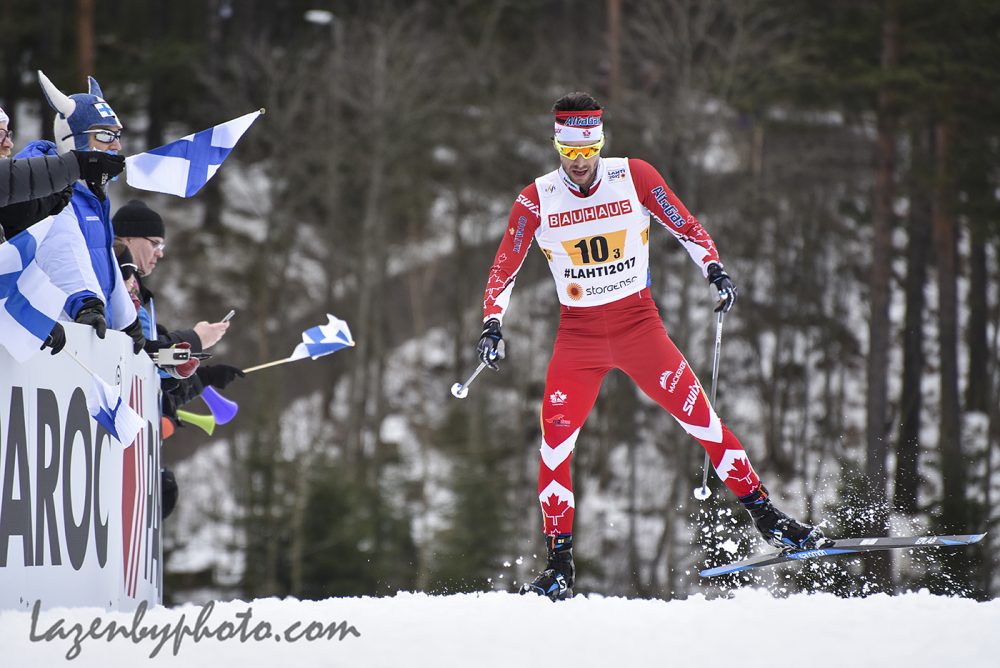
Canada’s Alex Harvey racing the third leg of the men’s 4 x 10 k relay at the 2017 Nordic World Championships on Friday in Lahti, Finland. (Photo: John Lazenby/Lazenbyphoto.com)
“That last lap my legs were definitely feeling it a little bit and those guys are all really good climbers,” Hamilton said. “I couldn’t quite make the moves that I wanted to in the last kilometer because I was a little whupped by then … but I was still able to pick off Czech Republic at the finish. Maybe not the best day for us, but still a day that we were fighting.”
Canada’s team of Graeme Killick, Devon Kershaw, Alex Harvey and Lenny Valjas finished 12th, after being lapped and thus pulled from the race on Valjas’s final leg.
In January of this year, Canada raced to a historic third place at the Ulricehamn World Cup relay in Sweden.
“It just wasn’t our day,” said a dignified Valjas after Friday’s relay. “We’re all in shape, it’s just none of us were on our A-game today and that’s what it takes to be fighting in this.”
Erik Bjornsen (U.S. Ski Team) racing the second leg of the men’s 4 x 10-kilometer relay at the 2017 Nordic World Championships on Friday in Lahti, Finland. (Photo: John Lazenby/Lazenbyphoto.com)
Norway’s Marit Bjørgen on her way to her 16th career World Championships gold in Tuesday’s 10 k classic individual start at the Lahti, Finland. (Photo: John Lazenby/Lazenbyphoto.com)
LAHTI, Finland — Moments before the women’s 10-kilometer classic individual start at the 2017 Nordic World Championships on Tuesday, temperatures read 35 degrees Fahrenheit and humidity hovered around 97 percent — the air nearly saturated. Earlier in the day, a near-ground fog lapped the tops of the three iconic ski jumps looming above the ski stadium.
In contrast to earlier classic events at these championships — a 15 k skiathlon, and classic team sprint — the tracks glazed with a mirror-like sheen.
For her 16th World Championship title, neither Norway’s Marit Bjørgen nor her wax techs were befuddled by the tricky tracks. Whether herringboning headwalls, firing like the nordic powerhouse she is on the flats and climbs, or streamlining the glide outs, Bjørgen remained peerless in her win over her 10 k classic competition. She finished in 25:24.9 minutes for the gold; the closest competitor Sweden’s Charlotte Kalla was 41 seconds behind.
Tuesday’s 2017 Nordic World Championships women’s 10 k classic podium, with (from left to right) Sweden’s Charlotte Kalla in second, Norway’s Marit Bjørgen in first, and Norway’s Astrid Uhrenholdt Jacobsen in third. (Photo: John Lazenby/lazenbyphoto.com)
With silver going to the Swede, the final podium spot went to another Norwegian, Astrid Uhrenholdt Jacobsen, who finished 55.5 seconds back from her teammate Bjørgen’s time.
Considering their collective medal count, it was a championship-pedigreed podium: it was Kalla’s 12th career championship medal — and her second in the last week. Jacobsen earned her third-individual championship medal of seven overall. (For the 2016/2017 World Cup season, it’s Jacobsen’s first podium.
It’s also been a decade since Jacobsen’s first World Championship medal, a classic-sprint gold in 2007 in Sapporo, Japan.
“A lot of things have happened in those ten years,” Jacobsen, 30, said after the race. “The medal today feels better than the gold medal in Sapporo. I fought harder for this. I’m just really happy today.”
Amongst the potential podium locks in the 10 k classic, Kalla noted she chose an earlier start as part of her race strategy; she started in bib 34.
“I decided to go early because of the warming up opportunities” Kalla explained during the post-race press conference. “I wanted to go on the competition track as long as possible. And then I also had a better opportunity to do my own race and not focus on the times against the others, just focus on my performance in every stage on the track.”
Sweden’s Charlotte Kalla racing to second in the women’s 10 k classic on Tuesday at 2017 Nordic World Championships in Lahti, Finland (Photo: John Lazenby/lazenbyphoto.com)
Despite her race-time dominance, Bjørgen spoke of her jittery nerves before the start.
“This 10 k has been one of the distances I really wanted to win,” the 36 year old said during the press conference. “I think I have two before the start of the world championships, so this was the one I wanted the gold medal. I think that’s the reason I was nervous and also I understand I was in good shape and it was really possible to take the gold, so that’s the reason.”
A 41-second winning margin for Bjørgen isn’t definitive. And unlike every other race at these championships, where high drama like Norwegian-Finn tangles, broken poles and Diggins-grit dictated the narrative, Tuesday’s 10 k classic was clinical.
At 1.5 k, 5 k, 6.3 k, and 7.8 k splits, Bjørgen was the fastest. Already at 6.3 k, Bjørgen had a 22-second gap on Kalla. Barring an equipment failure or tumble, by that point the win was a bygone conclusion and Bjørgen the author of this 10 k novella.
Norway’s Astrid Uhrenholdt Jacobsen on her way to bronze during the women’s 10 k classic at the 2017 Nordic World Championships in Lahti, Finland. (Photo: John Lazenby/lazenbyphoto.com)
“Today I had very good skis and I feel very strong, and the first 5 [k] I feel that my speed was very high,” Bjørgen added. “It was only a second from 1 kilometer to 4, and I feel that I am racing very fast and I not taking more seconds so I wonder how will I do it on the last 5 k. But then I heard it was from 6 [seconds] and then to 10 then to 20 and then understand they were opening a bit too hard.”
Bjørgen explained the news of time-gain inroads served as a propellant.
“I think when you heard you have second[s] on your side you just get some more power and you just want to ski more faster,” Bjørgen said. “You understand it’s well for you. You are getting so happy, it is no problem to speed up and go.”
Many adjectives come to mind when describing Bjørgen’s career. Yet the numbers are most impressive. When mining her career-win data, there’s always something new to learn. Of all her gold medals — now 22 between World Championships and the Olympics — prior to Tuesday’s win, 20 of those had come in non-individual-start races. (Her other individual-start win came in 2011 World Championships 10 k classic in Oslo, Norway.)
Bjornsen Leads Americans in 23rd, Randall 26th
Kikkan Randall (U.S. Ski Team) racing to 26th in the women’s 10-kilometer classic individual start at the 2017 Nordic World Championships on Tuesday in Lahti, Finland (Photo: John Lazenby/Lazenbyphoto.com)
Starting four minutes ahead of Bjørgen, the last starter for the U.S. Ski Team (USST) on Tuesday was Sadie Bjornsen. After covering the course in a time of 27:46.1, the American eventually finished as the top North American in 23rd (+2:21.2). The 10 k classic event was Bjornsen’s first individual event at these World Championships.
She also raced Sunday’s classic team sprint with her USST teammate Jessie Diggins, where the two captured bronze. Diggins did not race Tuesday’s 10 k classic.
“It definitely gave me a lot of confidence the other day,” Bjornsen, 27, said on Tuesday, referring to her bronze-medal performance on Sunday. “So I went into today probably a bit nervous because I had more expectations.”
Sadie Bjornsen (46) leading Sweden’s Ida Ingemarsdotter during the women’s 10-kilometer classic individual start at the 2017 Nordic World Championships on Tuesday in Lahti, Finland. (Photo: John Lazenby/Lazenbyphoto.com)
Looking back on the effort, Bjornsen explained that she may have paced the initial part of her race too slowly. With her 10 k classic performance from Otepää in the back of her mind, Bjornsen intended to take the first few kilometers of Tuesday’s world champs 10 k event to work into the race.
“I definitely wanted to keep things under control at the beginning, because I felt last week I started really hard and struggled to keep the pace up,” Bjornsen said. “I tend to do better when I do a more gradual start and then try to pin it after that. I haven’t seen the splits at all, but based on the way that I felt, maybe I started a little too easy.”
With glazed tracks making for difficult steady striding, Bjornsen indicated that she might not have gotten out of the track as often as she should have to stay fresh.
“You know, today was a day that you had to get out of the track and grind it in order to make your skis work,” Bjornsen said. “I was really trying to force it, and really tried to stay in the track. Then at 4 k, [USST Head Coach Chris] Grover was like, ‘Get out of the track. It’s much faster to run,’ and I feel like from there on I got to skiing a bit better.”
Finishing 10.7 seconds behind Bjornsen was her teammate Kikkan Randall, the second American in the top 30 in 26th (+2:31.7). Randall had already earned an individual bronze at these championships and competed in last weekend’s 15 k skiathlon, where she finished as the top American in 17th.
As Randall explained, her performances in these races, as well as those of other Americans competing, may influence who will start the women’s 4 x 5 k relay on Thursday.
“I think there’s a couple of us who know we’re trying to prove we’re worthy of the relay spot,” Randall said on Tuesday. “I think for Rosie and I, we were trying to ski our first 5 k pretty hard and really use this as a test.”
Despite working the pushing the pace for the first half of her race, Randall found herself able to adapt and finish strong.
“It’s certainly the best opening 5 k I’ve had all year,” Randall said. “I felt my body wanted to turn on and go on the first couple hills. That’s kind of an exciting new feeling for me.”
“The first couple climbs on the second lap I was like ‘OK, woah’,” she added. “[But] I found my groove the last two and half k, so overall a pretty solidly paced race.”
The two other Americans to compete in Tuesday’s 10 k, Rosie Brennan placed 32nd (+2:55.4) and Ida Sargent finished 43rd (+3:55.2).
Skiing alone for the entirety of her race, Brennan was more satisfied with her 10 k race than she was her skiathlon performance. Tuesday’s race, however, still left her hungry for more.
“I don’t know if I was so much looking for a result as much as a feeling,” Brennan explained after. “I think I was close but not quite there.”
All four Canadian women who traveled to Lahti competed in the 10 k event, with Katherine Stewart-Jones leading the team in 36th (+3:09.6). This season marks Stewart-Jones’s second year on the Canadian national team and it was her first World Championships.
The 21-year-old Stewart-Jones, of the National Team Development Centre (NTDC) Thunder Bay and national U25 Team, also competed at this year’s U23 World Championships in Park City, Utah. After Tuesday’s race, she said she’s excited about where the Canadian women are headed, particularly with regards to their results thus far at world champs.
Canada’s Katherine Stewart-Jones racing to 36th in the women’s 10-kilometer classic individual start at the 2017 Nordic World Championships on Tuesday in Lahti, Finland (Photo: John Lazenby/Lazenbyphoto.com)
“We’re all excited to be the next generation. Just to have four girls here at world champs is super amazing,” Stewart-Jones said after her first top 40 in her third World Championships race. “I think we’re really bringing up the energy as a group and getting each other pumped up and having confidence in each other.”
Explaining that she was able to stride for most that the race, Stewart-Jones was pleased with her result, but also the way she felt physically while skiing on course.
“In the last lap when I was getting a little tired, I jumped out of the tracks, but I had enough energy in my legs to run,” she said. “Overall, I was able to find that extra gear on that second lap and was able to relax on the first lap, which is super important on this kind of a course. I’m just really happy with how I skied.”
Finishing 4.6 seconds behind Stewart-Jones was Canadian World Cup Team skier Emily Nishikawa in 37th (+3:14.9). Two more members of Canada’s U25 Team, Dahria Beatty placed 39th (+3:24.9), and Cendrine Browne finished 47th (+4:05.2).
Despite having a limited number of classic races under her belt this season, Beatty had a positive review of her performance on Tuesday.
“I haven’t done a ton of classic races this year and doing the races last weekend in Otepää it was a really positive race for me and I was trying to build on that,” Beatty said. “That’s definitely the most fun I’ve had this week.”
Sadie Bjornsen (U.S. Ski Team) racing to 23rd in the women’s 10-kilometer classic individual start at the 2017 Nordic World Championships on Tuesday in Lahti, Finland (Photo: John Lazenby/Lazenbyphoto.com)
Kikkan Randall (U.S. Ski Team) racing to 26th in the women’s 10-kilometer classic individual start at the 2017 Nordic World Championships on Tuesday in Lahti, Finland (Photo: John Lazenby/Lazenbyphoto.com)
Rosie Brennan (U.S. Ski Team) racing to 32nd in the women’s 10-kilometer classic individual start at the 2017 Nordic World Championships on Tuesday in Lahti, Finland (Photo: John Lazenby/Lazenbyphoto.com)
Emily Nishikawa (Canadian World Cup Team) racing to 37th in the women’s 10-kilometer classic individual start at the 2017 Nordic World Championships on Tuesday in Lahti, Finland (Photo: John Lazenby/Lazenbyphoto.com)
Canada’s Emily Nishikawa racing to 37th in the women’s 10-kilometer classic individual start at the 2017 Nordic World Championships on Tuesday in Lahti, Finland (Photo: John Lazenby/Lazenbyphoto.com)
Dahria Beatty (Canadian U25 Team) racing to 39th in the women’s 10-kilometer classic individual start at the 2017 Nordic World Championships on Tuesday in Lahti, Finland (Photo: John Lazenby/Lazenbyphoto.com)
Canada’s Cendrine Browne (r) and Norway’s Ingvild Flugstad Oestberg during the women’s 10-kilometer classic individual start at the 2017 Nordic World Championships on Tuesday in Lahti, Finland (Photo: John Lazenby/Lazenbyphoto.com)
Russia’s Sergey Ustiugov out-duels Italy’s Federico Pellegrino for the men’s classic team sprint gold at 2017 Nordic World Championships on Sunday in Lahti, Finland. (Photo: John Lazenby/Lazenbyphoto.com)
LAHTI, Finland — The breath taken out of a nation.
Throughout the lifetime of a sporting fan, high-stakes races or games offer the chance for seared-into-the-neurons moments, things you remember for an eternity with the distinct recollection of where you were and what you were doing when the news came down.
But those are exceptionally rare moments. And depending on what side of the equation you’re on, they can be mile high or a mile deep. It’s rendered down to the win or the loss.
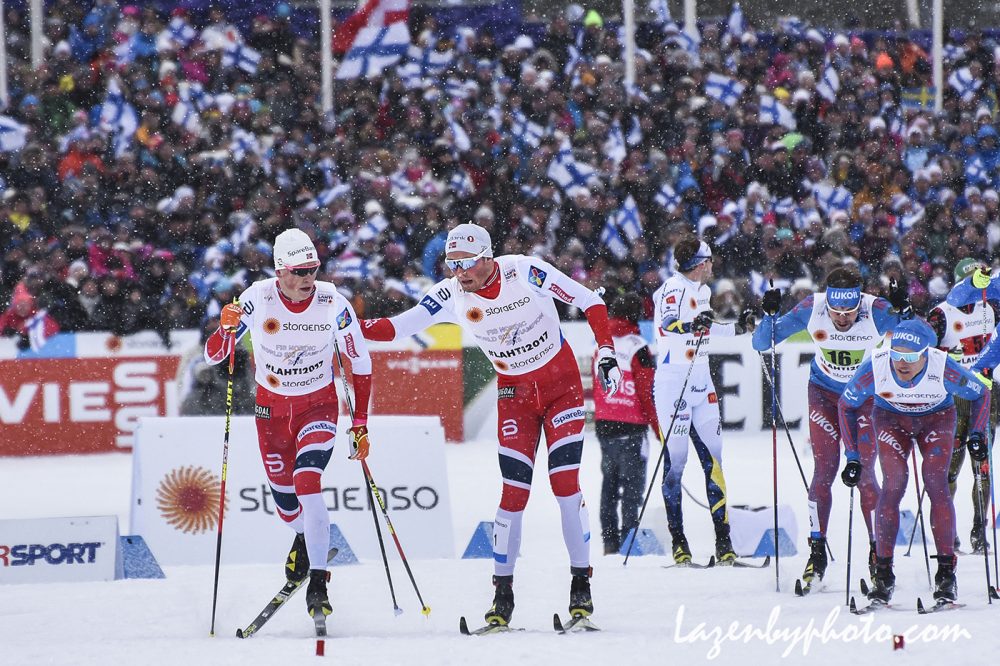
Norway’s Emil Iversen tags teammate Johannes Høsflot Klæbo during the men’s classic team sprint final at the 2017 Nordic World Championships on Sunday in Lahti, Finland. (Photo: John Lazenby/Lazenbyphoto.com)
For much of Sunday’s men’s 6 x 1.3-kilometer classic team sprint at the 2017 Nordic World Championships, it appeared to be a cruiser for team Norway, featuring Johannes Høsflot Klæbo and Emil Iversen. The ending to their gold-medal story seemingly written after the third exchange when Klæbo gifted Iversen and all of Norway a 5.38-second lead over the chasing Finns.
5.38 seconds is a small duration. But when that time gap is illustrated as a distance gap in a sprint, the void looks immense: in this case the distance from Iversen to Finland’s chaser Iivo Niskanen was 45 meters. Even in the best of times, an often too-wide gap to close.
The sprint course features a long but strideable climb right from the stadium’s steps. It then 180’s to the left and hits a steep headwall most skiers herringboned. Then it was a speedy descent into the hairpin known as “Lahti Corner”, and then stadium time — a horseshoe-shaped venue of terraced stands filled to capacity with a mostly Finnish crowd.
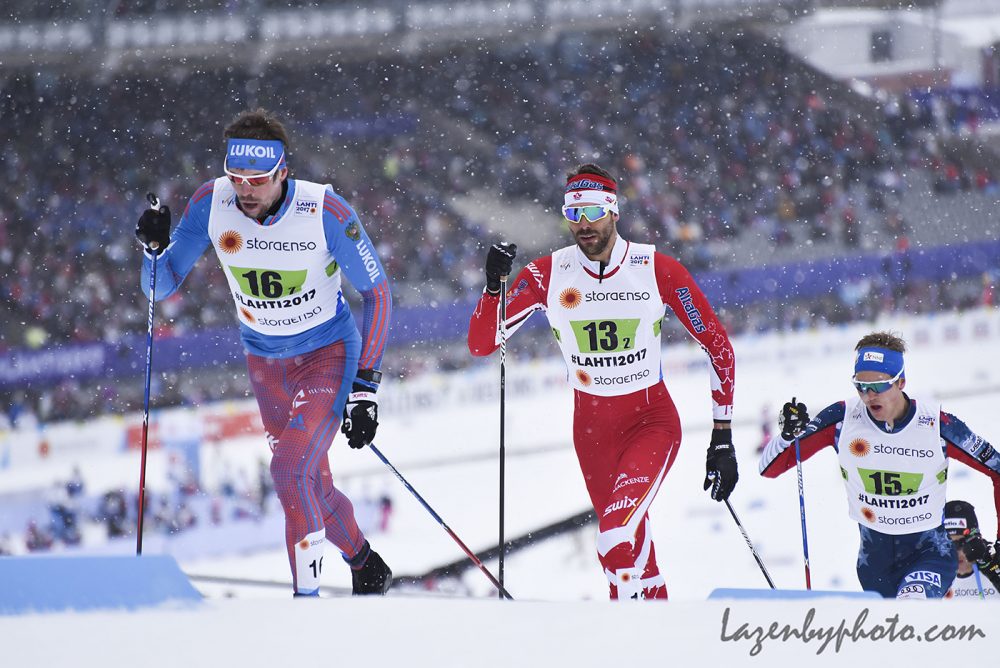
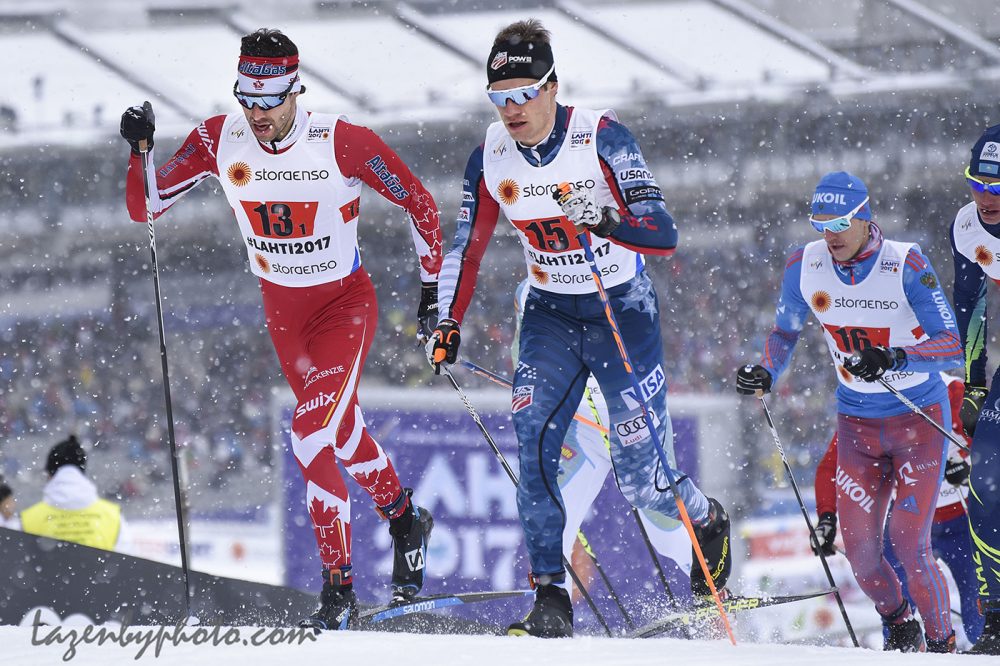
Russia’s Sergey Ustiugov (16) leads Canada’s Lenny Valjas (13) and American Erik Bjornsen (15) in the men’s classic team sprint final at 2017 Nordic World Championships on Sunday in Lahti, Finland. (Photo: John Lazenby/lazenbyphoto.com)
Chasing Iversen, frothing at his heels, were three skiers. There was Niskanen, and right behind him, matching stride for stride were Russia’s Sergey Ustiugov and Italy’s Federico Pellegrino.
As Niskanen worked up the headwall and pushed over the top, he put some meters on Ustiugov and Pellegrino. After a powerful double poling section, Niskanen tipped on the fulcrum into a fast downhill towards Iversen. By “Lahti Corner”, Niskanen had caught the Norwegian.
The Finnish frenzy that ensued was a roar. The crowd had sensed the Niskanen-Iversen link up.
On the glide out from Lahti Corner, a 300-meter straight away, Iversen was set in the third of four tracks. One lane of tracks remained to the left — inside of the Norwegian.
Niskanen, inches away from Iversen’s tails, slotted to his left to pass. There are many perspectives out there, and many depend on which flag you wave, but surely Iversen sensed Norway’s grasp on team gold weaken.
Norway’s Emil Iversen skiing with a broken pole down the finishing stretch after tangling with Finland’s Iivo Niskanen (not shown) 200 meters from the line, which cost Norway gold in the men’s classic team sprint at the 2017 Nordic World Championships in Lahti, Finland. (Photo: John Lazenby/lazenbyphoto.com)
Iversen moved to his left to shut down the Finn and immediately jolted backward as he tangled with Niskanen.
Finland and Norway down. The Finnish cheers snuffed.
In a blink, Ustiugov and Pellegrino zipped passed in what moments before had been a fight for bronze, into a sprint for gold.
Finland’s duo of Sami Jauhojärvi and Niskanen were third (+8.64), Norway fourth (+18.42). The race jury deliberated for a half hour before announcing that neither Norway nor Finland were relegated.
“What can I do at that situation, when I see that my teammate is going to push for the gold, and then happens this unfortunate crash?” Jauhojärvi said during the press conference. “But it’s just a part of sports, and sports is just a small part of life. We need to be happy that we can pick up the medal in front of [a] home audience this evening.“
After crossing the line Niskanen fumed and ranted.
“Yeah, of course straight after the finish line I was very angry, and maybe it wasn’t the most cleverest thing to do with Emil in that last curve,” Niskanen said of his antics. “He lost a medal, and maybe we lost a gold medal. But it’s over now, we are in bronze, and the games are continuing. Just only thing we need to do about this is shaking hands with Emil. We have many years to compete together in the same arenas, and our careers are continuing, and the Lahti ski games are continuing, and we will have good days later.”
A Norwegian journalist asked a pointed question of Niskanen. “Did you expect a rookie mistake from someone like Iversen?” he asked.
“Emil has done many sprints, and maybe that move was the only thing to do if he wanted to fight for the gold medal,” Niskanen said in his response. “He really wanted to win, and we did. I came faster behind him and he changed the line, but… it’s a sprint.“
Answering in English, Kriukov spoke to his lackluster early season results. “This season, yeah, not so good for me and my shape not so best,” he said. “But today I am liking the situation. And lucky for our team and I think there is a reason while our team is first today.”
For Kriukov’s partner Ustiugov, it was his second gold and third medal overall in as many championship races.
U.S. Fifth, Canada Sixth
American Simi Hamilton (16) and Canada’s Alex Harvey (13) racing together ahead of Russia’s Nikita Kriukov (16) in the men’s classic sprint semifinal at the 2017 Nordic World Championships in Lahti, Finland. Both teams reached the final, where the U.S. placed fifth and Canada sixth. (Photo: John Lazenby/lazenbyphoto.com)
U.S. Ski Team members Simi Hamilton and Erik Bjornsen skied to fifth place, 23.58 seconds behind Russia. For much of the race, Hamilton and Bjornsen remained in contact with the main group consisting of the podium countries: Norway, Canada, Germany, and Sweden.
On occasion, Klæbo would try to break the race, but the integrity of the group remained for most of three laps. After the race, when asked how he managed Klæbo’s burst, Hamilton said his was a game of calculated risk.
“I think it goes both ways. It’s one of those courses and one of those races where if you go too hard in the same spot then you’re going to pay for it later” Hamilton said. “But at the same time, you know, we’re at world champs, you have to take chances. I think you’re constantly sort of evaluating that risk versus reward the whole time you’re out there.”
The risks for losing contact were a gassed slog playing catch up; the reward — opportunity. And lap after lap it was either Bjornsen or Hamilton deep in a tuck after rounding “Lahti Corner”, playing in a congested international game once reserved for the traditional nordic-ski nations.
For the 25-year-old Bjornsen, it could have been a day of nerves instead of the calm and power with which he skied. Throughout the race, he posted the fourth- or fifth-fastest splits of the second-leg skiers.
“We haven’t done a lot of team sprints together,” Bjornsen said about his experience teaming up with Hamilton. “The last one was in Sochi. I haven’t done a lot of them recently. So it was great. Going into the finals, it was like, the best teams in the world and the best dudes next to me.”
Bjornsen skied the Americans from eighth into fifth on his second loop, and after Hamilton dropped two places to seventh by the last exchange, Bjornsen again rallied for fifth.
At 29 years old, Hamilton remains humble and a student of continued improvement.
“My classic skiing is still progressing,” Hamilton said. “And for someone like Erik, it comes so naturally for him, he’s such a beautiful classic skier, he’s so efficient. I just focused on putting myself in as much pain as possible to keep contact with that group that I was skiing with. I always have faith in him being able to dig to a place where not many people can dig too in order to come up with that result.”
Erik Bjornsen (U.S. Ski Team) racing in the men’s classic team sprint final at 2017 Nordic World Championships in Lahti, Finland. With teammate Simi Hamilton (not shown), the Americans finished fifth. (Photo: John Lazenby/lazenbyphoto.com)
Heading into the last lap, Hamilton tagged Bjornsen in seventh, 10 seconds back from Russia, Italy and Finland. (After a Klæbo flyer, Norway was 16 seconds ahead of the U.S. as Bjornsen began the final lap.)
“Simi handed off to me in a great spot on the last leg,” Bjornsen reflected. “I was fighting with a few other guys and it was just perfect. Super fun to be with the veteran here.”
“I actually didn’t know that she was on the podium until after [my] race,” Bjornsen admitted. “I was second leg so I showed up pretty late, kind of just when Simi was starting … So I was trying to stay pretty focused. I wasn’t even thinking about the fact – I actually glanced up at one point and saw a replay of her crashing, and so I was a little worried that they weren’t in it. But it was so exciting to see Sadie come up and get a podium here. This is her first race and I know she’s in good shape. It’s great. Nobody deserves it more than she does. I watched her over the years, just so focused and dedicated. There’s a reason she’s so strong.”
Canada was represented by national-team members Alex Harvey and Len Valjas. In January, the duo won the World Cup season’s first team sprint. On paper they still remained a medal contender, in addition Harvey has come into the championships primed. However, Valjas has struggled with a health issue the last few weeks.
“I’m better now, what I think we came to the conclusion with the doctors and everybody, two weeks ago in the gym in Davos I hurt my vertebrae a bit,” Valjas said after the race. “I don’t know how, but it totally affects my breathing, so [at the last World Cup in] Estonia and the sprint here, I felt like I was not able to breathe. The race starts well and I die immediately.”
Valjas said he’s received treatment to alleviate the symptoms. “A couple days ago, I didn’t know if I’d even start because it was really actually hard to take a deep breath,” he elaborated. “It doesn’t feel like much but when you try to go at 100 percent, you cannot keep up and it’s frustrating. So I was just happy that I was able to ski with these guys, but when it got away on that second leg there, trying to catch Iversen kind of pushed me over the limit a bit.”
Harvey initially skied the team into third by the first exchange, just 2.8 seconds out of first, and despite slipping to fifth on Valjas’s first loop, Harvey raced up to second by the third exchange, 4.9 seconds behind Norway. On Valjas’s second loop, he dropped to eighth. Harvey held that position on the second-to last leg and tagged Valjas with the same group containing the U.S. Valjas then picked off two places for sixth place.
“I died a bit in the end, but I still had a lot of confidence in Len’s finish,” Harvey said. “We know in a high-speed finish like that, Len is maybe the best in the world so I was still confident that if I put him in the right situation, we still had a legitimate shot. We still believed in a podium finish and it’s just, you can’t have it every time. But I think it was a big improvement for Lenny, compared to the last two weeks and leading up to the relay.”
The Canadians finished sixth, 27.02 seconds behind Russia and 3.44 seconds behind the U.S., in the final.
Championship racing continues Tuesday with the women’s 10 k classic individual start.