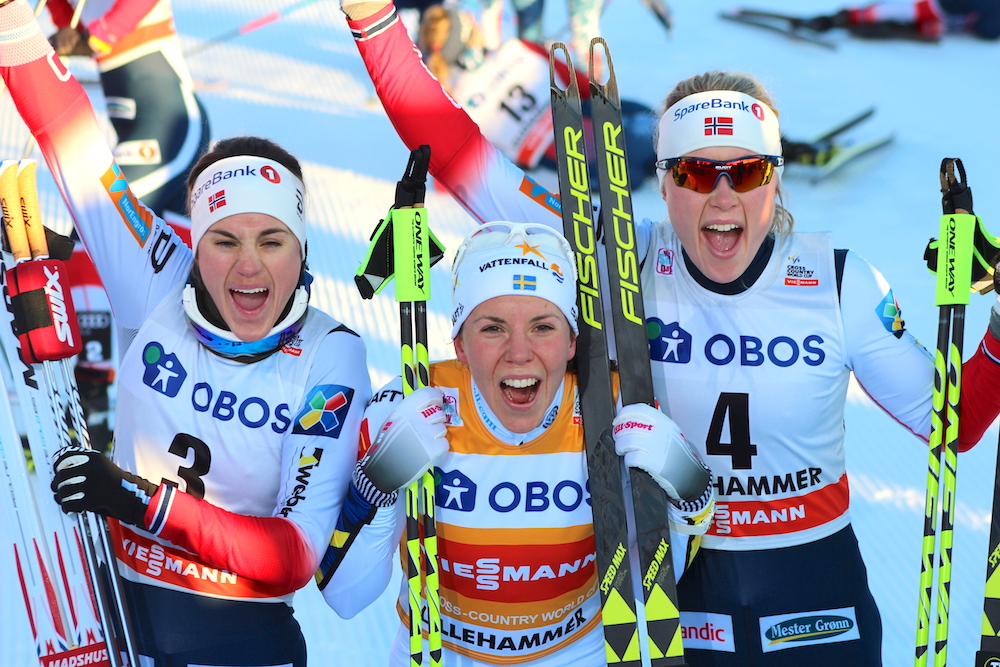
Charlotte Kalla (c) of Sweden with Norwegians Heidi Weng (l) and Ragnhild Haga after placing first, second and third, respectively, in the women’s 15-kilometer skiathlon on Sunday in Lillehammer, Norway. (Photo: Henrik Hunnes)
If it hadn’t been for the steady bob of her yellow leader’s bib and an intermittent shadow from the sun’s glare cast by the trail’s treeline, Charlotte Kalla might have blended right into the snow: her white suit symbolic of Sweden smooth across the Lillehammer race course in Norway.
As it were, the overall World Cup leader’s bib, her prize from winning last weekend’s battle against Norway’s Marit Bjørgen, could not be contested. Kalla crested the final climb of the women’s 15-kilometer skiathlon on Sunday with no Norwegians in sight, headed toward her second distance win in a row. Her closest competitor was Norway’s Heidi Weng, who finished 19.7 seconds after Kalla crossed the line in 42:24.7.
“It felt good, and when I was on that last climb I felt fine, but didn’t know that Heidi could not follow me,” Kalla said, according to a International Ski Federation (FIS) press release.
From the beginning Kalla commanded the lead, charging the classic portion out of the start. By the 2.5 k mark, the field had reached the course’s major climb, Weng pushing to the front and creating a small gap on the field, pulling Kalla and Austria’s Teresa Stadlober with her.
Leading the second group charge a little over seven seconds back was Finland’s Krista Pärmäkoski, followed by Norwegian’s Ragnhild Haga and Kathrine Rolsted Harsem,as well as the U.S. Ski Team’s Jessie Diggins.
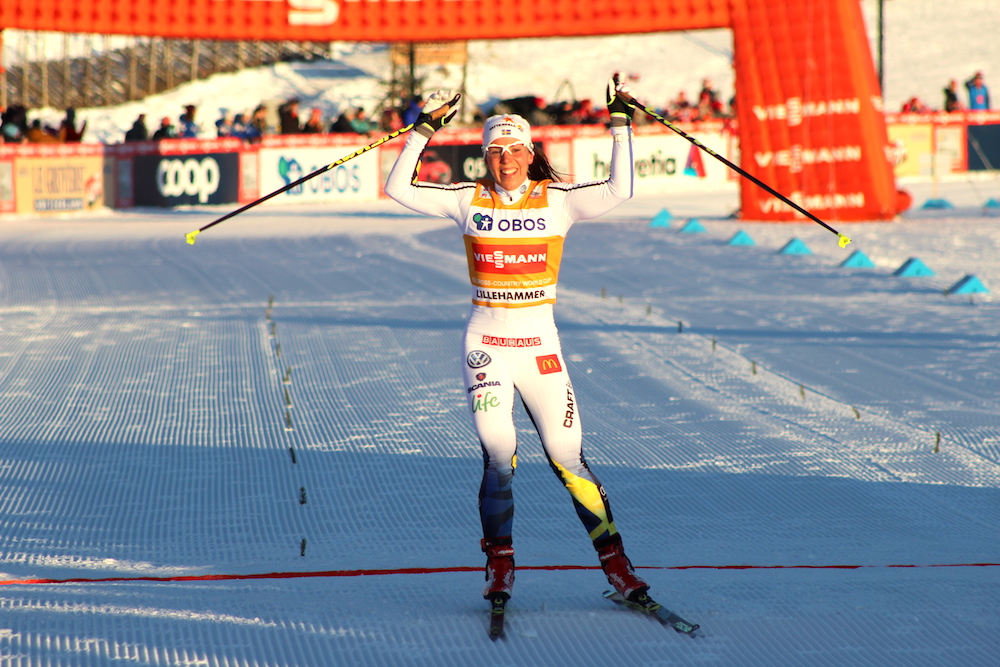
Sweden’s Charlotte Kalla winning the World Cup women’s 15 k skiathlon on Sunday at the Lillehammer World Cup in Norway. (Photo: Henrik Hunnes)
In just over a kilometer, Diggins had taken over the helm of the second group’s chase, closing the gap between herself and the leaders by three seconds. By the next kilometer, the crowd had swallowed Stadlober, while Diggins cruised into the third-place position.
“I think that was maybe the best I have classic skied in my entire life. I had amazing skis and I was just feeling really good,” Diggins said during a post-race interview with FasterSkier.
Diggins held onto third through the exchange, after Kalla and Weng had already passed through 21 seconds before.
“I knew that I need an easy classic, before the ski exchange [to] skate,” Kalla said. “Especially when I know how the uphills here are, it’s a very tough and long climb out of the stadium.”
For the first 5 k of the freestyle portion, Kalla trailed Weng by mere milliseconds, matching every two of Weng’s glides with a powerful one of her own.
As the two leaders approached the major climb for the final time, a sideways glance from both created a momentary pause: who wanted the lead?
In the end, it was Weng. She headed up the hill in front of Kalla, the taste of a Norwegian win on home turf in the back of her mouth. But Kalla’s momentary drop from the lead was no mistake; tactics as camouflage to her competitor as her suit in the snow.
Midway through the hill, the Swede made her move, using her powerful V2 to get around Weng and distancing herself from the Norwegian by 12 seconds as she cornered her way back toward the stadium.
“Skating was really tough,” Weng said, according to FIS. “I’m glad I held myself back a little, because Charlotte got really strong on the skating part, and on that last hill I knew she would go ahead. She was in another league. She is in a very good shape.”
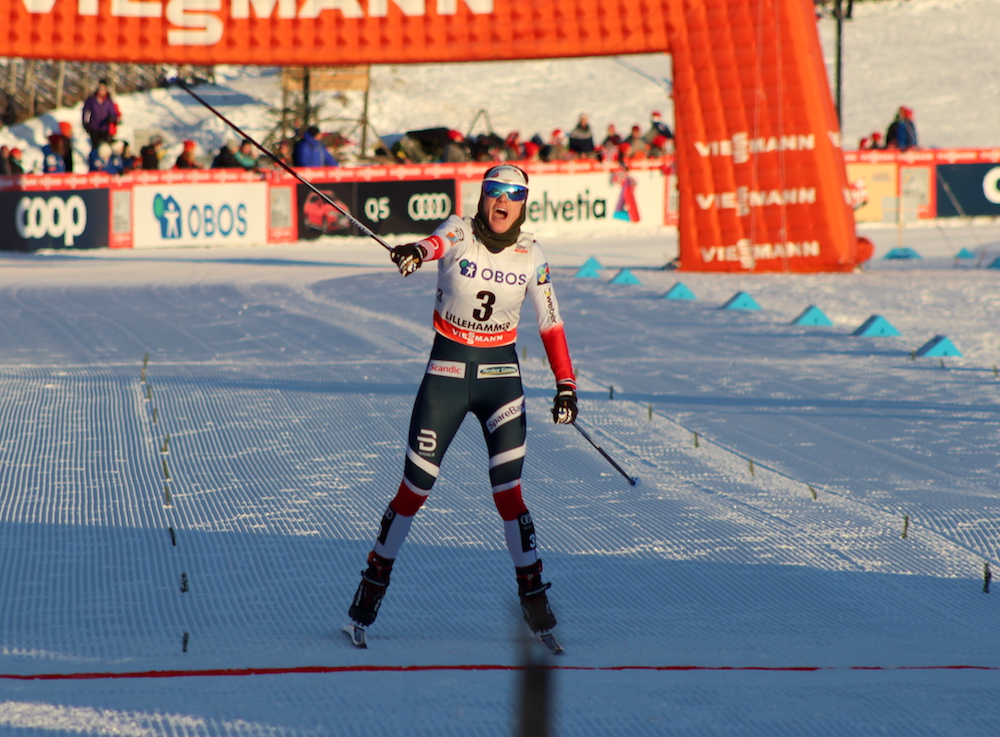
Heading into the finishing stretch, Kalla had extended her lead by another seven seconds, waving to the crowd as she crossed first. Following Weng in second was Haga in third place (+43.6).
“I was not satisfied with the first round classic, but I got a bit better after that and I was able to stay in contact with the leader,” Haga said according to FIS. “I felt stronger when we started with freestyle, but then I broke my pole in the last hill and I thought it was over for me regarding a podium position, but then I got a new one from the one of our coaches, and he told me that it was still possible.”
In fourth, 54.3 seconds behind Kalla was Bjørgen, just ahead of Diggins in fifth (+57.0).
Norway’s Heidi Weng finishing second the World Cup women’s 15-kilometer skiathlon on Sunday in Lillehammer, Norway. Sweden’s Charlotte Kalla (not shown) finished 19.7 seconds ahead for the win. (Photo: Henrik Hunnes)
“She put herself right in the race to be a contender for the podium today,” USST Women’s Coach Matt Whitcomb said of Diggins during a post-race phone interview. “It got away from her … but it’s really encouraging, particularly on a course as challenging as this one is in Lillehammer, that Jessie can fight in the top five like that.”
“I think she’s coming out of yesterday with a lot of confidence in her classic skiing, having made the sprint final,” Whitcomb continued. “In the past it’s more been about damage control in the classic leg, and now it’s about doing damage to others.”
Rounding out the top 10 was Stadlober in sixth (+1:04.9), Pärmäkoski in seventh (+1:07.8), Norway’s Ingvild Flugstad Østberg in eighth (+1:26.0), Russia’s Natalia Nepryaeva in ninth (+1:27.8), and a second USST member, Sadie Bjornsen in 10th (+1:32.6).
“She’s just been turning heads, demonstrating such great fitness and composure as she races in some pretty high stress situations,” Whitcomb said of Bjornsen. “Really strong all weekend.”
After coming through the exchange in 23rd, Kikkan Randall (USST) worked her way up to 16th (+2:06.5) by the end of the freestyle portion of the race.
“Had a good start but lost some ground on the first time up the big climb,” Randall wrote in an email to media outlets. “Found a better groove in the second classic lap and felt much stronger in the skate. Underlying fitness feels strong but still searching for my full race gear. Great conditions, even saw a bit of sun out there!”
Also scoring World Cup points for the USST on Sunday was Rosie Brennan 29th (+3:07.7).
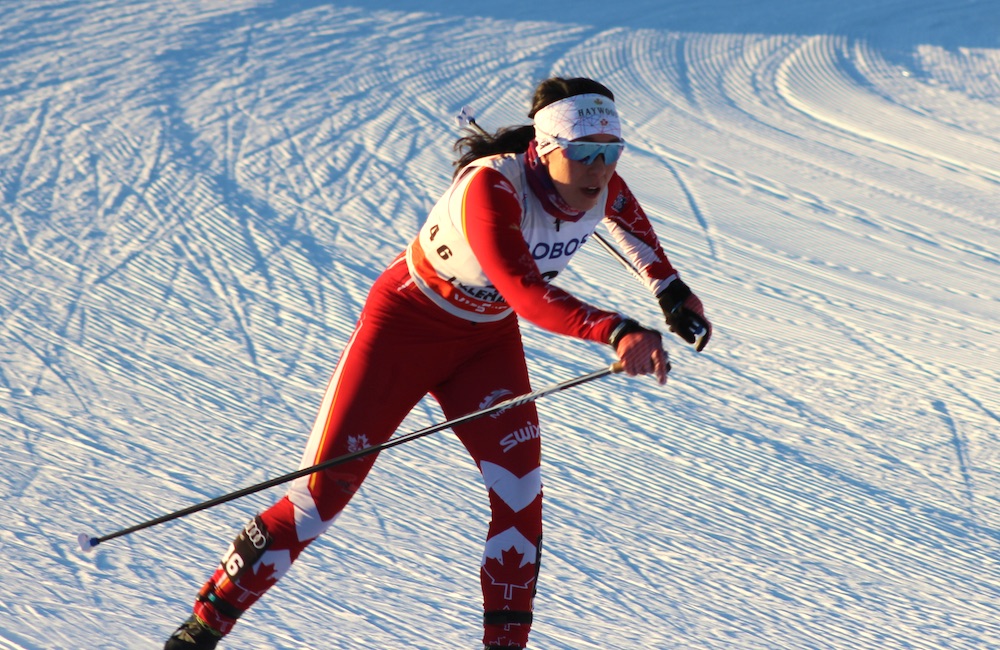
Canada’s Emily Nishikawa racing to 49th the women’s 15-kilometer skiathlon on Sunday at the World Cup in Lillehammer, Norway. (Photo: Henrik Hunnes)
“The harder the course, the more promising things get for Rosie,” Whitcomb said. “She’s just a worker out there. She can really drop it into low gear and pick off people on these big climbs. She’s been skiing the descents really aggressively; it makes sense that she hit the top 30 today.”
Also racing for the U.S., Liz Stephen finished 36th (+3:25.7), Chelsea Holmes 38th (+3:39.6) and Ida Sargent 55th (+6:41.1).
“Chelsea, in what is generally not her strong technique, was able to climb up into the top 30 in the classic portion of the skiathlon. That was really nice to see.” Whitcomb said. “She can certainly do really well in this event, particularly if she skis the way she did in parts of that classic race.”
Cendrine Browne led Canada in 45th (+4:37.3) while her teammate Emily Nishikawa followed in 49th (+5:00.1). Katherine Stewart-Jones did not finish.
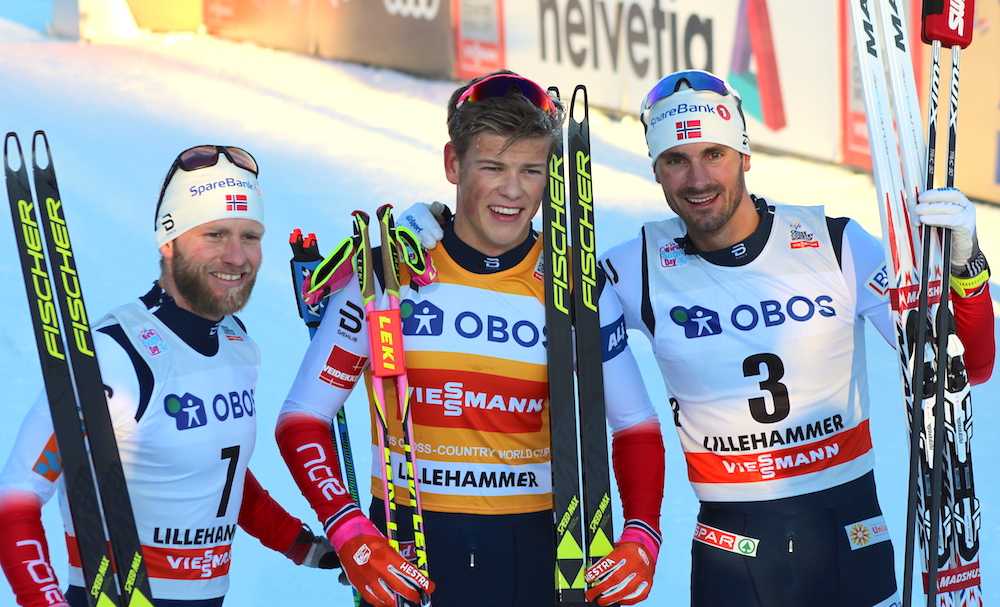
The all-Norwegian men’s 30 k skiathlon podium on Sunday in the 2017 World Cup in Lillehammer, Norway. Johannes Høsflot Klæbo (center) placed first, Martin Johnsrud Sundby (left) second, and Hans Christer Holund (right) third. (Photo: Henrik Hunnes)
Imagine for a moment that only months ago, at about 33 years old, you were in your prime — with World Cup globes on the mantle, six World Championship medals presumably in a drawer somewhere, and four Olympic medals (three of which are from the 2014 Games and will be awarded post-Sochi since the Russians that cheated have been scrubbed from the results sheet). And of course, there’s the iconic beard adorning the iconic Sundby — a technical master with a lung capacity like a blue whale.
But there’s the problem with the human condition of always wanting more. One more win, one more piece of hardware to reaffirm the legacy before the inevitable decay of Father Time.
On a sunny bluebird Sunday in Lillehammer, Norway, on the final buckling climb 28.65 kilometers into the men’s 30 k skiathlon, it looked like Norway’s Martin Johnsrud Sundby would satisfy his need to win. A need that’s been satiated since his first individual World Cup victory in Kuusamo, Finland, in 2008.
When Sundby made his move, he shattered a pack that included fellow Norwegians Hans Christer Holund and Simen Hegstad Krüger, France’s Maurice Manificat and Canadian Alex Harvey. And yes, the relatively new kid on the block from Norway, 21-year-old Johannes Høsflot Klæbo.
The Sundby move that historically would have been a kill-shot turned out to be a slight misfiring. Holund and Klæbo both looked mortal, but the bleed-out wasn’t terminal.
As Sundby glided down the rolling terrain towards the finish. It appeared to be another coronation.
But the roar from the crowds began rising as Klæbo worked the slight ups and the double-polable sections. With his skis running fast, Klæbo dropped Holund and reeled in Sundby by the finishing straight.
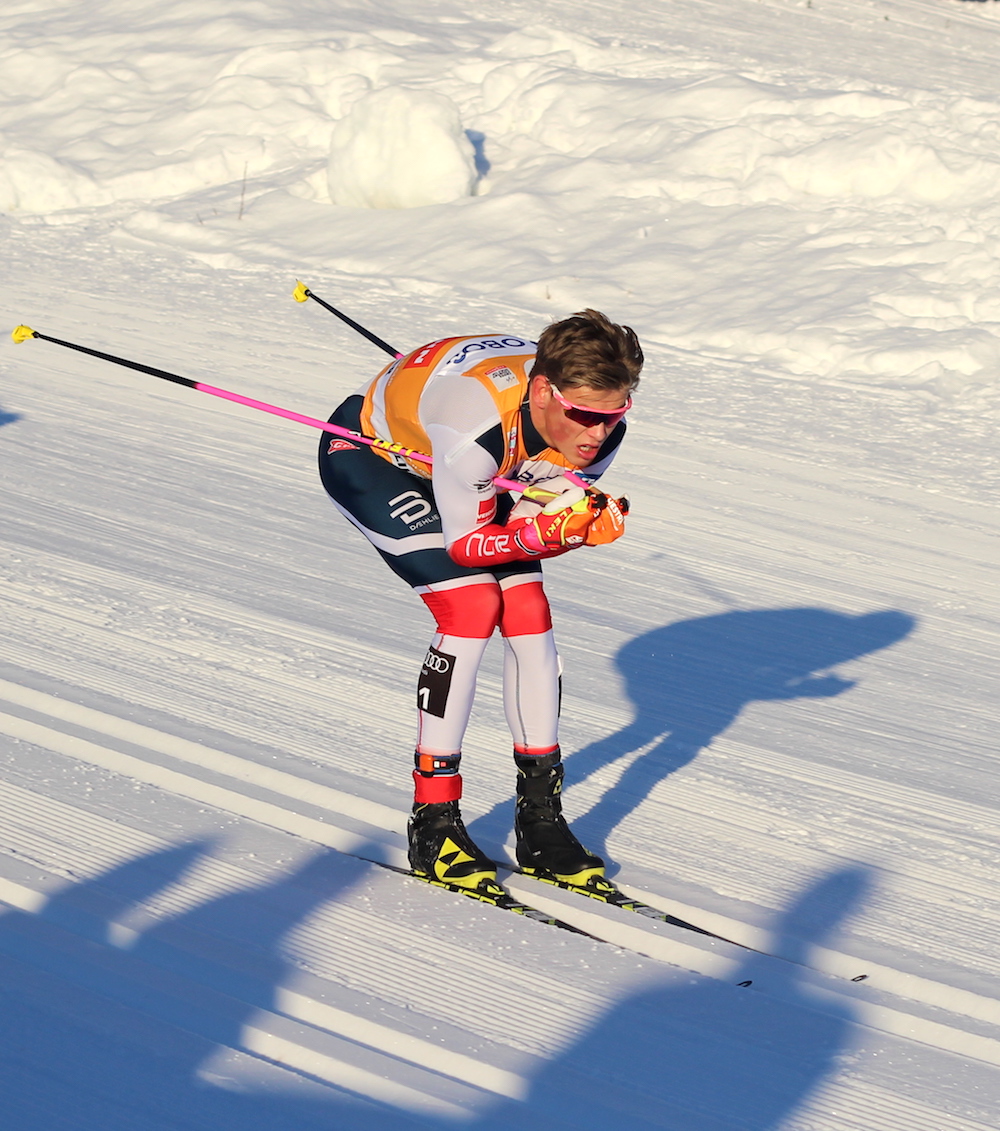
Norway’s Johannes Høsflot Klæbo on his way to winning the 2017 Lillehammer, Norway 30 k skiathlon. (Photo: Henrik Hunnes)
It was a Klæbo win as he claimed his fifth World Cup win this season in as many races. Sprint or distance, no doubt it is Klæbo-time.
The sport’s cliches could be in play. The older, once-dominant lion in Sundby licking his wounds. But these are humans after all. Winning ends for everybody, just not in such a public forum.
Amidst the Klæbo victory, this much was palpable: Sundby’s championship mantle has been usurped. During the concluding seconds of the skiathlon, Sundby saw his racing mortality sprint past with a hair-gelled coif and pink Oakleys.
Klæbo’s winning time was 1:16:47.1 hours.
Sundby placed second, 1.3 seconds back, and Holund third (+6.8). Krueger skied to fourth place (+10.9), Manificat fifth (+11.3), and Harvey sixth (+13.1).
Harvey was the best placed North American, proving once again his deserved reputation as one of the World Cup’s best. After five races, Harvey is ranked fifth in the overall World Cup standings.
“I am really happy — top 10 was the goal, so yeah, it’s really good to fight for the podium until the last three minutes of the race and it’s really good,” Harvey told FasterSkier in Lillehammer. “I felt good. Good skis. I was missing some at the last part of the long climb. The Norwegian guys were the best as expected.”
Harvey’s plan was simple. Tap into a huge training base, keep pace and mark the Norwegians on the skate leg.
“Kind of hide in the classic and then position myself well for the skate, just to be able to cover an attack that was going to come,” Harvey said of his tactics.
In the longest race of the season before February’s PyeongChang Olympics, it was an opportunity for Harvey to test his endurance, but also choose wisely when it came to skis.
“I went for easy kicking skis in classic and that was good,” Harvey said. “I saw Holund especially slipping a lot in the classic. I was just relaxing, and in skate, I wanted a ski that was feeling free on the climbs, because I know on the downhill you have such a big draft, it is not so much about the skis.”
The classic leg offered a more bunched-up group as the primary pacing surges transpired amongst the leaders. That changed quickly after the classic to skate exchange.
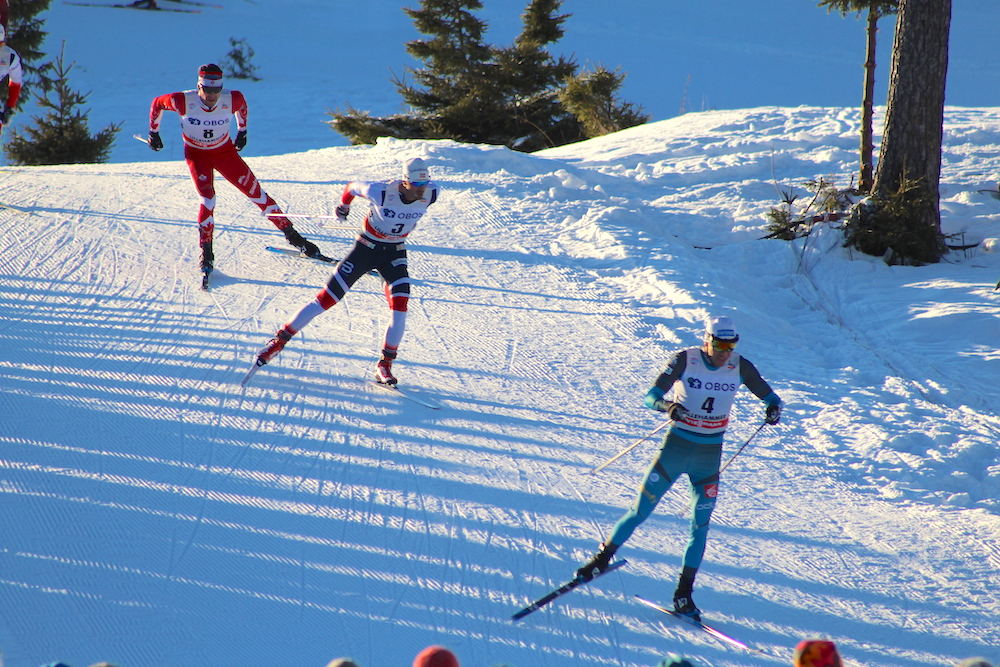
France’s Maurice Manificat (4) making a push at the start of the skate leg during Sunday’s 30 k skiathlon in Lillehammer, Norway, while Canada’s Alex Harvey (l) and Norway’s Hans Christer Holund (c) chase. (Photo: Henrik Hunnes)
“Then the skate, right away on the first lap, Holund and [Sundby] went to the front and they tried to make the first selection,” Harvey said of the first pacing challenge. “I think for the first or second lap of skating it was down to six guys. Then Manificat was pushing super hard on the long uphill. But then we kind of started chilling a bit at the end of the third lap.”
The perceived “chill” pace was simply a momentary lull. Sundby is never one to wait for a sprint finish to decide a distance effort.
“From then we went hard again on the last lap,” Harvey said of the turn of pace on the fourth and final skate lap. “Just steady pace from the stadium just fighting for position. We knew it would happen on the big back hill. So it was just about the best position. I entered there in second place behind Klæbo. So really that is hard to be better than that for starting the last hill. And then it was just man on man.”
We know how this race ended. But Harvey’s summation of the final chapters of this skiathlon was keen.
“Sundby was the strongest, but Klæbo was the most clever,” Harvey said of his old and new rivals.
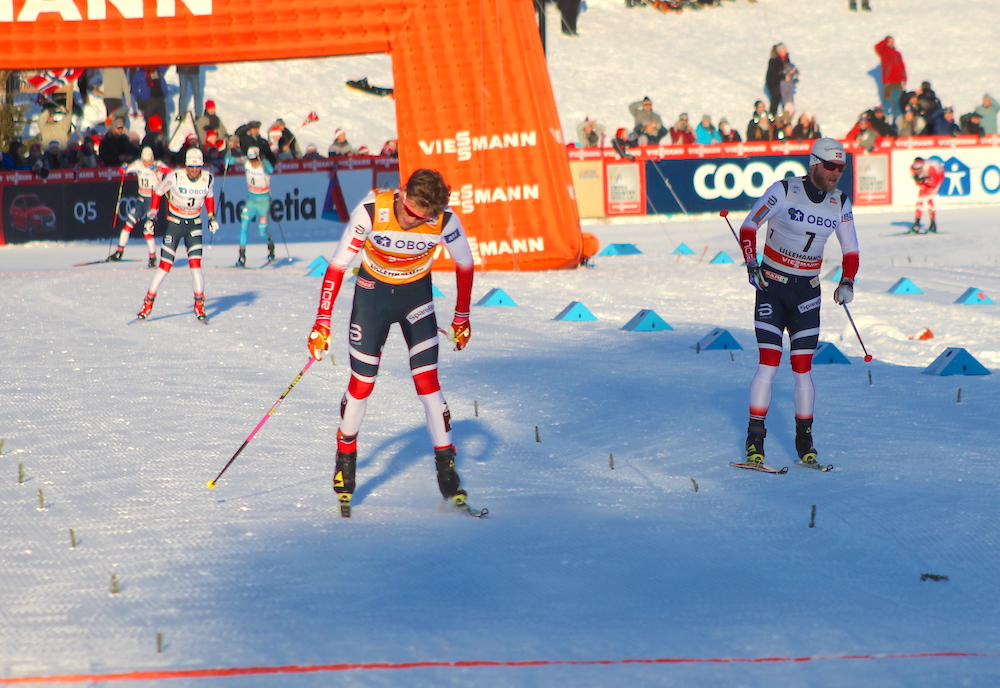
A gassed Johannes Høsflot Klæbo (yellow bib) holding off fellow Norwegian Martin Johnsrud Sundby (r) for the win on Sunday in the men’s 30 k skiathlon at the Lillehammer World Cup in Norway, while Norway’s third man, Hans Christer Holund (3) races to third. (Photo: Henrik Hunnes)
Harvey also reflected that, in terms of results and physical sensations, he is exactly where he’d like to be. Sustainable high output efforts are doable; it’s the 1 percent of the top high speed gear he’s waiting to access.
“Just the punch — I cannot dig super deep yet,” Harvey said. “It’s like that for me before Christmas. It is not unexpected. I think the base is better than in the past, so I can rely on that. So when it is time to really go, I am not there yet, but that is the training, the training is meant for that, too.”
Canada’s Devon Kershaw finished 19th (+2:59.7), just ahead of the U.S. Ski Team’s (USST) Erik Bjornsen in 20th (+2:59.9)y. Although finishing a place apart, their race tales only merged after the transition to the skate leg.
Kershaw must have felt good on the initial classic leg. Six kilometers into his kick-and-stride effort on what was described a quintessentially beautiful hard wax day, Kershaw was positioned 15th in large scrum of skiers, only 4.5 seconds off the lead. The Canadian World Cup vet then played more cat than mouse.
He skied well towards the front by 11 k moving into fifth. At 11.1 k he bolted ahead and won the bonus points. From that point on, Kershaw faded a bit and came through the technique-exchange zone in 18th and 36.2 seconds out of first; his first 15 k were done in a total of 39:58.5 minutes.
Bjornsen’s race took on a different tone early on. He skied conservatively in a technique in which he’s known to thrive. Bjornsen’s classic leg took him 40:28, and he came through the exchange in 23rd, 1:05.7 behind the leaders.
Bjornsen proved on Sunday his race tactics have matured as he’s rounded into a constant World Cup points threat this young season.
“The skiathlon here two years ago, I was feeling great and I charged into the top 10 on the classic and just paid for it on the skate leg,” Bjornsen told FasterSkier in Lillehammer after the race. “So today I tried to be a little smarter.”
Two years ago at the Lillehammer skiathlon, Bjornsen’s early efforts cost him places. He faded from what looked liked a top-20 effort to a sufferfest in the skate portion. After the skate leg, Bjornsen placed 42nd overall, over five minutes back from Sundby, that day’s winner.
Bjornsen’s strategy paid off on Sunday. In a post-race phone call, he explained that at one point on the classic leg, he had the leaders in sight.
“There were times in the second and third lap where the leaders were right there,” Bjornsen said. “But I think it would have been costly to close the 50-meter gap they had. … I think it’s just growing up in the U.S., I didn’t race a lot of 30 k’s. I have had more chances in the last few years over here to see what that race feels like. The 30 k, you can’t make those short sprints to gap up or you pay for it in the end.”
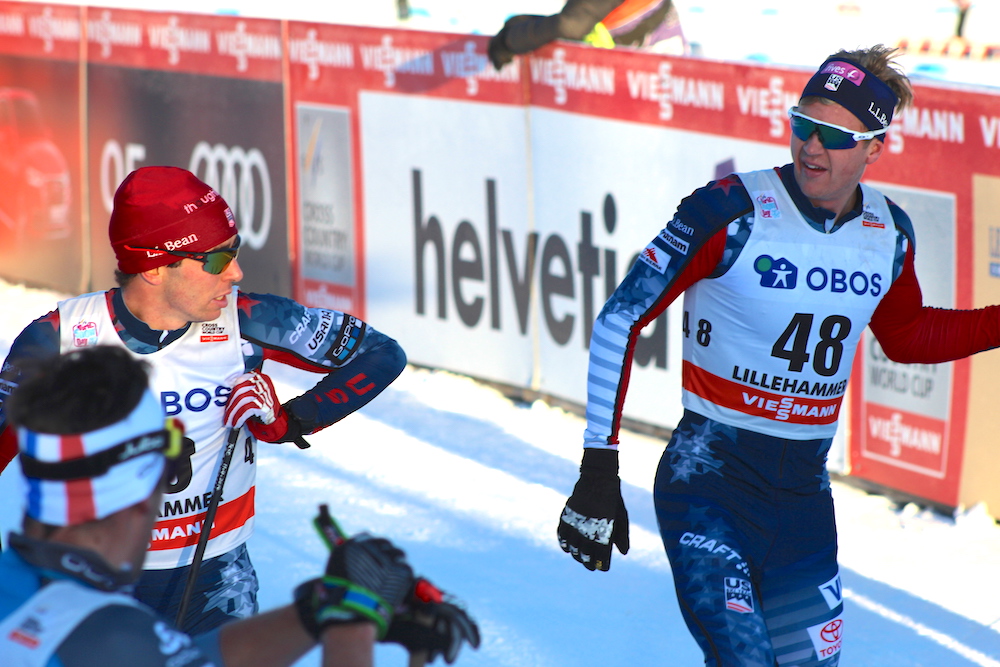
Erik Bjornsen (48) of the USST placed 20th and Noah Hoffman (49, red hat) placed 28th on Sunday’s World Cup 30 k skiathlon in Lillehammer, Norway. (Photo: Henrik Hunnes)
Although his relative position after the exchange did not change considerably, Bjornsen did draw skiers back towards him with his skate effort.
“I think I gained about five spots on the skate leg,” Bjornsen said. “Most of those guys were moving backward. I don’t think we were making any moves towards those front guys, but I was with a good group [including Kershaw]. I could see a pack of ten guys behind us, so my group was motivated to keep charging as well. It was a good plan for me.”
Bjornsen’s 20th place was a career best in a World Cup skiathlon: he placed 27th in the 2016 World Cup skiathlon in Lahti, Finland. Sunday’s result is also Bjornsen’s best in a World Cup race longer than 15 k.
Bjornsen’s former USST teammate, Noah Hoffman was in the points for the first time this season. Hoffman placed 28th after starting in bib 49. Like Bjornsen, he moved up in the standings as the race progressed.
Hoffman finished the classic portion of the race in 41:17.7 minutes and was ranked in 40th place. Kilometer by kilometer, he picked off places. He was 34th at the 19.55 k mark, and in the closing moments had locked into 28th, finishing 3:37.8 behind Klæbo.
Finishing 46.4 seconds outside of the points on Sunday was Scott Patterson of the USST in 36th (+4:56.1).
“Prior to the race, I was quite looking forward to this event,” Patterson emailed. “However, the Norwegian courses and the extra competition of the Norwegian nations group are never things to take too lightly.”
The newly minted USST member has skied against the Norwegian juggernaut before. In last season’s Holmenkollen 50 k classic in March, Patterson placed 28th for the best American result that day. Yet this is Patterson’s first full season on the World Cup and his first time racing World Cups before late January. (Patterson’s first World Cup race was two seasons ago.)
Undaunted, Patterson did keep a top-30 spot as his goal. He began the day in bib 39.
“My approach was to try and move up from my starting position through the classic but also really focus on conserving energy,” Patterson wrote. “I know my skating is a bit more on form currently. From the start things were not going my way. Early on I decided to defend my place in track rather than running up the side. This put me in almost last 500m into the race. For the first two laps I gradually made up some ground but was struggling to ski fast and relax the whole time. I found a little more form for the 3rd and 4th lap, but by that time I had lost a lot of ground.
“The skate leg was better, but I took things a little conservative early,” he continued. “While I was moving up, I was not able to close the gaps to get a good group to work with. Thus most of the skate was trying to catch a few small groups and move through them. Most of the time I felt that I was working on my own. I think I salvaged an ok race from a pretty rough start, but again this one is leaving me wanting more. While I was close again, I still am running with 0 world cup points.”
“It was really cool to start 19th today,” Caldwell reflected in an email. “I didn’t put the early bib to great use but it was a good learning experience and great practice skiing in a big, aggressive pack.”
As the USST’s youngest male World Cup skier gains valuable starts on what is projected as a long World Cup career, Caldwell, 23, did have a moment to reflect in the learning takeaways from the day.
“Mass start races are always fun and a good chance to learn from other skiers,” Caldwell wrote. “I was really impressed with how relaxed the top guys skied on the big climbs. Everyone is hammering but the best guys are so on it technically, really cool to see.”
Canada had three finishers outside the points: Russell Kennedy in 53rd (+7:30.7), Graeme Killick 54th (+6:41.3), and Knute Johnsgaard 60th (+9:49.0).
Racing continues next Saturday in Davos, Switzerland, with a freestyle sprint and a 10/15 k interval start skate race on Sunday.