Sadie Bjornsen can remember watching World Cup race footage as a kid, skiers zipping across the T.V. screen moving at speeds that seemed to her at the time, superhuman. In a recent blog post she recalled her view of them as “not even real… they were just figures in a movie.”
Now, with two World Cup sprint podiums on back-to-back weekends, her most recent being third place in Saturday’s 1.3-kilometer classic sprint in Lillehammer, Norway, Bjornsen is stepping into the reality of her childhood dream, and she’d like to debunk the myth that World Cup podium contenders possess some kind of otherworldly abilities. As she put it, they are more like “your friendly neighbor across the street working darn hard towards something”.
If Bjornsen is now finding herself on par with the World Cup racers she was once in awe of, it’s no magic trick. It’s what she’s described as “belief in myself.”
“I think sprint racing is a mental thing, absolutely, and last winter I really struggled with it,” Bjornsen said during a post-race, in-person interview on Saturday. “I feel like now I have more confidence to go out and lead the race, whereas before, I would have never done that because I was not confident in my skills. That’s been a mental hurdle that I’ve gotten over this winter, and hopefully it continues.”
Last year in Lillehammer, Bjornsen was the fastest qualifier but did not advance past the quarterfinals. This year in Lillehammer she once again won the qualifier, completing the course in a time of 3:22.45, but didn’t stop there. She placed second in her quarterfinal behind Norway’s Heidi Weng, and advanced to the second semifinal, which she won in a time of 3:23.33, crossing 0.46 seconds ahead of Sweden’s Stina Nilsson.
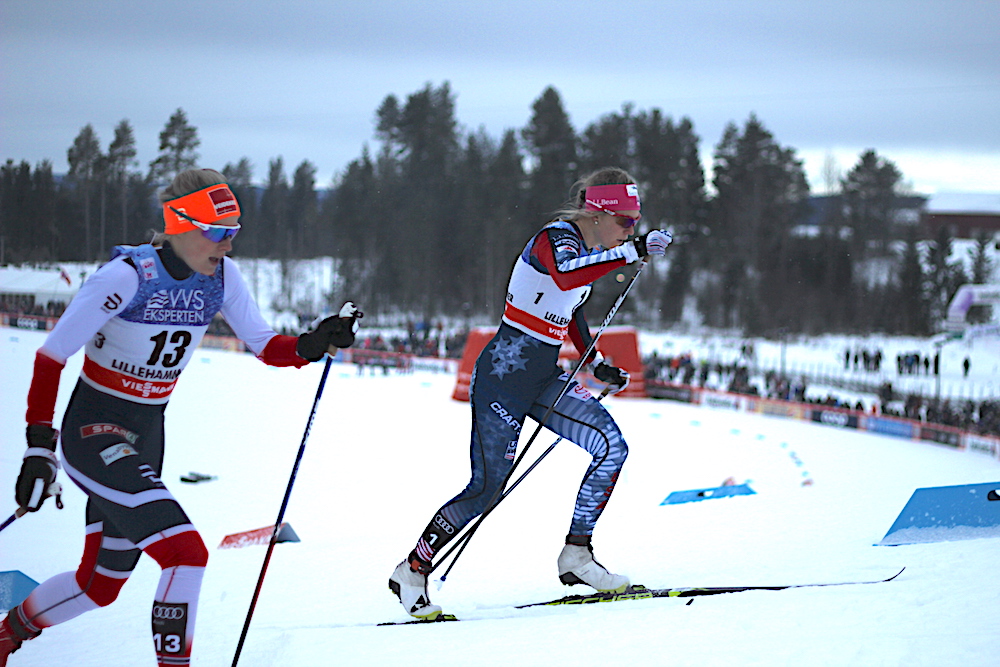
Heading into the final, Bjornsen faced Nilsson (whom she placed second behind in last weekend’s opening sprint), Norwegians Maiken Caspersen Falla and Ingvild Flugstad Østberg, Finland’s Krista Pärmäkoski, and her U.S. Ski Team (USST) teammate Jessie Diggins.
The Americans bookended the rest of the women’s finalists off the start, with Nilsson, Pärmäkoski and Falla taking hold of the lead by the first climb. Diggins strode to the right of the pack in fourth, while Bjornsen tucked in the inside left of the group in fifth.
As the six crested the top of the first hill, Nilsson continued to put pressure from the front, attempting to distance herself from Pärmäkoski and Falla with three powerful double poles. Bjornsen held her position in fourth, while Diggins had slipped a position, trailing Østberg in sixth.
As the finalists descended back toward the stadium, Pärmäkoski maneuvered her way to the front, and Nilsson and Falla clung to her. Bjornsen’s fast skis gained her ground, forcing her into a slight snowplow to prevent bumping into Falla by the bottom of the descent.
Pushed tightly to the inside on the next corner by Falla, Bjornsen lost a few centimeters on the three leaders and a small gap separated her from the top three heading into the second major climb. In milliseconds, the Americans were reunited, Diggins and Bjornsen striding side by side with Østberg at the hill’s halfway point. In the same moment, Falla powered to the left of Pärmäkoski, commanding the pace at the front.
Striding with unmatchable speed, Falla put close to a meter between her and the Finn by the top of the last climb, while Bjornsen and Nilsson jostled for position.
“Stina cut straight in front of me and I kind of lost my momentum,” Bjornsen said. “It was really, really hard to get going again; over the top of the final climb, my legs were for sure buckling.”
Diggins who had been racing to the outside, cut in, which put her in sixth.
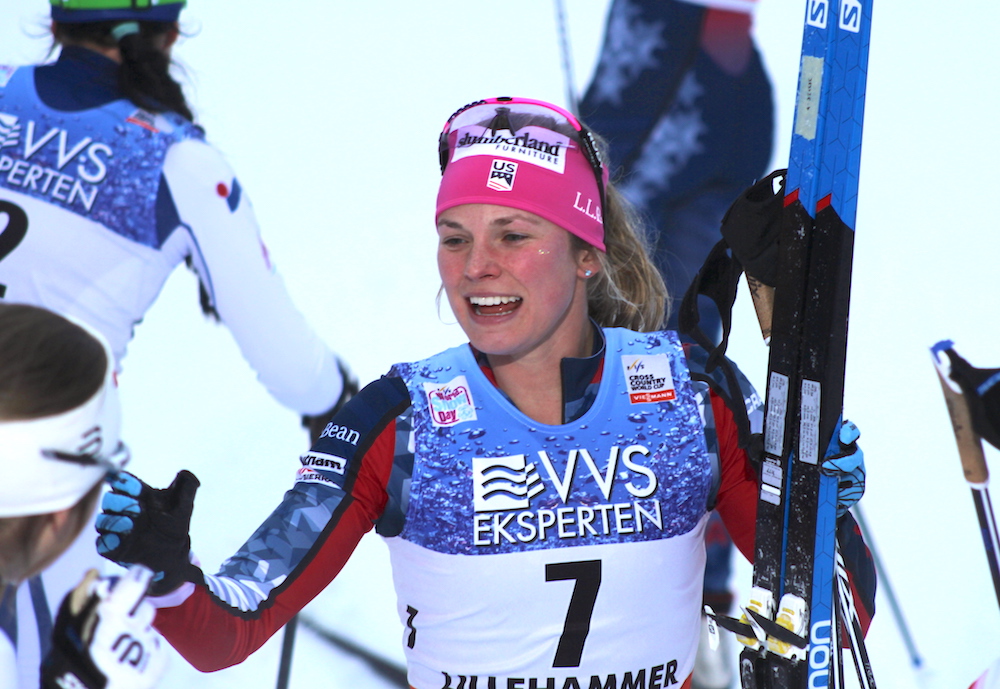
“I’m not in my very top shape right now, which is the plan … so in the final I got a little bit tired and my technique kind of came off the rails a little bit, but it felt good to try to stay close and be … in it with those girls,” Diggins said during an in-person interview after with FasterSkier.
In the final descent, it was Falla alone in the lead, Pärmäkoski poling with all her might to make up the two seconds that separated her from the win. Behind them, Bjornsen was sandwiched between Nilsson and Østberg in a race for third.
In the end, Falla, the defending Sprint World Cup champion, crossed first in a time of 3:19.98 for her first win of the 2017/2018 season. In last weekend’s classic sprint in Kuusamo, Finland, Falla missed qualifying by 0.32 seconds and ended the day in 31st.
“I was really sad after the race last week. Our skis weren’t that good as we hoped, but that happens in an outdoor sport,” Falla said, according to an International Ski Federation (FIS) press release.
Living just 20 minutes away from the Lillehammer venue, Falla indicated she had plenty of practice on the sprint course, shown in the final meters of Saturday’s race.
“I have been doing a lot of training exactly on that hill, many very hard trainings since the last season for the last minute on that climb, so today I really got to use it so I am really happy now,” Falla said.
Pärmäkoski crossed 2.07 seconds behind Falla for second place.
“Before Ruka I had a flu, since then I have been feeling better and better,” Pärmäkoski said, according to FIS. “It was a good day for me. In every heat I was feeling better.”
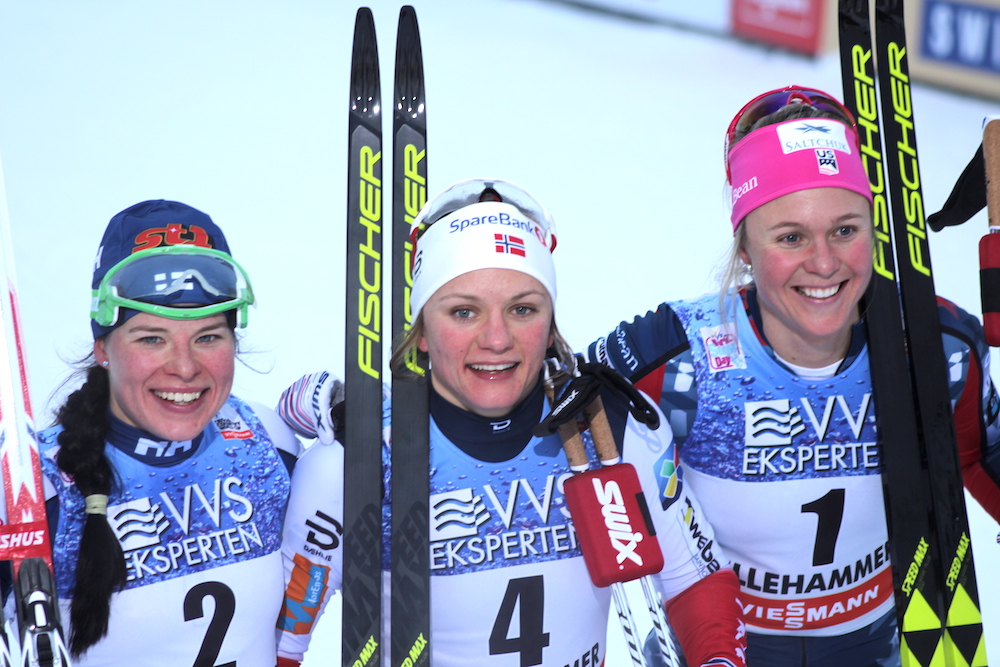
Bjornsen edged Nilsson by 0.27 seconds for the third spot on the podium, 5.01 seconds behind Falla. Last weekend, Nilsson outlunged Bjornsen by 0.24 seconds for the Ruka sprint win.
“I took the slingshot from Nilsson, and then just double poled my heart out to the finish,” Bjornsen said. “I did a lot of work this summer with double pole and … it seems to be paying off.
“It definitely feels maybe even more special than last weekend,” Bjornsen continued. “There were not as many Norwegians in the heats last weekend because they had some problems with their skis, so, to be on the podium here in Lillehammer, where it’s the home course for them, and everybody was strong, it was super special.”
Completing the women’s final was Nilsson in fourth (+5.28), Østberg in fifth (+6.09) and Diggins in sixth (+7.81).
“I’ve been working so hard for so long to try to feel like a classic skier, so to get into the final in a classic sprint, arguably my worst event, is really confidence boosting,” Diggins said.
Last weekend in Kuusamo, Diggins did not advance to the heats.
“Two years ago we were wondering if Jessie would qualify in classic sprints and now she can go one weekend from not qualifying to the next weekend to being in the final,” USST Women’s Coach Matt Whitcomb said during a post-race phone interview. “It’s clearly there for her. Yeah, she skates more easily than she strides, but it has come such a long way.”
On Saturday in Lillehammer, Diggins qualified seventh, 2.37 seconds off Bjornsen’s time. In the first quarterfinal, she raced Falla, Østberg, Finland’s Aino-Kaisa Saarinen, Norway’s Mari Eide, and Italy’s Greta Laurent.
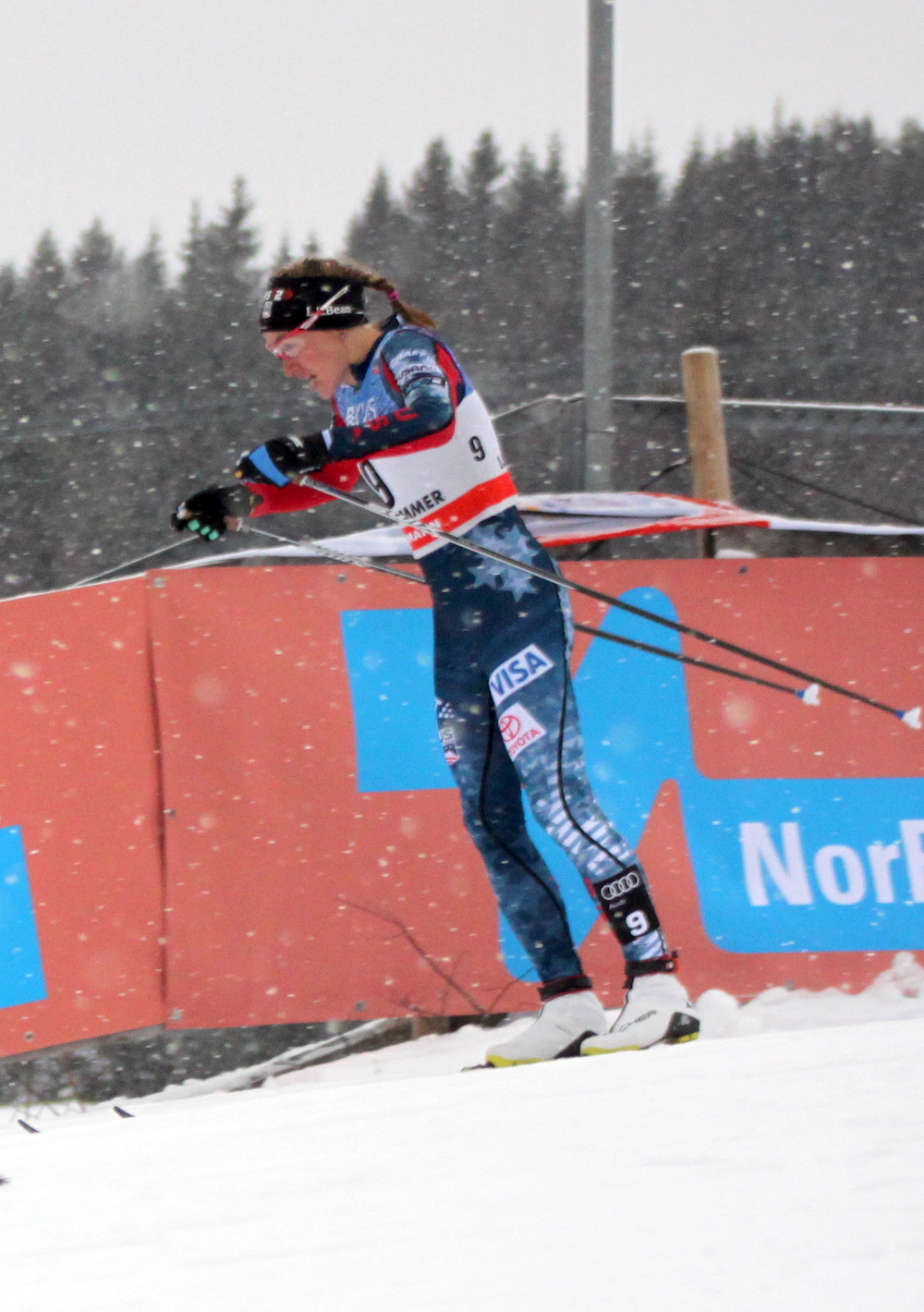
After finishing second in her heat behind Falla, Diggins advanced to the first semifinal with Falla, Østberg, Pärmäkoski, Russia’s Natalia Neprayeva, and another USST teammate Sophie Caldwell. In a three-way lunge, Østberg, Diggins and Caldwell fought for two lucky loser spots, which ultimately went to Østberg and Diggins.
Caldwell missed advancing by 0.06 seconds and ended the day in ninth overall.
“There were a couple things I wish I could have done differently in my semi, but it’s all a learning experience and even though I’d like to be in the final soon in a sprint, I think this is the best I’ve ever started a season. So I’m definitely happy with it,” Caldwell said after on the phone.
Explaining that she felt strong in her qualifier and quarterfinal, Caldwell indicated that if she were to change anything, it would be in her semifinal.
“I felt like I put myself in a really good position going up the first hill and then sort of over the top I let Krista hop in between me and Maiken, which sort of bounced me to the outside,” Caldwell reflected. “I just wish I’d been a little more aggressive and held my own and not allowed Krista to sneak in, but it’s just very little things that looking back you would have done differently.”
With Caldwell out, Diggins and Bjornsen advanced to the final, doubling the number of American finalists since last weekend’s classic sprint.
“It’s especially enjoyable when you have a day like this in Scandinavia where the Nation’s Group [in this case, Norwegian] quota is so strong,” Whitcomb said. “To put somebody on the podium and somebody else sixth and ninth, we’re really proud of that.”
Rounding out the top 10 was Poland’s Justyna Kowalczyk in seventh, Norway’s Heidi Weng in eighth, followed by Caldwell in ninth and Norway’s Thea Krokan Murud in tenth.
Rosie Brennan of the USST, who turned 29 on Saturday, missed qualifying for rounds by 0.26 seconds, finishing in 33rd (+6.84).
“She was skiing with a little birthday power out there today. I really like how Rosie is looking in these races, regardless of whether or not she gets in,” Whitcomb said. “I think it bodes really well for tomorrow and I think she’s in awesome shape.”
The second day of World Cup racing in Lillehammer takes place Sunday with the women’s 15 k skiathlon and men’s 30 k skiathlon.
Also racing for the USST on Saturday, Kikkan Randall finished 42nd (+9.70) and Ida Sargent was 44th (+10.09). The next North American finishers were Emily Nishikawa (Canadian World Cup Team) in 58th (+16.21), Dahria Beatty (Canadian World Cup Team) in 59th (+16.25), and Cendrine Browne (Canadian U25 Team) in 63rd (+23.11). American Chelsea Holmes (Alaska Pacific University) finished 64th (+24.84) and Katherine Stewart-Jones (Canadian U25 Team) was 65th (+30.85).