Tag: 2017 Ruka Triple

  • Klæbo Holds Off Sundby, Bolshunov and Harvey for Ruka Triple Sweep

    Klæbo Holds Off Sundby, Bolshunov and Harvey for Ruka Triple Sweep

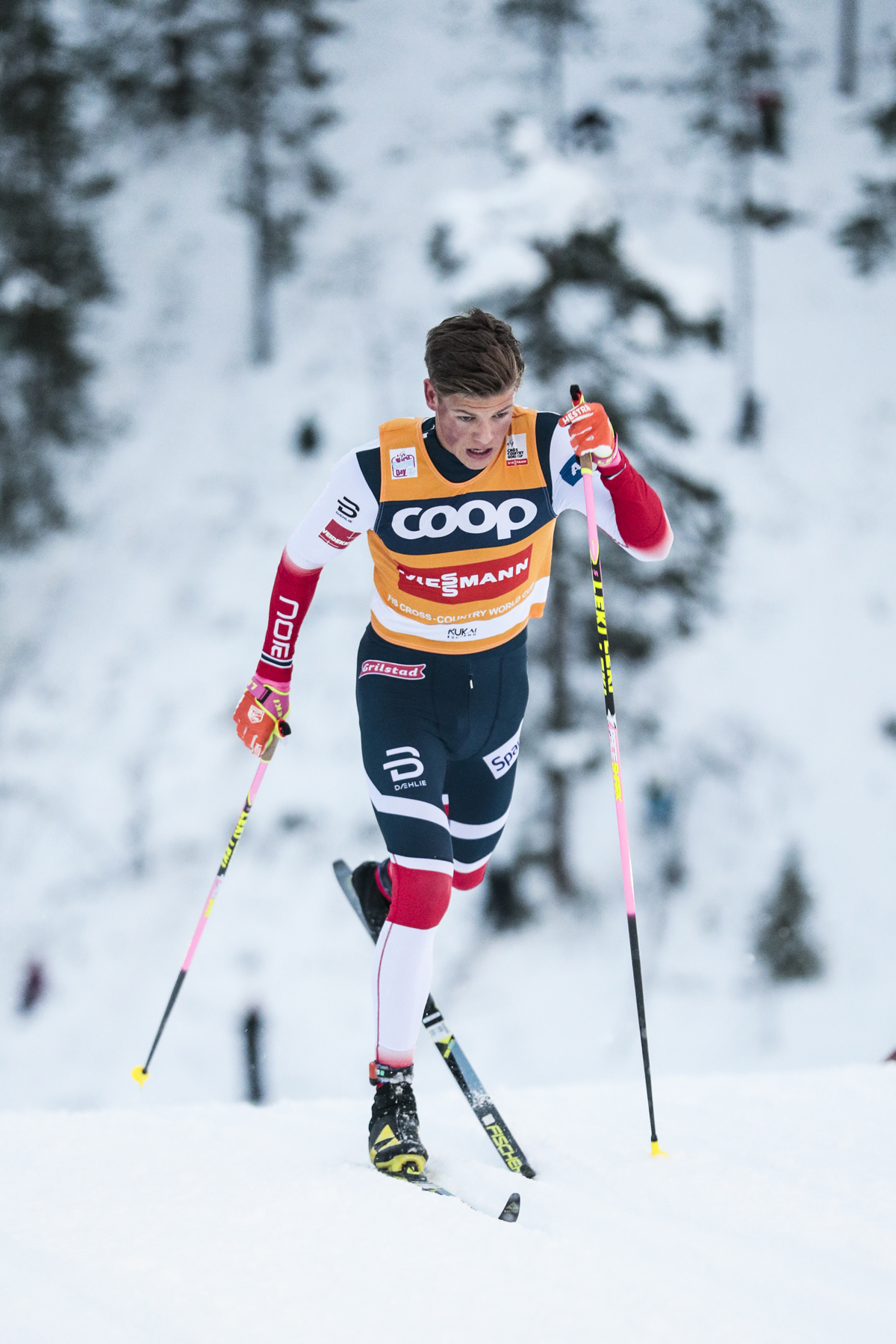
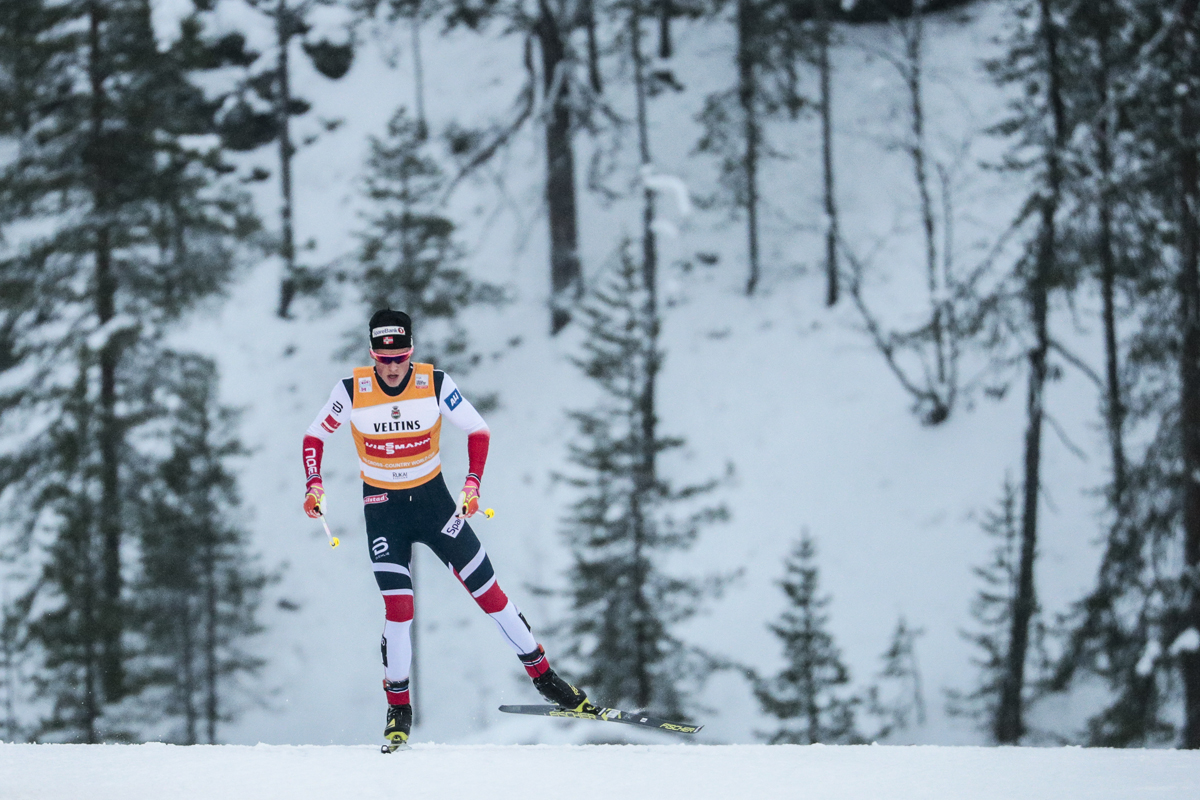
    Norway’s Johannes Høsflot Klæbo en route to his third-straight win in as many days of the World-Cup-opening Ruka Triple in Kuusamo, Finland. He won the 15 k freestyle pursuit for the mini-tour title. (Photo: Fischer/Nordic Focus)

    Two previous days of racing, and back-to-back victories no less, had begun to take its toll on Johannes Høsflot Klæbo within the first few laps of the men’s 15-kilometer freestyle pursuit on Sunday in Kuusamo, Finland. The 21-year-old Norwegian could feel it throughout his body; he was tired and 38 seconds of a starting cushion wasn’t going to be enough to hold off the hungry challengers behind him.

    Klæbo, who won Friday’s classic sprint and Saturday’s 15 k classic individual start on the World Cup opening weekend, wasn’t invincible and he couldn’t race to another win alone. Halfway through the pursuit, the man who started in second place, 38 seconds after him, Russia’s Alexander Bolshunov (who’s actually younger than Klæbo at age 20), had cut that deficit to 19.8 seconds. After him, Norway’s Martin Johnsrud Sundby, who started 10th and 1:05 minutes behind Klæbo, was up to third and just 25.3 seconds back.
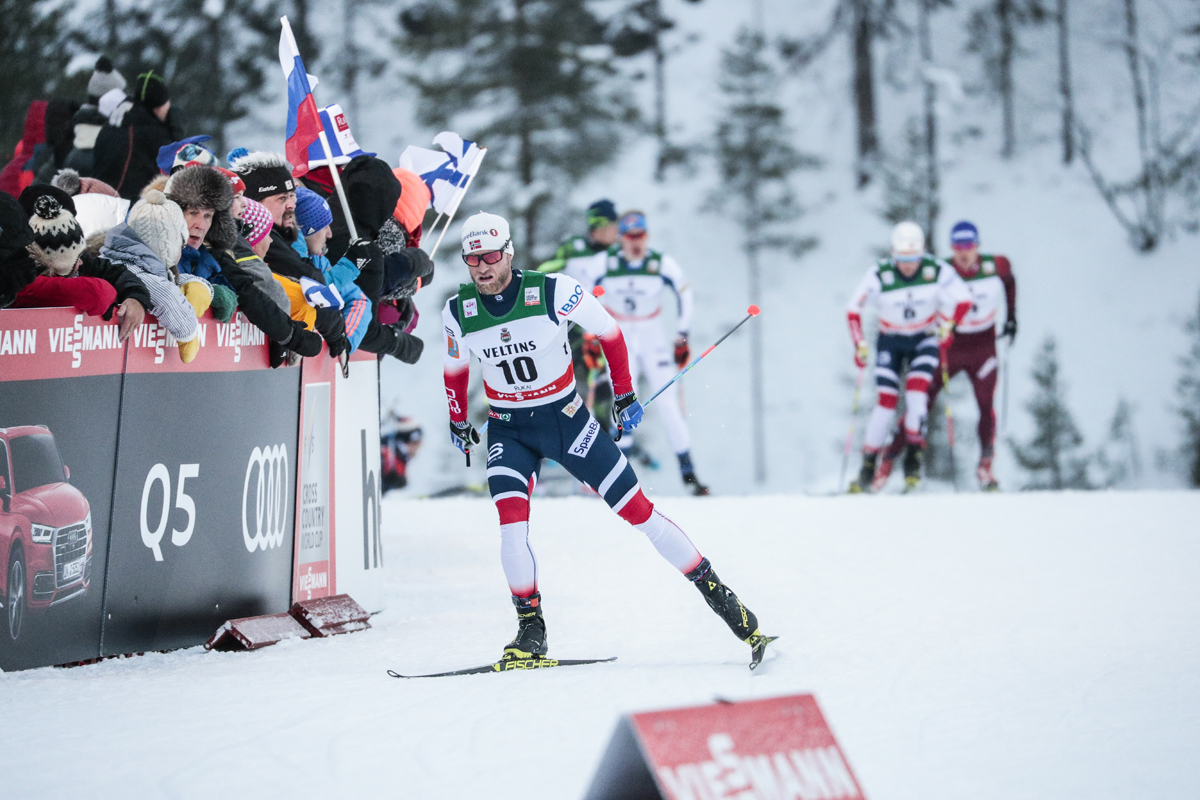
    Norway’s Martin Johnsrud Sundby, who started 10th in the 15 k freestyle pursuit on Sunday, picking off the places on the final day of the Ruka Triple World Cup mini tour in Kuusamo, Finland. (Photo: Fischer/Nordic Focus)

    On his fourth lap, Klæbo accepted the inevitable as Bolshunov and Sundby, who had linked up in an effort to catch him, in fact caught him on a climb around 8.6 k. A larger group of pursuers, including Canada’s Alex Harvey, locked on to the three leaders as well, and from there, the race truly began to take form. Klæbo had to recover, Sundby had to figure out how to try to drop him, Bolshunov had to see what he was capable of, and Harvey had to see how much he could give in the third race of the season.

    The first races of each winter aren’t easy for anyone. Despite spending the summer training for skiing, most North American World Cup skiers don’t get the opportunity to actually race — even on rollerskis — too often during the offseason. Because of the rich ski culture in Europe, rollerski races are a big deal with lots of summer and fall competitions to chose from. And because of Europe’s geography, it’s often easier to get on snow than it is for North Americans.

    (“I think this applies to all the North American actually, compared to Europeans we don’t race as much in summer,” Canadian World Cup coach Ivan Babikov said on the phone on Sunday. “They have races every weekend so they come into the season pretty sharp already with some good speed workouts, when we don’t have that opportunity. So that’s why, I think, every race is a step forward. It’s just, you have to remember or remind yourself how hard it is.”)

    So while Canadians and American World Cup skiers alike often look at an opening weekend like Finland’s Ruka Triple mini tour as a “chance to blow the cobwebs out” or “shake off the rust”, as some have said, it’s also an opportunity to see where you stand — as was the case for Harvey in the final meters of Sunday’s pursuit.

    Later in the fourth of six laps, Klæbo pushed the tempo up a climb, Bolshunov responded, and Harvey went with them. Soon after at 10 k, they lapped through the stadium with 11 men within 2.7 seconds of first. Up front, Bolshunov led Harvey, who had started the race 1:23 back in 12th.
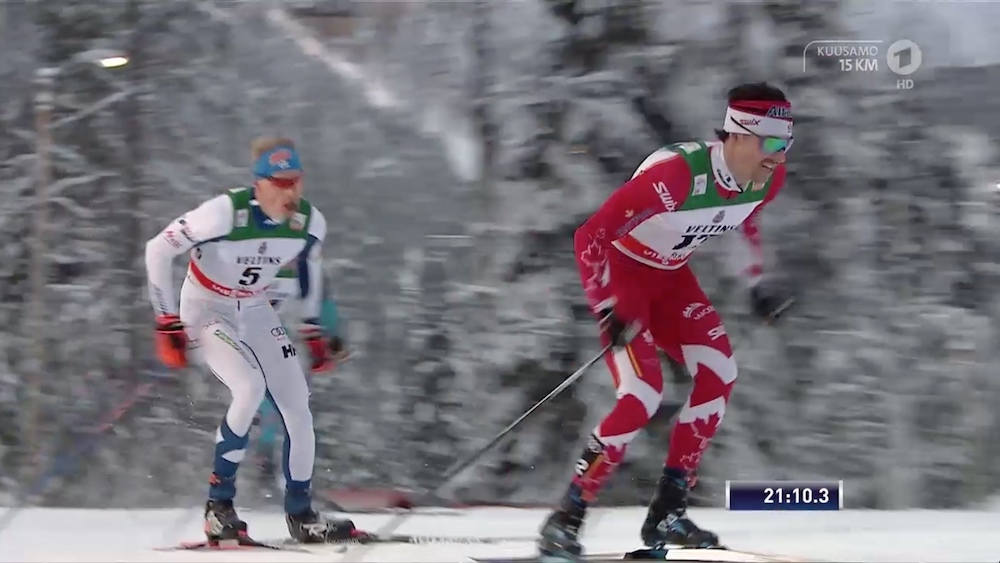
    Canadian World Cup Team member Alex Harvey leads Finland’s Iivo Niskanen during the men’s 15 k freestyle pursuit on Sunday, the final day of the Ruka Triple mini tour in Kuusamo, Finland. (Screenshot: ARD)

    Harvey had spent the first three laps working up to that lead group, initially with the likes of Russia’s Alexey Chervotkin (*who reportedly thanked Harvey after the race) and Sergey Ustiugov, Norway’s Hans Christer Holund and Sweden’s Marcus Hellner, and later with France’s Maurice Manificat, Sweden’s Calle Halfvarsson, Norway’s Emil Iversen, Chervotkin, and Holund, among others.

    “I knew there’d be some fireworks on the last lap so I just wanted to be in the front third of the group, just be ready for a move,” Harvey explained in a post-race phone interview. “I thought Sundby would be the guy making the move, which in the end, that’s what happened. The big uphill in the last lap, that’s where he went. I just wanted to be close to Sundby and ready to respond when Sundby went.”

    Sundby attacked as predicted on the second-to-last climb, around 13.6 k, and Harvey slotted behind him to follow him over the top.

    “I was just actually there on that last uphill when Sundby attacked,” Babikov recalled. “Klæbo was right there. I think there were just Norwegian tactics … Sundby attacked on the last uphill and Klæbo just cooled down and wasn’t chasing him at all, so for Alex, that was his only chance. … If he didn’t chase him, then Sundby probably would have skied away and it would have been a bigger group at the finish, but at the moment he tried, and they actually created a gap … Alex second and Sundby first.”

    With a few meters separating them from Norway’s Didrik Tønseth in third and Klæbo in fourth, Harvey thought he and Sundby had dropped them and that he would fight for first to the finish.

    “I kind of went all-in with the Sundby move,” Harvey said. “When I looked in between my legs just before the last downhill I thought we had a big enough gap … so I was feeling pretty good about my chances there, but not good about taking [Sundby] because I was really, really dead.”
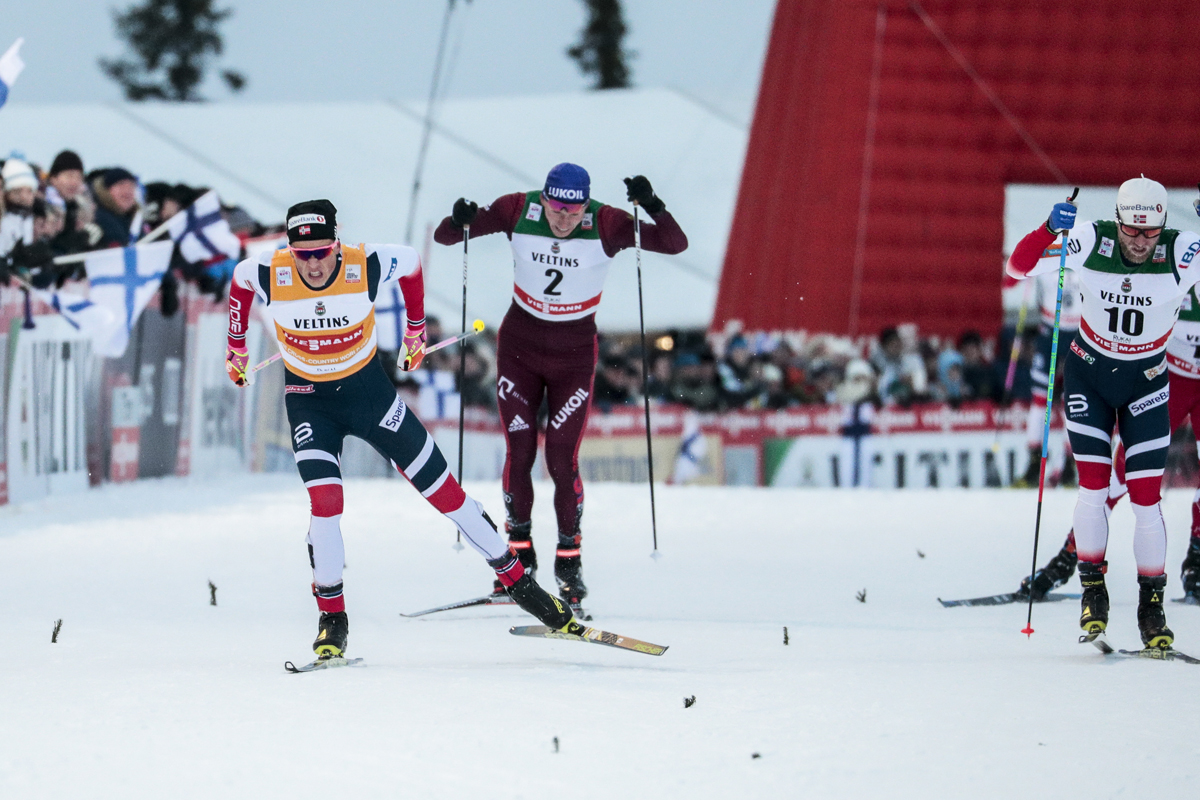
    Johannes Høsflot Klæbo (l) passing fellow Norwegian World Cup Team member Martin Johnsrud Sundby (10) for the win in Sunday’s 15 k freestyle pursuit at the Ruka Triple mini tour in Kuusamo, Finland. Russia’s Alexander Bolshunov (2) was 1 second back in third place for his first World Cup podium while Canada’s Alex Harvey (behind Sundby) placed fourth. (Photo: Fischer/Nordic Focus)

    After what Harvey estimated to be a 45-second downhill, he realized that wasn’t the case. Klæbo and Bolshunov had slingshot back toward the front, and while Sundby was first to the top of the last climb before the finish, Klæbo and Bolshunov were right behind him while Harvey followed in fourth.

    They entered the stadium together in that order, and Klæbo passed Sundby with about 100 meters remaining to take his third-straight win of the weekend.

    “Coming out of my tuck there I was just full of lactate, not feeling any fresher … then I just got passed on the hill,” Harvey recalled. “I had nothing left. That was my move. … I’m happy I made that move, but I couldn’t make a second burst after that.”

    While Klæbo won the pursuit and with it, the Ruka Triple mini-tour title in 36:23.2 minutes, Sundby placed second, 0.4 seconds back, Bolshunov claimed his first World Cup podium in third (+1.0), and Harvey finished another 0.6 seconds back in fourth (+1.6).

    On the day, Harvey’s course time ranked fifth fastest behind Manificat, who was the “winner of the day” in 34:50.9. Finland’s Matti Heikkinen was second fastest (+5.4) after starting 22nd and placing 14th, Holund was third fastest (+7.5) after starting 14th and finishing ninth, and Switzerland’s Dario Cologna, who started 26th and finished 17th, was fourth fastest (+8.7).

    Harvey said starting 17 seconds behind Sundby was a tall task on its own, and he had started the race with a goal of breaking into the top 10 overall. All things considered, fourth place was better than he expected at this point in the season.

    “… But I knew it was still within reach,” Harvey explained. “I believed in it, but I didn’t put too much hope in, let’s say, a top five or fighting for the podium. It was more like I wanted to be back in the top 10 and just that to me seemed already hard enough.”
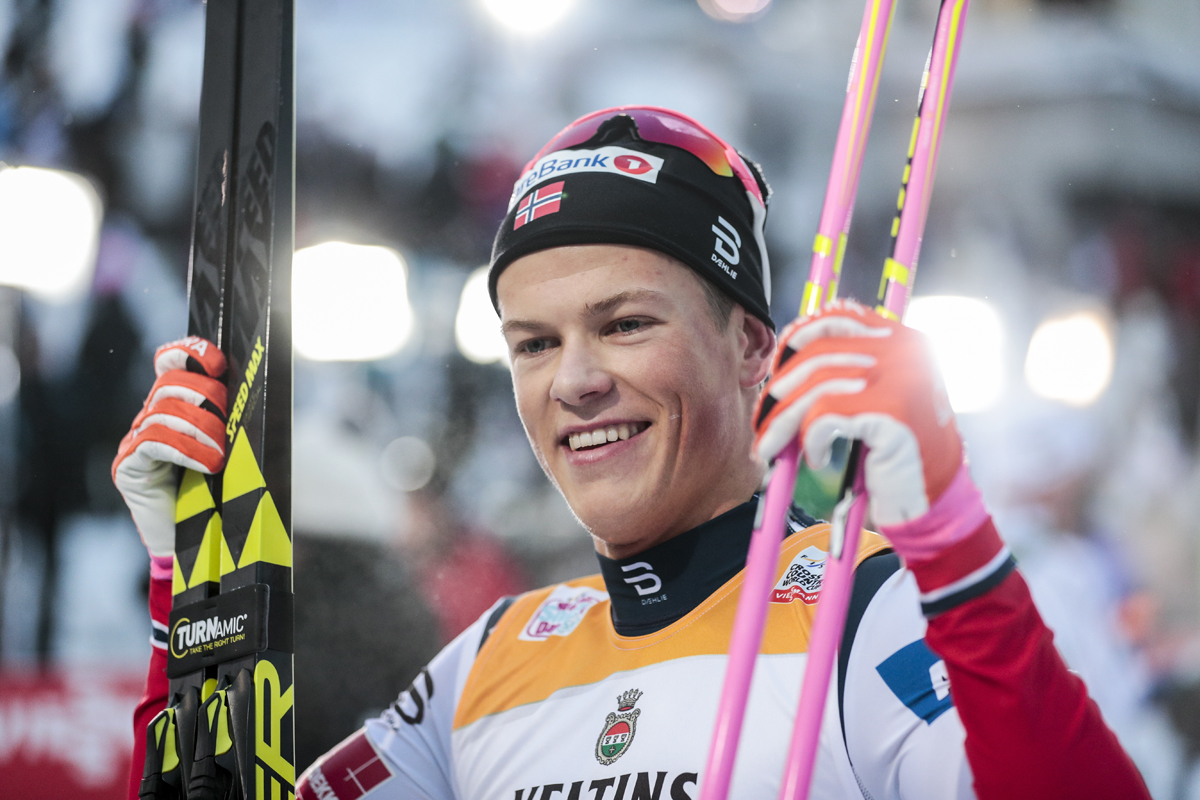
    Norway’s Johannes Høsflot Klæbo after winning the 15 k freestyle pursuit on Sunday to win the Ruka Triple mini tour in Kuusamo, Finland. (Photo: Fischer/Nordic Focus)

    The fact that he was able to hang with Klæbo and Sundby to the finish was a good sign, he added.

    “Right now, he’s not just a good sprinter, he’s the best distance skier in the world, too,” Harvey said of Klæbo. “I mean, to win a 15 k individual you have to be in very, very good physical shape, so he’s in really good physical shape and I know I’m not yet. I’m not in my best form and Sundby probably isn’t yet, so you never know what’s going to happen later in the season at the Olympics, but for now it’s hard to drop him when he’s actually just in better shape than everybody else in the world.”

    After the race, Klæbo told NRK he was relieved to get the win and have some time to rest before next weekend’s World Cup in Lillehammer, Norway.

    “My legs are shaking now,” Klæbo said. “Feels incredible to be the first to cross the finish line. Now I need a few days rest.

    “This was brutal,” he added. “I’m actually glad they caught up to me and luckily I had good skis. I’m glad I had a few seconds today.”

    Norwegian national-team coach Tor-Arne Hetland told NRK he was “really impressed” with Klæbo.  “We have a diamond in the sport of cross country skiing now,” Hetland said.

    “That’s very nice of him to say. It’s probably a little too much, but it has been a good start to the season,” Klæbo responded to NRK.

    Sundby spoke excitedly about having Klæbo to contest for the overall World Cup lead.

    “For the moment, he’s taking international cross-country skiing for men to a whole ’nother level,” Sundby told NRK. “It is a little humiliating for the rest of us, but at the same time it’s extremely inspiring to see what he does in his second year at this level. It’s hell of fun to have a guy like that on the team.”

    Bjornsen 26th, Kershaw 29th; Caldwell Posts Top-20 Time of Day

    Canada had two in the top 30 on Sunday with Devon Kershaw in 29th (+1:47.8), scoring World Cup points for the second-straight day. He started 28th and 1:59 out of first, just one second behind Cologna in 26th and Russia’s Andrey Larkov in 27th.

    “I just wasn’t strong enough to go with Dario,” Kershaw said on the phone. “I had the perfect chance to be able to follow Dario up the field, but he just started so fast, and on the steep terrain, my legs just — I tried up the first steep wall and at the top, I’m like, man, if I keep going like this, after 5 k I’m gonna be dead.
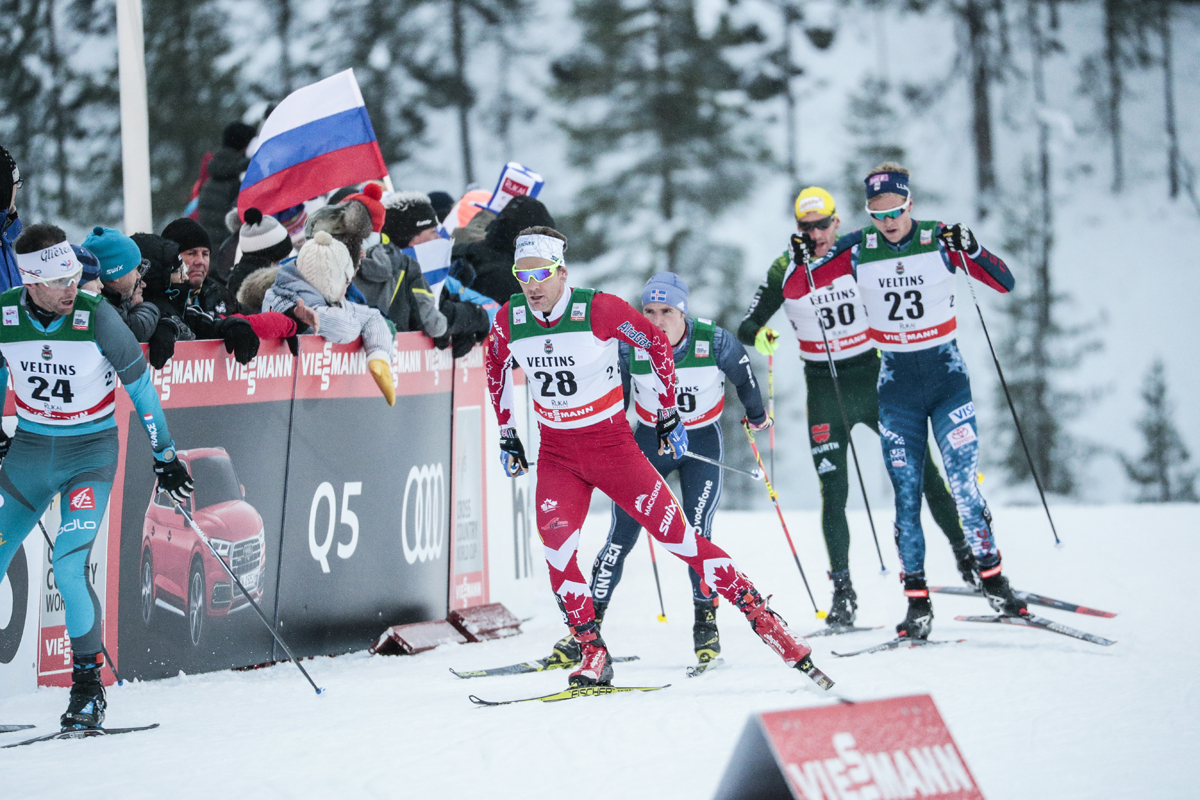
    Canada’s Devon Kershaw (28) leads American Erik Bjornsen (23) and others during the World Cup men’s 15 k freestyle pursuit on Sunday in Kuusamo, Finland. (Photo: Fischer/Nordic Focus)

    “So I had to manage my energy a little bit and in the end, it turned out that Bjornsen and I’s group just wasn’t strong enough,” Kershaw continued, referring to U.S. Ski Team member Erik Bjornsen, whom he started eight seconds behind and spent most of the race with. “[Our group] had a good 7 1/2 k and then after that, between 7 1/2 kilometers and 12 k, we were skiing really slow. So that’s a bit frustrating in a pursuit because you’re just stuck there in no-man’s land.”

    While he felt like he was skiing the flats well, Kershaw said he struggled with the “biting” conditions, which seemed to limit glide, especially on the notoriously steep course’s climbs.

    “I had to make the choice to be like, OK, I’ve got to just stay in this group and I’m not strong enough to drive the bus, because my legs just weren’t there today on the terrain” he said. “In the end I made a tactical error in the last 600 meters. I should’ve followed Bjornsen on the outside and I went on the inside and was hoping it would open up for me and it didn’t. So I ended up 29th, but that’s OK.”

    Bjornsen started 24th and finished the pursuit in 26th (+1:43.6), after following Larkov in 25th (+1:42.8) across the line and holding off Iceland’s Snorri Einarsson (a former Norwegian skier who raced for the University of Utah) in 27th (+1:46.2), Great Britain’s Andrew Musgrave in 28th (+1:47.2), Kershaw in 29th, and France’s Jean-Marc Gaillard in 30th (+1:49.2).

    “I started right around Cologna and [Finland’s Matti] Heikkinen but there was no way I was going to hold their pace, they were flying,” Bjornsen wrote in an email. “I had to settle in with the group around me. It soon became clear our group was not going to catch anyone in front of us or get caught, so it became a tactical game. Some surges, but for the most part nobody wanted to lead.”
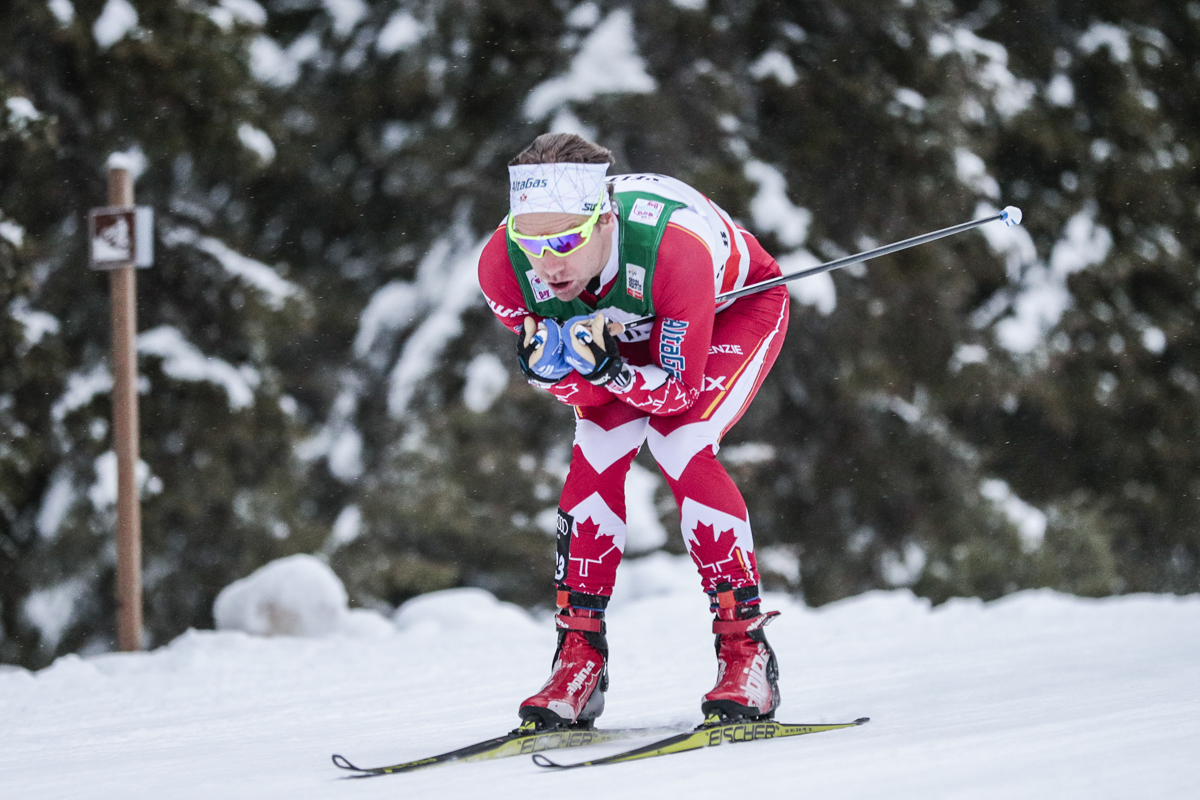
    Devon Kershaw (Canadian World Cup Team) en route to 29th in the 15 k freestyle pursuit on the last day of the Ruka Triple World Cup mini tour in Kuusamo, Finland. (Photo: Fischer/Nordic Focus)

    Kershaw laughed when he talked about some “tips” he gave Bjornsen during the race.

    “He had really fast skis so there were a few times that he came by me on the downhill and then would kind of try to hammer for a minute and then get tired and slow down again,” Kershaw said. “I told him, like, ‘Dude, you’ve got great skis. Unless you can stay in the front and really press, then it’s better just to play the game and wait for the end.’ After that, he did that and he torched us all in the end. So that was kind of fun to see for him.”

    According to Bjornsen, Kershaw suggested he sit back and wait for the sprint.

    “My skis were good but I think my weight is what helped me the most on that last huge downhill,” Bjornsen wrote. “I was fine going for that tactic but at the same time it would have been nice to leave a little more out there today. Stoked to get double points for 26th though!”
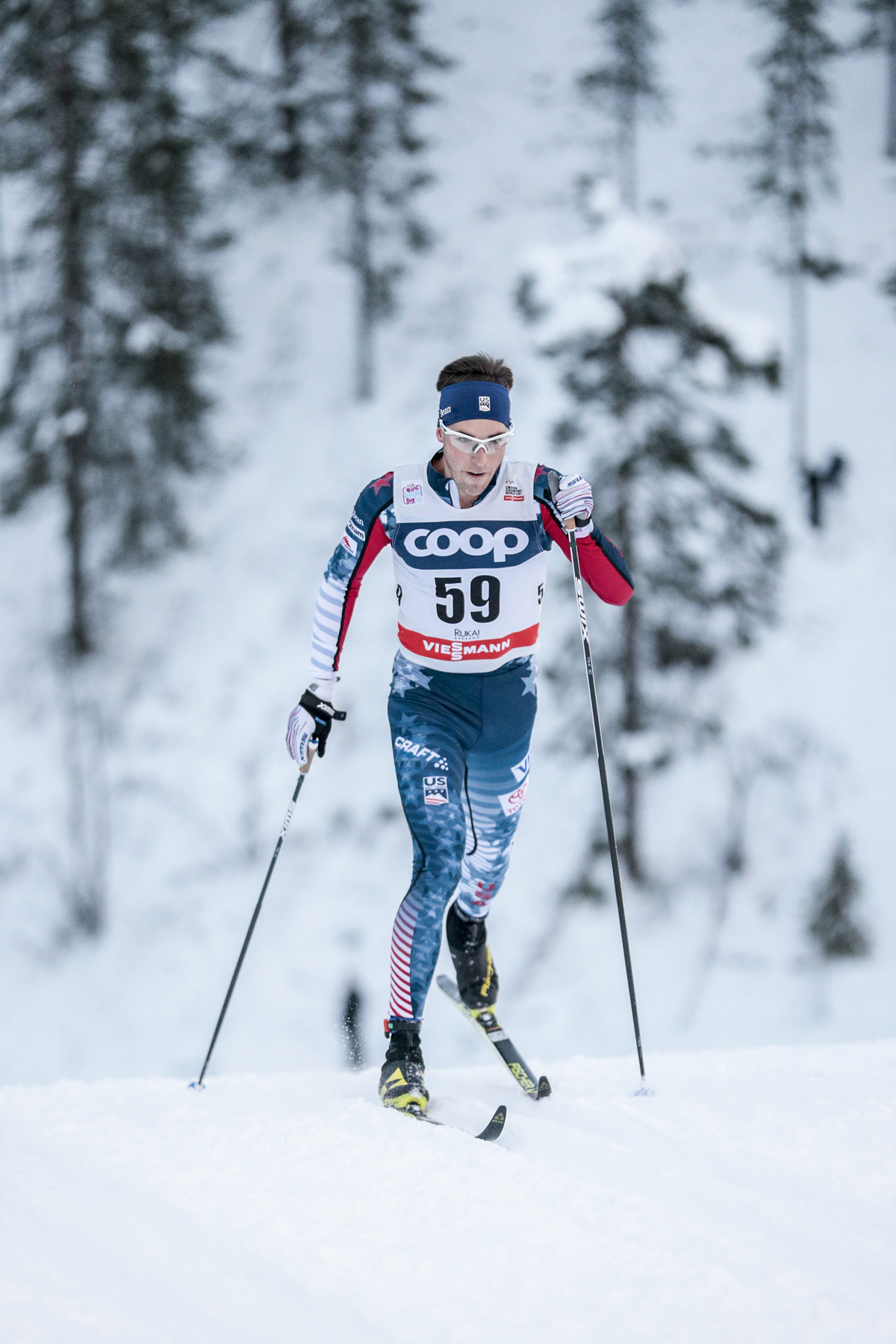
    Paddy Caldwell (U.S. Ski Team) racing to 70th in the men’s 15 k classic on Saturday, Day of the Ruka Triple World Cup mini tour in Kuusamo, Finland. In Sunday’s 15 k freestyle pursuit, he skied up to 51st with the 19th-fastest time of day. (Photo: Fischer/Nordic Focus)

    Paddy Caldwell, new to the U.S. Ski Team B-team this year, posted his best World Cup result with the 19th-fastest time of day, 50.5 seconds back from Manificat. He started with the wave in 70th and finished 51st overall (+3:03.1).

    “Going into the race my goal was to move up as much as possible,” the 23-year-old Caldwell wrote in an email. “I wasn’t really thinking about place or time of day – I was just trying to ski fast and put together a good effort.

    “It was really hard to move up in the pack,” he added. “I started midway back in the wave and we kept picking up more and more skiers as the race went on. I tried to relax as much as possible on the hills and build in energy to pass where I could on the flats. … I am really excited with the day and psyched to have had a good result here in Ruka. I’m looking forward to the rest of period 1 and learning more from the big dogs!”

    “Very exciting race out of Erik today,” U.S. Ski Team coach Matt Whitcomb commented on the phone. “… When he settled to the back of his pack on Lap 6 and headed into the downhill with one climb to go, we just all sort of expressed confidence over the U.S. radio channel, got ready see what he could do.  It is so fun to watch him in a stadium when he has to go head to head against five other athletes … he did not disappoint today. Really proud of Erik’s 26th place.”

    As for Caldwell, who skied the 25th fastest time of day in the 2017 World Cup Finals freestyle pursuit, Whitcomb said, “this is his race, the skate distance.”

    “There were times that he was a little bit road-blocked out there, just the way the pursuit race unfolds in that start … and it looked like today Paddy could keep going, so really great signs out of him,” Whitcomb said.

    Whitcomb also highlighted the races of Scott Patterson, who raced up from 78th to 55th (+3:28.4) with the 31st-fastest time, and Noah Hoffman, who improved from 45th to 39th (+2.33.3) with the 35th-fastest time. Also for the U.S., Andy Newell finished the tour out in 75th (+5:39.6).
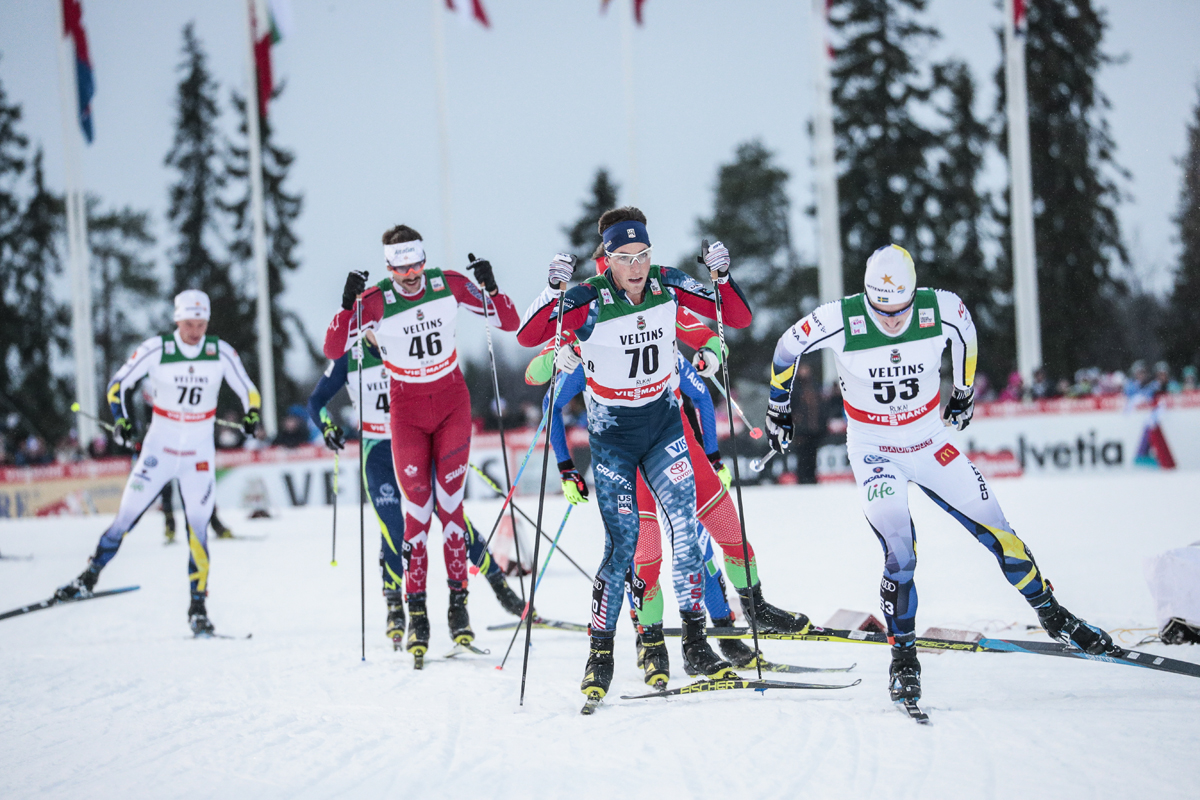
    American Paddy Caldwell (70) racing with Sweden’s Jens Burman (front) and Canada’s Len Valjas (46), among others, during Sunday’s World Cup 15 k freestyle pursuit on the last day of the Ruka Triple in Kuusamo, Finland. (Photo: Fischer/Nordic Focus)

    Canada’s Len Valjas moved up two places for 44th overall (+2:47.5), Graeme Killick finished the tour in 68th (+4:39.5), Knute Johnsgaard 81st (+6:43.6), and Julien Locke 83rd (+7:33.6).

    Babikov pointed out that Valjas had a shoulder injury that he mostly recovered from, but caused him to struggle with double poling in Friday’s sprint. Despite placing 63rd in that sprint, Valjas was the team’s third-best man in the weekend’s distance races.

    “[In] two distance races, he was third best and actually placed higher than he placed in sprint in the distance, 15 k, hardest one with lots of climbing,” Babikov said. “So that shows he has a good shape, but just needs to scrape that rust off and remember how to go fast again. I think physically he is in a good place, just need to do some more races, and it will come.”

    ***

    *Post-race sidenote: According to Harvey, after the race, the Russian team’s massage therapist told Canadian coach Ivan Babikov that Chervotkin wanted to thank Harvey for pulling him in the pursuit. Chervotkin, 22, started 11th and finished fifth, 6.2 seconds out of first and 4.6 seconds after Harvey in fourth.

    “There’s a bit of beef with the Russians and me right now,” Harvey said. “I came in wondering if they were just going to punch me in the face. They said they wanted to break my teeth, so this is a good turn of things.”

    As Harvey understands it, that was because of what he’s said to journalists regarding Russian doping at the 2014 Olympics.

    “I read that in the Norwegian news, actually, that Petukhov wanted to …,” he said with a laugh. “But I knew the media likes that sort of thing. But I think things are good now.”

    Harvey noted that Bolshunov and Chervotkin, neither of which have been implicated in the doping scandal, are part of “a new generation” in Russian cross-country skiing. “I saw the results in Bruksvallarna; it looks like the have almost as much depth as Norway does. They’re really strong.”

    Results: Men’s pursuit | Men’s time of day

    — Aleks Tangen, Ian Tovell, Jason Albert, and Harald Zimmer contributed
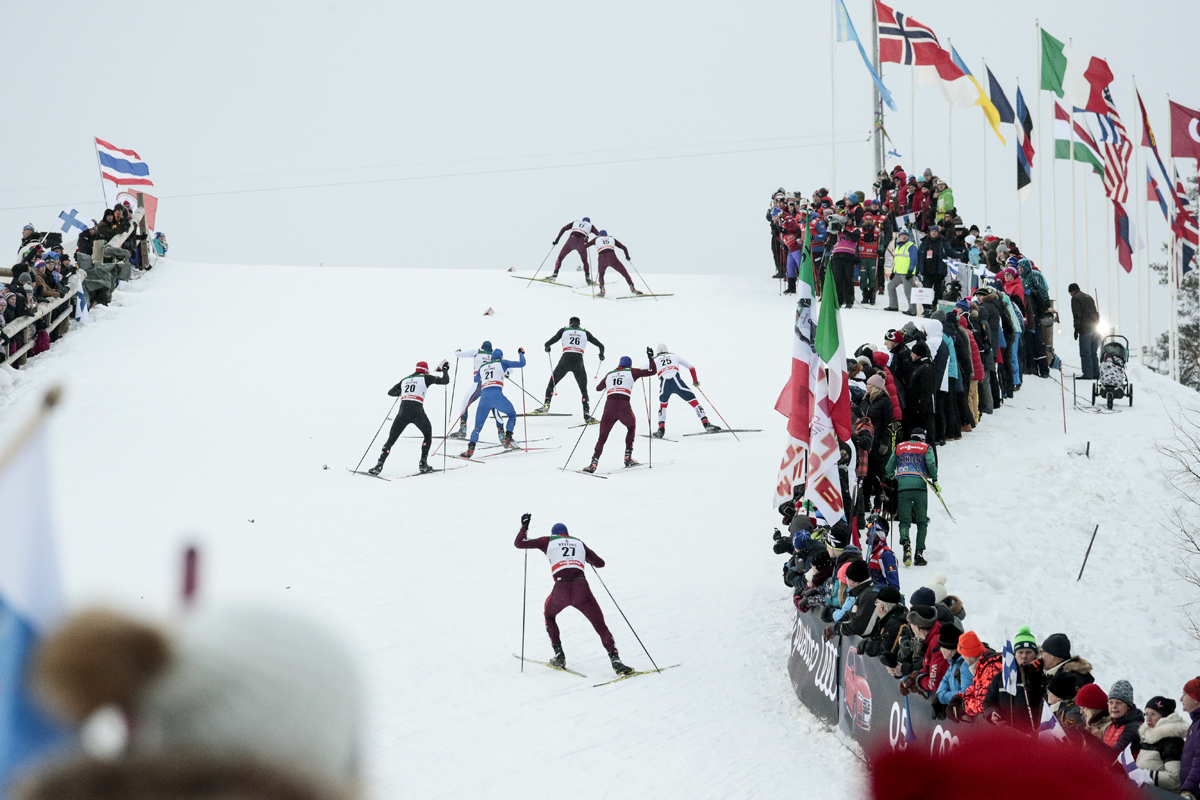
    Racers in the Ruka Triple World Cup 15 k freestyle pursuit, including Russia’s Andrey Larkov, Switzerland’s Jonas Baumann, Italy’s Federico Pellegrino, Switzerland’s Dario Cologna, and Norway’s Simen Hegstad Krueger, ascend a climb in Kuusamo, Finland. (Photo: Fischer/Nordic Focus)
  • Kalla Beats Bjørgen for Ruka Crown: ‘I have been waiting for this day’; Bjornsen 10th, Diggins 12th

    Kalla Beats Bjørgen for Ruka Crown: ‘I have been waiting for this day’; Bjornsen 10th, Diggins 12th

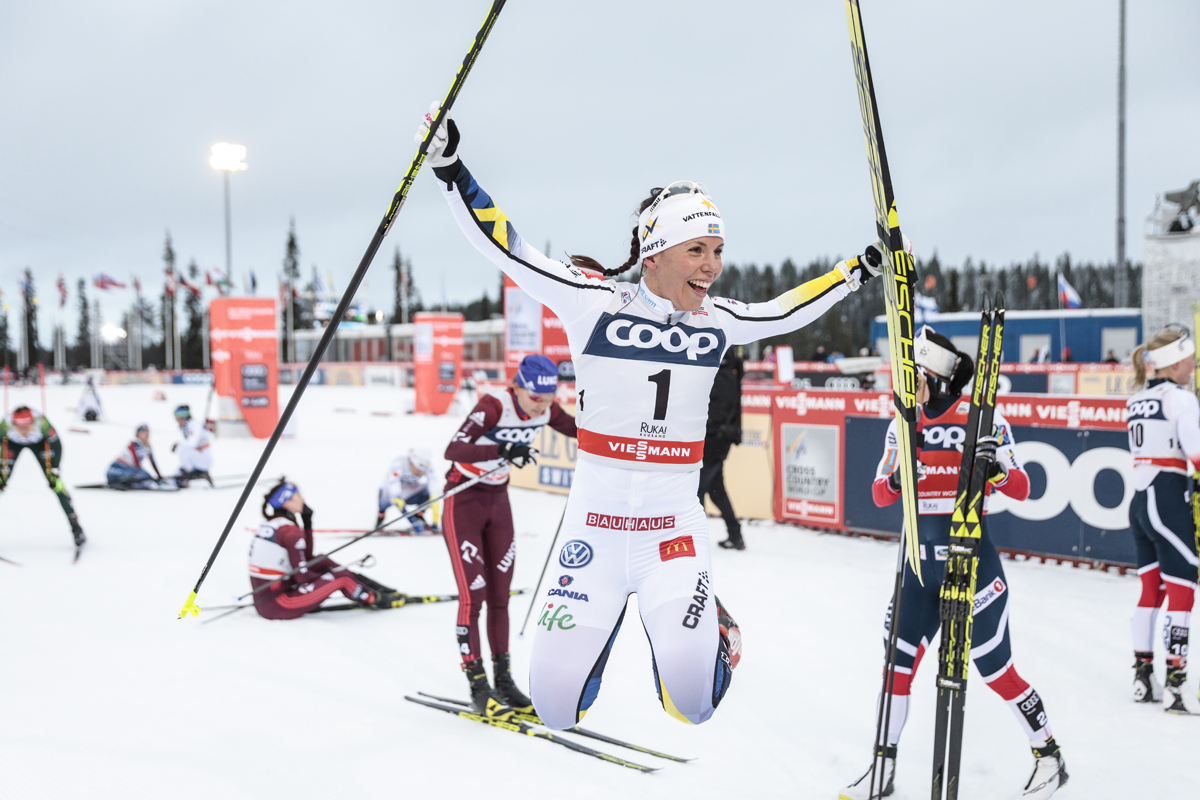
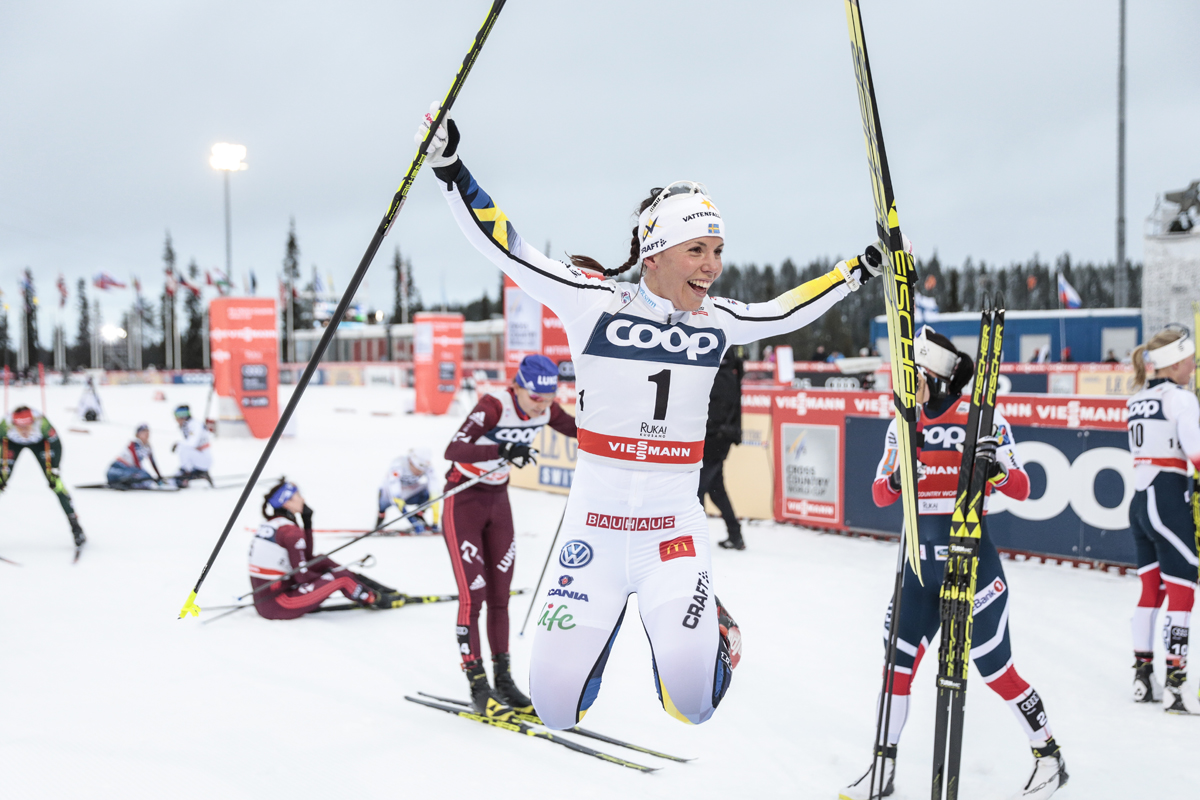
    Sweden’s Charlotte Kalla jumps for joy after winning Sunday’s 10 k freestyle pursuit and overall Ruka Triple title at the World Cup opener in Kuusamo, Finland. She started 2 seconds ahead of Norway’s Marit Bjørgen (second from right) and held her off by 9.7 seconds for the win. (Photo: Fischer/Nordic Focus)

    After two days of racing in Kuusamo, Finland, the Ruka Triple turned its last page on Sunday. As it turned out, the women’s 10-kilometer freestyle pursuit was a thriller.

    Sweden’s Charlotte Kalla came into the final day of the mini tour wearing bib 1 and with only a 2-second lead on the last person one might want skiing on their tails, Norway’s Marit Bjørgen.  

    The gamesmanship, the change of pace, skiing’s version of the dodge and parry became a two-skier affair between Kalla, 30, and Bjørgen, 37. Yet, followers of the sport know Bjørgen’s end-game: push the pace, determine who can match the pace, then seemingly flip a switch and steamroll ahead solo.

    The Swedish-Norwegian pairing performed an endurance duet that kept the packs of chasing skiers at bay. Sweden’s Stina Nilsson started the pursuit 12 seconds back in third, Norway’s resurgent Ingvild Flugstad Østberg 20 seconds back in fourth, and Russia’s Natalia Nepryaeva 23 seconds back in fifth. Norwegians Heidi Weng and Ragnhild Haga began 41 and 42 seconds back, respectively. None could gap up.

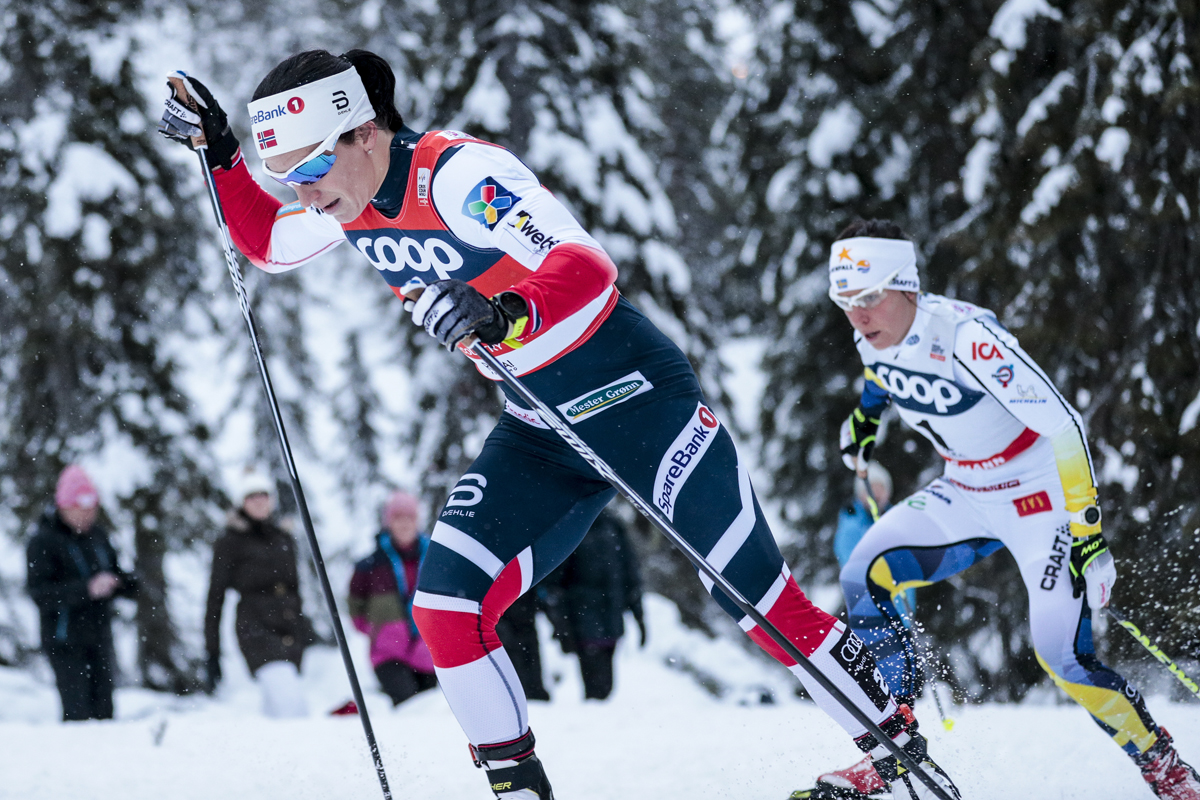
    Norway’s Marit Bjørgen leads Sweden’s Charlotte Kalla during the women’s 10 k freestyle pursuit on Sunday at the Ruka Triple World Cup in Kuusamo, Finland. (Photo: Fischer/Nordic Focus)

    Kalla and Bjørgen never blinked. They gradually pulled away from the chasers.

    “My plan was to ski quite fast together with Marit, and not bring the ones behind us into the game,” Kalla told FasterSkier in a post-race phone interview. “Because I know that Stina is a really good sprinter, so me and Marit had to work together to keep the gap to the others.”

    Heading back out into the woods on the final lap of the 2.5 k course, Kalla punched it. She accelerated the pace to what looked like a sprint, and Bjørgen initially stayed right on her tails.

    How sustainable was this pace? And would it be possible to pop the Norwegian, who had won Saturday’s race over Kalla by 17 seconds? In the previous 10 k classic, Kalla had matched Bjørgen’s times until the last 1 1/2 kilometers or so, when the punishing pace took its toll and she began hemorrhaging time.

    That was on her mind as Kalla kept up her furious pace.

    “Well, yesterday I didn’t truly have the belief that I could ski [away] from Marit, because she did have a great performance yesterday in the classic part, especially on the last lap,” Kalla reflected. “So when I decided to speed up I also knew that I cannot look back. I had to give it a real try and just focus in front of me all the time. I could not take a look behind my back because you have to work for a long long time, and today I succeeded.”

    With the difference in the two women’s skating techniques, Kalla appeared to be expending more energy, but gradually put a gap on Bjørgen – one ski length, two — easily an amount that could be closed on a downhill. It would have been easy to back off and slow down, but Kalla kept pushing and the gap grew to three seconds, four, five, six.

    Bjørgen didn’t respond.

    Kalla came flying into the final hill up to the stadium, the one where she had slowed so dramatically the day before, but didn’t lose any of her advantage this time around.

    “I was just telling myself to look up to the top, trying to push with your legs all the way,” Kalla said of her decisive move. “In the last sprint hill, before we came up to the stadium, I was thinking, ‘Left, left, left, left… one, two, three, four, five,’ just to be able to think of something else than the pain.”

    Kalla skied the turn into the finishing stretch with a clear margin and raised her hands at the finish line as she crossed in 25:50.1 minutes, 9.7 seconds before Bjørgen. She congratulated her rival before jumping in the air and shouting with joy.

    “It was an amazing day today,” Kalla said. “I felt very strong during the race. Just tried to ski my very best, and saved as much energy as possible during the first three laps. My dream yesterday, when I went to bed, was to be able to push very hard when we [would go] out on the last lap. And I was a little bit nervous but decided to follow my tactic. When I was on the top of the hill my coach yelled at me that I had six seconds [lead on Bjørgen]. So I had very tired legs, but I knew that I had to fight and do my very very best until the finish line.”

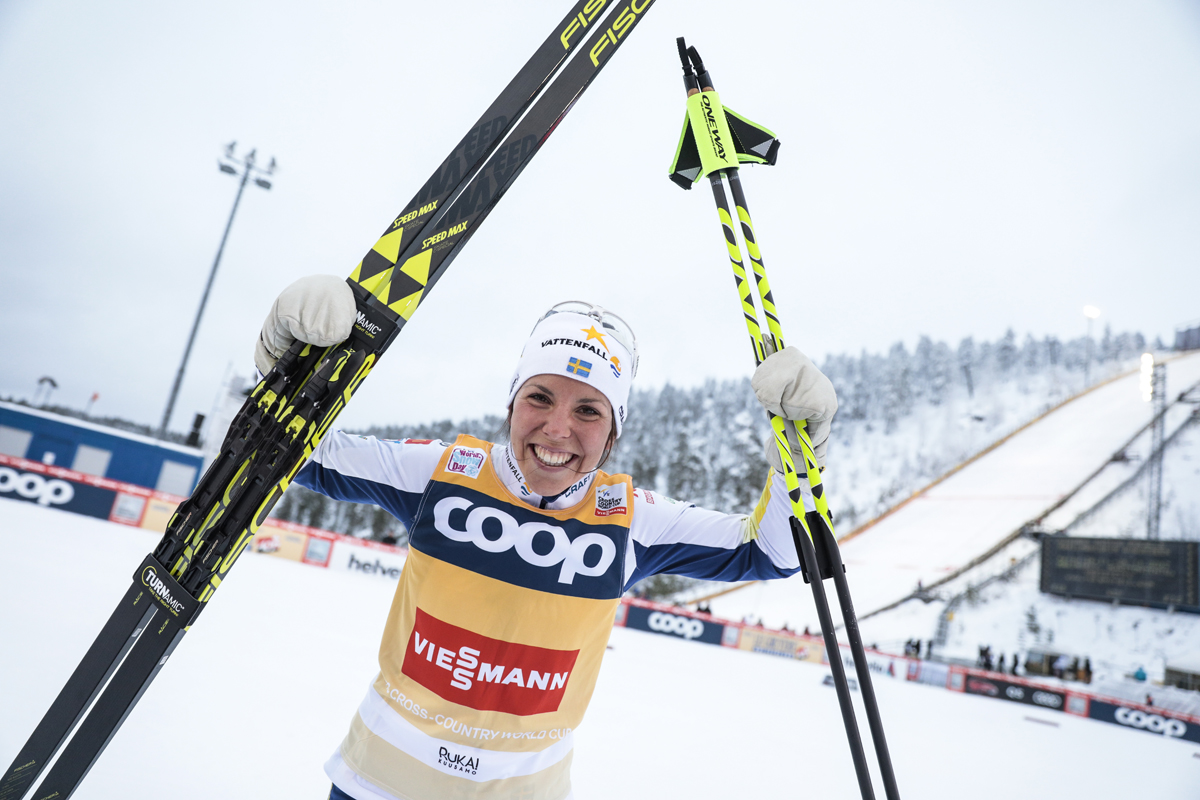
    Sweden’s Charlotte Kalla in the overall World Cup leader’s bib after starting the season with a Ruka Triple mini-tour win in Kuusamo, Finland. (Photo: Fischer/Nordic Focus)

    The last time Kalla won a World Cup was in 2015 when she won the 10 k skate in Östersund, Sweden, before winning the same event at the 2015 World Championships at home in Falun, Sweden.

    “It was a long time since I won a race the last time,” Kalla noted. “And I think it was 2008 when I won a mini tour, and that was the Tour de Ski, actually. So I have been waiting for this day, and I’m very happy today.”

    Also of note is that last year’s Ruka World Cup event Kalla suffered from a heart ailment and had to reduce to a slow-tempo ski to finish the race. One year later, she said that wasn’t on her mind.

    “No, I have not been thinking about that myself,” Kalla said of her health scare last year. “But all journalists I have met remembered what happened to me last year. So it’s like night and day to think about and look back to one year ago. It’s something totally different.”

    After Bjørgen, Norway took third through fifth places. Haga skied to third (+33.9) and posted the fastest time of day, skiing the course in 25:41.8 as she leapfrogged from 10th place at the start to finish on the podium. Weng finished fourth (+38.0), and Østberg fifth (+40.2).

    U.S. Women Continue to Thrive

    At the start of the Ruka Triple on Friday, to paraphrase a certain former U.S. Defense Secretary, there were many “known unknowns” for the U.S. Ski Team (USST) in Finland. The answers three days later are clear. Sadie Bjornsen’s (USST) second place and Sophie Caldwell’s eighth place in Friday’s classic sprint set the tone. According to U.S. women’s coach Matt Whitcomb, both Bjornsen and Caldwell have met the objective criteria for the upcoming Winter Olympics in PyeongChang, South Korea. (That criteria, as applied to Bjornsen and Caldwell, was a top eight in a World Cup classic sprint.)

    Four other USST women skied into the points on Sunday. Previously, Jessie Diggins placed 10th in Saturday’s 10 k classic individual start. Ida Sargent placed 15th in the sprint and began Sunday’s final stage in 23rd, based on her 10 k classic result. Rosie Brennan popped two top 30’s in the first two stages. Kikkan Randall, who had two off days in the classic sprint and 10 k classic, stormed back for Sunday’s skate pursuit. Randall began the day in bib 48 and finished the mini tour in 25th place, skiing the eighth-fastest time of the day.

    Kikkan Randall (U.S. Ski Team) racing from 48th up to 25th (with the eighth-fastest course time) in Sunday’s 10 k freestyle pursuit at the Ruka World Cup in Kuusamo, Finland. (Photo: Fischer/Nordic Focus)

    “She looked really strong and in control,” Whitcomb said on the phone about Randall. “She was making kills right from the start. It’s what we have seen out of her in this exact event before with actually with a very similar split several years ago, when we had the skate on the final day. It’s nice that she can leave this weekend with some confidence. She struggled with skis for the first two days of this tour and was skiing frustrated today, and she knows she has fitness, we know she has fitness, and we are really happy she was able to show it today.”

    Randall confirmed that Sunday’s effort was a more indicative performance.

    “Today was a much better gauge of where my fitness actually is,” Randall emailed. “After two frustrating classic days where the wax was a big factor, it was nice to just be able to go today and use what I have … Today felt the best out of the 3 races. I felt like my body wanted to go hard and I could find good power out there. I felt decent in the two classic races but felt like I couldn’t ski with my full shape because of wax and some technical struggles. So it was nice to know my shape is there.”

    Bjornsen was the U.S. women’s top finisher after three days of racing in Ruka. She began the day as the 11th starter and improved to 10th overall by the finish, 1:18 behind Kalla.

    “This is where we expect to see Sadie when things are going well,” Whitcomb said of Bjornsen’s performance. “But for things to go well, a lot has to stack up for any athlete, particularly for the beginning of the season, when you are traveling all the way from Alaska. It is pretty remarkable how resilient she is, how strong she has become, and how she can just rise above so many of her European competitors, who have been on snow in this time zone or one hour earlier for the last three or four weeks. She has gone halfway around the world and shown it is not so hard, so we are so impressed with Sadie’s ability to ski the way she this weekend.”

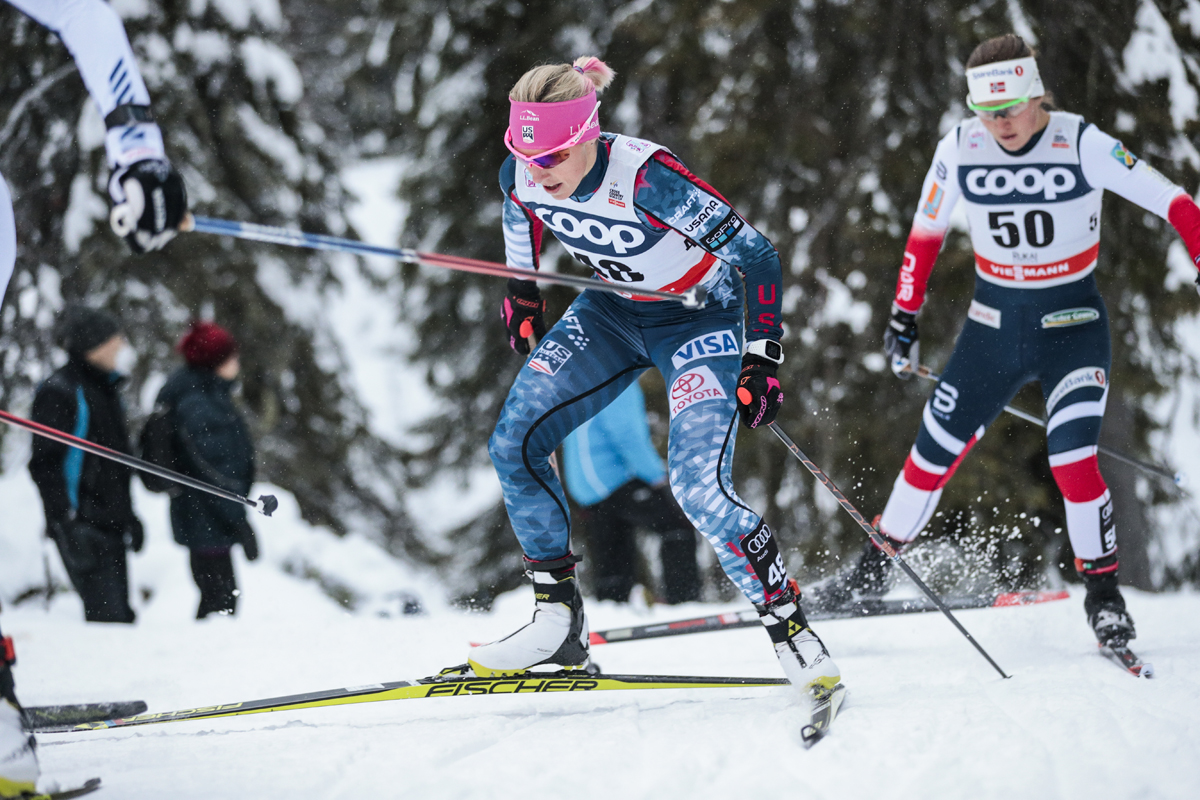
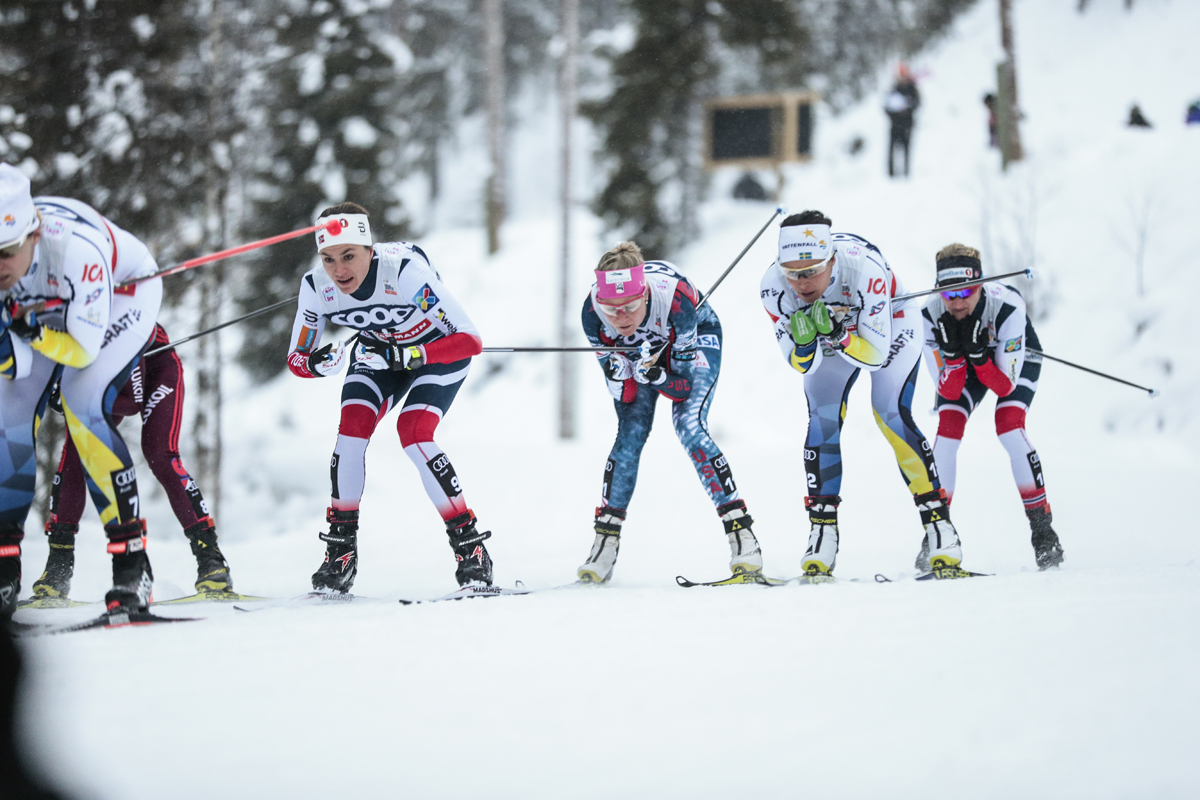
    Norway’s Heidi Weng (third from left) skiing in a pack with American Sadie Bjornsen (pink headband), Sweden’s Anna Haag (second from r) and Norway’s Kathrine Rolsted Harsem (r) during the 10 k freestyle pursuit on the last day of the Ruka Triple World Cup mini tour in Kuusamo, Finland. (Photo: Fischer/Nordic Focus)

    Bjornsen arrived in Europe for the start of the season on Nov. 8.

    Out the on course, Whitcomb awaited his skiers atop the course’s big climb at approximately 1.2 k on the 2.5 k loop. There, Whitcomb said he witnessed Bjornsen put her personal stamp on the race’s outcome.    

    “Sadie had this moment in the race today where she was starting to dangle a little bit of her pack as the pace turned up between laps 2 and 3, and at the hardest part of the course she was forced to make a decision whether or not to hang,” Whitcomb recalled. “And if she just made this move for another minute or two she would be able to ski with them and their draft another three-fourths of a kilometer and pull her that much closer to the finish line and protect her that much more from the packs from behind. That decision today, I think, kept Sadie in the top 10 and that is the kind of racer she is.”

    The first skate race of the year was welcomed by Bjornsen.

    “Today was another fun, and tough day of racing here to complete the tour,” Bjornsen emailed. “It was nice to have skate skis under my feet after two really challenging classic days! Ruka is what I consider one of the toughest race courses on the circuit. It is just wall after wall (steep climb after steep climb), and you never seem to get a break. Today, it was my goal to catch the group in front of me, and then just hang on for dear life. I woke up feeling good, and recovered after the past two days, so I was feeling excited to see what I can do in skate skiing. I feel like I dug deeper than I have in a long time, and was really satisfied when I finally got to the finish line. I now look forward to a few days of rest before another great weekend of racing in Lillehammer.”

    Diggins started the day in 16th and moved up to finish 12th overall. She also skied the 10th fastest time of day.

    “A very solid day out of Jessie,” Whitcomb said. “She is perhaps most disappointed on the classic sprint [on Friday]. It was two years ago when we weren’t sure if classic sprinting would ever be in the cards for Jessie and then she is within striking distance of the podium on certain days. I am sure she has left wanting more from that classic sprint, and I am sure we will see her make the rounds and advance through the heats very soon, but to have 10th yesterday, and I believe the 10th-fastest split today on an extremely hard course, that is a great sign.”

    For Diggins, who finished last season ranked sixth overall on the World Cup, the three-race weekend was a spark, reminding her body and mind of the racing routine.

    “I always work into the season and was carrying a pretty high load of training into the last week, so overall I’m really happy with how the season opener went!” Diggins emailed to FasterSkier. “It was nice to finally race again and get my racing feet under me — and remember how all the testing and warming up works!”

    Whitcomb also added some perspective on Diggins and whether her past results place any added undue pressure on her to perform.

    I think Jessie has matured quite a bit as far as that goes, and I think she can be more about the process, and really focus on what she really needs to do on the race each day and during a particular point on the course,” Whitcomb said. “As every k ticks by, rather than focusing on, ‘I must be fifth,’ if she is in 14th, she is going to do everything she can do be 13th and when she does that she will set her next goal.  She is very goal-orientated but she is realistic. Yeah, she loves to win; she is focused on things that are in her control.”

    Brennan placed 28th overall this weekend, after finishing in a photo finish with Germany’s Sandra Ringwald (in which Ringwald took 27th by 0.1 seconds).

    “I am satisfied with the weekend,” Brennan wrote in an email to FasterSkier. “Kuusamo is always a tricky place for me so I am happy to come away with some strong results. I didn’t have any result expectations as it’s the first races of the year and the fields can vary. I feel I have accomplished many of my other goals in my technique and approach so I am satisfied with that … It always helps to have some strong results in the beginning. It gives me confidence in my fitness and some of the skills have been working on over the summer. I have to say, I would have expected the 10k classic to be my strongest so I think some of the work on my weaknesses is paying off and that I am happy about!”

    Sargent left Ruka in 38th overall and comes away with renewed confidence. Known as a sprinter, her top 30 on Saturday bodes well for the Craftsbury, Vermont-based skier.

    “I am satisfied with the weekend and mostly excited to start the season,” Sargent wrote to FasterSkier. “Yesterday was an awesome day for me so it’s cool to have a distance race carrying my weekend for me. Overall I think it was a great weekend for the team and we are just getting rolling!”

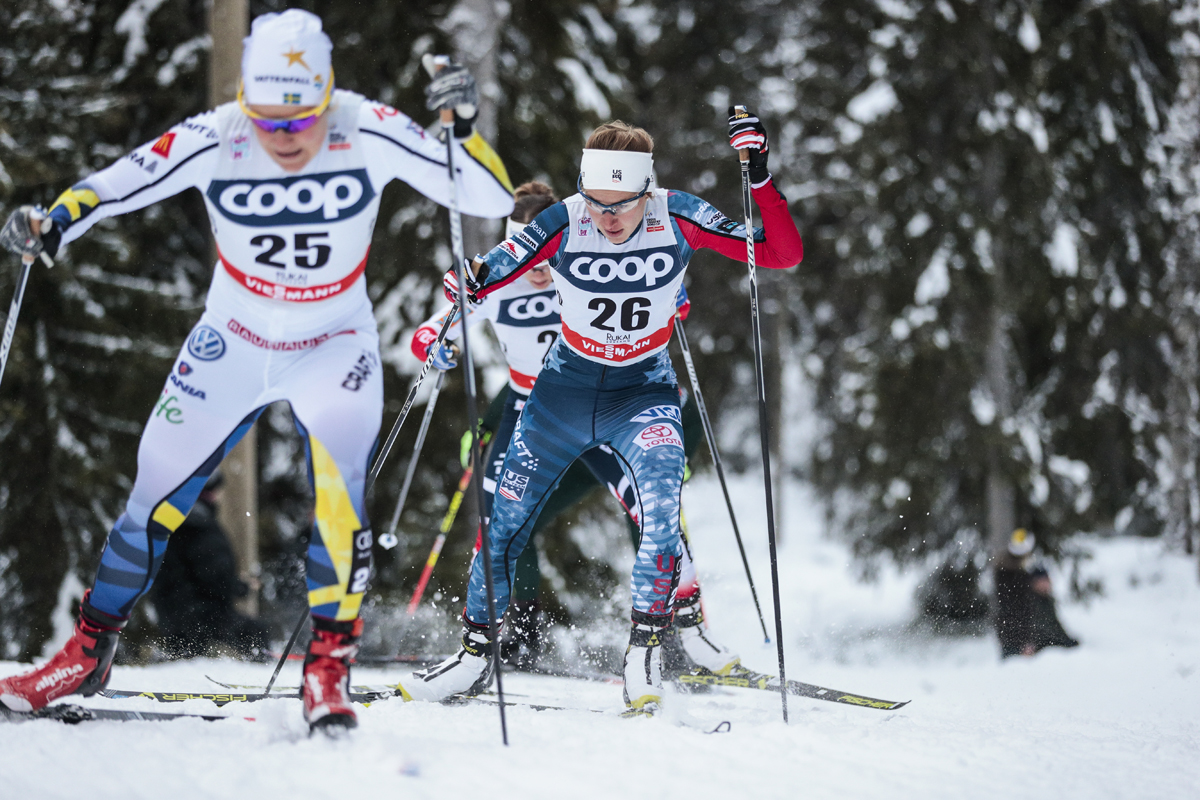
    Sophie Caldwell (26), of the U.S. Ski Team, chasing Sweden’s Hanna Falk (25) in the women’s 10 k freestyle pursuit on the last day of the Ruka Triple World Cup mini tour in Kuusamo, Finland. She finished 39th overall. (Photo: Fischer/Nordic Focus)

    After qualifying for the Olympics in her first race of the season, Caldwell finished one spot behind Sargent in 39th. Liz Stephen (USST) placed 56th overall, Chelsea Holmes (Alaska Pacific University) 60th, while Julia Kern (USST-D-Team) in her first European World Cup weekend was 71st.

    Canada started three skiers in the women’s races. Emily Nishikawa (Canadian World Cup Team) led them in 69th overall, Cendrine Browne (National U25 Team) followed in 72nd, and Dahria Beatty (Canadian World Cup Team) placed 79th.

    World Cup racing resumes in Lillehammer, Norway, next Saturday with a classic sprint.

    Results: Women’s pursuit | Women’s time of day | Overall World Cup standings

  • Sunday Rundown: Kalla, Klæbo Take Ruka Triple Crowns; Austria, Norway Top Biathlon Relays

    Sunday Rundown: Kalla, Klæbo Take Ruka Triple Crowns; Austria, Norway Top Biathlon Relays

    Sweden’s Charlotte Kalla (c) after winning the 2017 Ruka Triple and her first World Cup race since 2015. She won Sunday’s World Cup 10 k freestyle pursuit by 9 seconds over Norway’s Marit Bjørgen (l) and was nearly 34 seconds ahead of Norway’s Ragnhild Haga (r), who placed third. (Photo: FIS Cross Country/Twitter)

    FIS Cross Country World Cup (Kuusamo, Finland): 10/15 k freestyle pursuit

    Women’s report

    Men’s report

    Sweden’s Charlotte Kalla took down the fiercest contender women’s cross-country skiing has ever seen, challenging Norway’s Marit Bjørgen on the final lap of the women’s 10-kilometer freestyle pursuit on Sunday then successfully holding her off to the finish.

    Kalla entered the final day of the three-day Ruka Triple mini tour with a 2-second lead on Bjørgen out of the pursuit start. Bjørgen quickly caught her and led for much of the four-lap race — until the last lap. The two skied alone, at least 30 seconds ahead of their nearest chasers, with three other Norwegians, Ragnhild Haga, Ingvild Flugstad Østberg and Heidi Weng leading Austria’s Teresa Stadlober and Sweden’s Stina Nilsson at 8.6 k.

    Before that marker, Kalla had already launched her attack and was 6 seconds ahead of Bjørgen with 1.4 k to go. The Swede continued to push the pace and extended her buffer to Bjørgen, entering the stadium alone and winning by 9.7 seconds. For Kalla, a 2015 World Champion in the 10 k freestyle, it was her first World Cup win since 2015.

    Bjørgen took second and Haga outlasted her teammates for third place (+33.9). Weng finished fourth (+38.0) and Østberg fifth (+40.2), then Stadlober in sixth (+41.0) and Nilsson in seventh (+46.7).  Russia’s Natalia Nepryaeva led in the next chase group for eighth place (+1:01.6), followed by Sweden’s Ida Ingemarsdotter in ninth (+1:10.1) and American Sadie Bjornsen in 10th (+1:18.0). Another U.S. Ski Team (USST) member Jessie Diggins was close behind in 12th (+1:35.7), about five seconds behind Norway’s Kathrine Rolsted Harsem in 11th (+1:30.3).

    The USST had four in the top 30, with Kikkan Randall rising from 48th at the start to 25th (+2:41.1) and Rosie Brennan improving from 34th to 28th (+2:43.2).

    While Haga’s time was the fastest of the day in 25:41.8 (compared to Kalla’s finishing time of 25:50.1, which was third-fastest of the day behind Weng in second), Randall’s time was eighth fastest, Diggins was 10th fastest and Bjornsen 11th fastest of 79 in the last women’s race of the opening World Cup weekend.

    Also for the U.S., Ida Sargent finished out the tour in 38th, Sophie Caldwell was 39th, Liz Stephen 56th, Chelsea Holmes 60th, and Julia Kern 73rd.

    Canada’s Emily Nishikawa placed 69th overall and Cendrine Browne moved up two places to finish 72nd, while Dahria Beatty was lapped.

    Klæbo Sweeps Opening Weekend

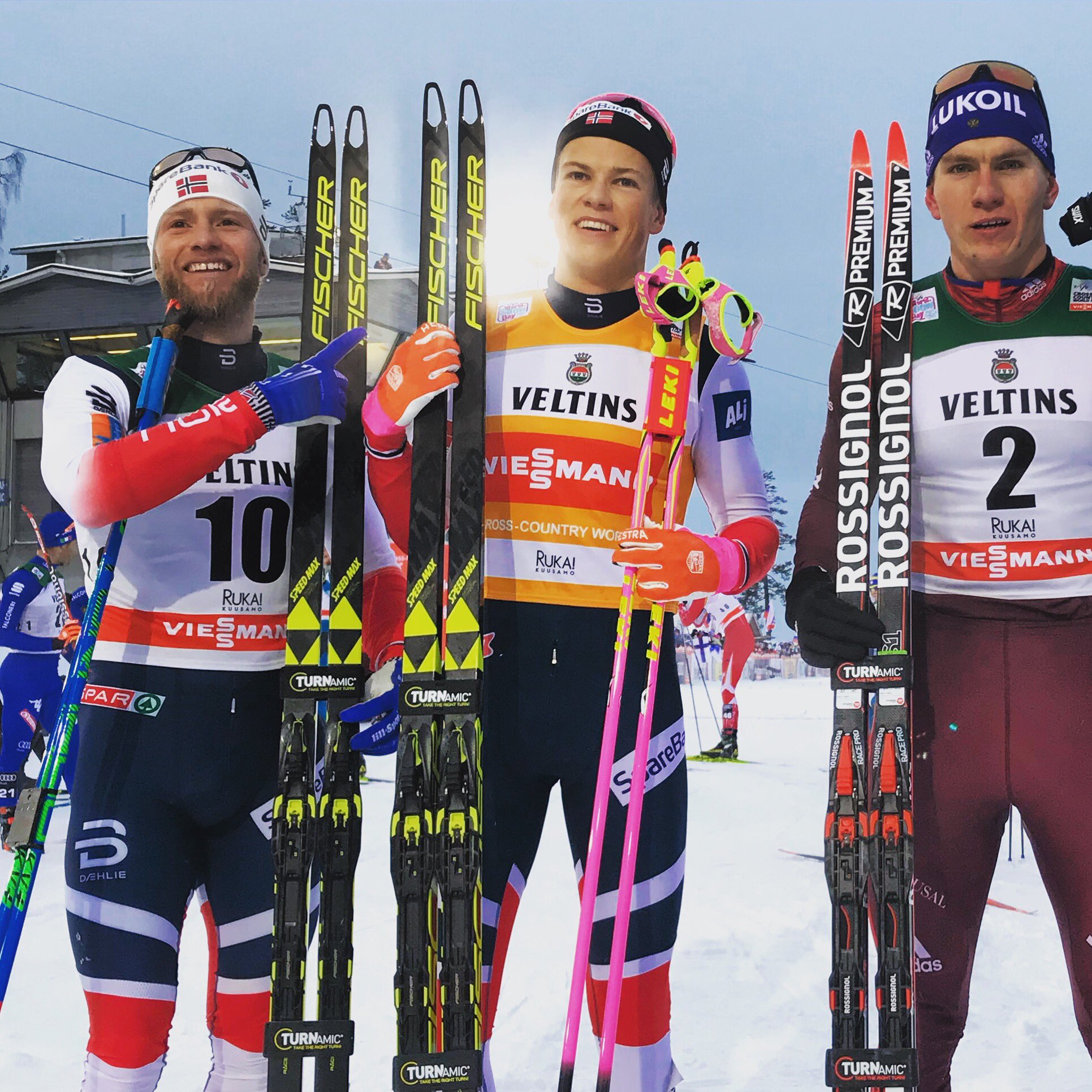
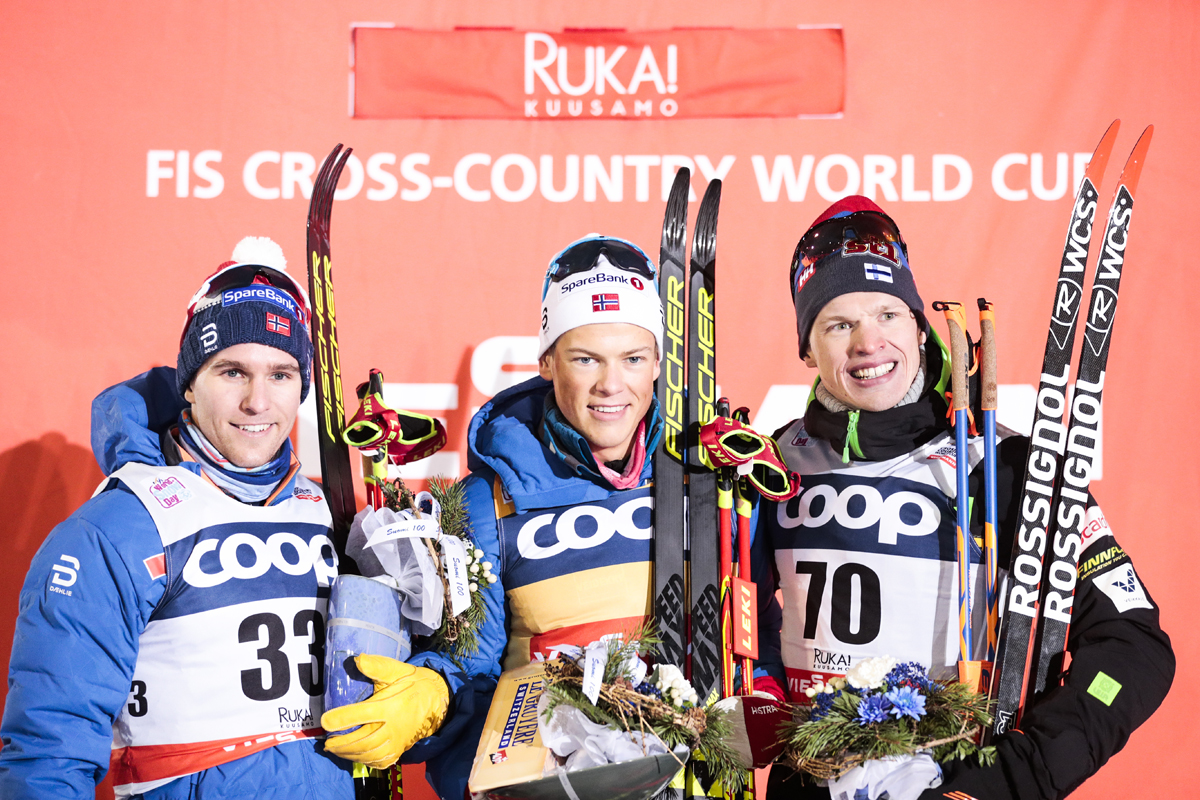
    The men’s 15 k freestyle pursuit podium on the last day of the Ruka Triple in Kuusamo, Finland, with Norway’s Johannes Høsflot Klæbo (c) in first, Norway’s Martin Johnsrud Sundby in second, and Russia’s Alexander Bolshunov in third. (Photo: FIS Cross Country/Twitter)

    In the men’s 15 k freestyle pursuit later in the day in Kuusamo, Johannes Høsflot Klæbo lost his 38-second buffer to the men’s field, but won the race after outlasting fellow Norwegian Martin Johnsrud Sundby, Russia’s Alexander Bolshunov and Canada’s Alex Harvey, respectively.

    While Klæbo started the pursuit 38 seconds ahead of Bolshunov in second place, Sundb  started 1:05 minutes back in 10th and Harvey was 1:23 behind in 12th.

    Klæbo remained 32 seconds ahead of Bolshunov at 5 k, at which point Sundby led a chase group in third, followed closely by Sweden’s Calle Halfvarsson, Norway’s Didrik Tønseth, Kazakhstan’s Alexey Poltoranin, Russia’s Evgeniy Belov, Norway’s Emil Iversen, Finland’s Iivo Niskanen, and Norway’s Pal Golberg, respectively.

    Harvey skied in the next group back with Sweden’s Marcus Hellner, Norway’s Hans Christer Holund, France’s Maurice Manificat, and Russia’s Alexey Chervotkin, all of which were in the top 15 at 5 k.

    Over the next 2.5 k, Bolshunov cut his distance to Klæbo to 20 seconds, and at 7.5 k, Sundby was skiing alone another five seconds back in third.

    Sundby caught Bolshunov and the two reeled in Klæbo over the next kilometer, catching him around 8.6 k, while 11 seconds back, Harvey led a chase group with Chervotkin, Niskanen, Holund, Poltoranin, and Manificat at 8.6 k.

    Harvey lapped through the stadium at 10 k right behind Bolshunov in first, while Tønseth followed in third and Klaebo in fourth. Sundby remained in seventh, less than 2 seconds back.

    At 12.5 k, 12 skiers remained in 2.6 seconds of the lead, but 1 k later, that number had dwindled to four within 3 seconds of first: Sundby, Harvey, Tønseth, and Klæbo. Bolshunov kept himself in contention just 3.8 seconds behind, and on the final climb, it became evident the race was between Klæbo, Sundby, Bolshunov, and Harvey. They finished in that order, with Harvey dropping off the pace in the finishing stretch.

    Klæbo took the win in 36:23.2, just 0.4 seconds ahead of Sundby in second, while Bolshunov took third, 1 second behind Klæbo. Harvey was another 0.6 seconds back in fourth, and the Canadian’s time stood up as the fifth fastest of the day, behind Manificat in first (34:50.9). Manificat tied Holund for placed eighth overall (+8.2), behind Chervotkin in fifth (+6.2), Niskanen in sixth (+7.2), and Tønseth in seventh (+8.1).

    Erik Bjornsen led the U.S. men overall in the tour in 26th (+1:43.6) for his third-straight race in the World Cup points. Also for the U.S. Ski Team, Paddy Caldwell raced to 19th for time of day (after starting 70th and finishing 51st in the pursuit).

    Canada’s Devon Kershaw also landed in the points for the second-consecutive day in 29th (+1:47.8).

    American Noah Hoffman finished the Ruka Triple in 39th (up from 45th at the start), Scott Patterson was 55th and Andy Newell 75th for the U.S.

    Canada’s Len Valjas placed 44th overall, Graeme Killick 68th, Knute Johnsgaard 81st, and Julien Locke 83rd.

    Results: 

    Women’s pursuit | Women’s time of day

    Men’s pursuit | Men’s time of day

    IBU Biathlon World Cup (Östersund, Sweden): Mixed & Single Mixed Relays

    Single mixed relay report

    Mixed relay report

    While France came in the favorites in the single mixed relay, starting a team of Martin Fourcade and Marie Dorin Habert, it was Austria who put on a master class and skied to a comfortable win today.

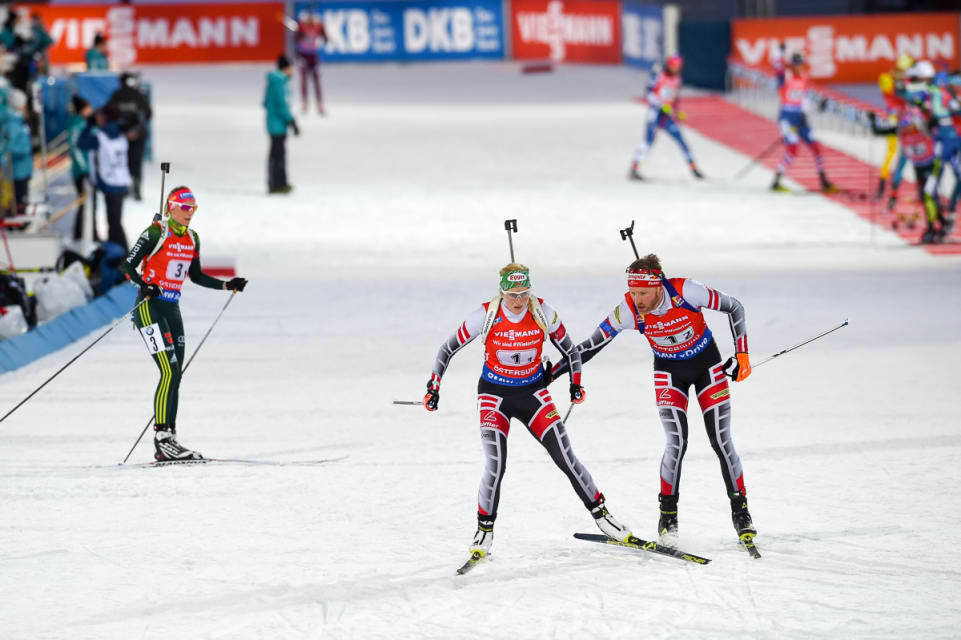
    Simon Eder tags off to Lisa Theresa Hauser for Austria during the single mixed relay World Cup in Ostersund, Sweden. The pair raced to a 16.5-second win. (Photo: IBU/biathlonworld)

    The Austrian duo of Lisa Theresa Hauser and Simon Eder used only two spare rounds over the course of 40 shots, the best shooting in the field by a wide margin. They led nearly the whole race and ended up with a 16.5-second victory over Germany’s Vanessa Hinz and Erik Lesser. The Germans used nine spare rounds to clean all their targets, but Lesser was aggressive on the skis and made up ground on the trails to finish 16.2 seconds clear of the rest of the field.

    There, drama ensued on the last loop. Kazakhstan’s Maxim Braun came through a crash caused by Italy’s Thomas Bormolini, who was skiing in third place on the penultimate downhill and also took out Ukraine’s Dmytro Pidruchnyi. That allowed Braun, along with teammate Galina Vishnevskaya, to just barely hold on to third place. Their shooting – with five spare rounds between them, the second-best in the field – allowed this, their best relay showing ever.

    Fourcade, who had left the range in seventh, came through the fray to put France into fourth, followed by Sweden (Linn Persson and Sebastian Samuelsson), then Ukraine (Pidruchnyi and Vita Semerenko) and Italy (Bormolini and Alexia Runggaldier).

    Both the U.S. team of Emily Dreissigacker and Leif Nordgren and the Canadian team of Rosanna Crawford and Christian Gow were lapped. Crawford was in second position more than halfway through the race when she fell on a downhill, losing a large amount of time and affecting the functioning of her rifle once she reached the shooting range.

    Results

    Later in the day, countries sent four-athlete teams out for regular mixed relays. Despite an imperfect start on the shooting range, the Norwegian team of Ingrid Tandrevold, Tiril Eckhoff, Johannes Thingnes Bø, and Emil Hegle Svendsen came away with a 5.3-second win over Italy’s Lisa VitozziDorothea WiererDominik Windisch, and Lukas Hofer.

    The German team of Franziska Preuss, Maren Hammerschmidt, Benedikt Doll, and Arnd Peiffer was third, +6.4, and Slovakia close behind in fourth.

    Canada’s Emma Lunder, Julia Ransom, Scott Gow, and Brendan Green finished 15th, +3:28.0, and the U.S. team of Susan DunkleeClare EganPaul Schommer, and Sean Doherty 21st, +4:47.6.

    Results

  • Klæbo Steamrolls to Another Ruka Win; Harvey 13th in 15 k Classic

    Klæbo Steamrolls to Another Ruka Win; Harvey 13th in 15 k Classic

    Norway’s Johannes Høsflot Klæbo racing to his second win in as many races at the Ruka Triple on Saturday in Kuusamo, Finland. He won the first distance race of the season, the men’s 15 k classic, by 15 seconds and will start Sunday’s freestyle pursuit with a 38-second head start on the men’s field. (Photo: Fischer/Nordic Focus)

    Is Johannes Høsflot Klæbo better than Petter Northug* was at his age? It’s hard to say, reigning Norwegian World Cup winner Martin Johnsrud Sundby told NRK. But his performance in the last two days is pretty unheard of, Sundby said after Saturday’s 15-kilometer classic.

    On both Friday and Saturday at the Ruka World Cup opener in Kuusamo, Finland, Klæbo (who’s still a U23 athlete at just 21 years old, although he’s on Norway’s exclusive World Cup Team) won both races to start the 2017/2018 season. He didn’t lose a round in Friday’s classic sprint, then came out to take a 15-second victory over fellow Norwegian Didrik Tønseth in Saturday’s 15 k classic.

    “There’s no doubt he’s a phenomenon,” Sundby said after placing eighth on Saturday, 30.7 seconds off Klæbo’s winning time of 33:38.8 minutes, according to a loose translation. “To race like he did yesterday, then do the same today. No, that’s amazing.”

    Klæbo ended last season as both season-long U23 (under-23) World Cup champion as well as the Sprint World Cup champion. He’s started this season without a loss, and he led at most parts of the race on Saturday, except for the 3.1 and 5 k checkpoints, where Russia’s Alexander Bolshunov clocked splits that were 0.9 and 4 seconds faster, respectively.

    The men’s 15 k classic podium on Day 2 of the Ruka Triple in Kuusamo, Finland, with Norway’s Johannes Høsflot Klæbo (c) in first, Norway’s Didrik Tønseth (l) in second, and Finland’s Iivo Niskanen (r) in third. (Photo: Fischer/Nordic Focus)

    But Bolshunov, who started 66th (out of 102) couldn’t hold it, and the young gun in bib 42 continued to hold his own in the leader’s chair at the finish. Klæbo ousted Tønseth from the top spot, putting Tønseth in second place. Finland’s Iivo Niskanen in bib 70 charged hard for the win, coming within three seconds of Klæbo around 6 k, but ended up 17.7 seconds short for third place.

    “It’s unbelievable what Johannes did today, having raced four sprint rounds yesterday,” Tønseth emphasized, according to a International Ski Federation (FIS) press release.

    “I was surprised myself,” Klæbo told FIS. “My plan was to open hard. When you fight for the World Cup victory, you try to give everything.”

    As for his reaction to Sundby’s praise, Klæbo told NRK he was trying to remain focused.

    “It’s just two races, so we’ll have to wait and see,” he said. “There is no one who is more of a favorite in the Tour de Ski than Martin. I will smile as long as I have the yellow shirt [as the overall Word Cup leader], but then he will get it in the end.”

    Saturday’s 15 k classic, as Niskanen pointed out, wasn’t an easy one. New snow from overnight and the day before mixed with temperatures around freezing made for glazed tracks, where skis were prone to icing.

    “It was a difficult competition and it was not easy to pick the right skis,” Niskanen told FIS. “Looking at the whole mini tour, third place today is good. I am still not where I would like to be, there are some good things but also some things I have to improve for the [Olympic] Games.”

    He’ll start Sunday’s final race of the Ruka Triple, the men’s 15 k freestyle pursuit, in fifth place, 49 seconds behind Klæbo in first. Bolshunov, who finished fourth on Saturday (19.9 seconds behind Klæbo), will start the pursuit in second. And Klæbo will start first, 38 seconds ahead of the Russian.

    Norway’s Pål Golberg will head out third, 6 seconds after Bolshunov, and Sweden’s Calle Halfvarsson will start fourth, another 4 seconds later and 1 second ahead of Niskanen. Tønseth is slated to start sixth (+0:57) just ahead of fellow Norwegian Emil Iversen and Kazakhstan’s Alexey Poltoranin (both 58 seconds back) in seventh and eighth, respectively. Russia’s Evgeniy Belov** is ninth in the tour standings (+1:05) and will start with Sundby in 10th (+1:05).

    On Saturday, Poltoranin, an early leader in bib 12, placed fifth (+25.6) to move up the mini-tour ranks. He initially bumped Belov, who started 10th, out of the leader’s chair, and Belov ultimately slipped to sixth (+26.5), just ahead of Iversen in seventh (+30.2) and Sundby in eighth (+30.7).

    Russian U23 skier Alexey Chervotkin placed ninth on the day (+31.2). Halfvarsson was 10th (+34.4) after coming within seven seconds of Klæbo’s time in the middle of the race but losing time on the last of three 5 k laps. For Norway, Golberg placed 11th (+38.1) and Hans Christer Holund 12th (+44.7), ahead of Canada’s Alex Harvey in 13th (+49.7).

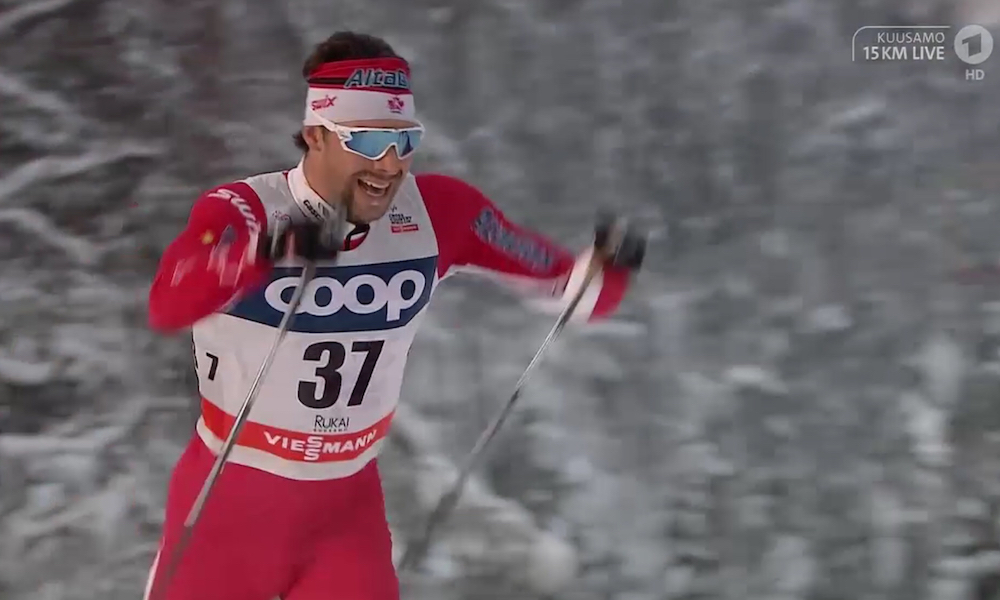
    Canada’s Alex Harvey racing to 13th in the men’s 15 k classic individual start on Saturday at the World Cup in Kuusamo, Finland. (Screenshot: ARD)

    Harvey, who started in bib 37, spent most of his race floating between 10th and 14th place, and did what he needed to get within striking distance of the top 10 for Sunday’s pursuit. He’ll start tomorrow’s race in 12th, 1:23 out of first and 9 seconds behind Chervotkin in 11th.

    “I was just hoping to move forward a bit in the standings but more importantly to deliver another good race,” Harvey wrote in an email on Saturday. The day before, he reached the quarterfinals and finished 21st overall in the sprint.

    “The conditions yesterday were quite different than today’s. Yesterday it was fresh falling snow and cold, then it warmed up quite a bit overnight so today was very glazy [sic] and shiny snow,” Harvey wrote. “Skis were good I think. Not the fastest but good kick in not-so-easy conditions to get grip.”

    Like fellow Canadian World Cup Team member Devon Kershaw, who tied American Erik Bjornsen (U.S. Ski Team) for 26th (both 1:15.2 out of first), Harvey explained that he chose no-wax “hairies”, also known as “rub” skis.

    (“I think a lot of guys went on rub skis,” Kershaw wrote in an email. “I went with rub skis and it was the right choice for me today. The techs were all pretty pumped because I have been very averse to rub skis in the past. The handful of times I’ve been ‘forced’ to race on them I’ve gotten completely destroyed, so today was fun to feel good and make the skis work for me.”)

    Harvey recalled feeling strong on the climbs, using his grip to his advantage.

    “From our more detailed splits it seems I was losing a bit on the flats which is usually my stronger terrain but nothing too dramatic,” Harvey wrote. “I’m happy to be within reach of the top ten, that was the goal for the weekend. Tomorrow I’m looking forward for 2 things. 1: chasing guys ahead of me. 2: skating!”

    Kershaw, who started 13th and had fewer men to chase ahead of him, explained that he paced his first lap so that he’d catch someone like Harvey, and the plan worked.

    “I was going to take my risk and start really slow. Almost level 3 effort,” Kershaw wrote of his pre-race strategy. “I knew I should be able to lap through with either Alex, [Finland’s Matti] Heikkinen, or Dario [Cologna of Switzerland] – and it just so happened that it was Alex. I ended up having great energy after my pedestrian start and was able to ski 10km with him, which obviously allowed me to ski into the points. Perhaps I should have been more aggressive out of the start, but I played it safe and it worked out decently well for me.”

    “That was sweet to have someone there,” Harvey said in a Cross Country Canada press release. “It was good for both of us and really helped pull us both around.”

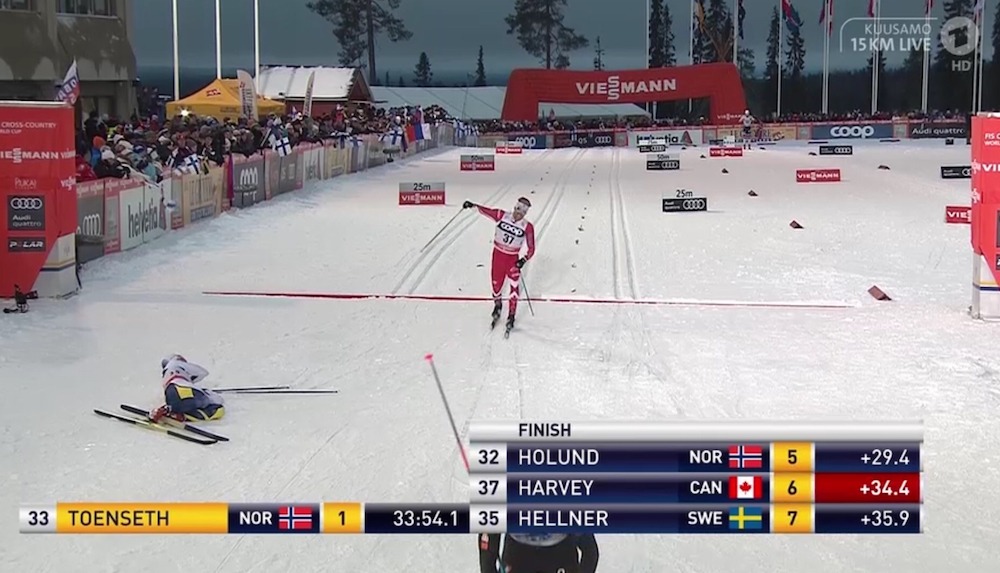
    Canada’s Alex Harvey (in red) lunges at the finish of the men’s 15 k classic at the Ruka World Cup in Kuusamo, Finland. While he initially finished sixth, he ended up 13th on the day. (Screenshot: ARD)

    Kershaw wrote that he was “decently happy,” with his race. “I know that 26th doesn’t sound earth shattering or anything, but to start the first distance race of the World Cup tour in the points is fine. I’m a notoriously slow starter throughout my career before Christmas, so I’m just looking for some solid races and to hit the points more often than missing them is good.”

    On Sunday, he’ll start 28th, one second behind Cologna in 26th and Russia’s Andrey Larkov in 27th. Bjornsen, the U.S. Ski Team’s leading man in the Ruka tour, is 7 seconds ahead of him in 23rd.

    “I think the celling is probably 20th,” Kershaw wrote of his aspirations for an overall finish for the mini tour. “We have a good group of about 10 guys all starting within 9 seconds of each other. I will hope to stay in that group and have the energy and punch to have a good last lap. You never know what happens in these pursuit starts too – so guys could blow up, but there’s a break at around 20, and then behind me there’s a break at around 30. Will be fun.”

    Bjornsen, who placed 24th in Friday’s sprint, started Saturday’s 15 k in bib 69, just 30 seconds ahead of Niskanen. In an email, Bjornsen described catching a “great ride from Iivo” on the second lap.

    “He’s just amazing here,” Bjornsen wrote. “I’m pretty sure he was disappointed with his result. He comes to Ruka with a mission. I jumped on him for a lap in the middle. It felt very controlled in the double pole sections but he was just striding up the hills no problem. The herring bone was not nearly as efficient. I had to let him go after skiing with him for 6kms.”

    Bjornsen explained that he took a chance and went for glide over grip.

    “I’ve only raced here four times but tricky classic conditions seem to be the norm. The hills are big and steep!” he wrote. “I had a pair of rockets under my feet but I didn’t stride in the tracks once. My double pole is feeling great right now so the tactic was to hammer double pole as far up the hill as I could, and then just get out of the tracks and run/herring bone.”

    After finishing in the top 30 to score World Cup points in the first two races of the season, Bjornsen explained he was feeling “psyched”.

    “I didn’t have the best feelings the last couple weeks, so I wasn’t expecting to be in the points right away,” he wrote.

    “Of course yesterdays race was fun for me, but for sure the highlight of the day was watching Sadie absolutely dominate the heats!” he added of his older sister Sadie Bjornsen placing second in the women’s sprint. “She’s been looking great this year and I think she has a lot more success to come. Personally I believe she was strong enough to take the win, it’s only a matter of time before that happens..”

    On Sunday, he hoped to chase a top-30 overall tour finish.

    “I’m starting around some legends, so it will be a great experience!” Bjornsen wrote.

    U.S. Ski Team coach Matt Whitcomb said he was impressed with Bjornsen’s ability to contend with “some of the best skiers in the world” on Saturday, including Niskanen.

    “[He] kind of took the approach, ‘I am going to swing as hard as I can and hope to connect with the ball,’ and it worked for a large part of that race,” Whitcomb said on the phone. “He was skiing up into the top 20, and then Niskanen on the final lap turned things up a little bit and popped him off … It was a gutsy race, so psyched for Erik. It is so fun to watch him figure out a project, some sort of challenge in the race and go after it. … Twenty-sixth is a hell of a race in Finland.”

    American Noah Hoffman raced to 43rd (+1:58.4) on Saturday, Andy Newell finished 59th (+2:29.6), Paddy Caldwell was 72nd (+2:53.5), Scott Patterson 86th (+3:17.7), and Simi Hamilton 96th (+3:43.4) for the U.S. Ski Team.

    Five other Canadian national-team members competed, with Len Valjas finishing 48th (+2:08.0), Graeme Killick 58th (+2:23.4), Knute Johnsgaard 87th (+3:19.8), Julien Locke (U25 Team) 100th (+3:56.4), and Jess Cockney 109th (+5:20.7).

    ***

    * Northug, 31, who made his World Cup debut in 2005/2006 and has since accumulated 13 World Championships golds and two Olympic gold medals, has started his season this weekend with non-World Cup International Ski Federation (FIS) races in Gålå, Norway, after skipping Norway’s opening FIS races in Beitostølen, Norway, last weekend. Per team rules, he was not allowed to start the Ruka World Cup as a result of that decision. So far in Gålå, Northug finished 17th in the 15 k freestyle on Friday and was eliminated in Saturday’s classic-sprint quarterfinals to place 19th in that race.

    ** Belov, 27 is one of six Russian skiers currently banned from competing at future Olympics as a result of doping at the 2014 Olympics. He and the five others are allowed to compete in FIS events, like the World Cup, unless FIS decides otherwise.

    Results: Men’s 15 k classic | Men’s Ruka Triple standings (Day 2) | Pursuit start list

  • ‘You Just Had to Bite Your Teeth Together,’ Bjørgen Wins Challenging Ruka 10 k; Diggins 10th

    ‘You Just Had to Bite Your Teeth Together,’ Bjørgen Wins Challenging Ruka 10 k; Diggins 10th

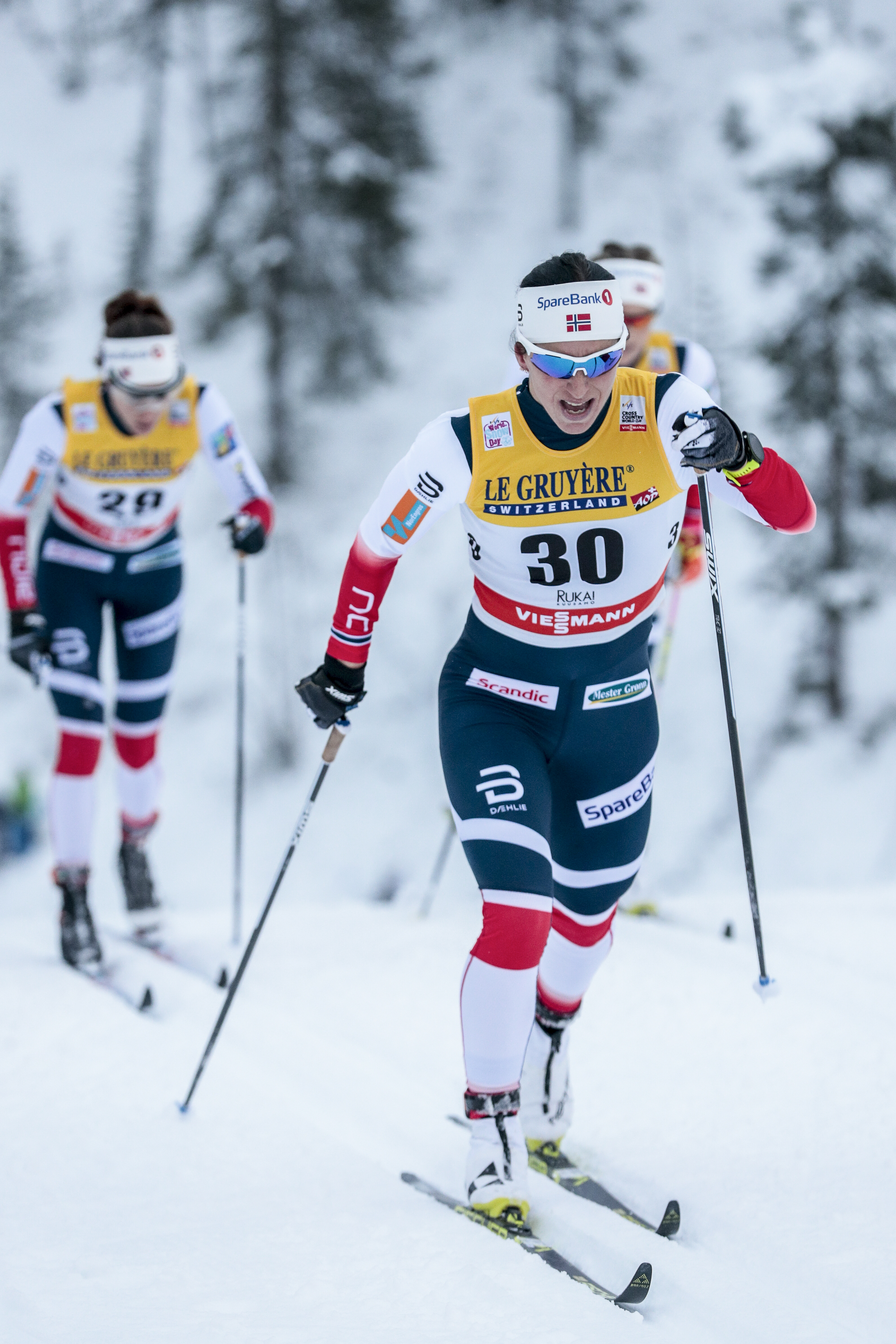
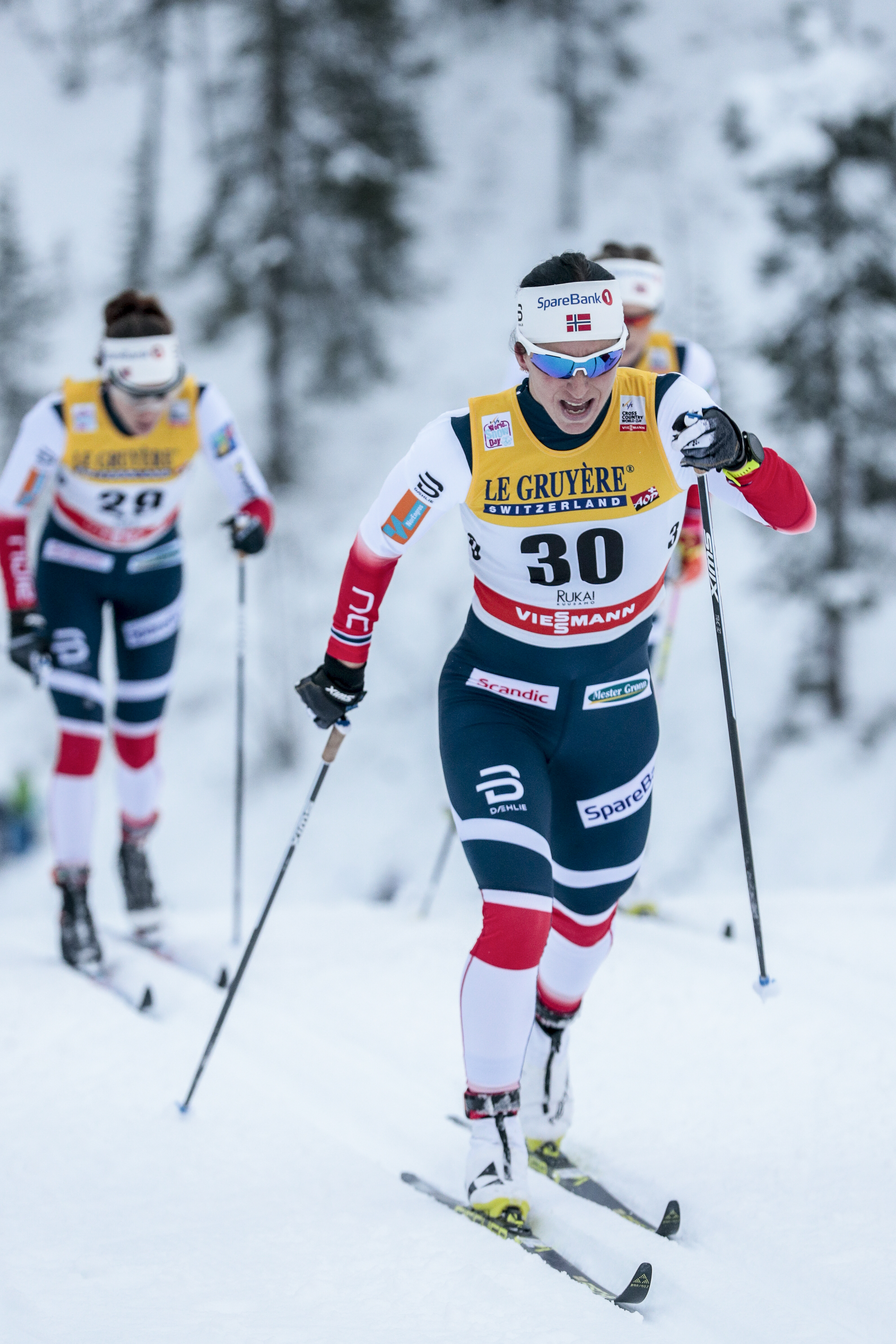
    Norway’s Marit Bjørgen (30) leads her teammate Heidi Weng (29) in the women’s 10 k classic individual start on Saturday at the Ruka World Cup in Kuusamo, Finland. (Photo: Fischer/Nordic Focus)

    At age 37, with more than 110 World Cup wins, 18 World Championships titles and six Olympic gold medals, it’s hard to imagine Norway’s Marit Bjørgen as anything but a machine; she races, she wins, she repeats.

    But even the World Cup veteran, who first raced the circuit in 1999, occasionally considers the simplicity of throwing in the towel. With intermittent snow showers on Saturday in Kuusamo Finland, temperatures hovering around freezing and varying snow conditions over the women’s two-lap course, many competitors entered in Saturday’s 10-kilometer classic individual start were caught in the classical dilemma of either slipping or sticking.

    “It was interesting to see everyone out there — from all different countries — during the warmup come to the top of hills and just scrape their skis off; it’s not something that you always see on the World Cup,” U.S. Ski Team member Ida Sargent said in a post-race phone interview. “But it was just one of those days where nothing was going to be perfect.”

    No matter how prepared or fit an athlete is, part of the allure and challenge of cross-country skiing is the element of ever-changing conditions. Mother Nature, after all, cannot be tamed. And even someone like Bjørgen can find it defeating.

    “It was challenging to lead today,” Bjørgen told NRK, according to a translation. “I considered giving in after the first kilometer, but then I got a good split time and realized that it was just as bad for everyone. Then you just had to bite your teeth together … I think I finished well.”

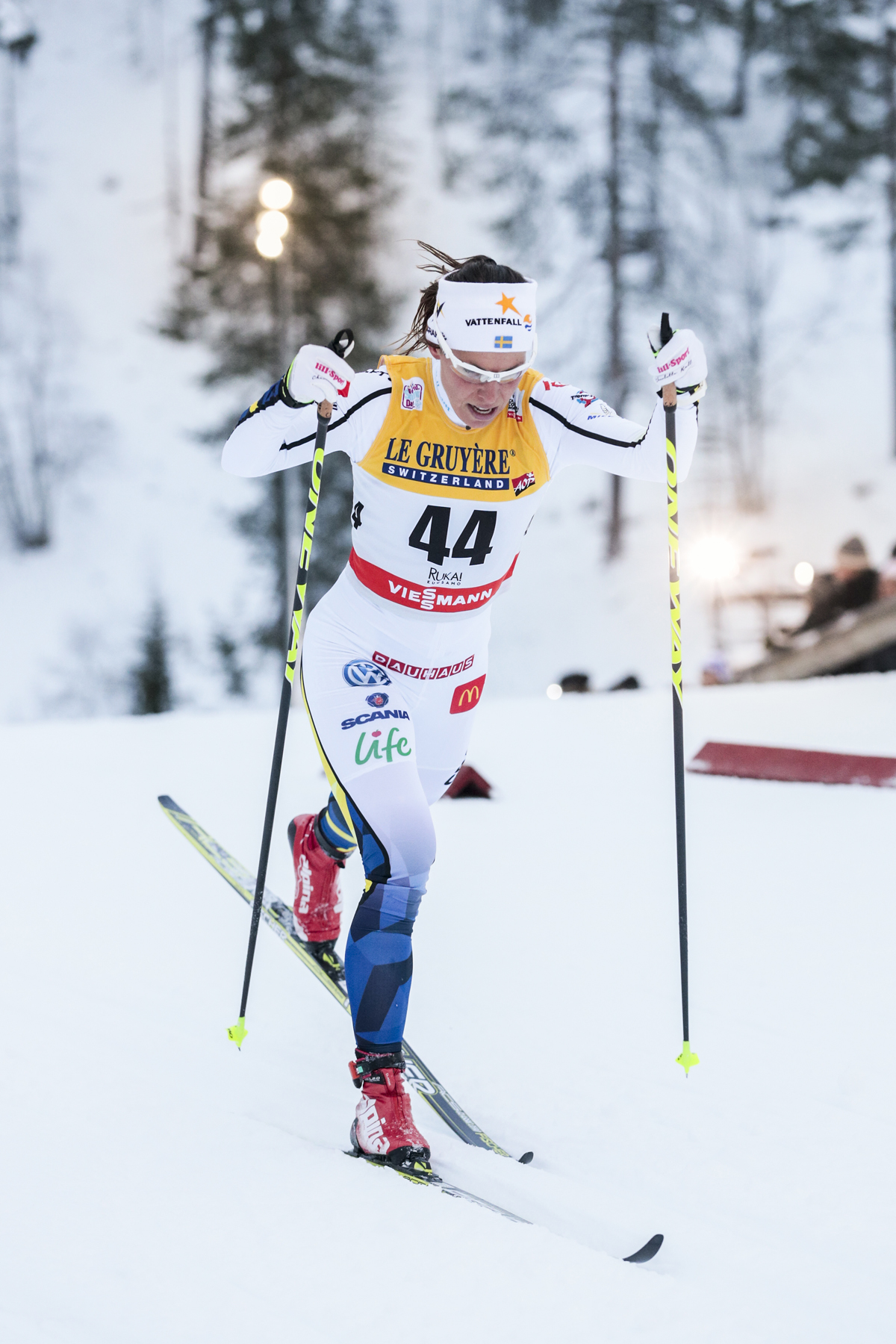
    Sweden’s Charlotte Kalla racing to second in the women’s 10 k classic at the Ruka Triple World Cup on Saturday in Kuusamo, Finland. (Photo: Fischer/Nordic Focus)

    By the first kilometer, Bjørgen in bib 30 (out of 89) was situated in third, 2.5 seconds back from the race leader at the time, Sweden’s Charlotte Kalla. In the next two kilometers, Bjørgen lost 8.6 seconds on Kalla, but surpassed Finland’s Aino-Kaisa Saarinen to move into second. Over the next 3 k, Bjørgen regained ground and began to close in. By the 6 k mark, she was but 0.6 seconds off of Kalla’s time and in another two kilometers, she was ahead by one second.

    Having overcome her initial discontent with the conditions, Bjørgen did not let off the brake, besting Kalla by 17 seconds at the finish and taking over the leader’s chair in 25:07.6. That result stood, and just 0.8 seconds out of second place, Norway’s Ingvild Flugstad Østberg stood on the final step of the podium in third place (+17.8).

    American Jessie Diggins, of the U.S. Ski Team (USST), placed 10th (+1:03.9) for her fourth-best result in a 10 k classic — her most recent being an eighth place in a classic mass start at last season’s Tour de Ski stage in Val di Fiemme, Italy.

    “I think this is probably the best I have ever done in Kuusamo,” Diggins said on the phone, referring to her performances in previous classic distance races there. In 2015, she finished 38th in the Ruka 10 k classic pursuit, and a year ago, she placed 13th in the Ruka 10 k classic.  

    “I usually try to come into the season really patient and work into it,” she continued “So it was a really nice surprise to feel pretty good today and fire up the engines, get that first distance race out of the way and remember how it feels to pace a 10 k.”

    She stayed within ten seconds of 10th place for most of the race, closing it down to 2 seconds with less than to 2 k to go before securing her final top-10 spot. While Diggins explained that many of the racers she saw on course appeared to have either no glide or no kick, she felt fortunate to have a decent balance of both.

    “I would ice up a little bit, but I could just run up the hills out of the track and then kick them really hard and they would clear up,” Diggins said. “So they stayed pretty fast, but with good kick as well, which was really really impressive. It could not have been easy to get the best of both worlds, so I am really, really grateful to those guys [our wax technicians].”

    Ahead of Diggins was Norway’s Heidi Weng in fourth (+34.0), Austria’s Teresa Stadlober in fifth (+36.4), Norway’s Ragnhild Haga in sixth (+38.2), Russian U23 (under-23) skier Natalia Nepryaeva in seventh (+42.8), Sweden’s Stina Nilsson  Friday’s classic sprint winner) in eighth (+46.1), and another U23 Russian, Anastasia Sedova in ninth (+53.4).

    Sargent placed 22nd (+1:21.9) for her best World Cup distance race result since 2014 and was the second fastest American woman of the day.

    “I haven’t scored distance points in a couple of years now, so it feels awesome to be back in the points, and I am really stoked to start the season out like this,” said Sargent, who’s been known for her sprinting results in Kuusamo (with a fifth place in its 2014 classic sprint and seventh place in 2015).

    “I was definitely a little conservative at the beginning, but I think the upside of that is not blowing up, especially for me being a little more sprint-based,” she explained. “It was exciting to be pushing and working my way through the race; moving up that way.”

    In the first kilometer, Sargent was positioned in 69th, 7.6 seconds away from 22nd. In the next 2 k, she moved up to 42nd, and by the halfway point she was in 33rd. Sargent continued to move up in rank, improving five more places by 6 k and moving into 24th with 2 k to go. By the finish, she had moved up to 22nd.

    “She just had an awesome pace out there,” U.S. Ski Team Women’s Head Coach Matt Whitcomb said on the phone after. “She started quite slow for the first 1.2 k. Something we talked about that has worked really well here, you go out too hard and you blow up, and you just bleed time throughout the race, or you go out conservatively see where the body is and figure out where you can put the pedal down. She skied a really patient race for the first two k and then was able to push the pedal and got a great response out of her body.”

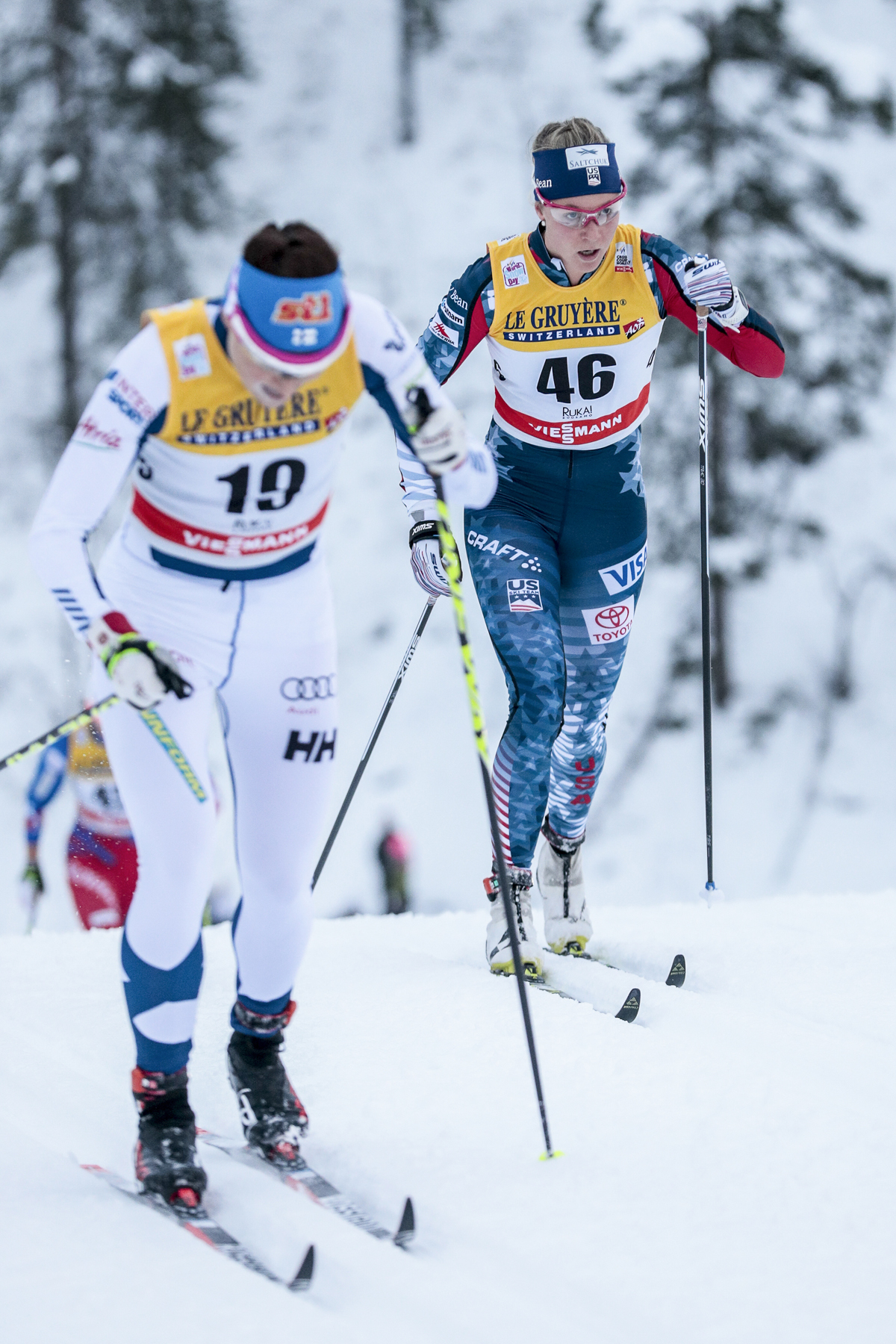
    American Sadie Bjornsen (46) chasing down Finland’s Aino-Kaisa Saarinen (19) during the women’s 10 k classic at the World Cup opener in Kuusamo, Finland. Bjornsen placed 23rd while Saarinen was 27th. (Photo: Fischer/Nordic Focus)

    Just 1 second behind Sargent was another USST member Sadie Bjornsen, coming off a career-best second place in Friday’s classic sprint, in 23rd (+1:23.4). While Bjornsen explained she had adequate recovery from the sprint, she had difficulty with her skis.

    “I worked really hard to calm all my excitement last night, and channel it towards today,” Bjornsen wrote in an email. “I woke up feeling recovered and ready to rally. … Unfortunately, I really struggled with skis today, and didn’t have the extra power to push through it. I was really proud for fighting hard, and pushing on like I was racing for a medal. What I have learned with classic skiing in this world of crazy conditions is that when the stars align, it can turn into an incredible day. But, it doesn’t happen every day, so no matter what, you have to be ready to seize every opportunity like it is your day. I am looking for more in my distance classic skiing of course, but the season is mighty long, I am happy with how I feel, so I know it will come this year.”

    In the standings, Bjornsen is now ranked 11th, behind Norway’s Haga and ahead of Sweden’s Anna Haag. Diggins is 16th with one race remaining: the women’s 10 k freestyle pursuit on Sunday.

    Finishing 6.2 seconds outside of the top 30 (and just 0.3 seconds out of 31st) was Rosie Brennan (USST) in 33rd (+1:47.7). Happy with her ski choice, Brennan used the conditions as an opportunity to test her race technique.

    “I decided to try a more aggressive pacing strategy today to ensure I could hold my technique together with such challenging conditions,” Brennan wrote in an email. “I think I over-paced as a result and should have started picking up the pace sooner than I did. This are all the things that take a few races to get back into the groove so I’m not too concerned with that. However, I felt good after picking up the pace so I think I am fit and ready more for.”

    Three places behind Brennan was another USST member, Sophie Caldwell (who finished eighth in Friday’s sprint) in 36th (+1:50.1).

    “This is a really tough course, so I tried to pace it well and take the first lap in control,” Caldwell wrote in an email. “I knew it would require some patience and tried not to panic if I didn’t feel perfect or my skis weren’t perfect in some places. I decided to go on wax and my skis were icing a bit over the tops of the hills, but I was able to ski off the accumulated snow and they felt fast for the downhills.”

    In addition to reaching the semifinals in Friday’s opening sprint, Caldwell started her World Cup season by racing to third in the sprint’s qualifying round.

    “Physically I felt pretty good today,” Caldwell wrote. “I was a little sore from the sprints yesterday, but I felt like I was able to recover enough to still have good energy and I was happy with the race. I felt like I skied the downhills well and definitely got a little tired going over the top of the massive uphill the second time, but was overall pleased with the race and think it was probably one of the best, if not the best distance race I’ve ever had in Kuusamo.”

    Nine American women raced Saturday’s 10 k, with Kikkan Randall (USST) finishing 48th (+2:14.5), Liz Stephen (USST) 58th (+2:26.3), Chelsea Holmes (Alaska Pacific University) 64th (+2:50.0), and Julia Kern (USST D-team) 74th (+3:19.2).

    Three Canadian women competed, with Emily Nishikawa (Canadian World Cup Team) leading them in 56th (+2:24.2), Cendrine Brown (National U25 Team) following in 76th (+3:23.6), and Dahria Beatty (World Cup Team) finishing 84th (+3:53.5).

    In Sunday’s 10 k freestyle pursuit, Kalla as the mini-tour leader will start 2 seconds ahead of Bjørgen in second and 12 seconds ahead of another Swede, Nilsson, in third. Østberg will start fourth, 20 seconds out of first, and Nepryaeva will head out fifth, three seconds after Østberg. Bjornsen in 11th will start 46 seconds back (and just 6 seconds out of seventh), and Diggins will start 1:04 back in 16th, 3 seconds behind Finland’s Kerttu Niskanen in 15th.

    Results: 10 k classic | Ruka Triple Standings (Day 2) |Pursuit start list

    — Ian Tovell and Harald Zimmer contributed
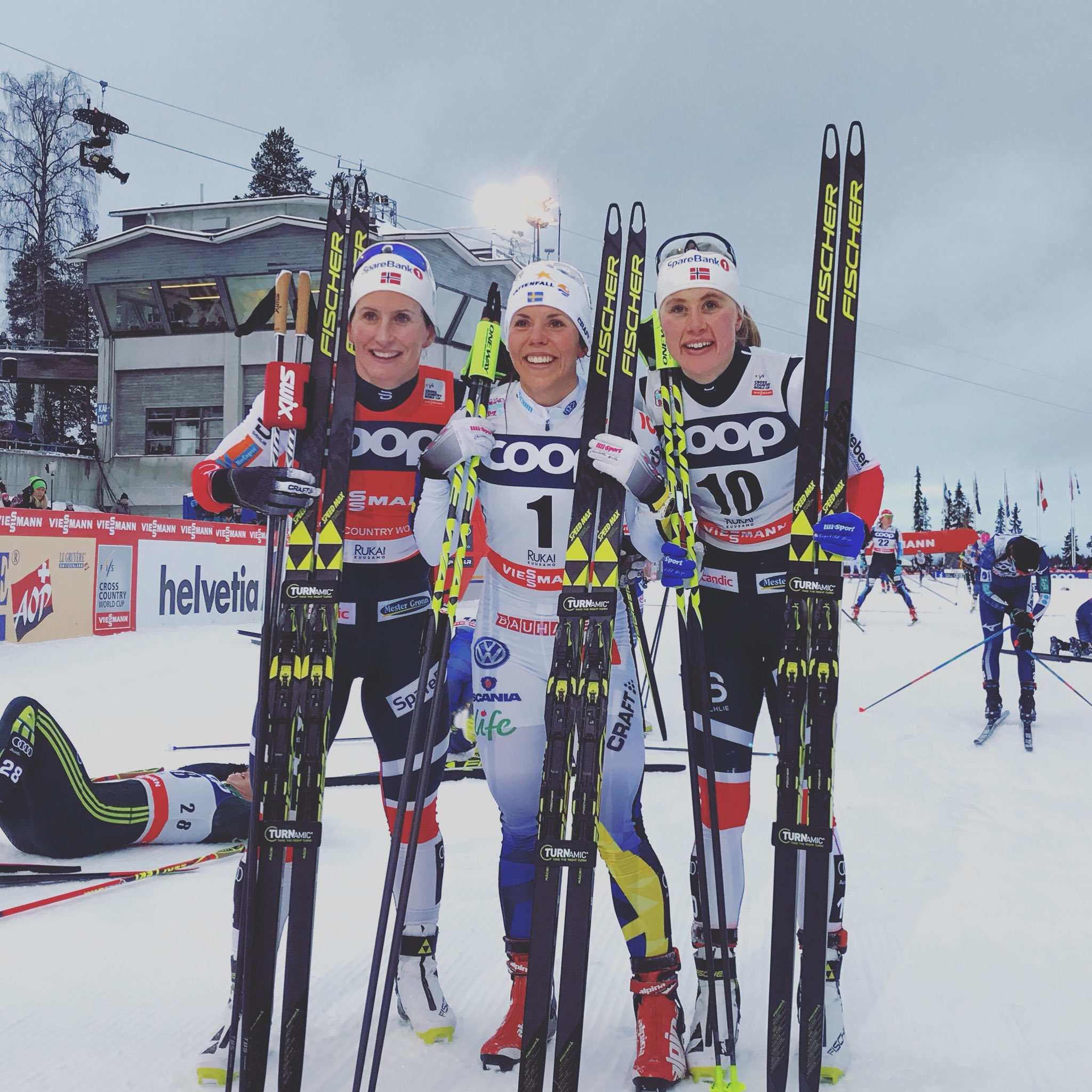
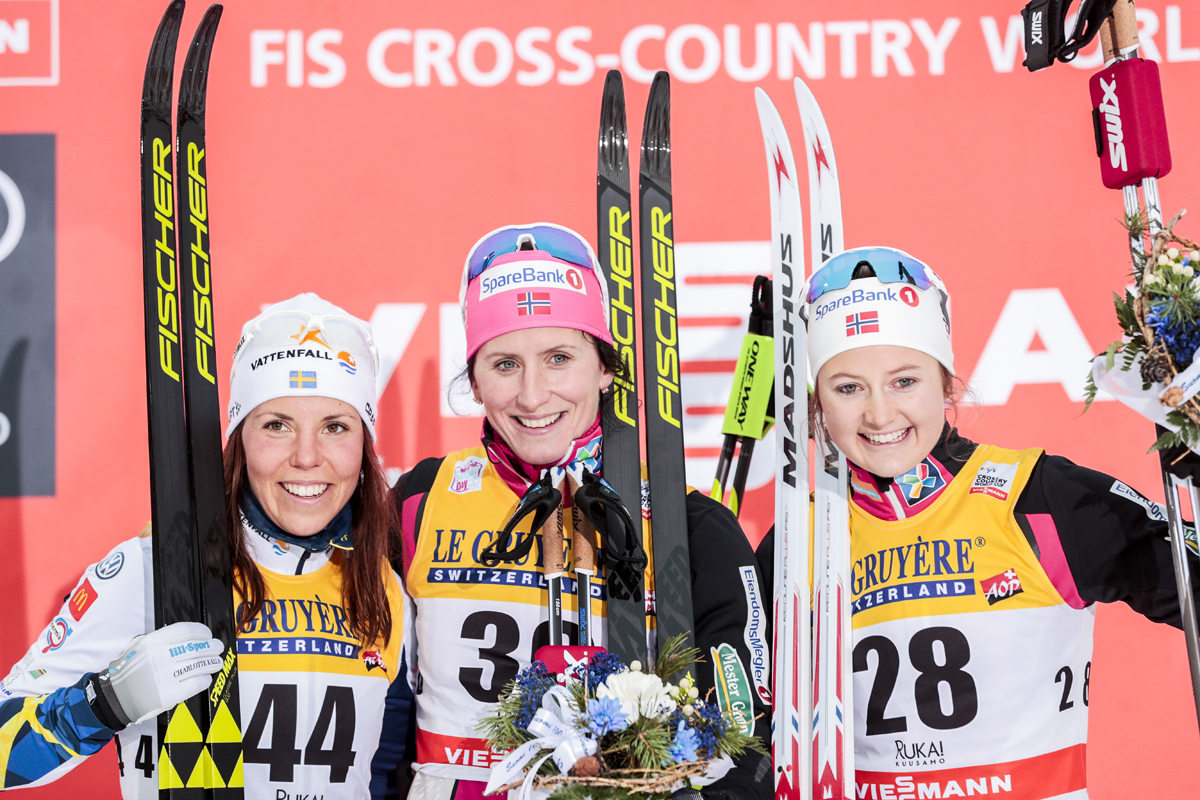
    The women’s 10 k classic podium on Saturday at the World Cup opening weekend in Kuusamo, Finland, with Norway’s Marit Bjørgen (c) in first, Sweden’s Charlotte Kalla (l) in second, and Norway’s Ingvild Flugstad Østberg (r) in third. (Photo: Fischer/Nordic Focus)