From the FasterSkier archive — posts syndicated from athletes’ and coaches’ own blogs between 2004 and 2012, kept online as published. Current coverage is at fasterskier.com.
Cold temperatures made it important to have the bases hard. We used Toko LF blue and XCold powder for our base layer covered with JetStream Blue 2.0 block. The XCold powder made a big difference in our testing.
Freestyle Sprint:
Fresh falling wet snow, Red 2.0 Powder won our test and put Caitlin on the podium.
— Report from Brian Gregg
(By the way, congratulations to Caitlin Gregg for qualifying to represent the US at the World Championships!)
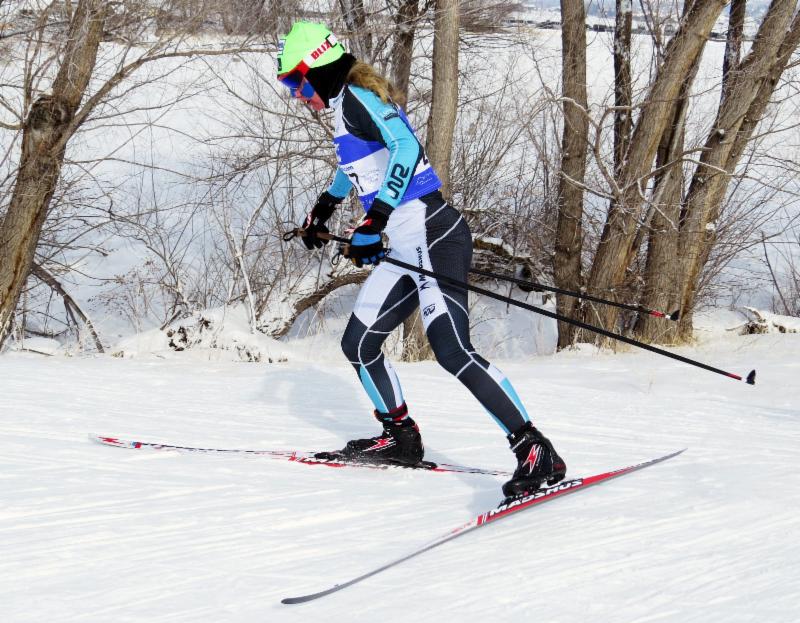
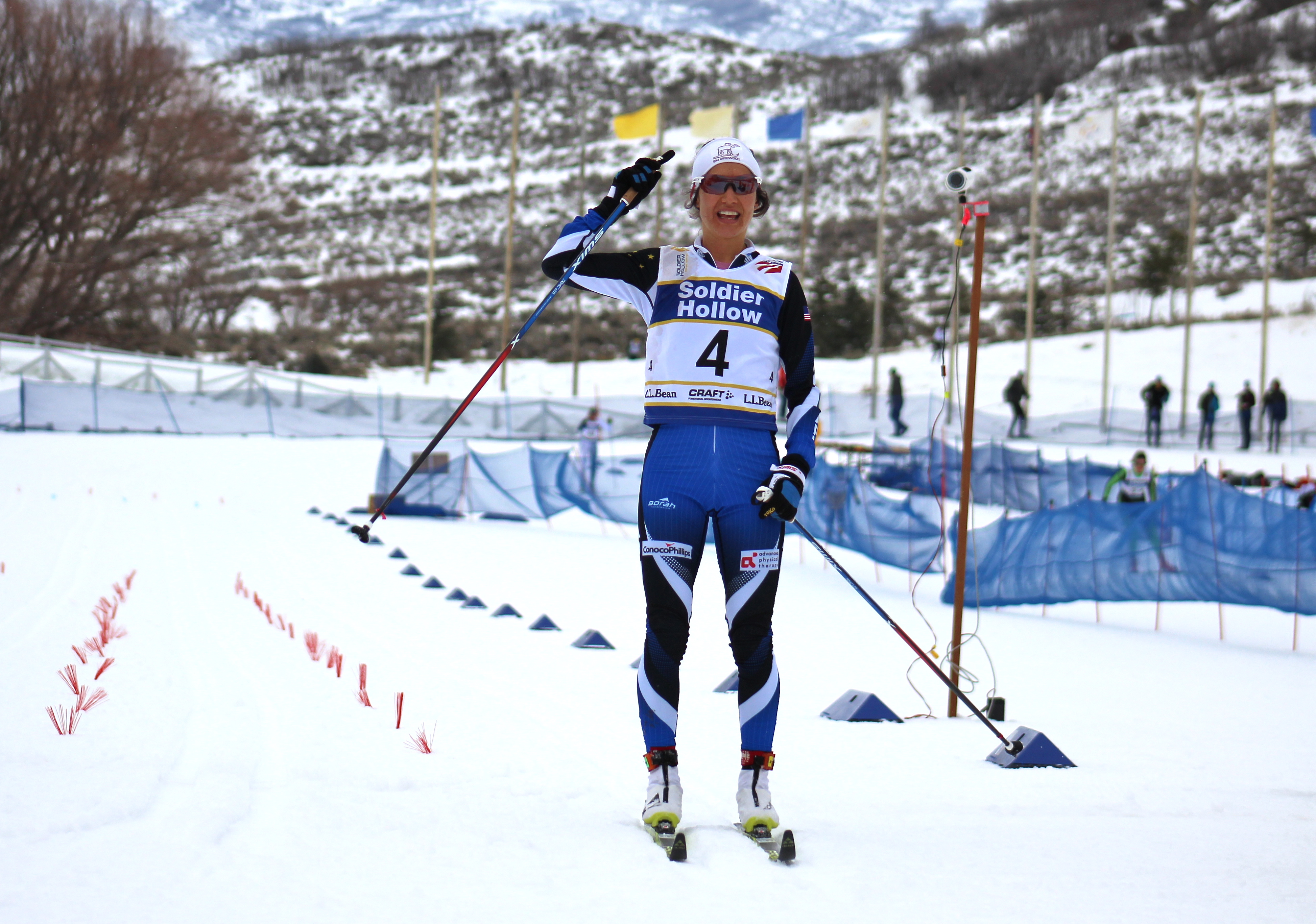
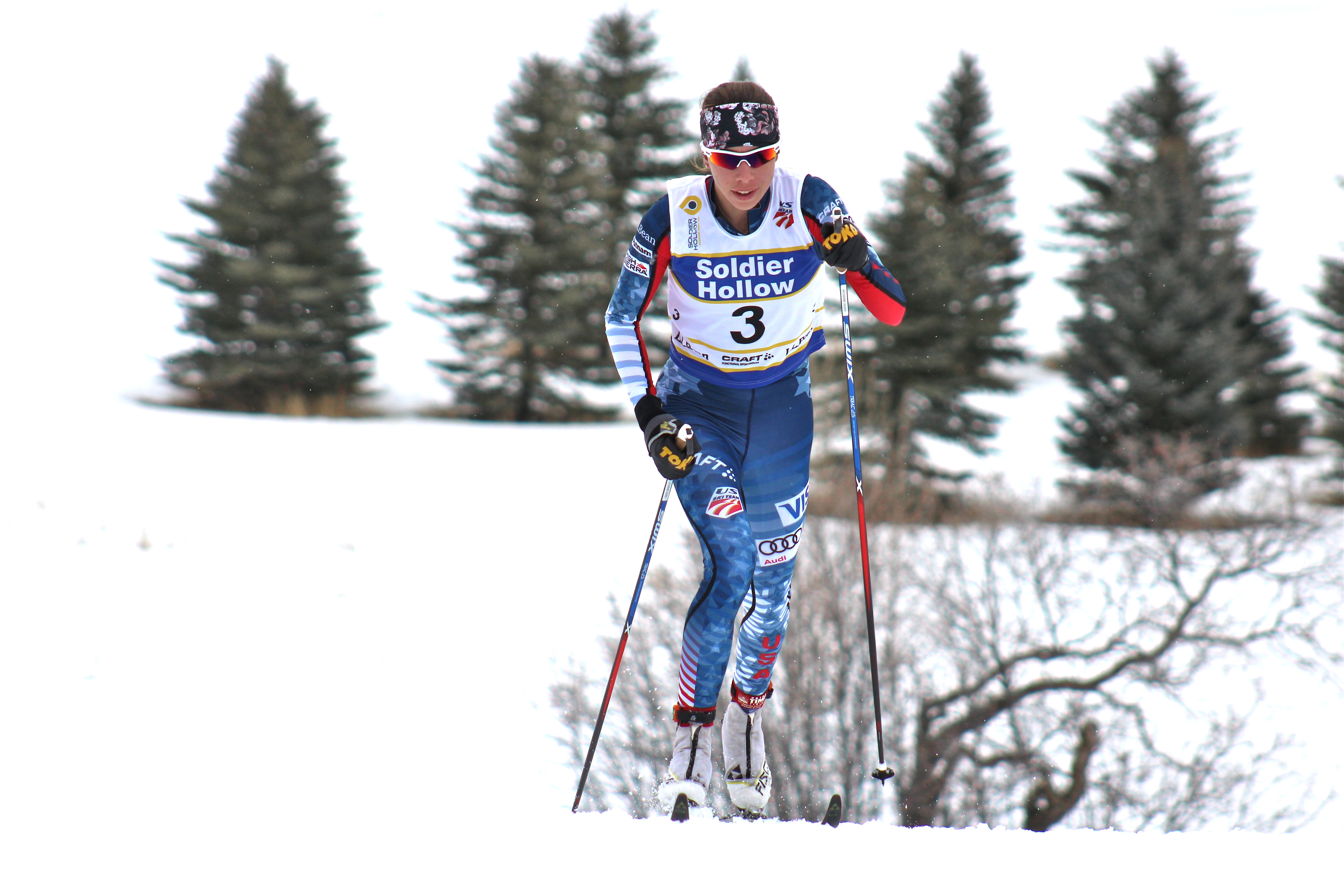
Caitlin Gregg on her way to her 8th US Cross Country Nationals victory
US Nationals Wax Report
The first races of the week, 10/15km skate distance races, brought us temperatures in the single digits and a 5km loop with some man-made and some natural snow. Many waxes were fast in the man-made so we made sure to test in the natural snow section to make sure nothing was a liability. Toko Blue 2.0 powder tested well for us, and for a topping we found JetStream Blue 2.0 block fleeced together with a cold liquid to be very fast, especially at speed.
The classic sprints on Day 2 was one of those days it seemed like snow conditions were changing every 20min. We had snow and rain swapping back and forth all day and athletes skiing hardwax, zeros, double poling, and by the end, klister skiing. We found Zeros to be very fast in the rounds, but it seemed like the guys with klister were able to run the hills a bit better. We had Toko JetStream Blue block mixed with JetStream Red block testing well for glide early in the morning on fresh snow in the mid 20’s, and by the end of the day we were on warm liquids.
For the 20/30km Classic mass starts we lucked out a little bit and had pretty stable klister skiing conditions all day on a man-made 3.7k loop. We powdered our skis with a Toko JetStream Red/Yellow mix, which felt really good, and by mid day we were adding Toko Helix Yellow as conditions got above freezing.
In the final race of the week, a skate sprint qualifier, a warm snow storm rolled in about an hour before the race, really slowing trail conditions down. The forecast called for this so we left off the black underlayer and based with Toko HF Red. The JetStream Red/Yellow powder mix again felt really good, but with such a short race, we opted for a block/liquid combo instead. Cole, Jack and Kelsey all skied well, getting themselves on the U23 Team!
— Chris Mallory, Sun Valley Gold Team Coach
(Congratulations to Cole Morgan for being named to the US World Championships team as well as World U23s!)
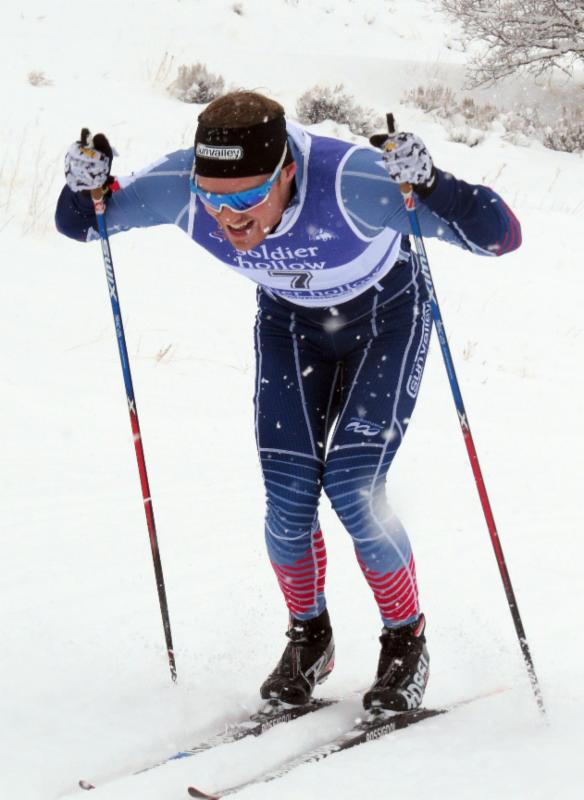
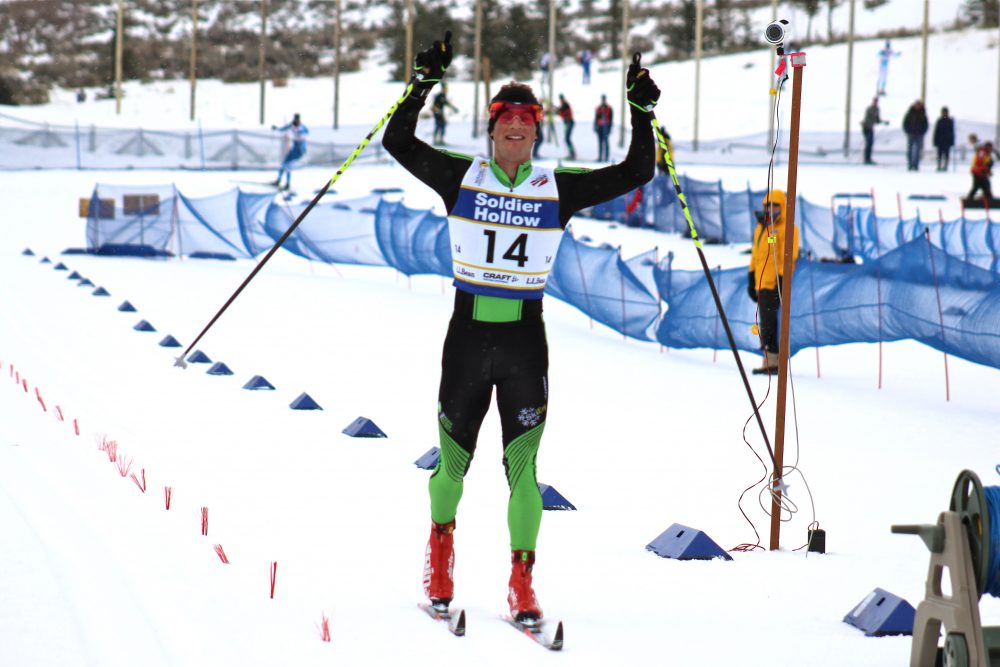
Cole Morgan on his way to qualifying for the US World Championship teams in U23 at Soldier Hollow, UT as well as Senior Elite in Lahti, Finland.
Wax Report from Eastern Cup Races in Waterville, ME
Saturday, Freestyle Sprint:
Conditions went from warm all week to single-digit temps the night before the race. The snow was icy and fast with a marginal amount of dirtiness. A skier in our group who attends Colby had been sending me photos all week showing some rocky and dirty snow but the organizers did a great job and things were very clean and beautiful on race day!
All skate skis were prepped with a very hard graphite underlayer from another brand and then received Toko HF Blue as the paraffin layer.
This combination was fast right out of the gate, and sped up even more significantly with a layer of HelX Blue for the qualifier. The skis also received a quick hand-corking of a block on just the tails of the skis which we felt improved top speed. I stuck to “cold” hand applications of everything due to the short nature of the race and because I was concerned that changing the already-fast nature of the graphite/HF Blue paraffin layer with too much heat from an iron or rotocork could slow things down in the cold snow.
Our skis were running well and we had a male and female Junior advancing to the Open heats which was great. We also had 3 more skiers in Junior heats so a long day was in store. Skis were a huge factor here, as stiff boards could really help a racer stay confident, balanced, and powerful on the fast icy snow.
With the help of some new matched test skis (thanks Rossignol and Skirack!) we were able to retest a lot going into the heats, but despite slightly warming temps the moisture content and consistency of the snow remained similar. The course ended with a fast downhill and long flat portion so we really went for top-speed and just hand-corked a layer of the morning’s block on all skis. We liked a 1mm structure that was half of a cross-hatch pattern (“Screw Left”). I applied the structure after the block was corked in, but before it was brushed out, to slightly dull the structure. Skiers advancing to further heats had a quick layer of block re-applied and brushed.
Skis were great and we had several breakthrough performances which really got momentum swinging for the next day!
Sunday, Classic Mass Start:
Very similar conditions with a frigid night and slightly warming daytime temps. Cold klisters were the name of the game, and durability was key. The night before all skis received a klister binder and an application of HelX Blue or HelX Red depending on start time. We knew from the day prior that the HelX would run well, and with almost 20 skiers to get klistered up on race day we wanted to make sure we had adequate time once things got rolling. Toko HF Blue was the paraffin on all skis.
We tested both blue and purple klisters from various brands in the morning, and Toko Blue klister was doing well although we ended up on a blue klister from one brand mixed together with a purple klister from another brand. Even as the sun warmed the spectators and coaches, the snow remained cold and this was the combination we stayed on from the first race at 9:30AM to the final race at 12:45PM.
Kick was fantastic and several more skiers had breakthrough performances! There were a few skiers who mentioned a little dragging, and if that was the case the skis received a dusting of Jetstream Blue Powder over the front of the kick zone.
Things really got going in the action of the day and I am disappointed that I neglected to test structure or even apply a structure that would’ve been a safe call like the Toko Blue Structurite the night before, or the pattern that had worked well the previous day. I think we generally do a good job with structure so this was a big mis-step on my part.
Waterville is a long drive for us, but the great atmosphere an strong results made for a very memorable weekend for MNC.
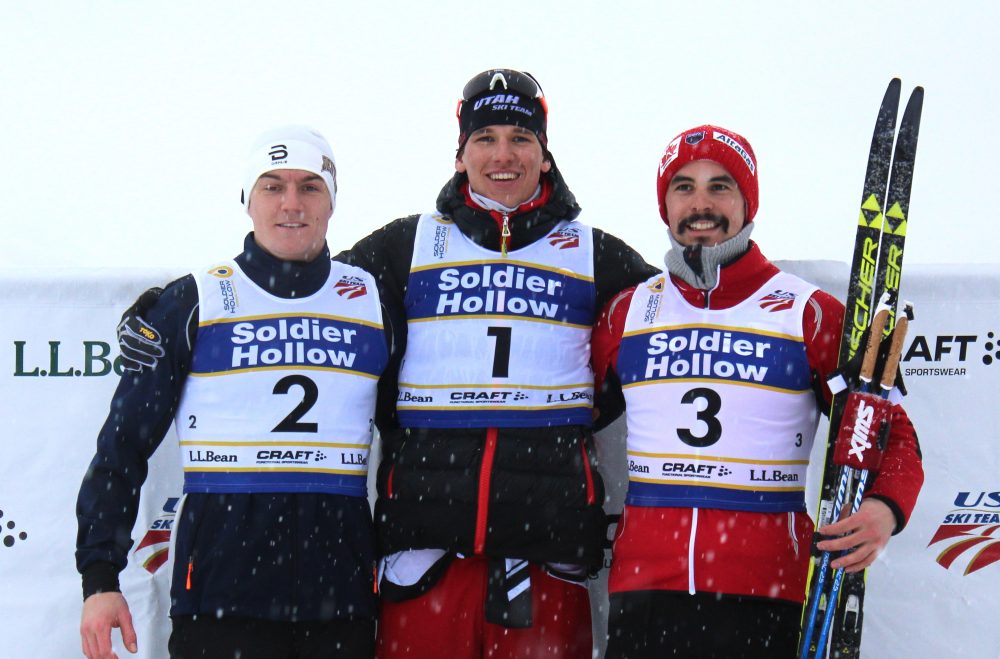
The men’s podium at Thursday’s freestyle sprint prologue at 2017 U.S. Cross Country Championships at Soldier Hollow, with (from left to right) Julien Locke (AWCA/NST U25 Team), Jess Cockney (Canadian World Cup B-team), and Knute Johnsgaard (AWCA/NST U25 Team).
MIDWAY, Utah. — Most were swallowed in seconds, the steady stream of snowflakes on Thursday serving a magician-like purpose: a curtain of snow through which the first five starters all appeared, only to disappear once again. All except one.
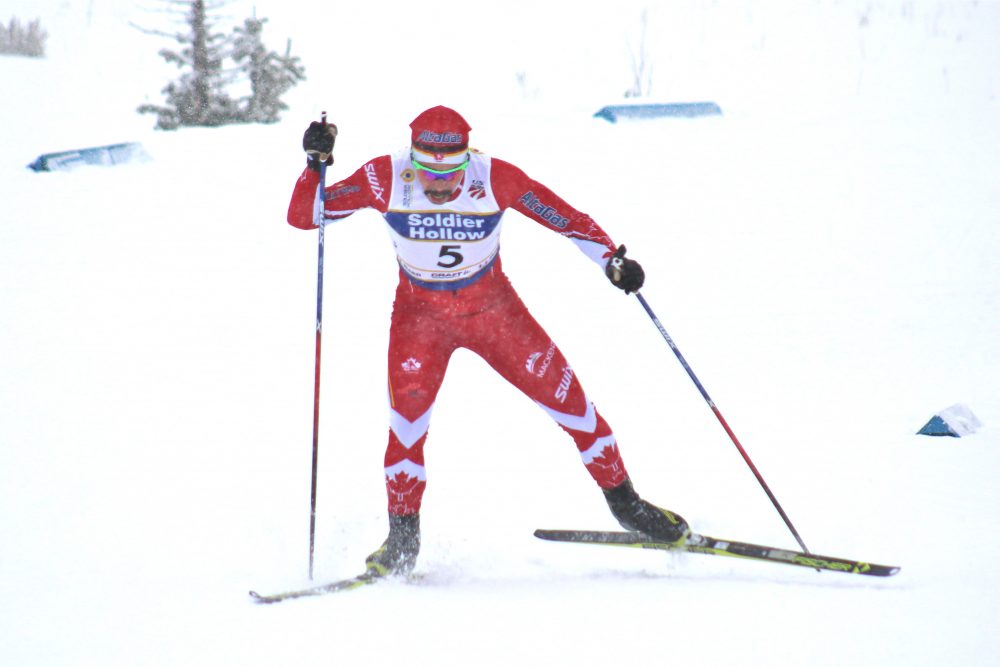
A speck of red bobbing through the Soldier Hollow’s (SoHo) new sprint course, sporting bib 5 and the Canadian national team suit, Jess Cockney did not go unseen.
The 27-year-old member of Canada’s World Cup B-team lost nothing to the freshly falling snow, posting the fastest course time as the fifth finisher through.
Jess Cockney of the Canadian World Cup B-team racing to the win in the men’s 1.5-kilometer freestyle sprint prologue on Thursday at U.S. nationals in Midway, Utah.
However, with more than 65 racers still looking to push past the start wand onto the 1.5-kilometer freestyle-sprint prologue loop at 2017 U.S. Cross Country Championships, Cockney had a wait before he had a win.
Starting seven bibs behind Cockney and 1 minute and 30 seconds after him, Julien Locke, of the Alberta World Cup Academy (AWCA) and Canadian U25 Team, headed out of the gate in bib 12.
The 23 year old was racing for the podium. After his classic sprint last Sunday ended in “disappointment”, Locke was ready for redemption.
“The plan for this week was to land on the podium,” Locke said during a post-race interview.
Locke hammered through the first undulating uphill leading out of the stadium, challenging the previous course leader’s pace. Looping through the first descent heading into the second major climb, he didn’t appear to be losing or gaining ground on Cockney.
However, rounding into the final finishing stretch, Locke was at a deficit. He finished 2.69 seconds behind Cockney’s prologue time, the closest any competitor would get for the remainder of the day.
Cockney’s prologue time of 3:15.20 minutes not only kept him in first place, but secured his spot at the upcoming World Championships in Lahti, Finland, starting late next month. With much at stake for many skiers heading to the start line of Thursday’s race — for Cockney, a chance at qualifying for his second World Championships — the Canadian sprinter indicated that staying confident gave him a leg up on his competitors.
Julien Locke (AWCA/Canadian U25 Team) racing to second in the men’s 1.5-kilometer freestyle sprint prologue on Thursday at U.S. nationals in Midway, Utah.
“Being on the start line is exactly the same as sitting down for a test,” Cockney said after. “You don’t really have to stress about it if you did all the preparation and you studied for it. Ski training is very similar to that.”
Cockney was joined on the U.S. nationals prologue podium (no sprint heats followed) by two fellow Canadians, Locke in second place and, (down to Locke by three-hundredths of a second) Knute Johnsgaard in third overall (+2.72).
Since Johnsgaard (also a member of the AWCA and Canadian U25 Team) was not pre-qualified for World Championships coming into this week’s competitions, Thursday’s prologue was his last shot at proving his deserved a team spot.
“I was fighting hard for the last couple spots [on the World Championships team],” Johnsgaard said Thursday. “I still don’t know [whether or not I’ve been selected].”
Regardless of whether Johnsgaard gets to sport the red maple leaf in Finland in late February/early March, he viewed the four days of racing at SoHo as valuable.
“It was a really great weekend to be able to have a bit deeper field than our usual domestic races in Canada,” Johnsgaard said. “Especially for the sprint heats, to be able to be going head to head with the fastest guys in North America and not just the fastest guys north of the border, it’s a really great experience and helps a lot.”
Knute Johnsgaard (AWCA/Canadian U25 Team) racing to third in the men’s 1.5-kilometer freestyle sprint prologue on Thursday at U.S. nationals in Midway, Utah.
While Americans dominated the NorAm opening weekend at Sovereign Lake, B.C., in December, Canada stuck it to its southern rivals on Thursday. If nothing else, it was confidence boosting with more than 600 racers coming out for the week’s races (although on Thursday, 71 started the senior men’s race).
“The field can be as deep as it is here, and you can still be confident that all the work you did to get to that start line is going to hopefully be better than anyone else’s,” Cockney said.
Though no American podium ceremony was held, the top Americans for the day were Logan Hanneman of Alaska Pacific University (APU) in fourth overall (+3.37), Cole Morgan of the Sun Valley Ski Education Foundation (SVSEF) Gold Team in sixth (+5.03) and his SVSEF teammate, John Hegman in seventh (+5.71). Both SVSEF Gold Team members also finished on Sunday’s American classic sprint podium.
Chelsea Holmes of Alaska Pacific University crossing the finish line first in the women’s 20-kilometer classic mass start on Tuesday at 2017 U.S. nationals in Midway, Utah.
MIDWAY, Utah. — As she headed up Soldier Hollow’s infamous Hermod’s Hill for her fifth and final time, there wasn’t another skier in sight. At least none of the ones she started with.
Chelsea Holmes, of Alaska Pacific University (APU), was fine with that. She never liked sprints to the finish, and on Tuesday, Holmes would have it her way.
Of course, there was still the possibility that she would slip and skid to a stop, or slow down drastically from a serious bonk. But those were all chances Holmes was willing to take. In the 29-year-old Alaskan’s mind, ski racing is about taking risks.
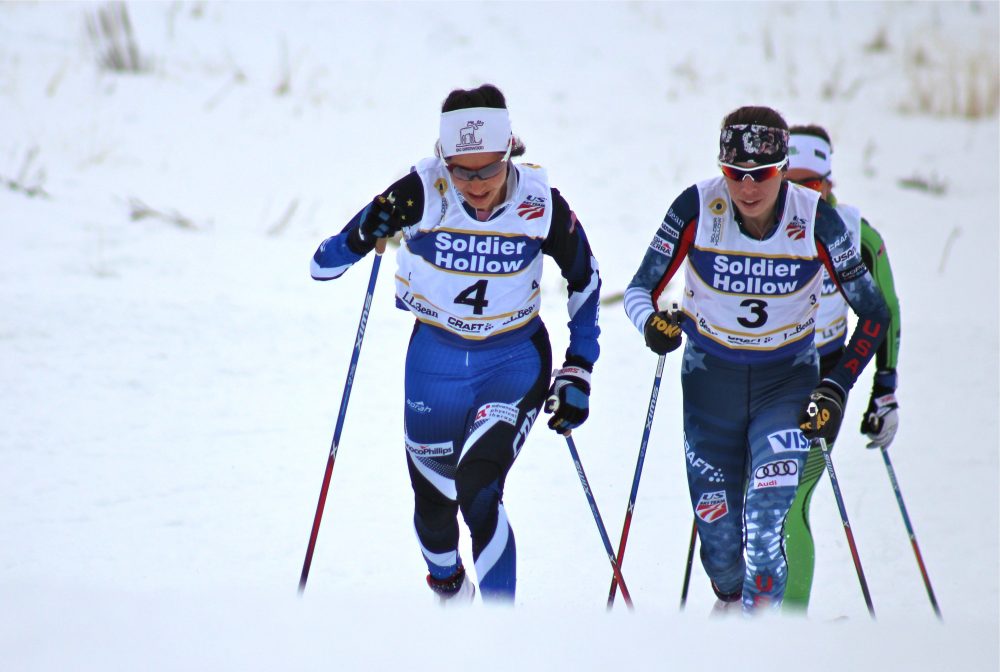
Chelsea Holmes (4) leads Katharine Ogden (3) and Caitlin Patterson during the women’s 20-kilometer classic masst start on Tuesday at U.S. nationals in Midway, Utah.
Tuesday’s 20-kilometer classic mass start was no different. Especially with it being the last distance event of the 2017 U.S. Cross Country Championships series.
“There are countless races that I’ve lead only to be passed and blown out in the last half kilometer,” Holmes said after Tuesday’s race. “But even those days, I don’t think I would do anything different other than say I should have gone harder, earlier. … I know that, more than anything, I will be disappointed if I don’t put it all out there.”
Go hard or go home it was, and within the first of five laps, Holmes was charging the front along with Katharine Ogden, of the Stratton Mountain School (SMS) and U.S. Ski Team Development Team, Caitlin Patterson, of the Craftsbury Green Racing Project (CGRP), and Erika Flowers (SMS Elite Team).
Hunting Holmes down in a chase group was her APU teammate Becca Rorabaugh — who place second in Sunday’s classic sprint and just off the podium in fourth in Saturday’s individual start — Liz Guiney (CRGP), Canada’s Dahria Beatty, and Anne Hart (SMS Elite Team).
As the squad of women in front descended back toward the lap lane, Holmes continued to work through the stadium’s flat section. Ogden did not. The 19 year-old was relaxed, following close to Holmes’s lead until the group made their way out into lap two.
Skiing under the bridge that spanned the course’s first major climb, Ogden strode to the right of Holmes, seeking the front spot for herself.
Katharine Ogden (Stratton Mountain School/USST D-Team) during the final lap of the women’s 20-kilometer classic mass start on Tuesday at U.S. nationals in Midway, Utah.
“KO is like me, she likes to push the pace,” Holmes said of Ogden. “Even though the stadium is not super-long, I could tell … I would get sucked back in. On the climbs, I felt myself breaking away.”
Though Holmes hadn’t necessarily peg-pointed a place on course to start her surge, by the end of Lap 2, she was feeling it. Climbing up the last hill before cornering back through stadium, it was only Ogden and Patterson who were able to hold onto Holmes.
“[Holmes and Ogden] have really amazing turnover on the uphills,” said Patterson, who strode roughly 10 meters behind the leaders on the hill. “It was sort of hard for me to ski relaxed and comfortable and follow them but, I was trying to follow them.”
Close to 25 seconds ticked by before the next group of women made their way up, including Rorabaugh, Hart, Flowers and APU’s Rosie Frankowski, who had maneuvered around three more skiers since the start — she started in bib 14 — and now sat in seventh.
Yet, as Patterson point out, with two laps to go, no podium or position was firmly in place. Especially at altitude, on a course that features some 700 meters of climbing, anything could happen. Patterson was predicting, or hoping, something would.
“I think your mind kind of naturally goes to like, ‘Ah, OK, here I am in third,’ ” said Patterson who had lost close to 30 second on the leaders by the end of Lap 3.
“But I was telling myself that it’s not over until it’s over,” she added. “People blow up and or get stronger again and with these big downhills and flats. You just never know what’s going to happen.”
Something did happen. Holmes hammered even harder.
Heading into her fourth lap, the Alaskan was bringing the hurt. Ogden, who had been fairly relaxed for three-fourths of the race, slowly faded from the APU suit’s sight.
“I was definitely chilling a little bit the first few laps,” Ogden explained. “Then [I] kind of died a little, actually a lot.”
Admittedly for Ogden, the race soon became about holding onto her spot rather than the finding first place position.
“I could tell that she was dropping me pretty hard,” Ogden added. “And I was just trying stay ahead of Caitlin [Patterson], to be honest.”
But Holmes hadn’t won yet. Even for a seriously adept climber, racing for the win is far from a glamour gig. It’s gritty. It’s grueling. But, according to Holmes, glamorous? Far from it.
“You hear stories about people feeling amazing, I don’t think I’ve ever felt that,” Holmes said. “If someone feels it’s easy, I don’t know I believe them.”
With one lap to go, the potential to bonk was still present. But botching the win because of that wasn’t what Holmes was worried about. For Holmes, it was whether she’d cross the line knowing she’d gone hard enough.
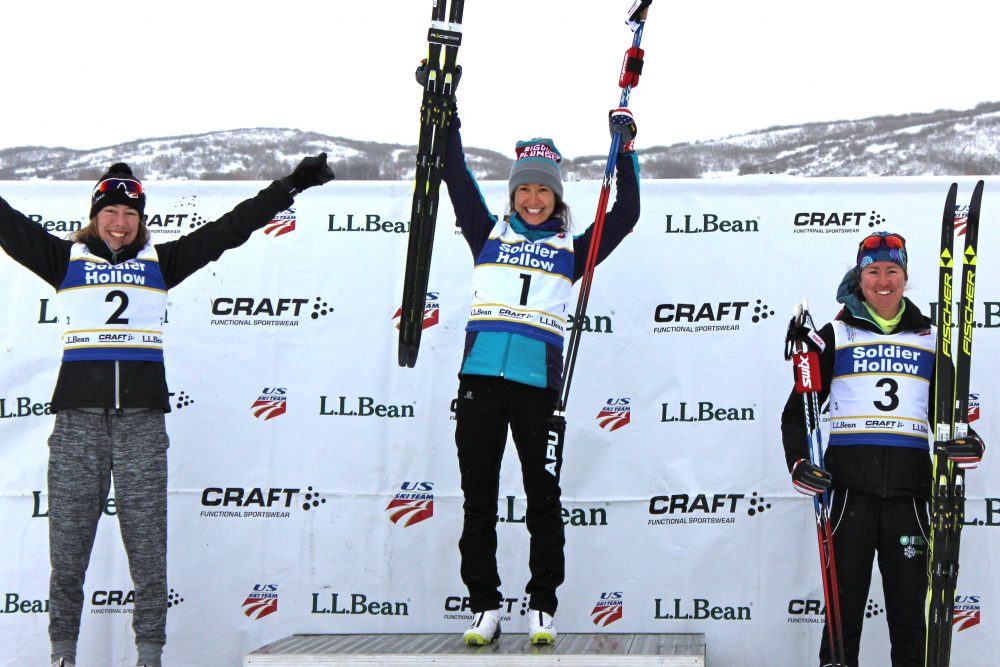
The women’s 20 k classic mass start podium on Tuesday at 2017 U.S. nationals at Soldier Hollow, with winner Chelsea Holmes (c), runner-up Katharine Ogden (l), and third-place finisher Caitlin Patterson.
“It’s a waste to think about that,” Holmes said of worrying about going too hard, too soon. “If I blow up, I blow up. I have to believe that I blow up less than everyone else.”
By the final 100 meters, with none of the skiers she had started with around, Holmes proved she wasted no time worrying about blowing up, crossing first for the win in time of 1:01:33.5 hours.
Taking second place, in her second 20 k ever, was Ogden, 49.2 seconds behind Holmes.
The final podium spot went to Patterson in third, (+1:10.4). Just missing the podium spot in was Frankowski in fourth (+2:13.9), while Canadian World Cup Team member Emily Nishikawa rounded out the top five in fifth overall (+2:26.6).
With the final U.S. nationals distance race done and just one race left, a freestyle sprint qualifier on Thursday, Holmes is happy to have taken the win for herself and for her APU team.
“Our techs, they work so hard…and the coaches,” Holmes said. “To do this for them, to give back to them, is amazing.”
Craftsbury Green Racing Project’s Ben Lustgarten on his way to winning the 30 k classic mass start at U.S. Cross Country Championships on Tuesday at Soldier Hollow in Midway, Utah.
MIDWAY, Utah — During the men’s 30-kilometer classic mass start on Tuesday at U.S. Cross Country Championships, the eastern slope of the Wasatch was wrapped in a blanket of snow that came periodically throughout the championship week. Beyond the white, race-time skies were slate gray, the leafless limbs of Soldier Hollow’s scrub oak the only sign that during spring and summer, this high-desert place could be verdant.
Green: the most impressionable color during eights laps of the men’s 30 k.
Scott Patterson (1) and Ben Lustgarten (14) leading Kris Freeman (9), and Brian Gregg (behind Patterson) during Tuesday’s 30 k classic mass start at 2017 U.S. nationals at Soldier Hollow in Midway, Utah.
For the first three of those laps, Ben Lustgarten of the Craftsbury Green Racing Project (CGRP), David Norris and Scott Patterson of Alaska Pacific University (APU), Brian Gregg (Team Gregg), and Kris Freeman (Team Freebird), and Canadian Knute Johnsgaard (Alberta World Cup Academy/National U25 Team) were off the front. The lead skier changed periodically, maybe a calculus of nobody wanting to work through the considerable wind, or a testament to the prowess of the group. For a time, no one seemed to dare expose themselves as not belonging.
In a classic race such as this when the kick is solid, the skis running speed smile-worthy, the fitness at an apex, there’s nothing else to do than eventually take a risk.
“I just went out easy, I wanted to stay near the front,” Lustgarten said about the first half of the race. “I didn’t want to lead as much as I did, because there was a pretty strong wind out there, so I was kind of going easy over the hills to let them catch me and stay behind them, tactically.”
For a time the 24-year-old Lustgarten said his nerves kept him from pushing the pace.
“I didn’t want to lead,” he added. “I know those guys would come in strong, I didn’t want to be too cocky, go out too fast and get caught, I really wanted to avoid that. Those guys are fast, I knew that any one of us could have won. I was nervous.”
The Burlington, Vt., native clad in a green-highlighted suit stole the 30 k classic show, winning in 1:21:06. Lap by lap, his performance became one of staying with the leaders to one of simply listening to his body and exploiting his good skis and eventually lighting out on his own.
Lap 6 was decisive.
“David Norris was kind of with me for a little bit, Lap 6, and I kinda gapped him a bit over some climbs, and I said, ‘You know what? I’m just gonna try to go for it, I’m feeling good, I don’t want to get it down to a sprint,’ and I just sent it.”
Norris hung on. Lustgarten’s move broke the others in the group but simply turned the screws slowly on Norris. At the start of the seventh lap, despite Lustgarten’s accelerations, Norris could be seen three meters arrears of Lustgarten.
Ben Lustgarten (14) celebrating his first career win at the domestic level with a national title in the men’s 30 k classic mass start on Tuesday at 2017 U.S. nationals at Soldier Hollow in Midway, Utah.
Come the eighth lap, it was Lustgarten’s race. Norris finished second, 37.5 seconds later, and Freeman placed third, 1:42.6 minutes behind Lustgarten. Patterson, Gregg and Johnsgaard finished in fourth (+1:55.4), fifth (+2:03.7) and sixth (+2:43.8), respectively.
“I was kinda struggling the first two laps,” Norris told FasterSkier after the race. “But my skis were really fast, and no kick, but I could run the hills and kinda keep catching back up on the downhills and flats, just with the speed of my skis. At that point, once the things kind of settled in, I was struggling on the hills, but my skis continued to be fast.”
Norris didn’t fold with less-than-ideal kick, but he had other ambitions.
“I was hoping to win. That was my goal,” Norris said. “I’ve been on the podium several times I was hoping this year was the year to finally win.”
In fact, if Las Vegas ran odds on distance classic events at U.S. nationals, Norris’s name would be a wise bet: Tuesday’s second place for Norris was his fifth national podium and his third in the 30 k classic.
At 36, Freeman remains a skiing force. But by the sixth lap, the four-time Olympian was 17 seconds behind Lustgarten, but still jousting with Patterson and Gregg. The trio remained together until the eighth lap when Freeman gambled.
“Scott just had great energy, his skis were really fast, but he was slick,” Freeman said of his podium-making move. “And then I was skiing with Brian, who also had really good kick and Scott who had terrible kick, so I actually tried to drop Brian on the second hill, which I saw him struggling on the last lap. And then I tried to drop Patterson on Hermod’s [hill] when he didn’t have any kick. I was suffering, and I was definitely strategizing. I was really glad that Patterson didn’t have any answer on Hermod’s, because my move was partially a bluff.”
The men’s 30 k classic mass start podium 2017 U.S. nationals on Tuesday at Soldier Hollow. From left to right: David Norris (APU) in second, Ben Lustgarten (CGRP) in first, and Kris Freeman (Team Freebird) in third.
Freeman’s bluff was just enough for third. The four time Olympian had his eyes set on 2017 World Championships beginning in late February in Lahti, Finland.
“The ultimate goal for my season this year was to race the 15 k at World Championships. You know, fourth and third at [this year’s] nationals, it’s going to be a real long shot to get selected for that,” Freeman said. “In that respect, I am disappointed. For how I felt in these races, I felt strong, I felt I skied well. I think the field is competitive, we’re definitely getting better as a nation. Still in it, I’ll be back next year and hopefully make the Olympic team.”
For as much as Freeman has been an icon on the U.S nordic ski scene and consistent podium threat, Lustgarten was a dark horse.
“It’s a surprise,” Lustgarten said of his win. Considering SuperTours, NorAms, and U.S. nationals, it was his first win. His first podium came last month at the SuperTour 15 k classic in West Yellowstone, Mont.
SoHo’s course is cut into an open side of a mountain, where much of the 30 k course was visible from a single vantage point. On this blustery, monochromatic day, it was all Green.
Left to right: University of Denver skier Moritz Madlener, University of Utah’s Kevin Bolger and Canada’s Jesse Cockney on top of the podium for the men’s 1.5-kilometer classic sprint on Sunday at U.S. nationals in Midway, Utah.
MIDWAY, Utah — Classic sprint day at U.S. Cross Country Championships. Nothing was simple. The 9:05 a.m. start time brought a daylong chess match for athletes and wax techs. Temperatures hovered near freezing all day — the entire spectrum of precipitation seemed to fall: drizzle, swollen wet snowflakes, and graupel.
One by one the big names set off at 15-second increments. There was Bend Endurance Academy’s Dakota Blackhorse-von Jess, then Reese Hanneman, of Alaska Pacific University (APU), followed by an elite list of North America’s best sprinters absent those few racing on the World Cup.
The men’s course featured three climbs, the last of which was positioned before a sweeping descent back into the stadium about 0.5 kilometers from the finish. Early on, even with the first few starters, it was evident on this hill that the chess match’s checkmate move pivoted on the wax.
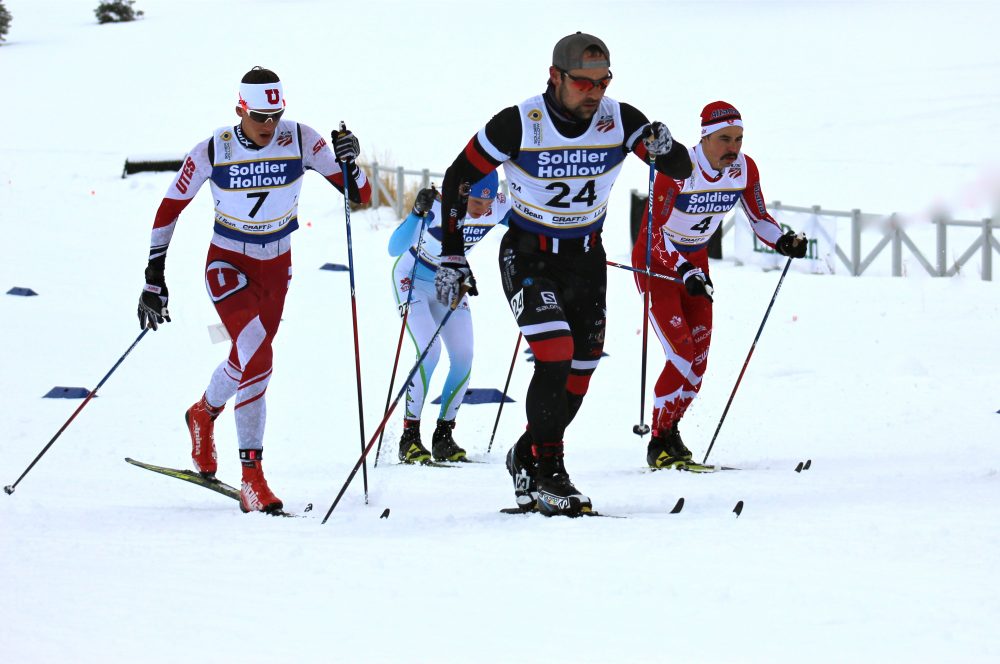
Dakota Blackhorse-von Jess (24) leads Kevin Bolger (7) and Jess Cockney (4) during the first quarterfinal of the men’s 1.5-kilometer classic sprint on Sunday at U.S. nationals in Midway, Utah.
Up that hill, some skiers strode, many slipped. Some athletes employed a herringbone-run mash up, some double poled on skate skis. Others suffered the indignity of balled up snow under foot and the awkward dance of shedding that snow and attempting to make forward progress.
APU Head Coach Erik Flora helped put the qualifier in perspective.
“This is the first time ever that I have been in a sprint race when we haven’t had any men in the heats,” Flora said about his men’s results. “And that’s the first time in ten years.”
For a club like APU, it’s clearly rare when a perfect storm impacts an entire men’s side.
“I don’t think it was one thing, it was a combination of a few things,” Flora said after the racing was completed. “We have a few guys that came in sick and that didn’t help. And we have a lot of guys that are seeded really high in the start list with points and if you look through the top 30, there’s a lot of unusual places.”
On many days, a high race seed correlates with good results.
“But sometimes there are those days when being in a certain place in a seed helps. I think for the leading men it was a disadvantage today,” Flora added.
Along with some recent sickness, the seeding and weather conditions, and skis that Flora noted weren’t “anything special”, APU’s qualifying positions portended a rough day for many.
Some athletes’ misfortune opened doors for others. No one kicked that door open with more force than University of Utah’s 23-year-old Kevin Bolger. He was the only American in the men’s final and won his first-career national title outright by winning the final over second-place skier Moritz Madlener (University of Denver), and Canadian national-team member Jess Cockney in third.
“100 percent. Absolutely,” Bolger said when asked if he was surprised by the end result. “Usually just qualifying for the heats is kind of my biggest goal. And today, I just, with the qualifying seventh I was in awe, actually.”
Bolger qualified seventh in 3:41.69, only a few seconds behind best qualifier, Ben Saxton of the Stratton Mountain School (SMS) Elite Team, who rounded the 1.5 k course in 3:38.35.
The Utah skier had a four-leaf-clover day. Bolger said his coach nailed the wax every round which complemented his fitness. In his quarterfinal, Blackhorse-von Jess set the tempo.
“I knew he was a good sprinter, I kind of look around in my heats before each, kind of see who I’m around, who I can play with,” Bolger said. “And I saw he was there, I knew he wanted to get to the final, so I was like, ‘He’s going to try and race well.’ And I got in behind him, he made a move and I stuck with him.”
On the back hill, where the skiers race up and away to the backside of the course, Blackhorse-von Jess played his hand.
“I think he got 10 meters off on me,” Bolger said of Blackhorse-von Jess’s stamp of authority.
But on the descent into the last kicker climb, Bolger’s skis were running.
“And my skis just – they glided right up to him,” Bolger described. “And I came up to that hill and they kept going, and I was like, ‘All right, I’m going to run up this sucker.’ And I went for it.”
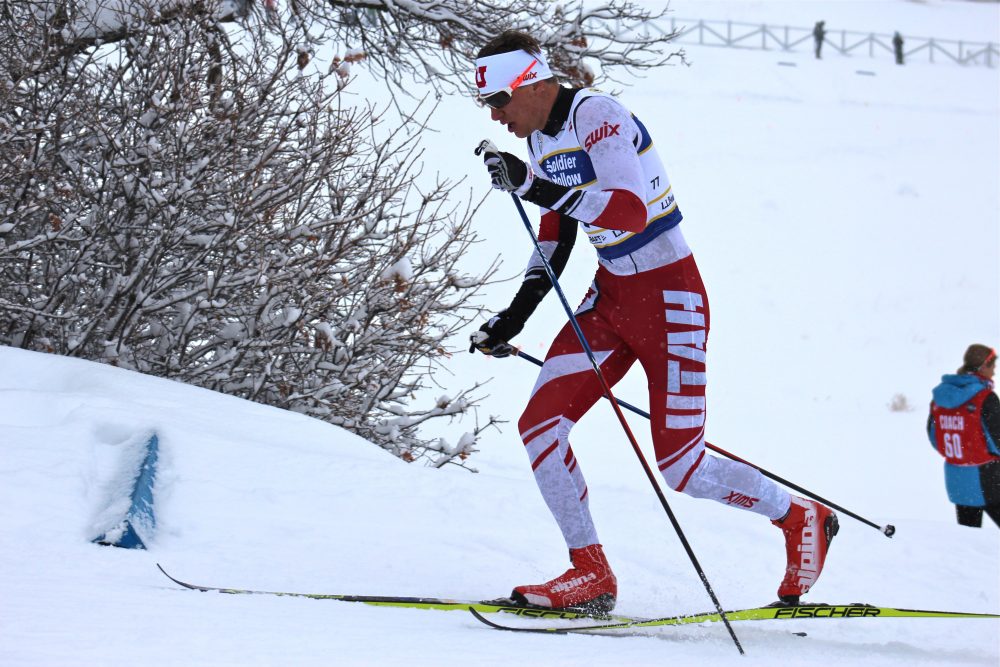
The University of Utah’s Kevin Bolger during the qualifier of the 1.5 k classic sprint on Sunday at U.S. nationals in Midway, Utah.
Now Bolger was off the front widening a small gap. Behind, it appeared Blackhorse-von Jess’s skis momentarily stalled out, resulting in a fall and snapped pole. Unaware of changing fortunes behind, Bolger cruised in. But he’d not simply cashed out, satisfied with a quarterfinal win. He banked some important knowledge. He wasn’t slipping on his skis when kicking at decisive moments.
“Knowing that I can charge up that [last] hill 100 percent and trust my skis, that’s huge, I think, in our sport,” Bolger said.
Luck struck again in his semifinal — Bolger placed fourth in a fast first semifinal; he was the second lucky loser, both of whom came from his semifinal.
In the final, Cockney made a bold move from the start, but the group behind yo-yoed, never losing significant contact. And on that same last hill, Bolger charged again.
“I was like, ‘OK, I think this is the time to go,’ ’cause I don’t have quite the turnover in my double pole,” Bolger said. “I know I’m big, strong and powerful, but the turnover I think isn’t quite there. So I thought that that was my time to go.”
Up and working over the top, Bolger was gone for his first national title.
“It kind of hit me like 10 meters from the finish that I was gonna win this sucker, and I was like, ‘Holy sh*t,’ ” he said.
Second-place finisher, 23-year-old Madlener is a student in the U.S. but grew up skiing in Germany. (It was Madlener’s second podium in as many races at senior nationals. He placed third in Saturday’s 15 k freestyle.)
Madlener is a multiple NCAA podium placer.
“I had second and third in NCAAs last year, and second the year before during my sophomore year,” Madlener explained in a post-race phone interview.
Although pleased with his podiums at Soldier Hollow this week, he explained his year-end goal remains winning an NCAA individual title.
“I want to win it at some point,” Madlener added. “This is my senior year, this year is it. I am aware it is difficult to win a race at NCAAs but that is my goal and of course to win again as a team, which I think we have a good chance to do.”
Madlener told FasterSkier he will not be pursuing a post-collegiate ski career and has accepted a job that will eventually base him in Salt Lake City after graduation.
The U.S. Podium
As part of U.S. nationals, a separate, U.S.-only podium is also recognized. Bolger still stood atop in first, 22-year-old Sun Valley Ski Education (SVSEF) Gold Team member Jack Hegman was second, and his teammate Cole Morgan, also 22, third.
Hegman and Morgan both skied in the second semifinal and neither advanced; Hegman finished third, Morgan fourth.
For Hegman, it’s his last year as a U23 so his main goal this week at nationals is qualifying for U23 World Championships.
“I’ve had two really solid races so far, so I’m pretty stoked on that,” Hegman told FasterSkier after the race, referring to Sunday’s classic sprint and Saturday’s 15 k skate. “Yesterday I ended up sixth, I think, fifth American, and second U23. So that was a really awesome race for me, I was pretty fired up.”
Double poling was Morgan’s golden ticket. He qualified fifth on skate skis.
“Then it started raining before the quarters,” Morgan explained. “I came out to do the warmup, and it was super icy when I warmed up, I was like, ‘Oh, I’m definitely going to double pole it again in the quarterfinal.’”
In the third quarterfinal, Morgan took second place to automatically advance.
Like Hegman, Morgan’s ride ended in the semis. But his goal of obtaining an U23 World Championship berth remains.
New names, emerging names, and some old ones: a crazy day in SoHo.
SuperTour skiers won’t be starting their season at the Rendezvous Ski Trails in West Yellowstone, Mont., this November. For the first time in the Yellowstone Ski Festival’s history, SuperTour races are not on the schedule. Citing altitude and frigid temperatures, the series is starting north in Bozeman, Mont.FasterSkier previously shared a press release from the U.S. Ski & Snowboard Association (USSA) giving the where and when of the 2016/2017 SuperTour schedule for high-level domestic racing. This article provides the why – why are the season’s first races not in West Yellowstone? Why are some U.S. SuperTour races in Canada? Why are U.S. nationals returning to Soldier Hollow after just two years away? And so on. FasterSkier spoke with various members of the American cross-country ski community to help get some answers about why the country’s top skiers will be going where when this winter.
Period One: Western Swing (but no West Yellowstone)
The single most noteworthy change to this year’s schedule may be the move away from West Yellowstone for the season’s opening races. Skiers have flocked to West Yellowstone in search of early-season snow, and often raced there, for a very long time. For how long? And why the change now?
As FasterSkier previously reported, elite skiers have made the Thanksgiving-week pilgrimage to West for nearly forty years: It was 1978 when the U.S. Ski Team held its first Fall Camp there, “with then-U.S. Ski Team coach Marty Hall and skiers like Bill Koch, Dan Simoneau and Tim Caldwell. Koch didn’t come too many years after because of exercise-induced asthma, which worsened with altitude.” People kept coming back. In 2004, Fall Camp, which had long since expanded to include a range of citizen skiers from around the country, was renamed the Yellowstone Ski Festival, with a full slate of clinics, demos, and a gear expo.
So why the change? Well, here’s another number from our article on the history of early-season skiing in West Yellowstone: “6,663: Elevation of West Yellowstone. The Rendezvous Ski Trails are about 6,800 feet above sea level (2,000 meters), and the South Plateau just outside the park is about 1,000 feet higher.”
The athletes have noticed. Bill Koch evidently noticed in the early 1980s. More recently, as Alaska Pacific University (APU) skier Reese Hanneman blogged in December 2015, “For as long as I have been racing, these first two weekends of elite racing have been held in the high mountain west, at illegally high altitude (according to FIS), which always makes them a little funky.”
USSA and club coaches noticed, too. As Robert Lazzaroni, USSA’s nordic domestic program director, explained in a phone interview, the impetus to move away from opening the season in West Yellowstone “came from the club coaches when we met in Craftsbury” following last season’s SuperTour Finals in March. The decision to move elsewhere was close to a consensus, Lazzaroni said: “It was very clear that the season starts too early. It’s too early – November 23rd – to start to chase points, when we want the athletes to peak at Nationals [in early January].”
West Yellowstone, known as “West” for short, is also at altitude, Lazzaroni noted. And finally, Lazzaroni made the uncontroversial observation that “West can be very cold.”
Putting all that together, he said, it just seemed like too much to ask of the athletes: “When you ask the athletes for the first race of the season to be at full speed, and to be fit, and in a cold place – it can be too much. And it puts their season in jeopardy. The risk was too big in their [the club coaches’] mind – too early, too high and the weather can be difficult. And that’s not good that early in the season.”
Hence the move from West in late November to Bozeman in early December: later, lower, and hopefully a little warmer.
So what will be left in West Yellowstone over Thanksgiving week, without elite athletes eyeing the competition, washing their hands, and chasing SuperTour points? Quite a bit, both USSA and West Yellowstone boosters agree.
As Lazzaroni noted, it was a “bummer” to lose the SuperTour component of the Yellowstone Ski Festival, but the festival “will continue. They will still have the junior race, they will still have the Masters race. It will just not be a SuperTour. … We believe a lot of the clubs will be there, training.”
Moira Dow seemed to agree. The program director of the Yellowstone Ski Festival, Dow said on the phone that she was “disappointed” to lose out on the opportunity to host the SuperTour races, but had no hard feelings toward USSA and appreciated the need to structure a race series to support athlete development.
“We understand that the athletes have to look out for the best of their development on the national stage,” Dow said. “While we recognize that, we are disappointed. We think that having the SuperTour held in a small town of West Yellowstone is fun and exciting. So we’re disappointed, but we understand the need.”
Dow admitted that the schedule change “was a surprise” to the organizers of the Yellowstone Ski Festival.
“Going into the [USSA] Congress [in mid-May] I thought it was still up for debate,” she said.
But given “the way it was presented at Congress,” Dow continued, “the athletes made their statement – I think the schedule was decided before Congress.”
Despite the surprise, Dow underscored that she had no hard feelings, and certainly did not view the schedule change as a personal attack on her or the festival. And she emphasized that everything that citizen skiers have come to expect from West Yellowstone in Thanksgiving week – clinics, demos, etc. – will still be there, including the races: “We’ll be holding just as many races, they just won’t be designated SuperTour” races, she said.
“SuperTours are not the most important part of our festival,” concluded an upbeat Dow. “We hope to see you in West Yellowstone.”
(So will the SuperTour return to West next year? The short answer is that likely nobody knows. In August 2015, quoting then-USSA nordic manager Joey Caterinichio, we reported, “West is the perennial host for Period I and could potentially rotate with Alaska, although, ‘there is no intention of changing West Yellowstone,’ according to Caterinichio.” That obviously didn’t last long. As Dow said when asked about her plans for November 2017, “we’re waiting to see – it changes from year to year.” She added, reflecting the development of this year’s schedule, “we find out in May what the athletes are looking to do to help put them on the national stage,” and then respond to that.)
An early December morning at the Sovereign Lake Nordic Centre in Vernon, B.C.
So the opening SuperTour weekend will be in Bozeman, Mont., starting with a skate sprint on Saturday, Dec. 3. A 10/15 kilometer classic individual start follows on Dec. 4. It will be a short week before athletes return to action with a classic sprint at Sovereign Lake in Vernon, British Columbia, on the evening of Friday, Dec. 9, with another short turnaround before 10/15 k skate interval starts the next day. (A relay that is not scored for SuperTour points will be held at the same venue on Sunday.)
If the move away from West Yellowstone was the first thing that struck many skiers about this year’s schedule, the move across the border was probably the second thing of note. The races in Silver Star will be a joint SuperTour/NorAm weekend (that is, they will be held together with the Canadian high-level domestic race series), an arrangement that has occurred in the past but not for some time. Ski representatives from both countries – which are identified as “children of a common mother” in the inscription on the Peace Arch at the border crossing between Blaine, Wash., and Surrey, B.C. – agree that the cooperation is welcome.
As Cross Country Canada (CCC) High Performance Director Tom Holland said on the phone earlier this summer, “We had a couple of phone meetings this year and there’s a willingness to work more together on a NorAm/SuperTour. Why not? To have more of these North-South relationships in the East and the West so people don’t have to travel so far. We’re sort of repeating history here. We’ve wanted to do this, but we did a lot of it in the ’90s, if you look at the results there were some great races back then. So it’s kind of a common-sense thing to have a North American race circuit where we compete against each other. We went down to West Yellowstone the last couple of years. It would be nice if there was more than that one weekend, but the U.S. has some other commitments in December. It would be nice if we had three or four weekends. The Euros ski more than us before Christmas, so the more we do the better.”
Holland continued, “We have those races every year anyway. It’s more about getting a high level of competition so we’re competing against the best in each nation and get warmed up for the season. There’s lots of examples of it working in the past, but it sort of faded as the SuperTour got stronger at one point. Anyway, we’re totally committed, and the U.S. is making a commitment, and we’re happy about U23/World Juniors being down there. So we’re going to do our trials down there. There’s a lot of cross-border stuff going on this year. I hope that sets a good tone for the future.”
Lazzaroni concurred, explaining that USSA wanted to hold consecutive race weekends relatively close together in order to make transportation somewhat easier. He also said they were pleased to combine with Canada in order to create a larger and more competitive field. Lazzaroni said that he hoped to have more joint SuperTour/NorAm weekends in the future.
Period Two: SoHo and Truckee
Athletes and coaches test skis in the stadium at Soldier Hollow in Midway, Utah, at 2014 U.S. Cross Country Championships.
Athletes will have nearly a month off before racing resumes with U.S. Cross Country Championships in January at Soldier Hollow in Midway, Utah. There is a 10/15 k skate individual start on Jan. 7, a full classic sprint the next day, and a 20/30 k classic mass start on Jan. 10. A qualification-only skate sprint event rounds out the week on Jan. 12.
U.S. nationals visited Soldier Hollow fairly recently. The races were held there in 2013 and 2014, before moving to Michigan’s Upper Peninsula for 2015 and 2016. The move back to Utah after only two years away is atypical.
The “main reason” for the quick return to Soldier Hollow, Lazzaroni said, “is because of World Juniors.”
The U23/Junior World Championships will be held at Soldier Hollow from Jan. 30 to Feb. 5, 2017, and will include roughly 750 athletes from dozens of nations. Some of those athletes will be junior and U23 skiers from the U.S., and Lazzaroni said that USSA wants to provide American skiers with a home-field advantage: “It was very important to us to bring the Championships back to the U.S., to show our commitment to FIS, and also to provide our athletes home-field advantage.” Lazzaroni explained that the best way to give American athletes this advantage was to give them an additional chance to race at Soldier Hollow in advance of the championships.
Therefore, Lazzaroni explained, USSA did not look back to the last time when U.S. nationals were held at Soldier Hollow in setting this year’s schedule. Rather, they looked forward, asking how best to prepare American athletes for Junior Worlds. And the answer was to let them race at Soldier Hollow in January before – for some skiers – racing there again in February.
But there will be something missing from this year’s edition of U.S. nationals: a national championship skate sprint. Instead, in the 2016/2017 season only, the national championship skate sprint will be held at the season-ending SuperTour Finals, as part of a race series colloquially known as Spring Series.
This schedule change, Lazzaroni explained, is due to the overall load on the Soldier Hollow volunteers and local community. It is “asking a lot of the venue” to hold both U.S. nationals and Junior Worlds at Soldier Hollow within the same month, Lazzaroni said. Among other inconveniences, he noted that there is an elementary school at Soldier Hollow, which also serves as the timing building and race headquarters, that has to be shut down when high-level races are held. Lazzaroni said that the local community was unable to commit to a full U.S. nationals schedule, including a full skate sprint day, on top of its other hosting obligations.
A quarterfinal in the freestyle sprint at 2013 U.S. nationals at Soldier Hollow in Midway, Utah. There will be no heats at this year’s national skate sprint; a qualification-only skate sprint will be held instead.The initial solution was just to take away the sprint race, moving U.S. nationals week from four races down to three. But, Lazzaroni said, this created a problem from the perspective of U.S. Ski Team Head Coach Chris Grover, who needs to oversee the selection of the U.S. team for the 2017 World Championships in Lahti, Finland, later this winter.
The races in Lahti include an individual skate sprint and a team classic sprint. The first half of the SuperTour schedule includes two classic sprints, but only one skate sprint.
The compromise, Lazzaroni explained, was a qualification-only skate sprint event at Soldier Hollow on Jan. 12. This was acceptable to Soldier Hollow event organizers and volunteers. And, Lazzaroni states, he feels that this “was a good compromise.” This way, “Grover can still have a qualification to make sure he has the best skiers to go to Lahti, and we don’t burn out the skiers and volunteers at Soldier Hollow.” The result will be a qualification-only skate sprint day, with no rounds contested. Results from the qualification will be used for purposes of qualifying for the U.S. World Championships team, but will not be scored for SuperTour points.
Following the skate-sprint qualification event, athletes have nine days off before racing on the Auburn, Calif., trail system in late January. A classic sprint will be held on Jan. 21, and a 5/10 k skate individual start on Jan. 22.
Period Three: Why not Ishpeming?
Roughly a month later, the SuperTour resumes with two races in Ishpeming, Mich., about 15 miles outside of Marquette on the state’s Upper Peninsula. There will be a skate sprint on Friday, Feb. 17, and a 5/10 k classic individual start on Sunday. (A 15/20 k mass start skate race, which will be a FIS-sanctioned collegiate race but will not be scored for SuperTour points, will be held on Saturday.) The race weekend will be held in conjunction with the NCAA Central Region Championships hosted by Northern Michigan University.
Al Quaal Recreation Area (Photo: Travelmarquettemichigan.com)The trails at Ishpeming’s Al Quaal Recreation Area last hosted a FIS event in February 2016. Before that, the previous and only entry for Ishpeming in the FIS results database is for a race weekend in February 1993. Suffice to say that it’s been a while.
So why Ishpeming? As Lazzaroni explained, repeating part of a reporter’s question, “You say, ‘Why Ishpeming?’ I would say, ‘Why not Ishpeming?’ ”
He said USSA attempts to rotate the SuperTour sites within the regions each year, and that this year the mid-season races are coming to the Midwest. It also recognized that the American Birkebeiner is held in the Midwest in late February, so there is an incentive to keep the SuperTour in the area. And Theodore Wirth Park in Minneapolis is undergoing construction work at present, and so was unable to host SuperTour races this year.
Lazzaroni explained that USSA was looking for a venue that could host SuperTour races for two weekends in a row, but was unable to find any venue that would take on this commitment. He said that they were pleased to get a taker for just one weekend in Ishpeming (population approximately 6,500), which has newly homologated trails and was eager to show them off. When the discussion was opened regarding bringing the SuperTour to the Midwest, Lazzaroni said, Ishpeming jumped on board.
“They have a long tradition of nordic skiing,” Lazzaroni noted, adding that Ishpeming was hosting cross-country races as early as 1905. The National Ski Association of America, a group that would later become the modern-day USSA, was founded in Ishpeming that same year.
Although last year’s Birkie was only scored for half SuperTour points, USSA has since revisited this assumption. At this year’s working group for the SuperTour schedule, Lazzaroni explained, they opened the question of whether the Birkie should count for full points or half points. Although some people had argued over the past few years that the Birkie should count for only half points, because it is often not a “normal” race distance, he clarified that the USSA Nordic Competition Guide makes “no mention that it should be half points.” Accordingly, USSA opted to follow the Comp Guide and restore the Birkie to full-points status.
Something less than a full SuperTour field typically races the Birkie; there were 17 American skiers with FIS points in the men’s elite race last year, and nine in the women’s.
Period Four: Spring Series in the Golden Heart City
A month after the Birkie, racers will travel north to end the season at Spring Series in Fairbanks, Alaska. Races will be held every other day over a week-long period from March 27 to April 2. A skiathlon, a skate sprint, a mixed club relay, and a 30/50 k mass start skate race are on the calendar. With a full skate sprint not being held at U.S. nationals in January, all events save the skiathlon will be national championship races.
Longtime Fairbanks race director John Estle is already excited. In an email to FasterSkier, Estle explained that the races will be held on a series of newly homologated and re-homologated courses at Fairbanks ski area Birch Hill. He noted that the new men’s sprint course will be “between 1500 and 1600m, which seems to be the preferred distance for sprint courses. Guys seem to like them to be about 3:30 in duration.” The women’s course will be “just a bit shorter than the men’s course.”
A 2012 photo from the trails at Birch Hill in Fairbanks, Alaska. (Photo: Lauren Fritz)After explaining the combinations of homologated loops that will be used for the various races, particularly the 30 and 50 k races on the last day of the season, Estle concluded, “The courses for those races will be quite challenging.”
Of the four races at Spring Series the skiathlon stands out, for its presence as well as its non-canonical distance. The suggestion on the official schedule that the distances will be 14 k for the women and 24 k for the men is apparently not quite accurate. Rather, Estle wrote, the distances will be 15 k and 22.5 k, respectively. “That is because we will have two homologated 3.75Km courses, one for the classic leg and one for the skating leg. Two laps of each course for women, three laps of each course for men” comes to 15 k and 22.5 k.
Estle is well aware that, at the Olympic Games or World Ski Championships level, women typically race a 15 k skiathlon and men a 30 k. “But most of the feedback I got from coaches and athletes was that at the end of a long, long World Cup season 30Km would just be too much,” Estle wrote. “At the World Cup finals in Canmore last year they did a 30Km skiathlon on a 3.75Km course and a large chunk of the field was pulled from the race (and hence the tour) after getting lapped. That was on a really tough course on a really warm day, but still. Those were damned good skiers, and they were completely shot at the end of that race.” So 15 k and 22.5 k it is.
A skiathlon, over any distance, is a rare event at the SuperTour level. Estle recalled hosting skiathlons in Fairbanks in both 2008 and 2009, but it is unclear whether they have occurred in this country at the highest levels of domestic competition since then. (The races are often entered in the FIS database as “pursuit” rather than “skiathlon” when they are held in this country, making it difficult to search for them. They are held more broadly at the high school and citizen racer levels.)
Skiathlons may be uncommon at this level of competition, but there seems to be widespread agreement that there should be more of them.
As Estle wrote, speaking as a race director, “One of the reasons that we are doing a skiathlon is that nobody ever does them in the US. … A skier’s first experience in a format contested at the World Championships should not be at those championships: Junior WC or U23 WC. If we are thinking about developing skiers who can compete at the highest levels, and coaches who can support them, then we need to make sure that our domestic schedule (FIS or otherwise) provides the types of experiences that will prepare them for the next highest levels of competition. Our skiers need a broad spectrum of experiences, and right now, because there are very few, if any, skiathlons on the domestic schedule, we are not preparing those skiers as well as we could or should.”
Lazzaroni sounded similar notes on behalf of USSA, saying that the skiathlon is contested at various international championships, and “why not prepare our athletes for that?” Echoing Estle, he noted that athletes reported back from the most recent World Junior Championships that they had never done a skiathlon before, “And that’s not right.” Lazzaroni said that he wouldn’t expect to see “many, many more [skiathlons] in the future” – but he added, “my vision is that, yes, we should train our skiers to be better at skiathlon, to be better prepared to do skiathlon.”
U.S. Ski Team Women’s Coach Matt Whitcomb was in complete accord, telling FasterSkier in a recent interview, “It’s often that at the junior and even U23 level when we go internationally, that we’re scrambling last-minute to find skiathlon boots, or to teach athletes how to load an exchange zone and what the rules are. So we’ll consider this just a quick dose of education for our entire community, and I think it’s going to have a big effect.”
The athletes seem to agree as well. Lex Treinen of APU, a top domestic athlete who has recorded SuperTour podiums but has not yet raced on the World Cup (which sees a handful of skiathlons each year), wrote in an email that he had done a skiathlon in Fairbanks some years ago – but that otherwise, “I have just done a couple at World Juniors and U23s.”
As Treinen explained, “Skiathlons are great and there is a good reason that they don’t do them very often on the Supertour: they are a pain in the ass logistically … for coaches and athletes and as the APU SuperTour team operates right now, we would not have the resources to wax for a skiathlon very effectively most of the season. Fairbanks will surely be an exception, since #1 it is closer to home and #2 it is Nationals which means there is a little bit of extra tech support from our team. Either way I don’t have a doubt that the fittest person will win this March and I really think it is a positive thing to be able to race some new formats. I am very excited that the Fairbanks organizers have decided to do something novel.”
Annie Pokorny, of the Sun Valley Ski Education Foundation (SVSEF) Gold Team, expressed similar sentiments. “The only skiathlons I’ve raced were at U23 World Champs, one in the Czech Republic and one in Italy,” Pokorny wrote in an email. “Despite my slim experience, however, I was incredibly excited to hear that USSA had integrated the skiathlon into domestic racing.”
Pokorny wrote that, “While it will certainly take some adjustment, I am always excited to see a diversified schedule on the SuperTour circuit. The more events we have, the more opportunities there are for varied competition and exposure to certain skills that our World Cup brethren see on a regular basis. Personally, the skiathlon is one of the most fun and exciting races I’ve ever entered. Having a switch in technique changes the rules of the game so there are more chances for comebacks than in a traditional mass start.”
When asked whether she was going to do anything special to prepare for this addition to the schedule, Pokorny wrote, “Few people know this, but in my first skiathlon I literally had the slowest transition time in the world, by many seconds. I don’t think I’ll need to change training much to be ready for the racing part, but it would be in my best interest to spend some time skiing while taking on and off my poles.” (Pokorny, who finished 29th in that race, is correct that her transition time ranked 48th out of 48 skiers.)
Looking to the future: Cross-country ski cross?
While this year’s SuperTour aims at selecting the U.S. team for Lahti and assigning start rights for upcoming World Cup events, USSA is also looking toward the future. And to hear Lazzaroni tell it, the future may involve cross-country ski cross.
Hannah Halvorsen (Far West/Sugar Bowl Academy) qualified 10th in the first-ever Cross-Country Cross event at the 2016 Youth Olympic Games in Lillehammer, Norway. (Photo: Far West/Facebook)“The cross-country cross has been a big success at the Youth Olympic Games in Lillehammer this winter,” he said. “It’s a format that the TV likes, the athletes like, that everybody likes. … I do hear from FIS that this is a format they want to push forward. We don’t know yet where it is going to go, but this is something we are keeping our eyes open [for], and I would not be surprised if you will see cross-country cross at some of the national events in the near future.”
Lazzaroni clarified that, by “near future,” he does not mean right away – “Obviously not next winter.” He added that this could become an important event to prepare U.S. athletes for larger stages: “Again, if this is going to be an event at World Juniors down the road – in two, three, four, five years, I don’t know – at Olympics, down the road – we should prepare our kids. And we have this discussion at Congress with the club coaches at a younger age, and we did encourage them to put some cross-country cross events at the local races. And again, the kids love it, because it’s fun. It’s working on agility, and it’s working on balance, and they become better skiers. It’s not now on the calendar, but I wouldn’t be surprised if in the near future we see more and more of this type of events.”