Another SuperTour season opened in West Yellowstone, Montana, one weekend later than usual this year but with a lot of the old standbys, including a twisty, technical freestyle sprint course and puzzling conditions for the classic distance race.
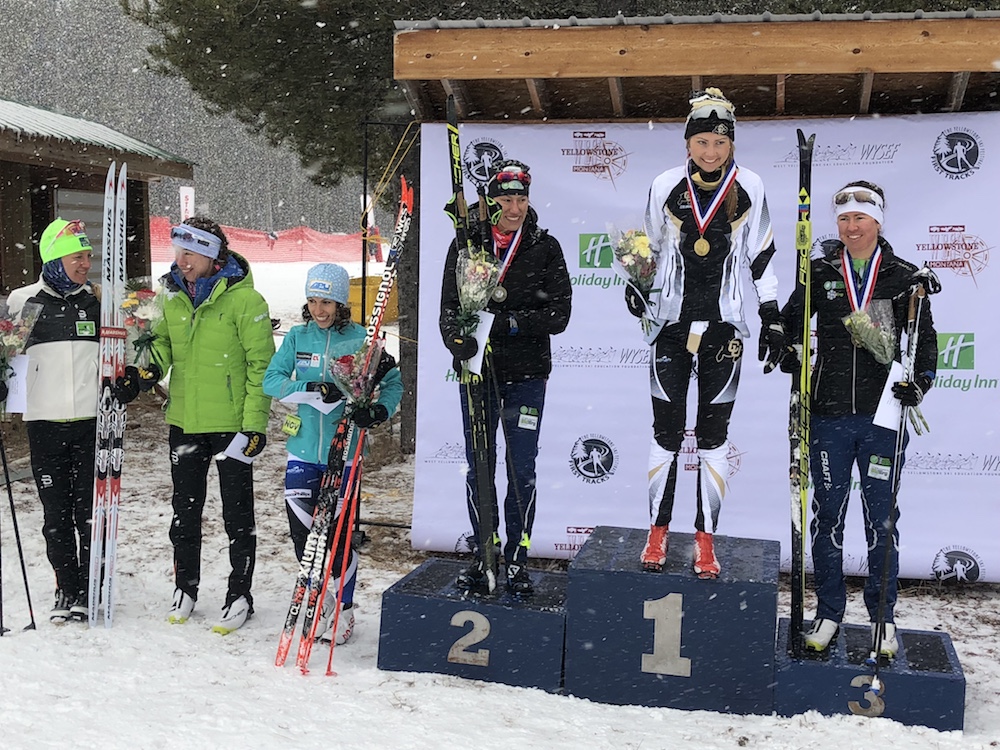
In a crash-marred women’s final on Saturday, Dec. 2, Anne Hart of the Stratton Mountain School (SMS) Elite Team avoided a tangle between Caitlin Gregg (Team Gregg) and Caitlin Patterson, of the Craftsbury Green Racing Project (CGRP), and skied to the win. According to Hart’s teammate, Erika Flowers, who also raced in the final, the two Caitlins collided in the final winding section before the last big uphill.
“They went down and some people were just ahead of them and were able to ski around,” Flowers said.
Hart was one of them.
“In my journal last night I actually had part of the course labeled ‘mushroom boost,’ which is right over the top of that last hill,” Hart said with a laugh in a post-race interview.
One of her goals for the day had been to save her “best burst for the end,” she continued. “So I was able to do my planned mushroom boost at the end, came across with the win and I couldn’t be more thrilled.”
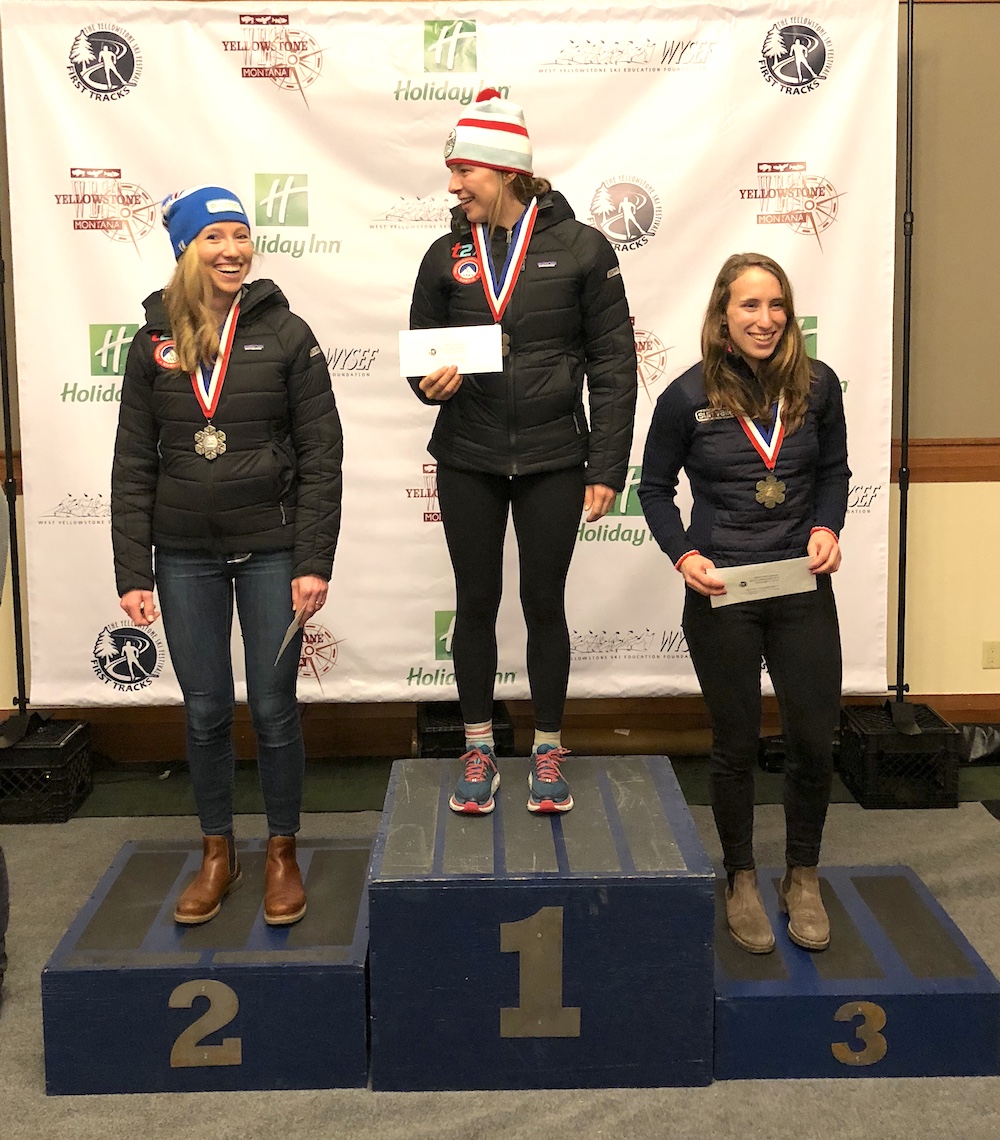
She won the women’s 1.5-kilometer freestyle sprint final in 2:52.49 minutes, just 0.88 seconds ahead of Flowers in second and 0.92 seconds ahead of Kelsey Phinney, of the Sun Valley Ski Education Foundation (SVSEF), in third.
Alaska Pacific University (APU) and U.S. Ski Team Development (“D”) Team member Hannah Halvorsen followed in fourth (+2.16), while Gregg finished fifth (+6.99) and Patterson was sixth (+7.22).
“I was fortunate not to go down,” Flowers said, “but I was stuck behind [the crash] so by the time I got kind of untangled from Caitlin Patterson, I was maybe 20 meters back from the group. I was feeling good and I really wanted to win today so I just hammered and was happy to sneak into second place at the end there.”
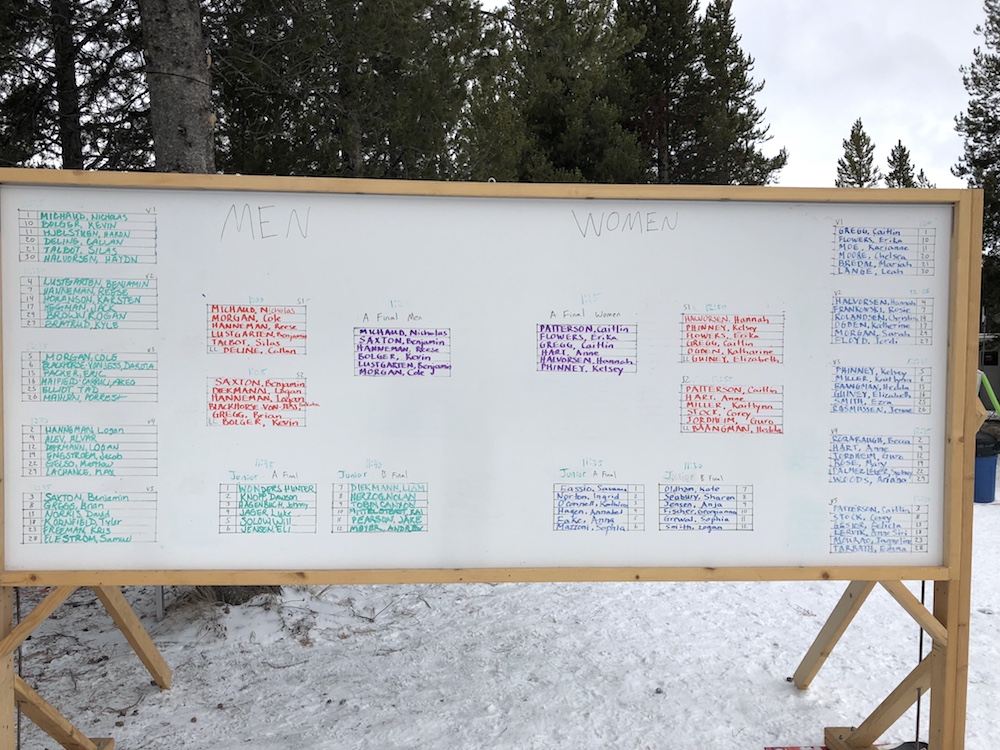
The sprint day began with Gregg winning the women’s qualifier in 2:50.79. Becca Rorabaugh (APU) qualified second (+2.7) and Patterson was the third-fastest qualifier (+3.0), ahead of Halvorsen in fourth (+5.64) and Phinney in fifth (+6.12). Hart qualified ninth (+8.98), just ahead of Flowers in 10th (+9.03) out of 58 in the women’s race.
“It’s a weird, fast and very tactical sprint course at high elevation,” Hart said of the Rendezvous Ski Trails’ race course some 6,800 feet above sea level. “So my qualifier wasn’t maybe exactly what I’d hoped but it wasn’t terrible, it wasn’t way off the mark, and I just tried to go through each round skiing in the front and in control. That didn’t happen in the final, but it turned out my being in the back and being sort of tactically aware allowed me to pass a crash.”
Hart won her quarterfinal and finished second to Patterson in their semifinal. Flowers won the other semifinal to advance to the final, and also won her quarterfinal. Phinney, who ultimately placed third, made it to the final as a lucky loser after finishing fourth in her semifinal, 1.88 seconds behind Flowers in first. Phinney had previously won her quarterfinal.
“You never really know what to expect for the first sprint of the season,” Phinney said. “I had a pretty good qualifier and then I led my quarterfinal and [that] ended up being the faster quarterfinal so I was feeling pretty good.”
Phinney’s winning quarterfinal time was more than 3.5 seconds faster than the winning times of the four other quarterfinals.
“The final was a little bit of mayhem,” Phinney added. “It was kind of just staying on your feet, being able to jump over people’s poles and hope for the best.”
While most of the top women planned to continue racing at the next SuperTour at the NorAm season-opener this weekend, Dec. 9-10, in Sovereign Lake (a.k.a. Silver Star), British Columbia, most are focused on U.S. Cross Country Championships from Jan. 3-8 in Anchorage, Alaska. And beyond that, some are hoping to get selected to the U.S. team for the 2018 Winter Olympics in PyeongChang, South Korea.
“I’d really like to win that skate race at U.S. nationals,” Flowers said. “That’s definitely been a goal of mine for the last few years and I haven’t made it happen yet, but I’ll definitely try this year.”
Michaud’s First Win
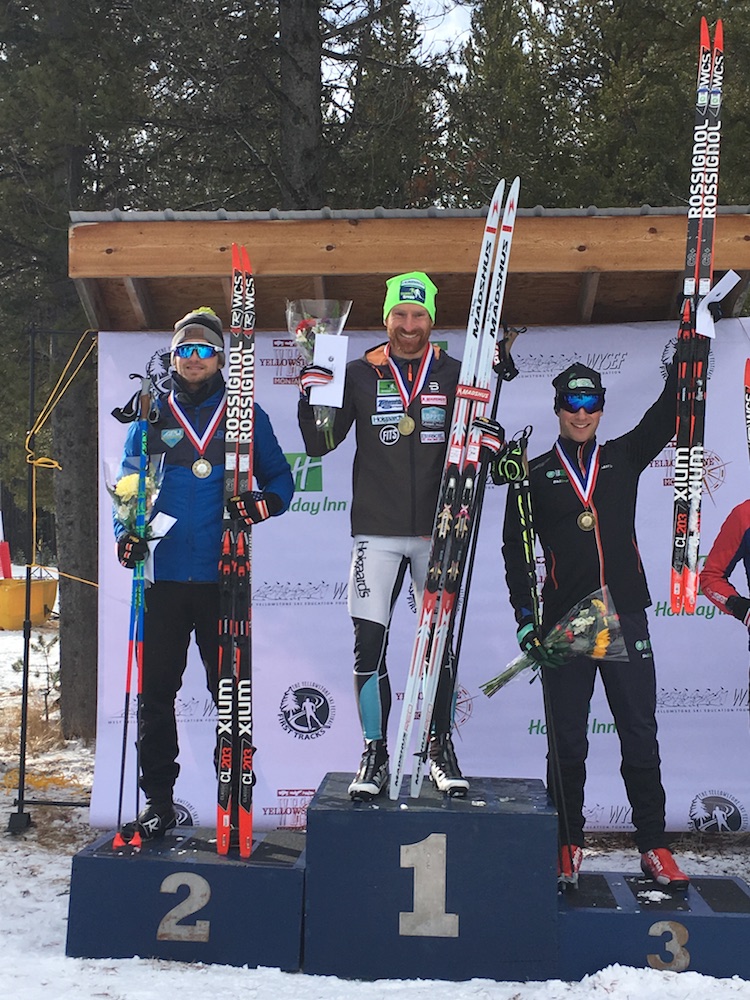
In the men’s 1.5 k skate sprint the same day, Nick Michaud of the Bridger Ski Foundation (BSF) won the qualifier and every heat thereafter to capture his first-career SuperTour win (and podium) with a winning final time of 2:30.69. He previously won the qualifying round in 2:29.5, just 0.08 seconds ahead of Logan Hanneman (APU) in second.
Ben Saxton (SMS Elite Team) qualified third (+0.63), Ben Lustgarten (CGRP) followed in fourth (+0.98) and Cole Morgan (SVSEF) was fifth (+1.3).
Michaud, a 25-year-old who has been jumping into SuperTours since 2010, then won his quarterfinal by 0.13 seconds over his BSF teammate Silas Talbot and his semifinal by just 0.05 seconds over Reese Hanneman (APU).
In the final, Michaud skated to a 0.17-second win over Lustgarten in second, while Reese Hanneman crossed the line in third (+0.84).
“It was just so fun,” Michaud said after. “Conditions were great. Everyone was out here. Great skis, great support; it was just so fun to race.”
Like many of his competitors, Michaud was looking for another standout result in the classic sprint at Sovereign Lake and had his sights set on U.S. nationals beyond that.
Hanneman had similar goals.
“The qualifying criteria for the sprint for the Olympics this year is just on the qualifier and obviously it’s a classic sprint at the Olympics so I think the classic sprints are going to be more important,” Hanneman said. “We have two classic sprints coming up between Silver Star next weekend and nationals in Anchorage [where both a skate sprint and classic sprint will be held] so I’m focusing on throwing down some good classic sprints.”
After qualifying in seventh then winning his quarterfinal and placing second to Michaud in his semifinal, Hanneman described the heats as “crazy fast.”
“This is probably the fastest I’ve ever seen it in West so that just means really high speeds and people weren’t really separating much, so you had to be really strong to make moves to pass people at those speeds,” Hanneman reflected. “In the final, everybody was just going for it, and I was able to find a hole and double pole by people going into that final hill there and kind of throw it down there. I burned up some of my matches trying to make that big move to go from the back of the pack into second so I faded a little bit in the final 100 meters, but other than that I was happy with it.”
Lustgarten, who advanced to the final after placing second in his quarterfinal and third in his semifinal (behind Michaud and Hanneman) described the rounds as “a bit sketchy with the corners. There’s a lot of turns out there; people trying to take insides, going out, going in,” he said.
“So that was pretty fun and also pretty sketchy and I just had to have really strong finishes because I kept getting boxed out in the back,” Lustgarten added. “But I managed to make my way through the pack on the hills.”
Also in the final, Kevin Bolger (SVSEF) finished fourth (+2.11), Saxton placed fifth (+2.86), and Morgan took sixth (+3.42).
Brian Gregg, Bångman Strike Late for Distance Win
On Day 2 of the SuperTour-opening weekend, racers faced freshly falling snow for the distance races: the women’s 10 k and men’s 15 k classic mass starts.
While a large group of men stuck together on the first of three laps, by Lap 2, the race leaders, including Brian Gregg, had started to break away. By the third and final time up Telemark Hill, the distance course’s signature climb, David Norris (APU) recalled that they were down to about eight.
“It was super snowy starting out,” Norris said. “… The pack actually ran really smooth. Every lap on Telemark, I think the pack got smaller. … [The last time up it] I led into Telemark, the big climb, and got to the top of there just with Lustgarten and Brian Gregg, and it was kind of a single-file drag race to the finish. On the last pitch, Brian got up next to me and just kind of pulled away a little bit into the finish.”
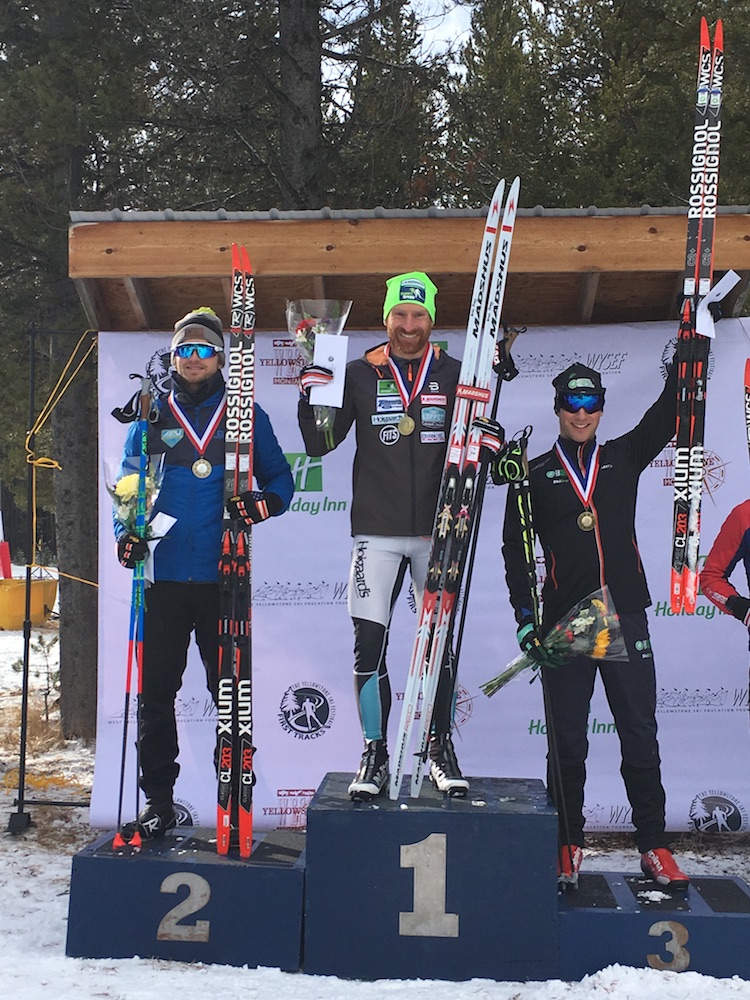
Gregg, of Team Gregg and Loppet Nordic Racing (LNR), captured the first SuperTour distance win of the season in 41:30.3, just 1.9 seconds ahead of Norris in second. Lustgarten notched his second-straight podium in third place (+4.6), while Kyle Bratrud (CXC Team) finished fourth (+10.9) and Kris Freeman (Caldwell Sport) was fifth (+12.6).
Tad Elliott (Ski & Snowboard Club Vail) followed in sixth, Eric Packer (APU) was seventh, Ian Torchia, of Northern Michigan University (NMU) and the USST D-Team, was eighth, Hunter Wonders (APU) ninth, and Martin Bergström (University of Utah Ski) 10th.
Gregg explained that after some pre-race deliberation, he chose to ski on zeros to ensure he had enough kick and avoid icing on the bottom. He was happy with his decision and noted that the he had waxing help from a group composed of several Midwest teams, including LNR, NMU and Central Cross Country (CXC).
“Our [lead] group of skiers out there all had really good skis so that was really fun,” Gregg said. “It was kind of a tactical race in the sense that it was really hard, like, [you’d] maybe get a little gap on the climbs, but then everybody would bunch back together, so I just tried to conserve energy and really focus on the last kilometer or two kilometers.”
When Norris attacked on Telemark Hill, Gregg said he followed Norris and Lustgarten over the top.
“… I was last, then we came in and I just had a little bit more in the end,” he said. “I was really happy with that. I haven’t won a classic SuperTour race since my first SuperTour win in 2010 so there was a few years in between there, but I’ll take it.”
Gregg, 33, is a 2014 Olympian, who, like his wife (2010 Olympian) Caitlin Gregg, is looking to qualify for a second Olympics this season in PyeongChang. He was pleased with his tactics on Day 2 in West Yellowstone after finding himself too far behind on the sprint’s last climb to contend (he made it to the semifinals and finished ninth overall in the sprint).
As for Sunday’s distance race, in which Gregg conserved his energy and struck at the right moment, Gregg said he learned from others, too.
“It’s fun to see other skiers — Tad Elliott is a really good tactician out there so I actually skied a lot with him watching where he’d spend the energy to move up in the pack and where he was just sort of relaxing,” Gregg said.
“It was definitely faster to be in the draft behind people so the leaders were kind of at a disadvantage,” Lustgarten observed after. “I was kind of mixing it up in the top 20 for the first two laps, and it felt pretty chill, but this is the kind of course where it can go from easy to hard in, like, 50 meters.”
He explained that Rogan Brown (SVSEF) led for most of the second lap. Brown ultimately tied Adam Martin (CGRP) for 11th place (+28.6).
“On the third lap I took the lead to do some work myself and then kind of was stuck in the lead unfortunately for most of the lap,” Lustgarten said. “It went from going to pretty easy to really hard in about a k.”
While he responded to Norris’s attack on Telemark Hill, he couldn’t match Gregg in the meters that followed.
“Brian Gregg came out of nowhere and I thought I could kind of sneak into second but I just didn’t have it today,” Lustgarten said. “That’s what I want to do with the race. He did it right. I think the best way to do it was to sit in the pack, kind of play the field, see how everyone goes, and just hammer the finish. He did really well today.”
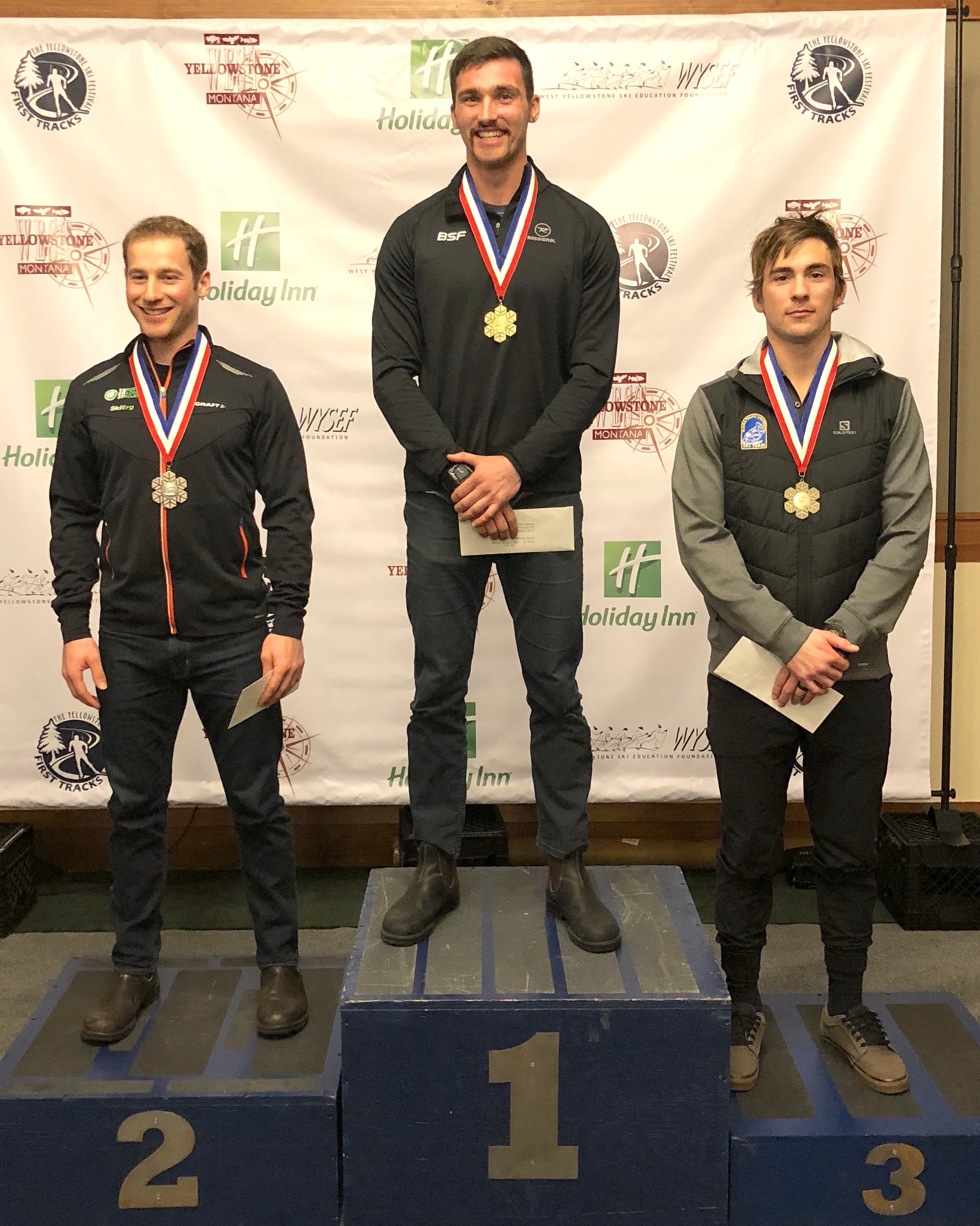
In the women’s 10 k classic mass start, Hedda Bångman, new to the University of Colorado Boulder (CU) Ski Team this year, double poled to the win in 30:24.8 over two Craftsbury’s Kaitlynn Miller and Caitlin Patterson, respectively.
“It was really hard conditions today, and I decided just one minute before the start to switch skis,” said Bångman, a 22-year-old Swedish student. “I took my zero skis and I think it was a good decision. I knew before I started I was forced to do double poling because my grip wasn’t the best on the skis so it was hard but … it felt good, except the technique zones [where double poling is not allowed], of course.”
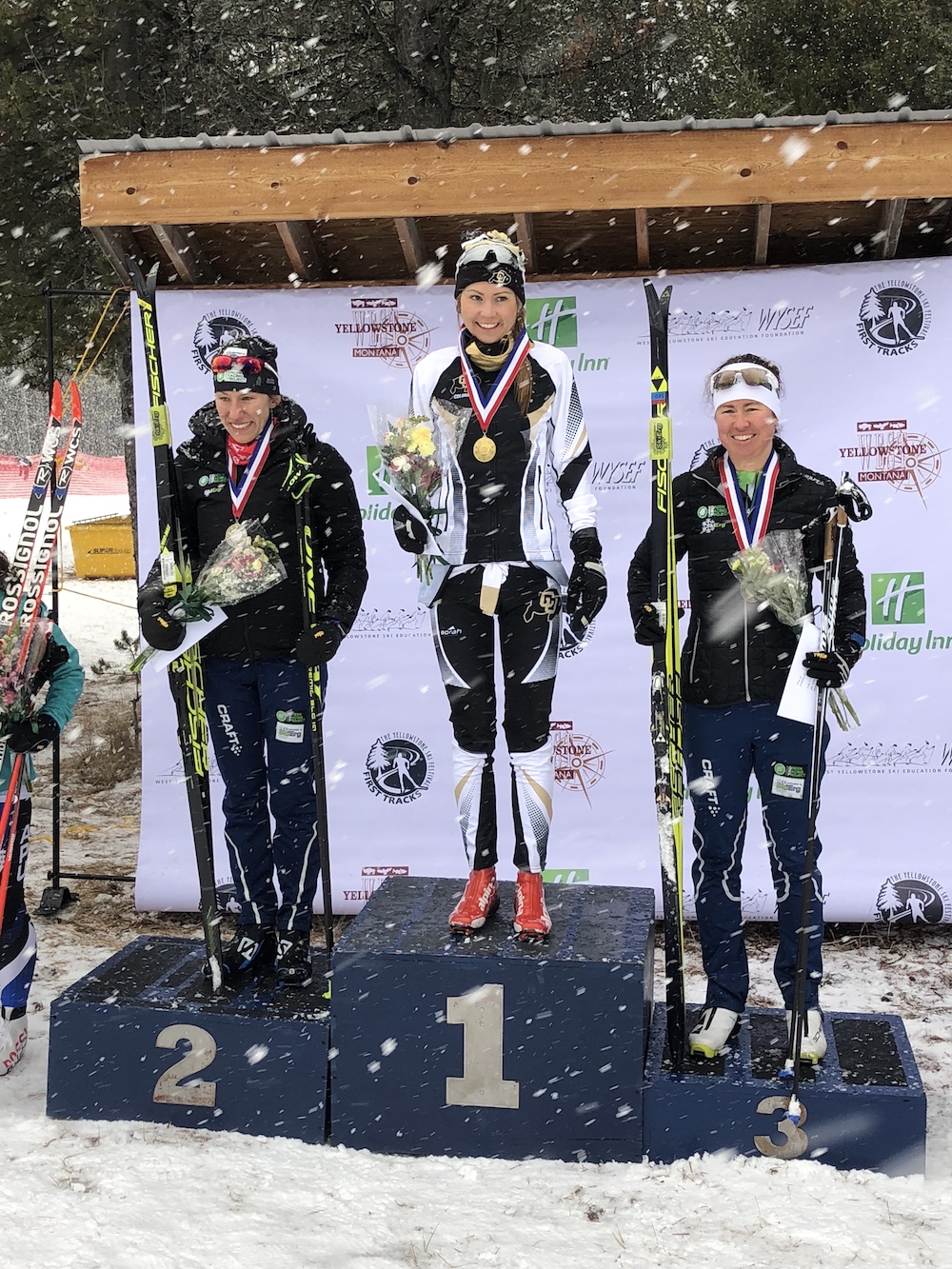
Bångman is new to the U.S. in her freshman season with CU.
“My shape is good. Everything was good today. It was fun to race and fun to be here to race,” she said. “It’s a little bit different compared to Scandinavia, but I like it. … It feels like it’s more relaxed here, but maybe it’s just my feeling.”
Miller raced to second place, 1.3 seconds back, ahead of her CGRP teammate Patterson in third (+3.4).
“It was a nice big group of us for a while there and the conditions were kind of lose and powdery, which I enjoy, so I was having fun with that,” Miller said, noting the APU’s Rosie Frankowski carried a lot of the load of setting the pace up front. “There was a nice group of us for a while that slowly just kept kind of stringing out until there were maybe four or five of us left, and then it was sort of just a sprint to the end there. Hedda kind of came in from third or fourth and just had a really good push to the finish…”
Frankowski finished 10 seconds after Patterson for fourth place (+13.5), Katharine Ogden (SMS/USST D-team) was fifth (+17.2), Caitlin Gregg sixth, Felicia Gesior (CXC Team) seventh, Anne Siri Lervik (CU) eighth, Flowers ninth, and Corey Stock (BSF) 10th.
“I want to commend Rosie Frankowski for really pushing the pace middle of the race,” Patterson said. “I think a lot of us out there had fairly slick skis so we were double poling a lot, but they had two technique zones per lap so that was interesting. We had to run those — a little striding, running, herringbone, whatever works to get the diagonal stride. … By the finish we were down to about three of us, and [Bångman] was first and my teammate Kaitlynn Miller had strong double pole into second and I was right behind them in third, so pretty solid day.”
The SuperTour circuit now moves to Canada to join up with the Sovereign Lake NorAm, with a classic sprint on Saturday, Dec. 9, and 10/15 freestyle individual starts on Sunday, Dec. 10.