From the FasterSkier archive — posts syndicated from athletes’ and coaches’ own blogs between 2004 and 2012, kept online as published. Current coverage is at fasterskier.com.
Back in January 2016, Tad Elliott emerged back onto the national championship scene with a win in the men’s 30-kilometer freestyle mass start at U.S. Nationals in Houghton, Mich. It had been some time since the skier originally from Durango, Colorado had felt unleashed from the grips of the energy-sapping Epstein-Barr virus.
Elliott went on to make the 2017 Nordic Ski World Championship team in Lahti, Finland. There, it was hard to miss his stunning effort firing up the first big climb out of the stadium as he skied the third leg of the U.S. men’s 4 x 10 k relay. Talk about lightness and upward momentum. In Lahti, he also notched a 27th in the men’s 50 k skate. He is a former member of the U.S. Ski Team and a three-time World Championship team member. (Let’s not forget this is a two-sport athlete. On two-wheels, Elliott crushed as an elite mountain biker. He won two U23 National Championship in mountain biking.)
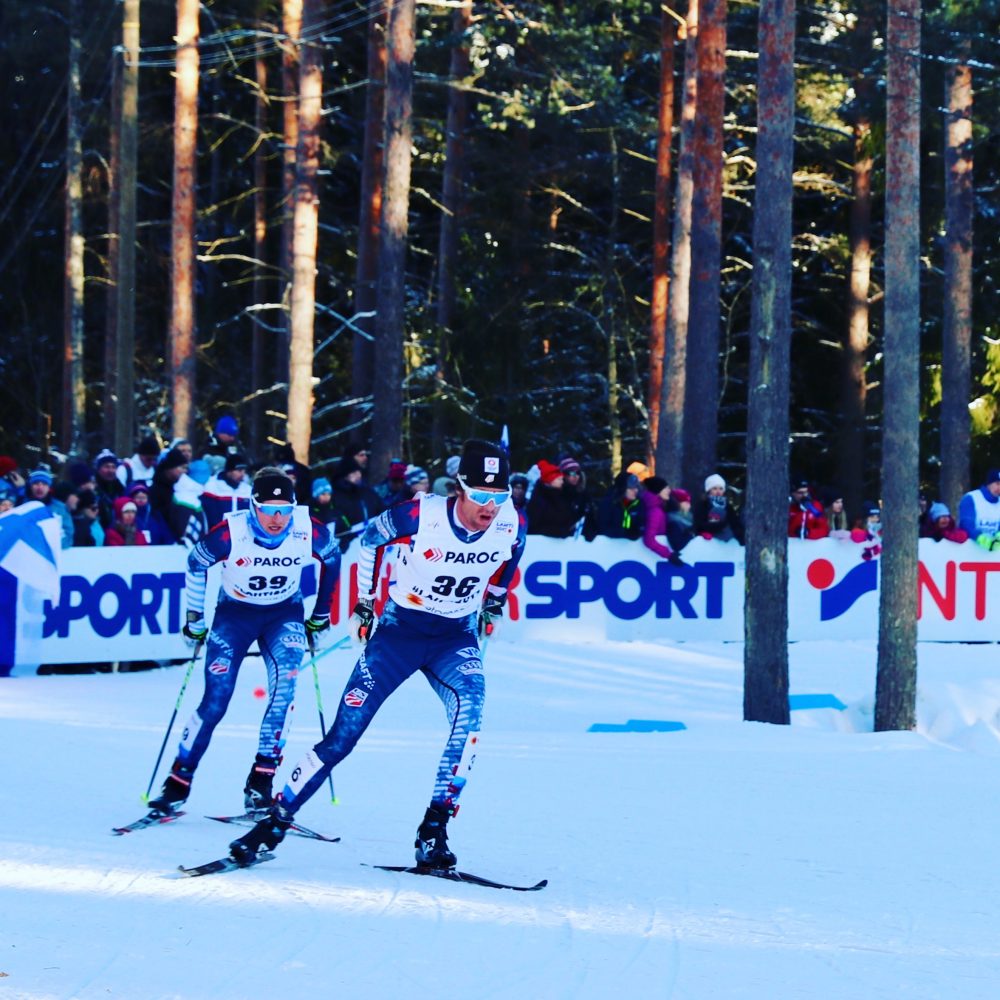
Tad Elliott (bib 36) and Kyle Bratrud (bib 39) during the men’s 30-kilometer skiathlon at the 2017 Lahti World Championships. (Photo: Matt Whitcomb)
Known as one of the finest skate skiers of his generation, Elliott’s upward trajectory unraveled in 2013 as he began struggling with symptoms of the Epstein-Barr virus. The winner of multiple national championships, Elliott began literally walking towards a life and a career premised on rest and recovery with the occasional aerobic stimulus to gradually bring him back into form.
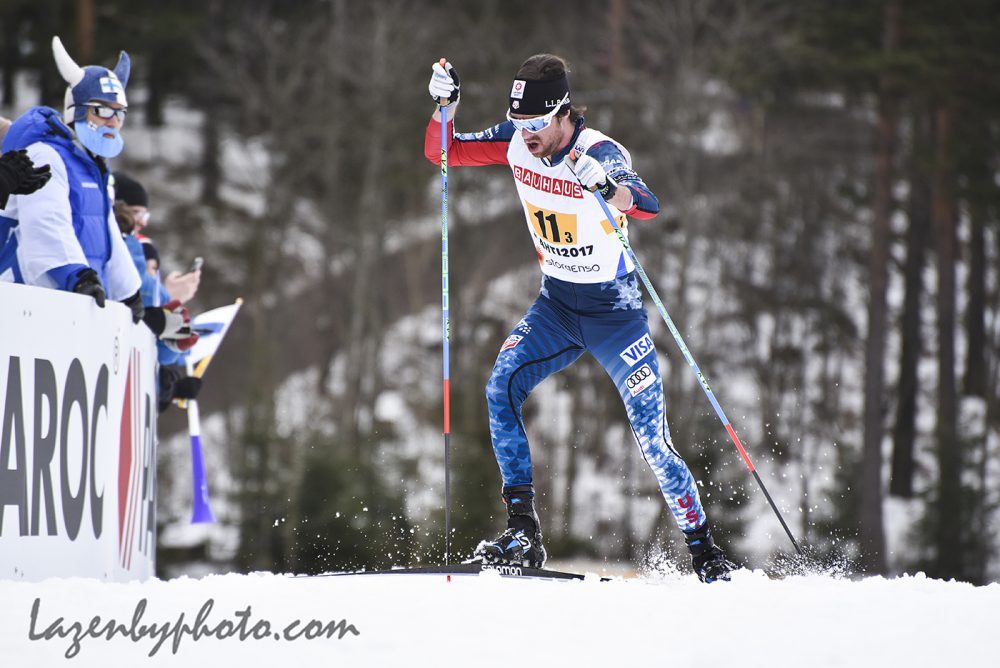
Tad Elliott racing the third leg of the U.S. men’s 4 x 10 k relay at the 2017 Nordic World Championships on Friday in Lahti, Finland. (Photo: John Lazenby/Lazenbyphoto.com)
In this episode of Nordic Nation, we tracked down the now thirty-year-old Elliott on October 9th, where he has begun undergraduate studies in sport physiology at the University of Northern Michigan. Elliott is also applying what he learned during his racing career as an assistant coach with the storied NMU program. He has also begun a side gig consulting athletes struggling with recovery and those wanting to develop sustainable training plans.
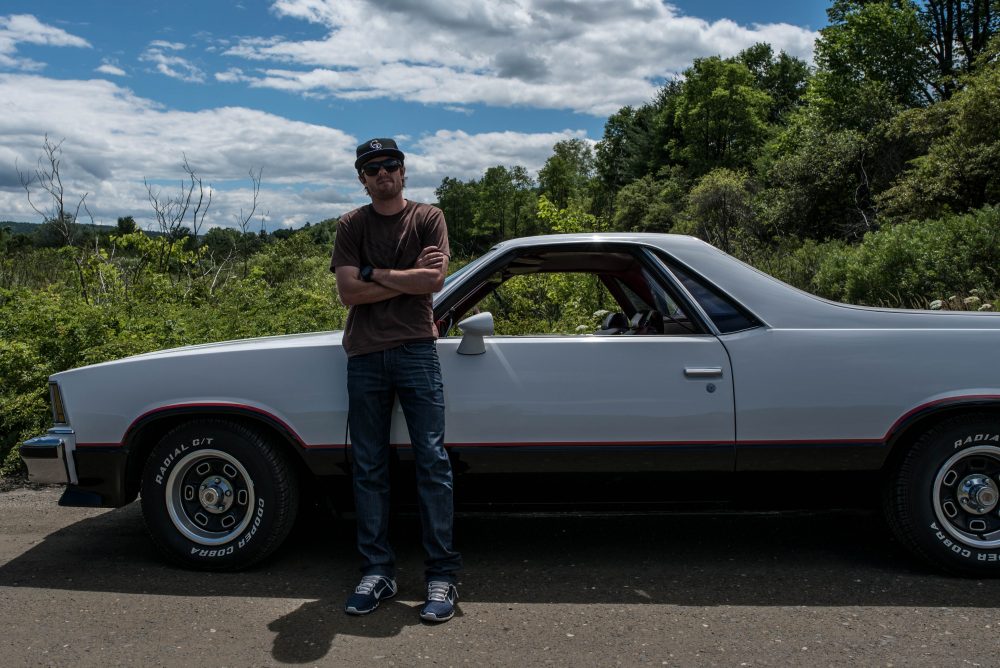
We have the go-ahead to post his email. You can reach out to him at tadelliott2@gmail.com if you’ve got questions as it relates to his experience with overtraining and the rebound. And he drives an El Camino that we are informed is stored indoors somewhere back east.
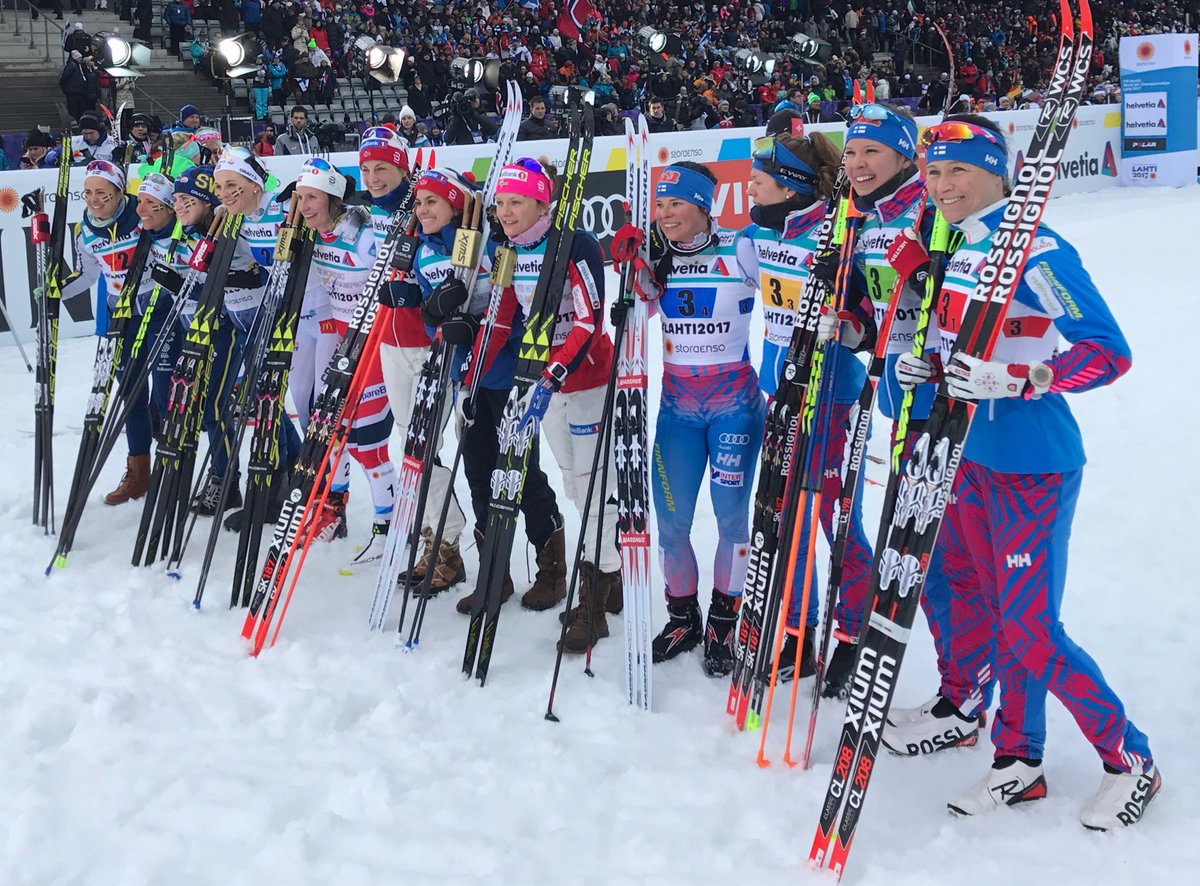
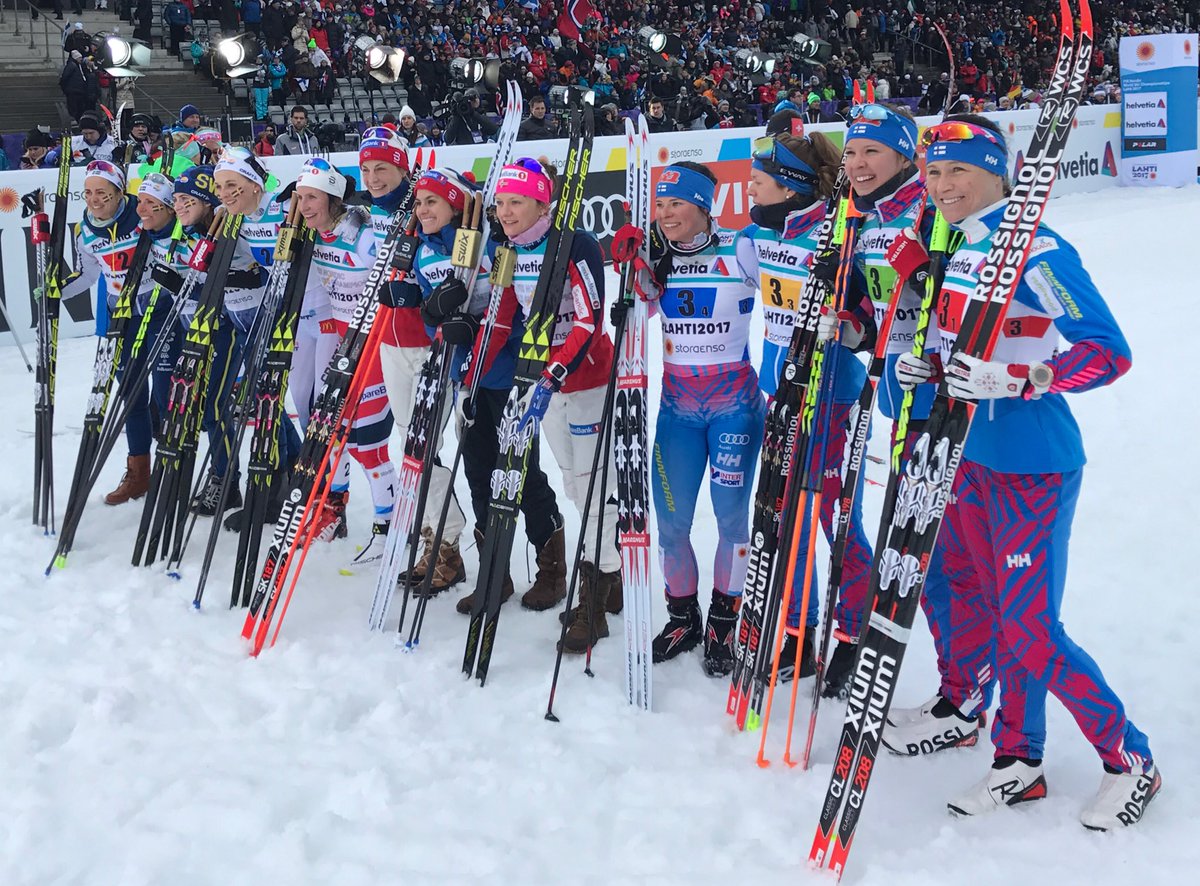
The women’s 4 x 5 k relay podium at 2017 Nordic World Championships on Thursday in Lahti, Finland, with Norway (c) in first, Sweden (l) in second, and Finland (r) in third. (Photo: FIS Cross-Country/Twitter)
FIS Nordic World Championships (Lahti, Finland): Women’s 4 x 5 k relay
The Norwegian women’s team got a much-needed lift from Astrid Uhrenholdt Jacobsen, the third leg of its 4 x 5-kilometer relay, on Thursday, who tagged her teammate Marit Bjørgen nearly a minute ahead of anyone else. From there, Bjørgen anchored the Norwegians to a 1:01.6-minute victory for her third gold of 2017 Nordic World Championships in Lahti, Finland.
Meanwhile, Sweden and Finland battled for silver, with Sweden’s anchor Stina Nilsson overtaking Finland’s Krista Parmakoski coming out of the final downhill into the stadium then leading her down the finishing stretch. Nilsson finished half a second ahead of Parmakoski for second place, while Finland claimed bronze (+1:02.1).
The U.S. was next across the line, after Jessie Diggins worked to close a 21.5-second gap to third place at the final exchange. While Diggins came within roughly 16 seconds of Nilsson and Parmakoski, that was as close as she could get and she finished fourth (+1:33.8), 31.7 seconds out of the medals.
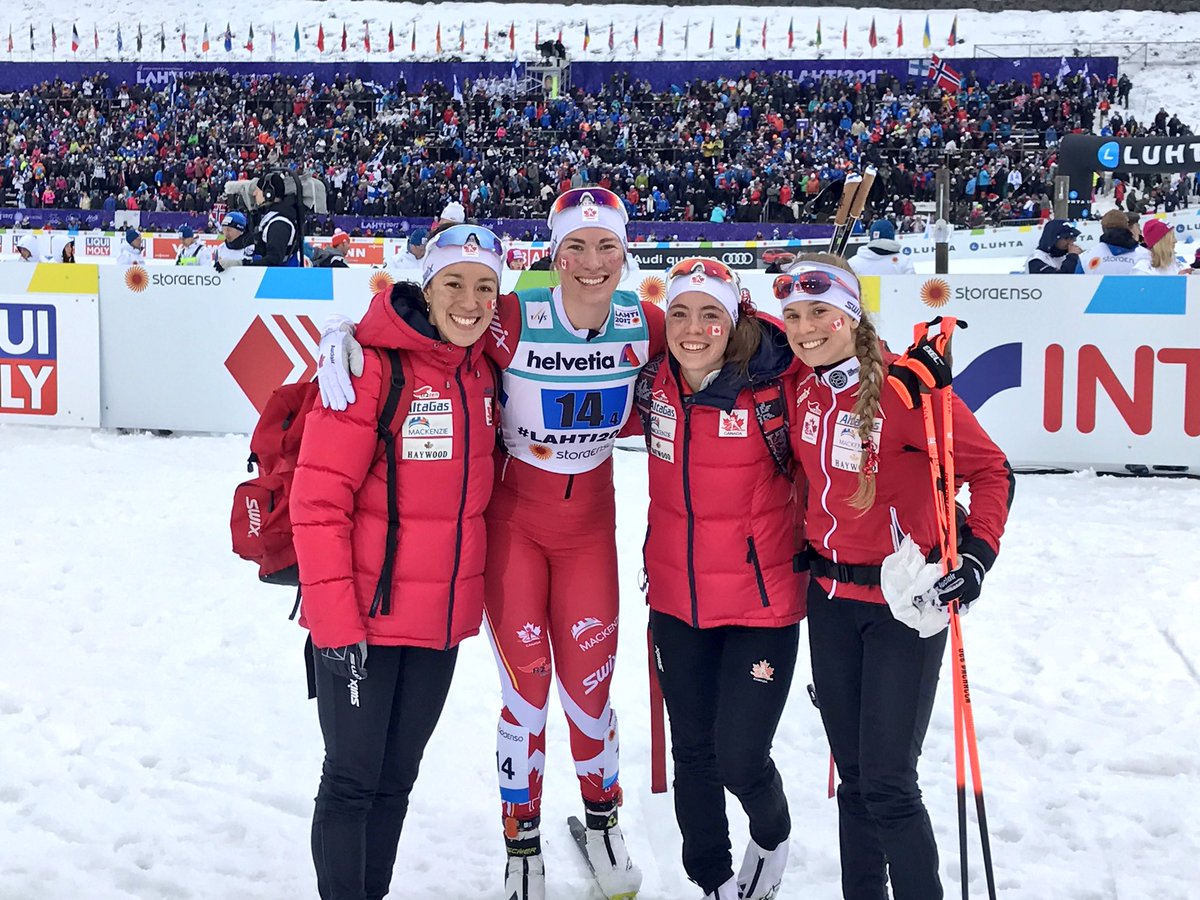
The Canadian women’s 4 x 5 k World Championships relay team, (from left to right) Emily Nishikawa, Dahria Beatty, Katherine Stewart-Jones, and Cendrine Browne, after tallying the third-best relay result for the Canadian women at a World Championships on Thursday in Lahti, Finland. (Photo: CCC/Twitter)
Canada placed 10th (+4:16.2) out of 16 teams in the women’s relay, for the best result for the Canadian women’s program since a sixth place in the 4 x 5 k relay at the 2001 World Championships (and third-best result ever), according to Cross Country Canada.
Norway took control during the first 5 k leg, where Maiken Caspersen Falla stuck with Poland’s Justyna Kowalczyk, who set a fast pace out of the start. Only three were able to remain with Kowalczyk: Falla, Finland’s Aino-Kaisa Saarinen and Sweden’s Anna Haag, while Kikkan Randall of the U.S. fell off the pace and skied alone in fifth. Randall came through the first exchange 24.5 seconds behind Falla in first and 16.4 seconds behind Haag in fourth.
On the second classic leg, Sweden’s Charlotte Kalla set a blistering tempo out of the start to catch Norway’s Heidi Weng 8 seconds ahead. Finland’s Kerttu Niskanen went with Kalla as the two bridged the gap to Norway. Later in that leg, Kalla began to fade while Niskanen took control and entered the exchange in first, just 0.4 seconds ahead of Weng. Kalla came through another 12.3 seconds later in third. American Sadie Bjornsen had worked hard to close the gap to third but tagged 23.5 seconds out of third in fourth (+36.2).
On the third leg, Jacobsen opened the race up for Norway, building a 56.7-second gap to second place during her skate leg, while Sweden’s 19-year-old Ebba Andersson pushed hard in the final kilometers to put her team in second. Finland’s Laura Mononen struggled with Jacobsen’s pace and dropped to third (+58.3). Meanwhile, Liz Stephen of the U.S. held onto fourth and tagged Diggins 21.5 seconds out of third at the final exchange.
From there, the Sweden/Finland fight for second place began. A minute ahead of them, Bjørgen skied comfortably in first, and behind them, Diggins skied alone in fourth.
Russia’s anchor Anastasia Sedova was tagged 45.5 seconds behind the U.S. in eighth (behind Germany, Poland and Switzerland), but passed those three teams to end up fifth (+2:28.6), 54.8 seconds behind the U.S.
Germany finished sixth, Switzerland seventh, Poland eighth, Italy ninth, and Canada 10th, with Katherine Stewart-Jones, Emily Nishikawa, Cendrine Browne, and Dahria Beatty racing for Canada. Stewart-Jones put them in eighth at the first exchange, Nishikawa slipped one spot to ninth, then Browne lost another spot for 10th, which Beatty held to the finish.
IBU World Cup (PyeongChang, South Korea): Women’s 7.5 k sprint
[UPDATED] The International Biathlon Union (IBU) World Cup circuit resumed on Thursday after nearly a two-week break coming off IBU World Championships, drawing competitors to PyeongChang, South Korea, the site of the upcoming 2018 Winter Olympics.
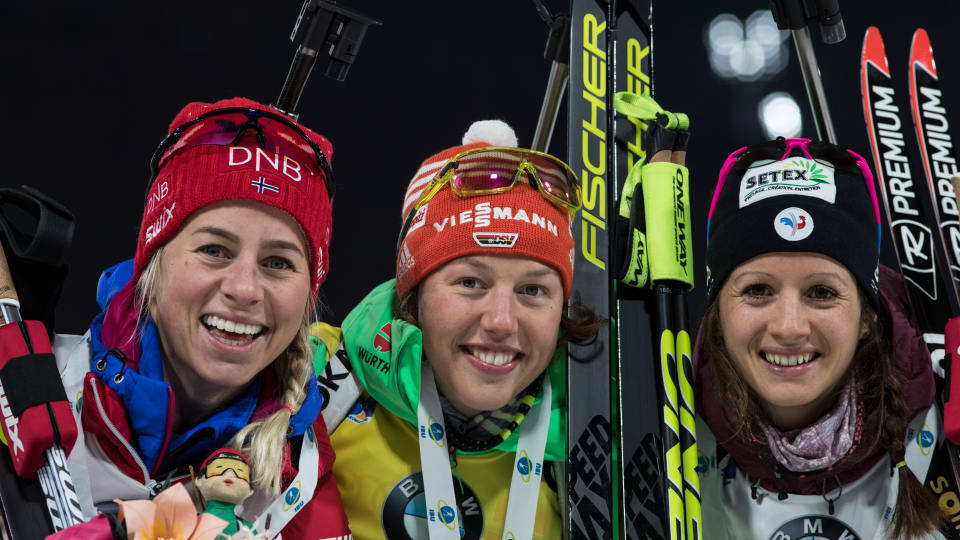
The women’s 7.5 k sprint podium at the IBU World Cup in PyeongChang, South Korea, with Germany’s Laura Dahlmeier (c) in first, Norway’s Tiril Eckhoff (l) in second and France’s Anaïs Chevalier (r) in third. (Photo: IBU)
Coming off five gold medals (in six races) at World Championships, Germany’s overall World Cup leader Laura Dahlmeier picked up where she left off, winning the women’s 7.5-kilometer sprint by 8.4 seconds with perfect shooting and a finishing time of 20:43.7 minutes.
Norway’s Tiril Eckhoff came closest to her in second, after also shooting clean, and France’s Anaïs Chevalier put herself in the mix with clean shooting as well to end up third (+41.6).
One second behind Finland’s Kaisa Mäkäräinen, who finished fourth (+58.7) despite two standing misses (0+2), was American Susan Dunklee in fifth (+59.7). The 35th starter, Dunklee initially finished third (before being bumped off the podium by Chevalier, then one more spot by Mäkäräinen).
Dunklee missed one shot during the standing stage (0+1) and posted the eighth-fastest course time for her fifth top five of the season (including her second place in the mass start at World Championships).
“I tried to be patient,” Dunklee wrote in an email after Thursday’s race. “I focused on pushing the last half km of the loop where I thought other people would be tired. And our techs made great skis for these challenging conditions.”
She passed two competitors on her last loop, one of which had passed her earlier in the final 2.5 k. Dunklee described the conditions as “a patchwork of glazed, icy and slow patches. A large number of volunteers were working on it with hand tools right before the start and I think that helped substantially,” she wrote. “I think the course is good for me: big climbs with technical descents.”
Rosanna Crawford led the Canadians in 30th (+1:54.9) with one prone miss (1+0), and Megan Tandy placed 39th (+2:14.8) with one standing penalty (0+1), just ahead of Julia Ransom in 41st (+2:19.5), who had one standing miss as well (0+1). All four Canadian women qualified for Saturday’s pursuit, with Emma Lunder placing 51st (+2:38.2) after one penalty (0+1).
For the U.S., Clare Egan and Joanne Reid finished 33rd (+1:59.5) and 35th (+2:07.6), respectively, both with one standing penalty (0+1). Maddie Phaneuf missed the top 60 to qualify for the pursuit in 68th (+3:07.7) with one miss (0+1).
After being in contention for a podium, France’s Marie Dorin Habert did not finish, reportedly because she felt nauseous.