From the FasterSkier archive — posts syndicated from athletes’ and coaches’ own blogs between 2004 and 2012, kept online as published. Current coverage is at fasterskier.com.

Tag: 2017 World Championships

  • All in the Timing: Inside Chicco Pelle’s Last Dance in Lake Placid

    All in the Timing: Inside Chicco Pelle’s Last Dance in Lake Placid

    This coverage is made possible through the generous support of Marty and Kathy Hall and A Hall Mark of Excellence Award. To learn more about A Hall Mark of Excellence Award, or to learn how you can support FasterSkier’s coverage, please contact info@fasterskier.com.

    LAKE PLACID, New York (March 21) — As the snow settled on Lake Placid and clouds began to dissipate over Mt. Van Hoevenberg, a growing sense that something momentous could happen permeated the crowd assembling for the last Sprint of the 2025-26 World Cup.

    That something unusual would happen was assured. With the Sprint Globe already secured to Johannes Høsflot Klæbo, the golden-haired juggernaut would not be on the starting line – opting instead to rest his legs, and head, in hopes of defending his 12-point lead over Harald Østberg Amundsen in the Distance standings. By default, then, someone other than Klæbo would stand atop Saturday’s podium – a rare occurrence in a season where the Norwegian had already won 8 of 11 Sprints in commanding fashion. (Two wins evaded Klæbo due to falls; the third because he did not start in Oberhof).

    Who would take his place? Ben Ogden, the Northeast’s homegrown favorite and the Sprint silver medalist in Milano-Cortina? Gus Schumacher, Ogden’s partner in the Olympic Team Sprint? France’s embattled specialist, Lucas Chanavat, who appeared on track to rival Klæbo during the 2023-24 season, who had seized the opportunity – and the win – after Johannes’ bobble in Davos last December? Ansgar Evensen (NOR), who had done the same in Drammen?

    Or, perhaps, it would be Federico Pellegrino (ITA) – the 35-year-old elder statesman of the league; making his 344th (and penultimate) World Cup start, eyeing an 18th and final Sprint victory?
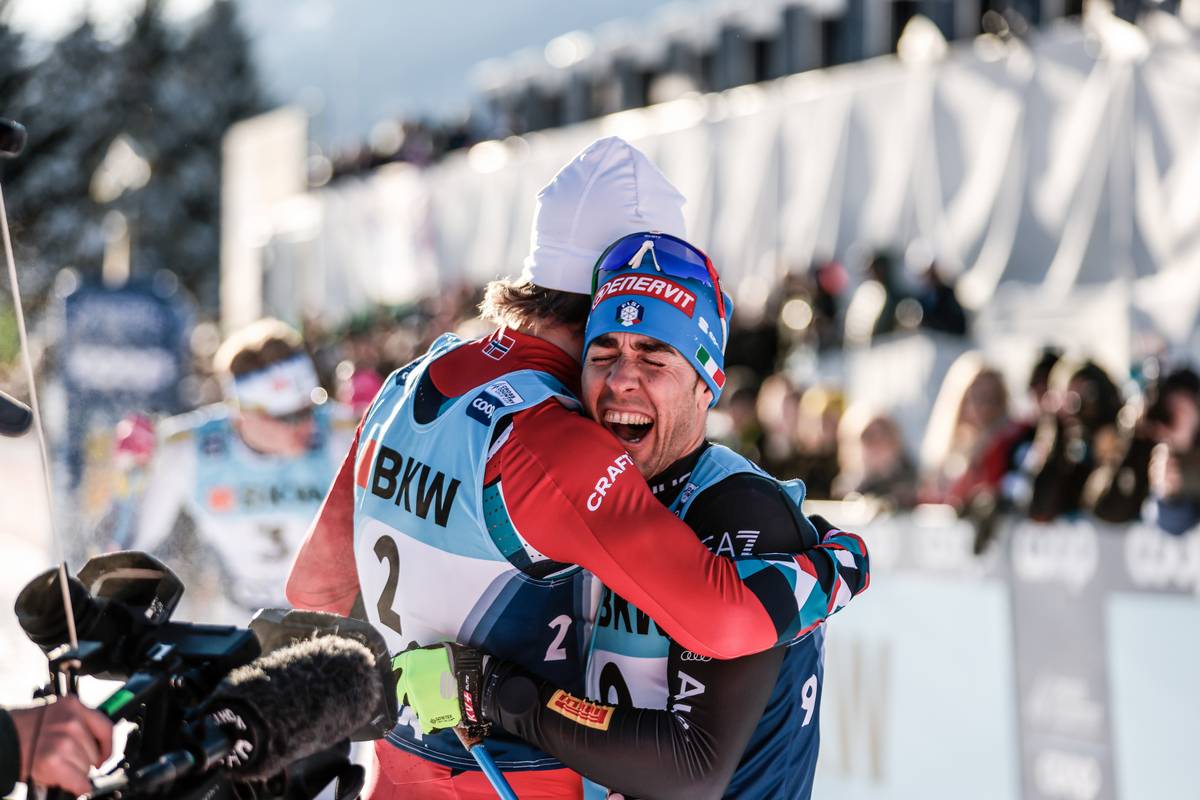
    Johannes Hoesflot Klæbo (NOR) and Federico Pellegrino (ITA) after the finish of the Finals in Davos, 2022. Pellegrino bested Klæbo on the eve of the birth of his first child. (Photo: Nordic Focus)

    It states the obvious to say that success in cross-country skiing is a matter of timing, and for “Chicco Pelle’s” 15 seasons, the timing had been just shy of right. The formative and final years of Pellegrino’s career were defined by the dominance of skiers other than he. Pellegrino made his World Cup debut in Drammen in March 2010, finishing 49th. The winner that day was Emil Joensson (SWE); runner-up was Petter Northug (NOR), then on his way to his first of two Overall Globes. These were the halcyon days in which Dario Cologna (CHE) descended from his Alpine fastness to rack up World Cup and Tour de Ski titles; when Northug, Joensson and Marcus Hellner (SWE) traded sprint victories and taunts in a bitter intra-Scandinavian rivalry. Pellegrino was 12th in his first World Championships Sprint (Oslo, 2011) and 11th at his first Olympic Sprint (Sochi, 2014).

    While notching his debut victory in December, 2014 in the Davos Freestyle Sprint, Chicco’s break came in the 2015-16 season. He won 5 of 13 sprint races, becoming the first non-Scandinavian male to win the Sprint Globe. As Pellegrino hit his stride, Northug’s star was showing its first flickerings ahead of a dramatic waning, Joensson had entered the twilight of his career, and although Sergey Ustiugov (RUS) was approaching his own prime, the factious cast of World Cup sprinters was looking for a new leading man.

    That man would not be Chicco. An upstart dramatist from Trondheim, Johannes Høsflot Klæbo, had arrived to script skiing’s long, and mind-bogglingly successful, next chapter. After making his debut in Drammen in 2016, Klæbo outscored Pellegrino in the 2016-17 Sprint standings, taking his first of 8 (and counting) Sprint Globes. The two went head to head at the 2017 World Championships in Lahti, Finland, where Pellegrino surged from behind to claim his first World Title ahead of a legendary lineup, including Ustiugov, Klæbo, and Northug, but this maiden gold would also be his last. In Pyeongchang the next year, the Olympic gold went to Klæbo; Chicco brought home silver.

    The wins did keep coming for Chicco, including a tear of three consecutive Sprint victories and his second Sprint Globe in 2020-21. And, though they admittedly came in greater abundance to Klæbo (who, it should be noted, did not start in those races, or the 2020-21 Tour de Ski), it is rather glib to assert that Chicco’s career had slid “in[to] the shadow of” the Norwegian. Pellegrino bested Klæbo in Dresden and Lahti in the spring of 2018; in Lillehammer that winter; and in Davos in 2022. He was near-omnipresent on Sprint podiums and won his second Olympic silver in Beijing in 2022; moreover, he was among the very few men who could disrupt Klæbo’s dominance in the discipline, and the clear favorite when Johannes was absent.

    But Pellegrino’s win in Davos in December 2022 marked the beginning of a long, and perhaps self-inflicted, World Cup drought. Chicco declared his intention to focus on distance races ahead of Milano-Cortina, and did indeed record four such podiums in classic, skate, and skiathlon formats, alongside a welter of Sprint podiums – including an ecstatic World Championships silver in Trondheim in 2025, and Olympic bronzes on home soil in the Team Sprint (alongside Elia Barp) and in the 4 x 7.5 k Relay (which he described as “the proudest day of [his] life!”) this February.

    Elia Barp welcomes Federico Pellegrino to a bronze-medal finish in the Olympic Team Sprint in Milano-Cortina, February 18th, 2026.
    (Photo: Vanzetta/Barbieri/NordicFocus)

    Outright wins, however, were not forthcoming. By the time March 21, 2026 arrived in Lake Placid, it had become Pellegrino’s last, best chance to secure one more Sprint victory.

    Anticipation and emotions ran high. While Pellegrino had been impervious to the crowd in Friday’s 10 k Classic – earbuds deadening the world beyond his blue racing cap during warmups, and his face a deaf mask of exertion during the race – their excitement overwhelmed him on Saturday. During his first warmup lap, he skated calmly up the course’s A-Climb through a chorus of “CHI-CCO, CHI-CCO, CHI-CCO.” On his second, the frenzied chant began again, and the gravity of the impending race dragged him to a halt. His skis splayed wide against the pitch; he buried face in his hands. “The energies I got in the Final were coming from the warmup lap, where I stopped in the middle of the climb, crying,” Pellegrino told me at the finish line. “I think the public deserved this kind of show, and I deserved to finish my career, with a Sprint skate like this.”

    Pellegrino embraces the crowd ahead of Sprint qualifying in Lake Placid. “The energies I got in the Final were coming from the warmup lap, where I stopped in the middle of the climb, crying.”
    (Photo: Thibaut/NordicFocus.)

    To reach that final finish line, however, was a perilous journey.

    After qualifying second, Pellegrino sidestepped two falls (the first from Jules Chappaz (FRA); the second from Elias Keck (GER)) in his Quarterfinal, moving from sixth to first in the course’s final descent and level hairpin. In Semifinal 1, he attempted to close on Lucas Chanavat (FRA) and Anton Grahn (SWE) through the crest of the A-Climb but couldn’t get by; pushed to the outside on the level hairpin, he was out-lunged by Lars Heggen (NOR) in the final meters, finishing third by 0.03.

    While the Lucky Loser spot was Chicco’s to lose heading into Semifinal 2, Erik Johansson (SWE), Harald Amundsen (NOR), and Even Northug (NOR) lost time playing for a slipstream position as they approached the top of the A-Climb. Pellegrino was on to the final by a comfortable margin.

    Lars Heggen (NOR) outlunges Federico Pellegrino (ITA) by 0.03 in Semifinal 1. Federico moved on to the Final as a Lucky Loser. (Photo: Thibaut/NordicFocus)

    Once more around the track, and the day could be his. After being fourth out of the gate, he attacked from the outside on the B-Climb; breaking into an aggressive V-2 and taking Chanavat and Heggen by surprise, he moved into second behind Grahn. The pace increased again at the base of the A-Climb, but where Grahn and Chanavat’s broad frames moved up the hill in sweeping, powerful strokes, Pellegrino leapt into a furious V-1.

    The move was decisive. To the adulation of the crowd, he opened a decisive gap through the crest of the climb. His lead only grew through the final descent into the level hairpin, but Chicco was taking no chances. While Grahn and Heggen grappled for second behind him, Pellegrino hammered to the line, threw his arms wide and his head back, roaring with the crowd.

    An 18th victory and 46th career podium, clinched.

    Federico Pellegrino secures his 18th and final World Cup victory. Lake Placid, March 21, 2026. (Photo: Thibaut/NordicFocus)

    What had happened in the Semifinal, when this triumphant last dance had nearly evaded him by three hundredths of a second? And what had changed for the Final?

    “I could not do what I did in the Final, because the energies of the other athletes were still quite big,” Chicco admitted our post-race interview. “About the last downhill, I was not the same as the others. I am not, I know, but I have some different qualities, and if I could get quite good gap in the top of the uphill, then I knew that I could keep it until I end. This is what I did. This is how I loved to win all along my career – not wait until the last meter, but trying before.”

    “Sometimes it happened, mostly before Klæbo came,” he laughed. “But today I was there, and I studied the best tactics in the end . . . the public here in Lake Placid deserves this kind of show, and I think we are all happy now.”

    And, this was nothing short of “the best way” to end his journey. “I could not do different. In the end, the last four years have been strange. I didn’t focus so much on sprinting; I tried to discover my body in different fields. Sometimes I got really great feelings and performances, but then, to come back here . . . and to win in that way, I could not do more.”

    Pellegrino after his final win. “I think the public deserved this kind of show, and I deserved to finish my career, with a Sprint skate like this.” (Photo: Thibaut/NordicFocus)
    One more podium for Federico Pellegrino, alongside Lars Heggen (NOR) and Anton Grahn (SWE). (Photo: Thibaut/NordicFocus.)

    In 15 seasons, Pellegrino proved himself to be far more than a runner-up to those Swedish and Norwegian titans who loomed large over his early and later years. He had taken the Sprint Globe from the Scandinavians for the first time; outsprinted Klæbo, Ustiugov, and Northug in Lahti; perpetually challenged – and occasionally beaten – the greatest athlete in the history of the sport; and secured Olympic medals on home soil, alongside a team of up-and-coming Italians ready and eager to fill his boots. “I’m really happy that he finished his career with probably one of the best weekends for him so far,” Elia Barp (ITA) told me on Sunday. “I’m very happy for him; I’m very happy for the team. I think we have proved that we are ready to race without him – not only me, but a few other young guys are ready to try to take victories next year . . . [He showed] that it is important to keep fighting and try to be a good overaller as he was in the last years. And, now we know that it’s possible; everyone is human as us, and we can do that.”

    To Chicco’s fans, that determination – to grapple with giants; to reinvent himself; to seize the final, perfect timing and a final, perfect victory – defined his career. But for Pellegrino himself, “the biggest memories will not stay about the races, but much more about the hugs I got from the teammates, from the coaches, even outside of Italy, from my family, from the people that love me – and not only when things went well; even when things were not going so well. I think this is something that sport teaches us; that in the end, it’s only a cross-country ski race, and life is different. That’s it. The hugs are something I will remember for my entire life.”

    Pellegrino, the most popular man at Zig Zag’s on Saturday, March 21. (Photo: Lily Den Hartog)

    At Zig Zag’s Pub on Saturday night, Pellegrino told this reporter’s associate that his win vindicated his decision to retire. On Sunday, soaked with rain and champagne and tears after his last World Cup race, he reaffirmed it:

    “That’s it. I tried to enjoy today as well . . . I tried to give my best, as always, and it was good after the finish line; under the rain, it was special. But with the teammates and coaches and waxers celebrating this moment, it was good for me.”

    “Now, I really need to stay with my family. They deserve this, and I need to give them a lot of time.”


    Love Stories Like This? Help Keep Them Coming.

    Feature stories like this one take time, access, and care to produce. If you value thoughtful storytelling and independent ski journalism, please consider becoming a Voluntary Subscriber. Your support directly fuels the work we do to cover the people, places, and moments that make our sport special.

    “Grazie Papao!!” Team Italy was waiting at the finish of the 20 k Skate with champagne and a tribute to Pellegrino’s children and wife, Greta Laurent (ITA, ret.). (Photo: Thibaut/NordicFocus)
  • Unseen Photos from Lahti World Champs

    Unseen Photos from Lahti World Champs

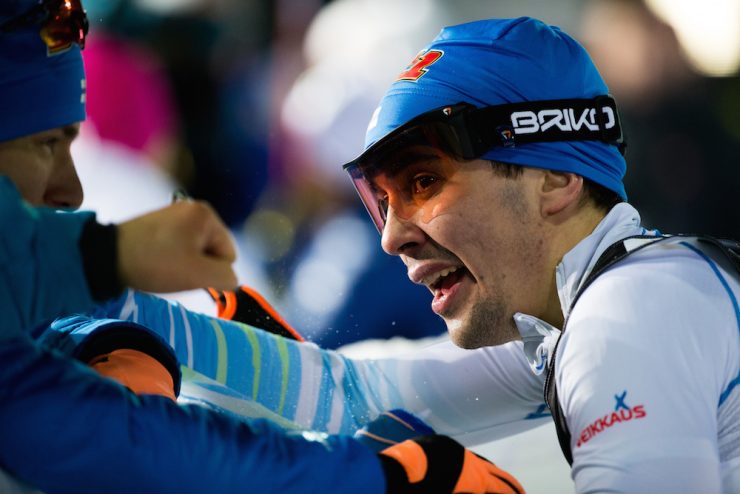
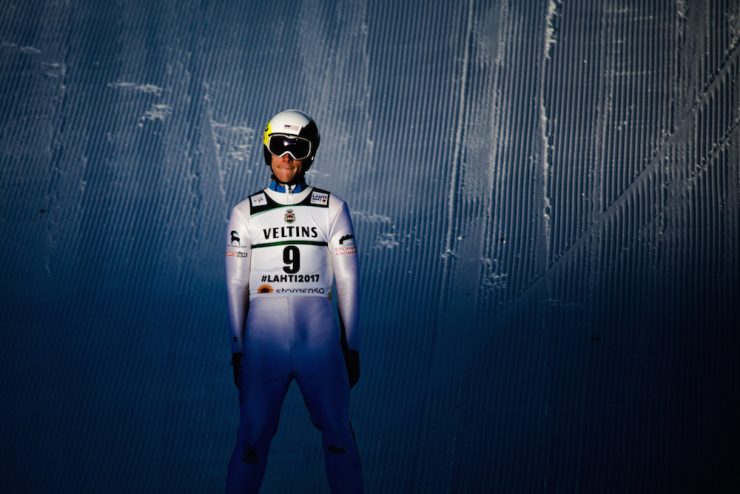
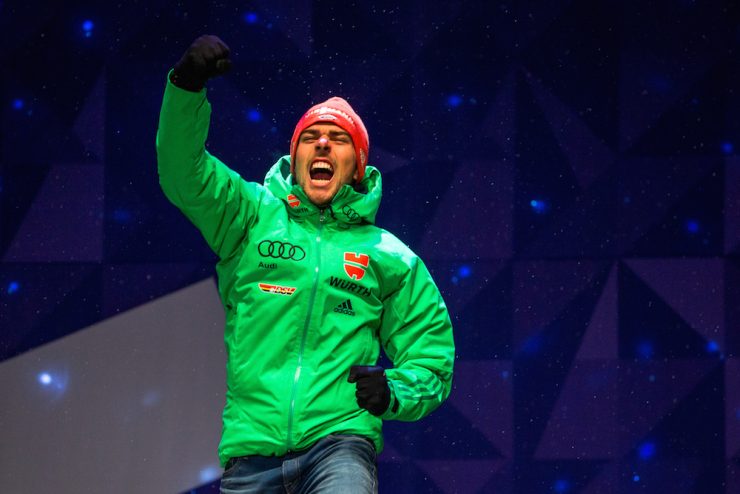
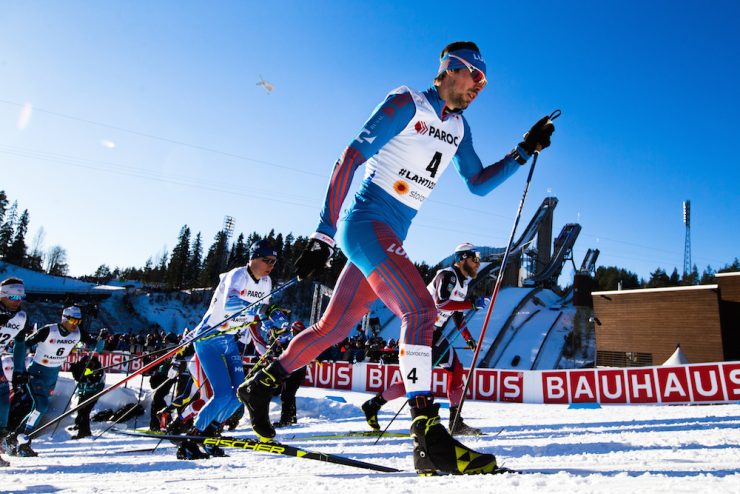
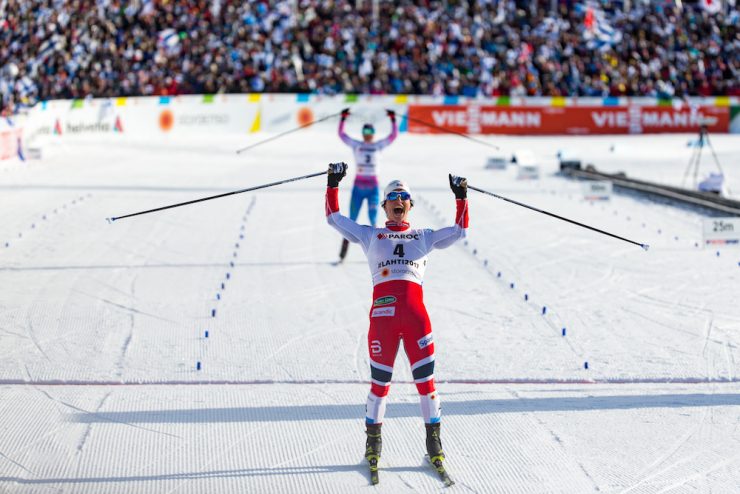
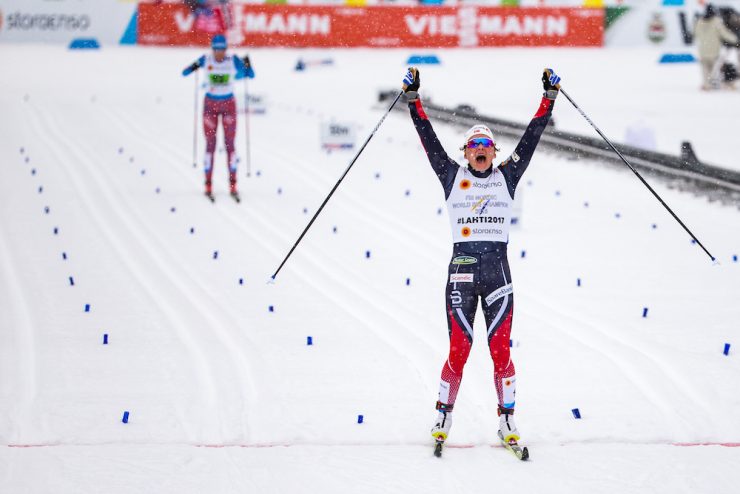
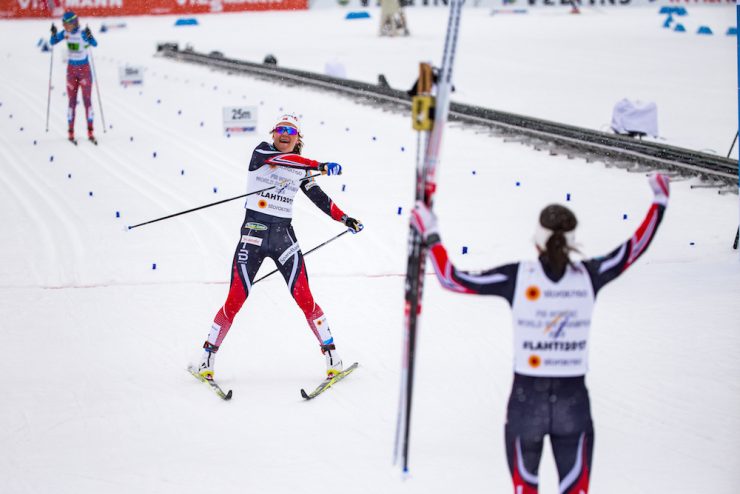
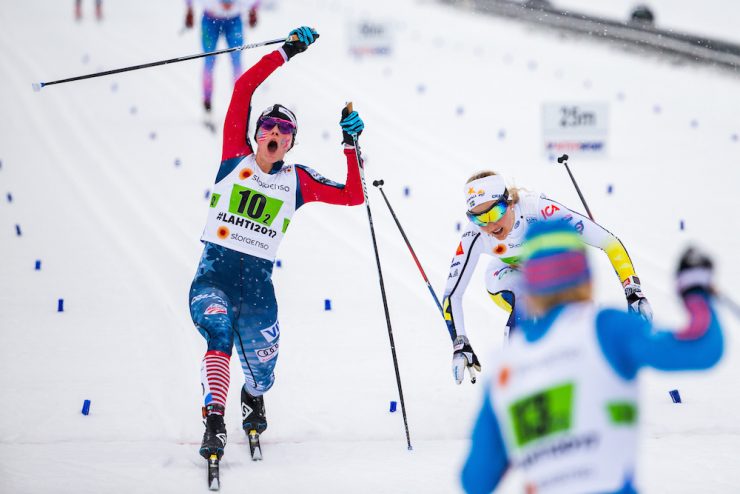
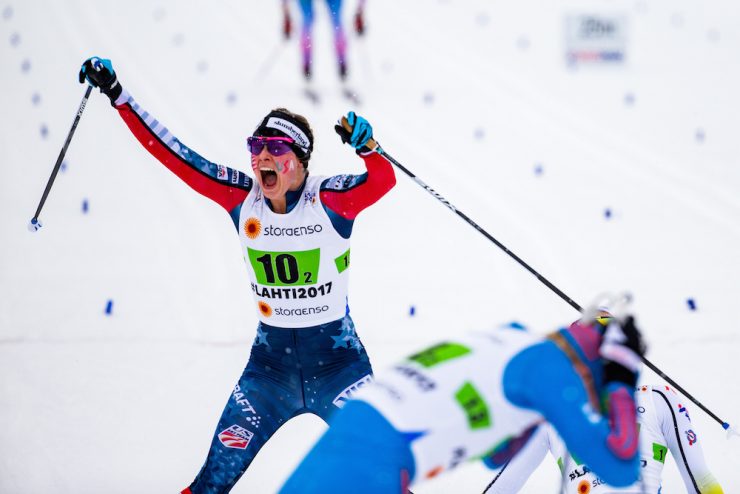
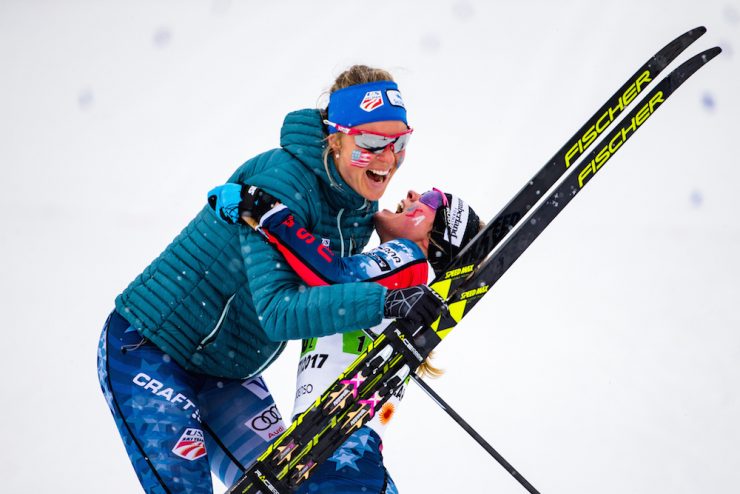
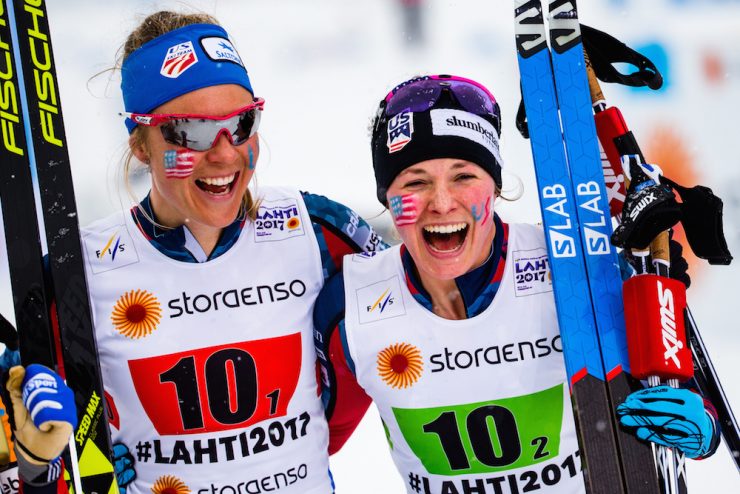
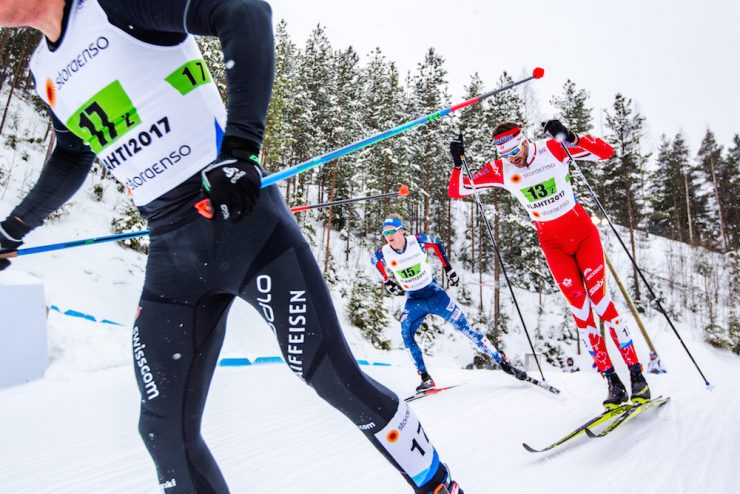
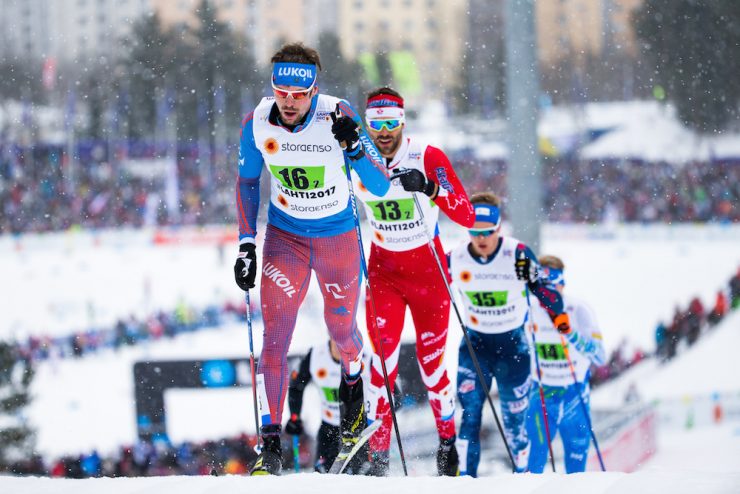
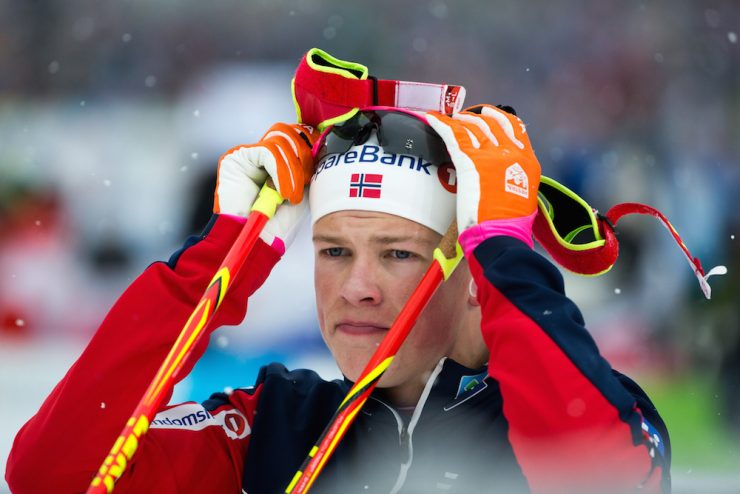
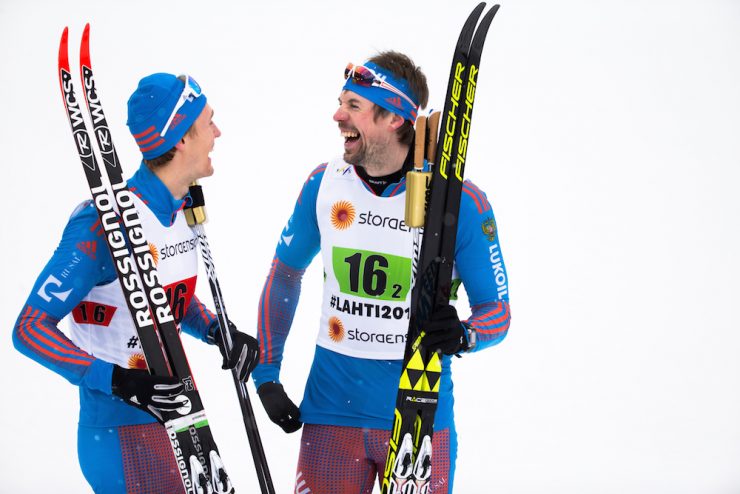
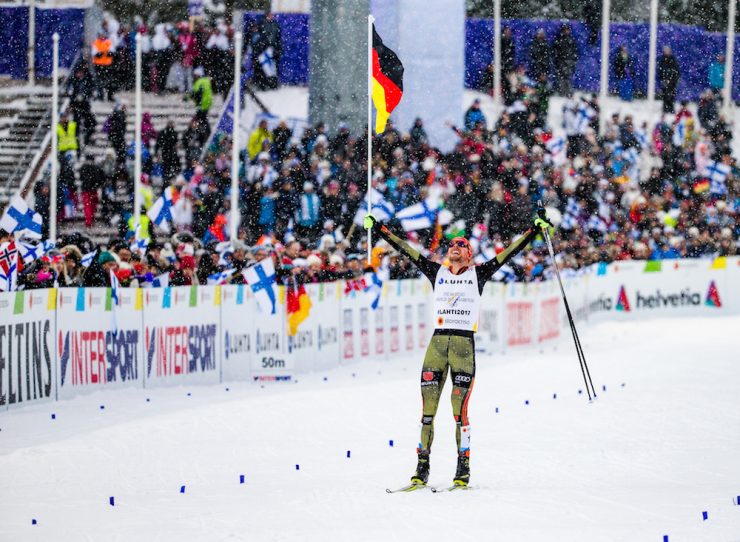
    Photographer Dustin Satloff was in Lahti, Finland, for 2017 FIS Nordic World Championships and he provided the following photos, which have never before appeared on FasterSkier. More on dustinsatloff.com.

    Click on photos to enlarge.

  • FasterSkier’s U.S. Continental Skiers of the Year: Ben Lustgarten and Jennie Bender

    FasterSkier’s U.S. Continental Skiers of the Year: Ben Lustgarten and Jennie Bender

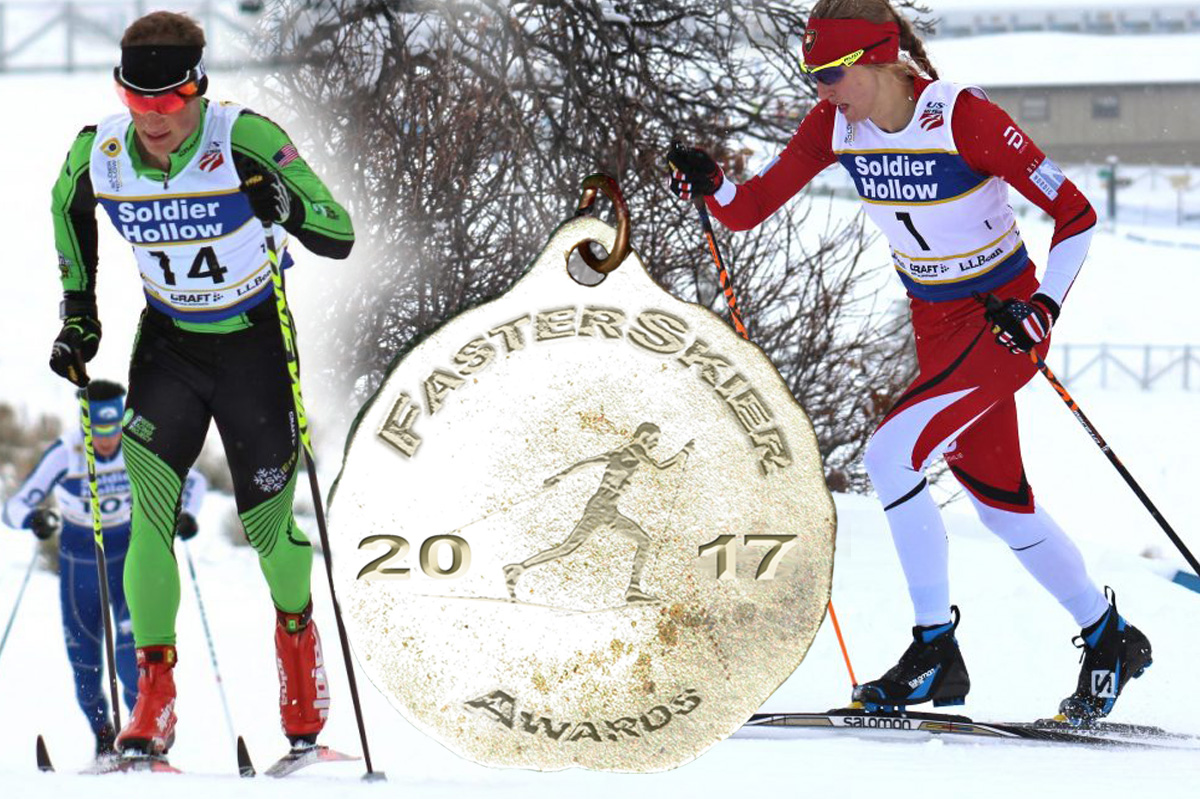
    Ben Lustgarten and Jennie Bender are FasterSkier’s 2017 American Continental Skiers of the Year.

    With the 2016/2017 season officially in the rearview, FasterSkier is excited to unveil its annual award winners for this past winter. Votes stem from the FS staff, scattered across the U.S., Canada, and Europe, and while not scientific, they are intended to reflect a broader sense of the season in review. This set of honors goes to outstanding American skiers competing primarily, but not exclusively, at the Continental Cup level. 

    Previous categories: Junior Skiers of the Year | Collegiate Skiers of the Year | Canadian Continental Skiers of the Year

    ***

    Ben Lustgarten, Craftsbury Green Racing Project

    Before the start of the 2016/2017 ski season, Ben Lustgarten sat down to meet with his new coach, Pepa Miloucheva of the Craftsbury Green Racing Project. After being based out of Sun Valley during the previous year, the Burlington, Vt., native had returned to the Green Mountain State to live and train an hour and half east of his hometown in Craftsbury.

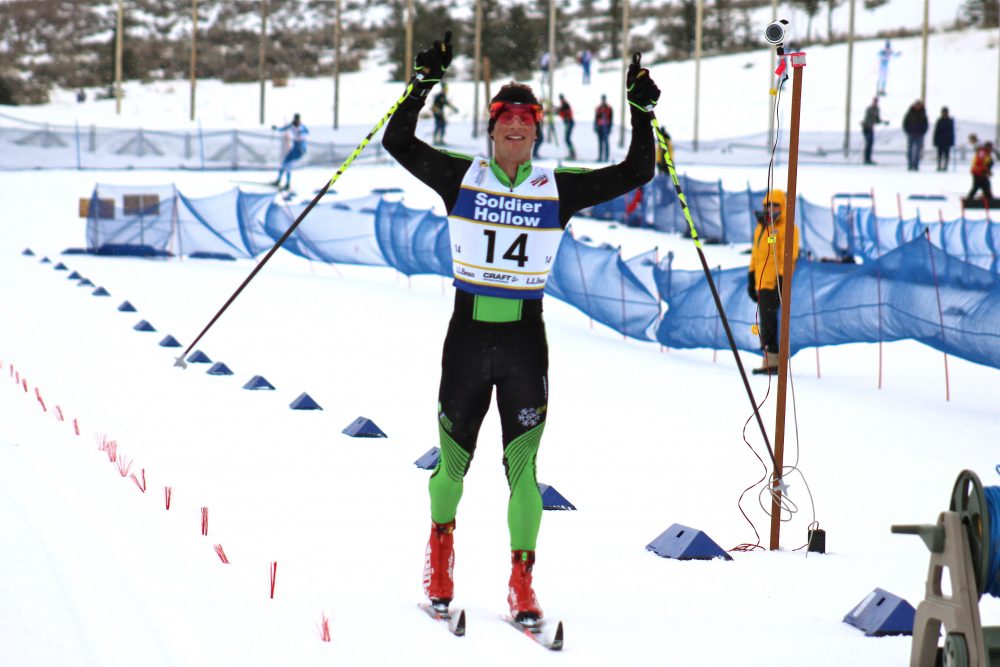
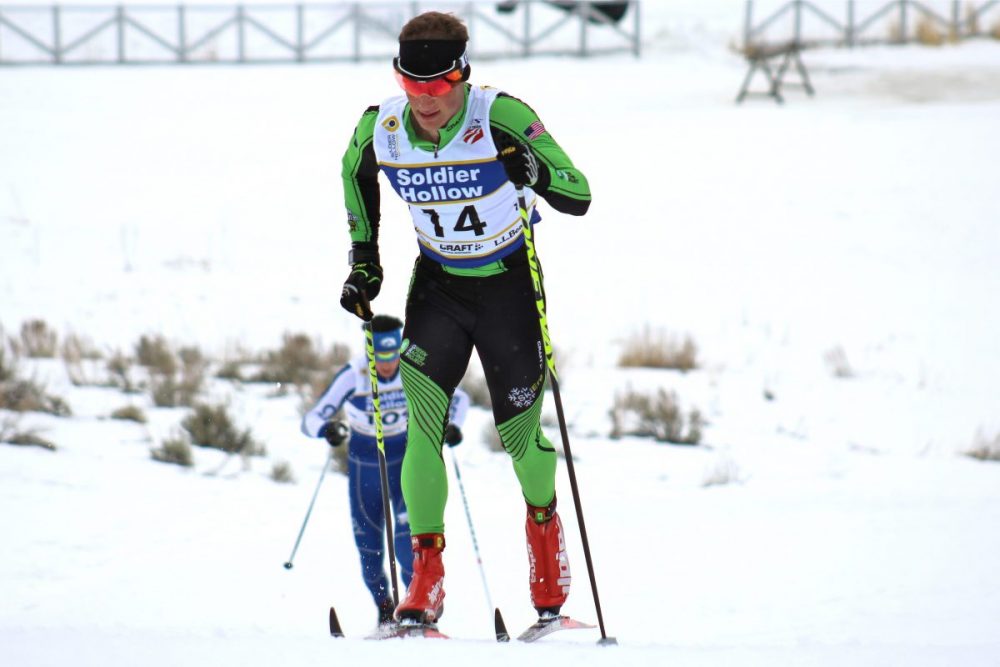
    Ben Lustgarten (14) celebrating his first career win at the domestic level with a national title in the men’s 30 k classic mass start at 2017 U.S. nationals at Soldier Hollow in Midway, Utah.

    With Miloucheva, he outlined some of his aims for the season. Two specific goals sat at the top of his list: 1) qualify for the Period III World Cup races in Otepää, Estonia, and 2) qualify for the 2017 World Championships in Lahti, Finland.

    Lustgarten’s ambitions were high. Prior to this year, the 24-year-old had never won a SuperTour race. In fact, before this year he had never even stood on a SuperTour podium.

    But past season stats were not a deterrent to Lustgarten. He went on to achieve both of his top two goals, qualifying for World Champs and ending Period II as the overall SuperTour leader, granting him Period III World Cup starts.

    However, it’s not so much the races that Lustgarten qualified for that makes him deserving of FasterSkier’s U.S. Continental Skier of the Year Award. It’s the races it took to get him there.

    Prior the 2017 U.S. Cross Country Championships, Lustgarten’s best U.S. national’s finish was sixth. He had never advanced beyond the quarterfinals in a SuperTour sprint, let alone win. But by the end of the season, all those numbers changed.

    In December, he raced to his first ever SuperTour podium finish, placing second in the men’s 15-kilometer classic event during the Bozeman SuperTour.

    In January, during the Auburn SuperTour in Truckee, Calif., he not only advanced for the first time from the quarterfinals in a SuperTour sprint (the only other time he had advanced past the quarterfinals before that was two weeks earlier at U.S. nationals, where he finished fifth in his semifinal, 10th overall), he won his semifinal and eventually, the final.
    “Top of the podium in a sprint! I never thought I’d see the day…” Lustgarten captioned a photo of himself atop the podium following the competition.

    And before winning his first ever sprint, Lustgarten also earned his first national title, finishing the men’s 30 k classic race at U.S. nationals this year as the top male.

    “This was something I only dreamed of,” Lustgarten wrote in a blog post in March of his victory in the men’s 30 k mass start event. “I crossed the line 1st, I was in shock and so excited. I was so happy that both of my parents were there watching and cheering, it was one of the best moments of my life!”

    Jennie Bender, Bridger Ski Foundation

    “Sometimes you just need to shake and bake out there…”

    That’s what the Bridger Ski Foundation’s Jennie Bender wrote in an email to FasterSkier after she won the women’s classic sprint at this year’s U.S. Cross Country Championships.

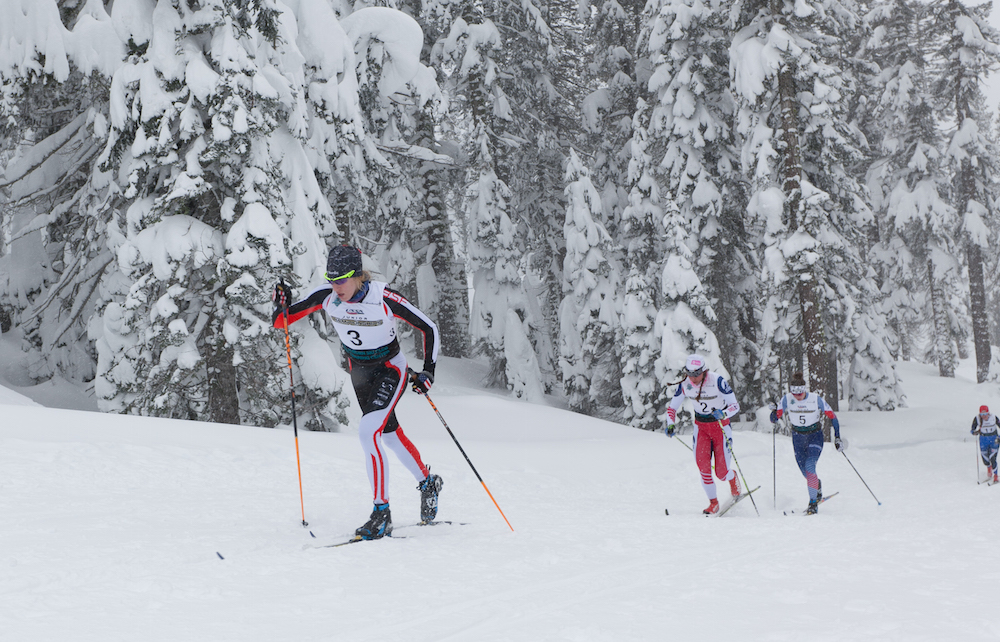
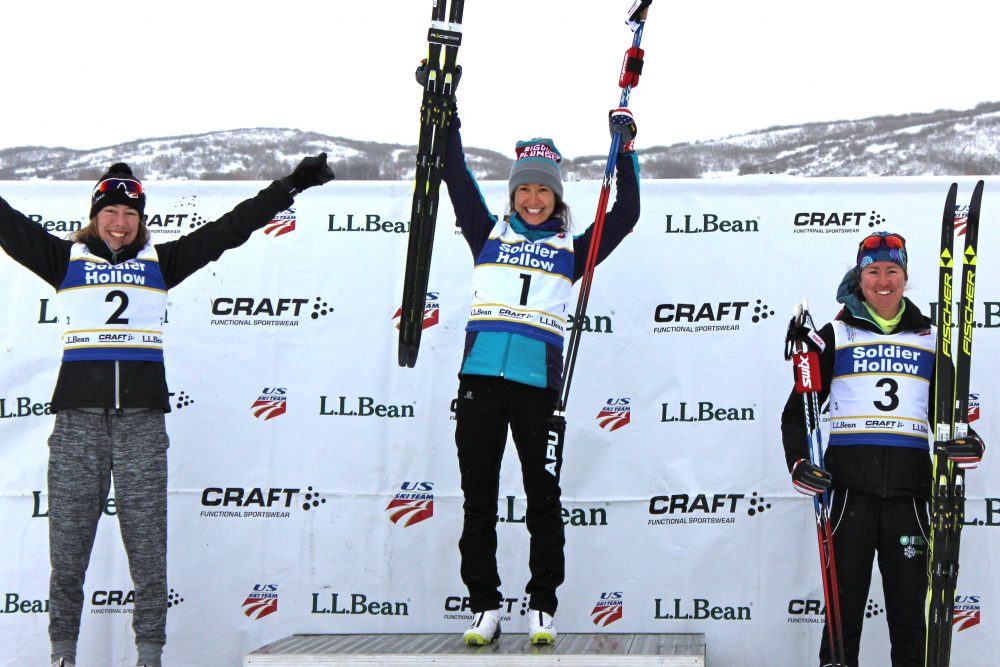
    Jennie Bender (3) of the Bridger Ski Foundation leading Stratton’s Julia Kern (2) and Sun Valley’s Deedra Irwin (5) during a sprint semifinal at the SuperTour in Truckee, Calif. Bender went on to win the semifinal, as well as the final.
    And while Bender’s name is certainly not a new one to the top of the results sheet, the 29-year-old’s accomplishments this season made her a top pick for FasterSkier’s 2017 U.S. Continental Skier of the Year.
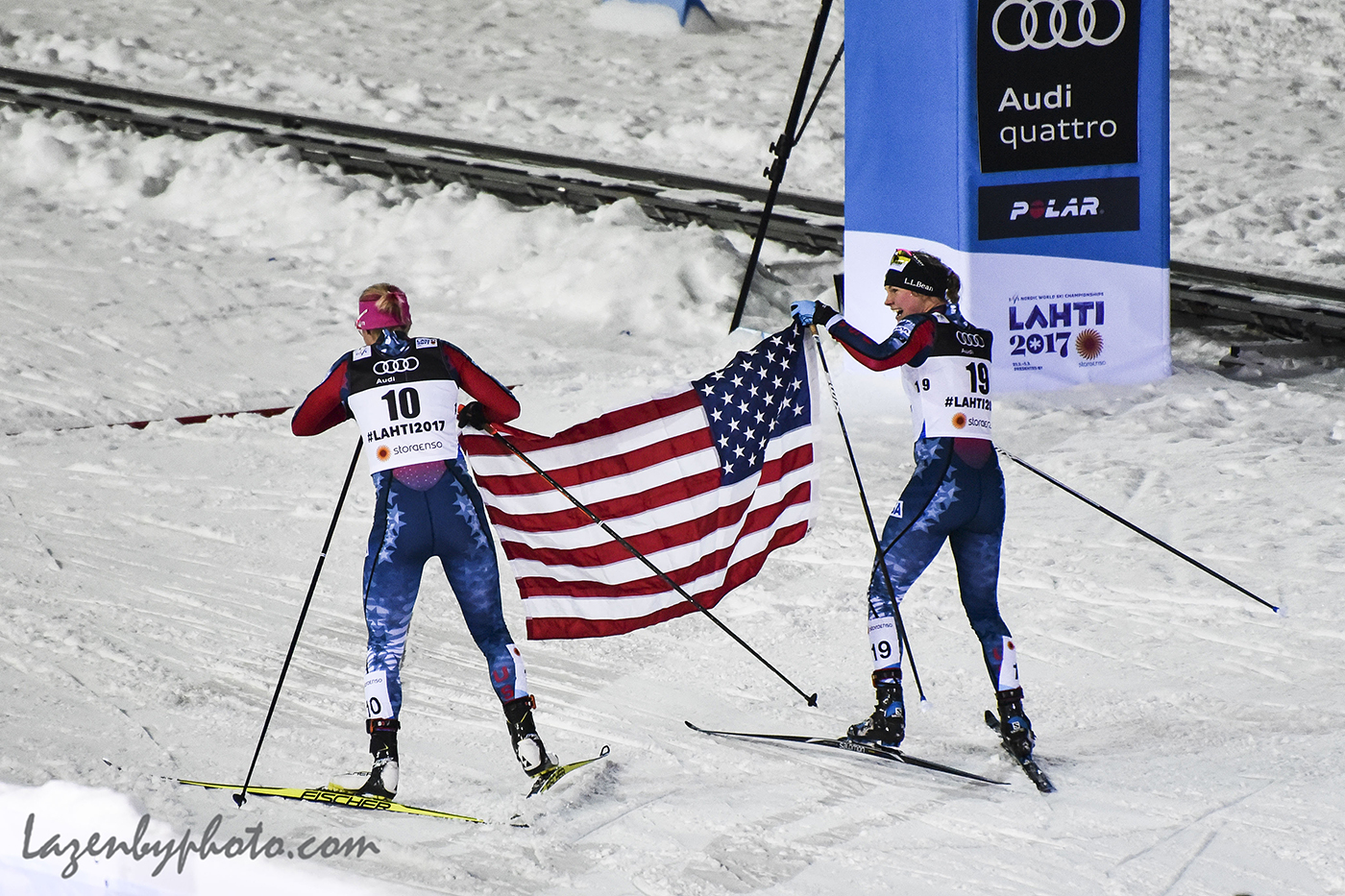
    She started her SuperTour season with a win, taking both the women’s qualifier and the final during the opening races in West Yellowstone, Mont.

    “My goal is to do better in qualifying, and I did that today, so that was a big win for me,” Bender said during an interview back in December.

    The following day she placed fourth in the women’s 10 k classic competition, her best 10 k finish since her third place finish in the event back in 2014.

    She raced to 12th in the 10 k freestyle at this year’s U.S. Cross Country Championships, her second best finish since 2012.

    A little less than two weeks later, she competed in the Auburn Ski Club SuperTour in Truckee, Calif., where she won the women’s classic sprint. She finished up her SuperTour season with a third place finish in the women’s sprint in Ishpeming, Mich.

    “I did today what I really wanted to do here,” Bender said back in January of her win in the women’s classic sprint. “I feel strong in my distance also. I feel a lot more put together as a whole athlete this year, which is pretty exciting.”

  • Saturday Rundown: Lahti & PyeongChang (Updated x2)

    Saturday Rundown: Lahti & PyeongChang (Updated x2)

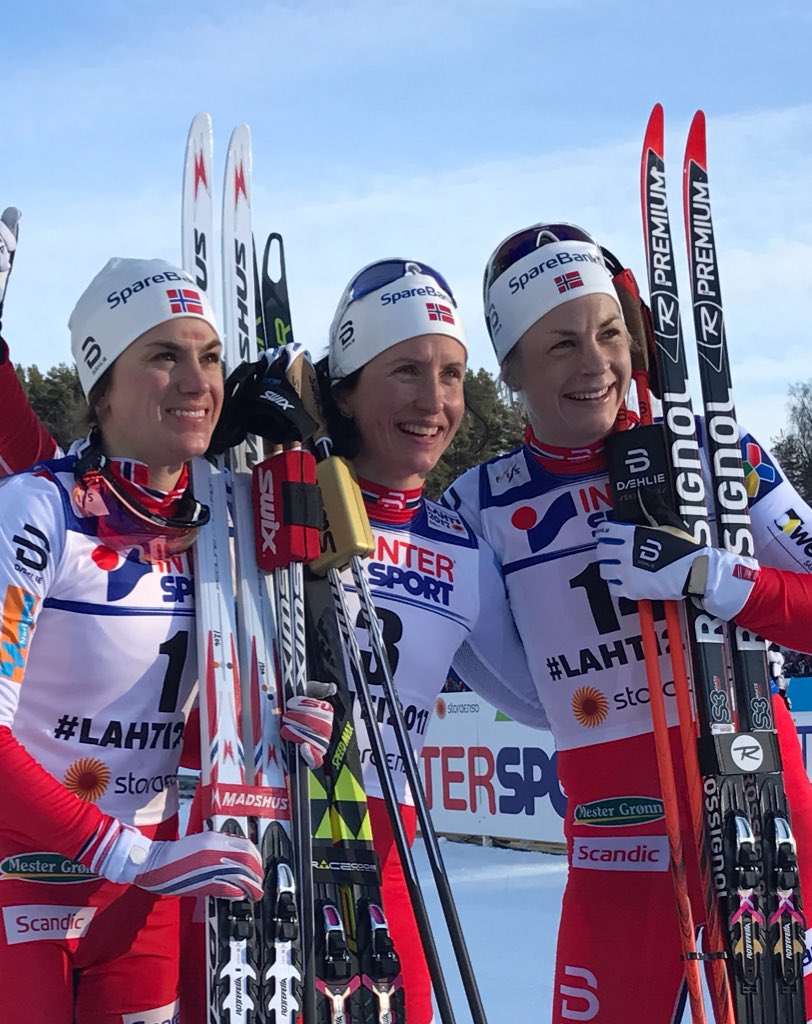
    The all-Norwegian women’s 30 k freestyle mass start podium at 2017 Nordic World Championships in Lahti, Finland, with Marit Bjørgen (c) in first, Heidi Weng (l) in second, and Astrid Uhrenholdt Jacobsen (r) in third. (Photo: FIS Cross-Country/Twitter)

    FIS Nordic World Championships (Lahti, Finland): Women’s 30 k freestyle mass start

    Marit Bjørgen made it a four-peat on Saturday with her fourth gold and third individual win over the last week at 2017 Nordic World Championships in Lahti, Finland. (She previously won the 15-kilometer skiathlon, 10 k classic, and 4 x 5 k relay.)

    The 36-year-old Norwegian closed out the championships with a 1.9-second victory in the women’s 30-kilometer freestyle mass start, finishing in 1:08:36.8 hours after setting the pace and leading a large group for much of the race. The group began to separate around 15 k, where it was down to 13 women with five seconds of first. At that point, Americans Jessie Diggins and Chelsea Holmes were within that lead pack.

    While Holmes started to fall off the pace around 16 k, Diggins stuck with the leaders to the very end, only until four Norwegians broke away to race for the medals over the final kilometer.

    With Bjørgen still charging hard up front, her teammates Heidi Weng, Astrid Uhrenholdt Jacobsen, and Ragnhild Haga followed, while Finland’s Krista Pärmäkoski trailed another second back in fifth and Diggins was one more second behind in sixth.

    Bjørgen led the downhill into the stadium and skied away from her teammates before the finishing stretch, leaving Weng and Jacobsen to duke it out for second place. Weng got it by less than one-hundredth of a second, Jacobsen took bronze (+1.9), and Haga completed the Norwegian top-four sweep in fourth (+7.4).

    Diggins passed Pärmäkoski and notched fifth (+10.4) for her career-best 30 k result. Pärmäkoski placed sixth (+11.3), Sweden’s Charlotte Kalla finished seventh (+13.9), Austria’s Teresa Stadlober was eighth (+15.5), Sweden’s Anna Haag ninth (+20.3), and Russia’s Yulia Tchekaleva 10th (+1:20.9) after edging Switzerland’s Nathalie von Siebenthal in a photo finish. Germany’s Stefanie Böhler placed 12th (+1:23.5) and Holmes finished 13th (+1:28.1) for her career best.

    U.S. Ski Team member Liz Stephen placed 25th (+3:09.4), 6.6 seconds ahead of Canada’s national U25 Team skier Cendrine Browne, who notched a career best 26th (+3:16) in her first World Championships.

    Holmes’s Alaska Pacific University (APU) teammate Jessica Yeaton, who races for Australia, finished 33rd (+4:32), Canada’s Dahria Beatty was 34th (+4:45.2), and American Caitlin Gregg 36th (+5:03.7).

    Great Britain’s Annika Taylor, a California native, placed 38th (+6:19.4). Canada’s Emily Nishikawa was 40th (+6:41.5) and Katherine Stewart-Jones 41st (+7:18.6), and Brazil’s Jaqueline Mourão, who trains in Quebec, was 46th (+13:44.6) out of 47 finishers.

    Results

    ***

    IBU World Cup (PyeongChang, South Korea): Women’s and men’s pursuits

    The women’s 10 k pursuit podium at the IBU World Cup in PyeongChang, South Korea, with Germany’s Laura Dahlmeier (c) in first, Finland’s Kaisa Mäkäräinen (l) in second, and France’s Anais Bescond (r) in third. (Photo: IBU)

    Coming off a fifth place in Thursday’s 7.5-kilometer sprint, Susan Dunklee held her position despite three penalties in the women’s 10 k pursuit on Saturday to finish fifth again at the International Biathlon Union (IBU) World Cup in PyeongChang, South Korea.

    Germany’s Laura Dahlmeier racked up her second-straight win in as many races in PyeongChang (and sixth-straight, counting World Championships), finishing in 27:58.0 minutes with clean shooting. She was just one of four women out of 58 finishers that hit all 20 targets in Saturday’s four-stage race.

    Finishing more than a minute later, Finland’s Kaisa Mäkäräinen placed second (+1:12.6) after starting fourth based on her sprint result. Mäkäräinen had two penalties, both in the first standing, but cleaned the other three stages (0+0+2+0). France’s Anais Bescond raced up from eighth at the start to third place (+1:18.9) at the finish, with a single penalty (0+0+1+0), while Norway’s Tiril Eckhoff missed her second-straight podium in fourth place (+1:32.0) after starting second but accumulating five penalties (1+2+1+1).

    Eckhoff edged Dunklee, of the U.S., by half a second as Dunklee placed fifth (+1:32.5) with three misses (1+1+0+1).

    Canada’s Rosanna Crawford rose from 30th to 19th (+2:49.1) for her best non-relay result of the season, with two penalties (1+1+0+0). Her teammate Megan Tandy also landed her first top 30 of 2016/2017 in 30th (+3:26.2) with two misses (1+0+1+0) after starting 39th. Also for Canada, Julia Ransom finished 44th (+4:18.4) after starting 41st and skiing four penalty loops (1+0+1+2).

    Also for the U.S., Clare Egan finished 36th (+3:41.9) with three clean stages but three misses in her first standing (0+0+3+0), after starting 33rd. Joanne Reid slipped from 35th at the start to 52nd (+4:53.4), with five penalties (1+1+0+3).

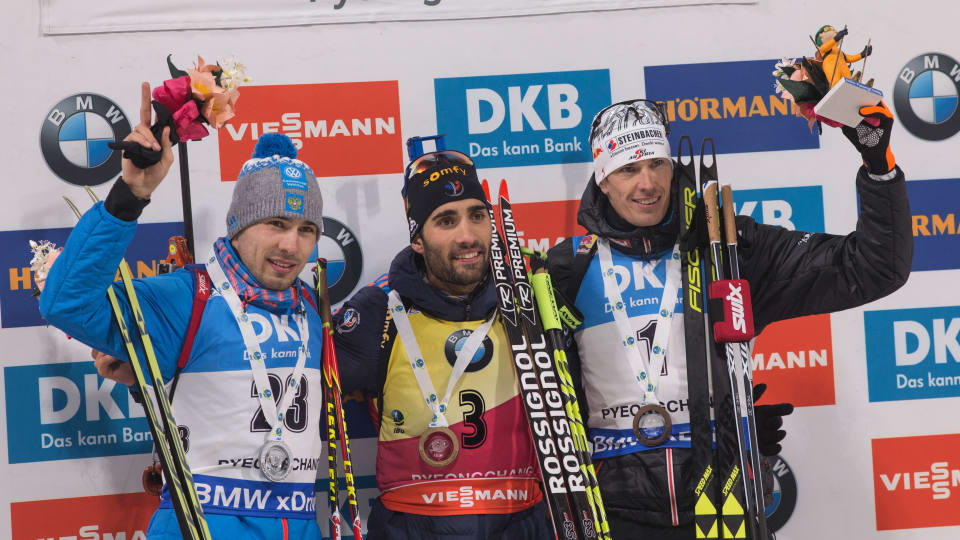
    The men’s 12.5 k pursuit podium on Saturday at the IBU World Cup in PyeongChang, South Korea, with France’s Martin Fourcade (c) in first, Russia’s Anton Shipulin (l) in second and Austria’s Julian Eberhard (r) in third. (Photo: IBU)

    [UPDATED] One day after locking up the overall World Cup title, Martin Fourcade was back at the top of the podium in the men’s 12.5 k pursuit in PyeongChang.

    Fourcade started third, after finishing third in Friday’s sprint, then shot clean to win in 31:24.2. Russia’s Anton Shipulin, who started 23rd, also shot 20-for-20 to race up to second place, 34.5 seconds behind Fourcade, with the fifth-fastest course time. In comparison, Fourcade’s course time was third fastest.

    Friday’s sprint winner, Julian Eberhard of Austria finished third (+36.7) after skiing three penalty loops (0+2+0+1). His teammate Simon Eder placed fourth (+1:03.2) after starting eighth and cleaning three stages before missing two on the last standing (0+0+0+2).

    Russia’s Evgeniy Garanichev improved from ninth at the start to fifth (+1:09.5) with two penalties as well (0+1+1+0). France’s Simon Desthieux was sixth (+1:13.5), Austria’s Dominik Landertinger seventh (+1:20.3), Germany’s Benedikt Doll eighth (+1:20.4) with the fastest course time after starting 20th.

    American Lowell Bailey was another 0.2 seconds back in ninth (+1:20.6), just ahead of Italy’s Lukas Hofer in 10th, who finished with the same time. Bailey previously tallied the third podium of his career on Friday, placing second in the sprint, but had two penalties on Saturday (1+0+1+0) to slip to ninth.

    Also for the U.S., Leif Nordgren improved to 28th (+2:28.9) after starting 37th and shooting 19-for-20 (0+0+0+1).

    Christian Gow shot clean to lead Canada in 32nd (+3:17.4), up from 56th at the start. His older brother Scott Gow slipped from 27th at the start to 43rd (+4:05.9) with five penalties (0+1+1+3), and Brendan Green followed in 44th (+4:09.8) with three penalties (2+1+0+0) after starting 28th.

    Results: Women | Men

  • Thursday Rundown: Silver and Bronze for Diggins, Randall at Lahti World Champs; Bankes Golden at IBU Junior Champs

    Kikkan Randall (l) and Jessie Diggins celebrate their bronze and silver medals, respectively, in the women’s individual freestyle sprint on Thursday, the first day of 2017 Nordic World Championships in Lahti, Finland. (Photo: John Lazenby/Lazenbyphoto.com)

    FIS Nordic World Championships (Lahti, Finland): Freestyle sprints

    Women’s report | Men’s report

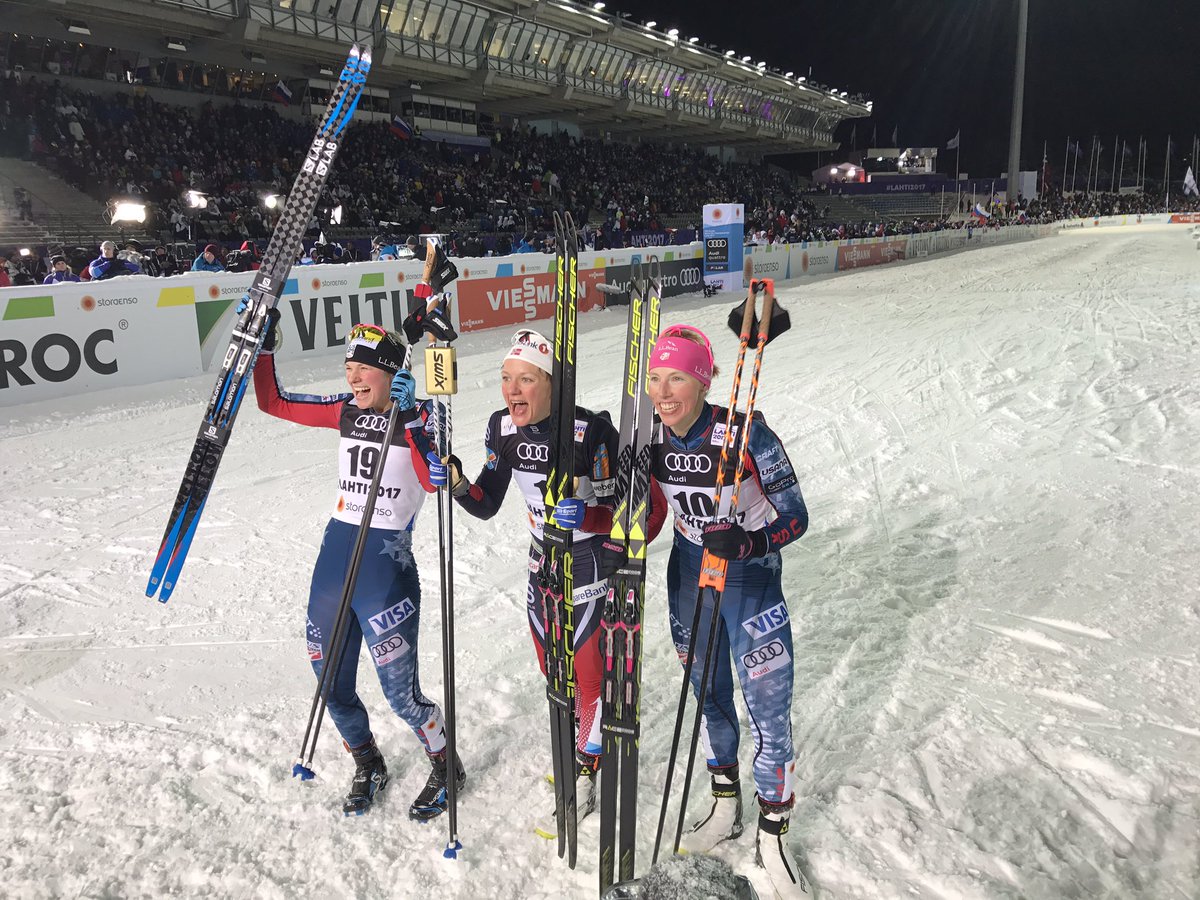
    [UPDATED] Two medals for the U.S. on Day 1. That’s exactly what happened Thursday in the first medals race of 2017 Nordic World Championships in Lahti, Finland, where American Jessie Diggins raced to second and her U.S. teammate Kikkan Randall third in the women’s 1.4-kilometer freestyle sprint final, right behind Norway’s Maiken Caspersen Falla, who took gold.

    Two Americans reached the podium in the women’s freestyle sprint on the first day of 2017 Nordic World Championships in Lahti, Finland, with Jessie Diggins (l) placing second and Kikkan Randall (r) third, behind Norway’s Maiken Caspersen Falla (c) in first. (Photo: FIS Cross-Country/Twitter)

    While Falla crossed the finish line first in in 3:02.34 minutes, Diggins finished 1.66 seconds back in second and Randall 3.76 seconds behind in third. Three U.S. Ski Team members reached the six-woman final, with Sophie Caldwell placing sixth (+5.37), behind Sweden’s Hanna Falk (fourth) and Ida Ingemarsdotter (fifth).

    Race favorite Stina Nilsson of Sweden ended the day in 12th overall after being relegated to last in her semifinal.

    Diggins won her quarterfinal and semifinal before finishing second for her second individual World Championships silver medal (she previously earned silver in the 10 k freestyle at the 2015 World Championships in Falun, Sweden, and before that, gold in the freestyle team sprint with Randall at 2013 World Championships in Val di Fiemme, Italy).

    It’s the second-straight championships that the U.S. has had individual medalists in the same race. Caitlin Gregg captured bronze in the 10 k freestyle, just behind Diggins. Four U.S. women qualified for the heats, with Ida Sargent finishing fifth in her quarterfinal for 24th overall.

    U.S. Ski Team head coach Chris Grover was universal in his praise when asked about the personal significance of Thursday’s two-medal night. “I am just really proud of the athletes — all of the athletes that were competing today,” Grover said after the women’s final. “All the athletes in the US program that were not competing today that were cheering in front of the television I’m sure this evening and are getting ready for races coming up. I am really proud of the team that we have collected here in terms of service team, and coaching team, and medical and support team … And everybody that is surrounding the event for the U.S.A. It’s just been a team over the last few World Championships that yes there has been a few people that have come off and come on, but there has really been a core group that provide this kind of stability on which we can have these kind of results.”

    In the men’s 1.6 k freestyle sprint final, Italy’s Federico Pellegrino outlasted three others within 0.7 seconds of the win, crossing the finish line first in 3:13.76.

    Russia’s Sergey Ustiugov missed out on the gold by 0.15 seconds and Norway’s Johannes Høsflot Klæbo took bronze (+0.44). Three Norwegians reached the final, with Finn Hågen Krogh placing fourth (+0.67), Petter Northug fifth (+12.13), ahead of Finland’s Ristomatti Hakola in sixth (+12.28).

    Canada’s Alex Harvey was the lone North American to reach the semifinals, where he was relegated to last in his heat for 12th overall.

    For the U.S., Andy Newell placed 21st on the day after finishing fifth in his quarterfinal and Simi Hamilton was 28th after taking sixth in his quarterfinal.

    Results: Women’s final | Men’s final

    Qualifying results

    All four of the U.S. women’s starters qualified for the heats to start the day, with Randall leading them in 10th, followed by Caldwell in 13th, Diggins in 19th, and Sargent in 27th.

    Norway’s Falla put down the fastest time in the women’s sprint qualifier in 3:03.14, Finland’s Mari Laukkanen was 2.37 seconds back in second, and Slovenia’s Katja Visnar 2.42 behind in third.

    Randall’s time was 4.45 seconds off Falla’s mark, Caldwell +5.66, Diggins +7.97, and Sargent +9.37.

    Canada’s Dahria Beatty missed the top 30 necessary to qualify by 3.67 seconds in 37th, 13.66 seconds behind Falla. Canada started three women with Cendrine Browne finishing 48th (+20.42) and Katherine Stewart-Jones 58th (+26.29) out of 107 women.

    In the men’s 1.6 k freestyle sprint qualifier that followed, Hamilton qualified 11th and Newell 20th for the U.S., and Canada’s Harvey qualified 13th.

    Russia’s Ustiugov topped the men’s qualifier in 3:11.72, while Norway qualified second and third with  Norway’s Krogh (+2.71) and Sindre Bjørnestad Skar (+3.39), respectively.

    Hamilton clocked in 7.6 seconds back in 11th, Harvey +7.85, and Newell +8.9.

    Also for the U.S., Erik Bjornsen missed qualifying by 2.22 seconds in 36th (+12.59), and Cole Morgan, in his first World Championships race, placed 54th (+18.41).

    Canada’s three other men entered in the sprint, Jess Cockney, Len Valjas and Knute Johnsgaard finished 47th (+16.82), 48th (+17.16) and 53rd (+18.39), respectively, to miss advancing to the heats.

    Qualifying results: Women | Men

    ***

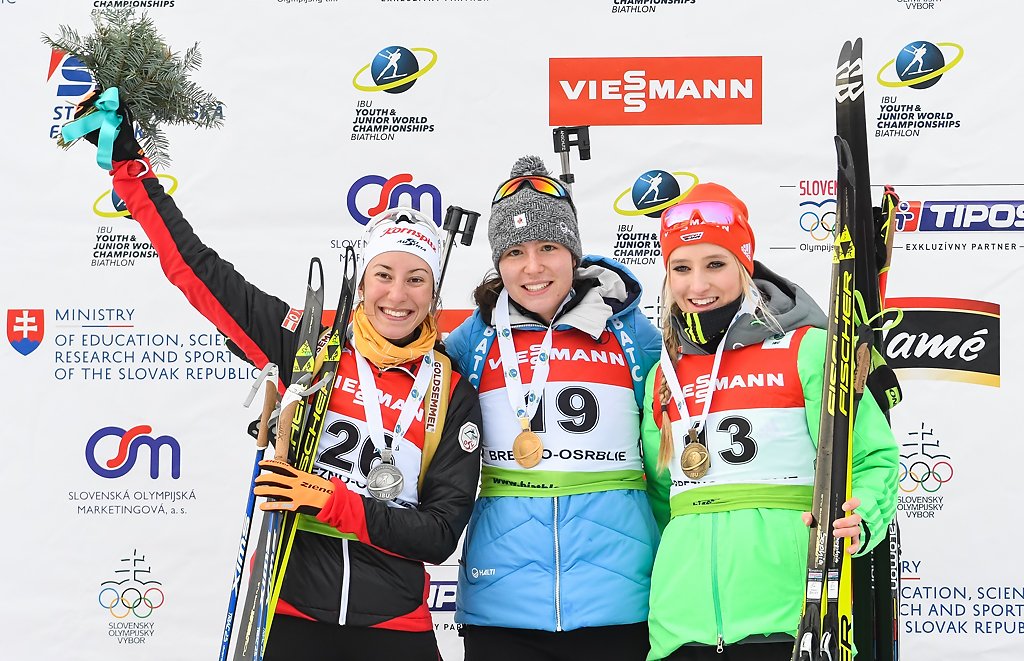
    The junior women’s 12.5 k individual podium on Thursday at IBU Junior World Championships in Osrblie, Slovakia, with Canada’s gold medalist Megan Bankes (c), Austria’s Julia Schwaiger (l) in second and Germany’s Anna Weidel (r) in third. (Photo: IBU Junior Cup/Twitter)

    IBU Youth/Junior World Championships (Osrblie, Slovakia): Junior individual races

    Race report

    [UPDATED] To say Canada is on a roll at the International Biathlon Union (IBU) Youth/Junior World Championships would be a massive understatement. On Thursday in Osrblie, Slovakia, Megan Bankes raced to a world title in the junior women’s 12.5-kilometer individual, hitting all 20 targets and finishing first in 37:22.0 minutes. After starting 19th, her time held up through 67 finishers, with Austria’s Julia Schwaiger coming closest for second place, 47.9 seconds back.

    Bankes was one of five women to clean the four-stage race on Thursday. Her teammate Leo Grandbois did the same in the youth men’s 12.5 k individual race the day before and won by nearly a minute and 15 seconds to become the third Canadian to win at Youth/Junior Worlds. Bankes is the fourth (second at Junior Worlds).

    Joining Bankes and Schwaiger on the podium was Germany’s Anna Weidel in third (+1:20.0). Like Schwaiger, Weidel shot 19-for-20. Schwaiger’s miss came in the last standing stage; Weidel’s in the first standing.

    Also for Canada, Emily Dickson placed 28th (+4:21.3) with one miss (0+1+0+0), and Nadia Moser was just outside the points (top 40) in 41st (+5:55.8) with four penalties (2+0+0+2). Charlotte Hamel did not finish.

    Americans Siena Ellingson placed 50th (+7:11.5) with four penalties (0+1+2+1) and Nina Armstrong 65th (+14:15.3) with eight misses (4+1+2+1).

    In the junior men’s 15 k individual earlier in the day, Norway’s Sindre Pettersen won by 51.2 seconds, after cleaning the first three stages then missing two on his final standing stage (0+0+0+2). After starting 68th, he finished in 40:17.2 minutes, knocking Germany’s David Zobel out of the lead. Zobel had started 26th and shot three penalties (0+2+1+0) but held the fastest time until Pettersen crossed the line. Zobel’s time held up for silver despite a challenge from Russia’s late starter Nikita Lobastov (bib 84), who shot 19-for-20 (0+1+0+0) and finished just four seconds short of Zobel for third place (+55.2).

    Canada’s Zachari Bolduc led the North Americans in 34th (+3:44.7) with two penalties (1+0+0+1).

    Cody Johnson finished 50th for the U.S. (+5:08.3) with two misses, both of which came in the last stage (0+0+0+2).

    Canada’s Trevor Kiers and Jules Brunette placed 54th (+5:21.6) and 55th (+5:27.4), respectively, each with five penalties. The fourth Canadian, Pearce Hanna finished 65th (+6:38) with seven misses.

    For the U.S., Cameron Christiansen placed 72nd (+8:10.6) with six penalties, and Peter Carroll was 79th (+10:36.4) with four misses. Travis Cooper did not start.

    Results: Junior women | Junior men 

  • Inside the Lahti World Champs Roster with Chris Grover

    Inside the Lahti World Champs Roster with Chris Grover

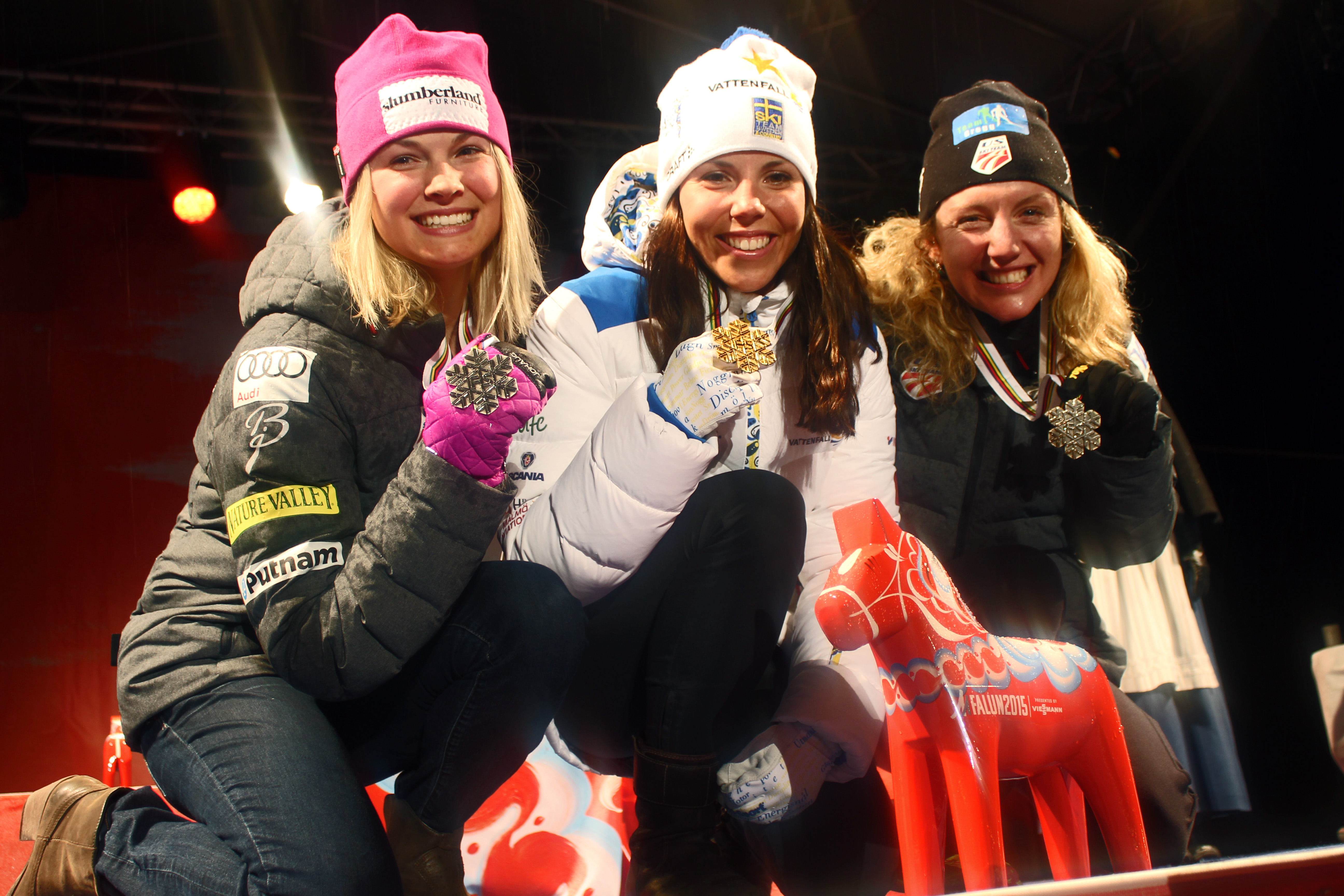
    The U.S. took two out of three spots on the podium in Tuesday's 10 k freestyle at 2015 World Championships. From left to right at the medals ceremony: silver medalist Jessie Diggins (USA), gold medalist Charlotte Kalla (Sweden) and bronze medalist Caitlin Gregg (USA) at the medals plaza on Tuesday night in Falun, Sweden.
    You may remember this from the last World Championships: The U.S. took two out of three spots on the podium in the 10 k freestyle at 2015 World Championships. From left to right at the medals ceremony: silver medalist Jessie Diggins (USA), gold medalist Charlotte Kalla (Sweden) and bronze medalist Caitlin Gregg (USA).

    On Wednesday, the U.S. Ski and Snowboard Association (USSA) announced its team nominations for the International Ski Federation (FIS) 2017 Nordic World Ski Championships, scheduled for Feb. 22-March 5 in Lahti, Finland. Following the announcement, FasterSkier spoke with U.S. Ski Team Head Coach Chris Grover to discuss the reasoning behind some specific skiers who were or were not named to the team.

    Applying the criteria

    First, a quick review: FasterSkier has previously discussed the substance and the operation of the objective selection criteria based on World Cup performance. These objective criteria placed the following members of the U.S. Ski Team (USST) onto the Lahti team based on their performance during the 2016/2017 World Cup season: Sadie Bjornsen, Rosie Brennan, Sophie Caldwell, Jessie Diggins, Simi Hamilton, Noah Hoffman, Andy Newell, Kikkan Randall, Ida Sargent, and Liz Stephen.

    All 10 athletes were ranked in the top 50 of the sprint and/or distance standings that were released earlier this week. USST member Erik Bjornsen ranked slightly outside the top-50 cutoff for both disciplines (59th for sprint and 60th for distance), and so is technically a discretionary selection.

    That leaves six additional athletes without USST status who were also selected through the exercise of discretion by the Selection Committee: Kyle Bratrud, Tad Elliott, Ben Lustgarten, and Cole Morgan for the men, and Caitlin Gregg and Chelsea Holmes for the women.

    Craftsbury Green Racing Project's Ben Lustgarten on his way to winning the 30 k classic mass start at U.S. Cross Country Championships on Tuesday at Soldier Hollow in Midway, Utah.
    Craftsbury Green Racing Project’s Ben Lustgarten on his way to winning the 30 k classic mass start at U.S. Cross Country Championships on Jan. 10 at Soldier Hollow in Midway, Utah.

    Lustgarten (70 points), Bratrud (63) and Elliott (56) are the top-three men in the distance ranking of the 2017 Championship Selection List. (The list takes an athlete’s best two finishes per discipline, including bonus points for U.S. nationals.) Morgan (70 points) is facially tied with Ben Saxton (also 70) on the men’s sprint list. (For more on why Morgan over Saxton, keep reading.)

    Holmes (80 points) and Gregg (63) are top two on the women’s distance list, followed by Katharine Ogden (60) and Caitlin Patterson (52). The top-ranked domestic skier on the women’s sprint list, Kaitlynn Miller (60 points), was not selected for Lahti.

    The principles of discretionary selection

    This summer, USST Women’s Coach Matt Whitcomb told FasterSkier that making discretionary picks was one of the harder parts of his job, saying, “We love not to do it.” But, he added, “in any criteria, discretion can often be one of the most important pieces.”

    Grover previewed how USST coaches might apply that discretion when he spoke with FasterSkier earlier this week, following the individual skate sprint in Toblach but before Wednesday’s announcement.

    “We do pay very close attention to what is happening in those races [at U.S. nationals],” Grover said. “And we are following them live as best we can from over here. We’ve been paying very close attention, and we’ve had some discussions.”

    Grover added that they had specifically been discussing “who we would start in which races in Lahti, because we absolutely want to fill every start spot, and we want to be able to have an alternate there in most cases as well, and that makes for some tough choices. Who’s skiing well domestically, who’s skiing well on the World Cup; it’s occasionally challenging to figure out which athletes are faster when they have the Atlantic Ocean between them.”

    Grover mentioned at the time that he hoped to follow and apply the selection criteria fairly rigorously and systematically.

    U.S. Ski Team Head Coach Chris Grover supervises a classic-technique drill at an on-snow camp last month at Mt. Bachelor in Bend, Ore.
    U.S. Ski Team Head Coach Chris Grover supervises a classic-technique drill at an on-snow camp in May at Mt. Bachelor in Bend, Ore.

    “The real key thing is that, at the bottom of the selection, we followed the selection criteria,” Grover said. “That’s key. Discretion really belongs to be used at the top, for those athletes who have a chance to come over and have big races at World Championships, and by big races I mean someone who can go on the podium, or the top five, top 10, or top 15. Look for some selections from USA, but I wouldn’t look for a lot of discretion at the end of the day. That doesn’t mean that we won’t use some, but we have a selection criteria, and we’ve created a clear path for athletes to visualize, and see how they are going to make it to the World Championships team, and we have to be very careful to honor those athletes, and their coaches, and their programs, and their hometowns, by selecting the athletes who came to the table, and raced fast, and won races. That’s the key for us.”

    Grover seemed willing to temper the strict application of objective rankings with some more objective consideration of conditions on the ground, particularly following a U.S. nationals where some races featured rather variable weather.

    “Of course we’re going to take everything into account,” Grover said, “take the waxing situation into account, tough waxing days. I know that some people struggled, I know that some teams struggled, that’s unfortunate. You absolutely want to see a national championship where it’s easy waxing, and then you get to see who is the best athlete out there. I’m also getting petitions from athletes who are like, ‘Yes, I felt sick during U.S. Nationals.’ And that’s tough too. You want to see everybody healthy, and having an easy wax day.”

    “It’s occasionally challenging to figure out which athletes are faster when they have the Atlantic Ocean between them.” — Chris Grover, U.S. Ski Team head coach

    But “at the end of the day,” Grover concluded, “we set up a selection criteria that was designed to give athletes a chance to have a bad race, to be sick for weekend, to give teams a chance to miss the wax, that’s why we only take the best two out of four distance races, and/or the best two out of four sprint races. That’s why the selection period is more than just U.S. nationals, but also includes the races from Yellowstone and Silver Star, so athletes have the chance to demonstrate their ability over a longer period of time, and to be able to throw out some bad races.”

    FasterSkier previously discussed the theory that the bonus points given for podium finishes at U.S. nationals made solid performances there potentially decisive for an athlete’s selection.

    Naming names

    As Grover adumbrated earlier this week, the selection of the male skiers not currently on the USST was based directly on skiers’ standing on the Lahti points list. Those selections “are very straightforward,” Grover told FasterSkier on the phone on Thursday. “We went right off of the Lahti selection list.”

    Grover added that they felt the need for only one more sprinter, in light of already having Hamilton, Newell and Erik Bjornsen on the team.

    Cole Morgan (SVSEF) racing to 12th in the men's 10 k classic FIS race in late November in West Yellowstone, Mont. (Photo: Ian Harvey/Toko)
    Cole Morgan (SVSEF) racing to 12th in the men’s 10 k classic FIS race in late November in West Yellowstone, Mont. (Photo: Ian Harvey/Toko)

    So why Morgan over Saxton for that one sprint spot, when both athletes had 70 points and were tied for first on the selection list? Tiebreakers.

    “That had to go down to like a four-way tiebreak procedure in order to determine which athlete to select,” Grover recounted. “Because they both had a first place from SuperTour, they both had two second-place finishes, and so it was only by going to their fourth race, where Cole prevailed over Ben. So that was tough, and definitely as excited as we are for Cole, that was tough for Ben, to be in that situation.”

    The tiebreaking race was “the skate qualifier only in Nationals.” Morgan finished 5.11 seconds and 17 places ahead of Saxton in Thursday’s demi-sprint, with Morgan clocking 3:20.23 and sixth vs. Saxton’s 3:25.34 and 23rd.

    Turning to distance skiers, Grover said, “So then we had four sprinters that we wanted to start, and then we obviously needed some distance skiers. And we felt like with Erik Bjornsen and Noah Hoffman on the team, that if we went out and got three more additional distance skiers that we would have the depth that we needed to effectively fill start rights, plus have an alternate, in the distance races at Lahti, which is why we went and got the three guys. We just went right off the distance points list.”

    That’s it for the men. As for the women, among American distance skiers, Gregg has a sterling championships résumé: bronze in the 10-kilometer freestyle at Falun in 2015. This performance, and Gregg’s ability to peak for it, figured heavily in the decision to go down to second on the women’s distance list and name Gregg, Grover noted.

    “We definitely … view Caitlin as a really incredible distance skier,” Grover said, “somebody who has the ability, or at least has proven the ability in the past, to be able to target an event, train for an event, a certain event, prepare for it, and then ski quite well at that event. And of course I’m referencing the Falun 10-kilometer race from two years ago. We named her to the team as a potential starter for the women’s 30 k freestyle. And typically Caitlin has been somebody who’s great at the long-distance skating in particular, and gets stronger as the race gets longer. So we’re not guaranteeing start positions for any athletes right now, but Caitlin for sure will be a strong contender to race that last race for women at the World Championships.”

    So Gregg was second on the distance list, but why not go down to Katharine Ogden (often referred to as “KO”) in third? In large part because of her youth – Ogden is still only 19 years old – and a concern for appropriate development.

    “We absolutely agree that athletes should first aim to be successful at – in the age group that they’re competing against,” Grover said. “So for KO, that means World Juniors, and being successful at World Juniors. And that should be, in my opinion, the absolute focus of her year this year.”

    The women's 20 k classic mass start podium on Tuesday at 2017 U.S. nationals at Soldier Hollow, with winner Chelsea Holmes (c), runner-up Katharine Ogden (l), and third-place finisher Caitlin Patterson.
    The women’s 20 k classic mass start podium on Tuesday at 2017 U.S. nationals at Soldier Hollow, with winner Chelsea Holmes (c), runner-up Katharine Ogden (l), and third-place finisher Caitlin Patterson.

    He added that the strength of the current American women’s team made it questionable whether Ogden, despite her talent, would necessarily be stronger than any other option. The coaches would ask, “‘OK, yes, if we were to bring you to the [senior] World Championships, what are the actual events that we would start you in? Are you one of the best four women in the United States in those events?’ There most likely, at this particular moment, is not starting space for her. … She’s going to be an absolute talent for the future, but we also have one of the strongest, if not the strongest women’s team in the history of U.S. skiing. So it’s tough to break into that group when you’re limited to four starts.”

    And what about Caitlin Patterson, an athlete who began the 2016/2017 season in Europe and scored World Cup points in the opening weekend, but never quite made the top 30 thereafter?

    Patterson was “one that we talked about, for sure,” Grover said. “However, she was not even the next woman on the points list behind Caitlin Gregg. That was Katharine Ogden. … So any time you’re talking about using discretion and using it at the bottom of the list, and then jumping over athletes that are on the list to use that discretion, then it becomes quite complicated.”

    Much as with Ogden, Grover noted that the strength of the current women’s team made it difficult to easily pencil Patterson in as a starter: “Our women’s team is so strong,” Grover said, “we didn’t necessarily see a race where we said, ‘You know what, Caitlin Patterson is within the top four women that we want to start in that particular event.’ It would have been a different situation if we didn’t have so many women making the objective criteria for World Cup in front of her.”

    But Grover noted that Patterson was not necessarily off the team for good: “So it puts Caitlin Patterson in a really tough spot, and we definitely want to see her have more opportunities, and we are in fact trying to provide her more opportunities by actually offering her some World Cup starts in the next few weekends that she’s going to take advantage of. And we’ll see what happens. If she’s able to have some outstanding results, we may reconsider.”

    As Grover alluded to regarding Patterson, the U.S. roster is not quite set in stone. “I think it’s important to recognize that we … may decide to add a man, or a woman, later to the World Championships Team,” Grover emphasized.

    “We have not maxed out what our quotas are for that event by any means,” he continued “And if we see an outstanding result of some kind, either at World Cup or say U23s/World Juniors, we may choose to add somebody to the team, which we did … two years ago in Falun, when we added Ben Saxton after he’d been sixth in the sprint at the World Juniors. So nobody has guaranteed start rights at the Lahti World Championships. And it may be that our team grows slightly. Or it may stay the same; we just don’t know yet.”

    End of an era?

    And finally, a look back for a historical note before everyone looks forward to next month’s races in Lahti: Assuming that he is not added to the roster in the next few weeks, this will be the first American international championship team without Kris Freeman since 1997. Freeman, currently of Team Freebird but a USST member for 11 years before that, was named to a total of 15 championship teams from 1997 to 2015. He was at Falun in 2015, Sochi in 2014, Val di Fiemme in 2013, Oslo in 2011, Whistler in 2010, Liberec in 2009, Sapporo in 2007, Torino in 2006, Oberstdorf in 2005. He was at Val di Fiemme, for the first time, in 2003, Salt Lake City in 2002, Lahti in 2001, and before that, he was also at three FIS Junior World Championships: Štrbské Pleso, Slovakia, in 2000; Saalfelden, Austria, in 1999; and Pontresina, Switzerland, in 1998.

    Freeman at the 2009 World Championships in Liberec.  (Photo: Swix Sport)
    Kris Freeman competing at 2009 World Championships in Liberec, Czech Republic. (Photo: Swix Sport)

    The last time Freeman was not named to an American championship team was Junior Worlds in Canmore in February 1997. To put that in perspective: top junior skiers at those races included Kristina Smigun, Axel Teichmann, Per Elofsson, and Lukas Bauer. American juniors racing at Canmore in 1997 included Rob Whitney, Pat Casey, and Lars Flora. Recent national champion Kevin Bolger (University of Utah) was 3 years old. Recent Nationals podium finisher Katharine Ogden was not born yet.

    Freeman told FasterSkier a week ago at U.S. nationals that, even if he were not selected to his second Lahti team, he intended to keep competing for at least one more winter with an eye to Pyeongchang: “Still in it, I’ll be back next year and hopefully make the Olympic team.”

    USST athlete Kikkan Randall keeps alive a streak going back to World Juniors at Štrbské Pleso in 2000. Counting 2017 in Lahti, she has been named to 16 championship teams (nine World Championships teams, four Winter Olympics teams, and three World Juniors teams) in that time.

    And USST skier Andy Newell was named to his 14th championship team, continuing a streak that dates back to World Juniors at Szklarska Poręba in 2001.

    Races in Lahti begin with the skate sprint on Feb. 23.

  • U.S. Names 17 to Lahti World Champs Team

    U.S. Names 17 to Lahti World Champs Team

    Simi Hamilton (l) hugs fellow U.S. Ski Team member Jessie Diggins after both placed third in their respective freestyle sprint finals at the World Cup stage in Gatineau, Quebec. (Photo: John Lazenby/Lazenbyphoto.com)
    Simi Hamilton and Jessie Diggins, both of whom finished on the podium in the first stage at Ski Tour Canada last season, will lead the U.S. Team at the 2017 Nordic World Ski Championships next month. (Photo: John Lazenby/Lazenbyphoto.com)

    (Press release)

    The U.S. Ski and Snowboard Association has named 17 athletes to the cross country team that will compete in the International Ski Federation’s 2017 Nordic World Ski Championships next month in Lahti, Finland. The biennial World Championships brings together the best athletes in the sport for the Feb. 22-March 5 event which will be live streamed in its entirely on NBCsports.com.

    “This is undoubtedly the strongest team that the USA has ever fielded at a major championships,” said Head Coach Chris Grover. “We have many veterans with World Cup podium experience in this group – athletes that are at the heights of their careers and their racing abilities. We have an experienced staff that knows how to manage the challenges of the major events and a world-class service team that has been making great skis all season long.  Lahti will be the perfect setting for the USA to showcase our newfound strength in cross country ski racing.”

    The team includes three medalists from past championships including Jessie Diggins (Afton, MN), Caitlin Gregg (Minneapolis) and Kikkan Randall (Anchorage). Diggins and Randall teamed up to win gold in the 2013 World Championships team sprint in Val di Fiemme, Italy. Diggins and Gregg went silver-bronze two years ago in the 10 km individual freestyle event in Falun, Sweden. Randall also won silver in the freestyle sprint at Liberec, Czech Republic in 2009. Only four Americans have won a cross country medal at World Championships.

    They will be joined by Sadie Bjornsen (Winthrop, WA), making her fourth team appearance, coming on heels of her first World Cup podium during the Tour de Ski. It will be the fifth worlds for Liz Stephen (E. Montpelier, VT), who was second fastest in the Tour de Ski hill climb. Other World Championships veterans will include Sophie Caldwell (Peru, VT), Ida Sargent (Orleans, VT) and Rosie Brennan (Park City, UT). New to the team this year is Chelsea Holmes (Girdwood, AK) who was on the podium at the recent L.L.Bean U.S. Championships at the Soldier Hollow Nordic Center in Utah.

    Leading the men will be Simi Hamilton (Aspen, CO), who was on the podium in a freestyle sprint in January, along with veterans Andy Newell (Shaftsbury, VT), Noah Hoffman (Aspen, CO) and Erik Bjornsen (Winthrop, WA). Among a host of first time team members are Kyle Bratrud (Eden Prairie, MN) and Ben Lustgarten (Burlington, VT), who each won gold at the recent L.L.Bean U.S. Championships at Soldier Hollow. They will be joined by Tad Elliott (Durango, CO), on his third worlds team, and Cole Morgan (Bozeman, MT), making his first appearance.

    It will mark the ninth appearance on a World Championships team for Randall and eighth for Andy Newell (Shaftsbury, VT).

    Lahti is a regular stop on the World Cup tour and will be holding the Championships for a record seventh time, with the first dating back to 1926 (1926, 1938, 1958, 1978, 1989, 2001, 2017). Over 700 athletes from more than 60 nations will take part in cross country, nordic combined and ski jumping. A quarter-million spectators are expected over the 12 days of the Championships.

    “Lahti is an iconic cross country venue with a proud tradition of ski racing and a massive fanbase,” added Grover. “The trails have been redesigned to provide more technical and aerobic challenges for the athletes and more opportunities to place the racers in front of the fans.  The atmosphere will be loud and electric.”

    Competition opens on Thursday, February 23 with the freestyle sprint – the strongest event of the Championships for the USA. Randall, Diggins, Caldwell, Newell and Hamilton have all been on the podium in World Cup sprints in the past. Action continues Saturday, February 25 with the multi-technique skiathlon. Diggins was second in the Tour de Ski skiathlon.

    The mid-distance events this year are classic, with 10 km for women and 15 km for men. The women will be eyeing a medal in the 4×5 km relay event on Thursday, March 2, with the men running the following day in a 4×10 km relay. The Championships conclude March 4-5 with a 30 km women’s and 50 km men’s freestyle mass start.

    2017 USA NORDIC WORLD CHAMPIONSHIPS CROSS COUNTRY TEAM
    (Name, hometown, USSA club, birthdate, age at start of championships)

    Men

    • Kyle Bratrud, Eden Prairie, MN (Central Cross Country) 2/9/1993 (23)
    • Erik Bjornsen, Winthrop, WA (Alaska Pacific University) 7/15/1991 (25) * **
    • Tad Elliott, Durango, CO (Ski and Snowboard Club Vail) 7/2/1988 (28) *
    • Simi Hamilton, Aspen, CO (Stratton T2) 5/14/1987 (29) * **
    • Noah Hoffman, Aspen, CO (Ski and Snowboard Club Vail) 8/1/89 (27) * **
    • Ben Lustgarten, Burlington, VT (Craftsbury Green) 4/17/1992 (24)
    • Cole Morgan, Bozeman, MT (Sun Valley Ski Education Foundation) 3/10/1994 (22)
    • Andy Newell, Shaftsbury, VT (Stratton T2) 11/30/1983 (33) * **

    Women

    • Sadie Bjornsen, Winthrop, WA (Alaska Pacific University) 11/21/1989 (27) * **
    • Rosie Brennan, Park City, UT (Alaska Pacific University) 12/2/1988 (28) * **
    • Sophie Caldwell, Peru, VT (Stratton T2) 3/22/1990 (26) * **
    • Jessie Diggins, Afton, MN (Stratton T2) 8/26/1991 (25) * **
    • Caitlin Gregg, Minneapolis (Loppet Nordic Racing) 11/7/1980 (36) * **
    • Chelsea Holmes, Girdwood, AK (Alaska Pacific University) 1/20/1987 (30)
    • Kikkan Randall, Anchorage (Alaska Pacific University) 12/31/1982 (34) * **
    • Ida Sargent, Orleans, VT (Craftsbury Nordic) 1/25/1988 (29) * **
    • Liz Stephen, E. Montpelier, VT (Burke Mountain Academy) 1/12/1987 (30) * **

    * Past World Championship team member
    ** Olympian


    MOST WORLD CHAMPIONSHIPS TEAMS (3 or more teams)

    Kikkan Randall – 9 (2001, 2003, 2005, 2007, 2009, 2011, 2013, 2015, 2017)
    Andy Newell – 8 (2003, 2005, 2007, 2009, 2011, 2013, 2015, 2017)
    Liz Stephen – 5 (2009, 2011, 2013, 2015, 2017)
    Sadie Bjornsen – 4 (2011, 2013, 2015, 2017)
    Jessie Diggins – 4 (2011, 2013, 2015, 2017)
    Simi Hamilton – 4 (2011, 2013, 2015, 2017)
    Noah Hoffman – 4 (2011, 2013, 2015, 2017)
    Ida Sargent – 4 (2011, 2013, 2015, 2017)
    Sophie Caldwell – 3 (2013, 2015, 2017)
    Erik Bjornsen – 3 (2013, 2015, 2017)

    2017 FIS NORDIC WORLD SKI CHAMPIONSHIPS
    Lahti, Finland
    Cross Country Schedule (Finnish times; seven hours ahead of EST)

    Wednesday, Feb. 22
    7:00 p.m. Opening Ceremony

    Thursday, Feb. 23
    3:00 p.m. Freestyle sprint qualifications
    5:30 p.m Freestyle sprint heats

    Saturday, Feb. 25
    12:00 p.m. – Women’s 7.5k CL/7.5k FS Skiathlon
    2:30 p.m. – Men’s 15k CL/15k FS Skiathlon

    Sunday, Feb. 26
    11:30 a.m. – Classic team sprint semi finals and finals

    Tuesday, Feb. 28
    1:45 p.m. – Women’s 10k classic

    Wednesday, Mar. 1
    1:45 p.m. – Men’s 15k classic

    Thursday, Mar. 2
    3:00 p.m. – Women’s 4x5k relay

    Friday, Mar. 3
    1:30 p.m. – Men’s 4x10k relay

    Saturday, Mar. 4
    2:30 p.m. – Women’s 30k freestyle mass start

    Sunday, Mar. 5
    2:30 p.m. – Men’s 50k freestyle mass start
    5:35 p.m. – Closing Ceremony

    PAST USA WORLD CHAMPIONSHIPS MEDALISTS

    1 – Jessie Diggins and Kikkan Randall, freestyle team sprint – 2013, Val di Fiemme
    2 – Jessie Diggins, 10 km freestyle – 2015, Falun
    2 – Kikkan Randall, freestyle sprint – 2009, Liberec
    2 – Bill Koch, 15k – 1976, Seefeld (Olympics doubling as World Championships)
    3 – Caitlin Gregg, 10 km freestyle – 2015, Falun
    3 – Bill Koch, 30k – 1982, Oslo

  • U.S. Nationals Open This Weekend at SoHo; World Champs Starts on the Line

    U.S. Nationals Open This Weekend at SoHo; World Champs Starts on the Line

    The last time U.S. Nationals were held at SoHo: Start of the women's 20 k freestyle mass start at 2014 U.S. Cross Country Championships at Soldier Hollow in Midway, Utah. Caitlin Gregg went on to win going away.
    The last time U.S. nationals were held at SoHo: Start of the women’s 20 k freestyle mass start at 2014 U.S. Cross Country Championships at Soldier Hollow in Midway, Utah.

    The domestic trials for the FIS Nordic World Ski Championships team begin at Soldier Hollow on Saturday morning. Not officially, but in practice that’s pretty much the case. That’s one implication of the numbers and points system used to help determine who competes for the U.S. at next month’s races in Lahti, Finland. Here, FasterSkier previews the races and considers the subtle math behind U.S. championship-team selection.

    The races

    The women race a 10-kilometer freestyle individual start at 10 a.m. local time on Saturday, followed by the men in a 15 k freestyle at noon. Sunday brings a full classic sprint (men’s qualifying starting at 10 a.m., women’s qualifying at 11 a.m., and sprint heats starting at 12:30 p.m.). Then Tuesday, Jan. 10, brings classic mass starts, 20 k for women and 30 k for men, starting at 10 a.m.

    A qualification-only, freestyle-sprint type event rounds out the week on Thursday, Jan. 12. (Why no heats? Because of overall demands on local volunteers and an elementary school housed at the venue. The national championship skate sprint will be held at U.S. SuperTour Finals, a.k.a. Spring Series, in March in Fairbanks, Alaska.)

    Social media shows several inches of fresh snow currently on top of a manmade base at Soldier Hollow in Midway, Utah.

    FasterSkier will be on site throughout the week, providing live updates and reports on the races. 

    What’s at stake

    Bragging rights, for one. All racers like to win, and the week’s first three events are all national championships. Also money: $1,200, $600, and $300 for podium spots in each of the distance races and sprint. It’s no Qaniq Challenge money, but it’s no small sum, either.

    Paddy Caldwell (Dartmouth/SMS/USST) racing to 21st in the men's 15 k freestyle at U23 World Championships in Rasnov, Romania. (Photo: Logan Hanneman)
    Paddy Caldwell (Dartmouth/SMS/USST) racing to 21st in the men’s 15 k freestyle at 2016 U23 World Championships in Rasnov, Romania. (Photo: Logan Hanneman)

    But beyond who takes home the medals and the money this week, the races are also important for determining who gets to compete in higher-level races later this season. Skiers under 18 are competing for spots on the Scandinavian Cup Team. Skiers slightly older are competing for spots on the U.S. team for U23/Junior World Championships, which will also be held at Soldier Hollow Jan. 30-Feb. 5. And at the highest level, there are spots up for grabs on the World Championships team for Lahti next month. Probably.

    As FasterSkier previously explained, the U.S. Ski and Snowboard Association (USSA) looks first to athletes’ performance on the World Cup in light of objective standards, and then potentially applies discretionary picks. After objective and discretionary selection, then “any remaining positions” for the Lahti team “may be filled by considering the athlete ranking highest on the 2017 Championship Selection List.” (As FasterSkier previously parsed, technically speaking the document says that remaining positions may be filled rather than will or shall be filled, meaning that USSA would not be strictly required to name a leading domestic skier to the team if it did not want to.)

    Filling out the team: Objective and discretionary selections

    So who’s already in from the U.S. Ski Team (USST)? One woman for sure, five more women basically guaranteed, one man basically guaranteed, then one woman and two men on the bubble.

    On the women’s side, Jessie Diggins has automatically qualified for Lahti twice over with her fifth- and sixth-place sprint finishes in Davos and Val Müstair.

    Behind her, five more skiers were well within the top 50 in either the sprint or distance World Cup standings following Wednesday’s pursuit race in Oberstdorf: Sophie Caldwell (12th in sprint standings), Sadie Bjornsen (15th in distance standings and 16th in sprint), Ida Sargent (33rd in sprint), Kikkan Randall (32nd in distance and 38th in sprint), and Liz Stephen (42nd in distance).

    Jessie Diggins celebrates finishing fifth in the Davos skate sprint. (Photo: Salomon/NordicFocus)
    Jessie Diggins celebrates finishing fifth in the Davos skate sprint. (Photo: Salomon/NordicFocus)

    (In the most strictly technical sense, everyone after Diggins cannot officially qualify this way until they are in the top 50 in those discipline standings that are released on Jan. 16. But – barring some extremely statistically improbable races by all eight women immediately below Stephen in the distance rankings – they should all qualify then with ease.)

    Rosie Brennan was 56th in the distance standings Wednesday, five points – one solid race – away from the top 50. She got that race in Toblach on Friday, moving up to 47th in the distance standings after finishing 23rd in the 5 k skate.

    For the men, Simi Hamilton is currently 41st in the sprint standings, and should be well within the top 50 on Jan. 16.

    As of Wednesday, Erik Bjornsen ranked 53rd for distance, four points out of 50th, and 55th for sprinting. Noah Hoffman was 67th in the distance standings. Hoffman moved up to 60th following his 25th-place finish in the 10 k skate in Toblach on Friday. 

    USST Women’s Coach Matt Whitcomb told FasterSkier in July that athletes who were on the bubble for World Championships selection “going into the Tour de Ski” would “need to make a pretty important decision. And that is whether or not to go back to U.S. championships and qualify domestically, or to take a chance and go with what they know and qualify in the Tour de Ski, and the sprint weekend after the Tour de Ski in Toblach.” Whitcomb added, “And so there are a great number of options both domestically and internationally on the World Cup, that I think we feel is as fair as can be.”

    But in practice, all USST athletes discussed above have remained in Europe rather than race at U.S. nationals. Diggins, both Bjornsens, Stephen, Caldwell, Randall, Hamilton, and Hoffman raced at least the first two stages of the Tour de Ski. Sargent and Andy Newell, joined by Hamilton and Caldwell, will compete in OPA Cup races in Planica, Slovenia, this weekend, USST Head Coach Chris Grover told FasterSkier by email last week.

    APU skier Scott Patterson made roughly the inverse decision in deciding to start the 2016/2017 season in this country (he had hoped for World Cup starts as last year’s SuperTour distance leader, but was not offered them for the first period of racing). Describing conversations between himself, Grover, and APU Coach Erik Flora, Patterson wrote to FasterSkier in November, “One of the most important points brought up was regarding qualification for world championships in Lahti. The selection criteria favors domestic racing for men due to the difficult objective criteria and weaker World Cup performances relative to the women. In accordance with the criteria I will be looking for some extremely strong early season results so that I can hopefully head to Europe in January and not return until after World Cup finals.”

    Regardless of who qualifies off the World Cup via objective standards, USSA may then make discretionary selections. FasterSkier previously surveyed the guidelines for the exercise of this discretion.

    Briefly put, USSA has almost unlimited discretion under the listed criteria. And if those criteria give USSA insufficient discretion, a catch-all provision lets USSA make discretionary selections for nearly any other reason if it feels like the objective criteria won’t work: “Other unanticipated failure of objective criteria to select an athlete likely to achieve competition results consistent with USSA program goals for World Championships.”

    Filling out the team: SuperTour leaders and bonuses for nationals podiums

    After objective and discretionary selections, that leaves this country’s top domestic racers skiing against each other for (probably) one remaining spot per gender.

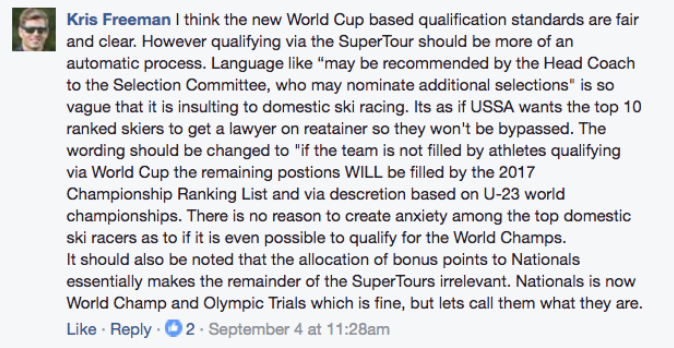
    Before the season began, FasterSkier wrote in a preview article that “American cross-country skiing does not have a trials system.” Kris Freeman (Team Freebird), a man who has been selected to 12 U.S. Olympic or World Championship teams (up to 15 if you include World Juniors teams) since 1998, politely begged to differ, writing in a comment to the FasterSkier Facebook site after the article was posted (see final two sentences in particular):

    Kris Freeman comment on FasterSkier Facebook page, Sept. 4, 2016. (photo: screenshot)
    Kris Freeman comment on FasterSkier Facebook page, Sept. 4, 2016. (photo: screenshot)

    Both FasterSkier and Freeman are technically correct. Given the numbers involved, Freeman is probably more correct. That is, there is no official trials system, but U.S. Nationals this year is getting pretty close to one.

    The World Championships Selection List is based on an athlete’s best two finishes in a single discipline, distance or sprint (qualification round only), across the 2016/2017 SuperTour to date, including the four races at U.S. Nationals. But first through third at the December SuperTour races were worth 30, 25, and 21 points, respectively. Because of the additional Nationals-only bonus points that will be awarded this week, first through third in the next four races count for 45, 35, and 26 points, respectively. Best two races, from the entire season to date, wins.

    So Freeman is correct that the “normal” SuperTour events were, if not meaningless, maybe less meaningful in light of the potentially dispositive points available for nationals podium finishes. (There are of course other advantages to being the season-long SuperTour leader, and the December races still count toward that.)

    In practice, two firsts at nationals would be unsurpassable by any combination of other races. Same for a first and second at nationals. Indeed, two seconds at nationals is a better result than two firsts in December. Two thirds at nationals beats two seconds from last month. The bonus points for nationals podiums are certainly significant digits.

    Matt Gelso (SVSEF) racing to his second-straight victory at the West Yellowstone SuperTour on Sunday in the men’s 15 k classic.
    Matt Gelso (SVSEF) racing to his second-straight victory at the West Yellowstone SuperTour in the men’s 15 k classic in December 2016.

    Matt Gelso (Sun Valley Ski Education Gold Team) and Liz Guiney (Craftsbury Green Racing Project) come into nationals as the SuperTour leaders to date, Gelso by a profound margin. Although both have World Cup start rights in Europe later this month by virtue of that status, both athletes will compete in at least the first three races in Soldier Hollow, Gelso and Guiney told FasterSkier earlier this week.

    The current SuperTour discipline leaders are Gelso for men’s distance, with 55 points, and Ben Saxton (SMST2) for men’s sprint, with 50 points. Jennie Bender (Bridger Ski Foundation) leads the women’s sprint standings with 55 points, while Katharine Ogden (Stratton Mountain School/USST D-Team) has 50 points to lead the women’s distance standings. These are not unimpressive point totals, which may become relevant if no single athlete puts together two podiums at nationals.

    The first race at Soldier Hollow begins at 10 a.m. Saturday morning. The U.S. team for Lahti is tentatively scheduled to be announced on Jan. 23.

  • After Hot World Cup Start, Patterson Needs Nationals to Make Lahti Team

    After Hot World Cup Start, Patterson Needs Nationals to Make Lahti Team

    American Caitlin Patterson (Craftsbury Green Racing Project) racing to 28th in the World Cup women's 10 k classic in Kuusamo, Finland. (Photo: Fischer/NordicFocus)
    American Caitlin Patterson (Craftsbury Green Racing Project) racing to 28th in the World Cup women’s 10 k classic at the start of the 2016/2017 season in Kuusamo, Finland. (Photo: Fischer/NordicFocus)

    Caitlin Patterson of the Craftsbury Green Racing Project had a red-hot start to her World Cup season, finishing 28th in the 10-kilometer classic in Kuusamo, Finland, and thus scoring World Cup points in the very first weekend of racing.

    But since then, not everything has gone perfectly for last season’s SuperTour leader. In the Lillehammer mini tour, she failed to crack the top 30 in any individual races and finished the tour 42nd overall.

    “A lot of lessons learned, but none of the races were quite what I wanted,” Patterson, 26, said at the time. “But it was OK. It was a good first experience of a mini tour.”

    Then there was the Davos 15 k freestyle, where she finished 44th.

    “I was looking forward to it, and I was realizing I don’t think I’ve done a 15 k individual maybe ever,” Patterson said. “But I was up for it. It definitely is a tough grade and these relentless hills add up on each other. I tried to ski smooth, but I think even in the first lap I felt like I lost all my power. It was really altitude, feeling flat, and then I started getting passed by some girls but I couldn’t stay with them at all until the last lap. [Sweden’s Jonna Sundling, who won the sprint qualifier the next day] came through, and I was able to stay with her. That was good.”

    The course has proven hard for lots of athletes to figure out — while the U.S. Ski Team’s Jessie Diggins crushed the 15 k, finishing fourth, teammate Liz Stephen talked about how she just couldn’t solve the course, no matter how many times she had tried.

    “I knew it was going to be hard, and I heard Liz and others talk about how tough it is, and altitude, and the very unique course,” Patterson said. “I guess I just felt a little disappointed that I wasn’t quite feeling my best today.”

    The next day: a freestyle sprint. It was a quick turnaround from relentless uphills and minutes with no rest, to needing quick speed in a sprint qualifier. Patterson finished 47th.

    “For a sprint, it was better than yesterday was for a distance race,” she said after the qualifier on Sunday, Dec. 11. “It was my first skate sprint of the year, which, I kind of like skate sprints, but this is a [tricky] course. I am definitely aware of several places out there where I felt like I was missing power, or sort of bogged down on the uphill the second time. It’s always a good experience, but I came in 40-something, and feeling bummed out a little bit. So that’s the end of the day today.”

    Neither Saturday nor Sunday last weekend were her days. But overall, Patterson is feeling good.

    “I had a really good interval session here mid-week,” Patterson said on Saturday, Dec. 10. “I don’t quite know why I didn’t feel so good today. You never know with the altitude. In general I feel that it’s good to get in all the different types of races, and warm back into the season.”

    According to social media, Patterson seems to be one of several U.S. athletes who came down with a cold mid-week.

    https://www.instagram.com/p/BN9MH1tDodJ/?taken-by=hoffnoah&hl=en

    One thing that’s on the line: World Championships qualifying. One of the objective criteria is to be ranked in the top 50 in either distance or sprint World Cup standings as of Jan. 16, 2017. With Patterson scoring points in the first weekend, it seemed like it might be a possibility to meet that criteria.

    Without scoring points in Lillehammer or Davos, Patterson is now ranked 47th. Regardless of how this coming weekend’s 10 k skate in La Clusaz, France, shakes out, she will miss many opportunities to score points in January in the Tour de Ski and following World Cups, meaning that even though she is the fourth-best U.S. woman in the distance standings right now, she likely won’t stay in the top 50 and thus earn a team naming that way.

    “Currently Caitlin P. is planning on racing at U.S. Nationals where she has the opportunity to qualify outright with two top distance or sprint races,” U.S. Ski Team Head Coach Chris Grover wrote in an email, adding that he had not discussed World Championships qualifying with either Patterson or the several other World Cup athletes who have not yet met the objective criteria.

    Athletes with the best two individual sprint or distance results in domestic racing from the beginning of the fall until Jan. 16 — with bonus points for turning in those performances at U.S. nationals or the SuperTours immediately after — will also earn World Championships nods.

    “If I could somehow squeak myself in — I was really hoping that today would have been a little better,” Patterson said after the Davos 15 k. “But it’s possible, maybe not so likely. Otherwise it will come down to nationals. I think this is still a great experience to be over here and I’m definitely learning a lot. I think every race I do teaches me a little bit more about how women ski over here and what I can do better. So I’m still expecting that nationals will be fun, and good racing that I can feel really strong at.”

    As she tries to find that perfect feeling, Patterson has been working with her Craftsbury coach, Pepa Miloucheva, even though it’s currently a long-distance relationship.

    “I haven’t really talked with the U.S. Ski Team coaches much, because Pepa has ideas about things,” Patterson said. “I’m just getting it week by week from her. I don’t really know what’s coming up. But I told her briefly about the 15 k going badly, and hopefully she thinks about what I should do now.”

  • Harvey Seeks More World Champs Hardware and a Possible World Cup Overall

    Harvey Seeks More World Champs Hardware and a Possible World Cup Overall

    Canada's Alex Harvey leads Norway's Martin Johnsrud Sundby during the men's 15 k freestyle pursuit at Stage 4 of the Ski Tour Canada in Quebec City. Harvey went on to place fourth, 1 second ahead of Sundby in fifth. (Photo: FlyingPointRoad.com/NNF)
    Canada’s Alex Harvey leads Norway’s Martin Johnsrud Sundby during the men’s 15 k freestyle pursuit at Stage 4 of the 2016 Ski Tour Canada in Quebec City. Harvey went on to place fourth, 1 second ahead of Sundby in fifth. (Photo: FlyingPointRoad.com/NNF)

    If you’re a fan of North American cross-country skiers, it’s likely you have an affinity for Canada’s Alex Harvey. Hailing from Quebec, he’s a marketable star in his home province. That may stem from his affability or his encroachment on Norway’s “stranglehold” on the World Cup overall.

    This year, for Harvey, his motivations are twofold. “The main goal is Lahti World Championship for sure, to be on the podium there,” Harvey said in a recent phone interview.

    Considering past performances, it’s not far-fetched to consider Harvey a contender for the overall: he was third overall in 2014, ninth in 2015 and seventh in 2016.

    “When Devon [Kershaw] was second in the overall in 2012, it was the first time I actually believed that a Canadian, or a North American man for that matter, could be on the overall podium,” Harvey said about his evolving aspirations. “Just because I saw Devon, one of my best friends, teammate, roommate from the last ten years, be on the top-three podium — that was the first year I believed it.”

    The belief in an overall podium and World Championships medal coming into the season is palpable, even realistic for the 28-year-old Harvey. He is a multiple World Championships medalist who can strike both in the sprints and distance events.  

    “But the championships medal is more important for me,” he said. “If I have to choose between say like championship gold and first place in the overall, I’d probably take first place on the overall. But I think championships are still a bigger deal to me than second or third [overall]. That’s why I put the focus still on the championship. The overall is still in the back of my mind and I am still doing every single weekend this year like previous years, other than the weekend after the Tour de Ski.”

     “Just because I saw Devon, one of my best friends, teammate, roommate from the last ten years, be on the top-three podium — that was the first year I believed it.” — Canadian Alex Harvey, on his overall World Cup aspirations

    Harvey noted that he will skip the pre-Olympic World Cup in PyeongChang, South Korea, to rest up for the late-February World Championships in Lahti, Finland. Harvey explained that a small contingent of Canadian coaches and athletes will take a quick trip after the World Cup season concludes to preview PyeongChang, the 2018 Olympic venue.

    With firm goals set, Harvey has been fastidious in his preparation. After the 2014/2015 season, Harvey underwent Iliac artery surgery to remedy a circulation issue in his legs. Last summer, although he felt better in certain running tests he’s used as historical benchmarks, his regiment deviated from his normal routine.

    Martin Johnsrud Sundby of Norway (right) training with Canadian athletes in Livigno, Italy, earlier this month. (Photo: Alex Harvey/Instagram)
    Alex Harvey snaps a photo of himself with Norway’s Martin Johnsrud Sundby (r), Devon Kershaw (l) and others while training in Livigno, Italy, this summer. (Photo: Alex Harvey/Instagram)

    “Because last year when I started training again I was coming off surgery, so I couldn’t do exactly what I was used to,” Harvey said of his 2015 dryland season. “I could not do strength or any intensity for two months. So this year I was back kind of doing what I was used to pretty much doing for my whole career before the summer of 2015. That’s just normal strength in the gym twice a week and a third time doing core and then intensity once a week for May, June and July. And then switching to twice a week after that. Some speed sessions, too: two speed sessions a week. There’s really nothing new for me. But it was kind of different from last year because I couldn’t do everything I wanted last year. I just went back to what I knew worked for me.”

    According to Harvey, it’s still working. There’s a five-minute double pole test, a six minute skating test, and a 25-minute running test that both Harvey and his coach Louis Bouchard have used as fitness barometers throughout his career.

    “I have improved all of them by ten full seconds each time,” Harvey said of his test times. “I mean, last year the big jump was on the running test because I was able to get out of threshold and push all out. And this year I was still able to improve a little bit on the running and  keep improving on the other aspects. Every year I think it is important to have some past kind of test, you need to know if things are working properly or not. We put a lot of focus on those test, but we have to keep a global perspective. But this year everything was improving, so that is good.”

    If the past is any guide, Harvey, racing in his maple-leaf-emblazoned lycra, should be high up on the leaderboards. And when it’s world champs time, Harvey believes the skiathlon is his best individual shot at medaling.

    Devon Kershaw (L) and Alex Harvey (R) with their World Championship gold medals
    Canadian teammates Devon Kershaw (l) and Alex Harvey (r) with their 2011 World Championship gold medals from the classic team sprint.

    “My favorite race is the skiathlon,” Harvey said when asked about his chances in specific World Championships races. “It’s the distance race, I think I have had the most success in my career. I have medaled in both World Junior Championships, U23 World Championship, and World Senior Championships … It is the race that for me is probably my best chance.”

    As mentioned, Harvey is an all-arounder. Along with his 2015 World Championships 30 k skiathlon bronze , there’s three total sprint World Championship medals accompanying the sole distance hardware.

    The Norwegian odds makers might just be hedging against their teams possible demise by picking Harvey as the spoiler.

    ***

    We asked Harvey to give our ’17 Questions for 2017′ a go. Here are his responses:

    1. Biggest change in your life in the last five or so months since the ski season ended?

    Not much…

    2. Biggest change in your training?

    This Spring I was able to start training like I did my whole career,which meant strength, intensity, speed and volume. Spring of 2015 I was only allowed volume until July!

    3. Major areas of improvement you’ve seen so far?

    Nothing major…I’m looking for a few seconds here and there. Overall
    I’m just a bit stronger, a bit faster and a bit more endurance..but nothing major! Biggest difference from last Summer is strength is back to what it was prior to my surgery.

    4. Whom you’ve been working closest with this offseason (coaches or training partners)?

    Louis Bouchard is still my coach after 10 years! Our National team is pretty similar to previous year, other than Babs [Ivan Babikov] is now an assistant coach! The training group in Quebec has a few new guys that can challenge and beat me, mostly in sprint time trials.

    5. Best trip in the last five months (and why)?

    Hawaii. After no warm vacation in the Spring of 2015, it was nice to get back there. I also started the training season in the Islands so that was a nice change!

    6. Favorite cross-training?

    Mountain biking.

    7. Favorite non-athletic activity or pastime this summer?

    Home renovations/improvement.

    8. Song that was your jam this summer?

    Panda – Desiigner

    9. All-time favorite race moment?

    The sprint on the Plaines of Abraham in Quebec City last March. The crowd rushing over the fences to come to me after the race, it felt like a bunch of college students rushed the football field of their favorite team after a big win!

    10. First thing you pack in your bag when you leave for Europe?

    School books. I’m always afraid I will subconsciously leave them behind.

    Alex Harvey of Cananda before the start of the men's 30 k skiathlon on Wednesday in Canmore, Alberta. (Photo: Fischer/NordicFocus)
    Alex Harvey before the start of the men’s 30 k skiathlon at the 2016 Ski Tour Canada in Canmore, Alberta. (Photo: Fischer/NordicFocus)

    11. Venue/event you’re most excited to visit this season?

    Lahti, FIN. Been there before but Worlds in Scandinavia is always exciting.

    12. Who will win the men’s and women’s World Cup titles this year?

    Ingvild [Flugstad Østberg].

    13. Biggest sacrifice you feel you’ve made choosing this career path?

    Being away from family and friends for extended periods of time.

    14. If you could change one thing about your sport, what would it be?

    Doping.

    15. What did you have for breakfast this morning?

    Bagel with jam and brown cheese, scrambled eggs, strawberries, orange juice, coffee

    16. In 5 years, I’ll be ____?

    A lawyer.

    17. In 50 years, I’ll be ____?

    A psyched dad.

  • Hamilton Poised for More World Cup Podiums with Same Relaxed Demeanor

    Simi Hamilton Mid-Crust Cruise around the Four Pass Loop (A loop circumnavigating the Maroon Bells outside Aspen, CO.) "The crust conditions that day maybe come in once every 10 years, so that was a pretty unreal adventure," Hamilton said. (Photo Credit: Linden Mallory)
    Simi Hamilton mid-crust cruise around the Four Pass Loop (a loop circumnavigating the Maroon Bells outside Aspen, Colo.) “The crust conditions that day maybe come in once every 10 years, so that was a pretty unreal adventure,” Hamilton said. (Photo: Linden Mallory)

    At 29, U.S. Ski Team member Simi Hamilton is calm and cool. Talking over the phone, his mellowed tone echoes that of seasoned ski mountaineer or devout powder-day worshipper, both of which he is. There’s lots of stoke, it’s simply tempered and masked in humility.

    That demeanor dispels this fact: in 2016, Hamilton finished his season ranked the 10th best sprinter in the world. Any added pressure coming into the 2017 season, which begins Nov. 27 in Kuusamo, Finland, because maybe he’s got a target on his back? Not so much.

    “No. I never feel like I have a target on my back,” Hamilton said in an interview on Oct. 17. “I, for sure, had a great season last year that I’m really proud of. I feel like I skied consistently well, especially in the sprints starting around Christmas and moving on past that. I felt really strong all year. I never really feel the outside pressure of other seasons weighing on the season coming up.”

    Last season on Dec. 19 in Toblach, Italy, Hamilton finished second in a skate sprint. Two and half months later at the Ski Tour Canada (STC), he qualified second and finished third at Stage 1 in Gatineau, Quebec. In between, Hamilton was a persistent North American sprinting presence.

    Hamilton, like many other skiers, said his primary goal this season is 2017 World Championships. But performing consistently on the World Cup also remains an objective. Hailing from 8,000-foot Aspen, Colo., a lack of oxygen doesn’t correlate to a lack of expectations for the skier, best known for his skate sprinting.

    “I am just really looking forward to this year,” he said. “It’s a little different in the sense that my main focus will be world champs this year, which is good for me because it is a skate sprint on a course that I enjoy and I think that I can ski really well. They’ve made some changes in Lahti to the course and their are some technical features that suit me really well and I am really looking forward to that. But at the same time, I am looking to hopefully feeling fast and fit throughout the whole season, not just for world champs. I think there will definitely be some great opportunities presenting themselves in the sprinting with some good altitude sprints in Davos and Val Müstair [Switzerland] and just some other skate sprints scattered throughout the season.”

    (The Davos sprint is Dec. 11 with the Val Müstair sprint on Dec. 31 — serving as the first stage of the Tour de Ski.)

    Coming off a career-best season, Hamilton remained committed to improving. This spring, he began working with U.S. women’s coach Matt Whitcomb to tweak some of his perceived deficits. Prior to working with Whitcomb, Hamilton’s primary coach was U.S. men’s coach Jason Cork.

    “Matt and I have known each other for a really long time now and we have always worked really well together and have always been great friends,” Hamilton said of his new coaching arrangement. “And it is a pretty kind of natural direction for both of us to take —  just working with each other and it has been great.”

    According to Hamilton, he’s worked with Whitcomb at all the USST camps this offseason; Bend, Ore., New Zealand, and currently in Park City, Utah.

    “I think we are pretty pumped about how it has gone so far and I’m looking forward to being able to work with him on a daily basis throughout the whole race season … and just have him there for the adventure during the race season,” Hamilton said.

    Over the past few seasons, strong double poling in classic events has been a prized commodity. As skiers get stronger, they’re able to exclusively double pole some distance and sprint races. The International Ski Federation (FIS) recently implemented an 83-percent rule, where classic poles in a FIS-sanctioned classic race can be no longer than 83 percent of a skier’s height with ski boots on.

    Simi Hamilton working on his double poling this past spring in Bend, Ore.. (Photo: flyingpointroad.com)
    Simi Hamilton working on his double poling this past spring in Bend, Ore.. (Photo: flyingpointroad.com)

    The rule shouldn’t impact Hamilton despite placing an emphasis this summer on fine tuning aspects of his double poling.

    “In terms of the new percentage rule, it doesn’t really affect me too much because the longest classic poles that I skied with in the past have only been about 81 or 82 percent of my height,” Hamilton explained. “So I wasn’t really looking to go any taller with my poles, so it doesn’t really affect me too much which is nice. … I am not worried about having to really alter my technique just because of that rule. I’m just fortunate to stick with what I have been working on and stick with the poles I have had for the last few years … and keep chipping away at that.”

    Technically speaking, Hamilton specified double poling up steep climbs in classic sprints as terrain in which he could improve — terrain where some skiers would opt for skate skis or waxless classic skis.

    “I have been playing around with a much shorter range of motion on the climbs to keep my tempo much higher,” Hamilton said. “I think historically in the past I have been a double poler that really relies on a lot of power, and that can come back to bite you a little bit when it gets really steep or it gets really punchy in soft snow conditions. So I think just focusing on staying in a really high position with a much shorter range of motion and maintaining a really quick tempo has been a really good thing for me to work on this summer. I feel like I definitely made some gains with figuring out those mechanics and am looking forward to working on them during dryland for the next month and then throughout this race season and putting them to use during some big races.”

    New school may be double poling some World Cup sprint courses, yet Hamilton’s calculations factor in his lower-body power. For 2017, he remains dedicated to understanding his classic-ski fleet and closing or making gaps using kick wax when it’s in play.

    “For me, it’s actually also a conditions kind of thing, like in Drammen last year I felt like I had a decent day, and who knows if I had I had been able to go past the semis if I was double poling, but I was striding all day in Drammen and a lot of people were double poling,” Hamilton said of his if-it-ain’t-broke-don’t-fix-it premise.

    “So it mostly depends on what the conditions are during that day, how the snow set up the night before, how fast it is. And honestly, if you step on a pair of your klister skis in the morning and they are rocket fast and you have great kick — for me that is still going to be a no brainer to go on a really good pair of classic skis. I feel like especially with my leg strength, I can use striding to my advantage. And if the opportunity presents itself that double poling is going to be a lot faster for me on a specific day, on a flatter course like Drammen or Stockholm, then I’ll for sure put double poling into the equation and think about it.

    “I think right now it’s not so much looking at races this coming season and the year after saying, ‘Yes, I am definitely going to double pole that race,’ ” he continued. “It’s mostly just about developing a really good double pole technique in case the opportunity does arise and it makes sense to actually double pole that day.”

     Simi Hamilton striding during a World Cup sprint in Drammen, Norway, last February. (Photo: Fischer/NordicFocus)
    Simi Hamilton striding during a World Cup sprint in Drammen, Norway, last February. (Photo: Fischer/NordicFocus)

    With his sights set on the World Cup, Hamilton keeps a less-than-myopic view on the future. If you follow him on Instagram or Facebook, training and adventuring often blur lines. Thus, a professional career fusing his love for the outdoors is part of his post-ski career framework.

    “A lot more people are interested in getting into the backcountry right now, so I am looking at it as an opportunity as more and more people are traveling outside ski-area boundaries,” he said of his passion for pursuing an advanced degree in snow science. “It’s an opportunity to develop more technology and shared cloud-based knowledge in order to make the backcountry safer for a lot more people traveling out there. So I’m psyched about creating or helping develop ways to ensure a safer kind atmosphere for your common backcountry skier … I think it would be pretty cool to give back to the outdoor community in that way and keep pushing the development of avalanche safety and awareness.

    Hamilton also mentioned he’d be excited to eventually settle in or around Aspen and the mountainous terrain he grew up in. That raises the question of how he’ll tap into his years of training. In Hamilton’s hometown part of the world, the end of winter is often celebrated by competing in the Grand Traverse Ski Race: a 40-mile backcountry race from Crested Butte to Aspen. Most often the Grand Traverse is won by human lungs racing on lightweight skimo gear. But on occasion, when the freeze-thaw cycle aligns, conditions are ripe for some to give it a go on skate gear.

    “I know it would probably take more than one time doing doing it before I hit the right conditions,” Hamilton said when asked when he’d jump into the Grand Traverse race. “I am really hopeful that in the future when I do do it, whether it’s one out of ten times or one out of twenty times, that it will be the perfect conditions for skate gear. I think if it were just right, I think that you could just demolish the record with some really good crust conditions. If it were really fast crust conditions you could basically V1 and V2 maybe 80 percent of the terrain — really move a lot quicker than putting skins on. I am super psyched to jump into that race someday.”

    For now it’s Hamilton’s formidable World Cup competition that understands he’s racing to win. In the future, the Aspen and Crested Butte locals may be watching Hamilton and a partner (Grand Traverse racers must compete in pairs), skate into the distance over Star Pass and Taylor Pass — heading home.

    ***

    We asked Hamilton to give our ’17 Questions for 2017′ a go. Here are his responses:

    1. Biggest change in your life in the last five or so months since the ski season ended?

    Outside of training, not a whole lot has changed… my sister got married so now I have a brother in-law. I guess that’s a great change.

    2. Biggest change in your training?

    I’ve added a bit more easy volume this summer. Which has been awesome since some of that has come in the form of a few 6-8 hour runs and mountain bike rides. I always love getting out for some epically long adventures in the mountains… that’s my favorite kind of training.

    3. Major areas of improvement you’ve seen so far?

    My coach, Matt, and I have been working on some new mechanical things with my double pole. I’m seeing some improvement there which I’m excited about, especially since having a good double pole on the World Cup is becoming more and more important.

    4. Whom you’ve been working closest with this offseason (coaches or training partners)?

    I’ve been working closely and very positively with my coach Matt Whitcomb, and have been getting in some great training with my teammates Andy Newell, Ben Saxton and Paddy Caldwell in Vermont and on snow in Bend, OR and New Zealand.

    5. Best trip in the last five months (and why)?

    New Zealand was a great camp for us this year. We saw a lot of different types of conditions from soft spring skiing to firm ice to mid-winter dry powder, so it was very beneficial to be able to train during a 2.5 week window on the most common snow types we see throughout the whole race season. I’ve taken a couple great trips to the desert since I’ve been home in Colorado this Fall, so that’s been awesome.

    6. Favorite cross-training?

    Mountain biking and backcountry skiing.

    7. Favorite non-athletic activity or pastime this summer?

    Working on my bike.

    8. Song that was your jam this summer?

    Old Thing Back by Notorious BIG

    9. All-time favorite race moment?

    Getting 3rd by a few centimeters in the Sprint in Gatineau, Quebec, last spring. A lot of my family and a ton of friends were there for that race, and it was just a great day in a lot of ways.

    10. First thing you pack in your bag when you leave for Europe?

    A lot of clean underwear and Cold FX.

    11. Venue/event you’re most excited to visit this season?

    Lahti, Finland (where the 2017 World Championships will be held)

    12. Who will win the men’s and women’s World Cup titles this year?

    Francesco De Fabiani and Charlotte Kalla.

    13. Biggest sacrifice you feel you’ve made choosing this career path?

    Keeping all of my stuff in one place. Between my all of my ski stuff, climbing gear, backcountry gear, and bikes, I can never remember where everything is.

    14. If you could change one thing about your sport, what would it be?

    I would push for adding more city sprints to the World Cup schedule. I think it’s a great way to showcase our sport to spectators that wouldn’t otherwise be interested in our sport, and racing in a city landscape is always such a cool thing.

    15. What did you have for breakfast this morning?

    Oatmeal squares and coffee.

    16. In 5 years, I’ll be ____?

    In school, studying snow science.

    17. In 50 years, I’ll be ____?

    An avalanche forecaster in Colorado.

  • Looking to Lahti: Inside the USST’s World Champs Selection Criteria

    Looking to Lahti: Inside the USST’s World Champs Selection Criteria

    The 2015/2016 U.S. Nordic Ski and Nordic Combined teams during a team photo shoot in their new uniforms on Monday, Oct. 19, in Park City, Utah. (Photo: USSA)
    Last season’s 2015/2016 U.S. Nordic Ski and Nordic Combined teams pose for a photo shoot in October 2015 in Park City, Utah. (Photo: USSA)

    American cross-country skiing does not have a trials system. That is, selection to the U.S. team for international championship events – the Olympics and World Championships – does not involve having everyone show up in the same race (or race series) on the same day, top finishers make the team. Championship teams used to be picked this way; Luke Bodensteiner writes memorably in Endless Winter: An Olympian’s Journal of his experiences at Anchorage’s Kincaid Park for the 1994 U.S. Olympic Trials. (Spoiler alert: as the subtitle suggests, he made the team.)

    But the current approach is somewhat more elaborate, including ranking lists and points and a variety of criteria that are primarily objective, but are also supplemented by discretionary factors. As we approach the winter of 2016/2017, and the country’s top skiers await the first intervals of fall with dreams of competing at the FIS Nordic World Ski Championships in Lahti, Finland, FasterSkier breaks down the selection criteria that set forth the ways in which a U.S. athlete may be named to the team.

    New selection criteria: Last winter’s results are out, this winter’s results are in

    The U.S. Ski and Snowboard Association’s (USSA) full selection criteria for Lahti are available here. This document reflects the final stage of a long process. In January 2015, shortly after he had shared the selection criteria for the 2015 World Championships in Falun, U.S. Ski Team Head Coach Chris Grover wrote on his blog about his intent to work on updating the criteria before it came time to select athletes for Lahti.

    “I’ve organized a working group of top US coaches this summer and fall to help us create a new selection criterion for Lahti 2017,” Grover wrote in response to a question about the interaction between objective and subjective criteria. “One important aspect of this new criteria is creating a head-to-head format in fall SuperTour racing (including U.S. Nationals) that provides an athlete with a clear path to Championship selection, without the guesswork of looking for races with low points. We are currently running the criteria by our legal department to ensure that, like all of our criteria, it’s fair, clearly understandable, and complies with the Amateur Sports Act.” *

    Eighteen months later, in June 2016, Grover wrote that he was “excited” about the updated selection criteria for the U.S. team for Lahti. He wrote that “the Objective and Discretionary selection procedures in [the new] criteria are very similar to what we have used in the past. The big change, however, comes in how Additional Team Selections are made. In the past, additional selections have been made using FIS or USSA points, which are created by scoring points races on a year-round continuum. This new criteria relies on head-to-head SuperTour and U.S. Nationals racing in the fall/early winter of the season of the Lahti Championships themselves.”

    Grover wrote that the new criteria are intended to reduce the temptation for athletes to chase FIS or USSA points, or even to “willingly manipulate the results of races” with an eye to improving points.

    He added, “This criteria rewards head-to-head competition in the season of the Championships. Athletes who skied fast in the spring of the previous season no longer have a potential advantage over those athletes skiing fast in the current season. The criteria provides a clear path for athletes to the World Championships. The athlete that is winning races is most likely going to make the Team. The guesswork of improving one’s FIS or USSA points is removed.”

    U.S. Ski Team Women’s Coach Matt Whitcomb concurs. As he told FasterSkier earlier this summer, the new focus on results solely from the 2016/2017 race season is “definitely a criterion that focuses more on how athletes are skiing closer to the Championships. It’s a very important concept, I think, that from what I can tell the entire ski community is behind.”

    (Concern over what is effectively a year-long window for the development of USSA points, and the implications of making championship-team selections on this basis, is not of recent vintage. In December 2001, Cory Smith, at the time an elite American skier, blogged about his disfavor with selecting skiers for the 2002 U.S. Olympic team on the basis of the most recent USSA points list, when the relatively low-key races held at Spring Series 2001 ended up having a disproportionate effect on the USSA rankings list used for Olympic selection many months later.)

    Inside the selection criteria: World Cup success as an objective path to selection

    The 2013 U.S. World Championship team poses in Val di Fiemme, Italy, after Kikkan Randall and Jessie Diggins (front right, and left, with flag) won the women’s freestyle team sprint.
    The 2013 U.S. World Championship team poses in Val di Fiemme, Italy, after Kikkan Randall and Jessie Diggins (front right, and left, with flag) won the women’s freestyle team sprint.

    The selection criteria themselves include a mix of objective standards and discretionary options. Performance on the World Cup is the easiest and most direct way to merit selection to the team, but there is also the option of skiing on via domestic results on the SuperTour. Probably.

    Starting with objective standards: The objective standards look solely to an athlete’s performance on the World Cup. An athlete will be automatically selected to the World Championships team if they have either (1) a “ranking in the top-50 in the Distance World Cup standings or the top-50 in the Sprint World Cup standings as of January 16, 2017,” or (2) a “top-8 individual final World Cup result” in one of three selected race formats between the start of the upcoming World Cup season and Jan. 16, 2017.  (The full document explains various tie-breaking procedures and additional principles; for example, a top-8 individual sprint finish trumps a top-50 sprint points ranking.)

    The three specified race formats in which a top-eight finish will lead to team membership are “Sprint F, individual start 10/15 km C, and 15/30 km Skiathlon.”

    This does not account for all of the individual races in the first half of the World Cup calendar – individual races in other formats include a classic sprint in Ruka, a classic sprint in Lillehammer, a 5/10 k skate in Lillehammer, a 15/30 k skate in Davos, and six of the seven races in the Tour de Ski (all save the opening skate sprint).

    In an email to FasterSkier, Grover explained that this distinction is by design. “Only individual events in the specific format we are racing in Lahti qualify for top-8 automatic qualification,” he wrote. “Classic sprints [which will be held in Lahti in the team sprint format] are not included in this specific part of the criteria because the aerobic and anaerobic demands of team sprint are different enough from individual sprint.”

    Grover addressed the possibility that an athlete could achieve a top-eight individual result on the World Cup, but do so in some race format other than the three designated ones of skate sprint, 10/15 k individual start classic race, and full-distance skiathlon.

    “An athlete that has scored a top-8 in any event will most likely score enough [World Cup] points in that single race to make the top-50 discipline qualification standard,” he wrote. And “at the end of the day, we want any athlete that can finish in the top-8 on the [World Ski Championships] team. We also have discretion to use in the event that a top World Cup performance by a given athlete fails to qualify them outright for the Lahti Team. The top-8 criteria has an element of redundancy in it, but it is important in the event that an athlete only gets 1/2 points for that performance if it comes during the Lillehammer mini-tour [on December 2-4] or the [Tour de Ski].”

    The possibility of discretionary picks

    Grover had alluded to USSA’s discretion to make additional selections. As the criteria document states, “The USSA may select additional athletes to the Team using coaches’ discretion, using factors other than objective criteria.” (This language is unchanged from the criteria that governed selection to the U.S. team for Lahti in 2015.)

    These discretionary factors include everything from results in last season’s races to “attitude,” “illness or injury during the selection period,” and “Indicia of medal potential in future Olympic or World Championship competition, which would be materially enhanced by selection to team.” Finally, a catch-all provision states that USSA may make discretionary selections for nearly any other reason if the objective criteria do not reach the desired goal: “Other unanticipated failure of objective criteria to select an athlete likely to achieve competition results consistent with USSA program goals for World Championships.”

    Whitcomb told FasterSkier in July that making discretionary picks was “one of the harder parts” of his job as a coach, stating, “We love not to do it.” Though he added, “But in any criteria, discretion can often be one of the most important pieces.”

    Inside the selection criteria: SuperTour success as a likely but not guaranteed  path to selection

    After USSA selects athletes via objective criteria based on World Cup performance, then, potentially, via discretionary factors, “any remaining positions” for the Lahti team “may be filled by considering the athlete ranking highest on the 2017 Championship Selection List.” (Technically speaking, the document says that remaining positions may be filled rather than will or shall be filled, meaning that USSA would not be strictly required to name a leading domestic skier to the team if it did not want to.)

    The scoring system for the 2017 Championship Selection List is explained in detail in the full selection criteria document. Briefly put, the list takes an athlete’s two best finishes “in a single discipline (sprint or distance)” and looks for the highest point total, based on awarding SuperTour points on a standard basis plus bonus points for a top-3 podium finish at U.S. Nationals. Notably, the window in which these performances may occur is only the first half of the 2016/2017 season, and does not – unlike the rolling USSA standard points list – include the second half of the 2015/2016 season.

    The highest ranked athlete on this list (who was not otherwise selected via objective criteria or discretionary factors) “may be recommended by the Head Coach to the Selection Committee, who may nominate additional selections.”

    The “Head Coach” is Grover. The “Selection Committee” is not literally defined elsewhere in the selection criteria document, but the document does discuss a “discretionary selection review group comprised of the USSA President and CEO, the Executive Vice President, Athletics, and the athlete representative from that sport who is a member of the USSA Board.” Grover clarified in an email that, in practice, the discretionary selection review group is the same as the “Selection Committee.”

    The USSA President and CEO, Executive Vice President for Athletics, and cross-country skiing athlete representative are currently Tiger Shaw, Luke Bodensteiner, and U.S. Ski Team member Rosie Brennan, respectively.

    Looking back and looking forward

    So how did this all play out in practice when it came time to select the team for Falun? Two years ago, eight athletes qualified objectively via their World Cup results. Another eight athletes were selected based on the most recent USSA points list. Finally, one athlete was selected via discretion.

    Specifically, Sadie Bjornsen, Sophie Caldwell, Jessie Diggins, Kikkan Randall, Ida Sargent, Liz Stephen, Simi Hamilton, and Andy Newell qualified for the U.S. team for Falun via objective criteria based on their World Cup rankings in the 2014/2015 season. Rosie Brennan and Caitlin Gregg for the women, plus Erik Bjornsen, Dakota Blackhorse-von Jess, Kyle Bratrud, Kris Freeman, Matt Gelso, and Noah Hoffman for the men, were then “entirely selected from the fourth publication of the USSA points list,” FasterSkier wrote soon after the selections were released. Finally, Ben Saxton was added to the team a few weeks later following his strong results at 2015 U23 World Championships in Almaty, Kazakhstan.

    “Brennan and Gregg were the top two domestic skiers on both the distance and sprinting lists [as of mid-January 2015],” FasterSkier wrote at the time. “Hoffman, Freeman, Gelso, and Bratrud were the first four skiers in the distance rankings, while Blackhorse-von Jess and Erik Bjornsen were the top skiers (apart from Newell and Hamilton) in the sprint rankings.”

    The U.S. team for Lahti is tentatively scheduled to be announced on Jan. 23, 2017. The first race at World Championships is the skate sprint on Feb. 23.

    * Footnote: The Amateur Sports Act of 1978, officially known as the Ted Stevens Olympic and Amateur Sports Act, 36 U.S.C. §§ 220501 et seq., “establishes a legal framework for protecting the participation opportunities of Olympic sport athletes,” one commenter explains. The Act mandates the creation of an Athletes’ Advisory Council, and describes procedures under which an athlete may submit eligibility disputes to binding arbitration. A related provision, section 9.1 of the Bylaws of the U.S. Olympic Committee (USOC), states that USOC “shall, by all reasonable means, protect the opportunity of an amateur athlete to participate if selected (or to attempt to qualify for selection to participate) as an athlete representing the United States” at the Olympics or World Championships.

  • Kikkan Randall Pregnant, Will Skip This Season But Focused on 2018 Olympics

    Kikkan Randall Pregnant, Will Skip This Season But Focused on 2018 Olympics

    Kikkan Randall and her husband Jeff Ellis recently announced they are expecting their first child in April 2016. Randall, 32, will skip the 2015/2016 season, but plans to return for 2016/2017. (Photo: USSA)
    Kikkan Randall and her husband Jeff Ellis recently announced they are expecting their first child in April 2016. Randall, 32, will skip the 2015/2016 season, but plans to return for 2016/2017. (Photo: USSA)

    (USSA press release)

    PARK CITY, UT (Oct. 15, 2015) – World Champion cross country ski racer Kikkan Randall (Anchorage, AK) is planning to take a break from competition this season. Randall and husband Jeff Ellis announced to her teammates this week that they are expecting their first child in April. Randall will skip the upcoming season, but plans to come back strong for the World Championship year in 2016-17 and keep her eyes focused on the 2018 Olympics in PyeongChang.

    Kikkan Randall racing last season at the final World Cup classic sprint in Drammen, Norway. Randall, 32, will miss the 2015/2016 season as she is expecting her first child. (Photo: Fischer/NordicFocus)
    Kikkan Randall racing last season at the final World Cup classic sprint in Drammen, Norway. Randall, 32, will miss the 2015/2016 season as she is expecting her first child. (Photo: Fischer/NordicFocus)

    Randall, 32, who has also won three season-long World Cup sprint titles, was glowing with the news as she talked to teammates gathered in Park City for the Team’s final pre-season conditioning camp.

    “After Sochi, I thought a lot about my future and the goals I still want to achieve,” said Randall. “I was always committed to continue racing, but Jeff and I also wanted to start a family. We felt this was a good time. I’m excited about becoming a mother, but am also looking forward to coming back to race in 2017.”

    Randall plans to spend some time at selective World Cups this season as a spectator to maintain contact with the sport. Her husband, who serves as a marketing support manager on the FIS Cross Country World Cup tour, will continue to travel on the circuit this winter.

    Randall, a 14-year veteran of the U.S. Cross Country Ski Team, is one of its most decorated stars in history with three World Cup titles and two World Championship medals, including gold in the team sprint from 2013, pairing with Jessie Diggins (Afton, MN).

    “Finding a way to balance an athletic career and being a mother has been a goal of hers for some time, so rewarding to see it come together for her,” said Head Coach Chris Grover. “As much as we will miss Kikkan’s leadership on the World Cup tour, we know that she will be back in 2016-17. The Team is very excited for Kikkan and Jeff.“

    “I plan to maintain my same athletic direction when I come back, skiing both sprint and distance,” Randall said. “I’m especially looking forward to the freestyle sprint at World Championships in Lahti, where I’ve won before, and the team events in PyeongChang.”

    “If anyone has the tenacity and the drive to return to World Class form after starting a family, it is Kikkan,” added Grover. “She understands the hard work and the form that is necessary to be a Champion, and she is already showing the determination to return to the sport and to win. The Team is already looking forward to having her back in training camps next summer and we’ll be looking to her for big results in 2017 and 2018.”

    Randall is continuing to participate with the Team at its dryland and roller ski camp in Park City until late October.