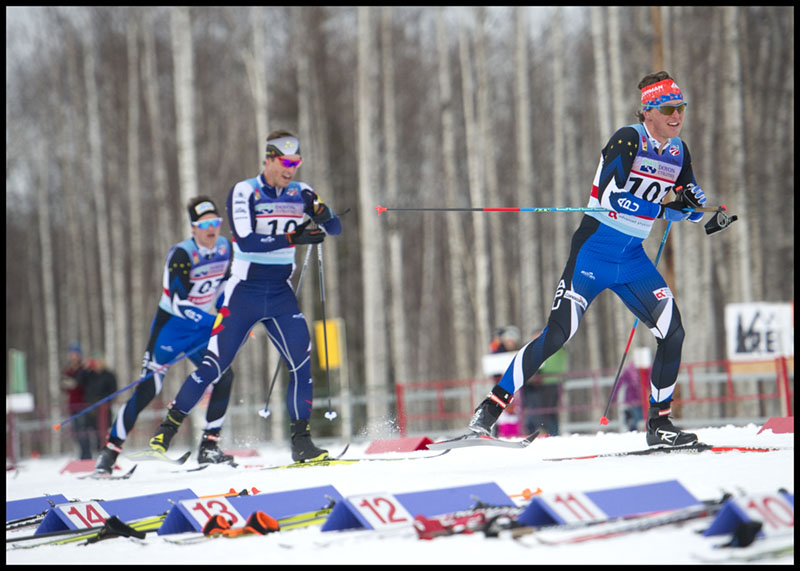
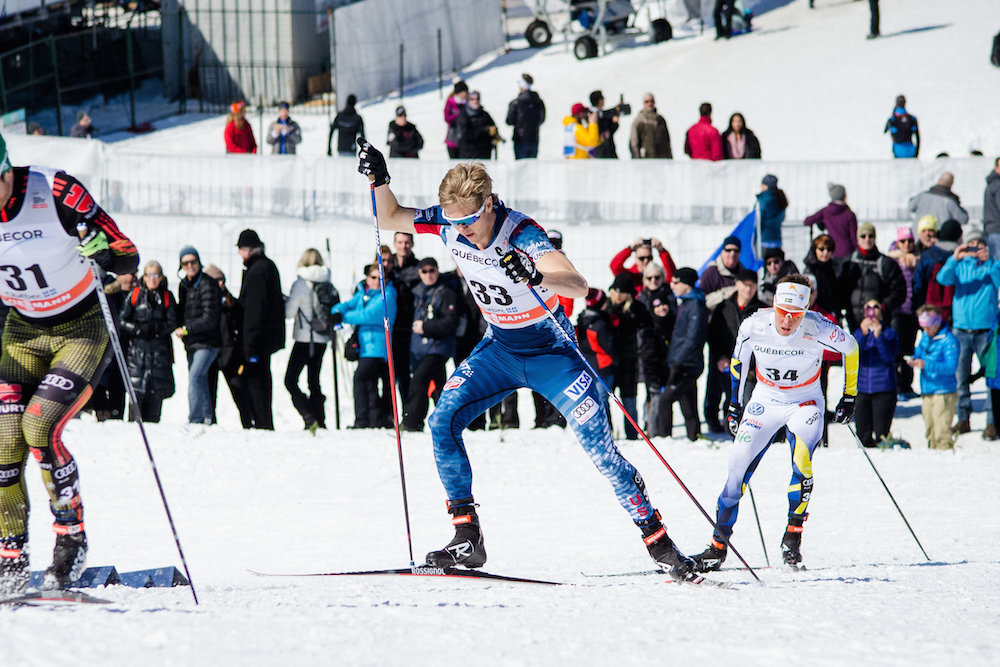
Scott Patterson racing the second stage of the 2016 Ski Tour Canada, a 17.5 k classic mass start in Montreal. (Photo: Flyingpointroad.com/NNF)
Alaska Pacific University’s (APU) 25-year-old Scott Patterson isn’t easily distracted. His is a busy schedule with a repetitive cycle like something out of the movie “Groundhog Day”. In Patterson’s case, the routine goes something like this: wake, eat, train, eat, work, train, sleep … repeat.
“My general plan is I try to put in about 25 hours a week,” Patterson said over the phone from his home base in Anchorage. Just so we’re clear, that’s 25 hours per week working as a mechanical engineer. Beyond aspiring to the highest levels of the sport, Patterson has worked for the same engineering firm for five years — two as an intern and three as a part-time employee. He focuses on ensuring oil and gas pipelines are up to spec and corrosion prevention.
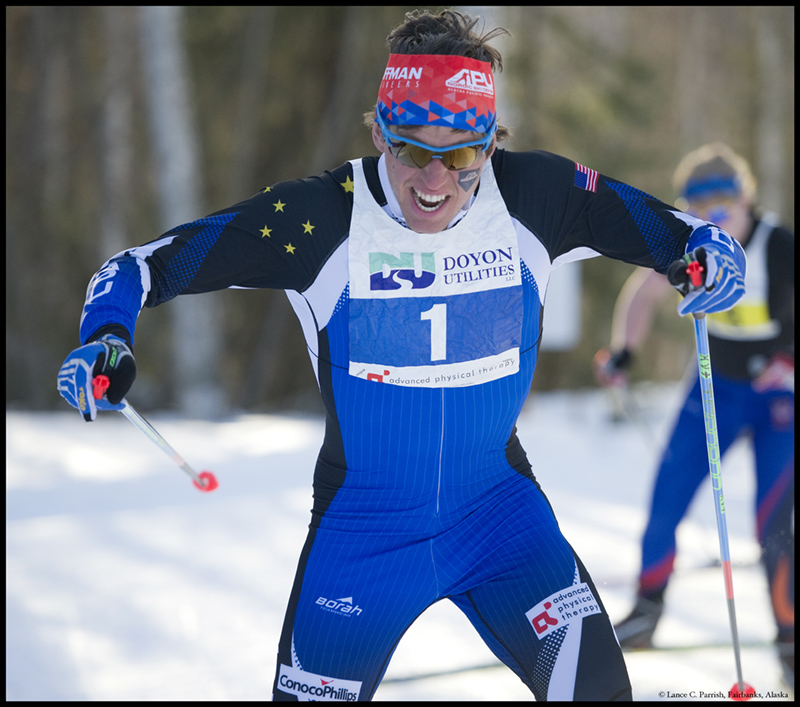
Scott Patterson (r) leads Kris Freeman (c) and David Norris (l) into the ski exchange during the men’s 22.5-kilometer skiathlon at 2017 SuperTour Finals in Fairbanks, Alaska. (Photo: Lance Parrish, Fairbanks)
If you think a classic-to-skate transition is tough, Patterson has dialed his training-to-work transitions.
“One of the things I’ve noticed is that I really kind of figured out how to nail down the transition, Patterson said. “I eat my food faster, driving in the car. Just like every single little thing is made to kind of streamline the day. And you’d probably say it’s a little OCD but it’s how I get through it, so it works for me.”
If you’re Patterson’s work boss, the question is has he clocked quality work time? If you’re Erik Flora, APU’s head coach, the question is has Patterson logged quality training? On average, Patterson said he trains two to two-and-a-half hours in the morning before a noontime arrival at work. He then trains another two to two-and-a-half hour block in the early evening. Amongst domestic skiers, he’s known to log a high volume of training hours.
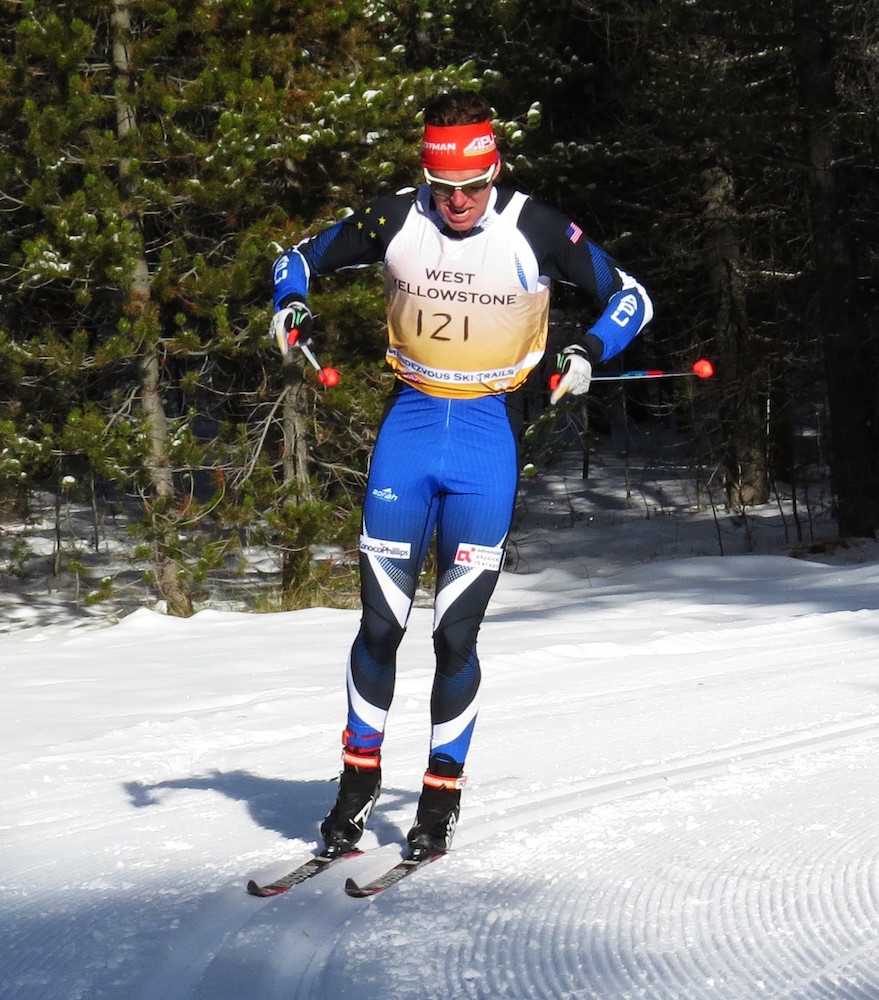
Scott Patterson double poling to the win in the men’s 10 k classic “pre-season” FIS race in November 2016 in West Yellowstone, Mont. (Photo: Ian Harvey/Toko)
Patterson began this year’s SuperTour distance skiing campaign with a third place in the 15 k skate in West Yellowstone, Mont. Then a week later in an equally loaded domestic field, Patterson won the 15 k skate at the first NorAm of the season at Sovereign Lake in Vernon, British Columbia.
Primed for his major objective of the year, qualifying for World Championships, Patterson figured one stellar race at U.S. nationals in early January would punch his ticket to Finland. The 15 k skate at nationals didn’t go as planned; he placed 16th (1:25.9 minutes back from the winner). And on a tricky waxing day for the 30 k classic mass start, Patterson finished fourth, about 12 seconds behind third-place skier Kris Freeman.
“I was definitely pretty bummed out. … I got sick about two days before I jumped into the 15 k,” Patterson said. “It was rough. I was coughing up mucus the whole time and struggling .”
U.S. Ski Team Head Coach Chris Grover acknowledged in an interview last month that he wanted to extend Patterson an opportunity to race at the PyeongChang World Cup. His rationale was simple: of the domestic male skiers proving themselves in the early season, Patterson — having not qualified for World Championships — lacked a chance to test himself internationally.
Patterson made the most of his chances, skiing to two ninth places in PyeongChang, South Korea, and placing 28th in the Holmenkollen 50 k classic mass start in Oslo, Norway.
Two seasons ago, in 2015/2016, Patterson had 13 individual World Cup starts. His best results were 32nd in the Holmenkollen 50 k classic and the 38th fastest time on the day in the Ski Tour Canada’s 15 k skate pursuit. On the 2015/2016 SuperTour circuit, Patterson was consistent, winning the 15 k classic at 2016 U.S. nationals as well as another 15 k classic, and placing second and third in two 15 k skate races.
Fast forward to this past season, 2016/2017, and the World Cup starts granted Patterson weren’t exactly a lifeline, but a knock on the door. Having missed out on his goal for the year, Patterson still understood a USST nomination wasn’t an outlandish expectation.
“I was kind of thinking of it especially after Holmenkollen,” Patterson said. “Going into the year, I was hoping I could ski well enough, but after Holmenkollen, I was realizing that I had scored points a couple times. That is what Grover and I had talked about. If I can get a few more in Canada [at World Cup Finals] and show it at the end of the season that I am better than the domestic field, and then I figured I put my best foot forward with sickness and everything, that was the best I could do and hope for a nomination there.”
With a path still open, Patterson finished the Quebec City World Cup Finals 41st overall, with the 30th-best time of day in the 15 k freestyle pursuit.
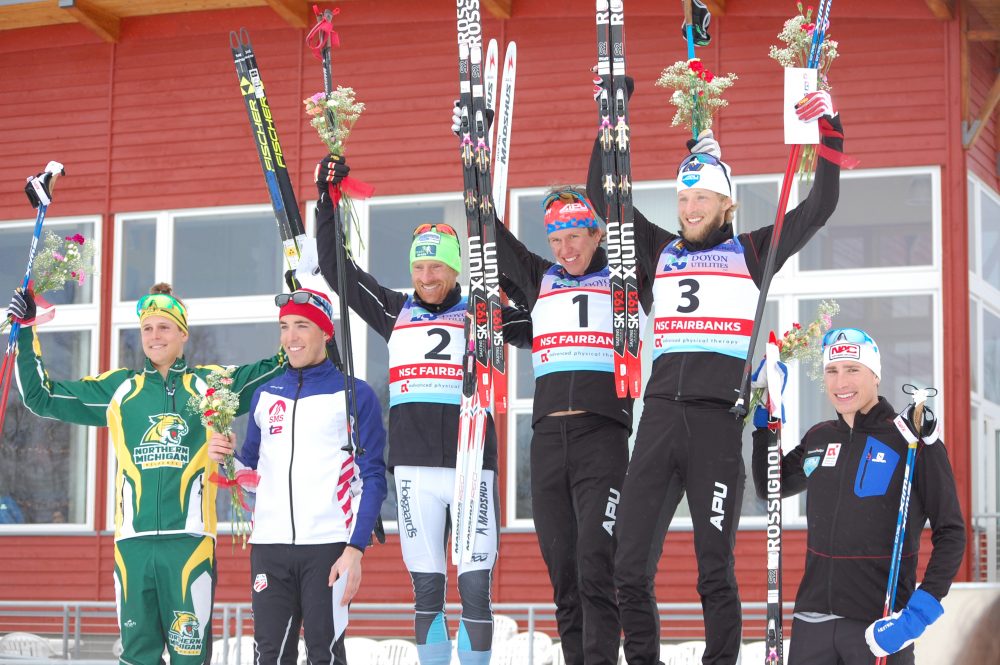
APU’s Scott Patterson (1) on the podium with Team Gregg’s Brian Gregg (2) and APU’s Eric Packer (3) after the men’s 50 k freestyle mass start at 2017 U.S. Distance Nationals in Fairbanks, Alaska. (Photo: Max Kaufman)
Patterson threw down an exclamation point to end the season at SuperTour Finals and U.S. Distance Nationals in Fairbanks, Alaska. He won both distance races — a 30 k skiathlon and 50 k skate mass start. When asked if he expected to dominate the domestic field in Fairbanks, Patterson was quick to answer.
“Not at all,” Patterson said. “That 30th place in Quebec, I kind of felt like I was faking it for the whole race. I wasn’t quite sure where my fitness was. I did a lot of leading got the pack, it was myself and Florian Notz from Germany kind of leading most of the race and David [Norris] and Paddy [Caldwell] both pulled some pretty good results out of our pack. Leading that pack, I was never like I am feeling great. I was kind of like, ‘Well, I am leading, I guess I should try hard and make it look like I am feeling good.’ I had no idea going into Fairbanks. Even that first race, the classic [leg] felt all right. I wasn’t sure I could handle the pace very well [and] I wasn’t sure that I could really push it further. But in the skate [leg], things clicked perfectly.”
Patterson was informed of his USST nomination in April. For now, he said, not much will change.
“It means that I am going to a few more camps,” Patterson said. “I have to leave Alaska a few more times. Over the years, I have figured out what works for me. Flora has learned what works for me, too. We are proceeding along the same path regardless of the nomination. The nomination just gives a few extra resources. All that is a good thing.”
Patterson also said he intends to race a full World Cup schedule, but currently his race schedule remains a work in progress. As far as early season objectives, Patterson is eyeing the World Cup 30 k skiathlon on Dec. 3 in Lillehammer, Norway.
“And then I’d like to overall, definitely be in the top 50 … make those Olympic criteria for the World Cup,” he said.
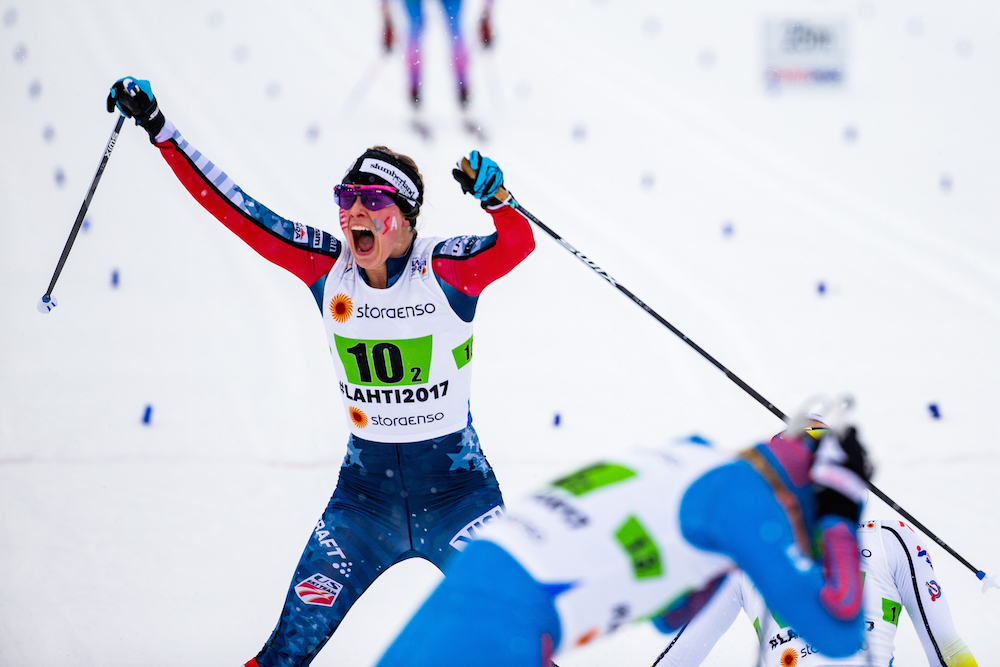
Jessie Diggins celebrates after anchoring her team to bronze in the women’s classic team sprint on Feb. 26 at 2017 World Championships in Lahti, Finland. (Photo: Dustin Satloff/dustinsatloff.com)
Shortly after the U.S. Ski Team (USST) formally announced its 2017/2018 cross-country team, FasterSkier reached USST Head Coach Chris Grover on the phone for his comments. Grover is in Bend, Ore., for the team’s traditional on-snow camp.
“We have nine athletes who made the objective criteria to make the 2018 U.S. Ski Team,” Grover said. “Eight that are on the A-team, all of whom finished in the top 30 in the world in either sprint or distance. And then Katharine Ogden, who as a medalist at the World Junior Championships, made the objective criteria that way.”
Below are the eight A-team athletes and Ogden, who was renominated to the development “D” team, that met the USST’s objective criteria for team selection.
A Team
Men
Simi Hamilton (Stratton Mountain School Elite Team)
Attain top-50 ranking in the 2017 final World Cup Overall ranking list.
Attain top-30 ranking in the 2017 final World Cup Sprint or Distance ranking list.
Attain top-20 ranking in the 2017 FIS final sprint or distance points list.
Attain a top-3 individual finish at the 2017 Junior World Championships or U-23 World Championships.
Six women finished the season ranked in the top 50 in the World Cup Overall ranking list: Diggins (6th), Bjornsen (16th), Stephen (28th), Caldwell (33rd), Randall (36th), and Sargent (44th). Notably, Diggins, Caldwell, Sargent, Randall, and Bjornsen all ranked in the top 30 for the final World Cup Sprint list, too, and Diggins, Bjornsen and Stephen all finished in the top 30 on the final World Cup Distance list.
Hamilton and Newell were the two men that met the objective criteria, with Hamilton ranking 30th on the final World Cup Overall list and ninth in the World Cup Sprint standings and Newell 28th on the final World Cup Sprint list.
The remainder of the USST were discretionary selections. The athletes nominated to the team under the discretionary guidelines are as follows:
B TEAM
Men
Erik Bjornsen (APU)
Paddy Caldwell (SMS Elite)
Scott Patterson (APU)
Women
Rosie Brennan (APU)
D TEAM
Ian Torchia (Northern Michigan University)
Hannah Halvorsen (Sugar Bowl Academy)
Julia Kern (SMS Elite)
As Grover explained, the USST’s use of discretion should not perceived as murky. Built into the criteria are aspects of fulfilling “individual markers” or competition results, “attitude and commitment”, illness or injury, and the heavily weighted medal potential.
“We are trying to incorporate athletes who we see are on a path to winning a medal at the highest level, at the Olympic level or at the World Championship level,” Grover said. “Can we make a strong case suggesting that an athlete is on the path to winning the medal? It’s really a difficult call. What are the metrics that we’ll be using: FIS points? Should we be using World Cup points? Should we be using placing at World Juniors or U23s, at NCAAs or SuperTours? There are so many different places where athletes are coming from, so many different places where they are competing. Are they all equal? No, of course not.”
What often makes discretionary selections difficult is that USST coaches must make assessments about future potential using real-time accomplishments between skiers skiing on the World Cup and those skiers competing at the World Cup and Continental Cup (i.e. SuperTour).
“You can’t really compare someone who has been competing on the World Cup to someone who has been competing at a Continental Cup level,” Grover explained. “So that’s a real challenge for us. Yes, you can look at FIS points – that’s one thing we have always done, for many years. We’ve taken that athlete and tracked FIS points and age in distance or sprint, whatever that athlete’s strongest discipline is, and we try to see where they are compared to the best skiers in the world, the top 10 athletes in sprint or distance of that sex in the world.”
Grover knows the FIS point system is not necessarily the best indicator of a U.S. skier’s potential on the World Cup.
“One of the big challenges that we had using that methodology is that our FIS points as a nation in the US are artificially low,” Grover said.
Grover believes FIS points are “artificially low” because the U.S. collegiate system has numerous European athletes with low FIS points that compete nearly every weekend on the NCAA circuit or FIS-sanctioned races. As a result, those skiers bring some U.S. skiers’ FIS points down.
“The same thing happens occasionally when the U.S. Ski Team comes back from Europe,” Grover said. “The U.S. women in particular but also some of the men, and they bring good points and then they are not perhaps at their sharpest at SuperTour Finals, and other athletes are able to improve their points by coming close to or beating these athletes. And so that really drives our points down. We’re just not in the European pool enough to have points that are directly compared to European counterparts. The isolation, the way that points come over and they get passed around, and then they stay isolated over here, it prevents us from our points being representative of where people are compared to their European peers.”
Athlete by Athlete
American Erik Bjornsen (33) racing to the 11th-fastest time of day in the men’s 15 k freestyle pursuit at World Cup Finals in Quebec City for his career-best World Cup result. He finished 25th overall. (Photo: Gretchen Powers)
For the B-team, let’s go athlete by athlete, those nominated and those not, to get a better picture of the whys and hows of USST discretionary selection. (Note that all of the D-team members from last year were renominated and will accordingly be invited to team camps.)
“About Erik Bjornsen for example, and why was he nominated to the team,” Grover said. “For a number of reasons, but one thing that we see is that he could contribute to a medal in the team sprint, which is an event where he and Simi were fifth at this World Championships. … [Erik is] a guy who is scoring points in sprints in the World Cup occasionally, some points in distance occasionally. He is a hybrid between aerobic and anaerobic capacities, and that lends itself rather well to team sprint. We feel like he has strong potential there.”
Bjornsen also skied to an impressive 18th (+1:56.7 behind the winner) in the 15 k classic at the 2017 World Championships.
Patterson is the lone new face nominated to the USST. “[Scott] just keeps coming up in conversation and he’s a really really interesting skier,” Grover said. “He got sick before U.S. nationals and then was sick for part of U.S. nationals and did not ski particularly well, at least by his standards for national championships in Soldier Hollow.”
The Anchorage-based skier did not make 2017 World Championships team. Yet at the start of the season, before his illness, he placed third in the 15 k classic in the West Yellowstone SuperTour and won the 15 k skate in the Sovereign Lake NorAm in mid-December.
“So this past winter, we knew he’s definitely one of those next guys — can we find some opportunities on the World Cup to start him?” Grover said.
Scott Patterson (APU) racing the anchor leg of the mixed relay at U.S. Distance Nationals in late March in Fairbanks, Alaska. (Photo: Lance Parrish, Fairbanks)
Last season, Patterson was offered World Cup starts in PyeongChang, South Korea, and Oslo, Norway. In a thin PyeongChang World Cup field, he placed ninth in both the 30 k skiathlon and team sprint. At Holmenkollen in Oslo, Patterson was the top American man, skiing to a 28th in a loaded field. Patterson also qualified for World Cup Finals in Quebec.
“And the cool thing was everywhere he went, he scored World Cup points as a 25-year-old athlete,” Grover said of Patterson’s potential. “So he’s a young guy who has got a big history of training. He’s training a lot and training really well and he’s also seizing these opportunities and showing in a very difficult men’s field that he’s a young guy who can grab some World Cup points.”
Patterson went on to dominate U.S. SuperTour Finals and Distance Nationals at the end of the season, winning both the 20 k skiathlon and 50 k freestyle mass start in Fairbanks, Alaska.
Addressing the question of why Patterson was given starts in PyeongChang and Oslo despite not leading the SuperTour at the time or qualifying for World Championships, Grover said Patterson had nearly fallen through the cracks. They needed to see he how he might perform on the World Cup.
“Last year it was a challenging year for us as a national-team staff to look back at what was happening domestically and to make much sense of who was skiing well,” Grover said. “For example, in the first four distance races of the year, Yellowstone, Silver Star, and the two at Soldier Hollow, we had four different men win the four distance races. And of the four first sprint races, in those locations, I believe we had four different men win those four sprint races. And different athletes that were winning qualification in some cases versus those that were actually winning the day result for the sprint. So it was a very unclear picture in terms of who was skiing well … especially on the men’s side.”
Of the skiers winning some of those races outright, Grover knew Patterson was promising, yet he wasn’t able to demonstrate it internationally on the World Cup or at World Championships.
“So we wanted to find opportunities for Scott,” Grover said.
Patrick “Paddy” Caldwell, 23, was bumped from the D-team to B-team status.
“Paddy, he’s been on the D-team for a few years; he’s obviously been on the radar,” Grover said.
Caldwell placed ninth in both the 15 k freestyle and 30 k skiathlon at the 2017 U23 World Championships. He also qualified for World Cup Finals in Quebec, where he skied the 25th-best time of day in the 15 k freestyle pursuit.
“Just given where he is in terms of his ability and his age, we felt like it was the right move for him to move from the D-team to the B-team,” Grover said.
“I think Noah would be the first to admit that last season was pretty disappointing, by his standards,” Grover said. “He and I were able to talk about expectations going into the season and Noah had struggled for a few years on the World Cup previous to this past season. … And so we just talked that we need to make progress towards an eventual medal in the sport. So this year needs to be a step forward and unfortunately it wasn’t. It wasn’t the results Noah wanted to see and unfortunately it wasn’t the result that we were hoping to see from Noah.”
Hoffman, 27, finished the season ranked 51st on the World Cup Overall list, a single point from the top 50 needed to meet the team’s objective criteria.
“We hope that Noah gets back in there and starts skiing closer to his potential and starts making progress towards that medal,” Grover added. “Absolutely, the door for sure is never closed for Noah or any athlete.”
On the women’s side, Rosie Brennan, 28, was renominated to the B-team. This past season on the World Cup, Brennan earned eight top 30s (the benchmark for scoring World Cup points). Her best finish, beyond her 23rd-best time of day in the Tour de Ski’s final climb, was a 22nd in La Clusaz, France, in the 10 k freestyle mass start.
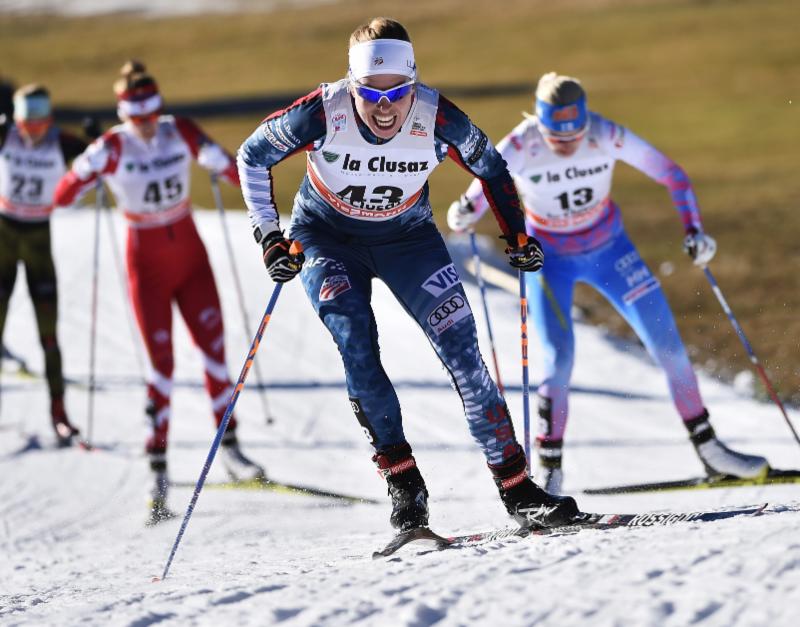
Rosie Brennan (43) racing to a season-best World Cup result of 22nd in the 10 k freestyle mass start on Dec. 17 in La Clusaz, France. (Photo: Toko/NordicFocus)
“Rosie is another interesting case,” Grover said. “It’s very hard to differentiate right now between Rosie Brennan, the skiing that she is doing, versus Caitlin Patterson, for example, or Chelsea Holmes. Yes, Rosie has been a little bit stronger in some races, but she has also had some more opportunity. However, we are really looking towards Rosie as a potential leg in a 4 x 5 kilometer women’s relay at a World Championship event. She has contributed a 5 k classic leg to a podium in Lillehammer, and she also skied a terrific leg in Ulricehamn — I want to say 12 seconds from the fastest on that particular leg in that relay this year. So she’s someone we are really looking towards for a potential relay leg. So there are athletes like that where it’s hard to differentiate sometimes between some of the domestic athletes who are really starting to blossom, who we are starting to take a lot of notice of them, but Rosie is somebody who … is in shape and ready to go when we get to Korea this winter.”
On the non-nomination side of the equation are Holmes and Patterson.
“Chelsea, she is someone who we have discussed a ton this spring,” Grover said. “And this is a conversation I’ve had with Chelsea as well. Is she a 5 k skier right now? Maybe, maybe not. She has certainly shown her ability in longer events. Her one standout international result from this season is a longer event in skating.”
“Does that, at this particular moment, suggest that she might be able to provide a 5 k classic leg in the relay? Not at this particular moment,” he said. “We have a lot of skaters on the women’s side right now. Our skating ability is quite high. So at this moment it doesn’t pencil out, but does that prevent her from being considered in the future for anything? Absolutely not.”
Scott Patterson’s older sister Caitlin, 27, remains on the USST radar as well.
“Caitlin is somebody else that we’ve discussed quite a bit,” Grover said. “She’s made a big step forward in the last year she started to score World Cup points and really flirting with that edge of the top thirty on a regular basis. So we absolutely have our eye on her. … Of course Chelsea is Continental Cup leader for Period 1, so she will be skiing World Cup Period 1. And then we’ll assess where she is at that point. Anything can happen at that point. She might be someone that’s skiing really well and we want to keep on the World Cup.”