From the FasterSkier archive — posts syndicated from athletes’ and coaches’ own blogs between 2004 and 2012, kept online as published. Current coverage is at fasterskier.com.
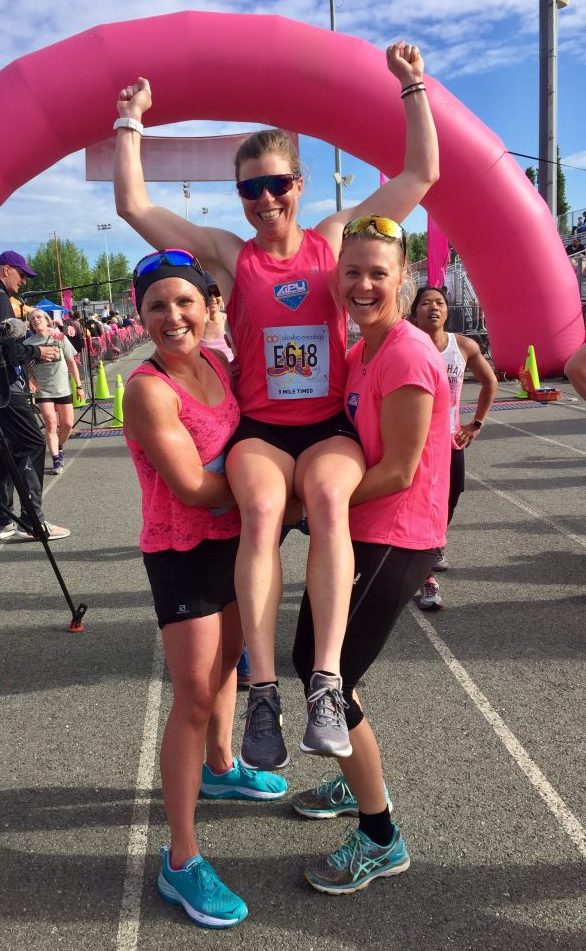
Rosie Brennan (center) celebrates with her APU teammate Sadie Bjornsen (r) and former teammate Holly Brooks after winning the 2018 Alaska Run for Women on June 9 in Anchorage, Alaska. (Courtesy photo)
The last time Rosie Brennan was focused on competitive running, she was sporting a red, white and black singlet as a senior at Park City High School in Utah. In the 11 years since, the former U.S. Ski Team member’s running has shifted from a seasonal sport to supplemental training for her true passion: cross-country skiing.
Yet earlier this month, on June 9, Brennan surged to the front of the Alaska Run for Women in Anchorage, Alaska, where she lives and trains with the Alaska Pacific University (APU) nordic ski team. She was first across the line in the 5-mile road race, finishing in 27 minutes, 31 seconds. Brennan also broke the course record by 5 seconds (in 2002 Chris Clark won it in 27:36). Notably, Clark raced to 19th in the 2000 Olympics marathon in Sydney, Australia.
Prior to this spring, Clark had been the only woman to break the 28-minute mark in the Alaska Run for Women’s 26-year-long history. Brennan, 29, joined her ranks, along with 28-year-old Anna Dalton, who finished four seconds behind Brennan for second place in this year’s race. Nineteen-year-old Caroline Pennacchio placed third with a time of 29:53. More than 5,000 women participated in this year’s race, an event Brennan’s former teammate Kikkan Randall has won numerous times.
While Brennan ran the race casually with friends a few years ago, the 2018 Run for Women marked her first real race on pavement since high school, according to the Anchorage Daily News.
“I’ve always hesitated to actually race it,” Brennan told FasterSkier during a recent phone interview. “The part I was most worried about was getting an injury.”
The 5-mile course covers paved roads and bike paths, and Brennan feared that a hard effort on that kind of surface would take a toll on her body. But this spring, she said she wanted to “spice things up.” That, and she wanted to test her recovery after a long bout with mononucleosis.
An uphill battle
Looking back through her training log, Brennan can pinpoint the exact day she began to feel off. In late December, at the end of the first period of World Cup racing and just before the 2018 Tour de Ski, she described her sensations as “going up and down.”
Rosie Brennan racing to 17th in a World Cup 10 k skate on Dec. 10 in Davos, Switzerland. (Photo: Reese Brown / U.S. Ski & Snowboard)
At the time, she assumed the source of her fatigue was from the previous four weekends of racing. She had started the 2017/2018 World Cup season with four top 30’s and two top 20’s, her strongest Period 1 results to date. Perhaps her body was adjusting to the new level of fitness and racing she was putting forth.
Thinking the flagging she felt might be warranted, Brennan decided to enter the Tour de Ski. She finished the first race, a freestyle sprint, with a season-best result of 15th. But that Dec. 30 race was the high point of her World Cup season.
“My first race of the Tour was one of my best races all year, so I didn’t really think anything bad was going on,” Brennan reflected. “But that was a sprint race and for whatever reason, my sprinting wasn’t affected. … After that race I didn’t have any good races in the Tour. It was kind of just downhill from there.”
Brennan pushed through the Tour’s seven stages, finishing the final pursuit-style hill climb on Jan. 7 in 24th overall (out of 32 women), with the 17th-fastest time. That strong performance cap to a tough Tour, however, was no omen for the weeks to come.
“After the Tour, I just wasn’t recovering. I mean, I just felt miserable,” Brennan said. “But when you’ve raced like that, it’s easy to just be like, ‘Oh, it was just the Tour; it was really hard this year or the conditions were challenging. I was trying to make due, rest and get back to normal.”
Heading into the new year, Brennan sat out of the World Cup sprint weekend in Dresden, Germany, and resumed racing Jan. 20 in Planica, Slovenia. Even so, Brennan still felt off. She opted out of the Planica distance race to rest up for the following World Cup weekend in Seefeld, Austria, the last one before the Olympics. Less then a month before the Olympics began in PyeongChang, South Korea, Brennan’s APU coach, Erik Flora, flew to Europe and met with Brennan in person to discuss what might be going on.
“We both felt like I had probably gotten a virus,” Brennan reflected. “But with a virus there’s nothing you can do, so we decided just to rest it out and play the course and see what happened.”
In Seefeld, however, there was no remission. After the first 2 kilometers in the 10 k freestyle mass start, Brennan was spent. Wanting to investigate more, she had her blood count tested that weekend. The results showed nothing extraordinary, but they did indicate some sort of viral infection.
“There was nothing for me to do except rest,” Brennan said. “I didn’t get a mono test or anything at that point, because I was not showing any extreme symptoms.”
With her departure for PyeongChang just days away and the buildup of her first Winter Games, Brennan worked to get into an ideal headspace.
“It was really hard place to be,” she explained. “I was headed to my first Olympics and the last thing I wanted to do was convince myself there was something wrong with me. So at that point I just decided to do the opposite, tell myself I was fine, I just needed to rest, everything was going to be fine. That was kind of the approach I took, just rest it out, try to have fun, get back into the groove of things, be excited for the Olympics, and hope things will turn around.”
Unfortunately, her mono reached its peak in PyeongChang. She was offered a spot in the opening women’s race, the 15 k skiathlon, and not wanting to miss her Olympic debut, she started.
“You only get what opportunities you get,” Brennan said. “I had to take that skiathlon start and just hope that things would turn around, and I think that was unfortunately probably the peak of my mono.”
That race, which she finished in 58th place, turned out to be her only start at the Games. After the Olympics, she finished out the World Cup season, but not without difficulty.
“Every race was kind of the same: I would ski 2 to 3 k and then everything would just fall to pieces,” she said. “You don’t really realize how much of hole or like a tunnel you’re in until you step out of it. If I were to do it again, I would have just come home after the Olympics to try and figure it out.”
But as they saying goes, hindsight is 20/20.
“At the time, you just keep telling yourself, OK, you’re going to get it this weekend, things are going to turn around,” Brennan said. “It’s really hard to not have that attitude when you’re over there because you’re trying to have fast races and you’re trying to make the most of the bad situation.”
Getting answers, moving forward
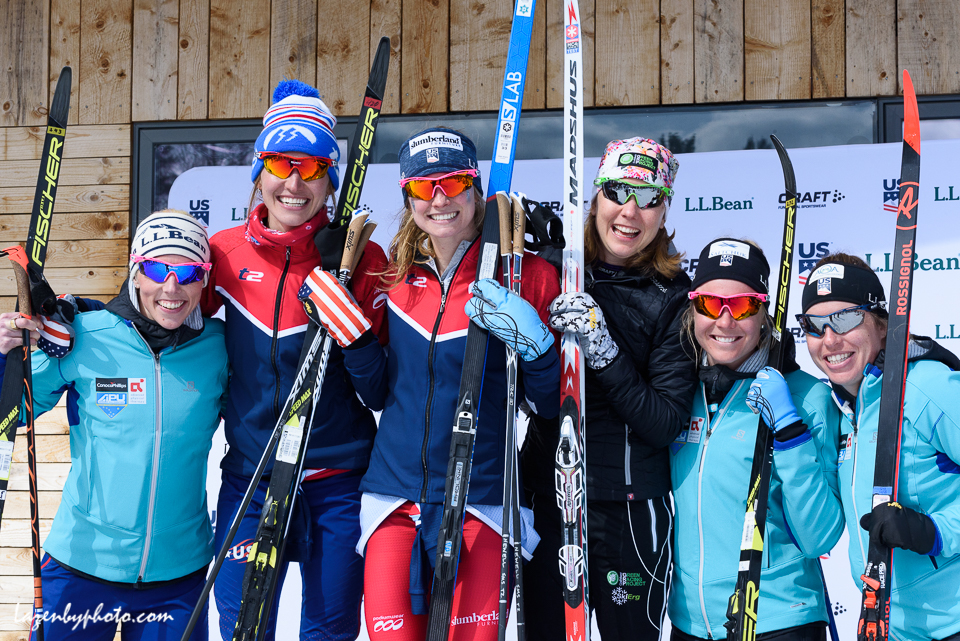
The women’s classic sprint top six at 2018 SuperTour Finals in Craftsbury, Vt., with (from left to right) U.S. Ski Team members Kikkan Randall in sixth, Sophie Caldwell in second, Jessie Diggins in first, Ida Sargent in third, Sadie Bjornsen in fourth, and Rosie Brennan in fifth. (Photo: John Lazenby/Lazenbyphoto.com)
When Brennan did return to her training base in Anchorage, it was late March after competing at SuperTour Finals in Craftsbury, Vermont. An Anchorage doctor with whom Brennan had been corresponding with agreed to run a few tests upon her return. One of those tests was for mono.
“That came back positive,” Brennan said. “It was nice to know, because after awhile I was starting to think that I was going crazy, but I was also frustrated because I had just spent three months trying to race when I probably shouldn’t have been. … My biggest fear was that by racing that whole time, I had driven it so far into my body that I would never come out.”
With that in mind, Brennan took April slow. Training took a back seat, as it does for most professional cross-country skiers that month. Brennan went biking, but for minimal amounts of time. When she felt tired, she stopped. By the time May 1 rolled around, Brennan decided she was feeling strong enough to jump into APU’s start-of-the-season training. It was then that she also decided she would enter Alaska’s Run for Women.
In order to train for the race, Brennan didn’t stray from her ski-specific training plan. Her biggest change was running her strength warmups and cool downs on pavement.
“Racing on roads requires a lot more leg speed and that was the part that I was worried about, whether I had enough leg speed,” Brennan said.
She also did one-minute strides with the APU team when they incorporated them into their training sessions. Otherwise, her road-running prep was minimal. When race day finally came, Brennan forgot to start her watch at the start.
“Retrospectively, I’m really glad that I did [forget] because I would have slowed down if I had known how fast we were running,” she said.
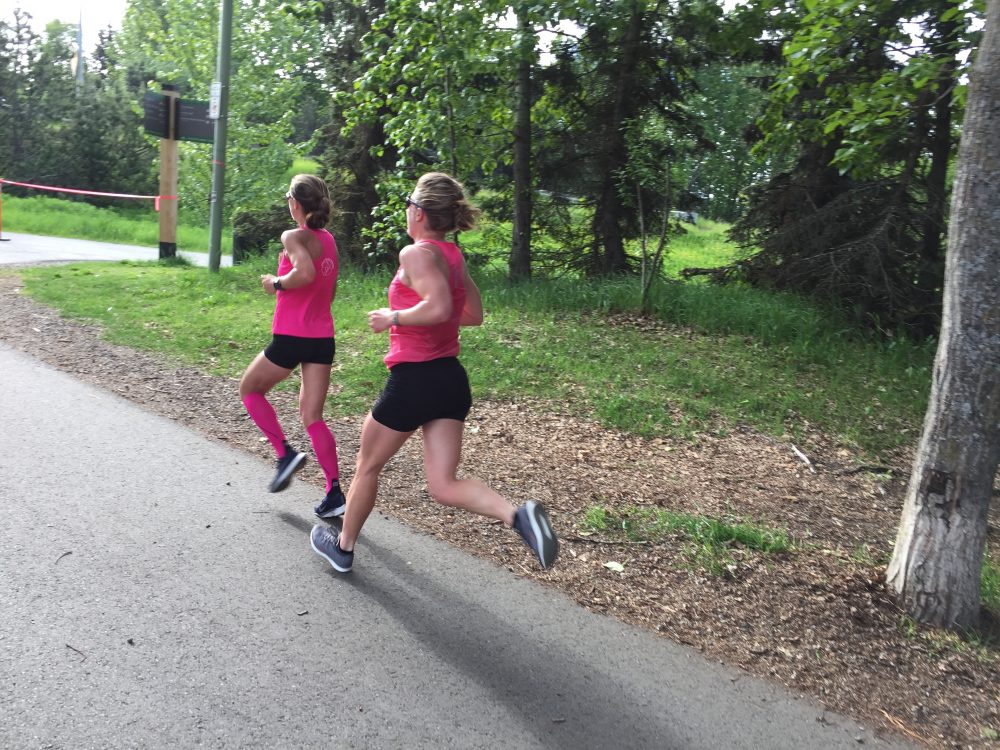
Rosie Brennan (r) chases Anna Dalton during the 2018 Alaska Run for Women on June 9 in Anchorage, Alaska. Brennan went on to win the race in a record-breaking time of 27:31. (Photo: Becca Rorabaugh)
Brennan and Dalton averaged around 5:30 minute/miles for the duration of the race, though for the most part, Brennan indicated she couldn’t hear any of the splits she was being given.
“At one point someone yelled, ‘That was a 5:15 mile!’ and I was like, ‘Haha, that’s really funny,’ ” Brennan recalled with a laugh.
Assuming that Dalton would make a move in the last 1,600 meters, Brennan hung tight to the experienced runner and aimed match her strides.
The move from Dalton never came. With about a minute left in the race, Brennan took the lead through the course’s final turns before the finish, which was on a final curve of a 400-meter track.
“Once I went, I realized that I actually had close to nothing left,” Brennan said of her final move. “I was like, ‘Oh no, she is going to pass me, she’s going to pass me. When I finally turned to the final 75 meters, I could see the clock it said, like, 27 something, and I had a rough idea what times were for the race, so I knew that was really fast. Then I was like, ‘Oh my gosh, I hope I actually get to the line.’”
Brennan did, taking the win and the record with it.
“I had no idea that we had broken the record,” Brennan said. “Once Anna finished, she came up to me and said she thought that we had both gone under [the course record], that was when it really hit me, how fast we had been running that whole time.”
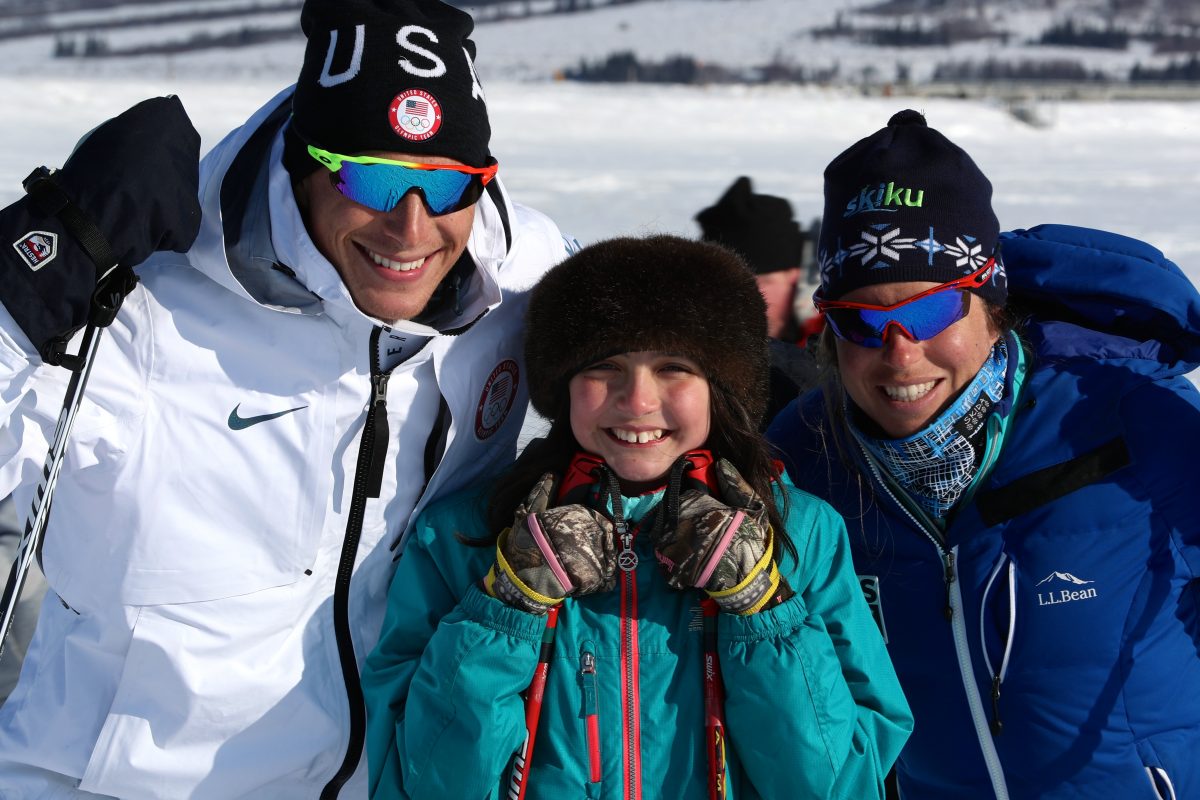
Olympians Tyler Kornfield (l) and Rosie Brennan (r) with a young Skiku skier this spring. (Courtesy photo)
The road-race win was Brennan’s first ever. At a running time trial with APU the weekend before, she had come close to a personal best. Both performances gave her confidence as she looked ahead to the rest of the training season.
“I definitely surprised myself,” Brennan said referring to her running victory. “To have that race really reassured me that I am moving in the right direction.”
A U.S. Ski Team member until this spring (she was originally named to the national team in high school, then after a six-year absence was renamed in the spring of 2015), Brennan was not renominated for her fourth-consecutive season in May. But even apart from the national team, she remains focused on racing internationally on the World Cup.
“I’m hoping for some World Cup starts and World Championships,” she said. “I’ll be working towards those.”
It’s been eight long months, but finally, the International Ski Federation (FIS) Cross Country World Cup season is upon us and with it, the Noah Fantasy Hoffman Fantasy Cross Country League. Both the real-world and online competitions kick off this Friday with the Ruka Triple World Cup, three days of racing in Kuusamo, Finland.
If you’re playing, you need to pick your team by Thursday at 11:59 p.m. Eastern Standard Time. Even if you’re in a post-Thanksgiving tryptophan-haze … it’s time.
Noah Hoffman, a U.S. nordic racer and founder of Noah Hoffman Fantasy Cross Country, which is entering its fourth season, after finishing 25th in last weekend’s 15 k freestyle FIS race in Beitostølen, Norway. He’ll be starting his season in earnest on Friday, Nov. 24, at the Ruka Triple World Cup in Finland. (Photo: Aleks Tangen)
In this episode we get a quick rundown from Noah Hoffman on how he got involved with FasterSkier and Adam Mahar, the coding brawn behind the world’s premier XC fantasy league, briefs us on the new rules. We connected with Noah Hoffman while he was training in Sjusjøen, Norway, and Adam Mahar, the Minneapolis-based website administrator and head programmer for Noah Hoffman Fantasy Cross Country.
To start the conversation off, you’ll get a bit of insight into what drives Hoffman and why he’s so productive when it comes to creating ski related projects. He’s got a blog, a great podcast, and the eponymous fantasy league.
Last year at this time, we did a full-blown analysis of Hoffman’s ski league, exploring the origins of the league, hearing how Adam got involved and then falling into a serious wormhole learning how some fantasy league experts pick their teams. Here’s a link to that episode.
Strategize, log in and pick you team. For this long weekend of racing, you have to have your team registered before midnight (EST) on Thursday. Choose wisely: the races are classic sprints (Friday), 10/15-kilometer classic individual starts (Saturday) and 10/15 k freestyle pursuits (Sunday). And if you need some pointers or at least some direction, listen closely to this episode.
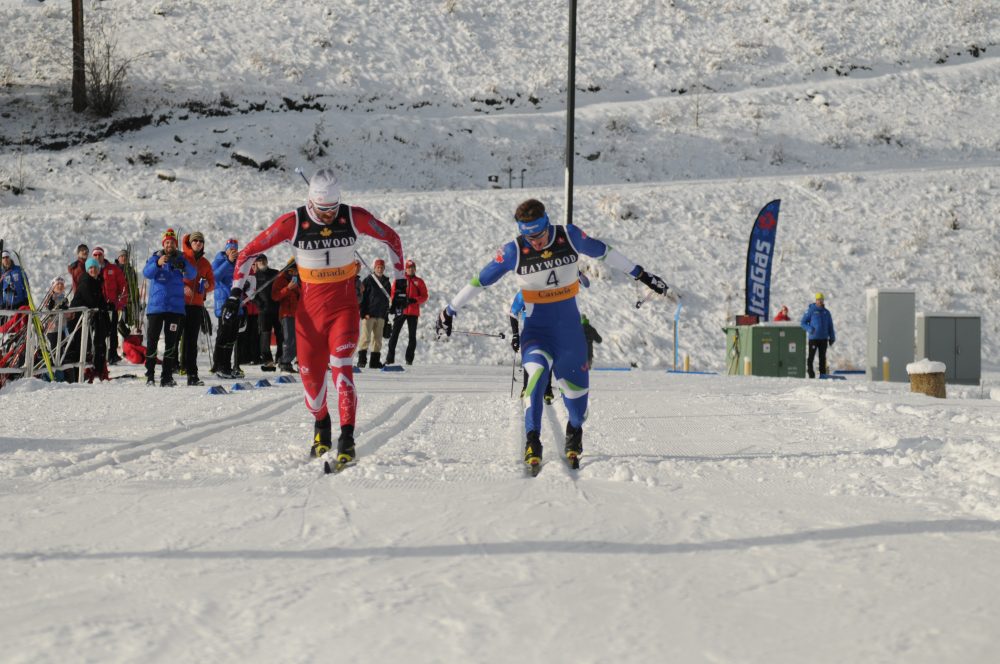
Canadian World Cup Team member Len Valjas (1) and Bob Thompson (NTDC Thunder Bay) lunge to the line during Wednesday’s Frozen Thunder classic sprint at the Canmore Nordic Centre in Canmore, Alberta. (Photo: Doug Stephen)
Clouds heavy with building snow and a winter-storm warning already in effect cast a second anticipatory shadow over a jittery group of racers gathered on Wednesday for the first Frozen Thunder race of the season at the Canmore Nordic Centre in Canmore, Alberta.
At stake for some of the top Canadians participating in the day’s classic sprint was the opportunity to secure the final spot on the men’s World Cup team for the first period of World Cup racing starting later this month. Nearly 12 centimeters of snow had fallen the night before on the two-lap race track, and for many stepping out onto the freshly groomed trails, months upon months of training prep was in the barn.
“That World Cup spot. That has been a goal for pretty well the whole year,” said Bob Thompson, who trains with the Thunder Bay National Team Development Centre (NTDC), on the phone after Wednesday’s races.
Thompson, 26, was not the only one hoping to book a plane ticket for World Cup Period 1, which starts Nov. 24 in Kuusamo, Finland, and continues through December. Sixty-six skiers started Wednesday’s men’s sprint qualifier and anyone in the hunt for that World Cup spot would have to outperform them all, excluding the Americans and Canadian World Cup Team member, Len Valjas, who was prequalified for the World Cup.
Even with the competition’s added edge, many racers went about business as usual on race day and in the days leading up to the event, Thompson explained.
“It’s been fairly carefree the week we’ve been here,” said Thompson, who arrived in Canmore with his NTDC teammates on Oct. 23. “The morning [of the sprint] I wouldn’t say things were a bleak atmosphere or super serious, it was just kind of everyone was doing their thing.”
Thompson went about his warmup the way he normally would on race day. In retrospect, he saw his plan as well-executed and his warmup as strong, despite breaking a pole during his intensity segment. For him, the qualifier went “really well,” he said.
Julien Locke (Canadian U25 Team/Black Jack) after winning the men’s classic sprint qualifier at Frozen Thunder in Canmore on Wednesday and securing the final spot on the Canadian men’s team for World Cup Period 1. (Photo: Cross Country Canada)
But Julien Locke, of the Canadian U25 Team and Black Jack Ski Team, was the fastest man in the open men’s qualifier and thus earned that coveted World Cup spot. Locke, 24, posted the top time of 3:37.81 minutes, nearly a second ahead of Valjas in second (+0.97) and 3.57 seconds ahead of the third qualifier, Dominique Moncion-Groulx of the Alberta World Cup Academy (AIAWCA). Thompson qualified fourth, 4.15 seconds off of Locke’s winning time.
“I didn’t have regrets or second thoughts on how I raced,” Thompson said. “Julien had a great race, props to him. I’ll just have to come back next time.”
Locke could not be reached at press time, but he spoke with Cross Country Canada (CCC) in a video posted on Twitter after the race.
“I’m really excited to have won the race this morning and qualified for Period 1 World Cup, but the Olympics is the big goal this year,” Locke said. “It’s super important to go get results on the World Cup, and I’m excited to have a chance to do that.”
According to CCC High Performance Director Thomas Holland, Locke and the rest of the World Cup Team (excluding Alex Harvey and Cendrine Browne) will head to Gällivare, Sweden, on Nov. 10, where they’ll compete in a weekend of International Ski Federation (FIS) races from Nov. 17-19. Meanwhile, Harvey and Browne, who train out of the Pierre Harvey National Training Centre (CNEPH) with coach Louis Bouchard in Quebec, will train in Davos, Switzerland, in advance of the World Cup opener in Finland.
But let’s get back to Frozen Thunder. With the qualifier behind them and the heats slated to take place in a zero-elimination King’s Court format, many racers approached the rest of Wednesday adamant on getting in some solid race efforts.
“The King’s Court format that we use in the heats was a great showcase for athlete development whereby every athlete entered in the race gets to race all 3 heats,” Holland explained in an email. “The format sees men and woman and para-skiers in some of the same heats – super fun event for all the athletes.”
In the first heat, Thompson, Locke, Valjas, and Moncion-Groulx went head to head, yet with the heats starting one minute apart on the two-lap track, there was a constant influx of skiers and some overlap.
“I think comments were made that we were dogging it a little bit,” Thompson said of that initial round. “There were other heats that we were basically skiing in the first lap with that were going faster than us … they were running pretty quick through the starts.”
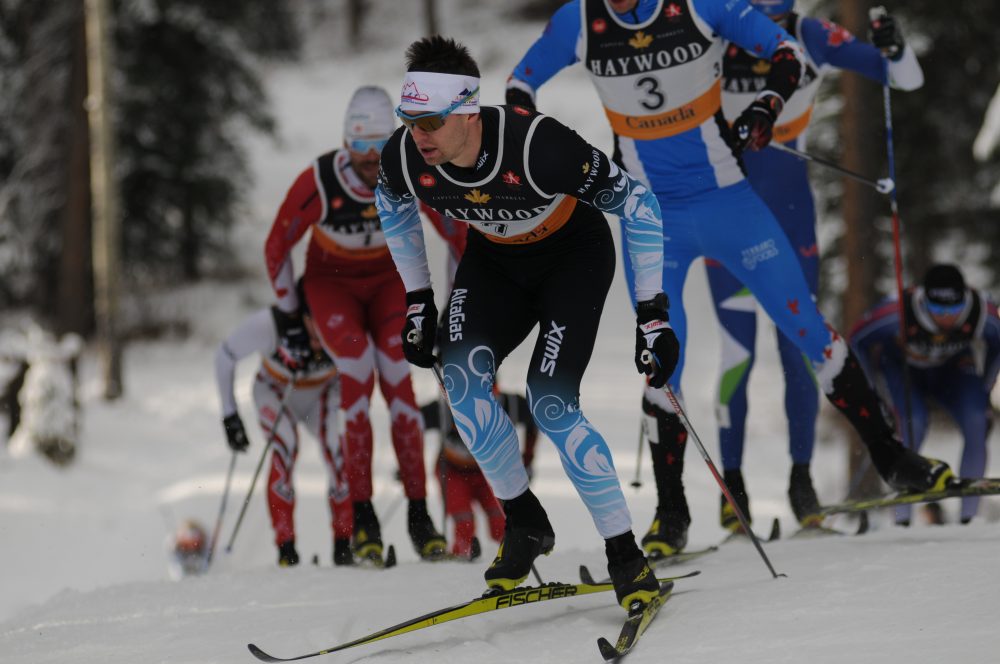
Dominique Moncion-Groulx (Alberta World Cup Academy) leads Julien Locke (3), of Canada’s U25 Team and Black Jack, and Len Valjas (l), of the Canadian World Cup Team, during a Frozen Thunder classic sprint heat on Wednesday at the Canmore Nordic Centre in Canmore, Alberta. (Photo: Doug Stephen)
In the second heat, Locke and Valjas paired up with Knute Johnsgaard (Canadian World Cup Team/AIAWCA) and American Cole Morgan, of the Sun Valley Ski Education Foundation (SVSEF). Thompson and Moncion-Groulx faced another American SVSEF skier, Kevin Bolger, as well as NTDC Thunder Bay’s Andy Shields. Four men advanced to the senior men’s final: Bolger, Thompson, Locke and Valjas.
In the final, Thompson recalled creating what he saw as “a bit of a gap” between himself and Valjas, yet Valjas, a seasoned World Cup sprinter, caught him in the lunge to the line for first. Overall on the day, Valjas placed first, Thompson second, Locke third, and Bolger fourth.
With the King’s Court format, female racers competed in the same same qualifier as the men, with Dahria Beatty (U25 Team/AIAWCA) emerging as the fastest female qualifier in 4:20.66. Her time was 8.56 seconds clear the second woman, American Chelsea Holmes, of Alaska Pacific University (APU), and 10.03 seconds ahead of Katie Weaver (Hollyburn Ski Club) in third. The third-placed Canadian woman in the qualifier, Annika Hicks (AIAWCA) clocked in fourth (+13.25).
In the heats, the women continued to race with the men. In the all-women final, Maya MacIsaac-Jones (U25 Team/Rocky Mountain Racers) took the win, Hicks placed second, Holmes third, and Frédérique Vézina (CNEPH) fourth.
Frozen Thunder racing continues Friday with men’s 10 k and women’s 7.5 k distance races, starting at 9 a.m. Mountain time. In a press release, CCC anticipated a turnout of 115 participants.
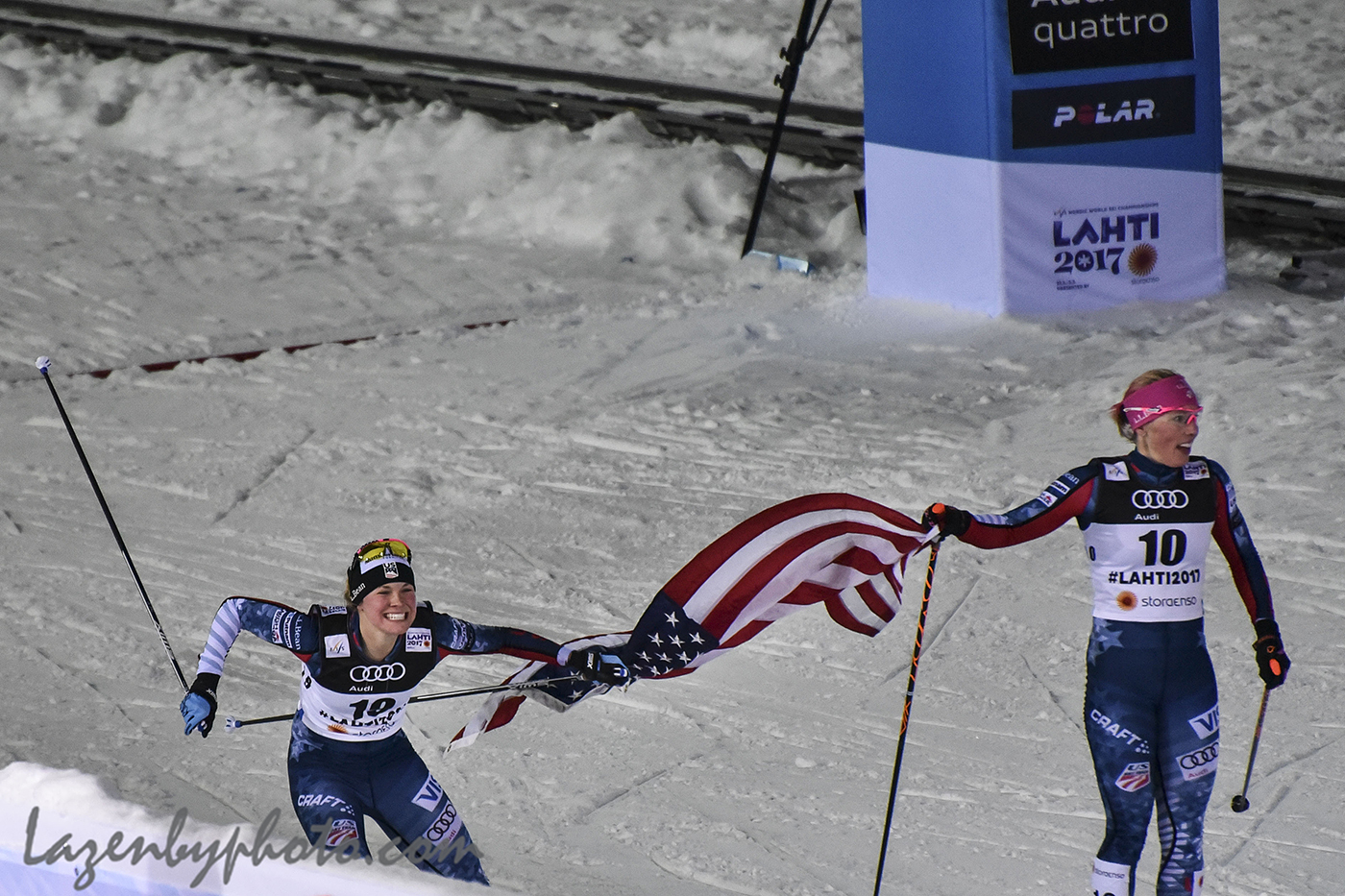
U.S. Ski Team members Jessie Diggins (l) and Kikkan Randall hold the American flag during a victory “lap” down the homestretch after placing second and third, respectively, in the women’s freestyle sprint at 2017 Nordic World Championships in Lahti, Finland. (Photo: John Lazenby/Lazenbyphoto.com)
ANCHORAGE, Alaska — Kikkan Randall is approaching a season full of lasts: her final season as a full-time athlete, her final season on the World Cup, and, she hopes, her fifth and final Olympics. Her main focus these days is resolutely on the future, but she took some time earlier this month to speak with FasterSkier about her summer training and what comes next.
Summer training
Randall’s final summer of training was anchored by the same thing as most of the 17 summers before it: multiple weeklong training camps on Eagle Glacier, the Alaska Pacific University (APU) facility in the Chugach Mountains above Girdwood, Alaska. But this summer saw Randall take only two trips to the glacier, instead of the three camps attended by most of the APU team.
In place of a third glacier camp, Randall traded a short helicopter ride for a long plane flight and traveled to Sweden for a 12-day training camp with the Swedish national team. It was Randall, fellow U.S. Ski Team (USST) member Liz Stephen, and 10 women from the Swedish team, Randall explained in a phone interview.
https://www.instagram.com/p/BXk2D1rj0W2/
Randall began her trip with three days in Östersund, Sweden, with Anna Haag and Stephen, who was coming from the Blink rollerski festival in Gjesdal and Sandnes, Norway. Then came three days in Åre with the full Swedish national team, as well as USST Women’s Coach Matt Whitcomb. The remaining days of camp were spent with the full Swedish team near Vålådalen. The whole thing made for a “really sweet” 12-day training block, Randall recalled.
American skiers were hardly receiving invitations to train with Scandinavian national teams at the start of Randall’s career, but such exchange programs are now relatively commonplace. This was not Randall or Stephen’s first such trip to Sweden, and Jessie Diggins joined the Norwegian national team for a camp last summer.
“I think it’s also a strong testament to our nation, and our program as a good partner to Norway as well,” Whitcomb previously said about the invitation, as well as speaking highly of both Diggins and the Norwegians.
“We’re all training at a high level now,” Randall says when asked whether she sees similarities or differences between American and Swedish training. “We’re all doing very similar types of training, loads of training.”
But even if the training quality and quantity are comparable, the logistics are different, reflecting the simple fact that the U.S. is more than 20 times larger than Sweden, with top-level skiers spread out across five time zones and thousands of miles.
“The real difference for me and what stands out is just the lifestyle of it,” Randall reflects, “and how the Scandinavians never have to travel more than three or four hours away from home. They get together for camps once every three weeks. They’re in camp but they’re these shorter camps and then they go home. Whereas for us, we have the geographical challenges of so much more travel, that when we get together, we have to get together for longer to make it worthwhile, but that of course changes the exact kind of training we can do within a camp, so that part’s varied a little bit.”
The difference isn’t just academic, but rather bears on the type of training that can be done in a group environment. “This camp we went to was an aggressive training schedule,” Randall notes, “and I don’t think it would be smart to necessarily take that schedule and bring it back to the U.S. and replicate it because just the way we live is a little different.”
https://www.instagram.com/p/BXay55rD8oi/
Randall found a valuable training stimulus from the camp, and appreciated the chance to “rub elbows with those guys, be like, OK, I may train a little differently, but I’m on track, versus having to wait seven months between race seasons and not knowing where the heck you are.”
But even more than the reality check on training and fitness, she says that it helps to have local friends in Europe when the Americans are on the road and living out of a suitcase for four months at a stretch.
“I think the biggest benefit” of this offseason training exchange “is that we get to know them as people,” Randall notes. “When we’re on the World Cup, then all of a sudden we have these friends on other teams. If we do need a weekend off and want to go to a home, we can go home with them and get a little break or we see them and we go out for jogs together. It’s pretty cool because I’ve developed lifelong friends now and I look forward to continuing to visit beyond just these training years. I think that shared experience is what really makes it special to me.”
The final World Cup season and the Olympics
It’s tough for any American skier to spend that long away from home. But Randall, with husband Jeff Ellis and support from family members on both sides, is upping the logistical ante by bringing along a toddler. The couple’s son, Breck Stuart Randall Ellis, turns 18 months old next month, and will be spending his second winter on the World Cup circuit.
“Our plan is to pack up early November and head over as a family,” Randall says of their approach for the 2017/2018 season. “We’ve got most of the winter figured out. We’ve got a few more apartment-style accommodations lined up this year. We know with a busy year-and-a-half-year-old, it’s going to be a little harder to contain him in a hotel room. We’re trying to set up the best kind of situation for our family.”
https://www.instagram.com/p/BMy2IR8A_q3/
Randall and Ellis have most of the winter already dialed in, but there’s still one large hole left in their schedule: PyeongChang. “The challenge we’re really wrestling with right now is with what to do about the Olympics,” Randall notes.
Randall is certain that she wants to have her child with her in South Korea if at all possible. “Ideally I’d have Breck at the Olympics,” she says.
Looking back to the 2017 World Championships, Randall says, “I think that was a really positive force having him with me at Lahti, but it’s looking to be exorbitantly expensive to be able to have him in South Korea nearby. We’re looking for accommodations, figuring out can we possibly afford this, and if not, what are some other options? We don’t have a clear answer on that one yet. Outside of that we’re looking forward to a totally fun winter altogether.”
It’s no secret to any parent that traveling with kids is tough. Alaska parents arguably learn this as well as anyone, just because it’s so darn far to travel anywhere from The Last Frontier. (Figure three hours’ flying time from Anchorage to Seattle alone, in the shortest flight that most Alaska kids ever take. And forget driving; that’s a 2,400-mile roadtrip.) It’s tempting to think that a four- or five-time Olympian would have an easier time of things, but Randall recounts challenges and choices that are relatable to any parent.
“It’s an interesting dilemma,” Randall analyzes, “just thinking about it from all sides, because on one hand, it was my choice to have a baby and with that comes different logistical challenges than when you don’t have children. At the same time, I am a strong contributing member of this team, I hope I can contribute to some Olympic medals, and for me to perform at my best, like I said, it was always a really positive influence to have Breck around while I was competing at the World Championships. It would be awesome if I could be able to have him there with me so that I could be in the right state of mind and perform really well. It’s, ‘Do I need to shoulder all the cost myself or can I get some support from the [United States Olympic Committee] or from the U.S. Ski Team?’ At this point it’s going to be fairly challenging to make it happen on our own.”
Complicating matters for anyone who hopes to stay outside of official athlete housing, as of this spring the PyeongChang area was reportedly facing a severe shortage of Olympic accommodations. These problems had not been alleviated as of earlier this month.
Skiing and parenting
Randall speaks candidly about the tradeoffs of doing her job effectively versus being available to her child, a balancing act instantly familiar to any parent. Breck was not with her in Sweden for last month’s 12-day training camp; Randall and Ellis “felt like that wasn’t a super-long stint,” and Breck was able to stay with Ellis and grandparents in Canada while Randall focused on training in Sweden. Randall was also solo at spring camp in Bend (also 12 days), and at each of the two Eagle Glacier camps (6–7 days each).
https://www.instagram.com/p/BY4X5ePHdm9/
“It has actually been a pretty challenging summer,” Randall notes. “I’ve had to be away from him a lot more than I had to be last year. I think I’m willing to do this now because I know it’s my last season. I can’t imagine doing it really any longer.”
She continues, “I’m glad he’ll be with me most of the winter and in Park City [at a USST training camp next month], because it’s getting tougher and tougher to be away, even though it’s nice for training and recovery and sleep and rest. I definitely miss him.”
If athletic training is, generally, a balancing act, then training while parenting is a balancing act while riding a unicycle backwards and juggling flaming knives. If those knives could at any moment start having a meltdown because they couldn’t find their preferred socks or a favorite toy. (Good thing Randall knows how to ride a unicycle.) Choosing between having your child be with you or with a supportive spouse is one such tradeoff. Choosing between more effective recovery and more effective parenting is another such tradeoff, one that Randall has to negotiate at least twice a day as a parent and an athlete.
“The hardest part for me,” Randall analyzes, “is when I’m tired and I come home [from training] and I know that the most productive thing for me is to recover, take a nap, get some time off my feet, to make the next workout effective and do my job, in a sense. But I also have this little boy who wants my attention and I love spending time with him, and it’s been a challenge this summer to navigate that and find a happy medium. I think some days I end up being more of a mom and some days I can, with the support of my husband and my parents, I can be a focused athlete.”
Randall and Ellis have made it work for a year, but Randall doesn’t want to have to make those choices much longer. “Like I said, I can wrap my mind around doing this one more year to make a final push at this Olympics, but that’s why I can’t think about doing it any longer, because I want to be able to not have that dilemma anymore.”
https://www.instagram.com/p/BHGIHlggsXM/
(Randall perceptively acknowledges that this dilemma never really goes away: “I know that while I look forward to not having the restrictions of a ski racer’s life for my family next year, I know that there’ll be, getting back to a more normal life of a job and wanting to fit in training and family and how all that’s going to work. I think it’s an issue a lot of parents face.”)
After PyeongChang
Randall remains committed to her goals for this season, and is working hard to achieve them. But she has also begun to think about what happens next.
So what to do following a nearly two-decade career as a professional athlete? Get involved in athlete representation, of course.
Randall is one of six athletes currently running for two open spots on the International Olympic Committee (IOC) Athletes’ Commission, a representative body established in 1981 for the purpose of representing athletes and their concerns within the IOC context. The commission’s mission is “to ensure that the athletes’ viewpoint remains at the heart of the Olympic Movement decisions,” says its website.
Elections will be held in February 2018 during the Olympics.
Randall has spent many years as a cross-country representative to the FIS Athletes’ Commission, which plays a comparable role relative to the International Ski Federation (FIS), but has not previously served on the IOC commission.
“Why do you want to do this?” Randall is asked.
“That’s a good question,” she replies. “Because it is an eight-year commitment. … I definitely asked myself if I want to go from being committed to a ski racer’s life, finally be retired from competition, and then go right into another eight-year commitment, but I really have enjoyed the athlete representation work I’ve done over the last eight years. I think to take that experience and expand it to the IOC level would just be really interesting.”
Randall has a politician’s poise as she explains why she wants to continue her involvement with the Olympics: “I think now is a great time to get involved and help strengthen the Olympic movement, get it back to a point where it’s being a good force in the world, because I want to see the Olympics still be important for my children, still be important for your children,” she tells a FasterSkier reporter who is also a parent. “I don’t want to see the Olympics go away. I’m hoping I can blend my experience having been an athlete at four Olympics, hopefully number five coming up, and then also having worked on the other side, representing the athletes, being in the business side of the sport, and I just think it would be a really cool way to stay involved.”
But she also seems authentically committed when she talks about the potential of the Olympics as a force for good.
“Bringing the world together every two years for an Olympic Games just creates so much goodwill amongst our global community and it inspires everybody to really find the best in themselves in a fair and clean way, which I think is really good for humanity.”
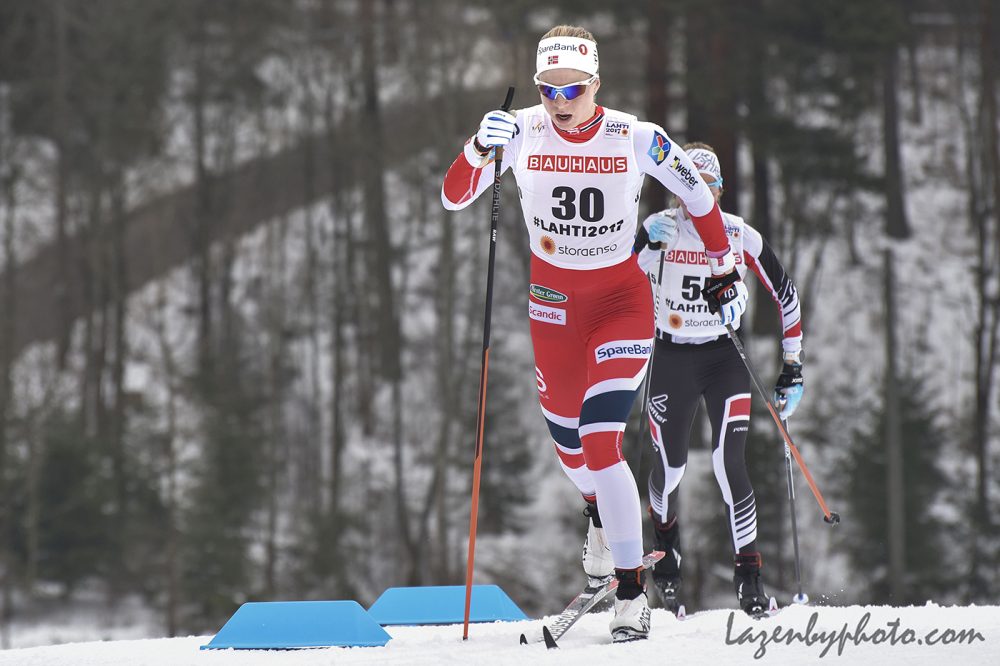
Norway’s Astrid Uhrenholdt Jacobsen, another candidate for the IOC Athletes’ Commission, racing to bronze during the women’s 10 k classic at the 2017 Nordic World Championships in Lahti, Finland. (Photo: John Lazenby/Lazenbyphoto.com)
As noted, there are six Winter Olympics athletes in the running for two open spots on the Athletes’ Commission. The other five candidates are Spanish skeleton racer Ander Mirambell, Finnish hockey player Emma Terho, Chinese long-track speedskater Zhang Hong, Italian luger Armin (“Il Cannibale”) Zöggeler, and Norwegian cross-country skier Astrid Uhrenholdt Jacobsen.
Randall does not reject a suggestion that the presence of both her and Jacobsen could to some extent split the “Nordic vote.”
“By having two cross-country skiers in the mix, it does have the potential to dilute the vote,” she notes. But she continues, “I think you can also look at it as we now have two ponies in the race. Both of us in the election and there’s probably a better chance that a cross-country athlete will make it to the IOC Commission. That’s good odds.”
Randall is quick to call Jacobsen, with whom she has previously trained on Eagle Glacier as an invited guest of the North American Women’s Training Alliance, an “accomplished person,” who “put a lot of thought into taking on this role.” But she diplomatically notes that Jacobsen “is coming from one side of getting involved in the athlete representation side, at least in an international way, for the first time. I’m coming from the side where I’ve been involved. It’ll just be interesting where people land on who they want to put forward.”
What comes next: Retirement and Canada
First things first, Randall officially plans to retire after this season. “I haven’t done an official press release,” she notes, “but I’ve definitely talked about it to plenty of people. Most people know that’s my plan.”
That leaves Randall and her family (Ellis has spent the past five years working as marketing support manager for the World Cup, but would presumably no longer want to spend all winter in Europe without his wife and son) needing jobs, and a place to do them.
What she’ll be doing next year is “also a very good question,” Randall says. “We’ve been talking about that as a family for a while.”
Randall notes that Ellis “has been very supportive,” pointing out that he moved to Alaska 10 years ago for her sake and has supported her once he retired from his own ski career. “We’ve always talked about once I retire from skiing to be open to chasing some career opportunities for him,” Randall notes. “He’s Canadian; maybe that meant moving to Canada and experiencing that for a while.”
The couple were exploring their options this spring when “an opportunity fell into our lap”: Ellis was invited to apply for a job with Swagman, a bike rack company based in Penctiton, British Columbia, about a four-hour drive east of Vancouver.
“It was total long shot because they were looking to fill the position in April of this year,” Randall notes. But Ellis applied anyway, “just to see what would happen.” He got the job. They were willing to hold it open for him for roughly a year, till April 2018, if he would be willing to move there. Penctiton it is for the Randall–Ellis family.
(Ellis was born in Orangeville, Ontario, and is a Canadian citizen. As the child of an American and a Canadian, Breck has dual citizenship. Randall is working on the immigration paperwork to gain legal residency in Canada as the spouse of a Canadian national.)
While Ellis works for Swagman, as well as parenting, Randall will be pursuing at least two other projects, as well as parenting.
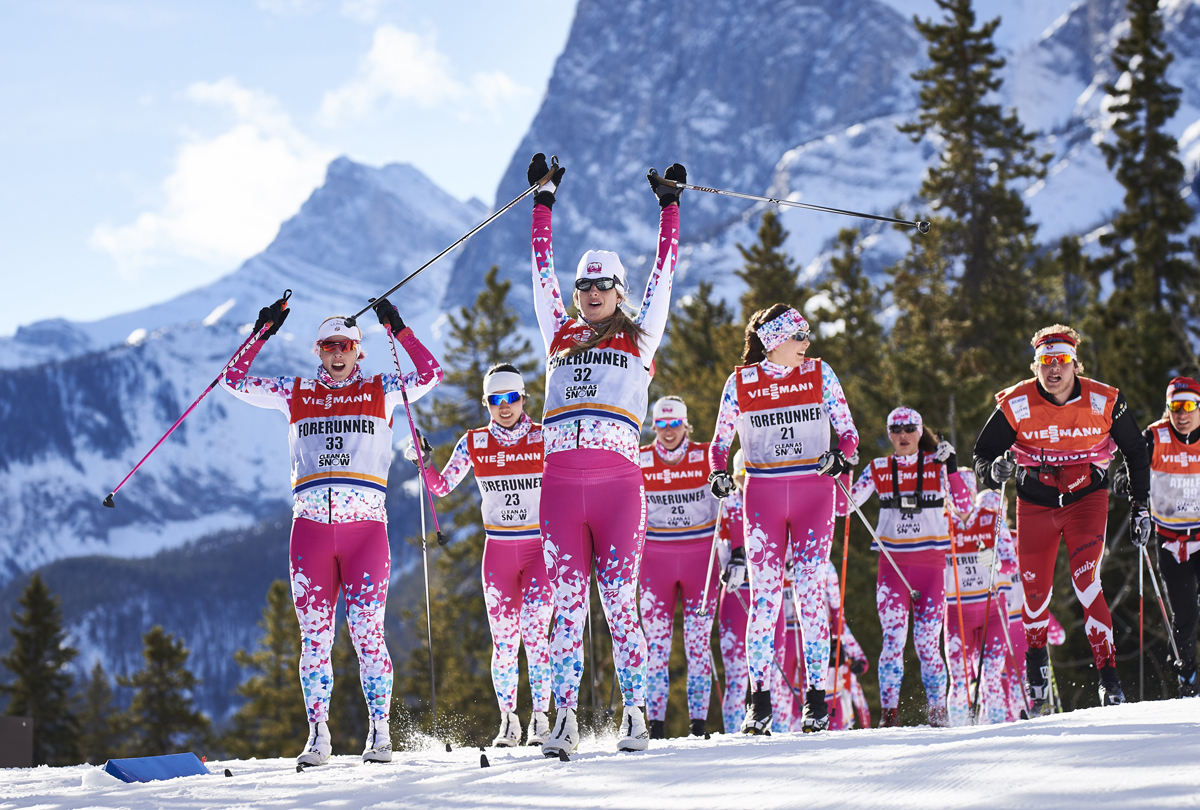
Kikkan Randall (left) and former Canadian national team member Chandra Crawford (32) leading the Fast and Female forerunners before the classic sprint at Stage 5 of the 2016 Ski Tour Canada in Canmore, Alberta. (Photo: Fischer/NordicFocus)
For one, she wants to be able to devote more attention to Fast and Female, a nonprofit sports advocacy group that, its website explains, aims at “keeping girls healthy, happy and active in sports through their teens by introducing them to inspiring athlete role models.” (You may have seen one of their Champ Chats in a ski community near you, particularly if you are the parent of a preteen or young teenager girl.) Randall is the U.S. leader of an international organization that was founded by Canadian skier Chandra Crawford in 2005.
“We’ve kept the U.S. side in a maintenance mode for the last few years,” Randall notes of Fast and Female, “since my time’s been limited, but since now that I can work on it more full time, I look forward to helping grow the U.S. organization maybe to the level that they’ve been operating in Canada. That’s a project on the horizon, depending on how this IOC athletes’ election goes. Should I get that position, that’s going to be a commitment. I want to be able to be flexible around that.”
And for another, she plans to finally get that degree. Randall graduated summa cum laude from East Anchorage High School in 2001 [around the time of the below throwback photo], then has been working on her undergraduate degree in business from Alaska Pacific University (the school, not the ski team) ever since.
https://www.instagram.com/p/BDtGVFmDSqk/
Randall has three classes left at this point. She plans to combine that with a flexible MBA program that recognizes the value of work experience, and to graduate from APU, with both a bachelor’s and a master’s degree in hand, by 2019.
Randall will attend the APU classes through a mix of online learning and intensive class blocks held in Anchorage. She looks forward to staying involved with the Anchorage and APU ski communities, and hopes that the MBA program “kind of creates a blend, allows me to move on to our next step … but also keeps me connected” with Anchorage as she goes through this period of transition.
Looking back and looking ahead (mostly just ahead)
But Randall has a lot of things to get through first in the next six months: her last Park City camp, her last World Cup season opener, (presumably) her last Olympics, her last World Cup race, and so on.
She’s spending much more energy these days training hard than stopping and reflecting, though the significance of some of these “lasts” isn’t lost on her. “I’ve got big goals I’m working towards this year,” she says. “I have my head down a lot of the time working toward that. Though when I was leaving the glacier, knowing it was the last camp, it hit me a little bit.”
But then she adds, “I really do want to take this year in, enjoy it, of course, leave everything I have on the table. I think I have a good perspective now. I got a little practice run the year I was pregnant because I stepped away from the racing season and I got to really appreciate what I love about racing and about training and about my team. This last two years, I think it’s given me the perspective to slow down a little bit and enjoy it because it will be over before we know it.”
Bottom line, Randall says, “Everything I love to do I get to do one more time, and everything that has been hard and maybe I don’t love doing, I only have to do it one more time.”
Randall made this final comment while driving back from the day’s first workout on a blustery and raw Tuesday in September. She made no mention of the weather, but it was a day when the first big fall storm of the season was rolling out of the Gulf of Alaska; a cold rain fell all day, temperatures stayed in the 40s, and the local paper warned of winds gusting to 45 miles per hour, nearly twice that in the mountains. Going back to her freshman year of high school, Randall has trained through the last 21 Alaska autumns.