From the FasterSkier archive — posts syndicated from athletes’ and coaches’ own blogs between 2004 and 2012, kept online as published. Current coverage is at fasterskier.com.
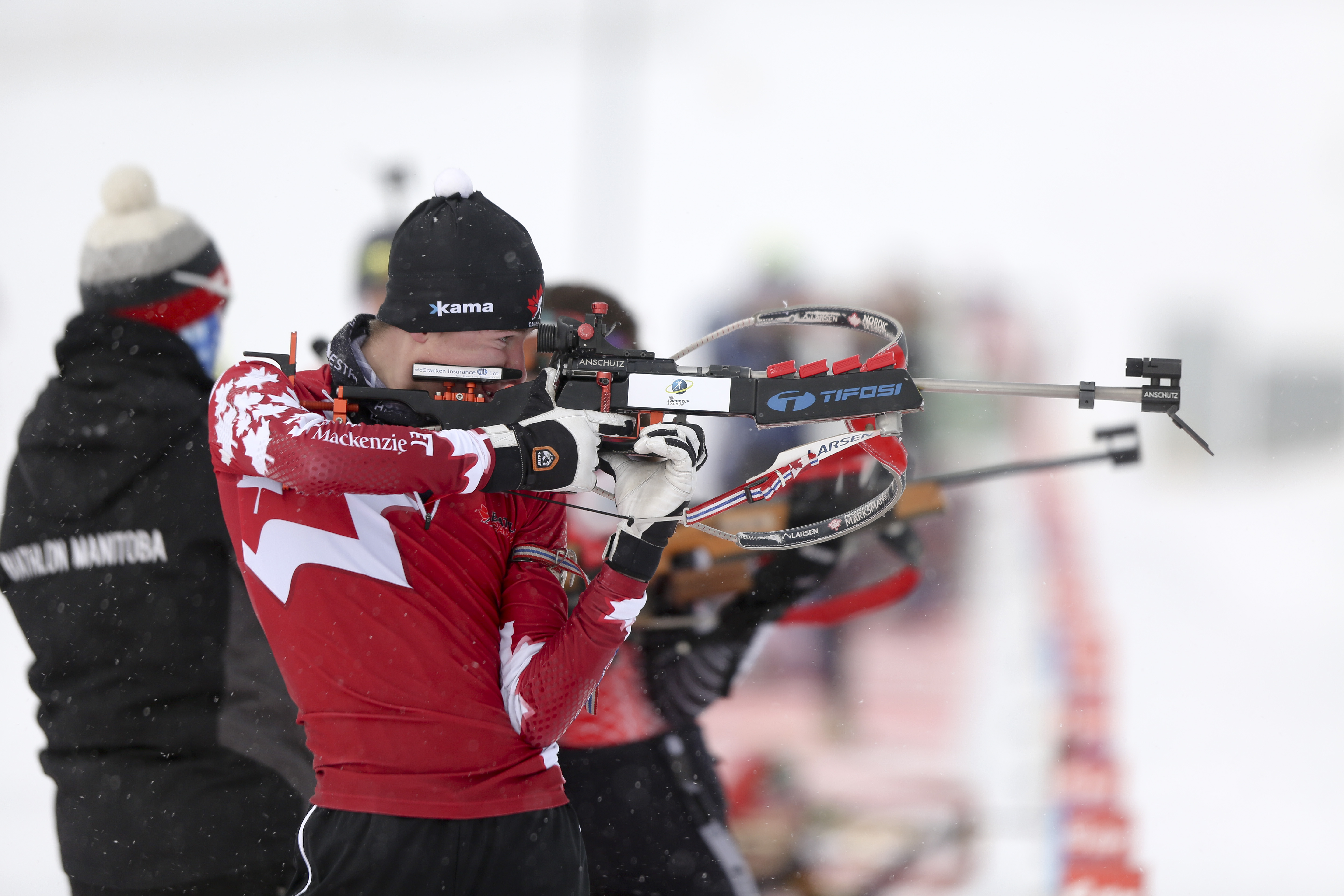
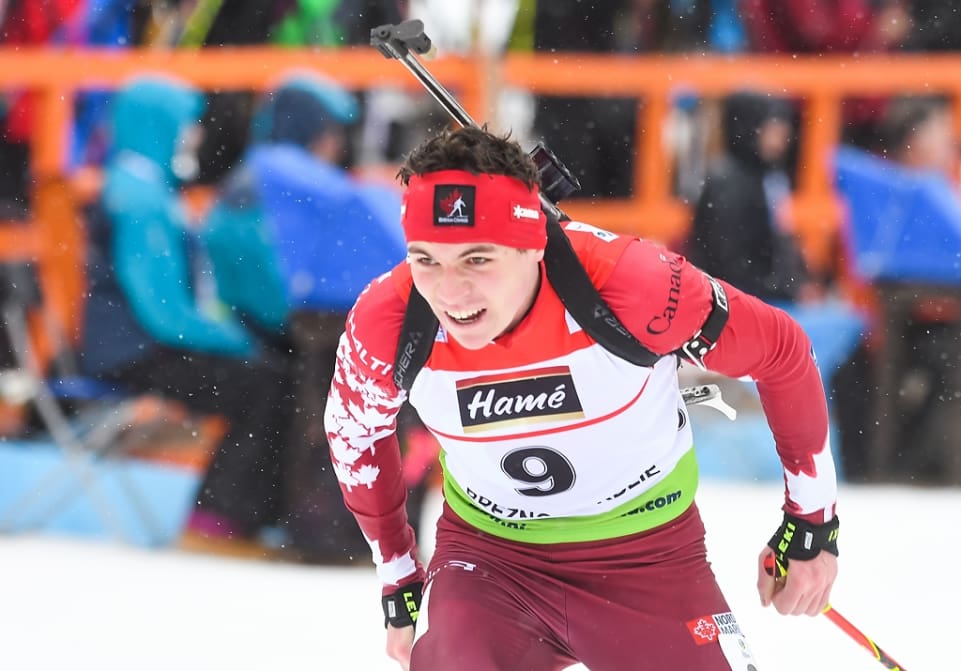
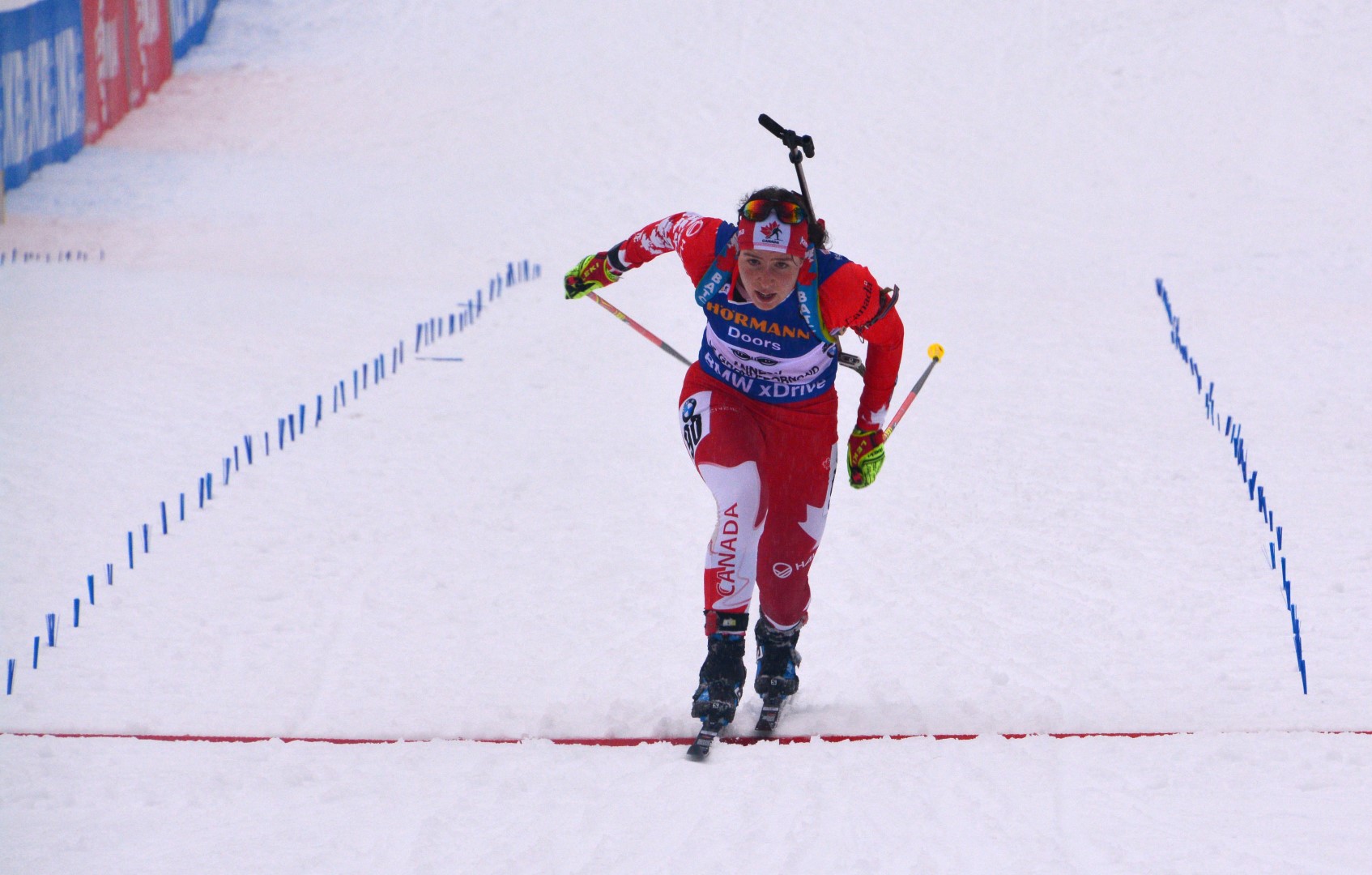
Canadian biathlete Thomas Hulsman training at the Canmore Nordic Centre in Canmore last season. (Photo: Britton Ledingham/iEvolve Photo Inc.)
In an effort to showcase the North Americans competing at this past week’s International Biathlon Union (IBU) 2018 Youth and Junior World Championships in Otepää, Estonia, we asked those qualifying athletes several questions about themselves — actually, we had them fill in the blanks. Here we have 18-year-old Thomas Hulsman, who represented Canada at his second World Youth Championships.
Over the last week, Hulsman placed 35th in the youth men’s 7.5 k sprint, 45th in the 10 k pursuit, 65th in the 12.5 k individual, and 16th in the 3 x 7.5 k relay.
***
“My full name is Thomas Gary Hulsman but you can call me Thomas.
I was born Calgary and raised in Airdire and I learned to ski at Foothills Nordic around the age of 12.
I spent the time between World Youth/Junior trials and Worlds on the Junior IBU tour and then in Norway for some training time.
My hardest workouts I did in the last training year to prepare for this was uphill intensity where we did a pyramid. That means we ran up, then back down, then ran a little bit further up, then back down, up then down, and up to the top.
One thing I’m working on this season to improve my biathlon is my sking.
This is my first time in Estonia and second time racing internationally, and so far it’s been a blast.
One difference I’ve noticed between Estonia and the Canada is the food.
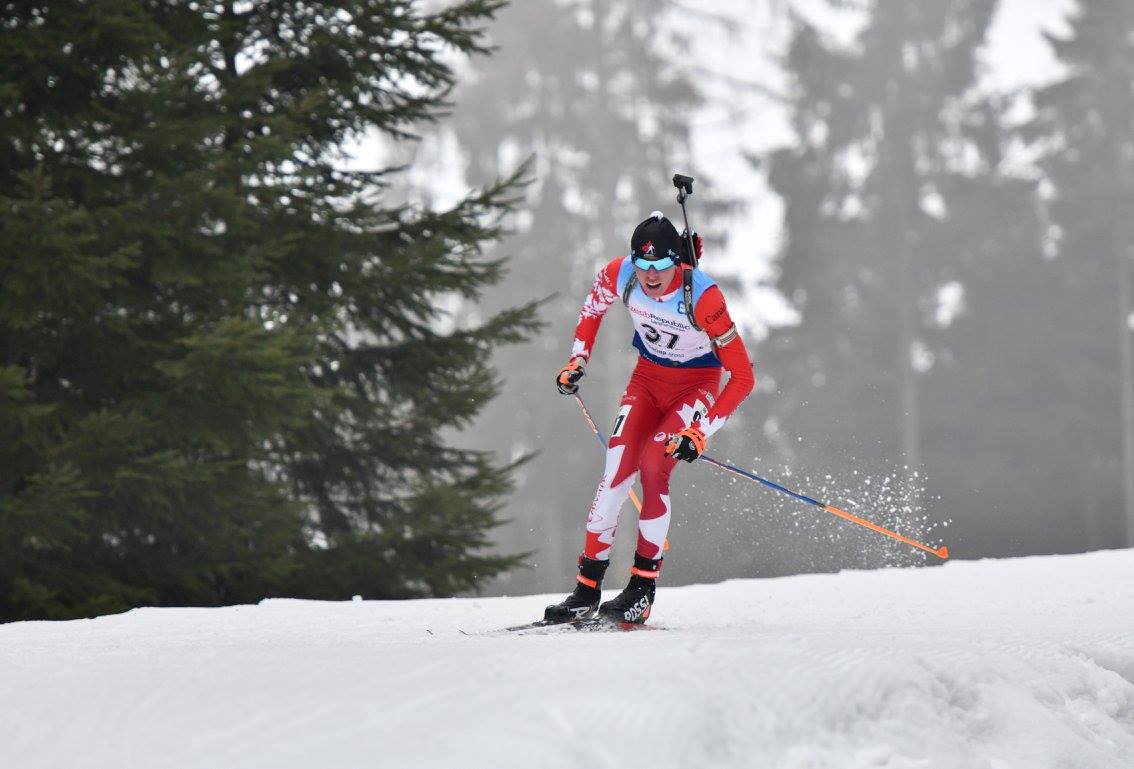
Thomas Hulsman racing at the IBU Junior Cup in the Czech Republic earlier this season. (Courtesy photo)
One of the things I’m most excited about for World Youth/Junior Championships in Otepää is seeing the country.
One race I’m particularly targeting is the sprint, because it is the race I need to place in the top 60 to do the pursuit.
Watching the Olympics in the leadup to my own races was inspirational. One of my favourite moments of the Games was watching the races with the boys in my room. I want to be like Martin Fourcade because he is so consistent.
At Worlds, I really hope I can chat/make friends with as many people as possible.
My favourite thing at the breakfast where we are staying is all of the fruit and the omelettes.
Before this trip, if you said “Estonia”, the first thing I’d think of would have been “Where is that?”
Now that I’m here, I’m pretty sure something I’ll always remember will be how there is skiing everywhere.
If I had a totally free day here and didn’t have to worry about race fitness or training, I’d spend it seeing the country, probably in the capital and shopping for stuff.
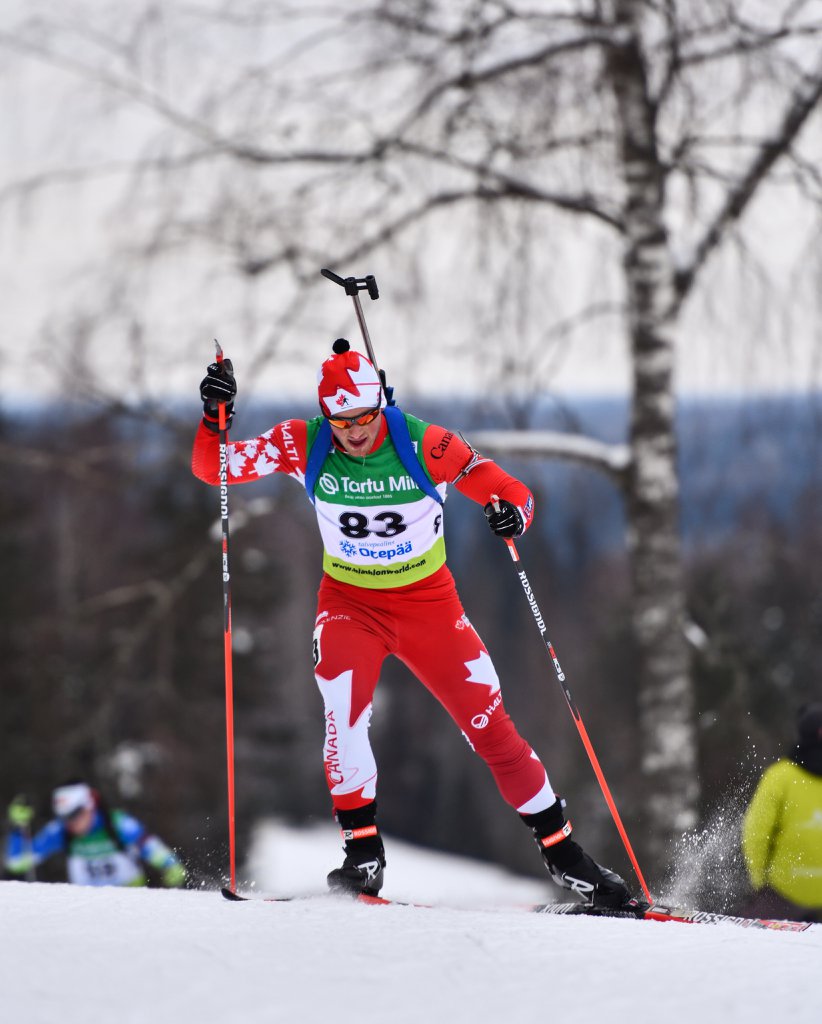
Canada’s Ryan Elden racing in the youth men’s 7.5 k sprint at 2018 IBU Youth World Championships in Otepää, Estonia. (Photo: Bryan Dickson)
In an effort to showcase the North Americans competing at this past week’s International Biathlon Union (IBU) 2018 Youth and Junior World Championships in Otepää, Estonia, we asked those qualifying athletes several questions about themselves — actually, we had them fill in the blanks. Here we have 18-year-old Ryan Elden, who represented Canada at his first World Youth Championships.
Over the last week, Elden placed 49th in the youth men’s 10 k pursuit, 59th in the 7.5 k sprint and 81st in the 12.5 k individual.
***
“My full name is Ryan Alexander Elden, but I go by Ryan pretty much all the time.
I was born and raised in Quesnel, British Columbia, and I learned to ski at the age of 2.
Between Trials and Youth Worlds I spent my time competing in Europe on the 2nd international Biathlon tour. I competed in races in Nové Mesto, Czech Republic and Pokljuka, Slovenia. After racing I spent the last 2 weeks in France, at my coach Etienne’s hometown, doing our final bit of training before Worlds.
The hardest/most fun workout we did during the summer in Whistler with the Whistler Nordic Training Centre was pulling tires on our roller skis.
The biggest thing I’ve been working on this season is shooting. I’ve been a little inconsistent in the past so I’ve been doing a bit of extra work to improve in that area.
This is my first time in Estonia and my second time racing internationally. My first time were the races I did in Czech Rebublic and Slovenia three weeks ago. It’s been a huge learning experience and a ton of fun.
One difference I’ve noticed between Canada and Estonia are the older buildings. It has a really cool mix of very modern buildings and very old buildings.
At Worlds, I’m really excited to see how I size up against the other biathletes from all around the world.
One race I’m especially targeting is the pursuit because it is the most fun in my opinion.
Watching the Olympics before racing has been really inspiring. My favourite part of watching the Olympics is hearing the stories of the athletes and what they’ve gone through to get to where they are today. I get so excited every time medalists are tearing up with happiness on the podium after finally achieving their dreams. If I had to choose someone, I would like to be like Johannes Thingnes Bø. A great champion and amazing athlete, but also personable and humble.
Here at Worlds I want to meet as many different as I can and learn about the other countries.
My favourite thing at breakfast (not here specifically but also here) is eggs with cheese.
The first thing I thought of before coming here was cold.
Now that I’m here, I don’t think I will ever forget how flat it is. Our course is anything but flat, surprisingly, but the countryside we drove through was very flat. It has beautiful scenery though.
If I had a ton of spare time here I would spend it exploring the larger towns and checking out cool buildings.
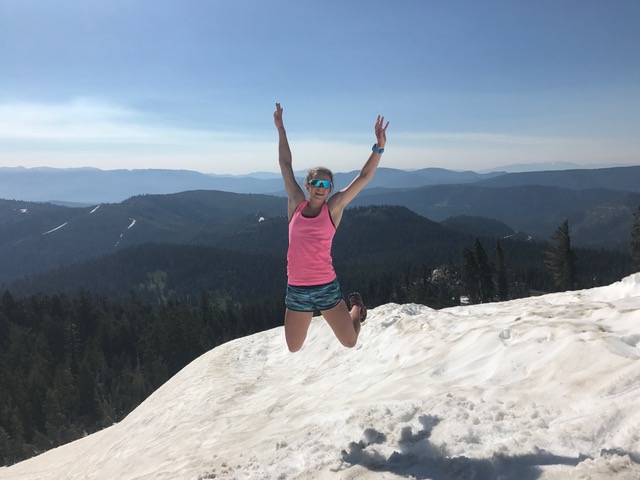
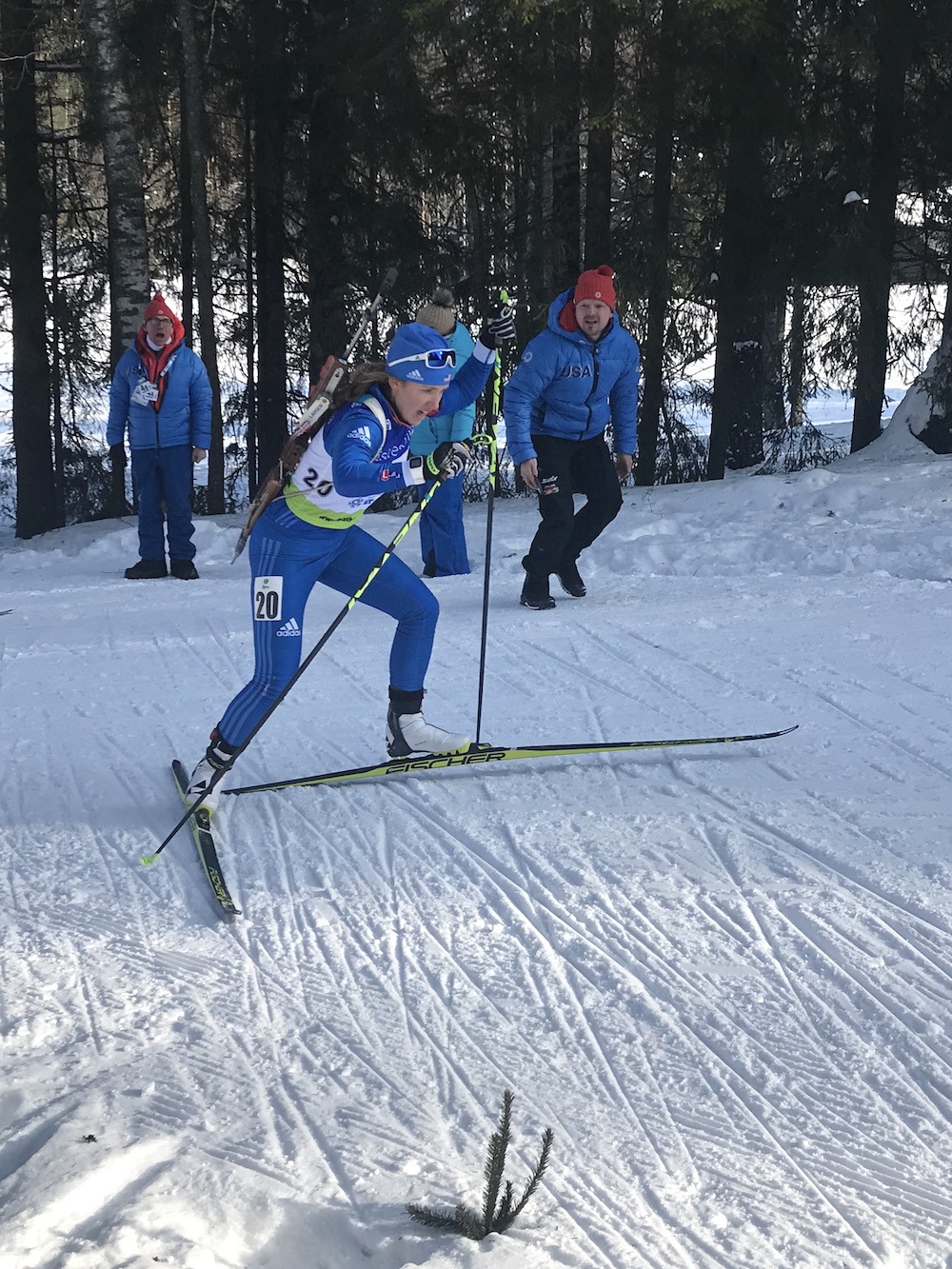
American Lexie Madigan getting some air during summer training. (Courtesy photo)
In an effort to showcase the North Americans competing at this past week’s International Biathlon Union (IBU) 2018 Youth and Junior World Championships in Otepää, Estonia, we asked those qualifying athletes several questions about themselves — actually, we had them fill in the blanks. Here we have 16-year-old Lexie Madigan, who represented the United States at her first Youth World Championships.
Over the last week, Madigan placed 70th in the youth women’s 6 k sprint, 83rd in the 10 k individual and 18th with the 3 x 6 k relay.
***
My full name is Margaret Lexie Madigan but you can call me Margie.
I was born and raised in Nevada City, California, and I learned to ski at the Auburn Ski Club.
Lexie Madigan racing (Courtesy photo)I spent the time between World Youth/Junior trials and Worlds training at home in California and competing on the Junior IBU Cup circuit.
The funnest workout I did in the last training year to prepare for this was when I played speedball at the beach with the Sugar Bowl Nordic Ski Team.
One thing I’m working on this season to improve my biathlon is learning to shoot in the cold weather.
This is my first time in Estonia and seventh time racing internationally, and so far it’s been the greatest experience!
One difference I’ve noticed between Estonia and the United States is that it is a lot colder (at least colder than California).
One of the things I’m most excited about for World Youth/Junior Championships in Otepää is all of the fast skiers and hard competition!
One race I’m especially targeting there is the sprint.
Watching the Olympics in the leadup to my own races was inspiring. One of my favorite moments of the Games was when Jessie and Kikkan won the Cross Country Team Sprint. I want to be like Jessie Diggins, because she showed that the race isn’t over until you cross the finish line and never gives up.
At Worlds, I really hope I can chat/make friends with someone from France and ask them if they know Martin Fourcade’s secrets.
Canada’s Trevor Kiers racing at the IBU Junior Cup in Nove Mesto, Czech Republic, earlier this season. (Courtesy photo)
In an effort to showcase the North Americans competing at this week’s International Biathlon Union (IBU) 2018 Youth and Junior World Championships in Otepää, Estonia, we asked those qualifying athletes several questions about themselves — actually, we had them fill in the blanks. Here we have 20-year-old Trevor Kiers, who is representing Canada at his second Junior World Championships.
“My full name is Trevor Kiers but you can call me anytime 😉.
I was born in Welland, Ontario, raised in Sprucedale, Ontario, and I learned to ski at Arrowhead Provincial Park.
I spent the time between World Youth/Junior trials and Worlds mainly racing on the junior circuit, and then spent the two weeks prior to WJCH in Sjusjoen, Norway.
The favourite workout I did in the last training year to prepare for this was riding the Ironman loop in Penticton, a 180km ride around the area with my teammates Carsen Campbell and Matt Hudec.
One thing I’m working on this season to improve my biathlon is confidence in the range.
This is my first time in Estonia and fourth time racing internationally, and so far it’s been amazing!
One difference I’ve noticed between Estonia and the Canada is that I’ve found that the history, and all that fun stuff is definitely super Euro, but I think that there is a mix of modern western culture thrown in there.
One of the things I’m most excited about for World Youth/Junior Championships in Otepää is watching all my teammates, from potential medalists, to first timers, and all my close friends!
One race I’m especially targeting there is the Sprint and pursuit combo.
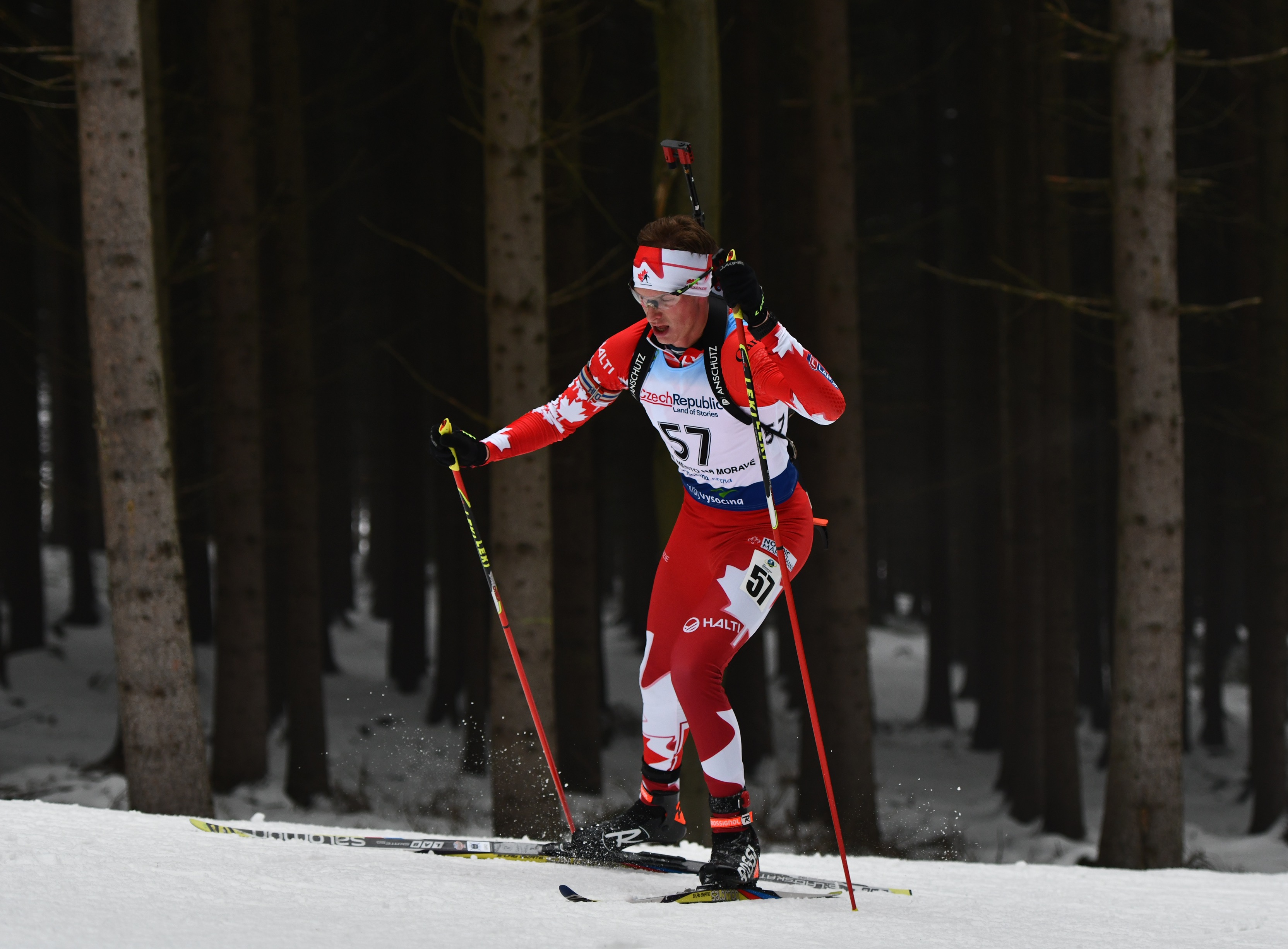
Trevor Kiers racing at Canadian World Junior Trials in Whistler earlier this winter. (Courtesy photo)
Watching the Olympics in the lead up to my own races was inspiring and motivational. One of my favourite moments of the Games was when Seb Sameulsson overtook Beni Doll for the silver medal in the men’s pursuit. I want to be like J-T Boe, because he races his heart out, but also knows when to have fun, and after the individual, when to get emotional 🙂
At Worlds, I really hope I can chat/make friends with someone from Norway and ask them if they want to trade last year’s race suits!
My favorite thing at the breakfast where we are staying is that they have what could be considered an American selection, they have oatmeal, eggs and bacon, the food is also delicious.
Before this trip, if you said “Estonia”, the first thing I’d think of would have been Andrew (team wax tech), because I know that he has family here, and that he enjoys his time with his cousins.
Now that I’m here, I’m pretty sure something I’ll always remember will be the venue, it’s been beautiful so far, and the course here is pretty spectacular.
If I had a totally free day here and didn’t have to worry about race fitness or training, I’d spend it around the old town in Tallinn. I went there the first day (I had flown in earlier than the rest of the group) but I feel like I hadn’t seen it all in its best, also a lot of things were closed because it was winter.
The best way to follow me on social media is on FacebookTrevor Kiers – Biathlete or Instagram@trevor.kiers, will also return smoke signals or messages flown in by owl.“
Angus Tweedie of Canada racing at the IBU Junior Cup in Nove Mesto, Czech Republic, earlier this season. (Photo: Brian Dickson)
In an effort to showcase the North Americans competing at this week’s International Biathlon Union (IBU) 2018 Youth and Junior World Championships in Otepää, Estonia, we asked those qualifying athletes several questions about themselves — actually, we had them fill in the blanks. Here we have 20-year-old Angus Tweedie of British Columbia, who is representing Canada at his first Junior World Championships after several IBU Junior Cup and Junior Open European Championships trips.
“My full name is Angus Tweedie but you can call me Curtis.
I was born and raised in Smithers, BC, and I learned to ski at the Bulkley Valley Nordic Center.
I spent the time between World Youth/Junior trials and Worlds racing the last two Junior Cup races and training in France.
The most memorable workout I did in the last training year to prepare for this was roller skiing in an inch and a half of snow while it was raining with my teammates in the Whistler Nordic Development Center.
One thing I’m working on this season to improve my biathlon is spending less time in the circle of shame.
This is my first time in Estonia and second time racing internationally, and so far, it’s been brutally hot inside and incredibly cold outside.
One difference I’ve noticed between Estonia and the Canada is the buildings are way older here.
One of the things I’m most excited about for World Youth/Junior Championships in Otepää is racing at a completely new venue.
One race I’m especially targeting there is individual.
Watching the Olympics in the leadup to my own races was highly disappointing. One of my least favorite moments of the Games was losing to Germany in hockey and to USA in both hockey and curling (we lost the stereotypically Canadian sports). I want to be like Mark McMorris, because his recovery was nothing short of spectacular.
At Worlds, I really hope I can chat/make friends with someone from Brazil and ask them “How do you get started in biathlon where winter isn’t really a thing?”
My favorite thing at the breakfast where we are staying is the fine selection of Yeti meats.
Before this trip, if you said “Estonia”, the first thing I’d think of would have been a mental picture of where it is on a map.
Now that I’m here, I’m pretty sure something I’ll always remember will be how similar it is to home (minus the lack of mountains of course)
If I had a totally free day here and didn’t have to worry about race fitness or training, I’d spend it wandering around with camera in hand.
The best way to follow me on social media is on Instagram@angomcmango.”
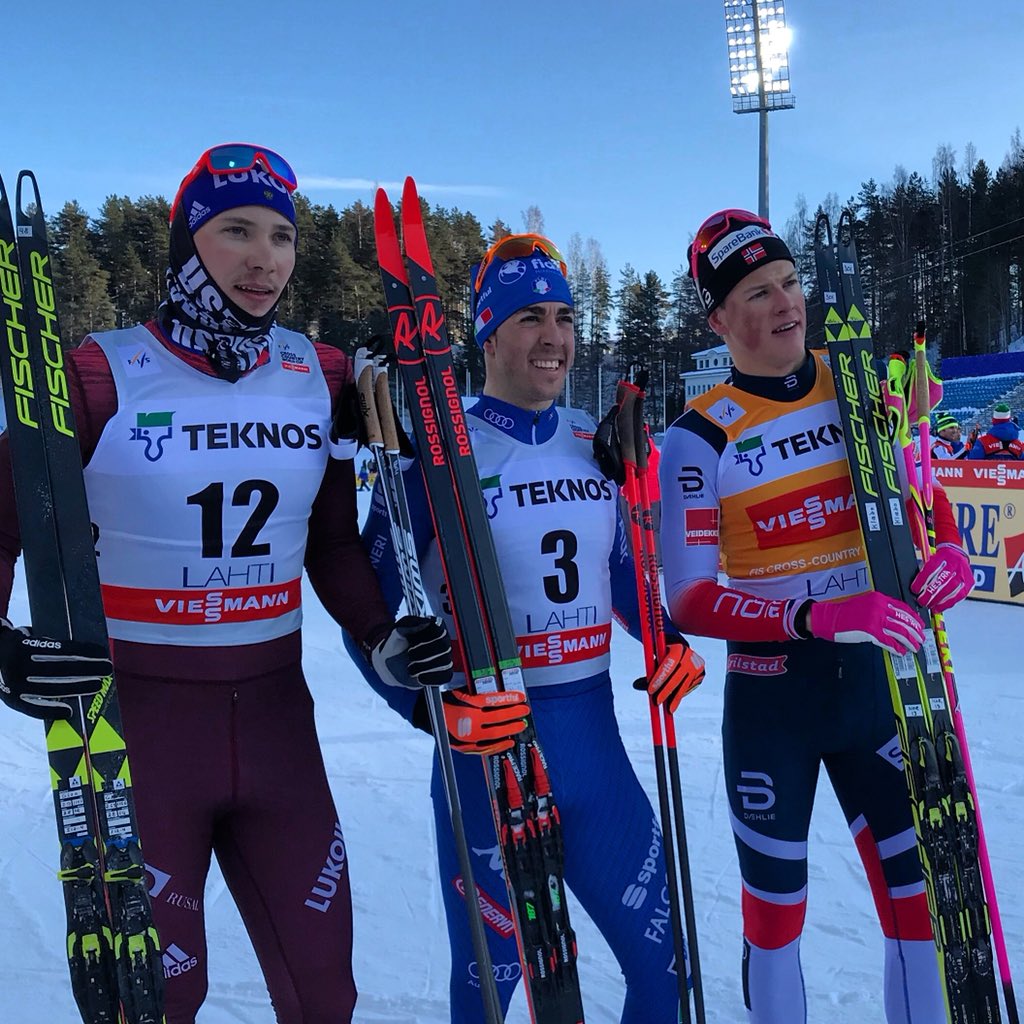
The men’s 1.6 k freestyle sprint podium at Saturday’s World Cup in Lahti, Finland, with Italy’s Federico Pellegrino (c) in first, Russia’s Gleb Retivykh (l) in second and Norway’s Johannes Høsflot Klæbo (r) in third. (Photo: FIS Cross Country/Twitter)
FIS Cross Country World Cup (Lahti, Finland): Men’s & women’s freestyle sprints
The defending world championships from the 2017 freestyle sprint prevailed again in Lahti on Saturday, with Norway’s Maiken Caspersen Falla winning the women’s 1.4-kilometer freestyle sprint final and Italy’s Federico Pellegrino coming out on top in the men’s 1.6 k final at last year’s World Championships venue.
Falla’s rise to the final started with her qualifying in 12th, 7.96 seconds off the fastest qualifying time set by Sweden’s Hanna Falk in 2:54.72. Russia’s Natalia Nepryaeva qualified second (+0.63) and Finland’s Krista Pärmäkoski third (+3.62), just ahead of Germany’s Victoria Carl in fourth (+3.88) and American Sadie Bjornsen in fourth (+3.88). Four American women qualified for the heats, with Sophie Caldwell in 17th, Ida Sargent in 21st and Rosie Brennan in 29th.
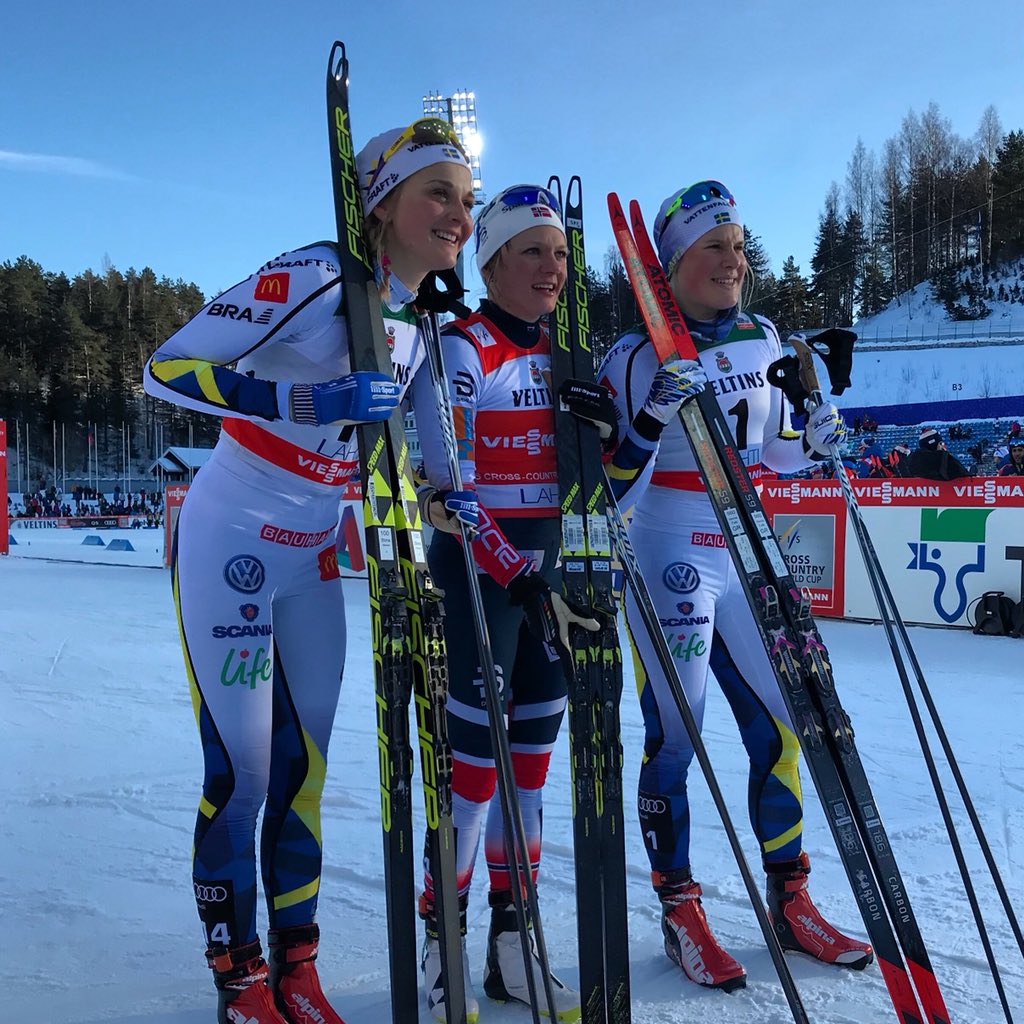
The women’s 1.4 k freestyle sprint podium at Saturday’s World Cup in Lahti, Finland, with Norway’s Maiken Caspersen Falla (c) in first, and Sweden’s Stina Nilsson (l) and Hanna Falk (r) in second and third, respectively. (Photo: FIS Cross Country/Twitter)
Falla went on to place second in the first quarterfinal, 0.71 seconds behind Sweden’s Stina Nilsson in first. According to the race jury’s ruling, Carl obstructed Pärmäkoski coming out of the last downhill before they entered the finishing straight and both crashed out of contention, with Pärmäkoski finishing fifth in the heat (+12.11) and Carl sixth (+49.5). Carl was relegated to last (30th place) for the obstruction.
Falla then won the first semifinal by just 0.04 seconds over Nilsson in second. The two other Swedes in that heat, Falk and Ida Ingemarsdotter, advanced to the final as well as lucky losers with fast-enough times.
In the final, Falla found herself at the front of the pack early then held her position to the finish, crossing the line in 2:54.83 and beating Nilsson by 0.36 seconds. Sweden had two on the podium with Falk in third (+0.78), Germany’s Sandra Ringwald placed fourth (+0.88), Ingemarsdotter was fifth (+1.83), and Switzerland’s Laurien van der Graaff placed sixth (+3.02).
Caldwell was the lone American woman to make it past the quarterfinals, as she placed second in her quarterfinal, 0.25 seconds behind Ringwald in first, then fourth in the second semifinal, 1.46 seconds behind Ringwald, who also won that heat. Overall, Caldwell finished the day in eighth.
Bjornsen placed 17th overall after finishing fourth in her quarterfinal, 2.84 seconds behind Falk in first. Sargent had been second in her quarterfinal until the final tight lefthand corner into the finishing straight, where she slipped to sixth and ultimately finished sixth, 1.07 seconds behind Sweden’s Anna Dyvik in first. Overall, Sargent finished the day in 27th, and Brennan placed 29th overall after finishing sixth in her quarterfinal, 4.91 seconds behind Ingemarsdotter in first.
Two American men advanced to the heats as well, with Kevin Bolger of the Sun Valley Ski Education Foundation (SVSEF) qualifying in 16th in his World Cup debut, 6.38 seconds behind Norway’s Johannes Høsflot Klæbo, who topped the qualifier in 2:59.06. Erik Bjornsen of the U.S. Ski Team qualified 29th, 8.29 seconds back.
Meanwhile, Pellegrino qualified for the heats in third (+1.9) behind France’s Baptiste Gros in second (+1.23).
There, Pellegrino won the first quarterfinal by 0.19 seconds over Klæbo, with the Norwegian visibly backing off before the finish — comfortable enough to automatically advance to the semifinals in second place. But Klæbo showed Pellegrino what he’s made of in the first semifinal and beat the Italian by nine-hundredths of a second.
Bolger also raced in that first semifinal after placing fourth in his quarterfinal, 0.73 seconds behind Russia’s Gleb Retivykh in first. Bolger’s time was good enough for one of two lucky loser spots in the semifinals, where he went on to finish sixth, 1.86 seconds after Klæbo. Overall Bolger finished the day in 11th.
Erik Bjornsen placed 20th on the day after finishing fourth in the first quarterfinal (with Pellegrino and Klæbo), 1.56 seconds out of first.
In the final, Klæbo set the tone, slowing the pace to almost a stop at one point, while he and Pellegrino stood side by side at the top of the course. On the way down, they accelerated, but Norway’s Sindre Bjørnestad Skar was the one who truly attacked. It might’ve been a bit too early, as Pellegrino caught him by the top of the final climb and took the lead on the following downhill into the stadium. Pellegrino held off his challengers, including Retivykh who came on strong out of the downhill, to take the win in 3:16.73, 0.77 seconds ahead of Retivykh in second and 0.9 seconds ahead of Klæbo in third. Skar settled for fourth (+1.3), Finland’s Ristomatti Hakola placed fifth (+1.44) and France’s Lucas Chanavat finished sixth (+7.55).
In the qualifier, Canada’s Dahria Beatty finished 34th, +13.39 and just 0.9 seconds from making the quarterfinals. She was the only Canadian woman competing.
American Kelsey Phinney (SVSEF) was also close to making the cut. In her first European World Cup, she placed 36th in the qualifier, +13.74. Caitlin Patterson and Kaitlynn Miller, both of the Craftsbury Green Racing Project, placed 56th (+20.12) and 61st (+21.70).
Mathilde Petitjean of Togo, a primarily Quebec-based skier, finished in 59th (+20.80).
In the men’s qualifier, Logan Hanneman (APU) placed 49th (+11.45). Paddy Caldwell (U.S. Ski Team/SMS T2) finished 59th (+13.55), and APU’s Reese Hanneman and David Norris placed 61st (+14.33) and 67th (+19.27).
Julien Locke led Canada in 42nd place (+9.78), and Andy Shields finished 60th (+14.29).
American Chloe Levins racing to seventh in the junior women’s 7.5 k sprint on Saturday at IBU Junior World Championships in Otepää, Estonia. (Photo: Terri Dickson)
Poland’s Kamila Zuk won her second race in a row, taking gold in the junior women’s 7.5 k sprint after also winning the individual at World Junior Championships. Zuk had one penalty to two by second-place Marketa Davidova of the Czech Republic, who finished 26.0 seconds back. Bronze went to Myrtille Begue of France, who shot clean to finish 52 seconds back.
The sole U.S. starter, Chloe Levins followed up her sixth-place finish in the individual with seventh place in the sprint. Levins had a single penalty and finished +1:31.7.
For Canada, Megan Bankes was close behind Levins in ninth, with two penalties and +1:49.5. Teammate Nadia Moser was 21st, also with two penalties, +2:46.2. Emily Dickson finished 36th, +3:50.5 with two penalties, and Zoe Pekos just missed the pursuit cutoff in 66th (+6:22.4) with four missed shots.
In the junior men’s 10 k sprint, Vasilii Tomshin of Russia took the gold with perfect shooting. France’s Martin Perillat Bottonet was second, less than a penalty-loop’s worth of time back at 20.5 seconds – and he did have one penalty. Norway’s Sverre Dahlen Aspenes took bronze (+29.4) with two missed shots.
Trevor Kiers led Canada in 16th, a breakthrough result; his previous World Juniors best was 39th in the pursuit last season. Kiers missed two shots, both in prone, and finished 1:34.9 behind the time set by Tomshin.
Adam Runnalls placed 26th for Canada (+2:08.3) with three missed shots. Teo Sanchez also qualified for the pursuit by placing 53rd (+3:19.2) with one penalty, and Angus Tweedie was left on the outside looking in with 69th place (+4:41.3) with three missed shots.
Cody Johnson led the Americans in 37th, with clean shooting, 2:31.1 back from Tomshin’s time. Tim Cunningham was the next finisher in 71st (+5:13.5) with seven missed shots, followed by Jacob Pearson in 79th (+6:24.2) with two penalties and Cam Christiansen in 86th (+7:52.5) with three penalties.
Leo Grandbois (second from l) with his support crew, including wax techs Andrew Chisholm (l) and Andrzej Lesnik (second from r) and Canada’s head coach Jacqueline Akerman (r), after Grandbois won gold last season in the 12.5 k individual, the first race of his first IBU Youth World Championships in Osrblie, Slovakia. (Photo: Airat Aitniakov)
In an effort to showcase the North Americans competing at this week’s International Biathlon Union (IBU) 2018 Youth and Junior World Championships in Otepää, Estonia, we asked those qualifying athletes several questions about themselves — actually, we had them fill in the blanks. Here we have 18-year-old Leo Grandbois, who is representing Canada at his second World Youth Championships. Last year in Osrblie, Slovakia, Grandbois won the 12.5 k individual at 2017 Youth Worlds.
“My full name is Leo Grandbois but you can call me The Terrible.
I was born in Munich, Germany, and raised in Lennoxville, Canada, and I learned to ski at 6.
I spent the time between World Youth/Junior trials and Worlds at my home doing my preparation for Worlds.
Canada’s Leo Grandbois (Biathlon Estrie) racing to gold in the 2017 IBU Youth World Championships 12.5 k individual race in Brezno-Osrblie, Slovakia. He hit all of his targets for the first time in a race to win by nearly a minute and 15 seconds. (Photo: IBU)
The hardest workout I did in the last training year to prepare for this was 6 times 6 minutes zone 4 in ski bounding with 2 minutes zone 1 between the intervals with Zach and Frank, my training partners back home.
One thing I’m working on this season to improve my biathlon is shooting time.
This is my first time in Estonia and third time racing internationally, and so far I’ve been Youth World Champion last year in Slovakia in the 12.5 k individual.
One difference I’ve noticed between Estonia and the Canada is the air humidity.
One of the things I’m most excited about for World Youth/Junior Championships in Otepää is racing.
One race I’m especially targeting there is the individual.
Watching the Olympics in the leadup to my own races was good for my own preparation. One of my least favourite moments of the Games was when Alex Harvey came 4th in the 50k, at 3 second from a medal. I want to be like Klaebo because he is dominant and relaxed.
At Worlds, I really hope I can chat/make friends with someone from Norway (a girl) and ask them their number.
My favorite thing at the breakfast where we are staying is the oatmeal.
Before this trip, if you said “Estonia”, the first thing I’d think of would have been Finland’s neighbours.
Now that I’m here, I’m pretty sure something I’ll always remember will be the steep hill in the race loop.
If I had a totally free day here and didn’t have to worry about race fitness or training, I’d spend it exploring around.
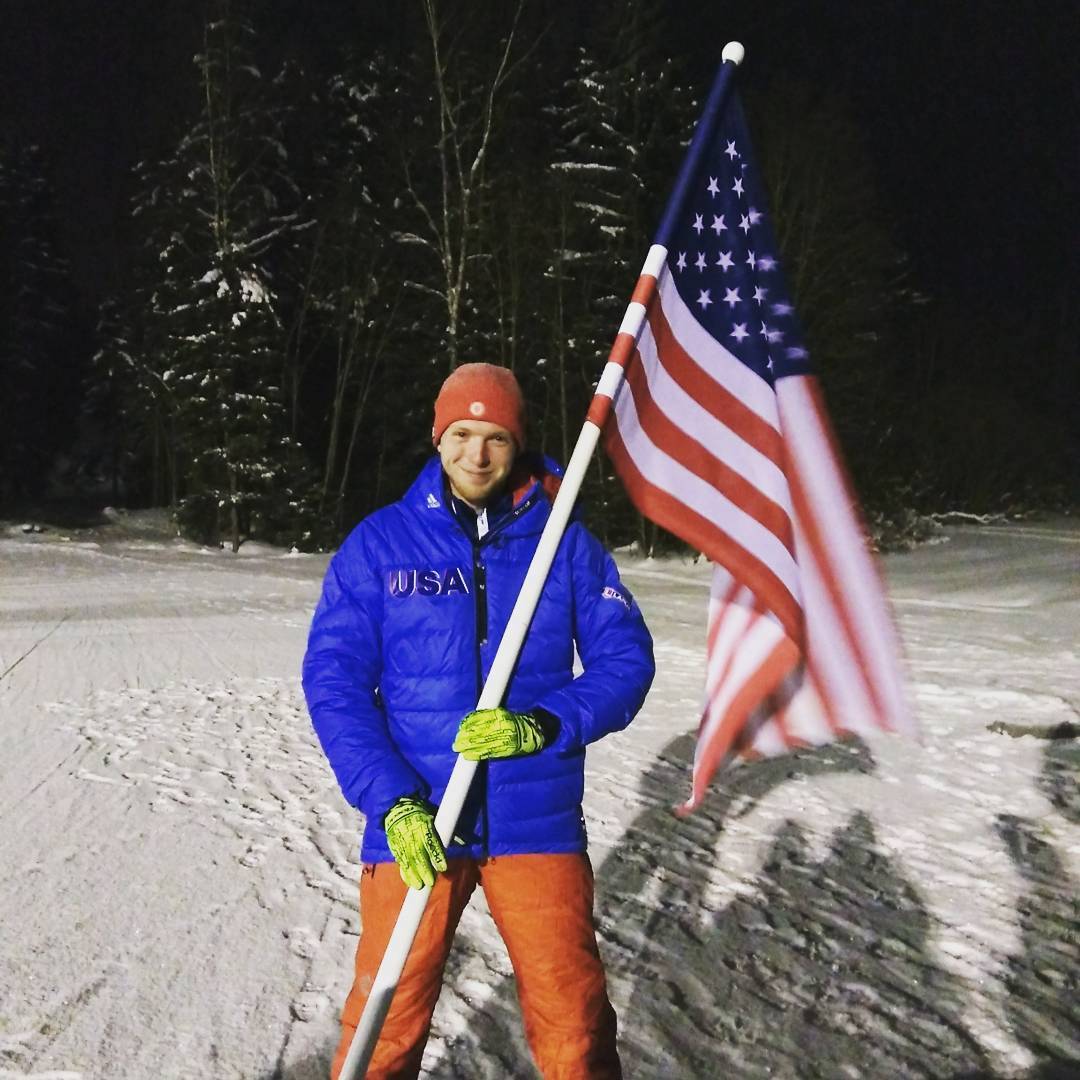
American biathlete Grace Gilliland away from biathlon. (Courtesy photo)
In an effort to showcase the North Americans competing at this week’s International Biathlon Union (IBU) 2018 Youth and Junior World Championships in Otepää, Estonia, we asked those qualifying athletes several questions about themselves — actually, we had them fill in the blanks. Here we have 18-year-old Grace Gilliland, who is representing the United States at her second World Youth Championships.
On Friday, Gilliland placed 55th in the youth women’s 6 k sprint, meeting her goal of qualifying for Sunday’s pursuit. She also finished 84th in Monday’s 10 k individual.
***
“My full name is Grace Gilliland, but you can call me Grace.
I was born and raised in Eagle River, Alaska, and I learned to ski at age 2.
I spent the time between World Youth/Junior trials and Worlds racing at the IBU Junior Cup and Junior Open European Champs.
The scariest workout I did in the last training year to prepare for this was doing hill bounding intervals on a loop where a Momma moose with two calves were, and the mom charged one of my teammates.
One thing I’m working on this season to improve my biathlon is shooting with more accuracy.
This is my first time in Estonia and 6th time racing internationally, and so far it’s been a lot of fun.
One difference I’ve noticed between Estonia and the United States is the houses in Estonia are a lot smaller than in the U.S.
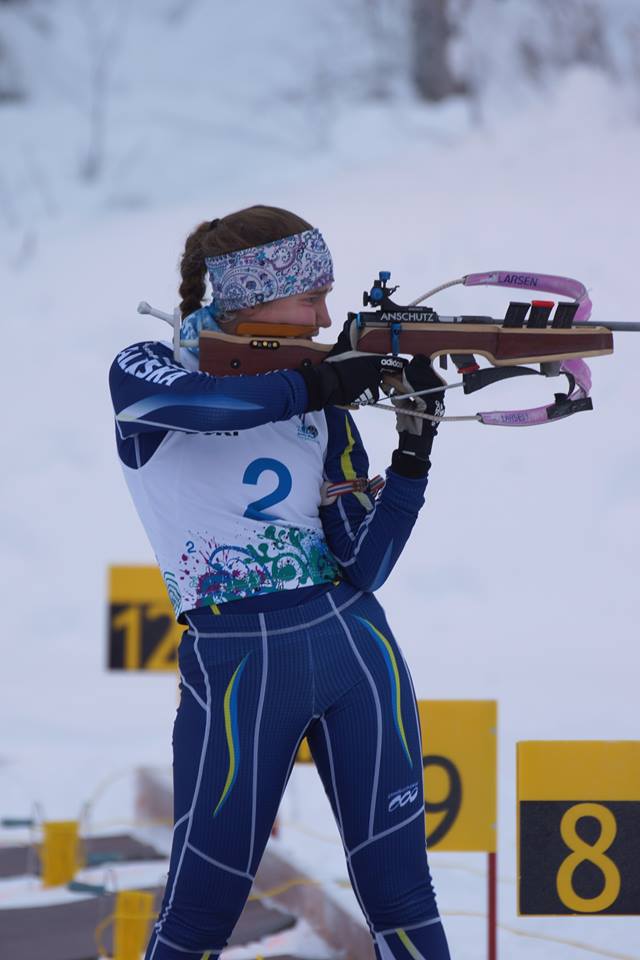
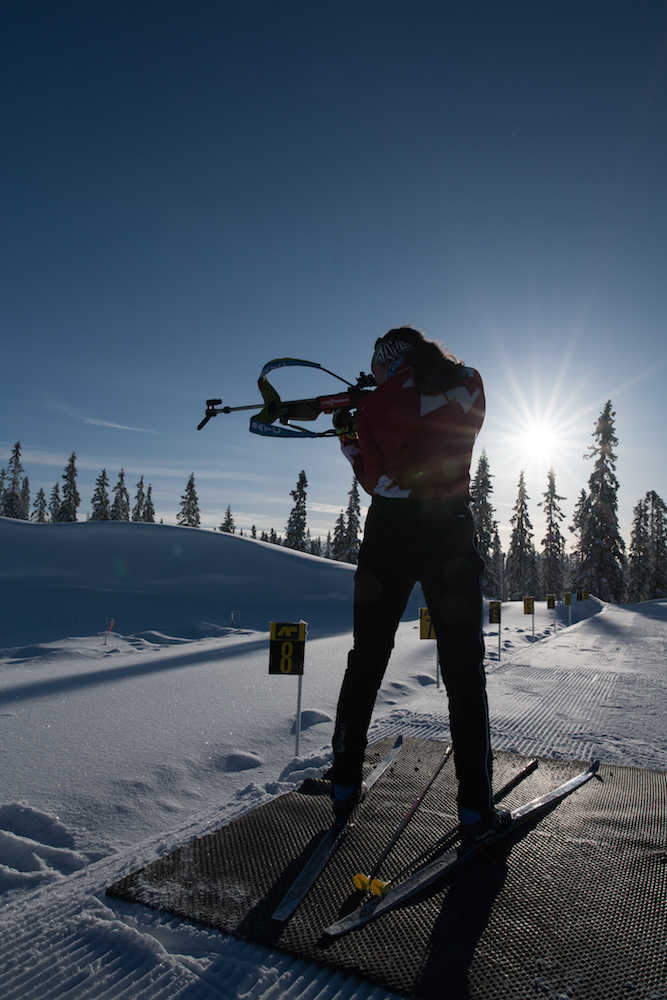
Grace Gilliland on the shooting range. (Courtesy photo)
One of the things I’m most excited about for World Youth/Junior Championships in Otepää is getting to see the biathlon venue, and ski new trails.
One race I’m especially targeting there is the Sprint race, so that I can qualify for the Pursuit.
Watching the Olympics in the lead up to my own races was exciting. One of my favorite moments of the Games was watching Jessie and Kikkan win the team sprint. I want to be like Kikkan Randall, because she is very dedicated to her sport and passing on the love for her sport to the next generation.
At Worlds, I really hope I can chat/make friends with a girl from Greenland and ask her if she remembered my team from Alaska that raced at Arctic Winter Games with her.
My favorite thing at the breakfast where we are staying is muesli.
Before this trip, if you said “Estonia”, the first thing I’d think of would have been everything I was told about how amazing the venue was.
Now that I’m here, I’m pretty sure something I’ll always remember will be how long and steep the hill is leaving the biathlon range.
If I had a totally free day here and didn’t have to worry about race fitness or training, I’d spend it exploring the town and playing in the snow.
The best way to follow me on social media is on Instagram@grace_eva99.”
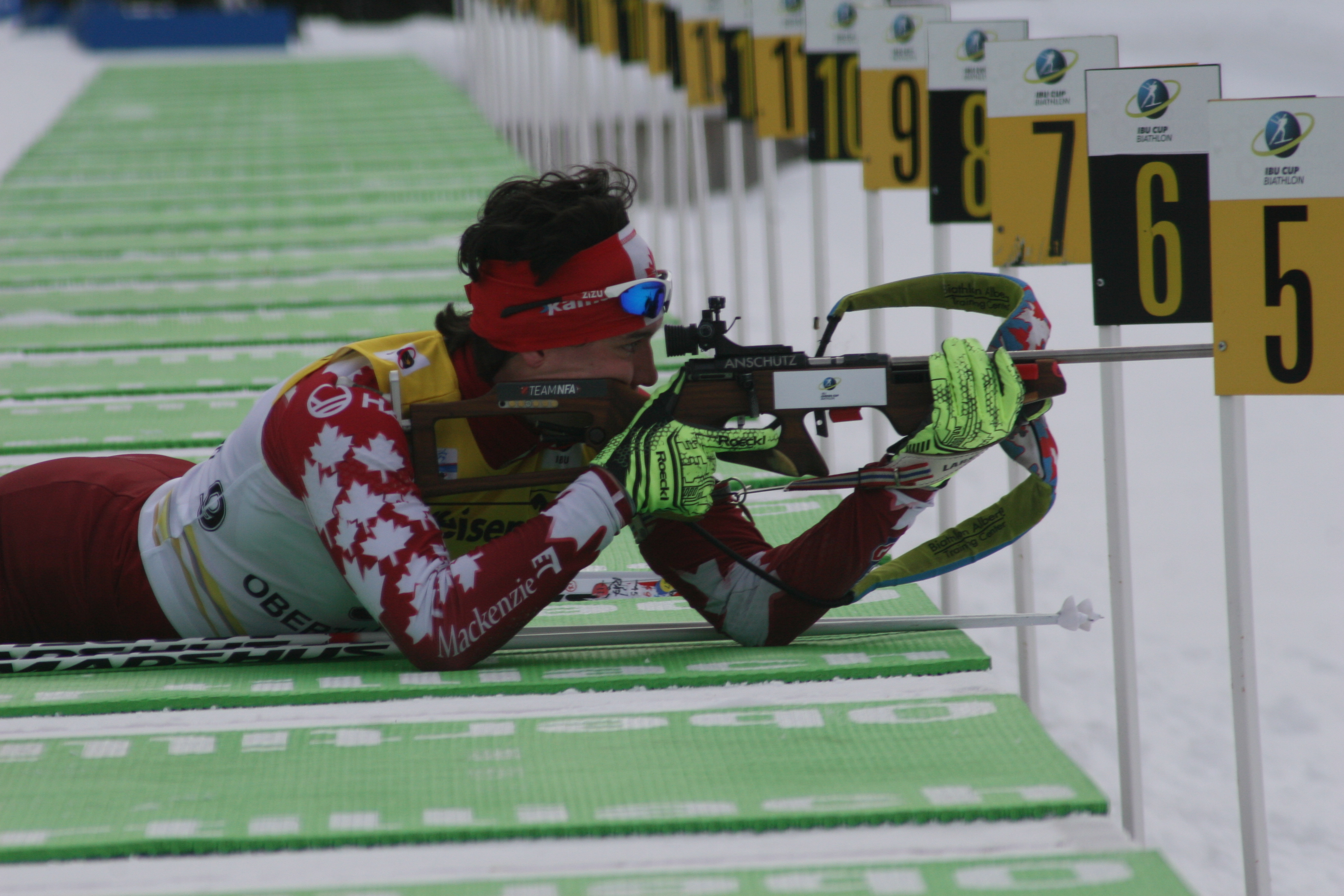
Teo Sanchez on the range at an IBU Junior Cup in Obertilliach, Austria, earlier this season. (Courtesy photo)
In an effort to showcase the North Americans competing at this week’s International Biathlon Union (IBU) 2018 Youth and Junior World Championships in Otepää, Estonia, we asked those qualifying athletes several questions about themselves — actually, we had them fill in the blanks. Here we have 20-year-old Teo Sanchez, who is representing Canada at his first Junior World Championships after competing in World Youth Championships in 2016.
“My full name is Teo Sanchez but you can call me Ted.
I was born in Colorado and raised in Canada, and I learned to ski at age 3 or 4.
I spent the time between World Youth/Junior trials and Worlds, meticulously training to make sure my I peak perfectly for these races.
The best workouts I did in the last training year to prepare for this were all the high intensity hill intervals with Biatlon Alberta Training Center.
One thing I’m working on this season to improve my biathlon is my ski technique! My technique is probably my biggest setback.
Teo Sanchez in the NorAm pursuit in Valcartier, Quebec, last season. (Photo: Dan Guay)
This is my first time in Estonia and fourth time racing internationally, and so far it’s been fantastic! Estonia is probably my favorite international venue so far.
One difference I’ve noticed between Estonia and the Canada is the food. I’ve never had rice pudding and jam for breakfast before.
One of the things I’m most excited about for World Youth/Junior Championships in Otepää is the atmosphere that comes with high levels of competition. That atmosphere feeds me.
One race I’m especially targeting there is the relay, I think I’ll be able to put my team in a really good spot.
Watching the Olympics in the leadup to my own races was inspiring. One of my favorite moments of the Games was both the relays in biathlon. It was incredible how fast the changed. I want to be like any of the athletes who are at the Olympics and clean, because cheating is shameful.
My favorite thing at the breakfast where we are staying is the bacon.
Before this trip, if you said “Estonia”, the first thing I’d think of would have been a desolate, stereotypical Eastern European country.
Now that I’m here, I’m pretty sure something I’ll always remember will be sleeping 12 hours the first day and missing training.
If I had a totally free day here and didn’t have to worry about race fitness or training, I’d spend it sightseeing in the nearby areas. Which is what we’re doing tomorrow.
The best way to follow me on social media is on Facebook. You can find me as Teo Sanchez. I’m not very active on social media.”
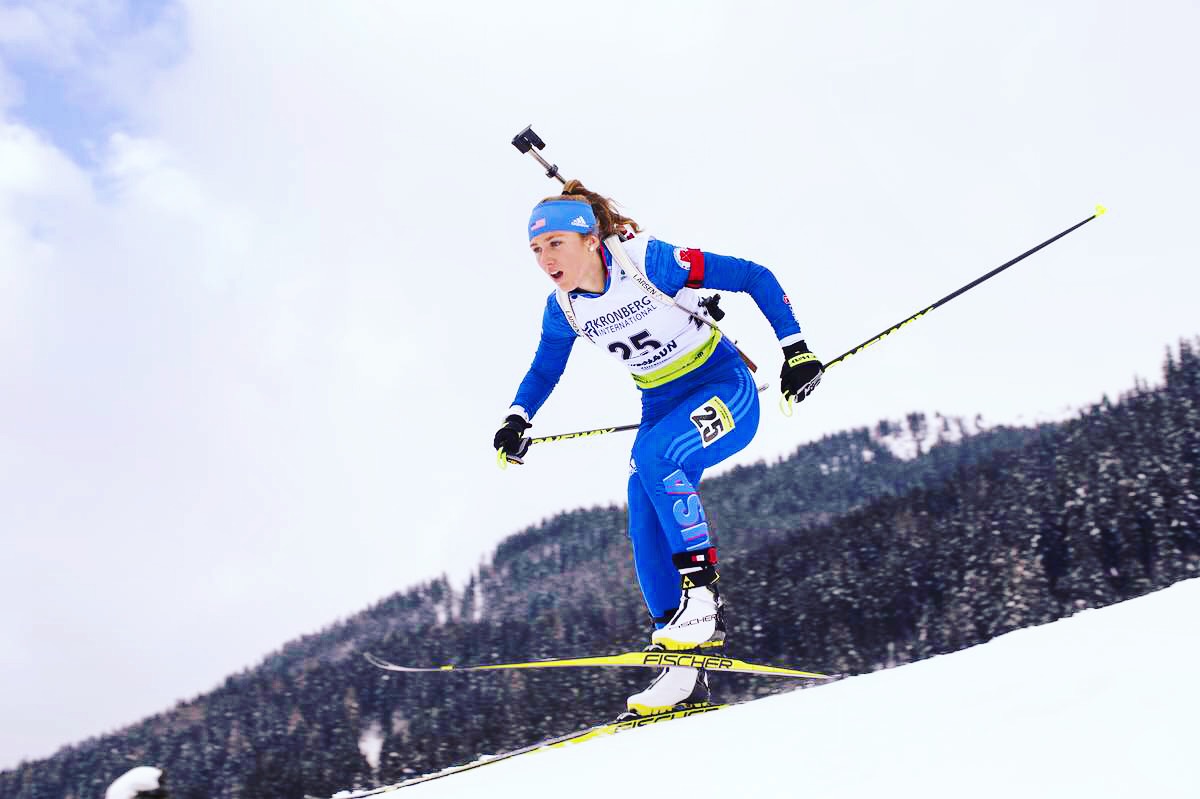
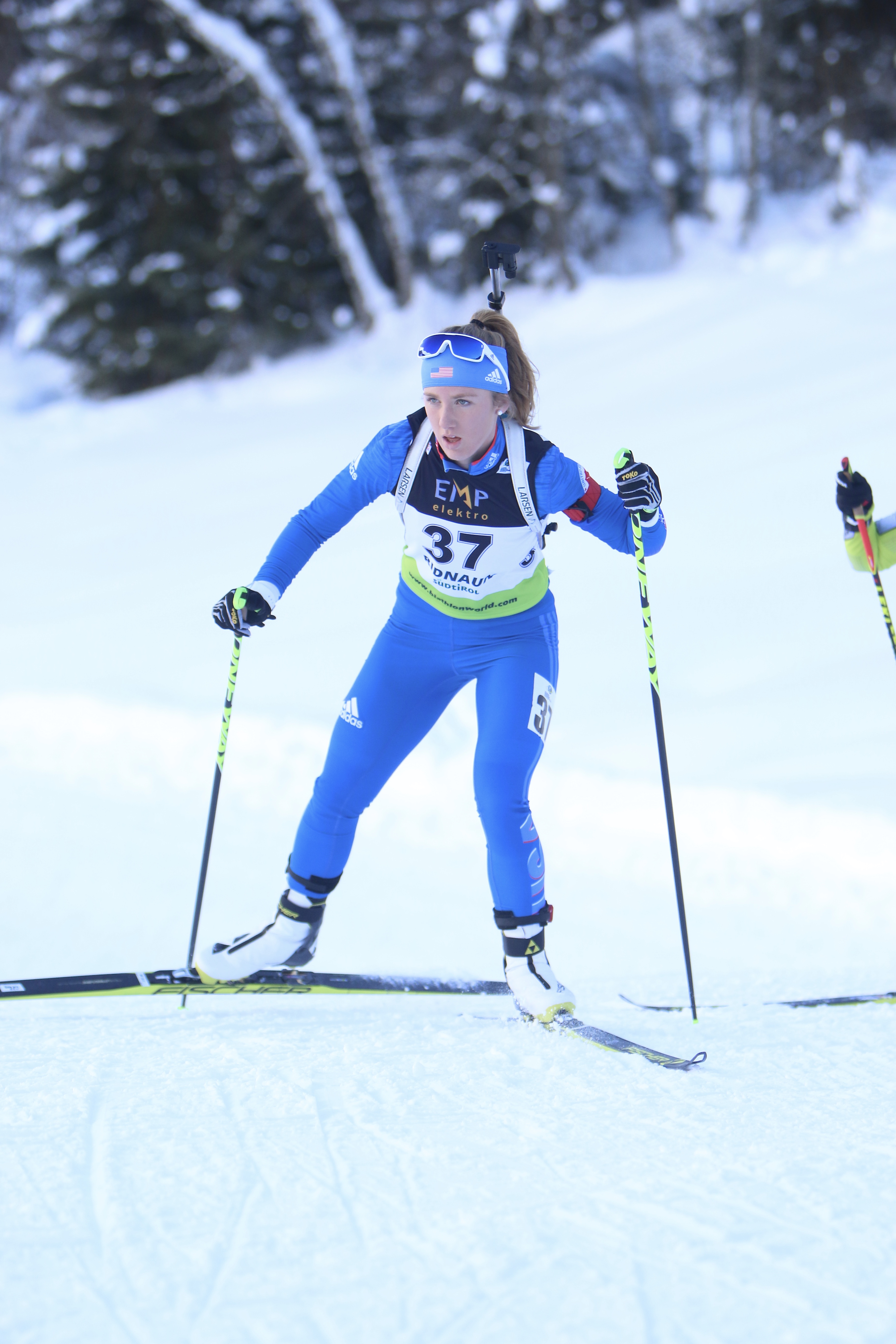
Chloe Levins racing at the IBU Cup in Ridnaun, Italy, as part of the U.S. Biathlon Association’s Olympic trials series. (Photo: USBA/NordicFocus)
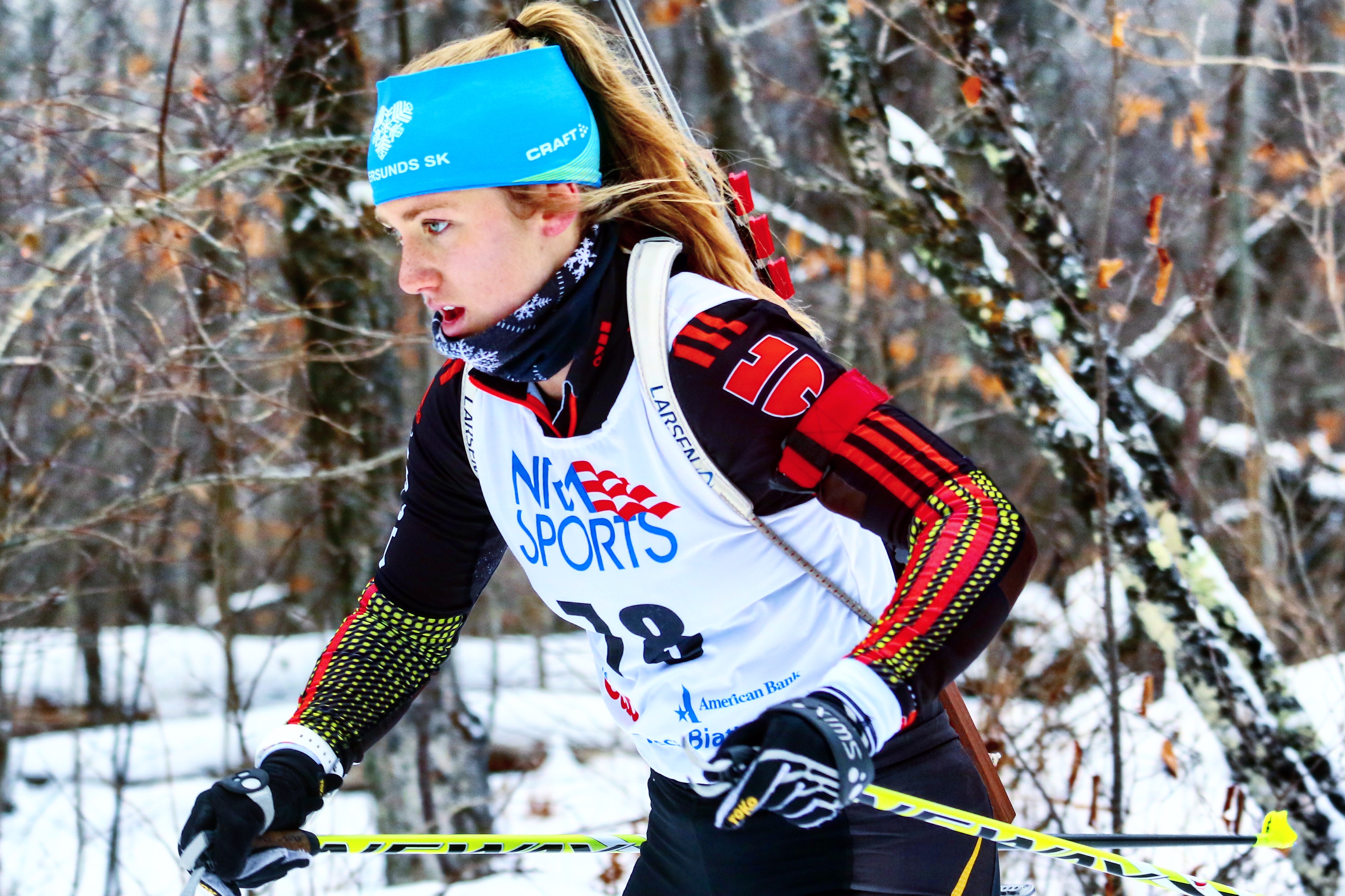
In an effort to showcase the North Americans competing at this week’s International Biathlon Union (IBU) 2018 Youth and Junior World Championships in Otepää, Estonia, we asked those qualifying athletes several questions about themselves — actually, we had them fill in the blanks. Here we have 19-year-old Chloe Levins, who is representing the United States at her first Junior World Championships. She previously represented the U.S. at Youth World Championships, including a fourth-place finish in the pursuit last season. Levins also made the short list of the U.S. Olympic Team and competed on the IBU Cup as part of Olympic Trials.
On Thursday, Levins placed sixth to lead her team in the junior women’s 12.5 k individual (+3:37.4 with three penalties).
***
“My full name is Chloe Levins but you can call me Chlo.
I was raised in Vermont, and I learned to ski by following my three older siblings.
I spent the time before Worlds in school at Middlebury College.
Chloe Levins racing in Ridnaun. (Courtesy photo)
The most memorable workout I did in the last training year to prepare for this was skiing with my coach. He doesn’t ski often, so it’s really special when he chooses to ski with me.
One thing I’m working on this season to improve my biathlon is (and probably always will be) my patience.
This is my first time in Estonia and fourth year racing internationally, and so far it’s been real winter with temperatures in the single digits (F) and falling snow.
One difference I’ve noticed between Estonia and the United States is the lack of fruit.
One of the things I’m most excited about for World Junior Championships in Otepää is experiencing a new world-class venue.
One race I’m especially targeting there is the next one.
Watching the Olympics in the leadup to my own races was hard to do at school. One of the most memorable moments of the Games was when Jessie Diggins overtook Stina Nilsson to earn US Women’s XC Skiing their first ever Olympic medal. I want to ski like Jessie, because she skis with more heart than anyone I’ve ever seen.
At Worlds, I really hope I can practice speaking German with my friends from Deutschland.
My favorite thing at the breakfast where we are staying is the lemon ginger tea.
Before this trip, if you said “Estonia”, the first thing I’d think of would have been the cold temperatures.
Now that I’m here, I’m pretty sure something I’ll always remember will be the cold temperatures.
If I had a totally free day here and didn’t have to worry about race fitness or training, I’d still spend it on skis.
The best way to follow me on social media is on Instagram@chlolevins or SnapChat @chlevins.”
Chloe Levins racing at IBU Cup Trials in Mount Itasca, Minnesota. (Courtesy photo)
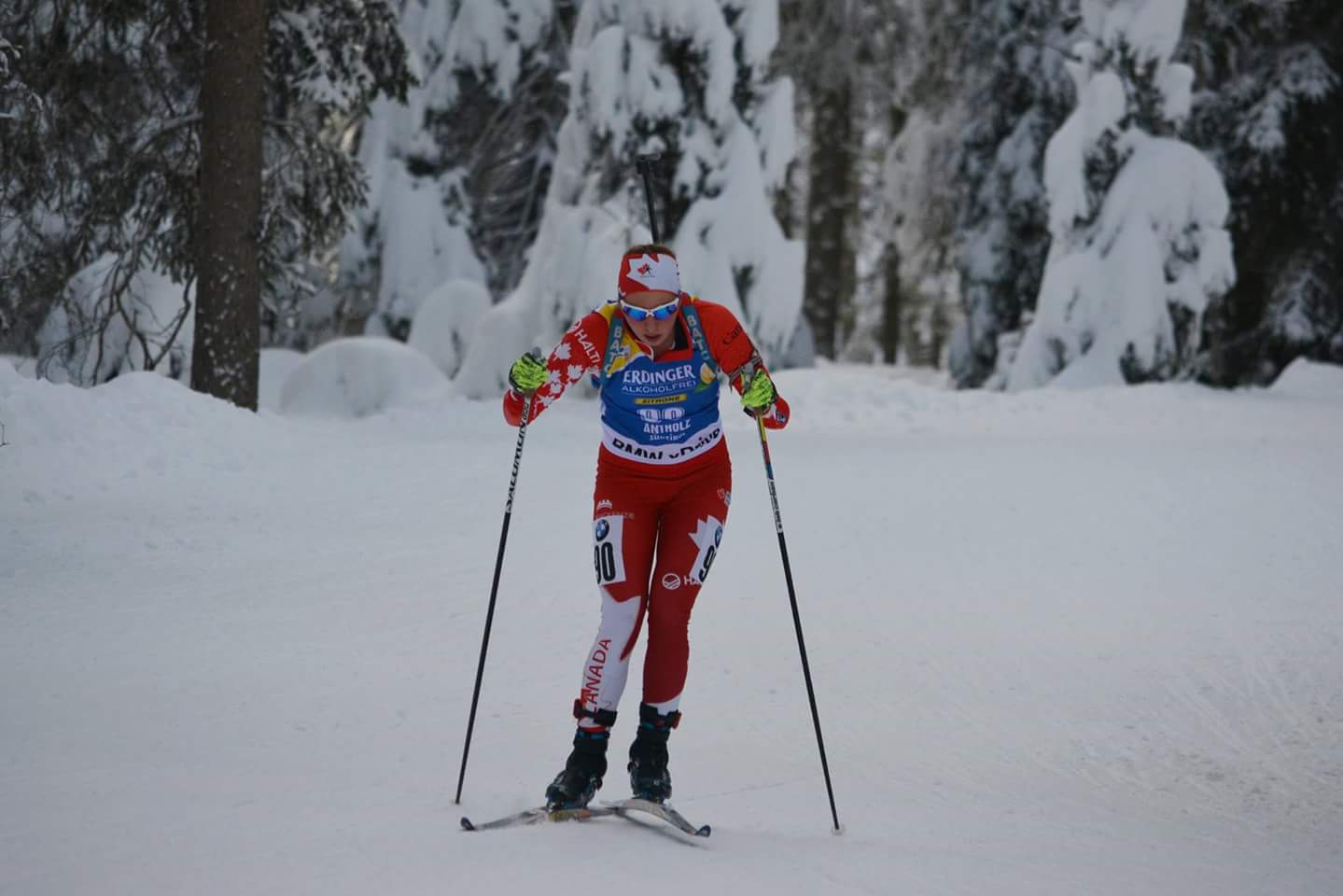
Nadia Moser of Canada in her first World Cup start in Antholz, Italy, this season. (Courtesy photo)
In an effort to showcase the North Americans competing at this week’s International Biathlon Union (IBU) 2018 Youth and Junior World Championships in Otepää, Estonia, we asked those qualifying athletes several questions about themselves — actually, we had them fill in the blanks. Here we have 20-year-old Nadia Moser, who is representing Canada at her second Junior World Championships. Moser started her season with four weekends worth of IBU Cup racing, and also got her first World Cup start in Antholz, Italy, where she finished 85th in the 10 k sprint.
On Thursday, Moser placed eighth in the junior women’s 12.5 k individual (+4:18.9 with three penalties) for her first top 20 in a non-relay event at Junior Worlds.
***
“My full name is Nadia Moser but you can call me Nadia.
I was born in Edmonton, Alberta, and raised in Atlin, British Columbia and Whitehorse, Yukon, and I learned to ski at… I don’t know exactly the age but I was pretty little.
I spent the time before Worlds training in Canada and Europe.
The windiest workout I did in the last training year to prepare for this was hiking to the top of Grotto Mountain on my own.
One thing I’m working on this season to improve my biathlon is ski technique.
This is my second time in Estonia and third year racing internationally, and so far it’s been interesting.
Canada’s Nadia Moser competing in the pursuit race at 2017 Junior Open European Championships in Nove Mesto, Czech Republic. (Photo: Emily Dickson)
One difference I’ve noticed between Estonia and the Canada is the landscape here is much flatter than Canmore.
One of the things I’m most excited about for World Youth/Junior Championships in Otepää is all of the races! I can’t target just one!
Watching the Olympics in the leadup to my own races was super exciting and inspiring. One of my favourite moments of the Games was watching Simon Schempp and Martin Fourcade sprint for the gold in the mass start.
I want to be like any super speedy animal, maybe a cheetah, because it would really help to be fast on race day.
At Worlds, I really hope I can chat/make friends with someone from any other country and ask them how they like racing in Estonia.
My favorite thing at the breakfast where we are staying is oatmeal/granola.
Before this trip, if you said “Estonia”, the first thing I’d think of would have been fish jello, because last year there was fish jello at the hotel I stayed at here (in Otepää).
Now that I’m here, I’m pretty sure something I’ll always remember will be fish jello.
If I had a totally free day here and didn’t have to worry about race fitness or training, I’d spend it exploring the science centre in Tartu.
The best way to follow me on social media is on Instagram@nadihaamoser.”
Alaska’s Helen Wilson on the shooting range. (Photo: Jim Pasek)
In an effort to showcase the North Americans competing at this week’s International Biathlon Union (IBU) 2018 Youth and Junior World Championships in Otepää, Estonia, we asked those qualifying athletes several questions about themselves — actually, we had them fill in the blanks. Here we have 16-year-old Helen Wilson, who is representing the United States at her second Youth World Championships.
On Monday, Wilson finished 74th in the 10 k individual, and she placed 18th with the U.S. youth women’s relay team in Wednesday’s 3 x 6 k.
***
“My full name is Helen Wilson but you can call me lawyer.
I was born and raised in Eagle River, Alaska, and I learned to ski at Junior Nordic.
I spent the time between World Youth/Junior trials and Worlds adjusting to reasonable temperatures, aka not Minnesota, only to arrive here in Otepää to experience those atrocious temperatures again.
The most frightening workout I did in the last training year to prepare for this was classic skiing away from a momma moose.
Helen Wilson racing in the 10 k freestyle at U.S. National Championships in Anchorage, Alaska. (Photo: Pat Cooper)
One thing I’m working on this season to improve my biathlon skills is learning how to shoot with numb digits.
This is my first time in Estonia and sixth time racing internationally, and so far it’s been way better than staying at home.
One difference I’ve noticed between Estonia and the United States is the people here speak Estonian.
One of the things I’m most excited about for World Youth/Junior Championships in Otepää is getting to glide on Susan Dunklee’s old boards.
One race I’m especially targeting there is the warm up. The winner of the warmup is clearly the fastest skier.
Watching the Olympics in the leadup to my own races was exhausting because they starred in the wee hours of the morning. One of my most shocking moments of the Games was when Martin Fourcade didn’t land on the podium in the sprint. I want to be like Martin Sundby because having his beard would have kept me warm at trials in Minnesota.
At Worlds, I really hope I can chat/make friends with someone from Norway and ask if they want to trade race suits.
My favorite thing at the breakfast where we are staying is the warm milk, that is half a degree away from curdling.
Before this trip, if you said “Estonia”, the first thing I’d think of would have been Africa.
Now that I’m here, I’m pretty sure something I’ll always remember will be how I sat on my friends lap in a snowbank in between the merging of two roads because I was afraid there was dog pee under the snow while a car drove by.
If I had a totally free day here and didn’t have to worry about race fitness or training, I’d spend it watching people suffer going up the “wall”. Good times, good times…
The best way to follow me on social media is on snapchat @biathlete.”
Rory Gilliland of Foothills Nordic racing at Canadian World Youth and Junior Trials in Whistler, British Columbia, earlier this season. (Courtesy photo)
In an effort to showcase the North Americans competing at this week’s International Biathlon Union (FIS) 2018 Youth and Junior World Championships in Otepää, Estonia, we asked those qualifying athletes several questions about themselves — actually, we had them fill in the blanks. Here we have 17-year-old Rory Gilliland of Calgary, who is representing Canada at his first Youth World Championships.
“My full name is Rory Gilliland but you can call me Rory.
I was born and raised in Calgary, and I learned to ski at 10 years old.
I spent the time between World Youth/Junior trials and Worlds finishing my first semester at school and training.
The most fun workout I did in the last training year to prepare for this was playing battleship on paper targets with teammates.
One thing I’m working on this season to improve my biathlon is ski speed.
This is my first time in Estonia and second time racing internationally, and so far it’s been fantastic!
One difference I’ve noticed between Estonia and the Canada is the lack of mountains that I train a lot in at home.
Rory Gilliland of Canada hits the range in Obertilliach, Austria, in an IBU Junior Cup sprint earlier this season. (Courtesy photo)
One of the things I’m most excited about for World Youth/Junior Championships in Otepää is racing against athletes from around the world of my age.
One race I’m especially targeting there is the individual competition.
Watching the Olympics in the leadup to my own races was fun, because they were much different from watching World Cup races. One of my least favourite moments of the Games was the Canadian men being beaten in the hockey semi-finals! I want to be like Martin Fourcade, because he is a talented but gracious athlete.
At Worlds, I really hope I can chat/make friends with someone from Norway and ask them how they train and how they like Estonia.
My favorite thing at the breakfast where we are staying is bacon!
Before this trip, if you said “Estonia”, the first thing I’d think of would have been potatoes or Ethiopia (oops).
Now that I’m here, I’m pretty sure something I’ll always remember will be the beautiful frosty mornings.
If I had a totally free day here and didn’t have to worry about race fitness or training, I’d spend it sledding.
The best way to follow me on social media is on Instagram@rorygilliland_“
Pascale Paradis at Canadian World Junior Trials in Whistler, B.C., earlier this season. (Courtesy photo)
In an effort to showcase the North Americans competing at this week’s International Biathlon Union (IBU) 2018 Youth and Junior World Championships in Otepää, Estonia, we asked those qualifying athletes several questions about themselves — actually, we had them fill in the blanks. Here we have 15-year-old Pascale Paradis, who is representing Canada at her first World Youth Championships.
In her first race, Monday’s 10 k individual, she finished sixth, and on Wednesday in the youth women’s 3 x 6 k relay, Paradis teamed up with Shilo Rousseau and Benita Peiffer to place 10th.
***
“My full name is Pascale Paradis but you can call me Pascale.
I was born and raised in Calgary, and I learned to ski in Calgary/Canmore.
I spent the time between World Youth/Junior trials and Worlds going to school and getting ready and training for WYJC.
The funnest workout I did in the last training year to prepare for this was going for a nice ski with my team mate to a back country hut, it wasn’t official training but it was really fun and I was skiing so I was happy. That was with my training partner.
One thing I’m working on this season to improve my biathlon is consistent shooting during races.
This is my first time in Estonia and first time racing internationally, and so far it’s been super cool.
One difference I’ve noticed between Estonia and the Canada is that there isn’t as many moutains and they have really cool different desserts.
One of the things I’m most excited about for World Youth/Junior Championships in Otepää is travelling and exploring a new place.
Pascale Paradis. (Courtesy photo)
One race I’m especially targeting there is the pursuit.
Watching the Olympics in the leadup to my own races was helpful to learn from but also stressful because I see how good everyone is.
One of my favorite moments of a Games was when Anna Carin Olofsson-Zidek, from Sweden, won her gold medal after after having a not super great season and then she came out of nowhere and surprised me so much and it inspires me that anyone can do well.
I want to be like Tiril Eckhoff because I’ve seen some videos of her and she seems really fun to be around as well as being a dedicated athlete pushing herself to her limits to do as well as she can. I heard she struggles with double vision and I’m amazed that it doesn’t seem to phase her and she just perseveres through all the tough times.
At Worlds, I really hope I can chat/make friends with someone from anywhere is the world and ask them how they feel about racing at a professional level, to see if they feel the same stress I’m sure many of us face before a race, and how they manage it.
My favorite thing at the breakfast where we are staying is how many options there are and how good it is everyday.
Before this trip, if you said “Estonia”, the first thing I’d think of would have been is that a real place?
Now that I’m here, I’m pretty sure something I’ll always remember will be the sunny sun and the fun ski trails and the the insanely steep hill in the course.
If I had a totally free day here and didn’t have to worry about race fitness or training, I’d spend it walking to Finland… haha just kidding but I’d definitely spend it exploring the forest, and I would like to find some mountains (if there are any here) and take pictures of them.
The best way to follow me on social media is on Instagram@pascale234_ or on SnapChat @pascalllieeee”
Megan Bankes (Biathlon Canada) lunging at the finish of the IBU World Cup women’s sprint in Annecy, France, in December. She placed 65th. (Photo: Glen Crawford)
In an effort to showcase the North Americans competing at this week’s International Biathlon Union (IBU) 2018 Youth and Junior World Championships in Otepää, Estonia, we asked those qualifying athletes several questions about themselves — actually, we had them fill in the blanks. Here we have 20-year-old Megan Bankes, who is representing Canada at her second World Junior Championships after also competing at 2015 World Youth Championships. Bankes won gold in the junior women’s individual race at last year’s Championships. This season, she started the winter on the World Cup and contributed to a ninth-place relay effort by the Canadian women in Hochfilzen, Austria. Bankes was the sixth woman on the list for a five-woman Canadian Olympic Team in biathlon.
On Tuesday, Bankes anchored Canada’s junior women’s 3 x 6 k relay team to ninth place.
***
“My full name is Megan Bankes but you can call me Megan.
I was born and raised in Calgary, AB, and I learned to ski at age 4.
I spent the time before Worlds training in Canmore and Sjusjøen Norway.
My favorite workout I did in the last training year to prepare for this was rollerskiing up Highwood Pass, then running Ptarmigan Cirque, almost running into a grizzly on the way down, and having cookies waiting for us at the end with my Biathlon Alberta Training Center teammates .
One thing I’m working on this season to improve my biathlon is my shooting consistency.
Megan Bankes on the range in Sjusjøen, Norway. (Photo: Emily Dickson)
This is my second time in Estonia and fifth year racing internationally, and so far it’s been kind of chilly.
One difference I’ve noticed between Estonia and the Canada is their love of kefir.
One of the things I’m most excited about for World Youth/Junior Championships in Otepää is racing.
One race I’m especially targeting there is the relay.
Watching the Olympics in the leadup to my own races was fantastic. One of my favorite moments of the Games was watching Kikkan and Jessie crush it in the team sprint and also cheering on Canadians in every sport. I want to be like Laura Dahlmeier because she can pull off amazing races when it really counts, and she’s so strong.
At Worlds, I really hope I can chat/make friends with someone from Sweden and ask them about themselves and their racing.
My favorite thing at the breakfast where we are staying is the tea selection.
Before this trip, if you said “Estonia”, the first thing I’d think of would have been memories from my trip here 12 years ago with my family.
Now that I’m here, I’m pretty sure something I’ll always remember will be the knitting.
If I had a totally free day here and didn’t have to worry about race fitness or training, I’d spend it wandering around the old city in Tallinn.
Tim Cunningham, of the St. Lawrence University Ski Team, representing Team USA at the 2018 IBU Youth/Junior World Championships in Otepää, Estonia. (Courtesy photo)
In an effort to showcase the North Americans competing at this week’s International Biathlon Union (IBU) 2018 Youth and Junior World Championships in Otepää, Estonia, we asked those qualifying athletes several questions about themselves — actually, we had them fill in the blanks. Here we have 19-year-old Tim Cunningham, a freshman on the Saint Lawrence University ski team who is representing the United States at his first World Junior Championships.
On Tuesday, Cunningham was part of the U.S. junior men’s team that finished 19th in the 4 x 7.5 k relay.
***
“My full name is Timothy Michael Cunningham, but you can call me Tim. I’ll probably answer by name but if you want better odds than that come shake my hand. It’s a more memorable introduction because it requires you to make eye contact, else it would be very weird and uncomfortable.
I was born in New Jersey, but I was raised in Springfield, N.H., and I learned to ski at Kearsarge Regional High School my freshman year. I was told I’d get to do biathlon. Little did I know they meant paintball biathlon. Not the same thing.
I spent the time between World Youth/Junior trials and Worlds mostly skiing, but also classic striding occasionally and studying a great deal of the time.
The most fantastic workout I did in the last training year to prepare for this was the USATF Mountain Running Championships 10 k on Mt. Cranmore. That was an exciting time in my life, I got to run the race in silence, just me the 53% grade on the last 500 meters to the top, and my demons.
I’m still learning the ropes of the sport, I started really training for biathlon August 1st of this past summer (2017) so the things that I’m really working on to improve my biathlon are my prone position (natural point of aim and relaxing) and racing like a biathlete, not a cross country skier.
This is my first time in Estonia and first time racing internationally, if you don’t count the Norwegian Birkebeiner, and so far, it’s been incredible. The course here in Otepää is really well built. It’s very tough out of the gate with really steep hills and sustained climbs but leaves room for good smooth skiing. There really aren’t any tough transitions on the course, just sheer fun.
Panorama shot of the 2018 IBU Youth/Junior World Championships venue in Otepää, Estonia. (Photo: Tim Cunningham)
One difference I’ve noticed between Estonia and the United States is they speak Estonian and serve pickled herring for breakfast.
One of the things I’m most excited about for World Youth/Junior Championships in Otepää is meeting a ton of new people from around the world and having some awesome race efforts on what may now be my favorite course.
One race I’m especially targeting there is the Individual race. It’s the longest race we do, which suits me, but it is also the first race I will do as a biathlete, not counting trials and the NorAm circuit.
Watching the Olympics in the leadup to my own races was motivating of course, but also a really good chance to see how other people, much better than I, handle the range at championship events. One of my favorite moments of the Games was watching to Jessie Diggins and Kikkan Randall win Olympic gold! That really motivated me to do well and maintain a good attitude at these championships in Otepää. Also, Martin Fourcade’s win in the Mass Start race was another one of my favorite moments.
At Worlds, I really hope I can chat/make friends with someone from every country. There are so many opportunities to learn about different cultures and people from very different backgrounds that it’s really hard to pick just one to want to talk to. I think the first thing I would ask someone is “What’s your name,” followed by general small talk. I’d like to learn a little bit of language from each country if possible, specifically “thank you” and “good luck,” or “have a good day/race.”
My favorite thing at the breakfast where we are staying is… well I don’t know what it is, it looks like wet feta cheese, yummy, but it goes really well with granola and berries, so I think I’ll keep eating it.
Before this trip, if you said “Estonia”, the first thing I’d think of would have been Otepää. There is an awesome video of Thomas Northug smashing a classic sprint in otepaa that I’ve seen numerous times.
Now that I’m here, I’m pretty sure something I’ll always remember will be… that’s hard to say. I’m hoping the best of this trip hasn’t happened yet. But so far, the most memorable thing has been traveling for almost a day to get here. I saw the sun and moon twice each between flying from the USA to Sweden and Estonia and finally taking the van to the hotel. And I get to do it again too! I will always remember this course though: it’s so well laid out, and with a gorgeous stadium and outer loop, that it will be hard to not miss in the US.
If I had a totally free day here and didn’t have to worry about race fitness or training, I’d spend it training and increasing my race fitness. But only for a few hours, every other hour would be spent exploring the mountains and talking to the locals about their culture and folklore. Also, their take on climate degradation and what they, as Estonians, are doing to decrease it.
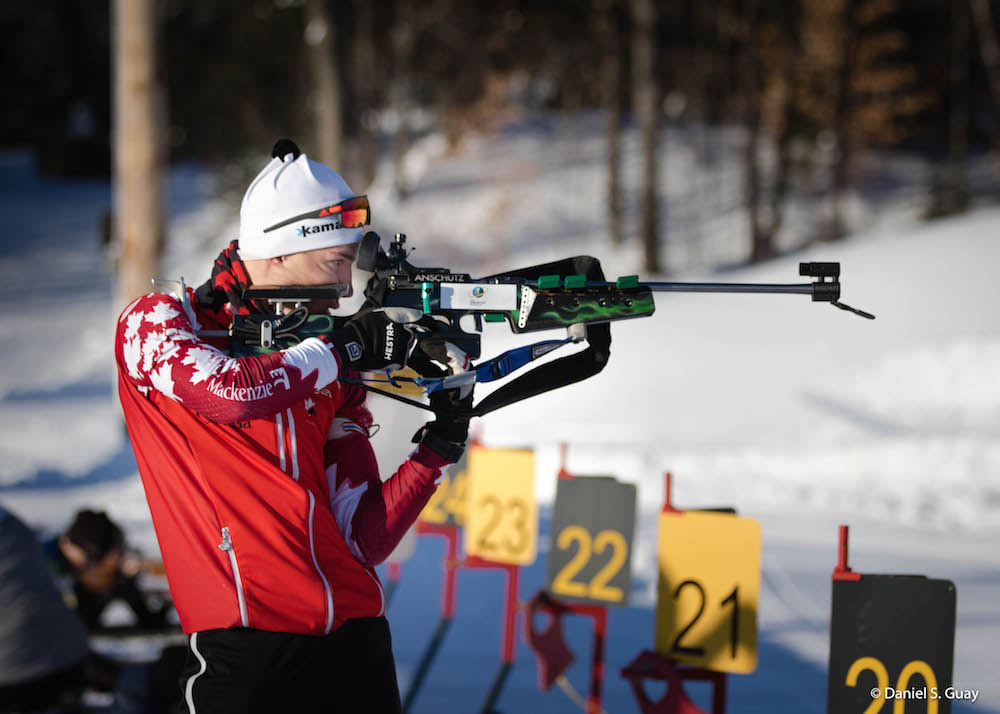
Adam Runnalls (Calgary Biathlon Racers) takes aim at Canadian team trials in Quebec last season. (Photo: Daniel S. Guay)
In an effort to showcase the North Americans competing at this week’s International Biathlon Union (IBU) 2018 Youth and Junior World Championships in Otepää, Estonia, we asked those qualifying athletes several questions about themselves — actually, we had them fill in the blanks. Here we have 19-year-old Adam Runnalls of Calgary, who is representing Canada at his first World Junior Championships after twice being part of the team for the Youth division.
On Tuesday, Runnalls anchored the Canadian team to 17th in the junior men’s 4 x 7.5 k relay.
***
“My full name is Adam Runnalls but you can call me boring old Adam.
I was born and raised in Calgary, and I learned to ski at 1 years old.
I spent the time between World Youth/Junior trials and Worlds training hard and going to school.
The hardest workout this season would be our road bike on Highwood Pass. I did it on a rental bike as it was my first road ride ever. Once the day was done, we did 110 km of riding and like 2000 meters of climbing. so being my first road ride ever it was pretty pouched about half way through. And I did this workout with my club, Calgary Biathlon Racers (CBR).
One thing I’m working on this season to improve my biathlon is my shooting consistency.
This is my first time in Estonia and 5th time racing internationally, and so far it’s been pretty all time.
One difference I’ve noticed between Estonia and the Canada is things are very quiet here. We almost drove across the entire country to get from the airport to Otepaa, which was only a 2 and a half hour drive. In Canada a drive this long might not even get you to the next town.
One of the things I’m most excited about for World Youth/Junior Championships in Otepää is getting into the racing.
One race I’m especially targeting there is a top 16 result.
Watching the Olympics in the lead up to my own races was very inspiring and gave me a great sense of national pride (Ferda). One of my least favorite moments moments of the Games was when Canada lost women’s hockey and then the next day lost men’s curling and men’s hockey. I want to be like Scott Moir, because he exemplifies what a Canadian is.
At Worlds, I really hope I can chat/make friends with someone from Sweden and ask them how can they turn 20 year olds into Olympic medalists??
My favorite thing at the breakfast where we are staying is the mini wieners. Who doesn’t like a hot dog for breakfast?.
Before this trip, if you said “Estonia”, the first thing I’d think of would have been potatoes and a skiing culture.
Now that I’m here, I’m pretty sure something I’ll always remember will be how the doors all open the opposite way I think they should.
If I had a totally free day here and didn’t have to worry about race fitness or training, I’d spend it probably still skiing.
Garrett Beckrich of the United States racing to at the IBU Junior Cup in Nove Mesto, Czech Republic, earlier this season. (Courtesy photo)
In an effort to showcase the North Americans competing at this week’s International Biathlon Union (IBU) 2018 Youth and Junior World Championships in Otepää, Estonia, we asked those qualifying athletes several questions about themselves — actually, we had them fill in the blanks. Here we have 17-year-old Garrett Beckrich, of Grand Rapids, Minnesota, who is representing the United States at his first World Youth Championships.
Today in Otepää, Beckrich finished 48th in the youth men’s 12.5 k individual, +6:03.9 with five penalties.
***
“My full name is Garrett Beckrich but you can call me Garrett.
I was born and raised in Grand Rapids, MN and I learned to ski at Mt. Itasca Nordic Ski Center with Petra Cervenka.
I spent the time between World Youth/Junior trials and Worlds racing in Czechia and Slovenia in the Junior Cup and Open Euro Championships respectively. I also raced in Minnesota High School races.
The most brutal workout I did in the last training year to prepare for this was a 100 mile bike ride with the Midwest team and Vlad.
One thing I’m working on this season to improve my biathlon is to learn how to calm myself during shooting, because this is my first year in biathlon. I picked up shooting very quickly since I have been doing that since I was young. I have a hard time mentally switching between aggressive skiing and calm and relaxed shooting.
This is my first time in Estonia and second time racing internationally, and so far it’s been a great experience. The coaches are very knowledgeable and have everything well organized.
One difference I’ve noticed between Estonia and the United States is that skiing is very popular here. The Otepää stadium has lots of room for spectators.
One of the things I’m most excited about for World Youth/Junior Championships in Otepää is the youth relay. We have a good chance in placing well in that event if we all are feeling well.
One race I’m especially targeting there is the sprint. I want to make my first international pursuit race after missing out on that at the Open European Championships.
Watching the Olympics in the leadup to my own races was very inspiring. Jessie Diggins and Kikkan Randall winning the team sprint showed that the US can compete with other teams on cross country skis instead of downhill.
I want to be like Jessie Diggins, because we are both Minnesotans and state champions.
At Worlds, I really hope I can chat/make friends with someone from Brazil and ask them how they train for biathlon when they don’t have any snow.
My favorite thing at the breakfast where we are staying is the cucumber lemonade. It tasted weird at first but after awhile you learn to dig the taste.
Before this trip, if you said “Estonia”, the first thing I’d think of would have been where my grandma’s family originated from. They came to the US from Latvia and that is just south of us.
Now that I’m here, I’m pretty sure something I’ll always remember will be how similar it is to northern MN. There are lots of pine trees and it’s very cold.
If I had a totally free day here and didn’t have to worry about race fitness or training, I’d spend it going across the border to Latvia to say I had been there.
The best way to follow me on social media is Instagram @grbeckrich.”
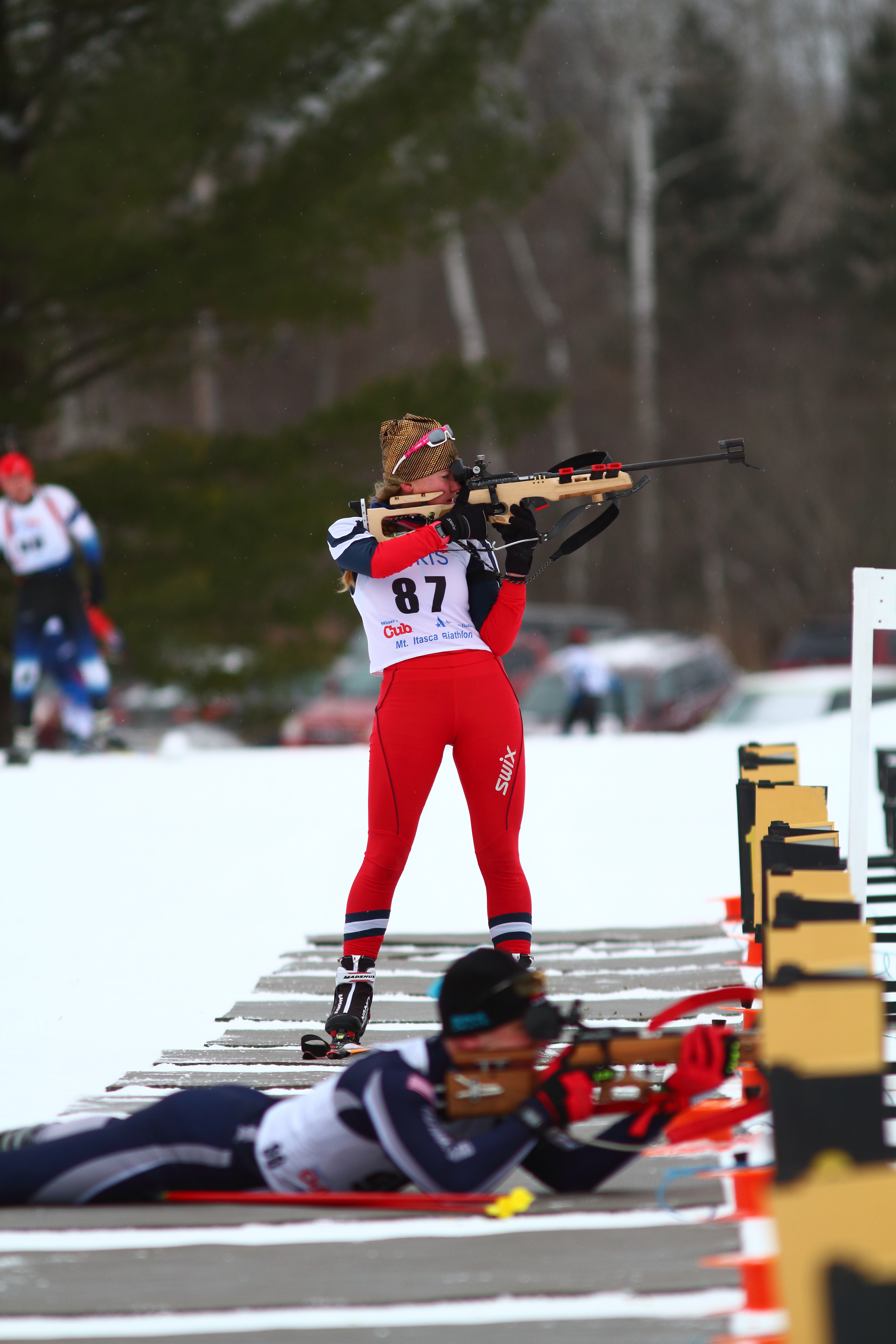
Emma Stertz competing on home turf at Mount Itasca, Minnesota. (Courtesy photo)
In an effort to showcase the North Americans competing at this week’s International Biathlon Union (IBU) 2018 Youth and Junior World Championships in Otepää, Estonia, we asked those qualifying athletes several questions about themselves — actually, we had them fill in the blanks. Here we have 17-year-old Emma Stertz, of Grand Rapids, Minnesota, who is representing the United States at her first World Youth Championships.
***
“My full name is Emma Stertz but you can call me Stertzy.
I was born and raised in Grand Rapids, MN, and I learned to ski at Mt Itasca Winter Sports Center.
I spent the time between World Youth/Junior trials and Worlds racing for my high school ski team.
The hardest workout I did in the last training year to prepare for this was a bike ride up Mt. Evans in Colorado with Minnesota Biathlon.
One thing I’m working on this season to improve my biathlon is staying focused while shooting.
This is my first time in Estonia and first time racing internationally, and so far it’s been full of learning experiences.
One difference I’ve noticed between Estonia and the United States is the buildings are triangular.
One of the things I’m most excited about for World Youth/Junior Championships in Otepää is meeting and competing with people from all over the world.
One race I’m especially targeting there is the sprint.
Watching the Olympics in the leadup to my own races was inspiring. One of my favorite moments of the Games was watching Kikkan Randall and Jessie Diggins win gold. I want to be like Jessie Diggins, because she brings so much excitement and positive energy to a team.
At Worlds, I really hope I can chat/make friends with someone from Denmark and ask them to trade clothes.
My favorite thing at the breakfast where we are staying is the Muesli.
Before this trip, if you said “Estonia”, the first thing I’d think of would have been it’s by Finland and Russia.
Now that I’m here, I’m pretty sure something I’ll always remember will be the people I’ve met.
If I had a totally free day here and didn’t have to worry about race fitness or training, I’d spend it exploring the town and trying all sorts of Estonian foods.
The best way to follow me on social media is on Instagram@emma_stertz.”
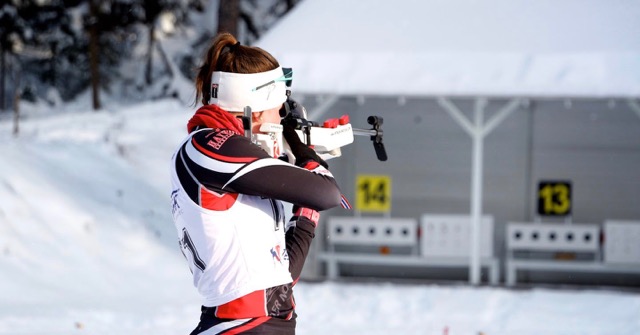
Benita Peiffer competing this winter. (Courtesy photo)
In an effort to showcase the North Americans competing at this week’s International Biathlon Union (IBU) 2018 Youth and Junior World Championships in Otepää, Estonia, we asked those qualifying athletes several questions about themselves — actually, we had them fill in the blanks. Here we have 17-year-old Benita Peiffer, of Whistler, British Columbia, who is representing Canada at her first World Youth Championships.
Today in Otepää, Peiffer finished 11th in the youth women’s 10 k individual, +1:43.1 with one penalty.
***
“My full name is Benita Peiffer but you can call me B.
I was born Vancouver, BC and raised in Whistler BC and I learned to ski at Whistler Olympic Park as well as Lost Lake.
I spent the time between World Youth/Junior trials and Worlds training in Whistler to prepare, and then I came over to Europe early to do some racing in Pokljuka for Biathlon, and then I met up with the BC Ski Team to do some Cross Country Ski races in Zwiesel.
My favourite workouts I did in the last training year to prepare for this were the workouts we did in Sweden, intervals up sand dunes, swamp running, skiing in the Torsby tunnel, participating in roller ski races and doing some roller ski classic heats with a group of athletes on the BC Team and Development Squad as well as a huge group of Swedish athletes.
One thing I’m working on this season to improve my biathlon is to stick to my basics of shooting. I often get overwhelmed with everything and forget the basics as well as keeping a positive mindset because a negative attitude will never get me anywhere.
Canada’s Benita Peiffer, who finished 11th in the opening race of World Youth Championships. (Courtesy photo)
This is my first time in Estonia and third time racing internationally, and so far it’s been an amazing experience. The competition over here is definitely much harder than in Canada and has showed me how much harder I have to work if I want to get to the level of some of these athletes.
One difference I’ve noticed between Estonia and the Canada is the food. Lots of potatoes and the desserts have been very interesting.
One of the things I’m most excited about for World Youth/Junior Championships in Otepää is the Sprint race. It is one of my favourite races to compete in. It is a 6km race with two shooting bouts. It is the perfect distance for me and perfect amount of shooting for me. I don’t get too overwhelmed with the amount of shooting and I am able to leave it all out there on the course feeling satisfied with my effort.
Watching the Olympics in the leadup to my own races was very inspiring. One of my favourite moments of the Games was watching my cousin, Arnd Peiffer win gold in the men’s sprint. I want to be like Laura Dahlmeier because she is a very consistent athlete who won several medals at the PyeongChang Olympics.
At Worlds, I really hope I can chat/make friends with someone from the German team and ask them where they train in Germany because I am very interested in coming to Germany at some point to train and compete.
My favourite thing at the breakfast where we are staying is the fresh bread.
Before this trip, if you said “Estonia”, the first thing I’d think of would have been “Where?”
Now that I’m here, I’m pretty sure something I’ll always remember will be the beautiful scenery and weather here. We have been lucky to have many beautiful sunny training days.
If I had a totally free day here and didn’t have to worry about race fitness or training, I’d spend it doing a relaxed ski through the countryside followed by a walk through the town exploring what Otepää has to offer.
The best way to follow me on social media is on Instagram @benitapeiffer.