From the FasterSkier archive — posts syndicated from athletes’ and coaches’ own blogs between 2004 and 2012, kept online as published. Current coverage is at fasterskier.com.
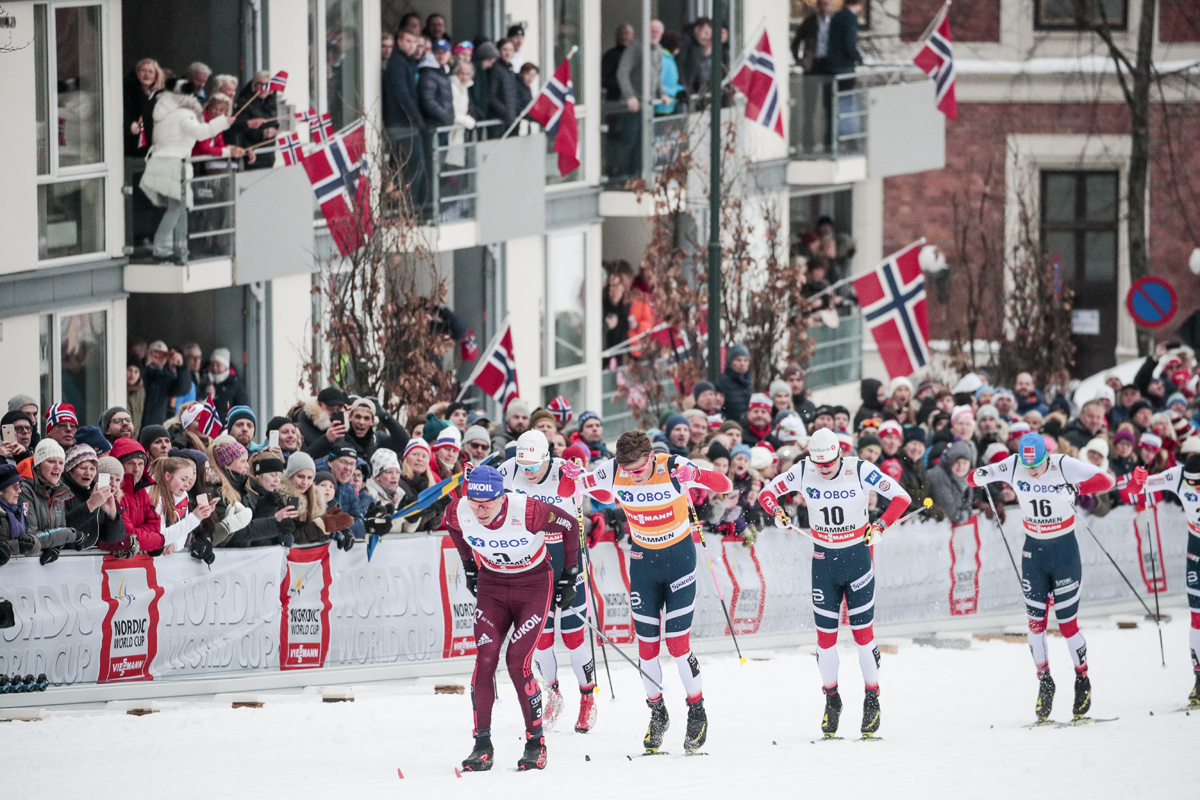
Russia’s Alexander Bolshunov leads five Norwegians in the men’s classic sprint final at the World Cup in Drammen, Norway: (from l to r) Eriik Brandsdal, Johannes Høsflot Klæbo (yellow bib), Sindre Bjørnestad Skar (10), Kasper Stadaas (16), and Emil Iversen. (Photo: Fischer/Nordic Focus)
Welcome to FasterSkier’s World Cup Preview, where we check in with the top-10 teams from last year’s FIS Cross Country World Cup tour before the season starts. The World Cup begins with a classic sprint in Ruka, Finland on Nov. 24th.
***
Russia
Overall in Nations Cup Last Year:3rd
Women’s Ranking 2017/2018:5th
Men’s Ranking 2017/2018:2nd
Russians to Watch:
For several years the attention grabbing fact about Russia was the morass of allegations and findings regarding rampant doping.
The bureaucratic seesaw teetering and tottering prior to the 2018 PyeongChang Games boiled down to will they or won’t they. As in, will Russian athletes be able to compete?
The Russian Federation was banned outright from the Games; it’s athletes competed under the IOC flag as Olympic Athletes from Russia (OAR).
The taint on competing Russian cross-country athletes last season was palpable. Clean or not, there was a sense of guilt by association. They must be a tough lot. Whatever psychic baggage the Russians carried as part of a shunned team, their collective results at the Olympics didn’t skip a beat. The same goes for the World Cup, where the group landed third overall in the Nation’s Cup.
A cadre of young Russian skiers propelled themselves into medal position. There was 22-year-old Denis Spitsov who missed a bronze in the Olympic 30 k skiathlon by less than three seconds. He placed third in the Holmenkollen 50 k skate.
The Russian men won silver in the PyeongChang 4 x 10 k relay.
By season’s end, Bolshunov was fifth overall in the World Cup standings. Added into Russia’s overall mix, Alexey Chervotkin was 11th overall, Usitugov 12th, Andrey Larkov 18th, Spitsov 20th, Maxim Vylegzhanin 27th, and Gleb Retivykh 30th.
Count them up, that’s seven men in the top-30 of the World Cup overall. Deep is deep.
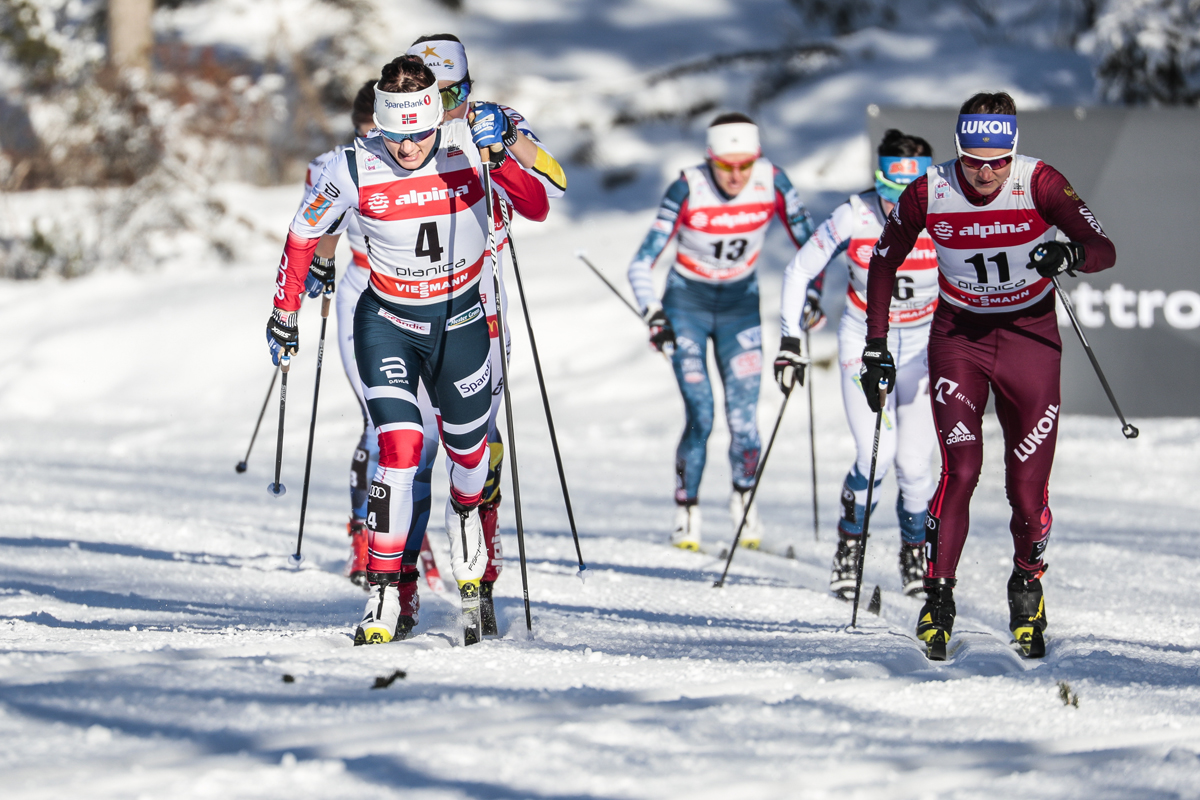
Maiken Caspersen Falla (NOR), Yulia Belorukova (RUS), (l-r) during the 2018 FIS world cup cross-country, individual sprint, Planica, Slovenia. (Photo: Fischer/Nordic Focus)
The Russian women had three athletes in the top-30 overall. Natalia Nepryaeva was ranked 13th, Anastasia Sedova 16th, and Yulia Belorukova 29th.
Nepryaeva, at twenty three years old, had three top-five finishes on the World Cup including a second place in Lahti’s 10 k classic. She placed fourth in the Olympic classic sprint and eighth in the 15 k skiathlon. Also at twenty-three-years-old, Belorukova podiumed on several occasions in World Cup sprints, and won bronze in the Olympic classic sprint.
In the Games 4 x 5 k relay, Nepryaeva, Belorukova, Sedova, and Anna Nechaevskaya, were third for Russia.
Beginning a new Olympic quadrennial, many years removed from Sochi but its dark-sided impacts still relatively fresh, Russia has new faces on the scene. The Russian Ski Federation appears that it can plug and play as it moves athletes into its winning pipeline.
Norway’s Simen Hegstad Krüger celebrates after winning gold in the men’s 30 k skiathlon on Sunday at the 2018 Olympics in PyeongChang, South Korea. (Photo: FlyingPointRoad)
It was an improbable move: Norway’s Simen Hegsted Krüger attacked a few kilometers from the finish of the men’s 30 k skiathlon, and the rest of the field let him go. Krüger didn’t let up and at one point had a lead of 25 seconds with just about two kilometers to go, all the more impressive because he had crashed just meters into the race and broken a pole, having to then make up 35 to 40 seconds to get back to the lead pack.
Norwegian teammates Martin Johnsrud Sundby and Hans Christer Holund tried to close the gap to Krüger in the final kilometer, but the 24 year old hung on for a 8-second win. Sundby was second and Holund was third (+9.0) to give Norway a medal sweep.
Denis Spitsov of the Olympic Athletes of Russia, also in his first Olympics, finished fourth, 12.7 seconds back. Maurice Manificat of France was fifth (+14.2), Dario Cologna of Switzerland sixth (+25.1), Andrew Musgrave of Great Britain seventh (+25.7), and Alex Harvey of Canada edged Martin Jaks of the Czech Republic for eighth (+33.4 and +33.8, respectively). Johannes Høsflot Klæbo of Norway, one of the pre-race favorites, finished 10th (+43.4).
For the U.S., Scott Patterson led the way in 18th (+1:07.5). Erik Bjornsen finished 42th (+4:34.7), Paddy Caldwell 51st (+6:58.1), and Noah Hoffman 54th (+7:08.7).
After Harvey’s top-10 finish, the next Canadian across the line was Devon Kershaw in 36th (+3:35.3). GraemeKillick finished 45th (+5:19.6), and Knute Johnsgaard was lapped and did not finish.
University of Utah alum Snorri Einarsson finished 56th (+7:13.9) in Iceland’s best result in Olympic cross-country skiing since 1994.
Arnd Peiffer on his way to winning the 10 k sprint at Alpensia Biathlon Center today. The German was one of just four men to shoot clean in windy conditions. (Photo: FlyingPointRoad)
With the race favorites each picking up a bevy of penalties, Germany’s Arnd Peiffer skated to a gold medal in the men’s 10 k sprint on Sunday. Both he and silver medalist Michal Krčmář of the Czech Republic shot clean, and were two of only four men in the field to do so. With that performance, Peiffer — whose lone senior Championship-level individual medal came when he won the World Championships sprint back in 2011 — made Germany two-for-two in biathlon races so far after Laura Dahlmeier’s win in the women’s sprint on Saturday.
The top of the results sheet was tight, with Krčmář finishing just 4.4 seconds slower than Peiffer. Krčmář only has one World Cup podium to his name, coming last season. Dominik Windisch of Italy finished with the bronze medal (+7.7) despite one missed shot, and edged out Austria’s Julian Eberhard (+8.4) seconds, who also had one penalty.
Erlend Bjøntegaard of Norway was fifth (+17.4) with two penalties, and Benedikt Doll (+17.6) and Simon Schempp (+21.4) gave Germany an impressive three spots in the top seven.
Those pre-race favorites? Martin Fourcade of France missed three shots in prone and despite cleaning standing, couldn’t make up enough time on the final loop for a top result. He finished eighth, +22.1. Johannes Thingnes Bø of Norway missed three shots in prone and then another in standing, finishing 31st, +1:12.7.
For the U.S., Lowell Bailey cleaned prone and then collected one penalty in standing to end the day 33rd (+1:15.6). Tim Burke had four penalties to land 47th (+1:47.5), and Leif Nordgren will join them in Monday’s pursuit after finishing 58th (+2:10.2) with two missed shots. Sean Doherty missed four of his five prone targets and was unable to come back from that blow, finishing 65th (+2:16.4).
The Canadians also suffered shooting woes. with Nathan Smith able to limit the losses to one penalty and finish 44th (+1:43.5). He is the only team member to make the pursuit. Brothers Scott and Christian Gow missed four and three shots, respectively, to earn the unlucky honor of being the first two men outside the pursuit cutoff in 61st (+2:14.0) and 62nd (+2:14.7). Brendan Green cleaned prone but then missed three shots in standing to finish 82nd (+3:09.2).
The women’s 10 pursuit and men’s 12.5 k pursuit are set for Monday at 5:10 a.m. and 7 a.m. Eastern Standard Time.
Paddy Caldwell (U.S. Ski Team/Stratton Mountain School) switching to skate skis during the halfway point of the men’s 30 k skiathlon at 2017 U23 World Championships at Soldier Hollow in Midway, Utah. (Photo: FlyingPointRoad.com)
PYEONGCHANG, South Korea — The 2018 Winter Olympics begin in earnest Saturday here in PyeongChang. Last night’s opening ceremony’s pounding K-pop, march of the athletes and lighting of the flame means it’s time for the real theater at the Alpensia cross-country and biathlon venues to go down. This morning’s temperature at 28 degrees Fahrenheit feels balmy. But don’t be fooled, a persistent firm wind from north still takes a bite. It will feel as it should, like winter, as the Games’ nordic events get underway.
The cross-country and biathlon venues get put to their first official Olympic-race test with the women’s 15-kilometer skiathlon in cross-country and women’s 7.5 k sprint in biathlon. For new cross-country spectators, most of the events are easy to understand. Mass starts: first across the line wins. The relays — the women’s 4 x 5 k, men’s 4 x 10 k, and the team sprint — are considered mass-start events, as is the skiathlon (we’ll get to that in a sec).
Individual starts are a bit different; the skier with the fastest elapsed race time wins. Skiers start one-by-one, thus the name “individual start”, at 30-second intervals. There is pacing and strategy involved — things like latching onto faster skiers zipping through the lap lane as one starts. But essentially, individual starts are time trials.
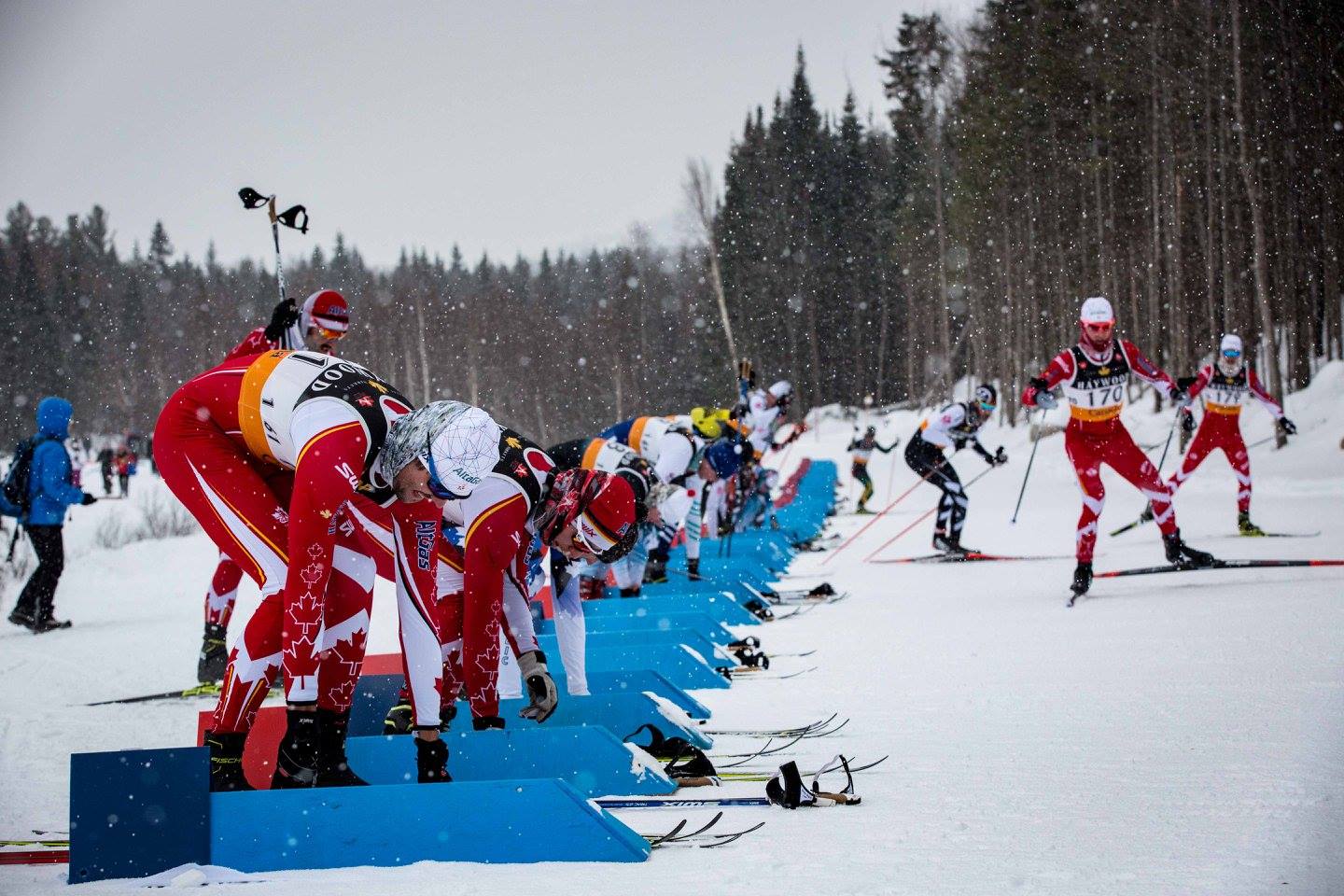
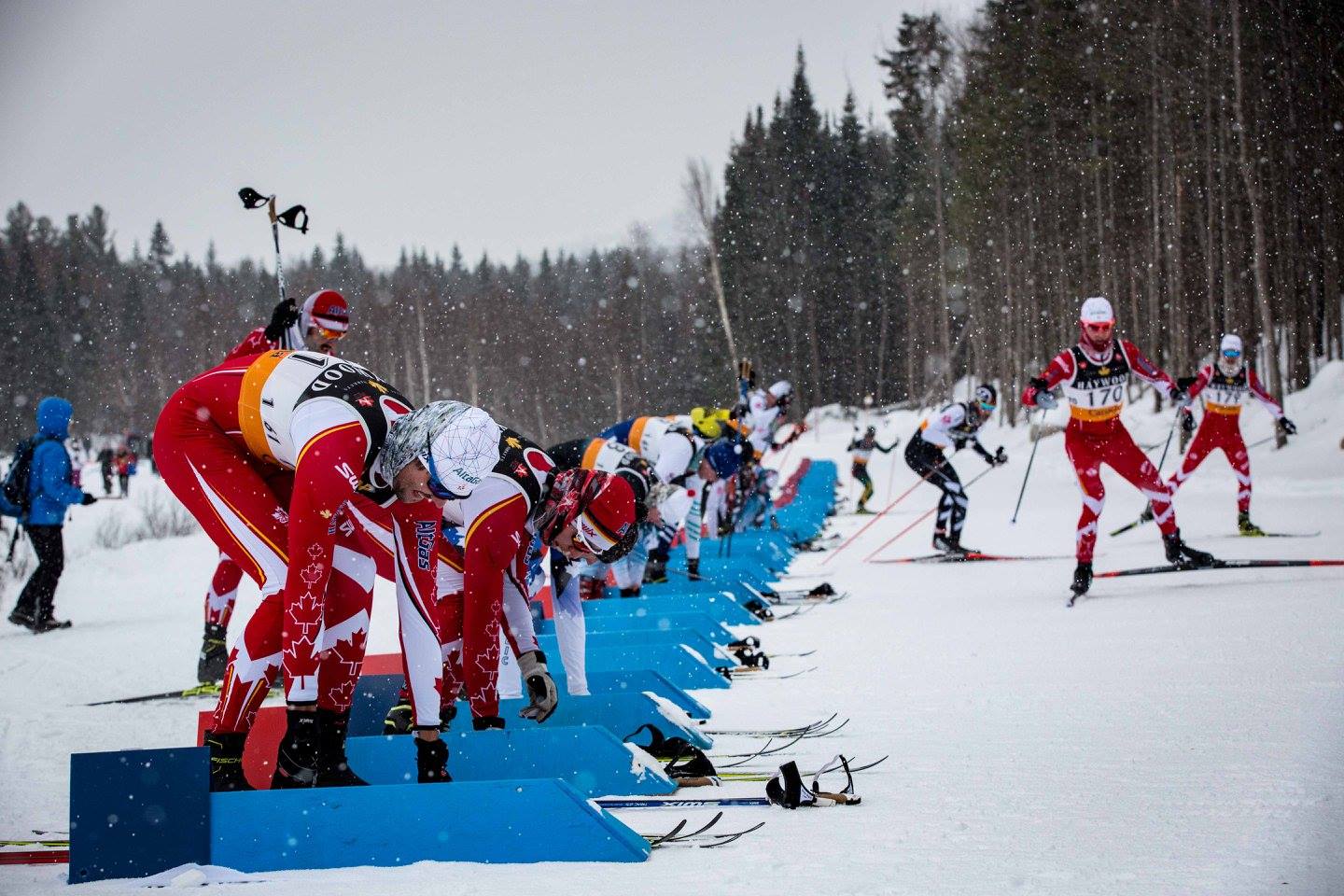
Canadian World Cup Team members Knute Johnsgaard (170) and Jess Cockney (179, behind) leaving the ski exchange halfway through the men’s 30 k skiathlon on Jan. 8 at Mont Sainte-Anne NorAm Trials in Quebec. (Photo: Mario Walker/NorAm MSA 2018 Facebook)
The skiathlon, which will be held for the women this Saturday and the men this Sunday, involves one complexity — the gear exchange halfway through. Initially, the women classic ski 7.5 k, the men 15 k. After that, athletes switch their skis and poles, but not their boots. It’s a quick on-the-fly transition out of the classic skis and into the skate skis. Take a breath, maybe, and grab a longer set of poles appropriate for skating. Female athletes then skate 7.5 k, the men continue on for another 15 k. The first skier to toe the finish lines wins.
The individual sprint in PyeongChang is a classic event; in PyeongChang, the distances are 1.3 k for the women and 1.8 k for the men. The field is whittled down to the top-30 fastest skiers on the day by an initial qualification run. The qualification is an individual start.
The top-30 fastest skiers advance to what are called “the heats” (or “the rounds” or more directly, “the quarterfinals”). There are five quarterfinal heats, each with six skiers. The fastest skier from the qualifier chooses which heat they’d like to line up in, then the second-fastest athlete chooses, and so on until the six start spots in each heat are filled.
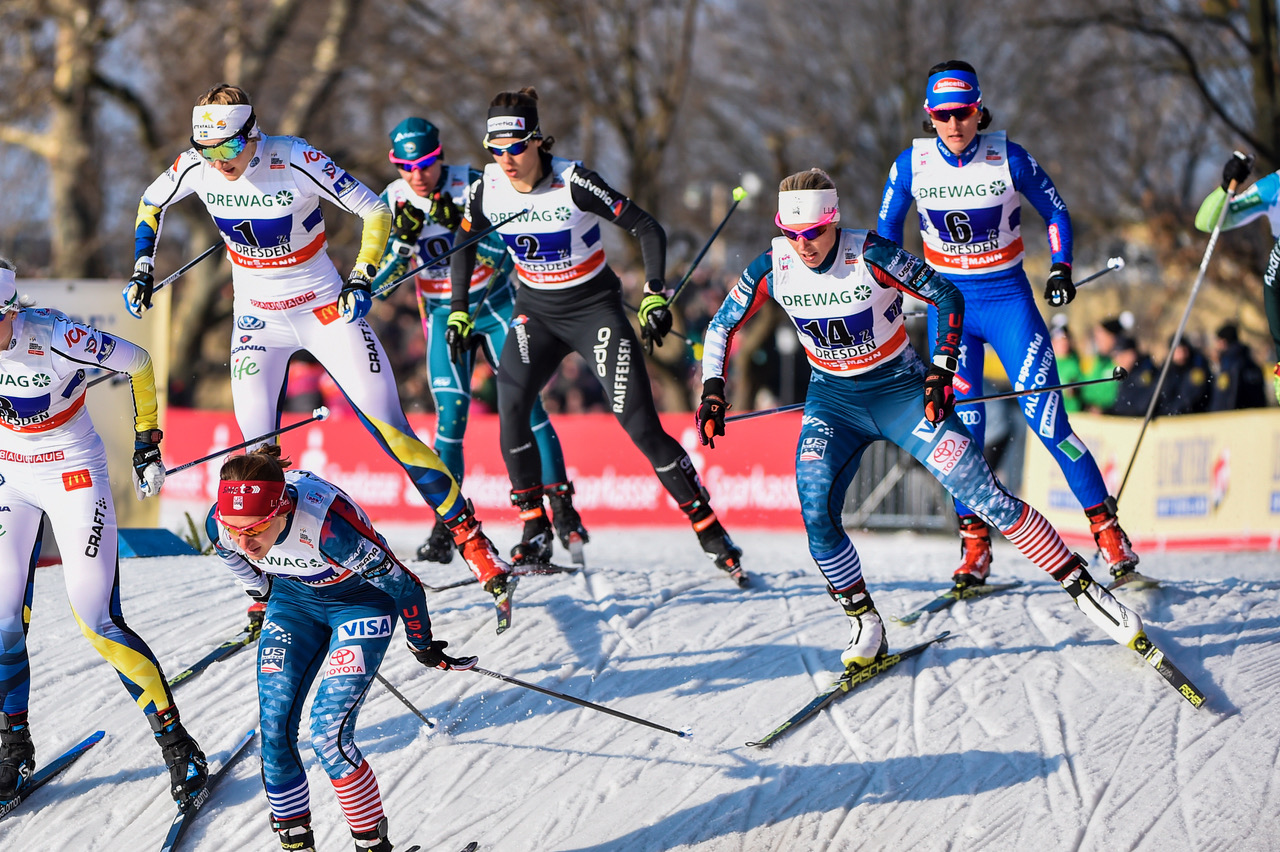
Americans Sophie Caldwell (front r) and Kikkan Randall (14) racing together in the women’s 6 x 1.2 k freestyle team sprint final on Sunday at the World Cup in Dresden, Germany. USA I, with Ida Sargent (not shown) and Caldwell went on to place third, while USA II, with Caitlin Patterson (not shown) and Randall, finished eighth. (Photo: Fischer/NordicFocus)
The top-two finishers in each heat advance to the semifinals. Additionally, the two next-fastest skiers (based on finishing time) from any of the five heats also advance as “lucky losers”. That makes for 12 skiers in the semis, six in each semifinal.
The pattern repeats: the top-two skiers from the semis advance to the final and the next two fastest skiers (again based on finishing time), advance to a six-skier final.
From there it’s pretty simple. The first skier to cross the line in the final is crowned overall sprint winner.
Team sprints follow a similar format, except they cut to the chase and begin with the semifinals. Each two-person team of the same gender has to race for their spot in the final, with each woman racing three loops (each 1.3 k long in PyeongChang), tagging off to their female teammate in between, for a total of five exchanges. Each man will ski three 1.8 k loops in PyeongChang, tagging their male teammate in between. At the Olympics, these races are called the women’s 6 x 1.3 k and men’s 6 x 1.8 k team sprints, and the format is freestyle (skate).
The top-two fastest teams from each of the two semifinals automatically qualify for the final, then the six next-fastest teams between the semifinals advance as lucky losers. Then, the 10 teams in the final repeat the six-leg race. First team across the finish line wins.
The Biathlon Basics
Then we have biathlon, which presents some more complex rules. As its most basic, biathletes ski a loop, shoot at five targets, ski another loop, shoot at five targets, and ski another loop for a total of three ski loops and two shooting rounds (that’s for the shortest-distance races, the sprints, ).
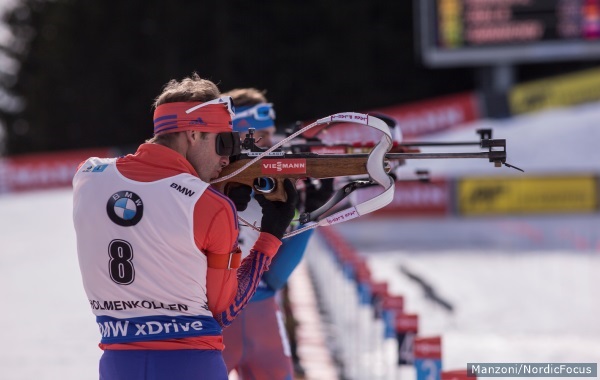
Lowell Bailey (US Biathlon) shooting during a standing stage in the men’s 15 k mass start, the last race of the 2016/2017 IBU World Cup season, in Oslo, Norway. He went on to finish 15th. (Photo: USBA/NordicFocus)
If you plan on viewing the biathlon events during the Games, the rules for each specific race vary. The PyeongChang organizing committee developed a handy guide for the Olympic biathlon competition’s formats and rules. It’s a simple resource, but invaluable if you are new to biathlon.
Individual start. As the name suggests, this is an individual-start race with skiers leaving at 30 second intervals. At 15 k long for the women and 20 k for the men, it’s also the longest-distance race on the docket for biathletes. Skiers shoot prone (on the ground, stomach down), standing (sideways stance), prone, standing. They have no spare bullets. They carry only five bullets per shooting round. (Remember, each shooting round involves hitting five targets.) The penalty is harsh for each miss. Athletes do not ski a penalty lap, but have one minute added to their final time per miss. Miss one shot, add one minute. Miss three, add three minutes. This is a high-reward, high-cost type race when it comes to shooting.
Sprint. The name is a bit misleading, these are not sprints like we know of in cross-country. The women ski a total of 7.5 k, the men 10 k. The name “sprint” comes from the fact that the distances raced are simply the shortest of the non-relay events. Sprints are an interval-start race, with skiers leaving at 30-second intervals. However, athletes only shoot two rounds, the first being prone, the second standing. Athletes have five bullets per round and each miss carries a penalty of a single 150-meter penalty lap. Miss two targets in a shooting round, ski two penalty laps for an additional 300 meter of skiing.
Pursuit. The fields are smaller and more selective for the pursuits (which are 10 k long for women, 12.5 k for men), with only the top-60 athletes from a given sprint qualifying for the pursuit that follows. The winner of the sprint starts first, with the other skiers following in order of their sprint finish. But, the time at which an athlete is released from the start depends on their time back in the sprint. For example, an athlete that finished 1:30 minutes behind the sprint winner starts 1:30 minutes behind that skier in the pursuit. Again, like the sprint, each miss is penalized with a 150-meter penalty lap. Skiers shoot four rounds in order of prone, prone, standing, standing. Cross the line first and you’re taking home some golden hardware.
Mass Start. Easy enough, all skiers leave at the same time for the second-longest race on the circuit (12.5 k for women, 15 k for men). However, there is a seeding system premised on the highest-ranked World Cup skiers positioned closer to the start line. And only 30 athletes are invited to start. (The top-30 field is derived from the top 25 athletes in the overall IBU World Cup plus the five best performers at a given event, such as the Olympics, outside the top 25 in the overall rankings.) Skiers shoot two rounds of prone and then two rounds standing. No extra shots, simply the tidy rule of a 150-meter penalty lap per missed target. First skier across the line wins.
Relays (Not mixed). Each relay is comprised of four legs. Each male starter skis 7.5 k, the women 6 k. The first-leg skiers on each team begin in a mass start. Then each skier tags off to their teammate in a designated tag zone. Before that tag goes down, each relay team member shoots two rounds: prone, then standing. However, each relay member is allotted three extra bullets per shooting round. Those three “spare” bullets must be manually loaded, one at a time. Each shooting round, athletes get eight shots to make the five targets fall. Any misses after those eight bullets are used is penalized with a penalty lap for each missed target. First team across the finish line wins.
Mixed Relays. As the name suggest, this is a mixed-gender relay, a relatively new format to biathlon. Teams are four-strong, with two women and two men. The women ski the first two legs (6 k each), men ski the remaining two (7.5 k each). It’s a mass start race with two shooting stages per athlete. Each skier shoots prone, then standing. Like the traditional relay format, athletes have three spare bullets per shooting stage. Those three extra bullets are manually loaded. Each missed target after the eight bullets are used results in a penalty lap. Again, if your team crosses the line first, you win.