From the FasterSkier archive — posts syndicated from athletes’ and coaches’ own blogs between 2004 and 2012, kept online as published. Current coverage is at fasterskier.com.
The women’s team sprint medal ceremony at the 2018 Winter Olympics in PyeongChang, South Korea, with (from left to right) Sweden’s silver medalists Charlotte Kalla and Stina Nilsson, American gold medalists Kikkan Randall and Jessie Diggins, and Norway’s bronze medalists Marit Bjørgen and Maiken Caspersen Falla. (Photo: FlyingPointRoad)
(Note: This article has been updated to include clarification from Sara Mae Berman on her results in the 1971 national 50-kilometer ski race in Putney, Vermont)
***
What did John Caldwell have to say after the U.S. women’s gold-medal performance on Wednesday at the 2018 Olympics? We asked Caldwell, a 1952 Olympian and one of the founders of the U.S. women’s cross-country program who coached the U.S. Ski Team through five Winter Olympics (1960, 1964, 1968, 1972, and 1984), and he wanted to take the opportunity to explain how the team came to be in order to give some perspective on how far it’s come. The following was written by Caldwell, 89, of Putney:
“It hasn’t been easy to get to where we are after today. Lots of the reports mention how many years it’s been, or that it’s been 564, 321 days (or something like that) etc., and they are all true. Better they knew a bit about the development and could write about that. So that’s what I intend to do here.
In the Oslo Olympic Games in 1952, the Finnish women ran the same course as the guys one day and their times beat our times. Of course we didn’t have a women’s team then.
I coached the FIS Team to Oslo in 1966 (Gallagher, Elliott, Gray, Damon and C Matis) and the manager, Bob Tucker, and I wanted to get females started skiing more in the US. So we met with a Swedish official named Inga Lowdin and she told us we should work to make sure people don’t think you need Amazons (females) to be good at xc. “I will send you some “girls” that will help your development of xc.”
Tucker and I had to lock the big boss in a closet — well, almost — in order to get funding for airfares, something on the order of $3500. Three Swedes came over in 1967, including Toini Gustafsson and Barbro Martinsson, who both won gold medals at the Autrans OWG in 1968. They made their first stop in Putney and encouraged Martha Rockwell to race the next day, thus starting her international career.
A few years earlier Martha had led off for a team at the Putney Relays. Girls didn’t race then and so she was teamed up with two boys. She beat a couple of boys from a near-by prep school to the finish and one was seen shredding his skis afterwards on a handy fence.
Sometime in the late ’60s we ran a National 50k at Putney. Sara Mae Berman wanted to race, but no long races were run for the female sex. I entered her with the guys on a 5 x 10 k loop. She was quite far behind when she came by on her 4th lap and I stopped her for a moment or two, showed her our timing clock on a little stand, along with a pencil and paper, and told her to just time herself because I had to go inside and award prizes. She finished and I will wager her time is registered somewhere. We ran a tight ship in those days.
[Note: Berman wrote FasterSkier and sent a copy of results from that race, which was held in 1971, to clarify that at least one man finished behind her. Her husband Larry Berman explained in another email that her time was not originally listed, “but the timers recorded her and I wrote down her splits. At the end of 4 laps, there were 3 men behind her.”]
So our first ladies international team didn’t materialize until 1970 when we sent them to the FIS World Championships in Vsyoke Tatry in Czechoslovakia.
All along the way in these years there was precious little club skiing. Almost all of it happened in secondary schools and colleges. Divisional committees dictated races to fit the school and college schedules. Year-round XC training was a rarity, mainly due to the fact there were few year-round coaches available. So as a nation, we floundered. The transition to club skiing was slow and I hesitate to try and explain it or point to significant events, but thank goodness, it happened. Now we are fairly well set up with a pretty good club system. The secondary schools are feeding some clubs and a lot of colleges, the colleges are doing a good job of developing skiers with their four-year programs and they help feed the clubs with good seniors. The clubs also help feed the colleges with good skiers from their junior ranks.”
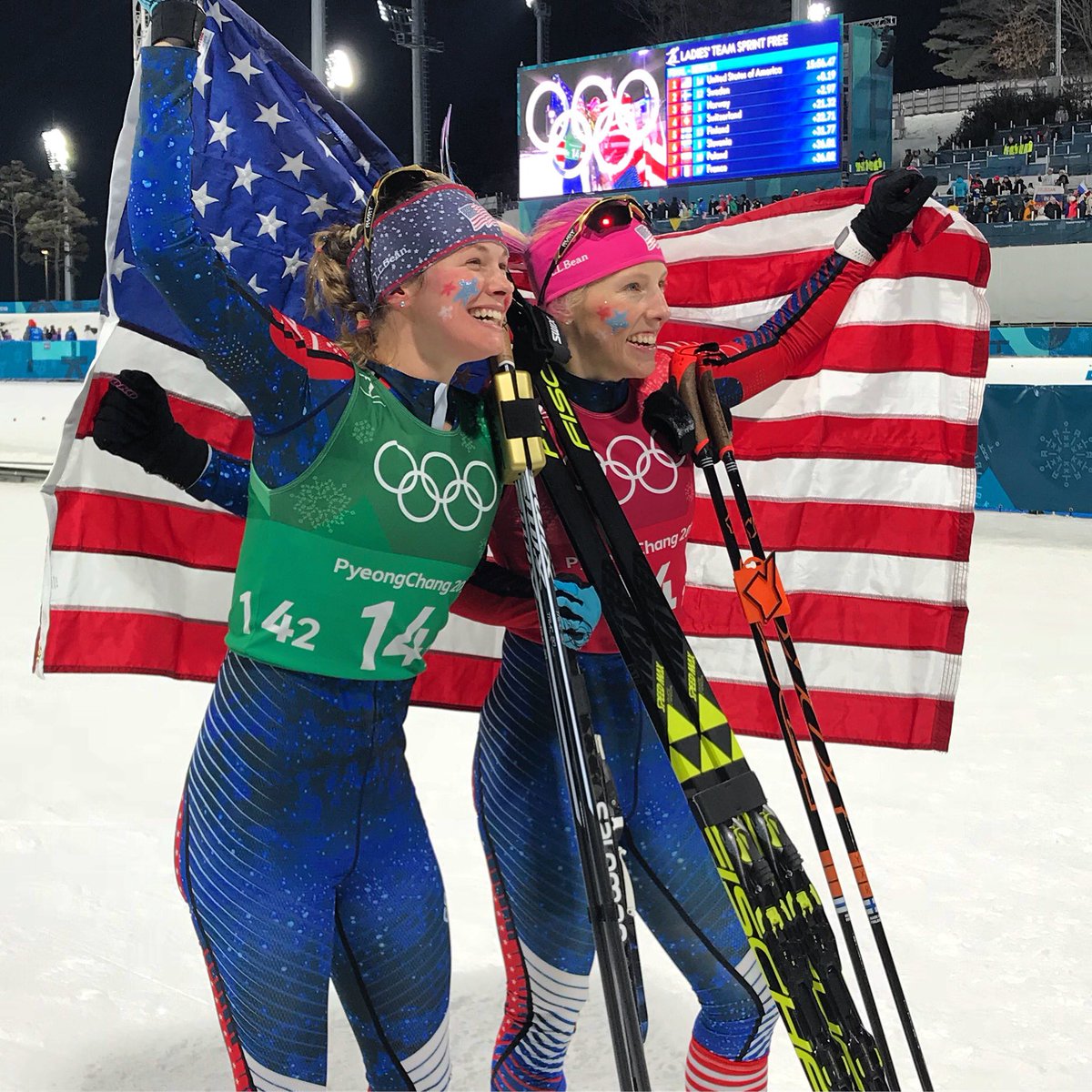
Americans Kikkan Randall and Jessie Diggins jumping for joy after placing first in the 2018 Olympic team sprint on Wednesday night in PyeongChang, South Korea, ahead of Sweden’s Charlotte Kalla (l) and Stina Nilsson (second from l) in second place and Norway’s Marit Bjørgen (second from r) and Maiken Caspersen Falla (r) in third. (Photo: FlyingPointRoad)
PYEONGCHANG, South Korea — There was a lot to process Wednesday, what with the U.S. women’s team sprint Olympic gold medal and all. But now that we’ve had a little time to breathe, FasterSkier wanted to bring you the best of the interviews that didn’t make our initial race reports. (Don’t worry, plenty more on this historic gold to come!)
Kikkan Randall, Team USA’s first-leg skier:
“It’s an amazing feeling. This is something the American team has been working for a long, long time. We’ve had one other medal back in 1976 from Bill Koch and for me, I’ve been on this Olympic path for the last 20 years. We’ve known it’s possible, but of course it takes putting together the right day, and it’s just an amazing validation for our team that’s worked so hard and what this can do for cross-country skiing back in the United States, it’s just so exciting.”
Kikkan Randall en route to gold with Jessie Diggins (not shown) in the women’s freestyle team sprint at the 2018 Olympics in PyeongChang, South Korea. (Photo: FlyingPointRoad)
On whether she knew this would be a historical race for Norway’s Marit Bjørgen (with her 14th Olympic medal):
“I knew that Marit’s been skiing really well all week and that she would be tough competition and knew she would be strong going up that second climb. When I arrived here, I saw the hill and thought, ‘That’s a good hill for Marit, and it’s a good hill for Kikkan.’ Marit is probably the greatest skier of all time and it’s been an honor to race with her, and of course it’s really fun for us to get our historic day and that gold medal, but also an amazing accomplishment for Marit to be the most successful Winter Olympian of all time.”
On her foot injury and Olympic prep:
“I had a foot injury that came in December and it caused me to change my training a little bit, and I also didn’t do as much training as I wanted to. I think that once I did start racing again, every race helped me get better. The skiathlon here was definitely a challenge; it was a tough course and I really struggled in the classic, so it took a lot just to keep my mind calm and relaxed and just think about one race at a time, and I was happy that things went better in the 10 k. It was a real honor to get named to our relay because it was tough to pick that team, but I was happy to have another strong leg there and then it was another anxious wait to see if I would even be named to this team. So as the Games went on, this is the event that I looked forward to most and have looked forward to the most over the last four years, and it was really a good feeling that my confidence was actually getting better and my feelings were getting better as we got closer.”
On how she hopes this medal will impact her sport in the U.S.:
“What’s really cool is I don’t think we’re gonna have to wait another decade for this to happen again. We have an amazing group of junior skiers and U23 [athletes] that are coming up. They won a medal in the relay at the World Juniors last year, we had another girl that was on the podium twice at World Juniors this year, our junior men were on the podium at World Juniors, so I think the door has been opened and what I hope this gold medal really means is what those kids dream about, being in this position someday and they really feel it’s possible, and the Olympics has the power to do more inspiration than any of the other races that we do that are typically in Europe. So it’s really cool to finally get the high profile and give those kids the belief and hopefully also to get more people to start cross-country skiing because they saw it here and they get excited and they want to go try it.”
On the Norwegian crown prince, Norwegian prime minister and Swedish king all attending the Games, and whether she thinks an American president will ever be at a cross-country ski race:
“Actually, when President Obama first got inaugurated I had a dream that I was sitting on Air Force One talking to him about cross-country skiing and telling him that it was a really cool sport but didn’t get enough attention, and he said when he became president he would help make cross-country higher profile, but that’s about the closest I’ve ever gotten to a president at a cross-country ski race.”
Jessie Diggins, Team USA’s second-leg skier:
“Team sprints are so much fun and I’ve been looking forward to this day for a year since the Lahti team sprint ended so I guess watching Kikkan do her leg so well and getting us in a position where we were going to get a medal, I was just watching that like, ‘Oh, well, OK, we’re gonna try to make it a gold one, then. We have nothing to lose.’ I really wanted to make this happen for this team, and we always said any medal we got was going to belong to the team. It was a team that got us here and gave us this opportunity and pushed us so hard in training all summer long and so I just had a lot of belief going in that last lap.”
Jessie Diggins (14) edges Sweden’s Stina Nilsson (r) for gold, while Norway’s Maiken Caspersen Falla (l) races to bronze, in the women’s freestyle team sprint final at the 2018 Olympics in PyeongChang, South Korea. (Photo: Noah Hoffman)
On what was going through her head during the final:
“Lap 2, I started to push the pace because I thought, ‘Both of these girls are really, really strong sprinters and I’m an OK sprinter, but I need everyone else to get pretty tired if I have a shot.’ ”
“That last corner, I don’t know what I was thinking except for just, ‘Go, go, go!’ because you really gotta dig really deep and I was in a lot of pain, for sure, but when your team is counting on you, you have to give it everything you have.”
On what it means to team up with Randall:
“I feel really lucky to have these, like, older sisters and role models on the team that I really look up to, every single one of them, and they’ve really shown me what is possible and shown me that it’s OK to dream really, really big. It means a lot to me because if this is the last team that [Kikkan and I] get to team sprint together, it’s like, ‘OK, I gotta make it a good one. I’ve gotta go out with a bang.’ And it’s so cool because Kikkan’s been this big role model in my life since before I got on the national team and it’s just such an honor to get to race with her every time and get to share those pre-race giggles and high fives and get to paint up the face.”
On her first words with Randall after finishing:
Americans Kikkan Randall (l) and Jessie Diggins on the top step of the 2018 Olympic team sprint podium after beating Sweden and Norway for gold on Wednesday at the Winter Olympic Games in PyeongChang, South Korea. (Photo: FlyingPointRoad)
“I think I asked her, ‘Did we just win the Olympics?’ because it didn’t feel like it was real and it still doesn’t feel like it’s real, but I just was so excited and so happy and also I couldn’t feel my legs.”
On handling any perceived pressure:
“For me, it’s been hard to not let it get inside my head and to race for myself because when I’m having fun, that’s when I’m actually dangerous on the race course and you get one too many people saying, ‘I believe that you’re going to go win!’ it becomes less fun because I don’t do it just to win, that’s not the whole end game for me. Having this awesome team atmosphere — we’ve been playing games, we’ve been dancing, we’ve been watching movies, we’ve been having a really good time here at the Olympics — and making sure that within our own little bubble that we keep it relaxed and keep it fun and keep a happy team vibe, I think that’s been a huge key for me, and kind of being able to go through the mixed zone with selective listening and make sure I’m still racing for me and for my team.”
On how this medal will affect future generations of U.S. skiers:
“I’m so excited to put some facepaint and put the socks on those kids because they are coming up hot and they’re working so hard and it’s so cool to see that we’re not going to retire and leave this gaping hole, there’s people coming up to take our places.”
Chris Grover, U.S. Ski Team Head Coach:
U.S. Ski Team Head Coach Chris Grover (l) with Jessie Diggins after Diggins and Randall won gold in the women’s freestyle team sprint at the 2018 Olympics in PyeongChang, South Korea. (Photo: FlyingPointRoad.com)
On choosing Randall as the first leg:
“We anticipated that it would probably be Marit or [Ragnhild] Haga that was skiing this leg for Norway, and we did think that it would also be Charlotte Kalla who was skiing for Sweden. So we knew there would be some great skaters, some great aerobic athletes that were in that capacity. We thought Kikkan, the way that her skate fitness has been coming on over the last few races here at the Olympics, we thought that her fitness could at least help us hang on to those ladies if they were really going to go, and we were just really pleasantly surprised that Kikkan was able to match them no problem throughout the day. That was exciting. Both women looked so in control in the semifinal that we knew they were going to have a crack at a medal in the final.”
On watching Diggins and Sweden’s Stina Nilsson racing for gold in the finishing stretch of the final:
“With Stina, she obviously was in incredible form in some of the other races here. Maiken [Caspersen Falla] as well, they obviously went first and second in the individual sprint, so there was gonna be no gimmies at all in the finish. We would have been so exhilarated and happy just to have a medal of any color, but for Jessie to have such a fantastic day and to be able to pull off the win was beyond our expectations.”
Tiger Shaw, U.S. Ski & Snowboard President and CEO:
“We are just flying high. I mean, I am still just numb with what those women have achieved; Kikkan, Jessie and the whole team, and the coaches and the techs and trainers … I’m speechless.”
“The culture of that team is just unbelievable, and they have conquered the world, coming from obscurity led by a single woman into a dynamic men’s and women’s team that is absolutely stunning. It makes one of the best stories I think in sport.”
On watching the race unfold:
“I was so excited there was a group of three and not a group of four because then you knew we had almost for sure a medal in the bag, and then all of a sudden you realized Jessie could get it done. And she came around that last corner and down that stretch and beat the best sprinter in the world. We were just screaming our brains out in amazement. Just thinking of the energy and the excitement of that I’ll never forget that for the rest of my life.”
Luke Bodensteiner, U.S. Ski & Snowboard Chief of Sport:
Jessie Diggins with U.S. coach after Diggins and Kikkan Randall won gold in the freestyle team sprint at the 2018 Olympics in PyeongChang, South Korea. (Photo: FlyingPointRoad)
On other sports taking notice of this U.S. cross-country team’s success:
“I have gotten so many messages now from people here in Team USA saying … head of speed skating got one saying this is the best moment of the Games for the entire Team USA. Our head coach in alpine texts me said, ‘I have never seen such a possessed, will-not-lose moment in my entire career.’ … This makes this hugely successful Olympics.”
On medal chances:
“I think we came in feeling like team sprint was not only our best opportunity for a medal, but probably a pretty high likelihood for us, honestly. But there is a difference between getting in there for a bronze medal and winning the thing outright. And that’s not something we… well, I guess we dreamed of it, but it’s not something we would have called out coming in here. So they lifted their game and they skied out of their minds. Kikkan would not be dropped, she covered all those moves on the climb, and of course the way Jessie finished it off was best in the world right there.”
“I was right on the finish line. … You could see a meter out that [Jessie] had this thing and people broke down in tears there, lots of hugs and tears.”
Charlotte Kalla, Sweden’s first-leg skier:
Jessie Diggins (l), Sweden’s Stina Nilsson (r) and Norway’s Maiken Caspersen Falla (behind) heading into the last 100 meters of the women’s freestyle team sprint final at the 2018 Olympics in PyeongChang, South Korea. (Photo: FlyingPointRoad)
“We are very happy for Kikkan and Jessie. They are so worthy of this gold medal.”
On skiing with Randall for a long time and whether these will be Kalla’s last Olympics as well:
“I don’t know. It may be the last. Kikkan, she has meant a lot for the whole team in the USA, and we have a special relationship because Kikkan has been several times in Sweden training with us, and I know in Vålådalen especially, where we exercised this [last] August, we pushed each other really really hard. She is an impressive skier.”
Marit Bjørgen, Norway’s first-leg skier:
“I’m very, very happy for Jessie and Kikkan today for taking a gold medal, and I feel also special that Kikkan is there. She also started [her first] Olympics in Salt Lake [like] me so I’m very happy for them, and I also think that’s very important for our sport, too, that they [won], so I’m very, very happy for them.”
Johannes Høsflot Klæbo, Norwegian men’s team-sprint winner:
On whether they were surprised about the win of the U.S. women:
“No, I’m not surprised. I think the way they managed to do the last round, it’s quite cool to see, and for sure it’s quite good for the sport and yeah, I think it’s amazing.”
Martin Johnsrud Sundby, Norwegian men’s team-sprint winner:
“I think all athletes admire the head of Jessie Diggins. That’s fantastic.”
***
One of the team sprint press conferences, with (from left to right) Sweden’s Stina Nilsson and Charlotte Kalla, a Russian translator and Denis Spitsov, American Kikkan Randall, Norway’s Marit Bjørgen and Maiken Caspersen Falla, France’s Maurice Manificat, a translator, and France’s Richard Jouve, on Wednesday night at the 2018 Olympics in PyeongChang, South Korea. (Photo: FlyingPointRoad)
Norway’s Johannes Høsflot Klæbo celebrates his team-sprint win with Martin Johnsrud Sundby (not shown), while Alexander Bolshunov of the Olympic Athletes from Russia (l) pushes for silver on Wednesday at the 2018 Olympics in PyeongChang, South Korea. It was his third-straight gold of the week. (Photo: FlyingPointRoad)
With a gold medal for their team already in the bag on Wednesday, Erik Bjornsen and Simi Hamilton put their heads down for the start of their own race at the 2018 Olympics. The men’s 6 x 1.4-kilometer freestyle team sprint final was scheduled to start just minutes after the women’s team sprint final ended, a race which saw Americans Kikkan Randall and Jessie Diggins capture the first Olympic gold for the U.S. in cross-country skiing.
It was motivating and inspiring, even confidence-boosting, Bjornsen reflected after his race in an in-person interview with FasterSkier. But he and Hamilton had their own medal hopes to tend to.
Like most of the men’s finalists, they weren’t able to watch the women’s race beforehand and came out onto the course shortly before the start of their final.
“I was warming up and kind of focusing on my own race, but I saw that they took the win when I was running to the start,” Bjornsen explained. “ … We were ready to match them.”
“I did not even see a second and I’m really bummed out that I didn’t,” Canada’s first-leg skier Len Valjas told FasterSkier after. “But so happy for the U.S., that’s amazing, like it actually gave us some positive energy before the race hearing who won. Our techs and coaches ran into our room, like, ‘Did you hear about the girls’ race?’ So it’s a win for North America. It just makes today even sweeter.”
American Erik Bjornsen (6) skiing with Canada’s Len Valjas (7) during the men’s 6 x 1.4 k freestyle team sprint at the 2018 Olympics in PyeongChang, South Korea. (Photo: FlyingPointRoad)
Both the American and Canadian men’s teams qualified for the 10-team final on Wednesday evening in PyeongChang, South Korea. Bjornsen and Hamilton had advanced with a fast-enough time after placing third in the second semifinal, while Valjas and his teammate Alex Harvey moved on as well (also as “lucky losers”) after finishing fifth in that semifinal.
The U.S. had some confidence going into the final after a semifinal performance that saw Bjornsen take the lead on the second-to-last lap, ahead of Norway. Hamilton held onto first for most of the the final lap until Norway’s Johannes Høsflot Klæbo passed him shortly before the finish, and France’s Richard Jouve passed Hamilton in the finishing straight as well, putting the Americans in third.
For the final, it was all about the medal hunt for Bjornsen and Hamilton, who placed fifth in last year’s World Championships classic team sprint in Lahti, Finland, just ahead of Canada in sixth, for the best U.S. men’s result in a team event.
Russia had won that 2017 world-champs team sprint with two athletes who were banned from competing at these Olympics, Nikita Kriukov and Sergey Ustiugov, and Italy placed second with Dietmar Nöckler and Federico Pellegrino. After an infamous tangle coming out of the final downhill, Finland ended up third with Sami Jauhojärvi (who retired after last season) and Iivo Niskanen, and Norway finished fourth with Klæbo and Emil Iversen. Norway opted for Klæbo and Sundby for its Olympic team-sprint squad on Wednesday, and Sundby later proved that he was worthy of the pick.
Ever since World Championships, it’s safe to say this is the race that had been primarily on Bjornsen’s and Hamilton’s minds for the better part of the last year.
They came out with a mission on Wednesday, putting themselves in the mix early in the final, alongside Canada.
Sweden’s first-leg skier Marcus Hellner leading during the men’s freestyle team sprint at the 2018 Olympics in PyeongChang, South Korea. (Photo: FlyingPointRoad)
Sweden set the pace for the first two laps, with Marcus Hellner starting them off and Calle Halfvarsson holding their lead on the second leg. They tagged off in first through the first two exchanges, just ahead of Norway and the Olympic Athletes from Russia after the first lap, then ahead of France, Norway and Russia after Lap 2. By the end of Hellner’s second lap, Sweden was still in first, tagging off in front of Norway, France and Russia, all within 1.3 seconds of first. Germany followed in fourth, 2.9 seconds back, and Bjornsen tagged the U.S. in fifth (+3.2).
The Americans had been hanging in fifth and sixth throughout the first half of the race, even after Bjornsen crashed at the beginning of his second leg. Heading into the first uphill after the exchange, Bjornsen skated over the tails of Nöckler’s skis ahead of him. He fell down and by the time he got back up, was in 10th — last place — starting back up the hill. Bjornsen recovered to put the U.S. in sixth, 3.2 seconds out of first, with three laps to go.
“It was super disappointing when I went down, but I mean, it was only halfway through the race and I just got up, and that’s for sure not going to be the end of it for us today,” Bjornsen said. “Unfortunately, I kind felt like I let the team down there a bit. I think that was one mistake that may have made a huge impact on our race today, but you know, that’s ski racing, that’s the way it goes sometimes. Unfortunately it’s at the Olympics.”
Hamilton was quick to respond to his teammate’s comments.
“In absolutely no way did Erik let any of us down, especially me,” Hamilton said. “I watched that on the big screen, I have been at a lot of team sprints on the World Cup, World Champs, Olympics, that always happens to someone, and 99 percent of the time, that person, especially if it’s in the finals, just gives up, whether it’s the first leg, second leg, third leg, they just give up. And Erik, he never does that, no matter what happens to him, what happens to us, he just fights ’til the absolute very end.
“It’s cliché to say that, but that’s what he does,” he continued. “That’s the only way he knows how to operate. … I am incredibly proud to be always be racing with Erik, to be training with him, to be rooming with him.”
The two Americans, who are rooming together in the Olympic Village, went on to lose a few more seconds and two places during Hamilton’s second leg, after which he tagged Bjornsen in eighth, 8.3 seconds out of first.
At the front of the pack, Klæbo had made a game-changing attack on the final climb of that leg, following Russia’s Alexander Bolshunov up it then making a few swift strides to get around him several meters from the top. As Klæbo jump-skated up and over and away from them, Bolshunov, Halfvarsson and France’s Jouve almost looked as if they were standing still, leaving them several seconds behind as they chased him toward the exchange.
Klæbo tagged Sundby 1.7 seconds ahead of Russia in second, 2.2 seconds clear of Sweden in third, 3 seconds ahead of Italy in fourth, and 3.3 seconds ahead of France in fifth. A couple more seconds back, Germany followed in sixth (+5.7), Finland in seventh (+6.0), the U.S. in eighth (+8.3), and Canada in ninth (+11.0), ahead of the Czech Republic in 10th (+12.8).
Sundby dug deep for his final 1.4 k lap to extend Norway’s lead to 5.1 seconds at the last exchange. For the first time all race, Klæbo took his hat off and prepared for his last time around the PyeongChang sprint course with Sweden, France and Russia about six seconds behind him.
Simi Hamilton (6) racing with Italy’s Federico Pellegrino (3) and others out of the exchange of the men’s 6 x 1.4 k freestyle team sprint semifinal at the 2018 Olympics in PyeongChang, South Korea. (Photo: FlyingPointRoad)
Bjornsen had skied the Americans back into sixth, 11.7 seconds back at the last exchange. Valjas tagged Harvey in eighth, 26.6 seconds out of first.
While Hamilton chased Pellegrino, who started 0.3 seconds ahead of him out of the exchange, over the next lap, the two kept Halfvarsson, Jouve and Bolshunov in their sights. Ultimately, however, they were unable to close the gap to fight for the medals.
The three-man chase group, led by Bolshunov, didn’t let off as they pursued Klæbo, who appeared untouchable as he rounded the course. As they sped down the final descent toward the finish, Klæbo pushed over the last little rise, looked back and appeared to exhale as he relaxed his shoulders. But it wasn’t over. Bolshunov was charging hard and Klæbo couldn’t let off just yet. The 21-year-old Norwegian took another breath then about a dozen or so more V2 pushes in the finishing straight. A full four seconds before the line, he let off and secured his third gold of his first Olympics in 15:56.26 minutes, 1.71 seconds ahead of Bolshunov (and Denis Spitsov of the Olympic Athletes of Russia) in second. Jouve outsprinted Halfvarsson to give France (with teammate Maurice Manificat) its second-straight bronze (+2.02), after France placed third in the men’s 4 x 10 k relay, and Sweden finished the race in fourth (+3.07).
About 15 1/2 seconds later, Pellegrino crossed the line in fifth (+18.55) for Italy, 2.17 seconds ahead of Hamilton in sixth (+20.72). The Czech Republic came through in seventh (+28.57) with Martin Jaks and Ales Razym, Harvey anchored Canada to eighth (+35.6), Finland finished ninth (+36.04) with Martti Jylhä and Ristomatti Hakola, and Germany placed 10th (+45.94) with Sebastian Eisenlauer and Thomas Bing.
“For our race tonight, we’re proud of what we accomplished,” Hamilton reflected. “Obviously, it’s always our goal to be on that podium. I think we both know that we can be up there and maybe someday we will. … If we are going to do that someday, there’s no way were going to do it without trying, so tonight was another one of those attempts, and it was a super-fun race, did everything we could, came up short, but we fought hard.”
“I guess we will have keep skiing and fight for it,” Bjornsen said, later adding, “We’re coming back for a gold.”
Canada’s Alex Harvey jets out of the exchange during the men’s 6 x 1.4 k team sprint semifinal at the 2018 Olympics in PyeongChang, South Korea. The Canadians went on to finish eighth. (Photo: FlyingPointRoad)
For Valjas, who had slipped to 10th on his second leg but brought his team back to eighth after Harvey put them in ninth with two laps to go, a top 10 at the Olympics on any day was a good one. He previously raced on Canada’s 4 x 10 k relay that finished ninth.
“I actually got a chest cold two days ago so it was kind of a game-time decision,” Valjas said after of Canada’s decision to start him with Harvey. “The team really wanted me to start this even if I’m not 100 percent, and honestly it felt pretty good. I think it was my legs that gave out before my lungs so I’m glad I did start because I felt horrible coming on the bus here. I was like, ‘How am I gonna race against these guys? Like, even healthy I’m gonna suffer.’
He explained that the course didn’t exactly suit his strengths with its long climbs.
“The first work section is a minute with no break,” Valjas said. “I was just trying to use the flats and the downhills like what I’m good at and the rest I was just surviving…
“Honestly for me on this course, at the World Cup last year, I had a terrible team sprint,” he added, reflecting on his 13th-place result last year with teammate Jess Cockney at the pre-Olympic World Cup in PyeongChang. “And I was good shape then. Jess raced great, I was just getting dropped. For me, another top 10 in the Olympics and I’m thrilled how it went and so happy that Alex had some punch in the end there. The 50 k [on Saturday], I’ll be out here cheering. It’s looking great for [Alex] and I’m glad I could help him in his race prep.”
Norway’s Johannes Høsflot Klæbo and Martin Johnsrud Sundby (1) embrace after Klæbo anchored the two-man team to first in the 6 x 1.4 k freestyle team sprint at the 2018 Olympics in PyeongChang, South Korea. (Photo: FlyingPointRoad)
For Norway, the gold medal was its fourth in five men’s races so far at these Olympics. Klæbo has won three of them (individual classic sprint, relay and team sprint) and Sundby two (relay and team sprint).
In a post-race press conference, Sundby, 33, had nothing but praise for his young teammate.
“I think the whole cross-country world at this point is looking on what Johannes does, how he does it, and why he is so fast,” Sundby said. “… We are close and are able to learn so much from this guy. He’s 21 years old. Today we were both extremely nervous for the competition. … Anything can happen, and these tracks are so tough, this sprint track. It’s a lot of uphill and a really tough downhill, and you don’t get any rest at any point, so we were not looking forward to it, but its really good to finish it.”
While Russia’s Spitsov said they had been going for gold, he explained through a translator that they were “not very lucky.”
“We had a small tactical mistake and we lost a few seconds through that when he was basically being blocked, lagging behind the French guy,” he said at the press conference. “We tried to catch up but we couldn’t. Johannes was stronger and faster.”
France’s Maurice Manificat (r) with teammate Richard Jouve after they earned bronze in the men’s freestyle team sprint final at the 2018 Olympics in PyeongChang, South Korea. (Photo: FlyingPointRoad)
For France, the bronze medal was a big deal. It was the first for the 23-year-old Jouve in his first Olympics. Manificat previously raced in France’s bronze-medal relay.
“Second medal and also with Richard, it’s unbelievable,” Manificat said at the press conference. “Three days ago a medal in distance with my teammates on the distance team, and it was a hard choice the last day with our sprinter Lucas Chanavat; he was really sad to not be part of this relay, but I think with this medal, it was for all for the team … and we are so happy together as you could see in the [finish] and to share it with Richard. [He was] unbelievable in the final [lap], it was so crazy, so thanks to him and thanks to all team’s waxers, we had such good skis, so it was perfect.”
— Jason Albert, Gabby Naranja, Ian Tovell, and Harald Zimmer contributed
The men’s 6 x 1.4 k freestyle team sprint podium at the 2018 PyeongChang Olympics, with Norway’s Martin Johnsrud Sundby and Johannes Høsflot Klæbo (c) in first, the Olympic Athletes of Russia’s Denis Spitsov (l) and Alexander Bolshunov (second from l) in second, and France’s Maurice Manificat (second from r) and Richard Jouve (r) in third. (Photo: FlyingPointRoad)
Team USA after Kikkan Randall and Jessie Diggins (c) won gold in the women’s freestyle team sprint on Wednesday at the 2018 Olympics in PyeongChang, South Korea. (Photo: FlyingPointRoad)
(Note: This rundown has been updated to include comments from Canadians Emily Nishikawa and Dahria Beatty.)
The medal hunt is over. In the final team event of the 2018 Winter Olympics, the U.S. women got the job done on Wednesday in PyeongChang, winning not just a medal, but the first Olympic gold in the history of U.S. cross-country skiing.
Jessie Diggins (l) and Kikkan Randall soak up their win in the women’s freestyle team sprint on Wednesday at the 2018 Olympics in PyeongChang, South Korea. (Photo: FIS Cross Country/Twitter)
Kikkan Randall and Jessie Diggins teamed up in the 6 x 1.25-kilometer event, with Randall tagging Diggins in third at the final exchange, just 0.7 seconds behind Norway’s Marit Bjørgen in first and 0.5 seconds behind Sweden’s Charlotte Kalla in second. With 1.25 k to go, Diggins charged ahead on the first climb, with Norway’s Maiken Caspersen Falla and Sweden’s Stina Nilsson chasing her in second and third, respectively. They were about 10 seconds clear of Switzerland in fourth at the final exchange.
Falla moved into first at the bottom of the final grueling climb. Halfway up, Diggins and Nilsson jostled to position themselves in second, and over the top, Diggins slotted into third.
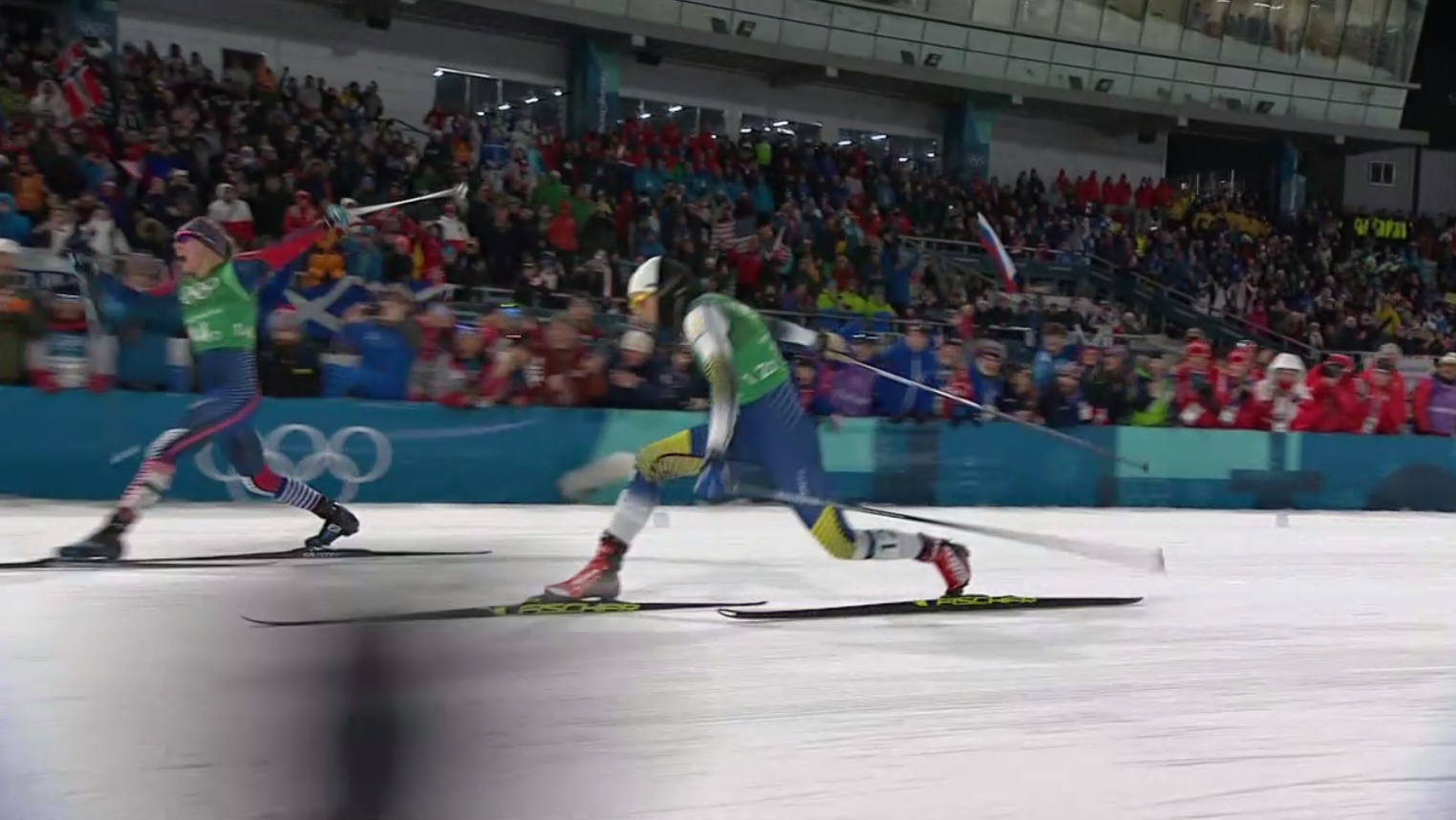
Riding fast skis on the downhill toward the stadium, Diggins stayed out of trouble while Nilsson nearly rode up onto Falla’s skis. While Nilsson used the draft to get into first coming out of that downhill, Diggins eyed a specific line, saw the opening between the two and took it to move into second. As Nilsson entered the finishing straight, Diggins was right there with her, even pulling into first as they came within 50 meters of the line. The gold became a reality, as Diggins outlunged Nilsson by 0.2 seconds at the finish with a time of 15:56.4 minutes, and Falla crossed 3 seconds back in third.
Jessie Diggins (l) lunging for gold in the women’s freestyle team sprint, 0.2 seconds ahead of Sweden’s Stina Nilsson at the 2018 Olympics in PyeongChang, South Korea. (Screenshot: NBC broadcast)
Gold for the U.S., silver for Sweden, bronze for Norway. With her 14th Olympic medal, Bjørgen became the most decorated Winter Olympian of all time, while Randall and Diggins earned their country’s first Olympic gold.
In the men’s 6 x 1.4 k team sprint final that followed, Johannes Høsflot Klæbo once again anchored another Norwegian victory, teaming up with Martin Johnsrud Sundby for Klæbo’s third medal of his first Olympics. With a strong second leg from Klæbo, the Norwegians gapped the field, and Sundby extended that gap to 5 seconds over Sweden by the final exchange. Klæbo rounded the final lap alone, still charging for the win and only letting up a few meters before the line to celebrate as he crossed in first with a time of 15:56.26.
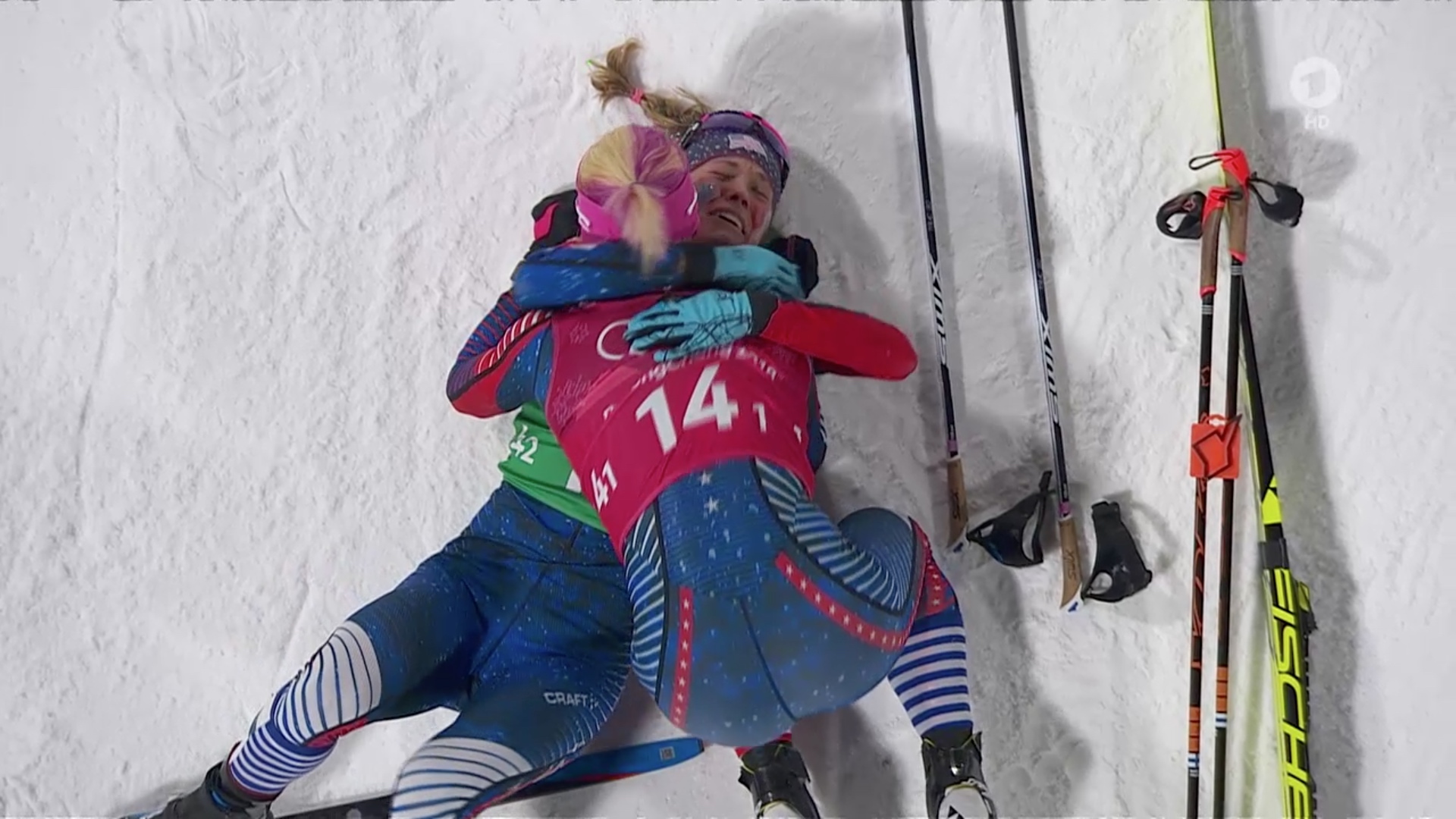
Kikkan Randall (14) and Jessie Diggins embrace as they celebrate their freestyle team sprint gold on Wednesday at the 2018 Winter Olympics in PyeongChang, South Korea. It is the first U.S. cross-country skiing gold medal in Olympic history, besting Bill Koch’s individual silver medal in the 30 k at the 1976 Winter Olympics. (Screenshot: ARD broadcast)
Alexander Bolshunov of the Olympic Athletes from Russia pushed to catch Klæbo on the last lap and motored for silver, finishing 1.71 seconds back. He teamed up with Denis Spitsov fortheir second-straight silver medal of the Games (after placing second in the 4 x 10 k relay) and Spitsov’s third medal (after placing third in the 15 k freestyle).
France (Maurice Manificat and Richard Jouve) placed third (+2.02) with Jouve edging Sweden’s Calle Halfvarsson by about a second for bronze, while Sweden placed fourth (+3.07) with Marcus Hellner and Halfvarsson. It was the French men’s second-straight bronze medal after placing third in the relay.
Italy (Dietmar Nöckler and Federico Pellegrino) was next across the line in fifth place, 18.55 seconds out of first, while the U.S. men (Erik Bjornsen and Simi Hamilton) followed in sixth (+20.72). Bjornsen crashed shortly after the start of the third leg (his second leg) after skiing onto the tails of Nöckler’s skis up the first climb out of the stadium. That put the American in last place near the bottom of the hill, but Bjornsen rebounded to tag off in sixth, just 3.2 seconds out of first. Hamilton slipped to eighth and 8.3 seconds back on the next leg, and by the last lap, it was Hamilton chasing Pellegrino for fifth place, which Italy ultimately took about 2 seconds ahead of him at the finish.
Canada’s Len Valjas and Alex Harvey finished eighth (+35.6), with Harvey holding off Finland in ninth by half a second at the line, after slipping as far back as 10th on Valjas’s second leg.
Semifinals
Earlier in the day, the Norwegian men and women, Russian men, and American women each won their semifinal heats as the field was narrowed to ten teams for each final.
In the first women’s semifinal, Bjørgen and Falla posted an easy win by 6.6 seconds. Switzerland’s Nadine Fähndrich and Laurien van der Graaff bested Slovenia’s Alenka Cebasek and Anamarija Lampic for second place.
In the second semifinal, Randall and Diggins claimed the win, with Kalla and Nilsson finishing second, just 0.7 seconds back; Diggins and Nilsson didn’t sprint for bragging rights, seemingly saving energy for the final. Russia’s Natalia Nepryaeva and Yulia Belorukova finished third (+2.1).
Only the top two finishers from each semifinal automatically advance to the final, but Slovenia and Russia qualified as “lucky losers” based on their time. Also qualifying for the final were Finland (MariLaukkanen and Krista Parmakoski), Poland (Justyna Kowalczyk and Sylvia Jasckowiec), France (Aurore Jean and Coraline Hugue), and Germany (Nicole Fessel and Sandra Ringwald).
The Canadian women’s team of Emily Nishikawa and Dahria Beatty finished seventh in the second semifinal, and were two spots out of making the final (the Czech Republic had a faster time than the Canadians but also did not advance).
“The first four legs we were right in there with the group,” Nishikawa told FasterSkier after their semifinal. “I think our second heat was quite a strong heat, it stayed together until the fifth leg. That’s where I blew up a little bit, but I did everything I could. … Dahria skied amazingly well, she was able to still catch Italy again on the sixth leg.”
“We knew that the first three, four teams would be quite strong: USA, Sweden, Russia and Finland,” Beatty said. “So we knew everyone else, we could ski with them in the group, so we were trying to stay with that kind of middle group ’cause we knew five or six would probably be qualifying from our heat. … I think we did a really good job of skiing a race where we were right in there. … I think we came something like 11 seconds short of what we needed…
“Even though we didn’t qualify it was nice to be able to go catch one team on the last lap there and finish strong,” Beatty added. “Our coaches were cheering amazing out there, and had some cheering from the American coaches, too. So there was a lot of motivation on the course to really fight to the line.”
In the men’s semifinals, Russia’s Spitsov and Bolshunov and Sweden’s Hellner and Halfvarsson at some points appeared to be running away with the first heat, but by the finish Germany (Sebastian Eisenlauer and Thomas Bing) and Finland (Martti Jylhä and Ristomatti Hakola) were within three seconds in third and fourth.
For the U.S., Bjornsen took charge of the second semifinal on the fifth lap, and Hamilton kept the lead into the final downhill. Klæbo passed him late in the game and claimed the win along with teammate Sundby, and Hamilton appeared unconcerned as Jouve passed him in the finishing straight as well to put France (with Manificat) in second; based on time, the U.S. advanced as a lucky loser.
Also in the men’s final were Italy (Nöckler and Pellegrino), Canada (Valjas and Alex Harvey) — who finished fifth in the second semifinal — and the Czech Republic (Martin Jaks and Ales Razym).