From the FasterSkier archive — posts syndicated from athletes’ and coaches’ own blogs between 2004 and 2012, kept online as published. Current coverage is at fasterskier.com.

Tag: 2018 Olympics

  • FasterSkier’s Coach of the Year: Eileen Carey; Runners-Up: Matt Whitcomb and Robin McKeever

    FasterSkier’s Coach of the Year: Eileen Carey; Runners-Up: Matt Whitcomb and Robin McKeever

    Eileen Carey congratulating Oksana Masters after a gold medal at the Paralympic Games. (Photo: Mark Reis/U.S. Paralympics)

    With the 2017/2018 season officially in the rearview, FasterSkier is excited to unveil its annual award winners for this past winter. Votes stem from the FS staff, scattered across the U.S., Canada, and Europe, and while not scientific, they are intended to reflect a broader sense of the season in review. This set of honors goes to coaches of North American teams in any nordic discipline, at any level – although in an Olympic and Paralympic Games year, that’s what we focused on.

    Previous categories: Junior Skiers of the Year | Collegiate Skiers of the Year | Biathletes of the Year| Para-Nordic Skiers of the Year | NoCo Skier of the Year | Canadian Breakthrough Athletes of the Year | American Breakthrough Athletes of the Year

    ***

    Eileen Carey, U.S. Paralympics Nordic

    As we have already noted recently on the site, the U.S. Paralympics Nordic program made a huge jump between the 2014 and 2018 Games, winning three medals in Sochi but 16 – from five different athletes – in PyeongChang. That also included both men and women, and two types of para-nordic events: sitting and visually impaired.

    A big architect of the team’s success has been head coach Eileen Carey. It’s not an easy or simple job to coach athletes at all different levels of sport and different athletic backgrounds, and bring them all towards success.

    “The diversity in disciplines and levels of athlete in our program is one of the most interesting and motivating parts of my job,” Carey wrote in an email last week. “On one hand, I love getting into the details of what might make someone a fraction of a percent faster. I love the process of breaking down a performance into parts and working with athletes to problem solve how to make a small element better.  So much of that is about failure, modification, and trying again.  The potential gains are so small, but so are the gaps from 4th to 1st and every once in a while something sticks and that is incredibly motivating for me. Andy [Soule]’s sprint finish [for a gold medal] in PyeongChang is a great example of that.
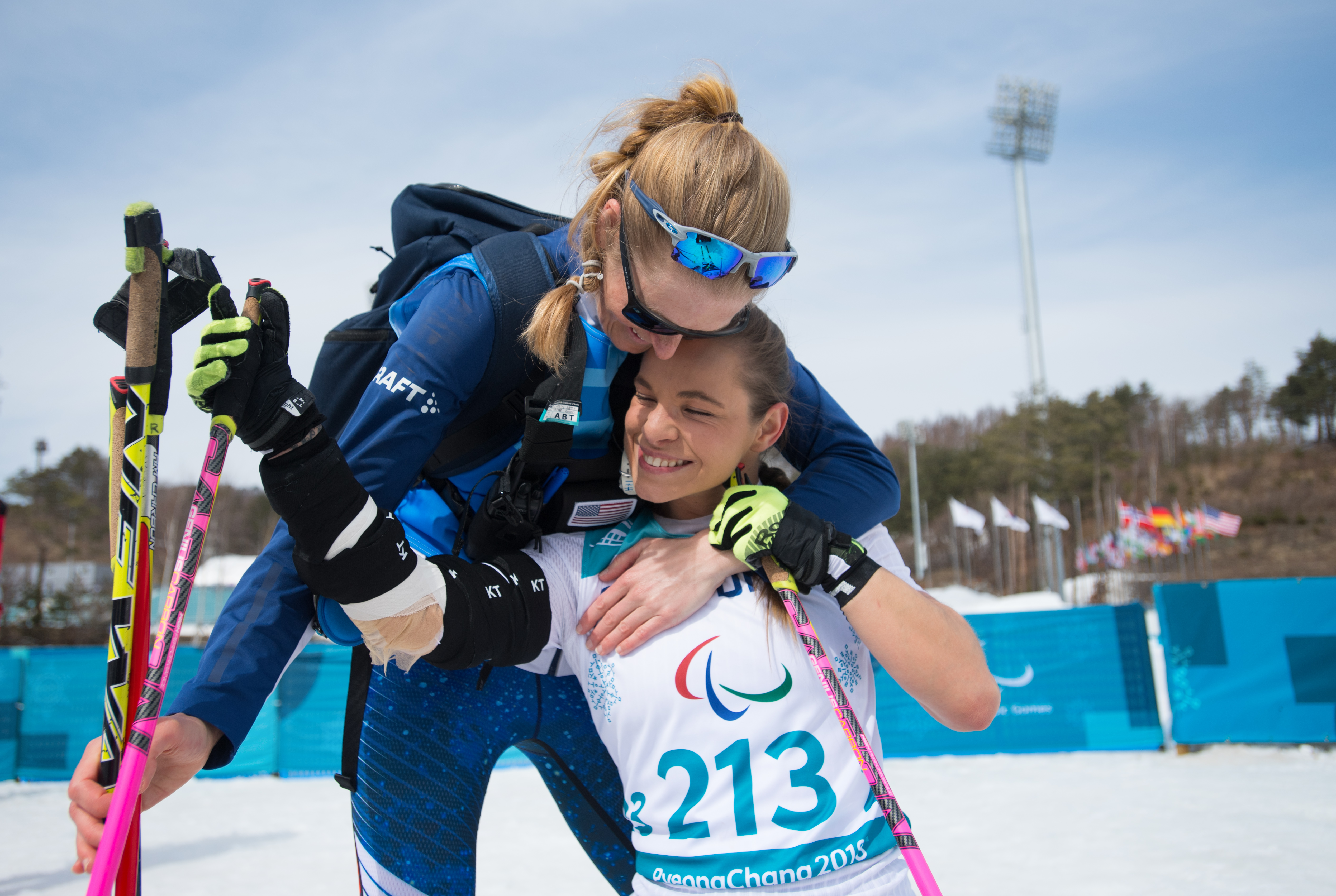
    Oksana Masters of U.S. Paralympics Nordic is hugged by head coach Eileen Carey after her gold-medal finish in the women’s sitting 5 k cross country race at the 2018 Winter Paralympic Games in PyeongChang, South Korea. (Photo: Mark Reis/U.S. Paralympics)

    “On the other hand we have some promising new athletes in our program who are at such a different level in what they need as athletes,” she continued. “For our program, our goal is always to provide best in the world service to our athletes. For our athletes who are aiming for the podium today, that involves every detail coming together, the execution of their plan. For Grace [Miller] and Mia [Zutter] and Ruslan [Reiter], our next generation of podium-potential athletes, providing best in the world service is more about making sure they see what their medal winning teammates and competitors are doing to achieve their performances and showing them a roadmap to get to that point.”

    Development coach BethAnn Chamberlain is a big piece of that effort. For the top-level athletes, Carey lives in Bozeman, Montana, where she works intensively with the sit-ski team,

    antabuse

    “They move to Bozeman in the winters,” Carey explained. “I am with them every day from November through March, in addition to training camps that we have most months from May-October. Most of them compete in summer sports, so in the off season, there is always an individualized balance of figuring out how to optimize their preparation for skiing, while working with their goals for other sports.”

    The standing and visually-impaired athletes have a different situation, and are primarily supported by clubs in their local areas. Carey works with both the athletes and their home coaches and teams to make sure they are getting the best development, but a big part of that can be training with an able-bodied ski team.

    “We can help with funding, or workout ideas that might be unique to Paralympic skiing,” Carey wrote. “But at the end of the day, Jake Adicoff and Sawyer Kesselheim’s success at the Games [where they took silver in the visually-impaired 10 k classic, the first visually-impaired medal by the U.S. in modern Paralympic history] is much more about Sun Valley SEF and Bowdoin (Jake’s club/school) and Bridger Ski Foundation and Montana State (Sawyer’s club/school)… We can help fill the gaps with funding and equipment and communication with their coaches, but their best path to the podium is the same as every skier who wants to be on an Olympic podium.”

    Carey and her colleagues, such as High Performance Director John Farra, have intentionally written their criteria so that standing and visually-impaired athletes can make the para-nordic national team without actually competing in para events – instead, they can make the C Team or Development team using USSA points from SuperTours, college races, or regional races. That means that they can spend more time with their home teams.

    “We are lucky in that we have incredible partners in the USSA community who are really the ones developing many of our athletes,” Carey wrote. “I hope the more that coaches and clubs around the country see our athletes competing in USSA and collegiate races, the more they see opportunities for providing a ski development pipeline to even more members of their communities. As much progress as we have made as a program over the last several years, we have at least that much again to improve, and this is the next big opportunity for us as a program, and also for ski clubs and communities around the country.”

    But while Carey is thinking about those big-picture goals and opportunities, she is also working one-on-one to help Americans become the best para-nordic skiers in the world.

    “The fall after Sochi, we started a technique modification process to target Andy [Soule]’s speed on flats, in particular finishing speed,” she explained. “In Sochi, he was moving quickly and had great hand speed but he was not going fast compared to the athletes he was competing against. We tried and failed at so many things in the past four years to improve that. Every once in a while, we would find a mental cue or some technical detail that seemed to make a difference and we would build on that and find ways to analyze it. It can be so frustrating, because there are inevitably times when progress stalls or reverts and there rarely is a clear answer why… When he turned it on during that finishing stretch of the sprint to take the gold, that was the epitome of a plan coming together at the right time.”

    A few minutes later, Oksana Masters won gold in the women’s sprint, overcoming an injury that had happened just weeks before the Paralympics. It was her first gold medal after collecting a silver and bronze earlier in the Games, to go with a silver and bronze from Sochi and a bronze from the 2012 summer Paralympics in rowing.

    “Both of those races, strictly from a sport performance standpoint, were just incredible,” Carey wrote. “In addition, those two athletes have really been the architects of our program’s rise over the last quad. The two of them were at every camp and World Cup, and their instincts as athletes drove the strategies of our program. That day could not have been a more meaningful culmination of the last four years for them as individuals, for us as a program, and for me as a coach.”

    Honorable Mention: Robin McKeever, Canadian Para-Nordic Skiing

    Also taking home 16 medals from PyeongChang? The Canadian Para-Nordic team, which like the Americans had a big jump in both the number of medals and the number of athletes winning them. Far from being just the Brian McKeever show – although the veteran went undefeated for the third Paralympics in a row – the team also picked up multiple medals from Mark Arendz, Natalie Wilkie, and Collin Cameron, plus an individual medal by Emily Young and two relay medals.
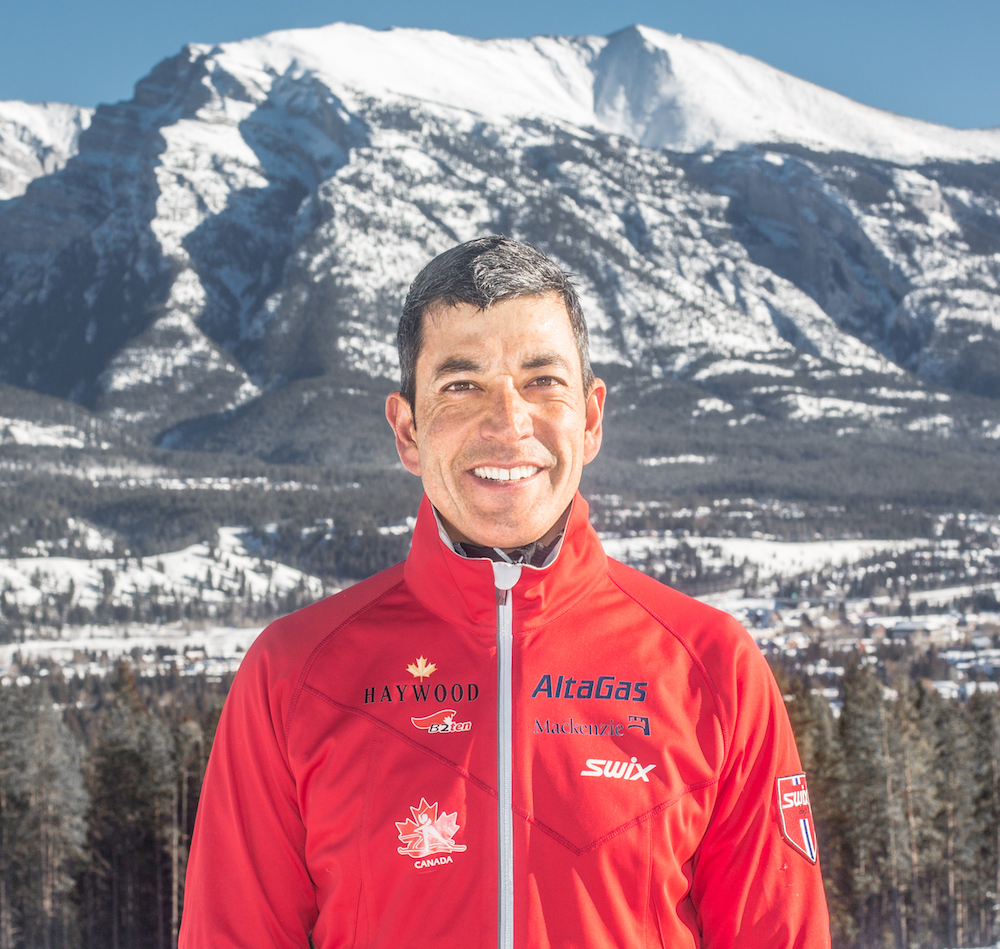
    Robin McKeever. (Photo: Noel Rogers/CCC)

    Carey’s counterpart up north is Robin McKeever, who incidentally said that he looked at what Carey was doing as an inspiration in being able to recruit summer-sports athletes and successfully transform them into winter gold medalists. The two gold medals by Kendall Gretch, an American triathlete who didn’t pick up cross-country skiing until 2015, were “eye-opening”.

    The para-sport landscape is slightly different in Canada, which also has a much smaller population to draw from (while at the same time having some of the same issues associated with far-flung geography). McKeever faces different development challenges, but has helmed the program towards depth and diversity in the last four years.

    “It started as an eight-year process in 2010,” McKeever said in an interview last week. “At that time, we only had funding for Brian. I was given the reins to rebuild, effectively. Now there are some next-generation funds we have the opportunity to access, and now that helps build the base. In the last few years we have had a development coach on board, Kate Boyd, and that has been huge.”

    There have been notable successes, such as the three medals Cameron took home; having picked up skiing just a few years ago after being involved with sledge hockey, Cameron was named one of our Breakout Athletes of the Year.
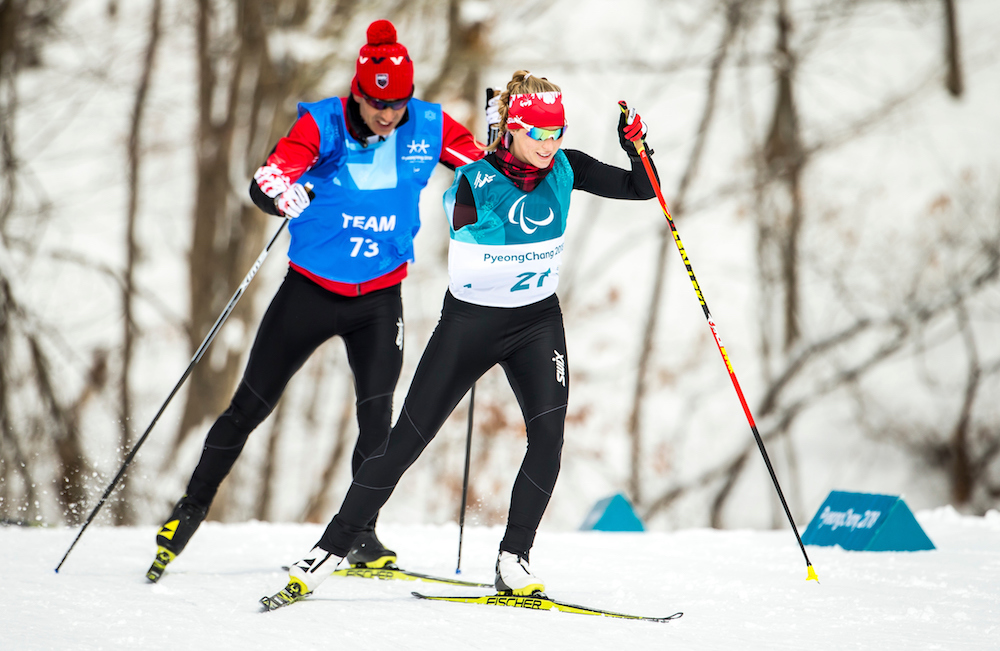
    Emily Young and coach Robin McKeever during a training session at the Alpensia Biathlon Centre during the 2018 Winter Paralympic Games in Pyeongchang, Korea. (Photo: Dave Holland/Canadian Paralympic Committee)

    Then there was Wilkie, a teenager who came to the program after losing four of her fingers in an accident.

    “We know where our pool of athletes comes from,” McKeever said. “It’s about the un-luck of athletes having trauma, which starts their Paralympic path. And it’s about luck in terms of recruiting athletes from summer sport.”

    Those newer athletes in the program have veterans to look up to, whether that is McKeever’s brother Brian, or now Mark Arendz, who took home a remarkable six medals between biathlon and cross-country skiing.

    “Mark was no surprise,” McKeever said. “Six medals was maybe a surprise, but he was a World Champion coming in.”

    Given the limitations on how the team can find new athletes, McKeever didn’t want to be too concrete about whether the program would see a big swell in numbers coming off its recent success.

    “It is still to be seen where that will go,” he said. “Some of it is a bit of luck, and some of it is really good management… A lot of staff has been around for eight years. They remain keen and excited. They stick around and are really integral to my support, and to the team’s support.”

    One of the biggest highlights for McKeever, and an illustration of how the program has changed in just a few years, was the mixed relay team of Arendz, Young, Wilkie, and Chris Klebl taking silver, the first ever relay medal for Canada.

    “The mixed relay is a real highlight,” he said. “Even if the full Russian contingent had been there, that would be a podium for us. I didn’t know eight years ago that the possibility was even there.”

    Honorable Mention: Matt Whitcomb, U.S. Ski Team

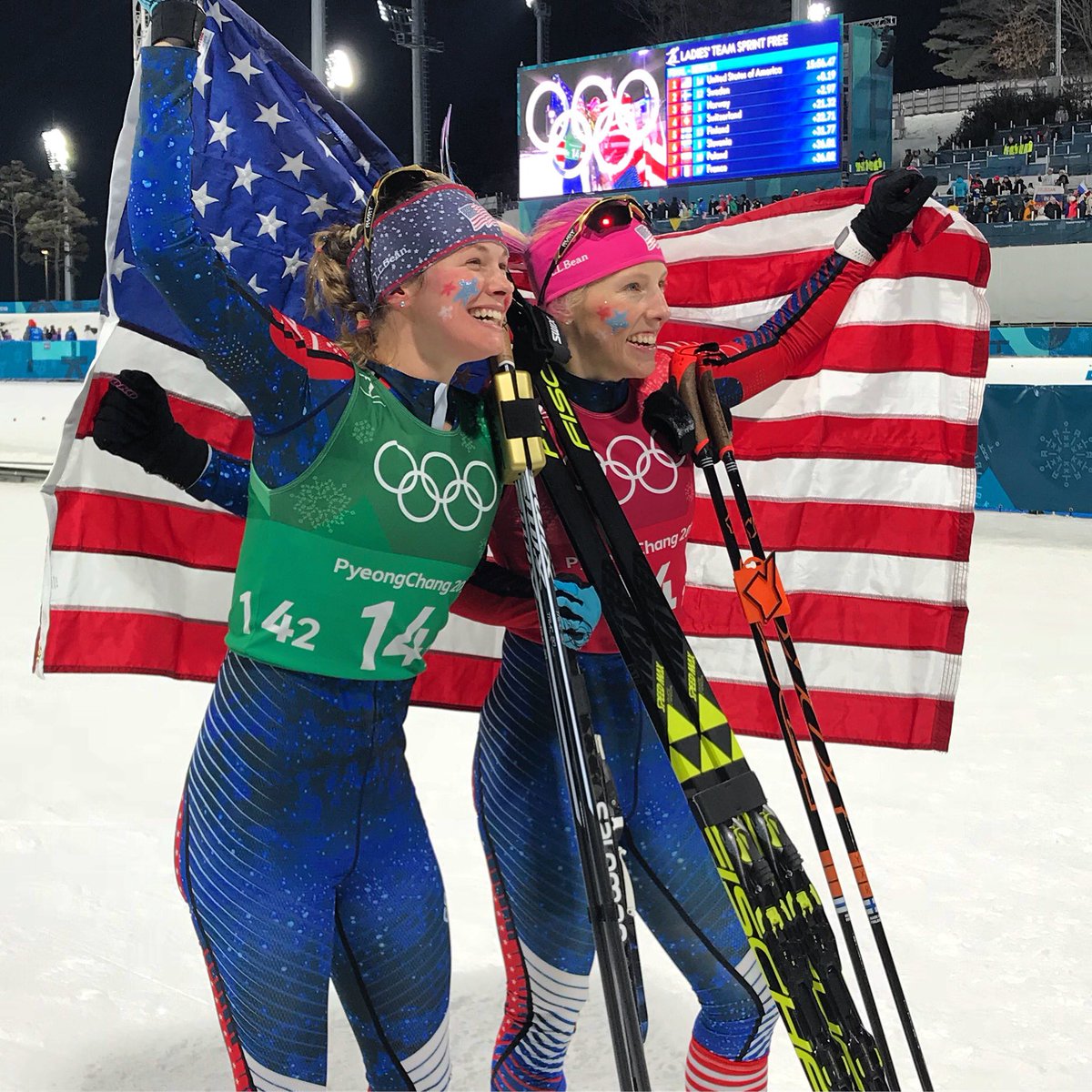
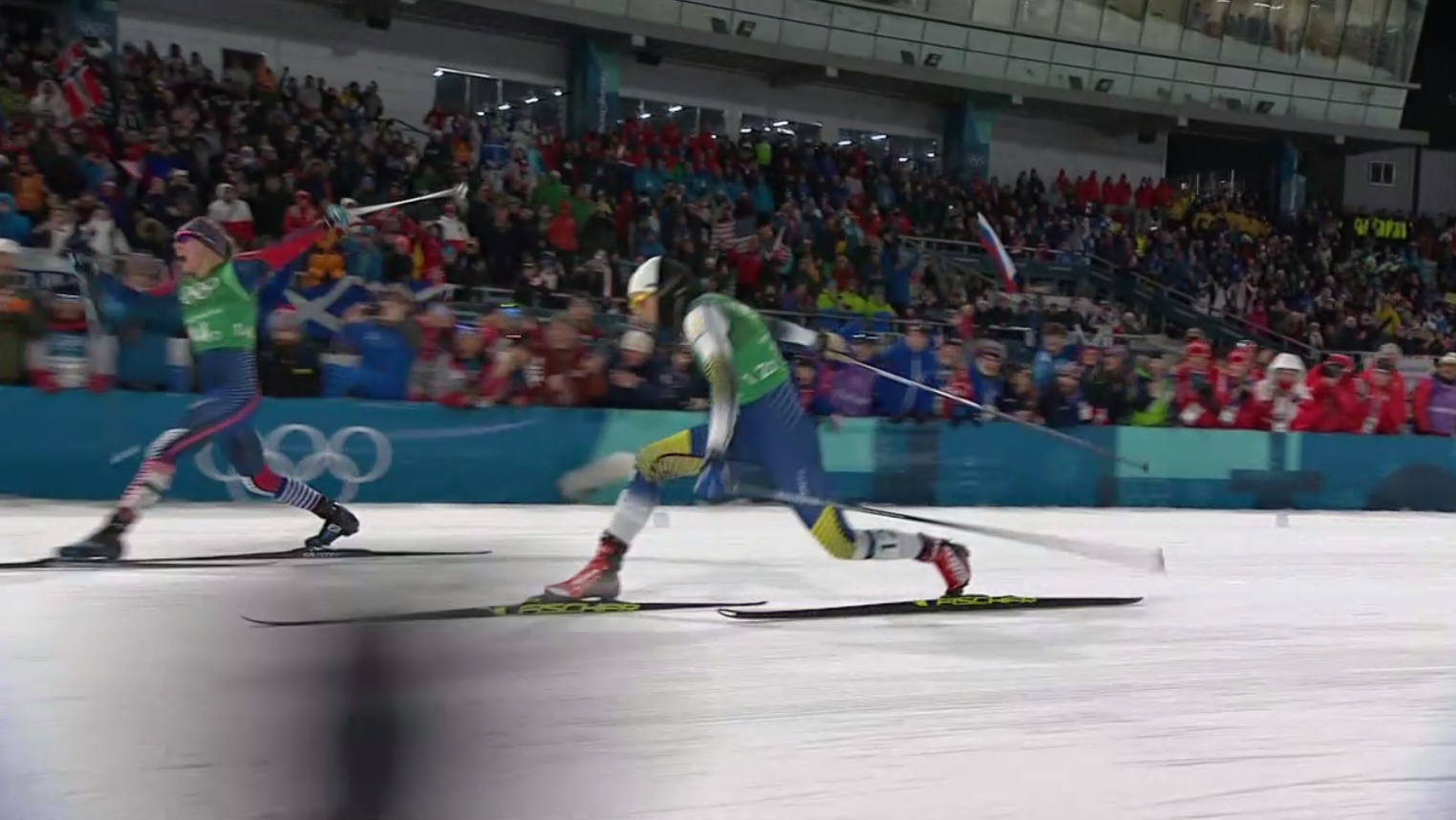
    Another team that had a huge jump this year? The U.S. Ski Team women. Jessie Diggins and Kikkan Randall took gold in the Olympic team sprint, the first-ever gold medal for the U.S. in the sport.

    But the Olympics weren’t the only thing that happened this season. Diggins also won a World Cup, was third in the Tour de Ski, and second in the overall World Cup standings. Randall picked up a World Cup podium; Sadie Bjornsen picked up several; and Sophie Caldwell had enough to earn third place int he Sprint Cup standings. The team had more days with many women in the sprint heats, and more good distance results, too.
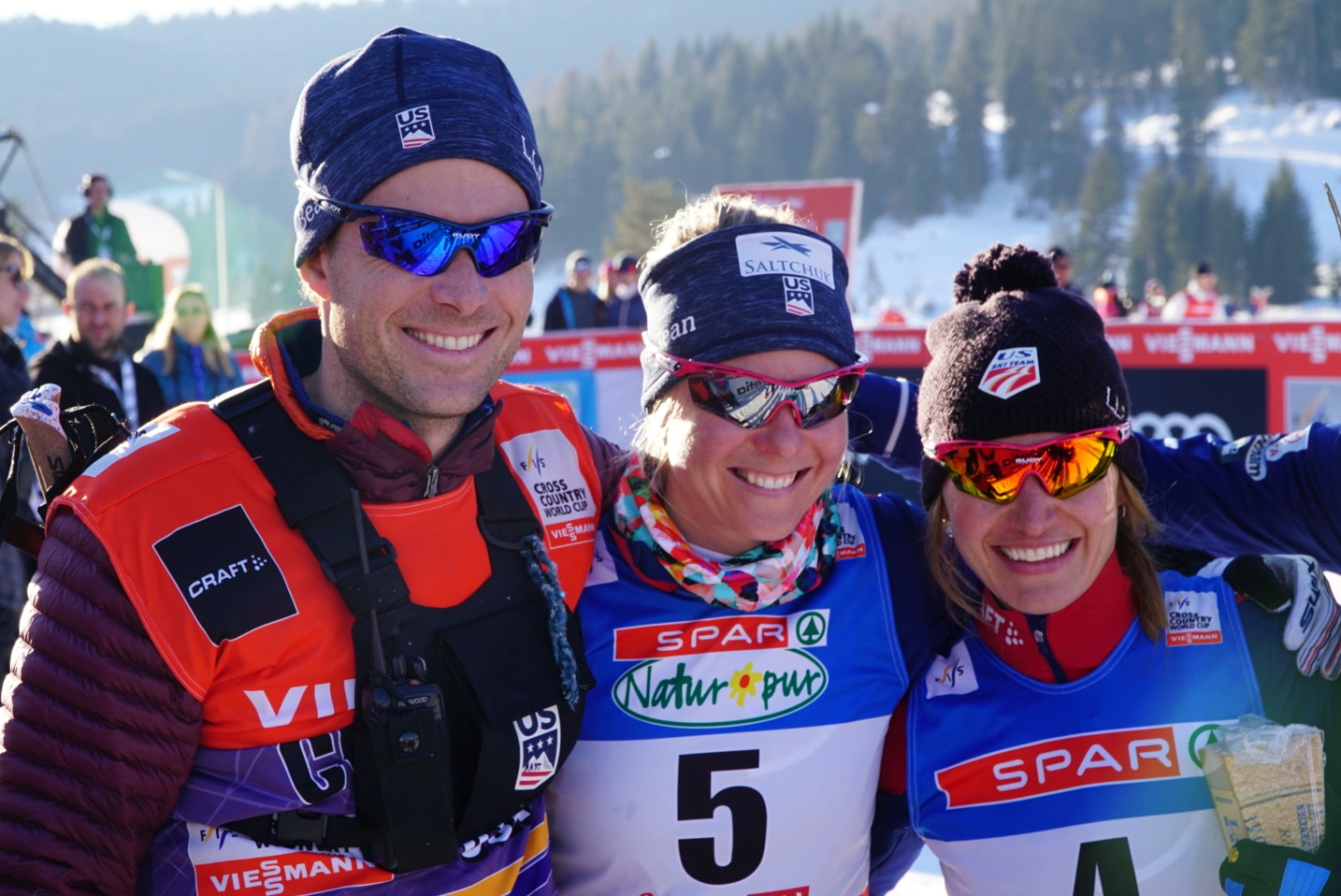
    Matt Whitcomb with Sadie Bjornsen and Sophie Caldwell in Seefeld, Austria, this winter. (Photo: Garrott Kuzzy / LumiExperiences.com)

    “It’s been a many-year goal of ours to be ranked in the top three for the women’s team and we secured that for the first time today,” U.S. Ski Team Women’s Coach Matt Whitcomb told FasterSkier of his team’s best-ever Nations Cup ranking after the final World Cup of the season in Sweden. “We’ve come into [past] finals, I believe, ranked third and then come out of finals ranked fourth. We’ve been fifth… It was really quite an achievement.”

    The U.S. women all spend large amounts of time with their club teams and coaches, including at APU and Stratton. But they come together to form a national team, the strength of whose relationships are a storied aspect of building their own success. And Whitcomb is a big ingredient there, facilitating not just training but atmosphere and long-range goals.

    When Caldwell secured third in the Sprint Cup, she thought back two years to a conversation she had with Whitcomb about race goals. Whitcomb wanted Caldwell to write down goal in particular: to be in the Sprint World Cup overall top three.

    “At the time I was like, ‘Eh, no, that seems pretty far off,’” Caldwell reflected in a post-race interview with FasterSkier.

    But it wasn’t, and the determination to work seriously on big goals, and believe you can get them, is a hallmark of the U.S. team.
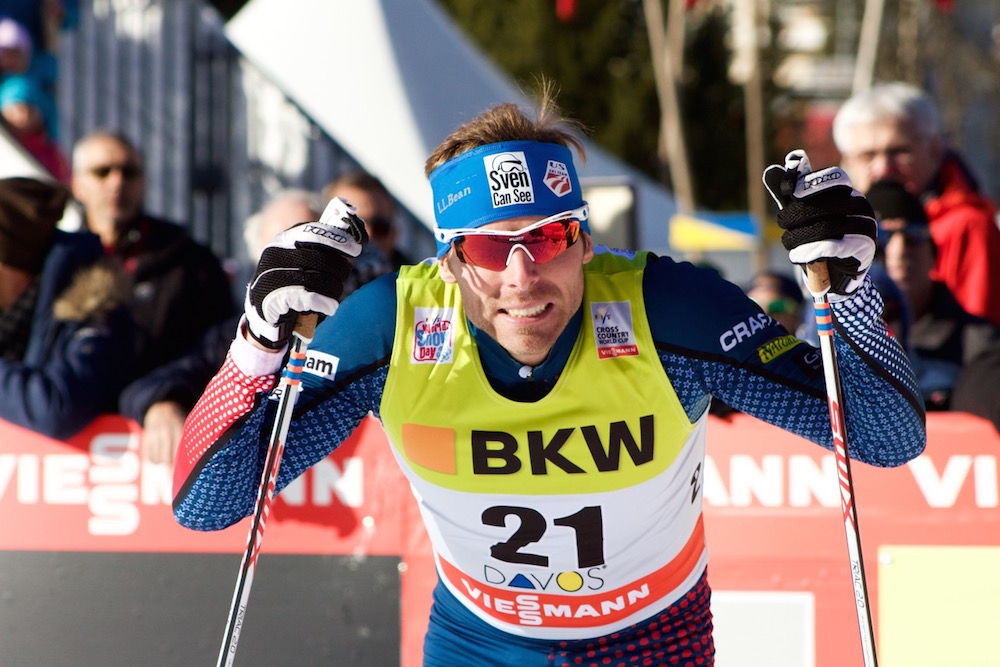
  • The Andy Newell Anti-Retirement Story

    The Andy Newell Anti-Retirement Story

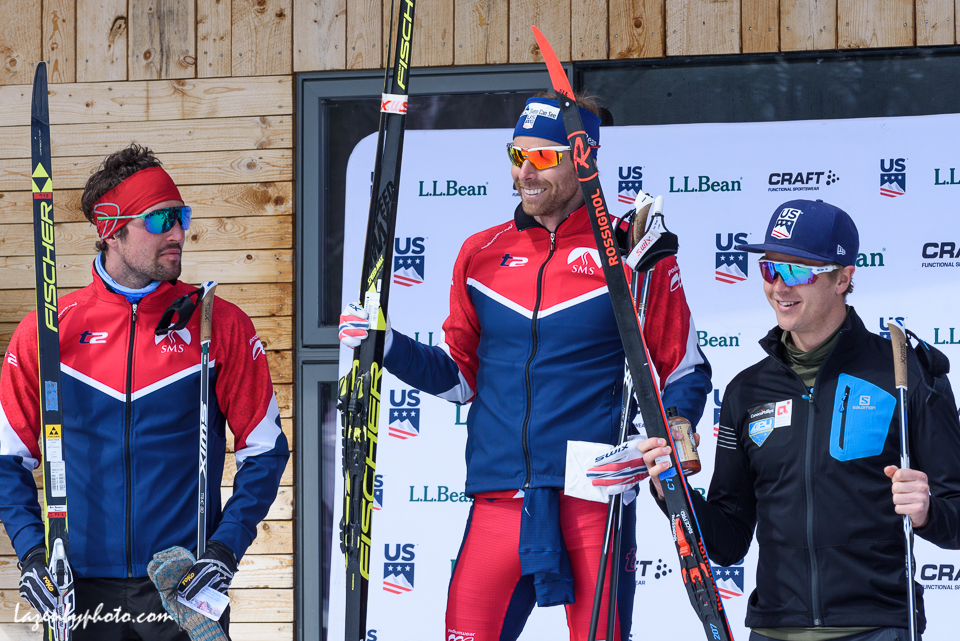
    Andy Newell (c) of the U.S. Ski Team (USST) and Stratton Mountain School T2 Team after winning the men’s classic sprint at 2018 SuperTour Finals on March 24 in Craftsbury, Vt. His Stratton teammate Ben Saxton (l) placed second and Erik Bjornsen (r), of the USST and Alaska Pacific University, placed third. (Photo: John Lazenby/Lazenbyphoto.com)

    When Andy Newell took to social media about a week and a half ago to announce that he was parting ways with the U.S. Ski Team (USST) after 16 years, some people might have assumed that he was leaving the sport. They would be wrong.

    Newell, a 34-year-old Shaftsbury, Vermont, native and USST A-team member for the last 12 seasons, was quick to clarify that he’s not retiring from racing. After four Olympics and 16 years on the team, he’s just ready to be his own boss and set his own schedule.

    “I guess in the back of my mind I always knew once the [2018] Olympics were over I would most definitely take a step back from being a full-time international ski racer and definitely take a step back from being a U.S. Ski Team national-team racer,” Newell said in a phone interview earlier this week. “Because that way, it allows me much more flexibility with my schedule even in the summer as far as training camps go and obviously a ton more flexibility in the winter as far as how much time I need to spend away from home racing World Cups.”

    American Andy Newell racing the men’s 1.5 k freestyle-sprint qualifier at Stage 1 of the 2017/2018 Tour de Ski on Dec. 30 in Lenzerheide, Switzerland. He qualified 20th and went on to finish 19th on the day. (Photo: Fischer/Nordic Focus)

    Newell spent all of last season — from Oct. 29 until mid-March — on the World Cup circuit in Europe (except for when he was at the Olympics in PyeongChang, South Korea, for the month of February). He rarely saw his wife, Erika Flowers, whom he married last June. The two arranged quick trips to see each other when they could, but as full-time ski racers on different circuits, it was a challenge.

    “Five, six, seven, or ten years ago, I was making many of these decisions as an individual, and now that I’m married, I definitely have a lot more to consider than just myself when I make decisions when it comes to planning and scheduling,” Newell said.

    While he was hesitant to elaborate on his plans moving forward, Newell emphasized that he’ll continue to race in the near future.

    “Right now, I guess my plan would be to get back to a simpler schedule where I am still training at a high level but not focused really at all on World Cup racing,” he said. “So I might target a few races that I’ve always really wanted to do, for example some of the Ski Classics possibly over in Europe like the [Norwegian] Birkebeiner, possibly the American Birkebeiner. I think there’s so many great ski experiences that we have out there other than racing World Cups every weekend.”

    And at this point, he’s not completely ruling out another run at World Championships.

    “If I’m feeling like a complete champion by doing some of these different races, then you might see me trying to take a stab at something like World Championships,” Newell said. “But I’m not really putting any pressure or expectations on that, I’m more just looking to get back to a more simple training and racing routine where I can come up with my own schedule and plans and just remember what it’s like to really enjoy ski racing and doing the ski races that I want to do.”

    Growing Up on the Ski Team

    Andy Newell with some hardware after placing fourth in the season-long Sprint World Cup for the 2009/2010 season. (Photo: Kikkan Randall)

    Newell first landed a spot on the U.S. Ski Team as a high-school senior at the Stratton Mountain School (SMS) in Stratton, Vermont. He was initially selected to the development team, which came with invitations to national-team training camps — like the present-day development “D” team — as well as summer housing at the USST base in Park City, Utah.

    That season, in 2002/2003, Newell raced at World Championships in Val di Fiemme, Italy, and nearly qualified for the heats in the skate sprint (placing 31st). Just 19 years old at the time, he also competed at Junior World Championships in Sollefteå, Sweden, where he placed second in the qualifier and seventh overall in the freestyle sprint.

    He competed in his first World Cup in 2004 and made the leap to the USST A-team in 2005. Newell then began his 12-season streak on the A-team, which entailed the team’s highest level of financial support. He reached the World Cup podium three times as an individual — first in 2006 in Changchun, China, where he placed third in a freestyle sprint. In doing so, Newell became the first American to medal in a World Cup race since Bill Koch did the same 23 years prior.

    While Koch was a distance racer — like every international nordic racer of his era — Newell earned his chops as a sprinter and came onto the World Cup scene when short-distance sprint races were in full swing (the format was introduced at 1999 World Championships and 2002 Winter Olympics).

    “I think back on those years, and they were so cool,” Newell said of his early days on the team. “To be, like, 20 years old and beginning to race World Cups. … I remember in ’05, I got a top 15 in a World Cup, and that was the first time that had happened for the U.S. in the last however many years, and because of things like that, every weekend something new and exciting was happening.

    “I started doing better in some of the sprints and winning the qualification and getting a top 10 here, and the next year I was on the podium after that in ’06,” he continued. “And so it was a very quick trajectory to becoming one of the best sprinters in the world at that time.”

    He raced at eight World Championships with his best result coming in 2007 in Sapporo, Japan, where he placed fifth in a classic sprint.

    “I won the qualification in the sprint and ended up finishing fifth, but I remember being pretty disappointed,” Newell reflected. “I thought I totally could’ve been on the podium there.”

    Andy Newell racing in late 2009. (Photo: Fischer/NordicFocus)

    His other two World Cup podiums came when he placed second in a 2008 skate sprint in Lahti, Finland, and third in a 2010 classic sprint in Drammen, Norway. In four Olympics, Newell achieved two individual top 20s in skate sprints (16th in 2006 and 18th in 2014), and ninth in the freestyle team sprint at the 2010 Olympics in Vancouver, B.C.

    In PyeongChang this past February, he raced to 37th in the classic sprint and 14th with the men’s 4 x 10-kilometer relay. Reflecting on those Olympics, Newell said he was personally disappointed with his results, but thrilled to be a part of history with his team.

    “I felt like I had put in the time, time and effort and preparation to race better than I did,” he said. “But at the same time, we created such a great, tight unit and team throughout the last four years that for me, it was just so great to be there, to be there on the day that Jessie [Diggins] and Kikkan [Randall] won a gold medal. … Even though I didn’t ski my best, it was still, to me, in a lot of ways a success to be there; it’s been a successful year in that respect.”

    ‘A Little Bit of a Guinea Pig’

    Asked how the sport, specifically sprinting, has changed over the years, he said it’s been gradual but noticeable. Moreover, his ability and willingness to adapt is what has kept him in it this long.

    “If you were to look back on a World Cup sprint from 2005, the technique would look a lot different than it does now,” he said. “Many of the courses are the same, some are a little longer now than maybe what you would see back in the early 2000s for sprinting, but I think, in order to be competitive then, and also still competitive now, I’ve had to try to adapt as best as I can, and always be willing to learn new things.

    Fifth in the 2012/2013 Sprint World Cup, Andy Newell (r) with women’s Sprint World Cup winner and fellow U.S. Ski Team member Kikkan Randall at 2013 World Cup Finals in Drammen, Norway. (Courtesy photo)

    “I think if I would have assumed I was doing everything right or couldn’t improve, then I would have definitely been left behind I think years and years and years ago,” Newell continued. “I think people like Kikkan have done a really good job of that, and something that I’ve really tried to do, too, over the years, is always being willing to learn something new and not really have an ego about your shortcomings as an athlete.”

    He explained that a consistent theme of his career was his willingness to venture into unchartered waters when it came to training.

    “I’ve been a little bit of a guinea pig for the U.S. Ski Team in a lot of ways,” Newell said with a laugh. “I was probably the first athlete to go over and race an entire World Cup season. They hadn’t done that before we started scoring those kind of World Cup points in the mid-2000s, so it was like, how do we create a training plan that’s going to allow us to be successful at World Championships but also still race an entire World Cup season? So it’s been a great learning process for me and also I think the coaches over the last 20 years.”

    Over the last two decades, Newell said he’s mainly worked with Chris Grover, the current U.S. Ski Team head coach, and more recently, USST Assistant Coach Jason Cork.

    “Chris Grover wrote my training plans for probably the majority of my career,” Newell explained. “In the last four years or so, I started to work more with Jason Cork and also myself, I do a lot of the writing myself.

    “I think I’m someone who likes to be a student of the craft of what I’m working on; I think I’ve always been like that,” he continued. “When a coach tells you to do something, you’re always kind of like, OK, but I would always want to ask why we do a certain workout the way we do and how it builds … I’ve just liked to learn about training principles over the years, and so as I’ve gotten older, I’ve gotten more involved in writing, going over training plans myself, and incorporating ideas and workouts that I want to do. And I’ve done a lot of dumb, crazy stuff over the years, too.”

    Andy Newell celebrating the end of the 2012/2013 season with some acrobatics in Falun, Sweden. (Photo: Adam Alexander Johansson, XHC)

    Newell may be best remembered for his extreme stunts on ‘X Ski Films’, a filmmaking company he owned and starred in for several years, which included backflips and other airborne tricks on cross-country skis.

    He’s also spent the last two decades training out of Stratton with three main coaches: Sverre Caldwell, Gus Kaeding, and most recently, Pat O’Brien, head coach of the SMS T2 Team. Newell met Flowers on that team, and while he won’t be a full-fledged member of SMS T2 this year, Newell said he’s looking to maintain a strong relationships with both Stratton and the U.S. Ski Team.

    “In some ways I don’t think it feels like I’m retiring because I’ve kind of always had such a passion for pushing the level of skiing forward in this country,” he said. “And for me as an athlete, that was the best way I could do that, and I know as I transition into different roles in the skiing community, my goal [is] to continue hoping to improve the level of skiing in this country and improve the professionalism of skiing in this country and inspiring the youth skiing movement in this country — all those goals that I had as a ski racer — I will continue to have as a coach or a team leader or whatever my next role is going to be.

    “I’d like to work with development as far as helping some younger kids out, so I’m going to try to look for opportunities where I can do that,” he added. “I think it’s kind of a natural transition from athlete to coach in a lot of ways, but I’m still very much going to be an athlete at least in the near future.”

    Looking back on his years with the national team, he likened it to the pride one would have in a college or university they graduated from.

    “I’m just really proud of my time that I’ve spent with the team and so grateful for all of the opportunities that the U.S. Ski Team has given me over the past two decades,” he said. “It’s probably the same way that people who go to universities and so forth feel about having that kind of pride for their alma mater. I never went to college so it’s like the U.S. Ski Team kind of scooped me up at 16, 17 years old. Everything that has built me up into the kind of person that I am now, that has molded me into my character, everything has more or less has come through the U.S. Ski Team.”

    Andy Newell (U.S. Ski Team) after his quarterfinal at a 2015 World Cup freestyle sprint in Davos, Switzerland. (Photo: JoJo Baldus)

    Is he nervous about going out on his own? Newell said it’s been a long time coming, and he’s more excited than anything.

    “The spring’s always a funny time because you’re pretty exhausted from the season,” he said. “In a lot of ways, kind of the last thing you want to think about is skiing, but for me, I’ve always been one of those people that in the springtime gets super excited about all the opportunities. … By April 1, I [would be] already thinking, ‘Oh, what can I do for training next year?’ … and I start throwing around all these crazy ideas. I think that’s one of the things that’s kept me in the sport for so long, is having that excitement around training and preparation.

    “I think it will be exciting in a lot of ways to try to be my own boss and do some of the training camps I want to do and partner up and train with some of the athletes that I want to train with,” he said of this spring and summer. “Not that I was ever held back by the U.S. Ski Team, but you definitely had to adhere to a certain schedule so I think it will be exciting to do some different things.”

    From Sprints to Marathons?

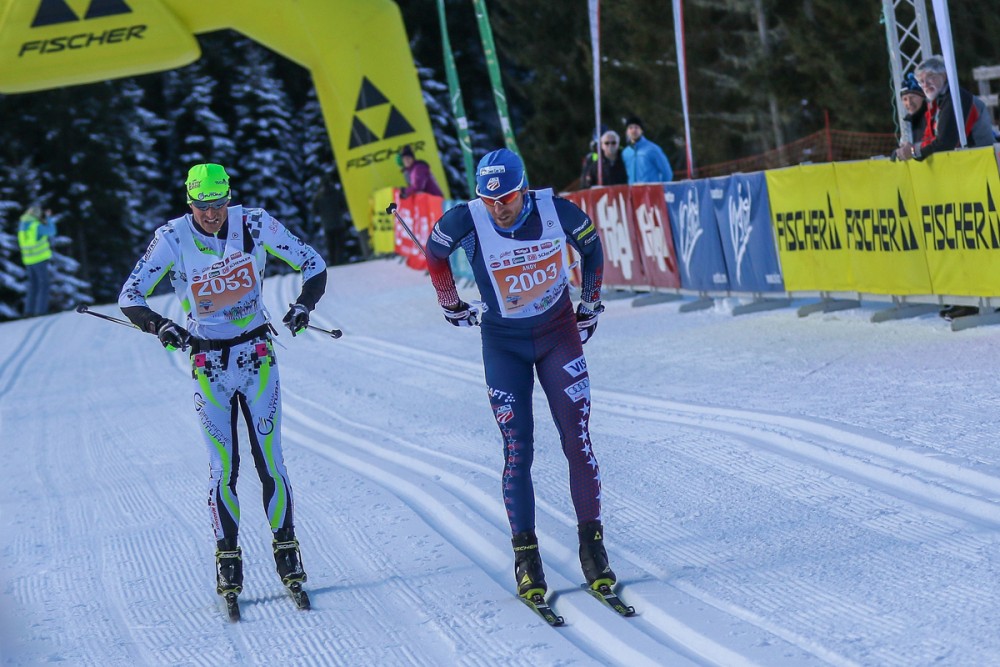
    In late January 2016, shortly before Newell spoke with FasterSkier about mulling retirement, or at least taking a step back from full-time ski racing, he double poled his way to second place in the 42-kilometer Dolomitenlauf classic marathon (part of the FIS Marathon Cup series) in Lienz, Austria. Never one to like being labeled a “sprint specialist”, Newell is looking forward to trying more marathon races like that.

    American Andy Newell (r) outsprints Italy’s Mauro Brigadoi, for second place in the 2016 Dolomitenlauf 42 k classic race in Lienz, Austria. (Photo: Fischer/NordicFocus)

    “I have a lot of great friends who train for the Ski Classics [marathon series] and a lot of my Norwegian buddies who I have raced World Cups with over the years have gone that route after their World Cup racing career,” he said. “It’s a cool idea because those races are super fun, there’s great prize money, there’s a lot of excitement over them, and I think it’s really impressive when you see somebody just crush 90 k’s of double poling like they do in the Vasaloppet.

    “So I’m definitely inspired by those guys and I, as an athlete, really like classic skiing,” he continued. “I love traditional-style classic skiing and I like double poling, so I think maybe in the future I will try to get into a few of those races, but it’s hard to do those and not be committed 100 percent because those guys that do those, they’re training to crush double pole like nobody’s business, so it’s hard to just show up on a weekend and race one of those races.”

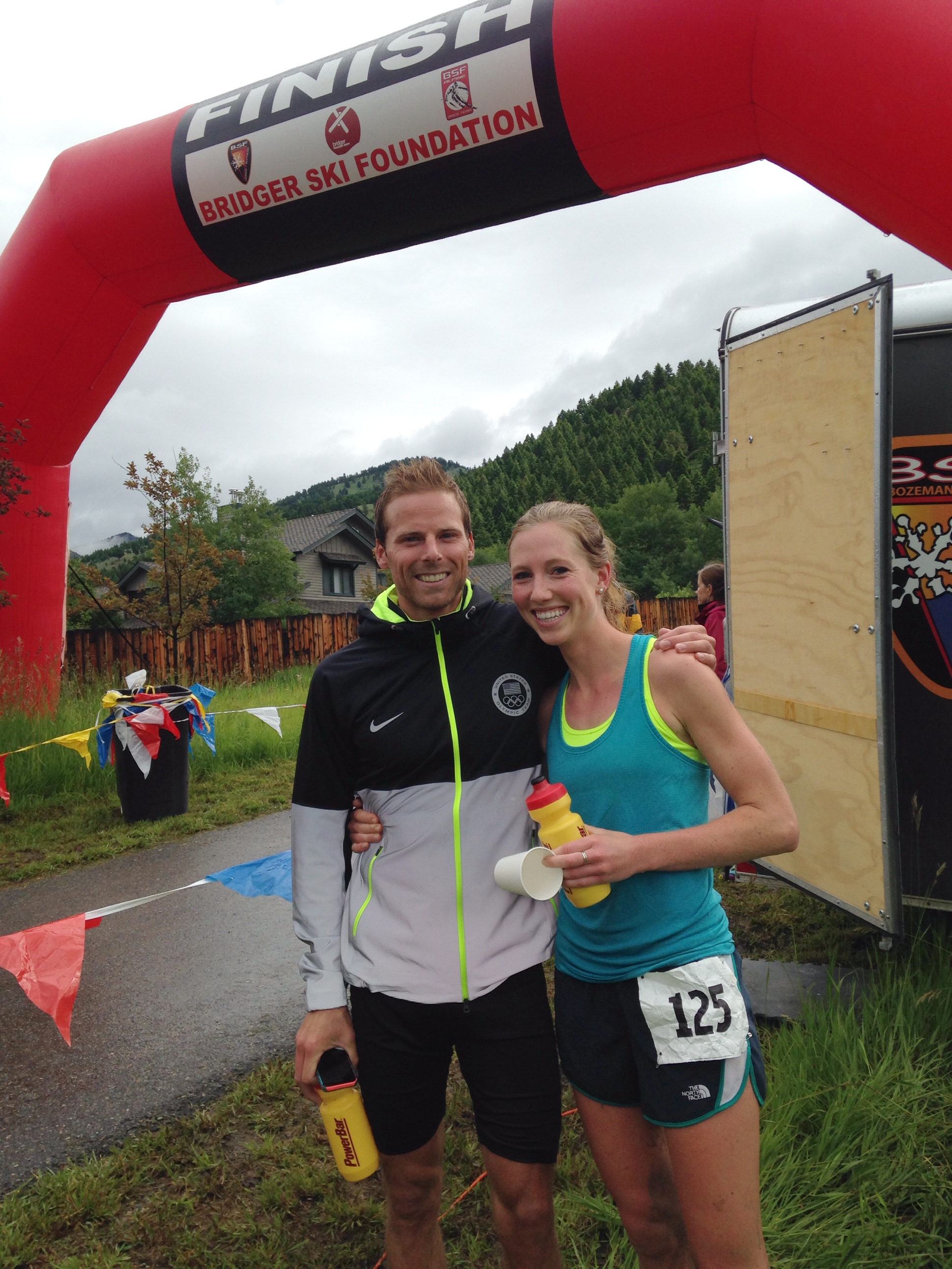
    Andy Newell and Erika Flowers, both of the Stratton Mountain T2 Elite Team, after both won the 2014 Jim Bridger Trail Run in Bozeman, Montana.

    Aside from the fitness required to double pole an entire marathon, the logistics of these races — many of which start in one town and end in another — is particularly challenging without a full-support crew or team.

    “I’d really like to do the [Norwegian] Birkebeiner and I think it will take a few times to be able to consider yourself a threat to the podium in a race like that,” Newell said. “I would be foolish to think I could just jump into a Ski Classics race and crush it, but it’s definitely a goal of mine to maybe do some of those over the next years because I think they’re such legendary, badass ski races.”

    In the near future, Newell and Flowers are headed out on a three-week “surf trip” to Australia and Indonesia.

    After that, “it’s yet to be seen how everything will fit in,” Newell said in regards to his future plans, both living, training, racing, and otherwise. “There will be more to say later as far as what I have going on for next year as far as what my goals will be.”

  • Bye Bye Biathlon: Many Retirements After 2018 Olympic Season

    Bye Bye Biathlon: Many Retirements After 2018 Olympic Season

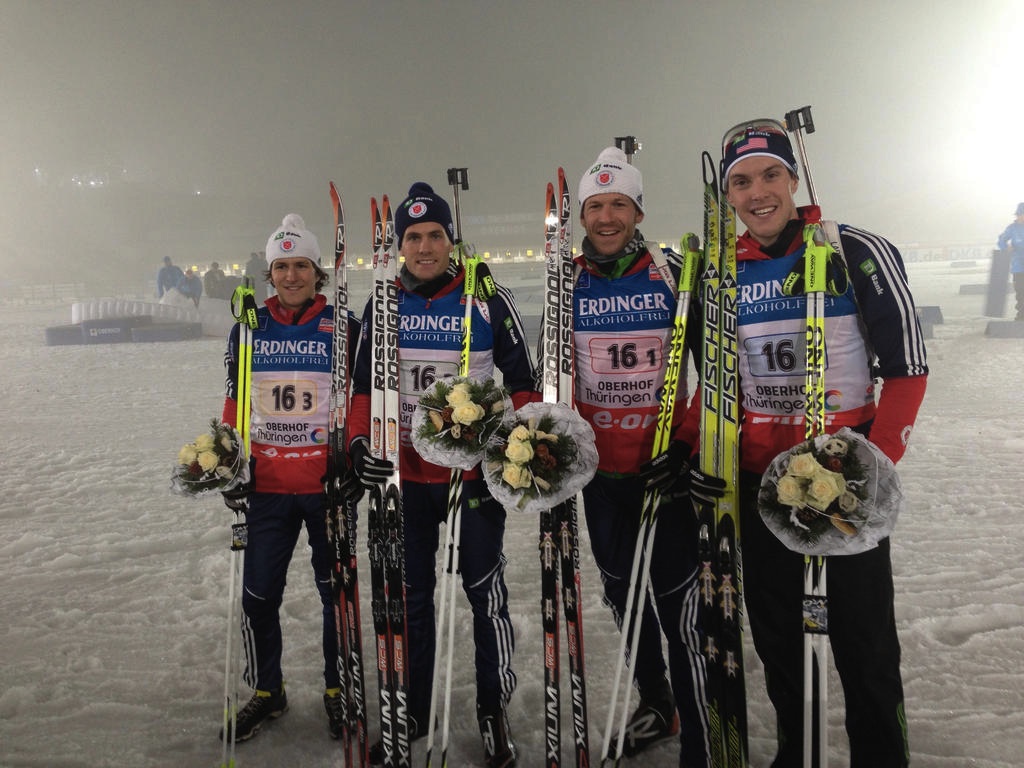
    Russell Currier, Tim Burke, Lowell Bailey, and Leif Nordgren after a fifth-place relay finish in the IBU World Cup relay in Oberhof, Germany, in 2013. Currier, Burke, and Bailey are all retiring. (Photo: USBA.)

    With the 2018 Olympics come and gone, many of biathlon’s athletes are calling it quits. Here’s a roundup of who you won’t see on the World Cup next season – and who’s still on the fence about their future.

    USA

    2017 Word Champion Lowell Bailey has long planned to retire after the 2018 season, and now that time has come. His first World Junior Championships was in 1999 and he got his first World Cup start in 2002. He raced 2003 World Championships before taking a break to go to the University of Vermont, before returning and competing in the 2006, 2010, 2014, and 2018 Olympics. His eighth-place finish in the 20 k individual at the 2014 Games are the best ever by an American biathlete. Bailey is the Executive Director of the Crosscut Mountain Sports Center in Bozeman.

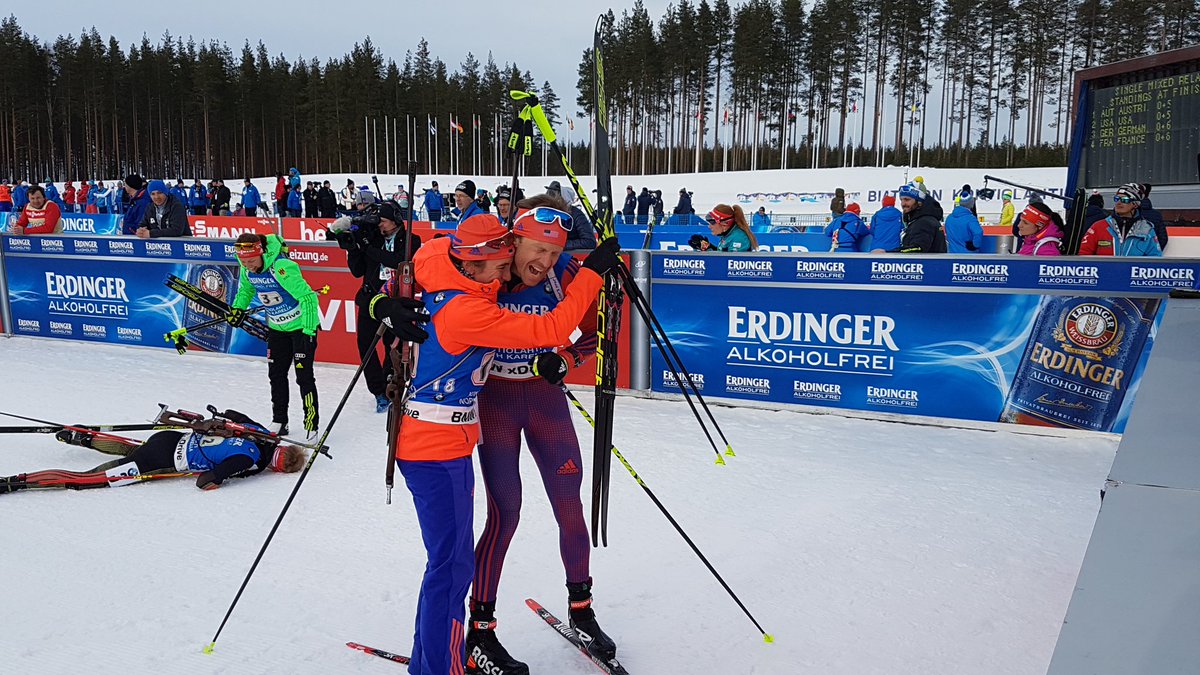
    Susan Dunklee and Lowell Bailey celebrate after finishing second in the World Cup single mixed relay in Kontiolahti, Finland, in 2017. Austria won the competition. Bailey is retiring and Dunklee is undecided as to whether she will continue racing. (Photo: IBU/Twitter)

    “I told myself this morning that I just wanted to go out on a high note,” he told FasterSkier in Oslo after leading off a U.S. relay team that finished seventh, in his last World Cup race. “I wanted to go out with a good result. And, I’m really happy to have shot clean in standing, clean from the clip in my last stage as a World Cup biathlete. That feels good. I’ll always remember that — that I went out with a clean stage.”

    Longtime teammate and 2013 World Championships silver medalist Tim Burke will also retire. Burke has six World Cup podiums to his name including that silver medal, and led the World Cup partway through the 2009-2010 season. Burke started racing internationally at 2000 Junior World Championships, and made his first senior World Championships in 2004. Like Bailey, he is a four-time Olympian.

    “It’s weird, I don’t honestly I don’t know if it’s truly hit me,” he said after the Oslo relay. “It might take weeks… I think it’s going to take a long time for all to settle in and for me to really reflect back on my career. Yeah, it’s a lot of emotion.” Burke says that his post-biathlon plans are not yet certain.

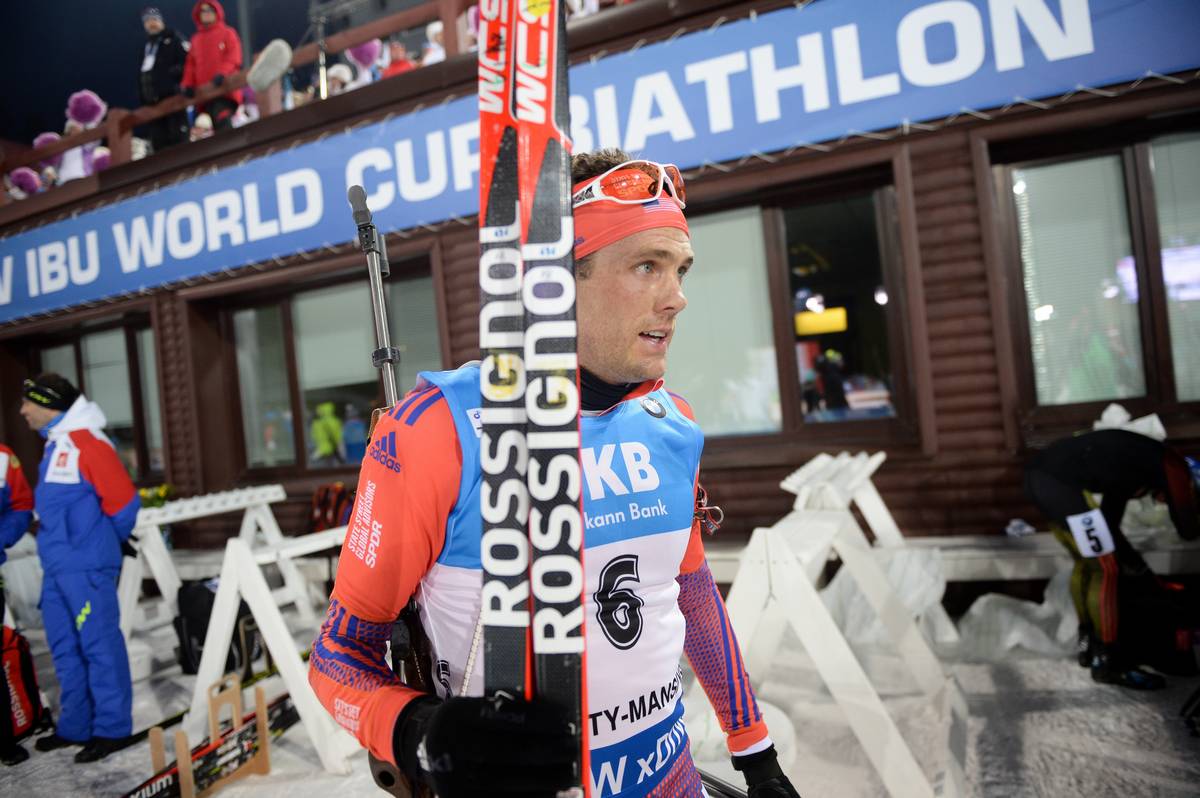
    Tim Burke after placing sixth in a World Cup pursuit in Khanty-Mansiysk, Russia, in 2016. (Photo: USBA/NordicFocus)

    Also retiring is Russell Currier, an off-and-on member of the national team and the Maine Winter Sports Center (now the Outdoor Sports Institute). Currier had two sixth-place World Cup results in 2012, and is a four-time World Championships team member. Since his World Cup debut in 2009, he has contributed to many U.S. relay efforts. He also competed at the 2014 Olympics, with a top finish of 49th, and was a member of the 2018 Olympic team though he did get any starts in PyeongChang.

    “USBA nationals will be officially be the last race of my biathlon career,” Currier wrote in an email to FasterSkier this week.

    The women’s team likely won’t see three retirements, and will thus have some more stability than the men’s crew, but there is more uncertainty regarding the women’s roster. Clare Egan wrote in an email this week that she was “Undecided!” about whether to continue racing. And in Oslo, after finishing third in the pursuit which was her last World Cup of the season, Susan Dunklee said the wasn’t sure if she would keep competing. “Ask me again in a month,” she said.

    Canada

    Julia Ransom retired in Oslo, as the 25-year-old is planning a career in dentistry and has many years of school ahead of her. “It’s just a good time for my partner and I to kind of move on,” she said after crossing the line in her final World Cup, the pursuit, hand in hand with teammate Rosanna Crawford.. “And it does feel right. It feels right.”

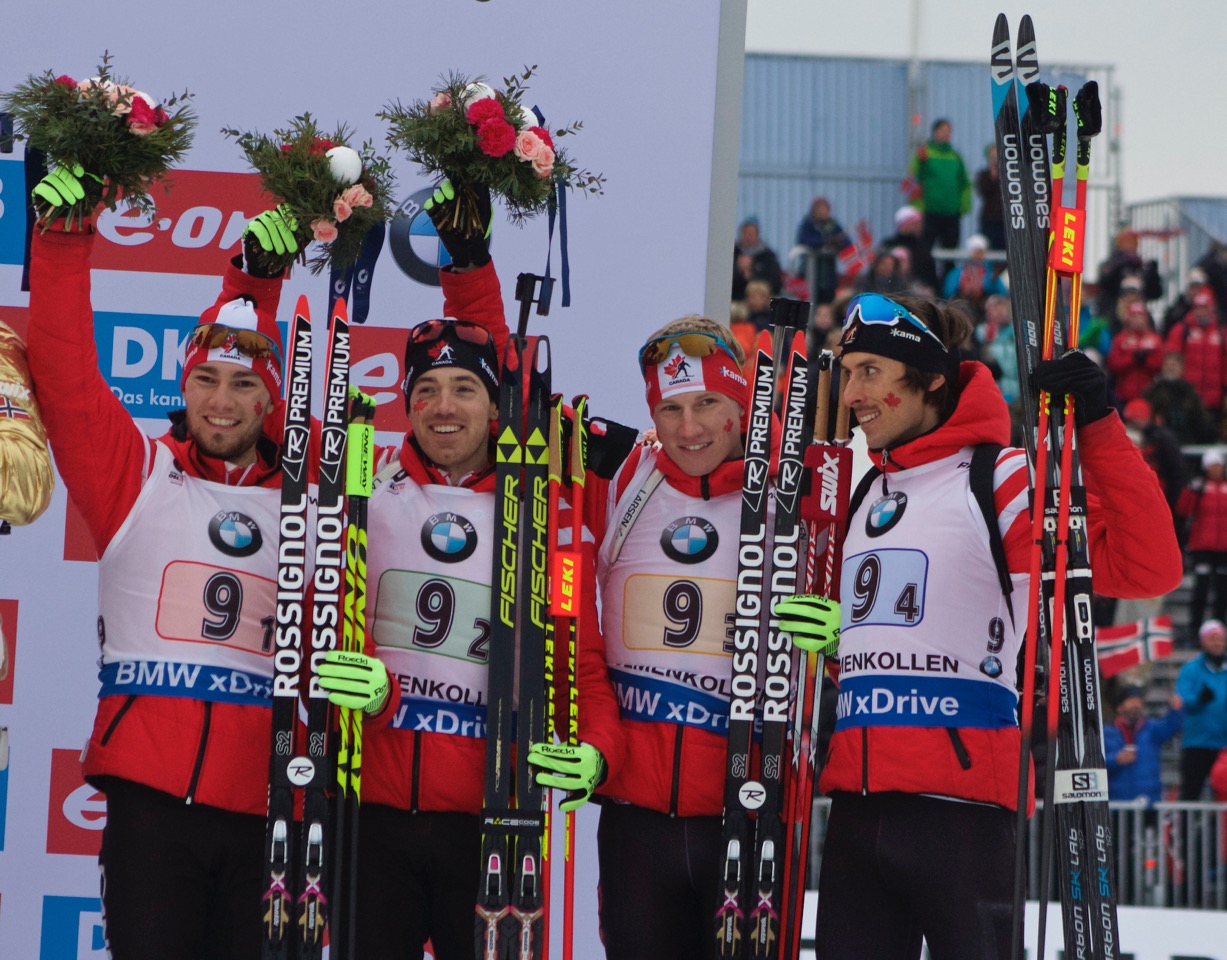
    The Canadian men’s team (l-r) Christian Gow, Nathan Smith, Scott Gow, and Brendan Green celebrate bronze in the men’s 4 x 7.5 k relay at 2016 World Championships in Oslo, Norway. Both Green and Smith are undecided on their future plans. (Photo: JoJo Baldus)

    Ransom scored two top-ten finishes at 2014 World Juniors, and made her first senior World Championships team in 2015. This season she had two top-ten World Cup finishes, and went to the Olympics in PyeongChang, where she finished 28th in the pursuit.

    She is the only one from the Canadian team who is definitely retiring, but quite a few of her teammates are on the fence and there could be huge turnover on the team depending on what they decide. That includes Rosanna Crawford and Brendan Green, even though Crawford finally bagged her first World Cup podium this season.

    “We’re not 100% sure yet,” Green said after the relay in Oslo. “Both Rosanna and I will sit on it a little bit over the spring. We will reevaluate a little bit and see what other opportunities arise. I think we both still love to race and train, and if we continue down that path I know we will still be motivated. But as of right now I’m not sure.”

    2015 World Championships silver medalist Nathan Smith – who was also, along with Green, Christian Gow, and Scott Gow, part of a bronze-medal relay at 2016 World Championships – is also unsure. He missed most of the 2016-2017 season with health issues and though he returned to the World Cup and the Olympics this year, did not perform up to his own expectations. 

    Rosanna Crawford, Megan Imrie, Megan Tandy, and Zina Kocher celebrate a fourth-place World Cup relay finish in Annecy, France, in 2014. Crawford and Tandy may not keep racing after this season; Imrie retired in 2014 and Kocher in 2016. (Photo: Matthias Ahrens)

    “I’m kind of waiting to see what happens with Biathlon Canada,” Smith wrote in an email this week. “I think some very difficult years are coming for the organization, unfortunately. That will play a big part in my, and I’m sure many other athletes’, decisions. Of course, I’m also not looking to have a continuation of the health problems over the last two seasons, which made competing at the highest level really difficult. So I will be keeping a close eye on how my body is reacting to training. If it’s still not coming around that would certainly not encourage me to continue either.”

    2010, 2014, and 2018 Olympian Megan Tandy also struggled with health issues this winter, and is likewise not sure what her future holds.

    “Originally it was my intention to retire after this season, however it was literally my worst season ever!” she wrote in an email. “I was sick more in the past 6 months than in the past two years. Anyways,  I have taken some time since the Olympics to followup about my health and to consider options for next season. I want to race a final season – one where I feel good and can put up a good fight (not necessarily results dependant, I just want to leave this sector of my life feeling like I gave it all I got), but a lot of things will need to fall into place for that to be realistic: sponsor support, coaching opportunities during the training season, and my health of course.”

    Poland

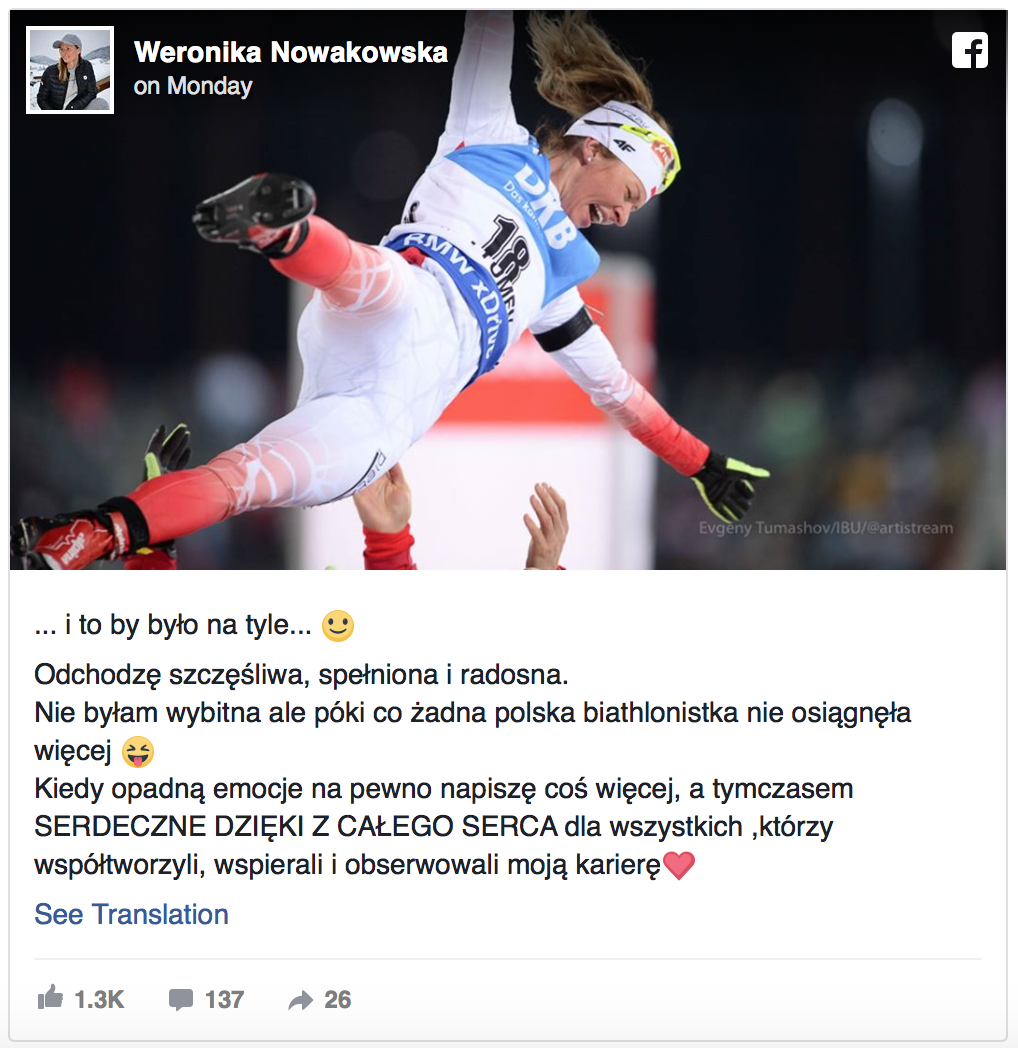
    Weronika Nowakowska is calling it a career. The 31-year-old picked up two World Cup podiums in the 2015 season before taking a break from competition to give birth to twins. She made a successful return this season and represented Poland in PyeongChang, with a top finish of 21st in the individual. She also had sixth- and fourth-place finishes on the World Cup this year and contributed to four different top-eight relay efforts, including one at the Olympics.
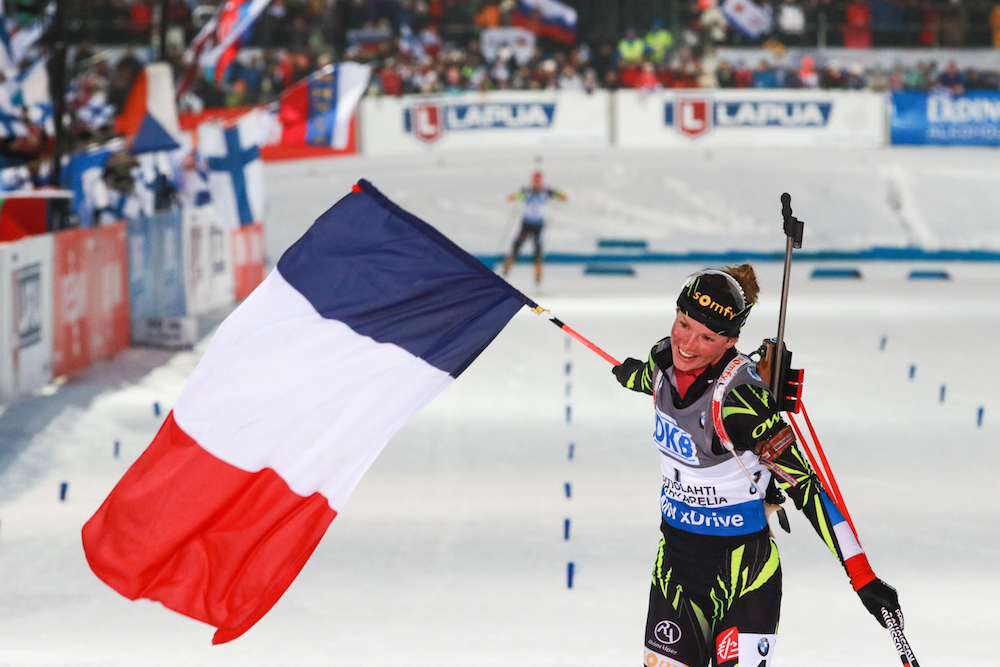
    “I leave happy, fulfilled and cheerful,” she wrote on her Facebook page, according to a translation. “I was not outstanding, but so far no Polish biathlete has done better”

    France

    Back in Oslo, French star Marie Dorin Habert ended her career. Dorin Habert – then simply Marie Dorin – competed in her first senior World Championships in PyeongChang in 2009, where she had a top individual finish of 18th and was part of the bronze-medal relay team. Fast forward and she had racked up a sprint bronze at the 2010 Olympics, seven World Cup wins, ten more World Championships relay medals, and four individual gold, one silver, and one bronze medal at World Championships, four of which were from the 2016 edition where she did not finish a single race without a medal.

    France’s Marie Dorin Habert celebrates her second win in as many races at 2015 IBU World Championships, after taking gold in the 10 k pursuit in Kontiolahti, Finland. (Photo: Kontiolahden Urheilijat/Jarno Artika)

    She found herself back in PyeongChang for the 2018 Olympics, where, despite a frustrating season until then, she was fourth in the sprint, bronze in the women’s relay, and gold in the mixed relay.

    “It’s so nice to end this way, to share it with all of the team, and the beautiful sun, and all the French people,” Dorin Habert said after winning the women’s relay in Oslo along with her teammates. “It’s a wonderful day for me. I would like to thank a lot, well, everyone, for being there in the biathlon family. I’m really happy to have this career, and I’m really happy for everything.”

    Jean Guillaume Beatrix he told is also retiring. Beatrix was a World Junior Champion in 2009, before going on to be a five-time World Championships team member and a 2014 Olympic bronze medalist in the pursuit. He was part of three silver- and one bronze-medal winning men’s relay teams at World Championships. But this season, he did not perform well enough to make a very competitive French team for the 2018 Olympics. His retirement was “a decision precipitated by my results”, L’Equipe, according to a translation.

    Czech

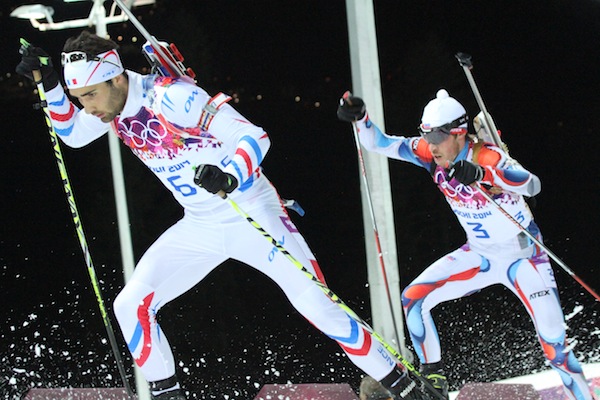
    France’s Martin Fourcade leading Jaroslav Soukup of the Czech Republic during the men’s Olympic 12.5 k pursuit at the 2014 Olympics.

    Jaroslav Soukup, the bronze medalist in the sprint at 2012 World Championships, where he was also part of the silver-medal mixed relay team, is retiring. Later in 2012, he suffered a horrendous accident while biking, including open fractures in his arm and neck and back injuries. By 2014, he made it back and won the same medals at the Olympics that he had at World Championships two years before: bronze in the sprint and silver in the mixed relay. Soukup qualified for the 2018 Olympics but only competed in the relay, which finished seventh. He had one World Cup top-30 this season.

    Norway

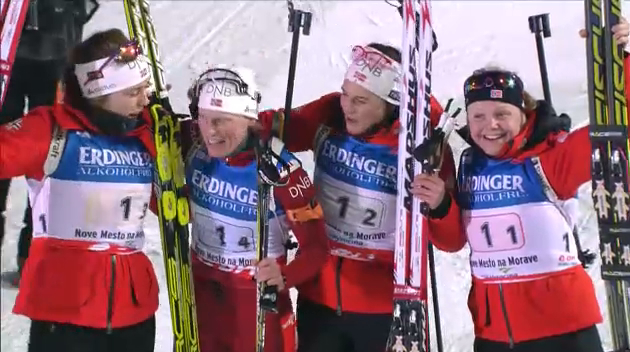
    Hilde Fenne, a staple of the Norwegian women’s team, retired after the last race of the season in Tyumen, Russia. Fenne never found breakout success as an individual; she had three top-15 finishes in her career. But she was an integral part of the women’s team and contributed to numerous World Cup relay podiums, as well as the gold-medal winning women’s relay at 2013 World Championships in Nove Mesto, Czech Republic.

    The Norwegian women’s relay celebrates its second-ever World Championships title after winning the 4 x 6 k event in Nove Mesto, Czech Republic. From left to right: Synnøve Solemdal, Tora Berger, Ann Kristin Flatland and Hilde Fenne.

    In that final race, her teammates wrote her name on their cheeks. “She has been a very important piece for me,” teammate Synnøve Solemdal told NRK, almost in tears. “We have stayed in a lot of hotel rooms together. I’m going to miss her very much.”

    On the men’s side, there is uncertainty as to whether some veterans will stick with racing or not. One is Ole Einar Bjørndalen, who was left off Norway’s Olympic team, who for the first time since 1992 this season. And yet, the 44-year-old has not stated that he will retire, and some who know him are speculating that he may try to stick it out one more year and go out with better results than he saw this season.

    Also with no stated plans is Emil Hegle Svendsen. Bjørndalen is the winningest athlete in World Cup history; Svendsen is number four. He won the World Cup overall title in 2010, and is a four-time Olympian. He won gold in the individual in 2010 and in the mass start in 2014, after which he suffered a total collapse anchoring the Norwegian men’s relay. In the past seasons he has been off and on, and he has only won two races since then. But this season he showed flashes of brilliance, and he was third in the mass start at the 2018 Olympics as well as anchoring the silver medal men’s relay and mixed relays.

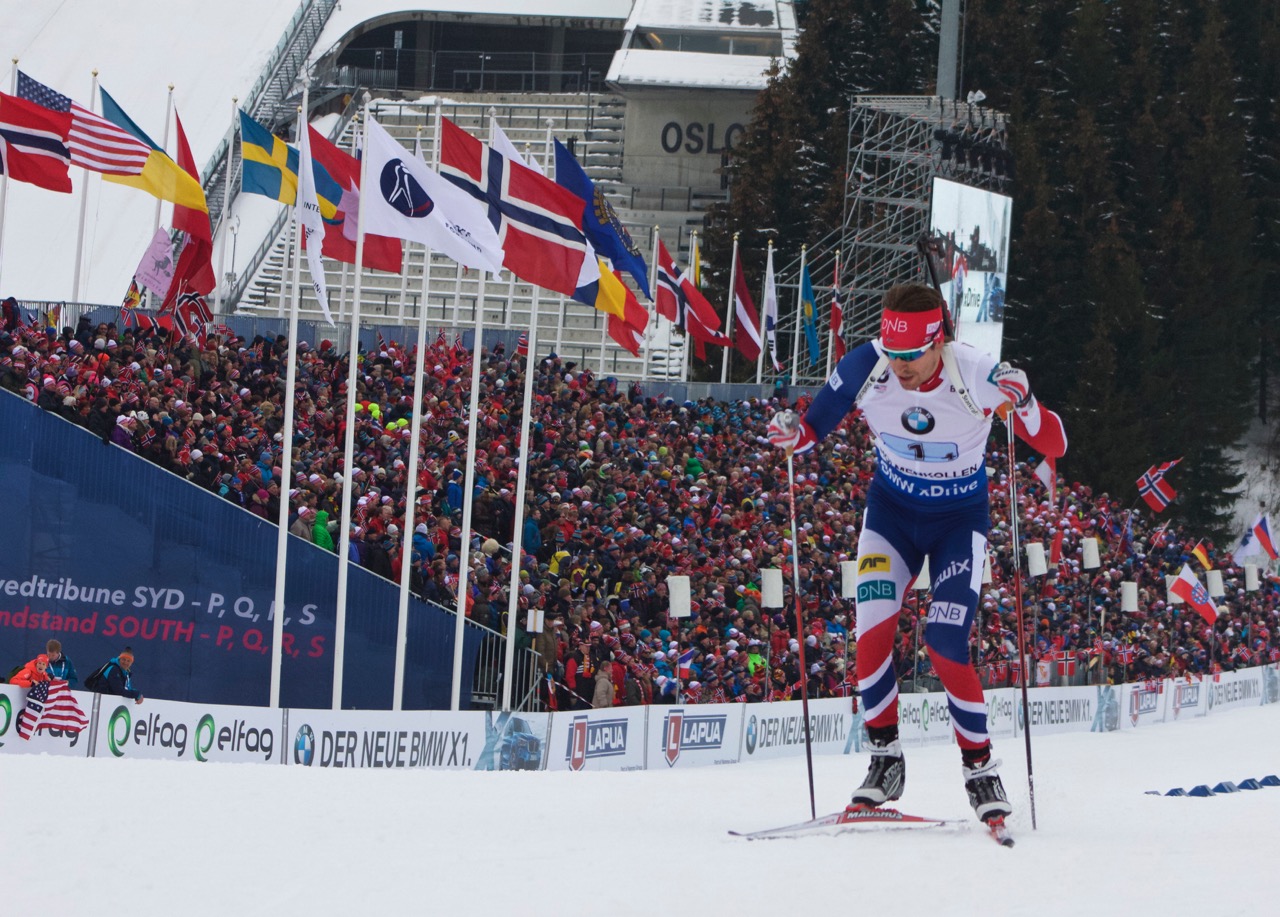
    Emil Hegle Svendsen of Norway leaves the stadium in the 2016 Holmenkollen World Cup as thousands of his countrymen cheer him on. Svendsen has not officially announced his plans for next season. (Photo: JoJo Baldus)

    “What Emil has done is absolutely fantastic,” teammate Tarjei Bø – who won the overall World Cup the year after Svendsen – told NRK two weeks ago. “He has won everything, and in addition done it several times, and he has come back again and again after being down. He has had a fantastic career and I hope he continues.”

    Finland

    She just won the overall World Cup crystal globe, but Kaisa Makarainen is not sure whether she will continue racing. In several previous years she had already discussed potentially retiring, but now she is reportedly waiting to think it over more as well as to discuss with the new team staff. U.S. Biathlon Women’s Coach Jonne Kahkonen, himself a Finn, was just announced as the new Head Coach for Finland.

    Germany

    Florian Graf, an athlete who finished as high as fourth on the World Cup in 2013 but has more recently been racing on the IBU Cup, is calling it quits at age 29.

    Several other top athletes are suspected to be considering retiring, but there hasn’t been much on the record discussion by them. Stay tuned.

  • More Olympic and World Championship Medalists Join Tyumen Biathlon Boycott

    More Olympic and World Championship Medalists Join Tyumen Biathlon Boycott

    Canada’s Christian Gow (12) chases Germany’s Erik Lesser during the men’s 4 x 7.5 k relay at the 2018 Olympics in PyeongChang, South Korea. Germany won bronze. Lesser lamented the situation and said of the IBU’s decision to hold World Cups in Tyumen, Russia, despite requests from him and other athletes to move the event: “If we don’t go, it’s wrong because it’s our sport we love. [But] if we go to Tyumen, we maybe send the wrong sign to IBU.” (Photo: FlyingPointRoad)
    In three weeks time, biathlon’s World Cup circuit will move to Russia.

    But a number of the sport’s stars won’t be there – and others plan to attend, but aren’t very happy about it.

    In an Executive Board session in PyeongChang, South Korea, a few weeks ago, the International Biathlon Union (IBU) decided to go on as planned with World Cup races in Tyumen, Russia, even though the Russian Anti-Doping Agency is still not compliant with the World Anti-Doping Code.

    Biathlon Canada had announced in December that it would boycott the event if it was kept in Russia, following revelations of systematic abuse of the anti-doping system by that country. In the intervening months, athletes appealed to the IBU through private channels to move the races to a country which complies with the WADA Code.

    After the IBU’s most recent announcement, the United States and Czech Republic have also gone public with boycotts of the event.

    Sebastien Samuelsson of Sweden celebrating silver in the men’s 12.5 k pursuit at his first Olympics on Monday in PyeongChang, South Korea. Samuelsson announced today that he is boycotting the World Cup Finals in Tyumen, Russia, because Russia is not in compliance with the World Anti-Doping Code. (Photo: IBU/Biathlonworld)

    Today, 2018 Olympic pursuit silver medalist (and relay gold medalist) Sebastian Samuelsson of Sweden announced on Twitter that he will not go to the races either.

    “Nations without a functioning anti-doping organization should not have competitions at the international level,” he wrote, according to a translation. “Also, worried about the safety of both myself and the doping tests in Russia.”

    Also not going is Klemen Bauer of Slovenia, a 2012 World Championships relay medalist who is a four-time Olympian.

    “I’m not planning to go to Russia at all,” he told FasterSkier in a Twitter exchange. “I was quite sure the IBU will replace the races, but despite all the effort we put into the clean/er biathlon, thanks to the president of the IBU that didn’t happen.”

    Both men are running for positions on the IBU’s Athletes Committee.

    “The idea is to improve the active role of the athletes and the voice of the athletes,” Bauer wrote of his candidacy. “We’ll see.”

    Another man running for a spot on the Committee is Germany’s Erik Lesser, 2014 Olympic silver medalist in the individual, 2015 World Champion in the pursuit, and several-time Olympic and World Championships relay medalist.

    Lesser will be attending the races in Tyumen, but he wasn’t happy about the IBU’s decision to hold them there.

    Klemen Bauer of Slovenia competing in the mass start at the 2018 Olympics in PyeongChang, South Korea. Bauer will not compete in the World Cup Finals in Tyumen, Russia. (Photo: FlyingPointRoad)

    “In my opinion the RUSADA and the Russian Federation have not done enough to light up this case,” he wrote in an email to FasterSkier. “During the last years, WADA and some commissions found a bunch of proof about a doping system in Russia. But RUSADA and [the Russian Biathlon Union] did nothing to fight against doping. The Anti-Doping-Laboratory in Moscow still does not have a license, and all the officials are in the same seats. It’s a wrong sign, after these problems, to go to Russia and celebrate World Cup Finals.”

    Lesser and teammate Arnd Peiffer, the 2011 World Champion in the sprint who then won gold at the 2018 Olympics, and who has even more World Championships and Olympic relay medals than Lesser, wrote a letter to the IBU explaining their position.

    Yet a few weeks ago, the IBU decided to go ahead and hold the World Cup in Tyumen anyway. They issued a press release explaining the decision.

    “I‘ve read the press release and I still don‘t understand why they decided this way,” Lesser wrote. “Because it‘s a threat to Russian biathlon fans and the Organizing Committee will take care of our safety? Wow, these are true reasons to keep the World Cup in Tyumen. So, I don‘t really think that reasons are valid.”

    Last season, there was also supposed to be a World Cup in Russia. But in 2017, several teams announced that they would boycott the event and IBU President Anders Besseberg had a contentious meeting with athletes, after which the IBU decided to move the event.

    This season, despite appeals by athletes like Lesser, Peiffer, and the others, that has not yet happened. And so in the end, Lesser says that he will compete in Tyumen, even though he wishes the races were somewhere else.

    “We argued with our federation and we decided to go to Tyumen,” he wrote. “The sport is the first [priority] and we want to compete. We hope that we can do a good job in Russia. We are there to stand as clean athletes.

    “It‘s bad that the IBU put us athletes in this position,” he wrote. “Actually it‘s not our job to be political. It‘s our job to be athletes and compete against other. If we don’t go, it’s wrong because it’s our sport we love. [But] if we go to Tyumen, we maybe send the wrong sign to IBU.”

  • World Cup Returns: Falla Holds Off Swedes, Caldwell 8th in Lahti Skate Sprint

    World Cup Returns: Falla Holds Off Swedes, Caldwell 8th in Lahti Skate Sprint

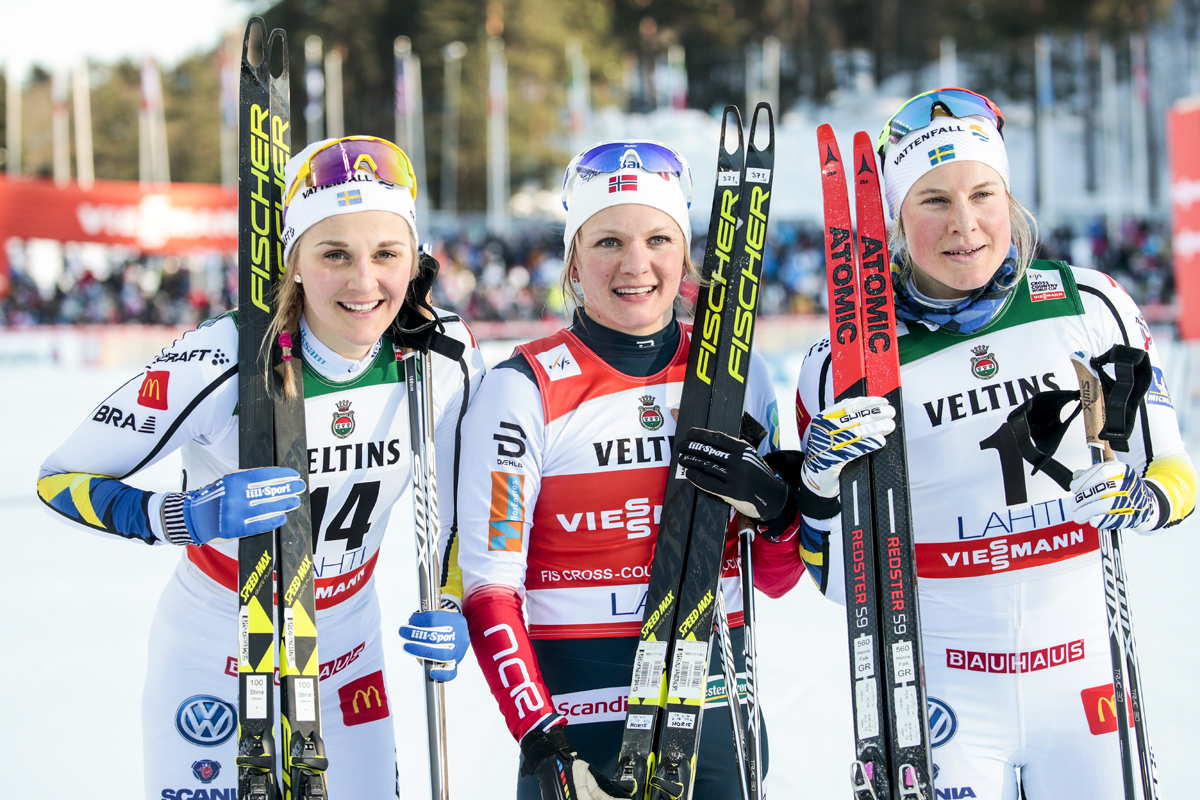
    The women’s 1.4 k freestyle sprint podium at Saturday’s World Cup in Lahti, Finland, with Norway’s Maiken Caspersen Falla (c) in first, and Sweden’s Stina Nilsson (l) and Hanna Falk (r) in second and third, respectively. (Photo: Fischer/NordicFocus)

    Eight points. That’s the number that separated Norway’s Maiken Caspersen Falla and Sweden’s Stina Nilsson in the Sprint World Cup standings before Saturday’s freestyle sprint in Lahti, Finland.

    Three sprints. That’s the number of World Cup sprint races that remained in the 2017/2018 calendar, one of which took place on Saturday.

    With one down and a classic sprint and skate sprint to go, Falla’s lead has grown to 28 points. It’s not much, with 150 sprint points remaining in the two remaining races (100 for winning the Drammen classic sprint and 50 for winning the skate sprint at World Cup Finals in Falun), but she’s getting there. Let’s just say neither of these two women can afford to skip a sprint.

    Coming off her last race of the Olympics, the team sprint (where Norway took bronze behind the U.S. and Sweden), Falla had 10 days to recover before Lahti. Nilsson had six days after notably racing to third in the 30-kilometer classic mass start on the last day of the 2018 Winter Games in PyeongChang, South Korea.

    Six time zones away from Korea in Finland, Falla and Nilsson faced off once again, but instead of racing for gold (which Nilsson had claimed in the Olympic classic sprint), they’re in a race for the Sprint Crystal Globe (of which Falla is the two-time defending champion).

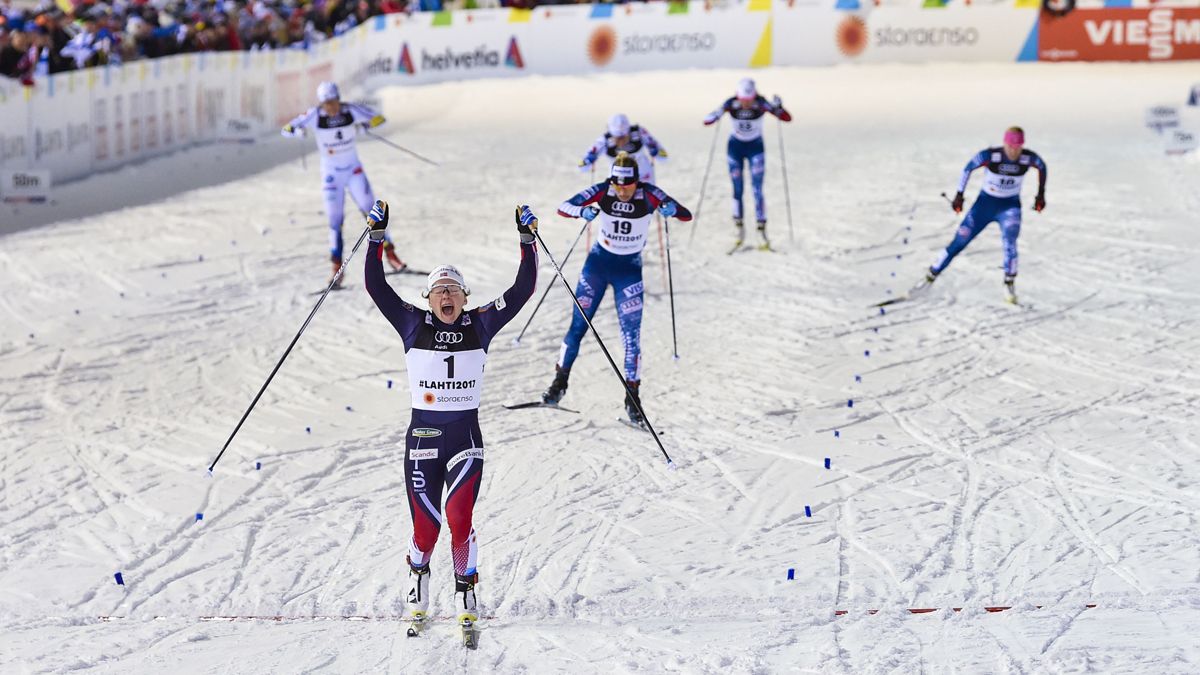
    Norway’s Maiken Caspersen Falla celebrates her gold medal in the 2017 World Championships freestyle sprint in Lahti, Finland, ahead of Americans Jessie Diggins (19) and Kikkan Randall (r), who placed second and third, respectively. The third U.S. woman in the final, Sophie Caldwell (second from r) finished sixth. (Photo: Fischer/NordicFocus)

    As alluded to, Falla had the edge on Saturday, winning the women’s 1.4 k skate sprint by 0.36 seconds over Nilsson in 2:54.83 minutes. She did it by leading from start to finish — a tactic she hadn’t necessarily planned nor desired —on the same course that she won on at World Championships last year. In that skate sprint, Falla bested Americans Jessie Diggins and Kikkan Randall for gold. Diggins and Randall placed second and third in that race, respectively, but the two did not contest Saturday’s sprint in Lahti. Instead, they were coming off a New York City media tour that involved several appearances with major TV networks.

    But back to Falla. The 27-year-old left her competition chasing on Saturday, advancing to the final after placing second in her quarterfinal (0.71 seconds behind Nilsson) and first in the first semifinal (just 0.04 seconds ahead of Nilsson in second place).

    She had qualified for the heats in 12th, 7.96 seconds off of the top time of 2:54.72 set by Sweden’s Hanna Falk.

    “I was really stressed in the prologue,” Falla said afterward, according to an International Ski Federation (FIS) press release. “In the heats I had a better feeling.”

    She had to fend off three Swedish heavy hitters in the final: Nilsson, Falk and Ida Ingemarsdotter.

    But Falla never let any of them get ahead of her — an impressive feat on Lahti’s sprint course with two major climbs. The lone Norwegian in the final, Falla jetted out of the gate and into the lead, with Falk quick to challenge her before the first uphill. But Falla stayed ahead.

    “I didn’t want the first position, but I just got it in the start,” Falla told FIS in a televised post-race interview. “So I just had to lie in front and do the best I could.”

    While Falla continued to drive the pace, Sweden’s Falk took a breather near the back while Ingemarsdotter and Nilsson slotted into second and third. Germany’s Sandra Ringwald, in her first World Cup sprint final since the Tour de Ski in late December, skied in fourth, ahead of Falk and Switzerland’s Laurien van der Graaff.

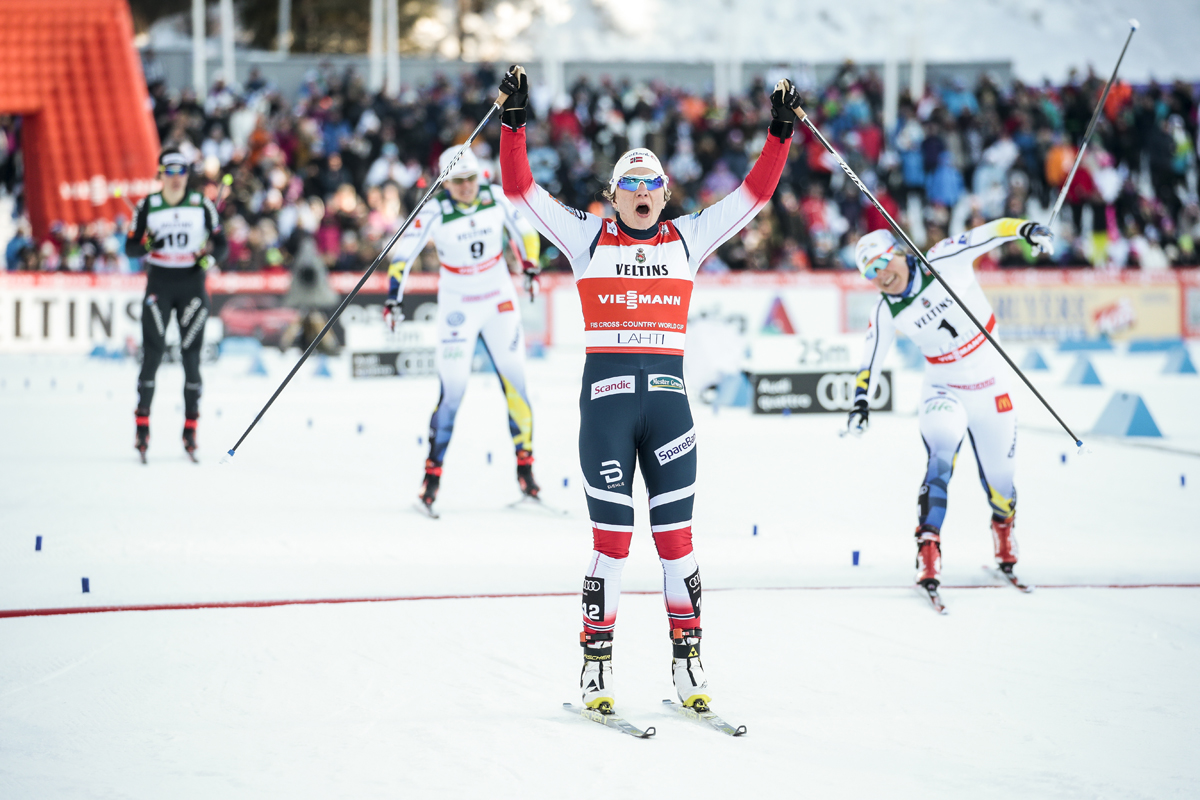
    Norway’s Maiken Caspersen Falla celebrates her win in the women’s 1.4 k freestyle sprint on Saturday at the World Cup in Lahti, Finland. (Photo: Fischer/NordicFocus)

    Falla led the downhill then into last long, multi-tiered climb, while the three Swedes assembled hungrily behind her. Nilsson began her attack when they hit the steepest section near the top, but Falla was at least a step or two ahead as they rounded the 180-degree turn and began to descend down the other side.

    Tucking into the stadium, Falla got low and used her fast skis to gain a few more meters on Nilsson. She then took a couple of strides to keep her momentum and finally launched her final V2 push toward the finish.

    No one could match her; not Nilsson skiing closest to her, nor Falk or Ringwald just behind. She didn’t even have to lunge to secure the victory over Nilsson, but Falk and Ringwald did as they placed third (+0.78) and fourth (+0.88), respectively. For Ringwald, fourth place marked her best individual World Cup result in a little over a year (after she placed fourth in a 2017 skate sprint in Toblach, Italy).

    For Falla, it was her second individual World Cup win of the season and first victory since Dec. 2 in Lillehammer, Norway, where she won the classic sprint. Falla was the 2014 Olympic champion in the individual skate sprint. And let’s not forget, she won the World Championships sprint in Lahti last year as well as the 2016 Lahti World Cup skate sprint.

    “Last year here and also two years ago I was in front down the last downhill, and I succeeded there for the last three years so I knew it is very possible to lie in front as well,” Falla told FIS. “In the final I had Stina and Hanna behind me and I knew both of them are really fast. I have a big respect for them and I am very happy I could win today.”

    Nilsson, who bested Falla for the classic-sprint gold medal in PyeongChang, had qualified for Saturday’s heats in 14th, 8.26 seconds out of first.

    “I felt pretty good in the prologue, but in the end I was missing some seconds, which I probably lost after the start,” she told FIS. “In the heats I found my pace and I could keep all the way through to the final. In the final, I was not so fast after the start but I am happy to be on the podium again. It is very good for the sport that the battle for the Sprint Crystal Globe is still going.”

    Falk also said she was satisfied with her end result, after winning her quarterfinal and advancing as a lucky loser in third in the semifinal with Falla and Nilsson.

    “I had a very good qualification,” Falk told FIS. “I tried to fight in every heat. The final was hard but I am happy to be third today. I had a good speed before the last corner but it was always tight there. It was a tough fight between me and Sandra [Ringwald]. I’m happy to be third.”

    Sadie Bjornsen (U.S. Ski Team) qualified fifth in the women’s 1.4 k skate sprint at the World Cup in Lahti, Finland, and went on to finish 17th overall. (Photo: Fischer/NordicFocus)

    Four Americans in Top 30

    Leading the Americans in the qualifying round was Sadie Bjornsen in fifth, 3.88 seconds off Falk’s fastest time. Sophie Caldwell qualified in 17th, Ida Sargent advanced in 21st and Rosie Brennan followed in 29th.

    For Brennan, it was her first time back in the heats in about two months after she qualified in 21st in the Tour de Ski classic sprint on Oberstdorf, Germany. While the heats were canceled that day due to a storm, Brennan went on to finish the Tour in 24th overall. Since then, however, the U.S. Ski Team (USST) member has finished outside the top 40 in four World Cup races and one Olympic event (the 15 k skiathlon).

    Despite finishing sixth in her quarterfinal on Saturday, 4.91 seconds behind Ingemarsdotter in first, Brennan’s overall result of 29th indicated she was back on track.

    “I have been struggling with health and recovery since the tour,” Brennan wrote in an email to FasterSkier. “I’ve just been taking things day by day and trying to work through whatever issue I am facing. The Olympics was a huge disappointment for me. I did what I thought was best to prepare for the games, but have struggled with my health and my body and as a result was far from where I wanted to be at that time.”

    In PyeongChang, she raced one event — the skiathlon — and placed 58th. She stayed with the team for the duration of the Games, hoping to have the opportunity to race the 30 k. But that wasn’t in the cards.

    “It’s very challenging to be at the games and not be participating in the events that you have trained for over so many years,” Brennan reflected. “I have had some good races this year and have made some improvements so I am doing my best to remember that and try to see each day as a new opportunity. My goals moving forward are more about my feelings, my body, and my health than any results. I am very happy to have made a step forward today and am hoping my distance skiing will see the same results. I wasn’t able to ski my quarterfinal as well as I would have liked, but it’s been awhile since I’ve raced now so to just get another stab at it was a great step forward.”

    Sophie Caldwell (U.S. Ski Team) racing to 17th in the Lahti skate sprint qualifier. She went on to reach the semifinals and place eighth overall. (Photo: Fischer/NordicFocus)

    Out of the four Americans in the quarterfinals, Caldwell was the lone U.S. woman in the semifinals. She had raced to second in her quarterfinal, finishing 0.25 seconds behind Ringwald, who won that heat. But her road there wasn’t an easy one, as Caldwell skied up from near the back of the pack into second coming out of the final downhill. There, she scooted ahead of Norway’s Heidi Weng, who had been second at the time, while Weng dropped to last in the heat.

    Weng, who placed 26th overall, told NRK that she was “mowed down” when Caldwell ran over her skis.

    “… I had the ambition to do well, and it’s incredibly annoying when something like that happens,” Weng said, according to a loose translation.

    She added that she didn’t discuss it with Caldwell after.

    “I can’t do anything about it now,” Weng said. “Things like that happen in a sprint…”

    Caldwell reflected that it might’ve been worth conserving less energy and using more to get in a better position before that last downhill.

    “I found myself in the back there with no room to pass or respond to a move,” Caldwell wrote in an email to FasterSkier. “… There is a big draft on the final downhill and if you’re leading, you need to send it and have a good bullet tuck, and if you’re within contact of the leader, you can try to work the draft and in my quarter I was able to do that. I don’t remember there being contact with Heidi, but we both definitely bobbled a bit on the final corner.”

    Caldwell’s first World Cup podium came in Lahti four years ago. Last year at World Championships, she reached the skate-sprint final and placed sixth overall.

    On Saturday, she made it to the semifinals and finished fourth in the second semi, 1.46 seconds behind Ringwald in first.

    “I have had some success in Lahti before and I’ve also had some disappointing results, and I think today was somewhere in between,” Caldwell wrote. “I enjoy how tactical this course can be with all the corners and transitions. I was feeling quite good today, but I struggled to find that extra punch and didn’t ski with the confidence or control I know I’m capable of, so even though the result is by no means a bad one, I was just disappointed in how I skied mentally in the semi final.”

    She was pleased with her recovery after the Olympics, where she placed eighth in the classic sprint and fifth with the women’s 4 x 5 k relay.

    “The Olympics can be physically and emotionally exhausting, so I made sure I took some time to take it easy and get my feet under me again,” Caldwell wrote. “I was really looking forward to getting back in the World Cup routine in Europe. We had a very long travel day, so we were feeling a little rugged the first day here, but some good sleep, food, and training had me feeling quite good a couple days later. I did some light intervals on Thursday that felt quite good and was psyched for today.”

    Bjornsen described having some trouble transitioning from the Olympics back to the World Cup. She raced four events in PyeongChang, with a top individual result of 14th in the classic sprint.

    “It was an interesting step back to the World Cup today,” Bjornsen wrote in an email to several media outlets. “It has been a real ‘homesick’ week here coming back from the Olympics, and sometimes hard to feel how your actual muscles are feeling instead of your head. Fortunately, my muscles felt surprisingly good in the qualifier and I felt really excited to see what I could do today!”

    In her quarterfinal, she recalled getting “tangled” and losing her positioning on the first turn, leaving her chasing the rest of the group.

    “I finally caught them on the very top of the course, but just narrowly missed getting into their draft down the hill, and missed moving with those top three,” Bjornsen wrote. “Sprinting has been everywhere from amazing to frustrating this year, and what I have learned is that you can never think too hard about it. Often for me, the difference between a fantastic day, and a frustrating day is some super move that I either find, or I miss.”

    She ended up fourth in her quarterfinal, 2.84 seconds behind Falk in first, which put Bjornsen 17th overall.

    “I am just looking forward to heading into tomorrow with a head that is back excited again, and some muscles feeling good!” Bjornsen wrote of Sunday’s 10 k classic. “I put a lot of focus into my form at the Olympics without much thought about afterwards. Fortunately, the majority of the World Cup field is in the same state, so now we are all just racing with what sort of energy and excitement we have left. I always kind of like that. It is raw and fun.”

    Sargent finished the day in 27th overall after placing sixth in her quarterfinal, 1.07 seconds behind Sweden’s Anna Dyvik in first. After skiing in fourth in the middle of the race, Sargent moved up to second on the final downhill toward the finish. But on the tight lefthand corner before the finishing straight, she lost her position and momentum and slipped to sixth.

    “Today wasn’t great but it was a huge step forward for me,” Sargent wrote to FasterSkier. “I haven’t raced much recently and was struggling with injury so I’m just super happy to be racing again and very excited to have a bunch more racing in the next few weeks.”

    In the last World Cup sprint before the Olympics, she broke her thumb and flew to Colorado for surgery. Sargent then jetted to South Korea, where she placed 33rd in the Olympic classic sprint.

    “I’m excited to feel like my fitness is still there after so much travel and not much racing,” Sargent wrote.

    Canada’s Dahria Beatty just missed making the rounds in 34th place on Saturday in the Lahti World Cup skate sprint. (Photo: Fischer/NordicFocus)

    Beatty 34th for Canada; Phinney 36th in First World Cup

    Canada’s Dahria Beatty missed qualifying for the heats in 34th, 0.9 seconds out of 30th place. While she was the lone Canadian woman competing on Saturday, three other American women started, with Kelsey Phinney of the Sun Valley Ski Education Foundation (SVSEF) racing to 36th, 1.25 seconds out of qualifying, in her World Cup debut.

    “I was pretty happy with my effort, definitely a little bummed to miss out on the heats, but cool to know that I’m pretty close to that level!” Phinney wrote in an email to FasterSkier. “I’m psyched to be here and getting a World Cup start was one of my main goals of the season. Being a second out of qualifying will for sure help stoke the fire for next year and I learnt a lot today from things that went right and things that didn’t.

    “This was my first World Cup start and everyone has been so welcoming,” she continued. “I’ve been having a lot of fun and just trying to take it all in. … It’s hard to put the feeling of being at the start line of a World Cup into words, it’s something I’m hoping to get to experience a lot more of!”

    (Her Sun Valley teammate Kevin Bolger, also in his first World Cup, placed 11th overall after reaching the semifinals in the men’s 1.6 k sprint. “I am so proud of Kevin, it was so special to get to watch him holding his own with the best in the world in the heats today! Really cool to see your teammate crush it in his first World Cup.”)

    Phinney explained that Saturday was a one-time opportunity since she’ll be joining the OPA Cup trip on Monday before flying back to the U.S. for SuperTour Finals in Craftsbury, Vermont, later this month. She’s spent the better part of the last month racing in Norway, placing sixth in a FIS skate sprint in Åsen and 13th in a Scando Cup skate sprint last weekend in Trondheim.

    “She had a really impressive Scando Cup Sprint last weekend, and has shown she can skate sprint with the best of them,” SVSEF Head Coach Chris Mallory wrote in an email to FasterSkier. “I thought she might squeak into the top 30 with a good day.  She skied the first half of the sprint today very fast, so the pacing was just a touch off.  But still, very solid effort for her first WC.  She’s shown the speed is there, so she’ll be back.”

    Kaitlynn Miller (Craftsbury Green Racing Project) on her way to 61st in the World Cup skate sprint qualifier in Lahti, Finland. (Photo: Fischer/NordicFocus)


    Also for the U.S., two Craftsbury Green Racing Project (CGRP) skiers, Caitlin Patterson and Kaitlynn Miller, placed 56th (+20.12) and 61st (+21.70), respectively.

    ***

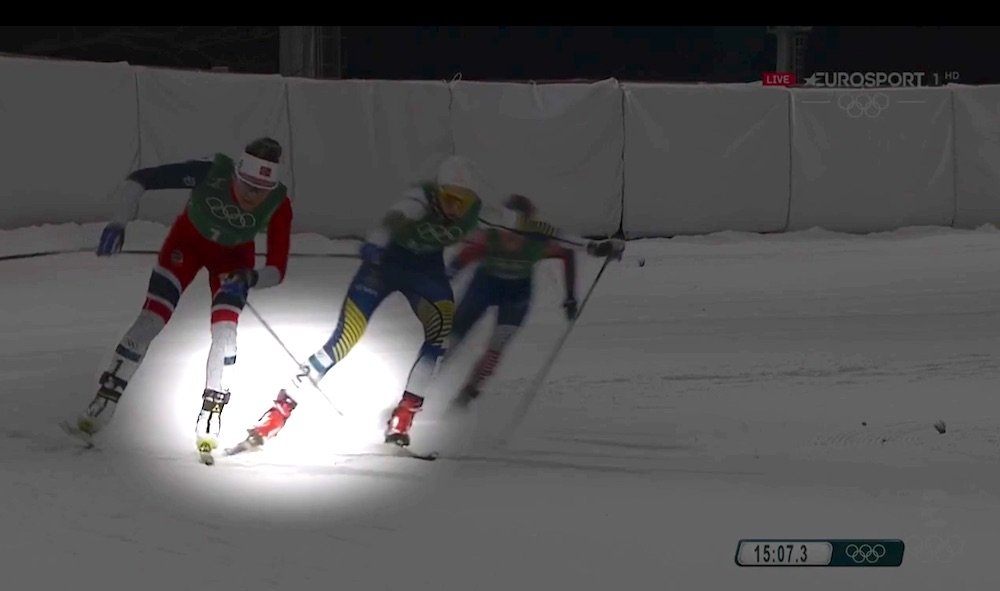
    Notes: In the first women’s quarterfinal, Germany’s Victoria Carl skied up on the ski tails of Finland’s Krista Pärmäkoski, which caused both women to crash out of contention on the final downhill. Pärmäkoski had been skiing in second at the time, behind Nilsson in first. She finished fifth in that heat (+12.11) and Carl, who appeared to hit her head, took a long time to stand back up and crossed the line in sixth (+49.5). Carl was relegated to last (30th place) for obstruction.

    German coach Janko Neuber told reporters after that, “She crashed, fell on the head and bruised the back of her neck. As a precaution she is being taken to the hospital for evaluations, but we are optimistic that it isn’t anything serious.”

    Pärmäkoski, who finished the day in 21st overall, wrote in Instagram: “This was a bit tough but today, with the fall, shorts [sprints] were short. Fortunately tomorrow is another chance.”

    ***

    Results: Qualifier | Final

  • How The Race Was Won: Women’s Team Sprint Video Analysis

    How The Race Was Won: Women’s Team Sprint Video Analysis

    In his own unique style, special guest Cosmo Catalano from Cyclocosm.com breaks down how Kikkan Randall and Jessie Diggins won Olympic gold in Pyeongchang, South Korea.

    HTRWW – 2018 Women’s XC Ski Team Sprint from Cosmo Catalano on Vimeo.

  • Sunday Olympic Rundown: Bjørgen Dominates 30 k Classic; Diggins 7th

    Sunday Olympic Rundown: Bjørgen Dominates 30 k Classic; Diggins 7th

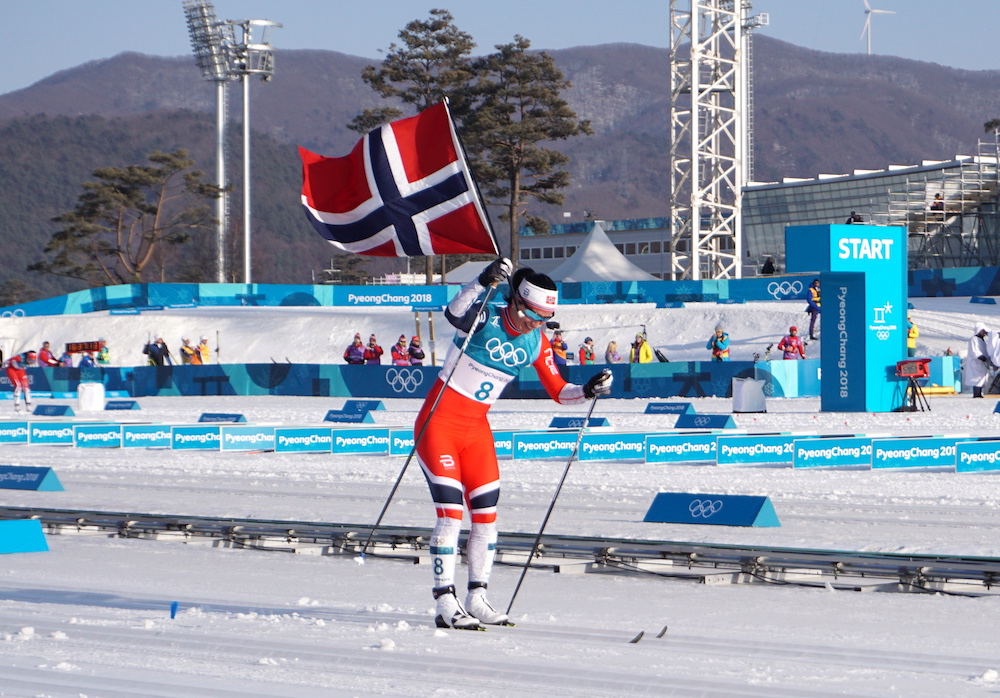
    Marit Bjørgen approaches the line for her eighth-career Olympic gold (and 15th medal) with a win in the final race of the 2018 Olympics, the women’s 30 k classic mass start, on Sunday in PyeongChang, South Korea. (Photo: Noah Hoffman)

    FasterSkier would like to thank Fischer Sport USA, Madshus USA, Concept2, Boulder Nordic Sport, and Swix Sport US for their generous support, which made this coverage possible.

    ***

    2018 Olympics (PyeongChang, South Korea): Women’s 30 kilometer mass start classic

    Report

    Marit Bjørgen went out with a bang. Skiing in presumably the final Olympics race of her illustrious career, the most-decorated Winter Olympian in history simply skied away from a strong field less than 10 kilometers into Sunday’s 30 kilometer classic mass start, earning the 15th Olympic medal of her career (and eighth gold) in dominant fashion.

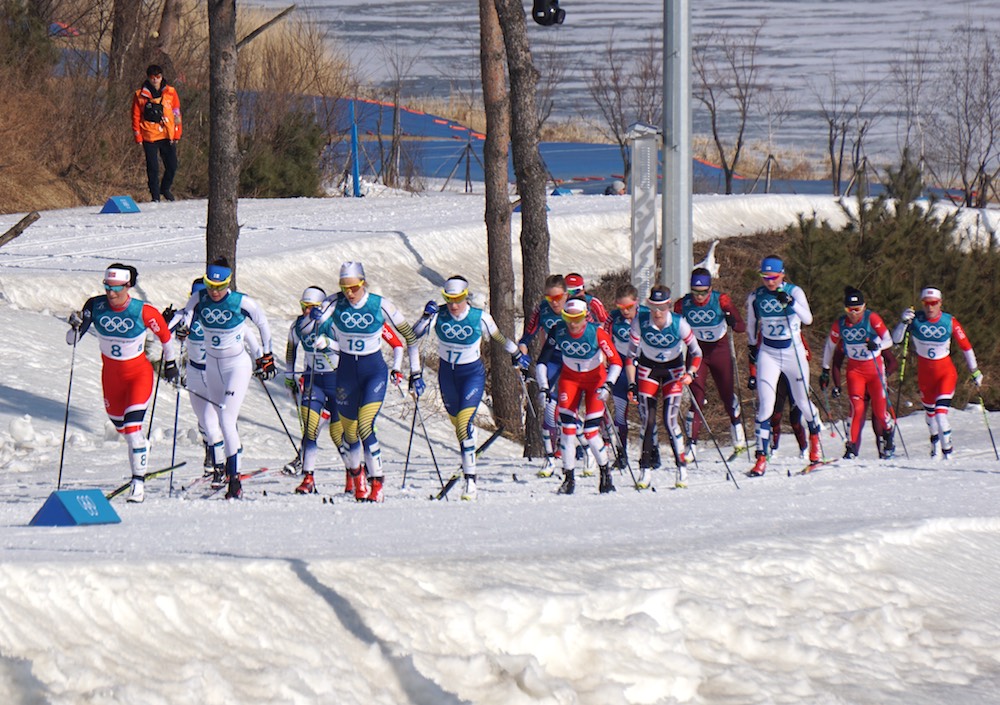
    From right to left: Norway’s Ingvild Flugstad Østberg leading Finland’s Kerttu Niskanen and Krista Pärmäkoski, Sweden’s Stina Nilsson, and Austria’s Teresa Stadlober (r), among others in the women’s 30 k classic mass start on the final day of the 2018 Olympics in PyeongChang, South Korea. (Photo: Noah Hoffman)

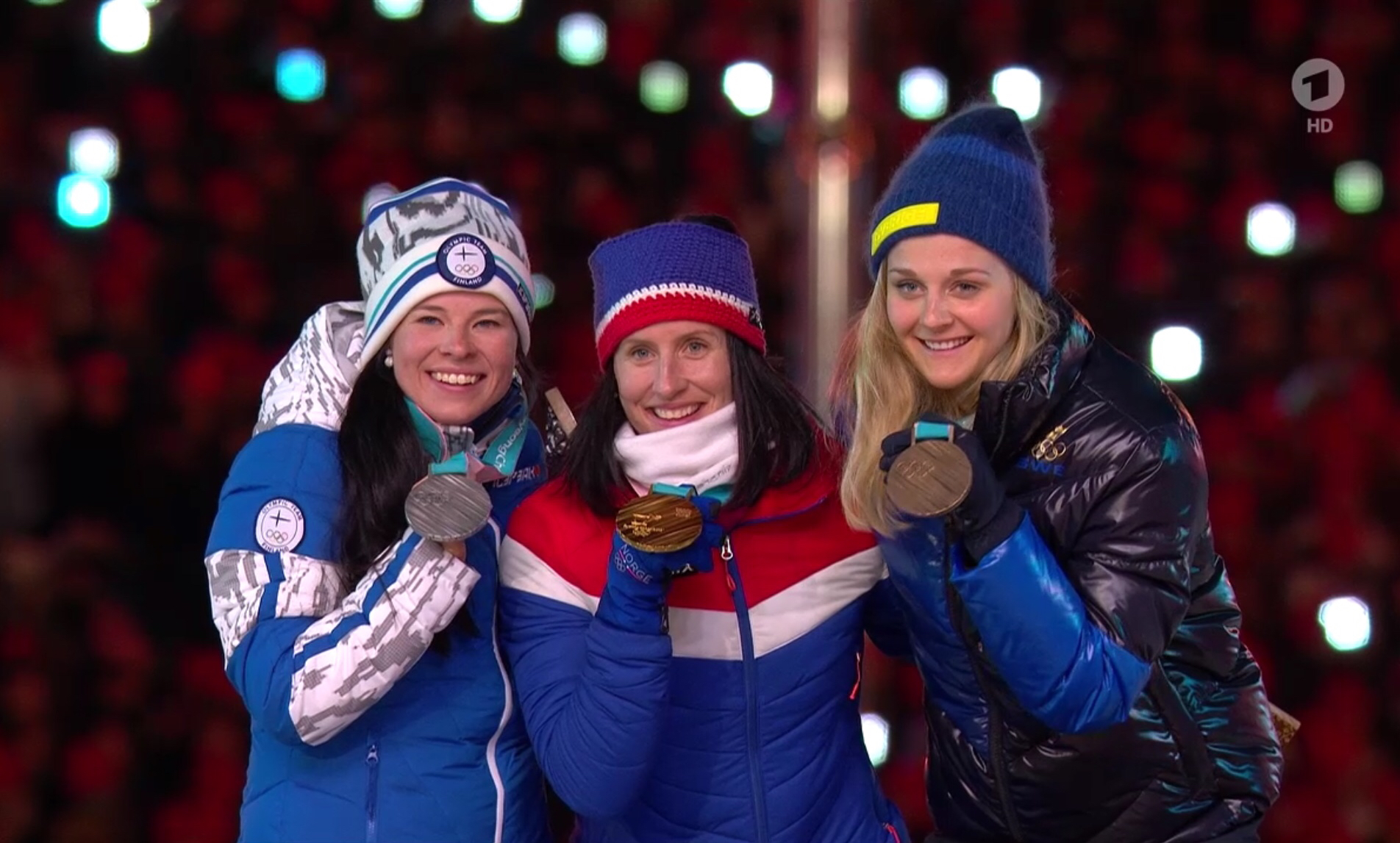
    Behind her, Finland’s Krista Pärmäkoski (+1:49.5) and Sweden’s Stina Nilsson (+1:58.9) rounded out the podium, with Nilsson breaking away from Norway’s Ingvild Flugstad Østberg (+2:00.4) within the stadium to edge her out for third.

    Fifth went to Charlotte Kalla of Sweden (+2:57.2), with Kerttu Niskanen of Finland sixth (+3:01.6). Jessie Diggins was seventh (+3:37.2), in an American performance that would have been lauded just a few years ago yet somehow represented her worst placing in all six races at these Olympics.

    Heidi Weng of Norway (+4:07.9) in eighth, Teresa Stadlober of Austria (+4:14.1) in ninth, and Masako Ishida of Japan (+4:20.8) rounded out the rest of the top ten. Stadlober’s ninth-place finish was particularly poignant; she was holding steady in silver-medal position through 20 k, before taking a wrong turn at an ill-marked course intersection and losing well over a minute returning to the correct track.

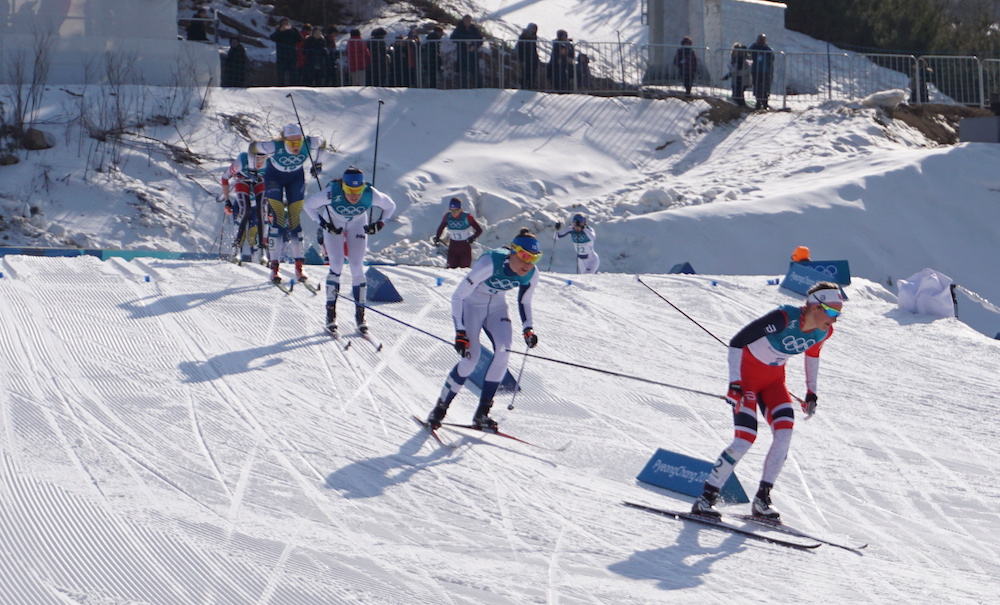
    Norway’s Marit Bjørgen (l) leading the pack during the women’s 30 k classic mass start at the 2018 Olympics in PyeongChang, South Korea. (Photo: Scott Patterson)

    But let’s go back to Bjørgen. Given those time gaps by the finish – nearly two minutes clear of second and third – this was clearly Bjørgen’s day. The 37-year-old Norwegian mother started in bib number 8, and was all of 1.1 seconds off the lead by the first checkpoint, less than one kilometer into the race. But after that… Bjørgen led by 2.3 k, midway through the first of four 7.5-k laps. Bjørgen led at 5 k. Bjørgen led at 7.5 k. Bjørgen led at 8.4 k. And so on. It was not literally a wire-to-wire victory, but it was pretty darn close.

    The race went from a mass start contest to a solo endeavor at roughly 9.5 kilometers in, midway through the second lap. Bjørgen simply surged ahead, and immediately opened up a small gap. By 9.8 k, the gap was 7 seconds. By 12.5 k, it was already up to 33 seconds. By 15 k, the advantage had swelled to 51 seconds. Bjørgen was putting nearly 10 seconds per kilometer on a chase group composed of Olympic medalists and World Championships podium finishers.

    With all due respect to Iivo Niskanen, the hero of Saturday’s courageous breakaway in the men’s 50 k classic, Bjørgen’s performance never felt in doubt the way Niskanen’s did. Bjørgen didn’t have any company, for one, and she had a shorter distance to cover, for another (“only” 20 k of solo skiing off the front). But mostly, well, she is Marit Bjørgen, the most dominant cross-country skier of all time.

    Bjørgen’s gap stretched to as great as 2:04 by the 27.5-k mark of the course. Finally, approaching the finish, she slowed slightly over the last few hundred meters, accepting a large Norwegian flag from a Viking helmet-clad fan and beaming as she carried it across the finish line. Her final time was 1:22:17.6. If they were the final 82 minutes of racing of a five-Olympics career, they were an exceptionally dominant 82 minutes.

    Behind her, a four-woman chase pack formed: Pärmäkoski, Kalla, Niskanen, and Stadlober. As late as 20 k, Kalla was still in seventh, nearly two minutes back of Bjørgen and roughly 35 seconds back of Stadlober in second.

    Soon after this, Stadlober took her wrong turn, skiing for some distance on the wrong course before having her error pointed out to her by a courseside coach or tech. She dropped from second to eighth within a kilometer.

    Reportedly, Austrian coach Markus Gandler was out on the course and the first to inform her of her mistake, yelling, “You are wrong!” She realized her mistake and turned around.

    “We were preparing the feed and noticed she didn’t come,” Gandler told Austrian broadcaster ORF, according to a translation. “I ran over but she didn’t hear me while skiing up. Only on the downhill I caught her.”

    “I don’t know if I should laugh or cry,” Stadlober told ORF after, according to a translation. “I can’t explain it to myself. I have been here for three weeks and if by now I don’t know the loop then I don’t know … I noticed skiing up that something wasn’t right because there was no more staff. When I looked over I just thought: Sh*t!”

    She said she had been feeling great up until that point and confident about her skis.

    “I would have had the power, but had-I-would-I [what could have been] is too late now,” Stadlober said of missing out on her first Olympic medal. “That’s life. It’s just bitter it happened in such a race and on a day when everything would have fit together.”

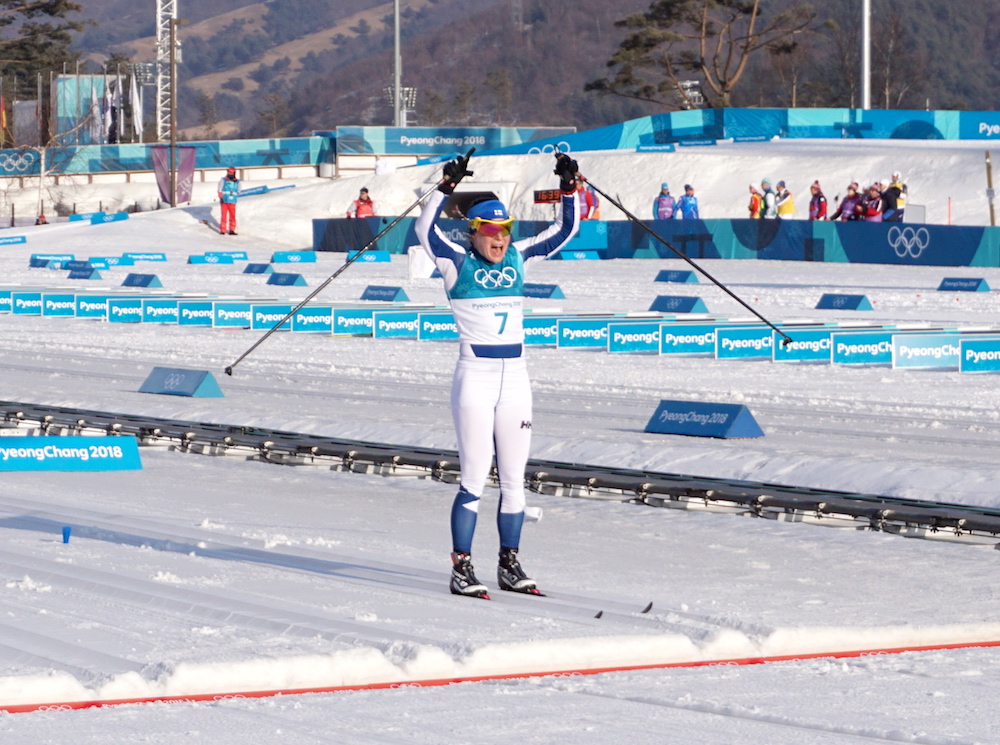
    Finland’s Krista Pärmäkoski celebrates her first individual silver medal which she claimed in the women’s 30 k classic mass start on Sunday at the 2018 Olympics in PyeongChang, South Korea. (Photo: Noah Hoffman)

    By 21 k, Pärmäkoski had a 13-second gap over Niskanen in the race for second, and Kalla had moved up to sixth. By 25 k, it was still Pärmäkoski in second, but now Østberg and Nilsson skiing lockstep in the fight for third.

    Pärmäkoski was never seriously threatened over the final lap, and crossed the finish line for silver.

    “I think that this 30 k was [the] hardest 30 k race [ever] for me,” Pärmäkoski reflected in a post-race press conference. “Of course I heard that Nilsson and Østberg come behind me and I also heard that now it’s 11 seconds, and then 14 seconds. And after this big downhill I heard that it’s a little bit more, but because I know that they are good in sprint, I just hoped that they can’t catch me. This was a crazy, crazy Olympics for me. Before I came here I wanted to win one individual medal and now I won three medals, so I am really happy.”

    In two Olympics, Pärmäkoski, 27, now has four medals — three of which came in PyeongChang (silver in the 30 k and bronze in the 15 k skiathlon and 10 k freestyle races).

    Behind her, Østberg and Nilsson dueled for the final podium spot. But while Østberg was aware of it, Nilsson hadn’t heard about Stadlober’s wrong turn ahead of them.

    Sweden’s Stina Nilsson (r) outlasts Norway’s Ingvild Flugstad Østberg (l) for bronze in the women’s 30 k classic mass start at the 2018 Olympics in PyeongChang, South Korea. (Photo: Noah Hoffman)

    At the finish, Nilsson looked surprised when Bjørgen told her she had won the bronze. Bjørgen then went immediately over to console her teammate, Østberg, who finished fourth, 1.5 seconds behind Nilsson in third.

    “I was quite sure that it was fourth. That I got the bronze was quite sick,” Nilsson told Norwegian broadcaster NRK, explaining that she thought the team staff was trying to give her false hope that a medal was within reach.

    “I did not realize that Stadlober had gone wrong. I thought she had moved away,” Nilsson said.

    But Østberg knew the bronze was between her and the Swede. “I definitely knew what I was fighting for. It’s amazing that she did not know, too,” Østberg told NRK.

    Diggins would finish roughly 90 seconds later in seventh, 36 seconds behind sixth and 30 seconds ahead of eighth. The result was emblematic of her day, in which she had skied for much of the race entirely by herself.

    Sadie Bjornsen was the next American, finishing in 17th (+6:32.6). The mid-teens result continued a trend at these Olympics; she was 14th in the classic sprint and 15th in the 10 k freestyle.

    The third American on the day was Rosie Frankowski in 21st (+8:53.8). Forget first Olympic start for the 26-year-old Alaskan and Alaska Pacific University athlete (which it was), Frankowski has zero World Cup starts to her name. She was the second American in the 20 k classic at last month’s U.S. Nationals, though, behind Caitlin Patterson.

    On Sunday Patterson was five spots behind in 26th (+10:26), after narrowly losing a sprint finish to Germany’s Victoria Carl.

    For Canada, Emily Nishikawa led the way in 30th (+12:14.1). She was followed by Cendrine Brown in 43rd (+19:06.3), as Anne-Marie Comeau did not finish.

    Also of note, Jessica Yeaton, who competes internationally for Australia but lives and trains in Anchorage with Alaska Pacific University, was 42nd (+18:37.2). And Petra Hyncicova, who skis in this country for the University of Colorado but races internationally for the Czech Republic, was 39th (+16:57.1).

    Results

    The women’s 30 k classic mass start medalists at the 2018 Olympics Closing Ceremony, with Norway’s Marit Bjørgen (c) in first, Finland’s Krista Pärmäkoski (l) in second, and Sweden’s Stina Nilsson (r) in third in PyeongChang, South Korea. (Screenshot: ARD broadcast)
  • Swedish Biathlon Caps Best Olympics with Relay Gold; U.S. Men 6th to Tie 1972 Mark

    Fredrik Lindström crosses the line first to secure a gold medal for his Swedish teammates in the men’s 4 x 7.5 k relay on Friday to close out biathlon competitions at the 2018 Olympics in PyeongChang, South Korea. (Photo: FlyingPointRoad)

    FasterSkier would like to thank Fischer Sport USA, Madshus USA, Concept2, Boulder Nordic Sport, and Swix Sport US for their generous support, which made this coverage possible.

    Remember when it was a big deal when Sweden won a Biathlon World Cup? The team in bright yellow has made it a habit at the 2018 Winter Olympics, winning their first Olympic relay gold and fourth medal over the last two weeks on Friday — the last biathlon race of the PyeongChang Games.

    “It’s dreams coming true at that moment,” Fredrick Lindström, the Swedish men’s 4 x 7.5-kilometer relay anchor said in a post-race press conference on Friday. “It’s my third Olympics and to be on top with these guys feels great. I don’t know what to say.”

    Lindström had taken gold in perhaps the most ideal way for an athlete in his position, by heading out on the last 2.5 k loop in first place, almost 41 seconds ahead of anyone else. While he had missed his first shot in the final standing stage of the race, Lindström cleared it with the use of one spare bullet. Meanwhile, his closest challenger for the win — Norway’s Emil Hegle Svendsen, who had followed him into the range and lined up alongside him to shoot — missed his first two targets and went on to miss more, ending up with a penalty lap after using all three spares.

    That was the end of gold for Norway and for Svendsen, who was all too familiar with the penalty lane in the closing moments of an Olympic relay. Four years ago in the men’s relay in Sochi, Russia, Svendsen as Norway’s anchor had been in the medal hunt until the final shooting. There, he used all of his spares and still left a target standing, which sent him to the penalty lap. After leading by as much as 20 seconds in the middle of that race, Norway finished fourth.

    But as they say, that’s biathlon. And on Friday, it was Sweden’s day and Lindström skiing on his own for a 2.5 k victory loop around the course. But he didn’t slow down. As the 28 year old skated up the final climb, he was greeted by several members of his team bowing up and down in a unison to celebrate the history that was about to be made. Lindström descended down into the stadium, not looking back and still pushing toward the line, before skiing to the sidelines a few meters before the finish to grab a small Swedish flag.

    Fredrik Lindström crosses the line first to secure a gold medal for his Swedish teammates in the men’s 4 x 7.5 k relay on Friday to close out biathlon competitions at the 2018 Olympics in PyeongChang, South Korea. (Photo: FlyingPointRoad)

    It wasn’t like the oversized French flag Martin Fourcade had been seen waving earlier in the Games, in the pursuit and again in the mixed relay. It was understated, like Sweden’s biathlon team before these Olympics, but he waved it proudly as he crossed the line to a sea of swarming teammates.

    Sweden (with Peppe Femling, Jesper Nelin, Sebastian Samuelsson, and Lindström) finished first with a cumulative time of 1:15.16.5 hours and a total of seven spares and zero penalties. Skiing alone and finishing 55.5 seconds behind them,  Svendsen crossed the line in second for Norway (with teammates Lars Helge Birkeland, Tarjei Bø, and Johannes Thingnes Bø), after tallying 12 spares and one penalty.

    In stark contrast to Lindström’s wide-eyed smile as he finished, Svendsen, 32, who had previously earned bronze in the mass start and silver with Norway’s mixed relay in PyeongChang, hung his head. His teammates met him at the finish and tried to improve his mood, but he was down.

    “It was a good battle. We wished each other luck before the start and it was a good fight,” Lindström said of contending with Svendsen for two out of three loops.

    Norway’s third-leg skier Johannes Thingnes Bø (1) racing his team into fourth to first in the men’s 4 x 10 k relay at the 2018 Olympics in PyeongChang, South Korea. (Photo: FlyingPointRoad)

    Johannes Bø had tagged Svendsen in first at the last exchange, 0.4 seconds ahead of Sweden, with Samuelsson handing off to Lindström. In the prone stage that followed, both Lindström and Svendsen cleaned without a miss. They left the range together, more than a minute clear of Germany’s Simon Schempp in third (who had missed three but avoided a penalty three spares). Germany had been 13.7 seconds back at the last exchange.

    “Emil had to go first the first loop, I went first the second loop, and on the shooting we were equal until that standing,” Lindström reflected. “I don’t know, I was the lucky man today. I feel proud that I managed that situation and to bring the gold to Sweden.”

    Even without gold, Svendsen is the third-most medaled biathlete in Olympic history, according to the International Biathlon Union (IBU). A four-time Olympian, he has eight medals, four of which are gold.

    “I think that’s awesome,” Svendsen said when asked about his medal tally at the press conference. “It feels very good and yeah, what can I say? Thank you.”

    Finishing more than a minute after Norway and exactly 2:07.1 minutes behind Sweden, Germany (with Erik Lesser, Benedikt Doll, Arnd Peiffer, and Schempp) placed third after Schempp incurred a penalty in the final standing stage. While he was still far enough ahead of Austria’s Dominik Landertinger to hang onto bronze, that penalty put Schempp nearly a minute behind Svendsen at the start of his last loop.

    While he waved to the crowd as he finished, Schempp later said he wasn’t happy with his performance. The German team accrued 10 spares and three penalties (two of which came in Doll’s second leg).

    “I just was disappointed in my race,” Schempp told German broadcaster ARD of his finish-line body language, according to a translation. “But at the end of the day we won the medal. That is the most important thing, that’s what matters, but of course, I can’t be satisfied with my shooting bouts. It was so incredibly gusty … I waited crazily long with my spare shots today because I thought the gusts would be over soon and then I could shoot. But unfortunately that was not the case, so I was on the range forever, losing a lot of time and then still didn’t hit every target. It was like a vicious cycle.”

    Lesser and Canada’s Christian Gow Up Front 

    Sweden had positioned itself for a medal from the gun, with first-leg skier Femling tagging Nelin in fifth, 27.3 seconds back, at the first exchange. Germany’s Lesser had put his team in first on that leg with near-perfect shooting — cleaning prone and using one spare in standing (0+0, 0+1). Lesser tagged Doll 18 seconds ahead of Slovakia in second, which had put itself in contention with a flawless first leg from Matej Kazár. (Slovakia dropped to 15th on the second leg and was lapped on the third leg.)

    Canada’s first-leg skier Christian Gow (12) leading the field, including France’s Simon Desthieux and Germany’s Erik Lesser (far l), to the top of a climb in the men’s 4 x 7.5 k relay at the 2018 Olympics in PyeongChang, South Korea. (Photo: FlyingPointRoad)

    Canada attracted some serious TV time when Christian Gow took the lead on the first climb out of the stadium. He went on to hit five targets in a row in prone and left the range in second, 1.2 seconds behind Lesser in first. One loop later, Gow had slipped to eighth and about 20 seconds back when he needed three spares to clean. He ended up tagging his brother and teammate Scott Gow in ninth, about 48 seconds out of first.

    “It wasn’t planned, for sure,” Gow, 24, told FasterSkier after about his decision to lead on the first loop. “Right at the top of the first climb, everyone was kind of moving over to the right, staying in kind of two lines, and there’s quite a bit of space there, so I took the opportunity to move up just because I’ve done so many relays where you’re stuck in the middle of the pack. …  I saw an opportunity to get to the front — I didn’t think it would be the front — but that’s what ended up happening, and I just did my pace and no one wanted to pass me.

    “I’m really happy to have cleaned the prone for sure because it’s great if you can lead it, but if you can’t knock down the targets it doesn’t mean too much,” he continued. “In the standing I’m trying to be a bit easier on myself, just because it’s a new situation to be way up in the front like that and having a great day. I wish I would have held it together a bit better than I did. I think I let the nerves get to me a little bit more than I should of, but a lesson learned and I’m happy with the first two-thirds [of my race].”

    Sweden’s Steady Rise

    Nelin raced Sweden into second place, 16 seconds behind the Czech Republic in first by the second exchange. He cleaned prone with one spare and avoided a penalty with three spares in standing while Germany’s Doll, who had been skiing alone in first before the standing shooting, dropped to fifth and almost 38 seconds back with two costly penalties.

    The Czech Republic’s Michal Šlesingr cleaned standing without a miss to take the lead with one loop to go in the second leg, 6.8 seconds ahead of Austria’s Simon Eder in second. Nelin followed another 8 seconds back in third, and tagged just 0.2 seconds ahead of Austria in the exchange.

    The third leg saw Johannes Bø, who had been tagged 31 seconds back in fourth, put Norway in first with a clean prone and a single spare in standing. Samuelsson, who had previously taken silver in the 12.5 k pursuit and placed fourth in the 20 k individual race at these Olympics, put Sweden in a position to win gold, using just one spare to clean prone and shooting without a miss in standing. He latched onto Bø, leading the Norwegian on their final loop and handing off to Lindström just 0.4 seconds behind Norway.

    The Swedish men’s gold-medal relay team, with Peppe Femling, Jesper Nelin, Sebastian Samuelsson, and Fredrik Lindström, after winning the last biathlon race of the 2018 Olympics in PyeongChang, South Korea. (Photo: FlyingPointRoad)

    Earlier this season, Sweden won the men’s relay at the IBU World Cup in Oberhof, Germany. The order was the same, except Martin Ponsiluoma skied the first leg, rather than Femling. While the win was a big deal for Sweden, it was against a slightly watered-down field, with some of the top biathletes opting to skip the Oberhof World Cup at the start of the new year.

    Friday’s victory marked Sweden’s first Olympic relay gold in biathlon after it earned bronze in 1976 in Innsbruck, Austria, and again in 1992 in Albertville, France.

    “It means a lot. It’s the first medal for men’s relay team in biathlon for Swede,” Samuelsson said. “Of course we are really satisfied. We did four good races everyone today and we’re super happy.”

    U.S. Ties Olympic-Best 6th

    While Austria finished Friday’s relay in fourth (+2:52.5), and France placed fifth (+3:26.6), the U.S. men tied its country’s best Olympic relay result in sixth (+3:50.2) with Lowell Bailey, Sean Doherty, Tim Burke, and Leif Nordgren. They had been 10th after Bailey’s first leg, in which he used two spares in each stage, and improved to sixth, then fifth on Doherty’s and Burke’s legs.

    Doherty used just one spare in prone and cleaned standing without a miss, leaving the range in sixth and 42 seconds back with one loop to go. He then tagged Burke in sixth, about 54 seconds out of first, and Burke held that position with a flawless prone stage followed by three spares in standing. He picked off one place on his last loop to tag Nordgren in fifth, 1:38.8 minutes back.

    The second-leg skier in the U.S. men’s relay, Sean Doherty racing his team into sixth on Friday at the 2018 Olympics in PyeongChang, South Korea. They went on to finish sixth to tie the best U.S. Olympic relay result. (Photo: FlyingPointRoad)

    “I’m real happy about that,” Doherty, 22 and in his second Olympics, said of his shooting. “I feel like I struggled with the prone earlier on [at these Olympics] and I got that kind of dialed in today, which was nice. Standing was good. I had a little break in the wind and I took full advantage. I shot pretty fast, pretty aggressive, but I hit all five from the clip and that’s what really moved things up.

    “We had a few days after the individual [race] to go back to the drawing board, come back to some of the fundamentals of shooting,” Doherty explained. “It’s nice to kind of reinforce that I’m capable of hitting targets and fixing things. When you’re not shooting well, you don’t have to keep not shooting well, if that makes sense.”

    Nordgren incurred the team’s only two penalties on his prone stage, but because of the strung-out field, he hung onto sixth, losing time to those ahead of him. He used three more spares in standing but stayed out of the penalty lap, finishing about about 24 seconds behind France in fifth.

    “Honestly it is a little disappointing,” Nordgren said after. “I know we were gunning a lot more as a team. I had some mistakes there in prone, too. That hurt a lot since we were right there in contention with some top teams in the world…

    “I will say we had amazing skis today so I pushed really hard on the first loop and I think I got a couple seconds on [Austria’s] Landertinger,” Nordgren added. “And then just in prone … I was just getting thrown around by the wind. It is has given me trouble the whole couple weeks here I obviously never quite figured it out.”

    In addition to tying the best U.S. relay result at an Olympics (of sixth place in the men’s relay at the 1972 Olympics in Sapporo, Japan), sixth was a big improvement for this team, which placed 16th at the 2014 Sochi Olympics. It was also the best Olympic relay result for Bailey and Burke, after they placed eighth in the 2014 mixed relay and ninth in the 2006 Olympic men’s relay.

    Tim Burke (l) on the range during a difficult standing shooting with France’s Martin Fourcade. While Burke cleaned with three spares, Fourcade had to ski a penalty lap in the men’s 4 x 7.5 k relay at the 2018 Olympics in PyeongChang, South Korea. (Photo: FlyingPointRoad)

    Asked whether this was his last Olympic race, Burke said it was.

    “Today was a good for me so yeah, I would say yes,” the 36-year-old four-time Olympian said. “Biathlon is a crazy sport; it is so up and down from one race to the next. The emotional rollercoaster is amazing. I am done though.

    “It has been my life for so long. It is what I know. It is what I love,” he added. “But it is time for the young guns to step up and take my place.”

    Bailey told reporters while the race was still going on that he was glad to finish his Olympic career with a race that didn’t include any penalty laps.

    “On a day like today, you saw that France was in the loop, now Germany, so the top nations are in there,” he said. “I cannot tell you how challenging this range is. It is so much different than most of the other ranges we shoot on.

    “Every Olympics has been different,” Bailey, also 36 and a four-time Olympian as well as 2017 world champion, reflected of his career. “In Sochi I had my career best with eighth place in the individual, and I will always have that. I will always know what I am capable of. That said, I know what I am capable of and I didn’t reach the bar that I set for myself. But all four Olympics have been honestly an incredible honor to put on Team USA uniform and go out there and compete for my country.

    “I know that it’s time to make the next step, to make the next transition,” he continued. “I’m really excited for our future, my family’s future. And I’m really excited for the future of US Biathlon.”

    Canada 11th

    Canada’s Scott Gow leading American Sean Doherty on the second leg of the men’s 4 x 7.5 k relay at the 2018 Olympics in PyeongChang, South Korea. (Photo: FlyingPointRoad)

    Canada finished the race in 11th (+5:40.3). Scott Gow had brought them up to seventh with perfect shooting on both his stages (0+0, 0+0) and tagged Macx Davies about a minute out of first.

    “My race pan today was to really emphasize the wind flags, and if it changes direction don’t be afraid to correct for it,” Scott Gow said. “In standing when I came in, it was quite windy, so I just waited a extra couple of seconds and then started to shoot when I felt like it was calm. It is hard to remember that sometimes because you are in the race mode and you just want to get it over with so you can try and just get back on course, so I was happy with that execution.”

    Davies, in his first Olympic race, needed three spares to clean prone and slipped to 10th, then had a penalty in standing to leave the range in 12th with one loop to go. He tagged Canada’s anchor Brendan Green in 13th, 4:29 behind. Green went on to use one spare in each of his shooting stages (0+1, 0+1) to bring the team up to 11th at the finish.

    Macx Davies skiing the third leg for Canada’s 4 x 7.5 k men’s relay at the 2018 Olympics in PyeongChang, South Korea. (Photo: FlyingPointRoad)

    “It wasn’t a great race for me, but I fought through it and pushed myself so that’s all I can ever really do,” the 25-year-old Davies said. “Coming into this race I was kind of just excited to get an Olympic start. We didn’t know if I was in or not until yesterday morning. Then kind of sitting around today, slowing realizing that it was happening tonight and getting a little bit more nervous and a little bit more excited as it went on. That was exciting.

    “Being part of the team, being part of Team Canada, it’s such a great feeling, great atmosphere,” Davies added. “Everyday you see someone do something amazing and that just inspires you to keep pushing yourself and do everything in your power to succeed.”

    As for Green, he said it’s safe to say these were his last Olympics.

    “I’ve been to three Games now and they’ve all been very unique and special in their own way,” the 31-year-old Green said. “I think Korea did a great job hosting. Volunteers are spectacular and so friendly. It’s too bad the weather didn’t cooperate a little bit more, but we did our best We all fought hard and I think we’ll be going away motivated and looking forward to more.”

    What’s Next?

    While the IBU World Cup season resumes March 8-11 in Kontiolahti, Finland, then makes its next stop in Oslo, Norway, March 15-18, both the Canadian and U.S. teams have stated they will boycott the season-ending World Cup in Tyumen, Russia, March 22-25.

    “The latest decision by the IBU was to send the World Cup tour to Tyumen, Russia for our World Cup final,” Bailey said on Friday. “Team USA is boycotting. The Czech team is boycotting. Canada is boycotting. We are trying to rally more support. I know that as an [IBU] athletes’ rep, we had almost every country had athletes that wrote letters to the IBU saying that we do not want to go to Tyumen. We don’t think it’s the right thing for clean sport, and still, the executive board with Anders Besseberg at the helm decided that it was in their best interest to go to Tyumen. So it’s time for a change. IBU leadership needs to change. Besseberg needs to step down. He’s lost the trust of the athletes.”

    “We won’t go to Russia,” Green said. “Instead we’ll go back to Canada for nationals. … I think until Russia is compliant we’ll probably continue to take a hard stance until things change.”

    Results

  • Friday Olympic Rundown: Sweden Bests Norway in Men’s Biathlon Relay, U.S. Record-Setting 6th

    Fredrik Lindström of Sweden crosses the line after securing a gold medal for his Swedish teammates in the men’s relay to close out biathlon competitions at the 2018 Olympics in PyeongChang, South Korea. (Photo: FlyingPointRoad)

    FasterSkier would like to thank Fischer Sport USA, Madshus USA, Concept2, Boulder Nordic Sport, and Swix Sport US for their generous support, which made this coverage possible.

    ***

    2018 Olympics (PyeongChang, South Korea): Biathlon Men’s 4 x 7.5 k relay

    Full report

    Germany were the favorites coming into this men’s relay and Erik Lesser started them off with a near-perfect relay leg to sit in first place, but shooting collapses by Benedikt Doll and Simon Schempp left the team with bronze medals at the finish.

    On a windy, gusty day, the relay instead came down to a race between Norway and Sweden. Coming into the last shooting stage Fredrik Lindström of Sweden and Emil Hegle Svendsen of Norway were stride for stride. Each missed their first shot in standing, but Lindström pulled himself together and hit the next four shots, then hit the final target using a spare round. Svendsen, on the other hand, kept missing and ended up skiing a penalty loop – just as he had when anchoring the Norwegian team in the Olympics in Sochi four years ago.

    A strong leg from Tim Burke, who cleaned prone and then survived on spare rounds while chaser Martin Fourcade of France headed to the penalty loop, helped the U.S. secure a best-ever sixth-place finish in the Olympic men’s relay. (Photo: FlyingPointRoad)

    Then, that left Norway off the podium. This time, Norway still earned silver, as behind him Schempp had his own shooting woes.

    An exciting relay with multiple lead changes in the end turned into something of a blowout, with Lindström able to celebrate on his final loop before joining overjoyed teammates Peppe Femling, Jesper Nelin, and Sebastian Samuelsson at the finish. It was the first Olympic relay gold medal in the history of Swedish biathlon, and the team did it with phenomenal shooting – just seven spare rounds despite difficult conditions. They were the only team to avoid the penalty loop, which most teams visited more than once.

    The Norwegian squad of Lars Helge Birkeland, Tarjei Bø, Johannes Thingnes Bø, and Svendsen finished 55.5 seconds back. The Germans with Lesser, Doll, Arnd Peiffer, and Schempp crossed the line +2:07.1, and the Austrian squad of Tobias Eberhard, Simon Eder, Julian Eberhard, and Dominik Landertinger were the first ones out of the medals, +2:52.5.

    The American team of Lowell Bailey, Sean Doherty, Tim Burke, and Leif Nordgren finished sixth, +3:50.2, tying the best-ever men’s relay finish by an American team at the Olympics. They had 14 spare rounds and two penalty loops.
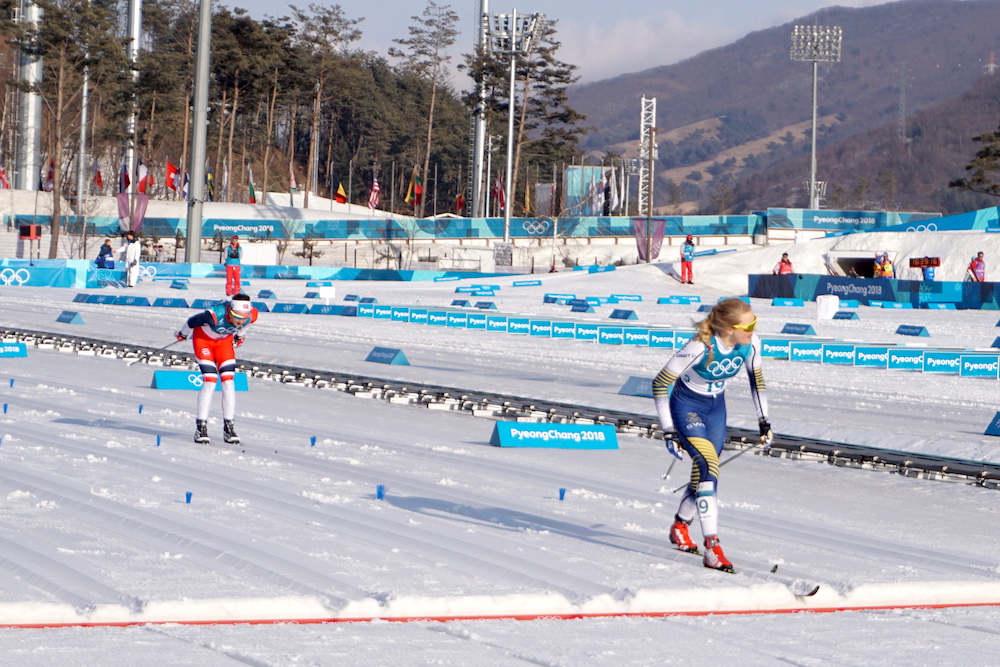
    The Canadian squad of Christian Gow, Scott Gow, Macx Davies, and Brendan Green finished 11th, +5:40.3, with 11 spare rounds and a penalty loop.

    Results

  • Team Sprint Tidbits: The Best of What You Haven’t Read

    Americans Kikkan Randall and Jessie Diggins jumping for joy after placing first in the 2018 Olympic team sprint on Wednesday night in PyeongChang, South Korea, ahead of Sweden’s Charlotte Kalla (l) and Stina Nilsson (second from l) in second place and Norway’s Marit Bjørgen (second from r) and Maiken Caspersen Falla (r) in third. (Photo: FlyingPointRoad)

    FasterSkier would like to thank Fischer Sport USA, Madshus USA, Concept2, Boulder Nordic Sport, and Swix Sport US for their generous support, which made this coverage possible.

    PYEONGCHANG, South Korea — There was a lot to process Wednesday, what with the U.S. women’s team sprint Olympic gold medal and all. But now that we’ve had a little time to breathe, FasterSkier wanted to bring you the best of the interviews that didn’t make our initial race reports. (Don’t worry, plenty more on this historic gold to come!)

    Kikkan Randall, Team USA’s first-leg skier:

    “It’s an amazing feeling. This is something the American team has been working for a long, long time. We’ve had one other medal back in 1976 from Bill Koch and for me, I’ve been on this Olympic path for the last 20 years. We’ve known it’s possible, but of course it takes putting together the right day, and it’s just an amazing validation for our team that’s worked so hard and what this can do for cross-country skiing back in the United States, it’s just so exciting.”

    Kikkan Randall en route to gold with Jessie Diggins (not shown) in the women’s freestyle team sprint at the 2018 Olympics in PyeongChang, South Korea. (Photo: FlyingPointRoad)

    On whether she knew this would be a historical race for Norway’s Marit Bjørgen (with her 14th Olympic medal):

    “I knew that Marit’s been skiing really well all week and that she would be tough competition and knew she would be strong going up that second climb. When I arrived here, I saw the hill and thought, ‘That’s a good hill for Marit, and it’s a good hill for Kikkan.’ Marit is probably the greatest skier of all time and it’s been an honor to race with her, and of course it’s really fun for us to get our historic day and that gold medal, but also an amazing accomplishment for Marit to be the most successful Winter Olympian of all time.”

    On her foot injury and Olympic prep:

    “I had a foot injury that came in December and it caused me to change my training a little bit, and I also didn’t do as much training as I wanted to. I think that once I did start racing again, every race helped me get better. The skiathlon here was definitely a challenge; it was a tough course and I really struggled in the classic, so it took a lot just to keep my mind calm and relaxed and just think about one race at a time, and I was happy that things went better in the 10 k. It was a real honor to get named to our relay because it was tough to pick that team, but I was happy to have another strong leg there and then it was another anxious wait to see if I would even be named to this team. So as the Games went on, this is the event that I looked forward to most and have looked forward to the most over the last four years, and it was really a good feeling that my confidence was actually getting better and my feelings were getting better as we got closer.”

    On how she hopes this medal will impact her sport in the U.S.:

    “What’s really cool is I don’t think we’re gonna have to wait another decade for this to happen again. We have an amazing group of junior skiers and U23 [athletes] that are coming up. They won a medal in the relay at the World Juniors last year, we had another girl that was on the podium twice at World Juniors this year, our junior men were on the podium at World Juniors, so I think the door has been opened and what I hope this gold medal really means is what those kids dream about, being in this position someday and they really feel it’s possible, and the Olympics has the power to do more inspiration than any of the other races that we do that are typically in Europe. So it’s really cool to finally get the high profile and give those kids the belief and hopefully also to get more people to start cross-country skiing because they saw it here and they get excited and they want to go try it.”

    On the Norwegian crown prince, Norwegian prime minister and Swedish king all attending the Games, and whether she thinks an American president will ever be at a cross-country ski race:

    “Actually, when President Obama first got inaugurated I had a dream that I was sitting on Air Force One talking to him about cross-country skiing and telling him that it was a really cool sport but didn’t get enough attention, and he said when he became president he would help make cross-country higher profile, but that’s about the closest I’ve ever gotten to a president at a cross-country ski race.”


    Jessie Diggins, Team USA’s second-leg skier: 

    “Team sprints are so much fun and I’ve been looking forward to this day for a year since the Lahti team sprint ended so I guess watching Kikkan do her leg so well and getting us in a position where we were going to get a medal, I was just watching that like, ‘Oh, well, OK, we’re gonna try to make it a gold one, then. We have nothing to lose.’ I really wanted to make this happen for this team, and we always said any medal we got was going to belong to the team. It was a team that got us here and gave us this opportunity and pushed us so hard in training all summer long and so I just had a lot of belief going in that last lap.”

    Jessie Diggins (14) edges Sweden’s Stina Nilsson (r) for gold, while Norway’s Maiken Caspersen Falla (l) races to bronze, in the women’s freestyle team sprint final at the 2018 Olympics in PyeongChang, South Korea. (Photo: Noah Hoffman)

    On what was going through her head during the final:

    “Lap 2, I started to push the pace because I thought, ‘Both of these girls are really, really strong sprinters and I’m an OK sprinter, but I need everyone else to get pretty tired if I have a shot.’ ”

    “That last corner, I don’t know what I was thinking except for just, ‘Go, go, go!’ because you really gotta dig really deep and I was in a lot of pain, for sure, but when your team is counting on you, you have to give it everything you have.”

    On what it means to team up with Randall:

    “I feel really lucky to have these, like, older sisters and role models on the team that I really look up to, every single one of them, and they’ve really shown me what is possible and shown me that it’s OK to dream really, really big. It means a lot to me because if this is the last team that [Kikkan and I] get to team sprint together, it’s like, ‘OK, I gotta make it a good one. I’ve gotta go out with a bang.’ And it’s so cool because Kikkan’s been this big role model in my life since before I got on the national team and it’s just such an honor to get to race with her every time and get to share those pre-race giggles and high fives and get to paint up the face.”

    On her first words with Randall after finishing:

    Americans Kikkan Randall (l) and Jessie Diggins on the top step of the 2018 Olympic team sprint podium after beating Sweden and Norway for gold on Wednesday at the Winter Olympic Games in PyeongChang, South Korea. (Photo: FlyingPointRoad)

    “I think I asked her, ‘Did we just win the Olympics?’ because it didn’t feel like it was real and it still doesn’t feel like it’s real, but I just was so excited and so happy and also I couldn’t feel my legs.”

    On handling any perceived pressure:

    “For me, it’s been hard to not let it get inside my head and to race for myself because when I’m having fun, that’s when I’m actually dangerous on the race course and you get one too many people saying, ‘I believe that you’re going to go win!’ it becomes less fun because I don’t do it just to win, that’s not the whole end game for me. Having this awesome team atmosphere — we’ve been playing games, we’ve been dancing, we’ve been watching movies, we’ve been having a really good time here at the Olympics — and making sure that within our own little bubble that we keep it relaxed and keep it fun and keep a happy team vibe, I think that’s been a huge key for me, and kind of being able to go through the mixed zone with selective listening and make sure I’m still racing for me and for my team.”

    On how this medal will affect future generations of U.S. skiers:

    “I’m so excited to put some facepaint and put the socks on those kids because they are coming up hot and they’re working so hard and it’s so cool to see that we’re not going to retire and leave this gaping hole, there’s people coming up to take our places.”


    Chris Grover, U.S. Ski Team Head Coach: 

    U.S. Ski Team Head Coach Chris Grover (l) with Jessie Diggins after Diggins and Randall won gold in the women’s freestyle team sprint at the 2018 Olympics in PyeongChang, South Korea. (Photo: FlyingPointRoad.com)

    On choosing Randall as the first leg:

    “We anticipated that it would probably be Marit or [Ragnhild] Haga that was skiing this leg for Norway, and we did think that it would also be Charlotte Kalla who was skiing for Sweden. So we knew there would be some great skaters, some great aerobic athletes that were in that capacity. We thought Kikkan, the way that her skate fitness has been coming on over the last few races here at the Olympics, we thought that her fitness could at least help us hang on to those ladies if they were really going to go, and we were just really pleasantly surprised that Kikkan was able to match them no problem throughout the day. That was exciting. Both women looked so in control in the semifinal that we knew they were going to have a crack at a medal in the final.”

    On watching Diggins and Sweden’s Stina Nilsson racing for gold in the finishing stretch of the final:

    “With Stina, she obviously was in incredible form in some of the other races here. Maiken [Caspersen Falla] as well, they obviously went first and second in the individual sprint, so there was gonna be no gimmies at all in the finish. We would have been so exhilarated and happy just to have a medal of any color, but for Jessie to have such a fantastic day and to be able to pull off the win was beyond our expectations.”


    Tiger Shaw, U.S. Ski & Snowboard President and CEO:

    “We are just flying high. I mean, I am still just numb with what those women have achieved; Kikkan, Jessie and the whole team, and the coaches and the techs and trainers … I’m speechless.”

    “The culture of that team is just unbelievable, and they have conquered the world, coming from obscurity led by a single woman into a dynamic men’s and women’s team that is absolutely stunning. It makes one of the best stories I think in sport.”

    On watching the race unfold:

    “I was so excited there was a group of three and not a group of four because then you knew we had almost for sure a medal in the bag, and then all of a sudden you realized Jessie could get it done. And she came around that last corner and down that stretch and beat the best sprinter in the world. We were just screaming our brains out in amazement. Just thinking of the energy and the excitement of that I’ll never forget that for the rest of my life.”


    Luke Bodensteiner, U.S. Ski & Snowboard Chief of Sport:

    Jessie Diggins with U.S. coach after Diggins and Kikkan Randall won gold in the freestyle team sprint at the 2018 Olympics in PyeongChang, South Korea. (Photo: FlyingPointRoad)

    On other sports taking notice of this U.S. cross-country team’s success:

    “I have gotten so many messages now from people here in Team USA saying … head of speed skating got one saying this is the best moment of the Games for the entire Team USA. Our head coach in alpine texts me said, ‘I have never seen such a possessed, will-not-lose moment in my entire career.’ … This makes this hugely successful Olympics.”

    On medal chances:

    “I think we came in feeling like team sprint was not only our best opportunity for a medal, but probably a pretty high likelihood for us, honestly. But there is a difference between getting in there for a bronze medal and winning the thing outright. And that’s not something we… well, I guess we dreamed of it, but it’s not something we would have called out coming in here. So they lifted their game and they skied out of their minds. Kikkan would not be dropped, she covered all those moves on the climb, and of course the way Jessie finished it off was best in the world right there.”

    “I was right on the finish line. … You could see a meter out that [Jessie] had this thing and people broke down in tears there, lots of hugs and tears.”


    Charlotte Kalla, Sweden’s first-leg skier:

    Jessie Diggins (l), Sweden’s Stina Nilsson (r) and Norway’s Maiken Caspersen Falla (behind) heading into the last 100 meters of the women’s freestyle team sprint final at the 2018 Olympics in PyeongChang, South Korea. (Photo: FlyingPointRoad)

    “We are very happy for Kikkan and Jessie. They are so worthy of this gold medal.”

    On skiing with Randall for a long time and whether these will be Kalla’s last Olympics as well:

    “I don’t know. It may be the last. Kikkan, she has meant a lot for the whole team in the USA, and we have a special relationship because Kikkan has been several times in Sweden training with us, and I know in Vålådalen especially, where we exercised this [last] August, we pushed each other really really hard. She is an impressive skier.”


    Marit Bjørgen, Norway’s first-leg skier:

    “I’m very, very happy for Jessie and Kikkan today for taking a gold medal, and I feel also special that Kikkan is there. She also started [her first] Olympics in Salt Lake [like] me so I’m very happy for them, and I also think that’s very important for our sport, too, that they [won], so I’m very, very happy for them.”


    Johannes Høsflot Klæbo, Norwegian men’s team-sprint winner:

    On whether they were surprised about the win of the U.S. women:

    “No, I’m not surprised. I think the way they managed to do the last round, it’s quite cool to see, and for sure it’s quite good for the sport and yeah, I think it’s amazing.”


    Martin Johnsrud Sundby, Norwegian men’s team-sprint winner:

    “I think all athletes admire the head of Jessie Diggins. That’s fantastic.”

    ***

    One of the team sprint press conferences, with (from left to right) Sweden’s Stina Nilsson and Charlotte Kalla, a Russian translator and Denis Spitsov, American Kikkan Randall, Norway’s Marit Bjørgen and Maiken Caspersen Falla, France’s Maurice Manificat, a translator, and France’s Richard Jouve, on Wednesday night at the 2018 Olympics in PyeongChang, South Korea. (Photo: FlyingPointRoad)
  • Clutch Klæbo Secures Another Norwegian Gold; U.S. Men 6th, Canada 8th in Team Sprint

    Norway’s Johannes Høsflot Klæbo celebrates his team-sprint win with Martin Johnsrud Sundby (not shown), while Alexander Bolshunov of the Olympic Athletes from Russia (l) pushes for silver on Wednesday at the 2018 Olympics in PyeongChang, South Korea. It was his third-straight gold of the week. (Photo: FlyingPointRoad)

    FasterSkier would like to thank Fischer Sport USA, Madshus USA, Concept2, Boulder Nordic Sport, and Swix Sport US for their generous support, which made this coverage possible.

    ***

    With a gold medal for their team already in the bag on Wednesday, Erik Bjornsen and Simi Hamilton put their heads down for the start of their own race at the 2018 Olympics. The men’s 6 x 1.4-kilometer freestyle team sprint final was scheduled to start just minutes after the women’s team sprint final ended, a race which saw Americans Kikkan Randall and Jessie Diggins capture the first Olympic gold for the U.S. in cross-country skiing.

    It was motivating and inspiring, even confidence-boosting, Bjornsen reflected after his race in an in-person interview with FasterSkier. But he and Hamilton had their own medal hopes to tend to.

    Like most of the men’s finalists, they weren’t able to watch the women’s race beforehand and came out onto the course shortly before the start of their final.

    “I was warming up and kind of focusing on my own race, but I saw that they took the win when I was running to the start,” Bjornsen explained. “ … We were ready to match them.”

    “I did not even see a second and I’m really bummed out that I didn’t,” Canada’s first-leg skier Len Valjas told FasterSkier after. “But so happy for the U.S., that’s amazing, like it actually gave us some positive energy before the race hearing who won. Our techs and coaches ran into our room, like, ‘Did you hear about the girls’ race?’ So it’s a win for North America. It just makes today even sweeter.”

    American Erik Bjornsen (6) skiing with Canada’s Len Valjas (7) during the men’s 6 x 1.4 k freestyle team sprint at the 2018 Olympics in PyeongChang, South Korea. (Photo: FlyingPointRoad)

    Both the American and Canadian men’s teams qualified for the 10-team final on Wednesday evening in PyeongChang, South Korea. Bjornsen and Hamilton had advanced with a fast-enough time after placing third in the second semifinal, while Valjas and his teammate Alex Harvey moved on as well (also as “lucky losers”) after finishing fifth in that semifinal.

    The U.S. had some confidence going into the final after a semifinal performance that saw Bjornsen take the lead on the second-to-last lap, ahead of Norway. Hamilton held onto first for most of the the final lap until Norway’s Johannes Høsflot Klæbo passed him shortly before the finish, and France’s Richard Jouve passed Hamilton in the finishing straight as well, putting the Americans in third.

    For the final, it was all about the medal hunt for Bjornsen and Hamilton, who placed fifth in last year’s World Championships classic team sprint in Lahti, Finland, just ahead of Canada in sixth, for the best U.S. men’s result in a team event.

    Russia had won that 2017 world-champs team sprint with two athletes who were banned from competing at these Olympics, Nikita Kriukov and Sergey Ustiugov, and Italy placed second with Dietmar Nöckler and Federico Pellegrino. After an infamous tangle coming out of the final downhill, Finland ended up third with Sami Jauhojärvi (who retired after last season) and Iivo Niskanen, and Norway finished fourth with Klæbo and Emil Iversen. Norway opted for Klæbo and Sundby for its Olympic team-sprint squad on Wednesday, and Sundby later proved that he was worthy of the pick.

    Ever since World Championships, it’s safe to say this is the race that had been primarily on Bjornsen’s and Hamilton’s minds for the better part of the last year.

    They came out with a mission on Wednesday, putting themselves in the mix early in the final, alongside Canada.

    Sweden’s first-leg skier Marcus Hellner leading during the men’s freestyle team sprint at the 2018 Olympics in PyeongChang, South Korea. (Photo: FlyingPointRoad)

    Sweden set the pace for the first two laps, with Marcus Hellner starting them off and Calle Halfvarsson holding their lead on the second leg. They tagged off in first through the first two exchanges, just ahead of Norway and the Olympic Athletes from Russia after the first lap, then ahead of France, Norway and Russia after Lap 2. By the end of Hellner’s second lap, Sweden was still in first, tagging off in front of Norway, France and Russia, all within 1.3 seconds of first. Germany followed in fourth, 2.9 seconds back, and Bjornsen tagged the U.S. in fifth (+3.2).

    The Americans had been hanging in fifth and sixth throughout the first half of the race, even after Bjornsen crashed at the beginning of his second leg. Heading into the first uphill after the exchange, Bjornsen skated over the tails of Nöckler’s skis ahead of him. He fell down and by the time he got back up, was in 10th — last place — starting back up the hill. Bjornsen recovered to put the U.S. in sixth, 3.2 seconds out of first, with three laps to go.

    “It was super disappointing when I went down, but I mean, it was only halfway through the race and I just got up, and that’s for sure not going to be the end of it for us today,” Bjornsen said. “Unfortunately, I kind felt like I let the team down there a bit. I think that was one mistake that may have made a huge impact on our race today, but you know, that’s ski racing, that’s the way it goes sometimes. Unfortunately it’s at the Olympics.”

    Hamilton was quick to respond to his teammate’s comments.

    “In absolutely no way did Erik let any of us down, especially me,” Hamilton said. “I watched that on the big screen, I have been at a lot of team sprints on the World Cup, World Champs, Olympics, that always happens to someone, and 99 percent of the time, that person, especially if it’s in the finals, just gives up, whether it’s the first leg, second leg, third leg, they just give up. And Erik, he never does that, no matter what happens to him, what happens to us, he just fights ’til the absolute very end.

    “It’s cliché to say that, but that’s what he does,” he continued. “That’s the only way he knows how to operate. … I am incredibly proud to be always be racing with Erik, to be training with him, to be rooming with him.”

    The two Americans, who are rooming together in the Olympic Village, went on to lose a few more seconds and two places during Hamilton’s second leg, after which he tagged Bjornsen in eighth, 8.3 seconds out of first.

    At the front of the pack, Klæbo had made a game-changing attack on the final climb of that leg, following Russia’s Alexander Bolshunov up it then making a few swift strides to get around him several meters from the top. As Klæbo jump-skated up and over and away from them, Bolshunov, Halfvarsson and France’s Jouve almost looked as if they were standing still, leaving them several seconds behind as they chased him toward the exchange.

    Klæbo tagged Sundby 1.7 seconds ahead of Russia in second, 2.2 seconds clear of Sweden in third, 3 seconds ahead of Italy in fourth, and 3.3 seconds ahead of France in fifth. A couple more seconds back, Germany followed in sixth (+5.7), Finland in seventh (+6.0), the U.S. in eighth (+8.3), and Canada in ninth (+11.0), ahead of the Czech Republic in 10th (+12.8).

    Sundby dug deep for his final 1.4 k lap to extend Norway’s lead to 5.1 seconds at the last exchange. For the first time all race, Klæbo took his hat off and prepared for his last time around the PyeongChang sprint course with Sweden, France and Russia about six seconds behind him.

    Simi Hamilton (6) racing with Italy’s Federico Pellegrino (3) and others out of the exchange of the men’s 6 x 1.4 k freestyle team sprint semifinal at the 2018 Olympics in PyeongChang, South Korea. (Photo: FlyingPointRoad)

    Bjornsen had skied the Americans back into sixth, 11.7 seconds back at the last exchange. Valjas tagged Harvey in eighth, 26.6 seconds out of first.

    While Hamilton chased Pellegrino, who started 0.3 seconds ahead of him out of the exchange, over the next lap, the two kept Halfvarsson, Jouve and Bolshunov in their sights. Ultimately, however, they were unable to close the gap to fight for the medals.

    The three-man chase group, led by Bolshunov, didn’t let off as they pursued Klæbo, who appeared untouchable as he rounded the course. As they sped down the final descent toward the finish, Klæbo pushed over the last little rise, looked back and appeared to exhale as he relaxed his shoulders. But it wasn’t over. Bolshunov was charging hard and Klæbo couldn’t let off just yet. The 21-year-old Norwegian took another breath then about a dozen or so more V2 pushes in the finishing straight. A full four seconds before the line, he let off and secured his third gold of his first Olympics in 15:56.26 minutes, 1.71 seconds ahead of Bolshunov (and Denis Spitsov of the Olympic Athletes of Russia) in second. Jouve outsprinted Halfvarsson to give France (with teammate Maurice Manificat) its second-straight bronze (+2.02), after France placed third in the men’s 4 x 10 k relay, and Sweden finished the race in fourth (+3.07).

    About 15 1/2 seconds later, Pellegrino crossed the line in fifth (+18.55) for Italy, 2.17 seconds ahead of Hamilton in sixth (+20.72). The Czech Republic came through in seventh (+28.57) with Martin Jaks and Ales Razym, Harvey anchored Canada to eighth (+35.6), Finland finished ninth (+36.04) with Martti Jylhä and Ristomatti Hakola, and Germany placed 10th (+45.94) with Sebastian Eisenlauer and Thomas Bing.

    “For our race tonight, we’re proud of what we accomplished,” Hamilton reflected. “Obviously, it’s always our goal to be on that podium. I think we both know that we can be up there and maybe someday we will. … If we are going to do that someday, there’s no way were going to do it without trying, so tonight was another one of those attempts, and it was a super-fun race, did everything we could, came up short, but we fought hard.”

    “I guess we will have keep skiing and fight for it,” Bjornsen said, later adding, “We’re coming back for a gold.”

    Canada’s Alex Harvey jets out of the exchange during the men’s 6 x 1.4 k team sprint semifinal at the 2018 Olympics in PyeongChang, South Korea. The Canadians went on to finish eighth. (Photo: FlyingPointRoad)

    For Valjas, who had slipped to 10th on his second leg but brought his team back to eighth after Harvey put them in ninth with two laps to go, a top 10 at the Olympics on any day was a good one. He previously raced on Canada’s 4 x 10 k relay that finished ninth.

    “I actually got a chest cold two days ago so it was kind of a game-time decision,” Valjas said after of Canada’s decision to start him with Harvey. “The team really wanted me to start this even if I’m not 100 percent, and honestly it felt pretty good. I think it was my legs that gave out before my lungs so I’m glad I did start because I felt horrible coming on the bus here. I was like, ‘How am I gonna race against these guys? Like, even healthy I’m gonna suffer.’

    He explained that the course didn’t exactly suit his strengths with its long climbs.

    “The first work section is a minute with no break,” Valjas said. “I was just trying to use the flats and the downhills like what I’m good at and the rest I was just surviving…

    “Honestly for me on this course, at the World Cup last year, I had a terrible team sprint,” he added, reflecting on his 13th-place result last year with teammate Jess Cockney at the pre-Olympic World Cup in PyeongChang. “And I was good shape then. Jess raced great, I was just getting dropped. For me, another top 10 in the Olympics and I’m thrilled how it went and so happy that Alex had some punch in the end there. The 50 k [on Saturday], I’ll be out here cheering. It’s looking great for [Alex] and I’m glad I could help him in his race prep.”

    Norway’s Johannes Høsflot Klæbo and Martin Johnsrud Sundby (1) embrace after Klæbo anchored the two-man team to first in the 6 x 1.4 k freestyle team sprint at the 2018 Olympics in PyeongChang, South Korea. (Photo: FlyingPointRoad)

    For Norway, the gold medal was its fourth in five men’s races so far at these Olympics. Klæbo has won three of them (individual classic sprint, relay and team sprint) and Sundby two (relay and team sprint).

    In a post-race press conference, Sundby, 33, had nothing but praise for his young teammate.

    “I think the whole cross-country world at this point is looking on what Johannes does, how he does it, and why he is so fast,” Sundby said. “… We are close and are able to learn so much from this guy. He’s 21 years old. Today we were both extremely nervous for the competition. … Anything can happen, and these tracks are so tough, this sprint track. It’s a lot of uphill and a really tough downhill, and you don’t get any rest at any point, so we were not looking forward to it, but its really good to finish it.”

    While Russia’s Spitsov said they had been going for gold, he explained through a translator that they were “not very lucky.”

    “We had a small tactical mistake and we lost a few seconds through that when he was basically being blocked, lagging behind the French guy,” he said at the press conference. “We tried to catch up but we couldn’t. Johannes was stronger and faster.”

    France’s Maurice Manificat (r) with teammate Richard Jouve after they earned bronze in the men’s freestyle team sprint final at the 2018 Olympics in PyeongChang, South Korea. (Photo: FlyingPointRoad)

    For France, the bronze medal was a big deal. It was the first for the 23-year-old Jouve in his first Olympics. Manificat previously raced in France’s bronze-medal relay.

    “Second medal and also with Richard, it’s unbelievable,” Manificat said at the press conference. “Three days ago a medal in distance with my teammates on the distance team, and it was a hard choice the last day with our sprinter Lucas Chanavat; he was really sad to not be part of this relay, but I think with this medal, it was for all for the team … and we are so happy together as you could see in the [finish] and to share it with Richard. [He was] unbelievable in the final [lap], it was so crazy, so thanks to him and thanks to all team’s waxers, we had such good skis, so it was perfect.”

    Results

    — Jason Albert, Gabby Naranja, Ian Tovell, and Harald Zimmer contributed

    The men’s 6 x 1.4 k freestyle team sprint podium at the 2018 PyeongChang Olympics, with Norway’s Martin Johnsrud Sundby and Johannes Høsflot Klæbo (c) in first, the Olympic Athletes of Russia’s Denis Spitsov (l) and Alexander Bolshunov (second from l) in second, and France’s Maurice Manificat (second from r) and Richard Jouve (r) in third. (Photo: FlyingPointRoad)
  • Wednesday Olympic Rundown: Diggins, Randall Capture Gold in Olympic Team Sprint (Updated)

    Wednesday Olympic Rundown: Diggins, Randall Capture Gold in Olympic Team Sprint (Updated)

    Team USA after Kikkan Randall and Jessie Diggins (c) won gold in the women’s freestyle team sprint on Wednesday at the 2018 Olympics in PyeongChang, South Korea. (Photo: FlyingPointRoad)

    FasterSkier would like to thank Fischer Sport USA, Madshus USA, Concept2, Boulder Nordic Sport, and Swix Sport US for their generous support, which made this coverage possible.

    ***

    2018 Olympics (PyeongChang, South Korea): Freestyle team sprint

    Women’s report

    Men’s report

    (Note: This rundown has been updated to include comments from Canadians Emily Nishikawa and Dahria Beatty.)

    The medal hunt is over. In the final team event of the 2018 Winter Olympics, the U.S. women got the job done on Wednesday in PyeongChang, winning not just a medal, but the first Olympic gold in the history of U.S. cross-country skiing.

    Jessie Diggins (l) and Kikkan Randall soak up their win in the women’s freestyle team sprint on Wednesday at the 2018 Olympics in PyeongChang, South Korea. (Photo: FIS Cross Country/Twitter)

    Kikkan Randall and Jessie Diggins teamed up in the 6 x 1.25-kilometer event, with Randall tagging Diggins in third at the final exchange, just 0.7 seconds behind Norway’s Marit Bjørgen in first and 0.5 seconds behind Sweden’s Charlotte Kalla in second. With 1.25 k to go, Diggins charged ahead on the first climb, with Norway’s Maiken Caspersen Falla and Sweden’s Stina Nilsson chasing her in second and third, respectively. They were about 10 seconds clear of Switzerland in fourth at the final exchange.

    Falla moved into first at the bottom of the final grueling climb. Halfway up, Diggins and Nilsson jostled to position themselves in second, and over the top, Diggins slotted into third.

    Riding fast skis on the downhill toward the stadium, Diggins stayed out of trouble while Nilsson nearly rode up onto Falla’s skis. While Nilsson used the draft to get into first coming out of that downhill, Diggins eyed a specific line, saw the opening between the two and took it to move into second. As Nilsson entered the finishing straight, Diggins was right there with her, even pulling into first as they came within 50 meters of the line. The gold became a reality, as Diggins outlunged Nilsson by 0.2 seconds at the finish with a time of 15:56.4 minutes, and Falla crossed 3 seconds back in third.

    Jessie Diggins (l) lunging for gold in the women’s freestyle team sprint, 0.2 seconds ahead of Sweden’s Stina Nilsson at the 2018 Olympics in PyeongChang, South Korea. (Screenshot: NBC broadcast)

    Gold for the U.S., silver for Sweden, bronze for Norway. With her 14th Olympic medal, Bjørgen became the most decorated Winter Olympian of all time, while Randall and Diggins earned their country’s first Olympic gold.

    In the men’s 6 x 1.4 k team sprint final that followed, Johannes Høsflot Klæbo once again anchored another Norwegian victory, teaming up with Martin Johnsrud Sundby for Klæbo’s third medal of his first Olympics. With a strong second leg from Klæbo, the Norwegians gapped the field, and Sundby extended that gap to 5 seconds over Sweden by the final exchange. Klæbo rounded the final lap alone, still charging for the win and only letting up a few meters before the line to celebrate as he crossed in first with a time of 15:56.26.

    Kikkan Randall (14) and Jessie Diggins embrace as they celebrate their freestyle team sprint gold on Wednesday at the 2018 Winter Olympics in PyeongChang, South Korea. It is the first U.S. cross-country skiing gold medal in Olympic history, besting Bill Koch’s individual silver medal in the 30 k at the 1976 Winter Olympics. (Screenshot: ARD broadcast)

    Alexander Bolshunov of the Olympic Athletes from Russia pushed to catch Klæbo on the last lap and motored for silver, finishing 1.71 seconds back. He teamed up with Denis Spitsov for their second-straight silver medal of the Games (after placing second in the 4 x 10 k relay) and Spitsov’s third medal (after placing third in the 15 k freestyle).

    France (Maurice Manificat and Richard Jouve) placed third (+2.02) with Jouve edging Sweden’s Calle Halfvarsson by about a second for bronze, while Sweden placed fourth (+3.07) with Marcus Hellner and Halfvarsson. It was the French men’s second-straight bronze medal after placing third in the relay.

    Italy (Dietmar Nöckler and Federico Pellegrino) was next across the line in fifth place, 18.55 seconds out of first, while the U.S. men (Erik Bjornsen and Simi Hamilton) followed in sixth (+20.72). Bjornsen crashed shortly after the start of the third leg (his second leg) after skiing onto the tails of Nöckler’s skis up the first climb out of the stadium. That put the American in last place near the bottom of the hill, but Bjornsen rebounded to tag off in sixth, just 3.2 seconds out of first. Hamilton slipped to eighth and 8.3 seconds back on the next leg, and by the last lap, it was Hamilton chasing Pellegrino for fifth place, which Italy ultimately took about 2 seconds ahead of him at the finish.

    Canada’s Len Valjas and Alex Harvey finished eighth (+35.6), with Harvey holding off Finland in ninth by half a second at the line, after slipping as far back as 10th on Valjas’s second leg.

    Semifinals

    Earlier in the day, the Norwegian men and women, Russian men, and American women each won their semifinal heats as the field was narrowed to ten teams for each final.

    In the first women’s semifinal, Bjørgen and Falla posted an easy win by 6.6 seconds. Switzerland’s Nadine Fähndrich and Laurien van der Graaff bested Slovenia’s Alenka Cebasek and Anamarija Lampic for second place.

    In the second semifinal, Randall and Diggins claimed the win, with Kalla and Nilsson finishing second, just 0.7 seconds back; Diggins and Nilsson didn’t sprint for bragging rights, seemingly saving energy for the final. Russia’s Natalia Nepryaeva and Yulia Belorukova finished third (+2.1).

    Only the top two finishers from each semifinal automatically advance to the final, but Slovenia and Russia qualified as “lucky losers” based on their time. Also qualifying for the final were Finland (Mari Laukkanen and Krista Parmakoski), Poland (Justyna Kowalczyk and Sylvia Jasckowiec),  France (Aurore Jean and Coraline Hugue), and Germany (Nicole Fessel and Sandra Ringwald).

    The Canadian women’s team of Emily Nishikawa and Dahria Beatty finished seventh in the second semifinal, and were two spots out of making the final (the Czech Republic had a faster time than the Canadians but also did not advance).

    “The first four legs we were right in there with the group,” Nishikawa told FasterSkier after their semifinal. “I think our second heat was quite a strong heat, it stayed together until the fifth leg. That’s where I blew up a little bit, but I did everything I could. … Dahria skied amazingly well, she was able to still catch Italy again on the sixth leg.”

    “We knew that the first three, four teams would be quite strong: USA, Sweden, Russia and Finland,” Beatty said. “So we knew everyone else, we could ski with them in the group, so we were trying to stay with that kind of middle group ’cause we knew five or six would probably be qualifying from our heat. … I think we did a really good job of skiing a race where we were right in there. … I think we came something like 11 seconds short of what we needed…

    “Even though we didn’t qualify it was nice to be able to go catch one team on the last lap there and finish strong,” Beatty added. “Our coaches were cheering amazing out there, and had some cheering from the American coaches, too. So there was a lot of motivation on the course to really fight to the line.”

    In the men’s semifinals, Russia’s Spitsov and Bolshunov and Sweden’s Hellner and Halfvarsson at some points appeared to be running away with the first heat, but by the finish Germany (Sebastian Eisenlauer and Thomas Bing) and Finland (Martti Jylhä and Ristomatti Hakola) were within three seconds in third and fourth.

    For the U.S., Bjornsen took charge of the second semifinal on the fifth lap, and Hamilton kept the lead into the final downhill. Klæbo passed him late in the game and claimed the win along with teammate Sundby, and Hamilton appeared unconcerned as Jouve passed him in the finishing straight as well to put France (with Manificat) in second; based on time, the U.S. advanced as a lucky loser.

    Also in the men’s final were Italy (Nöckler and Pellegrino), Canada (Valjas and Alex Harvey) — who finished fifth in the second semifinal — and the Czech Republic (Martin Jaks and Ales Razym).

    Final results: Women | Men

  • Germany Sweeps PyeongChang Large Hill/10 k; Fletcher 17th Once More

    Johannes Rydzek (5) leading his two German teammates, Fabian Rießle (6) and Eric Frenzel, as well as Norway’s Jarl Magnus Riiber toward the finish of the nordic-combined large hill/10 k competition on Tuesday at the 2018 Olympics in PyeongChang, South Korea. They finished in that order, with Germany sweeping the medals. (Photo: FlyingPointRoad)

    FasterSkier would like to thank Fischer Sport USA, Madshus USA, Concept2, Boulder Nordic Sport, and Swix Sport US for their generous support, which made this coverage possible.

    ***

    It was a total team effort on Tuesday for Germany in the second nordic-combined individual event of the 2018 Olympics in PyeongChang, South Korea, with Fabian Rießle, Johannes Rydzek and Eric Frenzel, with the help of Austria’s Wilhelm Denifl, chasing down Japan’s Akito Watabe and Norway’s Jarl Magnus Riiber about 6 kilometers into the 10 k race.

    Earlier on Tuesday, Watabe had put himself in first with the best-ranked jump on PyeongChang’s 142-meter large hill. He started the 10 k Gundersen in first, just 1 second ahead of Riiber, who had jumped to second, just 0.3 points behind Watabe.

    (Riiber had actually jumped farther with a distance of 139 meters, compared to Watabe’s 134-meter jump, and scored identical marks from the judges but lost points for wind compensation.)

    Germany en route to a complete sweep of the podium in the men’s nordic-combined individual large hill/10 k on Tuesday at the 2018 Olympics in PyeongChang, South Korea, with Johannes Rydzek (5) leading Fabian Rießle (6) and Eric Frenzel (4). They went on to place first, second and third, respectively. (Photo: FlyingPointRoad)

    Behind them, Denifl started the 10 k race 16 seconds out of first, Frenzel surged out of the start 24 seconds back, Rydzek 31 seconds behind, and Rießle 34 seconds back.

    While Watabe led Riiber off the front for the first two laps of the four-lap race, the three Germans caught Denifl before lapping through the stadium for the first time at 2.5 k. From there, 16 seconds behind the leaders, the four-man group worked to reel in first and second place and did so by 6 k.

    The lead pack then became six as Riiber and Watabe continued to position themselves up front at the 7.5 k mark.

    On the final lap at the 8.58 k marker, Watabe charged to the front in his move to reclaim first. After taking the lead on an uphill, it wasn’t long after until he found himself skiing with three others alongside him: Riiber, Rydzek and Frenzel.

    Then, Watabe slipped behind Riiber and the group closed in around him. Watabe clipped a ski, apparently with Rießle, who didn’t stumble, but Watabe did and dropped to the back of the pack. For Watabe, that was the end. For Germany, it was the beginning.

    Frenzel led the charge up the final climb with Rydzek and Rießle behind him while Riiber tried to keep pace. Riiber slotted into fourth over the top and the foursome flew down into the stadium, with Rydzek coming out of the draft in first and leading Rießle, Frenzel and Riiber to the finish, respectively.

    They finished in that order, with Rydzek taking gold in 23:52.5 minutes, 0.4 seconds ahead of Rießle in second place and 0.8 seconds ahead of Frenzel in third. Riiber crossed 2.8 seconds back in fourth, and Watabe ended up fifth (+12.5).

    Germany had four in the top seven with Vinzenz Geiger in seventh (+50.1), behind Finland’s Eero Hirvonen in sixth (+22.1).

    “I looked up to the video wall and saw the first three: all Germans,” Geiger recalled in a post-race interview with German broadcaster ARD. “That made me really happy, and of course I can also be happy about my seventh place.”

    Frenzel had previously taken gold and Watabe silver in the first nordic-combined event of the 2018 Olympics, the normal hill/10 k on Feb. 14. Riiber was fourth for the second-straight competition.

    Bryan Fletcher en route to 17th in Tuesday’s large hill/10 k competition, tying his best result at the 2018 Olympics in PyeongChang, South Korea. (Photo: FlyingPointRoad)

    American Bryan Fletcher repeated his result from the normal-hill competition as well, placing 17th on Tuesday, 1:42.9 minutes behind Rydzek in first. Fletcher had started the 10 k 2:04 minutes back in 23rd based on his jump. His teammate Ben Berend started 8 seconds behind him in 24th. Ultimately, Fletcher raced up to 17th with the 10th-fastest course time while Berend slipped to 39th (+4:28.2).

    “The second I was in the air I knew I had a good one,” Berend told FasterSkier after the jumping portion of Tuesday’s competition. “Because when you do it right, you’re just flying, and I was really high and I was pulling away towards the bottom of the hill and so I knew, but I couldn’t feel any wind or anything. I was just so psyched, trying to enjoy every second of it.

    In his first Olympic race, American Ben Berend on his way to 39th in the large hill/10 k competition at the 2018 Olympics in PyeongChang, South Korea. He started the day by jumping to 24th, which he said was his best competition jump of the season. (Photo: FlyingPointRoad)

    “I haven’t had that many good jumps this season so I’ve just been searching for that,” Berend explained. “It’s funny, it’s so easy when you are doing it right and it’s so hard when you’re lost, and so I finally felt like, that might have been my best jump of the season, honestly, so what are the odds of doing that at the Olympics? That’s pretty cool.”

    Tuesday was the 22 year old’s first Olympic competition after he sat out the first individual event because his jumping had been going poorly in training, he said. (Each team can only start four athletes per event. Taylor Fletcher sat out Tuesdsay’s competition.)

    “I definitely was a little nervous for tonight, even though there is no pressure on me,” Berend said. “… Our coach [three-time U.S. Olympic biathlete Jeremy Teela] texted us, he’s actually our cross-county coach, he’s back at home, and he just said, ‘You guys have nothing to lose. Don’t be scared to fail.’ So that’s kind of our mindset here, and it was good; it kind of works for me.”

    American Bryan Fletcher (23) skiing with Norway’s Jørgen Graabak (19) during the cross-country race of Tuesday’s individual large hill/10 k competition at the 2018 Olympics in PyeongChang, South Korea. Fletcher went on to finish 17th while Graabak placed 10th. (Photo: FlyingPointRoad)

    After the race, Bryan Fletcher, who had skied up to 13th by 7.5 k, recalled pulling a chase group for most of the four laps. He ended up 17th, 3.2 seconds shy of 16th place, behind Japan’s Go Yamamoto.

    “I went all in and just tried to make up as much ground as possible,” Fletcher told FasterSkier after. “I was hopeful and optimistic that I’d have the legs at the end. I knew that they were going to come around me with a pretty hard attack, and both of the guys that were with me have great finishing sprints, so I tried to pace myself a little bit, but I also knew that 17th or 10th or whatever you could get up to, it doesn’t really matter unless you’re on the podium so I was really going all in. … Unfortunately it didn’t work out, but I’m happy with how I skied and happy with the performance I had on the course today.”

    American Ben Loomis racing to 40th in the large hill/10 k competition at the 2018 Olympics in PyeongChang, South Korea. (Photo: FlyingPointRoad)

    Just behind Berend, his teammate Ben Loomis finished 40th (+4:38.8), up from 43rd in the jump, and Jasper Good followed in 43rd (+5:50.2), up from 46th.

    “It was kind of tough jumping … [and] hard to start the race at the back, but overall it was a good race by me and I felt pretty good out there,” Loomis said after. “Regardless of how I have and how I continue to do here, there’s a lot to take away and I’m learning a lot about how to better refine my preparations and just stay relaxed out there and just really put my best foot forward.”

    Nordic combined at the 2018 Games will conclude with the 4 x 5 k team event on Thursday.

    Results: Jumping | Final

    — Jason Albert and Harald Zimmer contributed

    American Jasper Good racing to 43rd in the large hill/10 k competition at the 2018 Olympics in PyeongChang, South Korea. (Photo: FlyingPointRoad)
  • Tuesday Olympic Rundown: France Wins Biathlon Mixed Relay; Germany Sweeps NoCo Event, B. Fletcher 17th Again

    Germany en route to a clean sweep of the podium in the men’s nordic-combined individual large hill/10 k on Tuesday at the 2018 Olympics in PyeongChang, South Korea, with Johannes Rydzek (5) leading Fabian Rießle (6) and Eric Frenzel (4). They went on to place first, second and third, respectively. (Photo: FlyingPointRoad)

    FasterSkier would like to thank Fischer Sport USA, Madshus USA, Concept2, Boulder Nordic Sport, and Swix Sport US for their generous support, which made this coverage possible.

    ***

    2018 Olympics (PyeongChang, South Korea): Biathlon Mixed Relay

    Full report

    A few shooting errors by pursuit bronze medalist Anais Bescond were not enough to derail France, as the team of Marie Dorin Habert, Bescond, Simon Desthieux, and Martin Fourcade took gold in the mixed relay. Skiing the first leg, Dorin Habert shot clean and tagged off just seven seconds behind the leading team from Italy. Bescond then used four spare rounds over the course of her relay leg, dropping the team to fourth (+48.9) at the halfway point. But both Desthieux and Fourcade shot 10/10, capitalized on the errors of others, and ended up with a clear 20.9 second margin for gold at the finish.

    Susan Dunklee put the U.S. in fifth after the first leg of the mixed relay. (Photo: FlyingPointRoad)

    Norway came back from a rough start to earn silver despite a whopping eleven spare rounds and a penalty loop. Marte Olsbu had three spare rounds to tag off in ninth, 32.8 seconds back, and then Tiril Eckhoff used two spare rounds in prone and then took a penalty loop in standing. But Johannes Thingnes Bø used just one spare round and skied the team from tenth to fourth, in contact with the medal pack, on his relay leg, and then Emil Hegle Svendsen used one spare round in each shooting stage to climb into a clear second; he skied alone on the final loop before crossing the line for silver.

    There was controversy about bronze, however. Germany had led much of the race thanks to a solid leg by Vanessa Hinz to start and then a brilliant leg by Laura Dahlmeier; Erik Lesser also excelled, and at the third exchange the team had used just two spare rounds and had a 32.6-second lead on the field. But sprint gold medalist Arnd Peiffer couldn’t keep it together and first used a spare round in prone, then took a painful penalty loop in standing.

    He exited the loop just as Italy’s Dominik Windisch went past. Lisa Vitozzi had put Italy in the lead after one leg thanks to perfect shooting, and despite three spare rounds Dorothea Wierer had tagged off in second at the halfway point. Lukas Hofer had maintained that position and Windisch was really only in fourth because of three of his own spare rounds.

    Windisch and Peiffer battled all the way around the final 2.5 k, with Windisch leading the final downhill; the pair were nearly even coming into the stadium, but Windisch sprinted for the finishing lanes and in doing so angled from one far side of the trail to the farthest finishing lane, just barely getting there ahead of Peiffer and debatably choosing a lane before the lane markings began. Peiffer, who had skied a straight course all the way from the downhill into the finish, was forced to then switch lanes and couldn’t regain the momentum to keep up with the Italian, who crossed the line in third place.

    The Germans protested, but the race jury ultimately decided to keep the Italians in third place, awarding them bronze, and the Germans finished fourth.

    “The jury has decide to keep the bronze medal for Italy; Peiffer did not have to alter his speed, therefore no reason to disqualify Windisch,” the IBU stated in a tweet. (The response to that tweet has nearly unanimously condemned it as the wrong decision.)

    The IBU 2016 Competition Rules give only a vague definition of obstruction, stating, “It is strictly forbidden to impede other competitors in any way at any time during the competition.”

    The Canadian team of Rosanna Crawford, Julia Ransom, Brendan Green, and Christian Gow finished 12th, +2:36.7, with nine spare rounds.

    The U.S. team of Susan Dunklee, Joanne Reid, Tim Burke, and Lowell Bailey finished 15th, +3:31.1, with three penalty loops and nine spare rounds.

    Results

    ***

    2018 Olympics (PyeongChang, South Korea): Nordic Combined Large Hill/10 k

    Full report

    Germany pulled off a podium sweep in the second nordic combined combined competition of the Olympics, with Johannes Rydzek, Fabian Riessle, and Eric Frenzel earning gold, silver (+0.4 seconds), and bronze (+0.8 seconds), respectively. They had been ranked fifth, sixth, and fourth after the jumping round on the big hill, but edged Norway’s Jarl Magnus Riiber off the podium. Riiber had the second-best jump of the day and ended up just 2.8 seconds out of a gold medal. Japan’s Akito Watabe topped the jumping scores and finished fifth, +12.5 seconds.

    For the U.S., Bryan Fletcher led the way again and just like in the normal hill competition, finished 17th. This time he was ranked 23rd after the jump and made up six places to cross the line +1:42.9. Ben Berend, Ben Loomis, and Jasper Good finished 39th (+4:28.2), 40th (+4:38.8), and 43rd (+5:50.2).

    Results

  • Fourcade Beats Schempp by a Toe in PyeongChang Mass Start

    France’s Martin Fourcade (right) and Germany’s Simon Schempp (left) lunging for first at the finish of the men’s 15-kilometer mass start at the 2018 Olympics in PyeongChang, South Korea. In a photo finish, Fourcade was deemed the winner with Schempp claiming the silver medal. (Photo: FlyingPointRoad)

    FasterSkier would like to thank Fischer Sport USA, Madshus USA, Concept2, Boulder Nordic Sport, and Swix Sport US for their generous support, which made this coverage possible.

    ***

    After both athletes had lunged over the finish line and fallen down, France’s Martin Fourcade initially thought he just lost an exciting finish sprint against Germany’s Simon Schempp in the men’s 15-kilometer mass on Sunday night at the Olympic Winter Games in PyeongChang, South Korea.

    He slammed his pole into the snow and shook his head in anguish. Not again.

    Almost exactly the same had already happened to Fourcade four years ago at the 2014 Olympics in Sochi, Russia, as he narrowly lost a sprint finish for the gold medal in the mass start to Norway’s Emil Hegle Svendsen.

    “I was sure that Simon did it,” Fourcade said of Schempp at Sunday’s post-race press conference. “It was just because four years ago in Sochi, Emil did me a lot of pain, and tonight I was sure that history was repeating again.”

    “I didn’t know who was in front of the other, and Martin as well,” Schempp recalled at the press conference. “So we were both waiting.”

    During the race Fourcade had incurred two penalty laps (1+0+0+1) while Schempp had missed just one target (0+0+0+1). However, Fourcade made up for that by skiing the fastest course time of the day.

    France’s Martin Fourcade (r) and Germany’s Simon Schempp (l) pushing to the finish of the men’s 15-kilometer mass start at the 2018 Olympic Winter Games in PyeongChang, South Korea. After a photo-finish lunge, Fourcade was deemed the winner while Schempp claimed silver. (Photo: IBU/Biathlonworld)

    But while they both had finished with the same time of 35:47.3 minutes, the photo-finish image evaluated by the race jury for about a minute would prove they were not exactly even: Fourcade had moved the tip of his boot just about half a foot before his opponent over the line.

    Now it was Schempp who looked a bit frustrated, tilting up his head and letting out a sigh after he saw the official result on the big video wall. But that feeling did not last for long, with pride about the strong performance he had just shown after a difficult season and the happiness about his first Olympic medal in an individual-start race in his third Olympics taking over.

    “For me, it was not too hard; I was happy to get one of these three medals,” Schempp said.

    “Of course I am enormously happy,” he had previously told German broadcaster ZDF immediately after the race, according to a translation. “I had to wait a long time for this, and now until the last individual-start race. I think it was incredibly suspenseful for all viewers.”

    Behind them the above-mentioned 2014 Olympic gold medalist Svendsen placed third to claim the bronze medal this time, 11.2 seconds out of first, with two penalties. He was on the winning side of a final sprint with Schempp’s teammate Erik Lesser, who placed fourth (+11.6), with two penalties. Germany’s third man in the top five, Benedikt Doll finished another few seconds back in fifth (+18.8), with one penalty, only slowing in the last 100 meters after he realized third and fourth place were out of reach.

    Fourcade Starts on Wrong Foot

    Initially the race had not started out well for Fourcade, with little indication that he could end the day with his historic fourth Olympic gold medal.

    On the first loop, he led the mass start field of only 30 athletes, comprised of the medal winners from the previous sprint, pursuit and individual races in PyeongChang, as well as the other top 15 in the current World Cup Total Score standings and filled up with the next-best performers of the last week not among those two groups.

    It was truly an elite field, including all seven different biathletes who had become International Biathlon Union (IBU) world champion in the mass start discipline in the last seven iterations.

    The whole pack stayed close together within a few seconds, with Germany’s Lesser bringing up the back, not investing any energy with fruitless maneuvers to gain a few positions.

    In the first prone shooting stage, 14 athletes remained clean while Fourcade missed a target, forcing him to ski a penalty lap. Then as he returned to the course, he stumbled briefly when his ski caught a V-board and he fell on his behind. He left the range in 19th position and 25 seconds behind South Korea’s Timofey Lapshin, who was leading into the next loop to the delight of local fans in the stands.

    But Fourcade quickly narrowed the gap on the next loop, and after a clean second prone shooting had moved up to eighth place, less than ten seconds behind Germany’s Doll, who had led the field for large parts of the prior loop and now also kept that position after the shooting stage.

    In that second prone, one of the presumed favorites and 15 k individual winner Johannes Thingnes Bø of Norway ruined his race with three penalties, falling back to 27th and almost 1:15 out of first. He eventually finished 16th (+1:20.0) after cleaning the remaining standing stages (0+3+0+0).

    Obviously having very fast skis, all four German athletes in the race stayed at or near the top throughout the next loop.

    “The way they were able to aggressively put their mark on this race, all four of them, from the first to the last loop … we surely didn’t expect that considering this level of competition,” German men’s head coach Mark Kirchner later told ZDF.

    (From left to right) Germany’s Simon Schempp, his teammate Erik Lesser (19) and France’s Martin Fourcade lead the field on the third loop of the men’s 15 k mass start at the 2018 Olympic Games in PyeongChang, South Korea. Fourcade went on to win the race, while Schempp finished second and Lesser fifth. (Photo: FlyingPointRoad)

    After again shooting clean in the first standing while Doll incurred a penalty, Fourcade took the lead going out on the course, with Schempp and Lesser followed within two seconds of him.

    On the third loop, Fourcade, Schempp and Lesser pushed hard for a high tempo and swapped leads several times. The gap to a group led by Czech Republic’s Ondrej Moravec and Austria’s Simon Eder ballooned after Eder had been less than 7 seconds behind leaving the range. At a split time following the longest climb, the group clocked in 24 seconds behind, and that time back grew to 30 seconds on that loop.

    Just before the range, Lesser and Schempp briefly looked at each other, then Lesser increased the frequency pushing hard for a few meters to move into first, knowing that would give him the first-lane position on the shooting range. From years of racing against each other, the German athletes were aware Fourcade often prefers to have that position in a final shooting as a demonstration of confidence, so it might have been a little psychological trick to irritate him.

    But Lesser’s race tactic did not exactly work out, as all three failed to clean their targets in the final shooting. Fourcade and Schempp both had to ski one penalty lap, while Lesser missed two shots and came back on the course in fifth, just behind teammate Doll and Norway’s Svendsen, who had both managed to hit all targets to move back into podium contention.

    About 20 seconds ahead, Fourcade kept the speed fairly high leading in front of Schempp throughout the loop, but did not attempt one of his signature ferocious attacks up a climb for which he is feared by his opponents.

    “I thought about a few scenarios how this could play out,” Schempp told ZDF, according to a translation. “I knew either he attacks on the first very steep and long climb, but there he only pushed the tempo and I could stay with him. And then he rather decelerated and I knew I had not other choice but stay behind him in his draft to save some energy for the finish stretch, because my current shape is not good enough to try and get away from him. … So then I knew it would end in a finish sprint. I tried to push hard into the downhill maybe taking the momentum with me, but unfortunately that was not enough.”

    “I tried to be faster than Simon in the first part of the loop, but he was still in my skis,” Fourcade said of the last loop. “So then I knew it will be a tight finish. I gave everything I had, but I know that Simon is a really good sprinter and that is not my main quality.”

    On the final downhill, Fourcade led the duo into the arena with Schempp drafting behind him. Fourcade briefly stumbled in the final right turn but retained his balance, not losing much speed. Entering the finishing straight, Schempp initially motioned toward a lane to the left of Fourcade, but when Fourcade veered that way as well before picking the center Schempp switched over to the right lane and poled all-out.

    France’s Martin Fourcade lunging for his second gold of the 2018 Olympics, and fourth Olympic gold of his career, in PyeongChang, South Korea, winning the men’s 15 k mass start on Sunday. (Photo: FlyingPointRoad)

    “I chose my corridor late because earlier this season in Hochfilzen [in the pursuit’s finishing race for third place] I did it a bit early, and then he went right into the one I wanted to go in as well,” Schempp told ZDF. “I still had that in the back of my mind.”

    “Our last sprint in Hochfilzen together was not a fair one,” Fourcade recalled of the same race, unprompted in his interview with ZDF. “And I thought during the final loop, ‘Beat him, but just do it in a fair way,’ because Simon is one of the best opponents I fight with. So thanks Simon for this fight, and it makes my gold more valuable.”

    “Choosing the finish stretch corridor, that’s the prerogative of the athlete who has pushed the tempo on the final loop,” Schempp explained in an interview with ZDF later in the evening. “So I could ski behind him, save a bit of energy, and in turn he gets that advantage. Poetic justice.”

    With the finish line approaching, Schempp managed to pole closer and finally next to the French athlete. “I felt that Simon was taking me meter after meter,” Fourcade recalled at the press conference.

    Both athletes lunged far as they approached the line, and with slightly higher velocity Schempp seemed to move past Fourcade as they slid and fell, causing Fourcade’s frustrated initial reaction as he looked over and saw the German coming to a stop slightly ahead of him.

    “After the finish line I thought I was in his back,” Fourcade told ZDF.

    But as the photo finish revealed, right on the line Fourcade had still been in front by about half the length of his foot this time and was the lucky winner.

    Any signs of initial frustration from Schempp were quickly replaced as he celebrated with his teammates and staff who rushed to congratulate him, and later was hoisted up on their shoulders.

    “The finish line came maybe five meters too early for me,” Schempp told ZDF. “But still, I am also totally happy and satisfied about silver. It was a suspenseful competition, and I am so glad it worked out. … I have had a few photo finishes in my career when I was in first, and now it’s the other way around. Martin was incredibly strong on the course today, and he had one more penalty than me, so he also fought enormously for gold, and I did my best.”

    Behind them, Lesser had tried to attack up the last big climb to break away from Norway’s Svendsen and his teammate Doll, but Svendsen managed to stay on his ski tails and in the finish sprint claimed the bronze medal by 0.4 seconds. It was his fourth individual medal in four Olympics (plus one gold medal in the men’s relay in 2010).

    France’s Martin Fourcade (c) in first, Germany’s Simon Schempp (l) in second, and Norway’s Emil Hegle Svendsen (r) in third, during the flower ceremony of the men’s 15 k mass start at the 2018 Olympics in PyeongChang, South Korea. (Photo: IBU/Biathlonworld)

    Four years ago at the Sochi Olympics, Svendsen had won the gold medal just ahead of Fourcade, as Fourcade recalled at the press conference.

    “It means very much, it’s been really bad Olympic Games for me,” Svendsen said in the press conference when asked about his bronze medal. “So I didn’t really believe in a medal at all. When I came into a position to get a medal I really fought hard. And to be on the podium with these guys, it’s a very good feeling.”

    When the experienced podium finishers were asked about their “secret” for a finish sprint, Svendsen added: “For me, I was thinking a lot about Marit Bjørgen from yesterday, what she did on the last few hundred meters [when] she didn’t allow the Swedish girl to catch her. That helped me a lot today, maybe that was the key to beating Lesser and Doll.”

    Disappointed, Lesser initially did not talk to German media following the race. Only several hours later, he posted an image of him hugging Schempp after the race and superimposed with the words “in the end the only thing left for me is to congratulate” to his Facebook fan page, adding a paragraph that according to a loose translation reads:

    “Wow!!! That was tight, annoying, hammer, humbling, pleasant, unbelievable, mega, crass, semi, phenomenal… no one has a leg up on our team. Everyone on our team is now individual-race World Champion and in possession of an individual-race Olympic medal. No other team can show that off.”

    On his Instagram account he wrote in English “Once again #wtf !!! It’s amazing to be part of this great team” to a photo of the team’s coaches and staff hoisting up Schempp.

    “Another really strong shooting performance, just one miss, that is great,” Doll told ZDF right after the race. “For two loops I skied at the top of the field, so that gives me some self-confidence … On the final lap, that kind of head-to-head duel isn’t really my strength, unfortunately I couldn’t win that today. It was difficult, even though we had the better ski today. We could have made a little more out of that, me and Erik, but that’s just the way it is.”

    Making History Instead of History Repeating Itself

    For Fourcade it was the fourth Olympic title of his career. In the mass start he had already won silver in both the 2010 Vancouver and 2015 Sochi Olympics. He now also has a gold medal in each non-relay discipline (sprint, pursuit, 15 k individual, and mass start).

    “Today I am so satisfied because I was second eight years ago in Vancouver in the mass start, I was second four years ago, and today I finally win this competition,” Fourcade said at the press conference. “So I am really proud.”

    As an added bonus, Fourcade is now tied with two French fencers for having won the most gold medals at either a Summer or Winter Olympic Games in the history of his country with six total.

    “That’s something really incredible. I grew up watching biathlon on TV and sport at the Olympics, so being the best French Olympian ever is something I am really proud of,” Fourcade said at the press conference. “But then you need to compare, because if I was Norwegian I would not be the best Olympian ever.”

    “After effort and suspense Martin Fourcade makes us tremble and dream a second time by winning a new gold medal for France. A legend of the Olympic Winter Games and biathlon,” French President Emmanuel Macron wrote on his official Twitter account, according to a translation, alongside with an image of the photo finish.

    Deep Respect for Each Other

    Fourcade’s opponent Schempp had not been in optimal health going into these championships after dealing with persistent back problems that forced him to miss several races on the 2017/2018 World Cup competition calendar. So in the end he was happy that despite losing out on gold so narrowly, he had been able to reach his first Olympic medal in a non-relay race. Last year, Schempp had won gold in the mass start at the 2017 World Championships, back then also his first title excluding relays.

    France’s Martin Fourcade (2) leading Germany’s Arnd Peiffer (1) and Norway’s Johannes Thingnes Bø (3) early in the men’s 15 k mass start at the 2018 Olympics in PyeongChang, South Korea. They went on to place first and second, respectively. (Photo: FlyingPointRoad)

    “I wasn’t really afraid [of the back injury returning], I was just hoping it would hold up,” Schempp told ZDF in a studio interview later Sunday evening. “It was very tedious and often also frustrating in January, because I did a lot to get it under control and a lot of people helped me with that. … But then 10 days before we flew over here, I just thought, ‘Woah, I don’t know if it will work out like this, if that will be enough.’ But then shortly before [the races] it got enormously better, there was a big leap, but I still didn’t know how it would be in the stress of a competition. … Until now it was pretty good and I hope it stays that way.”

    In his interviews right after the race, Fourcade had been very congratulatory of how hard his opponents had made it for him and how highly the won medal ranks for him.

    “I must apologize to the German fans because I know how much I disappointed them tonight,” Fourcade told ZDF. “But Simon is one of my best opponents. When I was on the podium with Simon and Emil I told them that I could not have a [better] podium for me tonight. It was the best podium I could hope for. You know, Simon is an incredible champion, and I am so proud I beat him in the sprint.”

    “We are on very good terms, and two years ago I have visited him at home,” Schempp later said of Fourcade to ZDF. “In general we get along very well. Maybe not so great on the tracks, but later in the finish, respectively before competitions. Of course he also has this crazy killer instinct and can assess race situations very well.”

    The close race also brought up memories of past events with an end like this.

    At the 2003 World Championships in Khanty-Mansiysk, Russia, two gold medals had been awarded in the women’s pursuit race to France’s Sandrine Bailly and Germany’s Martina Glagow after the photo finish had been deemed too close to call.

    But with the help of more modern technology there was a visible difference this time, and the German team readily accepted that when questioned if they thought it was fair that after a 15 k race you lose an Olympic gold medal merely by inches.

    “I think there are plenty of other sports were decisions are this close,” coach Kirchner told ZDF. “If you think about alpine skiing where races also get decided by hundredth of a second, or in others like bobsledding even by a thousandth, that’s the way it is. The athletes know they are fighting for every second, and in the end there has to be a winner. When the clock is running you know that it’s fair, there is no subjective judging.”

    No North Americans qualified for the top-30 men’s mass start field at these Olympics.

    The biathlon competitions in PyeongChang continue with the mixed relay on Tuesday at 8:15 p.m. local time. (6:15 a.m. EST).

    Results

  • Sunday Olympic Rundown: Klæbo Anchors Another Norwegian Gold; Fourcade Edges Schempp in Mass Start

    Johannes Høsflot Klæbo anchoring the Norwegian men’s 4 x 10 relay to gold on Sunday at the 2018 Olympics in PyeongChang, South Korea, while Denis Spitsov (background) celebrates silver for the Olympic Athletes for Russia. (Photo: FlyingPointRoad)

    FasterSkier would like to thank Fischer Sport USA, Madshus USA, Concept2, Boulder Nordic Sport, and Swix Sport US for their generous support, which made this coverage possible.

    2018 Olympics (PyeongChang, South Korea): Men’s 4 x 10 k relay

    International report

    North American report

    For a while in the men’s 4 x 10-kilometer relay on Sunday, it looked like the Russians might run away with the win. But that was just two classic legs and 20 k into the race, with a lot more racing to come.

    While Kazakhstan’s Alexey Poltoranin had handed off in first at the first exchange, just ahead of Andrey Larkov of the Olympic Athletes from Russia, Italy, France and Norway skied together behind them, with Norway’s Didrik Tønseth trailing off the back, 18 seconds behind.

    On the next classic leg, Russia’s Alexander Bolshunov put a hurt on the field. Within the first 3.3 k lap, he was 25 seconds ahead of Kazakhstan’s Yevgeniy Velichko in second, who was followed closely by Italy, Norway and France in third through fifth. Sweden’s Daniel Rickardsson had fallen farther behind to more than a minute back in sixth place, after his teammate Jens Burman lost contact with the lead group on the first leg.

    By the second exchange, Russia was 24.5 seconds clear of second place, while Italy’s Francesco de Fabiani tagged Giandomenico Salvadori in second, France’s Maurice Manificat tagged Clement Parisse in third (+28.0), and Norway’s Martin Johnsrud Sundby tagged Simen Hegstad Krüger in fourth (+32.1). Kazakhstan’s Velichko had fallen off the pace and was another 19 seconds back in fifth.

    Over the next 10 k, the first skate leg, Krüger and Parisse reeled in Russia’s Alexey Chervotkin, catching him before the end of their second lap. One lap later, Krüger came through the final exchange in first, tagging Johannes Høsflot Klæbo 0.4 seconds ahead of France in second. Chervotkin tagged Russia’s anchor Denis Spitsov in third, 16.2 seconds back, while Finland’s Matti Heikkinen passed Italy’s Salvadori on the last climb to put Finland in fourth (+58.6).

    Team France celebrates its bronze-medal finish in the men’s 4 x 10 k relay at the 2018 Olympics on Sunday in PyeongChang, South Korea. (Photo: FIS Cross Country/Twitter)

    Early in the final leg, France’s Adrien Backscheider took the lead ahead of Klæbo. The two held Spitsov off until the end of the second lap, where Spitsov came through the stadium first to start the final loop. Spitsov and Klæbo soon upped the pace, dropping Backscheider, and shortly after the 8.27 k checkpoint, Klæbo truly put the jets on to accelerate away from Spitsov. He dropped the Russian on a climb just before the final uphill, where it was clear that the gold was Norway’s.

    As he sped down into the stadium, Klæbo relaxed his arms, skied to the sideline and took a flag from the stands. He looked back for a moment and then crossed the finish line first in 1:33:04.9 hours, while Spitsov followed 9.4 seconds later for silver for Russia. Backscheider held on for bronze (+36.9) as his team exuberantly celebrated with him at the finish.

    Finland placed fourth (+1:40.5), Sweden fifth (+2:05.6), Germany sixth (+2:08.2), Italy seventh (+2:35.2), and Kazakhstan eighth (+3:31.4). Canada was ninth (+3:41.0) for its second-best Olympic relay result (with Len Valjas, Graeme Killick, Russell Kennedy, and Knute Johnsgaard), and the U.S. finished 14th (+9:24.2), out of 14 teams, with Andy Newell, Reese Hanneman, Scott Patterson, and Noah Hoffman.

    Results (will be posted here)

    ***

    France’s Martin Fourcade lunging for his second gold of the 2018 Olympics in PyeongChang, South Korea, winning the men’s 15 k mass start on Sunday. (Photo: FlyingPointRoad)

    Biathlon: Men’s 15 k mass start

    Full report

    Martin Fourcade is the champion once again. Six days after he won the 12.5-kilometer pursuit for his first gold in PyeongChang, the 29-year-old Frenchman did it again in the men’s 15 k mass start on Sunday, winning in a photo finish at the line.

    He took charge on the first loop, leading the field into the range for the first prone shooting. There, Fourcade shot a penalty and slipped to 19th, but it wasn’t over.

    Clean shooting on the second prone brought him up to eighth, 9.4 seconds out of first. Germany’s Benedikt Doll took that lead at that point after his second stage without a miss. Meanwhile Norway’s Johannes Thingnes Bø shot three misses on that second stage and dropped out of contention.

    One loop later, Fourcade moved into first with a clean standing. He left the range about 1 second ahead of Germany’s Simon Schempp and 2 seconds ahead of Germany’s Erik Lesser, after both made it through the first three stages without a miss. Doll missed one to slip to seventh, almost 30 seconds behind.

    After Fourcade and Schempp exchanged leads over the next loop, Lesser moved into first just before the final shooing, Going head to head, Fourcade and Schempp both missed one while Lesser missed two. Fourcade and Schempp still left the range in first and second, respectively, separated by 0.4 seconds, while Lesser slipped to fifth, 22.5 seconds back.

    Doll left the range in third (+19.2) after cleaning and Norway’s Emil Hegle Svendsen moved into fourth (+21.9) with a clean standing stage as well.

    In the end, Fourcade outlunged Schempp for the win in 35:47.3 minutes, with Schempp finishing less than a tenth of a second behind for silver, and Svendsen beat out Lesser in the finishing stretch by 0.4 seconds to claim bronze, 11.2 seconds behind, while Lesser settled for fourth (+11.6). Doll followed them in fifth (+18.8), Austria’s Julian Eberhard placed sixth (+30.7) with three penalties, Norway’s Erlend Bjøntegaard seventh (+32.1) with two misses, Norway’s Tarjei Bø eighth (+34.6) with three penalties, Sweden’s Jesper Nelin ninth (+34.6) with two misses, and Slovenia’s Jakov Fak 10th (+36.1), just ahead of the Czech Republic’s Ondřej Moravec in 11th (+36.3), with one miss each.

    Results

  • This One’s For Slovakia: Kuzmina Gets 3rd Medal of Week, and 3rd Olympic Gold, in Mass Start

    This One’s For Slovakia: Kuzmina Gets 3rd Medal of Week, and 3rd Olympic Gold, in Mass Start

    The women’s biathlon 12.5 k mass start medalists at the 2018 Olympics in PyeongChang, South Korea, with Slovakia’s Anastasiya Kuzmina (c) in first, Belarus’s Darya Domracheva (l) in second, and Norway’s Tiril Eckhoff (r) in third. (Photo: IBU/Biathlonworld)

    FasterSkier would like to thank Fischer Sport USA, Madshus USA, Concept2, Boulder Nordic Sport, and Swix Sport US for their generous support, which made this coverage possible.

    ***

    Slovakia’s Anastasiya Kuzmina made her intentions pretty clear early on at these Olympics.

    “I am missing my brother,” she said when asked of her younger brother, Anton Shipulin, who was one of the Russian athletes banned from competing at the 2018 Games in PyeongChang. “I hoped to the last moment that he will be able to compete here … I am really sorry about what happened and that my brother is not here. I am here to fight for medals for my entire family. I won the one medal, and I want to win another medal for my brother.”

    That was after she placed second in the women’s 10-kilometer pursuit on Monday. Two days before that, she had finished outside the medals, 13th, in the Olympics’ opening biathlon sprint.

    But Kuzmina, who was born in Tyumen, Russia, and started racing for Slovakia in 2008, has been an all-around threat in the sport for some time. At her first Olympics in 2010 in Vancouver, British Columbia, Kuzmina won her first Olympic gold in the sprint and took silver in the pursuit.

    Four years later, at the 2014 Olympics in Sochi, Russia — the Games that would later lead to her brother and multiple other top Russians being sanctioned for their alleged involvement in a systematic nationwide doping scandal — Kuzmina, still racing for Slovakia, racked up her second Olympic gold in the sprint.

    She had a child after each Olympics yet came back, Olympic cycle after Olympic cycle, to dominate at the highest level of the sport.

    Now 33 and in her third Olympics, Kuzmina raced to second in both the pursuit and 15 k individual on Thursday in PyeongChang. Then, on Saturday, in the last non-relay event of the championships and on yet another windy evening, she captured her third-career Olympic gold — winning the women’s 12.5 k mass start by 18.8 seconds in 35:23.0 minutes.

    At a post-race press conference, she dedicated that medal to her adopted nation.

    “I got my third medal here,” Kuzmina stated though a translator. “The first medal was conquered for me. The second one was conquered for my brother because I was sad that he is missing here and he was supporting me, was able to support me. And now the third medal is for entire Slovakia, for my team, and for many people which were supporting me in the hard times.”

    Slovakia’s Anastasiya Kuzmina with her nation’s flag celebrating her win in the women’s 12.5 k mass start at the 2018 Olympics in PyeongChang, South Korea. (Photo: IBU/Biathlonworld)

    While Kuzmina’s win was resounding — she led from the first loop to the finish — it didn’t come without a blip. After cleaning three consecutive stages in the prone-prone-standing-standing mass-start format, she missed one in the final shooting bout. But even after a penalty lap, Kuzmina was still 24.7 seconds clear of Domracheva in second.

    Leading into the range for each bout, Kuzmina generally cleaned quickly (shooting the fastest time on the first prone), slowing down slightly to hit the last shot of her second prone and a little bit more so on the third stage (17th-fastest shooting time) to ensure she stayed out of the penalty lap. Her last time in the range without anyone around her, Kuzmina posted the 30th-ranked shooting time and lost at least 20 seconds with her miss, but the win was still hers.

    With her third gold, she became the first female biathlete to win at three consecutive Olympics. At Saturday’s press conference, she explained that she had thought her best chance for that medal would be in the sprint.

    “When that didn’t happen I was really sad and nervous before the next races,” Kuzmina said. “But it happened here and the race was mass start, a different event than in Vancouver and Sochi, and it’s an incredible feeling. Nine years ago at the 2009 World Championships here in PyeongChang I won the first-ever medal for the Slovak Republic, for my homeland, and it was a silver medal and the race was mass start. I wanted to repeat it and to be again with a medal here in the same event in the same place, just nine years later.”

    She’s not sure if she’ll have another kid over the next four years, or if she’ll be at the 2022 Olympics to try to win golds in four different Games.

    “The next Olympics, at the moment I don’t know if I will quit my career or not or how long I will compete, how many years,” she said. “But I am not sure that I will be able to survive the next four years and compete in the next Winter Olympics.”

    For Belarus, Domracheva claimed her first medal of the Games in second, after placing ninth in the sprint, then 37th in the pursuit and 27th in the 15 k individual. The silver was her fifth-career Olympic medal after she won three races in Sochi (pursuit, individual and mass start) and took bronze in 2010 in the 15 k individual.

    Like Kuzmina, Domracheva has also been raising a small child in the leadup to PyeongChang. She and her Norwegian husband Ole Einar Bjørndalen, the most decorated Winter Olympian of all time with 13 medals, welcomed the birth of their first child, Xenia Bjørndalen, on Oct. 1, 2016.

    Domracheva, 31, put herself in second on Saturday by the second stage, after cleaning both prone stages. She chased Kuzmina on the third loop, skiing less than 10 seconds behind her and at least 15 seconds ahead of Germany’s Denise Herrmann and Italy’s Dorothea Wierer in third and fourth. On the third shooting stage that followed, Domracheva shot a miss and had to ski a penalty lap, putting her in fifth and 44 seconds behind Kuzmina in first.

    Wierer moved into second with clean shooting, setting out on the fourth loop 28 seconds behind Kuzmina.

    On the final shooting, Wierer had her costly miss of the day, which dropped her to seventh and 39 seconds back. While several of the top contenders incurred penalties on that last standing, Domracheva cleaned to reclaim second, and Norway’s Tiril Eckhoff cleaned when it counted to leave the range in third, 9.3 seconds behind Domracheva.

    While Kuzmina skied the overall fastest course time, her final loop only needed to be third fastest to secure the win. Heading into the final downhill that rounded into the stadium, she grabbed a Slovakian flag from one of her team’s staff members running beside her. The wind blew it directly into her face as she tried to wave it in front of the crowd, but it didn’t derail her nor erase the huge smile on Kuzmina’s face as she finished nearly 19 seconds clear of second place.

    Domracheva skied the second-fastest last loop (and third-fastest course time overall) to claim second, a result she was pleased with.

    “It was a tough race … because it was so high pressure during all races before,” Domracheva said at the press conference after. “The toughest was understanding that it was my last chance for an individual medal in these Games. And it was so important to keep this focus and continue to believe in yourself and I am very very happy that I have done that so well and took this silver medal.”

    She acknowledged that several of her competitors were in a similar position of seeking a medal at these Games, including but not limited to Finland’s Kaisa Mäkäräinen (who finished 10th on Saturday with two penalties) and Eckhoff, who’s previous best result this week was ninth in the pursuit (Eckhoff is a two-time bronze medalist from 2014, in the mass start and relay).

    “I knew that I was in some company of the girls who are quite strong, but who were so unlucky from the beginning of the Games,” Domracheva said. “And what kind of pressure … understanding that you try to do the best that you can, but something went wrong in the previous races, and this understanding of course gave me some kind of pressure. It was important to overcome this situation and start this mass start from zero.”

    Eckhoff, 27, who overcame two penalties (1+0+1+0) en route to bronze (+27.7), attributed her result to some luck.

    “I was lucky today and took a medal, but all year I trained for this, and I guess Kaisa did the same,” Eckhoff said at the press conference. “I was lucky, she was not. It’s hard for everyone I think, because of the conditions. And I know, Darya said it as well, it’s really tough when you don’t succeed here. And I am very happy that I managed it today.”

    While the medalists skied into the finish separately and without any close competition, the race for fourth was a close one with Italy’s Lisa Vittozzi edging Sweden’s Hanna Öberg, Wierer and Belarus’s Nadezhda Skardino. She claimed fourth (+45.6). Öberg placed fifth (+46.5), Wierer sixth (+47.3), and Skardino seventh (+47.9), ahead of Norway’s Marte Olsbu in eighth (+51.6), France’s Marie Dorin Habert in ninth (+57.9) and Mäkäräinen in 10th (+1:00.9).

    Only two out of 30 cleaned on Saturday, Skardino and Poland’s Monika Hojnisz in 15th (+1:36.2).

    Germany’s Laura Dahlmeier finished 16th (+1:47.1) after two early penalties (1+1+0+0). She started the race by keeping pace with Kuzmina on the first loop as the two of them slightly gapped the field before the first prone. There, Dahlmeier missed one to drop to 22nd and about 35 seconds back. She missed one more on the second prone, which put her in 21st and 1:12.4 out of first. Previously, Dahlmeier had won two races this week (sprint and pursuit) and finished third in the 15 k individual.

    No North Americans qualified for either of the mass starts. The men’s 15 k mass start is scheduled for Sunday at 6:15 a.m. EST.

    Results

  • Cologna Claims Third Olympic 15 k Gold in PyeongChang

    Switzerland’s Dario Cologna racing to gold in the men’s 15 k freestyle on Friday at the 2018 Olympics in PyeongChang, South Korea. (Photo: FlyingPointRoad)

    FasterSkier would like to thank Fischer Sport USA, Madshus USA, Concept2, Boulder Nordic Sport, and Swix Sport US for their generous support, which made this coverage possible.

    PYEONGCHANG, South Korea — For Swiss skier Dario Cologna, the triptych that began in 2010 was bookended here in PyeongChang on Friday during the men’s Olympic 15-kilometer freestyle race at the Alpensia cross-country center. Cologna became the first cross-country skier in Olympic history to haul in three golds in a specific men’s event: the 15 k hammerfest. 

    It all started at the 2010 Winter Olympics in Vancouver, British Columbia, where Cologna won the 15 k skate. Four years later, in 2014 in Sochi, Russia, he won the 15 k classic (as well as the 30 k skiathlon). Then today, in PyeongChang, Cologna won the 15 k skate. It’s a three-chapter performance over eight years that illustrates one skier’s aptitude for longevity and the ability to remain relevant during a year when several young international skiing stars are emerging.

    Switzerland’s Dario Cologna celebrates gold in the men’s 15 k freestyle on Friday at the 2018 Olympics in PyeongChang, South Korea. It was his third-straight Olympic win in the 15 k individual and his fourth Olympic gold after winning the skiathlon at the 2014 Games. (Photo: FlyingPointRoad)

    The 31-year-old Cologna stopped the clock Friday in 33:43.9 minutes. The 68th starter, he bested the time of Sunday’s 30 k skiathlon gold medalist, Simen Hegstad Krüger of Norway (bib 60) by 18.3 seconds, for the win.

    “It’s [an] amazing feeling to win a gold medal,” Cologna said in the post-race press conference. “It’s always a lot of hard work to be on top, and now three Olympics in a row to win this event it feels very good. And I am very happy and also proud to be back again on top, and to win this gold medal for Switzerland, it’s big emotions.”

    The first week of Olympic competition just about complete. With it, Krüger has become an unlikely PyeongChang story for Norway. Yes, Norway’s Johannes Høsflot Klæbo won the sprint — as expected. But Krüger winning skiathlon gold?

    “When you say it, it sounds crazy,” Krüger said of his two-medal Games thus far at the press conference. “I came here to the Olympics with a dream of maybe taking one individual medal, but to suddenly stand here with one gold medal and one silver medal after two competitions is an unbelievable feeling.”

    Norway’s Simen Hegstad Krüger racing to silver, his second medal of the 2018 Olympics, on Friday in the men’s 15 k freestyle in PyeongChang, South Korea. (Photo: FlyingPointRoad)

    Krüger, 24, added that his preferred race format is the individual start. Krüger pounced at the opportunity to race in the skiathlon, taking the field by surprise. But Friday was a different race puzzle for Krüger and it as a race he had marked as his best medal chance.

    “In a mass start you have to be prepared for a lot of different scenarios and outcomes,” Krüger said. “But when it’s an individual start it’s just you against the clock. You have to do everything by yourself, and I really enjoy that kind of skiing. That’s what I usually have been best in. With a mass start you have figure in many kinds of situations. You have to be able to ski ahead or to hang on … Today was actually my main goal going into these Olympics. This was the race I thought most of, thought I had my best chance taking a medal. So it is a really special feeling to take silver today.”

    Denis Spitsov, of the Olympic Athletes from Russia, racing to bronze in the men’s 15 k freestyle at the 2018 Olympics in PyeongChang, South Korea. (Photo: FlyingPointRoad)

    With many of Russia’s biggest names banned from the Games, 21-year-old Denis Spitsov, who started 48th, eased some of his nation’s angst by taking third (+23.0) under the team affiliation of Olympic Athletes from Russia.

    “It’s not as simple as it might seem,” Spitsov said at the press conference, through a translator. “I’ve trained for a long time. It’s a lot of discipline, perseverance and hard work. Everybody wants to achieve a medal, but I was luckier than the others today, hence the result.”

    But this was Cologna’s day.

    The marquee event of any championships are touted as the 50- and 30-kilometer distance races. Those races are the epics: head-to-head duels where strategy could mean hiding behind in a lycra V-formation on wind-pummeled courses or lighting out on a solo longshot. The 15 k tale is stark when it comes to plot line. It’s each skier alone fighting for the fewest tens of minutes and clicks of seconds until the clock stops.

    As the 68th starter in a 119-skier field, Cologna’s shakedown in this 15 k began at the halfway mark. This season’s resurgent Cologna skated by the 7.5 k timecheck in 16:18 minutes. Prior to the race, some Oslo oddsmaker might have thrown other names a favorable line: Norway’s Martin Johnsrud Sundby, Canada’s Alex Harvey, France’s Maurice Manificat. The list could reasonably be ten-skiers deep.

    Cologna’s 7.5 k split was 15.6 seconds up on the next fastest-skier, Manificat. (At 7.5 k, Krüger was fifth, 19.6 seconds back, while Spitsov was eighth, 31.6 seconds behind.)

    Simen Hegstad Krueger pushed his way onto another Olympic podium, earning silver in the 15 k skate. (Photo: FlyingPointRoad)
    Norway’s Simen Hegstad Krüger (60), leads France’s Jean-Marc Gaillard (l) and Lithuania’s Manthas Strolia (r), during the men’s 15 k freestyle at the 2018 Olympics in PyeongChang, South Korea. (Photo: FlyingPointRoad)

    In the second half of the race, Cologna was able to ramp up the effort, while the others either bled time and or couldn’t gain the meters fast enough.

    When the clock stopped for all the potential podium threats, once again, Cologna proved he remains the 15 k slayer in the big show.

    “It’s always hard to say,I think it’s always some details,” Cologna said of why he felt sharp during Friday’s race. “I was not 100-percent sure today about my shape. After the skiathlon of course I was a little bit disappointed.”

    Cologna, a pre-race skiathlon favorite, placed sixth in that first race of the 2018 Games.

    “I expected maybe a little bit more [in the skiathlon] after my win in the Tour de Ski and Seefeld,” Cologna said, referring to his pre-Olympic World Cup win in the 15 k freestyle mass start on Jan. 28 in Seefeld, Austria. “Today was just a perfect day. I started very fast from the beginning, but the feeling was still good and when I heard the times I knew there is a big chance to win a medal. And when the gap was over 20 seconds then I was quite sure it should be enough to win today.”

    As an individual-start race at the Olympics, entries are opened up to qualifying skiers we often don’t associate with cross-country prowess. Of the 116 finishers, Columbia’s 42-year-old Sebastian Uprimny placed 115th and Mexico’s German Madrazo, 43, finished 116th. They were also among the last starters and Cologna them as they crossed the line.

    “It’s great to see a lot of skiers,” Cologna said of the broad international field. “I think we had over 60 nations today. Of course we are fighting here for the medals, but it’s also great to see this Olympic spirit, and it’s good to see many athletes at the start who like to do this sport.”

    The men’s 15 k freestyle medalists at the 2018 Olympics in PyeongChang, South Korea, with Switzerland’s Dario Cologna (c) in first, Norway’s Simen Hegstad Krüger (l) in second, and Russia’s Denis Spitsov (r) in third. (Photo: FlyingPointRoad)

    With Krüger and Spitsov sweeping up the remaining Olympic bling in second and third respectively, Sundby’s quest for his first championship gold continued as he placed fourth, 24.9 seconds behind Cologna. Manificat skied to fifth (+27.0), and Norway’s Hans Christer Holund finished sixth (+34.5).

    Canada’s Alex Harvey hung in the medal conversation through 7.5 k at which he was fourth-fastest, 1.9 seconds out of third. Harvey lost time in the race’s final half to finish seventh (+35.5). FasterSkier will post a separate story on the North American results.

    Olympic racing continues Saturday with the women’s 4 x 5 k relay, and Sunday with the men’s 4 x 10 k relay.

    Results

    — Harald Zimmer, Gabby Naranja and Alex Kochon contributed

    Dario Cologna of Switzerland put his name in (more) Olympic history books today, winning the 15 k skate. (Photo: Flying PointRoad)
    Dario Cologna of Switzerland put his name in (more) Olympic history books today, winning the 15 k skate in PyeongChang, South Korea. (Photo: Flying PointRoad)
  • Friday Olympic Rundown: Historic 15 k Gold Three-Peat for Cologna; Harvey 7th, Patterson 21st

    Dario Cologna of Switzerland put his name in (more) Olympic history books today, winning the 15 k skate. (Photo: Flying PointRoad)
    Dario Cologna of Switzerland put his name in (more) Olympic history books today, winning the 15 k skate. (Photo: Flying PointRoad)

    FasterSkier would like to thank Fischer Sport USA, Madshus USA, Concept2, Boulder Nordic Sport, and Swix Sport US for their generous support, which made this coverage possible.

    2018 Winter Olympics (PyeongChang, South Korea): Men’s 10 k freestyle

    International report

    North American report

    Dario Cologna has shown that he meant business this season, winning another Tour de Ski title as well as the last World Cup before the Olympics. But it was still remarkable that he came out and won the 15 k skate today, by a dominant margin of 18.3 seconds over Norway’s Simen Hegstad Krüger. At 31 years old, Switzerland’s Cologna becomes the first man to ever win three 15 k Olympic gold medals in a row. The first came in the freestyle race in Vancouver in 2010, the second in the classic race in Sochi in 2014, and now another gold today.

    “A lot has come together for me today,” Cologna – who was in tears after he finished – said in a postrace interview with Switzerland’s SRF broadcaster, according to a translation. “A lot of hard work behind this. For me to come back this year, and that it now was enough for another Olympic gold, I can hardly describe that… Most of all I wanted to win a medal, and now it’s even a golden one. I have had a lot of successes in the past, so I don’t have to prove anything in that regard, but you do sports for those moments, to win. So of course I am very proud to be able to win a gold medal for Switzerland. An Olympic medal is always a little more special and a little more beautiful than other victories.”

    Simen Hegstad Krueger pushed his way onto another Olympic podium, earning silver in the 15 k skate. (Photo: FlyingPointRoad)
    Simen Hegstad Krueger of Norway (bib 60) pushed his way onto another Olympic podium, earning silver in the 15 k skate. (Photo: FlyingPointRoad)

    Krüger, who is at his very first Olympics, picked up his second medal of the Games after winning the 30 k skiathlon to open the men’s cross-country ski competitions. In third place (+23.0) was 21-year-old Denis Spitsov of Russia, who placed fourth in the 30 k.

    Fourth place went to Norway’s Martin Johnsrud Sundby (+24.9) who was still denied in his quest for individual Olympic gold, and fifth to France’s Maurice Manificat (+27.0). Rounding out the top six was Norway’s Hans Christer Holund (+34.5).

    Canada’s Alex Harvey was in the fight for the medals in the middle of the race, but faded over the final kilometers to end the day seventh (+35.5). Behind him, Graeme Killick finished 38th (+2:39.4), Knute Johnsgaard 69th (+4:04.6), and Devon Kershaw 71st (+4:17.6).

    The United States was led by Scott Patterson in 21st place (+1:44.1). Erik Bjornsen was close behind Patterson in the opening kilometers but slipped to 41st place by the finish (+2:44.7). Noah Hoffman placed 48th (+3:01.3), and Tyler Kornfield 74th (+4:34.0).

    University of Utah alumnus Snorri Einarsson, racing for Iceland, placed 56th (+3:21.7). Dartmouth College alum Tucker Murphy of Bermuda finished 104th (+9:21.8) and Canada-based Kequyen Lam of Portugal 113th (+20:50.2).

    Results

    -Harald Zimmer contributed

    Scott Patterson (U.S. Ski Team/APU) racing to 21st in the 15 k skate at the 2018 Olympics. (Photo: FlyingPointRoad)
    Scott Patterson (U.S. Ski Team/APU) racing to 21st in the 15 k skate at the 2018 Olympics. (Photo: FlyingPointRoad)
  • PyeongChang Olympics 10 k Skate: Quotes and Photos

    The women’s 10 k freestyle podium on Thursday at the 2018 Olympics in PyeongChang, South Korea, with (from left to right) Sweden’s Charlotte Kalla in second, Norway’s Ragnhild Haga in first, and Norway’s Marit Bjørgen and Finland’s Krista Parmakoski tied to third. (All photos: FlyingPointRoad)

    PYEONGCHANG, South Korea — Ragnhild Haga put herself front and center stage on Thursday in the women’s 10-kilometer freestyle individual start, winning by 20.3 seconds over Sweden’s Charlotte Kalla and establishing herself as the latest Norwegian gold medalist on the Olympic scene. Behind them, Norway’s longtime powerhouse Marit Bjørgen tied Finland’s Krista Pärmäkoski for third. That’s right, there were four women on the podium on Thursday in PyeongChang. And American Jessie Diggins was next in line in fifth for her second-straight fifth place and third top six at these 2018 Games.

    While we’re working on a report that will bring you the full details of that cross-country race, here are some quotes and FlyingPointRoad.com photos to hold you over:

    Ragnhild Haga (Norway), 1st:

    “I am not sure if I have dreamt of the gold medal, but I managed to take it today so I’m very happy.”

    “I think I had a better start than usually. I felt very good and got good messages from the coaches, that I was only a few seconds behind. On the last lap I was very afraid that some of the others were going to speed up so I increased my speed and got some more seconds. I just focused on staying on my feet on the last downhill, and to give it all to the finish line. It was just a perfect day.”

    Charlotte Kalla (Sweden), 2nd:

    “I tried to ski very offensive from the first lap. I knew that it will be very tough today. When you are on the bottom of the long downhill, you will work very hard until you are there the next time. It was hard to keep up a good technique today because I became very tired. It was hard to get recovery. I fight the hardest that I could, and I’m satisfied with my performance.”

    Krista Pärmäkoski (Finland), 3rd:

    “I think that it’s better that both of us stand on the place today. Of course Marit is one of my idols when I was younger. It’s really nice to stand on the same podium today.”

    Marit Bjørgen (Norway), 3rd:

    “Today I’m happy to take a medal. I thought that I was out of the podium in the 8 km, but we had a good finish, both me and Krista, I can see that we were racing the same, actually, all the way. So I’m really happy. To share it with Krista, it’s good for me.”

    Jessie Diggins (USA), 5th:

    “To have three top-six finishes at the Games, in totally different events, is like a dream come true for me. And yeah, of course you want a medal, you always want a medal, that’s why we are here, that’s like the point of the Olympics. But there are other things that are also really important besides the actual hardware. And I think it’s important to not put other people’s expectations on me.”

    “To be that close and to be skiing with the best in the world — I have looked up to Marit my entire life, and to be, I don’t know how many seconds I was from her, like four or five … it’s so awesome, and I could not have gone any harder. I can honestly look back and say: I don’t know where I would have found those seconds. I pushed my body way past its limit, I killed myself out there, and I thought I was gonna pass out on that last climb. I was completely locked up. That’s a really good feeling to know you gave it everything that you had and more than you thought you could give, and I’m really proud of today.”

    Sadie Bjornsen (USA), 15th:

    “It was definitely a fun day out there today. It’s pretty much the most perfect conditions that South Korea has delivered yet so it was really fun skiing. Certainly a tough course. I went out there and just tried, you know, no pressure, no expectations, see what I could do. It was fun. Definitely I wouldn’t say it’s the greatest moment ever, but the greatest moment is yet to come in these Games.”

    Kikkan Randall (USA), 16th:

    “I was really happy today to be able to focus on my own pacing. I think what got me at the skiathlon the other day was exploding with that fast pace of the start so I wanted to just ski it in four sections, kind of pick up speed as I went. I think I started nice and controlled but maybe started a little fast so that middle section was kind of tough to keep it together, and Haga passed me and tried to stay with her, but she was clearly skiing on another level. I am just happy that it felt like I paced it well, I skied it ’til the end where I had not much left in my legs, and that was the feeling I was going for today.”

    “It’s certainly been heartbreaking for Jessie because she’s clearly skiing at the top level and just skiing her heart out every single race … I know she has been laying all out there. She has had such a great happy demeanor that we are all feeding off of so it’s tough to see her … not quite get there, but I know all of us seem to rise to an occasion when the relays come around, and it’s what we’ve all been looking forward to. I think it would be pretty special to be able to do it [get a medal] in the relay, but there is obviously going to be some tough competition out there, a lot of countries are putting a lot of people in the top 10 there. It’s going to be challenge, but I think we can ski right in there if we have the right day.”

    Liz Stephen (USA), 30th:

    “I definitely didn’t have the best race I was hoping for, but I mean our team has so much good to focus on, and that’s what I plan on doing.”

    “I think of this [10 k skate individual start] as maybe my strong suit because I do so much training by myself, so I went out with the focus of pacing it and not ever like completely blowing up, because when I blow up its like seconds on seconds I lose, so I tried to pace it really conservatively in the beginning  and then work into it a little bit. I didn’t blow up until maybe like the second-to-last hill, but I think I skied the best that I could ski it so I am happy with the performance. You always want the result to be just like a ‘1’ or something, but yeah, it’s not, only one person gets that.”

    Emily Nishikawa (Canada), 32nd:

    “I had all these little process goals just to ski each section of the course the best I could. I think I really did that. I just focused on technical aspects and just little things like pushing over the tops and working the corners well, and I think I did a really good job of that so I am really, really happy with my race today.”

    Dahria Beatty (Canada), 37th: 

    “I was really happy with today’s race. I just really tried to focus on pushing hard and getting into that hurt locker today and skiing smoothly there. It was defintley the best race so far for me, the first 5 k felt really good and in control, lost a little bit of time in the end, but I was still pushing really hard and I was really satisfied to have a top 40 and feel like I gave everything I had when I crossed the finish line.”

    Cendrine Browne (Canada), 43rd: 

    “… First 5 k was really good, I felt good, I was top 20 for the first 5 k, so I was like, ‘Yes, this will be a great race,’ but then I died unfortunately, so I lost 20 places in 5 k so I am a little bummed right now, but I gave everything I had. I pushed really hard so there’s some days that are just like that. Your body doesn’t respond like you want it to, but I still did my best.”

    Anne-Marie Comeau (Canada), 62nd:

    “I’m happy about just starting the race, like, I am happy about skiing with all the other skiers and to see how fast it is and to get experience each time, so I am not happy with the result, but I am just excited for the next one and happy to be here and compete with all the other skiers.”

    Results