From the FasterSkier archive — posts syndicated from athletes’ and coaches’ own blogs between 2004 and 2012, kept online as published. Current coverage is at fasterskier.com.

Tag: 2018 Paralympic Winter Games

  • Paige Elliott and a Paralympic Eye-Opener

    Paige Elliott and a Paralympic Eye-Opener

    This story comes to FasterSkier from Paige Elliott, a lifetime cross-country skier with some wisdom to share after her experience at the 2018 Paralympics. Elliott is based in Durango, Colo. The story is reprinted with permission from the Durango Telegraph and originally ran on April 12, 2018. 

    ***
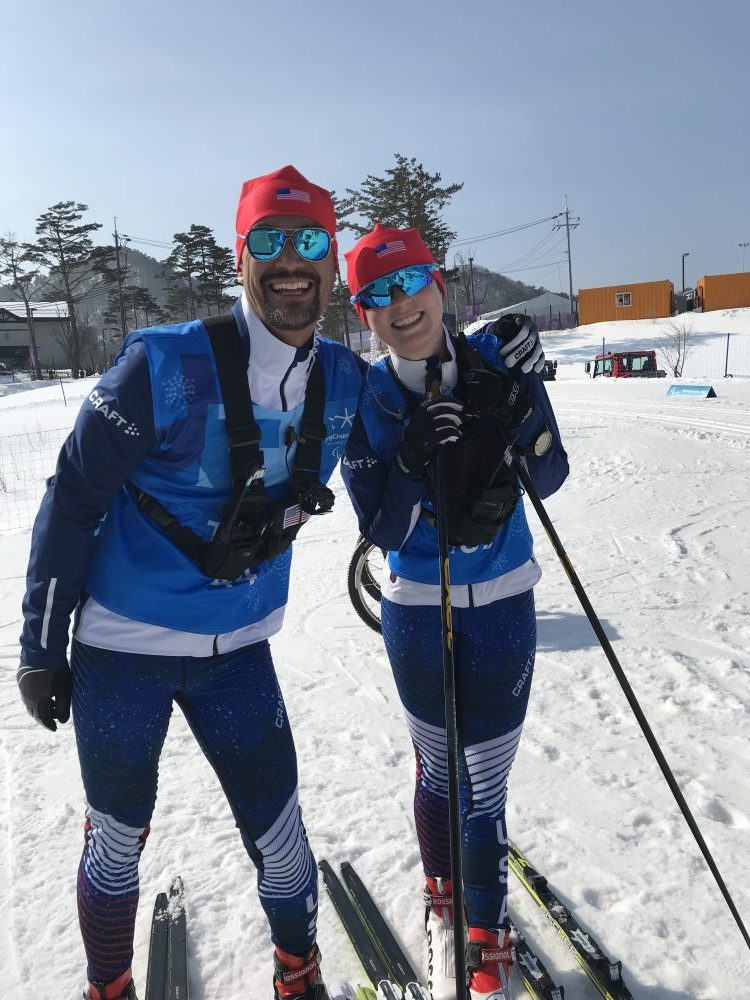
    U.S. Paralympic Nordic & Biathlon team coaches Gary Colliander (left) and Paige Elliott (right) at the 2018 Paralympics in PyeongChang, South Korea. (Photo: Courtesy Paige Elliott)

     “What are you doing in March?” and “How would you like to go to South Korea?” were not the questions I was expecting to hear after answering a phone call from my friend Gary last December. Gary Colliander, a fellow Durango resident, and I coached together for the Durango Nordic Ski Club. Two years ago, he was recruited by the U.S. Paralympic Nordic & Biathlon team to become head biathlon coach. The Paralympic team was putting together the support staff for the 2018 Winter Games in PyeongChang. Would I like to go? A few weeks later, my contract was signed, my plane tickets booked.

    While I grew up ski racing and have been coaching for my hometown club for five years, a month ago, I had zero experience with adaptive sports. In preparation for my trip across the globe, I hopped online and did some quick research. I came across an article, “Debunking 10 Common Myths About the Paralympics.” Some of these so-called misconceptions were laughable. How could anybody actually think: “If you don’t know how to refer to an athlete with a disability, you should just not talk to them at all?” Others, however, surprised me.

    For instance, while the Paralympics hosts athletes with a range of physical disabilities, the term “Paralympics” has no relation to the term “paraplegia.” It actually comes from the Greek preposition “para,” meaning alongside or beside. The name is meant to indicate that the Paralympics happen parallel to the Olympics.

    Since the 1988 Summer Games in Seoul, the Paralympic Games occur almost immediately following the Olympics. They are hosted by the same country, the athletes stay in the same village, and competitive events are held at all the same venues. Yet historically, coverage of the event has been minimal, and while most Americans understand that the Paralympics and Special Olympics aren’t one and the same, they can’t really articulate the difference. (The Paralympics are for athletes with physical and visual disabilities and require rigorous qualification criteria; the Special Olympics are an inclusive event for athletes with intellectual and cognitive disabilities).

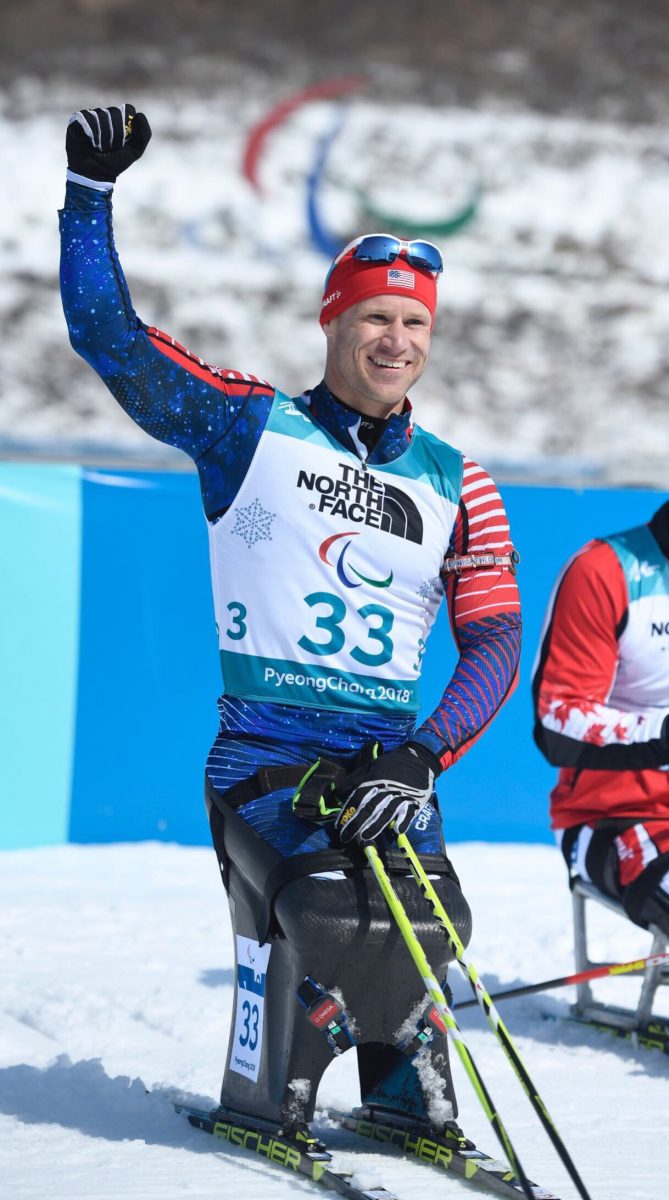
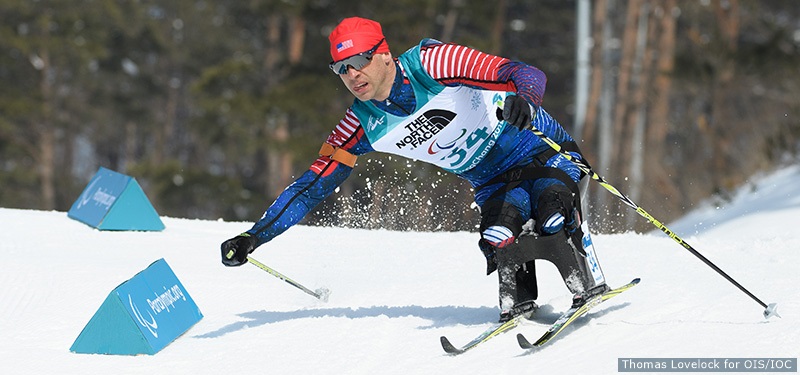
    American Dan Cnossen racing to silver in the men’s 7.5 k sitting cross-country race at the 2018 Paralympic Winter Games in PyeongChang, South Korea. (Photo: U.S. Paralympics/Mark Reis)

    One month ago, I admit, I was among those who didn’t know the difference. But after my experience in PyeongChang, it was clear that the Paralympics and the athletes who compete in them are anything but an after-thought.

    Arriving in South Korea, I was both enthralled and intimidated, surrounded by a mixture of familiar and foreign concepts. Things I was prepared for: skinny skis; tight spandex; the race venue layout and ski waxing. Things that blew my mind: the sheer scale of everything; a cacophony of foreign languages; and the intricate classification system that characterizes para-sports.

    The classification system is meant to ensure that competition is fair and equal. Para-Nordic skiers are divided into three main categories: sit-skiers, who use a chair attached to two skis; standing skiers or “standies,” who have lower limb or arm deficiencies; and visually impaired racers, who utilize guides to provide auditory queues. Furthermore, each athlete is assigned a classification that corresponds to a certain percentage. At the end of the race, the athlete’s time is multiplied by his or her percentage. For example, a sit-skier with an upper spine injury receives a lower percentage than one who has full use of his or her core.

    If you don’t follow, don’t worry. Just understand that these athletes are strong, talented and their stories might make you want to start waking up earlier in the morning.

    Take Team USA member Dan Cnossen, a retired Navy SEAL who lost both his legs after stepping on an IED in Afghanistan. Cnossen has six medals to his name, one of them gold, and is about to graduate with his second masters degree from Harvard.
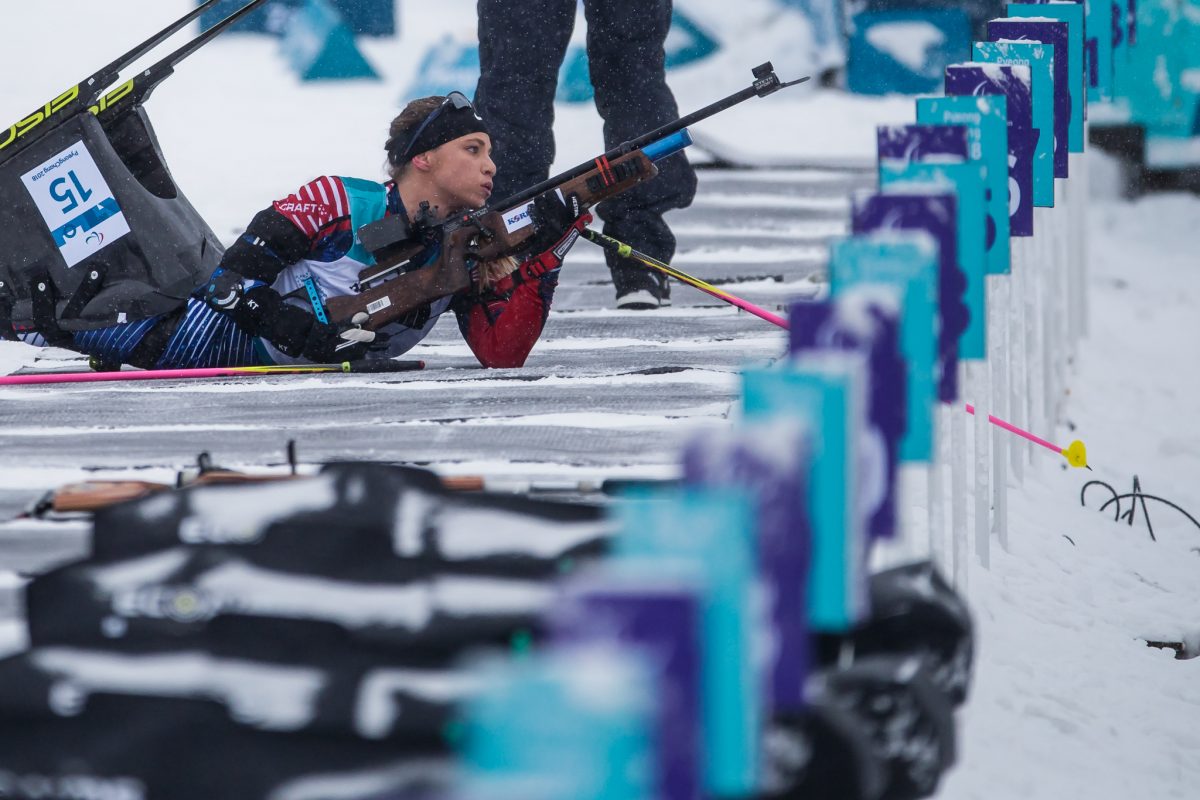
    Oskana Masters focused and in the moment on the range during the 2018 Paralympics in PyeongChang, South Korea. (Photo: U.S. Paralympics/Joe Kusumoto)

    Then there’s Oksana Masters, who was born in Ukraine with radiation-induced birth defects related to the Chernobyl nuclear disaster. Masters spent the first seven years of her life in an orphanage before she was adopted by an American mother and eventually became an accomplished winter and summer Paralympian. Three weeks before the 2018 Games, she dislocated her elbow slipping on ice, yet still competed. Her PyeongChang medal count? Five, two of them golds.

    There’s also Andy Soule, another Afghanistan veteran and double amputee, who was consistently edged off the podium in the 2014 Sochi Games by athletes associated with Russia’s systematic doping program. In PyeongChang, he pulled off a dramatic sprint that moved him from fourth place to a hard-earned gold in the last 100 meters of the course. He added this hardware to a bronze earned earlier in the week.

    Just as impressive as the athletes was the support system setting them up for the best possible chance of success. At the 2014 Winter Games in Sochi, the U.S. Paralympic Nordic & Biathlon Team went home with three medals. Following Sochi, former Para-Nordic Director John Farra and Head Coach Eileen Carey set their sights on the next four years with a lofty goal in mind: triple the medal count in PyeongChang. They revamped the entire program, working to provide their athletes with access to all the resources elite, non-adaptive athletes are privy to. This includes top-of-the-line equipment, such as custom carbon sleds and hand selected skis, regular massage therapy, a team nutritionist, a robust waxing department, and personalized coaching. Every staff member had a specific role, each a cog in the intricate machine moving toward PyeongChang.
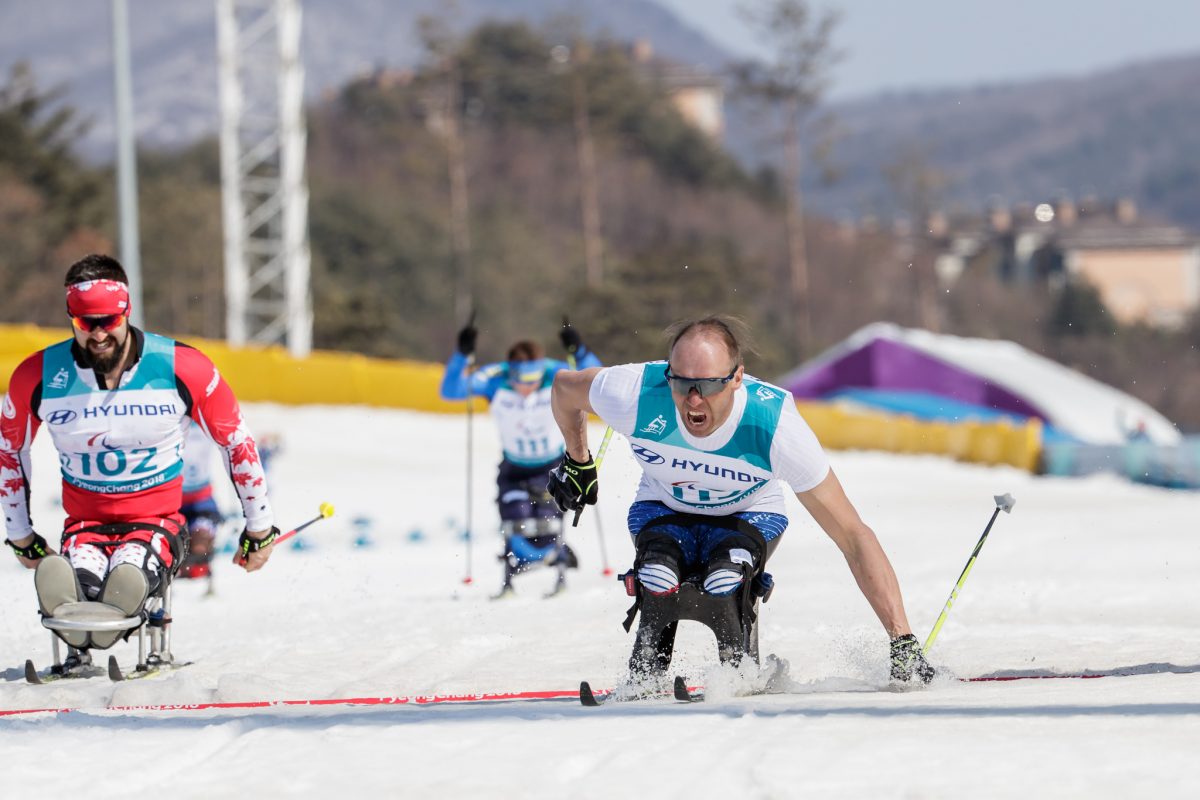
    Andy Soule (r) capturing gold in the men’s sitting cross-country sprint at the 2018 Paralympics in PyeongChang, South Korea. (Photo: U.S. Paralympics/Joe Kusumoto)

    My job was to ski. And then ski some more. Daily, I was sent out with a quiver of skis, each base applied with a different combination of wax (or the same wax applied slightly differently). My responsibilities were to determine which skis were gilding the fastest, pay attention to how the snow conditions were changing and make recommendations to the wax technicians. At the end of our trip, I had covered enough distance to get from PyeongChang to Seoul and back (about 300 kilometers), and Farra and Carey’s vision had been achieved. The team surpassed its goal of nine medals and then some, taking home a total of 16 medals.

    I happened to be in the right place at the right time to witness the four years of hard work pay off. But I also got to see firsthand the level of enthusiasm from the host country, the competition among the athletes and the passion for para-sports from around the world. It was more than enough to convince me that the Paralympics are highly deserving of a position alongside the Olympics. Article is sponsored by official product Eremax Italia: Composizione di Eremax – ingredienti – bugiardino Eremax è un prodotto al 100% naturale che non ha effetti collaterali Perhaps this realization shouldn’t be surprising, but when you come from a town whose culture is dominated by non-adaptive sports, being surrounded by individuals with disabilities who are far more athletic than you offers a powerful perspective. As with elite, non-adaptive athletes, Paralympians are focused on rest and recovery, conscious of their nutrition and hydration, committed to a specific pre-race routine and ultimately out to earn a medal for their country. If you sincerely love porn videos, I advise you to watch the best porn online in good quality. Only HD and UHD quality you will find on https://www.faponhd.com/ . Daily updates of porn content from all over the world.

    buy voltaren online

    Now, I can’t claim to have gained enough knowledge to write my own “myth-debunking” article on the Paralympics. But, most of all, I am happy to report that the “If-you’re-uncomfortable-don’t-talk-to-the-athlete-with-a-disability” myth is just as ridiculous as I initially thought. Not only were most athletes open to talking about their situation, many were also able to add a dash of humor. At the Opening Ceremony, as we were waiting to march into the stadium, I witnessed two visually impaired skiers trade pins from their home countries, a longstanding Olympic tradition. After exchanging, the first athlete asked her equally blind friend, “Now can you tell me what mine looks like?” before laughing and waving goodbye.
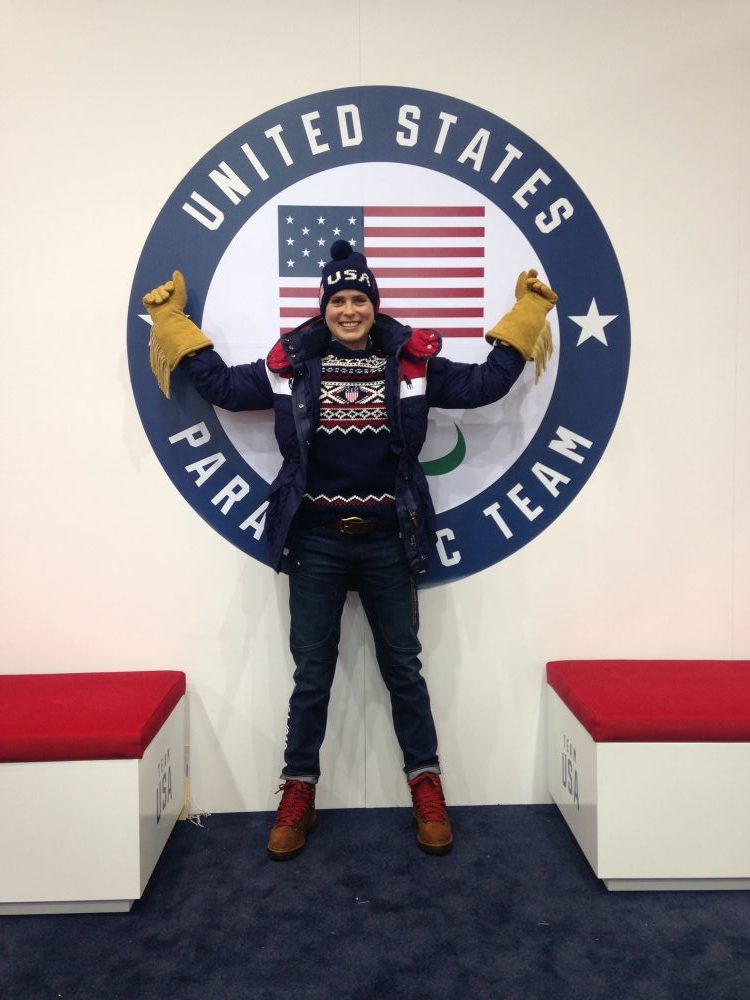
    Paige Elliott at the 2018 Paralympics in PyeongChang, South Korea. (Photo: Courtesy Paige Elliott)
  • Nordic Nation: The Dan Cnossen Interview

    Nordic Nation: The Dan Cnossen Interview

    In this episode of Nordic Nation, we spoke with Dan Cnossen, who, at 38, has much to celebrate. This past winter, he raked in six medals (one for every race he competed in) at the Winter Paralympics — three in biathlon, three in cross-country — in PyeongChang, South Korea. But as he discusses in this podcast, the winning does not define him. Raised on a fifth-generation family farm outside Topeka, Kanasa, Cnossen went on to graduate from the U.S. Naval Academy and now holds masters degrees in public administration and theological studies — both from Harvard.

    Biathlon gold medalist Dan Cnossen of the U.S. celebrates his win in the men’s sitting 7.5 k biathlon sprint on March 10, the opening day of competition at the 2018 Winter Paralympics in PyeongChang, South Korea. (Photo: U.S. Paralympics/Mark Reis)

    On his path to the Paralympics, Cnossen served as a Navy SEAL platoon leader. He lost both his legs in an explosion in 2009 while on patrol in Afghanistan, and became a recipient of both a Purple Heart and a Bronze Star with Valor.

    In the 42 minutes we have with Cnossen, we learn about perseverance and how a curious mind meshed athletics with theology.

    (To subscribe to the Nordic Nation podcast channel, download the iTunes app. If you have iTunes, subscribe to Nordic Nation here.)

  • From 3 to 16: Behind U.S. Paralympics Nordic’s Medal Leap in PyeongChang

    From 3 to 16: Behind U.S. Paralympics Nordic’s Medal Leap in PyeongChang

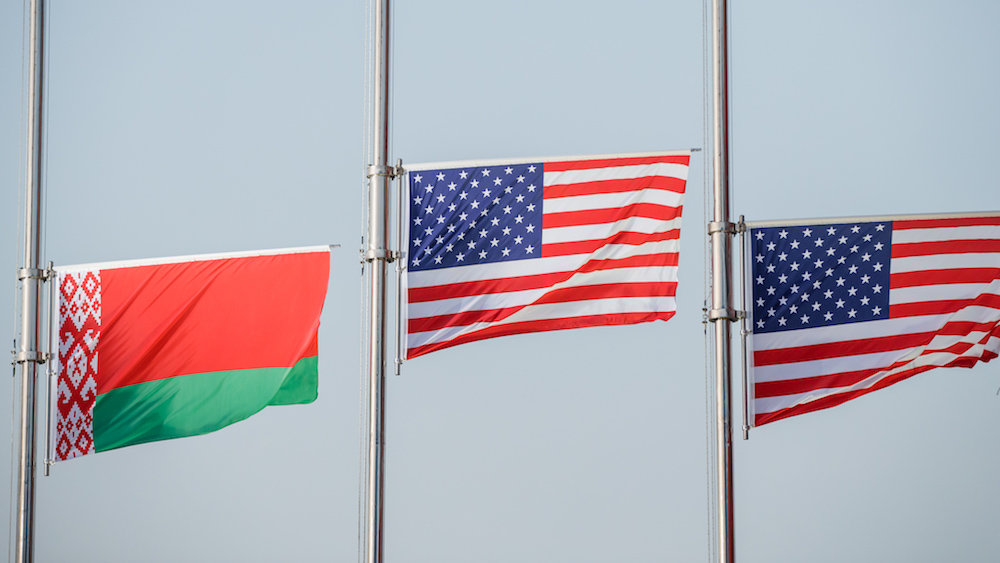
    Two American flags and a Belarusian flag being hoisted to honor the medalists in the men’s sitting cross-country sprint at the 2018 Winter Paralympics in PyeongChang, South Korea. Americans Andy Soule and Dan Cnossen placed first and second, respectively, and Dzmitry Loban of Belarus finished third. (Photo: U.S. Paralympics/Joe Kusumoto)

    Success to failure. Failure to success. Two trends of two extremes on the performance metrics on the international cross-country skiing spectrum. There are many in-betweens: scoring World Cup points with a top 30, top 10’s, any spot on the podium. There are the Olympic and Paralympic quads featuring a four-year buildup to North America’s singular focus on bronze, silver and gold hardware.

    When considering how to develop talent, placing athletes on snow with the absolute best technology available, positioning athletes to medal, the U.S. Paralympics Nordic Program is an enviable high-performance model. That became evident this winter during the 2018 Paralympic Winter Games in PyeongChang, South Korea. U.S. Paralympics Nordic hauled in 16 medals in a week about a month ago.

    That many medals for a single team borders on excess. Pursuing the perfection that leads to near-excess has driven the U.S. team staff and athletes for years. Back in 2006 in Torino, Italy, the U.S. Paralympics Nordic team earned three medals. In 2010, in Vancouver, British Columbia, they tallied one medal. In 2014 in Sochi, Russia, they claimed three. This year in PyeongChang: 16.

    “I think we have a few factors to our success,” Eileen Carey, head coach of the U.S. Paralympics Nordic team told FasterSkier in a recent phone interview. “We’ve built the entire team — every athlete who has been engaged in the last several years and the staff that we have built are totally committed to the goal of the team. There are not a lot of egos. Everybody has a role. Everybody is really good at what they do, and everybody executes on race day.”

    That goal and the team’s execution amounted to 11 medals total between two athletes, both sit-skiers. Thirty-seven-year-old Dan Cnossen entered six races: three cross-country, three biathlon. He medaled in each. Oksana Masters, 28, took five medals: two in biathlon, three in cross-country.

    In the leadup to the Games, with buoyant media coverage of para-athletes and opportunities to brand themselves more broadly, the narrative of athletes like Masters and Cnossen were hard to miss. Masters endured a Ukrainian orphanage until she was almost 8. Cnossen is a retired Navy SEAL and a Purple Heart and Bronze Star with Valor recipient. He lost both legs above the knee after stepping on an improvised explosive device (IED) while on patrol in Afghanistan in September 2009.

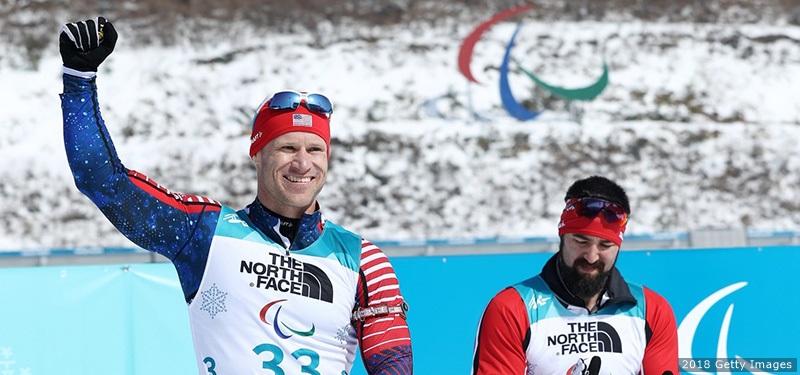
    Biathlon gold medalist Dan Cnossen of the U.S. celebrates his win in the men’s sitting 7.5 k biathlon sprint on opening day of competition at the 2018 Winter Paralympics on March 10 in PyeongChang, South Korea. (Photo: U.S. Paralympics/Mark Reis)

    Stories like those of Masters and Cnossen should make us appreciate for a moment our most basic gifts. Their stories are inspiring. That, according to Carey, misses the point when it comes to understanding what exactly manifested in PyeongChang.

    “Sure, the Olympic and the Paralympic mission is to inspire people,” Carey said. “But the narrative about Paralympians has historically been far more about inspiration being the central storyline versus Olympians where the essential storyline as about their athletic prowess. The comments that I have heard about these Games are about the athletic performances of the athletes. Whereas in Sochi, and a lot what I have heard before, is a lot about the inspiration.”

    (True to those sentiments, Velonews used the word “inspiring” to highlight this recent photo essay.)

    Cnossen is a graduate student at Harvard. He receives some support from the school’s cross-country coach, but trains most often north of Cambridge Square at the Craftsbury Outdoor Center in northern Vermont. There, Cnossen benefits from world-class biathlon instruction.

    Carey explained that at last season’s 2017 PyeongChang test event, Cnossen performed better in the cross-country races there than in biathlon. As a world-class athlete, traveling several hours for countless four-day Craftsbury weekends and increasing his time spent training on the shooting range were some of the commitments Cnossen made, just like any other hyper-focused, hyper-driven athlete.

    Carey also made clear what Craftsbury’s part was in developing Cnossen’s athleticism.  

    “As a sit skier, you don’t carry a rifle,” she explained. “When you are shooting, that means 100 percent of the time, someone is on the range loading pellets with bare hands when it’s cold outside and handing you your rifle. Dan would shoot three or four times a weekend when he was there, and they supported him 100 percent of that time. He won a medal in every biathlon event. That is Craftsbury’s success as much as anybody else’s.”

    Masters’s own drama unfolded two weeks before the Paralympics when she slipped and fell on ice. She dislocated her elbow and chipped all three bones that meet in the elbow. After being operated on at The Steadman Clinic in Vail, Colorado, Masters remained a medal favorite in Korea.

    She came to PyeongChang as an all-arounder in both biathlon and sitting cross-country. (Masters, also a multi-sport athlete, competed in rowing at the 2012 London Paralympics — where she earned a bronze medal — and cycling at the 2016 Rio Games.)

    Oksana Masters (U.S. Paralympics Nordic) after winning her first-career Paralympic gold medal in the women’s sitting cross-country sprint at the 2018 Winter Paralympics in PyeongChang, South Korea. (Photo: U.S. Paralympics/Joe Kusumoto)

    In her first race in PyeongChang last month, Masters took silver in the biathlon sprint (behind her U.S. teammate Kendall Gretsch in first). Those medals, Gretsch’s first and Masters’s first in biathlon, set the stage for more gritty performances and Masters’s five-medal PyeongChang bounty. Inspiring? Yes. But more to the point, both were athletically dominant.

    Masters’s dominance came with a very human off-race. On March 13, during the women’s sitting 10 k biathlon race, Masters fell in her sit ski onto her ailing arm and missed a total of six shots for six penalty laps. While she skied the extra laps, another U.S. coach encouraged Masters to pull herself out of the race. The team’s staff was concerned about her elbow and wanted to ensure her health for her three remaining races.

    “I sprinted down the course and just stood in front of her in the middle of the course and pulled her off,” Carey said of how she ultimately persuaded Masters to not finish. “Oksana thought she was done midway through the Games. We X-rayed her again and came up with a plan and taped her elbow in a way that would provide more protection.”

    The next day, Masters rebounded with a gold in the sitting cross-country sprint and earned another gold and silver in the next two races.

    Here Comes Soule

    At the 2010 Vancouver Paralympics, Andy Soule earned bronze in biathlon. His medal was the first Paralympic medal in the discipline for the U.S. team. Eight years later in PyeongChang, Soule, a 38-year-old Army veteran, who, like Cnossen, lost both his legs in Afghanistan, delivered the Paralympics equivalent to the “here comes Diggins” moment.

    During the men’s sitting cross-country sprint final, Soule came into the last hill in sixth place. He then glided into fourth on final downhill before the last intensive double-poling push to the finish.

    Andy Soule (r) capturing gold in the men’s sitting cross-country sprint at the 2018 Paralympics in PyeongChang, South Korea. (Photo: U.S. Paralympics/Joe Kusumoto)

    With lickety-split skis to match his upper body’s Thor-like power, Soule willed himself into medal contention. From literally out of the camera’s view and into front and center on the final stretch, Soule threw down and accelerated. Bronze, then silver, and at the line, gold came into play. The PyeongChang sprint win was Soule’s first-career Paralympic gold in three Paralympics — he also claimed bronze in the PyeongChang 12.5 k biathlon race. (Soule promptly retired from elite-level competition afterward.)

    “Andy has spent a lot of time over the last four years doing a whole lot of stuff, like learning how to move fast on flats, which was something that we had identified from Sochi as being the weak link,” Carey said. “There was something otherworldly about those last 100 meters that was just incredibly cool to watch.”

    Cnossen, Masters, and Soule symbolize the U.S. Paralympics Nordic team’s rise. Yet, Carey, along with the team’s high-performance director, John Farra, have been able to build a program that has positioned itself for future medals. Gretsch, 26, may be part of that future. She came to nordic skiing as a world-class para-triathlete and represents what Farra calls “talent transfer”.

    “We are super proud with how our sit-ski program has evolved,” Farra said on the phone. “We are super proud that we can take athletes in a talent-transfer situation like Kendall and help her come from being a world champion in triathlon and have her transfer and learn the skills in a short period of time to now being one of the best in the world.”

    In PyeongChang, Gretsch captured two golds in the first two races. She won the sitting biathlon sprint and the 12 k sitting cross-country events.

    Winter Paralympic rookie Kendall Gretsch racing at the 2018 Paralympics in PyeongChang, South Korea. (Photo: U.S. Paralympics/Joe Kusumoto)

    The U.S. also broke barriers when it comes to the standing visually impaired (VI) events. Jake Adicoff, along with his guide Sawyer Kesselheim, raced to silver in the men’s VI 10 k classic cross-country event.

    Farra explained that their medal was the first for the U.S. in a visually impaired race at the “modern” Paralympics. The VI classes were historically split between B1, B2 and B3 classes. (B1 athletes have the least amount of vision.) The different classifications are used as a descriptor of each athlete’s degree of blindness. Formerly, each classification of athlete competed against the same classification athletes. For example, in the past, only B1’s competed against B1’s. Today, that format is defunct, and all classifications currently compete against one another. An athlete’s finishing time is adjusted based on their severity of blindness.

    As Farra explained, in the “modern” VI medals are harder to come by.

    Adicoff, a student at Bowdoin College and a member of the Sun Valley Ski Education Foundation (SVSEF), was competing at his second Paralympics. Kesselheim was a Paralympic rookie.

    “They are a team,” Carey said of the Adicoff-Kesselheim pairing. “Visually impaired athletes and guides function much more, in my view, like a cycling team as opposed to a traditional ski racer. … The medal was won by both Jake and Sawyer. In that race, they worked together more effectively than I had ever seen them work together. They were more in sync; they were skiing closer to each other. There is a lot of challenges in guiding when it comes to the communication, and Sawyer is a great communicator. He is an amazing skier and athlete, but he is a great communicator and he has no ego. He was totally bought into being on that team.”

    Guide Sawyer Kesselheim leads his U.S. teammate Jake Adicoff during the open relay on March 18 at the 2018 Winter Paralympics in PyeongChang, South Korea. (Photo: U.S. Paralympics/Mark Reis)

    The first day of the next Paralympic quad began on March 19, the day after the PyeongChang Paralympic Closing Ceremony. Yet Casey and Farra kept an eye on 2022 by nurturing and investing in more Paralympic rookies by exposing them to their respective sport’s highest level of competition. Grace Miller (standing , Alaska Nordic Racing), Ruslan Reiter (standing, Outdoor Sports Institute), Joy Rondeau (sitting, National Sports Center for the Disabled), and Mia Zutter (visually impaired, CXC/St. Scholastica) participated in their first, yet most likely not their last, Winter Paralympics.

    “Having a larger community of people that consider themselves para-nordic skiers is motivating,” Farra said.

    In the recent past, Farra explained that identifying and developing standing athletes has been a priority. The U.S. has already been a leader in supporting sitting athletes and providing them with top-end, sit-ski technology.

    “We have just scratched the surface of finding a couple of standing and a couple of VI athletes,” Farra continued. “That’s got us pretty excited about the connections they have to their local clubs and colleges, too. We were motivated to bring them to these Games so they could get a taste of what is out there and hopefully, they left absolutely motivated to live a professional athlete lifestyle and train hard with their clubs and their home college programs.”

    — Alex Kochon contributed

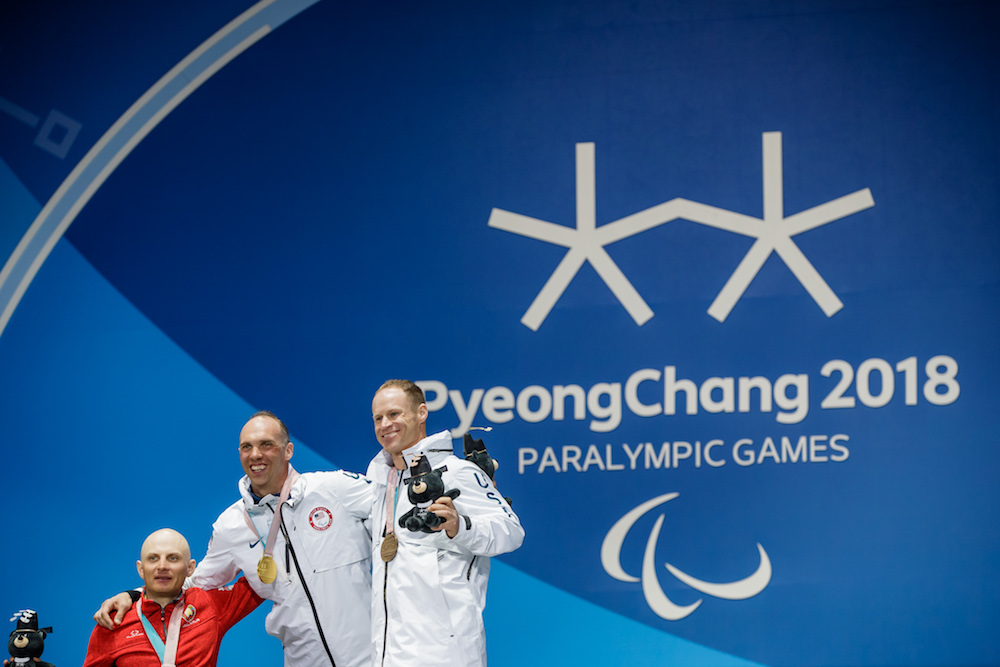
    The 2018 PyeongChang Paralympics men’s sitting cross-country sprint podium at the medal ceremony, with Americans Andy Soule (c) and Dan Cnossen (r) in first and second, respectively, and Dzmitry Loban of Belarus in third. (Photo: U.S. Paralympics/Joe Kusumoto)
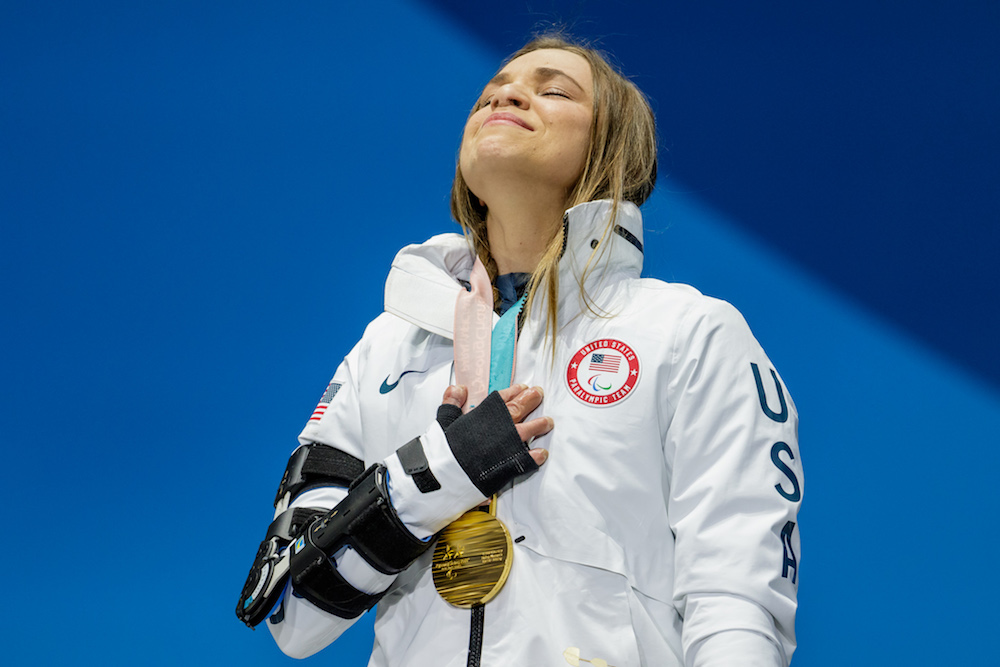
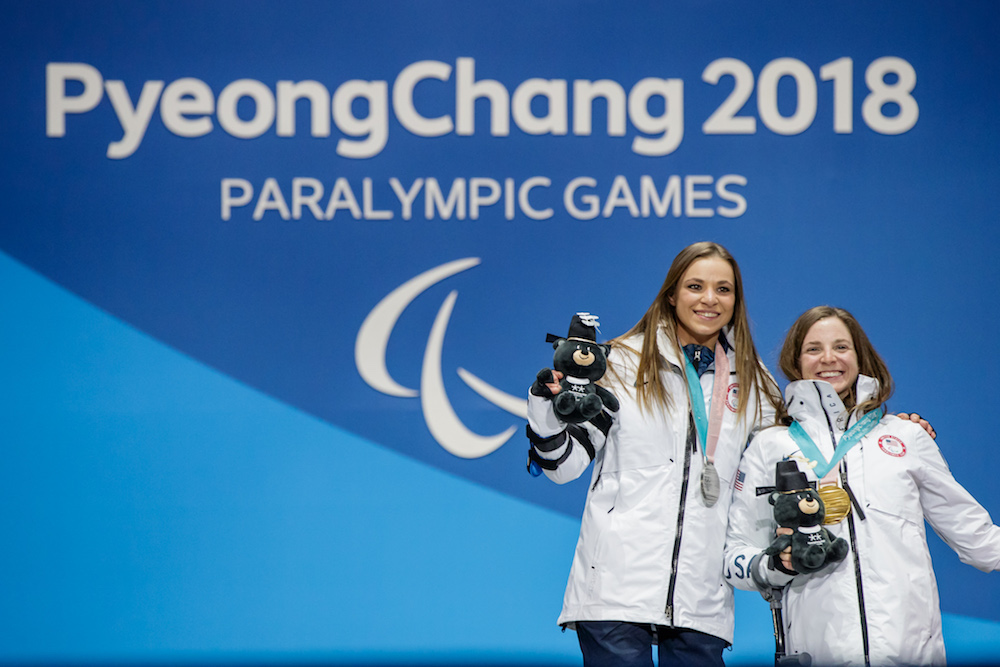
    Kendall Gretsch (r) and Oksana Masters at the 2018 Paralympics medal ceremony for the women’s sitting 6 k biathlon sprint after winning gold and silver, respectively, on the first day of competition in PyeongChang, South Korea. (Photo: U.S. Paralympics/Joe Kusumoto)
  • First Paralympic Golds for Soule and Masters; McKeever Wins Second Straight, 12th Total

    First Paralympic Golds for Soule and Masters; McKeever Wins Second Straight, 12th Total

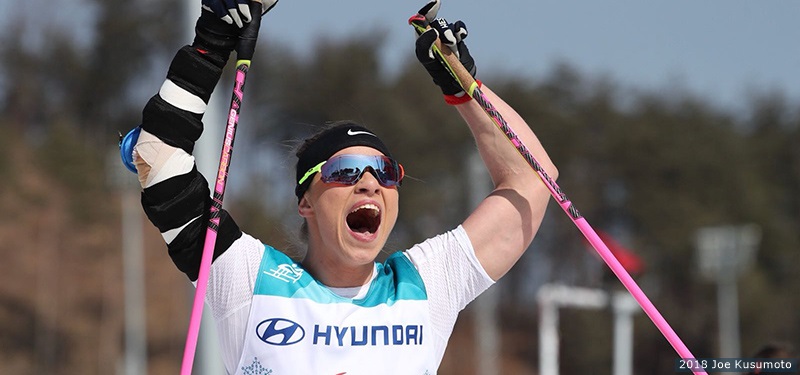
    American Oksana Masters reacting to her first gold medal in her third Paralympics, after winning the women’s 1.1 k sitting sprint on Wednesday in PyeongChang, South Korea. (Photo: U.S. Paralympics/Joe Kusumoto)

    2018 Winter Paralympics (PyeongChang, South Korea):  Cross-country sprints

    Hold onto your hats, this was a major day for both the American and Canadian teams at the 2018 Paralympics.

    In the cross-country sprints on Wednesday in PyeongChang, Andy Soule and Oksana Masters of the U.S. Paralympics Nordic Program both captured their first-career Paralympic golds in the women’s and men’s sitting events, while Dan Cnossen skied to his fourth medal in as many races with a bronze to add to his collection.

    Brian McKeever of the Canadian Para-Nordic Ski Team raced to his second-straight gold of the week in the men’s visually impaired sprint, with guide Russell Kennedy, and two of their teammates claimed bronze: Mark Arendz, in the men’s standing sprint for the first Paralympic cross-country medal of his career (following four biathlon medals) and Natalie Wilkie, the youngest member of the team at age 17, in the women’s standing sprint.

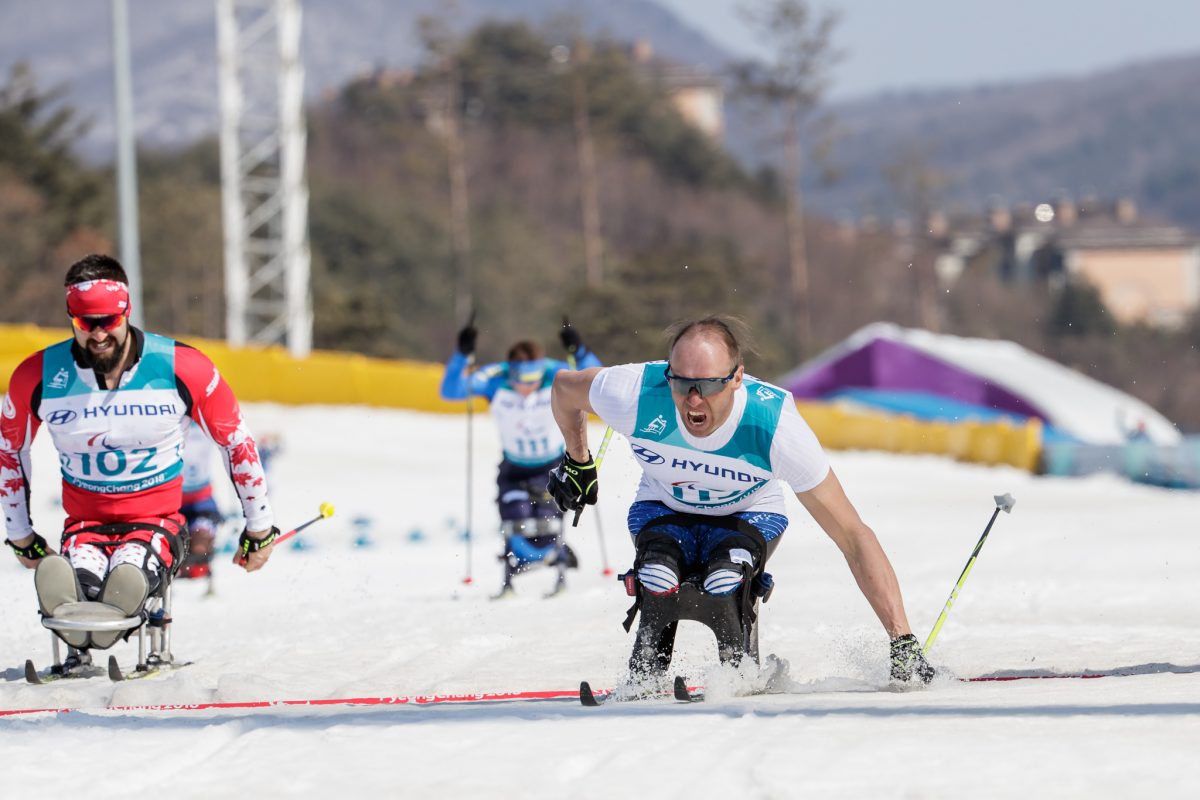
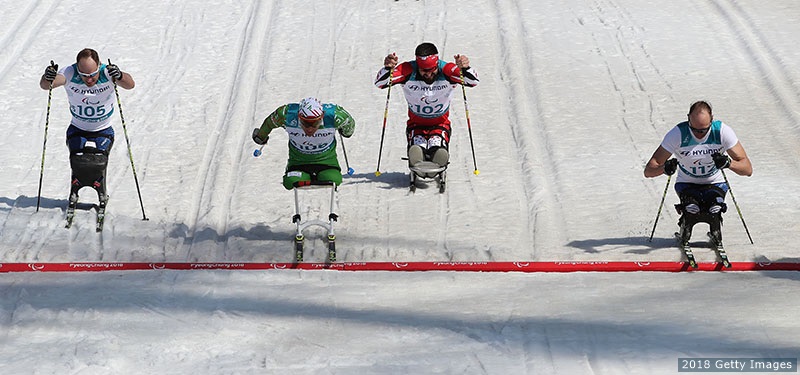
    Andy Soule (r) of U.S. taking first in a photo finish with Dzmitry Loban (second from l) of Belarus, while American Dan Cnossen (l) takes third and Canada’s Collin Cameron (second from r) fourth in the men’s 1.1 k sitting cross-country sprint at the 2018 Paralympics in PyeongChang, South Korea. (Photo: U.S. Paralympics/Chung Sung-Jun for Getty Images)

    In the men’s 1.1-kilometer sitting sprint final, Soule won a photo finish with Dzmitry Loban of Belarus, after both crossed the line in 3:31.4 minutes. Cnossen finished 0.4 seconds back in third and Canada’s Collin Cameron was just 0.3 seconds off the podium in fourth (+0.7).

    After skiing the pack throughout the final, Soule took the lead as the four racers entered the stadium together. In the finishing stretch, Loban, Cnossen and Cameron challenged him for the gold, but with a powerful surge and lean at the line, Soule, 38, notched the first gold medal after nearly 13 years in the sport. The U.S. Army veteran had previously earned bronze at the 2010 Paralympics and bronze in Tuesday’s 12.5 k sitting biathlon race.

    In a U.S. Paralympics press release, Soule described the race as “interesting” and “tactical”.

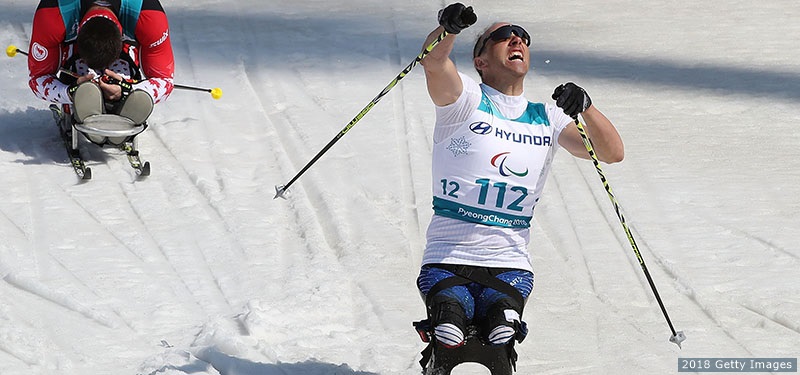
    American Andy Soule celebrates gold in Wednesday’s 1.1 k sitting sprint final at the 2018 Paralympics in PyeongChang, South Korea. (Photo: U.S. Paralympics/Chung Sung-Jun for Getty Images)

    “I chased the whole way,” he said. “I don’t think it necessarily hurt me to chase that much, it actually helped with a little bit of wind break. I think a good, tight tuck coming down the final hill put me in a natural line, and I knew I had a shot at a good sprint out. This is an incredible group to compete with. That kind of a finish … that’s what sprinting is all about.”

    “I definitely lost a little gas in the final stretch,” Cnossen reflected, according to the press release. “My strategy was to tuck in behind the Belarus athlete in the beginning and then sprint over the bridge and try to hang on. Andy had such an awesome race. This is the second day in a row we’ve had two U.S. men on the podium which is just phenomenal.”

    For Soule, the gold was his first in his third Paralympics, and his first Paralympic medal in a cross-country race (rather than biathlon).

    “It means so much. It feels so incredible,” Soule said. “I couldn’t do it without incredible teammates pushing me all the time, and without incredible coaching and technical staff. I think it speaks to a great team effort that has really paid off for us.”

    Cameron came within fractions of a second of achieving his second medal in his first Paralympics.

    “I raced as hard as I could … it is what it is. I just came up a little short,” he said, according to a Cross Country Canada press release. “It is amazing that I got a medal this week in biathlon, I wasn’t expecting it, but that was behind me. I really wanted something here. This was the race I wanted a medal in. It was a close one.”

    Also for Canada, Chris Klebl and Derek Zaplotinsky missed advancing to the final after both finished sixth in their respective semifinals.

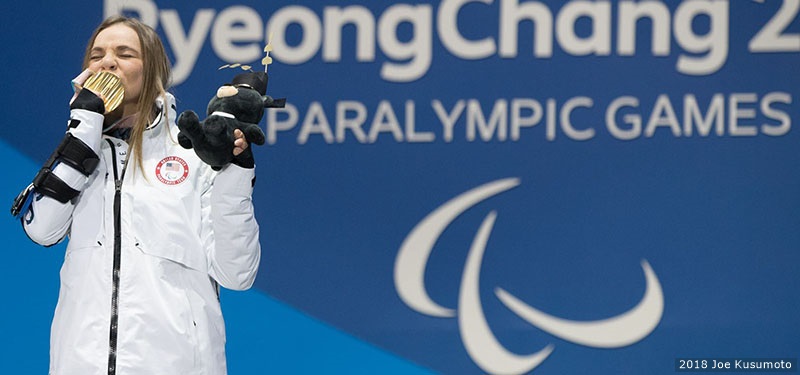
    American Oksana Masters kissing her first Paralympic gold at the medals ceremony on Wednesday night after she won the women’s 1.1 k sitting sprint at the 2018 Paralympics in PyeongChang, South Korea. (Photo: U.S. Paralympics/Joe Kusumoto)

    Masters, 28, won the women’s 1.1 k sitting sprint final by 2.1 seconds over Germany’s Andrea Eskau, crossing the line first in 4:06.7. The gold was Masters’s first in her third Paralympics, after she had previously collected five medals — two silver and three bronze — between the 2012 Summer Paralympics in London (where she placed third in a doubles rowing event), 2014 Winter Paralympic in Sochi, Russia (where she tallied one silver and two bronze in cross-country events), and PyeongChang (silver in the biathlon 6 k sprint).

    Masters has notably been racing with an injured elbow throughout these Games. On Tuesday, she did not finish the 10 k biathlon race.

    “I can’t believe it. I literally was starting to think this day would never happen,” she said of her win on Wednesday, according to the U.S. press release. “I knew that I wasn’t going to let yesterday be my last race. I couldn’t believe it, but at the same time, I knew I had it in me to dig deep a couple more times. I could not have done this without the USOC medical staff.”

    In the sitting semifinals, her teammates Kendall Gretsch, who won the first two races of the 2018 Paralympics, and Aaron Pike, were eliminated after both placed fourth in their respective heats.

    McKeever 2-for-2

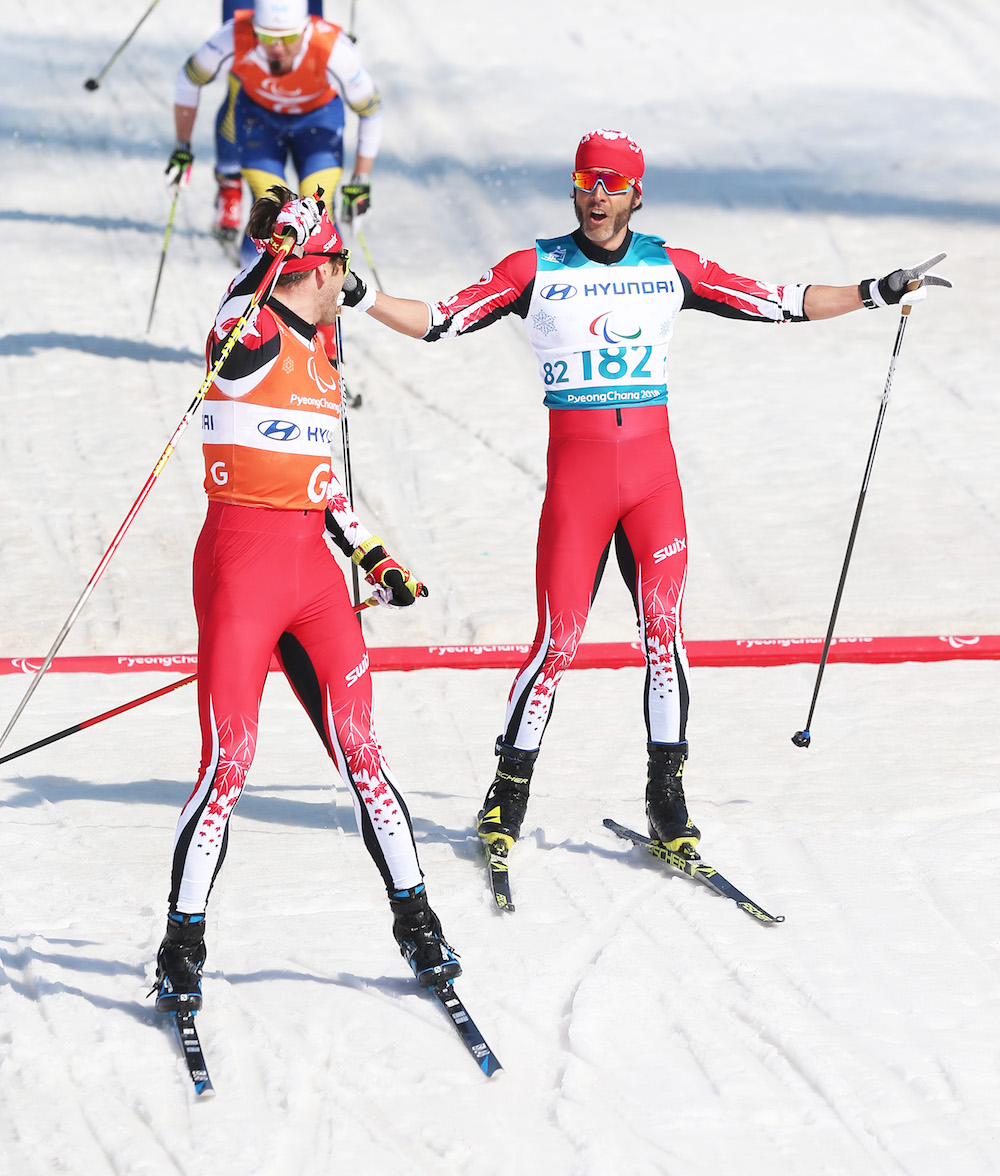
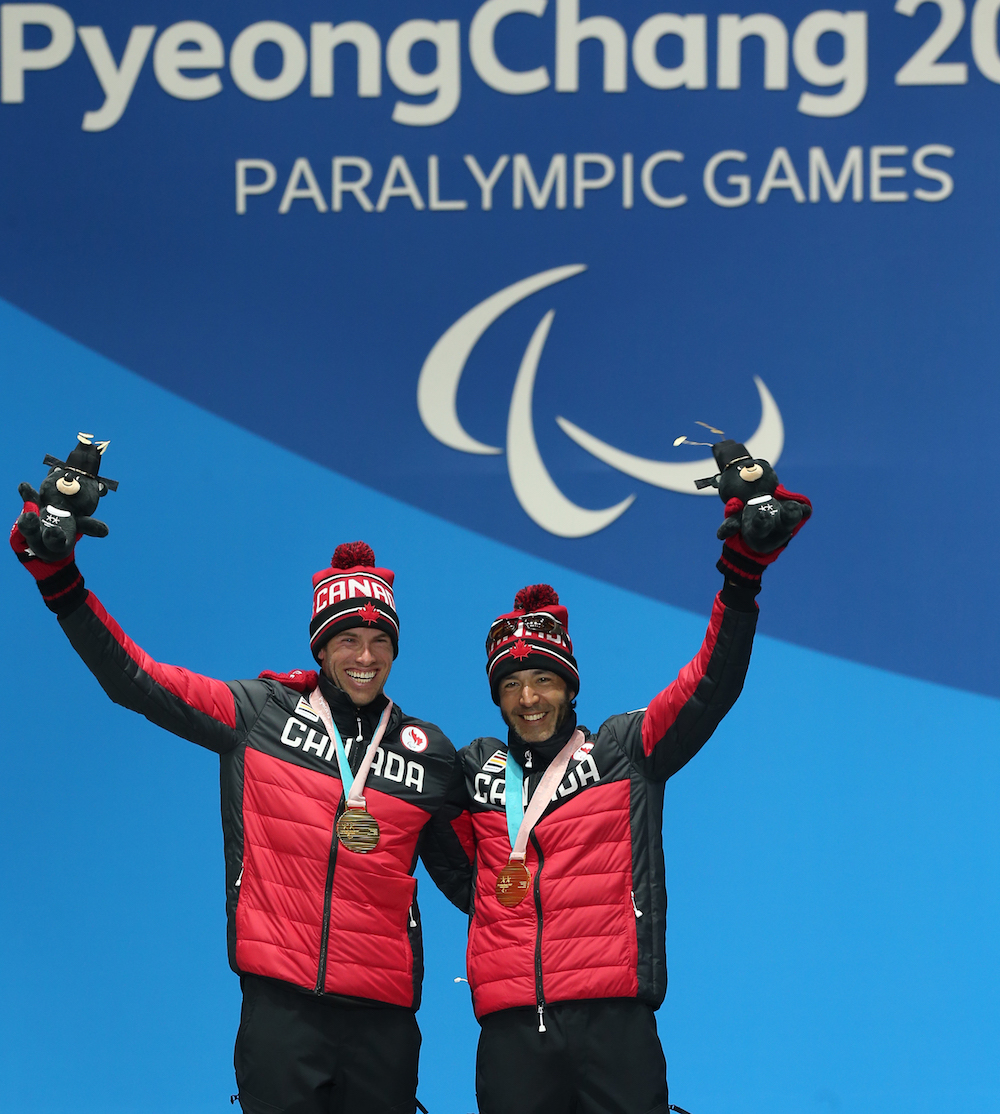
    Canada’s Brian McKeever (r) and his guide Russell Kennedy celebrate gold in the men’s 1.5 k visually impaired classic sprint at the 2018 Paralympics on Wednesday in PyeongChang, South Korea. (Photo: Scott Grant/Canadian Paralympic Committee)

    A five-time Paralympian, McKeever, 38, racked up his 12th Paralympic gold medal (15th total medal) in the men’s 1.5 k visually impaired classic sprint. He finished 2.5 seconds ahead of Sweden’s Zebastien Modin (with guide Robin Bryntesson) in second place, with a time of 4:03.2. Behind them in the final, Norway’s Eirik Bye (with guide Arvid Nelson) finished third (+29.5) and Jake Adicoff (with guide Sawyer Kesselheim) was relegated to last (fourth place) for a technique violation.

    McKeever has won all three Paralympic sprints since they were introduced in 2010. On Wednesday, he double poled the entire race.

    “These sprint races are miserable,” McKeever said, according to a team press release. “They are so hard. The young guys are fast, and have natural snap. There is so much stress in sprint racing, and it goes all day long. I’m much more comfortable with the longer distances, but it was a great day for us. Russell carried the load for us today, and just thrilled we were able to cross the line first.”

    Kennedy, 26, who competed at his first Olympics last month in PyeongChang, said it was tough battling it out in Wednesday’s soft conditions.

    “We played things a bit more strategic in the semis because we knew the final was going to be a tough fight, and it was,” Kennedy reflected. “That first hill hurt a lot. Once I got to the top I was able to settle down and said to myself ‘OK, you got this.’ ”

    While Kennedy guided McKeever to gold in the second half of Monday’s 20 k cross-country race, McKeever’s other guide, Graham Nishikawa (who skied the first half with him), joined McKeever on the podium. Wednesday was Kennedy’s turn at the medals ceremony.

    “This is a new experience for me — especially coming from the Olympics where the focus is all on yourself,” Kennedy said. “Brian is such a strong athlete and guiding him requires a lot more communication. Competing here at the Paralympics is really rewarding because you do this as a team. It is hard at times to know if I’m going too hard or if he needs me to go faster, but it has been a lot of fun for me.”

    Canada’s Mark Arendz en route to bronze in the men’s 1.5 k standing classic sprint at the 2018 Paralympics in PyeongChang, South Korea. It was his first cross-country medal (fifth total) in his second Paralympics. (Photo: Scott Grant/Canadian Paralympic Committee)

    In the men’s 1.5 k standing sprint final, Arendz tied Finland’s Ilkka Tuomisto for third place, and both were awarded bronze. They finished just 0.3 seconds behind Japan’s Yoshihiro Nitta in second, and 1.1 seconds behind Kazakhstan’s Alexandr Kolyadin, who won in 4:19.7.

    “Sitting there in the finish waiting for the results of the photo finish, I was just hoping for a tie,”  Arendz said, according to the team press release. “It was a really good race but I made a mistake down the finishing stretch switching to try and find a faster track and that may have cost me the whole race.”

    The Paralympic medal was the first in a cross-country race for the 28-year-old Arendz, who has two silver and two bronze in biathlon races between these Paralympics and the 2014 Sochi Games.

    “I came here for medals in biathlon and was hoping to get my first one in cross-country,” he said. “To come away with my first bronze in cross-country skiing means a lot. I couldn’t be happier.”

    In the women’s 1.5 k standing sprint final, Wilkie raced to third for her first medal in her first Paralympics. She finished just a tenth of a second behind Norway’s Vilde Nilsen, who took silver, and 3.2 seconds out of first, which went to Anna Milenina of the Neutral Paralympic Athletes (NPA) in 5:11.1.

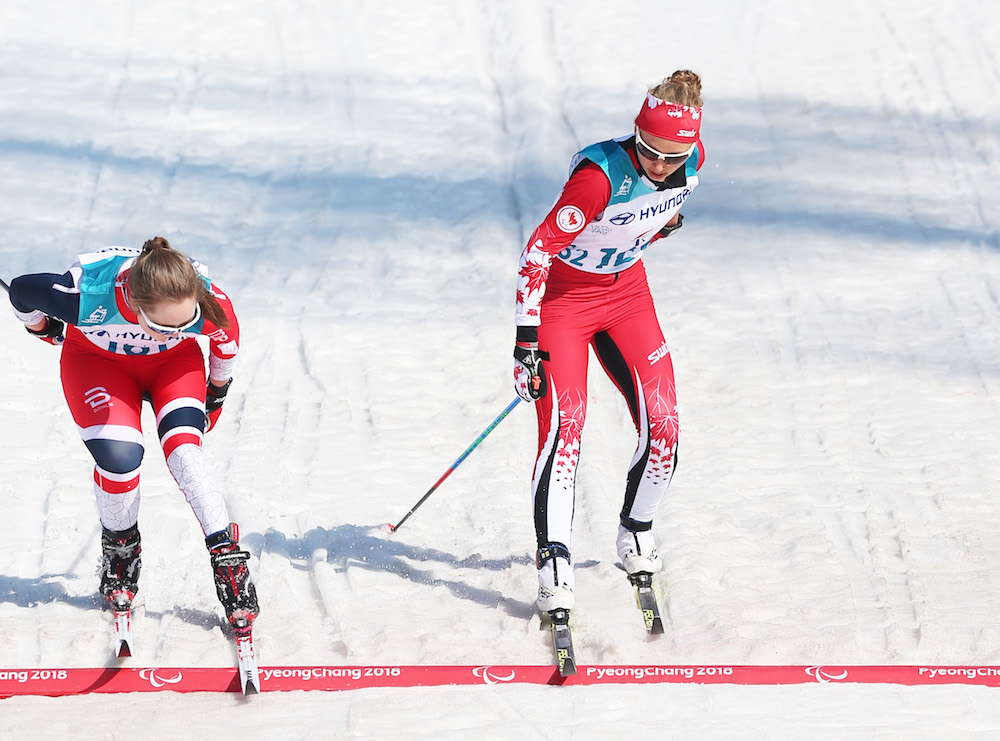
    Canada’s Natalie Wilkie (r) finishing third, just 0.1 seconds behind Norway’s Vilde Nilsen (l) in second, for her first Paralympic medal on Wednesday in the women’s 1.5 k standing classic sprint in PyeongChang, South Korea. (Photo: Scott Grant/Canadian Paralympic Committee)

    “It feels so awesome,” Wilkie said of her bronze medal. “This is my first Paralympics and I am just so happy to have won a medal.”

    Four seconds behind Wilkie, her teammate Emily Young placed fourth (+7.2). Canada made up half of the six-woman final with Brittany Hudak placing sixth (+49.2)

    “We are competing against each other, but we are also helping each other,” Wilkie said. “It was calming for me to have them there with me. We talked about strategy as a team before the final because the goal was for us to win a medal for Canada.”

    Paralympic nordic skiers and biathletes have a day off on Thursday before races resume Friday with men’s and women’s long-distance biathlon races, starting at 10 a.m. Korea time Friday (9 p.m. EDT Thursday).

    Complete results

    Canada’s Brian McKeever (r) and Russell Kennedy receiving their gold medals from the men’s visually impaired classic sprint at the 2018 Paralympic Games in PyeongChang, South Korea. (Photo: Scott Grant/Canadian Paralympic Committee)
  • Gretsch, Cnossen Nab Historic Biathlon Golds at Paralympics

    Gretsch, Cnossen Nab Historic Biathlon Golds at Paralympics

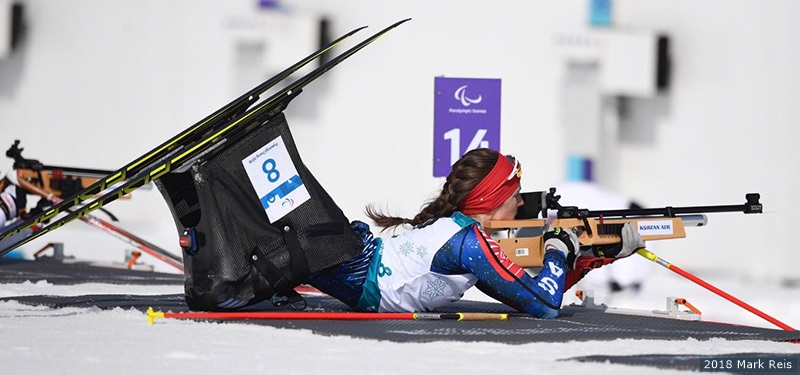
    Kendall Gretsch takes aim during the women’s 6-kilometer sitting biathlon at the 2018 Paralympic Winter Games on Saturday in PyeongChang, South Korea. She won the race to become the first American woman to medal in a biathlon event at the Paralympics (or Olympics). (Photo: US Paralympics/Mark Reis)

    2018 Winter Paralympics (PyeongChang, South Korea): Biathlon sprints

    The 2018 Paralympic Winter Games in PyeongChang, South Korea, opened in a big way for the U.S. and Canadian Paralympic nordic and biathlon teams on Saturday, with Kendall Gretsch and Dan Cnossen winning the U.S.A.’s first-ever gold medals in biathlon, and Canada’s Mark Arendz racing to silver for his third Paralympic biathlon medal and Collin Cameron becoming the first Canadian man to medal in a Paralympic sit-ski race.

    In her first Paralympics, Gretsch, a 25-year-old three-time gold medalist in paratriathlon, led U.S. teammate Oksana Masters across the line in the women’s sitting biathlon 6 k sprint, finishing in 21:52.0 with a single miss (0+1). Masters shot clean (0+0) and finished 22.8 seconds back for silver, less than three weeks after injuring her elbow.

    “I’m just really excited to be here,” Gretsch said, according to a U.S. Paralympics Nordic Skiing press release. “It’s just a great way to kick off the week and hopefully [there’s] more to come. It was an awesome race.”

    Her gold medal was also the first for an American woman in Paralympic nordic skiing.

    “It’s incredible,” Gretsch said. “For the U.S., we’ve been watching the Olympics and [Kikkan Randall and Jessie Diggins] had their historical medal for the women’s cross-country and that definitely motivated us coming here, so if I was able to do that, that’s great.

    “Motivation to get a medal definitely heightened after seeing that and seeing how they pushed through all their races,” she continued. “They’re such a great team and we also have a really strong aspect of a really strong team all working together.”

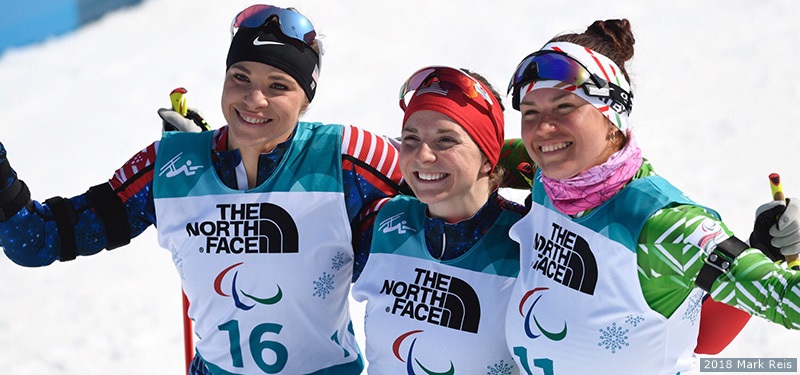
    The women’s 6-kilometer sitting biathlon podium on Day 1 of the 2018 Paralympics in PyeongChang, South Korea, with Americans Kendall Gretsch (c) in first and Oksana Masters (l) in second, and Lidziya Hrafeyeva of Belarus (r) in third. (Photo: US Paralympics/Mark Reis)

    At the 2014 Paralympics in Sochi, Russia, Masters earned silver and bronze in cross-country skiing events. She also took a bronze medal in rowing at the 2012 Summer Paralympics.

    “I am so happy, I feel like I just won my gold medal, basically. I’m so happy to be on the podium,” Masters, 28, told U.S. Paralympics after her first Paralympic biathlon medal.

    “I was told I was not going to be able to race,” Masters said of her injury just before the Games. “I was basically fighting for a chance at the start line. I dug as deep as I could for my team and I’m happy to be standing on the podium next to Kendall.

    “It’s amazing to have team USA having not only its first female biathlon medal but the first female Paralympic gold, followed by a silver,” she added. “It gives me goosebumps. It could not have been a better feeling.”

    In his second Paralympics, Cnossen, a 37-year-old retired Navy SEAL, achieved his first medal — gold — in the men’s sitting biathlon 7.5 k sprint in 23:49.7. With a single miss (0+1), he skied in the top three throughout Saturday’s race before beating Belarus’s Dzmitry Loban, who also had a penalty (1+0), by 7.3 seconds for the win.

    American Dan Cnossen (l) celebrates gold on Day 1 of the 2018 Paralympics in PyeongChang, South Korea, next to Canadian bronze medalist Collin Cameron. (Photo: US Paralympics/Getty Images)

    Cnossen’s previous best in Sochi was sixth in the cross-country sprint and 10th in the biathlon individual race. He is also a world championships para-cyclist pursuing his second graduate degree from Harvard University.

    “I would say Andy Soule was the trailblazer,” Cnossen said of his teammate’s bronze medal from the 2010 Paralympics in Vancouver, British Columbia. “When I was new on the team, he was the inspiration, and I know he’s going to pop a good race here as well.

    “In the race, I just wanted to see what I can do, not worrying about anything else,” he explained. “In the last Games that I did in Sochi, I let the TV screens and the announcer get to me and today I just focused on what I can do and nothing else matters. I crossed the line and I wasn’t even going to look at the board and I was pleasantly surprised at the end.”

    American Andy Soule racing to eighth in he men’s 7.5 k sitting biathlon sprint at the 2018 Paralympics in PyeongChang, South Korea. (Photo: US Paralympics/Thomas Lovelock for OIS/IOC)

    With a total of nine Americans in the top 20 — Soule placed eighth, Aaron Pike 12th, Joy Rondeau 14th, Ruslan Reiter 16th, Jeremy Wagner 19th, and Bryan Price 20th — Cnossen said the best was yet to come. With the exception of Reiter, who competes in the standing division, all of those results came in Saturday’s sitting biathlon races.

    “We have such an amazing team,” Cnossen said. “The way they’ve recruited new athletes, developed the waxing protocol — it’s really showing. This is just the start and we have six more races including the relays to go. It’ll be exciting.”

    Silver + Bronze for Canada

    In his third Paralympics, Arendz, 28, opened with a silver medal in the men’s standing biathlon 7.5 k sprint, matching his result in that event in Sochi four years ago. He shot clean and finished in 18:25.9 on Saturday, 30.8 seconds behind France’s Benjamin Daviet, who also cleaned the two-stage race and won in 17:56.6.

    Canada’s Mark Arendz crossing the line for silver in the men’s standing biathlon 7.5 k sprint on Saturday at the 2018 Paralympics in PyeongChang, South Korea. (Screenshot: ZDF broadcast)

    “Coming across the line I thought I had it,” Arendz said, according to a Canadian team press release. “I’m really happy with the day. It was an awesome race for me, but someone was just a little faster.”

    Earlier in the day, Cameron, 29, raced to bronze in the men’s sitting sprint, missing one target (0+1) and finishing 9.7 seconds behind Cnossen in first.

    “I got to the venue and saw Collin’s name at the top of the standings in his final lap of the sit-ski race,” Arendz recalled. “I cheered him on up his final hill and I took a lot of energy from watching him win his first ever Paralympic medal this morning.”

    A former sledge hockey player, Cameron started skiing three years ago. In achieving his first Paralympic medal, he became the first Canadian male biathlete to reach the podium in sit skiing at the Paralympics.

    “This is crazy. I didn’t expect this today,” Cameron said according to the press release. “I felt really great getting down on the mat and was in position every time. It got me on the podium today, and it is absolutely crazy.

    “When I was coming into the range for the second time, I heard on [my coach John Jaques’s] radio when he bent down to give me my rifle that I was in third, and I missed that shot,” he added. “I took a breath and got the rest – then I just went for it. Coming up that final hill, the whole team was just screaming at me and I went as hard as I could.

    “Everything came together today, and I don’t know why,” Cameron continued. “I think just the build up through the season. I was progressively getting snappier and faster, and all the work John spent with me in Sudbury. We focused on race procedure and that paid dividends today. It is such a fun course here.”

    In the women’s 6 k standing biathlon sprint, Canada’s Emily Young placed seventh with a single miss (0+1), just ahead of teammate Brittany Hudak in eighth with two penalties (1+1).

    Racing in PyeongChang continued Sunday with men’s and women’s sitting cross-country long-distance events, starting at 10 a.m. Korea time (8 p.m. EST on Saturday).

    Complete results