From the FasterSkier archive — posts syndicated from athletes’ and coaches’ own blogs between 2004 and 2012, kept online as published. Current coverage is at fasterskier.com.

Tag: 2018 PyeonChang Winter Olympics

  • Still Charging: Erik Bjornsen Retires at 28

    Still Charging: Erik Bjornsen Retires at 28

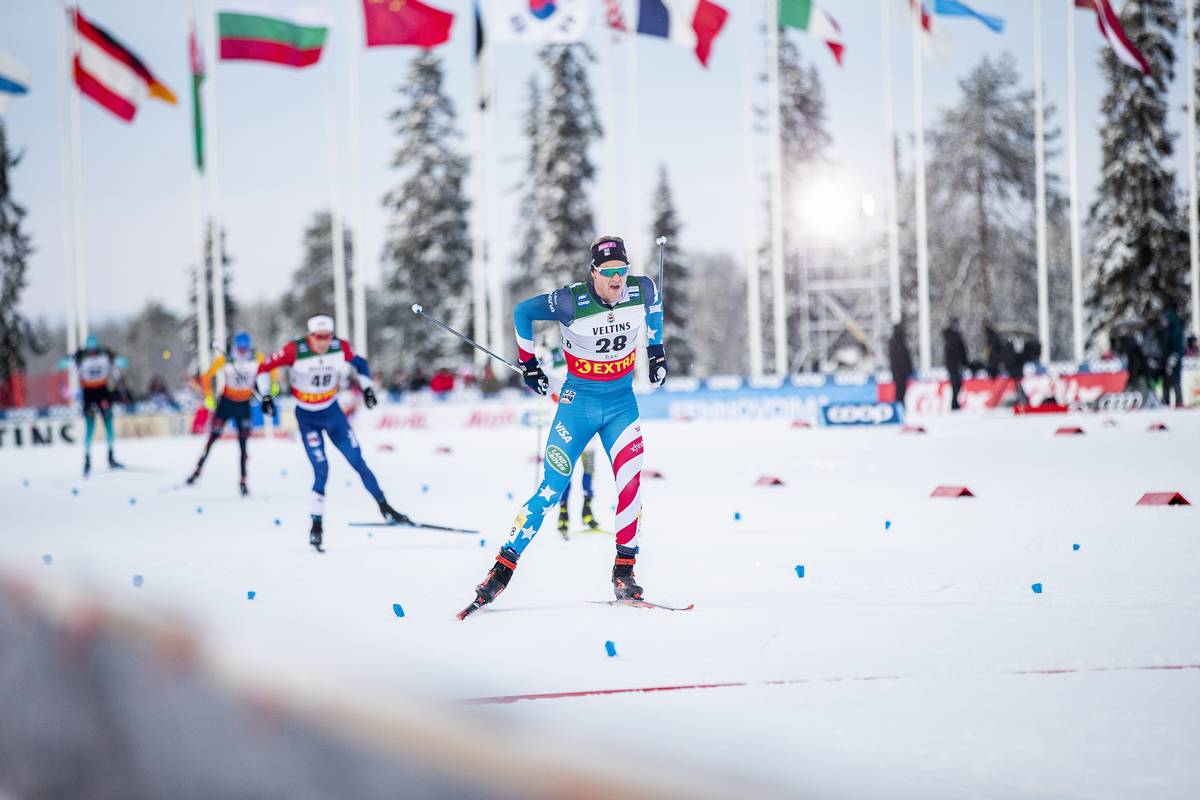
    Erik Bjornsen crossing the line in the 2019 15 k skate pursuit in Ruka, Finland. (Photo: NordicFocus)

    Bright lights in PyeongChang. The men’s second semifinal of the Olympic freestyle team sprint was a career highlight moment for Erik Bjornsen. Fourteen teams would crowd the start lanes with Martin Johnsrud Sundby in bib 1. The Norwegian was paired with Johannes Høsflot Klæbo: The duo blessed with Sundby’s stamina and his younger counterpart’s break-from-the-pack speed.

    With Simi Hamilton racing the second, fourth, and sixth legs for the U.S., and Bjornsen leading off, the semi was a chance to not only advance to the finals, but establish some mojo amidst an Olympic field. Hamilton and Bjornsen both possess slower tempo big-power generating F-350 type motors that belie the meters gobbled up with each cycle of their cadence. 

    As Bjornsen was tagged for the fifth of six legs, he locked on to France and Norway to position himself in rarefied company. PyeongChang’s Alpensia sprint course packed a punch. The course’s second climb it’s Everest – a drawn out leg burner. Pulsing into that climb, France’s Maurice Manificat, Sundby, and Bjornsen had already separated from the field. Midway up, Bjornsen subtly shifted gears, moved to the left of Manificat, and dropped the two steely veterans by 10 and then 15 meters pushing over the top.

    It was a Stars-and-Stripes flex.

    Bjornsen tagged Hamilton in first by nearly five seconds. The pair went on to qualify for the final and placed sixth overall in an event eventually won by the Sundby-Klæbo pairing. 

    (Video of Bjornsen’s breakaway on the 5th leg.)

    “It was interesting, I think that everybody knew what I was capable of in the field when I made those moves,” said Bjornsen when reflecting on career highlights. “I remember one of the strongest memories I have from racing is when I made that move against Sundby. And after the race, as we were starting the final in PyeongChang, he turned and looked at me for a while, and I could tell that he was thinking ‘what is this kid bringing to the final’? He eventually got the gold medal with Klæbo, and he is looking at this American guy, and I think that was one of the coolest feelings I have ever had — knowing that this legend was looking at me, and thinking, ‘what is this guy about to bring to the biggest performance of our lives?’”

    The U.S. men’s team has been overshadowed by a dominant women’s program for going on a decade. Through that time, the men’s distance program has seen the end of Kris Freeman’s reign and the emergence of Noah Hoffman and Erik Bjornsen. Hoffman retired in 2018. With Bjornsen announcing his retirement last month at twenty-eight years old, a void remains. As one generation bleeds into the next, Bjornsen is an anchor point for all those speedy juniors we’ve heard of. An affable athlete who set the American distance skiing bar for the past five years.
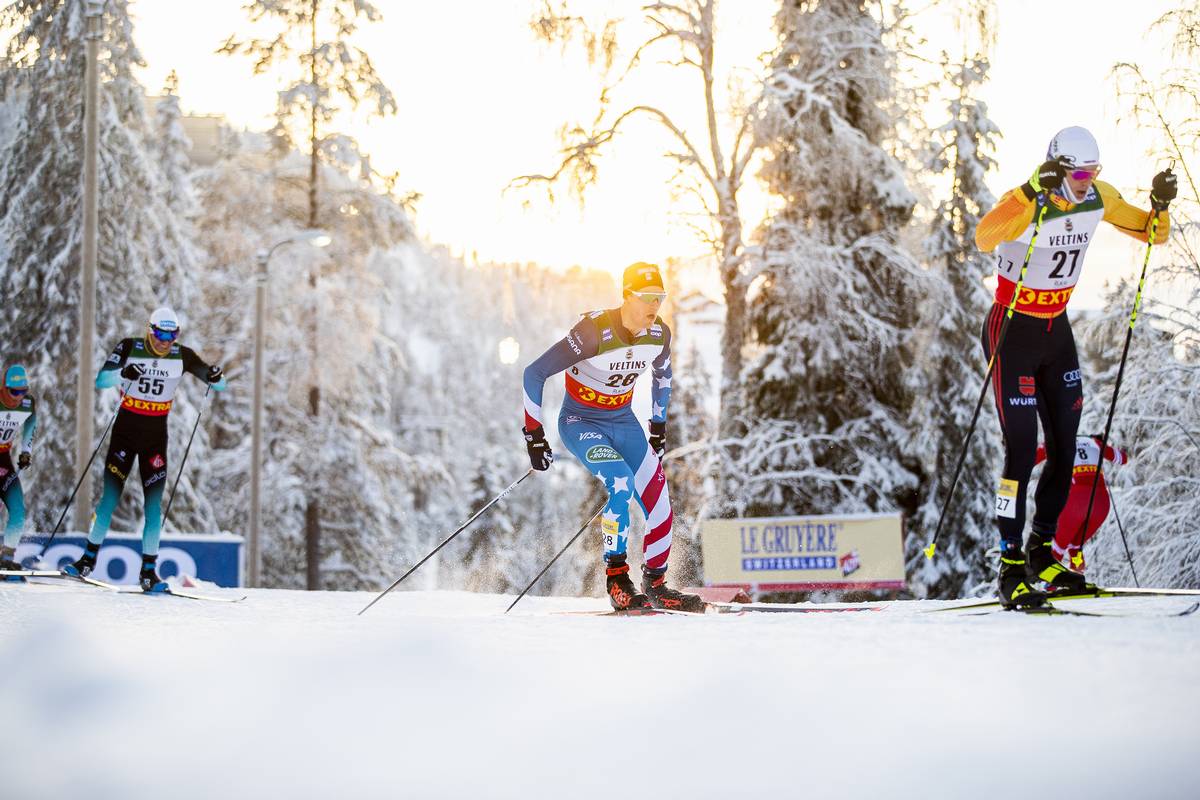
    Erik Bjornsen of the U.S. (bib 28) during the 2019 15 k skate pursuit in Ruka, Finland. In bib 27, Sebastian Eisenlauer (GER) leads Bjornsen. (Photo: NordicFocus)

    Bjornsen often shouldered the pressure for a team and broader community starved for that dominant distance performance by a U.S. male — a World Cup podium or a championship medal to validate the personal quest and the vicarious desire from some fixated on top-3 hardware. Making the top-30 on the men’s World Cup is a herculean task. Bjornsen first passed that threshold with an 18th place in 2014 during a 15 k classic (his marquee event), in Toblach, Italy.

    In January 2018, he surpassed that 18th place, which up to then was a career best individual mark on the World Cup, with a ninth place in Seefeld’s 15 k mass start skate. He peaked individually at the World Championships with an 18th and 17th, respectively, in the 2017 and 2019 Worlds in the 15 k classic. 

    The manifestation of steady improvement was Bjornsen’s calculus for remaining in the game. And the wait and wait for results beyond his stream of top-30s and top-20s was arduous. Even on the best of days, all things must align for the breakthrough.   

    “Definitely, my last couple of years, I was really hungry for great results, like everybody that puts so much into the sport,” said Bjornsen. “I was ready to make that next level. But I was moving towards the end of time I wanted to put into the sport and I really wanted to make the progress every year that I knew what I was capable of. There are so many variables in nordic skiing that I was just frustrated not to put it together more on the days when it was so tough. My thing was 15 k classic — that is where I could put together a top performance. That’s four 15 k classics a season, you are trying for your top performance in those four or five and also nailing the wax and also nail everything on that day. So I am proud of the results that I had but I was frustrated like any World Cup athlete. I was just definitely hungry for more at the end.”

    The World Cup came to an end for Bjornsen in December after he raced the opening weekends in Ruka, Finland, and Lillehammer, Norway. Yet, the decision to retire from World Cup level competition came after the 2018-2019 season if he did not, in his words, “step-up”.  

    After a solid summer of training, Bjornsen was blunt about his 2019-2020 World Cup campaign. “I am going over to the World Cup to make a step forward, or call it a career,” he said.

    He placed 25th overall in the Ruka triple. The following weekend in Lillehammer’s 15 k/15 k skiathlon he had a reason for optimism. At the same venue with the same race format in 2017 Bjornsen had placed 20th. This year, he initially raced near the sharp end. But as the temps warmed a degree or two, his skis began to ice. He faded to 39th. The plug was pulled.

    Bjornsen explained that U.S. World Cup regulars leave bags on the wax bus after each season, a stash of clothes and items to rely on when they arrive for the season each November. “I had left a bag over there basically for the last five or six years,” said Bjornsen. “On the last trip, I packed that one up. I didn’t know if I would be coming back.”

    Having grown up skiing in Washington’s Methow Valley, Bjornsen followed the usual path of success: solid Junior Nationals, World Junior Teams, a second place in the 2011 U.S.Nationals 20-kilometer classic, and his first senior championship two years later in the 15 k skate. USST D-team, B-team, and then A-team. Although the family fostered two future Olympians, (you know this but older sister Sadie is a USST veteran) Bjornsen’s parents moved to the Methow when a new alpine ski area was in the works. As luck would have it, the planned downhill area never materialized. 
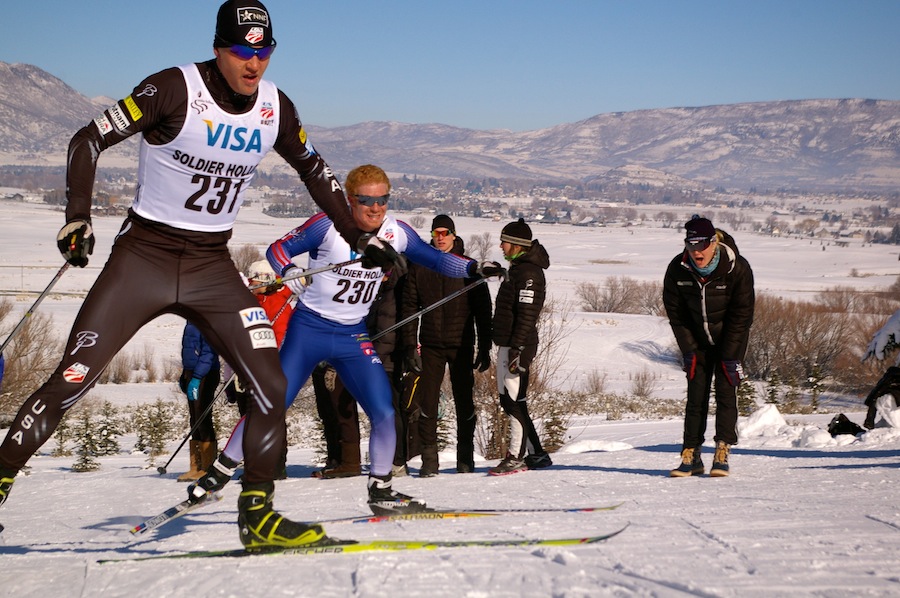
    Erik Bjornsen (APU/USST) and Matt Gelso (SVSEF) headed up Hermod’s Hill for the final time at the end of the 15 k freestyle at the 2013 U.S. Nationals. Bjornsen took his first career national title and Gelso finished third.

    The Bjornsens live on the more secluded Mazama end of the Methow. Mazama sits at the base of a closed-in-winter State Highway 20 which snakes its way up to Washington Pass and alpine paradise. Drive any direction but south in the winter from Mazama and it’s a snowy dead end. One road during those cold months serves as a diversion into Winthrop and further south to Twisp. The region’s storied cross-country trails provided another outlet. Within walking distance of Bjornsen’s neighborhood were endless ski trails and families falling in love over and over again with the sport. Sean and Laura McCabe and Leslie Hall (Laura McCabe and Hall are former USST members) lived nearby and were constant reminders that sliding on snow without a gravity assist had merits.

    With his two older sisters, the Bjornsens joined the local ski club. It was a steady stream of hand me downs terminating at Erik. As Bjornsen became more serious, he relied on Scott Johnston as his primary coach. Johnston is known as fastidious and established a serious training regime for Bjornsen. 

    “I learned a lot from him,” said Bjornsen. “He took the time to explain everything about skiing and also the physiology side of things. I started to understand the ways of training and training plans. He brought my curiosity out and made me think about each and every workout.”

    By the time Bjornsen was in his late teens, Sadie had moved to Anchorage to ski race as a student-athlete for the University of Anchorage Alaska (UAA). When it came time for a post-high school decision in 2010, Erik chose to attend UAA too. Both Bjornsens ultimately aborted their UAA paths after earning NCAA All-American status and began taking opportunities on the World Cup as they trained with APU. APU, an emerging powerhouse team, was coached by Erik Flora and championed by Anchorage’s Kikkan Randall. 
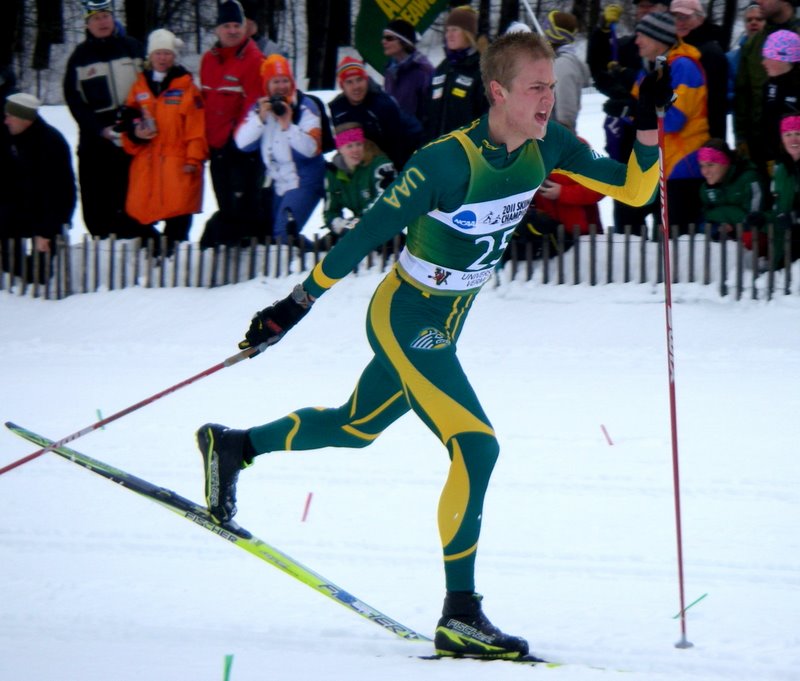
    Erik Bjornsen on his way to second at the 2011 NCAAs in Stowe, VT.


    For a juxtapose of Bjornsen between 2011 and 2019, click the following link.


    With a cohesive training group at APU and the steadiness of Flora, both Bjornsens blossomed. Erik earned his first World Cup start on Dec. 7, 2012 in Québec. A few days later in Canmore, he popped a 36th place in the 15 k classic. Along the way, he won six national championships and was a member of the U.S. Ski Team for seven years. 

    “When Erik first came in, I could see this young, talented skier that was excited about skiing, and he really enjoyed racing,” said APU’s Flora. “And when he first came in, I thought, Okay, if I can help him with his training, and help him reach the next level in fitness, that seemed like an opportunity that was an easy one to help him get toward his goals. And as he retires, you know, there was a certain point where Erik went from being in a place where talking about daily training was constructive, to where Erik absorbed all of that over the years, to the point where Erik knew how he wanted to train, and he had the foundation for it.”

    During the later part of his career, Bjornsen had enough know-how and self-knowledge to write his own training plans with the occasional check in or hands-on training session with Flora. 

    Bjornsen imprinted the cycle in his muscle memory. He attended USST camps, looped around on the Eagle Glacier during the summer, and locked in for a lengthy stint as a World Cup regular. The bag he eventually snagged off the wax bus this past December was left in Europe for five seasons or so, during which he raced at two Olympics and four World Championships.
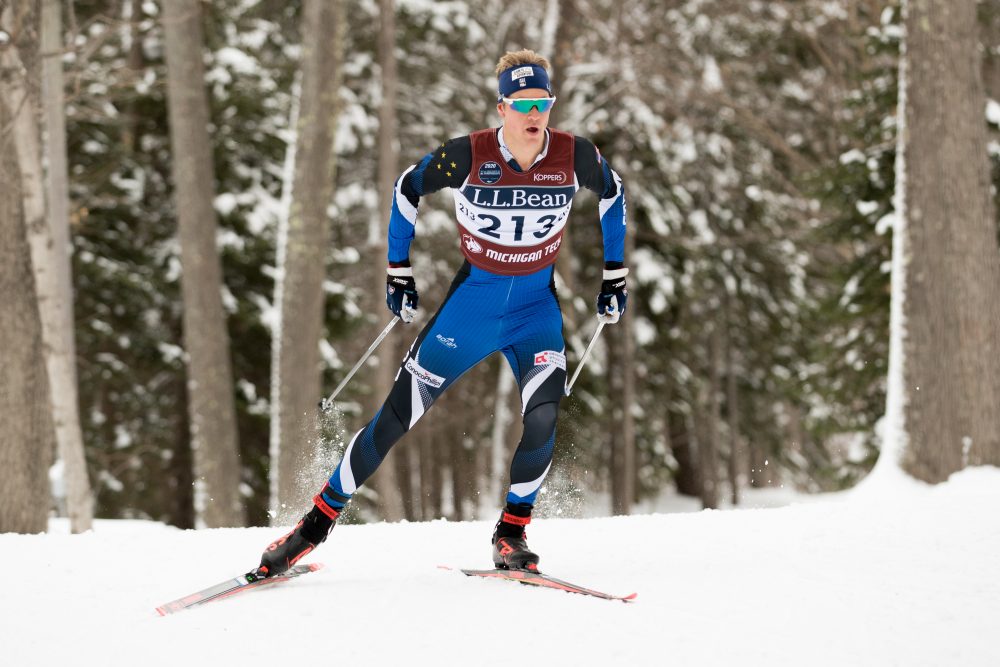
    Erik Bjornsen (APU) during the 2020 U.S. Nationals men’s 15 k skate. (Photo: Reese Brown)

    At the 2014 Olympics, Bjornsen contested five of six events as the youngest member of the team at 22 years old. Sochi was a time he recalls fondly not so much for a “media-worthy” result, but for the pure novelty of it. Big eyes. The Olympic rings. An international career yet to unfold. “It was just so fun, everything around it was great,” said Bjornsen.

    What was also great were the Hamilton-Bjornsen prospects in the team sprint. It’s one thing to prognosticate and imagine a team sprint medal on the men’s side. On paper and on snow this was no pipe dream. Other teams had the luxury of mixing and matching athletes over the years. When sprinting three laps, a total of roughly 4.5 k full tilt, the combo of stamina and 100 meter close out speed is rare. Deep teams can play around, shuffle a deck, optimize for those parameters when naming a team sprint duo. Someone falls ill, insert A for B. Someone has an off year, change X for Y. 

    For Hamilton and Bjornsen, the USST was all in. Sixth in Sochi. Sixth in PyeongChang. Fifth at the 2017 World Championships. Better than coming close, these two provoked legitimate medal hope. And better, the two were good friends. They were not simply two speedy specimens tolerating one another for a material outcome.  

    Walking through the mixed zone in PyeongChang after their finals, on a night when Jessie Diggins and Kikkan Randall won a historic gold 30 minutes prior, Hamilton and Bjornsen were consummate pros. There’s was a no-bullshit interview post-race. In tight quarter racing, Bjornsen had tumbled during the second leg after tripping on another skier’s tails. A tough-to-rebound-from-mishap on the tightrope of Olympic sprinting. 

    “It was super disappointing when I went down, but I mean, it was only halfway through the race and I just got up, and that’s for sure not going to be the end of it for us today,” Bjornsen said to FasterSkier at the time. “Unfortunately, I kind of felt like I let the team down there a bit. I think that was one mistake that may have made a huge impact on our race today, but you know, that’s ski racing, that’s the way it goes sometimes. Unfortunately, it’s at the Olympics.”

    Hamilton immediately responded by focusing on the asset that is Bjornsen.

    “In absolutely no way did Erik let any of us down, especially me,” Hamilton said. “I watched that on the big screen, I have been at a lot of team sprints on the World Cup, World Champs, Olympics, that always happens to someone, and 99 percent of the time, that person, especially if it’s in the finals, just gives up, whether it’s the first leg, second leg, third leg, they just give up. And Erik, he never does that, no matter what happens to him, what happens to us, he just fights ’til the absolute very end.”
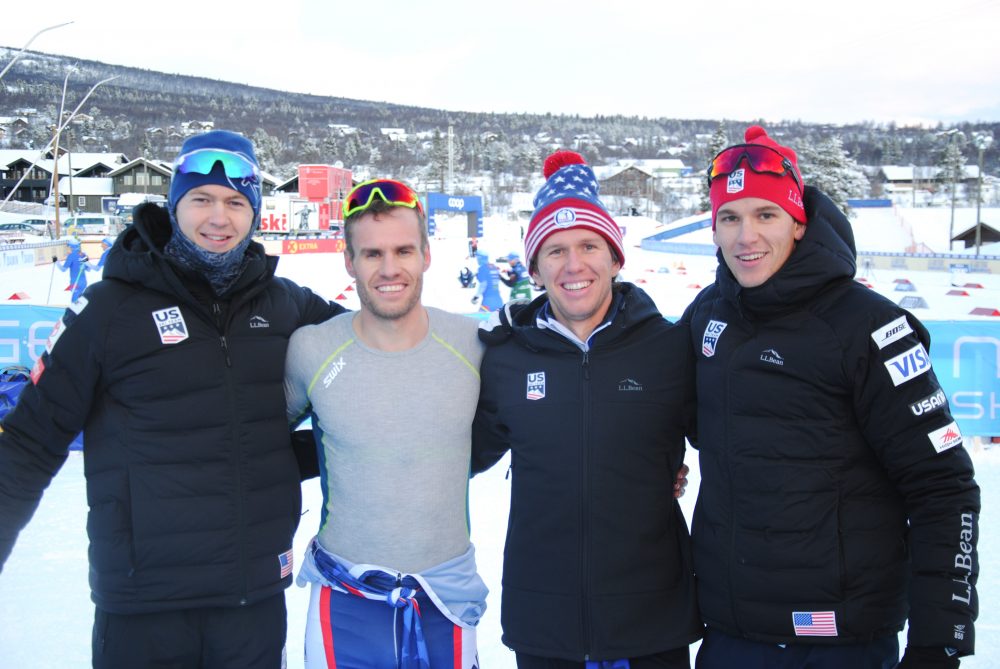
    The U.S. team for the men’s 4 x 7.5 k relay in Beitostølen, Norway (2018). From left to right, Erik Bjornsen, Simi Hamilton, Scott Patterson, and Kevin Bolger. (Photo: Aleks Tangen)

    This was, as Hamilton and Bjornsen knew, their best career opportunity for a hallmark medal. They both made eye contact with reporters — their disappointment palpable. This was clear: The two men had a deep bond forged over countless laughs and near misses. More than anything, the two could trust one another to bring their best. 

    “It’s hard to put into words the impact that Erik not only had on our team, our program, and XC skiing in general over the years, but also the impact that he had on me as my teammate and my friend,” Hamilton emailed when asked about Bjornsen’s retirement. “He grew to become one of my closest friends and I’m confident we’ll remain as such for the rest of our lives. Within the team, Erik defined what it meant to be a genuinely supportive teammate and he was the first person to celebrate any success that someone within our group had. His unwavering selflessness was evident as he always put his teammates, our coaches, and the staff before himself. I think in a way his successes and accomplishments went very much unnoticed because being genuinely happy and supportive of everyone around him always came before the desire to highlight his own results and market his own extraordinary talents. I’ve never laughed harder after hearing some of his witty remarks and jokes over the years and he always lent a tone of humor to any situation, no matter how serious everyone else was taking themselves. I’m grateful for so much that ski racing has given me over the years, but being on the team with Erik lands close to the top of the list of things I’m most grateful for.”
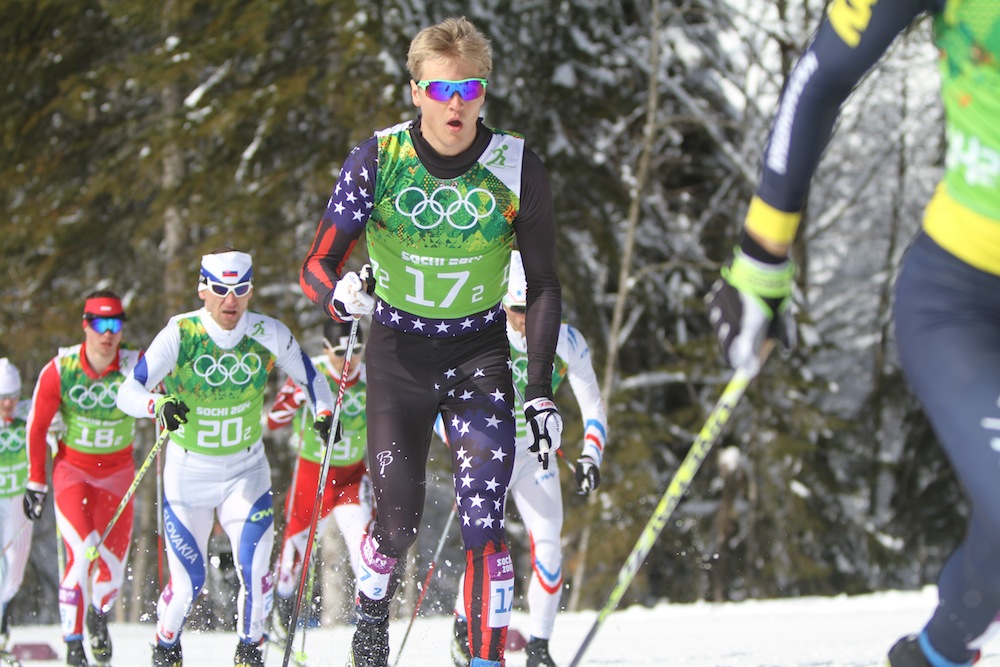
    Erik Bjornsen (USA) racing in the semifinals of the 2014 Olympic team sprint.

    It’s also hard to imagine that a force such as Bjornsen would have successes and accomplishments go unnoticed. Such is the atmosphere of quick turnaround news cycles amidst the backdrop of a national women’s team setting an incomprehensibly high watermark of podiums weekend after weekend.

    “You have to understand, it is like getting beat up over there if you are not achieving what you know you are capable of,” Sadie Bjornsen mused. “Erik has put in a lot of time doing so. I believe Erik is a top-10 World Cup racer. I don’t just believe it, I actually know it.

    “But, in order to achieve that, I don’t want to say it is different in the men’s than the women’s field, but the men, it is to me, just a little more thick on the top. When I have an off day I am generally in the 20s. When I have an on day, I am in the top-10. It is a lot less fun when you have an off day and you are in the 50s or 60s and you have an on day and you can be top-10. That is a big difference.”

    Sadie said her respect for Erik stemmed from his investment in a plan and holding himself accountable to it. “I really respected his confidence in that plan. What it showed me is that he believes in himself and he knows what he is capable of. He did not think of himself as a 50th place racer, he thought of himself as better. At the end of day, if someone achieves that confidence, that is huge.” 

    With Bjornsen’s departure from the team in December, he set forth to race several marquee domestic skate marathons. Although it afforded North American based skiers a chance to toe the line with a generational talent, for Bjornsen it was an opportunity to touch base with the many friends he had connected with during his years as a ski racer. Call it an unofficial retirement tour. 

    Bjornsen said he didn’t come into the races expecting to win since he had modified his training to savor simple on-snow moments. He emphatically claimed that this past winter had been one of his most “fun” yet.

    There’s a prevailing mythos in sport: The peak performance, like Bjornsen dropping Sundby and Manificat, are the highlight reel’s apogee. Those instances all have their place. They send chills. But what about the 99.9 percent of the time when that person was off-stage, not performing? That matters. 

    “Thinking about this, an athlete like Erik retiring makes your chest kind of heave,” Matt Whitcomb, the U.S. Ski Team’s Head Coach said. “You are trying to suppress emotions because he has been such an important part of my life as a coach. He is one of those people that makes being a coach so great. Makes these 120 consecutive days on the road tolerable because he is such a great guy. … He is the kind of the guy that has your back and everybody needs people like him.”

    Lightness and humility are attributes many peers associate with Bjornsen. He was, according to Sadie, unequivocally as much a support mechanism for her as she was for him. The shoulder to lean on tilted in both directions. Outside his immediate family, Erik’s even keeled perspective became an integral piece of the U.S. Ski Team’s European based unit. 
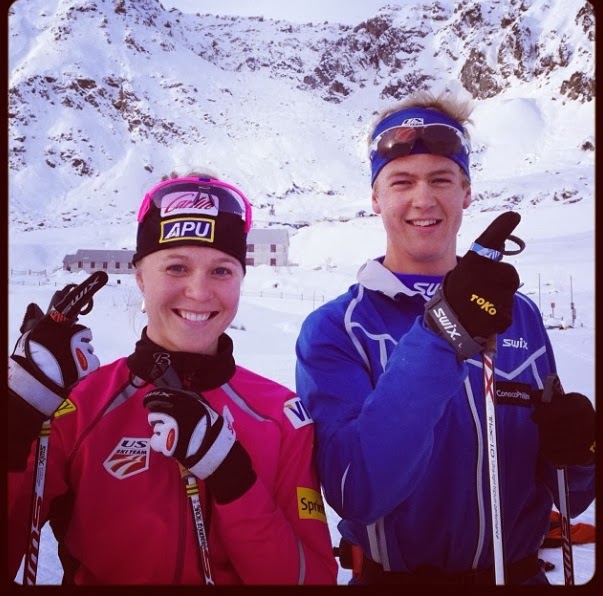
    Sadie Bjornsen and her younger brother Erik in 2013 after winning an Alaska Pacific University time trial earlier this month at Hatcher Pass near Anchorage, Alaska. (Photo: Courtsey Sadie Bjornsen)

    “The role Erik played on the team is easily overlooked,” said Sadie. “We can never talk about it enough. We got a breath of it without Erik the rest of this past winter. That position was really missed. That person who is always enthusiastic, always positive, always having a game, making light of everything. Erik took on that role really young, he was not going to hide anything. He was going to admit when he was struggling or whatever it was. That is a talent when spending four and a half months on the road. That is a long time. It is your family that you are living with, and it is difficult to maintain a positive outlook all the time.”

    There was no bitterness in Erik Bjornsen’s statements or tone when we spoke. He seemed ready with open arms for his next chapter. He did, however, mention a teaser of a thought experiment. “It would have been, at times, super fun to have Kris Freeman at his peak come around 10 years later and I could have skied alongside him. That would have been sweet. We could have pushed each other well.” 

    We can all imagine the mutually beneficial pacing that may have developed. The mentioning of Freeman was only a fleeting whiff of a “what if” moment. The rest, his thoughts of the World Cup, his training principles, his discussion of not meeting some of his expectations, seemed rooted in the past just months after stepping away from the life he’s known since his teens. 

    “It would have been fun to be racing on the podium,” said Bjornsen. “But one thing I noticed just from watching my sister so closely, is I don’t think you get any more happiness. I always really enjoyed racing and being over there even though maybe her results were 10 to 15 places on average higher than mine. It really doesn’t make any difference except maybe a bit financially. In the end, I got as much joy out of it than a guy that would have been on the World Cup podium.”
     

    Erik Bjornsen – 2016 vintage classic skiing powerhouse. (Photo: NordicFocus)
  • Cross Country Canada: The Reboot Part Two

    Cross Country Canada: The Reboot Part Two

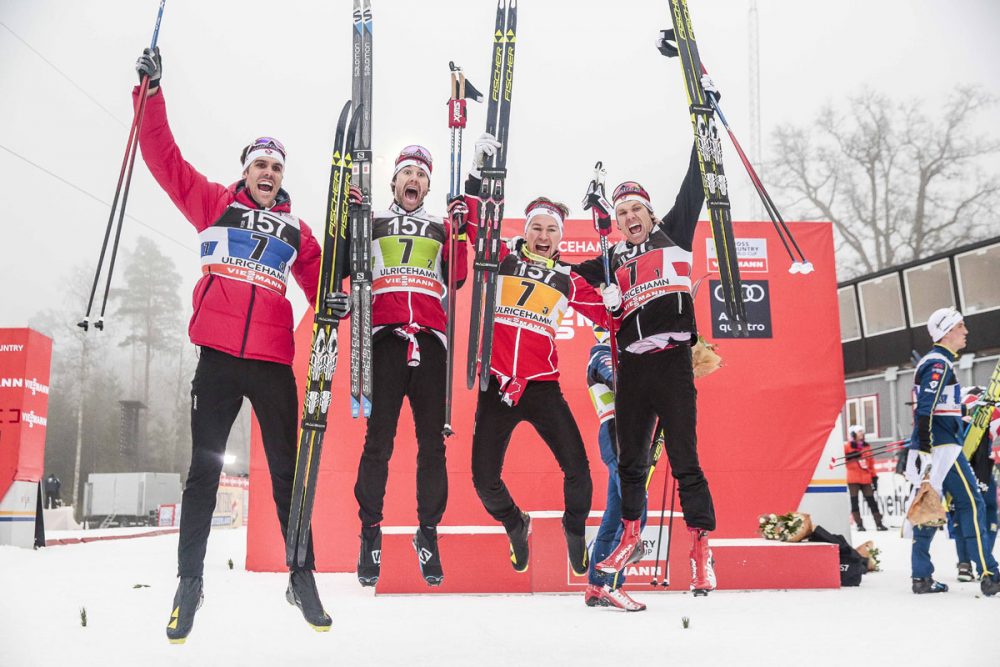
    Left to right: Canada’s Len Valjas, Alex Harvey, Knute Johnsgaard, and Devon Kershaw after their historic third place finish in the 2017 men’s 4 x 7.5-kilometer team relay in Ulricehamn, Sweden. (Photo: Fischer/Nordic Focus)

    This is the second part of FasterSkier’s report on the state of high performance cross-country skiing and athlete development in Canada. You can read part one here.

    Cross Country Canada (CCC), as the national governing body for cross-country skiing in Canada has the difficult task of steering a rather large ship. The idea in steering the ship is to maintain a path requiring little quick and nimble maneuvering. Survey the landscape, mine the data, set a course, and sail. Along the way, there’s the ability to make slight adjustments for efficiencies, accommodate unforeseen changes.

    To help make those macro and micro changes, Cross Country Canada hired Nic Lemyre as a high performance consultant in June, 2018. Lemyre, a Canadian living in Oslo, Norway has concrete ideas of what sustainable improvement and success resemble.

    Where do we want to be?

    Nic Lemyre (Photo: Norges Idrettshøgskole/Norwegian Sports Academy/)

    “We’re thinking our starting point is to build a really strong relay team, on both the women’s and the men’s side,” Lemyre told FasterSkier. “We want to have five athletes, so that we can rotate with the fifth athlete and we’re never in a situation where we can’t field a strong team because one athlete’s injured or sick.”

    According to Lemyre, the composite team must be derived of skiers who can hit specific individual benchmarks “[When] we have athletes that can start scoring points in every race they enter on the world cup, that’s a medium term goal,” Lemyre said. “From there, we start aiming for the top-15 for all athletes that are identified in that group.“

    Part of the reasoning behind the relay vision is that for a skier to get a permanent spot on the World Cup, the athlete not only has to reach a high level, but also help raise four other Canadians up to that level. Lemyre believes this should foster cooperation and team spirit.

    “It helps us meet goals of performance,” Lemyre added. “But also it helps us meet goals that are related to how to build a strong performance culture, where the athletes need to support each other, to learn from each other. They need to push each other. They need to push each other beyond limits they may have experienced before.”

    How do we get there?

    After PyeongChang, CCC appeared to have both the political will to start the painful process of another re-invention. However, that will came with a reduced budget with which CCC could support its future options.

    The simplified model of corporate restructuring begins with terminating certain roles and concludes with creating new roles filled by new individuals near the top of the organizational pyramid. Often, in a medium or large corporation, most people will be shuffled around and only a few near the top will lose their jobs. The final step is to find a quick win to help the newly reshaped organization gain morale and unify.

    buy amoxicillin online

    In a small organization like CCC, everyone is near the top. While the process works well for the survival of the organization, it can be hard on individuals. 

    The change at CCC began with long-time High Performance (HP) director Tom Holland’s planned retirement. Lemyre was hired as a consultant to oversee the restructuring of the HP group. Shortly before Lemyre’s hiring, CCC eliminated some positions.

    As Joel Quenneville’s recent firing demonstrates, proven ability and past success is not enough to provide job security during a reboot. (Quenneville was the NHL’s Chicago, Blackhawk’s head coach since 2008. During his tenure Quenneville lead the team to three Stanley Cups.)

    On November 1st, CCC hired Erik Bråten as a new national team coach and modified Louis Bouchard’s title. Bouchard remains head of the National Training Centre in Mont Ste-Anne, Québec, with the added title and responsibilities of World Cup Head Coach.

    Bråten, a recent Norwegian School of Sports Science graduate with a specialization in cross-country skiing, won the 2018 coach of the year award from the Norwegian ski federation. This hiring didn’t happen as quickly as some had hoped, but is considered the first win for CCC’s new structure.

    “Erik has a strong sports science background applied to cross-country skiing,” Lemyre said on the phone. “His profile is unique in our environment. The fact that he’s young is really positive for us, because he’s open to this new experience. He comes with a solid base, and his excitement and his motivation, I think, will be great assets in applying that knowledge in the right culture in Canada. At an individual level, Erik is unique in working one on one with athletes. I think our athletes are going to really appreciate that.”

    Along with bringing in new personel, Lemyre aims to improve sharing of training information in Canada. In Norway’s organizational structure, athletes and coaches are able to log hours and training plans on an interface organized by the Norwegian National Ski Federation. It’s a model and template Lemyre is intimate with.

    “The fact is that we have a large country, and we can’t be with athletes every day of the year following them on site,” Lemyre said. “Now the technology is there to pool [training data] in a way that our coaching staff and the local coaches can communicate really well, But also as we’re building up our science team, we also have interaction with our different people involved in helping the athletes develop.”

    Dahria Beatty racing the 2018 Holmenkollen 30 k freestyle mass start in Oslo, Norway. (Photo: Fischer/NordicFocus)

    Another planned shift is to interchange athletes between Europe and Canada more often. For example, Dahria Beatty will start the season in Canada — a change encouraged by her coach Chris Jeffries and supported by Lemyre.

    “This summer my coach Chris and I came up with a plan that allowed me to stay in Canada to start the season to build into the race season and then head over the Europe and race on the World Cup circuit leading up to World Championships in Seefeld,” Beatty said. “With this being the first year of the new quadrennial, it is the perfect time to fine tune some of those race details domestically before leaving for Europe mid-December. I am looking forward to racing part of the Tour de Ski then period 3 and hopefully finding my peak for World Championships and World Cup finals in Quebec.”

    Lemyre’s concept is to allow athletes like Beatty to build into the early part of the season domestically and arrive in Europe at a higher level of race fitness.

    “The way we scheduled the trips this year, giving some athletes the chance to prepare very well before they race on the World Cup,” Lemyre added. “I think some of them will be stronger when they show up on the World Cup, and also they’ll be able to sustain that level of performance over the time period they are on the World Cup. We will try to be a little more selective and well prepared when we show up, and then post really good results when the athletes are racing the World Cup.”

    Jeffries stated that the stress of living abroad, a dynamic known all to well by North American World Cup skiers, can be counterproductive to a developing athlete.

    “The last few years, our top athletes spent the majority of their time in Europe,” Jeffries said. “I think it stalled our development a little bit, because we’re always living out of a suitcase, and we’re always having to ski races where we’re trying to perform.”

    Dave Wood spent 18 years as a national team coach. His time leading the team included the post-Nagano rebuild and managing athletes at the Olympics in Vancouver. His vision includes giving skiers more time to develop and less emphasis on being fast all season.  

    “Sara [Renner] had far less World Cup starts before she was top-15 at the Olympics than the people of today,” Wood said. “I think that this big argument about experience is valuable when you are looking for seconds. When you are looking for minutes, [World Cup experience] makes no difference.”
    Will it Work?

    The U.S. has been able to develop a strong women’s team built off Kikkan Randall’s determination to drag U.S. skiing to the top. Randall took inspiration and knowledge from Canada’s post-1998 rebuild where Scott, Renner, Milaine Thériault, Jamie Fortier and Amanda Fortier decided it was time to lead the charge.

    American Kikkan Randall tucking during the women’s 10 k classic mass start at 2018 World Cup Finals in Falun, Sweden. (Photo: Fischer/NordicFocus)

    In both cases, the athletes didn’t succeed alone. The “fantastic five” got the support of Holland, Wood, and many others. Randall also collected a large supporting cast, well documented by Peggy Shinn’s book ‘World Class’. 
    Laura McCabe, now a Methow Valley coach and two-time Olympian, spent most of her free time in Nagano with the Canadian women’s team because it felt like a group that had a vision and a willingness to support one another to collective success.

    “It just shoots you up the ladder when you come back and you feel like you have a very safe place, you’re working on this goal together, you’re all in it together, and you’re there for each other all the time,” McCabe told FasterSkier. “I felt like the Canadian women were doing that. And now I feel like Matt Whitcomb has led that charge for the American women.”

    While crediting Randall for starting the process, McCabe feels that the team’s work to be a team is the critical factor.

    “They have goals, team goals and they have personal goals,” McCabe said. “They are always there for each other. One of their biggest goals is to basically keep their relationships positive and keep everybody moving forward. I think that is one of the number one reasons that team is doing well.”

    In a conversation last May with FasterSkier, Yukon coaching icon Alain Masson spoke of the complexities of achieving success on the international stage. Simply possessing physical gifts, the aerobic capacity, the predisposition to tolerate and absorb high training loads, is no guarantee of success.

    There’s the behind the scenes unglamourous work of nurturing athletes, remaining true to organizational core values, and feeding the system with money, intellect, and vision.

    “Definitely, there’s a minimum set of physical characteristics that you need to perform at that level,” Masson explained to FasterSkier. “But you also need many characteristics, personality characteristics, that are vital. What Alex showed, and Sara Renner, and Chandra [Crawford] and Beckie [Scott]. I think athletes that combine both the physical and the mental characteristic at a time when the program works together, and everything lines up with the funding, good leadership, and everybody working together. That’s the difficulty, this is the issue, trying to get all of that together. As the women in the U.S. have demonstrated, when you have all of that lining up, it’s amazing what you can do.” 


  • Cross Country Canada: The Reboot Part 1

    Cross Country Canada: The Reboot Part 1

    Canada’s Alex Harvey celebrating on the podium after placing second in the men’s 15 k freestyle mass start in Seefeld, Austria, for his best result of the 2018 World Cup season. (Photo: Salomon/NordicFocus)

    Cross Country Canada (CCC) has begun a reboot process as the new Olympic cycle starts. Corporations call this a reset, a rebranding, a new direction, restructuring, and various other names that try to disguise the challenges and issues that come with enacting real change.

    The reboot process traditionally starts with an acknowledgement that the current level of success, and that of the foreseeable future, doesn’t align with the goals or the potential of the organization.

    Canada left PyeongChang with no medals at three consecutive Olympics, only one skier in the World Cup red group, and a perception that there was no obvious successor to Alex Harvey.

    There are many people who, with the benefit of hindsight, believe that CCC allowed itself to be trapped by a combination of success and the Own The Podium (OTP) funding model. 

    The process of assigning blame for the past, called “blamestorming”in the corporate world, is one of the most effective ways to waste time and destroy morale without doing anything to improve the future. The “best practices” approach to a reboot starts with four apparently simple questions: How did we get here? Where are we now? Where do we want to be in five years? How can we get there?

    While CCC does many things as a national sport body, this article will focus on high performance and the development system.

    How did we get here?

    After a disastrous 1998 Olympics in Nagano, CCC shrank to a full-time staff of five and endured a forced re-invention. Four years later, in 2002 at Salt Lake, Beckie Scott won all three medals in the skiathlon after the initial silver and gold medalists were caught doping. Sara Renner missed the B final in the sprint for 9th place.

    Canadian Chandra Crawford in the 2011 team sprint in Dusseldorf, Germany. (Photo: Fischer/NordicFocus)

    In 2006 in Torino, Chandra Crawford earned a surprise gold in the sprint while Scott finished fourth. Scott had earlier teamed up with Renner for a team sprint silver medal.

    buy vancomycin

    In 2010, there were no Canadian cross-country medals. However, there were signs of promise. Renner skied to her fourth Olympic top-10 finish. All four Canadians competing in the men’s skiathlon finished in the top-15. Devon Kershaw lost out in final kilometer of the 50 k to finish fifth, 1.6 seconds away from gold.

    That post-Vancouver glow was possibly the point where CCC temporarily slid off the rails.

    A number of Canadian sports fell victim to OTP incentives. A sport qualifies for OTP funding by having good prospects for a medal in the next Olympics. The money comes with strings attached, to ensure that resources are spent on improving the probability that specific individuals will podium. For smaller sports where the OTP money is a significant proportion of the sport’s annual budget, it is hard to make choices that put that money at risk. Choices like balancing the emerging athletes in the pipeline, while simultaneously supporting those athletes already at the top-end of the sport. 

    As a result, many sports have lost their OTP eligibility by losing the focus on development and the vision that qualified the sport for OTP in the first place. Some people put cross-country skiing in the list of sports that fell into this trap.

    After 2010, the future looked bright. Harvey and Kershaw were World Champions in the 2011 team sprint. Kershaw was second overall in the 2011/2012 World cup. (A feat only equaled in North America by Scott and Jessie Diggins).

    Harvey arrived at Sochi in 2014 as a medal favorite. He was fresh off a World Cup podium in Toblach the weekend before the 2014 Games began. Sochi ended poorly when Canada, along with Norway, couldn’t solve the difficult waxing conditions.

    In 2017, the men’s World Cup relay podium in Ulricehamn, Sweden sustained the hope — that result earned another year of OTP funding for five men. (Harvey remained a the top, as he won the men’s 50 k skate at the Lahti, Finland World Championships.) 

    The results in PyeongChang were similar to 2002 numerically: Harvey was close to a medal in multiple races and Lenny Valjas collected 7th in the classic sprint. A medal would have changed the mood, but not overall situation. 

    Where are we now?

    Post-PyeongChang, CCC believes Canada is not achieving the international results a country with plentiful snow and 37 million people is capable of.

    The development system in Canada consists of the National Team, the official training centers (Centre National d’Entrainment Pierre Harvey (CNEPH), Thunder Bay National Team Development Centre (TBay), and the Alberta World Cup Academy (AWCA)), and the clubs. The ten provinces and three territories have teams, but don’t have a formal place in the development system as each of the thirteen regions approaches development support differently. In the last few years, the number of clubs actively recruiting and developing athletes while supporting a high performance team has increased. For our purposes, as no official name has been affixed to these clubs, the term ‘elite club’ will be used here.

    In the past, all national team members were required to belong to a training center while developing athletes were encouraged to join.

    “I can speak for many of the athletes, they thought that if they didn’t go to a training centre, then they might as well quit skiing,” Telemark’s coach Adam Elliot said. “It was that broad of a choice, they felt they had to choose between skiing and school immediately.”

    The landscape is more diverse now, with more options. The examples that follow skew to Western Canada, largely because the coaches quoted brought teams to Sovereign Lake snow camps in May and November and were available for in-person interviews. Eastern Canada remains equally diverse in terms of its club offerings.

    A common theme among the coaches and athletes is that each athlete’s needs are different, and he or she needs to find an environment that fills those needs. FasterSkier asked AWCA’s head coach Chris Jeffries how an athlete should choose his or her path to success.

    “It’s such an individual, case by case thing,” he said. “I don’t have an answer.”

    In 2017, a shift to allow more development paths resulted in new senior National Team member Gareth Williams staying at his home club, Telemark, in Kelowna, BC. Elliot described how it came about.

    “Tom Holland approached us, for Gareth, and said we like what you’re doing in the Okanagan, and we want to keep Gareth there. We’re going to support you and your program to be able to support Gareth.”

    Also in 2017, Julien Locke returned to his home club Black Jack while Russell Kennedy shifted to the new Team R.A.D., part of the Canmore Nordic Club.

    To further illustrate the spectrum of options and pathways, FasterSkier contacted three Canadian athletes, each with a history of NorAm podiums and some international success, to discuss their ski-training choices. Dahria Beatty started at AWCA and has remained there, Evan Palmer-Charette started at TBay then recently moved to Team R.A.D., and Andy Shields has gone rogue.

    Dahria Beatty en route to 20th overall in the Seefeld World Cup freestyle sprint for her season-best result in 2017/2018. (Photo: Fischer/NordicFocus)

    “For me, I’ve been working with Chris [Jeffries] for six years,” Beatty told FasterSkier in November. “It works really well for me, and I have a good group of training partners where I am, that can push me everyday in training.”

    AWCA is also the home training group for National Team skier Emily Nishikawa and two junior national team skiers. AWCA also benefits from its close proximity to a number of other training groups.

    “For me, Canmore’s a location where I want to be training, where I want to be based out of,” Beatty said. “All the pieces fit well together for [me], it’s somewhere I think I can keep improving.”

    Palmer-Charrette made a summer-time decision to change things up by finding a fresh environment in Team R.A.D.

    “I think the best part of being on a training centre is the entire program is based around a small group of athletes of similar age which makes for a great training and racing environment,” Palmer-Charrette wrote. “I feel training centres, as they are, are best-suited for junior/u23 athletes and especially great for athletes who are a bit late to the game like I was at the end of high school and will really benefit from learning from other athletes on the day to day training life.”

    Shields is no longer affiliated with an official team. He funds his skiing by painting houses in the summer and representing ski wax companies in the winter. Although he refers to ski racing as a hobby, he did end the last season as COC leader and will race period 1 of the World Cup.

    “I don’t think I could have done this straight out of junior,” Shields wrote. “My time on Tbay is still having a huge positive effect on my ski career. Being on a team through my early years as a senior made it much easier to get a decent training base and set a couple good habits in place which are paying dividends.”

    Shields did reflect and offer an alternative to how he might have changed his path to elite level skiing.

    “If I could go back in time I would have gone the NCAA route straight out of junior,” Shields added. “College skiing in the States is a much better deal than a training center for people in their early twenties. You can go down to the States, get a degree, not pay a dime, and come out the other side with plenty of time to have a full-time ski racing career. I would have joined a training centre upon finishing with NCAA.”

    The Canadian university system differs from the U.S. model, offering little money for sports. Heading south to the U.S. as a student-athlete remains an option for some Canadian skiers. Most athletes remain in the Canadian system to develop. With that in mind, FasterSkier asked why some athletes had chosen some of the Western based training centres.

    Jeffries, who leads the AWCA, also noted how his program has evolved. There appears to be room at the AWCA for those with concurrent goals. The AWCA has partnered with the University of Calgary to allow AWCA athletes to work towards degrees.

    “We’re always evolving our programming, and what it entails, and how we package it,” Jeffries said. “That’s why we have this new university program this year, because you just look at the popular decision making of graduated high school athletes.” 

    Elliott, based in the Okanagan, said his program offers athletes a well rounded experience too. 

    “You’ve got the trifecta,” Elliot said. “You’ve got access to education opportunities for post-secondary. We’ve got the university, UBC Okanagan, and the college. Most of the people who’ve moved here have gone to school. Secondly, it’s the Okanagan. Which is probably the best place to ski in North America, with skiing up and down the valley –with Nickel Plate, Telemark, [Kelowna] Nordic, Sovereign, and Larch Hills. The third is that you’re moving into a community of skiers: family, volunteers, everybody trying to make a go of keeping people in sport.”

    Clearly the times have changed from a programming perspective and the past’s financial windfall for Canadian cross-country skiing.

    “Probably the quad between 2010 and 2014, CCC had more money almost than it knew what to do with, ” Dave Wood, former National Team head coach, told FasterSkier in May as he finished up a long ski day. “Now, I think the budget’s still three and a half million. While it’s maybe low compared to what it has been, it’s a hell of a lot higher than it was in ‘99, by about four times.” 

    Former CCC High Performance Director Tom Holland spoke of those larger commitment from clubs during the Frozen Thunder races in October. 

    “There’s a lot more resources,” Holland said, referencing the increased numbers of coaches attending Frozen Thunder with their athletes. “One of the reasons clubs are more important now is that there are paid coaches at the clubs. That’s why training centres started in the 90’s, because you’ve got to have a coach, full-time.”

    Thee deep question remains: what next for Cross Country Canada as it ponders a post-Alex Harvey scene? Better and more diverse options for Canadian skiers, like those modernizing their offerings to connect with the student-athlete, is a step forward. But fans of the sport, and of course Cross Country Canada, have short-term and long-term goals. No one wants to see another Olympic quadrennial transpire without the glimmer of medal potential at the international championship level. 

    “I think when Alex Harvey retires, mostly likely after next year with Lenny Valjas, it will be the end of an era having athletes being able to finish on the podium at World Cups, World Championships, said Alain Masson, Whitehorse head coach. “So definitely, the program is going to go into a real rebuilding phase with lots of young athletes, but no guarantee of success in the near future.” 

    This is part one of a two-part story. 


  • More Olympic and World Championship Medalists Join Tyumen Biathlon Boycott

    More Olympic and World Championship Medalists Join Tyumen Biathlon Boycott

    Canada’s Christian Gow (12) chases Germany’s Erik Lesser during the men’s 4 x 7.5 k relay at the 2018 Olympics in PyeongChang, South Korea. Germany won bronze. Lesser lamented the situation and said of the IBU’s decision to hold World Cups in Tyumen, Russia, despite requests from him and other athletes to move the event: “If we don’t go, it’s wrong because it’s our sport we love. [But] if we go to Tyumen, we maybe send the wrong sign to IBU.” (Photo: FlyingPointRoad)
    In three weeks time, biathlon’s World Cup circuit will move to Russia.

    But a number of the sport’s stars won’t be there – and others plan to attend, but aren’t very happy about it.

    In an Executive Board session in PyeongChang, South Korea, a few weeks ago, the International Biathlon Union (IBU) decided to go on as planned with World Cup races in Tyumen, Russia, even though the Russian Anti-Doping Agency is still not compliant with the World Anti-Doping Code.

    Biathlon Canada had announced in December that it would boycott the event if it was kept in Russia, following revelations of systematic abuse of the anti-doping system by that country. In the intervening months, athletes appealed to the IBU through private channels to move the races to a country which complies with the WADA Code.

    After the IBU’s most recent announcement, the United States and Czech Republic have also gone public with boycotts of the event.

    Sebastien Samuelsson of Sweden celebrating silver in the men’s 12.5 k pursuit at his first Olympics on Monday in PyeongChang, South Korea. Samuelsson announced today that he is boycotting the World Cup Finals in Tyumen, Russia, because Russia is not in compliance with the World Anti-Doping Code. (Photo: IBU/Biathlonworld)

    Today, 2018 Olympic pursuit silver medalist (and relay gold medalist) Sebastian Samuelsson of Sweden announced on Twitter that he will not go to the races either.

    “Nations without a functioning anti-doping organization should not have competitions at the international level,” he wrote, according to a translation. “Also, worried about the safety of both myself and the doping tests in Russia.”

    Also not going is Klemen Bauer of Slovenia, a 2012 World Championships relay medalist who is a four-time Olympian.

    “I’m not planning to go to Russia at all,” he told FasterSkier in a Twitter exchange. “I was quite sure the IBU will replace the races, but despite all the effort we put into the clean/er biathlon, thanks to the president of the IBU that didn’t happen.”

    Both men are running for positions on the IBU’s Athletes Committee.

    “The idea is to improve the active role of the athletes and the voice of the athletes,” Bauer wrote of his candidacy. “We’ll see.”

    Another man running for a spot on the Committee is Germany’s Erik Lesser, 2014 Olympic silver medalist in the individual, 2015 World Champion in the pursuit, and several-time Olympic and World Championships relay medalist.

    Lesser will be attending the races in Tyumen, but he wasn’t happy about the IBU’s decision to hold them there.

    Klemen Bauer of Slovenia competing in the mass start at the 2018 Olympics in PyeongChang, South Korea. Bauer will not compete in the World Cup Finals in Tyumen, Russia. (Photo: FlyingPointRoad)

    “In my opinion the RUSADA and the Russian Federation have not done enough to light up this case,” he wrote in an email to FasterSkier. “During the last years, WADA and some commissions found a bunch of proof about a doping system in Russia. But RUSADA and [the Russian Biathlon Union] did nothing to fight against doping. The Anti-Doping-Laboratory in Moscow still does not have a license, and all the officials are in the same seats. It’s a wrong sign, after these problems, to go to Russia and celebrate World Cup Finals.”

    Lesser and teammate Arnd Peiffer, the 2011 World Champion in the sprint who then won gold at the 2018 Olympics, and who has even more World Championships and Olympic relay medals than Lesser, wrote a letter to the IBU explaining their position.

    Yet a few weeks ago, the IBU decided to go ahead and hold the World Cup in Tyumen anyway. They issued a press release explaining the decision.

    “I‘ve read the press release and I still don‘t understand why they decided this way,” Lesser wrote. “Because it‘s a threat to Russian biathlon fans and the Organizing Committee will take care of our safety? Wow, these are true reasons to keep the World Cup in Tyumen. So, I don‘t really think that reasons are valid.”

    Last season, there was also supposed to be a World Cup in Russia. But in 2017, several teams announced that they would boycott the event and IBU President Anders Besseberg had a contentious meeting with athletes, after which the IBU decided to move the event.

    This season, despite appeals by athletes like Lesser, Peiffer, and the others, that has not yet happened. And so in the end, Lesser says that he will compete in Tyumen, even though he wishes the races were somewhere else.

    “We argued with our federation and we decided to go to Tyumen,” he wrote. “The sport is the first [priority] and we want to compete. We hope that we can do a good job in Russia. We are there to stand as clean athletes.

    “It‘s bad that the IBU put us athletes in this position,” he wrote. “Actually it‘s not our job to be political. It‘s our job to be athletes and compete against other. If we don’t go, it’s wrong because it’s our sport we love. [But] if we go to Tyumen, we maybe send the wrong sign to IBU.”

  • Nilsson Nabs Long-Awaited Gold in PyeongChang Classic Sprint

    Sweden’s Stina Nilsson (center) won gold in the classic sprint at the 2018 Olympics on Tuesday in PyeongChang, South Korea, with Norway’s Maiken Caspersen Falla (left) taking silver and Russia’s Yulia Belorukova bronze. (Photo: FlyingPointRoad)

    FasterSkier would like to thank Fischer Sport USA, Madshus USA, Concept2, Boulder Nordic Sport and Swix Sport US for their generous support, which made this coverage possible.

    ***

    PYEONGCHANG, South Korea — Tuesday at PyeongChang’s Alpensia cross-country venue, the site of the Olympic Games women’s 1.25-kilometer classic sprint, Sweden’s Stina Nilsson took gold. On an evening when athletes were already challenged by an aerobic capacity testing course, shifting winds and falling snow, another factor made the challenge debilitating.

    Nilsson came into the Games well-rested and well-primed to take her first individual Olympic medal. The 24 year old had come close before; at her first Olympics, the Swede placed 10th in the freestyle sprint in Sochi, Russia. There, she went on to claim bronze in the classic team sprint with teammate Ida Ingemarsdotter.

    A year later in Falun, Sweden, at World Championships, Nilsson placed second in the individual classic sprint. When you are close, you begin to think more about achieving a singular goal and less about overall season-long outcomes.

    Nilsson last raced a World Cup the weekend of Jan. 20-21 in Planica, Slovenia, where she raced to 13th place in the 10 k classic. The day before, on Jan. 20, Nilsson took a small prize: a World Cup classic-sprint win.

    In her run up to PyeongChang, Nilsson explained she was able to focus on her training and block out distractions.

    “Not so much pressure the last weeks, because I have not been on the Internet so much,” Nilsson said at the post-race press conference. “And not on Instagram. So the most pressure comes from myself, and that’s the pressure that I have to deal with. But today I managed to control those feelings and just ski so fast as I can.”

    With temperatures hovering around 25 degrees on Tuesday evening, Nilsson was unstymied by the gusting winds or falling snow in formulating the answer to her success equation. Starting with Tuesday’s qualifier in PyeongChang, Nilsson marked the fastest time, stopping the clock in 3:08.74 minutes. With Nilsson pushing the pace, she also scored a win in the quarters. Again in her semifinal, Nilsson placed first after dualing with the 2014 Sochi skate-sprint champion, Norway’s Maiken Caspersen Falla (who also won the skate sprint at last year’s World Championships), in a photo finish.

    “I had a really good day,” said Nilsson, a 2015 World Championships classic-sprint silver medalist. “I felt strong already in the prologue, and I felt also strong in the quarterfinal, and in the semifinal. I felt like I had some energy saved for the final.”

    Sweden’s Stina Nilsson and teammate Hannah Falk (4) embrace after Nilsson won the classic sprint gold medal at the 2018 Olympics in PyeongChang, South Korea. (Photo: FlyingPointRoad)

    Lining up in the final trying to prevent Nilsson’s clean sweep on the day were Falla, Nilsson’s Swedish teammate Hannah Falk, American Jessie Diggins, and Russians Natalia Nepryaeva and Yulia Belorukova.

    The energy Nilsson stated she had saved for the final was more than sufficient. Off the line she set the pace up the course’s first climb — a climb not steep enough to create big gaps and string out the field. The group stayed together with two skiers in the inside lane, three in the adjacent lane, and Diggins skiing outside the tracks and closing on the outside.

    Topping out on the hill and taking a sharp 180-degree turn, Nilsson led but no skier pulled away. Down the hill, the six skiers tucked and glided and double poled into the course’s decisive climb with Belorukova then Falla the closet skiers to challenge.

    The final hill is where Nilsson seized the day.

    “I just wanted to cross the finish line totally tired, so I just went for it in the last uphill,” Nilsson said about her race tactics in the final. She carried considerable speed over the final climb and the gap grew to the two closest chasers, Falla and Belorukova.

    “My plan was to save the most of the power until the last part of the [final] climb,” Falla, 27, said at the press conference. “But when the two others got a little gap in the first downhill, I used too much power in the first part of the climb. So in the top where I was planning to use all my power, there wasn’t that much left.”

    Nilsson still had power to spare. She soloed off the front to win the final in 3:03.84 minutes. Falla took silver (+3.03), Belorukova, a 23-year-old Olympic rookie, bronze (+3.37).

    In the post-race press conference, Belorukova was asked about the tense relationship between the International Olympic Committee (IOC) and the Russian Ski Federation. The IOC banned numerous Russian skiers from PyeongChang for doping violations. Those Russian athletes competing at the 2018 Winter Olympics are not competing under the Russian flag, but as Olympic Athletes from Russia (OAR).    

    “Good question,” Belorukova said through an interpreter. “There is nothing that will break us, there is nothing that will instill fear into us, we are strong and we will fight until the end.”

    Nepryaeva ended up fourth (+9.14), Falk fifth (+11.16), and Diggins sixth (+11.23). FasterSkier will post an additional report on the U.S. women’s results.

    Results: Qualifier |Final

  • Kalla Opens Games with Skiathlon Gold; Diggins Makes Her Mark in Fifth

    Sweden’s Charlotte Kalla winning gold in the first race of the 2018 Winter Olympics in PyeongChang, South Korea, the women’s 15 k skiathlon, on Saturday ahead of Norway’s Marit Bjørgen (behind, in red) and Finland’s Krista Parmakoski, respectively. (Photo: FlyingPointRoad)

    FasterSkier would like to thank Fischer Sport USA, Madshus USA, Concept2, Boulder Nordic Sport and Swix Sport US for their generous support, which made this coverage possible.

    PYEONGCHANG, South Korea — Hot from the start, the expected Olympic-opening pace in the women’s 15-kilometer skiathlon on Saturday was a blistering tease. With the U.S. Ski Team’s Jessie Diggins, Norway’s overall World Cup leader Heidi Weng and Sweden’s Charlotte Kalla striding three abreast on the opening climb, the tactics were clear: hang with chargers from the get-go. That’s the blistering part.

    Much is at stake on the Olympic stage and making the cut with the skiers up front on Saturday’s skiathlon required high-rev, keep-in-contact speeds with just enough pedal off the gas to keep hopes alive. On a course built into a golf course that would seem to require golfers to be marathon-fit — the hills are for real — the attrition from the back was steady. Yet at 3.75 k into the classic leg, the race hadn’t been decisively shattered. There was still a semblance of an organized field of skiers. Twenty-four skiers ranging from Germany’s Victoria Carl in first to Finland’s Laura Mononen in 23rd, were separated by 4.3 seconds at 3.75 k. That part was the tease.  

    Germany’s Victoria Carl (front), followed by Sweden’s Charlotte Kalla and American Jessie Diggins, leading the women’s field on a downhill during Saturday’s 15 k skiathlon at the 2018 Winter Olympics in PyeongChang, South Korea. (Photo: FlyingPointRoad)

    Although it may have appeared like it could have been any one of those skier’s race, that was only a mirage. Already the skiathlon champ from the 2010 and 2014 Olympics, Norway’s Marit Bjørgen, had moved into the front. Her control move wasn’t decisive, but it was a reminder to the young corps of racers in her midst that her final Games wasn’t a farewell tour.  

    Bjørgen skied in front, but the likes of two Swedes, Charlotte Kalla and Ebba Andersson, kept a checkmate-type watch on the venerable queen of international cross-country skiing. Also on Bjørgen’s flanks were teammates Weng and Ingvild Flugstad Østberg, Finland’s Krista Pärmäkoski, Switzerland’s Nathalie von Siebenthal, and Austria’s Teresa Stadlober. And right in there, for moments in contact, then out of contact, then right there again, was perhaps the most tenacious in the bunch, Diggins.  

    Weng was the first out of the ski exchange at 7.5 k followed in order by Østberg, Bjørgen, Kalla, Pärmäkoski, Andersson, Stadlober, Russia’s Natalia Nepryaeva, Diggins and von Siebenthal.

    Jessie Diggins (standing, in blue) in the ski exchange while Norwegians Heidi Weng (r) and Ingvild Flugstad Østberg (second from r) prepare their departure at the halfway point of the women’s 15 k skiathlon on Saturday at the 2018 Olympics in PyeongChang, South Korea. (Photo: FlyingPointRoad)

    Immediately after the exchange, a long grinder of a hill kicks up out of the stadium. And it was not as if Kalla played her full house of a hand at the start of the skate portion, but she certainly made it clear her fitness and motivation were no bluff.

    From 9 k to 11.5 k, the race was all about gamesmanship. At moments, Kalla and Andresson appeared to be setting the pace in an attempt to prevent others from upping the tempo. The two Swedes slowed around 26:40 minutes, and allowed Bjørgen to take over the pace-making. Although Bjørgen’s limited World Cup run this year has shown a smidge of mortality — she’s won two of 10 World Cup races entered — one couldn’t help but think that Bjørgen would simply pull away after some herculean effort and dust the field.

    Around 12 k into the race, roughly 32:40 minutes in, Kalla dug into a powerful V2 and sure enough gapped the lead group by five then ten meters. With 1.5 k to go, Kalla had a 9.6-second lead on Bjørgen in second. Bjørgen led the chase, with Andersson, Pärmäkoski, von Siebenthal and Diggins close behind her.

    The women’s 15 k skiathlon medalists on Saturday at the opening race of the 2018 Olympics in PyeongChang, South Korea, with Sweden’s Charlotte Kalla (c) in first, Norway’s Marit Bjørgen (l) in second and Finland’s Krista Parmakoski (r) in third. (Photo: FlyingPointRoad)

    “I knew that she was trying to attack in that area, so I was looking for her,” Bjørgen said of Kalla during a post-race press conference. “We had a downhill and then she attacked when we were down. I tried to follow her, but we were too many girls and I didn’t get her back like I wanted to. So she got some meters early in the attack, and then I knew that it was hard. I tried and pushed hard to attack her, but she was too strong.”

    Kalla’s version of her winning move illustrates the singular focus with which she’s skied on the World Cup this season. The 30-year-old Swede has entered eight races, winning three and placing second twice. 

    “I didn’t know exactly where Marit was,” Kalla recalled in the press conference. “I knew that she was in the front somewhere, but I just tried to focus on my performance when I increased the speed and not what the others did. … Yes, there were thoughts about what are the others doing but I just tried to focus on my performance all the time and just look forward and I knew that I have been in pain many times during the summer.”

    Kalla’s victory, however, never really seemed certain with Bjørgen chasing — as if the 37-year-old Norwegian could simply roll back the years and gobble up meter after meter until she clung to Kalla’s tails.

    Only after Kalla had gone up and over the steep final climb and came bolting down a sweeping banked turn close to the stadium’s straightaway finish, was her win assured. With enough distance on the chasers, Kalla raised her arms in victory and scored gold.

    Winning the skiathlon in 40:44.9 minutes, Kalla became the first Swedish women to have won three gold medals at the Olympics. The victory is her second in a non-relay event at the Games, with her last individual gold coming in the 10 k freestyle back in 2010 in Whistler, British Columbia. Her second gold came four years ago at the Olympics in Sochi, Russia, where she anchored Sweden’s 4 x 5 k relay team to the win.

    Bjørgen pulled slightly ahead of Pärmäkoski and Andersson to place second, 7.8 seconds behind Kalla. Before the descent into the stadium, Pärmäkoski passed Andersson on the last climb stayed just ahead of her to the finish, toeing for bronze (+10.1), while Andersson, a 20-year-old first-time Olympian, placed fourth (+10.9). Diggins pushed for  fifth (+14.7), which stands as the best Olympic finish by an American female cross-country skier.

    Norway’s Marit Bjørgen (r) leads the pack through the stadium heading into the second lap of the skate portion in the women’s 15 k skiathlon at the 2018 Winter Olympics in PyeongChang, South Korea, while Sweden’s Charlotte Kalla (5) and Ebba Andersson (16) and Switzerland’s Nathalie von Siebenthal (10) follow. (Photo: FlyingPointRoad)

    Bjørgen remarked at the press conference that her years racing at the sharp end of the World Cup has allowed her to fully understand how to peak for the big events.

    “Since before Sochi, I was doing actually the same, competing before Christmas and then not competing so much before the Olympics,” she said of her established tapering plan. “I have been training and not doing the Tour de Ski, so that has been good for me, and I really wanted to do the same this year.”

    One race into the Olympics, that recipe has worked. But Bjørgen knows, too, her time is divided with caring for a young child, and afterall, she is Marit, so a limited World Cup race schedule might not be such a big deal.

    “Things are different for me now, to be a mom also it’s harder to do every race,” Bjørgen said. “And of course I am 37 years old … I think that’s not good for me to do every race. And also, I don’t need so many races to do a good race.”

    Diggins, 26, came into the race having won the last World Cup distance race, a 10 k freestyle mass start, in Seefeld, Austria. That win wasn’t a surprise, rather it was an affirmation of her third overall ranking on the World Cup.

    So while it was an all-Scandinavian podium (or more accurately, all-Nordic nations podium) on Saturday, Diggins is knocking.

    During the classic portion of the skiathlon, there were moments when it appeared the U.S. Ski Team (USST) member would pop just enough off the lead pack to acquiesce the ground lost. But that is not her style. She skied fierce.

    Diggins (near) and Kalla racing during the women’s 15 k skiathlon at the 2018 Winter Olympics in PyeongChang, South Korea. (Photo: FlyingPointRoad)

    The splits on the results sheet don’t indicate what was evident. Diggins willed herself to keep in the bronze-medal hunt. On the last hill before the finish, Diggins went for it. Whatever fumes were left gave the momentary appearance that just maybe she could close the gap to Pärmäkoski and even Bjørgen. To say the American skier came up short is to get it wrong. She has proven she’s in the Olympic medal hunt. This athlete came through.

    “I am really psyched with today,” Diggins told FasterSkier after the race. “It was a really good race. It was not my best race, but in terms of skis, tactically, physically, mentally, that was a really really good race for me. I was just struggling with some cramps out there, like my triceps were twitching on me and I couldn’t quite feel my legs. And so when I was trying to go and make my move, I just … I was pushing so hard and my body wasn’t quite responding the way I was hoping it would.”

    Diggins went on to explain that she’ll focus on her race hydration and fueling to temper the prospects of cramps.

    A fifth place for Diggins in a gutsy performance was a confidence boost.

    “Being seconds out of a medal is so exciting because I know it’s possible,” she added. “I have the belief, I have the confidence, and I have the love and support from home. And I definitely have the boards, oh my gosh, our techs did such a good job, my skis were so fast. So I am really happy with it.”

    Canada’s 24-year-old Cendrine Browne, of Cross Country Canada’s National U25 Team, was the next best-placed North American, finishing in 33rd (+3:17.0). In her first Olympics, Browne explained that her pre-race nerves were settled after an anxious Olympic-qualifying series before the Games.

    Cendrine Browne (Canadian U25 Team) racing to 33rd in her first Olympic race, the 15 k skiathlon at the 2018 Winter Olympics in PyeongChang, South Korea. (Photo: FlyingPointRoad)

    “I was really calm actually, I was more stressed out for trials [in early January] before coming here because I really wanted to be here,” Browne said. “So now that I’m here, I just want to enjoy and race and do my best. I just want to finish every race and tell myself, yes, I did everything I could today.”

    American Caitlin Patterson (also in her first Olympics) skied to 34th (+3:30.0). U.S. Ski Team member Kikkan Randall placed 40th (+4:02.3).

    In her fifth Olympics, Randall explained after the race that she still felt those pre-race nerves.

    “Just because you’ve done it more times doesn’t mean it gets any easier,” Randall, 35, explained. “I definitely was nervous. It helped to walk in the Opening Ceremony last night because that’s always such a highlight. I’ve been having a really good time with the girls.”

    Randall knows the pulsing nature of race dynamics and that the scorching pace someone like Bjørgen, Kalla or Diggins can throw down isn’t insurmountable if it’s your day.

    “I was definitely nervous coming into today just because I knew when I ski well and ski in the pack, I can have a really good performance,” Randall said. “But it’s always kind of a critical point out there when the pace is high and whether or not you can hang with it. So I wanted to try and be able to hang with that pace today and that was my goal. I did it for about 2 k and then I kind of fell apart. It’s just how it goes.”

    Randall admitted she was surprised she didn’t have better sensations during the race after what she stated was a solid week of training.

    Canadian World Cup Team member Emily Nishikawa finished 44th (+4:31.7), Canada’s Anne-Marie Comeau (a Laval University student at her first Olympics) finished 48th (+4:57.9), Australia’s Jessica Yeaton (who trains with Alaska Pacific University) was 50th (+4:59.9), Canada’s Dahria Beatty 52nd (+5:32.4), and American Rosie Brennan 58th (+6:51.1).

    “It wasn’t a great day for me as I’ve been struggling with some illnesses the last month and it’s kind of just left me a little bit of an empty feeling,” Brennan told FasterSkier after the race. “I was hoping that it would have turned around by now but I wasn’t quite there so I’m happy to be here and happy to have finished my first Olympic race and I’m hoping I still have some time to turn things around in the coming weeks.”

    The men’s 30 k skiathlon is the next cross-country event on the schedule in PyeongChang, set for Sunday at 1:15 a.m. Eastern Standard Time.

    Results

    — Harald Zimmer, Alex Kochon and Aleks Tangen contributed

    The finish of the women’s 15 k skiathlon, with (standing, from left to right) Sweden’s Charlotte Kalla, her teammate Ebba Andersson and Norway’s Marit Bjørgen looking on, while American Jessie Diggins (near) recovers on the ground with Austria’s Teresa Stadlober (4) and Switzerland’s Nathalie von Siebenthal after the first race of the 2018 Olympics in PyeongChang, South Korea. (Photo: FlyingPointRoad)
  • Eliška Albrigtsen (Formerly Hájková) Heading Three CXC Programs

    Eliška Albrigtsen (Formerly Hájková) Heading Three CXC Programs

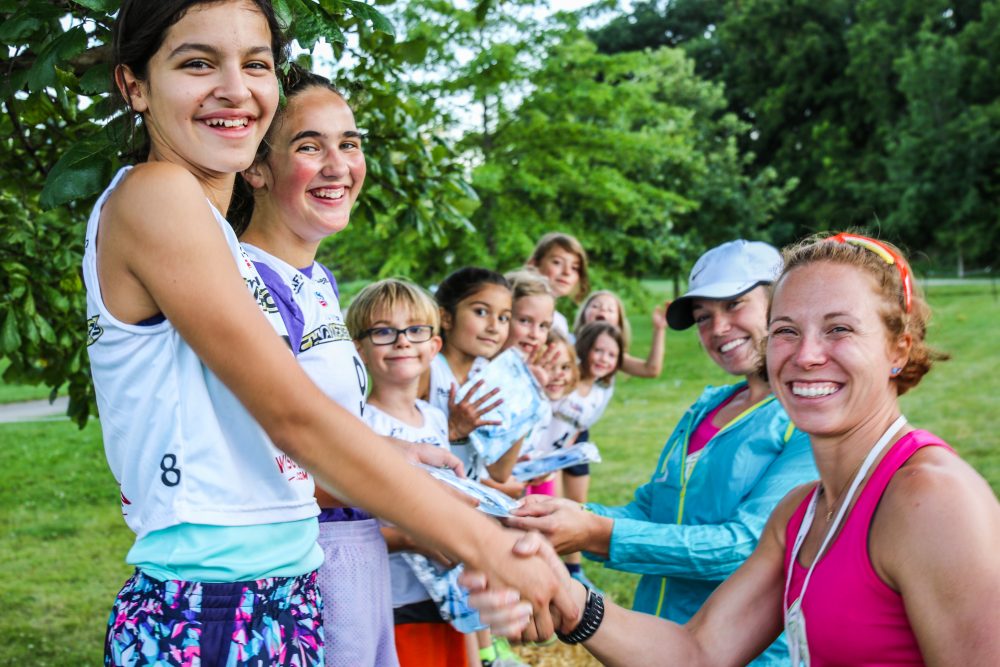
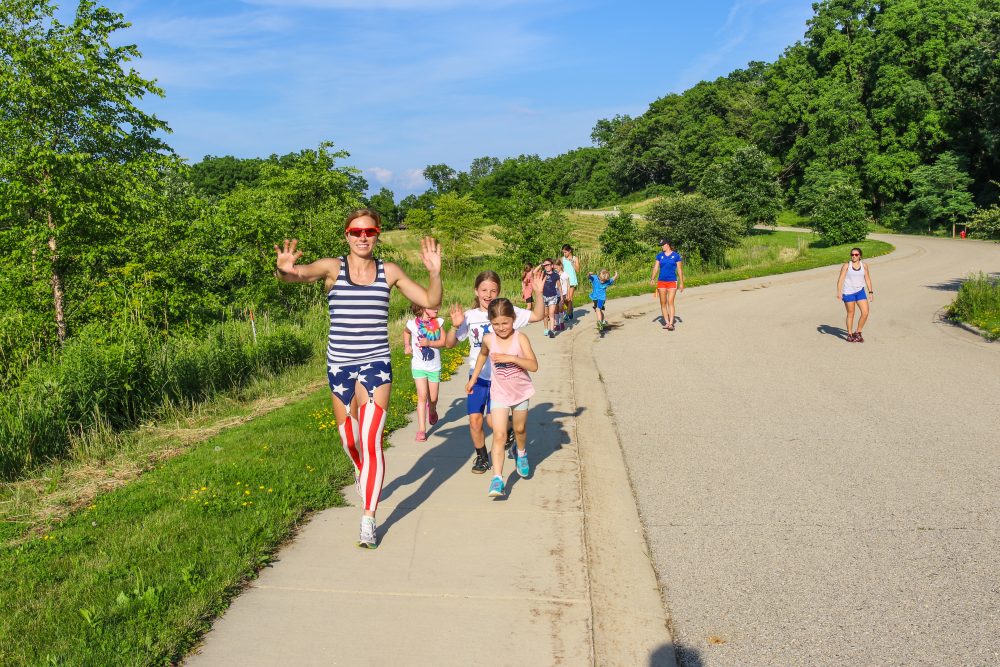
    Eliška Hájek Albrigtsen (formerly Hájková, front right) with Madison Nordic Ski Club’s Trail Kids this summer.(Photo: Tobias Hájek Albrigtsen)

    Many mornings, Eliška Hájek Albrigtsen’s husband, Tobias Albrigtsen, has to peel her out of bed. Living the life of an early bird like her spouse is nowhere near the top of her list — partly because she spends most nights prodding her hubby awake as he finishes his work, partly because she is strung out between four jobs of her own.

    Being in charge of three ski programs while assisting a fourth is not where the 29 year old envisioned herself when she moved to Madison, Wisconsin, this past June to work for Central Cross Country (CXC). But a lot can change over the course of a summer and for Albrigtsen (formerly Hájková), a lot did.

    After relocating to the Badger State’s capital from Lake Tahoe, California, to serve as CXC’s Community Olympic Development Director, Albrigtsen’s responsibilities began to accrue.

    It started with the addition of coaching CXC’s online master’s program. Then she had an interest in helping with CXC’s Paralympic and adaptive athletes. Finally, in late August, Andy Keller left his head-coaching position with the CXC Team to join Northern Michigan University (NMU) as an assistant coach, and Albrigtsen was in a prime spot to take over the reins. 

    “When Andy took the assistant coaching job at NMU, it was kind of natural that I got the CXC Team head coach position,” Albrigtsen, a Czech Republic native, said during a recent phone interview. “For me, it’s not like a big promotion, it’s just more stuff to do while I still do all the stuff I was doing before. I have a lot of responsibilities all of a sudden that I didn’t start with.”

    Among those responsibilities, she has been busy making informative videos for CXC Academy under the job title of Community Olympic Development Coach.

    Getting stuff done — and a lot of it, efficiently — seems to be somewhat second nature for Albrigtsen. Back in 2016, she placed sixth in the senior women’s distance race at U.S. nationals, despite having three jobs and indicating that the only training she had done in preparation was with her Boulder Nordic Junior Racing Team (BNJRT) athletes during practice sessions.

    While attending the University of Colorado-Boulder (CU), she finished in the top 10 of 45 out of 48 races over the course of her college career, according to a CU press release, all while maintaining above a 3.5 grade-point average.

    Eliska Hajkova (CU), racing against Sophie Caldwell (Dartmouth) and Corey Stock (CSU) during a sprint semifinal in 2012. Hajkova graduated in 2013 and after marrying, changed her last name to Hájek Albrigtsen. (Photo: James Doucett)

    After three seasons coaching the BNJRT in Colorado, Albrigtsen moved to Kings Beach at the north end of Lake Tahoe last year, where the juggling act continued. There, she served as the head coach for Tahoe XC, while also volunteering with the Auburn Ski Club’s elite athletes, taught private ski lessons for Tahoe Donner, coached an online master’s program, and once again raced U.S. nationals, placing 12th in the 20 k classic mass start. 

    She’s also raced more than two dozen World Cups, most recently in 2014.

    Though Albrigtsen indicates that she “never stops officially training or racing” this year might be a little different as it will be her first season coaching senior elite skiers. Still, the idea of more challenging practice sessions is enough to draw her in, even if it means scaling back her training a bit. As a coach she brings not only race experience, but the empathy and understanding of an athlete.

    “With U14 kids, I mean, I was challenging them, but I was not getting challenged,” she reflected. “I think being challenged as a coach, being able to hang out with your athletes, you really see and you can really feel their pain. When you’re right on their butts and doing every exercise, you can see, ‘OK, I know that in the Level 4 on the fifth minute, during the sixth interval you died, so let’s figure that out.’ I think that’s one of my powers, that I can really be there when it’s happening.”

    When asked of her strengths as a coach, CXC Executive Director Yuriy Gusev was quick to respond.

    “Her racing experience, number one,” he said on the phone. “And [she’s] just very energetic and hardworking and organized.”

    Albrigtsen will work with three CXC Team skiers this winter: Felicia Gesior, Kyle Bratrud and Sam Elfstrom. All three graduated from NMU, are currently based out of Marquette, Michigan, and will set their focus on the first few SuperTour races and U.S. nationals before re-evaluating their season goals. The fourth CXC Team member, Nichole Bathe (who graduated from the University of Alaska Fairbanks) remains on roster, but headed to Europe earlier this fall to train in Norway with a goal of making the 2018 Winter Olympic Games for Great Britain’s national team.

    Until the first week of SuperTour racing in early December, the amount of time the other three CXC elite skiers and Albrigtsen work together will depend on the athletes. Albrigtsen wanted to keep the summer and fall schedule fairly flexible so her athletes would not feel restricted in the amount of paid work or fundraising they could accomplish while training for the upcoming season.

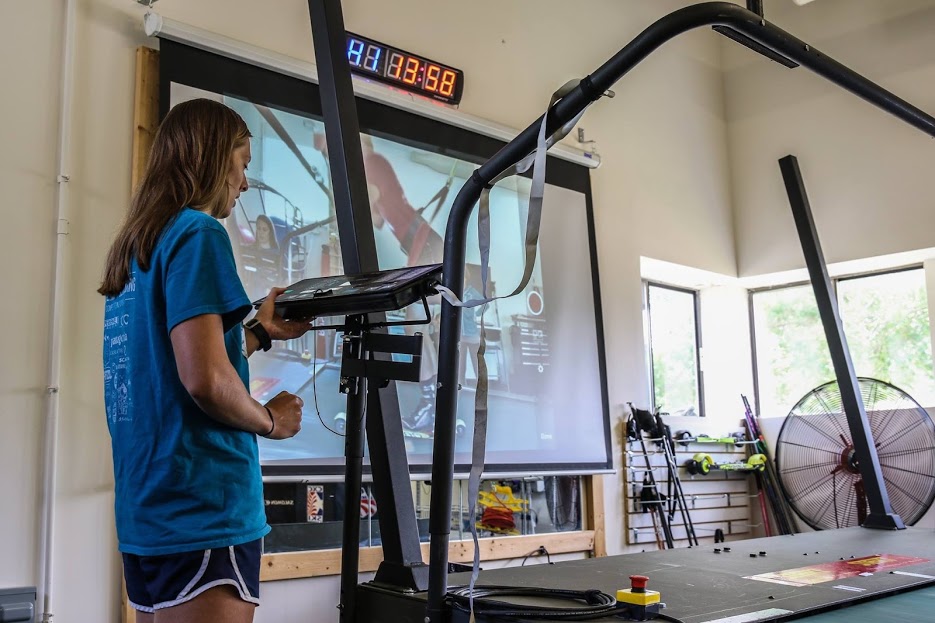
    For example, Gesior made a trip to Madison earlier this fall for a training session on CXC’s rollerski treadmill with Albrigtsen, but will spend most the next few weeks training in Marquette and preparing for a fundraiser she’s organizing: the Bergkönig trail run on Nov. 11. The event features 10 k, 5 k and 1 k races and was originally created by Maria Stuber and Bryan Cook in an effort to raise money for local cross-country skiers looking to continue their ski careers post-college.

    Gesior also works as a substitute teacher in Marquette, and most of her training this summer and fall has been with the NMU women’s team. Similarly, Bratrud and Elfstrom train with the NMU men’s team.

    Felicia Geisor of the CXC Team prepares to hop on the treadmill in early September. (Courtesy photo)

    “I think that’s OK that they follow [NMU],” Albrigtsen said, “That’s kind of the program that really took them where they are and they have something to top it. They don’t train like college skiers; I mean, it’s their job right now so they do train more. But the base is very similar and [NMU Head Coach] Sten [Fjeldheim] is being really nice about allowing them to train with them. Not all college coaches are that way, so we’re definitely really lucky.”

    According to Gusev, partnerships like the one CXC has with NMU and other programs in the Midwest are the reason for CXC’s expansion. Over the last decade, he said CXC has grown from a $50,000-dollar organization to a million-dollar one.

    “It’s all of those partnerships,” Gusev said of the CXC programs’ continued growth. “They’re incredible organizations so we’re able to work with all of them together and help them work together.”

    The organization hopes to continue its expansion with the addition of a $12-million-dollar training complex just outside the Madison suburb of Middleton, Wisconsin, which is currently in the planning stages. The facility would not only include a competition venue, but snowmaking equipment, a lit rollerski loop, and 30,000-square-foot facility open for recreational use as well.

    The idea behind the complex, Gusev indicated, would be to provide CXC athletes with a training venue, while simultaneously encouraging community members to get outside and active, using skiing as an example. The center already has one complex, the CXC Center of Excellence in Madison, complete with rollerski treadmill. 

    “With the CXC Team, our number-one goal is to support the athletes that need the support. That’s as simple as that,” Gusev said. “But overall, our goal as an organization is to grow the sport at all levels.”

    To Albrigtsen, the new facility is another reason Madison and CXC seemed like a good choice for her and her husband, Tobias, who is CXC’s media and communications coordinator, when moving from Tahoe to the Midwest. That, and the cost of living. 

    “We always talk about what can Midwest offer that other regions can’t. We don’t have the mountains, we don’t have the best winters, but what we really have is the best quality of life,” Albrigtsen said.

    “You can live much cheaper here than anywhere else in U.S. and still make somewhat good money,” she continued. “Not everybody, especially in the U.S., there’s maybe 10-15 people who can do this professionally and get paid being skiers, otherwise you have to work and that’s something Midwest does have to offer. You can have a normal life and be a skier. You can do it here.”

    While Albrigtsen’s “normal life” is somewhat busier than others might prefer, she is in no way deterred.

    “I am a total sport addict, and I think every coach has to be, otherwise it’s not really worth it,” she said. “Tobias and I, we’re just trying to do what we love and give something back.”

    Give something back, and get a little training in at the same time, even if it’s in between her multiple jobs.

    “My motivation is also to fit in my jeans, wearing tight dresses,” Albrigtsen added with a laugh. “I have a five-year-younger husband so I have to take care of myself.” 

    Eliska Hájek Albrigtsen (formerly Hajkova) leading a Fourth of July run with Madison Nordic Ski Club’s Trail Kids this summer. (Photo: Tobias Albrigtsen)
  • Confidence in Hand, Thompson Gunning for PyeongChang Spot

    Confidence in Hand, Thompson Gunning for PyeongChang Spot

    Bob Thompson (NTDC Thunder Bay) competing at last season’s World Cup in Lillehammer, Norway. He’s shooting for another round of Period I World Cup starts this season and, he hopes, an Olympic berth. (Photo: Fischer/Nordic Focus)

    This week’s featured articles are made possible thanks to the generous support of The Loppet Foundation, host of the Masters World Cup 2018. Registration opens in October.

    ***

    Bob Thompson won his first NorAm in 2014, at Olympic trials in Canmore, Alberta. The then-22-year-old Canadian cross-country skier skied safe and smart and took the victory after two pre-race favorites, Jesse Cockney and Phil Widmer, collided near the finish.

    That win didn’t earn Thompson an Olympic berth for Sochi. But this year, the Thunder Bay National Team Development Center (NTDC) athlete is hoping to get to PyeongChang, South Korea – and hopefully, to avoid needing an Olympic trials win to do so.

    “I’ll do the Frozen Thunder race [in Canmore in November] – I think it’s just one race this year – to get Period I [World Cup] starts,” Thompson, 26, said of his goals for the beginning of the season. “So then get on the Period I World Cup, and then from there that’s the only chance to get another two top 30s to get the Olympic qualification locked in.”

    After finishing 30th in the World Cup Finals sprint in Quebec City in March – his first World Cup points – Thompson is one-third of the way to qualifying for the Olympic team, most likely.

    Nominations go preferentially to athletes who have finished twice in the top-16, or have one top-12 distance result or one top-six sprint result, or are part of a podium relay or team sprint. Five men have hit those marks.

    Bob Thompson sprinting to second in the 2016 skate-sprint qualifier last fall at Frozen Thunder in Canmore, Alberta. The performance earned him the final spot on Canada’s 2016 Period I World Cup team. (Photo: Drew Goldsack)

    But if the team is not filled yet with men meeting those criteria – and it probably won’t be, as the Canadian team intends to take around seven men – the next spots will go to athletes with three top-30 World Cup results. That’s the mark Thompson is after.

    He already has one result in the bag.

    And he is familiar with Period I World Cups, considered by many to be the most difficult and competitive World Cups of the season. Most countries send a full team of athletes to every event, not true some other weekends of the year. And when World Cups are hosted in Norway and Finland, the 15 “extra” athletes the home country is allowed to enter as a “Nations Group” are pretty high-caliber skiers.

    “From an actual racing standpoint, I had [Russia’s Sergey] Ustiugov go by me when I was on my first lap and he was on his second lap,” Thompson said of a distinct memory from those races last season. “He just dropped me immediately. It was this realization, that, OK, I should be going a lot faster. I’m trying to do that … getting more World Cup experience under the belt.”

    But despite the wake-up call of racing the very best and deepest fields in the world, Thompson felt that he had executed well last season and now has experience to build on.

    “Those races were really good,” Thompson said of the 2016 races. “I guess I didn’t do as well as I had hoped – I had hoped I would get a top 30 in that period – but in Lillehammer I tied my previous best World Cup result, which was my very first one from Gatineau from the Ski Tour Canada. I was 52nd.”

    Thompson had another opportunity to get World Cup points last season when he was selected to race in PyeongChang for the World Cup test events. Like many countries, Canada didn’t send most of its A-team because the races were before World Championships and team leaders worried about fatigue. Thompson, Cockney, Simon Lapointe, and Julien Locke joined World Cup regular Len Valjas in PyeongChang.

    Bob Thompson (NTDC Thunder Bay) racing to second in the men’s classic sprint qualifier at 2016 Western Canadian Championships in Prince George, B.C. He went on to win the men’s final. (Photo: Sally Connon)

    It was a bitter moment for Thompson, in a way, because he finished 31st in the sprint qualifier, just 0.01 seconds out of the quarterfinals. That would have guaranteed him a top 30 and, perhaps, something much better than that.

    It was a race effort imperfectly executed, something that Thompson remembers.

    “I definitely knew multiple places where I didn’t ski it well enough,” he said. “There was one place where my wax caught on me, and then I tried to prevent that from happening again and took a corner too wide, easily losing at least a second. … I definitely felt like I could have had a decent result there. I mean, anyone can say that, but, yeah.”

    The pressure of having a good result is something that Thompson has grown used to, as he is constantly trying to qualify for something – a competition, a team, funding.

    “Every World Cup start I’ve had so far has had pressure to get that top 30,” he explained. “I always felt like I had to have near my best day to do it.”

    So in a way, this year’s Period I (if he gets there via Frozen Thunder) won’t be any different. The big change is that now he does have one top-30 under his belt, and in a field more competitive than in PyeongChang, too.

    If he doesn’t hit the top 30 twice in the initial period of World Cup racing, Thompson will need to manage the transition back to Canada better and excel at January’s Olympic trials, to be held in Mont Sainte Anne, Quebec.

    That will require refocusing, and Thompson had an important cautionary lesson about it last season. It had been his first time spending a whole period on the World Cup, and between the racing and the travel it took more out of him than he had expected.

    “Coming out of that is where I guess I learned the most,” he admitted. “We came back from Europe and were set on doing a bit of a recovery period before the U.S. Nationals races, which were trials races. But we decided we couldn’t pass up the opportunity for the Rossland NorAm weekend because it was the Period II qualification, for whoever won the weekend. We thought that I had raced well so I was going to be fast. And it turned out that in hindsight, that was a mistake as it was a bit too much travel for me or a bit too much load.”

    This year, with so much on the line, Thompson is trying to be aggressive but also careful.

    His plans hit a snag in August when Thompson fell ill and missed several weeks of training. With his coaches he has made the tough decision to skip an on-snow camp on the Dachstein glacier in Austria and try to gradually build back into full training without overdoing it. By November’s race in Canmore, he hopes to be back fully to himself.

    Before getting sick, things had been going well.

    “Maybe I was a little more tired than I should have been, but it was starting to get better, especially around the Alignment Camp we hosted in Thunder Bay,” Thompson said. “That was a lot of fun and a well-organized event. It was really good to have everyone who came to that, to train with us, and we could showcase the training venues in Thunder Bay. … I think I was not getting enough recovery after a few key workouts, but in July I made note that I was feeling a little bit run down and I started to address that.”

    He is also taking advantage of some non-coaching support systems available in the Thunder Bay area.

    “We have been focusing this year on nutrition,” Thompson explained. “We have been working with the Canadian Sport Institute Ontario a little bit more. I’ve been getting plans from their nutritionist as well as doing more work with their sports psychologist and physiologist. Those are a few of the small things that I hoped would be that extra percentage to help ramp me up for this Olympic year.”

    And another thing has changed for Thompson as well. Thanks to that 30th-place finish in the Quebec World Cup, he is now a “carded” athlete, receiving a monthly stipend from Sport Canada.

    It’s not enough money to change the material aspects of his life, but it has done two things. The first is to release Thompson from some of the pressure to do odd jobs whenever the opportunity arises.

    “Previous years, I have worked for older former skiers who have properties or rentals that need fixing up,” he said. “A number of us on the team have been doing that. But now it’s sometimes like, well, actually, I don’t have time. I have too much training. I don’t necessarily feel like I need to take all those opportunities which could take away from training opportunities due to fatigue levels and spending time not resting.”

    And secondly, having his own money to live on has been mentally freeing.

    “I have been very fortunate from my parents being very supportive of my racing,” Thompson said. “But just the fact that I wasn’t paying for it myself, or was paying for limited aspects of it – to have skied fast enough to have that income now, takes the strain off my parents and the pressure off myself for feeling like I was draining them too much.”

    It might seem trivial, but along with the sports psychology work it has made a big difference in Thompson’s outlook.

    “That in itself, the mental relief – I think I have been looking for that for the last five years, ever since I’ve been a senior athlete,” he said. “Ever since I entered the realm of, OK, now I should really be able to make it if I’m competing at the top level in Canada. So I think most of all it has been a good mental boost just to have that.”

  • Caitlin Patterson Races to 23rd at Mountain Running Worlds

    Caitlin Patterson Races to 23rd at Mountain Running Worlds

    Caitlin Patterson, who skis for the Craftsbury Green Racing Project, representing the U.S. at 2017 World Mountain Running Championships last month in Premana, Italy. (Photo: Richard Bolt)

    Note: This article has been updated to correct Caitlin Patterson’s birthplace. She was born in McCall, Idaho.

    ***

    The clang of a cowbell is a sound Caitlin Patterson has heard plenty of times during a ski race — but never while running — at least until she raced the 33rd edition of the World Mountain Running Championships (WMRC) July 30 in Premana, Italy.

    In her debut WMRC, which she qualified for in June, the 27-year-old Patterson discovered that for the mountain running fans of Italy, spectating is almost a sport in itself. Crowds of people cheering lined much of the 13-kilometer, two-lap course, and to Patterson’s surprise, within close range to the racers.

    “It definitely felt like there were a few cowbells being rung that were about the size of my head, and then a few being rung almost into my head,” Patterson said during a recent phone interview from Craftsbury, Vt. “But it was really neat to see how enthusiastic the Italians were about the race. … I have certainly never seen that many people with cowbells and cheering.”

    Caitlin Patterson, who skis for the Craftsbury Green Racing Project, representing the U.S. at the 2017 World Mountain Running Championships this July in Premana, Italy. (Photo: Richard Bolt)

    The race started in the city’s center and wove through Premana’s cobblestone streets for almost a kilometer before transitioning to trails. Unlike the rock- and dirt-covered mountain courses Patterson has run in the U.S., this race incorporated close to 3 k of pavement.

    “We started in the town itself and wound through these really narrow city streets, some of them so narrow I probably could have reached out and touched the walls with my hand,” Patterson said. “That first section of manmade mountain course was different than I might have expected. … Probably three of the race’s 13 k was on pavement, which not exactly anything I had prepared for.”

    What she had prepared for was a fast start. Prior to heading to Premana, Patterson, who skis for the Craftsbury Green Racing Project (CGRP) based out of Craftsbury, planned a couple distance runs with Vermont native and 2011 WMRC champion Kasie Enman (Enman also competed for the U.S. women’s team at this year’s WMRC).

    Though neither of the runs the two went on involved intensity or hill workouts, they did involve conversation about what to expect and how to tactically attack the race. While finding a competitor to race behind is often helpful in a mass-start ski race, Patterson learned the opposite is true for mountain running.

    “In skiing, you want to find someone that you can follow and draft off of. That’s a good tactic in a skiing mass start,” Patterson said. “But in running, especially on the downhills, when you’re just sending it over obstacles, it’s actually not a good idea to be right behind someone because then you can’t see what’s on the trail. Kasie said, ‘If you can, get around people so you have clear visibility of what’s ahead.’ ”

    Patterson spent most of her race in company of racers from other nations, runners she had never met before.

    “I didn’t know who I was racing with…,” Patterson said. “The first time up the climb went fairly well for me … but it was kind of humid and we were in the full sun almost the whole time and I don’t handle heat very well. So I was really struggling with the heat for most of the race.”

    Despite not being a heat-thriving racer, Patterson raced to 23rd overall (out of 64 finishers), with a time of 1:12:14. Allie McLaughlin led the U.S. women’s team in fifth with a time of 1:06:06. Her teammate Addie Bracy followed in eighth (1:07:46), and Kasie Enman placed 13th (1:09:11).

    Caitlin Patterson, who skis for the Craftsbury Green Racing Project, representing the U.S. at the 2017 World Mountain Running Championships this July in Premana, Italy. (Photo: Richard Bolt)

    Kenya’s Lucy Wambui Murigi won the race in 1:01:26, while Austria’s Andrea Mayr placed second (+1:17) and Germany’s Sarah Tunstall finished third (+2:49).

    The three-top scoring American women (McLaughlin, Bracy and Enman) lifted the U.S. to the overall team title, six points ahead of home-team Italy in second. The Czech Republic was another nine points back in third.

    “It was cool to have this opportunity to race and feel like I could put myself out there and see what I could do, but not have any pressure from myself or anyone else,” Patterson said.

    Patterson is not the first nordic skier to find success in mountain running, nor is she the only one in her family. Her brother, Scott Patterson, a member of Alaska Pacific University’s elite nordic team and the U.S. Ski Team B-team,  won this year’s Mount Marathon in Seward, Alaska.

    “We, as skiers, seek out adventure,” said Patterson, who was born in McCall, Idaho. “We’ll be like ‘Huh, I want to go run up this mountain for my training,’ and then that ends up translating well [to mountain running]. … I think there are a lot of skiers out there who, if they wanted to do some mountain running, they probably could do it well.”

    Though her current focus is on qualifying for the 2018 Winter Olympics in PyeongChang, South Korea, she also indicated that setting her sights beyond snow sports is not out of the question. She flew to Europe more than a week before the WMRC to watch this year’s Dolomites Skyrace, 23.5 k mountain climb and descent in northern Italy that’s part of the Skyrunner World Series.

    “I could really see myself doing some of those longer races at some point,” Patterson said. “My focus is very much on skiing, especially now that this is over, this has been a little adventure, but then we’ll see.”

    WMRC results: Senior Women | Women’s Team

    https://www.instagram.com/p/BXKxsXwFS7h/?taken-by=usmtrunningteam

  • ‘Why Not Go Again?’ Patterson Makes Mt. Marathon His Own One Year Later

    ‘Why Not Go Again?’ Patterson Makes Mt. Marathon His Own One Year Later

    U.S. Ski Team B-team member and Alaska Pacific University skier Scott Patterson scaling his way to the top of Mt. Marathon in Seward, Alaska on July 4, 2017. (Photo: Rob Whitney)

    As with other epic modern-day adventure race series, the fabled origin of Seward, Alaska’s annual Mount Marathon — held every July 4 — began with beer and a bet: who among us can run from the streets of downtown to the top of the 3,022-foot mountain crowding Seward’s skyline, then back to the bottom the fastest? What about within the hour?

    While the footrace race has evolved massively since the port town’s pioneer miners took on the challenge, clambering up its craggy course in woolen pants and workman’s boots nearly 90 years ago, it holds no less prestige for the millennial athletes or spectators who partake nowadays. To many Last Frontier residents, it is their Olympics. An estimated 30,000 outsiders annually inundate the town’s (population 2,500) sidewalks just to watch the event.

    “It’s Mount Marathon. It’s Alaska. It’s my Fourth of July,” Allie Ostrander, the 2017 women’s overall race winner and a Soldotna, Alask. native, told Alaska Dispatch News reporter (and former FasterSkier editor) Nat Herz after the competition. “Fourth of July feels empty without Mount Marathon.”

    Scott Patterson on his way to winning the 2017 Mt. Marathon running race on July 4 in Seward, Alaska. (Photo: Holly Brooks)

    Despite the obvious risks associated with careening down a mountain at top speed, stories of close encounters with kidney failure, brain-damaging falls, and disappearance deterred a few from re-entering this year’s version of the event.

    The upcoming 2018 PyeongChang Winter Olympics was reason enough for the current Mt. Marathon course-record holder and last year’s overall male champion, David Norris, to watch from the sidelines. His Alaska Pacific University (APU) teammate, Scott Patterson, who also recently earned a U.S. Ski Team (USST) nomination, however, did not.

    “It’s a big deal up here. I just figured why not go again?” Patterson, an Anchorage native, explained on the phone.

    In his debut Mt. Marathon race, Patterson had twisted his ankle and ultimately finished fourth last year. This year, as he weighed out his risk in racing, he arrived at a far less insidious calculation.

    “There’s definitely always a risk, that downhill is tricky,” Patterson said. “But I think looking at the competition beforehand, I knew that I could probably have a pretty good lead at the top and stake the downhill at my own speed; not really have to duke it out with someone down the hill.”

    With that, Patterson entered the 2017 event aiming for the win, but not the record. Norris was not on the start list, nor Kilian Jornet, the 2015 record holder and a professional ski mountaineer and ultramarathon  runner, not to mention Patterson had recently returned from the men’s USST training camp in Park City, Utah, which ran from June 26-July 5. Patterson departed the camp early to return for the race. 

    “Everyone was saying going into it that it was my race to lose,” the 25-year-old Patterson said. “The other guys who could really challenge me on the uphills this year skipped it, so it was kind of just me just out there on my own.”

    Patterson completed the 5-kilometer race in a time of 44:30 for the win, just over three minutes off the course record. The closest male finishers behind Patterson were Erik Johnson in second place just under a minute back (+0:52), and Kenneth Brewer in third, a little over two minutes behind (+2:23). Patterson’s first-place finish at Mt. Marathon is nothing unheard of among cross-country skiers. A number of other nordic athletes have been crowned the overall champion, including current USST A-team member Kikkan Randall, former USST athlete and Olympian Holly Brooks, APU nordic coach Eric Strabel, and Norris.  

    Morgan Arritola scaling her way to the top of Mt. Marathon in Seward, Alaska on July 4, 2017. (Photo: Rob Whitney)

    The runner-up in this year’s women’s event, Morgan Arritola, was also a member of the 2010 Vancouver nordic Olympic squad and skied competitively for over six years before she made the switch to mountain running in 2012. In her debut Mt. Marathon race, Arritola, 31, finished second in a time of 51:09, a minute and fifty seconds behind the 20-year-old Ostrander, who won in 49:19.

    While Arritola did preview the course once, she also indicated that she didn’t hold a whole lot over herself in terms of expectations and outcome going into race. Ultimately her goal coming into her first Mt. Marathon event was to “take it all in.” In discussions with her former teammates and champions, Randall and Brooks, the advice remained fairly simple: enjoy the atmosphere.

    “I didn’t really pre-race research. That’s not really my style,” Arritola, of Ketchum, Idaho, wrote in an email to FasterSkier. “Everyone has their own way of handling racing and I tend not to overthink.

    “I would love to come back next year,” she continued. “If there was a race-specific goal it would be to know the route I’m taking better. I asked for directions a few times 🙂 and be more confident on the downhill. I haven’t raced that kind of downhill and I just never got into a good rhythm.”

    While Arritola has three U.S. Mountain Running Championship titles to her name and a World Mountain Running bronze medal, mountain running is not where she is indelibly focused. She is currently going back to school for a degree in respiratory therapy and working various jobs to help fund her racing, such as The Rut 50 k in Big Sky, Mont., which she is registered to race in September.

    “I’m not running full time like with skiing,” Arritola wrote. “I am in my last year of school and running just keeps me sane. I don’t overthink it, I do what I want with it, and I enjoy it.”

    Finishing behind Arritola to round out the women’s top three was mother of three and three-time Mt. Marathon champion, Christy Marvin, in third place with a time of 52:22.

    In the junior race division of the event — in which racers run approximately halfway up the mountain before turning around for the descent — APU’s Luke Jager won the boys’ race in a time of 29:09, marking Jager’s second junior title in a row. Jager was followed by Gavin Block in second in a time of 29:32 and Ali Papillon in third in a time of 30 flat. The junior girls title went to Molly Gellert (Alaska Winter Stars) in a time of 32:53, also for the second year in a row. Behind Gellert in second was Ruby Lindquist finishing in a time of 33:55. Kendall Kramer (FXC) came in third, finishing in a time of 35:06 for the girls race.

    Results

  • Headed to World Mtn. Running Champs, Caitlin Patterson Committed to Skiing

    Headed to World Mtn. Running Champs, Caitlin Patterson Committed to Skiing

    Caitlin Patterson (front) racing to fourth place in the women’s 10 k at 2017 USATF Mountain Running Championships on June 3 in North Conway, N.H. That qualified her for the 2017 World Mountain Running Championships in July in Italy. (Photo: Michael Scott/miscottrunningphoto.shutterfly.com)

    Just over 24 hours before race day, Caitlin Patterson’s mind was made. The pre-registration deadline for the 2017 USA Track & Field (USATF) Mountain Running Championships in North Conway, N.H., was up and she was going to spontaneously do it. Written down in her summer plan was to enter few footraces, and this one promised both a challenging field and relatively short, two-hour drive from her training base in Craftsbury, Vt.

    The competition also offered an opportunity to tune up her race tactics. Patterson, 27, had raced to eighth in last year’s U.S. Mountain Running Championships uphill-only edition at Loon Mountain and was curious how she’d fare in a race with downhills (U.S. Mountain Running Championships alternate between uphill-only courses and ones that feature both ascents and descents).

    While the Craftsbury Green Racing Project (CGRP) skier planned on getting a lot out of the race, she hadn’t planned on getting selected to the U.S. World Mountain Running Championships team. But by the end of the women’s 10-kilometer run — a two-lap course which featured nearly 2,500 feet in total elevation gain — that’s just what she got. Patterson finished fourth overall, qualifying her for the 2017 World Mountain Running Championships in late July in Premana, Italy.

    Caitlin Patterson during a trail run this spring. She recently qualified for the 2017 World Mountain Running Championships, scheduled to take place July 30 in Italy. (Courtesy photo)

    “That was definitely a shock and not something I was expecting, to be able to run into fourth place,” Patterson said on the phone last week, three days after racing in North Conway. “That’s part of why I put myself in there, though, is because the race atmosphere can get you to do things you maybe wouldn’t otherwise.”

    The three women that finished ahead of Patterson were all World Championships team veterans: Addie Bracy (last year’s U.S. Mountain Running champion) in first, Allie McLaughlin (2014 U.S. champion) in second, and Kasie Enman in third (2011 U.S. champion).

    Patterson was the final woman to qualify, finishing in 56:42, 2 minutes and 46 seconds off Bracy’s winning time. Though perhaps a rookie in comparison to her competitors, Patterson didn’t let that detract her from racing how she wanted to.

    “I did a lot of power walking in that race, just on the steep stuff,” Patterson said. “I could see the top-three women in front of me and I would say most of them were running it. But walking worked better for me and the way I’m built.”

    With World Mountain Running Championships slated to take place on July 30, and the time coinciding with a rest week for Patterson, she plans to make the trip to Italy. The trip’s flights, food, and four days of lodging will be funded through the World Mountain Running Association and running organizations such as U.S. Track and Field and the All American Trail Running Association. In the weeks leading up the race, she hopes to do some training runs with Enman, who also lives in Vermont. The weekend before to the U.S. championships, Enman won the Vermont City Marathon.

    “If nothing else, [I want to] chat with her about what to expect over there,” Patterson said. “I was entering this race partially … so I could run with some other women and learn from them.”

    With those World Championships on the horizon, Patterson’s main focus this season remains skiing. She planned to enter a few more running races this summer before heading to New Zealand with her team in August.

    “The Olympics are on the radar for this coming winter, but we’ll see what I can do,” Patterson said.

    Scott Patterson (Alaska Pacific University/USST) during a crust-skiing adventure with his sister, Caitlin Patterson (not shown) this spring in Anchorage, Alaska. (Photo: Caitlin Patterson)

    Beyond making the 2018 Winter Olympics, she also is hoping to eventually make her way onto the U.S. Ski Team (USST). Her younger brother, Scott Patterson, was nominated to the USST B-team last month, and the news hit her as somewhat bittersweet.

    “I was really happy to hear he made the team,” Patterson said. “Of course, I wish that I could be there, too, but I know the rationale behind that I haven’t quite made that jump yet.”

    Breaking that bubble, as she acknowledged, is no easy task. There’s the nine-hour time change between her and her coach, Pepa Miloucheva, when she’s in Europe. There’s also the physical toll traveling takes on her body.

    “I feel like every year I should get better at traveling, and I do to some extent … going back and forth to Korea [for the PyeongChang World Cup] was great,” Patterson explained. “But for some reason the travel going from Period 1 back to the U.S. — so that was France back to Montana — that went really badly and I got very sick. That was very difficult, borderline devastating, for nationals racing.”

    In a way, Patterson’s description of being an on-the-cusp athlete is somewhat of a catch-22: the only way to improve her international racing is to race internationally, but doing so can make domestic racing difficult, with certain domestic races being the ones she needs to do well in if she is to continue racing at an international level.

    “I actually probably got the most nervous I’d been the entire season before U.S. nationals,” Patterson said. “After I’d been in Europe, where the racing is extremely tough and such a high level of competition, my expectations were, if I have a really great race, I can crack into the [World Cup] top 30 or so. Whereas coming back to nationals, I felt like I was the person who was in Europe and I’m one of the favorites.”

    Caitlin Patterson leading her Craftsbury teammate Kaitlynn Miller during the women’s 10-kilometer freestyle at 2017 U.S. nationals in Midway, Utah.

    Another point Patterson made was the idea of creating more opportunities for U.S. national-team and non-national-team members to compete against one another. This spring, Patterson received an email invitation to an athlete meeting led by athlete reps, Rosie Brennan (USST B-team member), Dakota Blackhorse-von Jess (Bend Endurance Academy), and Anne Hart (Stratton Mountain School). Topics discussed included:  SuperTour Calendaring, SuperTour Points, Seeding, Pole Length Rule, and Selection Criteria. Close to 30 athletes–from both the SuperTour circuit and USST–were in attendance, according to Patterson who also attended the meeting. Many present agreed with the following:

    “We as a ski community, as much as possible, would like for the U.S. Ski Team athletes who don’t make the criteria to race upcoming World Cup races or don’t make the criteria to race the Tour de Ski, to be sent back and have to race U.S. nationals,” Patterson said. “Maybe that will happen, I won’t really believe it until I see it.

    “It’s tricky,” Patterson continued. “Of course I’m still trying to figure it out myself. Kris Freeman made some good points that maybe the system of qualification isn’t working so well if so much has to be decided by discretion. But I guess in the end, the best way to do it is manage to race so fast, that it puts all doubt aside and show you just belong on there. Get off the bubble for sure, because there’s a lot of us trying to make that jump.”

    Even if last season didn’t earn her a nomination to the USST, Patterson is happy with the progress she’s witnessed in her skiing over the past few seasons, last year’s being particularly gratifying.

    “I really enjoyed my time in Europe during Period 1 this past winter,” she said. “It was a very positive experience and everyone was so excited to be there. And I think in many ways, it was a more positive experience than when I’ve been over there later in the season, when a lot of those athletes who have been racing in Europe really start to want to come home.

    “I respect the coaches’ decisions and I think they have good rationale on their side,” she continued. “I’ve been making good progress with my skiing, but I know that I need to prove unquestionably that I belong there on the ski-team ranks. There’s an extremely strong women’s team right now, which of course is great, but makes it really hard to get onto it. So I’ll keep trying and keep doing everything I can. Luckily I have a very supportive team here in the CGRP. So I can keep pursuing skiing, but hopefully make it to the Olympics one way or another.”

    Currently, CGRP sponsors, especially Concept2 and the Craftsbury Outdoor Center, cover CGRP athletes’ in season race and travel expenses. In the summer, lodging and food at the Craftsbury Outdoor Center are also paid for by CGRP financial supporters. For other outside expenses, Patterson relies on prize money she earns throughout the season.

    “No one in the US is in cross-country ski racing for the money, we’re in the sport because it’s an amazing way to stay fit and get outside, push your limits and compete, and inspire and help others along the way,” Patterson wrote in an email on Thursday. “I’m really not sure how long I’ll keep skiing at this competitive level. I have no definitive plans to stop, but I also don’t plan to keep going forever, as there are many other meaningful things I know I can do with my life. For now I’m living in the moment and the immediate future, giving everything I have to the pursuit of skiing my best, and enjoying the process and the journey.”

    Though perhaps headed to World Championships in a different sport than she would have expected, Patterson indicated that for now, her nordic ski career is where she will stay.

    “I’m really not sure, I haven’t given that any thought before.” Patterson wrote of a future in mountain running. “Mountain and trail running has always been something that I’m fairly good at because I’m training to be a skier, and I have a natural tendency towards an aerobic body type. I enjoy the races, and would like to improve my speed and consistency at running races, but I can’t really imagine continuing to be a competitive athlete but not focusing on skiing.”

  • An Air-Guitar Solo: Harvey Closes Out Championships with 50 k Win

    An Air-Guitar Solo: Harvey Closes Out Championships with 50 k Win

    It’s real. Canada’s Alex Harvey after winning gold in the men’s 50-kilometer freestyle mass start on Sunday at the 2017 Nordic World Championships in Lahti, Finland. (Photo: John Lazenby/Lazenbyphoto.com)

    LAHTI, Finland — Here’s the basics: fast and firm tracks, cloudless skies, and once again a stacked field for the final event of the 2017 Nordic World Championships: the men’s 50-kilometer freestyle mass start.

    Over the course of the 50 k, Canada’s Harvey had to think about one thing: be up front near the top three in order to shadow Norway’s Martin Johnsrud Sundby’s inevitable gut punch in the last kilometer. What he didn’t have to think about was playing catch up as a skier yo-yoing off the back, or his skis — they were rockets.

    In Sunday’s closing race of Lahti World Championships, Harvey was slotted in second, sliding around “Lahti Corner” just centimeters behind Sundby. Drafting off Harvey was 2017 championships legend, Russia’s Sergey Ustiugov, who had already racked up four medals previously in the week (skiathlon gold, team sprint gold, freestyle sprint silver and team relay silver). Pulling not far behind the three was Finland’s Matti Heikkinen and Andrew Musgrave of Great Britain. 

    After studying the women’s 30 k mass start on Saturday, Harvey had some cogent takeaways.

    Russia’s Alexey Chervotkin (21) leads Canada’s Alex Harvey (3) and Sweden’s Marcus Hellner (5) during the men’s 50 k freestyle mass start on Sunday at 2017 Nordic World Championships in Lahti, Finland. Harvey went on to win, Hellner placed 12th and Chervotkin 13th. (Photo: John Lazenby/Lazenbyphoto.com)

    “I saw the women’s race yesterday, and I figured if Marit Bjørgen could not distance herself from the other girls, then there is no way that the men will be able to do that,” Harvey said during Sunday’s post-race press conference. “I knew with the fast conditions, it was going to be a big group, and that leaves the potential for a lot of carnage, a lot of mayhem.”

    For the first 10 k, skiers from various nations took pulls up front, including Sundby and Ustiugov, and Norwegians Petter Northug, Hans Christer Holund, and Anders Gløersen. After testing the field and breaking away around 8 k into the race, Gløersen was still skiing alone up front, 20 seconds ahead of anyone else at 15 k.

    “Gløersen took off a bit and he was like, ‘What’s the gap? What’s the gap?’ ” Canadian World Cup coach Ivan Babikov said of Harvey. “He was always controlling the race and saving energy for the finish.”

    Eventually, the main pack surged to recover the lost time. Gløersen’s off-the-front-flier only earned him camera time. The catch came just before Lahti Corner returning to the stadium around 20 k in, where Russia’s Alexey Chervotkin took over. In another 2 k, Sundby, who had been stalking in the top 10, moved to the front as if the race were all of a sudden for real.

    Norway’s Anders Gløersen broke away early to lead the men’s 50 k freestyle mass start, skiing alone off the front for about 12 kilometers, on Sunday at the 2017 Nordic World Championships in Lahti, Finland. (Photo: John Lazenby/Lazenbyphoto.com)

    From then on, the size of the pack atrophied with each consecutive lap. At 30 k, the pack streaming through the stadium was 24 skiers long. At 45 k, the group winnowed to a train of 19. And within another 4 k, only 13 remained: Sundby, Ustiugov, Musgrave, Harvey, Heikkinen, Northug, Holund, Gløersen, Chervotkin, Sweden’s Marcus Hellner, Norway’s Sjur Røthe, Switzerland’s Dario Cologna, and France’s Maurice Manificat.

    “I wanted to be in the front, top three at least,” Harvey said, reflecting on his skiathlon tactics from last weekend, where he skied around fifth up until the final headwall and finished fifth, outside of the medals.

    “I knew that Sundby’s first chance to win gold was to break everybody,” Harvey continued. “I was expecting him to leave from kilometer 1 or 49.”

    Harvey guessed Sundby would be the only one who would try to break away. With that in mind he marked the Norwegian.

    “He knew it would be hard to break away [and that] it will be all about the finish,” Babikov said. “He was positioning himself perfectly up the last hill and just stayed on Sundby. That was his plan, ‘I’m just gonna stay on Sundby and if he changes skis, I’ll go change skis,’ but today conditions were perfect so he didn’t.”

    With ripping conditions and skis to match, Sundby never slowed nor switched skis. Neither did Harvey.

    “When he waited until the last lap, I knew exactly where he was going to do it: with a k and a half to go,” Harvey explained. “I was just lucky enough to have the legs to stick on him today and from then on it started playing more into my hands.”

    Canada’s Alex Harvey (5) charging to the line ahead of Russia’s Sergey Ustiugov (4), Norway’s Martin Johnsrud Sundby (1), Great Britain’s Andrew Musgrave (10) and Finland’s Matti Heikkinen (behind Harvey) in the men’s 50 k freestyle mass start on Sunday at the 2017 Nordic World Championships in Lahti, Finland. (Photo: John Lazenby/Lazenbyphoto.com)

    In the closing moments of nearly every race of these world champs, the fate of winners seem come down to luck, and often someone else’s bad luck. As the leaders came into the stadium, it was as if every observer were about to witness an upset due to a tumble or a tangle.

    Harvey was clean around the final turn and unscathed down the stretch.

    “I wanted to hit the [Lahti] corner in second, right behind Sundby or whoever was in the lead,” Harvey said. “I knew I needed to do that in the skiathlon, too, and I tried to go around Finn Hågen Krogh there, but he’s a clever sprinter too. He knew he wanted to be second there.

    “In the skiathlon it didn’t work, but today it did,” Harvey continued. “I was second the whole time and then out of that corner I did one push more than Sundby. I had really fast skis, but used the draft to slingshot and then hit the final corner in first and from there, I knew it was mine to lose more than anything else.”

    Canada’s Alex Harvey (5) celebrates his first individual World Championships gold after winning Sunday’s 50 k freestyle mass start in Lahti, Finland, ahead of Russia’s Sergey Ustiugov (4), Norway’s Martin Johnsrud Sundby (1), and Finland’s Matti Heikkinen (2), respectively. (Photo: John Lazenby/Lazenbyphoto.com)

    And so Harvey earned the crown: 50 k world champion in 1:46:28.9 hours.

    It’s his first championships gold since winning the classic team sprint with Devon Kershaw at 2011 world champs, and fifth medal in four World Championships. 

    “He turned around these world champs for all of us,” Babikov said of the Canadian team. “He was solid. We were with no medals so far, and winning 50 k, he’s the king now.

    “This is the legit distance and he took it today,” he added.

    “It’s a long championship,” said Louis Bouchard, Harvey’s personal coach and Canada’s World Cup co-coach. “He feels every day his energy’s still there, so he knows today, if he’s good tactically, then he can do it.”

    Asked how nerve-racking it was watching the final 5 k unfold, Bouchard responded, “I was pretty nervous, too much maybe. But that’s OK.”

    Alex Harvey’s Canadian teammates, coaches and support team celebrate his win in the men’s 50 k freestyle mass start on Sunday at the 2017 Nordic World Championships in Lahti, Finland. (Photo: John Lazenby/Lazenbyphoto.com)

    For his fifth medal of these championships (and sixth world-champs medal of his career), the 24-year-old Ustiugov crossed second for his third silver of the week, just 0.6 seconds behind Harvey. Finland’s 33-year-old Heikkinen took third (+1.4) for his first medal since 2011 World Championships.

    “Today I skied within my own limits and at the end I was fresh enough to attack,” Heikkinen said in a press conference.

    Asked about his not-so-characteristic finishing kick on Sunday, Heikkinen said he remembered how he faded to 20th in the 50 k classic mass start at 2015 World Championships.

    “After Falun 2015 world champs, I was watching the race after and I was walking in front a mirror and I said, ‘I won’t ever again be like that after a 50 k,’ ” he said. “I’ve been training two years now at a high level [with my team] … and that’s why I’m top three in overall World Cup, so it was possible.”

    Behind him in a photo finish for fourth, Musgrave capitalized on Sundby slowing before the finish — probably after the Norwegian realized he had missed out on a medal — to place fourth (+2.9). For Musgrave, who turns 27 on Monday, it was his first World Championships top 10. For Sundby, who had been on a quest all week for his first individual championships goal — it was a bummer. The 2018 Winter Olympics in PyeongChang, South Korea, will be Sundby’s next opportunity.

    From a North American and perhaps international standpoint, American Tad Elliott skied the gutsiest of races. Halfway through the race, Elliott, a 28-year-old Colorado native and former U.S. Ski Team member, remained a not-too-far-off the back chaser, 27 seconds behind the lead group. His margin back slowly accrued over the remaining distance.

    “At 25 k, man, some guys were really struggling and they balled it up,” Elliott said afterward. “I should have sent it a little harder but that’s how it goes sometimes in that pack. I thought I could get there, but I just missed it.”

    Elliott, of Ski Club Vail, finished 27th (+3:16.8) for his best individual result in three World Championships. In recent years, Elliott has struggled with illness, which impacted his ability to train and peak. Those difficulties caused him to question whether or not his best years were behind him. Evidently not.

    American Tad Elliott (41) racing to 27th in the men’s 50 k freestyle mass start on Sunday at the 2017 Nordic World Championships in Lahti, Finland.. (Photo: John Lazenby/Lazenbyphoto.com)

    “I didn’t know if I wanted to come back [to skiing]. I was so sick. I was so bummed. I was like, ‘Am I ever going to get back? Am I ever going to get back to top-30 form?’ ” Elliott said. “We knew if everything went right, I would qualify for worlds … then to get top 30 here, man, I feel like I’m starting to get greedy. I’m starting to want more, I’m starting to want more opportunities. But I’m proud of this effort, I’m going to savor it a bit.”

    In the first few kilometers, Russia’s Petr Sedov skied too wide on a 180-degree corner and stalled out. American Kyle Bratrud, the next skier to round the turn, was unable to avoid the Russian and collided. Soon after, due to the impact, Bratrud was unable to complete the race.

    U.S. Ski Team member Noah Hoffman finished the day in 50th (+8:53.1).

    Devon Kershaw was Canada’s second skier on Sunday, crossing in 38th (+5:45.5). Also for Canada, Graeme Killick and Knute Johnsgaard finished in 43rd (+7:04.0) and 55th (+12:03.3), respectively.

    “[Alex’s performance] was incredible and such a big boost for our entire team,” Babikov said. “You should see all the techs, and Devon and Graeme and Knute, who didn’t really have a great race today, and they’re still so psyched for him.”

    Results

    — Gerry Furseth, Jake Ellis and Alex Kochon contributed

    Canadian air guitar: Alex Harvey performs his team’s signature move after winning the men’s 50 k freestyle mass start on Sunday at the 2017 Nordic World Championships in Lahti, Finland. (Photo: John Lazenby/Lazenbyphoto.com)