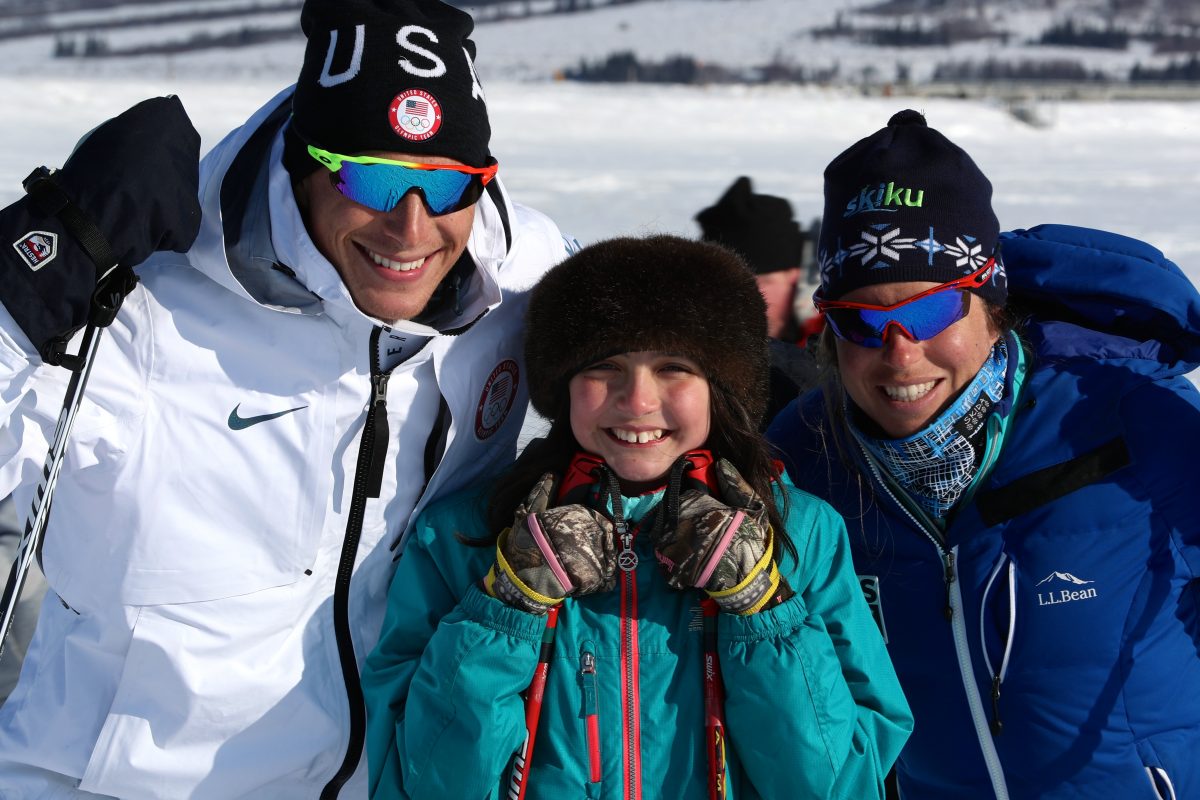
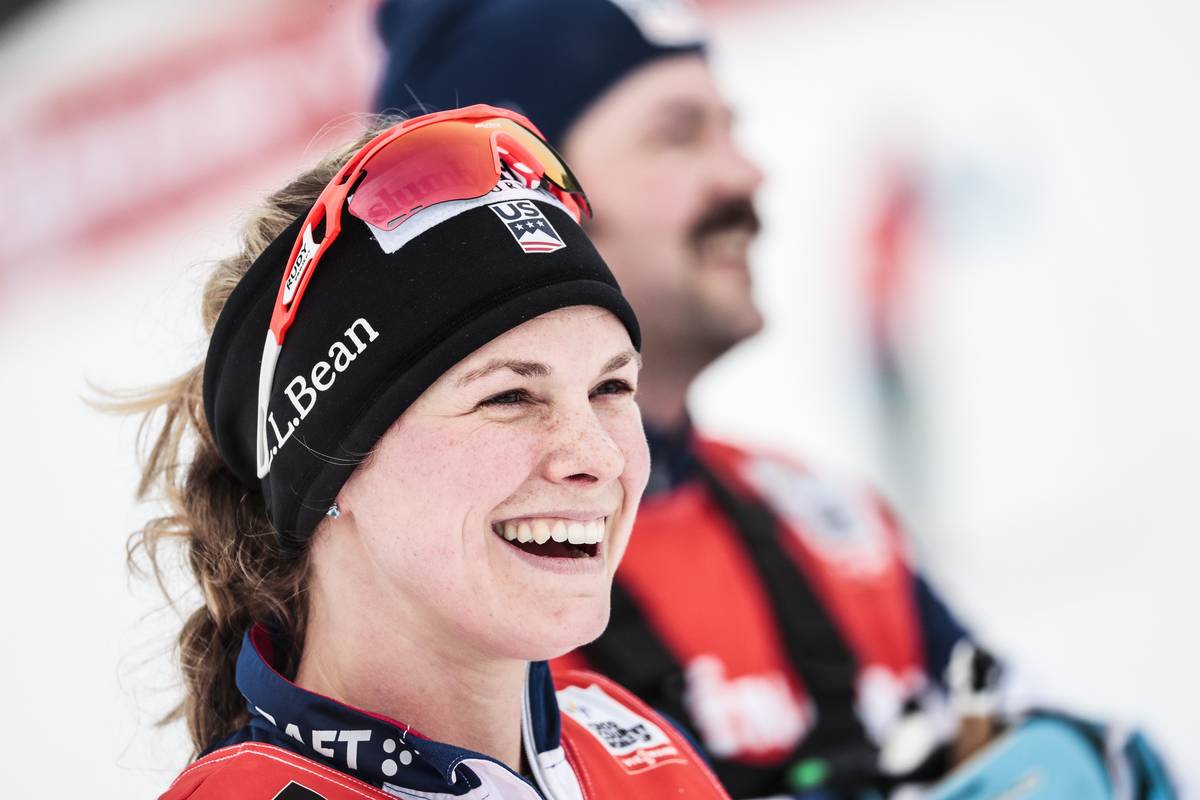
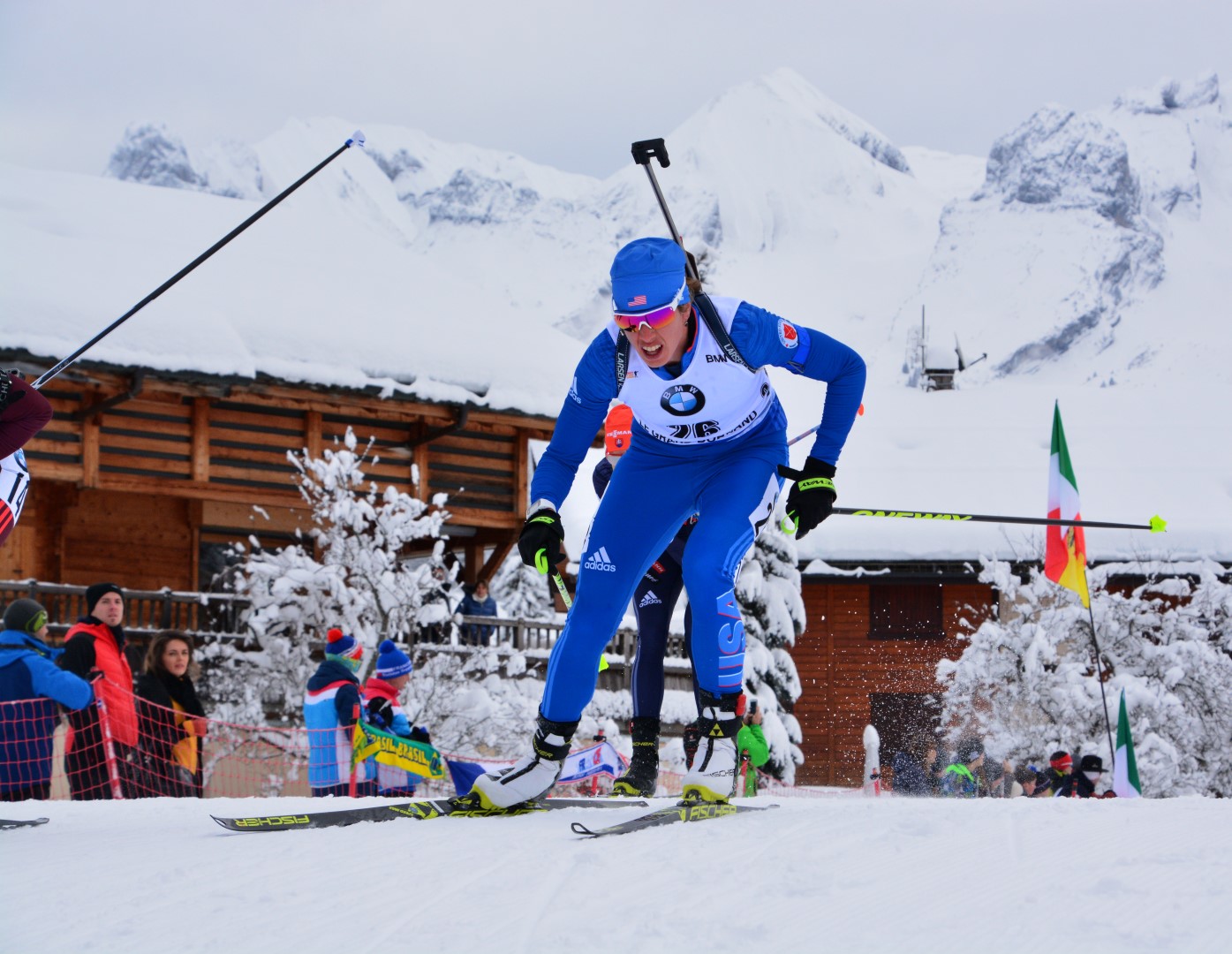
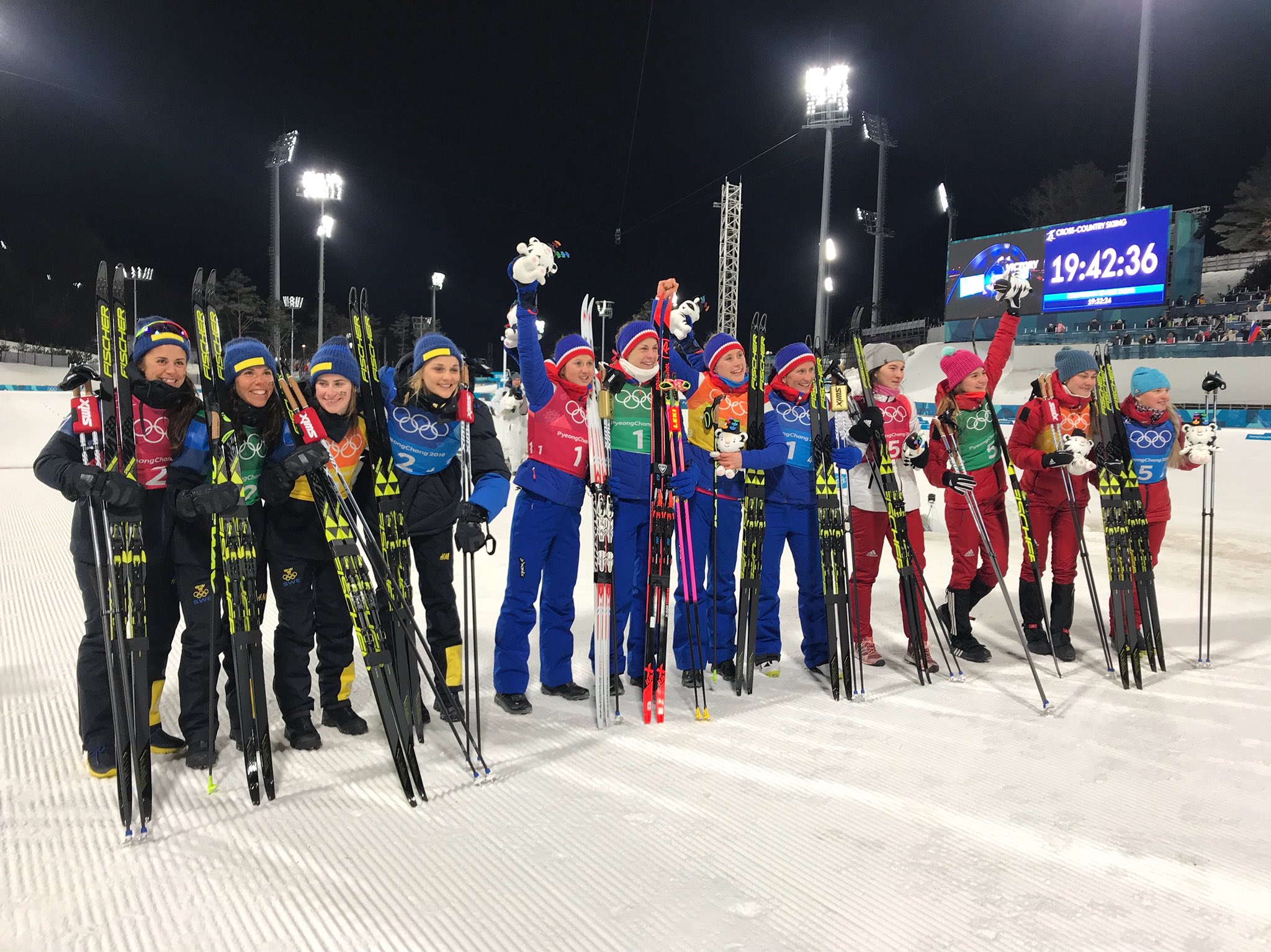
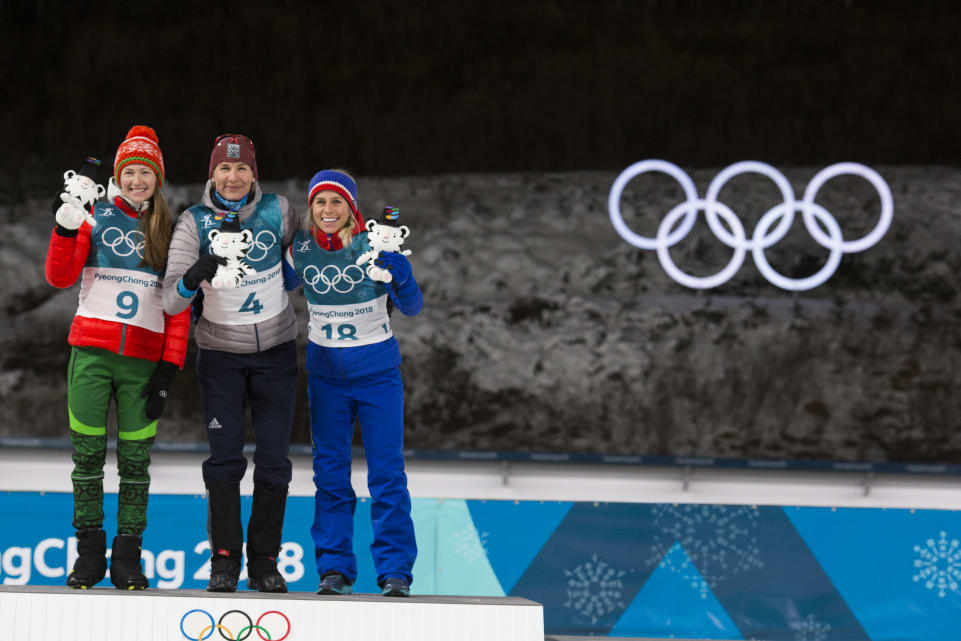
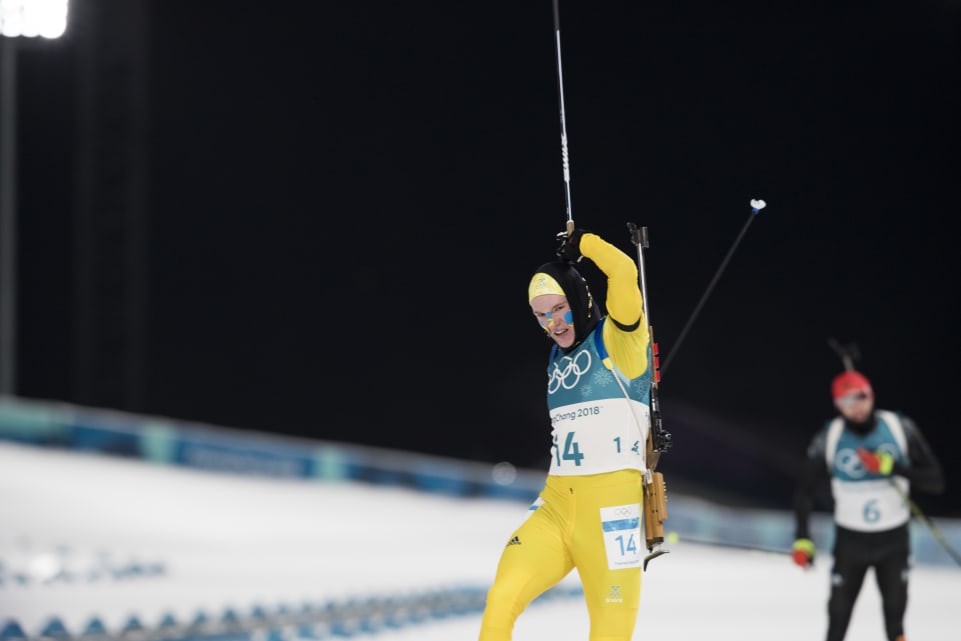
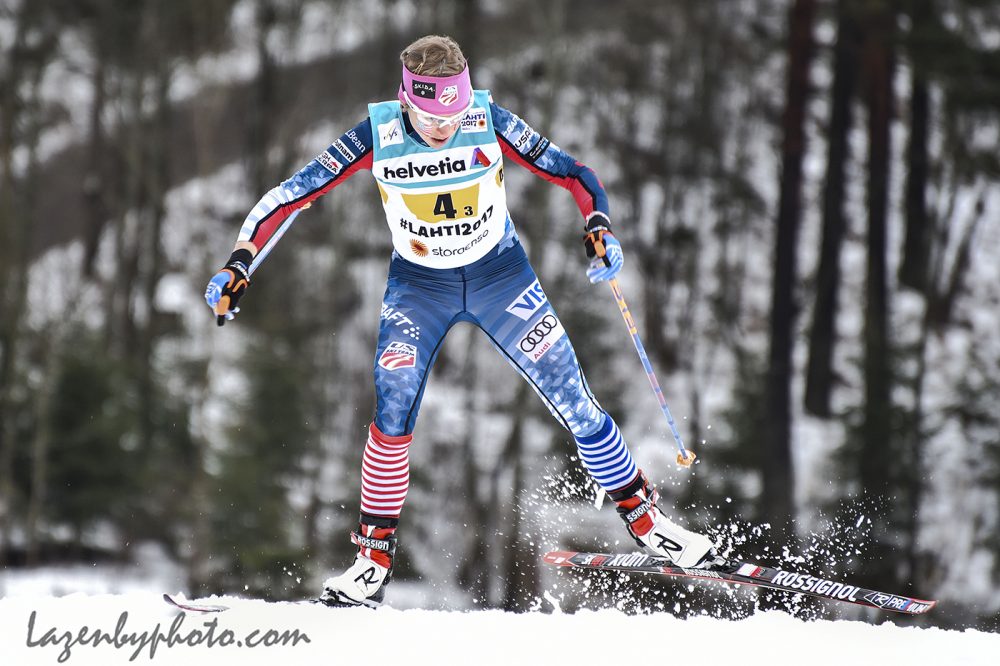
Jessie Diggins (USA) has inspired fans of all ages across the world. This weekend, many of them will gather along the race course, on her home snow, to say thank you. (Photo: Vanzetta/NordicFocus)
This Sunday, a lesser-heralded chapter of American history will close when Jessie Diggins enters her final World Cup event. She will leave the sport at the absolute top of her game, for the fourth time as the overall Crystal Globe winner, having slogged it out over a season that began the day after Thanksgiving above the Arctic Circle in Finland and will end 33 races later right here in Lake Placid, NY. She is the only skier, male or female, to compete in every single individual competition this year, from sub-three-minute sprints to two-plus hour marathons, before throngs of beer-guzzling fans in the sun and to empty Teutonic stadiums in the spritzing January rain.
During the run-up to the Milan Olympics, she briefly returned to the national zeitgeist, hyped for her ability to dig into the pain cave, and seen writhing on the ground beyond the finish line, a paroxysm of gasping. A high school student of mine had seen the feature on her in the New York Times, and a room of young athletes in Greenwich, CT — alien to Nordic ski culture — spent the full English class discussing the efficacy of pushing one’s limits. People around the once skilliterate Westchester County even started making the connection of why I’d named my dog “Diggins.”
Diggins Donahue (Photo: Timothy Donahue)
During her first Olympic race this year, Diggins crashed in traffic on the slushy snow and bruised her ribs. So naturally, five days later, she gritted her way to a bronze in the 10-kilometer freestyle and to 5th in the 50-kilometer classic on the final day of the Games. But just a week after this, when the collective gaze had drifted from the luge and returned to the Epstein files, she came improbably, from back in the field to within 0.1 second of winning a 20-kilometer in Falun. I watched this tuck-skate drag race with my daughter, who has a Diggins poster on her wall, and we screamed so loud the neighbors asked if everything was okay.
Against the slow off-gassing of rage coming across the airwaves — the sex trafficking, the elementary school bombing, the painful erosion of dignity and competence — Diggins has given us an important antidote all these years. In early 2021, when insurrectionists were sprawling their feet and flag across Nancy Pelosi’s office, Diggins was on her way to winning her first Tour de Ski. I remember the Alpe Cermis climb, when she crested into view in her red, white, and blue race suit, and thinking that she, too, is a compatriot. This past January, when her native Minnesota had become an epic fury, she won her third Tour de Ski title and was entering her fourth Olympics. She wrote, “For everyone out there caring for others, protecting their neighbors, and meeting people with love — every single step is for you. YOU are the ones who make me proud to carry the flag, and I hope I can bring you joy over these next few weeks.”
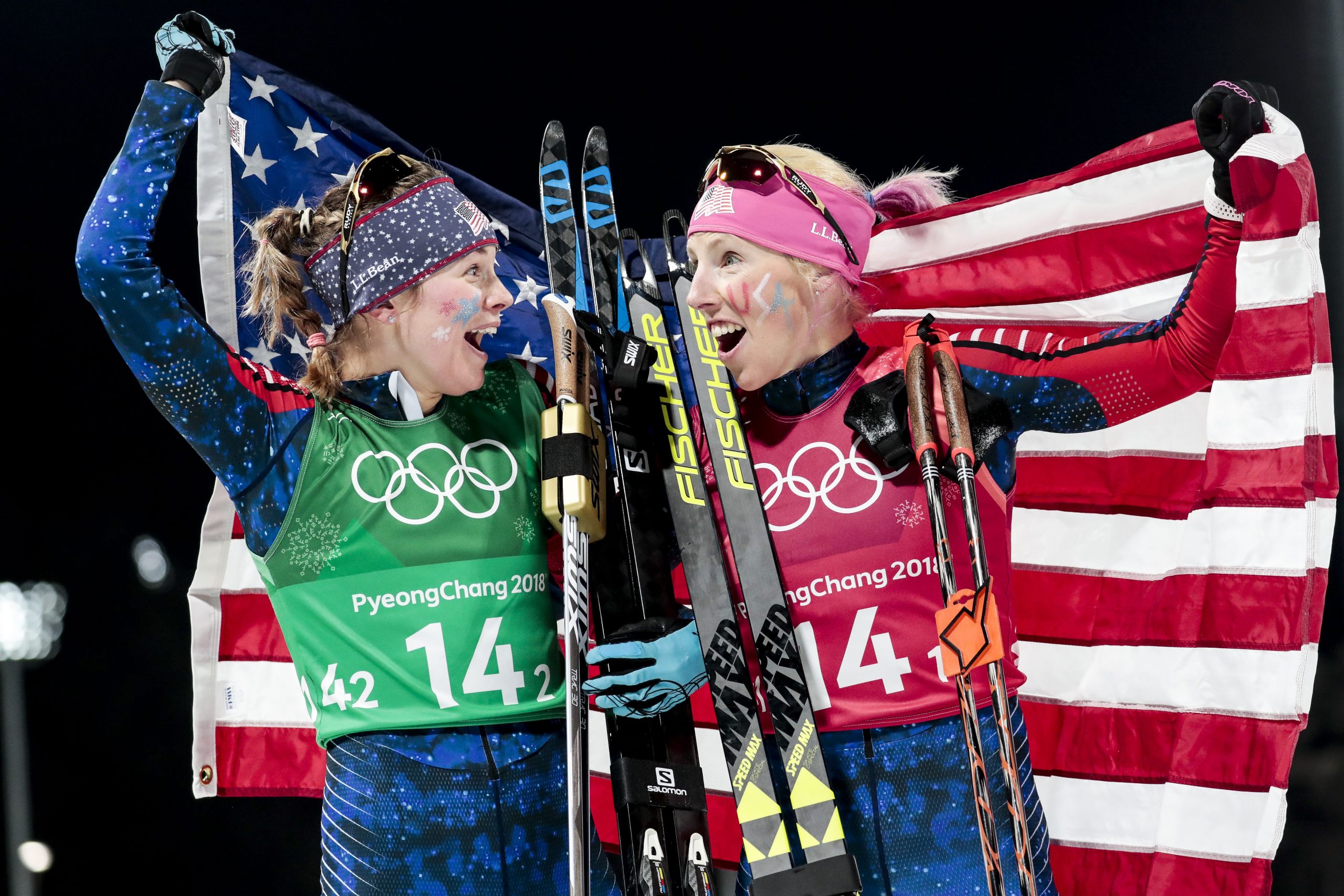
Jessica Diggins (USA), and Kikkan Randall (USA), (l-r) win America’s first cross-country Olympic gold in the women’s team sprint at the 2018 Pyeongchang (KOR) Olympics Pyeongchang. (Photo: Fischer/NordicFocus)
When she won Olympic gold with Kikkan in 2018, she was suddenly in the spotlight. Unfamiliar territory for our stoic sport whose only other American medalist to that point was Bill Koch, who won silver a half-century prior, and retreated into the moss of Vermont. But she was on the Wheaties box, and on commercials for Chipotle, Salesforce, Deliotte, and Toyota. She gave countless Swift-like appearances to throngs of impressionable youth; she lobbied in Washington D.C. for climate change reform. They found out her team nickname was “Sparkle Chipmunk,” and her pre-race glitter applications became her meme. She choreographed music videos; she shared homemade baked goods during the five-month-long European exodus. And she infected a hunger-based confidence that vaulted our underfunded, lowly squad to rival the Scandinavian powerhouses. Proclaimed as “the face of American skiing” and “America’s sweetheart,” she shouldered all this as she simultaneously maintained the fitness to train and race to her own world-best standards.
But as she reveals in the excellent, newly-released documentary about her called “Threshold” (with screenings all weekend at Lake Placid’s Palace Theater), the pressure of doing this day-in, day-out, for six solid years, got to her. As she tells the movie camera, it reacquainted her with senior year of high school: “I was trying to go 100 percent into every single corner of my life because I couldn’t sit still with the feeling that I was not enough.” In 2023, she relapsed with her eating disorder. In the film, she narrates this journey with a raw earnestness that, like her approach to skiing itself, cuts right to the marrow. “I’m willing to put my story on the line to help change this,” she says.
Jessie Diggins (CXC) on her way to first place at US Nationals in Rumford, Maine. (Photo: Hallie Herz)
Those of us who recall her first U.S. National title, back in 2011, among the paper mill aromas of Rumford, ME, fold this into our meta-narrative of triumph over challenge. Where others stand tall and firm on their skis, like maestros conducting their symphonies, Diggins hides none of the pain. Her head bobs, her shoulders undulate, her breathing seems louder than anyone else’s. She’s dropped off the back of the pack and yet somehow, she finds something. She’s not done. Here comes Diggins! If she can do it, I can do it.
This winter, I was particularly attuned to Diggins because, after two partial knee replacements, I was trying to claw my way back into competitive skiing. There were no Toyota endorsements at stake for me, but it was enough to re-connect with the core of this sport. Yes, it’s a beautifully nurturing, soul-susurrating exercise, but climbing up a hill deep into a race, it’s really just about holding off an explosion. The lack of oxygen excites my imagination and it’s all I can do to stay quiet and suppress the inevitable voices saying no, it’s too hard, this guy ahead of me is probably a wonderful father, it’s ok.
Who can say for sure what’s inside the mind of Diggins as she enters this state, this tribute of her current to her source that she has alchemized into fist-pumping, tear-jerking frenzy? But I know that the highlight reels she has brought us over her 15-year career – breaking a pole and scrambling with one arm to her first World Championship gold in 2013, finishing gloveless with a bloody face in 2023 (after another pole incident) and still earning silver, collapsing the day after food poisoning to win silver in the 2022 Olympics – this is something that should give the nation pride. She tells us, “I want to cross that finish line and I want to be so tired that I can’t even stand up, so that I know I gave everything in my heart toward my very best effort.” And she speaks with her actions.
We project our own wish fulfillment onto our heroes, and for the run of her career, with its 365 World Cup starts — more than anyone in history — Diggins has sturdily and gracefully absorbed our collective desires. Now she is leaving on her terms, from the top step of so many podiums, a master of her time.
The Donahue daughters have been inspired by Diggins their entire lives — and they’ll be on-site for one last weekend of racing, sending her off with the skier’s signature heart and a glorious sunset on an amazing career. (Photo: Timothy Donahue)
Love Stories Like This? Help Keep Them Coming.
Feature stories like this one take time, access, and care to produce. If you value thoughtful storytelling and independent ski journalism, please consider becoming a Voluntary Subscriber. Your support directly fuels the work we do to cover the people, places, and moments that make our sport special.
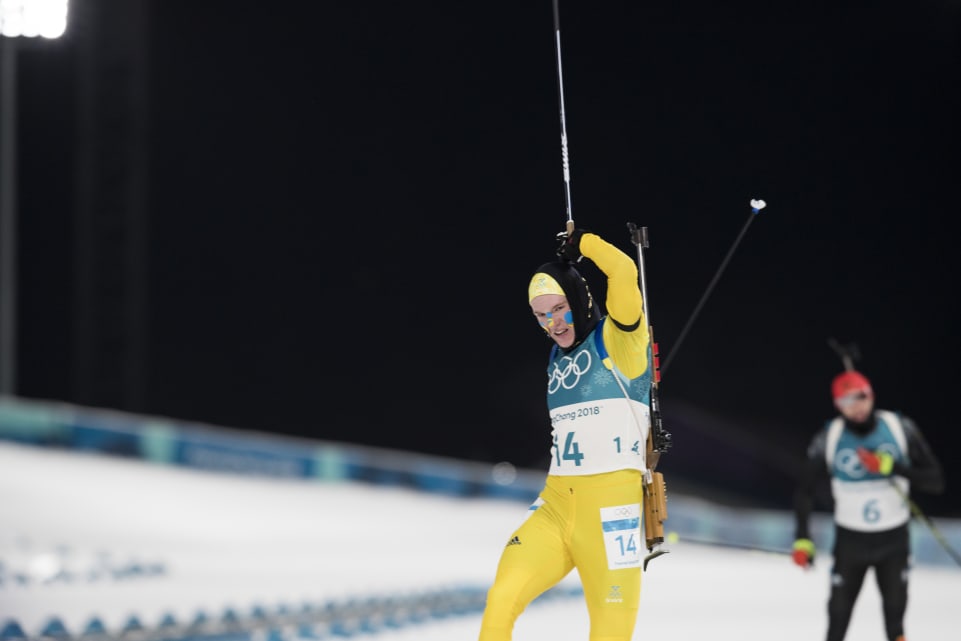
Putting yourself in another’s shoes – or ski-boots — is an age-old tenant. But it would be truly hard to imagine being twenty-one years old and thrust into the biathlon world spotlight. At least year’s Olympics in PyeongChang, Swedish biathlete Sabastian Samuelsson literally arrived on the scene in his canary yellow race suit — he won a silver in the pursuit and gold as a member of Sweden’s men’s relay team.
During his post-race press conferences, his condor was appreciated as was his down to earth vibe. The medals, the massive media attention, the desire for his limited time were all new pathways for a young person to navigate. In this Nordic Nation podcast, we spoke with Samuelsson on February 8 to learn about his life since PyeongChang.
Sebastian Samuelsson of Sweden celebrating silver in the men’s 12.5 k pursuit at his first Olympics on Monday in PyeongChang, South Korea. It was also his first non-relay podium at the World Cup/World Championships level. (Photo: IBU/Biathlonworld)
Beyond being one of the most recognizable faces in Sweden, Samuelsson has become an outspoken critic of WADA’s Compliance Review Committee (CRC) and its Executive Committee (EX CO). This past January, after RUSADA missed the Dec. 31 deadline for handing over the Moscow Lab’s LIMS data and any underlying data, Samuelsson penned an open letter to the CRC’s head, Jonathan Taylor.
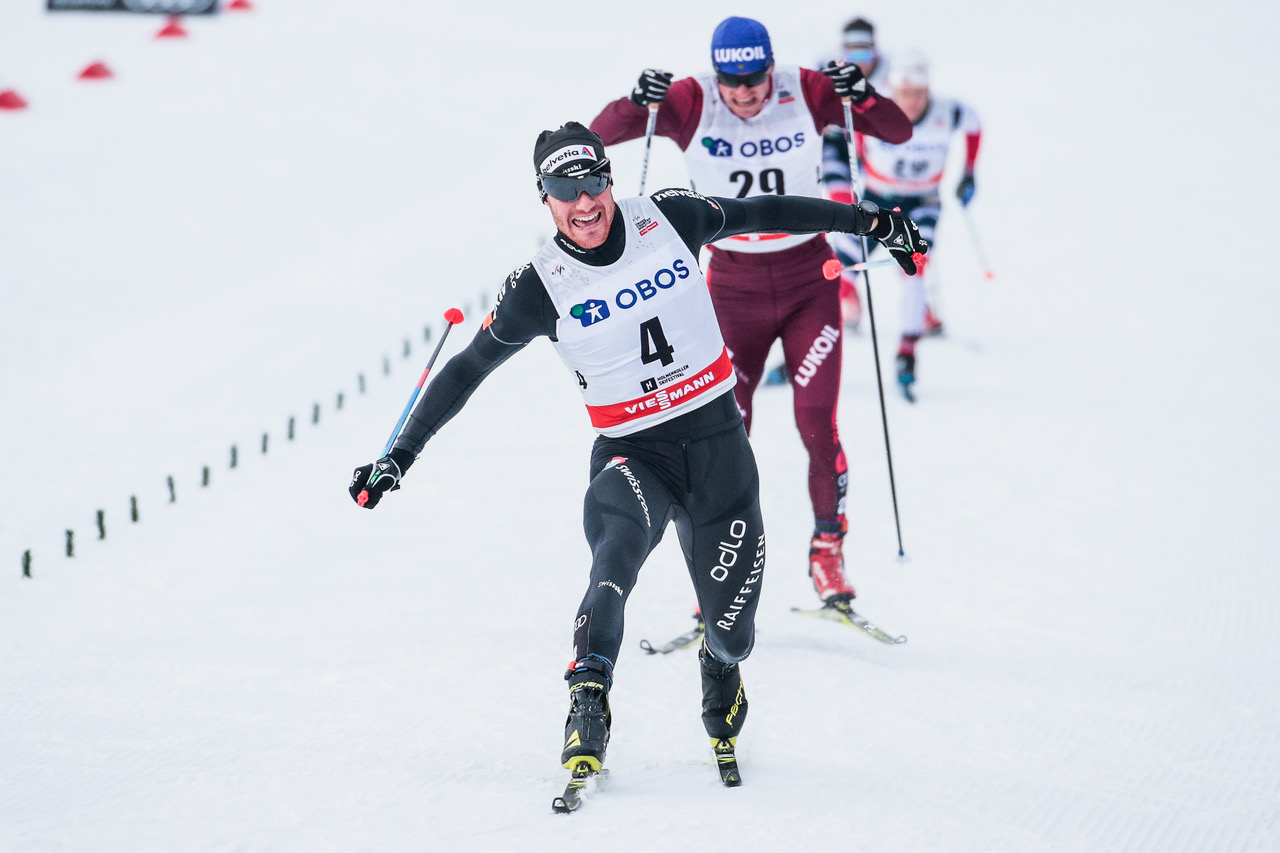
The photo finish for first between Switzerland’s Dario Cologna (near) and Norway’s Martin Johnsrud Sundby at the 2018 Holmenkollen 50 k freestyle mass start in Oslo, Norway. Cologna got it by 0.01 seconds. (Photo: FIS Cross Country/Twitter)
Welcome to FasterSkier’s World Cup Preview, where we check in with the top-10 teams from last year’s FIS Cross Country World Cup tour before the season starts with the Ruka weekend in Kuusamo, Finland, on Nov. 24 with a classic sprint.
***
Switzerland
Overall in Nations Cup Last Year: 6th
Women’s Ranking 2017/2018: 7th
Men’s Ranking 2017/2018: 4th
However lopsided Switzerland World Cup profile appears – think Dario Cologna prime time all the time – the team is more than a set of shoulders to carry its star. Certainly, Cologna can steal the show, as his return to form last season proved, but the Swiss collective of athletes proved their World Cup mettle in 2017/2018.
Twenty-five-year-old Nathalie Von Siebenthal arrived on the World Cup in-form. In Ruka, the start of last year’s World Cup, she placed sixth in the 10-kilometer freestyle pursuit. Between Ruka and the Olympics, Siebenthal raced to numerous top-10’s in distance events while placing eighth overall in the Tour de Ski (TdS).
Switzerland’s Nathalie von Siebenthal racing the second-fastest third leg of the women’s 4 x 5 k relay at 2017 World Championships on March 2 in Lahti, Finland. Her team finished seventh.
In PyeongChang, Siebenthal was able to bring the Swiss team near the front of the women’s distance race pack. In the 15 k skiathlon, Siebenthal placed sixth overall, 2.9 seconds behind fifth place Jessie Diggins (USST) who was dialed for a stellar Games. In the individual start 10 k skate, Siebenthal again was sixth.
Nadine Fähndrich, at twenty three years old, should help the Swiss women’s team build upon last year’s solid performance. By season’s end, Fähndrich was ranked 21st on the sprint list and 31st on the distance list. She finished 27th overall on the World Cup.
The Swiss women’s team gets deeper. There’s veteran skier Laurien van der Graaf who had several top-10’s on the World Cup and Olympics. She won the Lenzerheide, Switzerland and Seefeld, Austria skate sprints, was the fifth ranked sprinter in the world last season, and 21st overall.
Cologna is back: Second in the final overall standings, first in distance. Let’s just say he’ll round out an already well-rounded Swiss team.
Jovian Hediger, at twenty-seven, will take some of the pressure off Cologna when it comes to the Swiss men’s expectations. He finished the season ranked 19th in the sprint cup.
Even in the way northern latitudes, there is no denying the earth’s 23.5-degree tilt on its axis and our relationship with the sun. Spring has sprung. In the spirit of holding onto winter just a little bit longer, we struck up a conversation with newly minted Olympian, Alaska Pacific University (APU) skier and Alaskan native, 27-year-old Tyler Kornfield.
Tyler Kornfield (tall skier on left) and Rosie Brennan (adult to right of Kornfield) during a Skiku on-snow session this spring. (Courtesy photo)
On the competition side of things, Kornfield set the domestic scene abuzz back in 2012. At U.S. nationals that year in Rumford, Maine, he won the classic sprint and placed third in the freestyle sprint. This past January at 2018 nationals in Anchorage, Kornfield skied to seconding the classic sprint and third in the skate sprint. The experienced skier’s most He also won the 30 k classic to cap off a stellar championships week.
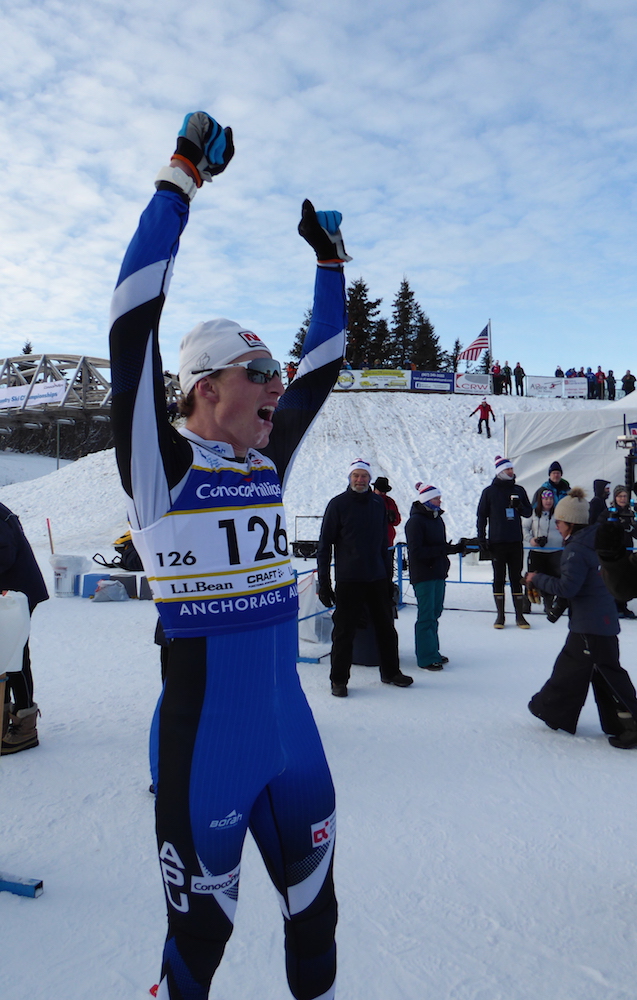
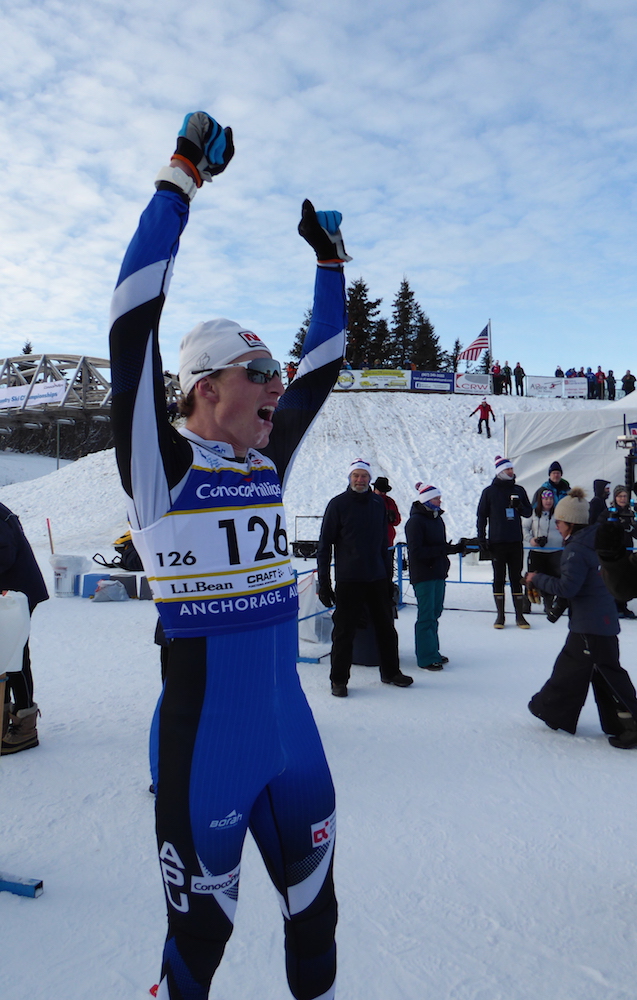
APU’s Tyler Kornfield celebrates after winning the men’s 30 k classic at U.S. nationals on Jan. 7 at Kincaid Park in Anchorage, Alaska.
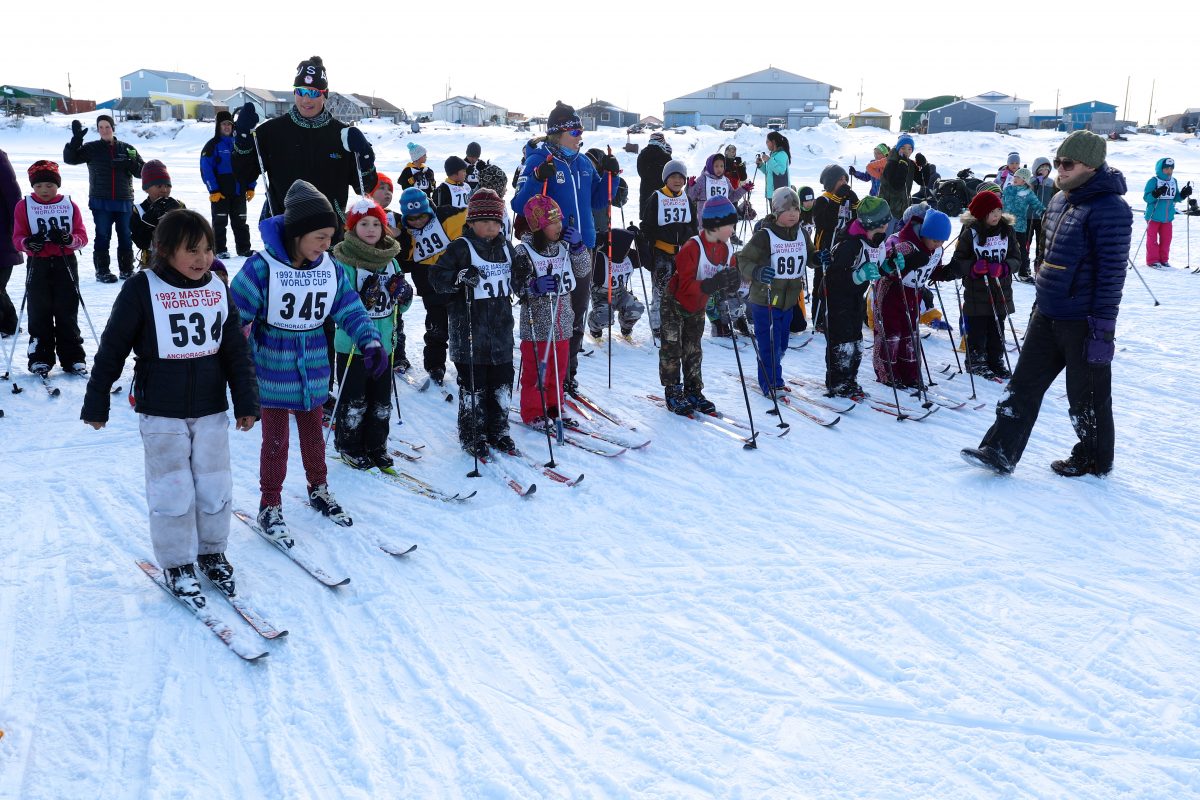
But maybe, more importantly, Kornfield has helped bring cross-country skiing to rural Alaskan villages through Skiku. Kornfield is not alone in this endeavor: many skiers and coaches have volunteered their time to “to foster the health and recreational benefits of skiing, biathlon and running through sustainable programs across Alaska”.
All smiles. Olympian Tyler Kornfield (l) and Rosie Brennan (r) with a young Skiku skier. (Courtesy photo)
We spoke to Kornfield on May 3 to learn more about his commitment to Skiku and get the rundown on his year.
Jessie Diggins (U.S. SKi Team) after placing fourth in the women’s 10 k classic mass start at Stage 6 of the 2018 Tour de Ski (TdS) in Val di Fiemme, Italy. She went on to finish the Tour in third overall to become the first non-European woman to finish in the top three of the TdS. (Photo: Salomon/NordicFocus)
Reflecting on her ski season, here’s the no-nonsense: Diggins simply crushed it. Lots of firsts. The Tour de Ski podium. The gold with Randall in the Olympic team sprint. Her second overall on the World Cup and third in the distance standings. More than $110,000 dollars in World Cup prize earnings alone. And all that face-time and the front-row seat as she led much of the Holmenkollen 30 k skate this year. You’ve got to love that midwestern chutzpah on the Oslo holy ground.
We reached Diggins on April 26 while she was sitting in a Boston park enjoying some spring sunshine. In this interview, we run the gamut of topics from how she’s using her new post-Olympic gold platform to her thoughts on an outstanding World Cup season.
Eileen Carey congratulating Oksana Masters after a gold medal at the Paralympic Games. (Photo: Mark Reis/U.S. Paralympics)
With the 2017/2018 season officially in the rearview, FasterSkier is excited to unveil its annual award winners for this past winter. Votes stem from the FS staff, scattered across the U.S., Canada, and Europe, and while not scientific, they are intended to reflect a broader sense of the season in review. This set of honors goes to coaches of North American teams in any nordic discipline, at any level – although in an Olympic and Paralympic Games year, that’s what we focused on.
A big architect of the team’s success has been head coach Eileen Carey. It’s not an easy or simple job to coach athletes at all different levels of sport and different athletic backgrounds, and bring them all towards success.
“The diversity in disciplines and levels of athlete in our program is one of the most interesting and motivating parts of my job,” Carey wrote in an email last week. “On one hand, I love getting into the details of what might make someone a fraction of a percent faster. I love the process of breaking down a performance into parts and working with athletes to problem solve how to make a small element better. So much of that is about failure, modification, and trying again. The potential gains are so small, but so are the gaps from 4th to 1st and every once in a while something sticks and that is incredibly motivating for me. Andy [Soule]’s sprint finish [for a gold medal] in PyeongChang is a great example of that.
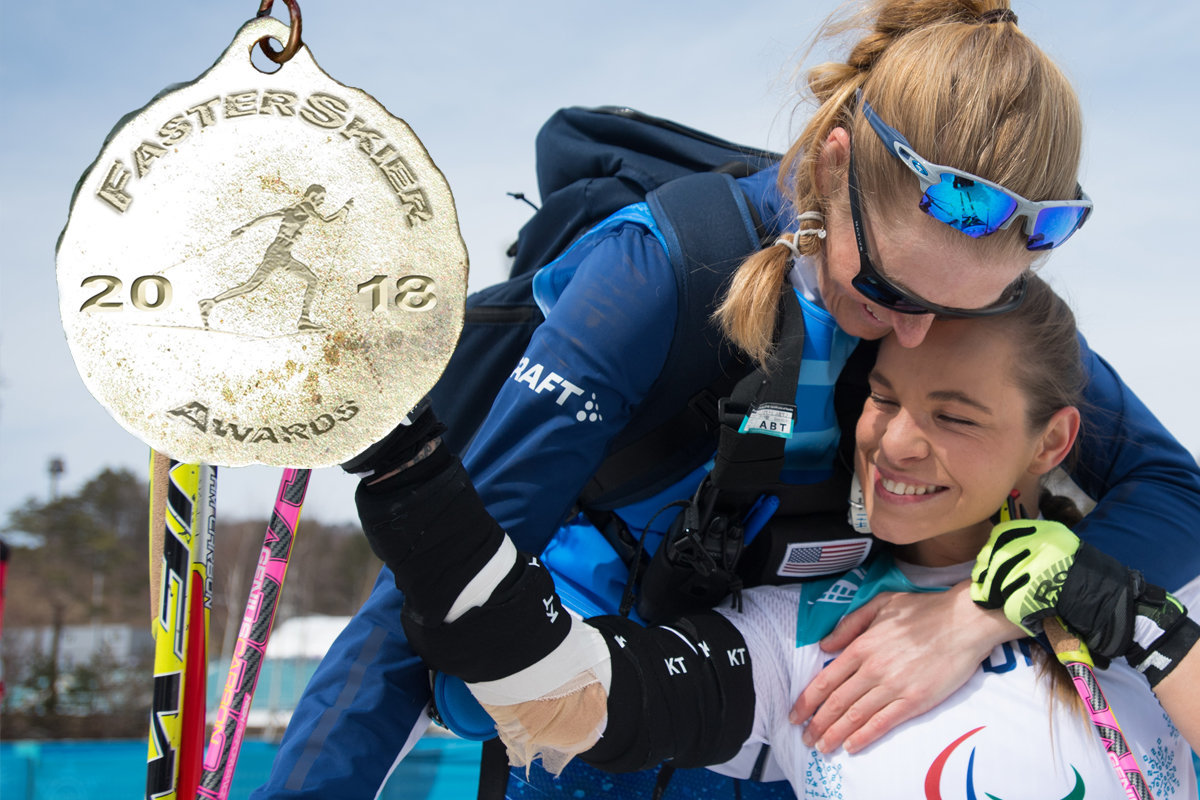
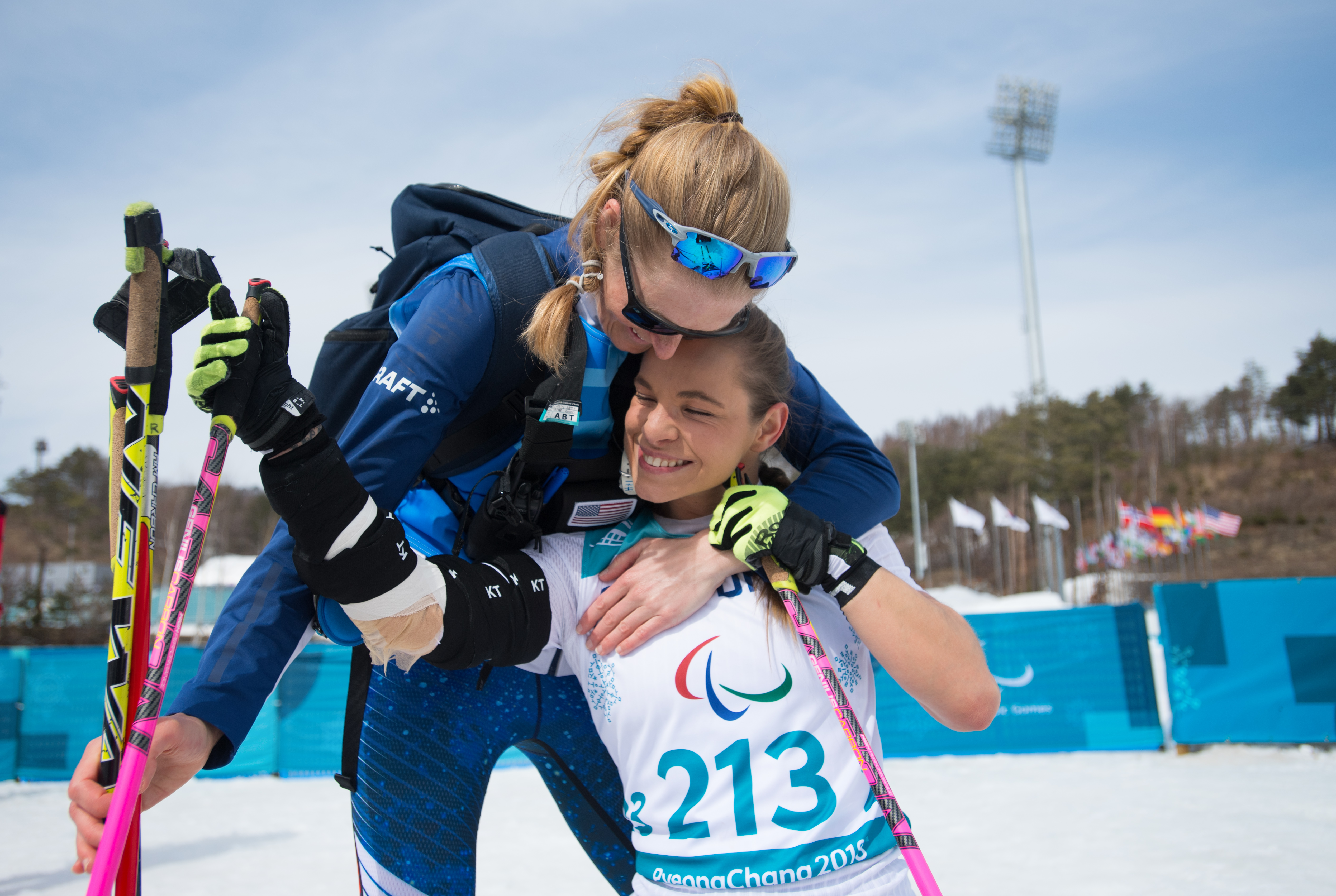
Oksana Masters of U.S. Paralympics Nordic is hugged by head coach Eileen Carey after her gold-medal finish in the women’s sitting 5 k cross country race at the 2018 Winter Paralympic Games in PyeongChang, South Korea. (Photo: Mark Reis/U.S. Paralympics)
“On the other hand we have some promising new athletes in our program who are at such a different level in what they need as athletes,” she continued. “For our program, our goal is always to provide best in the world service to our athletes. For our athletes who are aiming for the podium today, that involves every detail coming together, the execution of their plan. For Grace [Miller] and Mia [Zutter] and Ruslan [Reiter], our next generation of podium-potential athletes, providing best in the world service is more about making sure they see what their medal winning teammates and competitors are doing to achieve their performances and showing them a roadmap to get to that point.”
Development coach BethAnn Chamberlain is a big piece of that effort. For the top-level athletes, Carey lives in Bozeman, Montana, where she works intensively with the sit-ski team,
“They move to Bozeman in the winters,” Carey explained. “I am with them every day from November through March, in addition to training camps that we have most months from May-October. Most of them compete in summer sports, so in the off season, there is always an individualized balance of figuring out how to optimize their preparation for skiing, while working with their goals for other sports.”
The standing and visually-impaired athletes have a different situation, and are primarily supported by clubs in their local areas. Carey works with both the athletes and their home coaches and teams to make sure they are getting the best development, but a big part of that can be training with an able-bodied ski team.
“We can help with funding, or workout ideas that might be unique to Paralympic skiing,” Carey wrote. “But at the end of the day, Jake Adicoff and Sawyer Kesselheim’s success at the Games [where they took silver in the visually-impaired 10 k classic, the first visually-impaired medal by the U.S. in modern Paralympic history] is much more about Sun Valley SEF and Bowdoin (Jake’s club/school) and Bridger Ski Foundation and Montana State (Sawyer’s club/school)… We can help fill the gaps with funding and equipment and communication with their coaches, but their best path to the podium is the same as every skier who wants to be on an Olympic podium.”
Carey and her colleagues, such as High Performance Director John Farra, have intentionally written their criteria so that standing and visually-impaired athletes can make the para-nordic national team without actually competing in para events – instead, they can make the C Team or Development team using USSA points from SuperTours, college races, or regional races. That means that they can spend more time with their home teams.
“We are lucky in that we have incredible partners in the USSA community who are really the ones developing many of our athletes,” Carey wrote. “I hope the more that coaches and clubs around the country see our athletes competing in USSA and collegiate races, the more they see opportunities for providing a ski development pipeline to even more members of their communities. As much progress as we have made as a program over the last several years, we have at least that much again to improve, and this is the next big opportunity for us as a program, and also for ski clubs and communities around the country.”
But while Carey is thinking about those big-picture goals and opportunities, she is also working one-on-one to help Americans become the best para-nordic skiers in the world.
“The fall after Sochi, we started a technique modification process to target Andy [Soule]’s speed on flats, in particular finishing speed,” she explained. “In Sochi, he was moving quickly and had great hand speed but he was not going fast compared to the athletes he was competing against. We tried and failed at so many things in the past four years to improve that. Every once in a while, we would find a mental cue or some technical detail that seemed to make a difference and we would build on that and find ways to analyze it. It can be so frustrating, because there are inevitably times when progress stalls or reverts and there rarely is a clear answer why… When he turned it on during that finishing stretch of the sprint to take the gold, that was the epitome of a plan coming together at the right time.”
A few minutes later, Oksana Masters won gold in the women’s sprint, overcoming an injury that had happened just weeks before the Paralympics. It was her first gold medal after collecting a silver and bronze earlier in the Games, to go with a silver and bronze from Sochi and a bronze from the 2012 summer Paralympics in rowing.
“Both of those races, strictly from a sport performance standpoint, were just incredible,” Carey wrote. “In addition, those two athletes have really been the architects of our program’s rise over the last quad. The two of them were at every camp and World Cup, and their instincts as athletes drove the strategies of our program. That day could not have been a more meaningful culmination of the last four years for them as individuals, for us as a program, and for me as a coach.”
Honorable Mention: Robin McKeever, Canadian Para-Nordic Skiing
Also taking home 16 medals from PyeongChang? The Canadian Para-Nordic team, which like the Americans had a big jump in both the number of medals and the number of athletes winning them. Far from being just the Brian McKeever show – although the veteran went undefeated for the third Paralympics in a row – the team also picked up multiple medals from Mark Arendz, Natalie Wilkie, and Collin Cameron, plus an individual medal by Emily Young and two relay medals.
Robin McKeever. (Photo: Noel Rogers/CCC)
Carey’s counterpart up north is Robin McKeever, who incidentally said that he looked at what Carey was doing as an inspiration in being able to recruit summer-sports athletes and successfully transform them into winter gold medalists. The two gold medals by Kendall Gretch, an American triathlete who didn’t pick up cross-country skiing until 2015, were “eye-opening”.
The para-sport landscape is slightly different in Canada, which also has a much smaller population to draw from (while at the same time having some of the same issues associated with far-flung geography). McKeever faces different development challenges, but has helmed the program towards depth and diversity in the last four years.
“It started as an eight-year process in 2010,” McKeever said in an interview last week. “At that time, we only had funding for Brian. I was given the reins to rebuild, effectively. Now there are some next-generation funds we have the opportunity to access, and now that helps build the base. In the last few years we have had a development coach on board, Kate Boyd, and that has been huge.”
Emily Young and coach Robin McKeever during a training session at the Alpensia Biathlon Centre during the 2018 Winter Paralympic Games in Pyeongchang, Korea. (Photo: Dave Holland/Canadian Paralympic Committee)
Then there was Wilkie, a teenager who came to the program after losing four of her fingers in an accident.
“We know where our pool of athletes comes from,” McKeever said. “It’s about the un-luck of athletes having trauma, which starts their Paralympic path. And it’s about luck in terms of recruiting athletes from summer sport.”
Those newer athletes in the program have veterans to look up to, whether that is McKeever’s brother Brian, or now Mark Arendz, who took home a remarkable six medals between biathlon and cross-country skiing.
“Mark was no surprise,” McKeever said. “Six medals was maybe a surprise, but he was a World Champion coming in.”
Given the limitations on how the team can find new athletes, McKeever didn’t want to be too concrete about whether the program would see a big swell in numbers coming off its recent success.
“It is still to be seen where that will go,” he said. “Some of it is a bit of luck, and some of it is really good management… A lot of staff has been around for eight years. They remain keen and excited. They stick around and are really integral to my support, and to the team’s support.”
One of the biggest highlights for McKeever, and an illustration of how the program has changed in just a few years, was the mixed relay team of Arendz, Young, Wilkie, and Chris Klebl taking silver, the first ever relay medal for Canada.
“The mixed relay is a real highlight,” he said. “Even if the full Russian contingent had been there, that would be a podium for us. I didn’t know eight years ago that the possibility was even there.”
Honorable Mention: Matt Whitcomb, U.S. Ski Team
Another team that had a huge jump this year? The U.S. Ski Team women. Jessie Diggins and Kikkan Randall took gold in the Olympic team sprint, the first-ever gold medal for the U.S. in the sport.
But the Olympics weren’t the only thing that happened this season. Diggins also won a World Cup, was third in the Tour de Ski, and second in the overall World Cup standings. Randall picked up a World Cup podium; Sadie Bjornsen picked up several; and Sophie Caldwell had enough to earn third place int he Sprint Cup standings. The team had more days with many women in the sprint heats, and more good distance results, too.
Matt Whitcomb with Sadie Bjornsen and Sophie Caldwell in Seefeld, Austria, this winter. (Photo: Garrott Kuzzy / LumiExperiences.com)
“It’s been a many-year goal of ours to be ranked in the top three for the women’s team and we secured that for the first time today,” U.S. Ski Team Women’s Coach Matt Whitcomb told FasterSkier of his team’s best-ever Nations Cup ranking after the final World Cup of the season in Sweden. “We’ve come into [past] finals, I believe, ranked third and then come out of finals ranked fourth. We’ve been fifth… It was really quite an achievement.”
The U.S. women all spend large amounts of time with their club teams and coaches, including at APU and Stratton. But they come together to form a national team, the strength of whose relationships are a storied aspect of building their own success. And Whitcomb is a big ingredient there, facilitating not just training but atmosphere and long-range goals.
When Caldwell secured third in the Sprint Cup, she thought back two years to a conversation she had with Whitcomb about race goals. Whitcomb wanted Caldwell to write down goal in particular: to be in the Sprint World Cup overall top three.
FasterSkier’s 2018 Canadian Breakthrough Skiers of the Year are Zina Kocher (l) and Collin Cameron. (Photos: Mario Walker & Scott Grant/Canadian Paralympic Committee)
With the 2017/2018 season officially in the rearview, FasterSkier is excited to unveil its annual award winners for this past winter. Votes stem from the FS staff, scattered across the U.S., Canada, and Europe, and while not scientific, they are intended to reflect a broader sense of the season in review. This set of honors goes to Canadian athletes in any disciplines who had a major breakthrough at some level of competition.
Four years ago, Collin Cameron didn’t really know what cross-country skiing was. At least, he didn’t know that it was a sport he could do.
“I did not even know paranordic was a thing, to be honest!” the Canadian wrote in an email last week. “At that time I was just starting to play sledge hockey provincially for our local team here in Sudbury, just for fun.”
But he since found a local group to try Para-Nordic, and was then recruited onto the Canadian Para-Nordic National Ski Team.
Canada’s Colin Cameron racing to bronze in the men’s 7.5 k sitting biathlon sprint at the 2018 Paralympic Games in PyeongChang, South Korea. (Photo: Scott Grant/Canadian Paralympic Committee)
In March, he became a multiple Paralympic medalist when he won bronze in both the 7.5 k and 15 k sitting biathlon competitions.
At the end of the Games, he picked up another bronze in the open relay, where he teamed up with Brian McKeever. In a four-leg relay, they were one of only two teams to enter with just two athletes, and each raced two different relay legs.
“Being a part of the open relay team with Brian, and his guides Graham [Nishikawa] and Russell [Kennedy], was something really special and I will never forget it,” Cameron wrote. “Getting my third Paralympic medal with those guys was pretty cool… just being a part of this amazing and successful team of athletes, techs, and coaches has to a favourite moment. Getting to see my teammate and travel roommate Mark Arendz finally earn his first gold medal was really, really awesome!”
Although he is fairly new to Para-Nordic sport, Cameron’s success wasn’t completely unanticipated. Last season, he won a World Cup race on the same terrain in PyeongChang.
“Going into the Games, I had one major goal of winning the sprint race I won at the test event the year before,” Cameron explained. “I had to settle for 4th, only 0.7 seconds off the podium. Aside from that single race, my other goal was to finish in the top 10 in all races I entered.”
As any athlete will tell you, an Olympic or Paralympic medal is a much different animal than getting on the podium at a World Cup race. And Cameron found that to be true, too, when he returned home to Canada.
“It’s been quite overwhelming to be honest,” he wrote. “I didn’t expect anything like the receptions I’ve received, and it’s really inspiring to see the way the community in both my hometowns have followed mine and the team’s success at the Games. I definitely could not have done this without the huge and overwhelming support from everyone here.”
His next goal is 2019 World Championships, which will be held in Prince George, British Columbia.
“I am very fortunate to be able to work with some of the best technical skiers and coaches in the world, that have greatly aided in the whole transition of making myself an endurance athlete…that being said there is still lots of work to do!”
Zina Kocher, Foothills Nordic
Yeah, Zina Kocher is 35. Yeah, she’s a three-time Olympian. But she did something brave this year.
The former biathlete, who had retired in 2016, decided to become a cross-country skier and try to make a fourth Canadian Olympic team. She had been thinking about giving it a go, and discussing with longtime coach Richard Boruta.
Zina Kocher racing at Olympic Trials at Mont Sainte Anne. (Photo: Mario Walker/NorAm MSA 2018 Facebook)
In some ways, things didn’t work out. She went to Olympic Trials in Mont Sainte-Anne, Quebec, knowing that it was a long shot — the race formats were heavily skewed towards classic, something that Kocher hadn’t done competitively for years, even though she has long been one of the fastest skate skiers in the country.
She didn’t make the Olympics. And it might have ended there, but it didn’t.
“After the selection races, I felt settled, ready to go back to ‘retirement’ or back to my previous next phase and other life goals and stop following, let’s say, a set training plan,” Kocher wrote in an email last week “But then I thought it would be fun to race the NorAm in Red Deer [Alberta], since that’s where I’m from and where I started xc skiing many many years ago! I hadn’t raced there since I was in high school. And then I thought oh Nipika loppet, never done that, why not. And then decided last minute to go to Gatineau Loppet when my friend Kamila (my past coach Richard Boruta’s widow) said she was going and I should come.”
So, a season that had started with one goal — make the Olympics — went on.
At that point, Kocher was leading the NorAm series, and found out that as a result she had an automatic spot to race on the World Cup for the last competitions of the season: the Holmenkollen 30 k freestyle mass start in Oslo, Norway, and World Cup Finals in Falun, Sweden.
“Well, the Holmenkollen is legendary and an awesome opportunity,” she wrote.
Kocher had raced there many times before, as a biathlete. Doing so as a skier was a new experience.
“We had tons of fans cheering us on, pushing us up those big climbs!” she wrote. “I didn’t feel like I was in the best race shape that day, but I gave what I had for a 5 k pace that lasts for a torturous 30 k … and my body went into some sort of shock post race, but that’s another story.”
Despite that, she was the top finisher among the other different Continental Cup leaders.
And then, on to Falun, where she had to do a classic World Cup race because it was part of a mini tour.
“One big thing I went though [this season] was facing a fear of being last,” she wrote. “That sounds a bit crazy to say, but I think it’s probably an honest statement for many athletes. No one wants to come last, but someone does! Printed in ink, on a computer screen, it’s there for all to see! … I was terrified of doing a 10 k mass start classic in Falun, and I knew I would probably be last from the start. I was. In the end, it wasn’t so terrifying and I made it to the finish line. Having accomplished it, felt pretty darn good even though it was a bit of a solo 10 k. The fans and coach Babs [Ivan Babikov] were incredible cheerleaders!”
Now, it’s back to retirement for Kocher. One of her top memories from the season was that Gatineau Loppet.
“After some contemplation today, I think my favourite moment was doing the 50 k Gatineau Loppet,” she wrote. “Not because I won (great too of course), but because it was a great atmosphere, and it was cool to do a race point-to-point and with a mass… and because I was with Kamila and her friend Lukas. Lukas was actually racing on Richard’s old skis, doing his first ski loppet (he raced both days). Kamila didn’t think she’d be able to do any racing this winter, so it was wonderful to see her do what she loves again, and she even won the overall (both days – skate & classic 50). It was a bit of an emotional weekend. And felt like a great Richard tribute weekend.”
Honorable Mention: Russell Kennedy, Team R.A.D. & Canadian Para-Nordic Skiing (guide)
Kennedy accomplished a rare feat this season by competing at both the 2018 Olympics and Paralympics.
“I’ve been on my own schedule this year because the Team R.A.D. is mostly younger athletes and … I have to do my own thing because I’m going for the Olympics,” Kennedy, last season’s overall NorAm winner, said at the beginning of the season. “So it actually works better for me to be training with Brian [McKeever] because he has similar goals as me.”
Canada’s Brian McKeever (r) and Russell Kennedy receiving their gold medals from the men’s visually impaired classic sprint at the 2018 Paralympic Games in PyeongChang, South Korea. (Photo: Scott Grant/Canadian Paralympic Committee)
As the NorAm winner, Kennedy started the season on the brutally competitive first period circuit of the FIS Cross Country World Cup. There, he had a top finish of 48th place in a skate sprint in Davos, Switzerland. It was only his second stint of European World Cups, after competing in Drammen and Oslo last winter.
Kennedy returned to Canada and secured his Olympic spot by winning the sprint qualifier at Mont Sainte Anne and placing second in the sprint final. Two weeks later, he picked up two second-place finishes in NorAms in Red Deer.
From there it was to the Olympics, where the 27 year old helped the Canadian relay team to ninth place, and as an individual finished 49th in the 50 k and 54th in the sprint.
Then it was the Paralympics, which had long been part of the season plan. Kennedy was one of two guides for visually-impaired skier Brian McKeever, and as such picked up a collection of Paralympic gold medals (along with Graham Nishikawa, McKeever’s other guide). It was the third straight Paralympics where McKeever went undefeated – he now has 13 gold medals.
“These sprint races are miserable,” McKeever said after crossing the line with Kennedy for gold in the sprint, according to a team press release. “They are so hard. The young guys are fast, and have natural snap. There is so much stress in sprint racing, and it goes all day long. I’m much more comfortable with the longer distances, but it was a great day for us. Russell carried the load for us today, and just thrilled we were able to cross the line first.”
“It is hard to describe the mental states I went though the past couple months,” Kennedy recently wrote on his blog. “From being told that I didn’t make the team to making the Olympic team, feeling like I was getting sick then coming back to some of the better races of my life… There were days I woke up and wondered if it was worth it and if the hard work would pay off or if I was just blowing money on something that I didnt have in me… When I fell in love with training though I knew I was doing the right thing. So fall in love with the process dreamers, when you do you will have all good days!”
Honorable Mention: Natalie Wilkie, Canadian Para-Nordic Skiing
Natalie Wilkie is just 17 years old, but she’s a Paralympic gold medalist.
In the final individual competition of the 2018 Paralympics, Wilkie topped the results sheet in the 7.5 k standing classic race – leading her teammate Emily Young onto the podium in the process. Wilkie was the gold medalist by just 1.6 seconds in an extremely exciting competition.
Canada’s Natalie Wilkie (r) finishing third, just 0.1 seconds behind Norway’s Vilde Nilsen (l) in second, for her first Paralympic medal in the women’s 1.5 k standing classic sprint in PyeongChang, South Korea. (Photo: Scott Grant/Canadian Paralympic Committee)
“This is crazy awesome,” Wilkie said in a press release after the race. “I didn’t think this would happen at all. I’m only 17 and this is my first Paralympics… The difference today was double poling. I just kept telling myself to pretend I was elbowing my older brother.”
She has even inspired older members of the team, too, including 27-year-old Young, who was just a tenth of a second away from silver in that race.
“What would Natalie do?” she said in the same press release. “I just kept saying ‘What would Natalie be doing.’”
Earlier in the Games, Wilkie had won bronze in the sprint. And to close things out, she helped the Canadian mixed relay team – with Young, Chris Klebl, and Mark Arendz – to silver, the first relay medal the country had ever won at the Paralympics.
“What Mark, Chris and the girls did in that first relay was awesome,” McKeever, who teamed up with Cameron for a second relay medal later that same day, said in a press release.
Tim Burke of US Biathlon (left) and Rosanna Crawford of Biathlon Canada (right) are FasterSkier’s 2018 Biathletes of the Year. (Photos: USBA/NordicFocus; Salomon/NordicFocus)
With the 2017/2018 season officially in the rearview, FasterSkier is excited to unveil its annual award winners for this past winter. Votes stem from the FS staff, scattered across the U.S., Canada, and Europe, and while not scientific, they are intended to reflect a broader sense of the season in review. This set of honors goes to outstanding North American biathletes on the international circuit.
***
Rosanna Crawford, Biathlon Canada
Rosanna Crawford had been close to the podium before, coming into this season. Fourth place. Fifth place.
But then she had a disastrous 2017 season that left her in tears after World Championships, wondering what had gone wrong. After that, she lost her brother, as the Crawford family endured heart-rending tragedy.
Rosanna Crawford celebrates with her Biathlon Canada teammates Emma Lunder (l) and Julia Ransom (r) after placing third for her first-career IBU World Cup podium on Thursday in the women’s 15 k individual in Ruhpolding, Germany. (Photo: Salomon/NordicFocus)
All of that might have stopped some people, but not Crawford. In Ruhpolding, Germany, she finally scored that podium – in a race so tough it’s only held a few times a season, the 15 k individual. She shot a perfect 20-for-20 to take third place, 21.2 seconds behind Dorothea Wierer of Italy.
“There’s just so many lessons you learn over the years, and trying to bring it all together and to have it pay off on one day is exactly what we’re all hunting for out there,” Crawford said after her podium.
Later that weekend she again shot 20-for-20, this time in the mass start. She left the range the final time in first place, but was passed by three other women on the final loop and had to settle for fourth.
“I was really surprised to leave the range in 1st, these are the 30 best women in the world,” Crawford wrote in an email after the mass start. “I would have love to hold onto a podium, but was pretty dead on my last loop… I was pretty disappointed when I crossed the line in fourth, but as time went by I got more and more happy. To have hit another 20/20 is fantastic, especially in the high pressure situation of a Mass Start. With that race I went 50/50 in Ruhpolding!”
It was an up-and-down season for Crawford, who finished no better than 39th in the first period of World Cup racing and was sent down to the second-tier IBU Cup. But she excelled there, and then came the races in Ruhpolding.
From there she headed to the Olympics – her third – and had a poor sprint race, finishing 53rd with three penalties. It was devastating, but she came back and climbed all the way up to 19th in the pursuit, the biggest improvement in the whole field.
“I had some really good chats with my sister Chandra,” Crawford said after the Olympic pursuit. “She’s a huge motivator for me and my biggest cheerleader now. She really just talked some sense into me to not be so down on myself after the sprint, so that was really helpful.”
Immediately after the Olympics, Crawford finished 12th in the sprint and 11th in the mass start in Kontiolahti, Finland, before finishing the season off in Oslo. She has still not announced whether she will continue competing next year, or retire.
But crossing the finish line in third in Ruhpolding was an unforgettable highlight, either way.
“[Teammates] Julia [Ransom], Emma [Lunder] and Sarah [Beaudry], they kind of pushed past the IBU guys, which I don’t think they were allowed to do, but Canada’s not on the podium every day so they let them sneak by to give me a hug so that was really special,” Crawford told FasterSkier. “I’ve been with these girls the past couple years now and so to be able to celebrate with them is amazing. Their results have been so inspiring for me … [My coach Roddy Ward] also jumped the fence, which I don’t think was allowed, so that was nice to be able to see him as well.”
Tim Burke, US Biathlon
While Crawford was finally hitting that career mark, U.S. Biathlon’s Tim Burke was getting his mojo back. After a frustrating few seasons, Burke rallied for the 2018 Olympics, his fourth.
Tim Burke (US Biathlon) racing to 14th in the men’s 12.5 k pursuit at the IBU World Cup in Oberhof, Germany. (Photo: US Biathlon/NordicFocus)
Along the way, he amassed some strong results: tenth in the sprint in Annecy, fourth in the sprint in Oberhof. The Oberhof sprint was his best result since 2013.
It came on a course with a personal connection, as his wife, Andrea (Henkel) Burke, had her home training base in Oberhof.
“I have spent a lot of time training here over the last eight years,” Burke laughed. “It’s Andrea’s home town and I feel like the fans out there today were really behind me from the start, because of Andrea. So be able to have the best performance of my season and my best performance in a long time here was for sure special.”
Burke didn’t set a best-ever U.S. mark for himself at the Olympics, with a top finish of 17th in the pursuit. Like Crawford, he made the best of things after a disappointing Olympic sprint, in his case having finished 47th in the opening competition.
“I was disappointed in the result not the performance,” he said of the sprint, after improving in the pursuit. “I felt like I executed well. I felt like I hit my cues on the course and on the range, and it just didn’t happen yesterday. The game plan going into today, there was nothing new. Stick to the things that have been working well for me in the World Cup, and that’s what I did.”
In PyeongChang, he contributed to a U.S. men’s relay team which finished sixth, tying the best ever team result at an Olympic Games.
A few weeks later, in his final race before retiring, he went out and did some solid biathlon, helping the team to seventh in the World Cup relay in Oslo.
Burke’s career has had many individual highs – six podiums including a World Championships silver medal in 2013, and a brief stint in the overall World Cup leader’s bib – but this season, it was his team efforts that were some of the best.
“The Olympic relay, we were very happy with,” he said in Oslo. “The sixth place there [in PyeongChang, South Korea], we were right there. That was a great race for us, but this is solid as well… I’ve been here a long, long time, and an top eight today is very different than a top eight when I came on the World Cup 14 years ago. It’s so close now. There’s so many good teams. So it’s a solid result.”
Honorable Mention: Susan Dunklee, US Biathlon
Burke’s teammate Susan Dunklee saved the best for last this season, hitting the podium for the first time since winning silver in the mass start at last year’s World Championships.
Susan Dunklee racing to 20th in the mass start in Annecy, France. (Photo: Glen Crawford)
It was a tough start to the season for Dunklee, who tried to implement a new shooting strategy and saw it backfire, as she had a string of results no better than 53rd in the opening two weekends of racing.
But then she had a solid weekend in Annecy, France, finishing tenth in the sprint and sixth in the pursuit. A lifeline.
“After Thursday, I was just feeling relief, to be honest,” she said after the Annecy pursuit. “It’s so huge to get a top ten and then get a flower ceremony today.”
Two months later, Dunklee had an athlete’s worst nightmare and got sick at the beginning of the Olympics, racing the opening sprint anyway but then finishing 66th and missing the pursuit. In the 15 k individual she placed 19th, and she led the women’s relay at one point.
“I often start feeling stronger and stronger as the season goes on, and this season it took a little longer,” Dunklee explained. “I had a lot of sickness, and some frustrating shooting days early in the season that made it hard for me to keep going.”
After the Games, she finished 36th in the sprint in Kontiolahti despite still getting over (another) illness, then came to Oslo and placed fourth in the sprint and third in the pursuit, in a podium that only appeared thanks to clean shooting in the final stage where others faltered.
“It doesn’t really matter what everybody else is doing, you just have to try to put the best race you can,” she said of landing on the podium despite two penalties. “Sometimes you have a perfect race and five other people do too, and then you are sixth. But some days you don’t have a perfect race and you end up third.”
Like Crawford, Dunklee hasn’t announced whether she will keep racing next season. If not, her last World Cup memory will be sharing the podium with Anastasiya Kuzmina and Darya Domracheva. Not bad.
Honorable Mention: Scott Gow, Biathlon Canada
Canada’s Scott Gow just keeps improving, and this season was no exception. Early on he had two career-best performances: 16th in the sprints in both Östersund and Annecy.
Scott Gow (Biathlon Canada) after placing 16th in the IBU World Cup men’s sprint on Friday in Annecy, France. (Photo: Glen Crawford)
But the biggest career-best also came on the biggest stage. At the Olympics, Gow shot 19-for-20 in the 20 k individual to finish 14th, the best performance by any North American in PyeongChang.
He had started the Games with 61st in the sprint – maybe the worst place to finish, just one spot (in his case one tenth of a second) out of the pursuit.
Gow re-tooled and started focusing on the 20 k.
“When it’s this calm, relatively as calm, everyone can shoot well,” he said after that race. “So that puts a little extra pressure and emphasis on myself to shoot well. So going into today I knew that would be have to the focus, to hit targets, because even if my skiing is a little off I can make up for it with a really good shooting. And that was what was going through my head the last few days preparing for this.”
Plan achieved, mission accomplished. Except that one shot.
“I was very happy with it,” Gow said, noting that even a career-best at the Olympics wasn’t perfect. “A little disappointed to miss that one standing shot, especially when everything was going quite well in the range. Skiing was pretty good, and so overall I am very happy.”
Finland’s Iivo Niskanen after winning the men’s 50 k classic mass start at the 2018 Winter Olympics in PyeongChang, South Korea. (Photo: FlyingPointRoad)
PYEONGCHANG, South Korea — Sun, clouds, fog, and snow. At the Alpensia Cross-Country Skiing Center on Saturday, the men’s 50-kilometer classic mass start transpired like a 50 k should. There was the break-the-pack pace from the start. There was the hard-man up front trying for a solo break. Of course there were chasers: one of whom blew up and faded and another that latched on for a silver-medal ride. And eventually there was a group of four that closed in on a single medal that eventually left three athletes unsatisfied. This was solid Olympic 50 k racing.
For Finland’s 26-year-old Iivo Niskanen, the plan worked. Burning through the 68 other starters began right away. As the 2 p.m. unfettered sun warmed the tracks, the kilometers ticked off with the favorites coalescing in the front. They included Martin Johnsrud Sundby of Norway, Kazakhstan’s Alexey Poltoranin, Alex Harvey of Canada, and the Olympic Athletes from Russia’s (we’ll just call them Russians) Alexander Bolshunov — a 21-year-old star of the Games, if you’re a medal counter (with two silvers and a bronze before Saturday’s race).
This is the 50 k classic, a race usually suited for the well-established and the well-conditioned. This was Niskanen’s day.
The switch flipped at 17.5 k when the Finn was set to fly. Sundby skied 1.4 seconds back, Poltoranin +2.3, Russia’s Alexey Chervotkin +3.4, Bolshunov +4.3, Russia’s Andrey Larkov +5.4, Norway’s Hans Christer Holund +5.7, and Harvey +6.0. These were the names that topped the course’s time checks.
Bold. Daring. Tempting fate. All these words could describe the noticeable uptick in effort from Niskanen at 22.36 k that cracked the field. Unike the tale of the frog in boiling water unaware of it’s slow demise — Niskanen’s pacing shakedown was abrupt. Although not exactly a punch of effort, there was no subtlety to it.
Passing through 27.2 k, Bolshunov trailed the Niskanen-Poltoranin duo by 20.9 seconds. Niskanen soldiered as the consummate soloist except Poltoranin was velcroed on. A look to the side here, another look to the side there from Niskanen could not convince Poltoranin to take a pull up front.
Norway’s Niklas Dyrhaug leads a mass of skiers during the men’s 50 k classic mass start on Saturday at the 2018 Olympics in PyeongChang, Sourth Korea. (Photo: FlyingPointRoad)
A second and third plot line developed behind. Bolshunov surged. Sundby, Holund and Harvey solidified into a core that would slowly bleed time to the leaders. In their own eventual fight for bronze, Harvey’s group fended off every racer except for Russians Larkov and Chervotkin.
Up ahead, Bolshunov flaunted his 21-year-old verve. There was no stage fright. He caught, passed, and gapped Poltoranin. At 33.32 k, only Bolshunov could muster the fight and locked in on Niskanen. As much as Bolshunov was the 50 k’s yin at this point, Poltoranin was its yang. His valiant chase of Niskanen early on smudged out by his crash and burn. Poltoranin was eventually caught by the Harvey group and finished 15th (+5:15.0).
Late in the race, the temps had cooled below freezing and flurries fell. The sun-to-cloud swap also came with a fog bank reminiscent of March in Holmenkollen. Through the stadium at 37.5 k, neither Niskanen nor Bolshunov exchanged skis. Again, like with Poltoranin, Niskanen pulled up slightly. Bolshunov wouldn’t take the invite. He continued drafting the Finn.
Finland’s Iivo Niskanen leads Alexander Bolshunov of the Olympic Athletes from Russia during the men’s 50 k classic mass start at the 2018 Olympics in PyeongChang, South Korea. (Photo: FlyingPointRoad)
That dynamic changed as Bolshunov led down the sweeping turn into the stadium area around 40 k. With the Russian 0.6 seconds ahead, Niskanen changed into his third pair of skis for the day, taking advantage of his ability to swap skis twice during the race. (This is important and we’ll come back to this point: Bolshunov exchanged skis only once.)
With Niskanen’s gear swap and Bolshinov’s power-double-pole, the Russian led out of the stadium.
“I saw the gap appear,” Niskanen said in the post-race press conference. “There’s is no penalty loop like in a normal exchange area — often there is an extra meters when you are going to change skis. So of course, it’s a guess about the dirty snow, and here the snow is so dirty that it’s a big difference between fresh and old skis.”
Niskanen gambled. So, too, did Bolshunov. Eleven seconds opened as they both rolled the dice. This was not, as it first appeared, a gold-medal move for Bolshunov. Less than two kilometers later, Niskanen was there to taunt Bolshunov with noticeably faster skis.
“I could catch him quite easily,” Niskanen recalled. “Then the only tactical plan was to wait and wait and use better skis when it is possible and the best place to use them.”
The best place was the final headwall. The body worked. The skis flew. Niskanen won the 50 k in 2:08:22.1 as he pulled away from Bolshunov in the race’s closing moments. A dejected Bolshunov earned his fourth medal of the 2018 Games (after silver in the relay and team sprint, and bronze in the individual classic sprint) placing second, 18.7 seconds back.
A medal still hung out there for Larkov, Harvey, Sundby, and Holund. Like Niskanen on the final climb, Larkov stung the group first while Harvey and Sundby punched too late. Larkov took bronze, 2:37.5 minutes behind Niskanen. Harvey shut down Sundby on the final stretch to secure fourth (+2:43.6). and Sundby placed fifth (+2:43.7).
The Russians were first to the press conference. Through an interpreter, Bolshunov hinted at his frustration at being so close to gold.
“Obviously I am a little bit disappointed because I could have won this race,” Bolshunov said. “There was a small problem that affected my result.”
Norway’s Martin Johnsrud Sundby leads Finland’s Iivo Niskanen (8), Kazakhstan’s Alexey Poltoranin (behind Niskanen), and Canada’s Alex Harvey (2) early in the men’s 50 k classic mass start at the 2018 Olympics in PyeongChang, South Korea. (Photo: FlyingPointRoad)
That small problem, Bolshunov clarified, were his skis. “Basically the small problem was with the fact that it got much colder and the skis were not as slippery as they should have been. So my result was affected,” he said.
Larkov, too, said his skis were off. “Basically just like my teammate I am also a little bit disappointed,” Larkov, 28, said. “I had some problems with my skis because the weather got colder as we were racing and I had to change my skis. After I changed skis I thought I basically I had no chance but I managed to get to third place.”
Bolshunov and Larkov were the only two skiers in the top 31 to swap skis once. Every other racer took the two allowed ski exchanges. (Four other skiers total among the finishers changed skis a single time.)
Bolshunov entered the optional ski exchange area slightly ahead of Niskanen when the Finn swapped at 40 k. Asked by FasterSkier why he chose to ski on, Bolshunov claimed he wasn’t in position.
“Basically I was on the right and I was not in the right position to change the skis,” Bolshunov said. “I would have changed them but I could not do it in time, so I had to go on like that.”
During the press conference, neither Niskanen nor the Russians acknowledged each other. After learning that the Russians blamed skis as their demise and Niskanen’s gift, the gold-medal winner tried to set the record straight as he and Bolshunov share the same ski sponsor.
“Skis were really really good,” Niskanen said of his own planks. “Maybe you can see the reason here in the result list. The Russian guys have changed skis only once, but that has been their tactic. Also my tactic was to use third and second best pair at the beginning of the race and leave the best pair at the end. It’s the same series skis for me and one of them. We have brother pairs.”
Niskanen’s win was the first gold for Finland (across all sports) in PyeongChang. As the reigning 15 k classic world champion, Niskanen said that he has embraced a selective peaking strategy. For the last two years he has focused on two championship classic races: the 15 k in Lahti, and Saturday’s 50 k.
“Two years after Sochi, I trained so hard and tried to do too many things and have too much races and I got easily sick,” Niskanen said. “And then last two years I want to be the best shape at the right time. Maybe someday my main goal in the season is to win the World Cup overall, but last two years, the only goal has been one race because at the moment, I am so much better in classic. Everything, like the skiathlon [here], they have been preparation races for me to improve the shape.”
If the skiathlon was a training run for Niskanen, as he claimed, it worked. Yet his fortunes were much better Saturday. During the skiathlon, Niskanen strung out the field during the classic leg. He faded to finish in 19th. His hot start in the 50 k, Niskanen acknowledged, made for an anxious Finnish coach.
“Maybe my coach was a bit nervous to watch the race because I often start too hard too early,” Niskanen said. “This time I suffered well, but you just need to live the moment and play the game. If you don’t try you cannot win. This time I was the strongest man.”
The men’s Olympic 50 k classic podium in PyeongChang, South Korea, with (from left to right) Alexander Bolshunov (l) of the Olympic Athletes from Russia (OAR) in second, Finland’s Iivo Niskanen (c) in first, and Andrey Larkov (OAR) in third. (Photo: FlyingPointRoad)
The strongest man on Saturday was undeniably the strongest man. For the second consecutive Olympics, Russia has stepped onto the 50 k podium. With that comes the spectre of doping. Russia went 1-2-3 in the 50 k in Sochi amidst evidence later uncovered about state-sponsored doping. In PyeongChang the Olympic Athletes from Russia (OAR) went 2-3. With that, of course, comes questions. At the 2018 Winter Olympics, even with the increased scrutiny since Sochi, two Russian athletes have been flagged for doping: a curler and bobsledder.
“I don’t know if I can answer this question because I’m only starting to compete on this level,” Bolshunov, who was invited to these Olympics as an OAR athlete because he was not associated with the Sochi debacle, said when asked if he and his 2018 Olympic teammates have any affiliation with Sochi’s taint. “I cannot really compare what happened four years ago with the athletes that are here. I am my own man and they were their own team. So we just do the best we can and we move ahead.”
Americans Kikkan Randall and Jessie Diggins jumping for joy after placing first in the 2018 Olympic team sprint on Wednesday night in PyeongChang, South Korea, ahead of Sweden’s Charlotte Kalla (l) and Stina Nilsson (second from l) in second place and Norway’s Marit Bjørgen (second from r) and Maiken Caspersen Falla (r) in third. (Photo: FlyingPointRoad)
PYEONGCHANG, South Korea — There was a lot to process Wednesday, what with the U.S. women’s team sprint Olympic gold medal and all. But now that we’ve had a little time to breathe, FasterSkier wanted to bring you the best of the interviews that didn’t make our initial race reports. (Don’t worry, plenty more on this historic gold to come!)
Kikkan Randall, Team USA’s first-leg skier:
“It’s an amazing feeling. This is something the American team has been working for a long, long time. We’ve had one other medal back in 1976 from Bill Koch and for me, I’ve been on this Olympic path for the last 20 years. We’ve known it’s possible, but of course it takes putting together the right day, and it’s just an amazing validation for our team that’s worked so hard and what this can do for cross-country skiing back in the United States, it’s just so exciting.”
Kikkan Randall en route to gold with Jessie Diggins (not shown) in the women’s freestyle team sprint at the 2018 Olympics in PyeongChang, South Korea. (Photo: FlyingPointRoad)
On whether she knew this would be a historical race for Norway’s Marit Bjørgen (with her 14th Olympic medal):
“I knew that Marit’s been skiing really well all week and that she would be tough competition and knew she would be strong going up that second climb. When I arrived here, I saw the hill and thought, ‘That’s a good hill for Marit, and it’s a good hill for Kikkan.’ Marit is probably the greatest skier of all time and it’s been an honor to race with her, and of course it’s really fun for us to get our historic day and that gold medal, but also an amazing accomplishment for Marit to be the most successful Winter Olympian of all time.”
On her foot injury and Olympic prep:
“I had a foot injury that came in December and it caused me to change my training a little bit, and I also didn’t do as much training as I wanted to. I think that once I did start racing again, every race helped me get better. The skiathlon here was definitely a challenge; it was a tough course and I really struggled in the classic, so it took a lot just to keep my mind calm and relaxed and just think about one race at a time, and I was happy that things went better in the 10 k. It was a real honor to get named to our relay because it was tough to pick that team, but I was happy to have another strong leg there and then it was another anxious wait to see if I would even be named to this team. So as the Games went on, this is the event that I looked forward to most and have looked forward to the most over the last four years, and it was really a good feeling that my confidence was actually getting better and my feelings were getting better as we got closer.”
On how she hopes this medal will impact her sport in the U.S.:
“What’s really cool is I don’t think we’re gonna have to wait another decade for this to happen again. We have an amazing group of junior skiers and U23 [athletes] that are coming up. They won a medal in the relay at the World Juniors last year, we had another girl that was on the podium twice at World Juniors this year, our junior men were on the podium at World Juniors, so I think the door has been opened and what I hope this gold medal really means is what those kids dream about, being in this position someday and they really feel it’s possible, and the Olympics has the power to do more inspiration than any of the other races that we do that are typically in Europe. So it’s really cool to finally get the high profile and give those kids the belief and hopefully also to get more people to start cross-country skiing because they saw it here and they get excited and they want to go try it.”
On the Norwegian crown prince, Norwegian prime minister and Swedish king all attending the Games, and whether she thinks an American president will ever be at a cross-country ski race:
“Actually, when President Obama first got inaugurated I had a dream that I was sitting on Air Force One talking to him about cross-country skiing and telling him that it was a really cool sport but didn’t get enough attention, and he said when he became president he would help make cross-country higher profile, but that’s about the closest I’ve ever gotten to a president at a cross-country ski race.”
Jessie Diggins, Team USA’s second-leg skier:
“Team sprints are so much fun and I’ve been looking forward to this day for a year since the Lahti team sprint ended so I guess watching Kikkan do her leg so well and getting us in a position where we were going to get a medal, I was just watching that like, ‘Oh, well, OK, we’re gonna try to make it a gold one, then. We have nothing to lose.’ I really wanted to make this happen for this team, and we always said any medal we got was going to belong to the team. It was a team that got us here and gave us this opportunity and pushed us so hard in training all summer long and so I just had a lot of belief going in that last lap.”
Jessie Diggins (14) edges Sweden’s Stina Nilsson (r) for gold, while Norway’s Maiken Caspersen Falla (l) races to bronze, in the women’s freestyle team sprint final at the 2018 Olympics in PyeongChang, South Korea. (Photo: Noah Hoffman)
On what was going through her head during the final:
“Lap 2, I started to push the pace because I thought, ‘Both of these girls are really, really strong sprinters and I’m an OK sprinter, but I need everyone else to get pretty tired if I have a shot.’ ”
“That last corner, I don’t know what I was thinking except for just, ‘Go, go, go!’ because you really gotta dig really deep and I was in a lot of pain, for sure, but when your team is counting on you, you have to give it everything you have.”
On what it means to team up with Randall:
“I feel really lucky to have these, like, older sisters and role models on the team that I really look up to, every single one of them, and they’ve really shown me what is possible and shown me that it’s OK to dream really, really big. It means a lot to me because if this is the last team that [Kikkan and I] get to team sprint together, it’s like, ‘OK, I gotta make it a good one. I’ve gotta go out with a bang.’ And it’s so cool because Kikkan’s been this big role model in my life since before I got on the national team and it’s just such an honor to get to race with her every time and get to share those pre-race giggles and high fives and get to paint up the face.”
On her first words with Randall after finishing:
Americans Kikkan Randall (l) and Jessie Diggins on the top step of the 2018 Olympic team sprint podium after beating Sweden and Norway for gold on Wednesday at the Winter Olympic Games in PyeongChang, South Korea. (Photo: FlyingPointRoad)
“I think I asked her, ‘Did we just win the Olympics?’ because it didn’t feel like it was real and it still doesn’t feel like it’s real, but I just was so excited and so happy and also I couldn’t feel my legs.”
On handling any perceived pressure:
“For me, it’s been hard to not let it get inside my head and to race for myself because when I’m having fun, that’s when I’m actually dangerous on the race course and you get one too many people saying, ‘I believe that you’re going to go win!’ it becomes less fun because I don’t do it just to win, that’s not the whole end game for me. Having this awesome team atmosphere — we’ve been playing games, we’ve been dancing, we’ve been watching movies, we’ve been having a really good time here at the Olympics — and making sure that within our own little bubble that we keep it relaxed and keep it fun and keep a happy team vibe, I think that’s been a huge key for me, and kind of being able to go through the mixed zone with selective listening and make sure I’m still racing for me and for my team.”
On how this medal will affect future generations of U.S. skiers:
“I’m so excited to put some facepaint and put the socks on those kids because they are coming up hot and they’re working so hard and it’s so cool to see that we’re not going to retire and leave this gaping hole, there’s people coming up to take our places.”
Chris Grover, U.S. Ski Team Head Coach:
U.S. Ski Team Head Coach Chris Grover (l) with Jessie Diggins after Diggins and Randall won gold in the women’s freestyle team sprint at the 2018 Olympics in PyeongChang, South Korea. (Photo: FlyingPointRoad.com)
On choosing Randall as the first leg:
“We anticipated that it would probably be Marit or [Ragnhild] Haga that was skiing this leg for Norway, and we did think that it would also be Charlotte Kalla who was skiing for Sweden. So we knew there would be some great skaters, some great aerobic athletes that were in that capacity. We thought Kikkan, the way that her skate fitness has been coming on over the last few races here at the Olympics, we thought that her fitness could at least help us hang on to those ladies if they were really going to go, and we were just really pleasantly surprised that Kikkan was able to match them no problem throughout the day. That was exciting. Both women looked so in control in the semifinal that we knew they were going to have a crack at a medal in the final.”
On watching Diggins and Sweden’s Stina Nilsson racing for gold in the finishing stretch of the final:
“With Stina, she obviously was in incredible form in some of the other races here. Maiken [Caspersen Falla] as well, they obviously went first and second in the individual sprint, so there was gonna be no gimmies at all in the finish. We would have been so exhilarated and happy just to have a medal of any color, but for Jessie to have such a fantastic day and to be able to pull off the win was beyond our expectations.”
Tiger Shaw, U.S. Ski & Snowboard President and CEO:
“We are just flying high. I mean, I am still just numb with what those women have achieved; Kikkan, Jessie and the whole team, and the coaches and the techs and trainers … I’m speechless.”
“The culture of that team is just unbelievable, and they have conquered the world, coming from obscurity led by a single woman into a dynamic men’s and women’s team that is absolutely stunning. It makes one of the best stories I think in sport.”
On watching the race unfold:
“I was so excited there was a group of three and not a group of four because then you knew we had almost for sure a medal in the bag, and then all of a sudden you realized Jessie could get it done. And she came around that last corner and down that stretch and beat the best sprinter in the world. We were just screaming our brains out in amazement. Just thinking of the energy and the excitement of that I’ll never forget that for the rest of my life.”
Luke Bodensteiner, U.S. Ski & Snowboard Chief of Sport:
Jessie Diggins with U.S. coach after Diggins and Kikkan Randall won gold in the freestyle team sprint at the 2018 Olympics in PyeongChang, South Korea. (Photo: FlyingPointRoad)
On other sports taking notice of this U.S. cross-country team’s success:
“I have gotten so many messages now from people here in Team USA saying … head of speed skating got one saying this is the best moment of the Games for the entire Team USA. Our head coach in alpine texts me said, ‘I have never seen such a possessed, will-not-lose moment in my entire career.’ … This makes this hugely successful Olympics.”
On medal chances:
“I think we came in feeling like team sprint was not only our best opportunity for a medal, but probably a pretty high likelihood for us, honestly. But there is a difference between getting in there for a bronze medal and winning the thing outright. And that’s not something we… well, I guess we dreamed of it, but it’s not something we would have called out coming in here. So they lifted their game and they skied out of their minds. Kikkan would not be dropped, she covered all those moves on the climb, and of course the way Jessie finished it off was best in the world right there.”
“I was right on the finish line. … You could see a meter out that [Jessie] had this thing and people broke down in tears there, lots of hugs and tears.”
Charlotte Kalla, Sweden’s first-leg skier:
Jessie Diggins (l), Sweden’s Stina Nilsson (r) and Norway’s Maiken Caspersen Falla (behind) heading into the last 100 meters of the women’s freestyle team sprint final at the 2018 Olympics in PyeongChang, South Korea. (Photo: FlyingPointRoad)
“We are very happy for Kikkan and Jessie. They are so worthy of this gold medal.”
On skiing with Randall for a long time and whether these will be Kalla’s last Olympics as well:
“I don’t know. It may be the last. Kikkan, she has meant a lot for the whole team in the USA, and we have a special relationship because Kikkan has been several times in Sweden training with us, and I know in Vålådalen especially, where we exercised this [last] August, we pushed each other really really hard. She is an impressive skier.”
Marit Bjørgen, Norway’s first-leg skier:
“I’m very, very happy for Jessie and Kikkan today for taking a gold medal, and I feel also special that Kikkan is there. She also started [her first] Olympics in Salt Lake [like] me so I’m very happy for them, and I also think that’s very important for our sport, too, that they [won], so I’m very, very happy for them.”
Johannes Høsflot Klæbo, Norwegian men’s team-sprint winner:
On whether they were surprised about the win of the U.S. women:
“No, I’m not surprised. I think the way they managed to do the last round, it’s quite cool to see, and for sure it’s quite good for the sport and yeah, I think it’s amazing.”
Martin Johnsrud Sundby, Norwegian men’s team-sprint winner:
“I think all athletes admire the head of Jessie Diggins. That’s fantastic.”
***
One of the team sprint press conferences, with (from left to right) Sweden’s Stina Nilsson and Charlotte Kalla, a Russian translator and Denis Spitsov, American Kikkan Randall, Norway’s Marit Bjørgen and Maiken Caspersen Falla, France’s Maurice Manificat, a translator, and France’s Richard Jouve, on Wednesday night at the 2018 Olympics in PyeongChang, South Korea. (Photo: FlyingPointRoad)
It wasn’t the wire-to-wire triumph that Norway sometimes achieves, but the pre-race favorites got the job done despite a scare midway through, thanks to dominant skiing by Ragnhild Haga and smooth strength from anchor Marit Bjørgen.
Norway took gold in the 4 x 5 k relay by two seconds over Sweden in 51:24.3 minutes. Olympic Athletes from Russia took bronze (+43.3), Finland fourth (+1:02.6), and the United States fifth (+1:20.5).
The first leg went out with Natalia Nepryaeva of Russia setting a blistering pace, fracturing the field almost immediately. A number of racers tried to stay with her only to get shot off the back of the pack. Taking a different pacing strategy, Slovenia’s Anamarija Lampic made up ground in the final section of the first leg to tag off in second, with Norways’ Ingvild Flugstad Østeberg third, all within a few seconds of each other.
Part of Nepryaeva’s fracturing of the field led to U.S. lead skier Sophie Caldwell getting dropped, to tag off 1:01.5 minutes back in 11th place.
In the second leg, Charlotte Kalla of Sweden and Kerttu Niskanen of Finland clocked the fastest times, making up 24.4 and 9.9 seconds that had been lost to Russia and Norway by their teammates Anna Haag and Aino Kaisa Saarinen, respectively. In the meantime, Astrid Uhrenholdt Jacobsen of Norway had a disastrous relay leg and notched just the eighth-fastest split time, falling to fourth.
Yulia Belorukova of Russia continued to lead the race on that second leg, but Kalla tagged off at the end of the classic portion just 1.4 seconds back, and Niskanen in third (+10.1). Sadie Bjornsen made up three places to tag off in eighth (+1:05.2).
Jacobsen tagged Haga 29.8 seconds out of first. From that point, Haga gradually reeled in the leaders over the course of the 5 k skate leg. It was an absolutely dominant performance, with the fastest split time by 24.7 seconds in a less than 12-minute race.
Sweden’s Ebba Andersson led Russia’s Anastasia Sedova for the whole leg and stayed clear of the field, but Haga — the gold medalist in the 10 k skate — made up enough ground to finish her effort in third, 3.4 seconds back.
That was more than enough for Bjørgen to work with, and she and Swedish anchor Stina Nilsson quickly dropped Anna Nechaevskaya of Russia and set off on their personal duel for gold. Bjørgen led the whole way, but could not make any decisive move to drop the Swede. Instead, over the top of the climb she had about a second, which Nilsson could not close on the downhill or the final flats into the finishing straight: gradually, Bjørgen just added a meter and another to her lead and crossed the line with gold.
Nechaevskaya continued to lose time on the leaders, but still held on to bronze. Krista Pärmäkoski skied an aggressive effort for Finland to pass the team from Switzerland, which had been in fourth after strong legs from Laurien van der Graaff, Nadine Fähndrich, and Nathalie von Siebenthal. But 21-year-old Lydia Hiernickel was unable to keep the pace and Switzerland dropped to seventh by the finish, getting passed by not only Parmakoski and Jessie Diggins, but also Sandra Ringwald of Germany. The Germans finished sixth (+1:49.4) and Switzerland seventh (+1:51.5).
Kikkan Randall had skied the third-fastest split of the field (behind Haga and Andersson) in the third leg to bring the U.S. into sixth, and Diggins also skied the third-fastest split (behind Bjørgen and Nilsson) for her leg to bring the team up to fifth at the finish.
The Canadian team of Dahria Beatty, Emily Nishikawa, Cendrine Browne, and Anne-Marie Comeau placed 13th (+4:50.3) of 14 teams.
The women’s biathlon 12.5 k mass start medalists at the 2018 Olympics in PyeongChang, South Korea, with Slovakia’s Anastasiya Kuzmina (c) in first, Belarus’s Darya Domracheva (l) in second, and Norway’s Tiril Eckhoff (r) in third. (Photo: IBU/Biathlonworld)
Not even a miss in the final stage could keep Slovakia’s Anastasiya Kuzmina from her third medal of the 2018 Olympics, this time gold, in the women’s 12.5-kilometer mass start on Saturday at the Alpensia Biathlon Center.
Kuzmina took charge early in the five-loop race, leading Germany’s Laura Dahlmeier into the range for the first prone shooting stage. There, Kuzmina cleaned all five targets quickly to get back out on course in first, while Dahlmeier missed one to slip out of the top 20, while several other athletes cleaned.
Kuzmina went on to hit every target over the next two shooting stages to distance herself from second place, and even with a miss on the last standing stage, she left the range 24.7 seconds clear of Darya Domracheva of Belarus in second.
Domracheva had put herself in second with clean shooting in the first two stages, then dropped to fifth with a miss on the third stage. Italy’s Dorothea Wierer was up to second by the fourth shooting after three clean stages, then fell back to seventh with a miss on the last standing.
There, Domracheva cleaned to get back into silver-medal contention, 9.3 seconds ahead of Norway’s Tiril Eckhoff in third.
Heading into the final downhill into the stadium, Kuzmina had enough time to grab a flag from one of her team’s staff members running alongside the trail. She crossed the finish line first in 35:23.0 minutes without anyone close for her third-career Olympic gold (after winning the sprint at the 2010 and 2014 Games).
Domracheva skied on her own to second, 18.8 seconds behind, for her first medal of the 2018 Games (and fifth of her career after winning three races at the 2014 Olympics).
Eckhoff, who had skied two penalty laps, took third, 27.7 seconds behind Kuzmina, while Italy’s Lisa Vittozzi held off Sweden’s Hanna Öberg, Wierer and Belarus’s Nadezhda Skardino for fourth place (+45.6). Öberg placed fifth (+46.5), Wierer was sixth (+47.3), and Skardino seventh (+47.9), ahead of Norway’s Marte Olsbu in eighth (+51.6), France’s Marie Dorin Habert in ninth (+57.9) and Finland’s Kaisa Mäkäräinen in 10th (+1:00.9). Dahlmeier, who had won two races and placed third in another at these Olympics, finished 16th (+1:47.1) with two penalties (1+1+0+0).
A generation ago, North American cross-country skiing was a results-sheet afterthought with the exception of the one-off banner day.
Now, with Canada’s Alex Harvey and the U.S. Ski Team earning World Cup wins, podiums, and coveted points, expectations are high. Is it medal or go home?
Not quite. Breathe. Exhale.
On Tuesday night at the Alpensia cross-country venue, North American skiers put on a show. With Jessie Diggins making the finals and Canada’s Len Valjas skiing like he could reel in the ephemeral white whale, spectators and writers alike could also breathe and exhale, knowing good things come around eventually.
Asked in the mixed zone after the race if medals were still in the mix, Diggins turned to the media scrum before walking away and said, “I wouldn’t be racing here if they weren’t.”
In Tuesday’s qualifier, Diggins spearheaded a four-skier women’s U.S. Olympic team that skied one-by-one out of the start in tricky winds and pending precipitation.
Posting the fastest qualifying time was Sweden’s Stina Nilsson, covering the 1.2 k sprint course in 3:08.74 minutes (She would eventually move on to win the event’s gold-medal. Diggins was the leading U.S. skier in qualification, slotting into seventh place, 7.02 seconds off Nilsson’s time. Sadie Bjornsen placed ninth (+7.38) and Sophie Caldwell 12th (+8.32) in a qualifier featuring a 15.28-second spread from Nilsson to 30th-place Aino-Kaisa Saarinen of Finland.
The fourth U.S. starter, Ida Sargent, just missed the quarterfinals in 33rd. She finished 17.06 seconds behind Nilsson’s time.
Three American Women in the Quarterfinals
American Jessie Diggins (7) lunges for second in a photo finish in the women’s classic sprint semifinal on Tuesday at the 2018 Olympics in PyeongChang, South Korea (Photo: FlyingPointRoad)
Diggins selected Heat 3 along with Sweden’s Hanna Falk, an eventual finalist. With her up-tempo double pole, Diggins set the standard immediately.
Into the first climb, which really served as an appetizer for the more significant and steeper climbing meal of the course’s second climb, Diggins took control. There was no doubt watching the speed-frenzy of Falk and Diggins that the sprinting duet would take it to the line, the rest of their heat left behind. It was Diggins-Falk down the final stretch then Falk-Diggins at the line. Falk placed first in 3:11.08, Diggins a camera-click behind in second (+0.16).
Post-qualifier, Caldwell chose the second heat, featuring Norway’s Maiken Caspersen Falla, the day’s second fastest qualifier, and Sweden’s Ida Ingemarsdotter, who placed eighth in qualification.
“During heat selection I have tended to choose some of the first couple heats because it gives me more recovery and they tend to be faster, so I have a better chance of being a lucky loser,” Caldwell explained after the race. “Today I was toying back and forth whether to choose the fifth heat or the second because the fifth didn’t have as many people. But I really like following Maiken. She always sets down a fast heat so I just decided to go with what was working.”
Caldwell, who won the final World Cup sprint — a skate sprint — prior to the Olympics, didn’t need to fix what wasn’t broken. The U.S. Ski Team skier shadowed Falla.
“My strategy was to hop in behind [Falla] and stick with her,” Caldwell added. “And she definitely opened up a bit of gap over the top of the final hill, but I think I skied the downhill well.”
It’s a scorching downhill with a banked sweeping righthand corner that slingshots skiers into the tracks ahead. Down came Falla with a 10-meter gap on Caldwell. But Caldwell’s quick-stepping and gravity defying apex propelled her closer to Falla.
“I started to close in on her and then hopped in her draft on the finishing stretch and was able to finish right behind her,” Caldwell said of closing out her quarterfinal. “That sort of played out perfectly.”
Falla won the heat in 3:11.98, Caldwell was a close second, finishing 0.16 seconds behind.
Bjornsen chose the fourth heat along with Russian Yulia Belorukova and Norway’s Heidi Weng.
One aspect of U.S. women’s skiing that the U.S. Ski Team’s (USST) women’s coach Matt Whitcomb has preached over the years is to go out and take risks; to feel comfortable in the fact that coaches support skiers taking those chances. For the USST women, positive outcome chances have manifested in more confidence and a higher probability of podiums.
Bjornsen went out strong and carried the pacing of the chasing skiers. Her long smooth strides looked settled. In her post-race interview, Bjornsen said she believed the up and down nature of the women’s sprint course required a capacity for endurance.
American Sadie Bjornsen (9) leads into a climb in the women’s classic sprint quarterfinal on Tuesday at the 2018 Olympics in PyeongChang, South Korea. (Photo: FlyingPointRoad)
“I think it’s more distance-type of sprinting,” Bjornsen said.
Bjornsen looked semifinal-bound as she hustled up the decisive climb and Belorokuva made her move over the last portion of the headwall.
But Norway’s Heidi Weng, who had looked uninspired on moving into the climb’s initial ramp, appeared to have learned a lesson from her male teammate, Johannes Høsflot Klæbo. She ran up the outside of the main five-skier group. Belorokuva and Weng punched over the top of the hill in first and second, respectively.
“I probably should have paced it a little bit,” Bjornsen said after the race. “But I was really excited and I just wanted to see what I could do. Man, I was hurting the last 3/4’s of the hill for sure. I was trying to find that next skier and push it hard over the top but yeah probably the best skiing today is to save some energy for the top of that, because that is going to make the difference and your going to see the medals won right there.”
As a third-place finisher in her heat — behind the winner Belorukova and second-place Weng — Bjornsen could have moved on to the semifinals as a ‘lucky loser’ based on time. But her time was not fast enough.
Sadie Bjornsen (second from l) out of the tracks and ready to roll after the start of her quarterfinal heat, alongside Norway’s Heidi Weng (r) in the women’s 1.25 k classic sprint at the 2018 Olympics in PyeongChang, South Korea. (Photo: FlyingPointRoad)
“You know, it didn’t go as I dreamed, but the best races I have are when I just go out there and have no fear and send it from the front,” Bjornsen explained. “That was kind of my goal today. I’m not tactically the best skier in the world, but when I have a lot of guts things go well.
“Unfortunately it didn’t work as planned today,” Bjornsen continued. “I hit a bit of a slow patch on that final downhill and lost a position which I really needed but, I am really happy that I tried skiing like that and I definitely have a good feeling and I think there is a lot more to come.”
Bjornsen finished 14th overall.
Caldwell Sends It in the Semis
Norway’s Maiken Caspersen Falla (r) and Sweden’s Stina Nilsson dual (l) battle for first in the women’s semifinal. Behind them, Sweden’s Hanna Falk (4) duels with U.S. skier Sophie Caldwell for third in the 1.25 k classic sprint on Tuesday at the 2018 Olympics in PyeongChang, South Korea. (Photo: FlyingPointRoad)
Despite the semifinal spotlight shining brightest on Nilsson and Falla, in her quarterfinal, Caldwell had proven she could match Falla’s speed burst as the Norwegian closed out the heat. In her semifinal, with Nilsson now playing alpha-sprinter, Caldwell would need to keep in contact up and over the final climb if she hoped of making a finals appearance.
“I think the pace felt a little harder,” Caldwell said of her semifinal. “I haven’t seen times — it could have just been it was one heat later so you are a little more tired. Maiken and Stina really put in a push over the top of that hill, and I feel like that’s where they opened a solid gap. I was hoping I would be able to reel them in on the downhill a little again, but it was just a big enough gap.”
Caldwell nearly caught the Nilsson-Falla train. With the Swede and Norwegian slightly ahead down the final straight, Falk and Caldwell hammered for fast times, hoping for a lucky loser finals berth.
Nilsson won the semi with Falla (+0.03), Falk (+0.62), and Caldwell (+0.80) crossing the line in blur. Falk was the second of two lucky losers to advance. Caldwell was eliminated, missing the lucky loser spot by 0.18 seconds once the times from the other semifinal had been tallied.
Sophie Caldwell (U.S. Ski Team) after one of the rounds in the women’s classic sprint on Tuesday at the 2018 Olympics in PyeongChang, South Korea. (Photo: FlyingPointRoad)
“Hanna out-doubled-poled me in the final stretch,” Caldwell said. “It definitely was frustrating being so close to lucky loser, but I was happy with the effort I put in and to be that close was good. I felt good out there, I was a little nervous about how I would feel because I don’t think I slept for a minute last night, I got so nervous.
“I wasn’t even nervous yesterday,” she continued. “As soon I laid down, my mind started racing and I was awake a lot of the night. But I think that’s good, that meant I was excited. I was happy with my feelings out there. I think any day you make it into the semifinal is a good day, and of course you always want more especially at the Olympics. But I think it’s important to take a step back and recognize that that was a really good day and especially for classic sprinting this year it might be my best result of the season, so I am happy.”
Diggins has made the Olympics her own stage. She nearly pulled out a medal in the 15 k skiathlon last Saturday. Her World Cup season has been peppered with sprint and distance highlights. So a Diggins-charge through the heats, even in a classic sprint, isn’t the story.
The story is that Diggins has set the bar so high that she expects herself to be in these moments; moments of tension where the high-stakes world of sport are cut and dry. Clearly Diggins belongs and it’s an environment in which she has thrived.
In her semifinal, it was a tight 1-2-3 with Russia’s Yulia Belorukova winning in 3:10.12 and Diggins stretched across the line for a photo finish with another Russian, Natalia Nepryaeva. Both skiers finished 0.60 seconds behind Belorukova, however, Diggins placed second, Nepryaeva third. While Diggins automatically qualified for the final, Nepryaeva advanced as well as the first lucky loser.
In the final, Nilsson stole the show with a statement win. She won her first career Olympic gold with an exclamation point. Falla placed second (+3.03), Belorukova third (+3.37), Nepryaeva fourth (+9.14), Falk fifth (+11.16), and Diggins sixth (+11.23).
“For me, just making the final has been a huge step forward,” a self-deprecating Diggins said after the race. “If you told me at the start of the year that I would make the Olympic classic sprint final, I would have been like, ‘Ha, that’s funny, good joke.’ So for me, just having my technique really click this year and having the confidence and the form to make it, has been a really big step forward, and I am really happy and proud of that.”
Having adjusted to the bright light and bump up in media attention on this Olympic stage, Diggins explained it was in fact an extremely taxing series of race efforts as she advanced through the evening.
“For my race today, yeah, I definitely didn’t recover quite enough coming from the second semifinal to the final,” she said. “I don’t know if I would have recovered enough even from the first semi. I had to dig pretty deep just to make it, but I am really happy with where my shape is overall and where my form is.
For sure, I was crumbling a little bit on that last monster climb and working hard to keep it upright and keep it together. But I went at it with everything I had,” she continued. “I really dug deep and I pushed myself hard and I am really really proud of this race today, I think it was a good one and I think it shows some good things to come.”
Women’s cross-country racing continues here in PyeongChang on Thursday with the 10 k freestyle — another Diggins canvas awaiting her brushmarks.
Russell Kennedy (46) with a Canadian wax tech before Tuesday’s classic sprint qualifier at the 2018 Olympics in PyeongChang, South Korea. (Photo: FlyingPointRoad)
Top 30. It’s a tough mark to make at the World Cup level, let alone the Olympics. On Tuesday, the U.S. and Canadian teams each entered four men and four women in the classic-sprint qualifiers at the 2018 Olympic Games in PyeongChang, South Korea.
American Logan Hanneman racing to 42nd in the men’s 1.4-kilometer classic sprint qualifier at the 2018 Olympics in PyeongChang, South Korea. It was his first Olympic race. (Photo: FlyingPointRoad)
Three American women and two American men qualified, but Ida Sargent, Andy Newell and Logan Hanneman did not. Sargent finished the women’s 1.25-kilometer qualifier in 33rd, 1.78 seconds out of the top 30, Newell missed it by 1.67 seconds in 37th the men’s 1.4 k qualifier, and Hanneman finished 42nd.
For Canada, one man qualified: Len Valjas. Alex Harvey tied for 32nd and missed the cutoff by just 0.26 seconds. Jess Cockney placed 35th, 0.85 seconds out of 30th, and Russell Kennedy was 54th. Three Canadian women started, but none qualified. Emily Nishikawa, best known as a distance skier, led them in 34th, 2.73 seconds out of 30th, for her career-best sprint result. Dahria Beatty placed 42nd and Cendrine Browne was 51st.
Then there was Jessica Yeaton, who races for Australia but trains with Alaska Pacific University in Anchorage, Alaska. Yeaton finished the qualifier in 48th. Ahead of her, the Czech Republic’s Petra Hyncicova, the two-time defending 2017 NCAA champion who skis for the University of Colorado Boulder, finished 45th in her first Olympics.
Here are some quotes from the North Americans who caught up with FasterSkier in the mixed zone after Tuesday’s qualifier:
On race feelings:
“I felt really good, I executed a really good plan, and yeah, just didn’t pan out.” — Jess Cockney (Canada), 35th
“It wasn’t great. It was a really hard course, and it was quite windy today, and I just didn’t feel like I could get my body up to the speed I need to be going at on this course was working. I just felt a little of that distance-race pace today so that was too bad because I am always hoping to make the heats on a stage like this, but just didn’t have it today.” — Dahria Beatty (Canada), 42nd
On strategy:
“I knew this first climb was going to set everything else up, and you have to had already been in it. You can’t get to the top of the hill and think you’re going to ski yourself back into it — that’s half the course right there. I executed that really well and came up short.” — Cockney
On PyeongChang’s sprint course:
“There’s a monster climb in it and also dealing with the wind — it’s definitely a tough course, but it skis really nice and it’s a well-designed course, so it’s fun to ski.” — Emily Nishikawa (Canada), 34th
“It’s a really hard course, lots of climbing and pretty steep, so I am really proud of my teammate Emily, who did her best-ever sprint result, so that is really inspiring. Hopefully I will get there one day, too, because she is a distance skier as well.” — Cendrine Browne (Canada), 51st
“After shortening it from the course they had last year, they essentially took out the only downhill in the first half of the course. Especially with the wind today, you had to work half ay into the downhill, so there wasn’t any rest until the top of the course at about 2.5 minutes, so it was a real endurance course.” — Beatty
“It’s really hard. I skied it last year and it was actually harder on the boys’ course, so this first hill was a little better ‘cuz it sort of cuts out the part where you start slipping, but at the same time it cuts out all that rest from your tuck down. This time you’re shooting straight into the second hill, which is really hard.” — Jessica Yeaton (Australia), 48th
Canada’s Russell Kennedy racing to 54th in the men’s 1.4-kilometer classic sprint qualifier at the 2018 Olympics in PyeongChang, South Korea. (Photo: FlyingPointRoad)
“I think it’s more than hard, it’s just a strategy course. If you go too hard, you can lose a lot in the second half, and for me that is what happened today.” — Russell Kennedy (Canada), 54th
On the wind:
“I feel like you get a huge gust every now and then … It’s definitely windy the whole time, but then sometimes you run into something crazy and it’ll be like, ‘Whoa,’ and it throws you back a little bit. But it’s sort of the same conditions for everyone. You can’t control when it’s going to have a big gust.” — Nishikawa
“Definitely the conditions are tough and the wind doesn’t help when you get a head gust and then a tail wind and throw off your tempo and stuff, but it’s a very smart thinker’s course I think.” — Kennedy
On looking forward:
“It’s a long championships. You can’t dwell on a bad race too long, even a good race, like there’s always another one in a day or two so you have to take the time to learn from the race, or if you’re really pumped or really upset you can take a few minutes to process that, but not much longer than that really.” — Nishikawa
“Today I wasn’t expecting much from the result, but I was more thinking about how well I wanted to ski the course, so I really wanted to ski well and push hard in preparation for the 10 k skate, which is my favorite race, so I am really looking forward to that. Today was more of an intensity to prepare myself for my favorite race.” — Browne
On the Olympic experience so far:
“It’s been awesome. It’s been the best 10 days ever so far. I’ve had so much fun. The racing’s been good, nothing amazing, nothing terrible though, so it’s just been a really good experience overall.” — Yeaton
France’s Martin Fourcade defending his Olympic gold from four years ago on Monday in the men’s 12.5 k pursuit at the 2018 Olympics in PyeongChang, South Korea. (Photo: FlyingPointRoad)
Imagine for a moment, if you can, that you’re a two-time Olympic gold medalist from four years ago, and so far this winter, you’ve been on the podium in every biathlon World Cup you’ve raced but one (the first race, a single-mixed relay in November).
Your name is Martin Fourcade and you’re an 11-time world champion from France. You’re also a 29-year-old dad and you’ve spent the last four years since the last Olympics more or less preparing for gold in another race: the first race of the 2018 Olympics in PyeongChang, South Korea.
Now imagine that in that race, which you came into feeling more prepared than ever, you finished eighth after missing three targets in the first prone shooting stage.
Fourcade recalled in a press conference on Monday that his result in the men’s 10-kilometer sprint on Sunday wasn’t frustrating. It was disappointing.
“It was a really strange feeling,” Fourcade said after Monday’s 12.5 k pursuit. “… I was disappointed because yesterday I did not understand why I missed three, and I wanted this Olympic gold in the sprint more than any of the competitions. I worked really hard for this competition. I worked on my shooting for being good in the sprint, I worked on my skiing to be good in the sprint, and I think I was relaxed, I was in a good mood, I had good preparation. … And after the race [yesterday] I was really sad because I didn’t understand what I did bad.”
On Monday morning, he reviewed a photo of his missed shots in the sprint and figured out his error. The red flags that show the strength and direction of the wind in the range were waving more violently than he had remembered feeling during that prone bout.
“I realized it was not because I was unlucky … it was because I did a mistake, and from that time it was really much more easy to turn my anger into strength for the competition today,” Fourcade said. “It’s a bit masochist, but it works.”
Fourcade started the second race of the 2018 Games, the pursuit, 22 seconds behind Germany’s Arnd Peiffer (who won Sunday’s sprint) in eighth. Peiffer held his ground through the first loop and first prone shooting in first, hitting all of his targets and leaving the range in second, just 0.8 seconds behind Austria’s Julian Eberhard, who also cleaned and started the race in fourth.
France’s Martin Fourcade (8) skiing in the pack en route a gold medal in the men’s biathlon pursuit on Monday at the 2018 Olympics in PyeongChang, South Korea. (Photo: FlyingPointRoad)
Fourcade missed his third shot and emerged from the penalty loop still in eighth, now 28 seconds out of first. He and Peiffer both cleaned the second prone, putting Peiffer back into first and Fourcade up to sixth, 21 seconds behind, while Eberhard missed one to drop to seventh.
All the while, the little red flags blew in various directions, twirling around their posts. Gusts kicked up flurries of snow into the air, under a pitch black sky past 9 p.m. Korea time — the start of the men’s pursuit.
It was once again frigid out there and only those who were shooting carefully enough and could feel their fingers (or were managing it regardless) were succeeding.
On the third loop, Fourcade hooked up with a chase group in an effort to catch Peiffer, and by the end of that 2.5 k loop, they did. Heading into the range for the first standing shooting, Fourcade put himself in second, just ahead of Germany’s Simon Schempp in third and behind Peiffer in first. Fourcade and Peiffer lined up in the second and first shooting positions, respectively, putting the pressure on Peiffer in particular.
Then, Peiffer missed his first shot. He hit the remaining four, but it wasn’t enough — Fourcade had knocked down all five and had taken his time to do so, posting the 28th-ranked shooting time. While Peiffer skied his first penalty lap of the day, Fourcade headed back to the course in first place. Peiffer slotted into second, 20.3 seconds behind.
“I think it was a key time of the competition because on the third shooting, the wind was really tricky, challenging, probably it was the most difficult shooting of today,” Fourcade recalled of that standing stage. “I took a bit more time then my opponents to shoot my first ammunition and then when I realized I was the only one who shot clean, I knew that I was the only one who could decide who would be the Olympic champion. I didn’t say that I was sure I would win, but the decision was in my hand.”
He rounded the fourth loop on his own and entered the range for the last time all alone. Then, Fourcade cleaned all five targets with the ninth-fastest shooting time, and turned to the stands behind him with a celebratory fist pump.
“My finish line was not the real finish line, it was the last ammunition of my last magazine on the fourth shooting,” Fourcade said. “I really put all my energy into this shooting and I think if I had to fight with any athlete on the tracks, I wasn’t able to do it because after this shooting I was totally empty.”
He didn’t need to fight with anyone on that last loop. Behind him, Germany’s Benedikt Doll had moved into second with a clean final stage, 36 seconds back, and Sweden’s Sebastien Samuelsson was up to third, another eight seconds behind.
On that final loop, Fourcade locked up gold, coming into the stadium with enough time to grab a large French flag from the stands, about 100 meters from the finish. Meanwhile, Doll and Samuelsson duked it out for second, with Samuelsson closing the gap to Doll then challenging him on the final climb.
“I saw Sebastien behind me and my legs felt weaker and weaker in the long uphill,” Doll, the 2017 sprint world champion, said at the press conference. “And he came closer and closer, and then he [caught] me so I was thinking, ‘OK, now I need to make a new tactic for sprinting for the finish.’ ”
The 20-year-old Samuelsson overtook Doll, 27, as they crested the last climb and led the downhill toward the stadium finish.
“I knew we had really good skis today and I knew that if I can catch him at the top, I had a really good chance,” Samuelsson reflected. “My plan was to go a little bit later because I wanted a wind shadow, but [my team’s] waxers were … yelling a lot and then I just had to go. I was helped a lot with my skis today.”
Sebastien Samuelsson of Sweden celebrating silver in the men’s 12.5 k pursuit at his first Olympics on Monday in PyeongChang, South Korea. It was also his first non-relay podium at the World Cup/World Championships level. (Photo: IBU/Biathlonworld)
In the end, Samuelsson got him by 3 seconds for silver, finishing 12 seconds after Fourcade claimed the win in 32:51.7 minutes. Doll, who had started the pursuit in sixth, settled for bronze, 15 seconds behind Fourcade, for his first medal in his first Olympics with a single penalty (0+1+0+0).
“I couldn’t follow [Samuelsson] and he had faster skis,” Doll concluded. “He was a little bit stronger, and so I think he’s the right holder for the silver medal.”
In addition to shooting 19-for-20 (0+0+1+0), Samuelsson, who started the race in 14th, raced the fastest overall course time of the day, 8.6 seconds faster than Fourcade, who was second fastest. The young Swede reportedly told the International Biathlon Union (IBU) on Periscope that he’d cut his hair if he won a medal at his first Olympics in PyeongChang.
“I think nobody was thinking I’d be able to cut my hair after these Olympics, but now I have to do it, I have said so,” Samuelsson said at the press conference. “But I heard that my teammate said maybe you should keep the hair until the relays because you never know what will happen if you cut it.”
Samuelsson’s previous individual World Cup best was 13th in a sprint last season. He won a relay with his four-man team this season in the 4 x 7.5 k in Oberhof, Germany. After Monday’s pursuit, Fourcade said he congratulated him.
“I told Sebastien in the changing room, it’s not a bad day to start his first Olympics with his first international podium. I know a guy who did that eight years ago in the Olympics in Vancouver,” Fourcade said, referring to his first Olympic medal (silver) in the mass start at the 2010 Games.
Fourcade went on to win the pursuit and 15 k individual race at the 2014 Olympics in Sochi, Russia, where he also took silver in the sprint.
“Martin is, I mean, the perfect biathlete,” Samuelsson said. “I knew when he finished eighth yesterday that today he would be really fighting for the gold medal. For me, it’s a big victory for me to just be on the podium and Martin is unbelievably good.”
“Martin was not happy [after the sprint],” Doll said when asked about Fourcade. “Of course three mistakes in the prone shooting, it’s horrible, so it was for sure that today that he will fight and give everything to win, and in the end his plan fulfilled. He was I think the fastest skier or maybe Sebastien was the fastest skier, I don’t know, but he was the best biathlete today.”
France’s Martin Fourcade after winning the men’s 12.5 k pursuit on Monday at the 2018 Olympics in PyeongChang, South Korea. He also won the pursuit at the 2014 Sochi Olympics. (Photo: FlyingPointRoad)
In his book, “Martin Fourcade: Mon rêve d’or et de neige” (My dream of gold and snow), which came out in November, Fourcade wrote about how nervous he was the night before his first gold medal in Sochi.
“Four years ago before the Olympics in Sochi, I was simply shaking because I had a lot of fears,” Fourcade said at Monday’s press conference when asked about that passage from the book. “Many things changed in my life since Sochi. When I came here in Korea, I knew that I will be a happy man even without any Olympic gold in this event, so I think it helped me to take it more easy and I was in a really good mood and really satisfied with how I prepared this competition.”
Asked now if that fear is gone, he said it was.
The men’s 12.5 k pursuit podium at the 2018 Olympics in PyeongChang, South Korea, with France’s Martin Fourcade (c) in first, Sweden’s Sebastien Samuelsson (l) in second and Germany’s Benedikt Doll (r) in third. (Photo: IBU/Biathlonworld)
Finishing 47.5 seconds after Doll was Norway’s Tarjei Bø in fourth (+1:02.6). Bø started 13th and posted the fourth-fastest course time to overcome three penalties (0+0+1+2). He held off three others in a sprint to the line, with Schempp following in fifth (+1:02.7), after starting seventh, Switzerland’s Benjamin Weger placing sixth (+1:03.1), up from 15th at the start, and France’s Simon Desthieux placing seventh (+1:03.7), up from 12th. Peiffer ended up eighth (+1:14.1) with three penalties (0+0+1+2), and Sunday’s silver medalist Michal Krčmář of the Czech Republic finished 30th (+3:49.9) with seven misses (2+0+3+2).
Norway’s Johannes Thingnes Bø finished the race in 21st (+2:51.0), up 10 places from starting 31st based on his sprint result, with six penalties on Monday (0+2+4+0).
“We both [knew] before the Olympics that it will not be only a fight between us because we know the shooting range [here] is challenging,” Fourcade said of Johannes Bø, his main rival this season. “I thought that at our best level, we could be difficult to beat, but the wind and the Olympic situation will bring many opportunities for outsiders to take [medals], yesterday Arnd did in a magnificent way. It’s not a competition about Johannes today. It’s biathlon.”
Burke Up to 17th
Tim Burke (US Biathlon) racing to 17th in the men’s 12.5 k pursuit at the 2018 Olympics in PyeongChang, South Korea, up from 47th at the start. (Photo: NordicFocus/US Biathlon)
Three Americans and one Canadian qualified for the pursuit in the sprint top 60, and US Biathlon’s Tim Burke raced all the way up to 17th (+2:19.6) after starting 47th, with two penalties (0+1+1+0) and the 15th-fastest overall course time.
“I am very happy with the race,” Burke said in a post-race interview with FasterSkier. “I really felt like I put it together for the opportunities I was given in the race today, but this is not normal biathlon. You saw that they moved the downhill [competition] to a different day; we can’t do that in biathlon we have too many events, so we have to go on these days when it’s honestly unfair conditions like today. I benefited a lot from having very little wind in my standing positions, and I was able to move up a lot. Others I know were not so lucky. Unfortunately that is part of an outdoor sport.”
Asked how he reset after the sprint the day before, Burke said he talked about it with his coach.
“I was disappointed in the result not the performance,” he recalled. “I felt like I executed well. I felt like I hit my cues on the course and on the range, and it just didn’t happen yesterday. The game plan going into today was nothing, there was nothing new, stick to the things that have been working well for me in the World Cup and that’s what I did.”
After Burke, Lowell Bailey was the next best American on Monday, finishing 32nd (+3:51.6) after starting 33rd. He cleaned the first two stages but missed five between the two standing bouts (0+0+3+2).
American Lowell Bailey (33) racing to 32nd in the men’s 12.5 k pursuit at the 2018 Olympics in PyeongChang, South Korea (Photo: NordicFocus/US Biathlon)
“Unfortunately today, the weather got involved and I had one stage that really just threw my race off,” Bailey told FasterSkier after. “Wind, I mean, that third stage was just absolutely ridiculous. … There was nothing longer than 20 seconds of those big gusts and that time it was like two minutes. I got through of about 40 seconds of standing there waiting, time bleeding off the clock at that point I just started pulling the trigger, I couldn’t hold on the target, you just got to do your best on that point.”
Then there was Leif Norgren, also of the U.S., who finished 50th (+5:48.7), up from 58th at the start, with five penalties (2+2+0+1).
“Physically I think it was improvement from yesterday,” Nordgren told FasterSkier. “I still struggled with the wind and shooting, and it makes it kind of frustrating because with windy conditions like these it’s a big opportunity to move up in the pursuit and I wasn’t able to capitalize on that today. So a little disappointed in that regard, but that’s just how it goes sometimes.”
Canada’s lone man in the pursuit, Nathan Smith crossed the line in 54th (+6:06.5), after starting 44th, with four misses (0+0+1+3).
While he raced up to 37th after the first three stages, Smith dropped to 51st with three misses in the last standing.
“Three penalties on the last standing was really a lot of time spent in the loop,” he reflected.
Physically, he said the race felt, “really, really hard.”
Biathlon at the Olympics continues with the women’s 15 k individual on Wednesday and men’s 20 k individual on Thursday.
Germany’s Arnd Peiffer (front) on his way to winning the men’s 10 k sprint at the Alpensia Biathlon Center on Sunday at the 2018 Olympics in PyeongChang, South Korea. The German was one of just four men to shoot clean in windy conditions. (Photo: FlyingPointRoad)
Arnd Peiffer’s race day before the men’s 10-kilometer sprint at the 2018 Olympic Winter Games in PyeongChang began anything but ideal, not giving any indication that it would end as one of the luckiest days in the athletic career of the German, standing at the top of the podium and flanked by Michal Krčmář of the Czech Republic in second and Italy’s Dominik Windisch in third place.
“Shortly before ski testing, the bolt on my rifle broke. Then I slipped outside the wax cabin [on a flight of stairs] and badly bruised my elbow,” Peiffer told German broadcaster ARD about a series of mishaps that also included a cut to his hand, a forgotten key for his rifle storage locker and a poor warmup. “Somehow nothing was really working as planned, but then in the race everything did.”
About an hour before the race during dry firing target practice (without loaded ammunition clips), the bolt on Peiffer’s rifle that triggers the shots just snapped. On short notice the weapon had to be disassembled and the bolt replaced with the help of men’s head coach Mark Kirchner (a successful biathlete himself with a gold medal in the sprint and two in relays at the 1992 and 1994 Olympics), a problem that according to Peiffer “happens about once every six months to a year… That’s not so bad, but something you don’t really want to occur right before a race”.
“I am generally not superstitious at all,” Peiffer recounted during an interview with ARD in the Olympic broadcasting center late Sunday night. “But Mark told me, ’22 is a good bib number, I once became world champion with that… And [teammate Erik Lesser] also had a broken bolt before the individual race at the [2014] Olympics in Sochi when he shot clean four times and won silver, that was surely a good omen.’ I was like, yeah, that won’t help me today either.”
Yet after he had started his race, Peiffer was indeed the lucky one, hitting 10-for-10 shots in every bit as difficult wind conditions as the day before during the women’s sprint when his teammate Laura Dahlmeier won gold, while the presumed favorites such as France’s Martin Fourcade and Norway’s Johannes Thingnes Bø missed too many targets to contend for the medals.
In his prone shooting, Peiffer reacted correctly to a strong gust of wind from the left side of the range, adjusting his sights with several clicks on his rifle. Then in the standing shooting he took advantage of manageable conditions to shoot in rhythm and again remained clean. On the final loop he skied the 10th-fastest time (18th overall), crossing the line in a time of 23:38.8 minutes. That mark would not be beaten anymore by the 65 athletes starting behind him.
“I have waited a long time for this individual medal,” he said during his in-studio interview with ARD. “I won one in 2011 [at IBU World Championships] and since then had a few chances that I didn’t take advantage of, and sometimes didn’t have any chance at all. So that it worked out today, with a pretty mediocre course time, is a gift that I am very grateful for.”
It was Peiffer’s first individual medal at Olympics, following a silver medal in the men’s relay in Sochi and no podium in Vancouver in 2010. Most of the World Cup successes for the 30-year-old biathlete have been in sprints, and he won the title in this discipline at the 2011 World Championships in Khanty Mansiysk, Russia. His first World Championship medals also came in PyeongChang, back in 2009, when he took bronze with the relay and mixed relay, which he fondly remembered.
Germany’s Arnd Peiffer is hoisted up by his coaches, staff and teammates, celebrating his victory in the men’s 10-kilometer sprint on Sunday at the 2018 Olympic Winter Games in PyeongChang, South Korea. (Photo: IBU/Biathlonworld.com)
“I am honestly completely surprised that my result was so amazing, that I am standing at the very top,” he had told ARD right after the race. “I am just happy about my performance, because in Vancouver and Sochi I twice had a bad sprint [finishing outside the top 30]… So for today I just was determined to have a good one, have a good shooting performance, and if it had been a sixth place I’d also have been happy.”
The silver medal in Sunday’s sprint went to Krčmář, who also hit 10-for-10 and finished 4.4 seconds shy of Peiffer’s time. Starting behind Peiffer in the middle of the field, that clean shooting performance opened a window of opportunity to wedge himself between the times set by Peiffer and Windisch, who ultimately placed third (+7.7) with one penalty.
“For me, it was very hard in the last loop,” Krčmář said at the post-race press conference. “I [had no] power in last loop and my teammate on the track said to me, ‘You are five seconds behind Arnd’. I do maximum [went as hard I could], but Arnd [was really] better today.”
He made up 2.4 seconds on that final loop, but could not catch up to Peiffer’s time. It was the first sprint podium for the 27-year-old Krčmář at the World Cup or championships level, and at these Olympics it came just at the right moment.
“It’s true, for me a big, big medal. First in career,” Krčmář said. “It’s for me [a] very surprising day because I [felt bad] in the training here. My shooting in training [was] not so good. And now, zero-zero. I am lucky man today because I [had] very good condition in standing shooting and on the track.”
Windisch missed one target in his standing bout, and came back on the course 12.2 seconds behind Peiffer’s time and 5.4 seconds behind Krčmář. He narrowed that gap on the final loop, but it wasn’t enough to catch either one.
“The wind was not easy because it continued to change … but maybe it was the best for me because I had something to think about and to be concentrated on my work,” Windisch said at the press conference. “I didn’t think about results, and maybe that was my secret today.”
For Windisch, 28, it was the second Olympic medal of his career after he held Italy to bronze in the mixed relay in Sochi four years ago.
“The relay is always a tough race because you are racing also for your friends or for three other persons. Maybe it’s more pressure there,” Windisch said when asked to compare the two achievements. “But to win an individual medal [means] a little more because it’s really hard to reach it, because there are so many different good athletes. I think the emotions are really big. But also [for the] relay the emotions are maybe bigger because the whole team celebrates the medal.”
Down On Their Luck
Having started in bib 5, Austria’s Julian Eberhard led the race early on until Peiffer beat his time, and in the end he just missed a medal by 0.7 seconds when Windisch bumped him off the podium to fourth place (+8.4, with one penalty).
During the race, Eberhard, who has three World Cup victories to his name, broke a pole on the loop after prone shooting and had to ski about 300 meters before receiving a spare. But he couldn’t explain why he lost time on the final downhill before the finish.
“I definitely started today with the goal to get the victory. I did my job, and it was very close. Only eight seconds are missing, so of course this is very bitter now,” Eberhard told Austrian broadcaster ORF, according to a translation. “Especially considering that before the downhill 500 meters before the finish I was clearly in second place … Those are the little details that have to work out for a gold medal.”
Norway’s Erlend Bjøntegaard led the race after the prone stage with his time and in the end finished fifth (+17.4), also just missing the podium after he missed two targets in his standing stage (0+2). He had been selected as the final athlete on the Norwegian men’s Olympic roster, effectively replacing biathlon legend Ole Einar Bjørndalen, a decision debated controversially in his home country. But on Sunday, Bjøntegaard, 27, justified his start.
“It feels incredibly strange when you put it that way,” Bjøntegaard told Norwegian broadcaster NRK when told he might have been one miss away from the podium, according to a translation. “It slowly dawns on me that I was so close to an Olympic medal and the gold. There is a lot of buzzing in my head. I’m happy, but also a little disappointed and mad at myself. It’s strange to look at the results list. Very strange. I’m struggling to take it in, but it’s slowly coming to me that I was so close.”
A number of athletes could have echoed same feeling, including three of Peiffer’s teammates.
Benedikt Doll, the defending sprint world champion, placed sixth (+17.6) after missing his final shot. Mass-start world champion Simon Schempp came almost as close in seventh (+21.4, with one penalty), and Erik Lesser, whose past rifle troubles had served as a positive example for Peiffer, was not far behind in 11th place (+31.9, also missing his final shot), despite starting the race with a bruised ribcage.
“I am rooming with Arnd and lost our team-internal duel. So that totally annoys me,” Lesser jokingly told ARD.
“I think that is the hallmark of our men’s team. Today I was the lucky one who got through. From my point of view, it could have been any one of the other three as well. I am not just saying that, I truly believe that,” Peiffer told ARD.
“I will definitely drink a small beer with my coaches, wax techs and teammates, I won’t let myself be denied of that,” he added with a laugh, although it was already past midnight local time. “And then I’ll be looking forward to [the pursuit], because now the pressure is gone. We have a great starting position, the others also did a great race even if that won’t be at the center of attention now. We can be really proud of that.”
As for the presumed “Big Two” race favorites who have dominated the International Biathlon Union (IBU) World Cup this season, with France’s Fourcade standing on the podium in every individual race he started and Norway’s Johannes Bø having won eight races including three sprints, on Sunday they looked like mere mortals for once.
While Peiffer was approaching the finishing stretch, Fourcade, who had started in a later group in bib 54, missed three prone shots. He came out of the penalty lap with a split time that ranked 56th overall. That setback would have taken just about any other athlete completely out of contention, but with a clean standing shooting and the fastest overall course time of the day, Fourcade limited the damage and rose to eighth at the finish (+22.1).
Bø, currently ranked second behind Fourcade in the World Cup Total Score, also missed three shots in prone and another one in standing (3+1), crossing the line 1:12.7 back in 31st.
Their uncharacteristic days left openings and opportunities for the three podium finishers.
“I think on these conditions, it’s possible for everything and nothing, so today it was our lucky day and maybe not the day for Bø and Fourcade,” Windisch said at the press conference. “It was really difficult to shoot, and I think they will have many other chances at these Olympic Winter Games and they will be here [at the press conference] the next time.”
“I don’t know how this could happen,” Peiffer said at the press conference, still a bit incredulous about the outcome. “The other two [Fourcade and J.T. Bø] were dominating the season in ski times and on the range, so I didn’t expect that anyone would be in front of them, for sure not me.”
Four North Americans Qualify for Pursuit
American Lowell Bailey racing to 33rd in the first men’s race of the 2018 Olympics, the 10 k sprint, on Sunday in PyeongChang, South Korea. (Photo: FlyingPointRoad)
The best North American in the difficult conditions was US Biathlon’s 2017 individual-discipline world champion Lowell Bailey, who began his race by cleaning all his prone targets, leaving the range with a split time that ranked him in eighth overall.
Then Bailey was shown on the international broadcast as one of the last remaining podium contenders still out on the course when he came into the range again for his standing shooting, in which he missed the fourth shot and thus had to ski through the 150-meter penalty lap.
That set him back to 24th place, and after losing about 30 more seconds on the final loop he crossed the line 1:15.6 out of first in 33rd.
“I had a good performance on the range, I was happy with the shooting but, unfortunately, I just didn’t have it in the legs,” Bailey said, according to a US Biathlon press release. “I just haven’t had the ski shape that I had last year. I haven’t gotten the speed going this year and that’s the way biathlon is. It wasn’t a bad race. I had a really good first lap, I just didn’t have it on the second and third laps. With any luck I’ll feel better and better as the Games go on.”
Tim Burke (US Biathlon) en route to 47th in the men’s 10 k sprint at the 2018 Olympics in PyeongChang, South Korea. (Photo: FlyingPointRoad)
His teammate Tim Burke finished 47th (+1:47.5) with four penalties (2+2).
“Physically I felt descent. It wasn’t a bad start,” Burke told FasterSkier after the race. “Shooting was tough. I had four penalties. It was real tricky today; it’s a bit of a lottery and that’s the way it goes. … I thought I had similar wind [to zeroing] when I was shooting prone, but what makes it really tough here is it switches literally from one shot to the next. I am really curious to talk to the coaches and see where I was at because I felt totally fine and normally I don’t miss all these shots.”
“It’s a tough course because you have longer climbs,” he said of the course at the Alpensia Biathlon Center, after skiing the 28th-ranked time of the day. “A lot of biathlon courses today, the climbs are only 30 seconds long before you get a break and here you have a couple climbs that are significantly longer than that, so that suits me well.”
Leif Nordgren (US Biathlon) en route to 58th in the men’s 10 k sprint at the 2018 Olympics in PyeongChang, South Korea. (Photo: FlyingPointRoad)
Leif Nordgren will join them in Monday’s pursuit after finishing 58th (+2:10.2) with a missed shot in each of his shooting stages (1+1).
“I’m satisfied that I made the pursuit and there’s another [race] day tomorrow, but yeah, the shooting was quite tough today and the wind,” Nordgren said after. “I made two mistakes and that was too much to have a great race today.”
Asked about the challenging conditions, he added:
“The wind was obviously number one, but actually the cold is another thing. If your hands ever get cold, it impacts the shooting tremendously. If you pause just for a second to even think about how cold your hands are that can throw off the shooting right away. So little things like that. It doesn’t take much to really lose that focus.”
Sean Doherty (US Biathlon) racing to 65th in the men’s 10 k sprint at the 2018 Olympics in PyeongChang, South Korea. (Photo: FlyingPointRoad)
The fourth American starter Sean Doherty missed four of his five prone targets, having to shoot about in the middle of the lane positions on the wind-exposed range. The penalties set him back almost 2 minutes, and even a clean standing shooting was not enough to overcome that deficit. He ultimately finished 65th (+2:16.4, 4+0), only about 2.5 seconds out of the top 60 needed to qualify for the pursuit.
“The wind today is very highly variable and I really thought I had a handle on it in zero [target practice],” Doherty said after. “I had a good zero, I had a good shooting warm up. I had pretty good confidence in what I am doing with things. I came in and I thought I had it under control and obviously something is off. … When I came in I did not assess the wind to be that severe, I guess I didn’t give it enough credit. … But everything else went well. The skiing feels strong. Standing shooting was fine.”
Doherty skied the 48th-ranked course time for the day.
“The course is skiing well,” he said. “It’s very fast and firm and this is a good hard course. … I am happy with the skiing, I felt fairly energetic and I am pretty encouraged with that, but it’s just the range. You leave a lot out there when you miss four.”
The Canadians also struggled with the windy conditions and demanding course.
Nathan Smith was able to cope best, shooting clean in prone before having to ski one penalty lap in his standing bout (0+1) to finish 44th (+1:43.5).
“I was happy with my shooting,” Smith said of his race. “Nine out of ten so that’s good for the windy conditions. … My shooting has been really good this year. Whenever I race I’m probably like 90 percent average or something. I usually shoot pretty quick and this year I haven’t been afraid to slow down when I need to be to hit those targets.”
On the course Smith only skied the 77th-ranked time of 87 starters, after he missed every World Cup race since the sprint in Annecy, France, before Christmas.
“Skiing was hard,” Smith said. “I haven’t raced for two months so it’s hard to jump into the top level of racing when you have just kind of been racing by yourself for a bit after getting sick … When you’re not feeling tip top, I think the biggest difference is when you’re going over hills and stuff, you’re tired and you’re just like, ‘Oh yeah, I’m getting to a downhill,’ and you can’t really push hard through all those transitions.”
Unfortunately he was Biathlon Canada’s only team member to qualify for the pursuit, while others missed the top 60 by mere fractions of a second.
Scott Gow missed four shots in his prone stage before cleaning all targets in standing (4+0), finishing 2:14.0 back in 61st place. That was just 0.1 seconds behind Romania’s Cornel Puchianu, who had incurred just one penalty, and finished 60th.
Gow told FasterSkier he took special care to bundle up before the race to keep warm fingers and a feeling for the trigger, but when he reached the prone stage, the wind had changed directions from the zeroing target practice, posing yet another problem.
“I had a fairly consistent wind from the left I would say, then when I came in to shoot in the race, it had switched directions,” Gow said. “So I thought I had accounted for it and I could hear that I was actually, we call it splitting, but hitting like half the target there and I didn’t want to chance making an overcorrection. So it was disappointing. I think luck-of-draw type of thing. It was too bad.”
The four penalty laps set him back two minutes and all the way to 84th place at the split time, and despite hitting all his targets in the following standing stage, Gow couldn’t quite make up that deficit.
On the course he skied the 46th-ranked time of the day overall and the 29th-ranked final loop.
“It’s a really hard course,” Gow said. “It’s basically three big hills with a couple downhills in-between. There’s no transitional areas, there’s no flatter spots. So it feels like you’re always grinding up a hill just to go back down and have to go up it again. … I felt like I could go a little harder on the first two-thirds of the course, and then just make sure I drop back a little bit on the last climb before you come back into the stadium just for the shooting sake. Then also with the wind, especially the headwind, to try and ski behind people if possible to get a good draft. … Overall I would say I did a fairly solid job with my race plan.”
Christian Gow (Biathlon Canada) racing to 62nd in the men’s 10 k sprint at the 2018 Olympics in PyeongChang, South Korea. (Photo: FlyingPointRoad)
His brother Christian Gow was just behind him in 62nd, 2:14.7 back with three penalties (2+1). Thus he also was less than a second out of the top 60.
“The conditions are tough today,” Christian said after. “It’s windy. It’s not nearly as bad as it was this afternoon, that was crazy. But regardless, it’s changing a lot, which I think is the hardest thing.”
“I corrected in prone and so I have to talk to the coaches and see if it was me or if I missed the correction, where those misses were,” he said of his shooting performance. “Then standing I think was a bit more my fault than anything. Shooting on lane 30 here, it’s quite sheltered. It blocks most of the wind, so it was pretty calm when I shot there and I still came away with a miss.”
Christian skied the 61st-ranked course time, acknowledging that he was impacted by the cold temperatures and wind.
“Today I felt a bit heavier than I would have liked to on the track,” he said of his skiing. “It’s a tough course for sure, really big climbs in it, and you’ve got to manage your energy so that you can do them time and again. … The wind, absolutely you get thrown around by it, but I kind of figure that everyone is getting some of that at some point.”
Brendan Green (Biathlon Canada) en route to 82nd in the men’s 10 k sprint at the 2018 Olympics in PyeongChang, South Korea. (Photo: FlyingPointRoad)
The fourth Canadian starter Brendan Green cleaned prone and was also shown on the international broadcast as a potential late contender when he came into the range for his standing shooting. But with strong wind he then missed three shots, ultimately finishing the race in 82nd place (+3:09.2, 0+3).
“It was a tough day,” Green said. “The conditions were obviously very challenging. But on a day like today that … opens up the door a bit, there’s a good opportunity, but I just was not able to put together a solid performance today. … Standing I just had a lot of gusts, just couldn’t quite overcome the wind for standing.”
“It’s a very challenging course,” he said of the conditions. “The cold weather and the wind. The snow is very dry and very slow, kind of like a sandpaper feel to it. But hopefully the weather starts to cooperate and things start to warm up a bit and the wind drops.”
The biathlon competitions in PyeongChang continue Monday with pursuits for the women at 7:10 p.m. local time (5:10 a.m. EST) and men at 9 p.m (7 a.m. EST). The times back to the winner from the sprint carry over into the pursuit race.
Taking a day or two adjusting to the time warp of flying to South Korea, we decided to give former U.S. Ski Team Head Coach Pete Vordenberg a ring to get some vital details on a climate-activism project he’s devised for the cross-country ski community.
Former U.S. Ski Team Head Coach and current dad, husband and photographer: Pete Vordenberg. (Courtesy photo)
But first things first, if you don’t know Pete, go back and listen to an older episode of Nordic Nation — here’s the link to Part 1, and Part 2.
Back to the more critical task at hand: getting the details regarding Pete’s letter-writing campaign to curb climate change. Here’s the cool thing, so don’t tune out just yet, this is a bipartisan project. Pete’s cross-country climate challenge in this instance jives with building consensus.
So yes, Nordic Nation is delving into the political realm. As Vordenberg would say, we cannot be cross-country skiers without snow.
Below is Pete’s appeal to the cross-country ski community. It’s also a ripe time for this challenge. You’ll note Pete mentions the U.S. Ski Team’s success is in large part due to a nationwide “community focused effort”. That effort just might result in an Olympic medal in the next two weeks. Putting that in perspective, we should have no problem with Pete’s challenge.
Dear Cross Country Skier,
The cross country community is a highly motivated, educated, and energetic group of people connected both literally and figuratively through our sport. Sixteen years ago we seldom reached the top 30 on the international result sheet. Today we have won World Cup and World Championship medals, and even won the overall World Cup. This progress is a result of our nationwide, community-focused effort. It is time for us to apply our cross country power to make our planet and our sport sustainable.
Climate change is a global threat that is directly affecting our sport, our way of life, and life on earth. It is time for us to add our collective voice to a climate change solution that is already underway. Through the Citizens’ Climate Lobby, a swelling of voices and non-partisan action is already leading to a solution to global climate change.
Here is atwo-minute video of the problem, the solution, and the overall plan.
Now you and your ski team can put muscle behind the solution.
Join the XC Climate Challenge (#xcclimatechallenge). Here’s how:
*First, you and your team members will write and sign the Constituent Comment Letter (link and attached). Please make it positive and solution-oriented. The goal of these letters is to lead our leaders by showing them that the people in their districts demand strong climate action. Letter comments can be general or, preferably, specific. We are asking our representatives to join the bipartisan Climate Solutions Caucus, which at this time has 68 members—half Republicans, half Democrats. And also to support CCL’S carbon-fee and dividend proposal.
*Second, send your letters to me, Pete Vordenberg. The Citizens’ Climate Lobby (CCL) and I will count them and the CCL will hand deliver them to your congressional representatives. These letters are the key element of this project. This strategy has been proven effective!
*Third, nominate youth skiers from your team to take the lead in this effort. Representatives will be selected from all participating teams to represent the cross country community at a Citizen Climate Lobby National Conference in June. Prizes from ski-industry businesses will also be given to teams based on the number of letters they get signed, taking team size into consideration.
That is the challenge.
When: Now. This contest begins now and will end April 30th. Please do not delay! Start now and keep going.
A good team strategy to get as many letters as possible:
Create a Climate Activism Event or add Climate Activism to an existing event for your team and community.
Show the movie “Saving Snow” and have all the constituent comment letters ready to be personalized, signed, put in a large mailing envelope, and sent to me.
How to sign up for a showing of “Saving our Snow”. Click here.
Does your team already have a climate or climate activism project? Let us know what it is and we can share it with our community!
Contact Pete Vordenberg with questions, ideas and to register your team.
Canada’s Zina Kocher heading out for the final leg of the women’s 4 x 6-kilometer relay at 2016 IBU World Championships in Oslo, Norway. Her team went on to place 15th. (Photo: JoJo Baldus)
“I’m un-retiring for six months,” 34-year-old Zina Kocher said with a laugh on the phone earlier this week.
Kocher, who lives in Canmore, Alberta, announced via Instagram on Oct. 2 that she was returning to elite-level racing with the one-and-done hope of making the 2018 Winter Olympics in PyeongChang, South Korea. As she referenced in her social-media post, Kocher’s return to the trails will be “4k” (kilograms) lighter — her current run at the Olympics Games will be in cross-country, not biathlon.
For sixteen years, Kocher trained and raced as a top-tier Canadian biathlete. She was a three-time Olympic biathlete and raced at 12 World Championships. After the 2016 race season, Kocher pulled the plug on her ski career. She worked as a doula, completed her first year of massage-therapy school at Calgary’s Mount Royal University, and married Alex Lawson this past summer.
The question for Kocher was what to do with all her pent-up energy? Like many endurance athletes, she’s wired for movement.
“I guess for the first few months after I retired, I didn’t exercise much,” Kocher said. “I traveled, I went to Turkey and Greece, I rock climbed a lot. … Actually in January 2017, when I started school full time, I just felt that I needed something. When I left school each day, I was like a caged animal and I had to go and be physical because I had had enough of sitting in a chair for hours and listening.”
That restlessness was partially tamed with bi-weekly gym sessions, running and occasionally, cross-country skiing in the evening. All this was simply to burn extra fuel.
“My body had a hard time with being sedentary,” Kocher said. “There was no thought about being in the Olympic Games. It was just, I need to be physically active. That was my only thought. I actually would often study for one of my classes while I was on a bike in the weight room because I had to go through flashcards for anatomy. So I would study and work out at the same time.”
Zina Kocher (r) leads Emily Nishikawa in the 30 k freestyle mass start at the 2017 Canadian Ski Nationals. (Photo: Peggy Hung)
Flipping through flashcards, passing classes and pumping the blood wasn’t enough. Considering Kocher’s athletic resume, she needed something more. She signed up for the Cross Country Canada (CCC) 2017 Ski Nationals in Canmore. No travel, no stress finding a wax guru to prime the skis — a Canadian nationals in her backyard would simply be a carrot to motivate her while in school.
Kocher is known as one of Canada’s best skate skiers — at the 2017 Canadian Ski Nationals in March, she won the 5-kilometer freestyle and placed second to CCC World Cup Team member Emily Nishikawa in the 30 k freestyle mass start.
“There were definitely side comments after those races from people, like, ‘Are you training?’ and ‘You should maybe think about maybe training full time again,’ and ‘Have you thought about the Olympics?’” she reflected.
The 2018 Olympics were not part of the plan. But Kocher’s results at nationals started the wheels turning.
Last April, Kocher said Boruta made a few passing jokes about qualifying for the Olympics. Initially, she was tepid about the prospects of a comeback. Her primary goal remained finishing her education. She did, however, ask Boruta and her former physiologist if she could mount a viable comeback if she delayed full time training until this September.
“Basically their thoughts, Richard’s thought and the physio’s was, yeah, I have a huge base behind me and I haven’t exactly laid on the couch and done nothing for a year and a half,” she said. “So we can do this.”
In a sad twist of timing, Kocher said the day she contacted Boruta to confirm she was ready to begin his training plan was also the day of Boruta’s accident.
“Richard knew we still wanted to do it, but he was waiting for me basically to be ready to start a full program,” she said. “I think I would have had regrets if I hadn’t done this, and it was going to be our fun challenge together. I think in a way it’s my way to honor Richard.”
Zina Kocher racing the 15 k individual at the 2014 Sochi Olympics. (Photo: FasterSkier)
Committed to the comeback, Kocher reached out to former CCC national-team head coach Justin Wadsworth for assistance. Wadsworth also lives in Canmore and is now coaching Kocher.
“We have had Zina at our training camps in the past and Zina is just a real pleasure to have around,” Wadsworth said on the phone. “She is easygoing and she has always been positive. So she asked me if I would be interested to help, especially in light of what happened with Richard I told her I would be more than happy to do what I can, and so we set out on this journey together.”
Kocher appears to have all the parts to make an Olympic return. Yet one critical aspect of the comeback is a work in progress. For all of her adult life (up until a year and a half ago), Kocher trained full time as a biathlete. In that world, classic skiing expertise is not a requirement.
“I feel confident in skating,” Kocher said with a slight laugh. “I don’t feel confident in classic, but I hope that in a couple months I will feel confident in classic.”
On the International Biathlon Union (IBU) World Cup circuit, her career best was third place in the 15 k individual in 2006 in Östersund, Sweden. In reaching that podium, she was the first Canadian to earn a medal in over a decade. She went on to record several top-1o finishes and was a member of the Canadian women’s 4 x 6 k relay team that placed fourth at a World Cup in 2013, with Megan Imrie, Rosanna Crawford and Megan Tandy. At the Sochi Olympics, her 4 x 6 relay team placed eighth for the best-ever Canadian Olympic result in that event, and she was the top Canadian in 25th in the Sochi 10 k pursuit.
But all of those events were skate. The classic-technique piece is critically important for Kocher’s PyeongChang quest. The Canadians will host Olympic Trials in January in Mont Sainte Anne, Quebec. At those trials, Kocher will have to contest, and most likely win, a 10 k classic and a skiathlon in hopes of qualifying. (The PyeongChang women’s distance events are a 10 k skate, 30 k classic and 15 k skiathlon.)
With limited time and limited classic experience — Kocher said she only used classic technique as recovery when she was a full-time athlete — Wadsworth has an abridged plan for Kocher. He also understands the challenges at play.
“I’ve seen Zina classic ski a tiny bit over the years,” Wadsworth said. “And classic skiing is got to be right in there with one of the most technical athletic things that you can do. The motion, kicking the ski, it is quite hard to become efficient at.”
Wadsworth admitted he likes the challenge and has laid down a practical approach to hone Kocher’s classic skiing.
Zina Kocher waves to the home crowd after placing second in an IBU Cup sprint in Canmore, Alberta. (Photo: Pam Doyle)
“We have a few strategies,” Wadsworth said. “We have just focused on double poling and skating. And then we are going to start working on actual classic technique once we get on snow so there are no bad habits developed on the rollerskis. We don’t have a lot of time, a couple of months here, but I think she can get to a place where on the right day with the right skis she could stay near enough to the leaders in a skiathlon to let her skating take over.”
It appears since retiring and un-retiring, Kocher’s high quality, low-volume training has her motor primed. Back in the late spring, Kocher received some data indicating she had not lost much fitness since retiring as a biathlete.
“I did do a treadmill test just because they needed some subjects for some students, and that was in May or June,” Kocher said. “Everything was totally normal to how I always am in the spring. It was the exact same baseline.”
More recently, Kocher displayed an effort indicating her temporary comeback may be for real.
“I will say at this point — we’ve trained for about three or four weeks and then kind of officially together — she did the Norquay uphill time trial and I think she posted her second-best time there as an athlete and among the better times that I have seen from cross-country skiers,” Wadsworth noted. “Fitness-wise she is back in good shape, and I think she is ready to give a good stab at this. … Definitely some really good women are preparing for the Olympics and probably have a leg up on her, but you know, there are some spots available. And I think she has a good opportunity and she has a lot of experience. She is approaching her training plan very wisely and with a lot of experience it might pay off.”
Liz Stephen racing the third leg for the U.S. women’s team in the 4 x 5 k relay at the 2017 Nordic World Championships in Lahti, Finland. (Photo: John Lazenby/Lazenbyphoto.com)
There is no faking a smile.
As a visual social-media feed, Instagram places a premium on how we’d like to be perceived by the viewing world. Instagram’s editing tools come with an assortment of beautifying filters.
But smiles? Fake smiles are filter-proof.
Although not a habitual Instagram poster, scroll through U.S. Ski Team (USST) athlete Liz Stephen’s account, @lizhillstephen — it’s hard not to notice her genuine grin and the smiles of those around her. Those smiles are for real.
There are other moments for Stephen when the disappointment is palpable. For instance, Stephen began the 30-kilometer freestyle at 2017 World Championships wearing bib 13. At 15 k, Stephen was less than a minute back from eventual winner, Norway’s Marit Bjørgen. By 25 k the gap to Bjørgen bumped to almost two minutes. Crossing the finish, Stephen was 3:09.4 minutes behind the Norwegian, good enough for 25th.
With her USST overcoat draped over her 5-foot-2 frame and it’s hood shrouding her face, it was clear there’d be no post-race comment. In her strongest technique, on a hill-climbing course in Lahti, Finland, the race and result were not what she’d hoped for.
Stephen is already a two-time Olympian (2010, 2014) and she’s gunning for a third in PyeongChang, South Korea. By the time those Games transpire, the up-tempo Park City, Utah, resident will be 31 years old.
Today at 30, Stephen still chases those smiles.
“Last year I just wanted to be a person,” Stephen said on the phone from Park City on Sept. 8. “Because that seemed to be what I needed to do in order to get happy. But it also kept me at altitude, at home in Park City. And it kind of kept me in the same stale spot for the whole summer.”
This dryland cycle, the Vermont native took note and modified her summer training plans — trying to maximize the benefits of training at altitude with low-elevation oxygen baths.
“This year I have been to Bend, I have been to Sweden, and I skipped New Zealand,” Stephen explained. “Kind of for those reasons, just because New Zealand is at altitude. I live at altitude, so I wanted all my camps to be as much as possible at sea level.”
Stephen spent time this summer training in relatively low Norway and Sweden. While in Sweden, accompanied by USST teammate Kikkan Randall, Stephen trained with the Swedish national women’s team. The Sweden camp proved a solid low-altitude respite.
“When I looked at the schedule, going to Sweden was a good fit,” Stephen said. “I’d always loved it there. I think I should probably have been a Swede. And I wanted to be inspired by them, which I was. I got my ass totally kicked in Sweden, in a good way, and in Norway. And, you know, I think it’s good to get your ass kicked sometimes, especially when it is mid-summer and you can come home and make some changes, which I have done. I came home [to Park City] and am psyched to be training, psyched to be a skier.”
When asked what those changes were, Stephen was clear and forthright in her response.
“We did kind of an interesting workout in Sweden that I actually just did this morning on the Erg,” Stephen said. “The idea is lactate production. That’s been something that I have struggled with over the last few years I think especially, and I think that this might be part physiological, just the type of athlete that I am, but also living at altitude has made me a little bit slower I guess in a lot of aspects. So in this workout, the idea is to produce as much lactate as possible. There is no pacing. You just go all out for 40 seconds on and 50 off. You do a bunch of rounds of this.
“I think for me, where I lose a lot in races is the ability to change speed,” she continued. “I can go forever, but races aren’t forever, they are only as long as they are. So you have to be able, especially with more mass-start races, you have to be able to stay with the pack and stay with the moves. And maybe sometimes make your own moves and that is where I think this workout could really benefit me.”
Liz Stephen (front, yellow jacket) training with Sweden’s national team and U.S. teammate Kikkan Randall (back row, third from left) in Sweden this summer. (Photo: Instagram/@lizhillstephen)
A few days after our interview, Stephen left Park City and flew back to her parents’ home in Vermont. There she planned to conduct an informal sea-level training camp with a schedule dense with hard interval training. Stephen returned to Park City at the end of September to take part in the USST training camp. And last Saturday, she ran the Red Bull 400 (a 400-meter near-vertical sprint to the top of a ski jump) in Park City for the third straight year, where she placed second behind Utah native Megan Foley.
In early September, Stephen said she felt good. But she’s quick to reflect that a professional endurance athlete’s life offers many opportunities to dwell.
“Definitely there are ups and downs, there always are,” she said. “I guess I should put it this way, as athletes we think in the moment all the time. We are supposed to be the best we can be every session. We are supposed to be doing the best we can. We are 24-hour athletes. Everything is so in the moment that it is really hard. We also take the negative parts of that too. You have a bad workout and all of a sudden, even if the day before was great, you live in the moment of the bad workout. So I think that’s always a challenge. I think for me, recognizing that is what is happening, and that the workout that you just completed that was really bad really doesn’t mean you are in terrible shape or that you are not a great athlete, it’s just where you’re at that day. I think there are always going to be ups and downs, and the trajectory of this year has been more positive than a couple years ago.”
Stephen said she remains undecided if she’ll continue her ski career after the 2017/2018 season. Her focus remains laser-like: be the best she can be mid-February in PyeongChang.
The 2018 Olympic cross-country race schedule offers several opportunities for Stephen. There’s the 10 k freestyle, the 15 k skiathlon and the 30 k classic mass start.
But five klicks remains the magic distance.
Stephen cannot deny that a potential skate leg start on the 4 x 5 k women’s relay team and helping her team win a medal remains a steadfast goal. With a plan in mind and quality training hours ticked off, does she internally think “5 k skate”?
“Yeah. Absolutely I do,” she said. “And I have said this to my psychologist a few times and others. That I, of course, for me, I am focused on that race in particular and I have been for years.”
Liz Stephen at work during the U.S. Ski Team women’s team’s camp in the Methow Valley in late June/early July. (Photo: Matt Whitcomb)
With a strong USST women’s team and several domestic skiers striving to break through internationally, the USST coaches responsible for determining the relay squad may have a tough task culling the team down to four. A few years back, Stephen understood her inclusion on a 4 x 5 k relay team was almost automatic. Now her focus on that race is qualified.
“We have changed a little bit,” she said. “Specifically the psychological plan, just focused on that 5 k effort and that day and that race. But, but I also want it to be very clear that I want the team to medal. Not for myself. Even if I wasn’t on the team that day, that’s what I love about the relays — it’s not about one person. It’s about four. And whether I am one of those four people who have the best chance of winning that medal or skiing the fastest, I am not focused on that. I am focused on being the best I can be that day and hopefully that is good enough to be on that team.
“It is really kind of like a practice for your brain, I think, to decide what is most important to you and what you are going to go for,” she added. “And I think that it’s scary to put it out there. Yeah, I want to be on that team, but you know what? A lot of people that want to be on that team, and there are a lot of people that could be on that team. So yeah, I think it’s fun to have pressure like that and to have a goal, but it is certainly not something that I am banking on. Things can change in a heartbeat.”
Those types of changes are random — a stumble on a trail run, an errant pole plant while rollerskiing, a tumble on an icy World Cup course. This season Stephen decided to make a calculated change and switch to Madshus, a Norwegian-based company, for her skis.
“You know it’s a been a little bit tough this summer because I did have to leave Rossignol who I have been with for 15 years and they have been very good to me,” she said. “I am loyal. I am a loyal person. I felt like I needed to make a decision to change because I felt like after doing some testing, I felt like I needed to try a new ski.”
“Ida Sargent on the U.S. Team has Madshus as well and we are similar sizes,” Stephen said. “We almost never do the same races. So the idea of having somebody to share skis with at times, both she taking mine and me taking hers if they are better on those days, takes the edge off of needing your own perfect fleet going into a very important year on very different skis than you are used to.”
To jumpstart her understanding of the new ski fleet, Stephen is planning a November pre-World Cup training trip with Sargent to La Forêt Montmorency in Quebec.
Heading into the season, much remains the same for Stephen. She’ll still charge headlong up the World Cup’s stout gradients. She’ll still smile for real. But along the journey, she’ll embrace the prospect of taking big performance risks where the outcome remains uncertain.
Alex Harvey (4) climbing in the classic leg of the Olympic 30 k skiathlon in 2014, where he placed 18th. Harvey and four other men have met Primary Qualification Criteria for the 2018 Olympics.
As athletes enter their final preparations for the Olympic season, some Canadian cross-country skiers have a pretty good idea that they’ll be heading to PyeongChang, South Korea, in February to compete.
That’s because they have already achieved nomination objectives that will put them on the final ranking list from which the team will be picked. If more than 12 athletes – the maximum team size – meet criteria, then a second selection process will proceed to pick only the top-ranked athletes.
“If you had too many people, you’ve got to rank them on their best results and the team could be full,” Cross Country Canada High Performance Director Tom Holland said in an interview. “But that’s not likely to happen.”
In other words: six men and two women can feel pretty safe that they are heading to PyeongChang.
Other details of the Olympic team selection process are still unpublished. The location, dates, and formats of the final Olympic Trials races are being discussed, but have not been finalized. Those competitions will be used to bring the roster up to 11 or 12 athletes – with a minimum of four athletes of each gender – if that isn’t accomplished on the World Cup.
“We have to do an amendment to this criteria for final qualifying in Canada, which will be in January,” Holland said. “That piece isn’t complete yet. That’s something I have to send out to the committee and work those details through… With the men we’ve almost met the max, and we could probably only take one more. Whereas with the women, we’ll probably taking at least five, [so] there’s at least three more spots for women.”
Who’s (Most Likely) In
Several athletes have already met the “Primary Qualifying Criteria”. That group is headlined by Alex Harvey, who won his first individual World Championships gold medal last season in the 50 k in Lahti, Finland.
There are several ways to meet the primary criteria, all at World Cup or World Championships races. All consider, for scoring, only the first four finishers from each country – for example, removing the fifth (or higher) Norwegian athlete on the results list and moving everyone else up accordingly. For purposes of brevity, this will be called “Olympic-style scoring” for the rest of this piece.
The men’s freestyle team sprint podium on Sunday, Jan. 15 in Toblach, Italy, with Canada’s Alex Harvey and Len Valjas (c) in first, Sweden’s Oskar Svensson and Karl-Johan Westberg in second (l), and Italy’s Federico Pellegrino and Dietmar Noeckler in third (r). (Photo: Fischer/Nordic Focus)
With that scoring metric, sprinters must achieve one top-6 result or two top-16 results to make the list. In distance races, athletes with one top-12 or two top-16 results, or two results with FIS points under 10, make the list. Members of a podium relay or team sprint effort will all make the list. And, in a special nod to the disciplines which will be contested at the Olympics, an athlete with a top-16 distance result and a top-16 classic sprint result will make the list.
Harvey meets most of those requirements individually. Thanks to Canada’s third-place relay in Ulricehamn, Sweden, Devon Kershaw, Knute Johnsgaard, and Len Valjas join him on the nomination list.
Of the group of four, Valjas is the only athlete other than Harvey who has also met the individual standards and would have qualified without the relay result (or a team sprint win with Harvey in Toblach, Italy), thanks to sprint results of 13th in Lillehammer, Norway; 14th in Davos, Switzerland; 16th in Val Mustair, Switzerland; 10th in Falun, Sweden; and fourth in PyeongChang, South Korea.
Jesse Cockney has also met the individual nomination standards by finishing 10th in World Cup sprints in both PyeongChang, South Korea, and Quebec City, Canada.
“So there’s [five] athletes that have met those criteria,” Holland said. “And then we move onto what’s called an ‘Alternate Qualifying Criteria A.’ In this criteria, they have to be three times in the top 30.”
Alternate A, or Next On The List
A number of athletes have met this next set of criteria.
Dahria Beatty finished 25th in the sprint in Davos, 26th in the 10 k mass start in La Clusaz, France, and 29th in the sprint in Otepaa, Estonia.
Dahria Beatty is currently atop the women’s Olympic qualification list with three top-30 World Cup results last season. (Photo: Fischer/Nordic Focus)
Graeme Killick finished 21st in the 30 k skate in Davos. He also had a few near-top-30’s which, with Olympic-style scoring, turn into top-30’s: 33rd in the 10 k mass start in Val Mustair, 32nd in the 15 k mass start in Val di Fiemme, Italy, and 32nd again in the same event in Quebec City.
And Emily Nishikawa did it with finishes of 39th in the Lillhammer 10 k, 34th in Davos, and 37th in the Quebec City mass start, all of which are top-30’s with Olympic-style scoring.
For these athletes, selection is not guaranteed. If more skiers meet the “Primary Qualifying Criteria” in December and January World Cups, they would get preference and those who only met “Alternate Qualifying Criteria” would get bumped down.
Holland doesn’t envision that happening, though.
“There’s nobody that skied at that level,” he said of the possibility that an athlete not already mentioned would pop a top-six or top-16 World Cup result in December. “If you haven’t done it once last year, it’s going to be hard to do it… But it’s not impossible.”
There are several athletes who are on their way to meeting the “Alternate Qualifying Criteria A,” leaving open the possibility that the list of athletes meeting those requirements would be long enough that it would have to be winnowed down by ranking athletes according to their best results.
Cendrine Browne finished 26th in the World Championships mass start 30 k. She also placed 35th in the 10 k skate in Ulricehamn, a result which turns into a top-30 with Olympic-style scoring.
Julien Locke placed 20th in the sprint in Quebec City, and Bob Thompson placed 30th.
(Thompson also placed 31st in PyeongChang, South Korea, a result which would be top-30 with Olympic-style scoring; several other Canadian athletes also finished in the top 30 that weekend. But their results won’t count towards Olympic qualification due to a depth-of-field calculation explained in a separate article.)
So the list of athletes meeting “Alternate Qualifying Criteria A” could grow.
“We have men that have top-30 World Cup sprints, so they could do it,” Holland said. “But I don’t expect on the women’s side [other than Browne] — we don’t have anybody that’s done any, so [for them] it’s going to be hard to do it three times.”
Access to Points Races
A fair number of athletes will have opportunities to work on qualifying criteria this winter, as Canada is planning to send a full team to Period I.
Graeme Killick used the Tour de Ski to hit Olympic qualification criteria. (Photo: Fischer/NordicFocus)
“We don’t want to take more than 12 [athletes],” Holland said. “That’s seems to be the magic number for us, because we know we can support that. So we are going to take at least four women and seven or eight men.”
That’s the biggest chance athletes will get to avoid a nerve-wracking trip to Olympic Trials. While the selection document states that the qualifying period goes through January 21, in reality all of the World Cup-based qualifying will be done by Christmas.
That is because the Canadian team only takes a small squad to the Tour de Ski, the first set of World Cups after Christmas. The selection criteria for 2017-2018 national team trips has not yet been posted on the CCC website, but in the 2016-2017 season, athletes had to achieve one top-12, two top-20s, or three top-30s in Period I in order to head to the Tour de Ski.
In other words, anyone objectively qualifying for the Tour de Ski will have met some Olympic nomination criteria already.
There is a way to reach the Tour without those top results – according to the criteria, athletes could be added to the team by discretion if they had scored World Cup points. In other words, for athletes with one or two top-30 finishes, it is up to coaching staff whether they would be brought along or not.
Killick competed in the Tour de Ski last season through this mechanism – he had a lone top-30 result in Period I. Then he collected two more Olympic-style scoring top-30’s at the Tour de Ski.
Those were the results that allowed Killick to meet the Olympic nomination criteria through “Alternative Qualifying Criteria A”, but this year, athletes in a similar position might not be so lucky.
First of all, the Olympic Trials races are likely to be scheduled at roughly the same time – “around January 6th to 10th,” Holland said. So athletes would have to choose whether to risk a trip to the Tour de Ski, versus closing things out at Olympic Trials.
And secondly, the Tour vs. Olympic Trials decision may not even be a choice. Holland indicated that if an athlete were close to qualifying but had not yet met the Tour de Ski standard – which could be very possible since last year’s Tour de Ski criteria specified World Cup points, not the adjusted, four-athletes-per-country scoring of the Olympic selection – they would not be offered the chance to finish things off in Europe.
“We’re not going to take a whole pile of people to the Tour de Ski to try to qualify,” Holland said. “It’s better to do it in Canada head to head.”
And so, although the selection document states that qualifying can be done through January 21st, Holland did not seem to consider the Tour de Ski or post-Tour World Cups in Dresden, Germany, and Planica, Slovenia, when discussing how athletes can qualify.
“By the 10th [of January] you want to have your team picked,” he said. “You want to have your logistics, ideally you want that whole team to go to the Seefeld World Cup [January 27-28], and move to PyeongChang and get them in their training mode for the Games.”
The Rest of the Process
That means that for at least a few woman and perhaps one or two men, it will come down to the Trials races that Holland says will be held at Mont Sainte Anne.
“We’re probably only looking for one man,” Holland said of the number of athletes that would be selected from those races. “We’ve had men who have scored World Cup points in sprint but not distance so odds are we’ll be looking for a sprinter. On the women’s side, it depends what happens on the World Cup. Cendrine Browne two out of three [top-30’s] so she could make that criteria in December. So on the women’s side it’s a little more open. I think we’re looking for both sprint and distance athletes, and if Cendrine makes it in December we’d only be looking at two women.”
After that, selected athletes will refocus and begin preparing for their Olympic experience.
“After the Tour de Ski, we’re going to skip the next two World Cup weekends,” Holland said of the team’s top athletes. “Then they’ll be training at altitude, probably in Livigno for the most part, and then they’ll go to the World Cup in Seefeld [Austria] with the whole Olympic team. The ones that come from Canada might just come over prior to Seefeld and spend some time in Davos [Switzerland], or something like that.”
Northern Michigan University senior Adam Martin (l) receiving the 2017 NCAA Elite 90 award for having the highest cumulative grade-point average (4.0) at this year’s NCAA Skiing Championships. (Photo: Flyingpointroad.com)
On the eastern side of the Northern Michigan University (NMU) campus, where Fair Avenue and Presque Isle Ave intersect, a righthand turn presents visitors with a view of the Berry Events Center and the school’s 26-year-old Superior Dome — a semi-Star-Trek-like outcropping in an otherwise conventionally secular setting. Between the two recreational buildings sits another building, the college’s Physical Education and Instructional Facility (PEIF). Designed predominantly as a practice venue for basketball players, the complex attracts other NMU athletes: nordic skiers.
Skiers who crossed the PEIF threshold glanced fleetingly at the fluorescent-lit, green-and-white basketball courts before heading toward the real reason they’d entered the building’s glass doors, the nordic-ski room.
Like any ski room, wax benches line the walls and the slight smell of particle board hangs in the air. Skis from the 1970s wait on one wall in an eternal yearning for snow. Certificates honoring the school’s former and current All-American athletes create a collage with newspaper clippings taped here and there. Race bibs and posters scrawled with faded signatures from national champions and graduated NMU Olympians cover any remaining open space.
Adam Martin racing at 2010 Junior Olympics in Presque Isle, Maine. (Photo: FlyingPointRoad.com)
As a prospective student sitting on one of the couches that corners the room, Adam Martin was struck by the number of athletes’ names honored and the extent to which many of them took their cross-country careers. An 18 year old in the midst of training with the Central Cross Country (CXC) post-grad program at the time, Martin’s visit was the result of a scouting search by NMU Head Nordic Coach Sten Fjeldheim, the ski room an auspicious scene to any dedicated skier.
Still, Martin never guessed that three years after enrolling at the university, he would be an adorned member of its accolades — earning four All-American National Collegiate Athletic Association (NCAA) results before graduating in 2017. The results weren’t what he’d expected, nor were they even really part of his plan.
“I’m not totally into setting very specific outcome goals,” Martin, a Wausau, Wisconsin, native, explained on the phone from New Zealand in late August. “I try to focus a lot more on becoming a better skier, becoming more fit and really focus more internally on improving myself and then seeing where that puts me at the end of each year.”
That being said, by the end of his junior year at NMU, Martin had earned All-American status in both classic and freestyle races. He also competed at the 2016 Under-23 World Championships in Rasnov, Romania, leading the U.S. junior men in 23rd in the classic distance race. To top it all off, earlier that same season he raced to third place in the 15-kilometer classic at the 2016 U.S. nationals in Houghton, Michigan.
Before that nationals podium, Fjeldheim tallied Martin’s on-snow time as minimal. The team had not skied on snow until the week competitors arrived in Houghton. In all likelihood, the top contenders Martin faced had logged anywhere from two to three times as much — many of them had already raced two SuperTours, one in West Yellowstone, Montana, and the other in Sun Valley, Idaho.
“I really feel like a lot of athletes these days, they’re distracted,” Fjeldheim said during a recent phone interview. “I think you need to have a lot of mental energy to be a ski racer and you’re getting it sucked out of you by reading all this, I’m not talking about scientific research, I’m talking about stuff. You know, so and so is doing this, so and so is doing that. … You’re not thinking about it in terms of what you need to do and what works for you … It’s not about being able to be on a glacier 24/7. It’s not about being able to be on snow … a lot of U.S. skiers can’t.
“Adam had his best U.S. nationals when he had five days on snow,” Fjeldheim continued. “How do you explain that? Because it’s from May through December that matters.”
Martin spent his summers training in Marquette, Michigan, with his then-teammates Kyle Bratrud (now a member of the CXC Team coming off a 2017 national championship), Ian Torchia (now a senior at NMU and a second year nominee to the U.S. Ski Team D-team), and Sam Elfstrom (a 21 Title Defender), among others. Martin turned down internships so he could ski. He made skiing his life, not his results.
Adam Martin at a Glance: Name: Adam Martin Nickname: Marty Age: 22 Hometown: Wausau, Wisconsin When I’m not skiing I’m most likely:
-Working on a computer project for the Outdoor Center
-Gaming with the boys Most Bad A** Moment: Going for a 3-hour run with my Dad, Fredrik Schwencke, and Ian Torchia at 4:30 am before college graduation. Most Embarrassing Moment: Showing up at college graduation sweaty. Self-Identified Spirit Animal: A Marten Favorite Music Genre: Game of Thrones Soundtrack Superpower: I can eat a large Little Caesars pepperoni pizza in under 4 minutes. Most Influential Mentor: Sten Fjeldheim
In his senior year, he once again earned All-American (top 10) honors in both the NCAA classic and freestyle competitions, and competed at the 2017 U23 World Championships in Midway, Utah.
“From a dedication standpoint, I think I pursued skiing as well as I could, had I set that goal [of a nationals podium or an All-American finish],” Martin said. “Had I really said specifically that I wanted to do those, I don’t think it would have changed anything in a positive manner.”
Fjeldheim reflected that any time Martin walked into his office, he knew a slew of questions would follow. Martin regularly prodded him, researched Fjeldheim’s answers and returned with more questions. The curiosity stemmed from a desire to not only understand his training, but arm himself for the future.
“Never a lack of questions from Adam, he really dug into it,” Fjeldheim said. “He empowered himself with a pretty big body of knowledge about physiology, technique and race strategy.
“It was enlightening for me,” Fjeldheim, an NMU staple for the last 31 years, continued. “Having this young whippersnapper, can-do, nothing-can-stop-me type of kid.”
As a kid himself, Martin, who turns 23 next month, began skiing at an early age with his parents, not getting competitively involved until his middle-school years. By the time he reached high school his skiing only got stronger, his interest in it as well. He was the state champion his senior year, before taking a gap-year in Hayward, Wis., training partially with the CXC team.
“I didn’t race very well that year,” Martin reflected. “In terms of putting things in perspective, and maybe even maturing a little bit, though, I’m very glad I did it.
“Somewhat ironically, because I think most people consider taking time off just to ski as giving up a part of your academic career, I think for me it had quite the opposite effect,” Martin continued. “I really appreciated academics more and put a tremendous amount more time into my academics in college than I did in high school.”
Adam Martin, a recent graduate of Northern Michigan University, racing to 15th in the men’s 30 k skiathlon at 2017 U23 World Championships at Soldier Hollow in Midway, Utah. It was his first top 20 in two U23 Worlds appearances. (Photo: Flyingpointroad.com)
While at NMU, Martin studied mathematics and computer engineering, eventually earning degrees in both. Along with being a double major, Martin’s four-year grade point average topped out at 4.0, earning him a nomination from the College Sports Information Directors of America’s 2017 Academic All-America First Team and the 2017 NCAA Elite 90 Award.
Still, even if Martin made his studies look easy, they took effort on his part. His missed many classes for training, 10 alone this past spring for U23 World Championships (which he jocosely pointed out in a FasterSkier profile was still less than last year). He met with instructors outside of class, making his skiing work in large part due to his diligence and his rapport with professors.
“I was very fortunate at NMU,” Martin explained. “The math department is pretty small and I knew all my professors on I’d say on a personal level, so they were extremely understanding of me going to ski races. I developed a certain amount of respect from them. They let me [leave class] because they trusted that I’d figure things out.”
Martin’s skiing would not be bogged down by school, and vice versa. The two went hand-in-hand, he could keep his mind off one and become consumed by the other. If Martin’s situation was unique, it wasn’t because of the subject he studied.
“Find a situation where you have a good relationship with your professors and they’re more than just a person in a lecture hall. I think that’s super important,” Martin said of balancing academics with skiing.
Adam Martin (2) racing to sixth in the men’s 20 k freestyle mass start at 2017 NCAA Championships on March 11 in Jackson, N.H. (Photo: Flyingpointroad.com)
In deciding his next steps after college, Martin decided that if he were to pursue a profession in skiing, it would be now rather than later. In his search for a ski program, the inquisitive nature that guided his undergraduate years directed him once again: Where would he see himself get the most out of his skiing? What did he need as a skier and what did each program have to offer?
Last winter, he found his answer. Nestled in northern Vermont, the Craftsbury Green Racing Project (CGRP) presented itself as a clear solution. Not only did he connect with CGRP Head Coach Pepa Miloucheva, but the program was also financially favorable to him. Under the CGRP, his lodging and food would be covered by the Craftsbury Outdoor Center (COC) and much of his training and race travel by Concept2.
“I looked at a couple different programs and talked to Pepa in the winter and was very impressed with what she had to say in terms of what she thought I needed to do to get better, how perceptive she was of where I was at without me explaining very much, just from watching me race,” Martin said.
“Additionally, the Green Team is incredibly well funded. It’s one of the most professional ski teams I think you’ll find in the U.S. and it’s pretty cool to be on a team like that, to feel like you’re absolutely taken care of,” he continued. “That’s a large amount thanks to [COC owners] Dick Dreissigacker and Judy Geer and their support with the Outdoor Center and Concept 2.”
Four years of college tuition in the back of his mind, CGRP offered not just security, but independence. He would not need to turn to his parents nor spend all his spare time working a second and third job, though he currently works on small-scale computer projects for the Outdoor Center.
Craftsbury Green Racing Project teammates Adam Martin (r) and Ben Lustgarten during a summer track workout. (Courtesy photo)
“Obviously my parents are extremely supportive, they have to be for me to have made it this far in skiing, but after graduating college, it’s not really an ideal situation for me to have to ask for a ton of support from them,” Martin explained. “So finding a team that covers all this was a huge help and pretty important in terms of not having to worry about that on top of training.”
Most recently, Martin made the trek to New Zealand for a month-long on-snow camp with the CGRP. He has been working with Miloucheva as well as his Craftsbury’s teammate Ben Lustgarten, who joined the CGRP at the start of last season. On its website, the team lists 12 athletes, four of which are men.
“He is really great to work with,” Miloucheva wrote of Martin in an email. “Very motivated, works really hard to improve every detail of his technique and fitness, asks lots of questions and always the right ones, which means he thinks about what I say and what I ask him to do. And he is genuinely nice person.”
While Martin acknowledges that many U.S. skiers are aiming for the 2018 Winter Olympics in PyeongChang, South Korea, his skiing goals, like the equations he works with, tend toward the conceptual as opposed to concrete.
“I have not set that specific goal, although I certainly will try to be in my best shape during the qualifying period … and give myself as good of a chance as I can,” he said. “Beyond that, while I’m pursuing skiing, I think my goal would be I would like to strive to be a competitive World Cup distance racer … whatever avenues would lead towards that.”