From the FasterSkier archive — posts syndicated from athletes’ and coaches’ own blogs between 2004 and 2012, kept online as published. Current coverage is at fasterskier.com.
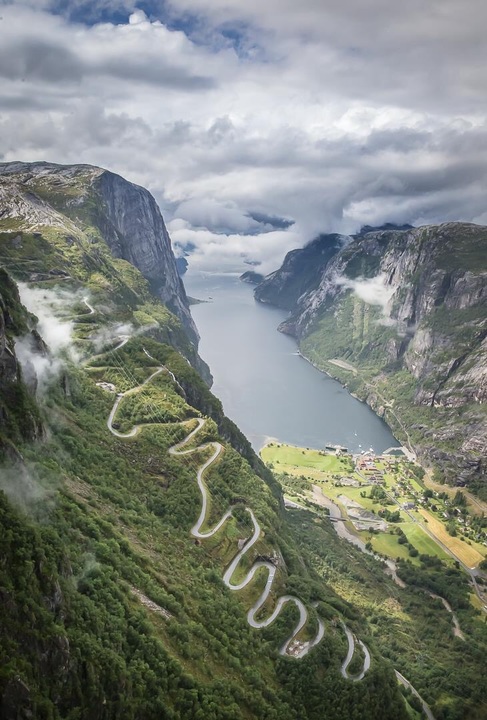
The 7.5-kilometer race course for the Lysebotn Opp, an annual hill climb at the Blink Ski Festival in Lysebotn, Norway. (Photo: Blink Ski Festival/ Facebook)
There’s a little more than six months to go until the opening ceremony of the 2018 PyeongChang Winter Olympics. For the recently turned 30-year-old Charlotte Kalla, a two-time Olympic gold medalist and three-time silver medalist from Sweden, nothing would be sweeter than to capture another gold this winter in South Korea.
Her last individual Olympic win came in 2010 in Vancouver, B.C., when she took first in the women’s 10-kilometer freestyle. A repeat podium in the PyeongChang 10 k skate is not far from her thoughts.
“It is a race that is certainly on my mind,” Kalla told NRK on Thursday, according to a translation.
What better way for Sweden’s 10 k favorite to practice than at the Blink Ski Festival’s Lysebotn Opp, an annual 7.5 k freestyle rollerski hill climb in Lysebotn, Norway? With names sure to contest her at the Olympics –including Norway’s Marit Bjørgen and Heidi Weng, as well as Finland’s Krista Pärmäkoski, Germany’s Stefanie Böhler and American Liz Stephen — on the start list for Thursday’s race, Kalla couldn’t resist entering herself.
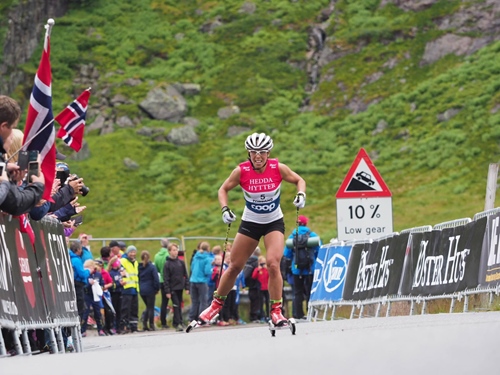
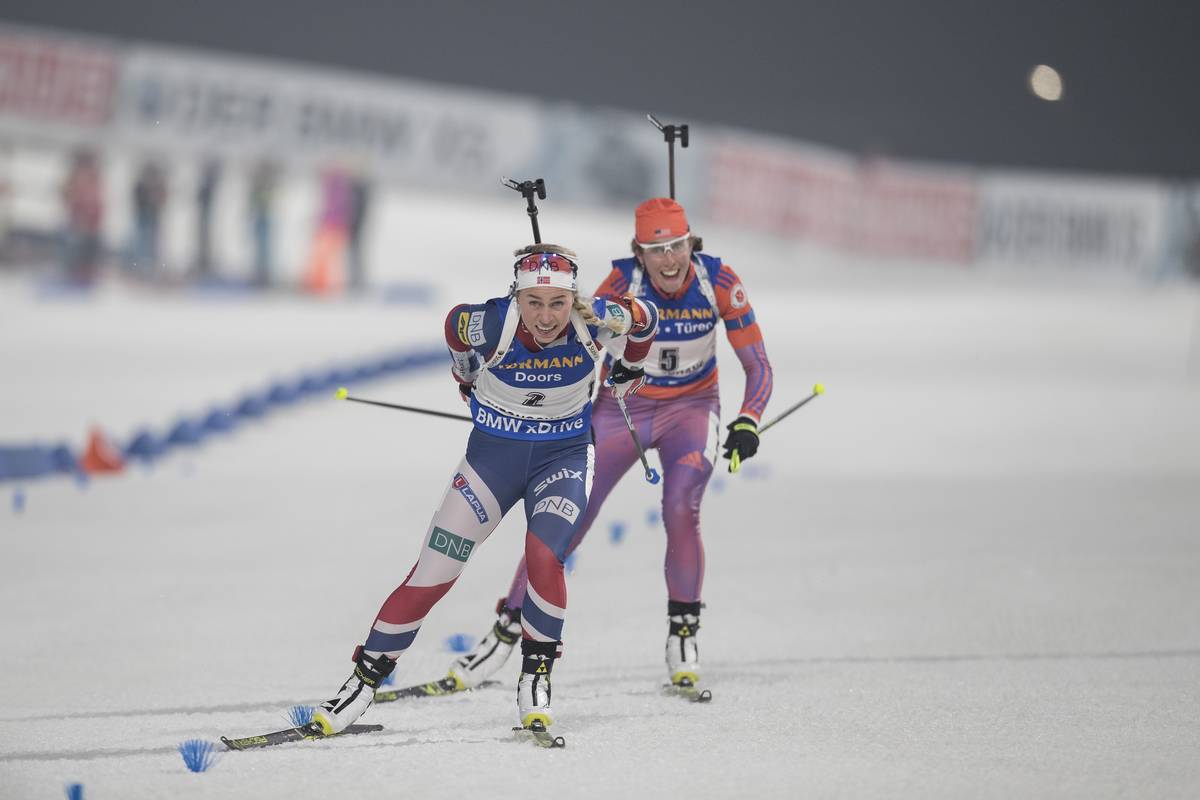
Sweden’s Charlotte Kalla (r) racing to the win in the Lysebotn Opp, a 7.5-kilometer uphill climb, at the 2017 Blink Ski Festival on Thrusday in Lysbotn, Norway. (Photo: Axelar/Arild Aarnes)
If her performance in the rollerski race is any indication of where Kalla is headed this winter, it’s the direction she wants. After breaking away with Bjørgen, Pärmäkoski and Weng early on in the race to form a lead pack of four women, Kalla quickly decided to make the race her own.
Within the next few kilometers, Kalla dropped the two Norwegians and Pärmäkoski and went on to finish first in a time of 33 minutes, 18.3 seconds. Weng followed 40.3 seconds later and Bjørgen crossed in third, 1 minute and 50.5 seconds back.
Notably, Kalla’s time was faster than 57 out of 100 elite men that raced the same 7.5 k course later on Thursday.
“One shouldn’t focus too much on what happens in July, there is a lot left to be done before the season, but it’s been long since I’ve been in this good a shape in July. The last time was probably 2013,” Kalla told NRK.
The Lysebotn Opp’s 2014 champion,Stephen finished sixth overall (+3:35.7) on Thursday, after Norway’s Ragnhild Haga in fourth (+2:43.4) and Pärmäkoski in fifth (+2:47.0). Prior to winning three years ago, Stephen also placed third in the famous rollerski hill climb in 2012 (the Lysebotn Opp was added to the festival in 2010).
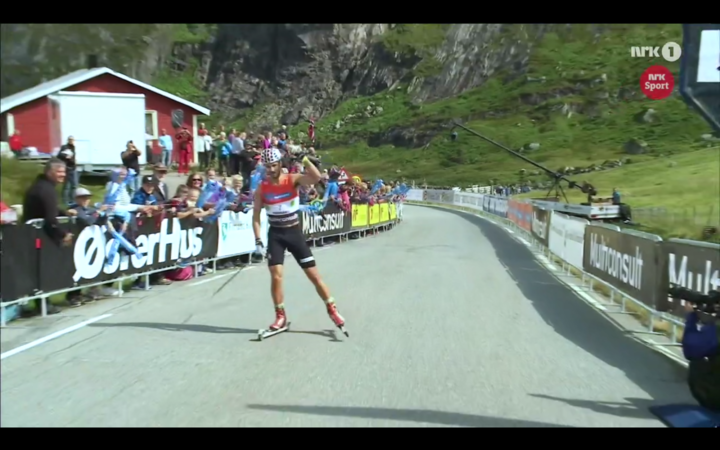
In the men’s 7.5 k uphill race that followed, Hans Christer Holund broke away for the win in 27:37.6, besting fellow Norwegian Simen Hegstad Krüger in second (+1:13.9) and Finland’s Matti Heikkinen in third (1:25.6).
Holund took it out strong from the start, holding his lead through the climb’s entirety.
Norway’s Hans Christer Holund after winning the men’s 7.5-kilometer Lysebotn Opp rollerski hill climb on Thursday at the 2017 Blink Ski Festival in Lysebotn, Norway. (Photo: NRK screenshot)
“I am healthy and have done some solid training this summer,” the 28-year-old Holund told NRK after. “It looks promising. There’s still a lot of time Olympics, but it does look promising. It is so competitive in Norway and it’s tough to just be selected. If I am selected for the Olympics when the time comes then I will be good enough and then an Olympic gold-medal is the next task.”
Norway occupied seven of the top eight on Thursday, with Henrik L’Abée-Lund in fourth (+1:59.6), Sjur Røthe in fifth (+2:05.7), Martin Johnsrud Sundby (Wednesday’s 60 k winner) in sixth (+2:11), Simen Andreas Sveen in seventh (+2:12.4), and Gaute Kvåle in eighth (+2:14.7).
Andy Newell of the U.S. Ski Team did not race the hill climb, but he was back for the 15 k mass start on Friday (as was Stephen for the women’s 10 k). Stay tuned for results in a separate report.
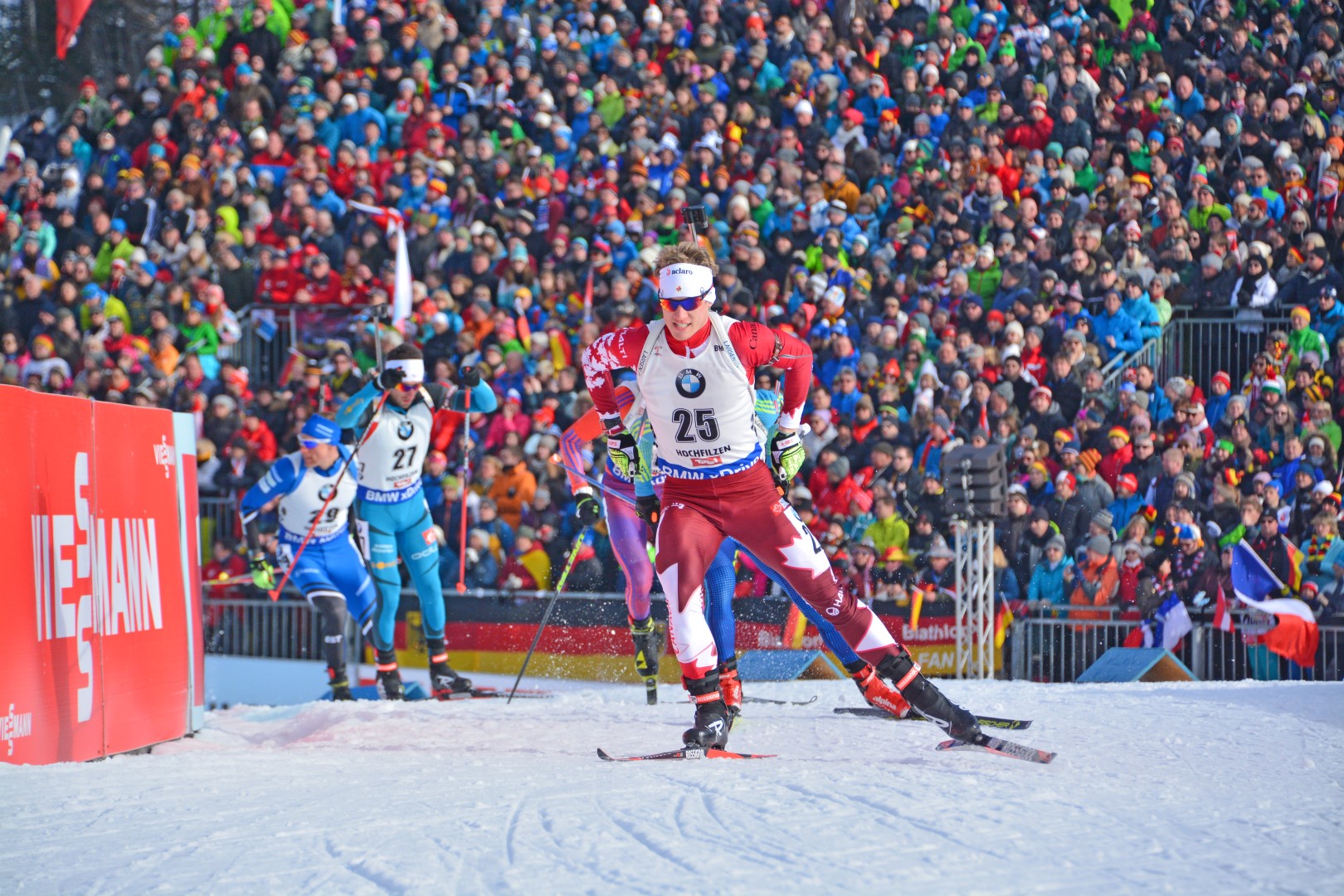
Biathlon Canada’s Scott Gow racing to 47th in the men’s 12.5 k pursuit at 2017 IBU World Championships in Hochfilzen, Austria. Biathlon Canada is facing a tightening of purse strings for the 2018 Olympic season as Own The Podium cut its base funding to zero. (Photo: Glen Crawford)
If you made it past the article’s title, then get ready to immerse yourself in the intricacies of Canadian high-performance sports funding.
OK, here it goes…money, money, money. Add this for effect, $.
Imagine for a moment you’re the CEO of a national sporting body and you’ve got high aspirations — things like championship and Olympic medals. There’s an infinite amount of puzzle pieces to organize and assemble. There are two critical pieces to even fathom success: the motivated athletes-coaches combo along with ample funding.
Biathlon Canada finds itself in a precarious position for the 2017/2018 season— a critical year considering that many athletes sharpied in the 2018 Winter Olympics in PyeongChang, South Korea, in mid-February as their performance peak just after the 2014 Sochi Olympiad.
The financial hammer fell in May when Own The Podium (OTP), a Canadian nonprofit focused on supporting Olympic medal contenders, cut its base funding to Biathlon Canada to zero dollars. ((Biathlon Canada is the National Sporting Organization (NSO) overseeing biathlon in Canada.))
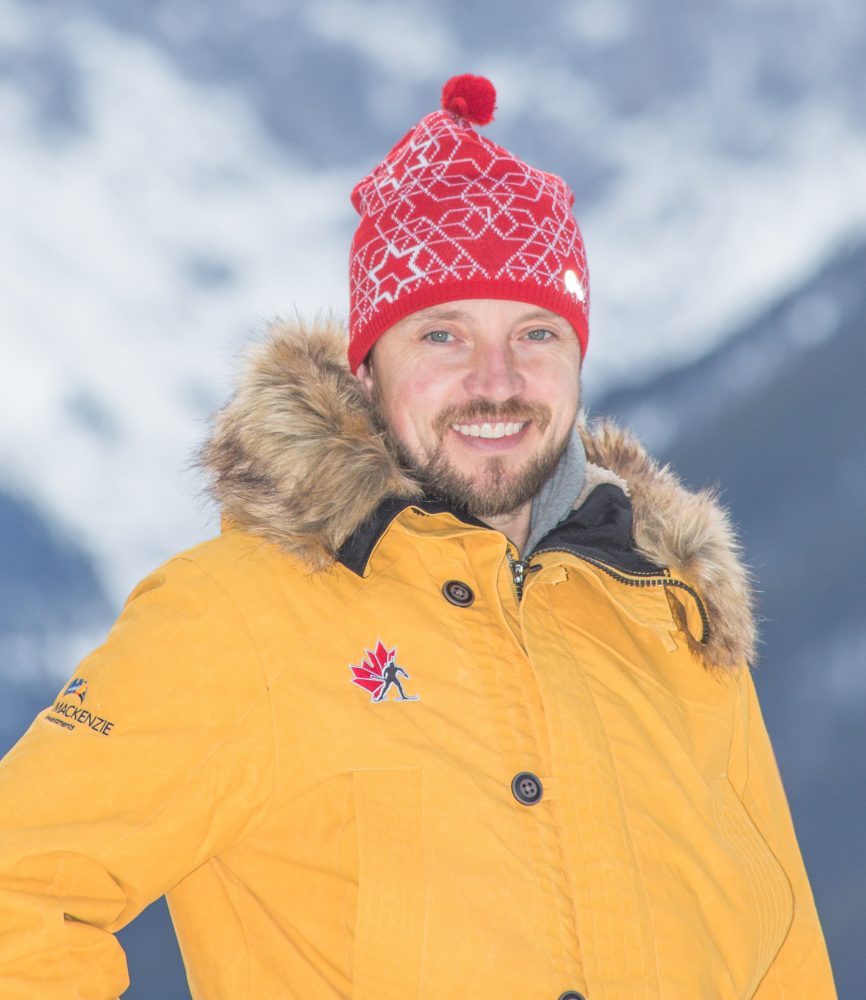
Andy Holmwood, Biathlon Canada’s general manager (Photo: Pam Doyle)
During the final run-up to PyeongChang, Biathlon Canada must belt-tighten and evolve in a climate of continued funding scarcity. At the time of publication, the exact amount of Biathlon Canada’s budget was unclear despite a request to Biathlon Canada General Manager Andy Holmwood to confirm his organization’s 2017/2018 budget.
“I am not in a position to discuss any of our budget numbers,” Holmwood said in a phone interview on July 11th.
Biathlon Canada receives the majority of its funding from three major sources. There’s Sport Canada, a government agency providing funds to NSO’s through its Sport Support Program. Jon Schofield, a Sport Canada spokesperson and media-relations specialist, explained to FasterSkier in an email that Sport Support Funding is for a four-year cycle.
Then there are corporate and private donations made directly to Biathlon Canada.
Lastly, there’s funding from Own The Podium (OTP). According to Schofield, OTP makes the recommendations upon which other groups base their monetary support.
“Those sports that have athletes which have demonstrated the potential to achieve a podium result at the Olympics and Paralympics, are also eligible for enhanced excellence support,” Schofield wrote in an email. “The assessment of podium potential is done yearly by Own the Podium which provides funding recommendations to Sport Canada, the Canadian Olympic Committee and the Canadian Paralympic Committee – (the two latter) which in turn support the sports directly.”
It can be tricky and frustrating. Biathlon Canada is in a constant struggle to promote and financially support athletes who have already arrived while keeping promising athletes in the development pipeline.
The OTP Ask
Here’s how the basics work between OTP and Biathlon Canada. The NSO, or Biathlon Canada in this case, presents its supporting evidence — in both a formal proposal and in-person meeting — that its athletes have Olympic medal potential. OTP officials then recommend funding based on their assessment of the submitted evidence.
OTP funding is considered to be “top-up” funding, or monies for athletes at the very highest level of their respective sport. Amongst the high-performance scene in Canada, the philosophy of emphasizing those athletes already at the top is referred to “targeted excellence”. In total, OTP redistributes approximately $64 million annually. To put that in perspective, that $64 million is part of the larger $200 million the government invest in Canadian sport annually.
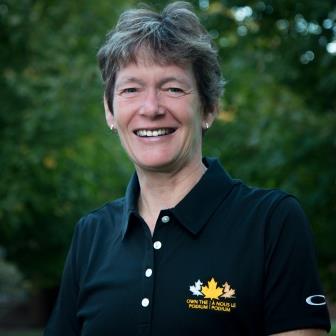
Anne Merklinger, Own The Podium chief executive officer (Photo: OTP)
“Our mandate, which is prescribed by the national funding partners, is to provide technical advice for National Sport Organizations and to provide investment recommendations for those sports organizations that have evidence of medal potential for the upcoming set of Games,” Anne Merklinger, OTP chief executive officer, said in a phone interview. “Secondly, we also provide investment recommendations for the subsequent set of Games, so in winter that would be for 2022. So those investment recommendations are being considered by the minister and they are not final yet.”
According to Holmwood, Biathlon Canada presented a portfolio highlighting the medal potential of its men’s relay team.
“I think we made a strong case for our men’s relay team as a medal hopeful,” Holmwood said. “I think it’s fair to say they didn’t agree with us completely. They didn’t share that perception. It is clear that OTP in an Olympic year, they refer to sharpening their pencils and really focusing the funding on strong medal contenders. In their eyes, we did not fit in that.”
Two seasons ago, the men’s relay team earned a historic bronze medal at 2016 International Biathlon Union (IBU) World Championships in Oslo, Norway. Last season, their best finish was seventh at the World Cup in PyeongChang, South Korea, where many nations did not start all of their top athletes. (More on last season’s results later.)
“Their base funding for ’17-’18 is zero,” Merklinger said about OTP’s funding for Biathlon Canada. “But they are receiving $50,000 for the coaching position … to support a coach through the Olympic Legacy Coaching Fund. So that is the extent of the funding recommendation for biathlon for the ’17-’18 fiscal year.”
Starting at the top of Canada’s biathlon pyramid, the collective gasp came at the depth of the cuts, not that OTP cuts were made.
“OTP takes a very actuarial approach,” Holmwood said. “It’s not subjective. And to their credit, they are very clear in their mandate. It’s not a big massive surprise. I think what surprised us was just how deep the cut went.”
Roddy Ward, Biathlon Canada high-performance director (Photo: Ric Rowan)
“In the end, it seems as though they believe we have some up-and-coming athletes but no medal prospect for 2018 Olympics,” Ward said. “By their mandate, it means we get cut out of the pot of money for the Olympic season. I don’t doubt they followed through with their mandate, but ultimately, decisions like that undermine growth towards consistent podiums in our sport.”
Ward has a point about diminished funding decreasing the odds of future podiums. But OTP’s mandate only looks to a two-Olympic cycle “event horizon”. At the moment, OTP is not obligated to look further than Beijing 2022.
OTP publishes what it calls a Winter Historical Comparison on it’s website. It outlines OTP funding recommendations for Olympic winter sports by quadrennial. For the Vancouver quadrennial, Biathlon Canada received $1,784,173. It received $1,324,623 for the Sochi quadrennial.
According to Merklinger, for the ’14-’15 fiscal year, Biathlon’s base funding from OTP was $250,000, $400,000 for ’15-’16 and $435,000 for the ’16-’17 fiscal year. Accounting for the ’17-’18 cuts, and adding the $50,000 from the coaching legacy fund, the PyeongChang quadrennial total for Biathlon amounts to $1,135,000.
(On OTP’s website, a figure of $1,200,000 is used for the first three years of the PyeongChang quadrennial. Using that figure, an amount of $1,250,000 would have been recommended for Biathlon during the PyeongChang quad.)
Although Merklinger was clear in explaining to FasterSkier that Biathlon Canada’s base funding was “zero”, Holmwood said this about OTP’s potential allocations: “Our OTP funding for this coming season is uncertain. It is fair to say, I would say that we have received a substantial cut, but just what we will be getting from OTP is not certain.”
OTP’s Merklinger said the funding door as it applies to the medal potential of Canada’s national biathlon team isn’t exactly slammed shut. OTP maintains the administrative flexibility to infuse money into a high-performance program on short term notice.
“We can do that from today until the start of the Olympic Games,” Merklinger said when asked if OTP could recognize medal potential with monetary support if an athlete or team proves they are on form in races scheduled a few months before the Games. “We are eager to work with biathlon as the season unfolds to assess the progress of their preparations and their performance for PyeongChang and would be delighted to be in a position where we could provide a very specific incremental funding recommendation that is focused and that responds to a positive side of the program and indicates that they indeed have evidence of medal potential.”
The Potential
Medal potential is exactly that — potential. There are no absolutes. Although actuarial means may be used to determine the likelihood for an Olympic medal, sport is fickle.
Take biathlon, for example. There’s the shooting range and wind conditions, the rifle and its complex moving parts, the wax, the skis, and of course the athlete. The number crunching for potential would have to consider the likelihood of all things aligning for a Canadian athlete and the likelihood a veritable podium lock, like France’s Martin Fourcade, has an unlikely off-day. No matter where the OTP assessment falls, OTP’s job is a tough one — determining the likelihood of an event before that event transpires and basing its funding decisions on that likelihood.
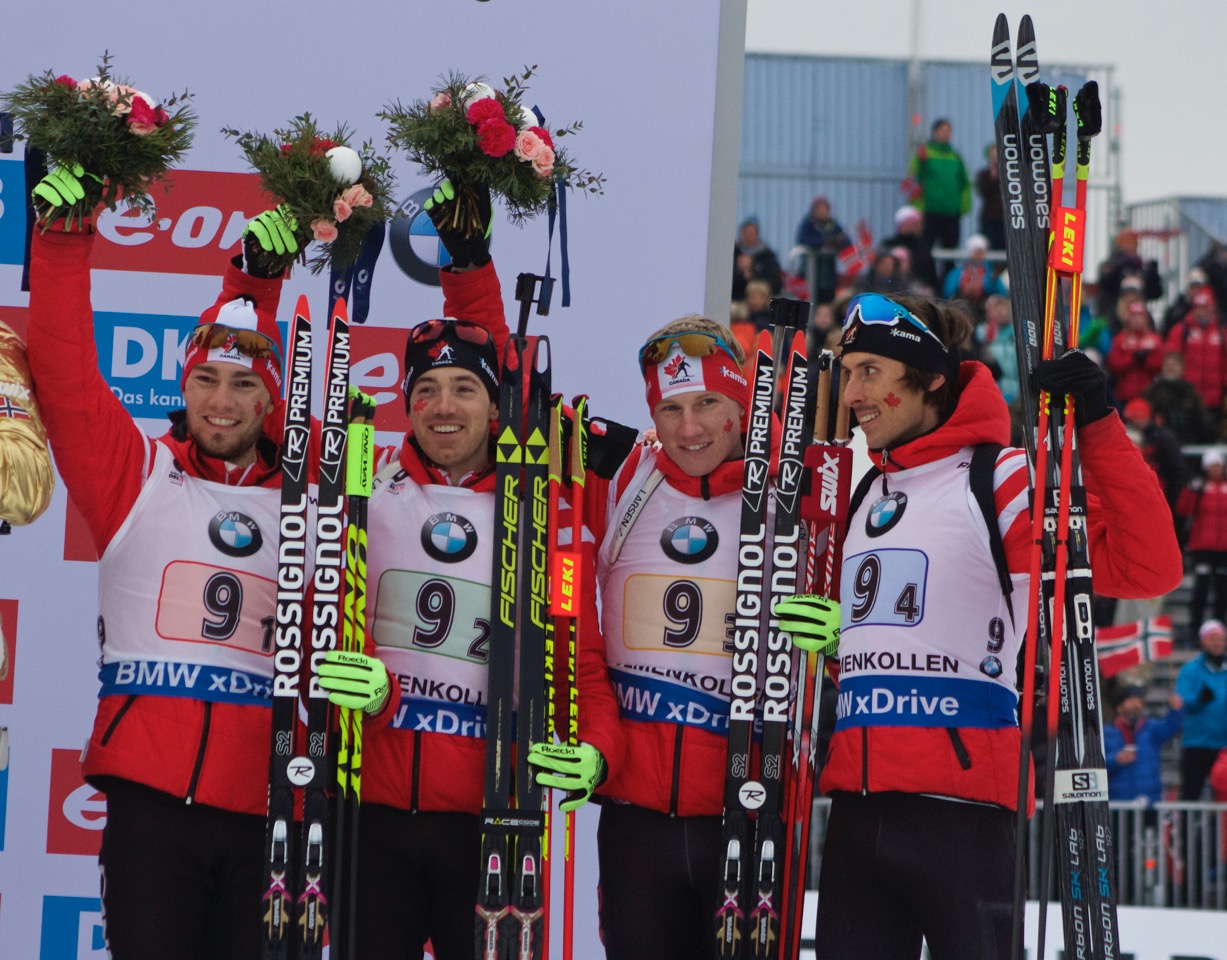
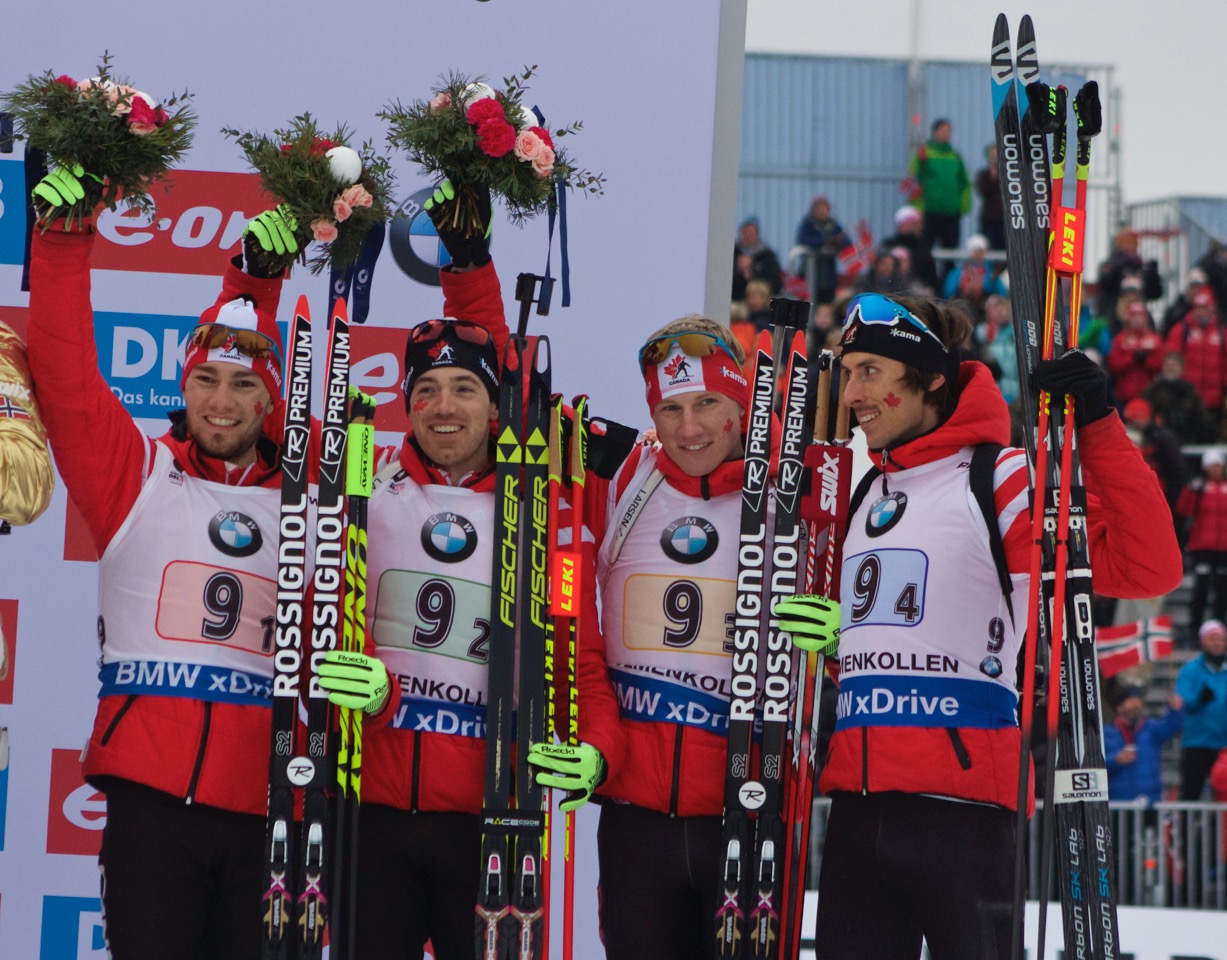
The Canadian men’s team (from left to right) Christian Gow, Nathan Smith, Scott Gow, and Brendan Green celebrating bronze in the men’s 4 x 7.5 k relay at 2016 World Championships in Oslo, Norway. (Photo: JoJo Baldus)
One wouldn’t need to be transported back far in time to underscore Biathlon Canada’s positive medal potential. For starters, the time machine’s date could be set to March 12, 2016. In the pressure cooker of Oslo’s Holmenkollen stadium, Canadian biathletes Christian Gow, Nathan Smith, Scott Gow, and Brendan Green claimed bronze in the World Championships relay.
The past season was a down year for Canadian biathlon. Smith, the team’s highest-profile male skier, was sidelined for much of the season while he battled a virus. Brendan Green, another veteran with multiple top 10’s to his name, scored a single top-30 World Cup result in 2016/2017. Meanwhile, Scott Gow raced to three top 30’s, earning 23rd, 18th, and 17th places on the World Cup.
On the women’s side, Rosanna Crawford had been the team’s rising star, earning fourth-, fifth- and seventh-place finishes on the World Cup during the 2014/2015 season; she also placed 15th at 2016 Oslo World Champs in the 12.5 k mass start. Individually, Crawford scored six World Cup top 30’s this past season with a best result of 19th at the PyeongChang test event. She placed 26th in this year’s World Championship sprint.
As has been written before about Biathlon Canada’s tenuous funding, OTP considers medal potential at World Championships and Olympics. It’s not obligated to consider stand alone results on the World Cup circuit when making those judgments. So performance on the big stage matters.
In recent years, it has been rumored that Biathlon Canada has run a deficit.
“Biathlon Canada has always kind of operated in the red,” Crawford said in a phone interview.
It’s possible that the prospect of programmatic cuts due to the NSO’s financial standing wasn’t unforeseen. According to a February 2015 article in The Crag and Canyon out of Canmore, Biathlon Canada will maintain the same annual expenditures through 2018. In that article, that reporter states that Biathlon Canada’s annual budget is $1.4 million. This number reflects the NSO’s total budget, not the portion set aside for funding the high-performance program.
With a lack of substantial OTP support this year, Biathlon Canada is implementing a high-performance austerity program during the training season.
“We must move on and do our best to deliver on our results despite the massive cuts,” Ward said. “We have virtually cut everywhere; no funded camps, reduced IST (physiologist, strength coach, nutrition, sport psych etc), less staff, athletes will pay to compete on the World Cup. We are doing our very best to build a solid program for our National Team with limited resources, this means an ‘all hands on deck’ approach by staff. I can tell you staff are extremely motivated so in some way, it’s very exciting to be a part of and could be the perfect storm for us.”
Canada’s high-performance biathletes are accustomed to traveling for training camps. Athletes have experienced on-snow training camps in New Zealand, Park City, Utah camps, dryland racing and training in Jericho, Vermont, Haig glacier camps in the Canadian Rockies, as well as a Jasper, Canada camp. Other camps have included a Dachstein glacier camp and training in Norway. This dryland season will be more restrictive. According to Crawford, the women’s team traveled and trained in Kelowna, British Columbia, where costs were minimized: Ransom’s parents housed the team, and a sponsor donated funds for groceries.
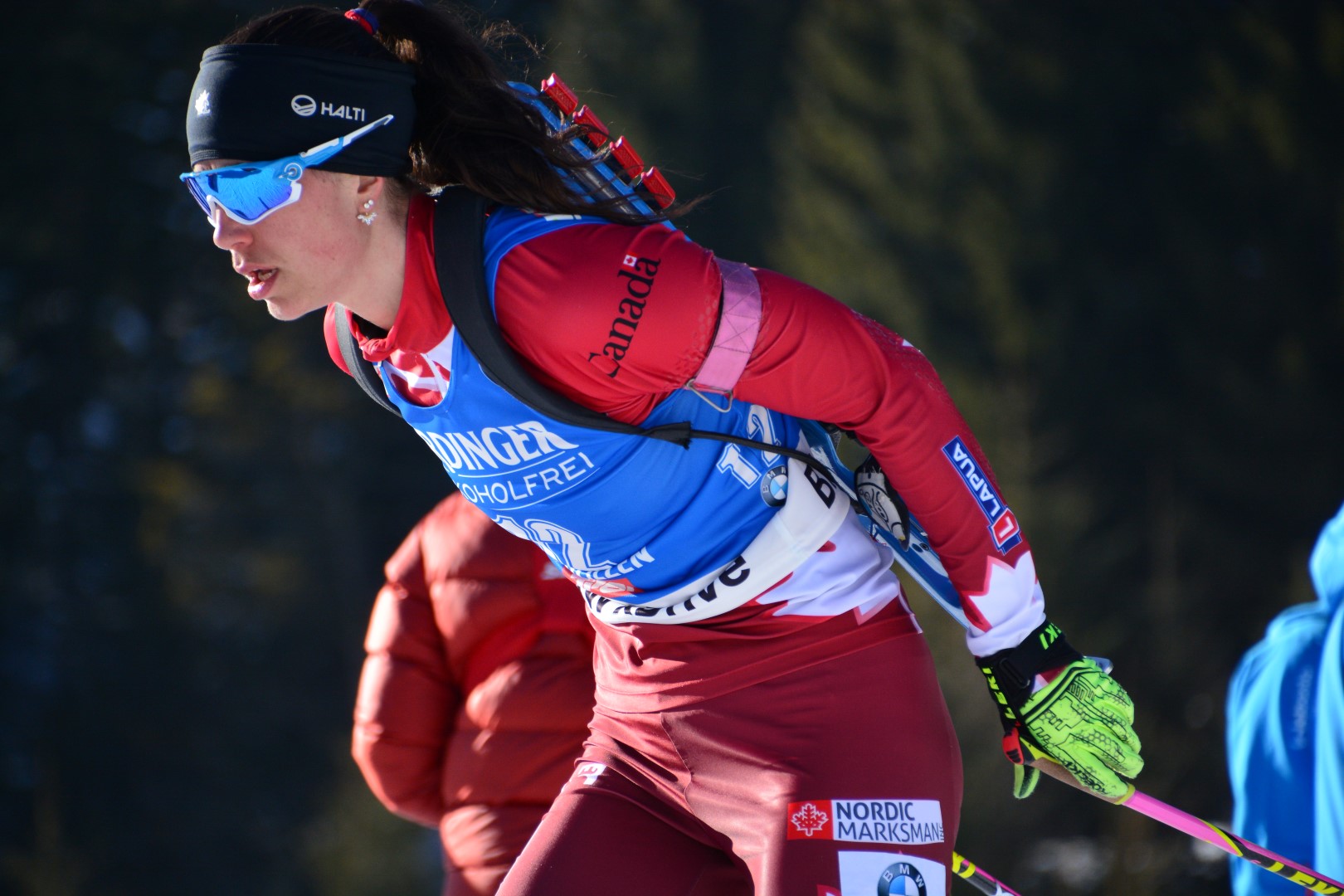
Rosanna Crawford (Biathlon Canada) racing to 26th in the women’s 7.5 k sprint at 2017 IBU World Championships in Hochfilzen, Austria. (Photo: Glen Crawford)
Crawford also wrote in an email that both the men’s and women’s team will be spending two to three nights on the Haig glacier outside of Canmore later this summer, and Christian and Scott Gow will be attending a self-funded Park City camp.
“The majority of the cuts we have seen have been in those extensive trips, or out of country trips, maybe more precisely,” Holmwood said. “We were thinking of going to Jericho in August, but we removed that simply because the cost is pretty high. Our dollar is not strong right now, also. The U.S. is not typically a place we need to go to.”
New terrain, opportunities to thwart dryland-season staleness, and exposure to different athletes are value added aspects of training camps. Crawford, who is based in Canmore, home of Biathlon Canada and a world-class biathlon training facility, said the lack of camps are a setback, but not a season-killer.
“In some ways, it’s fuel for the fire, like, ‘We’re gonna show you’,” she said. “We don’t have to travel, we can do really good recovery, everyone can be with their significant others, and the coaches get to spend more time with their families so maybe they’ll be less likely to get burnt out in the winter. So I think we’re all just trying to find the positives from this scenario.”
With an important competition year looming, Crawford explained the real compromise may come if the funding limitations impact service on the international competition circuit.
“Truly I don’t think this summer is going to be the hard part. I have complete faith in our coaches and Jess Kryski, who’s our physiologist, that they know exactly what to do with us to get us nice and strong,” she said. “It’s more the concerns around the wintertime of how many wax techs we’re going to have, whether we’ll have massage therapists, whether athletes will have to pay to go and race. I think those are some of my bigger concerns.”
Holmwood stated that when snow flies and athletes toe the line internationally, the financial gut-shot will not impact athlete support.
“The key theme is that we are tightening our belts primarily with regard to camps,” Holmwood continued. “But come World Cup season, IBU Cup season, we will be supporting teams to the extent that we have in the past, and we will give them the resources they need to succeed.”
The Financial Seesaw and Its Cost: Reforms Coming
In 2010, Biathlon Canada’s charitable status was called into question and ultimately rescinded by the Canada Revenue Agency. Prior to the ruling, Biathlon Canada could issue tax receipts for donations. That’s no longer the case. As a result, corporate and individual donors must be compelled to contribute funds based on Biathlon Canada’s marketing exposure or simply the gift of giving.
Without the possibility of issuing tax receipts as a nonprofit, Biathlon Canada finds itself with hands wide open without a tax deduction incentive to attract corporate sponsors.
It appears Biathlon Canada has come to rely on OTP funding for its elite level athletes, despite the fact that in the Canadian sports system this funding is supposed to be a “top-up”.
“OTP makes up the bulk of the funding for the National Team and our winter competitive tours so it hit our National Team budget hard,” Ward said.
Exposed with OTP’s lack of funding is the cost of relying on a single source to meet the financial demands of running a NSO of a niche sport. The money is hard to come by.
Yet high-performance athletes in Canada have direct support from Sport Canada through what is called the Athlete Assistance Program (AAP). The requirements for athlete support through Sport Canada are different than OTP’s medal-driven approach.
“Support is provided yearly to those athletes whose sport has identified them either being or having the potential for a top 16 result in the world,” wrote Schofield, of Sport Canada. “Each sport has a number of stipends that they have access to, based on previous results and future potential.”
AAP qualifying athletes are considered “carded” athletes. Carded athletes receive a monthly check from the government to help offset living expenses while they train with the end goal of representing Canada at the Olympics or international competitions. Since 2004, $1,500 was the maximum monthly stipend an athlete could receive. As of this March, the federal funding for the AAP was increased 18 percent — eligible athletes can now receive up to $1,770 per month.
Here’s the verbiage straight from the AAP website: “AAP support seeks to relieve some of the financial pressures associated with preparing for and participating in international sport and assists high-performance Canadian athletes to combine their sport and academic or working careers while training intensively in pursuit of world-class performances.”
It remains to be seen if carded biathletes must use their monthly check for training necessities and sport recovery rather than rent or mortgage and food.
“We’ll still get the same,” Crawford said when asked if the OTP cut would impact the team’s carded athletes. “Each individual athlete will still get the same amount of money they’ve been getting in the past years from the government. Of course, it’s great for us to have funding, but it would be better if Biathlon Canada could also have a big funding partner so that we could do training camps and stuff like that, and the money we that we get could go toward groceries and the high cost of living in Canmore.”
As with the government’s intent to increase the maximum allotment to its carded athletes to compensate for a long overdue adjustment for inflation, reform minded stakeholders in government and the NSO’s should see changes to how the OTP “targeted excellence” philosophy is implemented.
Almost exactly a month ago, a report titled “Review of Sport Canada’s Targeted Excellence Approach,” was released on June 22. Essentially, the 72-page report highlights the underlying success of OTP — it has helped produce more Canadian Olympic medals — but also reports on findings that call for systemic change.
One of the main concerns raised in the report was that OTP funding decisions are made annually. The negative consequence for NSO’s and athletes is that a climate of instability persists in some sports when funding remains questionable from year to year. When cuts occur, it can leave less financially nimble NSO’s too little time to pick up the funding slack. And potential corporate sponsors shy away from longer-term sports sponsorships when defunding or deep cuts from OTP remain an ongoing possibility.
The report does suggest a model premised on funding obligations longer than a single year.
And for those in nordic sport concerned about the development pipeline, the report makes requests for a greater emphasis on longer-term funding. A common critique of OTP, as featured in a Nordic Nation podcast, is that investments in what in Canada is referred to as the “NextGen”, or up and coming athletes, are lacking.
Here’s a major concern: The medal bounty OTP has helped Canada haul in since the 2010 Vancouver Games could be a well that’s drying up. Without investing in developing its younger athletes, medal famine may be the new norm.
The Government of Canada mentioned in its April 2015 budget that increased monies for athlete development — the so called “NextGen” — would be forthcoming. The report released on June 22 recommends the following strategy when it comes to emerging athletes and allocating funds: “The current targeted approach should not be used with younger athletes deep in the ‘pipeline’. Instead, an approach that favoured focusing on training groups and larger numbers was recommended.”
For now, the brutal funding cycle continues for Canada’s biathletes and high-performance support team as feast and famine remain the backdrop to a strict definition of high-performance success: medals. The return on investment in the near term for all the stakeholders might be a zero-sum game, and in that case, who wins?
Bend Endurance Academy (BEA) athletes ready for a ride while standing in front of their “Adventure Bus”. (Photo: Mike Rougeux)
In the summer of 2013, Bend Endurance Academy (BEA) Executive Director Ben Husaby made what some may have considered a strange company purchase. The two-time Olympic cross-country skier bought an old yellow school bus, painted a pale-blue stripe lengthwise down its side and inscribed the organization’s moniker where an educational institution name once was.
Why? Was he planning to shuttle BEA student-athletes to and from school during his spare time?
Not quite. When Husaby founded the nonprofit organization in Bend, Ore., in 2009 alongside Brenna and Bill Warburton, he and BEA advocated for the affordability and accessibility of sport to kids. The addition of a bus to the organization created a means of free transport and the potential to incorporate youth who might otherwise miss out. In the summer, the bus would run daily, with BEA athletes boarding from various pickup spots and being transported at no extra cost to practice venues. In the winter, bus pickups and drop-offs would move to three times a week.
It largely symbolized what he and BEA wanted to do: get a greater number of kids outside and active, without breaking the bank.
“We have figured out how to run the organization through program fees, and our program fees are on par with [Bend] Parks and Rec,” Husaby recently said on the phone. “Even though [BEA] is nonprofit and we have a board of directors, we try really hard not to fundraise … the entire organization is really pushed by program revenue. I think people appreciate that.”
Ben Husaby (second from left) smiling with some of Bend Endurance Academy’s finest. (Photo: Mike Rougeux)
While Husaby didn’t drive the oversized, yellow-and-blue streaked bus — he left that to retired school-bus driver Steve Delery — he valued providing a greater number of families with the option to participate in BEA’s programs. The bus was just one physical example.
The mission of BEA is another. With the primary goal of providing its members a resource in “teamwork, personal growth and community responsibility,” Husaby hoped the program he created eight years ago would attract an audience beyond just the superstar athlete.
In keeping with this model, the organization has grown from 20 youngsters in its startup years to just under 1,000 unique enrollments this year. Husaby attributed this participant surge to the affordability and accessibility BEA promotes.
“We’re not performance driven,” Husaby said. “It allows for a horizontal platform. All kids need to spend more time outside. All kids need to put their screens down. All kids need to have interactions with quality mentors and you can do all of those things without necessarily being competition focused.
“It’s not a top-down organization,” the 51-year-old Minnesota native continued. “It’s mostly about teaching kids to enjoy endurance sports and that message has worked all the way through.”
Even if Husaby prefers the Academy to remain less performance driven than other clubs, its program still puts out national-caliber athletes. In the realm of nordic skiing, Dakota Blackhorse-von Jess is one of them.
For close to 17 years, Blackhorse-von Jess and Husaby have worked together, originally while Husaby was still a coach for the Mt. Bachelor Sports Education Foundation (MBSEF) in the early 2000s — he was let go from MBSEF in December 2008 and started BEA the following month.
Prior to that, skiing came in the form of racing for Husaby. After moving to Bend in 1991, he qualified for two Olympics — 1992 and 1994 — and tried one final time in 1998 before focusing on marathon racing, including the American Birkebeiner, for the next two years.
“I was working for a friend in an automotive restoration shop when that fall [of 2000] the director of MBSEF contacted me asking if I wanted to coach the nordic program,” Husaby said of his start in coaching.
Husaby accepted the position, and while sitting in his office one afternoon, he met a visitor that ultimately influenced the rest of his coaching career. A stocky high schooler entered his room, voicing goal that made Husaby’s eyebrows go up.
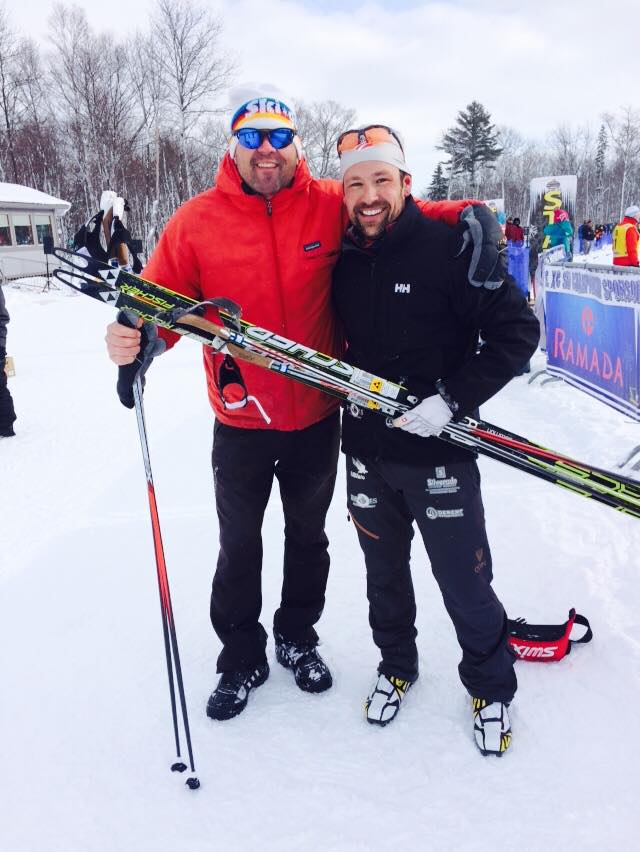
Ben Husaby (l) and Dakota Blackhorse-von Jess. (Photo: Mike Rougeux)
“[Blackhorse-von Jess] walked in and said, ‘I want to win Junior Nationals,’ ” Husaby recalled. “I sort of laughed because he was kind of a pudgy little kid … I mean I didn’t even know who he was. But I said, ‘OK,’ kind of laughing, and ironically, two years later, he was at World Juniors.”
The two went to World Juniors in 2006, before Blackhorse-von Jess headed east to attend Dartmouth College for four years, earning a degree in computer science. Upon returning to Bend in 2011, Blackhorse-von Jess rejoined Husaby and BEA. He earned a job as the organization’s associate director, a position in which he was responsible for bookkeeping, building the enrollment system and managing the program’s website.
However, as Husaby admitted, being Blackhorse-von Jess’s boss and coach proved to be difficult. Blackhorse-von Jess had an intense training schedule, but the work he needed to complete for BEA was equally important. Husaby was caught in the delicate position of understanding his employee’s outside stressors and their significance while also being charged with overseeing Blackhorse-von Jess’s salaried work.
Though not the singular reason, this is one point Husaby brought up as he discussed his recent decision to leave his post as executive director. Though he will continue to coach Blackhorse-von Jess through this Olympic season, he plans to leave BEA by Sept. 1 of this year.
“I think me leaving is actually going to make [Dakota’s] ski career a little bit easier as he winds it down,” Husaby said.
According to the 31-year-old Blackhorse-von Jess, this will most likely be his final competitive season and he hopes to end with a bang by qualifying for the 2018 Winter Olympics in PyeongChang, South Korea.
“I’m looking forward to doing something different this season,” Blackhorse-von Jess said earlier this week on the phone. “I mean, I know in many ways what we do this year is the same, but it’s our last year and it’ll be, farewell tour isn’t the best way to put that, but I think there is something special and different about it. I’m just excited to see what it holds.”
Though Husaby considers BEA his “phoenix”, he departs the head position with a sense of respect for what’s been accomplished and an excitement to spend the final months of his ski career back on the ground doing what he loves most: coaching.
“I’ve already noticed that for me, it’s going to be a lot easier to coach [Dakota] if I’m not his boss any longer,” Husaby said.
“I think the organization is ready for a manager that perhaps doesn’t have as personal of a connection as I do to Bernie [Nelson, BEA’s nordic director], Dakota, Bill [Warburton, cycling director] and Mike [Rougeux, climbing director],” he continued. “I’m leaving now because I’ve been either an athlete, or a coach, or a leader, or a supporter for 30-some years and it’s just time … it’s taken a lot to build this organization and I really honestly believe that I’ve taken it as far as I can.”
The organization is certainly a far cry from the volunteer-run, single-sport (nordic skiing) nonprofit it was in the beginning. Since its inception, cycling and climbing programs have been added to the academy, 45 seasonal, as well as two more full-time employees added to the original staff of three, and program participation has reached capacity.
“It’s big now and it needs someone that perhaps has a little more experience with growing the organization fiscally,” Husaby said. “We’re kind of through the whole founders’ phase. We were a scrappy, scrappy startup, and I was comfortable leading that, I think I just reached my capacity with the organization.”
Husaby will continue to aid BEA with coaching and moving into a new leased facility through the summer. Though no particular candidate has been singled out as of yet, the BEA’s Board of Directors is looking for someone who supports Husaby’s original mission and vision for youth.
“The biggest contribution Ben gave is defining a culture of the organization that is really long-lasting,” BEA Board President Cris Himes said on the phone. “What Ben has really done for BEA is to emphasize fun and joy and getting outside for kids at all levels, making it fun for them and helping them find their intrinsic drive.
“Really that’s been his number one contribution and that’s not going to go away,” she continued. “We are all expressing gratitude to Ben for what he has given this community and organization. It’s quite a legacy and a gift.”
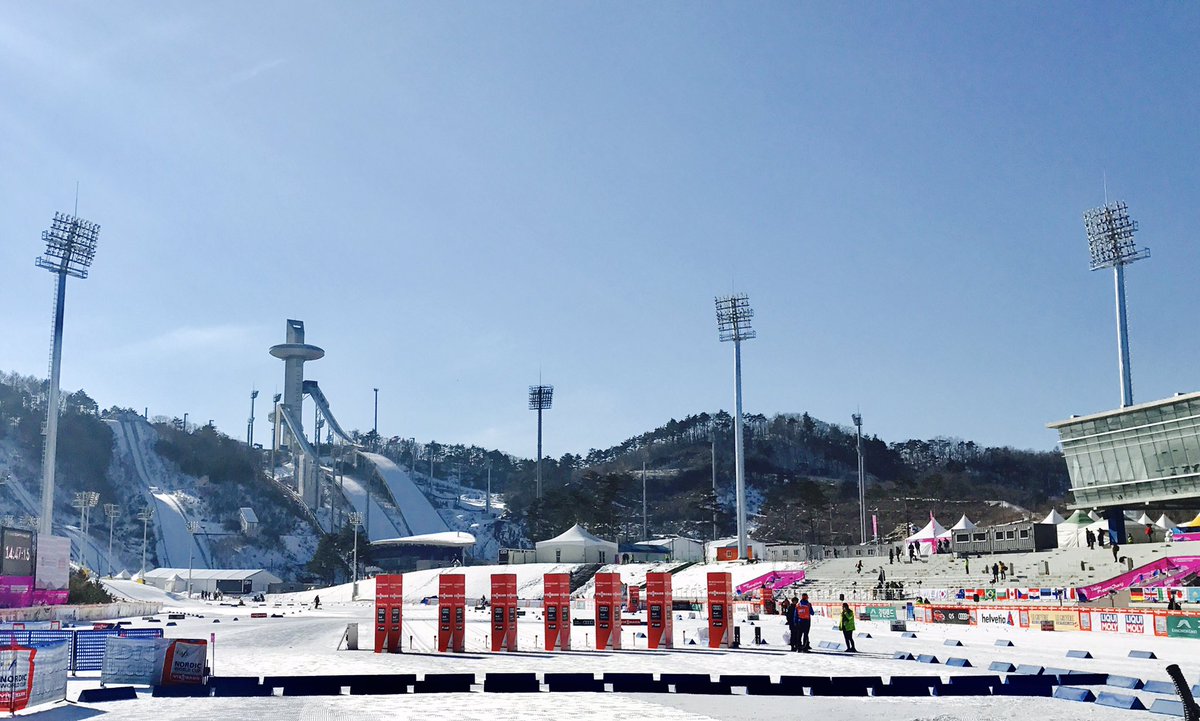
The PyeongChang venue as seen in February 2017. PyeongChang, South Korea, will host the 2018 Olympic Games this coming February. (Photo: FIS Cross Country/Twitter)
Note: This is the first of a multiple-part series on the 2018 Winter Olympic selection criteria for the U.S. cross-country ski team. A parallel piece compares the cross-country team’s criteria with other U.S. winter sports.
***
Friday, July 7, will mark seven months to go until the Opening Ceremony for the 2018 Winter Olympics in PyeongChang, South Korea. As athletes across the country ramp up their commitment in this Olympic year, and #roadtopyeongchang trends across various social media platforms, FasterSkier takes a look at the recently released selection criteria and procedures for nomination to the U.S. Olympic team.
Briefly put, what does it take to get to PyeongChang? And what factors will U.S. Ski Team (USST) coaches and (newly rebranded) U.S. Ski & Snowboard leaders apply in deciding who will be wearing red, white and blue next February?
In this article, FasterSkier first breaks down the criteria themselves, then summarizes a recent interview with USST Head Coach Chris Grover about why these criteria were chosen and how they should work.
Inside the criteria: World Cup performance, discretion and potential domestic picks
The criteria themselves are little changed from the standards used to pick the American team for the last two international championship events, World Champs in Falun in 2015 and Lahti in 2017. First comes objective qualification via performance on the World Cup. Second comes the potential use of discretionary picks. Third, if any spots are left over, the highest-ranking athlete on a domestic points list may, but does not have to, be nominated to the team.
As for the overall size of the U.S. team, a maximum of 12 male or 12 female athletes may be nominated, with a final team quota of probably 17 to 20 athletes to be determined closer to the Olympics themselves. (This is up from a total team quota of 17 in 2014, though ultimately only 14 athletes were named for Sochi, and the extra three American spots were redistributed to other nations.)
The U.S. may enter up to four athletes in a single race at the Olympics. The six cross-country events in PyeongChang will be a skiathlon (15 kilometers for women and 30 k for men), individual classic sprint, freestyle team sprint, 10/15 k skate interval start, 4 x 5 k or 4 x 10 k mixed technique relay (classic, classic, skate, skate), and 30/50 k classic mass start.
As for the criteria themselves for making the U.S. Olympic team: In order:
Objective qualification via World Cup results
Athletes who have achieved a top-eight finish in one of five specific races, or who have a top-50 ranking on either the World Cup sprint or distance list midway through Period II, will be named to the team.
Most precisely, “Any eligible athlete that posts a top-8 individual final World Cup result during the selection period [Nov. 23, 2017, through Jan. 15, 2018] in the following events will be selected to the Team: Sprint C, individual start 10/15 km F, and 15/30 km Skiathlon.”
Looking to the schedule for the 2017/2018 World Cup season, classic sprints will be held on Nov. 24, in Ruka, Finland; Dec. 2, in Lillehammer, Norway; and Jan. 3 in Oberstdorf, Germany (as part of the Tour de Ski). A 10/15 k freestyle individual start will be held in Davos, Switzerland, on Dec. 10. The only skiathlon on the 2017/2018 World Cup calendar will be held in Lillehammer on Dec. 3. Any athlete posting a top-eight final result in one of those five races will be named to the Olympic team.
(The 10/15 k skate pursuits on the schedule don’t count for top-eight purposes – it’s only Olympic formats that are used for qualification. And the 10/15 k skate race in PyeongChang is an interval-start race, not a pursuit.)
So that’s high finishes in individual races. As for cumulative performance across multiple races, “Athletes ranking in the top-50 in the distance World Cup standings or the top-50 in the Sprint World Cup standings as of January 15, 2018 shall be selected to the team.” Jan. 15 marks roughly the midway point of the World Cup calendar. By that point, 18 World Cup races will have been held.
U.S. Ski Team member Sadie Bjornsen racing in the women’s 15 k skiathlon at the 2014 Winter Olympics in Sochi, Russia. Bjornsen is a veteran member of the national team heading into another Olympic year.
As of the comparable point in the 2016/2017 season, shortly after the Tour de Ski, USST members Sadie Bjornsen, Rosie Brennan, Sophie Caldwell, Jessie Diggins, Simi Hamilton, Noah Hoffman, Andy Newell, Kikkan Randall, Ida Sargent, and Liz Stephen had top-50 rankings in either or both disciplines.
A maximum of five athletes per gender may be selected based on their Sprint World Cup rankings. Tiebreaking procedures come into play at that point if necessary, generally based on an athlete’s single best finish in a sprint race.
Discretionary selection
Spots on the U.S. Olympic team will presumably remain open after the application of the objective criterion of World Cup performance. In that case, “the USSA Cross Country Head Coach may use discretion … to determine team nominations” for additional spots on the Olympic team.
Grover would at that point recommend additional athletes to a three-person committee, composed of U.S. Ski & Snowboard President Tiger Shaw, Executive Vice President of Athletics Luke Bodensteiner, and athlete representative Rosie Brennan.
If Brennan stands exposed to a potential conflict of interest from discretionary selection (that is, through no fault of her own, she “stands to benefit privately from a decision made by the Selection Committee,” as would happen if she had not qualified objectively and were being considered for discretionary selection), then she would be directed not to engage in any conduct “meant to unduly influence” the selection committee regarding her potential selection to the Olympic team.
Grover is then directed to consider any of (a) “outstanding competition results” from both this season and last season, (b) “Recent positive direction or trend of competition results indicating a potential for Olympic success,” or (c) “Indication of medal potential in future Olympic or World Championship competition (such as international age group results and rankings) that would be materially enhanced by selection to the team.”
U.S. Ski & Snowboard was not required to make discretion a means of selection to the team. It also has the discretion not to use discretion at all; as the document states, Grover may use discretion to determine additional team nominations, but does not have to.
Domestic selection. Maybe.
If there are any spots remaining on the team after applying criteria (1) and (2), U.S. Ski & Snowboard may consider the highest-ranked domestic athlete, one per gender. But it technically doesn’t have to.
(There is some ambiguity within the selection document itself as to whether more than one team spot could be filled via a domestic ranking list. On the one hand, selection criterion 3 uses the plural when it talks about “any remaining positions,” and “those positions may be filled.” On the other hand, it also mentions “the athlete with the highest rank on the 2018 Olympic Winter Games Selection List,” and both “athlete” and “rank” are in the singular. In practice, Grover clarified in a recent phone interview that the national team is potentially open to bringing more than one skier per gender, pointing out that four men and two women were brought to Lahti off the domestic rankings list.)
The 2018 Olympic Winter Games Selection List, as with the comparable list for 2017 World Champs in Lahti, is essentially the “normal” 2017/2018 SuperTour points list, plus substantial bonus points for 2018 U.S. National Championships. An athlete’s best two finishes in a single discipline (sprint or distance, not skate or classic) will be counted.
The SuperTour point totals system, and bonus points for podium finishes at 2018 U.S. nationals, appear to be precisely the same as those used last winter for Lahti. That is, first through third at the December SuperTour races will be worth 30, 25, and 21 points, respectively. The addition of nationals-only bonus points means that first through third in the four races in Anchorage count for 45, 35, and 26 points, respectively. When an athlete’s best two finishes are counted, a second and third at U.S. nationals (61 points) would be worth more than two firsts (60 points) at “normal” SuperTour races.
For this reason, in last year’spreview for 2017 U.S. nationals, FasterSkier quoted longtime racer Kris Freeman as stating that “the allocation of bonus points to Nationals essentially makes the remainder of the SuperTours irrelevant. Nationals is now World Champ and Olympic Trials which is fine, but let’s call them what they are.”
The math is the same this season as last season. This season, U.S. nationals start in Anchorage on Jan. 3, 2018. The four races there will be a skate sprint, classic sprint, 10/15 k skate interval start, and 20/30 k classic mass start.
Discretion and selection to international championship events
The appropriate role of discretion when selecting athletes for a World Ski Championships or Olympic team is a subject of recurring interest for fans and supporters of American cross-country skiing, and has frequently arisen on this site.
For example, here’s USST Women’s Coach Matt Whitcomb in an interview with FasterSkier in July 2016, answering the question, “Is it fair to say that making discretionary picks is one of the harder parts of your job as a coach?” Whitcomb replied, “For sure. We love not to do it. But in any criteria, discretion can often be one of the most important pieces. We really envy these Olympic Trials [for the American track and field athletes for the 2016 Rio Olympics] that we’re watching right now, where the top three go and fourth is either an alternate or they don’t go, and it’s just much more objective.”
And here’s Grover in January 2017, slightly ahead of the naming of the U.S. team for Lahti: “The real key thing is that, at the bottom of the selection, we followed the selection criteria. That’s key. Discretion really belongs to be used at the top, for those athletes who have a chance to come over and have big races at World Championships, and by big races I mean someone who can go on the podium, or the top five, top 10, or top 15. Look for some selections from USA, but I wouldn’t look for a lot of discretion at the end of the day.”
Or here’s Grover in January 2014, discussing why he and the rest of U.S. team leadership abjured discretion completely in taking Brian Gregg to Sochi but not Matt Liebsch, when only 0.04 points separated the two on the domestic men’s distance list: “We really tried to apply the selection criteria in the most fair way possible.That becomes, for sure, a challenge, especially on the men’s side when you get down to the sixth, seventh, eighth guys, you’re really splitting hairs because the FIS points are so close at that point. Because they were so close we opted not to use discretion. It really wasn’t a fair way to do it.”
(As things played out in Sochi, USSA selected 14 athletes out of a total possible quota of 17. Grover explained at the time, shortly after selections were made and before the Olympics began, that they had only intended to bring those athletes whom they planned on starting in races. “With seven women and seven men, we have our start positions filled,” Grover told FasterSkier before the Games. “Seven and seven was the magic number for us.” Liebsch is reported to have considered legal action to gain a spot on the U.S. team for Sochi, but found that that it was “too late” for him to do so. In Sochi a few weeks later, U.S. athlete Torin Koos did not start the 50 k skate race, a race format in which Liebsch had previously won at the American Birkebeiner.)
The U.S. Ski Team’s views on discretion
Grover, the longtime USST head coach, is aware that people feel strongly about the substance and application of selection criteria for U.S. championship teams. “I think overall I’d say people get a little bit mired up and tied up with selection criteria, and whether it’s fair or not, or how this potentially sees them falling within that criteria,” Grover told FasterSkier in a recent phone interview.
But Grover has a simple message for domestic athletes hoping to go to PyeongChang: “All you need to do is to ski fast, you need to go out there and win races, or to reach podiums. And if you can do that, your chances of being selected to the team are quite good.”
The current criteria are “better than ever, more fair than ever,” Grover continued. “I think [it] gives athletes the most direct path possible to a major championship team.”
Grover urged domestic athletes not to obsess over the apparent prioritization of discretion over domestic race results as a means of picking the Olympic team. Addressing a hypothetical non-national team member, he said, “As as an athlete domestically, don’t get hung up in the order that those things come down in the selection criteria. Discretion has to be next, because a discretionary athlete that’s picked needs to be picked because they are a top athlete who should be on the team, who has somehow been missed by the selection criteria.
“So that’s the placement it has to be,” he continued. “And that’s consistent with selection criteria across different disciplines, in different sports. So that’s just the way that the procedure needs to work. But it doesn’t mean that a large number of discretionary athletes will necessarily be selected prior to the domestic field.”
The statements that discretion “has” to have this status, and that this is “consistent with … different sports,” are not necessarily correct. As reported today in another article on FasterSkier, discretion plays a less prominent role in every other U.S. Ski & Snowboard sport.
Grover also underscored that the use of discretion within American skiing pales in comparison to its role in Norway or Russia.
“We’re competing against teams that are using 100-percent discretion to name their teams,” Grover emphasized. “So in the U.S., we have kind of the most democratic, objective, fair, I guess you could say – other nations, our Scandinavian peers, might call this an American system that we use for selecting athletes. It’s very cut-and-dried.”
The four countries that Grover mentioned by name in his interview as the Americans’ main competition – Norway, Sweden, Finland, and Russia – all finished ahead of the U.S. in the final Nations Cup standings for the 2016/2017 World Cup season.
Grover also stressed that U.S. Ski & Snowboard used only one discretionary pick for the Lahti roster, taking USST athlete Erik Bjornsen. “And the reason that we used one discretionary spot to select Erik was because he basically fell between the two criteria. He didn’t quite make the top-50 in the world standard because he had gotten sick during the selection process, and he wasn’t home domestically to race in the races domestically, but I think very few people out there would argue that that wasn’t a good use or a smart use of one discretionary spot.”
Grover further stressed that the team had used, as he initially put it, “zero discretion” when selecting athletes for Falun World Championships in 2015. (In a subsequent email to FasterSkier, Grover clarified that “We used zero discretion in the original selection of 16 athletes (8 men and 8 women) to the Falun Team, but we did add Ben [Saxton] at a later date via discretion after he finished 6th in the sprint at U23 Champs.”)
Writing criteria for the top vs. the bottom
Grover cited the decision to bring Erik Bjornsen to Lahti as an exemplary use of discretion, underscoring that Bjornsen was a skilled athlete who “had some of the very best individual results there” among American skiers.
“So that is absolutely our intention,” Grover continued, “it has been our intention, and it will be our intention going forward, is that we use discretion on the rare case where there’s an injury, or an illness, with a top athlete, and/or the criteria fail to select someone that I think most everyone would agree should be there representing the United States.”
At world champs in Lahti in 2017, Bjornsen finished 18th in the 15 k classic and teamed up with Simi Hamilton to finish fifth in the team sprint. At world champs in Falun in 2015, Saxton finished 54th in classic sprint qualifying, roughly nine seconds from making the heats.
While Grover is confident that discretion is most appropriately used for a top-performing U.S. athlete, he acknowledged some issues regarding the final athletes selected (or not selected) to a team.
Summarizing his discussion with domestic senior club coaches about the selection criteria used for Lahti, and any potential changes before PyeongChang, Grover said, “All the responses I got back were positive, people were like, Yeah, it worked well. It’s never perfect at the bottom, but I don’t really see any way to improve it.”
Indeed, he noted, the U.S. Ski & Snowboard working group “struggled with” how to select “athletes at the bottom of the selection, and make it as fair as possible. And what you come up with at the end is, in the end there’s no real perfect way to do it, and there’s going to be challenges to the way that any selection criteria works at the very bottom of the selection.”
Current success vs. preparing for the future
Another issue surrounding selection is the question of current competitiveness vs. taking a young athlete to a “practice” Olympics just for the experience – that is, is the Olympics for development or for podiums. In 2014, for example, regarding the recently named team for Sochi, Grover said, “The Olympics is the pinnacle of the performance or competition pipeline.”
Development occurs at many lower levels, Grover noted (Europa Cups, World Juniors, etc.), but “It does not and should not come at the World Championships or the Olympics. … It’s not a development trip; it’s a competition trip at the very highest level.”
Similarly, earlier this year Grover explained that junior skier Katharine Ogden (a.k.a. “KO”) was not selected for Lahti on the grounds that “athletes should first aim to be successful at – in the age group that they’re competing against. So for KO, that means World Juniors, and being successful at World Juniors.”
The third prong of discretionary selection for the current Olympic team, “Indication of medal potential in future Olympic or World Championship competition (such as international age group results and rankings) that would be materially enhanced by selection to the team,”may be said to go against these principles.
But Grover explained that this “future medal potential” path to discretionary selection is rarely if ever used, even when the Olympic team is selected with an eye to current podium potential.
“We haven’t used it that way,” Grover said. “Obviously the language is there if we were to choose to use it, but in the past we really have not used it that way, and I don’t anticipate using it going forward into this season. … We want … the fastest skiers on the start line in Korea, and those are the ones that we’re gonna be selecting.”
Different standards for men and women?
An additional issue in selecting American skiers is that the women are currently, proportionally speaking, faster than the men – that is, the U.S. women, as a team, have recently tended to achieve better results within the women’s World Cup field than the U.S. men do within the men’s World Cup field.
It is also true that the international men’s field is more top-heavy than the women’s field, across the course of a single World Cup season, meaning that a greater number of World Cup points is needed to crack the top-50 of a discipline ranking.
Perhaps for these reasons, multiple athletes have confirmed to FasterSkier the substance of a suggestion made at a recent athletes’ meeting at the season-ending 2017 U.S. Distance Nationals in Fairbanks: That the selection criteria should be made more challenging on the women’s side, such as by making the objective cutoff there be a top-40 or even a top-30 discipline ranking rather than top-50.
“I understand where the person who asked that question, where kind of they’re coming from” Grover told FasterSkier, when asked generally if there had ever been discussions about making the objective criteria different between the genders.
“They’re referring to the fact that there’s greater depth on the men’s side … there’s a lot more men ranked – that have FIS points that are say 30 and under, versus the number of women perhaps that have 30 FIS points or less.”
But, Grover continued, “top results are top results at the end of the day. And there’s three medals that are handed out, for men and for women. And if that means that selecting an athlete who ends up to be, say, 46th in the top, in terms of the top 50 in a discipline list by the middle of January, that athlete might be closer to contributing to a top result or a podium than one of the guys.”
For this reason, Grover questioned the aims served by this suggestion. “Is the end objective for that person just to provide more opportunities for men to come over and be 50th place at the Olympics? Because if that is the objective, then I don’t think it’s worthwhile pursuing. What we’re trying to do is have top results … to really compete. And that means selecting those athletes who are the closest to the top placings.”
Freeman also argued that it was illogical to use a non-championship event for selection to the USST, “whose primary stated goal is to win medals. … Is racing up a hill at the end of a nine-day tour really a fair way to determine who goes to the World Championships or Olympics?”
Grover’s stance is that it’s more difficult to finish in the overall top 30 of the Tour de Ski than reach the podium at U.S. nationals. Due to recent changes in FIS rules that will allow more pure sprinters to start the 2017/2018 Tour de Ski without counting against their nation’s start quota, he foresees a greater number of finishers in this year’s Tour.
“I would anticipate that this year you’re going to have much better numbers of athletes that are actually finishing the Tour,” he said, “and so the standard there won’t be quite as ‘easy,’ quote-unquote. It’s not necessarily easy, but won’t be as easy as it was this last year.
“Is it easier to score points, even at the end of a Tour de Ski if you can survive it, versus to have a podium at U.S. nationals, given that a bunch of the top USA athletes are doing the Tour de Ski at the same time?” he asked. “I would still guess that it’s easier to reach the podium at U.S. nationals, and thereby that would make it an easier path for an athlete to make the Olympic team.”
FasterSkier has separately addressed Freeman’s argument regarding the “access problem” of obtaining Tour or World Cup start rights in the first place. FasterSkier has also considered the approach used by the US Biathlon Association, which makes it “not a foregone conclusion” that athletes receiving World Cup starts will necessarily make the Olympics.
The bottom line
“At the end of the day,” Grover concluded, “I would anticipate that we’ll be able to bring the athletes that we want to bring so that we can fill every potential start spot at the Games. … We will fill every start at the Olympics.”
Grover and U.S. Ski & Snowboard intend to do so by making sure “that we capture any athlete who can reach the podium, any athlete who can reach the top five, the top 10, the top 15. That’s the absolute critical element, is that we give ourselves the best chance to be successful.”
And Grover believes that the current criteria are “the best way to do that.” We “were trying to create a more equitable, more concrete, easier to understand and visualize path for domestic athletes, racing SuperTour, to qualify for a major championship team,” Grover said. The result, he concludes, is “better than ever, more fair than ever. … So, you know, I feel good, I feel really good about the criteria, I feel like we got the most fair criteria for the Olympic selection that we’ve had, and I’m excited to see how it turns out.”
— Jason Albert and Chelsea Little contributed reporting
***
Stay tuned for more on this topic, including an article on American athletes’ reaction to the Olympic selection criteria and how they feel the exercise of discretion has affected them and U.S. skiing. And be sure to read about the role of discretion across other U.S. Ski & Snowboard sports, particularly biathlon.
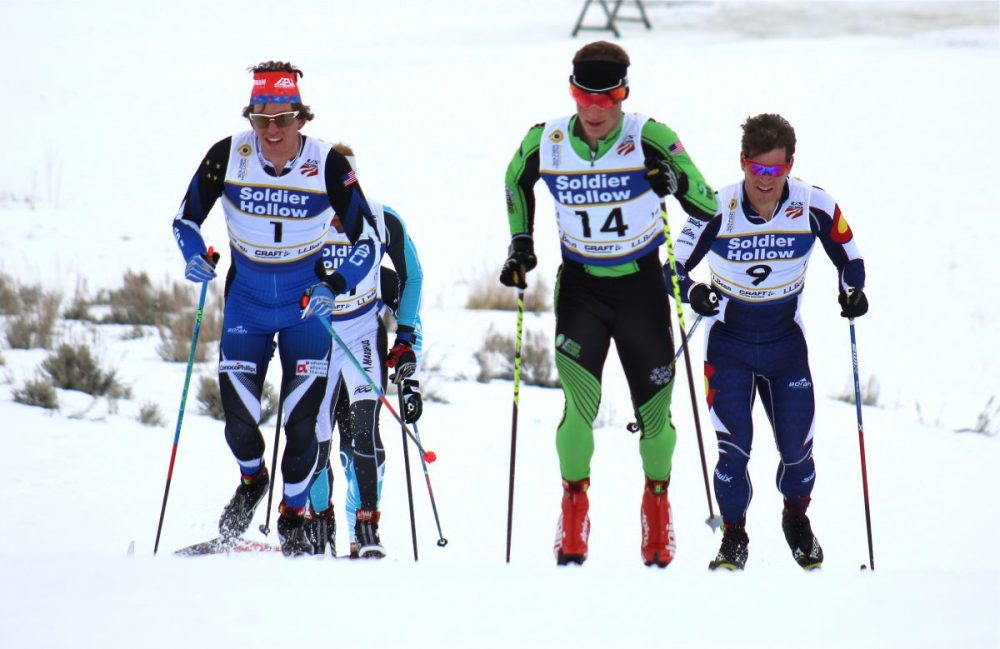
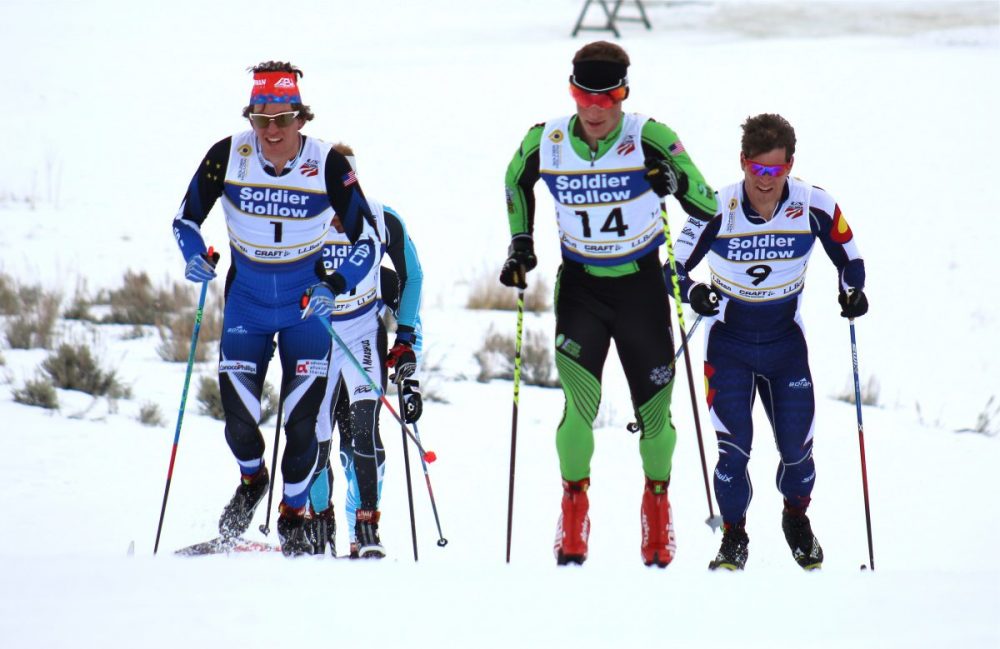
U.S. nordic skiers Scott Patterson (1), Ben Lustgarten (14), Kris Freeman (9), Brian Gregg (behind Patterson) racing head to head in the 30 k classic mass start at 2017 U.S. nationals at Soldier Hollow in Midway, Utah. Lustgarten went on to win for his first national title.
Note: This is part of a series on the 2018 Winter Olympic selection criteria for the U.S. cross-country ski team. Read this parallel article for specifics on the criteria itself.
***
When considering the criteria recently posted by the U.S. Ski Team regarding how cross-country athletes will be selected for the 2018 Olympics in PyeongChang, South Korea, it’s useful to know some context about how selections are made in other sports.
As described in a parallel piece, the criteria have three main components: a World Cup qualification process via top-eight results on one of five different days between November and mid-January, or else a top-50 World Cup ranking; discretion; and standings from the U.S. SuperTour and national championships.
Some aspects of these criteria are consistent with common practices in other disciplines under the umbrella of U.S. Ski & Snowboard and across other winter national governing bodies.
Others are not.
For instance: of all of the U.S. Ski & Snowboard disciplines, the cross-country criteria were the last to be approved. The final signature of approval came on May 30, 2017, and the document was not posted online until June; on the other end of the spectrum, the freestyle skiing criteria got its last signature in June 2016.
Secondly, though criteria for many of the ski and snowboard disciplines include discretionary clauses, few are featured as prominently as the discretionary clause is in cross-country skiing. Few individual winter sports use discretion so prominently, with the exception of figure skating (a judged sport).
But at the same time, the lack of a guaranteed nomination route via domestic racing is not unusual, as several other sports will fill their Olympic rosters based only on international competition results.
So considering different aspects of the criteria, which are in line with national best practices? Which likely came from cross-country team staff? Which are in line with, and perhaps generated from, U.S. Ski & Snowboard’s overall philosophy?
Who knows what, when
Most straightforward issue to address is the timing of Olympic criteria approval. Criteria were released later for cross-country skiing than for any other U.S. Ski & Snowboard discipline; in addition, sports independent of U.S. Ski & Snowboard: biathlon, bobsled, skeleton, luge, short- and long-track speedskating, hockey and curling had already published their criteria.
Figure skating criteria could not be found on the U.S. federation’s website, but the official selection procedure had already been described on the NBC Olympic site.
That means that cross-country skiing was the very last set of 2018 U.S. Winter Olympic team criteria to be published, a deviation from past Games. The 2014 Olympic criteria for cross-country skiing were signed in June 2012, more than a year and a half before those Olympics.
“At best we would like the selection procedures to be made available to the athletes a year before the evaluative events that may be used to select [the Olympic team,” said Rachel Isaacs, a sport performance bid liaison for the U.S. Olympic Committee (USOC) who previously served as the organization’s team leader for sport performance.
With the first World Cup races less than six months away at the time the criteria were posted, that didn’t happen this year.
Isaacs said that the time frame is not a requirement, and that the organization offers flexibility. That means that there are no strict consequences for publishing criteria late.
“We do realize that that can’t always be the case,” she said of the year-in-advance standard. “The informal guideline would be to make sure that the athletes know if a World Cup season is going to be used, certainly prior to the World Cup season starting … But we wouldn’t mandate that the first event of a World Cup season in 2017 — it wouldn’t be a year prior to that. We understand that they are still developing their selection criteria and qualification process.”
In this case, the 2018 Olympic criteria for cross-country skiing are more or less identical to those used for 2017 World Championships, although U.S. Ski Team Head Coach Chris Grover said that there had been discussions about whether to implement any changes.
Isaacs also didn’t see a problem with the fact that the qualification period for the World Cups themselves was long past by the time the criteria were posted.
“I think athletes know that the World Cup season is always part of, and I do want to emphasize a part of, the selection process,” Isaacs said, indicating that athletes should have known that qualifying for the early-season competitions would be important.
As to the question of whether athletes might have planned their previous season differently if they knew the criteria further in advance — or built a multi-year training plan differently, or a single-season training plan that accounted for having to peak multiple times – Isaacs was dismissive.
“Any athlete knows what she or he needs to do to best prepare themselves along with their coaching staff or whatnot,” she said, adding that responsibility for preparing did not rest with national team staff who develop selection criteria.
Discretion in the main criteria
The most controversial part of the criteria is likely to be the placement of discretion before a domestic qualifying mechanism.
(Discretion also comes heavily into play at the World Cup level, discussed later in this piece.)
After World Cup results and standings, the next way to qualify for the Olympics is via discretion: “If team positions remain open after the application of criteria 1 above, the USSA Cross Country Head Coach may use discretion (See Section 2 below) to determine team nominations.”
(Note: USSA refers to the U.S. Ski & Snowboard Association, which until June 19 was the name of what is now simply U.S. Ski & Snowboard, for which there is no official abbreviation.)
The reason for that, according to U.S. Ski & Snowboard Executive Vice President for Athletics Luke Bodensteiner, would be to prevent a situation where the team roster had already been filled via objective criteria and coaches could not nominate a key athlete who had somehow not met the criteria.
“We’ve got some interesting factors in cross-country, like with the team sprint, where arguably a different kind of athlete is best — and there aren’t that many team sprints to evaluate from,” he said in an interview. “The coaches have the ability to pick that roster in ways that don’t pin them down to results that may not be reflective of true performance.”
The criteria specify that athletes may be selected via discretion if they have indicated the potential for Olympic success via results in the 2016/2017 or 2017/2018 season, have a recent positive trend towards success that would suggest strong performances at the Games, or show potential for medals in future Olympics in such a way that participating in this Olympics would be beneficial for development.
But for cross-country skiing, discretion is listed as the second criterion just as it was for the 2014 Olympics and 2015 and 2017 World Championships.
That is a departure from other U.S. Ski & Snowboard disciplines.
In alpine skiing, discretion is only listed as the last possible mechanism in a cascade of criteria – it is only to be used if four previous objective criteria, all based on World Cup results, fail to fill the team.
And in snowboarding and freestyle skiing criteria, discretion is not even listed together with the objective mechanisms and is rather only described in a separate section of the criteria. There, too, discretion is to be used only if the objective criteria fail to fill the team roster.
In nordic combined and jumping, discretion is listed as the second criterion – like cross-country skiing (which lists its two World Cup qualifying mechanisms together under one heading) – but the criteria also state, “There is no requirement that section 1.3.2 [discretion] be used for nominating athletes to the team.” That sentence appears nowhere in the cross-country criteria.
Bodensteiner suggested that the different disciplines could not be directly compared, because alpine skiing, for example, has no Continental Cup-based qualifying mechanism.
“Rather than looking at alpine having discretion as their last piece, I think the primary difference between alpine and cross-country is there’s not that third tier of domestic selection in alpine,” Bodensteiner said. “There’s more of a push to say, if we don’t have athletes that gain selection through the World Cup, then we probably don’t fill our quota.”
Outside of skiing, some sports, like figure skating and hockey, use discretion exclusively with no objective criteria. Bobsled uses discretion widely; while there are objective standards for bobsled pilots, the pushers are assembled into teams based on discretion after having met minimum requirements through a long selection process.
There are yet other sports which use objective criteria for most of the team selection, but deal with the possibility of a key athlete failing to meet the objective criteria for some reason by guaranteeing coaches the ability to use some discretion.
In biathlon (as discussed on this site yesterday), one discretionary selection is hard-coded into the process – for the last athlete for the five-man or five-woman roster, meaning that the first four spots are already automatically filled by athletes best meeting the objective criteria.
For bobsled pilots and for skeleton, too, the criteria state that if the U.S. receives more than one quota spot at the Olympics, the last team selection will be made via discretion. (If the U.S. gets only one sled, it will be selected based on objective criteria.)
Such a system of leaving the last spot to discretion would seem to fulfill Bodensteiner’s idea of picking “an athlete” via discretion in case their suitability for a team event was not captured by individual results, for instance.
Yet there is no cap in the cross-country skiing criteria for how many athletes could be selected via discretion. In the recent past, zero, one or two athletes per Championships have been picked using discretion.
Bodensteiner seemed wary of using discretion in general, saying that “I know from experience that using discretion — particularly in the Olympics — is painful and it’s really not worth the challenges that it can create… unless this is something that really supports a medal objective.”
But he stood behind the prominent inclusion of discretion in the cross-country criteria, even though it seemed anomalous among the other disciplines he oversees.
“We put it in after the World Cup selection just to have that ability to make that assessment there, pick an athlete through discretion if we need to and then use the third criteria to fill up the team if we elect to fill up the team,” Bodensteiner said.
And when pressed on whether that meant that only a small number of athletes would gain Olympic starts via discretion, Bodensteiner demurred.
“We always want to leave the door open because you can never really anticipate everything that happens,” he said.
International vs. domestic results
Another aspect of the criteria sure to raise discussion is that it would be possible to fill the Olympic roster without ever dipping into the field of athletes who compete primarily within North America.
The first two criteria for Olympic qualification come from the World Cup. First priority will be given to athletes who notch top-eight results in the period between Nov. 23, 2017 and Jan. 15, 2018 in classic sprints (in Ruka, Finland; Lillehammer, Norway; and the Tour de Ski stage in Oberstdorf, Germany), the 10/15 k freestyle individual start in Davos, Switzerland, or the 15/30 k skiathlon in Lillehammer.
Second priority goes to athletes ranked in the top 50 of the distance or sprint World Cup standings at the end of this selection period.
Add a discretionary selection or two, and particularly on the women’s side, it’s easy to imagine a team that completely bypasses athletes racing on the SuperTour and at U.S. nationals.
There were just two domestic skiers nominated to the women’s World Championships teams in each of 2015 and 2017 (Caitlin Gregg both years, and Rosie Brennan in 2015 and Chelsea Holmes in 2017; between the three of them are one World Championships medal and two top-20 finishes).
And the whole women’s team to the 2014 Olympics was picked based on World Cup results.
International-based qualification priorities may rankle athletes who have not been offered World Cup starts and whose only opportunity to qualify for the Olympics is through domestic results. But in the wider world of U.S. sports, it isn’t all that unusual.
As noted above, U.S. Ski & Snowboard’s Olympic selection criteria for alpine skiing completely bypass any domestic competitions, relying instead solely on international results.
Ski jumping and nordic combined offer Olympic spots to the winners of Olympic trials (and only the winners, not also runners-up). But that is their first criteria, and all the rest are based on international results at the World Cup or Continental Cup level. Thus, if a World Cup athlete wins trials, the team will end up filled only with athletes competing internationally (barring the use of the discretionary clause). Domestic athletes have no direct opportunity to fill spots at the bottom of the roster.
Outside of skiing, luge also bases all of its selections on the results of international-level competitions. Bobsled makes all of its objective selections based on international results, with the last spot being filled by discretion.
Providing a domestic qualification route is not mandated or even suggested by the U.S. Olympic Committee.
“There is definitely a range [of selection strategies] from the national governing bodies,” said Isaacs. “The sports are the experts. They tell us how they think they will pick the best team and we work with them to ensure a fair process.”
Who gets to the World Cup?
The key to making good team selections based on international results, it seems, is to get all of the best athletes to those international competitions. With World Cup results being the only way for cross-country skiers to absolutely guarantee a trip to the 2018 Olympics, who gets to even go to the World Cup may become critically important.
And while U.S. Ski and Snowboard wishes to generally avoid using discretion to pick an Olympic team, that masks a potentially essential role discretion might play: in determining who races on the World Cup and can shoot for those top-eight finishes or top-50 rankings.
For Period 1, the only athletes guaranteed starts are those with a top-50 overall World Cup ranking from the previous season (Jessie Diggins, Sadie Bjornsen, Liz Stephen, Sophie Caldwell, Kikkan Randall, Ida Sargent, and Simi Hamilton), a top-30 Sprint Cup or Distance Cup ranking (Andy Newell), and the 2016/2017 SuperTour champions (Scott Patterson and Chelsea Holmes).
And the only athletes guaranteed Tour de Ski starts by the U.S. Ski Team are those who are sitting in the top 30 of the World Cup overall or distance rankings at the conclusion of Period 1. The top 20 athletes in the Sprint Cup are also now guaranteed spots by FIS, outside of each country’s specific quota.
That means that in order for any other athlete to qualify via the World Cup mechanism, they would need to be offered World Cup starts via discretion. The World Cup criteria state that “Discretionary selections, if any, may be based on a variety of factors, including competitions conducted outside of the selection period.”
Bodensteiner stated that he supported the cross-country coaching staff in their ability to make discretionary picks at the World Cup level.
“We’re using discretion maybe more on a strategic basis,” he said. “With Tour de Ski, there is sensitivity about team size and just our ability to really service the best athletes in that kind of environment. You also have specific considerations in terms of which actual disciplines and techniques are being competed in those different blocks of World Cup… But I also know [Head Coach Chris Grover] is using some of his ability to select athletes into the World Cup to think forward in terms of preparing an athlete over successive years for international success.”
A top-eight World Cup finish is, obviously, not easy to obtain.
Nor is a top-50 ranking, although last season Caitlin Patterson, racing Period 1 as the SuperTour winner, came close, ranking 54th on the distance list at Christmas. That wasn’t far from unprecedented: in 2011 Holly Brooks, the previous year’s SuperTour champion, was 20th on the distance list at Christmas. That 2011/2012 season, Diggins won the SuperTour. She went home for Christmas in 2012 ranked 40th on the World Cup distance list.
(For men, such successes by SuperTour leaders sent to the first period of World Cup racing have been rare.)
Providing specific athletes with a chance to notch an Olympic-qualifying body of work on the World Cup may or may not go into that decision-making process regarding who gets starts.
But the question of who heads to the World Cup will likely to come into play, especially on the men’s side.
While the World Cup criteria state that “USSA policy mandates that team selection criteria shall be principally objective (or performance-based) and that available start rights and team spots will not necessarily be filled,” only three men have objectively qualified to start World Cups in Period 1.
Grover has already stated that he tentatively plans to send three more men to the World Cup for Period 1 – U.S. Ski Team (USST) members Erik Bjornsen and Paddy Caldwell, along with Noah Hoffman, who was not renominated to the USST this season.
If one of the planned six men does not end up on the World Cup this fall – due to illness, injury, or some other factors – the USST might invite someone else. But even that is not straightforward.
“World Cup Period 1 is a little problematic for athletes,” Grover said in an interview earlier this month. “If making the Olympics, for example, is a primary goal, which it is for most of the top senior athletes, it’s a little problematic for an athlete to decide whether they want to attempt to do that domestically, or on the World Cup. Obviously it’s easier to do that domestically. Not that it’s easy, but that it’s easier, for sure, to qualify at home versus to qualify on the World Cup. So if, for example, one of those six men weren’t able to make it, we might look at inviting another athlete, but I wouldn’t be surprised if we get turned down on that particular offer.”
In terms of who such an offer might go out to, there are no written, clear-cut standards for what an athlete must do to receive one. It’s discretion, or nothing.
“It’s pretty challenging to figure out, after a dryland training season, who is the next best athlete,” Grover said. “Everybody has just been training on their own domestically, in their clubs. And according to everybody, the training is going very well – but it’s quite hard at that point to reach down and say, OK, this is going to be the next best person to bring up.”
In Conclusion
Both U.S. Ski & Snowboard and the USOC document that fairness and openness are important in the selection process.
“One of the keys that we have is that there’s always basically an objective pathway to the Olympics,” Bodensteiner said.
“If it wasn’t fair – if it was picking somebody’s best friend or cousin – we would tell them that these would not be approved and they need to go back and redo the draft,” Isaacs said of the potential situation of a national federation writing criteria which didn’t meet USOC standards.
But fairness and an open path to the Olympics are in the eye of the beholder.
“Sometimes that might be really limited,” Bodensteiner said of the ability to qualify outright for an event. “In cross-country, sometimes it’s pretty limited. But there’s still the objective opening for an athlete to have that pathway.”
On Sunday, the International Ski Federation (FIS) approved its calendar for the 2017/2018 Cross-Country World Cup season at its spring meeting in Portoroz, Slovenia. The season opens with the Ruka triple — three straight days of racing Nov. 24-26 in Kuusamo, Finland — and includes a sprint weekend in Dresden, Germany, classic races in Planica, Slovenia, and skate races in Seefeld, Austria (host of 2019 World Championships), all in Period 2.
Next comes the 2018 Winter Olympics in PyeongChang, South Korea, from Feb. 9-25.
The season wraps up with Period 4 in Finland, Norway and Sweden, with World Cup Finals in Falun, Sweden.
Full calendar below or for original PDF, click here.
South Korea’s Eui Hyun Sin won both biathlon races at 2017 U.S. Paralympics nationals and placed third in the cross-country sprint and short-distance races in Casper, Wyo. (Photo: Pearson Photography)
For a few days at the end of January, a sea of stringed kites fills the skies of many cities in South Korea. The normally crowded streets of downtown Seoul — the country’s capital — empty and become almost devoid of people. Many of the residents are indoors with their families, or en route to the hometowns of relatives, all in order to celebrate Seollal, one of the nation’s greatest Korean holidays.
Generally spanning a period of three to five days, Seollal is observed by many citizens as a time to feast, be with family, and pay tribute to ancestral figures. Shops and businesses close, and work is waitlisted until after the festivities’ culmination.
While many enjoyed the extra days of leisure this year, one South Korean skier was itching to get back to work: Paralympian Eui Hyun Sin.
Born in Gongju, South Korea, Sin became accustomed to the savory meats and spare time that are part of the holiday’s tradition. But now, Seollal — and many of the other Korean holidays he continues to observe — are as much a celebration as they are a symbol of something he must sacrifice: time spent training.
As many of his competitors maintained a fairly consistent training plan in their preparation for this year’s 2017 World Para Nordic Skiing Championships, which took place Feb. 10-19 in Finsterau, Germany, Sin’s schedule forced him to skip a few training sessions. But that did not prevent him from medaling at the championships.
Sin, a 37-year-old sit skier who lost both his legs following a car incident, raced to a bronze in the men’s 12.5-kilometer sitting biathlon race and a silver in the men’s 15 k sitting cross-country race in Finsterau (in the LW12 category). In doing so at his first World Championships, he became the most successful in para-nordic skier in South Korea’s history.
“I was very happy, but I feel regretful at the same time, because I could not train enough because of the Korean holidays,” Sin wrote in an email, according to a team translator. “However, it means so much for me, because it was the first time for the history of Para Nordic ski of Korea.”
Along with becoming the first South Korean to medal at World Championships, Sin also won three International Paralympic Committee (IPC) World Cup races, two in Ukraine and also in the 15 k cross-country race at home in PyeongChang, South Korea, where the 2018 Winter Olympics and Paralympics will be held.
Nordic skiing is not the only realm of athletics in which Sin has made his mark. Prior to joining the Korean para-nordic ski team in 2015, he played internationally for the Korean para ice-hockey team and also competed in wheelchair basketball and para cycling at the national level. His involvement in these sports, as well as encouragement from friends, led him to turn to skiing for the past two years.
“When I was playing Hockey and Cycling constantly, one of my friends suggested me to join the Para nordic ski club,” Sin wrote.
He struggled with the decision as he had a solid job and needed to provide for his family.
“However, I thought that I am not that young and it is very special chance to participate in the Paralympics held in my own country. So, I decided to start the nordic ski,” he wrote.
He made the decision with a home Paralympics weighing heavily on his mind. And as he gears up for PyeongChang next March, he’s one of his nation’s best chances for a medal.
“The 2016/17 was the season which made me confident for the Paralympic medal,” Sin wrote. “Since there will be Paralympic Games in this season, I want to win the gold medal by training hard.”
Much of that training so far has taken place abroad. Following the last races of the season in April in Casper, Wyo., the South Korean para-nordic team planned to continue training in the U.S. until May 30.
Then Sin and the crew will make their way to PyeongChang for the month of June, followed by travel to Finland in July.
“This year, we are training with the new head coach Kaspar Wirz who is from Canada,” Sin wrote. “He has much experience and knowledge to teach, so the training is very fun. I am focusing on the skiing positions and shooting for the biathlon.”
With a full season ahead of him and a full one behind — he finished the 2016/2017 season ranked second in the overall cross-country IPC World Cup rankings — Sin is both excited about the opportunity to represent his country at home and the accomplishments he has already given to Korea.
“The highlights were the moment I won the gold medals in cross country 7.5 K and 15 K in the World Cup held in Ukraine,” Sin wrote. “The win was a big moment for me.”
Former Biathlon Canada High Performance Director Eric de Nys making the team announcements in Valcartier, Quebec. (Photo: Dan Guay)
For the past 13 years, Eric de Nys has been ingrained in the sport of cross-country skiing and its offshoots, including biathlon. He spent 10 years as a coach on Cross Country Canada’s national team, leading the women’s World Cup team in his final two years there.
Based in the same town and out of the same training facilities in Canmore, Alberta, de Nys parted ways with the national team after the 2014 Olympics and founded a bridge development program, the WinSport Junior Cross-Country Ski Team, to prepare junior skiers for senior-level racing.
A year and a half later, in October 2015, de Nys accepted a new job as high-performance director for Biathlon Canada, replacing Chris Lindsay (who currently works as a high-performance advisor for Own the Podium).
De Nys spent two winters with Biathlon Canada, but less than week after the conclusion of the 2016/2017 competition season, that tenure ended. The move from Biathlon Canada to discharge de Nys came less than a year before the 2018 Olympics, but after a season in which the Canadian biathlon team fell short of reaching the podium in a World Cup or World Championships race.
While several younger biathletes had major breakthroughs, including Megan Bankes and Leo Grandbois at Youth/Junior World Championships, and national-team members like Scott Gow, Christian Gow, Emma Lunder, and Julia Ransom recorded career-bests on the IBU World Cup circuit, several veteran members appeared to take a step back. Nathan Smith was out most of the season with a virus, and Rosanna Crawford and Brendan Green struggled to return to their competitive form.
Biathlon Canada General Manager Andy Holmwood told the Rocky Mountain Outlook that the decision was not performance related. He explained that Biathlon Canada expected to have the position filled by May 1. A job posting on its website indicated that applications would be accepted through May 7.
In an email to FasterSkier, Holmwood wrote that the new high-performance director will take over a program with plans leading up to and through the PyeongChang Winter Games. He explained that he hoped to fill the position as soon as is “feasible.”
Other than to “confirm we’ve recently parted ways with Eric de Nys and wish him the best of success in future endeavours, Biathlon Canada has no comment on the situation,” Holmwood wrote.
De Nys declined to comment specifically on the matter as well, telling FasterSkier on the phone that, as far as he knew, the decision was not performance related. He added that he had enjoyed working with both CCC and Biathlon Canada and was remaining positive as he looked ahead.
“One door closes and multiple open,” de Nys said of his plans moving forward. “I just hope the best for the athletes.”
After spending more than a decade of his career in skiing, he suspected he will remain involved in the sport in the future — even as a volunteer — although this year may signal a break.
“I’m not sure at what level yet, but I will be helping out at the club level or something like that,” de Nys said. “Maybe volunteering, but I do think I will step away from sport for at least year, maybe forever. I don’t know.”
Germany’s Maren Hammerschmidt (left) and Canada’s Julia Ransom fist-bump for a job well done halfway through the 4 x 6 k relay at the IBU World Cup in PyeongChang, South Korea, on Sunday. Germany won the race, and Canada ended up eighth.
To nobody’s surprise, Germany came out on top in the women’s World Cup relay in PyeongChang, South Korea, where biathletes are checking out next year’s Olympic venue.
Nadine Horchler, Maren Hammerschmidt, Denise Herrman, and Franziska Hildebrand cruised to 22.8-second win over Norway in the 4 x 6 k event, completing a clean five-for-five sweep of all the relays this season despite resting top star Laura Dahlmeier and relay regular Vanessa Hinz.
Sure, France made a valiant effort to best the Germans, and nearly succeeded, before Celia Aymonier – who had come into the last shooting even with Hildebrand – was stuck with two penalty loops. After that disaster, the French ended up sixth.
But perhaps the biggest surprise was to see Canada constantly in the podium mix through three of four legs of the relay. Canada’s best-ever women’s relay finish, fourth place, came in 2014, and so far this season their results had landed between 10th and 18th place.
The women’s podium of Germany, Norway, and Czech Republic after the IBU World Cup relay in PyeongChang, South Korea. (Photo: IBU/Twitter)
Yet several team members were feeling the best on skis that they had all season, and Rosanna Crawford, Julia Ransom, Megan Tandy, and Emma Lunder combined for just seven spare rounds and no penalty loops, tying them for the best shooting of the day with Sweden.
“It has been a bit disappointing for us this year in relays,” Crawford wrote in an email. “In the first two relays we only used four and three spares total for the team, but we were really missing the ski speed. So it’s nice to have things come around for the final relay.”
Crawford started out by using four spare rounds, more than half the team’s total, and yet found herself constantly at the front of the race. She left the standing stage in tenth, and tagged off even with Anais Chevalier of France in first place.
“Even though I was quite disappointed with my shooting and needing four spares, it felt amazing to be able to ask my body to go faster and for it to respond,” Crawford wrote. “My last loop was really great… I just keep chasing each woman down, until it was just me and France!”
Crawford actually had the fastest ski time of all scramble-leg athletes. With that as a start, Ransom took the tag and cleaned both stages, although she said that doing so was harder than it looked.
“Today I had to work very hard for every standing shot,” she explained in an email. “It definitely wasn’t an easy shooting day for me (regaining my confidence after the relay at World Campionships). However, I was so happy to pull it together and hit them all. It’s a confidence-booster for me for the next two weekends of racing.”
Ransom’s confidence was also boosted by the previous day’s pursuit, where she had clocked the 25th-fastest ski time. For several loops, she skied with Germany’s Hammerschmidt and France’s Anais Bescond.
“Yesterday’s pursuit ski speed proved to me that I can really trust my fitness and perhaps push for faster times,” she wrote. “Skiing today with Anais and Maren felt comfortable! I felt like I belonged there.”
On the final loop of their relay leg, Hammerschmidt put the hammer down and left Bescond and Ransom behind. But Ransom still tagged off in third, 17 seconds behind Hammerschmidt and 2.4 seconds behind Bescond.
Tandy cleaned prone, regaining second place as other teams struggled on the range.
“When I left prone in second position I was pretty excited, but also a little bit surprised and relieved that I was still up there,” she wrote. “I didn’t feel too nervous, I mostly felt determined and excited. I was just reminding myself of my own game plan: how I wanted to ski, what I wanted to focus on during shooting.”
Tandy then used a spare in standing; she tagged off in fourth, 36 seconds behind the leaders. While she had felt good in the pursuit, her legs lost her a few places on the trails in the relay.
“I felt much more tired today than yesterday and it was a very tough fight out there,” she wrote in an email. “My poor legs were just done…I guess three races with a cold that to you! But I was composed on the shooting range, handled the wind well and gave it my best effort. Of course I wish I hadn’t missed my last standing shot, but I can be satisfied with one spare.”
That left it to Lunder to either win or lose sight of a podium position. For Lunder, the newest member of Canada’s World Cup team, it was a new experience.
“I’ve definitely never been tagged in a position like this in a World Cup relay before,” she wrote in an email. “Although it was a bit nerve-wracking to continue seeing Canada in the top three, I decided to just see what I could do today and not worry about any result or placing. I was pretty happy with how I handled things – I was our World Champs anchor as well, so that was a good practice run for today.”
Like Tandy, Lunder had been feeling under the weather, and got sick after World Championships. The top three slipped away, more because of skiing than shooting. Lunder used two spares in prone, but then quickly cleaned standing. She simply couldn’t hold her position on the trails.
“My skiing has felt quite weak this week, but even with slow skiing I’m happy to have brought my shooting up to a higher level,” she wrote. “I definitely felt a bit shaky in prone, but after hitting my two spares I was fairly confident in the rest of the race. I’ve been so happy with my consistent standing this year, and knew if I just focused on my cues it would be a good shooting bout, which it was.”
The team was thrilled to hang on to an eighth-place finish (+ 1:34.0) at the end of the day, even if some members wished they had skied or shot better.
“I am really proud of our women’s team right now,” Crawford wrote. “Julia did an incredible job skiing with Anais [Bescond] and cleaning both stages, Megan was also clutch on the range and holding her own on the skis, and Emma has been so amazing at standing this year that I knew she would be able to keep up in the top eight.”
“The relay was a good indicator of our potential,” Ransom agreed. “We all fought hard and put together a great performance. I was obviously thrilled to be tagged off right at the front! It’s very motivating to be going head to head with the top teams.”
Susan Dunklee collected the fastest ski time of all women on the second leg of the 4 x 6 k relay in PyeongChang. (Photo: US Biathlon Association/NordicFocus.com)
The United States had immediately gotten a tough start, with leadoff racer Clare Egan skiing a penalty loop in standing; she tagged off to Susan Dunklee in 19th place. Dunklee had collected fifth-place finishes in both the sprint and pursuit this week and skied the fastest of all second-leg skiers in the relay, but was still able to make up only 5.5 seconds on Hammerschmidt and move the team to 14th.
Joanne Reid, the third American, also used two spare rounds, moving the team up another three places to 11th. Finally, Maddie Phaneuf used three spares in standing and the Americans finished 14th (+3:08.3).
“Today’s relay was mediocre for me,” Phaneuf wrote in an email. “I felt okay on the skis but still not great. I was really happy with my prone, I took some wind clicks coming in and was pleased that it worked. Our team was the only team that cleaned all of the prone stages from the clip [without spares]! So that was exciting. I was pretty bummed with my standing, missing three from the clip, but was happy with how I handled the pressure to hit them with my spare rounds. I still can’t remember exactly what happened, I do recall it being a bit gustier when I was shooting. I felt like I was making progress on my standing during training and the Sprint race, but today I just wasn’t focused I guess.”
The women were not particularly satisfied with the result, but knew that they could do better.
“There are a lot of fighting hearts on this team,” Reid said in a USBA press release. “We’re not always the team with the best shooting, but I think every one of us has enough love for our teammates that we choose to fight for them, and for our staff that have put so much work into making our race successful… we are aware of every piece we have to work on, and every one of us is dedicated to the process of learning and training and practicing until we can make it to the top. One team, one goal. See you in 2018, PyeongChang, and we’ll be stronger then.”
Susan Dunklee (US Biathlon) racing to fifth in the women’s 10 k pursuit on Saturday at the IBU World Cup in PyeongChang, South Korea. (Photo: USBA/NordicFocus)
In Saturday’s 10-kilometer pursuit in PyeongChang, South Korea, Laura Dahlmeier achieved a level of perfection that made biathlon almost seem unexciting.
The German biathlon star started in bib number one after winning Thursday’s 10 k sprint on the 2018 Olympic course, then shot a perfect 20-for-20 and skied away from the field to a 1:12.6 victory.
As she hit the last target with more than a minute of time in hand over her competitors, Dahlmeier raised her arms in the air and gave a brief celebration for her coaches and the crowd.
“Today I had enough time for that,” she told the IBU in an interview.
“It’s just crazy when you know, ‘Okay, there are only two kilometers left and nothing can go wrong anymore’,” she later told German broadcaster ARD. “It’s cool when you can high-five the others and say thanks to the coaches on the course. You don’t often get that opportunity to enjoy the final loop.”
It was the 13th World Cup win of the season for the German, who is likely (though not guaranteed) to win the Total Score. She is also now within one win of tying the record for most wins in a single season by a woman, set by Magdalena Forsberg of Sweden in 2001 and tied by Tora Berger of Norway in 2013.
“It was incredibly beautiful today,” she told ARD. “This was really the perfect race. It’s crazy, it’s a dream, and this is exactly what I trained for all year. You make so many shots in the summer, and it’s just beautiful when you can draw on that in competition. Gigantic. This was really a huge race.”
While Dahlmeier was relaxing around the last loop, the race for the podium was still playing out behind her.
After slowly climbing her way up from an eight-place starting position, Anais Bescond of France cleaned the last stage and went into second place. A podium finisher on the World Cup in previous seasons, she hadn’t yet had a top finish and had only been offered one start at World Championships.
She was chased by Finland’s Kaisa Makarainen. One of the fastest skiers on the World Cup, it was no surprise that she quickly caught Bescond.
But the French athlete hung on and crossed the finish line just 6.3 seconds behind Makarainen to claim third place.
“It’s my goal during this season to try to catch the podium,” Bescond told the IBU. “I was not able to compete in all the competitions at World Championships, as I was sick, so I am really happy about this third place.”
Germany’s Franziska Hildebrand left the range in fourth place, but was caught by American Susan Dunklee and Norway’s Tiril Eckhoff. Dunklee had been in position to maybe grab a podium, but missed her last shot.
“I missed that last shot; that was a bummer, the last standing,” she said.
But back on the trail, she gapped Hildebrand and Eckhoff going up the course’s major climb, and thought she had fourth place in the bag.
“Honestly, that last hill on the steep section, that’s the best I’ve felt all season, attacking on the last loop,” Dunklee said in a phone interview. “I was able to dig into that sprint or jump-skate mode for that last pitch. That was a good feeling, I’ve missed that.”
Norway’s Tiril Eckhoff leads American Susan Dunklee to the finish of Saturday’s 10 k pursuit at the IBU World Cup in PyeongChang, South Korea. Eckhoff edged Dunklee by 0.5 seconds for fourth place. (Photo: USBA/NordicFocus)
But Eckhoff came roaring back, catching up on the downhill – which led straight into the finishing stretch. Coming out of Dunklee’s draft she had a bit more momentum to the finish line and snagged fourth place, half a second ahead of Dunklee in fifth, exactly where Dunklee had started the day.
“In the sprint… my strategy was to push the downhills all the way into the stadium, and I made up huge amounts of time on people, especially the last loop,” Dunklee said. “So going into today, I expected the downhill to be my strength. Today it wasn’t there in the downhill, which surprised me. I pushed,and pushed, and Tiril caught up. When she caught me on that last straightaway, she had a little more speed, coming out of the draft, and there was nothing I could do at that point.”
With three misses, Dunklee was pleased that she could appear in her second flower ceremony of the weekend – and keep a string of good results going. She was sixth and second in the final individual races of World Championships in Hochfilzen, Austria, two weeks ago, and now was fifth twice in PyeongChang on the future Olympic course.
“It wasn’t a bad performance, but it didn’t feel like a good performance, either,” she said. “I’ve got to be really happy to get a top five with three misses. I’ll take that.”
Crawford 18th in Last Individual Race of Season
Coming off of a disappointing World Championships, Rosanna Crawford had almost called it a season.
“I had some long talks with my coach about continuing on the season,” Crawford admitted. “I really wanted to go home right away, but we decided it would be good to see the Olympic venue and that we needed a fourth women to take part in the relay. So I was feeling really drained and frustrated by the end of World Championships. But a bit of time away from the team, where I got to enjoy just skiing and seeing a new part of world, really helped bring my mood around.”
She and partner Brendan Green actually went to France to visit Bescond – and like Bescond, came to PyeongChang and turned in their best results of the season.
Crawford finished 30th in the sprint and then had strong standing shooting in the pursuit to move up even more. After a miss in each prone, she cleaned both standing stages to climb to 24th and then the top 20.
“These past two races I have felt the best I have all season,” Crawford wrote in an email.
She left the shooting range in 19th, and was engulfed in a back-and-forth with several women who passed her and who she passed on the final loop. In the end, she did finish 19th (+2:49.1).
“I was quickly caught by four women at the base of the climb,” Crawford wrote. “I knew that if I made it to the top with them that I could most likely beat them. Justine Braisaz [of France] started going hard halfway up the hill and I had to take the long way around a Ukrainian girl, but at the top I just tucked in behind her and started my ‘sprint.’ On the last downhill before the finish [Russia’s Irina] Starykh passed me and I tucked in behind her and we had a fun sprint to the finish!”
Despite the improved results – Crawford explained that she thought time she had taken off from competition in the beginning of the season was finally beginning to give her some benefit – she is still planning to return to Canada after the weekend rather than finishing off the World Cup season in Finland and Norway.
“Time to go home, rest and recover and get ready to start again for next year,” she wrote.
All four Canadian women had made the pursuit, and Megan Tandy was the next across the line in 30th (+3:26.2); she had moved up from 39th with two penalties.
Julia Ransom finished 44th (+4:18.4) with four missed shots and Emma Lunder 49th (+4:49.6) with two missed shots.
Egan Flirts With Top 20, Finishes 36th
For the U.S., halfway through the race it was looking like Dunklee could have company near the top of the results sheet. With two clean prone stages, Clare Egan had moved from 33rd up to 16th.
Clare Egan (US Biathlon) racing to 36th in the women’s 10 k pursuit on Saturday at the IBU World Cup in PyeongChang, South Korea. (Photo: USBA/NordicFocus)
But in her first standing bout, she missed three shots.
“I have some work to do on staying calm and focused on the shooting process, rather than the potential outcome when the race is going well for me,” Egan wrote in an email. “That distraction certainly played a role in my misses today, as I was in sight of the top 10 when I came into shooting three.”
Her penalty loops dropped her back to the 40’s, but Egan bounced back to clean the final standing stage and ended up 36th (+3:41.9).
“I am happy with my shooting, especially my clean last stage,” she wrote. “Going 0-0-3-0 is more frustrating than some other arrangements of three misses, but when it comes down to it, I shot 85% and I’m satisfied.”
That rebound came partly thanks to a 30th-ranked ski time (tied with Canada’s Tandy).
“I have to say that I’m surprised by my ski time, because I have a cold,” Egan wrote. “Both physically and mentally I’m relying on autopilot right now, and I’m thankful that my body is handling it so well. Our skis were great again, everyone is suffering from the same jet lag and race schedule, and I’m clearly in good shape even if I don’t feel good. I’ll be looking to get healthy and fully refocused for our last two World Cups.”
Joanne Reid finished 52nd (+4:53.4) with five penalties.
Lowell Bailey (US Biathlon) racing to ninth in the men’s 12.5 k pursuit at the IBU World Cup in PyeongChang, South Korea. (Photo: USBA/NordicFocus)
For a few kilometers, it looked like Julian Eberhard – the winner of Friday’s sprint – had things in hand in the 12.5 k World Cup pursuit in PyeongChang, South Korea.
The Austrian cleaned his first prone stage and didn’t bleed too much time on the trails to Martin Fourcade, the French superstar who was chasing him down.
But then he missed two shots in the second stage – and Fourcade sailed past him, off into the history books.
Fourcade went 20-for-20 on the shooting range and racked up a 34.5-second win, his 12th for the season, matching a record set by Norway’s Ole Einar Bjørndalen in 2005. And there are still two more weekends of World Cup racing after PyeongChang.
“I am part of this generation who grew up watching Bjørndalen on television,” Fourcade said to the IBU after the race. “He is just so inspiring. I came to the stadium very tired, I want to thank him for being as inspiring as he was as I was growing up.”
Eberhard wasn’t totally out of it though; he cleaned both of his standing stages, climbing back up into podium position. With one stage to go, he was skiing comfortably with Austrian teammates Simon Eder and Dominik Landertinger, in second, third, and fourth place.
Eder and Landertinger missed twice on the final stage; Eberhard only missed once. Again, he had to watch someone else pass him while he was stuck skiing his penalty.
The men’s 12.5 k pursuit podium on Saturday at the IBU World Cup in PyeongChang, South Korea, with France’s Martin Fourcade (c) in first, Russia’s Anton Shipulin (l) in second and Austria’s Julian Eberhard (r) in third. (Photo: IBU)
This time it was Russia’s Anton Shipulin, who had started the day 23rd, shot perfectly, and improbably made his way all the way up to second place. It was an impressive demonstration that nobody can be counted out in a biathlon race, even when handicapped by a disappointing result the day before.
“Today, the shooting did the trick,” Shipulin said through a translator at the press conference. “I cannot remember last time I shot clean in a competition with four shooting stages. I think our service men did a great job: the skis were going very fast, and I felt like I was in a good shape. I just wish I had the same mood yesterday.”
And reinforcing the possibility of a comeback was Eberhard. He had never before had a podium in a head-to-head race, only in individual-start sprints, and the two misses in prone easily could have started a collapse.
But he had kept himself to 85% shooting, and nobody could catch the Austrian on the last loop. He held onto third place (+36.7) and for the first time in his career, Eberhard took two podiums in one weekend.
“This was a really wicked race,” Eberhard told Austria’s ORF broadcaster. “One of the coolest I have ever raced. I gave everything in the end, but I wasn’t really hopeful to catch Anton again, he is just too strong on the final loop for that.”
Another Top 10 for Bailey
Lowell Bailey (US Biathlon) leading France’s Martin Fourcade in the men’s 12.5 k pursuit on Saturday at the IBU World Cup in PyeongChang, South Korea. Fourcade went on to win after starting third, and Bailey placed ninth after starting second. (Photo: USBA/NordicFocus)
After finishing second in the sprint, Lowell Bailey of the United States had a top start position in the pursuit. He was quickly caught by Fourcade – who started third – on his first loop.
“I had a feeling that Fourcade would catch me right off the bat, so I was happy to stay with him, and ski with him the first lap,” Bailey said in a phone interview from PyeongChang.
The sprint had been Bailey’s fourth individual race in a row with perfect shooting, but he couldn’t keep it going. Already in the first prone stage he split a bullet, and then had two misses later in the race.
“I was a little bit shaky, I think, in shooting today,” he said. “It’s been a long season, and some days you wake up without the mental focus you have some other days. Today it was a lot of effort to get my zero dialed in and get ready for the race. Knowing that, I’m actually pretty happy with how the shooting went.”
Despite the misses, he left the final stage in seventh place. The American was caught by Germany’s Benedikt Doll – the World Champion in the sprint – and Landertinger, who had rocketed out of the penalty loop.
“I was happy with the way I skied the last loop,” Bailey said. “I knew that [Doll] was in the big group behind me, and he and [Landertinger] were coming. They are two of the fastest skiers in the world. So I was happy to be able to hang on to them until the finish.”
Bailey tried to position himself to come off the final corner and lead to the finish line, but it was challenging given the course setup.
“It’s whoever gets to the top of the hill first,” Bailey said. “Because I was in a group, I was just trying to catch Landertinger and Doll, so that last 200 meter stretch before the uphill I went as hard as I could. I did catch them and I tried to go around them on the outside on the big sweeping penultimate curve. It narrows down to about 2 meters after that… there’s a bottleneck. I about came even with Landertinger but we both were kind of stepping on each others skis. He got out in front, and I had to get in the draft, and wait for the sprint.”
By that point, Italy’s Lukas Hofer and France’s Jean Guillaume Beatrix had also caught onto the group. Moving at a high speed, they all shot into the finishing lanes together. Landertinger made it to the finish first, with Bailey taking second place in the group and ninth overall (+1:20.6).
“That was one of the craziest group sprints you could be in,” Bailey marveled. “You were going so fast you didn’t know whether you should stay in your skate tuck, or start V2ing. It was kind of just ride it out to the finish. Definitely, that last climb is where the race is won or lost for many races at the Olympics.”
Bailey’s teammate Leif Nordgren finished 28th, +2:28.9 with a single missed shot – the last one.
“Of course I’m a little ticked at missing the last shot, I’ve been doing that a lot lately, so that needs to change,” Nordgren wrote in an email. “[But] it was a good race for me today, finally I put everything together for a pursuit race. It’s a lot of fun to be in the mix like that, and to take advantage of the opportunity to move ahead in places is good. I had a big group of guys right ahead of me today which leaves kind of a bitter feeling to the finish.”
For Canada, Christian Gow led the way in 32nd (+3:17.4) after starting almost last – 56th – but cleaning all 20 of his shots.
“I am super happy with the race and pumped to have, finally, achieved the elusive 20/20,” Gow wrote in an email. “The conditions on the range tonight were perfect, completely calm in the whole range. I wouldn’t say that I necessarily put any extra focus on shooting today. I had a good feeling in zero before the race and I hoped that I could make a clean shooting happen. I tried to do things normally and not get worried about the possibility of hitting them all.”
He was followed by his brother Scott Gow in 43rd (+4:05.9) with five penalties, and Brendan Green in 44th (+4:09.8) with three missed shots.
“We are 7 hours behind you in Pacific time (and a day ahead),” U.S. Ski Team Head Coach Chris Grover wrote in an email from South Korea on Monday. But as his email hints, tracking time and day when criss-crossing time zones and arranging a phone call can be befuddling. So another way of stating what Grover wrote is that KST, or Korea Standard Time, is 17 hours ahead of the time at this reporter’s location in Bend, Ore.
The call went down on Monday at 5 p.m. Pacific Standard Time. Just so we’re all straight, that was Tuesday, 10 a.m. KST.
With all that travel, staying rested, staying fast and staying healthy are primary concerns for athletes and coaches traveling on the usually Eurocentric World Cup.
“When you look at the U.S. team it is primarily a European-based team,” Grover said on the phone. Many U.S. athletes have been in Central Europe since mid-November. Maybe there’s a +1 hour difference from Central European Time (CET) when a race is hosted in, say, Finland. Most athletes haven’t had to deal with constant time-change jolts.
As a pre-Olympic World Cup (the 2018 Winter Games will be held in PyeongChang, South Korea), organizers wanted athletes and team support to have an easy transition upon arrival. The races — a classic sprint on Friday, skiathlon on Saturday and freestyle team sprint on Sunday — are being held in the late afternoon or evening; at times compatible with Europe’s television market.
Although the Korean times are atypical for Euro-based World Cups, they do correspond to the “physiological” times dictating when skiers are primed for racing. A 6 p.m. KST race is the equivalent of a 10 a.m. race in France.
“It actually plays well for athletes coming from Europe because they can acclimate less because they can sleep in,” Grover said of how the time-zone change shouldn’t be a dramatic shift for the U.S. team. “They can sleep in for quite a while, get up late, have a late lunch, race, and then have a late dinner and shift their whole normal schedule further back in the day. So I’d say the primary strategy we are employing, but not every athlete can do it, or do it super effectively, but we are trying basically to keep these guys on a European time zone as much as possible while they are over here.”
Yet remaining healthy while traveling and living abroad has been a puzzle for many skiers. On the flight over and while staying in hotels, Grover preaches good hygiene: wash hands and use hand sanitizer when hand washing isn’t convenient. The U.S. also asks that hosting hotels take precautions like disinfecting rooms prior to team’s arrival to help minimize germ exposure. In addition to these precautions, Grover had athletes consult face to face with a U.S. Ski Team (USST) nutritionist when the athletes were in Ulricehamn, Sweden, in mid-February. It was another aspect of monitoring athlete health.
“[The nutritionist was] making sure everybody was doing OK nutritionally, making sure they are doing OK with their body composition,” Grover said. “It is one thing to monitor those things in the U.S. when everybody is in the training mode, it is another things when you move to Europe and all of sudden you are on a different diet pretty much every week and you are competing full time. … So everybody had a good check in there. If people needed a supplement of vitamin D or iron, or what have you, or to improve part of their nutritional program, then we addressed that a couple weeks ago. That’s one way that we are trying to stay healthy.”
Another aspect of the quick-turnaround PyeongChang trip is transporting gear and making good and efficient use of the USST ski techs’ time while on the ground at the future Olympic venue.
“We brought all of our own equipment; we had nothing here,” Grover explained. “This is the first time we have been here during the winter. That was of course one of the challenges is the logistics and the expense of moving all of our necessary gear over here. And all teams are obviously in that same boat.”
The three U.S. coaches (Grover, Matt Whitcomb and Jason Cork) and four techs that made the trip to PyeongChang are there first to prepare athletes and skis for the three-race stop. But it’s also double duty in terms of Olympic prep. The USST staff will remain an extra day, the athletes depart for Europe next Monday, to further advance their venue-specific data set. Grover said this trip will remain the only USST testing trip prior to the 2018 Games.
“We have definitely taken lessons that we have learned from Vancouver [and] from Sochi,” Grover said of the team’s de-emphasis on longer term, on-site testing. “You can definitely over test a bit in a place and kind of get heading in wrong directions that are not so applicable a year later when you have a different composition on the track between, say, manmade and natural snow, for example. … So the testing that we really want to do is important, but it is more on the fundamentals of structure of grinds, of base layers, that sort of thing.”
The U.S. brought six current USST athletes to South Korea: Sophie Caldwell, Ida Sargent, Liz Stephen, Andy Newell, Simi Hamilton, and Noah Hoffman. Grover stated the remaining national-team members opted for a different schedule and did not make the trip.
Matt Gelso and Liz Guiney earned start rights as Period 1 SuperTour leaders. According to Grover, the U.S. team invited two additional athletes as well, Caitlin Patterson (Craftsbury Green Racing Project) and her brother Scott Patterson (Alaska Pacific University).
Neither of the Patterson siblings were selected for the upcoming World Championships in Lahti, Finland. Yet Grover stated he believed both deserved PyeongChang starts — specifically in the skiathlon.
“They both had been sick immediately prior to the nationals and then actually the first part of the nationals as well. Especially in Scott’s particular case,” Grover explained. “But both had been skiing well not only in the early season this year, but also in the late season last year. Caitlin was taking World Cup points distance at the end of last year and at the beginning of this year in Kuusamo as well.”
In Scott’s case, Grover mentioned he remained one of the top U.S. distance skiers behind USST members Erik Bjornsen and Hoffman.
“The next guy that was getting close to perhaps breaking through to the top 30,” Grover said. “We wanted to find an opportunity to give them a distance start and to see what they could do.”
The Canadians have also arrived in Asia. Coach Charles Castonguay, of the Pierre-Harvey National Training Centre, will be leading the team in South Korea, assisted by five Canadian team World Cup techs and Tom Holland, Cross Country Canada’s high-performance director.
Representing Canada in the women’s races will be Annika Hicks (Alberta World Cup Academy) and Sadie White (NTDC Thunder Bay).
On the men’s side, national-team members Len Valjas and Jess Cockney, Para-Nordic Ski Team member Brian McKeever, Bob Thompson (NTDC Thunder Bay), Julian Locke (Alberta World Cup Academy/National U25 Team), and Simon Lapointe (CNEPH) were slated to start Friday’s sprint in South Korea.
In an email, Castonguay explained that team selection was premised on two criteria: 1. World Cup results (such as a top 30, which Len Valjas achieved), and 2. Classic sprint results and distance results from U.S. nationals last month (excluding athletes who were selected for Junior and U23 World Championships).
“Some athletes, who were also selected for senior [World Championships] in Lahti declined PyeongChang, like Knute [Johnsgaard], to get a better preparation for Lahti,” Castonguay wrote. “So we went down the rank list to select people for Korea.”
Racing begins on Friday with the men’s and women’s classic sprints.