From the FasterSkier archive — posts syndicated from athletes’ and coaches’ own blogs between 2004 and 2012, kept online as published. Current coverage is at fasterskier.com.
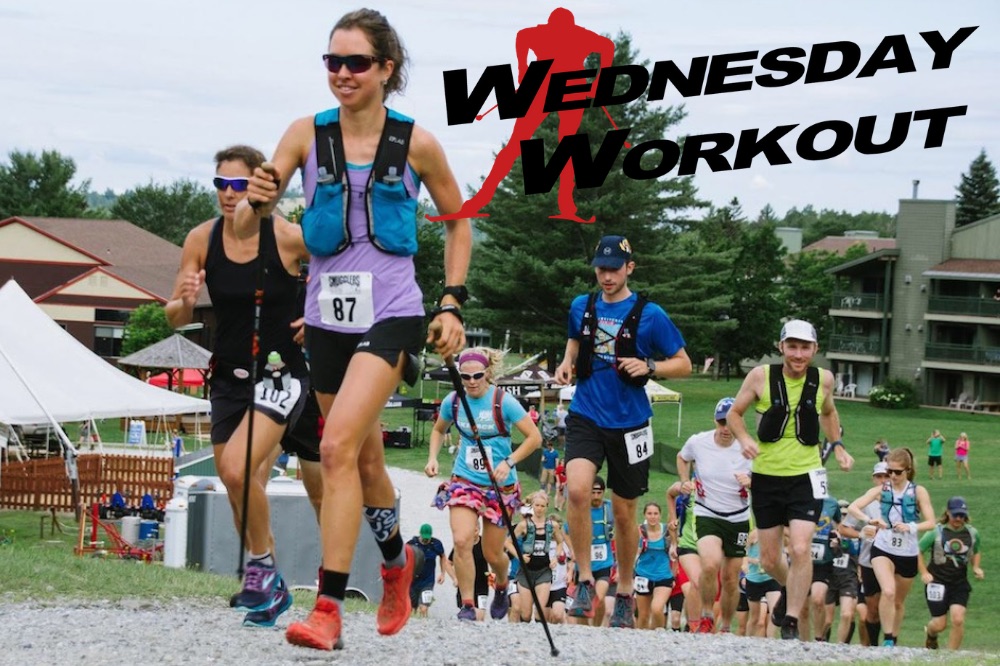
Caitlin Patterson (front) racing the 25 k Smugglers’ Mountain Race in Jeffersonville, Vermont, in August. (Photo: Pennie Rand)
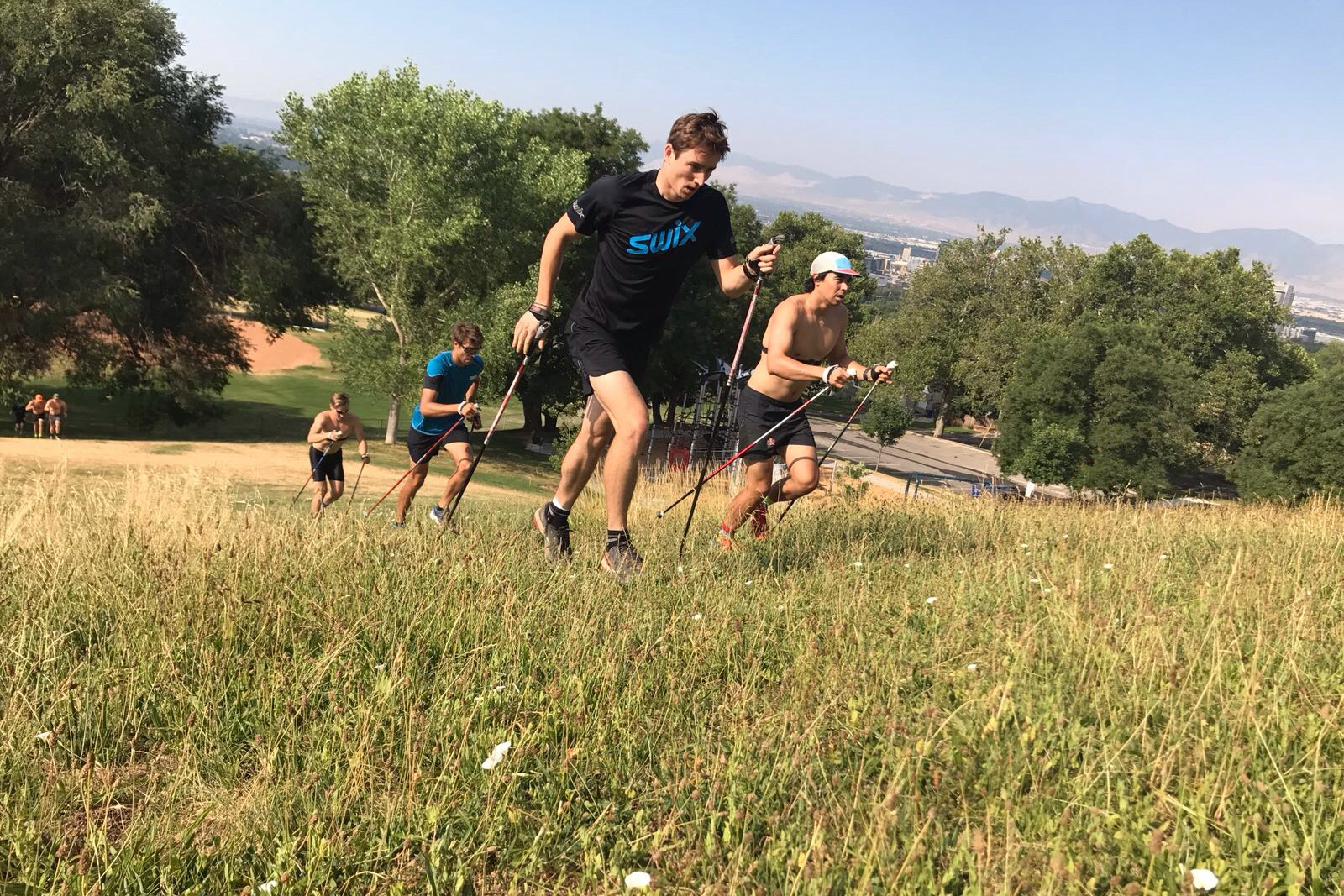
This week’s workout comes from Caitlin Patterson, a Craftsbury Green Racing Project (CGRP) skier and 2018 Winter Olympian. We asked the 28-year-old Patterson, an accomplished mountain runner as well, about training and racing with poles while hiking or running. When and what type of terrain does she typically use them for, and what kind of workout would she recommend with poles?
***
It may come as no surprise that many of Caitlin Patterson’s dryland workouts incorporate poles. Even with a nomination to the 2017 USA Track and Field Mountain Running World Championships Team, Patterson’s mentality remains, “I am skier and I train to be a skier.”
With skiing as her primary sport (she competed at the 2018 Winter Olympics in South Korea), Patterson has also found herself as a top contender in domestic mountain running races.
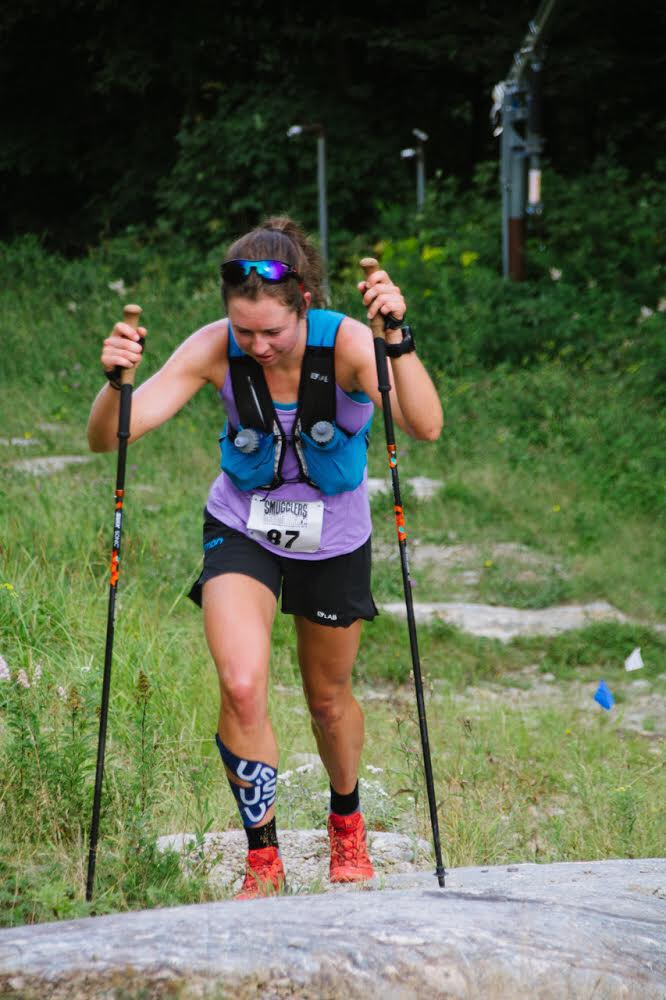
Caitlin Patterson racing the 25 k Smugglers’ Mountain Race in Vermont in August. (Photo: Pennie Rand)
This summer, she raced in California’s 2018 Broken Arrow Skyrace series. In the Vertical Kilometer (VK) 5-kilometer race, with 3,100 feet of elevation gain, Patterson placed third among women, behind 2010 Olympic skier Morgan Arritola in first and professional ultra runner Hillary Allen in second. Patterson also raced the Broken Arrow 26 k and finished second to Daniella Moreno, of the U.S. Distance Mountain Running Team.
Born in McCall, Idaho, and later raised in Anchorage, Alaska, Patterson acknowledges that much of her success in both mountain running and skiing stems from knowing when and how to put her poles to good use. (In both Broken Arrow Skyraces, she was permitted and opted to use poles.)
When to put poles to use?
The straightforward answer to this question is on the ups. During distance workouts, Patterson rarely takes the time to pole plant while descending downhill. Her reason is that doing so may actually inhibit her turnover, slowing the pace and her momentum.
“I find that when you try to pole on a downhill, you often brake or brace more,” she explained. “So I put them away or hold them in my hands on a downhill.”
Once she reaches a climb, regardless of grade, she puts her poles and arms to work.
“From the most gradual uphill to the steeper uphill for a distance workout, I’ll use them,” she said.
When it comes to intervals on foot, Patterson almost always usespoles. Much of this is due to the training philosophy of her coach at Craftsbury, Pepa Miloucheva.
“In all my years here on the team, I haven’t ever done just pure running intervals,” said Patterson, now in her sixth year with CGRP. “That’s sort of more related to Pepa. She just doesn’t really care for them. She really cares more for running with poles or rollerski intervals.”
Beyond the type of workout (distance or interval), Patterson also looks at the workout’s expected elevation gain and terrain when she decides whether or not to use poles.
A workout with “sustained climbs”, such as a long run to the top of a mountain peak, warrants using poles for Patterson. She added that it “also depends on the footing or the microscale of the terrain/type of trail that you’re on.”
Trails with large, chunky rocks may not be conducive to proper pole planting. The same goes for terrain with surfaces that make poling more work and climbing less efficient. Patterson explained that her younger brother, Scott Patterson, a member of the U.S. Ski Team, has yet to use poles in a mountain running race.
“I was trying really hard to convince Scott to use [poles] for the Rut, a [mountain running] race in Montana,” she said. “He decided not to use them because, with that race, it is so rocky up high. You can’t plant poles on pure slabs of rock.”
So what’s the most optimal poling workout? Long-distance or interval? Technique-oriented or threshold?
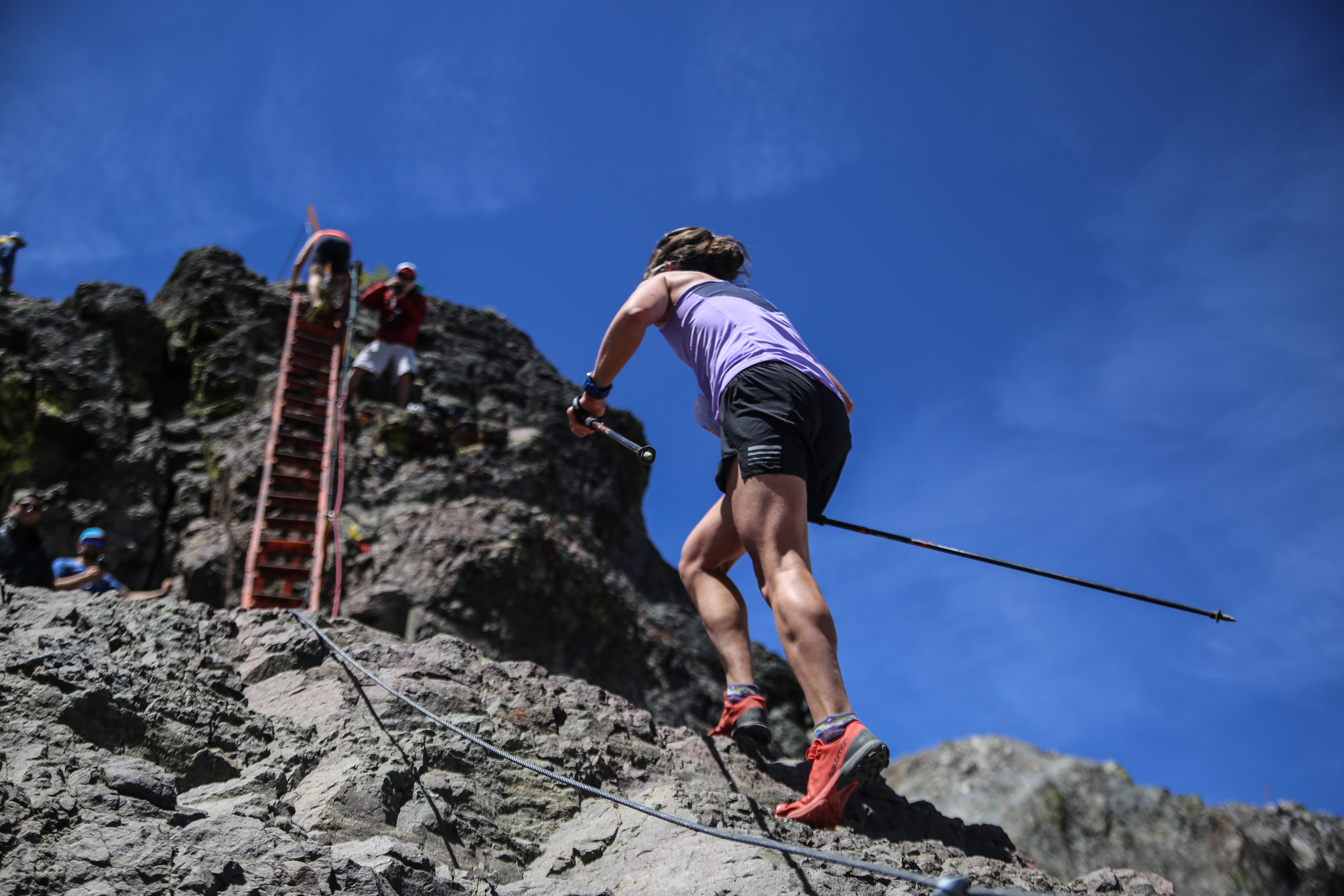
Caitlin Patterson racing at the Broken Arrow Skyrace in California. (Photo: Martina Valmassoi/Salomon)
Incorporating poles into workouts can come in a multitude of varieties, but Patterson’s favorite comes in the form of racing.
“What I would recommend is to go find a local mountain race, double check that you can use poles for it, and race,” she said.
She recommended a race distance between 10 to 25 k with plenty of elevation gain.
One of the biggest reasons she favors poles in mountain running races is for experimental purposes. Races offer the opportunity to test how using poles might give an advantage over not using poles.
“In these races I’ve done in the past few years, when I was able to use my poles, particularly as a woman racing with the men, I’ll be like, ‘OK, I’m running along on the flats and darn that guy is running faster than me, so I pick up my poles and I just run along and then I’m keeping up,” Patterson explained. “Then I get to a steep spot and I’m like, ‘Huh, I think I’ll start using my poles now,’ and once I use them, I pass the guy next to me or something.’”
Mountain running races don’t always find Patterson with poles in hand. Using poles on gradual terrain may end up slowing down one’s tempo, she explained, causing the racing to slow down.
“I’ve found that poles are most useful when you can use them on really steep stuff to save your legs,” she said.
“No matter what you’re doing with the poles, keep your core strong and your arms strong,” Patterson said of her number-one recommendation for skiers looking to do the workout.
“I’m thinking more about more overall body efficiency than skiing technique,” she continued. “No matter what technique you do you should always keep your core strong and keep your arms strong and going parallel with your motion.”
Caitlin Patterson (front) leads CGRP teammates Kaitlynn Miller and Akeo Maifeld-Carrucci while running with poles in Craftsbury, Vt. (Courtesy photo)
The Workout:
Type: Mountain Running Race with Poles
Terrain: Preferably mountain slope with continuous uphill or mountain running race course
Warm up: Easy 20-minute jog with two to three leg speeds
Race: 10-26 k threshold effort
Pole during the climbs and focus on keeping core tight
American Bryan Fletcher after jumping to 18th on the 109-meter normal hill at the 2018 Olympics in PyeongChang, South Korea. He went on to finish 17th in the 10 k later in the day. (Photo: FlyingPointRoad)
At age 31, Bryan Fletcher estimates he’s dedicated 25 years to the sport of nordic combined. He has been a U.S. national team member for the past 11 years and maintains that first time he flew off a jump on skis occurred at the ripe age of 4. Before that, and before his first steps, Fletcher’s exposure to skiing came from the viewpoint of a child carrier on his father’s back.
For the first time since his initial national-team naming in 2006, Fletcher’s full-time work will no longer revolve around nordic combined. As of this spring, the U.S. Nordic Combined veteran has retired from World Cup competition, as have a few other internationally notable nordic-combined skiers.
For any athlete who has devoted as much time as Fletcher, retirement rarely means complete severance from the sport. From the onset of his career, nordic combined (NoCo) served as more than just an athletic pursuit for Fletcher. It was also in a way, a lifeline.
***
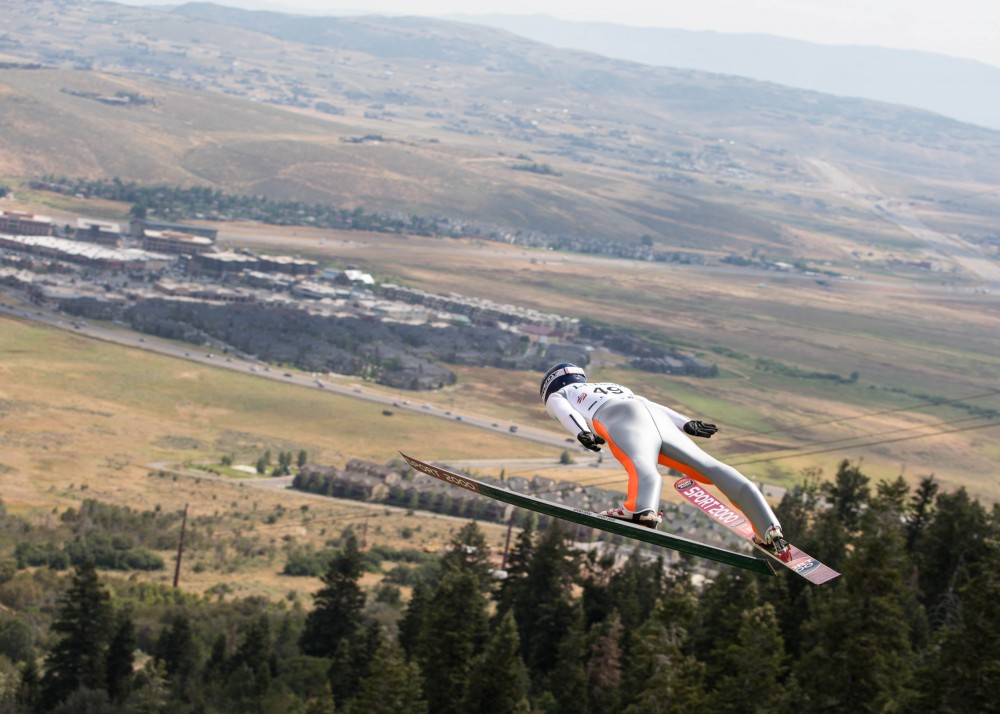
Bryan Fletcher (U.S. Nordic Combined) at the 2016 U.S. Ski Jumping and Nordic Combined Large Hill Championships in Park City, Utah. (Photo: USSA/Tyler Tate/T Squared Action Sports)
When he was 6 years old, Fletcher made a special request to his parents. At the time, he was a self-proscribed “adrenaline-junkie kid” living in Steamboat Springs, Colorado — a well-known ski town that is also home to the country’s historical ski jumping venue, Howelsen Hill. Fletcher had heard that his hometown was hosting a “learn-to-ski-jump day” for kids his age.
Naturally, he wanted to attend.
But even if Fletcher’s 6-year-old self self showed a fearless gall and a desire to jump, his parents had other reasons to feel nervous about signing him up. His health. Three years earlier, he had been diagnosed with acute lymphoblastic leukemia (ALL)-
A type of cancer in which the body’s bone marrow overproduces lymphocytes (a type of white blood cell), ALL’s symptoms can range from pain in the bones and joints to fatigue and fever. To treat his condition, Fletcher completed regular chemotherapy sessions three hours away in Denver, Colorado. Some sessions left him without hair.
“I think it’s very easy for young kids, especially going through cancer, to be pretty down in the dumps and not really get to feel like they’re a normal kid,” Fletcher told FasterSkier on the phone earlier this month. “I don’t know how or why, but I guess I begged my parents enough to sign me up for that learn-to-ski-jump day.”
With some persuasion, he convinced his parents to let him partake in the event. Instantly, Fletcher was hooked, prompting him to join Steamboat’s youth ski-jumping program. Eventually, he found his way to the cross-country trails and began participating in the youth NoCo program at the Steamboat Springs Winter Sports Club.
“I think they saw the smile on my face and were like, ‘Holy cow, how are we going to tell him that he can’t do this?’ ” Fletcher recalled of the first time he tried ski jumping.
NoCo became what Fletcher referred to as the “perfect distraction” from his chemotherapy sessions and childhood cancer. In Denver, he adhered to everything his doctors recommended, especially if it meant getting back to Steamboat, skiing and jumping sooner.
“I think it was, in hindsight, a great motivator for me,” Fletcher said of his early days in the sport.
***
U.S. Nordic Combined’s 2011/2012 team members (from left to right) Bill Demong, Bryan Fletcher and Taylor Fletcher with head coach Dave Jarrett at Soldier Hollow in Midway, Utah. (Photo: USSA)
From then on, Nordic Combined became inextricably intertwined with his life, both on the hill and at home. His younger brother, Taylor Fletcher, who was four years younger, also picked up NoCo, and the two shared practices and passion for the sport.
“Both he and I are fighters, but … he’s always had to work for it a little bit harder than I did,” Taylor said on the phone this month. “That’s what drove him to become as good as he was.”
When Bryan was a freshman at the Winter Sports School in Park City, Utah, he was selected to be a forejumper for the 2002 Winter Olympics.
“This honor further solidified my goals and ambitions to become a world-class athlete,” Bryan wrote on his website.
Just two years after his high-school graduation, Bryan earned a spot on the U.S. Ski Team. He was 20 years old. One year later, he qualified for his first World Championships in Sapporo, Japan, racing to 40th in the sprint.
Six months after his 22nd birthday, Bryan claimed his first Continental Cup podium: third place in an individual large hill/10-kilometer Gundersen at Soldier Hollow near Park City. He competed at his second World Championships in 2009, walking away with two individual top-30 performances (30th in the large hill/10 k and 22nd in the normal hill/10 k).
By the third competition weekend of the 2010/2011 World Cup season, Bryan had achieved his first individual top 10, placing eighth in the normal hill/10 k in Ramsau, Austria.
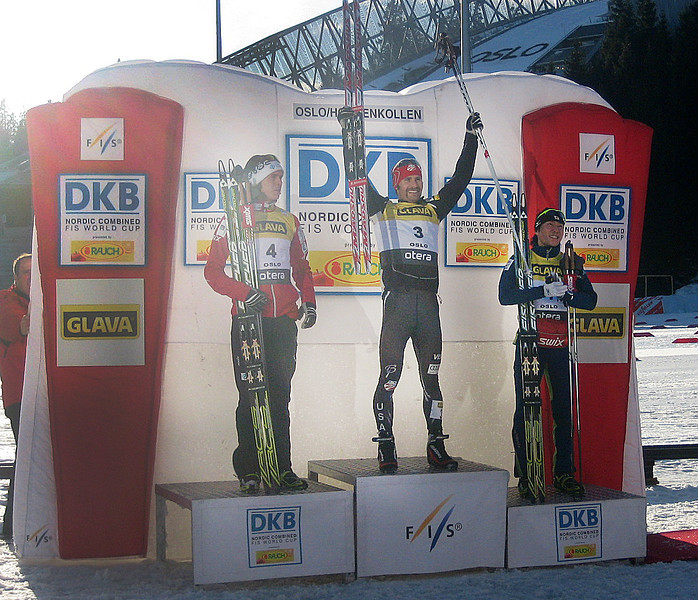
Bryan Fletcher on the top of the podium in at the 2012 Nordic Combined World Cup in Oslo, Norway. (Photo: Margo Christiansen/USSA)
But it was the following season, in 2011/2012, that Fletcher really found his form. At the 2012 Holmenkollen World Cup in Oslo, Norway, he became the fifth American to win a Nordic Combined World Cup with a victory in the large hill/10 k. In that season alone, he also finished in the top 10 seven other times.
“That was kind of a pivotal point,” Fletcher said of his Holmenkollen win. “It was a reinforcing result. … I was like, ‘OK, I do belong here at the top of a World Cup and I have a future in the sport … all the sacrifices and work you’ve put into it are worth it.”
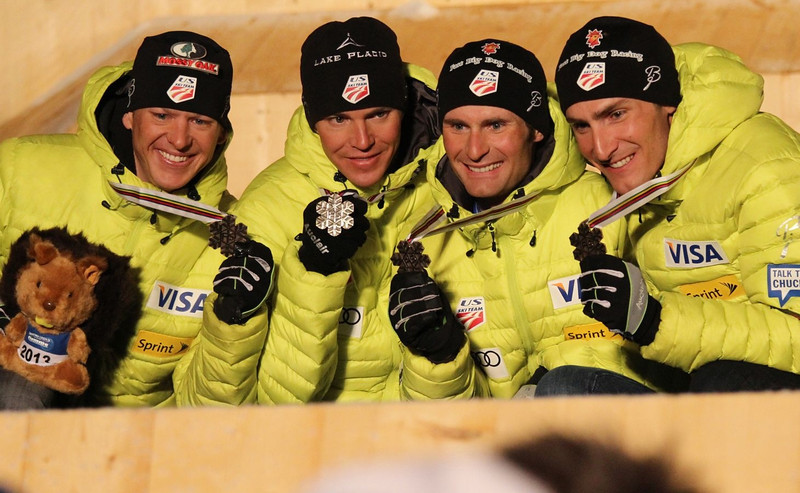
Bryan once again made the team for 2013 World Championships in Val di Fiemme, Italy, where he and his teammates Billy Demong, Todd Lodwick and his brother Taylor raced to bronze in the 4 x 5 k team event.
“That was just solid teamwork and great performances by all,” Bryan said. “A happy moment in the career.”
From left to right: Todd Lodwick, Billy Demong, Bryan Fletcher, and Taylor Fletcher with their bronze medals from the team event at the 2013 Nordic Combined World Championships in Val di Fiemme, Italy. (Photo: Fiemme2013)
Twelve years after his cameo forerunning appearance at the 2002 Salt Lake Olympics, Bryan found himself at the top of another Olympic jumping hill — this time wearing the Team USA race suit. He had qualified for the 2014 Olympics in Sochi, Russia, where he went on to finish 22nd in the large hill/10 k and 26th in the normal hill/10 k.
Over the next four years, he would qualify for two more World Championship teams as well as the 2018 Olympics in PyeongChang, South Korea. On top of those achievements, he’d accumulate 10 more individual top-10 World Cup finishes, including two seventh-place results this past winter.
In PyeongChang, Bryan placed 17th in both individual races: the large hill and normal hill/10 k Gundersen starts.
“I went into PyeongChang wanting to have a lot of fun, obviously wanting to fight for a medal, and to put my best foot forward,” Bryan explained. “I put together probably some of my best performances on the jump hill I’ve had in several years. Unfortunately my cross-country wasn’t quite as strong as I’d hoped for, but I still felt like I put everything I had in the training going into it.”
***
When it comes to his work, Bryan is all about giving his all, which is one reason he chose to retire from World Cup competitions. It is also one of the reasons why he is not immediately transitioning into coaching, despite his close connection to the sport for so many years.
“I am the type of guy who likes to do things 100 percent,” Bryan explained. “The sport is always growing and the level is always rising, and I just felt like I wasn’t going to be able to give the sport all the effort that I needed to give it to be successful [as an athlete]. So I decided that 2018 was the year that I would retire and I would move into finishing my academic career and start a new journey.”
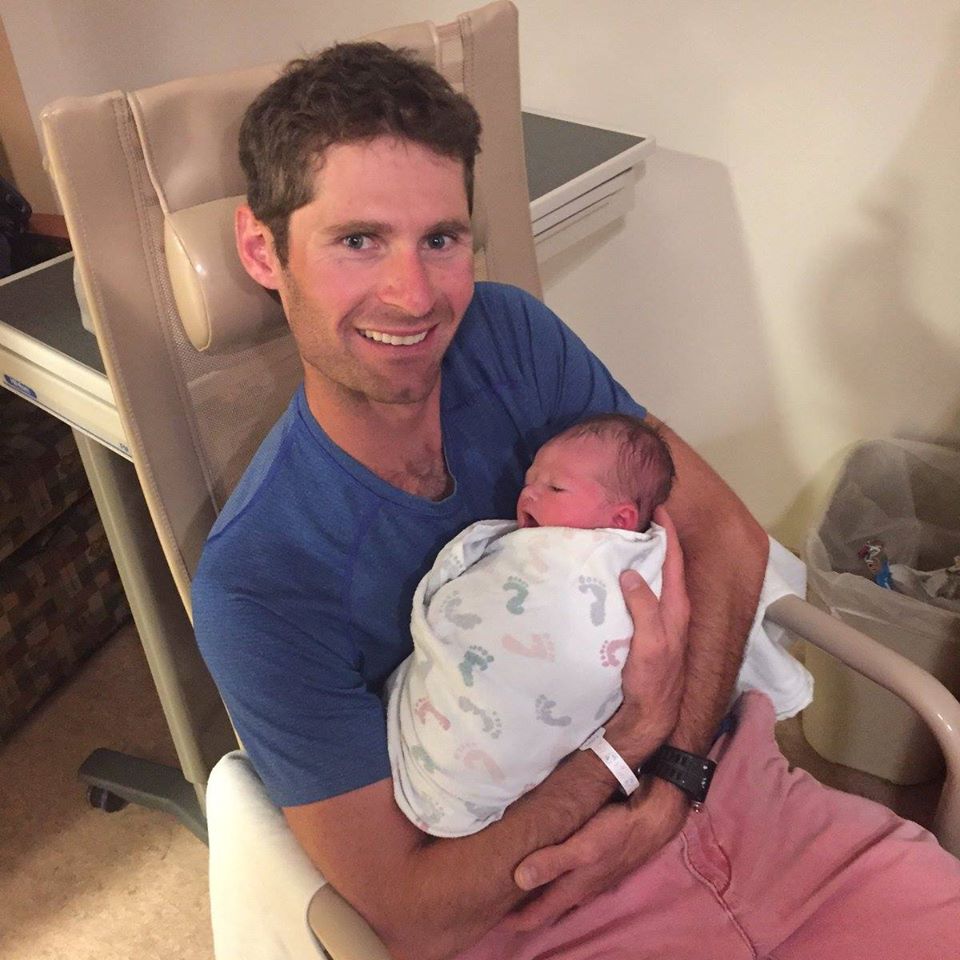
Bryan Fletcher holding his newborn, Ellery Ardene Fletcher. Fletcher and his wife Nikki welcomed their baby girl on Aug. 29, 2016. (Photo: USSA Nordic)
His new journey will involve finishing school and spending more time with his wife and 20-month-old daughter, Ellery. Through online courses, he has been working toward a degree in health education and promotion (with an emphasis on health science), which he aims to complete by next year. Graduate school has popped into his mind, as well as the idea of becoming a physician assistant.
Though coaching may have seemed like the ideal professional avenue for an athlete like Fletcher, the U.S. team veteran sees value in spacing himself from the team before getting too deeply involved.
“I think that going into coaching is really easy, especially to go straight from your athletic career, but you don’t have that time to expand your knowledge,” he said. “For a number of years, coaching was how I wanted to stay involved in the sport. I’ve since changed that idea.”
Instead, he hopes to enhance his knowledge of athletics and health science before working with athletes. The idea is to not only allow himself to develop more, but give the current U.S. NoCo team time to develop as well.
“When you come back to a sport so fresh out of retirement, it’s easy to focus on the same problems that you had as an athlete,” Fletcher explained. “But those issues may not be necessarily what the other athletes are struggling with or what they need to work on.
“On our team, we have some athletes that are great jumpers and we also have some athletes that are great cross-country skiers, but we don’t have particularly many of both right now,” he continued. “I think we just need to take some time to let those athletes develop in a new environment. That way you’re not just coaching the strong skiers to be strong skiers and the best jumpers to be the best jumpers, but instead allowing them to find strength in the opposite areas.”
Though he himself was 20 years old when he joined the team, by the end of his career, most of Fletcher’s teammates were almost a decade younger than him. While the team energy in recent years was one that left him admittedly needing “more naps”, he also sees the younger pool of athletes as an opportunity to foster a new team dynamic for American nordic combined.
Bryan Fletcher with his father at the 2014 Winter Olympics in Sochi, Russia: “The biggest lesson I ever learned from my dad was not only how to ski but how to enjoy every single day on skis.”
“As the younger athletes come up, we have to let them create their own culture and be accommodating of it,” Fletcher said. “I think the way I can have the biggest impact on the team is not by jumping immediately into coaching, but instead taking some time away from the team to broaden my knowledge base and skill sets in different areas. Then several years from now, I can return to the team with a new attitude and new approach and add something different.”
For the time being, his involvement with NoCo will remain at the administrative level. He was recently elected to Team USA’s Athletes’ Advisory Council and will serve a four-year term on the board of directors.
Even so, his presence at practice sessions will be missed.
“It’s going to be weird,” Taylor said of his brother’s departure from the team. “He was always the very level-headed leader.”
As Taylor, a three-time Olympian, steps into the primary NoCo team-veteran role, Bryan was sage in his advice to those who will continue to hit the trails and the hill.
“Just have a plan in place, especially when you start to think that you’re heading down that road of retirement,” Bryan said. “I think it’s really easy to kind of get stuck and not know what you want to do, so just make sure that you kind of have some sort of idea, some kind of stepping stone to go forward.”
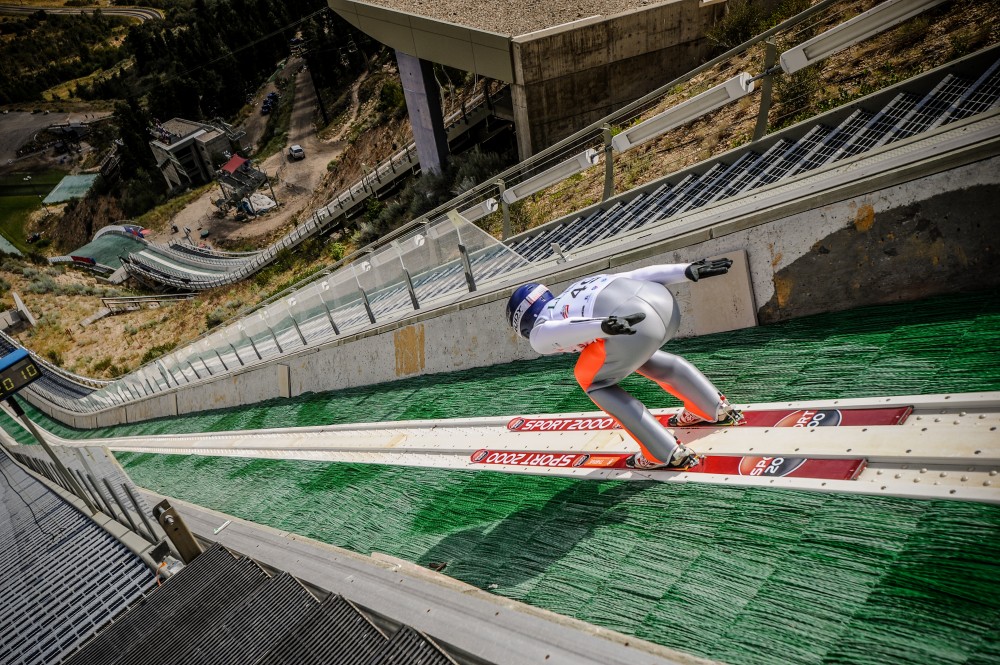
Bryan Fletcher flying at the 2016 U.S. Ski Jumping Championships at Utah Olympic Park in Park City, Utah. (Photo: USSA/Tyler Tate/T Squared Action Sports)
Canada’s Alex Harvey racing to seventh in Friday’s 15 k freestyle at the 2018 Olympics in PyeongChang, South Korea. It was his best individual result in his third Olympics. (Photo: FlyingPointRoad)
PYEONGCHANG, South Korea —Twelve-point-five seconds. Roughly half the amount of recommended handwashing time to prevent norovirus; a protocol followed by those attending the XXIII Winter Olympic Games. 12.5 seconds. The amount of time between Canada’s Alex Harvey and his first Olympic medal.
For anyone who has devoted most of their life — at 29 years old, Harvey is in his third Olympics — to one particular goal, it can be devastating if that point isn’t reached. Beyond devastation, complete consumption.
In cross-country ski racing, that consumption frequently manifests itself in finding seconds, ‘If I had poled harder here, I could have gained ground there…’. Each second is slid under a microscope for exhaustive inspection.
There’s a sense of risk involved with taking a step back from that magnifying lense. It can be uncomfortable to objectively look at what could have been versus what the results sheet actually read.
Regardless of which light the men’s 15-kilometer freestyle race is examined under, only three walked away with medals. Switzerland’s Dario Cologna with gold in a time of 33:43.9, Norway’s Simen Hegstad Krüger with silver, 18.3 seconds behind him, and Denis Spitsov taking the bronze, 23 seconds out of first.
Harvey had it in his cards to make the podium. A handful of strong performances in the 15 k skate — he recently placed second at the last World Cup before the Olympics, the 15 k freestyle mass start in Seefeld, Austria — pepper the Quebec native’s nordic career.
The same statistic, however, held true for France’s Maurice Manificat prior to the end of Friday’s race. The Frenchman has finished in the top three of World Cup 15 k freestyle races a number of times. In Friday’s Olympic 15 k, he finished fifth (+27.0).
The list of other potential podium finishers goes on. Norway’s Martin Johnsrud Sundby, Finland’s Matti Heikkinen, Sweden’s Marcus Hellner. Throughout Friday’s event, Harvey was in the mix. At the halfway point, he was racing in fourth, 1.9 seconds behind third place.
However, 6 k later, he had dropped back to seventh. Thirty-five seconds out from the win and 12.5 seconds out of third in seventh place was ultimately where he would finish the day. But in a post-race interview with FasterSkier, for Harvey, owning the race outweighed its immediate dissection.
“There’s no regrets,” Harvey said. “I went out the way I had to go to be on the podium. Just missed it a bit in the end.
“It’s the same level of competition as we saw at World Championships,” he continued. “We’ve been able to do it at the World Championships so there’s no reason why we can’t do it at the Olympics, but it’s a really competitive, deep field.”
Canada’s Alex Harvey racing to seventh in Friday’s 15 k freestyle at the 2018 Olympics in PyeongChang, South Korea. (Photo: FlyingPointRoad)
Last year in Lahti, Finland, Harvey became a world champion in the 50 k freestyle mass start. The finish was his first individual world champs win after he and his Canadian teammate Devon Kershaw won the 2011 World Championships classic team sprint in Oslo, Norway.
Five days ago, in the 30 k skiathlon that opened men’s cross-country racing at the Games, Harvey placed eighth. He went on to race the individual classic sprint on Tuesday, where he missed qualifying in 32nd.
“It’s possible to be on the podium…but I need to have a really special day, just like I need to have a special day to win a medal at the World Championship,” Harvey said. “I’ve been lucky enough to have that four or five times over my career, so I know it’s possible.”
After Harvey, the next-best North American in Friday’s 15 k was American Scott Patterson in 21st (+1:44.1).The 26-year-old Idaho native explained that for the first half of the race, he questioned whether he was even fighting for a top 30.
Scott Patterson leading the U.S. men’s team in 21st in the 15 k freestyle at the 2018 Olympics in PyeongChang, South Korea. (Photo: FlyingPointRoad)
“Honestly, I didn’t think that I was racing very well for 7.5 k. I was kind of suffering out there a bit,” Patterson told FasterSkier. “But I think [in the] later laps, I realized I was actually skiing all right and kind of found a little more energy towards the end. I got a good ride off [Norway’s Hans Christer] Holund for maybe a kilometer or so towards the very end, which was good to see.”
The 15 k is Patterson’s second-career Olympic race after he raced to 18th in the skiathlon last Sunday. When asked what was behind his top performances this week, Patterson’s answer encompassed both physical and mental response. At last months’ U.S. nationals in Anchorage, Alaska, where he grew up and trains, Patterson had been battling residual symptoms of bronchitis, which he said cleared up fairly well in time for the Games. Considering these were his first Olympic races, his expectations for results were not exceptionally high.
“Probably weird to say, but I feel like the Olympics are pretty low pressure for me,” Patterson said. “Unlike Jessie [Diggins], I’m not expected to win a medal. I’m just kind of out here to put my best foot forward. So I mean, you race in the U.S. and for someone like me, it’s kind of they expect you to win, so you better go and win. Here, if you get 40th everyone forgets. If you get 20th, everyone remembers for a couple of days, happy about it, and then they forget.”
Canada’s Graeme Killick racing to 38th in the men’s 15 k freestyle at the 2018 Olympics in PyeongChang, South Korea. (Photo: FlyingPointRoad)
Canada’s Graeme Killick was next on the results sheet in 38th (+2:39.4). At 28 and in his second Olympics, Killick explained that while the skiathlon (where he placed 45th) had left him hurting, Friday’s 15 k progressed much better, a good omen for the yet-to-come men’s 50 k classic mass start — his main focus for the Games.
“The pursuit [skiathlon] was a real struggle after 5 k. It was kind of 25 k of pain after that, but today I felt better as the race progressed,” Killick explained. “I think that shows that the shape is coming, especially in the longer distances and the 50 k, which is probably my main goal for the Games. So I’m getting some good feelings going into the last races here.”
American Erik Bjornsen en route to 41st in the men’s 15 k freestyle at the 2018 Olympics in PyeongChang, South Korea. (Photo: FlyingPointRoad)
Erik Bjornsen, also in his second Olympics, was the second American in 41st (+2:44.7). Though he had entered the race with intent of skiing in the top 20, his body did not respond the way he had hoped.
“I’m not going to try to pace it for a 50th place finish so I tried to go out as if I was going to ski in the top 20,” Bjornsen, 26, said. “I quickly realized I wasn’t going to be able to do that and I just kind of struggled the last 10 k.
“Body’s not quite where I’d like it to be,” he added. “That’s the way it goes sometimes.”
Also for the U.S., Noah Hoffman finished 16.6 seconds behind Bjornsen in 48th (+3:01.3), and Tyler Kornfield placed 74th (+4:34.0) in his first Olympic race.
Kornfield, who turned 27 last Friday, was picked to start the 15 k in place of U.S. Ski Team Development Team member Paddy Caldwell, who was out sick.
“Paddy has got a low-grade cold, and we are just resting him until we feel like it’s safe we push him,” U.S. coach Matt Whitcomb said on the phone after Friday’s race. “Unfortunately he is probably gonna be out for the relays. … The nice thing about the Olympics is you have this Team USA poly-clinic downstairs, and you can just go get tested for everything. It’s no flu, no norovirus, it’s just a cold.”
American Tyler Kornfield in his first Olympic race, the 15 k freestyle on Friday in PyeongChang, South Korea. He finished 74th. (Photo: FlyingPointRoad)
Kornfield said he learned he would start the 15 k a couple of days ago.
“This kind of was a bit of a surprise,” Kornfield said. “Ever since I found out, I’ve just been trying to stay relaxed, stay in the moment and get ready for a good one.”
Kornfield is also slated to start the men’s 50 k classic mass start on Feb. 24, but the opportunity to jump into another Olympic distance race prior to that was one that he embraced.
“I was just trying to not get too worked up, not get too stressed, look around at some of the guys around me and know that they’re some of the best in the world and the best that I can do is go as hard as I can and put my best race forward,” said Kornfield, a Fairbanks, Alaska, native who won this year’s U.S. nationals 30 k classic mass start to help punch his ticket to the Games.
“I put it all out there and yeah, the result is what it is,” he continued. “I was a bit back, but I went as hard as I could and that was the race plan, and I think I did that.”
Competing for Canada, Knute Johnsgaard finished 69th (+4:04.6) and Devon Kershaw was 71st (+4:17.6).
Canada’s Devon Kershaw in the men’s 15 k freestyle at the 2018 Olympics in PyeongChang, South Korea, where he finished 71st. (Photo: FlyingPointRoad)
For Kershaw, a four-time Olympian, it was his first time finishing outside the top 60.
“I felt good warming up and everything, but it just wasn’t there at all today and I had no energy whatsoever in my body and was just on the struggle bus the whole way,” he said after. “I made a mistake and went the wrong way in the lap lane, like I went around the back of the stadium when I should’ve cut [through] so that’s like 30-40 seconds extra already that I didn’t need to lose some more so it’s just one of the worst skate races of my career so I’m pretty disappointed.”
The women’s 4 x 5 k relay is next on the Olympic schedule, starting at 6:30 p.m. Korea time on Saturday (10:30 CET; 4:30 EST). The men’s 4 x 10 k relay will follow on Sunday.
Norway’s 27-year-old Ragnhild Haga racing to gold, her first Olympic medal, in the 10 k skate at the 2018 Olympics in PyeongChang, South Korea. (Photo: FlyingPointRoad)
FasterSkier would like to thank Fischer Sport USA, Madshus USA, Concept2, Boulder Nordic Sport, and Swix Sport US for their generous support, which made this coverage possible. PYEONGCHANG, South Korea —Be honest. Who chose Norway’s Ragnhild Haga as Thursday’s gold medal favorite?
In pre-race hearsay, the 26 year old seemed an outside shot for the win. On the Olympic stage, other names openly circulated the 10-kilometer freestyle race. Sweden’s Charlotte Kalla was one.
The 30-year-old Swede had already proven her form — and Olympic intent — by opening the 2018 Pyeongchang Winter Games with a skiathlon win. Even with that hardware tucked away, Kalla was by no means overzealous to have her sights set on another distance gold medal. She’s well known on the World Cup for her 10 k podium performances. Two Olympic cycles ago, she collected gold in the Vancouver 10 k skate race.
If not Kalla, then the Norwegian name ‘Marit Bjørgen’ was certainly heard. Haga’s teammate, Bjørgen, has been first or second in all but five World Cup 10 k skate races she’s entered over the past decade. At the Vancouver 2010 Winter Olympiad, the Norwegian finished two places behind Kalla to take the 10 k freestyle bronze.
Sweden’s Charlotte Kalla racing to second at the 2018 Olympics in PyeongChang, South Korea. (Photo: FlyingPointRoad)
After Kalla and Bjørgen, another name to consider was Norway’s Ingvild Flugstad Østberg. At one time perhaps considered a sprint specialist, Østberg is more a cross-country all-arounder. She has three 10 k freestyle World Cup wis, one from 2016 and two from this season.
Add to the medley Finland’s Krista Pärmäkoski, who, with numerous second and third place 10 k World Cup podiums, was plenty hungry to take a freestyle win (she earned her first 10 k classic victory earlier this year in Planica, Slovenia). Another name tossed around in the stands and over the loudspeaker was Jessie Diggins of the U.S.A.
Prior to PyeongChang, Diggins made it palpably clear twice, if not more, that striving for a medal is a goal of hers at these Winter Games. Her gutsy win the Seefeld 10 k freestyle mass start — the final World Cup event before the 2018 Olympics — was the first performance nod to the direction she hoped to head in South Korea.
Her second sign off came in a Jan. 29 blog post titled “Brave Enough”.
Jessie Diggins after placing fifth in the women’s 10 k freestyle at the 2018 Olympics in PyeongChang, South Korea. It was her second top-five and her third top-six of the Games. (Photo: FlyingPointRoad)
In that post, Diggins makes it clear that it is not necessarily whether the suitcase she packs at the end of the games includes a gold, silver, or bronze disc strung with blue-ribbon. It is the idea that as she watches the smoke clear from the closing ceremony’s firework display and stands to depart the 2018 Olympic venue, she leaves knowing that she went after that prize the best that she could.
“I want to know that I was brave enough to want it,” she writes, of achieving the first women’s cross-country Olympic medal.
In the line just before, she writes, “I know it’s not impossible, after all.”
A 2015 World Championships silver medalist in the 10 k freestyle and known for her ability to grind through grueling uphills in skating events to the top of the field, it would be imprudent to say that Diggins was not a medal contender. By the start of Thursday’s 10 k, the 26-year-old Afton, Minnesota, native had securely nailed a spot in the polls. No one was pulling your ear.
Not necessarily in the predictions was Haga — until the Norwegian’s stats were pulled up on paper. In 10 k freestyle events, Haga has had seven top-five World Cup performances. Three of those were podiums (second or third place) that came in the past two months.
Still, while Haga has been racing the World Cup since 2010, none of those eight years produced an outright win. The Norwegian’s best performance to date was in this year’s Ruka 10 k pursuit, where she finished with the top time of day. The PyeongChang Games mark Haga’s Olympic debut and Thursday’s 10 k skate is her second only Olympic race. Last Sturday she crossed 15th in the skiathlon, which she personally described as “just a bad day.”
“It is easy to get a little bit uncertain about my shape and skis and everything,” Haga said during a press conference after Thursday’s 10 k. “We didn’t know exactly what happened, but I just tried to put it behind me.”
Norway’s Marit Bjørgen racing to a tie for third with Finland’s Kris Parmakoski (not shown) in the women’s 10 k skate in the PyeongChang Games. (Photo: FlyingPointRoad)
Redemption came knocking. Haga covered Thursday’s 10 k course in a time of 25:00.5, which put her in the leaders chair, and later, the top of the podium with gold.
Haga didn’t start the day as number 1, but in bib 50, exactly two minutes ahead of Kalla.
At first, Kalla had the fastest splits, besting Bjørgen, who had started earlier in bib 32, by almost five seconds and Pärmäkoski (bib 48) by six seconds at the 1.4 k checkpoint. At the 5 k mark, Kalla had doubled her lead on both the Finn and the Norwegian.
“I tried to ski very offensive from the first lap,” Kalla said at the press conference. “I knew that it will be very tough today. When you are on the bottom of the long downhill you will work very hard until you are there the next time. It was hard to keep up a good technique today, because I became very tired. It was hard to get recovery.”
Østberg in bib 58 was skiing in third by the halfway point. Diggins, who started in bib 56, had moved from seventh to fifth by 5 k, 13.5 seconds away from the win and 4.5 seconds away from third.
Jessie Diggins racing to fifth at the 2018 Olympics in PyeongChang, South Korea. (Photo: FlyingPointRoad)
Backtracking to the first 1.4 k, Haga had the fourth-fastest time, before moving into second behind Kalla at the halfway mark.
In another kilometer, everything shuffled. Kalla’s pace dropped in rank and she moved back into second. Haga’s pace came out 1.7 seconds faster than the Swede’s to take the lead. Diggins was now in third, skiing 17.9 seconds out from the win and 0.7 seconds ahead of Bjørgen in fourth. At 6.2 k, Pärmäkoski lingered in fifth, 2.6 seconds away from Diggins.
All five skiers held their positions over the next 2.2 k.
“I wanted to start first in the group because, I thought that maybe after the first lap I could go out with Ingvild Flugstad Østberg or Heidi Weng,” Bjørgen explained at the press conference.
While she waited in the finishing pen, Diggins, Kalla, Haga and Pärmäkoski were still on course.
“I heard after 5 k that I was close up to the medals,” Bjørgen continued. “The problem for me was that I was losing in the middle of the race, like I have done this winter.”
With less than two kilometers left in the race, Haga buried her competition. With legs that looked fresh, the Norwegian headed up the final climb and finished 31.9 seconds faster than Bjørgen.
“I think I had a better start than usual,” Haga said at the press conference. “I felt very good and got good messages from the coaches, that I was only a few seconds behind. On the last lap I was very afraid that some of the others were going to speed up. So I increased my speed and got some more seconds. I just focused on staying on my feet on the last downhill and to give it all to the finish line.”
Jessie Diggins pushing toward the finish in the Olympic 10 k skate. (Photo: FlyingPointRoad)
Back out on course, the American was visibly working every turn, every hill, to her max.
“Of course you want a medal, you always want a medal, that’s why we are here, that’s like the point of the Olympics,” Diggins told FasterSkier after the 10 k. “But there are other things that are also really important besides the actual hardware. I think it’s important to not put other people’s expectations on me. To be that close and to be skiing with the best in the world. I have looked up to Marit my entire life.”
To take a quick tick back in history, Diggins was born eight years before Bjørgen’s World Cup debut in 1999. The American came onto the World Cup circuit in 2011. When Bjørgen competed in her first Olympics at the Salt Lake City 2002 winter games, Diggins was 11 years old.
Bjørgen would go on to compete at four more Winter Games and take home six Olympic gold medals before tallying her 12th Olympic medal on Thursday. The 37-year-old Norwegian is a nordic-powerhouse presence, one that Diggins, and many others, idolized growing up. The only difference is now Diggins finds herself vying for the same Olympic step.
On Thursday, she tied that result, placing fifth (+35.2) in the 10 k. This time around, she was 3.3 seconds away from third (shared by Bjørgen and Pärmäkoski) and 3.3 seconds away from the bronze medal.
“I could not have gone any harder,” Diggins reflected. “I can honestly look back and say, I don’t know where I would have found those seconds. I pushed my body way past its limit, I killed myself out there, and I thought I was gonna pass out on that last climb. I was completely locked up. That’s a really good feeling to know you gave it everything that you had and more than you thought you could give. I’m really proud of today.”
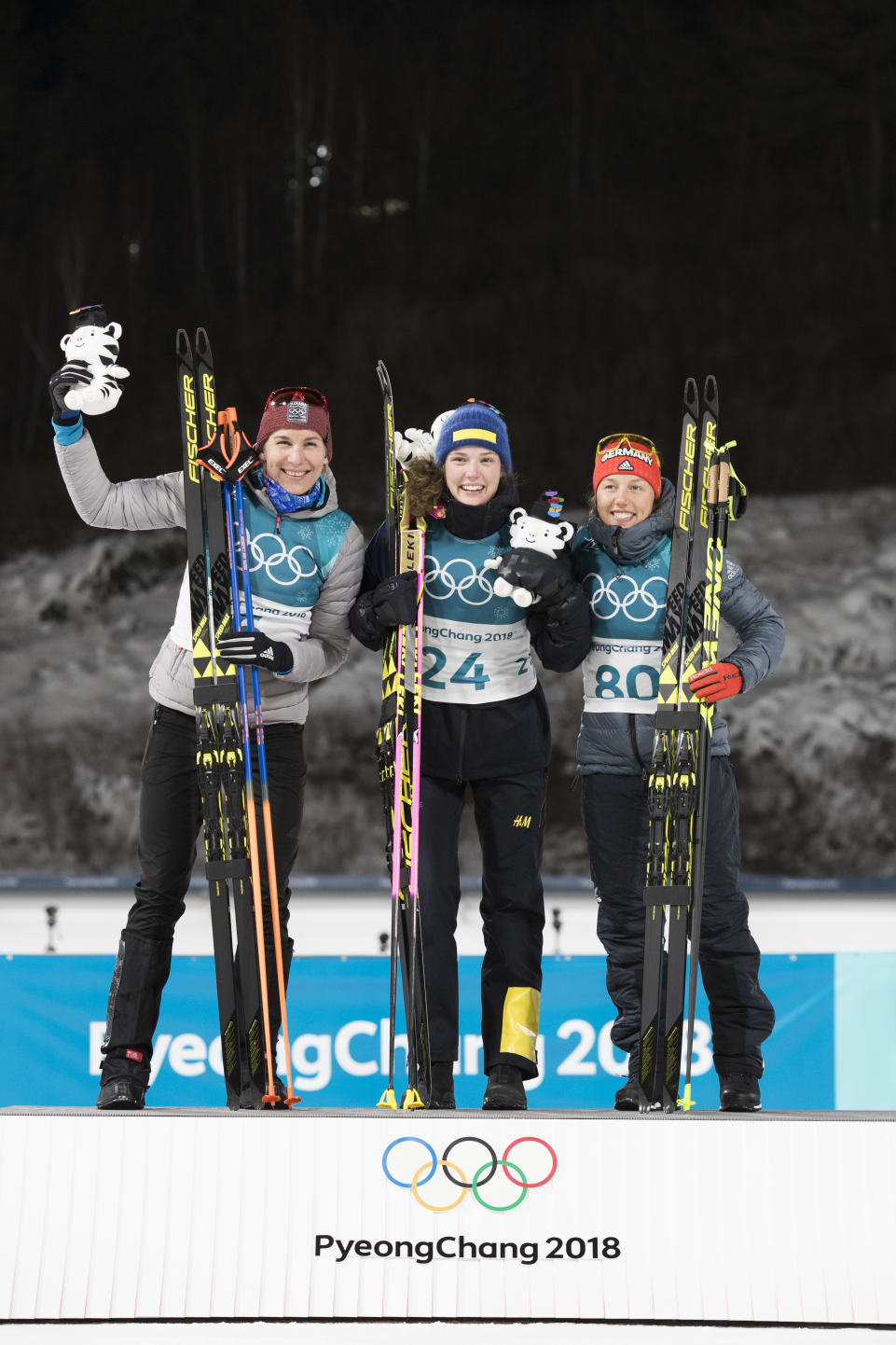
The women’s 10 k freestyle podium on Thursday at the 2018 Olympics in PyeongChang, South Korea, with (from left to right) Sweden’s Charlotte Kalla in second, Norway’s Ragnhild Haga in first, and Norway’s Marit Bjørgen and Finland’s Krista Parmakoski tied for third. (Photo: FlyingPointRoad)
Diggins was bumped into fifth due to a tie finish between Bjørgen and Pärmäkoski. The Finn and the Norwegian were each awarded an Olympic bronze medal.
“I think that it’s better that both of us stand on the place today,” Pärmäkoski said at the press conference. “Of course Marit is one of my idols when I was younger. It’s really nice to stand on the same podium today.”
The Olympic medal is the 27-year-old Pärmäkoski’s third, after she placed third in the skiathlon last Saturday and second in the relay at the 2014 Olympics in Sochi, Russia. .
“I am really happy for a bronze today,” Bjørgen said at the press conference. “I can still sit there and think about that I could do something better there, but I have no chance to do it again, so I’m really happy to sit there and share it with Krista.”
In second with silver and her second medal of the 2018 Games was Kalla.
“It was for sure a different feeling from the mass start. In the mass start you know exactly what position you have. Today you have to work hard all the time,” Kalla said. “I fight the hardest that I could, and I’m satisfied with my performance.”
Haga retained the top time through them all, earning her first Olympic medal at her first Olympics in the color of gold.
“It was just a perfect day,” Haga said, adding with a laugh, “My uncle was in the Olympics and I think he finished eighth once. I wanted to beat his result.” Her uncle, Anders Bakken, raced in the 1980 Olympic Winter Games in Lake Placid, New York, according to her Olympic bio. “So now maybe I’m best in the family, too.”
Three Americans in Top 20
Following Diggin’s fifth place, her fellow U.S. Ski Team members Sadie Bjornsen placed 15th (+1:42.1) and Kikkan Randall finished 16th (+1:49.9).
Sadie Bjornsen racing to 15th in the women’s 10 k freestyle at the 2018 Olympics in PyeongChang, South Korea. (Photo: FlyingPointRoad)
“I decided I was not gooing to pace, just go on sending mode and see what I could do, see if I could hold it,” Bjornsen told FasterSkier. “I guess I wasn’t able to hold it as much as I would have liked, but I still am really happy. I think that’s my best Olympics result yet, and I think there is more yet to come, some awesome races still around the corner.”
Bjornsen actually finished one place better in Tuesday’s classic sprint, where she was 14th overall.
The third-best American on Thursday, Randall may have earned her spot in the U.S. women’s relay on Saturday.
Kikkan Randall racing to 16th in the women’s 10 k freestyle at the 2018 Olympics in PyeongChang, South Korea. (Photo: FlyingPointRoad)
“I was looking at pictures of Breck on the way up [to the race venue] and just knowing that if I skied happy and skied my own race I would perform well and I think it worked,” she told FasterSkier after Thursday’s 10 k. “I know my skate shape has been good all year, so just was happy to be able to lay it down after kind of a frustrating end to the skiathlon. The team events are the ones I look forward to the most over the last four years and would love to be in a position to go for it.”
Liz Stephen was the fourth American finisher on Thursday, finishing in 30th (+2:35.4).
“I think you did something wrong if you get to this point and your not smiling at least. I mean it’s the Olympics,” Stephen said to FasterSkier while smiling in the mixed zone. “I definitely didn’t have the best race I was hoping for, but I mean, our team has so much good to focus on, and that’s what I plan on doing.”
Liz Stephen racing to 30th in the women’s 10 k freestyle at the 2018 Olympics in PyeongChang, South Korea. (Photo: FlyingPointRoad)
PyeongChang marks Stephen’s third Olympics. For a moment after the race, the 31 year old reflected on the fact that it is most likely her last.
“It is a little emotional for sure,” Stephen said of the significance of the moment. “I definitely had thoughts out there like, ‘Hey, this could be your last race, this could be your last ever Olympic race, don’t leave anything out there,’ so that’s motivational in a good way. It wasn’t ever a negative, like, ‘Oh, this is going to be my last race. I don’t want to end this way.’ It was like, ‘This is maybe my last race, let’s go get it.’ So we will see, maybe I will get another one, but if I didn’t, goddamn, this has been fun.”
Emily Nishikawa racing to 32nd in the women’s 10 k freestyle at the 2018 Olympics in PyeongChang, South Korea. (Photo: FlyingPointRoad)
Competing for Canada, Emily Nishikawa (+2:41.) led the way in 32nd. Dahria Beatty (+2:48.4) was 37th, Cendrine Brown (+3:11.9) 43rd, and Anne-Marie Comeau (+4:10.8) 62nd.
“I had all these little process goals just to ski each section of the course the best I could,” Nishikawa told FasterSkier. “I think I really did that. I just focused on technical aspects and just little things like pushing over the tops and working the corners well, and I think I did a really good job of that so I am really, really happy with my race today.”
For more quotes and photos from Thursday’s 10 k, click here.
Women return to the race venue for the 4 x 5-kilometer relay Saturday.
— Jason Albert, Ian Tovell, Chelsea Little, Harald Zimmer, and Alex Kochon contributed
Norway’s Marit Bjørgen congratulates her teammate Ragnhild Haga on Haga’s win in the women’s 10 k freestyle on Thursday at the 2018 Olympics in PyeongChang, South Korea. (Photo: FlyingPointRoad)
Sweden’s Hanna Öberg on her way to a gold medal in the women’s 15 k individual at the 2018 Olympics in PyeongChang, South Korea. Öberg skied the sixth-fastest time and shot 20/20. (Photo: IBU/Biathlonworld.com)
PYEONGCHANG, South Korea — It was a day for firsts here at the 2018 Winter Olympics.
At the Alpensia Biathlon center, athletes for the first time saw mild temperatures, blue skies, and — perhaps most importantly for success in the individual race — tame winds. All welcome firsts at what’s been a blustery and downright chilly Games, and it came just a day after the race jury postponed the women’s 15 kilometer individual race due to high winds.
But another first was the most stunning. Twenty-two year old Swedish biathlete Hanna Öberg skied with panache and shot with zen-like nerves on the biggest athletic stage of her life to win gold in the rescheduled 15 k.
“It’s really big for me that I could take this step,” she said in a press conference. “And to have my parents here, it means a lot, and also my boyfriend. To share this with everyone means the most to me. It’s really big.”
The individual race is relentless in its capacity to shatter nerves. Five three-kilometer loops in total and twenty shots — four shooting rounds alternating prone and standing — and each miss carries a draconian one-minute penalty.
Anything can happen on individual race day. Shoot clean and the podium’s top step is within grasp. Miss and you plummet through the rankings. That means opportunity, but also stress.
While many of her competitors have experience trying to manage that stress (successfully or not), Öberg hadn’t been here before.
Sweden’s Hanna Öberg at the flower ceremony celebrating her gold medal in the women’s 15 k individual at the 2018 Olympics in PyeongChang, South Korea. (Photo: IBU/Biathlonworld.com)
“I’m 22 years old and last season was my first in the World Cup, and also my first World Championships, in Hochfilzen,” Öberg said, laughing at the incredible spot she had climbed to. “The season before that, I took two gold medals at the Junior World Championships. That’s also the last time that I shot four zeros in a competition.”
Öberg has only notched three top-10′s on the World Cup, and before Thursday’s golden performance, Öberg’s fifth in the pursuit here matched a career best.
But shoot clean in this race, and you’ve made your own opportunities to grab gold.
Opportunity knocked for Öberg after three clean shooting rounds. She left the range in first place on her fourth ski loop and kept pace, setting herself up for a tense five shot sequence. Enough Swedish fans populated the stands to cheer as each of Öberg’s targets fell. The final 3 k loop remained tense for the what ifs for the young Öberg: a snagged V-board or a corner skied too wide could mean a medal gone.
None of that happened, of course.
Öberg stopped the clock in 41:02.7, but she had to wait nearly half an hour to know that she had sealed the deal. She had an early bib and among the many athletes behind her in the start order was last season’s world number one, Laura Dahlmeier of Germany, a late starter in bib 80.
But Dahlmeier only shot 19/20, and couldn’t catch Öberg’s time on the tracks, ending up with a bronze medal instead.
“I think not just me, I think everybody knows that it was a really, really great day for Hanna,” Dahlmeier – who won the other two gold medals awarded so far at these Olympics – said in the press conference. “I think it was her first time to be on the podium, and it’s really great to be on the podium at the Olympics. It must be one of the best days of her life… with a clean shooting and good skiing performance, you can win a race. And today not so many athletes shot zero, I think just three athletes. It’s great for her and also for the whole Swedish team.”
“Of course I’m surprised,” Öberg said of her win. “I could not believe this before and I knew that maybe this performance today could have taken me to a medal but that I would win this race, it’s just unbelievable.”
Slovakia’s Anastasiya Kuzmina on course in the 15 k individual at the 2018 Olympics in PyeongChang, South Korea. Kuzmina finished second to earn her second medal of these Olympic Games, two match two sprint gold medals from 2010 and 2014. (Photo: IBU/Biathlonworld.com)
If it was a surprise for Oberg, it was a turnaround for Sweden, which did not send a women’s team to the 2014 Olympics because the Olympic Committee did not feel that any of the biathletes had the potential for acceptably strong results.
But in the 15 k, Linn Persson finished 11th and Mona Brorsson 14th; Brorsson was also 10th in the pursuit.
“I just want to say, I’m super impressed with Sweden,” American biathlete Susan Dunklee said in the finish area, when Dahlmeier was still out on course. “Holy shit. In 2014, Sweden did not take a women’s team to the Olympics. I felt so bad for the one woman on the team who was on the bubble for that and they decided not to take her, which I thought was really stupid. And then turn around, four years later, you have a potential gold medalist here, [and] couple of the top 10’s or something?”
The two pre-race favorites were Anastasiya Kuzminaof Slovakia and Dahlmeier, both of whom were already medalists at this Games.
Kuzmina placed second in the 10 k pursuit on Monday. If Öberg kept it together considering her lack of championship experience, Kuzmina faltered twice on the range despite hers. Kuzmina raced to gold in the 2014 Olympic sprint, and gold and silver in the 2010 Olympic sprint and pursuit, respectively.
Germany’s Laura Dahlmeier at the finish of the women’s 15 k individual biathlon competition at the 2018 Olympics in PyeongChang, South Korea, where she won bronze. (Photo: IBU/Biathlonworld.com)
Despite suffering a single miss in the first standing and second prone rounds, for two misses total, Kuzima finished with a time just 24.7 seconds behind Öberg’s. The Slovak made up her two-minute shooting penalty on the skis, clocking the fastest ski time for each of her five ski loops to earn her first career championship medal in the individual format race.
“To be honest, I have to say that this is the event which I had the smallest ambitions from [in] for all the individual-start events here,” Kuzmina said during the press conference. “But I told myself that this is another chance to get a medal, and I wanted to do everything like in training, everything perfectly, fully focused [on] each shoot.”
Germany’s Dahlmeier, a double-gold medalist in PyeongChang, having won the sprint and pursuit, won bronze (+41.2). She had a single penalty in her first shooting round.
“With the first shooting I had this miss and just tried to stay focused,” Dahlmeier said. “I know it with one miss, it must be possible to reach the podium, but it’s better to have a clean shooting, and after the first miss, I tried to stay focused.”
Shooting clean the remainder of her rounds, Dahlmeier charged on the skis. Of her five ski loops, two were the second fastest splits, three the third fastest.
Her German teammate Franziska Preussof Germany finished fourth, +59.0 with clean shooting, and Paulina Fialkovaof Slovakia placed fifth (+1:02.3) with one missed shot. Poland’s Monika Hojniczfinished sixth (+1:54.8) with one missed shot as well.
Three North Americans in Top 30
American biathlete Susan Dunklee was the best placed North American in 19th (+3:26.3), after two misses on the range.
Posting a 66th place on Saturday’s 7.5 k sprint, Dunklee had not advanced to contest the pursuit, which was disappointing for last year’s World Championships silver medalist.
“I’m still bummed about that day,” Dunklee said of the sprint. “But I think one of the things that biathlon does is train you how to be resilient and how to pick yourself up over and over again. It was certainly not the first day that sort of things happened to me. Maybe it’s the first day at a really big, big stage like this, but I think I’ve had lots of experience over the years for refocusing. You have to let yourself be sad for a few hours but then you have to set a deadline and say, OK, by this time of day, I’m going to just start only allowing myself to focus on the positives again and move forward.”
Thursday’s 15 k proved more to Dunklee’s liking. She’s mending a cold which she says has left her feeling sapped.
“I was so happy to have that extra day off [due to the wind postponement] and I’m slowly getting over this cold,” Dunklee explained. “It’s getting better and better each day but it’s not quite 100 percent. I felt like I could focus on the shooting range. My head was a little bit more clear, less foggy, so that was really nice.”
Dunklee’s teammate Joanne Reid finished 22nd (+3:34.1), for her best-ever result in top-level international competition, with just one missed shot. Reid was not scheduled to race Thursday’s 15 k individual, after finishing 86h – second from last – in the sprint.
Instead, Reid’s teammate Maddie Phaneuf had originally been penciled in for the individual, but came down with strep throat earlier in the week.
“I am really happy that I had a good race, just because I took Maddie’s spot here,” Reid added. “I didn’t want to go out there and have a bad day. And she is really disappointed that she didn’t get to race, so this one’s for her.”
Reid made the best of her opportunity. With her limited experience on the 3 k loop, Reid said her strategy required her to dial the pacing back slightly.
“There is nothing technical out here,” Reid said. “So you really are hammering, short recovery, you’re hammering, short recovery, you’re hammering, and then it’s this long downhill into the range. And if you are not really careful your legs will start shaking and that will throw off your shooting. So you have to be really focused the whole time and that can be really hard in a 15 k.”
Also for the U.S., Clare Egan finished 62nd (+6:53.6) with four penalties and Emily Dreissigacker 67th (+7:09.2), also with four penalties.
For Canada, Rosanna Crawford led the way in 26th (+3:48.7) with two penalties — both occurred in her first shooting round. During her interview, Crawford was upset for second-guessing herself during that round.
“I’m just frustrated,” Crawford said. “I made a correction in prone and then corrected back and missed where I corrected back to. I think I definitely could’ve hit 20. I know it’s a hard thing to do in biathlon, but I was feeling really confident on the range. I’m just really mad that I didn’t trust myself. This was my best chance to have a top 10. Hopefully I’ll qualify for the mass start but we’ll have to see.”
For now, Crawford remains on the “waiting list” for the mass start. Two athletes will have to drop out for a start position to open up for the Canadian.
“As I was warming up, I was like, ‘you have to trust yourself, you have to trust yourself’, and then I just didn’t do it,” Crawford said. “The next prone and the next standings, I did trust myself and I made a correction. All the hits were centered, so I definitely learned a lot. It’s unfortunate that you have to learn a lesson in an Olympic race. You wish that you could just go out there and do what you know how to do.”
Canadian Sarah Beaudry was close behind Crawford in 29th (+3:58.4) with one missed shot. It was the second-best result of her career, behind a 23rd-place World Cup finish in Oberhof, Germany, this January.
“Overall I’m really happy hitting 19 in my first Olympic race, and especially in race like the individual where it really counts,” Beaudry said. “I was really happy with that, especially because the last couple weeks I’ve been struggling with my prone position a bit, and I really felt confident and solid in my prone, so that was nice.”
Also for Canada, Emma Lunder finished 54th (+5:49.4) with three penalties and Julia Ransom was 74th (+8:31.4) with five missed shots.
It was a disappointing opening to the Olympics for Johannes Thingnes Bø of Norway, who despite winning eight World Cup races this season started the Games with finishes of 31st and 21st in the sprint and pursuit. But on Thursday he showed why he was a medal favorite and won the 20 k individual race – only by 5.5 seconds, but that margin becomes impressive when you consider that he had two penalties, and thus two minutes of penalty time, while silver and bronze medalists Jakov Fak of Slovenia and Dominik Landertinger of Austria (+14.2) shot clean.
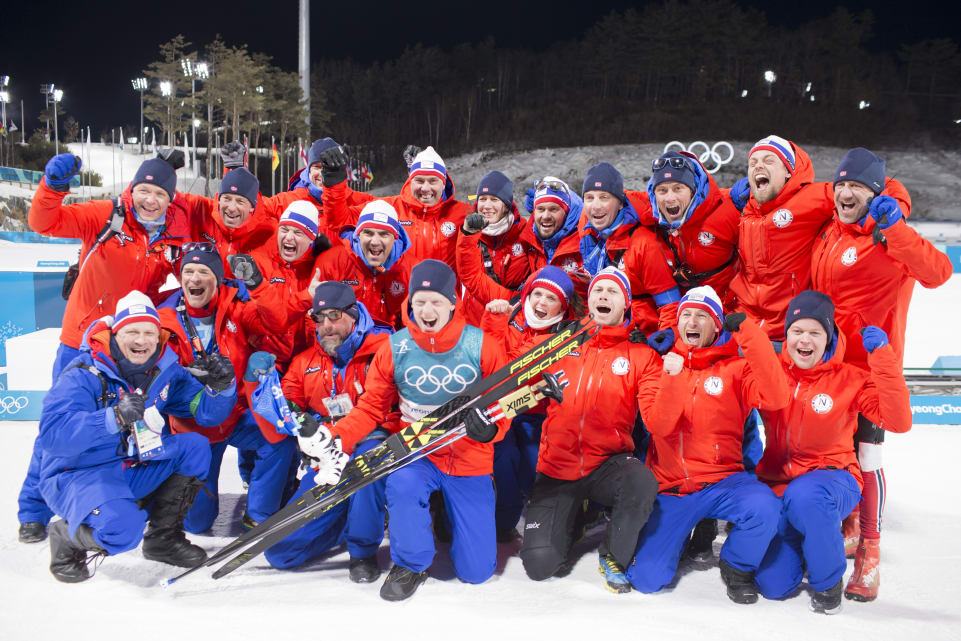
Johannes Thinges Bø celebrates with Norwegian team staff after winning Olympic gold in the 20 k individual despite two missed shots. (Photo: IBU/Biathlonworld.com)
Sweden’s Sebastian Samuelsson followed up a silver medal in the pursuit with fourth place in the individual, missing one shot and notching a time 29.1 seconds behind Bø. France’s Martin Fourcade, gold medalist in the pursuit, missed two shots like Bø but finished in fifth (+42.4). Switzerland’s Benjamin Weger placed sixth (+48.6) with one penalty.
It was a good day for Canada on the back of strong shooting: Scott Gow placed 14th (+2:02.5) with one penalty for a career-best result result; he had previously had two 16th-place finishes on the World Cup this season. With the same shooting, Brendan Green placed 22nd (+2:26.6). Christian Gow had two penalties to finish 26th (+2:57.2). Canada’s fourth man, Nathan Smith, missed five shots and placed 81st (+8:11.9).
For the United States, shooting was not as successful and Tim Burke led the way in 41st (+4:01.9) with four penalties. With one less penalty Sean Doherty was close behind in 44th (+4:21.8). Lowell Bailey placed 51st with four penalties (+4:53.0) and Leif Nordgren missed five shots to finish 66th (+6:27.3).
Sweden’s Hanna Oeberg (center) won gold in the biathlon women’s 15 k pursuit, followed by Slovakia’s Anastasiya Kuzmina (left) in silver and Germany’s Laura Dahlmeier in bronze. (Photo: IBU/Biathlonworld.com)
A few days after teammate Samuelson scored a career-best result to earn silver in the pursuit, Hanna Öberg of Sweden used perfect 20-for-20 shooting to capture gold in the women’s 15 k individual. The 22-year-old’s previous best results were fifth place in both Monday’s pursuit, and in a World Cup race last season.
She bested the two pre-race favorites: Anastasiya Kuzmina of Slovakia had two penalties but still managed a silver medal, her second of the games, finishing +24.7. And double gold medalist Laura Dahlmeier of Germany had one penalty and earned bronze (+41.2).
It was a good day for both of those teams as Franziska Preuss of Germany finished fourth, +59.0 with clean shooting, and Paulina Fialkova of Slovakia placed sixth (+1:02.3) with one missed shot. Poland’s Monika Hojnicz finished sixth (+1:54.8) with one missed shot as well.
The United States was led by Susan Dunklee in 19th, with two penalties (+3:26.3). Her teammate Joanne Reid finished 22nd (+3:34.1), her best-ever result in top-level international competition, with just one missed shot. Clare Egan finished 62nd (+6:53.6) and Emily Dreissigacker 67th (+7:09.2) with four penalties apiece.
For Canada, Rosanna Crawford led the way in 26th (+3:48.7) with two penalties and Sarah Beaudry was close behind in 29th (+3:58.4) with one missed shot. Emma Lunder finished 54th (+5:49.4) with three penalties and Julia Ransom was 74th (+8:31.4) with five missed shots.
Montana State University student Johanna Talihärm of Estonia finished 50th (+5:36.8) with three penalties.
Thursday afternoon saw more of the same for the women’s cross-country ski events at this year’s Winter Olympics: Scandinavia filling up the podium, with American Jessie Diggins tantalizingly close to that breakthrough American podium in fifth. This time it was Norwegian Ragnhild Haga in first in the 10 kilometer freestyle individual start, Charlotte Kalla of Sweden in second (+20.3), and Finland’s Krista Pärmäkoski and Norway’s Marit Bjørgen tied for third (+31.9).
The bronze is Bjørgen’s 12th lifetime Olympic medal, moving her into a tie with fellow Norwegian Bjørn Dæhlie for the most Olympic medals won by a cross-country skier. Countryman Ole Einar Bjørndalen, a biathlete, holds the overall Winter Olympics record with 13.
Diggins was 35.2 seconds back of Haga in fifth. She was in seventh place through 1.6 k, up to fifth at 5 k, up to third at 6.2 k, and still in third at the 8.4-k time checkpoint, 1.9 seconds up on Bjørgen and five seconds up on Pärmäkoski. But her form seemed to break down over the final uphill, and Diggins lost just enough time on Bjørgen and Pärmäkoski over the final 1.6 k to slip off the podium.
Between a 4.6-second deficit to third in Saturday’s skiathlon and a 3.3-second gap here, Diggins has now missed two bronze medals by a combined 7.9 seconds over 25 kilometers of racing.
Jessie Diggins pushing to the finish in the Olympic 10 k skate. The American finished fifth. (Photo: FlyingPointRoad)
Sixth place went to Swiss skier Nathalie von Siebenthal (+49.8), who slowed slightly after a fast start that saw her with the second-ranked time through 1.6 k. Ingvild Flugstad Østberg (+1:05.5), in seventh, was the third Norwegian in the top seven.
Olympic Athlete from Russia Anastasia Sedova (+1:07.3), Austrian Teresa Stadlober (+1:15.6), and Olympic Athlete from Russia Anna Nechaevskaya (+1:24.3) rounded out the top ten.
Sadie Bjornsen (+1:42.1) in 15th and Kikkan Randall (+1:49.9) in 16th were the next two Americans. Randall started relatively early with bib number 23, and was the leader in the clubhouse when she crossed the finish line. Liz Stephen (+2:35.4) was 30th.
For the Canadians, Emily Nishikawa (+2:41.) led the way in 32nd. Dahria Beatty (+2:48.4) was 37th, Cendrine Brown (+3:11.9) 43rd, and Anne-Marie Comeau (+4:10.8) 62nd.
Also of note, Australia’s Jessica Yeaton, who lives and trains in Anchorage with Alaska Pacific University, recorded an Olympics personal best finish of 41st (+3:09.1). University of Alaska Anchorage student Casey Wright, also competing for Australia, finished 81st (+6:55.8).
University of Colorado skier and NCAA champion Petra Hyncicova of the Czech Republic finished 60th (+4:09.4). University of New Hampshire alum Annika Taylor of Great Britain finished 75th (+5:52.4).
And Jaqueline Mourau of Brazil, who lives and trains in Quebec, was 74th (+5:49.8).
Canada’s Len Valjas after earning the first lucky loser spot for the semifinals in the men’s 1.4-kilometer classic sprint at the 2018 Olympics in PyeongChang, South Korea. (Photo: FlyingPointRoad)
PYEONGCHANG, South Korea — Flashback to pre-Pyeongchang.
In the weeks leading up to the 2017 World Championships in Lahti, Finland, Canadian Len Valjas sustained an injury to his back during a gym workout in Davos. He traveled to Finland, unsure if the incident would prevent him from racing at world champs. Eventually, he started both the men’s individual and team sprint for Canada.
But his back, and subsequently his breathing, never quite fully recovered for the event.
The Canadian continued to work at rehabilitating his back through the spring and summer. In the fall, however, he experienced relapse. For the most part, leading up to that point had been able to work through any discomfort. A tweak in November left him turning to various medical tests and MRIs to see what went wrong. Eventually, the issue boiled down to his thoracic spine.
“It just feels like there is a rubber band around my chest,” Valjas added after the Seefeld sprint. “When it’s flared up and tight it just takes longer to take a deep breath. I honestly can’t go any higher than [Zone] 3 and my body can’t go on any slower breathing.”
Canada’s Len Valjas (26) racing during the second semifinal of the men’s 1.4-kilometer classic sprint at the 2018 Olympics in PyeongChang, South Korea. (Photo: FlyingPointRoad)
In the Seefeld sprint, Valjas ended the day in 40th. After a cooldown, he returned to the team’s hotel and began his two-week training countdown for the Pyeongchang individual classic sprint, one of his main targets at the 2018 Olympic Winter Games.
When the morning of the men’s 1.4-kilometer classic sprint arrived on Tuesday, Valjas was still experiencing pain in his back.
“I woke up and I was having trouble breathing, the rib wasn’t moving well,” Valjas told FasterSkier in PyeongChang on Tuesday.
“The last month leading up to this, I’d train a little bit, push it too far, then have a little setback,” he added.
Then something popped. Literally. After a morning run on Tuesday prior to the qualification rounds, the Canadian took a moment to lay on a foam roller.
“I don’t know what moved, popped, but I just lay there for five minutes, kind of arching my back and I stood up and I could breathe,” Valjas explained. “I try to not lie on my back like that because I could really piss it off — any time you’re lying on something kind of sharp with a broken back, it might not totally help — but it’s the only reason I was able to ski today.”
While his Canadian teammate Alex Harvey did not advance past the qualifying round (finishing the day in 32nd, 0.26 seconds away from qualifying and 9.41 off of the fastest qualification time, which was set by Finland’s Ristomatti Hakola in 3:08.54), Valjas advanced to the heats in 26th (+8.57).
Slotted in the fourth quarterfinal, the pressure was on for the 29-year-old Valjas if he wished to advance to the semifinal, either automatically or as a lucky loser. Italy’s Federico Pellegrino had set a fast pace in Quarterfinal 2 and incidentally, the second heat still held the lucky loser time as Valjas’s quarterfinal lined up at the start.
Already qualified for the semis were the likes of Norway’s Johannes Høsflot Klæbo, Sweden’s Teodor Peterson, Norway’s Pål Golberg, Finland’s Hakola and Russia’s Alexander Bolshunov.
Names to take note of at the start of Valjas’s heat included Norway’s Emil Iversen, Sweden’s Oskar Svensson and Russia’s Alexander Panzhinskiy.
Off the gun, and out of the start tracks, Valjas was squeezed to the inside. Each V-board brought a cringe from the crowd; it appeared as if he nearly nicked each one as the six quarterfinalists made their way into the first climb. As they crested over the top, the looming 6-foot-5 figure of Valjas was last.
Heading into the second climb, the order remained pretty close to the same: Iversen led, while Svensson chased milliseconds behind. Panzhinskiy, Germany’s Sebastien Eisenlauer and Slovakia’s Peter Mlynár comprised the middle. The last suit to crest the quarterfinal’s final climb, Canada.
“On the hill, I wasn’t fastest to the top by any means, I was gapped, but I just made sure to push over the top,” Valjas said. “I knew the techs gave me the fastest skis out there … and I just let the skis roll.”
As the skiers rounded into the descent back toward the stadium, Valjas began to move up. He slungshot around Eisenlauer and Mlynár and with 150-meters to go he was positioned in fourth. As Oskar and Svensson battled for first and second, Valjas and Panzhinskiy fought for third and fourth. The clock was ticking. Current lucky loser time posted at 3:11.95.
In the final lunge to the line, Valjas bested Panzhinskiy by 0.28 seconds to take third in Quarterfinal 4 in a time of 3:10.87. One more heat to go to see if he would retain his coveted lucky loser position.
Hamilton’s Quarterfinal
In the fifth and final heat, it was Finland’s Martti Jylhä, Lauri Vuorinen, Germany’s Thomas Bing, France’s Baptiste Gros, Russia’s Alexey Vitsenko, and American Simi Hamilton.
Hamilton had qualified in 19th (+7.59), and in the fifth quarterfinal, he held a good position heading into the first climb, sitting in fourth. Tag-teaming the front was Jylhä and Gros. As the group descended to corner into the second climb, however, Vuorinen’s skis clipped the back of Hamilton’s. Both the American and the Finn went down, taking out the Russian’s pole in the process.
“Coming out of that corner everyone wants to go left, because that gives you the best line for getting up and over that second climb. So we were all kind of aiming for that lefthand track,” Hamilton said. “I figured that I could at least stay left of the track going into that corner. Then maybe run past people out of the track.
American Simi Hamilton (19) racing in the fifth quarterfinal of the men’s 1.4-kilometer classic sprint at the 2018 Olympics in PyeongChang, South Korea. (Photo: FlyingPointRoad)
“But it just squeezed way, way, way too tight on the left; we all came together at the wrong time,” he continued. “And I think my skis, my tips got skied over. My skis just kind of stopped dead and my body kept going.”
By the time Hamilton and Vuorinen were able to stand back up again, Gros and Jylhä were cresting the top of the course’s brutal climb. Vitsenko just received a new pole. Jylhä and Gros ultimately finished the quarterfinal in first and second, respectively. Hamilton was the fourth across the line in his heat, ending the day in 20th.
“I’m bummed for sure,” Hamilton said. “But, you know, you got to look forward to the team sprint. I’m psyched about ski racing and psyched about this team. I know we have a lot of momentum, and so just look forward to the next race.”
Onto the Semis
With all five quarterfinals complete, Valjas earned the first lucky loser spot and advanced to Semifinal 2. Similar to his quarter, the Canadian skied toward the back of the pack through the first climb. As they swept through the first descent toward the second course climb, Valjas positioned himself into fourth. Cresting to the final down, Canada was in the mix.
When the group returned to view for the final descent, however, Hakola had taken the lead. Sweden’s Svensson was close behind followed by a small gap and then Valjas. The Canadian pulled hard, but Hakola and Svensson finished 1-2 respectively and claimed the automatic advance spots. The high speed of the first semifinal, which Klæbo won, produced the final’s two lucky losers. Valjas was out, but not without giving spectators in the stands and at home a maple-leaf show. He ended the day in seventh for Canada’s best result in two Olympic cycles.
“Really proud to be chosen to represent Team Canada at my second Olympics!” Valjas posted on Instagram prior to the start of the 2018 Winter Games. “Thank you to my family, friends and supporters. I am so grateful to all the people that have helped me reach this point.”
Bjornsen in the Mix
The third and final North American man to qualify besides Valjas and Hamilton was American Erik Bjornsen, who snagged the last spot in 30th (+9.15). Bjornsen entered Quarterfinal 1, which featured Peterson, France’s Richard Jouve, Kazakhstan’s Alexey Poltoranin, Italy’s Maicol Rastelli and Tuesday’s eventual gold medal winner, Klæbo.
Erik Bjornsen (U.S. Ski Team) racing to 42nd in the men’s 30 k skiathlon on Sunday at the 2018 Olympics in PyeongChang, South Korea. He went on to place 25th in the classic sprint on Tuesday.(Photo: FlyingPointRoad)
“Whether it was Klaebo or someone else … I am just thinking how I can get to the front,” Bjornsen said.
Bjornsen cornered into the final uphill to the far left, taking the inside track through the climb. As he strode the course’s last grueling up, he indicated his energy “felt great.” However, the opportunity to move to the front as he had hoped eluded him.
“I was feeling pretty comfortable up this first hill and was hoping that I could find a hole out there somewhere, never really came, so had to lay it down the last 100 meters,” Bjornsen said.
The final stretch saw Bjornsen pegged up against Jouve and Poltoranin. In the end, the three-way sprint finish for third — behind Klæbo in first and Peterson in second (+1.14) — went to Jouve (+1.31), followed Poltoranin in fourth (+1.51) and Bjornsen in fifth (+1.63). That put Bjornsen 25th on the day.
“I just don’t have the top speed for that,” Bjornsen said. “I am more of a distance guy, but I mean I am happy to be feeling good and I think that is a good sign for the races to come.”
Two other Americans raced Tuesday’s classic sprint, with Andy Newell finishing outside the top 30 in 37th and Logan Hanneman 42nd. Following Valjas and Harvey’s performances, Jess Cockney finished in 35th, just 0.85 seconds outside of qualification.
“I felt really good, I executed a really good plan,” Cockney said. “Just came up short.”
Also competing in the sprint was Canada’s Russell Kennedy, who finished in 54th. Following the able-bodied Winter Games, Kennedy will attend the Paralympic Winter Games taking place this March in Pyeongchang as a guide for Canada’s legendary Paralympian, Brian McKeever.
“It’s a strategy course,” Kennedy explained on Tuesday of the 1.4 k sprint track. “If you go too hard, you can lose a lot in the second half and for me that is what happened today.”
Men’s cross-country returns on Friday for the Olympic 15 k freestyle event.
Norway’s Johannes Høsflot Klæbo (2) racing to gold, ahead of Italy’s Federico Pellegrino (9) and Russia’s Alexander Bolshunov (4) in the men’s 1.4-kilometer classic sprint final on Tuesday at the 2018 Winter Games in PyeongChang, South Korea. (Photo: FlyingPointRoad)
PYEONGCHANG, South Korea — Johannes Høsflot Klæbo. Search the Norwegian’s name in the International Ski Federation (FIS) web databank and it appears at the top of nine of the 13 World Cup races he has entered this season.
For many, Klæbo is more than just the name of Scandinavia’s most recent nordic speedster. It is a verb. Cross-country skiing argot has come to embrace the idea of pulling a “Klæbo” or deciding to “Klæbo” a course.
On Tuesday at the Alpensia cross-country venue in PyeongChang, his name gained even more light in the glimmer of cross-country skiing stardom. He raced to a convincing win in the men’s 1.4-kilometer classic sprint at the 2018 Winter Olympics amidst freshly falling snow and frigid winds. While most racers were bundled in buffs, Klæbo kept his distinct coiffed hair sans hat.
The victory earned Norway its third gold medal of the Games and Klæbo’s first Olympic medal. The 21 year old’s win is also the youngest gold-medal performance in the history of cross-country at the Olympics.
But even a name like Klæbo takes pause to credit those who predate his success. His name has not always dominated nordic-news headlines. There were others before him. Looking back 12 years, Klæbo can recall the the individuals he aspired to be like. There were names that he as a 9 year old heard again and again; ones that he looked up to, that motivated his desire to not only to compete at an Olympic games, but to put forth a gold performance of his very own.
“When Petter [Northug] was doing [cross-country skiing] so well from 2006, it’s been a big inspiration for me,” Klæbo said during a post-race press conference.
Norway’s Johannes Høsflot Klæbo (2) and Russia’s Alexander Bolshunov (3) with spectators after winning gold and bronze, respectively, in the men’s 1.4-kilometer classic sprint on Tuesday at the 2018 Olympics in PyeongChang, South Korea. (Photo: FlyingPointRoad)
Petter Northug, Jr., is one of Norway’s most decorated male cross-country skiers to date. In 2006 at the age of 20, Northug won three Junior World Championship titles. At the time, Klæbo was Northug’s junior by a little more than a decade. Northug went on to compete at two Olympic Games, coming away with two gold medals in 2010.
“When you’re starting to go in high school and you’re looking forward and looking up to people doing it well in championships, you really want to do the same,” reflected Klæbo, who is mainly coached by his grandfather. “You want to do it your way. To be able now to cross the finish line first and get an Olympic gold medal. It’s quite an unbelievable feeling.”
On Tuesday, his Olympic win was secured in the top of the final climb. Though the sprint finalists were led out of the start by Russia’s Alexander Bolshunov, who’s also 21, Klæbo stuck to the Russian’s ski tails.
Holding tightly to Klæbo was Italy’s Federico Pellegrino. Finland’s Ristomatti Hakola, who posted the top time in Tuesday’s qualifying round in a time of 3:08.54 minutes, as well as Norway’s Pål Golberg and Sweden’s Oskar Svensson, also followed as they made their way up the initial ascent.
“Bolshunov was quite strong in the start of the final there; he was pushing quite hard for the first uphill,” Klæbo said. “My plan was always to be able to run fast in the last uphill and to be able to get the gap and turn around on the top there.”
Klæbo crafted his plan perfectly. While Bolshunov’s maroon suit strode in first through the first major hill and the second course climb, Klæbo crouched patiently just behind. As they approached the final hill, the distinct bouncing stride of Klæbo came into play.
The pitch intensified and so did Klæbo. At the halfway point, the Norwegian and Russian fought side-by-side. Just before the peak of the hill, Klæbo made his move. He pushed around Bolshunov and pressed the pace in the front.
Rounding back toward the stadium, it was the Norwegian in first with close to a two-meter gap on the two skiers chasing him down: Bolshunov and Pellegrino. In a pack of three behind them were Golberg, Svensson and Hakola.
The final descent featured Klæbo on his own. He cornered the final turn without anyone close to him and double poled to the 50-meter mark, checking back several times before slowing his pace. With arms outstretched and a pink gloved wave to the crowd, he crossed the finish line first in a time of 3:05.75.
The battle for second came down to Pellegrino and Bolshunov. The 27-year-old Italian, in his second Olympics, double poled. The Olympic rookie from Russia matched him. Pellegrino, the overall Sprint World Cup champion from two seasons ago (Klæbo won the Sprint Crystal Globe last year), is better known for his dominance in the freestyle sprints. However, that didn’t prevent him from gunning to the end.
Norway’s Johannes Høsflot Klæbo (l) and Italy’s Federico Pellegrino finishing first and second, respectively, in the first semifinal of the men’s 1.4-kilometer classic sprint at the 2018 Olympics in PyeongChang, South Korea. (Photo: FlyingPointRoad)
“I knew that I could always talk about me like an outsider for today. This was a good thing,” Pellegrino said at the press conference. “But in Ruka when I catch the final and I think that the track was so similar with a strong uphill I started to think about a medal. Then I worked a lot during this winter for improving my classic side.”
“I had only one goal for these Olympics, that was to return to Italy with one medal,” Pellegrino said on Tuesday.
The medal would come in the color of silver. Pellegrino outlunged Bolshunov by 0.02 seconds to claim second (+1.34) place and his first Olympic medal. Bolshunov’s bronze medal is also the Russian’s first of Olympic caliber. Previously this season, Bolshunov had reached the World Cup podium five times, always in third place. Two of those races were sprints.
“If I may be frank I have not yet internalized this medal,” said Bolshunov, who’s competing at these Olympics as part of the “Olympic Athletes of Russia” delegation.
“It’s only been a little while, so I have to basically understand what has happened,” he continued. “But I am very happy to be here, and I am very happy to have achieved this result.”
Norway’s Golberg finished fourth (+3.81) and Sweden’s Svensson fifth (+7.73), while top qualifier Hakola finished the final in sixth (+20.72).
— Jason Albert, Gavin Kentch, Ian Tovell, and Harald Zimmer contributed
Italy’s Federico Pellegrino absorbs his silver-medal performance on Tuesday in the men’s 1.4 k classic sprint at the 2018 Olympics in PyeongChang, South Korea. (Photo: FlyingPointRoad)
Norway swept the medals in the first men’s cross-country race of the 2018 Olympics in PyeongChang, South Korea, with Simen Hegstad Krüger (c) taking gold, Martin Johnsrud Sundby (l) silver and Hans Christer Holund (r) bronze. (Photo: FlyingPointRoad)
PYEONGCHANG, South Korea — First a quick parable every skier has heard: never give up. From coaches, teachers and certainly parents, it’s always the same. Never give up. For those on the receiving end of the timeworn parable, it can sound like the annoying advice of elders; something that only applies in the later years. Easily brushed off words that might apply later, never now.
Early in the men’s 30 k skiathlon at the 2018 Olympics in PyeongChang, South Korea. (Photo: FlyingPointRoad)
During Sunday’s blustery and downright frigid 30-kilometer skiathlon, the first men’s cross-country race of the 2018 Olympic Games, that parable came into play not more than fifteen seconds after the start. Sixty-eight skiers shot off the line and merged into the classic ski tracks — the front-row athletes, the likes of Canada’s Alex Harvey, Norwegians Martin Johnsrud Sundby and Johannes Høsflot Klæbo, Switzerland’s Dario Cologna, and Finland’s Iivo Niskanen, skied clean up the first climb.
Caught up in the striding, double poling and the tumbling was Norway’s 24-year-old Simen Hegstad Krüger, bib 7, waving his arm as he lay prone on the snow. Skier down — broken pole. There really didn’t seem much to it other than it was bib 7. Bib 7 slow to get up, slow to unstrap his mangled pole, slow to get into the tracks and single stick for tens of meters. Bib 7. Krüger.
Then the coach arrives, the pole becomes functional, the game is on. By then, Niskanen, a renowned classic skier, had accelerated the pace. From the front, the pack was pulled apart like taffy. From the back of the mass of skiers, where Krüger now ventured, a sea of 67 other bib numbers waited to be picked off. Whatever the phrase “never give up” is in Norwegian, it most certainly rattled around in Krüger’s mind.
“It’s my first-ever Olympic race and it started in the worst possible way,” Krüger said during the post-race press conference. “I just had to try to stay calm and use some time to catch up because I think if I had skied too fast there after my crash, I don’t think I would have any power when I caught up.”
Let’s ascend from the bottom up on Krüger’s World Cup results pyramid. He has 28 World Cup top-30 results, 12 of which are top 10’s. Of those top 10’s, he has two podiums: a third place in the fifth stage of the 2017 Tour de Ski, the 10 k skate in Toblach, Italy, and another win in Toblach this past December in the 15 k skate.
Surely this is no spoiler — bib 7 won the Olympic 30 k skiathlon on Sunday in 1:16:20 hours in burley conditions. On top of that, consider this: he’s a first-time Olympian, this was his first Olympic race and first championship gold.
Let’s get back to Niskanen, who is a no-joke classic skier. Of all his major wins, including Finland’s National Junior Championships (with multiple titles in 2012 and 2013), you have to comb through to find a freestyle win. There are three skate wins, none on the World Cup. And here’s another striking piece of information, according to the International Ski Federation (FIS) database, Niskanen has never won off of Finnish soil except for the 15 k classic at 2014 U23 World Championships in Val di Fiemme, Italy.
Finland’s Iivo Niskanen leads Switzerland’s Dario Cologna, Canada’s Alex Harvey and several Norwegians during the classic portion of the men’s 30 k skiathlon at the 2018 Olympics in PyeongChang, South Korea. (Photo: FlyingPointRoad)
PyeongChang is in South Korea, seven time zones from Finland.
Number crunching in sport is nothing new. Somebody in the Norwegian head-shed must have known Niskanen’s skewed geographic preference.
Off the Finn went with the skiathlon favorites all in tow. By all accounts, Niskanen set a punchy pace. Nearly through 10 k, the 26 year old owned it. No doubt he knew his chances were slim if he didn’t break the pack and stretch out a solo lead before the transition to 15 k of skate technique. For a bit after 10 k, Sundby took some pulls up front. But in what became a familiar classic leg trend, the 13 skiers, separated by no more than five seconds, zipped down the banked corner before the 15 k mark gear exchange led by none other than Niskanen.
The Finn had done the job of cutting the lead pack down to a manageable number, but he hadn’t built a gap from which he could nurse a cushion during the skate leg. In being the fox for at least 12 hounds, Niskanen had burned through his high-pace fuel. Fourth out of the transition, 1.3 seconds behind Klæbo in first, he was back in 18th just under 4 k later, 9 seconds out of first. He ultimately finished the skiathlon in 19th place, 1:14.2 minutes behind the winner.
A quick swap of the skis and the poles and the 21-year-old young gun from Norway, Klæbo, was first through the 15 k time check. Harvey followed next with a tight grouping from first to 13th within 9.5 seconds, tightening pole straps on the run and readying for the skate leg throwdown.
Norway’s Simen Hegstad Krüger (7) leads Germany’s Lucas Bögl during the skate leg of the men’s 30 k skiathlon on Sunday at the 2018 Olympics in PyeongChang, South Korea. (Photo: FlyingPointRoad)
Here’s the thing: the 14th skier through the exchange, 15.2 seconds back was Krüger. This athlete was in 67th at 0.88 k, and improved to 57th 1.5 k later. Fast and steady, Krüger would reel in the front group. By 17.25 k, he was within a few seconds of lead.
“As soon as I changed skis, then suddenly my legs felt great again,” Krüger said at the press conference. “I knew that now all possibilities are open again and just tried to start fresh.”
The skate leg’s dynamics proved the opposite of the classic. There was no Niskanen-type breaking the wind. At moments it appeared Harvey would surge, or Cologna, or Sundby, or Holund, or Great Britain’s Andrew Musgrave.
Krüger hung tight, never taking the leadership reins.
“I knew that the skating part is my strongest part and I had to try to save some power the first two laps there and just stay with the group,” Krüger reflected.
The plot thickened as the k’s ticked off. With the likes of Sundby in the pack, Krüger couldn’t risk a finish-line sprint. In his third Olympics, Sundby is still seeking his first Olympic gold (after taking bronze in the Sochi 30 k skiathlon and silver in the 2010 Vancouver 4 x 5 k relay).
Before Sundby, 33, could dictate the closing chapter of Sunday’s race, Krüger stung the group with a power surge around 26.25 k and quickly gapped the chasers by 9.1 seconds. A little over a kilometer later, Krüger had opened up a 22.8-second lead.
“I know that there’s some quite fast skiers in the group, so I knew that my chance was to get rid of them before the finish,” Krüger said of his tactics. “When I got some meters there I had to go for it and don’t look back.”
Norway’s Simen Hegstad Krüger celebrates after winning gold in the men’s 30 k skiathlon on Sunday at the 2018 Olympics in PyeongChang, South Korea. (Photo: FlyingPointRoad)
He never looked back. It was an exclamation-point Olympic gold medal win, and he beat Sundby in second by 8 seconds and another Norwegian teammate Hans Christer Holund in third by 9.9 seconds.
Although Krüger kept his eyes focused ahead, Sundby said during the press conference that he and Holund were looking around for potential chasers.
“For sure, we have a really clear team tactics,” Sundby explained of why he and Holund did not attempt to close the gap on Krüger. “If one of us gets seconds from the rest of the pack, the others cannot try to catch him, so me and Hans Christer, I think we were waiting for Alex, Dario, Maurice [Manificat], everybody else to try to catch Simen. I think both of us were a bit surprised that nobody really tried.”
Both Sundby and Holund acknowledged that when the gap grew to 20 seconds, they felt the team pact to not chase down a potential Norwegian gold medalist had been honored. On the final hill climb before the finish Sundby and Holund went.
“I don’t think either me or Martin wanted to have Alex or Dario, we didn’t want to sprint with them in the last few hundred meters so when it was like 1 1/2 kilometers [to go], I think [Sundby] said or I said, ‘Now we just go,’ ” Holund said at the press conference. “And we did that in the hill.”
Sundby settled for silver and Holund bronze, 2.8 seconds clear of Denis Spitsov, representing the Olympics Athletes of Russia, in fourth.
“For sure, for us it was a bit frustrating, we also wanted to go for the gold for sure,” Sundby said. “But our team tactics was clear today and it’s just amazing that we really pulled this [podium sweep] off.”
“… Simen is a really strong guy, not just physical but also mental,” said the 28-year-old Holund, also in his Olympic debut. “I think we should give credit to Simen that he was actually daring to break loose on the last lap there. I don’t think many people would have the confidence to do that and that’s why he deserves that gold medal.”
Norway’s Simen Hegstad Krüger (7) gets a big hug from one of his teammates after he won gold in his first Olympic race, the men’s 30 k skiathlon, on Sunday at the 2018 Winter Games in PyeongChang, South Korea. (Photo: FlyingPointRoad)
After the race, Krüger acknowledged that he owed some gratitude to his silver and bronze Norwegian teammates.
“I think both the guys there on both sides [of me] could’ve gone faster when I got some meters, but they let the others do the work,” noted Krüger. “So I think I owe them a big thanks for not catching up with me when I went for it.”
Spitsov, 21, also in his first Olympics, finished fourth, ahead of France’s Maurice Manificat in fifth (+14.2), Cologna in sixth (+25.1), Musgrave in seventh (+25.7), and Harvey, who edged Martin Jaks of the Czech Republic, for eighth (+33.4 and +33.8, respectively). Klæbo, one of the pre-race favorites, finished 10th (+43.4).
Harvey, who had been eyeing the skiathlon, said after the race the best skiers had won.
Canada’s Alex Harvey (4) leading France’s Jean-Marc Gaillard (9) and Finland’s Iivo Niskanen (8) during the skate leg of the men’s 30 k skiathlon at the 2018 Olympics in PyeongChang, South Korea. Harvey went on to finish eighth. (Photo: FlyingPointRoad)
“I think the three best guys won today,” Harvey told FasterSkier after. “It was a fair race and they were just stronger than anybody else in the world.”
Asked about the race’s defining breakaways in the final kilometers, he said he just didn’t have the legs to react.
“I was feeling good until Sundby and Holund went and then I just couldn’t go,” Harvey said.
After Harvey’s top 10, the next Canadian across the line was Devon Kershaw in 36th (+3:35.3). Graeme Killick finished 45th (+5:19.6), and Knute Johnsgaard was lapped and did not finish.
Kershaw noted the high pace during the classic leg curtailed his later-race efforts.
“I was really shocked that the classic went out as hard as it did,” Kershaw told FasterSkier. “And, after that, you’re in survival mode … It was really, really brutal today. “You know, it wasn’t the coldest day I’ve done, but it was for sure the windiest race I’ve ever competed in. When you’re having a bad day, that wind really tears at your mind, so I struggled.”
For the U.S., Scott Patterson led the way in 18th (+1:07.5). In his first Olympics, Patterson’s moxy was palpable. The the 26-year-old, first-year U.S. Ski Team member began the skate leg in 27th position, 47.7 seconds behind the leaders.
U.S. Ski Team member Scott Patterson (c) on his way to 18th place in his first Olympic race, the men’s 30 k skiathlon, at the 2018 Winter Games in PyeongChang, South Korea. (Photo: FlyingPointRoad)
Immediately as Patterson skated away, his powerful strides were evidence he’d only be picking off spots in the final 15 k.
“The last couple skiathlons I’ve done it’s been a little bit rough classic,” Patterson told FasterSkier after. “Then you switch to skating and it’s like, ‘OK, now I know what I’m doing’, and it definitely felt like that today.”
A year ago at the pre-Olympic World Cup in PyeongChang, Patterson finished ninth in the 30 k skiathlon. Besides that result, his best individual World Cup finish was 27th in the 15 k freestyle mass start at the most recent World Cup on Jan. 28 in Seefeld, Austria.
As he completed the third of four skate laps, Patterson could see Sundby’s lead group 34 seconds ahead of him.
“Everyone was giving us splits off to that front group and it was like, ‘OK, maybe we can make it, maybe we can make it,’ ” Patterson reflected, smiling. “But then you’re also like, ‘They’re going to start charging real soon.’ So I was kind of optimistic, but also, when you’re leading that pack, it’s like, I want this pack to move up, but I don’t want to be the one making it move up because that’s a lot of work.”
He credited France’s Jules Lapierre, who finished 15th, and Italy’s Francesco de Fabiani, who placed 20th, for helping to pull the group along.
“I ended up leading the final sprint hill quite a few times, but [Lapierre] did a lot of work out on the course, which was super helpful…,” Patterson said. “We were able to kind of pull apart our group a bit and pick off a few of the guys struggling from the lead pack, like we got Iivo Niskanen right at the end, which I was pretty psyched about.”
Erik Bjornsen (U.S. Ski Team) racing to 42nd in the men’s 30 k skiathlon at the 2018 Olympics in PyeongChang, South Korea. (Photo: FlyingPointRoad)
Also for the U.S., Erik Bjornsen finished 42nd (+4:34.7), Paddy Caldwell 51st (+6:58.1), and Noah Hoffman 54th (+7:08.7).
“I really enjoy both courses and I think the classic portion was maybe a little trickier with the wind today,” Caldwell said of his race. “I was just telling Reese [Hanneman] that I thought that things were pulling apart more in the classic side. You know, if you lose the group in front of you and then you catch the wind, it gets really tough. I think that the time gaps today are probably going to be quite, quite large because of that, but we had awesome skis on both sides [classic and skate]. I was trying to maintain position in classic and pick off people where I could in skate.”
In his second Olympics, Hoffman also said the wind played a factor.
“Honestly, it was gusty and there were sections where you’d come into the wind and just be brought to a dead stop,” Hoffman said. “But overall, it could have been a lot more of a grind because we had this warm spell the last couple days and the snow was quite fast out there. It was an uphill wind in terms of the general direction, and so for the most part the downhills were slower, but still tucking and then the uphills, you got a little bit of a boost … My body wasn’t there today.”
Olympic cross-country racing continues Tuesday with the men’s and women’s classic sprints.
(From left to right) U.S. Ski Team members and 2018 Olympians Rosie Brennan, Kikkan Randall, Sadie Bjornsen, Jessie Diggins, Erik Bjornsen, and Ida Sargent posing after their intro press conference on 2-7-18. (Photo: Flyingpointroad.com)
PYEONGCHANG, South Korea — Sitting one-by-one across the stage dressed in what appeared to be the brightest of bright white tops, Kikkan Randall, Jessie Diggins, Rosie Brennan, Ida Sargent, and the Bjornsens (both Erik and Sadie) held court for the attending media Wednesday afternoon at PyeongChang’s mountain cluster media center. All athletes are members of the U.S. Ski Team (USST) and 2018 Olympians.
Randall, the seasoned vet, fielded a spectrum of questions centered around her role as the foundational piece of the U.S. women’s cross-country-ski juggernaut. It’s the Anchorage-based skier’s fifth Olympic Games.
Back in 2002, when Nina Kemppel competed in her last of four Games for the U.S. cross-country ski team, Randall, as part of the same 2002 Salt Lake squad, was beginning her own five-Olympiad odyssey. Sixteen years later, Randall could reflect on being, at times, a lonely success story on the women’s side, to the present, when on the most recent World Cup weekend in Seefeld, Austria, two U.S. women scored wins: Sophie Caldwell in the freestyle sprint,Diggins in the 10 k mass start skate.
Jessie Diggins and the media swarm during her intro press conference at the 2018 PyeongChang Olympic Games. (Photo: Flyingpointroad)
As much as the press was there to see a champ like Randall, they also were captured by Diggins’s spunk and verve. Erik Bjornsen took it all in after stating in his intro that this was his first press conference. He proceeded to take out his smartphone and unabashedly capture a few panning video shots of the scrum of reporters there to learn more about the U.S. cross-country team poised to make history in South Korea.
For those who follow the sport and in particular the U.S. women, much was said about the “team” and their devotion to it. But each athlete also spoke of their personal goals and ambitions.
After the main press conference, when athletes took one-on-one questions, FasterSkier had an opportunity to check in with Brennan, Erik Bjornsen and Sargent.
2018 is Brennan’s first Olympics, yet she arrives with a broad scope of World Cup experience to draw from. She scored two top-20’s in successive World Cup 10 k freestyle races in Davos, Switzerland and Toblach, Italy. She nailed a 15th place in the Tour de Ski’s opening skate sprint. It was a solid Period 1 on the World Cup for Brennan.
Much has been written about the U.S. women’s collective prospects in the 4 x 5 k relay. That team, which could include more names than the four-member team is alloted, is still not set in stone.
Asked if she would be approaching her first race opportunities as a demonstration to the coaches of her overall fitness, Brennan was anything but coy.
Sophie Caldwell (3) leading her U.S. teammate Rosie Brennan (15) and Norway’s Astrid Uhrenholdt Jacobsen in the quarterfinal of the women’s freestyle sprint at Stage 1 of the 2018 Tour de Ski in Lenzerheide, Switzerland. (Photo: Fischer/NordicFocus)
“I have been struggling the last few weeks since the TdS with my own racing,” the 29-year-old Brennan said. “And so at this point I am just hoping to had enough time to turn my form around and to race better myself. I obviously don’t want to be part of a relay team that I’m going to let down. So I want to be in my best shape before I even think about that. That is one of my goals and I hope I’ve had some time to turn my shape around. But I think at this point, I am looking for every opportunity to race that I can get to show that I have turned this around and that I am ready and then will start looking at that relay spot.”
Most recently, Brennan struggled in Seefeld’s 10 k skate mass start, finishing 53rd. Brennan also after completed the Tour de Ski (TdS), which concluded Jan. 7. Understanding that maintain high level fitness on the World Cup is a challenge few master, Brennan said the TdS had sapped her energy.
“Just a little more fatigue than I expected from the Tour despite the fact that we only had six and half races,” Brennan acknowledged. “There were a lot of weather events so everything was a little more energy intensive and a little hectic. I came in with a lot more training than I have in the past, I trained a little harder during Period 1 in hope to be sharp for the Olympics, and I think I didn’t respect that as much as should have and was a little tired afterwards. And also fighting a little illness and things like that. I am feeling a lot better now and I hope a little rest is all I needed.”
For Erik Bjornsen, who is experiencing his second Olympics after racing three individual events and the 4 x 10 k relay in Sochi, these Games could become a stepping stone. In Seefeld, Bjornsen placed ninth in the 15 k mass start skate. If Bjornsen’s positive energy in the press conference was any indication, he might be trending into rarefied air on the men’s side.
“I think I could have some good performances,” Bjornsen, 26, said. “I don’t have the pressure that everybody else does, but I do have have the potential to put in some really solid results.”
(Left to right) USST members and 2018 Olympians Ida Sargent, Erik Bjornsen and Kikkan Randall during thier intro press conference on Wednesday at the PyeongChang Games. (Photo: Flyingpointroad)
Last year at the Nordic World Championships in Lahti, Finland, he and teammate Simi Hamilton placed fifth in the team sprint. In PyeongChang, the course remains championship-tough, but athletes are more exposed to the elements as the tracks were built on a hilly golf course.
“Of course, I’m really excited for the team sprint,” Bjornsen said. “And these courses, I’ve been out there once, it is a little early to say. It seems good. It is a golf course, but there are some big climbs, which I like. I like hard-work sections but there are also some flatter sections, which suits a big guy like myself. And then having wind, I was joking before, it should be good for the guys that are chasing.”
Then let’s talk about tough and gritty. Topping the list would be Sargent. If you missed this, here’s the short version. Back on Jan. 27, prior to her start in Seefeld’s skate sprint qualifier, Sargent fell and broke her thumb.
“It was a complete clean break,” Sargent, 30, stated. “Every pole plant was very painful. But actually, I felt like my brain was a bigger a detriment because it happened 15 minutes at most before the start and I knew that something was wrong. I was thinking the whole time, ‘This is bad, this is bad.’ I could feel the pain and was thinking that something very serious was going on.”
On her literal whirlwind of treatment, Sargent flew to Vail, Colorado, for surgery on her thumb at The Steadman Clinic.
“I had a plate inserted and seven screws securing this plate,” Sargent explained during a follow-up phone interview on Thursday. “So good hardware in there, and an amazing surgeon. My surgeon was very confident; he has done this before, and he knew that the plate was extremely secure so that he wasn’t at all concerned about it moving or not me not having the stability. I think he ended up using a slightly larger plate just to make sure it was plenty secure.”
The next morning, post-surgery, Sargent was cleared for active recovery to increase her mobility and bring down the swelling.
“Two days later I was skiing, doing some one pole and some two pole,” Sargent added. It was incredible to me that they can take a clean break and fully stabilize it.”
Sargent was clear when asked if there’s anything she cannot do.
“Nope,” she said. “The only restriction is just personally managing the pain when I ski. The bone is not fused together yet, that eventually will happen. I also obviously have the trauma of having screws put into the bone and there is the swelling, but that has been going down. I have been working with Zuzanna Rodgers here in Korea. We have working on some exercises and some massage to reduce the swelling.”
Ida Sargent (5) leads her semifinal heat and teammates Jessie Diggins (4) and Sophie Caldwell (9) around a corner at this season’s Davos World Cup. (Photo: Reese Brown / U.S. Ski & Snowboard)
It is cold here in PyeongChang. It’s a dry cold, but when temps are slow to budge from the single digits and eventually warm to the low teens, cold is cold. Most people with surgical procedures requiring the insertion of metal plates claim cold temps can complicate their sensations. Here in Korea, that seems not to be a problem for Sargent.
“I was talking with someone yesterday who has a plate in their hand as well, and they feel the cold,” Sargent said “I don’t think I feel it because I still have a fair amount of swelling on top of the plate at the moment. So I think that that is providing some increased insulation. That is the bonus of that maybe. I haven’t felt the cold from it.”
Sargent stated she was scheduled to race next Tuesday’s classic sprint.
“As long as I am feeling like my thumb is good to go and I feel confident in my ability to ski well with it, I’ll be racing that,” Sargent explained. “The sprint is on Tuesday, so I still have five days or something at this point That is the plan right now and putting the full focus on being recovered and ready for that day.”
The 2018 PyeongChang Olympics begin Saturday with the women’s 15 k skiathlon.
Black Jack Ski Team members (left to right): Daniel Merlo, Julien Locke, Remi Drolet, Michaela McLean, Abbey McLean and Molly Millar. (Photo: Julien Locke)
In Rossland, British Colombia, most residents can reach the town’s lone alpine hill by car in five minutes, the cross-country trails in seven. Tucked high in the Monashee Mountains, hemlock and fir outnumber some 3,500 locals, most of whom know each other by name. And over the past two decades, Rossland, which was featured three years ago in The New York Times travel section, has shown that a small town can produce nordic talent, repeatedly.
Thanks in part to snow that covers the ground an average of five months each year and roadways that provide 25 kilometers of continuous rollerski climbing, the area is one that Dave Wood — Cross Country Canada’s national-team coach from 1998 to 2010 and the current head coach of Rossland’s Black Jack Ski Team since 2010 — says has “everything you need to make great skiers.”
George Grey was one of them. The two-time Olympian grew up in Rossland after moving there from Great Britain, where he was born, with his parents at the age of 2. He spent much of his childhood skiing and racing for Black Jack before being selected to Canada’s national team in 2001. Grey then moved to Canmore, Alberta, the home of Cross Country Canada (CCC) since 1995.
Black Jack and national U25 Team member Julien Locke (3) leads Canadian World Cup Team member Le Valjas (1) in a Frozen Thunder classic sprint heat on Nov. 1 in Canmore, Alberta. (Photo: Angus Cockney)
Despite living more than six hours away, Grey returned to Rossland often enough to join his old club team for training camps. When he was in town, “George Grey Days” were occasionally held for local youths interested in testing their skill against anyone else willing, including skiers from a relatively nearby town, Nelson.
Racers received race bibs and a chance to learn the course by following Grey around the trails beforehand. While many young skiers participated, one Nelson native saw the events as more than just a chance to race against friends.
“Before I joined Team Black Jack, when I was still racing for Nelson, he’d have George Grey Days where we’d put on a race and we’d all meet him and ski with him,” 24-year-old Julien Locke recalled on the phone earlier this month. “I think to have someone like that in the regional ski community was huge in impressing upon me that it is possible to come from a small place and get somewhere in sport.”
Born in Nelson, a town with a population of about 10,000, Locke grew up participating in the Nelson Nordic Ski Club’s Jackrabbits program until he was 14. He then moved an hour away to Rossland, where he joined Black Jack in 2006.
“Rossland became an adopted hometown,” he said. “I consider the Rossland club my home club.”
Locke’s first year with Black Jack was also his first year completing a full, yearlong training program. Though he had been skiing since he could put boots on his feet and click into skis, that season gave him new insight into his sport and what he wanted to do with it. In 2009, Locke competed at Canadian nationals in Duntroon, Ontario, and finished fourth in the juvenile boy’s classic sprint.
“That sat heavily with me all summer because I knew, I believed that I was capable of being on the podium in a sprint at nationals,” Locke said.
“I think that was a pivotal moment in understanding that training and preparation makes the difference at the end of the day,” he said. “Coming from a small town … I’ve always had a belief that I can rise to the top, but that was the first moment it really cemented into my mind.”
From then on, skiing became Locke’s primary athletic focus. He placed second in the classic sprint at the 2015 nationals and third in the freestyle sprint at the 2016 U.S nationals. Later that season, he racked up another third place in the freestyle sprint at 2016 Canadian nationals, and the following spring, he was nominated to CCC’s national U25 Team for 2016/2017. Last season, before making his World Cup debut in PyeongChang, South Korea, Locke won two races at South Korea’s national championships: the classic sprint and 10 k classic. At the subsequent PyeongChang World Cup, he finished 36th in the classic sprint.
This season, Locke has his sights set on the 2018 PyeongChang Winter Olympics in February. After what he called his “best summer of training” yet, which included two national-team training camps in Park City, Utah, and a few camps with Black Jack, he put his fitness to the test on Nov. 1 at Frozen Thunder’s opening races in Canmore.
This year, the first race, the Frozen Thunder classic-sprint qualifier held big implications for those vying for the final spot on the Canadian men’s World Cup Team for Period 1. The winner of the men’s qualifier would earn a trip to Europe to race the first four weekends of the World Cup, from late November through December. And World Cup results were what Locke needed if he wanted to qualify for the Olympic team.
Julien Locke (center), of the Canadian U25 Team and Black Jack Ski Team, during a bounding training session with the Canadian national team in Park City, Utah, this fall. (Courtesy photo)
“[My coach Dave Wood and I] made the decision this summer to put a pretty high priority on the Frozen Thunder race because, with the way the Canadian selection process works this year with the Olympics, World Cup results are the most important thing, and there’s not a lot of opportunities to get on the World Cup, with these trials being the first and the most straightforward way to get there,” Locke said.
But Locke understands he’s not the only one with Olympic aspirations this season. A number other top domestic skiers are also gunning for a spot on the team.
“Start of every year in the spring, you sit down and look at what the goals are going to be and of course, this year it’s the same for everybody,” he said. “The Olympics are the big focus, across the board, everybody is going for the same thing.”
Despite the pressure to perform in the Frozen Thunder sprint prelim, he was able to push aside any nerves.
“I knew my season would look drastically different if I didn’t perform,” Locke said. “And I was quite confident in my preparation. I think with any race, that’s what I build my confidence from is knowing that I prepared well.”
Locke won the qualifier in a time of 3:37.81 to secure that spot on the World Cup team. He flew to Sweden on Nov. 11 for the opening International Ski Federation (FIS) races in Gällivare, Sweden, this past weekend. This week, Locke and the rest of the Canadian World Cup team is headed to Kuusamo, Finland, where the World Cup opens on Friday with the Ruka Triple mini tour.
While his coach, Wood, will remain in Rossland, he’ll continue to keep in touch with Locke by phone to help guide him through the start of the season.
“It’s a step along the road for the season,” Wood told FasterSkier. “Lots of athletes you see, their focus is like a funnel. In May, they’re looking at the funnel through the small end instead of the big end, and by the time the fall comes, now they’re through the big end and for whatever reason they can’t maintain or refine the things they have to do. In May, they’re doing everything right and in the fall they’re doing not very many things right. Julien is one of those athletes that understands that and as the season gets closer, his focus intensifies.”
This past Friday through Sunday in Gällivare, Locke raced to 72nd in the opening 10 k freestyle, skipped Saturday’s 15 k classic, and then placed 39th in Sunday’s classic sprint qualifier. He missed the top 30 needed to qualify for the heats by 2.36 seconds.
“This weekend was a great chance to do some good race efforts ahead of the World Cup,” Locke wrote in an email on Sunday. “With such large fields, it was a good reminder that the margin for error is very small. Leading into the World Cup next weekend, it will only become ever more important to focus on the details. I’m looking forward to the upcoming three weeks, particularly the Ruka sprint as it has always been a favourite race of mine to watch. It’s such a tactical course with so much potential for excitement in the last 45 seconds.”
While Locke previously referred to his win at Frozen Thunder a “relief”, it is just the beginning of a several-monthlong journey.
“Of course I’m excited, but it felt to me sort of as the first step in the broader plan for the season,” Locke said. “Just one box being checked off.”
Julien Locke (Canadian U25 Team/Black Jack) training on Haig Glacier near Canmore this summer. (Courtesy photo)
Team Gregg, consisting of two halves that constitute a podium-threat whole, is featured on the latest episode of Nordic Nation. Caitlin (formerly Compton) Gregg, 36, and husband Brian Gregg, 33, the two members of Team Gregg, are based along the border of Wirth Park in Minneapolis, Minnesota. Yes, the two skiers are highly accomplished; both are former Winter Olympians and Caitlin earned a bronze medal in the 10-kilometer freestyle at the 2015 World Championships in Falun, Sweden. But their partnership has become a model of independent professional ski team viability.
The sum total of Team Gregg: Brian Gregg (left) and Caitlin Gregg (right). (Courtesy photo)
They are also a model of two hyper-driven people able to moderate their own personal goals for the collective greater good of the team. If you’ve ever had the opportunity to see the Greggs at a race venue, this much is clear: they have got each other’s back. Brian can be seen helping test skis, handing Caitlin feeds along the course and screaming encouragement. The same can be said of Caitlin. Neither is above doing the menial tasks to ensure the other has the best opportunity on race day.
Nordic Nation caught up with Caitlin and Brian Gregg on Sept. 13, a few days after their return from an on-snow camp at New Zealand’s Snow Farm. Along with the usual “how’s the training going”, questions, you’ll hear about the unique way the Greggs financed their house and what the future holds.