Ski orienteering — it’s a real-deal, fast-paced sport. Don’t believe it, check out these photos.
Earlier this month from March 5-10, the Craftsbury Outdoor Center in Craftsbury, Vermont, hosted the 2018 Ski Orienteering World Cup and World Masters Championship. Photographer John Lazenby captured some high-action moments at the races. Check out his complete gallery here and a sampling of his shots below (click each to enlarge):
Finland’s Tuomas Kotro before the start of the distance race at the 2018 International Orienteering Federation World Cup at the Craftsbury Outdoor Center in Craftsbury, Vt. (Photo: John Lazenby/Lazenbyphoto.com)
Russia’s Stepan Malinovskii racing in the middle distance race at the 2018 International Orienteereing Federation World Cup at the Craftsbury Outdoor Center. (Photo: John Lazenby/Lazenbyphoto.com)
Estonia’s Rimmo Room racing in the sprint at the 2018 International Orienteering Federation World Cup sprint in Craftsbury, Vt. (Photo: John Lazenby/Lazenbyphoto.com)
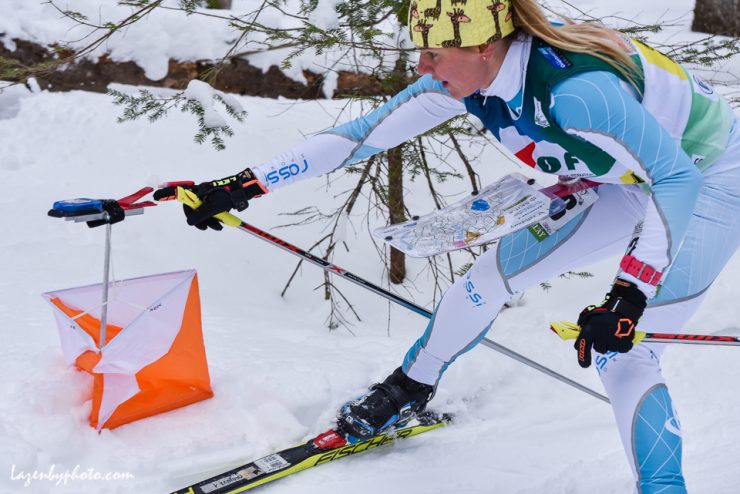
A Czech competitor hits a checkpoint and the snow in the middle distance race at the 2018 International Orienteering Federation World Cup at the Craftsbury Outdoor Center. (Photo: John Lazenby/Lazenbyphoto.com)
Eventual winner Tove Alexandersson of Sweden in the middle distance race at the 2018 International Orienteering Federation World Cup at the Craftsbury Outdoor Center. (Photo: John Lazenby/Lazenbyphoto.com)
Norway’s Lars Moholdt in the middle distance race at the 2018 International Orienteereing Federaation World Cup at the Craftsbury Outdoor Center. (Photo: John Lazenby/Lazenbyphoto.com)
Romania’s Simon Suciu, leads Estonian Kevin Hallop in the middle distance race at the 2018 International Orienteering Federation World Cup in Craftsbury, Vt. (Photo: John Lazenby/Lazenbyphoto.com)
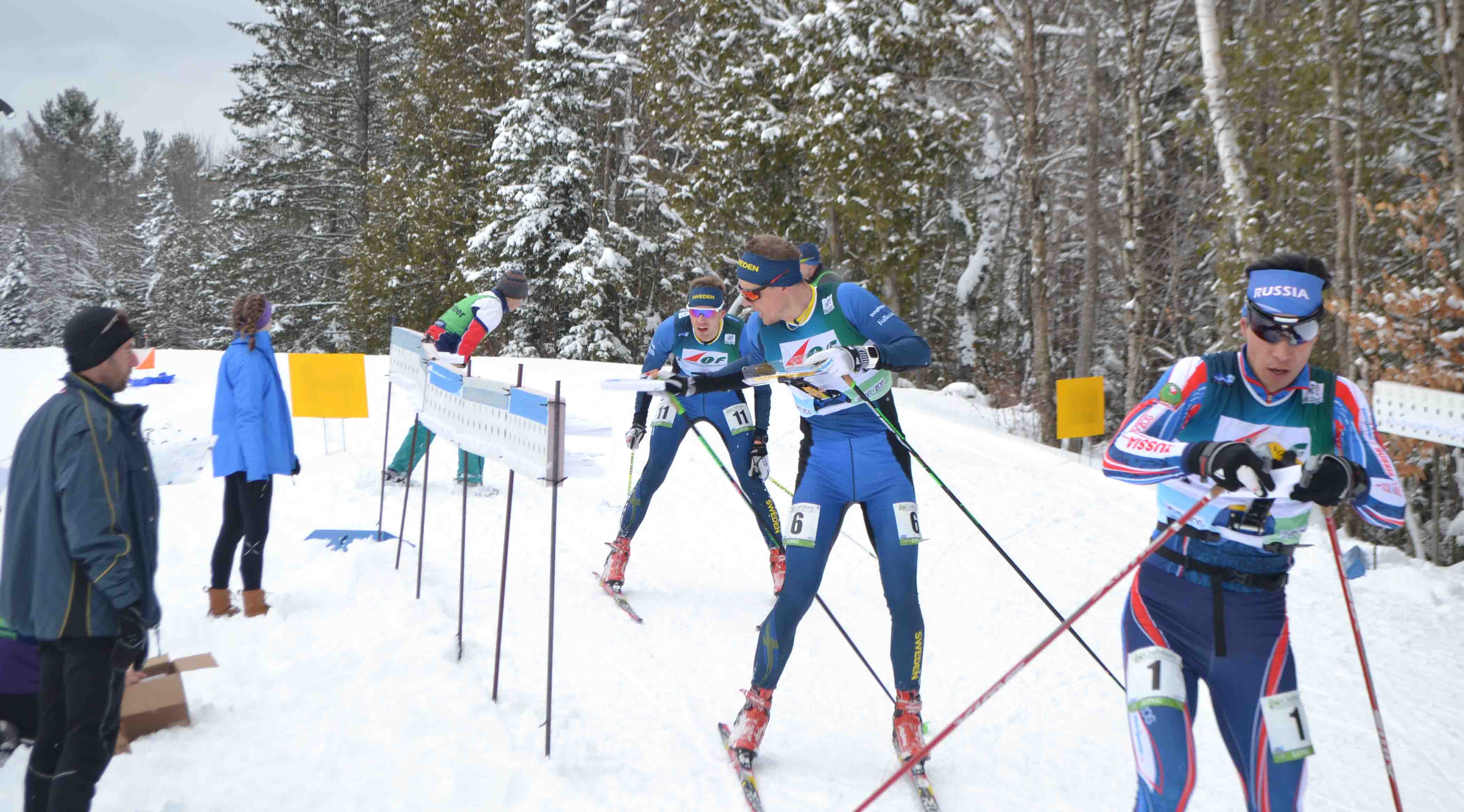
Bulgaria’s Stanimir Belomazhev leads Sweden’s Oyvind Wiggen in the mixed relay at the at the 2018 International Orienteering Federation World Cup at the Craftsbury Outdoor Center. (Photo: John Lazenby/Lazenbyphoto.com)
American Jimmy Burnham in the exchange zone of the mixed relay at the International Orienteering Federation World Cup at the Craftsbury Outdoor Center in Craftsbury, Vt. (Photo: John Lazenby/Lazenbyphoto.com)
Eventual silver medalist Eduard Khrennikov of Russia hits a checkpoint in the mixed relay at the at the 2018 International Orienteering Federation World Cup at the Craftsbury Outdoor Center. He teamed with Tatyana Oborina for second place. (Photo: John Lazenby/Lazenbyphoto.com)
Eventual silver medalist Russian Tatyana Oborina hits a checkpoint in the mixed relay at the at the International Orienteering Federation World Cup at Craftsbury Outdoor Center, Craftsbury, VT. She teamed with Eduard Khrennikov . (Photo: John Lazenby/Lazenbyphoto.com)
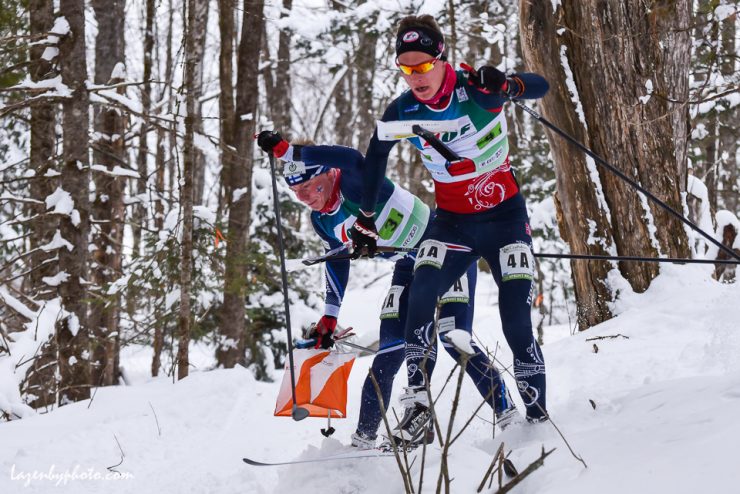
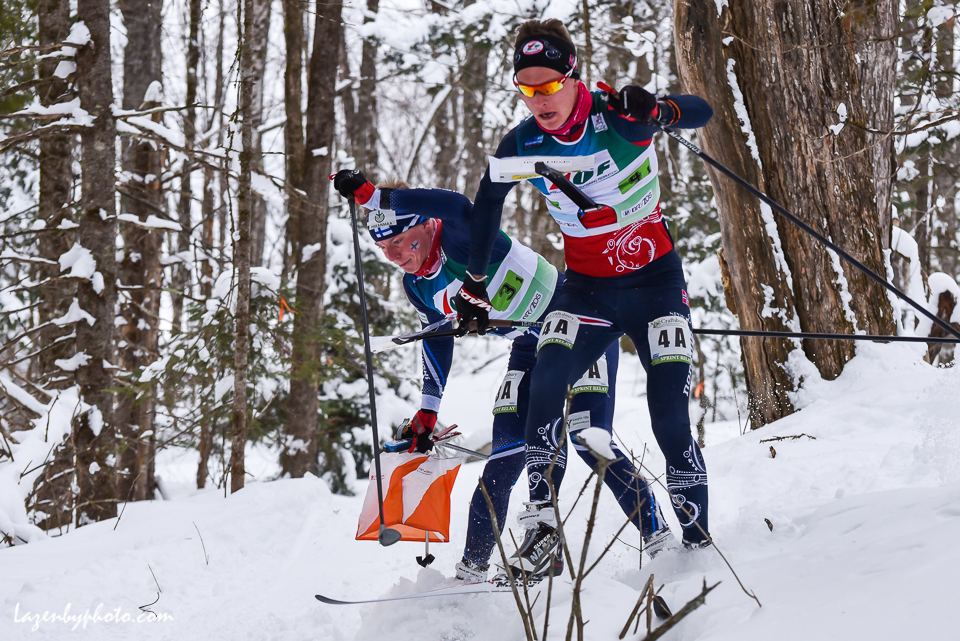
A near miss as competitors Tero Linnainmaa of Finland and Jorgen Madslien of Norway arrive at a check point at the same time in the mixed relay at the International Orienteering Federation World Cup at Craftsbury Outdoor Center, Craftsbury, Vermont. (Photo: John Lazenby/Lazenbyphoto.com)
Canada’s Robert Graham after the final exchange in the mixed relay at the 2018 International Orienteering Federation World Cup at the Craftsbury Outdoor Center. (Photo: John Lazenby/Lazenbyphoto.com)
A Swedish ski-orienteering World Cup competitor carries his nation’s flag Craftsbury, Vt. (Photo: John Lazenby/Lazenbyphoto.com)
Canada’s Milla Tarnopolsky and Robert Graham after placing 18th in the mixed relay at the 2018 International Orienteering Federation World Cup at the Craftsbury Outdoor Center. (Photo: John Lazenby/Lazenbyphoto.com)
Americans Anna Voegele and Ari Ofsevit after placing 19th in the mixed relay at the 2018 International Orienteering Federation World Cup at the Craftsbury Outdoor Center. (Photo: John Lazenby/Lazenbyphoto.com)
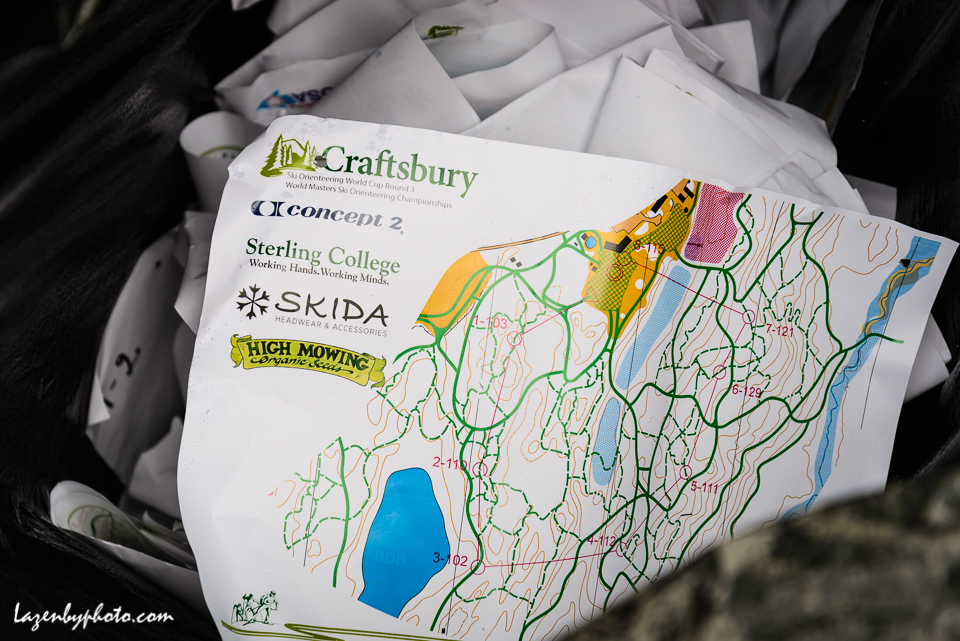
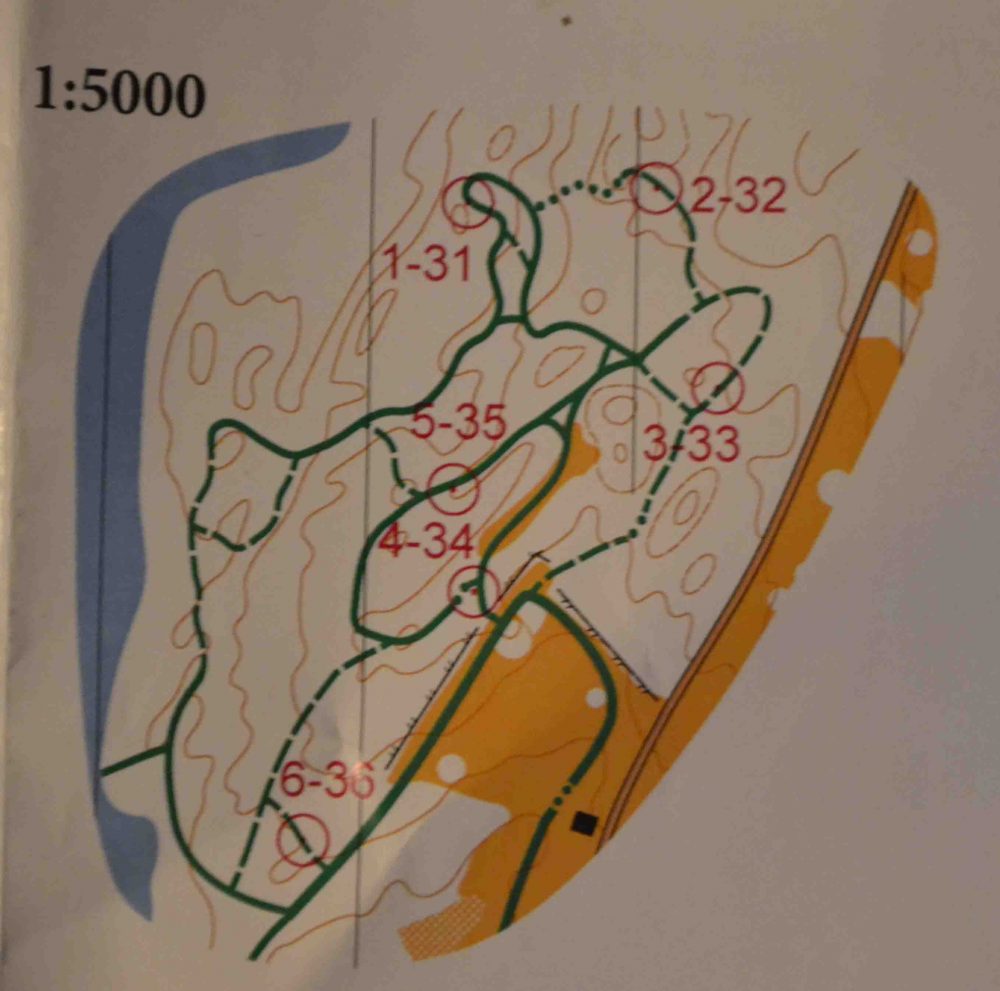
One of the maps at the 2018 Ski Orienteering World Cup / World Masters Ski Orienteering Championships in Craftsbury, Vt. (Photo: John Lazenby/Lazenbyphoto.com)
A near miss as competitors Tero Linnainmaa of Finland and Jorgen Madslien of Norway arrive at a checkpoint at the same time in the mixed relay at the International Orienteering Federation World Cup at Craftsbury Outdoor Center in Craftsbury, Vermont. (Photo: John Lazenby/Lazenbyphoto.com)
The following was submitted by Kevin Brooker, who attended the 2018 Ski Orienteering World Cup and Ski Orienteering World Masters Championships last week in Craftsbury, Vermont. Brooker, who wrote an introductory piece on ski orienteering, set out to explain how the event made its way to the small town in the Northeast Kingdom.
***
CRAFTSBURY, Vermont — Even within the tiny and tight-knit American world of nordic activities, ski orienteering is relatively unknown. Just like traditional cross country racing, the American devotees are rabid enthusiasts determined to have an impact on a sport dominated by Scandinavian athletes. Overseeing the sport is the International Orienteering Federation (IOF), whose mission is to promote the overall sport of orienteering and all of the subsets such as ski-o, mountain bike-o, and the largest segment: foot-o.
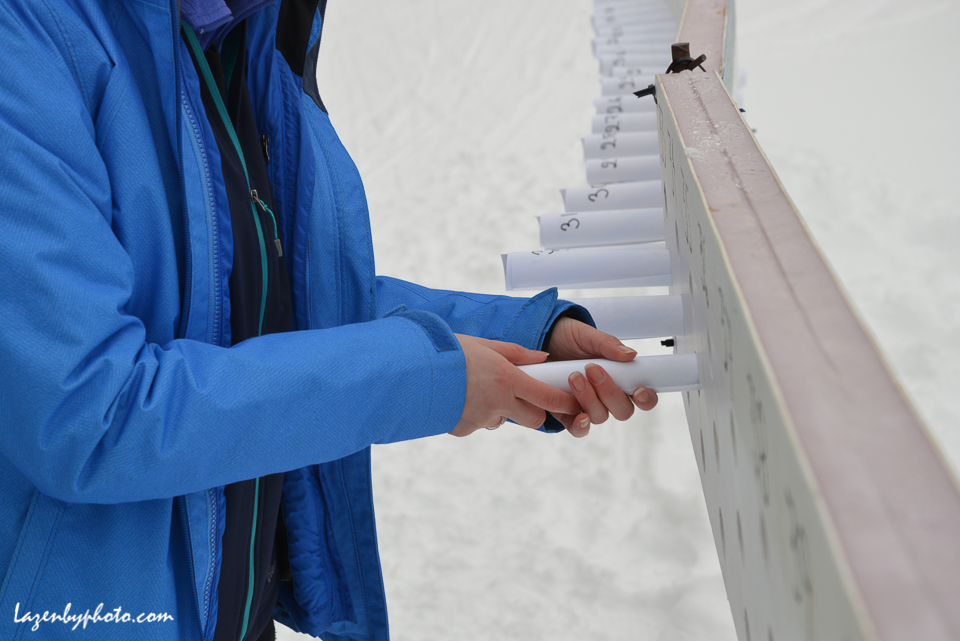
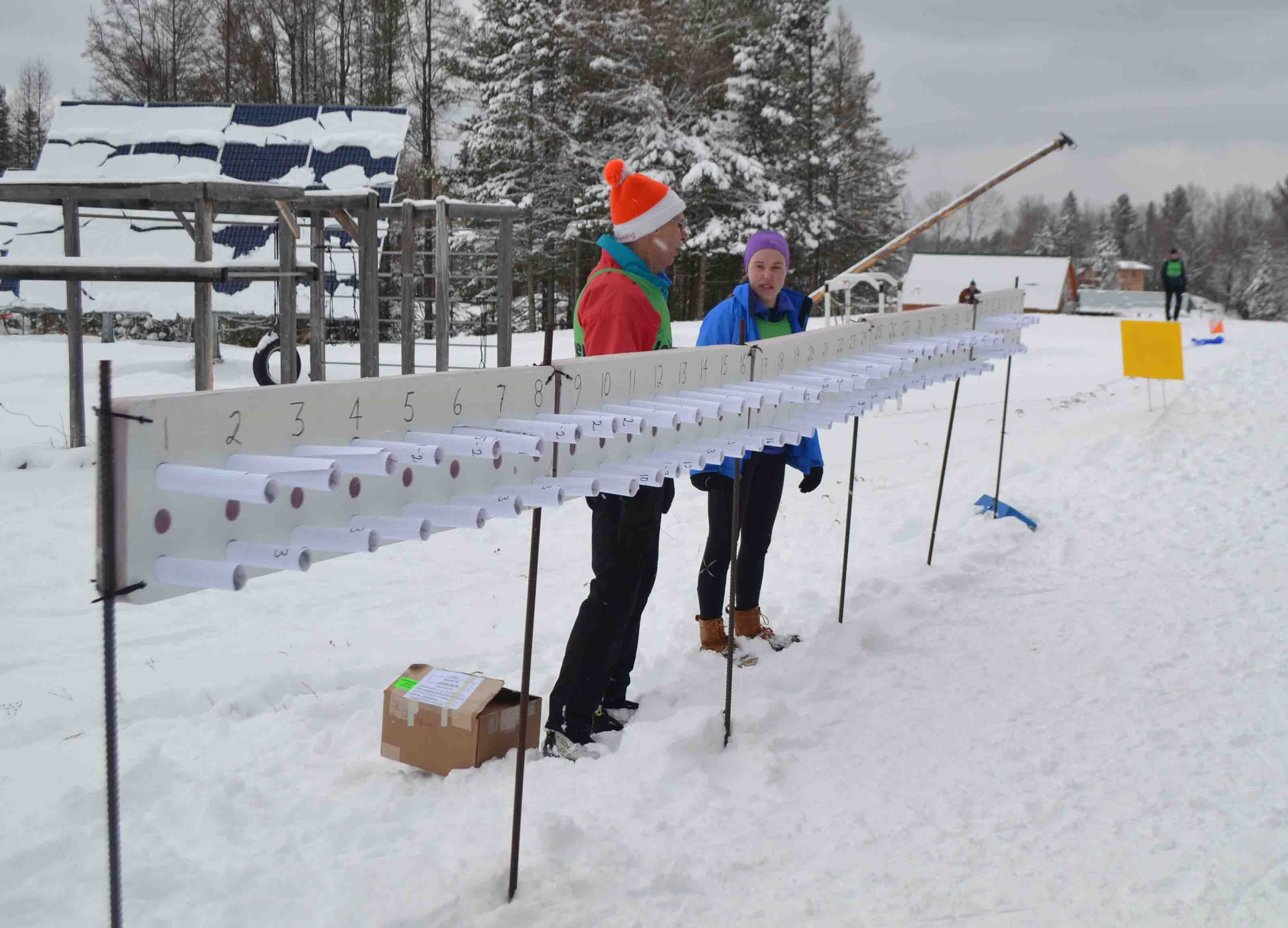
At the map exchange, athletes remove the used map, grab the next sequence and continue racing. Race volunteers collect the discarded maps and refill the board with fresh maps, as seen at the Ski Orienteering World Cup Finals in Craftsbury, Vt. (Photo: Kevin Brooker)
The IOF organizes a World Cup and World Championships for all segments and does its best to move these events around the globe. Like most international competitions, it takes several years to pull together an event. In addition to an appropriate venue, the organizing committee must have international experience, a lot of determination and grit.
Just how did the Ski-O World Cup Finals and Masters World Championships end up in Vermont and how did it go?
Ken Walker, event controller for this year’s championships in Craftsbury, explains the genesis of the event:
“I was approached several years ago while ski-0 masters racing in Europe about bringing World Cup ski-0 races back to North America. We held very successful races in Truckee, California, in 2012 and competitors wanted to return. I suggested doing it in the East and [Craftsbury Event Director] Adrian Owens was enthusiastic about holding them at Craftsbury. This was a natural choice, knowing the fine trail network and an organization welcoming competition events. My official job was national event controller. It basically means I check to ensure the races are fair, accurate and safe, and we follow the International IOF rules.”
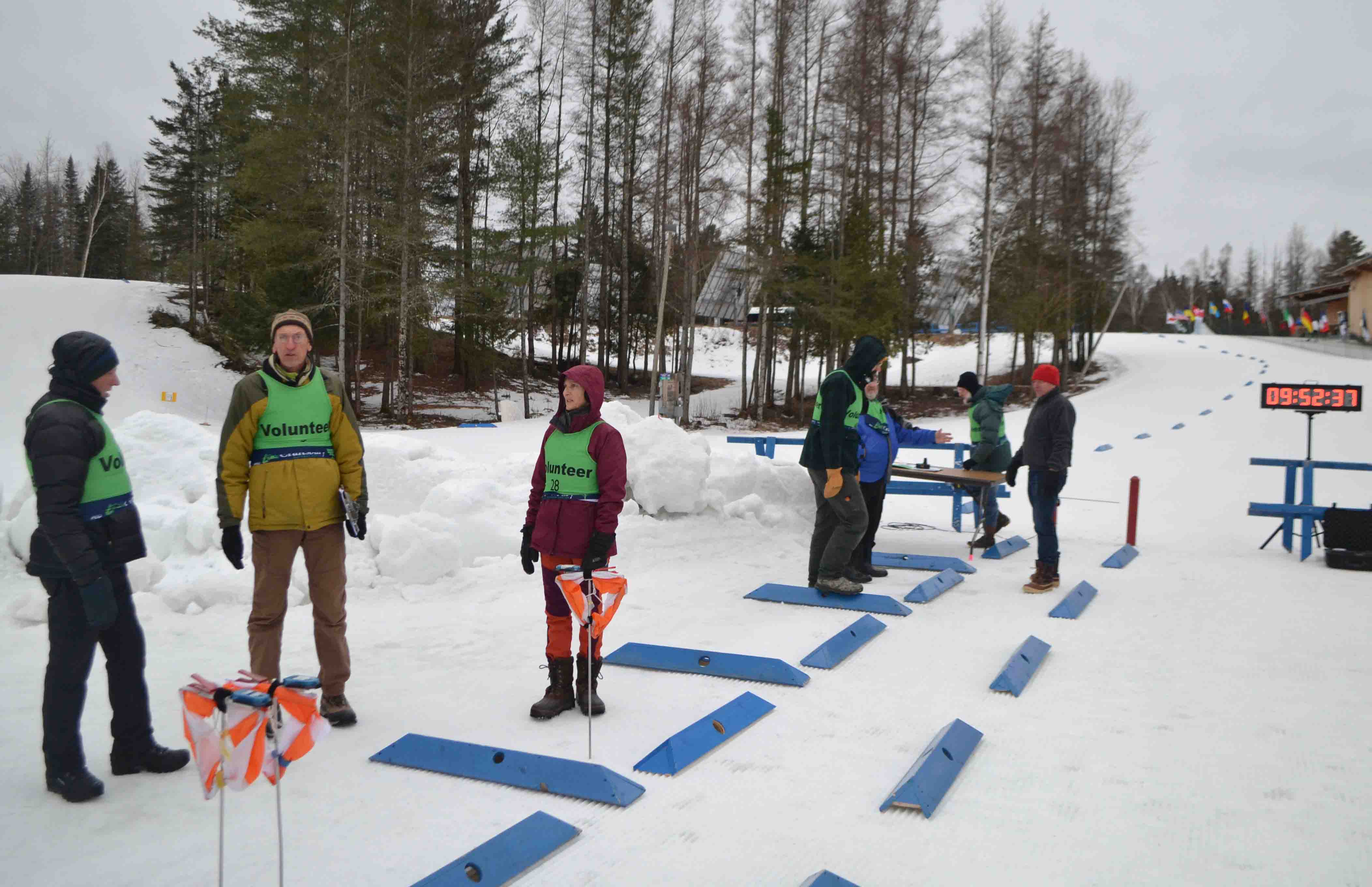
Preparing for racers to arrive at the map exchange in the distance race at the International Orienteering Federation (IOF) Ski Orienteering World Cup at the Craftsbury Outdoor Center in Craftsbury, Vermont. (Photo: John Lazenby/Lazenbyphoto.com)
With a well-formed idea, Walker and Owens approached Judy Geer, co-owner of the Craftsbury Outdoor Center (COC), about hosting the event.
“When Adrian Owens approached us about the idea of hosting this race, which he did well over a year ago, I was pretty quick to say, ‘Sure, sounds like fun!’ ” Geer explained. “It seemed like an opportunity to share our trail system in a new way and welcome an international group of nordic skiers to Craftsbury. At the same time, we had no idea how to host such a race so it was critical that there would be a knowledgeable organizing committee to really put it all together. Luckily, we had that. “
An East-Coast venue secured, Walker and Owens assembled an organizing committee (OC) to bring the event to Vermont. The committee had more to do than just run a race; they had to educate the Craftsbury staff and teach them about ski-o.
Craftsbury Outdoor Center coach Ollie Burruss had this to say about his ski-o learning curve:
“I would just add that the organizing committee has been incredibly helpful in educating those of us at the Outdoor Center without a background in ski orienteering – I think that would be almost all of us, actually. We are quite comfortable hosting high level cross country races, but this series added new elements to our race day preparation. Without the OC stepping up and providing input, suggestion, education, and the like, we would not have known where to start.”
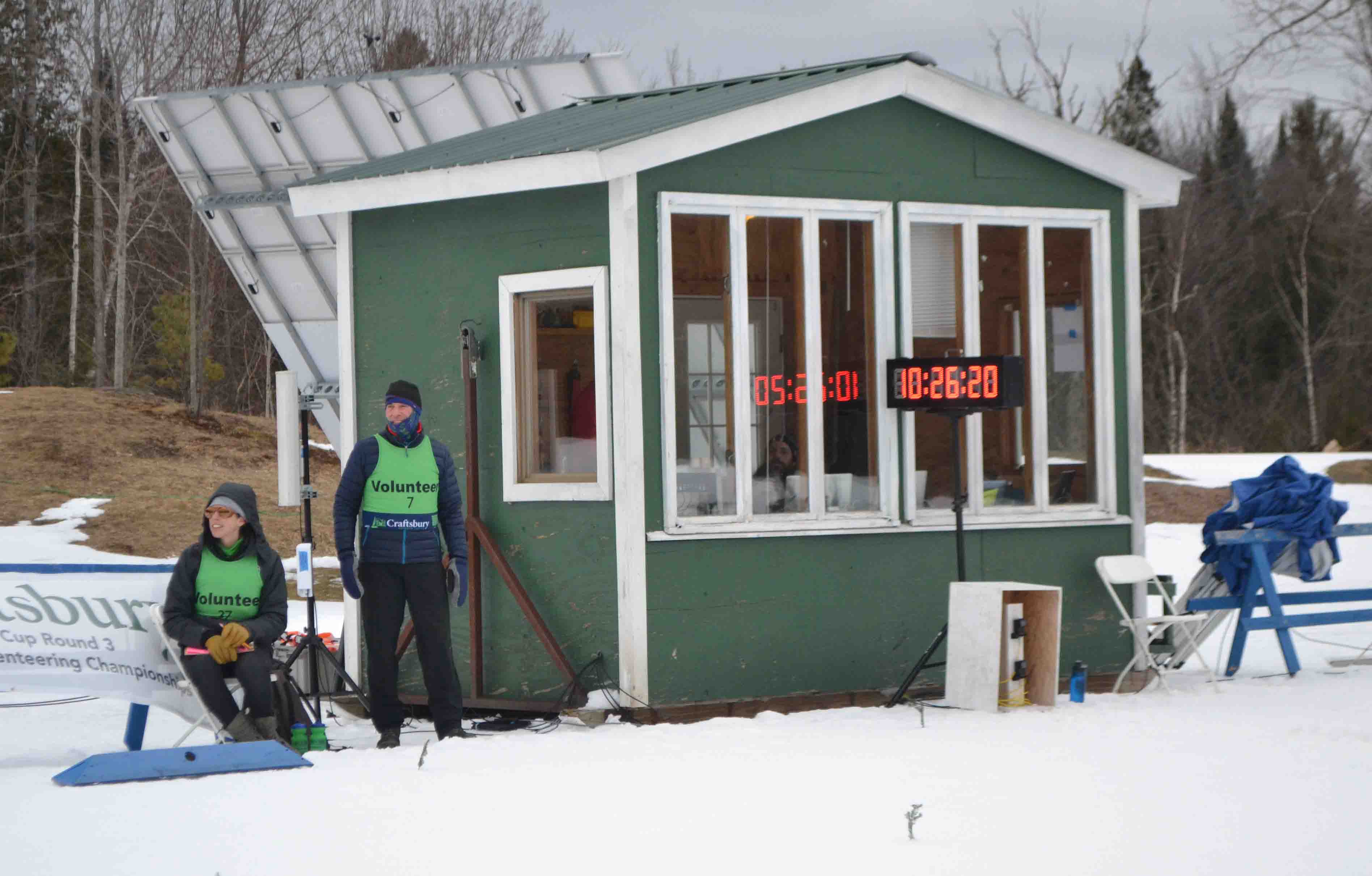
The finish crew getting ready to record race numbers to help verify the electronic finish order at the Ski Orienteering World Cup Finals and World Masters Championships in Craftsbury, Vt. (Photo: Kevin Brooker)
Much of a ski-o race shares a lot of similarities with a more traditional cross-country event. Both have individual starts and mass starts. With the exception of ski-o competitors wearing map holders, the starts and finishes look identical. Craftsbury was able to utilize their expertise and equipment setting up timing and start and finish areas. Where the Center needed some help was setting appropriate courses and the OC provided two expert competitors and course setters.
Alex Jospe and Andy Hall are two such experts.
“As course setter, my main task is to design an orienteering course that is appropriate for each class,” Jospe explained. “For the elite skiers, this involves very technical skiing and very technical navigation, with a mix of challenges from route choices to fine-scale navigation execution, all done at top speed. Ironically, those are the easiest courses to set, because the competitors can handle just about anything you throw at them. The tricky part is designing a course that will be navigationally challenging for the elder classes, without totally thrashing them on the ski trails.
One of the maps at the 2018 Ski Orienteering World Cup / World Masters Ski Orienteering Championships. (Photo: John Lazenby/Lazenbyphoto.com)
“Setting a course entails laying everything out on paper, and then going out into the terrain to make sure that all the trails and tracks line up the way they are supposed to,” she continued. “I also spend a lot of time skiing various route choices, to get a sense of how long it will take for the skiers to complete the course. Then we print out the maps, and go out to set up the checkpoints, which are marked with an orange and white flag. Each of these flags (called ‘controls’) has an electronic timing unit on top, so that competitors can carry a timing chip and get splits instantaneously at the finish.”
With the event completed, how does the OC feel about the event?
“We’ve been on a steep learning curve about this sport, and it’s really been fun to finally get to watch the races this week!” Greer noted. “We hope the competitors are enjoying Craftsbury as much as we’re enjoying having them here.”
“Our expectations have been more than met, with terrific support from venue staff and the trail groomers,” Walker said. “It is fun to host nearly 200 European racers and introduce more Americans to ski-o.”
The start crew preparing for the World Cup long distance event at 2018 Ski Orienteering World Cup / World Masters Ski Orienteering Championships in Craftsbury, Vt. (Photo: Kevin Brooker)
With years of racing, coaching, and organizing races, Burruss had this to say: “I really appreciate the patience they [the organizers] have showed and I hope we have held up our end of the bargain. It is a cool event and I’m glad we were able to help bring this level of racing to the NEK [Northeast Kingdom].”
The experience of setting dozens of courses for many levels of skill and age, with snow cover ranging from gray ice to a foot of fresh snow, Jospe summed up her experience:
“Hosting this event at the Craftsbury Outdoor Center has been amazing. They are generous, interested, and enthusiastic — we couldn’t do this without such good support! It’s really cool to bring so many international competitors to this corner of Vermont, and everyone is appreciating the friendly vibes.”
For those of us fortunate enough to participate in this world-class event, the hard work and effort by the OC and huge staff of volunteers at the start, finish, registration, and out on the course is greatly appreciated. The trail grooming was exceptional and the rest of the COC staff was extremely professional. Everyone worked together to provide a fantastic racing experience to spectators and participants alike.
About the Author: Kevin began nordic skiing to keep in shape for bicycle racing at the dawn of the skating revolution. He lives in Vermont with his wife and two kids, who are fortunate enough to have great skiing right out the front door.
This ski-orienteering mass-start race had two exchanges. The top map is the first taken after the start. The maps were used in different orders to deter leaching (following). The intricacies of an orienteering mass start are worthy of their own article. The course setter mixes and matches the routes, and each athlete will cover the same legs but in a different order. After all this, there is often a finishing sprint for the victory. The exchange crew must be sure to put the correct map into the proper slot to insure a fair race. (Photo: Kevin Brooker)
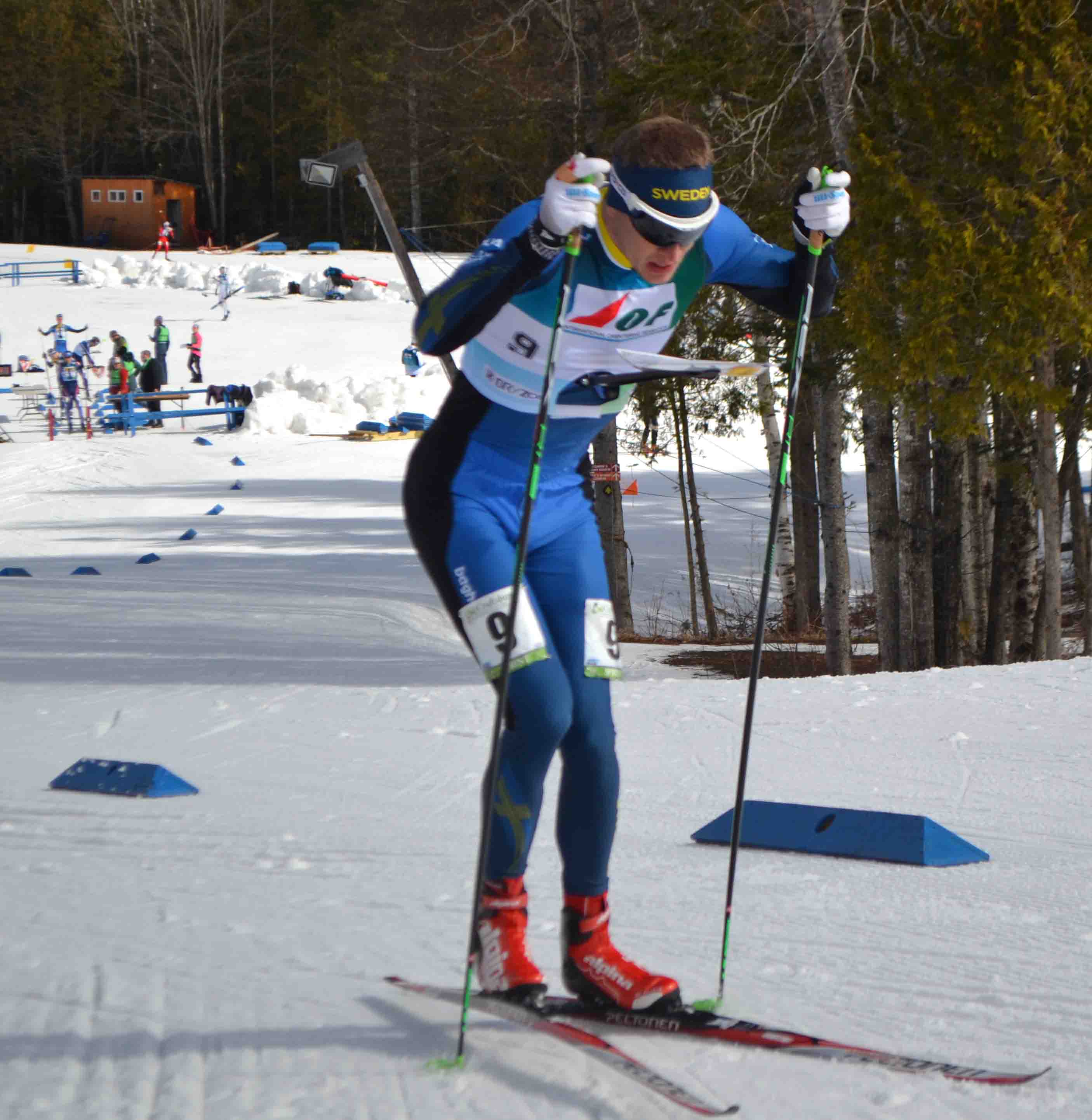
Sweden’s Martin Hammarberg leaving the start of the ski orienteering World Cup sprint on Tuesday in Craftsbury, Vt., with a map on a holder strapped to his chest. The first 300 meters or so of the race involve simple navigation, allowing the competitors time to read the map and formulate a plan. (All photos: Kevin Brooker)
CRAFTSBURY, Vermont — This week, the Craftsbury Outdoor Center is hosting the final three races of the 2018 Ski Orienteering World Cup as well as Ski Orienteering World Masters Championships. In addition to flocking from all over the United States, athletes have traveled from Bulgaria, Canada, Taiwan, Czech Republic, Estonia, Finland, Germany, Italy, Norway, Romania, Russia, Sweden, and Switzerland for this event.
For those FasterSkier readers worried about cross-country skiing being unknown here in the U.S., it is a safe bet “Ski-O” is orders of magnitude even more obscure.
A small ski-orienteering training map. At this scale, 1 centimeter on the map is roughly 50 meters on snow. The first number is the control for that race (athletes follow them in order) and the second is to identify the correct control has been found. Controls are scattered all over to suit different classes and only controls used for a particular class are depicted on the map.
Simply put, Ski-O is a race combining navigation and cross-country skiing. The route is up to the competitor and route choice is a big part of winning races. Just 15 seconds before they push through the wand to start their race, each athlete is given a map containing control points (used to determine distance). Most races are individual start, but there are mass start events, too (although none will be held in Craftsbury).
The skill is using a trail network to travel as fast as possible from control to control, which must be taken in a specified order. Race distances are given as control to control in a straight line and actual distance traveled is longer due to the circuitous nature of ski trails. Adding a bit of fun to the mix, not all travel is on wide, groomed trails. Athletes are free to travel off trail if they believe it is the quickest way to the next control.
The organizers prepare trails full enough for two athletes to skate alongside each other (depicted as a solid green line on the map), narrow but almost skate-able (dashed green line), or single track (dotted green line) which is pretty much a hiking trail that a skier can double poled to navigate.
The map also contains topographical information and navigable features such as buildings, cliffs, fields, fences, and just about anything which can be identified when covered with snow.
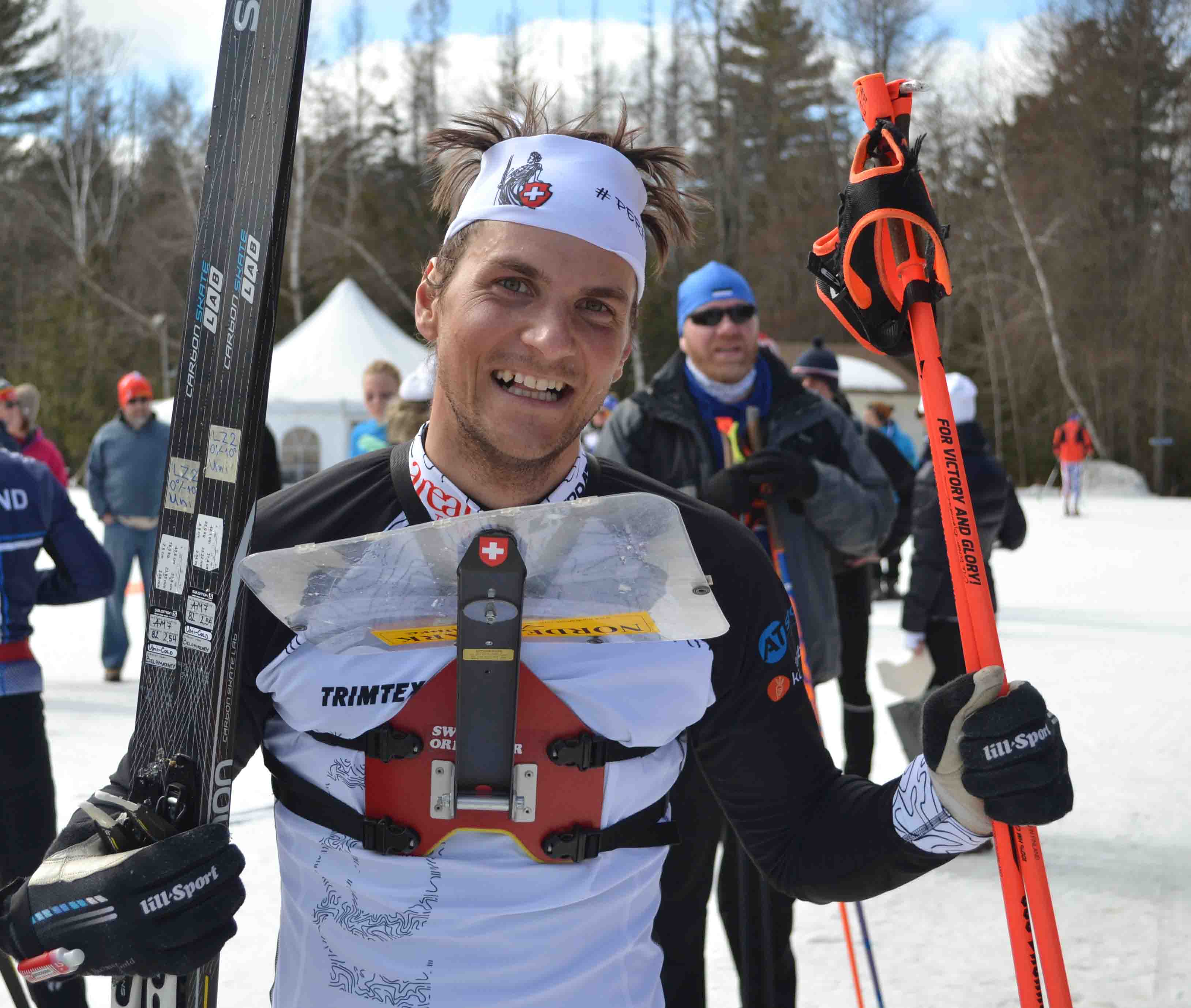
Gion Schnyder of Switzerland showing off his gear and smile after finishing seventh in Tuesday’s ski orienteering World Cup sprint in Craftsbury, Vermont.
Each skier wears a map holder which can pivot in the center allowing the athlete to orient the map if they so choose. This device also allows the skier to read the map while in motion.
Route choices are made on the basis of the quality of the ski tracks, gradient and distance, all of which can be read from the map. Each athlete decides if it is quicker to ski wide trails and travel farther while going faster, or take the shortest route through the woods while moving at a lower rate of speed. It might also be quicker to abandon mapped trails altogether and strike out through the woods.
Watching these athletes move through the woods is impressive. They travel off-trail and successfully negotiate terrain most alpine skiers would hesitate to try. There is very little slowing down, leaving a wide trail for a bit of single track. In comparison with the more well-known cross-country skiing, ski orienteers are faster on technically challenging, narrow, soft tracks.
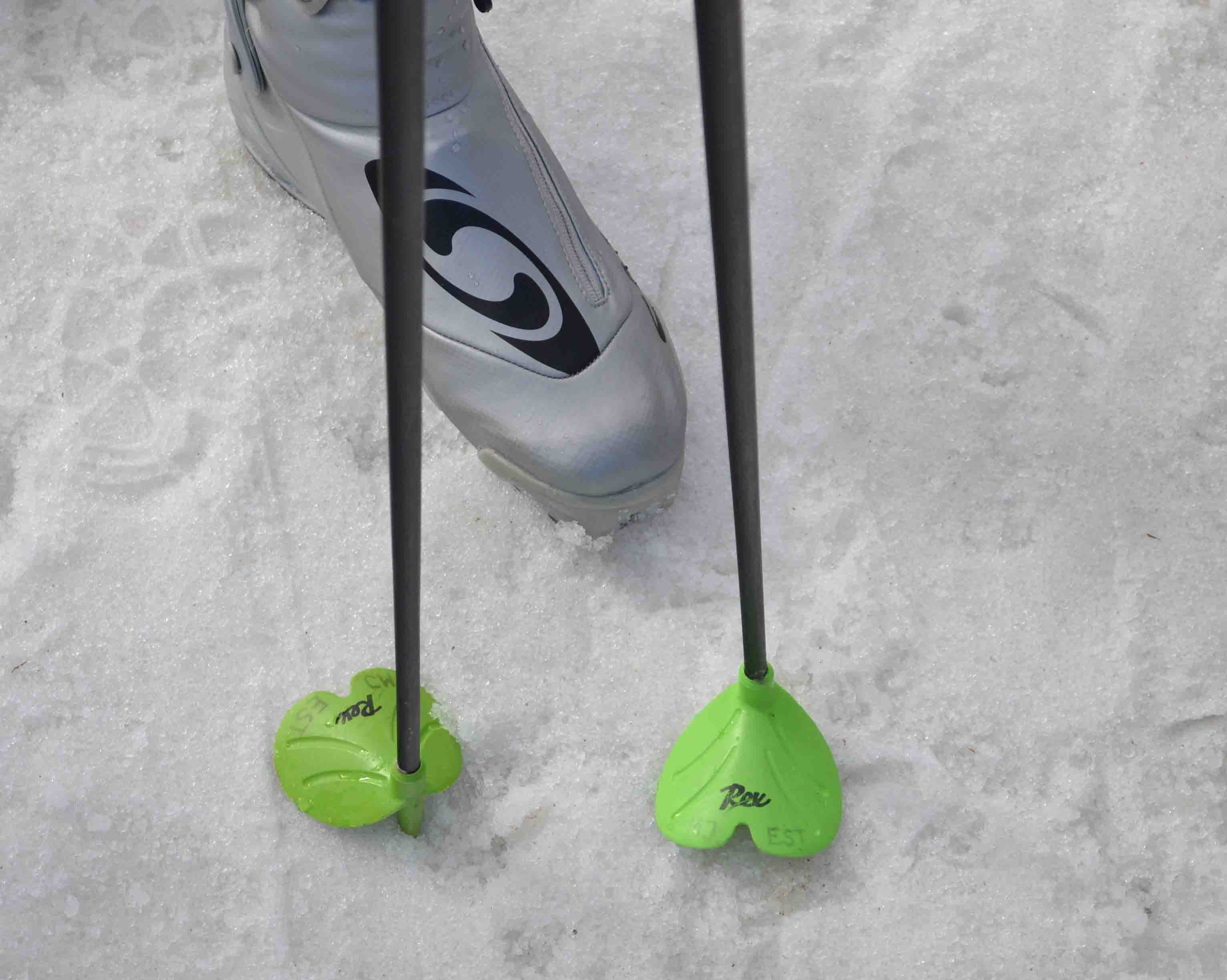
Ski-orienteering pole baskets are relatively big since a lot of the terrain is not compacted trails.
There are a few equipment modifications for ski-o. Pole baskets are significantly larger and skis are a bit shorter than what’s used on firm groomed tracks. Skating is preferred and some competitors carry a compass. To verify finding a control, an electronic chip (looks like a thumb drive) is time stamped when the athlete passes the chip across a device which looks like a cellphone. At the end of the race the chip is downloaded to calculate the total course time. Distance is not measured. The fastest athlete to collect all controls in the specified order and complete the course is the winner.
The World Cup sprint has a point-to-point distance for the men of 3.4 kilometers, and the best distance by trail is 4.4 k. The women’s race has a point-to-point of 3 k and trail distance of 3.7 k. The men have 11 controls and the women have nine. The expected winning time for both races is 13 minutes.
On the other end of the spectrum, a long-distance event is advertised point-to-point as 24 k for the men and 18 k for the women. Both have an expected winning times of roughly 90 minutes.
At the end of the World Cup week, FasterSkier will post a short report on the races.
Here are the top-five results of Tuesday’s World Cup sprint:
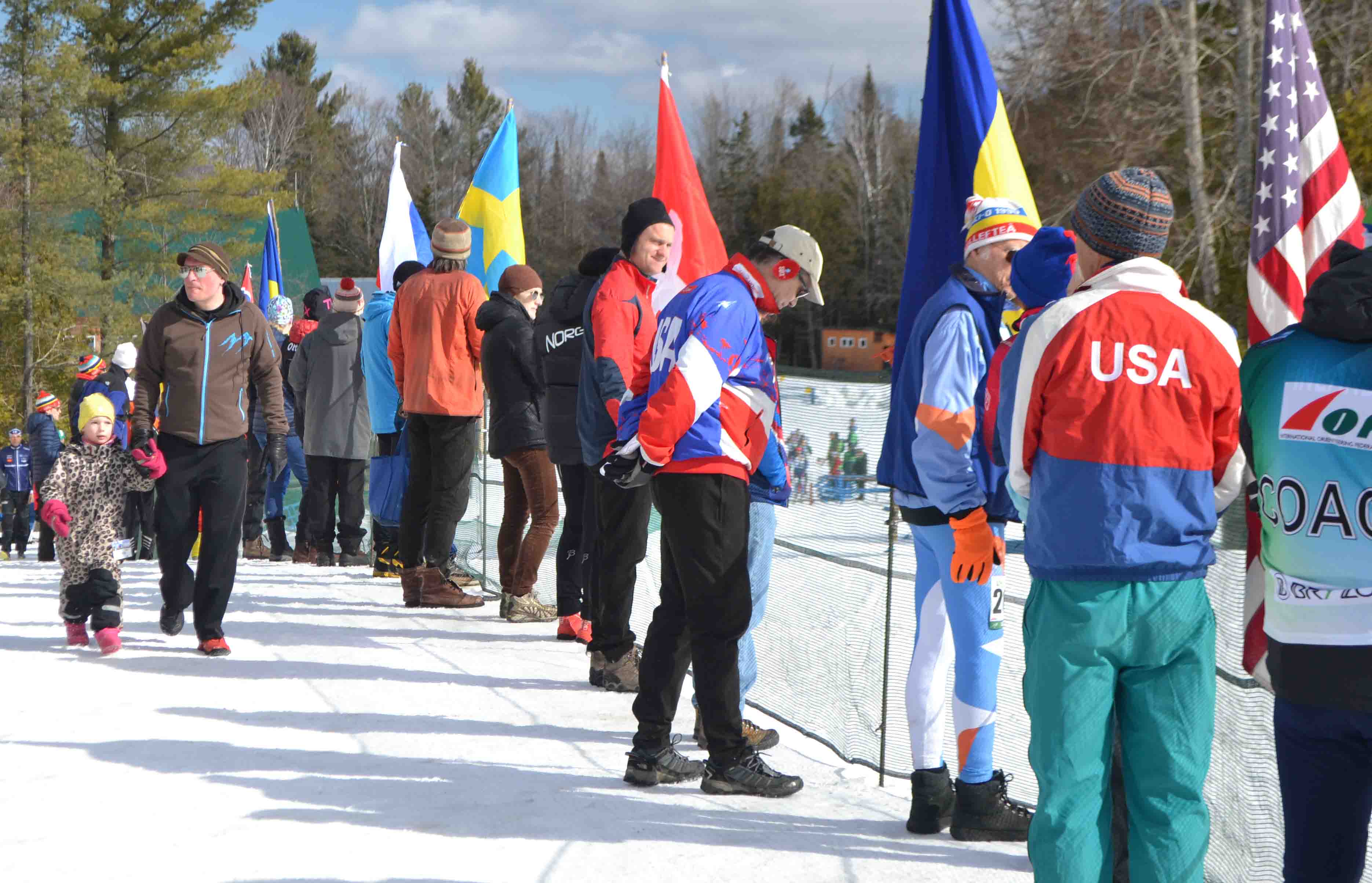
Spectators alongside the trail at the 2018 Ski Orienteering World Cup in Craftsbury, Vermont.