From the FasterSkier archive — posts syndicated from athletes’ and coaches’ own blogs between 2004 and 2012, kept online as published. Current coverage is at fasterskier.com.
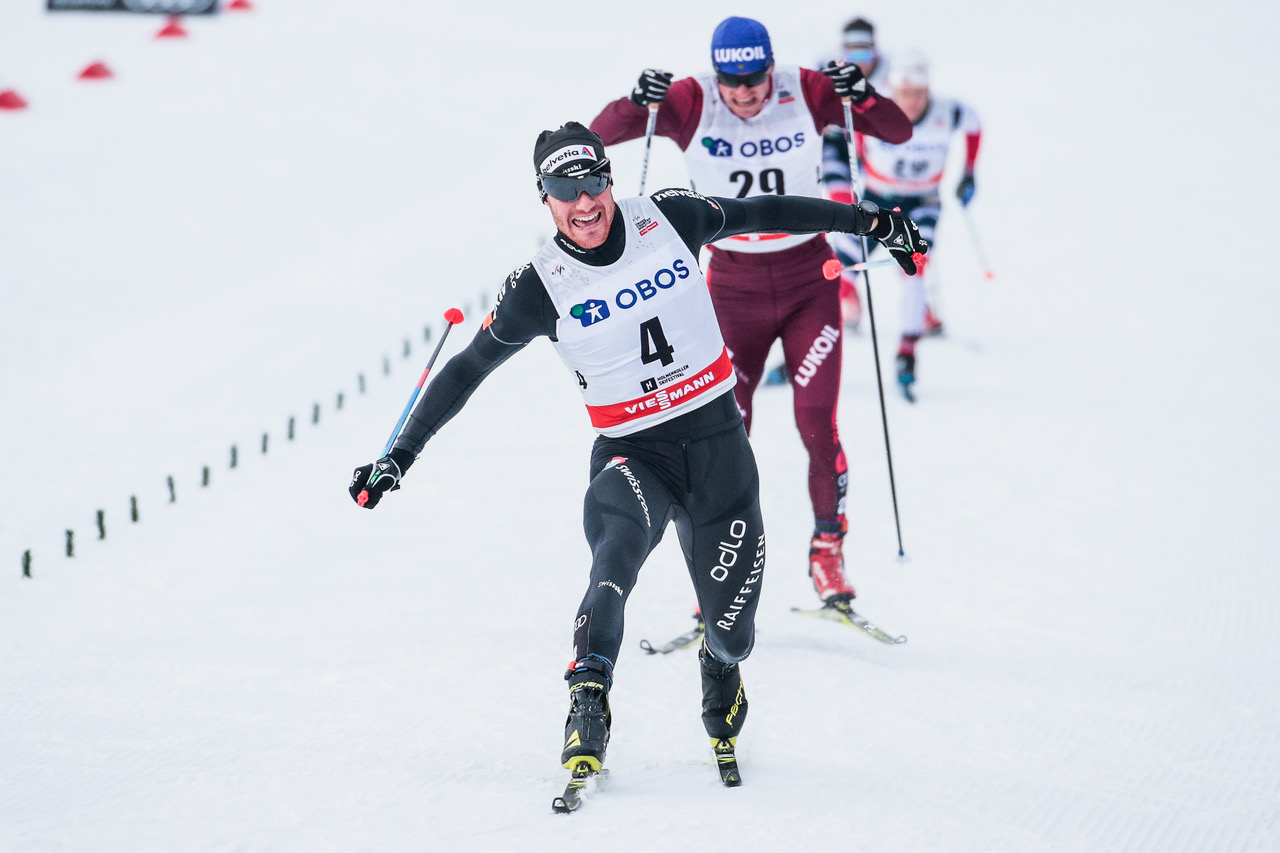
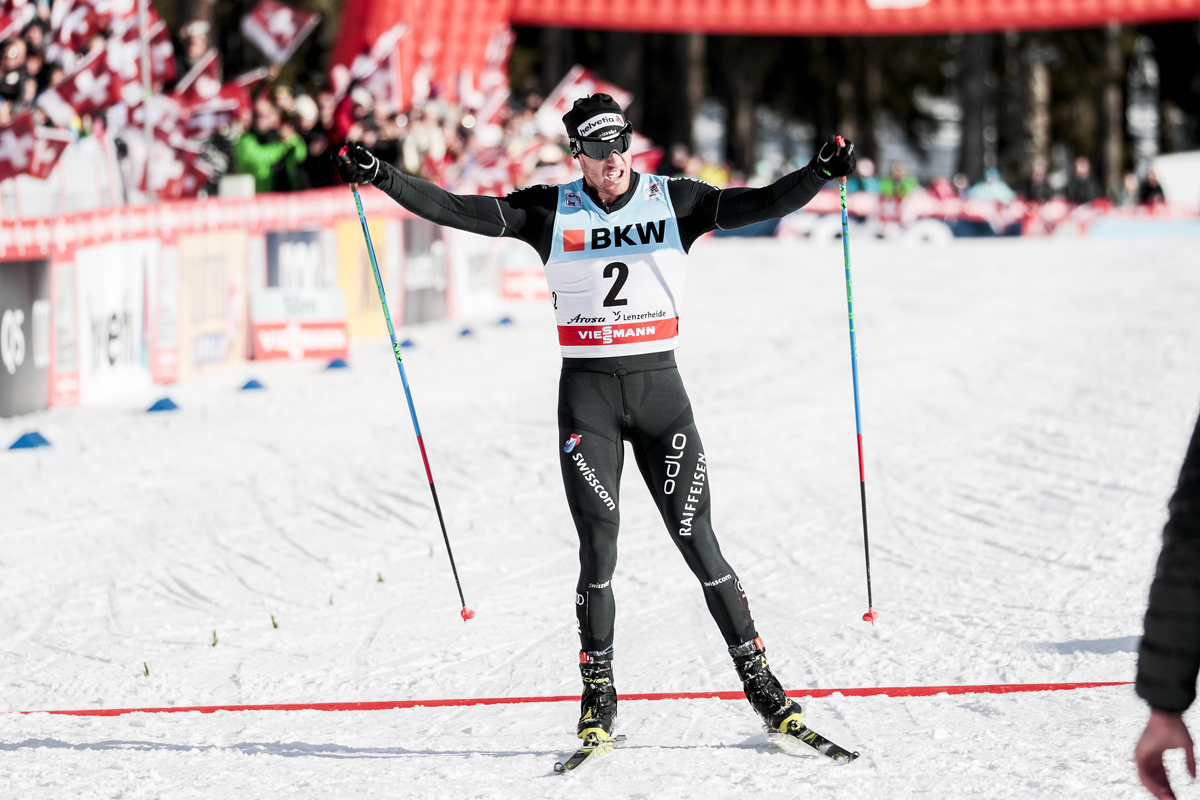
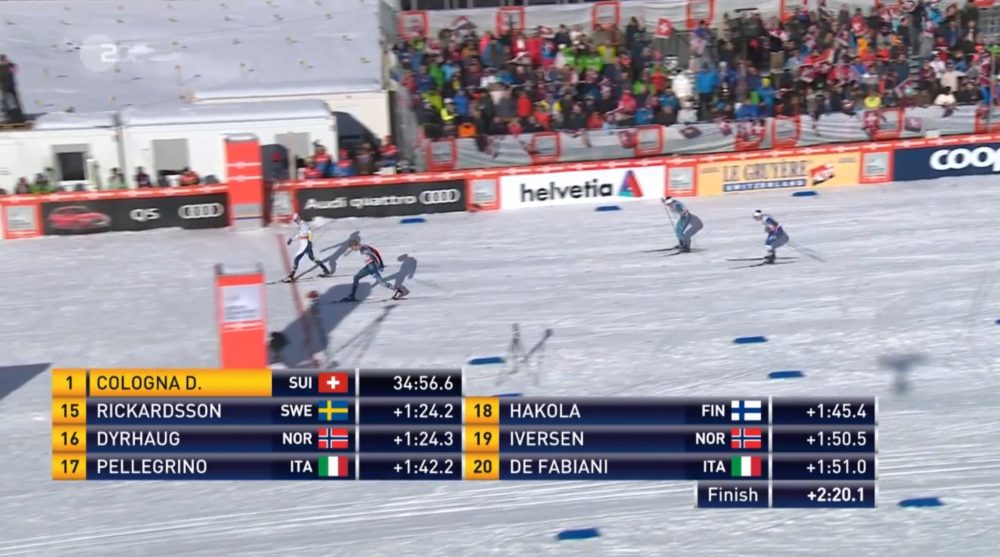
The photo finish for first between Switzerland’s Dario Cologna (near) and Norway’s Martin Johnsrud Sundby at the 2018 Holmenkollen 50 k freestyle mass start in Oslo, Norway. Cologna got it by 0.01 seconds. (Photo: FIS Cross Country/Twitter)
Welcome to FasterSkier’s World Cup Preview, where we check in with the top-10 teams from last year’s FIS Cross Country World Cup tour before the season starts with the Ruka weekend in Kuusamo, Finland, on Nov. 24 with a classic sprint.
***
Switzerland
Overall in Nations Cup Last Year: 6th
Women’s Ranking 2017/2018: 7th
Men’s Ranking 2017/2018: 4th
However lopsided Switzerland World Cup profile appears – think Dario Cologna prime time all the time – the team is more than a set of shoulders to carry its star. Certainly, Cologna can steal the show, as his return to form last season proved, but the Swiss collective of athletes proved their World Cup mettle in 2017/2018.
Twenty-five-year-old Nathalie Von Siebenthal arrived on the World Cup in-form. In Ruka, the start of last year’s World Cup, she placed sixth in the 10-kilometer freestyle pursuit. Between Ruka and the Olympics, Siebenthal raced to numerous top-10’s in distance events while placing eighth overall in the Tour de Ski (TdS).
Switzerland’s Nathalie von Siebenthal racing the second-fastest third leg of the women’s 4 x 5 k relay at 2017 World Championships on March 2 in Lahti, Finland. Her team finished seventh.
In PyeongChang, Siebenthal was able to bring the Swiss team near the front of the women’s distance race pack. In the 15 k skiathlon, Siebenthal placed sixth overall, 2.9 seconds behind fifth place Jessie Diggins (USST) who was dialed for a stellar Games. In the individual start 10 k skate, Siebenthal again was sixth.
Nadine Fähndrich, at twenty three years old, should help the Swiss women’s team build upon last year’s solid performance. By season’s end, Fähndrich was ranked 21st on the sprint list and 31st on the distance list. She finished 27th overall on the World Cup.
The Swiss women’s team gets deeper. There’s veteran skier Laurien van der Graaf who had several top-10’s on the World Cup and Olympics. She won the Lenzerheide, Switzerland and Seefeld, Austria skate sprints, was the fifth ranked sprinter in the world last season, and 21st overall.
Cologna is back: Second in the final overall standings, first in distance. Let’s just say he’ll round out an already well-rounded Swiss team.
Jovian Hediger, at twenty-seven, will take some of the pressure off Cologna when it comes to the Swiss men’s expectations. He finished the season ranked 19th in the sprint cup.
(From left to right) U.S. Ski Team members and 2018 Olympians Rosie Brennan, Kikkan Randall, Sadie Bjornsen, Jessie Diggins, Erik Bjornsen, and Ida Sargent posing after their intro press conference on 2-7-18. (Photo: Flyingpointroad.com)
PYEONGCHANG, South Korea — Sitting one-by-one across the stage dressed in what appeared to be the brightest of bright white tops, Kikkan Randall, Jessie Diggins, Rosie Brennan, Ida Sargent, and the Bjornsens (both Erik and Sadie) held court for the attending media Wednesday afternoon at PyeongChang’s mountain cluster media center. All athletes are members of the U.S. Ski Team (USST) and 2018 Olympians.
Randall, the seasoned vet, fielded a spectrum of questions centered around her role as the foundational piece of the U.S. women’s cross-country-ski juggernaut. It’s the Anchorage-based skier’s fifth Olympic Games.
Back in 2002, when Nina Kemppel competed in her last of four Games for the U.S. cross-country ski team, Randall, as part of the same 2002 Salt Lake squad, was beginning her own five-Olympiad odyssey. Sixteen years later, Randall could reflect on being, at times, a lonely success story on the women’s side, to the present, when on the most recent World Cup weekend in Seefeld, Austria, two U.S. women scored wins: Sophie Caldwell in the freestyle sprint,Diggins in the 10 k mass start skate.
Jessie Diggins and the media swarm during her intro press conference at the 2018 PyeongChang Olympic Games. (Photo: Flyingpointroad)
As much as the press was there to see a champ like Randall, they also were captured by Diggins’s spunk and verve. Erik Bjornsen took it all in after stating in his intro that this was his first press conference. He proceeded to take out his smartphone and unabashedly capture a few panning video shots of the scrum of reporters there to learn more about the U.S. cross-country team poised to make history in South Korea.
For those who follow the sport and in particular the U.S. women, much was said about the “team” and their devotion to it. But each athlete also spoke of their personal goals and ambitions.
After the main press conference, when athletes took one-on-one questions, FasterSkier had an opportunity to check in with Brennan, Erik Bjornsen and Sargent.
2018 is Brennan’s first Olympics, yet she arrives with a broad scope of World Cup experience to draw from. She scored two top-20’s in successive World Cup 10 k freestyle races in Davos, Switzerland and Toblach, Italy. She nailed a 15th place in the Tour de Ski’s opening skate sprint. It was a solid Period 1 on the World Cup for Brennan.
Much has been written about the U.S. women’s collective prospects in the 4 x 5 k relay. That team, which could include more names than the four-member team is alloted, is still not set in stone.
Asked if she would be approaching her first race opportunities as a demonstration to the coaches of her overall fitness, Brennan was anything but coy.
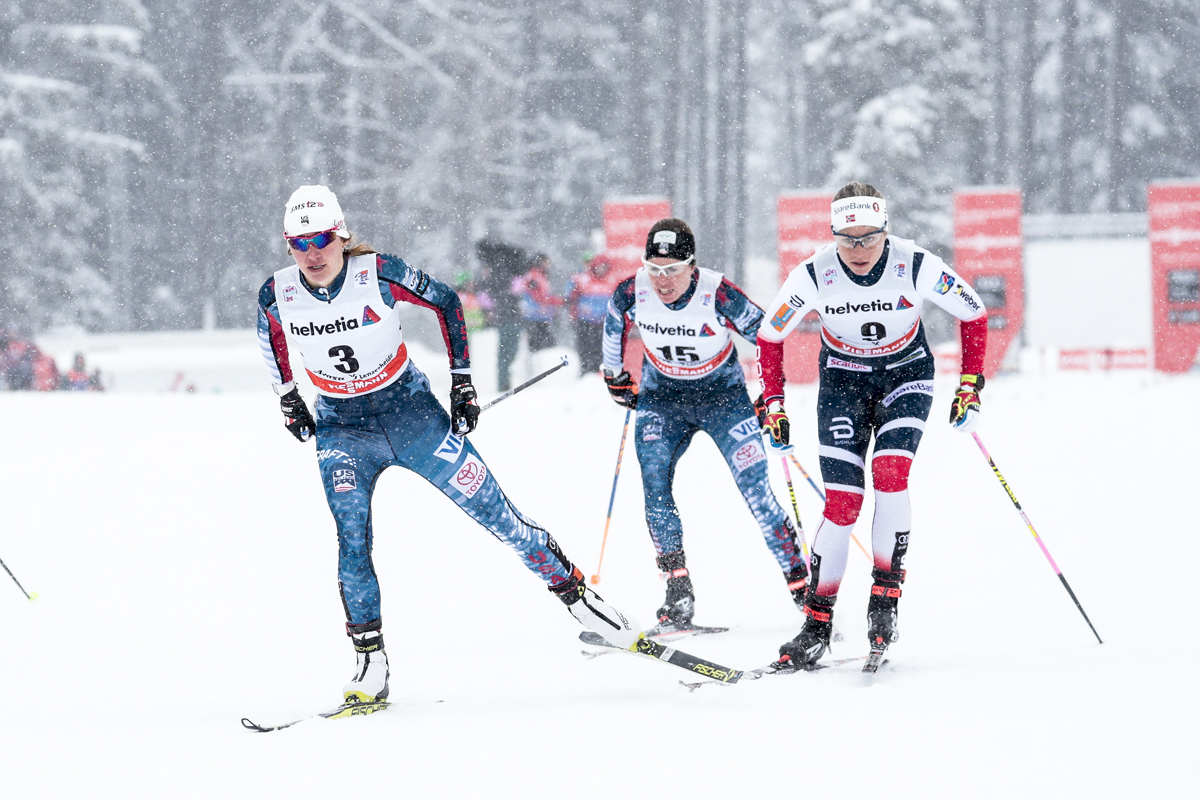
Sophie Caldwell (3) leading her U.S. teammate Rosie Brennan (15) and Norway’s Astrid Uhrenholdt Jacobsen in the quarterfinal of the women’s freestyle sprint at Stage 1 of the 2018 Tour de Ski in Lenzerheide, Switzerland. (Photo: Fischer/NordicFocus)
“I have been struggling the last few weeks since the TdS with my own racing,” the 29-year-old Brennan said. “And so at this point I am just hoping to had enough time to turn my form around and to race better myself. I obviously don’t want to be part of a relay team that I’m going to let down. So I want to be in my best shape before I even think about that. That is one of my goals and I hope I’ve had some time to turn my shape around. But I think at this point, I am looking for every opportunity to race that I can get to show that I have turned this around and that I am ready and then will start looking at that relay spot.”
Most recently, Brennan struggled in Seefeld’s 10 k skate mass start, finishing 53rd. Brennan also after completed the Tour de Ski (TdS), which concluded Jan. 7. Understanding that maintain high level fitness on the World Cup is a challenge few master, Brennan said the TdS had sapped her energy.
“Just a little more fatigue than I expected from the Tour despite the fact that we only had six and half races,” Brennan acknowledged. “There were a lot of weather events so everything was a little more energy intensive and a little hectic. I came in with a lot more training than I have in the past, I trained a little harder during Period 1 in hope to be sharp for the Olympics, and I think I didn’t respect that as much as should have and was a little tired afterwards. And also fighting a little illness and things like that. I am feeling a lot better now and I hope a little rest is all I needed.”
For Erik Bjornsen, who is experiencing his second Olympics after racing three individual events and the 4 x 10 k relay in Sochi, these Games could become a stepping stone. In Seefeld, Bjornsen placed ninth in the 15 k mass start skate. If Bjornsen’s positive energy in the press conference was any indication, he might be trending into rarefied air on the men’s side.
“I think I could have some good performances,” Bjornsen, 26, said. “I don’t have the pressure that everybody else does, but I do have have the potential to put in some really solid results.”
(Left to right) USST members and 2018 Olympians Ida Sargent, Erik Bjornsen and Kikkan Randall during thier intro press conference on Wednesday at the PyeongChang Games. (Photo: Flyingpointroad)
Last year at the Nordic World Championships in Lahti, Finland, he and teammate Simi Hamilton placed fifth in the team sprint. In PyeongChang, the course remains championship-tough, but athletes are more exposed to the elements as the tracks were built on a hilly golf course.
“Of course, I’m really excited for the team sprint,” Bjornsen said. “And these courses, I’ve been out there once, it is a little early to say. It seems good. It is a golf course, but there are some big climbs, which I like. I like hard-work sections but there are also some flatter sections, which suits a big guy like myself. And then having wind, I was joking before, it should be good for the guys that are chasing.”
Then let’s talk about tough and gritty. Topping the list would be Sargent. If you missed this, here’s the short version. Back on Jan. 27, prior to her start in Seefeld’s skate sprint qualifier, Sargent fell and broke her thumb.
“It was a complete clean break,” Sargent, 30, stated. “Every pole plant was very painful. But actually, I felt like my brain was a bigger a detriment because it happened 15 minutes at most before the start and I knew that something was wrong. I was thinking the whole time, ‘This is bad, this is bad.’ I could feel the pain and was thinking that something very serious was going on.”
On her literal whirlwind of treatment, Sargent flew to Vail, Colorado, for surgery on her thumb at The Steadman Clinic.
“I had a plate inserted and seven screws securing this plate,” Sargent explained during a follow-up phone interview on Thursday. “So good hardware in there, and an amazing surgeon. My surgeon was very confident; he has done this before, and he knew that the plate was extremely secure so that he wasn’t at all concerned about it moving or not me not having the stability. I think he ended up using a slightly larger plate just to make sure it was plenty secure.”
The next morning, post-surgery, Sargent was cleared for active recovery to increase her mobility and bring down the swelling.
“Two days later I was skiing, doing some one pole and some two pole,” Sargent added. It was incredible to me that they can take a clean break and fully stabilize it.”
Sargent was clear when asked if there’s anything she cannot do.
“Nope,” she said. “The only restriction is just personally managing the pain when I ski. The bone is not fused together yet, that eventually will happen. I also obviously have the trauma of having screws put into the bone and there is the swelling, but that has been going down. I have been working with Zuzanna Rodgers here in Korea. We have working on some exercises and some massage to reduce the swelling.”
Ida Sargent (5) leads her semifinal heat and teammates Jessie Diggins (4) and Sophie Caldwell (9) around a corner at this season’s Davos World Cup. (Photo: Reese Brown / U.S. Ski & Snowboard)
It is cold here in PyeongChang. It’s a dry cold, but when temps are slow to budge from the single digits and eventually warm to the low teens, cold is cold. Most people with surgical procedures requiring the insertion of metal plates claim cold temps can complicate their sensations. Here in Korea, that seems not to be a problem for Sargent.
“I was talking with someone yesterday who has a plate in their hand as well, and they feel the cold,” Sargent said “I don’t think I feel it because I still have a fair amount of swelling on top of the plate at the moment. So I think that that is providing some increased insulation. That is the bonus of that maybe. I haven’t felt the cold from it.”
Sargent stated she was scheduled to race next Tuesday’s classic sprint.
“As long as I am feeling like my thumb is good to go and I feel confident in my ability to ski well with it, I’ll be racing that,” Sargent explained. “The sprint is on Tuesday, so I still have five days or something at this point That is the plan right now and putting the full focus on being recovered and ready for that day.”
The 2018 PyeongChang Olympics begin Saturday with the women’s 15 k skiathlon.
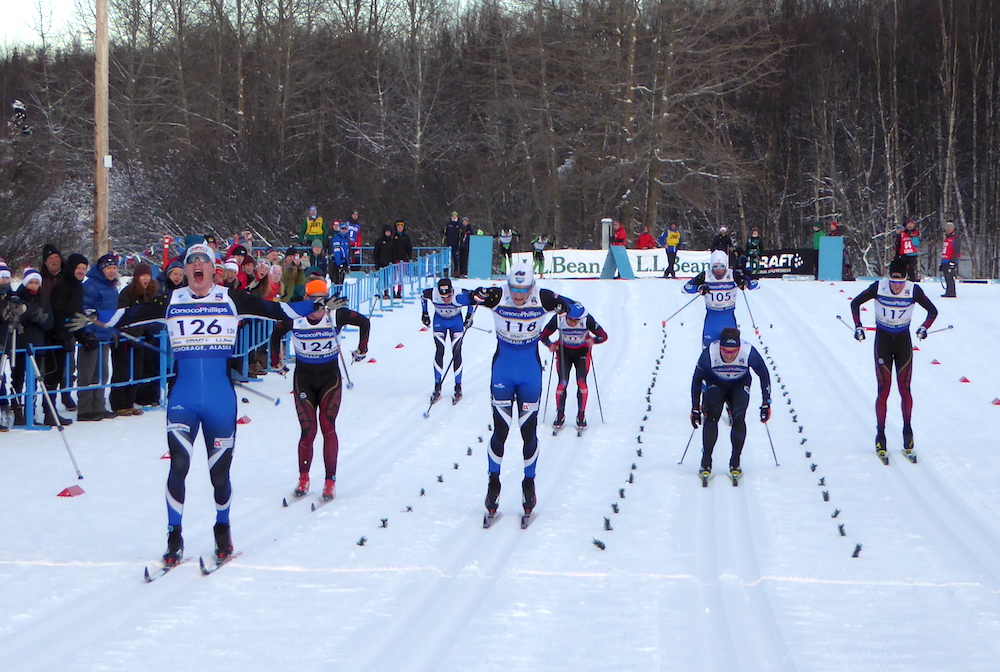
APU’s Tyler Kornfield (126) leads APU’s Eric Packer (118) and DU’s Eivind Romberg Kvaale (124) to the line in the men’s 30 k classic mass start at 2018 U.S. Cross Country Championships on Sunday in Anchorage, Alaska. Kornfield, Packer, and Kvaale finished first, second and third, respectively. Kris Freeman (10, second from left) was fourth overall and the third American.
U.S. Cross Country Championships (Anchorage, Alaska): 20/30 k classic mass starts
Sweden’s Hedda Bångman denied Caitlin Patterson of her first outright victory of the week at 2018 U.S. Cross Country Championships, but Patterson as the first American racked up her third-straight national title in the women’s 20-kilometer classic mass start at Kincaid Park on Sunday in Anchorage, Alaska.
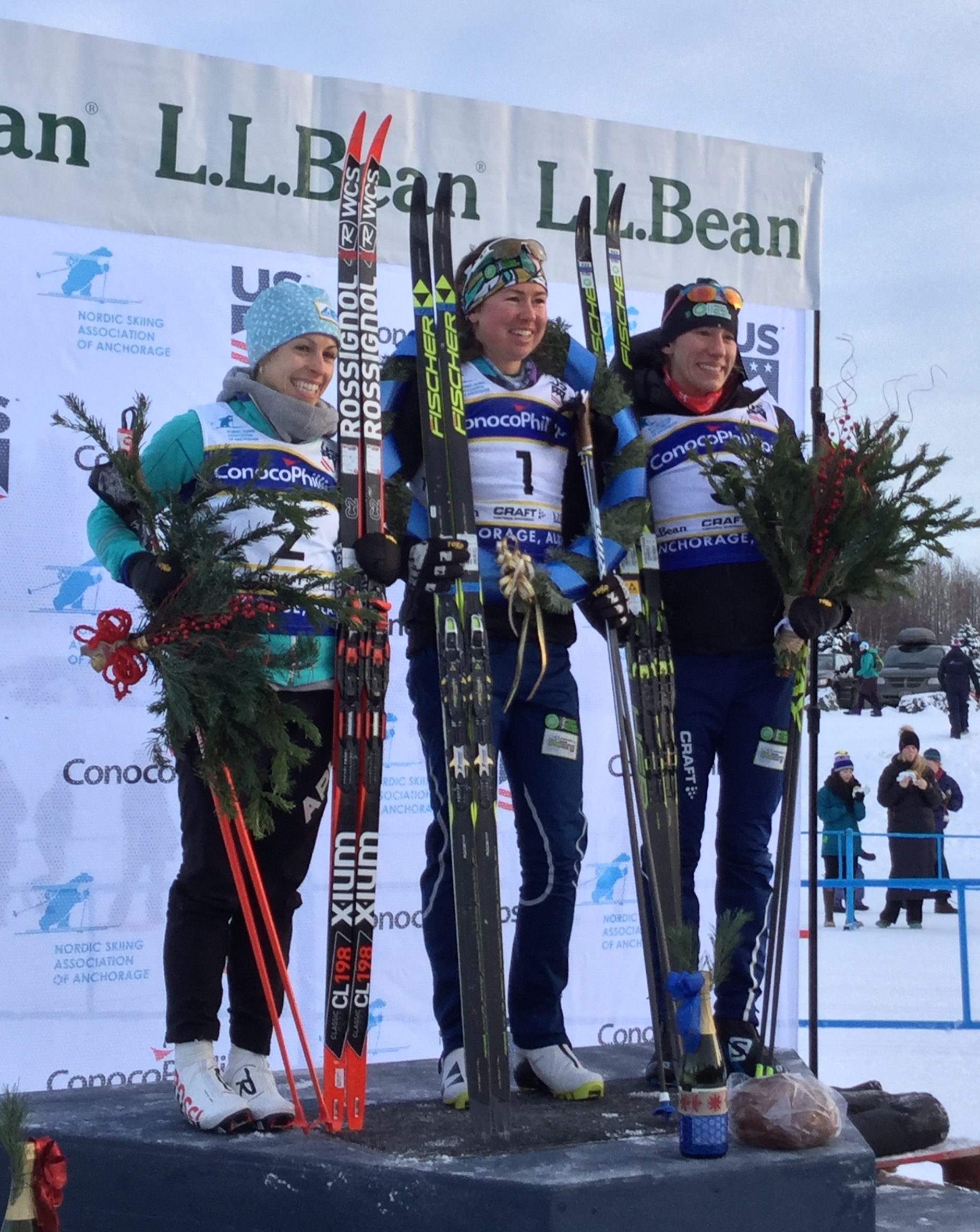
The top-three Americans in the women’s 20 k classic mass start on Sunday at 2018 U.S. nationals in Anchorage, Alaska, with Caitlin Patterson (1) of the Craftsbury Green Racing Project (CGRP) in first, Rosie Frankowski of APU (l) in second, and Kaitlynn Miller (r) of CRGP in third.
Bångman, a 22-year-old freshman at the University of Colorado Boulder (CU), pulled off a 15.9-second win in the mass start, crossing the line in 1:00:55.3 hours. Patterson, of the Craftsbury Green Racing Project (CGRP), finished second, but was the top American in the event for the third time this week, and Rosie Frankowski, of Alaska Pacific University (APU), notched third (second American), 19.6 seconds back.
Rounding out the top 10 was Jessica Yeaton, who trains with APU and races for Australia, in fourth (+44.1), Kaitlynn Miller (CGRP) as the third American in fifth overall (+1:13.5), Alayna Sonnesyn of the University of Vermont (UVM) in sixth (+1:25.3), Chelsea Holmes (APU) in seventh (+1:55.4), Norwegian CU skiers Christina Rolandson and Anne Siri Lervik in eighth (+1:55.7) and ninth (+1:56.1), respectively, and Erika Flowers of the Stratton Mountain School (SMS) Elite Team in 10th (+2:14.6).
The men’s 30 k classic mass start was incredibly close, with APU’s Tyler Kornfield taking his first-ever distance national title (he was the 2012 classic sprint national champion) in 1:21:43.6. He edged his teammate Eric Packer by 0.7 seconds at the line, and Eivind Romberg Kvaale, a sophomore at the University of Denver (DU), finished 1 seconds back in third.
Kris Freeman (Caldwell Sport) was just off the overall podium in fourth (+1.6), but was the third American. Another DU skier, Dag Frode Trollebø, also from Norway, finished fifth (+2.0), and APU had three in the top six with David Norris in sixth (+2.5). Noah Hoffman (Ski & Snowboard Club Vail) finished seventh (+2.6), Scott Patterson (APU) eighth (+3.6), and Craftsbury’s Adam Martin and Ben Lustgarten followed in ninth (+14.7) and 10th (+14.9), respectively. With Brian Gregg (CXC/LNR/Team Gregg) in 11th (+16.1), the men’s top 11 were separated by less than 17 seconds.
IBU World Cup (Oberhof, Germany): Men’s and women’s relays
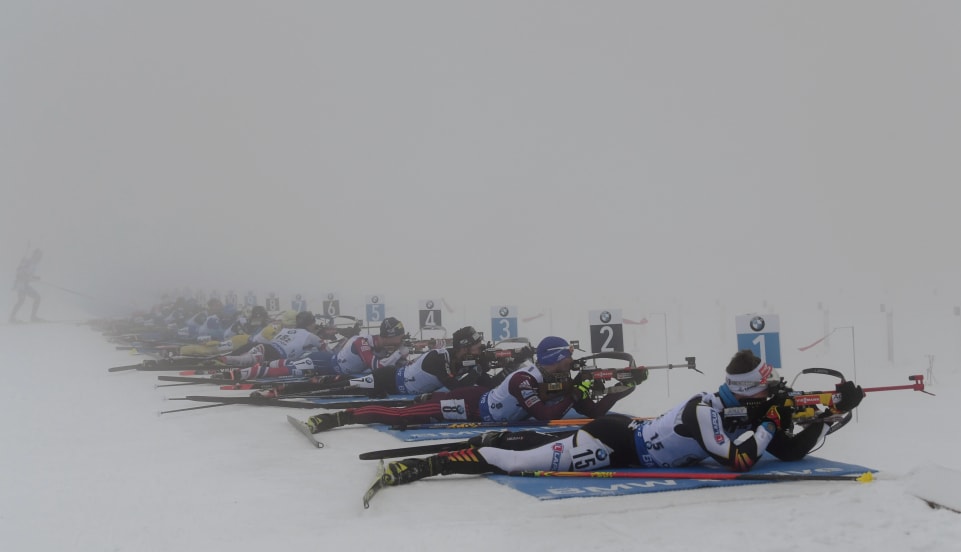
Racers on the range during the men’s 4 x 7.5 k relay on a foggy Sunday at the IBU World Cup in Oberhof, Germany. (Photo: IBU/Biathlonworld)
The Swedish men’s team and French women won the second relays of the International Biathlon Union (IBU) World Cup season on Sunday, with Sweden winning the men’s 4 x 7.5 k relay by 1:10.8 over Italy, and France besting Germany by 32.4 seconds.
Notably, most of the top teams didn’t start all of their “A” teamers.
In the men’s race, Sweden’s Martin Ponsiluoma, Jesper Nelin, Sebastian Samuelsson, and Fredrik Lindström combined for their first win together — and the first win for most of the members on the team.
“It is a dream when you are a kid to compete in a World Cup,” Samuelsson said, according to an IBU press release. “To have a win is really amazing!”
The Swedish women’s team also landed on the podium in third (+48.2).
“What a race by the whole team,” said Lindström, who also has one non-relay World Cup win (from 2012) to his name. “It could not be better.”
Conditions could not have been much more difficult for shooting on Sunday, with the fog that had descended early in the day for the women’s race worsening for the men’s race. When there wasn’t fog, there was wind.
Misses were common throughout the two races, and even with racers being able to use three spares per shooting stage to clean, there were a high number of penalty laps.
But the Swedish men kept their penalties to a minimum, with just one for the entire team and a total of nine spare rounds used among them. After Ponsiluoma came through the first exchange in sixth, Nelin skied them into third, Samuelsson picked off another place despite skiing a penalty after his standing stage to put them in second, and Lindström anchored them to first.
“The conditions today were so special. Somehow I felt not so nervous, I was calm and had luck on my side,” Lindström said at a post-race press conference about his nearly flawless shooting (0+0; 0+1).
“I have never [been first] before,” he added. “Not like this in a relay at least. That’s really fantastic.”
“I had to look up to see if I was aiming the right way,” Nelin said after cleaning prone (0+0) then using two spares to clean standing (0+2). “I had no idea where I was aiming, so it was really difficult. But I hit, and it was good. Maybe these conditions fit me and I should never see anything.”
Italy placed second with Thomas Bormolini, Lukas Hofer, Dominik Windisch, and Thierry Chenal combining for two penalties and 11 spares. Hofer had skied them up from eighth to second, and Windisch then took the lead on the third leg to put them in first at the final exchange, 1 minute ahead of Sweden. But Chenal slipped with the seventh-fastest last leg time and a penalty after standing.
“Being on the podium with the team is always a special feeling,” Hofer said at the press conference. “For Thierry, it’s the first year in the World Cup, and he does a really good job, not just today. I am really happy that he could close out this relay. Second place is like a win for us.”
Norway placed third (+2:04.6) with Vetle Sjåstad Christiansen, Henrik L’Abée-Lund, Lars Helge Birkeland, and Tarjei Bø. Together, they had three penalties (two from L’Abée-Lund and one from Birkeland) and 14 spares.
“I grew up on Holmenkollen so I practiced a lot there [in fog],” L’Abée-Lund said. “But today was really really hard, I didn’t see anything in prone. Standing was OK, but prone was really difficult.”
“It’s great to be on the podium,” Christiansen said. “Of course Norway always wants to win, but today we are very happy for our brothers in our neighbor-country Sweden.”
The Canadian men placed 10th (+6:23.1) out of 25 teams with Christian Gow, Scott Gow, Brendan Green, and Carsen Campbell having a combined six penalties and 20 spares. Three of those penalties came on Scott Gow’s second leg, two from Campbell’s anchor leg, and one on Christian Gow’s first leg.
After a penalty on his first prone stage (1+3), Christian cleaned standing with a spare (0+1) and tagged Scott in 11th, 53 seconds out of first. Scott then had two penalties in prone and three in standing, but managed to improve to eighth given how much everyone else was struggling with the shooting as well. Green kept them in eighth with two clean stages (0+2, 0+3), and Campbell, in his first World Cup relay, cleaned prone (0+2) but had two standing penalties (2+3) to put the team in 10th at the finish.
In an interview with German broadcaster ARD halfway through the race, Canadian coach Matthias Ahrens called the range conditions, which ranged from thick fog to unpredictable wind, “very hard to assess.”
“… To be honest, the good thing was that conditions were very bad,” he later added. “So regarding visibility, almost everyone was on the range at the same time [with the same irregular conditions]. They had to wait very long, and of course had bad conditions to shoot, but much of the field was there at the same time.”
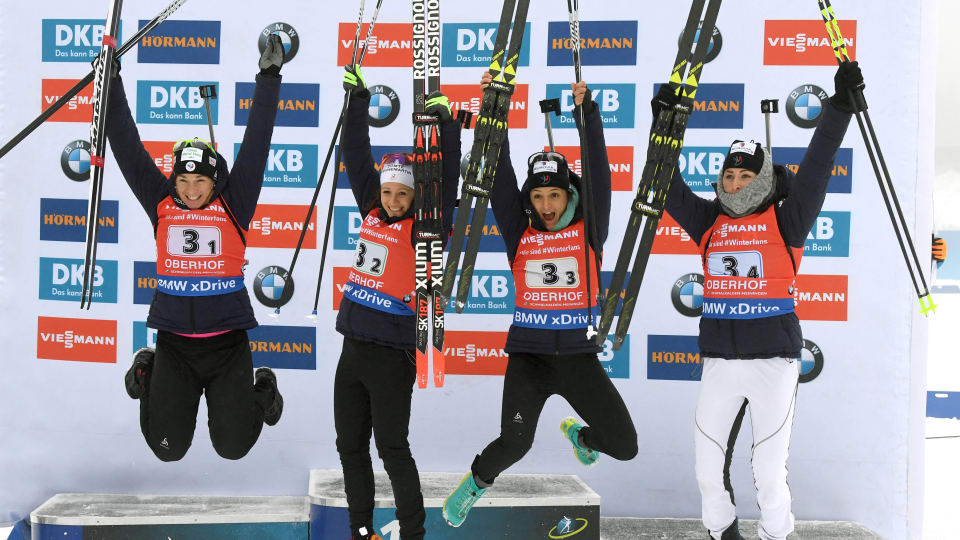
The French women’s team, of Anais Bescond, Anais Chevalier, Celia Aymonier, and Justine Braisaz, celebrate their relay victory on Sunday at the IBU World Cup in Oberhof, Germany. (Photo: IBU/Biathlonworld)
In the women’s race, with better shooting visibility, France’s Anais Bescond, Anais Chevalier, Celia Aymonier, and Justine Braisaz took the win in 1:12.42.4, with one penalty and 10 spares. After Bescond put them in first through the first exchange, 6 seconds ahead of Italy in second, Chevalier had to ski a penalty loop after prone but cleaned standings (1+3, 0+0) and tagged off in second, 23 seconds behind Italy, now in first.
One loop later, France was back in first thanks to Aymonier, who cleaned with just two spares (0+0, 0+2), and they extended their lead from 0.8 seconds at the last exchange to 32 seconds at the finish with Braisaz, who shot 0+1, 0+3, and skied the fastest anchor leg.
“I know that it’s always good for Justine to start in the first position, so I really wanted to pass the relay to her in that,” Aymonier said in a press conference after.
“I was nervous, too,” Braisaz said. “That kind of shooting turned my mind upside down, actually. The crowd was very loud, and … I wasn’t very focused on what I did. It was a bit foggy, too, so that made it harder. But finally it was a French day, maybe.”
“In my mind the whole team is really strong, and really able to get the first place,” Bescond said. “After years and years and years behind Germany’s team we finally did it. So just Oberhof spirit I think.”
Germany placed second with Vanessa Hinz, Denise Herrmann, Franziska Preuss, and Maren Hammerschmidt. They combined for two penalties and 13 spares; with a penalty on Hinz’s first leg and one more on Hammerschmidt’s last shooting. After being tagged in 14th, Herrmann skied them into fourth, 40 seconds out of first, and Preuss elevated them to second, which Hammerschmidt held onto.
“I was struggling a little bit in the prone shooting,” Herrmann said. “But the skiing was good today, and also the standing [shooting]. I tried to go fast on the track and catch some girls.”
Sweden, with Linn Persson, Anna Magnusson, Elisabeth Högberg, and Mona Brorsson, avoided the penalty loop and used eight spares to reach the podium for the first time in six seasons. In sixth place at the first exchange, they slipped one place to seventh on the second leg, but Högberg raced them up to fourth with near-perfect shooting (0+0, 0+1) with one leg to go. Brorsson then anchored them to third with clean shooting (0+2, 0+1) and the third-fastest last leg.
“It’s just super nice for us! I am super happy,” Magnusson said. “We were very emotional at the finish.”
When Brorsson was asked if she believe she could fight for the podium, she responded, “Not really. But I said to Linn, ‘Maybe it is our day today. Please let it be our day today.’ ”
The Canadian women finished 14th (+6:37.5), out of 20 teams, with two penalties and 13 spares. Sarah Beaudry initially put them in 15th after shooting 0+1, 0+2, then Julia Ransom had a standing penalty (0+2, 1+3) to slip one place to 16th. Megan Tandy picked off three places with clean shooting (0+0, 0+2) and tagged Emma Lunder in 13th, and Lunder had a penalty in prone but cleaned standing (1+3, 0+0) to finish in 14th.
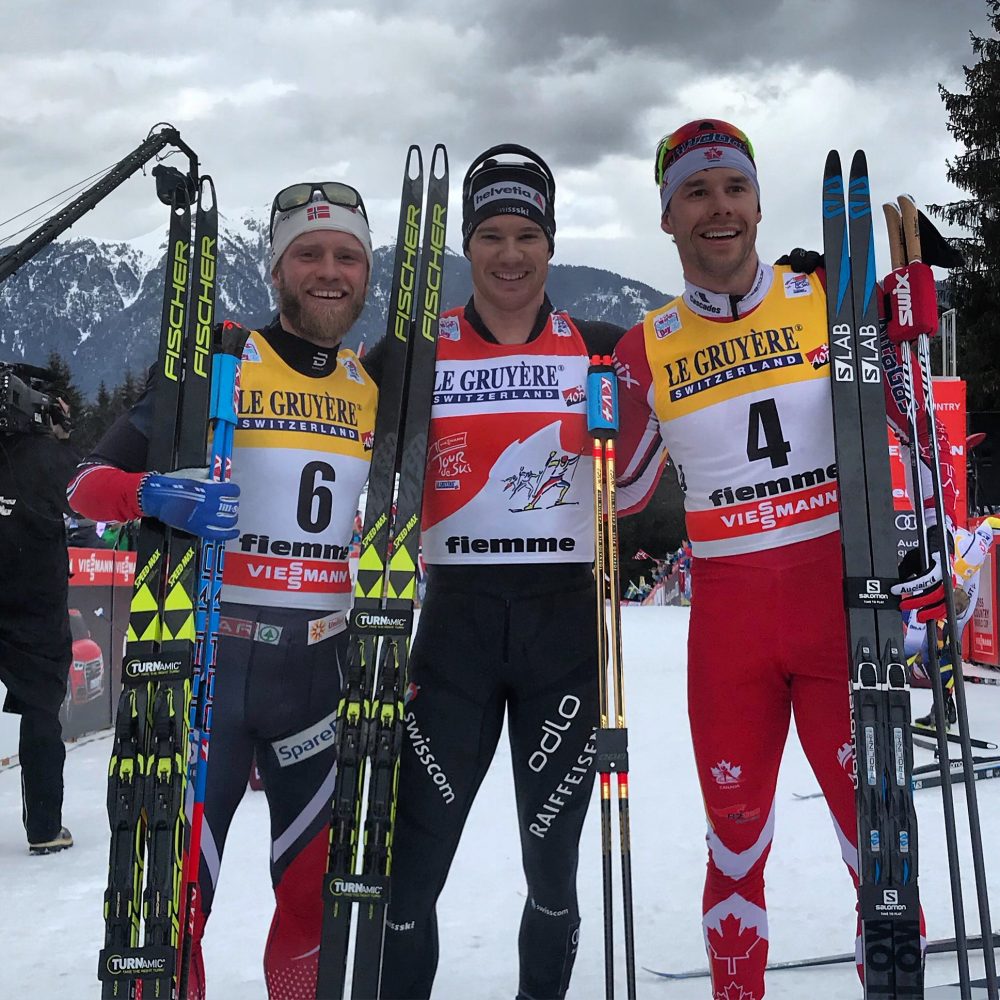
The men’s overall 2018 Tour de Ski podium atop Alpe Cermis after the final Stage 7 hill climb: with Switzerland’s Dario Cologna (c) in first, Norway’s Martin Johnsrud Sundby (l) in second and Canada’s Alex Harvey (r) in third. (Photo: FIS Cross Country/Twitter)
Dario Cologna of Switzerland added a fourth Tour de Ski (TdS) title to his list of accolades on Sunday, winning the 2018 edition of the race in dominant fashion, with a 1:26.5-minute win over Norway’s Martin Johnsrud Sundby. And Canada’s Alex Harvey scored his first TdS overall podium in third.
The 31-year-old Cologna started the 9-kilometer freestyle pursuit up Alpe Cermis 1:15 ahead of Kazakhstan’s Alexey Poltoranin in second. Russia’s Sergey Ustiugov, slated to start third, did not start due to a back injury. Thus Harvey was the third man off the start line, 1:23 behind Cologna.
(Sweden’s Marcus Hellner, 13th after Saturday’s Stage 6, also did not start the Tour’s final stage.)
Early on, Cologna started putting time into his competitors, extending his lead on Poltoranin to 1:20.5 and Harvey to 1:24 at 1.8 k.
By 4 k, however, Harvey had used his speedy skiing on the flatter portions of the race leading up to the climb to catch Poltoranin, and the two clocked through that checkpoint 1:19.4 behind Cologna. Behind them, Russia’s Alexander Bolshunov skied just ahead of Sundby, another 21 seconds and 22 seconds back, respectively, in fifth and sixth.
While Harvey clawed back a few more seconds on Cologna, he was still 1:17.8 back at 6.2 k, with Poltoranin just 0.7 seconds behind him in third.
Harvey remained in second until around 8.5 k; with just a half kilometer to go, Sundby had caught both Poltoranin and Harvey, passing them both. Sundby held that position and finished second, 1:26.5 behind Cologna, who won in 28:52.1.
Harvey stayed strong for third (+1:30.6) while Poltoranin dropped off the Canadian’s pace in the final half kilometer and finished fourth (+1:41.7). Norway’s Hans Christer Holund placed fifth (+2:17.8), Bolshunov lost a spot to finish sixth (+3:09.7), France’s Jean-Marc Gaillard finished seventh (+3:16.7), Sweden’s Daniel Rickardsson eighth (+3:20.8), and Russia’s Alexey Chervotkin and Andrey Larkov took ninth (+3:33.5) and 10th (+3:37.8), respectively.
France’s Maurice Manificat, known for his strength in freestyle hill climbs and pursuit races, rose from 14th to 11th (+3:45.7) with the second fastest time of day, 12.8 seconds slower than Sundby as the time of day winner in 28:36.4. Cologna’s time was fourth fastest (+15.7), behind Russian U23 skier Denis Spitsov in third (+14.3) (Spitsov started 20th and finished 13th). Holund’s time ranked fifth (+20.6) and Harvey’s time was sixth fastest (+23.6) of the 43 men that finished the race.
The lone American man to complete this year’s Tour, Paddy Caldwell (U.S. Ski Team) skied the 22nd fastest time of day for 38th overall (+11:54.8).
Heidi Weng (center) celebrates her second Tour de Ski victory, with teammate Ingvild Flugstad Østberg second and the U.S. Ski Team’s Jessie Diggins third. (Photo: FIS Cross Country/Twitter)
In the women’s hill climb that kicked off the day, Heidi Weng raced to her second consecutive TdS title. The Norwegian started the day within two seconds of teammate Ingvild Flugstad Østberg, and the two skied together for the flat section of the nine-kilometer stage of the competition. But when the climbing got steep on Alpe Cermis, Weng left her teammate behind and eventually racked up a 48.5-second win.
The battle for third was less predictable. Jessie Diggins of the United States started the day in fourth, but made up the ten seconds to third-place KristaPärmäkoski of Finland in the first few kilometers. The pair climbed together for a while before Diggins attacked. Pärmäkoski tired on the final sections of the Alpe Cermis and Diggins took the podium in definitive style, 2:23.2 behind Weng and 24 seconds ahead of Pärmäkoski. It’s the first overall Tour de Ski podium for Diggins or any American athlete.
Teresa Stadlober of Austria finished fifth (+3:09.4), Kerttu Niskanen of Finland sixth (+4:17.0), Russia’s Anastasia Sedova seventh (+4:49.6), and Switzerland’s Nathalie von Siebenthal eighth (+4:56.1).
Sadie Bjornsen started eighth and slipped one spot to finish ninth (+6:15.0), giving the U.S. two top-ten finishers in the Tour de Ski for the first time. Liz Stephen finished 16th (+8:25.8) and Rosie Brennan 24th (+10:59.6).
En route to her win, Weng notched the fastest time of the day on the 9 k stage. Stadlober’s time was second, Diggins third, Østberg fourth, and Stephen fifth.
32 women finished this year’s edition of the Tour de Ski.
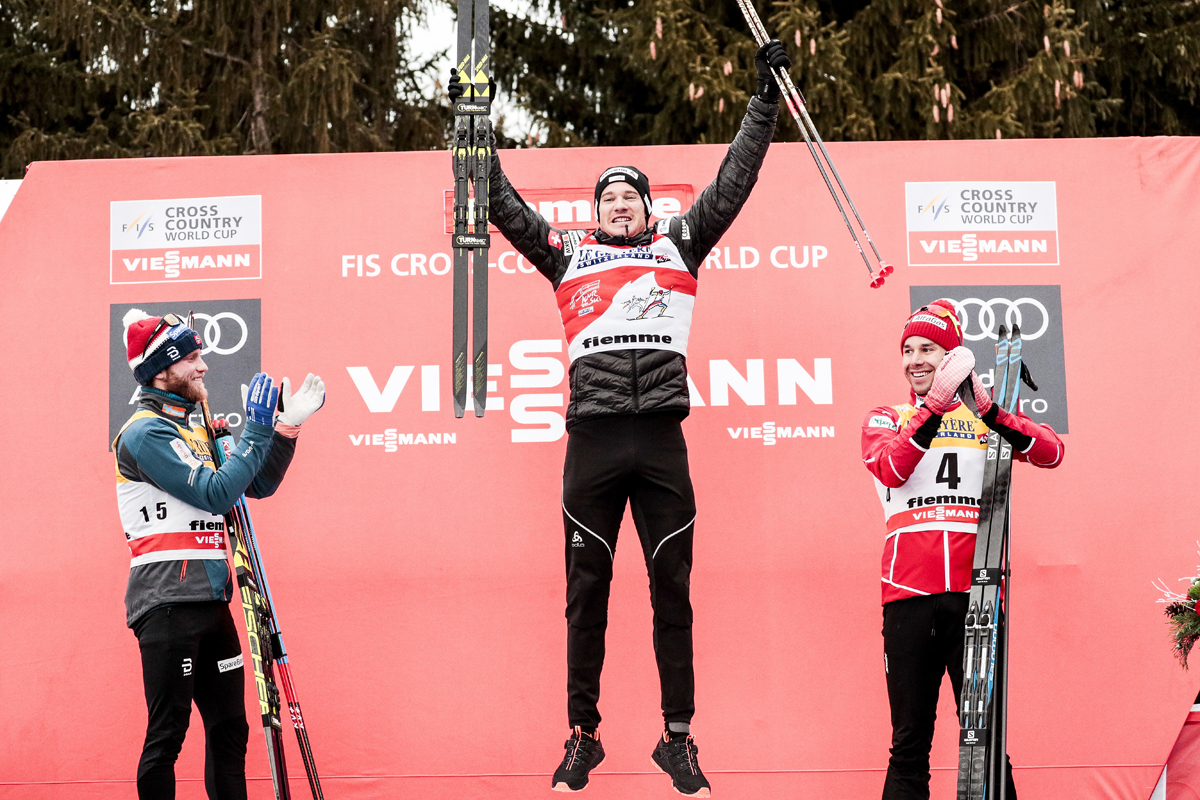
Switzerland’s Dario Cologna (c) celebrates his fourth Tour de Ski overall title, which he won Sunday and was joined by Norway’s Martin Johnsrud Sundby (l) and Canada’s Alex Harvey (r) on the podium in second and third, respectively. (Photo: Fischer/NordicFocus)
The 2018 Tour de Ski is a wrap. On Sunday in Val di Fiemme, Italy, the final Stage 7 hill climb was a mirage of sorts as Switzerland’s Dario Cologna soloed in for his fourth overall Tour de Ski (TdS) victory. The stage, a 9-kilometer freestyle pursuit “final climb” ascends an alpine ski-area slope for the final three k’s as it climbs 425 meters from race start to finish.
Not once did the 31-year-old Cologna look ready to crack. He was cool and calm during another hallmark performance for a skier who, before this year’s TdS, hadn’t stood atop a World Cup podium in three years (he broke through by winning the second stage of this year’s Tour: the 15 k classic in Lenzerheide, Switzerland). Cologna crossed the line Sunday atop Alpe Cermis in 28:52.1 minutes and recorded the fifth-fastest climb time of the day.
“Yes, it worked out very well,” Cologna said to Swiss broadcaster SRF, according to a translation. “I am very happy to arrive up here in first place, six years after the last time. It feels very good. It was a super Tour de Ski.”
Prior to the season, despite his past success, was considered a long shot for numerous podiums. In recent years, Cologna’s star appeared to be in slow-fade mode.
“You couldn’t expect it to work out like this,” Cologna told SRF of his overall win. “I had a good feeling, only the start of the season didn’t work out so well. But since the first race the sprint in the Tour things opened up for me, and after that, it worked out pretty well. No weaknesses, I could pull it through. And that in the end, it worked out so well with such a lead, I wouldn’t have expected that.”
Switzerland’s Dario Cologna finishing the men’s final climb, Stage 7 of the 2018 Tour de Ski, in first for his fourth TdS title atop Alpe Cermis in Val di Fiemme, Italy. (Photo: Fischer/NordicFocus)
With his three-year podium drought only satiated last week, Cologna is savoring the moment.
“It’s always beautiful,” Cologna said of winning his fourth TdS. “After the first year, they came quickly after each other. The first one surely was special. But as I said before, it’s also nice having to wait for a victory. So I am enjoying this one very much. I am happy that I could come back like this, and that I can still win big races.”
Post-Tour — although several World Cup weekends remain before the PyeongChang Opening Ceremony on Feb. 9 — in the overall calculus of who might arrive in form and a serious medal threat, add Cologna to that list.
“Of course that I am back, that I can beat everyone,” Cologna said of his form. “That surely is a good sign for myself, that everything is all right, and now it’s about preserving and showing this form at the Olympics.”
Cologna, wearing the red bib as the TdS leader skied off first on Sunday with a 1:15-minute gap on second placed skier Alexey Poltoranin of Kazakhstan. Canada’s Alex Harvey started third (+1:23) followed by Russia’s Alexander Bolshunov fourth (+1:40) and Norway’s Martin Johnsrud Sundby fifth (+1:42). Coming into the stage, last season’s TdS overall winner Russian Sergey Ustiugov was third overall (+1:22), but he did not start the final climb.
According to a translation of an SRF interview with Russian coach Markus Cramer, Ustiugov could barely move his head back and forth as a result of his crash during the Stage 5 mass start in Oberstdorf, Germany. Cramer claimed the injury was again aggravated in Saturday’s Stage 6 classic mass start in Val di Fiemme.
The opening kilometers of the race feature higher-speed, slightly descending terrain with a few rollers in the opening k. Clear from the start was that Cologna wouldn’t cede any seconds as he approached the climb, which begins to kick up around 6.2 k.
The facts are Cologna skied with such poise that his performance seemed almost quotidian. The Swiss skier was never challenged. At 6.2 k, Harvey and Poltoranin were paired 1:17.8 minutes back, in second and third. Sundby and Bolshunov came through 22 seconds later.
This was the real drama — the battle for the second and third steps on the podium — Cologna was a lock all along for his final bow across the line. None of the four chasers tempted the folly of trying to gap up to the Swiss skier and risk blowing up before the finish.
Poltoranin, winner of Saturday’s 15 k classic mass start, is hyped as a classic specialist. If anyone waited for the 30 year old to collapse early on the Alpe Cermis’s flanks, it did not happen. He stuck on Harvey as the Canadian set the tempo. And just behind, at 7.1 k, Sundby’s podium hunting looked more real as he pulled Bolshunov and himself near the tails of Poltoranin’s skis.
Through another kilometer of gradients measuring 26.5 percent, 14.3 percent, and then 24 percent — climbs steep enough on the skinny skis to check for a malfunctioning inclinometer — Sundby matched Harvey, and Poltoranin matched Bolshunov. The foursome came through the time check with a four-second difference from Harvey to Poltoranin.
Norway’s Martin Johnsrud Sundby (6) leads Canada’s Alex Harvey (behind) toward the finish line of the Stage 7 final climb of the 2018 Tour de Ski. Sundby finished second overall and Harvey placed third for his best Tour de Ski overall finish. (Photo: Fischer/NordicFocus)
“I knew Sundby would come by us at one point,” Harvey said on the phone after. “The plan was to hopefully hit the base of the hill away from Sundby, and hit it at my own pace to not have to go his pace right away. Because last year I was skiing with Manificat and Heikkinen, for example, and Cologna was like 20 seconds ahead of us maybe at the base of the hill, and they just started charging so hard that it just put me in the red too early. So the plan was to just go my own pace at the base of the hill and then whenever Sundby catches me be ready to react to that.”
Sundby caught Harvey in the first third of the climb and paced behind the Canadian. At 8.5 k, moving through tight switchbacks, the 21-year-old Bolshunov broke — his redlining engine defaulted to a more moderate gear. Bolshunov lost 20 seconds quickly as Sundby, Harvey and Poltoranin forged ahead, all fighting for second and third place.
“Sundby stayed behind me until the halfway point of the climb and then took over took the lead,” Harvey recalled. “By then I was feeling OK. I just had to stay strong and stay on him. When I saw Bolshunov was getting dropped it was really motivating for me. You are suffering so bad by then at least you are thinking there is another guy who are suffering even more than me.”
Cresting the steeps on the Alpe Cermis climb with about a kilometer to go, Poltoranin had faded back.
“When finally I actually saw that Poltoranin was getting dropped as well, I thought this is really good,” Harvey said. “But then I was also starting to feel pretty tired. I still tried to go by Sundby at the end, he had a little bit more than me. It is good terrain for him, a steady climb like that. He is such a strong climber — it was simply good I was able to just hang onto him until the end.”
It was Sundby and Harvey left to parry. Harvey is a closer. But on this day, Sundby held out for second place (+1:26.5) and Harvey third (+1:30.6).
Poltoranin placed fourth (+1:41.7), Norway’s Hans Christer Holund fifth (+3:09.7) and Bolshunov suffered an epic slow down to finish in sixth (+3:09.7). Bolshunov skied the 34th-ranked climb time (out of 43 finishers) in 17:40.6 minutes.
Harvey’s third place marks a big step in his TdS performances. In 2016, the 29-year-old Quebec native was 14th overall and had the 16th-fastest time on the final hill climb stage. The 2017 TdS saw Harvey seventh overall with the 25th-fastest climb time. On Sunday, Sundby clocked the fastest climb time in 15:58.3 and fastest time of day on the entire course in 28:36.4. Harvey skied the seventh-fastest climb time (+26.7) and sixth-fastest course time (+23.6).
“I thought it was probably the best year for that,” Harvey said about his TDS podium prospects. “But I mean, that climb has been just so bad for me over the years. It was kind of best-case scenario. But honestly, I don’t know how much I believed in it.”
Before that, in 2011, Harvey started the final stage seventh overall and finished 20th. In 2012, Harvey began the final hill climb pursuit in sixth overall — he ended the day and the Tour 40th overall.
“I am just so bad on the climb. I was hoping for [a podium], but it was just hard for me to fully believe in it because of all the previous experience,” Harvey explained. “I have been well-ranked up until the last stage a few years in a row, but just never been able to quite do it on the last stage. I knew the shape was more solid than ever, but there was still a bit of a question mark for me for the Alpe.”
Alex Harvey at the finish of Stage 7 of the 2018 Tour de Ski. Harvey finished third overall for his best-ever finish on the Alpe Cermis and overall in the Tour. (Screenshot: ARD broadcast)
On Sunday, that question for Harvey was answered. Harvey will take a two-day recovery period in Val di Fiemme and then begin a 10-day altitude camp with Canadian teammate Devon Kershaw in Seiser Alm. Harvey said he would then train in Livigno as part of his pre-Olympic altitude camp.
For the U.S., Paddy Caldwell was the only male skier remaining in the TdS. He began the day ranked 44th overall of 46 skers. Although he was 10:53 minutes behind at the start, Caldwell began in a wave of skiers released en-mass 10 minutes after Cologna. Caldwell ended his first TdS having moved up to 38th overall (+11:54.8) after skiing the 20th fastest climb time in 17:04.7 (and 22nd-fastest pursuit time, 1:18 behind Sundby).
With the conclusion of the Tour de Ski, racing continues next weekend in Dresden, Germany, with a skate sprint Saturday and skate team sprint on Sunday. The next distance race on the World Cup will be a 10/15 k classic in Planica, Slovenia, on Jan. 21.
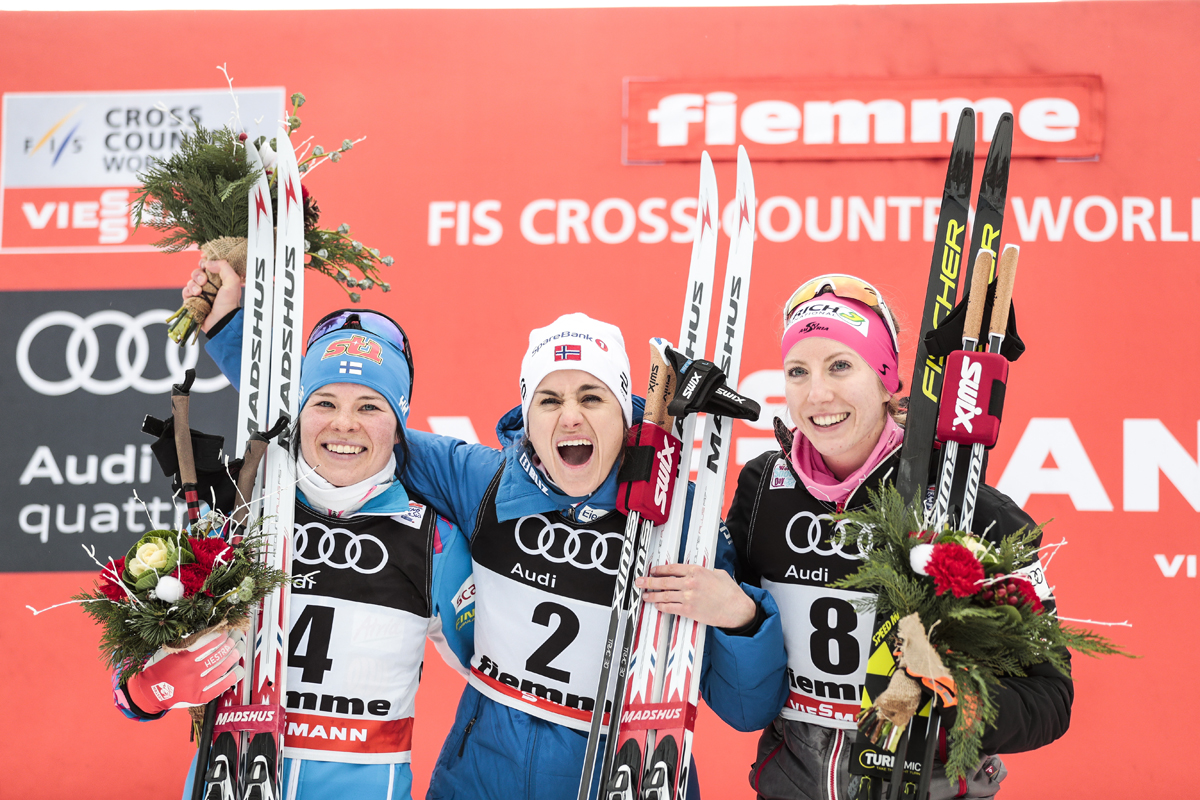
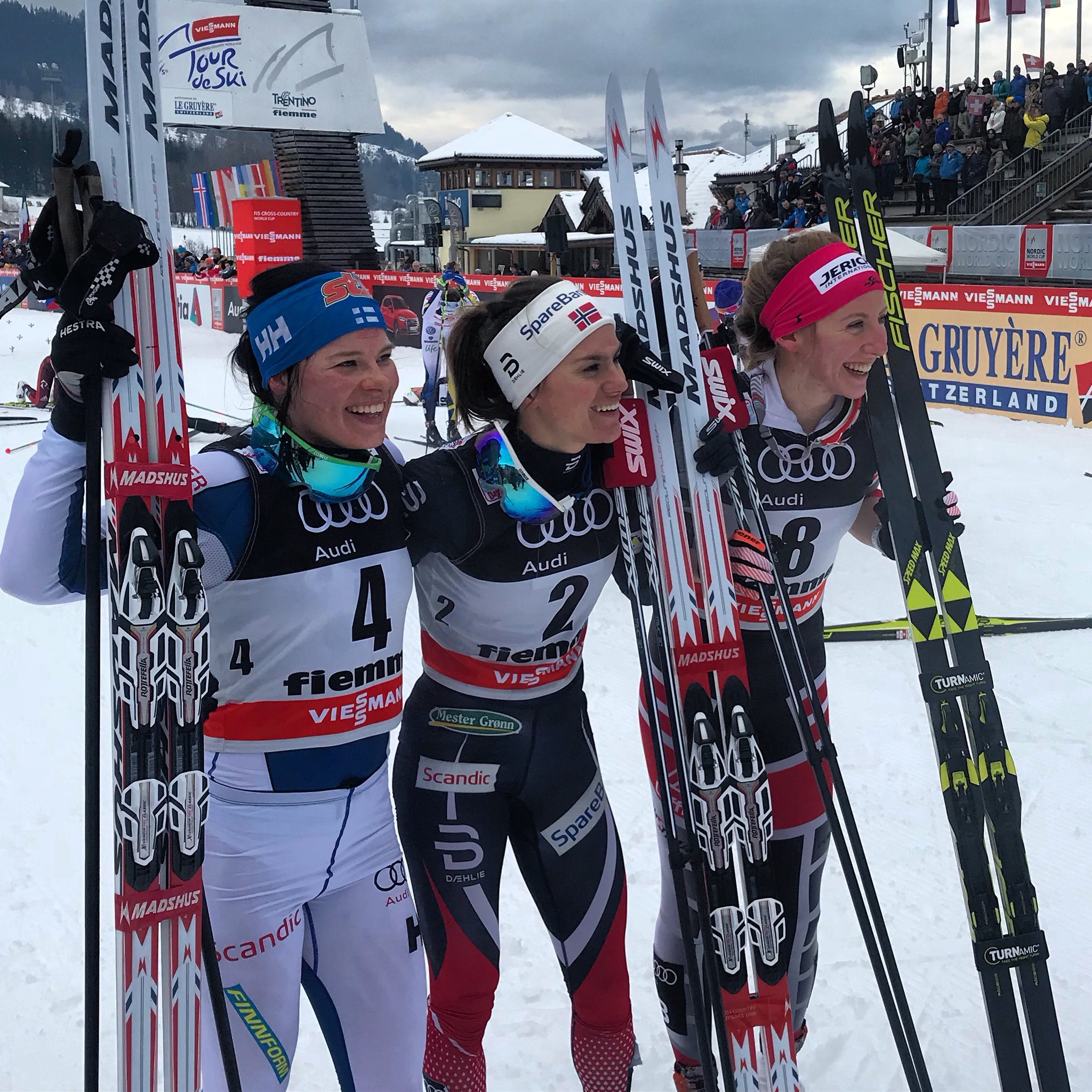
The 2018 Tour de Ski Stage 6 women’s 10 k classic mass start podium with Norway’s Heidi Weng (c) in first, Finland’s Krista Parmakoski (l) in second and Austria’s Teresa Stadlober (r) in third in Val di Fiemme, Italy. (Photo: Fischer/NordicFocus)
After the Tour de Ski’s previous dance with earth, wind and rain and the subsequent cancellation of the Stage 4 classic sprint followed by a congested Stage 5 mass start in Oberstdorf, Germany, all seemed to return to a sense of normalcy on Saturday.
The women contested Stage 6 of the Tour de Ski (TdS), a 10-kilometer classic mass start, in the iconic Val di Fiemme, Italy. The women skied a 2.5 k climb-and-descend-centric course four times to the thrills of bell-ringing fans and the mountain gods, who, for the time being, allotted a weather reprieve after Central Europe’s rumble with funky atmospheric pressure gradients.
In what amounted as a critical race to shake out the standings before Sunday’s final Stage 7 climb up Alpe Cermis, with 10 k to go and then 10 k down, Norway’s Heidi Weng rolled the dice and won.
Austria’s Teresa Stadlober leads Norway’s Heidi Weng (2) and Ingvild Flugstad Østberg, American Jessie Diggins (3) and others around a downhill corner during the women’s 10 k classic mass start at Stage 6 of the 2018 Tour de Ski in Val di Fiemme, Italy. (Photo: Fischer/NordicFocus)
“It was a great race,” Weng said after the race, according to an International Ski Federation (FIS) press release. “I felt very good. I like Val di Fiemme very much. Every time I compete here I have had a good one. It will be a hard race tomorrow.”
Weng, last season’s TdS winner, crossed the line firs on Saturday in 29:07.9. It was her first individual World Cup win since her victory atop Alpe Cermis in last year’s final Tour stage. Finland’s Krista Pärmäkoski finished 7.6 seconds back in second place, Austria’s Teresa Stadlober was another second back in third place (+8.6), and American Jessie Diggins put herself in the mix in fourth (+23.6). The Tour leader coming into Saturday’s race, Norwegian Ingvild Flugstad Østberg, who at times looked like she could dominate the pace, faded to fifth (+35.2).
Also for the U.S. women’s team, Sadie Bjornsen finished 10th place (+1:11.3), Liz Stephen 24th (+2:18) and Rosie Brennan 30th (+2:47.2).
With a single stage to go, and a doozy at that (the 9 k freestyle hill climb pursuit up Alpe Cermis), Saturday’s stage was all about minimizing losses for some and making gains for others. As the Tour’s defending champion, Weng proved not only does she have TdS stamina, she has the gumption to kill on the final stage’s climb. Last year, Weng began the hill climb in second overall, 20 seconds behind Sweden’s Stina Nilsson. But more importantly in that 2017 race, Weng started 1:04 minutes ahead of Østberg in fourth. Nine k and 425 meters of climbing later, Weng took the win — she gained time on Østberg, who placed fourth overall (+2:04.3). Not that last year’s dynamics dictate how this year’s TdS will play out, but it remains a data set.
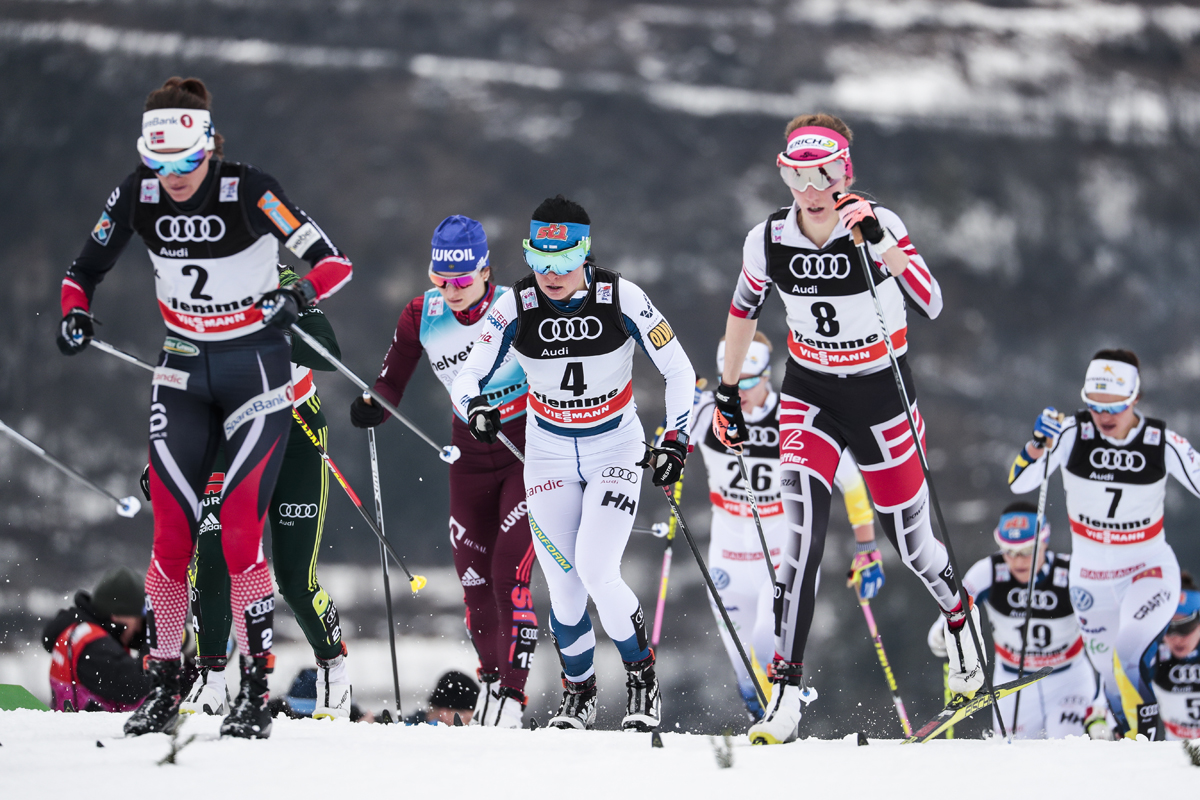
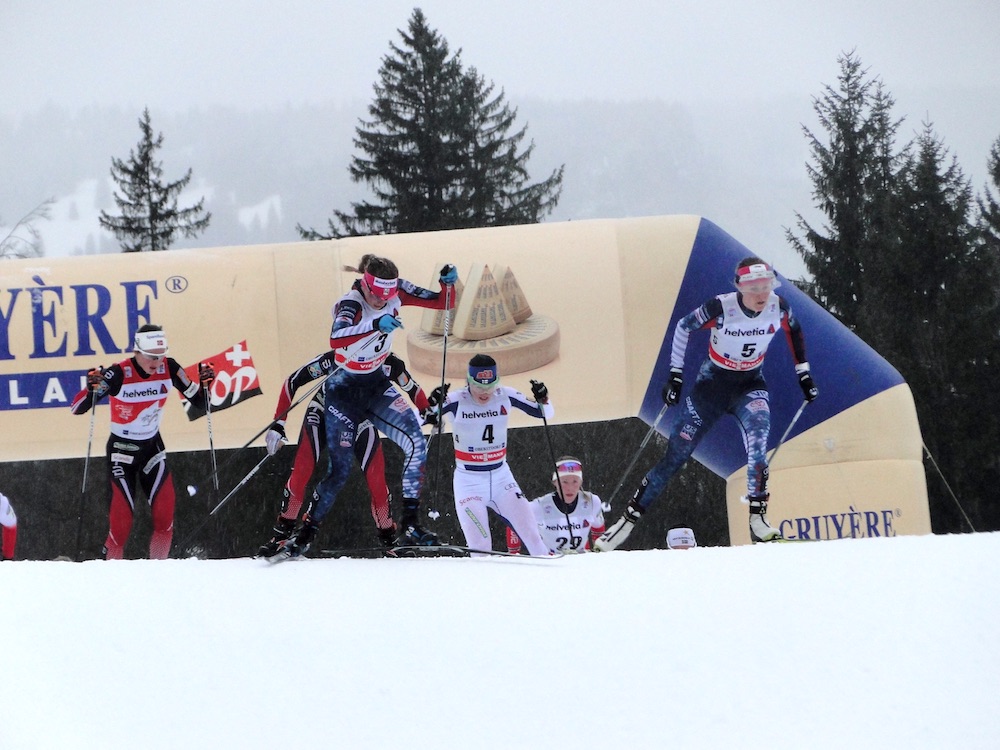
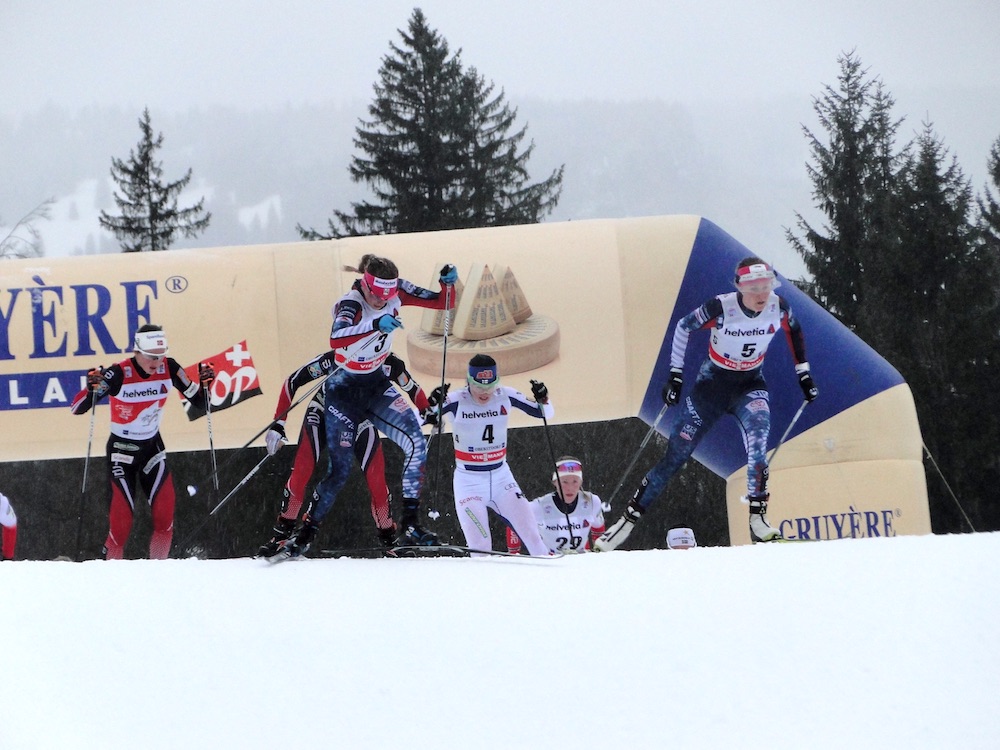
Norway’s Heidi Weng chases her teammate Ingvild Flugstad Østberg (not shown), followed by Austria’s Teresa Stadlober (8), Finland’s Krista Parmakoski, Russia’s Natalia Nepryaeva, Sweden’s Evelina Settlin (26) and Anna Haag (7), among others, early in the women’s 10 k classic mass start at Stage 6 of the 2018 Tour de Ski in Val di Fiemme, Italy. (Photo: Fischer/NordicFocus)
Weng began Saturday’s stage in second overall and 57 seconds behind TdS leader Østberg. Weng endures as the lanky yet seemingly ideal pairing of power-to-weight climbing ratio. Østberg, who is enjoying a resurgence this year after a lull by her standards last season, prevails as a powerful force to Weng’s lithe climbing. Yet after winning the first three Tour distance stages, underestimating the 2017/2018 version of Østberg on Alpe Cermis might prove too risky.
Saturday’s 10 k seemed like a poker match up to the second pass through the stadium at 5 k. The top-14 skiers were strung out in a line — 8.8 seconds separating Bjornsen in 14th to Østberg in first. For a moment, maybe it was an Østberg bluff, but she and Weng took a brief pull up front on a climb that appeared to unsettle the group of five that had formed and consisted of the Norwegian duo plus Diggins, Pärmäkoski and Stadlober.
It turns out Østberg’s moves were a bluff revealing she was dealt a weak hand: by 8.6 k Østberg was 19 seconds behind Weng. By then, Weng had played her full house and had gapped Pärmäkoski and Stadlober in second and third place respectively, by 10 seconds. Diggins skied in fourth, 16.5 seconds behind Weng.
From then on, Weng soloed for the win.
Heading into Sunday’s final stage, the formidable climb up Alpe Cermis, Østberg still leads the Tour with a tiny 1.8-second gap on Weng.
With Weng’s history on the climb, it appears to be her Tour to lose. If Weng wins the hill-climb pursuit, she’ll be the only skier besides Poland’s Justyna Kowalczyk to win successive Tours. Kowalczyk won four straight TdS’s from 2010 to 2013.
Jessie Diggins (U.S. SKi Team) after placing fourth in the women’s 10 k classic mass start at Stage 6 of the 2018 Tour de Ski in Val di Fiemme, Italy. (Photo: Salomon/NordicFocus)
U.S. standout Diggins had entered the stage in third overall, 1:56.7 behind. For much of Saturday’s race, she was a catalyst, either setting tempo up front, gliding away on the downhills or sitting in and letting the Norwegians know she was right there.
Weng’s mark on the race, which was embellished with her make-or-break climbing speed near 7.5 k, redlined several top skiers. At the 7.5 k checkpoint, Diggins was 8.2 seconds back. It looked initially as if it were more of an unmatchable Weng pace than a moment when Diggins would lose more time and fall from the Pärmäkoski-and-Stadlober pairing. Diggins came through 7.5 k in line with the Finn and Austrian.
Weng kept charging, Pärmäkoski and Stadlober kept their losses in check, and Diggins lost more time in the closing kilometers. The American was 19.8 seconds back at 9 k, and 23.6 behind as she crossed the finish line.
“In today’s race I tried to stay near the front and out of trouble,” Diggins wrote in an email to FasterSkier. “With my luck I just wanted to avoid crashes or broken poles! I faded slightly in that last lap and couldn’t go with Krista and Teresa but it was so fun to see exactly where the podium was since it’s mass start and see where I can improve a little bit for the next time. Always learning and taking notes!”
Diggins dropped one place in the overall standings and currently sits in fourth (+1:43.1). Pärmäkoski is third overall (+1:33.5) and Stadlober fifth (+2:29.9).
“In the overall tour, I’m really happy with my placing,” Diggins added. “To be starting 10 seconds behind Krista is awesome and I’ve been racing better than any other year, for sure. It’s fun to feel strong in sprint and distance, classic and skate, and my goal for years has been to become a true all-rounder. It’s fun to finally be getting there!”
Diggins, known for her uncanny race tenacity, understands the final stage is daunting.
“Unfortunately, I’m not a natural-born climber, but I know how to suffer, I know how to be a fighter, and I’m going to go give that climb everything I’ve got left,” Diggins explained about her approach to the hill climb. “And in the end, that’s all you can do! My internal mantra is most likely something like ‘just keep swimming….just keep swimming…’, Finding Nemo style. Because you have to see the humor in climbing that beast!”
Sadie Bjornsen (U.S. Ski Team) leads Sweden’s Stina Nilsson (l) on a downhill during the women’s 10 k classic mass start at Stage 6 of the 2018 Tour de Ski in Val di Fiemme, Italy. (Photo: Fischer/NordicFocus)
Bjornsen began the day sixth overall (+2:47.0) and finished in 10th. Bjornsen will begin Stage 7 ranked eighth, 3:33.1 minutes behind TdS leader Østberg.
“Today was another one of those days that left me wanting a bit more,” Bjornsen emailed to several media outlets. “After falling in the last race, I was determined to make up some time that I had lost in my overall tour position. I have been feeling really great on my classic skis, and felt like I had some power left in my legs this morning, so my goal was to just go with the leaders as long as possible. Unfortunately, I had a bit of a tough start, and made some tactical errors that left me pretty far back in the pack on the first lap. Then, once I was finally finding position again, I got trampled over, and fell. Once again, I fought my way back to the front after getting stuck behind some traffic, but just burned a few too many jets getting yo-yo’d around today.
“At this stage in the tour, when things go great, you can convince yourself you are invincible,” Bjornsen continued. “When you get rattled a bit, it takes an extra amount of mental power to fight back to where you want, and I think that is what got me today. My race today still puts me in a place to fight for top 10 in the overall, which is super exciting. Considering the swings of this TDS, I am thrilled to be fighting for top 10. I have never done that in a Tour event, so it is a good goal for me when I am pushing myself up that mountain tomorrow with every last bit of energy I have!”
TdS vet Liz Stephen again scored World Cup points on Saturday. In four distance races in this TdS, she has been in the top 30 three times. Admittedly, Stephen understood it was a small World Cup field.
“Well, it’s much easier to get 24th in a race when there are only 32 starters,” Stephen said on the phone Saturday. “But today was definitely, it was maybe the fastest pace I’ve ever seen in a World Cup. Either that, or my brain was just moving really slowly, and my body, but I was just really having trouble keeping the pace those girls were setting, so, it was a really hard day for me. I had to dig pretty deep. … I certainly, I was just on the ropes the whole time. Just felt like I was sprinting for 10 k. So, that was a little bit of a tough one today, but I love the courses and I just really happy to be feeling more like myself racing again during this Tour.”
But the bread and butter of Stephen’s gravity defying climbing ability is the Tour’s final hill climb. In 2013 she notched the second fastest time of day up Alpe Cermis. In 2014, she was seventh overall in the TdS and third fastest on the final stage. She was third fastest again in 2016 and second fastest in 2017.
Her expectations for Sunday are once again high.
“I look forward to tomorrow,” she said of the final climb. “I mean, it’s one of the hardest things that you can go do, but it’s also something I’ve always enjoyed because it’s — you just go up the hill. … You just kind of grind it out. I’m certainly hoping to take some people off tomorrow and I definitely look forward to the day, for sure. I think it will be even potentially more special to this year because I have some really good friends here watching from Vermont, and I think that will be really cool to have them out, watching this race for the first time.”
Stephen reflected that the early part of her season was not to her liking.
“I’ve definitely struggled at the beginning of this year, and I think probably it’s a combination of the getting older factor and trying to figure out how much recovery is needed, and how much intensity is needed, and what volume is needed,” the 30-year-old Vermont native said. “It is really different. I’m not the 24-year-old athlete that could recover and go bop around all day and then go race and have it be great. I’m certainly feeling something, and I think probably aging is probably it. I definitely struggled especially this fall on Period 1 … I never felt like myself racing. And so, I think just to feel even a little bit of a glimmer of what I want to feel like later in this season and just again in my career, it definitely is much easier now to kind of get my brain around. I haven’t lost it all. It still is there.”
With picking off skiers on her way up Alpe Cermis, Stephen aspires for that podium reserved for the time-of-day mountain goats.
“I would certainly kind of probably chuck it out there that I’d love to be top two,” she stated. “I think Heidi will be tough to beat out there tomorrow. Especially with the win on her shoulders, as well. But, I would be really happy with a top three tomorrow. And I’m certainly just really looking forward to trying to ski the best I can ski.”
The Tour de Ski concludes Sunday with Stage 7 in Val di Fiemme.
Slovakia’s Anastasia Kuzmina celebrates her second-straight IBU World Cup win in Oberhof, Germany, on Saturday with a 1:04-minute victory in the women’s 10 k pursuit. It marked her fourth win of the 2017/2018 season. (Photo: IBU/Biathlonworld)
IBU World Cup (Oberhof): Women’s and men’s pursuits
So far in 2018, Slovakia’s Anastasiya Kuzmina is undefeated after winning her second-straight race on Saturday at the International Biathlon Union (IBU) World Cup in Oberhof, Germany — this time by 1:04.4 minutes in the women’s 10-kilometer pursuit.
After winning Thursday’s sprint, Kuzmina started 35 seconds clear of anyone else on Saturday, while Finland’s Kaisa Mäkäräinen headed out of the gate after her in second.
Veronika Vitkova of the Czech Republic started another 5 seconds back in third, and Germany’s Franziska Hildebrand set out in fourth, 47 seconds after Kuzmina.
Three Canadians finished in the top 60 of Thursday’s sprint to qualify for the pursuit, with Julia Ransom heading out ninth (+1:14), Sarah Beaudry starting 23rd (+1:39), and Megan Tandy starting 59th (+2:38).
Throughout the four-stage race, it became more and more evident that no one was going to touch Kuzmina. She cleaned the first prone stage to leave the range 55.8 seconds clear of Hildebrand, who also cleaned to move into second. Makarainen dropped to fourth with a miss and Vitkova left the range in third (+1:08.5) after skiing a penalty lap as well.
On the second prone stage, Kuzmina missed one target, but the penalty lap only cost her about 10 seconds; Hildebrand cleaned to keep herself in second place with three loops remaining.
The first standing stage that followed saw Kuzmina miss another target and Hildebrand clean, yet 34.6 seconds still separated them. Kuzmina finally cleaned the last standing to extender her lead back up to a minute, while Hildebrand missed one to lose sight of the podium, slipping to fifth and 1:22.4 back at the start of the final loop.
Italy’s Dorothea Wierer as the 16th starter steadily worked her way up to podium contention, cleaning all four stages with the third-fastest overall shooting time to put herself in second after the final standing, 1:00.2 behind Kuzmina. Ukraine’s Vita Semerenko raced up from 22nd to third with perfect 20-for-20 shooting as well, leaving the range 11 seconds after Wierer with one loop to go.
On the final loop, Kuzmina skied the 22nd-fastest time on that loop (compared to Wierer’s 28th-fastest last-loop time) to put a few more seconds into Wierer as the eventual runner-up, winning in 30:49.5. On the day, Kuzmina’s overall course time was eighth fastest.
“It was a very interesting race for me today,” Kuzmina told the IBU after. “My shape is very good now but I was worried if I could concentrate on the shooting … After the first shooting, I was relaxed and realized it was OK. I just gave the other girls two chances … I must apologize for my emotion [on the shooting range], but I was so happy and enjoyed the last loop.”
Wierer finished 1:04.4 minutes later for second place, and Semerenko crossed the line in third, 1:10.2 out of first. Poland’s Weronika Nowakowska finished fourth (+1:17.1) after starting sixth, with clean shooting, and Mäkäräinen ended up fifth (+1:23.4) with three penalties (1+0+1+1) and the fourth-fastest overall course time. Belarusian Darya Domracheva followed in sixth (+1:28.8) after starting seventh and shooting 18-for-20 (0+0+1+1), and Germany’s Laura Dahlmeier finished seventh (+1:28.8), up from 13th with one late penalty (0+0+0+1).
South Korea’s Anna Frolina placed eighth (+1:36.0, two penalties) for her best result since December 2012, France’s Justine Braisaz finished ninth (+1:37.0; three penalties), and another French skier Anais Bescond 10th (+1:37.1; one penalty). Hildebrand lost six places on the final loop to end up 11th (+1:38.7; one penalty).
Overall, France’s Celia Aymonier skied the fastest course time of the day to rise from 28th to 15th (+2:08.7; three penalties).
Ransom finished the day in 37th (+3:54.4) with three misses (1+0+0+2). She had been in 16th after her early miss in the first prone stage then hovered around the top 20 as she entered her final standing stage. There, she missed two to drop to 36th and she ultimately lost one more place to Finland’s Mari Laukkanen (who started the loop in 37th and passed Ransom, as well as four others, to finish 32nd).
In her first World Cup pursuit of the season, Tandy improved to 43rd (+4:31.8) with a single miss (0+0+1+0). Overall, her range time was the 18th fastest and shooting time was 23rd fastest.
Beaudry finished 51st (+5:36.6) with three misses (1+2+0+0), recovering one place from skiing in 52nd after the second shooting.
In the men’s 12.5 k pursuit that followed, France’s Martin Fourcade held the lead from start to finish and held off Norway’s Johannes Thingnes Bø by 6.3 seconds for his second-straight win in Oberhof. Both of the Bø brothers reached the podium with older brother Tarjei Bø placing third, 30.9 seconds back.
Fourcade as starter No. 1 had a single penalty on the first prone to keep himself ahead (1+0+0+0) and finish first in 32:23.6. Johannes Bø had three penalties (1+1+1+0) but still managed to rise from third at the start to second at the finish. Tarjei started fifth and shot clean to reach the podium.
The fourth starter, American Tim Burke had three penalties (0+2+0+1) and ended up 14th (+1:43.7).
Meanwhile, Canada’s Christian Gow rose from 36th to 21st (+2:19.2) to tie his career best (which also came in a pursuit this season) with 19-for-20 shooting (0+0+0+1). Scott Gow finished 50th (+4:45.0; six penalties), and Brendan Green placed 54th (+5:26.1; three penalties).
The Oberhof IBU World Cup concludes Sunday with the men’s and women’s relays. Canada has entered Beaudry, Ransom, Tandy, and Emma Lunder in the women’s 4 x 6 k, and Christian Gow, Scott Gow, Brendan Green, and Carsen Campbell in the men’s 4 x 7.5 k. The U.S. does not have enough athletes at the Oberhof World Cup to field a team in either race.
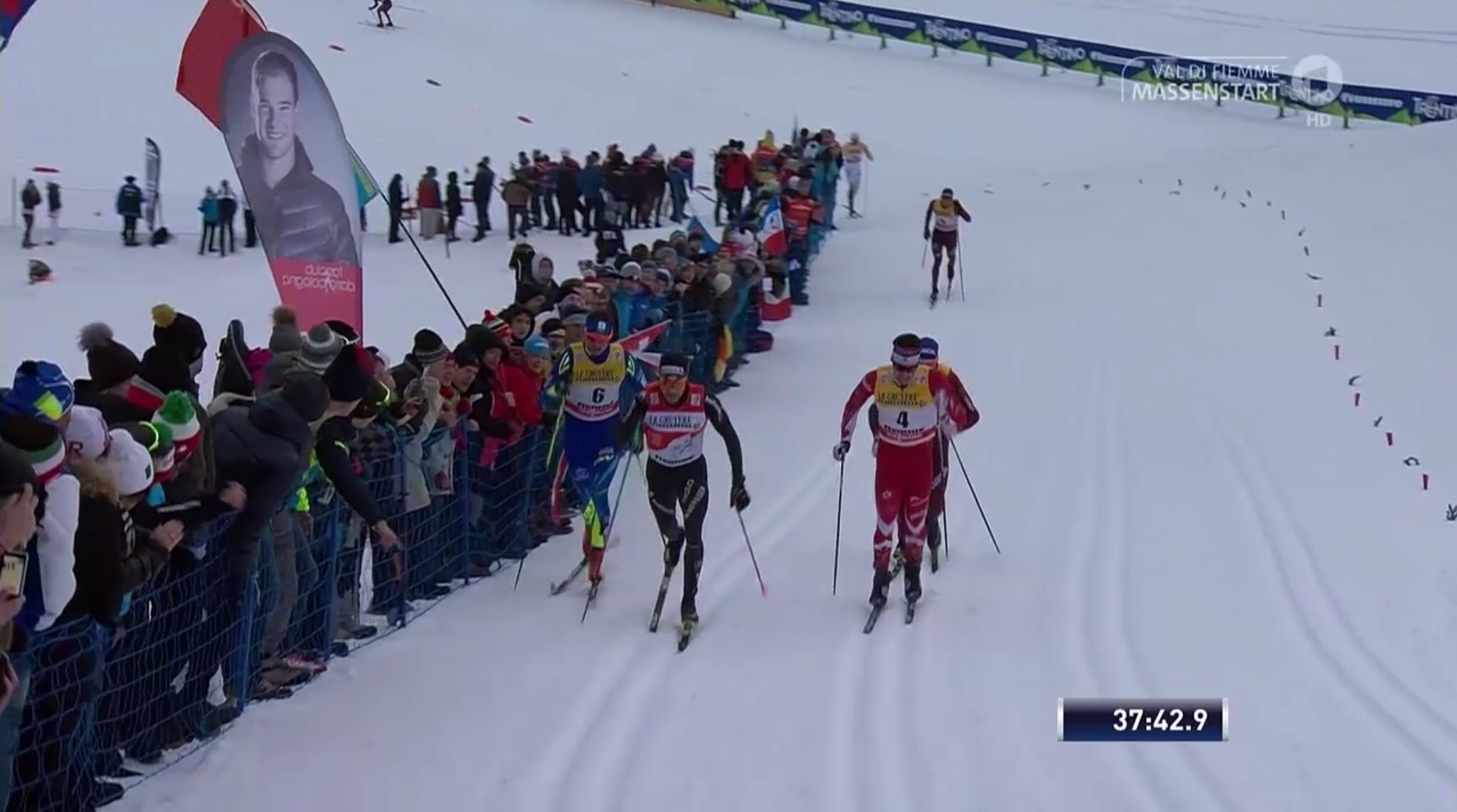
Alexey Poltoranin (l), Dario Cologna (c), and Alex Harvey (4) charge up the last climb of Saturday’s 15 k mass start in Val di Fiemme, Italy. Poltoranin took the win, with Andrey Larkov (behind Harvey) placing second and Harvey third at Stage 6 of the 2018 Tour de Ski. (Screenshot: ARD broadcast)
After a soggy and windy stay in Oberstdorf, Germany where the Stage 4 sprint was canceled and the Stage 5 freestyle mass stats were a cluster, the Tour de Ski (TdS) got back to a sense of normalcy in Val di Fiemme.
Or did they? After dominating the first part of the men’s 15 k classic mass start and picking up valuable Tour bonus seconds, Russia’s Sergey Ustiugov faded, eventually finishing 14th, 42.8 seconds out of the win.
Instead, Alexey Poltoranin of Kazakhstan made a big push to try to break for it about halfway through the race. Dario Cologna of Switzerland, the Tour de Ski leader coming into the day, followed, as did Canada’s Alex Harvey. The trio had a small gap of a few seconds consistently for several kilometers, before Russia’s Andrey Larkov caught up to them. Behind them, the field continued to fracture into chaos, claiming what would in past years have seemed unlikely victims like Norway’s Martin Johnsrud Sundby.
After much posturing and pushing in the final kilometer, the lead pack of four came shooting into the downhill finish with Poltoranin claiming the win by 0.4 seconds over Larkov. Harvey finished third, +0.9, and Cologna fourth, +2.3. There was a bigger gap before Russia’s Alexander Bolshunov crossed the line in fifth, +15.0.
That means that Poltoranin takes over second place in the Tour, while Ustiugov lost ground.
The only American starter, Paddy Caldwell, finished 48th out of 52 finishers, +3:38.6.
The women’s 10 k classic mass start podium at Stage 6 of the 2018 Tour de Ski on Saturday in Val di Fiemme, Italy, with Norway’s Heidi Weng (c) in first, Finland’s Krista Parmakoski (l) in second and Austria’s Teresa Stadlober in third. (Photo: FIS Cross Country/Twitter)
The women’s race went off as planned: no snafus, only burning lungs and muscles. At the start of Stage 6, Jessie Diggins was ranked third overall in the Tour (+1:56.7). Norway’s Ingvild Flugstad Østberg wore the red bib as the TdS leader, while teammate Heidi Weng was second overall (+57.0).
As Saturday’s race transpired, Weng proved dominant. She won in 29:07.9. Finland’s Krista Parmakoski placed second (+7.6), and Austria’s Teresa Stadlober third (+8.6).
Diggins skied a gutsy race to finish fourth (+23.6). Østberg, who at times looked like she could dominate the pace, faded to fifth (+35.2).
U.S. skiers Sadie Bjornsen finished in 10th place (+1:11.3), Liz Stephen 24th (+2:18), and Rosie Brennan 30th (+2:47.2).
Heading into tomorrow’s final stage, the formidable climb up the Alpe Cermis, Østberg leads the Tour with a tiny 1.8-second gap on Weng. Parmakoski is third overall (+1:33.5), Diggins fourth (+1:43.1), and Bjornsen eighth (+3:33.1).
U.S. Ski Team members Jessie Diggins (bib 3) and Sadie Bjornsen (bib 5) leading the pack ahead of eventual winner Ingvild Flugstad Østberg (left, red bib) of Norway and third-place finisher Krista Pärmäkoski (bib 4) of Finland in the women’s 10 k freestyle mass start in Oberstdorf, Germany, the fifth stage of the 2017-2018 Tour de Ski.
(Note: This article has been updated to include comments from U.S. Ski Team Women’s Coach Matt Whitcomb.)
OBERSTDORF, Germany — After a severe storm had led to the cancellation of the Stage 4 classic sprint the prior day, the 2018 Tour de Ski resumed on Thursday morning with the scheduled mass starts, albeit on an altered course due to wind damages and the still ongoing strong rainfall.
In the women’s 10-kilometer race, athletes had to ski a 2.1-kilometer course five times (for an actual total of 10.5 k). The course featured a climb out of the arena leading into a steep descent and sharp left hairpin turn (identical to the sprint course), then the athletes had to ski a long and flat out-and-back loop, before the laps concluded with another climb and the descent back into the stadium area.
“Today was definitely a very different course than most due to the storm and trees falling down over the usual course!” U.S. Ski Team (USST) member Jessie Diggins explained in email to FasterSkier. “It was icy and flat, which meant that the pack stayed really tight together as there were no big climbs to break it up. … This was the only course that [the race organizers] were able to make and so I think having a race is better than no race at all, for sure.”
The two American women in the best overall positions in the Tour de Ski (TdS), with Diggins in third and Sadie Bjornsen in fifth heading into Stage 5 put their mark on the first few loops by staying at or near the front of the pack of 45 female starters remaining in the Tour.
“Highlight of the day was controlling lap 2 alongside Jessie,” Sadie Bjornsen wrote in an email to media outlets after the race. “It’s funny during tour events, I always feel like it benefits us to mentally work together!”
Diggins then managed to claim second-place behind Finland’s Krista Pärmäkoski in the women’s only interim sprint for bonus seconds on the third lap, earning 12. “Fortunately, I got into a great position to sprint for the bonus seconds,” Diggins wrote.
But that moment was also when things started to turn south for the Americans, as Bjornsen stumbled on the climb just as the top group accelerated for the sprint.
“I had a great first half of the race, but unfortunately slipped out right before the bonus, and fell down,” Bjornsen wrote. “In the 4 seconds on the ground, I managed to get passed by 20 people, and then struggled to fight my way back up.”
Still third by the 4.2 k split, Bjornsen had fallen back all the way to 23rd at the 5.7 k mark, even though in real time she had only lost 11 seconds to the top.
Diggins remained near the front of the field for the next lap and was still in sixth place and just two seconds off the pace at the 8.4 k split time. But while three Norwegians, Sweden’s Maria Nordström and Finland’s Pärmäkoski up front readied themselves for the final sprint to the finish, Diggins hit a snag.
“Unfortunately, 200 meters from the finish I hit ice and crashed hard into the boards, spinning around and losing quite a bit of time and places,” Diggins wrote. “But that happens sometimes in racing and I shook it off already!”
Skating ahead of her, Norway’s current TdS leader Ingvild Flugstad Østberg and teammate Heidi Weng as her closest pursuer and defending Tour champion built a little gap on a downhill section into the arena to the third Norwegian, Maiken Caspersen Falla, who lost speed when she briefly slipped. Just a few seconds behind followed a still tightly packed group of almost 20 athletes within 10 seconds of one another.
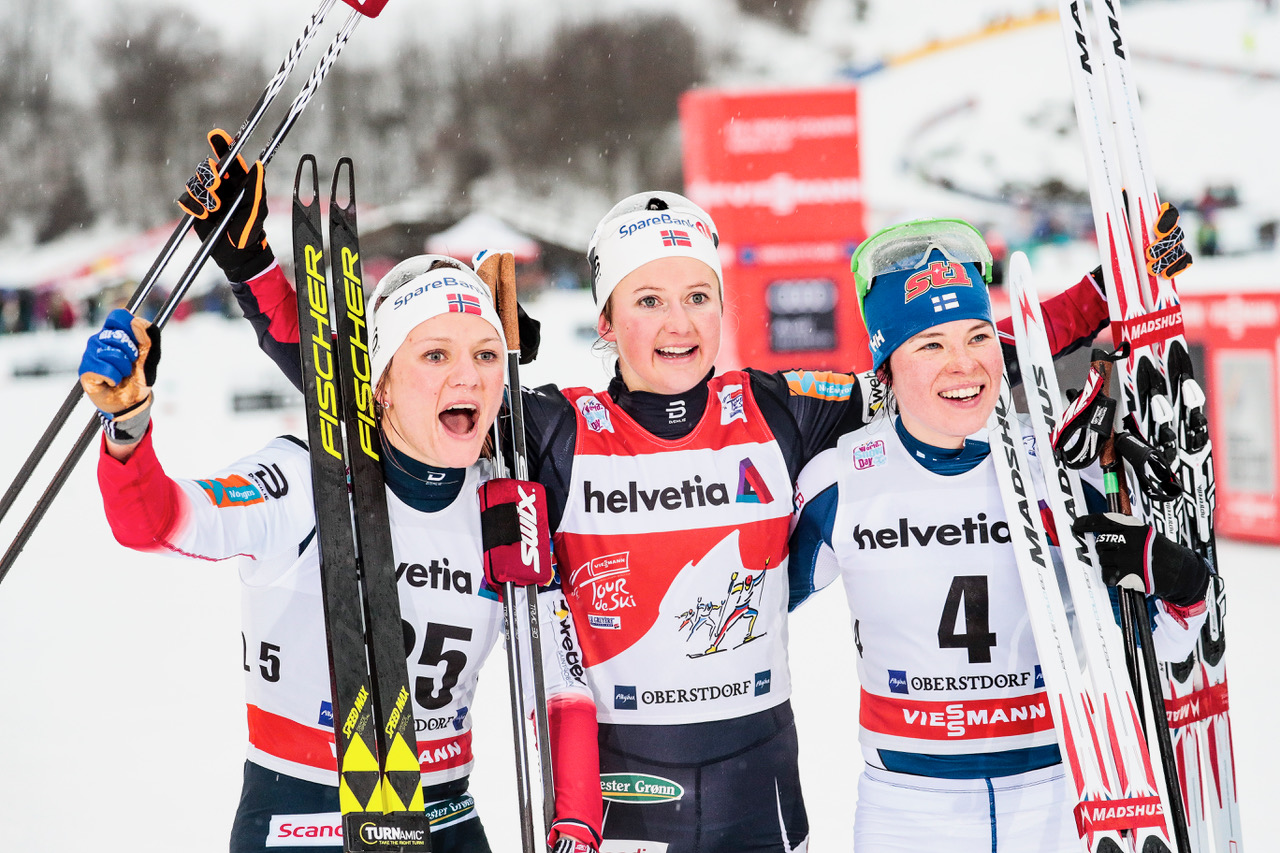
The women’s 10 k freestyle mass start podium at Stage 5 of the Tour de Ski in Oberstdorf, Germany, with Norway’s Ingvild Flugstad Østberg (c) in first and Maiken Caspersen Falla in second, and Finland’s Krista Pärmäkoski (r) in third. (photo: Fischer/Nordic Focus)
The two Norwegians entered the finishing stretch side by side, with Weng taking the right of two center lanes and Østberg the one to her left. Weng might have been a step ahead, but then suddenly lost her balance and veered right, falling on her side.
Uncontested, Østberg celebrated her third-straight TdS win across the finish line, while her teammate Falla claimed second place, 1.9 seconds back. Pärmäkoski took the third position on the podium (+3.2), and Switzerland’s Nathalie von Siebenthal followed in fourth (+4.1) and Nordström fifth (+4.4).
“I’m just really happy that I managed to cross the finish line first,” Østberg told reporters in English after the race. “I thought when we were on the last uphill, I knew that we were in a big, big group. So I thought that maybe 20 girls would pass me in the last 100 meters. I realized that it was a fight with Heidi and me, and I saw that she had an accident — that’s really sad for her. When things like that happen I don’t think it’s fun at all, but I just had to keep on going. I’m sad for Heidi.”
“My plan today [was] to gain as many bonus seconds as possible,” Pärmäkoski, who also benefitted from Weng’s mishap, said according to an International Ski Federation (FIS) press release. “After the bonus sprint [which she won] I knew I had to be fighting for a good position before the finishing straight. I feel sorry for Heidi’s fall, but such situations happen in our sport.”
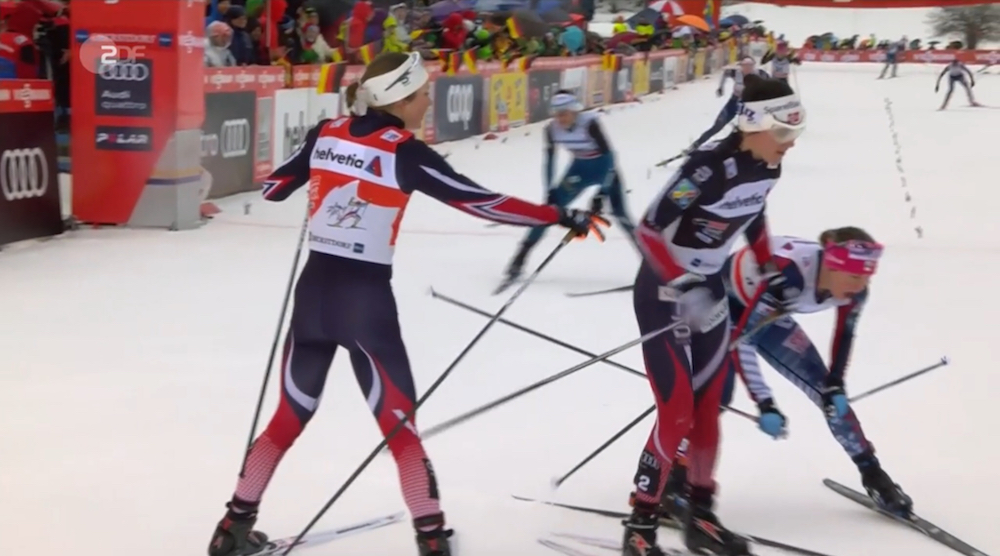
Norway’s Ingvild Flugstad Østberg reaches out for her teammate Heidi Weng (r) while American Jessie Diggins finishes behind them in the women’s 10 k freestyle mass start at Stage 5 of the 2018 Tour de Ski in Oberstdorf, Germany.
Weng scrambled back to her feet and turned around to face the finish, but having lost all speed only crossed the line 7.2 seconds back in 11th place. She covered her head in her hands, then refused the outstretched arm from Østberg and walked out of the finish pen without talking to her teammates or any media.
Only after about an hour had passed, she told Norwegian broadcaster NRK that she just needed some time alone and had been “very embarrassed”.
Just as the finishing-pen interaction between the two Norwegian rivals unfolded, Diggins snowplowed to a halt behind them, having reached the finish in 24th position, 16.8 seconds out of first, following her own stumble.
Four seconds later, Bjornsen crossed the line in 26th (+20.8).
And just another few seconds later, the third USST member Liz Stephen reached the finish in 28th place (+24.5), after moving her way up from skiing as far back as 40th position at the 4.2 k mark.
A day after she would have made the sprint heats and scored World Cup points after qualifying in 21st place before the race was canceled, the fourth USST member in the Tour, Rosie Brennan finished 36th (+52.7) on Thursday.
Along with 10 other female competitors, Americans Ida Sargent and Sophie Caldwell withdrew from the TdS before Stage 5, with the intention to be ready for the next regular-season World Cup weekend of sprint races Jan. 13-14 in Dresden, Germany.
Overall Tour de Ski Standings
Despite a less-than-ideal stage due to the mishap just before the finish, Diggins remained in third for podium contention in the overall Tour standings. Now 1:56.7 minutes out of first, she lost more time to Østberg, while Weng in second trails Østberg by 57 seconds. Pärmäkoski is fourth overall, 2:09.1 back.
“She skied a gutsy race and didn’t lose a lot of time,” U.S. Ski Team Women’s Coach Matt Whitcomb said about Diggins on the phone late Thursday. “We would’ve loved for her to pick up a few more bonus seconds to put a little time in to Pärmäkoski, but these next two days should be great for Jessie. … Nothing was really gained today, but not a whole lot was lost.”
Norway’s Ingvild Flugstad Østberg after winning her third-straight stage of the 2018 Tour de Ski: the women’s 10 k freestyle mass start in Oberstdorf, Germany.
“I think I need maybe almost two minutes to beat Heidi at the end [up the Alpe Cermis],” Østberg told reporters. “She’s the strongest climber in the World Cup, and she really likes the courses in Val di Fiemme. So I think she will be really strong in the last two stages.”
“It has been a discussion if I will go through the whole Tour or not,” Østberg added. “The sprint yesterday was canceled and today was, uh, a special race, maybe not the hardest one, so that makes it easier to keep skiing. But yes, the last two stages are hard. We have plenty of weeks of rest after the Tour so I think it will be good for preparation for the Olympics.”
With her result in the Oberstdorf mass start stage, Bjornsen slipped from fifth to seventh position (+2:47.0) in the overall Tour standings.
“I was pretty bummed, but then again, it’s tour skiing,” Bjornsen wrote. “You can’t think about a race more than 10 minutes after it’s over… or you waste energy for the next. So now, I’m really looking forward to some great classic skiing in the rain here in a couple days! Let’s see what I can do!”
“Sadie’s skied a brilliant Tour as well,” Whitcomb said. “She slipped a couple spots but not a lot of time, given how tight the race was, even though she finished in 26th she was very close to the leaders. She stumbled on one of the climbs and just ended up getting buried in the pack. When you’re back where she ended up and where Liz and Rosie were, it is really difficult to move. There just aren’t hills to tire people out…”
Bjornsen stands to improve one spot again for the next race as Germany’s Nicole Fessel announced her intention to withdraw from the Tour after this stage, citing a need to conserve energy and the upcoming Olympics as her highest priorities this season. Fessel, who is skiing for the local club in Oberstdorf and thus very familiar with the area, had finished the day in sixth place (+5.5) and was also ranked sixth overall (+2:39.8).
“Conditions were top, considering what happened the last hours here, they really managed to compact the snow,“ she told German broadcaster ARD in an interview, according to a translation. “It was difficult to ski today because the course wasn’t so demanding now, but it still had its challenges. Personally I was missing the climbs a little bit, but I am still satisfied that today I was in the mix and could assert myself in a race that required sharp elbows.”
Stephen is 27th overall (+5:12.2) and Brennan 33rd (+5:50.6) out of 43 women remaining.
Asked what kind of final overall finish in this Tour is attainable to Stephen, one of the strongest hill climbers on the World Cup circuit, Whitcomb said it depends on how her next two races go in Val di Fiemme (with a 10 k classic mass start on Saturday followed by the 9 k freestyle final climb on Sunday).
“I’m focused less on what her end result could be and more on the fact that things are starting to look and feel really good for her,” Whitcomb said. “Today she felt great, and it wasn’t necessarily a course that suited her super well, but she was really engaged physically out there and looked fresh and was just attacking when she could. I think when we put her on a tough course it’s going to go really well.
“I think Rosie’s also in great shape,” he added. “She’s had a couple distance races where she hasn’t skied to the level that’s she currently at with her fitness and ability, and she knows that. Today was tough for her. With this flat, she felt that the platform she was skiing on was very unstable and it made things very challenging today. Rosie’s legs were very tight in the race and she didn’t feel like she could access her motor the way that she wanted to. Val di Fiemme if nothing else does that; these are tough courses here.”
For the third time after 1987 and 2005, Oberstdorf is scheduled to host the 2021 FIS Nordic Ski World Championships, and the organizers will then hope for better luck with the weather conditions that would allow them to showcase all of the demanding courses at the venue.
After a rest and travel day, the TdS will resume on Saturday with the sixth stage, a 10-kilometer classic style mass start for the women in Val di Fiemme, Italy, before concluding with the grueling 9 k freestyle pursuit climb up Alpe Cermis.
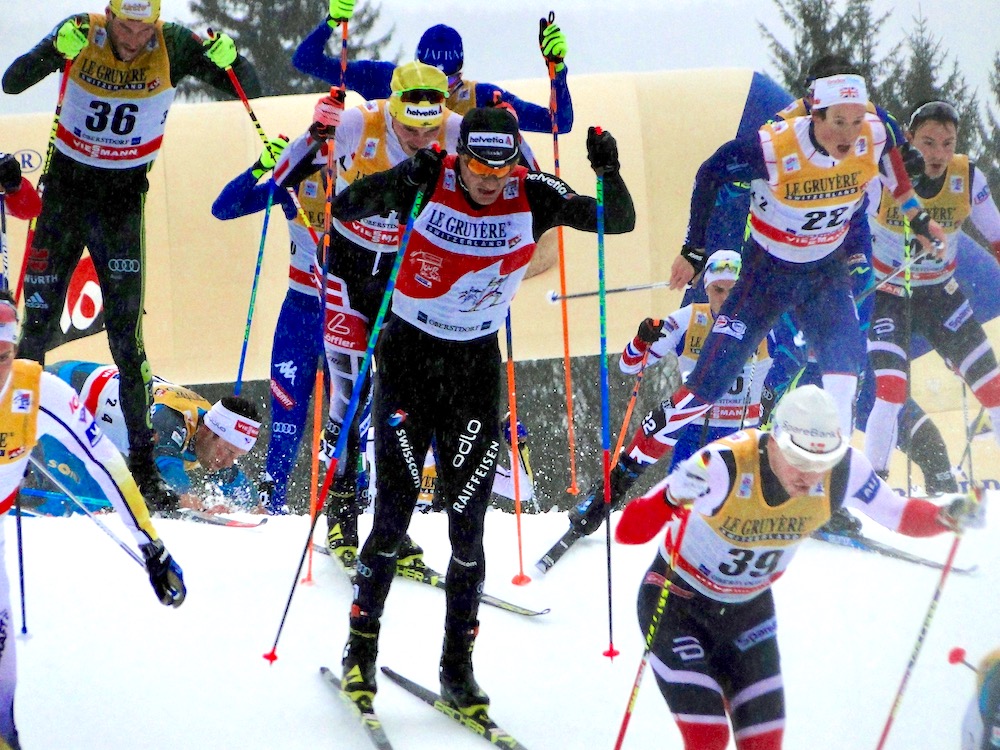
This pretty much sums up Stage 5 of the 2018 Tour de Ski, with a France’s Adrien Backscheider (an early race leader) crashing in the background while Switzerland’s Dario Cologna (red Tour leader’s bib) and Great Britain’s Andrew Musgrave (22) and others chase Norway’s Sindre Bjørnestad Skar (39) and others not shown in the men’s 15 k freestyle mass start on Thursday in Oberstdorf, Germany. (Photo: Harald Zimmer)
Like ants swarming a bread crumb — skating ants — on ice. That was one image that could be conceived from the men’s 15-kilometer freestyle mass start on Thursday, which served as Stage 5 of the 2018 Tour de Ski in Obertsdorf, Germany.
After high winds and fallen trees Wednesday in Obertsdorf left race organizers scrambling to set a new course for Thursday’s distance races, the end result was a 2.1 k loop (the women’s sprint course plus a flat section) with a maximum climb of 16 meters per lap for both the men and the women. The men rounded it seven times for 14.7 k and the women lapped five times for 10.5 k.
While Oberstdorf’s distance courses are typically “challenging and hilly and filled with attacks and strategic moves”, according to U.S. Ski Team Women’s Coach Matt Whitcomb, Thursday’s race was mostly flat. “It was probably the flattest race that many of these athletes have ever raced on the World Cup so it made for a really exciting pack race.
“[The organizers] just couldn’t use the course with the hills because the trees and the forest were unstable,” Whitcomb explained on the phone Thursday evening. “They also didn’t have time to clear the wood that fell. There were six or seven huge trees that fell on the course.”
It had also rained on Wednesday — in fact, a lightening storm struck the venue and led to the cancellation of Stage 4 after the women’s qualifier — so organizers opted to salt the course to preserve it as much as possible for the mass starts. It was raining again on Thursday, leaving the course icy with a thin coat of slush on top by the time the men raced after the women.
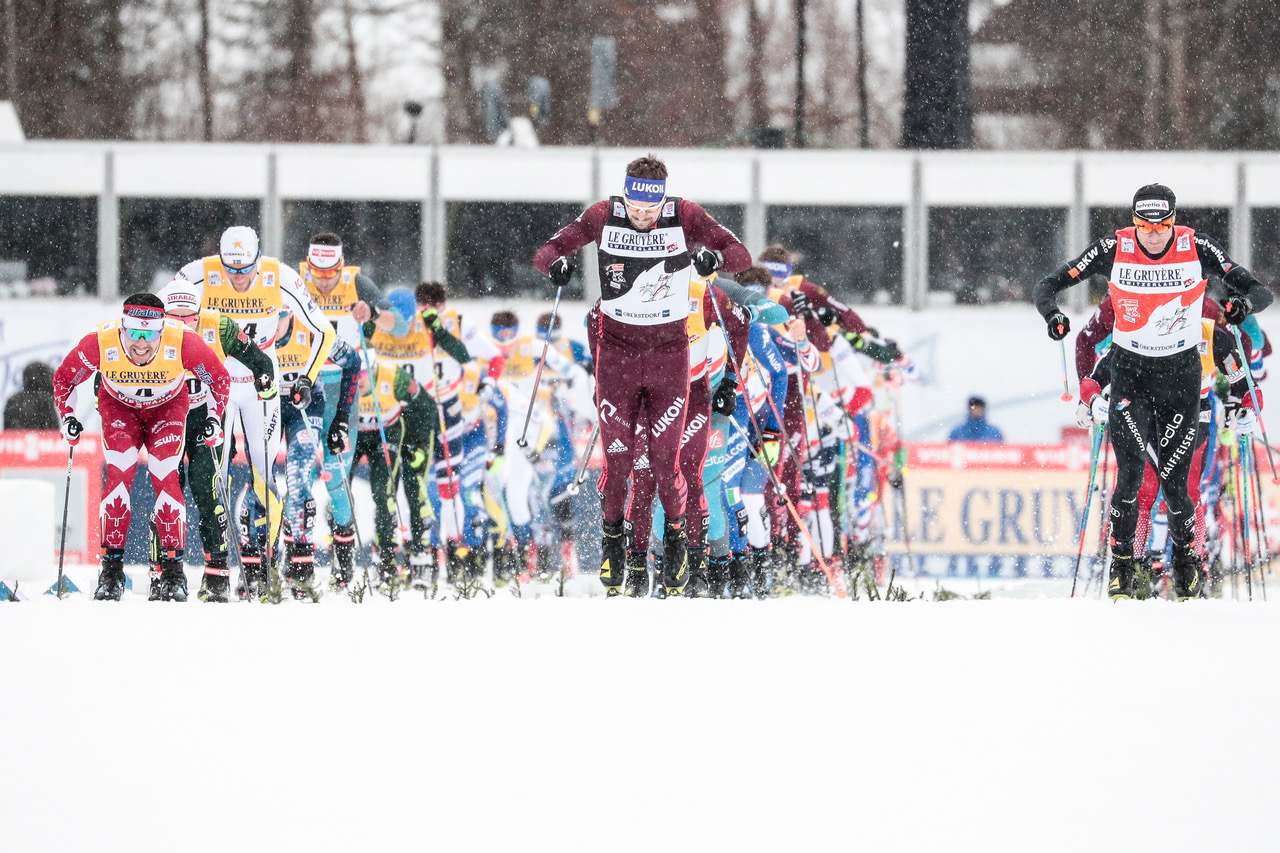
Start of the men’s 15 k freestyle at Stage 5 of the 2018 Tour de Ski in Oberstdorf, Germany, with Canada’s Alex Harvey (4), Russia’s Sergey Ustiugov (black bib) and Switzerland’s Dario Cologna (red Tour leader’s bib) up front. (Photo: Fischer/NordicFocus)
The men’s field, led by Russians Sergey Ustiugov and Alexander Bolshunov for almost all of the first lap, completed Lap 1 of seven in 4 minutes and 16 seconds (with Sweden’s Calle Halfvarsson leading through the checkpoint). There, at 2.1 k, all 67 starters were within 16 seconds of the lead.
One lap later, as Great Britain’s Andrew Musgrave led the large group through the stadium, just ahead of Norway’s Martin Johnsrud Sundby, Switzerland’s Dario Cologna, and Canada’s Alex Harvey, only one man had been dropped. Sixty-six still skied within 19 seconds of first.
Crashes dotted the entire race, with Bolshunov going down at least twice. Mostly, skiers tripped over one another on the slightly rolling course. Harvey even broke a pole at one point in the middle of the second-to-last lap. In a phone interview on Thursday, the lone Canadian in this year’s Tour de Ski (TdS) estimated he witnessed several crashes per lap.
“I saw for sure between 10 and 15 crashes that happened within my surroundings,” Harvey said.
For the first two laps, Harvey positioned himself in the top five, coming through the 3.6 k sprint bonus in fifth place to earn six bonus seconds (which count toward the overall Tour standings). On Lap 3, he dropped back to around seventh, still within 2 seconds of Musgrave and Norway’s Didrik Tønseth, who swapped the lead throughout the third lap.
On Lap 4, Cologna moved to the front, just ahead of Musgrave, Tønseth, Sundby and 30 others within 10 seconds of first at 7.8 k. There, Harvey was back in 30th, 9.2 seconds back. About 1.5 seconds behind him at 8.4 k, the end of Lap 4, was American Erik Bjornsen in 36th.
“I didn’t want to fall that far back, but I made a couple bad decisions, like picking wrong lanes and it was just a bit of a slower lane on one hill, so you’d lose five, six spots,” Harvey recalled. “Somebody would fall in front of you or in your lane, so then you’d come to a stop and lose 10 spots, so it was just real mayhem there. But my plan was to try to stay in the top five, top 10 all day, but I just didn’t do that.”
Lap 5 saw Cologna, Sundby, Tønseth, and even France’s Clement Parisse at the front of the pack, while Harvey moved back up to around 20th, just 3.5 seconds out of first.
On the penultimate lap, Harvey broke a pole.
“I had been kind out of position for a lap and half by then, so I was just trying to find ways to move, going on the outside, I think somebody just stepped on my pole, but it’s hard to tell,” he said.
Despite dropping to what he estimated to be 40th on that sixth lap, Harvey recovered, thanks to the tightly packed group, and lapped through the stadium in 27th, 5.3 seconds behind Tønseth in first.
Over the final 2.1 k, Harvey continued to pick off the places. One and a half k later, he was up to eighth, 3.4 seconds behind Norway’s Sindre Bjørnestad Skar in first.
“I was really focusing on staying outside the whole time, never going for the inside lane and then maybe people were starting to get tired a little bit, even though the course was not hard and the course was fast,” Harvey said. “… I think a lot of it was luck.”
In the final meters, when everyone at the front of the race turned it up another notch and Norway’s Emil Iversen attacked on the final rise before descending into the stadium, Harvey came out on top off a three-way photo finish for fifth place, edging Musgrave in sixth and Norway’s Finn Hågen Krogh in seventh. All three were within 4 seconds of first place, which went to Iversen.
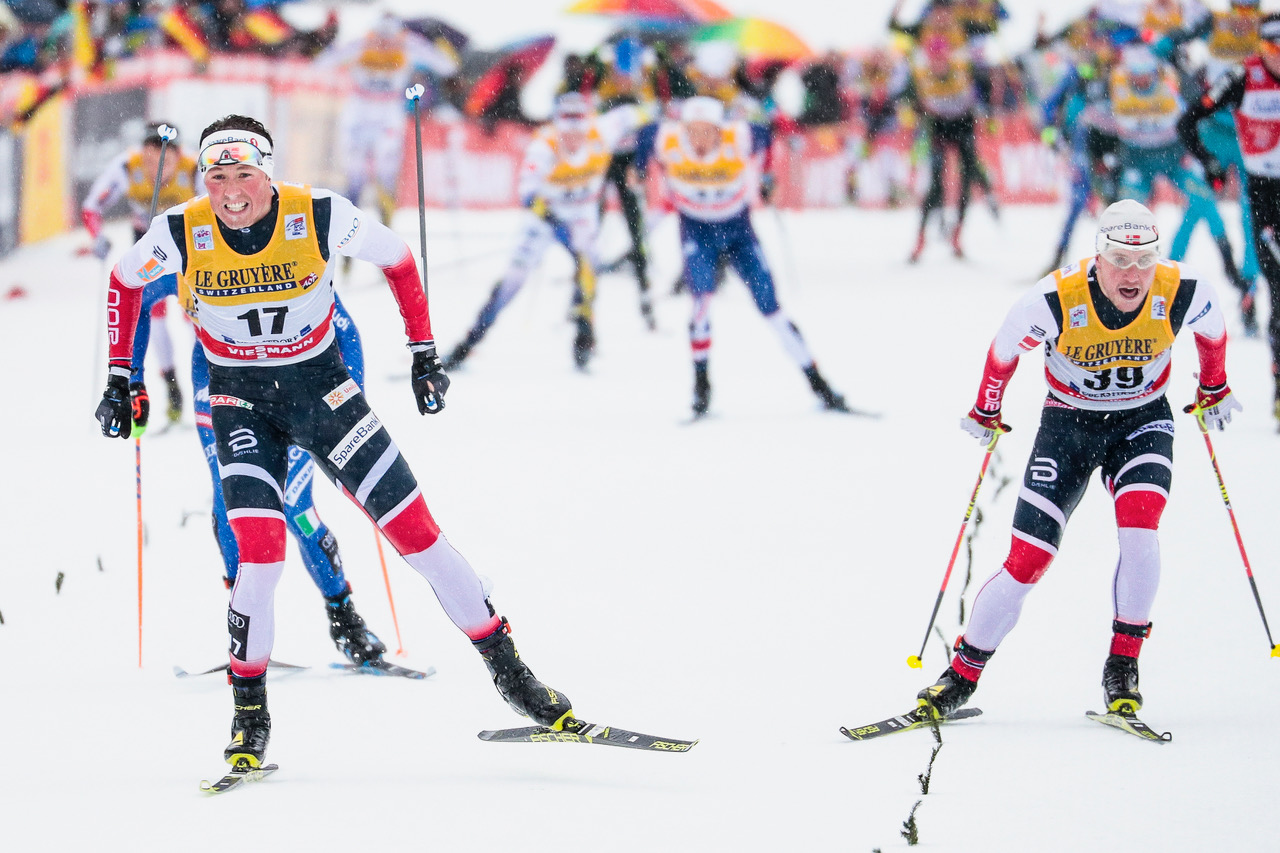
Norway’s Emil Iversen (17) racing to the line with his teammate Sindre Bjørnestad Skar (39) for first in the men’s 15 k freestyle mass start on Thursday, which Iversen won by 0.4 seconds for his first win and podium of the season, and the first for a Norwegian man in the 2018 TdS. (Photo: Fischer/NordicFocus)
The win was Iversen’s first of the season, and Norway’s first on the men’s side in the 2018 TdS, and puts him in 13th, 2:13 minutes out of first, with two stages remaining.
“It was a fight from the start to the end, and I just had to be in my head… doing the right things,” Iversen told reporters in English after the race. “I did that really good today so I am satisfied with that.”
Iversen crossed finished first in 29:49.8, just 0.4 seconds ahead of his Norwegian teammate Skar in second place. Italy’s Francesco De Fabiani — who had been 34th at 8.6 k, seven seconds back and just ahead of Bjornsen — claimed third place, just 0.9 seconds behind Iversen. Cologna finished fourth (+3.7) to extend his overall TdS lead, followed by Harvey in fifth. Harvey is still fourth in the Tour, now 1:23.1 behind Cologna.
Asked if he was mostly focused on finishing close to Cologna, Harvey said he was actually keeping track of Bolshunov, who ended up 40th (+15.9) on Thursday. Heading into Stage 5, the Russian U23 skier was third in the Tour, 6.3 seconds ahead of Harvey in fourth. So Harvey knew that even 6 bonus seconds at one of two sprint bonuses on the course could be the difference between third or fourth in the standings.
At the first bonus sprint, where Harvey picked up 6 seconds, Bolshunov picked up 3. Then, at the second bonus sprint at 7.8 k, the Russian clocked through in sixth for 5 seconds. Harvey was 30th there for zero. At the end of the day, Harvey held onto fourth in the standings, 1:21.3 minutes behind Cologna, 30.1 behind Ustiugov, who’s still in second, and 15.5 behind Sundby, who improved to third. Meanwhile, Bolshunov slipped to fifth, 3.6 seconds behind Harvey.
“… He ended up crashing on the last lap, I think,” Harvey said of Bolshunov. “I was focusing more on the guys that are closer to me because Dario, he’s so solid, he never really has a bad day. I think a lot of people — nobody’s giving it to him, but it’s going be hard to get back on him, so I think people are starting to fight more for second place. It was more about Bolshunov and Ustiugov.”
Russia’s Sergey Ustiugov leading Norway’s Martin Johnsrud Sundby (6), Austria’s Dominik Bauldof (47), Kazakhstan’s Alexey Poltoranin (5) and the rest of the men’s field during the men’s 15 k freestyle mass start at Stage 5 of the Tour de Ski. (Photo: Fischer/NordicFocus)
Ustiugov finished 28th on Thursday (+11.1) and now trails Cologna by 53 seconds in the overall. Sundby finished eighth (+4.2) and picked up 23 bonus seconds in Thursday’s mass start to move up from sixth to third overall (+1:07.6).
“For sure, it has been difficult weather, difficult conditions for those who make this race, and I think you can argue in a lot of ways today, the race was difficult and blew many racers’ chances, both with the difficulties with the skis and poles,” Sundby told reporters in English after. “But I am happy that they decided to do the race. They found a short track we could ski in and no cancellation I think that was good.
“My main goal for the season is Olympics,” Sundby continued. “I think we use this Tour for, one: I love the Tour de Ski; it’s a beautiful competition, and two: to get in better shape for the Olympics. That is the main goal this season, but I still want to fight for the first [in the Tour]. It looks a bit a long ahead at this point, but we have two more races to go.”
For Harvey, the race was also about distancing himself from some of his biggest threats in the final climb on Sunday, such as Sweden’s Marcus Hellner, who entered Stage 5 in 10th and about 35 seconds behind him overall, and France’s Maurice Manificat, who was previously 36 seconds behind him in 14th overall. They’re still at least 37 seconds behind Harvey after Manificat finished 10th on Thursday to move up to 10th overall (+1:59.0), tied with Germany’s Thomas Bing, who placed ninth Thursday to put himself ninth overall (+1:59.0). Hellner follows in 11th overall (+2:05.3) after finishing 22nd in Stage 5.
“I think for me today was a really good opportunity to make some time, especially on the guys close behind me, like Manificat and Hellner,” Harvey said. “I didn’t lose much, but I kind of missed the opportunity to give myself a bit more of a cushion for the climb, so that’s mostly what I’m bummed out about. That and looking at the schedule of the Tour, [this mass start] was for sure where I thought my best chance at a podium would be. So I’m a bit bummed out that I missed out on that, but it’s part of the game.”
In a Cross Country Canada press release, Harvey was quoted on his frustration with the mass start being held on a short, narrow and relatively easy course.
“It’s just too bad, the organizing committee or the jury should have just made it a sprint or an individual start,” Harvey told FasterSkier. “It was just kind of a stupid race. I was lucky that I ended up not losing too much time but I didn’t feel like I raced. It was easy the whole time, with just nerves the whole time, trying not to fall and stay out of trouble, even though nobody I think was able to stay fully out of trouble today.”
Bjornsen ended up 32nd at the finish, 11.7 seconds out of first, and leaves the TdS in 20th (+3:10.7). After initially planning to race the entire Tour, he spoke with Whitcomb about withdrawing after Stage 5 on Tuesday night.
“Erik is in a great spot,” Whitcomb said. “He’s had a really strong period [1 on the World Cup]. He’s skiing a really strong Tour. He’s made a distinct step forward this year, and we want to not lose sight of the goal of doing well at the Olympics. Erik’s a guy where in a number of events, but especially in the team sprint, a medal could be on the table for him, so we’re really focused on making sure we don’t tap things too deeply when we don’t need to. So Erik decided to ski through today, then head to Ramsau for a little rest, then a training camp.”
“It was a hard decision since I’m feeling good and sitting in 20th place,” Bjornsen wrote in an email. “There is a team sprint coming up in a little over a week [in Dresden, Germany] that I want to prepare for. There are only a couple team sprints each year and I feel that is my best chance of stepping onto a World Cup podium. I can’t let those opportunities pass me by.”
“I was pretty disappointed with my result,” Bjornsen wrote of Thursday’s mass start. “I’ve been feeling strong and felt like I wasn’t able to use my fitness out there today. It was great practice skiing in a tight pack. The finish came way too fast.”
Also for the U.S., Paddy Caldwell raced to 39th on Thursday (+15.5), and Andy Newell was 53rd (+43.2) while Simi Hamilton did not start. Newell and Hamilton have also decided to leave the Tour, as they had originally planned after Oberstdorf, and head to Ramsau, Austria, in advance of the Dresden city sprint World Cup weekend Jan. 13-14.
“I chose to race today because I had held back a bit in the last skate race on stage 3 to rest up for the sprint, and then sure enough It was canceled,” Newell wrote. “So I felt like I still had some good energy and It was worth having one more hard race.
“I felt a lot better racing today than in the distance races at altitude so I was stoked about that,” he added. “It was raining and icy and fast so it made for an exciting time. Lots of crashes and broken poles for sure, it felt more like rollerski racing with such a tight pack. Aside from several small tangles on the uphills, I tried to avoid trouble and was happy to ski with the main pack during the the majority of the race.”
“Kind of a weird stage for sure but I think it’s actually good for the TDS,” he wrote. “Adds some excitement and plays to a different skill set to race on an icy flat course like that. Racing is racing. We have an all uphill stage of the TDS, I think it should be customary to have a flat one:) similar to cycling.”
He leaves the Tour in 65th (+9:37.1), while Caldwell will continue in his first-ever Tour de Ski ranked 60th (+6:58.2) out of 67.
“I felt like I was skiing with new people all the time,” Caldwell wrote in an email about Stage 5. “It was a very dynamic and chaotic race. There were countless crashes and tangles out there. Absolute mayhem. Poles breaking every climb and at least one serious pile up every lap.
“I am happy with my performance today though it is bittersweet being so close to the points and the top guys,” he wrote of his 39th-place stage result. “It has been a pretty rough Tour for me so far fighting a cold, but today was definitely a step in the right direction. Right now I am just hoping to keep working out this cold and be able to put together good efforts for the next two races.”
“I actually thought he skied fantastically today,” Whitcomb said, “and he’s sounding much better tonight so I think there’s quite a bit of hope for Paddy. He’s looking good right now.”
Other notable withdrawals from the Tour include Sweden’s Halfvarsson and Finland’s Iivo Niskanen. Halfvarsson placed 54th on Thursday to leave the Tour in 24th overall. Niskanen did not race in Oberstdorf.
The Tour de Ski Stage 5 women’s 10 k freestyle mass start podium on Thursday in Oberstdorf, Germany, with Norway’s Ingvild Flugstad Østberg (c) in first and Maiken Caspersen Falla (l) in second, and Finland’s Krista Pärmäkoski (r) in third. (Photo: FIS Cross Country/Twitter)
Tour de Ski Stage 5 (Oberstdorf, Germany): 10/15 k freestyle mass starts
In one of the more unconventional stages of the Tour de Ski — a rainy, seven-lap, 14.7-kilometer men’s freestyle mass start, and a five-lap, 10.5 k women’s mass start (both of which were adapted to a shorter course after damage from Wednesday’s storm) — two Norwegians outlasted a tightly packed group of competitors to the finish, with Emil Iversen winning the men’s race and Ingvild Flugstad Østberg capturing her third-straight win in the women’s race on Thursday in Oberstdorf, Germany.
Iversen posted his first win of the season after hanging in the pack throughout the relatively flat race, with a maximum climb of 16 meters and total climb of 50 meters.
In the finishing stretch, he outsprinted fellow Norwegian Sindre Bjørnestad Skar by 0.4 seconds for the win in 29:49.8 minutes. Italy’s Francesco De Fabiani reached the podium in third, just 0.9 seconds out of first. Switzerland’s Dario Cologna kept his overall Tour lead in fourth place (+3.7) and Canada’s Alex Harvey came out on top of a photo finish for fifth with Great Britain’s Andrew Musgrave taking sixth and Norway’s Finn Hågen Krogh seventh, all 4 seconds after Iversen.
Norway’s Martin Johnsrud Sundby placed eighth (+4.2), Germany’s Thomas Bing ninth (+4.9) and France’s Maurice Manificat 10th (+5.2).
Twenty-five skiers finished within 10 seconds of first, and 57 in the 67-man field ended up within 50 seconds of first.
Overall, Cologna continues to lead the Tour standings with two stages to go: a 15 k classic mass start on Saturday and 9 k freestyle hill climb on Sunday, both in Val di Fiemme, Italy. He is 53 seconds ahead of Russia’s Sergey Ustiugov, who placed 28th on Thursday, and 1:07.6 ahead of Sundby in third. Harvey remains in fourth, now 1:23.1 behind and 3.5 seconds ahead of Russia’s Alexander Bolshunov (+1:26.7), who finished 40th on Thursday after falling several times.
Erik Bjornsen led the U.S. men in 32nd (+11.7), Paddy Caldwell placed 39th (+15.5), and Andy Newell was 53rd (+43.2). Simi Hamilton did not start. Overall, Bjornsen is 20th in the Tour (+3:10.7), Caldwell 60th (+6:58.2) and Newell 65th (+9:37.1) out of 67, although this is expected to be Newell’s last stage of the Tour.
In the women’s race earlier in the day, Østberg secured a 1.9-second victory over her teammate, Maiken Caspersen Falla, a Norwegian sprint specialist. Østberg crossed the line first in 23:16.5 and Finland’s Krista Pärmäkoski joined the two Norwegians on the podium in third, 3.2 seconds out of first.
Switzerland’s Nathalie von Siebenthal finished 4.1 seconds back in fourth for her best World Cup result, Sweden’s Maria Nordström was fifth (+4.4) to tie her career best, Germany’s Nicole Fessel sixth (+5.5), Austria’s Teresa Stadlober seventh (+5.8), Norway’s Anne Kjersti Kalvå eighth (+6.5) for her first World Cup top 10, Russia’s Anastasia Sedova ninth (+6.7), and Sweden’s Emma Wiken 10th (+7.1). Norway’s Heidi Weng was another 0.1 seconds back in 11th (+7.2), and for the first time this season, no U.S. Ski Team members finished in the top 20.
Jessie Diggins placed 24th (+16.8), Sadie Bjornsen 26th (+20.8), Liz Stephen 28th (+24.5), and Rosie Brennan 36th (+52.7).
“Today was definitely a very different course than most due to the storm and trees falling down over the usual course!” Diggins wrote in an email to FasterSkier. “It was icy and flat, which meant that the pack stayed really tight together as there were no big climbs to break it up.
“Fortunately, I got into great position to sprint for the bonus seconds [on Lap 3],” she continued. “Unfortunately, 200 meters from the finish I hit ice and crashed hard into the boards, spinning around and losing quite a bit of time and places. But that happens sometimes in racing and I shook it off already!”
Østberg now leads the Tour standings by 57 seconds over Weng while Diggins is nearly 2 minutes back in third (+1:56.7). Pärmäkoski follows in fourth (+2:09.1), Finland’s Kerttu Niskanen is up to fifth (+2:34), Fessel is sixth (+2:39.8), while Bjornsen slipped two places to seventh (+2:47.0). Stephen is 27th overall (+5:12.2) and Brennan 33rd (+5:50.6) out of 43 women.
Ida Sargent and Sophie Caldwell did not start on Thursday and withdrew from the Tour to focus on the regular-season World Cup sprints next weekend in Dresden, Germany, which are also the focus for their U.S. teammates Kikkan Randall, Hamilton and Newell.
A view of the racecourse in Oberstdorf, Germany, on Wednesday after Storm Burglind ripped through, bringing rain and wind which tossed materials and trees around the course.
OBERSTDORF, Germany — On Wednesday, a storm big enough to earn a name from meteorological agencies, “Burglind” provided unexpected obstacles to the World Cup cross-country ski field. With some gusts of wind approaching hurricane speeds, the women’s and men’s sprint courses became potentially dangerous — and they are already difficult to ski under regular conditions.
Trees fell on a warmup track and a section initially intended for the men’s sprint. Blown-over ad banners and gates littered both the men’s and women’s sprint courses for the fourth of seven stages at this year’s Internationals Ski Federation (FIS) Tour de Ski.
“There were a few lightning strikes during the ski testing window that were probably within a mile of the venue, so that made everyone nervous and for me that was the scariest part of the day,” Simi Hamilton of the U.S. Ski Team (USST) wrote in an email. “I think they were prepared to keep running the race until a 60-foot tall tree fell down on the distance course where men were warming up and women cooling down. At that point, I think they deemed it too dangerous to continue, and I agree with the decision they made.”
Ultimately, the race jury canceled the sprints.
This was not good news for some women, who had looked forward to the races and braved the elements successfully: their sprint qualifying round had still been started despite the adverse conditions. Maiken Caspersen Falla of Norway won that time trial, although it wasn’t ever counted for anything other than FIS points.
Those who didn’t go as fast as Falla could benefit from having a “mulligan” to try anew on Thursday, when races are scheduled to continue with mass starts also in Oberstdorf.
“The skiing itself was really good today, perfect klister conditions, so it is unfortunate to cancel the race, but our safety should always come first,” USST member Rosie Brennan wrote in an email. “I think it would have been better to postpone the race as soon as the lighting hit and then make a decision as to whether or not it is safe to race so that no one is out skiing in lightning … I was debating if I should keep warming up or not take the risk, and that is a position I don’t think the athletes should be put in.”
The qualifying round was drowned out in a rainstorm on Wednesday. The female racers were drenched when they came off the course, and while lightning could be seen over the mountains surrounding the arena they ran to take cover indoors.
Just as the men’s qualifying round was about to be started, the jury decided to cancel the race day.
“Heavy rain and strong winds made the competition course not safe for the athletes. The competition has halted after the ladies’ prologue before the men began,” a FIS press release stated.
Local organizers, team representatives and FIS race officials couldn’t remember if something like this had ever happened, at a Tour de Ski or otherwise.
“Trees fell over on the course, some athletes just stopped skiing. Those were not acceptable conditions for the athletes, but also for the staff out on the course,” German cross-country team manager Andreas Schlütter told broadcaster ARD, according to a translation.
According to another jury decision, the FIS points gained in the women’s qualifying will count. However, for the Tour de Ski standings and the overall World Cup, it will be as if no race had happened. The Tour thus will have only six instead of the scheduled seven stages.
Women’s Qualifying
Jessie Diggins of the USST, currently in third position in the 2018 Tour de Ski (1:26.9 behind Norway’s Ingvild Flugstad Østberg in first), finished the qualifying in second position, 2.55 seconds behind Norway’s Falla. Local fan-favorite Sandra Ringwald of Germany was third (+5.80), rising from 13th position at the course’s halfway mark.
Behind Diggins, Ida Sargent raced to ninth (+8.67) in the qualifier, and would have had a good position in the heats. Sargent was coming off a strong run, having qualified in fifth position and then reached the final in a freestyle sprint in Davos, Switzerland, in December, and placed 20th in the freestyle sprint in Lenzerheide, Switzerland, earlier this week.
“It was really crazy out there,” Sargent wrote in an email after the race. “I’ve never raced in a lightning storm. All through the warmup I was expecting someone to cancel it because the thunder and lightning strikes were really close. I ended up just going inside and spinning because I’m really afraid of lightning. There was another really big lightning strike just before I started the qualifier. Rosie [Brennan] and I looked at each other and both kind of laughed since we couldn’t believe we were actually racing in that. I think it helped me go fast because I just wanted to get back inside as soon as possible. … I felt good out there, so I was actually bummed the weather was so crazy and they had to cancel it. But it was definitely the right call because it just wasn’t safe.”
Starting a few bibs behind Sargent, Brennan finished 21st (+12.95), following up on a 15th-place finish in the Lenzerheide sprint.
“I am, of course, bummed to not race,” Brennan wrote in an email. “However, I am also disappointed that we were even allowed to be out there warming up. Things were not bad at all when we showed up, but the rain increased and then the wind picked up, and then the thunder and lightning started. After I heard thunder and lightning, I became very scared.”
Sadie Bjornsen, currently in fifth overall in the Tour and with a podium in the Stage 2 Lenzerheide 10 k classic, had been looking forward to the Oberstdorf classic race well before starting the Tour, according to a U.S. Ski & Snowboard press release.
But the safety of the athletes was on her mind more so than her own race performance hampered by external wind influence, which might have seen her drop back in the overall standings if the race had continued.
“It sure was a wild day out there today,” Bjornsen wrote in an email to FasterSkier. “Unfortunately, it took a turn further from ‘wild’, and turned into life-threatening risk. About 45 minutes before the start of the race, weather took a severe turn. Thunder and lighting started hitting very close, and then the rain came hard, and then the wind picked up. For a while it was funny, but it turned to the point that is was downright dangerous. I was 99% sure the race would be cancelled, so I was trying to not stress. To my disbelief, the jury was not able to weigh the risk between safety and putting on a race, and the race went on.”
After starting in the middle of the field, Bjornsen’s halfway checkpoint split time ranked 15th.
“A giant hurricane gust hit as I was making the far turn on the end of the course,” she wrote of her race loop. “I got blown so hard from the back that I had to skid to a stop on the corner in order to stay on the course. Then, as I tried to make my way up the climb back home, the wind was blowing so hard, I literally couldn’t move. At one point, I crouched down, put my head down, and just tried to not get blow away. I finally was able to get going again, but was forced to herring bone up the entire hill against the wind. As I crossed the line, I quickly realized it was not going to be a fair race today. My sole goal was to get indoors though, so I ran for the building. As the results came in, I heard I got pushed out of qualifying, and it slowly broke my heart.”
Bjornsen finished in 37th position.
“Ski racing can’t always be fair, and that is life,” she concluded. “But more importantly today, I was super sad to see the race wasn’t called off the minute the first thunder and lighting started hitting, and gusts started blowing that were strong enough to take trees down. … We all want to be out there racing, there is no doubt about that… but we should never chase that dream at the compromise to our life! I hope today was a learning lesson for the jury, and we can avoid situations like this in the future.”
Her teammate Liz Stephen would have also been out of the heats after she finished the qualifying in 49th place (+39.22).
Almost exactly two years ago on Jan. 5, 2016, Sophie Caldwell of the U.S. Ski Team won her first World Cup race on this same course and location. On Wednesday, she did not start in the sprint qualifying due to an illness. Earlier this week, Caldwell had already been successful finishing in second place in the freestyle sprint in Lenzerheide, only behind Switzerland’s Laurien van der Graaff.
Questioned in person, FIS Cross-Country Media & Project Coordinator Michal Lamplot could not immediately confirm whether the cancellation would mean that Caldwell could in theory continue the Tour on Thursday if she wanted to (typically once an athlete does not start a tour stage, that individual is out for the rest of the tour). However, Caldwell had already intended to likely leave the Tour latest after the mass start in Oberstdorf to focus on a weekend of sprint races in Dresden, also Germany.
Men’s Qualifying Not Started
Initially the competition jury had considered switching the men’s sprint course to the same 1.25-kilometer loop as the women, omitting a tree-lined higher-elevated section up the (in-)famous Burgstall climb, introduced at 2005 World Championships.
The men, including Canada’s Alex Harvey, who is currently in fourth overall in the Tour standing (1:01.8 behind Switzerland’s Dario Cologna), came out into the starting pen to warm up running back and forth.
“Early in my warm up I went on the training trails, saw a first broken tree there, then looping back to a place I had skied four minutes prior I saw that another tree had fallen in that four minute period!” Harvey wrote in an email. “I think canceling the race was the safe call today. You don’t want to have trees falling on the skiers! It’s the first time something like this happened to me as a skier!”
The men quickly retreated to the athletes’ tent and wax cabins when the jury decision to cancel their race spread around.
“I’m especially bummed with the decision to cancel the race today,” USST sprinter Andy Newell wrote. “I’m particularly disappointed because this classic sprint was pretty much the only reason I was racing the Tour in order to get some valuable classic sprinting in, since they are so limited on the World Cup.”
He would have preferred for the race jury to wait a while longer to have another opportunity for a race he had targeted specifically, though in the end that likely would not have helped as rain turned into heavy sleet and the wind hardly died down.
“I think the weather was probably too poor to have a fair race at the time, but I would have liked to see them postpone or put a hold on qualification rather than cancel,” Newell wrote. “There was heavy rain and wind but the snow was actually in great shape and I think we could have had some good weather windows with a postponed start…. It likely makes it impossible for a tv broadcast with a postponed race, but at least we get something done. This was my main race to focus on in the last month.”
“I think they made the right call today, and I’m glad that everyone is safe,” Hamilton noted. “… You have to be flexible when you are on the World Cup and it’s a good reminder to make the most of every single race opportunity you are given regardless of the weather and conditions.”
Along with the teams, some 900 spectators in the stadium area had to leave again without getting to see a race.
Oberstdorf Stage ‘5’ (Skipped 4) Set for Thursday
According to a statement by FIS, regularly scheduled 10/15 k freestyle mass start competitions will be held on Thursday, weather permitting, albeit with some alterations due to damage to the course. The races will be a couple kilometers shorter for both the men and the women, with the women racing four laps for 8 k and the men doing six laps for 12 k.
“Due to the damage on the planned course caused by the severe weather a different competition course will be used resulting in a slightly reduced lap,” a FIS press release stated.
The USST sprint-specialists will likely withdraw from the Tour, although a few may stay and race Thursday’s Stage 5 (while Stage 4 was never contested, FIS opted to keep the remaining Tour stages named as they previously were). Most World Cup sprinters have their eyes set on a weekend of freestyle sprint and team-sprint races in downtown Dresden, also in Germany, Jan. 13-14.
“If they just continue with the 15 km mass skate then I’ll consider racing that if the conditions aren’t too crappy,” Hamilton wrote.
The athletes focused on the overall Tour — or at least intending to complete the grueling challenge of now six races in nine days — will have to deal with whatever happens next.
“The tour will go on tomorrow,” Bjornsen wrote. “We will keep trying to work through the weather. It is unfortunate to see this storm hitting much harder than expected. In this world, we have to be prepared for everything. Today that meant three layers of clothing, rain outfits, and a positive outlook. We will bring the same tomorrow, and hope the winds and thunder and lighting don’t come to join!”
Ultimately, losing a sprint out of the schedule could drastically impact the Tour’s final standings.
“I think if we just lose the classic sprint, it’s better for [Martin Johnsrud] Sundby and Dario [Cologna],” Harvey wrote. “For me personally, I’d like to have a classic sprint, both for my Tour de Ski chances and the opportunity to get another good classic sprint before the Games. They made a new course for the men here and it’s a bit like the PyeongChang course… I don’t know if it’s just me but the first thing I thought when I skied the course yesterday was: sweet, this is a great practice for the Olympic sprint!”
—Alex Kochon and Chelsea Little contributed reporting
The women’s 10 k freestyle podium at Stage 3 of the 2018 Tour de Ski on Monday in Lenzerheide, Switzerland, with Norway’s Ingvild Flugstad Østberg (c) in first and Heidi Weng (l) in second, and American Jessie Diggins (r) in third. (Photo: Salomon/NordicFocus)
Not one of the last three days in Lenzerheide, Switzerland, were alike, with three different American women standing on the coveted podium and three vastly different conditions for the first three stages of the 2018 Tour de Ski.
Technically, it wasn’t 2018 until today — with Jessie Diggins racing to third in the women’s 10-kilometer freestyle pursuit on Monday, the first day of the new year and her first podium of the season.
She did so in soft, slow conditions with fresh snow coating Lenzerheide’s 3.75 k distance course — a stark contrast to Sunday’s fast-and-icy conditions that caused a few racers to fly off the course*. American Sadie Bjornsen stayed on her feet and raced to third for her first-career 10 k podium. Saturday’s skate sprint was a snowy one, which another U.S. Ski Team member Sophie Caldwell embraced and raced to second place, for her first individual World Cup podium in two years.
Monday was a suffer-fest for everyone on course and a solo one for the first three skiers. Norway’s Ingvild Flugstad Østberg headed out of the gate first, after leading the Tour de Ski (TdS) standings with a win in Saturday’s 10 k classic. Her teammate Heidi Weng started second, 33 seconds back, and Diggins started 32 seconds after Weng (1:05 minutes behind Østberg) in third.
With Bjornsen next in line, another 10 seconds back in fourth, and Russia’s Natalia Nepryaeva 2 seconds behind her in fifth, the race was for the podium was more or less a formality, barring anything unexpected for Østberg, Weng and Diggins. Sure, anyone of them could have unraveled, but it wasn’t likely. Regardless, each still had to gut out three long laps on their own, with Diggins eyeing Weng, Weng trying to close the gap to Østberg, and Østberg with only the open trail ahead of her.
“It was like hell today,” the 27-year-old Østberg said after her second-straight win on Monday, according to an International Ski Federation (FIS) press release. “It was a very hard fight. I felt the snow was not fast. I was gaining seconds on Heidi and then losing them again.”
Throughout the race, Østberg had a maximum gap of 36 seconds to Weng in second (at 1 k) and a minimum gap of 23 seconds (again to Weng at 5.6 k). She crossed the finish line first in 26:48.1 minutes, while Weng finished 27.8 seconds back in second and Diggins another 49.1 seconds later in third (+1:01.4).
Weng, who is currently second in the overall Tour standings, 32.8 seconds behind Østberg in first with four stages to go, told FIS that the race was “very hard for everybody”, but she was pleased with her ability to ski hard on the uphills and flats. For most of the race, she looked like Weng was giving it everything she had — as was Diggins — and Weng ended up with the third-fastest time of day. Austria’s Teresa Stadlober posted the fastest 10 k time in 26:20.6, which put her in 12th at the finish after she started 29th. Weng was 22.5 seconds slower and Østberg 27.5 seconds off that time with the fourth-fastest time of day.
In her third race in as many days, Østberg said she felt tired out of the start on Monday.
“Already after one hundred meters, my legs were tired, but I fight, fight, fight all the way,” she told German broadcaster ZDF. “And I managed to reach the finish first, it was a great feeling.”
This marked Østberg’s third win of the season — all of which have come in Switzerland (she won the Davos 10 k freestyle on Dec. 10). Four years ago, she won her first World Cup race in Lenzerheide in a freestyle sprint.
“In Davos and here in Lenzerheide I had some of my best races, so Switzerland is a good place for me to race,” she told ZDF.
Jessie Diggins (U.S. Ski Team) racing to third in the women’s 10 k freestyle pursuit at Stage 3 of the 2018 Tour de Ski in Lenzerheide, Switzerland. On the first day of the new year, it was her first podium of the season. (Photo: Salomon/NordicFocus)
Then there was Diggins, who continued the U.S. Ski Team (USST) streak of landing on the podium over three consecutive days.
“Today my plan was to go out hard and ski a gutsy race, and try to put some time into the girls behind me,” she wrote in an email to FasterSkier. “It’s sometimes hard to be skiing alone but I actually loved it because I could just put my head down, hammer, and do my thing!”
Within the first kilometer, she had already put a few more seconds into Bjornsen in fourth place. Meanwhile, Bjornsen, 13 seconds behind Diggins, worked to shake off Nepryaeva.
“Starting in 4th was a pretty exciting position, and even a bit terrifying,” Bjornsen wrote in a mass email to media outlets. “It was my goal to try to catch Jessie, and ski with her, but I knew I needed to get it done in the first kilometer, because she was going to be on a mission. I got darn close, but not quite close enough. I could tell right away I was going to be on a solo mission, and needed to really push hard to stay ahead of the group working together behind me.”
The group she was referring to included Finland’s Kerttu Niskanen and Krista Pärmäkoski. Toward the end of the first lap at 3.3 k, they had distanced themselves from a nine-woman chase group led by Norway’s Astrid Uhrenholdt Jacobsen, of which Caldwell was a part of. After dropping Nepryaeva on the first lap, Bjornsen had the two Finns and the crew behind them to worry about.
“I managed to stay ahead until literally the last downhill, and got passed by Krista, so lost one place, but I left the day pretty satisfied,” Bjornsen wrote after finishing fifth in a three-way battle with Pärmäkoski and Niskanen for fourth place. Pärmäkoski took it, passing Bjornsen in the last few hundred meters and leading her and Niskanen, respectively, into the finishing straight. Pärmäkoski crossed the line in fourth, 29 seconds after Diggins and 1:45.9 after Østberg, while Bjornsen was another 0.3 seconds back in fifth (+1:46.2) and Niskanen finished 0.4 seconds later in sixth (+1:46.6). Behind them, Jacobsen finished seventh (+1:59.9), Fessel eighth (+2:00.3), the Czech Republic’s Petra Novakova ninth (+2:01.0), and Germany’s Sandra Ringwald 10th (+2:11.3).
Sadie Bjornsen (U.S. Ski Team) leading Russia’s U23 leader Natalia Nepryaeva (l) in the women’s 10 k freestyle pursuit at Stage 3 of the 2018 Tour de Ski in Lenzerheide, Switzerland. Bjornsen went on to finish fifth and Nepryaeva finished 17th. (Photo: Fischer/NordicFocus)
“It required digging darn deep those last kilometers,” Bjornsen wrote. “I was feeling pretty good for the first lap, but started to really burn for the last two. I’m really looking forward to a day off, and then some classic sprinting! Sounds like it will be darn wet and rainy, but it will be fun.”
Heading into the fourth stage of the TdS, Wednesday’s classic sprints in Oberstdorf, Germany, Diggins is third overall,1:26.9 minutes out of first, Parmakoski is up to fourth (+2:00.9; after starting Monday’s race in eighth), and Bjornsen is positioned in fifth (+2:01.2), just ahead of Niskanen in sixth (+2:01.6).
“It’s really fun to be in podium position right now in the tour, but my plan as always is to just take it one day at a time and focus on each stage separately,” Diggins wrote. “If I can give my best effort each day, hopefully it all adds up well!
“I was really proud of our wax tech team because the past two races have been extremely tricky waxing conditions with varying snow all over the course,” Diggins added. “It was hard to pick skis but my tech Cork was so calm and collected and got me through the pre-race testing!”
Despite not planning to finish the Tour, Caldwell is sitting in a respectful 18th overall (+3:14.2) after finishing 18th in Monday’s race, 2:59.2 behind Østberg.
“10km skates tend to be the hardest discipline for me, and although today wasn’t anything to write home about, it also wasn’t a disaster, so I was pretty happy with it!” Caldwell wrote.
Sophie Caldwell (U.S. Ski Team) racing to 21st in the women’s 10 k classic on Sunday at Stage 2 of the 2018 Tour de Ski in Lenzerheide, Switzerland. On Monday, she finished 18th in the Stage 3 10 k skate pursuit. (Photo: Fischer/NordicFocus)
She started seventh, 1:32 back, at the same time as Niskanen in bib 6. Parmakoski started 3 seconds behind them and the three immediately formed a group, with Caldwell leading the first kilometer.
“For some reason out of the start Kerttu just pulled to the side and made me lead, which I thought was interesting since both she and Krista are much better distance skiers than I am,” Caldwell wrote in an email to FasterSkier. “But anyway, I was totally fine taking the lead, but I wasn’t going to push the pace leading, so I just skied a chill pace until they decided to take back over coming through the stadium. The chase pack caught us pretty quickly, which I was actually excited about because the Finns’ pace was a little too hot for me once they picked it up and the chase group was skiing a pace that felt quite comfortable for me for a lap or so.”
With racers like Jacobsen and Germany’s Nicole Fessel leading the large chase pack for much of the race, Caldwell hung in the group for about 5 k in the middle of the race. But with one lap to go, she lost contact and found herself fighting for 18th.
“The pace was definitely picked up at the beginning of the third lap and I started to get tired then, but I just tried to keep my skis gliding and focus on getting to the finish line,” she wrote. “It was cool for me because often I feel like those skate races are red lining it from the start for me, and today I felt in control for two laps and had a pretty fun time with it!
“I’m really happy with how my tour has gone so far,” Caldwell continued. “I had one of my best sprints ever and one of my best distance races ever, so no complaints there! I feel healthy, fit, and happy and it’s given my confidence a good boost.”
“The vibe is pretty amazing among our team right now,” Bjornsen wrote. “To have a podium every day of the Tour is pretty exciting! It’s fun to see things really come together for everyone. I think there is more to come!”
Asked if this was in line with what the U.S. team was expecting for a start to the Tour, USST Head Coach Chris Grover said it surpassed expectations, but wasn’t unanticipated.
“There was some opportunity in this field this year with [Sweden’s Charlotte] Kalla and Stina Nilsson not starting, with [Norway’s Marit] Bjørgen and Ragnhild Haga not starting, for example, so that left some opportunity for some of the other women to have some breakthrough results,” he said on the phone. “But at the same time, the women that have been on the podium from the U.S.A. the last three days have been on the podium this year or in past years and have been kind of knocking on the door of those results…
“Overall it’s a better start to the Tour than we could’ve wished for,” he later added. “It’s been really exciting to see a podium from a different woman on the team each day. I think once we get to Oberstdorf there’s going to be fresh opportunities for all those women once again to reach the podium. I’m just hoping that right now that everybody can stay healthy, get some good rest, and really look forward to seeing what they can do in the next couple stages.”
With four stages to go, the U.S. has six women in the Tour, with Liz Stephen improving to 31st on Monday (up from 37th at the start), Rosie Brennan maintaining her overall place in 33rd, and Ida Sargent in 55th (down from 31st at the start).
“I was hoping to make up some more places and thought getting into the top 30 was doable. But last lap I lost a little steam and couldn’t keep up my pace,” Stephen wrote in an email to FasterSkier.
En route to the 26th-fastest course time, Stephen picked off four places between 3.3 and 4.3 k.
“The race started really fast, as usual for the World Cup, so I try to be patient and bank on people coming back to me, which they did after about a lap,” she wrote. “I was focused on making up time consistently around the whole course and not just killing myself on the uphills. However the second 1/2 of the course was a lot of climbing so I focused on those sections and tried to get in peoples drafts for the long downhill into the stadium.”
Now in 31st overall, she is 4:22.7 out of first. Brennan is another 10 seconds back in 33rd (+4:32.9).
“I am happy to have scored my first points of the year yesterday in a classic race on very icy, scary conditions, which is not my strong suit, and then again have a top 30 performance,” Stephen continued, referring to her 28th place in Sunday’s 10 k classic. “My year has certainly started slower than I wanted it to, but the Tour is always a good way for me to get a lot of racing in a short period of time and bring my fitness up. So, every day I focus on making a few more spots and look forward to Alp Cermis!”
While Sargent is fighting illness and had initially planned to withdraw from the Tour after Stage 4 or 5 in Oberstdorf (to focus on the World Cup sprints after the Tour), Stephen and Brennan intended to finish it.
“I know Ida is kind of feeling on edge … I know she was kind of a questionable start for yesterday’s classic race so we’ll see what happens with her going into Oberstdorf,” Grover said.
He described Kikkan Randall’s foot injury as one that’s crept up over time that and doesn’t involve a stress fracture.
“She is planning on starting in Dresden right now, both in the sprint and the team sprint so I think she’ll continue to be somewhat selective with the races she chooses,” he said of Randall resuming her season with the next regular-season World Cup races Jan. 13-14 in Dresden, Germany. “She may or may not go at all to Planica [Slovenia, Jan. 20-21], since those are two classic races, but she will for sure race in Seefeld [Austria, Jan. 27-28], where there’s two skate races. So right now her plan is, keep trying to make progress with the foot, get it healthy, be ready to race in Dresden, be ready to race in Seefeld, be ready to race at the Games.”
*Switzerland’s Laurien van der Graaff, the Stage 1 skate-sprint winner, crashed out of contention in Saturday’s 10 k classic, and finished 35th to put herself 16th overall in the TdS heading into Stage 3.
“…I skied out into the deep snow, I had problems to brake at all and went straight ahead and unfortunately crashed and lost quite a few seconds there,” she told Swiss broadcaster SRF, according to a translation. “Otherwise I felt good. It was a special race, a bit more attention on me than usual, but it was cool, I am still happy about yesterday. Aside from my crash I enjoyed it. My nose is pretty banged up. … It really hurts.”
The men’s 15 k freestyle pursuit podium at Stage 3 of the 2018 Tour de Ski on Monday, with Switzerland’s Dario Cologna (c) in first, and Russia’s Sergey Ustiugov (l) in second and Alexander Bolshunov (r) in third in Lenzerheide, Switzerland. (Photo: Fischer/NordicFocus)
The Tour de Ski (TdS) theater was treated to a solo-skier drama during the Stage 3 men’s 15-kilometer freestyle pursuit on Monday in Lenzerheide, Switzerland.
On New Year’s Day, it was a homegrown skier, Switzerland’s Dario Cologna, who stole the show winning the race in 34:56.6 minutes. Cologna is a three-time Tour de Ski winner, who until Saturday’s 15 k classic stage win, hadn’t won a World Cup race in three years.
“It was an amazing day already yesterday,” Cologna told the International Ski Federation (FIS) in a post-race interview. “Today I didn’t plan to already go away [from Ustiugov] on the second loop, but I felt very good. It was amazing with the crowd again here, with a home crowd it gives you so much energy. The last loop was very tough, Sergey came back strong, but I was just pushing and really wanted this win. It was one of these amazing days.”
Russia took the remaining podium spots with Sergey Ustiugov in second, 17.6 seconds behind Cologna, and U23 skier Alexander Bolshunov in third (+45.5). The lone Canadian in the race, Alex Harvey, outsprinted a six-man group to finish in fourth (+46.8). Kazakhstan’s Alexey Poltoranin was fifth (+47.1), Norwegians Martin Johnsrud Sundby sixth (+48.1) and Hans Christer Holund seventh (+48.2), Russia’s Alexey Chervotkin eighth (+49.9), Finland’s Iivo Niskanen ninth (+51.5), and Sweden’s Marcus Hellner 10th (+1:21.7).
For the last day in 2017 and the first in 2018, Cologna is ringing in the new year with a vigorous resurgence. On paper before the race, Cologna’s potential top spot on the podium seemed possible, but based on recent stats, uncertain. Yes, Stage 2’s win was a statement, but a horde of would-be winners and chasers weren’t far back from Cologna at the start.
Russia’s Sergey Ustiugov racing to second in the Stage 3 men’s 15 k freestyle pursuit at the 2018 Tour de Ski on Monday in Lenzerheide, Switzerland. (Photo: Fischer/NordicFocus)
As the red-bibbed Tour leader, Ustiugov started first with only a 0.01-second wisp of time before second skier, Cologna, skied away. One-two, they were gone, with Bolshunov 12 seconds back, and the likes of Sundby and Harvey 39 seconds and 53 seconds behind, respectively.
In a quote to media after his Saturday win, Cologna noted he was hoping to pace together with Ustiugov from the start to keep the chasers at bay. The duel-with-Ustiugov tactics looked like they might play out for the duration — Ustiugov is known as a near-impossible skier to break.
At 2.7 k, it was a Cologna-Ustiugov tandem; they were separated by 0.4 seconds. But the impressions of the physical strain on 25-year-old Ustiugov were apparent — the strained facial expressions, the suddenly faltering technique. Cologna, on the other hand, looked like he had turned back the clock to his old dominating ways — the 31 year old’s skiing was big, smooth, and powerful.
At 4.7 k, Ustiugov was 7.3 seconds back. In the next k, Cologna pulled ahead. By 5.8 k, the time gap to Ustiugov had ballooned to 19.3 seconds. And with no apparent flaws evident in Cologna’s skiing, it was game over — Cologna eventually skied across the line on a blue-sky Swiss day waving to the home crowd.
“I was surprised myself. It really was my tactic to ski together exchanging in the lead, and initially that worked very well,” Cologna told Swiss broadcaster SRF, according to a translation. We regularly exchanged, and then he suddenly couldn’t quite keep up. I had thought that he started extremely fast, I barely could hang on at the beginning, but then he paid a little for that. I was surprised myself. But later he was able to recuperate and kept the gap constant. For me, it worked out great.”
The Tour takes a rest day on Tuesday and will ramp up again for a Stage 4 classic sprint in Oberstdorf, Germany, on Wednesday. After that, the distance races reign until the Tour concludes with the Stage 7 final climb in Val di Fiemme, Italy.
“It’s looking good right now,” Cologna told SRF. “Classic sprint is surely my weakest discipline in this tour. Ustiugov will try to win again and then he might be ahead. But then we have three distance races again, and I have shown that I can hold up. The starting position is better than ever. And now I’ll try to pull through.”
Swiss skier Dario Cologna makes it two wins in a row after a three-year a World Cup victory drought. Cologna won Stage 3 men’s 15 k freestyle pursuit at the 2018 Tour de Ski on Monday.(Photo: Fischer/NordicFocus)
For now, Cologna asserts with understated confidence that he can crack last year’s TdS winner Ustiugov.
“I think when you are in this position that has to be the goal. It won’t be easy, the day after tomorrow you can win another minute [in bonus seconds] and that rather will go to Ustiugov than to me. So it’s still very wide open. One also knows that he can rest up very quickly. And the others are also not out of the picture yet, there are some very strong athletes behind who will try everything they have, but I will also give it my best.”
Harvey 4th, Bjornsen 22nd
As the ninth starter in a sea of podium-shot skiers, Harvey had to ski strategically from the go. Sundby, starting sixth and 14 seconds in front, was a world-class rabbit to chase. Soon after, by 2.1 k, Harvey had locked onto Sundby.
“I talked with Holund just before the race and since I was starting just ahead of him, like a second, we agreed that I would just start fast and try to reel in Chervotkin first and then do the first 2 k in the front,” Harvey explained on the phone about his race plan. “Then [Holund] said he was going to help if he felt good, so he was able to help to close the last I don’t know 6 seconds to Sundby. … I was expecting Sundby go a bit hard. I don’t know if he was playing it conservative knowing that the course bites you in the ass on the last lap with the slow snow condition, or if he felt a little tougher today, but it was a bit unexpected to be coming back on him. At like 3 k we were back on him — it was fairly fast to close 15 seconds on him.”
At 6 k, Harvey was part of a strong group of seven skiers, all of whom except Finland’s Ristomatti Hakola, were glued together until the final straight. Beyond Harvey and Hakola, the group included Holund, Poltoranin, Sundby, Niskanen, and Chervotkin.
“The group was working well, but it was kind of such slow snow on the climb that no one was feeling good enough to do really good pulls,” Harvey said. “We would do a pull, and then your legs would get so tired and people would move over but it was the same for everybody. … It was really hard actually. The snow on the climbs especially was cold and dry, and then the downhills were a bit faster, but it was really hard, especially muscularly on the legs.”
“I was trying to help a bit on the sections I am the best, and I had really good skis,” Harvey said. “I was trying to, on the flatter sections where it’s more high speed, take some lead, and on some downhills push some baskets if I am following. I know on the steep terrain, the long grindy hill is maybe not my strength compared to Sundby — they were doing a lot of the work there — I was trying to push it on the flat and the more high-speed sections. … when you are in a pack with Sundby, it is kind of up to him to try to break us. I think everyone knew he was the strong man of the group, he is not the World Cup overall leader now, but he still is still one of the favorites, he is top-three overall.”
Canada’s Alex Harvey (9) and Norway’s Hans Christer Holund (10) during Stage 3 men’s 15 k freestyle pursuit at the 2018 Tour de Ski on Monday. Harvey placed fourth in the race. (Photo: Salomon/NordicFocus)
In the closing kilometer, Bolshunov’s gap on the Harvey pack was closeable. Perhaps with a few more meters and coupled with Bolshunov’s fade starting around 13 kilometers, Harvey could have snagged the last podium spot. Harvey showed he’s still a standout finisher by outsprinting his cohort and nearly catching Bolshunov as he captured fourth place — 1.3 seconds behind Bolshunov.
“I knew with the good skis, I could have a good kick at the end if I was feeling OK,” Harvey said. “So my card was more to be in good position for the last two k instead of trying to break the group.”
Harvey plans on finishing the Tour. The Quebec native explained he’s being treated well after the other Canadian who started the Tour, Devon Kershaw came down with an illness and withdrew after Stage 1.
“We still have five wax technicians; I still have seven total staff working just for me,” Harvey said. “It’s actually pretty sweet. With the small group it is really quick to turn around, we drove out of the hotel 15 minutes ago and we saw the French guys pulling in, so they hadn’t showered yet, they hadn’t packed their bags so we are probably 30 minutes in front of them. It makes it good for the recovery and more seamless for all the transitions. I am really lucky.”
With time bonuses factored in, Cologna leads the Tour standings with 1:12:46.6 hours of cumulative time. Ustiugov is in second, 22.6 seconds back, Bolshunov third (+55.5), and Harvey fourth (+1:01.8).
Harvey is joined by several skiers closely separated from fifth to ninth. Poltoranin is fifth overall (+1:02.1), Sundby sixth (+1:03.1), Holund seventh (+1:03.2), Chervotkin eighth (+1:04.9), and Niskanen ninth (+1:06.5). Hellner sits in 10th (+1:36.7).
For the U.S., Erik Bjornsen’s distance skiing remains a highlight. He kept his personal streak of skiing into the top 30 in every distance race he’s entered this season alive. Bjornsen notched a 27th in Saturday’s classic pursuit, a result that set him up for success on Sunday. He started one spot and 11 seconds behind World Cup overall distance leader, France’s Maurice Manificat.
Right away, Manificat set a too-hot pace. By 2 k, the Frenchmen had moved up to 19th place (+1:37.0), while Bjornsen bumped to 26th (+1:57.7). Manificat, in fact, skied the fastest time of day, covering the 15 k in 34:41.8 minutes.
The U.S. Ski team’s Erik Bjornsen (blue suit near the finish) about to toe the line during the Stage 3 men’s 15 k freestyle pursuit at the 2018 Tour de Ski on Monday. Bjornsen placed 22nd. (Photo: screenshot from SRF)
Bjornsen soon found his groove and his mates for the remaining kilometers.
At 10 k, Bjornsen skied in 28th place in a dense ski train of approximately 11 skiers. The group accounted for places 32nd through 23rd.
For another 2 k, Bjornsen seemed married to his 28th spot. But, seeking an opportunity, Bjornsen, along with Sweden’s Calle Halfvarsson and Britain’s Andrew Musgrave, moved to the front and pushed the pace of what would be a line of close-in-contact chasers.
In the final kilometers, the Bjornsen group closed nearly ten seconds on Cologna. With his constant up-tempo pressure and smart skiing, Bjornsen finished in 22nd place (+2:20.7) with the 26th-fastest time of day.
Bjornsen goes into the rest day now placed 22nd in the Tour and 2:35.7 minutes behind Tour leader Cologna.
“He’s really consistent,” U.S. Ski Team Head Coach Chris Grover said on the phone from the U.S. “He is really strong every event whether in a distance race, sprint, classic, skate. I think he wanted a little bit more out of the classic a day ago, I know it was a tough waxing day for all of those guys.”
Bjornsen is now faced with deciding if he stays or goes as it relates to the Tour. Grover stated Bjornsen will contest the Stage 4 sprint in Oberstdorf, but will then determine his race plan.
“He can have some great races in Oberstdorf,” Grover noted. “He will be one that is actually trying to make the decision, that at what point coming out of Oberstdorf where it makes sense to complete the entire Tour or whether it makes sense for him to stop and race in Dresden.”
The Dresden World Cup weekend runs Jan. 13-14 and features a freestyle team sprint. That team sprint in Dresden is the only opportunity to contest that event before the Olympics. (The team sprint is also an Olympic event and Bjornsen is targeting the team sprint at the Games.)
“He is the one that is keeping his eye on that possibility,” Grover explained. “He’ll make his own determination after the next two days of racing which path he wants to go on. Both of them are great ways to go. It just depends whether he wants to really try to move up in the last few of the TdS standings or if he feels like it is more valuable for him to be in a tactical sprint experience of the team sprint.”
Also for the U.S. Ski Team on Monday, Simi Hamilton placed 48th (+4:13.9), Paddy Caldwell 68th (+6:04.4) and Andy Newell 74th (+8:15.6).
After Sunday’s racing, Caldwell, who had intended to finish the whole Tour, sits 51st in the Distance World Cup standings. For the 23-year-old Caldwell to meet the objective criteria for an Olympic spot, he’ll need to be in the top 50.
“He knew the deal going in,” Grover said of Caldwell’s decision to race the Tour. “He knew that he would have to qualify using World Cup or he would have to qualify using U.S. National Championships and racing SuperTour in the fall. For him, he felt like it was more valuable to race World Cup to gain the experience and have a lot of starts during this period. He has weighed the options and he fully realizes that he may not qualify for the Olympics if he chooses what could be the more difficult path. He really felt like the World Cup was the more valuable experience for him because he wants to be a World Cup skier in the future and he wants to be someone who is having good results on the World Cup in the future.”
Grover also recognized Caldwell’s presence at the Tour as beneficial in the long run.
“As the youngest guy on the team, he’s skiing all of these races, in all of these venues for the very first time,” Grover said. “For him, it is about building experience for the future. If you can just go and learn these venues and learn these course, learn how to manage his energy in a Tour de Ski, in a seven-stage, nine-day event, that is really critical. That will be the kind of preparation he needs for the future.”
Tuesday is a rest day for Tour skiers. Racing resumes on Wednesday in Oberstdorf with a classic sprint.
The women’s freestyle pursuit podium at Stage 3 of the Tour de Ski, with Norway’s Ingvild Flugstad Østberg (c) in first and Heidi Weng (l) in second and American Jessie Diggins (r) in third on Monday in Lenzerheide, Switzerland. (Screenshot: ZDF broadcast)
Tour de Ski Stage 3 (Lenzerheide, Switzerland): 10/15 freestyle pursuits
In the first three stages of the Tour de Ski (TdS), three different American women have reached the podium. Jessie Diggins became the latest in Monday’s New Year’s Day 10-kilometer freestyle pursuit in Lenzerheide, Switzerland.
Heading into Stage 3, the last one in Switzerland before the Tour moves to Oberstdorf, Germany, Diggins ranked third overall in the TdS. She started the pursuit in that place, 1:05 minutes after Tour leader Ingvild Flugstad Østberg of Norway. More than 30 seconds ahead of her, another Norwegian Heidi Weng headed out of the start in second place, 33 seconds after Østberg. And 10 seconds behind Diggins, her U.S. teammate Sadie Bjornsen started fourth, 1:15 out of first and just two seconds ahead of Russia’s Natalia Nepryaeva in fifth.
The women’s race then became a demonstration of strength and grit as Østberg kept herself out of reach, leading by a comfortable margin at every checkpoint and securing her second-straight win in 26:48.1 minutes. Weng could see her, and Diggins could see Weng, but neither linked up, as Weng finished second, 27.8 seconds after Østberg, and Diggins held onto third (+1:16.9) for her first podium of the season.
Behind Diggins, Finland’s Krista Pärmäkoski rose from eighth and 1:35 back at the start (starting behind her Finnish teammate Kerttu Niskanen in sixth and American Sophie Caldwell in eighth), to fourth at the finish, 1:45.9 out of first. Pärmäkoski outlasted Bjornsen by 0.3 seconds and Niskanen by 0.7 seconds at the finish to put herself in fourth overall in the Tour standings with four stages remaining, while Bjornsen placed fifth (+1:46.2) and Niskanen sixth (+1:46.6).
Norway’s Astrid Uhrenholdt Jacobsen moved up from 15th at the start to seventh at the finish (+1:59.9) with the fifth-fastest time of day. Austria’s Teresa Stadlober won the time of day, covering the course in 26:20.6 and improving from 22nd to 11th.
The U.S. had three finish in the top 20 with Caldwell placing 18th (+2:59.2) after skiing with a group of nine, led by Jacobsen and Switzerland’s Nathalie von Siebenthal, until the last of three laps. Caldwell fell off the pace around 7.5 k and skied the remainder of the lap alone to put herself 18th overall in the tour.
Liz Stephen started 37th and moved up to 31st (+4:07.7) with the 26th-fastest time of day (1:27.2 behind Stadlober). Rosie Brennan started 33rd and finished in that position (+4:17.9), and Ida Sargent finished 55th (+6:09.2) after starting 31st. Sixty-one women remain in the tour with four stages to go.
Cologna Takes Control
The men’s 15 k freestyle pursuit podium at Stage 3 of the 2018 Tour de Ski on Monday, with Switzerland’s Dario Cologna (c) in first, and Russia’s Sergey Ustiugov (l) in second and Alexander Bolshunov (r) in third in Lenzerheide, Switzerland. (Photo: FIS Cross Country/Twitter)
[UPDATED]
One second wasn’t enough for Russia’s Sergey Ustiugov to keep Dario Cologna at bay on the Swiss skier’s home turf, as the two started the men’s 15 k freestyle pursuit in first and second, respectively, with just 1 second between them on Monday in Lenzerheide.
Cologna took the lead after the first lap, around 3.7 k, and never relinquished as he scored his second-straight stage victory in Stage 3 of the Tour de Ski. Cologna previously won Sunday’s 15 k classic, but was second based on time back in the overall Tour standings to Ustiugov.
Between 3.7 and 4.7 k, Cologna put about six seconds into the Russian and was more than 19 seconds ahead of him by the 5.8 k checkpoint. Ustiugov skied around 22 seconds back at 10 k, still 15 seconds clear of another Russian Alexander Bolshunov in third and 43 seconds ahead of another one of his teammates Alexey Chervotkin in fourth.
Meanwhile, Canada’s Alex Harvey skied in fifth place with the six-man chase group Chervotkin was leading. Norway’s Martin Johnsrud Sundby took charge of that group by 13.3 k, while Harvey remained in fifth.
At the finish, Cologna took the win by 17.6 seconds over Ustiugov, crossing the line in 34:56.6. Ustiugov placed second and Bolshunov third (+45.5), while Harvey charged hard for the podium and placed fourth (+46.8). The Canadian beat Kazakhstan’s Alexey Poltoranin by 0.3 seconds for fourth, while Poltoranin settled for fifth (+47.1), Sundby sixth (+48.1), Norway’s Hans Christer Holund seventh (+48.2), Chervotkin eighth (+49.9), Finland’s Iivo Niskanen ninth (+51.5), and Sweden’s Marcus Hellner 10th (+1:21.7).
Cologna leads the Tour by 22.6 seconds over Ustiugov, Bolshunov is 55.5 seconds back in third, and Harvey 1:01.8 minutes back in fourth, just ahead of Poltoranin in fifth (+1:02.1), Sundby in sixth (+1:03.1) and Holund in seventh (+1:03.2).
Erik Bjornsen is up to 22nd in the Tour standings with four stages to go, 2:35.7 out of first, after placing 22nd on Monday and finishing 2:20.7 behind Cologna. The U.S. Ski Team’s leading man started 25th and skied the 26th-fastest time of day.
Can you guess who won the men’s time of day? France’s Maurice Manificat, who has a tendency to win these FIS points races, with a course time of 34:41.8. Manificat started 24th and skied up to 14th at the finish. Harvey’s time ranked fourth, 7.8 seconds slower than Manificat’s, while Holund was fifth fastest (+8.5) and Cologna sixth fastest (+13.2).
Four American men raced the third stage of the Tour, with Simi Hamilton finishing 48th (up from 54th at the start), Paddy Caldwell finishing 68th (up from 74th), and Andy Newell finishing 74th (after starting 69th). Overall, Hamilton, a sprint-focused skier who hadn’t planned on racing the whole Tour, according to U.S. head coach Chris Grover, is 48th in the Tour, 4:28.9 out of first. Caldwell is 68th (+6:19.4), and another sprinter, Newell 74th (+8:30.6) out of 77 men remaining in the TdS.
Switzerland’s Dario Cologna after winning the Tour de Ski Stage 2 men’s 15 k classic on Sunday in Lenzerheide, Switzerland, for his first World Cup win since January 2015. (Screenshot: ZDF broadcast)
Tick-tock. An appropriate intro in a place like Switzerland — a nation and culture known for accurate timepieces and punctuality.
Depending on how you look at it, for 31-year-old Swiss skier Dario Cologna, one of two things has been on-the-dot: his three year slide in results since winning the 2014/2015 World Cup overall and his battle with both injuries and an ascendant Martin Johnsrud Sundby; Or his rejuvenated Lenzerheide, Switzerland Tour de Ski (TdS) Stage two kick, glide, and pole performance in the 15-kilometer classic individual start on Saturday.
In the final 100 meters, the clocked ticked down precious seconds for Cologna as he attempted to keep his grasp on a hair-thin margin over classic ski specialist from Kazakhstan, Alexey Poltoranin. Until Cologna’s appearance near the finish line, Poltoranin looked locked in the leader’s chair.
But as Cologna came into the home stretch, with the Viessman markers indicating 100m, 75m, 50m and 25m before him, the clock read -13.7 seconds. For Cologna to win. Thirteen point six of those 13.7 seconds could tick off for the Swiss skier to win.
As the time passed, it looked physically impossible for Cologna to cover the ground fast enough — the seconds seemingly ran off faster than the meters covered.
With his toe crossing the line and the Swiss flags waving, Cologna won with a margin of 0.6 seconds over second place skier Poltoranin. For most, a razor-thin time margin for a 15 k race. But in Switzerland, coming in on the good side of a 0.6 second win might as well be an hour cushion— early is early, late is late, and a win is a win.
Cologna covered the 15 k distance in 35:29.5 minutes, winning the second stage of the 2018 Tour de Ski for his first World Cup victory in three years. Poltoranin placed second (+0.6), and Norway’s Martin Johnsrud Sundby scored his first podium since early December. Sundby placed third, 13.1 seconds out of first.
“After a sprint, it is always a little harder to get going again,” Cologna told Swiss broadcaster SRF, according to a translation. Cologna placed 14th in the TdS Stage one sprint. That was Cologna’s best sprint result since a 13th in last seasons TdS opening day sprint.
“But I already showed yesterday that I am well on my way, that I could race a good prologue, and today it worked out great,” Cologna continued. “I had good material. And I think I could make a good race towards the finish. It’s amazing, the first victory in Switzerland. I think it’s my 22nd, but the first one at home, which is very beautiful. And after a two-year break, it really is a great satisfaction.”
The race wasn’t only a contest between Cologna and Poltoranin. With Cologna starting in bib 62 and Poltoranin in bib 27, the time stamps for success had been laid down. Starting six spots back behind Cologna was Russia’s Alexander Bolshunov in bib 68.
Bolshunov started hot and sustained that pace for the first two laps. On the other hand, Cologna began a bit more tempered, posting the ninth fastest split at 2.5 k. Cologna then throttled up and posted the fastest splits at 6 k, 8.5 k, and 10 k. Those times held up until Bolshunov steamrolled through.
The Russian U23 skier posted the fastest splits until the finish. Bolshunov began the last lap at 10 k with a 7.4 second lead on Cologna but faded on the final lap to place fourth, 14 seconds behind the winning time.
“I felt good and I think I paced myself well,” Cologna said in the SRF interview. “In the beginning, I didn’t feel that I was going so fast, but the split times were alright, never far away (off the pace), and in the end, I could really push the tempo again. Especially the long climb out of the stadium, I timed that well and never over-paced there, that worked out perfectly. And surely the equipment was also super until the end.”
Another Russian U23 skier, Alexey Chervotkin skied to fifth (+16.2). Norway’s Hans Christer Holund was sixth (+21.2), Finland’s Iivo Niskanen seventh (+22.9), Italy’s Francesco De Fabiani eighth (+27.2), Norway’s Didrik Tønseth ninth (+37.1), and Russia’s Sergey Ustiugov 10th (+37.1).
Despite his 10th place, Ustiugov remains the TdS leader. On Monday’s 15 k freestyle pursuit, Ustiugov will ski off first, followed by Cologna in second (+1.6), while Bolshunov will ski off third, 13.1 seconds behind.
This position, just behind the leader Ustiugov, appears to suit Cologna heading into stage three.
“The starting position, I think just one or two seconds back, that is pretty much optimal,” Cologna said to SRF. “Then I can ski with Ustiugov from the start, and I hope we will be fast. That is really ideal. If I was ten seconds ahead that wouldn’t help much, I probably would just get caught quickly. This way, we can work together right from the beginning. It’s going very well so far, and I hope it will continue like that.”
Cologna is a three-time winner of the TdS — having placed first overall in 2008/2009, 2010/2011 and 2011/2012. Asked by SRF if he felt like he is back to his old form, Cologna expressed hope that the old self is the new self.
“I hope so! I also had a good feeling at the beginning of the season, always close… but it never fully worked out, and today it didn’t,” Cologna said. “In the finish, the six-tenth of a second were on my side for once. And yeah, I hope I am back.”
Alex Harvey on his way to 20th place in the Tour de Ski Stage 2 men’s 15 k classic on Sunday in Lenzerheide, Switzerland. (Screenshot: ZDF broadcast)
Having never left the top-end of the sport is Canada’s, Alex Harvey. After placing seventh in Saturday’s sprint, and coming into Sunday’s race ranked 6th overall in the TdS, Harvey began as the 48th starter. The race did not play out to Harvey’s liking
“It was just a bad day,” Harvey said according to a Cross Country Canada press release. “The 15 kilometre classic is my weakest event, but I was still expecting something better today. I just have to forget about today and focus on tomorrow.”
Harvey was 15th, 17th, and 18th at the 6 k, 8.5 k, and 10 k marks respectively. He finished in 20th (+57.9).
“The beginning was good, but I just didn’t ski well and struggled the rest of the way,” Harvey told Cross Country Canada. “I didn’t blow up or explode. I was just bleeding time the whole way. It is a really hard course with a bit of altitude and I think I lost most of my time on the climbing sections.”
After Sunday’s race, Harvey slipped from seventh to ninth place in the overall standings. He’ll start Monday’s pursuit 53 seconds behind Ustiugov and 14 seconds back from sixth overall skier Sundby.
Canada brought two skiers to the TdS, Harvey, and teammate Devon Kershaw. Kershaw has started all 12 TdS editions.
“I had the 2nd most starts in stages, but now Jean-Marc Gaillard (FRA) will pass me and I will be 1 or 2 down on Petter (Northug),” Kershaw wrote in an email “ If you look at the stats, it’s incredible that Petter has started and finished 10 Tours, and has been top 4 in all those. That’s amazing. He’s missed here.”
On Sunday, Kershaw did not start due to illness. According to the skier, early Friday morning, he was “rocked hard” by a stomach illness.
“Friday I was in bed all day long and could not eat anything except for two pieces of white bread at about 19:00 and about 1L of sport drink… It was agony,” Kershaw emailed.
“I tried to race on Saturday (in hopes of just getting through the sprint in case I bounced back fast), but obviously I was completely empty. In the sprint I had no energy and no power whatsoever,” Kershaw explained. “But by Saturday after the race I was eating some “actual” food again, so I was hoping for a miracle today. This 15km classic was a target race of mine when the World Cup calendar came out, so it was hard to let go of. I went up to the stadium, tested my skis, and skied with Ivan some kilometres to judge how I was feeling. The verdict was depressing: I just had zero power in the body, and felt so empty again, so I couldn’t justify starting. Now it’s time to eat as much as I can, and drink a ton to get back feeling normal again.”
Kershaw now plans on traveling to Davos for some training until Jan. 4. After, Kershaw will begin his Olympic prep with a three week altitude block in Seiser Alm, Italy.
“With me missing these vital races, I will change my plans a bit and most likely race in Planica, SLO on the 21st weekend,” Kershaw added. “The main thing now is to fill up the tank again. I am so disappointed and sad to miss my favourite event – I love the Tour de Ski and it’s been good to me in the past. Not much I can do now, it was horrible timing to get a stomach bug, but I should be a-ok in a few days and back on track after taking a decision like this (to stop).”
On the U.S. side in Saturday’s 15 k classic, Erik Bjornsen led the U.S. men in 27th (+1:22.4). Bjornsen was Sunday’s third starter and as such was in a virtual time-split void.
“I would prefer to start around the seeded guys, just to have a better idea of where I’m at in the overall, but it was fine to start bib three,” Bjornsen said over Skype. “I started behind two French guys that I kinda followed their results in the past. So it was fun to have a rabbit out there that I really wanted to catch. I got some feedback, but nothing super-useful because it’s hard to give splits to someone who’s starting so far up in the pack. They’re able to give me splits at like 6K when I was finishing, and it sounded like I was in a pretty decent spot so, yeah, I mean, the splits weren’t super-useful today.”
Erik Bjornsen of the U.S. Ski Team in the Tour de Ski Stage 2 men’s 15 k classic on Sunday in Lenzerheide, Switzerland. Bjornsen placed 27th in the race. (Screenshot: ZDF broadcast)
This is Bjornsen’s third Tour and being an Olympic year and the possibility that he’ll contest the sprints in Dresden on Jan. 13 and 14, he’s still unsure he’ll race until the Tour’s final stage.
“I guess finishing this tour is still a little bit up in the air, which, I think, in the past two years, I went into the Tour thinking I would for sure finish,” Bjornsen said. “I guess that’s a little bit of a different mindset going into it. But the approach is still the same, I mean, hopefully, I hope to be competitive every day, work hard at trying to make sure I’m recovered after every race, and prepared for the next one.”
Bjornsen will begin Monday’s pursuit ranked 25th, 1:46 minutes behind Ustiugov. This time around, it will be a controlled mass start in ways and Bjornsen will have plenty of rabbits to chase. French standout and World Cup distance list leader, Maurice Manificat, starts in bib 24, nine seconds ahead of Bjornsen.
It should also be noted that Bjornsen is on a distance race roll. He has started five World Cup distance races of seven and scored World Cup points in each. (The top-30 skiers score points.)
“I’m pretty excited that I’ve actually finished top-30 in every distance race I’ve started this year, so hopefully that’ll be the goal again for tomorrow,” Bjornsen added. “I was definitely hoping for a little better result today–I tend to be a little better classic skier. But, I mean, tomorrow, just kinda hold the position. I haven’t looked at which guys I’m around but I’m sure it’s pretty tight. So hopefully we can have a good group to work with and, yeah, I mean, definitely stay top 30 is the big goal.”
Other U.S. finishers were Simi Hamiltonin 58th (+2:41.8), Andy Newell was 71st (+3:11.5), and Paddy Caldwell 75th (+3:36.2).
Eighty-five men finished the second stage of the Tour de Ski.
The women’s 10 k classic podium at Stage 2 of the 2018 Tour de Ski, with Norway’s Ingvild Flugstad Østberg (c) in first and Heidi Weng (l) in second, and American Sadie Bjornsen (r) in third in Lenzerheide, Switzerland. (Photo: FIS Cross Country/Twitter)
Tour de Ski Stage 2 (Lenzerheide, Switzerland): 10/15 classic
For the second-straight day of the Tour de Ski, an American landed on the podium, with Sadie Bjornsen placing third in the women’s 10-kilometer classic individual start on Sunday in Lenzerheide.
For Bjornsen, it was her third individual podium of the season and first in a race longer than 5 k. She finished behind two Norwegians, Ingvild Flugstad Østberg, who took the win in 26:59.4 minutes, and Heidi Weng, who was 25.7 seconds back in second.
Bjornsen was 42.2 seconds out of first and 6.7 seconds clear of Finland’s Kerttu Niskanen in fourth (+48.9). Sweden’s Anna Haag placed fifth (+52.6), Germany’s Nicole Fessel finished sixth (+58.2), and the second American in the top 10, Jessie Diggins in seventh (+1:04.4).
Switzerland’s Nathalie von Siebenthal placed eighth (+1:08.3) on home soil, just ahead of Germany’s Stefanie Böhler in ninth (+1:08.8), and Slovenian U23 skier Anamarija Lampič placed 10th (+1:08.9).
For Østberg, the win came two seasons after she won her very first distance World Cup race in Lenzerheide. With the win she leads the Tour standings by 32.8 seconds over Weng in second. Diggins is up to third overall (+1:04.9) and will start Monday’s 10 k freestyle pursuit accordingly, 1:05 seconds after Østberg, who will head out of the gate first.
Bjornsen is fourth overall (+1:15.4), just ahead of Russia’s Natalia Nepryaeva in fifth (+1:17.3) while Niskanen is another 15 seconds back in sixth (+1:32.0), and will start the pursuit with American Sophie Caldwell, who was second in Saturday’s Stage 1 skate sprint and ranks seventh overall (+1:32.0). Caldwell placed 21st on Sunday, 1:40.6 behind Østberg.
“It’s has been a huge goal of mine to be on the distance podium,” Bjornsen said, according to a FIS press release. “It felt really crazy out there today. At the 6.0 km I got the information I was in 2nd place. I had to ski a lot out of the track. I had to give everything I had in the last 2.5 km. I was little bit disappointed yesterday, I was hoping for more so today feels really great.”
The U.S. had five in the top 30 with Liz Stephen in 28th (+2:04.8) and Ida Sargent in 30th (+2:06.7). For Stephen, it was her first time in the points (top 30) this season. Rosie Brennan placed 38th (+2:20.5). Kikkan Randall did not start and thus withdrew from the Tour.
Dario Cologna rose to the challenge on Sunday, winning the second stage of the 2018 Tour de Ski for his first World Cup victory in three years.
The 31-year-old Swiss skier completed the men’s 15-kilometer classic individual start in 35:29.5 minutes, besting the time of Kazakhstan’s Alexey Poltoranin by 0.6 seconds to win in front of a home crowd in Lenzerheide, Switzerland.
Cologna started 62nd and sped up as the race progressed, clocking the fastest times from 6 k on. Russia’s Alexander Bolshunov started behind him in bib 68 and topped Cologna’s time at every checkpoint, skiing 7.4 seconds faster than him at 10 k. But over the final 5 k loop, Cologna prevailed and Bolshunov faded, with the Russian U23 skier finishing fourth, 14 seconds off Cologna’s winning time.
“It’s amazing, the first victory in Switzerland,” Cologna told Swiss broadcaster SRF. “I think it’s my 22nd [World Cup win], but the first one at home, which is very beautiful. And after a two-year break it really is a great satisfaction.”
Poltoranin started 27th and claimed his second podium of the season and first one of the tour, while Norway’s Martin Johnsrud Sundby scored his first podium since early December. Sundby placed third, 13.1 seconds out of first. Russia had two in the top five with another U23 skier, Alexey Chervotkin in fifth (+16.2). Norway’s Hans Christer Holund was sixth (+21.2), Finland’s Iivo Niskanen seventh (+22.9), Italy’s Francesco De Fabiani eighth (+27.2), Norway’s Didrik Tønseth ninth (+37.1), and Russia’s Sergey Ustiugov 10th (+37.1).
Canada’s Alex Harvey placed 20th (+57.9) and slipped two places in the overall standings to ninth. Russia’s Sergey Ustiugov, who won yesterday’s Stage 1 skate sprint, still leads the standings while Cologna is up to second, just 1.6 seconds back heading into Monday’s freestyle pursuit in Lenzerheide. Bolshunov is third, 12.7 seconds back, Poltoranin fourth (+22.0), Finland’s Ristomatti Hakola fifth (+27.7), Sundby sixth (+39.1), Niskanen seventh (+46.4), Chervotkin eighth (+49.8), Harvey ninth (+53.8), and Holund 19th (+54.5).
In Saturday’s 15 k classic, Erik Bjornsen led the U.S. men in 27th (+1:22.4), Simi Hamilton finished 58th (+2:41.8), Andy Newell was 71st (+3:11.5), and Paddy Caldwell 75th (+3:36.2).
Eighty-five men finished the second stage of the Tour de Ski; Canada’s second man, Devon Kershaw, did not race on Sunday and withdrew from the tour due to illness.
The women’s top-three finishers (below) after Stage 1 of the 2018 Tour de Ski, with (from left to right) American Sophie Caldwell in second, Switzerland’s Laurien van der Graaff in first, and Norway’s Maiken Caspersen Falla in third. Above, van der Graaff acknowledges her home crowd after winning her first World Cup in Lenzerheide, Switzerland. (Photo: FIS Cross-Country/Twitter)
FIS Cross-Country Tour de Ski (Lenzerheide, Switzerland): Stage 1 freestyle sprint
Sophie Caldwell is back on the podium. It’s been two years since the 27-year-old U.S. Ski Team sprinter won an individual World Cup race and became only the third woman in U.S. history to to do so. That was also in the Tour de Ski — but in a classic sprint.
In the time since, the U.S. women’s team has racked up several more podium accolades. Jessie Diggins has recorded three individual World Cup wins (and two World Championships medals), Sadie Bjornsen has notched three individual podiums (and a World Championships team sprint silver with Diggins) in the last year, and Kikkan Randall raced to bronze in the 2017 World Championships skate sprint.
But Saturday, the first day of the 2018 Tour de Ski, was Caldwell’s moment to stand on the second step of the podium. She started the morning by qualifying third in the women’s 1.5-kilometer freestyle sprint in Lenzerheide, Switzerland, 2.33 seconds behind Norway’s Ingvild Flugstad Østberg, who won the qualifier in 3:29.19 minutes. Diggins qualified second, 1.41 seconds off Østberg’s time.
Five out of the seven U.S. women entered in the Tour qualified in the top 30 to advance to the heats, with Bjornsen clocking the 13th fastest time (+5.20), Rosie Brennan 15th (+5.27), and Ida Sargent 30th (+8.69). Randall finished 44th and Liz Stephen 66th out of 71 in the women’s qualifier.
A three-way photo finish for first in the first women’s semifinal, with Americans Jessie Diggins (far side) and Sophie Caldwell (near) lunging at the line with Norway’s Maiken Caspersen Falla (pink headband). Falla won that heat, Caldwell was second and Diggins third, while all three plus Switzerland’s Laurien van der Graaff in fourth (in black) advanced to the final. (Screenshot: ARD broadcast)
Caldwell went on to win the first quarterfinal and place second in the semifinal by just six-hundredths of a second (behind Norway’s Maiken Caspersen Falla, who won the first semifinal).
Diggins advanced in second in her quarterfinal, 0.54 seconds behind Østberg who won that heat, then raced to third in the first semifinal, just another hundredth of a second behind Diggins. The final featured the two Americans as well as local favorite, Laurien van der Graaff of Switzerland, Falla, Russia’s Natalia Nepryaeva, and Germany’s Sandra Ringwald.
In front of friends and family, Van der Graaff went on to take the win — her first and Switzerland’s first on home soil since Toni Livers won in Davos in 2007.
She won the final in 3:25.8, 1.42 seconds ahead of Caldwell in second. Falla placed third (+1.86), Nepryaeva took fourth (+3.17), and Diggins finished fifth after breaking her second pole of the day (she previously broke a pole and skied a while without one in the quarterfinal). Ringwald fell and finished sixth (+31.68).
Van der Graaff had previously qualified fourth then won her quarterfinal and advanced as a lucky loser from the first semifinal, where she placed fourth behind Falla, Caldwell and Diggins.
“It’s incredible. I mean, to win on this course, home, is just crazy,” van Der Graaff said in a post-race interview with the International Ski Federation (FIS).
Bjornsen and Brennan finished the day in 14th and 15th, respectively, after placing third in their quarterfinals. The U.S. had five in the top 20 with Sargent in 20th, after she placed fourth in her quarterfinal.
The men’s podium after the Stage 1 freestyle sprint of the 2018 Tour de Ski, with Russia’s Sergey Ustiugov (c) in first, Italy’s Federico Pellegrino (l) in second, and France’s Lucas Chanavat (r) in third. (Photo: FIS Cross Country/Twitter)
In the men’s 1.5 k freestyle sprint, the defending Tour de Ski champion, Sergey Ustiugov of Russia, won his first World Cup race of the season by 1 second over Italy’s Federico Pellegrino.
Ustiugov started off by winning the qualifier in 2:58.46, and Pellegrino qualified second, 1.08 seconds off the Russian’s time. Ustiugov then raced to second in the first quarterfinal, just 0.07 seconds behind Norway’s Finn Hågen Krogh in first. In the second quarterfinal that followed, Pellegrino took the win over Finland’s Ristomatti Hakola in second (+0.35).
The first semifinal featured a three-way photo finish for first, with Ustiugov edging Pellegrino by 0.04 seconds and Krogh by 0.06 seconds. Hakola finished fourth (+1.11) in that heat to advance to the final as well.
There, the 25-year-old Ustiugov was first across the finish line in 2:57.28. Pellegrino claimed second (+1.0), and France’s Lucas Chanavat — whom had qualified third and won both his quarterfinal and semifinal — reached the podium in third (+2.76). Hakola was fourth (+5.91), Krogh fifth (+14.39), and the second French skier in the final, Richard Jouve sixth (+21.01).
Canada’s Alex Harvey missed reaching the final by one-hundredth of a second, placing third in Chanavat’s semifinal after a photo finish for second place. While Chanavat won that heat by 0.34 seconds over his French teammate Jouve, Harvey was another 0.01 seconds back in third. Ultimately, Harvey placed seventh overall (he started the day by qualifying in 18th).
Three out of four American men qualified for the heats, with Simi Hamilton in 15th, Andy Newell in 20th and Erik Bjornsen in 27th. Hamilton finished the day in 15th as well after placing third in his quarterfinal, Newell ended up 19th after finishing fourth in his quarterfinal, and Bjornsen was 25th after taking fifth in his quarter.
Paddy Caldwell finished 74th in the qualifier for the U.S. Canada’s second man in the Tour, Devon Kershaw finished 86th out of 94.
With the 2018 edition of the multi-stage Tour de Ski beginning on Saturday, Dec. 30, and lasting through Sunday, Jan. 7, here’s a glance at the race schedule and several nations’ lineups. If you’re in the U.S. and have access to the Olympic Channel, all of the events are going to be streamed live online, according to a U.S. Ski & Snowboard press release.
Stay tuned for FasterSkier’s full coverage of the event, with quick rundowns, full reports and live tweeting of the races.
2018 TOUR DE SKI SCHEDULE (all times EST)
(Note: All events will be available online. “Streaming only” denotes that an event will not broadcast on TV.)