Tag: 2018 U.S. Cross Country Championships

  • ‘It Felt Surreal,’ Patterson Closes Out U.S. Nationals with Win No. 4

    ‘It Felt Surreal,’ Patterson Closes Out U.S. Nationals with Win No. 4

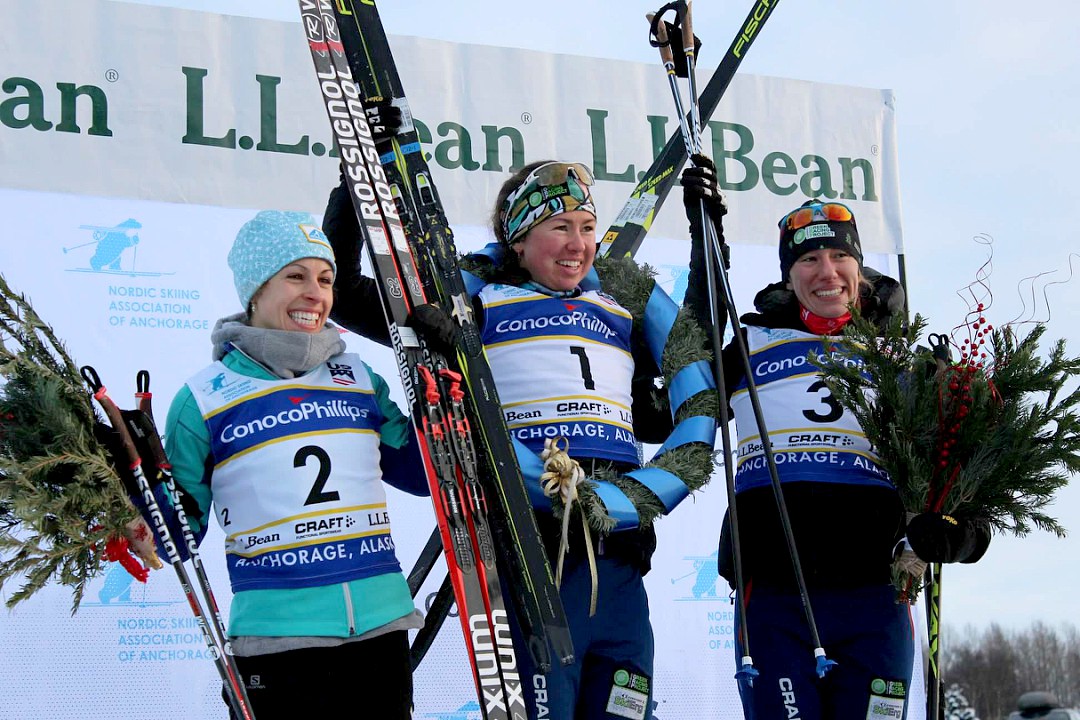
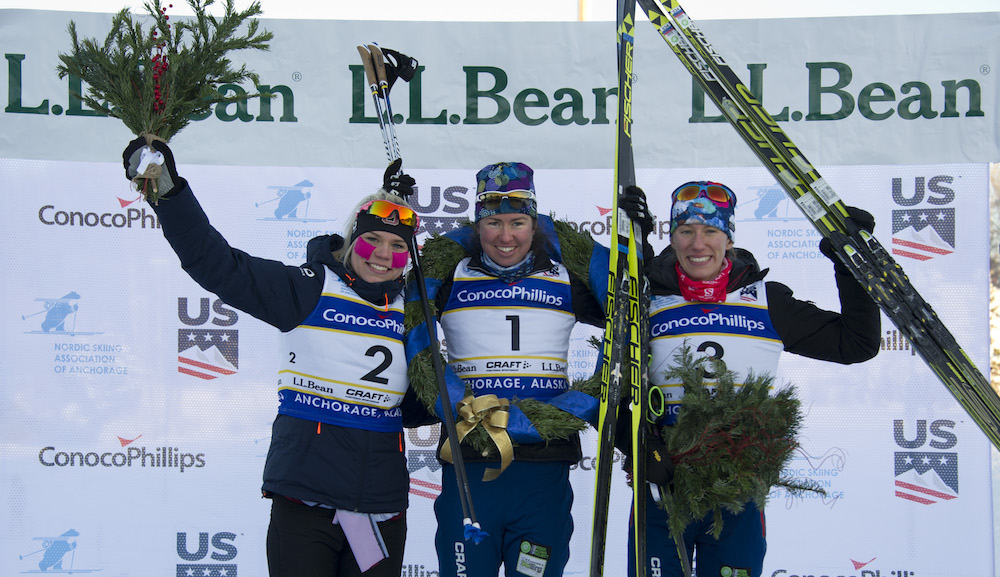
    Caitlin Patterson (c) atop the podium for the fourth-straight race of the week at 2018 U.S. Cross Country Championships in Anchorage, Alaska, joined by Finland’s Jasmi Joensuu (l) of the University of Denver, in second and Patterson’s CGRP teammate Kaitlynn Miller (r) in third. (Photo: Michael Dinneen Photography)

    Note: This article has been updated to reflect the fact that U.S. Ski Team member Jessie Diggins was the top American in four consecutive U.S. nationals races in 2012, winning the freestyle sprint, 10 k skate and 20 k classic mass start outright and placing second to Canada’s Dasha Gaiazova in the classic sprint (but topping the podium as the first American). This week, Caitlin Patterson, of the Craftsbury Green Racing Project, became the first woman since Diggins to be the top American in four U.S. national races as well.

    ***

    ANCHORAGE, Alaska — Maybe there’s something to be said for growing up in Alaska. Or maybe there’s something to be said about the mystique of Kincaid Park, its surrounding Tordillo, Chugach and Alaskan mountain ranges all bathed in sunlight at the start on the last day of 2018 U.S. Cross Country Championships during the women’s 1.5-kilometer classic sprint.
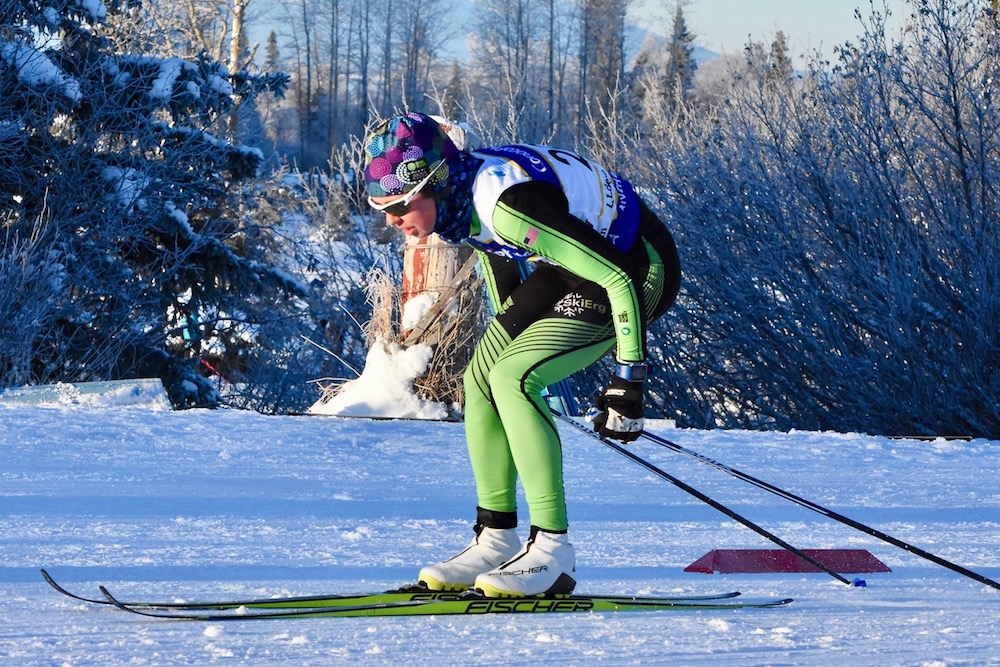
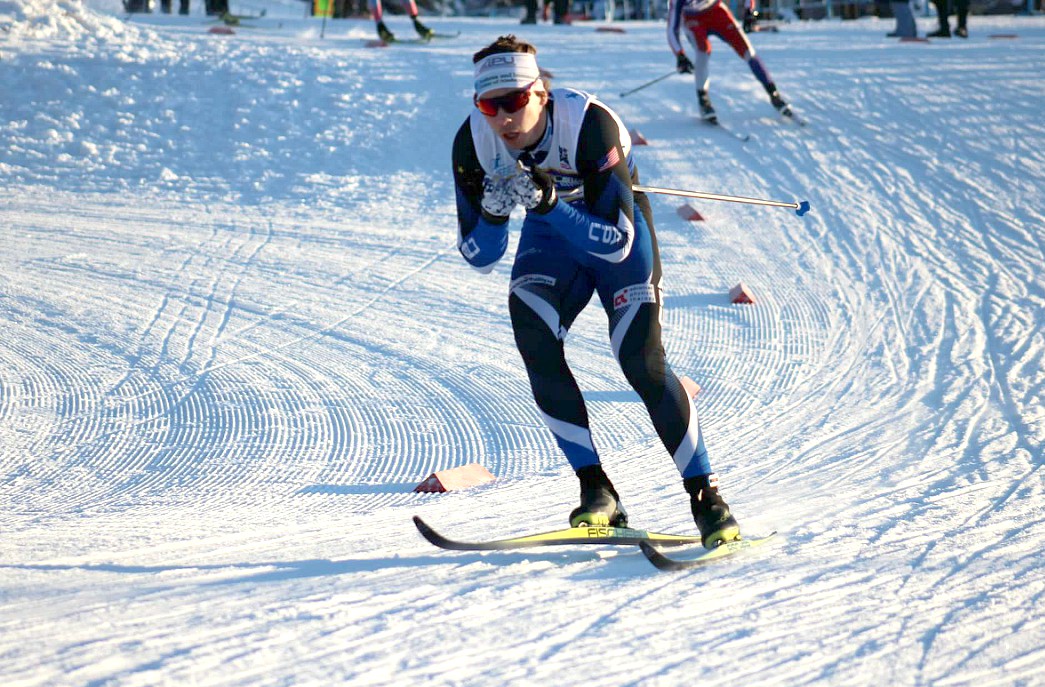
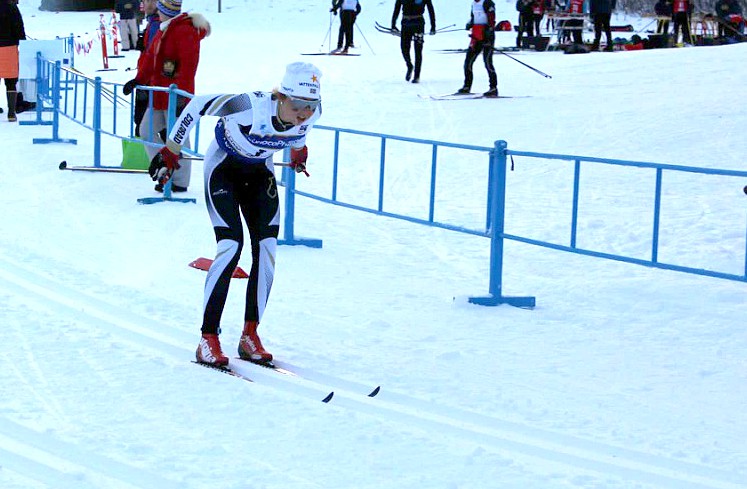
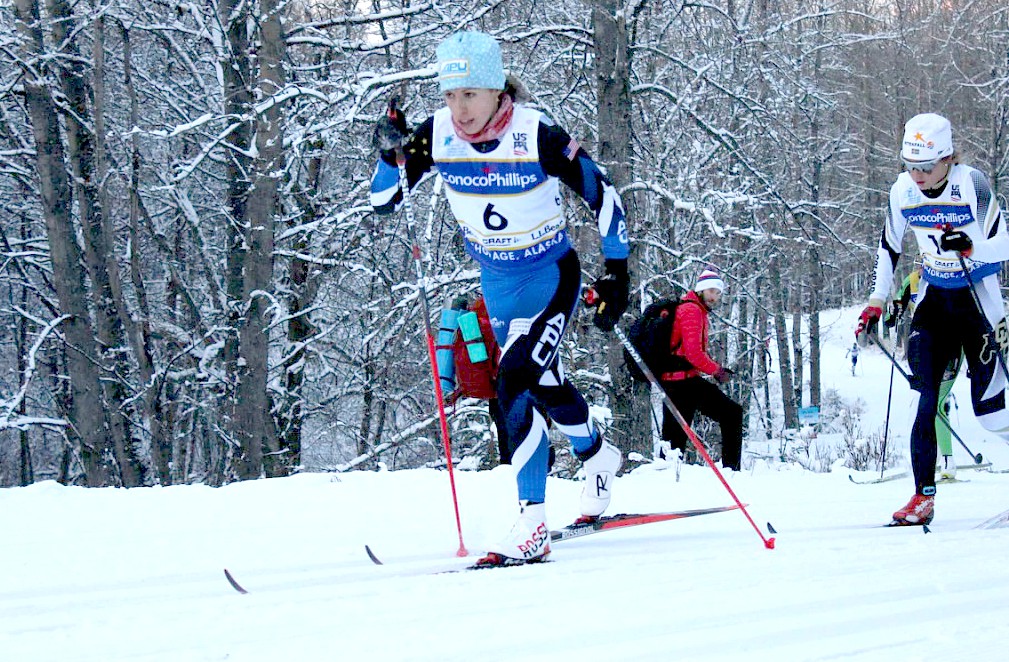
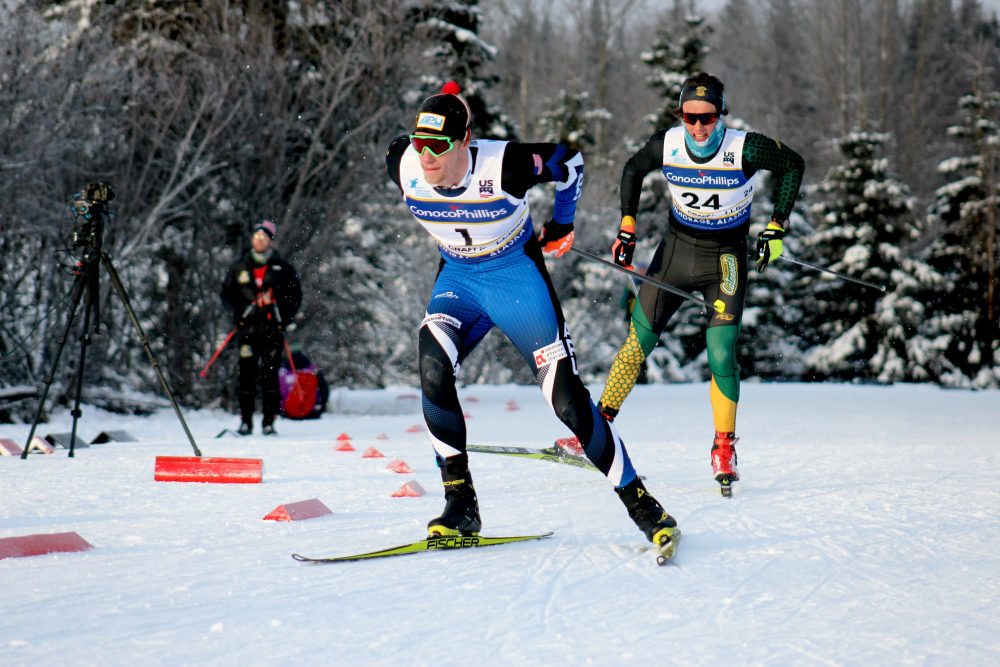
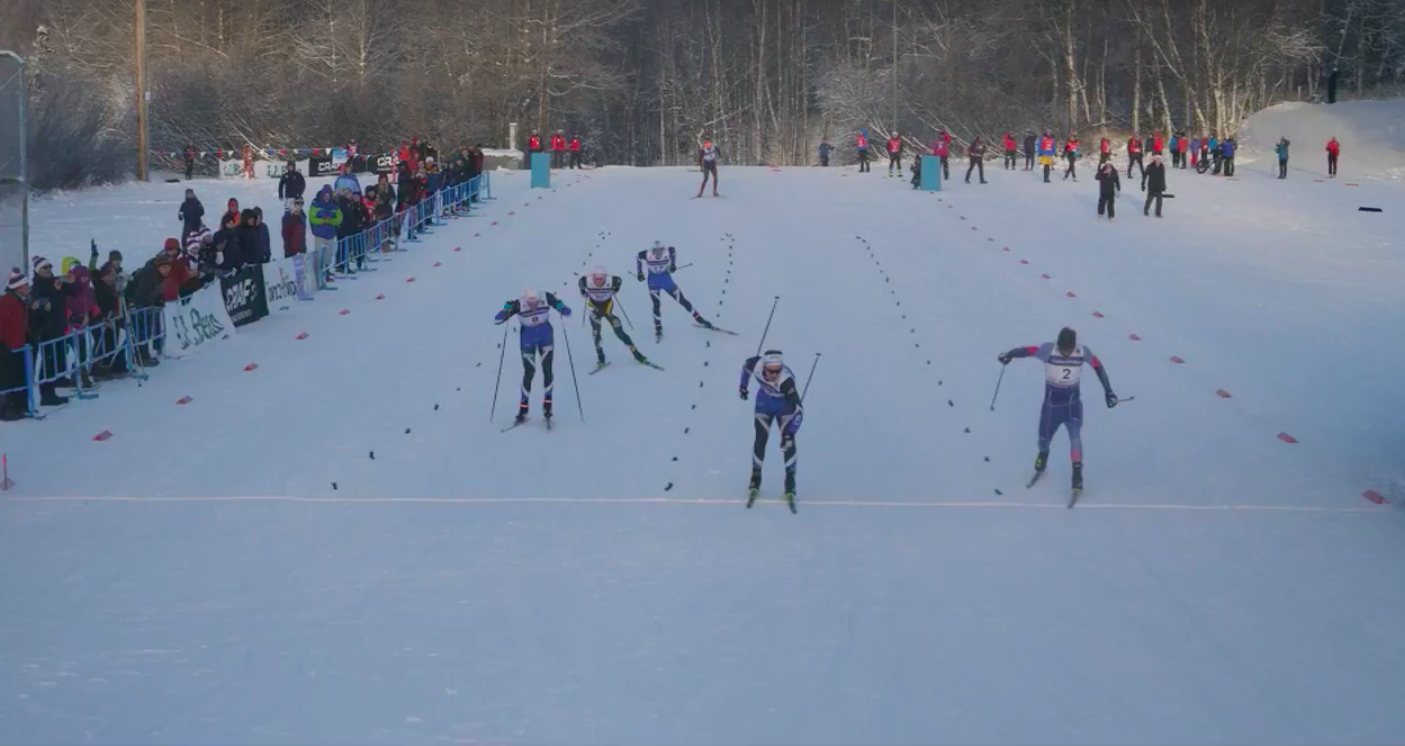
    Caitlin Patterson (Craftsbury Green Racing Project) approaching the finish line of the women’s 1.5 k classic sprint final on Monday, the last day of 2018 U.S. Cross Country Championships in Anchorage, Alaska. She won the final for her fourth-straight national title of the week. (Photo: Michael Dinneen Photography)

    Be it either of those, Caitlin Patterson became the first woman since U.S. Ski Team (USST) member Jessie Diggins, to earn four consecutive titles at a single U.S. nationals. Diggins did it in 2012 in Rumford, Maine, two years after Kikkan Randall, a USST member who trains with Alaska Pacific University (APU), swept four races outright at Kincaid. (Both Randall and Patterson grew up in Anchorage; Randall was born in Salt Lake City, born in McCall, Idaho. Patterson, 27, attended South Anchorage High School while Randall, 35, went to East Anchorage High).

    Even if Patterson, who’s currently based out of Vermont with the Craftsbury Green Racing Project (CGRP), had not won the final event of 2018 nationals, she had already posted a banner week. She started it by racing to first in the opening women’s 10 k freestyle individual start last Wednesday, amidst slushy ski trails, falling wet snow and a standard dark Alaskan winter morning sky.

    After a training day on Thursday, she returned to the Kincaid trails on Friday — which had transformed from 48 hours before — racing once again to first, this time in the women’s freestyle sprint for her first sprint title.

    Saturday brought another training day before Patterson returned on Sunday for the women’s 20 k classic mass start.
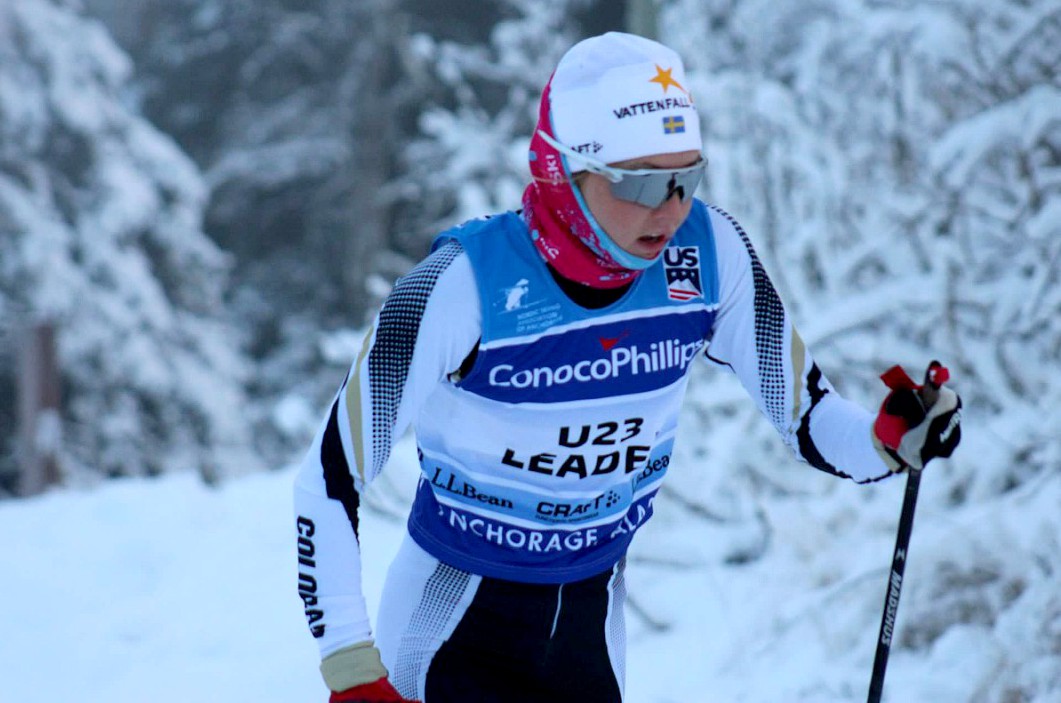
    Hedda Bångman, a Swedish freshman at the University of Colorado at Boulder (CU), racing to fourth in the qualifying round of the women’s 1.5 k classic sprint on Monday at 2018 U.S. Cross Country Championships in Anchorage, Alaska.

    Up against Sweden’s Hedda Bångman, a University of Colorado at Boulder (CU) freshman, and Rosie Frankowski (APU), the two of whom led much of Sunday’s four-lap race, Patterson had met her match. However, Frankowski’s fall on the final hill paired with Patterson’s strong skiing led Patterson to finish as the day’s top American. Bångman took the outright win while Patterson placed second overall, ahead of Frankowski in third. The two were first and second on the U.S. podium.

    If she had left it at that, Patterson would have tied Rosie Brennan — of the U.S. Ski Team and APU — who won three out of four U.S. nationals races in 2015.

    But Patterson took it one step further.

    With no training or rest day in between, the CGRP skier joined the remaining U.S. nationals field on Monday. Some skiers had already left, including Australian and APU skier, Jessica Yeaton, who flew out Monday morning to prepare for next weekend’s World Cup in Dresden, Germany.

    Based on her qualifier alone, it might have seemed Patterson was beginning to feel the effects of four days of racing since last Wednesday. She qualified seventh, 4.77 seconds behind the fastest qualifying time of 3:41.40, posted by Finnish skier and University of Denver (DU) junior Jasmi Joensuu.

    “Today qualification was really good, I felt really good,” Joensuu said after the race. “But then, my throat is really sore after the qualification … so I didn’t know if I could race actually. But I decided to race, I knew that I could win this race. I knew that there were some good girls but they also had 20 k yesterday, which I didn’t race, so that was good for me.”

    With Joensuu, 21, having sat out Sunday’s mass start and Patterson having expended herself over 20 k, the Finn may have had a leg up on the American.

    What Joensuu had not counted on was Patterson’s familiarity with the course and what the American had learned from Friday’s freestyle sprint.

    “I think that bottom corner was a really good one for me all week and in the skate sprint I figured out how to ski it with good momentum,” Patterson said after Monday’s race, referring to the slightly inclined corner about 100 meters before the finish. “Even with that big gap that she put on the hill, I think just knowing how to ski the hill here at Kincaid … the finish stretch was mine.”
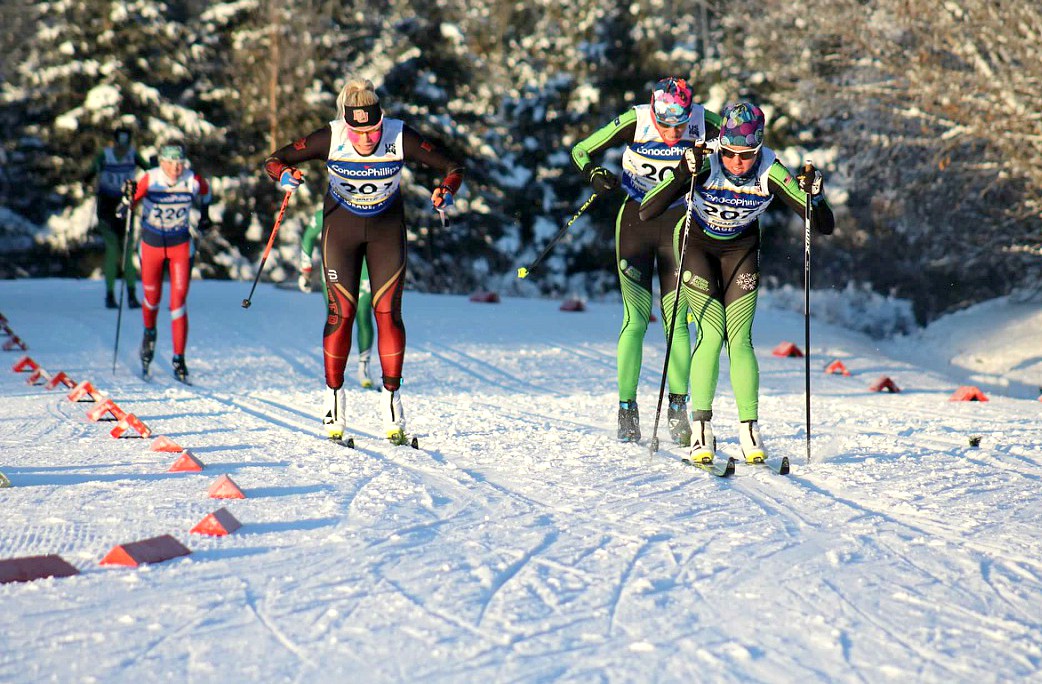
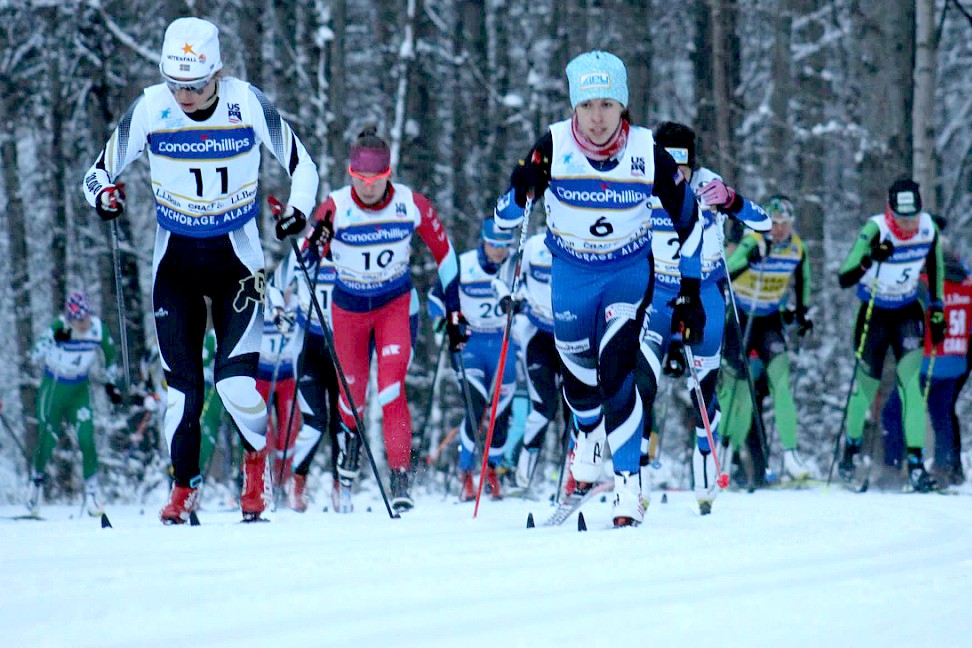
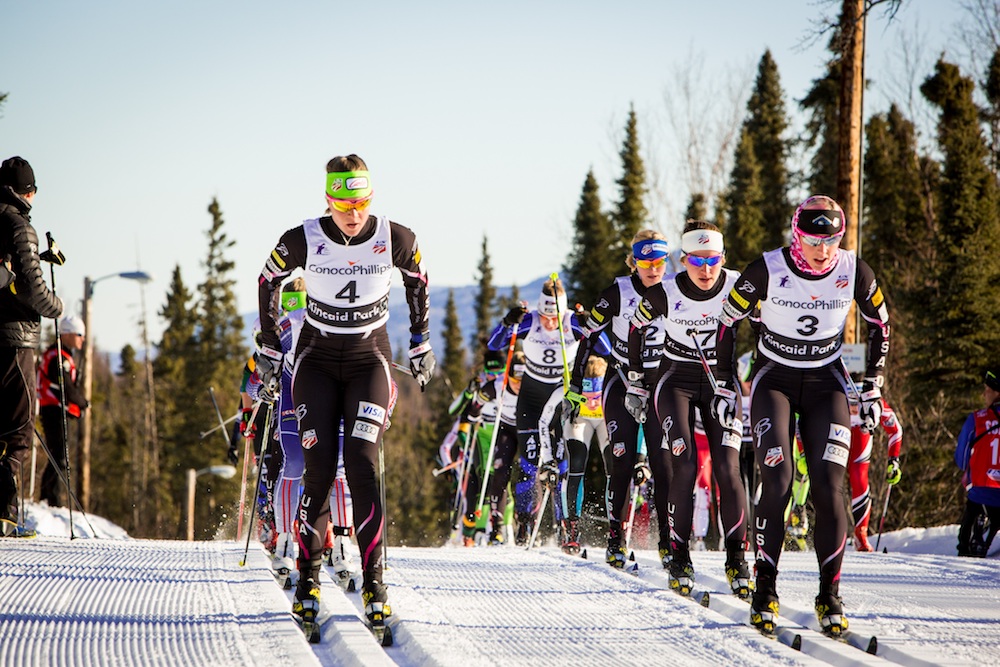
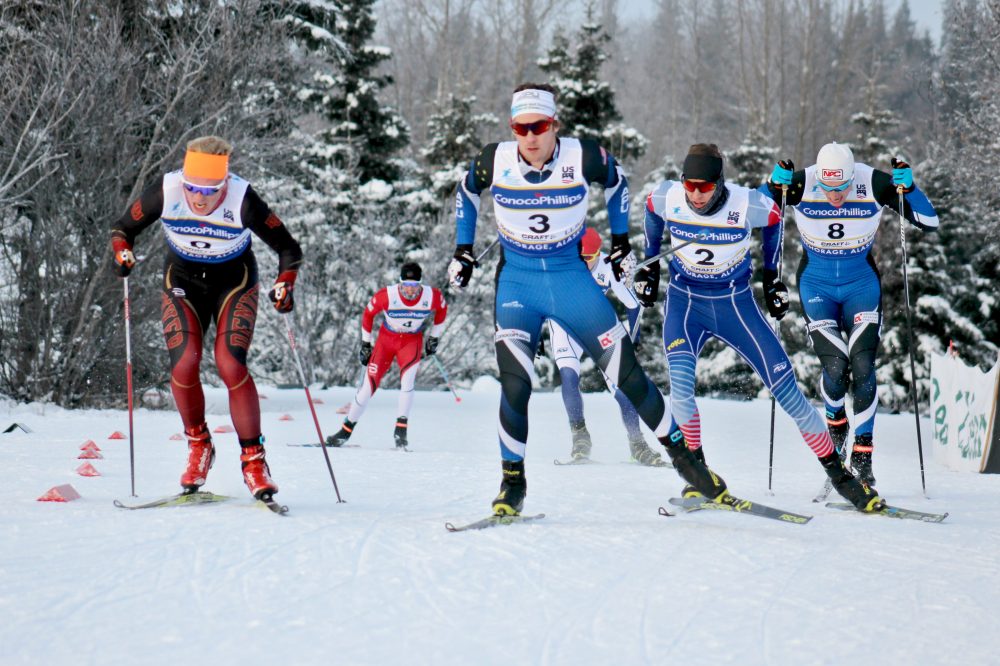
    Craftsbury’s Caitlin Patterson (207) and Kaitlynn Miller (second from r) and Jasmi Joensuu, of the University of Denver, lead their semifinal during the women’s 1.5 k classic sprint on Monday at 2018 U.S. Cross Country Championships in Anchorage, Alaska.

    In their semifinal, though Joensuu had gapped both Patterson and and another CGRP skier Kaitlynn Miller at the top of Gong Hill — the sprint’s final major climb — both Craftsbury skiers had caught Joensuu by the bottom of the descent’s corner back towards the finish.

    A similar scenario played out in the final.

    “In the final I did a tactic, I would ski the uphill as fast as I can, I don’t save anything and that almost worked,” Joensuu recalled.

    Joensuu and Petra Hyncicova, a CU senior from the Czech Republic, had pushed hard out of the start of the final, followed by Patterson and Miller, as well as Dartmouth skier Lydia Blanchet and APU’s Becca Rorabaugh.

    “I tended to lose time in the beginning of the race and then catch back up,” said Blanchet, who had to catch a plane within an hour of finishing the final. “I had great skis and downhills are one of my strengths.”

    While the two non-Americans raced to the front halfway through the course’s major climb, Blanchet, Rorabaugh, Miller, and Patterson hung behind. Then halfway through the final hill, Joensuu attacked, attempting to distance herself from the pack.

    By the top of the hill, she had done just that, with 4 meters separating her from the rest of the field. Miller and Patterson followed, tucked into the downhill swooping curve.

    As Joensuu disappeared behind the trees blocking the corner from spectator’s view, Miller and Patterson were already hot on her heels. Using her momentum, Patterson swung around Joensuu and emerged from the corner first, double poling with a sizeable lead to her fourth victory in a row in a time of 3:39.58.

    “It felt surreal coming down the finishing stretch today, realizing that I couldn’t hear people behind me and realizing that it was going to be number four,” Patterson said. “I could not have imagined this if I tried, but I’ve just had really good feelings all week. Great support from the staff and waxers and everything, and it’s fun being back here in Anchorage, especially.”
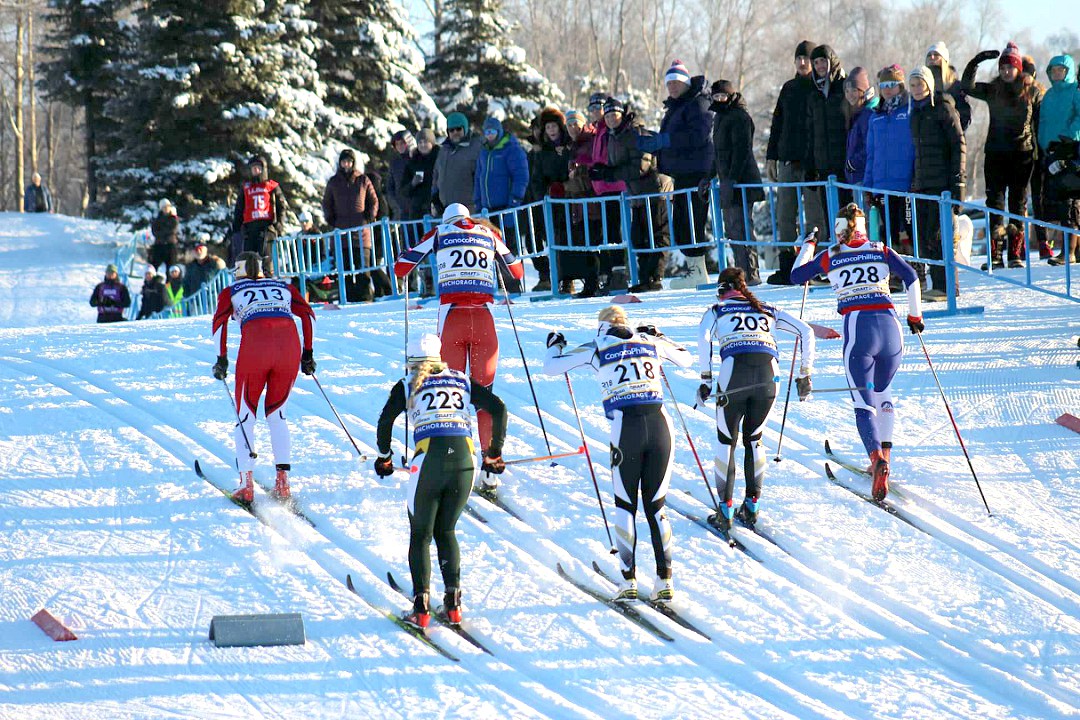
    The fifth women’s classic sprint quarterfinal heat on Monday at 2018 U.S. Cross Country Championships in Anchorage, Alaska, with CXC/Peak Nordic’s Felicia Gesior (208) leading with Corey Stock (213) of the Bridger Ski Foundation, and Northern Michigan’s Nicole Schneider (223), the University of Colorado Boulder’s Christina Rolandsen (218) and Petra Hyncicova (203), and Mae Chalmers of SMS (228) chasing.

    Finishing second, 2.36 seconds behind Patterson, was Joensuu. Capturing third for her third American podium this week was Miller (+3.9). Miller finished second to Patterson in Friday’s freestyle sprint and was the third American in Sunday’s 20 k.

    “I’m really pleased with how everything panned out,” Miller said. “To me the big sign of improvement has been in my skating and I was really excited with my skate sprint and obviously really excited with yesterday and today as well, but it’s nice to see my skating moving up a little bit.” 

    Despite being the 2016 national classic sprint champion, Miller, of Elmore, Vt., explained she entered Monday’s race with nothing held over her head.

    “I don’t ever go into a race expecting a certain result,” she said. “Anything can happen, even to strong, very experienced skiers … [but] it is exciting to be in the mix.”

    Though Miller also explained she “felt pretty tired” by the time she lined up for the final on Monday, she also acknowledged that she was, in all likelihood, not alone.

    “I think that was the situation for all of the women out there today, after the 20 k yesterday. It was sort of like, well, the snap isn’t there, the energy isn’t quite there, but everyone was in the same boat,” she said. “Everyone’s making the best of it, and your body knows what to do once you get to the start line.

    “All things considered, I felt great, had a really great result, and I’m very happy with it,” Miller added.
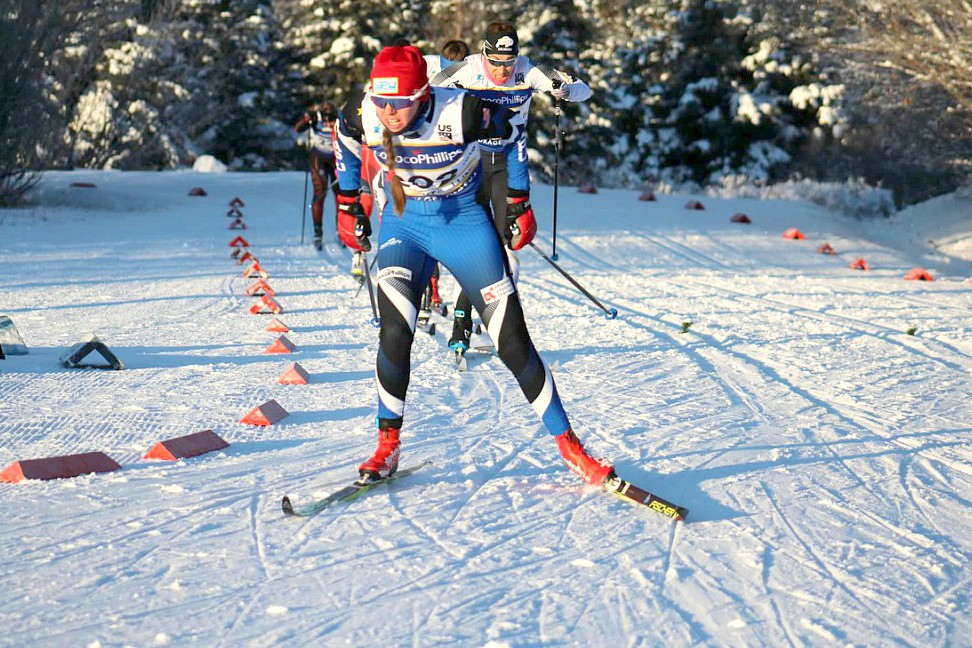
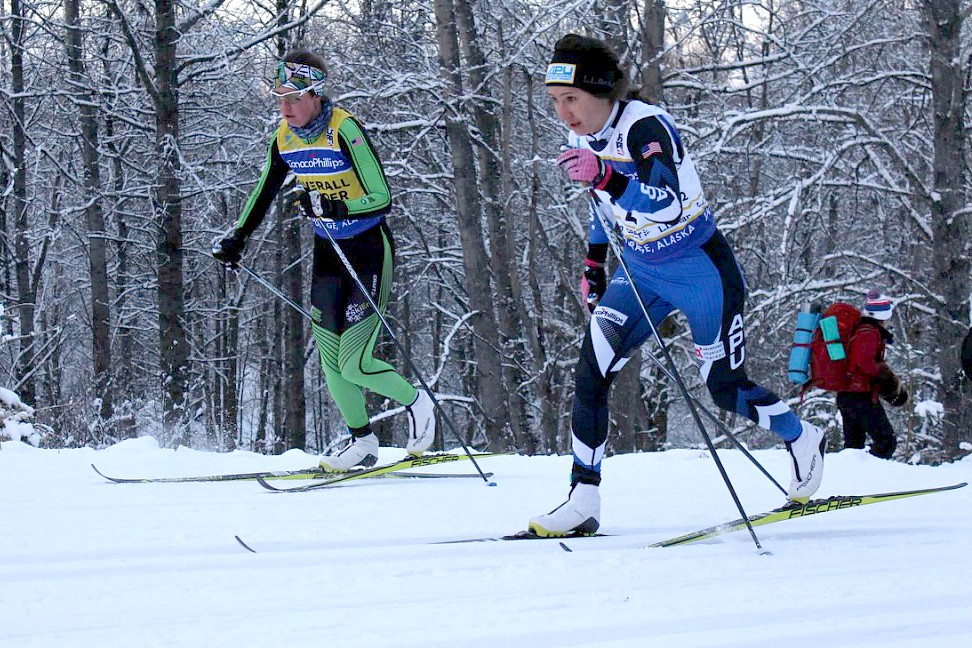
    Becca Rorabaugh (APU) during the women’s 1.5 k classic sprint on Monday at 2018 U.S. Cross Country Championships in Anchorage, Alaska. After finishing second in the qualifier (as the top American) she finished fourth overall in the final and was the third American on the day.

    Rorabaugh finished fourth overall (+9.92) and was the third American. The Fairbanks native, who has spent the last 10-plus years living and training in Anchorage, was the top American qualifier on Monday, 1.31 seconds behind Joensuu in first overall.

    “I was extremely excited with my qualifier,” Rorabaugh said. “It was rather unexpected. I was the first American and I had one really good qualifier in West Yellowstone this year but the other two so far have been pretty medium for me, so I was really excited really happy with this morning.”

    Though the qualifier is what counts for the Olympic points list, Rorabaugh indicated that was of less importance to her than just “getting her qualifier back.”

    “It’s been a couple years since I’ve been having a very strong qualification in sprint racing so I was just trying to work on having enough energy and having enough heat pumped to really crush a qualifier first thing in the morning,” she said.  

    “I wanted to have something special at home,” she added, referring to the friends and family that came to Kincaid to watch her race. “So it was good to have something at the end of the week.”

    With firm tracks, cold temperatures reading around 10 degrees Fahrenheit and a low sun in the sky, Rorabaugh described the final U.S. nationals event as “a quintessential Alaskan day.”

    “That was quite nice,” she added.

    Rounding out the final was Hyncicova in fifth (+10.03) and Blanchet in sixth (+11.21).

    “Today I was kind of tired. I finally hit the jet lag over the weekend,” Hyncicova, the two-time defending NCAA champion, said. “But … making the final, and even being third in the quarterfinal is awesome. It’s just proving that I am kind of in good shape so that’s a good start of the season.”

    Rounding out the remainder of the women’s top 10 was Bångman in seventh, Sun Valley Ski Education Foundation skier, Kelsey Phinney in eighth, Central Cross Country’s Felicia Geisor in ninth and Stratton Mountain’s Erika Flowers in tenth.

    In the junior women’s classic sprint, Wasatch Nordic’s Sarah Morgan took the win in 3:54.93. Novie McCabe (Methow Valley Nordic) placed second (+1.5) and her teammate teammate Ella-Sophie Kuzyk placed third (+6.66).

    Results: Women’s qualifier | Women’s final | Junior women’s final

    –Ian Tovell, Andrea Pontyondy-Smith and Gavin Kentch contributed
    Highlights video by Max Romey Productions

  • Reese Hanneman Wins Qualifier, Second Sprint Title of Week at Nationals

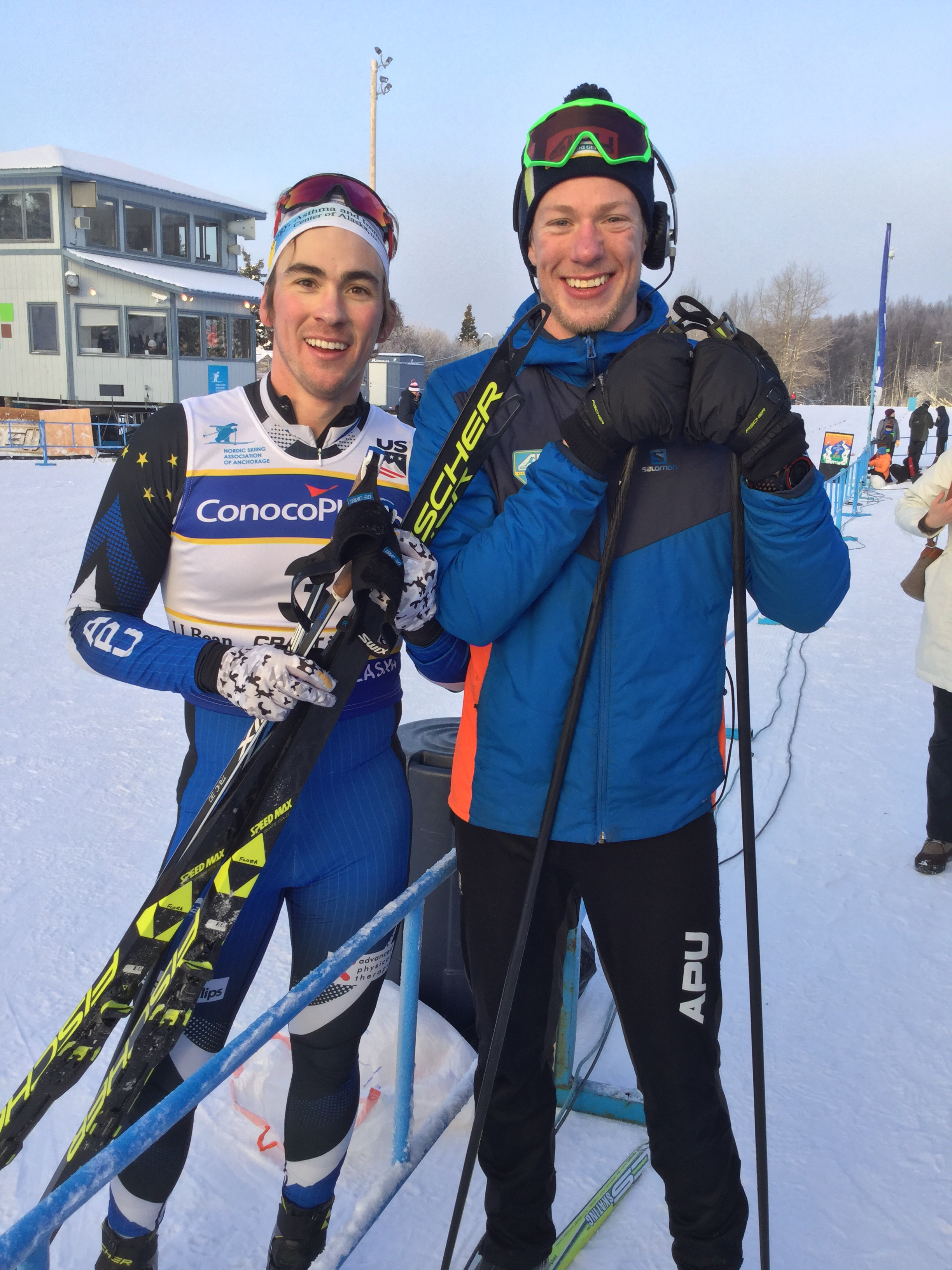
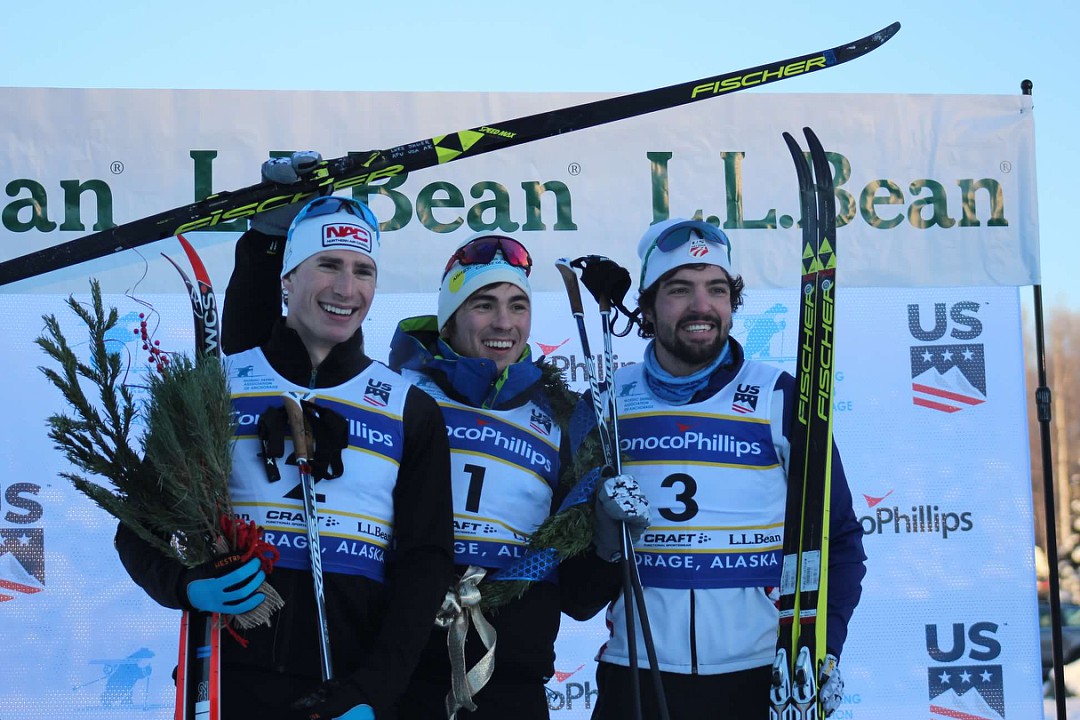
    Left to right: Tyler Kornfield (APU), Reese Hanneman (APU) and Ben Saxton (SMS) as the top three finishers in the men’s 1.6 k classic sprint final on Monday, the last day of 2018 U.S. Cross Country Championships in Anchorage, Alaska.

    ANCHORAGE, Alaska — No two races are exactly alike, the saying goes, and there’s a lot of truth to this cliché. But if you step back just a little bit, two race days can start to look awfully similar to one another.

    For example, for the second time this week, a Hanneman brother won the sprint qualifier, Reese Hanneman won the final, and Alaska Pacific University (APU) put three athletes in the final and two on the podium on a perfect day for sprinting at Kincaid Park. That was the story on Monday, when Reese Hanneman led teammate Tyler Kornfield and Ben Saxton of the Stratton Mountain School (SMS) Elite Team across the line in the men’s classic sprint at 2018 U.S. Cross Country Championships. But it was also the case on Friday, when Reese was first and Kornfield was third in the freestyle sprint. It’s been a good week for the Hanneman family.

    The classic sprint, the final race of this year’s U.S. nationals, had a slightly more subdued feel than the three that preceded it.

    The fields were 50 percent smaller; a combined 160 athletes skied in the qualifier on Monday compared to 337 on Friday, as many juniors opted out of a race whose results did not bear on qualification for international trips and championship teams, and some athletes had already left town. The spectator numbers were smaller, measuring in the dozens rather than the hundreds after three days of packed parking lots and raucous crowds, as the first day of school following winter break sent local students back to the classroom. And the athletes were tired, too, after a full week of racing.

    “I was just running on fumes out there, especially after the 30 k yesterday,” fifth-place finisher Kevin Bolger, of the Sun Valley Ski Education Foundation (SVSEF) told FasterSkier after the men’s final.

    But cross-country skiers are nothing if not resilient, and so, just after 10 a.m., Dakota Blackhorse-von Jess (Bend Endurance Academy) once again led 95 men out onto the qualifying course at 15-second intervals. The temperature was 10 degrees Fahrenheit, according to the display on the stadium scoreboard. The sun had yet to rise and start burning off the morning’s dense fog. It felt cold.

    It’s a very quintessential Alaskan day,” women’s domestic podium bronze medalist Becca Rorabaugh (APU) said after. “It’s like an Alaska temperature, and I feel like a lot of the Alaskan teams have great skis, it’s hard-wax skiing, and it’s just a classic race day. It’s very Alaskan.”

    Hanneman Brothers Headline Qualifier

    https://www.instagram.com/p/BdsyQTkB945/

    APU skiers did very well in the time-trial portion of the morning, which has added, if not exclusive, significance for Olympic qualifying purposes slightly a month before the 2018 Winter Olympics begin in PyeongChang, South Korea.

    Reese Hanneman, 28, who grew up in Fairbanks, covered the brand-new, 1.6-kilometer sprint course in 3:21.93, a time good for the fastest qualifying mark on the day. And he did so by nearly three seconds. Next best was his APU teammate and younger brother, Logan Hanneman, 2.84 seconds back. Third was his APU teammate Tyler Kornfield, 4.23 seconds off Reese’s mark.

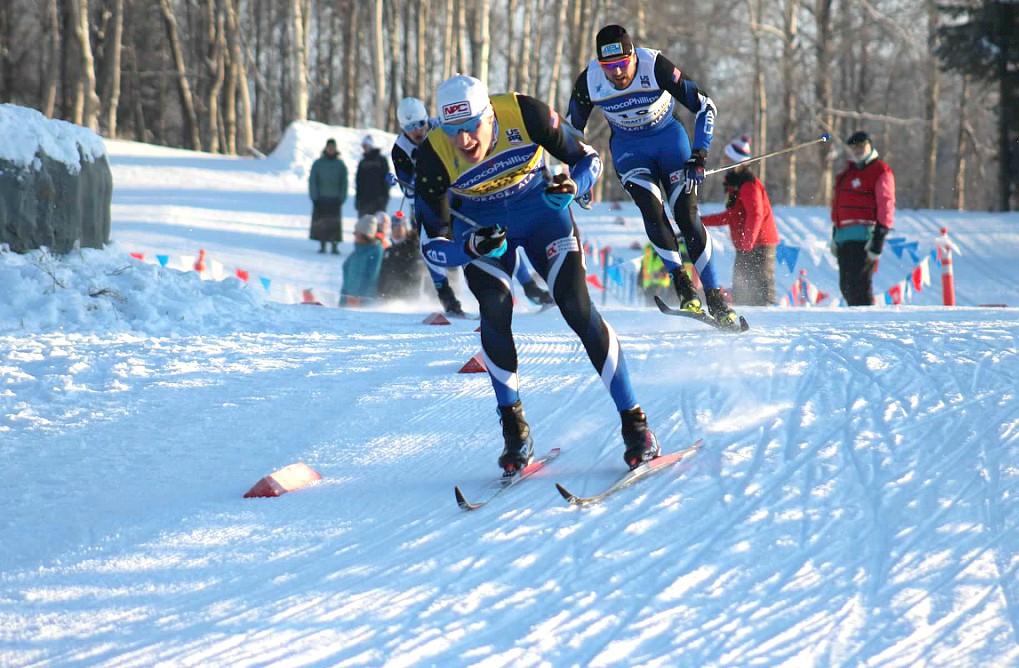
    Alaska Pacific University’s Reese Hanneman during the men’s 1.6-kilometer classic sprint heats on Monday at 2018 U.S. Cross Country Championships in Anchorage, Alaska. Hanneman won the qualifier and eventually, the final for the national title.

    The brothers Hanneman are skiing qualifiers well these days, to put it mildly. Logan, 24, won Friday’s sprint qualifier, with Reese qualified third.

    In light of the bonus points awarded for U.S. nationals podium performances, FasterSkier’s unofficial calculations put Logan first on the 2018 Olympic Winter Games domestic sprint qualifying list, with 80 points (45 for first at U.S. nationals and 35 for second), and Reese second, with 71 points (45 for first and 26 for third).

    In Monday’s classic sprint, Benjamin Ogden (SMS) was fourth in qualifying, 5.12 seconds back. Blackhorse-von Jess was fifth (+5.16), Zak Ketterson of Northern Michigan University sixth (+7.56), Cole Morgan (SVSEF) seventh (+7.61), David Norris of APU eighth (+7.85), Saxton ninth (+7.88), and Bolger tenth (+9.09).

    Just like the skate sprint, Brian Gregg, of Central Cross Country (CXC), Loppet Nordic Racing (LNR) and Team Gregg, was the final athlete to make the heats, 16.53 seconds back in 30th.

    “I would say all the top sprinting guys, everyone’s focusing kind of on the qualifier, more so than normal,” Reese said on Friday after he had qualified third in the skate sprint. “There’s no margin for error, and you just have to ski it absolutely as fast as possible. It’s definitely different tactics than in the heats… but if you’re fast, you’re fast.”

    Reese Hanneman Wins Everything En Route to Final

    On Monday, Reese was pretty darn fast. He won his quarterfinal, the first of the day, as well as his semifinal, the first of the day, to make the final with the maximum amount of rest possible. And then, of course, he won the final as well for his fourth national title — and second of 2018 nationals.

    In the day’s first quarterfinal, Reese was in the lead by the first turn at 200 meters, followed closely by Bolger. The two of them had a big lead by the time they were coming off Gong Hill. The rest of the field caught up to them somewhat by the finish, but Reese and Bolger still took the top two spots with relative ease.

    In the second quarterfinal, U18 skier Ogden led the field into the first turn, with Morgan and Bill Harmeyer, of the University of Vermont, right behind. Ogden was still into the lead coming back into the stadium, but Kris Freeman (Caldwell Sport) had caught up into third. Coming into the finish, Freeman won a four-way lunge for second over Thomas O’Harra (APU), Ben Lustgarten (CGRP), and Harmeyer. O’Harra’s third place in a fast heat was good enough to send him on to the semifinals with the day’s first lucky loser spot.

    In the third quarterfinal, Andrew Egger (Colby College) took the lead out of the stadium, but it was Blackhorse-von Jess in the top spot by the time they came back. Blackhorse-von Jess entered the finishing stretch with a 10-meter lead. Ketterson took second, 1.2 seconds back, with Egger another second back by the finish.

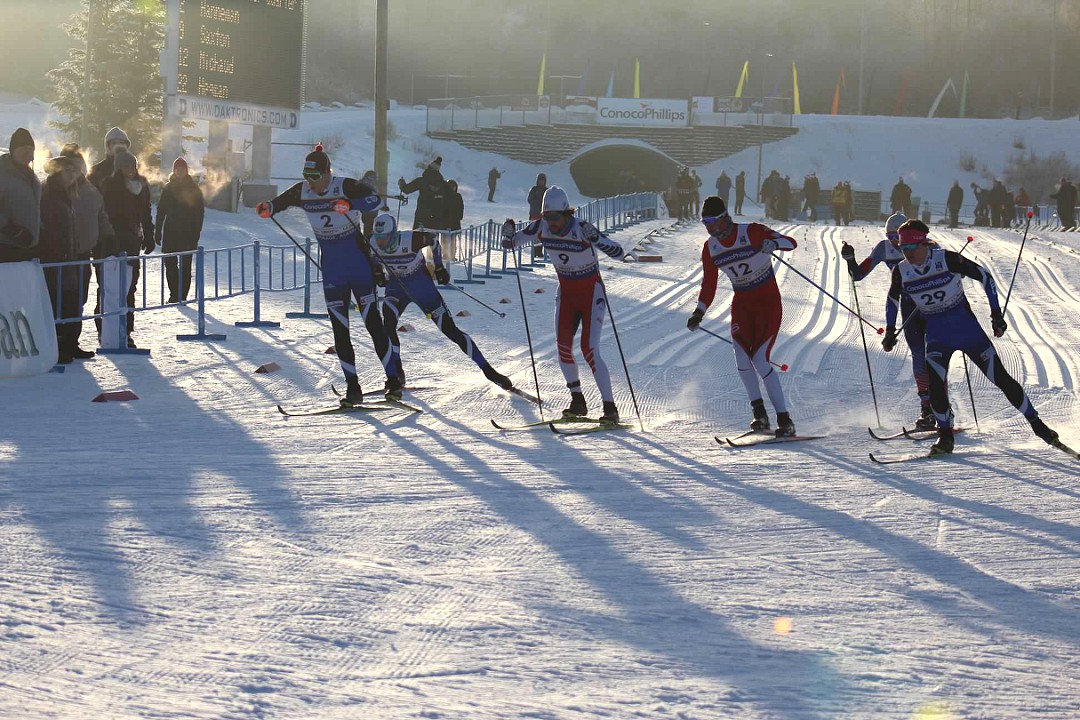
    From left to right: Logan Hanneman (APU), Like Jager (APU), Ben Saxton (SMS Elite Team) Nick Michaud (BSF), Scott Patterson (APU), and Jack Hegman (SVSEF) at the start of their quarterfinal in the men’s 1.6-kilometer classic sprint on Monday at 2018 U.S. Cross Country Championships in Anchorage, Alaska.

    In the fourth quarterfinal, Saxton and Logan Hanneman left the stadium with the early lead, alongside a quick-starting Luke Jager (APU), one of three U18 skiers who made the senior heats. It was Saxton in the lead coming back to the stadium two minutes later, with Logan leading Jager. Saxton came into the finishing stretch with a healthy lead, but Logan made a powerful move to pull around him and come alongside. Saxton won the heat by 0.37 seconds over Logan. Yesterday’s medalist, Eric Packer (APU), was out in third.

    The fifth quarterfinal was heavy on local pride, with three APU skiers and a fourth from University of Alaska Anchorage. Erik Axelsson (Montana State University) led Kornfield and Logan Diekmann (University of Utah) into the first uphill. But two minutes later it was all APU, with Kornfield, David Norris and Forrest Mahlen with a sizeable lead on the rest of the field. Kornfield took the win; Mahlen came around Norris for second, but Norris moved on with the day’s other lucky loser spot. Axelsson was nearly five seconds back of Norris in fourth.

    In the first semifinal, Blackhorse-von Jess flashed his ski speed and momentum by dropping into a tuck within the first 200-meter straightaway in the stadium, then still led the field over the top of the first, smaller climb. Ogden and Reese Hanneman were nearby. When they returned to the stadium, Reese had a 20-meter lead over Ogden on the downhill. As happened throughout the day, though, that lead shrank to half that size by the time the skiers entered the finishing stretch. But Reese still had the lead, which he held to the finish. Bolger was second, 0.32 seconds back. Ogden was relegated for obstruction.

    The second semifinal featured a predominantly blue color scheme, between four suits from APU and the blue accents on Saxton’s SMS suit. Saxton again led out of the stadium, with Ketterson and Kornfield close by. By the time they came off Gong Hill two minutes later, it was Kornfield in the lead, with Ketterson close behind him. Kornfield led into the finishing stretch, but Ketterson overtook him to place first in the heat.

    Behind them, Logan Hanneman made a strong push for third. He closed down Saxton, edging him by 0.04 seconds for third behind Ketterson and Kornfield. In practice, both Logan and Saxton advanced to the final as lucky losers; Norris’s fifth place in this heat would have won the day’s first semifinal by nearly a second.

    Reese Hanneman Wins Final, Again

    Slightly after 2 p.m., six men lined up in the south end of the Kincaid Stadium. From racer’s left to right, it was Logan, Kornfield, Ketterson, Reese, Bolger, and Saxton in the starting blocks. The sun was out, the temperature was in the high teens, and the course was firm and fast. There was no wind. Conditions were once more basically perfect.

    The field had a clean start at the sound of the starter’s pistol, double poling in six separate lanes over the first 200 meters slightly downhill through the stadium. As the racers turned right to go up the first hill it was the Hanneman brothers in the lead, with Kornfield immediately behind them and Ketterson to Kornfield’s right. The pack double poled up the first part of the climb, then strode up and over the top of the hill.

    A quick descent followed, then a high-speed, double-pole section leading to the start of the course’s main hill. Reese pushed the pace going up the hill, and not everyone was able to respond.

    “I basically started at the base of the big climb,” Reese recalled of the 24-meter vertical gain B-climb in the middle of the sprint course. “I just kind of led in the climb and then just threw down the hammer and just tried to drop everyone going up that thing, and just continue to pound it over the top and take it all the way home.”

    The largest climb on the course is “tough for classic skiing,” Bolger explained. “That hill definitely adds a different dynamic to your whole approach to every heat you do. To be able to ski up that hill four times, strong, it’s a challenge.” (Bolger added that he didn’t think anyone would have attempted to double pole a hill of that size, saying that “it’s a challenging enough hill to where it’s going to rule out double poling for anyone.” But just to be sure, race organizers placed a no-double-pole technique zone up the entire length of the climb for both the qualifier and the heats.)

    By the time the field descended the waterfall downhill back into the stadium, Reese had a substantial gap over Kornfield, who in turn had a sizeable lead over Ketterson.

    Kornfield made up some of this gap going down and around the final 180-degree turn, but Reese still entered the final straightaway with a sizeable lead. Saxton had moved into third, ahead of Ketterson, by the time they reached the 100 meters to go mark.

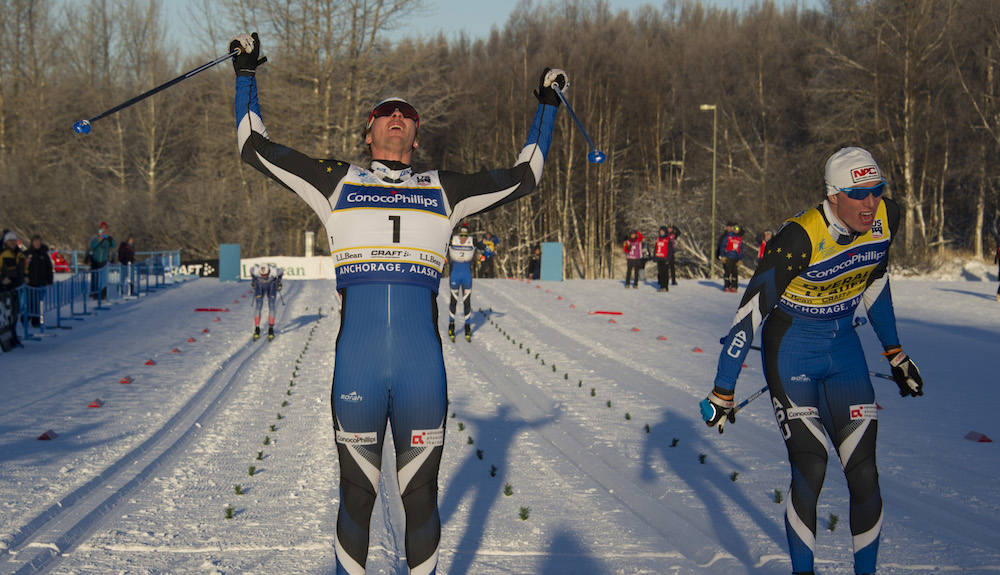
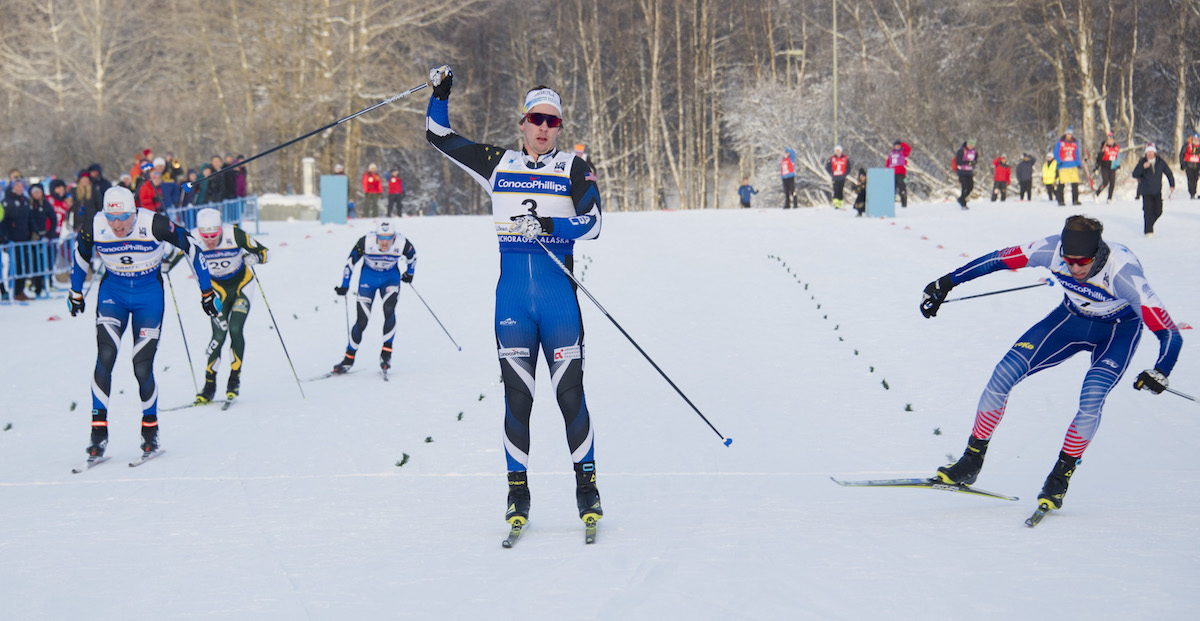
    Reese Hanneman (1) of Alaska Pacific University celebrates his second sprint title of the 2018 L.L.Bean U.S. Cross Country Ski Championships on Monday with a win in the classic sprint final, just ahead of teammate Tyler Kornfield (r) in Anchorage, Alaska. Ben Saxton (SMS Elite Team) rounded out the podium in third. (Photo: Michael Dinneen Photography)

    Kornfield barreled down the slight uphill of the finishing straight with grace and fury, closing in on Reese with each extension of his lanky frame. But he was still in the same finishing lane as his APU teammate, getting closer to Reese, but still immediately behind him. With roughly 20 meters to go, Kornfield moved one lane to his left, then lunged as he approached the finish. But Reese’s lead was still too much, and he crossed the finish with his second sprint national title of the week.

    Reese’s time for the final was 3:20.62. Kornfield was 0.2 seconds back in second.

    Some distance behind them, Saxton crossed the finish line in third, 4.78 seconds back of Reese, with a slight lead over Logan and Bolger. Ketterson finished sixth, 6.83 seconds back, in his second sprint final of the week.

    “I can’t let off at all,” Reese said, when asked what he was thinking when coming down the final stretch of a national championship classic sprint with a narrow lead over Kornfield, who won the men’s 30 k classic mass start in an all-out effort to the line the day before.

    “He is obviously on super-good form right now,” Reese continued. “I just have to know that I have a little more speed than he does. … But he’s really cranking right now. He is skiing great, but it definitely motivated me to know to just drive that thing so hard in the final.”

    The second national title in as many races was “an answer to a lot of prayers from this morning and in the heats,” Reese said. “I just feel really lucky and stoked that I could put it together and be in such good form right now in January. It was a great day, an amazing day.”

    Tyler Kornfield leads his APU teammate Forrest Mahlen in the men’s 1..6 k classic sprint on Monday at 2018 U.S. Cross Country Championships in Anchorage, Alaska.

    Although Kornfield was second today, he “probably got the all-around performance of the week for the men,” Reese said of his teammate. Kornfield reached the podium in every race this week save the opening 15 k freestyle individual start, where he was 14th.

    Kornfield’s race series was “a dream come true a little bit,” Kornfield told FasterSkier, “a little unexpected, but I knew I had it in me. The start of the season didn’t go as planned, I got sick for a month before it started, I also sprained my wrist for another month and so I was pretty frustrated with the lack of performances, but I knew there was something there and it was just a matter of time.”

    “In this sport there are a lot of ups and downs,” he continued, “and it’s really easy to get caught up in the downs and not realize that just because you have a few bad races doesn’t mean you lose your ability to succeed, so just have to keep your head up and keep trying and hoping for the doors to open.”

    When it comes to possibilities for potential Olympic selection, “I don’t know anything,” Kornfield said. “I can let you know in a couple weeks.”

    Mathematically speaking, Kornfield currently ranks second to APU teammate Scott Patterson on the most recent version of the Olympic selection distance points list, which reflects both distance races from U.S. nationals.

    For now, Kornfield plans to leave Alaska on Tuesday (that is, today) for a previously planned trip to Austria. He plans to work out precisely what races he will contest soon; he had planned on racing a Ski Classics marathon, but is currently uncertain where he will be racing next.

    While Kornfield’s week at U.S. nationals exceeded his expectations, Monday’s third-place finisher, Saxton, didn’t have the week he was hoping for.

    “I came here, like many people, with goals of heading to Korea and representing the country racing in the Games,” Saxton said after the final. “I fell short of that this week and that’s nothing to be ashamed of, but I was really disappointed I wasn’t in the mix as much as I would have hoped to be. This week was difficult because I don’t feel like I put forth a representative effort.”

    Saxton was quick to offer sincere congratulations to the skiers who had had more success this week.

    “I am incredibly proud to know and am happy for Logan and Scott and Reese and all of the other champions from this week,” he said, “and incredibly happy that those are going to be the skiers going to over to represent us. I think it’s just, from a personal standpoint, people can understand I was disappointed not to feel like I had my absolutely best days out there, but I am really proud to end the day on a podium, representing the hard work that all my teammates and my coach and the program at Stratton have done all year, and to reward them for that work and that effort is a great feeling.”

    Saxton also enjoyed the “playground mentality” of the sprint day.

    “I think a lot of the times racing we can get lost in the technical aspects of it,” he mused, “but one of the reasons I love racing heats so much is, it just kind of reminds me of being back in elementary school and pointing to something in the far end of the playground, basketball hoop, or whatever it is, and just saying, ‘Let me race you there.’ And there’s no rules, there’s no anything, it’s just the feeling of you and the other person just going all out, and that’s a beautiful way to live and that’s a beautiful way to compete, and sprints are a wonderful thing like that.”

    Strong Alaska Performances Throughout the Week

    What a difference a year makes. One year ago this week, in the classic sprint at Soldier Hollow, APU didn’t put any athletes into the heats for the first time in at least a decade, done in by a combination of illness, seeding, weather conditions, and wax choice. This time around, head coach Erik Flora’s squad sent eight men through to the heats, six to the semifinal, three to the final, and two to the podium.* 

    The classic sprint capped a successful week for APU, and for Alaskan skiers more generally. Caitlin Patterson, who skis for CGRP, took all four gold medals for the women. Then APU skiers took all four golds on the men’s side, between Scott Patterson on Wednesday, Reese on Friday and Monday, and Kornfield on Sunday. Chelsea Holmes, Kornfield again, Hannah Halvorsen, Rosie Frankowski, Eric Packer, Becca Rorabaugh, and Kornfield again also stepped on the domestic podium for APU. All told, that’s 15 out of a possible 24 medals going to athletes who hail from or ski in Alaska.

    (Although if you slice the data another way, there were also seven out of 12 possible medals in women’s races won by CGRP, between Patterson’s quadfecta and Kaitlynn Miller’s trifecta.)

    This week’s results “just show the depth” of the team, Reese told FasterSkier after his race. “It speaks to the hard work of our coaches, especially Erik Flora. That guy will not be outworked, he just puts so much into us. I’m just really happy that we can have a week like this and go four for four in the men’s with APU, just to show that what he is doing works and how hard he works for us. … To get to this point that we can do that and crush all week and just give them a good show is really rewarding.”

    “We’re all Alaska born-and-raised,” Reese added of the APU men. “Can’t beat that.”

    *(Full disclosure, this reporter skis on the APU Masters team, and receives direct coaching from Flora roughly once a year at Masters Camp.)

    Results: Final | Heats | Qualifier

    — Gabby Naranja and Ian Tovell contributed
    Highlights video by Max Romey Productions

    Replay on U.S. Ski & Snowboard live feed (start at roughly 1:21:00 into the video for the men’s final)

  • Monday Rundown: U.S. Nationals; MSA NorAm Trials

    Monday Rundown: U.S. Nationals; MSA NorAm Trials

    Left to right: Tyler Kornfield (APU), Reese Hanneman (APU) and Ben Saxton (SMS) the top three Americans in the men’s 1.6 k classic sprint final on Monday, the last day of 2018 U.S. Cross Country Championships in Anchorage, Alaska.

    U.S. Cross Country Championships (Anchorage, Alaska): Classic sprint

    Women’s report

    Men’s report

    Caitlin Patterson did it. With a classic-sprint win on Monday, she successfully capped off an undefeated 2018 U.S. Cross Country Championships, as the top American woman in all four races over the past week in Anchorage, Alaska.

    Patterson, of the Craftsbury Green Racing Project, qualified seventh then won the women’s 1.5-kilometer final by more than 2 seconds in 3:39.58 minutes. Finland’s Jasmi Joensuu, a junior at the University of Denver (DU), won the qualifier and ultimately finished second in the final, 2.36 seconds behind Patterson.

    Craftsbury once again had two on the podium with Kaitlynn Miller placing third overall (+3.9) as the second American. Becca Rorabaugh, of Alaska Pacific University (APU), was the top American in the qualifier in second overall, then placed fourth in the final (+9.92) and reached the U.S. podium in third.

    Petra Hyncicova, a University of Colorado Boulder (CU) senior from the Czech Republic, placed fifth overall (+10.03), and Lydia Blanchet, a Dartmouth College U23 skier, finished sixth (+11.21) and was the fourth American woman.

    Joensuu, 21, of Kuortane, Finland, started the day by winning the qualifier in 3:41.4, while Rorabaugh followed in second, 1.31 seconds back. Hyncicova qualified third (+1.85), CU’s Hedda Bångman (who won Sunday’s 20 k classic) qualified fourth (+2.92), and Miller qualified fifth (+2.93). Anne Hart of the Stratton Mountain School (SMS) Elite Team clocked the sixth-fastest qualifying time (+3.88), and Patterson followed in seventh (+4.77).

    From there, Patterson won both her quarterfinal and semifinal, besting Miller and Joensuu in the latter by 0.66 seconds and 2.63 seconds, respectively. Blanchet placed fourth in that same semifinal (+5.15) and advanced to the final as a lucky loser with a fast-enough time, along with Joensuu (Patterson and Miller automatically advanced in first and second).

    With her 4-for-4 record at 2018 nationals, Patterson is the most successful woman at U.S. Cross Country Championships since U.S. Ski Team member Jessie Diggins was the top American in all four races at 2012 nationals in Rumford, Maine.

    In the men’s classic sprint final, Reese Hanneman (APU) captured his second title in as many sprints this week (after winning the freestyle sprint on Friday). He won the qualifying round by 2.84 seconds in 3:21.93, and later the final by a 0.2 seconds in 3:20.62. Kornfield placed second, and Ben Saxton (SMS Elite Team) rounded out the podium in third (+4.78).

    Logan Hanneman, the winner of Friday’s freestyle-sprint qualifier, finished second to his older brother Reese in Monday’s classic-sprint qualifier, then went on to reach the final and place fourth overall (+5.42). Kevin Bolger (Sun Valley Ski Education Foundation) placed fifth (+5.52), and Zak Ketterson (Northern Michigan University) was sixth (+6.83).

    Results:

    Women’s qualifierWomen’s final

    Men’s qualifier | Men’s final

    ***

    NorAm Trials (Mont Sainte-Anne, Quebec): 15/30 k skiathlons

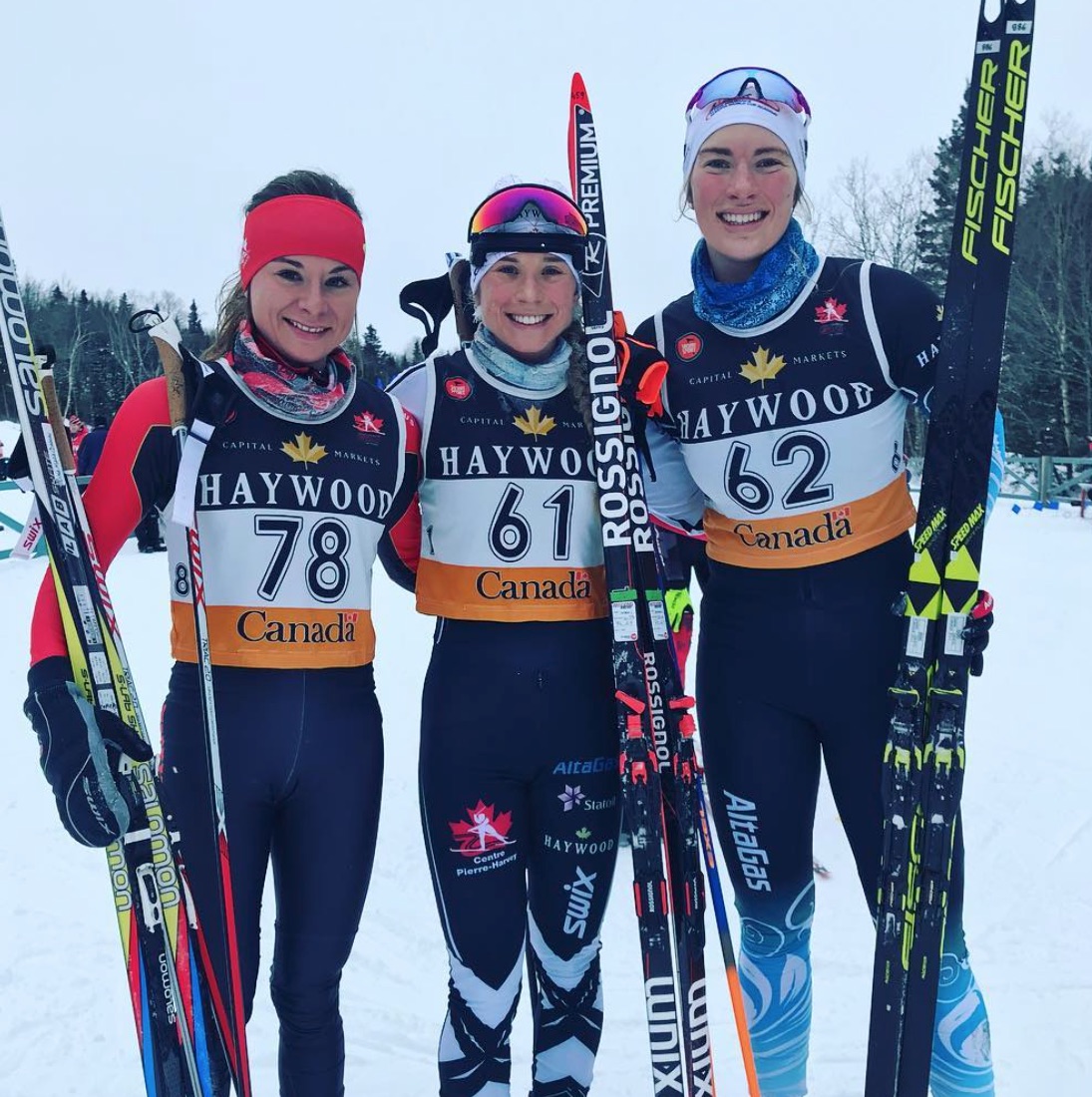
    The women’s 15 k skiathlon podium on Monday at NorAm trials at Mont Sainte-Anne, Quebec, with Cendrine Browne (c) of the Pierre-Harvey National Training Centre (CNEPH) and Canadian U25 Team in first, Anne-Marie Comeau (l) of Laval University in second, and Dahria Beatty (Alberta World Cup Academy/Canadian World Cup Team) in third. (Photo: Cross Country Canada/Instagram)

    Cendrine Browne won the women’s 15-kilometre skiathlon in 43:01.9 minutes on Monday at the Mont Sainte-Anne (MSA) ski trails to put an exclamation point on her presumptive selection for the PyeongChang Olympics. Browne, of the Centre National d’Entraînement Pierre Harvey (CNEPH)/Pierre-Harvey National Training Centre, which is based in nearby Saint-Ferréol-les-Neiges, broke away with Laval University’s Anne-Marie Comeau during the classic leg to take a 20-second lead that she held to the finish.

    Comeau faded slightly to take second, 11.9 seconds back, qualifying for U23’s and putting her name in the hat for the upcoming 2018 Olympics. Either Comeau or the winner of Wednesday’s classic interval start should take that potential Olympic berth as Canada’s top female distance skier not already qualified. Browne has theoretically earned a spot as the top women’s sprinter, besides Dahria Beatty, who won the sprint and already met Canada’s Olympic qualifying criteria.

    “It now has to go before the selection committee,” Cross Country Canada’s High Performance Director Thomas Holland wrote in an email on Friday.

    After trials races were shuffled around due to extreme cold, with temperatures near -20 Celsius on Sunday at MSA, it warmed up to a balmy -8 degrees Celsius (17 Fahrenheit) by mid-afternoon on Monday. Both the women’s and men’s skiathlons were held, which not only served as one of two distance races for Olympic selection, but for Junior and U23 World Championships as well.

    In the race for third place, Beatty outsprinted a group of four to take the final podium spot, 19.9 seconds behind Browne and 0.3 seconds ahead of their fellow Canadian National Team member Maya MacIsaac-Jones, of Rocky Mountain Racers (RMR) and U25 Team. Just 0.2 seconds out of fourth, Katherine Stewart-Jones, of the National Training Development Centre (NTDC) Thunder Bay and national U25 Team, placed fifth (+20.4) and CNEPH’s Laura Leclair was another second back in sixth (+21.4).

    Almost 55 seconds passed before the seventh-place finisher came across the line, which was Zina Kocher (Foothills Nordic) skiing alone (+1:15.8). Another 49 seconds later, Jaqueline Mourao of Brazil’s national team placed eighth (+2:04.9), ahead of Zoë Williams (Carleton University) in ninth (+2:11.3), and Andrea Dupont (RMR) in 10th (+2:11.5).

    In the junior women’s 10 k skiathlon, Whitehorse’s Natalie Hynes won in 30:19.8 to punch her ticket to Junior Worlds in Goms, Switzerland, from Jan. 28-Feb. 3. India McIsaac (RMR) finished 0.7 seconds back in second and Orford’s Alexandra Racine completed the podium in third (+32.8).

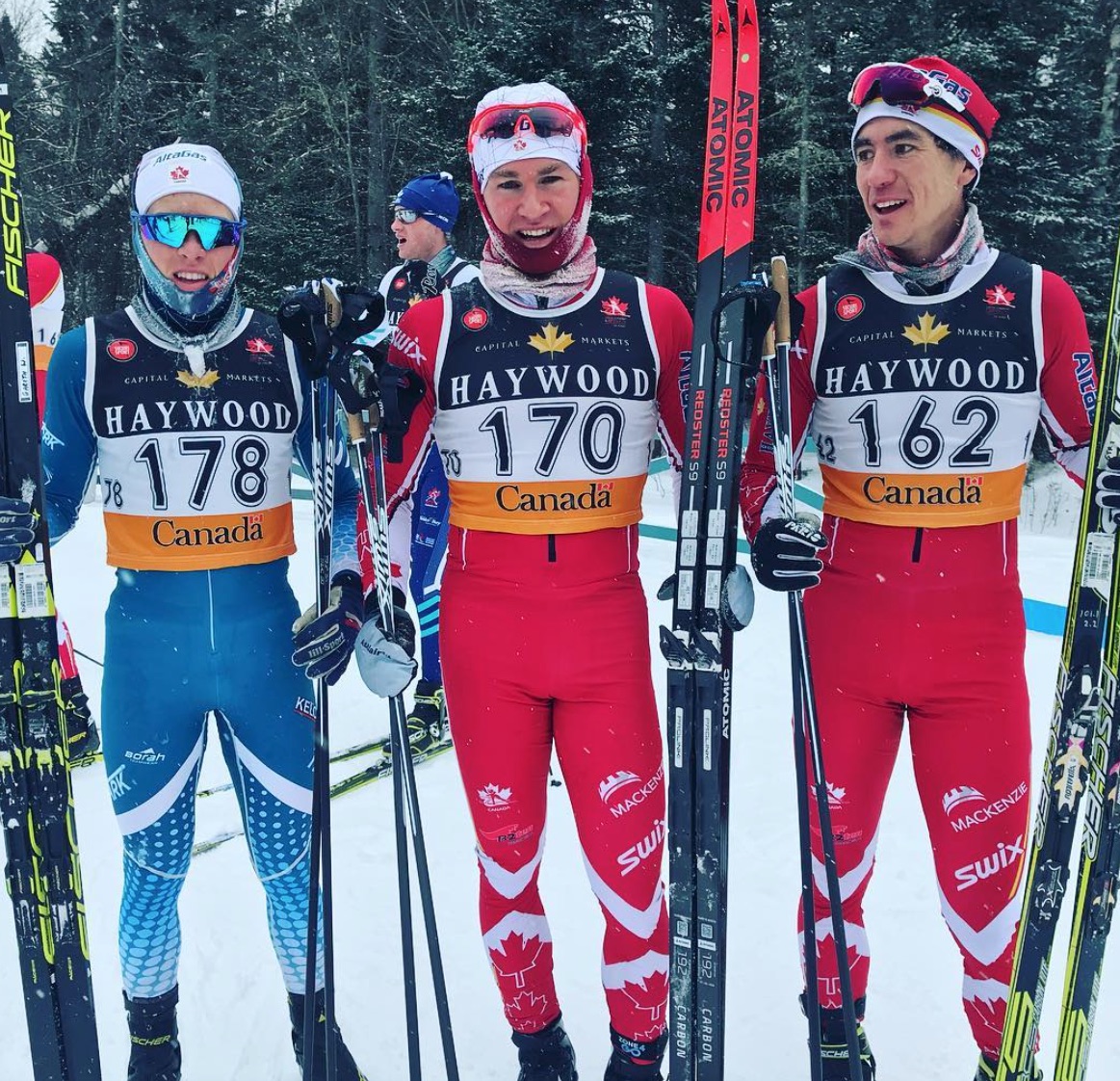
    The men’s 30 k skiathlon podium at NorAm trials at Mont Sainte-Anne, Quebec, on Sunday, with Knute Johnsgaard (c) of Canada’s World Cup Team in first, Graham Nishikawa (r) of the Canadian Para-Nordic Team in second and Gareth Williams (Telemark Nordic/Canadian U25 Team) in third. (Photo: Cross Country Canada/Instagram)

    On the men’s side, Canadian World Cup Team member Knute Johnsgaard, who met qualifying criteria for PyeongChang last season, shook off a slow start to the World Cup season with a win in the NorAm trials men’s 30 k skiathlon, finishing in 1:13:30.9.

    Graham Nishikawa, who’s already destined for the PyeongChang Paralympics as a guide on the Canadian Para-Nordic Ski Team, finished 1 second back for second place. The 34-year-old Nishikawa edged out first-year senior national-team member Gareth Williams, 20, of Telemark Nordic and the national U25 Team, by 0.5 seconds. Williams was the top U23 athlete to qualify for this year’s U23 World Championships.

    The top 6 finished within 41 seconds of the podium, with Jack Carlyle (AWCA) in fourth (+5.8), Philippe Boucher (CNEPH) in fifth (+13.9), and Scott Hill (BXC) in sixth (+40.7). World Cup Team member Len Valjas led the next group across the line in seventh (+1:28.6), followed by Bob Thompson (NTDC Thunder Bay) in eighth (+1:29.4), Alexis Dumas (CNEPH) in ninth (+1:35.5), and Ricardo Izquierdo-Bernier (CNEPH) in 10th (+1:35.7)

    CNEPH’s Antoine Cyr won the junior mens 15 k skiathlon in 50:13.1 to earn a spot at Junior Worlds. Félix Longpré, of the local M.S.A. ski club, finished second (+15.7) and Thomas Manktelow was third (+49.0), just ahead of his Alberta World Cup Academy teammate Étienne Hébert in fourth (+49.3).

    After Sunday’s racing was postponed due to temperatures well below the legal race limit, the remaining trials schedule includes freestyle sprints on Tuesday (for Junior and U23 World Championships qualifying purposes only), and classic interval starts on Wednesday.

    Results

  • Kornfield Crowned National 30 k Champ After 8-Man Sprint to Finish

    Kornfield Crowned National 30 k Champ After 8-Man Sprint to Finish

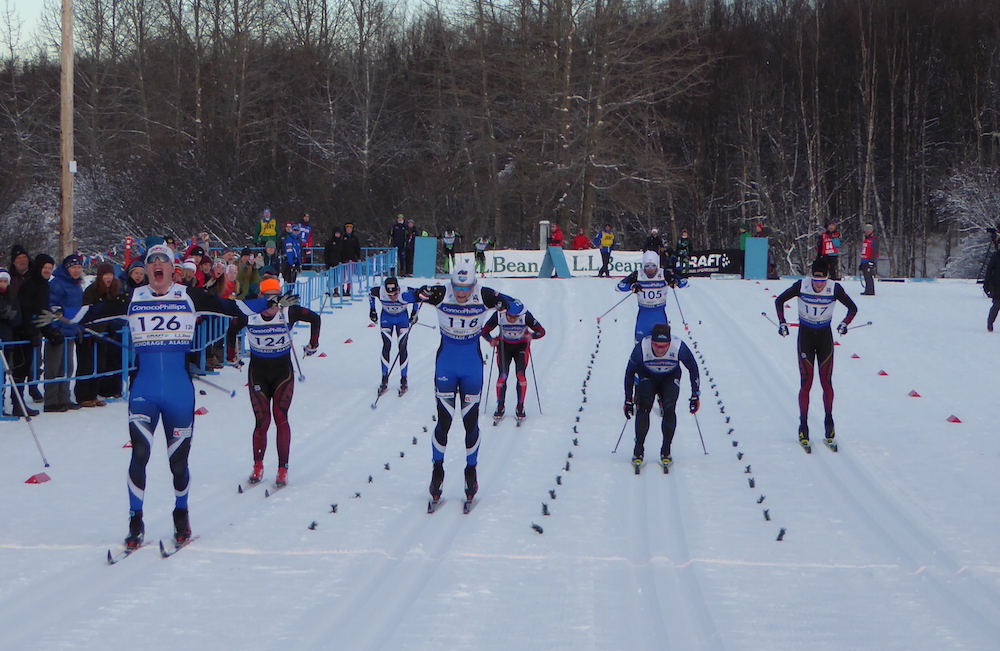
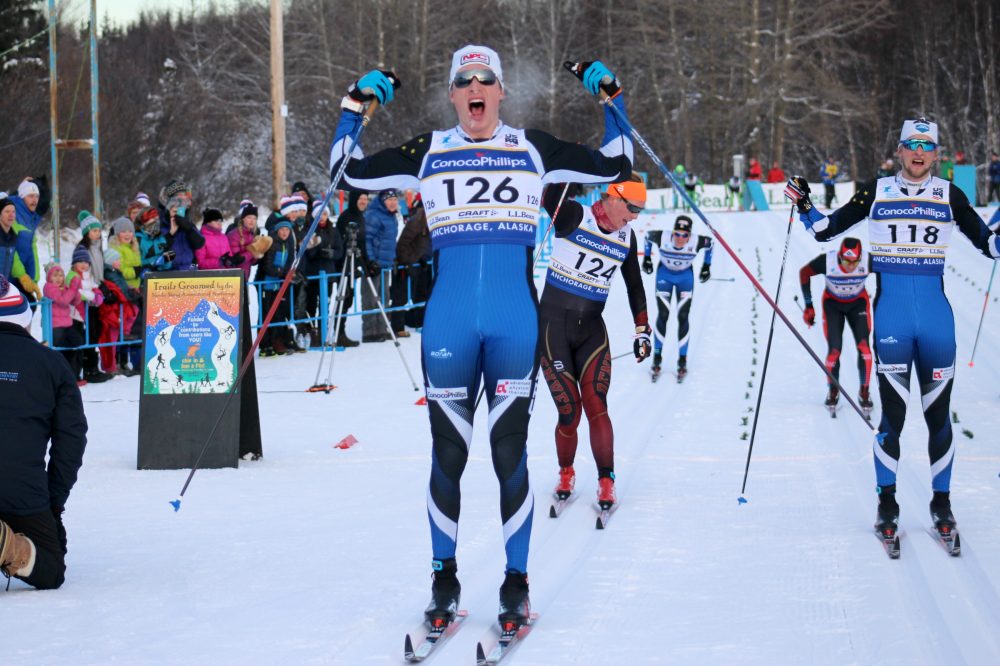
    APU’s Tyler Kornfield (126) celebrates as he crosses the finish line first in the men’s 30-kilometer classic mass start at 2018 U.S. Cross Country Championships on Sunday at Kincaid Park, Anchorage, Alaska. It was Kornfield’s second national title, first one since 2012 and first in a distance race.

    ANCHORAGE, Alaska — It could have been mistaken for the finish of a sprint final — except for the fact that almost 10 skiers were in the hunt until the end, most of which were distance specialists.

    As it were, the last 100 meters of the men’s 30-kilometer classic mass start at 2018 U.S. Cross Country Championships on Sunday involved eight men double poling in four lanes. Two of those men were past national classic-sprint champions.

    “Honestly of all the people in the race, I did not want to be sprinting against Tyler Kornfield and Eric Packer to the finish because I know they’re really good sprinters,” Kris Freeman, of Caldwell Sport, said after the race. “That being said I also didn’t expect to be sprinting against them.”

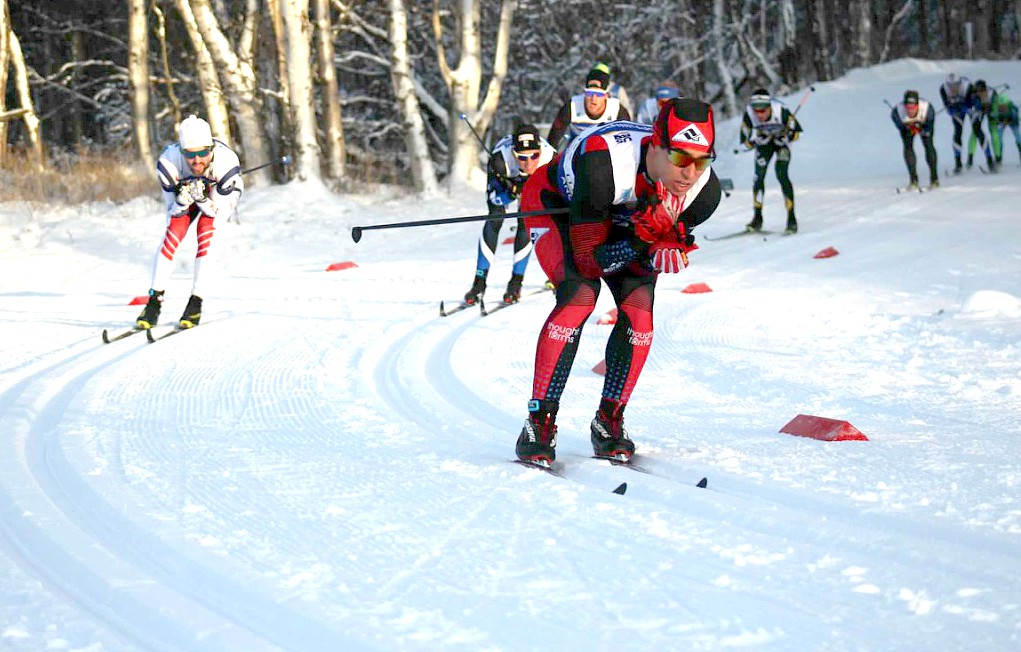
    Kris Freeman (r) leads Ian Torchia (NMU/U.S. Ski Team) during the men’s 30-kilometer classic mass start at the 2018 U.S. Cross Country Championships in Anchorage, Alaska.

    Given their track record — Kornfield, who races with Alaska Pacific University (APU), has a 2012 national classic sprint title and Eric Packer, also from Anchorage and APU, has one from 2016 — not many skiers would want to find themselves up against either APU skier, let alone both, in the final 100 meters of a classic race.

    But as Sunday’s six-lap men’s race progressed, and athletes continued to ascend Elliott’s Climb, it became more and more clear that the off chance of that happening was actually, fairly high.

    Kornfield’s Calculations

    Clipped into his race skis, Kornfield, 26, towers above many of his competitors, at close to 6-foot-2. Given his stature, the Anchorage, Alaska native is hard to miss on Kincaid Park’s ski trails.

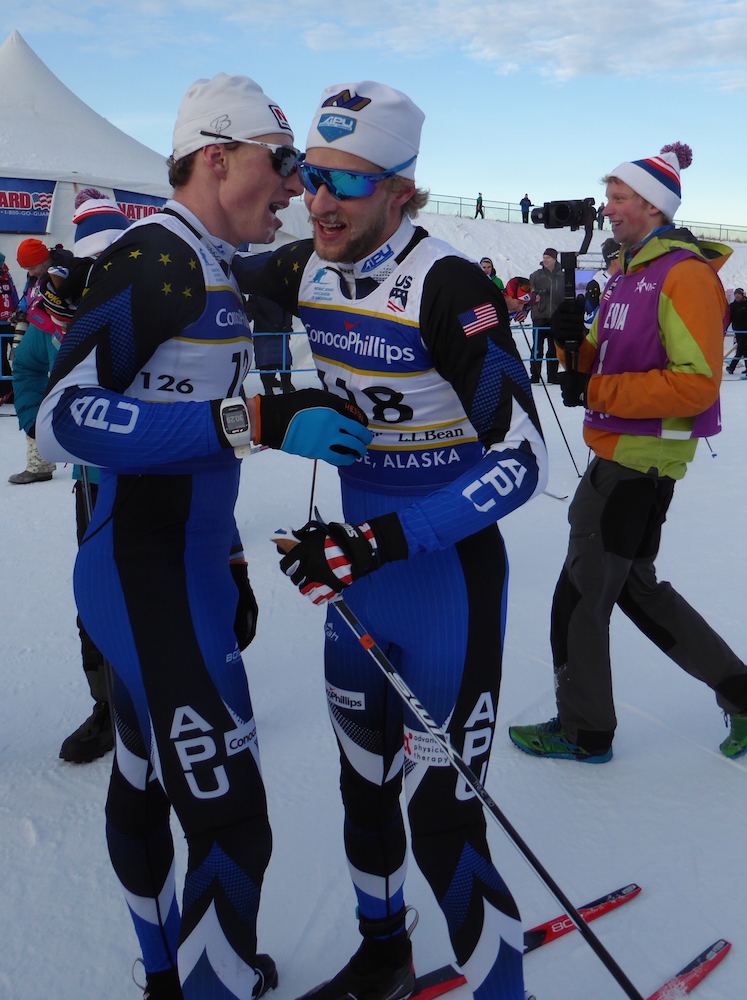
    APU’s Tyler Kornfield (l) and Eric Packer (r) hug after the men’s 30 k classic at U.S. Nationals at Kincaid Park in Anchorage, Alaska.

    Yet when he raced toward the front of the pack in the first lap of Sunday’s mass start, wearing bib 126, it went fairly unnoticed. There were still five laps to go and most figured the charge would come later, from APU’s Scott Patterson (who had won the 15 k freestyle race earlier in the week by almost a minute), or from 2014 Olympian and three-time national champion Noah Hoffman.

    “Honestly I was expecting Scott and Noah to break away,” Packer said during a post-race interview. “My goal today was to hang with them. They pushed the pace the first three laps and were putting in effort to break away. But right around Lap 3 or 4, when we were still grouped together, I think I started realizing personally that it was going to be a tight finish.”

    While Packer’s enlightenment may have come at the same time for many of the spectators at Sunday’s event, Kornfield might have saved them the suspense had he been given an opportunity before the start of the race.

    “I was looking at the course yesterday and in my mind I was picturing how I was going to win it,” Kornfield said after the race.

    With Saturday being an official training day without any races, Kornfield took the time to learn every curve of the 5 k loop that made up the men’s course, the map of which was released Friday evening. Having grown up skiing and racing at Kincaid didn’t hurt the Service High School graduate’s confidence either.

    “I’ve done that hill so many times in sprint racing,” Kornfield said of Gong Hill, which was also featured in Friday’s freestyle sprint and was about 3.5 to 4 k into the 5 k loop.

    “So at like 2 k out I thought, ‘You know what? I feel fresh. If I don’t go, I’m going to regret this for the rest of my life,’ ” Kornfield reflected.

    Packer’s Motivation

    Many who had ventured to Anchorage for U.S. nationals awoke Thursday morning, poured a cup of coffee and proceeded with the championships’ first official training day/off day. Some, perhaps, even slept in.

    When Packer, a 27-year-old former Dartmouth skier who attended South Anchorage High School, arose Thursday morning, it was to grave news: he learned his grandmother had unexpectedly passed.

    He, his family and mother were shaken as they mourned their loss. The pull of commemoration was also in tow.

    “It’s really interesting to be in the middle of the Olympic trials, you’re in the pressure cooker and then you have family come up and it helps remind you what’s important, and that’s the people and your family,” Packer said.

    “On the skate sprint day, I was skiing for her and today on the start line, I said to myself, ‘This is for my grandma,’ ” he continued. “I think that just helped keep it in perspective, that the race isn’t for me, it’s for my family and community and everybody.”

    With unseen weight, but light feet and a fire within him, Packer started Sunday’s mass start in bib 118, racing toward the back of the lead pack for the first two laps and moving to the middle for the next two.

    Noah Hoffman leads early on in the the men’s 30-kilometer classic mass start at the 2018 U.S. Cross Country Championships in Anchorage, Alaska.

    “The pack was churning the whole time,” Packer said. “The entire time I was telling myself to just relax. Stay in contact and relax.”

    That lead group consisted of Packer, Kornfield, Freeman, Hoffman of Ski & Snowboard Club Vail (SSCV), and Patterson (APU), as well as APU’s David Norris, Kevin Bolger of the Sun Valley Ski Education Foundation (SVSEF), Ian Torchia of Northern Michigan University (NMU) and the U.S. Ski Team, Norwegians Dag Frode Trollebø and Eivind Romberg Kvaale of the University of Denver (DU), Adam Martin and Ben Lustgarten (last year’s 30 k classic champion) of the Craftsbury Green Racing Project (CGRP), Tad Elliott (SSCV) and Brian Gregg (CXC/Loppet Nordic Racing/Team Gregg). Each time they reached Elliott’s Climb, the lone A-climb on the 5 k loop, those in front would accelerate.

    Often the acceleration came from Hoffman, who paced most of the uphills and often Elliott’s.

    “Noah Hoffman, I feel like he was up there trying to push the pace all the way,” Kvaale, a 23-year-old DU sophomore, said after the race. “He’s not the fastest sprinter so I guess that natural for him, but the downhills are so long and you draft so well here, so it’s hard to get away.”

    “I was thinking, ‘When is this going to break up?’ ” Hoffman reflected on Sunday, the day before his 29th birthday. “I kept pushing the pace. I tried to make it hard at times, but not only was it coming back together, it was also a massive group. I mean, it’s one thing if you go and three or four guys come with you, but it was way more than that.”

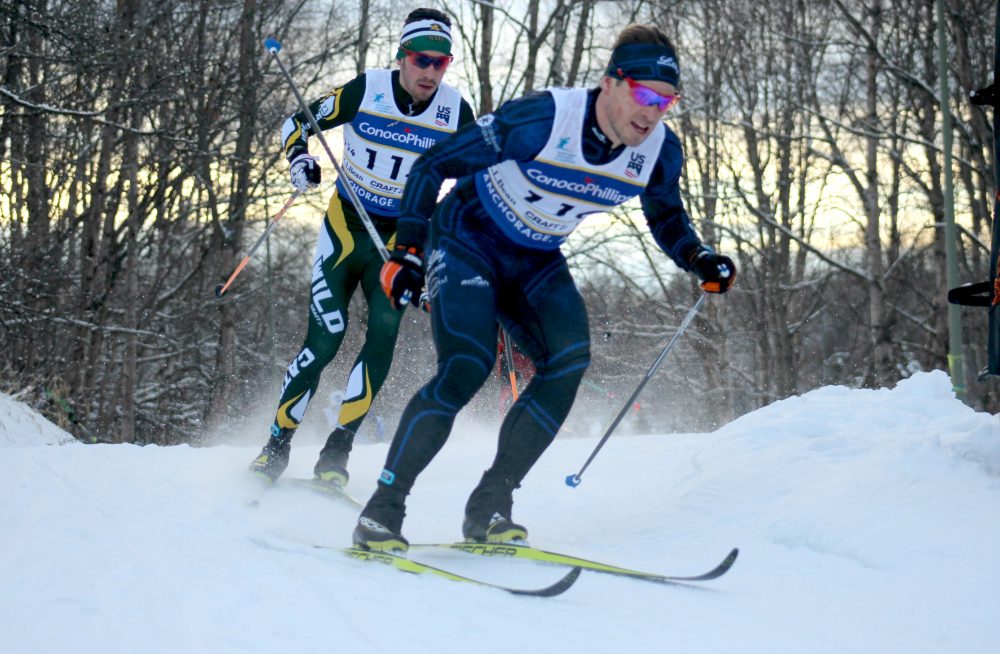
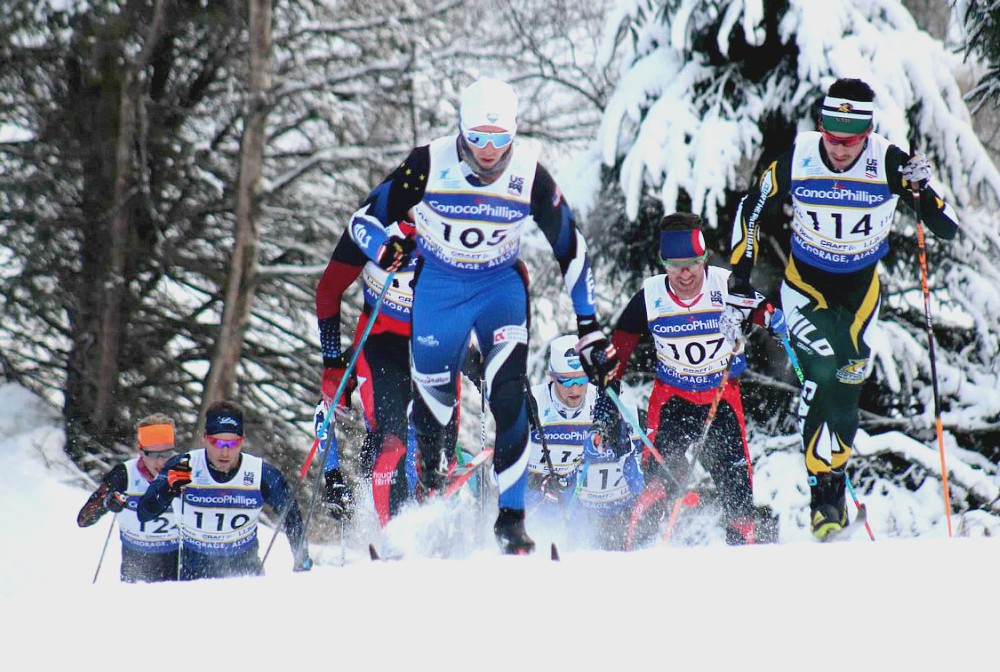
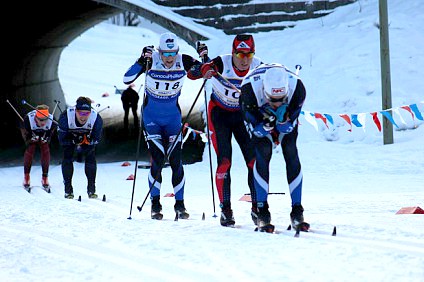
    APU’s David Norris (105) leads up Gong Hill as Ian Torchia (114), Tad Elliott (107) and Kris Freeman (110) chase him during men’s 30-kilometer classic mass start at the 2018 U.S. Cross Country Championships in Anchorage, Alaska.

    The group remained a pack of 14 through five and half laps, with the lead exchanging from Hoffman to Kvaale, to Martin and Norris.

    “It didn’t really matter how fast people climbed, it always came back together,” said Norris, a Fairbanks native, who sat out Wednesday’s distance race due to illness and was still feeling under the weather on Sunday. “You could tell early that Noah was trying to break away. If anything it looked like he was working harder, but not doing damage.”

    While at the top of Elliott’s Climb, gaps would form that Freeman described as being up to five seconds between him and Hoffman and the rest of the pack. But when the group reached the bottom of Gong Hill, all 14 racers were continually rejoined.

    The Sprint Finish

    By the time the group began descending toward back toward the stadium for the last time, apprehension filled within the spectators standing behind the colored flags lining the course and the athletes corralled on the inside.

    A gap had parsed out a few skiers, though eight still remained within range of the win.

    “I was debating the entire last lap, ‘When do I go? When do I go? When do I go?’ ” recalled Freeman, a 37-year-old four-time Olympian from New Hampshire. “Then Tyler went and I reacted rather than dictating.”

    APU’s Tyler Kornfield (126) celebrates as he crosses the line first in the men’s 30-kilometer classic mass start on Sunday at 2018 U.S. Cross Country Championships in Anchorage, Alaska. Eric Packer (118) finished second and Denver University’s Eivind Romberg Kvaale (124) placed third.

    The group had been climbing the final hill together when Kornfield made his move. He pushed around to the outside edge to the front leading into the descent and through the tunnel. As all eight rounded the final corner to the finish, Kornfield put his head down and did what he did best, double poling in an outright sprint to his first-ever U.S. nationals distance win.

    “I knew the only way I could win as a sprinter was to conserve energy and try to stay with pack and wait for the final push,” Kornfield said. “In the finish I just kept pushing and watching that finish line come closer and closer. I’ve never had emotions like that after a race. ”

    Kornfield crossed in a time of 1:21:43.6 for the overall win. Packer crossed 0.7 seconds back in second and Kvaale crossed 1 second out of first for third overall. Freeman, 1.6 seconds back, was the third American in fourth overall.

    “We have a group of guys who are training as much as or more than anyone else in the country and sometimes it takes a while for that fitness to come around,” Packer said. “I think we were a little bit nervous in West Yellowstone and Silver Star [at the December SuperTours] and didn’t have our best races, but it’s great to have things come together at the right time.”

    Finishing out the top 10 was Trollebø in fifth (+2.0), Norris in sixth (+2.5), Hoffman in seventh (+2.6), Patterson in eighth (+3.6), Martin in ninth (+14.7), and Lustgarten in 10th (+14.9).

    “I had very good glide on my skis so I knew I was able to gain a lot on the other guys,” Trollebø said after. “But it was only two tracks at the end so, it’s almost like in a bike race, you have to stay well positioned to be there at the end.”

    Right to left: APU’s Tyler Kornfield leads SSCV’s Noah Hoffman, APU’s Eric Packer, SSCV Kris Freeman, and DU’s Eivind Romberg Kvaale heading out of the stadium tunnel and toward the finish for the men’s 30-kilometer classic mass start at the 2018 U.S. Cross Country Championships in Anchorage, Alaska.

    In terms of the U.S. Olympic points list, Patterson is ranked first, followed by Kornfield, Hoffman, Packer, and Gregg (Gregg finished Sunday in 11th, 16.1 seconds back).

    “We’ll see what they do for naming a team. It’ll be interesting,” Hoffman said.

    “I haven’t seen the math yet, but I have not figured many scenarios where I could be third and still make the Olympic team,” Freeman noted. “So it’s a bittersweet day.

    “But that’s what happened and I’m happy for those guys,” Freeman continued. “They’ve been working at this for a long time. I’m not sure that they’re going to make the team but if they do, good luck to them.”

    Wonders Wins Junior Race

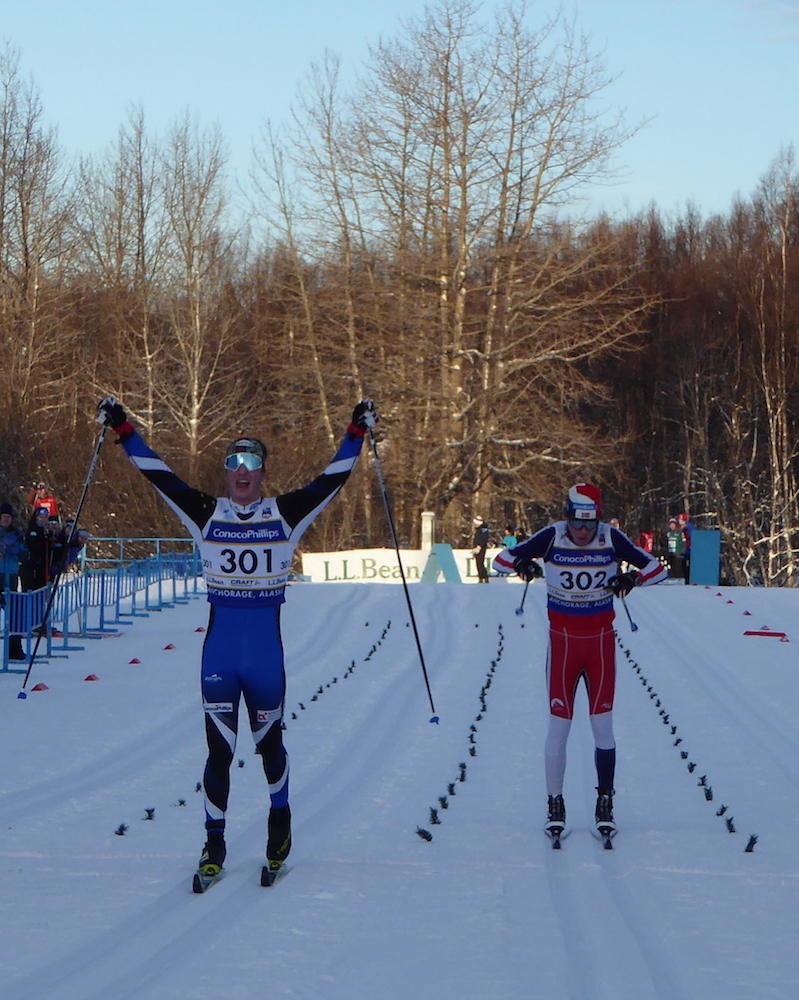
    APU’s Hunter Wonders (301) winning the junior men’s 10 k classic mass start, just ahead of Ben Ogden (SMS) at U.S. nationals at Kincaid Park on Sunday Anchorage, Alaska.

    A junior men’s 10 k classic mass start was also run on Sunday, with APU’s 19-year-old Hunter Wonders claiming the win in a time of 26:07.1. Stratton Mountain School (SMS) skier Ben Ogden finished second, 0.6 seconds back, and Canyon Tobin (APU) placed third (+23.4).

    “I’m extremely thrilled I was able to hold my bib position,” Wonders said after the junior’s race. “I crashed going down roller coaster on the first lap and lost some time, then I was fighting to get back to where I was, so I hammered until I was back with that lead pack. I felt good so I just kept trying to go for it and it paid off.”

    Racing continues Monday for the final event of 2018 nationals, the men’s and women’s classic sprints.

    Results: Men’s 30 k | Junior men’s 10 k

  • Caitlin Patterson Takes Third National Title of Week; Sweden’s Bångman First Overall

    Caitlin Patterson Takes Third National Title of Week; Sweden’s Bångman First Overall

    The top-three Americans in the women’s 20 k classic mass start on Sunday at 2018 U.S. nationals in Anchorage, Alaska, with Caitlin Patterson (1) of the Craftsbury Green Racing Project (CGRP) in first, Rosie Frankowski of APU (l) in second, and Kaitlynn Miller (r) of CRGP in third.

    ANCHORAGE, Alaska — It turns out that Caitlin Patterson does have a weakness: Swedes. The 27-year-old Craftsbury Green Racing Project (CGRP) skier was denied her first outright victory of the week when she crossed the finish line second to Hedda Bångman, a former member of Sweden’s U23 National Team who now skis for the University of Colorado Boulder (CU), in the women’s 20-kilometer classic mass start at the 2018 U.S. Cross Country Championships on Sunday morning at Kincaid Park. But as the first American, Patterson captured her third national title in as many races.

    Rosie Frankowski, of Alaska Pacific University (APU), was the third athlete across the line and second American. She was followed by Jessica Yeaton, who competes domestically for APU, but is an American-Australian dual citizen and competes internationally for Australia. Kaitlynn Miller, also of CGRP, was the fifth athlete across the line to round out the domestic national championship podium.

    Bångman crossed the finish line of the four-lap, technically 22-kilometer course in 1 hour, 55.3 seconds, 15.9 seconds clear of Patterson in second. It was the first time all day that Bångman had enjoyed such an edge.

    CU’s Hedda Bångman on her way to win the women’s 20 k classic mass start at 2018 U.S. Cross Country Championships on Sunday in Anchorage, Alaska.

    The field of 42 skiers left the Kincaid Stadium at 10 a.m. on another perfect race day, the temperature around 16 degrees Fahrenheit and an approaching sunrise about to reveal mountains shimmering in all directions.

    Wednesday’s fresh snow had allowed race organizers to come up with a compromise between the snowmaking loop and the full International Ski Federation (FIS) distance courses, a 5.44-k loop that began with an A-climb up Elliott’s Climb, descended most of the way back to the stadium, covered all the hills on the snowmaking loop, then traversed the 1.5 k Lekisch Loop before finishing in the stadium. The hills on the course were relatively front-loaded, with the single largest climb coming in the start of the loop and smaller (but still steep) hills over the final four-plus kilometers. The final kilometer was predominantly downhill from the high point of the 1.5 k Lekisch into the finish.

    Snow coverage off of the manmade loops appeared to be good to very good, albeit with a relatively abrasive and icy base in the bottom of the tracks.

    The first time up Elliott’s, Frankowski led a large group of 30-plus women (effectively the entire field) up to the top of the A-climb roughly 1.3 k into the race. She was closely followed by APU’s Chelsea Holmes to her left, and Bångman and Miller to her right.

    The second time up Elliott’s, little had changed. Frankowski led a group of 10 women, with Bångman, Yeaton, and Holmes immediately behind her, and Patterson a few strides farther back.

    The third time up Elliott’s, it was yet again Frankowski in the lead, followed yet again by Bångman, Yeaton and Holmes, with Patterson yet again appearing to lag back slightly on the uphill.

    Rosie Frankowski definitely deserves a shout-out for leading the train a whole lot out there and really pushing the pace,” Patterson told FasterSkier in a finish-line interview.

    Four kilometers later, the athletes lapped through the stadium a final time as they headed out on their fourth loop. At this point, Frankowski, Bångman and Patterson, in that order, were still within one second of each other, with Yeaton around seven seconds back in fourth and Miller in fifth 12 seconds behind Yeaton.

    APU’s Rosie Frankowski (6) and CU’s Hedda Bångman (11) leading the charge up Elliott’s Hill in the women’s 20k classic mass start at the 2018 U.S. Cross Country Championships in Anchorage, Alaska.

    If the lead pack was going to avoid a three-woman sprint to the finish, something was going to have to give. And the final time up Elliott’s, it did.

    “The fourth lap is where it really splintered apart,” Patterson said. “At the top of Elliott’s, that last really kicker hill, the herringbone hill.”

    At that point, Patterson, who grew up in Anchorage, recounted that Bångman had “really good skis, like stay-in-the-track that whole way up good. All the rest of us were running outside [the tracks] flailing around a bit, so she gapped us there. And she skis the downhills very well, so she closed a gap there across the World Cup [start area] flat out there, and we never closed that down. Frankie and I were chasing her on Rollercoaster, but I think she held her gap about the same from there all the way to the finish.”

    As Bångman, 22, told FasterSkier after the race, “I didn’t have a plan before [the race], but I knew I was the strongest. So when we went out on the last lap, then I realized, ‘I can really make this race.’ So in the first hill on the last lap, I started to push harder, and then I left the others behind me. And then it was just to push as hard as I can to the finish line.”

    By the time the three-woman lead pack came around the edge of the stadium again, midway through their final lap, Bångman had a significant lead, roughly 12 seconds. She stretched it to 15.9 seconds by the finish, finally allowing herself to slow slightly, look around, and celebrate in the final meters before crossing the finish line.

    Behind her, a battle for top American was shaping up between Frankowski, who had never stood on a national championships podium, and Patterson, who had been there twice already this week.

    Coming through the edge of the stadium, Patterson held a lead of two to three seconds over Frankowski as the two of them approached the wall-like climb up the Gong Hill for the final time. Patterson began heading up on the left side of the trail, Frankowski a few meters behind her on the right, herringboning with stunning alacrity for being 20 kilometers into a 22-kilometer race.

    Then Frankowski caught a pole tip on her ski and fell into the sugar snow on the uphill. It took her several seconds to get up. While she extricated herself, Patterson skied away and up and over the top of the Gong Hill.

    “The real cool thing that came out of that fall,” Frankowski told FasterSkier after, “was that I actually had my pole stuck under my ski, and I had to literally think, ‘Relax, and figure this out and stand up.’ While in the past I would have been so frantic I probably would have dropped more places than I did.”

    “So I basically was just trying to get up,” recalled Frankowski, a 26-year-old Minneapolis native. “And when I got up someone yelled, ‘Don’t give up.’ And immediately I felt like, well, I am going to try to catch Caitlin, and if I could I would, but I didn’t. She is so strong right now; I tried and got close, but I didn’t do it.”

    Frankowski’s travails were news to Patterson when told about this after the race.

    “I had no idea,” Patterson said of her fall. “But that makes sense because it confused me because I was certain that as I ran up on the wall on the left side I was certain that there was someone just by me on the right side. But then I could hear on the downhill that there was no one close and then people were cheering for her 10 meters back, so I didn’t see that during the race.”

    Frankowski’s fall came midway through the last lap, roughly 2.1 kilometers before the end of the race. After giving chase over the Lekisch Loop, she made up roughly the time she had lost in the fall before running out of real estate, crossing the finish line 3.7 seconds after Patterson for third overall and second American.

    Rosie Frankowski (APU) leads CU’s Hedda Bångman (11) up Elliott’s Hill in the women’s 20 k classic mass start at the 2018 U.S. Cross Country Championships in Anchorage, Alaska.

    Yeaton, 26, who was born in Perth, Australia, and moved to Alaska at age 12, skied into the finish alone 24 seconds later for fourth overall. Miller followed another 29 seconds later for fifth overall and third American. Alayna Sonnesyn, a University of Vermont junior, was the second college skier and second U23 skier in the top six.

    “I felt so strong today,” said overall first-place finisher Bångman. “It was a so-good race, I’m so happy. My skis were perfect, and my body felt so good.”

    Patterson is now three-for-three for national titles this week, but this one didn’t come easy.

    “I am pretty excited about this third one, but it was the toughest of them all,” she said.

    “It was a real struggle to hang with the people who were pushing the pace today,” she added, crediting Frankowski for her work at the front.

    “I know especially how I am racing right now that I just need to hang on and the end can be good, and it was fairly good today,” Patterson added. “So I am really happy with the national title.”

    Patterson said that she had opted to prioritize glide over kick on Sunday in light of the course profile, “because I feel like a lot of those walls are steep enough where I would be running anyway.”

    “I probably erred a little too much on the glide side,” she continued. “Which is my fault with some testing … so I was herringboning like every single one of those technique zones, every kind of big hill, just had to keep moving. And luckily because the skis were so fast and I know these downhills so well, I was able to catch up on a lot of the downhills when I did get gapped on several uphills, almost every lap.”

    Each lap featured three of the technique zones that Patterson had mentioned, in which doublepoling was forbidden. For the Anchorage readers, or anyone else familiar with the Kincaid trails, one was at the top of Elliott’s Climb; one was at the southern end of Dark Alley, approaching the lower tunnel; and one was the entire climb up to the Gong Hill from the north/back side of the snowmaking loop just a few hundred meters later.

    (There had been a fourth zone marked during Saturday’s course preview, Patterson recounted, in the first uphill on the Lekisch Loop, which features a stair-step climb with a slight saddle or depression between the two steps. “There was a technique zone that they tried to put there,” she said, “and it literally had a downhill in it, but luckily the coaches protested that and they took it out.”)

    After 22 k of skiing and 12 careful trips through each technique zone, Frankowski finished 3.7 seconds behind Patterson. It was the first national championships podium of her career.

    Her sole strategy coming into the start of the race had been to “push every uphill,” Frankowski explained. “I have raced at Kincaid enough to know that you recover at every single downhill, and so for someone who doesn’t have a sprint at the end, I needed the pace to be hot at the beginning. So right when we started, immediately out of the start I realized that our skis were incredibly fast, and honestly comparable to or better than anyone else’s in the field, and so I felt, well I am going to doublepole as much as I can and then every downhill, especially the ones I struggle on, just tuck behind and try to be relax and know that I can catch back up.”

    Craftsbury skier Caitlin Patterson (l) with APU’s Chelsea Holmes during the the women’s 20 k classic mass start at the 2018 U.S. Cross Country Championships in Anchorage, Alaska.

    Frankowski made clear that, like Patterson, she had gone thin to win when it came to choosing how much kick wax she wanted. “The course here,” she said, “except for maybe Elliott’s, all these hills are running hills so you really had to Klæbo it up or herringbone and just know that you are not going to have perfect striding today, and if you do, your skis are going to be too slow through the stadium to be in the mix.”

    Frankowski, whose public social media profile frequently features paeans to the consumption of Thai food, also clarified, “I would say the key to success is that last night I had Tom Yum soup and Pad Thai for dinner, and lots of cookies, so I think that helped also.”

    Fellow APU skier Yeaton was the fourth skier across the finish line, 24.5 seconds behind Frankowski and 44.1 seconds back from Bångman.

    Yeaton pulled no punches when asked if she had been expecting this result.

    No,” she said. “Not even close. Nowhere in the ballpark. … I was hoping, like on a great day, maybe I’d get top 10. I never thought I’d get fourth.”

    Yeaton’s fourth wrapped up a strong week of domestic racing for the Australian-American dual national, who is known more as a sprinter rather than a distance skier. Indeed, her next races will be Dresden, Germany, to compete for Australia at next weekend’s sprint-centric World Cup stop. Yeaton is presumptively qualified for the Australian Olympic Team in the latest FIS Olympic Points List simulation.

    29.4 seconds behind Yeaton came Craftsbury’s Miller in fifth overall, but the third American across the line after Patterson and Frankowski. She had been “in contact with the lead group until about the third lap when a gap formed on Elliott’s [Climb] that I was unable to bridge,” Miller wrote in an email to FasterSkier after the race.

    “I’m very pleased with my race and it was very exciting to see my teammate, Caitlin Patterson, place second,” she added. “I was very impressed with the 5k course that the organizers put together for the event. It was a fun course to race on.”

    Sunday marked Miller’s fifth time on a national championships podium, and second in this week, following a second on the American podium in Friday’s freestyle sprint.

    Sonnesyn filled out the rest of the top six. The 21-year-old Vermont college skier identifies as a distance skier and had been hoping for a better result in Wednesday’s 10 k skate, she told FasterSkier at the finish.

    I was excited for that, but unfortunately I didn’t have the race I was hoping for,” Sonnesyn said. “But I came back with a really strong sprint, which kind of surprised me. And I was feeling so great that I came into this race today pretty confident. So I was excited for it this morning, and I’m really happy with the way it went.”

    Hannah Halvorsen Wins Junior Race

    While junior women (U20 skiers and under) raced alongside the senior/master field in Wednesday’s 10 k freestyle individual start, Sunday saw the juniors get their own starting time and course for the 5-kilometer classic mass start race. One lap, 92 starters, 5.5 kilometers, go!

    Before long, a pileup ensued. But “I only heard about it from quite a few girls,” junior winner Hannah Halvorsen, of APU and the U.S. Ski Team, told FasterSkier after. “I was right in front of it; I got lucky.”

    Halvorsen, 19, covered the one-lap course in 15:07.8. Second place went to Hailey Swirbul, a University of Alaska Anchorage sophomore, 10.4 seconds back.

    Third place on the all-Alaska podium went to an athlete with four years’ less experience and one fewer Junior World Championships medal to her name, U16 athlete Kendall Kramer. Kramer, who finished 4.4 seconds behind Swirbul, skis for the Nordic Ski Club of Fairbanks/Fairbanks XC (NSCF-FXC), as well as West Valley High School. She had competed in only one other FIS race in her life before this week.

    Halvorsen was second on the junior girls podium in Wednesday’s distance skate race, and third overall among American women in Friday’s sprint race. Swirbul was the top junior woman on Wednesday and reached the quarterfinals of the senior women’s sprint on Friday.

    Halvorsen had high praise for Sunday’s race course: “Super-fun course, up and down, kind of rolling,” she said. “Good places to find speed and carry momentum, time to rest and do different transitions. Just, like, a fun course.”

    It probably doesn’t hurt that she won. “It felt good,” said Halvorsen, who grew up in Truckee, California. “I was tired this morning, but it doesn’t really matter how you feel, you just get out there and go for it. I had really good skis, really good support; my dad’s here, my brother’s here. It’s a beautiful day to be racing; really fun racing out there.”

    — Gabby Naranja and Ian Tovell contributed reporting
    Results: Women’s 20 k | Junior women’s 5 k

    Highlights video from Max Romey Productions

  • Hanneman Bros. Headline National Skate Sprint: Logan Wins Qualifier, Reese Wins Final

    Hanneman Bros. Headline National Skate Sprint: Logan Wins Qualifier, Reese Wins Final

    Reese Hanneman (c) of Alaska Pacific University celebrates his win in the men’s freestyle sprint final on Friday at 2018 U.S. Cross Country Championships. He finished 0.08 seconds ahead of Kevin Bolger (r) of the Sun Valley Ski Education Foundation for the win at Kincaid Park in Anchorage, Alaska. (Photo: Michael Dinneen Photography)

    ANCHORAGE, Alaska — Friday was a good day for Team Hanneman and its friends. Younger brother Logan Hanneman won the qualifier, older brother Reese Hanneman won the final, and Alaska Pacific University (APU) put three skiers in the final and two on the podium in the men’s freestyle sprint on a bluebird day at Kincaid Park on Day 2 of racing at the 2018 U.S. Cross Country Championships.

    A long day of sprint racing got underway with the men’s qualifier at 10 a.m., precisely 10 minutes before the official sunrise. But it was already brighter then than at any point during the day on Wednesday, when a sodden snowfall blotted out most of the daylight and APU skier Rosie Frankowski openly mused about wearing a headlamp during her warmup.

    Friday, by contrast, brought light fog in the morning, burning off to reveal full sunshine during the heart of the day and bring actual warmth to the hundreds of fans lining the sprint course around Kincaid Stadium and up and down the Gong Hill. Temperatures had reached as low as 14 degrees Fahrenheit during the night before, and were never much above 19 degrees during the day Friday. The course of mostly manmade snow, with a mixture of natural snow from the roughly three inches that fell on Wednesday, was firm and fast. There was no wind. In stark contrast to the slush racers experienced on Wednesday, conditions were essentially perfect.

    Logan Hanneman Fastest in Qualifying

    Dakota Blackhorse-von Jess (Bend Endurance Academy) led out the field of 191 men with bib No. 1 for the qualifier. Less than an hour later, APU skier Logan Hanneman had proven fastest in the individual time-trial portion of the day.

    The Hanneman brothers after Friday’s skate sprint at 2018 U.S. Cross Country Championships in Anchorage, where they live and train with Alaska Pacific University. Reese Hanneman (l) won the men’s final and younger brother Logan (r) won the men’s qualifier.

    Logan’s time on the 1.6-kilometer course was 3:07.40. The 24 year old was followed, on the imaginary but meaningful “qualifier podium,” by Kevin Bolger, of the Sun Valley Ski Education Foundation (SVSEF) in second, 0.48 seconds back, and Reese Hanneman in third, 1.13 seconds behind.

    The rest of the qualifying top 10 were Nick Michaud (Bridger Ski Foundation) in fourth, Martin Bergström (University of Utah) in fifth, Dag Frode Trollebø of the University of Denver (DU) in sixth, Cole Morgan (SVSEF) in seventh, Tyler Kornfield (APU) in eighth, Eivind Romberg Kvaale (DU) in ninth, and Gus Schumacher (Alaska Winter Stars), Wednesday’s top junior in the distance race, in 10th.

    Brian Gregg, representing Central Cross Country (CXC), Loppet Nordic Racing (LNR) and Team Gregg, took the coveted 30th and final qualifying spot, 8.82 seconds back from Logan. Nicholas Sweeney (DU) was another second-plus back in 31st.

    This laundry list of results is of more than academic interest if you are a male sprinter trying to make the U.S. Olympic team for next month’s Olympic Winter Games in PyeongChang. As FasterSkier recently explained, the points list for Olympic selection “will only consider qualification-round finish placing,” and not an athlete’s final position based on racing in the heats. Notably, while both Logan Hanneman (fifth in his semifinal) and the day’s fastest female qualifier, Anne Hart (third in her semifinal), did well, neither of them made their respective final.

    APU’s Logan Hanneman (l) leading the University of Vermont’s Bill Harmeyer in the men’s 1.6-kilometer freestyle sprint quarterfinals on Friday at the 2018 U.S. Cross Country Championships in Anchorage, Alaska. After winning the qualifier, Hanneman was eliminated in the semifinals.

    If there was one person who had seen Logan Hanneman’s speedy qualifying time coming, it was his older brother.

    “He’s one of the best qualifiers,” Reese, 28, said of Logan before this season began. This was true on Friday even though Logan was racing with a dislocated rib, according to Kornfield.

    “So the fact that he won the qualifier is unbelievable,” Kornfield said after.

    The added significance of the qualifier result for U.S. Olympic selection purposes, coupled with the desire to still have enough energy left to ski well through three rounds of heats, was on the radar of all three eventual podium finishers.

    I would say all the top sprinting guys, everyone’s focusing kind of on the qualifier, more so than normal,”  Reese said on Friday. “There’s no margin for error, and you just have to ski it absolutely as fast as possible. It’s definitely different tactics than in the heats… but if you’re fast, you’re fast.”

    According to Bolger, who finished second in both qualifying and the final, the significance of the qualifier “absolutely” affected his approach to the day overall.

    Definitely wanted to go into the qualifier and have a strong result,” Bolger said. “I was happy with being second, just barely behind Logan, which I was bummed about but also super happy – there’s a lot weighing on it. So to be able to have a good qualifier, and then still be able to, I think, ski strong throughout the heats, and then into the final – I think that says just as much. So overall I’m really happy.”

    “All the pressure was on the qualifier,” echoed Kornfield, who finished third in the final after qualifying in eighth. “I’m normally not very good at qualifying, so the chance of me making that [No. 1 qualifying] spot would have been a moonshot, but I was happy with how I qualified. I know that if I qualify well, then my heats go well, so I was just, after qualifying well, trying to get back and focus on the heats.”

    Reese Takes First Throughout Heats

    Of the three podium finishers, Reese and Bolger had the smoother paths throughout the day. Reese was first in his quarterfinal and first in his semifinal to automatically advance to the final, winning each heat by less than 0.2 seconds. Similarly, Bolger won his quarterfinal, then was second to Reese in a fast semifinal, 0.17 seconds back.

    Left to right: Eivind Romberg Kvaale (University of Denver), Nick Michaud (Bridger Ski Foundation), Reese Hanneman (APU), Kevin Bolger (SVSEF) and Tyler Kornfield (APU) during their men’s 1.6 k freestyle sprint semifinal on Friday at the 2018 U.S. Cross Country Championships in Anchorage, Alaska.

    Kornfield skied fast enough in his semifinal to earn a lucky loser bid for the final in fourth, after finishing second behind Reese in his quarterfinal. The top-four men in that second semifinal all finished within less than a second of Reese as the winner, and both lucky losers — Kvaale in third and Kornfield — came from that heat.

    Throughout the rounds, Reese skied fairly close to the front throughout the day. In his quarterfinal, the men’s fifth of the day, he was one of three skiers near the lead as the pack took a righthand turn heading up and out of the stadium. He was second coming off the course’s largest downhill back into the stadium, then turned on Beast Mode, approaching the final straightaway to pull into the lead and take the win in 3:10.62. Kornfield was second, 0.19 seconds back.

    In the semifinal, similarly, Reese skied in the top three throughout the race, ultimately leading the four-man group sprint to the line for first.

    Reese Hanneman Holds Off Bolger 

    Nearly four hours into the day, six men lined up for the final, now under bright sunshine. From skier’s right to left, it was Eric Packer (APU), Zak Ketterson (Northern Michigan University), Bolger, Reese, Kvaale, and Kornfield lined up across the south end of the capacious Kincaid Stadium.

    That’s three APU skiers with national titles to their name, last year’s classic sprint national champion in Bolger, one skier whose previous best at U.S. nationals was 15th (Kvaale), and a 20 year old whom the livestream announcers called a “surprise finalist” (Ketterson).

    The field had a clean start off the line, and into the slight-downhill straightaway through the Kincaid Stadium. After approximately 200 meters, the racers took a righthand turn up to the base of a gradual, all-V2, two-stage uphill. At this point it was Ketterson in the lead, with Kvaale and Reese tucked in immediately behind him, and the other three athletes following no more than a ski length further back.

    By the top of this climb, it was still Ketterson in front, with Reese following and Packer up into third position.

    Roughly one minute later, it was Ketterson in front coming down the waterfall downhill back into the stadium at high speeds. There was a gap of five meters back to Kornfield and Reese, who jostled slightly on the descent but did not fall, and Bolger and Packer immediately behind them. Ketterson was technically still in front, but five meters’ separation at those speeds meant little, and the lead pack was effectively still five athletes strong.

    By the time the racers had negotiated a broad 180-degree turn and climbed back up into the stadium, Hanneman was in the lead coming around the final curve. Bolger was second, with Ketterson and Kornfield just off to his left.

    Reese Hanneman (c) takes first, roughly half a ski length ahead of Kevin Bolger (r), with Tyler Kornfield (l) third. Zak Ketterson (second from l) and Eric Packer (third from l) are immediately behind Kornfield, with Eivind Romberg Kvaale farther back. (Screenshot: U.S. Ski & Snowboard live stream)

    Hanneman came into the final straightaway with a slight lead, and took the middle lane. He skied smoothly through the finish, but Bolger was coming on strong to his left in the outer lane.

    Reese kept his slight lead all the way to the finish. Bolger lunged better, but Reese skied faster. Bolger’s lunge got him to within less than half a ski-length of Reese by the finish, but Reese took the victory.

    To Reese’s right, Kornfield led Ketterson and Packer in the next lane to the inside. Kvaale skied in leisurely at the back after suffering an untimely broken pole.

    Reese’s winning time was 3:11.33 for the 1.6 k course. Bolger was 0.08 seconds back, with Kornfield another 0.8 seconds behind him for third. There was a gap of over a second to Ketterson and Packer, then another 12 seconds back to Kvaale.

    Reese aimed to continue his frontrunning ways in the final, he explained to FasterSkier in a post-race interview.

    “Everyone’s fighting for the front half because you know that’s kind of where you’ve got to be,” he said. “Everyone’s too fast; you know you’re not going to come from sixth. So I just fought really hard to stay kind of in the front half, throw down the move on the last hill coming into the finish, and it paid off.”

    The men’s freestyle sprint podium at 2018 U.S. Cross Country Championships, with Reese Hanneman (c) in first, Kevin Bolger (l) in second and Tyler Kornfield (r) in third on Friday in Anchorage, Alaska.The men’s freestyle sprint podium at 2018 U.S. Cross Country Championships, with Reese Hanneman (c) in first, Kevin Bolger (l) in second and Tyler Kornfield (r) in third on Friday in Anchorage, Alaska.

    Reese said he was thrilled by a day in which he won the national title — his third — and Logan won the qualifier.

    “He’s one of the best in the country,” Reese said of Logan, “and he and I have been going back and forth in the sprints for a while now. He’s the defending champion in this event from last season, so I knew he was a factor. He’s a powerful skier, and it’s awesome to see him do well. I think we’re both better because we’ve been fighting with each other for years.”

    Bolger explained he approached the final differently than his other heats.

    “Honestly, I just tried to stay relaxed,” the 24-year-old Wisconsin native said. “I tried to kind of keep an open mind and not put too much into it, overthink it. … I wanted to ski kind of my own race and let things unfold in front of me, and then take chances where I could.”

    In practice, this put Bolger in fourth coming off the big downhill back into the stadium. But he trusted his skis, and his finishing skills, and was able to move back into second within just a few hundred meters.

    “I kind of got, not pushed to the back a little bit, but kind of toward the back,” he recounted. “But coming toward those last few corners I was right in there. And I was confident in my skiing and I knew I was strong, I felt strong, so I was kind of able to push those corners hard.”

    Kornfield, similarly, said, “This is a hard course, so you just had to keep pushing to the finish.”

    “The way the course starts, it doesn’t start too hard, it’s pretty flat for the first part. And the uphill is so big that – for some reason you can’t break away on that,” Kornfield added of Kincaid’s brand-new sprint course. “You couldn’t gain that much time; I think people were just conserving until that last 200 meters. It always bunched up with about 200 meters to go, and it was only about who had the best kick and who got lucky with the hole shot. If you tried to get yourself in good position by the final, you would have a good go at the finish.”

    Reflecting on the vagaries of sprint racing, he noted, “This is an incredibly fair course. It’s incredibly wide, and it was a lot of fun, but we don’t race those kind of back-and-forth heats that often. So I was just pretty relieved to make the podium, because anything could have happened. You could have snapped a pole easily, you could have fallen. It was kind of a relief just to make it to the final in the first place, and then to make it on the podium was unbelievable.”

    Kornfield, 26, who was born and raised in Anchorage and has raced at Kincaid Park dozens of times, summoned the same adjective when asked if he had ever seen a crowd like this at Kincaid for a ski race before.

    “This is unbelievable,” Kornfield said. “I remember back [at U.S. nationals at Kincaid] in 2010, and I felt like it was just a wave of noise coming in. This is even more. It’s incredible that people were here and out here. I’m so excited that Reese and I could make the podium and make ’em proud.”

    (A sportswriter for the local Anchorage Daily News with 30 years’ experience called it “One of the biggest spectator crowds ever to gather at Kincaid Park.”)

    Kornfield likely has fond memories of 2010 for many reasons; he won his first national title then. Friday’s third-place finish marked his seventh time on a U.S. nationals podium, including two national titles. Reese, similarly, took home his third national title (after the 2014 classic sprint at Soldier Hollow in Utah and 2016 skate sprint in Houghton, Michigan), and recorded his eighth national podium. And Bolger notched his second-career podium finish at U.S. nationals, after winning the classic sprint at Soldier Hollow last year.

    New Sprint Course Meets with Rave Reviews

    As FasterSkier recently explained, Friday marked the debut of the new sprint course at Kincaid. And the athletes approved.

    “It was a great course,” Reese said. “Really hard – I would say probably the hardest sprint course we’ve had at nationals in a while. It rivals Fairbanks last year. But there’s a big hill, something you would see on a World Cup, or [World] Championships, so that made it hard. Super-fast downhills. … I think it’s one of the best courses we’ve had in a while. There’s some gradual terrain, there’s a hill, an A-climb, one of the biggest climbs I’ve seen on a sprint course in the U.S., probably ever. I think it’s a great course. It’s fair, everybody likes it, it’s fun. But it skis really well, it’s fast. You can’t get too much better than that.”

    “It’s a good course,” concurred Bolger. “It’s really fun. Good hills, good downhills, good cornering. I think it kind of gets at, you’ve kind of got to be a good all-around skier to kind of be able to go from the qualifier to the final.”

    “This is an incredibly fair course, it’s incredibly wide, and it was a lot of fun,” said Kornfield.

    Athletes will get another shot at it on the final race day of U.S. nationals, the classic sprint on Monday. Classic distance races (20/30 k mass starts) are the next races up, starting at 10 a.m. Sunday morning.

    Results: Final | HeatsQualifier

    –Gabby Naranja contributed
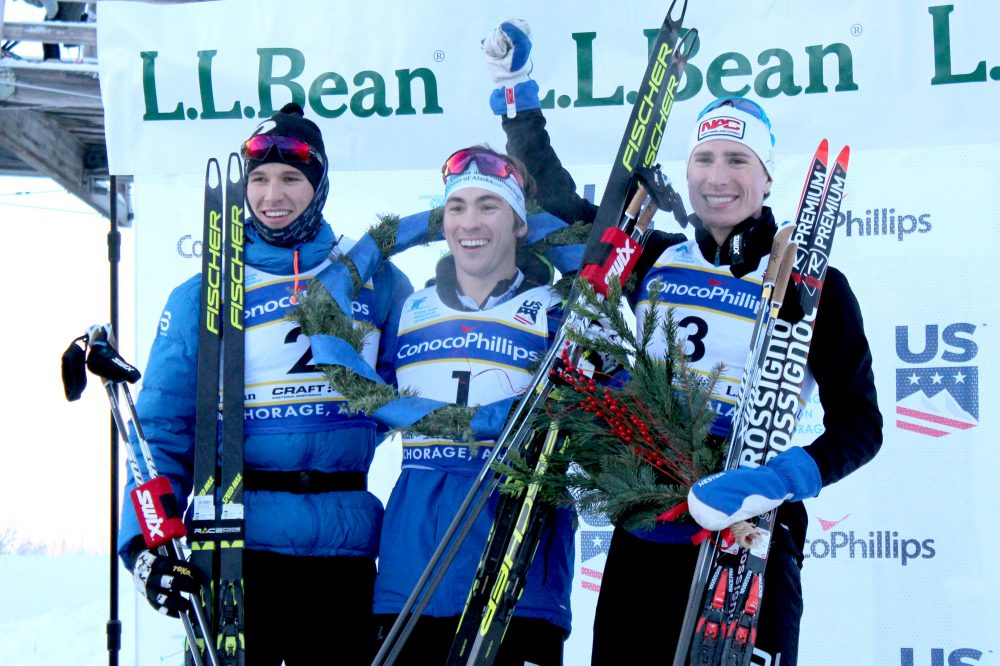
    Reese Hanneman video interview

    Highlights video by Max Romey Productions

  • Friday Rundown: Oberhof, Mont Sainte-Anne Trials, and U.S. Nationals

    Friday Rundown: Oberhof, Mont Sainte-Anne Trials, and U.S. Nationals

    The Hanneman brothers after Friday’s skate sprint at 2018 U.S. Cross Country Championships in Anchorage, where they live and train with Alaska Pacific University. Reese Hanneman (l) won the men’s final and younger brother Logan (r) won the men’s qualifying round.

    U.S. Cross Country Championships (Anchorage, Alaska): Freestyle sprints

    Men’s report

    Women’s report

    Caitlin Patterson racked up her second-straight national title at this year’s 2018 U.S. Cross Country Championships and Reese Hanneman topped the men’s freestyle sprint final on Friday at Kincaid Park in Anchorage, Alaska.

    In the first of two sprints at 2018 U.S. nationals, Patterson, the Craftsbury Green Racing Project (CGRP) skier who won the women’s 10-kilometer freestyle on Wednesday, posted a 3.56-second win in the women’s 1.5 k freestyle sprint final on Friday.
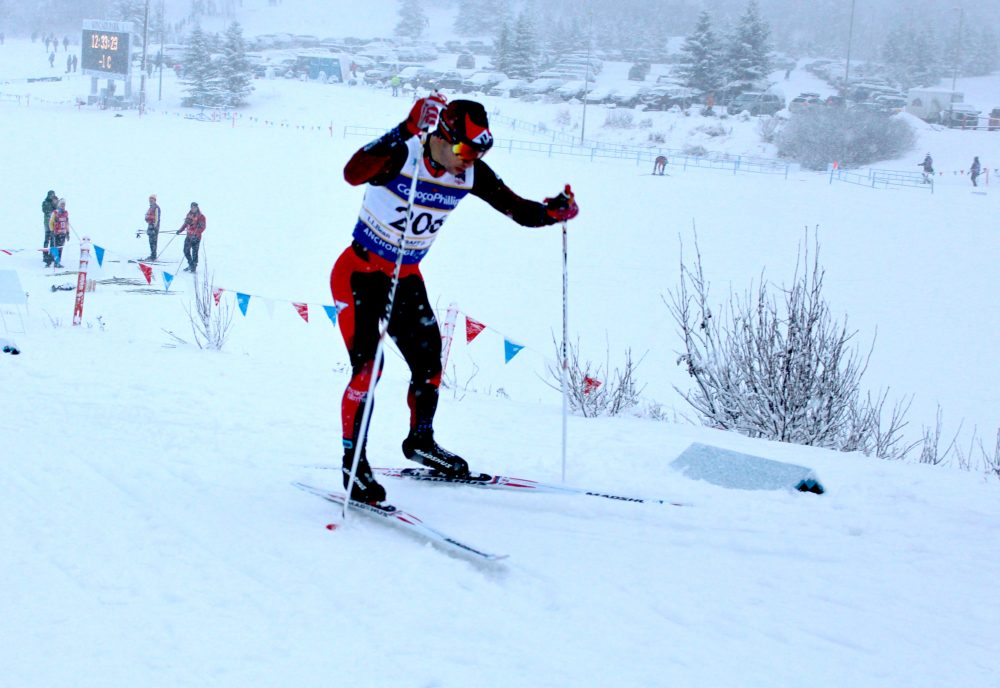
    After qualifying 12th, 5.76 seconds back from Anne Hart of the Stratton Mountain School (SMS) Elite Team, who won the qualifier in 3:22.10, Patterson won both her quarterfinal and semifinal, both times ahead of University of Denver (DU) junior Jasmi Joensuu in second.

    The two advanced to the final, where Patterson reached the finish line first once more in 3:20.93, about 3 1/2 seconds ahead of Joensuu in second and 4.19 seconds ahead of Petra Hyncicova, a senior at the University of Colorado Boulder, in third. Craftsbury had two in the final with Kaitlynn Miller placing fourth (+4.35). U20 skier Hannah Halvorsen of Alaska Pacific University (APU) and the U.S. Ski Team (USST) finished fifth (+7.66), and Kelsey Phinney of the Sun Valley Ski Education Foundation (SVSEF) placed sixth (+9.78).
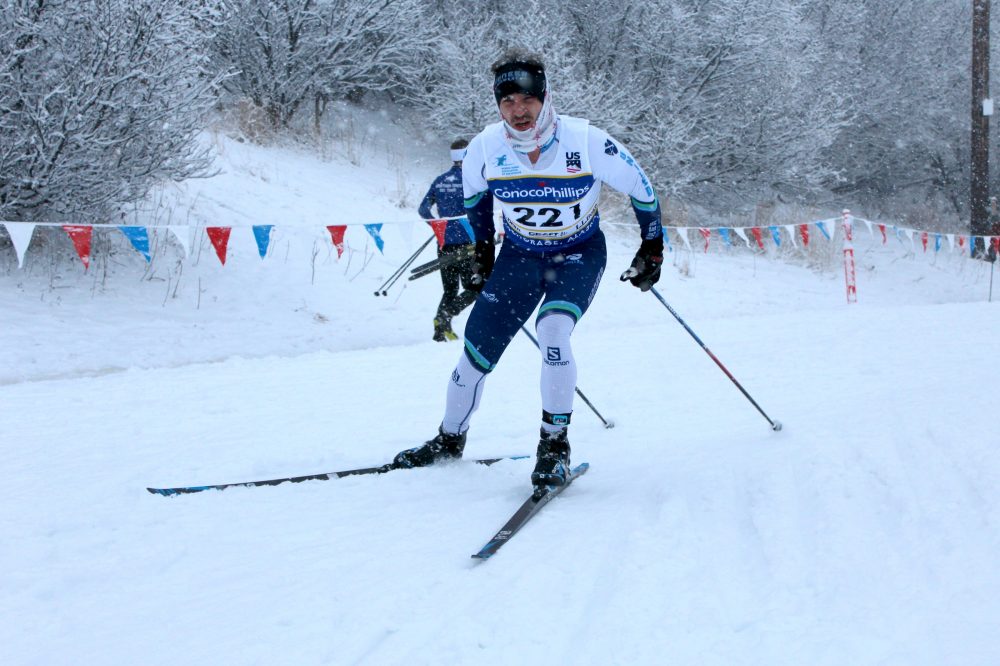
    Hart won her quarterfinal then placed third in the first semifinal, behind Miller, who won that heat, and Hyncicova in second, to miss advancing to the final. Hart had won the qualifier by 1.78 seconds over Joensuu in second.

    In the men’s 1.6 k skate sprint, Logan Hanneman (APU) won the qualifier in 3:07.4. Kevin Bolger (SVSEF) qualified in second (+0.48), and older brother Reese Hanneman (APU) was third (+1.13).

    In the quarterfinals, Reese won his heat by 0.19 seconds ahead of his teammate Tyler Kornfield, and Logan finished second, 0.42 seconds behind U18 skier Gus Schumacher (Alaska Winter Stars), as the winner of the first quarterfinal. Bolger won the fourth quarterfinal.

    Reese raced to another win in the second semifinal, 0.17 seconds ahead of Bolger in second. APU’s Eric Packer won the first semi, 1.66 seconds clear of Zak Ketterson of Northern Michigan University (NMU) in second. Logan finished fifth in that semifinal, 4.48 seconds out of first, trailing Dakota Blackhorse-von Jess (Bend Endurance Academy) in third and Schumacher in fourth.

    In the final, which included three APU athletes out of six total, Reese nipped Bolger by just eight-hundredths of a second for the win in 3:11.33. APU had two on the podium with Kornfield in third (+0.88). Ketterson finished fourth (+1.92), Packer was fifth (+2.34), and DU sophomore Eivind Romberg Kvaale was sixth (+14.08).

    U.S. nationals racing continues Sunday with the 20/30 k classic mass starts.

    Complete results

    ***

    NorAm Trials (Mont Sainte-Anne, Quebec): Classic sprints

    The men’s classic sprint podium at 2018 Canadian NorAm Trials on Friday at Mont Sainte-Anne, Quebec, with Julien Locke (second from r) in first, Russell Kennedy (r) in second, Bob Thompson (c) in third, Evan Palmer-Charrette (second from l) in fourth, and Dominique Moncion-Groulx (l) in fifth. (Photo: Canmore Nordic Ski Club/Instagram)

    Canada’s NorAm Olympic trials opened Friday at Mont Sainte-Anne in Beaupré, Quebec, with Dahria Beatty (Canadian World Cup Team/Alberta World Cup Academy) winning the women’s 1.35-kilometer classic sprint and Julien Locke (Canadian U25 Team/Black Jack) topping the men’s 1.35 k classic sprint final. While Beatty has already secured her spot at the 2018 Olympics in PyeongChang, South Korea, Locke has not — but the win didn’t ensure he’ll be selected to the team. In a tiebreaker, it looks like he is second on the men’s sprint list at trials to Russell Kennedy, of Canmore Nordic/Team R.A.D.

    Based on its published nomination procedures for the 2018 Olympic Games, Cross Country Canada (CCC) will consider both qualifying and final results in its “sprint selection ranking process”. In the men’s qualifying round on Friday, Kennedy qualified first (in 3:02.81 minutes) and Locke followed in second (3.06 seconds back). Kennedy later placed second to Locke in the men’s final. Effectively, that meant they were tied, should CCC select another male sprinter to its Olympic team. But the tiebreaker is the qualifying round, which Kennedy won.

    To reach the final, Kennedy placed second in his quarterfinal, behind Ricardo Izquierdo-Bernier of the Pierre-Harvey National Training Centre (CNEPH), and Locke was second in his quarterfinal as well, behind Andy Shields of Lappe Nordic. All four automatically advanced to the semifinals, where Kennedy posted a 1.12-second win over Bob Thompson, of the National Team Development Centre (NTDC) Thunder Bay, and Locke edged Jess Cockney (of the Canadian World Cup Team, who prequalified for PyeongChang) by 0.34 seconds.

    In the final, Locke notched a 1.17-second win over Kennedy, crossing the line first in 3:04.16. Thompson took third (+2.49), Evan Palmer-Charrette (NTDC Thunder Bay) was fourth (+5.74), Dominique Moncion-Groulx (AWCA) was fifth (+7.2) and Cockney sixth (+55.97). Len Valjas, who is recovering from a shoulder injury and is prequalified for PyeongChang, won the men’s B-final for seventh overall.

    In the women’s race, Beatty qualified first in 3:41.55, then won both her quarterfinal and semifinal before topping the final as well in 3:45.02, 0.64 seconds ahead of Maya MacIsaac-Jones (U25 Team/Rocky Mountain Racers) in second. Katherine Stewart-Jones (U25 Team/NTDC Thunder Bay) finished third (+1.2) in the final, Cendrine Browne (U25 Team/CNEPH) was fourth (+4.58), Annika Hicks (AWCA) fifth  (+10.21), and Andrea Dupont (RMR) sixth (+12.18).

    Browne posted the second-fastest qualifying time, 3.13 seconds back from Beatty. Olivia Bouffard-Nesbitt (RMR) qualified third (+8.08), but was disqualified in her quarterfinal. MacIsaac-Jones qualified fourth (+8.49), putting her total points for the day — based on CCC’s selection ranking — at 6. Browne scored 6 points as well (for qualifying second then finishing fourth overall), but with the better qualifier, Browne is expected to be deemed the winner of that Olympic sprint spot. Laura Leclair (CNEPH) qualified fifth (+10.57), and Stewart-Jones ranked fifth (+13.8) in the qualifying round.

    NTDC Thunder Bay’s Katherine Stewart-Jones (l) and CNEPH’s Cendrine Browne, both the Canadian U25 Team, after the NorAm Trials classic sprint at Mont Sainte-Anne, Quebec. (Photo: Mario Walker/NorAm MSA 2018 Facebook)

    Browne won her quarterfinal by 1.5 seconds over Hicks, and the two met again in the semifinal, which Browne also won, this time by 2.81 seconds over Hicks. MacIsaac-Jones posted a 0.25-second quarterfinal win over Dupont, then finished second in her semifinal, 0.22 seconds behind Beatty.

    Fresh off racing Period 1 of the World Cup, Browne, 24, is best known as a distance skier, but she’s been on the NorAm sprint podium before. She last won a sprint qualifier and finished second overall at two years ago at the Canmore NorAm in December 2015.

    Kennedy, 26, as last year’s overall NorAm winner also spent the last two months racing World Cup Period 1. He is an American-born dual citizen who has lived in Canada since 2010. He’s also expected to attend the PyeongChang Paralympics as a backup guide for Brian McKeever.

    In an email, CCC High Performance Director Thomas Holland confirmed Browne and Kennedy were the sprint-selection winners next in line for Olympic quota spots.

    On the NorAm Hayward Mont Sainte-Anne Facebook page, the following announcement was posted on Saturday:

    “Cendrine has officially been named the winner of the Olympic sprint selection event.

    The only catch is that Cross Country Canada’s official selection cannot be announced until FIS (the international ski federation) announces its final quota re-allocation at the end of January.

    The most recent version of the FIS quotas, dated yesterday morning (Friday) allocates only eight quotas for Canada. IN THEORY, that quota could be lowered further still, in which case certain named athletes could be left out.

    Which is why Cendrine will have to wait until late January to shout her news from the rooftops!

    Her victory in the sprint selection is doubly important as it puts her in the Number 3 spot on the women’s team, behind Dahria Beatty and Emily Nishikawa, according to Amendment #2 of Cross Country Canada’s Olympic selection criteria.

    If the FIS quota were to be lowered to 7, for example, it would be the women’s distance winner who would lose out.”

    The NorAm trials for Olympics as well as Junior and U23 World Championships resume Monday with skiathlons, followed by skate sprints on Tuesday. Sunday’s 10/15 k classic individual starts were postponed to Wednesday.

    Results: Qualifying round | Heats

    ***

    IBU World Cup (Oberhof, Germany): Men’s 10 k sprint

    Full report

    Tim Burke shooting clean in standing for his second-straight stage en route to a fourth-place finish in the men’s 10 k sprint on Friday at the IBU World Cup in Oberhof, Germany. (Screenshot: ARD broadcast)

    In his first race of the new year, Tim Burke raced to fourth — his best result in four years — in the men’s 10-kilometer sprint at the International Biathlon Union (IBU) World Cup in Oberhof, Germany.

    The 35-year-old American started 22nd out of 103 and shot clean to cross the finish line in third, 20.1 seconds behind France’s Martin Fourcade, who also shot clean and finished in 25:03.3 minutes — a time that would hold up against the entire field as the fastest and give the Frenchman his second win of the season.

    Fourcade had bumped early race leader Norway’s Johannes Thingnes Bø to second, after Bø missed two targets on his initial prone stage then cleaned standing (2+0), but skied the fastest overall course time to reach the podium. Burke’s time was 9.9 short of Bø’s.

    Ultimately, Norway’s Emil Hegle Svendsen as the 58th starter bumped Bø to third and Burke off the podium, finishing second, 8.1 seconds behind Fourcade, also with clean shooting.

    Canada was led by Scott Gow in 32nd (+1:48.7), who had a single standing penalty (0+1), and his brother Christian Gow finished 36th (+1:50.3) with one standing miss as well (0+1). Brendan Green was 57th (+2:30.4) with three penalties (1+2), and in his first European World Cup race, Carsen Campbell finished finished 94th (+4:05.3) with two misses (2+0).

    The U.S. started two men on Friday, with Sean Doherty finishing 84th (+3:24.4) with four penalties (3+1).

    The Oberhof IBU World Cup continues Saturday with the men’s and women’s pursuits.

    Results

  • Scott Patterson Wins Home U.S. Nationals 15 k by Nearly a Minute

    Scott Patterson Wins Home U.S. Nationals 15 k by Nearly a Minute

    Scott Patterson (Alaska Pacific University/U.S. Ski Team) racing to first in the men’s 15-kilometer freestyle individual start on Wednesday at 2018 U.S. Cross Country Championships in Anchorage, Alaska.

    (Note: This article has been updated to include comments from Noah Hoffman.)

    ANCHORAGE, Alaska — It was a day of homecomings and returns at snowy Kincaid Park for the first day of the 2018 U.S. Cross Country Championships. Scott Patterson returned to his childhood training grounds with a convincing victory, Noah Hoffman returned to racing at U.S. nationals with second, and Matt Liebsch returned to the nationals podium with third in the men’s 15-kilometer freestyle individual start on Wednesday afternoon. All of them overcame notably difficult conditions to do so.

    While there were several strong contenders in the field of 181 starters, many had tabbed Patterson, of Alaska Pacific University (APU), and Hoffman, affiliated with Ski & Snowboard Club Vail (SSCV), among the favorites coming in. They weren’t wrong, given both the pair’s recent World Cup experience and their domestic history at this distance.

    For both athletes in the top echelon of U.S. men’s distance skiing, the 15 k race has long been their bailiwick. Coming into this week’s races, Patterson, of the U.S. Ski Team B-team, had reached the podium in six of his last eight 15 k races at the SuperTour or national championships level (plus wins in two competitive Alaskan 15 k FIS races in that time). While Hoffman, a former U.S. Ski Team member, has raced in this country less frequently over the past several years, he had achieved that mark in three of his last four domestic 15 k races. For a pair of high-training volume athletes with remarkable aerobic capacity, there is clearly something about this distance that lets them do well.

    Noah Hoffman racing to second in the men’s 15-kilometer freestyle individual start on Wednesday at 2018 U.S. Cross Country Championships in Anchorage, Alaska. It was his first January nationals appearance since 2012.

    On Wednesday, Hoffman did well, but Patterson did better.

    “I was impressed by him and happy to see him skiing so well, I mean he handled the condition and that course really well and…he has trained a bunch, but you know I also think that I can ski at that level and I didn’t do that yesterday,” Hoffman said on the phone on Thursday. “In that sense there is more out there, but I am definitely satisfied with second place, I think it sets me up well for going into Sunday in terms of like qualifying for the Olympic team or just having a good week in general.”

    Starting in bib 215 in the middle of the A-seed group, nine spots after Hoffman in bib 206, Patterson led wire-to-wire throughout the six-lap race. After one lap, his time advantage over Hoffman was 7.9 seconds. After two laps, it was up to 11.8 seconds. Patterson’s edge grew steadily from there – 24.1 seconds at three laps, then 41.4 seconds at four laps, then 52.2 seconds through five laps.

    Patterson received an early clue he was having a good day when he passed Kyle Bratrud, of Central Cross Country (CXC), during the first lap.

    “The full confirmation came from my coach, Erik Flora, just after the first lap when he gave me a split that I was leading,” Patterson wrote in a post-race email to FasterSkier. “From there it was mostly just building time against the clock rather than any competitor specifically.”

    Patterson finished in 36:33.7. Hoffman was 55.2 seconds back in second.

    Hoffman was similarly in second each time he came through the stadium on the 2.69-kilometer lap course. (The race may therefore have been closer to 16.1 k than 15 k, according to the map published on the U.S. nationals website.)

    The first lap saw more variability for several skiers, with some eventual top-10 finishers ranking as low as 28th after their first time around the course. Liebsch, representing Pioneer Midwest, was in seventh after Lap 1. But by the end of Lap 2, Liebsch was up to third overall, and he held that position all the way to the finish.

    Matt Liebsch (Pioneer Midwest) racing to third in the men’s 15 k freestyle on Wednesday at the 2018 U.S. Cross Country Championships in Anchorage, Alaska. It was his first U.S. nationals appearance in two years and his first national podium since placing second in 2012 in a 15 k freestyle in Rumford, Maine.

    Liebsch finished 21.3 seconds back from Hoffman in second, and 1:16.5 behind Patterson in first. Liebsch nipped fourth-place finisher Rogan Brown (Sun Valley Ski Education Foundation) by 3.7 seconds for the final podium spot.

    The rest of the top 10 went to Tad Elliott (SSCV) in fifth (+1:24.4, Gus Schumacher (Alaska Winter Stars) in sixth (+1:27.7), Brian Gregg (CXC/LNR/Team Gregg) in seventh (+1:31.3), Jack Hegman (SVSEF) in eighth (+1:36.0), Benjamin Ogden (Stratton Mountain School) in ninth (+1:42.1), and Adam Martin (Craftsbury Green Racing Project) in 10th (+1:44.2).

    Conditions for Wednesday’s race were markedly different from the “firm and fast” courses observed last week. Temperatures above 40 degrees Fahrenheit during the day on Tuesday softened the top few inches of manmade snow on the snowmaking loop and left two to three inches of soft slush on the course’s first main uphill. Above-freezing temperatures Tuesday night, some light rain and a steady snowfall at temperatures hovering around 31.5 degrees all day Wednesday, made for a challenging race.

    For the men, that came after 147 women did four laps each in the day’s first race. Then the men skied a cumulative thousand-plus laps in the day’s second race. By the end of the day on Wednesday, the day’s final starters pushed to glide through four to five inches of slush on the first climb, Gong Hill.

    Despite the conditions, or maybe even because of them, U.S. Ski Development Coach Bryan Fish said that Wednesday’s race courses were a worthy test for American athletes being chosen for international championship teams.

    “I think it was actually good that it snowed,” Fish told FasterSkier in person after the race. “Not only for the long-term of the whole week, but also the fact that the course – just due to the fact that the limited amount of snow, they weren’t able to run it on a fully homologated course. So what I think this did, at least from my perspective, is that it was much harder because of the snow conditions. And I think that creates a better environment to pick the right athletes to go onto these championship courses that they’ll be racing in Europe and in PyeongChang.”

    “The conditions were definitely tricky,” Patterson observed. “Yesterday for our prerace training we had crazy ice and wind in classic Anchorage Chinook style, but even then the forecasts were calling for something different today. Looking out the window in the morning, I knew it was going to be interesting with snow rapidly accumulating and a temperature around 35 degrees.”

    “There were definitely some rough patches with soft deep snow,” Patterson wrote, referring to Wednesday’s race. “Also in many places, maintaining speed meant staying in the skied-in lane. Thus passing was difficult in some areas. Overall, racing fast was about getting through the tough areas quickly but not burning too much energy. Then really focus on the other areas where I could ski hard and put time into people. These conditions didn’t make the skis feel super fast, but I think the APU techs did a great job with the conditions out there to give me some of the fastest skis in the race.”

    Patterson was the only athlete in the men’s race whose overall pace exceeded that of the fastest woman’s lap in the day’s first race, as continued snowfall made the course ski harder for everyone.

    Despite the weather, Patterson wrote to FasterSkier, he felt confident going into Wednesday’s race.

    “But I was also expecting a tight battle with Noah Hoffman and maybe some others,” he wrote. “We had been racing at quite a similar level on the World Cup, but I think the combination of home course advantage and a bit of rough travel for Noah tipped the scale in my favor.”

    (Hoffman recently posted, in a series of Instagram video updates chronicling his travel misadventures, that it took him over 24 hours to successfully leave Hartford as he attempted to fly to Alaska, and that it ultimately took him 56 hours to travel to Anchorage from Putney, Vermont, by plane. “16 hours short of the drive time,” Hoffman wrote.)

    “Scott was world-class today,” Hoffman said, according to a U.S. nationals press release. “I hope he can bring that back to Europe and I hope to be there with him.”

    “You know I continue to feel that I am really looking for my skiing to click,” Hoffman later said during a phone conversation with FasterSkier. “I am really looking to figure out how to ski as well as I had in the past and as I know how… if I am skiing the way that I can, I am going to have all the opportunities I want…everything else really falls into place if that goal does.”

    Hoffman hopes to qualify for PyeongChang, but still remains most concerned with his skiing, believing that performances will follow once he clicks in.

    “I am just focused on trying to put together a representative effort of my fitness because I continue to believe that I am one of the fittest athletes in the world, and that the skiing that I did in 2013-14 wasn’t some miracle or some fluke, I want to give myself more opportunities to prove that, but that’s the goal,” Hoffman continued. :So making teams, and the politics of all of it, is really not, not what I am caught up in. I am focused on trying to ski as well as I can and as I have. I skied best in the world I know I can do that, its been a long time, and its been extremely frustrating, but that continues to be the focus. You got to focus on skiing fast and that’s all you can control.”

    “Overall I felt quite good,” Patterson wrote. “I was getting a lot of good information and splits from my coaches so I had a good understanding of the race the whole time. I kept the pace steady throughout and made sure to work with the conditions instead of fighting against the tricky snow.”

    Patterson had more support out there than just his coaches, on a day when the large parking lots at Kincaid filled to capacity and parked vehicles lined the road up the hill from the stadium at some points.

    “Racing at home is always special,” the 25-year-old Patterson wrote, “both in terms of fans and having the home-course advantage. I have raced at Kincaid more than any other place in the world and I feel like I know how to ski well there. It does have its tricks that take some time to learn. In addition to that, there are the fans. The first time up to the course high point or the Gong Hill, I felt like every person on the sidelines was cheering for me. There were several instances where I would recognize someone’s voice and start to try and figure out who it was before going back to focusing on the race. It’s even more special with all the Olympic hype today.”

    It was his second national title after winning the 15 k classic two years ago in Houghton, Michigan. Patterson, who attended high school in Anchorage, had more experience at Kincaid than anyone else on the podium, but Liebsch is also a fan of the city’s biggest cross-country ski area.

    “I’ve always raced really well here,” Liebsch, 34, told FasterSkier on the phone Wednesday evening. “This is my third time up here, and I’ve had a third, a fourth, and a third. So I like racing at sea level; Kincaid seems to be good to me. So when I saw that Nationals was here this year, I was like, ‘Oh, I gotta go to that for sure.’ ”

    Liebsch most recently made a U.S. nationals podium in 2012 at Rumford. This was also the last time, before Wednesday, that Hoffman raced at the full-fledged U.S. nationals in January; he has competed at U.S. Distance Nationals (an annual 50 k mass start) in the spring several times since then. (This season, Hoffman raced Period 1 of the World Cup. After not being offered a start spot in the Tour de Ski, he chose to come to U.S. nationals instead. Patterson was offered a Tour de Ski start spot, but declined that in favor of coming to nationals.)

    These days, Liebsch works full time at Pioneer Midwest.

    “When I saw that [nationals were in Anchorage] I got really excited to try to train well this summer,” he said. “I never really stopped training. Sometimes I’m exercising, sometimes I’m training. I actually trained this year. Last year I exercised.”

    (He later mused, “I’m less than 20 months removed from World Cup racing, so everyone thinks that I just rolled over and died. But I kept training, and I kind of had it in the back of my mind that I may take another swing, see what happens.”)

    Liebsch came to Anchorage “with the expectation to win today,” he said. But he was quick to credit Patterson for his dominant performance: “Obviously Scott just sent it,” Liebsch said. “Scott was on his own planet today.”

    For “everyone else” in the race, Liebsch said of the challenging and variable conditions, “it was kind of like you had to ski relaxed, and just kind of let the ski scoot along on the snow. Because there were like trenches, and then there was like mashed potatoes, and then there was like new snow. It was kind of weird.”

    So what happens next? Short-term, Liebsch does not plan to contest Friday’s sprint, so he’s going to go skiing at Hatcher Pass instead.

    He also has big technique plans, with an eye to qualifying for the upcoming Olympics in PyeongChang.

    “I have a chance to probably go ski in Korea, potentially, after the points reshuffle from today,” Liebsch said. “They’re going to have to take a bunch of domestic guys, I think, and … I think I’m in the mix. If I can figure out how to classic ski between now and Sunday, it could be real exciting.”

    Patterson has comparable goals in advance of Sunday’s 30 k classic mass start.

    “For PyeongChang, today’s race feel like it puts me in the driver’s seat for the distance spots. Through the early season SuperTour, no one really stood out above the rest for distance races. Today, Noah Hoffman and I showed that we might not have scored many World Cup points, but we are still forces domestically. The 30k classic on Sunday will be my other big focus to get an Olympic spot.”

    Two Juniors in the Top 10

    https://www.instagram.com/p/BdgdIgbB92S/

    While there was a separate podium ceremony on Wednesday for the top-three junior boys (after athletes of all ages raced together), you don’t have to go too far down the results sheet to find the top-three finishers under age 20: Gus Schumacher (Alaska Winter Stars) was sixth overall, Ben Ogden (Stratton Mountain School) was ninth, and Hunter Wonders (APU) was 21st. Schumacher and Ogden are still U18 skiers; Wonders is a U20.

    Schumacher’s sixth overall is a quantum leap from his previous best finish at a U.S. nationals: he was 43rd in the 15 k classic at Houghton in Jan. 2016.

    “I guess I wasn’t expecting this specific result,” Schumacher, 17, wrote to FasterSkier, “but I knew that on home snow I could possibly put up a pretty fast time and be competitive with the seniors.”

    As for his mindset in conditions like those found on Wednesday, Schumacher wrote, “I guess my approach is that it’s the same for everyone and as long as I don’t get freaked out I can race as well as normal. So the goal is really to stay calm and try to adjust my technique in warmup to be more efficient.

    “I was super stoked about today’s race,” he continued. “I think it is a great sign for the future, hopefully I can keep this pace up!”

    Count Fish, the development coach, among those also stoked about Wednesday’s race. Fish is attending U.S. nationals for a number of reasons, he explained, including to help support the naming of various international championship teams (Junior Worlds team, U23 team, and the U18 Nations Trip team). And while he looks at results, to be sure, it’s more than just that.

    “We’re also looking at results versus age as well,” Fish said. “And not only the result itself, but what were the times, and what were the time gaps. … Really exciting to see a couple of young men, like Gus Schumacher and Ben Ogden, sixth and ninth. And those two were back and forth. And I had Ben as high as eighth, and Gus in 10th, and Gus had an incredibly fast last lap, to put time not only into the other juniors but into the whole field, to finish sixth overall. So that was really exciting to see, to have two young athletes like that finish that high.”

    Results

  • U.S. Nationals Rundown: Pattersons Rule 10/15 k Skate

    U.S. Nationals Rundown: Pattersons Rule 10/15 k Skate

    Caitlin Patterson of the Craftsbury Green Racing Project (CGRP) earned a national title on Wednesday with a win in the women’s 10 k freestyle at 2018 U.S. Cross Country Championships in Anchorage, Alaska. (Photo: Instagram/US Nationals 2018)

    2018 U.S. Cross Country Championships (Anchorage, Alaska): 10/15 k freestyle

    Men’s report

    Women’s report

    The Patterson siblings are crushing it on Day 1 of the U.S. Cross Country Championships at Kincaid Park in Anchorage, Alaska.

    Scott Patterson (APU/USST) racing to a 55-second win in the men’s 15 k freestyle on Wednesday at U.S. Cross Country Championships in Anchorage, Alaska. (Photo: Jim Jager/US Nationals 2018 Instagram)

    Scott Patterson raced to a 55.2-second victory over Noah Hoffman in the men’s 15-kilometer freestyle individual start on Wednesday. Patterson is an Anchorage-based U.S. Ski Team (USST) member who trains with Alaska Pacific University (APU). Hoffman is a former USST member who raced Period 1 of the World Cup with Patterson. Matt Liebsch, of Pioneer Midwest, placed third, 1:16.5 minutes off of Patterson’s winning time of 36:33.7.

    Patterson’s older sister, Caitlin Patterson, of the Craftsbury Green Racing Project (CRGP) won the women’s 10 k freestyle earlier on Wednesday by 19.7 seconds over Caitlin Gregg, who’s affiliated with Central Cross Country (CXC), Loppet Nordic Racing (LNR) and Team Gregg. APU’s Chelsea Holmes, who raced World Cup Period 1, placed third, 24.4 seconds off Patterson’s winning time of 27:09.1.

    Also in the top 10 in the women’s race were Rosie Frankowski (APU) in fourth, University of Colorado Boulder (CU) skiers Petra Hyncicova and Christina Rolandsen in fifth and sixth, respectively, Erika Flowers of the Stratton Mountain School (SMS) Elite Team in seventh, Hailey Swirbul (University of Alaska Anchorage) in eighth, Becca Rorabaugh (APU) in ninth, and Hedda Bångman (CU) in 10th.

    In the men’s top 10 were Rogan Brown of the Sun Valley Ski Education Foundation (SVSEF) in fourth, Tad Elliott (Ski & Snowboard Club Vail) in fifth, Gus Schumacher (Alaska Winter Stars) in sixth, Brian Gregg (CXC/LNR/Team Greg) in seventh, Jack Hegman (SVSEF) in eighth, Benjamin Ogden (SMS) in ninth, and Adam Martin (CGRP) in 10th.

    Results: Men | Women

  • Anchorage to Host 2018 L.L.Bean U.S. Cross Country Championships Jan. 3-8

    (Photo: Charlie Renfro)

    America’s top skiers hit Kincaid Park January 3-8

    ANCHORAGE, AK (Courtesy of U.S. Ski & Snowboard) – Top cross-country skiers from across America will compete for national titles, FIS Junior World Championship spots and potential Olympic berths at the 2018 L.L. Bean U.S. Cross Country Championships January 3-8. All events will take place at Kincaid Park. U.S. Ski & Snowboard will also carry a live stream of the events on its Facebook page (www.facebook.com/usskiandsnowboard/).

    Alaska is a hotbed for cross-country skiing and past U.S. Championships in Anchorage have attracted large fields. The Alaskan city most recently hosted the event in 2010. The U.S. Championships are being organized by the Nordic Skiing Association of Anchorage.

    The week’s competitions feature two freestyle and two classic events for both men and women. The top American in each race will be crowned national champion. Results from the freestyle races and the classic distance events will be used to determine the teams for the 2018 FIS Junior & U23 World Ski Championships in Goms, Switzerland January 28-February 3.

    “The U.S. Championships is a stop for our top domestic skiers seeking not just U.S. titles but spots on international teams,” said U.S. Ski & Snowboard Nordic Domestic Program Director Robert Lazzaroni. “Anchorage is an excellent venue as the event will capture the great enthusiasm we have for cross country skiing in Alaska.”

    “Anchorage has an amazing infrastructure for cross country skiing,” said organizing committee chair Joey Caterinichio. “Events such as the U.S. Cross Country Championships help keep the circle of cross country skiing alive and give our youth an atmosphere to thrive in at all levels of skiing and to witness the pinnacle of U.S. racing.”

    All races in Anchorage are also part of the 2017-18 SuperTour and points will count towards the overall SuperTour titles, Olympic Winter Games selection and international World Cup starts. The long distance and team championships will take place March 23-28 in Craftsbury, Vermont.

    While primary selection for the 2018 Olympic Cross Country Team will come from World Cup races, some final spots will be determined from results in Anchorage. The Olympic team nominations will be announced the week of January 23.

    More information on the 2018 L.L. Bean U.S. Cross Country Championships can be found at www.usskiandsnowboard.org and www.usnationals2018.com. For updates, also visit the event’s Facebook page at www.facebook.com/xcusnats2018/ .


    2018 L.L.Bean U.S. Cross Country Championships

    All races at Kincaid Park; schedule subject to change


    10 a.m.-2 p.m. Wednesday, January 3

    Men’s 15k freestyle

    Women’s 10k freestyle


    10 a.m.-4 p.m. Friday, January 5

    Men’s and women’s freestyle sprints


    10 a.m.-3 p.m. Sunday, January 7

    Men’s 30k classic mass start

    Women’s 20k classic mass start

    Junior men’s 10k classic mass start

    Junior women’s 5k classic mass start


    10 a.m.-4 p.m. Monday, January 8

    Men’s and women’s classic sprints


    Find a full schedule at www.anchoragenordicski.com/wp- content/uploads/2017/11/2018- US-Nationals-Event-Schedule- Coast.pdf.