From the FasterSkier archive — posts syndicated from athletes’ and coaches’ own blogs between 2004 and 2012, kept online as published. Current coverage is at fasterskier.com.
From left to right: Maddie Phaneuf, Arielle Gold, Jessie Diggins, Stacey Cook, and David Wise in front of the U.S. Capitol in late April in Washington, D.C. (Photo: Barbara Weber/Protect Our Winters)
Young and empowered. Twenty-three-old Maddie Phaneuf, a 2018 Olympic biathlete and member of the US Biathlon’s national team, has been finding her voice this short offseason as she lobbied members of the U.S. Senate and House of Representatives in Washington, D.C., on April 25. Phaneuf, along with 2018 U.S. Winter Olympians Jessie Diggins, Arielle Gold (snowboarding), David Wise (freestyle skiing), and Stacey Cook (alpine skiing), spoke in D.C. on behalf of the Citizens’ Climate Lobby and Protect Our Winters (POW).
“I have been working with POW for about a year now,” Phaneuf explained on the phone on April 24. “I have been helping them out as a winter-sports athlete giving presentations to schools and teaching kids about climate change and its impact.”
Phaneuf may have been destined for winter sports, but until the age of 8, her life was a snow-void. Phaneuf was born in Virginia and spent her early childhood in South Carolina. Her limited exposure to snow consisted of a single freak snowfall where the snow melted within a day. Fortunately for US Biathlon, Phaneuf said her father wanted his children to experience the full spectrum of the seasons and relocated the family to Old Forge, New York, in the Adirondack Mountains.
“The whole town is really into skiing, whether it be downhill or nordic,” Phaneuf said of Old Forge, where her parents still reside. “So my parents wanted us to get into that because it would be a great way to experience winter in the Adirondacks, and for us kids to stay active.”
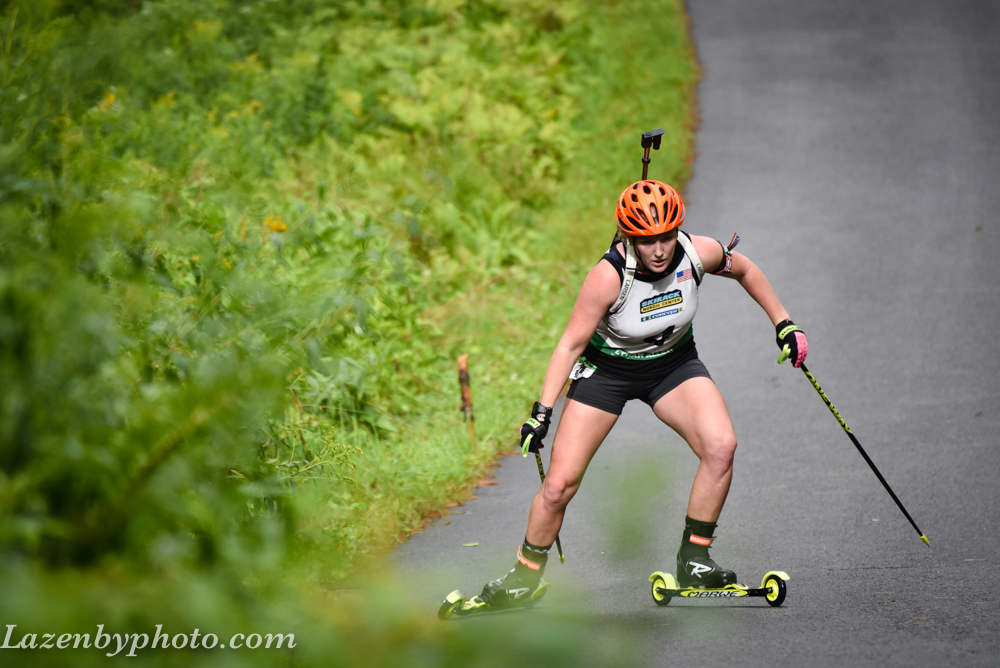
Maddie Phaneuf (USBA/PBSC) racing to fourth in the women’s mass start last August at 2017 US Biathlon Rollerski Championships in Jericho, Vt. (Photo: John Lazenby/Lazenbyphoto.com)
Nominated to US Biathlon’s X-Team in 2014, Phaneuf climbed the ranks and to reach A-team status last season. Last month, she was named to the B-team, part of the US Biathlon’s top-tier High Performance Team. While continuing to train and race with the national team, she planned to move from Lake Placid, N.Y., to her new training base in Boulder, Colorado, this summer.
New York’s North Country, where Old Forge is located, is a reliably conservative region. At least on electoral maps, the politics can skew towards an anti-climate-change perspective. However, Phaneuf said she has felt backed by Old Forge as she explains her point of view to others.
“My hometown is very supportive of me,” Phaneuf said. “I went into the local school and they were excited to learn about my climate-change presentation. But I am sure there are parents that don’t necessarily agree with what I am saying, but they are not going after me.”
Politics and athletics can be a non-starter for athletes. Being outspoken about a cause, in particular, one as divisive as climate change, can alienate an athlete — especially on social media. But Phaneuf has used the resilience she has developed in the fickle sport of biathlon to weather the storm and move forward with her activism.
Phaneuf admits she is still learning how to navigate the potential minefield of exercising her free speech. This past February, Phaneuf penned an op-ed piece for Syracuse.com, expressing her belief that change must be enacted to save winter, and by extension, our ability to sustain the winter sport economic engine and way of life in places like the North Country.
Phaneuf was eventually alerted to the many negative comments her piece received when she posted it on her personal Facebook page.
“I went to the article and 90% of the comments were bashing me,” Phaneuf explained. “Saying I am too young, I have never experienced anything — what am I talking about? Not even bashing climate change but bashing me personally … When I shared the climate-change article I wrote, one guy replied something like, ‘What’s up? You are not posting things about the Olympics. This is bullshit. I don’t want to read this. I want to follow you.’ I replied, ‘OK, the Olympics are over. It’s my offseason. I think it is irrelevant to post things about the Olympics right now because we aren’t there. And I want to show my followers what I do in my free time. Just because you are an athlete doesn’t mean you can only post about training and racing.”
Phaneuf recognizes that her Olympic-team nomination has given her more exposure. She said her Facebook page went from 1,000 to 4,000 likes during the 2018 Olympics in February. As she had matured, Phaneuf explained she’s become wiser when it comes to engaging detractors.
“I have been trying better than in the past,” Phaneuf said. “In the past, I would reply to all the comments kind of aggressively, like ‘what do you mean?’ But now I take a step back and simply read the comments. I understand everyone on the internet is human and all have their own opinion. I just try to not respond unless they are trying to put words in my mouth or saying other things about me, then I will respond and clarify the facts in a respectful way.”
The halls of Congress, on most days, are not the wild west of internet commenting. The tone is soberer. There is the understanding that change comes about from the steady persistence of advocacy, lobbying and voting at the ballot box.
Two weeks ago in D.C., the talking points for Phaneuf and the other athletes present were clear They were to speak about the following: What impacts have they witnessed regarding climate change? How is climate change impacting their sport? How might climate change impact future Winter Olympics?
The athletes also spoke of the regional economic boost snow availability brings certain regions across the U.S. (POW and Citizens’ Climate Lobby cite that in New York alone, the outdoor-recreation economy contributes $41.8 billion dollars and provides 313,000 jobs.)
US Biathlon’s Maddie Phaneuf outside the D.C. office of U.S. House Representative Elise Stefanik (New York). (Photo: Barbara Weber/Protect Our Winters)
The Congressional briefing was a bipartisan event sponsored by Senator Michael Bennet of Colorado and Senator Susan Collins of Maine. The athletes also met with Senator Tina Smith of Minnesota, Senator Dean Heller of Nevada, Congresswoman Elise Stefanik from Phaneuf’s district in New York, Congressman Scott Tipton of Colorado, and Congressman Mark Amodei of Nevada.
“It was good,” Phaneuf said on April 26, the day after her D.C. experience. “I was definitely nervous going into it. I had never been in the position of talking directly to congresspeople or senators. They definitely heard our message. It was definitely more chill than I expected it to be. I was afraid it was going to be judgmental and scary. … The biggest part of our day was simply talking about our own experiences with climate change. And not getting too much into the politics.”
Although Phaneuf has chosen to emulate a long line of athlete activist, her biathlon career remains a priority as she transitions from upstate New York and her residency at the Lake Placid Olympic Training Center to her new base in Boulder.
Phaneuf’s B-Team status comes on the heels of what she calls her “worst season ever”. Although qualifying for Olympics, Phaneuf said she struggled before the Olympics and spent her time in PyeongChang, South Korea, bedridden.
“I struggled a lot with fitness last summer and lost tons of training,” Phaneuf said of the start to her 2017/2018 racing season. “Then I didn’t make the World Cup team in the first period, and then I made the IBU Cup team, but was not performing well and barely made the Olympic team. [In PyeongChang] I got sick the day of my first race and got strep throat and a virus on top of that. I was totally out for two weeks. Being at the Olympics and being around that atmosphere and being so close to racing — having that stripped away from me, made we want to figure how to get better at training and do a lifestyle change. This is why I am moving to Boulder.”
A new training season has begun for Phaneuf. In the meantime, she’ll be juggling her sport with her more seasoned political voice.
“I don’t think I have ever voted in midterm elections,” Phaneuf said of the midterm elections set for this November. “I don’t think I ever thought of it as a big deal. So we are are trying to get the word out because it is a big deal. We want to elect people who will actually listen to us.”
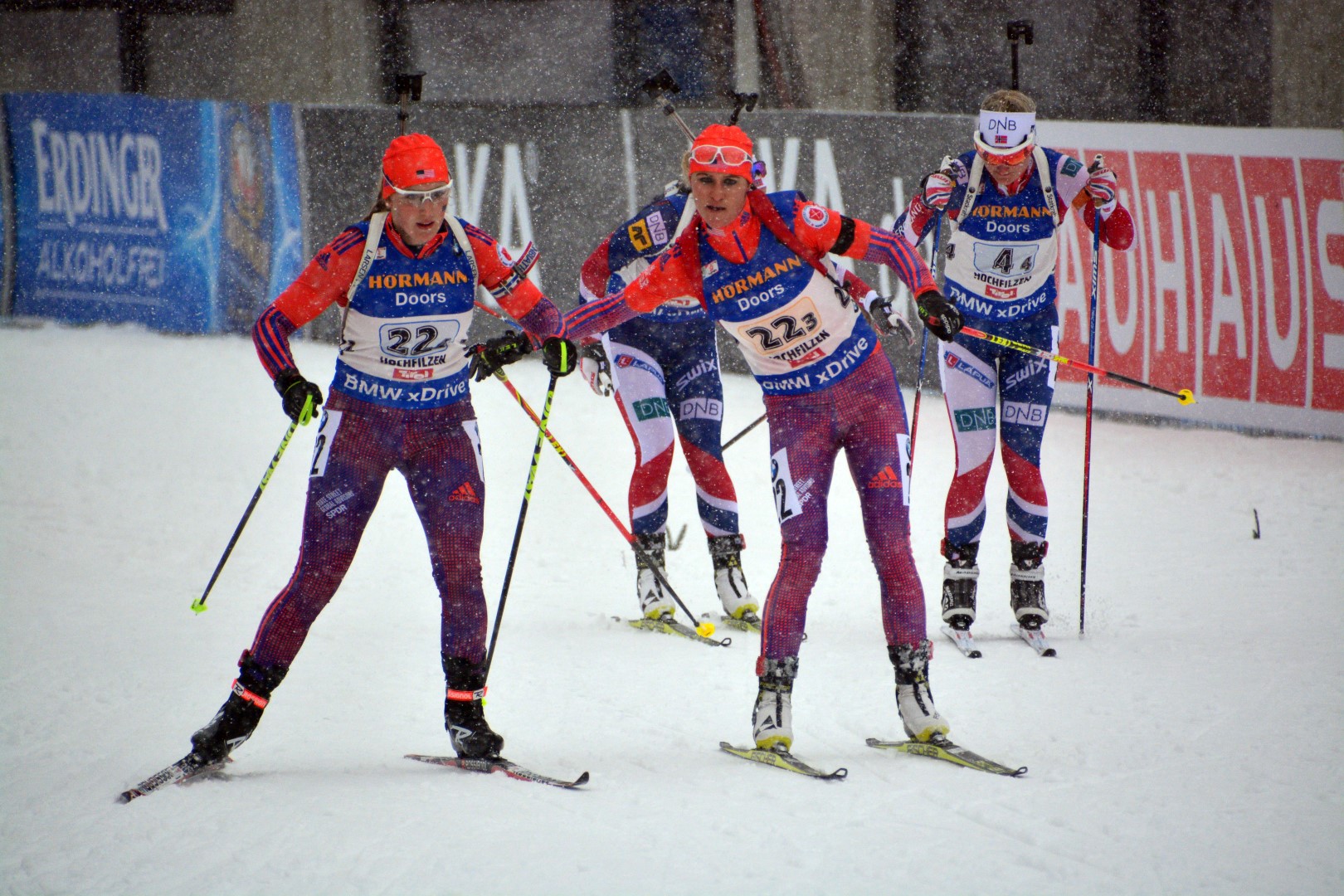
US Biathlon’s Maddie Phaneuf (l) gets tagged by teammate Joanne Reid during the final exchange of the women’s 4 x 6 k relay at 2017 IBU World Championships in Hochfilzen, Austria. The team finished 14th. (Photo: Glen Crawford)
FasterSkier’s 2018 Canadian Breakthrough Skiers of the Year are Zina Kocher (l) and Collin Cameron. (Photos: Mario Walker & Scott Grant/Canadian Paralympic Committee)
With the 2017/2018 season officially in the rearview, FasterSkier is excited to unveil its annual award winners for this past winter. Votes stem from the FS staff, scattered across the U.S., Canada, and Europe, and while not scientific, they are intended to reflect a broader sense of the season in review. This set of honors goes to Canadian athletes in any disciplines who had a major breakthrough at some level of competition.
Four years ago, Collin Cameron didn’t really know what cross-country skiing was. At least, he didn’t know that it was a sport he could do.
“I did not even know paranordic was a thing, to be honest!” the Canadian wrote in an email last week. “At that time I was just starting to play sledge hockey provincially for our local team here in Sudbury, just for fun.”
But he since found a local group to try Para-Nordic, and was then recruited onto the Canadian Para-Nordic National Ski Team.
Canada’s Colin Cameron racing to bronze in the men’s 7.5 k sitting biathlon sprint at the 2018 Paralympic Games in PyeongChang, South Korea. (Photo: Scott Grant/Canadian Paralympic Committee)
In March, he became a multiple Paralympic medalist when he won bronze in both the 7.5 k and 15 k sitting biathlon competitions.
At the end of the Games, he picked up another bronze in the open relay, where he teamed up with Brian McKeever. In a four-leg relay, they were one of only two teams to enter with just two athletes, and each raced two different relay legs.
“Being a part of the open relay team with Brian, and his guides Graham [Nishikawa] and Russell [Kennedy], was something really special and I will never forget it,” Cameron wrote. “Getting my third Paralympic medal with those guys was pretty cool… just being a part of this amazing and successful team of athletes, techs, and coaches has to a favourite moment. Getting to see my teammate and travel roommate Mark Arendz finally earn his first gold medal was really, really awesome!”
Although he is fairly new to Para-Nordic sport, Cameron’s success wasn’t completely unanticipated. Last season, he won a World Cup race on the same terrain in PyeongChang.
“Going into the Games, I had one major goal of winning the sprint race I won at the test event the year before,” Cameron explained. “I had to settle for 4th, only 0.7 seconds off the podium. Aside from that single race, my other goal was to finish in the top 10 in all races I entered.”
As any athlete will tell you, an Olympic or Paralympic medal is a much different animal than getting on the podium at a World Cup race. And Cameron found that to be true, too, when he returned home to Canada.
“It’s been quite overwhelming to be honest,” he wrote. “I didn’t expect anything like the receptions I’ve received, and it’s really inspiring to see the way the community in both my hometowns have followed mine and the team’s success at the Games. I definitely could not have done this without the huge and overwhelming support from everyone here.”
His next goal is 2019 World Championships, which will be held in Prince George, British Columbia.
“I am very fortunate to be able to work with some of the best technical skiers and coaches in the world, that have greatly aided in the whole transition of making myself an endurance athlete…that being said there is still lots of work to do!”
Zina Kocher, Foothills Nordic
Yeah, Zina Kocher is 35. Yeah, she’s a three-time Olympian. But she did something brave this year.
The former biathlete, who had retired in 2016, decided to become a cross-country skier and try to make a fourth Canadian Olympic team. She had been thinking about giving it a go, and discussing with longtime coach Richard Boruta.
Zina Kocher racing at Olympic Trials at Mont Sainte Anne. (Photo: Mario Walker/NorAm MSA 2018 Facebook)
In some ways, things didn’t work out. She went to Olympic Trials in Mont Sainte-Anne, Quebec, knowing that it was a long shot — the race formats were heavily skewed towards classic, something that Kocher hadn’t done competitively for years, even though she has long been one of the fastest skate skiers in the country.
She didn’t make the Olympics. And it might have ended there, but it didn’t.
“After the selection races, I felt settled, ready to go back to ‘retirement’ or back to my previous next phase and other life goals and stop following, let’s say, a set training plan,” Kocher wrote in an email last week “But then I thought it would be fun to race the NorAm in Red Deer [Alberta], since that’s where I’m from and where I started xc skiing many many years ago! I hadn’t raced there since I was in high school. And then I thought oh Nipika loppet, never done that, why not. And then decided last minute to go to Gatineau Loppet when my friend Kamila (my past coach Richard Boruta’s widow) said she was going and I should come.”
So, a season that had started with one goal — make the Olympics — went on.
At that point, Kocher was leading the NorAm series, and found out that as a result she had an automatic spot to race on the World Cup for the last competitions of the season: the Holmenkollen 30 k freestyle mass start in Oslo, Norway, and World Cup Finals in Falun, Sweden.
“Well, the Holmenkollen is legendary and an awesome opportunity,” she wrote.
Kocher had raced there many times before, as a biathlete. Doing so as a skier was a new experience.
“We had tons of fans cheering us on, pushing us up those big climbs!” she wrote. “I didn’t feel like I was in the best race shape that day, but I gave what I had for a 5 k pace that lasts for a torturous 30 k … and my body went into some sort of shock post race, but that’s another story.”
Despite that, she was the top finisher among the other different Continental Cup leaders.
And then, on to Falun, where she had to do a classic World Cup race because it was part of a mini tour.
“One big thing I went though [this season] was facing a fear of being last,” she wrote. “That sounds a bit crazy to say, but I think it’s probably an honest statement for many athletes. No one wants to come last, but someone does! Printed in ink, on a computer screen, it’s there for all to see! … I was terrified of doing a 10 k mass start classic in Falun, and I knew I would probably be last from the start. I was. In the end, it wasn’t so terrifying and I made it to the finish line. Having accomplished it, felt pretty darn good even though it was a bit of a solo 10 k. The fans and coach Babs [Ivan Babikov] were incredible cheerleaders!”
Now, it’s back to retirement for Kocher. One of her top memories from the season was that Gatineau Loppet.
“After some contemplation today, I think my favourite moment was doing the 50 k Gatineau Loppet,” she wrote. “Not because I won (great too of course), but because it was a great atmosphere, and it was cool to do a race point-to-point and with a mass… and because I was with Kamila and her friend Lukas. Lukas was actually racing on Richard’s old skis, doing his first ski loppet (he raced both days). Kamila didn’t think she’d be able to do any racing this winter, so it was wonderful to see her do what she loves again, and she even won the overall (both days – skate & classic 50). It was a bit of an emotional weekend. And felt like a great Richard tribute weekend.”
Honorable Mention: Russell Kennedy, Team R.A.D. & Canadian Para-Nordic Skiing (guide)
Kennedy accomplished a rare feat this season by competing at both the 2018 Olympics and Paralympics.
“I’ve been on my own schedule this year because the Team R.A.D. is mostly younger athletes and … I have to do my own thing because I’m going for the Olympics,” Kennedy, last season’s overall NorAm winner, said at the beginning of the season. “So it actually works better for me to be training with Brian [McKeever] because he has similar goals as me.”
Canada’s Brian McKeever (r) and Russell Kennedy receiving their gold medals from the men’s visually impaired classic sprint at the 2018 Paralympic Games in PyeongChang, South Korea. (Photo: Scott Grant/Canadian Paralympic Committee)
As the NorAm winner, Kennedy started the season on the brutally competitive first period circuit of the FIS Cross Country World Cup. There, he had a top finish of 48th place in a skate sprint in Davos, Switzerland. It was only his second stint of European World Cups, after competing in Drammen and Oslo last winter.
Kennedy returned to Canada and secured his Olympic spot by winning the sprint qualifier at Mont Sainte Anne and placing second in the sprint final. Two weeks later, he picked up two second-place finishes in NorAms in Red Deer.
From there it was to the Olympics, where the 27 year old helped the Canadian relay team to ninth place, and as an individual finished 49th in the 50 k and 54th in the sprint.
Then it was the Paralympics, which had long been part of the season plan. Kennedy was one of two guides for visually-impaired skier Brian McKeever, and as such picked up a collection of Paralympic gold medals (along with Graham Nishikawa, McKeever’s other guide). It was the third straight Paralympics where McKeever went undefeated – he now has 13 gold medals.
“These sprint races are miserable,” McKeever said after crossing the line with Kennedy for gold in the sprint, according to a team press release. “They are so hard. The young guys are fast, and have natural snap. There is so much stress in sprint racing, and it goes all day long. I’m much more comfortable with the longer distances, but it was a great day for us. Russell carried the load for us today, and just thrilled we were able to cross the line first.”
“It is hard to describe the mental states I went though the past couple months,” Kennedy recently wrote on his blog. “From being told that I didn’t make the team to making the Olympic team, feeling like I was getting sick then coming back to some of the better races of my life… There were days I woke up and wondered if it was worth it and if the hard work would pay off or if I was just blowing money on something that I didnt have in me… When I fell in love with training though I knew I was doing the right thing. So fall in love with the process dreamers, when you do you will have all good days!”
Honorable Mention: Natalie Wilkie, Canadian Para-Nordic Skiing
Natalie Wilkie is just 17 years old, but she’s a Paralympic gold medalist.
In the final individual competition of the 2018 Paralympics, Wilkie topped the results sheet in the 7.5 k standing classic race – leading her teammate Emily Young onto the podium in the process. Wilkie was the gold medalist by just 1.6 seconds in an extremely exciting competition.
Canada’s Natalie Wilkie (r) finishing third, just 0.1 seconds behind Norway’s Vilde Nilsen (l) in second, for her first Paralympic medal in the women’s 1.5 k standing classic sprint in PyeongChang, South Korea. (Photo: Scott Grant/Canadian Paralympic Committee)
“This is crazy awesome,” Wilkie said in a press release after the race. “I didn’t think this would happen at all. I’m only 17 and this is my first Paralympics… The difference today was double poling. I just kept telling myself to pretend I was elbowing my older brother.”
She has even inspired older members of the team, too, including 27-year-old Young, who was just a tenth of a second away from silver in that race.
“What would Natalie do?” she said in the same press release. “I just kept saying ‘What would Natalie be doing.’”
Earlier in the Games, Wilkie had won bronze in the sprint. And to close things out, she helped the Canadian mixed relay team – with Young, Chris Klebl, and Mark Arendz – to silver, the first relay medal the country had ever won at the Paralympics.
“What Mark, Chris and the girls did in that first relay was awesome,” McKeever, who teamed up with Cameron for a second relay medal later that same day, said in a press release.
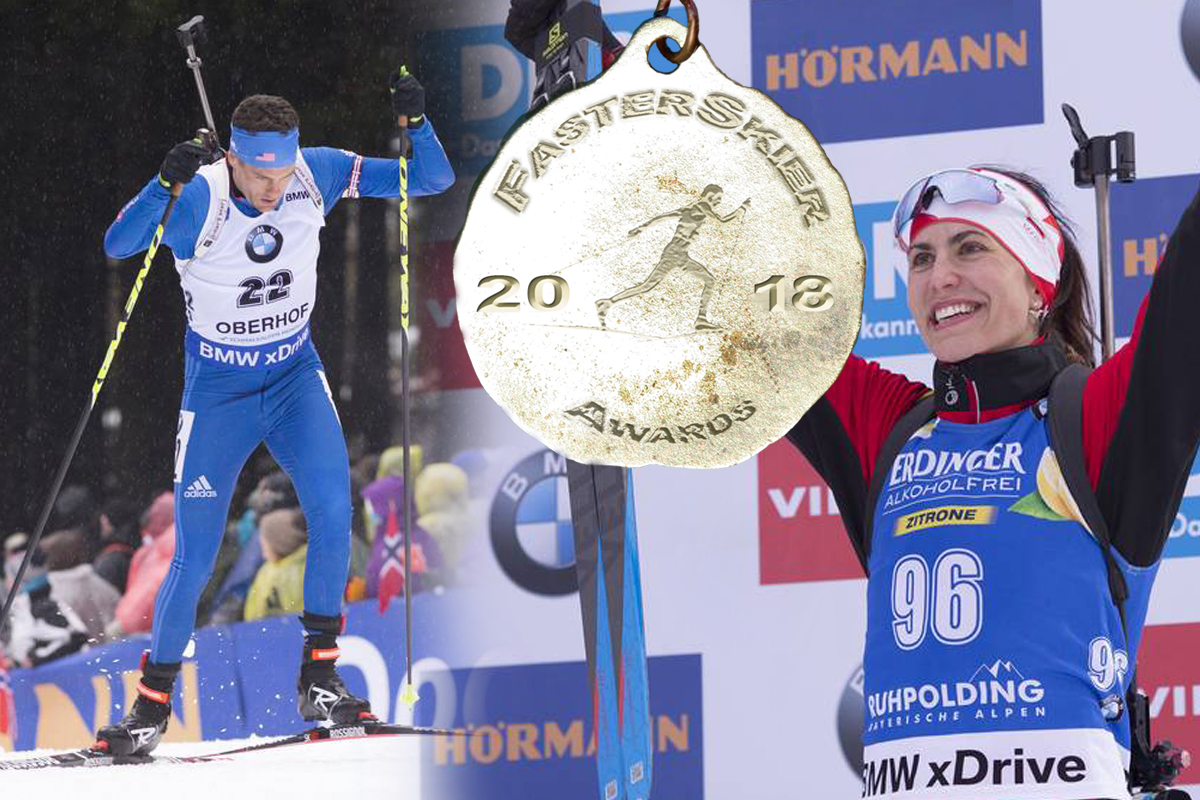
Tim Burke of US Biathlon (left) and Rosanna Crawford of Biathlon Canada (right) are FasterSkier’s 2018 Biathletes of the Year. (Photos: USBA/NordicFocus; Salomon/NordicFocus)
With the 2017/2018 season officially in the rearview, FasterSkier is excited to unveil its annual award winners for this past winter. Votes stem from the FS staff, scattered across the U.S., Canada, and Europe, and while not scientific, they are intended to reflect a broader sense of the season in review. This set of honors goes to outstanding North American biathletes on the international circuit.
***
Rosanna Crawford, Biathlon Canada
Rosanna Crawford had been close to the podium before, coming into this season. Fourth place. Fifth place.
But then she had a disastrous 2017 season that left her in tears after World Championships, wondering what had gone wrong. After that, she lost her brother, as the Crawford family endured heart-rending tragedy.
Rosanna Crawford celebrates with her Biathlon Canada teammates Emma Lunder (l) and Julia Ransom (r) after placing third for her first-career IBU World Cup podium on Thursday in the women’s 15 k individual in Ruhpolding, Germany. (Photo: Salomon/NordicFocus)
All of that might have stopped some people, but not Crawford. In Ruhpolding, Germany, she finally scored that podium – in a race so tough it’s only held a few times a season, the 15 k individual. She shot a perfect 20-for-20 to take third place, 21.2 seconds behind Dorothea Wierer of Italy.
“There’s just so many lessons you learn over the years, and trying to bring it all together and to have it pay off on one day is exactly what we’re all hunting for out there,” Crawford said after her podium.
Later that weekend she again shot 20-for-20, this time in the mass start. She left the range the final time in first place, but was passed by three other women on the final loop and had to settle for fourth.
“I was really surprised to leave the range in 1st, these are the 30 best women in the world,” Crawford wrote in an email after the mass start. “I would have love to hold onto a podium, but was pretty dead on my last loop… I was pretty disappointed when I crossed the line in fourth, but as time went by I got more and more happy. To have hit another 20/20 is fantastic, especially in the high pressure situation of a Mass Start. With that race I went 50/50 in Ruhpolding!”
It was an up-and-down season for Crawford, who finished no better than 39th in the first period of World Cup racing and was sent down to the second-tier IBU Cup. But she excelled there, and then came the races in Ruhpolding.
From there she headed to the Olympics – her third – and had a poor sprint race, finishing 53rd with three penalties. It was devastating, but she came back and climbed all the way up to 19th in the pursuit, the biggest improvement in the whole field.
“I had some really good chats with my sister Chandra,” Crawford said after the Olympic pursuit. “She’s a huge motivator for me and my biggest cheerleader now. She really just talked some sense into me to not be so down on myself after the sprint, so that was really helpful.”
Immediately after the Olympics, Crawford finished 12th in the sprint and 11th in the mass start in Kontiolahti, Finland, before finishing the season off in Oslo. She has still not announced whether she will continue competing next year, or retire.
But crossing the finish line in third in Ruhpolding was an unforgettable highlight, either way.
“[Teammates] Julia [Ransom], Emma [Lunder] and Sarah [Beaudry], they kind of pushed past the IBU guys, which I don’t think they were allowed to do, but Canada’s not on the podium every day so they let them sneak by to give me a hug so that was really special,” Crawford told FasterSkier. “I’ve been with these girls the past couple years now and so to be able to celebrate with them is amazing. Their results have been so inspiring for me … [My coach Roddy Ward] also jumped the fence, which I don’t think was allowed, so that was nice to be able to see him as well.”
Tim Burke, US Biathlon
While Crawford was finally hitting that career mark, U.S. Biathlon’s Tim Burke was getting his mojo back. After a frustrating few seasons, Burke rallied for the 2018 Olympics, his fourth.
Tim Burke (US Biathlon) racing to 14th in the men’s 12.5 k pursuit at the IBU World Cup in Oberhof, Germany. (Photo: US Biathlon/NordicFocus)
Along the way, he amassed some strong results: tenth in the sprint in Annecy, fourth in the sprint in Oberhof. The Oberhof sprint was his best result since 2013.
It came on a course with a personal connection, as his wife, Andrea (Henkel) Burke, had her home training base in Oberhof.
“I have spent a lot of time training here over the last eight years,” Burke laughed. “It’s Andrea’s home town and I feel like the fans out there today were really behind me from the start, because of Andrea. So be able to have the best performance of my season and my best performance in a long time here was for sure special.”
Burke didn’t set a best-ever U.S. mark for himself at the Olympics, with a top finish of 17th in the pursuit. Like Crawford, he made the best of things after a disappointing Olympic sprint, in his case having finished 47th in the opening competition.
“I was disappointed in the result not the performance,” he said of the sprint, after improving in the pursuit. “I felt like I executed well. I felt like I hit my cues on the course and on the range, and it just didn’t happen yesterday. The game plan going into today, there was nothing new. Stick to the things that have been working well for me in the World Cup, and that’s what I did.”
In PyeongChang, he contributed to a U.S. men’s relay team which finished sixth, tying the best ever team result at an Olympic Games.
A few weeks later, in his final race before retiring, he went out and did some solid biathlon, helping the team to seventh in the World Cup relay in Oslo.
Burke’s career has had many individual highs – six podiums including a World Championships silver medal in 2013, and a brief stint in the overall World Cup leader’s bib – but this season, it was his team efforts that were some of the best.
“The Olympic relay, we were very happy with,” he said in Oslo. “The sixth place there [in PyeongChang, South Korea], we were right there. That was a great race for us, but this is solid as well… I’ve been here a long, long time, and an top eight today is very different than a top eight when I came on the World Cup 14 years ago. It’s so close now. There’s so many good teams. So it’s a solid result.”
Honorable Mention: Susan Dunklee, US Biathlon
Burke’s teammate Susan Dunklee saved the best for last this season, hitting the podium for the first time since winning silver in the mass start at last year’s World Championships.
Susan Dunklee racing to 20th in the mass start in Annecy, France. (Photo: Glen Crawford)
It was a tough start to the season for Dunklee, who tried to implement a new shooting strategy and saw it backfire, as she had a string of results no better than 53rd in the opening two weekends of racing.
But then she had a solid weekend in Annecy, France, finishing tenth in the sprint and sixth in the pursuit. A lifeline.
“After Thursday, I was just feeling relief, to be honest,” she said after the Annecy pursuit. “It’s so huge to get a top ten and then get a flower ceremony today.”
Two months later, Dunklee had an athlete’s worst nightmare and got sick at the beginning of the Olympics, racing the opening sprint anyway but then finishing 66th and missing the pursuit. In the 15 k individual she placed 19th, and she led the women’s relay at one point.
“I often start feeling stronger and stronger as the season goes on, and this season it took a little longer,” Dunklee explained. “I had a lot of sickness, and some frustrating shooting days early in the season that made it hard for me to keep going.”
After the Games, she finished 36th in the sprint in Kontiolahti despite still getting over (another) illness, then came to Oslo and placed fourth in the sprint and third in the pursuit, in a podium that only appeared thanks to clean shooting in the final stage where others faltered.
“It doesn’t really matter what everybody else is doing, you just have to try to put the best race you can,” she said of landing on the podium despite two penalties. “Sometimes you have a perfect race and five other people do too, and then you are sixth. But some days you don’t have a perfect race and you end up third.”
Like Crawford, Dunklee hasn’t announced whether she will keep racing next season. If not, her last World Cup memory will be sharing the podium with Anastasiya Kuzmina and Darya Domracheva. Not bad.
Honorable Mention: Scott Gow, Biathlon Canada
Canada’s Scott Gow just keeps improving, and this season was no exception. Early on he had two career-best performances: 16th in the sprints in both Östersund and Annecy.
Scott Gow (Biathlon Canada) after placing 16th in the IBU World Cup men’s sprint on Friday in Annecy, France. (Photo: Glen Crawford)
But the biggest career-best also came on the biggest stage. At the Olympics, Gow shot 19-for-20 in the 20 k individual to finish 14th, the best performance by any North American in PyeongChang.
He had started the Games with 61st in the sprint – maybe the worst place to finish, just one spot (in his case one tenth of a second) out of the pursuit.
Gow re-tooled and started focusing on the 20 k.
“When it’s this calm, relatively as calm, everyone can shoot well,” he said after that race. “So that puts a little extra pressure and emphasis on myself to shoot well. So going into today I knew that would be have to the focus, to hit targets, because even if my skiing is a little off I can make up for it with a really good shooting. And that was what was going through my head the last few days preparing for this.”
Plan achieved, mission accomplished. Except that one shot.
“I was very happy with it,” Gow said, noting that even a career-best at the Olympics wasn’t perfect. “A little disappointed to miss that one standing shot, especially when everything was going quite well in the range. Skiing was pretty good, and so overall I am very happy.”
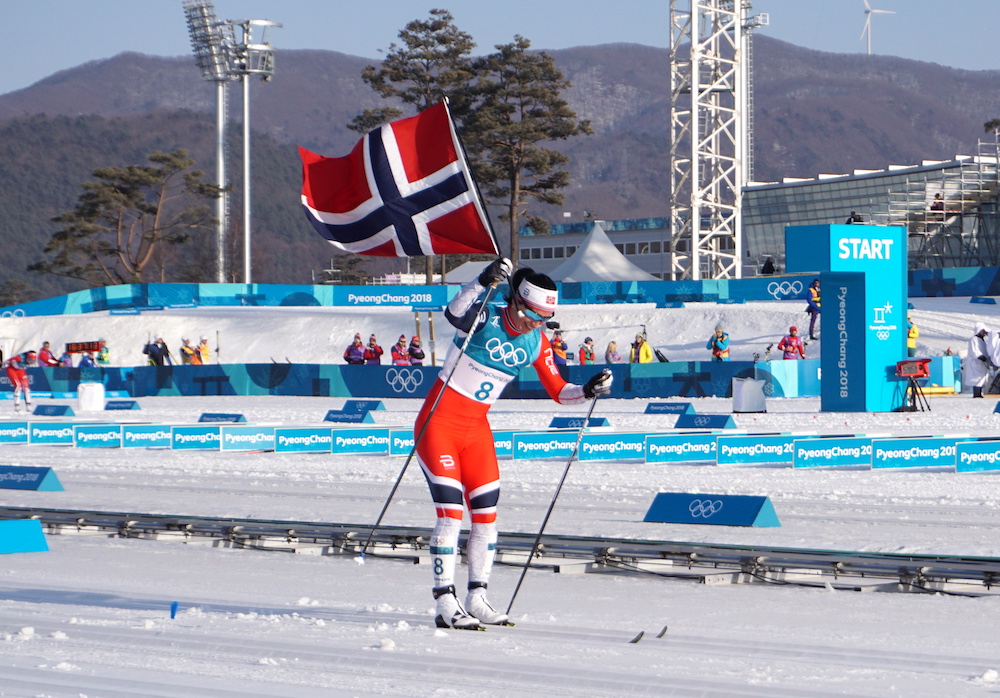
Marit Bjørgen approaches the line for her eighth-career Olympic gold (and 15th medal) with a win in the final race of the 2018 Olympics, the women’s 30 k classic mass start, on Sunday in PyeongChang, South Korea. (Photo: Noah Hoffman)
Marit Bjørgen went out with a bang. Skiing in presumably the final Olympics race of her illustrious career, the most-decorated Winter Olympian in history simply skied away from a strong field less than 10 kilometers into Sunday’s 30 kilometer classic mass start, earning the 15th Olympic medal of her career (and eighth gold) in dominant fashion.
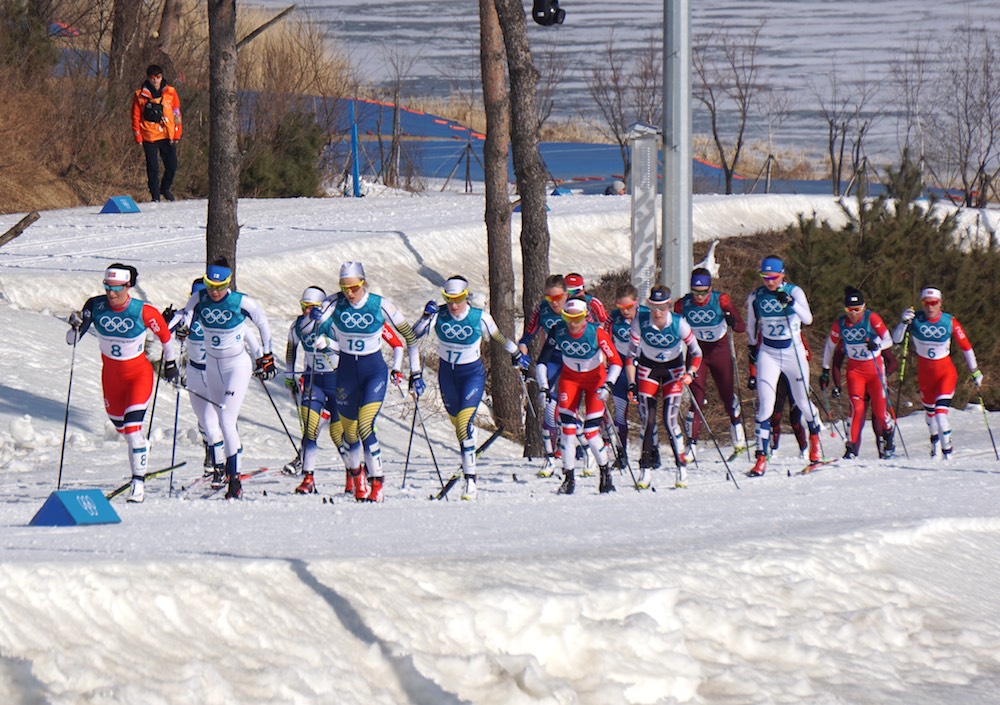
From right to left: Norway’s Ingvild Flugstad Østberg leading Finland’s Kerttu Niskanen and Krista Pärmäkoski, Sweden’s Stina Nilsson, and Austria’s Teresa Stadlober (r), among others in the women’s 30 k classic mass start on the final day of the 2018 Olympics in PyeongChang, South Korea. (Photo: Noah Hoffman)
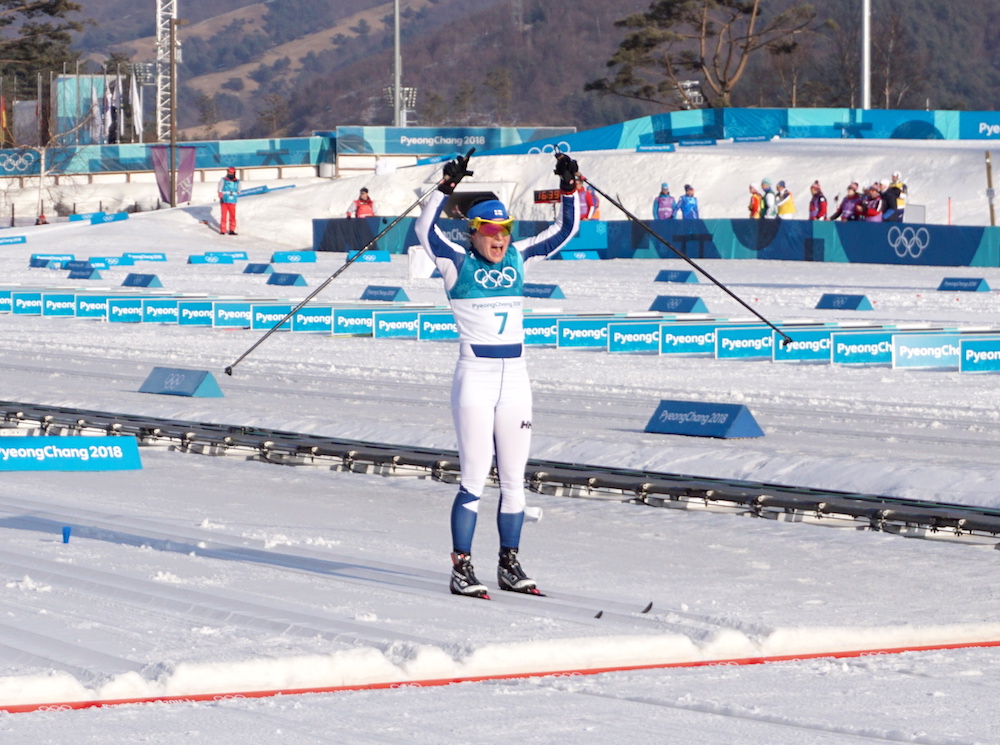
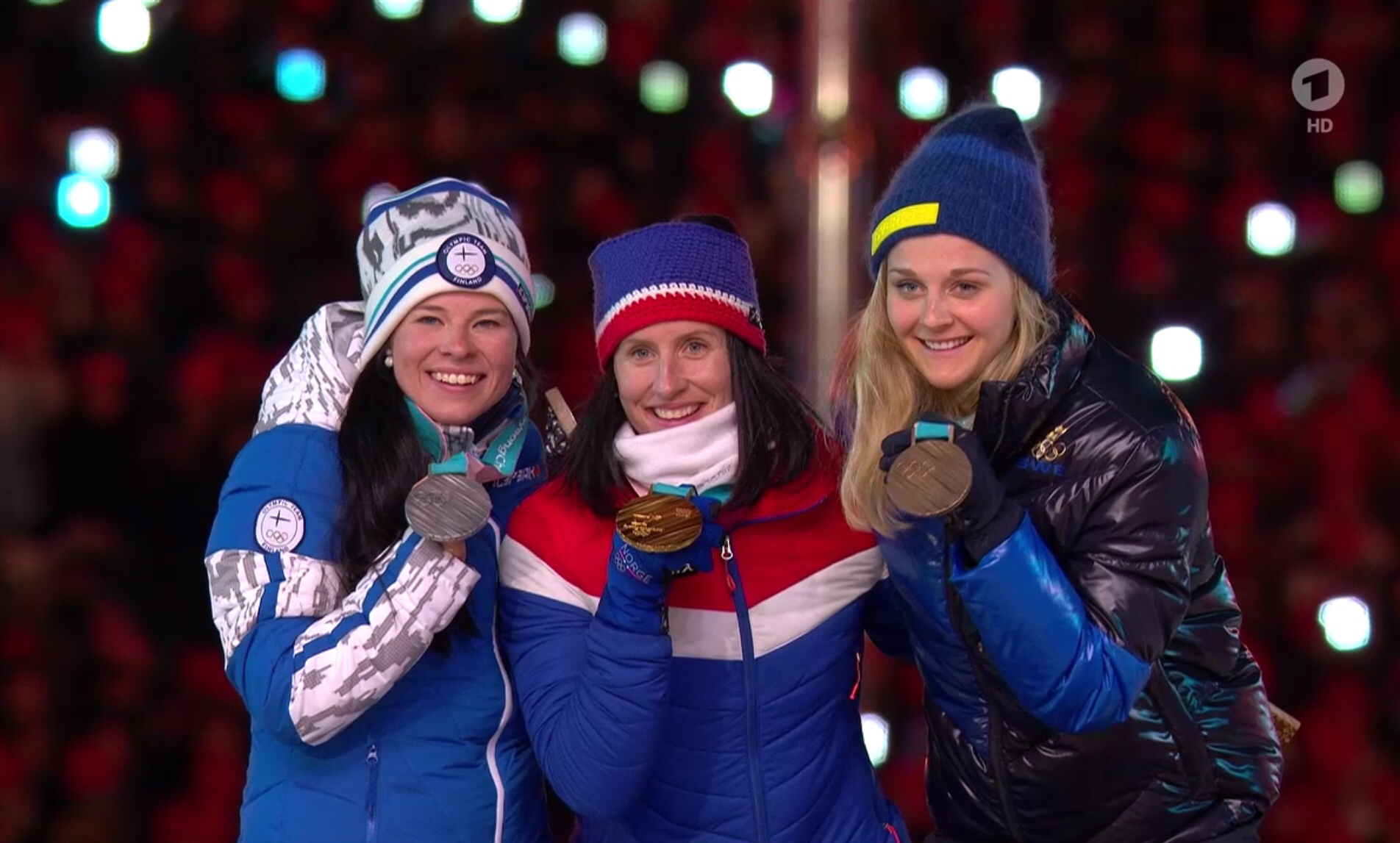
Behind her, Finland’s Krista Pärmäkoski (+1:49.5) and Sweden’s Stina Nilsson (+1:58.9) rounded out the podium, with Nilsson breaking away from Norway’s Ingvild Flugstad Østberg (+2:00.4) within the stadium to edge her out for third.
Fifth went to Charlotte Kalla of Sweden (+2:57.2), with Kerttu Niskanen of Finland sixth (+3:01.6). Jessie Diggins was seventh (+3:37.2), in an American performance that would have been lauded just a few years ago yet somehow represented her worst placing in all six races at these Olympics.
Heidi Weng of Norway (+4:07.9) in eighth, Teresa Stadlober of Austria (+4:14.1) in ninth, and Masako Ishida of Japan (+4:20.8) rounded out the rest of the top ten. Stadlober’s ninth-place finish was particularly poignant; she was holding steady in silver-medal position through 20 k, before taking a wrong turn at an ill-marked course intersection and losing well over a minute returning to the correct track.
Norway’s Marit Bjørgen (l) leading the pack during the women’s 30 k classic mass start at the 2018 Olympics in PyeongChang, South Korea. (Photo: Scott Patterson)
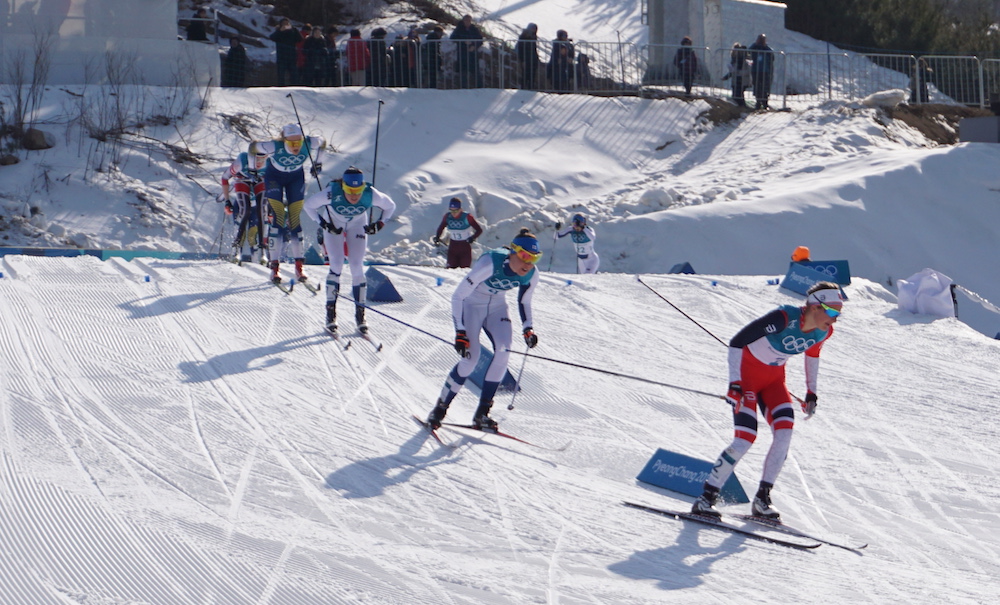
But let’s go back to Bjørgen. Given those time gaps by the finish – nearly two minutes clear of second and third – this was clearly Bjørgen’s day. The 37-year-old Norwegian mother started in bib number 8, and was all of 1.1 seconds off the lead by the first checkpoint, less than one kilometer into the race. But after that… Bjørgen led by 2.3 k, midway through the first of four 7.5-k laps. Bjørgen led at 5 k. Bjørgen led at 7.5 k. Bjørgen led at 8.4 k. And so on. It was not literally a wire-to-wire victory, but it was pretty darn close.
The race went from a mass start contest to a solo endeavor at roughly 9.5 kilometers in, midway through the second lap. Bjørgen simply surged ahead, and immediately opened up a small gap. By 9.8 k, the gap was 7 seconds. By 12.5 k, it was already up to 33 seconds. By 15 k, the advantage had swelled to 51 seconds. Bjørgen was putting nearly 10 seconds per kilometer on a chase group composed of Olympic medalists and World Championships podium finishers.
With all due respect to Iivo Niskanen, the hero of Saturday’s courageous breakaway in the men’s 50 k classic, Bjørgen’s performance never felt in doubt the way Niskanen’s did. Bjørgen didn’t have any company, for one, and she had a shorter distance to cover, for another (“only” 20 k of solo skiing off the front). But mostly, well, she is Marit Bjørgen, the most dominant cross-country skier of all time.
Bjørgen’s gap stretched to as great as 2:04 by the 27.5-k mark of the course. Finally, approaching the finish, she slowed slightly over the last few hundred meters, accepting a large Norwegian flag from a Viking helmet-clad fan and beaming as she carried it across the finish line. Her final time was 1:22:17.6. If they were the final 82 minutes of racing of a five-Olympics career, they were an exceptionally dominant 82 minutes.
Behind her, a four-woman chase pack formed: Pärmäkoski, Kalla, Niskanen, and Stadlober. As late as 20 k, Kalla was still in seventh, nearly two minutes back of Bjørgen and roughly 35 seconds back of Stadlober in second.
Soon after this, Stadlober took her wrong turn, skiing for some distance on the wrong course before having her error pointed out to her by a courseside coach or tech. She dropped from second to eighth within a kilometer.
Reportedly, Austrian coach Markus Gandler was out on the course and the first to inform her of her mistake, yelling, “You are wrong!” She realized her mistake and turned around.
“We were preparing the feed and noticed she didn’t come,” Gandler told Austrian broadcaster ORF, according to a translation. “I ran over but she didn’t hear me while skiing up. Only on the downhill I caught her.”
“I don’t know if I should laugh or cry,” Stadlober told ORF after, according to a translation. “I can’t explain it to myself. I have been here for three weeks and if by now I don’t know the loop then I don’t know … I noticed skiing up that something wasn’t right because there was no more staff. When I looked over I just thought: Sh*t!”
She said she had been feeling great up until that point and confident about her skis.
“I would have had the power, but had-I-would-I [what could have been] is too late now,” Stadlober said of missing out on her first Olympic medal. “That’s life. It’s just bitter it happened in such a race and on a day when everything would have fit together.”
Finland’s Krista Pärmäkoski celebrates her first individual silver medal which she claimed in the women’s 30 k classic mass start on Sunday at the 2018 Olympics in PyeongChang, South Korea. (Photo: Noah Hoffman)
By 21 k, Pärmäkoski had a 13-second gap over Niskanen in the race for second, and Kalla had moved up to sixth. By 25 k, it was still Pärmäkoski in second, but now Østberg and Nilsson skiing lockstep in the fight for third.
Pärmäkoski was never seriously threatened over the final lap, and crossed the finish line for silver.
“I think that this 30 k was [the] hardest 30 k race [ever] for me,” Pärmäkoski reflected in a post-race press conference. “Of course I heard that Nilsson and Østberg come behind me and I also heard that now it’s 11 seconds, and then 14 seconds. And after this big downhill I heard that it’s a little bit more, but because I know that they are good in sprint, I just hoped that they can’t catch me. This was a crazy, crazy Olympics for me. Before I came here I wanted to win one individual medal and now I won three medals, so I am really happy.”
In two Olympics, Pärmäkoski, 27, now has four medals — three of which came in PyeongChang (silver in the 30 k and bronze in the 15 k skiathlon and 10 k freestyle races).
Behind her, Østberg and Nilsson dueled for the final podium spot. But while Østberg was aware of it, Nilsson hadn’t heard about Stadlober’s wrong turn ahead of them.
Sweden’s Stina Nilsson (r) outlasts Norway’s Ingvild Flugstad Østberg (l) for bronze in the women’s 30 k classic mass start at the 2018 Olympics in PyeongChang, South Korea. (Photo: Noah Hoffman)
At the finish, Nilsson looked surprised when Bjørgen told her she had won the bronze. Bjørgen then went immediately over to console her teammate, Østberg, who finished fourth, 1.5 seconds behind Nilsson in third.
“I was quite sure that it was fourth. That I got the bronze was quite sick,” Nilsson told Norwegian broadcaster NRK, explaining that she thought the team staff was trying to give her false hope that a medal was within reach.
“I did not realize that Stadlober had gone wrong. I thought she had moved away,” Nilsson said.
But Østberg knew the bronze was between her and the Swede. “I definitely knew what I was fighting for. It’s amazing that she did not know, too,” Østberg told NRK.
Diggins would finish roughly 90 seconds later in seventh, 36 seconds behind sixth and 30 seconds ahead of eighth. The result was emblematic of her day, in which she had skied for much of the race entirely by herself.
Sadie Bjornsen was the next American, finishing in 17th (+6:32.6). The mid-teens result continued a trend at these Olympics; she was 14th in the classic sprint and 15th in the 10 k freestyle.
The third American on the day was Rosie Frankowski in 21st (+8:53.8). Forget first Olympic start for the 26-year-old Alaskan and Alaska Pacific University athlete (which it was), Frankowski has zero World Cup starts to her name. She was the second American in the 20 k classic at last month’s U.S. Nationals, though, behind Caitlin Patterson.
On Sunday Patterson was five spots behind in 26th (+10:26), after narrowly losing a sprint finish to Germany’s Victoria Carl.
For Canada, Emily Nishikawa led the way in 30th (+12:14.1). She was followed by Cendrine Brown in 43rd (+19:06.3), as Anne-Marie Comeau did not finish.
Also of note, Jessica Yeaton, who competes internationally for Australia but lives and trains in Anchorage with Alaska Pacific University, was 42nd (+18:37.2). And Petra Hyncicova, who skis in this country for the University of Colorado but races internationally for the Czech Republic, was 39th (+16:57.1).
The women’s 30 k classic mass start medalists at the 2018 Olympics Closing Ceremony, with Norway’s Marit Bjørgen (c) in first, Finland’s Krista Pärmäkoski (l) in second, and Sweden’s Stina Nilsson (r) in third in PyeongChang, South Korea. (Screenshot: ARD broadcast)
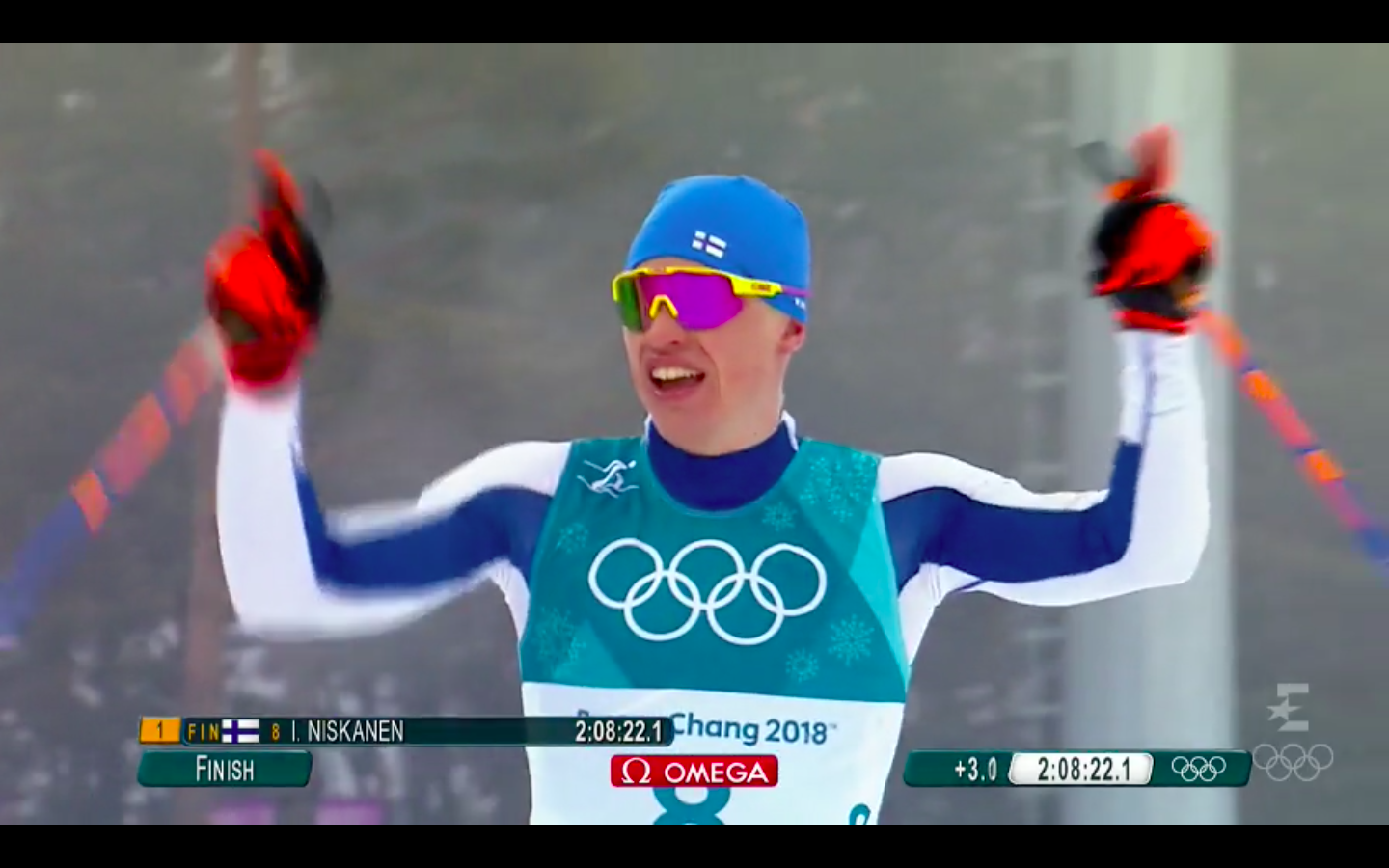
The 26-year-old Finn, skiing in his second Olympics, broke away from a well-credentialed chase pack at the 17-kilometer mark of Saturday’s Olympic 50-kilometer mass start classic race, then skied a courageous race from there to take the gold nearly 90 minutes of racing later.
He had some company, as Olympic Athlete from Russia Alexander Bolshunov made an equally gutsy move to bridge the gap up to Niskanen by 36 k. But Niskanen used a well-timed surge on the final uphill to come round Bolshunov with 1.1 k to go, and take the convincing win by the finish. Behind him, Olympic Athlete from Russia Andrey Larkov made a similar move on the final hill 2 ½ minutes later to come clear of a chase group and take the bronze.
But let’s back up. A field of 69 racers began the 50 k classic at 2 p.m. local time under cloudy skies, which ultimately gave way to heavy mist and light snow as the floodlights came on around 3:30 in the afternoon. It was the 23rd running of a race first held at the 1924 Olympics in Chamonix. Boldface names such as Bjørn Dæhlie, Gunde Svan, and Thomas Wassberg are among its historical champions. A Finn had not won this race since Kalevi Hämäläinen in 1960.
Norwegian Martin Sundby led a 23-racer pack through the end of the second lap, roughly 17 k and 42 minutes into the race. Niskanen was in seventh at this point, 2.5 seconds off the lead.
Less than a kilometer later, with nearly two-thirds of the race still ahead of him, Niskanen headed to the front. Moving quickly, he soon opened up a small gap over much of the rest of the field. Roughly five minutes later, around the 19-k mark, he began pushing the pace in earnest.
The field began to spread out almost immediately. Niskanen was closely followed by Alexey Poltoranin of Kazakhstan.
Niskanen and Poltoranin skied together throughout lap 3, their advantage soon growing to 20 seconds over the chase group. By 26 k, they had a gap of 25 seconds to Bolshunov in third.
At 27 k, Bolshunov set off on a courageous solo effort to reel in the two athletes in front of him, leaving Sundby to lead the chase group. Seven minutes later, Bolshunov had made up 25 seconds over less than three kilometers; he moved around Poltoranin, and set out to track down Niskanen.
Finally, at the 36 k mark, after roughly 10 k of solo work, Bolshunov had caught up to Niskanen. The two men skied together throughout the fifth and penultimate lap, Niskanen still in the lead until he finally moved aside, all but forcing Bolshunov to come round him and take the lead.
Bolshunov led through the second half of lap five, and appeared to be pulling away while Niskanen seemed to be tiring from the solo effort as well as fighting slick skis. As the two came through the stadium for a final time, 42 k into the race, they were over a minute clear of a fading Poltoranin, and more than two minutes up on the Sundby/Alex Harvey/et al. chase group. The final order of the medals was still up in the air, but gold and silver, in some order, seemed very likely to go to the two men in the breakaway.
Bolshunov led through the stadium the final time, where he did not avail himself of a final ski exchange. Behind him, Niskanen pulled over for new skis. Bolshunov, sensing the Finn’s absence, immediately put in a surge, and gapped Niskanen by roughly 11 seconds early in the final lap. But 8.3 k per lap is a long way, and Niskanen steadily worked to close the gap without panicking. By the 44 k mark, 2.3 k into the final lap and with a full 6 k yet to go, Niskanen had pulled back even with the Olympic Athlete from Russia.
The two men skied together for the next 4+ kilometers. Bolshunov appeared stronger, and is the better sprinter of the two, but Niskanen had experience. And fresh skis.
Suddenly, Niskanen went. With 1.1 k to go, going up the final hill for the final time, he surged hard, and immediately opened up a gap of several meters over his rival. Behind him, Bolshunov stood up as he crested the hill, nearly coming to a stop.
An exultant Niskanen skied in unchallenged, crossing the finish line in a final time of 2:08:22.1. A deflated Bolshunov followed 18.7 seconds later for silver, slamming his pole to the ground as he crossed the finish line.
Behind them, Poltoranin had been caught midway through the final lap, ultimately fading to finish 15th. Coming into the final uphill it was Sundby, fellow Norwegian Hans Christer Holund, Harvey, and Larkov, four men fighting for one final spot on the podium. Much as Niskanen had done 2 1/2 minutes earlier, Larkov pushed ahead on this hill, opening up a gap that he held all the way to the finish. He took third, 2:37.5 behind Niskanen.
A few seconds later, Harvey outlunged Sundby for fourth, +2:43.6 to +2:43.7. Holund was sixth (+2:50.1), Daniel Rickardsson of Sweden another minute back in seventh (+3:50.4), Czech Martin Jaks eighth (+4:10.5), Switzerland’s Dario Cologna ninth (+4:21.1), and Norwegian Emil Iversen tenth (+4:36.9).
One spot later, Scott Patterson led the way for the Americans in eleventh (+4:52.1), after consistently skiing in the teens throughout much of the race. It is the best men’s Olympic distance result in generations.
For the Americans, Noah Hoffman followed in 33rd (+10:42), and Tyler Kornfield was 48th (+16:14.4).
Harvey’s fourth led the way for Canada. He was followed by Devon Kershaw in 26th (+9:27.3), Graeme Killick one spot back in 27th (+10:06.7), and Russell Kennedy in 49th (+16:54.5).
The final race at this year’s Winter Olympics is the women’s 30 k classic mass start, tomorrow afternoon local time.
Fredrik Lindström of Sweden crosses the line after securing a gold medal for his Swedish teammates in the men’s relay to close out biathlon competitions at the 2018 Olympics in PyeongChang, South Korea. (Photo: FlyingPointRoad)
Germany were the favorites coming into this men’s relay and Erik Lesser started them off with a near-perfect relay leg to sit in first place, but shooting collapses by Benedikt Doll and Simon Schempp left the team with bronze medals at the finish.
On a windy, gusty day, the relay instead came down to a race between Norway and Sweden. Coming into the last shooting stage Fredrik Lindström of Sweden and Emil Hegle Svendsen of Norway were stride for stride. Each missed their first shot in standing, but Lindström pulled himself together and hit the next four shots, then hit the final target using a spare round. Svendsen, on the other hand, kept missing and ended up skiing a penalty loop – just as he had when anchoring the Norwegian team in the Olympics in Sochi four years ago.
A strong leg from Tim Burke, who cleaned prone and then survived on spare rounds while chaser Martin Fourcade of France headed to the penalty loop, helped the U.S. secure a best-ever sixth-place finish in the Olympic men’s relay. (Photo: FlyingPointRoad)
Then, that left Norway off the podium. This time, Norway still earned silver, as behind him Schempp had his own shooting woes.
An exciting relay with multiple lead changes in the end turned into something of a blowout, with Lindström able to celebrate on his final loop before joining overjoyed teammates Peppe Femling, Jesper Nelin, and Sebastian Samuelsson at the finish. It was the first Olympic relay gold medal in the history of Swedish biathlon, and the team did it with phenomenal shooting – just seven spare rounds despite difficult conditions. They were the only team to avoid the penalty loop, which most teams visited more than once.
The Norwegian squad of Lars Helge Birkeland, Tarjei Bø, Johannes Thingnes Bø, and Svendsen finished 55.5 seconds back. The Germans with Lesser, Doll, Arnd Peiffer, and Schempp crossed the line +2:07.1, and the Austrian squad of Tobias Eberhard, Simon Eder, Julian Eberhard, and Dominik Landertinger were the first ones out of the medals, +2:52.5.
The American team of Lowell Bailey, Sean Doherty, Tim Burke, and Leif Nordgren finished sixth, +3:50.2, tying the best-ever men’s relay finish by an American team at the Olympics. They had 14 spare rounds and two penalty loops.
The Canadian squad of Christian Gow, Scott Gow, Macx Davies, and Brendan Green finished 11th, +5:40.3, with 11 spare rounds and a penalty loop.
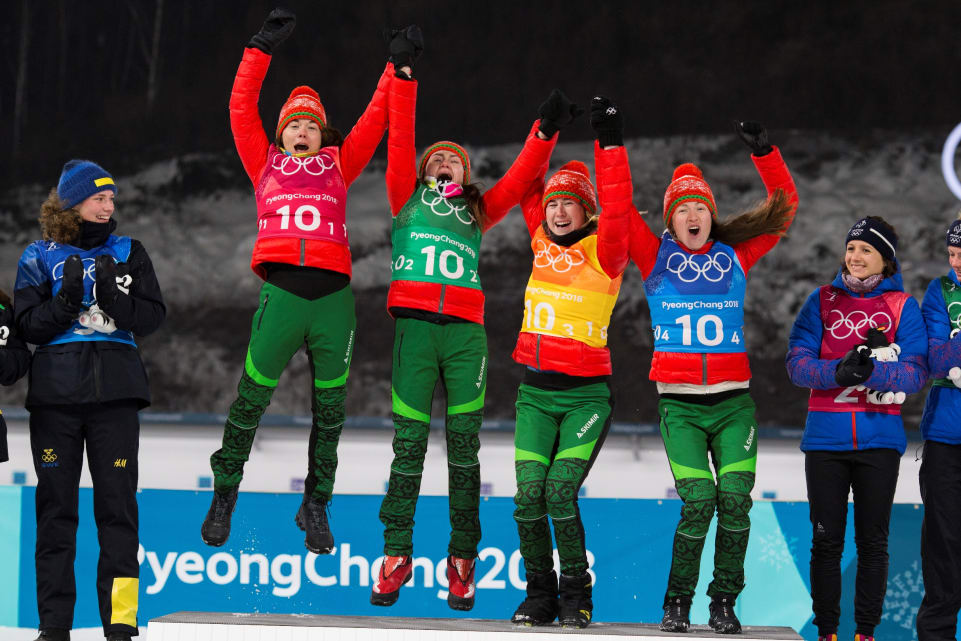
The Belarusian women’s biathlon team of Nadezhda Skardino, Irina Kryuko, Dzinara Alimbekava, and Darya Domracheva celebrates winning gold in the relay. They were ranked 10th coming into the day. (Photo: IBU/Biathlonworld.com)
Ranked just 10th coming into today’s women’s relay, the team from Belarus stole the show with Darya Domracheva skating across the line to claim the fourth Olympic gold of her career after strong efforts from Nadezhda Skardino and Iryna Kryuko, both of whom have stood on the World Cup podium before, and newcomer Dzinara Alimbekava, a 22-year-old newcomer with just 11 World Cup starts to her name. It was the first relay medal ever won by Belarus at the Olympics.
The setting was windy and snow-blown and the race was extremely tight, with seven teams with one penalty loop (or a few spare bullets) worth of time going into the final leg. The Belarusians’ nine spare rounds were the best shooting of the day; while that spare-round tally was matched by Slovakia, Kazakhstan, Bulgaria, and Japan, those teams had penalty loops as well.
Sweden actually wasn’t one of them, but with perfect shooting and a fast ski time 15 k gold medalist Hanna Öberg brought the team to silver after starting the anchor leg in eighth, a minute back. She benefitted from many missed shots by the leaders, and then passed France’s Anais Bescond on the final loop to claim second, 10.7 seconds back, for her teammates (Linn Persson,Mona Brorsson, and Anna Magnusson) while France (Bescond, Anais Chevalier, Marie Dorin Habert, and Justine Braisaz) took bronze (17.6). These medal-winning teams used 12 and 14 spare rounds, respectively, an unusually high tally.
Norway (Synnøve Solemdal, Tiril Eckhoff, Ingrid Tandrevold, and MarteOlsbu) finished fourth, +29.7, Slovakia fifth (+38.4), Switzerland sixth (+43.5) after winning a photo finish against Poland (+43.6), and Germany finished seventh (+53.9).
The Canadian team of Sarah Beaudry, Julia Ransom, Emma Lunder, and Rosanna Crawford finished 10th, +1:33.4. Their shooting of eleven spare rounds and one penalty loop was among the better scores of the day.
The United States had a strong start, with Susan Dunklee tagging off in second place, Clare Egan maintaining a good position in fourth, and Joanne Reid rebounding from one bad shooting stage to tag off in sixth. Anchor leg Emily Dreissigacker crossed the finish line in 13th, +2:01.9.
2018 Olympics (PyeongChang, South Korea): Nordic Combined Team Competition
After sweeping the medals in the large hill competition, perhaps it was not a surprise that Germany won the nordic combined team event. It was a blowout: ranked second after the jumping round but starting the cross-country ski relay just six seconds behind Austria, the Germans quickly took the lead and then just extended it. Their team of Vinzenz Geiger, Fabian Riessle, Eric Frenzel, and Johannes Rydzek won by 52.7 seconds over Norway’s Jan Schmid, Espen Andersen, Jarl Magnus Riiber, and Jørgen Gråbak. Austria hung on for third, +1:07.8, with Wilhelm Denifl, Lukas Klapfer, Bernhard Gruber, and Mario Seidl.
The United States team of Taylor Fletcher, Ben Berend, Ben Loomis, and Bryan Fletcher lost out on a photo finish with Poland and finished 10th out of 10 teams, +5:16.7.
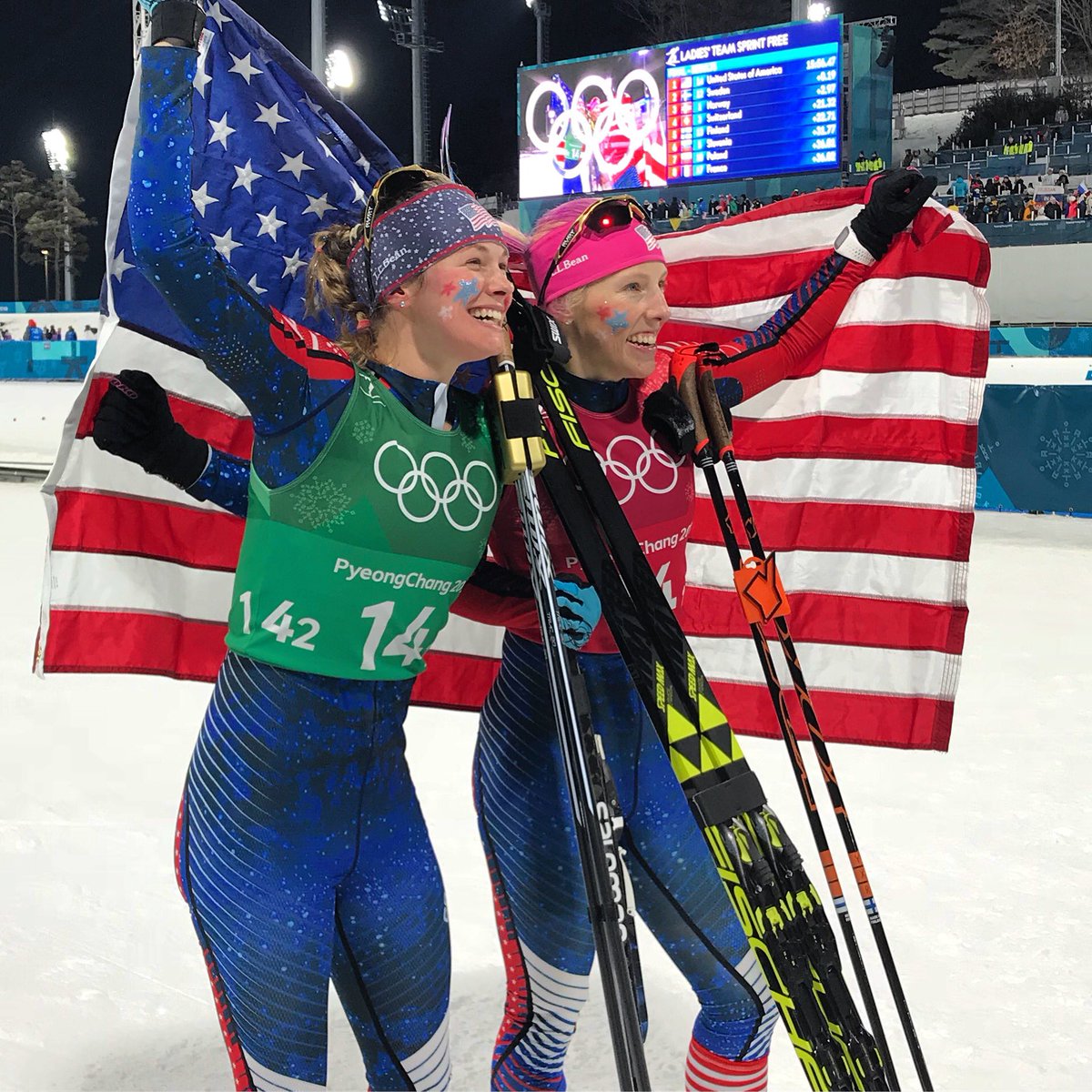
Team USA after Kikkan Randall and Jessie Diggins (c) won gold in the women’s freestyle team sprint on Wednesday at the 2018 Olympics in PyeongChang, South Korea. (Photo: FlyingPointRoad)
(Note: This rundown has been updated to include comments from Canadians Emily Nishikawa and Dahria Beatty.)
The medal hunt is over. In the final team event of the 2018 Winter Olympics, the U.S. women got the job done on Wednesday in PyeongChang, winning not just a medal, but the first Olympic gold in the history of U.S. cross-country skiing.
Jessie Diggins (l) and Kikkan Randall soak up their win in the women’s freestyle team sprint on Wednesday at the 2018 Olympics in PyeongChang, South Korea. (Photo: FIS Cross Country/Twitter)
Kikkan Randall and Jessie Diggins teamed up in the 6 x 1.25-kilometer event, with Randall tagging Diggins in third at the final exchange, just 0.7 seconds behind Norway’s Marit Bjørgen in first and 0.5 seconds behind Sweden’s Charlotte Kalla in second. With 1.25 k to go, Diggins charged ahead on the first climb, with Norway’s Maiken Caspersen Falla and Sweden’s Stina Nilsson chasing her in second and third, respectively. They were about 10 seconds clear of Switzerland in fourth at the final exchange.
Falla moved into first at the bottom of the final grueling climb. Halfway up, Diggins and Nilsson jostled to position themselves in second, and over the top, Diggins slotted into third.
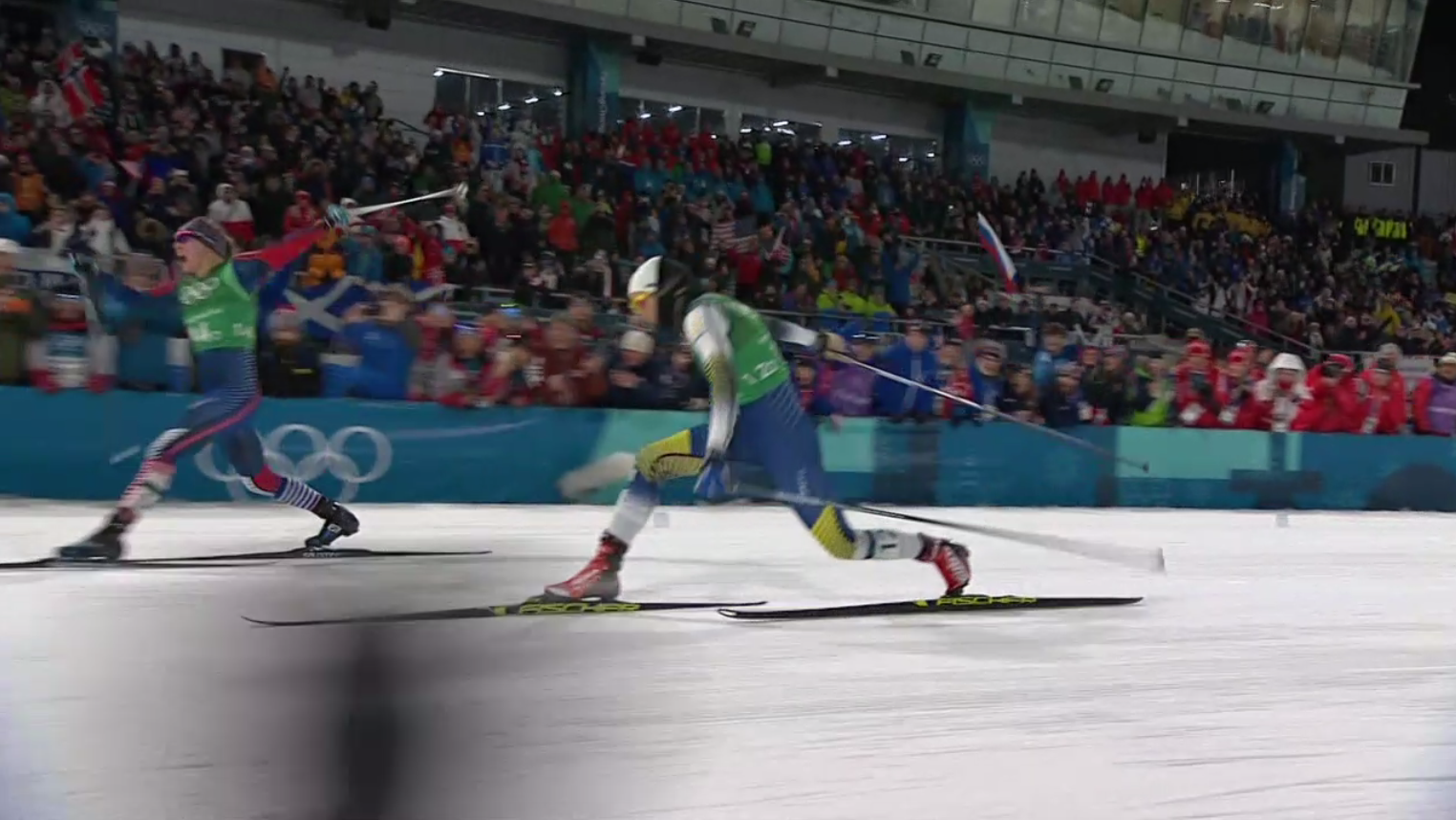
Riding fast skis on the downhill toward the stadium, Diggins stayed out of trouble while Nilsson nearly rode up onto Falla’s skis. While Nilsson used the draft to get into first coming out of that downhill, Diggins eyed a specific line, saw the opening between the two and took it to move into second. As Nilsson entered the finishing straight, Diggins was right there with her, even pulling into first as they came within 50 meters of the line. The gold became a reality, as Diggins outlunged Nilsson by 0.2 seconds at the finish with a time of 15:56.4 minutes, and Falla crossed 3 seconds back in third.
Jessie Diggins (l) lunging for gold in the women’s freestyle team sprint, 0.2 seconds ahead of Sweden’s Stina Nilsson at the 2018 Olympics in PyeongChang, South Korea. (Screenshot: NBC broadcast)
Gold for the U.S., silver for Sweden, bronze for Norway. With her 14th Olympic medal, Bjørgen became the most decorated Winter Olympian of all time, while Randall and Diggins earned their country’s first Olympic gold.
In the men’s 6 x 1.4 k team sprint final that followed, Johannes Høsflot Klæbo once again anchored another Norwegian victory, teaming up with Martin Johnsrud Sundby for Klæbo’s third medal of his first Olympics. With a strong second leg from Klæbo, the Norwegians gapped the field, and Sundby extended that gap to 5 seconds over Sweden by the final exchange. Klæbo rounded the final lap alone, still charging for the win and only letting up a few meters before the line to celebrate as he crossed in first with a time of 15:56.26.
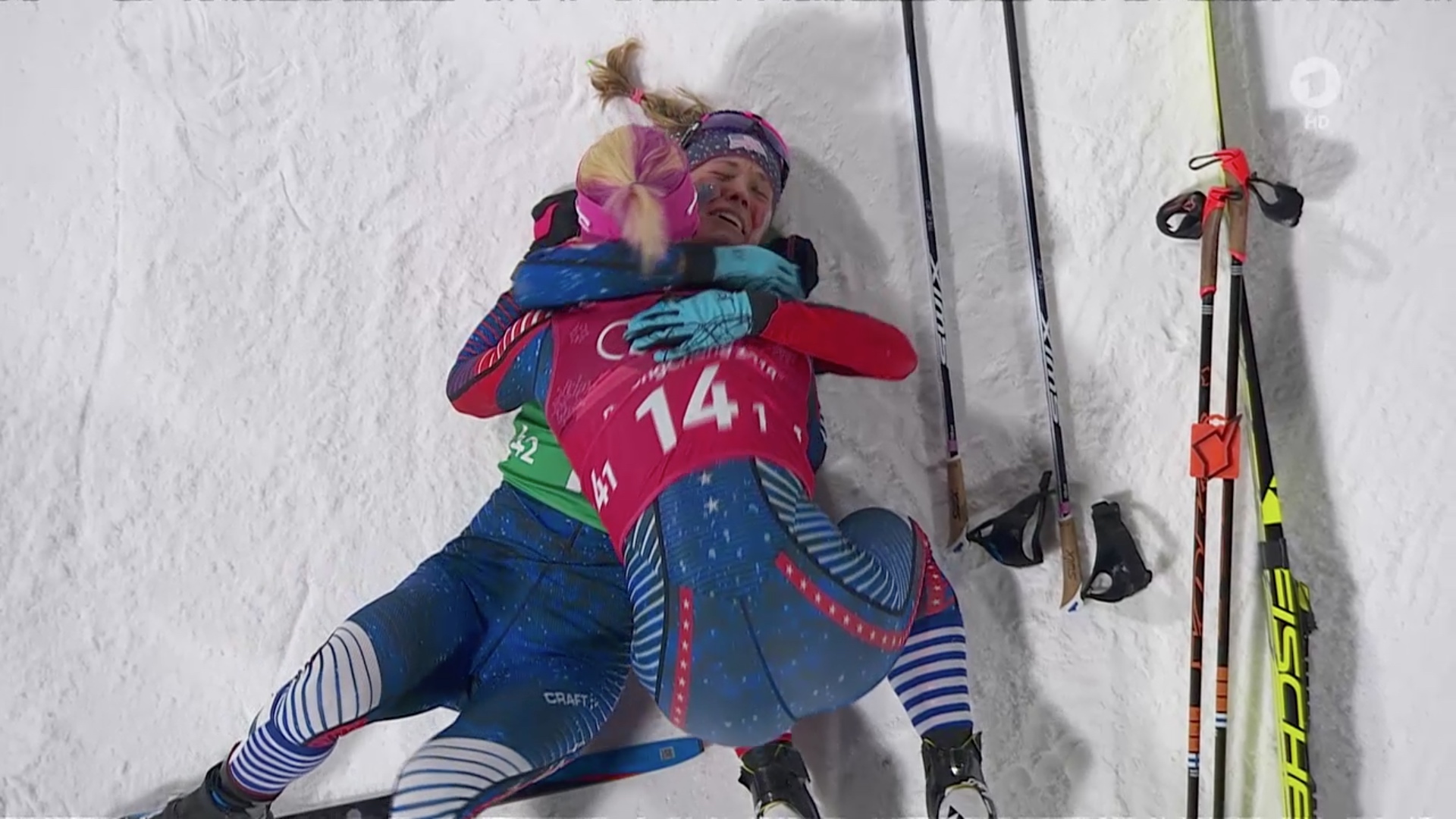
Kikkan Randall (14) and Jessie Diggins embrace as they celebrate their freestyle team sprint gold on Wednesday at the 2018 Winter Olympics in PyeongChang, South Korea. It is the first U.S. cross-country skiing gold medal in Olympic history, besting Bill Koch’s individual silver medal in the 30 k at the 1976 Winter Olympics. (Screenshot: ARD broadcast)
Alexander Bolshunov of the Olympic Athletes from Russia pushed to catch Klæbo on the last lap and motored for silver, finishing 1.71 seconds back. He teamed up with Denis Spitsov fortheir second-straight silver medal of the Games (after placing second in the 4 x 10 k relay) and Spitsov’s third medal (after placing third in the 15 k freestyle).
France (Maurice Manificat and Richard Jouve) placed third (+2.02) with Jouve edging Sweden’s Calle Halfvarsson by about a second for bronze, while Sweden placed fourth (+3.07) with Marcus Hellner and Halfvarsson. It was the French men’s second-straight bronze medal after placing third in the relay.
Italy (Dietmar Nöckler and Federico Pellegrino) was next across the line in fifth place, 18.55 seconds out of first, while the U.S. men (Erik Bjornsen and Simi Hamilton) followed in sixth (+20.72). Bjornsen crashed shortly after the start of the third leg (his second leg) after skiing onto the tails of Nöckler’s skis up the first climb out of the stadium. That put the American in last place near the bottom of the hill, but Bjornsen rebounded to tag off in sixth, just 3.2 seconds out of first. Hamilton slipped to eighth and 8.3 seconds back on the next leg, and by the last lap, it was Hamilton chasing Pellegrino for fifth place, which Italy ultimately took about 2 seconds ahead of him at the finish.
Canada’s Len Valjas and Alex Harvey finished eighth (+35.6), with Harvey holding off Finland in ninth by half a second at the line, after slipping as far back as 10th on Valjas’s second leg.
Semifinals
Earlier in the day, the Norwegian men and women, Russian men, and American women each won their semifinal heats as the field was narrowed to ten teams for each final.
In the first women’s semifinal, Bjørgen and Falla posted an easy win by 6.6 seconds. Switzerland’s Nadine Fähndrich and Laurien van der Graaff bested Slovenia’s Alenka Cebasek and Anamarija Lampic for second place.
In the second semifinal, Randall and Diggins claimed the win, with Kalla and Nilsson finishing second, just 0.7 seconds back; Diggins and Nilsson didn’t sprint for bragging rights, seemingly saving energy for the final. Russia’s Natalia Nepryaeva and Yulia Belorukova finished third (+2.1).
Only the top two finishers from each semifinal automatically advance to the final, but Slovenia and Russia qualified as “lucky losers” based on their time. Also qualifying for the final were Finland (MariLaukkanen and Krista Parmakoski), Poland (Justyna Kowalczyk and Sylvia Jasckowiec), France (Aurore Jean and Coraline Hugue), and Germany (Nicole Fessel and Sandra Ringwald).
The Canadian women’s team of Emily Nishikawa and Dahria Beatty finished seventh in the second semifinal, and were two spots out of making the final (the Czech Republic had a faster time than the Canadians but also did not advance).
“The first four legs we were right in there with the group,” Nishikawa told FasterSkier after their semifinal. “I think our second heat was quite a strong heat, it stayed together until the fifth leg. That’s where I blew up a little bit, but I did everything I could. … Dahria skied amazingly well, she was able to still catch Italy again on the sixth leg.”
“We knew that the first three, four teams would be quite strong: USA, Sweden, Russia and Finland,” Beatty said. “So we knew everyone else, we could ski with them in the group, so we were trying to stay with that kind of middle group ’cause we knew five or six would probably be qualifying from our heat. … I think we did a really good job of skiing a race where we were right in there. … I think we came something like 11 seconds short of what we needed…
“Even though we didn’t qualify it was nice to be able to go catch one team on the last lap there and finish strong,” Beatty added. “Our coaches were cheering amazing out there, and had some cheering from the American coaches, too. So there was a lot of motivation on the course to really fight to the line.”
In the men’s semifinals, Russia’s Spitsov and Bolshunov and Sweden’s Hellner and Halfvarsson at some points appeared to be running away with the first heat, but by the finish Germany (Sebastian Eisenlauer and Thomas Bing) and Finland (Martti Jylhä and Ristomatti Hakola) were within three seconds in third and fourth.
For the U.S., Bjornsen took charge of the second semifinal on the fifth lap, and Hamilton kept the lead into the final downhill. Klæbo passed him late in the game and claimed the win along with teammate Sundby, and Hamilton appeared unconcerned as Jouve passed him in the finishing straight as well to put France (with Manificat) in second; based on time, the U.S. advanced as a lucky loser.
Also in the men’s final were Italy (Nöckler and Pellegrino), Canada (Valjas and Alex Harvey) — who finished fifth in the second semifinal — and the Czech Republic (Martin Jaks and Ales Razym).
PYEONGCHANG, South Korea — Cross-country is still a roots sports in the United States. Woods-skiers and fitness buffs stoke the small engine driving the sport. But every four years, the buildup begins. The pressure notched up. There’s national television appearances for U.S. nordic athletes. Time to shine when the spotlight is pointed in your direction. For a fringe sport in North America, easy access to snow is a prerequisite, the Olympic buildup makes the cross-country conversation more relevant.
To study on paper the lineups for Saturday’s women’s Olympic 4 x 5 kilometer relay is to realize the chances of medaling are exactly that: chances. Every head-to-head matchup, like a Stina Nilsson versus a Marit Bjørgen as the evening’s anchors for Sweden and Norway respectively, has its pros and cons. Coaches make calculated decisions. Can Bjørgen gain enough ground on Nilsson before the final straight? Can Nilsson stay close enough to edge Bjørgen on the final straight? Ultimately the skiers go out and ski.
U.S. Ski & Snowboard put out a press release as the U.S. relay team was announced detailing the women’s 4 x 5 k relay results chronologically both on the World Cup and major championships.
The U.S. women’s best-ever result relay result on the World Cup was a second place in January 2016 in Nove Mesto, Czech Republic. (That lineup was Caldwell, Bjornsen, Stephen, Diggins). Their best World Championships relay result was a fourth place last year in Lahti, Finland. 2014 in Sochi marked the women’s best Olympic result of eighth place.
Team. Much is said about the U.S. women’s team. So it’s fitting that in terms of promoting potential medals, the women’s relay gets the playbill’s frontpage.
Again it’s a calculated chance for any team — no nation is ever a lock. Look at Norway’s 4 x 5 k relay result in Sochi. Fifth. So could the U.S. end a medal drought 26-years deep on Saturday? No. So is the Olympic buildup fair — maybe not.
The beauty of the relay isn’t based so much in the euphoric glow of the podium’s top-three steps but how the chances played out.
Norway played its chances with the Bjørgen-Nilsson duel. And Bjørgen couldn’t escape Nilsson’s shadow until the closing 300 meters — a place where Nilsson herself was supposed to shine. Norway stopped the clock in 51:24.3. Sweden placed second (+2.0).
The U.S team of Sophie Caldwell, Sadie Bjornsen, Kikkan Randall, and Jessie Diggins placed fifth (+1:20.5). About all the pre-race hype and expectations, Randall, in her fifth Olympics, said it best.
Five-time Olympian Kikkan Randall skiing the U.S. team into sixth position during Saturday’s Olympic 4 x 5 k relay. (Photo: FlyingPointRoad)
“This is our best Olympic finish ever,” Randall said in the mixed zone after the race. “When we tend to be really focused on the medals it’s because we know deep in our hearts it is possible. I still think this is amazing that we put together four strong legs today and to get the best-ever result, keep the pathway going forward.”
This is not baseball’s World Series with a best-of-seven series. It is one and done. So when Caldwell toed the line in the scramble leg, there was belief. And if we want to fast forward to the end of this report, belief remains.
Caldwell sent it for the first half of her leg. Russia’s young upstart team took it out hot — their strategy one of padding their skate legs for the onslaught from Norway’s and Sweden’s skate legs. Only 8.1 seconds off the front at the time, Caldwell then fell off as the Olympic Athletes from Russia (OAR) and Norway surged ahead by the 3.58 k mark. Caldwell came through to tag Bjornsen in 11th place (+1:01.5).
“I think that our team has more belief than we ever had right now,” Bjornsen said after the race. “It’s just so motivating and exciting, and we show up to every race just so excited to see what we can do, and kind of goosebumps just standing on the start line and that is certainly a memory that we are going to take away forever.”
Sophie Caldwell during the scramble leg for the U.S women during Saturday’s 2018 Olympic 4 x 5 k relay. She is ahead of Switzerland’s Laurien van der Graaff. (Photo: FlyingPointRoad)
After skiing the sixth fastest leg, Bjornsen took the team into eighth place (+1:05.2) as she tagged to Randall for the first skate leg. Randall skied the third best time on her leg and brought tagged off to Diggins in sixth.
As the Bjørgen-and-Nilsson parry played out ahead, Diggins motored. She, too, skied the third-fastest anchor leg split and reeled in another place as she crossed the line in 52:44.8 minutes to secure fifth place.
Here’s the thing: a medal appeared out of reach for the U.S. early on. But these women make you believers. That’s not U.S. Ski & Snowboard spin. That’s not wishful fan-boy thinking. It’s incremental steps the U.S. women have made.
Every nation shows up for the Games primed. The U.S. showed up and they were fifth on Saturday. Thirty-seven-point-two seconds out of third. Who wouldn’t believe in that?
“I think for me, every time you get to put on the rely socks it’s a big honor, its a privileged,” Diggins said as she reflected on the race. “You know you’re just not racing for yourself. You are racing for your teammates, you are racing for the people who did not get named to the relay, but easily could have, and are out there cheering on the course, and you are racing for Team USA. … I got to see each of my teammates ski their hearts out. I was getting more and more fired up watching them, just like, ‘OK, it’s my turn I am going to go reel in as many people as I can,’ and then we are going to walk away proud of what we did here today because there is more to it than just medals.”
Asked after the race to expand on what the day in and day out meaning of belief is like for the women’s team, U.S. women’s coach Matt Whitcomb elaborated on his role and that of the athletes.
“As coaches we spend a lot of time trying to tune people’s engines and try to make sure that they show up with a roaring Ferrari,” Whitcomb remarked. “But the Ferrari needs a driver and for the skier that’s the brain. The body will not go if the brain isn’t behind it and we’ve seen it time and time again where you have someone who you think is completely tuned up and prepped and ready to win a race and they’re not even in the points, and you later uncover that something had them out of balance and listing starboard and kept them off course for the day.
Jessie Diggins after skiing the U.S. women into fifth place during the 4 x 5 k Olympic relay. (Photo: FlyingPointRoad)
“So when we, as a team, first believe in one another, you then have your entire team that believes in you,” Whitcomb continued. “And that’s impossible to miss the positive effects of your team. One after the next, believing in you as a skier and you can’t help but believe more in yourself. So when you’re confident, you believe more in yourself, the body starts up really quickly and you can race the car.”
Under Whitcomb’s guidance, the U.S. nordic community has come to expect excellence for it’s women’s team. Consider that for a minute. Consider that during the early part of Randall’s career, it was a fight to even field a women’s relay team. Consider that Whitcomb chose a Ferrari as his vehicular metaphor. That metaphor works for the U.S. squad.
Whitcomb also spoke of how the race unfolded from the outset.
“The first thing that jumped out was that Russia chose the strategy of two very hot classic legs,” Whitcomb said. “That is something we were hoping didn’t occur. And it doesn’t always in championship events, it tends to, but I felt like, and I still feel like, we put together the very best team we had tonight. I have really honestly no regrets about that.”
Here’s the link to the 4 x 5 k women’s relay start list. It’s a wow-type list. The Norwegians, the Swedes and the Finns, all loaded lineups. And the Russians were seated fifth. Natalia Nepryaeva and Yulia Belorukova, both Russian skiers that have already medaled at these Games, led off the first two relay legs. They were a big unknown who pulled through for the bronze.
Ready, set, go. The start of the women’s 4 x 5 k Olympic relay. (Photo: FlyingPointRoad).
“It was really interesting to talk with the Russian coach on the trails as we were watching the race and confirm that they were in fact they were going to take it out hot, so we were privy to that,” Whitcomb said. “The athletes more than anybody knew what was going on. They can see the splits opening up or closing down. But as you saw in several cases, with Riita-Liisa [Roponen] from Finland, with Astrid [Uhrenholdt Jacobsen] from Norway, with Russia’s last skier on their first leg anyways, there are dents in armor here and there. We were hoping to really tear those open, and we got close but we were on the same hill as the medal. We’ve been there before and that’s frustrating. But for me, it’s fortunately more than just medals and I’m very proud of the team today.”
Canada’s relay team of Dahria Beatty, Emily Nishikawa, Cendrine Browne, Anne-Marie Comeau placed 13th (+4:50.3).
“We are racing all for each other; we are doing our very, very best,” Nishikawa said after the race. “I think our team has come a long ways. Last year at the world champs we probably had one of our best days ever [in 10th]. On a really good day we could be fighting with a lot of these teams.”
Racing continues Sunday with the men’s 4 x 10 k relay.
It wasn’t the wire-to-wire triumph that Norway sometimes achieves, but the pre-race favorites got the job done despite a scare midway through, thanks to dominant skiing by Ragnhild Haga and smooth strength from anchor Marit Bjørgen.
Norway took gold in the 4 x 5 k relay by two seconds over Sweden in 51:24.3 minutes. Olympic Athletes from Russia took bronze (+43.3), Finland fourth (+1:02.6), and the United States fifth (+1:20.5).
The first leg went out with Natalia Nepryaeva of Russia setting a blistering pace, fracturing the field almost immediately. A number of racers tried to stay with her only to get shot off the back of the pack. Taking a different pacing strategy, Slovenia’s Anamarija Lampic made up ground in the final section of the first leg to tag off in second, with Norways’ Ingvild Flugstad Østeberg third, all within a few seconds of each other.
Part of Nepryaeva’s fracturing of the field led to U.S. lead skier Sophie Caldwell getting dropped, to tag off 1:01.5 minutes back in 11th place.
In the second leg, Charlotte Kalla of Sweden and Kerttu Niskanen of Finland clocked the fastest times, making up 24.4 and 9.9 seconds that had been lost to Russia and Norway by their teammates Anna Haag and Aino Kaisa Saarinen, respectively. In the meantime, Astrid Uhrenholdt Jacobsen of Norway had a disastrous relay leg and notched just the eighth-fastest split time, falling to fourth.
Yulia Belorukova of Russia continued to lead the race on that second leg, but Kalla tagged off at the end of the classic portion just 1.4 seconds back, and Niskanen in third (+10.1). Sadie Bjornsen made up three places to tag off in eighth (+1:05.2).
Jacobsen tagged Haga 29.8 seconds out of first. From that point, Haga gradually reeled in the leaders over the course of the 5 k skate leg. It was an absolutely dominant performance, with the fastest split time by 24.7 seconds in a less than 12-minute race.
Sweden’s Ebba Andersson led Russia’s Anastasia Sedova for the whole leg and stayed clear of the field, but Haga — the gold medalist in the 10 k skate — made up enough ground to finish her effort in third, 3.4 seconds back.
That was more than enough for Bjørgen to work with, and she and Swedish anchor Stina Nilsson quickly dropped Anna Nechaevskaya of Russia and set off on their personal duel for gold. Bjørgen led the whole way, but could not make any decisive move to drop the Swede. Instead, over the top of the climb she had about a second, which Nilsson could not close on the downhill or the final flats into the finishing straight: gradually, Bjørgen just added a meter and another to her lead and crossed the line with gold.
Nechaevskaya continued to lose time on the leaders, but still held on to bronze. Krista Pärmäkoski skied an aggressive effort for Finland to pass the team from Switzerland, which had been in fourth after strong legs from Laurien van der Graaff, Nadine Fähndrich, and Nathalie von Siebenthal. But 21-year-old Lydia Hiernickel was unable to keep the pace and Switzerland dropped to seventh by the finish, getting passed by not only Parmakoski and Jessie Diggins, but also Sandra Ringwald of Germany. The Germans finished sixth (+1:49.4) and Switzerland seventh (+1:51.5).
Kikkan Randall had skied the third-fastest split of the field (behind Haga and Andersson) in the third leg to bring the U.S. into sixth, and Diggins also skied the third-fastest split (behind Bjørgen and Nilsson) for her leg to bring the team up to fifth at the finish.
The Canadian team of Dahria Beatty, Emily Nishikawa, Cendrine Browne, and Anne-Marie Comeau placed 13th (+4:50.3) of 14 teams.
The women’s biathlon 12.5 k mass start medalists at the 2018 Olympics in PyeongChang, South Korea, with Slovakia’s Anastasiya Kuzmina (c) in first, Belarus’s Darya Domracheva (l) in second, and Norway’s Tiril Eckhoff (r) in third. (Photo: IBU/Biathlonworld)
Not even a miss in the final stage could keep Slovakia’s Anastasiya Kuzmina from her third medal of the 2018 Olympics, this time gold, in the women’s 12.5-kilometer mass start on Saturday at the Alpensia Biathlon Center.
Kuzmina took charge early in the five-loop race, leading Germany’s Laura Dahlmeier into the range for the first prone shooting stage. There, Kuzmina cleaned all five targets quickly to get back out on course in first, while Dahlmeier missed one to slip out of the top 20, while several other athletes cleaned.
Kuzmina went on to hit every target over the next two shooting stages to distance herself from second place, and even with a miss on the last standing stage, she left the range 24.7 seconds clear of Darya Domracheva of Belarus in second.
Domracheva had put herself in second with clean shooting in the first two stages, then dropped to fifth with a miss on the third stage. Italy’s Dorothea Wierer was up to second by the fourth shooting after three clean stages, then fell back to seventh with a miss on the last standing.
There, Domracheva cleaned to get back into silver-medal contention, 9.3 seconds ahead of Norway’s Tiril Eckhoff in third.
Heading into the final downhill into the stadium, Kuzmina had enough time to grab a flag from one of her team’s staff members running alongside the trail. She crossed the finish line first in 35:23.0 minutes without anyone close for her third-career Olympic gold (after winning the sprint at the 2010 and 2014 Games).
Domracheva skied on her own to second, 18.8 seconds behind, for her first medal of the 2018 Games (and fifth of her career after winning three races at the 2014 Olympics).
Eckhoff, who had skied two penalty laps, took third, 27.7 seconds behind Kuzmina, while Italy’s Lisa Vittozzi held off Sweden’s Hanna Öberg, Wierer and Belarus’s Nadezhda Skardino for fourth place (+45.6). Öberg placed fifth (+46.5), Wierer was sixth (+47.3), and Skardino seventh (+47.9), ahead of Norway’s Marte Olsbu in eighth (+51.6), France’s Marie Dorin Habert in ninth (+57.9) and Finland’s Kaisa Mäkäräinen in 10th (+1:00.9). Dahlmeier, who had won two races and placed third in another at these Olympics, finished 16th (+1:47.1) with two penalties (1+1+0+0).
It was a disappointing opening to the Olympics for Johannes Thingnes Bø of Norway, who despite winning eight World Cup races this season started the Games with finishes of 31st and 21st in the sprint and pursuit. But on Thursday he showed why he was a medal favorite and won the 20 k individual race – only by 5.5 seconds, but that margin becomes impressive when you consider that he had two penalties, and thus two minutes of penalty time, while silver and bronze medalists Jakov Fak of Slovenia and Dominik Landertinger of Austria (+14.2) shot clean.
Johannes Thinges Bø celebrates with Norwegian team staff after winning Olympic gold in the 20 k individual despite two missed shots. (Photo: IBU/Biathlonworld.com)
Sweden’s Sebastian Samuelsson followed up a silver medal in the pursuit with fourth place in the individual, missing one shot and notching a time 29.1 seconds behind Bø. France’s Martin Fourcade, gold medalist in the pursuit, missed two shots like Bø but finished in fifth (+42.4). Switzerland’s Benjamin Weger placed sixth (+48.6) with one penalty.
It was a good day for Canada on the back of strong shooting: Scott Gow placed 14th (+2:02.5) with one penalty for a career-best result result; he had previously had two 16th-place finishes on the World Cup this season. With the same shooting, Brendan Green placed 22nd (+2:26.6). Christian Gow had two penalties to finish 26th (+2:57.2). Canada’s fourth man, Nathan Smith, missed five shots and placed 81st (+8:11.9).
For the United States, shooting was not as successful and Tim Burke led the way in 41st (+4:01.9) with four penalties. With one less penalty Sean Doherty was close behind in 44th (+4:21.8). Lowell Bailey placed 51st with four penalties (+4:53.0) and Leif Nordgren missed five shots to finish 66th (+6:27.3).
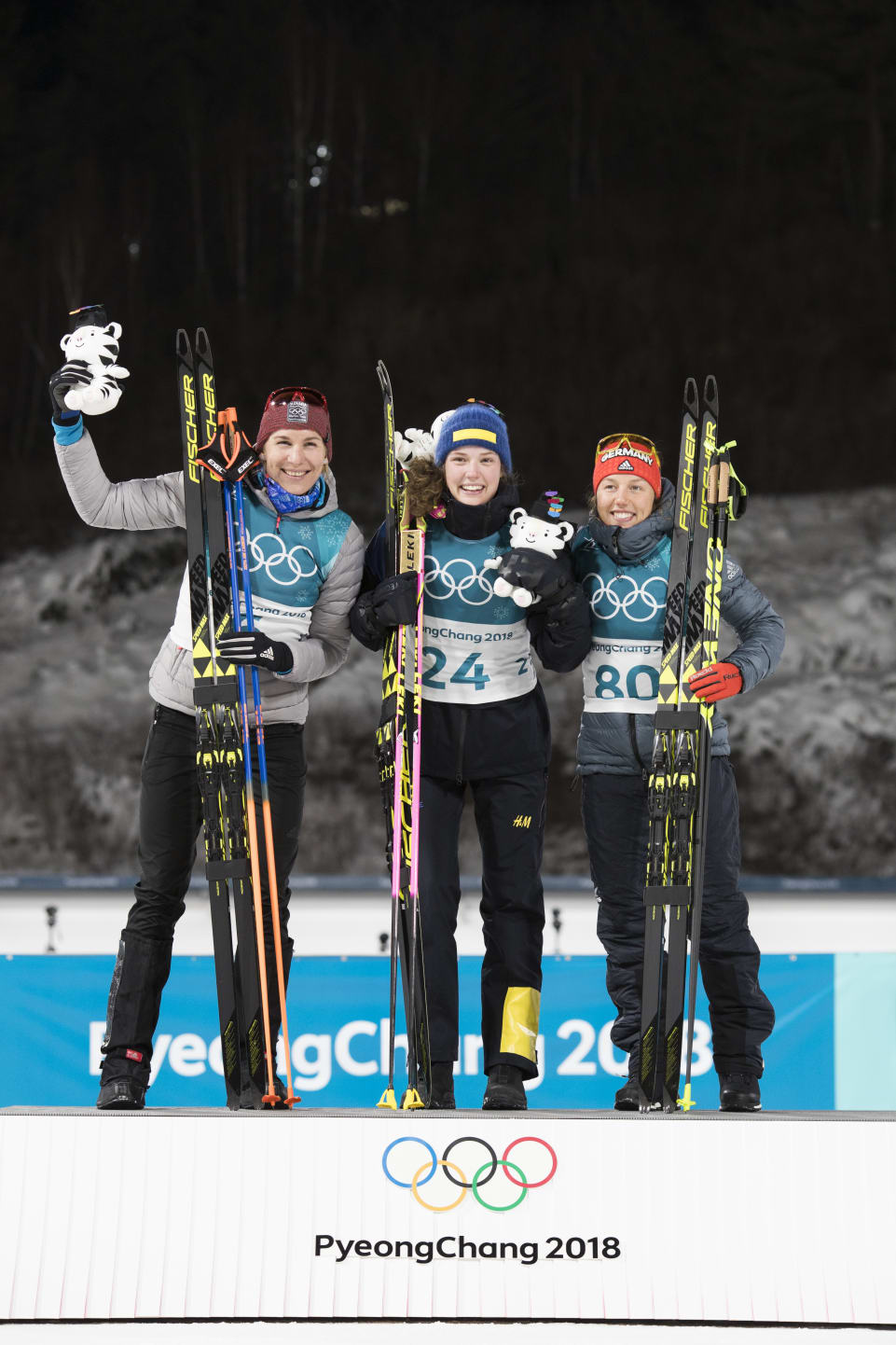
Sweden’s Hanna Oeberg (center) won gold in the biathlon women’s 15 k pursuit, followed by Slovakia’s Anastasiya Kuzmina (left) in silver and Germany’s Laura Dahlmeier in bronze. (Photo: IBU/Biathlonworld.com)
A few days after teammate Samuelson scored a career-best result to earn silver in the pursuit, Hanna Öberg of Sweden used perfect 20-for-20 shooting to capture gold in the women’s 15 k individual. The 22-year-old’s previous best results were fifth place in both Monday’s pursuit, and in a World Cup race last season.
She bested the two pre-race favorites: Anastasiya Kuzmina of Slovakia had two penalties but still managed a silver medal, her second of the games, finishing +24.7. And double gold medalist Laura Dahlmeier of Germany had one penalty and earned bronze (+41.2).
It was a good day for both of those teams as Franziska Preuss of Germany finished fourth, +59.0 with clean shooting, and Paulina Fialkova of Slovakia placed sixth (+1:02.3) with one missed shot. Poland’s Monika Hojnicz finished sixth (+1:54.8) with one missed shot as well.
The United States was led by Susan Dunklee in 19th, with two penalties (+3:26.3). Her teammate Joanne Reid finished 22nd (+3:34.1), her best-ever result in top-level international competition, with just one missed shot. Clare Egan finished 62nd (+6:53.6) and Emily Dreissigacker 67th (+7:09.2) with four penalties apiece.
For Canada, Rosanna Crawford led the way in 26th (+3:48.7) with two penalties and Sarah Beaudry was close behind in 29th (+3:58.4) with one missed shot. Emma Lunder finished 54th (+5:49.4) with three penalties and Julia Ransom was 74th (+8:31.4) with five missed shots.
Montana State University student Johanna Talihärm of Estonia finished 50th (+5:36.8) with three penalties.
Thursday afternoon saw more of the same for the women’s cross-country ski events at this year’s Winter Olympics: Scandinavia filling up the podium, with American Jessie Diggins tantalizingly close to that breakthrough American podium in fifth. This time it was Norwegian Ragnhild Haga in first in the 10 kilometer freestyle individual start, Charlotte Kalla of Sweden in second (+20.3), and Finland’s Krista Pärmäkoski and Norway’s Marit Bjørgen tied for third (+31.9).
The bronze is Bjørgen’s 12th lifetime Olympic medal, moving her into a tie with fellow Norwegian Bjørn Dæhlie for the most Olympic medals won by a cross-country skier. Countryman Ole Einar Bjørndalen, a biathlete, holds the overall Winter Olympics record with 13.
Diggins was 35.2 seconds back of Haga in fifth. She was in seventh place through 1.6 k, up to fifth at 5 k, up to third at 6.2 k, and still in third at the 8.4-k time checkpoint, 1.9 seconds up on Bjørgen and five seconds up on Pärmäkoski. But her form seemed to break down over the final uphill, and Diggins lost just enough time on Bjørgen and Pärmäkoski over the final 1.6 k to slip off the podium.
Between a 4.6-second deficit to third in Saturday’s skiathlon and a 3.3-second gap here, Diggins has now missed two bronze medals by a combined 7.9 seconds over 25 kilometers of racing.
Jessie Diggins pushing to the finish in the Olympic 10 k skate. The American finished fifth. (Photo: FlyingPointRoad)
Sixth place went to Swiss skier Nathalie von Siebenthal (+49.8), who slowed slightly after a fast start that saw her with the second-ranked time through 1.6 k. Ingvild Flugstad Østberg (+1:05.5), in seventh, was the third Norwegian in the top seven.
Olympic Athlete from Russia Anastasia Sedova (+1:07.3), Austrian Teresa Stadlober (+1:15.6), and Olympic Athlete from Russia Anna Nechaevskaya (+1:24.3) rounded out the top ten.
Sadie Bjornsen (+1:42.1) in 15th and Kikkan Randall (+1:49.9) in 16th were the next two Americans. Randall started relatively early with bib number 23, and was the leader in the clubhouse when she crossed the finish line. Liz Stephen (+2:35.4) was 30th.
For the Canadians, Emily Nishikawa (+2:41.) led the way in 32nd. Dahria Beatty (+2:48.4) was 37th, Cendrine Brown (+3:11.9) 43rd, and Anne-Marie Comeau (+4:10.8) 62nd.
Also of note, Australia’s Jessica Yeaton, who lives and trains in Anchorage with Alaska Pacific University, recorded an Olympics personal best finish of 41st (+3:09.1). University of Alaska Anchorage student Casey Wright, also competing for Australia, finished 81st (+6:55.8).
University of Colorado skier and NCAA champion Petra Hyncicova of the Czech Republic finished 60th (+4:09.4). University of New Hampshire alum Annika Taylor of Great Britain finished 75th (+5:52.4).
And Jaqueline Mourau of Brazil, who lives and trains in Quebec, was 74th (+5:49.8).
American Bryan Fletcher racing to 17th in the men’s 10 k Gundersen start today, the second half of the nordic-combined normal hill/10 k competition, on Wednesday at the 2018 Olympics in PyeongChang, South Korea. It was his first individual top 20 at his second Olympics. (Photo: FlyingPointRoad)
After the jumping round of the nordic-combined individual normal hill/10-kilometer Gundersen-start competition on Wednesday, Austria’s Franz-Josef Rehrl topped the standings thanks to a jump of 112 meters, just a meter farther than second place Jarl Magnus Riiber of Norway.
The top American was Bryan Fletcher, who sat in 18th place after a jump of 97.5 meters good for 99 points. He started the 10 k cross-country skiing portion of the competition 2:06 behind Rehrl, 1:51 behind Riiber – who has won two World Cups this season – and 1:30 behind defending Olympic champ Frenzel.
Fletcher initially made up some time on the leaders, but as the pace of the race was constantly changing in the end he wound up just one spot ahead of where he started, in 17th. Defending Olympic champ Eric Frenzel of Germany made it to the front after starting in bib five and sprinted to a 4.8 second victory over Japan’s Akito Watabe. Austria’s Lukas Klapfer earned bronze (+18.1) just ahead of Riiber (+22.5). Fletcher’s time was 2:12.2 behind Frenzel at the finish.
Ben Loomis and Taylor Fletcher jumped to 37th and 39th positions, respectively, and started the cross-country competition 3:24 and 3:37 out of the lead. Taylor Fletcher moved up four spots to finish 35th (+3:27.8) while Loomis lost a few places to finish 41st (+4:29.4). The final American starter, Jasper Good, was last (47th) after the jumping round but made up two spots on the trails to finish 45th (+5:48.4)
Keep calm and be the best: one missed shot early on did not keep France’s Martin Fourcade from defending his Olympic gold medal in the men’s biathlon pursuit. (Photo: FlyingPointRoad)
“Use this rage as energy!” Martin Fourcadewrote on Instagram after finishing eighth in the men’s 10-kilometer sprint on Sunday.
Um, yeah. The French biathlon star defended his gold medal from the 2014 Olympic pursuit with just one missed shot in Monday’s 12.5 k competition, taking the lead after the third shooting stage and never giving it back. He finished with a comfortable enough margin to grab the French flag and take his time waving it down the finishing straight.
A large pack of chasers were all in contention for second place coming into the final shooting stage, but of them all only Benedikt Doll of Germany and Sebastian Samuelsson of Sweden cleaned their targets. Samuelsson took his time to do so, and left the range with a nearly eight-second deficit on Doll. But he gradually worked his way up to the German on the trails, before putting in a spurt on one of the last small uphills on the course. The 20-year-old Swede managed to hold his lead on the swooping downhills into the stadium and not get consumed by the draft effect, and celebrated crossing the line in second place. Samuelsson’s previous best result was 13th place in a World Cup. It is Sweden’s first Olympic biathlon medal since 2010.
Tarjei Bø of Norway finished fourth (+1:02.6) after missing three shots; all the medalists had only a single penalty apiece. Germany’s Simon Schempp was fifth (+1:02.7), also with three penalties, and Switzerland’s Benjamin Weger finished sixth with two missed shots (+1:03.1), narrowly edging France’s Simon Desthieux (+1:03.7).
For the U.S., Tim Burke finished 17th (+2:19.6) with just two missed shots after starting in 47th position after a disappointing sprint race. Lowell Bailey placed32nd (+3:51.6) with five penalties — all in standing — and Leif Nordgren 50th (+5:48.7), also with five missed shots.
For Canada, Nathan Smith finished 54th (+6:06.5) with four missed shots.
With just one missed shot, Germany’s Laura Dahlmeier took her second gold medal of this young Olympic Games when she won the 10 k biathlon pursuit by 29.4 seconds. Dahlmeier finished no better than 13th in the 2014 Olympics — where she was only 20 years old – but four more years of experience have made her nearly unbeatable, if last year’s triple gold haul from World Championships serves as a basis for comparison. But even if she only nets these two golds, she has already made history: no other woman has ever won both the sprint and the pursuit at the same Olympic Games.
Dahlmeier started in bib 1 but the other medalists used stellar performances to move up after disappointing sprint races. Anastasiya Kuzmina of Slovakia edged France’s Anais Bescond by just 0.2 seconds to take silver. Kuzmina had started in bib 13 and won her medal despite four missed shots – she had the fastest course time of the whole field – while Bescond had started 19th but had hit all but one of her targets.
Fourth place went to the sprint silver medalist Marte Olsbu of Norway (+1:07.3), fifth to Hanna Öberg of Sweden (+1:08.9), and sixth to Denise Herrman of Germany (+1:19.4).
Rosanna Crawford of Canada started 53rd after a tough sprint race, but shot 18/20 and moved up to 19th place (+2:27.7), the best Olympic result of her career.
Montana State University student Johanna Talihärm, representing Estonia, missed four shots to finish 26th (+2:59.4). Just behind her was Canada’s Julia Ransom in 28th (+3:03.0) with one missed shot.
The lone American in the race, Emily Dreissigacker, set a new career best with 47th place (+5:01.4), and Canada’s Emma Lunder finished 53rd (+6:16.8). Teammate Megan Tandy did not start.
Norway’s Simen Hegstad Krüger celebrates after winning gold in the men’s 30 k skiathlon on Sunday at the 2018 Olympics in PyeongChang, South Korea. (Photo: FlyingPointRoad)
It was an improbable move: Norway’s Simen Hegsted Krüger attacked a few kilometers from the finish of the men’s 30 k skiathlon, and the rest of the field let him go. Krüger didn’t let up and at one point had a lead of 25 seconds with just about two kilometers to go, all the more impressive because he had crashed just meters into the race and broken a pole, having to then make up 35 to 40 seconds to get back to the lead pack.
Norwegian teammates Martin Johnsrud Sundby and Hans Christer Holund tried to close the gap to Krüger in the final kilometer, but the 24 year old hung on for a 8-second win. Sundby was second and Holund was third (+9.0) to give Norway a medal sweep.
Denis Spitsov of the Olympic Athletes of Russia, also in his first Olympics, finished fourth, 12.7 seconds back. Maurice Manificat of France was fifth (+14.2), Dario Cologna of Switzerland sixth (+25.1), Andrew Musgrave of Great Britain seventh (+25.7), and Alex Harvey of Canada edged Martin Jaks of the Czech Republic for eighth (+33.4 and +33.8, respectively). Johannes Høsflot Klæbo of Norway, one of the pre-race favorites, finished 10th (+43.4).
For the U.S., Scott Patterson led the way in 18th (+1:07.5). Erik Bjornsen finished 42th (+4:34.7), Paddy Caldwell 51st (+6:58.1), and Noah Hoffman 54th (+7:08.7).
After Harvey’s top-10 finish, the next Canadian across the line was Devon Kershaw in 36th (+3:35.3). GraemeKillick finished 45th (+5:19.6), and Knute Johnsgaard was lapped and did not finish.
University of Utah alum Snorri Einarsson finished 56th (+7:13.9) in Iceland’s best result in Olympic cross-country skiing since 1994.
Arnd Peiffer on his way to winning the 10 k sprint at Alpensia Biathlon Center today. The German was one of just four men to shoot clean in windy conditions. (Photo: FlyingPointRoad)
With the race favorites each picking up a bevy of penalties, Germany’s Arnd Peiffer skated to a gold medal in the men’s 10 k sprint on Sunday. Both he and silver medalist Michal Krčmář of the Czech Republic shot clean, and were two of only four men in the field to do so. With that performance, Peiffer — whose lone senior Championship-level individual medal came when he won the World Championships sprint back in 2011 — made Germany two-for-two in biathlon races so far after Laura Dahlmeier’s win in the women’s sprint on Saturday.
The top of the results sheet was tight, with Krčmář finishing just 4.4 seconds slower than Peiffer. Krčmář only has one World Cup podium to his name, coming last season. Dominik Windisch of Italy finished with the bronze medal (+7.7) despite one missed shot, and edged out Austria’s Julian Eberhard (+8.4) seconds, who also had one penalty.
Erlend Bjøntegaard of Norway was fifth (+17.4) with two penalties, and Benedikt Doll (+17.6) and Simon Schempp (+21.4) gave Germany an impressive three spots in the top seven.
Those pre-race favorites? Martin Fourcade of France missed three shots in prone and despite cleaning standing, couldn’t make up enough time on the final loop for a top result. He finished eighth, +22.1. Johannes Thingnes Bø of Norway missed three shots in prone and then another in standing, finishing 31st, +1:12.7.
For the U.S., Lowell Bailey cleaned prone and then collected one penalty in standing to end the day 33rd (+1:15.6). Tim Burke had four penalties to land 47th (+1:47.5), and Leif Nordgren will join them in Monday’s pursuit after finishing 58th (+2:10.2) with two missed shots. Sean Doherty missed four of his five prone targets and was unable to come back from that blow, finishing 65th (+2:16.4).
The Canadians also suffered shooting woes. with Nathan Smith able to limit the losses to one penalty and finish 44th (+1:43.5). He is the only team member to make the pursuit. Brothers Scott and Christian Gow missed four and three shots, respectively, to earn the unlucky honor of being the first two men outside the pursuit cutoff in 61st (+2:14.0) and 62nd (+2:14.7). Brendan Green cleaned prone but then missed three shots in standing to finish 82nd (+3:09.2).
The women’s 10 pursuit and men’s 12.5 k pursuit are set for Monday at 5:10 a.m. and 7 a.m. Eastern Standard Time.
Germany’s Laura Dahlmeier racing to her first Olympic gold (and first Olympic medal) on Saturday in the women’s 7.5 k sprint, the first biathlon race of the 2018 Winter Olympics in PyeongChang, South Korea. (Photo: FlyingPointRoad)
(Note: This article has been updated to include comments from Canada’s Julia Ransom.)
“Perfectionist” is a term the coaches of Germany’s Laura Dahlmeier often use to describe her.
On Saturday, this quality helped Dahlmeier to brave difficult wind conditions on her way to winning the gold medal in the women’s 7.5-kilometer sprint that opened the biathlon competitions at the 2018 Winter Olympics in PyeongChang, South Korea, ahead of Norway’s Marte Olsbu in second and the Czech Republic’s Veronika Vítková in third place.
“A childhood dream is coming true,” Dahlmeier told German broadcaster ZDF after the race, according to a translation. “I have always imagined this, that some day I would stand at the very top at the Olympics, that I could win a gold medal. And somehow exactly that happened to work out today. I am incredibly grateful and proud. It’s an amazing feeling, and I don’t think I have fully realized it yet.”
On the shooting range, Dahlmeier twice adjusted her rifle’s sights in the prone stage to successfully cope with changing winds. Coming into the standing stage, she hit three targets in rhythm, then waited for what seemed like excruciating seconds for a gust to pass, before triggering her fourth and fifth shots. Both targets flipped over to white.
She had taken so long that she only recorded the 76th-ranked shooting time in this stage in the field of 87 athletes, 22 seconds off the pace and almost as long as the time it takes to ski a penalty lap. But that she had hit all shots mattered the most. Only two other athletes managed to clean all 10 targets on Saturday.
Dahlmeier followed that up by skiing the fastest course time on the final loop, and fourth-best overall. She crossed the finish line in a time of 21:06.2 minutes, lunging to not squander even a tenth of a second more, before pounding her chest and raising her arms in jubilation, knowing the time she had set would be hard to beat. Indeed her mark could not be improved again by any athlete starting later.
“I believe if you want to win a race like this one, that doesn’t happen by chance,” Dahlmeier told ZDF. “A lot goes into that. It’s true, I really had to work for it in the race today. But also the team around me, what they had to work during the last days, weeks, months, years, that is embodied by today’s result. It’s just beautiful that I was allowed to fulfill that dream today.”
Olsbu claimed the silver medal, 24.2 seconds back with one penalty in her prone shooting stage and just 1.6 seconds ahead of Vítková on the bronze podium spot, who had missed one target in the standing stage.
France’s Marie Dorin Habert placed fourth (+33.1) with one penalty in prone, while Dahlmeier’s teammate Vanessa Hinz was fifth (+40.3), losing out on a potential medal when she missed the last shot of her competition. Several other favorites struggled with the wind conditions and incurred a number of penalties.
For the two runner-ups, winning a medal at the Olympics was also a dream come true.
“Of course I am happy, it was my best race ever,” first-time Olympian Olsbu, 27, said when asked in the press conference if she was satisfied with the silver medal. “It was difficult on the shooting range today because it was so windy, but I just stuck to my plan. And I was so happy when I crossed the finish line. … That was a dream from when I started in biathlon. Of course [compatriot] Ole Einar Bjørndalen was my hero when I was a child, and I was hoping that one day I will do the same. I don’t know what to say, it is just amazing and today I am sitting here with an Olympic medal.”
“Yeah, it was my dream too, like for Marte, and I am happy that my dream is here,” Vítková, 29, said of her first individual Olympic medal in her third Winter Games.
Starting early in bib 12, Vítková initially appeared dissatisfied when she crossed the finish line and saw that she had not managed to beat Olsbu’s time, after the Norwegian had finished the race just one bib ahead. The Czech feared more athletes would finish ahead of her and still push her several positions down, but aside from Dahlmeier starting in bib 23, no one managed to do that.
So at the “flower ceremony” in the arena, where the podium finishers each received a stuffed animal as their prize (a snow-white tiger called Soohorang that is the official mascot of the 2018 Winter Olympics), Vítková was beaming just like her two peers. The Olympic medals will be awarded in an separate ceremony later.
“I am very happy, because this medal is my first ‘big’ medal in an individual race,” Vítková explained at the press conference. “I had a [silver] medal from the Olympic Games in Sochi, but it was a mixed relay medal. And now I have MY medal!”
Last season, Dahlmeier set a record by winning five events at a single International Biathlon Union (IBU) World Championships, taking gold in every race but the sprint (where she placed second) in Hochfilzen, Austria. But winning the gold medal in PyeongChang was indeed the fulfillment of a lifelong dream. As an elementary school student, Dahlmeier reportedly had written two career goals into a class book: Olympic champion in biathlon and becoming the manager of an Alpine Club hut, since mountaineering continues to be her other big passion. One down, one to go.
“Today was a victory Laura had to work very hard for, that wasn’t automatic,” German women’s national team coach Gerald Hönig told ZDF, according to a translation. “My highest respect for how she withstood the conditions today. How she repeatedly had to make the right decisions by herself on the course and on the range in order to be successful. She did that great, and she is outshining a great overall team result.”
In 2014 at her first Olympics in Sochi, Russia, the biathlon competitions for Dahlmeier, who was 20 at the time, and the rest of the German women’s team had started off as disappointing with no individual medals, and then descended into turmoil when on the eve of the women’s relay, the doping case of Evi Sachenbacher-Stehle due to a tainted food supplement came to light (her suspension later was reduced to six months) and the team again failed to reach the podium.
“For our team this medal is particularly important,” Hönig said. “We still have the defeats of Sochi somewhere in the back of our minds. Well, I particularly do, so for me this is a gigantic moment. I believe having a medal in the very first race here makes the tasks that lie ahead much easier … It’s the prerogative of young athletes like Laura to chalk that off faster, but I have repeatedly thought about these days in Sochi … Laura showed coolness today, but also executed everything she had worked for in training.”
Dahlmeier, now 24, became the second German athlete to win a gold medal at the Winter Olympics in the women’s sprint, after Kati Wilhelm claimed the title at the 2002 Games in Salt Lake City, Utah.
Mixed Day for North American Starters
Canada’s Julia Ransom was the best North American in the sprint, finishing in 40th place (+2:08.8) after she shot fast and accurately, incurring just one penalty in her standing stage.
Julia Ransom (Biathlon Canada) racing to 40th in the women’s 7.5 k sprint at her Olympic debut in PyeongChang, South Korea. (Photo: FlyingPointRoad)
On the course she skied the 68th-ranked time of the day, consistently losing about 45 seconds on each loop to the blazing pace set by Slovakia’s defending Olympic sprint champion and current World Cup Sprint standings leader Anastasiya Kuzmina, who ended up 13th place with three penalties (2+1).
For Ransom it was her first start in an Olympic race, building on three appearances at Biathlon World Championships.
“It was amazing to start the race today,” Ransom wrote in an email to FasterSkier. “Some of my family were in the stands and the others had woken up early in Canada to catch it. Definitely feeling the love!”
She described the conditions as “windy with some extremely strong gusts,” Ransom wrote. “I noticed it more out on course than in the range. I was quite happy with my shooting today, but unfortunately my legs were just cooked (for whatever reason)! However, I think this was a good leg blowout, and after some rest, I’ll be ready for the pursuit!”
All four Canadian women that contested Saturday’s sprint finished in the top 60 to qualify for Monday’s pursuit, with Rosanna Crawford next in line in 53rd (+2:23.0) after shooting three penalties (1+2).
Canada’s Rosanna Crawford (22) racing to 53rd in the women’s 7.5 k sprint on Saturday at the 2018 Olympics in PyeongChang, South Korea. (Photo: FlyingPointRoad)
“It was really tough,” Crawford told FasterSkier in the mixed zone after the race when asked about the conditions. “The wind made it hard for shooting and on the course, all of a sudden these gusts would come and blow your poles right out from underneath you. In prone, I made a correction and missed my first shot which shouldn’t have happened, and in standing I overheld [the rifle] for my second miss so I’m pretty disappointed.”
Starting fairly early in bib 22, the race was still going on at the time of her interview, so Crawford feared she might miss the cutoff for the pursuit. At least that did not happen.
“The sprint sets you up for the rest of the week, for two weeks, so I’m pretty bummed,” she continued. “I’m still looking forward to the relays, so that’s definitely positive. It’s just so unfortunate that the sprint dictates the other individual races, other than the 15-kilometer [individual race]. Hopefully I’ll qualify for the pursuit and can go out there and fight again. I love the 2 k course here, so I’m really looking forward to it.”
In her third Olympics, Crawford skied the 44th-ranked course time of the day.
Canada’s Emma Lunder racing to 54th in her Olympic debut on Saturday in the women’s 7.5 k sprint in PyeongChang, South Korea. (Photo: FlyingPointRoad)
Just behind her, Emma Lunder in her Olympic debut placed 54th (+2:24.2) with two misses in the standing stage (0+2). Her course time ranked 65th.
Megan Tandy, in her third Olympics, finished 57th (+2:36.6) with a penalty in each stage (1+1). She skied the 69th-ranked course time.
“Although I am somewhat disappointed with today’s result (57th with 2 misses and heavy legs) I am thinking positive,” Tandy wrote on Instagram on Saturday. “8 years ago I was the only woman to qualify for the pursuit, this Olympics all 4 of us will be putting up a fight.”
(Note: FS missed interviewing Ransom, Lunder and Tandy in the mixed zone, and with the race in the evening local time they could not be reached for comments at press time.)
In her first Olympic race and on her first year with the senior women’s team, Team USA’s Emily Dreissigacker was the top American 51st place (+2:21.0) after shooting 9-for-10.
American Emily Dreissigacker racing to 51st in the women’s 7..5 k sprint on Saturday at the 2018 Olympics in PyeongChang, South Korea. It was her career-best result at the World Cup level. (Photo: FlyingPointRoad)
“I did I shot zero plus one [0+1], so I’m pretty happy with that,” Dreissigacker told FasterSkier after the race. “The wind was a little tricky out there. I was just trying to stay calm and think about what I could control…. Happy to make the pursuit!
“It was kind of gusty and changing a lot,” she commented on the conditions. “Like on prone, I got a little lucky, the wind was pretty much what I had zeroed in [target practice], which was still pretty windy, but at least was consistent. Then in standing, I mean, it definitely wasn’t terrible, but I could feel the wind pushing my barrel around a little bit.”
Dreissigacker’s course time ranked 74th overall and she slipped 10 places on the final loop.
“I definitely died a little bit on the last lap,” she said. “I think the hills are hard. … You’re not really recovering [anywhere] before you climb back up to come back down into the stadium.”
Previously Dreissigacker’s best result on the IBU World Cup in a sprint had been a 59th place at last month’s race in Antholz, Italy, followed by a 56th place in the pursuit.
For the rest of the US Biathlon women, things did not work out as well as they had hoped on Saturday.
Clare Egan (US Biathlon) racing to 61st in the women’s 7.5 k sprint at the 2018 Olympics in PyeongChang, South Korea. (Photo: FlyingPointRoad)
Also starting in her first Olympic race, Clare Egan just missed the cutoff for the pursuit race in 61st place (+2:45.4) with three penalties (1+2), only two seconds behind Emilia Yordanova of Bulgaria.
“Honestly as I was warming today it felt like I was warming up today for any other race, which I think is a good thing,” Egan told FasterSkier after. “I knew I was ready to go today and I was excited to do what I’ve been training to do and become an Olympian.”
But then her race began with a mishap on the course.
“I fell on the first loop at the bottom of the big hill, which is kind of a nightmare. I haven’t fallen in a couple years probably, but I don’t know, it just happened,” Egan said. “Weird things happen in big races I guess, but besides that I am really pleased with my skiing considering I was really sick in our pre-Olympic training camp.”
Skiing only the 71st course time on the first loop due to the fall, her pace improved from there, capped by the 30th-ranked time on the final loop (57th overall).
“I’m really happy with the prone,” she said of her shooting performance. “It was really tricky shooting today, windy, missed one but I am very satisfied with that. Standing I started out really solid, had three good hits and felt good about what I was doing and then I misfired actually. My bullet didn’t eject and I wish I had refocused better after that. I had to kind of pick the bullet out and I didn’t reset adequately. So then I missed my last two shots and I am not happy about that, but it was sort of a mediocre race overall.”
Team veteran Susan Dunklee incurred an uncharacteristic five penalties (1+4) to finish in 66th position (+3:06.9).
Starting early in the race in bib 6, she could be seen on the broadcast making a wind adaptation in the prone stage after missing her fourth shot, then went on to hit the last one having to ski once around the 150-meter penalty lap.
She came back on the course with what would later be the 28th-ranked split time, but in the standing stage, things then turned south and with four additional penalty laps, she could not make up the deficit.
“I’ve had better days,” the 2017 World Championships silver medalist told FasterSkier after the race. “I missed five shots. You can’t be anywhere close to where you need to be with 50-percent shooting. It’s very frustrating. You work for four years and you have big dreams, you see what’s possible, and it all comes down to one of these races like this and the sprint is so important for the rest of the races here. You really have to have a good sprint to qualify for the pursuit, to qualify for the mass start, so I’m really bummed about that, that’s for sure.”
Unlike her teammates, Dunklee skipped Friday’s Opening Ceremony of the Winter Olympics while “fighting off a small cold,” according to a US Biathlon Instagram post.
She skied the 42nd course time of the day and didn’t want to blame her misses all on the weather conditions.
“The conditions are actually really nice,” she said. “It’s a little bit cold but not so cold as it was when we first got here. You can feel your fingers, which is really nice. Seems like it’s fair. You’ve got really hard-packed good tracks.
“I think I’m going to have to figure out how to allow myself to be disappointed for another hour or so, get it out of the system a little bit and then put it behind me and move on,” Dunklee concluded.
Joanne Reid (US Biathlon) racing to 86th in the women’s 7.5 k sprint at the 2018 Olympics in PyeongChang, South Korea. (Photo: FlyingPointRoad)
Also in her first Olympic race, the fourth U.S. starter Joanne Reid finished 86th (+5:12.6) with seven penalties (4+3), though she explained it wasn’t due to any race jitters already having competed in front of far bigger crowds on the World Cup before.
“I try and approach every race the same,” Reid told FasterSkier. “Same warm up. Same mentality. Just go out there and hope you hit your targets which didn’t really work out for me today.”
She skied the 67th-ranked race time of the day overall.
“It’s much worse on the cross-country side,” she said of the biathlon course and range conditions. “Everything is real open [to wind] over there. We have only the stadium area and the range [that] gets all the wind, but on the backside it’s pretty good, it’s sheltered. It’s actually really fun, it’s really ripping, it’s up and down with some swoopy corners.”
Reid explained that for her standing shooting she had planned to use the wind cover from a hill on the far left side of the range, as many athletes like Dahlmeier had also done, but that was not possible when she came in to her shooting stage as all those lane positions were occupied.
“Definitely in standing the farther lanes have less wind and when I came there was no farther lane,” Reid said. “It was 30, 29, 28, 27, 26 were all full and then big gusts coming in and that was pretty brutal. Then the longer you stand the more your muscles shake, so you know, that’s life.”
Career Best for Johanna Talihärm
Unlike for most of the North Americans except Dreissigacker, for Estonia’s Johanna Talihärm it was a career-best race in her second Olympics, finishing 22nd (+1:20.8) with one penalty (0+1).
The resident of Bozeman, Montana, is well known on the U.S. collegiate cross-country skiing circuit as a Montana State University junior and a second-team All-American at last year’s NCAA Skiing Championships.
This January leading up to the Olympics, she competed in cross-country races at the U.S. Cross Country Championships in Anchorage, Alaska, and in West Yellowstone, Montana.
Her previous best result on the IBU World Cup was a 29th place in a pursuit race in Hochfilzen earlier this season.
In the PyeongChang women’s sprint, she was the lone racers for Estonia. In Sochi, she finished 48th in the sprint for her best individual result and placed 16th in the women’s relay.
The biathlon competitions in PyeongChang continue on Sunday with the the men’s 10-kilometer sprint, followed by the women’s and men’s pursuit on Monday.
The start of the women’s 15 k skiathlon on Saturday, Day 1 of the 2018 Winter Olympics, with (front row, from left to right) Austria’s Teresa Stadlober, Norway’s Ingvild Flugstad Østberg, Norway’s Heidi Weng, American Jessie Diggins, and Sweden’s Charlotte Kalla leading out of the stadium in PyeongChang, South Korea. (Photo: FlyingPointRoad)
The 2018 Winter Games kicked off Saturday with the women’s 15-kilometer skiathlon, which saw Sweden’s Charlotte Kalla take her second-career individual Olympic gold (third including relays) and first individual gold in eight years. Not far behind her, American Jessie Diggins achieved the best Olympic result for an American woman in cross-country skiing.
After Kalla established herself as a leader early in the opening 7.5 k classic leg, the Swede spent much of the race working with her teammate Ebba Andersson to counter any type of attack from the Norwegians, specifically Marit Bjørgen.
On rock-solid classic conditions in PyeongChang, Bjørgen led the second half of the classic leg up until the ski exchange, where she entered the “pit stop” first, just ahead of Kalla in second. Norway’s Heidi Weng was in third at the time and swapped into her skate gear fastest, leaving the exchange about 28 seconds later in first. Her Norwegian teammate Ingvild Flugstad Østberg followed her in second and Bjørgen emerged in third, just ahead of Kalla in fourth.
Meanwhile, Diggins skied consistently in the top 10 and within about four seconds of the lead throughout the classic leg, entering the exchange in 13th and leaving in ninth, 5.4 seconds after Weng.
While Kalla took the lead early in that first skate lap, Switzerland’s Nathalie von Siebenthal made a move into first on a climb just before 9.75 k, while Bjørgen kept her close. Andersson continued to keep herself in the mix, skiing in third, just ahead of Kalla in fourth and Finland’s Krista Pärmäkoski in fifth. Diggins slotted behind two Norwegians, Østberg and Weng, while Austria’s Teresa Stadlober followed. At 9.75 k, 11 women were within 6 seconds of first.
Bjørgen reclaimed the lead shortly thereafter, but Kalla made her game-changing move on a climb about 34 minutes into the race, just before the 12.5 k checkpoint. There, the Swede had begun to gap the pack and was 5.5 seconds ahead of Bjørgen in second. Andersson remained in third, 5.9 seconds back, just ahead of von Siebenthal, Pärmäkoski, and Stadlober. Diggins in seventh pushed to keep herself in the chase group and was able to with about 2.5 to go.
One kilometer later, Kalla was nearly 10 seconds clear of Bjørgen, as well as Andersson and Pärmäkoski. The Finn moved ahead of Andersson on one of the last climbs to put herself in third as they headed down and back toward the stadium.
Sweden’s Charlotte Kalla celebrates her victory in the women’s 15 k skiathlon on Saturday at the 2018 Olympics in PyeongChang, South Korea, and her first individual Olympic gold medal in eight years. She beat Norway’s Marit Bjørgen (behind) by nearly eight seconds. (Photo: FlyingPointRoad)
All alone, Kalla skied to the win in 40:44.9 minutes, what Bjørgen distanced herself from third place and claimed second, 7.8 seconds later. Pärmäkoski took the bronze medal in third (+10.1), less than a second ahead of Andersson in fourth (+10.9). Kalla’s previous Olympic gold medals came individually in the 10 k freestyle at the 2010 Games in Whistler, British Columbia, and with her team in 2014 in the women’s 4 x 5 k relay in Sochi, Russia.
Diggins finished fifth (+14.7) for a new all-time best for a female American cross-country skier at the Olympics (after Sophie Caldwell placed sixth in the sprint at the 2014 Games), about three seconds ahead of von Siebenthal in sixth (+17.6). Stadlober placed seventh (+26.6), Russia’s Natalia Nepryaeva was eighth (+33.0), Weng was ninth (+40.7), Sweden’s Stina Nilsson 10th (+48.9), and Østberg 11th (+58.3).
In her first Olympics, Canada’s Cendrine Browne (Canadian U25 Team) led her team in 33rd (+3:17.0), ahead of American Caitlin Patterson (also in her first Olympics) in 34th (+3:30.0).
U.S. Ski Team member Kikkan Randall placed 40th (+4:02.3), Canadian World Cup Team member Emily Nishikawa finished 44th (
+4:31.7), Canada’s Anne-Marie Comeau was 48th (+4:57.9), Australia’s Jessica Yeaton (who trains with Alaska Pacific University) was 50th (+4:59.9), Canada’s Dahria Beatty 52nd (+5:32.4), and American Rosie Brennan 58th (+6:51.1).
The men’s 30 k skiathlon is the next cross-country event on the schedule in PyeongChang, set for Sunday at 1:15 a.m. Eastern Standard Time.
Germany’s Laura Dahlmeier racing to her first Olympic gold (and first Olympic medal) on Saturday in the women’s 7.5 k sprint, the first biathlon race of the 2018 Winter Olympics in PyeongChang, South Korea. (Photo: FlyingPointRoad)
2018 Winter Olympics (PyeongChang, South Korea): Biathlon women’s 7.5 k sprint
While most others struggled on the range in the first biathlon race of the 2018 Olympics, Germany’s Laura Dahlmeier held steady and shot clean, then posted the winning time in the women’s 7.5 k sprint on a windy Saturday evening in PyeongChang.
The 23rd starter (out of 87 finishers), Dahlmeier had to wait a long time for her gold medal to be confirmed, but she had done it, winning with a time of 21:06.2 minutes for her first Olympic medal. She has seven gold medals from World Championships but this was her first at her second Olympics. And on Saturday, she was one of just two women in the top 20 to hit all 10 targets in the two-stage race. Russia’s Tatiana Akimova was the other and she finished 20th.
The 24-year-old Dahlmeier bested the time of Norway’s Marte Olsbu, who started 11th and had a single miss in prone (1+0), by 24.2 seconds. Olsbu’s time was good enough for second, just ahead of the Czech Republic’s Veronika Vítková, who started right behind her in bib 12, in third place (+25.8). Vítková also had to ski one penalty lap after a standing miss (0+1). For Olsbu, 27, this is her first Olympics. For Vítková, 29, it was her first individual medal in three Olympic Games.
France’s Marie Dorin Habert missed the podium by 7.3 seconds in fourth (+33.1), after one prone penalty (1+0). Germany had two in the top five with Vanessa Hinz in fifth (+40.3) with one miss, Italy’s Lisa Vittozzi was sixth (+40.5) with one miss, Sweden’s Hanna Öberg seventh (+40.8) with one miss, Switzerland’s Irene Cadurisch eighth (+45.5) with one miss, Belarus’s Darya Domracheva ninth (+46.2) with two penalties, and France’s Justine Braisaz 10th (+47.9) with two penalties as well.
Julia Ransom (Biathlon Canada) racing to 40th in the women’s 7.5 k sprint at her Olympic debut in PyeongChang, South Korea. (Photo: FlyingPointRoad)
Canada’s Julia Ransom was the top North American in 40th (+2:08.8) with one standing penalty (0+1). Canada had all four women finish in the top 60 (thus qualifying for Monday’s pursuit) with Rosanna Crawford in 53rd (+2:23.0) with three misses (1+2), Emma Lunder in 54th (+2:24.2) with two standing misses (0+2), and Megan Tandy in 57th (+2:36.6) with a penalty in each stage (1+1).
One American finished in the top 60 to qualify for the pursuit: Emily Dreissigacker, in her first Olympics, in 51st (+2:21.0), after shooting 9-for-10 (0+1). Clare Egan just missed the cutoff in 61st (+2:45.4) with three misses (1+2), Susan Dunklee fell out of contention with five misses (1+4) to finish 66th (+3:06.9), and Joanne Reid finished 86th (+5:12.6) with seven penalties (+3:06.9).
Estonia’s Johanna Talihärm, a Montana State University student who lives in Bozeman, finished 22nd (+1:20.8) with one miss (0+1) for her best individual result at her second Olympics.
The men’s 10 k sprint takes place Sunday in PyeongChang at 6:15 a.m. EST.
Taking a day or two adjusting to the time warp of flying to South Korea, we decided to give former U.S. Ski Team Head Coach Pete Vordenberg a ring to get some vital details on a climate-activism project he’s devised for the cross-country ski community.
Former U.S. Ski Team Head Coach and current dad, husband and photographer: Pete Vordenberg. (Courtesy photo)
But first things first, if you don’t know Pete, go back and listen to an older episode of Nordic Nation — here’s the link to Part 1, and Part 2.
Back to the more critical task at hand: getting the details regarding Pete’s letter-writing campaign to curb climate change. Here’s the cool thing, so don’t tune out just yet, this is a bipartisan project. Pete’s cross-country climate challenge in this instance jives with building consensus.
So yes, Nordic Nation is delving into the political realm. As Vordenberg would say, we cannot be cross-country skiers without snow.
Below is Pete’s appeal to the cross-country ski community. It’s also a ripe time for this challenge. You’ll note Pete mentions the U.S. Ski Team’s success is in large part due to a nationwide “community focused effort”. That effort just might result in an Olympic medal in the next two weeks. Putting that in perspective, we should have no problem with Pete’s challenge.
Dear Cross Country Skier,
The cross country community is a highly motivated, educated, and energetic group of people connected both literally and figuratively through our sport. Sixteen years ago we seldom reached the top 30 on the international result sheet. Today we have won World Cup and World Championship medals, and even won the overall World Cup. This progress is a result of our nationwide, community-focused effort. It is time for us to apply our cross country power to make our planet and our sport sustainable.
Climate change is a global threat that is directly affecting our sport, our way of life, and life on earth. It is time for us to add our collective voice to a climate change solution that is already underway. Through the Citizens’ Climate Lobby, a swelling of voices and non-partisan action is already leading to a solution to global climate change.
Here is atwo-minute video of the problem, the solution, and the overall plan.
Now you and your ski team can put muscle behind the solution.
Join the XC Climate Challenge (#xcclimatechallenge). Here’s how:
*First, you and your team members will write and sign the Constituent Comment Letter (link and attached). Please make it positive and solution-oriented. The goal of these letters is to lead our leaders by showing them that the people in their districts demand strong climate action. Letter comments can be general or, preferably, specific. We are asking our representatives to join the bipartisan Climate Solutions Caucus, which at this time has 68 members—half Republicans, half Democrats. And also to support CCL’S carbon-fee and dividend proposal.
*Second, send your letters to me, Pete Vordenberg. The Citizens’ Climate Lobby (CCL) and I will count them and the CCL will hand deliver them to your congressional representatives. These letters are the key element of this project. This strategy has been proven effective!
*Third, nominate youth skiers from your team to take the lead in this effort. Representatives will be selected from all participating teams to represent the cross country community at a Citizen Climate Lobby National Conference in June. Prizes from ski-industry businesses will also be given to teams based on the number of letters they get signed, taking team size into consideration.
That is the challenge.
When: Now. This contest begins now and will end April 30th. Please do not delay! Start now and keep going.
A good team strategy to get as many letters as possible:
Create a Climate Activism Event or add Climate Activism to an existing event for your team and community.
Show the movie “Saving Snow” and have all the constituent comment letters ready to be personalized, signed, put in a large mailing envelope, and sent to me.
How to sign up for a showing of “Saving our Snow”. Click here.
Does your team already have a climate or climate activism project? Let us know what it is and we can share it with our community!
Contact Pete Vordenberg with questions, ideas and to register your team.
Kequyen Lam skiing at the Sovereign Lake Nordic Centre on Jan. 19, three days before he was officially named to the Portugal Olympic team. (Photo: Raj/theprimaldesire.com)
VERNON, B.C. — In May of 2015, a new skier turned up at the Sovereign Lake snow camp. He struggled to skate up small hills and fell down often. In the coming week, that same skier will represent Portugal at the 2018 Winter Olympics in PyeongChang, South Korea.
At first glance, Kequyen Lam seemed like a typical Canadian nordic newbie. Great lateral balance combined with regular falls forward and backward revealed his alpine background. Six months later, Lam turned up at the Sovereign Lake NorAm with intermediate technique, much-improved fitness and a total determination to recover from a bad cough in time for the distance race. Asked by FasterSkier to explain the shocking improvement over the summer, he said, “I used to be a snowboarder. And I worked hard.”
Fast-forward to 2018 and Lam, 38, has a FIS ranking that created an Olympic quota spot for Portugal. The journey was anything but simple, both as a skier and as a dual citizen.
FasterSkier caught up with Lam at the Sovereign Lake Nordic Centre on Jan. 21, one day before the official announcement of the 2018 Olympic quota allocation.
“I’m a united-nations individual. I would say that I’m proud to have the entire heritage that I do have, the history. I’m super proud that my parents are boat people, refugees.” — Kequyen Lam, 2018 Olympian
Becoming A Nordic Skier
A bit of Googling shows that Lam’s casual reference to snowboarding wasn’t the whole truth. He competed at the 2013 Sochi Snowboard World Cup and was on track to qualify for the 2014 Olympics in that sport. A season-ending crash in Austria resulted in a shoulder injury that stopped that dream and changed Lam’s path.
“Everything was going super well, but at this track, something mentally wasn’t right,” he recalled. “I was in a state of fear: fear of getting hurt, fear of injury. Physically, I believe I was ready, but mentally, it was tough.”
After the end of his snowboarding dream, Lam worked in Golden, B.C., as a pharmacist.
“I kind of moved on with my life, lived in Golden, did the whole career thing, did things for fun,” Lam explained. “I’m just the type of person where doing things for fun isn’t enough.”
Lam’s path into cross-country skiing started less than three years ago, at age 36, with Paralympic athlete and friend Tyler Mosher, who told Lam to “talk to Maria.”
“I talked to Maria Lundgren, and she forwarded me to Tony Chin,” he said of Lundgren, a British Columbia Ski Team coach, and Chin, one of the head coaches at the Nordic Racers Ski Club in Vancouver.
Through Chin, he met Ryan Olson, a masters skier.
“Ryan Olson is pretty hardcore guy when it comes to skiing,” Lam said. “He is dedicated and he gives ‘er hard. That was the reason I was able to learn the beginning steps of cross-country skiing.”
Olson connected Lam with Matt Liebsch, an American Birkebeiner champion and competitive American skier who organizes an annual camp at the Haig glacier near Canmore, Alberta. Lam spent three days there with Canadian Olympians Dasha Gaiazova and Ivan Babikov before training with Liebsch’s group on the glacier.
“I spent ten days total up at the Haig in 2015, and that’s when I learned how to ski, how to skate ski,” Lam explained.
His introduction to nordic skiing took him through a who’s who of Western Canadian skiing in just his first three months of the sport. From Mosher to Glenn Bond (Lam’s current coach), there was and is a large community of people who help skiers progress. For Lam and the Olympics, progress is measured in FIS points.
“The magic points! The first races happened in Finland,” Lam explained. “Last year, I went to Finland, I did a couple races there. I scored some good points there. And then there were some [rollerski] races in Columbia in December of this year where I got the majority of my points. It was actually those races that got me enough points to get under the 300-point standard to meet the Olympic qualification criteria.”
Representing Portugal
How does a Canadian come to have dual citizenship with Portugal? The story starts in Asia.
Lam’s grandparents immigrated to Vietnam from China before being driven out by the Indochina War (a 31-year Vietnamese civil war which bled over into Cambodia and Laos). When the war ended in 1975 with the defeat of the South Vietnamese government, Lam’s parents returned to their noodle business. The new Socialist Republic of Vietnam was not forgiving to groups that were believed to have supported the losing side. In 1978 and ’79, around 450,000 Vietnamese of Chinese ethnicity were expelled or escaped from Vietnam. Lam’s parents left as ‘boat people’, spending a month on an open boat before landing in Macao. Lam was conceived and born in a refugee camp in Macao in 1979, which was then a Portuguese colony, before being flown to Canada at the age of three months to live with a host family in Abbotsford, British Columbia.
“My grandfather on my mum’s side, they had made it to Abbotsford from Hong Kong,” Lam said. “The family split up entirely. [My grandparents] went to Hong Kong and they made their way to Abbotsford, and when they found out that we were coming over, they went to one of the churches in Abbotsford and found a family to take care of us when we got there. I mean, the Canadian government would have figured that out, but [my grandfather] wanted to make sure that the people that were going to take care of us were gonna be good people. That’s what he did. We were super, super fortunate.”
At 27, Lam started the process of connecting with his family history.
“I contacted the [Portuguese] consulate in Vancouver, they contacted the hospital that I was born in in Macao, and sure enough my name was there,” he said. “I get a letter in the mail, all in Portuguese, I had no idea what it meant.”
That all happened in 2006, the year he started pharmacy school.
“I took a year of Portuguese, I enrolled in two semesters, learning how to read and write, how to understand,” he said. “Then I spent two months in Portugal, travelling all over the coast, surfing. I did some volunteer work in a pharmacy in Faro, for a few days, just to see what it was all about.”
The Portuguese media has connected with Lam’s story and a part of Portugal’s colonial history. Their country has a second representative in PyeongChang, alpine skier Arthur Hanse, whose parents emigrated from Portugal to France. Lam was selected to be the flag bearer at Friday’s Opening Ceremony.
According to The Portugal News Online, the last time Portugal sent more than one athlete to the Winter Olympics was in 1988 when its four-man bobsled team qualified. That team competed against the famous Jamaican bobsled team and finished last in the final, while Jamaica did not finish.
“I’m a united-nations individual,” Lam said. “I would say that I’m proud to have the entire heritage that I do have, the history. I’m super proud that my parents are boat people, refugees.”
The Olympic Dream
Lam is one of many who dream of representing ‘small nations’ at the Olympics: athletes who work together to build a worldwide community and inspire others to chase their dreams.
“For two and a half years, nobody really knew what I was doing,” he said. “They knew that I was skiing, that I was passionate. That was 100 percent, but there was a purpose behind it, and that purpose was to make it to the Games in 2018. And tomorrow [Jan. 22] is judgment day.”
The ‘big nations’ in nordic skiing have big solutions. From dedicated wax teams in country-specific waxing rooms to physio staff to multiple coaches, the support is total. The ‘small nations’ live in a different world, sharing wax rooms among multiple countries and relying on the wax companies and ski companies for testing.
Team Portugal has Lam, supported by coach (and Atomic ambassador) Glenn Bond.
“What we’re going to do is we are going to see if Atomic will look at skis, wax skis and get everything dialed for training days and the race day,” Lam said. “I think that’s the best route to go. They’re testing skis every day, and they know what’s going to be fast.”
Like many of his peers, Lam has qualified for one event: the 15-kilometer freestyle individual start next Friday, Feb. 16. The people who have met him on his journey will be celebrating. You can follow Lam on his website or Instagram @kequyenlam.
Canada’s Ivan Babikov (18) leads American Noah Hoffman (26) and Canada’s Alex Harvey (4), among others, in the men’s 30 k skiathlon at the 2014 Winter Olympics in Sochi, Russia.
This article has been edited to include a link to an updated and more detailed guide to NBC’s television coverage.
You may have heard that the Olympics are coming up soon. Your favorite athlete’s social media platform is probably showing them sitting on an airplane, going through Olympic processing, or wearing Those Gloves right about now. Plus Noah Hoffman is blogging again, which is the surest sign yet that the Games of the XXIII Winter Olympiad are nearly upon us. (Seriously, though, Noah’s blog is not to be missed for any ski fan; the man’s output is prodigious and his insight keen, and he provides a perspective that you will find literally nowhere else.)
When are the races?
First off, when are the cross-country ski races? Surprisingly late, if you’re an athlete on the ground in PyeongChang starting a sprint qualifier at 5:30 p.m. local time (!) or a sprint final at 9:30 p.m. (!!). Surprisingly early, if you’re on the East Coast of this country and weren’t planning on waking up at 4:30 a.m. to watch the women’s relay. And at surprisingly humane late evening times, if you live in Alaska and may actually get to watch skiing at 9 or 10 p.m. for once rather than the 2 to 3 a.m. time slot that typically characterizes European World Cup races.
Here is the master schedule for all of the cross-country ski events. Note that South Korea is an impressive 18 hours ahead of Alaska, and 14 hours ahead of the East Coast, and so any event starting before 6 p.m. local time in South Korea will occur on the preceding day in Alaska.
The schedule linked above should automatically update the “My Time” entry to show the event time relative to your time zone. That said, here is FasterSkier’s reading of the master schedule for cross-country, keyed to the two extremes of the Alaska Time Zone and Eastern Time Zone (with apologies to readers in the Hawaii–Aleutian, Pacific, Mountain, and Central time zones, you should be able to extrapolate from these readily enough):
Women’s skiathlon: 10:15 p.m. Feb. 9 Alaska time / 2:15 a.m. Feb. 10 East Coast time
Feb. 14: Individual normal hill/10 k Gundersen (jumping at 1 a.m./skiing at 3:45 a.m.)
Feb. 20: Individual large hill/10 k Gundersen (jumping at 5 a.m./skiing at 7:45 a.m.)
Feb. 22: 4 x 5 k team event (jumping at 2:30 a.m./skiing at 5:20 a.m.)
And how to watch them?
There’s a simple answer if you’d like to watch the races live, and potentially a simple answer if you’d like to watch them after the fact.
If you want to watch live coverage, and you have a current cable subscription that includes the networks of NBCUniversal (CNBC, NBCSN, USA, and NBC), then use your cable subscriber email and password to log into the relevant NBC livestream website or NBC sports app (NBC iOS App / NBC Android App / NBC Roku App). Probably do this first on a dry run ahead of time in order to make sure that the technology works.
(You could also, theoretically, watch this on the actual NBC “channels” currently “broadcasting” on your actual old media “television.” However, this assumes that NBCSN will actually be broadcasting cross-country skiing at that time, as opposed to, say, figure skating reruns or alpine skiing. That may, sadly, be a somewhat charitable assumption, and even if it’s not it’s difficult to get specific programming info from the general NBC site – although this more detailed updated schedule from NBC is far more helpful. You could also look for an online NBCSN/CNBC/USA stream somewhere like here, but your viewing experience is still subject to that same assumption even if you’re watching the NBCSN television broadcast on your computer screen.)
Jessie Diggins winning a 10 k freestyle mass start at the last World Cup race Jan. 28 in Seefeld, Austria. (Photo: Salomon/NordicFocus)
If you’re willing to wait – and particularly if you live in the Eastern time zone, and are unable or unwilling to forego sleep for two weeks to watch live – then “Skiing Vinnie” has been doing yeoman’s work for the past few years in putting up complete broadcasts of World Cup races within a few hours after they end. Find his eponymous YouTube channel here, or his website here. While Vinnie has to get creative during the Games, he has a “Plan B”. Check out his website for links to videos as we closer to the races; this is a great, hassle-free way to watch the races over breakfast the next morning, or in your office when you’re supposed to be working.
Moving farther afield, both geographically and technologically speaking, you can also use a Virtual Private Network, or VPN, to access online streams provided by a broadcaster in another country. Using a VPN generally lets you avoid geo-restrictions placed on content, and so, for example, access BBC videos even though you’re not in England, or NRK skiing coverage even though you’re not in Norway.
As general tech site Lifewire points out in its “how to stream the Olympics” guide, “By and large, access to VPNs is not free. Yes, you can obtain some access during free trials but eventually, you’ll need to register and pay. Those that do charge a fee, however, are usually less expensive than what it would cost you to have even a single month’s access to cable or other television providers.” Roughly $10 dollars should get you a month of access to a high-quality VPN service.
Here is one overview of VPN sites out there. Here is another. You might also be able to achieve the same thing via a simple browser extension (maybe).
The technology involved in setting up and operating a VPN is remarkably user-friendly. Once you’ve purchased a service (or found a free one whose allocated bandwidth you intend to use up during the first part of the Games before moving on to another free service’s trial offer), using it is actually quite straightforward. Once you’ve got it up and running, try setting your location to Great Britain and availing yourself of the Eurosport Player. Italy, Germany, and all of Scandinavia should also be viable options for coverage, although the commentary there may not be in English.
(Jessie Diggins recently called out Eurosport for saying that she couldn’t win a mass start sprint finish… before a race in which she won a mass start sprint finish… so if you tune into Eurosport you can stay up on all the good bulletin-board material. And of course you can always listen to the seasoned Chad Salmela of NBC Sports; he’ll probably be less likely to write off Diggins’s sprinting abilities.)
The opening ceremonies for the 2018 Winter Olympics begin on Friday, Feb. 9. Notwithstanding all of the above, you should be able to watch those on any TV with a broadcast antenna. If anyone still has those anymore.
Anne-Marie Comeau leading Cendrine Browne during the skiathlon at Cross Country Canada’s NorAm/Olympic Selection Races in Mont Sainte Anne, Quebec, in January. (Courtesy photo)
Today, she’s Olympic-bound. But two years ago, Anne-Marie Comeau was stepping away from cross-country skiing.
Comeau had raced at 2015 World Junior Championships, finishing 25th in the skiathlon, but by December of that year the Canadian was diagnosed with a shoulder injury that required her to take half a year away from skiing.
Anne-Marie Comeau (Université Laval) racing to third in the women’s 10 k classic on Jan. 10 at Mont Sainte-Anne NorAm Trials in Quebec. (Photo: Mario Walker/NorAm MSA 2018 Facebook)
And that was plenty for Comeau to focus on. A talented runner, she had set the Quebec junior record at 5,000 meters (16:34.4, a time she has since improved on). And she won a silver medal at Junior Pan-American Games.
But skiing was something she couldn’t shake.
“I did more training for running, but skiing remained a sport that I love in the winter,” Comeau wrote in an interview with FasterSkier last week, translated from French into English. “I realized over the months that I missed ski racing, and so I decided in autumn of 2017 that I would do the selection races for Olympics, especially since they were at Mont-Ste-Anne where I live.”
So Comeau, who began attending Université Laval this fall and competed with their cross-country team, adapted her training somewhat. She added a rollerski workout once a week and uphill sessions on Mont Sainte Anne.
“Since it had been two years that I wasn’t doing ski races, it was difficult for me to come up with fixed goals,” Comeau wrote. “The prospect of participating in this type of selection gave me a certain motivation to train, and I couldn’t wait to get back to the joy of ski racing.”
At the same time, she was part of a college team for the first time.
Comeau ran for the Laval Rouge et Or team this fall. (Courtesy photo)
“It’s always really stimulating to be part of a team where the other athletes have the same passion,” she wrote.
The Laval women won the Quebec Conference Championships, and finished third at Canadian U Sports Cross-Country Championships.
“I’m very satisfied with my first season,” Comeau wrote. “I’m particularly pleased with the result that I had when we participated in an NCAA race in Princeton, New Jersey. It was a 6 k cross-country race and our team finished second in the overall standings. I finished first in that race. That second place for our team gave us confidence for what came next. The atmosphere in the team was really good and I am always very proud to represent the Rouge et Or.”
The pride and team energy, combined with just enough ski-specific training, combined perfectly to prepare Comeau to re-enter the world of ski racing.
To say that the Olympic selection races went well would be an understatement. On the second day of racing Comeau placed second in the 15 k skiathlon behind Cendrine Browne, who had already sealed her Olympic nomination by winning the sprint to open the trials series. Then on the last day of competition Comeau placed third in the 10 k classic behind Browne and Katherine Stewart-Jones.
That made her the distance winner of the trials, not counting Browne.
“To succeed in qualifying for the Olympics was truly a huge joy for me and a motivation to give my best for what would follow!” she wrote.
Comeau at the trials races in Mont Sainte Anne. (Courtesy photo)
But there was a catch: because Comeau hadn’t raced in so long – the only competitions she had done this season before selection trials were the Sovereign Lake NorAms – she did not have the required five FIS races averaging 100 points or below. So while she topped the selection list, in order to be allowed to race at the Olympics she had to get a few more results with good FIS points.
“After my races at Mont Sainte Anne, I was so motivated and proud of my results that it gave me positive energy to face the challenges that I had to overcome to meet the Olympic criteria from FIS,” Comeau wrote. “I didn’t really think about everything I had to accomplish, I just went right into it, the motivation of going to the Olympics being my main objective that I wanted to meet.”
To do that, she headed south, racing in a 10 k skate in Craftsbury, Vermont, and a 5 k classic in West Yellowstone, Montana. That brought her average FIS points down to 98.47.
Comeau is still absorbing the idea of becoming an Olympian.
“At 21 years old, I consider myself blessed to be able to live this experience, and I want to try to take the most of this experience to help me in the pursuit of my athletic career,” she wrote. “Honestly, to give the best I can and to live fully in each of my races, that’s my main goal. For the results, it’s hard for me to predict.”