Tag: 2018 World Cup Finals

  • U.S.A. Storms Falun World Cup Finals Podium; Diggins 2nd in Overall World Cup

    U.S.A. Storms Falun World Cup Finals Podium; Diggins 2nd in Overall World Cup

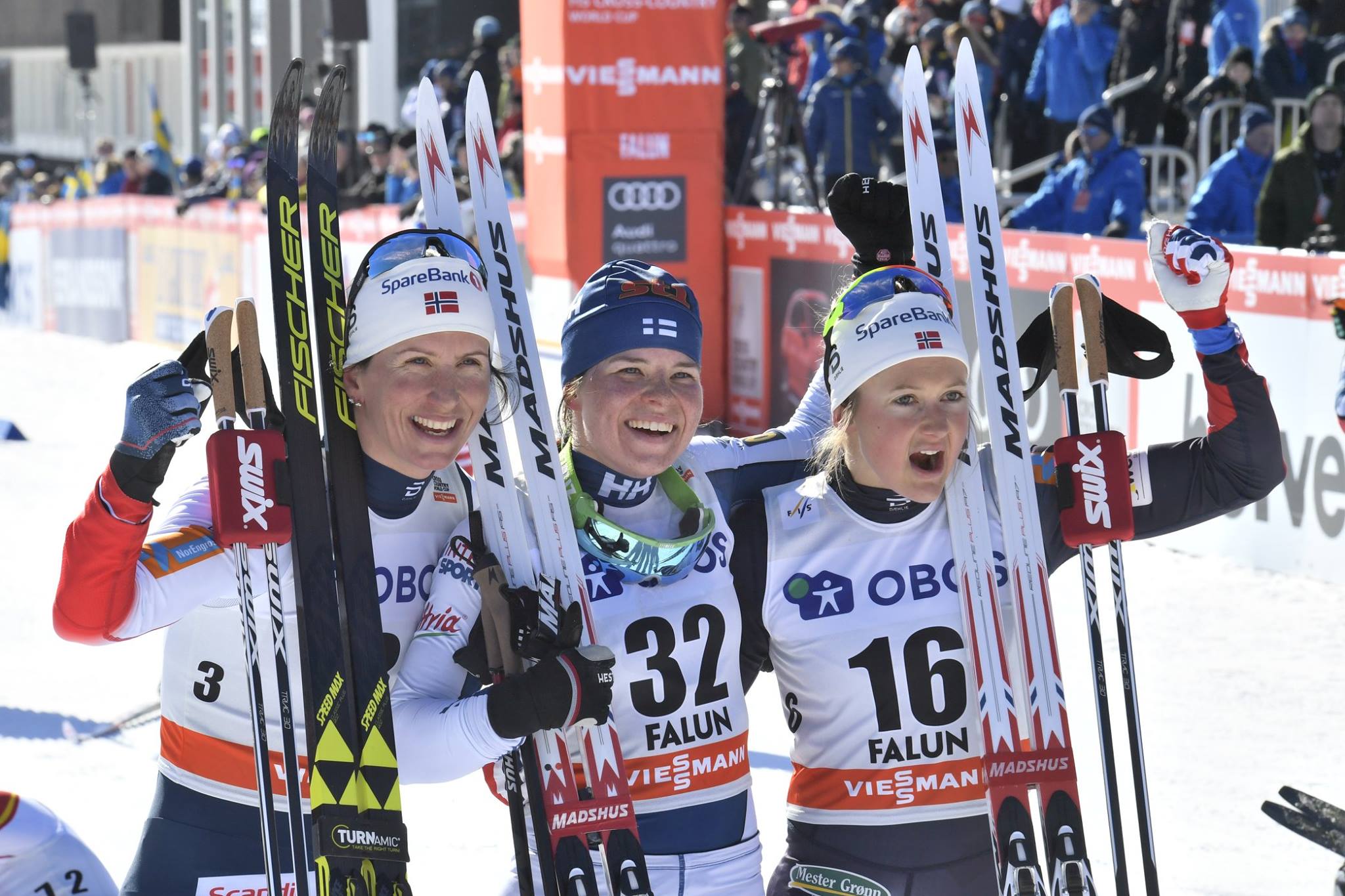
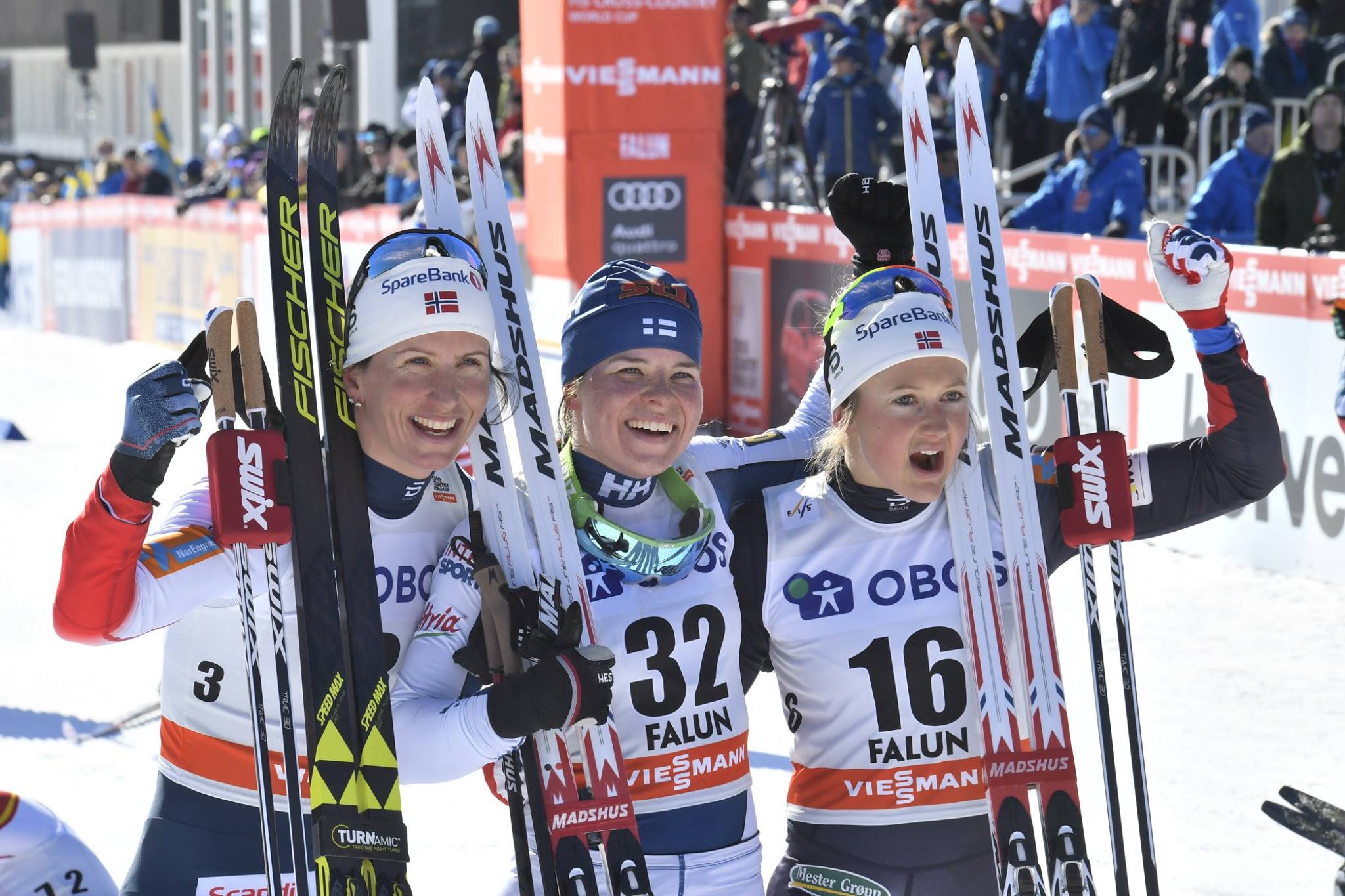
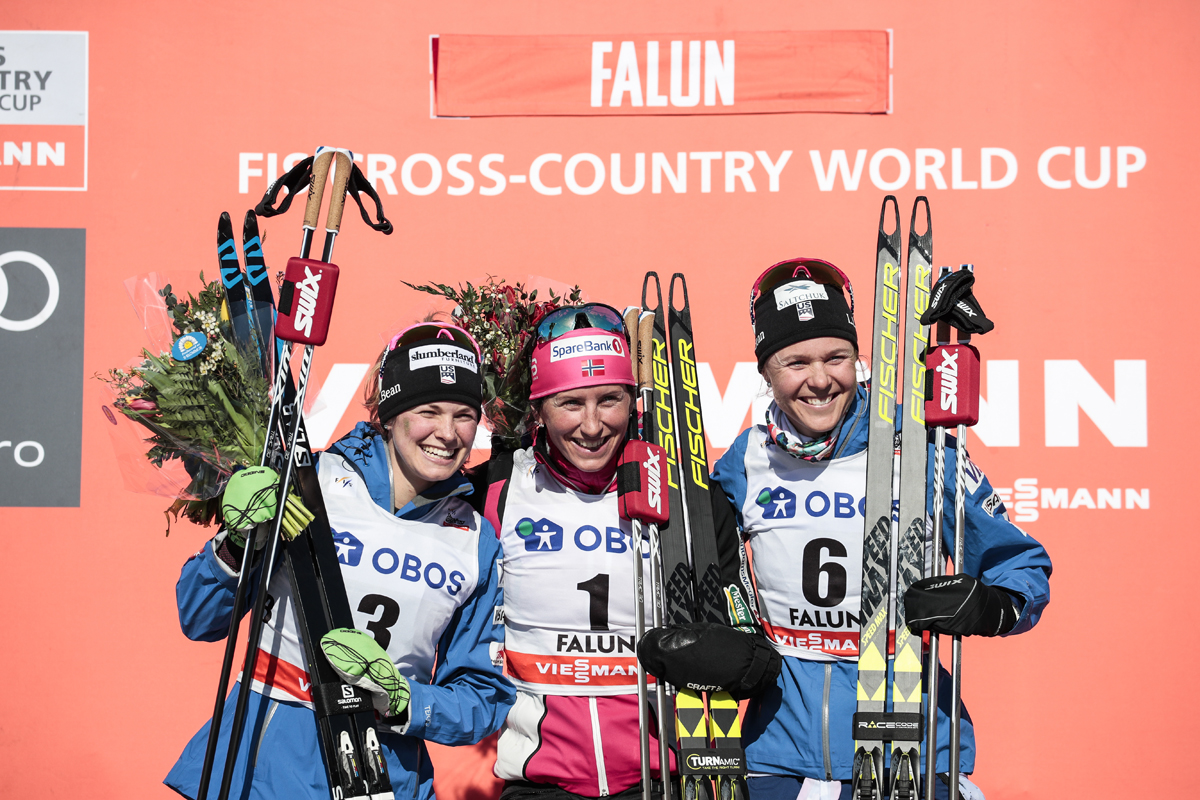
    The women’s 10 k freestyle pursuit podium on the last day of 2018 World Cup Finals in Falun, Sweden, with Norway’s Marit Bjørgen (c) in first, and Americans Jessie Diggins (l) and Sadie Bjornsen (r) in second and third, respectively. (Photo: Fischer/NordicFocus)

    FALUN, Sweden — NOR. USA. USA.

    Looking at the results monitor, those were the tri-letter country codes that popped into the top three at the end of the women’s 10-kilometer freestyle pursuit at World Cup Finals on Sunday.

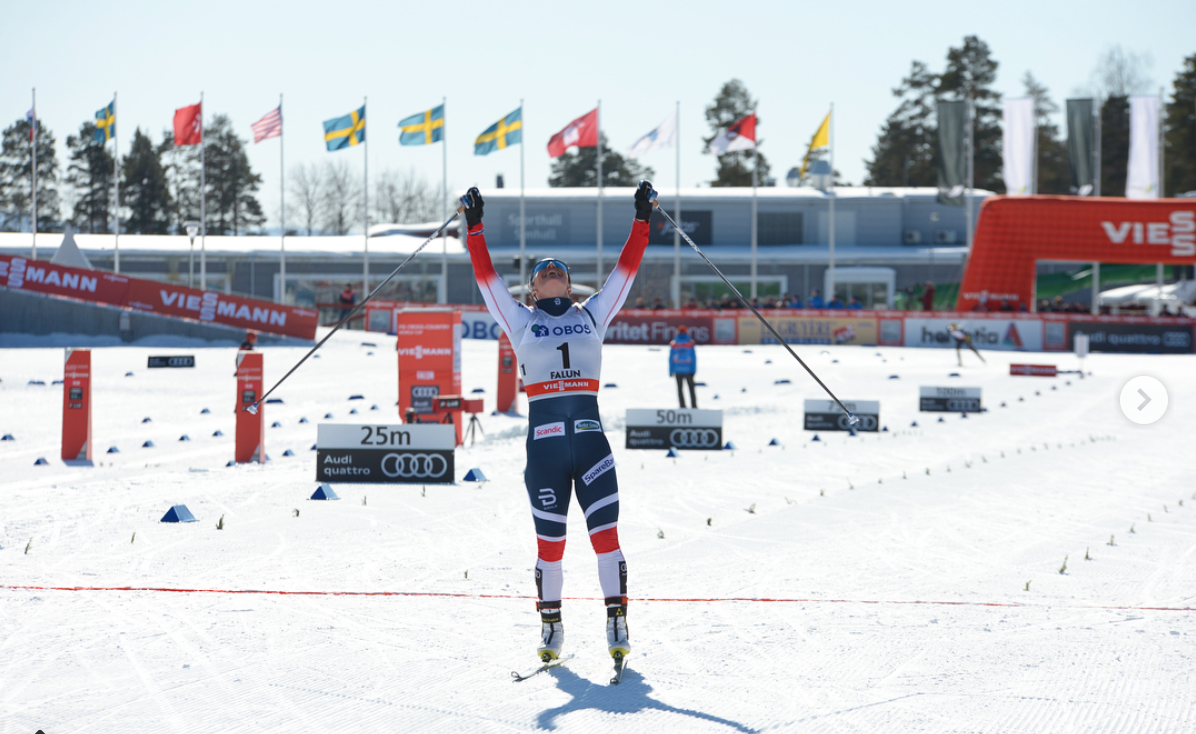
    The “NOR” belonged to Marit Bjørgen of Norway, who ended her 2017/2018 World Cup season with yet another win. In Sunday’s pursuit, the 37 year old led from start to finish and ended where she started, in first after covering the course in a time of 24:18.9 minutes.

    For many who follow the World Cup, a Norwegian name — like Bjørgen, who has won more than 110 individual World Cup races — at the top of the results is nothing new. All due respect.

    But the pressure for Scandinavia to hold off an American entourage is mounting; Sunday’s race presenting itself as a prime example.

    A 41-second gap separated American Jessie Diggins from Bjørgen by the time she flipped past the start wand, her characteristic cheek sparkles visible from the stands. As the third starter on course, Diggins had sewn shut the 5 seconds that the day’s second starter, Ingvild Flugstad Østberg of Norway, had on the American and within the first kilometer, was establishing herself as Bjørgen’s main threat.

    “I had 45 seconds in the total time at Mördarbacken the first time,” Bjørgen reflected in a post-race interview with FasterSkier. “And then it was 30 and then 20, then I was a little bit stressed. I thought, ‘Aha, I have to work harder a little bit.’ I feel like on the uphill I was the same speed as Jessica, but she was better than me on the easier part of the tracks. And I’m really happy to make it. I had to push hard in the end.”
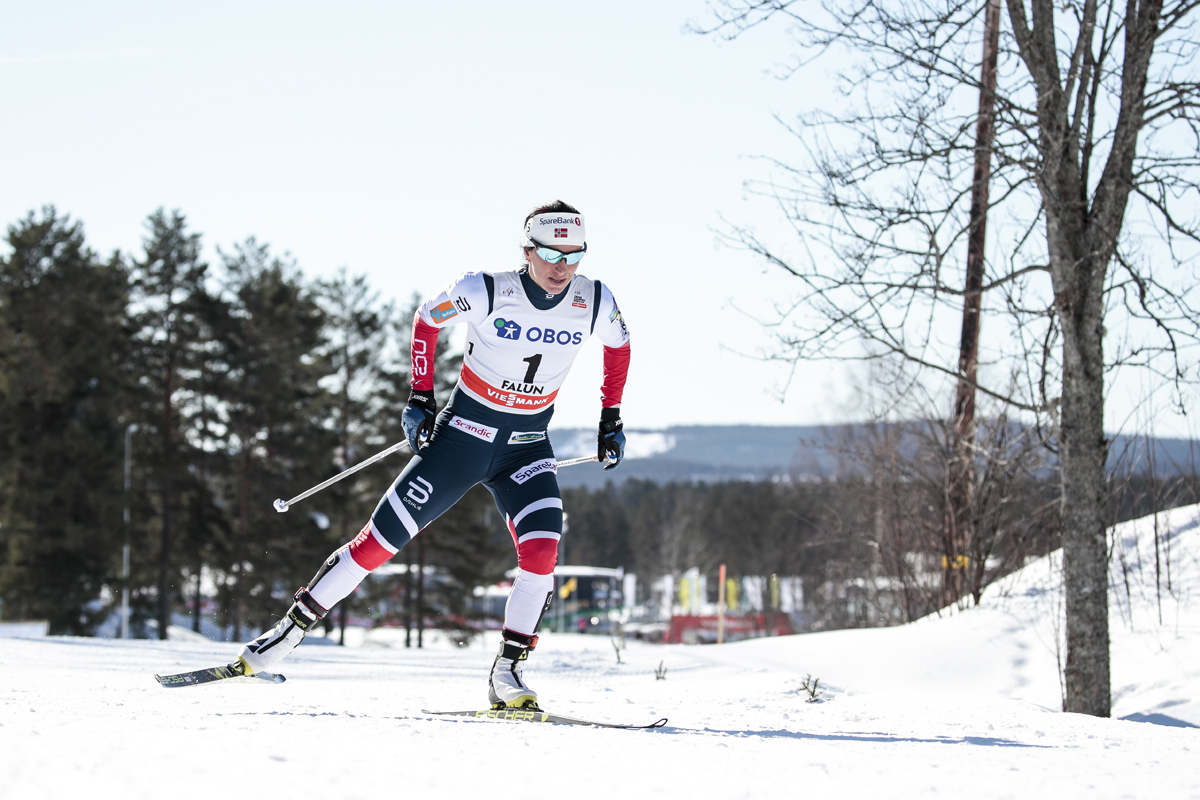
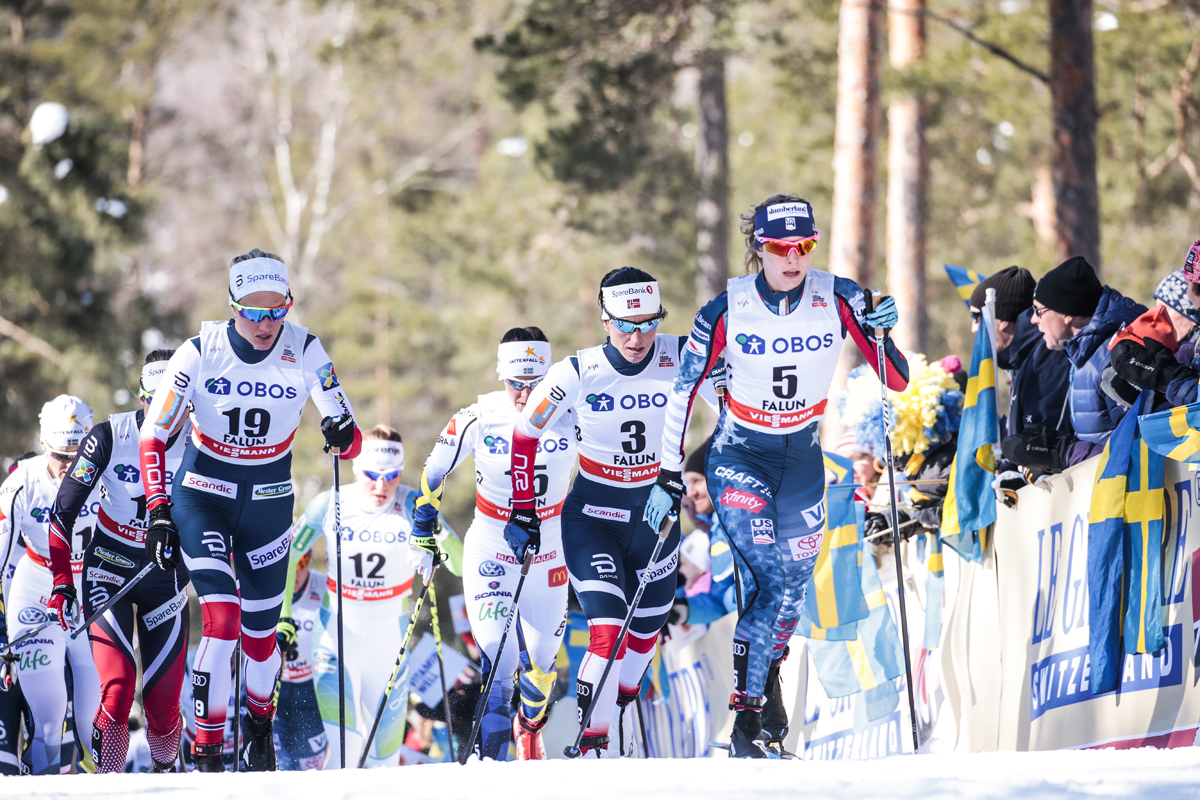
    Norway’s Marit Bjørgen leading off the front during the women’s 10-kilometer freestyle pursuit on Sunday at World Cup Finals in Falun, Sweden. (Photo: Fischer/NordicFocus) (Photo: Fischer/Nordic Focus)

    After catching Østberg, Diggins led the Norwegian and eventually dropped her by 17 seconds at 3.75 k. On Bjørgen, she had gained just over five seconds in time. By the 5 k mark, Diggins was a little less than 30 seconds back, and had put 13.4 more seconds into the race leader.

    “I was grateful to feel so good today,” Diggins told FasterSkier. “We had amazing skis and that was really important. Especially on a course with so much gradual climbing and gradual working downhills, you needed to have good skis, and our techs delivered. And they gave us the tools we needed to have a good day.”

    At the 7.5 k mark, 20 seconds separated the American from the win. By the time Diggins crossed the finish line in second, she was 16.7 seconds behind Bjørgen. The effort from Diggins gave her the fastest time of day in 23:54.4 minutes, which was 24.5 seconds faster than Bjørgen’s time.

    “It’s a sport of patience,” Diggins said. “I feel like I’ve been coming into my own with the confidence to know that any race I start, I can be trying to fight for the podium and racing like I can win. Instead of racing like, ‘Oh, I’m going to try to just see what I can do,’ it’s like, ‘No, I’m going to try to win.’ ”

    But Diggins was not the only American hunting and holding off Norwegians. Her U.S. teammate Sadie Bjornsen, who had gone out hot in Saturday’s race in hopes of a podium, earned it on Sunday in a sprint finish for third (+1:11.5) between herself and Norway’s Ragnild Haga and Astrid Uhrenholdt Jacobsen.

    In the finishing stretch, Bjornsen, Haga and Jacobsen had gone head to head, with the American outlunging Haga — the gold medalist from this year’s Olympic 10 k state — by exactly half a second and beating Jacobsen by 1.3 seconds for the final spot on the podium.
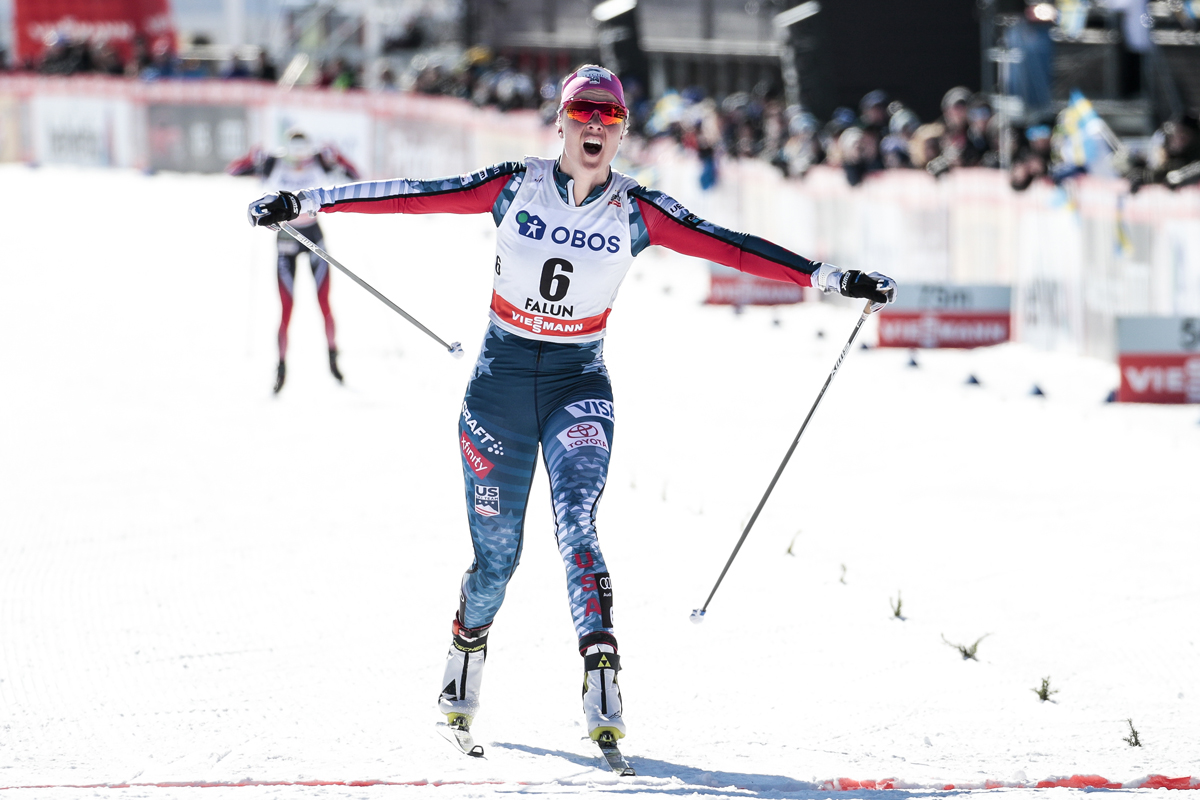
    American Sadie Bjornsen earning third in the women’s 10-kilometer freestyle pursuit on Sunday at 2018 World Cup Finals in Falun, Sweden. (Photo: Fischer/NordicFocus)

    “Coming into the final stretch I was like, ‘OK, that is the last time you get to do the final stretch this year and make it count,’ ” Bjornsen told FasterSkier. “It ended up working out for me, and that turned into quite the dream day.

    “I think the step I made this year is one step closer to being in a place where Jessie is racing right now,” Bjornsen continued.  “To have a teammate who is just pushing the bar just every single day and making me believe that in order to be the best racer in the world, you have to have no fear. Jessie is a great example of that and it is certainly contagious.”

    On Sunday, Bjornsen had started 21 seconds behind Østberg and 29 seconds ahead of Haga. By 7.5 k Haga had caught the group battling for third, which included Bjornsen, Finland’s Krista Pärmäkoski, Østberg, Sweden’s Charlotte Kalla, and Jacobsen. The group stayed together until the downhill back toward the stadium. 

    “I was like, ‘OK, I have to be smart here and keep pushing the pace hard enough that we do not get caught from behind, but conserve for that final sprint and then when I came into the sprint lap,’ ” Bjornsen reflected.

    Along with being a podium threat in Sunday’s race, the Americans are also gunning full-speed ahead toward the top three in the overall, sprint or distance World Cup standings. On Friday, Sophie Caldwell of the U.S. claimed third in the season-long Sprint World Cup. On Sunday, Diggins stood on the podium in second in the Overall World Cup and third in the Distance World Cup.

    “We are really showing that we are a skiing nation, and it’s taken so many years and so much hard work from a lot of people, but I think it’s so cool to show that we can be in the fight,” Diggins said.
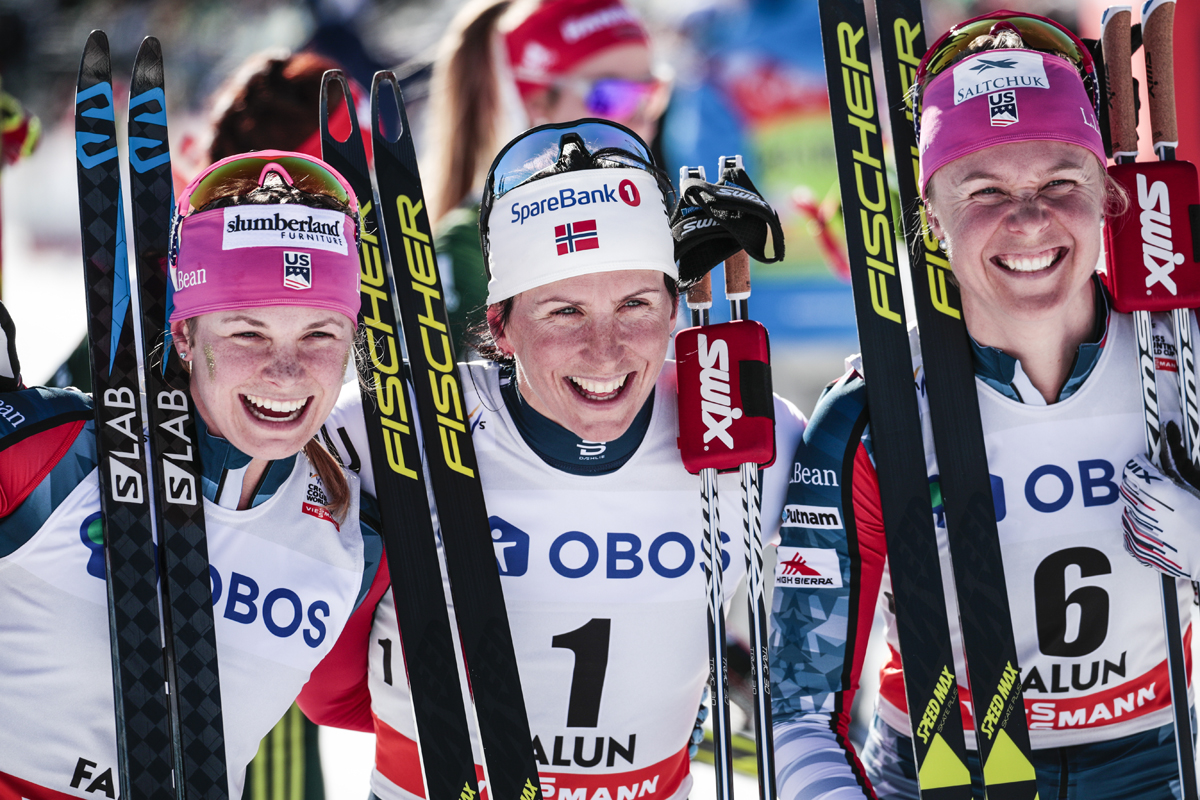
    The women’s 10 k freestyle pursuit podium on the last day of 2018 World Cup Finals in Falun, Sweden, with Norway’s Marit Bjørgen (c) in first, and Americans Jessie Diggins (l) and Sadie Bjornsen (r) in second and third, respectively. (Photo: Fischer/NordicFocus)

    Its been a many year goal of ours to be ranked in the top three for the womens team and we secured that for the first time today,” U.S. Ski Team Women’s Coach Matt Whitcomb told FasterSkier of his team’s best-ever Nations Cup ranking.  “Weve come into [past] finals, I believe, ranked third and then come out of finals ranked fourth. Weve been fifth. And I think as an entire team, men and women combined, … I think weve finished fifth, which would be exceptional. It was really quite an achievement for both our mens and womens teams.

    Whitcomb was right; the U.S. Ski Team placed fifth in the Nations Cup.

    In the decade leading up to the past two World Cup seasons, podiums from American women peppered the circuit, but predominantly in sprints. Kikkan Randall holds most of those, having recorded 28 individual podiums before 2016, only five being in a distance greater than 2 k. Sophie Caldwell broke through with a third-place sprint finish in 2014.

    American Liz Stephen had also reached the World Cup podium four times in distance races prior to 2016 — twice outright and twice for time of day.

    From 2016 on, the number of podiums that have gone to U.S. women has only increased. Caldwell earned three podiums this season alone. Diggins has racked up a total of 14 individual World Cup podiums since her first (which was also a first place) in 5 k freestyle in Toblach, Italy, in 2016. Bjornsen now has a total of five podiums over the course of two seasons. Stephen added two more to her name, one time of day and one outright, and Randall another top three in this past December’s Davos sprint. 

    Whitcomb was quick to point out that much of this success, started with U.S. Ski Team veterans Randall and Stephen, who skied the last World Cup races of their careers on Sunday. Randall finished the race in 43rd (+4:33.3) with the 29th-fastest time of day, and Stephen 50th (+4:57.2).

    “Honestly I start crying every time I think about it,” Whitcomb said, referring to the fact that Randall and Stephen will be retiring after this season. “Its been a day that I have feared for my whole career, basically since I started working with Kikkan and Liz, really since they started working with us.

    “I know we are not saying goodbye forever, but definitely we are saying goodbye in a certain capacity to two of the most important people that have ever set foot on the U.S. Ski Team,” he added.

    The two spoke with Fasterskier after their last race together, perhaps fitting as Stephen joined the team in 2006, only a year after Randall. The pair have worked with Whitcomb for the past 12 years.

    “As your whole career flashes before your eyes, it’s the people that are the best part,” Randall, 35, said.

    In their career final World Cup race on Sunday, both Randall and Stephen donned unicorn headbands, pink arm warmers and spandex boyshorts inscribed with the words “Thank You!!” across the backend. During their pre-race morning run, they felt something was missing and made a spur-of-the-moment stop at a store to purchase a few “costume pieces” for the race. Their outfits sparked smiles as they completed the race, and there was no denying the message they hoped to send off as they departed the ski-racing world: the energy and enthusiasm of a strong team.

    (Article continues below)
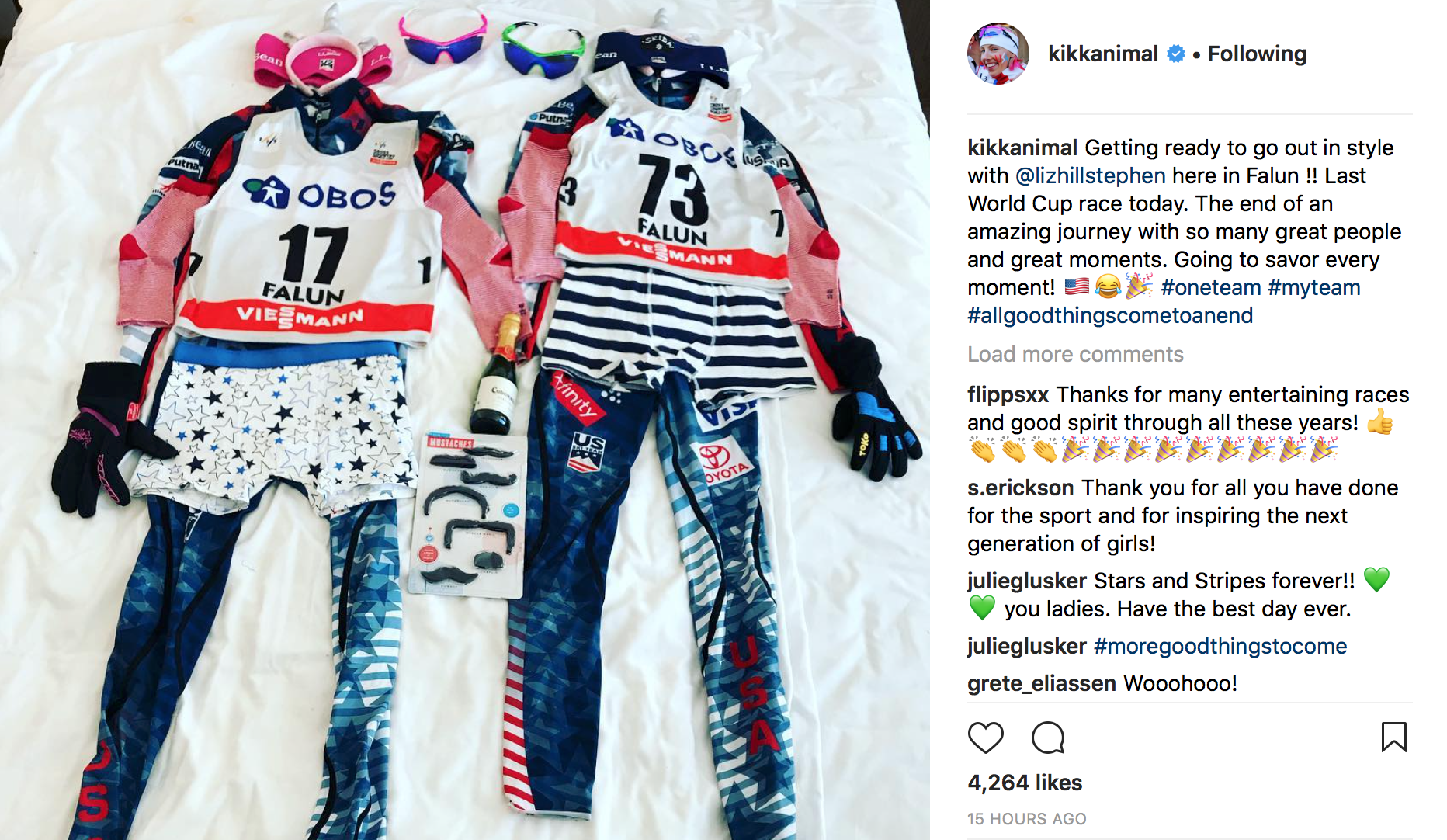
    The last-race outfits worn by Kikkan Randall and Liz Stephen for Sunday’s World Cup Finals pursuit. (Photo: Kikkan Randall/Instagram)

    “We are all most proud of the team we built,” Randall said. “To see it at such a good point and to know just because we are leaving the scene doesn’t mean it’s going away; these girls are going to continue to carry the torch, the young girls coming in.”

    “I would second that,” Stephen, 31, said. “One of the main things was that we wanted to leave a program that sustain itself, and I think that we both feel very happy and confident that that is going to happen. Like Kikkan said, Jessie won more points this year alone than we used ever see in an entire season men and women combined, you know, 10 years ago, and so I think that is a testament of the success that we have been able to create for one another.”

    Both Randall and Stephen were also given the opportunity to take a victory lap after the race, alongside Finland’s Aino-Kaisa Saarinen and Sweden’s Anna Haag, who sported a Disney Princess bath towel as a superhero cap, as well as a bejeweled crown (in an interview with FasterSkier, Haag explained the outfit had not been coordinated with the Americans, but was rather a coincindence. The Americans and Swedish skier are longtime friends and shared a nonalcoholic-champagne beverage in the finish area after the race).

    “I certainly wasn’t expecting a send-off like that,” Stephen said. “That was really special, that the four of us were able to do that together.”

    “I have done this 20 years … and I have raced my goals and even more,” Saarinen told FasterSkier. “Actually this skiing family is the thing what I’m going to miss the most.”

    Also racing for the U.S. on Sunday, Caitlin Patterson finished the pursuit in 35th (+3:58.4) with the 22nd-fastest time of day, Caldwell finished in 36th (+4:00.7), Rosie Frankowski 46th (+4:41.3), Kaitlynn Miller 56th (+6:13.8), and Ida Sargent 57th (+7:06.4).

    “It’s been a really unexpected good season, and I am really happy with it,” Miller said. “Today was awesome seeing Sadie and Jessie finish out the World Cup season like that.”

    The Canadians were led by Cendrine Browne, who finished 39th (+4:14.4) with the 27th-fastest course time, followed by Emily Nishikawa in 48th (+4:43.7), Dahria Beatty in 54th (+6:04.3) and Zina Kocher in 60th (+9:28.4). 

    “I love the course, it is perfect for me,” Browne wrote in an email to FasterSkier. “Steep up hills and one skate sections are what I prefer best! I was suprised yes!!! All season I was trying so hard to get into the top 30. Maybe I was trying to hard and putting to much pressure on myself. Today, I decided to have fun and to forget everything and it just happened!”

    “I am really happy about my season even if it was filled with so many emotions,” Browne continued. “Going to the Olympics and placing 33rd at my first Olympic race is definitely a highlight. Also, my 36th place in Holmenkollen is a huge accomplishment for me. Even if I fell twice and should have been in the top 30, it was an awesome race. And today’s 27th place is definitely the best thing that happened this season. Finishing the season like this fills my heart with joy and hope for next season.”

    ***
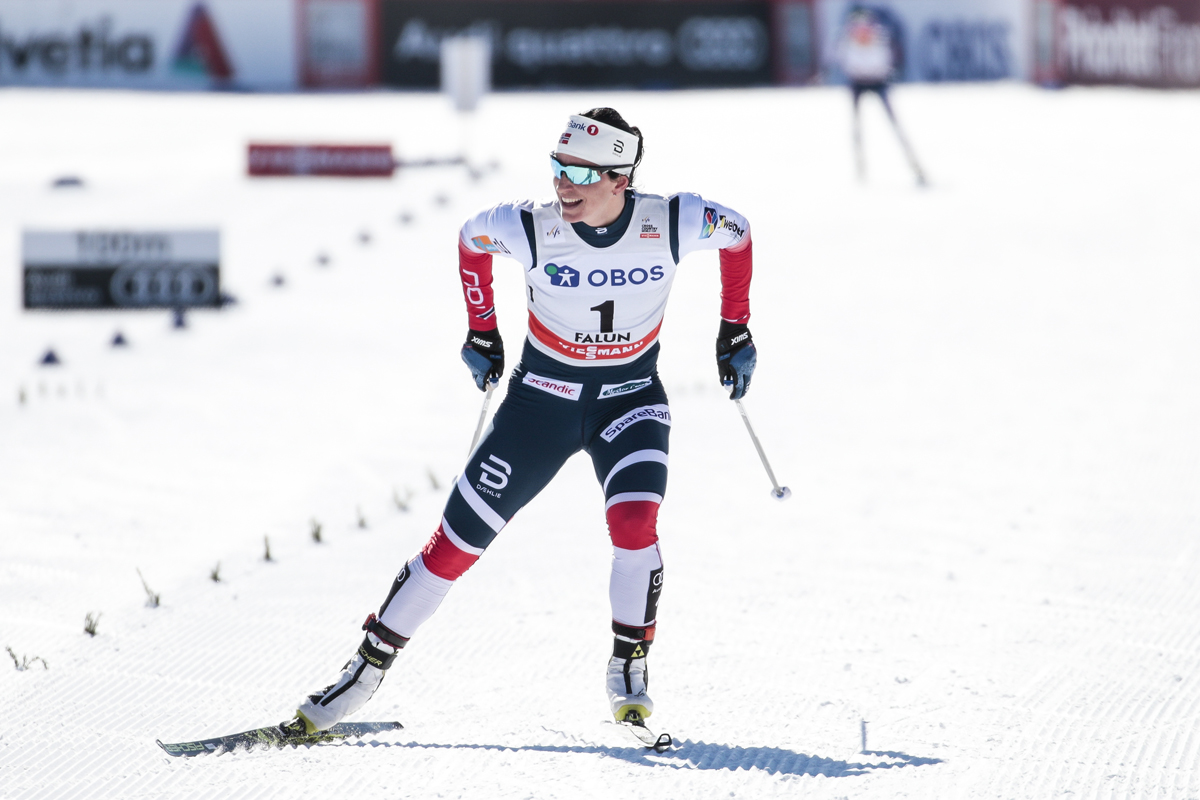
    Norway’s Marit Bjørgen finishing first in the women’s 10 k freestyle pursuit at 2018 World Cup Finals in Falun, Sweden, while American Jessie Diggins (in background) chases for second place. (Photo: Fischer/NordicFocus)

    Notes: While there has been a lot of discussion about retirements, Bjørgen isn’t saying it’s over. 

    “I want to finish [the season] in a good way, but I think I’ve been at my very best. I’ve passed it [my peak],” Bjørgen said in a loosely translated interview with NRK on Friday. 

    So will she race next winter? Bjørgen estimated she would need to train at least 850 hours if she wanted to compete with her teammate Therese Johaug, who will be returning to the World Cup next season.

     “It’s going to be a lot of training, and you have to prioritize a lot. That’s the toughest thing,” Bjørgen said. “But when I’m at work, it’s no problem. I’m here to do the job. Should I do one more year, I will not do it halfway [half-hearted].”


    ***

    Results: Pursuit | Overall Standings | Distance Standings | Mini-Tour Standings

  • Sunday Rundown: Diggins and Harvey 2nd, Bjornsen 3rd in Falun Pursuit; Dunklee 3rd in Oslo (Updated)

    Sunday Rundown: Diggins and Harvey 2nd, Bjornsen 3rd in Falun Pursuit; Dunklee 3rd in Oslo (Updated)

    Norway’s Marit Bjørgen celebrates her overall win in the last race of 2018 World Cup Finals, the 10 k freestyle pursuit, on Sunday in Falun, Sweden. (Photo: Svenska Skidspelen/Instagram)

    FIS Cross Country World Cup Finals (Falun, Sweden): 10/15 k freestyle pursuits

    Men’s report

    In the last women’s race of the World Cup season, U.S. Ski Team members Jessie Diggins and Sadie Bjornsen made it one they’ll remember for a long, long time as Diggins raced to second in the 10-kilometer freestyle pursuit and Bjornsen outlasted two Norwegians for third. The two finished the World Cup Finals mini tour in second and third, respectively, behind Norway’s Marit Bjørgen who won it in 24:18.9 minutes.

    Bjørgen started with a 36-second cushion to her Norwegian teammate Ingvild Flugstad Østberg in second. Diggins started third, 41 seconds back, just ahead of Finland’s Krista Pärmäkoski in fourth (+43.0), based on their cumulative performances over the last two days of the mini tour (skate sprint and 10 k classic mass start).

    While Østberg, Diggins and Pärmäkoski formed a chase pack, Diggins dropped them in pursuit of Bjørgen on the first lap. The American continued to push the pace throughout the three-lap race, coming within 16.7 seconds of Bjørgen at the finish.

    Meanwhile, during the pursuit, a chase group of five, which included Bjornsen, caught Østberg and Pärmäkoski. The group of seven dwindled to three on the last two climbs, where Bjornsen and Norway’s Astrid Uhrenholdt Jacobsen and Ragnhild Haga broke away in a race for third.

    The three were even entering the finishing stretch, where Bjornsen then beat them in a final 100-meter push to the line. Bjornsen claimed third (+1:11.5) for her fourth podium of the season and first in a distance skate race. Haga followed in fourth (+1:12.0) and Jacobsen fifth (+1:12.8), while Pärmäkoski placed sixth (+1:16.2), Sweden’s Charlotte Kalla seventh (+1:17.9), Østberg eighth (+1:19.0), Sweden’s Jonna Sundling ninth (+1:30.5) and Ebba Andersson 10th (+1:44.7).

    Bjornsen now has five-career individual World Cup podiums to her name, and this is the first in a skate race longer than 5 k.

    Diggins clocked the fastest time of day in 23:54.4, while Haga was second-fastest (+10.7) after starting the race in 17th. Bjørgen’s time ranked third, Jacobsen was fourth-fastest and Bjornsen fifth-fastest.

    Diggins’s performance elevated her to second in the Overall World Cup standings, just 40 points behind Norway’s Heidi Weng (who placed 18th in the pursuit) in first for the second-straight year. Østberg slipped to third overall, 22 points behind Diggins. In the Distance World Cup, Weng took the title by 63 points over Østberg in second, while Diggins was another 32 points back in third.

    Bjornsen ended up sixth in the Overall World Cup and 10th in the distance standings.

    Also for the U.S., Caitlin Patterson raced from 46th at the start to 35th (+3:58.4) with the 22nd-fastest time of day, Sophie Caldwell placed 36th (+4:00.7), Kikkan Randall finished her last World Cup race in 43rd (+4:33.3) with the 29th-fastest time, Rosie Frankowski placed 46th (+4:41.3), Liz Stephen 50th (+4:57.2) in her final World Cup race, Kaitlynn Miller 56th (+6:13.8), and Ida Sargent 57th (+7:06.4).

    For Canada, Cendrine Browne picked off 10 places to finish 39th (+4:14.4) with 27th-fastest time of day, Emily Nishikawa finished 48th (+4:43.7), Dahria Beatty 54th (+6:04.3), and Zina Kocher 60th (+9:28.4).

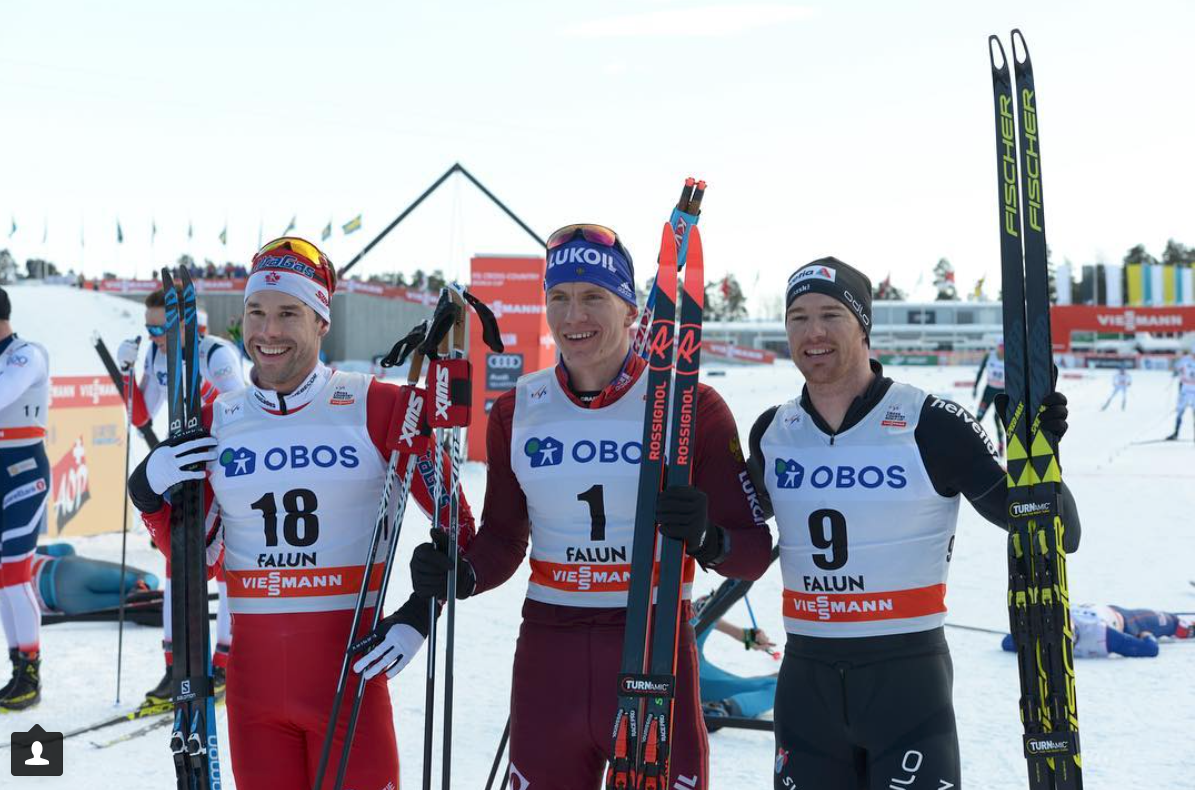
    The men’s 15 k freestyle and 2018 World Cup Finals podium, with Russia’s Alexander Bolshunov (c) in first, Canada’s Alex Harvey (l) in second and Switzerland’s Dario Cologna (r) in third. (Photo: Svenska Skidspelen/Instagram)

    In the men’s 15 k freestyle pursuit that followed, Russia’s Alexander Bolshunov started 38 seconds clear of Norway’s Johannes Høsflot Klæbo in second, and Sweden’s Calle Halfvarsson and Italy’s Federico Pellegrino headed out together another second later in third and fourth, respectively.

    Norway’s Martin Johnsrud Sundby started the race in seventh (+53.0), and Switzerland’s Dario Cologna followed in ninth (+56.0), while Canada’s Alex Harvey started 1:16 back in 18th.

    While Bolshunov skied the entire race on his own and won the weekend mini tour in 35:03.3, a number of racers battled for second, with Sundby moving into second in the chase pack, ahead of seven others, less than 2 k in. Several skiers found themselves at the front of that group, including Cologna, Halfvarsson, and even Harvey (with Harvey leading the chase at 9.3 k), while the time gap to Bolshunov grew.

    With about 2 k to go, the group was down to six. Harvey attempted an attack, but Cologna matched him. Then, on one of the course’s final climbs, Cologna made his move to get a slight gap, but lost his balance slightly on the downhill, allowing Harvey to catch back up.

    With one last uphill to go, Harvey was in the driver’s seat in second, Cologna in third and Sundby in fourth. That order held to the finish, with Harvey claiming second, 47.1 seconds behind Bolshunov, Cologna placing third (+47.5) and Sundby fourth (+48.7). Just behind them, Russia’s Maxim Vylegzhanin crossed in fifth (+50.3), ahead of Norway’s Hans Christer Holund in sixth (+51.7), Halfvarsson in seventh (+54.1), and Norway’s Sjur Røthe in eighth (+54.9). Nearly 10 seconds later, Norway’s Niklas Dyrhaug outlunged two Russians for ninth (+1:04.1): Denis Spitsov in 10th (+1:04.2) and Andrey Larkov in 11th (+1:04.3).

    Harvey, who finished the season in fourth in both the Overall and Distance World Cup standings, won the time of day in 34:34.3. Holund had the second-fastest course time, 1 second off Harvey’s time, after starting the race in 22nd.

    Harvey’s Canadian teammate Devon Kershaw tallied his fifth-straight distance top 30 in 28th (+2:21.9), after starting 27th, and Graeme Killick finished 56th (+4:33). Julien Locke did not start.

    For the U.S., Erik Bjornsen clocked the 22nd-fastest time en route to 38th (+3:10.4), after he started 51st. Simi Hamilton improved 10 places to finish 49th (+4:07.8), Scott Patterson and Paddy Caldwell worked together to move up from 72nd and 73rd, respectively, to 58th (+4:41.5) and 59th (+4:41.6), respectively, at the finish. Kevin Bolger placed 60th (+4:43.5) and David Norris 64th (+5:09.8).

    While Klæbo slipped from second to 25th in the pursuit (+1:45.8), the Norwegian still won his first Overall World Cup by 119 points over Cologna in second. Sundby placed third, 29 points out of second and 82 points ahead of Harvey.

    Cologna claimed the Distance World Cup Crystal Globe by 41 points over Sundby, and Holund reached the Distance World Cup podium in third, 58 points out of second and just 5 points ahead of Harvey in third. France’s Maurice Manificat had been third heading into the final day of racing, but finished the pursuit in 26th (+2:11.9) and dropped to fifth in the final distance rankings.

    Results: 

    Women: Pursuit Time of day | Final Overall World Cup rankings | Final Distance World Cup rankings

    Men: Pursuit | Time of day | Final Overall World Cup rankings | Finals Distance World Cup rankings

    ***

    IBU World Cup (Oslo, Norway): Women’s pursuit + men’s relay

    Women’s pursuit report | Julia Ransom retires 

    Men’s relay report

    In her last race of the season, Susan Dunklee returned to the podium. The American started fourth in Sunday’s 10-kilometer pursuit at the International Biathlon Union (IBU) World Cup in Oslo, then made her way into third by the final shooting stage. Dunklee shot 18-for-20 (1+0+1+0) and finished 29.5 seconds behind the winner, Darya Domracheva of Belarus, who missed two targets as well (1+0+1+0) and finished first in 30:37.4. Slovakia’s Anastasiya Kuzmina started the race in first (ahead of Domracheva in second) and ended up second (+9.2) with four penalties (0+2+2+0).

    Canada’s Julia Ransom and Rosanna Crawford finished together in 51st and 52nd, respectively, both 4:52.4 out of first. Ransom had four penalties (0+1+1+2) while Crawford missed five (1+3+1+0). Emma Lunder did not finish.

    In the men’s 4 x 7.5 k relay on Sunday, Norway’s team of Lars Helge Birkeland, Henrik L’Abee-Lund, Tarjei Bø, and Johannes Thingnes Bø used just three spare rounds to clean eight shooting stages and took the win in 1:13:13.7 hours. Austria finished 50.3 seconds back in second place, with Dominik Landertinger, Felix Leitner, Simon Eder, and Julian Eberhard, with a total of five spares. Russia’s Maxim Tsvetkov, Anton Babikov, Dmitry Malyshko, and Anton Shipulin raced to third (+56.9) with just four total spares.

    The U.S. men placed seventh (+2:01.5) with eighth spares, after Lowell Bailey put the team in seventh on the first leg. Sean Doherty skied them up to sixth on the second leg, Tim Burke slipped to 10th on the third leg, and Leif Nordgren posted the seventh-fastest anchor leg to put them in seventh at the finish.

    Canada placed 16th (+5:42.4) with Christian Gow, Scott Gow, Brendan Green, and Macx Davies. The team had been in 19th at the final exchange, but Davies skied them up to 16th with the 14th-fastest anchor leg. In all, they used 10 spares.

    Results: Women’s pursuit | Men’s relay

  • Pärmäkoski Wins Another 10 k Classic; Diggins 8th, Bjornsen 11th in Falun

    Pärmäkoski Wins Another 10 k Classic; Diggins 8th, Bjornsen 11th in Falun

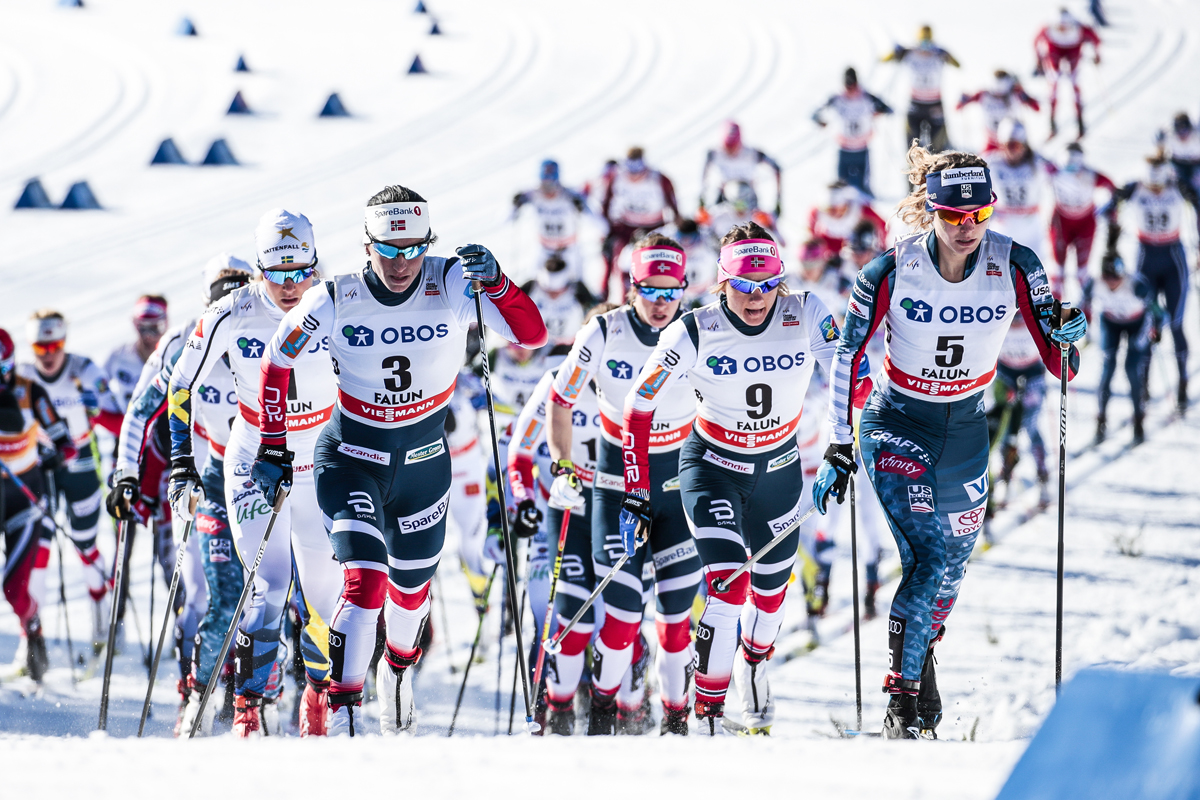
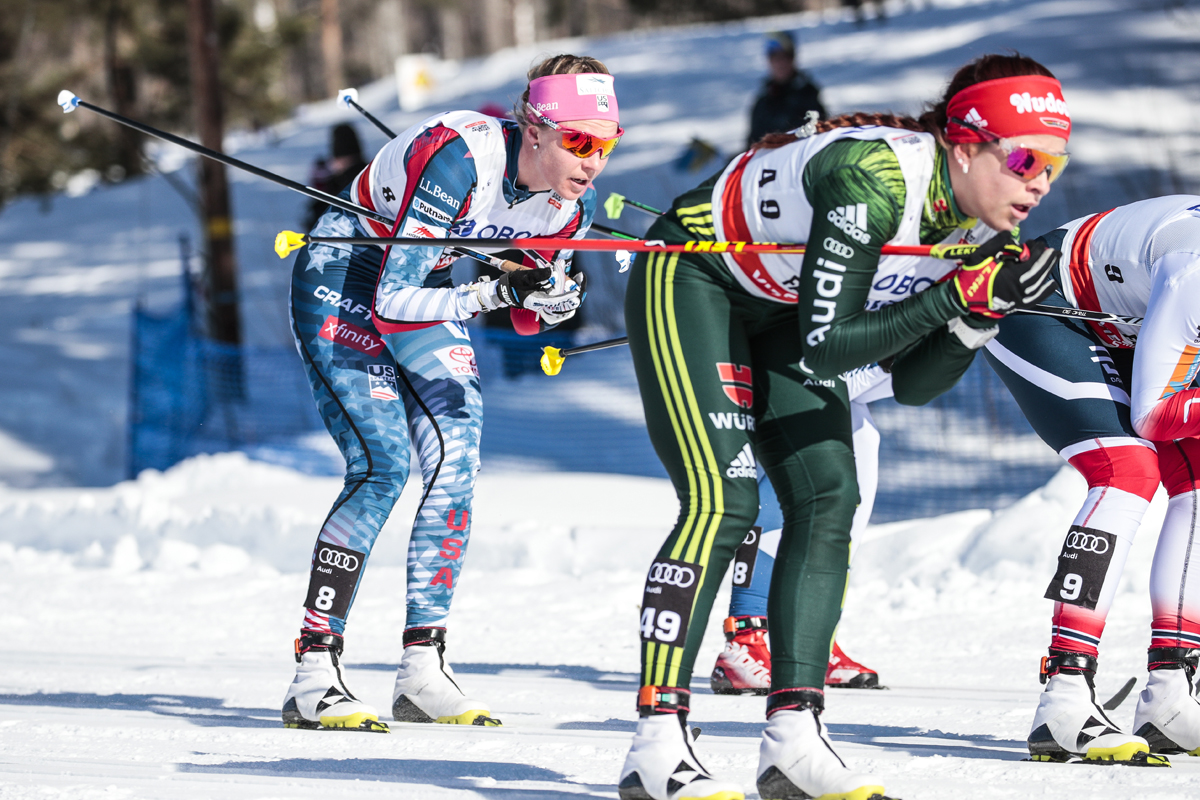
    American Jessie Diggins (5) and Norway’s Marit Bjørgen (3) and Maiken Caspersen Falla lead early in the women’s 10 k classic mass start at World Cup Finals in Falun, Sweden. (Photo: Fischer/NordicFocus)

    FALUN, Sweden — To those watching, even to those racing, the winner was the woman who had led most of Saturday’s 10-kilometer classic mass start: Norway’s Marit Bjørgen.

    “Marit and Tiril [Udnes Weng], another Norwegian young girl, they were skiing really fast and I thought that they would be first and second,” Norway’s Ingvild Flugstad Østberg told FasterSkier after the race.

    Seven minutes after the start gun, Bjørgen had moved to the apex of the field and there she seemed intent to stay.

    No doubt, the 37-year-old Norwegian holds a close relationship with the 10 k classic event. Over the course of her World Cup career, she has amassed 31 podiums in the distance/discipline, 16 of those being in first place.

    Last year in Lahti, Finland, Bjørgen was crowned the 10 k classic world champion, and she also holds the 10 k classic World Championships title from 2011.  At the 2006 Olympics in Turin, Italy, she earned silver in the 10 k classic event. The next time a 10 k classic was featured at the Olympics, in 2014 in Sochi, Russia, she finished fifth.  

    With substantial backing, Bjørgen seemed well on her way to another 10 k classic win at 2018 World Cup Finals on Saturday in Falun. Finland’s Krista Pärmäkoski may have not looked like a real threat — until the finishing stretch.

    In the corner before the final 100 meters, Pärmäkoski pulled up just behind Bjørgen. Just two kilometers earlier, the Finn had been skiing two seconds off of the Norwegian’s pace.

    Backtracking to the race’s halfway mark, Pärmäkoski had been even farther behind Bjørgen. Three seconds had separated the chase pack from Bjørgen and Tiril Udnes Weng, who led the race at 5 k. At that point, Sweden’s Charlotte Kalla had been spearheading the charge to close down the gap, while Pärmäkoski skied in fifth, almost one second back from Kalla and four seconds back from Bjørgen.

    Even earlier in the race, when Bjørgen made her move to the front at 3.75 k, Pärmäkoski, who had started in bib 32, was 19 places out of first.

    “I had to start so much behind the others,” Pärmäkoski told FasterSkier, referring to her bib number, which was based on her finish in the opening race of the World Cup Finals, Friday’s freestyle sprint.

    “But my body worked very well today … and I had really good grip and glide [with] my skis,” Pärmäkoski continued. “I passed the other athletes when we got to the downhill, the long downhill.”

    By the descent heading back toward the stadium, Pärmäkoski had passed Tiril Udnes Weng and moved around Kalla. Close to two seconds stood between her Bjørgen and Østberg, the latter of which had moved into second at the 7.5 k mark.

    “I didn’t dare to look back and see how many girls were keeping up with [us] in front,” Østberg said.

    If she had looked back, she would have seen the Finn firing on all cylinders.

    By the descent back toward the stadium, Pärmäkoski had caught Østberg and hunted her next Norwegian. She closed in on Bjørgen in the corner just before the finishing stretch.  Fifty meters to go and Pärmäkoski pulled up just alongside Bjørgen.

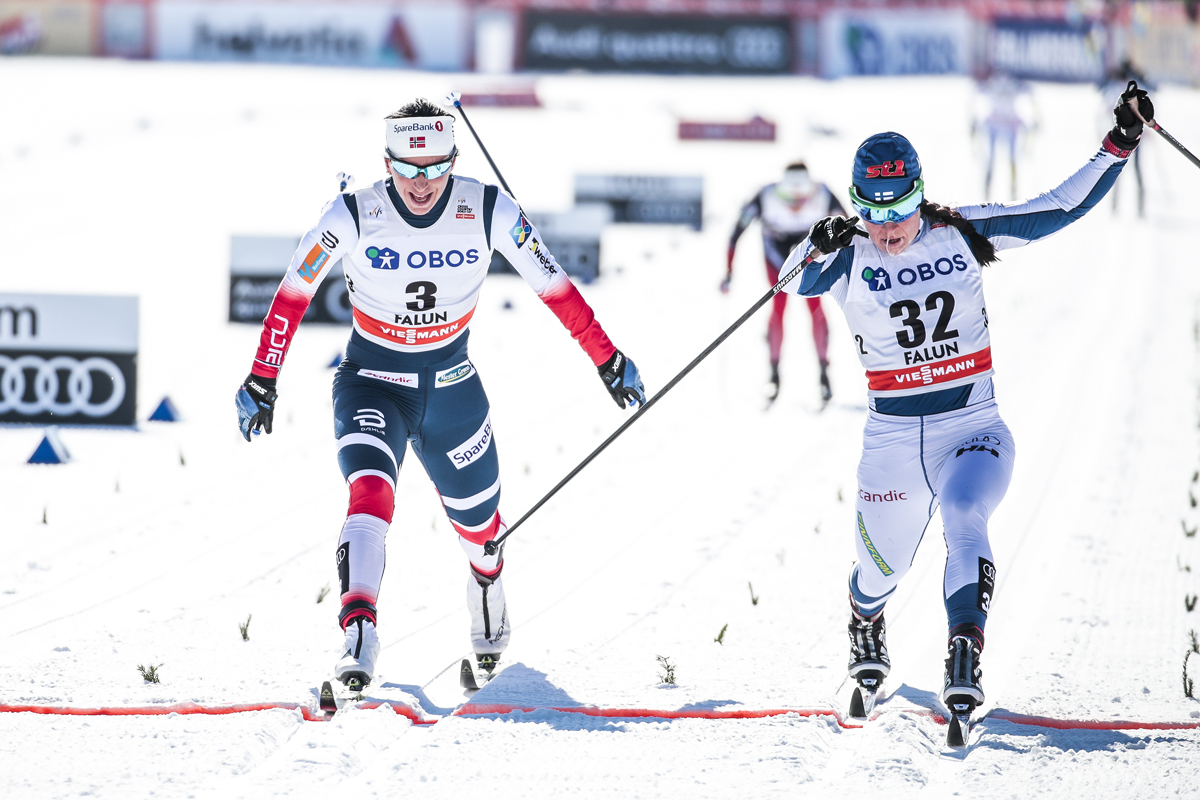
    Finland’s Krista Pärmäkoski (32) edges Norway’s Marit Bjørgen for the win in the women’s 10 k classic mass start at 2018 World Cup Finals in Falun, Sweden. (Photo: Fischer/NordicFocus)

    The two approached the finish line in tandem. Pärmäkoski, however, was stronger in the final double-pole push and nabbed the win by just 0.2 seconds over Bjørgen in a time of 26:00.5 minutes. Bjørgen took second behind the Finn in a time of 26:00.7.

    “I thought that maybe I was stronger than her and I feel that I was doing a good finish, but she was stronger than me,” Bjørgen told FasterSkier, referring to the sprint finish between Pärmäkoski and herself.

    “I thought Marit was gonna take it on the last 100 meters, but Krista was too strong,” said Østberg, who finished 5.1 seconds back in third.

    The win is Pärmäkoski’s third 10 k classic title in a row this season. Her first came in Planica, Slovenia –which was also her first World Cup win — and her second came two weekends ago in front of a home crowd in Lahti.

    For Østberg, the World Cup podium was her first since January.

    “It’s been a while since I’ve been on the podium individually, in an individual race, so I was just so happy that I managed to finish in third place,” Østberg said.

    Less than 10 seconds behind her, a pack of five surged to the finish line, with Sweden’s Ebba Andersson crossing in fourth (+14.5), Japan’s Masako Ishida fifth (+14.8), Kalla in sixth (+15.2), Austria’s Teresa Stadlober in seventh (+15.4) and American Jessie Diggins in eighth (+15.5). Exactly 1 second separated the five-skier spread, with Diggins bookmarking the tail end.

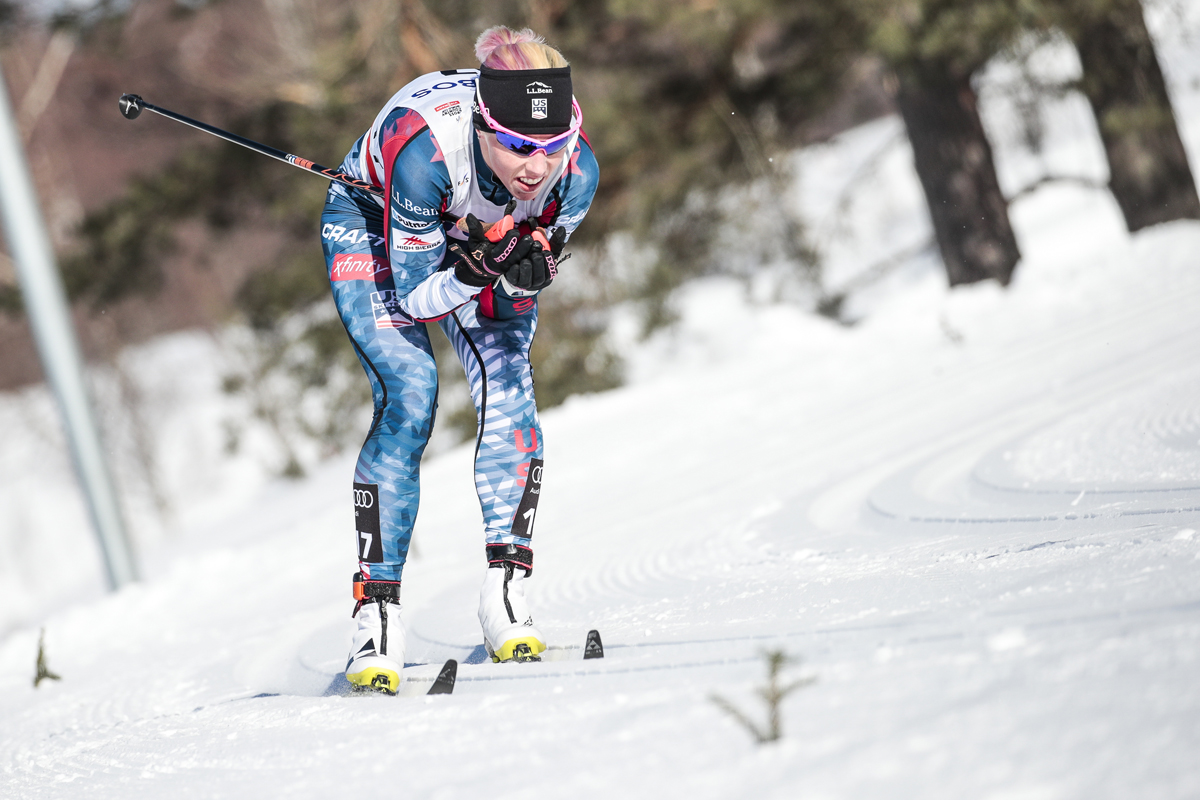
    American Jessie Diggins leading the pack up an early climb with Norway’s Kathrine Rolsted Harsem and Marit Bjørgen just behind during the women’s 10 k classic mass start at World Cup Finals in Falun, Sweden. (Photo: Fischer/NordicFocus)

    “I was a little bit bummed I didn’t quite have the same feelings in my body that I’ve been having,” Diggins told FasterSkier. “It wasn’t a bad race at all … I just was struggling to find that last gear. I know it’s there because it was there in the sprint yesterday. So I am just going to go hard tomorrow and see what I can do.”

    Bjørgen currently leads the World Cup Finals mini tour and will be the first skier on course in Sunday’s 10 k freestyle pursuit. Starting 36 seconds after her will be Østberg in second, then Diggins, 41 seconds back in third.

    In the Overall World Cup standings as well, Diggins ranks third with 1226 points. The American is 106 points behind Østberg in second and 213 points behind Norway’s Heidi Weng in first. At most, with a win, Diggins could score 200 points on Sunday. Behind her, Pärmäkoski is 112 points back in fourth.

    An Olympic gold medal already achieved and a couple other firsts to her name this season (last weekend, she became the first American woman to podium in a 30 k Holmenkollen), Diggins’ drive is for a personal best on Sunday.

    “I am just excited to keep pushing hard and see if I can break through and get some new firsts for me,” Diggins told FasterSkier. “I am fighting for a good spot in the overall [World Cup] and in the overall distance [ranking] as well … it’s fun to try to do something new and definitely motivates me to keep fighting really hard. It kept me pushing for every second today.”

    Diggins is also third in the Distance World Cup standings, 64 points behind Østberg in second and 43 points ahead of Pärmäkoski in fourth.

    Rounding out the remainder of Saturday’s top 10 was Norway’s Astrid Uhrenholdt Jacobsen in ninth (+24.8) and Finland’s Kerttu Niskanen in 10 (+26.2). Just 0.1 seconds outside of the top 10 was American Sadie Bjornsen in 11th (+26.3).

    American Sadie Bjornsen skiing just behind Germany’s Katharina Hennig during the women’s 10 k classic mass start at 2018 World Cup Finals in Falun, Sweden. (Photo: Fischer/NordicFocus)

    This World Cup season has marked somewhat of a breakthrough season for Bjornsen, with the 28 year old earning her first distance podium and two classic sprint podiums.

    On Friday, she appeared to be pulling for a podium again. Bjornsen charged hard to the front of the pack in bib 8, three bibs back from Diggins, who led the first 2 k of the race before Bjørgen took over.

    When asked about the risk involved with taking such a race tactic and why she chose to do so, Bjornsen was thoughtful. Reflecting on her recent strong results in sprint qualifiers, she explained that she was testing “what can happen if I have no fear, if I have no fear of failing.”  

    “I keep trying to tell myself that in the distance races … any amount of fear really pulls you back from that podium potential. So this last week I made it a goal of mine to try to race from the gun and see if I can hang on,” Bjornsen said.

    With this being the final weekend of World Cup racing until next season, Bjornsen also saw it as an opportune time for her to try going out harder at the start. In a sense, test her pacing in an insular way.

    “It’s the best time of the year [for that],” Bjornsen said of a hot start. “You have nothing to lose. I definitely am fighting in the overall [World Cup] for places, too, but at the same time it’s not fighting for a podium. So if I absolutely explode, like I did today in the middle of the race, there is just no failing with that.

    “I am learning how to [ski in the front] this year and next year I’m ready to come back and take that risk more often,” she added.

    Bjornsen is currently ranked eighth in the Overall World Cup standings with 799 points. Ahead of her is Kalla in seventh (828), Bjørgen in sixth (835), and Stadlober fifth (836). In the distance standings, Bjornsen is 10th. She will start Sunday’s pursuit in sixth, 57.3 seconds after Bjørgen. 

    American Kikkan Randall tucking during the women’s 10 k classic mass start at 2018 World Cup Finals in Falun, Sweden. (Photo: Fischer/NordicFocus)

    Also competing for the U.S. on Saturday was Sophie Caldwell, who placed 41st (+1:36.1), Rosie Frankowski in 44th (+1:43.7), Caitlin Patterson in 47th (+1:54.8), Kikkan Randall in 57th (+2:34.1), Kaitlynn Miller in 64th (+2:50.7).

    In her final weekend of World Cup racing, Randall explained Saturday’s result was not quite where she hoped to be, partly as her body still felt the effects of Friday’s sprint effort.

    “I always just like to end on a good note feeling like I just really raced hard and [with] regards to the results, feel competitive,” she said. “Yesterday was more along those lines, today was just hard, but it’s still good to be up here. Such a beautiful day for racing, perfect temperature, good tracks, good skis.”

    Emily Nishikawa led Canada in 36th (+1:31.1), followed by Cendrine Browne in 50th (+2:05.7), Dahria Beatty in 61st (+2:46.6), and Zina Kocher in 69th (+6:12.0).

    Results | Mini Tour Standings Day 2 | Women’s pursuit start list 

    Overall World Cup standings Distance World Cup standings

  • Bolshunov Nabs First-Career World Cup Win, Controls Falun Mini Tour

    Bolshunov Nabs First-Career World Cup Win, Controls Falun Mini Tour

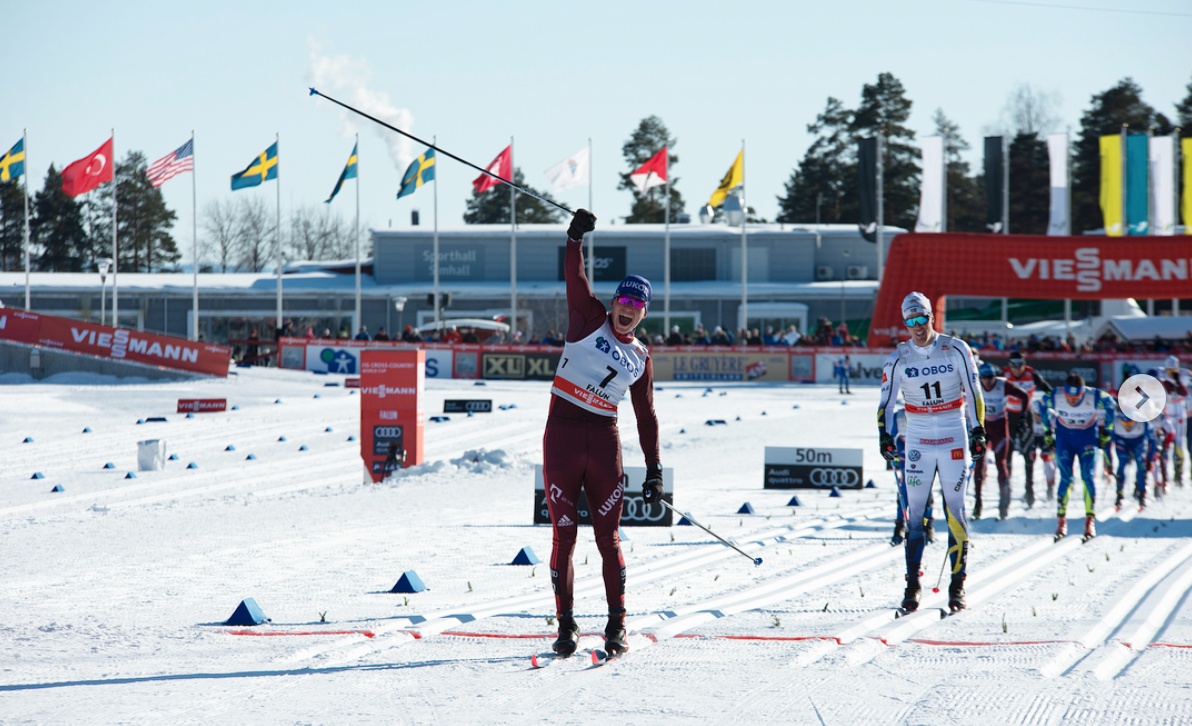
    Russian Alexander Bolshunov celebrates as he wins his first-career World Cup, a 15 k classic mass start, just ahead of Sweden’s Calle Halfvarsson (11) at 2018 World Cup Finals in Falun, Sweden. (Photo: Svenska Skidspelen/Instagram)

    Saturday was the second day of World Cup Finals mini tour, held in Falun, Sweden, which conclude the 2017/2018 season. Friday’s first stage began with a skate sprint, while Saturday featured a 15-kilometer classic mass start for the men.

    As the season is no longer young, the fitness for some athletes frayed, a mass start could offer the opportunity for some to hide in the pack and others to exploit. On a sunny and cold Saturday in Falun, the leading distance skiers on the World Cup were unable to separate. The terrain was World-Cup hilly, yet the pace was never decisive enough to shatter the field.

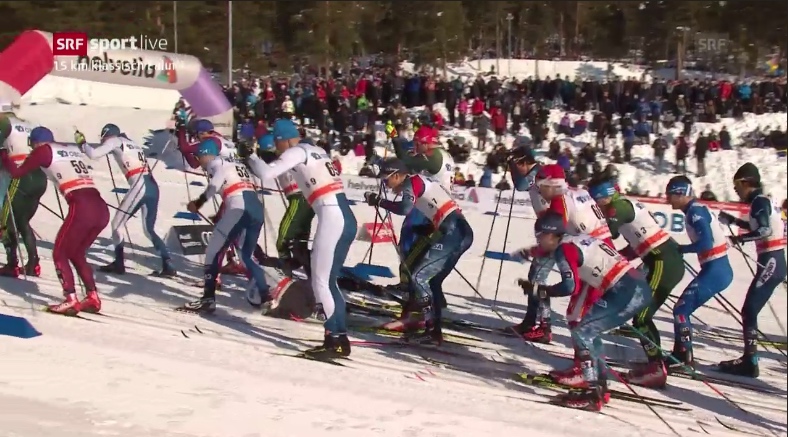
    That field was 91-skiers full. 182 poles. 182 skis. Churning from the start, only those skiers in the front rows of the start pyramid could pole and stride away unscathed. As is the nature of 91 skiers fighting for classic-track scarcity — the lanes taper down in number — pile-ups are the norm. So while some skiers like U.S. Ski Team members Erik Bjornsen and Scott Patterson lost time in a starting-scrum spill, others were looking for brighter opportunities up front.

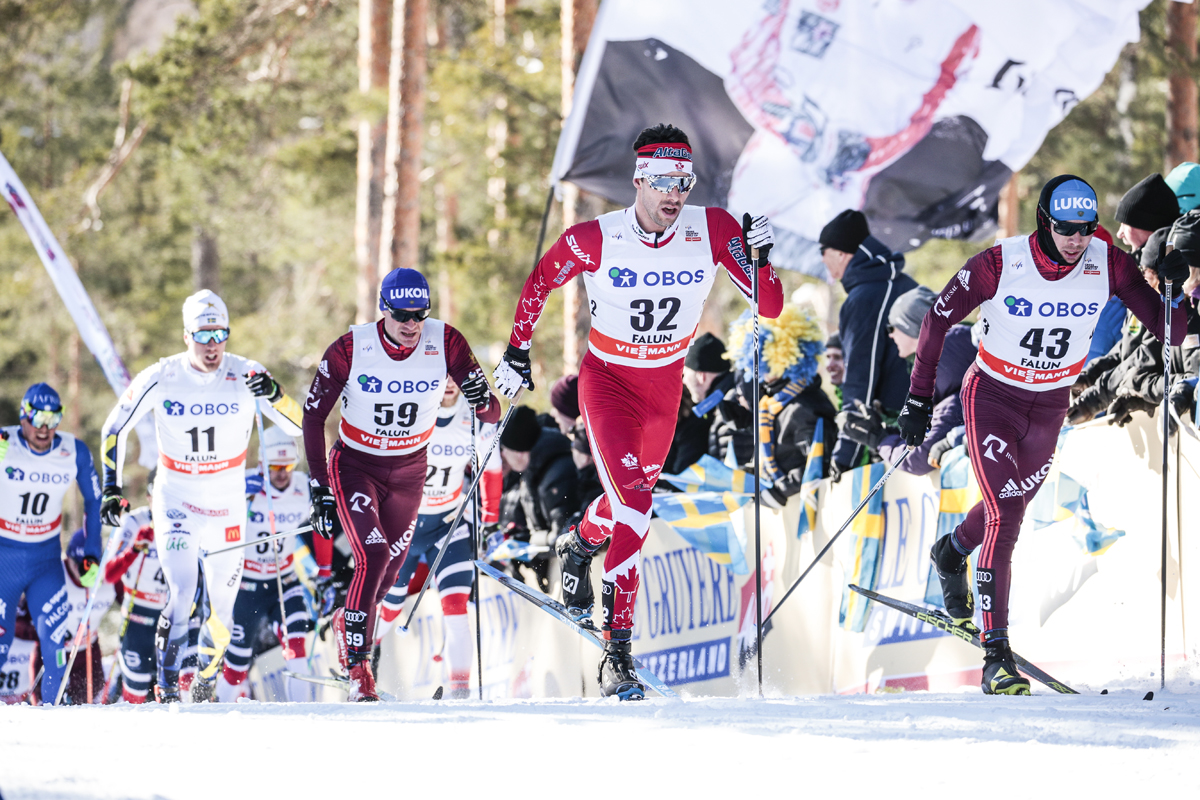
    Russia’s Alexey Chervotkin (43) and Canada’s Alex Harvey (32) lead another Russian Maxim Vylegzhanin 59), Sweden’s Calle Halfvarsson (11) and Italy’s Francesco De Fabiani (10) up a climb during the men’s 15 k classic mass start at World Cup Finals in Falun, Sweden. (Photo: Fischer/NordicFocus)

    From the start the pace was hot. There was Finland’s Iivo Niskanen, Sweden’s Emil Jönsson, Norway’s Johannes Høsflot Klæbo, Martin Johnsrud Sundby, Niklas Dyrhaug, Canada’s Alex Harvey, Kazakhstan’s Alexey Poltoranin, Russians Alexey Chervotkin and Alexander Bolshunov, and Swedes Calle Halfvarsson and Marcus Hellner, all in either a strung-out or condensed formation 3.75 k into the race. Skiers were slowly slipping off the back. But even with the surging up front, the tactics playing out appeared to place a premium on safety in numbers.

    Bolshunov surged at 4.5 k to snag the highest-value time bonus. Otherwise, for much of the race, identifying specific skiers was a task in itself. Coming down the hills a third through the race, the top-50 skiers were a sinuous and continuous line separated by 17.7 seconds. At the bottom of climbs, the compressive part of the accordion effect was in play. Skiers in front could push, those behind became a more dense cluster of lycra-clad athletes.

    Despite the prevalent pulsing of pace, skiers like Chervotkin and Harvey had their moments of pluckiness. Each paced a long line of skiers through the 9.3 k mark. But clear at this point was that the pattern of this race would be defined by the collective mass of skiers that began the mass start. Yes, time gaps would balloon a bit by the finish, but at 12 k (the second time bonus), a gap of 1.7 seconds separated first through 35th place.

    The move that mattered in this race came from the birthday boy, Halfvarsson. According to FasterSkier’s reporter on the ground, the Swedish crowd serenaded Halfvarsson, 29, with a happy birthday rendition prior to the start. Maybe it was birthday stoke, maybe it was an acknowledgment that with age comes fewer opportunities to seize the win, but with one kilometer to go, Halfvarsson ran like Klæbo. Up and over the hill, the Swede forged a small gap on the 30-plus chasers.

    Again on the last short incline before the speedy descent into the stadium, Halfvarsson performed a masterful high-step run. Only Bolshunov at this point could suck up near the Swede’s tails. For a moment, rounding into the final straight, it looked like Halfvarsson’s icing on his birthday cake would be a Falun stage win.

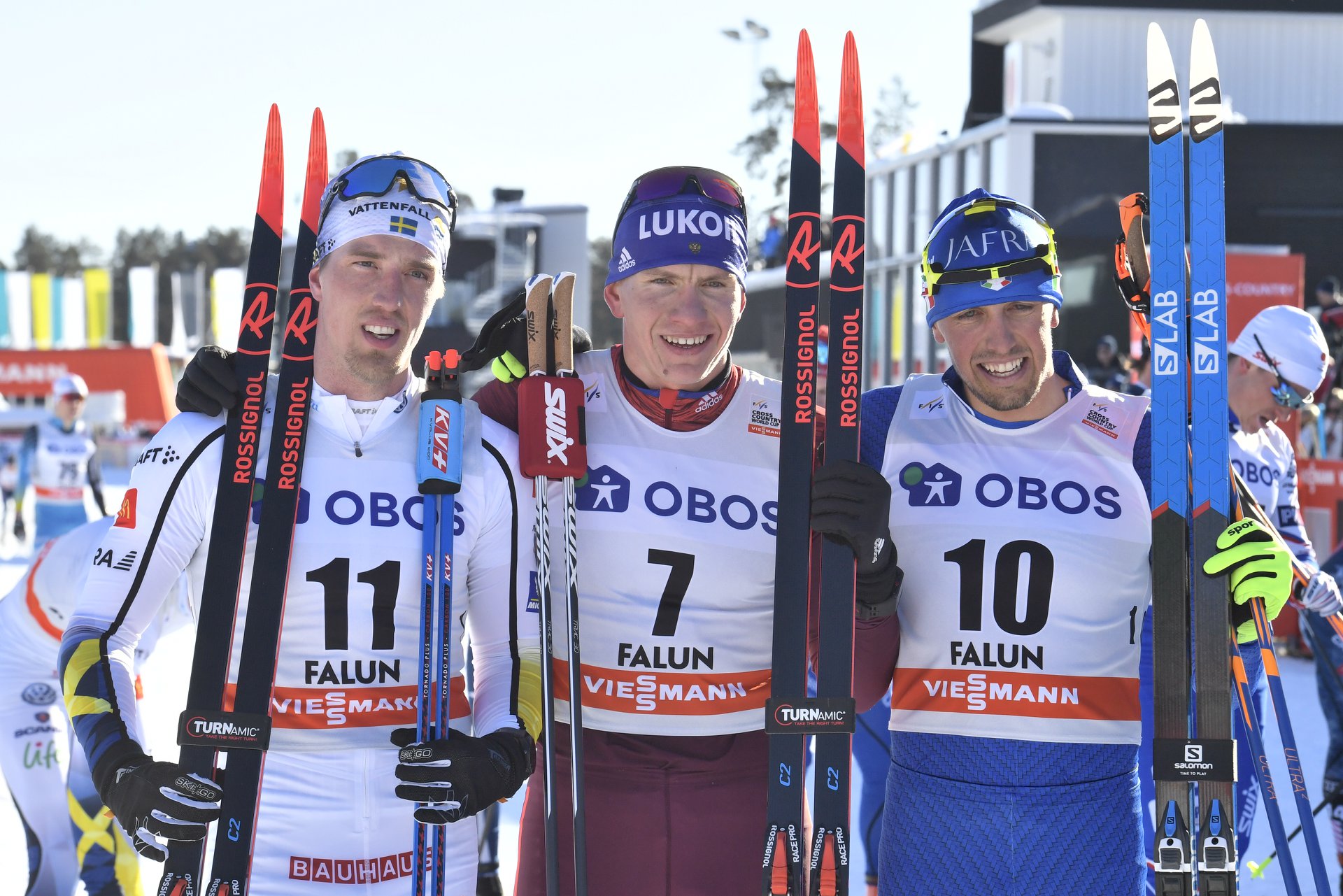
    The men’s 15 k classic mass start podium at 2018 World Cup Finals in Falun, Sweden, with Russia’s Alexander Bolshunov (c) in first, Sweden’s Calle Halfvarsson (l) in second, and Italy’s Francesco De Fabiani (r) in third. (Photo: FIS World Cup Svenska Skidspelen/Facebook)

    Halfvarsson came into the straight out of the tracks. As he zeroed in to begin the double-poling finish, the birthday boy stumbled slightly slotting into the nearest lane. Bolshunov flew by with a supreme double pole and took the win in 36:59.8. Halfvarsson placed second (+1.3), Italy’s Francesco De Fabiani third (+3.1), Poltoranin fourth (+3.7) and Chervotkin fifth (+5.2).

    For the 21-year-old Bolshunov, it was his first-career World Cup win. Prior to Saturday’s win, Bolshunov had stood on the podium six times in his first full season on the World Cup. (Bolshunov’s only World Cup start last season was in Drammen, Norway, in March 2017.) Along with Klæbo, also 21, Bolshunov has risen into one of the sport’s top athletes. He claimed three silvers and a bronze medal in PyeongChang. His two individual Olympic medals were a second in the 50 k classic mass start and third in the classic sprint.

    “I have had many second and third place finishes this season so I am very happy to finally have a win,” Bolshunov told the International Ski Federation (FIS) after the race. “This feels good. I will do what I can tomorrow for another good result but for now, I will enjoy this win.”

    Sunday’s final men’s race of the season and last race of the three-stage mini-tour, will be a 15 k freestyle pursuit. Bolshunov leads the mini-tour standings in first with a total elapsed time of 38:37 minutes. Klæbo, who finished 22nd (+13.6) on Saturday, sits in second (+38.0), while Halfvarsson is third (+39.2).

    The Swede took away the positives from the day’s near-win in front of the home crowd.

    I tried today to get a win but it was too much,” Halfvarson told FIS. “Off the final corner, I was really tired. I am still happy with second place. I have been on a podium a few times this season and always third. So at least second place is an improvement even if I didn’t manage the win.”

    Canada’s Alex Harvey was the best placed North American in 20th place (+10.7). He’ll begin Sunday’s pursuit in 18th (+1:16.1).

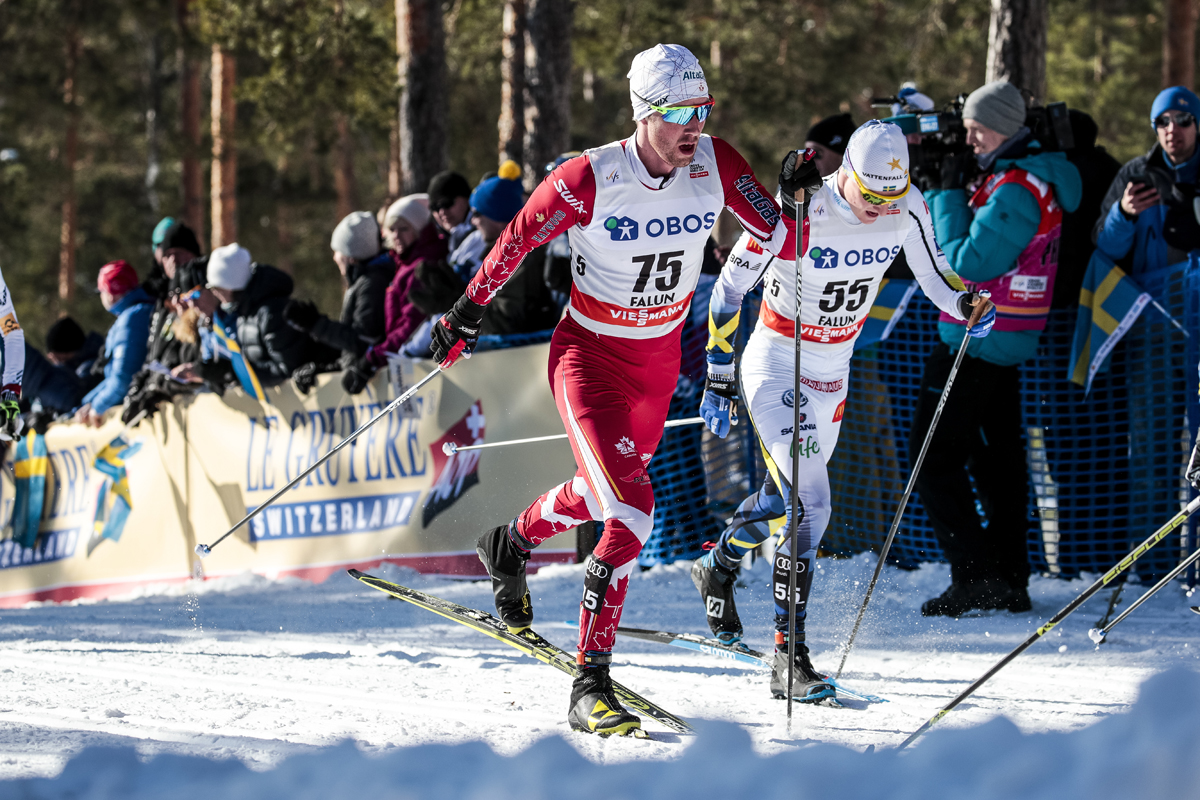
    Canada’s Graeme Killick (75) skiing with Sweden’s Jens Burman during the men’s 15 k classic mass start at World Cup Finals in Falun, Sweden. Killick went on to finish 41st. (Photo: Fischer/NordicFocus)

    Teammate Devon Kershaw finished 26th (+14.6) for his fourth-straight race in the top 30 (including his 26th-place finish in the Olympic 50 k classic). Graeme Killick placed 41st (+1:13) and Julien Locke was 81st (+3:29) for Canada.

    “I felt quite good today,” Kershaw said after the race. “I was a little disappointed with the last kilometer because I was kind of out of position a little bit after Mördarbakken and couldn’t quite get up through traffic, but it’s really close. And a little disappointed to be 26th again; it seems like that’s kind of where I’ve lived all year, but it was a good race for me.”

    Kershaw, a 35-year-old staple of the Canadian team, has been seeking a return to top form.

    “Just races like today where I feel good and can execute decently well,” Kershaw explained.
    “To be honest this year I am super motivated after the championship. I’ve [been] having major, major asthma issues at the Olympics and that really really affected me and it took a long time to get a little better, but I felt like by the time I got to Lahti I was feeling quite a bit better. So that really helps, I mean, I can breathe again and I’m feeling good.”

    Kershaw is expected to mull over the prospects of continuing his ski career in the coming weeks.

    “We’re not sure, I’ll talk to the wife next week [Norwegian former elite skier Kristin Størmer Steira],” Kershaw said of his future plans. “You know there’s a lot of issues right now in Canada so I’ll have to think about it. A lot of guys are saying that they’re gonna call it a day. And I’m not getting any younger, but I still feel quite good, and I mean a race like today shows that I can still compete with the best in the world so that’s motivating, but we’ll definitely have to take some weeks to think about it.”

    Nowhere to go: U.S. skiers Erik Bjornsen (bib 57) and Scott Patterson (bib 67) stuck in a pile-up after the start of the men’s 15 k mass start classic at World Cup Finals in Falun, Sweden. (Screenshot: SRF Sport broadcast)

    For the U.S., Erik Bjornsen finished 52nd (+1:47.1), Simi Hamilton 62nd (+2:06.4), Kevin Bolger 69th (+2:27.1), David Norris 70th (+2:31.2), Scott Patterson 71st (+2:40.6), Paddy Caldwell 75th (+2:52.7), and Andy Newell 86th (+4:47).

    Patterson’s race did not go as planned.

    “I was in a big pile-up right at the start,” Patterson told FasterSkier after. “I was the second-to-last one out of the stadium and then the first time up Mördarbakken, my ski fell off. So I skied halfway down, got my ski back on, just turned back around and then just like stupidly chasing the rest of the race. …

    “I felt OK,” Patterson added. “[Without] those two stupid things it would have been a good race. But I was so far off and then it was really hard to get back to the pack and then it was like, ‘Well, I can’t get to the pack. I am here with those guys.’ ”

    Lately, Patterson, 26, has been a highlight for the U.S. distance skiing prospects. The first-year U.S. Ski Team member notched three individual top-20 results at last month’s Olympics, including 11th in the 50 k classic. Last weekend in Oslo, Norway, Patterson proved that was no fluke, as he placed 16th in a traditionally deep field at the Holmenkollen 50 k skate.

    World Cup Finals conclude with 10/15 k freestyle pursuits on Sunday.

    Results | Falun mini-tour standings| Men’s pursuit start list

    — Gabby Naranja, Harald Zimmer and Alex Kochon contributed

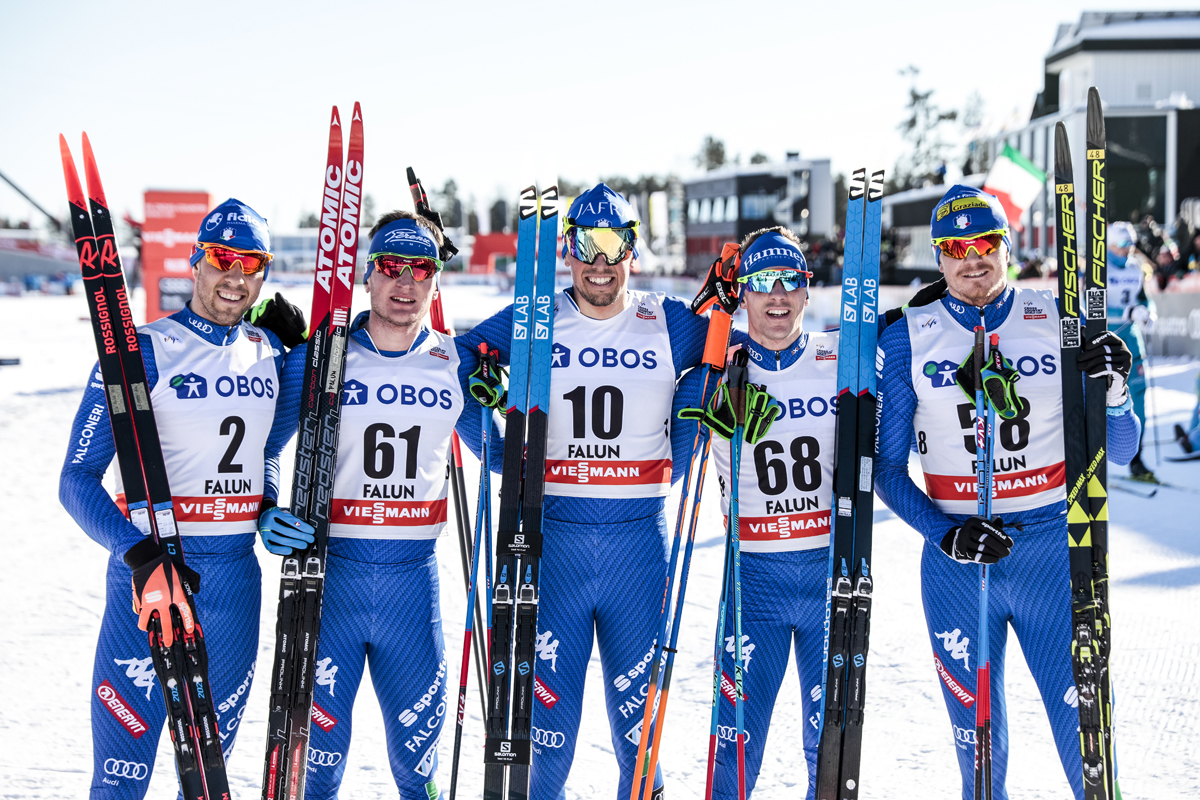
    The Italian men’s team after Saturday’s 15 k classic mass start at 2018 World Cup Finals in Falun, Sweden, with (from left to right) Federico Pellegrino, Giandomenico Salvadori, Francesco De Fabiani, Maicol Rastelli, and Dietmar Nöckler. (Photo: Fischer/NordicFocus)
  • Saturday Rundown: Pärmäkoski Beats Bjørgen in Falun 10 k Classic; Bolshunov Notches First Win

    Saturday Rundown: Pärmäkoski Beats Bjørgen in Falun 10 k Classic; Bolshunov Notches First Win

    The women’s 10 k classic mass start podium at 2018 World Cup Finals in Falun, Sweden, with Finland’s Krista Pärmäkoski (c) in first, Norway’s Marit Bjørgen (l) in second and Ingvild Flugstad Østberg (r) in third. (Photo: FIS World Cup Svenska Skidspelen/Facebook)

    FIS Cross Country World Cup Finals (Falun, Sweden): 10/15 k classic mass starts

    Women’s report

    Men’s report

    Day 2 of World Cup Finals in Falun entailed 10- and 15-kilometer classic mass starts on Saturday, and in the first race of the day, Finland’s Krista Pärmäkoski pulled out a thrilling finishing-sprint victory over Norway’s Marit Bjørgen.

    After American Jessie Diggins led early in the first 2.5 k loop, Bjørgen set the tone from the front for most of the race. With less than a kilometer to go, Norwegian powered up the final horseshoe-shaped climb in first, with Pärmäkoski and Bjørgen’s Norwegian teammate Ingvild Flugstad Østberg just behind her. The three had dropped the field while lapping through the stadium around the 7.5 k.

    While Østberg fell off the pace on that final uphill, Bjørgen accelerated as she took a few quick strides over the top, gaining a few meters on Pärmäkoski as they headed into the descent. The finishing stretch is long in Falun, and Pärmäkoski was able to come on strong just before she and Bjørgen entered the final 100 meters before the finish. There, Pärmäkoski’s double-pole speed not only matched Bjørgen, but beat her, as Pärmäkoski passed her with several meters to go and took the win by 0.2 seconds in 26:00.5 minutes. It was Pärmäkoski’s second win of the season and fourth of her career (including time-of-day pursuit stage wins).

    Just behind Pärmäkoski and Bjørgen, who congratulated each other immediately at the finish, Østberg finished 5.1 seconds back in third. Five women fought for fourth place, with Sweden’s Ebba Andersson taking it (+14.5) ahead of Japan’s Masako Ishida in fifth (+14.8), Sweden’s Charlotte Kalla in sixth (+15.2), Austria’s Teresa Stadlober in seventh (+15.4), and Diggins in eighth (+15.5).

    Norway’s Astrid Uhrenholdt Jacobsen was the next finisher across the line in ninth (+24.8), then Finland’s Kerttu Niskanen in 10th (+26.2) and American Sadie Bjornsen in 11th (+26.3).

    Canada’s Emily Nishikawa was the next North American in 36th (+1:31.1), and she led her teammates Cendrine Browne, who placed 50th (+2:05.7), Dahria Beatty in 61st (+2:46.6) and Zina Kocher in 69th (+6:12).

    For the U.S., Sophie Caldwell finished 41st (+1:36.1), Rosie Frankowski 44th (+1:43.7), Caitlin Patterson 47th (+1:54.8), Ida Sargent 52nd (+2:10.2), Liz Stephen 54th (+2:20.0), Kikkan Randall 57th (+2:34.1), and Kaitlynn Miller 64th (+2:50.7). Rosie Brennan did not start.

    The men’s 15 k classic mass start podium at 2018 World Cup Finals in Falun, Sweden, with Russia’s Alexander Bolshunov (c) in first, Sweden’s Calle Halfvarsson (l) in second, and Italy’s Francesco de Fabiani (r) in third. (Photo: : FIS World Cup Svenska Skidspelen/Facebook)

    In the men’s 15 k classic mass start on Saturday afternoon, Russia’s 21-year-old Alexander Bolshunov notched his first-career World Cup win after reaching the podium seven other times this season (placing third in six of those seven races).

    Bolshunov hung in the pack and took the lead at the start of the final lap at 11.25 k, ahead of four of his Russian teammates, Alexey Chervotkin in second, Evgeniy Belov in third, Andrey Larkov in fourth, and Maxim Vylegzhanin in fifth. Behind them, Switzerland’s Dario Cologna skied just ahead of Norway’s Martin Johnsrud Sundby and Canada’s Alex Harvey, who were among 29 skiers within four seconds of first.

    While Sweden’s Calle Halfvarsson led the final climb before the stadium, Bolshunov caught him on the downhill and out-double-poled him in the finishing stretch, taking first by 1.3 seconds in 36:59.8. Halfvarsson finished second and Italy’s Francesco de Fabiani scored his second World Cup podium of the season in third (+3.1).

    Kazakhstan’s Alexey Poltoranin missed the podium by 0.6 seconds in fourth (+3.7), Chervotkin followed in fifth (+5.2), ahead of Cologna in sixth (+5.6) and Italy’s Federico Pellegrino in seventh (+5.6), after they finished together. Sundby and his Norwegian teammate Niklas Dyrhaug also crossed the line at the same time in eighth (+6.3) and ninth (+6.3), respectively, just 0.1 seconds ahead of another one of their teammates, Sjur Røthe, in 10th (+6.4).

    Less than five seconds later, Harvey finished 20th (+10.7), ahead of Norway’s Johannes Høsflot Klæbo in 22nd (+13.6). Klæbo slipped out of contention on the third of four laps, as he dropped from fourth to 22nd in less than two kilometers.

    Canada’s Devon Kershaw finished 26th (+14.6) for his fourth-straight race in the top 30 (including his 26th-place finish in the Olympic 50 k classic mass start), Graeme Killick placed 41st (+1:13) and Julien Locke was 81st (+3:29).

    Erik Bjornsen was the top American man in 52nd (+1:47.1), Simi Hamilton finished 62nd (+2:06.4), Kevin Bolger was 69th (+2:27.1), David Norris 70th (+2:31.2), Scott Patterson 71st (+2:40.6), Paddy Caldwell 75th (+2:52.7), and Andy Newell 86th (+4:47).

    World Cup Finals conclude with 10/15 k freestyle pursuits on Sunday.

    Results: Women | Men

    ***

    IBU World Cup (Oslo, Norway): Women’s relay + men’s pursuit

    Women’s relay report

    Men’s pursuit report

    France won the International Biathlon Union (IBU) World Cup women’s 4 x 6 k relay to start the day at Holmenkollen, ahead of Germany and Italy, while the Canadian women’s team (Sarah Beaudry, Julia Ransom, Emma Lunder, and Rosanna Crawford) placed 11th and the U.S. (Clare Egan, Susan Dunklee, Joanne Reid, and Emily Dreissigacker) came back from 21st to finish 15th.

    In the men’s 12.5 k pursuit that followed, France’s Martin Fourcade won his 10th race at Holmenkollen, putting himself 49 points ahead of Norway’s Johannes Thingnes Bø with three individual races in Tyumen, Russia, remaining. US Biathlon’s Sean Doherty tied his second-best result this season in 17th and his teammate Lowell Bailey raced up to 28th with the 19th-fastest time of day. Leif Nordgren placed 40th and Tim Burke was 47th, while Canada’s Scott Gow finished 51st and Christian Gow was 54th.

    Results: Women’s relay | Men’s pursuit

  • Friday Rundown: Falk, Klæbo Win Last Sprint of Season in Falun; Caldwell 6th

    Friday Rundown: Falk, Klæbo Win Last Sprint of Season in Falun; Caldwell 6th

    Sweden’s Hanna Falk (r) smiles as she wins the fourth World Cup race of her career and first race in Falun, Sweden, with a victory in the women’s freestyle sprint at 2018 World Cup Finals on Friday. Her teammate Jonna Sundling (l) placed second while Norway’s Marit Bjørgen finished third. (Photo: Svenska Skidspelen/Instagram)

    FIS Cross Country World Cup Finals (Falun, Sweden): Freestyle sprints

    Women’s report

    Men’s report

    In the last sprint of the season and the first race of the three-day World Cup Finals in Falun, Sweden’s Hanna Falk and Norway’s Johannes Høsflot Klæbo won their respective 1.4-kilometer freestyle sprint finals, while Norway’s Maiken Caspersen Falla and Klæbo claimed the season-long Sprint Crystal Globes and Sophie Caldwell of the U.S. placed third in the Sprint World Cup.

    Falk started Friday by topping the women’s qualifier on home turf in 2:59.88 minutes, 1.65 seconds ahead of American Jessie Diggins, who qualified in second. Russia’s Natalia Nepryaeva qualified third (+2.73), while American Sadie Bjornsen raced to the fourth-fastest qualifying time (+2.96), ahead of Norway’s Marit Bjørgen in fifth (+3.72).

    Falk then won the first quarterfinal and first semifinal before taking control and dusting the field in the women’s final. She essentially led the final from start to finish, but slowed her pace and the five women behind her as she ascended the last climb. As she reached the 180-degree turn at the top, Falk launched into high gear, leaving the rest of the field chasing. Bjørgen was closest to her in second, but still several meters back, as they descended down into the stadium, and Falk skated away from her pursuers for her fourth-career World Cup win (and first victory in Falun) in 3:08.25. Sweden’s 23-year-old Jonna Sundling came on strong in the finishing straight for her first World Cup podium in second (+0.53), Bjørgen took third, and Sweden had three in the top four with Anna Dyvik in fourth (+1.72).

    Norway’s Silje Øyre Slind finished fifth (+4.3), and Caldwell, who had qualified for the heats in 16th then won her quarterfinal and advanced in third in the second semifinal, placed sixth overall (+6.99).

    Four American women posted top-20 qualifying times, with Kikkan Randall advancing as well in 18th. Diggins placed seventh overall after finishing third in the first semifinal, 0.42 seconds behind Falk in first and just 0.08 seconds behind Sundling, who advanced to the final in second.

    Bjornsen was ninth on the day after placing fifth in that semifinal, 0.85 seconds out of first. Randall finished 15th overall after placing third in her quarterfinal, 3.14 seconds behind Diggins, who won that heat.

    Also for the U.S, Ida Sargent missed the top 30 needed to qualify in 36th, as did Rosie Brennan in 49th, Caitlin Patterson in 63rd, Liz Stephen in 66th, Kaitlynn Miller in 69th, and Rosie Frankowski in 75th.

    Canada’s Emily Nishikawa placed 40th, Dahria Beatty was 48th, Cendrine Browne 60th, and Zina Kocher 71st.

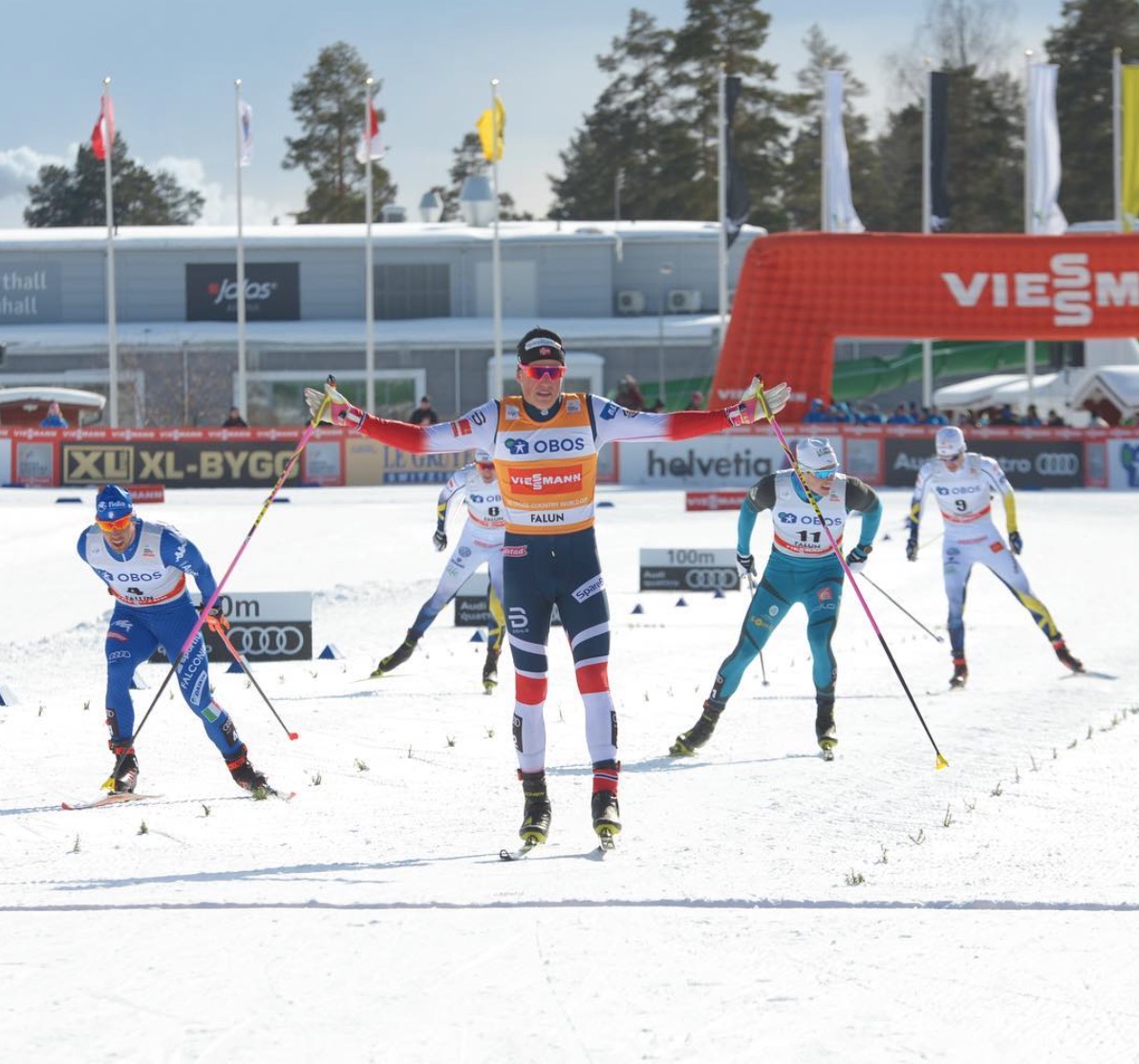
    Norway’s Johannes Høsflot Klæbo (yellow bib) celebrates his 11th World Cup victory of the season in the men’s freestyle sprint at 2018 World Cup Finals in Falun, Sweden, ahead of Italy’s Federico Pellegrino (l) in second and France’s Lucas Chanavat (11) in third. (Photo: Svenska Skidspelen/Instagram)

    In the men’s race, Russia’s Alexander Bolshunov qualified first in 2:36.23, 0.46 seconds ahead of Klæbo in second. Klæbo then won the first quarterfinal, first semifinal, and you guessed it, the final as well, backing off before crossing the finish line for the last time in 2:37.03.

    Italy’s Federico Pellegrino powered past France’s Lucas Chanavat in the finishing stretch of the final to claim second, 0.39 seconds behind Klæbo. Chanavat completed the podium in third (+1.76), Finland’s Ristomatti Hakola finished fourth (+3.26), and Sweden’s Oskar Svensson and Teodor Peterson placed fifth (+3.88) and sixth (+6.17), respectively.

    Two American men qualified for the heats, with Simi Hamilton advancing in 13th and Kevin Bolger in 29th. Hamilton went on to place 14th on the day after finishing third in the first quarterfinal, 0.61 seconds behind Klæbo. In his second-career World Cup sprint, Bolger placed 30th overall after finishing sixth in his quarterfinal, 2.21 seconds behind Peterson in first.

    In the overall Sprint World Cup, Klæbo took his second-straight title by a whopping 243 points over Pellegrino in second, while Falla won her third-straight Sprint Crystal Globe by 78 points over Sweden’s Stina Nilsson, who was out sick for Friday’s race. Nilsson joined her at the Sprint World Cup podium ceremony on Friday, as did Caldwell, who achieved her best overall sprint standing in third.

    Falla placed eighth overall on the day after being eliminated in the semifinals (she finished fourth behind Falk, Sundling and Diggins, respectively).

    For the U.S., Erik Bjornsen narrowly missed qualifying in 31st, Andy Newell placed 43rd, Paddy Caldwell was 60th, David Norris 84th, and Scott Patterson 87th.

    For Canada, Julien Locke placed 32nd, Alex Harvey 34th, Devon Kershaw 74th, and Graeme Killick 81st.

    Results:

    Women: Qualifier | FinalWomen’s Sprint World Cup (final standings) 

    Men: Qualifier | Final | Men’s Sprint World Cup (final standings)